WELCOME
TO
MY PRESENTATION
Md Shovo Mia
Trainer
E Learning & Earning Development : Rangpur
shuvohasan443@gmail.com
Today’s Session:
Job: Search Engine Optimization (SEO)
Learning Outcome:
At the end of the session, learners will be able
Search Engine Optimization (SEO) as per industry standards.
Structure of The Session
➢ Discussion
➢ Demonstration
➢ Review
➢ Feedback
➢ Link to the Next Session
Discussion
What Seo ?
SEO stands for Search Engine Optimization. It's a way of
making your website easier to find on search engines like
Google. When someone searches for something, SEO helps
your website show up higher in the results, so more people
visit it.
SEO is the process of improving a website's ranking in search engine
results pages (SERPs).
The goal is to increase organic (non-paid) traffic from search engines
like Google.
A higher ranking means more people will see and click on your website.
What is a search engine?
A search engine is a software program or a system
designed to help users find information stored on the
internet or within a specific database.
Search engines work by indexing and cataloging
content from various sources and then providing users
with a list of relevant results based on their search
queries
Types of search engine ?
➢ Crawler-Based Search Engines
➢ Specialized Social-Based Search Engines
Crawler-based search engines, like Google, Bing, and
Yahoo, use automated programs called "crawlers" or
"spiders" to systematically explore the web, find
pages, and add them to their index, which is then
used to generate search results
Specialized Social Based Search Engines:
Specialized social-based search engines focus
on finding information within social media
platforms, offering tools for market
research, influencer identification, and
content analysis. Like: YouTube Facebook
Tiktok.
How To work Search Engine Algorithms ?
Search engine algorithms work by crawling,
indexing, and ranking web pages based on various
factors to provide the most relevant and useful
results to users.
Crawling:
Search engines use programs called "spiders," "bots," or "crawlers"
to explore the internet and discover new web pages.
These crawlers follow links from one page to another, building a
vast database of web content.
Indexing:
Once a page is crawled, the search engine analyzes its content,
keywords, and other factors to understand its relevance and
categorize it.
This information is stored in a massive database called an "index,"
which acts as a directory of the web.
Ranking:
When a user performs a search, the algorithm
sifts through the index to find pages that match
the search query.
It then uses a complex set of factors to determine
the relevance and quality of each page, assigning a
ranking score.
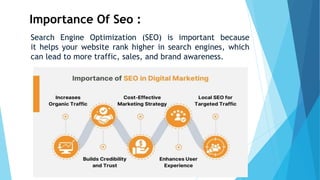
Importance Of Seo :
Search Engine Optimization (SEO) is important because
it helps your website rank higher in search engines, which
can lead to more traffic, sales, and brand awareness.
What Are the Types of SEO?
Three main types of SEO :
1. On-page SEO: Actions you take with website content to
improve rankings (for example, using relevant keywords).
2. Off-page SEO: Actions that happen outside your website
to improve rankings (for example, building backlinks).
3. Technical SEO: Actions on the technical side of your site
(for example, improving page speed).
Other type Of Seo:
Local SEO is a strategy that helps businesses improve their
visibility in local search results. ( Like: Google My Business
(GMB) Listing, Local Reviews,
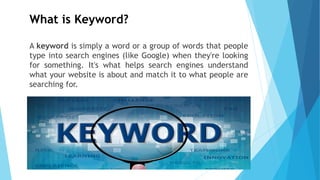
What is Keyword?
A keyword is simply a word or a group of words that people
type into search engines (like Google) when they're looking
for something. It's what helps search engines understand
what your website is about and match it to what people are
searching for.
Types Of Keyword Intent:
1. Informational
Informational keywords are search queries used by people who
want to learn something. Examples include:
❖ “Coffee calories”
❖ “National coffee day”
❖ “What is the difference between cold brew and iced coffee”
Many informational queries take the form of questions, starting
with words like “what,” “why,” or “how.” Google often displays
articles, videos, or guides for informational searches.
2. Navigational
Navigational keywords lead searchers to a specific site
or page. Typing a brand or website name into a
search engine is often a navigational query. Examples
include:
❖“Youtube”
❖“Semrush blog”
❖“Where is angelino’s coffee located”
Searchers already know the company or product and
want to reach a certain website or location.
3. Commercial
Commercial keywords help people research specific
products or services. They may check reviews, compare
options, or look for discounts. Examples include:
❖ “Free coffee”
❖ “Dunkin iced coffee flavors”
❖ “Peet’s cold brew vs starbucks cold brew”
Searchers with these queries often plan to buy soon.
Content such as comparisons, listicles, reviews, or how-to
articles can target these searches.
4. Transactional
Transactional keywords show the strongest intent to buy or complete an
action. Target these with ads and optimized product pages or landing
pages where users can act immediately. Examples include:
❖ “Buy crypto online”
❖ “Sandwich places near me that deliver”
❖ “Pickup truck for sale”
These searches usually occur after a person has finished researching and
is ready to purchase—that’s why they’re also called buyer keywords.
For example, “buy crypto online” leads to pages where users can buy
cryptocurrency directly.
According to length 2 type keyword
Short-tail keyword
A short-tail keyword, also known as a 'head term', is a
general search term that typically contains 1-3 words
and covers a broad topic. Short-tail keywords
generally have higher search volume than long-tail
keywords which means that they attract more
website visitors.
❖These are short and general keywords, usually 1-2
words.
❖Example: "smartphone"
According to length 2 type keyword
Short-tail keyword
A short-tail keyword, also known as a 'head term', is a
general search term that typically contains 1-3 words
and covers a broad topic. Short-tail keywords
generally have higher search volume than long-tail
keywords which means that they attract more
website visitors.
❖These are short and general keywords, usually 1-2
words.
❖Example: "smartphone"
Long-tail keyword
Long-tail keywords are longer, more specific searches that
users enter into search engines.
They usually have lower search volumes individually, but
collectively, they comprise a large percentage of overall
searches performed on Google.
Long-tail keyword Examples:
 Here are examples of long-tail keywords:
❖ Homemade coffee filters
❖ Can you warm up iced coffee
❖ Marketing agency for SaaS
❖ Enterprise marketing software
These keywords are longer and more specific—telltale
signs of long-tail keywords. They also have relatively low
search volumes, according to Semrush’s Keyword
Overview tool.
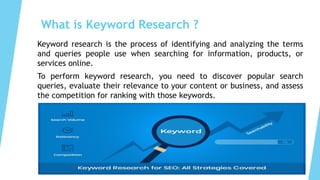
What is Keyword Research ?
Keyword research is the process of identifying and analyzing the terms
and queries people use when searching for information, products, or
services online.
To perform keyword research, you need to discover popular search
queries, evaluate their relevance to your content or business, and assess
the competition for ranking with those keywords.
Why is Keyword Research So Important?
Keyword research is crucial for several reasons, especially when it
comes to SEO (Search Engine Optimization) and content marketing.
Here's why it's so important:
1. Understand What People Want
Keyword research shows what words people use when they search online.
This helps you create content that answers their questions and matches
what they’re looking for.
2. Helps You Rank Higher
By choosing the right keywords, you can make sure your website shows
up in search results. The higher you rank, the more people will see your
site.
Why is Keyword Research So Important?
3. Create Better Content
Keyword research helps you find out what people are searching for.
This way, you can make content that’s helpful and interesting to
your audience, so they’re more likely to visit your site.
4. See What Your Competitors Are Doing
Keyword research lets you see which keywords your competitors
are using. This can help you find new ideas or areas they may have
missed.
5. Get More Conversions
By choosing keywords that show people are ready to take action
(like buying something), you can attract people who are more likely
to become customers or take the next step on your website.
Why is Keyword Research So Important?
6. Helps with Ads
If you’re running ads, keyword research helps you pick the best
words to make sure your ads reach the right people.
7. Target Specific Needs
Keyword research also helps you find longer phrases (called long-
tail keywords) that are easier to rank for and bring in more specific
traffic.
In short, keyword research helps you create content that people
actually want, gets more visitors to your site, and makes it easier
to rank higher in search results.
• Summary of the session
Link To The Next Session
❑ Website Audit / Competitor Research.
search engine optimization basic seo infromation

search engine optimization basic seo infromation

  • 1.
    WELCOME TO MY PRESENTATION Md ShovoMia Trainer E Learning & Earning Development : Rangpur shuvohasan443@gmail.com
  • 2.
    Today’s Session: Job: SearchEngine Optimization (SEO) Learning Outcome: At the end of the session, learners will be able Search Engine Optimization (SEO) as per industry standards.
  • 3.
    Structure of TheSession ➢ Discussion ➢ Demonstration ➢ Review ➢ Feedback ➢ Link to the Next Session
  • 4.
    Discussion What Seo ? SEOstands for Search Engine Optimization. It's a way of making your website easier to find on search engines like Google. When someone searches for something, SEO helps your website show up higher in the results, so more people visit it. SEO is the process of improving a website's ranking in search engine results pages (SERPs). The goal is to increase organic (non-paid) traffic from search engines like Google. A higher ranking means more people will see and click on your website.
  • 5.
    What is asearch engine? A search engine is a software program or a system designed to help users find information stored on the internet or within a specific database. Search engines work by indexing and cataloging content from various sources and then providing users with a list of relevant results based on their search queries
  • 6.
    Types of searchengine ? ➢ Crawler-Based Search Engines ➢ Specialized Social-Based Search Engines Crawler-based search engines, like Google, Bing, and Yahoo, use automated programs called "crawlers" or "spiders" to systematically explore the web, find pages, and add them to their index, which is then used to generate search results
  • 7.
    Specialized Social BasedSearch Engines: Specialized social-based search engines focus on finding information within social media platforms, offering tools for market research, influencer identification, and content analysis. Like: YouTube Facebook Tiktok.
  • 8.
    How To workSearch Engine Algorithms ? Search engine algorithms work by crawling, indexing, and ranking web pages based on various factors to provide the most relevant and useful results to users.
  • 9.
    Crawling: Search engines useprograms called "spiders," "bots," or "crawlers" to explore the internet and discover new web pages. These crawlers follow links from one page to another, building a vast database of web content. Indexing: Once a page is crawled, the search engine analyzes its content, keywords, and other factors to understand its relevance and categorize it. This information is stored in a massive database called an "index," which acts as a directory of the web.
  • 10.
    Ranking: When a userperforms a search, the algorithm sifts through the index to find pages that match the search query. It then uses a complex set of factors to determine the relevance and quality of each page, assigning a ranking score.
  • 11.
    Importance Of Seo: Search Engine Optimization (SEO) is important because it helps your website rank higher in search engines, which can lead to more traffic, sales, and brand awareness.
  • 12.
    What Are theTypes of SEO? Three main types of SEO : 1. On-page SEO: Actions you take with website content to improve rankings (for example, using relevant keywords). 2. Off-page SEO: Actions that happen outside your website to improve rankings (for example, building backlinks). 3. Technical SEO: Actions on the technical side of your site (for example, improving page speed). Other type Of Seo: Local SEO is a strategy that helps businesses improve their visibility in local search results. ( Like: Google My Business (GMB) Listing, Local Reviews,
  • 13.
    What is Keyword? Akeyword is simply a word or a group of words that people type into search engines (like Google) when they're looking for something. It's what helps search engines understand what your website is about and match it to what people are searching for.
  • 14.
    Types Of KeywordIntent: 1. Informational Informational keywords are search queries used by people who want to learn something. Examples include: ❖ “Coffee calories” ❖ “National coffee day” ❖ “What is the difference between cold brew and iced coffee” Many informational queries take the form of questions, starting with words like “what,” “why,” or “how.” Google often displays articles, videos, or guides for informational searches.
  • 15.
    2. Navigational Navigational keywordslead searchers to a specific site or page. Typing a brand or website name into a search engine is often a navigational query. Examples include: ❖“Youtube” ❖“Semrush blog” ❖“Where is angelino’s coffee located” Searchers already know the company or product and want to reach a certain website or location.
  • 16.
    3. Commercial Commercial keywordshelp people research specific products or services. They may check reviews, compare options, or look for discounts. Examples include: ❖ “Free coffee” ❖ “Dunkin iced coffee flavors” ❖ “Peet’s cold brew vs starbucks cold brew” Searchers with these queries often plan to buy soon. Content such as comparisons, listicles, reviews, or how-to articles can target these searches.
  • 17.
    4. Transactional Transactional keywordsshow the strongest intent to buy or complete an action. Target these with ads and optimized product pages or landing pages where users can act immediately. Examples include: ❖ “Buy crypto online” ❖ “Sandwich places near me that deliver” ❖ “Pickup truck for sale” These searches usually occur after a person has finished researching and is ready to purchase—that’s why they’re also called buyer keywords. For example, “buy crypto online” leads to pages where users can buy cryptocurrency directly.
  • 18.
    According to length2 type keyword Short-tail keyword A short-tail keyword, also known as a 'head term', is a general search term that typically contains 1-3 words and covers a broad topic. Short-tail keywords generally have higher search volume than long-tail keywords which means that they attract more website visitors. ❖These are short and general keywords, usually 1-2 words. ❖Example: "smartphone"
  • 19.
    According to length2 type keyword Short-tail keyword A short-tail keyword, also known as a 'head term', is a general search term that typically contains 1-3 words and covers a broad topic. Short-tail keywords generally have higher search volume than long-tail keywords which means that they attract more website visitors. ❖These are short and general keywords, usually 1-2 words. ❖Example: "smartphone"
  • 20.
    Long-tail keyword Long-tail keywordsare longer, more specific searches that users enter into search engines. They usually have lower search volumes individually, but collectively, they comprise a large percentage of overall searches performed on Google.
  • 21.
    Long-tail keyword Examples: Here are examples of long-tail keywords: ❖ Homemade coffee filters ❖ Can you warm up iced coffee ❖ Marketing agency for SaaS ❖ Enterprise marketing software These keywords are longer and more specific—telltale signs of long-tail keywords. They also have relatively low search volumes, according to Semrush’s Keyword Overview tool.
  • 22.
    What is KeywordResearch ? Keyword research is the process of identifying and analyzing the terms and queries people use when searching for information, products, or services online. To perform keyword research, you need to discover popular search queries, evaluate their relevance to your content or business, and assess the competition for ranking with those keywords.
  • 23.
    Why is KeywordResearch So Important? Keyword research is crucial for several reasons, especially when it comes to SEO (Search Engine Optimization) and content marketing. Here's why it's so important: 1. Understand What People Want Keyword research shows what words people use when they search online. This helps you create content that answers their questions and matches what they’re looking for. 2. Helps You Rank Higher By choosing the right keywords, you can make sure your website shows up in search results. The higher you rank, the more people will see your site.
  • 24.
    Why is KeywordResearch So Important? 3. Create Better Content Keyword research helps you find out what people are searching for. This way, you can make content that’s helpful and interesting to your audience, so they’re more likely to visit your site. 4. See What Your Competitors Are Doing Keyword research lets you see which keywords your competitors are using. This can help you find new ideas or areas they may have missed. 5. Get More Conversions By choosing keywords that show people are ready to take action (like buying something), you can attract people who are more likely to become customers or take the next step on your website.
  • 25.
    Why is KeywordResearch So Important? 6. Helps with Ads If you’re running ads, keyword research helps you pick the best words to make sure your ads reach the right people. 7. Target Specific Needs Keyword research also helps you find longer phrases (called long- tail keywords) that are easier to rank for and bring in more specific traffic. In short, keyword research helps you create content that people actually want, gets more visitors to your site, and makes it easier to rank higher in search results.
  • 26.
    • Summary ofthe session
  • 28.
    Link To TheNext Session ❑ Website Audit / Competitor Research.