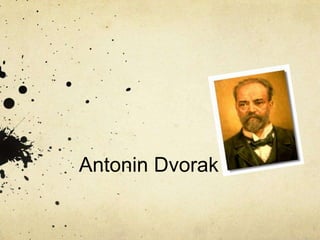
Antonin Dvorak
Profile

Antonin was born September 8, 1841 at Nelahozeves, Prague
(Czech Republic) His parents are Frantisek and Anna and he
was the oldest of eight.

Died May 1rst, 1904 in Prague due to Bright’s disease
(Bright's Disease is an older classification for different forms
of kidney disease. It was named after Dr. Richard Bright, who
described the condition in the early 19th century.
After graduating from an organ school in Prague, he
began writing his first composition at the age of 20.
In the 1860’s, he played as a violist in Bohemian
Provisional Theater Orchestra and taught piano
lessons,
In 1873, he married Anna Cermakova, and had left
the orchestra to pursue another career as a church
organist. He wrote several compositions during this
period.
His music attracted the interest of Johannes Brahms
(a German composer and pianist), who assisted his
career; he was supported by the critic Eduard
Hanslick.
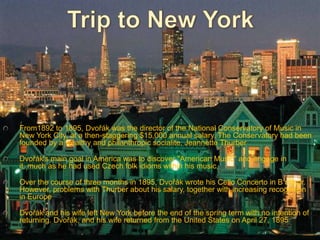
From1892 to 1895, Dvořák was the director of the National Conservatory of Music in
New York City, at a then-staggering $15,000 annual salary. The Conservatory had been
founded by a wealthy and philanthropic socialite, Jeannette Thurber

Dvořák's main goal in America was to discover "American Music" and engage in
it, much as he had used Czech folk idioms within his music.

Over the course of three months in 1895, Dvořák wrote his Cello Concerto in B minor.
However, problems with Thurber about his salary, together with increasing recognition
in Europe

Dvořák and his wife left New York before the end of the spring term with no intention of
returning. Dvořák, and his wife returned from the United States on April 27, 1895
Last years
In his last artistic period (from 1898 to 1904), he
focused mainly on opera. He created some of
his most valuable operatic works, such as The
Devil and Kate (1898/99), Rusalka (1900) and
Armida (1902/3).


Dvořák died on May 1, 1904, following five
weeks of illness, at the age of 63, leaving many
unfinished works.
Who is he?

Composer

Conductor

Teacher

His later works reflected Brahmsian Classicism, Czech nationalist style
and American folk influences.

He has honorary degrees from several prestigious universities including
Cambridge University.

He wrote symphonies, string quartets, operas, songs and piano
music, among others.
Notable Works:

His most famous work is the Ninth Symphony from the "New
World Symphony" Other works include "Te Deum," "Cypress
Trees" (song cycle), "First Symphony," "The Bells of Zlonice,"
"Alfred" (opera), "Hymnus" (cantata), "Third Symphony" (won
the Austrian State Stipendium), "Stabat Mater," "String Quartet
in F major," "The American," "Cello Concerto," "Biblical
Songs" and "Humoresque in G flat major.“
Why is Dvorak famous?
Dvorak was skillful composer of the
Romantic Era, and wrote quite a
bit of music he will be remembered for
one of his symphonies, the
Symphony #9 in E Minor is
commonly called the "New World"
symphony. Some old editions of his
works number this symphony as #5
but it is properly #9.
Romantic music is a term describing a style of Western classical music that began in
the early 19th century.

Romantic music attempted to increase emotional expression and power to describe
deeper truths or human feelings, while preserving but in many cases extending the
formal structures from the classical period, in others, creating new forms that were
deemed better suited to the new subject matter.


                                    Romantic
Romantic music as a movement evolved from the formats, genres and musical ideas
established in earlier periods, such as the classical period, and went further in the name of
expression and syncretism of different art-forms with music. Romanticism does not
necessarily refer to romantic love, though that theme was prevalent in many works
composed during this time period, both in literature, painting, or music. Romanticism
followed a path that led to the expansion of formal structures for a composition set down or
at least created in their general outlines in earlier periods, and the end-result is that the
pieces are “understood” to be more passionate and expressive, both by 19th century and
today’s audiences
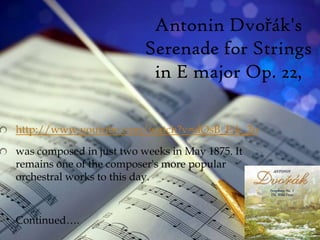
Antonin Dvořák's
                          Serenade for Strings
                           in E major Op. 22,

http://www.youtube.com/watch?v=dOsB_E-k_2o

was composed in just two weeks in May 1875. It
remains one of the composer's more popular
orchestral works to this day.


Continued….
Composition and Premiere
1875 was a fruitful year for Dvořák's composing. This
was the same year that he wrote his Symphony No.
5, String Quintet No. 2, Piano Trio No. 1, the opera
Vanda, and the Moravian Duets. These were happy
times in his life. His marriage was young, and his
first son had been born. For the first time in his
life, he was starting to be recognized as a
composer, and was able to live stably without fear of
poverty. He received a generous stipend from a
commission in Vienna, which allowed him to compose
his Fifth Symphony and several chamber works as well
as the Serenade.

Allegedly, Dvořák wrote the Serenade in just 12
days, from 3–14 May. The piece was premiered in
Prague on 10 December 1876 by Adolf Czech and the
combined orchestras of the Czech and German
theatres. It was published in 1877 in the composer's
piano duet arrangement by Emanuel Starý in Prague.
References
http://www.last.fm/tag/romantic/wiki

http://musiced.about.com/od/classicalmusicians/p/dvorak.htm

http://www.classiccat.net/dvorak_a/index.php

http://www.allmusic.com/artist/antonin-dvorák-mn0000768609

http://wiki.answers.com/Q/Why_is_Antonin_Dvorak_famous

http://letthejourneysbegin.wordpress.com/2012/08/21/1021/

http://en.wikipedia.org/wiki/Serenade_for_Strings_(Dvo%C5%
99%C3%A1k)

Antonin Dvorak

  • 1.
  • 2.
    Profile Antonin was bornSeptember 8, 1841 at Nelahozeves, Prague (Czech Republic) His parents are Frantisek and Anna and he was the oldest of eight. Died May 1rst, 1904 in Prague due to Bright’s disease (Bright's Disease is an older classification for different forms of kidney disease. It was named after Dr. Richard Bright, who described the condition in the early 19th century.
  • 3.
    After graduating froman organ school in Prague, he began writing his first composition at the age of 20. In the 1860’s, he played as a violist in Bohemian Provisional Theater Orchestra and taught piano lessons, In 1873, he married Anna Cermakova, and had left the orchestra to pursue another career as a church organist. He wrote several compositions during this period. His music attracted the interest of Johannes Brahms (a German composer and pianist), who assisted his career; he was supported by the critic Eduard Hanslick.
  • 4.
    From1892 to 1895,Dvořák was the director of the National Conservatory of Music in New York City, at a then-staggering $15,000 annual salary. The Conservatory had been founded by a wealthy and philanthropic socialite, Jeannette Thurber Dvořák's main goal in America was to discover "American Music" and engage in it, much as he had used Czech folk idioms within his music. Over the course of three months in 1895, Dvořák wrote his Cello Concerto in B minor. However, problems with Thurber about his salary, together with increasing recognition in Europe Dvořák and his wife left New York before the end of the spring term with no intention of returning. Dvořák, and his wife returned from the United States on April 27, 1895
  • 5.
    Last years In hislast artistic period (from 1898 to 1904), he focused mainly on opera. He created some of his most valuable operatic works, such as The Devil and Kate (1898/99), Rusalka (1900) and Armida (1902/3). Dvořák died on May 1, 1904, following five weeks of illness, at the age of 63, leaving many unfinished works.
  • 6.
    Who is he? Composer Conductor Teacher Hislater works reflected Brahmsian Classicism, Czech nationalist style and American folk influences. He has honorary degrees from several prestigious universities including Cambridge University. He wrote symphonies, string quartets, operas, songs and piano music, among others.
  • 7.
    Notable Works: His mostfamous work is the Ninth Symphony from the "New World Symphony" Other works include "Te Deum," "Cypress Trees" (song cycle), "First Symphony," "The Bells of Zlonice," "Alfred" (opera), "Hymnus" (cantata), "Third Symphony" (won the Austrian State Stipendium), "Stabat Mater," "String Quartet in F major," "The American," "Cello Concerto," "Biblical Songs" and "Humoresque in G flat major.“
  • 8.
    Why is Dvorakfamous? Dvorak was skillful composer of the Romantic Era, and wrote quite a bit of music he will be remembered for one of his symphonies, the Symphony #9 in E Minor is commonly called the "New World" symphony. Some old editions of his works number this symphony as #5 but it is properly #9.
  • 9.
    Romantic music isa term describing a style of Western classical music that began in the early 19th century. Romantic music attempted to increase emotional expression and power to describe deeper truths or human feelings, while preserving but in many cases extending the formal structures from the classical period, in others, creating new forms that were deemed better suited to the new subject matter. Romantic Romantic music as a movement evolved from the formats, genres and musical ideas established in earlier periods, such as the classical period, and went further in the name of expression and syncretism of different art-forms with music. Romanticism does not necessarily refer to romantic love, though that theme was prevalent in many works composed during this time period, both in literature, painting, or music. Romanticism followed a path that led to the expansion of formal structures for a composition set down or at least created in their general outlines in earlier periods, and the end-result is that the pieces are “understood” to be more passionate and expressive, both by 19th century and today’s audiences
  • 11.
    Antonin Dvořák's Serenade for Strings in E major Op. 22, http://www.youtube.com/watch?v=dOsB_E-k_2o was composed in just two weeks in May 1875. It remains one of the composer's more popular orchestral works to this day. Continued….
  • 12.
    Composition and Premiere 1875was a fruitful year for Dvořák's composing. This was the same year that he wrote his Symphony No. 5, String Quintet No. 2, Piano Trio No. 1, the opera Vanda, and the Moravian Duets. These were happy times in his life. His marriage was young, and his first son had been born. For the first time in his life, he was starting to be recognized as a composer, and was able to live stably without fear of poverty. He received a generous stipend from a commission in Vienna, which allowed him to compose his Fifth Symphony and several chamber works as well as the Serenade. Allegedly, Dvořák wrote the Serenade in just 12 days, from 3–14 May. The piece was premiered in Prague on 10 December 1876 by Adolf Czech and the combined orchestras of the Czech and German theatres. It was published in 1877 in the composer's piano duet arrangement by Emanuel Starý in Prague.
  • 13.