Antimicrobial agents used as
preservatives
Presented By: Abhni Gupta
M. Pharm (Pharmaceutics)
(2412100566001)
PSIT-Pranveer Singh Institute of Technology
(Pharmacy), Kanpur
Subject-Cosmetics and Cosmeceuticals
Subject Code -MPH-204T
GUIDED BY:
Dr. PRANAY WAL
DEAN OF PHARMACY DEPARTMENT
PSIT (PHARMACY), KANPUR
Introduction
 Preservatives is a substance or chemical that is used in cosmetics to prevent the decomposition
 Preservatives are responsible for maintaining the product safety and prolonging shelf life.[1]
 Preservatives also ensure consumer safety by reducing the likelihood of infections or irritations resulting from
contaminated products.[2]
Rosemary Extract Powder
1. Preservatives
1
 Antimicrobial preservatives are chemical agents incorporated into formulations to prevent the growth of
microorganisms such as bacteria, yeasts, and molds.
 These preservatives are crucial in water-based cosmetics, where microbial growth is more likely, and help
protect both the product and the user from contamination. [3]
Peppermint Extract
2. Antimicrobial Preservatives
2
Types of Preservatives
1. Natural 2. Synthetic
(These are derived from
natural sources such as
plants, microorganisms.)
(Synthetic preservatives are
chemically engineered to
provide broad-spectrum
protection against bacteria,
fungi, and yeasts.)
[4]
[3]
3
1. Natural
Essential Oils
Plant Extracts
Organic Acids and Derivatives
Fermentation-Derived Agents
Ex- Tea tree oil ,
Rosemary oil,
thyme oil and
lavender oil
Ex- Neem extract,
grapefruit seed extract,
green tea extract
Ex- Benzoic acid,
sorbic acid,
dehydroacetic acid
Ex-Lactobacillus
ferment
4
2. Synthetic
Parabens
Formaldehyde Releasers
Alcohols and Glycols
Chlorhexidine
Ex-Methylparaben,
propylparaben,
butylparaben, ethyl
paraben
Ex-DMDM hydantoin,
Imidazolidinyl urea,
diazolidinyl urea
Ex- Benzyl alcohol, ethanol
Isopropyl alcohol, propylene
glycol
5
6
Need of Preservatives [4]
3. Ensure product safety for consumers
1. Prevent microbial contamination during storage
2. Extend the shelf life of the product
4. Protect products from contamination during daily use
5. Maintain visual and sensory integrity
6. Support global product distribution
7. Allow inclusion of natural or sensitive ingredients
8. Enhance consumer trust and brand reputation .
7
Ideal Characteristics [5]
1. Broad-spectrum activity
2. Chemical and physical stability
3. Low toxicity
4. Non-irritating and non-sensitizing
5. Compatible with other ingredients
6. Effective at low concentrations
7. No undesirable Odor or colour
8. Easy to incorporate into formulations
9. Resistant to microbial adaptation
10. Regulatory acceptance
8
Merits of Preservatives [6]
1. Inhibit Microbial Growth 2. Extend Product Shelf Life
10. Ensure Multi-Dose Product Safety
9. Reduce Risk of Infections
8.Maintain Active Ingredient Stability
7. Enhance Consumer Safety and
Confidence
3. Minimize Product Recalls
6. Facilitate Global Distribution
4.Reduce Dependence on Cold Chain
5. Cost-Effective Protection
9
Demerits of Preservatives [7]
1. Can cause allergic reactions, skin
irritation, or sensitization, especially in
individuals with sensitive skin.
4. Preservatives can interact with active
pharmaceutical ingredients or excipients,
affecting product stability.
3. Prolonged use may lead to the
development of antimicrobial resistance,
reducing long-term effectiveness.
2. Some preservatives, such as parabens
and formaldehyde-releasing agents, are
associated with potential toxicity.
5. May require careful concentration
control, as excessive amounts can be
harmful to human health.
6. Some preservatives degrade over time,
losing effectiveness and compromising
product safety.
10
Uses of Preservatives in Adults and Children [8]
Uses
% Used in Children
% Used in Adults
Preservative
Ophthalmic, nasal, and
topical products
0.005–0.01%
0.01–0.02%
Benzalkonium Chloride
Injectable solutions and
vaccines
0.25% (use with caution)
0.25–0.5%
Phenol
Creams, ointments, and
parenteral
0.05–0.2%
0.1–0.2%
Chlorocresol
Vaccines and ophthalmic
solutions
0.005–0.01%
0.01%
Thimerosal
Emulsions, vaccines, and
topical products
0.5–1.0%
0.5–1.0%
Phenoxyethanol
Oral liquids, creams,
injectables.
Same, but used with
caution in neonates
0.1–0.2% + 0.02–0.04%
Methylparaben +
Propylparaben 11
Image
Preservatives Used
Type of Cosmetic
Product Name
Phenoxyethanol, Ethyl
hexyl glycerine
Facial Moisturizer
Neutrogena Hydro
Boost Water Gel
Phenoxyethanol,
Methylparaben, Ethyl
paraben
Anti-aging Cream
Olay Regenerant Micro-
Sculpting Cream
Methylparaben,
Propylparaben
Facial Cleanser
Cetaphil Daily Facial
Cleanser
Methylisothiazolinone
(MIT), Phenoxyethanol
Spot Treatment
The Body Shop Tea Tree
Oil
Methylparaben,
Propylparaben
Body Lotion
Aveeno Daily
Moisturizing Lotion
Market Preparations
12
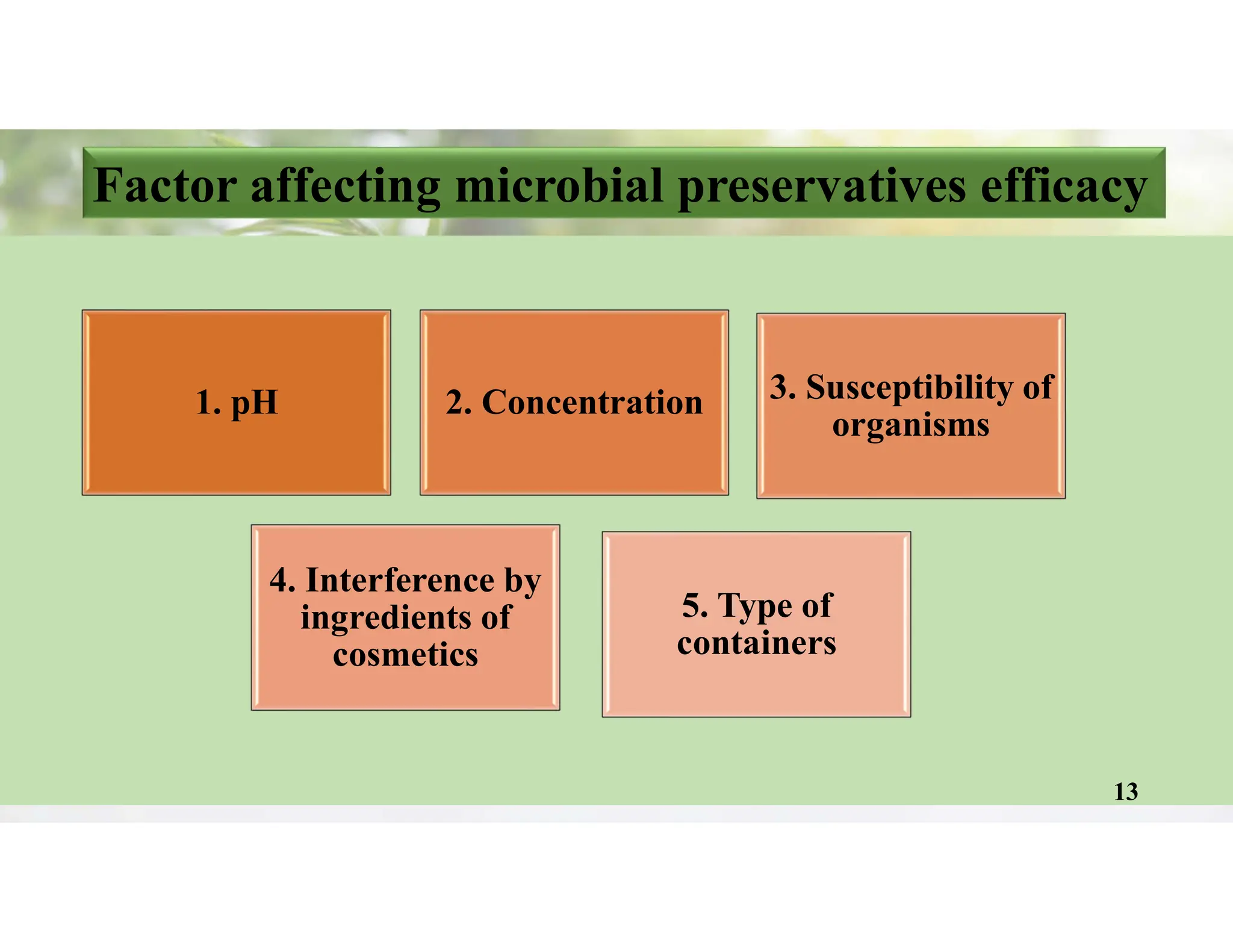
Factor affecting microbial preservatives efficacy
1. pH 2. Concentration 3. Susceptibility of
organisms
4. Interference by
ingredients of
cosmetics
5. Type of
containers
13
References
1. Dureja H, Kaushik D, Gupta M, Kumar V, Lather V. Cosmeceuticals: An emerging concept.
Indian Journal of Pharmacology. 2005 May 1;37(3):155-9.
2. Boyer IJ, Heldreth B, Bergfeld WF, Belsito DV, Hill RA, Klaassen CD, Liebler DC, Marks Jr JG,
Shank RC, Slaga TJ, Snyder PW. Amended safety assessment of formaldehyde and methylene
glycol as used in cosmetics. International journal of toxicology. 2013 Nov;32(6_suppl):5S-32S.
3. Dweck AC. Preservatives in cosmetics. Clin Dermatol. 2009;27(5):555–562.
doi:10.1016/j.clindermatol.2009.06.012.
4. Herman A. Antimicrobial preservatives: effectiveness, toxicity, and alternatives for use in cosmetics. J
Appl Microbiol. 2020;129(6):1421–1432. doi:10.1111/jam.14672.
14
.
5. Steinberg DC. Preservatives for cosmetics. Carol Stream, IL: Allured books; 2012.
6. Denver SP, Hodges NA, Gorman SP, Gilmore BF. Hugo and russell’s pharmaceutical microbiology.
Hoboken.
7. Soni MG, Carabin IG, Burdock G. Safety assessment of esters of p-hydroxybenzoic acid (parabens).
Food and chemical toxicology. 2005 Jul 1;43(7):985-1015.
8. Rowe RC, Sheskey P, Quinn M. Handbook of pharmaceutical excipients. Libros Digitales-
Pharmaceutical Press; 2009.
15
Antimicrobial used as a preservatives.pdf

Antimicrobial used as a preservatives.pdf

  • 1.
    Antimicrobial agents usedas preservatives Presented By: Abhni Gupta M. Pharm (Pharmaceutics) (2412100566001) PSIT-Pranveer Singh Institute of Technology (Pharmacy), Kanpur Subject-Cosmetics and Cosmeceuticals Subject Code -MPH-204T GUIDED BY: Dr. PRANAY WAL DEAN OF PHARMACY DEPARTMENT PSIT (PHARMACY), KANPUR
  • 2.
    Introduction  Preservatives isa substance or chemical that is used in cosmetics to prevent the decomposition  Preservatives are responsible for maintaining the product safety and prolonging shelf life.[1]  Preservatives also ensure consumer safety by reducing the likelihood of infections or irritations resulting from contaminated products.[2] Rosemary Extract Powder 1. Preservatives 1
  • 3.
     Antimicrobial preservativesare chemical agents incorporated into formulations to prevent the growth of microorganisms such as bacteria, yeasts, and molds.  These preservatives are crucial in water-based cosmetics, where microbial growth is more likely, and help protect both the product and the user from contamination. [3] Peppermint Extract 2. Antimicrobial Preservatives 2
  • 4.
    Types of Preservatives 1.Natural 2. Synthetic (These are derived from natural sources such as plants, microorganisms.) (Synthetic preservatives are chemically engineered to provide broad-spectrum protection against bacteria, fungi, and yeasts.) [4] [3] 3
  • 5.
    1. Natural Essential Oils PlantExtracts Organic Acids and Derivatives Fermentation-Derived Agents Ex- Tea tree oil , Rosemary oil, thyme oil and lavender oil Ex- Neem extract, grapefruit seed extract, green tea extract Ex- Benzoic acid, sorbic acid, dehydroacetic acid Ex-Lactobacillus ferment 4
  • 6.
    2. Synthetic Parabens Formaldehyde Releasers Alcoholsand Glycols Chlorhexidine Ex-Methylparaben, propylparaben, butylparaben, ethyl paraben Ex-DMDM hydantoin, Imidazolidinyl urea, diazolidinyl urea Ex- Benzyl alcohol, ethanol Isopropyl alcohol, propylene glycol 5
  • 7.
  • 8.
    Need of Preservatives[4] 3. Ensure product safety for consumers 1. Prevent microbial contamination during storage 2. Extend the shelf life of the product 4. Protect products from contamination during daily use 5. Maintain visual and sensory integrity 6. Support global product distribution 7. Allow inclusion of natural or sensitive ingredients 8. Enhance consumer trust and brand reputation . 7
  • 9.
    Ideal Characteristics [5] 1.Broad-spectrum activity 2. Chemical and physical stability 3. Low toxicity 4. Non-irritating and non-sensitizing 5. Compatible with other ingredients 6. Effective at low concentrations 7. No undesirable Odor or colour 8. Easy to incorporate into formulations 9. Resistant to microbial adaptation 10. Regulatory acceptance 8
  • 10.
    Merits of Preservatives[6] 1. Inhibit Microbial Growth 2. Extend Product Shelf Life 10. Ensure Multi-Dose Product Safety 9. Reduce Risk of Infections 8.Maintain Active Ingredient Stability 7. Enhance Consumer Safety and Confidence 3. Minimize Product Recalls 6. Facilitate Global Distribution 4.Reduce Dependence on Cold Chain 5. Cost-Effective Protection 9
  • 11.
    Demerits of Preservatives[7] 1. Can cause allergic reactions, skin irritation, or sensitization, especially in individuals with sensitive skin. 4. Preservatives can interact with active pharmaceutical ingredients or excipients, affecting product stability. 3. Prolonged use may lead to the development of antimicrobial resistance, reducing long-term effectiveness. 2. Some preservatives, such as parabens and formaldehyde-releasing agents, are associated with potential toxicity. 5. May require careful concentration control, as excessive amounts can be harmful to human health. 6. Some preservatives degrade over time, losing effectiveness and compromising product safety. 10
  • 12.
    Uses of Preservativesin Adults and Children [8] Uses % Used in Children % Used in Adults Preservative Ophthalmic, nasal, and topical products 0.005–0.01% 0.01–0.02% Benzalkonium Chloride Injectable solutions and vaccines 0.25% (use with caution) 0.25–0.5% Phenol Creams, ointments, and parenteral 0.05–0.2% 0.1–0.2% Chlorocresol Vaccines and ophthalmic solutions 0.005–0.01% 0.01% Thimerosal Emulsions, vaccines, and topical products 0.5–1.0% 0.5–1.0% Phenoxyethanol Oral liquids, creams, injectables. Same, but used with caution in neonates 0.1–0.2% + 0.02–0.04% Methylparaben + Propylparaben 11
  • 13.
    Image Preservatives Used Type ofCosmetic Product Name Phenoxyethanol, Ethyl hexyl glycerine Facial Moisturizer Neutrogena Hydro Boost Water Gel Phenoxyethanol, Methylparaben, Ethyl paraben Anti-aging Cream Olay Regenerant Micro- Sculpting Cream Methylparaben, Propylparaben Facial Cleanser Cetaphil Daily Facial Cleanser Methylisothiazolinone (MIT), Phenoxyethanol Spot Treatment The Body Shop Tea Tree Oil Methylparaben, Propylparaben Body Lotion Aveeno Daily Moisturizing Lotion Market Preparations 12
  • 14.
    Factor affecting microbialpreservatives efficacy 1. pH 2. Concentration 3. Susceptibility of organisms 4. Interference by ingredients of cosmetics 5. Type of containers 13
  • 15.
    References 1. Dureja H,Kaushik D, Gupta M, Kumar V, Lather V. Cosmeceuticals: An emerging concept. Indian Journal of Pharmacology. 2005 May 1;37(3):155-9. 2. Boyer IJ, Heldreth B, Bergfeld WF, Belsito DV, Hill RA, Klaassen CD, Liebler DC, Marks Jr JG, Shank RC, Slaga TJ, Snyder PW. Amended safety assessment of formaldehyde and methylene glycol as used in cosmetics. International journal of toxicology. 2013 Nov;32(6_suppl):5S-32S. 3. Dweck AC. Preservatives in cosmetics. Clin Dermatol. 2009;27(5):555–562. doi:10.1016/j.clindermatol.2009.06.012. 4. Herman A. Antimicrobial preservatives: effectiveness, toxicity, and alternatives for use in cosmetics. J Appl Microbiol. 2020;129(6):1421–1432. doi:10.1111/jam.14672. 14
  • 16.
    . 5. Steinberg DC.Preservatives for cosmetics. Carol Stream, IL: Allured books; 2012. 6. Denver SP, Hodges NA, Gorman SP, Gilmore BF. Hugo and russell’s pharmaceutical microbiology. Hoboken. 7. Soni MG, Carabin IG, Burdock G. Safety assessment of esters of p-hydroxybenzoic acid (parabens). Food and chemical toxicology. 2005 Jul 1;43(7):985-1015. 8. Rowe RC, Sheskey P, Quinn M. Handbook of pharmaceutical excipients. Libros Digitales- Pharmaceutical Press; 2009. 15