PRESERVATIVES
DR. MANJOOR AHAMAD SYED,
M.Pharm,Ph.D
Associate. Professor
Department of Medicinal Chemistry,
College of Public Health and Medical Sciences,
Mettu University, Mettu
Post Box No-318
Ethiopia.
PRESERVATIVES
Definition: A chemical substance used to preserve organic substance from decay or spoilage
by preventing microbial attack.
Preservatives are substances added to various pharmaceutical dosage forms and cosmetic
preparations to prevent or inhibit microbial growth. An ideal preservative would be effective
at low concentrations against all possible micro-organism, be nontoxic and compatible with
other constituent of the preparation and be stable for the shelf-life of the preparation.
2
IDEAL PROPERTIES OF PRESERVATIVES
 It should not be irritant.
 It should not be toxic.
 It should be physically and chemically stable.
 Preservative should be compatible with other ingredients used in
formulation.
 It should be act as good antimicrobial agent and should exert wide
spectrum of activity.
 It should act as preservative in small concentration i.e. it must be
potent.
 It should maintain activity throughout product manufacturing, shelf
life and usage.
Classification of preservative
Preservatives are classified on variety of the basis and some of these are as
follows:
Classification based on mechanism of action
a) Antioxidants: Eg. Vitamin E Vitamin C
b) Antimicrobial agents: Eg. Benzoates, Sodium benzoate, Sorbates
c) Chelating agents: Eg. Polyphosphates, Citric acid
CLASSIFICATION BASED ON SOURCE:
a) Natural Preservatives:-Eg. Neem Oil Salt (sodium chloride) Lemon
Honey.
b) Artificial Preservatives: Eg.Benzoates, Sodium benzoate Sorbates,
propionets, nitrites.
Classification based on chemical structure:
S.NO Class Examples
01 Acids Benzoic acid, Sorbic acid, Boric acid
02
Esters
Methyl paraben, Ethyl paraben, Propyl paraben, Butyl
paraben, Sodium benzoate, Sodium propionate and
potassium sorbate
03 Alcohols Chlorobutanol, Benzyl alcohol, Phenyl ethyl alcohol
04 Phenols Phenol, Chloro cresol
05 Mercurial compounds Thiomersal, Nitromersal, Phenyl mercuric nitrate,
Phenyl mercuric acetate.
06 Quaternary ammonium Benzalkonium chloride, Cetyl pyridinium chloride
MECHANISM OFACTION:
Preservative how they act?
Natural substances such as salt, sugar, vinegar, and diatomaceous earth are also used as
traditional preservatives. Certain processes such as freezing, pickling, smoking and
salting can also be used to preserve food. Another group of preservatives targets
enzymes in fruits and vegetables that continue to metabolize after they are cut. For
instance, citric and ascorbic acids from lemon or other citrus juice can inhibit the
action of the enzyme phenolase which turns surfaces of cut apples and potatoes brown.
Caution must be taken, however, since FDA standards do not currently require fruit and
vegetable product labels to accurately reflect the type of preservative used in the
products.
NEED FOR PRESERVATIVES
Toprotect our
drug from
microbial attack
Toenhance
activity and
efficacy of drug
Tostabilize our
product
Toincrease shelf
life of our
product
RECOMMENDED PRESERVATIVE CONCENTRATION
Name
Recommended
Concentration
BenzylAlcohol 0.5 to 10%
Benzalkonium
Chloride
0.01%
Chlorobutanol 0.25 to 0.5%
Methyl Paraben 0.01 to 0.5%
Phenol 0.065 to 0.02%
Preservative Concentration for Liquid Oral Preparation
Sr.
No.
Name Recommended
Concentration
1. Benzoic Acid 0.1 to 0.2%
2. Sorbic Acid 0.1 to 0.2%
3. Methyl Paraben 0.25%
4. Propyl Paraben 0.5 to 0.25%
5. Sodium Benzonate 0.1 to 0.2%
6. Bronidol 0.001 to 0.05%
ANTI-MICROBIAL PRESERVATIVES:
• It is added in product to minimize risk of spoilage and to kill low levels of contaminants
introduced during storage or repeated use of a multi-dose container
• These agents mainly work by inhibiting the cell wall, cell membrane growth or other
bacterial organelles which may attack our product.
PREPARATIONS REQUIRED ANTI- MICROBIAL PRESERVATIVES:
Preparations which contain water are at risk of microbial spoilage such as:
Solutions
Suspensions
Emulsions
Topical preparation e.g creams
Injectable
Eye drops etc
BENZOIC ACID & p-HYDROXY BENZOIC ACID DERIVATIVES
BENZOIC ACID
It is used as a food preservative
It inhibits the growth of microbes including mould, yeast and some
bacteria.
Used as antiseptic also
O
OH
benzoic acid
O
ONa
sodium benzoate
SODIUM BENZOATE
It is a white crystalline solid, soluble in water and alcohol
It is used extensively as food and pharmaceutical preservatives.
It is not a bactericidal, only a bacterio- static agent along with fungistatic
activity
PARA HYDROXY BENZOIC ACID DERIVATIVES
Esters of p-hydroxy benzoic acid which are familiarly known as PARABENS, which are
extensively used in Pharmaceutical industry. Methyl, ethyl and propyl parabens are the
most commonly used preservatives. These are less toxic to human beings because they are
rapidly hydrolysed in the body to p-hydroxy benzoic acid, which is quickly conjugated
and excreted. They are used in concentration ranging from 0.005 to 0.05%
The preservatives activity of PARABENS increase with increase in Mol. Weight but the
methylparabens is found to be most effective against MOLDS and the propylparabens is
most effective against YEASTS. Propyl paraben is more LIPID SOLUBLE and is preferably
used for drugs in oil or lipophilic bases.
METHYL PARABEN
USES:
1. It is the most frequently used antimicrobial preservative in cosmetics. It occurs
naturally in several fruits, particularly in blueberries. It has a role as a plant
metabolite, an antimicrobial food preservative, a neuroprotective agent and
an antifungal agent. Methylparaben is used in allergenic testing.
2. It is used as antiseptic and preservative in various pharmaceutical preparations.
O
OCH 3
O
H
methyl 4-hydroxybenzoate
O
OH
O
H
4-hydroxybenzoic acid
CH3OH/H2SO4
Esterification
- H2O
O
OCH 3
O
H
Methyl paraben
Synthesis:
ETHYLPARABEN
USES:
It is used as preservative and food additive.
It is often use in combination with other preservatives.
O
O
O
H
ethyl 4-hydroxybenzoate
Synthesis:
O
OH
O
H
4-hydroxybenzoic acid
CH3CH2OH/H2SO4
Esterification
- H2O
O
O
O
H
Ethylparaben
PROPYL PARABEN
USES:
1. Propylparaben is the benzoate ester that is the propyl ester of 4-hydroxybenzoic
acid. Preservative typically found in many water-based cosmetics, such
as creams, lotions, shampoos and bath products. Also used as a food additive.
It has a role as an antifungal agent and an antimicrobial agent.
Synthesis:
O
O
O
H
propyl 4-hydroxybenzoate
O
OH
O
H
4-hydroxybenzoic acid
CH3CH2CH2OH/H2SO4
Esterification
- H2O
O
O
O
H
Propyl paraben
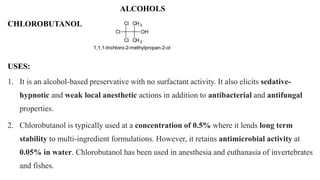
ALCOHOLS
USES:
1. It is an alcohol-based preservative with no surfactant activity. It also elicits sedative-
hypnotic and weak local anesthetic actions in addition to antibacterial and antifungal
properties.
2. Chlorobutanol is typically used at a concentration of 0.5% where it lends long term
stability to multi-ingredient formulations. However, it retains antimicrobial activity at
0.05% in water. Chlorobutanol has been used in anesthesia and euthanasia of invertebrates
and fishes.
CHLOROBUTANOL
Cl
Cl
Cl
CH3
CH3
OH
1,1,1-trichloro-2-methylpropan-2-ol
USES:
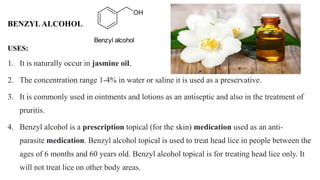
1. It is naturally occur in jasmine oil.
2. The concentration range 1-4% in water or saline it is used as a preservative.
3. It is commonly used in ointments and lotions as an antiseptic and also in the treatment of
pruritis.
4. Benzyl alcohol is a prescription topical (for the skin) medication used as an anti-
parasite medication. Benzyl alcohol topical is used to treat head lice in people between the
ages of 6 months and 60 years old. Benzyl alcohol topical is for treating head lice only. It
will not treat lice on other body areas.
BENZYL ALCOHOL
OH
Benzyl alcohol
USES:
1. It is used as an preservative in cosmetics from essential oils.
2. In cosmetics and personal care products, Phenethyl Alcohol is used in the formulation
of eye area makeup, makeup products, skin care products, shampoos and
perfumes and colognes. Phenethyl Alcohol prevents or retards bacterial growth, and
thus protects cosmetics and personal care products from spoilage.
PHENETHYLALCOHOL OH
2-phenylethanol
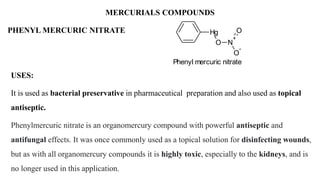
MERCURIALS COMPOUNDS
USES:
It is used as bacterial preservative in pharmaceutical preparation and also used as topical
antiseptic.
Phenylmercuric nitrate is an organomercury compound with powerful antiseptic and
antifungal effects. It was once commonly used as a topical solution for disinfecting wounds,
but as with all organomercury compounds it is highly toxic, especially to the kidneys, and is
no longer used in this application.
PHENYL MERCURIC NITRATE Hg
O N
+
O
-
O
Phenyl mercuric nitrate
1. It is used as bacterial preservative in pharmaceutical preparation and also used as topical
antiseptic.
2. Phenylmercuric acetate (PMA) has been used against fungal activity in agriculture and in
leather processing and has been known to work well. PMA has also been used as an
additive in eye-drops and paint in order to preserve them, as a disinfectant, and as a
catalyst in polyurethane systems.
PHENYL MERCURIC ACETATE
Hg
O
O
Phenyl mercuric acetate
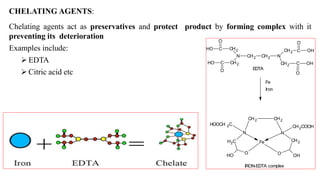
CHELATING AGENTS:
Chelating agents act as preservatives and protect product by forming complex with it
preventing its deterioration
Examples include:
 EDTA
 Citric acid etc
CH2 CH2 N
N
CH2
CH2
CH2
CH2 C OH
C OH
C
C
O
H
O
H
O
O
O
O EDTA
Fe
Iron
N
CH2 CH2
N
Fe
O O
H2C CH2
CH2COOH
HOOCH 2C
O
H OH
IRON-EDTA complex
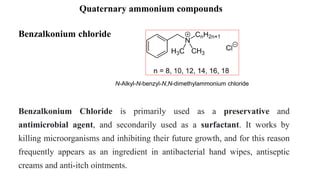
Quaternary ammonium compounds
Benzalkonium Chloride is primarily used as a preservative and
antimicrobial agent, and secondarily used as a surfactant. It works by
killing microorganisms and inhibiting their future growth, and for this reason
frequently appears as an ingredient in antibacterial hand wipes, antiseptic
creams and anti-itch ointments.
Benzalkonium chloride
N-Alkyl-N-benzyl-N,N-dimethylammonium chloride
Cetylpyridinium chloride
Cetylpyridinium chloride (CPC) is a cationic quaternary ammonium
compound used in some types of mouthwashes, toothpastes, lozenges,
throat sprays, breath sprays, and nasal sprays. It is an antiseptic and
preservative that kills bacteria and other microorganisms.
1-Hexadecylpyridin-1-ium chloride
ANALYSIS OF PRESERVATIVES IN PRODUCTS
High performance liquid
chromatography
Capillary electrophoresis (CE)
Gas chromatographic methods
Thin layer chromatographic methods
Flow injection analysis
ANALYSIS OF PRESERVATIVES IN PRODUCTS
Titrimetric Methods
Flourimetric Methods
Spectrophotometric methods
Atomic Absorption Spectroscopic
(AAS) Method
While choosing preservative for drug product consideration should be made about:
1. Concentration
2. Toxicity
3. Selectivity
4. Interaction with formulation etc
COMMON SIDE EFFECTS:
HYPERSENSITIVITY ALLERGY ASTHMA
HYPERACTIVITY
NEUROLOGICAL
DAMAGE CANCER
Preservative Side effects
Paraben Neurological damage in rats Potent irritants
Formaldehyde Diazolidinyl urea
Imidazolidinyl urea
Skin irritants Eye irritants
lung irritants
Benzyl alcohol fatal toxic syndrome in low weight neonates
Cetyl alcohol Stearyl
alcohol
Infrequent sensitizers
Preservatives Side effects
2-Phenylethanol Irritant to skin, eye and mucous membranes
Benzoic acid Gastro-irritant
Chloroxylenol Cross sensitivity
Chlorocresol Irritant to skin, eyes and mucous membranes
Hexachlorophene Neurotoxicity
EDTA Dose-related broncho- constriction
EVALUATION OF PRESERVATIVES
3
1
The evaluation of preservatives has traditionally involved time-consuming tests :
Pharmacopoeial antimicrobial effectiveness tests (AET)
Preservative efficacy tests (PET).
These are required for the assessment of the antimicrobial preservation of
multiple-use pharmaceutical products
CHALLENGING ORGANISMS USED FOR TEST
Staphylococcus aureus.
Pseudomonas aeruginosa. Fungi /
mould, Aspergillus niger. Yeast,
Candida albicans.
32
PRESERVATIVES FOR DIFFERENT DOSAGE FORM
Oral Methyl, ethyl, propyl parabens, sodium
benzoate, calcium lactate, sodium and
potassium, sorbic acid
Dermal Benzalkonium chloride, cetrimide,
thiomersal, imidurea, chlorhexidine,
chlorocresol, phenyl salicylate
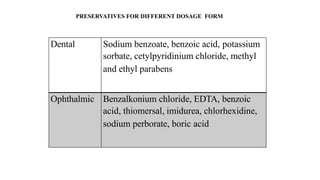
PRESERVATIVES FOR DIFFERENT DOSAGE FORM
Dental Sodium benzoate, benzoic acid, potassium
sorbate, cetylpyridinium chloride, methyl
and ethyl parabens
Ophthalmic Benzalkonium chloride, EDTA, benzoic
acid, thiomersal, imidurea, chlorhexidine,
sodium perborate, boric acid
PRESERVATIVES FOR DIFFERENT DOSAGE FORM
35
Nasal Benzalkonium chloride,
phenylcarbinol, potassium sorbate,
chlorobutanol, chlorocresol, EDTA
Rectal Benzyl alcohol, benzoic acid, sodium
benzoate, methyl hydroxybenzoate,
chlorhexidine gluconate

Presevatives-mass.pptx

  • 1.
    PRESERVATIVES DR. MANJOOR AHAMADSYED, M.Pharm,Ph.D Associate. Professor Department of Medicinal Chemistry, College of Public Health and Medical Sciences, Mettu University, Mettu Post Box No-318 Ethiopia.
  • 2.
    PRESERVATIVES Definition: A chemicalsubstance used to preserve organic substance from decay or spoilage by preventing microbial attack. Preservatives are substances added to various pharmaceutical dosage forms and cosmetic preparations to prevent or inhibit microbial growth. An ideal preservative would be effective at low concentrations against all possible micro-organism, be nontoxic and compatible with other constituent of the preparation and be stable for the shelf-life of the preparation. 2
  • 3.
    IDEAL PROPERTIES OFPRESERVATIVES  It should not be irritant.  It should not be toxic.  It should be physically and chemically stable.  Preservative should be compatible with other ingredients used in formulation.  It should be act as good antimicrobial agent and should exert wide spectrum of activity.  It should act as preservative in small concentration i.e. it must be potent.  It should maintain activity throughout product manufacturing, shelf life and usage.
  • 4.
    Classification of preservative Preservativesare classified on variety of the basis and some of these are as follows: Classification based on mechanism of action a) Antioxidants: Eg. Vitamin E Vitamin C b) Antimicrobial agents: Eg. Benzoates, Sodium benzoate, Sorbates c) Chelating agents: Eg. Polyphosphates, Citric acid CLASSIFICATION BASED ON SOURCE: a) Natural Preservatives:-Eg. Neem Oil Salt (sodium chloride) Lemon Honey. b) Artificial Preservatives: Eg.Benzoates, Sodium benzoate Sorbates, propionets, nitrites.
  • 5.
    Classification based onchemical structure: S.NO Class Examples 01 Acids Benzoic acid, Sorbic acid, Boric acid 02 Esters Methyl paraben, Ethyl paraben, Propyl paraben, Butyl paraben, Sodium benzoate, Sodium propionate and potassium sorbate 03 Alcohols Chlorobutanol, Benzyl alcohol, Phenyl ethyl alcohol 04 Phenols Phenol, Chloro cresol 05 Mercurial compounds Thiomersal, Nitromersal, Phenyl mercuric nitrate, Phenyl mercuric acetate. 06 Quaternary ammonium Benzalkonium chloride, Cetyl pyridinium chloride
  • 6.
    MECHANISM OFACTION: Preservative howthey act? Natural substances such as salt, sugar, vinegar, and diatomaceous earth are also used as traditional preservatives. Certain processes such as freezing, pickling, smoking and salting can also be used to preserve food. Another group of preservatives targets enzymes in fruits and vegetables that continue to metabolize after they are cut. For instance, citric and ascorbic acids from lemon or other citrus juice can inhibit the action of the enzyme phenolase which turns surfaces of cut apples and potatoes brown. Caution must be taken, however, since FDA standards do not currently require fruit and vegetable product labels to accurately reflect the type of preservative used in the products.
  • 7.
    NEED FOR PRESERVATIVES Toprotectour drug from microbial attack Toenhance activity and efficacy of drug Tostabilize our product Toincrease shelf life of our product
  • 8.
    RECOMMENDED PRESERVATIVE CONCENTRATION Name Recommended Concentration BenzylAlcohol0.5 to 10% Benzalkonium Chloride 0.01% Chlorobutanol 0.25 to 0.5% Methyl Paraben 0.01 to 0.5% Phenol 0.065 to 0.02%
  • 9.
    Preservative Concentration forLiquid Oral Preparation Sr. No. Name Recommended Concentration 1. Benzoic Acid 0.1 to 0.2% 2. Sorbic Acid 0.1 to 0.2% 3. Methyl Paraben 0.25% 4. Propyl Paraben 0.5 to 0.25% 5. Sodium Benzonate 0.1 to 0.2% 6. Bronidol 0.001 to 0.05%
  • 10.
    ANTI-MICROBIAL PRESERVATIVES: • Itis added in product to minimize risk of spoilage and to kill low levels of contaminants introduced during storage or repeated use of a multi-dose container • These agents mainly work by inhibiting the cell wall, cell membrane growth or other bacterial organelles which may attack our product.
  • 11.
    PREPARATIONS REQUIRED ANTI-MICROBIAL PRESERVATIVES: Preparations which contain water are at risk of microbial spoilage such as: Solutions Suspensions Emulsions Topical preparation e.g creams Injectable Eye drops etc
  • 12.
    BENZOIC ACID &p-HYDROXY BENZOIC ACID DERIVATIVES BENZOIC ACID It is used as a food preservative It inhibits the growth of microbes including mould, yeast and some bacteria. Used as antiseptic also O OH benzoic acid O ONa sodium benzoate SODIUM BENZOATE It is a white crystalline solid, soluble in water and alcohol It is used extensively as food and pharmaceutical preservatives. It is not a bactericidal, only a bacterio- static agent along with fungistatic activity
  • 13.
    PARA HYDROXY BENZOICACID DERIVATIVES Esters of p-hydroxy benzoic acid which are familiarly known as PARABENS, which are extensively used in Pharmaceutical industry. Methyl, ethyl and propyl parabens are the most commonly used preservatives. These are less toxic to human beings because they are rapidly hydrolysed in the body to p-hydroxy benzoic acid, which is quickly conjugated and excreted. They are used in concentration ranging from 0.005 to 0.05% The preservatives activity of PARABENS increase with increase in Mol. Weight but the methylparabens is found to be most effective against MOLDS and the propylparabens is most effective against YEASTS. Propyl paraben is more LIPID SOLUBLE and is preferably used for drugs in oil or lipophilic bases.
  • 14.
    METHYL PARABEN USES: 1. Itis the most frequently used antimicrobial preservative in cosmetics. It occurs naturally in several fruits, particularly in blueberries. It has a role as a plant metabolite, an antimicrobial food preservative, a neuroprotective agent and an antifungal agent. Methylparaben is used in allergenic testing. 2. It is used as antiseptic and preservative in various pharmaceutical preparations. O OCH 3 O H methyl 4-hydroxybenzoate O OH O H 4-hydroxybenzoic acid CH3OH/H2SO4 Esterification - H2O O OCH 3 O H Methyl paraben Synthesis:
  • 15.
    ETHYLPARABEN USES: It is usedas preservative and food additive. It is often use in combination with other preservatives. O O O H ethyl 4-hydroxybenzoate Synthesis: O OH O H 4-hydroxybenzoic acid CH3CH2OH/H2SO4 Esterification - H2O O O O H Ethylparaben
  • 16.
    PROPYL PARABEN USES: 1. Propylparabenis the benzoate ester that is the propyl ester of 4-hydroxybenzoic acid. Preservative typically found in many water-based cosmetics, such as creams, lotions, shampoos and bath products. Also used as a food additive. It has a role as an antifungal agent and an antimicrobial agent. Synthesis: O O O H propyl 4-hydroxybenzoate O OH O H 4-hydroxybenzoic acid CH3CH2CH2OH/H2SO4 Esterification - H2O O O O H Propyl paraben
  • 17.
    ALCOHOLS USES: 1. It isan alcohol-based preservative with no surfactant activity. It also elicits sedative- hypnotic and weak local anesthetic actions in addition to antibacterial and antifungal properties. 2. Chlorobutanol is typically used at a concentration of 0.5% where it lends long term stability to multi-ingredient formulations. However, it retains antimicrobial activity at 0.05% in water. Chlorobutanol has been used in anesthesia and euthanasia of invertebrates and fishes. CHLOROBUTANOL Cl Cl Cl CH3 CH3 OH 1,1,1-trichloro-2-methylpropan-2-ol
  • 18.
    USES: 1. It isnaturally occur in jasmine oil. 2. The concentration range 1-4% in water or saline it is used as a preservative. 3. It is commonly used in ointments and lotions as an antiseptic and also in the treatment of pruritis. 4. Benzyl alcohol is a prescription topical (for the skin) medication used as an anti- parasite medication. Benzyl alcohol topical is used to treat head lice in people between the ages of 6 months and 60 years old. Benzyl alcohol topical is for treating head lice only. It will not treat lice on other body areas. BENZYL ALCOHOL OH Benzyl alcohol
  • 19.
    USES: 1. It isused as an preservative in cosmetics from essential oils. 2. In cosmetics and personal care products, Phenethyl Alcohol is used in the formulation of eye area makeup, makeup products, skin care products, shampoos and perfumes and colognes. Phenethyl Alcohol prevents or retards bacterial growth, and thus protects cosmetics and personal care products from spoilage. PHENETHYLALCOHOL OH 2-phenylethanol
  • 20.
    MERCURIALS COMPOUNDS USES: It isused as bacterial preservative in pharmaceutical preparation and also used as topical antiseptic. Phenylmercuric nitrate is an organomercury compound with powerful antiseptic and antifungal effects. It was once commonly used as a topical solution for disinfecting wounds, but as with all organomercury compounds it is highly toxic, especially to the kidneys, and is no longer used in this application. PHENYL MERCURIC NITRATE Hg O N + O - O Phenyl mercuric nitrate
  • 21.
    1. It isused as bacterial preservative in pharmaceutical preparation and also used as topical antiseptic. 2. Phenylmercuric acetate (PMA) has been used against fungal activity in agriculture and in leather processing and has been known to work well. PMA has also been used as an additive in eye-drops and paint in order to preserve them, as a disinfectant, and as a catalyst in polyurethane systems. PHENYL MERCURIC ACETATE Hg O O Phenyl mercuric acetate
  • 22.
    CHELATING AGENTS: Chelating agentsact as preservatives and protect product by forming complex with it preventing its deterioration Examples include:  EDTA  Citric acid etc CH2 CH2 N N CH2 CH2 CH2 CH2 C OH C OH C C O H O H O O O O EDTA Fe Iron N CH2 CH2 N Fe O O H2C CH2 CH2COOH HOOCH 2C O H OH IRON-EDTA complex
  • 23.
    Quaternary ammonium compounds BenzalkoniumChloride is primarily used as a preservative and antimicrobial agent, and secondarily used as a surfactant. It works by killing microorganisms and inhibiting their future growth, and for this reason frequently appears as an ingredient in antibacterial hand wipes, antiseptic creams and anti-itch ointments. Benzalkonium chloride N-Alkyl-N-benzyl-N,N-dimethylammonium chloride
  • 24.
    Cetylpyridinium chloride Cetylpyridinium chloride(CPC) is a cationic quaternary ammonium compound used in some types of mouthwashes, toothpastes, lozenges, throat sprays, breath sprays, and nasal sprays. It is an antiseptic and preservative that kills bacteria and other microorganisms. 1-Hexadecylpyridin-1-ium chloride
  • 25.
    ANALYSIS OF PRESERVATIVESIN PRODUCTS High performance liquid chromatography Capillary electrophoresis (CE) Gas chromatographic methods Thin layer chromatographic methods Flow injection analysis
  • 26.
    ANALYSIS OF PRESERVATIVESIN PRODUCTS Titrimetric Methods Flourimetric Methods Spectrophotometric methods Atomic Absorption Spectroscopic (AAS) Method
  • 27.
    While choosing preservativefor drug product consideration should be made about: 1. Concentration 2. Toxicity 3. Selectivity 4. Interaction with formulation etc
  • 28.
    COMMON SIDE EFFECTS: HYPERSENSITIVITYALLERGY ASTHMA HYPERACTIVITY NEUROLOGICAL DAMAGE CANCER
  • 29.
    Preservative Side effects ParabenNeurological damage in rats Potent irritants Formaldehyde Diazolidinyl urea Imidazolidinyl urea Skin irritants Eye irritants lung irritants Benzyl alcohol fatal toxic syndrome in low weight neonates Cetyl alcohol Stearyl alcohol Infrequent sensitizers
  • 30.
    Preservatives Side effects 2-PhenylethanolIrritant to skin, eye and mucous membranes Benzoic acid Gastro-irritant Chloroxylenol Cross sensitivity Chlorocresol Irritant to skin, eyes and mucous membranes Hexachlorophene Neurotoxicity EDTA Dose-related broncho- constriction
  • 31.
    EVALUATION OF PRESERVATIVES 3 1 Theevaluation of preservatives has traditionally involved time-consuming tests : Pharmacopoeial antimicrobial effectiveness tests (AET) Preservative efficacy tests (PET). These are required for the assessment of the antimicrobial preservation of multiple-use pharmaceutical products
  • 32.
    CHALLENGING ORGANISMS USEDFOR TEST Staphylococcus aureus. Pseudomonas aeruginosa. Fungi / mould, Aspergillus niger. Yeast, Candida albicans. 32
  • 33.
    PRESERVATIVES FOR DIFFERENTDOSAGE FORM Oral Methyl, ethyl, propyl parabens, sodium benzoate, calcium lactate, sodium and potassium, sorbic acid Dermal Benzalkonium chloride, cetrimide, thiomersal, imidurea, chlorhexidine, chlorocresol, phenyl salicylate
  • 34.
    PRESERVATIVES FOR DIFFERENTDOSAGE FORM Dental Sodium benzoate, benzoic acid, potassium sorbate, cetylpyridinium chloride, methyl and ethyl parabens Ophthalmic Benzalkonium chloride, EDTA, benzoic acid, thiomersal, imidurea, chlorhexidine, sodium perborate, boric acid
  • 35.
    PRESERVATIVES FOR DIFFERENTDOSAGE FORM 35 Nasal Benzalkonium chloride, phenylcarbinol, potassium sorbate, chlorobutanol, chlorocresol, EDTA Rectal Benzyl alcohol, benzoic acid, sodium benzoate, methyl hydroxybenzoate, chlorhexidine gluconate