28.08.2014
PRESERVATIVES
By: R.Ph Dr. Saba Inayat Ali
Lecturer
DCOP
LEARNING OBJECTIVES
At the end of this topic, students will be able to:
Define Preservatives.
List the criteria for selecting a suitable preservative.
Classify preservatives as antimicrobial and
antioxidants.
Discuss the properties of alcohol, Acids, Esters &
Quaternary Ammonium compounds as preservatives.
Preservatives
Preservatives are substances that are commonly
added to various foods and pharmaceutical products in
order to prolong their shelf life.
The addition of preservatives to such products,
especially to those that have higher water content, is
essential for avoiding alteration and degradation by
microorganisms during storage.
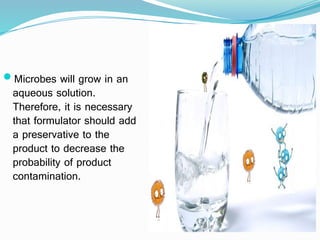
Microbes will grow in an
aqueous solution.
Therefore, it is necessary
that formulator should add
a preservative to the
product to decrease the
probability of product
contamination.
SELECTION OF PRESERVATIVE
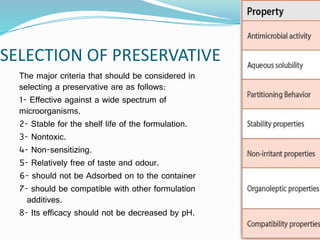
The major criteria that should be considered in
selecting a preservative are as follows:
1- Effective against a wide spectrum of
microorganisms.
2- Stable for the shelf life of the formulation.
3- Nontoxic.
4- Non-sensitizing.
5- Relatively free of taste and odour.
6- should not be Adsorbed on to the container
7- should be compatible with other formulation
additives.
8- Its efficacy should not be decreased by pH.
Classification of preservatives
Preservatives are classified into two main classes:
1. Antimicrobial preservatives
2. Antioxidant
Antimicrobial preservatives
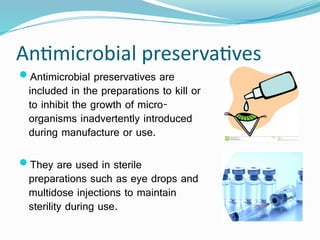
Antimicrobial preservatives are
included in the preparations to kill or
to inhibit the growth of micro-
organisms inadvertently introduced
during manufacture or use.
They are used in sterile
preparations such as eye drops and
multidose injections to maintain
sterility during use.
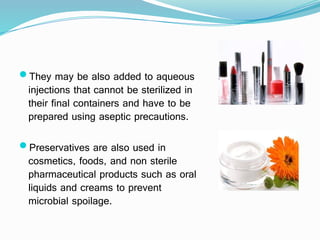
They may be also added to aqueous
injections that cannot be sterilized in
their final containers and have to be
prepared using aseptic precautions.
Preservatives are also used in
cosmetics, foods, and non sterile
pharmaceutical products such as oral
liquids and creams to prevent
microbial spoilage.
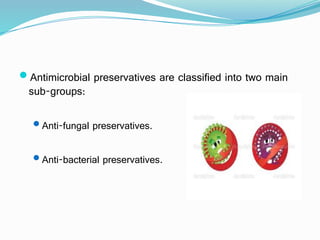
Antimicrobial preservatives are classified into two main
sub-groups:
Anti-fungal preservatives.
Anti-bacterial preservatives.
ANTI-FUNGAL PRESERVATIVES
Anti-fungal preservatives include compounds such as
benzoic acid, ascorbic acids and their salts.
phenolic compounds, methyl, ethyl, propyl and butyl p-
hydroxybenzoate (parabens).
ANTIBACTERIAL PRESERVATIVES
Antibacterial preservatives include compounds such as
quaternary ammonium salts
alcohols, phenols
Mercurials
biguanidines.
Antioxidants
Antioxidants are included in the pharmaceutical products
to prevent deterioration from oxidation.
Examples
ascorbic acid
citric acid
potassium and sodium salts of sulphurous acid.
Types
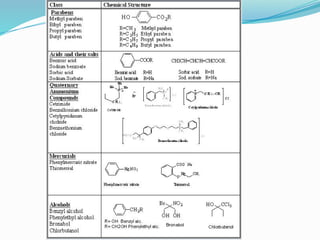
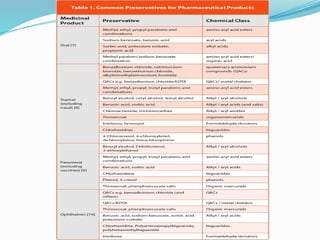
Preservatives may be grouped into a number of classes
depending upon their molecular structure, including:
Alcohols
Acids
Esters
Quaternary Ammonium compounds
1) Alcohols
Ethanol is useful as a preservative when it is
used as a solvent; however, its dose need a
relatively high concentration to be effective.
13-50%
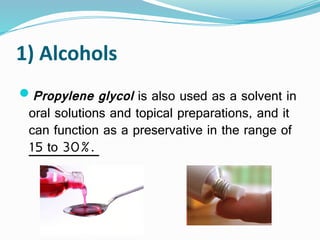
1) Alcohols
Propylene glycol is also used as a solvent in
oral solutions and topical preparations, and it
can function as a preservative in the range of
15 to 30%.
1) Alcohols
Chlorobutanol and phenylethyl alcohol are
used in lower concentrations of about 1% for
preservative action.
2) Acids
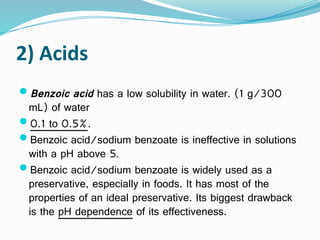
Benzoic acid has a low solubility in water. (1 g/300
mL) of water
0.1 to 0.5%.
Benzoic acid/sodium benzoate is ineffective in solutions
with a pH above 5.
Benzoic acid/sodium benzoate is widely used as a
preservative, especially in foods. It has most of the
properties of an ideal preservative. Its biggest drawback
is the pH dependence of its effectiveness.
2) Acids
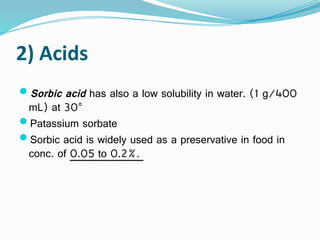
Sorbic acid has also a low solubility in water. (1 g/400
mL) at 30°
Patassium sorbate
Sorbic acid is widely used as a preservative in food in
conc. of 0.05 to 0.2%.
3) Esters
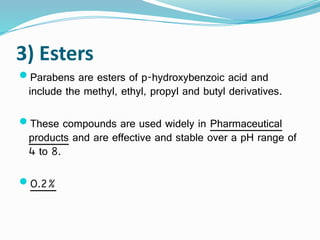
Parabens are esters of p-hydroxybenzoic acid and
include the methyl, ethyl, propyl and butyl derivatives.
These compounds are used widely in Pharmaceutical
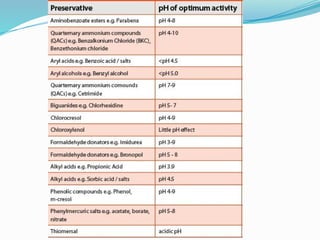
products and are effective and stable over a pH range of
4 to 8.
0.2%
Parabens
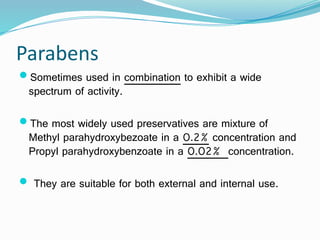
Sometimes used in combination to exhibit a wide
spectrum of activity.
The most widely used preservatives are mixture of
Methyl parahydroxybezoate in a 0.2% concentration and
Propyl parahydroxybenzoate in a 0.02% concentration.
 They are suitable for both external and internal use.
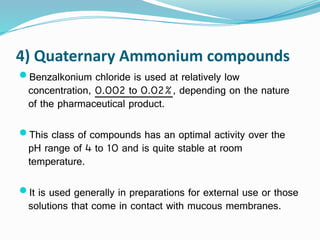
4) Quaternary Ammonium compounds
Benzalkonium chloride is used at relatively low
concentration, 0.002 to 0.02%, depending on the nature
of the pharmaceutical product.
This class of compounds has an optimal activity over the
pH range of 4 to 10 and is quite stable at room
temperature.
It is used generally in preparations for external use or those
solutions that come in contact with mucous membranes.
scribd.vdownloaders.com_preservatives.pdf

scribd.vdownloaders.com_preservatives.pdf

  • 1.
  • 2.
    PRESERVATIVES By: R.Ph Dr.Saba Inayat Ali Lecturer DCOP
  • 3.
    LEARNING OBJECTIVES At theend of this topic, students will be able to: Define Preservatives. List the criteria for selecting a suitable preservative. Classify preservatives as antimicrobial and antioxidants. Discuss the properties of alcohol, Acids, Esters & Quaternary Ammonium compounds as preservatives.
  • 4.
    Preservatives Preservatives are substancesthat are commonly added to various foods and pharmaceutical products in order to prolong their shelf life. The addition of preservatives to such products, especially to those that have higher water content, is essential for avoiding alteration and degradation by microorganisms during storage.
  • 5.
    Microbes will growin an aqueous solution. Therefore, it is necessary that formulator should add a preservative to the product to decrease the probability of product contamination.
  • 6.
    SELECTION OF PRESERVATIVE Themajor criteria that should be considered in selecting a preservative are as follows: 1- Effective against a wide spectrum of microorganisms. 2- Stable for the shelf life of the formulation. 3- Nontoxic. 4- Non-sensitizing. 5- Relatively free of taste and odour. 6- should not be Adsorbed on to the container 7- should be compatible with other formulation additives. 8- Its efficacy should not be decreased by pH.
  • 7.
    Classification of preservatives Preservativesare classified into two main classes: 1. Antimicrobial preservatives 2. Antioxidant
  • 8.
    Antimicrobial preservatives Antimicrobial preservativesare included in the preparations to kill or to inhibit the growth of micro- organisms inadvertently introduced during manufacture or use. They are used in sterile preparations such as eye drops and multidose injections to maintain sterility during use.
  • 9.
    They may bealso added to aqueous injections that cannot be sterilized in their final containers and have to be prepared using aseptic precautions. Preservatives are also used in cosmetics, foods, and non sterile pharmaceutical products such as oral liquids and creams to prevent microbial spoilage.
  • 10.
    Antimicrobial preservatives areclassified into two main sub-groups: Anti-fungal preservatives. Anti-bacterial preservatives.
  • 11.
    ANTI-FUNGAL PRESERVATIVES Anti-fungal preservativesinclude compounds such as benzoic acid, ascorbic acids and their salts. phenolic compounds, methyl, ethyl, propyl and butyl p- hydroxybenzoate (parabens).
  • 12.
    ANTIBACTERIAL PRESERVATIVES Antibacterial preservativesinclude compounds such as quaternary ammonium salts alcohols, phenols Mercurials biguanidines.
  • 13.
    Antioxidants Antioxidants are includedin the pharmaceutical products to prevent deterioration from oxidation. Examples ascorbic acid citric acid potassium and sodium salts of sulphurous acid.
  • 14.
    Types Preservatives may begrouped into a number of classes depending upon their molecular structure, including: Alcohols Acids Esters Quaternary Ammonium compounds
  • 15.
    1) Alcohols Ethanol isuseful as a preservative when it is used as a solvent; however, its dose need a relatively high concentration to be effective. 13-50%
  • 16.
    1) Alcohols Propylene glycolis also used as a solvent in oral solutions and topical preparations, and it can function as a preservative in the range of 15 to 30%.
  • 17.
    1) Alcohols Chlorobutanol andphenylethyl alcohol are used in lower concentrations of about 1% for preservative action.
  • 18.
    2) Acids Benzoic acidhas a low solubility in water. (1 g/300 mL) of water 0.1 to 0.5%. Benzoic acid/sodium benzoate is ineffective in solutions with a pH above 5. Benzoic acid/sodium benzoate is widely used as a preservative, especially in foods. It has most of the properties of an ideal preservative. Its biggest drawback is the pH dependence of its effectiveness.
  • 19.
    2) Acids Sorbic acidhas also a low solubility in water. (1 g/400 mL) at 30° Patassium sorbate Sorbic acid is widely used as a preservative in food in conc. of 0.05 to 0.2%.
  • 20.
    3) Esters Parabens areesters of p-hydroxybenzoic acid and include the methyl, ethyl, propyl and butyl derivatives. These compounds are used widely in Pharmaceutical products and are effective and stable over a pH range of 4 to 8. 0.2%
  • 21.
    Parabens Sometimes used incombination to exhibit a wide spectrum of activity. The most widely used preservatives are mixture of Methyl parahydroxybezoate in a 0.2% concentration and Propyl parahydroxybenzoate in a 0.02% concentration.  They are suitable for both external and internal use.
  • 22.
    4) Quaternary Ammoniumcompounds Benzalkonium chloride is used at relatively low concentration, 0.002 to 0.02%, depending on the nature of the pharmaceutical product. This class of compounds has an optimal activity over the pH range of 4 to 10 and is quite stable at room temperature. It is used generally in preparations for external use or those solutions that come in contact with mucous membranes.