Antibiotic sensitivity testing
 The antibiotic sensitivity test is the best method to
select proper treatment of infectious diseases
 So, we use it either to
 1- select the best antimicrobial agent
 2-to accumulate epidemiological information on the
resistance of microorganism of public health
importance
1. Kirby Bauer agar disk diffusion
methods
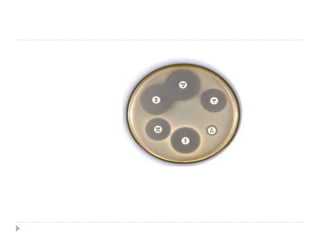
 Procedure
 1-Streak bacterial inoculum on (Mueller-Hinton agar
plate )
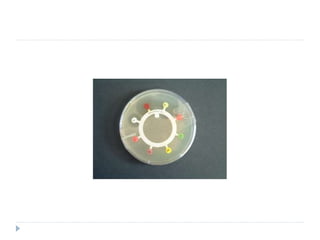
 2- antibiotic impregnated discs are placed onto the
agar surface
 3-incubate over night on 37 ºc
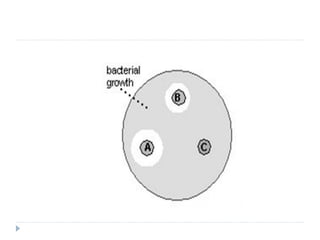
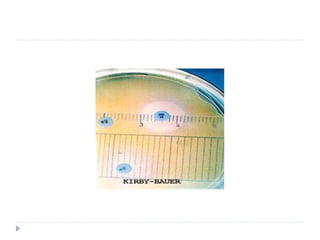
 4- an inhibitory zone appear around the disks
 5- zone of inhibition is measured according to
National Committee for Clinical Laboratory
Standards (NCCLS).guidelines
2.
comparative methods (Stokes’)
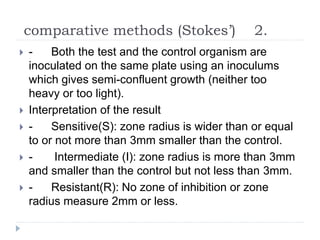
 - Both the test and the control organism are
inoculated on the same plate using an inoculums
which gives semi-confluent growth (neither too
heavy or too light).
 Interpretation of the result
 - Sensitive(S): zone radius is wider than or equal
to or not more than 3mm smaller than the control.
 - Intermediate (I): zone radius is more than 3mm
and smaller than the control but not less than 3mm.
 - Resistant(R): No zone of inhibition or zone
radius measure 2mm or less.
3. Dilution method
 - This used to detect antimicrobial susceptibility to
slow growing M.O.
 - It could be carried out on microtiter plate or test
tube.
 - It used to detect MIC
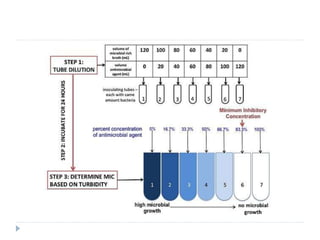
 - Performed by making a serial dilution of
antimicrobials in broth media and add 5 drops from
106bacterial suspensions and incubate at 37 °C over
night, then read about turbidity which indicates resistance
and clearance which indicate sensitivity, and detect the
MIC as the lowest concentration of antimicrobial that
required preventing visible growth.
 -
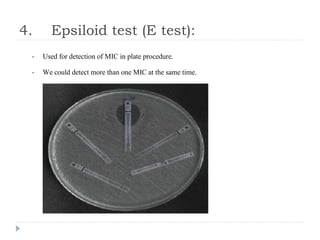
4. Epsiloid test (E test):
- Used for detection of MIC in plate procedure.
- We could detect more than one MIC at the same time.

Epsilometer test (E- test ) is an ‘exponential gradient’
method of determination of antimicrobial resistance.
The E-test has been developed to provide a direct
quantification of antimicrobial susceptibility of
microorganisms.This is a quantitative method that
applies both the dilution of antibiotic and diffusion of
antibiotic into the medium.

The device consists of a predefined, continuous, and
exponential gradient of antibiotic concentrations
immobilized along a rectangular plastic test strip.
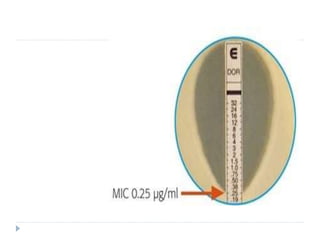
After 48 hours incubation a drop-shaped inhibition
zone intersects the graded test strip at the inhibitory
concentration (IC) of the antibiotic.
Antibiotics sensitivity testing (1).pptx

Antibiotics sensitivity testing (1).pptx

  • 1.
  • 2.
     The antibioticsensitivity test is the best method to select proper treatment of infectious diseases  So, we use it either to  1- select the best antimicrobial agent  2-to accumulate epidemiological information on the resistance of microorganism of public health importance
  • 3.
    1. Kirby Baueragar disk diffusion methods  Procedure  1-Streak bacterial inoculum on (Mueller-Hinton agar plate )  2- antibiotic impregnated discs are placed onto the agar surface  3-incubate over night on 37 ºc  4- an inhibitory zone appear around the disks  5- zone of inhibition is measured according to National Committee for Clinical Laboratory Standards (NCCLS).guidelines
  • 8.
    2. comparative methods (Stokes’) - Both the test and the control organism are inoculated on the same plate using an inoculums which gives semi-confluent growth (neither too heavy or too light).  Interpretation of the result  - Sensitive(S): zone radius is wider than or equal to or not more than 3mm smaller than the control.  - Intermediate (I): zone radius is more than 3mm and smaller than the control but not less than 3mm.  - Resistant(R): No zone of inhibition or zone radius measure 2mm or less.
  • 10.
    3. Dilution method - This used to detect antimicrobial susceptibility to slow growing M.O.  - It could be carried out on microtiter plate or test tube.  - It used to detect MIC  - Performed by making a serial dilution of antimicrobials in broth media and add 5 drops from 106bacterial suspensions and incubate at 37 °C over night, then read about turbidity which indicates resistance and clearance which indicate sensitivity, and detect the MIC as the lowest concentration of antimicrobial that required preventing visible growth.  -
  • 12.
    4. Epsiloid test(E test): - Used for detection of MIC in plate procedure. - We could detect more than one MIC at the same time.
  • 13.
     Epsilometer test (E-test ) is an ‘exponential gradient’ method of determination of antimicrobial resistance. The E-test has been developed to provide a direct quantification of antimicrobial susceptibility of microorganisms.This is a quantitative method that applies both the dilution of antibiotic and diffusion of antibiotic into the medium.
  • 14.
     The device consistsof a predefined, continuous, and exponential gradient of antibiotic concentrations immobilized along a rectangular plastic test strip. After 48 hours incubation a drop-shaped inhibition zone intersects the graded test strip at the inhibitory concentration (IC) of the antibiotic.