Internal Medicine Mini-Lecture
Learning Points
 Basics
 Choosing antibiotics
 Overview
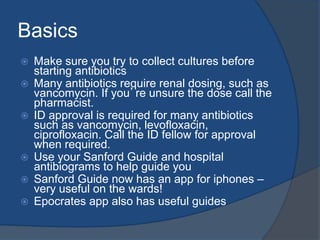
Basics
 Make sure you try to collect cultures before
starting antibiotics
 Many antibiotics require renal dosing, such as
vancomycin. If you’re unsure the dose call the
pharmacist.
 ID approval is required for many antibiotics
such as vancomycin, levofloxacin,
ciprofloxacin. Call the ID fellow for approval
when required.
 Use your Sanford Guide and hospital
antibiograms to help guide you
 Sanford Guide now has an app for iphones –
very useful on the wards!
 Epocrates app also has useful guides
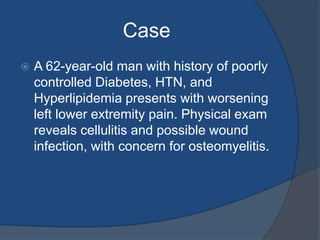
Case
 A 62-year-old man with history of poorly
controlled Diabetes, HTN, and
Hyperlipidemia presents with worsening
left lower extremity pain. Physical exam
reveals cellulitis and possible wound
infection, with concern for osteomyelitis.
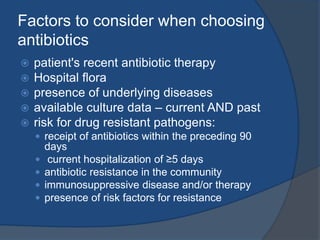
Factors to consider when choosing
antibiotics
 patient's recent antibiotic therapy
 Hospital flora
 presence of underlying diseases
 available culture data – current AND past
 risk for drug resistant pathogens:
 receipt of antibiotics within the preceding 90
days
 current hospitalization of ≥5 days
 antibiotic resistance in the community
 immunosuppressive disease and/or therapy
 presence of risk factors for resistance
Choosing an antibiotic:
 Think about Location:
 Where did the patient become ill? Travel?
Exposure?
 Where did the infection anatomically originate?
 Where in the body, has or will the infection
spread to?
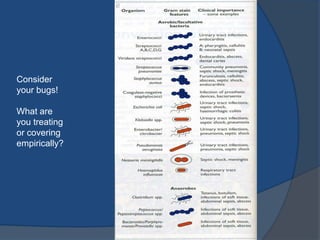
 Think about the bug you are treating:
Consider
your bugs!
What are
you treating
or covering
empirically?
Antibiotic classes
 Beta-lactams*
 Aminoglycosides
 Quinolones*
 Macrolides*
 Lincosamides*
 Metronidazole*
 Glycopeptides
 Oxazolidinones
 Streptogramins
 Lipopeptides
 Tetracyclines
 Chloramphenicol
 Polymyxins
 Sulfonamides
 Trimethoprim
 Rifamycins
 Nitrofurantoin
* These groups will be reviewed
further
B-Lactams: Penicillins
 Penicillin
 Use: pneumococcus, strep, enterococcus, N. meningitidis, syphilis,
listeria, leptospirosis and oral anerobes: peptostreptococcus and
prevotella
 Amoxicillin
 Use: Covers same stuff as penicillin and expanded activity against
gram negatives ( E.coli, Proteus,H. influenza, H. pylori, N.
meningitidis, shigella, klebsiella); covers most spirochetes including
lyme disease. Clavulanate enhances the gram negative spectrum to
include additional anaerobes such as bacteroides.
 Oxacillin/Nafcillin/Dicloxacillin
 Use: Only good for staphylococcal spp (except MRSA),
pneumococcus and other streptococci
 Piperacillin and Ticarcillin
 Use: Piperacillin covers pneumococcus, streptococcal spp including
enterococcus, gram negative including pseudomonas.
 Does not cover MRSA.
B-Lactams: Cephalosporins
1st generation
 Cefazolin:
 Use: staph, non-enterococal strep; prophylactic in clean
surgeries, cellultis, folliculitis
 Limitations: respiratory tract infections, animal bites or surgeries
involving the colon
2nd Generation
 Cefuroxime:
 Use: respiratory infections--Strep pneumoniae, H.influenzae and
M.cattarhalis; , meningitis due to pneumococcus,H.flu and
N.meningitidis.
 Limitations: enteric organisms/abdominal anaerobes
 Cefoxitin/Cefotetan:
 Use: intra-abdominal infections especially anerobes
 Limitations: staph and other gram positives
B-Lactams: Cephalosporins
3rd Generation
 Cefotaxime & Ceftriaxone:
 Use: Good for staph and non-enterococcal strep; broad
coverage of gram negative and oral anaerobes, CNS,
pulmonary, endovascular, GI infections (excluding gut
anaerobes), sinusitis, otitis, head & neck.
 Limitations: does NOT cover Pseudomonas; ceftriaxone can
cause biliary sludging and limits its utility in treating biliary tree
infections
 Ceftazidime:
 Use: Good gram negative coverage including Pseudomonas;
febrile neutropenia CNS infections- good for Pseudomonas
meningitis
 Limitations: reduced activity against the gram positives and oral
anaerobes.
4th Generation
 Cefepime & Cefpirome:
 Use: Enterobacter, Citrobacter and Serratia;Pseudomonas; gram
positives; used in neutropenic fever and CNS infections.
Beta-Lactams: Carbapenems
 Imepenem:
 slightly more activity against gram positive
bacteria than meropenem or ertapenem
 Ertapenem:
 Good for aerobic gram negatives
 poor coverage of pseudomonas ,E. faecalis,
nocardia
 Meropenem:
 Good for aerobic gram negatives
 Doripenem:
 Good for CNS coverage and pseudomonas
Beta-Lactams
 Cautions:
 Beta-lactam allergy can occur in up to 10%
 5%-10% cross-sensitivity in penicillin,
cephalosporins, and carbapenems
 Side effects:
 diarrhea, nausea, rash
Quinolones:
 Ciprofloxacin:
 Use: Covers most aerobic gram negatives including
Pseudomonas.
 penetrates CNS, prostate, lungs
 Limited against staph
 Non-ciprofloxacin quinolones: Ofloxacin, Levofloxacin,
Moxifloxacin: Gemifloxacin:
 Use: Great for respiratory pathogens, most enteric gram
negatives
 Only levofloxacin covers pseudomonas
 Covers some atypicals: Mycoplasma, Chlamydia, Legionella
 Cautions:
 Can cause Qt prolongation, tendon rupture, CNS toxicity
 Do not use in patients with epilepsy or existing CNS lesions or
inflammation
 Side effects:
 Commonly causes C diff
Macrolides:
Erythromycin, Clarithromycin, Azithromycin
 Use:
○ Broad spectrum against gram positives including
strep, staph aureus (MSSA)
○ Good for atypical oganism such as Mycoplasma,
Chlamydia, Legionella
○ Covers N.gonorrhea, H flu, Legionella
 Caution:
○ can interact with statin to cause myopathy
○ Can cause Qt prolongation
 Side effects:
○ GI upset
Lincosamides: Clindamycin
 Use:
 Reasonable gram positive aerobic coverage
against strep and many staph including MRSA
 Special role in treating strep in necrotizing
fascitits
 Anaerobic coverage better then penicillin but not
as good as metronidazole
 Caution:
 can interact with neuromuscular blocking agents
and cyclosporine
 Side effects:
 Diarrhea, commonly causes C difficile—avoid
clindamycin if other good options exist.
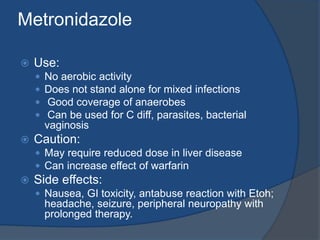
Metronidazole
 Use:
 No aerobic activity
 Does not stand alone for mixed infections
 Good coverage of anaerobes
 Can be used for C diff, parasites, bacterial
vaginosis
 Caution:
 May require reduced dose in liver disease
 Can increase effect of warfarin
 Side effects:
 Nausea, GI toxicity, antabuse reaction with Etoh;
headache, seizure, peripheral neuropathy with
prolonged therapy.
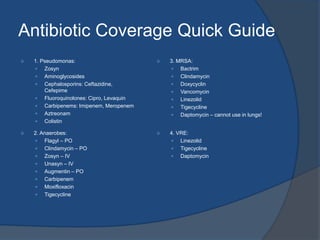
Antibiotic Coverage Quick Guide
 1. Pseudomonas:
 Zosyn
 Aminoglycosides
 Cephalosporins: Ceftazidine,
Cefepime
 Fluoroquinolones: Cipro, Levaquin
 Carbipenems: Imipenem, Meropenem
 Aztreonam
 Colistin
 2. Anaerobes:
 Flagyl – PO
 Clindamycin – PO
 Zosyn – IV
 Unasyn – IV
 Augmentin – PO
 Carbipenem
 Moxifloxacin
 Tigecycline
 3. MRSA:
 Bactrim
 Clindamycin
 Doxycyclin
 Vancomycin
 Linezolid
 Tigecycline
 Daptomycin – cannot use in lungs!
 4. VRE:
 Linezolid
 Tigecycline
 Daptomycin

Antibiotics (5).ppt

  • 1.
  • 2.
    Learning Points  Basics Choosing antibiotics  Overview
  • 3.
    Basics  Make sureyou try to collect cultures before starting antibiotics  Many antibiotics require renal dosing, such as vancomycin. If you’re unsure the dose call the pharmacist.  ID approval is required for many antibiotics such as vancomycin, levofloxacin, ciprofloxacin. Call the ID fellow for approval when required.  Use your Sanford Guide and hospital antibiograms to help guide you  Sanford Guide now has an app for iphones – very useful on the wards!  Epocrates app also has useful guides
  • 4.
    Case  A 62-year-oldman with history of poorly controlled Diabetes, HTN, and Hyperlipidemia presents with worsening left lower extremity pain. Physical exam reveals cellulitis and possible wound infection, with concern for osteomyelitis.
  • 5.
    Factors to considerwhen choosing antibiotics  patient's recent antibiotic therapy  Hospital flora  presence of underlying diseases  available culture data – current AND past  risk for drug resistant pathogens:  receipt of antibiotics within the preceding 90 days  current hospitalization of ≥5 days  antibiotic resistance in the community  immunosuppressive disease and/or therapy  presence of risk factors for resistance
  • 6.
    Choosing an antibiotic: Think about Location:  Where did the patient become ill? Travel? Exposure?  Where did the infection anatomically originate?  Where in the body, has or will the infection spread to?  Think about the bug you are treating:
  • 7.
    Consider your bugs! What are youtreating or covering empirically?
  • 8.
    Antibiotic classes  Beta-lactams* Aminoglycosides  Quinolones*  Macrolides*  Lincosamides*  Metronidazole*  Glycopeptides  Oxazolidinones  Streptogramins  Lipopeptides  Tetracyclines  Chloramphenicol  Polymyxins  Sulfonamides  Trimethoprim  Rifamycins  Nitrofurantoin * These groups will be reviewed further
  • 9.
    B-Lactams: Penicillins  Penicillin Use: pneumococcus, strep, enterococcus, N. meningitidis, syphilis, listeria, leptospirosis and oral anerobes: peptostreptococcus and prevotella  Amoxicillin  Use: Covers same stuff as penicillin and expanded activity against gram negatives ( E.coli, Proteus,H. influenza, H. pylori, N. meningitidis, shigella, klebsiella); covers most spirochetes including lyme disease. Clavulanate enhances the gram negative spectrum to include additional anaerobes such as bacteroides.  Oxacillin/Nafcillin/Dicloxacillin  Use: Only good for staphylococcal spp (except MRSA), pneumococcus and other streptococci  Piperacillin and Ticarcillin  Use: Piperacillin covers pneumococcus, streptococcal spp including enterococcus, gram negative including pseudomonas.  Does not cover MRSA.
  • 10.
    B-Lactams: Cephalosporins 1st generation Cefazolin:  Use: staph, non-enterococal strep; prophylactic in clean surgeries, cellultis, folliculitis  Limitations: respiratory tract infections, animal bites or surgeries involving the colon 2nd Generation  Cefuroxime:  Use: respiratory infections--Strep pneumoniae, H.influenzae and M.cattarhalis; , meningitis due to pneumococcus,H.flu and N.meningitidis.  Limitations: enteric organisms/abdominal anaerobes  Cefoxitin/Cefotetan:  Use: intra-abdominal infections especially anerobes  Limitations: staph and other gram positives
  • 11.
    B-Lactams: Cephalosporins 3rd Generation Cefotaxime & Ceftriaxone:  Use: Good for staph and non-enterococcal strep; broad coverage of gram negative and oral anaerobes, CNS, pulmonary, endovascular, GI infections (excluding gut anaerobes), sinusitis, otitis, head & neck.  Limitations: does NOT cover Pseudomonas; ceftriaxone can cause biliary sludging and limits its utility in treating biliary tree infections  Ceftazidime:  Use: Good gram negative coverage including Pseudomonas; febrile neutropenia CNS infections- good for Pseudomonas meningitis  Limitations: reduced activity against the gram positives and oral anaerobes. 4th Generation  Cefepime & Cefpirome:  Use: Enterobacter, Citrobacter and Serratia;Pseudomonas; gram positives; used in neutropenic fever and CNS infections.
  • 12.
    Beta-Lactams: Carbapenems  Imepenem: slightly more activity against gram positive bacteria than meropenem or ertapenem  Ertapenem:  Good for aerobic gram negatives  poor coverage of pseudomonas ,E. faecalis, nocardia  Meropenem:  Good for aerobic gram negatives  Doripenem:  Good for CNS coverage and pseudomonas
  • 13.
    Beta-Lactams  Cautions:  Beta-lactamallergy can occur in up to 10%  5%-10% cross-sensitivity in penicillin, cephalosporins, and carbapenems  Side effects:  diarrhea, nausea, rash
  • 14.
    Quinolones:  Ciprofloxacin:  Use:Covers most aerobic gram negatives including Pseudomonas.  penetrates CNS, prostate, lungs  Limited against staph  Non-ciprofloxacin quinolones: Ofloxacin, Levofloxacin, Moxifloxacin: Gemifloxacin:  Use: Great for respiratory pathogens, most enteric gram negatives  Only levofloxacin covers pseudomonas  Covers some atypicals: Mycoplasma, Chlamydia, Legionella  Cautions:  Can cause Qt prolongation, tendon rupture, CNS toxicity  Do not use in patients with epilepsy or existing CNS lesions or inflammation  Side effects:  Commonly causes C diff
  • 15.
    Macrolides: Erythromycin, Clarithromycin, Azithromycin Use: ○ Broad spectrum against gram positives including strep, staph aureus (MSSA) ○ Good for atypical oganism such as Mycoplasma, Chlamydia, Legionella ○ Covers N.gonorrhea, H flu, Legionella  Caution: ○ can interact with statin to cause myopathy ○ Can cause Qt prolongation  Side effects: ○ GI upset
  • 16.
    Lincosamides: Clindamycin  Use: Reasonable gram positive aerobic coverage against strep and many staph including MRSA  Special role in treating strep in necrotizing fascitits  Anaerobic coverage better then penicillin but not as good as metronidazole  Caution:  can interact with neuromuscular blocking agents and cyclosporine  Side effects:  Diarrhea, commonly causes C difficile—avoid clindamycin if other good options exist.
  • 17.
    Metronidazole  Use:  Noaerobic activity  Does not stand alone for mixed infections  Good coverage of anaerobes  Can be used for C diff, parasites, bacterial vaginosis  Caution:  May require reduced dose in liver disease  Can increase effect of warfarin  Side effects:  Nausea, GI toxicity, antabuse reaction with Etoh; headache, seizure, peripheral neuropathy with prolonged therapy.
  • 18.
    Antibiotic Coverage QuickGuide  1. Pseudomonas:  Zosyn  Aminoglycosides  Cephalosporins: Ceftazidine, Cefepime  Fluoroquinolones: Cipro, Levaquin  Carbipenems: Imipenem, Meropenem  Aztreonam  Colistin  2. Anaerobes:  Flagyl – PO  Clindamycin – PO  Zosyn – IV  Unasyn – IV  Augmentin – PO  Carbipenem  Moxifloxacin  Tigecycline  3. MRSA:  Bactrim  Clindamycin  Doxycyclin  Vancomycin  Linezolid  Tigecycline  Daptomycin – cannot use in lungs!  4. VRE:  Linezolid  Tigecycline  Daptomycin

Editor's Notes

  • #10 Key take away for Beta Lactams: -Remember that Pipercillin covers Pseudomonas (Zosyn is Pipercillin with Tazobactam)
  • #11 Key take away for Cephalosporins: -Increasing gram negative coverage with progression from 1st gen to 4th gen
  • #13 Key take away for Carbapenems: -Ertapenem has poor coverage of Pseudomonas!
  • #15 Key point for Quinolones: Levofloxacin has excellent lung penetration!
  • #16 Key point: Remember QT prolongation!
  • #17 Key Point: Remember C. diff!