Ministry of Iraqi Higher Education and Scientific Research
Babylon university-college of dentistry
Done by students:-
1-Saad J. Hamood
2-Haidar M. Hassan
3-Ahmed M. lefta
Pharmacology for orofacial bacterial infection
Many pathologies present to dentist in clinic
Many of these are inflamatory conditions associated
with pain
So when need intervention we need analgesic for pain
as well as antibiotic for infection
The clinical situation require AB are limited .they include
oral infection associated with
1- elevate body temp.
2-pain 3- inflamation 4- systemic involve
A- lymphadenopathy B- trismus
Step wise for AB prescribing
To prescribing AB the professional shouldknow associated
pathogens
Spectrum of activity of most used AB
in treatment of orofacial infection
BroadExtendedNarrow
Augmentin (amoxicillin
plus clavulanate),
sulfamethoxazole and
trimethoprim,
tetracyclines
(tetracycline,
doxycycline)
Cephalosporins
(cephalexin, cefadroxil,
cefaclor, cefuroxime),
extendedspectrum
penicillins (ampicillin,
amoxicillin),
fluoroquinolones
(ciprofloxacin, levofloxacin,
moxifloxacin)
Clindamycin, dicloxacillin,
macrolides
(erythromycin,
clarithromycin,
azithromycin),
metronidazole,
penicillin G, penicillin V
Narrow spectrum
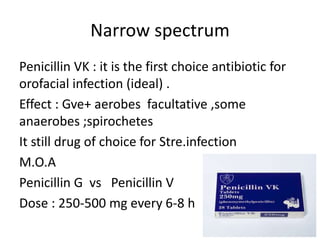
Penicillin VK : it is the first choice antibiotic for
orofacial infection (ideal) .
Effect : Gve+ aerobes facultative ,some
anaerobes ;spirochetes
It still drug of choice for Stre.infection
M.O.A
Penicillin G vs Penicillin V
Dose : 250-500 mg every 6-8 h
Metronidazole
Dose : 500mg q6-12 h
Effect : obligate anaerobes such bactroid ,camp.
,prevotella , vielonella
M.O.A
Advese effect : metalic taste , glossitis, stomatitis ,
xerostomia, furry tonge
CAUSION : not take with alcohol due to as
disulfiram like reaction may occur
Clindamycin (AG)
• Dose : 150-450 mg q6-8h
• Effect : mostly against most strain of staph.
Aurus
• M.O.A
• It is bacteriostatic not bactericidal
•
Azithromycin + clarithromycin +
erythromycin
• azithro. : dose 500mg for 1 day then 250mg *4d
• Clarithro. : dose tab 250-500mg q12 h
• ER of clarithro. (not for child)
• 1000 * 1
• Note : both Azithromycin + clarithromycin are
used with caution in patient with history of
cardiovascular disease
• Erythromycin used as alternative macrolides for
patient with history of cardiovascular disease
• Dose : 250-500 mg q 6 h
Doxycycline
• Dose : 100 mg q 12h
• For sinusitis : cap 100mg ,2cap for 1st day then 1
daily .
• Uses : for aubantimicrobial dose as adjunct to
scaling and root planing or for subgingival
application .
• Causion in patient with hepatic impairment also
for pregnant women and nursing mom due to it
deposition in bone and teeth .also enhanced the
effect of warfarin .
• Side effect : nausea,vomiting,diarrhoea,dysphagia
Extended spectrum
• Fluroquniolones (nuclic acid synthesis)
• It is not used as the first line > due it may cause
colateral damage ( superinfection by resistence
pathogens)
• Ciprofloxacin & Levofloxacin : dose 250-700mg q
12h
•
Penicillins ( amoxicillin&ampicillin)
• Amoxicillin : 250-500mg q 8h
500-875mg q 12h
It combid to metronidazole for treat AA.
Periodontitis
• Ampicillin
Cephalexin (keflex)
• Dose : 250-1000mg q 6-12h
• In patients with a history of severe reactions
(urticaria, angioedema, bronchospasm,
anaphylaxis), the rate of reactions to cephalexin in
patients with a history of penicillin allergy is about
10%. For patients with a history of a less-than-
severe reaction to cephalexin, the rate is closer to
0.1%
Broad spectrum
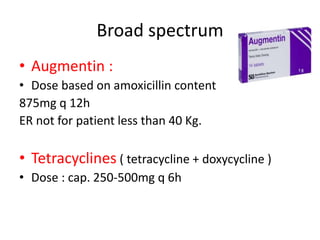
• Augmentin :
• Dose based on amoxicillin content
875mg q 12h
ER not for patient less than 40 Kg.
• Tetracyclines ( tetracycline + doxycycline )
• Dose : cap. 250-500mg q 6h
Antibiiotic for immunocompramized
patient
• Numerous medical conditions are associated
with suppression of the immune system either
directly from an underlying disease (e.g.,
diabetes, cancer, organ transplantation)
• or from medications used to manage these
diseases (e.g., cyclosporine,prednisone)
• immunocompromised patient is the risk of poor
healing and
systemic spread of an orofacial infection
So in order to quantifying patient severity
of immunosuppression
• Measure ANC(absolute neutrophile count)
• ANC is calculated by multiplying the percentage
of neutrophils plus bands (immature
neutrophils) with the absolute number of
neutrophils from the total white blood cell
(WBC) count.
• For example, if a patient had 2000/μL WBCs with
45% neutrophils and 5% bands, the patient’s
ANC is 1000/μL (2000/μL × 50%).
• An ANC < 500/μL represents a severe
neutropenia with an increased incidence and
severity of infection
Neutropenic cancer patients
• Patients with cancer may be neutropenic from
their chemotherapy treatment or their underlying
cancer.
• , the National Cancer Institute recommends that
the American Heart Association (AHA) regimen
prophylactic antibiotics be used for patients with
indwelling venous access lines and an ANC
between 1000 and 2000/μL before any invasive
dental procedure.
• Topical antibiotics such as chlorhexidine 0.12%
solution swish and expectorate with 10 mL twice
daily) are appropriate for localized gingival
disease during neutropenia .The use of broad-
spectrum antibiotics is appropriate forthe
treatment of active orofacial infections in
neutropenic patients
• The antibiotic can be changed to a narrower-
spectrum agent based on appropriate
susceptibility of bacterial isolates as identified
through culture of draining pus.
ANTIBIOTIC PROPHYLAXIS AGAINST INFECTIVE ENDOCARDITIS
AND PROSTHETIC JOINT INFECTIONS
• Oral bacterial pathogens may be responsible for
cases of infective endocarditis (IE) or late-
prosthetic joint infections.
• bacteremia from routine daily activities such as
tooth brushing and chewing food
• THE NEW GUIDELINE STATES, “TREATMENTS AND
PROCEDURES APPLICABLE TO THE
INDIVIDUAL PATIENT RELY ON MUTUAL COMMUNICATION
BETWEEN PATIENT, PHYSICIAN, DENTIST, AND OTHER
HEALTHCARE PRACTITIONERS .”
Cardiac Conditions Associated With the Highest Risk of
Endocarditis for Which Antibiotic Prophylaxis Is
• •• Prosthetic cardiac valve.
• •• Previous infective endocarditis.
• •• Cardiac transplantation recipients who develop cardiac
valvulopathy.
• •• Congenital heart disease (CHD)a:
• •• Unrepaired cyanotic CHD, including palliative shunts and
conduits.
• •• Completely repaired congenital heart defect with prosthetic material
or device, whether placed by surgery or by catheter intervention,
• during the first 6 m after the procedure.b
• •• Repaired CHD with residual defects at the site or adjacent to the site
of a prosthetic patch or prosthetic device (which inhibit
endothelialization).
Bacteremic Risks of Various Dental
Procedures
• Higher •• Dental extractions
• •• Periodontal procedures, including surgery, subgingival
placement of antibiotic fibers/strips, scaling and root
• planing, probing, and recall maintenance.
• •• Dental implant placement and replantation of avulsed teeth.
• •• Endodontic (root canal) instrumentation or surgery only
beyond the apex.
• •• Initial placement of orthodontic bands but not brackets.
• •• Intraligamentary and intraosseous local anesthetic
injections.
• •• Prophylactic cleaning of teeth or implants where bleeding is
anticipated
Lower
• •• Restorative dentistry (operative and prosthodontic)
with/without retraction cord.c
• •• Local anesthetic injections (non-intraligamentary and non-
intraosseous).
• •• Intracanal endodontic treatment; post placement and
buildup.
• •• Placement of rubber dam.
• •• Postoperative suture removal.
• •• Placement of removable prosthodontic/orthodontic
appliances.
• •• Taking of oral impressions.
• •• Fluoride treatments.
• •• Taking of oral radiographs.
• •• Orthodontic appliance adjustment
PROPHYLACTIC ANTIBIOTICS IN HEMODIALYSIS PATIENTS
• THE BEST STRATEGY IS TO CONSULT WITH THE PATIENT’S
NEPHROLOGIST TO DETERMINE IF PROPHYLACTIC
ANTIBIOTICS ARE DEEMED NECESSARY FROM THEIR
MEDICAL POINT OF VIEW.
The primary viral pathogen of oral infections is:-
Herpes simplex virus 1 (HSV-1)
• The first is primary herpetic gingivostomatitis (HGS)
• The second is recurrent herpes labialis (RHL)
• Oral antiviral therapies (acyclovir, famciclovir,
valacyclovir) are indicated in acute HGS.
preventing further viral DNA synthesis without
affecting the normal cellular processes
:- 15 mg/kg daily for 7 d----
five times daily(start within 72 h of
symptoms)
:- 400 mg tid or 200 mg five
times daily for 7–10 d
• Cream (5%)
• Cream (5%) with hydrocortisone (1%)
• Ointment (5%)
:- Hypersensitivity to
acyclovir orValacyclovir
Renal dysfunction or co-
administration of nephrotoxic drugs
apply to lesion
five times
daily for 4 d
• Common side effects:-
• Important drug interactions:- Aminoglycosides ,
phenytoin , Mycophenolate and probenecid.
• In pregnancy:-category B
• During feeding :-not use over 800mg and is preferable
topical only
Second:- Famciclovir (Famvir)
• Adults dose :-500 mg tid for 7–10 d
• Cream (1%):- Apply to lesion every 2 h
while awake for 4 d
• Important drug interactions Digoxin(hf),
probenecid(Uric A.)
• Hypersensitivity to famciclovir
• Pregnancy:-category B
• Adult dose:- 1 g bid for 7–10 d
• Interaction :-Cimetidine,
phenytoin, probenecid
• Hypersensitivity to acyclovir or
valacyclovir
• Prophylaxis :-500 mg qd
(indefinite duration)
• In pregnancy:-category B
Preventive strategies
• basic avoidance of triggers
• use of sunscreen
• use prophylactic drug therapy to reduce the
recurrence rate.
• Oral acyclovir and valacyclovir
• Given that valacyclovir is a once-daily
treatment
• acyclovir is to be taken twice daily for
prevention
FUNGAL INFECTION
Risk factors
1.Age
2.Diabitic mellitus
3. Poor oral hygiene
4. Chronic local irritation of mucus membrane
5. Oral prostheses
6. immunosuppressed Patients
1. acute pseudomembranous candidiasis (commonly called
thrush).
2. Acute atrophic or erythematous candidiasis
Type of poc
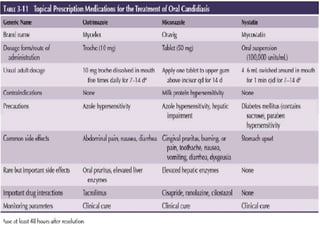
Oral candidiasis
Topical
1. Miconazole tab 50 mg
2. nystatin 100,000 units/ml
3. Clotrimazole 10ml
1.fluconazole
2. Itraconazole ( first line)
3.Posaconazole ( first line)
4. Voriconazole (second line)
5.Amphotrisene b (second line)
Mild
Moderate and sever disease
Treatment of Angular Cheilitis
1.Bacterial can be cured using mupirocin topical
ointment
2. fungal topical nystatin or ketoconazole cream a
mild corticosteroid, to reduce inflammation like
triamcinolone
3.nither bacterial nor fungal origin, barrier creams
such as petrolatum, zinc oxide, or lip balm can help
protect irritated skin
Denture Stomatitis
1. chlorhexidine and chlorine-based soaks
2. oral hygiene
3. removing dentures at night
4. medications useful in reducing ulceration
recurrence include colchicine, pentoxifylline,
azathioprine, thalidomide, and dapsone. injectable
immunosuppressant, such as interferon alfa,
infliximab, and etanercept
symptom management
1.topical and oral corticosteroids.
2.Intralesional steroid injections are not advised
3.topical pimecrolimus or tacrolimus might either be
considered a first-line therapy or be useful in steroid-
refractory case
Lichen Planus
pemphigus vulgaris, bullous pemphigoid, and
mucous membrane pemphigoid topical
corticosteroids.
For refractory disease or to induce remission
combinations of oral corticosteroids and
immunosuppressant medications such as
azathioprine, dapsone, mycophenolate, or
cyclophosphamide can be used
Other Oral Lesions
طب اسنان بابل-المضادات الحيوية 2016

طب اسنان بابل-المضادات الحيوية 2016

  • 2.
    Ministry of IraqiHigher Education and Scientific Research Babylon university-college of dentistry Done by students:- 1-Saad J. Hamood 2-Haidar M. Hassan 3-Ahmed M. lefta
  • 3.
    Pharmacology for orofacialbacterial infection Many pathologies present to dentist in clinic Many of these are inflamatory conditions associated with pain So when need intervention we need analgesic for pain as well as antibiotic for infection The clinical situation require AB are limited .they include oral infection associated with 1- elevate body temp. 2-pain 3- inflamation 4- systemic involve A- lymphadenopathy B- trismus
  • 4.
    Step wise forAB prescribing
  • 5.
    To prescribing ABthe professional shouldknow associated pathogens
  • 6.
    Spectrum of activityof most used AB in treatment of orofacial infection BroadExtendedNarrow Augmentin (amoxicillin plus clavulanate), sulfamethoxazole and trimethoprim, tetracyclines (tetracycline, doxycycline) Cephalosporins (cephalexin, cefadroxil, cefaclor, cefuroxime), extendedspectrum penicillins (ampicillin, amoxicillin), fluoroquinolones (ciprofloxacin, levofloxacin, moxifloxacin) Clindamycin, dicloxacillin, macrolides (erythromycin, clarithromycin, azithromycin), metronidazole, penicillin G, penicillin V
  • 7.
    Narrow spectrum Penicillin VK: it is the first choice antibiotic for orofacial infection (ideal) . Effect : Gve+ aerobes facultative ,some anaerobes ;spirochetes It still drug of choice for Stre.infection M.O.A Penicillin G vs Penicillin V Dose : 250-500 mg every 6-8 h
  • 8.
    Metronidazole Dose : 500mgq6-12 h Effect : obligate anaerobes such bactroid ,camp. ,prevotella , vielonella M.O.A Advese effect : metalic taste , glossitis, stomatitis , xerostomia, furry tonge CAUSION : not take with alcohol due to as disulfiram like reaction may occur
  • 9.
    Clindamycin (AG) • Dose: 150-450 mg q6-8h • Effect : mostly against most strain of staph. Aurus • M.O.A • It is bacteriostatic not bactericidal •
  • 10.
    Azithromycin + clarithromycin+ erythromycin • azithro. : dose 500mg for 1 day then 250mg *4d • Clarithro. : dose tab 250-500mg q12 h • ER of clarithro. (not for child) • 1000 * 1 • Note : both Azithromycin + clarithromycin are used with caution in patient with history of cardiovascular disease • Erythromycin used as alternative macrolides for patient with history of cardiovascular disease • Dose : 250-500 mg q 6 h
  • 11.
    Doxycycline • Dose :100 mg q 12h • For sinusitis : cap 100mg ,2cap for 1st day then 1 daily . • Uses : for aubantimicrobial dose as adjunct to scaling and root planing or for subgingival application . • Causion in patient with hepatic impairment also for pregnant women and nursing mom due to it deposition in bone and teeth .also enhanced the effect of warfarin . • Side effect : nausea,vomiting,diarrhoea,dysphagia
  • 12.
    Extended spectrum • Fluroquniolones(nuclic acid synthesis) • It is not used as the first line > due it may cause colateral damage ( superinfection by resistence pathogens) • Ciprofloxacin & Levofloxacin : dose 250-700mg q 12h •
  • 13.
    Penicillins ( amoxicillin&ampicillin) •Amoxicillin : 250-500mg q 8h 500-875mg q 12h It combid to metronidazole for treat AA. Periodontitis • Ampicillin
  • 14.
    Cephalexin (keflex) • Dose: 250-1000mg q 6-12h • In patients with a history of severe reactions (urticaria, angioedema, bronchospasm, anaphylaxis), the rate of reactions to cephalexin in patients with a history of penicillin allergy is about 10%. For patients with a history of a less-than- severe reaction to cephalexin, the rate is closer to 0.1%
  • 15.
    Broad spectrum • Augmentin: • Dose based on amoxicillin content 875mg q 12h ER not for patient less than 40 Kg. • Tetracyclines ( tetracycline + doxycycline ) • Dose : cap. 250-500mg q 6h
  • 16.
    Antibiiotic for immunocompramized patient •Numerous medical conditions are associated with suppression of the immune system either directly from an underlying disease (e.g., diabetes, cancer, organ transplantation) • or from medications used to manage these diseases (e.g., cyclosporine,prednisone) • immunocompromised patient is the risk of poor healing and systemic spread of an orofacial infection
  • 17.
    So in orderto quantifying patient severity of immunosuppression • Measure ANC(absolute neutrophile count) • ANC is calculated by multiplying the percentage of neutrophils plus bands (immature neutrophils) with the absolute number of neutrophils from the total white blood cell (WBC) count. • For example, if a patient had 2000/μL WBCs with 45% neutrophils and 5% bands, the patient’s ANC is 1000/μL (2000/μL × 50%). • An ANC < 500/μL represents a severe neutropenia with an increased incidence and severity of infection
  • 18.
    Neutropenic cancer patients •Patients with cancer may be neutropenic from their chemotherapy treatment or their underlying cancer. • , the National Cancer Institute recommends that the American Heart Association (AHA) regimen prophylactic antibiotics be used for patients with indwelling venous access lines and an ANC between 1000 and 2000/μL before any invasive dental procedure.
  • 19.
    • Topical antibioticssuch as chlorhexidine 0.12% solution swish and expectorate with 10 mL twice daily) are appropriate for localized gingival disease during neutropenia .The use of broad- spectrum antibiotics is appropriate forthe treatment of active orofacial infections in neutropenic patients • The antibiotic can be changed to a narrower- spectrum agent based on appropriate susceptibility of bacterial isolates as identified through culture of draining pus.
  • 20.
    ANTIBIOTIC PROPHYLAXIS AGAINSTINFECTIVE ENDOCARDITIS AND PROSTHETIC JOINT INFECTIONS • Oral bacterial pathogens may be responsible for cases of infective endocarditis (IE) or late- prosthetic joint infections. • bacteremia from routine daily activities such as tooth brushing and chewing food • THE NEW GUIDELINE STATES, “TREATMENTS AND PROCEDURES APPLICABLE TO THE INDIVIDUAL PATIENT RELY ON MUTUAL COMMUNICATION BETWEEN PATIENT, PHYSICIAN, DENTIST, AND OTHER HEALTHCARE PRACTITIONERS .”
  • 21.
    Cardiac Conditions AssociatedWith the Highest Risk of Endocarditis for Which Antibiotic Prophylaxis Is • •• Prosthetic cardiac valve. • •• Previous infective endocarditis. • •• Cardiac transplantation recipients who develop cardiac valvulopathy. • •• Congenital heart disease (CHD)a: • •• Unrepaired cyanotic CHD, including palliative shunts and conduits. • •• Completely repaired congenital heart defect with prosthetic material or device, whether placed by surgery or by catheter intervention, • during the first 6 m after the procedure.b • •• Repaired CHD with residual defects at the site or adjacent to the site of a prosthetic patch or prosthetic device (which inhibit endothelialization).
  • 22.
    Bacteremic Risks ofVarious Dental Procedures • Higher •• Dental extractions • •• Periodontal procedures, including surgery, subgingival placement of antibiotic fibers/strips, scaling and root • planing, probing, and recall maintenance. • •• Dental implant placement and replantation of avulsed teeth. • •• Endodontic (root canal) instrumentation or surgery only beyond the apex. • •• Initial placement of orthodontic bands but not brackets. • •• Intraligamentary and intraosseous local anesthetic injections. • •• Prophylactic cleaning of teeth or implants where bleeding is anticipated
  • 23.
    Lower • •• Restorativedentistry (operative and prosthodontic) with/without retraction cord.c • •• Local anesthetic injections (non-intraligamentary and non- intraosseous). • •• Intracanal endodontic treatment; post placement and buildup. • •• Placement of rubber dam. • •• Postoperative suture removal. • •• Placement of removable prosthodontic/orthodontic appliances. • •• Taking of oral impressions. • •• Fluoride treatments. • •• Taking of oral radiographs. • •• Orthodontic appliance adjustment
  • 24.
    PROPHYLACTIC ANTIBIOTICS INHEMODIALYSIS PATIENTS • THE BEST STRATEGY IS TO CONSULT WITH THE PATIENT’S NEPHROLOGIST TO DETERMINE IF PROPHYLACTIC ANTIBIOTICS ARE DEEMED NECESSARY FROM THEIR MEDICAL POINT OF VIEW.
  • 27.
    The primary viralpathogen of oral infections is:- Herpes simplex virus 1 (HSV-1)
  • 28.
    • The firstis primary herpetic gingivostomatitis (HGS) • The second is recurrent herpes labialis (RHL)
  • 29.
    • Oral antiviraltherapies (acyclovir, famciclovir, valacyclovir) are indicated in acute HGS.
  • 30.
    preventing further viralDNA synthesis without affecting the normal cellular processes
  • 31.
    :- 15 mg/kgdaily for 7 d---- five times daily(start within 72 h of symptoms) :- 400 mg tid or 200 mg five times daily for 7–10 d • Cream (5%) • Cream (5%) with hydrocortisone (1%) • Ointment (5%) :- Hypersensitivity to acyclovir orValacyclovir Renal dysfunction or co- administration of nephrotoxic drugs apply to lesion five times daily for 4 d
  • 32.
    • Common sideeffects:- • Important drug interactions:- Aminoglycosides , phenytoin , Mycophenolate and probenecid. • In pregnancy:-category B • During feeding :-not use over 800mg and is preferable topical only
  • 33.
    Second:- Famciclovir (Famvir) •Adults dose :-500 mg tid for 7–10 d • Cream (1%):- Apply to lesion every 2 h while awake for 4 d • Important drug interactions Digoxin(hf), probenecid(Uric A.) • Hypersensitivity to famciclovir • Pregnancy:-category B
  • 34.
    • Adult dose:-1 g bid for 7–10 d • Interaction :-Cimetidine, phenytoin, probenecid • Hypersensitivity to acyclovir or valacyclovir • Prophylaxis :-500 mg qd (indefinite duration) • In pregnancy:-category B
  • 35.
    Preventive strategies • basicavoidance of triggers • use of sunscreen • use prophylactic drug therapy to reduce the recurrence rate. • Oral acyclovir and valacyclovir • Given that valacyclovir is a once-daily treatment • acyclovir is to be taken twice daily for prevention
  • 36.
  • 37.
    Risk factors 1.Age 2.Diabitic mellitus 3.Poor oral hygiene 4. Chronic local irritation of mucus membrane 5. Oral prostheses 6. immunosuppressed Patients 1. acute pseudomembranous candidiasis (commonly called thrush). 2. Acute atrophic or erythematous candidiasis Type of poc Oral candidiasis
  • 38.
    Topical 1. Miconazole tab50 mg 2. nystatin 100,000 units/ml 3. Clotrimazole 10ml 1.fluconazole 2. Itraconazole ( first line) 3.Posaconazole ( first line) 4. Voriconazole (second line) 5.Amphotrisene b (second line) Mild Moderate and sever disease
  • 41.
    Treatment of AngularCheilitis 1.Bacterial can be cured using mupirocin topical ointment 2. fungal topical nystatin or ketoconazole cream a mild corticosteroid, to reduce inflammation like triamcinolone 3.nither bacterial nor fungal origin, barrier creams such as petrolatum, zinc oxide, or lip balm can help protect irritated skin
  • 42.
    Denture Stomatitis 1. chlorhexidineand chlorine-based soaks 2. oral hygiene 3. removing dentures at night 4. medications useful in reducing ulceration recurrence include colchicine, pentoxifylline, azathioprine, thalidomide, and dapsone. injectable immunosuppressant, such as interferon alfa, infliximab, and etanercept
  • 43.
    symptom management 1.topical andoral corticosteroids. 2.Intralesional steroid injections are not advised 3.topical pimecrolimus or tacrolimus might either be considered a first-line therapy or be useful in steroid- refractory case Lichen Planus
  • 44.
    pemphigus vulgaris, bullouspemphigoid, and mucous membrane pemphigoid topical corticosteroids. For refractory disease or to induce remission combinations of oral corticosteroids and immunosuppressant medications such as azathioprine, dapsone, mycophenolate, or cyclophosphamide can be used Other Oral Lesions