Antibiotics
(Classification, Strategy of use & Hypersensitivity Test)
prepared
By
Cl.Ph: Joseph Talaat William
Clinical pharmacist, on Urology & Nephrology
Hospital
Assiut University
Strategy of use of Antibiotics
How can we choice of a suitable Antibiotic?
 Before selecting an Antibiotic the clinician
must first consider two factors:
1- The patient.
2- The known causative organism.
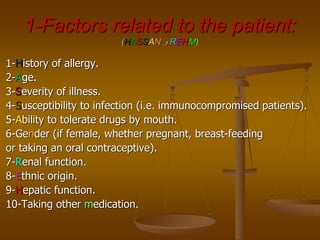
1-Factors related to the patient:
(H A S S A N & R E H M)
1-Factors related to the patient:
(HASSAN ‫و‬ REHM)
1-History of allergy.
2-Age.
3-Severity of illness.
4-Susceptibility to infection (i.e. immunocompromised patients).
5-Ability to tolerate drugs by mouth.
6-Gender (if female, whether pregnant, breast-feeding
or taking an oral contraceptive).
7-Renal function.
8-Ethnic origin.
9-Hepatic function.
10-Taking other medication.
2-Factors related to The known
causative organism:
(T R S)
2-Factors related to The known
causative organism:
(TRS)
1-Type of causative organism.
2-Resistance.
3-Severity of infection.
Cont….
The principles in selection of an antibacterial
agents must be also involved a number of
variables including information on side-effects.
Duration of therapy, dosage, and route of
administration.
An example of a rational approach to the
selection of an
antibacterial
 Example (1):
Female patient complaining of nausea and symptoms
of a urinary tract infection in early pregnancy. The
organism is reported as being resistant to ampicillin
but sensitive to:
1-Nitrofurantoin.
2-Gentamycin.
3-Tetracycline.
4-Trimethoprim.
5-Cefotaxime or Ceftriaxone.
Which one of these ABs would be referred to this
patient?
An example of a rational approach to the
selection of an
antibacterial
 Example (1):
Female patient complaining of nausea and symptoms of a
urinary tract infection in early pregnancy. The organism is
reported as being resistant to ampicillin but sensitive to:
1-Nitrofurantoin. (F)-----(Can cause nausea)
2-Gentamycin. (F)-----(Best avoided in pregnancy)
3-Tetracycline. (F)-----(Causes dental discoloration)
4-Trimethoprim. (F)-----(Folate antagonist therefore
theoretical teratogenic risk)
5-Cefotaxime or Ceftriaxone .(T)-----(The safest
antibiotics in pregnancy are the penicillins and
cephalosporins)
Therefore, Cefotaxime or Ceftriaxone would be indicated
for this patient.
An example of a rational approach to the
selection of an
antibacterial
 Example (2):
Hospitalized male patient has a symptoms of a urinary
tract infection and take Warfarin as oral anticoagulant
his laboratory test show:
1- Low Na , K & Ca serum level.
2- increase in liver enzyme.
3- increase in bilirubin level.
Doctor give the patient Ringer solution to correct his
electrolytes disturbance.
An example of a rational approach to the
selection of an
antibacterial
 Example (2):
The organism which causes UTI is reported
sensitive to:
1- Augmentin.
2- Ceftriaxone.
3- Cefotaxime.
4- Cefoprazone.
Which one of these ABs would be referred to
this patient?
An example of a rational approach to the
selection of an
antibacterial
 Example (2):
The organism which causes UTI is reported sensitive to:
1- Augmentin. (F)---( Increase tendency of bleeding).
2- Ceftriaxone. (F)---(Because patient take Ringer
solution and has liver dysfunction).
3- Cefotaxime. (T)---(90% Excreted as unchanged form
from urine).
4- Cefoprazone. (F)---( Mainly Excreted from bile).
Therefore, Cefotaxime would be indicated for this
patient.
Antibacterial policies
Local policies often limit the antibacterials that
may be used to achieve reasonable economy
consistent with adequate cover, and to reduce
the development of resistant organisms.
A policy may indicate a range of drugs for
general use, and permit other drugs only on the
advice of the microbiologist or physician
responsible for the control of infectious
diseases.
Before starting therapy
The following precepts should be considered before
starting:
1-Viral infections should not be treated with
antibacterials. However, antibacterials may be used to
treat secondary bacterial infection (e.g. bacterial
pneumonia secondary to influenza).
2-Samples should be taken for culture and sensitivity
testing; „ blind‟ antibacterial prescribing for
unexplained further difficulty in establishing the
diagnosis.
Cont….
3-Knowledge of prevalent organisms and their
current sensitivity is of great help in choosing
an antibacterial before bacteriological
confirmation is available. Generally, narrow-
spectrum antibacterials are preferred to broad-
spectrum antibacterials unless there is a clear
clinical indication (e.g. life-threatening sepsis).
Cont….
4-The dose of an antibacterial varies according
to a number of factors including age, weight,
hepatic function, renal function, and severity of
infection. The prescribing of the so-called
„standard‟ dose in serious infections may result
in failure of treatment or even death of the
patient.
Note….
therefore it is important to prescribe a dose
appropriate to the condition. An inadequate
dose may also increase the likelihood of
antibacterial resistance. On the other hand, for
an antibacterial with a narrow margin between
the toxic and therapeutic dose (e.g. an
aminoglycoside) it is also important to avoid an
excessive dose and the concentration of the
drug in the plasma may need to be monitored.
Cont….
5-The route of administration of an antibacterial often
depends on the severity of the infection. Life-
threatening infections require intravenous therapy.
Antibacterials that are well absorbed may be given by
mouth even for some serious infections. Parenteral
administration is also appropriate when the oral route
cannot be used (e.g. because of vomiting) or if
absorption is inadequate.
Whenever possible, painful intramuscular injections
should be avoided in children.
Cont….
6-Duration of therapy depends on the nature of the
infection and the response to treatment. Courses
should not be unduly prolonged because they
encourage resistance, they may lead to side-effects
and they are costly. However, in certain infections
such as tuberculosis or osteomyelitis it may be
necessary to treat for prolonged periods. Conversely a
single dose of an antibacterial may cure uncomplicated
urinary-tract infections. The prescription for an
antibacterial should specify the duration of treatment
or the date when treatment is to be reviewed.
Superinfection
In general, broad-spectrum antibacterial drugs
such as the cephalosporins are more likely to
be associated with adverse reactions related to
the selection of resistant organisms e.g. fungal
infections or antibiotic-associated colitis
(pseudomembranous colitis); other problems
associated with superinfection include vaginitis
and pruritus ani.
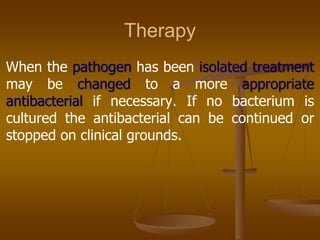
Therapy
When the pathogen has been isolated treatment
may be changed to a more appropriate
antibacterial if necessary. If no bacterium is
cultured the antibacterial can be continued or
stopped on clinical grounds.
Hypersensitivity Test
Antibiotic
Hypersensitivity
Antibiotics are the most common class of medications that
individuals report allergy or intolerance. Adverse reactions are
reported at a predictable rate with all antibiotic use that vary by
antibiotic. Antibiotic allergy incidence rates are sex dependent,
higher in females than in males. Most of these events are not
reproducible or immunologically mediated. Antibiotic allergy
prevalence increases with increasing age and is more common in
hospitalized populations and in populations that use more
antibiotics. Determining potential mechanisms for the observed
symptoms of the adverse reactions is the starting point for
effective management of antibiotic hypersensitivity. Skin testing
and direct challenges are the primary tools used to determine
acute tolerance.
Types of Hypersensitivity Test
There are Five types of skin testing used in
allergy diagnosis:
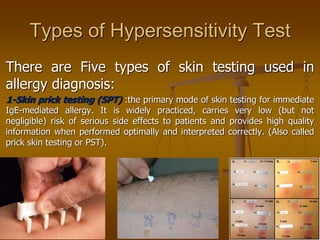
1-Skin prick testing (SPT) :the primary mode of skin testing for immediate
IgE-mediated allergy. It is widely practiced, carries very low (but not
negligible) risk of serious side effects to patients and provides high quality
information when performed optimally and interpreted correctly. (Also called
prick skin testing or PST).
Cont.…
Prick tests are used to confirm clinical sensitivity
induced by aeroallergens, foods, some drugs,
venoms and a few chemicals. Prick tests are
widely used for confirmation of clinical
immediate hypersensitivity induced by a wide
variety of naturally occurring allergens such as
inhalants and foods.
Cont.…
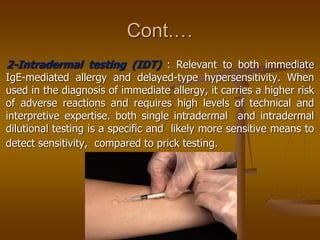
2-Intradermal testing (IDT) : Relevant to both immediate
IgE-mediated allergy and delayed-type hypersensitivity. When
used in the diagnosis of immediate allergy, it carries a higher risk
of adverse reactions and requires high levels of technical and
interpretive expertise. both single intradermal and intradermal
dilutional testing is a specific and likely more sensitive means to
detect sensitivity, compared to prick testing.
Cont.…
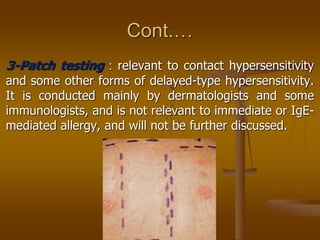
3-Patch testing : relevant to contact hypersensitivity
and some other forms of delayed-type hypersensitivity.
It is conducted mainly by dermatologists and some
immunologists, and is not relevant to immediate or IgE-
mediated allergy, and will not be further discussed.
Cont.…
4- Scratch Testing :is a technique that is less
sensitive, more painful, not reproducible, and not
recommended for diagnostic testing ) “Scratch” testing
is not endorsed and should no longer be performed(.
Cont.…
4-Modified Quantitative Testing : is an
accurate and more cost–effective method of
testing than intradermal dilutional testing while
still obtaining quantitative results. The use of
quantitative testing aids in improving patient
care by facilitating the accurate diagnosis of
aero– allergen disease.
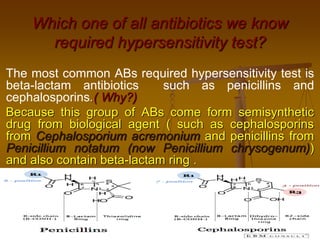
The most common ABs required hypersensitivity test is
beta-lactam antibiotics such as penicillins and
cephalosporins.( Why?)
Because this group of ABs come form semisynthetic
drug from biological agent ( such as cephalosporins
from Cephalosporium acremonium and penicillins from
Penicillium notatum (now Penicillium chrysogenum))
and also contain beta-lactam ring .
Which one of all antibiotics we know
required hypersensitivity test?
Validation of Cephalosporin skin test
for predicting immediate
hypersensitivity
Background
 Cephalosporin is one of the most commonly used beta-lactam
antibiotics globally, and also a major offending agent of drug
hypersensitivity along with penicillin.
 Before administration, cephalosporin skin test for predicting
immediate hypersensitivity has been widely used in most
hospitals in Korea.
 However, the validity of this test for prediction of immediate
hypersensitivity has still not been well studied.
 The confirmation of sensitivity and specificity of the skin test is
needed.
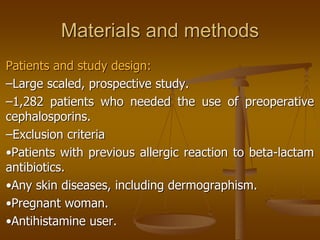
Materials and methods
Patients and study design:
–Large scaled, prospective study.
–1,282 patients who needed the use of preoperative
cephalosporins.
–Exclusion criteria
•Patients with previous allergic reaction to beta-lactam
antibiotics.
•Any skin diseases, including dermographism.
•Pregnant woman.
•Antihistamine user.
Materials and methods
Skin test :
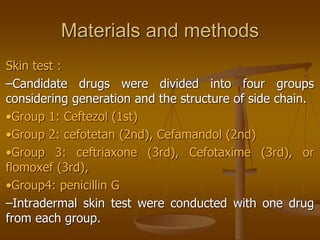
–Candidate drugs were divided into four groups
considering generation and the structure of side chain.
•Group 1: Ceftezol (1st)
•Group 2: cefotetan (2nd), Cefamandol (2nd)
•Group 3: ceftriaxone (3rd), Cefotaxime (3rd), or
flomoxef (3rd),
•Group4: penicillin G
–Intradermal skin test were conducted with one drug
from each group.
Materials and methods
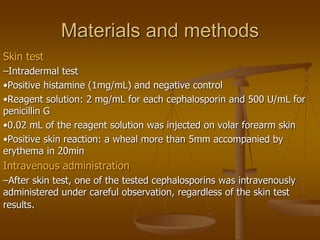
Skin test
–Intradermal test
•Positive histamine (1mg/mL) and negative control
•Reagent solution: 2 mg/mL for each cephalosporin and 500 U/mL for
penicillin G
•0.02 mL of the reagent solution was injected on volar forearm skin
•Positive skin reaction: a wheal more than 5mm accompanied by
erythema in 20min
Intravenous administration
–After skin test, one of the tested cephalosporins was intravenously
administered under careful observation, regardless of the skin test
results.
Diagnostic algorithm and results of
allergologic work up in study subjects
Diagnostic algorithm and results of
allergologic work up in study subjects
Diagnostic algorithm and results of
allergologic work up in study subjects
(After IV administration)
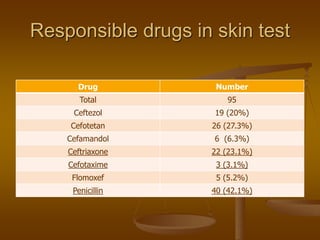
Responsible drugs in skin test
Drug Number
Total 95
Ceftezol 19 (20%)
Cefotetan 26 (27.3%)
Cefamandol 6 (6.3%)
Ceftriaxone 22 (23.1%)
Cefotaxime 3 (3.1%)
Flomoxef 5 (5.2%)
Penicillin 40 (42.1%)
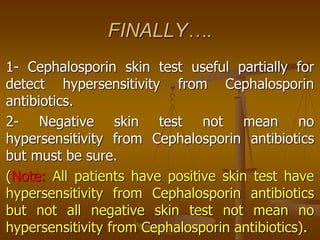
FINALLY….
1- Cephalosporin skin test useful partially for
detect hypersensitivity from Cephalosporin
antibiotics.
2- Negative skin test not mean no
hypersensitivity from Cephalosporin antibiotics
but must be sure.
(Note: All patients have positive skin test have
hypersensitivity from Cephalosporin antibiotics
but not all negative skin test not mean no
hypersensitivity from Cephalosporin antibiotics).
Antibiotic classification

Antibiotic classification

  • 1.
    Antibiotics (Classification, Strategy ofuse & Hypersensitivity Test) prepared By Cl.Ph: Joseph Talaat William Clinical pharmacist, on Urology & Nephrology Hospital Assiut University
  • 4.
    Strategy of useof Antibiotics
  • 5.
    How can wechoice of a suitable Antibiotic?  Before selecting an Antibiotic the clinician must first consider two factors: 1- The patient. 2- The known causative organism.
  • 6.
    1-Factors related tothe patient: (H A S S A N & R E H M)
  • 7.
    1-Factors related tothe patient: (HASSAN ‫و‬ REHM) 1-History of allergy. 2-Age. 3-Severity of illness. 4-Susceptibility to infection (i.e. immunocompromised patients). 5-Ability to tolerate drugs by mouth. 6-Gender (if female, whether pregnant, breast-feeding or taking an oral contraceptive). 7-Renal function. 8-Ethnic origin. 9-Hepatic function. 10-Taking other medication.
  • 8.
    2-Factors related toThe known causative organism: (T R S)
  • 9.
    2-Factors related toThe known causative organism: (TRS) 1-Type of causative organism. 2-Resistance. 3-Severity of infection.
  • 10.
    Cont…. The principles inselection of an antibacterial agents must be also involved a number of variables including information on side-effects. Duration of therapy, dosage, and route of administration.
  • 11.
    An example ofa rational approach to the selection of an antibacterial  Example (1): Female patient complaining of nausea and symptoms of a urinary tract infection in early pregnancy. The organism is reported as being resistant to ampicillin but sensitive to: 1-Nitrofurantoin. 2-Gentamycin. 3-Tetracycline. 4-Trimethoprim. 5-Cefotaxime or Ceftriaxone. Which one of these ABs would be referred to this patient?
  • 12.
    An example ofa rational approach to the selection of an antibacterial  Example (1): Female patient complaining of nausea and symptoms of a urinary tract infection in early pregnancy. The organism is reported as being resistant to ampicillin but sensitive to: 1-Nitrofurantoin. (F)-----(Can cause nausea) 2-Gentamycin. (F)-----(Best avoided in pregnancy) 3-Tetracycline. (F)-----(Causes dental discoloration) 4-Trimethoprim. (F)-----(Folate antagonist therefore theoretical teratogenic risk) 5-Cefotaxime or Ceftriaxone .(T)-----(The safest antibiotics in pregnancy are the penicillins and cephalosporins) Therefore, Cefotaxime or Ceftriaxone would be indicated for this patient.
  • 13.
    An example ofa rational approach to the selection of an antibacterial  Example (2): Hospitalized male patient has a symptoms of a urinary tract infection and take Warfarin as oral anticoagulant his laboratory test show: 1- Low Na , K & Ca serum level. 2- increase in liver enzyme. 3- increase in bilirubin level. Doctor give the patient Ringer solution to correct his electrolytes disturbance.
  • 14.
    An example ofa rational approach to the selection of an antibacterial  Example (2): The organism which causes UTI is reported sensitive to: 1- Augmentin. 2- Ceftriaxone. 3- Cefotaxime. 4- Cefoprazone. Which one of these ABs would be referred to this patient?
  • 15.
    An example ofa rational approach to the selection of an antibacterial  Example (2): The organism which causes UTI is reported sensitive to: 1- Augmentin. (F)---( Increase tendency of bleeding). 2- Ceftriaxone. (F)---(Because patient take Ringer solution and has liver dysfunction). 3- Cefotaxime. (T)---(90% Excreted as unchanged form from urine). 4- Cefoprazone. (F)---( Mainly Excreted from bile). Therefore, Cefotaxime would be indicated for this patient.
  • 16.
    Antibacterial policies Local policiesoften limit the antibacterials that may be used to achieve reasonable economy consistent with adequate cover, and to reduce the development of resistant organisms. A policy may indicate a range of drugs for general use, and permit other drugs only on the advice of the microbiologist or physician responsible for the control of infectious diseases.
  • 17.
    Before starting therapy Thefollowing precepts should be considered before starting: 1-Viral infections should not be treated with antibacterials. However, antibacterials may be used to treat secondary bacterial infection (e.g. bacterial pneumonia secondary to influenza). 2-Samples should be taken for culture and sensitivity testing; „ blind‟ antibacterial prescribing for unexplained further difficulty in establishing the diagnosis.
  • 18.
    Cont…. 3-Knowledge of prevalentorganisms and their current sensitivity is of great help in choosing an antibacterial before bacteriological confirmation is available. Generally, narrow- spectrum antibacterials are preferred to broad- spectrum antibacterials unless there is a clear clinical indication (e.g. life-threatening sepsis).
  • 19.
    Cont…. 4-The dose ofan antibacterial varies according to a number of factors including age, weight, hepatic function, renal function, and severity of infection. The prescribing of the so-called „standard‟ dose in serious infections may result in failure of treatment or even death of the patient.
  • 20.
    Note…. therefore it isimportant to prescribe a dose appropriate to the condition. An inadequate dose may also increase the likelihood of antibacterial resistance. On the other hand, for an antibacterial with a narrow margin between the toxic and therapeutic dose (e.g. an aminoglycoside) it is also important to avoid an excessive dose and the concentration of the drug in the plasma may need to be monitored.
  • 21.
    Cont…. 5-The route ofadministration of an antibacterial often depends on the severity of the infection. Life- threatening infections require intravenous therapy. Antibacterials that are well absorbed may be given by mouth even for some serious infections. Parenteral administration is also appropriate when the oral route cannot be used (e.g. because of vomiting) or if absorption is inadequate. Whenever possible, painful intramuscular injections should be avoided in children.
  • 22.
    Cont…. 6-Duration of therapydepends on the nature of the infection and the response to treatment. Courses should not be unduly prolonged because they encourage resistance, they may lead to side-effects and they are costly. However, in certain infections such as tuberculosis or osteomyelitis it may be necessary to treat for prolonged periods. Conversely a single dose of an antibacterial may cure uncomplicated urinary-tract infections. The prescription for an antibacterial should specify the duration of treatment or the date when treatment is to be reviewed.
  • 23.
    Superinfection In general, broad-spectrumantibacterial drugs such as the cephalosporins are more likely to be associated with adverse reactions related to the selection of resistant organisms e.g. fungal infections or antibiotic-associated colitis (pseudomembranous colitis); other problems associated with superinfection include vaginitis and pruritus ani.
  • 24.
    Therapy When the pathogenhas been isolated treatment may be changed to a more appropriate antibacterial if necessary. If no bacterium is cultured the antibacterial can be continued or stopped on clinical grounds.
  • 25.
  • 26.
    Antibiotic Hypersensitivity Antibiotics are themost common class of medications that individuals report allergy or intolerance. Adverse reactions are reported at a predictable rate with all antibiotic use that vary by antibiotic. Antibiotic allergy incidence rates are sex dependent, higher in females than in males. Most of these events are not reproducible or immunologically mediated. Antibiotic allergy prevalence increases with increasing age and is more common in hospitalized populations and in populations that use more antibiotics. Determining potential mechanisms for the observed symptoms of the adverse reactions is the starting point for effective management of antibiotic hypersensitivity. Skin testing and direct challenges are the primary tools used to determine acute tolerance.
  • 27.
    Types of HypersensitivityTest There are Five types of skin testing used in allergy diagnosis: 1-Skin prick testing (SPT) :the primary mode of skin testing for immediate IgE-mediated allergy. It is widely practiced, carries very low (but not negligible) risk of serious side effects to patients and provides high quality information when performed optimally and interpreted correctly. (Also called prick skin testing or PST).
  • 28.
    Cont.… Prick tests areused to confirm clinical sensitivity induced by aeroallergens, foods, some drugs, venoms and a few chemicals. Prick tests are widely used for confirmation of clinical immediate hypersensitivity induced by a wide variety of naturally occurring allergens such as inhalants and foods.
  • 29.
    Cont.… 2-Intradermal testing (IDT): Relevant to both immediate IgE-mediated allergy and delayed-type hypersensitivity. When used in the diagnosis of immediate allergy, it carries a higher risk of adverse reactions and requires high levels of technical and interpretive expertise. both single intradermal and intradermal dilutional testing is a specific and likely more sensitive means to detect sensitivity, compared to prick testing.
  • 30.
    Cont.… 3-Patch testing :relevant to contact hypersensitivity and some other forms of delayed-type hypersensitivity. It is conducted mainly by dermatologists and some immunologists, and is not relevant to immediate or IgE- mediated allergy, and will not be further discussed.
  • 31.
    Cont.… 4- Scratch Testing:is a technique that is less sensitive, more painful, not reproducible, and not recommended for diagnostic testing ) “Scratch” testing is not endorsed and should no longer be performed(.
  • 32.
    Cont.… 4-Modified Quantitative Testing: is an accurate and more cost–effective method of testing than intradermal dilutional testing while still obtaining quantitative results. The use of quantitative testing aids in improving patient care by facilitating the accurate diagnosis of aero– allergen disease.
  • 33.
    The most commonABs required hypersensitivity test is beta-lactam antibiotics such as penicillins and cephalosporins.( Why?) Because this group of ABs come form semisynthetic drug from biological agent ( such as cephalosporins from Cephalosporium acremonium and penicillins from Penicillium notatum (now Penicillium chrysogenum)) and also contain beta-lactam ring . Which one of all antibiotics we know required hypersensitivity test?
  • 34.
    Validation of Cephalosporinskin test for predicting immediate hypersensitivity
  • 35.
    Background  Cephalosporin isone of the most commonly used beta-lactam antibiotics globally, and also a major offending agent of drug hypersensitivity along with penicillin.  Before administration, cephalosporin skin test for predicting immediate hypersensitivity has been widely used in most hospitals in Korea.  However, the validity of this test for prediction of immediate hypersensitivity has still not been well studied.  The confirmation of sensitivity and specificity of the skin test is needed.
  • 36.
    Materials and methods Patientsand study design: –Large scaled, prospective study. –1,282 patients who needed the use of preoperative cephalosporins. –Exclusion criteria •Patients with previous allergic reaction to beta-lactam antibiotics. •Any skin diseases, including dermographism. •Pregnant woman. •Antihistamine user.
  • 37.
    Materials and methods Skintest : –Candidate drugs were divided into four groups considering generation and the structure of side chain. •Group 1: Ceftezol (1st) •Group 2: cefotetan (2nd), Cefamandol (2nd) •Group 3: ceftriaxone (3rd), Cefotaxime (3rd), or flomoxef (3rd), •Group4: penicillin G –Intradermal skin test were conducted with one drug from each group.
  • 38.
    Materials and methods Skintest –Intradermal test •Positive histamine (1mg/mL) and negative control •Reagent solution: 2 mg/mL for each cephalosporin and 500 U/mL for penicillin G •0.02 mL of the reagent solution was injected on volar forearm skin •Positive skin reaction: a wheal more than 5mm accompanied by erythema in 20min Intravenous administration –After skin test, one of the tested cephalosporins was intravenously administered under careful observation, regardless of the skin test results.
  • 39.
    Diagnostic algorithm andresults of allergologic work up in study subjects
  • 40.
    Diagnostic algorithm andresults of allergologic work up in study subjects
  • 41.
    Diagnostic algorithm andresults of allergologic work up in study subjects (After IV administration)
  • 42.
    Responsible drugs inskin test Drug Number Total 95 Ceftezol 19 (20%) Cefotetan 26 (27.3%) Cefamandol 6 (6.3%) Ceftriaxone 22 (23.1%) Cefotaxime 3 (3.1%) Flomoxef 5 (5.2%) Penicillin 40 (42.1%)
  • 43.
    FINALLY…. 1- Cephalosporin skintest useful partially for detect hypersensitivity from Cephalosporin antibiotics. 2- Negative skin test not mean no hypersensitivity from Cephalosporin antibiotics but must be sure. (Note: All patients have positive skin test have hypersensitivity from Cephalosporin antibiotics but not all negative skin test not mean no hypersensitivity from Cephalosporin antibiotics).