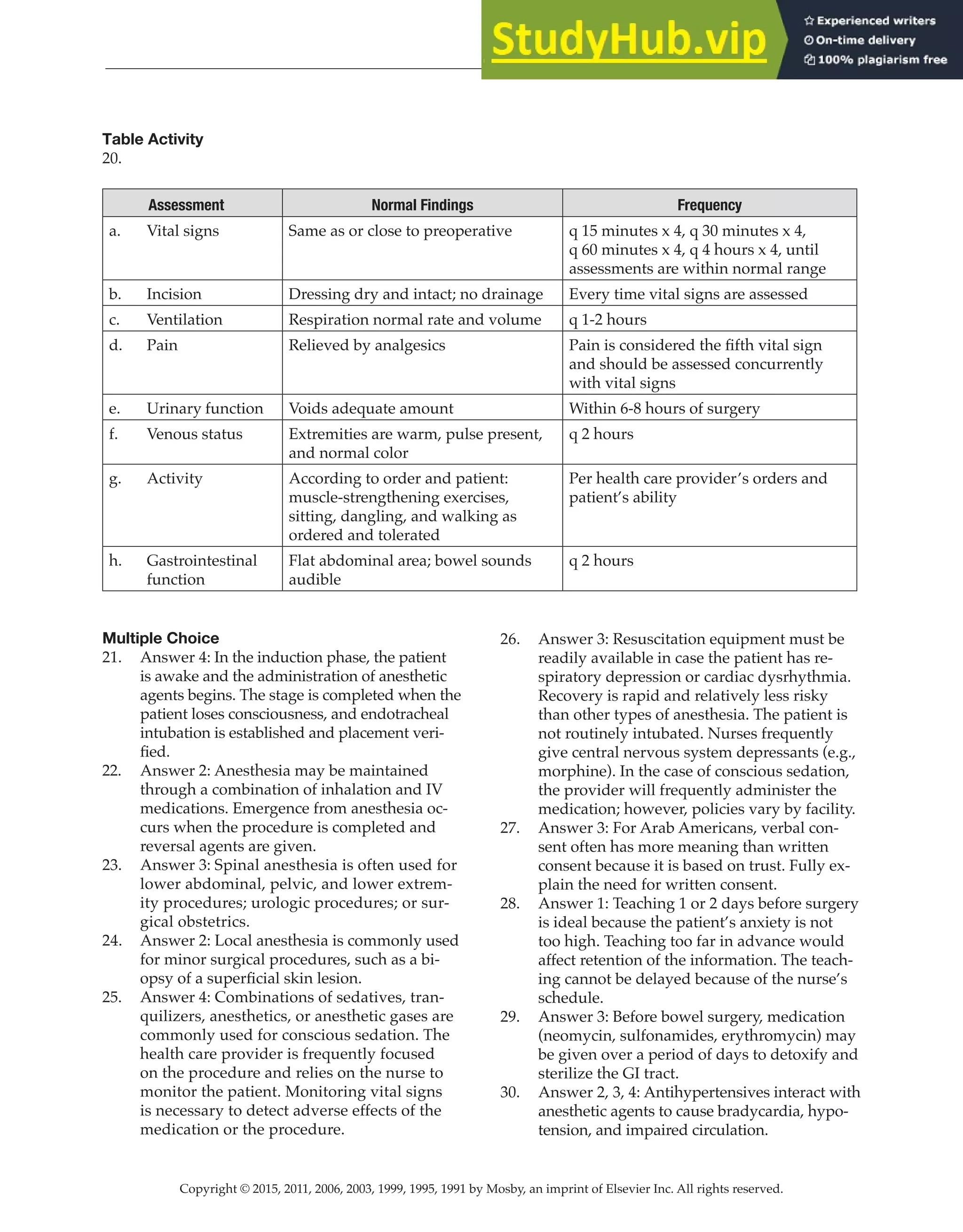
Copyright © 2015, 2011, 2006, 2003, 1999, 1995, 1991 by Mosby, an imprint of Elsevier Inc. All rights reserved.
Answer Key
  
1
  
Answer Key
1
CHAPTER 1—THE EVOLUTION OF NURSING
Matching
1. b
2. d
3. e
4. a
5. f
6. h
7. c
8. g
9. j
10. i
Short Answer
11. The National League for Nursing (NLN) es-
tablished educational standards and criteria
and is involved in the voluntary accreditation
of nursing programs.
12. The purposes of NAPNES and NFLPN are to:
Set standards for practical/vocational nursing
programs.
Promote and protect practical/vocational
nursing.
Educate and inform the general public about
practical/vocational nursing.
13. LPN/LVNs function to provide specific ser-
vices to patients under the direct supervision
of a licensed physician, dentist, or registered
nurse; assists individuals, sick or well, in the
performance of those activities contributing to
health, to their recovery, and to gain indepen-
dence as rapidly as possible or to have a peace-
ful death. The LPN/LVN is educated to be a
responsible member of a health care team, per-
forming basic therapeutic, rehabilitative, and
preventive care to assigned patients. LPN/
LVNs are continuing to provide care in all
types of settings, with the majority employed
in long-term care settings.
Fill-in-the-Blank Sentences
14. state board of nursing
15. National Council of State Boards of Nursing
16. Patient’s Bill of Rights
Multiple Choice
17. Answer 2: One of the primary problems of the
early nineteenth century hospitals was poor
hygienic practices. Hospitals were dirty and
overcrowded and care was mostly given by
untrained persons.
18. Answer 4: The population is aging rapidly
and there is an increased need for nursing ser-
vices for this growing segment of the popula-
tion.
19. Answer 3: “Nightingale Nurses” improved
patient care and advanced the practice of
nursing through good hygiene, sanitation,
patient observation, accurate recordkeeping,
nutritional improvement, and the introduc-
tion and use of new equipment.
20. Answer 1: The four major concepts are nurse,
patient, health, and environment.
21. Answer 4: Poverty, homelessness, and un-
employment are factors in increased risk for
health problems.
22. Answer 2: Physiologic needs, such as eating
and oxygenation, are the first priority accord-
ing to Maslow.
23. Answer 4: Adolescence is time when love and
belonging to a peer group are very important.
Being part of a team is the best way to help
him meet this need.
24. Answer 1, 3, 5: Patient can participate in
smoking cessation; stress, weight, and alcohol
intake reduction; and control over own body
and health. Giving information about technol-
ogy, new medications, and costs may be of
interest to the patient, but these topics are less
useful in helping the patient take an active
role in her own health.
25. Answer 4: While the UAP or unit secretary
can direct visitors, extreme caution should
be used in giving out patient information.
(Note to student: Even acknowledging that a
patient has been admitted to the hospital can
be viewed as a violation of confidentiality.)
Taking vital signs is acceptable; however, the
pharmacist generally restocks medications.
Validating and interpreting are nursing re-
sponsibilities.
26. Answer 2: Economic use of time and materials
is the best way to contain costs for individual
Copyright © 2015, 2011, 2006, 2003, 1999, 1995, 1991 by Mosby, an imprint of Elsevier Inc. All rights reserved.
Answer Key
  
2
  
patients. Malpractice insurance does not help
to contain costs. While it is appropriate to
question the health care provider about safety
issues, it is not appropriate to question use of
diagnostic testing. Diagnosis is an extremely
complicated process, which requires an exten-
sive depth of knowledge about pathology. Re-
ferring patients to another clinic just shifts the
financial burden to another part of the health
care system.
27. Answer 1: Orem’s theory is based on helping
the patient to attain self-care. Nightingale’s
theory uses manipulation of the environment
(i.e., patient’s pillows). Benner and Wrubel
demonstrate caring by assisting the patient to
cope. Parse’s theory encourages the patient to
participate in the health experience.
28. Answer 1, 2, 3, 4, 6: Under the terms of this
document, patients are assured that they can
expect high-quality hospital care, a clean and
safe environment, involvement in their care
and the decision-making process, protection
of privacy, help when leaving the hospital,
and help with billing concerns. Patients can-
not always expect to get a private room with
all amenities.
29. Answer 3: Health care workers are entitled to
respect from patients and also expect patients
to be responsible for their own behavior.
30. Answer 3: LPN/LVNs never function inde-
pendently without the supervision of an RN
or health care provider.
Critical Thinking Activities
31.
Wellness
Highest level of
optimal health
Illness
Diminished or impaired
state of health
X
This patient has some health problems and
some changes in her life, but she has a rela-
tively high level of wellness. Her blood pres-
sure is under control and she has adapted to a
major change (retirement), by taking on a new
challenge of volunteering. Her positive out-
look on life allows her to find joy in the pros-
pect of sharing time with a new generation.
32. a. Originally, the white pleated cap and the
apron signified respectability, cleanliness,
and servitude. Caps gradually became
symbolic of office and achievement and
were celebrated with capping ceremonies.
Uniforms became more informal and
nurses complained that caps interfered
with care, caused hair loss, took too
much time for washing and starching,
and were a source of bacteria. Health
care facilities and nursing schools typi-
cally have dress codes for style of uniform
and/or color. Staff are generally required
to wear nametags and identification badg-
es. Many nurses do not approve of man-
datory dress codes. They argue that other
health care professionals do not depend
on uniforms for their authority.
b. It is likely that as a nursing student and a
soon-to-be nurse that looking professional
is important to you. You may feel anxious
to be rid of your current student uniform
for a variety of reasons. Freedom of choice,
unattractive style, and not being marked
as a student are frequent reasons cited by
students. From patients’ point of view,
they feel more comfortable and confident
when they are easily able to distinguish
nurses from other staff members. Recent
studies also suggest that patients believe
that nurses who wear white are better
nurses than those who do not wear white.
33. a. This patient has complex physical prob-
lems and he has some lifestyle, social, and
financial issues that need extra attention.
Registered nurse (RN)—provides direct
patient care in the hospital and an RN
from a home health agency could also be
involved in the care of this patient.
LPN/LVN—works under the supervision
of the RN in providing patient care.
Physician—provides diagnosis and pre-
scription of treatment and medications.
Social worker—provides counseling and
referral to community resources.
Physical therapist—offers exercises and
will assist this patient in learning tech-
niques for safe ambulation, bending, and
lifting.
Dietitian—provides nutritional counsel-
ing.
Respiratory therapist—supervises oxygen
administration and performs pulmonary
assessments.
Technologist—will obtain and analyze
specimens and perform other diagnostic
procedures.
Pharmacist—prepares the medication in
the hospital. The community pharmacist
can help this patient monitor his home
medications.
Copyright © 2015, 2011, 2006, 2003, 1999, 1995, 1991 by Mosby, an imprint of Elsevier Inc. All rights reserved.
Answer Key
  
3
  
(Note to student: Some hospitals will also
have a financial counselor to assist the
patient in understanding the hospital bill
and to make arrangements in paying out-
of-pocket costs.)
b. For primary prevention, the nurse would
encourage wellness activities and pre-
emptive screening programs such colo-
noscopy or glucose screening. For second-
ary prevention, to reduce the impact of
the chronic respiratory disease, the nurse
would encourage smoking cessation
and weight loss. For tertiary prevention,
the nurse would get a referral for home
health assistance, including physical
therapy, which will improve quality of life
and reduce further loss of function.
CHAPTER 2—LEGAL AND ETHICAL ASPECTS
OF NURSING
Matching
1. e
2. d
3. b
4. h
5. f
6. a
7. c
8. j
9. g
10. i
True or False
11. True
12. True
13. False. Duty refers to the established relation-
ship between the patient and the nurse.
14. False. Assault is an intentional threat to cause
bodily harm to another; does not have to in-
clude actual bodily contact. The nurse would
be charged with battery, which is the unlawful
touching of another person without consent.
15. True
Multiple Choice
16. Answer 4: The student has initiated the nurse-
patient relationship and therefore has the
duty to act. All students are CPR-certified so
the student has to perform the duty in a rea-
sonable and prudent manner as would other
nursing students. All of the other options are
also likely to be necessary. (Note to student:
Discuss this situation with your clinical in-
structor for advice about visiting patients dur-
ing the preclinical preparation time.)
17. Answer 4: A poor nurse-patient relationship
increases the likelihood that the patient will
seek legal action and harm has to occur in or-
der for liability to be established. The family
of the elderly patient could seek damages, but
that is less likely if they understand that the
nurse and facility will try their best to prevent
falls, but are unable to physically restrain pa-
tients for the purpose of preventing falls. The
angry patient may report the nurse to the su-
pervisor, but if no harm is sustained then any
legal action against the nurse will not be suc-
cessful. The family who complained at 3:00 am
may also be very angry. The nurse’s decision
to wait must be based on comprehensive as-
sessment of the patient to ascertain that there
is nothing to warrant calling at 3:00 am. Care-
ful documentation is necessary. Making an
incident report in all of these situations would
be a good idea.
18. Answer 1, 2, 3, 4, 6: The UAP’s personal
health records are confidential and unrelated
to the patient’s case.
19. Answer 2: Early discharge and high levels
of patient acuity require excellent discharge
teaching so patients can perform self-care and
self-monitoring and are therefore less likely to
suffer harm. Being able to take a limited num-
ber of high-acuity patients would be ideal,
but high acuity is the current trend. Having
malpractice coverage is good if litigation oc-
curs; however, insurance payouts may actu-
ally be contributing to the problem. Ensuring
accountability of others is not possible.
20. Answer 1: Assess knowledge and readiness
to perform. Barriers may include knowledge
deficit or feelings of anxiety or self-doubt. Go-
ing with her and observing performance and
pulling her file would be appropriate after as-
sessment. Forcing someone to do a task that is
beyond their ability and understanding is in-
appropriate supervision and the nurse would
be liable for the UAP’s errors.
21. Answer 2: Locate the RN in charge so that
the blood can be started. Health care provid-
ers can supervise nurses and they know the
potential adverse reactions of blood products;
however, they are generally less familiar with
the policies and procedures related to the ac-
tual administration.
Copyright © 2015, 2011, 2006, 2003, 1999, 1995, 1991 by Mosby, an imprint of Elsevier Inc. All rights reserved.
Answer Key
  
4
  
22. Answer 1, 2, 3, 4: Do not include any informa-
tion that identifies the patient. Information
such as the room number or the health care
provider’s name may seem harmless, but
including those details could lead to specula-
tion about patient’s identity. A clinical report
must include information such as vital signs
and medical condition. If in doubt, the clinical
instructor should be consulted.
23. Answer 1: Patients must be at least 18 years
old to give consent. If under 18, the exceptions
are marriage; court-approved emancipation;
self-supporting and living apart from parents;
military service; or for STIs, alcohol or drug
abuse, sexual assault, or family planning.
24. Answer 3: Policies about giving patient infor-
mation over the phone will vary. For example,
some facilities may not allow acknowledging
that the patient is or is not there. Other facili-
ties require that the patient have a list of peo-
ple who are allowed to call for information.
Another variation is that selected callers are
given a phone code to reach the patient. The
nurse should be familiar with hospital policy,
because the policies are designed to specifi-
cally comply with HIPAA.
25. Answer 3: Alert the health care provider so
the child can be examined for occult injury.
The other options may also be used to investi-
gate the possibility of child abuse.
26. Answer 3: Call for help first, because the
health care team is not prepared to face armed
assailants. Trying to reassure patients in the
immediate area would be the second step.
Stifle the impulse to run out and help. If
the emergency staff is killed or injured, this
makes the situation worse. Locking doors
in an emergency department is likely to be
impractical and create additional safety prob-
lems.
27. Answer 1: Being competent and compassion-
ate are the best defenses. Knowing the legal
definition may be helpful, but definitions
are abstractions and the nurse’s day is full of
real-world events. Obtaining malpractice in-
surance is likely to make the nurse feel better,
but it does not decrease the chances of getting
sued. Validating nursing actions with another
is always beneficial, but this is not a realistic
option for minute-to-minute care.
28. Answer 2: The nurse is assessing the wound
during the dressing change and documenta-
tion should reflect the nurse’s attention to the
standard of care. Documenting the type of
dressing may be necessary for continuity of
care and also for reimbursement. The other
options are incorrect.
29. Answer 4: Disciplinary defense insurance
includes attorney; wage loss reimbursement;
travel, food, and lodging expenses; and le-
gal fees when the nurse has to go before the
board of nursing for disciplinary action. The
other types of insurance are for malpractice
protection.
30. Answer a. 4, b. 3, c. 2, d. 5, e. 1: The nurse
hopes for dismissal of charges. The letter of
reprimand may be formal or informal. Proba-
tion with stipulations means that the nurse can
continue to work, but under conditions as
determined by the board (e.g., monitored).
Suspension with stipulations means that the
nurse cannot continue to work, but there are
conditions that must be fulfilled. Revocation
of license is loss of licensure.
31. Answer 1: First, assess the patient’s feelings
by encouraging expression. The patient may
not understand the advance directives or may
have issues that were triggered by the discus-
sion. The other options are also necessary.
32. Answer 2: The patient’s living will is the best
protection, because it reflects the patient’s
wishes. Policies and procedures and the Joint
Commission may contain general guidance
about giving excellent care to patients, but
will not offer any specific help in this situ-
ation. The Patient Self-Determination Act
supports the use of living wills to define the
individual’s choices about care and treatment.
33. Answer 4: The nurse, the 13-year old girl, and
the mother all have very strong feelings about
this emotional situation. First, the nurse must
control her own responses. The other options
are likely to be necessary, but this will be a
difficult process and other health care team
members, such as a social worker, family
counselor, spiritual advisor, legal counsel, or
obstetrician are likely to be involved.
34. Answer 1, 2, 3, 5: If the nurse observes an-
other nurse being rude toward a patient, the
ethical thing to do would be to follow up so
that patients are respected. Texting should not
be used as an additional method of passing
gossip among staff. The other options demon-
strate ethical professional behavior.
35. Answer 3: The supervisor should be present-
ed with the facts. Theft is unethical and el-
derly residents are in an especially vulnerable
position; thus the Nurse B is not giving good
Copyright © 2015, 2011, 2006, 2003, 1999, 1995, 1991 by Mosby, an imprint of Elsevier Inc. All rights reserved.
Answer Key
  
5
  
care. Talking to the residents or families will
be part of the investigation that is conducted
by the supervisor. The supervisor could rec-
ommend that both nurses seek assistance for
values clarification.
Critical Thinking Activities
36. a. In regard to informed consent for a sur-
gical or diagnostic procedure, the nurse
may be responsible for witnessing that
the patient is signing the consent and is
aware of the treatment, risks, alternatives,
and consequences of accepting or reject-
ing care. The nurse should be careful not
to discuss with the patient the elements
of disclosure that the health care provider
is required to make, such as the risks or
benefits involved with the treatment or
procedure.
b. The nurse should go back to the charge
nurse and clarify how nurses are getting
informed consent signed. It is possible
that health care providers are explaining
the procedures and the nurses are later
assessing the patients’ understanding and
then contacting the provider if the patient
has additional questions or needs clarifi-
cation; however, this is not the best situa-
tion. Ideally, the nurse should accompany
the provider during the explanation and
the form should be signed at that time.
The nurse could ask the charge nurse to
obtain the informed consent and then fur-
ther discuss this process with a supervi-
sor, because the nurses in this facility are
at great risk for practicing outside scope
of practice and could be liable if the pa-
tient suffers harm from the procedure.
37. a. Further assessment is needed to deter-
mine the underlying motivation for the
action of these two nurses. It appears that
Nurse A is reluctant to care for “those
kinds of people” and the code specifies
that the nurse should provide care with-
out discrimination. Assessment of Nurse
A’s behavior may reveal that she lacks the
confidence or skills to care for AIDS pa-
tients; thus additional training is needed.
Possibly the death of a close friend from
AIDS may have created an emotional bar-
rier and thus she may need grief counsel-
ing. Nurse B is attempting to help Nurse
A, which is a laudable action; however, in
order to maintain a high degree of person-
al and professional behavior, which is also
part of the code of ethics, Nurse B should
talk to Nurse A about the comment, rather
than ignoring it.
b. Nurse B should initiate the process of val-
ues clarification, either by herself or with
assistance from a counselor or supervisor.
This process includes thinking about a
belief or behavior, deciding its value and
incorporating the value into a response.
Nurse B could talk directly to Nurse A to
see if Nurse A is actually discriminating
against a certain type of patient or if there
is some other problem, such as knowl-
edge/skills deficit. Nurse B may also
decide to report Nurse A’s unethical be-
havior by following the appropriate chain
of command, explaining the facts clearly,
and documenting the incident objectively
and accurately.
38. a. First, the nurse needs to involve other
members of the health care team, such as
the health care provider and the psychi-
atric social worker. Physical causes for
depression or changes in cognition should
be investigated, as well as psychological
causes of depression. A psychiatrist or
psychiatric clinical nurse specialist should
assess the patient for signs of suicide. If
the patient is deemed of sound mind,
than he has the right to refuse care.
b. When a patient refuses care, the nurse
may experience a personal feeling of re-
jection. The nurse has to recognize that
refusal of treatment is not a refusal of
interaction and human warmth. It may be
difficult, but the nurse should continue
to check on the patient as before and to
spend as much time as before, but the
focus may shift from task orientation
to therapeutic communication. And of
course the patient always has the option
of changing his mind and accepting se-
lected elements of care.
c. For nurses, the refusal of heroic measures
is often easier to accept, because many
nurses themselves do not want to be kept
“alive by machines.” However, it seems
cruel and inhuman if basic needs like
food or hygiene are not provided. Nurses
have worked for centuries trying to pre-
vent pressure ulcers and to improve pa-
tient outcomes. Nurses may also believe
that immunization is partially for the pro-
Copyright © 2015, 2011, 2006, 2003, 1999, 1995, 1991 by Mosby, an imprint of Elsevier Inc. All rights reserved.
Answer Key
  
6
  
tection of the individual, but also for the
purpose of “herd immunity.” Nurses are
trained to be problem-solvers and doers.
Doing nothing for the patient may seem
difficult, but remember that supporting
the patient emotionally and psychologi-
cally is also a nursing function.
39. The nurse has gone up the chain of command
and reported her concerns to the supervisor.
However, the nurse could still be involved in
a legal action if there is an occurrence where a
patient is harmed. The nurse could report the
conditions to the state board of nursing, but
change is likely to come slowly, if at all. The
nurse may opt to make personal notes or inci-
dents reports related to working conditions or
to discussions with supervisors.
		
The ethical implications are that the nurse
is employed in a situation that is constantly
putting the patients at risk; however, in some
ways, if the nurse opts to quit and seek anoth-
er job, then the patients have lost an advocate
and a caregiver. In addition, this scenario is
not uncommon and the nurse could find that
he/she has jumped from the frying pan into
the fire.
		
If the nurse opts to stay, then teamwork is
especially important under these conditions
and watching out for each other and all of the
patients becomes more important when ev-
eryone is tired and stressed.
CHAPTER 3—DOCUMENTATION
Matching
1. d
2. k
3. f
4. l
5. j
6. h
7. b
8. c
9. a
10. e
11. g
12. i
Short Answer
13. The five basic purposes of patient records are
communication, permanent record of account-
ability, legal record of care, information for
teaching, and source for research and data col-
lection.
14. Focus charting uses the nursing process and
the focus is sometimes a current patient con-
cern or behavior, and sometimes a significant
change in patient status or behavior or a sig-
nificant event in the patient’s therapy. In CBE,
complete physical assessments, observations,
vital signs, intravenous (IV) site and rate, and
other pertinent data are charted at the begin-
ning of each shift. During the shift, the only
notes the nurse will make will be for addi-
tional treatments done or planned treatments
withheld, changes in patient condition, and
new concerns. Narrative charting is an ab-
breviated story form of patient care. It is used
for both computerized and noncomputerized
nurse’s notes and includes subjective and/or
objective data, consultations, care and treat-
ments, and response to therapy.
15. Home health care and long-term care docu-
mentation are directly related to reimburse-
ment, because patients’ eligibility and services
provided by the nurses must be documented
to justify payment by Medicare, Medicaid,
or private insurance companies. The chart-
ing is not usually done on the same time
schedule or with the same frequency as that
of the acute care facility. An interdisciplinary
approach must be documented in the notes
along with evidence of compliance with state
and federal regulations. For home health care,
nurses carry written records with them or use
a laptop computer to maintain patient docu-
mentation.
Table Activity
16. See Table 3-1, Essential Elements of Documen-
tation, page 39.
Multiple Choice
17. Answer 4: Narrative notes should include a
complete description of the patient’s response
to any therapies. As a student, you write
evaluation statements on a care plan, but in
the hospital it is unlikely that you will see the
actual care plan format that you use in school.
The Kardex is tool that outlines therapies,
orders, and activities, but there is no space for
documentation of outcomes. Medication ad-
ministration times are recorded on the MAR,
but usually there is no space for additional
notation.
Copyright © 2015, 2011, 2006, 2003, 1999, 1995, 1991 by Mosby, an imprint of Elsevier Inc. All rights reserved.
Answer Key
  
7
  
18. Answer 3: Documentation can always be im-
proved; however, it is particularly important
to document patient condition on discharge
and any follow-up instructions. If the patient
goes home and immediately dies, the nurse,
who is the last professional to see the patient,
has made no note to indicate that the patient
was stable on leaving the hospital.
19. Answer 2: In a large hospital, there could be
many employees who would have a legiti-
mate reason to look at the patient’s chart;
however, for document security and patient
confidentiality the nurse is obligated to ques-
tion any unfamiliar person. If the person
identifies self and the nurse is still not sure if
access is appropriate, the charge nurse or se-
curity could be contacted for advice.
20. Answer 4: Computer access and time for doc-
umentation can always be a problem, so mak-
ing notes for personal use is an alternative.
The student can always ask the instructor for
advice, but there is nothing the instructor can
do about lack of functional computers. Hard-
copy charting is usually reserved for total sys-
tem shutdown for prolonged periods of time.
Waiting until the end of the shift is never the
best option.
21. Answer 3: The nurse would meet the patient’s
immediate need for the medication. Since
the vital sign data are missing, the nurse ap-
plies nursing process and assesses the blood
pressure and pulse before administering the
medication. Then the nurse documents the BP
and pulse and the administration of the medi-
cation. Next the nurse would find the UAP
and ask about the vital signs (Ask about other
patients too; the UAP should have finished
and recorded all am vitals by 10:00 am.) Giving
the medication without knowing the BP is an
incorrect action. If the UAP recorded the vitals
in the narrative notes, he/she may need ad-
ditional training, because this is not the best
place to document routine vital signs.
22. Answer 2: If the nurse is clear about the or-
ders, it would be appropriate to carry them
out. If there are questions, the nurse should
call the health care provider for clarification.
Later, consult a supervisor about provider’s
response; SBARR is a relatively new concept
and some providers may need some addition-
al instruction about the process. Documenting
the incident in the patient’s chart is not appro-
priate.
23. Answer 3: The charge nurse can determine the
corrective action, which may include referral
to the nurse educator. Coworkers do not have
time to teach basic spelling and grammar to
other employees. All health care professionals
are obligated to watch out for each other and
the patients; therefore, doing nothing is incor-
rect. The nurse can correct (not change) his/
her own documentation, but not the docu-
mentation of others.
24. Answer 3: Documenting the time that the pa-
tient is in x-ray explains why the medication
was not given on time. Consult the charge
nurse, because there are certain medications
that should not be held for prolonged time
periods. Interventions and therapies should
be documented after they are completed, not
before. Calling the pharmacy is okay, but the
student will have to take additional steps after
talking to the pharmacist. An incident report
is not needed at this time if steps are taken to
resolve the situation.
25. Answer 1: Clinical (critical) pathways allow
staff from all disciplines to develop stan-
dardized, integrated care plans for projected
length of stay for specific and predictable
cases. Day-to-day elements of care such as
activity and pain control are laid out. Unusual
events with potential for harm or those that
cause actual harm are usually documented in
an incident report. The pathway is a multidis-
ciplinary care plan that replaces the nursing
care plan. The LPN/LVN has a role in moni-
toring and documenting, but professional
roles are not specifically written out in the
pathway.
26. Answer 3: The nurse manager will have
knowledge of policies related to medical
records and leaving the hospital prior to dis-
charge. The records are hospital property, but
this explanation is likely to cause the patient
to become more upset. Contacting the health
care provider may be appropriate to address
the patient’s desire to leave the hospital, but
the provider is not the best resource to contact
for requesting records. Copying the chart for
the patient is incorrect, because policies need
to be reviewed and followed.
27. Answer 4: Contact the nursing instructor for
guidance. Immediately shredding the Kardex
or checking for patient identifiers at this point
does not address the problem. Apologizing
and explaining may seem like the best route,
but the student should seek out the instructor
Copyright © 2015, 2011, 2006, 2003, 1999, 1995, 1991 by Mosby, an imprint of Elsevier Inc. All rights reserved.
Answer Key
  
8
  
first. This is a serious HIPAA violation that
could result in disciplinary action or even a
lawsuit for the student and the instructor.
28. Answer 1: For paper charting, draw a line
through it and initial the error. Generally
there is no need to report this type of error to
the charge nurse, unless there is some unusual
occurrence. Using correction fluid is incor-
rect. Discarding the page is a possibility if the
nurse is the first and only person to make an
entry on that page.
29. Answer 1, 2, 3, 4: Failure to completely docu-
ment allergies puts the patient at risk for
severe allergic reactions that could result in
death. Using patient quotes may be appropri-
ate for describing symptoms or conditions,
but complaints about care or caregivers
would be documented in an incident report.
Documenting medication that is not given is
falsification. Failure to document assessment
of the IV site indicates low quality of care
(even if there was no actual problem with the
IV site). Clustering information is a common
and acceptable method of documentation.
It would be better if the generic and brand
names are written in orders; however, if the
meaning is clear, legible, and accurate, the or-
der is acceptable.
30. Answer 2: If the computer monitor is left
open, anyone who walks by can look at the
information. In addition, an active login al-
lows anyone to go into the system under the
nurse’s password. The other actions are ac-
ceptable ways to pass information to other
health care team members.
Critical Thinking Activities
31. Sample #1: Day of month and time of entry
are missing. “Good night” and “status un-
changed” are empty, general phrases. There
is one spelling error: escendially should be
corrected to essentially. Rather than charting
diamond ring and gold watch, use descrip-
tive adjectives, such as clear, white, or yellow.
Also, documenting that expensive items are
being stored in the bedside table creates li-
ability for theft or loss. Patient’s condition, the
time, and the method of transportation to the
cafeteria are missing.
		
Sample #2: Generally charting for another
nurse is not done. (Note to student: Charting
the actions of another team member could
potentially be done in an emergency situation
where many tasks are simultaneously being
performed and one nurse is the designated
recorder.) “SSE” and “CC” are not approved
abbreviations. There are two spelling errors:
adominal distencion should be corrected to ab-
dominal distention.
		
Sample #3: Time of entry is missing. Full
assessment of pain is missing. Statement indi-
cating blame, “physician made error,” should
not be used. Inppropriate follow-up action is
recorded (i.e., the appropriate follow-up is to
call the provider for clarification). Patient’s
complaint about care and quoted remark
should not appear in nurses’ notes. Time of
pain medication is missing and there is no
note about response to medication. Signature
of nurse is missing.
32. Both EHR and hardcopy systems provide a
permanent legal record of past and current
medical and nursing problems, plans for
care, care given, and the patient’s responses
to various treatments. Both are used for cost
reimbursement and quality assurance and im-
provement.
		
EHR eliminates repetitive entries and it is
easier to locate and retrieve the data. Gener-
ally, EHR increases efficiency, consistency, ac-
curacy, and legibility and decreases cost. EHR
has created new issues related to safeguarding
patient confidentiality and additional training
is needed for new employees and whenever
the software is upgraded. Access to functional
computers can also be an issue.
		
Hardcopy charting is less common, es-
pecially in large hospital settings; however,
hardcopy can be easier to read than a com-
puter screen. The hardcopy system can also
be easier to navigate when documenting the
atypical situation (i.e., patient’s situation or
the event does not seem to fit into the com-
puter’s checkbox style of organization).
CHAPTER 4—COMMUNICATION
Fill-in-the-Blank Sentences
1. caring; sincerity; empathy; trustworthiness
2. trust
3. anger; impatience; withdrawal
4. Impaired verbal communication
5. inability to speak
Multiple Choice
6. Answer 2: The best method is to give report
behind a closed door. Eliminating all passers-
Copyright © 2015, 2011, 2006, 2003, 1999, 1995, 1991 by Mosby, an imprint of Elsevier Inc. All rights reserved.
Answer Key
  
9
  
by is almost impossible in busy care settings.
Negative language should be eliminated from
reports, but even positive reports should not
be broadcast to anyone not directly involved
in the patient’s care. Written notes do not
guarantee confidentiality unless they are
closely safeguarded and shredded appropri-
ately.
7. Answer 4: Open-ended questions and two-
way communication are the best ways to elicit
feelings. Asking the patient if he is afraid is a
closed question, this could also suggest to the
patient that he should be afraid. Giving infor-
mation or showing pictures creates a one-way
information flow from nurse to patient and
this doesn’t encourage the patient to speak
out.
8. Answer 1: The nurse acknowledges the pa-
tient’s desire to go home, while providing an
opportunity to assess (patient must also as-
sess) ability to independently walk and func-
tion. The other options indicate that the nurse
is agreeing with the patient’s verbal desire to
go home and is ignoring the nonverbal gri-
mace.
9. Answer 4: A notebook and a pen are typically
associated with recording new material for
later use. However, an optimistic nurse will
remember that adolescents may demonstrate
behaviors to get peer approval; thus all of
these students may be interested in the topic,
and the cell phone or the bored expression
may be less about the teacher or topic and
more about the peer group. Use of the Inter-
net is questionable. The adolescent may be
searching for some information that will con-
tribute to the discussion; however, use of the
Internet can be a distraction to others in the
group.
10. Answer 4: The nurse checks to understand the
patient’s concern. Option 1 is a closed ques-
tion. Option 2 is giving information. Option 3
is a validating response.
11. Answer 3: An open-ended question allows
the patient to take the lead and provides an
opportunity for the nurse to assess the pa-
tient’s worries. A closed question that directs
the patient’s worries back toward the health
care provider does not elicit explanation. The
second-best response: the nurse makes a good
guess about the patient’s worries, but this is
also a closed question. Offering to make the
patient feel better is not realistic in this in-
stance.
12. Answer 4: Use of closed questions is the best
strategy for this type of patient interview. The
other techniques will only prolong the discus-
sion of irrelevant information. Focusing could
also be used.
13. Answer 2: In expressive aphasia, the patient
understands, but can’t verbally respond;
therefore, eye blinks are an alternative. En-
couraging the patient to speak is inappropri-
ate at this time. Referring to family members
is appropriate if they have knowledge of
details that the patient cannot describe; how-
ever, do not leave the patient out of the com-
munication loop. Hearing and understanding
speech are not the issues.
14. Answer 1, 2, 3, 6: Method of addressing
people, interpretation of time, touch, and eye
contact are culturally based. Facial expres-
sions and gestures such as hand-shaking and
tone of voice also have a cultural context, so
the nurse should investigate cultural norms
before assuming that these are acceptable ap-
proaches.
15. Answer 2: Older adults may need additional
time to process information or formulate a
response. Speaking loudly and slowly is not
necessary unless there is some hearing loss.
Well-lit environments are preferred. Discour-
aging anecdotes or tangential communication
may be necessary if there is an urgent need or
if the nurse needs specific information.
16. Answer 3: The nurse paraphrases the patient’s
statement. This indicates that nurse heard and
interpreted the meaning. For the other behav-
iors/responses, the nurse is using passive lis-
tening and the patient is not sure if the nurse
understands what he/she is trying to say.
17. Answer 2: The nurse is reflecting patient’s
feelings and then invites the patient to elabo-
rate. Restating what the patient has said
should be used sparingly; overuse sounds like
parroting. Offering to review the instructions
suggests that grasp of the knowledge will al-
leviate all problems. Suggesting that someone
stay with the patient is offering unsolicited
advice.
18. Answer 1: Intimate space is from the face to 18
inches away; therefore, in assisting the patient
to transfer, the nurse would have to touch the
patient and should obtain permission first.
Sitting in a chair would be within the personal
space of 18 inches to 4 feet. Speaking to the
family or handling the patient’s belongings
could also have cultural implications; how-
Copyright © 2015, 2011, 2006, 2003, 1999, 1995, 1991 by Mosby, an imprint of Elsevier Inc. All rights reserved.
Answer Key
  
10
  
ever, these are less directly related to intimate
space.
19. Answer 1: Asking about type of surgeries
invites the patient to give an exact answer.
“What kinds of problems?” and “How do
you feel?” are very broad questions. The pa-
tient may be unsure what the nurse is asking
about. “Are you having any pain?” is a closed
question, which is okay, but requires several
other follow-up questions to elicit relevant
details.
20. Answer 2: The nurse should assess the un-
derlying meaning of the patient’s comment
(i.e., UAP’s jokes might be hurtful, offensive,
or inappropriate to the patient. Or the patient
might like the UAP’s communication style.)
Automatic superficial responses, making as-
sumptions, or changing the subject are not
therapeutic.
21. Answer 3: When talking to health care provid-
ers, the nurse uses assertive communication
that conveys respect, but also communicates
what is needed to safely care for the patient.
The other responses are not in the best inter-
ests of the patient. Being aggressive towards
the health care provider may cause him/her
to hang up. Being nonassertive puts the nurse
in the position of having no orders to address
the change in condition.
22. Answer 4: The nurse is acting like a physical
bridge between the boy at the window and
the two at the bedside. Using silence and be-
ing physically present are good interventions
when a patient has died. Talking to the boy
about feelings or directing him to come to the
bedside may be premature. He may need a
little time to process the death of his father. At
the same time, do not leave him isolated by
grouping with the two at the bedside.
23. Answer 2: The nurse must do a quick assess-
ment of her own feelings and decide whether
she can be therapeutic with the patient. The
patient’s nonchalance could mean many
things and the young patient needs to feel
that health care personnel are available to
help. The nurse must care for a patient if there
is no one else available, but asking another
nurse would be appropriate if the situation
is not urgent and the nurse continues to feel
hostile towards the patient. Expressing con-
cern is a possibility, but the nurse and the
patient must have a well-established trusting
relationship, and when expressed, the concern
should be patient-centered.
24. Answer 4: The nurse is newly graduated and
wants to have good relationships with co-
workers and to see that the patients get good
care. Honest praise is a good way to establish
trust in coworker relationships. Once trust
is established, the nurse could be more con-
frontational with the UAP. Role modeling is
one way to gently redirect behavior. Gaining
more experience is good, but don’t mimic
questionable behavior. Speaking to the RN is
a possibility, but true disrespect may not be
the issue, so assessment of behavior should
precede going to the RN. Everyone may seem
happy, but residents in long-term care facili-
ties frequently feel that they have to get along,
because there is no other option.
25. Answer 2: First assess the patient to deter-
mine if there is an issue with social isolation.
Also remember that hearing-impaired pa-
tients may have problems if there is excessive
background noise, so he may actually hear
better in his own room. Based on the assess-
ment, the other options could be considered.
Critical Thinking Activities
26. a. Problems—slurred words and unclear
speech
b. Goal—Patient will communicate needs
effectively with verbal and/or nonverbal
communication.
c. Nursing actions—Refer to Box 4-6 on p.
74. Determine the language spoken by the
patient, use simple communication, spend
time with the patient, and try alternative
methods of communication. Allow time
for responses; ask questions that can be
answered “yes” or “no.” Anticipate pa-
tient’s needs. Maintain eye contact. Watch
for frustration or fatigue.
d. Evaluation statement—Patient is able to
convey needs to the nurse by nodding
head and using unaffected hand for sig-
naling.
e. Reassess the patient and the situation for
confounding factors or changes in the
patient’s condition that may be interfer-
ing with goal achievement. For example,
the patient may have pain that is distract-
ing him. Possibly the patient may have
a change in mental status that signals a
new problem with cerebral perfusion. The
patient could be too tired or frustrated
to attempt communication. Based on the
Copyright © 2015, 2011, 2006, 2003, 1999, 1995, 1991 by Mosby, an imprint of Elsevier Inc. All rights reserved.
Answer Key
  
11
  
new assessment data, the care plan may
have to be modified.
27. Environment—the nurse is experiencing
an overload of distraction from a variety of
sources. The nurse’s posture and position
(crossing the arms over the chest) and the
space and territory (standing too far away
and by the door) convey impatience. The
message to the patient is “I do not want to
communicate with you.” Any trust between
the nurse and patient is destroyed. “Dear” is
used less by younger people and possibly the
nurse may view “dear” as condescending.
The patient may be experiencing unresolved
grief over the loss of husband (recall that she
is a widow) or stress related to hospitaliza-
tion. The patient could also be having a physi-
ologic problem such as fever or an electrolyte
imbalance which has triggered confusion or
hallucinations. Cultural differences and use of
language could also be factors. For example,
the patient may not be able to directly express
fears and concerns, so repeatedly uses the call
bell to get attention.
28. See Table 4-4, p. 73.
		
We all use responses that block commu-
nication, so do not judge yourself to be a poor
communicator if you have numerous exam-
ples.
		
On the other hand, if you cannot think of
any examples where you used responses that
blocked communication, you may need to in-
crease awareness of what you are saying and
how others are responding to you. Conscious
use of communication responses and the ef-
fect that responses have on others allow us to
intentionally improve our therapeutic com-
munication.
CHAPTER 5—NURSING PROCESS AND
CRITICAL THINKING
Crossword Puzzle
1. See Table 5-3, p. 82.
A
4
N
T
I
8
C
I
P
A
T
O
R
Y
N
F
1
U
N
C
T
I
O
N
A
L
12
D
14
E
O
E
D
5
R
W
L
Y
R
A
S
U
S
11
Y
F
P
I
E
U
T
T
D
N
E
U
C
D
9
I
S
A
B
L
I
N
G
T
T
I
I
6
N
A
B
I
L
I
T
Y
I
16
O
O
N
N
D
7
E
10
F
E
N
S
I
13
V
E
15
E
A
F
A
M
X
F
L
F
L
P
C
F
E
A
E
E
C
I
S
C
T
R
S
T
A
2
B
I
L
I
T
Y
E
I
I
V
D
V
V
P
3
E
R
C
E
I
V
E
D
E
E
True or False
2. True
3. False. Identification of problems occurs dur-
ing the diagnosis phase.
4. False. A nursing intervention is created to
provide specific written instructions for all
caregivers.
5. False. Advising patients about medications
for a health condition is the responsibility of
the health care provider.
6. False. Perceived constipation is defined as
“self-diagnosis of constipation and abuse of
laxatives, enemas, and/or suppositories to en-
sure a daily bowel movement.”
Short Answer
[Note to the student: For questions 7, 8, 9, and 10,
the answer key shows examples of nursing diagno-
ses, goals, interventions, or evaluation statements.
Your answers may differ, so check your answers for
these questions against the following criteria. The
nursing diagnosis should include: (1) the nursing
diagnosis label from the NANDA-I list; (2) the
contributing, etiologic, or related factor; and (3)
the specific cues, signs, and symptoms from the
patient’s assessment. A patient outcome statement
provides a description of the specific, measurable
behavior (outcome criteria) that the patient will be
able to exhibit in a given time frame following the
interventions. Nursing actions should be directly
related to helping the patient achieve the goal
and evaluation statements should reflect achieve-
ment, partial achievement, or failure to achieve the
patient-centered outcome.]
Copyright © 2015, 2011, 2006, 2003, 1999, 1995, 1991 by Mosby, an imprint of Elsevier Inc. All rights reserved.
Answer Key
  
12
  
7. Fluid volume deficit related to severe vomit-
ing and diarrhea manifested by poor skin
turgor, weight loss, and decreased blood pres-
sure
Patient will demonstrate fluid balance (in-
take approximates output) within 24 hours.
8. Impaired physical mobility related to right
hemiparesis manifested by an inability to
ambulate independently or perform selected
activities of daily living. Patient will perform
transfer techniques (e.g., moving from lying
to sitting position) prior to discharge from re-
habilitation facility.
9. Examples of possible nursing interventions
include: assess skin integrity every shift, en-
sure skin is clean and dry at all times, range
of motion to right side, turn every 2 hours if
unable to ambulate.
10. a. At 8:00 am, patient passed moderate
amount of formed brown stool without
straining.
b. At 8:00 am, patient reports passing very
small amount of stool, but “feels better
than I did yesterday.”
c. At 8:00 am, patient straining for bowel
movement; attempts x 2 for 30 minutes,
but unable to pass stool. Is requesting an
enema for relief.
11. Examples of how critical thinking is used by
the nurse are (1) deciding when to do vital
signs, (2) deciding what temperature site
should be used, (3) deciding when to sit and
talk with a patient, and (4) determining the
presence of hypoglycemia or hyperglycemia
in the unconscious diabetic patient.
12. a. Acute pain: Physiologic
b. Decreased cardiac output: Physiologic
c. Situational low self-esteem: Esteem
d. Risk for injury: Safety and security
e. Ineffective relationship: Love and belong-
ingness
f. Hopelessness: Self-actualization
Multiple Choice
13. Answer 4, 3, 1, 2, 5, 6: The six steps are as-
sessment, diagnosis, outcomes identification,
planning, implementation, and evaluation.
14. Answer 1: Observing the patient’s abilities is
an assessment that will guide the type of in-
terventions that the nurse selects. Modifying
a standardized plan is part of the planning
phase. Taking the blood pressure after medi-
cation is evaluating the efficacy of the inter-
vention. Assisting the patient to make a list of
questions would be done during the interven-
tion phase.
15. Answer 3: There are a number of things that
could cause the patient to be pale, diaphoretic,
and tachypneic. Based on the objective cues,
the nurse would use critical thinking and con-
clude that respiratory (e.g., pulmonary em-
boli) and cardiac (e.g., myocardial infarction)
causes would have priority over metabolic
(e.g., hypoglycemia or infection) or renal (e.g.,
kidney stone) causes. Then the nurse will use
a series of closed questions to try to determine
the cause. In other words, chest pain suggests
cardiac or respiratory problems. Fever and
chills are related to infection. Difficulty sitting
could be related to neurologic dysfunction,
systemic weakness, or musculoskeletal prob-
lems. Asking about time of onset of symptoms
helps to further clarify problem (e.g., onset
after exertion).
16. Answer 3: Prioritize the problems/nursing
diagnoses, so that the patient’s health and
safety are maintained; immediately intervene
if necessary. The other actions are also part of
a complete and comprehensive nursing care
plan.
17. Answer 4: The decision to use a PRN medica-
tion is based on nursing assessment; therefore,
the nurse would obtain a baseline assessment
at the beginning of the shift and reassess pe-
riodically at least every 4 hours or more often
if needed. The nurse could ask the charge
nurse if the order could be revised; for ex-
ample, “use inhaler for respiratory rate > 30/
min with subjective feelings of air hunger.
However, the charge nurse might also point
out that all nurses should be familiar with
asthma symptoms. Asking the patient about
what triggers the asthma gives a clue as to
when the inhaler might be needed. Leaving
the inhaler at the bedside could be a strategy
if the patient is very familiar with the onset
of asthma and how to use the inhaler, but this
option leaves the decision-making up to the
patient.
18. Answer 1, 2, 4, 5, 6: All subjective, objective,
historical (note to student: opioid medication
can cause constipation), and functional data
related to bowel function are relevant for a
diagnosis of Constipation. Flat, brown lesion
near umbilicus is noted during physical as-
sessment, but does not apply to bowel func-
tion.
Copyright © 2015, 2011, 2006, 2003, 1999, 1995, 1991 by Mosby, an imprint of Elsevier Inc. All rights reserved.
Answer Key
  
13
  
19. Answer 2, 3, 5, 6: A focused assessment is
advisable when the patient is critically ill,
disoriented, or unable to respond. A focused
assessment is also used to gather information
about a specific health problem or a patient’s
report of a sign or a symptom. A complete
assessment involves a review and physical
examination of all body systems and cogni-
tive, psychosocial, emotional, cultural, and
spiritual components and is appropriate for a
patient who is stable and not in acute distress.
20. Answer 3: Biographic data assists the health
care team to identify potential risk factors. For
example, the average 85-year-old man has dif-
ferent health issues than the average 3-year-
old child. The other options are also true.
21. Answer 2: The nurse must gather and analyze
data to make clinical judgments and deter-
mine appropriate nursing diagnoses. In the
past, nurses were not encouraged to make
judgments, but rather were expected to fol-
low the physician’s orders without question.
Health care providers identify disease and
illness. Standardized care plans did evolve
from the use of nursing diagnoses; however,
standardized plans must be carefully evalu-
ated to make sure that they are appropriate to
the individual patient. Nursing diagnoses are
not intended to limit, but rather to reflect, the
types of problems that the nurse can treat.
22. Answer 4: Being underweight and having
difficulty with independent position changes
puts the patient at risk for developing prob-
lems with the skin. In the other options, a
problem with the skin already exists; there-
fore, Impaired skin integrity would be a better
choice.
23. Answer 1: Edema would be a collaborative
problem, because the health care provider
would identify the medical diagnosis that
is causing or contributing to the edema and
then prescribe medication or other therapies.
The nurse would identify a nursing diagno-
sis such as Excess fluid volume, and design
interventions such as position change, review
dietary aspects, and reinforce medication
compliance. Assisting the patient with anxiety
and coping would be nursing responsibilities.
Making the diagnosis of cancer would be the
responsibility of the health care provider.
24. Answer 3: At discharge, patients should be
given a copy of the medication reconciliation
form. If the patient does not have the form,
the nurse should obtain a copy from the dis-
charging hospital for the patient. Because of
confidentiality, the family should not have
this form, unless the patient gives permis-
sion. Health care providers and pharmacists
will also rely on the medication reconciliation
form.
25. Answer 2: Palpating the abdomen to locate
any rigidity or rebound tenderness would be
part of the focused physical assessment relat-
ed to the patient’s report of abdominal pain.
The other assessments are appropriate for the
head-to-toe assessment that would be done at
the beginning of each shift.
26. Answer 2, 3, 4, 5: Patients with Alzheimer’s
disease will have multiple nursing diagnoses.
Acute confusion should not apply, unless the
patient has delirium or a new injury/insult
to the neurologic system. Chronic confusion
would be selected.
27. Answer 3: All phases of the nursing process
are linked together. However, for this patient
the problem is straightforward and the solu-
tion seems simple, but careful planning is
essential, because assisting this patient to the
bathroom will be very time-consuming. El-
derly people may move slowly, require help
to stand, ambulate, sit, undo clothing, clean
perineal area, and wash hands. It is likely
that the nurse will make a short-term plan
that includes assigning a UAP to assist the
patient and an order should be obtained for
a bedside commode. Also some time must be
allocated to teach the patient to call for help.
This patient will also need more frequent skin
assessments. Long-term, the plan may include
bowel/bladder training, or possibly a physi-
cal therapy consult to help the patient gain
more independent movement.
28. Answer 4: If the goals are not being met, then
the nurse should evaluate the situation to
determine why they are not being met. After
that, the nurse may opt to revise the goal or
change interventions. Documentation of inter-
ventions, results, and any revisions to the plan
are always essential.
29. Answer 2: Evidence-based practice is a
scholarly and systematic problem-solving
paradigm that draws from research, practice-
generated data, clinical expertise, and health
care consumer values and preferences. The
committee will draw on many sources to cre-
ate an evidence-based practice policy and
procedure manual, because it guides the
employees of an institution in the delivery of
Copyright © 2015, 2011, 2006, 2003, 1999, 1995, 1991 by Mosby, an imprint of Elsevier Inc. All rights reserved.
Answer Key
  
14
  
high-quality care. Directly applying research
results to the clinical setting is rarely done.
While this is a criticism of research, results
generally have to be replicated many times
with large numbers of subjects. The Internet
is a tool, but sources and information must
be validated. Asking for advice from clinical
experts is one of many sources used to build
evidence-based practice.
30. Answer 4: The nurse applied critical thinking
skills and used assessment findings, knowl-
edge of pathophysiology, and knowledge of
equipment used for monitoring to identify
the irregular pattern of heart rhythm. Possibly
the nurse might visually identify patient risk
factors, such as being overweight, smoking,
or shortness of breath. In this case, the nurse
would use questions to gather more data (e.g.,
“Do you ever have chest pain?” and “Do you
have a personal or family history for heart
problems?”). A head-to-toe assessment and
a complete evaluation can always give ben-
eficial information; however, because of time
constraints, these assessments are not always
practical.
31. Answer 1, 2, 3, 4: Mentally rehearsing is a way
to think about a problem before it happens.
Formulating questions is a way of actively
engaging the mind while receiving informa-
tion. Knowing how others are making deci-
sions can guide the learner to understand
the linkage of events. Advocating for more
clinical time is a reasonable suggestion, but
most nursing programs are already providing
the maximum number of clinical hours and
are constrained by clinical space and faculty.
Scanning nursing information is useful to
gather more information, but critical thinking
requires active application and practice.
Critical Thinking Activities
32. An example of a potential plan for this patient
is:
Nursing diagnosis—pain related to abdomi-
nal surgery
Goal—reduction or relief of pain when treated
Assessment—check vital signs and do a com-
plete assessment of the patient’s pain, observe
for signs or symptoms of potential complica-
tions (e.g., hemorrhage or infection); observe
for contributing factors (e.g., noxious stimuli)
Nursing interventions—Provide analgesic as
ordered, position the patient for comfort, pro-
vide distraction if desired (e.g., music)
Evaluation—After intervention, reassess the
patient’s subjective reports of pain
33. a. The LPN/LVN assists the registered nurse
by performing ongoing complete and fo-
cused assessments of patients, depending
on the facility and scope of practice in a
state. See Box 5-2, p. 90 for additional in-
formation.
b. The RN is responsible for identifying and
prioritizing nursing diagnoses; however,
patient care is a collaborative effort and
the goal is to provide quality care for the
patient. If the LPN/LVN feels that an er-
ror has been made, he/she has a respon-
sibility to point out the error to protect
the patient. When there is a disagreement,
use a diplomatic approach. Organize in-
formation, opinions, and rationales in a
clear and concise manner. Focus on the
patient and avoid making comments that
are personal or defensive. If two people
cannot resolve their differences, it would
be appropriate to discuss the situation
with a supervisor. This is very important
when patient safety and well-being are
involved.
CHAPTER 6—CULTURAL AND ETHNIC
CONSIDERATIONS
Crossword Puzzle
1.
M
8
O
R
A
L
S
10
U B C
S
1
R
5
U
T
2
R
A
N
S
6
C
U
L
T
U
R
A
L
E
C
O
T
R
E
C
7
U
L
T
U
R
E
9
U
E
I
T
R
O
E
H
E
T
T
N
Y
Y
I
P
C
E
3
T
H
N
O
C
E
N
T
R
I
S
M
T
E
4
L
A
S
T
I
C
I
T
Y
Fill-in-the-Blank Sentences
2. Cultural competence
3. ethnic stereotype
4. Hispanic
5. biomedical health belief system
6. health care; care; discipline the children
Copyright © 2015, 2011, 2006, 2003, 1999, 1995, 1991 by Mosby, an imprint of Elsevier Inc. All rights reserved.
Answer Key
  
15
  
Multiple Choice
7. Answer 2: People who speak a little Eng-
lish are more likely to understand simple
language; brevity is also important because
communicating in a second language is very
tiring. Speaking loudly may be interpreted as
aggression and cause withdrawal or irritation.
Use of an interpreter is necessary when ob-
taining an initial history or getting informed
consent; however, getting an interpreter for
every interaction is not possible. Provid-
ing detailed directions is not usually a good
strategy even for patients who speak English,
because details are frequently forgotten or be-
come overwhelming.
8. Answer 2, 3, 5: While it is important to ap-
proach all patients as individuals, older adults
are generally less tolerant of other cultures,
more likely to be rigid in practices, and use
home remedies and traditional religious prac-
tices. Those with cognitive impairments may
make thoughtless or hurtful comments. Older
age is not directly related to educational back-
ground.
9. Answer 2: Discuss the alternatives to blood
transfusion with the health care provider and
then perhaps the provider can make a plan
that will incorporate an acceptable alternative.
Supporting the patient and documenting are
also appropriate after alternatives have been
fully explored. The risk manager can advise
about problems that might occur if the patient
feels coerced, but trying to change the pa-
tient’s mind about a blood transfusion is not
appropriate.
10. Answer 1: There are special procedures for
washing and shrouding the body, so contact
the family first. Staying with the body and
waiting 8-30 minutes before postmortem care
would be in keeping with the Jewish religion.
Organ donation may be a personal decision,
but many religions forbid it.
11. Answer 1, 3, 6: Self-assessment and under-
standing of self along with keeping an open
mind will help the nurse. Trying to match
beliefs is not reasonable, because the nurse
is also influenced by his/her own culture. If
trying to act the same or ignoring the differ-
ences, the nurse is not giving care based on
individual needs.
12. Answer 2: Respect and protection of the soul
were indicated by all study participants.
Prayers at the bedside may be appropriate
for some, but not all; assess before making
suggestions. Religious beliefs can assist with
coping, but those who have no religious pref-
erences may have alternative coping methods.
Rituals and ceremonies should be allowed as
long as there is no harm to patient or others.
13. Answer 3: First the nurse controls own behav-
ior; this helps the family to decrease excite-
ment and anxiety. Identifying the leader is
important, because the leader can control the
family and the information flow. If the leader
does not speak the best English, then the
nurse can ask him/her to identify the member
to speak. Taking the patient to a private room
may be counterproductive if the patient relies
on family for support or translation. Physi-
cally assessing the patient would be appropri-
ate if the patient arrives unresponsive or is in
apparent distress.
14. Answer 3: Talk with the UAP first to assess
the circumstances and the UAP’s behavior.
After assessing, the nurse can go back to
the patient and apologize or explain as ap-
propriate. There is a chance that the patient
did something that made the UAP feel very
uncomfortable, in which case the nurse can
support the UAP to be professional and to
problem-solve in difficult situations. Also, the
UAP may be exhibiting behavior that would
be considered normal or even respectful, but
giving feedback about how patients are inter-
preting her behavior can help her to work in
cross-cultural situations.
15. Answer 2: If a nurse has very strong beliefs
or has certain behaviors that are very natural,
finding a work environment that matches per-
sonal strengths can be a better solution than
trying to modify behavior for every patient
situation. For example, pediatrics may be a
good match for this nurse, whereas a clinic
that serves older multicultural patients may
not be a good match. Assessing and under-
standing behavior is always a good start, but
understanding origin of behavior does not
ensure change. Learning about other cultures
broadens perspective, but patients still need
to be assessed and treated as individuals. Re-
questing certain types of patients is not ethical
or fair to staff or patients.
16. Answer 3: In group settings, people will
normally gravitate to preferred areas with
preferred company; thereafter the same seat/
area is chosen over and over again. (Watch
how a group of students enters and sits in a
classroom.) Assigning seats is demeaning for
Copyright © 2015, 2011, 2006, 2003, 1999, 1995, 1991 by Mosby, an imprint of Elsevier Inc. All rights reserved.
Answer Key
  
16
  
adults and may inhibit natural development
of relationships. Asking every resident for
seating preference at every meal is impractical
for time management. (Some residents may be
confused or very hard of hearing and others
may answer, but decide and move very slow-
ly.) Encouraging conversation with a variety
of people is not a bad idea, but this might be a
better strategy during other social activities.
17. Answer 1: To prevent delay for all the pa-
tients, leave this patient to the end. If there is
a medication that cannot be delayed, giving
a 15-minute warning might work. Assessing
the preoccupation may be useful; however,
the patient may just have a number of rituals/
behaviors that always fill the morning hours.
Starting at 8:00 am is impractical, there are
many things at the beginning of the shift that
the nurse must attend to.
18. Answer 1: Present orientation is action that
is guided by patient’s “feeling okay” in the
moment. “What should I do if…?” indicates
future thinking and readiness to make con-
tingency plans. “Can we share the pills?” is
possibly present-oriented, but also there is no
understanding of even basic safety concepts.
“Would you take…?” suggests that the patient
is ready to align himself with the future think-
ing of the nursing student.
19. Answer 3: Use of herbal tea should be inves-
tigated. Many herbs can interact with pre-
scribed medications or will be contraindicated
in certain disease conditions. The health care
provider should be informed and the phar-
macist can be consulted. The other practices
should be allowed, because they may be effec-
tive or ineffective, but are not harmful.
20. Answer 4: First gather more information
about what the wife is feeding the husband,
then this information can be shared with the
nutritionist. Revising the goal is necessary.
The dietary plan can be changed, but the
change should incorporate compromises that
support the patient’s health and meet the cul-
tural preferences.
21. Answer 2, 3, 4, 5: These questions are de-
signed to elicit what the patient thinks or
believes about what is happening to the body.
Asking about onset or duration of sensations
are the standard assessment questions used to
identify the problem.
Critical Thinking Activities
22. a. The nurse can explain that she under-
stands and speaks a little Spanish, but
an interpreter is needed to ensure an
accurate history. When speaking to a pa-
tient through an interpreter, look at the
patient (the way you normally would),
rather than looking at the interpreter
while speaking. In caring for the patient,
the nurse can use her limited Spanish and
should keep directions short and simple,
and use appropriate gestures or written
cues.
b. The advantages of having a family mem-
ber translate include not having to locate
and wait for a translator. The family
becomes more involved in the patient’s
care and the nurse can build rapport with
the family and observe the family inter-
actions. The patient may also feel more
comfortable or reassured if the family is
present during care or procedures.
		
The disadvantages are that family
members may or may not be able to ac-
curately convey the nurse’s meaning to
the patient or may intentionally or unin-
tentionally withhold information from the
nurse or the patient. Potentially there is
a violation of confidentiality; the patient
has less opportunity to decide whether
the information is something that the
family should know. There could also be
legal problems; for example, the services
of a professional translator should always
be used for consent forms.
c. i. Language—“What language is used
in the home?”
ii. Health—”How would you describe
your health?”
iii. Family structure—“Who will make
the decisions about your care?”
iv. Dietary practices—“What types of
food do you normally eat?”
v. Use of folk medicine—“Are there any
special remedies that you use? If so,
what are they?”
23. The nurses have tried to go up the chain of
command and this has not been successful
so far. Approaching the nurse manager again
would be appropriate, because one person’s
behavior is affecting other staff members
and potentially patient care is being delayed
across the board. Talking to the nurse is an-
Copyright © 2015, 2011, 2006, 2003, 1999, 1995, 1991 by Mosby, an imprint of Elsevier Inc. All rights reserved.
Answer Key
  
17
  
other good attempt, but the day-shift nurse’s
comment suggests that her time orientation is
not the same as the other nurses on the staff.
There are many factors that may contribute
to the nurse’s being late. Culture is one fac-
tor, but family responsibilities, transportation
problems, or health problems may also con-
tribute. The nurse who is late also needs to
hear feedback from coworkers about how her
behavior affects them. Respect has to be ex-
tended both ways. The nurse manager should
be involved to help all of the nurses make a
personal and unit-wide action plan for the
safe and efficient function of the unit.
24. a. Answers will vary widely, because the
US is a large country and Americans
are frequently influenced by worldwide
ancestral backgrounds; however, Ameri-
can nursing students frequently share a
belief in equal access to health care and
education. As a nursing student, you are
likely to place a high value on education,
achievement, and scientific principles.
Nurses are also known as having high
standards of moral and ethical behavior
and being champions of human rights.
It is also likely that you aspire to be a
responsible citizen who is willing to be
happy on a modest income. You may also
identify strongly with one or several other
American subcultures.
b. As a nursing student who is originally
from another country, you are likely to
share many of the values that American
nursing students hold. If you are not orig-
inally from the United States, the impact
of being in the American culture may be
(or perhaps used to be) very stressful for
you. Even if you are relatively comfort-
able in your job/school, have friends, and
speak English very well, it is likely that
there are many things about your country
that you miss very much. Sometimes you
may feel isolated, angry, or just exhausted
because of the challenges of being in a
country that seems so different. In addi-
tion to adapting to American culture, it is
also likely that as a nursing student, you
will meet many patients from other coun-
tries.
CHAPTER 7—ASEPSIS AND INFECTION
CONTROL
True or False
1. False. Hand hygiene is considered the most
important method.
2. True
3. True
4. False. Coccidioidomycosis (valley fever) and
histoplasmosis (a systemic fungal respiratory
disease) are examples of systemic fungal in-
fections. Protozoa are responsible for malaria,
amebic dysentery, and African sleeping sick-
ness.
5. False. Accidental needlestick is an example of
portal of entry.
6. False. Microorganisms are present in all
people, but infection will not develop unless
the host is susceptible to the microorganism’s
strength and number.
7. True
8. False. Hepatitis B, or serum hepatitis, is the
most commonly transmitted infection by con-
taminated needles.
9. False. The acute stage is usually when the
danger of contagion is the highest.
10. False. Intact multilayered skin surface is the
first line of defense.
Short Answer
11. Refer to Table 7-1 on p. 120. The four major
categories of pathogens are bacteria, viruses,
fungi, and protozoa.
12. Disinfection is used to destroy microorgan-
isms; however, it does not destroy spores.
Disinfectant solutions are too strong to use
on human skin, but are appropriate to use on
inanimate objects. If a disinfectant solution
comes in contact with human tissue, the tissue
may feel “slippery.” This is the first step of
tissue breakdown. Use clean gloves to protect
the skin.
13. Refer to Box 7-5 on p. 127. Standard precau-
tions include techniques for hand hygiene,
disposal of equipment/sharps; handling of
specimens, supplies, and equipment; and use
of private rooms for patients.
14. Everyone (including health care providers) is
responsible for disposing of sharps immediate-
ly after using them. Sharps should be disposed
of in a puncture-proof container in the patient
area. Drop sharps into box; never push items
into the box or overfill it. Avoid leaving sharps
on procedure trays or among bed linens.
Copyright © 2015, 2011, 2006, 2003, 1999, 1995, 1991 by Mosby, an imprint of Elsevier Inc. All rights reserved.
Answer Key
  
18
  
15. Refer to Skill 7-3 on p. 133.
16. Medical asepsis includes techniques that
inhibit the growth and spread of pathogens.
Surgical asepsis destroys all microorganisms.
Sterile technique is required to prevent intro-
duction of organisms.
a. MA
b. MA
c. SA (Interior of syringe, tip and interior of
needless adapter, and interior of specimen
container are sterile.)
d. SA (Tip of cotton swab and interior of
specimen container are sterile.)
e. SA (Requires sterile gloves, field, and
equipment.)
f. MA
g. MA
h. SA (Interior of syringe, entire needle, and
interior of medication vial are sterile.)
i. MA
j. SA (Requires sterile gloves, field, and
equipment.)
k. SA (Requires sterile gloves, field, and
equipment.)
l. MA
17. 1. Perform hand hygiene.
2. Place the wrapped sterile package in the
center of the work surface.
3. Remove the tape or seal indicating the
sterilization date.
4. Grasp the outer surface of the tip of the
outermost flap; open the outer flap away
from your body.
5. Grasp the outside surface of the first side
flap; open the side flap, allow it to lie flat
on the table surface.
6. Grasp the outside surface of the second
side flap and allow it to lie flat on the
table surface.
7. Grasp the outer surface of the last and in-
nermost flap; pull the flap back, allowing
it to fall flat.
Multiple Choice
18. Answer 4: A soiled dressing is an environ-
ment that is suitable for growth of micro-
organisms. Wearing gloves and masks and
isolating personal items interrupts mode of
transmission. Having the patient cover mouth
and nose interrupts the portal of exit.
19. Answer 3: Herpes simplex virus is transmit-
ted by contact; thus gloves and gowns are
needed, but masks and negative airflow are
not necessary.
20. Answer 4: Rubella requires droplet precau-
tions; thus mask and cough etiquette are
appropriate. Washing hands before the proce-
dure would be more useful to prevent spread
of rubella to others. Calling x-ray is okay, but
advise that patient should continuously wear
mask; mask should be changed if it becomes
wet. An isolation gown is not necessary in this
case.
21. Answer 2: Shaking linens stirs up air currents
that encourage transfer of microorganisms.
The other actions are all useful to control in-
fection.
22. Answer 4: It is mandatory that health care
workers wear an N-95 or higher particulate
respirator mask when caring for patients with
active tuberculosis.
23. Answer 1: If the closest flap is opened first,
the nurse will have to cross the sterile field to
open the rest of the kit. The other options are
correct.
24. Answer 2: Antacids can alter the acidity of
gastric secretions which offers some defense
against microorganisms that are ingested.
Cipro and Vibramycin are antibiotics that
fight infectious organisms. Hibiclens is an an-
tiseptic solution for cleaning the skin.
25. Answer 3: If the white blood cell count con-
tinues to be elevated after antibiotic therapy,
then the health care provider may have to
change antibiotics or do additional diagnostic
testing. Positive sensitivity results indicate
that the antibiotic should be effective killing
the organism. A positive blood titer for anti-
bodies indicates possible previous exposure
to disease or vaccination. Negative growth on
blood cultures either means that insufficient
time has passed for bacterial growth to occur
or there are no pathogens in the sample.
26. Answer 3: An unusual cluster of infection
noted in the emergency department must be
investigated because of the epidemiologic
implications for the community (e.g., bioter-
rorism or epidemic). The laboratory should
be contacted for results of cultures. The nurse
should follow protocols for disposal of con-
taminated waste and putting patients into
isolation.
27. Answer 2: All patients do not have infectious
disease; however, use of Standard Precautions
is based on the assumption that any of us
could have an infectious disease and not nec-
essarily be aware of it. “Universal blood and
body fluid precautions” is a term that was
Copyright © 2015, 2011, 2006, 2003, 1999, 1995, 1991 by Mosby, an imprint of Elsevier Inc. All rights reserved.
Answer Key
  
19
  
used in the past. Studies do show higher in-
fection rates if there are no precautions used.
Hand hygiene is always appropriate, but use
of gloves, masks, etc., should be based on as-
sessment, protocols, and nursing judgment.
28. Answer 4: First talk to the patient about why
he feels the need to sneak out and smoke.
Smoking and/or getting out appear to have
a very high value for him. Educating the pa-
tient is often a one-way information flow from
nurse to patient; thus education does not al-
ways take the patient’s feelings or needs into
account. The other options might be used,
based on assessment findings.
29. Answer 1: Contact isolation is needed for in-
fectious diseases that are passed by direct con-
tact with an infected person or item. Draining
wounds fall into this category. Leukopenic
patients require isolation to protect them from
exposure to pathogens. Neisseria meningitides
meningitis and tuberculosis require droplet
precautions.
30. Answer 3, 4, 6: Exposure to oral secretions
would be reason to wear gloves. Taking a his-
tory and reviewing medications should not
require gloves (if bottles appear soiled, the
nurse may opt to wear gloves). Taking blood
pressure should not expose the nurse to any
body fluids. (Note to student: Some nursing
programs will require students to use gloves
for a full set of vital signs. Following program
and facility procedures is always recommend-
ed.)
31. Answer 2: Remove the gloves and flush the
area freely with water to remove the allergens.
After removing the immediate source, the
other options would also apply.
32. Answer 3: If coworkers are in the middle of
a task, help them finish unless there is an im-
mediate patient safety issue and then try to
problem-solve to prevent future occurrences.
The nurse could allow the UAP to continue to
drag the bag, but the UAP is at risk for injury.
The UAP may or may not be responsible for
overfilling the bag; therefore, reporting or
reminding are not fair until responsibility is
established.
33. Answer 4: Isolation of patients is increasingly
more common, so learning to organize and
cluster care is the best strategy. If all patients
are stable, then caring for nonisolation pa-
tients first is a good idea; however, prioritize
according to patients’ needs, not nurse’s con-
venience. If similar cases can be housed in the
same room, this might help, but remember
that all PPE still has to be changed and hand
hygiene performed when moving from one
patient to the next. If a nurse is repeatedly
given all of the isolation cases day after day,
talking to the charge nurse would be an op-
tion. Caring for isolation patients is more
time-consuming.
34. Answer 2: All of these patients are going to
take extra time and careful planning before
starting the procedure; however, the patient
who is confused and obese presents two chal-
lenges. Inserting a urinary catheter into an
obese female presents a challenge to visual-
ize the meatus. If she is confused and moves
at the wrong time, sterility will be broken. A
4-month-old is small enough that an expe-
rienced nurse can give the injection without
assistance; for those who need help, a parent
or helper can stabilize the leg during the in-
jection. The patient who is coughing can be
medicated with a cough suppressant or given
a cough lozenge. Also applying a mask to the
patient is necessary. For the patient who is
eager to help, give him a task that allows par-
ticipation, but one that does not interfere with
sterility. For example, he could hold the roll
of tape and apply a piece of tape to the tubing
after the IV is inserted.
35. Answer 2: Even though the tray was steril-
ized, if moisture is present it should not be
used. The other options are incorrect.
36. Answer 4: There is no point in putting on
sterile gloves to open the bottle, because the
gloves are immediately contaminated by the
outer surface of the bottle. In addition, the cap
would never be placed on the sterile field be-
cause the cap is contaminated; thus the entire
field would be considered contaminated. The
other actions are correct.
37. Answer 2: All of these strategies are likely to
help the patient gain control over fears and
concerns associated with being HIV positive;
however, the mode of transmission for HIV is
well-documented and reviewing this informa-
tion will help the patient recognize that family
members are unlikely to contract HIV during
casual contact. The patient and sexual part-
ners can be referred for additional counseling
about how to manage intimate contact.
38. Answer 1: The health care provider demon-
strates a bad habit that is placing all of her pa-
tients at risk. Consulting the infection-control
nurse is a good strategy for a new nurse who
Copyright © 2015, 2011, 2006, 2003, 1999, 1995, 1991 by Mosby, an imprint of Elsevier Inc. All rights reserved.
Answer Key
  
20
  
may be unsure how to approach the provider.
(Remember, if you are unsure about how to
do something, seek advice, especially when
you are new on the job.) Doing nothing is in-
correct. Health care providers are not directly
accountable to nurses; however, nurses are
directly responsible to safeguard the health of
patients. Checking on the patient is okay, but
the patient’s status is unrelated to the provid-
er’s failure to correctly perform hand hygiene.
Writing up an incident report could be an al-
ternative if there is no other mechanism avail-
able to deal with the problem at the systemic
level. Offering a paper towel and assessing
knowledge is a possibility, but the nurse must
be prepared for the provider’s response.
39. Answer 3: Advanced age, disease, chemo-
therapy, and radiation all affect the immune
system; thus the 73-year-old man has the
most factors. The child needs to have immu-
nizations prior to entering school. Traveling
to Japan presents less risk than traveling to
other countries where water, sanitation, food
handling, and exposure to tropical diseases
would create greater risk. Stress and over-
weight increase likelihood for conditions such
as diabetes or heart disease.
40. Answer 1: If the student has been taking anti-
biotics for at least 24 hours, it would be okay
for him/her to care for patients in the clinical
area. The other options create opportunities to
spread the infection.
Critical Thinking Activities
41. a. Any patient can develop a health care–
associated infection (HAI) if Standard
Precautions are not consistently used.
However, the patient with the hip fracture
and the patient with dehydration and di-
arrhea are at a greater risk because of age,
debilitation, poor nutritional status, and
decreased mobility. The patient who un-
derwent the routine colonoscopy should
be further assessed for underlying chronic
health problems that may contribute to
risk for infection.
b. HAIs are mostly transmitted by contact
between health care personnel and pa-
tients; thus hand hygiene is essential.
Strict adherence to sterile technique is
required for invasive procedures. Provide
patients with items for personal care that
are not shared with other patients (e.g.,
urinal or water pitcher). Place contami-
nated articles such as linen in designated
receptacles. Teach patients and visitors
about hand hygiene and isolation proce-
dures. Staff education, review of infection
procedures and policies, review of patient
records, and consultation with infection-
control nurse contribute to decreased
incidence of HAIs. Analyzing data and
consultation with public health depart-
ments helps alert staff about epidemio-
logic trends.
c. The patient with watery diarrhea should
be placed on contact isolation. Clostridium
difficile (C. diff.) infection may be the
cause. C. diff. infection is more common
among elderly institutionalized people.
The health care provider should be noti-
fied and an order for stool cultures should
be obtained.
42. a. “What is your typical breakfast, lunch,
and dinner?” (To determine nutritional
status and eating preferences)
“Do you have any health problems? Does
your immediate family have any health
problems?” (Disease or hereditary factors)
“Are you currently taking any kinds of
prescribed, over-the-counter, or illicit
drugs?” (Some medications alter immune
response.)
“Have you recently had chemotherapy or
radiation therapy?” (Chemotherapy and
radiation lower immune response.)
“Do you smoke or use alcohol? If so, how
much and how frequently?” (Excessive
use of tobacco and/or alcohol contributes
to chronic illness. Both can alter immune
response and healing.)
“Do you practice healthy habits, such as
exercise?” (Better baseline health contrib-
utes to the immune response.)
“What do you do for work?” (Occupa-
tional exposure to toxins, stress, or patho-
gens affects immune status.)
“Are you currently experiencing stress at
work, home, or otherwise?” (Stress ad-
versely affects immune response.)
b. The inflammatory process begins in re-
sponse to injury or infection, with the
cellular response and protective vascu-
lar reaction. Fluid, blood products, and
nutrients are delivered to the interstitial
tissues at the site of the injury. Pathogens
are neutralized, allowing cell and tissue
repair.
Copyright © 2015, 2011, 2006, 2003, 1999, 1995, 1991 by Mosby, an imprint of Elsevier Inc. All rights reserved.
Answer Key
  
21
  
c. Localized—edema, pain, erythema, heat,
pain/tenderness, purulent drainage
d. Systemic—fever, leukocytosis, malaise,
anorexia, nausea, vomiting, lymph node
enlargement (possibly change in mental
status, although more likely to occur in
elderly patients)
CHAPTER 8—BODY MECHANICS AND
PATIENT MOBILITY
Word Scramble
1. Flexion: (b) movement of certain joints that
decreases angle between two adjoining bones
2. Extension: (e) movement of certain joints that
increases angle between two adjoining bones
3. Hyperextension: (h) extreme or abnormal ex-
tension
4. Abduction: (a) movement of limb away from
body
5. Adduction: (f) movement of limb toward axis
of body
6. Supination: (g) kind of rotation that allows
palm of hand to turn upward
7. Pronation: (c) kind of rotation that allows
palm of hand to turn downward
8. Dorsiflexion: (d) to bend or flex backward
9. Circumduction: (i) movement in a circular
pattern
Multiple Choice
10. Answer 4: Raising the head of the bed and
assisting patients to sit upright or even to lean
slightly forward over an overbed table help
facilitate respiratory efforts. Laying supine
is appropriate for patients who are in shock.
Trendelenburg or head downwards with body
and legs elevated was also historically used
for shock, but is used less frequently now.
Lateral position with knee and leg drawn up
can be used for procedures, such as giving an
enema.
11. Answer 1: The Sims’ position is a lateral side-
lying position with knee and leg drawn up
towards the chest. Most patients can easily as-
sume this position. For the lithotomy position,
the patient lies supine with knees bent and
hips and thighs are abducted. In order to easi-
ly access the rectum in the lithotomy position,
the patient’s feet have to be in stirrups on a
gynecology table or the hips have to be placed
on the flat side of a bedpan if the patient is in
bed. Trendelenburg or head downwards with
body and legs elevated was also historically
used for shock, but is used less frequently
now. In the orthopneic position, the patient is
seated and chest is bent slightly forward over
a bedside table.
12. Answer 3: Medications that are used to reduce
blood pressure may cause orthostatic hypo-
tension because of vasodilation or a reduction
of fluid volume (diuretics).
13. Answer 1: Keeping the knees slightly bent
helps the nurse maintain balance and maxi-
mizes the use of leg muscles, which are stron-
ger than the back or arms if the patient needs
support. Feet should be positioned apart, ap-
proximately at shoulder-width. Contracting
the stomach muscles protects the back. Keep-
ing the patient close prevents stretching or
reaching.
14. Answer 2: Immediately assisting the patient
to the floor will prevent an uncontrolled fall
that could cause injury. Leaning the patient
against the wall might be helpful in some
circumstances, but there is still a risk of an
uncontrolled fall. Supporting the patient and
moving quickly back to the room would be
ill-advised. This choice would require a rela-
tively strong patient who could move rapidly.
An assistant can be instructed to obtain a
wheelchair or a stretcher as needed, but the
nurse should not attempt to keep the patient
upright while waiting for a wheelchair to ar-
rive.
15. Answer 4: Deep-breathing and coughing help
mobilize secretions and keep the alveoli open
and functional. Suctioning the airways is per-
formed if the patient has an endotracheal or
tracheostomy tube, but the need for suction-
ing is based on assessment. Position should be
changed a minimum of every 2 hours. Oxy-
gen is only used if the oxygen saturation level
is low or has potential to be too low. Nebu-
lizers are used to open narrowed airways in
pathologic conditions, such as asthma.
16. Answer 3: The nurse must assess what the pa-
tient normally does at home in order to design
interventions that mimic or compensate for
routine activities. Limiting visitors may help
some patients, but socially active patients may
not benefit from restrictions. Independence is
always the goal; therefore, offering to do ev-
erything for the patient is incorrect. A private
room may be appropriate, but this arrange-
ment should be offered after assessing the
patient’s needs.
Copyright © 2015, 2011, 2006, 2003, 1999, 1995, 1991 by Mosby, an imprint of Elsevier Inc. All rights reserved.
Answer Key
  
22
  
17. Answer 1: Plantar flexion or foot drop can be
prevented if the feet are positioned so soles
of the feet are resting against the footboard
in dorsiflexion. A bedboard provides addi-
tional support to the mattress and improves
vertebral alignment. A trapeze bar enables the
patient to raise trunk by grasping the bar. A
trochanter roll prevents external rotation of
legs when patient is in a supine position.
18. Answer 2: Pulses should be strong and easily
palpated; this suggests good perfusion. Capil-
lary refill is usually 3 seconds (5 seconds for
older adults). Loss of sensation is not normal
and may suggest pressure on surrounding
nerves that could cause damage. Mild local-
ized discomfort could occur with injury, sur-
gery, or pathology, but if the patient does not
have any reasons for this to occur, it should be
investigated.
19. Answer 1, 3, 4: Flexion, lateral flexion, or ro-
tation are appropriate for ROM of the neck.
Hyperextending the neck is possible, but not
advised, especially in older patients. Supina-
tion is rotation of the forearm so that the palm
of the hand turns upwards.
20. Answer 2: A contracture is a fixed joint with
shortening (flexion) of muscles, ligaments,
and tendons as a result of disuse. The other
options are also abnormal conditions that may
result from injury, disease, or improper body
mechanics.
21. Answer 4: Shearing results when tissue layers
become torn and separated. This occurs as the
skin surface is pulled one way and the under-
lying tissues do not move in the same direc-
tion or at the same speed. Pulling patients
across linens creates shearing force, as does
slipping downwards in bed when the head
of the bed is elevated. Dislocation, increased
stress, or hyperextension of joints can also oc-
cur when moving patients if the joints are not
properly supported when assisting the patient
to move.
22. Answer 1: Patients who are at risk for osteo-
porosis should be encouraged to exercise. This
strengthens bones and reduces the risk for
fractures. The other complications are more
related to immobility.
23. Answer 3: Standing directly in front of the pa-
tient and placing hands on the patient’s waist
prevents reaching, which could cause injury
to the nurse. Pulling on the patient’s joints
could cause injury to the patient. Standing to
the side of patient could be an option if there
were an additional person to assist on the
other side of the patient.
24. Answer 2: According to NIOSH, health care
staff should not attempt to lift more than 35
pounds of the patient’s body weight.
25. Answer 2: Sitting with legs crossed increases
the risk for thrombophlebitis, so the patient
should be reminded to uncross legs. Forget-
ting slippers increases the risk for falls and
injury to the feet. Rising too quickly can cause
orthostatic hypotension, which causes dizzi-
ness. Sitting in a slouched position will cause
muscle fatigue and bad posture increases back
strain.
26. Answer 1: Tissue damage can occur within 4
hours, so the minimum assessment should be
every 4 hours. Assessment at the beginning
of the shift is appropriate to establish baseline
information, but once per shift is not ade-
quate. Pain is a later sign; thus early detection
is essential. Assessment immediately after cast
application is to assess comfort and tolerance
of procedure. (Note to student: Compartment
syndrome can occur without a cast; for exam-
ple, crush injuries can cause swelling within
the fascial compartments.)
27. Answer 2: Changes related to aging create
an increased risk for skin damage. CPM also
increases the risk for skin impairment, so
skin must be frequently assessed. Fire hazard
is unlikely. CPM is not easy to use. CPM is
frequently used in conjunction with physical
therapy. Degree of flexion and speed must be
set correctly.
Critical Thinking Activities
28. a. Before moving the patient, the nurse as-
sesses for the patient’s ability to assist in
the move and the necessary safety mea-
sures that should be taken (e.g., gait belt,
additional people to assist).
b. Position the chair on the patient’s stron-
ger side. Stand in front of the patient and
place hands at patient’s waist level or
below, and allow the patient to use his or
her arms and shoulder muscles to push
down on the mattress to facilitate the
move.
		
Assist the patient to stand and swing
around with back toward the seat of chair.
Keep the strong side toward the chair.
Help the patient sit down as the nurse
bends his or her knees to assist the pro-
cess.
Copyright © 2015, 2011, 2006, 2003, 1999, 1995, 1991 by Mosby, an imprint of Elsevier Inc. All rights reserved.
Answer Key
  
23
  
c. If the patient starts to fall during transfer,
the goal is to ease the patient gently to the
floor. The nurse stands with feet a apart,
pulls the patient close to own body with
patient’s buttocks on nurse’s hip. The
patient slides down the nurse’s leg. The
nurse bends knees and hips to lower the
patient to the floor.
d. First demonstrate passive range-of-
motion exercises with use of left arm and
leg. Encourage and support any small
attempts at movement. Family members
can be very helpful with encouraging and
assisting with ROM exercises if the nurse
teaches them how to do the exercises and
the underlying principles.
29. a. Complications of immobility include
muscle atrophy, contractures, pressure
ulcers, reduced peristalsis, and postural
hypotension. Refer to Box 8-2 on p. 166
for additional information.
b. Nurses can prevent complications by
turning patients every 1-2 hours, provid-
ing range-of-motion exercises, obtaining
an order for laboratory studies to assess
nutritional status (i.e., albumin), obtaining
nutritional consult as needed, and obtain-
ing an order for a specialized mattress or
a sheepskin covering.
c. For a reddened area on the sacrum, pro-
vide skin care and turning and supportive
devices. Appearance of area and care
must be carefully documented. Consult a
wound care specialist as needed.
CHAPTER 9—HYGIENE AND CARE OF THE
PATIENT’S ENVIRONMENT
True or False
1. True
2. False. Incontinence is not an expected change
that is associated with aging.
3. False. As of October 2008, Medicare and Med-
icaid stopped covering the costs of treating
pressure ulcers that developed during the pa-
tient’s hospitalization.
4. False. When the external pressure against the
skin is greater than the pressure in the capil-
lary bed, blood flow decreases to the adjacent
tissues.
5. False. A male patient’s beard, mustache, or
sideburns are never removed without consent
of the patient, except for emergency purposes.
Fill-in-the-Blank Sentences
6. physical assessment
7. 68° to 74° F (20° to 23° C)
8. 2
9. tympanic membrane (eardrum); cerumen
(wax)
10. skin integrity
Multiple Choice
11. Answer 2: Patients with diabetes should be
taught to visually inspect the feet because dia-
betes can cause changes in peripheral sensa-
tion. In addition, even small injuries are a risk
because of poor wound healing. The other op-
tions are incorrect.
12. Answer 3: Dentures are cleaned with a soft
toothbrush and stored in a container with a
solution of the patient’s choice.
13. Answer 4: Before-breakfast care includes as-
sisting to ambulate to the bathroom, washing
face and hands, and oral hygiene if the patient
desires it. The other tasks are typically per-
formed after breakfast, unless the patient has
procedures, treatments, or diagnostic testing.
14. Answer 2: Patients who are paralyzed from
the waist down (paraplegic) should be taught
to use arms to shift weight frequently. Chang-
ing wet linens is always appropriate, but this
intervention is more important for incontinent
patients. Paraplegic patients should be as-
sisted to master bowel and bladder training,
so that incontinence is less of an issue. Donut
cushions are not recommended because they
can impair circulation. The skin should be
clean and dry.
15. Answer 4: The nurse would continue to assess
the patient for additional areas of redness.
Other potential areas include scapulae, ears,
elbows, heels, inner and outer malleoli, inner
and outer knees, back of head, ischial tuberos-
ities, trochanteric areas of the hips, and heels.
16. Answer 1: This patient will require frequent
gentle mouth care several times a day for a
period of days to remove the crusting. Scrub-
bing is likely to cause bleeding. Hydrogen
peroxide can impair wound healing and
would also create significant bubbling and
frothing for a patient who has no control over
the gag reflex. Flushing with a bulb syringe
creates a potential for aspiration.
17. Answer 1: Dried secretions can be gently
wiped with a moist gauze or cotton ball. If
soap gets in the eye, it will cause pain and ir-
ritation. Eyes should be cleaned from inner
Copyright © 2015, 2011, 2006, 2003, 1999, 1995, 1991 by Mosby, an imprint of Elsevier Inc. All rights reserved.
Answer Key
  
24
  
canthus to outer. Paper towels can scratch
plastic lenses.
18. Answer 3: The hearing aid should not be
placed in the sun, by a heating element, or
near the stove. The other actions are correct.
19. Answer 3: Most people prefer to do their own
pericare, so the nurse would first assess ability
and willingness. Next the nurse could assess
secretions, wound site, and other symptoms.
Then the patient can perform the hygiene or
the nurse can perform it if the patient prefers.
20. Answer 1, 3, 4, 6: The patient has functional
incontinence, so the staff must help the pa-
tient compensate for the difficulty in getting
to the toilet. Currently an indwelling catheter
and restricting fluids are not appropriate in-
terventions for this patient.
21. Answer 1: The student would report the ab-
normal clay color of the stool, which should
be a brown color. Clay-colored stool suggests
that the patient is having some problem in the
digestive tract.
22. Answer 3: Obese patients represent a chal-
lenge because it is difficult for one (some-
times two) person(s) to accomplish tasks that
require moving the patient. It is faster and
safer for everyone if the nurse and UAP work
together. The nurse can simultaneously assess
and perform hygienic care. After the initial as-
sessment of skin and self-care, the nurse could
adapt the strategies; for example, ask a second
UAP to help or instruct patient to do select
aspects of hygienic care.
23. Answer 1: Patients with chronic pulmonary
disease will often request a cooler tempera-
ture or even a fan, because they have to work
harder to obtain adequate oxygen. The patient
with chills and fever could request that the
temperature be lowered, but may also request
warm blankets for chilling. Patients with pe-
ripheral vascular disease often report coldness
of extremities. Critically ill patients are more
likely to need warmer room temperatures.
24. Answer 2: Getting the residents out of bed is
the most important intervention because im-
mobility and pressure on tissues will cause
skin breakdown. Daily assessment would be
ideal, but it is unlikely to occur in an assisted-
living facility. A toileting schedule can help
those with incontinence problems, but incon-
tinence is only one of many risk factors that
elderly people will have. High-quality protein
is important, but protein is only one nutrient
among many that are required for skin integ-
rity.
25. Answer 4: The nurse would assess the pa-
tient’s discomfort and solicit opinions about
how to make the situation more tolerable. A
noisy staff could be the only problem, but the
family member’s comment could also be the
“tip of the iceberg,” and thus the nurse would
try to seek out other sources of irritation.
Based on the assessment of the patient, the
nurse may decide to use the other options.
26. Answer 4: Putting up all four side rails is con-
sidered a form of restraint, which requires an
order.
27. Answer 3: If the patient is brushing his own
teeth, this is a signal of actual independence
in accomplishing tasks. The patient may
or may not call for help when needed; the
nurse would have to assess the patient’s
understanding and use of the call light. The
position of the commode chair is typical; the
nurse should assess the patient’s ability to
independently and safely get to the chair. The
UAP can tell the nurse that the patient is inde-
pendent, but the nurse should verify this in-
formation with the patient. (Note to student:
Observe that the nurse should have given bet-
ter instructions. An inexperienced UAP may
not know how to encourage independence.)
28. Answer 1, 2, 4, 5, 6: An upright position and
oral suctioning are used to prevent aspiration.
(Facility policy may vary, but oral suction-
ing is not an invasive procedure and UAPs,
conscious patients, and family members can
be taught to use this device.) The UAP can
observe for and report conditions if the nurse
specifies what to watch for. Brushing someone
else’s teeth should mimic the action that you
would use to brush your own teeth, unless
the patient has special conditions, such hard,
dried secretions. Gloves and hand hygiene
are always part of oral care. Checking for gag
reflex is a nursing responsibility.
29. Answer 1: Hot baths with water temperature
of 113° to 115° F (45° to 46° C) provide relief
for sore muscles. A tepid bath of 98.6° F (37°
C) can be used to lower elevated body tem-
peratures. Warm baths with temperatures of
109.4° F (43° C), help to relieve tension, al-
though many people prefer to shower. A sitz
bath is used primarily to reduce inflammation
for patients who have had perineal or anal
surgery.
Copyright © 2015, 2011, 2006, 2003, 1999, 1995, 1991 by Mosby, an imprint of Elsevier Inc. All rights reserved.
Answer Key
  
25
  
30. Answer 1, 3, 5, 6: Being relaxed, calm, and re-
assuring are useful. Using distraction is more
useful than negotiating, and making demands
is likely to increase agitation. Demonstrating
and explaining desired behavior is usually a
good strategy, but for safety and efficiency the
nurse is more likely to finish the bath without
trying to teach the patient with dementia how
to accomplish the task. Repeating patterns is
a good general strategy, but for hygiene the
washing of body parts should be prioritized
on a daily basis. Having consistent caregivers
is the ideal.
Critical Thinking Activities
31. Bathing may be affected as follows:
a. A fatigued patient—Perform only the care
that is absolutely necessary for comfort
and safety.
b. Patient on complete bedrest—Assist as
necessary with the bath and other hy-
gienic measures such as oral care while
the patient is in bed.
c. Right-sided paralysis—Encourage the pa-
tient to do as much hygienic care as pos-
sible with the left arm, assisting as neces-
sary.
d. Inflammation of the perianal tissue—A
sitz bath is indicated.
e. East Indian Hindu patient—Hygiene is
extremely important and a daily bath is
part of the patient’s religious duty; bath-
ing after a meal or with water that is too
hot may be avoided.
f. Older adult who is incontinent—Special
care should be given to cleanse and dry
the skin carefully; perineal care may be
done more frequently and a skin barrier
cream can be applied.
32. a. Risk factors for development of pressure
ulcers include chronic illness, debilitation,
limited mobility, incontinence, and poor
nutrition.
b. Stage I is intact skin with nonblanchable
redness. The wound characteristics vary:
areas may be painful, firm, soft, warm, or
cool compared to adjacent tissue.
c. During suspected deep tissue injury, the
wound appears as a localized purple or
maroon area of discolored, intact skin or
a blood-filled blister. Characteristics of
the area range from painful, firm, mushy,
boggy, or warm to cool compared to ad-
jacent tissue. The wound sometimes be-
comes covered with thin eschar.
d. Pressure ulcers can be prevented by re-
positioning the patient frequently in the
bed or chair, providing good nutrition,
keeping the skin clean and dry, and using
pressure-relieving surfaces.
e. Refer to Box 9-5 on p. 202.
CHAPTER 10—SAFETY
Abbreviations
1. Rescue patients, sound the Alarm, Confine the
fire, and Extinguish or Evacuate
2. Center for Disease Control and Prevention
3. Occupational Safety and Health Administra-
tion
4. P—Pull the pin to unlock the handle. A—Aim
low at the base of the fire. S—Squeeze the
handle. S—Sweep the unit from side to side.
5. Safety reminder device
True or False
6. True
7. True
8. False. Safety reminder devices (SRDs) can be
used in any health care setting. Many long-
term care facilities are currently adopting a
restraint-free environment.
9. False. There is a 0.03% chance of a health care
worker becoming infected with HIV from a
sharps injury.
10. True
Multiple Choice
11. Answer 1: Everyone should leave the room
where the thermometer has been broken.
Close interior doors and open windows to
increase ventilation to the outside. The area
should not be vacuumed, but should be mo-
ped with a mercury-specific cleansing agent.
The home health nurse should refer to agency
policy for additional directions that relate to
the home environment.
12. Answer 4: By delegating the UAP to move
ambulatory patients, the nurse is rescuing the
greatest number. Next, the nurse would call
911. Closing the door is appropriate because
the door will block the smoke and the fire.
The nurse must then attend to the helpless
ventilator patient. Oxygen creates a good
environment for a hotter and faster fire, so
oxygen is turned off. The nurse now has to
Copyright © 2015, 2011, 2006, 2003, 1999, 1995, 1991 by Mosby, an imprint of Elsevier Inc. All rights reserved.
Answer Key
  
26
  
manually support respiration by delivering
breaths with a bag-valve-mask or a pocket
mask. Both methods will be delivering room
air. The nurse is aware that moving the pa-
tient and equipment would take minimum of
two people and this action would also partial-
ly block the hallways; thus the nurse would
use critical thinking to determine when (or if)
to move the patient.
13. Answer 1, 3, 4: No one should smoke around
oxygen. Fire alarms and other detectors
should be properly installed and function
should be routinely checked. Family should
have escape routes planned and practiced.
Use of candles should not be encouraged. Us-
ing one electrical circuit creates a potential
for overload. Covering electrical cords may
decrease falls, but the carpet will mask frayed
cords and offer a fuel source for fires.
14. Answer 1: A bed and chair alarm alert the
nursing staff that the patient is getting up, so
someone knows to go to assist the patient.
Keeping the light and television on would
add to confusion and disorientation. Side
rails are considered a form of restraint and
confused patients often attempt to crawl over
the rails. Frequently checking on the patient
is always a good idea, but the patient can still
wander off between times. Having family
come in every night is unpractical and unreal-
istic in an extended-care situation.
15. Answer 3: The nurse stands on the weaker
side and grasps the gait belt at the back. This
position allows the nurse to provide support
and ease the patient to the floor if he begins to
fall.
16. Answer 1, 2, 3, 5: The use of SRDs requires an
order, explanation to patient and family, and
is only used as a last resort after other meth-
ods have been tried or considered. The entire
nursing staff does not have to be consulted
about the type of SRD. Type of SRD depends
on provider’s orders, clinical judgment, and
ongoing assessment.
17. Answer 2: The nurse remembers RACE and
first removes the patient from the room. As
they exit the room, the nurse closes the door
to confine the fire to that room and then
sounds the alarm. The nurse is not likely to
turn off all electrical equipment in this case.
18. Answer 3: A sentinel event is an occurrence
that causes death or serious injury. A broken
arm suggests that there may have been im-
proper assessment, application, monitoring,
or choice of SRD. The other events may be
subject to an internal review by risk manage-
ment, hospital administration, or the nurse
manager.
19. Answer 1, 3, 4, 6: Previous history of falls and
unsteadiness increase the risk for falls. If assis-
tance is required to walk from room to room,
the nurse must plan to assist the patient to the
bathroom and to meals. The nurse ensures
that all assistive devices are close to the bed
or chair. Asking the patient if he can indepen-
dently get up after a fall is an assessment of
strength and independence, but this also sug-
gests that the patient should independently
attempt to get up after a fall. (Patient should
be assessed for injury after a fall and encour-
aged to regain balance and strength before
attempting to get up.) Assessing for loss of
consciousness is usually performed when try-
ing to determine the etiology of the fall (e.g.,
head injury, neurologic event, cardiac event).
20. Answer 3: The nurse gives specific measures
to prevent orthostatic hypotension (i.e., sit
slowly and dangle legs before standing).
“Whenever she needs help” is a vague direc-
tion that requires the patient to ask for help
and then the UAP must decide if help is ap-
propriate, but there is no guidance about
circumstance or execution. The nurse should
assess whether the use of the bedpan is ap-
propriate for the patient. If the patient is able
to get up, walking decreases the complica-
tions of immobility. The UAP should not be
expected to make a decision about “if she
seems weak.” This decision should be based
on nursing assessment.
21. Answer 3: The UAP can be instructed to as-
sist the patient to change position every two
hours. Assessment of circulation and respira-
tory effort should be performed by the nurse.
The RN and the health care provider should
be consulted to determine the time for remov-
al of SRDs.
22. Answer 4: Anyone involved in the care of a
patient who is receiving internal radiation
should wear their own dosimeter. This in-
cludes handling items such as linen and trash.
Routine care must continue (e.g., vital signs
and hygiene); thus staff will enter the room
whenever necessary, but care should be well-
organized so that minimal exposure occurs.
Children under the age of 18 should not visit
the patient while there is a danger of radiation
exposure. Wearing a mask, eye shield, and
Copyright © 2015, 2011, 2006, 2003, 1999, 1995, 1991 by Mosby, an imprint of Elsevier Inc. All rights reserved.
Answer Key
  
27
  
isolation gown do not offer sufficient protec-
tion against radiation exposure.
23. Answer 2: If the patient is having uncontrol-
lable movements during a grand mal sei-
zure, placing soft material against the side
rails offers some protection. Checking the
airway and suctioning secretions should be
performed by the nurse. Inserting an oral air-
way is not done during the seizure, but may
be done after the seizure is over to keep the
tongue from falling backward; also there is
always a possibility of a repeat seizure until
medication or other therapy is given.
24. Answer 3: For infants who are just learning
to crawl, the mother should look at what’s
on the floor and within arm’s reach from a
crawling position. This would include electri-
cal sockets and cords. Pot and pan handles
should be turned away from the child’s reach.
This becomes relevant when the child begins
to stand and walk. Pool safety is more related
to toddlers and children. Children can be
taught to recognize dangerous products, but
this is for preschoolers who have developed
language skills.
25. Answer 2: Any new device or equipment
has some risks because of the learning curve;
however, new prescription lenses frequently
cause some distortion in depth perception and
they are less likely to be perceived by the pa-
tient or the staff as “new” or directly related
to safe ambulation. A wheelchair, safety bar,
and walker are designed to increase stability.
In addition, the elderly adult is likely to ap-
proach these new items with caution.
26. Answer 1: Postoperative patients have a risk
for blood loss, and anemia can cause dizziness
and shortness of breath. An infection would
cause an increased white cell count; dizziness
and shortness of breath may accompany in-
fection, but these would not be the most typi-
cal symptoms. Blood urea nitrogen (BUN) and
creatinine reflect kidney function; however,
changes in BUN and creatinine can occur and
the patient would not necessarily show imme-
diate symptoms.
27. Answer 2: Antihistamines cause drowsiness
and have mild sedative properties, so patients
should be cautioned about side effects.
28. Answer 4: The infant is using his right hand
to grab at the dressing on the left arm. If the
right elbow is secured in a straight position,
he should not be able to reach the dressing.
(Note to student: Sometimes it may be neces-
sary to pin or secure the SRD to the linen/
mattress if the child is very determined.)
Mummy wrap is more restrictive and usually
used as a temporary restraint during pro-
cedures. Bilateral wrist SRDs are also more
restrictive and the infant is likely to have skin
damage because he will continuously pull
to get free. The wrap jacket allows free arm
movement.
29. Answer 3: In cases of overdose, it is essential
to determine quantity. The mother may need
help to remember that the bottle was half full,
or only had 2 or 3 pills. In the case of aspirin,
number of times of vomiting is less relevant,
because aspirin is readily dissolved and ab-
sorbed in the stomach. The health care team
will contact Poison Control regardless of the
mother’s report or the first aid given at home.
In addition, Poison Control is likely to have
the mother’s call on file. Asking about previ-
ous episodes of poisoning would be relevant
after current emergency care is given, if the
health care team has reason to suspect child
neglect/abuse.
30. Answer 2: Laryngeal edema puts the patient
at risk for an airway obstruction. The other
signs and symptoms could occur during a
type IV hypersensitivity allergic reaction
which is less serious.
31. Answer 2: Scrubbing and flushing the wound
with soap and water is the best first measure
to decrease risk of infection. The UAP should
contact the infection-control nurse. Sharps
boxes should never be overfilled, but are dis-
posed of before they are full and immediately
replaced. The nurse and the UAP should both
write an incident report which would include
the facts.
32. Answer 3: The nurse would first review the
facility’s emergency/fire policies and proce-
dures to determine if contingency plans have
been made for the blocked hallway. Based
on the review of the policies/procedures, the
nurse may decide to use the other options.
33. Answer 4: Before any action is taken, some-
one must recognize that an unusual biologic
event is occurring. The nurse is one of the
first health care professionals who will as-
sess patients for flulike symptoms or other
symptoms that mimic endemic disorders. The
nurse would isolate any suspected cases and
immediately contact the supervisor, so that
emergency/disaster plan can be activated.
The plan should include notification of the lo-
Copyright © 2015, 2011, 2006, 2003, 1999, 1995, 1991 by Mosby, an imprint of Elsevier Inc. All rights reserved.
Answer Key
  
28
  
cal public health department and attention to
public safety.
34. Answer 3: Severe respiratory distress is the
most prominent symptom of cyanide gas ex-
posure.
35. Answer 2, 3, 4, 6: For nursing homes or long-
term care facilities, the plan must include
ways to keep track of residents and notifica-
tion of families and health care providers.
The goal would be to provide a safe environ-
ment, which may include moving residents
to another location. Providing emergency
treatment for critically injured patients or ini-
tiating decontamination would be included in
hospital disaster plans.
36. Answer 2: Botulism can be transmitted by
contaminated food. Inhalation is the most
likely form for anthrax as a bioterrorist weap-
on. A bioterrorism-related outbreak of pneu-
monic plague is likely to be airborne and can
spread among people via large aerosol drop-
lets. Smallpox can be transmitted by contact
or by the airborne route.
Critical Thinking Activities
37. a. Patient outcome: Patient will be free of
injury and practice safety measures.
Nursing interventions: Assess patient’s
status and safety needs.
Provide instruction on use of call light.
Place patient near the nurse’s station,
orient patient to the surroundings, assist
with ambulation, have patient use rubber-
soled shoes or slippers, remove clutter
from walk spaces, use side rails as neces-
sary, and check equipment such as cane or
walker for disrepair.
b. Safe ambulation can be promoted by the
nurse using a gait belt for patient sup-
port, having the patient use hand rails
in hallways (if available), walking to the
patient’s side with the closest leg behind
the patient’s knee, and having the patient
walk using a wide base of support.
c. The safety of the older adult is influenced
by changes in sensory function (vi-
sion, hearing, touch), decreased muscle
strength, decreased circulation, medica-
tions taken, and possible cognitive altera-
tions.
38. a. Refer to Box 10-12, p. 246. The nurse’s role
in a disaster is to know the necessary pro-
cedures and maintain personal safety and
patient safety.
b. Indications of a possible bioterrorist at-
tack include:
A rapidly increasing incidence of disease
Unusual increase in the number of people
seeking care for fevers, respiratory prob-
lems, GI complaints
An endemic disease rapidly emerging at
an uncharacteristic time or in an unusual
pattern
Lower attack rates for people who have
been indoors
Clusters of patients from a single area
Large numbers of rapidly fatal cases
Presentation of diseases that are relatively
uncommon
39. There is no right or wrong answer to this
question. Nurses must safeguard their own
health in order to care for family and patients.
Some nurses may decide that the risk of expo-
sure is too high and will decide that the health
of family will come first. Others will decide
that the family is prepared and able to care for
themselves and these nurses will continue to
care for patients even in high-risk situations.
Having information about the disaster plan
and how to safeguard self, family, and pa-
tients is one strategy. Having discussions with
coworkers and supervisors is another strategy
to help prepare for such an event.
CHAPTER 11—VITAL SIGNS
Word Scramble
Scrambled Term
Unscrambled
Term
Definition or
Characteristic
1. cardiaydarb bradycardia b
2. dysaenp dyspnea e
3. pertherhymia hyperthermia g
4. pneabrady bradypnea f
5. eeafbril afebrile c
6. achypneat tachypnea d
7. yyhhdrstmia dysrhythmia a
8. pohymiather hypothermia j
9. diacartachy tachycardia h
10. sionperthenhy hypertension i
Figure Labeling
11. See Figure 11-5, p. 266.
Copyright © 2015, 2011, 2006, 2003, 1999, 1995, 1991 by Mosby, an imprint of Elsevier Inc. All rights reserved.
Answer Key
  
29
  
Fill-in-the-Blank Sentences
12. 105.0° F (40.5° C)
13. 97° F to 99.6° F (36.1° C to 37.5° C)
14. 1½ inches
15. thready
16. medulla oblongata
17. alveoli
18. cardiac; arteries
Figure Labeling
19. The reading should be marked as 136/78 on
the aneroid gauge; check your ability to read
an aneroid gauge with an instructor or a class-
mate.
Table Activity
20. See Table 11-1, p. 256.
Age Group
Heart Rate
(per Minute)
Respiratory Rate
(per Minute) Blood Pressure (mm Hg)
Neonate 120-160 36-60 Systolic: 20-60
Infant 125-135 40-46 Systolic: 70-80
Toddler 90-120 20-30 Systolic: 80-100
School-age (6-10 years) 65-105 22-24 Systolic: 90-100
Diastolic: 60-64
Adolescent (10-18 years) 65-100 16-22 Systolic: 100-120
Diastolic: 70-80
Adult 60-100 12-20 Systolic: 100-120
Diastolic: 70-80
Older adult 60-100 12-18 Systolic: 130-140
Diastolic: 90-95
Multiple Choice
21. Answer 4: First determine if the experienced
UAP selected the axillary method for a specif-
ic reason; then teach the UAP about selection
of measurement sites if needed. Although the
patient wants breakfast, the nurse may elect
to assess the patient first to determine if there
is a fever and identify a potential infection
source. Instructing the UAP to repeat the tem-
perature using a more accurate method would
be the second step after the nurse determines
that the axillary method was inappropriate. If
the UAP’s performance of vital signs appears
to be a problem, observing technique would
be an option.
22. Answer 3: For stable medical-surgical pa-
tients, every 4 hours is typical; however, poli-
cies can vary. The nurse could take the vital
signs more frequently, but this is likely to
interfere with accomplishing other tasks. The
beginning and end of the shift are good times
to take vital signs, but if the nurse works a 12-
hour shift there could be as much as 10 or 11
hours between vital signs, if these are the only
times that vital signs are taken.
23. Answer 2: For teaching purposes and for
safety, the nurse would take the student back
to the patient and teach assessment for other
signs and symptoms that indicate danger-
ous conditions, such as shock or sepsis. After
teaching the student that assessment is always
the first response, then the nurse could use
the other options to teach problem-solving for
abnormal vital signs.
24. Answer 3: Hypothermia results in a decreased
heart rate, because lowering body tempera-
ture lowers metabolism. Tachycardia is not
expected for this patient; irregular tachycardia
is a danger sign because hypothermia patients
have a risk for cardiac dysrhythmias. Palpat-
ing radial or dorsalis pedis pulses may be
difficult, but the carotid and femoral pulses
should still be palpable, or the nurse could
check an apical pulse.
25. Answer 1: Between 1:00 am and 4:00 am,
the body temperature is lower. Thanking
the UAP is appropriate because he/she has
noted a change in the patient’s baseline. An
explanation helps him/her to gain a greater
Copyright © 2015, 2011, 2006, 2003, 1999, 1995, 1991 by Mosby, an imprint of Elsevier Inc. All rights reserved.
Answer Key
  
30
  
understanding that will contribute to future
performance.
26. Answer: Pulse deficit is 9.
27. Answer 2: The apical pulse should be counted
for a full minute.
28. Answer 1: The carotid pulses should not be
palpated bilaterally, because of the potential
to interrupt blood flow to the brain. The other
actions are correct.
29. Answer 2: Patients who are having acute pain
often demonstrate an increased respiratory
rate. Opioid medications, hypothermia, and
brainstem injury are more likely to cause a
decreased respiratory rate.
30. Answer 3: Patients can intentionally or unin-
tentionally alter rate if they know they are be-
ing observed. The other options may also be
true or partially true.
31. Answer 1: Using a cuff that is too small is like-
ly to yield a blood pressure that shows a false
high reading. The cuff is more likely to pop
off than to create discomfort for the patient. A
large cuff on a small arm can yield a false low
blood pressure. In order for blood pressure to
approximate baseline, conditions should be
repeated during measurement (e.g., appropri-
ate cuff, same time of day, no exercise prior to
measurement).
32. Answer 4: The respiratory rate of 9 is low and
needs immediate attention. (Note to student:
in the event of getting such a report, immedi-
ately stop report and assess the patient. After
attending to the patient, talk to the nurse who
gave report or to the charge nurse, because a
respiratory rate of 9 should be immediately
addressed. The situation might need addi-
tional investigation.)
33. Answer 3: A 4+ pulse is considered a bound-
ing pulse that feels full and springlike even
under moderate pressure. This indicates a
hyperdynamic state that would be more con-
sistent with high blood pressure; whereas a
weak or thready pulse is associated with low
blood pressure, decreased peripheral perfu-
sion, or pulse deficit.
34. Answer 1: First, the nurse would check to see
if the pulse oximeter is correctly positioned.
The other options are also a possibility. If the
fingers are cold because of environment or
poor circulation, the pulse oximeter may not
work correctly. Assuming that the nurse is
healthy and a nonsmoker, applying the pulse
oximeter to own finger is a quick way to test
the function.
35. Answer 4: The temporal arterial method is ap-
propriate in virtually all situations. An infant
cannot cooperate for an oral temperature. The
axillary is the least accurate and the rectal is
the most invasive.
36. Answer 3: The earpieces should be cleaned
regularly. Draping the stethoscope around the
neck, rubbing the tubing frequently between
palms, or using alcohol for cleaning will cause
the tubing to dry and crack.
37. Answer 1, 2, 3, 4, 5: Any of these factors can
cause tachycardia. (Note to student: Substance
abuse is not an expected event in the hospital;
however, patients have been known to go out
and smoke cigarettes or to use illicit drugs
that are supplied by friends or family mem-
bers. If substance abuse is suspected, explain
to the patient in a matter-of-fact tone that the
health care team is merely seeking an expla-
nation for a change in vital signs.) Hypother-
mia would cause a decrease in pulse rate.
38. Answer 3: The sudden decompensation
and accompanying symptoms suggest that
cardiac output has been greatly decreased.
In this case, the blood flow to the periphery
will decrease so that the brain and heart are
preserved. The carotid is likely to be the stron-
gest. The femoral is often used during cardiac
arrest, because getting to the patient’s neck is
not always easy (too many staff members at
the head of the bed).
39. Answer 4: The report is a normal and expect-
ed condition; thus the nurse plans to do the
routine assessment and observe as needed.
40. Answer 1, 2, 4, 5, 6: If the patient is having
alterations in respiration, the nurse would
assess for additional symptoms. Pursed-lip
breathing is seen among patients with chronic
respiratory disease, such as emphysema. Nos-
tril flaring, especially when seen in small in-
fants, is an ominous sign. Retractions indicate
that the patient is working very hard to draw
air into the lungs. Worsening fatigue will oc-
cur as the patient approaches the need for
intubation. Subjective shortness of breath is
likely, but do not ask the patient for a detailed
description; talking interferes with breathing.
Epistaxis is not expected.
41. Answer: Pulse pressure is 50. The usual pulse
pressure is around 40; consistently elevated
pulse pressures may be a predictor of heart
disease, especially in the elderly.
42. Answer 4: In patients with hypertension, the
sounds usually heard over the brachial artery
Copyright © 2015, 2011, 2006, 2003, 1999, 1995, 1991 by Mosby, an imprint of Elsevier Inc. All rights reserved.
Answer Key
  
31
  
disappear as pressure is reduced and then re-
appear at a lower level. This temporary disap-
pearance of sound is the auscultatory gap.
Math and Conversion
43. a. 98.6° F
b. 38.4° C
c. 102.6° F
d. 36.5° C
44. a. 20 kg
b. 94.45 rounded to 94 kg
45. a. 13.2 rounded to 13 lbs
b. 35.2 rounded to 35 lbs
46. a. 175.26 rounded to 175 cm
b. 68.58 rounded to 69 cm
47. 2000 mL or 2 liters of fluid loss is equal to 2 kg
of weight
Critical Thinking Activities
48. a. For this patient, menopause may be caus-
ing hormonal changes which would cause
the temperature to fluctuate. Physical or
emotional stress associated with illness
and hospitalization may also be factors.
The nurse should also consider the am-
bient temperature of the room and the
excessive layering of blankets or clothes.
Also, assess the ingestion of hot liquids
or smoking that may have occurred
immediately before the temperature
measurement. See Box 11-4 on p. 258 for
additional information.
b. Signs and symptoms of an elevated tem-
perature include thirst, anorexia, warm
skin, headache, elevated pulse and respi-
ratory rates, restlessness, increased per-
spiration, and disorientation. See Box 11-5
on p. 258 for additional information.
c. For the patient with an elevated tem-
perature, the nurse should recheck the
temperature, keep the linens dry, limit
activity, administer antipyretic medica-
tion as ordered, and increase fluid intake.
The health care provider should be kept
informed about changes in the patient’s
condition. Refer to Box 11-6 on p. 258 for
additional information.
49. a. For this patient, the physical stress of
chronic respiratory disease is the most
likely factor. While the patient is instinc-
tively attempting to get into a sitting posi-
tion to facilitate breathing, the motion of
changing position is a form of exercise
that creates an additional need for oxy-
gen. The nurse should also assess for fe-
ver, emotional stress, medication history,
smoking, and pain. See Box 11-11 on p.
271 for additional information.
b. If the patient’s respirations are rapid and
labored, the nurse should position the
patient as upright as possible, check the
vital signs, provide oxygen, remain with
the patient, and contact the health care
provider as needed. See Box 11-12 on p.
271 for additional information.
c. “Sir, there is no need to apologize. You are
no bother. Right now, we need to focus on
helping you breathe, so you can explain
everything to me later, after you are feel-
ing better. I want to help you sit upright,
get you some oxygen and check your vital
signs.” (Note to the student: Usually you
would respectfully listen to a patient and
encourage expression of feelings; how-
ever, with this patient the priority is oxy-
genation. His talking is interfering with
his breathing and oxygenation.)
50. The nurse has to use knowledge of normal
daily fluctuations, normal variations, and nor-
mal values (baseline) for the individual pa-
tient. Many factors, such as age, environment,
psychological state, and disease process can
affect vital signs. Other factors, such as equip-
ment malfunction, room temperature, and
patient cooperation or condition can interfere
with the accuracy of vital signs. Medica-
tions and treatments such as oxygen, dietary
therapies, or radiation treatments can influ-
ence outcomes. The nurse must know which
diagnostic tests and medical procedures will
increase the risk for complications of hemor-
rhage, infection, or loss of function. Finally
the nurse has to have knowledge of normal
body response and changes in patient status
that signal the need to intervene to maintain
the health and safety of the patient.
Copyright © 2015, 2011, 2006, 2003, 1999, 1995, 1991 by Mosby, an imprint of Elsevier Inc. All rights reserved.
Answer Key
  
32
  
CHAPTER 12—PHYSICAL ASSESSMENT
Table Activity
1.
Term Description
Anorexia Lack of appetite resulting in the
inability to eat
Constipation Difficulty passing stools or
infrequent passage of hard stools
Cyanosis Bluish discoloration of the skin and
mucous membranes
Diaphoresis Profuse sweating
Diarrhea Frequent passage of loose, liquid
stools
Dyspnea Shortness of breath or difficulty
breathing
Ecchymosis Extravasation of blood into the
subcutaneous tissues
Edema Abnormal accumulation of fluid in
interstitial spaces
Erythema Redness or inflammation of the skin
or mucous membranes
Fetid Pertaining to something that has a
foul, putrid, or offensive odor
Inflammation The protective response of the
tissues of the body to irritation or
injury
Jaundice Yellow tinge to the skin
Lethargy or lethargic State or quality of being indifferent,
apathetic, or sluggish
Nausea Sensation often leading to the urge
to vomit
Orthopnea Must sit upright or stand in order to
breathe comfortably
Pallor Unnatural paleness or absence of
color in the skin
Pruritus Itching and an uncomfortable
sensation leading to an urge to
scratch
Purulent drainage
(pus)
Creamy, viscous, pale yellow or
yellow-green exudate; liquefied
necrosis of tissues
Sallow Unhealthy yellow color; usually
said of a complexion or skin
Scleral icterus Yellow color of the sclera
Tachycardia Heart contracts at a rate greater
than 100 beats per minute.
Tachypnea Abnormally rapid rate of breathing
Vomit Expel the contents of the stomach
out of the mouth
Fill-in-the-Blank Sentences
2. birth
3. lack of nutrients
4. inspection
5. introduce yourself
6. half
Multiple Choice
7. Answer 2: Sickle cell anemia is a hereditary
disease; thus genetic counseling may be con-
sidered.
8. Answer 2: Diabetes mellitus is a metabolic
disease. Ulcerative colitis is an autoimmune
disorder. Cystic fibrosis is inherited. Heart
failure cannot be linked to any one cause, but
lifestyle modification is an important preven-
tive measure.
9. Answer 4: High levels of cholesterol increase
the risk for coronary artery disease.
10. Answer 3: All the options are recommended
to patients for overall good health; however,
smoking cessation is the single most impor-
tant intervention for lung disease. Participa-
tion in cancer screening is recommended, but
currently there is no reliable screening test for
lung cancer.
11. Answer 4: Diaphoresis and flushing can be
seen in a variety of disorders and circum-
stances, but are frequently associated with hy-
permetabolic states, such as fever or exercise.
The other vital signs are lower than expected
for the average adult.
12. Answer 2: Cyanosis and dyspnea indicate
that oxygenation of tissues is inadequate and
that the patient is having trouble breathing,
so frequent assessment of respiratory effort is
required.
13. Answer 3: In orthopnea, the patient has diffi-
culty breathing in a flat position, so is likely to
be more comfortable sitting in a chair or hav-
ing the head of the bed elevated.
14. Answer 1: If the patient can identify other
symptoms, this helps the health care team
to locate the source of the infection. For ex-
ample, back pain or problems with urina-
tion suggest a urinary tract infection. A sore
throat with difficulty swallowing suggests
pharyngitis. Allergies can cause some people
to have low-grade temperatures, but fever
is not typically associated with allergic reac-
tions. Asking about previous similar episodes
could be a follow-up question to try to narrow
the search; for example, tuberculosis or AIDS
could cause episodes of respiratory infections
Copyright © 2015, 2011, 2006, 2003, 1999, 1995, 1991 by Mosby, an imprint of Elsevier Inc. All rights reserved.
Answer Key
  
33
  
that recur. Onset of fever is also a follow-up
question that could be used if a pattern of in-
fection is currently noted; for example, a num-
ber of people have developed febrile illness
after attending the same event.
15. Answer 4: A patient who is anorexic has a
poor appetite with a subsequent poor intake
of nutritious foods, so the nurse would assess
need for supplemental feedings, which could
include high-calorie, high-protein oral supple-
ments, tube feedings, or intravenous nutri-
tion.
16. Answer 2: The nurse recognizes that the pa-
tient is tired. Shortness of breath is visible as
the patient’s respiratory rate increases and the
focus of attention is on breathing; usually the
facial expression conveys anxiety. Licking lips
or dry lips would signal need for water. There
many ways that pain manifests, but restless-
ness, shifting weight, or expiratory grunting
would be a few of the nonverbal behaviors
that the nurse might observe.
17. Answer 3: Fear activates the sympathetic ner-
vous system, so the blood pressure will rise
and the pupils will dilated (fight or flight re-
sponse). Pain and nausea are subjective symp-
toms.
18. Answer 1: Patient is likely to have scratched
self to relieve the sensation of itching.
19. Answer 2: P stands for Precipitating-
Provocative-Palliative. Rating the pain is a
query about Severity. Onset is determined by
asking when it started. Spread of symptoms
to other body parts is used to determine Ra-
diation and location. (See Box 12-6, p. 295 for
additional information.)
20. Answer 1: Crackles (produced by fluid in the
bronchioles and the alveoli) are short, discrete,
interrupted, crackling, or bubbling sounds that
are most commonly heard during inspiration.
Sibilant wheezes have a high-pitched, squeak-
ing, musical quality and are produced by
airflow through narrowed airways. Sonorous
wheezes have a lower-pitched, coarser, gur-
gling, snoring quality and usually indicate the
presence of mucus in the trachea and the large
airways. Pleural friction rubs are produced by
inflammation of the pleural sac; the nurse will
hear a rubbing, grating, or squeaky sound
upon auscultation.
21. Answer 3: A normal white cell count is the
best indicator of the success of antibiotic ther-
apy. A decrease in pain and increase in func-
tion are good indicators that the medication
is working. However, subjective symptoms
may improve after several days of antibiotic
therapy, but the infection can still be present
until antibiotic therapy is completed. Edema,
redness, and elevated white count suggests
that the antibiotic may need to be changed.
22. Answer 1: Watching the patient as he/she
performs an activity is the best method for as-
sessing abilities to accomplish ADLs. Asking
the patient who does the shopping and cook-
ing would be a better question than asking
him what he eats. (He may rely on others to
obtain and prepare the food.) A full set of vital
signs gives some indirect information about
the patient’s abilities; for example, a rapid
respiratory rate would suggest that activity
intolerance would be a factor in performing
ADLs. Level of consciousness and orienta-
tion are important, but a person can be fully
conscious and oriented, yet be unable to get to
the bathroom.
23. Answer 4: The nurse should use terminology
that is familiar to the average person.
24. Answer 2: The Glasgow Coma Scale is used
for patients who have potential for neurologic
abnormalities related to brain injury. The
other patients have potential for brain injury
related to poor tissue perfusion secondary to
a disease state, but there are many other inter-
ventions that the nurse would use to prevent
coma from happening to patients with car-
diac, infection, or respiratory problems.
25. Answer 3: The most likely finding would be
dependent edema in the lower extremities.
26. Answer 2: The preceptor would try to deter-
mine what process the new nurse is using to
assess and to document. There is a possibility
that the new nurse knows what to do, but is
not able to describe the findings. Thus there
is either a knowledge deficit or a communica-
tion problem. There is also the possibility that
the new nurse copied the assessment from a
previous entry. This is falsification of docu-
mentation, but probably occurs more often
than it should. After assessment, the precep-
tor could decide to use the other options.
27. Answer 2: Press against one nostril and have
patient breathe. If the nostril is patent, air
should flow freely; then switch and occlude
the other nostril. Using a penlight only allows
visualization of the opening of the nostril.
Having the patient blow the nose first would
be appropriate if the patient is having rhinor-
rhea (runny nose). Having the patient breathe
Copyright © 2015, 2011, 2006, 2003, 1999, 1995, 1991 by Mosby, an imprint of Elsevier Inc. All rights reserved.
Answer Key
  
34
  
quietly is an opportunity to observe respira-
tory effort, but air will enter the unobstructed
nostril if the other is obstructed.
28. Answer 1: The UAP can observe and report
on respiratory rate and depth, but the nurse
should give the UAP parameters for report-
ing, especially if the patient is at risk for
respiratory problems or if the UAP is inexpe-
rienced. The other tasks are nursing responsi-
bilities.
29. Answer 1: An inward curvature of the lumbo-
sacral area is normal. An exaggerated posteri-
or curvature of the thoracic spine is kyphosis.
An increased lumbar curvature is lordosis. A
lateral curvature is scoliosis.
30. Answer 2: The popliteal pulse is hard to find
and the patient may have difficult assuming
the prone position which is optimal for this
assessment. Prior to calling the health care
provider, the nurse would assess pulses and
tissues that are distal to the popliteal area;
thus if the dorsalis pedis pulse and/or the
posterior tibial pulse are palpable, the blood is
flowing through the popliteal area to the dis-
tal tissues.
Critical Thinking Activities
31. a. Respiratory: “Do you have difficulty
breathing?” “Have you ever been exposed
to TB?” “Do you smoke?”
b. Endocrine: “Has your weight changed
recently?” “Do you have a personal or
family history of diabetes?” “Have you
noticed any change in your tolerance to
heat or cold?”
c. Gastrointestinal: “Do you have any trou-
ble swallowing?” “Is there any change in
your appetite?” “Have you had nausea,
vomiting, diarrhea, or constipation?”
d. Cardiac: “Have you had any chest pain?”
“Do you have a personal or family history
of hypertension?” “Have you experienced
any palpitations?”
e. Neurologic: “Are you having headaches?”
“Have you ever had a serious head injury
in the past?” “Have you experienced any
changes in sensation or coordination?”
f. Genitourinary: “Do you have any dis-
comfort when you urinate?” “Have you
noticed any changes in frequency of uri-
nation?” “Do you suspect that you may
have been exposed to a sexually transmit-
ted infection?”
32. a. O Onset
When did the pain start?
P Precipitating-Provocative-Palliative
What causes it? What makes it better?
What makes it worse?
Q Quality-Quantity
How does it feel, look, or sound, and
how much of it is there? How often,
when, how long…?
R Region-Radiation
		
Where is it? Does it spread?
S Severity scale
Does it interfere with activities? How
does it rate on a severity scale of 0 to
10?
T Treatments
What helps? For how long?
U Understanding
What do you think is causing it? How
does it affect you?
V Values
Goals of care; on a scale of 1 to 10,
what would you consider a tolerable
level of pain?
b. In assessing the abdomen, first inspect
for shape, contour, lesions, and skin color.
Listen for bowel sounds for 1 minute
in all four quadrants. Next use light to
moderate palpation and check for texture,
temperature, and moisture of the skin.
Also note distention, firmness, tender-
ness, or guarding.
33. The nurse must have knowledge of normal
body function and pathophysiology in order
to determine which questions to ask and in-
vestigate underlying physiologic disorders. If
the patient has a headache, the logical place
to start is to collect subjective data about the
pain (e.g., “What does it feel like?” “Where
is the pain located?” “Are you having pain at
any other location besides your head?”). Ask
about associated symptoms that are likely to
accompany a severe headache (e.g., “Have
you felt nauseated?” “Have you felt dizzy?”
“Are you experiencing any problems with
your vision?”). Based on the nurse’s knowl-
edge of pathophysiology, the nurse would ob-
tain objective data; for example, hypertension
could cause headaches. Intracranial bleeding
could cause a change in pupil size and reac-
tion. Meningitis could cause an elevation of
body temperature.
34. The patient might see the nurse as efficiently
using the time, but is more likely to think
Copyright © 2015, 2011, 2006, 2003, 1999, 1995, 1991 by Mosby, an imprint of Elsevier Inc. All rights reserved.
Answer Key
  
35
  
that the nurse is very busy and focused on
completion of tasks. The nurse’s actions
have blocked communication and created
psychological distance between herself and
the patient. The patient is less likely to give
complete information to this nurse, because
she doesn’t appear to be interested in hearing
what he has to say.
CHAPTER 13—ADMISSION, TRANSFER, AND
DISCHARGE
Identifying Patients’ Reactions to
Hospitalization
1. a. Reaction: Fear of the unknown. Patient is
manifesting fear of the unknown, which
causes insecurity, and relates to the need
for safety according to Maslow.
b. Reaction: Separation anxiety. Separation
anxiety is a reaction that reflect the needs
Maslow identified as belongingness and
love.
c. Reaction: Loneliness. Patient is showing
loneliness, which is a reaction that reflects
the needs Maslow identified as belong-
ingness and love.
d. Reaction: Loss of identity. The adoles-
cent feels that his clothes are a part of his
identity. His behavior reflects a need that
Maslow identified as self-esteem.
Fill-in-the-Blank Sentences
2. The Patient Self-Determination Act
3. Joint Commission; Medicare; Medicaid
4. accepting facility; signed consent
5. 24
Multiple Choice
6. Answer 1: The nurse should notify the health
care provider, who ideally will come immedi-
ately and talk to the patient and have the pa-
tient sign the AMA form. The incident should
be documented in the nurse’s notes. An inci-
dent report may also be completed as needed.
It is inappropriate to detain a rational patient
if he/she wants to leave.
7. Answer 2: A patient with an old head injury
can be considered a chronic care case that
could be assigned to LPN/LVN; however,
it would be appropriate for the LPN/LVN
to notify the supervising RN because the
patient’s change in status and needs should
be assessed by the RN. Explaining the AMA
form to the patient could be done, but the
question is whether the patient can legally
assume responsibility for his own actions.
Contacting the family is a possibility, but the
hospital/nurse could still be held liable if the
patient were to injure himself or others in a
confused state. Calling the risk manager is an
option, but it is unlikely that the manager will
make the decision to detain the patient, be-
cause the decision has to be based on whether
the patient is rational and able to make safe
judgments.
8. Answer 1, 2, 3, 5, 6: When the admission is
conducted through the admissions depart-
ment, efforts are made to obtain demographic,
insurance, and emergency contact informa-
tion. The ID band is immediately placed, so
that all health care team members can cor-
rectly identify the patient for appropriate
care. HIPAA and Patient’s Bill of Rights can
be explained by the admissions representa-
tive. Discussions about medication and other
health-related matters should be done by the
nursing staff.
9. Answer 3. While all patients benefit from an
individualized approach, the farmer from ru-
ral China is most likely to be unfamiliar with
plumbing conditions in a Western hospital.
The patient with Alzheimer’s disease is not
going to remember any new information.
Children who are just starting to toilet train
are likely to need diapers during hospitaliza-
tion, because the stress may cause them to
revert to earlier behavior. The woman with
stress incontinence needs interventions to
help tighten the pelvic musculature.
10. Answer 2: Explaining that the band is for
safety reassures the patient that the band is
for his/her benefit and not just a standard
method of classification, and that he/she is
not viewed as just an assigned number. Joking
with patients is often appropriate, but first the
nurse should establish rapport with the pa-
tient; otherwise he/she may believe that there
is real possibility of getting lost or displaced.
11. Answer 4: First the nurse reflects the patient’s
feelings of anxiety and then directly invites
the patient to ask questions. Indicating when
to call and willingness to help is a good thing
to say after the patient appears to be comfort-
able and settled in his/her new surroundings.
Telling the patient “not to worry” does not
address his/her specific concerns. “I know I
would” switches the focus to the nurse.
Copyright © 2015, 2011, 2006, 2003, 1999, 1995, 1991 by Mosby, an imprint of Elsevier Inc. All rights reserved.
Answer Key
  
36
  
12. Answer 4: This elderly patient is refusing
information that the nurse believes is neces-
sary; however, the nurse can spend the time
making the patient safe and comfortable and
then return when the son arrives. At that time
the nurse can assess the family dynamics to
determine if the patient relies on the son for
decision-making or information retention and
filtering.
13. Answer 1, 2, 6: UAP can assist by making
the room more comfortable and welcoming.
Needs should be assessed by the nurse and
then signs, equipment, or other items can be
obtained. Items of value should not be stored
in the bedside table.
14. Answer 4: A transfer requires an order from
the provider, and the provider must speak
directly to accepting provider at the receiving
hospital. The receiving hospital must be con-
tacted and accept the transfer and the nurse
must give a report to the nurse who will be
caring for the patient.
15. Answer 2: For any patient who has change
of mental status, knowing baseline behavior
is important. For a patient with dementia,
knowledge of baseline behavior is especially
important, because delirium and dementia
can have some similarities. The other infor-
mation is also relevant, but not as critical as
meeting the patient’s immediate physical
needs.
16. Answer 1: An older patient with chronic dis-
ease and fewer personal resources is likely
to have the most complex discharge plan,
which may include social services, nursing,
physical therapy, and home health aides. He
is more likely to need help with issues such
as transportation, shopping, preparing food,
and assistance with ADLs. He is also likely to
be taking more medications and have more
ongoing health problems.
17. Answer 4: The nurse would first attempt to
assess the caregiver’s attitude. Based on the
assessment findings, the nurse could use the
other options.
Critical Thinking Activities
18. a. There are certain responsibilities that
must be performed. Checking and verify-
ing ID band to ensure identification must
be performed.
b. Immediate needs must be assessed and
addressed. In this case, the patient’s res-
pirations and breathing are the priority.
The nurse would check respiratory rate,
get a pulse oximeter reading, and initiate
interventions such as assisting the patient
to sit in an upright position, encouraging
slow purse-lipped breathing, and discour-
aging excessive talking.
c. Ordinarily, the nurse would explain
hospital routines such as visiting hours,
mealtime, and medication times; howev-
er, based on the assessment of the patient,
the nurse may opt to temporarily delay
long explanations. The nurse might say,
“Sir, when you are feeling more relaxed
and breathing easier, I can explain more
about the hospital routines and what you
can expect.”
d. The information that is generally included
in the orientation for the patient includes
location of the room (proximity to nurses’
station), location of bathroom, how to
call for assistance, how to adjust the bed
and lights, how to operate the phone and
television, and policies that apply to the
patient (e.g., smoking, visiting hours).
For this patient, the nurse may decide to
explain how to call for assistance and how
to adjust the bed, but delay all additional
information. The nurse should make a
plan, inform the patient, and then follow
through. For example, the nurse might
say, “Sir, I am going to let you rest for
about an hour. Use the call button before
then if you need anything, but in an hour
I will come back and finish telling you
about hospital procedures.”
19. a. Other health care providers involved in
the discharge process include:
Social worker—counseling, determination
of community and financial resources
Wound care specialist—advice about
cleaning wound and changing dressings
Physical therapist—rehabilitation plan of
exercise
Occupational therapist—ADLs, vocation-
al skills
b. Rationale for nursing interventions for
patient discharge:
i. Verifies health care provider’s
decision to discharge patient
ii. Prevents waiting when patient
is leaving and allows for initial
determination of insurance coverage
iii. Avoids delays in the process and
allows for family members to prepare
Copyright © 2015, 2011, 2006, 2003, 1999, 1995, 1991 by Mosby, an imprint of Elsevier Inc. All rights reserved.
Answer Key
  
37
  
iv. Ensures that the patient has all
personal items and assists the family
v. Conserves the patient’s strength
CHAPTER 14—SURGICAL WOUND CARE
Matching
See Table 14-3, p. 347.
1. e
2. c
3. a
4. g
5. b
6. d
7. f
Short Answer
8. a. Inflammatory phase—24-48 hours, blood
elements leak into the tissues, leukocytes
appear
b. Reconstruction phase—2-3 weeks, fibro-
blasts are present, collagen formation be-
gins, wound strength begins to increase
c. Maturation phase—after 3 weeks, fibro-
blasts exit, wound becomes stronger
9. a. Primary—surgical wound, clean edges
b. Secondary—wound edges not close to-
gether, may have purulent drainage
c. Tertiary—infected wound left open, de-
layed suturing
10. a. Gauze—to permit air to reach wound
b. Semiocclusive—to permit oxygen to reach
wound, but not the impurities in the air
c. Occlusive—to prevent air or oxygen from
reaching the wound to keep the wound
moist and promote healing
d. Dry dressing— nondraining wounds, pro-
tects the wound from injury, prevents in-
troduction of bacteria, reduces discomfort,
and speeds healing
e. Transparent—able to visualize wound,
contain exudates, and decrease wound
contamination
11. a. Finger or wrist—circular
b. Calf or thigh—spiral reverse
c. Joints—figure 8
d. Scalp—recurrent
Multiple Choice
12. Answer 3: Seafood supplies protein and zinc.
The salad provides vitamin A and the tomato
juice provide vitamin C. The other meals also
provide good nutrition, but do not offer all of
the required nutrients.
13. Answer 4: The goal for the patient (assuming
no fluid contraindications) is 2000-2400 mL.
He drank a total of 1460 mL, so he if he drinks
two or three additional 8-ounce servings, he
will be closer to the recommended amount.
16 ounces = 480 mL
10 ounces = 300 mL
6 ounces= 180 mL
Half a liter =500 mL
Total intake =1460 mL
14. Answer 2: The nurse helps the patient learn
to move independently and safely. This is ac-
complished in steps: rolling, leverage, and
pushing. The patient should not be encour-
aged to just lay in bed. Holding a pillow to
the abdomen is appropriate during coughing
and deep-breathing. Calling for assistance is
okay, but this limits independence.
15. Answer 1, 2, 3: Initially, the nurse inspects
the dressing for intactness and for any signs
of hemorrhage. The skin surface around the
dressing is also noted for baseline compari-
son. Exudate will drain downwards, so the
nurse must look underneath the patient to
ensure that there is no drainage present. The
initial dressing is generally removed by the
health care provider. Sanguineous drainage is
expected at first; serous drainage occurs later
as wound healing progresses.
16. Answer 2: The nurse suspects that an infec-
tious process is occurring and knows that an
elevated white blood cell count is likely to
validate this suspicion.
17. Answer 2: The triangular binder (sling) will
provide support for the possible fractured
forearm.
18. Answer 1: The nurse would not remove
staples or sutures if the wound edges ap-
peared to be separating. Serous drainage is a
sign of healing and should be cleaned away.
The patient’s anxiety can be addressed before
the procedure. Staple removal should feel
like a tug or a pinch, but should not cause
great pain. The site can be reinforced with
SteriStrips, so this should decrease worries
about the incision coming apart. Keloid for-
mation and scarring could be aggravated by
leaving the staples in too long.
19. Answer 4: If the dressing is moistened with
saline, this will help loosen the crusty exu-
date.
Copyright © 2015, 2011, 2006, 2003, 1999, 1995, 1991 by Mosby, an imprint of Elsevier Inc. All rights reserved.
Answer Key
  
38
  
20. Answer 3: The nurse should first reinforce the
dressing, because this may help stop or slow
the bleeding. Next, the nurse would assess
for signs of shock. The charge nurse and the
health care provider should be notified about
the saturated/reinforced dressing and the
vital signs and pain symptoms. The dressing
should not be removed at the 3-hour point by
anyone except the health care provider.
21. Answer 4: The wound should be covered with
sterile dressings moistened with saline. The
patient should be placed in a low Fowler’s
position with the knees slightly flexed. The
health care provider should be notified. A pat-
ent IV is needed because the patient is likely
to need a surgical repair.
22. Answer 1: For a postoperative patient, the
nurse is likely to first suspect hemorrhage,
so taking the pulse and blood pressure and
checking for pain would be the best actions.
The nurse would check for wound approxi-
mation if dehiscence or evisceration were ex-
pected. The patient is more likely to report a
pop or release sensation if the incision comes
apart. Infection is also a possibility. The symp-
toms in the scenario could accompany septic
shock, but the goal is to identify infection
signs prior to the onset of septic shock. (Note
to the student: The patient’s symptoms could
also be related to other disorders such as pul-
monary emboli or hypoglycemia.)
23. Answer 2: An expected output ranges from
250-500 mL.
24. Answer 2: Clean gloves are adequate to re-
move old dressings. The other options are cor-
rect.
25. Answer 3: The student has performed the cor-
rect action. Telling the patient that the student
is doing a great job gives the student positive
reinforcement, while reassuring the patient
that the student’s technique is correct. The
other options are incorrect.
26. Answer 2: The amount of drainage is exces-
sive, so the nurse would take vital signs and
assess for other symptoms of hemorrhage or
shock and inform the health care provider.
Documenting is always necessary and com-
fort measures are always welcome once the
immediate problem is addressed. The nurse
should not apply a pressure dressing, but the
supine position would be appropriate if the
nurse determines that the patient is hypovole-
mic.
27. Answer 1: The primary concern is that respi-
ratory function could be restricted if the bind-
er is too tight. Vomiting and nausea are not
contraindications, but the patient may need
assistance in positioning the emesis basin.
Binders can be used for obese patients, but
the appropriate size is needed. Older patients
do have more fragile skin, so the skin must be
assessed frequently, or the nurse may decide
that the binder should not be used because of
the fragile skin.
28. Answer 3: The transparent dressing is cur-
rently the dressing of choice.
Critical Thinking Activities
29. a. Factors that impair wound healing in-
clude age, malnutrition, smoking, drugs,
and diabetes mellitus. Patient’s ability to
care for himself is also not optimal.
b. The nurse would assess his ability to
perform self-care, to reach the wound,
and to manipulate the wound dressings.
He has trouble with his vision, so the
nurse would adapt the teaching (e.g., us-
ing color-coding of dressing materials).
The nurse will increase time allowed for
the skills and repetition of teaching and
give small amounts of information at a
time. This patient will have a decrease in
sensory receptors and a decrease in pain
sensation; therefore, he will need to have
someone to help him visually inspect
the wound on a routine basis. The nurse
should ask the patient about his resources
and arrange for home health if necessary.
This patient needs assistance to increase
fluid intake and nutrition. Social services
could be contacted about having meals
delivered to his house.
30. a. Wound irrigation is used to clean the
wound and remove debris and eschar.
b. Equipment needed: 35-mL syringe,
19-gauge catheter, sterile solution.
c. Syringe is held 1 inch above the wound
for irrigation.
d. Direction of cleansing is from least to
most contaminated.
e. Report evidence of fresh bleeding, sharp
increase in pain, retention of irrigant, or
signs of shock.
Copyright © 2015, 2011, 2006, 2003, 1999, 1995, 1991 by Mosby, an imprint of Elsevier Inc. All rights reserved.
Answer Key
  
39
  
CHAPTER 15—SPECIMEN COLLECTION AND
DIAGNOSTIC TESTING
Matching
1. d bronchoscopy
2. c mammogram
3. b arteriography
4. a paracentesis
For additional examples of diagnostic tests,
see Table 15-1, pp. 369-383.
Fill-in-the-Blank Sentences
5. health care provider; supplies or equipment;
patient
6. informed verbal consent
7. human immunodeficiency virus (HIV); hepa-
titis B
8. recap; puncture-resistant containers
9. interpreters
10. confidentiality
11. abnormal
12. psychological preparation
Figure Labeling
13. See Figure 15-7, p. 401.
Short Answer
14. Assess patient’s ability and concerns. Ensure
proper preparation. Give explanations that
are appropriate to developmental age and cul-
tural background. Wear gloves and perform
hand hygiene. Collect and label using correct
techniques. Ensure that specimens are trans-
ported to the laboratory in a timely manner.
See Box 15-4, p. 385.
15. Refer to Box 15-1, p. 368 and Skill 15-1, p. 367.
General preparation of the patient before di-
agnostic testing includes checking the medical
record for the order, making sure the consent
is signed (if necessary), gathering equipment
and supplies, teaching and preparing the pa-
tient, providing privacy, maintaining asepsis,
assisting the health care provider, labeling
and sending the specimen to the laboratory,
and documenting the procedure.
16. Assess for pain, infection, and the ability to
understand the procedure and directions.
Also note any physical problems that may in-
terfere with the procedure; for example, abil-
ity to maintain the position (e.g., remaining
quiet and still) or using equipment (e.g., open-
ing a sterile wipe). Assess for anxiety, fear, or
concerns about the procedure. Assessing for
past experiences (negative or positive) is also
useful in anticipating the patient’s response to
the procedure. For many tests, baseline vital
signs, mental status, or peripheral perfusion
should be obtained. If a contrast medium is to
be used, assess for allergies.
17. For the older adult, there may be physical
difficulty in manipulating equipment for
specimen collection or achieving necessary
positions. Hearing or vision may add to prob-
lems in understanding instructions. Altera-
tions in circulation and respiratory function
may interfere with obtaining specimens. NPO
status may lead to dehydration. Contrast
media such as barium can cause constipation,
which is a chronic problem for many older
adults. Decreased kidney function can be fur-
ther compromised by contrast media that are
excreted by the kidneys. Multiple medications
may alter results.
18. Proper labeling of specimens requires date
and time, patient’s full name, ID number
and/or room number, age and sex, health care
provider’s name, test ordered to be completed
on the specimen, and collector’s name and
initials.
Figure Labeling
19. See Skill 15-14, figure in Step 9b(1), p. 410.
Delegation
20. The UAP must be trained in the procedure of
specimen collection. The nurse must assess
the patient before directing the UAP to collect
the specimen. If assessment findings indicate
that the patient’s condition is unstable or if
the patient’s condition hinders specimen col-
lection, it is not appropriate to direct the UAP
to do the task.
a. Yes
b. No
c. No (Note to student: drawing blood is
frequently done by the phlebotomist. In
some cases, the LPN/LVN may draw the
blood, but this can be based on facility
policy.)
d. No
e. Yes
f. No
g. Yes
h. No
i. No
j. No
k. Yes
l. No
Copyright © 2015, 2011, 2006, 2003, 1999, 1995, 1991 by Mosby, an imprint of Elsevier Inc. All rights reserved.
Answer Key
  
40
  
m. No
n. Yes
o. Yes—If the patient has had the colostomy
for a long period of time and is familiar
with the care, it is appropriate to direct
the UAP to collect the specimen. If the
patient is still trying to learn about colos-
tomy care, then the nurse should collect
the specimen and take the opportunity to
teach the patient more about self-care.
Multiple Choice
21. Answer 4: See Skill 15-11, p. 395. The inner
ampule is crushed so that the medium for or-
ganism growth coats the swab tip. Closing the
lid tightly would apply to any specimen. Liq-
uid culture medium or color change reagents
apply to different types of specimens.
22. Answer 4: Flat, supine position or head not el-
evated more than 30 degrees is for prevention
of spinal headaches. Fluid intake would be
encouraged. The health care provider would
be notified if the pain is unrelenting.
23. Answer 3: See Table 15-1, figure under sub-
heading “Thoracentesis,” p. 382.
24. Answer 2: Sounds will be heard during the
test. There are no food or fluid restrictions. No
discomfort should occur and the patient must
remain motionless.
25. Answer 1: Blood is allowed to drop onto the
test strip rather than smearing it, which could
alter results. The side of the finger is used be-
cause it is less painful than the center. Gently
squeezing the finger and holding it down-
wards will encourage the blood flow.
26. Answer 3: Voiding at least 30 mL is thought
to flush organisms that remain on the skin.
The cup must be sterile, only about 10 mL is
needed. Betadine was used in the past, but
chlorhexidine is now more commonly used to
clean the skin.
27. Answer 2: Clamping the tube allows fresh
urine to collect. Clean gloves are needed,
not sterile gloves. Disconnecting the catheter
increases the risk for HAI. Inserting a needle
directly into the catheter will cause leakage;
specimen should be drawn from the port.
28. Answer 3: The purpose of catheterizing for
residual is to determine how much urine re-
mains in the bladder after voiding. The other
options are incorrect.
29. Answer 2: All of these values are of concern
and would be evaluated in terms of the pa-
tient’s condition and reported to the health
care provider. However, a low platelet count
will result in prolonged bleeding at the punc-
ture site, because platelets are involved in the
clotting process.
30. Answer 2: The tourniquet is left in place no
more than 1-2 minutes because of discomfort
and possible alteration of test results. One
end is crossed tightly over the other, then the
upper end is tucked under the band to form
a half bow. The tourniquet is generally posi-
tioned 4 to 6 inches above the selected site.
Tourniquets serve to prevent venous blood
flow but not arterial blood flow. Make sure
the tourniquet is tight enough that the veins
distend; however, pulse should be palpable.
31. Answer 4: The patient may not be aware that
different bacteria can cause UTI; therefore,
explaining the rationale helps the patient un-
derstand the need for the test. Routine testing
or health care provider’s desire to order the
test are both true, but these are vague answers
that do not help the patient understand why
the test is ordered. Possibly, the patient could
convince the provider to prescribe antibiotics
without doing the test, but most providers are
very reluctant to do this and inappropriate
prescribing does contribute to resistant strains
of bacteria.
32. Answer 1: Stool is taken from two separate
areas to demonstrate that blood is throughout
stool and not localized. Specimen should not
be taken from toilet bowl. The control should
be tested at the same time as the specimen.
Hemolysis and urgent delivery to the labora-
tory are not relevant for this test.
33. Answer 2: During bronchoscopy, a flexible
tube enters the airway; therefore, impaired
respirations, aspiration, laryngospasms, bron-
chospasms, or effects of anesthesia could be
causing hypoxia. The nurse should assess
respiratory rate and effort; pulse oximeter is
used to check oxygenation. The other assess-
ments may also be relevant in contributing to
the overall status of the patient, but airway is
the priority.
34. Answer 3: Elderly patients have a greater
risk for dehydration and fluid and electrolyte
imbalance. The patient has had the prepara-
tion twice and repeating the preparation for
a third time increases the risks. After assess-
ment is completed, calling the health care
provider and technician and explaining to the
patient can be done.
Copyright © 2015, 2011, 2006, 2003, 1999, 1995, 1991 by Mosby, an imprint of Elsevier Inc. All rights reserved.
Answer Key
  
41
  
35. Answer 2: Extra fluids, especially water, will
help thin the mucus and make it easier to ex-
pectorate. Mouth care should be performed
after expectoration, not before. Avoidance of
red meat and caffeine are relevant to other di-
agnostic tests, not to sputum specimens. Col-
lecting saliva is not the goal.
36. Answer 4: If the test is totally unfamiliar to
the nurse, checking facility manuals that are
related to diagnostic testing will guide the
nurse in assessing the patient for specific
symptoms, and in knowing normal values
versus slightly abnormal or critical values.
The laboratory technician may be able to help,
but frequently technicians are not familiar
with how a test might relate to patient circum-
stances.
37. Answer 4: All of these patients represent dif-
ferent challenges in obtaining a voided urine
specimen. The patient who is comatose is not
going to be able to understand or cooperate.
For women who are menstruating, if flow is
finished or nearly finished, then extra clean-
ing can sometimes overcome the interference
of menstrual blood. The overweight patient
may need assistance in cleaning and holding
labia apart to prevent contamination (a bed-
pan might be considered). Patients with pros-
tate problems can have various flow problems
(i.e., some difficulty starting stream or com-
plete blockage).
38. Answer 1: Patients who travel to foreign
countries and develop GI symptoms are at
risk for ova and parasites. The stool must
be examined when it is fresh, because these
organisms are easier to detect when they are
alive. Dark stool suggests blood, normal-
colored stool can still be tested for occult
blood. Stool is frequently examined if foreign
body ingestion is suspected; small, smooth,
rounded objects will usually pass. Floating
stool is usually associated with fat in the stool
and signals problems with digestion of fats.
39. Answer 4: Recall that vagal stimulation can
result in bradycardia and the overall de-
creased perfusion will cause diaphoresis. This
can result even when the correct technique
is used. Five to ten seconds for suctioning
is considered acceptable. Anxiety can cause
diaphoresis, but tachycardia is more likely
than bradycardia. The nurse would monitor
the patient and notify the health care provider
about the incident.
40. Answer 1, 2, 3, 4: Symptoms of systemic in-
fection and localized infection should be as-
sessed. Possibly the infection control nurse or
the charge nurse could review past records to
identify quality of care issues. If the dressings
are not being changed, this could contrib-
ute to the development of infection, but this
investigation should not delay reporting or
treating the immediate problem.
41. Answer 2: It is likely that the phlebotomist
will draw the blood cultures and the blood
chemistries at the same time; however, from
a treatment standpoint the blood cultures
should be done immediately so that the anti-
biotics can be started as soon as possible.
42. Answer 1: The nurse would remind the stu-
dent that venipunctures (and other proce-
dures such as taking a blood pressure) should
not be performed on the side of mastectomy
or a shunt. The other actions are correct.
43. Answer 1: The patient is having a delayed al-
lergic reaction as evidenced by the signs and
symptoms of swelling and itching, dyspnea,
and tachycardia. The treatment is to admin-
ister prn diphenhydramine (Benadryl) and
contact the health care provider for additional
orders, such as steroid medication. The nurse
would watch for worsening. If the patient is
worsening, alerting the rapid response team
and preparing emergency equipment would
be appropriate. Contacting the health care
team member who administered the contrast
medium might be done later by risk manage-
ment or hospital administration to investigate
issues of patient safety. Applying a cool com-
press and suggesting rest are comfort mea-
sures that could be offered in addition to the
Benadryl.
44. Answer 1, 2, 3, 5, 6: If the environmental
temperature is cool, peripheral blood flow
decreases. Likewise if the arm is lowered, it is
easier to draw blood and gravity will facilitate
the flow once the skin is punctured. Tech-
nique includes many factors, the position of
the arm, the depth and site of puncture, and
the gentle squeezing or milking to encourage
the drop to flow. Certain disease conditions
(e.g., Raynaud’s disease) can cause problems
with peripheral circulation. Calluses or skin
injury or disease (e.g., burns) can alter the
condition of the skin and make piercing the
skin more difficult. Improper calibration of
the glucometer can alter the accuracy of the
Copyright © 2015, 2011, 2006, 2003, 1999, 1995, 1991 by Mosby, an imprint of Elsevier Inc. All rights reserved.
Answer Key
  
42
  
results, but this does not affect the difficulty
in obtaining the blood sample.
45. Answer 1: The NG tube is not designed or in-
tended to be pierced with a needle. The other
options are correct.
46. Answer 2: The cough reflex is stimulated by
the catheter. The other occurrences are not
normal or expected.
47. Answer 3: Having the patient say “ahhh”
facilitates visualization, minimizes the gag
reflex, and gives the patient something to
focus on. Using a tongue blade can make
visualization more difficult if the patient is
already prone to gagging. The blade can trig-
ger the reflex and the patient will tense up as
the blade is inserted. Also, if the nurse uses
the tongue blade, both hands have to be per-
forming; tongue blade requires steady even
pressure, but no pushing backwards; whereas
the culture swab needs a light quick sweep
backwards towards the tonsillar wall. It is im-
possible for the patient to obtain a good throat
culture on himself. The health care provider
should be notified if the specimen cannot be
obtained. There are mild topical anesthetic
preparations that could be used, but these are
not typically used for this procedure.
48. Answer 1, 2, 4: For elderly patients and chil-
dren, the nurse should select 23- to 25-gauge
needles. For most adults 20- to 21-gauge is
selected. Butterfly needles are frequently used
for children or older adults because they are
easier to hold during insertion. If a vacuum
tube is used, sterile double-ended needles are
desirable. The nurse may be tempted to grab
equipment that is familiar, but it is the nurse’s
responsibility to become familiar with equip-
ment that best suits the needs of patients.
The collection tube does not affect the nurse’s
choice of needle, nor the type of blood chem-
istry that is ordered.
49. Answer 4: Nurse A should go up the chain of
command to address this problem. Report-
ing to the nurse manager is an option if the
charge nurse is not willing or able to deal
with the problem. If Nurse A was a preceptor
for Nurse B, then assessing skill in perfor-
mance would be appropriate. Offering to help
is always good for morale and teamwork, but
Nurse B needs help with knowledge/skills
deficit and stepping in and taking over does
not help Nurse B improve.
50. Answer 2: Continue the procedure, but con-
tinuously monitor the patient for worsening,
because chest pain suggests inadequate oxy-
genation of heart muscle. Time of pain should
be indicated on the ECG strip or request slip
(it is possible that the pain will correlate to a
dysrhythmia on the ECG tracing). Chest pain
should be reported to the health care provider
and treated, but the target of the medication
will be the oxygen deficit that is causing the
pain. A crash cart should not be needed, un-
less the health care team fails to notice and
treat the chest pain.
Critical Thinking Activities
51. a. Assess the patient’s baseline vital signs
and pain, lung sounds, presence of cough,
level of knowledge about and prior ex-
perience with the procedure, ability to
understand and follow directions, and
overall physical and emotional status.
b. Lungs should be auscultated before the
procedure so that the nurse can compare
lung sounds after the procedure. Dimin-
ished or absent breath sounds after the
procedure are a sign of possible pneumo-
thorax. If the patient has an uncontrol-
lable cough, the nurse should obtain an
order for a cough suppressant, because
excessive coughing or moving can result
in damage to the lung if the needle moves
during the procedure.
c. Refer to Skill 15-1 on p. 367. Check the
medical record for the order and make
sure the consent is signed. Teach the pa-
tient that a sitting position must be main-
tained and coughing and moving could
potentially cause damage to the lungs.
Explain that a local anesthetic is used and
there is a pressure-like pain as the needle
passes through the pleura and the fluid is
removed. Gather equipment and supplies.
Provide privacy and assist the patient to
a sitting position. Maintain asepsis, assist
the health care provider, label and send
the specimen to the laboratory, and docu-
ment the procedure.
d. Monitor vital signs and observe for
cough, hemoptysis, dyspnea, tachypnea,
diminished or absent breath sounds, anxi-
ety, restlessness, fever, or subcutaneous
emphysema. Turn patient to unaffected
side for 1 hour. Obtain a chest x-ray if or-
dered. Resume normal activity in 1 hour
if patient is asymptomatic.
Copyright © 2015, 2011, 2006, 2003, 1999, 1995, 1991 by Mosby, an imprint of Elsevier Inc. All rights reserved.
Answer Key
  
43
  
52. For this patient, there may be physical dif-
ficulty manipulating the specimen cup or
cleaning the perineal area. Explain the pro-
cess of a midstream urine collection and do
additional assessments on fine motor skills.
Obtain an order for a straight catheterization
specimen if she is unable to manipulate the
wipes and the specimen cup while holding
the labia apart. Older adults are likely to have
fragile veins; consider doing the venipuncture
without a tourniquet; also consider getting the
most experienced person to draw the blood.
NPO status and bowel cleaning procedures
may lead to dehydration. This patient reports
poor appetite and fluid intake, so she has an
increased risk for fluid and electrolyte imbal-
ance. Older adults have decreased renal func-
tion and the contrast media can contribute
to additional decreased kidney function. The
BUN and creatinine results must be checked
before the IVP. Fluids should be encouraged
after the test and urine output should be mon-
itored, because decreased urine output can be
a sign of renal failure.
CHAPTER 16—CARE OF PATIENTS
EXPERIENCING URGENT ALTERATIONS IN
HEALTH
Word Scramble
See Box 16-3, p. 423.
1. anaphylactic (b)
2. cardiogenic (e)
3. hypovolemic (a)
4. neurogenic (f)
5. psychogenic (c)
6. septic (d)
Short Answer
7. The caller should identity self and location.
State that structure collapsed and several
people were injured. State possibility of ongo-
ing danger related to the unstable structure.
Currently there are ____ adults and ____ chil-
dren with ____ injuries. First aid measures:
____, ____, and ____ have been provided. One
victim has chronic ____. The parking lot is
congested with cars and people who are try-
ing to leave. Best access is on the south side of
the community center. See Box 16-1, p. 415 for
additional information.
8. Patient’s weight, age, substance ingested, in-
haled, or injected, amount of substance taken,
time taken, any medications patient has taken,
and current status of patient.
9. The teaching plan should include keeping
emergency first aid supplies and instructions
available. Maintaining a list of emergency
phone numbers. Accident-proofing the home:
Keep poisons locked away from children, use
handrails, use nonskid surfaces, have good
lighting, and practice electrical safety (e.g.
check electrical appliances for frayed cords).
10. 54%
Multiple Choice
11. Answer 1: First, the nurse assesses level of
consciousness. Based on the assessment, the
nurse may decide to question the person, start
CPR, call 911, or check for injuries.
12. Answer 4: Health care professionals, includ-
ing nurses, should check for a carotid pulse,
but spend no longer than 10 seconds.
13. Answer 4: A high-pitched inspiratory noise
suggests that there is an object in the airway
that is allowing a small amount of air to go
around the object. This is an emergency, be-
cause the object could become lodged and al-
low no air movement. If the person can speak,
this means that air is passing over the vocal
cords and into the airway. Forceful coughing
is a good sign because it is the most effective
means for the person to independently rid
the airway of a foreign body. If the person is
coughing, rescuer would not interfere, even if
some wheezing is heard.
14. Answer 3: Placing the fist just above the navel
is the position to create enough force to expel
the foreign body, and to avoid fracturing un-
derlying bone structures.
15. Answer 4: The nurse would visually inspect
the mouth for an object, open the airway, and
attempt to ventilate. If ventilation is not possi-
ble, deliver five abdominal thrusts; then look
in the mouth for foreign object and repeat
sequence until object is dislodged and breath-
ing resumes, or if no spontaneous breathing,
initiate CPR.
16. Answer 1, 2, 4: Immediate measures are to
establish an airway and control bleeding.
Body temperature should be maintained, so
covering the person helps minimize heat loss.
The head should not be elevated, because this
will decrease perfusion to the cerebrum. Also,
spinal precautions would be applied if head
or neck injuries are suspected. Oral fluids are
typically withheld. Intravenous fluids would
Copyright © 2015, 2011, 2006, 2003, 1999, 1995, 1991 by Mosby, an imprint of Elsevier Inc. All rights reserved.
Answer Key
  
44
  
be started if available. No medication should
be given at the scene of the accident.
17. Answer 3: A person with a known allergy to
bee stings is supposed to carry an epinephrine
pen and the pen should be immediately avail-
able in case the person has an anaphylactic
reaction or becomes unconscious or unable to
speak. If a pen is not available, taking diphen-
hydramine and immediately seeking medical
assistance would be the next best thing. Dis-
cussions about past episodes of allergic reac-
tion should not delay treatment or seeking
medical assistance. Allergic reactions can be
progressively worse with repeated exposures
to allergens.
18. Answer 2: The person should not be moved,
but since he is conscious it would be appro-
priate for the nurse to identify self and ask
for permission to help. Resist the impulse to
assist the person into a sitting or standing
position. (Person may also be attempting to
get up.) Initiating spinal precautions is cor-
rect; however, failure to ask permission or
explain actions could be interpreted as an at-
tack, especially if the person is confused and
the nurse is a stranger to him/her. Asking the
person about pain, symptoms, and events is
appropriate after he is calm, immobile, and
help has been summoned.
19. Answer 2, 4, 5: CPR can be stopped to apply
the AED, and for trained personnel to take
over. If the person is spontaneously breathing
and has a pulse, CPR should be discontinued
even if the person remains unconscious. Pulse
and breathing should be continuously moni-
tored. The nurses should not trade off with
a layperson unless they are exhausted and
unable to continue with CPR. Trading causes
delay. In addition, the nurses are more likely
to have experience, recent training, and better
compression technique than a lay rescuer. The
nurses should not be distracted by the relative
or the crowd. CPR requires intense effort and
timing. The nurses could stop if the relative or
crowd were threatening their personal safety.
20. Answer 3: The wife is acknowledging that it is
time to say goodbye. It is not uncommon for
families to need additional time at the bedside
when someone dies. The other statements in-
dicate a belief or hope that he can still recover.
21. Answer 2: Absence of a carotid pulse is indic-
ative of cardiac arrest. The peripheral pulses
are not as strong and blood flow to extremi-
ties will decrease to preserve the brain and
heart. It is possible for respirations to cease
while the heart continues to beat (e.g., chok-
ing or drowning); however; cardiac arrest will
quickly follow respiratory arrest. There are
many reasons for decreased responsiveness
(e.g., diabetic coma, stroke, drug overdose,
electrolyte imbalance) where the heart will
continue to beat.
22. Answer 3: The goal of CPR is to mimic the
pumping action of the heart and if compres-
sions are too rapid and the heart is not al-
lowed to fill with blood, there is nothing to
pump out. The rescuer will become fatigued
even if the proper rate is maintained; altering
the speed of compressions is not the solution.
Lacerations or fractures are more associated
with proper hand position than speed of com-
pressions. A smooth motion is more related to
proper position of arms and hands in relation
to the victim’s body. Rescuer fatigue could
also contribute to smoothness of movements.
23. Answer 2: For infants, gastric distention is
common because an excessive amount of air
is delivered during rescue breathing. To pre-
vent this, the amount of air that is held in the
nurse’s cheeks is given during each rescue
breath.
24. Answer 4: For infants, use five back blows,
turn him over and deliver five chest thrusts.
For back blows and chest thrusts, head should
be lower than the trunk. See Figure 16-9, p.
423. If the object is expelled during blows or
thrusts and the head is downward, gravity
will help. Using a flashlight and looking in
the mouth will delay the intervention of clear-
ing the airway. The child is likely to struggle
out of fear and respiratory distress and visual-
izing the back of the mouth will be very dif-
ficult.
25. Answer 2: Oliguria is urine output less than
500 mL in 24 hours. During shock, blood flow
to the kidneys is decreased. This can result in
damage to the kidneys. Paralytic ileus is de-
creased or absent motility of the bowel, which
can also occur with shock; however, the ap-
propriate assessment would be bowel sounds,
abdominal pain, or failure to pass gas or stool.
Shock can also produce electrolyte imbalance,
but assessment of laboratory values would be
more appropriate than observing amount of
urine output. Heart failure is the least likely
complication of shock. Right-sided heart fail-
ure is more associated with long-term respira-
tory or circulation problems.
Copyright © 2015, 2011, 2006, 2003, 1999, 1995, 1991 by Mosby, an imprint of Elsevier Inc. All rights reserved.
Answer Key
  
45
  
26. Answer 3: The patient has an arterial bleed, so
the nurse would not waste time seeking out
sterile supplies. Clean gloves and a clean tow-
el are adequate. Elevation above the level of
the heart will also help control the bleeding.
Wrapping the area with layers of sterile gauze
would be done after initial bleeding is con-
trolled. Pressure to the brachial artery would
only be done if direct pressure and elevation
were not controlling bleeding.
27. Answer 4: If direct pressure, elevation, and
indirect pressure have failed to control bleed-
ing and the patient’s life is in danger, the
nurse would use a tourniquet. Use of a tourni-
quet should not be considered part of general
first aid or the Good Samaritan principles. A
health care provider could order the applica-
tion of a tourniquet over the phone or the
victim could request it; however, as with other
procedures that are not within the scope of
practice, the nurse should decline unless he/
she deems that the patient’s life is in jeopardy.
28. Answer 1: The nurse should assess for all of
these options; however, for elderly patients
hypertension is a primary risk factor. If hy-
pertension is the underlying cause, the blood
pressure is likely to be very high. Because
the bleeding was easily controlled, the nurse
suspects that the patient did not know how
or could not perform the self-care measures
to stop the bleeding, so knowledge and skill
must be assessed. Infections can also contrib-
ute to nosebleeds, so checking the tempera-
ture would also be appropriate.
29. Answer 2: All of these patients are at risk
for internal bleeding; however, Coumadin
(warfarin) is an anticoagulant and fractures
of hip or femur can result in 500-1500 mL of
blood loss. Small children with bumps to the
forehead usually do well and are generally
discharged to parents with a careful explana-
tion of what to watch for. Blunt trauma to the
abdomen can cause rapid or slow internal
bleeding. This patient should receive serial
abdominal assessments and complaints of
increasing pain are immediately reported to
the RN or health care provider. Women with
postpartum hemorrhage can die if the bleed-
ing is excessive or if there are complications,
(e.g., disseminated intravascular coagulation),
but generally a dilation and curettage and IV
fluid replacement are sufficient treatment.
30. Answer 1, 2, 3, 5, 6: Respiratory distress, pain,
and decreased perfusion are signs/symptoms
of a pneumothorax or hemothorax. A patient
could be unconscious and responsive if exces-
sive blood is lost or decreased oxygenation of
tissues has occurred; however, patients with a
hemothorax or pneumothorax are frequently
conscious and experiencing pain, anxiety, and
severe respiratory distress.
31. Answer 1: The nurse cannot immediately de-
termine if the patient has been overcome by
gas or heat, or by something else; however,
for the nurse’s safety, he/she steps out of the
house and calls 911. If the nurse is overcome
by gas and help has not been summoned first,
the nurse and the patient could die. If the
nurse can remove the patient from the house,
this would be the best thing for the patient;
however, if the nurse cannot safely move the
patient, the nurse should use critical thinking.
(Windows could be broken from the outside.
Two strong neighbors could assist the nurse
to drag the patient from the house.) Cooling
measures and contacting Poison Control can
be done once the victim is out of the hot and
toxic environment.
32. Answer 4: Loss of bowel and bladder func-
tion, rapid and weak pulse, labored breathing,
seizures, nausea, vomiting, diarrhea, loss of
memory, lack of coordination, and depressed
muscle reflexes are signs of serious intoxica-
tion. The other adolescents are demonstrating
signs and symptoms of mild intoxication.
33. Answer 4: Victims are first moved into a cool
environment. Next, the nurse would assist
to remove constrictive clothing, offer cool
drinks, and give cool compresses. A circulat-
ing fan will also help.
34. Answer 3: No creams, ointments, sprays, or
other topical applications should be put on
the skin. The skin will have to be assessed and
cleaned at the hospital and topical applica-
tions can create complications. The other ac-
tions are correct.
Critical Thinking Activities
35. a. Good Samaritan laws stipulate legal
protection for those who give first aid
in emergency situations if they follow a
reasonable and prudent course of action.
Once the nurse initiates any action, there
is a moral and legal obligation to continue
until qualified help arrives.
b. Use simple language and remain calm.
Direct a bystander to call 911. Ask the
woman for permission to help her and tell
Copyright © 2015, 2011, 2006, 2003, 1999, 1995, 1991 by Mosby, an imprint of Elsevier Inc. All rights reserved.
Answer Key
  
46
  
her to remain in a supine position. Check
the airway, breathing, and circulation.
Identify the source of bleeding and apply
direct pressure (use the cleanest material
available). Once bleeding is controlled
continue observations of skin color, tem-
perature, pupil reaction, and neuromus-
cular status.
c. A victim in shock may have a change in
the level of consciousness, skin tempera-
ture and color changes, decreased blood
pressure, increased pulse rate and respira-
tions, diminished urinary output, muscle
weakness or tremors, pupil dilation, nau-
sea, and vomiting.
d. Appropriate interventions for this victim
in shock include: establish airway, control
bleeding, maintain supine body position,
and avoid hyperextension of the neck to
protect against potential neck or spine
injuries. Cover the patient. Do not allow
anyone to administer food or fluids. Give
emotional support.
36. a. The weather is cool and windy. The man’s
clothes are wet. He is shivering, confused,
and his speech is slurred. The absence of
shoes suggests that he has discarded them
in his confusion, and that loss of the shoes
is contributing to heat loss.
b. Hypothermia is demonstrated by uncon-
trollable shivering; low body tempera-
ture; slow, slurred speech; disorientation;
and uncoordinated or decreased muscle
movement. The skin may appear mottled
and edematous, with general numb-
ness. Pulse is weak and irregular, with
depressed respiratory rate. The victim
becomes more lethargic, with decreasing
level of consciousness, until reflexes are
also lost.
c. Victim should be moved to a warm en-
vironment if possible and wet clothes
should be removed and the victim should
be covered with warm blankets. For a
conscious victim, warm nonalcoholic flu-
ids should be provided. The victim needs
medical help as soon as possible.
37. Your selection of event could be related to
your family. For example, you have young
children and a neighbor has a swimming pool
where the children are frequently invited for
play dates. In your mental rehearsal, where
was the nearest phone to call 911? Who was
most likely to be there to assist you? Did you
remember how to do CPR on young chil-
dren? What were the children doing when the
drowning occurred? Could the incident have
been prevented?
		
The event could relate to your job in an
assisted-living center. Who discovered the res-
ident? What actions did you take first? Where
is the AED located? Do you remember how
to use the AED? Does the facility have a bag-
valve-mask or is mouth-to-mouth the method
that you would use?
CHAPTER 17—COMPLEMENTARY AND
ALTERNATIVE THERAPIES
Fill-in-the-Blank Sentences
1. Complementary therapies
2. Alternative therapies
3. mind-body-spirit
4. allopathic medicine
5. Integrative medicine
True or False
6. False. Chiropractors do not prescribe medica-
tion.
7. True
8. False. Reflexologists are not qualified to diag-
nose.
9. True
10. False. Acute infectious conditions such as ap-
pendicitis should be assessed by an allopathic
health care provider.
Multiple Choice
11. Answer 1: Many people use CAM therapies,
but will not report the usage. Reasons for
not reporting include fear of disapproval by
health care team, belief that natural products
are not harmful, or assumption that supple-
ments are not worth mentioning. Practices
may seem so “normal” or routine that the
patient would overlook them as health care
issues; thus direct questions are needed to
elicit information, rather than waiting for
the patient to offer the information. Taking a
complete history and advocating are expected
routine nursing behaviors. Some CAM thera-
pies may be covered by insurance, but usually
a health care provider’s order is required for
coverage.
12. Answer 3: National Center for Complemen-
tary and Alternative Medicine serves as a
clearinghouse to distribute information to
Copyright © 2015, 2011, 2006, 2003, 1999, 1995, 1991 by Mosby, an imprint of Elsevier Inc. All rights reserved.
Answer Key
  
47
  
the public, the media, and professionals.
Supporting, coordinating, and conducting
research, and research training in the area
of alternative medicine are also performed.
Textbooks include much basic and valuable
information, but the information will be out-
dated compared to other sources. Use of the
Internet is likely to yield much information,
but sources may not be validated. American
Cancer Society is the second best option.
13. Answer 1, 2, 3, 4, 5: Lack of research, ac-
countability, consistency, and standardization
contribute to safety and quality problems. An
herbal preparation usually includes an un-
purified extract of the whole plant. One herb
may be used for a variety of purposes, and its
action is usually gentler than those of phar-
maceuticals.
14. Answer 4: Herbal preparations should be dis-
continued at least 2 weeks before a surgical
procedure to prevent interactions with drugs
and to avoid complications such as hemor-
rhage. Over-the-counter products can have
dangerous side effects, especially if there are
interactions. Following the package instruc-
tions is correct, but this is just one aspect of
using the product correctly.
15. Answer 2: See Table 17-1, p. 447 for herb-drug
interactions.
16. Answer 4: Studies support the use of T’ai chi
in preventing osteoporosis. Acupuncture is
used in the treatment of osteoarthritis. Osteo-
porosis is a contraindication for chiropractic
treatments. Reflexology decreases stress,
enhances circulation, and normalizes metabo-
lism.
17. Answer 2: Acupuncture has been used in
smoking cessation and to treat other addic-
tions. Exchanging tobacco leaf for another
type of plant leaf could be dangerous and is
ill-advised. Inhalation of lavender oil does
reduce stress; possibly stress could be one
reason that a person reaches for a cigarette,
but nicotine is highly addictive and the crav-
ing would persist. Biofeedback could also be
useful for increasing awareness of physiologic
changes associated with wanting a cigarette
and/or withdrawal from nicotine.
18. Answer 2: Patients who are at risk for throm-
bophlebitis should not have the legs mas-
saged. The other patients could all benefit.
19. Answer 4: It is likely that the student’s initial
reaction on seeing the patient was already
manifest through nonverbal behavior. Focus-
ing on the face will help reestablish rapport
and the patient’s face is more familiar to the
student than the wrinkled landscape of the
patient’s body. Safety is the primary concern
at the moment, so leaving to step out into the
hall or find the instructor is incorrect. Not
looking directly at the patient will increase the
patient’s feelings of rejection.
20. Answer 2: “Skin hunger” refers to lack of be-
ing touched; therefore, the nurse would assess
who is amenable to receiving touch and hugs
from staff members.
21. Answer 1: Inhalation of substances can trigger
or worsen asthma symptoms. Aromatherapy
may help decrease depression, stress, or pain.
22. Answer 3: Myasthenia gravis causes muscle
weakness and possibly the magnet’s action
could cause relaxation of muscles; thus mag-
net therapy is contraindicated for patients
with myasthenia gravis. Magnet therapy is
also thought to cause vasodilation and anti-
inflammatory action. So checking vital signs
and being vigilant for occult signs of infection
would also be relevant for anyone who is us-
ing magnet therapy. Memory and cognition
should not be affected.
23. Answer 1: Guided imagery helps the person
gain control over responses to stress or stimuli
by modifying perceptions. Deep-breathing,
accessing all senses, and using images such as
warmth or success are part of the technique.
24. Answer 1, 2, 6: Research indicates that
animals have a calming effect and reduce
blood pressure and anxiety. Interaction can
stimulate mental activity. Family pets do not
necessarily make good therapy animals. Not
all patients will want to get involved with
therapy animals; conversely, some may like
animals but allergies or autoimmune condi-
tions prevent interaction.
25. Answer 1: Repressed emotions may surface
during the biofeedback sessions; thus, the
therapist would have to give support or refer
the patient to an appropriate counselor.
Critical Thinking Activities
26. a. Obtain information on the patient’s use
of complementary and alternative treat-
ments. Try to avoid using the term “alter-
native medicine” because the patient may
not view the use of herbs or other thera-
pies as alternative or as medicine. Assess
the patient’s belief system about health
and treatment. Add findings to the pa-
Copyright © 2015, 2011, 2006, 2003, 1999, 1995, 1991 by Mosby, an imprint of Elsevier Inc. All rights reserved.
Answer Key
  
48
  
tient’s record and inform the health care
provider because some therapies could
cause an interaction with medical treat-
ment or be contraindicated for certain
medical conditions.
b. Refer to Cultural Considerations: Provid-
ing Culturally Appropriate Complemen-
tary and Alternative Therapy on p. 460.
The nurse’s beliefs may be very different
than the patient’s; therefore, the nurse
may have trouble supporting the patient’s
choices because of potential dangers of
interaction or delay in seeking standard
medical treatment. Another potential is-
sue is that the patient may intentionally
withhold disclosure for fear of censure or
criticism by the nurse or health care pro-
vider or the information may be uninten-
tionally withheld because the use of the
therapy may be a longstanding routine
part of the patient’s life and would there-
fore not be reported.
c. When teaching patients about CAM, the
nurse may include information on the
safe use of therapies, positive and nega-
tive effects, contraindications to use, repu-
table sources for purchase, interactions
with medical therapy, and when to seek
medical treatment.
27. a. None of these patients are currently good
candidates for relaxation therapy. The pa-
tient with dementia will have trouble fo-
cusing. It is unlikely that she would have
the ability to concentrate on the stimuli or
understand the instructions. It is possible
that an advanced nurse specialist could
design a specialized relaxation program
for her, but the standard techniques in-
cluded in Box 17-1, p. 456 are not likely to
work, and may actually increase her agi-
tation.
b. The college student is concentrating on
studying and solving current math prob-
lems; therefore, his mind is not passive
enough to turn away from his goal. It is
likely that he lacks the ability to focus
on your instructions or to attend to the
stimuli because he is under the influence
of “uppers.” This patient would be a good
candidate for relaxation therapy once his
system is clear of the drugs.
c. The retired military officer demonstrates
some rigidity in his way of dealing with
the world and his personal issues. It
appears that he is not receptive to the
nurse’s help at this time. The nurse could
consider teaching the techniques to the
wife. It is likely that his tension is affect-
ing her.
CHAPTER 18—PAIN MANAGEMENT,
COMFORT, REST AND SLEEP
Fill-in-the-Blank Sentences
1. noxious
2. chronic nonmalignant
3. 6
4. perception
5. endorphins
True or False
6. False. There is no predictable relationship be-
tween tissue injury and pain.
7. False. Approximately 50% of people who suf-
fer moderate to severe pain will continue to
suffer, primarily because nurses fail to assess
pain.
8. False. Acetaminophen and nonsteroidal anti-
inflammatory drugs (NSAIDs)—the nonopi-
oid analgesics—are the most widely available
and frequently used analgesic group.
9. True
10. False. Older adults require about the same
amount of sleep as younger people, but are
more likely to achieve it in separate episodes.
Multiple Choice
11. Answer 2: Respiratory rate is already low and
respiratory depression is a side effect of opi-
oid medication.
12. Answer 3: For chronic pain, such as the pain
that accompanies arthritis, NSAIDs are most
commonly used. Their better-characterized
actions are peripheral, where they are thought
to exert analgesic effects.
13. Answer 3: The epidural opioids have side
effects including urinary retention, postural
hypotension, pruritus, nausea, vomiting, and
respiratory depression.
14. Answer 1, 3, 4, 5: Meperidine is used much
less frequently for any patients, but older
adults are even more prone to have side ef-
fects because of reduced kidney function.
Morphine sulfate is generally not used for
chronic pain. NSAIDs are not the first choice
for older adults, because of the risk for gastric
and renal toxicity. Combinations of opioid
Copyright © 2015, 2011, 2006, 2003, 1999, 1995, 1991 by Mosby, an imprint of Elsevier Inc. All rights reserved.
Answer Key
  
49
  
drugs would not be a good choice of therapy
for older adults because of drug-drug interac-
tions and additive effects.
15. Answer 1: The nurse implements measures
to alter the sensory impulses, which help
close the gate and block pain impulses, by
providing back rubs, applying warm or cool
compresses, and using auditory and visual
distractions.
16. Answer 3: Assessing and reassessing the pa-
tient’s pain is one of the key concepts under
the new TJC standards. The other actions are
also important nursing responsibilities that
the nurse would routinely perform.
17. Answer 2: The nurse should help the student
recognize that an assessment of pain should
precede any interventions. Based on the stu-
dent’s report of the patient’s description of
pain, the nurse may decide to ask the other
questions or they may need to return to the
patient’s room and conduct additional assess-
ment.
18. Answer 3: Guided imagery is the process of
helping a patient recreate a time and place
where he/she felt relaxed, happy, and peace-
ful. The nurse must be skilled in this process
to help the patient activate memories of
sights, sounds, smells, and emotions. Firm
and light strokes are used during massage.
Electrical stimulation of the skin is used in
transcutaneous electric nerve stimulation.
Biofeedback uses specialized equipment to
help the patient identify and learn to control
responses to stress and stimuli.
19. Answer 4: The biggest advantage is that the
patient gains some feelings of control over
his/her own pain and many of the therapies
can be performed at home once the patient
learns to master the techniques. The other op-
tions are also relevant to the noninvasive tech-
niques.
20. Answer 1: There is a possibility that the TENS
unit could interfere with a cardiac pacemaker,
so the health care provider should be alerted
to discuss the possibility with the patient.
21. Answer 3: The maximum dose for acetamino-
phen is 4000 mg in 24 hours, so if the patient
receives the medication every 4 hours over the
course of 24 hours, he/she will get 6 doses or
6000 mg. So the nurse should call the health
care provider to clarify the order.
22. Answer 3: The intramuscular route is more
likely to cause respiratory depression than
the other routes. In addition, the child is more
likely to be opiate-naïve.
23. Answer 2: Normeperidine is eliminated by
the kidneys and is a particularly poor choice
for patients with sickle cell disease because
most have some degree of renal insufficiency.
24. Answer 4: Cancer patients require long-term
repeated doses of opioids for pain manage-
ment and this results in accumulation of the
metabolite in meperidine, normeperidine. The
active metabolite in meperidine, normeperi-
dine, sometimes produces irritability, trem-
ors, muscle twitching, jerking, agitation, and
seizures. Meperidine (Demerol) is used much
less frequently than in the past, because there
are other opioid medications that are safer. At
home, patients cannot be monitored as closely
as they are in an acute care facility, so those
who need long-term therapy must be offered
treatments that they can manage in the home
setting. Young healthy patients have also had
adverse reactions to meperidine (Demerol).
25. Answer 4: Duloxetine (Cymbalta), an anti-
depressant, is used for control of the pain as-
sociated with diabetic neuropathy. NSAIDs,
such as ketorolac tromethamine (Toradol),
tramadol (Ultram), and acetaminophen (Tyle-
nol) are considered as good pain relievers for
mild to moderate pain, but are not as effective
for neuropathic pain, which can be difficult to
treat.
26. Answer 1: Physical tolerance and physical
dependence do occur in many patients after
1-4 weeks of regular opioid administration.
Recognize that these effects are expected
with long-term opioid treatment, but do not
confuse them with addiction. Chronic pain is
defined as lasting longer than 6 months.
27. Answer 3: Diuretics should be taken early in
the day. Otherwise, the patient will have to
rise frequently at night to go to the bathroom.
Patients can have varied success with differ-
ent NSAID medications, but sleep disturbance
is not a typical complaint. A recent increase
in opioid medication should actually help the
patient to get more rest and sleep. Antiemetics
are usually taken before meals. Some anti-
emetics cause drowsiness and should help the
patient rest and sleep.
28. Answer 2: Rotating days to nights creates the
biggest disruption because the body will con-
tinuously try to adapt to the biologic rhythm
of sleep. Night shift work is also associated
with health problems.
Copyright © 2015, 2011, 2006, 2003, 1999, 1995, 1991 by Mosby, an imprint of Elsevier Inc. All rights reserved.
Answer Key
  
50
  
29. Answer 4: An automatic blood pressure
cuff can be applied to an extremity and left
in place. This allows the nurse to check the
blood pressure and pulse without having to
wake the patient to apply and remove the
cuff. The machine does not replace the nurse.
The nurse must still enter the room every 2
hours, read the machine, count the respira-
tions, and ensure that the cuff has fully deflat-
ed. If the provider has ordered q2h vital signs,
it is likely that the patient is unstable or that
the provider anticipates that the patient may
develop a problem. Explaining the procedure
to the patient is appropriate; however, do not
suggest to the patient that the process will
end after 12 hours. It would be better to tell
him that the provider will evaluate the pat-
tern of vital signs at the end of 12 hours and
then make a decision based on that data. Tell-
ing the UAP to be quiet and quick is an option
if there is no automatic cuff or if the patient
cannot tolerate the continuous presence of the
cuff.
30. Answer 4: First the nurse assesses patient’s
usual methods for dealing with difficulty
sleeping. Based on assessment findings, the
nurse may elect to use the other options.
Critical Thinking Activities
31. a. To fully assess the patient’s pain, the
nurse should follow up with questions
about the severity, location, duration, pos-
sible cause, relief measures, exacerbating
factors, prior history, and degree of inter-
ference with ADLs.
b. If the nurse does not respond to the pa-
tient’s pain, the patient’s trust may be
eroded and there could be physical set-
backs, such as delayed healing.
c. To reduce the patient’s pain, the nurse can
provide comfort measures (e.g., applica-
tion of heat or cold), administer medica-
tions as ordered, encourage the patient to
report the pain, provide emotional sup-
port, maintain a clean and quiet environ-
ment, and reduce stress.
32. a. NREM sleep is necessary for body tissue
restoration and healthy cardiac function.
REM sleep is important for brain and
cognitive function; therefore, interruption
of REM sleep will interfere with memory
and learning. See Box 18-5, p. 480 for ad-
ditional information.
b. Patient will sleep at least _____ hours per
night while in the hospital.
c. Nursing interventions to promote sleep
include determining the patient’s usual
sleep patterns, limiting interruptions dur-
ing the night, providing a quiet darkened
room, maintaining comfort, emptying
trash and removing dietary trays prompt-
ly, offering a back rub, changing linens or
dressings, administering medication as
ordered, and offering noncaffeinated bev-
erages.
33. a. Many factors contribute to a patient’s
lack of comfort, which manifests in many
forms, including anxiety, constipation,
constricting edema, depression, diapho-
resis, diarrhea, abdominal distention, dry
mouth, dyspnea, fatigue, fear, flatus, grief,
headache, hopelessness, hyperthermia,
hypothermia, hypoxia, incontinence, mus-
cle cramping, nausea, pain, powerless-
ness, pruritus, sadness, singultus, thirst,
urinary retention, or vomiting.
b. Helping the patient cope with the cause
of discomfort may have been as simple as
changing the wet linen, offering a glass of
water, or obtaining a warm blanket. You
may have used therapeutic communica-
tion to help the patient deal with anxiety,
depression, fear, grief, hopelessness, or
powerlessness. You may have adminis-
tered pain medication or other medication
to relieve noxious symptoms such as nau-
sea and vomiting.
CHAPTER 19—NUTRITIONAL CONCEPTS AND
RELATED THERAPIES
Matching
1. b
2. d
3. a
4. g
5. i
6. c
7. f
8. e
9. j
10. h
Short Answer
11. The six classes of nutrients are carbohydrates,
fats, proteins, vitamins, minerals, and water.
Copyright © 2015, 2011, 2006, 2003, 1999, 1995, 1991 by Mosby, an imprint of Elsevier Inc. All rights reserved.
Answer Key
  
51
  
They function in the body to provide energy,
build and repair tissue, and regulate body
processes.
12. a. Protein: 4 kcal/g, 10% to 35%
b. Carbohydrate: 4 kcal/g, 45% to 65%
c. Fats: 9 kcal/g, 20% to 35%
13. a. Food source: Egg yolks, liver, milk, car-
rots, winter squash, sweet potatoes,
spinach, collards, kale, broccoli, apricots,
cantaloupe. Function: Vision, epithelial
tissue integrity, growth, reproduction, em-
bryonic development, immune function.
Symptoms of deficiency: Night blindness,
xerophthalmia, increased infections, fol-
licular hyperkeratosis. Symptoms of toxic-
ity: Fatigue, headache, nausea, vomiting,
blurred vision, liver abnormalities, bone
and skin changes.
b. Food source: Fortified milk, fortified mar-
garine, egg yolks, liver, fish. Function:
Maintain blood calcium and phosphorus
balance. Symptoms of deficiency: Rickets
(children)—abnormal shape and structure
of bones. Symptoms of toxicity: Calcifica-
tion of soft tissues.
c. Food source: Green leafy vegetables, milk,
dairy products, liver, meat, egg yolks,
green tea (synthesis by intestinal bacteria).
Function: Formation of blood clotting fac-
tors. Symptoms of deficiency: Increased
prothrombin time; in severe cases, hem-
orrhaging. Symptoms of toxicity: None
exhibited.
14. a. Food source: Milk, cheese, milk products,
green leafy vegetables, broccoli, legumes,
fish with bones, fortified cereals. Func-
tion: Formation and maintenance of bones
and teeth, blood clotting, nerve conduc-
tion, muscle contraction. Symptoms of
deficiency: Osteoporosis (adults)—weak,
more porous bones. Stunted growth in
children. Symptoms of toxicity: Constipa-
tion, increased risk in males for urinary
stone formation, reduced absorption of
iron and zinc.
b. Food source: Sweet potatoes, fruits, veg-
etables, fresh meat, legumes, milk. Func-
tion: Nerve conduction; muscle contrac-
tion, including the heart; fluid and acid-
base balance. Symptoms of deficiency:
Severe: cardiac dysrhythmias, muscle
weakness, glucose intolerance. Moderate:
increased blood pressure, risk of kidney
stones, increased bone loss. Symptoms of
toxicity: Cardiac arrest.
c. Food source: Salt, processed foods, small
amounts in whole unprocessed foods.
Function: Fluid and acid-base balance,
nerve conduction, muscle contraction.
Symptoms of deficiency: Cramps, mental
confusion, apathy, appetite loss (usually
secondary to diarrhea or disease). Symp-
toms of toxicity: Hypertension in suscep-
tible individuals, increased calcium excre-
tion.
True or False
15. False. As adipose tissue, fat helps insulate the
body from temperature extremes and serves
as a cushion to protect organs and other tis-
sues from being bumped or jarred.
16. True
17. False. Increased fluid intake is a common
dietary treatment for renal calculi (kidney
stones) and urinary tract infection.
18. True
19. True
20. False. Current American Heart Association
recommendations for healthy individuals
older than 2 years are to obtain 25% to 35%
of total calories from fat, with less than 7% of
total calories from saturated fats and less than
1% of total calories from trans-fatty acids.
21. False. In the United States, nearly 35% of
adults and over 16% of children and adoles-
cents are obese.
22. False. If unable to aspirate, first try looking for
kinks or occlusions and attempt to flush the
tube with 30 mL of water.
23. True
Copyright © 2015, 2011, 2006, 2003, 1999, 1995, 1991 by Mosby, an imprint of Elsevier Inc. All rights reserved.
Answer Key
  
52
  
Table Activity
24. See Table 19-3, p. 492.
Numerical Value
Interpretation of
Numerical Value
LDL Cholesterol
<100 Optimal
100-129 Near or above optimal
130-159 Borderline high
160-189 High
≥190 Very high
Total Cholesterol
<200 Desirable
200-239 Borderline high
≥240 High
HDL Cholesterol
<40 men; <50
women
Low
Figure Labeling
25. See Figure 19-7, p. 522.
Multiple Choice
26. Answer 1: Vitamin K can affect clotting times;
thus the patient should be assessed for inges-
tion of typical amounts of vitamin K sources
and be advised to keep consumption at a
consistent rate so that the medication can be
adjusted accordingly.
27. Answer 2: Bleeding gums is one sign of vi-
tamin C deficiency; citrus fruits, broccoli,
tomatoes, and peppers are some sources for
vitamin C. Milk, egg yolks, and liver supply
vitamins A, D, and K. Cereals, legumes, and
nuts supply vitamin B1
(thiamine). Poultry,
fish, and brown rice supply vitamin B6
. See
Table 19-4, p. 495 for additional information.
28. Answer 4: Vitamin B12
is primarily found in
foods of animal origin; therefore, the person
eating the vegan diet is most likely to need
vitamin B12
supplements. The patient who is
trying weight loss plans should be assessed
for weight loss goals and advised to see the
health care provider. The patient who eats
very few fruits and vegetables needs counsel-
ing about healthy diet. Eating small amounts
of a wide variety of foods is a good strategy to
meet nutritional needs without taking supple-
ments.
29. Answer 1, 2, 5: Animal products, eggs, meat,
fish, and milk supply complete proteins.
Peanuts and beans are good sources of incom-
plete proteins.
30. Answer 1: Vitamin A is a fat-soluble vitamin
and can be stored in the body; potentially it
can cause death. The others are water-soluble.
Vitamin C could cause diarrhea and abdomi-
nal cramping.
31. Answer 2: Sources of zinc include red meat,
liver, eggs, seafood, cereal, whole grains, and
legumes.
32. Answer 2: Any liquid that can by seen
through is considered okay for a clear liquid
diet.
33. Answer 4: In diabetes, the body does not pro-
duce or properly use insulin. Insulin is a hor-
mone needed to convert sugar, starches, and
other carbohydrates into the energy for daily
life. Fat and sodium restrictions are frequently
used for patients who are at risk for cardio-
vascular disorders. Protein restrictions are
used mostly for patients with kidney or liver
problems.
34. Answer 3: The patient is describing symptoms
of lactose intolerance and there is a higher
incidence among Asian-, African-, and His-
panic-Americans and American Indians. Food
allergies are more likely to cause itching or
swelling of the mucous membranes. MyPlate
guidelines generally direct people to eat a
variety of foods in modest portions. Asking if
others are having similar symptoms is a good
question if food poisoning is suspected.
35. Answer 4: The nasogastric tube pressing
against the eustachian tube causes obstruction
and edema. It is best prevented by turning the
patient from side to side frequently, at least
every 2 hours.
36. Answer 2: Patients should be assisted to a sit-
ting or high Fowler’s position to prevent aspi-
ration. The other actions are correct.
37. Answer 1, 2, 3, 5, 6: Ability to chew, swallow,
and take fluids should be assessed. Dietary
intake related to health problems or culture
should also be assessed. Ability to obtain and
prepare own food would be relevant for a
community-dwelling patient, but meals are
typically prepared in long-term care facilities.
38. Answer 3: The nurse must assess how the pa-
tient is tolerating the liquid diet before offer-
ing soft foods. This would include assessing
bowel function and subjective sensations. The
patient is likely to be hungry for something
Copyright © 2015, 2011, 2006, 2003, 1999, 1995, 1991 by Mosby, an imprint of Elsevier Inc. All rights reserved.
Answer Key
  
53
  
besides liquids, but desire for food does not
necessarily correlate with what the bowel can
tolerate. Assessments should be made before
calling the provider or the nutritionist.
39. Answer 2: At approximately 4-6 months of
age, depending on the infant’s development,
it is possible to introduce solid foods into the
diet. The child is usually started on iron-for-
tified rice cereal. Fruits are added next, then
vegetables, and then meats.
40. Answer 4: Diuretics, such as furosemide, chlo-
rothiazide, and hydrochlorothiazide can con-
tribute to depletion of potassium, magnesium,
and calcium.
41. Answer 1, 3, 4, 5, 6: Assisting, recording, ob-
serving, communicating, and monitoring are
nursing responsibilities related to nutrition.
Designing dietary plans for chronic health
problems should be done by a dietitian be-
cause many health problems require a balance
of calories and nutrients with disease condi-
tion and patient preferences.
42. Answer 1: Ten ounces of chicken breast is an
excessively large portion according to My-
Plate.
43. Answer 2: Helping the patient understand the
application of the DRIs to personal health is a
strategy to help him remember the informa-
tion. DRIs do replace RDAs, but are not ex-
actly the same because DRIs combine RDAs,
Adequate Intake (AI), Tolerable Upper Intake
Level (UL), and the Estimated Average Re-
quirement (EAR) of each nutrient. RDAs did
target the adult American; however, RDAs
were also made for other age groups (e.g.,
children and elderly) and for pregnant/lactat-
ing women.
44. Answer: 225 g carbohydrates; 75 g for protein;
33.3 g for fat
1500 ÷ 0.60 = 900 kcal in carbohydrates
1500 ÷ 0.20 = 300 kcal in protein
1500 ÷ 0.20 = 300 kcal in fat
900 kcal for carbohydrates ÷ 4 kcal/g = 225 g
for carbohydrates
300 kcal for protein ÷ 4 kcal/g = 75 g for pro-
tein
300 kcal for fat ÷ 9 kcal/g = 33.3 g for fat
45. Answer 4: Protein is the single most im-
portant nutrient for building and repairing
tissue; however, the patient will need a well-
balanced diet in order to recover.
46. Answer 1: Corn and potatoes are complex car-
bohydrates that break down more slowly and
provide energy for a longer time. Milk, fruits,
honey, table sugar, and chocolate are simple
sugars that supply quick energy because
they require less digestion. Electrolyte drinks
would be important on hot days during pro-
longed periods of exercise.
47. Answer 4: Water-soluble fiber foods help to
bind the cholesterol in the digestive tract.
Insoluble fiber found in wheat bran, celery,
lettuce, and pears helps to soften stool and
speed transit of foods through the digestive
tract. Oranges provide more fiber than orange
juice. White rice will slow movement of solid
material through the digestive tract.
48. Answer 2: Sudden increase in dietary fiber
can cause bloating, gas, and constipation, so
patients should be advised to add fiber foods
slowly and to drink a lot of water. Contact-
ing the health care provider is always good
advice when starting a new dietary change,
but returning to old dietary habits should not
be encouraged in this case. Osteoporosis and
anemia can be caused by excessive fiber, but
there are many benefits of a reasonable fiber
intake, so the nurse should not scare the pa-
tient by making statements that do not neces-
sarily apply to the patient’s situation.
49. Answer 4: Saturated fats increase the risk
for atherosclerosis. However, none of these
chronic health problems is improved by eat-
ing too much fat.
50. Answer 2: Monounsaturated fats are thought
to lower LDL (bad) cholesterol. The other
options are incorrect. Avocadoes are high in
fat, so the nurse should remind the patient to
limit total fat intake to 20% to 35%.
51. Answer 2: If the patient is able to describe a
plan of self-management, it means that he/
she understands the sources of cholesterol
and is ready for self-care; thus the nurse can
reinforce the plan. Asking the patient to de-
scribe a typical 24-hour period is the second
best option, because it provides assessment
data as to areas the patient needs to “watch.”
Offering a food list is a good option if the
patient is unsure how to proceed. “Do you
understand?” is a closed question. The patient
may be embarrassed and just say yes.
52. Answer 2: Albumin is a plasma protein. Albu-
min level is lowered in poor nutritional states
and should improve with nutritional therapy.
Hemoglobin and electrolyte values are also
associated with nutritional status of various
minerals. White blood cell counts reflect im-
mune system reaction.
Copyright © 2015, 2011, 2006, 2003, 1999, 1995, 1991 by Mosby, an imprint of Elsevier Inc. All rights reserved.
Answer Key
  
54
  
53. Answer: 67 g
First convert pounds to kilograms
185 ÷ 2.2 = 84 kg
84 kg × 0.8 g/kg = 67 g
54. Answer 3: Iron deficiency anemia is the most
prevalent nutrition problem in the world.
In addition, adolescence, menstruation, and
a lack of animal products in the diet will
increase the risk for iron deficiency anemia.
There is a higher incidence of anorexia ner-
vosa among teenage girls; however, choosing
a vegan diet is considered a healthy choice,
whereas anorexia nervosa is a mental health
disorder. Rickets is caused by a vitamin D de-
ficiency. Marasmus is a protein deficiency.
55. Answer 3: Patients with severe illness or in-
jury or with prolonged starvation will have
negative nitrogen balance and manifest mus-
cle atrophy. Being NPO and fasting do create
a negative nitrogen balance state, but tem-
porary protein deficiency should not cause
obvious physical changes. Pregnancy creates a
positive nitrogen balance as tissues are built.
56. Answer 4: Kwashiorkor is a severe protein de-
ficiency. The swelling is caused by fluid shift-
ing related to hypoalbuminemia. It is likely
that the children have many other nutritional
deficiencies.
57. Answer 3: Citrus fruits supply vitamin C
and an additional 35 mg/day of vitamin C is
encouraged because smoking increases oxida-
tive stress.
58. Answer 1: Stomach acidity decreases with age
and with antacid use. This decreased acid-
ity blocks the absorption of vitamin B12
from
foods. Intrinsic factor is required for vitamin
B12
absorption, and may be missing after
stomach surgery. Both vitamin B12
and intrin-
sic factor are required to prevent pernicious
anemia. Heme iron prevents iron deficiency
anemia. Antacids do interfere with the ab-
sorption of many medications and nutrients;
advise patients to follow directions of health
care provider.
59. Answer 3: Iron poisoning can be fatal and
many children’s supplements will contain
iron. Vitamin C can cause some gastrointes-
tinal disturbances. Poison Control will ask
the child’s weight, amount ingested, time,
and product name. Inducing vomiting in this
case is not harmful, but probably not helpful
either, because the chewable form is readily
digested and absorbed.
60. Answer 4: Children under age 2 should not be
given low-fat milk because they need the fat
content. For the other patients, low-fat milk
would be preferred over whole milk.
61. Answer 3: If the child helps prepare the food
it gives him a role and helps him increase feel-
ings of control. Meal and snack times should
be set times. Children’s servings should be
smaller than adult servings. Offering the fam-
ily food is not a bad strategy, but if every meal
is a struggle, then offering nutritious foods
that the child likes will meet nutritional needs
and make mealtimes more pleasant. In addi-
tion, children often have a very narrow range
of preferences and introducing new foods
should be done slowly.
62. Answer 4: If the information is relevant to
current interests, the recipient is more likely
to pay attention. In this case, most adolescent
girls are interested in their appearance. Delay-
ing the discussion would be ideal for teaching
purposes, but this is not always realistic or
possible. Explaining the science of physiol-
ogy and nutrition is more likely to appeal to
a nursing, medical, or nutrition student. As-
sessing interest in other health topics is okay,
but this is just another means for delaying the
discussion about nutrition.
63. Answer 3: The UAP’s intentions were good
and long-term care facilities are trying to
liberalize the diet for residents. In addition,
acknowledging holidays with special foods
helps residents to maintain cultural and social
norms. The meals could be adjusted for the re-
mainder of the day to allow for the cupcakes
to be part of the total intake. Collecting the
cupcakes would be demeaning and demoral-
izing for the residents and the staff. However,
reminding the UAP to check first before hand-
ing out food is appropriate.
64. Answer: Weight in kilograms divided by
height in meters squared. See Figure 19-5, p.
511.
65. Answer 4: Encouraging the patient to set
small and realistic goals is the most impor-
tant thing for successful weight loss. Strict
adherence to diet or exercise goals can seem
overwhelming at first and it is unlikely that
the patient can start with 60 minutes of exer-
cise or strictly adhere to 1500 kcal every day.
Supplements may be needed, but taking these
is the easier part of the weight loss program,
so emphasizing this point is usually not nec-
essary.
Copyright © 2015, 2011, 2006, 2003, 1999, 1995, 1991 by Mosby, an imprint of Elsevier Inc. All rights reserved.
Answer Key
  
55
  
66. Answer 1: Body mass index of ≥40 is consid-
ered morbidly obese and would be considered
valid reason for bariatric surgery. If BMI is
35 or higher, the patient might be considered
if medical conditions such as diabetes are
present. BMI of 23 is considered normal, so if
weight loss of a few pounds was part of the
treatment, diet and exercise would be pre-
scribed. BMI of 17 is underweight; therefore,
weight loss for this patient is not part of the
therapeutic regimen.
67. Answer 4: Erosion of tooth enamel and the
calloused knuckles are from frequent self-
induced vomiting, which is a behavior associ-
ated with bulimia nervosa. Hiding the food,
throwing it away, or pushing it around the
plate are behaviors exhibited in anorexia ner-
vosa. Eating extraordinarily large amounts of
food is a feature of binge eating.
68. Answer 4: Consistent mealtimes make the co-
ordination of carbohydrate intake, insulin, or
oral medication and exercise more controlled
and predictable. Diabetic meal planning
should be individualized. Fish is good, but
should be baked or grilled, not fried. Monitor-
ing and control of total carbohydrate intake is
emphasized. Sugars and desserts are consid-
ered part of the total.
69. Answer 2: Milk has lactose, which is a sugar,
and also supplies protein. Weakness, perspira-
tion, and disorientation could be signs of heat
related dehydration, in which case encourag-
ing water would be appropriate. IV glucose is
given if patients are unresponsive. Sucking on
hard candy would be appropriate if no other
source of glucose was readily available.
70. Answer 4: Steatorrhea is fat in the stool and
occurs when there is incomplete digestion of
fats. Carbohydrate-modified diets are pre-
scribed for patients with diabetes. Protein-
restricted diets are used for patients with
kidney or liver problems. Sodium-restricted
diets are used for heart failure or hyperten-
sion.
71. Answer 2, 3, 4, 5, 6: Explaining, offering sug-
gestions to relieve subjective thirst, and mak-
ing sure that others know about restrictions
are important interventions. Help the patient
divide fluid over the 24-hour period to de-
crease subjective sensation of thirst.
Critical Thinking Activities
72. a. Patients who cannot chew or swallow;
for example, in cases of coma, facial
trauma or oral surgery. Anorexia from
physical causes such as cancer. Psychiatric
causes such as anorexia nervosa where
the patient refuses food. The patient has
a severe nutritional need, such as severe
burns.
b. Nursing assessments and interventions
for enteral feedings:
i. Assessment—Need for teaching,
presence of abdominal distention, and
bowel sounds
ii. Gastric aspirate—pH = 0-4, appearing
green, brown, or tan
iii. Gastric residual above 150 mL—
Return the residual, hold the feeding,
wait 1 hour and reassess
iv. Formula is cold—Warm the formula
to prevent cramping
v. Occlusion of tubing—Flush with 30
mL of warm water
vi. After the feeding—Flush the tubing
with 30-60 mL water and recap and
secure the tube
vii. Documentation—Amount and type
of feeding, status of tube, patient
tolerance, adverse effects, and
teaching provided
c. Irritation of mucous membranes, diar-
rhea, nausea, bloating, delayed gastric
emptying, contamination, otitis media
infection, aspiration, overhydration, fluid
and electrolyte imbalance, and hyper-
glycemia. Clogged tubing or accidental
removal can also be problematic.
73. a. There is an increased need for nutrients
during pregnancy because of rapid fetal
growth and increased maternal metabolic
needs, tissue growth, and blood volume.
Optimal nutrition during pregnancy
reduces the risk of complications, prema-
ture deliveries, and low birth weight.
b. For the pregnant woman, supplements
of vitamin A for embryonic development
and breast milk production and content;
vitamin C for tissue formation and iron
absorption; vitamin B6
for protein me-
tabolism and fetal growth; and folic acid
for prevention of neural tube defect and
macrocytic anemia are recommended. Vi-
tamin A is found in milk, egg yolks, green
and yellow vegetables, and organ meats.
Vitamin C is found in citrus fruits, straw-
berries, broccoli, tomatoes, and green
leafy vegetables. Vitamin B6
is found in
Copyright © 2015, 2011, 2006, 2003, 1999, 1995, 1991 by Mosby, an imprint of Elsevier Inc. All rights reserved.
Answer Key
  
56
  
milk, wheat, corn, liver, and meat. Folic
acid is found in green leafy vegetables,
oranges, liver, broccoli, asparagus, and
fortified grain products.
c. This woman is slightly underweight;
therefore, it is likely that she would be en-
couraged by her OB-GYN to gain between
28-40 pounds. The idea of nutrient-dense
foods should be discussed and encour-
aged, rather than empty-calorie foods.
d. Things to be avoided by the pregnant
woman are alcohol, caffeine, smoking,
and drugs other than those prescribed by
the health care provider.
CHAPTER 20—FLUIDS AND ELECTROLYTES
Matching
1. b
2. e
3. f
4. a
5. h
6. i
7. c
8. g
9. d
10. j
Short Answer
11. The intracellular fluid compartment is com-
prised of all the fluid inside the cells within
the body and contains dissolved particles
called solutes.
12. The extracellular fluid compartment contains
any fluid outside the cells. It contains large
amounts of oxygen and carbon dioxide as
well as glucose, amino acids, fatty acids, so-
dium, calcium, chloride, and bicarbonate.
13. Interstitial fluid is found between the cells or
in the tissues. Examples of interstitial fluid
include lymph, cerebrospinal fluid, and gas-
trointestinal (GI) secretions.
14. Intravascular fluid is the plasma within the
vessels. This fluid contains serum, proteins,
and other substances necessary to sustain life.
The intravascular fluid usually carries nutri-
ents and waste products between cells and tis-
sues and makes up the remaining 7% of fluid
volume.
Table Activity
15.
Electrolyte Normal Value Range
Sodium a. 125-145 mEq/L
Potassium b. 3.5-5.0 mEq/L
Chloride c. 96-106 mEq/L
Calcium d. 4.5-5.6 mEq/dL
Phosphorus e. 2.4-4.1 mEq/dL
Magnesium f. 1.5-2.5 mEq/L
Bicarbonate g. 22-24 mEq/L
Multiple Choice
16. Answer 4: Potassium is excreted through the
urine; therefore, increasing urine output helps
the body rid itself of excess potassium. IV cal-
cium is given to patients with hypocalcemia.
Fluid restrictions are used for patients with
hyponatremia. Foods high in potassium are
given when the patient has hypokalemia.
17. Answer 4: Infusion of excess amounts of
citrated blood (citrates bind to the calcium)
causes hypocalcemia, and Chvostek’s sign is
one of the signs.
18. Answer 1: Dairy products are the best source
of calcium. Calcium is also found in some
green leafy vegetables, but these sources are
harder for the body to use.
19. Answer 2: When metabolic acidosis occurs,
one of the compensatory mechanisms is an
increased respiratory rate to rid the body of
carbon dioxide. Removing carbon dioxide
from the blood lowers the carbonic acid level
and raises pH to create a more alkaline envi-
ronment. Diaphoresis is not expected, because
the patient is dehydrated. Urine output is
likely to be decreased because of fluid deficit
from diarrhea. The heart rate is likely to be
increased also because of dehydration second-
ary to diarrhea.
20. Answer 3: Normal ph is 7.35; thus acidosis is
identified. Paco2
greater than 45 is typical of
chronic obstructive pulmonary disease.
21. Answer 3: Breathing into a paper bag helps
the father to “rebreathe” some of the carbon
dioxide that he is losing because he is hyper-
ventilating. This will help correct the blood
pH.
22. Answer 1: Aspirin is chemically acetylsalicylic
acid. This medication will result in excessive
acid in the body, resulting in metabolic aci-
Copyright © 2015, 2011, 2006, 2003, 1999, 1995, 1991 by Mosby, an imprint of Elsevier Inc. All rights reserved.
Answer Key
  
57
  
dosis. Respiratory alkalosis is also likely as
the body attempts to compensate for the acid
overload.
23. Answer 1: Suctioning removes acids from the
stomach and this is reflected in an elevated
pH which indicates alkalosis. The Paco2
is
normal or maybe slightly elevated if the body
is attempting to retain CO2
and increase acid.
The HCO3
–
is elevated because the kidneys
are attempting to excrete bicarbonate, but the
kidneys are slower than the other response
systems.
24. Answer 2: Weighing the patient daily is the
best method to track trends of fluid gain or
loss. It is essential that the patient be weighed
the same time every day with the same
amount of clothing. Assessing blood pressure
and pulse can reflect changes in intravascular
volume (i.e., hemorrhage). IV fluid intake pro-
vides insufficient information. Laboratory val-
ues are intended to reflect body elements such
as electrolytes, proteins, or cell structures.
Therefore looking at laboratory values in
context of the patient’s condition can contrib-
ute to understanding the pathology of fluid
status, but this is not the best method to track
trends of fluid increase or decrease.
25. Answer 1: Hypernatremia (sodium levels over
145 mEq/L) causes intracellular dehydration
as fluid is pulled from the cells. Hypotonic
solutions move into the cells, causing them
to enlarge. The health care provider could
order a hypertonic solution which pulls fluid
from the cells if the patient had hyponatremia.
Isotonic solutions expand the body’s fluid
volume without causing a fluid shift from one
compartment to another and are given when
the intravascular volume is low (i.e., hemor-
rhage).
26. Answer 3: Isotonic solutions expand the
body’s fluid volume without causing a fluid
shift from one compartment to another. These
solutions are the most commonly used when
the electrolyte balance is not the issue, but
fluid replacement is needed. Hypotonic solu-
tions move into the cells, causing them to en-
large. Hypertonic solutions pull fluid from the
cells.
27. Answer 1, 2, 3, 4: Electrolytes serve in body
metabolism, water and electrolyte balance,
and regulation and formation of hydrochloric
acid. Transportation of nutrients and wastes
relies on the fluid component.
28. Answer 4: Fresh vegetables contain minimal
amounts of sodium. Minimizing or elimi-
nating table salt is encouraged. Cheese and
canned vegetables are high in sodium. Eating
out is not necessarily discouraged, but the
nurse should review the menu with the pa-
tient to make sure that selections are reason-
able.
29. Answer 4: Patients who take loop diuretics
must be cautioned about the signs of low po-
tassium and advised about foods that provide
potassium. Patients with small bowel obstruc-
tion are more at risk for hyponatremia. Renal
failure often results in hyperkalemia. Exces-
sive alcohol consumption is associated with
hypocalcemia and hypomagnesemia.
30. Answer: 2 liters. One liter of fluid equals 2.2
pounds (1 kg); therefore, a weight loss of 2.2
pounds will reflect loss of one liter of fluid.
150 – 145.5 = 4.5 pounds
2.2 pounds × 4.5 pounds = 2.045 rounded to 2
1 liter x liters
31. Answer 1: High levels of potassium (normal
range 3.5-5.0 mEq/L) cause cardiac dysrhyth-
mias and cardiac arrest. The nurse would im-
mediately begin to monitor the heart. Foods
and fluids with potassium would be with-
held. Checking for medications that influence
potassium level would be appropriate once
the immediate danger has been resolved. IV
calcium gluconate is given to patients who
have hyperkalemia so the nurse would ensure
that this is available, but the medication can-
not be given until an order from the provider
is obtained.
32. Answer 2: The patient’s calcium level is low
and this increases her risk for bone weakness
and other problems associated with osteopo-
rosis. The other values are within normal lim-
its.
33. Answer 1: Amphojel is given to patients with
high phosphorus levels. The normal range is
2.4-4.1 mEq/dL; therefore, the value shows
therapy has corrected the imbalance to the
normal range. The other levels are also within
normal limits.
34. Answer 1: All of these levels are on the lower
end of the normal range and should be ob-
served for continued downward trends; how-
ever, because the patient had surgery on the
parathyroid glands, the nurse should be con-
cerned about the calcium level in particular.
Loss of parathyroid hormone (parathormone)
interferes with the absorption and utilization
Copyright © 2015, 2011, 2006, 2003, 1999, 1995, 1991 by Mosby, an imprint of Elsevier Inc. All rights reserved.
Answer Key
  
58
  
of calcium. Calcium levels below 4.5 mEq/dL
can result in tetany and laryngeal spasms that
could block the airway.
35. Answer 2: The blood buffer responds in a
fraction of a second in an attempt to cor-
rect acid-base imbalance. When that system
is exhausted, the lungs are the second line
of defense and respiratory rate increases to
compensate for metabolic acidosis. The kid-
neys are the third line of defense, but will
take hours or days to correct the imbalance.
In DKA, urinary output is usually decreased
because the patient is in a state of dehydration
and the patient is generally tachycardic. If all
systems fail, the pH will decrease.
36. Answer 3: Respiratory alkalosis can be re-
lated to rapid respiratory rates. The nurse
would check the ventilator settings to ensure
that they match the orders. If the ventila-
tor settings are incorrect, the nurse would
reset them. The RN and health care provider
should be notified about the blood gas results
and any action that was taken. Excessive
secretions or a mucus plug are more likely
to cause respiratory acidosis. Using the bag-
valve-mask would be appropriate as a tempo-
rary measure if the nurse determines that the
ventilator is malfunctioning.
Critical Thinking Activities
37. a. Older adults have changes in their body
fluid amount, reduced kidney function,
and may have increased sodium in their
diet and decreased fluid intake. These in-
dividuals are at greater risk for dehydra-
tion and postural hypotension.
b. Serum potassium of 3.4 mEq/L is low
(normal range 3.5-5.0 mEq/L). The pa-
tient will need replacement potassium.
The patient should be closely monitored
for signs of hypokalemia and laboratory
values should be closely monitored dur-
ing the replacement therapy.
c. The following factors contribute to hypo-
kalemia: vomiting (a), diarrhea (b), and
diuretics (c).
d. Refer to Box 20-4 on p. 544. Common
signs and symptoms of hypokalemia
include muscle weakness, leg cramps,
nausea, vomiting, and reduced gastroin-
testinal function. Interventions include
measuring I&O, monitoring patients on
digoxin and diuretics, monitoring cardiac
status, checking laboratory results, and
administering supplements (diet, medica-
tions, IV).
e. The normal range of sodium is 125-145
mEq/L. Therefore, the patient has a so-
dium level that is still within the normal
range; however, the value is on the low
end and the patient is losing sodium
because of vomiting and diarrhea. The
health care provider is likely to order in-
travenous solution that provides sodium
such as normal saline or 45% saline. The
nurse should monitor laboratory values
and be alert for signs of hyponatremia.
f. Refer to Box 20-1 on p. 542. Common
signs and symptoms of hyponatremia
include headache, fatigue, and postural
hypotension. Interventions include mea-
suring I&O, replacing sodium and fluids,
and monitoring fluid losses.
g. Output includes urine, diarrhea, nasogas-
tric suction, drainage, and emesis.
38. a. The nurse anticipates that the patient
needs treatment for respiratory acidosis.
b. Refer to Box 20-10 on p. 551. Signs and
symptoms of respiratory acidosis include
lethargy, disorientation, headache, de-
creased level of consciousness, dyspnea,
tachycardia, and increased blood pres-
sure.
c. Treatment for respiratory acidosis in-
cludes intermittent positive pressure
breathing (IPPB), low-flow oxygen, anti-
biotics (for underlying infections, if pres-
ent), bronchodilators, hydration, and cor-
rection of the underlying problem.
CHAPTER 21—DOSAGE CALCULATION AND
MEDICATION ADMINISTRATION
Basic Math Review
1. 13
⁄5
2. 61
⁄8
3. 1
⁄4
4. 77
⁄12
5. 1
⁄6
6. 1
⁄12
7. 11
⁄2
8. 71.849
9. 0.0833
10. 5.750 5.8
11. 1482.7750
12. 13.3
13. 0.50
Copyright © 2015, 2011, 2006, 2003, 1999, 1995, 1991 by Mosby, an imprint of Elsevier Inc. All rights reserved.
Answer Key
  
59
  
14. 75%
15. 2.5
Table Activity
16.
Metric Apothecary
60 milligrams 1 grain
0.45 kilogram 1 pound
1 kilogram 2.2 pounds
30 milliliters 1 fluid ounce
500 milliliters 1 pint
1000 milliliters 1 quart
17. a. 1 ounce
b. 1 liter
c. 1 quart
d. 1 pint
e. 1 grain
f. 2.2 pounds
g. 0.4 liters
h. 0.002 milligrams
i. 0.004 grams
j. 20 kilograms
k. 5000 micrograms
l. 2.5 centimeters
m. 62.5 centimeters
n. 102 kilograms
o. 240 milliliters
p. 720 milliliters
q. 0.25 milligrams
r. 15 milliliters
s. 30 milliliters
Matching
18. d
19. a
20. c
21. e
22. b
Clinical Application of Math
23. 62.5 centimeters
24. 90 centimeters
25. 95 centimeters
26. 72 kilograms
27. 26 kilograms
28. 27 pounds
29. 720 mL
30. 3460 mL
31. Intake 3910 mL Output 3150 mL
32. 2 tablets
33. 2 tablets
34. 12.5 mL
35. 0.4 mL
36. 0.5 mL
37. 0.8 mL
38. 15 mg
39. 10 mg
40. 6.7 mg rounded to 7 mg (Note to student: You
may observe some pediatric nurses or health
care providers who do not round up for drug
calculations. Also some drugs such as Lanoxin
are very potent and require more precision;
therefore, rounding is less appropriate.)
41. 6.36 mg rounded to 6 mg
42. 13 gtt/min
43. 21 gtt/min
44. 30 gtt/min
45. 42 gtt/min
46. 125 mL/hour
47. 125 mL/hour
48. Answer: 200 mL/hour (Note to student: In the
clinical setting, you may see that some pumps
will only go up to 199/hour.)
49. 167 mL/hour
50.
10
20
30
40
50
60
80
90
100
Copyright © 2015, 2011, 2006, 2003, 1999, 1995, 1991 by Mosby, an imprint of Elsevier Inc. All rights reserved.
Answer Key
  
60
  
51.
.20
.40
.60
.80
1.00
mL
Short Answer
52. See Box 21-5, p. 575.
53. See Box 21-6, p. 575.
54. A medication order should include patient’s
name, date and time of the order, name of
drug, dosage of drug, route of administration,
time or frequency of administration, signature
of health care provider, and any special in-
structions regarding the administration.
55. Factors that influence a patient’s response to
a medication include age, weight, physical
health, psychological status, environmental
temperature, gender, amount of food in the
stomach, and dosage form.
Multiple Choice
56. Answer: a. 4, b. 2, c. 1, d. 3
“STAT” has the highest priority. This type of
order indicates an urgent or emergency situ-
ation. “Now” has a relative urgency; for ex-
ample, the health care provider may want the
nurse to give pain medication prior to starting
a procedure, but the patient is not in critical
danger. “One time only” is used for medica-
tions that are only given once; for example,
medication that is given just before going
to the operating room. The frequency of a
“PRN” medication is based on the assessment
of the patient’s condition.
57. Answer 4: One grain is equal to 60 mg; there-
fore, half of a grain is 30 mg.
58. Answer 3:
Amount × Drip factor = gtt/min
Time (in minutes)
500 mL ÷ 4 hours = 125 mL/hour
125 mL × 15 gtt/min = 31.25 round to 31 mL/
min
60 min
59. Answer 2: Greater trochanter of the femur, the
anterosuperior iliac spine, and the iliac crest
are the landmarks for the ventrogluteal site.
See Figures 21-14, p. 601 and 21-15, p. 602 for
additional information.
60. Answer 2: ID bands should show the patients’
full name and generally will have an ad-
ditional identifier, such as a patient number
or birthdate. Asking patient to state his/her
name is also recommended. Occasionally,
mental status, language, or cognitive status
will prevent use of this method. Asking an-
other nurse about identity is a method that
could be used in some cases, such as with
long-term care residents who do not wear ID
bands, but it is not a preferred method. Ask-
ing family members to verify names is also
occasionally done, but again is not the pre-
ferred method.
61. Answer 4: For infants younger than 12
months, vastus lateralis is the preferred site.
62. Answer 4: A witness is required whenever a
an opioid is wasted. Usually the pharmacy
will not have to be notified, because opioids
are stored on the unit. The medication cannot
be “wiped off” and should not be adminis-
tered.
63. Answer 3: The purpose of the Z-track tech-
nique is to prevent seepage of the medication
back through the track of the needle. This
method is preferred for medications that are
irritating to the tissues.
64. Answer 2: The anterior aspect of the forearm
is the most common site for tuberculin testing.
The upper outer aspect of the arm and the
area around the umbilicus are common sites
for subcutaneous injections. Middle third of
the anterior thigh is an IM injection site.
65. Answer 4: Drip factors will vary by manu-
facturer, so looking at the package label and
instructions is the best way to find the drip
factor.
66. Answer 3: Inhaler medication is meant to be
inhaled into the lungs. Spraying would result
in a topical application to the mucous mem-
branes of the mouth and throat.
67. Answer 1, 3, 4, 5: The extended-release and
sustained-release beads are designed to dis-
solve and release the medication at different
times; thus crushing the beads destroys the
Copyright © 2015, 2011, 2006, 2003, 1999, 1995, 1991 by Mosby, an imprint of Elsevier Inc. All rights reserved.
Answer Key
  
61
  
mechanism. Sublingual tablets are meant to
be placed under the tongue and the medica-
tion is absorbed directly into the bloodstream.
Enteric-coated tablets are intentionally coated
to delay absorption.
68. Answer 1: An idiosyncratic reaction is an un-
expected reaction that seems to be unique to
that individual, sometimes the opposite effect
of what the medication is supposed to do.
		
Medications that augment action are syn-
ergistic. Need for higher dosage is evidence of
tolerance to a drug. Development of a rash is
likely to be an allergic reaction.
69. Answer 2: In the buccal route, medication is
absorbed through the mucous membranes
and into the circulatory system.
70. Answer 2: Most facilities allow a 30-minute
window on either side of the designated time,
so the nurse has from 8:30 am to 9:30 am. Start-
ing with the most cooperative patients en-
sures that many of the patients will get their
medication on time. If the nurse starts with
a patient who needs a lot of help, then all of
the medications will be delayed. Five patients
with many medications is not an atypical
load; however, if the nurse feels that the as-
signment exceeds abilities, the charge nurse/
RN should be notified at the beginning of the
shift, not at the start of medication time. The
nurse should alert the RN about the potential
delay and then report back if the medications
were delayed. Starting at 9:00 am is too late.
Many facilities require an incident report if
the medications are delayed.
71. Answer 2: The total IV volume, 1000 mL,
should infuse in 8 hours; therefore, the patient
should be receiving 125 mL/hour. If it was
started at 0800 hours (8:00 am), at 1400 hours
(2:00 pm) the patient should have been receiv-
ing IV fluid for 6 hours; 125 mL/hour × 6
hours = 750 mL.
72. Answer 4: First, the nurse would recalculate
the gravity rate (gtt/min) and then reset the
flow rate so that 125 mL/hr is being deliv-
ered. The charge nurse should be consulted
if the nurse is unsure about how to proceed.
In some facilities, this type of error requires
an incident report. The charge nurse may also
decide that someone should talk to the night-
shift nurse, because it appears the IV was not
checked after the fluid was started. In other
situations, the health care provider would
have to be notified, because the patient could
suffer ill effects. The IV flow is behind sched-
ule, but generally infusing the fluid to “catch
up” is not recommended.
73. Answer 3: A precipitate indicates that the
medications are incompatible, so the drug
should be discarded. The nurse should have
called the pharmacy prior to mixing the
drugs. Administering the drug or verifying
the order is incorrect, because incompatible
drugs should not be given together. Rotating
the syringe does apply in some cases, but not
for incompatible drugs.
74. Answer 3: Patients are usually very familiar
with the medications they have to take at
home, so if there is a comment that suggests
a difference it is best for the nurse to stop and
find out why the medication looks different.
After checking, the nurse might consider us-
ing some of the other options. If there is a new
medication, the nurse should take the oppor-
tunity to do patient teaching.
75. Answer 3: The RN or charge nurse should
assume care of this patient because there is a
risk for the patient to have a serious adverse
reaction. During the first dose, the RN/charge
nurse will frequently assess the patient’s reac-
tion and if the patient remains stable, it would
be appropriate for the LPN/LVN to give the
subsequent doses. Refusing to give the medi-
cation is an option, but delays can be danger-
ous. For example, delaying antibiotics greatly
increases the morbidity and mortality related
to sepsis. The pharmacy is unlikely to have
access to any records beyond what the nurse
can access.
76. Answer 4: Fifteen tablets is an “unreason-
able” number. Most medications come in a
strength that approximates the typical dose
for the typical adult patient; therefore, if the
calculation exceeds 3 tablets, capsules, pills,
etc., the nurse should automatically question
the order. A reliable drug source will cite the
typical dose range. Based on information of
the typical drug dose, the nurse can contact
the provider or the pharmacy as needed.
77. Answer 2: Inform the charge nurse, so that
he/she is aware of events that are affecting a
group of patients. The charge nurse may elect
to give the medication her- or himself or may
opt to delegate the duty to Nurse B. Giving
medications to someone else’s patients is nev-
er ideal; however, delaying medication is also
not good for the patients. If Nurse B is asked
to give the medications, she would have to
Copyright © 2015, 2011, 2006, 2003, 1999, 1995, 1991 by Mosby, an imprint of Elsevier Inc. All rights reserved.
Answer Key
  
62
  
use the six rights and quickly familiarize her-
self with the patient’s health conditions.
78. Answer 1: Suppositories will melt at body
temperature and a soft suppository is more
difficult to insert. The other actions are appro-
priate.
79. Answer 2: Inhalers usually deliver medication
to the lungs; therefore, patients with asthma,
emphysema, or chronic bronchitis are more
likely to have this type of mediation order.
Patients with acute respiratory problems are
also treated with inhalers until symptoms im-
prove.
80. Answer 1: If the solution is viscous, the nurse
would select a Luer-Lok tip, because greater
pressure will have to be applied during the
injection of solution. Higher syringe pressures
will cause the slip tip to separate from the
needle and the solution will spray out. The
other factors are less important, although the
physics of longer needles also requires higher
syringe pressures.
81. Answer 3: If an existing IV has stopped, this
suggests that something is wrong. The first
thing that the nurse checks is the patient’s
subjective sensation of pain, also assessing for
infiltration. (Note to student: Infiltration does
not always cause pain. Pain results from the
type of solution or large infiltrations can put
pressure on nerves.) The RN or health care
provider should be notified if an infiltration is
present. Before the nurse discontinues the IV,
the nurse should troubleshoot the problem.
Repositioning the arm or the IV bag may help.
If the flow resumes, then it would be correct
to recalculate drip rate and count the drops to
regulate the flow.
82. Answer 3: There are no major blood vessels
in the intradermal tissues. The purpose of
aspirating is to determine if the needle has
punctured a vessel. If the needle is within a
vessel, the medication will be injected directly
into the bloodstream. This technique is likely
to be included in the procedure manual, but
the nurse should understand the rationale
that underlies nursing action. An intradermal
needle is fine and short, but if the nurse has
not selected an appropriate site, or improper
technique is used, the needle could puncture a
blood vessel.
83. Answer 2: Dyspnea and a weak thready pulse
are possible signs of pulmonary embolus or
anaphylactic reaction. This is a medical emer-
gency. The other findings are less urgent, but
still require the nurse’s attention.
84. Answer 2: Older patients have reduced kid-
ney function and an increased risk for neph-
rotoxicity. If urinary output is reduced, this
further damages the kidneys. Nephrotoxic
effects will eventually affect mental status,
but this would be a late sign. Vomiting could
contribute to nephrotoxicity if fluid loss is not
corrected. High blood pressure is associated
with kidney problems; however, this is more
associated with pathophysiology that devel-
ops over time.
Critical Thinking Activities
85. Home health safety for drug administration
should include instructing the patient/family
on proper storage and labeling, disposal of
outdated drugs, compliance with prescribed
dosage and schedule, not sharing drugs, and
side effects that require notification of the
health care provider.
86. Listen to the patient. Include the pharmacist
as a resource to prevent errors. Prepare only
one patient’s medications at a time and leave
drugs in their labeled packages. Have another
nurse calculate the dose and the rate, and
compare your answers. High-risk drugs such
as insulin and heparin warrant a second nurse
to verify the accuracy of the dose prepared.
The need to quickly administer drugs does
not outweigh safe practices. Always report
errors. Review the literature for error reports
from other facilities. See Box 21-7, p. 579 for
safety tips.
87. Missing information: Date and time that order
was written, route of administration, frequen-
cy of administration.
88. Whenever a medication is not supplied in the
desired dose, the nurse must make a calcula-
tion. Any calculation is open to error; thus car-
rying a calculator is important. Working the
problem out on paper helps the nurse to spot
errors and is a way of recalculating the same
problem. In addition, the new nurse is in
training, so he/she is automatically less famil-
iar with what the answer is “supposed to look
like.” In this scenario, no one double-checked
the calculation. Finally, it is apparent that this
nurse was very distracted. Medication admin-
istration time is always hectic, but the nurse
should develop habits that will sustain him/
her through chaotic times. Double-checking
Copyright © 2015, 2011, 2006, 2003, 1999, 1995, 1991 by Mosby, an imprint of Elsevier Inc. All rights reserved.
Answer Key
  
63
  
calculations and having a nurse recheck calcu-
lations should be automatic behaviors.
CHAPTER 22—CARE OF PATIENTS WITH
ALTERATIONS IN HEALTH
Word Scramble
Scrambled Term
Unscrambled
Term
Correct
Clue
1. zationcatheri catheterization b
2. ymotso ostomy
​
h
3. secef feces
 ​
f
4. lencetualf flatulence
 ​
d
5. tionimpac impaction
 ​
i
6. continencein incontinence
  ​
e
7. ationinfiltr infiltration
 ​
c
8. venintraous intravenous j
9. vagela lavage g
10. ssionpredecom decompression a
Fill-in-the-Blank Sentences
11. infection; occlusion
12. 3-5
13. 750-1000 mL
14. 60-80 mm Hg
15. 2-4
True or False
16. False. Teaching the patient effective coughing
techniques and the implementation of suc-
tioning will help to keep the patient’s airway
patent.
17. True
18. False. Internal vaginal irrigation or douching
should not be performed routinely as it tends
to wash away protective agents.
19. True
20. False. It is imperative for the nurse to check
for proper nasogastric tube placement before
an irrigation or tube feeding; the tube can al-
ways be dislodged after x-ray verification.
21. False. Patients with urostomies are at high
risk for skin impairment at the site due to
nearly continuous urine drainage.
22. False. Oxygen does not explode or burn, but
it does support combustion so flammable ma-
terial combined with sparks or open flames
increase the risk for fires.
Short Answer
23. (a) Right Task, (b) Right Circumstance, (c)
Right Person, (d) Right Direction, and (e)
Right Supervision/Evaluation, See Box 22-1,
p. 614 for additional information.
24. (a) To maintain fluid volume if a patient is
not taking in fluid or nutrients orally, (b) for
fluid replacement if the patient is losing fluid
through prolonged nausea or vomiting, (c) for
medications, (d) for blood or blood products,
and (e) for nutritional support.
25. IV therapy poses the risk of (a) infiltration,
(b) phlebitis, (c) infection at the IV site or sys-
temic infection, (d) fluid volume excess, and
(e) bleeding at the IV site.
Clinical Application of Math and Conversion
26. Answer 870 mL
350 mL + 20 mL + 500 mL = 870 mL
27. Answer 500 mL
200 mL + 100 mL + 50mL + 150 mL = 500 mL
28. Answer 90 mL
30 mL/hour × 3 hours = 90 mL
29. Answer 250 mL
125 mL/hour × 2 hours = 250 mL
30. Answer 125 mL
475 mL – 350 mL = 125 mL
Multiple Choice
31. Answer 4: This procedure requires an order
from the health care provider. The student
should check order for purpose, type of
equipment, medications, or other specifics
that apply to this patient.
32. Answer 3: Standard Precautions are based on
the assumption that every patient is a source
of infectious organisms, so hand hygiene be-
fore and after every patient encounter contrib-
utes to safety and infection control. The other
options are important aspects of performing
any procedure.
33. Answer 2: Raising the bed and lowering the
side rail are primarily done so that the nurse
does not have to stoop or reach. Raising the
bed and lowering the side rail does not pro-
vide patient safety or contribute to patient
comfort. Visualization is likely to be slightly
better and most procedure manuals would
recommend raising the bed, but nurse per-
forms the action based on knowledge of body
mechanics.
34. Answer 3: If a caustic substance enters the
eye, the correct action is to immediately flush
the eye with the cleanest fluid available. At
Copyright © 2015, 2011, 2006, 2003, 1999, 1995, 1991 by Mosby, an imprint of Elsevier Inc. All rights reserved.
Answer Key
  
64
  
home this would be tap water. The nurse is
also likely to perform the other actions at the
appropriate time.
35. Answer 2: The pepper spray will cause severe
pain and copious flushing is easier for the
patient and the nurse if a Morgan lens is used.
Conjunctivitis is usually not irrigated unless
allergens were applied directly to the eye
area. Prolonged use of contact lenses would
not be a reason for eye irrigation. Eye irriga-
tions at home are more likely to be performed
with an eye cup, or possibly a small syringe.
36. Answer 4: The elderly patient is reporting a
symptom of cerumen impaction and this is a
common reason for ear irrigation. The other
patients have conditions that are contraindica-
tions for ear irrigation.
37. Answer 3: Cold applications will cause vaso-
constriction and should not be used for pa-
tients with preexisting circulation problems.
Slight swelling immediately after an injury
is not a contraindication for cold application.
The cold application is an adjunct to pain
medication. If the patient believes that 20 min-
utes is too long, then the nurse would assess
his rationale and help him adapt the therapy
according to his preferences or document that
he refused it, as appropriate.
38. Answer 2: The benefit of cold application is
local anesthesia. Vasodilation and increased
metabolism occur with heat applications. The
viscosity of blood should not be affected. The
decreased flow is due to vasoconstriction.
39. Answer 1: Generally the application lasts
10-20 minutes. The patient should not adjust
the temperature because the skin will adapt
to temperatures; increasing or decreasing for
comfort could result in skin damage. The pa-
tient should not move the application because
the purpose of therapy is to target structures
that are directly beneath the application. The
nurse must observe the area, but purpose of
the application overrides the convenience of
the nurse.
40. Answer 3: Heat causes vasodilation, so the
distribution of blood is changing and the
heart is having to work faster and harder to
move blood.
41. Answer 1, 2, 3, 4: The nurse specifies the tem-
perature, time, what to report, and asks to
be notified about completion of therapy. The
nurse would then evaluate the patient’s re-
sponse. This cannot be delegated to the UAP.
42. Answer 1: The patient should not lie directly
on the pad, because it increases the risk for
burns. The other actions are correct.
43. Answer 3: The tourniquet is applied to im-
pede venous flow, but still allow arterial flow.
The other options are incorrect.
44. Answer 2: Phlebitis is an inflammation of the
vein and as it progresses, the redness will
travel up the vein. Edema can accompany
phlebitis, but will also be seen in infiltration.
Cool skin and sluggish flow are more typical
of infiltration.
45. Answer 1: Normal saline is always used to
flush the tubing and to hang concurrently in
the Y-tubing setup. Other solutions can cause
the blood cells to lyse.
46. Answer 4: Although the patient needs fluid
and could benefit from a larger gauge, the pa-
tient’s veins are more likely to accept a small-
er-gauge catheter. (Note to student: Giving
the patient some fluid will often increase the
circulating volume and the veins will “plump
up,” then a larger catheter could be inserted. )
47. Answer a, e, d, b, c: The nurse selects the tub-
ing based on the needs of the patient and the
type of infusion to be initiated. He/she re-
moves the tubing from the sterile packaging,
inspects it for kinks, and makes sure the roller
or slide clamp is functional and closed.
48. Answer a, i, d, e, g, b, c, h, f: The nurse re-
moves the correct solution from the sterile
packaging; inspects for expiration date, leaks,
or contamination. The tubing is removed
from the package and inspected; then the
clamp is closed. The nurse inverts the bag
(holds it upside down) to allow easy access to
the tubing insertion port. The insertion port
cover and the cover from the tubing spike are
removed. The spike is inserted into the port
until the plastic diaphragm covering the port
is pierced. The bag is positioned upright and
the tubing drip chamber is partially filled. The
clamp is controlled during priming. As the
fluid fills the tubing, invert injection ports to
fill them with fluid as well. Finally the clamp
is closed.
49. Answer 2: The nurse would search for ad-
ditional signs of fluid overload: dyspnea; a
rapid, weak pulse; cough; disorientation; in-
creased or decreased blood pressure; crackles;
pitting edema; and decreased urine output.
If overload is suspected, slow the infusion
and contact the RN and health care provider.
Weight gain is usually a good indicator or flu-
Copyright © 2015, 2011, 2006, 2003, 1999, 1995, 1991 by Mosby, an imprint of Elsevier Inc. All rights reserved.
Answer Key
  
65
  
id overload; however, because the patient is
having sudden-onset respiratory symptoms,
this indicator is not as useful.
50. Answer 2, 4, 5, 6: The nurse inspects the IV
site because signs of progressive local infec-
tion would suggest systemic infection. The IV
can be discontinued and the tubing and cath-
eter are saved for culture. The nurse looks for
other sources of infection; recall that pneumo-
nia and urosepsis are two major HAIs. While
it is appropriate to review white cell count
and temperature, these are generalized body
responses that do not point to the specific
source of infection.
51. Answer 4: Secretions are obstructing the air
passages; suctioning will clear the airway.
52. Answer 4: Semi-Fowler’s position allows the
patient to breathe easier and allows easy ac-
cess for nurse. Sterile technique is required.
The outer cannula is not removed. Cotton
balls should not be inserted into the tracheos-
tomy.
53. Answer 3: If the balloon is inflated while it
is in the urethra, it is possible to rupture the
urethra, so the fluid is withdrawn and the
catheter is advanced. If the catheter cannot
be advanced, then it is withdrawn and the
health care provider is notified of a possible
obstruction. The catheter should not be pulled
back without withdrawing the fluid. Inflation
of the balloon should not cause discomfort;
therefore, if discomfort occurs, the inflation
must stop and the fluid must be withdrawn.
54. Answer 4: The meatus is cleansed and 2
inches of the catheter from the point where
it enters the meatus is cleansed. The catheter
should not have tension. The bag needs to
be emptied at least once every 8 hours. The
drainage bag should be below the level of the
bladder, and never attached to the side rails.
55. Answer 2: Urine specimens are never ob-
tained from the drainage bag. They should
be obtained from the port. (Note to student:
Even when the catheter is first inserted, if
you obtain urine from the bag it would not be
considered “midstream” because the first bit
of urine would go directly into the bag.) The
other actions are correct.
56. Answer 1: Digital stimulation can stimulate
the vagus nerve which can cause bradycardia
and hypotension, so a previous history of car-
diac disease is of particular concern.
57. Answer 4: A compress is a moist dressing. The
waterproof heating pad (e.g., Aquathermia) is
used to retain the warmth.
58. Answer 2, 4, 5: Swelling and coolness occur
because the fluid is flowing directly into the
tissues. At some point, the fluid will become
sluggish and stop, but for patients who have
loose skin (e.g., some older patients), a sig-
nificant amount of fluid will enter the tissues
before the pressure within the tissues exceeds
the pressure created by the IV flow. Warmth
and redness are more associated with phlebi-
tis.
59. Answer 2, 3, 6: Leaving the stabilization de-
vice (or tape that secures the device) in place
decreases the risk of accidentally dislodging
the catheter. Discontinuing the infusion and
changing the IV site are correct if erythema
or edema are present. Labeling allows other
nurses to see when the dressing was last
changed. The site is not palpated or covered
with tape because that would increase the
risk for infection. Putting tape over the trans-
parent dressing obscures observation and it
makes removal difficult.
60. Answer 3: The nurse hangs a new bag. Fre-
quently, shift-change activities can take an
hour or two for the oncoming shift. This is a
courtesy for the next shift and is better for the
patient.
Critical Thinking Activities
61. Before, during, and after the skill, the nurse
implements the following:
a. To identify the patient—Check the name
band and ask the patient his/her name.
b. To reduce the spread of microorganisms—
Use Standard Precautions, especially
hand hygiene, and surgical asepsis as in-
dicated.
c. To provide privacy—Close the door of the
room and pull the curtain around the bed
or table.
d. To ensure patient safety—Monitor the pa-
tient carefully, keep the patient informed
of his/her participation, return the bed
to low position, place the call bell within
reach.
62. If intravenous (IV) apparatus is positional,
instruct the patient how to properly position
arm to maintain flow. Teach to notify about
redness, swelling, or discomfort at the site
or if flow slows or stops, or if blood is seen
Copyright © 2015, 2011, 2006, 2003, 1999, 1995, 1991 by Mosby, an imprint of Elsevier Inc. All rights reserved.
Answer Key
  
66
  
in the tubing. Instruct how to ambulate with
IV pole or stand. It is best to take tub bath,
but showering may be allowed if the IV site
is completely covered. Teach that IV pump
alarms should not be silenced and the flow
rate should not be stopped or changed. Re-
mind patient not to lie on tubing or kink it.
63. Changes in cardiac and renal function related
to the aging process or chronic conditions
create the need for extreme accuracy in flow
control and thus make the use of electronic
infusion devices necessary. Older adults are
more prone to fluid imbalances and fluid
overload. If the patient is not able to tolerate
the infusion of whole blood or red blood cells
in 4 hours, it may be necessary for the blood
bank to split the unit into two bags. Make
sure to refrigerate the second bag during the
infusion of the first.
		
Fragility of veins in the older adult pa-
tient increases risk of infiltration; use extra
care in injecting bolus of medications; tourni-
quet may cause ruptured veins and/or bruis-
ing to occur. Opt to perform the venipuncture
without the use of a tourniquet or use a blood
pressure cuff to provide enough pressure for
vein dilation. Use the smallest gauge catheter
or needle possible. Avoid the back of the older
adult’s hand or the dominant arm for veni-
puncture, because any problems at these sites
greatly interfere with the older adult’s inde-
pendence. With decreased subcutaneous tis-
sue, the veins lose stability and may roll away
from the needle. To stabilize the vein, apply
traction to the skin below the projected inser-
tion site. An angle of 5-15 degrees on insertion
is helpful, because the veins are more super-
ficial. Minimal use of nonporous tapes and
skin protectant solutions is recommended.
Face the patient while speaking clearly and
calmly to compensate for visual and hearing
deficits. Short-term memory loss, depression,
and confusion sometimes lead patients to re-
move the IV catheter or change their attitude
or decisions about care. The adult patient who
is competent and is properly taught about the
benefits and risks of IV therapy has the right
to refuse.
CHAPTER 23—LIFESPAN DEVELOPMENT
Matching
1. b
2. e
3. a
4. g
5. c
6. f
7. d
8. j
9. h
10. i
True or False
11. True
12. False. Interaction with the environment pro-
vides a means for them to acquire language
skills.
13. False. The adolescent often requires increased
hours of sleep to restore energy levels.
14. False. According to the Activity Theory, older
people who are more socially active adjust
better to aging.
15. True
Short Answer
16. Factors contributing to the changed family
include economic changes, feminist move-
ment, better birth control, legalized abortion,
postponement of marriage and childbearing,
and increased divorce rate. Refer to Box 23-1
on p. 700.
17. A functional family is able to adapt to change,
has coping techniques in place, and demon-
strates a sense of commitment and purpose.
See Box 23-3, p. 702.
18. Family stress may be caused by chronic ill-
ness, working mothers, abuse, and divorce.
19. a. Engagement stage: couple considers mar-
riage
b. Establishment stage: adjusts to married
and interdependent state
c. Expectant stage: makes decisions sur-
rounding pregnancy
d. Parenthood stage: begins at the birth or
adoption of the first child
e. Disengagement stage: grown children
leave home
f. Senescence stage: older adult must cope
with changes
Copyright © 2015, 2011, 2006, 2003, 1999, 1995, 1991 by Mosby, an imprint of Elsevier Inc. All rights reserved.
Answer Key
  
67
  
25. Answer: 27 pounds. By the time the baby is 1
year of age, the birth weight has tripled.
26. Answer 1: The infant’s body is using nutrients
according to a system of growth and devel-
opment; thus fat reserves are accumulated
in the first several months for insulation
and a reserve of nutrition. Muscle and bone
are expected to develop around 8 months.
Cephalocaudal growth is defined as growth and
development that proceeds from the head to-
ward the feet. Breast milk and formula supply
the appropriate nutrients for the growth of
young infants.
27. Answer 2: The signs and symptoms reported
by the mother are the first expected evidence
of teething. Massaging the gums and giving
water are recommended for infant dental
hygiene. Brushing the teeth is recommended
after the first tooth has erupted. The nurse
would advise the mother to contact the health
care provider if the nurse believes that infant
acetaminophen is needed to relieve discom-
fort. The nurse would not recommend medi-
cation to the mother.
28. Answer 2: Persistent crying during a usual
sleep period indicates illness or some other
type of discomfort. Whenever the infant is
inconsolable with usual measures, the health
care provider should be contacted. The other
behaviors are normal and expected.
29. Answer 2: Infants use sensory impressions
and motor activities to learn about the envi-
Table Activity
20.
Age Group Temperature Pulse
Respirations
(at Rest) Blood Pressure
Infants at 12
months
Wide variation 120/min 30/min 90/60 mm Hg
Toddler
1-3 years
98° and 99° F (36.6°
and 37.2° C)
90-120/min 20-30/min 80-100 mm Hg sys-
tolic and 64 mm Hg
diastolic
Preschooler
3-5 years
97° to 99° F (36.1° to
37.2° C)
70-110/min 23/min 110/60 mm Hg
School age
6-12 years
97° to 99° F (36.1° to
37.2° C)
55-90/min 22-24/min 110/65 mm Hg
Adolescent
12-19 years
97° to 99° F (36.1° to
37.2° C)
70/min 20/min 120/70 mm Hg
Multiple Choice
21. Answer 2, 3, 4, 6: Administering medication
on time and showing respect to elderly pa-
tients are important to being a good nurse;
however, Healthy People 2020 Health Indica-
tors are more about improving the overall
health of the general population. For addi-
tional information, see Table 23-1 on p. 698.
22. Answer 2: The nurse would continue the in-
terview and assess the interaction between the
wife and husband and how they are respond-
ing to each other. After additional assessment,
the nurse might ask the husband to leave if
the wife seems fearful to speak in front of
him. The nurse could seek advice about cul-
tural norms, but discontinuing the interview
may be impractical. Directing the questions
towards the husband is likely to feel awk-
ward, but it is possible that the wife prefers
that he provide the answers.
23. Answer 2: In the autocratic family pattern,
the relationships are unequal. The parents
attempt to control the children with strict,
rigid rules and expectations. Mother assum-
ing dominance would be a matriarchal fam-
ily pattern. Uncle controlling finances would
be the patriarchal family pattern. Children
participating would be the democratic family
pattern.
24. Answer 2: Height (length) increases by about
1 inch per month for the first 6 months.
Copyright © 2015, 2011, 2006, 2003, 1999, 1995, 1991 by Mosby, an imprint of Elsevier Inc. All rights reserved.
Answer Key
  
68
  
ronment; thus reaching for, tasting, and feel-
ing objects with the mouth gives the child
information. Clinging to parents is an intel-
lectual function that occurs as the child learns
to distinguish parents from others. Shoulder
control prior to hand control is an example of
proximodistal growth and development that
originates in the center and moves toward the
outside. Saying “me” and “no” is a toddler
behavior.
30. Answer 1: An 8-month-old child is likely to
demonstrate separation anxiety. This is a trau-
matic time for the parent and the child, but
knowing that this is a normal behavior will
help the mother feel less anxious and guilty.
An 8-month-old should have an established
sleep/rest pattern; ideally the daycare staff
will interact with the child so that nap pattern
is maintained. Parallel play is a form of play
used by toddlers. Assess mother’s feelings
before validating guilt. It is likely that the
mother will feel some guilt, but the mother
may also want to return to work and it would
be inappropriate to imply that she should feel
guilty.
31. Answer 3, 4, 5: Introducing cereals first and
then slowly introducing other foods allow the
child and the parent to have new experiences
and evaluate the outcomes. There is a pos-
sibility that the child could have a bad physi-
cal reaction or a dislike for a certain food, so
the foods should not be mixed or introduced
simultaneously. Early introduction of citrus
fruits may contribute to the development of
allergies; waiting until after 6 months is rec-
ommended.
32. Answer 3: Toddlers are unable to share
because of their egocentric nature, so this
mother is demonstrating expectations beyond
the ability of the child. Harsh discipline tech-
niques can be evidence of how the mother
was treated as a child. The nurse would care-
fully assess for other risks factors, behaviors,
and signs and symptoms before making any
conclusions. Continuously retrieving a tod-
dler will cause frustration for the child, but
this mother is demonstrating anxiety about
his safety. Rather than allowing the child to
climb onto eating surfaces, the nurse could
suggest that the mother redirect the child to
climb on equipment that is designed for the
purpose of climbing. Ignoring a fussy toddler
is probably a strategy that this mother has
developed to use if the child is not hurt, but is
not getting his own way.
33. Answer 2: The toddler prefers ritualistic be-
haviors; therefore, the nurse would assess
nighttime rituals and try to approximate them
as much as possible (e.g., favorite bedtime
story). Night bottles with milk or juice should
not be encouraged because they contribute to
dental caries. Amount of sleep is a relevant
question, but it is more likely that he will have
trouble falling asleep in a strange environ-
ment. Once he is asleep, he is likely to sleep
for the accustomed period of hours. Keep ex-
planations simple and honest.
34. Answer 3: Small hard foods have a greater
potential for aspiration and choking. Reassure
the mother that her nutritional logic is sound,
but carrot sticks can be served when the child
gets older.
35. Answer 4: Three-year-olds are usually able to
carry on a conversation. Children do grow at
their own pace, but if expected milestones are
not being met, then consulting a health care
provider is recommended. Reading and play-
ing do help to expand vocabulary once the
child is talking.
36. Answer 2: Preschoolers use imagination and
are developing fine motor skills, and draw-
ing is a way to communicate. The nurse
should not offer the child a snack without the
mother’s permission and advice because of
potential allergies or food restrictions. Desire
to “help” is more related to the school-age
child. Talking to a child is always beneficial;
however a 4-year-old is less likely to be able
to independently entertain himself with a
book.
37. Answer 2: The nurse should ask the age of
the child because complaints of “growing
pains” related to rapid growth are reported by
school-aged children. Obvious growth in the
long bones and increase in height of approxi-
mately 2 inches per year for both boys and
girls are physical characteristics of the school-
age child. The other questions could help to
identify contributing factors.
38. Answer 3: The school-age child is able to
think logically and apply principles to specific
cases. Using a helper is recommended for
younger children, especially toddlers who are
strong-willed. Magical thinking is also more
relevant to younger children. Modesty and
privacy are more important for adolescents.
Copyright © 2015, 2011, 2006, 2003, 1999, 1995, 1991 by Mosby, an imprint of Elsevier Inc. All rights reserved.
Answer Key
  
69
  
39. Answer 1, 2, 4: Vision, dentition, and signs of
scoliosis are recommended for routine screen-
ing. Hearing would be tested if the child
showed some signs such as inattentiveness
while being spoken to, speaking very loudly,
or failing to attend to instructions. Cancer
screening is recommended by the American
Cancer Society for adults. HIV testing is not
routinely done on children.
40. Answer 2: Give the child a role as a helper.
This increases feelings of control and appeals
to the developmental task of industry. Praise
is an important reinforcer of desired behavior.
Demonstrating on a doll is a method used for
preschoolers. Coaching the parent would be a
good choice if the child had to have ongoing
dressing changes at home.
41. Answer 4: The child’s nonverbal behavior
indicates to the nurse that something has hap-
pened that causes the child to feel fear, em-
barrassment, or possibly anger. The child has
to trust the nurse before sharing the events
associated with the strong feelings. The nurse
should not promise confidentiality. Parents
have to be informed about injuries and ill-
nesses that occur at school and if there is some
violence, bullying, or safety issue, the princi-
pal must be informed.
42. Answer 1, 2, 3: It is normal for the school-age
child to have gradual gains in height and
weight, although the full growth potential is
yet to come during the adolescent and young
adult periods. Nutrients and genetics could
be contributing to the child’s shorter stature,
but it would be inappropriate for the nurse
to say this to the mother without first doing a
dietary assessment and referring her to a ge-
netic counselor.
43. Answer 4: The more concrete the plan, the
greater the risk for committing suicide. The
other questions are relevant because these are
indicators of depression.
44. Answer 3: The nurse should follow up on the
statement about sex education and reinforce
that sex education has to be provided by
someone. If they prefer to give the informa-
tion at home, the nurse can offer to help with
resources and communication methods. The
other statements indicate that parents are
helping teenagers by setting boundaries.
45. Answer 1, 2, 3, 4: Developing own value sys-
tem should occur during adolescence. The
other tasks are part of development during
early adulthood.
46. Answer 3: Generativity is accepting respon-
sibility for and offering guidance to the next
generation. Focusing on fears, concerns, and
failures is evidence of stagnation, which is the
opposite of generativity. Reviewing a personal
will and belongings is more typical of late
adulthood.
47. Answer 2: Visualization of half the field is a
pathologic condition that is usually associated
with stroke or damage to the brain. The other
options are part of the normal aging process.
48. Answer 2: Reminiscing or reviewing one’s
life and past accomplishments validates the
meaning and importance of life. The other ac-
tivities are important for the socialization and
health of the elderly residents.
49. Answer 3: The nurse can see several of the
problems, but additional assessment should
be made for contributing factors, such as
loneliness, poor dentition, poverty, food intol-
erances, and constipation. The nurse should
also assess the patient’s ability to maintain a
household and live independently. Based on
assessment findings, the nurse may decide to
use the other options.
50. Answer 1: Low-fat, low-sodium diet help de-
crease the risk of atherosclerotic heart disease
and hypertension. Streptococcal pneumonia
vaccine and coughing and deep-breathing
are interventions for expected changes in the
respiratory system. Frequent position changes
help protect the skin.
Critical Thinking Activities
51. See Safety Alert, Safety Rules for Infants and
Young Children, p. 711. Generally parents
or those who care for young children will
welcome suggestions about how to improve
safety, so if you find areas that need improve-
ment, remember to first give positive feed-
back about what they are doing correctly, then
give suggestions for how to improve, then
reinforce the positive again. Your assessments,
suggestions, and teaching points could pre-
vent an accident.
52. a. Some children are ready for toilet training
at 18 months, but readiness may not oc-
cur in others until 24 months. The mother
may need to wait several months and
then try again. Bowel control precedes
bladder control. Nighttime control is
achieved after daytime control is accom-
plished.
Copyright © 2015, 2011, 2006, 2003, 1999, 1995, 1991 by Mosby, an imprint of Elsevier Inc. All rights reserved.
Answer Key
  
70
  
b. The developmental task according to
Erikson is autonomy versus shame;
therefore, parents should give praise for
accomplishments which help the child
to build self-control and pride in accom-
plishments. Scolding and punishing state-
ments create shame and doubt.
c. While temper tantrums are difficult for
parents, help the mother understand
that her child is expressing frustration.
Encourage the mother to try to maintain
a matter-of-fact attitude and reassure her
that the tantrums will pass as the child
learns other verbal and nonverbal ways to
express feelings.
53. Refer to Table 23-4 on p. 729. Examples of
changes that occur in the aging individual in-
clude:
a. Sensory—presbyopia, presbycusis
b. Integumentary—thinner skin, decreased
moisture
c. Cardiovascular—arteriosclerosis, in-
creased blood pressure
d. Respiratory—decreased gas exchange and
ciliary action
e. Gastrointestinal—decreased saliva, re-
duced peristalsis
f. Genitourinary—prostate enlargement,
drier vaginal tissue
g. Musculoskeletal system—bones become
porous, joint stiffness
h. Neurologic—slowed reaction time, de-
creased pain perception
54. a. Ability to cope may increase with aging
because of successful experiences and
strengths that have developed and ma-
tured over time; however, a decreased
ability to cope may also be the result of
perceived failures, multiple losses, and a
sense of dissatisfaction.
b. Intelligence and learning—The capacity to
understand and learn can be maintained.
c. Memory—Some loss of short-term memo-
ry may occur; past events are recalled.
55. Answers will vary according to your experi-
ence with that older person and your selec-
tion of a theory. For example, if a person
has a long history of alcohol abuse, then the
Wear-and-Tear theory may seem to apply. The
person may physically look older than his/
her chronological age and have many health
problems. If you selected someone you know
who is very social and active, the Activity
Theory could help explain how that active
person has a good life and seems satisfied
and well-adjusted. Elders who self-impose a
homebound lifestyle seem to be withdrawing
from society as explained by the Disengage-
ment theory.
CHAPTER 24—LOSS, GRIEF, DYING, AND
DEATH
Fill-in-the-Blank Sentences
1. loss
2. grief work
3. Grief therapy
4. Bereavement
5. Mourning
6. confidence
7. pain; respiratory distress; confusion
8. Euthanasia
9. Autopsies
10. year
Multiple Choice
11. Answer 2: The college student is experienc-
ing a change related to growing up and going
out on his own. He is losing the security and
safety of home as he transitions to becoming
more independent. The other people are fac-
ing situational losses.
12. Answer 4: A situational loss presents an op-
portunity to grow and develop. Evaluation
of strengths and weaknesses is a way for the
student to correct the negatives and repeat
positives. The student has recognized that
meeting criteria is a way to ensure future suc-
cess. The other actions indicate that the “C”
grade is still a threat to self-esteem and the
student is continuing to emotionally struggle
with that loss.
13. Answer 3: The nurse should assess the pa-
tient’s feelings about the experiences. Sense
of presence is a normal grief response and can
be comforting if the person sees the deceased
as safe and at rest. The other options might
be considered once further assessment is con-
ducted.
14. Answer 4: In this uncomfortable situation, the
nurse recognizes that each family member is
expressing such intense grief that they are not
able to help or consider the feelings of each
other. Rather than separate them, the nurse
would stay with them as a bonding force and
allow expression of emotions. Once the yell-
Copyright © 2015, 2011, 2006, 2003, 1999, 1995, 1991 by Mosby, an imprint of Elsevier Inc. All rights reserved.
Answer Key
  
71
  
ing, screaming, and sobbing begin to ebb, the
nurse may decide to use the other options.
15. Answer 3: Talking about things they used to
enjoy is the best indicator of the four, because
reminiscence is a healthy way to think about
the past. The other activities suggest that she
is trying to keep him with her in the present
environment.
16. Answer 4: First, the nurse acknowledges the
pain and loss associated with the triggering
factor. Taking the medication on a routine ba-
sis would be particularly difficult for the pa-
tient because the blame and guilt would recur.
The nurse would then perform an assessment
and use appropriate interventions. Options 1
and 2 are false reassurances. In option 3, the
nurse acknowledges feelings, but then offers a
platitude.
17. Answer 3: A grief attack is an unexpected
emotional or behavioral response to a routine
event or behavior. It is even possible that see-
ing the hospice nurse reminded the son about
the deceased patient. The nurse would calmly
reassure the patient that over time, his emo-
tions will become more balanced.
18. Answer 4: The nurse must assess on a fre-
quent basis whether the family wants to
participate in the patient’s care. The family
members may have helped yesterday, but to-
day they could be tired, upset, or distracted.
They may have fears related to actual or per-
ceived change in the patient’s status, or re-
peatedly asking for assistance could be a sign
of stress. Based on the initial assessment, the
nurse may decide to use the other options.
19. Answer 2: For the dying patient and the fam-
ily, short-term goals are encouraged as being
more realistic and achievable; however, the
nurse would not discourage expression of the
other statements. The family and patient are
going through a process and some denial at
certain points would be considered a coping
mechanism.
20. Answer 3: The patient is overwhelmed by
all of the problems, so the nurse will have to
use therapeutic communication and listen to
what the patient has to say about each issue.
This will help determine which problem is the
priority. Addressing pain is a logical place to
start; however, there is a possibility that the
other problems are more important to the pa-
tient. There is a possibility that the nurse may
decide to ask the RN to take charge of the case
because the issues and analysis of the diagno-
ses are too complex. Reviewing the care plan
is appropriate after assessment is performed.
21. Answer 1, 3, 4: When the patient nears death
there are changes in vital signs, including (1)
slow, weak, and thready pulse; (2) lowered
blood pressure; and (3) rapid, shallow, irregu-
lar, or abnormally slow respirations. Mouth
breathing occurs, which leads to dry oral
mucous membranes. The patient often has a
detached look in the eyes.
22. Answer 4: The nurse should consult the nurs-
ing supervisor. Active euthanasia is still ille-
gal; even though the staff, the patient, and the
family may all agree. If the provider gives the
dose, there is still a possibility that the nurse
could be liable for failure to intervene.
23. Answer 2: If the patient is DNR, the nurse
would stay with the patient and perform com-
fort measures. All attempts should be made to
bring the family to be with the patient. CPR
or an IV fluid bolus would be inappropriate
because of the DNR order.
24. Answer 4: The nurse has a responsibility to
make sure that the family has the opportunity
to talk to a qualified health care professional
about organ donation. This is the law in most
states, but also some families are comforted
by being able to help other patients and fami-
lies. The health care provider who certified
death should not be involved in the removal
or transplant of organs. The nurse is not re-
sponsible or qualified to certify death or to
explain the organ donation and transplant
process.
25. Answer 1, 2, 5, 6: Alleviating pain, meeting
spiritual needs, giving comfort measures, and
allowing decision-making are within the Dy-
ing Persons’ Bill of Rights. The patient should
be consulted first about how much informa-
tion he/she wants and if he/she wants to be
included in the decision-making. The patient
may seem indecisive, but this is normal un-
der stressful circumstances and extra time
should be allowed. The nurse may find that
patients/families from different cultures have
a different approach to information flow and
decision-making. But in the United States, the
health care team generally takes the approach
that the patient will be included in the infor-
mation and decision-making. The health care
team can assist the patient with information
about a living will or advance directives, but
these decisions should be made by the patient
Copyright © 2015, 2011, 2006, 2003, 1999, 1995, 1991 by Mosby, an imprint of Elsevier Inc. All rights reserved.
Answer Key
  
72
  
and the family. (See Box 24-8 on p. 751 for ad-
ditional information.)
26. Answer 3: Advance directives are signed
and witnessed documents providing specific
instructions for health care treatment in the
event that a person is unable to make these
decisions personally at the time they are need-
ed. Cardiac arrest, respiratory arrest, or other
conditions that cause loss of consciousness or
change in mental status would apply.
27. Answer 3: Children ages 5-9 years believe that
wishes and actions can cause outcomes. (See
Table 24-1 on p. 740 for additional informa-
tion.)
28. Answer 1: The name and contact information
of the person who will make health care deci-
sions if the patient becomes unable to make
those decisions should be on file. Generally,
the facility likes to have a copy of the power
of attorney on file. That person could be next
of kin (e.g., spouse), but could be a sibling or
adult child if the spouse is not able to make
the decisions. The nurse should direct the pa-
tient and family to discuss and record wishes
about death in a living will.
29. b, e, a, c, d, f (See Skill 24-1 on p. 755 for addi-
tional information.)
Critical Thinking Activities
30. a. Goals—Patient will establish new rela-
tionships.
Patient will engage in activities with fam-
ily and/or friends.
Interventions—Establish trust. Use active
listening. Encourage verbalization of feel-
ings.
Provide opportunities for interaction.
b. Loss is when someone or something can
no longer be seen. The patient is expe-
riencing an actual loss. The severity of
response varies, but the patient’s grief
would be considered a natural response
to the loss of her husband. Her feelings
and behaviors would be considered a
normal part of grieving unless they were
prolonged (>2 years). The goal of grief is
to resolve hurt and reestablish one’s life.
c. Factors that influence loss include child-
hood experiences, significance of the loss,
physical and emotional state, total loss
experiences, view of loss as a crisis, dura-
tion and timing of the loss, suddenness
of the loss, financial impact, availability
of resources, cultural factors, personal at-
tributes, and relationship to the object or
person.
d. This patient shows that the grieving pro-
cess is influenced by physical function-
ing—the attainment of basic needs (food,
air), sleeping patterns, discomfort, and
overall general health state are being af-
fected. Social aspects include the patient’s
support systems. The family members
should be available to help, but she is
isolating herself. Members of the health
care team can offer support; some patients
need temporary distance from the family
because of past relationships. Professional
counseling is always an option.
e. Assess such areas as sleeping patterns,
body image, activities of daily living
(ADLs), mobility, general health, medica-
tion use, and pain. Additional areas of
concern include the basic needs of nutri-
tion, elimination, oxygenation, activity,
rest, sleep, and safety
31. a. Nurse B may be experiencing bereave-
ment overload because of multiple losses
in the course of work with failure to ade-
quately process them. On the other hand,
Nurse B may be experiencing personal
grief. Perhaps the dying patient reminds
the nurse of a beloved grandparent and
family’s response reminds her of how her
own family responds.
b. Nurse A can use effective listening skills,
and help Nurse B to acknowledge per-
sonal limits and recognize when there
is a need to get away and take care of
herself. Nurse B might also need time
and assistance to grieve over personal or
professional losses. Although Nurse B is
likely to be intellectually familiar with the
grieving process, nurses frequently find
themselves in the position of always hav-
ing to give. Nurse A can help Nurse B to
realize that receiving is also necessary to
be effective. Nurses can cope with grief
by identifying their own beliefs, trading
off patients when overwhelmed, avoiding
the “savior” complex, and setting limits.
(See Box 24-2 on p. 739 for additional in-
formation.)
Copyright © 2015, 2011, 2006, 2003, 1999, 1995, 1991 by Mosby, an imprint of Elsevier Inc. All rights reserved.
Answer Key
  
73
  
CHAPTER 25—HEALTH PROMOTION AND
PREGNANCY
Matching
1. i
2. g
3. b
4. d
5. c
6. e
7. j
8. a
9. h
10. f
Fill-in-the-Blank Sentences
11. mechanical injury; temperature; musculoskel-
etal
12. 10
13. purplish discoloration of the vagina, vulva,
and cervix
14. biochemical or chromosomal abnormalities
15. 8; fetus
Table Activity
16. See Table 25-5, p. 786.
Heart rate Increases 10-15 bpm
Blood pressure Remains at prepregnancy levels
in first trimester (systolic)
Slight decrease in second
trimester (systolic and
diastolic)
Returns to prepregnancy levels
in third trimester (diastolic)
Blood volume Increases by 1500 mL or 40% to
50% above prepregnancy level
Red blood cell
mass
Increases 18%
Hemoglobin Decreases
Hematocrit Decreases
White blood
cell count
Increases in second and third
trimesters
Cardiac
output
Increases 30% to 50%
Multiple Choice
17. Answer 1: Blurring and diplopia (double
vision) can be associated with pregnancy-
induced hypertension. The blood pressure
and the symptoms should be immediately
reported to the health care provider.
18. Answer 4: At week 16, all organs and struc-
ture are formed; at week 24, the fetus weighs
about 27 ounces; at week 19, head hair devel-
ops; and at week 20, the fetus has settled into
a favorite position.
19. Answer 3: Swelling of the face is one of the
danger signs that should be reported to the
health care provider. Increased blood flow
from high estrogen levels causes reddened
palms or spider nevi. Increased blood vol-
ume is expected, but this alone does not
cause water retention. Increased amounts of
melanocyte-stimulating hormone cause be-
nign changes in skin coloration.
20. Answer 2: Ptyalism is excessive salivation;
sucking hard candy provides symptom relief.
The other options are strategies for dealing
with heartburn.
21. Answer 3: Prolonged or repeated fetal tem-
perature elevation may result in birth defects.
The other options may also occur, but are less
associated with the first trimester and the
problem of heat and humidity.
22. Answer 3: The goal is to experience 10 move-
ments in a 1-2 hour period. Counting all of
the movements in a 24-hour period would be
very impractical. Mother’s activities such as
eating or exercise could possibly influence the
fetus, but ideally the mother should choose
a quiet time to sit or lie down to count the
movements.
23. Answer 1: Ten times in a row; three times a
day is the recommendation. The other options
are incorrect.
24. Answer 4: Note the intactness of the placenta;
bleeding and infection can occur if fragments
of the placenta are retained in the uterus. The
placenta should be weighed and the presenta-
tion of the fetal side (Shiny Schultz) versus
uterine wall (Dirty Duncan) should be noted.
Placental barrier refers to the ability of the
placenta to filter bacteria and some other sub-
stances.
25. Answer 1: Ordinarily the cord would have
three vessels: two arteries and one vein. One
artery and one vein may be associated with
fetal anomalies and requires follow-up. The
other findings are expected.
26. Answer 2: At 12 weeks, the Doppler should
be used to detect heart tones. The stethoscope
can be used between 16 and 19 weeks. Trans-
vaginal and abdominal ultrasound are usually
not performed by nurses; however, transvagi-
nal ultrasound is used in the first trimester,
Copyright © 2015, 2011, 2006, 2003, 1999, 1995, 1991 by Mosby, an imprint of Elsevier Inc. All rights reserved.
Answer Key
  
74
  
and abdominal ultrasound is used later in the
pregnancy. Ultrasound is used for examining
additional factors beyond heart rate.
27. Answer 4: Remind the student that the patient
should be sent to the bathroom to empty the
bladder before she assumes a supine position.
The other steps are appropriate.
28. Answer 1: A stable or decreased fundal height
may indicate intrauterine growth restriction
(IUGR); an excessive increase could indicate
multifetal gestation or hydramnios (excessive
amniotic fluid).
29. Answer 2: Declining levels of human cho-
rionic gonadotropin suggest a miscarriage.
Maternal serum alpha-fetoprotein is used to
predict certain types of birth defects. A small
sample of amniotic fluid could be tested for
genetic factors such as sex and chromosomal
abnormalities, health status, and maturity of
the fetus. Chorionic villus sampling is used to
detect genetic disorders.
30. Answer 4: The woman and partner can watch
the imaging if they desire to do so. The blad-
der should be filled prior to the procedure to
allow for better imaging. The lithotomy posi-
tion is used during transvaginal ultrasound.
The procedure should not cause any pain or
discomfort.
31. Answer 3: At least 2 fetal movements ac-
companied by 2 increases of 15 bpm in a
20-minute period indicate a healthy fetus. The
mother is likely to express feelings of relief
if she knows that the baby will not be at risk
during the delivery. If the fetal heart rate does
not increase with fetal movement, additional
testing is needed and anxiety and uncertainty
will continue.
32. Answer 4: Colostrum flow in the second
trimester is considered normal. Suggest use
of breast pads to control excessive flow. The
premilk would be given to the infant because
it contains antibodies, carbohydrates, and
protein and has a mild laxative effect.
33. Answer 3: The nurse should be ready to assist
the family with coping strategies if there are
financial issues by offering referrals, emotion-
al support, and networking to find additional
resources. Ideally, the lack of insurance should
not affect quality of care; however, the family
may avoid prenatal care or refuse diagnostic
testing if they are trying to save money. The
nurse can activate the health care team to help
the family make a plan that provides maxi-
mum quality of care at the minimum price.
34. Answer 3: In the initial health history, infor-
mation about chronic diseases, infectious
disease, use of substances such as alcohol,
or exposure to substances such as industrial
waste should be obtained. Genetic counsel-
ing is a very involved process that should not
be initiated until all of the relevant data have
been collected and risk factors are evaluated.
35. Answer: The EDB is May 25, 2015. According
to Nägele’s rule, start with the first day of the
woman’s last normal menstrual period and
count back 3 months, then add 7 days.
36. Answer: The parity of the woman is 4-3-0-0-3.
G: Gravidity, T: Term births, P: Preterm births,
A: Abortions, L: Living children.
37. Answer 3: Hyperemesis gravidarum, which is
excessive vomiting, can lead to dehydration,
fluid and electrolyte imbalance, acid-base im-
balance, altered kidney and cardiac function,
and even fetal death. Small frequent meals
are suggested for morning sickness and heart-
burn. Salivating and heartburn are gastroin-
testinal problems that may occur, but presence
of these conditions does not help identify hy-
peremesis gravidarum.
38. Answer 2: Maternal smoking is associated
with preterm delivery, low birth weight, and
decreased intrauterine growth. Respiratory
distress, infection, or fetal distress are serious
problems that may occur, but are not neces-
sarily associated with maternal smoking. No
change in fetal heart rate during contractions
is a sign of a healthy fetus; this is detected
during the contraction stress test.
39. Answer 4: Pain and burning with urination
signal a urinary tract infection. Infection is
one of the dangers that require evaluation.
The other symptoms are likely as the preg-
nancy advances.
40. Answer 1: Increases in platelets and fibrino-
gen will contribute to clot formation. De-
creases in hematocrit are mainly dilution due
to increased circulating volume. The stressors
placed on the kidneys during pregnancy may
result in protein and glucose in the urine. This
finding suggests gestational diabetes. Women
with a history of cholelithiasis may experience
increased cholesterol level, which is common
during pregnancy.
41. Answer 1, 3, 5, 6: Traveling to areas with un-
treated water should be avoided if possible.
Airline policies regarding pregnancy vary.
Insurance coverage may not extend to foreign
countries and there is additional anxiety if
Copyright © 2015, 2011, 2006, 2003, 1999, 1995, 1991 by Mosby, an imprint of Elsevier Inc. All rights reserved.
Answer Key
  
75
  
preterm labor starts when far from home. Use
of seatbelt is always advisable. It is illegal to
terminate someone because of pregnancy.
Magnetometers do not harm the fetus.
Critical Thinking Activities
42. a. Refer to Box 25-7 on p. 781. Areas for
counseling are adaptation and discom-
forts that may be experienced, safety
measures, exercise and rest, nutrition,
sexuality, personal hygiene, danger signs,
fetal growth and development, prepara-
tion for labor, preparation for baby, and
diagnostic tests.
b. Refer to Table 25-1 on p. 785. There are a
number of drugs that should be avoided
during pregnancy, including antiemet-
ics, salicylates, stimulants, tranquilizers,
opioids, antihistamines, vaginal antiinfec-
tives, alcohol, caffeine, and tetracycline.
c. The nurse instructs the woman to avoid
smoking, alcohol, medications (unless
prescribed), too much sitting or stand-
ing, heavy lifting, hot tubs, saunas, and
spas. Also, sports or activities that require
balance to maintain safety are not recom-
mended; for example, surfing or skiing.
43. a. Presumptive signs of pregnancy are sub-
jective in nature. These signs are frequent-
ly attributed to pregnancy, but they may
also indicate other conditions not related
to pregnancy. Probable signs indicate a
high likelihood that the woman is preg-
nant. These findings are objective in nature
and can be confirmed by an examiner. Still,
these signs are not 100% reliable indica-
tors. Positive signs occur only with preg-
nancy and cannot be attributed to other
physiologic occurrences. Positive signs de-
finitively identify the presence of the fetus.
b. Presumptive signs—amenorrhea, breast
changes, quickening, nausea and vomit-
ing
Probable signs—Hegar’s and Goodell’s
signs, uterine enlargement, positive preg-
nancy test
Positive signs—visualization of the fetus
44. First encourage expression of feelings and
validate feelings by using verbal and non-
verbal responses. Assess methods of coping
that worked in the past and help the patient
recognize that she has experience in overcom-
ing obstacles and that past methods can be
applied to the current situation. Assist the pa-
tient to problem-solve by helping her to clear-
ly define problems, delimit problems as much
as possible, set small goals, and develop an
action plan. Encourage the patient to engage
in self-care activities that will boost her spirit
and appearance, such as buying an attractive
new blouse or getting a haircut. Encourage
the patient to find things that she likes about
herself and then help her to enhance those
qualities, such as wearing a pair of earrings
that bring out the blue color of her eyes.
Educate her about the bodily changes that
are occurring and reassure her that some of
the changes, such as the hyperpigmentation,
will resolve after delivery. Finally, encourage
her through the first trimester, because as the
pregnancy progresses it is likely that she will
start to feel better about herself and the preg-
nancy.
CHAPTER 26—LABOR AND DELIVERY
Matching
1. d
2. e
3. b
4. c
5. a
Fill-in-the-Blank Sentences
6. first trimester
7. hospital; birthing center; home
8. availability of trained personnel
9. midwives
10. matured and ready for birth
11. oxytocin stimulation; progesterone withdraw-
al; estrogen stimulation; fetal cortisol
12. progressive cervical dilation and effacement
13. passageway; passenger; powers; position of
mother; psyche
14. molding
True or False
15. True
16. False. The mechanical theory is based on
the principle that once a hollow-body organ
reaches a certain state of distention, it will
spontaneously contract and empty; therefore,
one woman giving birth to large and small in-
fants contradicts the principle of the mechani-
cal theory.
17. True
18. True
Copyright © 2015, 2011, 2006, 2003, 1999, 1995, 1991 by Mosby, an imprint of Elsevier Inc. All rights reserved.
Answer Key
  
76
  
19. False. No pushing until the cervix has dilated
because this may result in swelling or tear-
ing of the cervix and may ultimately slow the
birthing process.
Figure Labeling
20. See Figure 26-5, p. 803,
Multiple Choice
21. Answer 1: Lightening refers to when the fe-
tus settles into the pelvis. This places more
weight on the urinary bladder, so urinary
frequency is expected. The space in the chest
cavity actually opens up, so breathing should
improve. Decreased fetal movement should
not occur and leakage of amniotic fluid is not
expected to accompany lightening.
22. Answer 3: The nitrazine test is positive for
amniotic fluid; labor should start within a few
hours. If not, the health care provider is likely
to induce labor. Precipitous labor is rapid la-
bor that lasts less than 3 hours. She could go
home, but she should be preparing to activate
the birth plan.
23. Answer 2: Braxton Hicks will increase in fre-
quency, duration, and intensity as the preg-
nancy progresses. Backache is expected, but
headache is not expected and could be a sign
of hypertension.
24. Answer 4: Renewed energy for nesting be-
haviors can occur. Nausea and diarrhea are
not uncommon and weight loss of 1-3 pounds
may occur. Depression is not expected at this
time.
25. Answer 2: Pelvimetry involves the use of x-
ray films and would be used for nonpregnant
patients who are planning to conceive, but
have a history (injury or rickets) that could
affect the shape of the pelvis. Palpation could
be used for the patient in the first trimester.
For multiple pregnancies or other soft-tissue
evaluations, ultrasound would be used.
26. Answer 1: While transverse lie only occurs
in 1% of pregnancies, multiple pregnan-
cies weaken the abdominal wall and thus
transverse lie is more likely to occur in these
patients. Pelvic contracture or placenta pre-
via also increases the risk. When the fetus
is small, position changes are frequent and
lie seldom changes towards term because of
space. Longitudinal is spine parallel to spine
and is the most common lie. Breech presenta-
tion is affected by lie.
27. Answer 4: The health care provider can re-
lieve pressure on the cord by putting on a
sterile glove and holding the presenting part
off of the umbilical cord. Mother could be as-
sisted into a modified Sims, Trendelenburg, or
knee-chest position. Cesarean birth and moni-
toring for fetal distress are also likely.
28. Answer 3: Massaging the fundus is done to
restore muscle tone. Atony (relaxation) can be
caused by overstimulation. This is not desir-
able, because a firm fundus is less likely to
bleed. Separation and expulsion of placenta
complete the third stage of labor and the
health care provider will assist as needed.
Massaging will help expel clots, but observa-
tion is used to determine number and size.
29. Answer 2: Upright positions (walking, sit-
ting, kneeling, or squatting) promote cardiac
output and reduce pressure on the great ves-
sels, thereby promoting placental perfusion.
Left lateral side-lying is the position of choice
if the mother is tired and wants to lie down.
Knee-chest position is used if there is sus-
pected cord compression. Lithotomy position
is usually used for hospital deliveries.
30. Answer a. 5, b. 3, c. 2, d. 4, e. 7, f. 1, g. 6: Fig-
ure 26-14, p. 811.
		
Engagement occurs when the biparietal
diameter of the fetal head crosses the pelvic
inlet. Descent is the downward progress of
the presenting part. Flexion occurs as the chin
tucks and the occiput presents to the maternal
pelvis. Internal rotation enables the fetal head
to progress through the maternal pelvis. Ex-
tension occurs when the occiput passes under
the symphysis pubis. External rotation occurs
as the shoulders and body move through the
birth canal. The delivery ends with expulsion,
in which the body of the infant leaves the pel-
vis.
31. Answer 4: The transitional phase is the last
phase of the first stage of labor. Mother
should be alert and talkative in the latent
phase and less talkative in the active phase.
Confusion and disorientation is not expected
and may signal problems with oxygenation
and perfusion.
32. Answer 2: Contractions are expected every 3-5
minutes. With 4- to 7-cm dilation. Pain will
be manageable, but is intensified compared
to earlier. Desire to walk is more likely in the
latent phase.
33. Answer 2: Early, or latent, phase: slow, deep
chest or abdominal breathing, 6-9 breaths/
Copyright © 2015, 2011, 2006, 2003, 1999, 1995, 1991 by Mosby, an imprint of Elsevier Inc. All rights reserved.
Answer Key
  
77
  
min; inhale through nose and out through
pursed lips. Middle, or active, phase: Slow
acceleration then deceleration of breaths
through contraction; breaths shallow; approxi-
mately 16-20 breaths/min. Transitional phase:
4-6 pants followed by a blow for duration
of contraction. Remind patient to take deep,
cleansing breath before and after contraction
to increase oxygen intake.
34. Answer: 7 (See Table 26-5, p. 819.)
35. Answer 3: Ambulation before rupture of
membranes is encouraged because it provides
distraction and tends to strengthen the effec-
tiveness of labor. Full bladder can slow labor.
Supine position is more uncomfortable and
can compress the vena cava. Enemas are not
given if vaginal bleeding is present.
36. Answer 1: Stop the infusion and contact
the health care provider if there are signs or
symptoms of complications, such as changes
in FHR; bradycardia; tachycardia; arrhyth-
mias; or excessive frequency, duration, or
pressure of contractions.
37. Answer 2: Yellow-stain is associated with fetal
hemolytic disease or intrauterine infection.
Hydramnios is an excessive amount of fluid.
Port wine color is associated with abruptio
placentae. Greenish-brown is associated with
a breech birth.
38. Answer 2, 3, 4, 5: Birth plan includes informa-
tion about the pregnancy-related changes the
mother will experience, fetal development,
labor, delivery, and the postpartum period.
Ideally, discussions of when to get pregnant or
genetic counseling are included in the precon-
ception counseling.
39. Answer 3: Uterine relaxation could result
in postpartum hemorrhage. Glycopyrrolate
(Robinul) is given to reduce secretions and
decrease the risk of aspiration. Citric acid (Bic-
tra) is given to reduce the acidity of secretions.
Abdominal pain is likely to be associated with
the procedure, not the anesthetic.
40. Answer 2, 3, 4: Hypertension, diabetes, and
history of stillbirth or fetal demise are reasons
for induction. For rupture of membranes 2
hours ago, the patient is likely to be advised
to walk and wait to see if contractions will be-
gin. Placenta previa and herpes simplex infec-
tion are contraindications for induction.
41. Answer 1, 3, 4, 5: Indications for cesarean
birth can be maternal or fetal. The major ma-
ternal indications for cesarean delivery are
cephalopelvic disproportion, previous cesar-
ean delivery, breech presentation, medical
conditions that would endanger the mother’s
health such as cardiac complications, abnor-
mal conditions of the placenta such as placen-
ta previa, infections of the vaginal canal, and
pelvic abnormalities. Major fetal indicators
are fetal oxygen deprivation, prolapse of the
umbilical cord, breech presentation, malpre-
sentations such as transverse, and congenital
anomalies.
Critical Thinking Activities
42. a. The admission assessment includes his-
tory of pregnancy, medical history, review
of the prenatal record, interview of the
patient (progress of labor, preparation),
physical examination, and performance of
diagnostic tests (urinalysis, blood work).
See Box 26-5, p. 821.
b. Assessment includes contractions, fetal
heart rate, cervical changes, vaginal dis-
charge, degree of discomfort, and psycho-
social reaction.
c. Monitoring includes vital signs, uterine
tone, vaginal drainage, and status of peri-
neal tissues every 15 minutes for the first
hour and then every 30 minutes for the
second hour.
43. External monitoring uses external transduc-
ers on the maternal abdominal wall to assess
FHR and uterine activity. It does not require
rupture of membranes or cervical dilation. An
intrauterine catheter is used to monitor fre-
quency, duration, intensity, and resting tone
of uterine contractions. Fetal distress resulting
from hypoxia is indicated by nonreassuring
FHR patterns. These patterns can include a
progressive increase or decrease in the base-
line FHR, progressive decrease in baseline
variability, tachycardia (more than 160 bpm),
severe bradycardia (less than 100 bpm),
persistent late decelerations, and severe vari-
able decelerations with slow return to base-
line. Another indication of fetal distress is
greenish-stained amniotic fluid in a cephalic
presentation.
44. Birth is a time when nurses and other health
care providers are exposed to a great deal
of maternal and newborn blood and body
fluids. Wash hands before donning gloves
and after performing procedures and remov-
ing gloves. Wear gloves (clean or sterile, as
appropriate) when performing procedures
that require contact with the woman’s geni-
Copyright © 2015, 2011, 2006, 2003, 1999, 1995, 1991 by Mosby, an imprint of Elsevier Inc. All rights reserved.
Answer Key
  
78
  
talia and body fluids, including bloody show
(e.g., during vaginal examination, amniotomy,
hygienic care of the perineum, insertion of an
internal scalp electrode and intrauterine pres-
sure monitor, and catheterization). When as-
sisting with a birth, wear a cover gown and a
mask with a shield or protective eyewear. Cap
and shoe covers are worn for cesarean birth
but are optional for vaginal birth in a birthing
room. Drape the woman with sterile towels
and sheets as appropriate. Help the partner
put on coverings appropriate for the type of
birth, such as cap, mask, gown, and shoe cov-
ers. Wear gloves and gown when handling
the newborn immediately after birth. Use an
appropriate method to suction the newborn’s
airway.
45. a. Memories of sexual abuse can be trig-
gered by intrusive procedures such as
vaginal examination; losing control; be-
ing confined to bed and “restrained” by
monitors, intravenous lines, and epidur-
als; being watched by students; and expe-
riencing intense sensations in the uterus
and genital area. Survivors of abuse may
react in panic or anger, may take control
of everyone and everything related to
childbirth, may be submissive and depen-
dent, or may retreat by mentally dissociat-
ing.
b. Increase sense of control by explaining
all procedures and why they are needed,
validating needs and requests, asking
permission to touch, accepting her reac-
tions to labor, and protecting privacy by
covering body and limiting the number of
people involved in her care.
CHAPTER 27—CARE OF THE MOTHER AND
NEWBORN
Fill-in-the-Blank Sentences
1. puerperium
2. involution
3. distensible
4. bathing; activity; dietary
5. placenta
6. 48; 96
7. depression
8. attachment (bonding)
9. learned
Table Activity
10.
Assessment of Newborn Normal Value
Head circumference 13-14 inches
Relationship of head to
chest circumference
Head circumference is
1 inch larger than the
chest
Temperature 97.6° F to 98.6° F
Pulse 120-160/min
Respirations 30-60/min
Blood pressure 60-80/40-50 mm Hg
Multiple Choice
11. Answer 4: Shock results in generalized de-
creased oxygenation of tissues; thus giving
supplemental oxygen is a priority interven-
tion. Raising the head of the bed is not ad-
vised, because this decreases perfusion of the
cerebrum. Oxytocin may be increased rather
than decreased if uterine atony is contributing
to the blood loss. Over-massaging the fundus
can contribute to uterine atony.
12. Answer 1: The mother should perform sponge
baths for 7-10 days, until the cord comes off.
The other options are correct cord care.
13. Answer 2: The diaper is applied loosely.
Health care providers may also recommend
cloth diapers for the first week. The yellow
crust is not removed and may persist for 2-3
days. Bleeding is assessed every hour for 12
hours. Petroleum gauze is not needed when
a Plastibell is used because the plastic bell
covers the glans and prevents the tissue from
sticking to the diaper.
14. Answer 4: The bathwater should be approxi-
mately 100° F (37.7° C) and the infant’s heat
loss should be controlled because infants
have a relatively large ratio of skin surface
to body mass. The vernix caseosa should not
be vigorously removed because it is attached
to the protective layer of the skin. Mild soap
and water are recommended for cleaning the
perineum in conjunction with every diaper
change. Bathing every other day is usually
sufficient.
15. Answer 4: The first postpartum visit is usually
scheduled around 6 weeks. Menses resume at
6 weeks in about 45% of nonnursing mothers.
Breastfeeding should not be considered a reli-
able method of contraception. Discomfort and
Copyright © 2015, 2011, 2006, 2003, 1999, 1995, 1991 by Mosby, an imprint of Elsevier Inc. All rights reserved.
Answer Key
  
79
  
bleeding will occur if the episiotomy is not
healed.
16. Answer 3: The infant can latch on more read-
ily if the mouth surrounds the areolar tissue.
Alternate breasts with each feeding and allow
suckling for 10-15 minutes for each breast.
To break suction, the finger is placed under
nipple, rather than pulling child away from
breast.
17. Answer 3: Tenderness and redness of the
breast may indicate mastitis; thus this symp-
tom should be reported. Temperatures greater
than 100.4° F (38° C) and lochia that has a foul
odor or a bright-red color should also be re-
ported. The fundus should feel very firm, like
a softball.
18. Answer 2: For mothers who are bottle-
feeding, applications of covered ice packs
are recommended for relief of engorgement.
The mother should not manually pump the
breasts, because this will stimulate milk pro-
duction. Engorgement usually occurs about 3
days after giving birth and mothers who se-
lect bottle-feeding still have to take measures
to suppress milk production in the first part of
the postpartum period.
19. Answer 1, 2, 4, 5: At birth, the skin is covered
with a yellowish-white, cream cheese–like
substance called vernix caseosa. Another com-
mon finding is lanugo (downy, fine hair
characteristic of the fetus, between 20 weeks
of gestation and birth). Good skin turgor and
tissue elasticity are expected. Desquamation
at birth is considered a sign of postmaturity.
20. Answer 3: Have the mother hold the baby to
minimize stress and take vital signs. Immedi-
ately report assessment findings to the health
care provider, because a weak, high-pitched
cry can signal health problems such as infec-
tion or neurologic disorders.
21. Answer 1, 2, 4, 5: Acrocyanosis can last for
7-10 days. It is most commonly observed
when the infant becomes cold. Mottling, a
lacy pattern with dilated vessels on pale skin,
is also common. Another normal variation
is called the harlequin sign; half of the new-
born’s body appears deep red and the other
half appears pale as a result of vasomotor
disturbance. This looks alarming, but is not
harmful. Epstein’s pearls on the hard palate
are a result of epithelial cells and disappear
spontaneously within a few weeks. Jaundice
occurring sooner than 48 hours after birth is
termed pathologic jaundice. This type of jaun-
dice is not normal and may be the result of a
maternal-fetal blood incompatibility. Further
assessment of jaundice is required.
22. Answer 2: Lochia serosa, a pinkish to brown
drainage, is a sign of placental healing. Lochia
serosa follows lochia rubra (bright-red drain-
age with small clots) that occurs immediately
after delivery. After day 7, there is progression
to slight yellow to white drainage. Lochia
should always have a fleshy odor, never a foul
odor.
23. Answer 4: Retroperitoneal hematomas are the
least common, but are the most dangerous
because they are caused by laceration of ves-
sels near the hypogastric artery, secondary to
rupture of a cesarean scar.
24. Answer 3: Enemas and suppositories are con-
traindicated for women who have third- or
fourth-degree perineal lacerations. The other
treatments would be appropriate
25. Answer 2: The bottle should be filled with
warm tap water about 100.4° F (38° C). The
contents of the whole bottle should be used
for each cleaning. Cleaning with toilet tissue
is not recommended, but the area should be
patted dry with tissue after flushing with the
Peri bottle. Twice a day for 20 minutes is the
recommended time for a sitz bath.
26. Answer 3: Elevated platelet count increases
the risk for thrombus formation. Early and
frequent ambulation is key in preventing this
problem. Patients who have had excessive
blood loss (low hematocrit and hemoglobin)
can have fatigue. Elevated white blood cell
count is typical with infection. A low platelet
count would potentiate hemorrhage.
27. Answer 1: A full bladder places pressure on
the uterus and can prevent normal contrac-
tion, which controls bleeding, especially in the
early postpartum period. In the late postpar-
tum period, continued distention results in
urinary stasis, which contributes to infection.
Rectocele and uterine prolapse can be compli-
cations from perineal lacerations that are not
properly repaired. Kidney dysfunction is not
expected. Painful intercourse can be the result
of not waiting for the episiotomy to heal or for
normal vaginal lubrication to resume. Patients
should be taught Kegel exercises to prevent
future episodes of urinary incontinence.
28. Answer 3: Patients can experience gestational
hypertension, so check the blood pressure
and compare it to previous measurements.
The nurse reports findings to the health care
Copyright © 2015, 2011, 2006, 2003, 1999, 1995, 1991 by Mosby, an imprint of Elsevier Inc. All rights reserved.
Answer Key
  
80
  
provider. Leakage of cerebrospinal fluid can
create a headache after epidural or spinal an-
esthesia. The health care provider may decide
to order an analgesic. The nurse should not
indicate to the patient that headaches are nor-
mal or likely to spontaneously resolve.
29. Answer 1: In postpartum patients, profuse
diaphoresis is expected in the first week, espe-
cially at night. Low blood sugar, fever, and re-
spiratory distress can also cause patients to be
very diaphoretic. If the patient has a history of
any chronic health problems or if the patient
appears to be in distress, the nurse could use
the other options.
30. Answer 2: It is a normal part of development
for a 15-year-old to be concerned about her
appearance and to be concerned about her
relationship with her boyfriend. Support
her sense of self-esteem first. If she is secure
about herself and her relationship with her
boyfriend, she will be able to care for the in-
fant. If she is not interested in learning about
swaddling, the lesson can be postponed. She
should not be badgered into holding the baby
or judged for wanting to look nice.
31. Answer 4: The nurse assesses bowel func-
tion by auscultating for bowel sounds; asking
about passage of gas; and assessing for pain,
distention, or discomfort. Protocols or clini-
cal pathways give guidance, but they do not
eliminate the nurse’s clinical judgment. Di-
etary is not responsible for selecting or with-
holding foods related to medical therapies.
The nursing staff must ensure that the patient
consumes foods and fluids that are appro-
priate to the diet therapy. The health care
provider relies on the nursing staff to assess
the patient’s readiness to advance foods and
fluids.
32. Answer 1: Weight-loss diets are not encour-
aged. Breastfeeding mothers should follow
the same diet as they followed while pregnant
(i.e., an additional 300-500 kcal/day with 2-3
L of fluid). Non-breastfeeding mothers are ex-
pected to return to their prepregnant weight
in about 6-8 weeks.
33. Answer 2: Patient is likely to experience some
dizziness and orthostatic hypotension be-
cause of blood loss, anesthesia medications,
splanchnic engorgement, and pain. Assisting
her to a sitting position and pausing allows
the nurse and patient to assess whether stand-
ing is possible and also allows the body a few
minutes to physiologically compensate for the
position change. The other options are also
good safety measures.
34. Answer 1: An epidural causes regional anes-
thesia, so loss of sensation in the lower part of
the body is expected. Change of mental status
is not an expected side effect of an epidural
block, but may be the result of medications
such as morphine. Blood pressure is more
likely to decrease rather than increase, but all
changes should be reported. Low-grade fever
is not expected, although some women may
experience shivering or chills.
35. Answer 2: First the nurse would check for
signs of dehydration, because the patient
is likely to be dehydrated from blood loss,
perspiration, and being NPO. Giving fluids
may resolve the slight temperature eleva-
tion. Checking lochia and urine and looking
for other sources of infection would be more
likely after the first 24 hours, particularly if
the temperature is greater than 100.4° F (38°
C). Checking the fundus is part of the routine
assessment, but is less related to temperature
elevation at this point.
36. Answer 3: Discharge will pool in the vaginal
vault and when the patient stands there is a
sudden increase of flow; however, the nurse
should always do a firsthand assessment of
the lochia and the patient’s response. Expla-
nations to the patient are always appropriate.
Reinforce to the UAP that reporting symp-
toms is always correct; although in this case,
the symptoms are benign and expected.
37. Answer 4: If the baby grasps only the nipple,
there is insufficient pressure on the lactiferous
glands. If the baby is unable to suckle, then
manually pumping the breasts is an alterna-
tive. Bottle feedings are also a possibility,
but decreased frequency and regularity of
breastfeeding may suppress milk production.
Engorgement usually resolves in 48 hours and
manual expression of milk should help relieve
the discomfort.
38. Answer 3: First assess the father’s feelings
and knowledge; then based on the assess-
ment, a plan can be developed to include him
in the care of his wife and infant. The domi-
nant grandmother seems to be interfering, but
there may be cultural or familial issues that
affect her behavior. This family may benefit
from counseling, but roles may become more
clear as the initial excitement wears off. If the
father desires to be more active in child care,
teaching should begin as soon as possible.
Copyright © 2015, 2011, 2006, 2003, 1999, 1995, 1991 by Mosby, an imprint of Elsevier Inc. All rights reserved.
Answer Key
  
81
  
39. Answer 2: For mild pain, acetaminophen is
usually sufficient. Morphine and codeine
cause constipation; however, codeine may be
combined with acetaminophen preparations
to create a strong analgesic. If so, the nurse
should preemptively assist the patient with
measures to avoid constipation. Aspirin can
interfere with clotting.
40. Answer 1: Whenever there is an increased
number of unfamiliar faces on the unit, the
staff must be extra-vigilant because of the
increased movement in and out of the unit.
The infant must be protected at all times and
the nursing staff must always be aware that
abduction could happen at any time.
41. Answer 3: Low-set ears may indicate a chro-
mosomal disorder. This finding should be
reported. Molding is related to compression
of the malleable cranium during birth and this
should resolve within 1-2 days. Strabismus is
crossed eyes and nystagmus is an abnormal
lateral movement of the eyes. Both are com-
monly seen because of the immaturity of the
newborn’s nervous system.
42. Answer 4: Hair tufts, dimples, and masses
should be reported to the health care provider
so that an abnormality of the spinal column
can be ruled out. Lanugo is the fine hair that
covers the baby, but the hair tuft is not an
expected feature of lanugo. Vernix caseosa is
the white cheesy substance that covers new-
borns. It is attached to the skin, so it is usually
left in place for 48 hours, then gently washed
off. Skin and hair discolorations are related
to genetic factors, so the nurse must increase
awareness of normal variations for different
groups.
43. Answer 2: Vitamin K (AquaMEPHYTON) is
routinely administered to compensate for the
temporary lack of intestinal flora. Prothrom-
bin levels are low at birth, which increases the
risk for bleeding, but vitamin K should cor-
rect this. Rho(D) immune globulin (RhoGAM)
is given to mothers for Rh incompatibilities.
Bowel movements are monitored, but not for
the purpose of measuring blood clotting fac-
tors.
44. Answer: 420-480 mL/day
Fluid needs are high: 140-160 mL/kg/day
6.6 pounds ÷ 2.2 kg/pound = 3 kg
140 mL/kg/day × 3 kg = 420 mL/day
160 mL/kg/day × 3 kg = 480 mL/day
45. Answer 1: Neonates will have high levels of
insulin, which can cause hypoglycemia. If
the blood glucose level is 40 mg/dL or lower,
sterile glucose water is given. Oral feedings
of sterile water are given to bottle-fed babies
to assess for ability to swallow and anomalies
of the digestive tract. Breastfeeding would be
the second best option if sterile glucose water
was not immediately available (delivery in
the field). Intravenous dextrose is given to
patients who are unresponsive and unable to
swallow.
46. Answer 3: If stool is not passed within 24
hours after birth, the health care provider
should be notified. The other stool conditions
are considered normal.
Critical Thinking Activities
47. The postpartum nurse should be advised
about the name of the primary care provider;
gravidity and parity; age; anesthetic used;
medications given; duration of labor and time
of rupture of membranes; oxytocin induction
or augmentation; type of birth and repair;
blood type and Rh status; rubella immunity
status; syphilis and hepatitis serology test re-
sults; intravenous (IV) infusion of any fluids;
physiologic status since birth; description
of fundus, lochia, bladder, and perineum;
infant’s sex and weight; time of birth; pe-
diatrician; chosen method of feeding; any
abnormalities noted; and assessment of initial
parent-infant interaction.
48. Changes that occur in body systems after de-
livery:
a. Cardiovascular—decrease in blood vol-
ume and cardiac output
b. Urinary—initial diuresis, possible reten-
tion
c. Gastrointestinal—hemorrhoids, constipa-
tion
d. Endocrine—reduction in estrogen and
progesterone levels
e. Integumentary—reduction of hyperpig-
mentation, increased elasticity
Copyright © 2015, 2011, 2006, 2003, 1999, 1995, 1991 by Mosby, an imprint of Elsevier Inc. All rights reserved.
Answer Key
  
82
  
CHAPTER 28—CARE OF THE HIGH-RISK
MOTHER, NEWBORN, AND FAMILY WITH
SPECIAL NEEDS
Crossword Puzzle
1.
B
9
P
13
M
1
O
N
O
Z
Y
G
6
O
T
I
C
H
14
E
L
L
P
H
L
O
I
T
H
5
B
O
Y
L
T
P
C
8
A
H
E
K
7
E
R
N
I
C
T
E
R
U
S
R
R
K
R
P
18
B
C
E
A
15
N
A
S
A
R
C
A
I
L
T
P
E
L
A
E
11
Y
E
D
4
I
Z
Y
G
O
T
10
I
C
C
R
E
O
L
M
16
H
17
L
U
R
A
12
T
O
N
Y
A
B
C
M
R
D
M
I
H
P
T
R
P
N
S
A
A
S
G
2
E
I
L
M
I
D
M
A
I
N
A
M
3
O
R
B
I
D
I
T
Y
T
I
A
Y
O S
Fill-in-the-Blank Sentences
2. prematurity; low birth weight
3. choriocarcinoma
4. fallopian tube
5. uterine
6. respiratory distress syndrome
True or False
7. True
8. True
9. False. Use of oral contraceptives is controver-
sial because of the increased risk of thrombo-
embolic disease in the immediate postpartum
period (first 4 weeks).
10. False. A prominent feature of postpartum de-
pression is rejection of the infant, often caused
by abnormal jealousy.
11. False. The woman who is addicted to opioids
may have infections that compound the risk
to the infant, including hepatitis; septicemia;
and STIs, including AIDS.
Short Answer
12. Refer to Box 28-1 on p. 876. Examples of high-
risk factors in pregnancy:
a. Biophysical—genetic, nutritional, medi-
cal, and obstetric disorders
b. Psychosocial—smoking, caffeine, alcohol,
drugs, psychological status
c. Sociodemographic—low income, lack of
prenatal care, age, parity, marital status,
residence, ethnicity
d. Environmental—exposure to infections,
radiation, chemicals
13. Refer to Box 28-2 on p. 877. Examples of fac-
tors that place the postpartum patient and
newborn at risk:
Mother—hemorrhage, traumatic labor and
delivery, infection, psychosocial factors, ab-
normal vital signs, previous medical condi-
tions
Infant—respiratory distress, poor Apgar
score, cardiovascular disease, congenital
abnormalities, neuromuscular dysfunction,
hypo- or hyperglycemia, hyperbilirubinemia,
preterm, low birth weight, feeding problems
14. A preterm infant usually demonstrates frog-
like/flaccid posture; ruddy color; head ap-
pearing large in comparison to body; pliable
bones of skull with large, flat fontanelles; thin,
translucent skin; lots of lanugo; pliable ear
cartilage; small genitals; weak cry; and imma-
ture or absent reflexes.
Multiple Choice
15. Answer 3: Missed: The fetus dies and growth
ceases, but the fetus remains in utero. Amen-
orrhea continues, but no uterine growth is
measurable. In fact, the uterus may decrease
in size. Septic: Malodorous bleeding, elevated
temperature, and cramping may be present;
cervical os is opened; and abdominal tender-
ness is typical. Incomplete: Some, but not all,
of the products of conception are expelled.
Inevitable: Bleeding increases and the cervical
os begins to dilate. Membranes may rupture.
16. Answer 4: In hyperemesis gravidarum, exces-
sive nausea and vomiting may result in elec-
trolyte, metabolic, and nutritional imbalances.
Relief of painful uterine contractions would
be a goal for abruptio placentae. Absence of
fetal withdrawal symptoms is relevant for
infants of mothers who abused alcohol or
drugs. Prothrombin times, partial thrombo-
plastin times, and platelet counts are moni-
tored for patients who develop disseminated
intravascular coagulation.
17. Answer 2, 4, 6: UAP can measure and report
amount and frequency of emesis, assist with
oral hygiene, and can weigh the patient. Ini-
tially, patients are NPO until the vomiting
subsides; IV fluid is used for hydration and
electrolyte replacement. The nurse must as-
Copyright © 2015, 2011, 2006, 2003, 1999, 1995, 1991 by Mosby, an imprint of Elsevier Inc. All rights reserved.
Answer Key
  
83
  
sess for dehydration; this cannot be delegated.
Bedrest is usually not ordered for this condi-
tion.
18. Answer 2: Patients with placenta previa are
treated conservatively with bedrest to include
bathroom privileges. The rationale being that
the placenta could migrate upwards before
delivery. Patients with hyperemesis gravi-
darum are given clear liquids after the vomit-
ing subsides. Painless bright-red bleeding is a
sign of placenta previa, but continued bleed-
ing is not expected and will lower the hemo-
globin and hematocrit. Tocolytic drugs are
used for patients with cervical incompetence.
19. Answer 4: Continuous headache, upset stom-
ach, and blurred vision are associated with
eclampsia and an upset stomach is a warning
sign of impending seizure activity.
20. Answer 3: Hyperglycemia in the fasting por-
tion of the test is blood sugar > 92 mg/dL.
Frequent urination would accompany high
blood sugar. The other signs/symptoms are
typical of hypoglycemia.
21. Answer 2: The nurse knows that vaginal ex-
aminations can increase the bleeding, so she
would stop the inexperienced provider and
take him/her aside and remind of the poten-
tial complication. The other actions are cor-
rect.
22. Answer 4: Abruptio placentae is considered
an obstetric emergency. The patient is likely to
have lost a significant amount of blood and is
considered unstable while being prepared for
a cesarean birth.
23. Answer 2: If the mother and the father are
both Rh negative, than the newborn will also
be Rh negative.
24. Answer 1: Excessive or rapid weight gain, par-
ticularly when accompanied by edema, should
be reported promptly. Edema is typically de-
scribed using a scale of 1+ to 4+.
25. Answer 4: In cases of severe preeclampsia or
eclampsia, medication therapies including
magnesium sulfate (MgSO4
) may be pre-
scribed parenterally to prevent seizure activ-
ity.
26. Answer 1: The pregnancy is likely to be un-
planned; thus the self-care measures and
the physical and hormonal changes that ac-
company pregnancy have probably not been
considered. In addition, the adolescent has to
combine developmental tasks with the new
role of becoming a mother or may face the de-
cision about adoption.
27. Answer 4: Exposure to cat feces is a source of
Toxoplasma gondii, a protozoan that can cause
toxoplasmosis.
28. Answer 1: One of the main features of PPD
is a seeming lack of interest in the baby. The
mother may demonstrate annoyance at hav-
ing to care for the baby or exhibit a lack of
maternal feelings. The mother may also have
thoughts about harming self and child.
29. Answer 3: Disseminated intravascular coagu-
lation (DIC) is a potentially life-threatening
disorder that results from alterations in the
normal clotting mechanism.
30. Answer 3: Fundal massage is a measure to
counteract uterine atony. One nurse can per-
form the massage and check for response. If
bleeding continues, another nurse calls the
provider about suspected hemorrhage and for
an order to start oxytocic medications.
31. Answer 2: To detect a hematoma, the nurse
would examine the perineal area. Taking
the blood pressure and saving linens is ap-
propriate if blood loss is suspected, but these
measures do not help to locate the source. Pal-
pating the abdomen would be appropriate to
assess internal bleeding, but not for suspected
hematoma.
32. Answer 2: The nurse would call the health
care provider and ask for clarification. Blood
pressures under 160/100 mm Hg may not be
medicated because of impaired perfusion to
the fetus.
33. Answer 2: Abdominal palpation could
traumatize the liver and cause subcapsular
bleeding. The other assessments should be
performed.
34. Answer 3: Although mastitis can occur at any
time, engorgement and milk stasis frequently
precede mastitis, when feedings are skipped
or when breastfeeding is suddenly stopped.
Antibiotics and cold packs are used if the con-
dition occurs. Increasing fluid intake is recom-
mended to facilitate milk production.
35. Answer 2: Perinatal infection is rare, so the
mother would usually be treated and cleared,
and then according to federal guidelines the
danger to the infant will have passed. Infants
are tested at birth and treated with medica-
tions for preventive therapy. The infant’s
medication can be stopped when the mother
and relatives are treated and show no evi-
dence of disease.
36. Answer 3: The process of labor would be
stressful to the mother’s cardiac system, but
Copyright © 2015, 2011, 2006, 2003, 1999, 1995, 1991 by Mosby, an imprint of Elsevier Inc. All rights reserved.
Answer Key
  
84
  
oxygen therapy seems to have been sufficient
in this case. The second stressful period to the
mother’s heart will be the 48 hours after birth
as the extravascular fluid returns to the blood
system, so the nurse would be vigilant dur-
ing that period to watch for cardiac decom-
pensation. Based on findings from frequent
assessments, the nurse may decide to talk to
the provider about PRN oxygen, telemetry, or
transfer to the CCU.
37. Answer 4: Early ambulation is encouraged for
all patients to prevent thrombotic problems.
If DVT occurs, the affected leg is elevated.
The legs are never massaged, because of po-
tentially dislodging the thrombus. Oral an-
ticoagulants are given as part of the therapy
for patients who develop DVT or those who
continue to have high risk for DVT. During
hospitalization, the patient may receive sub-
cutaneous injections of anticoagulant medica-
tions such as enoxaparin or heparin.
38. Answer 2: If the father is Rh negative, the
neonate will also be Rh negative. If the father
is Rh positive, the nurse will ask the mother
about other pregnancies and occasions for re-
ceiving RhoGAM. Amniocentesis would war-
rant RhoGAM if the father is Rh positive.
39. 5. Provide oxygen by mask at 8-10 L/min.
7. Notify the health care provider that a con-
vulsion has occurred.
3. Note the time and sequence of the convul-
sion.
4. Insert an airway after the convulsion, and
suction mouth and nose.
1. Remain with the woman and press the
emergency bell for assistance.
6. Observe fetal monitor patterns for brady-
cardia, tachycardia, or decreased variabil-
ity.
2. If the mother is not on her side already,
turn her onto her side when the tonic
phase begins.
Critical Thinking Activities
40. a. Ideally, the blood pressure readings are
taken 2 times 6 hours apart. The readings
should be taken with the woman seated
and ensure the cuff size is appropriate.
The nurse would observe for generalized
edema of the face, hands, and ankles.
Periorbital edema may mark a more omi-
nous finding. The nurse should weigh the
patient and test the urine. In mild pre-
eclampsia, urine testing frequently shows
1+ to 2+ albumin readings. The nurse
should also ask about accompanying
symptoms such as headache, visual dis-
turbance, or upset stomach. The infant’s
status is also monitored.
b. Treatment includes bedrest and a bal-
anced diet with protein and moderate
sodium intake.
41. a. Diagnostic tests include 1-hour diabetes
screening, glucose tolerance, glycosylated
hemoglobin, finger sticks, and fetal sur-
veillance (biophysical profile, stress tests,
alpha-fetoprotein, ultrasound).
b. The complications of gestational diabetes
are:
Maternal—infections, difficult labor, vas-
cular problems, azotemia, ketoacidosis,
pregnancy-induced hypertension
Fetal—stillbirth, spontaneous abortion,
hydramnios, large placenta, alteration in
size for gestational age, neonatal hypo-
glycemia, hyperbilirubinemia, respiratory
distress
CHAPTER 29—HEALTH PROMOTION FOR THE
INFANT, CHILD, AND ADOLESCENT
Short Answer
1. Strategies to promote dental health include:
a. Infant—The nurse instructs parents to
clean the oral cavity by wiping the teeth
and gums with a damp washcloth; use a
small, soft-bristled toothbrush when more
teeth come in; avoid toothpaste; initiate
fluoride supplementation after 6 months;
ensure proper nutrition; prevent bottle
caries (no propping of bottle at bedtime).
b. Preschooler—Parents must assist with
dental hygiene, provide professional den-
tal care, continue fluoride supplementa-
tion, screen for malocclusion problems.
c. Adolescent—Continue good dental prac-
tices, correct malocclusions.
2. a. Infant—Encourage breastfeeding, intro-
duce baby foods as recommended, begin
with rice cereal, use prescribed baby for-
mula.
b. Preschooler—Encourage high-nutrient
foods such as fruits, vegetables, whole
grains, and low-fat dairy and protein
products.
c. Adolescent—Provide nutritionally dense
foods and snacks.
Copyright © 2015, 2011, 2006, 2003, 1999, 1995, 1991 by Mosby, an imprint of Elsevier Inc. All rights reserved.
Answer Key
  
85
  
3. Barriers to proper immunization include lack
of insurance and funding, lack of transporta-
tion, lack of education about the importance
of immunizations, and personal and cultural
beliefs.
True or False
4. True
5. True
6. False. Fluoride supplementation is recom-
mended at age 6 months if the water supply is
not fluoridated.
Multiple Choice
7. Answer 1: Asking about plans is a way for
the nurse to assess the adolescent’s knowl-
edge and thoughts about sexual relations.
This question is a segue into the discussion of
sexual relations as an event that is coming and
how to prepare for it. The other questions are
also useful, but they are closed questions and
offer less opportunity for the adolescent to
take the lead in what he/she wants to know
about sexual behavior.
8. Answer 2: The Healthy People 2020 goals are
designed to target the whole population and
they cover a wide range of topics. All of the
options contribute to the achievement; how-
ever, teaching groups of people about general
health promotion for children is a way to have
greater impact compared to helping individu-
al patients with single issues.
9. Answer 4: A child is more likely to develop
good health habits if adults, particularly
parents and close family members, practice
healthy habits on a routine basis. The other
options are also recommended as health pro-
motion points.
10. Answer 2: All of these children have risk fac-
tors, but the 9-year-old has a daily routine
of eating high-calorie, high-fat foods. This
increases the risk for developing poor eating
habits. The 13-year-old also has risk for obe-
sity because of inactivity, but 2-4 hours may
be acceptable if the child is eating healthy
food and spending at least an hour per day in
physical activity. If parents have to work full-
time, there is less time for meal preparation or
other health promotion activities; however, a
3-year-old is likely to prefer finger foods and
this type of food requires less preparation. A
17-year-old boy is likely to eat large amounts
and still feel very hungry because of the
growth spurt that occurs during adolescence.
11. Answer 3: Rice cereal is recommended as the
introductory food.
12. Answer 3: Because the toddler is working
through autonomy and initiative, give choices
about nutritionally dense food. Bargaining is
more likely to set up a power struggle. Com-
petitive or game-like approaches will appeal
more to school-agers. Presenting cause and
long-term effects will have little meaning for
the toddler who lives in the now.
13. Answer 4: Developmentally, the adolescent
wants to be accepted by the peer group and
appearance is very important. It’s impractical
to tell the daughter that she can’t go out with-
out sunscreen and unilateral pronouncements
are likely to create a climate of defiance. Infor-
mation about the risks for skin cancer are not
particularly meaningful to adolescents who
believe they are invulnerable. Comparing the
child’s characteristics to another child puts
the child in a powerless position.
14. Answer 2: Children age 6-12 months have the
greatest risk for aspiration, because they put
everything in the mouth as a way to investi-
gate the properties of objects.
15. Answer 1, 3: The American Heart Associa-
tion recommends a maximum of 7% of daily
calories to be fats. Fat-free or 2% milk would
be recommended. Physical exercise for 60
min/day is also recommended. Grains should
not be excluded from the diet. Children will
have bodily changes during adolescence, but
overweight children often grow up to become
overweight adults.
16. Answer 4: The child understands that parked
cars and curbsides are not good areas for
playing. Parents should help the child review
when he can play outside and who must ac-
company him. The helmet should always be
worn, regardless of anticipated distance. Run-
ning out into the street to get a ball should
be discouraged, even if the child does “stop,
look, and listen.” Drivers anticipate people at
crosswalks, but are less aware of children who
are running out into the middle of the street.
17. Answer 2: The toddler is going to use his/
her new motor skills to investigate grand-
ma’s house. Grandma is more likely to have
drawers and cabinets that contain danger-
ous household substances and prescription
drugs that are easily accessible. The infant
will potentially ingest anything on the floor.
The school-age child and adolescent could
potentially be exposed to toxic fumes, but are
Copyright © 2015, 2011, 2006, 2003, 1999, 1995, 1991 by Mosby, an imprint of Elsevier Inc. All rights reserved.
Answer Key
  
86
  
unlikely to consume materials that they are
working with.
Critical Thinking Activities
18. Regular physical activity lowers the death
rates for adults and reduces the risk for devel-
oping heart disease, high blood pressure, dia-
betes, and colon cancer. In children, physical
activity increases bone and muscle strength
and helps decrease body fat. Psychological
benefits include improvement in self-esteem
and reduction of stress and depression. The
nurse can promote physical activity in chil-
dren by educating parents, teachers, school
administrators, and daycare providers and by
being a good role model.
19. a. Interventions for this nursing diagnosis
include counseling parents to store medi-
cines in containers with childproof caps,
store harmful substances out of reach or
in locked cabinets. Educate parents about
calling the Poison Control center. Remind
that syrup of ipecac is no longer recom-
mended.
b. Examples of strategies that may be imple-
mented to prevent accidental poisonings
include:
Never referring to medication as candy
and keeping it out of the reach of children
(childproof containers)
Storing harmful substances (e.g., cleaning
supplies) out of reach or locked away
Inspecting the home for possible sources
of lead contamination
Keeping toxic plants out of reach
Keeping emergency phone numbers
available
Educating older children about safety
hazards
20. Behaviors associated with teen smoking in-
clude use and approval of smoking by peers
or siblings, smoking parents, accessibility of
tobacco products, low self-esteem, and expo-
sure to advertising for tobacco products.
		
Nurses should support legislation that re-
stricts the sale of tobacco products to minors.
		
Nurses should help adolescents under-
stand the risks involved in smokeless to-
bacco: lip, gum, throat, and stomach cancers.
People who smoke should be advised that the
damaging smoke is often trapped in cloth-
ing, drapes, and household furnishings and
that environmental tobacco smoke results
in increased risk for heart and lung disease,
particularly asthma and bronchitis in chil-
dren. The nurse should be aware of available
resources and promote their use. For example,
the American Cancer Society (ACS) offers pro-
grams and resource materials aimed at educat-
ing children and adolescents concerning the
dangers involved in tobacco use. These pro-
grams are available at no cost to schools, civic
organizations, and health care professionals.
CHAPTER 30—BASIC PEDIATRIC NURSING
CARE
Fill-in-the-Blank Sentences
1. pure milk
2. Women, Infants, and Children (WIC)
3. respect; collaboration; support
4. are able; are not able
5. 5
True or False
6. True
7. True
8. False. The American Academy of Pediatrics
recommends breastfeeding exclusively for 6
months; then after 12 months, discontinuation
of breastfeeding is a personal choice.
9. True
10. False. Children, like adults, will engage in
activities for distraction as a method of coping
with pain.
11. False. Newborns have the most rapid metabo-
lism and a fracture at birth could unite in as
little as 3 weeks compared to 8 weeks for an
8-year-old.
12. True
Short Answer
13. (a) Preventing disease or injury; (b) assisting
children, including those with a permanent
disability or health problem, to achieve and
maintain an optimum level of health and de-
velopment; and (c) treating or rehabilitating
children who have deviations from an optimal
state of health.
14. (a) Admission, (b) blood tests, (c) the after-
noon of the day before surgery, (d) injection
of preoperative medication, (e) the moments
before and during transport to the operating
room, and (f) return from the postanesthesia
care unit (PACU).
15. Gain the trust of the parents by (a) review-
ing and interpreting information from the
Copyright © 2015, 2011, 2006, 2003, 1999, 1995, 1991 by Mosby, an imprint of Elsevier Inc. All rights reserved.
Answer Key
  
87
  
health care provider as needed, (b) asking the
parents whether they have any questions, (c)
conveying concern for the parents’ well-being,
(d) listening and being available, and (e) re-
specting them as experts on their child and
soliciting their input.
Figure Labeling
16. See Figure 30-8, p. 955. Each face is for a per-
son who has some pain. The nurse points to
each face and says, “This face has no hurt.
This one hurts a little bit. This one hurts a lit-
tle more. This one hurts even more. This one
hurts a whole lot. This one hurts the worst.
Now you pick which face matches your pain.”
Table Activity
17. Vital Signs (Averages) (See Table 30-3, p. 940.)
Age
Heart Rate/
min
Respirations/
min
Blood
Pressure
Newborn 120 35 70/50
1-11
months
120 30 90/60
2 years 110 25 96/68
4 years 100 23 100/70
6 years 100 21 105/70
10 years 90 20 108/70
12 years 88 20 110/70
16 years 70 20 120/70
Clinical Application of Math and Equivalents
18. Three inches is approximately 8 cm and his
growth is within the normal range.
19. 280 mL
20. 95 mm Hg; formula for children age 1-7 years:
90 + the age in years
21. 20 mL; 1 gram equals 1 mL of urine
22. 240 mL; 1 ounce is equal to 30 mL
23. 4 mL is equal to 4 cc
Multiple Choice
24. Answer 3: The nurse empowers the mother by
pointing out correct actions during a stressful
event. This reinforces the mother’s confidence
and encourages her efforts. The other respons-
es are also okay if used at the correct time, but
responding to the mother’s source of distress
(fear of incompetence) is the first action to em-
power her.
25. Answer 3: The parent is the expert on the
child’s behavior and her advice should be
incorporated into the plan of care. This action
demonstrates respect for the mother as an
equal in the decision-making. Making sugges-
tions, teaching, and projecting warmth are all
important, but note the directionality of these
actions is from nurse to parent. Asking for
advice refocuses the direction from mother to
nurse.
26. Answer 1, 2, 3, 5, 6: The selected method is
based on the child’s ability to cooperate; for
example, infants cannot hold an oral ther-
mometer under the tongue. Parents may or
may not object to rectal temperatures, but
their wishes are considered. Adolescents will
object to rectal temperatures because of mod-
esty, whereas the preschooler does not like
intrusion of objects. If there is a possibility of
sepsis or acute infection, the need for accurate
temperature overrides other considerations.
The chosen route should be the least traumat-
ic and still fulfill the purpose. Parents’ lack
of familiarity with the route would not be a
deciding factor because the nurse will explain
procedures and equipment as a routine action.
27. Answer 1: See Table 30-3, p. 940 for additional
information.
28. Answer 1: A 1-year-old has a three- or four-
word vocabulary. It usually includes “mama”
and “dada.” Infants babble, coo, and mimic
sounds. In toddlerhood, more words are un-
derstood than expressed. Children usually
know 25-50 words by 18 months, but by 2
years they often know more than 250 words.
29. Answer 1: For a 12-year-old, P 88, R 20, BP
110/70 are considered average for the age. P
124, R 32, BP 126/66 indicates a hypermeta-
bolic state such as fever or stress. The nurse
should conduct additional assessment.
30. Answer 2: Infant likes toys that bang, shake,
or can be pulled; enjoys playing “peek-a-boo.”
At birth, visual acuity is normally 20/300 to
20/400. Bladder control may not be achieved
until age 3. Doubles weight by 6 months;
triples weight by 1 year.
31. Answer 1: The experience of the injection is
best compared to a familiar sensation. “Don’t
move” is a negative way to phrase the instruc-
tions. Rephrase in a positive way: “You can
help me by holding very still,” or “Mommy
is going to give you a big hug.” Don’t offer a
choice when there is no choice. Try to avoid
the word “shot.”
32. Answer 3: Tell the child that the medicine
tastes a little strong and the sweet juice will
Copyright © 2015, 2011, 2006, 2003, 1999, 1995, 1991 by Mosby, an imprint of Elsevier Inc. All rights reserved.
Answer Key
  
88
  
wash away the taste. The syringe method is
usually used for infants or resistant toddlers.
The ice pop could also be used in conjunc-
tion with the sweetened juice, but requires a
little more preparation for correct timing. If
the child is allowed to sip the liquid at will, it
decreases the chance that he/she is going to
willingly consume the entire dose.
33. Answer 1, 2, 6: Only water should be used
around the eyes. Cotton-tipped swabs should
not be inserted into the ear canal. The foreskin
is not retracted because of potential for bleed-
ing and damage. The other actions are correct.
34. Answer 4: If the school-age child has been
told that he will be asleep for the procedure,
he is likely to compare the explanation to
normal sleep, so the nurse should explain
the concept of “special sleep.” Handling the
mask is appropriate for younger children, but
the school-age child needs a simple explana-
tion of how the mask works. Talking to a peer
would be appropriate for an adolescent. Reas-
surance about safety and necessity is an emp-
ty response that is not very useful to patients
who can process information.
35. Answer 3: The mother should try to instill
regular and typical family patterns of eating,
so that meals are associated with desired be-
haviors. Leaving food out creates an expecta-
tion that meals and food are at the whim of
the child. Restraining in a high chair will cre-
ate frustration for everyone. Five-hour time
increments are excessive for most people;
toddlers will eat more if they are given small,
frequent meals.
36. Answer 1, 4: The birth weight should double
by age 6 months and it is likely that the infant
is enjoying rattles and peek-a-boo. Active
exploration of environment will occur at an
older age and parallel play is characteristic
of toddlers. Breastfeeding is recommended
as the exclusive food source until at least 6
months.
37. Answer 2: The vastus lateralis is good site
because the chance of damaging underlying
structures is less likely. The site is also the
most developed in an infant, which is desir-
able. Ease of exposure is not a factor. Pain is
equal at this site compared to others.
38. Answer 3: Children will exhibit concern when
others are crying, but apprehension could be a
sign that the child is experiencing some abuse.
The other children are exhibiting normal be-
haviors for developmental age.
39. Answer 2: Around 9 or 10 months, the child
will start crawling. The parents should be
encouraged to look around their house to see
what the infant will encounter as he crawls
around; thus they can prepare the environ-
ment in anticipation of this new milestone.
40. Answer 2: The nurse would first give the
stethoscope to the child, so that he/she can
handle it and play with it. Assistance of a
helper will not be useful in this procedure,
because resistance and screaming will make
auscultation impossible. If the assessment is
not possible, the nurse would ask about func-
tions and symptoms related to bowel function
such as eating, vomiting, bowel movements,
flatus, or abdominal pain.
41. Answer 3: The nurse counts respirations first,
because handling the infant can precipitate
agitation or activity. Blood pressures are usu-
ally not taken until age 3.
42. Answer 1, 2, 5, 6: Three flexion creases are
expected, so referral to a specialist is war-
ranted. Tufts of hair along the spine can be
associated with spina bifida. Lack of babbling
at 9 months could indicate a problem with
hearing. Tongue protrusion is associated with
cognitive impairment. Newborns and young
infants prefer en face position. Bumping into
obstacles at age 1 is normal because of visual
acuity.
43. Answer 2: The nurse would describe the type
of stool that is expected for breastfed babies.
44. Answer 3: The concentration of proteins and
minerals in whole milk taxes the infant’s im-
mature kidneys, so it is not recommend before
the age of 1 year.
45. Answer 3: Honey has caused infant botulism
and this mother was well-informed. The other
elements are acceptable.
46. Answer 2: The infant demonstrates an active
interest in getting nutrition from alternative
sources. Comparing children to standards or
to siblings is a way for parents to understand
time frames for readiness. Returning to work
is a valid reason for the mother’s readiness to
wean.
47. Answer 2: The American Academy of Pe-
diatrics recommends cholesterol testing for
children whose parents or grandparents have
total cholesterol levels of 240 mg/dL or higher
or whose parents or grandparents have had
heart attacks or been diagnosed with blocked
arteries at age 55 or earlier in men, or age 65 or
earlier in women.
Copyright © 2015, 2011, 2006, 2003, 1999, 1995, 1991 by Mosby, an imprint of Elsevier Inc. All rights reserved.
Answer Key
  
89
  
48. Answer 1: The health care team first seeks
out and treats immediate injuries. The other
options are likely to follow once the team has
ensured physical safety.
49. Answer 4: The child is allowed to assume
a position of comfort and perceived safety,
then the nurse gets on the child’s eye level.
This position creates less threat. Making faces
could be perceived as a threat. In addition,
whenever the nurse stands in the doorway, it
gives the impression that the nurse is getting
ready to leave. Sitting on mom’s lap is a good
strategy, but touching is never the first action
for any patient. Putting chairs in a small circle
would be a good strategy for an adolescent.
50. Answer 1: The nurse compares the sensation
of wearing the electrode to a known sensation
of a band-aid and allows the child to handle
it. Being hooked to a machine sounds scary, as
does the idea of being electrocuted or having
someone watch your heart.
Critical Thinking Activities
51. a. The nurse can reduce anxiety for the child
and parents during hospitalization by:
Orienting them to the unit and explaining
routines.
Introducing them to the staff and room-
mate.
Providing tours and audiovisual aids.
Having the child handle equipment and
supplies.
Allowing the child to keep his own
clothes or toys.
Encouraging parents to visit and stay.
Explaining procedures and the status of
the child.
b. Strategies for communicating with a child
include:
Using a calm, unhurried voice
Speaking clearly; being direct and specific
Stating directions in a positive way
Focusing communication on him
Talking to the child and the parents
Using play as a method to initiate conver-
sation
Listening to and observing the child at
play
Looking for opportunities to offer the
child choices
Being honest
Explaining in a concrete manner
52. a. Refer to Box 30-4 on p. 938. Guidelines
for the pediatric physical examination in-
clude:
Performing the examination in an appro-
priate area
Providing time for play and becoming
acquainted
Observing behaviors that signal readiness
to cooperate
Using techniques to promote cooperation
Beginning the examination in a nonthreat-
ening manner
Using the “paper doll” technique
Involving the child in the examination
process
b. The nurse can have the child assist with
the auscultation of the lungs by:
Asking the child to “blow out” the oto-
scope light or flashlight
Placing a cotton ball in the child’s palm
and asking the child to blow the ball in
the air
Placing a small tissue on the top of a pen-
cil and asking the child to blow the tissue
off
Having the child blow a pinwheel, party
horn, or bubbles
53. The pediatric nurse should enjoy working
with children of all ages. He/she must be able
to provide care to the child while also identi-
fying family stressors and providing care for
other members of the family. The nurse must
have specialized skills, including excellent
assessment skills, the ability to establish trust,
teaching ability, and the ability to serve as a
patient advocate. A pediatric nurse serves as
a role model for children by demonstrating
appropriate health promotion and prevention
behaviors such as maintaining good nutri-
tion, a healthy lifestyle, and personal hygiene,
or for parents by exhibiting age-appropriate
responses to children. What the nurse needs
most is the ability to recognize and appreciate
the uniqueness that each child or adolescent
brings to the nurse-patient relationship.
CHAPTER 31—CARE OF THE CHILD WITH
A PHYSICAL AND MENTAL OR COGNITIVE
DISORDER
Matching
1. c
2. g
Copyright © 2015, 2011, 2006, 2003, 1999, 1995, 1991 by Mosby, an imprint of Elsevier Inc. All rights reserved.
Answer Key
  
90
  
3. a
4. i
5. f
6. e
7. b
8. j
9. d
10. h
Fill-in-the-Blank Sentences
11. 20 mm Hg
12. 12
13. deficient
14. 90%
15. Reed-Sternberg
16. infections
17. 600 to 1200
18. drug
True or False
19. True
20. True
21. False. Cryptorchidism, which is undescended
testes, requires surgical fixation of the testes.
22. False. Essentially, the nutritional needs of chil-
dren with diabetes are no different from those
of unaffected children. Children with diabetes
require no special foods or supplements.
23. True
24. True
Short Answer
25. (a) Increased pulmonary blood flow, (b) de-
creased pulmonary blood flow, (c) obstruction
to systemic blood flow, and (d) mixed blood
flow
26. (a) Pulmonary stenosis, (b) ventricular septal
defect (VSD), (c) right ventricular hypertro-
phy, and (d) overriding aorta
27. (a) The decrease in RBCs causes anemia, (b)
neutropenia leads to infection, and (c) the de-
crease in platelets causes bleeding.
28. (a) Bacterial, (b) viral, (c) mycoplasmal, (d)
foreign body aspiration
29. E: Enlarge the nipple, S: Stimulate the suck
reflex, S: Swallow fluid appropriately, R: Rest
when infant signals with facial expression.
Table Activity
30. Clinical Manifestations of Dehydration (See
Table 31-1, p. 1008.)
Assessment Signs and Symptoms
Skin Cold, dry, gray, loss of
turgor
Mucous
membranes
Dry
Eyes Sunken
Fontanelles Sunken
Behavior Lethargic
Pulse Rapid, weak
Blood pressure Low
Respirations Rapid
Figure Labeling
31. A hip dysplasia is usually assessed by the
nurse upon finding uneven thigh and gluteal
folds. When placed in the prone position,
there is limited abduction of the hip on the
affected side. A weight-bearing infant may
have the affected leg shorter than the other,
with evident limping. Refer to Figure 31-21a,
p. 1025.
Clinical Application of Math and Conversions
32. 3.6 kg
7 pounds = 3.2 kg
15 pounds = 6.8 kg
6.8 – 3.2 = 3.6 kg
33. 2.6 mL
40 mg × 7 mg = 2.625 rounded to 2.6 mL
15 mL x
34. 35 mL. The volume of fluid in milliliters is
equal to the weight of the fluid measured in
grams.
Multiple Choice
35. Answer 1: The clinical signs and symptoms of
mild to moderate anemia (hemoglobin: 6-10
g/dL) are often vague and nonspecific and
include irritability, weakness, decreased play
activity, and fatigue. When hemoglobin falls
below 5 g/dL, the child will have anorexia,
skin pallor, pale mucous membranes, glos-
sitis, concave or “spoon” fingernails, inability
to concentrate, tachycardia, and systolic mur-
murs.
Copyright © 2015, 2011, 2006, 2003, 1999, 1995, 1991 by Mosby, an imprint of Elsevier Inc. All rights reserved.
Answer Key
  
91
  
36. Answer 1: Murmurs are heard as the blood
moves through the defective structures.
37. Answer 3: Surgery is generally required
because the defects are structural so diet,
exercise, and medication will not correct the
defects.
38. Answer 3: Iron deficiency anemia is the most
common.
39. Answer 2: The ascorbic acid in citrus fruits or
juices enhances iron absorption.
40. Answer 1, 3, 4: A breastfed infant should start
iron supplements at 4 month of age. Preterm
infants have less iron reserve to begin with,
so they also need supplements. A 16-year-old
girl who is dieting will have iron deficiency
related to menstruation, so she should also
have supplements. It is recommended that a
toddler obtain the necessary iron by eating
lean meats, legumes, and fortified cereal. The
10-month-old is eating commercial infant
cereal, which is the best solid food source of
iron.
41. Answer 3: The trip to the beach is less likely
to include the usual precipitating factors: in-
fection, fever, hypoxemia, dehydration, high
altitudes, cold, or emotional stress.
42. Answer 3: The nurse recommends to the
mother the best toy would be swim fins. The
other toys offer a bigger risk for falls and inju-
ries that could cause bleeding.
43. Answer 4: In idiopathic thrombocytopenia
purpura, the platelet count is lowered and
this increases the risk for bleeding, even if in-
juries are minor.
44. Answer 2: Any person with an active infection
should not enter the room. Also, the 3-year-
old who has symptoms of a cold is likely to
touch, crawl, climb, and desire to play with
his/her sibling. Pregnancy is not a contraindi-
cation. Parents should routinely shower and
change clothes before coming to the hospital
to visit. The 5-month-old is not infectious;
however he/she is likely to have a weaker im-
mune system and parents should reconsider
exposing him/her to the hospital environ-
ment.
45. Answer 2: Most exposed infants up to 18
months of age will test positive for HIV an-
tibodies, but it is unclear whose antibodies
are being detected during this time. In infants
younger than 18 months, a polymerase chain
reaction (PCR) test, which actually tests for
HIV, not for the antibody, is available to de-
finitively diagnose HIV infection early in this
age group.
46. Answer 3: The nurse reflects back the
thoughts of this young person who is fac-
ing this life-altering chronic disease. This is
the best response, because it indicates to the
adolescent that the nurse is really listening
and understands his concerns. This response
also invites continued discussion. The other
responses are more likely to dissuade the ado-
lescent from further disclosure.
47. Answer 1: Nonsteroidal antiinflammatory
drugs (NSAIDs) are the first line of drug
treatment. Stronger NSAIDs are tried if
over-the-counter medications do not work.
Corticosteroids could be used to decrease
inflammation. Slower-acting antirheumatic
drugs (SAARDs), disease-modifying antirheu-
matic drugs (DMARDs), and tumor necrosis
factor (TNF) blockers are added in that order
if previous drugs are not working.
48. Answer 3: Suctioning is based on assessment
of lung sounds and noting excessive moisture
in the tube. Infant could also show signs of ir-
ritability and fussiness. Facility policy will not
stipulate specific time frames and the health
care provider relies on the nurse to make a
clinical judgment about need for suctioning.
The neonate is not able to cough up secre-
tions.
49. Answer 3: Parenteral nutrition is ordered to
reduce the risk of aspiration. Bottle-feeding
and breastfeeding interfere with respiration
and all enteral methods increase the risk for
aspiration.
50. Answer 4: The nurse first tries to explain the
rationale for not prescribing the antibiotics.
The nurse may have to give additional expla-
nation about superinfections. If the mother is
still dissatisfied after the nurse’s best effort,
the nurse can contact the health care provider.
51. Answer 2: Rheumatic fever and acute glo-
merulonephritis are associated with a history
of untreated streptococcal infections.
52. Answer 2: This increase of pulse could signal
hemorrhage, which is the chief concern in
the postoperative period. The other reports
are also of concern and indicate that the UAP
needs to be instructed on positioning (semi-
Fowler’s), and fluids (no red or purple fluids
that would confuse the observation of bleed-
ing). Active running and playing should be
discouraged in the immediate postoperative
period.
Copyright © 2015, 2011, 2006, 2003, 1999, 1995, 1991 by Mosby, an imprint of Elsevier Inc. All rights reserved.
Answer Key
  
92
  
53. Answer 3: The nurse would intervene if the
inexperienced health care provider started
to examine the throat by using a tongue
blade because this could trigger a laryngeal
spasm and cause respiratory arrest. The child
should sit on the mother’s lap for psychologi-
cal safety, because crying could also cause a
spasm. The diagnosis is based on symptoms,
preceding history, and diagnostic studies.
The operating room could be notified in case
emergency intubation is required.
54. Answer 3: A cool-mist humidifier helps re-
lieve cough. Liquids are given so that secre-
tions are thinned and easier to expectorate.
Antibiotics and cough suppressants are not
usually prescribed.
55. Answer 4: The nurses who are assigned to
care for children with RSV should not also
care for high-risk patients. This is an addition-
al measure to prevent cross-contamination.
The other option is to put all of the patients in
the same room, but five patients in one room
is likely to exceed the occupancy space in
most modern hospitals. The children are not
in reverse isolation, but personnel with minor
infections should alert the charge nurse so
that the staff is used to best advantage. Caring
for patients who are in isolation is more time-
consuming, which is one reason that all isola-
tion patients are usually not assigned to one
nurse.
56. Answer 4: Cystic fibrosis is a multiorgan dis-
ease, but pulmonary complications and pul-
monary failure are the usual cause of death.
57. Answer 3: Clear fluids, including water or
dextrose and water, are given first and then
there is a gradual progression to formula. If
the mother intends to breastfeed, she should
be directed to pump the breasts until the in-
fant is able to feed directly from the breast.
58. Answer 2: It is acceptable to offer a com-
mercially available oral rehydration solution
in small amounts for the first 4-6 hours fol-
lowing the onset of diarrhea. The American
Academy of Pediatrics no longer recommends
withholding food or fluids for 24 hours fol-
lowing the onset of diarrhea or administer-
ing the traditional BRAT diet (bananas, rice,
applesauce, and toast or tea).
59. Answer 3: Umbilical hernias usually show
spontaneous closure by 2 years of age in small
defects (less than 2 cm); surgical closure is
performed if the condition persists after age
2-5 years or for defects larger than 2 cm.
60. Answer 4: Immediate surgical repair of the
diaphragm with replacement of the herniation
is required because severe respiratory distress
develops within hours after birth.
61. Answer 3: Pharmacologic therapies include
cimetidine (Tagamet), ranitidine (Zantac), fa-
motidine (Pepcid), metoclopramide (Reglan),
or proton pump inhibitors (PPIs) such as
omeprazole (Prilosec) and lansoprazole (Pre-
vacid) to reduce acid secretion.
62. Answer 2: The kidney function must be veri-
fied because nonfunctional kidneys contribute
to hyperkalemia. For presence of crackles or
wheezes, the nurse would notify the health
care provider if a high flow rate of fluid had
been ordered. Bowel sounds are likely hyper-
active because of the diarrhea. Bowel sounds
can be hypoactive if the patient is hypokale-
mic. If the patient were hyperglycemic, the
nurse is likely to notify the health care pro-
vider before starting the potassium, because
elevated blood sugar can be accompanied by
hyperkalemia; for example, in diabetic keto-
acidosis.
63. Answer 1, 2, 3: The nurse is trying to deter-
mine if the child has a learned repression
habit, which may come from holding back the
urge because it is painful to defecate. Some
children will ignore the urge if they are too
busy playing and other children may hold the
urge because of an embarrassing incident at
school. A 5-year-old has insufficient informa-
tion to have insight into cause of constipation.
Offering fruit versus medicine sounds like
a threat and is not the most therapeutic ap-
proach.
64. Answer 3: If the barium enema was success-
ful in reducing the intussusception, normal
bowel functions will return as indicated by
the presence of bowel sounds and the passage
of stool containing the barium.
65. Answer 4: Adrenocortical steroids (predni-
sone) are ordered to reduce the proteinuria
and subsequently the edema. Bedrest is or-
dered initially. A good protein intake is need-
ed to offset the loss of protein through the
urine. Dietary restrictions include a low-salt
diet and restricted fluids.
66. Answer 1: Congenital hypothyroidism can re-
sult in permanent cognitive impairment. Poor
outcomes are usually attributed to noncompli-
ance.
Copyright © 2015, 2011, 2006, 2003, 1999, 1995, 1991 by Mosby, an imprint of Elsevier Inc. All rights reserved.
Answer Key
  
93
  
67. Answer 4: Hyperthyroidism is rare in young
children, primarily affecting young adoles-
cents.
68. Answer 4: Treatment of clubfoot consists of
manipulation and the application of a series
of short leg casts.
69. Answer 1: Atopy refers to an allergy for which
there is a genetic or inherited predisposition.
A familial history of asthma, allergic rhinitis,
or dry skin is often present. Food allergies and
abnormal skin function are implicated by as-
sociation.
70. Answer 4: Vesicles on an erythematous base
are observed in varicella. Pinpoint red spots
with white specks in the buccal cavity are ob-
served with rubeola (measles). A pinkish-red
maculopapular rash that begins on the face
is observed with rubella (German measles).
A rose-pink macular rash on the trunk is ob-
served for roseola infantum (exanthema subi-
tum).
71. Answer 1, 2, 4: The child with idiopathic sco-
liosis will have unequal hip height and shoul-
der height, scapular and rib prominence, and
a posterior rib hump that is visible when the
child bends forward at the waist.
72. Answer 4: Left untreated, the child is at risk
for amblyopia (lazy eye; reduction or dim-
ness of vision, especially in which there is no
apparent pathologic condition of the eye), in
which there is a loss of visual acuity.
73. Answer 2: The skin becomes thick and leath-
erlike with repeated scratching.
74. Answer 1, 3, 4, 6: Padded side rails are for
safety to prevent injury if extremities or head
are moving around uncontrollably. Loosening
restrictive clothing facilitates breathing. Turn-
ing the head prevents aspiration. Staying with
the child is for safety and observation. Mov-
ing the child to the bed is not necessary and
picking him/her up may actually increase the
risk for falls for the nurse and the child. Push-
ing a tongue blade between the teeth during
the seizure is not recommended; however,
after the seizure is over, the nurse could insert
an oral airway to prevent the tongue from
falling back into the throat and occluding the
airway.
75. Answer 2: In infants, measurement of the
head circumference is the most important
diagnostic technique. It is important to mea-
sure the head circumference routinely in all
infants. Any measurement that crosses one or
more grid lines within a 2- to 4-week period is
suggestive of hydrocephalus.
76. Answer 4: The child with ADHD is often eas-
ily distracted by extraneous stimuli, so a calm
and quiet space with limited objects will offer
fewer distractions. The other strategies may
cause him to get more excited. If the child is
physically tired, he may seem to have less
energy to bounce about, but he will also have
less energy for learning.
77. Answer 1: Tricyclic antidepressants or selec-
tive serotonin reuptake inhibitors (SSRIs) such
as fluoxetine (Prozac), trazodone (Desyrel),
sertraline (Zoloft), bupropion (Wellbutrin),
venlafaxine (Effexor), and paroxetine (Paxil)
are helpful in alleviating symptoms
78. Answer 2: The child with an IQ of 40 can be
trained to independently do activities of daily
living. (1) Mild (educable cognitive-impaired),
IQ of 50 or 55 to approximately 70; (2) moder-
ate (trainable cognitive-impaired), IQ of 35 or
40 to 50 or 55; (3) severe, IQ of 20 or 25 to 35
or 40; and (4) profound, IQ below 25.
79. Answer 1: The behavior is considered a type
of stress response. The parents and the child
should be reassured that he is okay and that
he must return to school. Encourage parents
to be firm and not negotiate with the child.
80. Answer 1, 4: In working with children with
autism, remember that change and stimula-
tion are very stressful for them, so familiar
possessions and routines are best. Commu-
nicate directly, limit direct eye contact, and
don’t touch or hold unless the child signals
that it is okay to do so. There is no cure, but
some children will be able to achieve a level of
independence.
Critical Thinking Activities
81. a. The nurse would advise parents not to
smoke. Bed sharing, adult beds, sofas,
and soft bedding such as pillows or quilts,
stuffed animals, or towels potentially cre-
ate a risk for accidental entrapment and
suffocation. Do not overbundle the infant;
dress the infant in light clothing and keep
the room at a comfortable temperature.
Infants should always be placed on their
back for sleep until one year of age. Offer
the infant a pacifier when sleeping to re-
duce the risk of SIDS.
b. SIDS occurs more often in males and in
siblings of SIDS victims. Incidence is in-
creased in winter months, with peak inci-
Copyright © 2015, 2011, 2006, 2003, 1999, 1995, 1991 by Mosby, an imprint of Elsevier Inc. All rights reserved.
Answer Key
  
94
  
dence occurring in January. Native Ameri-
cans and African Americans are most
often affected, and there is an increased
occurrence in lower socioeconomic class-
es. The cause of SIDS is unknown, but
SIDS is often associated with poor prena-
tal care, premature birth, low birth weight,
multiple births, and CNS and respiratory
dysfunctions. There is also an association
between SIDS and smoking, drug addic-
tion, and maternal age of younger than 20
years. Breastfed infants have a lower inci-
dence of SIDS. Sleep position has been as-
sociated with SIDS, along with congenital
abnormalities, including sleep apnea and
depressed ventilator response to increased
carbon dioxide or decreased oxygen lev-
els. Sleeping in a prone position possibly
predisposes the infant to oropharyngeal
obstruction or affects ventilatory arousal.
Soft polystyrene-filled mattresses or pil-
lows have the potential to cause suffoca-
tion in the infant sleeping in a prone posi-
tion.
		
There are a large number of risk fac-
tors and some parents could be offended
if the nurse is careless about presenting
the information. The nurse could opt to
say, “Because we care about all babies,
we give all parents the same information
about preventing SIDS” or “The cause
of SIDS is unknown, but your baby has
several risk factors that have been associ-
ated with SIDS.” Or “Would you like ad-
ditional information about SIDS and risk
factors?”
		
The nurse is likely to decide that the
approach will need to be modified for
individual parents; assessment of respon-
siveness to information is essential.
82. a. Signs/symptoms—tightness in chest,
wheezing, shortness of breath, tachypnea,
dyspnea, coarse breath sounds, restless-
ness, anxiety, dark red color of the lips,
cyanosis, paroxysmal cough, fatigue, and
diaphoresis
b. Diagnostic tests—physical examination,
pulmonary function tests, laboratory
studies, and radiographic examinations
c. Medical treatment—medications
(metered-dose inhalers) including bron-
chodilators and steroids, chest physio-
therapy, and allergy testing
d. Nursing interventions—vital signs, hy-
dration, positioning (high Fowler’s), ad-
equate rest, breathing exercises, teaching
to avoid allergens and undue exertion
83. a. Most common cause—bacterial infection
b. Classic signs and symptoms—positive
Kernig’s and Brudzinski’s signs, nuchal
rigidity
c. Diagnostic test—lumbar puncture to test
cerebrospinal fluid (CSF)
d. Medical treatment—IV antibiotics, isola-
tion, fluids, antipyretics, seizure precau-
tions
e. Preventive measures—Hib vaccine, pro-
phylactic rifampin
84. a. Sources of lead—lead-based paint or
caulking, contaminated soil and dust,
drinking water that comes through lead
pipes
b. Prevention—recognition of sources/haz-
ards, community education
c. Screening—blood levels, history, and en-
vironmental assessment for all children
ages 6 months to 6 years
d. Parent guidelines to reduce lead levels—
Restrict access to hazards, reduce dust,
wash hands and toys, run water from
cold water tap, avoid certain pottery and
ceramic ware, provide regular meals.
85. a. What are your fantasies about suicide?
When have these thoughts occurred?
How long have you been having these
thoughts?
Do you have a plan?
Do you have access to the means to carry
out the plan?
Have you shared your thoughts with
your parents or any other adults?
b. The threat of suicide should always be
taken seriously. If the child tries to laugh
it off or minimize the threat, the nurse
would gently explain the need for follow-
up as an act of caring and concern. The
nurse would also tell that child about who
must be informed. In this case, the parents
will need to be informed first and a health
care provider should be identified by the
parents. If there is a policy at the school
for informing school administrators the
nurse would follow those instructions. In
extreme cases, for example, if the child
threatened to leave or to harm self or the
nurse, the police could be summoned and
Copyright © 2015, 2011, 2006, 2003, 1999, 1995, 1991 by Mosby, an imprint of Elsevier Inc. All rights reserved.
Answer Key
  
95
  
the child could be escorted to the hospital
for her own safety.
CHAPTER 32—HEALTH PROMOTION AND
CARE OF THE OLDER ADULT
Short Answer
1. Refer to Table 32-3 on p. 1075. Examples of
changes in the integumentary system are de-
creased vascularity, sebaceous gland function,
sweat gland function; subcutaneous fat thick-
ness; hair pigment and growth; and hormone
production.
2. Refer to Table 32-4 on p. 1077. Changes in the
gastrointestinal system are an increase in den-
tal caries and tooth loss, and decreases in gag
reflex, muscle tone of sphincters, gastric secre-
tions, and peristalsis.
3. Refer to Table 32-5 on p. 1081. Changes in
urinary function are a decrease in the number
of functional nephrons, blood supply, muscle
tone, and tissue elasticity, and an increase in
prostate size.
4. Refer to Table 32-6 on p. 1083. Examples of
changes in cardiovascular function are a de-
crease in cardiac output and elasticity of heart
muscle and blood vessels, and an increase in
atherosclerosis.
5. Refer to Table 32-7 on p. 1085. Changes in the
respiratory system are decreased body fluids,
number of cilia, tissue elasticity, and number
of capillaries, and increased calcification of
cartilage. Kyphosis, muscle weakness, and
thoracic rigidity have an influence on respira-
tory function.
6. Refer to Table 32-8 on p. 1087. Changes in
musculoskeletal function are decreases in
bone calcium, fluid in intervertebral discs,
blood supply to muscles, joint mobility, and
muscle mass.
7. Refer to Table 32-9 on p. 1090. Changes that
occur in the endocrine system are decreases
in pituitary excretions, production of thyroid-
stimulating hormone, production of parathy-
roid hormone, production and utilization of
insulin, and release of testosterone, estrogen,
and progesterone.
8. Refer to Table 32-10 on p. 1091. Reproductive
changes include decreased estrogen levels,
increased vaginal alkalinity, decreased testos-
terone, and decreased circulation.
9. Refer to Table 32-11 on p. 1093. Sensory
changes that occur with aging are:
a. Vision—decreased number of eyelashes,
decreased tear production, increased dis-
coloration of lens, decreased tissue elastic-
ity, decreased muscle tone
b. Hearing—decreased tissue elasticity, de-
creased joint mobility, decreased number
of hair cells in inner ear
c. Taste and smell—decreased number of
papillae on tongue, decreased number of
nasal sensory receptors
10. Refer to Table 32-12 on p. 1095. Neurologic
changes are decreases in number of brain
cells, number of nerve fibers, and number of
neuroreceptors
Table Activity
11. Refer to Table 32-13, p. 1097.
Multiple Choice
12. Answer 1: Patient used to be very engaged
with life, but shows a gradual withdrawal
from interaction, and the people who know
him support this behavior. In the Exchange
theory, there is also reduced interaction, but
it is based on decreasing value of interac-
tion. In Activity theory, older adults develop
a positive concept of self and find new roles.
In Continuity theory, personality remains the
same, and behavior becomes more predictable
as people age.
13. Answer: 1770 calories/day. (Note to student:
If you based your calculation on 14 calories/
pound the answer would be 1820/day.) In a
real clinical situation, you might opt to tell
the patient to aim for 1800 calories, because it
would be an easier number for the patient to
remember.
14. Answer 3: Unilateral sudden onset of a cold
foot on either side suggests an arterial clot
that should be reported for further evalua-
tion. Tissue damage will occur within hours.
Progressive edema suggests fluid retention,
the gradual progression makes this symptom
somewhat less urgent. Excessive warmth sug-
gests an inflammatory process. Cramping of
calf muscles after exertion is also characteris-
tic of arterial insufficiency. All of these symp-
toms should be reported to the health care
provider.
15. Answer 1: Dysphagia is difficulty swallowing,
so swallow precautions need to be performed
to prevent aspiration, which could lead to
pneumonia. Aphasia is difficulty understand-
ing words, which may improve as the condi-
Copyright © 2015, 2011, 2006, 2003, 1999, 1995, 1991 by Mosby, an imprint of Elsevier Inc. All rights reserved.
Answer Key
  
96
  
tion improves. Presbyopia is farsightedness
resulting from a loss of elasticity of the lens of
the eye. Akinesia is hypoactivity.
16. Answer 3: Getting up once a night to urinate
would be considered normal for this patient,
but a change of pattern to 4-5 times a night
suggests possible infection or other causes
that need medical treatment. The other op-
tions are good suggestions for dealing with
the routine inconvenience of nocturia.
17. Answer 2: Antibacterial soaps are harsh and
will worsen the pruritus. The other options
are all correct interventions for pruritus.
18. Answer 1: Patients with dysphagia will fre-
quently do better with semi-solid foods, rath-
er than thin liquids. Feeding quickly, placing
in a low Fowler’s position, or talking while
eating increase the risk of aspiration.
19. Answer 1: Alendronate (Fosamax) is pre-
scribed for the treatment of osteoporosis. Frac-
tures can occur from routine activities such
as bending or lifting; thus gentle handling is
necessary. Purse-lipped breathing is useful
for patients who have COPD. Frequent pulse
checks would be appropriate for patients with
cardiac disorders, fluid imbalance, or for any
who are critically ill or injured. Kegel exercis-
es help patients who have stress incontinence.
20. Answer 4: Kyphosis is a curvature of the
spine that decreases overall air exchange and
secretions are retained. Heartburn is related to
decreased muscle tone of sphincters in the GI
tract. Swelling of the ankles can be caused by
decreased heart function or fluid retention; for
example, from renal system problems. Weak
stream of urination is related to incontinence
or enlarged prostate.
21. Answer 1, 2, 3, 5: Primary prevention focuses
on the strengths, resources, and abilities of
the person; thus modifying lifestyle factors
and getting recommended vaccinations are
included. Treatment of disease to prevent
further deterioration is considered secondary
prevention.
22. Answer 3: When a certain amount is reached,
Medicare recipients must pay 100% of the
cost of prescriptions up to a yearly maximum
out-of-pocket limit. After the maximum limit
is met, the coverage gap ends and the pre-
scription plan pays a percentage of the cost of
covered drugs again. The statement about the
dentist is not true. Generic medications are
less expensive and therefore preferable if okay
with prescriber. The Affordable Care Act has
yet to demonstrate advantages or disadvan-
tages, but at this point it is unwise for seniors
to trust that all is well.
23. Answer 4: Conflict within the family is an
additional source of stress and her comment
suggests that others are complaining but not
helping. The other statements indicate that
the daughter is experiencing some strain;
however, there is evidence of coping and ad-
aptation.
24. Answer 3: Setting realistic short-term goals
empowers people to move forward and ac-
complishment increases self-esteem. Cheerful
behavior will come across as insensitivity to
loss and grief; thus it is inappropriate at this
time. Being alone and thinking about losses
will exacerbate the problem. This behavior
should be limited. Assessment of patient’s
and family’s feelings and thoughts about liv-
ing together should be assessed before mak-
ing this type of suggestion.
25. Answer 2: Shifting the patient’s weight mim-
ics movement that would normally occur. The
other options may also be appropriate, but are
not as important as repositioning.
26. Answer 1, 2, 3, 5: Having the patient slide
across wet linens creates a shearing force that
damages underlying tissues. Tape should be
used very sparingly, because the skin is eas-
ily torn when tape is removed. Patient should
be handled gently; firm grip on the forearm
is likely to cause bruising. Asking for lifting
help is appropriate.
27. Answer 2: Diminished gag reflex increases
the risk for choking and aspiration. Function
of other reflexes is unrelated to gag reflex in
this circumstance. Pain in the neck area is not
anticipated with a diminished gag reflexes.
Nutritional status would be a consideration if
the patient is having ongoing difficulty swal-
lowing.
28. Answer 4: Encourage whole grains, fruit and
vegetables, and high-quality protein. Fats,
refined sugars, and products made with white
flour offer more calories with less nutritional
value. Fruits are preferred over juices because
fresh fruits offer more fiber and less sugar per
serving.
29. Answer 2: Controlling incontinence is the is-
sue; thus proposing a voiding schedule is the
most useful suggestion. Use of adaptive de-
vices are for patients who have trouble hold-
ing or grasping a cup. Dividing fluid is used
when patients are on fluid restriction. Edu-
Copyright © 2015, 2011, 2006, 2003, 1999, 1995, 1991 by Mosby, an imprint of Elsevier Inc. All rights reserved.
Answer Key
  
97
  
cating about fluid intake is the second best
option and many people recognize that they
need to drink more fluid, but have a variety of
excuses for not doing so.
30. Answer 1: Gastric motility can slow with age,
so exercise is one way to stimulate peristalsis.
The other options are interventions that ad-
dress loss of appetite and difficulty achieving
adequate nutritional intake.
31. Answer 2: Being overweight could contribute
to gastric reflux and achieving ideal body
weight will help to solve the problem. Pa-
tients who do not drink milk need education
about alternative calcium sources. Changes
in bowel habits or sores that won’t heal need
additional medical evaluation, possibly for
cancer or other disorders.
32. Answer 3: Assess the bowel pattern first;
problems are often reported when there is a
minor deviation from what is perceived as
normal elimination. Other options might be
considered based on assessment findings.
33. Answer 1, 4, 5, 6: Blood pressure medication,
body mass index of 18.5-24.9 kg/m2
,adequate
sleep, and avoiding secondhand smoke are
appropriate measures. Complex carbohydrates
and vegetable protein are desirable. Exercise is
recommended for most days of the week.
34. Answer 4: Patients with COPD frequently
have thick sputum, which is difficult to cough
up. Making sure that patients are well hydrat-
ed is the best way to thin secretions. The other
options are good teaching points for patients
with COPD to help ensure adequate oxygen-
ation.
35. Answer 3: The nurse should assess for other
signs and symptoms, especially those indicat-
ing a source of infection such as urinary tract
infection or pneumonia.
36. Answer 2: Assess for other injuries before at-
tempting any interventions or reporting to
health care provider. Resist the urge to im-
mediately put the patient back into bed. Addi-
tional helpers are needed and injuries can be
worsened by movement.
37. Answer 2: The symptoms that the patient
described are characteristic of adult-onset
diabetes and hyperglycemia is the laboratory
result that is expected. Elevated thyroid-
stimulating hormone level would be associ-
ated with hyperthyroidism. Elevated estrogen
level is not expected for a 56-year-old woman;
thus follow-up studies would be required.
Elevated serum cholesterol is a risk factor for
coronary artery disease, which could be con-
current with diabetes.
38. Answer 3: Total cholesterol level of 130 g/dL
increases risk for cardiac disease and saturat-
ed fat should contribute no more than 7% of
calories/day. Fluid and fiber are more directly
related to bowel function, but this is generally
good advice. Body mass index is important,
but people with normal or below-normal
weight can have elevated cholesterol levels.
39. Answer 1: Levothyroxine is used to treat hy-
pothyroidism. Without the medication, the
symptoms of hypothyroidism will return.
Heat intolerance, diarrhea, and weight loss
are symptoms of hyperthyroidism.
40. Answer 4: Generally, questions about sexuali-
ty should occur after talking about other body
systems. This allows time for the nurse to
establish rapport with the patient and feelings
of discomfort should decrease. If the patient
gives permission, this may also decrease the
nurse’s feelings of discomfort. Asking for help
is appropriate if unable to complete a task.
Self-assessment should occur before the occa-
sion to interview arises.
41. Answer 1: As the patient reads the newspaper
out loud, note accuracy of content and the dis-
tance that the patient holds the paper while
reading. Ask if the print seems clear. Suggest
a follow-up appointment as appropriate. Yel-
lowing of the lens may affect color perception.
Noting pupil reaction is not incorrect, but this
data is less relevant.
42. Answer 4: Primary open-angle glaucoma oc-
curs very gradually and painlessly; visual loss
begins with deteriorating peripheral vision.
The other symptoms are associated with acute
angle-closure glaucoma which is a medical
emergency that requires immediate attention
to prevent blindness.
43. Answer 2: Sitting directly in front of the pa-
tient allows the patient to watch the lips and
to look at facial expressions. Standing in front
of the window creates a glare that interferes
with visualization of the nurse’s face and lips.
Sitting beside the patient may be culturally
offensive; also visualization of nurse’s lips
will be difficult. Standing over the patient
frequently occurs in the hospital, but this
is never the best position from the patient’s
point of view if it can be avoided. In addition,
continuously leaning in to eye level would be
very poor body mechanics for the nurse.
Copyright © 2015, 2011, 2006, 2003, 1999, 1995, 1991 by Mosby, an imprint of Elsevier Inc. All rights reserved.
Answer Key
  
98
  
44. Answer 1: Sudden change of behavior sug-
gests a medical problem such as infection, or a
metabolic, oxygenation, or perfusion disorder.
The health care team needs to quickly identify
the cause and initiate treatment. The patient is
temporarily restrained because of heightened
risk for injury to self or others. Other patients
are also at risk for injury, but their issues
should be managed without restraints.
45. Answer 2: Parkinson’s disease is character-
ized by tremors, muscle rigidity, and hypo-
activity. Intellectual function is not impaired.
Patients with Parkinson’s disease may have
trouble articulating pain, but the disease itself
is not characterized by pain.
46. Answer 3: Hemianopia is blindness in half the
visual field; thus if patient does not turn head
to look at the whole tray, only half of the food
will be visualized. Sitting up and focusing on
chewing and swallowing are strategies for
dysphagia. Difficulty manipulating utensils or
small objects is related to hemiplegia.
47. Answer 1, 2, 4, 6: An increased number of
medications (including over-the-counter),
prescribers, or pharmacies contribute to risk
for the patient. A pill box is a reminder tool
that will not prevent polypharmacy, but may
prevent overdosing or underdosing due to
forgetfulness. Seeing the primary health care
provider on a regular basis is a good way to
prevent the problems associated with poly-
pharmacy.
48. Answer 4: The nurse should follow up to find
out the meaning of “whatever they want with
you.” This is a cryptic statement that could
underscore a minor issue or possible abuse.
Being left alone may need investigation if
there appears to be a safety issue; however,
the patient could be lonely. This is not an
abuse issue, but the daughter may need sug-
gestions about increasing social opportunities
for her mother. Being invited to visit or asking
for lunch are benign comments that could be
related to the patient’s age.
49. Answer 3: Explaining the benefit of ambulat-
ing is the best response. Negotiating for prom-
ises of future behavior invites manipulation.
Being defensive or shifting the responsibility
to the helath care provider invites further ar-
guments.
50. Answer 3: One of the goals is to reduce emer-
gency visits due to falls. Checking blood
pressure at least every 4 hours and reporting
new symptoms are expected actions related to
good nursing care for any patient. Breast self-
examination should be done monthly.
51. Answer 2: OBRA requirements include com-
prehensive resident assessments, increased
training requirements for unlicensed assistive
personnel (UAP), greater number of nursing
staff, availability of social workers, standards
for nursing home administrators, and quality-
assurance activities. Availability of an om-
budsman is from the Long-term Ombudsman
Program which is a national effort to support
the rights of residents and facilities. Disrepect-
ing a resident is related to residents’ rights.
Dealing with employees who disrespect oth-
ers is usually the responsibility of the nurse
manager. Immediate reassignment of a room
would be a common event.
Critical Thinking Activities
52. Examples of nursing assessments are:
a. Integumentary—Observe skin for signs of
dryness, tears, lesions; observe condition
of hair and nails.
b. Cardiovascular—Observe for edema and
chest pain, monitor vital signs, check pe-
ripheral pulses.
c. Respiratory—Observe respiratory effort,
monitor for activity tolerance.
d. Gastrointestinal—Observe integrity of
oral cavity, assess characteristics of bowel
elimination, check intake and output
(I&O) and weight.
e. Urinary—Observe for frequency, quantity,
color, or discomfort when urinating. Ask
about incontinence or problems with re-
tention or difficulty passing urine.
f. Musculoskeletal—Determine ability to
perform activities of daily living, range of
motion; check for muscle weakness, pa-
ralysis, and pain.
g. Neurologic—Observe behavior and re-
sponses; check for presence of pain; iden-
tify level of awareness.
h. Vision and hearing—Observe for eye
irritation or discomfort. Ask about blur-
ring, decreased night vision, or sensitivity
to glare. Assess visual acuity and use of
corrective lenses. For hearing, ask about
subjective loss of hearing. Note behaviors,
such as turning up volume on television,
or failing to respond when spoken to.
Note balance when walking or perform-
ing position change.
Copyright © 2015, 2011, 2006, 2003, 1999, 1995, 1991 by Mosby, an imprint of Elsevier Inc. All rights reserved.
Answer Key
  
99
  
53. a. Do you have sensations of heartburn or
nausea?
How’s your appetite?
Describe your typical 24-hour dietary pat-
tern. Any changes?
Have you recently gained or lost weight?
If so, how much and over what time pe-
riod?
Have you had any pain or cramping? If
so, please describe.
What is your typical bowel pattern? Any
changes? If so, please describe.
Have you noticed a change in the color
or consistency of your stool? If so, please
describe.
b. For some patients, gastric reflux can be
controlled by eating small meals, avoid-
ing eating before bedtime, elevating
head of bed, and maintaining ideal body
weight. For the older adult with constipa-
tion, the nurse should promote adequate
fluid intake, exercise, and a diet that con-
tains fiber. Such foods include vegetables,
fruit, and whole-grain bread.
54. a. There is no right or wrong answer to this
type of question. Your reaction to this
question is likely to be based on personal
experiences. Consider that the nurse ap-
pears to have entered the job with an
open mind. At that point, she had no
reason to judge people according to age
or any other criteria. She was open to the
experience of interacting with and learn-
ing from others. After she begins to feel
more comfortable, she gravitates towards
people whom she likes and enjoys. This is
normal and expected behavior. The older
staff members are then defined as being
rigid and slow. Based on their behavior,
the nurse then superimposes that impres-
sion on the older nursing student. Thus, it
appears that the nurse is guilty of ageism,
at least toward the nursing student.
b. In order to make the situation better, let’s
go back to where the nurse decides that
the older staff members are rigid and
slow. This small sample of older nurses
may be excessively rigid and slow, but
they are coworkers so focusing on their
strengths, rather than their deficits, would
be one strategy. If there is truly a problem
(i.e., patient safety), then talking to the
nurse manager is another option. The
nurse could also examine her own values
to see if there are cultural, ethnic, or age
factors that are influencing perception of
others.
		
Finally, the nursing student deserves
a chance that is not clouded by the behav-
ior of others.
55. The husband and wife are in the age group
that has high risk for falls. The wife has al-
ready fallen once, so the nurse would gather
information about what contributed to that
fall, because history of falls is a risk factor.
Both take blood pressure medication, so or-
thostatic hypotension may be a problem. Ar-
eas of the house are dark and there are many
possessions in the house that may create ob-
stacles (and need upkeep). Stairs are problem-
atic. For suggestions for fall prevention, see
Safety Alert, p. 1101.
CHAPTER 33—CONCEPTS OF MENTAL
HEALTH
Fill-in-the-Blank Sentences
1. Mental illness
2. 50
3. schizophrenia
4. psychotherapeutic
5. housing; crisis
Multiple Choice
6. Answer 2: Displacement occurs when emo-
tions are expressed toward someone or
something other than the actual source of the
emotion. Projection is attributing to others
undesirable characteristics that the person
has, but does not want to admit possessing.
Identification incorporates a characteristic
(thought or behavior) of another individual or
group. Reaction formation is conscious behav-
ior completely opposite to the unconscious
process.
7. Answer 4: Regressive behavior is demonstrat-
ed by a return to behavior of an earlier age or
stage of development. Laughing about abuse
would be a manifestation of dissociation. Act-
ing as though incontinence did not occur is an
example of repression. Aggression can be sub-
limated by competitive participation in sports.
8. Answer 2: Anxiety can be defined as a vague
feeling of apprehension that results from a
perceived threat to the self. Stress is the non-
specific response of the body to a demand.
Copyright © 2015, 2011, 2006, 2003, 1999, 1995, 1991 by Mosby, an imprint of Elsevier Inc. All rights reserved.
Answer Key
  
100
  
Crisis can be defined as an unstable period in
a person’s life characterized by the inability to
adapt to a change from a precipitating event.
Mental illness or disorder is a manifestation
of dysfunction (behavioral, psychological, and
biologic).
9. Answer 1: The adolescent who is participating
in activities and has reasonably good grades
is demonstrating success at school, which is a
possible positive factor. The other three ado-
lescents have some evidence of dysfunctional
relationships: extreme sibling rivalry, lack of
mother-child bonding at birth, and excessive
parental expectations.
10. Answer 2: Setting small realistic goals is evi-
dence of good mental health. Denial (“don’t
have any problems”) is way of coping, but
for substance abusers it is the most common
overly used defense mechanism. If one’s
behavior is contingent on another’s success,
then the relationship is not healthy. Rational-
ization is another defense mechanism and
the speaker may also be projecting feelings of
being judged. Both can be used as excuses for
continued substance abuse.
11. Answer 3: In every care setting on a daily
basis, the nurse will care for patients who are
vulnerable to stress, anxiety, and depression.
In addition, recall that more than 50% of the
population in the US is likely to have a mental
health disorder in their lifetime. The other op-
tions are also true or partially true.
12. Answer 2: The superego guides moral action
and allows the nurse to think and act at the
highest level of abstraction. The ego is reality-
based and would cause the nurse to be fo-
cused on duties, although the id may mediate
to cause the nurse to ignore requests if those
requests cause unpleasantness or threats to
self-interest. The id would minimize an error,
because it would be easier and less painful
than taking responsibility for it. Obtaining
CEUs is a reality-based activity driven by the
ego.
13. Answer 3: The nurse could recall the memory,
but generally the memory, especially the pain-
ful parts, is repressed. This repression allows
the nurse to have a relatively happy life. The
unconscious level holds memories that are not
readily recalled. The conscious level allows
vivid thoughts and memories. The id part of
the personality would drive attempts to expe-
rience pleasure and block pain.
14. Answer 3: Panic level of anxiety is demon-
strated by extreme terror, possible immobility,
and a potential danger to self and others. The
patient who is assisting another with a wheel-
chair is using mild anxiety to problem-solve
and move towards productive action. The
patient walking towards the safe area is prob-
ably arguing to relieve tension and increase
feelings of control. The patient who is search-
ing for the wedding ring recognizes that there
is a problem, but severe anxiety is distorting
her ability to make a logical judgment.
15. Answer 4: If test results have a greater im-
pact on future life events, than the degree of
anxiety is likely to be higher. The student who
has done well over the semester has a posi-
tive history with studying and testing. This
student probably would have done better
with sleep, but knows that he/she is likely
to be okay. The student who sees the test as
another hurdle is not threatened by the test-
ing process, but is more likely to see the test
as a relatively mundane event. The smart,
busy student is also likely to have a lot of
stress because of the multiple stressful factors,
but this student may have developed coping
strategies over time that have helped him/
her juggle multiple stressors. For example, the
student may recognize that excellent grades
are less important than passing grades when
considering the context of his/her life circum-
stances.
16. Answer 3: When a patient enters the hospital,
he/she loses normal social, employment, and
family roles. Normal clothes, daily routines,
and control over own body are taken away.
Acknowledging difficulties and offering self
are two forms of therapeutic communica-
tion. Offering to call the health care provider
deflects the patient’s concerns away from the
nurse. Suggestion of wearing own clothes is
okay, but the nurse should assess first, be-
cause the clothes may be the smallest issue.
Leaving an angry patient does not help meet
emotional needs.
17. Answer 2: First the nurse would assess for
factors that may constrain the patient from
fully participating in social interactions. Based
on the assessment findings, the nurse may use
the other options.
18. Answer 2: “Did something happen?” Is a
closed question and generally open questions
are preferred; however, the child is young and
may have some difficulty fully articulating a
Copyright © 2015, 2011, 2006, 2003, 1999, 1995, 1991 by Mosby, an imprint of Elsevier Inc. All rights reserved.
Answer Key
  
101
  
problem at school. The nurse would assess the
child’s nonverbal behavior as he/she answers
the question. The other questions might also
be used during the interview if there seems to
be a problem at school.
19. Answer 1: Validating the son’s feelings helps
him to recognize that even though the situa-
tion is complex, he is not alone. Listening to
him is supportive and therapeutic. The nurse
could consider using the other options to as-
sist this family.
20. Answer 4: Standing close allows the nurse to
assess the wife’s needs and nonverbal behav-
ior. Closeness, touching, and hugging can be
therapeutic if the wife is receptive to physical
touch from nursing staff. The nurse would ask
if the wife needs assistance to notify family/
friends before initiating the call. Making the
patient comfortable and pain-free will help to
comfort wife, but first the nurse should ad-
dress the wife’s immediate emotional distress.
Antianxiety medication is not needed at this
time.
Critical Thinking Activities
21. a. In a mild anxiety state, the body is read-
ied for action and reaction to danger.
Stressful demands are addressed with
problem-solving and constructive action.
Mild anxiety is common and actually
useful in situations where motivation re-
sults in purposeful action. For example,
it is likely that most nursing students are
mildly anxious prior to an examination,
so they focus on the material and devote
more time to studying.
b. In moderate anxiety, tension is increased,
but perception is decreased. The person is
alert to specific information and may feel
irritable with some physical signs such as
headache or increased vital signs. An ex-
ample of moderate anxiety is the person
who has waited all day long in an airport
after repeated delays in flights and has
a relatively urgent need to reach his/her
destination.
c. Severe anxiety manifests as a narrowing
of perceptual field, with distortions in
communication and a feeling of impend-
ing danger. An example of severe anxiety
is a bystander at the scene of a fatal ac-
cident who is trying to call 911, but is
having trouble clearly communicating the
situation to the dispatcher.
d. Panic anxiety is characterized by terror,
possible immobility, and potential for
harm to self or others. An example of
panic would be a woman trapped in a
burning building who is unable to move
or follow the directions of rescuers.
e. Possible coping responses are overeating,
oversleeping, overfunctioning (e.g., work-
ing excessive hours), drinking, smoking,
withdrawal, seeking out someone to talk
with, yelling, exercising or performing
other physical activity, fighting, pacing, or
listening to music. Defense mechanisms
are listed in Table 33-1, p. 1117.
f. Examples of healthy coping could be
seeking someone to talk to. This behavior
is reinforced by encouraging and iden-
tifying people who are willing to listen
and be supportive. Exercise is another ex-
ample of healthy coping; help the person
identify how he/she feels after exercise
and encourage regular “preemptive”
physical activity. The circumstances of
unhealthy behaviors such as drinking or
smoking should be identified. This will
help the individual recognize when and
how the stress causes these unhealthy re-
sponses.
22. a. Refer to Box 33-7 on p. 1120. Assessment
of emotional status includes the person’s
general appearance, behavior, speech pat-
tern, thought content, mood and affect,
sensory function, insight and judgment,
and potential for harm to self or others.
Also ask the husband how Martha used to
respond to stress or change when she was
younger. Current behavior may be an ex-
aggeration of behavior at a younger age.
b. Older adults may experience social isola-
tion, exaggeration of personality and be-
haviors, losses related to role, depression,
and addictions. Care must be taken in as-
sessment not to mistake changes that oc-
cur with aging, such as sensory changes,
as manifestations of disorientation or mal-
adjustment. For Martha, withdrawal and
helplessness may be a result of the recent
changes or losses experienced during hos-
pitalization.
23. The mentally healthy individual can suc-
cessfully adapt to change, set realistic goals,
problem-solve and enjoy life. Being able
to juggle the schedule, assignments, and
demands of nursing school would be an ex-
Copyright © 2015, 2011, 2006, 2003, 1999, 1995, 1991 by Mosby, an imprint of Elsevier Inc. All rights reserved.
Answer Key
  
102
  
ample of successful adaptation to change. De-
ciding to enter nursing school and graduate
within the designated amount of semesters is
a realistic goal. Balancing your finances with
tuition and cost of living is an example of
problem-solving. Enjoying life is more diffi-
cult in nursing school, but it is likely that as a
nursing student, you are enjoying the interac-
tion with classmates.
24. In theory, deinstitutionalization was intended
to be a humane and rational way to address
the needs of patients with mental illness. The
idea was to have patients return to live and
function in the community with supportive
services. Unfortunately, the lack of funding
and abrupt closure of facilities resulted in
large numbers of people being turned out into
the streets with few skills and no resources.
People with chronic mental illness do better
if family is available to remind them about
medication, appointments, etc., and to help
them navigate the community mental health
system. The prison system has had to absorb
some of these individuals for behavioral is-
sues that are more related to mental health
disorders than to criminal intent.
CHAPTER 34—CARE OF THE PATIENT WITH A
PSYCHIATRIC DISORDER
Matching
1. e
2. h
3. a
4. j
5. b
6. c
7. i
8. f
9. d
10. g
Fill-in-the-Blank Sentences
11. disorganized thinking
12. anhedonia
13. alogia
14. flat affect
15. Apathy
16. multiaxial
True or False
17. False. They usually do have insight.
18. False. Behavior that indicates a persistent de-
sire to be the opposite sex is termed transsexu-
alism.
19. False. One in every 10 are affected.
20. True
Multiple Choice
21. Answer 2: During the manic phase, the pa-
tient will display excessive energy; thoughts
will rapidly shift from topic to topic. Physical
motion can be excessive to the point of ex-
haustion. In the acute phase, the nurse must
assist the patient to stay focused enough to eat
and rest as much as possible. Inconsistency
increases contention and agitation.
22. Answer 4: Drug therapy using clomipramine
(Anafranil) has been of great value in treating
OCD.
23. Answer 2: Reduced salt intake is a possible
contributor to lithium toxicity.
24. Answer 4: The best response is to state reality
and then the nurse conducts further assess-
ment. The nurse may try to find the underly-
ing feeling, but should try to phrase questions
that do not validate the reality of voices. For
example, “What is the reason for not eating?”
If the patient persists in talking about the
voices, then redirecting is appropriate. For ex-
ample, “Ignore the voices and come and help
me wipe off the lunch table.”
25. Answer 3: The nurse recognizes that going to
meet the wife (who is dead) could be a veiled
suicide threat, a metaphor, a casual remark,
or part of a hallucination or delusion. Because
of the potential for suicide, this patient needs
priority assessment. The nurse also needs to
assess the content of the message from God
as a possible command hallucination to harm
self or others.
26. Answer 4: Hallucinations are considered a
positive symptom; sensory distortion without
a stimulus. Nurse should assess the patient
for possible sources of body odor or infection,
as there is also a possibility of illusion, which
is a misinterpretation of a real stimulus. Avoli-
tion is a negative symptom. Akathisia is a side
effect of some antipsychotic drugs.
27. Answer 2, 4: Schizophrenia is frequently ac-
companied by psychotic features that can
include paranoid delusions, hallucinations,
and severe disorganized thinking. Phobias
are usually associated with anxiety disorders.
Mania is usually associated with bipolar dis-
Copyright © 2015, 2011, 2006, 2003, 1999, 1995, 1991 by Mosby, an imprint of Elsevier Inc. All rights reserved.
Answer Key
  
103
  
order. Redoing is a behavior associated with
compulsions.
28. Answer 2: The patient is compelled to drive
back and check the lock. The patient is ob-
sessed by the thought of disordered towels.
Voices in the head are a type of hallucination.
Being afraid of spiders is a phobia.
29. Answer 4: The woman is hypomanic and is
likely to feel very good about herself and the
world. At this point she has less incentive to
seek medical attention, even though she could
progress to mania.
30. Answer 1, 2, 4: A person with neurosis re-
mains oriented to reality, with some degree
of distortion of reality manifested by a strong
emotional response to the trigger event. Vari-
ous complaints of nervousness or emotional
upset, compulsions, obsessiveness, and pho-
bias are common with a neurosis. A neurotic
person will often exhibit poor self-esteem and
have social relationships that suffer due to the
various complaints noted. Being out of touch
with reality and having impaired judgment
are more associated with psychosis.
31. Answer 1: The information has to be shared
with other team members to activate a multi-
disciplinary plan. Disclosures of harm to self
or others cannot be kept in confidence. Sug-
gesting a spiritual advisor may be appropriate
after assessing the patient’s spiritual beliefs.
Documentation and verbal discussions will
both occur.
32. Answer 3: Talk to the patient first to assess the
gift-giving. Giving valued sentimental items
in conjunction with “remember me” could be
a signal of suicidal intent. The other options
might be used after the initial assessment.
33. Answer 2: All of these people are having
stress related to a life event, but psychologi-
cally, the person who has just been released
from prison faces the greatest changes in
integrating back into society and is likely to
have fewer resources or skills to help him/her
adapt.
34. Answer 2: Patients who have schizophrenia
display concreteness and will have trouble
with metaphors or similes or idiomatic lan-
guage. Patients with dementia will also dem-
onstrate concreteness. (Note to student: The
nurse might consider talking to the staff mem-
ber about use of language forms when talking
to patients. The goal of the unit is to move pa-
tients toward normal everyday conversation,
but it is also likely that other patients would
have laughed at the patient who hopped
around.)
35. Answer 2: The nurse would talk to the teen-
ager and assess for other symptoms such
as affect, emotional lability, and speech pat-
terns. Content, consistency, and rationality of
beliefs and ideas may also give information.
The nurse can then point out to the neighbor
the normal findings and reinforce the need
to follow up with the provider. Advise the
neighbor to tell the provider about family his-
tory. Comparing current behavior to previous
behavior is not very useful, because normal
adolescent behavior is generally quite differ-
ent from previous ages. The neighbor should
be able to independently judge whether the
son’s religious beliefs are consistent with the
rest of the family.
36. Answer 1: Psychosomatic illness refers to a
physical disorder arising as a result of a
psychological trigger. Posttraumatic stress
disorder is related to experiencing an extreme
life-or-death event that results in symptoms
that recur with triggering stimuli. Generalized
anxiety disorder is characterized by excessive
worrying about daily aspects of normal life.
Bulimia nervosa is an eating disorder.
37. Answer 4: The nurse can acknowledge that
the feeling of being listened to would create
anxiety and fear. The other actions make it
appear that the nurse also believes that “they”
are listening. Moving to the garden could be
an option, but the nurse would say, “I don’t
think there is a problem with the intercom,
but it’s nice day; we could go to the garden if
that would be more comfortable for you.”
38. Answer 4: The nurse’s goal is to reflect real-
ity in the most accurate way possible, thus
the nurse makes a general statement about
how television advertisements affect all view-
ers. The nurse needs to recognize that ideas
of reference are theorized as demonstrating
the patient’s need to feel special. “He wasn’t
really talking to you” demeans the patient’s
feelings. “You can’t buy it right now” is real-
ity, but signals the nurse’s agreement that the
advertisement was just for the patient. Asking
about interest in motorcycles is possible if the
nurse feels that the patient would benefit from
a “normal” conversation topic.
39. Answer 2: The nurse must first assess what
the patient considers as disturbing. Although
closing the door, turning off lights, and de-
creasing sources of sound are good general
Copyright © 2015, 2011, 2006, 2003, 1999, 1995, 1991 by Mosby, an imprint of Elsevier Inc. All rights reserved.
Answer Key
  
104
  
practices, the patient with an anxiety disorder
may actually become more anxious if left
alone in the dark to contemplate tomorrow’s
surgery.
40. Answer 2, 3, 4: A very small amount of cur-
rent induces a controlled and brief grand
mal seizure. Confusion and memory loss are
expected, but both are transient. The patient
does not experience pain and the treatments
are frequently done on an outpatient basis.
Critical Thinking Activities
41. a. Refer to Box 34-1 on p. 1130. Warning
signs of suicide are withdrawal from
family or friends, talking about death or
suicide, giving away prized possessions,
drug or alcohol abuse, personality chang-
es, signs of depression, and previously
failed suicide attempts.
b. Refer to Box 34-1 on p. 1130. Assess both
patients for a plan and means to carry
out the plan. (Note to student: A detailed
plan with a realistic means to carry it
out increases the risk.) Precautions to
be implemented for the elderly resident
include removing articles that could be
used for suicide (shoelaces, sharps), re-
moving furniture, moving patient close to
nurses’ station, checking the patient every
15 minutes, obtaining order for 1-to-1 ob-
servation as necessary, instructing visitors
not to leave gifts, making sure all medica-
tion is swallowed, attending the patient
during meals (silverware), and making
frequent therapeutic verbal contact. The
patient with quadriplegia will need some
different interventions. For example, fam-
ily counseling may be needed, because
the resident may try to enlist someone
from the family to assist in the suicide.
The resident could also stop eating or
start refusing treatments such as antibiotic
therapy for infections or even routine hy-
gienic care. Frequently checking the pa-
tient and therapeutic communication are
necessary, even if the nurse determines
that the likelihood of suicide attempt is
low because of the quadriplegia. Both pa-
tients may benefit from additional consul-
tation by the clinical nurse specialist.
42. a. Possible outcomes for a patient with
depression are verbalization of feelings,
completion of ADLs, participation in
group activities, and no evidence of sui-
cidal thoughts.
b. Specific treatments for a patient who is
depressed are antidepressant medications,
participation in group activities, promo-
tion of self-care (hygiene, grooming), and
electroconvulsive therapy (ECT) if the
medication is not effective.
c. Medications typically used for the de-
pressed patient are Prozac, Desyrel, Elav-
il, Tofranil, Zoloft, and Effexor.
d. Side effects: hypotension, anticholinergic
effects, dry mouth, increased or decreased
appetite, headache, blurred vision, chang-
es in heart rate/rhythm
		
Nursing actions: vital signs, check BP,
candy or gum for dry mouth, advising pa-
tients on MAOIs to avoid foods with tyra-
mine (red wine, beer), monitoring overall
effects
CHAPTER 35—CARE OF THE PATIENT WITH
AN ADDICTIVE PERSONALITY
Matching
1. c
2. e
3. f
4. a
5. i
6. b
7. d
8. g
9. j
10. h
True or False
11. False. It is possible to suffer from more than
one addiction at the same time. An example is
the alcoholic person who is also a smoker and
a compulsive gambler.
12. True
13. False. There has been a decrease in alcohol use
over the years that experts attribute to educa-
tion of the public and laws set forth to limit
availability to minors.
14. True
15. True
16. False. Marijuana is the most commonly used
illicit drug in the United States.
17. False. Currently, there is no mandatory report-
ing for suspected abuse. Healthcare Integrity
and Protection Data Bank (HIPDB) requires
Copyright © 2015, 2011, 2006, 2003, 1999, 1995, 1991 by Mosby, an imprint of Elsevier Inc. All rights reserved.
Answer Key
  
105
  
federal and state government agencies (in-
cluding nursing boards and health agen-
cies) to report all final adverse actions taken
against a health care provider, supplier, or
practitioner.
Short Answer
18. (a) Excessive use or abuse, (b) display of psy-
chological disturbance, (c) decline of social
and economic function, and (d) uncontrollable
consumption, indicating dependence.
19. (a) Low stress tolerance, (b) dependency, (c)
negative self-image, (d) feelings of insecurity,
and (e) depression
Table Activity
20. Disorders Associated with Alcoholism (See
Table 35-1, p. 1149.)
System Disorders
Gastrointestinal
(GI)
Gastritis; pancreatitis; cancer
of mouth, esophagus, and
stomach; esophageal varices;
GI bleeding; malabsorption of
nutrition; ascites
Hepatic Hepatitis, cirrhosis, fatty
liver, liver failure, hepatic
encephalopathy
Cardiovascular
and blood
disorders
Hypertension, enlarged heart,
high cholesterol, heart failure,
portal hypertension, low
blood sugar, anemia, poor
clotting ability, increased
susceptibility to infection
Respiratory Decreased cough reflex,
aspiration pneumonia
Uroreproductive Prostatitis, impotence, urinary
flow problems
Musculoskeletal Myopathies, bone fractures
from falls, joint damage from
injury
Neurologic Neuritis, organic brain
diseases such as Wernicke’s
encephalopathy and
Korsakoff’s psychosis, nerve
palsies, gait changes, short-
term memory loss
Multiple Choice
21. Answer 4: A blood alcohol level of >500 mg/
dL (>0.50%) will cause respiratory depression
and respiratory arrest in most people. See
Table 16-1, p. 433 and Table 35-2, p. 1159 for
additional information.
22. Answer 4: The nurse would first assess the
current consumption of food and drink,
which are the usual sources of caffeine. Sup-
plements and over-the-counter medications
can also contain caffeine. The nurse may de-
cide to use all of the questions.
23. Answer 3: If heavy users stop suddenly, with-
drawal symptoms occur including craving,
irritability, restlessness, impatience, hostility,
anxiety, confusion, difficulty concentrating,
disturbed sleep, increased appetite, and de-
creased heart rate.
24. Answer 4: Withdrawal signs and symptoms
are not anticipated for abuse of hallucinogens.
25. Answer 1, 2, 5: Characteristics of amotiva-
tional cannabis syndrome are decreased
goal-directed activities, abrupt mood swings,
abnormal irritability and hostility, apathy, and
decline of personal grooming. Depression,
paranoia, and suicidal thoughts or attempts
are possible.
26. Answer 1: The patient is developing a toler-
ance, which is expected when patients are
prescribed opioids for acute pain; abstinence
will resolve the problem. The nurse should
not recommend medications; this is outside
the scope of practice. For patients who have
chronic pain, continued opioid prescriptions
can result in addiction, but at this point, the
patient is still having acute pain. The health
care provider is unlikely to increase the dos-
age, because the fracture is healing; he/she
will probably recommend NSAIDs.
27. Answer 3: When friends and family begin
to query use, this is a sign that a problem is
developing and the nurse can help the friend
evaluate behaviors of an alcohol problem.
Substance use becomes a problem when the
user loses control and obtaining and using the
substance begin to exert control over the indi-
vidual. The form of alcohol is irrelevant. If the
friend has talked to her boyfriend, it is likely
that he would deny or minimize the problem.
28. Answer 4: The nurse paraphrases the moth-
er’s underlying source of guilt. Denial is a
normal and typical response for most family
members. The other responses are also par-
tially true and the nurse may decide to use
them at the appropriate time.
29. Answer 2: While all of these factors are pres-
ent in the middle stage, abuse of many dif-
Copyright © 2015, 2011, 2006, 2003, 1999, 1995, 1991 by Mosby, an imprint of Elsevier Inc. All rights reserved.
Answer Key
  
106
  
Critical Thinking Activities
38. a. Possible contributing factors to alcohol
abuse include genetics, deficiencies in
hepatic enzymes, personality traits, or
cultural/familial behaviors.
b. The CAGE questionnaire has four ques-
tions that can be used to assess alcohol-
ism. Two or more “yes” responses to any
of the four questions suggests alcoholism.
(See Box 35-2, p. 1149.)
c. The family can experience anger, frus-
tration, guilt, or denial. Family can in-
advertently contribute to alcohol abuse
of affected member with codependent
behavior, such as making excuses or over-
compensating. Family members can be
advised to seek help for themselves.
39. a. At this point, the nurse may decide to
continue observing for other behaviors
that the night-shift nurses display or to
collect more data about the patients who
were having the pain before drawing a
conclusion. Or the nurse may decide to
discuss the patients’ reports with a super-
visor.
b. Specific role-related signs of the chemi-
cally impaired nurse are requesting night-
time assignments, making frequent trips
to the bathroom, being absent from the
unit, being involved in inaccurate opioid
counts or noting excessive wasting of
opioids, charting illogically or carelessly,
having patients who do not get relief from
pain medication, and making mistakes in
treatments. (See Box 35-10, p. 1160 for ad-
ditional information.)
c. The chemically impaired nurse is referred
for a peer-assistance program for treat-
ment and supervision in order to main-
tain licensure.
d. The Healthcare Integrity and Protection
Data Bank (HIPDB) is a national data
bank wherein federal and state govern-
ment agencies are required to report all fi-
nal adverse actions that are taken against
a health care provider, supplier, or prac-
titioner. This is an incentive for impaired
professionals to seek treatment.
e. Nobody wants to be a tattletale, especially
if the coworker is a friend. Also, when an
incident happens, the morale of the unit
is affected. Seeking advice and counseling
is helpful during these dilemmas and if
injury to a patient is prevented, then the
ferent types of substances is most likely to
hasten progression to the late stage.
30. Answer 3: Many Asians, American Indians,
and Inuit have deficiencies in the enzymes
that metabolize alcohol. Alcoholism is higher
in these ethnic groups than in the general
public. Jews, Mormons, and Muslims have
very low rates of alcoholism, whereas the
French and the Irish have high rates.
31. Answer 4: All of these patients have serious
problems; however, alcoholism is a national
health problem surpassed only by heart dis-
ease and cancer. In addition, the increasing
number of elderly patients who need com-
plex health care services is a national issue.
32. Answer 1: All of these statements about
alcohol are true, but vitamin B1
, folic acid,
and vitamin B12
deficiency are caused by the
prolonged use of alcohol, which has a toxic
effect on the intestinal mucosa that results in
decreased absorption of these nutrients.
33. Answer 3: If the nurse suspects alcohol with-
drawal, then the nurse gives the patient a
matter-of-fact explanation about symptoms
and directly asks the patient about alcohol
use. Assessing for pain is a correct action, but
recall that the symptoms could also be related
to other conditions such as pulmonary embo-
li, anxiety, or hypoglycemia. The nurse would
call the provider to report findings. A blood
alcohol level is not useful if withdrawal is oc-
curring. Making the medical diagnosis is out
of the scope of nursing practice, but gathering
data to give to the health care provider is a
nursing responsibility.
34. Answer 1: Delirium tremens (DTs) is a com-
plication of alcohol withdrawal. The risk of
death from this complication is as high as
15%, even with treatment.
35. Answer 2: Denial is the most commonly used
defense mechanism used by substance abus-
ers.
36. Answer 1, 2, 3, 4, 6: Elevated liver enzymes,
hypoglycemia, abnormal clotting times, and
abnormal blood protein levels occur with al-
coholism. Magnesium levels will be decreased
in some cases. It is not uncommon to find ane-
mia.
37. Answer 2: Respiratory depression is the most
serious problem and the airway should be
assessed and managed to prevent aspiration.
The other actions are also important.
Copyright © 2015, 2011, 2006, 2003, 1999, 1995, 1991 by Mosby, an imprint of Elsevier Inc. All rights reserved.
Answer Key
  
107
  
outcome is positive, even for the impaired
nurse who will have to participate in an
assistance program and have extra super-
vision.
CHAPTER 36—HOME HEALTH NURSING
Fill-in-the-Blank Sentences
1. legislative; regulatory; health care
2. 60
3. physical strengths; functional abilities
4. Medicare
True or False
5. False. Licensure by the state is only one type
of home health agency. Other methods are
certification by state or by need and accredita-
tion by an outside agency.
6. False. Medicare and Medicaid have specific
requirements that must be met in order to
qualify. People who do not have private insur-
ance or those who cannot pay out-of-pocket
expenses must often rely on self, family, or
friends.
7. True
8. False. Medicaid is coverage for all ages. Medi-
care is for those over the age of 65.
9. False. DRGs are used to set a pay rate accord-
ing to diagnosis for hospitals to receive Medi-
care reimbursement.
10. True
Multiple Choice
11. Answer 4: Occupational therapy will suggest
assistive devices such as eating utensils that
are easier to manipulate and exercises that
that can build fine motor control and coordi-
nation. The health care provider would sign
the plan of care that would include occupa-
tional therapy. Physical therapy assists with
issues of mobility, strength, and balance. The
home health aide assists with ADLs as need-
ed.
12. Answer 2: “No Smoking” signs should be
clearly visible to decrease risk of fire. Water-
based gel is recommended for lips. Disposable
equipment should be examined frequently
and changed as needed. Once a month is like-
ly to be too long for some items; heat, humid-
ity, hygiene, and maintenance of equipment
are factors affecting the equipment. Wool
blankets are likely to increase static.
13. Answer 3: Telehealth is best utilized for pa-
tients who need monitoring for standard
measurements such as vital signs and blood
glucose. The other patients will require a
home health professional to go to the home
and perform the skill or do the assessment.
14. Answer 4: For entry into the system, Medicare
and Medicaid require an interdisciplinary
treatment plan that outlines frequency and
duration. The health care provider must have
a face-to-face visit with the patient and the
provider must sign the plan.
15. Answer 1: The patient who is able to eat with-
out choking has returned his/her pre-stroke
functional ability (restorative). The patient
who stops smoking has improved and moved
towards a higher level of health (improve-
ment). The patient who is routinely exercising
is maintaining current level of health (main-
tenance). The patient who is compliant with
recommended diet is using health promotion
information to minimize health disorder (pro-
motion).
16. Answer 2, 3, 4, 5: The LPN/LVN can perform
skills related to medication administration
and the ongoing monitoring of parameters
such as vital signs, blood glucose readings,
and assessment of physical status. Reinforcing
dietary information is also appropriate. The
RN is responsible for the admission assess-
ment and should review and evaluate the pa-
tient’s progress to determine if goals are met
or if the plan must be recertified by the health
care provider.
17. Answer 3: Medicare will not cover visits that
only involve household chores. The patient
must require some skilled nursing or physical
therapy service and then a home health aide
is able to provide personal care and physical
assistance.
18. Answer 4: The aide should be given specific
information about what to look for and what
to report. All team members should foster in-
dependence rather than doing everything for
the patient. The nurse should direct the aide
as to type of bath procedure, because the pa-
tient may be used to taking a bath, but physi-
cal condition now makes getting in and out
of the bathtub very dangerous. Instructions
to “report problems” is too vague. This puts
the aide in the position of having to determine
what is or is not a problem.
19. Answer 3: The supervisor would first ask the
nurse to describe a typical home visit to assess
Copyright © 2015, 2011, 2006, 2003, 1999, 1995, 1991 by Mosby, an imprint of Elsevier Inc. All rights reserved.
Answer Key
  
108
  
what the nurse is doing and how the time is
being spent. Based on the assessment of the
nurse’s performance, the supervisor may also
consider using the other options.
20. Answer 1, 3, 4, 5: Home health documenta-
tion is similar in purpose to any health care
documentation. When quality of care is
recorded, assessment and improvement of
care can occur through review of documenta-
tion. All patient records are legal documents.
Reimbursement is even more closely tied to
documentation in home health because of
Medicare and Medicaid regulations. Docu-
mentation does not replace verbal communi-
cation. The family does not have free access to
patient records. Rights to privacy continue in
the home setting.
Critical Thinking Activities
21. a. The RN should do the initial assessment.
The LPN/LVN works under the supervi-
sion of the RN and observes wound heal-
ing and performs/teaches wound care,
monitors blood pressure, and the patient’s
self-care efficacy for management of dia-
betes. All care and observations are care-
fully documented to meet the standards
of Medicare and third-party insurance
companies.
b. RN or LPN/LVN must ensure that appro-
priate instructions are given. Delegation
of interventions to assistive personnel in
the home can include provision of hygien-
ic care and assistance with other activi-
ties of daily living, measurement of vital
signs, glucose monitoring, and possibly
medication supervision.
c. i. Physical therapy—Services provided
by a qualified and licensed physical
therapist, with the goal of treatment
being restorative.
ii. Home health aide—A primary skilled
or therapy service must be needed
before HHA services can be provided.
22. Personal and professional attributes described
for RNs also apply to the LPN/LVN. Indepen-
dent practice is not allowed, but self-direction,
motivation, creativity, clinical proficiency,
flexibility, compassion, empathy, and patience
are all essential attributes. Good communica-
tion skills—both written and spoken—are
necessary. The ability to work alone, follow
directions, recognize important changes in
condition, and assist in patient teaching are
needed. It is important to understand and
practice the concept of teamwork. Nurses
who prefer the structure of the institutional
setting and benefit from immediate direction
and frequent peer support find the indepen-
dence of home care practice difficult. (Note
to student: Home health may not be the ideal
first job for a new nurse because of the level of
independence that is required. If you choose
to do home health as your first job, make sure
that your prospective employer offers a good
preceptor program and ongoing clinical sup-
port.)
23. Admission to the home health care agency in-
cludes a complete patient evaluation, environ-
mental assessment, identification of primary
problems, family/support person assessment,
determination of level of knowledge about
care, involvement of the patient in the plan,
notification of patient rights, costs, billing,
and information on advance directives.
		
Differences between home care and acute
care admission would be the explanation of
costs and billing related to different funding
sources. The home environment is considered
in the overall discharge planning in an acute
care facility, but the home environment as-
sessment is more in-depth and detailed by
the home health nurse. Also, the home health
nurse is more likely to obtain a better assess-
ment of family and community support.
Copyright © 2015, 2011, 2006, 2003, 1999, 1995, 1991 by Mosby, an imprint of Elsevier Inc. All rights reserved.
Answer Key
  
109
  
CHAPTER 37—LONG-TERM CARE
Table Activity
See Box 37-1, p. 1182.
Terminology
Definition of Services to
Support Older Adults
1. Respite care Scheduled stays for the
older adult to give the
caregiver a break from the
responsibility of providing
care.
2. Daycare Facilities are frequently
used by family members
and caregivers who work
during the day.
3. Home health
care
Includes homemakers,
shoppers, respite care
workers, personal care
attendants, home health
aides, and nursing care
staff.
4. Nutrition
programs
Senior centers serve meals
or home delivery of one
hot meal per day.
5. Senior centers Centers that provide rec-
reational activities, lunch,
health screening, exercises
classes, educational classes,
and transportation to and
from the site if needed.
6. Transportation
services
Service for grocery shop-
ping or medical appoint-
ments.
True or False
7. False. The need for long-term care arises
when an individual is not capable of meeting
daily needs independently.
8. True
9. True
10. False. PACE has 88 sites in 29 states and re-
quires only that the patient be 55 years of age
or older, live in a “service area,” be screened
by a group of health professionals, and sign
and agree to enrollment terms.
Multiple Choice
11. Answer 1, 2, 4, 6: Activities of daily living
(ADLs) include the routines of hygiene,
dressing and grooming, toileting, eating, and
ambulating. Shopping would be considered
an instrumental ADL. Occasionally, CNAs
will assist with shopping; for example, when
the patient lives at home. In long-term care
settings, this duty would be less common. So-
cialization is important and will occur as the
CNA and nurse interact with the patient, but
is not technically considered an ADL.
12. Answer 2: The subacute unit offers the skilled
nursing services that the patient will require
and he needs these services for a limited time.
13. Answer 3: OBRA defines requirements for the
quality of care given to residents and covers
many aspects of institutional life, including
nutrition, staffing, qualifications required of
personnel, and many others. Use of restraints
for confused patients would be a considered
a violation of OBRA. The nurse could review,
but does not update, the residents’ advance
directives. Medicare and Medicaid place
many stipulations on long-term care and the
goals of these programs are intertwined with
OBRA, but the nurse is not responsible to en-
sure that the residents are qualified for Medi-
care or Medicaid.
14. Answer 4: This couple mostly needs help with
ADLs; an assisted-living facility would sup-
ply their needs, but would also allow them to
live in relative independence as a couple with
their own belongings in their own private
space.
15. Answer 1, 2, 3, 4, 6: Ideally, everyone except
the other residents can be involved in the
meeting, because all have a contribution to
make to the overall care plan. Including other
residents would be a violation of privacy and
confidentiality.
16. Answer 3: A primary concern for any patient
population is safety, but for the nursing home
residents safety is emphasized because the
residents are likely to have physical and cog-
nitive deficits or changes related to aging that
increase the risk for injury. Communication,
documentation, and assistance are also impor-
tant.
17. Answer 1: The RAI is a comprehensive assess-
ment that is done at admission. The intent is
to look at all aspects of the residents’ status.
The information is used to develop an indi-
vidualized plan of care for each resident.
18. Answer 3: It is typical for summaries to be
done monthly. If there were any acute changes
noted they would be documented as they oc-
curred.
Copyright © 2015, 2011, 2006, 2003, 1999, 1995, 1991 by Mosby, an imprint of Elsevier Inc. All rights reserved.
Answer Key
  
110
  
19. Answer 3: First, the nurse would ask the fam-
ily what they have been considering. It is
likely that repeat episodes of wandering have
triggered some preliminary thoughts or inves-
tigation of some options. The other questions
could also be used after the family discloses
initial ideas and concerns.
20. Answer 2: For the benefit of the resident, the
CNA should be invited to attend. The resi-
dent is currently not adjusting to being in the
facility, and the positive relationship with the
CNA should be incorporated into the plan of
care. Also the CNA may be doing something
with or for the resident that others should also
be doing.
Critical Thinking Activities
21. a. The usual patient or resident in a long-
term care facility demonstrates cognitive
impairment, incontinence, inability to
perform ADLs, and an inability to be sup-
ported in a home environment. Residents
usually experience cardiovascular disease
(hypertension and stroke), mental and
cognitive disorders (Alzheimer’s), and
endocrine disorders (diabetes). If you see
yourself as a good match for these pa-
tients, long-term care is an option for you.
b. Medications in long-term care facilities
may be administered by certified medica-
tion aides or technicians because of the
large number of residents who require
medications. There is also a 2-hour win-
dow of administration in this setting be-
cause of the volume of administration.
		
If you are about to graduate from
nursing school, the idea of allowing medi-
cation aides to do this important duty
may make you feel uncomfortable. Del-
egation, assignment, and supervision of
personnel is a learned skill that will come
with opportunity and practice. Work be-
side the medication aide to see how he/
she performs and discuss scope of prac-
tice. This will help you develop trust in
other coworkers and leadership skills.
22. a. See Box 37-4, p. 1187.
b. Funding long-term care is an important
issue for most families and it is likely that
your family is or will be concerned about
this issue. If your grandmother has long-
term care insurance, than you are lucky,
because many people do not. If your
grandmother has any assets, those will
have to be liquidated and used initially.
If that money runs out, she might be eli-
gible for Medicaid. Medicare may cover
some of the costs if your grandmother has
a specific medical condition that needs
treatment; for example, a broken hip. But
if she just needs help with ADLs or the
functional activities of living, you should
not count on Medicare. Many families are
paying out-of-pocket for long-term care
for their elderly relatives.
23. All nurses need to have an awareness of how
legal aspects affect their practice. In long-term
care, the nurse will care for the residents for
extended periods of time. The residents are
more likely to be elderly, possibly confused,
and to have given power of attorney to some-
one or to have a guardian. Elderly residents
will frequently rely on health care staff to ex-
plain and interpret complex information. The
nurse must know who to call and when to
call if problems occur. The nurse must make
the immediate interpretation of the advance
directives when there is illness or injury and
will have to make the decision whether to call
911 or to perform comfort measures or other
interventions.
		
In an acute care facility, patients stay a
very short time and the goal is to care for im-
mediate needs and then discharge them back
into the community. There are usually more
resources in acute care facilities for decision-
making. Decisions such as informed consent
for major procedures are handled by the
health care provider. While all patients are
encouraged to complete advance directives,
the directives are usually not needed for the
majority of patients whom the nurse cares for
on a daily basis. During acute care, the fam-
ily is frequently at the bedside for a portion
of the day and available to answer questions;
whereas in long-term care, family is more
likely to visit on weekends or holidays.
CHAPTER 38—REHABILITATION NURSING
Matching
1. c
2. a
3. d
4. e
5. b
Copyright © 2015, 2011, 2006, 2003, 1999, 1995, 1991 by Mosby, an imprint of Elsevier Inc. All rights reserved.
Answer Key
  
111
  
Fill-in-the-Blank Sentences
6. chronic illnesses
7. functional; complications; environment
8. behavioral; image; dynamics
9. goal-oriented (outcome-oriented)
10. adapt
11. charge
12. educator; caregiver; counselor; care coordina-
tor; case manager; patient advocate; consul-
tant; researcher; administrator; manager
13. variants
14. developmental potential
15. early
Multiple Choice
16. Answer 1: Level of injury is at thoracic spine
T1-T12 and involves paralysis of lower ex-
tremities. Paralysis of bladder, bowel, and
sphincters; pain in chest or back; abdominal
distention; and loss of sexual function are
other potential symptoms. Patient will have
use of the upper extremities.
17. Answer 3: Level of injury is at cervical spine
C2-C7 and involves paralysis of all extremities
and trunk, respiratory failure, bladder and
bowel disturbance, bradycardia, perspiration,
elevated temperature, and headache. Immo-
bility increases risk for respiratory infections.
Cognitive problems are not anticipated unless
there is a concurrent head injury or if there are
complications such as sepsis or hypoxia sec-
ondary to perfusion problems.
18. Answer 1: Patient has sustained a mild brain
injury and headache and vertigo are expected
findings. Difficulty with judgment and rea-
soning accompany moderate injury. Pro-
longed posttrauma amnesia and behavioral
problems accompany severe injury and coma-
tose or unresponsive states are characteristic
of catastrophic injuries.
19. Answer 3: Autonomic dysreflexia is frequent-
ly caused by a distended bladder and removal
of the source of irritation should resolve the
problem. Sitting or high Fowler’s is the posi-
tion of choice to decrease intracranial pres-
sure. Giving an antihypertensive medication
may result in hypotension once the source of
irritation is located and removed. Calling the
provider is appropriate if initial nursing mea-
sures do not resolve the problem.
20. Answer 2, 4, 5, 6: Passive and active range-of-
motion exercises, anticoagulants, and elastic
stockings are preventive measures. Vigilant
assessment is needed to identify development
of DVT. Fluid restriction would contribute to
the development of DVT. Application of heat
could mask the symptoms.
21. Answer 4: Observation is the best method to
determine the level of assistance required.
For example, if the patient can manipulate a
spoon, he can probably manipulate a comb.
Asking the UAP to assist as needed is inap-
propriate delegation and this places the as-
sessment of the patient’s abilities on the UAP.
Patient may overestimate or underestimate
abilities by self-report; however, asking the
patient for input is part of the overall plan.
Reading the documentation is also appropri-
ate, but the patient’s status may have changed
and a baseline assessment for rehabilitation
therapy is needed.
22. Answer 4: Sitting in a stable chair will allow
the patient to independently manipulate the
soap, water, and washcloth. She can wash and
rinse herself. Getting in and out of a tub is dif-
ficult for many older people. In addition, pa-
tients with hip fractures are usually instructed
to avoid hip flexion. The patient could lose
balance and fall, even if the UAP is very close
by. Using a bath basin may be appropriate in
some circumstances, but generally patients
are encouraged to get out of bed if they are
able to, because ambulation prevents many
complications.
23. Answer 3: Most people benefit if distractions
are minimized during learning; however, the
patient with traumatic brain injury is the most
likely to have trouble concentrating and fo-
cusing on new information.
24. Answer 2: If the patient can independently
stay at home and the spouse acknowledges
this ability, then one person is unemployed
rather than two. Continuously working to-
ward an unrealistic goal will only increase the
stress for patient and spouse. If the spouse
quits her job, than her fears for her husband
may subside, but it is likely that financial is-
sues will eventually cause stress. The patient
can acknowledge the spouse’s stress, but tell-
ing her to stop worrying is unlikely to be suc-
cessful.
25. Answer 1, 2, 3, 4, 6: Air-filled cavities in the
body (ears, lungs, and gastrointestinal tract)
and organs enveloped by fluid-filled cavities
(brain and spinal cord) are most susceptible
to compression damage from high-explosive
blasts. Airborne debris embedded in any
body part comprises the secondary injury cat-
Copyright © 2015, 2011, 2006, 2003, 1999, 1995, 1991 by Mosby, an imprint of Elsevier Inc. All rights reserved.
Answer Key
  
112
  
egory. Injuries that occur from being thrown
as the result of an explosive shockwave are
considered tertiary. Inhalation and exposure
to toxic chemicals, traumatic amputations of
limbs, and burns are examples of quaternary
injuries. Myocardial infarction is not part of
the expected injury pattern; however, it could
occur if the patient has a preexisting condition
or secondary to injuries that cause blood loss
or decreased oxygenation.
Critical Thinking Activities
26. a. In a rehabilitative assessment of a patient
with a traumatic brain injury, the nurse
may expect to see inconsistent perfor-
mance of activities, anger, depression, and
frustration. There may be multiple prob-
lems with cognition along with a lack of
initiative. Egocentric behavior is normal.
b. Most patients with traumatic brain inju-
ries require physical, cognitive, and psy-
chosocial intervention for many years, if
not the remainder of their lives. Emphasis
is on attainment of a maximum level of
functioning, whether it is a return to an
occupation or achievement of basic ADLs.
c. Examples of possible outcomes for pa-
tients with traumatic brain injuries are:
Will demonstrate ability to perform ADLs
related to grooming by combing own hair.
Will remain injury-free.
Will demonstrate an awareness of safety
hazards.
CHAPTER 39—HOSPICE CARE
Fill-in-the-Blank Sentences
1. cancer
2. Curative treatment
3. professional staff visits; medication; equip-
ment; respite; acute
4. Palliative care
5. in the last 6 months
Table Activity
6. See Table 39-1, p. 1213.
Multiple Choice
7. Answer 3: The patient and the primary care-
giver must desire and be willing to participate
in planning care. Hospice care should be
available without discrimination; however,
there are criteria related to prognosis, certifi-
cation by health care providers, and patient
and caregiver’s willingness to participate.
Cancer is the most common diagnosis in hos-
pice, but any terminal conditions could also
be included. Informing family members is
correct, but the patient and primary caregiver
will generally be making the decisions and
comfort is the goal, rather than life support.
8. Answer 1: Respite care is a period of relief
from responsibilities of caring for a patient.
Palliative care consultant gives advice about
relief of patient’s pain or symptoms. Bereave-
ment counseling assists family/caregiver after
the patient has died. The hospital ethics com-
mittee advises about ethical issues such as
discontinuation of feeding.
9. Answer 1, 2, 4, 6: Anticholinergics help to
manage excessive secretion. Anticonvulsants
are prescribed for neuropathic pain. Antiemet-
ics are for nausea and vomiting. Anxiolytics
are for anxiety and reduced anxiety helps to
decrease the subjective experience of pain.
Anticoagulants and antihypertensives could
be ordered, but are less emphasized in hos-
pice care.
10. Answer 4: The explanation of “managing the
pain and keeping him alert” reassures the
wife that specific and measurable goals are
being met. The other responses are partially
correct, but vague responses are less helpful
to the wife.
11. Answer 3: Primary caregiver and patient are
encouraged to live and enjoy life; thus go-
ing to an occasional movie or taking a break
would be advisable. The patient and family
may decide that a long-term care facility is a
good choice, but this is just one of many op-
tions that should be presented to the whole
family. Hoping for remission would not be a
hospice goal; however, hope for realistic goals
would be encouraged (e.g., hope to live for
daughter’s wedding). The patient should be
offered food and fluids, but the emphasis is
not on healing and recovery. Emphasis is on
helping the patient’s symptoms (e.g., taking
some fluid will help relieve dry mouth and
eating prevents hypoglycemia symptoms).
12. Answer 2: The nurse is first and foremost a
patient advocate. Giving the patient the op-
portunity to continue or stop is way of show-
ing respect and giving the patient control. The
other options could also be considered once
the nurse knows that the patient desires to
have the rituals continue.
Copyright © 2015, 2011, 2006, 2003, 1999, 1995, 1991 by Mosby, an imprint of Elsevier Inc. All rights reserved.
Answer Key
  
113
  
13. Answer 4: The volunteer coordinator’s re-
sponsibility is to assess the patient and fam-
ily’s needs and to train the volunteers and
match them with the patient and family; thus
the situation needs to be reassessed, the vol-
unteer needs to be retrained, and possibly a
different volunteer should be assigned to this
family.
14. Answer 2: The nurse will recognize that the
aide spends a lot of time with the patient, so it
is natural for them to develop a rapport. Fre-
quent reports from the aide will be valuable
to the entire team. The nurse may also decide
to use the other options. Praising reinforces
desirable behavior. Reminding about scope of
practice may be appropriate if the aide starts
giving the patient advice about personal or
health problems. Having rapport and trust
with a patient is always desirable.
15. Answer 4: The nurse coordinator coordinates
the services of the hospice team, which in-
cludes the physical therapist, who would be
the specialist to actually teach the wife how to
do the transfer skills. It is likely that the nurse
coordinator will have to assess and document
the patient’s abilities for purposes of obtain-
ing health care provider’s orders. The assess-
ment data are also used for reimbursement.
16. Answer 2: ESAS addresses the areas of pain,
tiredness (lack of energy), drowsiness, nau-
sea, appetite, shortness of breath, depression
(feeling sad), anxiety or nervousness, and the
patient’s overall feeling of well-being.
17. Answer 2: The nurse would try a prescribed
nonopioid medication and nonpharmaceuti-
cal options and observe for relief of pain. The
nurse should not encourage a patient to take a
medication after the patient reports ill effects.
The nurse should contact the provider and
report the patient’s reluctance to take opioid
medication and the response to the nonopioid
medication. Changing to alternative routes or
lowering the dose without a provider’s orders
is practicing outside the scope of practice.
18. Answer 4: Metoclopramide (Reglan) is contra-
indicated for patients with suspected obstruc-
tion because it increases gastric motility. The
other medications could be ordered for nau-
sea.
19. Answer 1: Replace fluids first; very mild salt
solutions may be better tolerated than sweet
tastes; however, if the patient prefers sweet,
clear liquids those are acceptable. Rice and
pudding are okay if the patient is tolerating
liquids. Favorite foods should be held until
patient feels well enough to enjoy them.
20. Answer 4: Assess discomfort and bowel func-
tion before offering any other interventions.
21. Answer 3: Stomatitis is an inflammation of
the tissues in the mouth. It is uncomfortable
to eat; therefore, hygiene and swabbing the
mouth help relieve the discomfort. Antiemet-
ics are given to decrease nausea and vomiting.
Weighing the patient is not recommended,
because the patient will feel depressed about
weight loss and weight gain is unlikely. Bring
meals in, if cooking smells seem to be affect-
ing the patient.
22. Answer 1: The patient and family need emo-
tional support in understanding and experi-
encing this untreatable condition. The other
options are possible, but rarely considered at
this stage.
23. Answer 2: Applying oxygen will make the
caregiver feel better while the nurse is on the
way. The “death rattle” is often heard 24-48
hours before death, so the nurse should go to
the house, support the caregiver, explain the
death rattle, and help the caregiver prepare
for imminent death. Bronchodilators can be
used for dyspnea and air hunger when appro-
priate. Calling 911 is not appropriate. Pooling
of mucus and fluids is the cause of the noise,
and is somewhat expected; however, explain-
ing this over the phone is insufficient. The
caregiver needs support.
24. Answer 4: Transdermal scopolamine will help
to control the excess secretions. Assess the
patient’s ability to successfully use coughing
and deep-breathing. This could be a useful
intervention, but it is likely that weakness will
prevent successful production of secretions.
Droperidol (Inapsine) is an antiemetic medi-
cation. Suctioning is usually not done because
it is uncomfortable for the patient and the
caregiver would have to wake frequently dur-
ing the night.
25. Answer 2: This is serious and complex is-
sue, so the nurse should go up the chain of
command. While it is normal for the staff to
grieve, the aide’s behavior is excessive and
potentially burdensome to the caregiver. The
nurse coordinator should investigate the
aide’s behavior, the caregiver’s response, and
the need for counseling. The outcomes could
impact the caregiver’s grieving and the aide’s
future participation as a team member.
Copyright © 2015, 2011, 2006, 2003, 1999, 1995, 1991 by Mosby, an imprint of Elsevier Inc. All rights reserved.
Answer Key
  
114
  
26. Answer 4: The caregiver is apparently very
stressed out, so the nurse would listen to the
caregiver and assess the situation. Contacting
the team is premature. The nurse coordinator
would be contacted after the nurse assesses
and determines that the plan needs revision. If
the caregiver had demonstrated fear, anxiety,
or had indicated that something was wrong
with the patient, the nurse would check the
patient’s status first. Anger and frustration
suggest that the patient’s health status is not
the problem; the caregiver’s feelings of help-
lessness are the issue.
Critical Thinking Activities
27. a. Refer to Box 39-2 on p. 1216. Pain assess-
ment includes presence of pain, location,
intensity (use of scale), variation in in-
tensity, subjective description, treatments
being used, rating of relief with current
treatment, factors that precipitate or ag-
gravate the pain, and its effect on ADLs.
b. Nursing responsibilities in addition to
pain assessment are monitoring the use
and effectiveness of pain relief medica-
tions and treatments, having dosages of
medications adjusted according to the
patient’s needs, and educating family
members/caregivers about pain relief
measures.
c. i. Mild to moderate pain is usually
controlled by NSAIDs (nonsteroidal
antiinflammatory drugs).
ii. Severe pain is usually treated with
opioids.
iii. Long-lasting results are achieved
with MS Contin, OxyContin, and
Duragesic patches.
d. Additional measures for pain relief in-
clude application of hot or cold packs,
repositioning, music therapy, relaxation
techniques, TENS devices, imagery, hyp-
nosis, and biofeedback.
28. In this case, the patient is not able to con-
tribute to the decision-making process. This
family, like all families, has strengths and
weaknesses and everyone seems to have an
opinion. The nurse coordinator should assess
each the family member’s abilities and feel-
ings. The social worker can help the family
work through communication issues so that
members understand each other. Nurse coor-
dinator or social worker can help the family
understand different options. For example,
in long-term care, the staff is considered the
primary caregiver. It is also possible that they
could hire someone to assist as caregiver in
the home setting. Family members could also
be assisted in developing a plan to divide re-
sponsibilities and take turns in doing the actu-
al caregiving. Discussing additional resources
such as respite care, volunteer services, and
spiritual and bereavement will help reassure
the family that they are not alone in the pro-
cess.
CHAPTER 40—INTRODUCTION TO ANATOMY
AND PHYSIOLOGY
Crossword Puzzle
1.
F
7
D
6
I
F
F
U
S
I
O
N
L T R
O
12
A
S
C
4
Y
T
O
P
L
A
S
M
P
1
I
O
H
2
O
M
E
O
S
T
A
S
I
S
A
N
I
G
P
10
S
O
O
8
I
N
13
C
M
5
E
M
B
R
A
N
E
U
Y
I
G
O
C
T
T
A
C
11
E
L
L
O
O
N
Y
E
S
3
Y
S
T
E
M
T
U
I
I
O
S
S
S
S I
T
9
I
S
S
U
E
Fill-in-the-Blank Sentences
2. anterior
3. posterior
4. superior
5. superficial
6. inferior
7. medial
8. lateral
9. distal
10. proximal
Copyright © 2015, 2011, 2006, 2003, 1999, 1995, 1991 by Mosby, an imprint of Elsevier Inc. All rights reserved.
Answer Key
  
115
  
Table Activity
11. See Table 40-6, p. 1238 for additional information.
One Body Part of
Major System Major System Function
Lungs Respiratory Exchange of carbon dioxide for oxygen; regulation of acid-base
balance
Heart Cardiovascular Transportation of nutrition, water, oxygen, and wastes
Brain Nervous Coordination of body’s activities; communication
Stomach Digestive Mechanical and chemical breakdown of food; absorption of
nutrients
Kidneys Urinary Clearing blood of waste products; water and electrolyte balance;
acid-base balance
Bones Skeletal Support; movement; storage of minerals; blood cell formation
Voluntary muscles Muscular Movement; maintenance of posture; heat production
Skin Integumentary Protection; regulation of body temperature; synthesis of
chemicals; sense organ
Thyroid gland Endocrine Production of hormones that affect metabolism
Lymph nodes Lymphatic Protection
Gonads Reproductive Production of sex cells
Figure Labeling: Planes of the Body
12. The sagittal plane runs lengthwise from the
front to the back. Asagittal cut gives a right
and a left portion of the body. Amidsagittal cut
gives two equal halves. The coronal (frontal)
plane divides the body into a ventral (front)
section and a dorsal (back) section. The trans-
verse plane cuts the body horizontal to the sag-
ittal and frontal planes, dividing the body into
caudal and cranial portions. See Figure 40-2, p.
1228 for additional information.
Multiple Choice
13. Answer 3: The gallbladder is located just
below the right ribs. The spleen is on the left
side. The small intestine and cecum are lo-
cated lower in the abdominopelvic cavity.
14. Answer 2: The urinary bladder is located in
the hypogastric region. See Figure 40-4, p.
1229 for additional information.
15. Answer 1: The stomach is located in the epi-
gastric region. See Figure 40-4, p. 1229 for ad-
ditional information.
16. Answer 2: The appendix is located in the right
lower quadrant. See Figure 40-5, p. 1230 for
additional information.
17. Answer 4: Once diagnosed, patients are usu-
ally placed on “nothing by mouth” (NPO),
but a patient who develops a small bowel ob-
struction at home will often seek health care
because of vomiting and abdominal pain. A
proximal obstruction is one that is closer to
the beginning of the small intestine; therefore,
the blockage is higher up in the system. Vom-
iting can occur whenever there is an intestinal
obstruction; however, in a distal large intesti-
nal obstruction, vomiting is less likely. If it de-
velops, it usually occurs later and the emesis
could have a fecal odor.
18. Answer 1: The epidermis or skin is composed
of stratified squamous tissue. One of the main
functions is to protect the body from infection.
Bones are for strength and structure. Simple
columnar tissue participates in the secretion
of mucus. Adipose tissue provides insulation.
19. Answer 3: The mucous membranes are de-
signed to trap microorganisms and dryness
decreases that function. Poor oral hygiene
contributes to respiratory infection, especially
for patients who are bedridden. Patients who
are in a coma are not given solid food. Dignity
and preservation of the teeth are desirable for
all patients.
20. Answer 3: The bursae are small cushionlike
sacs that are found between joints; therefore,
Copyright © 2015, 2011, 2006, 2003, 1999, 1995, 1991 by Mosby, an imprint of Elsevier Inc. All rights reserved.
Answer Key
  
116
  
the nurse would assess the movement and
discomfort of the major joints.
Critical Thinking Activities
Activity 1
21. Knowledge of how the body works helps the
nurse to distinguish normal findings from
abnormal findings. Knowledge of location
and function of organs helps the nurse pre-
dict the involvement of underlying structures
that are related to patients’ reports of pain
and discomfort and design interventions that
will enhance function or repair dysfunction.
Knowledge of physiology at the cellular level
helps the nurse implement interventions that
keep the body in homeostasis.
Activity 2
22. A 2-cm ecchymosis noted on distal tip of first
digit of right foot.
Activity 3
23. Accuracy is an important part of documenta-
tion; thus using the patient’s words in direct
quotes is acceptable. In addition, assessment
data should reflect the nurse’s ability to make
and record professional observations. When
the nurse’s records are reviewed by other
health care professionals or by legal or finan-
cial consultants, use of correct terminology
and accuracy reflect the quality of care.
CHAPTER 41—CARE OF THE SURGICAL
PATIENT
Matching
1. d
2. a
3. f
4. e
5. b
6. g
7. c
8. i
9. h
True or False
10. True
11. True: Ablative surgery is an excision or re-
moval of diseased body part.
12. False: Palliative surgery is surgery for relief or
reduction of intensity of disease symptoms;
will not produce cure. Breast biopsy is a diag-
nostic procedure.
13. True: Diagnostic surgery is surgical explora-
tion that allows the health care provider to
confirm diagnosis.
14. True: Same-day admit conditions are when
the patient enters the hospital and undergoes
surgery on the same day and remains for con-
valescence.
15. True: Transplant surgery is replacement of
malfunctioning organs.
16. True: Constructive surgery is restoration of
function lost or reduced as result of congenital
anomalies.
17. True: Reconstructive surgery is restoration of
function or appearance to traumatized or mal-
functioning tissue.
18. True: Major surgery involves extensive recon-
struction or alteration of body parts; poses
great risks to well-being.
19. False: Cataract surgery is considered a minor
ambulatory procedure.
Copyright © 2015, 2011, 2006, 2003, 1999, 1995, 1991 by Mosby, an imprint of Elsevier Inc. All rights reserved.
Answer Key
  
117
  
Table Activity
20.
Assessment Normal Findings Frequency
a. Vital signs Same as or close to preoperative q 15 minutes x 4, q 30 minutes x 4,
q 60 minutes x 4, q 4 hours x 4, until
assessments are within normal range
b. Incision Dressing dry and intact; no drainage Every time vital signs are assessed
c. Ventilation Respiration normal rate and volume q 1-2 hours
d. Pain Relieved by analgesics Pain is considered the fifth vital sign
and should be assessed concurrently
with vital signs
e. Urinary function Voids adequate amount Within 6-8 hours of surgery
f. Venous status Extremities are warm, pulse present,
and normal color
q 2 hours
g. Activity According to order and patient:
muscle-strengthening exercises,
sitting, dangling, and walking as
ordered and tolerated
Per health care provider’s orders and
patient’s ability
h. Gastrointestinal
function
Flat abdominal area; bowel sounds
audible
q 2 hours
Multiple Choice
21. Answer 4: In the induction phase, the patient
is awake and the administration of anesthetic
agents begins. The stage is completed when the
patient loses consciousness, and endotracheal
intubation is established and placement veri-
fied.
22. Answer 2: Anesthesia may be maintained
through a combination of inhalation and IV
medications. Emergence from anesthesia oc-
curs when the procedure is completed and
reversal agents are given.
23. Answer 3: Spinal anesthesia is often used for
lower abdominal, pelvic, and lower extrem-
ity procedures; urologic procedures; or sur-
gical obstetrics.
24. Answer 2: Local anesthesia is commonly used
for minor surgical procedures, such as a bi-
opsy of a superficial skin lesion.
25. Answer 4: Combinations of sedatives, tran-
quilizers, anesthetics, or anesthetic gases are
commonly used for conscious sedation. The
health care provider is frequently focused
on the procedure and relies on the nurse to
monitor the patient. Monitoring vital signs
is necessary to detect adverse effects of the
medication or the procedure.
26. Answer 3: Resuscitation equipment must be
readily available in case the patient has re-
spiratory depression or cardiac dysrhythmia.
Recovery is rapid and relatively less risky
than other types of anesthesia. The patient is
not routinely intubated. Nurses frequently
give central nervous system depressants (e.g.,
morphine). In the case of conscious sedation,
the provider will frequently administer the
medication; however, policies vary by facility.
27. Answer 3: For Arab Americans, verbal con-
sent often has more meaning than written
consent because it is based on trust. Fully ex-
plain the need for written consent.
28. Answer 1: Teaching 1 or 2 days before surgery
is ideal because the patient’s anxiety is not
too high. Teaching too far in advance would
affect retention of the information. The teach-
ing cannot be delayed because of the nurse’s
schedule.
29. Answer 3: Before bowel surgery, medication
(neomycin, sulfonamides, erythromycin) may
be given over a period of days to detoxify and
sterilize the GI tract.
30. Answer 2, 3, 4: Antihypertensives interact with
anesthetic agents to cause bradycardia, hypo-
tension, and impaired circulation.
Copyright © 2015, 2011, 2006, 2003, 1999, 1995, 1991 by Mosby, an imprint of Elsevier Inc. All rights reserved.
Answer Key
  
118
  
31. Answer 1: NSAIDs inhibit platelet aggrega-
tion and may prolong bleeding, increasing
susceptibility to postoperative bleeding.
32. Answer 2: In the immediate postoperative
period, all patients are at risk for aspiration
related to nausea and vomiting and will have
impaired abilities to manage secretions. Elder-
ly patients have additional problems related
to age.
33. Answer 2, 4, 6: The UAP can assist the pa-
tient to remove any personal clothing and
don hospital attire and can also apply the
antiembolic stockings. The UAP can assist the
patient to move from the bed to the stretcher.
Comparing data, checking IV sites and equip-
ment, and ensuring that the postoperative
list is completed are nursing responsibilities.
(Note to student: Knowledge of correct nursing
action and principles of delegation are com-
bined to decide which action can be assigned
or delegated to a UAP. Remember that UAP
need specific instructions.)
34. Answer 4: The patient may be feeling fear
of the unknown or fear of cancer; long-term,
she may be thinking about death, mutilation,
or change of lifestyle. First address the feel-
ings and then ask her to expand on her fears.
Based on assessment findings, the other op-
tions might be used.
35. Answer 2: While all of these patients have the
potential for adverse reactions and drug-drug
interactions, the elderly patient with poly-
pharmacy and chronic health conditions is the
most vulnerable.
36. Answer 2: Smoking increases the risk for re-
spiratory complications, such as pneumonia
and atelectasis. The patient’s reading on pulse
oximeter is likely to be lower than normal or
low-normal because of the smoking. Patient-
controlled analgesia pump and call bell are
also important, but less related to the issue of
smoking.
37. Answer 4: “What...?” is an open-ended ques-
tion. This allows the patient to seek informa-
tion and the nurse can determine areas where
the patient needs clarification. The other ques-
tions are closed-ended and do less to encour-
age the patient to speak.
38. Answer 4: If consent is obtained while the pa-
tient is under the influence of consciousness-
altering substances (even if prescribed), the
consent is not considered valid. The other
information is also relevant and the provider
should be advised.
39. Answer 2: The UAP can assist with oral care;
however, the patient and the UAP should
be instructed that fluids should not be swal-
lowed. During NPO status, patients usually
are not given any fluid. The exception could
be small sips of water to take certain medica-
tions. Some providers will allow the patient
to have small hard candies, but sucking hard
candies does stimulate peristalsis, so this is
not standard practice for all patients who are
NPO.
		
UAPs are not responsible for checking IV
fluids.
40. Answer 3: Coughing increases intracranial
pressure; therefore, coughing is contraindi-
cated for patients with intracranial surgery.
41. Answer 2: The nurse would check for disten-
tion first and then consider the other options.
42. Answer 3: Slowing of the respiratory rate sug-
gests that the level of anesthesia is causing
respiratory paralysis; the patient may require
resuscitation. A decrease in blood pressure is
also serious because of possible vasodilation.
Loss of sensation and decreased movement of
the lower extremities are expected.
43. Answer 3: The nurse would assess the extrem-
ity for the new report of discomfort. Based on
assessment findings, the nurse could consider
the other options. (Postoperatively, the patient
could have an emboli or a deep vein throm-
bus. Positioning on the operating table could
put pressure on tissues or nerves. Patient
could also have a problem that is not directly
related to surgery; for example, cardiac.)
44. Answer 1: The patient is instructed to get
up and void before getting the medication
because it causes most people to get drowsy.
Urinary retention is also a common complica-
tion after surgery. The surgeon should mark
the site and obtain consent. Most preoperative
checklists require noting that the site has been
marked and that the consent form is signed.
Vital signs can be taken before or after medi-
cation.
45. Answer 1, 2, 4, 6: The UAP can obtain most
of the equipment, but is not responsible for
checking the function of pumps or suction
equipment. The nurse should ensure that
these items are functional, as they are likely to
be needed when the patient arrives. (Note to
student: Knowledge of correct nursing action
and principles of delegation are combined to
decide which action can be assigned or del-
Copyright © 2015, 2011, 2006, 2003, 1999, 1995, 1991 by Mosby, an imprint of Elsevier Inc. All rights reserved.
Answer Key
  
119
  
egated to a UAP. Remember that UAP need
specific instructions.)
46. Answer 4: The patient must have stable vital
signs before he/she is transferred to the nurs-
ing unit. If the order for transfer has been
written, the PACU nurse would be respon-
sible for informing the anesthesia provider
about the unstable vital signs. Nausea, vomit-
ing, a sore throat, and wound pain are expect-
ed.
47. Answer 1: First the nurse would check the
patient. If there are no obvious signs or symp-
toms of shock, then the nurse would instruct
the UAP to take and report BP and pulse to
determine a trend. A lower-than-baseline
blood pressure is not uncommon after sur-
gery.
48. Answer 4: The scrub nurse performs actions
that require sterile handling. The circulating
nurse is considered nonsterile and can per-
form tasks that require asepsis. He/she helps
the scrub nurse and surgeons maintain steril-
ity.
49. Answer 3: The ambulatory surgery patient
is released to home, so the patient must be
alert and pain, nausea, and vomiting must
be controlled. The patient is not allowed to
drive himself home and family’s willingness
to assume responsibility does not absolve the
nurse from making decisions about the pa-
tient’s safety.
50. Answer 3: Any of these findings warrant fur-
ther investigation; however, for diabetic pa-
tients, there is an increased susceptibility for
infection and poor wound healing. Impaired
communication can be a problem for patients
who have had a cerebrovascular accident.
Bloody emesis could be related to esophageal
varices. Hypoventilation is a problem for pa-
tients with preexisting respiratory disorders.
Critical Thinking Activities
Activity 1
51. Types of latex reaction: Irritant reaction, types
I and IV allergic reaction
Factors influencing: The patient’s suscep-
tibility and the route, duration, and frequency
of latex exposure
		
Risk factors: History of anaphylactic
reaction of unknown cause during a medi-
cal or surgical procedure, multiple surgical
procedures, food allergies, a job with daily
exposure to latex, history of reactions to latex;
allergy to poinsettia plant; history of allergies
and asthma
		
Methods of prevention: Screen prior to
admission, provide a latex-free environment,
communication to all members of the health
care team, clearly marking the chart
Activity 2
52. See Box 41-3, p. 1244.
Activity 3
53. Older patients have higher morbidity and
mortality rates than younger patients.
		
Older individuals often have other coex-
isting conditions that increase stress on the
older patient. Recovery can be affected by the
level of mental functioning, individual cop-
ing abilities, and the availability of support
systems. These are often altered in the older
adult.
		
Risks of aspiration, atelectasis, pneu-
monia, thrombus formation, infection, and
altered tissue perfusion are increased in the
older adult.
		
Disorientation or toxic reactions can oc-
cur in the older adult after the administration
of anesthetics, sedatives, or analgesics. Older
adults often have a slower metabolism of
these substances. These reactions may linger
days after administration.
CHAPTER 42—CARE OF THE PATIENT WITH
AN INTEGUMENTARY DISORDER
Matching
1. j
2. h
3. b
4. e
5. a
6. i
7. c
8. d
9. n
10. m
11. f
12. t
13. o
14. k
15. r
16. s
17. l
18. p
Copyright © 2015, 2011, 2006, 2003, 1999, 1995, 1991 by Mosby, an imprint of Elsevier Inc. All rights reserved.
Answer Key
  
120
  
19. q
20. g
21. u
Short Answer
22. Protection from infection
Regulation of temperature
Synthesis of vitamin D
Prevention of dehydration
Excretion of waste
23. P—Provocative and palliative factors (things
that bring the condition on)
Q—Quality/quantity (characteristics and
size) of the skin problem
R—Region (specific region of the body)
S—Severity (of the signs and symptoms)
T—Time (length of time the patient has had
the disorder)
24. A—Is the mole Asymmetrical?
B—Are the Borders irregular?
C—Is the Color uneven or irregular?
D—Has the Diameter of the growth changed
recently?
E—Has the surface area become Elevated?
Figure Labeling—Rule of Nines
25. See Figure 42-19, p. 1324.
26. a. 36%
b. 54%
c. 18%
Multiple Choice
27. Answer 2: Alopecia is hair loss, which is a
common side effect of chemotherapy. Use of
scarves or wigs could help. Also teach the pa-
tient that the hair will grow back. Therapeutic
baths and applying lotions after bathing help
with pruritus. Shaving, tweezing, or pumice
stones can be used for hirsutism.
28. Answer 1: Paronychia is an infection of the
nail that spreads around the nail. Topical
antibiotics and wet dressings are the usual
treatment; sometimes a surgical incision and
drainage of the infected area are performed.
29. Answer 4: Skin disease, endocrine problems,
and malnutrition are associated factors for
hypotrichosis.
30. Answer 3: The most likely diagnosis is celluli-
tis. The extremity should be immobilized and
elevated and warm, moist dressings are ap-
plied to relieve discomfort. Therapeutic baths
are usually used for dry or itchy skin.
31. Answer 3: Eczema is associated with allergies
to chocolate, wheat, eggs, and orange juice.
32. Answer 1: Isotretinoin (Accutane) is terato-
genic; thus pregnancy is an absolute contra-
indication and strict contraception is advised
for 1 month before starting and 1 month after
completing treatment. Avoiding sun exposure
is also advised.
33. Answer 2: A raised, black nevus is considered
one of the most threatening skin lesions, and
removal is recommended to prevent it from
becoming malignant. Any change in color,
size, or texture or any bleeding or pruritus
deserves investigation. The other comments
reflect typical changes associated with aging.
34. Answer 1: Clubbing of the fingertips indicates
chronic hypoxemia, which is associated with
conditions such as emphysema.
35. Answer 2: The palm of the hand supplies
more information about temperature and tex-
ture than the fingertips, and both sides should
be compared. A cotton-tipped applicator can
be used to test for sensation. Use of gloves is
recommended if the skin is broken or if mu-
cous membranes are being assessed.
36. Answer 3: The nurse may suspect self-
mutilation, but must conduct further assess-
ment. Based on the assessment, the nurse
might consider using the other options.
37. Answer 4: The eschar provides protection, so
at the this point it is left intact. The RN and
LPN/LVN would collaborate to develop a
comprehensive, long-term care plan, which
may include the wound care specialist. The
ulcer is currently unstageable because it can’t
be fully assessed.
38. Answer 3: Health care staff who have received
two doses of the varicella vaccine should be
assessed for symptoms 8-21 days after expo-
sure to the patient with shingles. Staff who
develop symptoms consistent with herpes
zoster should be removed from active duty.
Health care staff who have not received the
two doses of varicella vaccine may be infec-
tive for 8-21 days and should be moved to
another duty location away from patient care.
39. Answer 3: Dermatitis medicamentosa can
cause patients to have respiratory distress.
Dermatitis venenata is caused by contact with
plants and the area should be immediately
washed. Pain, itching, and infection are pos-
sible complications for many skin disorders,
but these problems have lower priority than
respiratory distress.
40. Answer 4: Wheals and hives after exposure to
foods, insect bites, drugs, and other allergens
Copyright © 2015, 2011, 2006, 2003, 1999, 1995, 1991 by Mosby, an imprint of Elsevier Inc. All rights reserved.
Answer Key
  
121
  
can lead to anaphylactic shock. Epinephrine
would be given to this patient for respiratory
symptoms or if rapid worsening occurs. Her-
pes simplex is accompanied by burning sen-
sation and a dry, crusty lesions. Single pink,
scaly patch that resembles a large ringworm
occurs with pityriasis rosea. Skin maceration,
fissures, and vesicles around the toes is typi-
cal of tinea pedis.
Critical Thinking Activities
Activity 1
41. a. Emergent phase: Stop the burning by
removing clothes and shoes. Open the
airway, control bleeding, and remove all
nonadherent clothing and jewelry. Cover
the victim with clean sheet or cloth, as-
sess ABCs, and look for life-threatening
injuries. Assessment every 30 minutes to
1 hour. Initiate fluid therapy, insert Foley
catheter, monitor intake and output every
hour, insert NG tube to prevent aspira-
tion, and administer analgesics in small,
frequent doses.
b. Acute phase: ABCs—assessment of re-
spiratory pattern, vital signs, circulation,
intake and output, ambulation, bowel
sounds, inspection of wound, and mental
status. Control of pain decreases anxiety,
promotes sense of support. Initiate pro-
tective measures for skin by maintain-
ing protective isolation. Dressing and
treatment of burns as ordered. Monitor
of eschar, débridement of wound, range
of motion. Postoperative care after each
surgery. Maintain and assess nutritional
status.
c. Rehabilitation phase: Return to produc-
tive life, address social and physical skills;
may take years.
Activity 2
42. a. Oxygenation, pulmonary function, car-
diac function, blood count, temperature
b. Assess for pallor by looking at the mu-
cous membranes, lips, nail beds, conjunc-
tivae of lower eyelids
c. Palpation for warmth and induration
CHAPTER 43—CARE OF THE PATIENT WITH A
MUSCULOSKELETAL DISORDER
Figure Labeling
1. See Figure 43-2 A, p. 1338.
Short Answer
2. a. Support
b. Movement
c. Mineral storage
d. Hemopoiesis
e. Protection
3. a. Motion
b. Maintenance of posture
c. Production of heat
4. Perform the 7 Ps of orthopedic assessment to
establish a baseline and monitor changes in
the patient’s muscular function, bone integ-
rity, distal circulation, and sensation:
Pain: Does it seem out of proportion to the pa-
tient’s injury? Does the pain increase on active
or passive motion?
Pallor
Paresthesia or numbness
Paralysis
Polar temperature: Is the extremity cold com-
pared with the opposite extremity?
Puffiness from edema or a hematoma
Pulselessness: A Doppler ultrasound device
may be useful to determine the presence or
absence of blood flow if unable to palpate dis-
tal pulses
5. Treatment of sprains usually consists of rest,
ice, compression, and elevation (RICE) of the
affected area.
True or False
6. False: The pillow is used to maintain leg ab-
duction.
7. False: Scoliosis is a lateral (or “S”) curvature
of the spine. Kyphosis is a rounding of the
thoracic spine (hump-backed appearance).
8. True
9. True
10. True
Multiple Choice
11. Answer 1: Diarrhea, nausea, and vomiting
are potential side effects of colchicine. Fluid
retention and sodium retention are side effects
of adrenocorticosteroids. Seizures and dys-
rhythmias are side effects of meloxicam (Mo-
Copyright © 2015, 2011, 2006, 2003, 1999, 1995, 1991 by Mosby, an imprint of Elsevier Inc. All rights reserved.
Answer Key
  
122
  
bic), which is an NSAID. Hypercalcemia and
orthostatic hypotension are side effects of
teriparatide (Forteo) which is used for post-
menopausal women who are at increased
risk for osteoporosis fractures or who cannot
use other treatments.
12. Answer 1, 2, 4: Foods that are good sources
of calcium include whole and skim milk, yo-
gurt, turnip greens, cottage cheese, ice cream,
sardines with bones, spinach, many green
vegetables, calcium-fortified orange juice, and
soymilk.
13. Answer 2: The health care provider is most
likely to order an x-ray examination of the
ankle to rule out fracture. The radiation ex-
posure is minimal; however, female patients
of childbearing age should always be asked
about pregnancy. Assessment of allergies and
medications and past treatments are good
general questions for all patients, but in this
case are less relevant to the diagnostic test
that will most likely be ordered.
14. Answer 3: Loss of sensation and movement
are unexpected complications that should
be reported. Headache is the most common
symptom, but if correct positioning and or-
dered analgesics do not relieve the pain, this
should also be reported. Patients are encour-
aged to take fluids flush the dye from the
body. Patients are usually in a flat or semi-
Fowler’s position for 8-12 hours; the nurse
would explain the purpose of the position and
initiate diversion interventions (e.g., televi-
sion, reading, listening to music).
15. Answer 2: AKS can affect the cardiovascular
and respiratory systems. Inflammatory bowel
disease occurs in about 3-10% of patients.
Back pain and stiffness, weight loss, vision
change, and fatigue are common. The 7 Ps
could be used, but apply more to assessment
of extremities. Mental status and urination
should not be directly affected.
16. Answer 3: The patient is describing the symp-
toms of gout; thus, the nurse would do a
dietary history to include specific questions
about alcohol, organ meats, anchovies, yeast,
herring, mackerel, or scallops, because foods
high in purines worsen gout. Patients with
ankylosing spondylitis should be asked about
bowel changes. All patients should be asked
about exercise routines. Jaw tension, excessive
fatigue, or anxiety would be more typical for
patients with fibromyalgia.
17. Answer 1: Osteomyelitis is an infection of the
bone. Drainage precautions are initiated, be-
cause the wounds frequently require débride-
ment, irrigation, and sterile dressing changes.
Ambulating may be restricted because the
affected part is usually rested. Patients with
arthritis or fibromyalgia are more likely to
have trouble moving in the early morning. Ice
packs are more appropriate for patients with
sprains or strains; sometimes for patients with
arthritis.
18. Answer 1, 2, 4, 5: Coughing and deep-
breathing, clear liquids with transition to a
regular diet, assessing ability to use assis-
tive devices, and monitoring IV fluids and
antibiotics would be included in the care of
the patient who had unicompartmental knee
surgery. The patient would not have a cast
and intraarticular injections of corticosteroids
would be given by the health care provider
for rheumatoid arthritis.
19. Answer 2: The nurse’s first action would be
to assess for signs/symptoms of hypovolemic
shock. An increase in pulse is an early sign.
A decrease in blood pressure comes later. The
nurse could also look at the urinary output,
but the most useful piece of data is to know
output per hour. Reassurance and visitors are
appropriate if the patient is physically stable,
and needs additional emotional support.
20. Answer 2: Pain is a primary symptom of
compartment syndrome or infection. In ad-
dition, pain is a subjective symptom that the
child will have to report to parents. Capillary
refill and other assessments, cast care and
maintenance are important, but the parents
can be given written information about these
topics. Fiberglass casts do not degrade if they
get wet, but drying them out can be time-
consuming.
21. Answer 4: The head of the bed should not be
elevated past 45 degrees to a avoid acute flex-
ion on the device. The other actions are part of
the postoperative care.
22. Answer 1: Bedrest is typically for the first 24
hours. The other comments are correct.
23. Answer 2: When a person falls, the natural
instinct is to extend the arms out to break the
fall. This results in a Colles’ fracture, which
is a fracture of the distal portion of the radius
within 1 inch of the wrist joint. A head-to-toe
assessment always gives good information,
but the obvious injuries should be addressed
Copyright © 2015, 2011, 2006, 2003, 1999, 1995, 1991 by Mosby, an imprint of Elsevier Inc. All rights reserved.
Answer Key
  
123
  
first in this “field” situation. Mental status ex-
amination would be the priority if the patient
could not relate details of the fall (e.g., loss of
consciousness because of a cardiac, neurolog-
ic, or metabolic event). Based on the patient’s
current status, the environmental assessment
should be performed after other potential in-
juries are assessed.
24. Answer 1: The patient has signs and symp-
toms of a pelvic fracture and hemorrhage
is the most life-threatening complication.
Hemoglobin and hematocrit are laboratory
indicators of blood loss. Blood type and Rh
are important if the patient needs emergency
surgery. Urinalysis and stool for occult blood
are performed because of the position of the
bladder and the colon in the pelvic area.
25. Answer 4: The nurse performs the assessment
first. Based on the assessment findings, the
nurse may decide to use the other options.
26. Answer 2: Volkmann’s contracture is a per-
manent contracture that can result from unde-
tected and untreated compartment syndrome.
The result is clawhand with flexion of the
wrist and hand and atrophy of the forearm.
The nurse would assess the patient’s abilities
to perform ADLs. The other options are ac-
tions that should have been performed during
the patient’s initial injury and treatment.
27. Answer 2: The arterial blood gases are within
normal limits. The patient with a long bone
fracture is at risk for fat embolism, but the
occurrence is relatively rare. However, respi-
ratory failure is the most common cause of
death associated with fat embolism, so the
nurse would continue to monitor the patient.
28. Answer 2: Frequent position changes and
stretching hands are preventive measures
for carpal tunnel syndrome. Warm packs
will worsen the inflammation and edema.
Suggesting use of medication, even over-the-
counter medications, is not advised, especially
because the health care provider has not
evaluated the medical condition. Wrapping
the wrist may help a bit, but the health care
provider is likely to recommend the use of a
commercial splint.
29. Answer 3: Patients who have had a laminec-
tomy are at risk for a paralytic ileus; therefore,
the nurse would first assess for possible bowel
obstruction.
30. Answer 4: An elevated serum alkaline phos-
phatase signals osteogenic sarcoma or other
bone disorders (liver disease is also associated
with elevated alkaline phosphatase). Phan-
tom limb pain occurs after amputation for
some individuals. Fibromyalgia has a variety
of symptoms, but the pain tends to be in the
muscles and in the low back. Compartment
syndrome is the result of excessive pressure
within the fascial compartments, usually
caused by a cast or dressing, but can also be
caused by a crushing injury.
Critical Thinking Activities
Activity 1
31. Genetic and environmental factors, such as
small bone structure and lack of exercise, can
contribute to the rate of bone loss. Individuals
most at risk for developing osteoporosis are
small-framed, white (European descent) or
Asian race, smoking, and alcoholism. Medi-
cal conditions associated with an increased
development of the disease include hyper-
thyroidism, chronic lung disease, cancer,
inflammatory bowel disease, alcoholism, and
Vitamin D deficiency. Medications that are
linked to the development of osteoporosis
include steroids, anticonvulsants, immuno-
suppressant therapies, and heparin. Diets low
in calcium or high in caffeine and protein are
also implicated.
		
Nursing interventions are aimed at pre-
venting further bone loss and fractures. Teach
the patient to include milk and dairy products
in the diet. Use vitamin D supplements as
prescribed. Food and beverages that contain
caffeine also contain phosphorus, which
contributes to bone loss. Encourage smoking
cessation. Safety measures, such as side rails,
handrails, bedside commodes with seat eleva-
tors, and rubber mats in showers can help
prevent falls in older adults. Efforts are made
to keep patients with osteoporosis ambula-
tory to prevent further loss of bone substance
as a result of immobility. Encourage weight-
bearing exercise to increase bone density.
Activity 2
32. FMS is not life-threatening, but 50% of pa-
tients report that they have trouble complet-
ing ADLs. There is a wide range of symptoms,
such as aches, fatigue, cognitive difficulties,
problems sleeping, anxiety, depression, and
tingling sensations. Symptoms can overlap
with chronic fatigue syndrome. There are no
specific diagnostic tests; thus, an exclusion
Copyright © 2015, 2011, 2006, 2003, 1999, 1995, 1991 by Mosby, an imprint of Elsevier Inc. All rights reserved.
Answer Key
  
124
  
approach is used and the diagnosis could
take years. FMS is hard to treat and many will
have trouble achieving remission.
Activity 3
33. Women are at greater risk for hip fracture
due to their increased occurrence of osteo-
porosis and longer life expectancy compared
with men. This woman is thin and therefore
has inadequate local tissue to absorb shock.
Climbing stairs to the second floor requires
coordination and balance that change with
age. The loose rugs and clutter are hazard-
ous and low light impairs vision. Bending to
pet the dog or having him jump on her can
put her off balance; the physiologic changes
of aging result in decreased joint flexibility
and muscular strength. The cane, walker, and
eyeglasses appear to have low value for this
woman, even though they could help prevent
falls.
Activity 4
34. Rheumatoid arthritis (RA) is a progressive,
inflammatory, systemic disease believed to be
autoimmune in nature. Osteoarthritis (OA)
is a disease resulting from the deterioration
of joints. It is nonsystemic and noninflam-
matory. RA may affect any area of the body
and is characterized by periods of remission
and exacerbation. OA involves joints. Both
disorders include signs and symptoms of
muscle weakness, pain, and stiffness. RA pa-
tients also report malaise and loss of appetite.
Management of RA includes administration
of antiinflammatory medications to control
the progression of the disease, pain relief, and
measures to prolong joint function. Manage-
ment of OA includes physical therapy, heat
applications, drug therapy, and joint replace-
ment. The prognosis for each is variable.
CHAPTER 44—CARE OF THE PATIENT WITH A
GASTROINTESTINAL DISORDER
Figure Labeling
1. See Figure 44-1, p. 1403.
Fill-in-the-Blank Sentences
2. Peristalsis
3. infections; decay
4. reflux
5. proteins; fats; simple sugars
6. water; feces; expulsion
7. blood clotting
8. fats
9. proteins; fats; carbohydrates
10. hypothalamus
Multiple Choice
11. Answer 2, 3, 4, 5: Injury, trauma, or disruption
of the anal sphincter can result in fecal incon-
tinence. Spinal cord lesions can result in loss
of conscious control of defecation. Normal
changes that occur with aging are usually not
significant enough to cause incontinence. Vol-
untary inhibition of defecation is learned in
childhood as a means to control emptying of
the rectum.
12. Answer 2: Musculature of the bowel contains
its own nerve centers that respond to disten-
tion through peristalsis. Therefore, even when
the patient has motor paralysis, reflex defeca-
tion often persists or can be stimulated. Bowel
training is a better long-term option; the other
options could be considered as interim mea-
sures until bowel control is achieved.
13. Answer 1: Biofeedback training has been
proven effective with alert, motivated patients
who have motility disorders or sphincter
damage that causes fecal incontinence. The
patient learns to tighten the external sphincter
in response to manometric measurement of
responses to rectal distention.
14. Answer 3: High-fiber foods facilitate defeca-
tion. Fluids should also be encouraged.
15. Answer 2: Sucralfate (Carafate) acts by coat-
ing the gastric mucosa. Misoprostol (Cytotec)
is contraindicated during pregnancy. Cimeti-
dine (Tagamet) increases the serum levels of
oral anticoagulants, theophylline, phenytoin,
some benzodiazepines, and propranolol.
Diphenoxylate with atropine (Lomotil), di-
menhydrinate (Dramamine), atropine, sco-
polamine, hyoscyamine, dicyclomine, and
clidinium (Donnatal, Bentyl) are just a few of
the drugs that can cause sedation.
16. Answer 1: Intrinsic factor (a substance se-
creted by the gastric mucosa) is produced to
allow absorption of vitamin B12
. Pernicious
anemia can develop because of vitamin B12
deficiency. Patients with a partial gastrectomy
should have a blood serum vitamin B12
level
measured every 1 to 2 years so that replace-
ment therapy of vitamin B12
via a monthly
injection or via nasal route weekly can be in-
stituted before anemia appears. Hemoglobin
Copyright © 2015, 2011, 2006, 2003, 1999, 1995, 1991 by Mosby, an imprint of Elsevier Inc. All rights reserved.
Answer Key
  
125
  
and hematocrit would be monitored when
blood loss is suspected. Iron dextran can be
given for anemia associated with blood loss in
Crohn’s disease. Increasing fruits and vegeta-
bles and decreasing red meat and fat is good
general advice, but is inadequate to address
the patient’s risk for pernicious anemia.
17. Answer 2, 3, 4, 5: Stomach carcinogenesis
probably begins with a nonspecific mucosal
injury as a result of aging; autoimmune dis-
ease; or repeated exposure to irritants such
as bile, antiinflammatory agents, or smoking.
Other factors include history of polyps, perni-
cious anemia, hypochlorhydria (deficiency of
hydrochloride in the stomach’s gastric juice),
chronic atrophic gastritis, and gastric ulcer.
Because the stomach has prolonged contact
with food, cancer in this part of the body is
associated with diets that are high in salt,
smoked and preserved foods (which contain
nitrites and nitrates), and low in fresh fruits
and vegetables.
18. Answer 2, 4, 5: The onset of Crohn’s disease is
usually insidious, with nonspecific complaints
such as diarrhea, fatigue, abdominal pain, and
fever. As the disease progresses, the patient
experiences weight loss, malnutrition, dehy-
dration, electrolyte imbalance, anemia, and
increased peristalsis.
19. Answer 2, 4, 5: The patient should be kept on
bedrest and kept NPO. Vital signs should be
monitored because there is a risk for perito-
nitis. Antibiotics can be given if perforation is
suspected or may be given as a preoperative
medication. Enemas and heating pads should
not be used because of increased risk for peri-
tonitis. Antacids are unlikely to offer relief to
this patient.
20. Answer 3: The nurse would assess the ab-
dominal pain, check the vital signs, and assess
for other symptoms of hypovolemic shock.
Other symptoms of perforation would include
melena, oral bleeding, and guarding.
21. Answer 1: The patient returns in 8 hours to
have the monitoring device removed. The pill
camera passes through the gastrointestinal
system in 2-3 days. There is no need to re-
trieve the camera and problems with passing
the device or change in stool are not expected.
22. Answer 4: During the procedure, mild hydro-
chloric acid is administered through the NG
tube. If pain increases, then the test is con-
sidered positive. Relief of pain by nitrates is
more associated with anginal pain. Antacids
could provide some relief and are used in the
treatment of reflux and gastritis. Decompres-
sion of the stomach can provide relief; for
example, in the case of obstruction or pancre-
atitis.
23. Answer 1: Barium is a contrast medium that
can interfere with visualization during a colo-
noscopy or in the interpretation of the flat
plate and ova and parasite examinations.
24. Answer 2: Removing the plaques can cause
pain and bleeding. The other actions are cor-
rect in the care of oral candidiasis.
25. Answer 3: For lesions that do not heal within
2-3 weeks, the neighbor should seek medical
attention. Diluted hydrogen peroxide can be
used for candidiasis or halitosis. Lipstick or
lip balm that includes sunscreen and consum-
ing fruit and vegetables are good preventive
measures, but inadequate to address the exist-
ing lip lesion.
26. Answer 2: The conservative approach mostly
includes modification of lifestyle, which in-
cludes avoiding foods and beverages that
contribute to discomfort, smoking and alcohol
cessation, losing weight, sleeping with head
elevated, and not lying down immediately af-
ter eating. Medications are also used in a step-
up fashion. Nissen fundoplication is a surgical
procedure that would be used if medical ther-
apies are not successful. Barrett’s esophagus is
considered precancerous and requires endos-
copy and biopsy every 1-3 years. Discussion
of this information is premature, unless the
provider or nurse suspects that the patient is
likely to be noncompliant and needs to hear
the worst-case scenario in order to comply.
27. Answer 3: Perforation is the most lethal com-
plication of peptic ulcer disease (PUD) be-
cause of peritonitis. An elevated white blood
cell count will accompany this potentially
lethal infection. Fecal assay antigen and occult
blood are used to diagnosis PUD. Pain during
the hydrochloric test is used to diagnose gas-
troesophageal reflux disease.
28. Answer 2: The patient is describing symptoms
of dumping syndrome which occurs in ap-
proximately one-third to one-half of patients
who have surgery for peptic ulcer disease.
Symptoms are usually triggered by a bolus of
hypertonic food. The other questions could be
used to gather additional information.
29. Answer 3: The use of antidiarrheals is not
recommended because the body is trying to
rid itself of the E. coli pathogen. The health
Copyright © 2015, 2011, 2006, 2003, 1999, 1995, 1991 by Mosby, an imprint of Elsevier Inc. All rights reserved.
Answer Key
  
126
  
care provider could order antidiarrheals if
the fluid loss is relentless. Oral fluids are the
first choice, but IV fluids can be ordered if the
patient is having trouble with oral fluids or
to replace initial fluid loss. Contact isolation
would be appropriate to prevent the spread to
others.
30. Answer 4: C. difficile is not destroyed by an-
tiseptic hand rub, so soap and water are re-
quired for adequate hand hygiene. The other
options are not part of contact isolation or
needed for the care of this patient.
31. Answer 4: Patients with celiac sprue must
avoid wheat, rye, and barley.
32. Answer 3: First the nurse acknowledges
feelings and then assesses what the patient
understands about the disease and the diag-
nostic process. Based on the assessment, the
nurse may decide to use the other options.
(Note to student: Recall principles of thera-
peutic communication by starting where the
patient is emotionally; acknowledge feelings
and encouraging expression of feelings.)
33. Answer 1: With severe diarrhea, the body
loses sodium, potassium, calcium, and bi-
carbonate. Hematocrit levels are likely to be
elevated because of fluid loss. A fecal sample
is likely to show blood because of irritation to
the mucosa. Liver function tests should not be
relevant to this condition.
34. Answer 2: First the nurse tries to help the pa-
tient express feelings about the procedure and
other concerns. Based on the assessment of
concerns, the nurse may decide to use the oth-
er options. (Note to student: Recall principles of
therapeutic communication by starting where
the patient is emotionally; acknowledge feel-
ings and encouraging expression of feelings.)
35. Answer 1: Crohn’s disease causes ulceration
with fistula formation that can connect the
colon with the urinary tract. The urine of
patients with suspected appendicitis will be
tested to rule out urinary infection as a source
of the pain. Patients with ulcerative colitis
could develop urinary tract infections related
to improper hygiene of the perineal area; thus
staff and patients should be aware to clean
and wipe from front to back. Peptic ulcer dis-
ease should not contribute directly to urinary
tract infections.
36. Answer 4: The side-lying with knees flexed
(fetal position) is preferred because this de-
creases the strain on the abdominal wall.
37. Answer 2: For acute diverticulitis, the patient
is likely to be NPO. The other actions are cor-
rect.
38. Answer 1: The nurse recognizes the potential
for peritonitis; however, additional assess-
ment with vital signs should be performed
before sitting the patient in semi-Fowler’s
position (BP could be low and pulse elevated
because of shock) or notifying the health care
provider who will ask about the last set of
vital signs. PRN pain medication is not appro-
priate if peritonitis is suspected. (Remember
to apply the nursing process; the first step is
assessment.)
39. Answer 1, 2, 4, 6: Monitoring vital signs, pain,
bowel sounds, fluid balance, and drainage
and bleeding are appropriate care. The pa-
tient should turn, cough, deep-breathe, and
be encouraged to ambulate. The Foley should
be removed as soon as possible to prevent
infection and to allow adequate time to assess
the patient’s ability to void. Suction should be
temporarily discontinued during ambulation.
40. Answer 3: Increasing fluid intake and a high-
fiber diet decrease the likelihood of constipa-
tion; straining at stool can cause hemorrhoids.
Suggesting use of hydrocortisone creams or
rubber-band ligation is the responsibility of
the health care provider.
Critical Thinking Activities
Activity 1
41. a. Assessment: Includes noting difficulty
swallowing and painful swallowing. Ob-
serve for regurgitation, vomiting, hoarse-
ness, chronic cough, and iron-deficiency
anemia.
b. Nursing diagnoses and planning: Ineffec-
tive breathing pattern related to incisional
pain and proximity to the diaphragm;
Imbalanced nutrition, less than body
requirements related to dysphagia; De-
creased stomach capacity related to gas-
trostomy tube
c. Implementation: Monitor respirations
carefully because of proximity of incision
to diaphragm and patient’s difficulty car-
rying out breathing exercises. Monitor
intake and output and daily weights to
determine adequate nutritional intake.
Assess to determine which foods patient
can and cannot swallow, and to select and
prepare edible foods.
Copyright © 2015, 2011, 2006, 2003, 1999, 1995, 1991 by Mosby, an imprint of Elsevier Inc. All rights reserved.
Answer Key
  
127
  
d. Evaluation: Evaluation should reflect the
patient’s response to interventions and
the resolution, partial resolution, or fail-
ure to resolve the problems identified by
nursing diagnoses.
Activity 2
42. a. Preoperative
i. Preparation: Encourage improved
nutritional status; offer a high-
protein, high-calorie diet if oral
diet is possible. Total parenteral
nutrition may be necessary for
severe dysphagia or obstruction.
Gastrostomy tube feedings may be
indicated. Give prescribed antibiotics.
ii. Knowledge: Discuss what to expect
during entire procedure, review
activities that will be done during
recovery process.
b. Postoperative
i. Knowledge: Discuss availability of
pain medications.
ii. Pain: Review nonpharmacologic
methods to relieve pain.
iii. Noncompliance: Discuss the
implications for recovery and the
development of complications with
noncompliance.
iv. Nutrition: Start clear fluids at
frequent intervals when oral intake
is permitted; introduce soft foods
gradually, increasing to several small
meals of bland food; have patient
maintain semi-Fowler’s position for 2
hours after eating and while sleeping
if heartburn (pyrosis) occurs.
Activity 3
43. a. Presence of distention, visibility of
peristaltic waves, vomiting, tenderness,
guarding behaviors, presence and charac-
teristics of bowel sounds
b. Abdominal x-rays, CT scans, sigmoid-
oscopy or colonoscopy may be used to
confirm the presence of an intestinal ob-
struction. Hematologic studies may be
used to assess the degree of impact of the
obstruction. These blood studies include
electrolyte levels and hemoglobin and he-
matocrit readings.
c. Removal of gas and fluid, correction of
electrolyte imbalances, relief or removal
of the obstruction
d. The manifestations of mechanical and
intestinal obstructions are similar. Regard-
less of the cause of the obstruction, the
result is an inability of gastric contents to
pass through the GI tract. The primary
difference between the types is the un-
derlying cause. Nonmechanical intestinal
obstructions result from a neuromuscular
or vascular disorder. Mechanical obstruc-
tions are caused by a physical occlusion in
the intestinal tract.
CHAPTER 45—CARE OF THE PATIENT WITH
A GALLBLADDER, LIVER, BILIARY TRACT, OR
EXOCRINE PANCREATIC DISORDER
Matching
1. i
2. a
3. f
4. b
5. j
6. h
7. m
8. g
9. k
10. e
11. d
12. l
13. n
14. c
Fill-in-the-Blank Sentences
15. discoloration; 2.5 mg/dL
16. two to three; three to four
17. liver
18. 16,000
19. gallstones
20. cigarette smoking
Multiple Choice
21. Answer 4: Patient should exhale and not
breathe while needle is being inserted. This
allows the health care provider to insert the
needle between the sixth and seventh or
eighth and ninth intercostal spaces and into
the liver.
22. Answer 1: The purpose of the T-tube is to
allow the bile to drain out. Initially, up to
500 mL of drainage would be considered an
expected outcome. The flow should decrease
over time. Inflammation, pain, and bleeding
are not expected findings.
Copyright © 2015, 2011, 2006, 2003, 1999, 1995, 1991 by Mosby, an imprint of Elsevier Inc. All rights reserved.
Answer Key
  
128
  
23. Answer 4: The pain is expected because of
diaphragmatic irritation secondary to abdom-
inal stretching and to residual carbon dioxide.
The appropriate intervention is to give an an-
algesic.
24. Answer 2: The level of lipase is more specific
for diagnosing acute pancreatitis. Low albu-
min, increased glucose, and elevated amylase
are likely to accompany the diagnosis of
pancreatitis; however, changes in albumin,
glucose, and amylase can be associated with
many other disorders.
25. Answer 1: Hepatitis E is most often seen in
southeastern and central Asia, the Middle
East, Africa, and Mexico. Drinking water from
questionable sources and eating raw shellfish
increase the risk for hepatitis E. High-risk sex-
ual behaviors and sharing needles are sources
of hepatitis B and C. Hepatitis G has shown
up in Europe, Asia, and Australia.
26. Answer 2: The number of tablets or ingestion
of fatty food just before the test could alter
the outcome. Also, vomiting and diarrhea can
alter the absorption of the dye. Laxatives and
enemas are usually not required. Amount of
fluid should not affect examination; however,
fat in the fluids (i.e., whole milk) could be a
factor.
27. Answer 1: For a pregnant woman, ultrasound
offers an option that is safe. Oral cholecystog-
raphy and intravenous cholangiography and
computed tomography require exposure to
x-rays.
28. Answer 3: There are no special instructions
that the UAP needs to care for a patient after
a HIDA scan; verbally reassuring the UAP
is a good idea, because he/she may not be
familiar with what happens during diagnos-
tic procedure. The amount of radioisotope
is very minimal, so use of the dosimeter is
not required. (Note to student: Certain units
or jobs may require that all personnel wear
dosimeters all the time.) The isotope is given
intravenously, but bleeding is not an expected
side effect of the procedure. (Note to student:
Knowledge of correct nursing action and prin-
ciples of delegation are combined to decide
which action can be assigned or delegated to
a UAP.
  
Remember that UAP need specific in-
structions.)
29. Answer 2: The needle liver biopsy is an in-
vasive test that creates a potential for hemor-
rhage, shock, peritonitis, and pneumothorax;
thus, frequent assessment of vital signs is
required. The serum ammonia test is accom-
plished by drawing a blood sample. Oral
cholecystography and radioisotope liver scan
do not require any care beyond routine assess-
ment after returning from the procedure.
30. Answer 3: The purpose of a soft toothbrush
with gentle brushing action is a precaution
initiated when patients are at risk for bleed-
ing. In this case, the cirrhotic liver cannot
absorb vitamin K or produce the clotting fac-
tors VII, IX, and X. These factors result in the
patient with cirrhosis to develop bleeding ten-
dencies.
31. Answer 1, 2, 4: Preoperative patients need to
learn about coughing and deep-breathing and
would be ideal candidates for the student.
The patient with chronic hepatitis is also a
good choice. The patient with esophageal var-
ices should not be encouraged to cough be-
cause of the potential for rupture. The patient
with acute pancreatitis needs to cough and
deep-breathe, but this patient is less than ideal
for a first-semester student, because acute
pancreatitis causes severe pain and the patient
may have little tolerance for the novice.
32. Answer 3: Hepatic encephalopathy is a type
of brain damage caused by liver disease and
consequent ammonia intoxication. The other
tests are also included in the general diagno-
sis of liver disease.
33. Answer: 1.4 mL
155 lbs ÷ 2.2 = 70.45, rounded to 70 kg
70 kg × 0.02 mL/kg = 1.4 mL
34. Answer 4: If the patient knows that the pro-
cedure will provide relief for noxious symp-
toms, he/she is more likely to cooperate.
Nasogastric tube insertion is extremely un-
comfortable, but giving pain medication does
not alleviate the sensations of tearing or gag-
ging. An antianxiety medication may be more
effective in this case. Having the most experi-
enced nurse insert the tube is a good strategy
for an anxious patient, but he/she must still
agree to cooperate. Calling the health care
provider is also appropriate if the patient is
determined to leave the hospital.
Critical Thinking Activities
Activity 1
35. a. Infection and rejection of the organ
b. Respiratory complications (pneumonia,
atelectasis, pleural effusions), hemor-
rhage, infection, electrolyte imbalances
Copyright © 2015, 2011, 2006, 2003, 1999, 1995, 1991 by Mosby, an imprint of Elsevier Inc. All rights reserved.
Answer Key
  
129
  
c. The patient will be closely observed for
signs of rejection. There will be medica-
tions to reduce the likelihood of rejection.
Cyclosporine is an effective immunosup-
pressant drug. Other immunosuppres-
sants used include azathioprine (Imuran),
corticosteroids, tacrolimus (Prograf), my-
cophenolate mofetil (Cellcept), and new
agents including the interleukin-2 recep-
tor antagonists basiliximab (Simulect) and
daclizumab (Zenapax).
d. Coughing and deep-breathing exercises,
monitoring neurologic status, signs of
hemorrhage, input and output, assess-
ment of drainage from Jackson-Pratt
drains, NG tubes, and T-tubes. Protective
isolation is likely to be needed and the
nurse should monitor for signs and symp-
toms of infection and rejection.
Activity 2
36. a. Cholelithiasis
b. Increased heart and respiratory rates, dia-
phoresis, elevated temperature, elevated
leukocyte count, mild jaundice, steator-
rhea
c. Fecal studies, serum bilirubin tests, ul-
trasound of the gallbladder and biliary
system, HIDA scan, or operative cholangi-
ography (OCG) may be done. Ultrasound
of the gallbladder is highly accurate in
diagnosing cholelithiasis.
Activity 3
37. a. Smoking, obesity, red meat, pork, fat, and
coffee contribute to risk for pancreatic
cancer. Symptoms can be vague and in-
sidious; therefore, cancer is usually well-
established before it is diagnosed and life
expectancy can be 4 to 6 months after di-
agnosis. The patient may have to undergo
many diagnostic tests and will then be
told that tumors are inoperable. The pain
is likely to be significant.
			
The patient may express regret be-
cause of failure to modify lifestyle, fear
related to death, frustration related to in-
tensive diagnostic testing, and treatments
that provide little hope for cure. The
patient will be dealing with severe pain
while having to face loss of social, work,
family, and community roles.
b. The nurse is aware that the patient faces
many challenges. Active listening encour-
ages expression of fears and concerns.
Give information as needed to decrease
anxiety. Expert care and anticipating
needs also helps to decrease the patient’s
anxiety. Refer to social services and sup-
port groups as appropriate.
CHAPTER 46—CARE OF THE PATIENT WITH A
BLOOD OR LYMPHATIC DISORDER
Short Answer
1. The blood performs three critical functions.
First, it transports oxygen and nutrition to the
cells and waste products away from the cells,
and it transports hormones from endocrine
glands to tissues and cells. Second, it regulates
the acid-base balance (pH) with buffers, helps
regulate body temperature because of its wa-
ter content, and controls the water content of
its cells as a result of dissolved sodium ions.
Third, it protects the body against infection by
transporting leukocytes and antibodies to the
site of infection and prevents blood loss with
special clotting mechanisms.
2. The lymphatic system has three basic func-
tions: (1) maintenance of fluid balance, (2)
production of lymphocytes, and (3) absorp-
tion and transportation of lipids from the in-
testine to the bloodstream.
3. Lymph nodes (glands) have two functions: (1)
to filter impurities from the lymph and (2) to
produce lymphocytes (WBCs).
4. The spleen: (1) has a major role in homeostasis
by destroying worn-out or defective RBCs;
(2) is a reservoir for blood; (3) forms lympho-
cytes, monocytes, and plasma cells; (4) houses
white blood cells in the lining of the hollow
cavities within the spleen; (5) produces RBCs
before birth (the spleen is believed to produce
RBCs after birth only in cases of extreme he-
molytic anemia).
True or False
5. False: Blood is slightly alkaline, with a pH
range of 7.35 to 7.45.
6. False: White blood cells defend the body
against bacteria and viruses. The primary
function of the red cells is the transportation
of oxygen.
7. False: There is a greater risk of penetrating
underlying structures if the sternum is select-
ed as the site. The posterior superior iliac crest
is considered the preferred site for children.
Copyright © 2015, 2011, 2006, 2003, 1999, 1995, 1991 by Mosby, an imprint of Elsevier Inc. All rights reserved.
Answer Key
  
130
  
8. True
9. True
10. True
Table Activity
11. See Table 46-1, p. 1491 for additional information.
Blood Test Normal Values
Red blood cells (RBCs) Males: 4.7-6.1 million/mm3
Females: 4.2-5.4 million/mm3
Hemoglobin Males: 14-18 g/dL
Females: 12-16 g/dL
Hematocrit Males: 42%-52%
Females: 37%-47%
Platelet count 150,000-400,000/mm3
White blood cells (WBC) actual cell count 5000-10,000/mm3
Prothrombin time (PT) 11-12.5 seconds
International Normalized Ratio (INR) 0.7-1.8
Partial thromboplastin time (PTT) 60-70 seconds
Multiple Choice
12. Answer 1: When patients are dehydrated, the
hemoglobin and hematocrit appear higher
than normal. Restoring fluid balance will
yield normal results for hemoglobin and he-
matocrit. Platelet counts and prothrombin
time should not be affected.
13. Answer 3: Bandemia is seen in patients who
have serious bacterial infections, so the nurse
is aware of the need to monitor for develop-
ment of sepsis, which could lead to septic
shock. Conditions such as dehydration or
polycythemia vera increase the risk for deep
vein thrombosis. Thrombocytopenia is a
reduction of platelets. The basophils are in-
volved in allergic response.
14. Answer 3: If the father is Rh-positive and the
mother is Rh-negative, anti-D antibodies can
exist from a previous pregnancy, miscarriage,
ectopic pregnancy, or transfusion. In subse-
quent pregnancies, if the baby is Rh-positive,
hemolytic disease (in the newborn) could be
triggered by the presence of the mother’s anti-
D antibodies.
15. Answer 1: Some Jehovah’s Witnesses will
accept volume expanders (colloids) and au-
tologous blood. The health care team can
administer blood to children without the con-
sent of parents according to the US Supreme
Court. It is however within the rights of a
responsible and coherent adult to refuse treat-
ment.
16. Answer 4: The UAP can assist the patient with
self-care activities and toileting, but the nurse
must assess the patient’s limitations and give
the UAP specific instructions. The UAP might
apply oxygen if there was a true emergency,
but generally the patient’s shortness of breath
should be reported to and assessed by the
nurse. Teaching the visitors and patients
about limitations and designing an appropri-
ate visit schedule should be done by the nurse
with consideration of the patient’s wishes and
his/her limitations. (Note to student: Knowl-
edge of correct nursing action and principles
of delegation are combined to decide which
action can be assigned or delegated to a UAP.
Remember that UAP need specific instruc-
tions.)
17. Answer 3: Subtle changes in behavior such as
restlessness or anxiety are considered early
signs. Orthostatic blood pressure is manifest
after patient loses 1000-1500 mL of blood. De-
creased red cell count may not be evident in
the early stages. Decreased urine output is a
compensatory mechanism that indicates that
blood is being shunted away from the kidneys
in order to preserve the brain and heart.
Copyright © 2015, 2011, 2006, 2003, 1999, 1995, 1991 by Mosby, an imprint of Elsevier Inc. All rights reserved.
Answer Key
  
131
  
18. Answer 3: The patient has a risk for internal
bleeding (risk for hypovolemic shock) and
peritonitis (risk for septic shock). If the pain is
worse, the nurse would reassess the pain and
then call the health care provider to report
findings. Using SBAR (situation, background,
assessment, recommendations), the nurse
could ask for orders for diagnostic testing or
for a change in pain medication.
19. Answer 1: While waiting for the health care
provider to call back, the nurse should enlist
the UAP to take and report vital signs. The
other actions are correct, but the nurse is
responsible for those tasks. (Note to student:
Knowledge of correct nursing action and prin-
ciples of delegation are combined to decide
which action can be assigned or delegated to
a UAP.
  
Remember that UAP need specific in-
structions.)
20. Answer 3: Blood thinners, aspirin, antiinflam-
matory medications and vitamin E are likely
to be discontinued before surgery.
21. Answer 4: Pain is likely to be severe due to
tissue ischemia. The other symptoms could
also occur.
22. Answer 1, 3, 5: Patients with sickle cell dis-
ease should avoid high altitudes, flying in
unpressurized planes, dehydration, extreme
temperatures, iced liquids, alcohol, and vig-
orous exercise. Patients should not smoke
and should protect extremities from injury
because of impaired circulation. Patients with
sickle cell disease have frequent problems
with infections. It is important for the patient
to remain current with vaccinations and take
prophylactic antibiotics to protect against
these infections.
23. Answer 2: In polycythemia, the blood is very
viscous and there is an increased risk of deep
vein thrombosis. There is a potential for life-
threatening pulmonary emboli if the clot
breaks off and travels to the lungs. The nurse
would perform all of the other assessments as
part of total patient care.
24. Answer 2: For the patient’s safety and protec-
tion from infection, the nurse would initiate
protective isolation, wash hands, and don ap-
propriate apparel (e.g., mask, gown, gloves),
then check the patient for signs of infection.
Hand hygiene is important to stress to the
patient, but it’s more important to inform visi-
tors and all caregivers. The medication list
should be reviewed because adverse reactions
to medication is the primary cause of agranu-
locytosis (severe reduction of white cell com-
ponents).
25. Answer 1: Drawing pictures and storytelling
will help the child express fears and worries.
The child is likely to need protection against
infection and be in protective isolation.
Treatments include chemotherapy and bone
marrow transplant. In addition, the usual pro-
cesses that combat infection are altered. Expo-
sure to animals, plants, or other people should
be avoided during neutropenic episodes.
26. Answer 1, 2, 3, 4: Ecchymoses and petechiae
suggest that the patient bruises very easily.
This could be the result of a coagulation dis-
order or a medication such as prednisone. The
nurse asks questions to determine if the pa-
tient has noticed bleeding from other sources.
Asking the patient about the cause of bruises
is also appropriate to identify specific trauma
or injury to the bruised areas. Hydrocortisone
cream is not useful in this case. Dietary assess-
ment is always useful, but in this case is more
related to the patient’s general health than to
the specific finding of ecchymoses and pete-
chiae.
27. Answer 2: With a low platelet count, the
nurse initiates bleeding precaution measures.
Placing pressure on the arms or legs during
movement can cause bruising. A mask is not
necessary, but good hand hygiene is always
appropriate. Patients with sickle cell disease
would be encouraged to drink fluids to pre-
vent dehydration. Patients with red blood cell
disorders are more prone to fatigue; however,
the nurse would assess all patients for ability
to achieve ADLs and instruct the UAPs ac-
cordingly.
28. Answer 4: Non-contact sports such as golf
would be recommended because of the poten-
tial for injury in other sports.
29. Answer 1: In the early stages, the patient may
report a painless enlargement of a cervical, ax-
illary, or inguinal lymph node. Night sweats,
weight loss, and fever are “B” symptoms
associated with a poor prognosis. Alcohol-
induced pain is a feature associated with
Hodgkin’s, but does not consistently manifest
in every patient.
30. Answer 2, 3, 4: By the time non-Hodgkin’s is
detected and diagnosed, the disease is usu-
ally widespread. Involvement of the digestive
organs is likely, but the lymph system could
spread the disease and cause pressure in any
area. Pleural effusion, bone fractures, and
Copyright © 2015, 2011, 2006, 2003, 1999, 1995, 1991 by Mosby, an imprint of Elsevier Inc. All rights reserved.
Answer Key
  
132
  
paralysis are possible complications. Che-
motherapy is the mainstay of treatment for
nonlocalized disease. The prognosis is worse
than Hodgkin’s and the diagnostic testing
and treatment are rigorous, so it is likely that
the patient and family will need support. Lo-
calized pain in the spine that increases with
movement is more associated with multiple
myeloma. Total assistance for ADLs is not an-
ticipated until the end stage of the disease.
Critical Thinking Activities
Activity 1
31. a. Pernicious anemia
b. The Schilling test for pernicious anemia
is being replaced by a serum test called
megaloblastic anemia profile
c. Vitamin B12
injections, folic acid supple-
ments, iron supplements, possible trans-
fusions
d. The treatment must be lifelong. Failure to
maintain treatment will result in death.
Activity 2
32. a. Iron deficiency anemia
b. Female, due to the occurrence of menses,
recent pregnancy, history of stomach sur-
gery
c. Tachycardia, spoon-shaped fingernails,
headache, burning tongue; desire to eat
clay, starch, and ice
d. Iron supplements may be contraindicated
in peptic ulcer disease.
		
Side effects include gastrointestinal
(GI) upset (nausea, vomiting), constipa-
tion or diarrhea, and green to black stools.
		
Iron is absorbed best from the duo-
denum and proximal jejunum. Therefore
enteric-coated or sustained-release cap-
sules, which release iron farther down in
the GI tract, are counterproductive; they
are also more expensive.
		
If side effects develop, the dose and
type of iron supplement may be adjusted.
Some people cannot tolerate ferrous sul-
fate because of the effects of the sulfate
base. Ferrous gluconate may be an accept-
able substitute.
		
Iron is best absorbed in an acidic en-
vironment. To avoid binding the iron with
food, iron should be taken about an hour
before meals, when the duodenal mucosa
is most acidic. Taking iron with vitamin
C (ascorbic acid) or orange juice, which
contains ascorbic acid, also enhances iron
absorption.
		
Do not administer with an antacid
because it reduces the absorption of iron.
		
If a dose is missed, continue with
schedule; do not double a dose.
		
Iron may interfere with absorption
of oral tetracycline antibiotics and quino-
lones (Cipro, Levaquin, Noroxin). Do not
take within 2 hours of each other.
		
Dilute liquid iron preparations in
juice or water, and administer with a
straw to avoid staining teeth. Provide oral
hygiene after taking.
		
Check for constipation or diarrhea.
Record color (iron turns stools green to
black) and amount of stool.
		
Iron is toxic, and caution must be
taken to store iron preparations out of a
child’s reach.
Activity 3
33. a. Ambulation helps counter hypercalcemia
because weight-bearing helps the bones
reabsorb some calcium. Calcium reab-
sorption in the bones decreases the risk of
pathologic fractures. Fluids prevent de-
hydration and dilute calcium and prevent
protein precipitates that can cause renal
tubular obstruction.
b. First, the nurse would assess the pattern
of pain and plan activities for when pain
is lower and energy is higher. Medicate
the patient 30-40 minutes before ambula-
tion and explain the benefits of ambula-
tion. Obtain assistive devices as needed;
for example, a wheelchair can be nearby if
the patient wants to stop and rest. To in-
crease sense of control, encourage the pa-
tient to take an active role in the design of
the ambulation program. Enlist the family
as appropriate. Setting small goals—for
example, walking to the end of the hall—
is also helpful.
Copyright © 2015, 2011, 2006, 2003, 1999, 1995, 1991 by Mosby, an imprint of Elsevier Inc. All rights reserved.
Answer Key
  
133
  
Activity 4
34.
Assessment Malaise, fatigue, and weakness. Patient may relate history of illness, easy bruising,
bleeding tendencies with petechiae and ecchymoses. Nonhealing cuts and
bruises, draining lesions, jaundice, and palpable subcutaneous nodules. Edema
and tenderness in lymph nodes. Gastrointestinal symptoms, cardiovascular and
respiratory changes. Neurologic symptoms such as headache, numbness, tingling,
paresthesia, and behavioral alteration. System-by-system approach to confirm
patient’s report of symptoms.
Nursing
diagnoses
Risk for infection; Risk for injury (bleeding, falls); Fatigue; Deficient knowledge;
Pain, acute; Pain, chronic; Ineffective tissue perfusion; Impaired gas exchange;
Activity intolerance; Ineffective coping; Impaired skin integrity.
Planning Determine the priority for nursing interventions from the list of nursing diagnoses
according to Maslow’s hierarchy of needs and set goals accordingly.
Implementation Place patient in private room. Avoid contact with visitors or staff members who
have an infection. Stress careful handwashing to the patient and other caregivers.
Assist in planning daily activities to include rest periods to decrease fatigue and
weakness. Oxygen is given for dyspnea or excessive fatigue with exertion. Patient
teaching stresses the disease process and continued medical follow-up.
Evaluation Patient shows no signs of infections; temperature and WBC count are within
normal limits. Patient has not fallen. Patient shows no signs of bleeding, or
bleeding is controlled quickly. Patient is able to bathe self in 30 minutes without
fatigue. Patient is able to explain measures to prevent infection and measures to
prevent hemorrhage. Patient states no shortness of breath.
CHAPTER 47—CARE OF THE PATIENT WITH
A CARDIOVASCULAR OR A PERIPHERAL
VASCULAR DISORDER
Tracing a Drop of Blood
1. Superior or inferior vena cava → right atrium
→ tricuspid valve → right ventricle → pulmo-
nary semilunar valve → pulmonary artery →
capillaries in the lungs → pulmonary veins →
left atrium → bicuspid valve → left ventricle
→ aortic semilunar valve → aorta
Impulse Pattern
2. SA node → AV node → bundle of His → right
and left bundle branches of AV bundle → Pur-
kinje fibers
Figure Labeling
3. See Figure 47-6, p. 1537.
a. Anterior right atrial branch of right coro-
nary artery
b. Right coronary artery
c. Marginal branch of right coronary artery
d. Anterior interventricular branch of left
coronary artery
e. Marginal branch
f. Circumflex branch of left coronary artery
g. Left coronary artery
Matching
4. f
5. e
6. d
7. q
8. b
9. a
10. k
11. m
12. j
13. i
14. g
15. r
16. h
17. t
18. u
19. v
20. c
21. l
22. w
23. n
24. o
Copyright © 2015, 2011, 2006, 2003, 1999, 1995, 1991 by Mosby, an imprint of Elsevier Inc. All rights reserved.
Answer Key
  
134
  
25. p
26. s
Fill-in-the-Blank Sentence
27. Troponins 1 and 2
28. B6
; B12
; folate
29. 5
30. Yoga; walking
31. Intermittent claudication
32. smoking cessation
Multiple Choice
33. Answer 1: Prothrombin time, International
Normalized Ratio, and partial thromboplastin
time reflect blood clotting, so these laboratory
values are the most important to follow up
for patients who are on anticoagulant ther-
apy. The electrolytes are important for heart
muscle contraction. Enzyme creatine kinase,
creatine phosphokinase, and myoglobin can
be used to assist with the diagnosis of myo-
cardial infarction, but troponin levels are now
more commonly used. B-type natriuretic pep-
tide is used in the diagnosis of heart failure.
34. Answer 4: Low hemoglobin indicates de-
creased ability to carry oxygen to the body
cells and anemia, so the first action is to make
sure that the patient is getting supplemental
oxygen. (Oxygen is likely to have been previ-
ously ordered for a diagnosis of MI; if not, the
nurse should start oxygen and then obtain an
order.) The other options could also be includ-
ed to correct low hemoglobin.
35. Answer 1: During cardiac catheterization,
the catheter is inserted into a peripheral ves-
sel (usually the arm or the groin). There is a
potential for bleeding or injury to nerves, so
pulses and sensation distal to the site of inser-
tion must be checked. Electrocardiograms and
positron emission tomography are considered
noninvasive.
36. Answer 2: Smoking cessation or at least re-
ducing the number of cigarettes is a modi-
fiable factor. Heredity plays a role, but is
considered nonmodifiable. Prophylactic drugs
would not be the first line of therapy for this
healthy patient. Discussions of diet and exer-
cise would be more appropriate. Body mass
index of 30 is too high because this indicates
obesity.
37. Answer 2: Elevation of blood glucose is
thought to contribute to damage to the arte-
rial intima and contribute to atherosclerosis.
38. Answer 4: Recent studies indicate that type D
personality has the highest risk for cardiovas-
cular problems because of increased anxiety
and depression. The type A personality who
is in a hurry and often angry or irritated was
formerly believed to have the highest risk.
39. Answer 2: The monitor is showing a normal
sinus rhythm. (Note to student: If there is ever
any doubt about the monitor function or dis-
play or if you doubt your interpretation of the
ECG tracing, just check on the patient.)
40. Answer 4: Recall that bearing down is one
way to cause vagal stimulation. The other op-
tions can also cause sinus bradycardia, but are
less likely to have such a rapid recovery to a
regular rate.
41. Answer 3: In third-degree heart block, the
impulses to stimulate heart muscle contrac-
tion are not being transmitted through the AV
junction. The rate is very slow and symptoms
of hypotension and angina are likely.
42. Answer 1: For this patient, there is an in-
creased risk for ventricular fibrillation. The
patient may or may not have symptoms dur-
ing the episodes, but aggressive treatment is
likely in order to prevent ventricular fibril-
lation, which is a lethal dysrhythmia. Beta-
adrenergic blockers are used in the ongoing
suppression of ventricular tachycardia.
43. Answer 2: Ventricular fibrillation can be re-
versed if an electrical countershock is applied
using the defibrillator. If defibrillation fails to
convert the dysrhythmia, a bag-valve-mask
with supplemental oxygen and a crash cart
will be needed. A temporary pacemaker is not
typically used for ventricular fibrillation.
44. Answer 4: The arm on the pacemaker side
should be immobilized for the first several
hours; then for 6-8 weeks, the patient must
refrain from lifting the arm over the head.
Climbing stairs and participation in active
sports are more related to recovery during
cardiac rehabilitation. Electrical sources may
interfere with the pacemaker’s fixed mode.
45. Answer 4: Stents are thrombogenic; thus, the
patient is likely to be prescribed an anticoagu-
lant.
46. Answer 2: Applying patches in the morning
and removing them at bedtime prevents the
development of tolerance. Nitroglycerin tab-
lets should always be carried in a pocket or
purse for immediate availability. A burning
sensation under the tongue is expected dur-
Copyright © 2015, 2011, 2006, 2003, 1999, 1995, 1991 by Mosby, an imprint of Elsevier Inc. All rights reserved.
Answer Key
  
135
  
ing activation of the tablet. Up to three tablets
should be taken to determine if pain relief is
adequate.
47. Answer 3: Pain is the foremost symptom and
is the target of immediate therapy, because
pain is a signal of ischemia. Diaphoresis is
secondary to pain or possibly hypotension.
Palpitations could occur, but are not a typical
complaint. Shortness of breath is related to the
body’s attempt to increase oxygen to the tis-
sues.
48. Answer 4: Fortunately, rheumatic fever now
occurs less frequently in the United States,
because treatment for group A β-hemolytic
streptococci infections has improved. For older
patients or for patients who have emigrated
from undeveloped countries, the possibility for
rheumatic heart disease still exists.
49. Answer 3: First, the nurse would determine if
the correct dose and form of the nitroglycerin
were taken. If the nitroglycerin was taken cor-
rectly, than the nurse may opt to quickly assess
for other symptoms that suggest cardiac or
digestive problems. Based on the assessment,
the nurse may decide to call 911 or the health
care provider. The neighbor should not drive
himself to the hospital.
50. Answer 2: Thrombolytics are not used for pa-
tients with active internal bleeding, suspect-
ed aortic dissecting aneurysm, recent head
trauma, history of hemorrhagic stroke within
the past year, or surgery within the past 10
days.
51. Answer 4: For 24-48 hours, the patient is
usually limited to getting up to the bedside
commode; thereafter, the activity is gradually
increased, but the nurse should carefully as-
sess the patient before and after exertion and
then give the UAP additional instructions
about how to assist the patient.
52. Answer 4: Teaching him how to read the
labels gives him a practical skill that he can
use at the grocery store. The other options are
incorrect. Healthy fats that do not exceed 30%
of the total calories are part of good nutrition.
Fiber intake should be 20-30 grams.
53. Answer: 2.27 rounded to 2.3 liters.
One liter of fluid equals 1 kg (2.2 pounds); a
weight gain of 2.2 pounds signifies a gain of 1
liter of body fluid.
2.2 pounds : 5 pounds = 2.272
1 liter x
54. Answer 1: The patient is describing a correc-
tive action that he uses to deal with orthop-
nea. Worsening heart failure is accompanied
by fluid retention and it is likely that sleeping
in a chair is causing the fluid to collect in the
lower extremities. As the edema worsens, the
abdominal girth will increase and the breath-
ing will become more labored as the fluid pro-
gresses upwards. The nurse is also likely to
assess compliance with diet and medications.
The home health nurse has an additional ad-
vantage of being able to look at the environ-
ment. Climbing stairs or navigating distances
between rooms may be an issue as the patient
becomes progressively more fatigued.
55. Answer 3: Digoxin should be held for a pulse
under 60/min. The other actions are correct.
56. Answer 2: Remember the priorities of airway
and breathing and give the patient oxygen.
Next establish a peripheral IV for morphine
and diuretics. Arterial blood gases and aus-
cultating lung sounds will assist in the diag-
nosis, but the patient is in severe distress and
the symptoms are attended to first.
57. Answer 3: The UAP can weigh the patient. The
other tasks are nursing responsibilities. (Note to
student: Knowledge of correct nursing action
and principles of delegation are combined to
decide which action can be assigned or del-
egated to a UAP. Remember that UAP need
specific instructions.)
58. Answer 1: In pericarditis, the membranous
sac that surrounds the heart becomes in-
flamed. Fluid collects in the sac and the heart
becomes compressed by the pressure of the
fluid. The effusion restricts the movement of
the heart (cardiac tamponade).
59. Answer 3: Endocarditis puts the patient at
risk for emboli that can travel to any organ.
Sudden shortness of breath suggest that a
large embolus or numerous small emboli have
lodged in the lungs. The other signs/symp-
toms are part of the presenting clinical mani-
festations.
60. Answer 2: The grandmother is historically cor-
rect in thinking that patients die within a year,
so she may be thinking about something that
happened in the past. Giving her accurate and
up-to-date information can help her reevalu-
ate her granddaughter’s chances for recovery.
Talking about surgical procedures is premature
at this point. Telling her about heart rest and
staff taking care of the child are okay, but these
are generalized statements that do little to
explain the therapeutic advantages of current
treatment.
Copyright © 2015, 2011, 2006, 2003, 1999, 1995, 1991 by Mosby, an imprint of Elsevier Inc. All rights reserved.
Answer Key
  
136
  
61. Answer 3: Cardiomyopathy caused by cocaine
abuse is seen more frequently now than ever
before. Cocaine causes intense vasoconstric-
tion of the coronary arteries and peripheral
vasoconstriction, resulting in hypertension.
Cocaine also causes high circulating levels of
catecholamines, which may further damage
myocardial cells, leading to ischemic or dilated
cardiomyopathy. The prognosis is poor. Exces-
sive alcohol intake over a prolonged period of
time also increases the risk.
62. Answer 1: Transplant patients need immuno-
suppressive therapy and protective isolation.
Pericardiocentesis is performed for cardiac
tamponade. Percutaneous transluminal an-
gioplasty is diagnostic and reparative for
coronary artery disease or embolism.
63. Answer 4: The prehypertensive category was
created to help people recognize that small in-
creases in blood pressure can have large conse-
quences on health. Patients would be advised
about controlling modifiable risk factors and
encouraged to participate in routine health ap-
pointments.
64. Answer 3: For arterial insufficiency, the leg
should be dependent, because this will in-
crease the blood flow to the tissues and help
decrease the pain. The other options are
likely to increase pain. Elevation and ice will
decrease the blood flow. Exercise must be bal-
anced with rest.
65. Answer 1: Dark-green vegetables contain vita-
min K which counteracts the effect of the anti-
coagulant drug.
66. Answer 2: The patient is showing signs and
symptoms of a ruptured aneurysm and hypo-
volemic shock. The nurse would place the pa-
tient in a shock position and immediately call
for help. (Note to student: See Chapter 46 nurs-
ing interventions for hypovolemic shock for
additional information. Rapid response team,
code team, or hospitalist may be available in
different facilities.) The patient does need a
patent IV. Giving pain medication is not a pri-
ority, although oxygen should be started.
67. Answer 3: Early ambulation and encouraging
mobility, which includes change of position
and range-of-motion exercises are the most
important preventive measures. Compression
stockings and calf measurements are part of
prevention and detection. Elevating the legs
may be ordered as a comfort measure if DVT
occurs.
Critical Thinking Activities
Activity 1
68. a. Myocardial infarction
b. A myocardial infarction results from the
occlusion of a major coronary artery or
one of its branches. This leads to ischemia.
c. 12-lead ECG, chest radiograph, cardiac
fluoroscopy, myocardial imaging, echo-
cardiogram, PET scan, or multigated
acquisition scanning (MUGA). Blood
workup may include electrolytes, CBC,
ESR, serum cardiac markers: CK-MB,
myoglobin, troponin-I
d. Prevention of further tissue damage, in-
terventions to promote tissue perfusion
e. Monitor vital signs, administer oxygen,
monitor pain, administer medications as
ordered
Activity 2
69. a. Native American, history of hypertension
b. Nitroglycerin, aspirin, beta-adrenergic
blocking agents such as propranolol, meto-
prolol (Lopressor), nadolol (Corgard), at-
enolol (Tenormin), and timolol (Blocadren);
and calcium channel blockers such as nife-
dipine (Procardia), verapamil, diltiazem,
and nicardipine (Cardene)
		
For patients unable to tolerate aspirin,
ticlopidine (Ticlid) or clopidogrel (Plavix)
may be given.
c. Angina pain is caused by the temporary
lack of oxygen and blood supply to the
heart.
Activity 3
70. a. Changes in the cardiac musculature
lead to reduced efficiency and strength,
resulting in decreased cardiac output.
Disorientation, syncope, and decreased
tissue perfusion to organs and other body
tissues can occur as a result of decreased
cardiac output. Arterial disease resulting
from the aging process causes hyperten-
sion because of the increased cardiac ef-
fort needed to pump blood through the
circulatory system. Edema, secondary to
heart failure, may cause tissue impair-
ment in the immobile older adult. Im-
mobility leads to venous stasis, venous
ulcers, and poor wound healing. It also
increases the risk of venous thrombosis
and embolus formation. Older adults
Copyright © 2015, 2011, 2006, 2003, 1999, 1995, 1991 by Mosby, an imprint of Elsevier Inc. All rights reserved.
Answer Key
  
137
  
with cardiac disease often receive several
medications. Even with lower doses of
medications, the older adult may suffer
toxicity, since the rate of drug metabolism
and excretion decreases with age. Inde-
pendent older adults with cardiac condi-
tions should receive adequate teaching
regarding medication, diet, and warning
signs of complications. Encourage them to
maintain regular contact with the health
care provider and to seek care at the first
sign.
b. Signs and symptoms of heart failure in-
clude:
Decreased cardiac output
• Fatigue
• Anginal pain
• Anxiety
• Oliguria
• Decreased gastrointestinal motility
• Pale, cool skin
• Weight gain
• Restlessness
Left ventricular failure
• Dyspnea
• Paroxysmal nocturnal dyspnea
• Cough
• Frothy, blood-tinged sputum
• Orthopnea
• Pulmonary crackles (moist popping
and crackling sounds heard most
often at the end of inspiration)
• Radiographic evidence of pulmonary
vascular congestion with pleural
effusion
Right ventricular failure
• Distended jugular veins
• Anorexia, nausea, and abdominal
distention
• Liver enlargement with right upper
quadrant pain
• Ascites
• Edema in feet, ankles, sacrum; may
progress up the legs into thighs,
external genitalia, and lower trunk
c. Heart failure is managed with digoxin,
vasodilators, ACE inhibitors, beta block-
ers, and angiotensin II receptor blockers.
Nesiritide is the first of the drug class
called human BNPs. It reduces pulmonary
capillary pressure, improves breathing,
and causes vasodilation with increase in
stroke volume and cardiac output.
d. Teach the patient to monitor for signs and
symptoms of recurring problems such as
shortness of breath; swelling of ankles,
feet, or abdomen; and frequent nighttime
urination. Plan activity to provide for rest
periods; take medications as prescribed;
report signs of nausea, pain, lightheaded-
ness, and syncope to the doctor. Eat foods
high in potassium and low in sodium if
taking diuretics. Avoid alcohol when tak-
ing vasodilators.
Activity 4
71. a. Venous stasis ulcers result from vein in-
sufficiency causing stasis of blood. People
who are homeless spend a lot of time with
their legs in a dependent position. This
puts greater strain on vessels. The correc-
tive measure is to lie down and elevate
legs, but this is not always possible for
homeless persons. Poor nutrition, expo-
sure to the elements, and lack of access
to hygienic facilities impairs healing of
ulcers.
b. P for pulses: Assess the patient’s affected
extremity first. Compare the findings with
previous ones or correlate them with the
patient’s signs and symptoms. Pulses
should be present in venous disorders,
but edema may interfere with palpation.
Use a Doppler as needed.
		
A for appearance: Note whether the
extremity is pale; mottled; cyanotic; or
discolored red, black, or brown.
		
T for temperature: If the problem is
venous, the extremity will feel normal or
abnormally warm.
C for capillary refill: Capillary refill is
normally less than 2 seconds, but it may
be extended when the patient has PVD.
		
H for hardness: Palpate the extrem-
ity to determine whether the tissues are
supple or hard and inelastic. Hardness
may indicate long-standing PVD, chronic
venous insufficiency, lymphedema, or
chronic edema. Hardened subcutaneous
skin also increases the risk of stasis ulcers.
		
E for edema: Pitting edema frequently
indicates an acute process, and nonpitting
edema may be seen with chronic condi-
tions, such as venous insufficiency. Assess
both extremities for edema and compare
and document the findings.
Copyright © 2015, 2011, 2006, 2003, 1999, 1995, 1991 by Mosby, an imprint of Elsevier Inc. All rights reserved.
Answer Key
  
138
  
		
S for sensation: In addition to asking
the patient about pain, ask if he or she has
other abnormal sensations, such as numb-
ness or tingling, or heat or cold.
c. Visibly ulcerated skin having dark pig-
mentation, dryness, scaling, and edema
may occur. Dull aching pain relived by
elevation of the extremity. Peripheral
pulses are usually present with venous
insufficiency. Pain, aching, and cramping
associated with venous disorders are usu-
ally relieved by activity and/or elevating
the extremity.
d. The focus is on promotion of wound heal-
ing and preventing infection. Dietary
management including adequate protein
intake with supplements of vitamin A
and C, and mineral zinc. Débridement
of necrotic tissue, antibiotic therapy, and
protection of ulcerated areas. Homeless
patients may need assistance in obtaining
medication or nutritious foods. The nurse
should suggest ways to adapt wound care
and instruct about elevating legs when-
ever possible.
Activity 5
72. Recall the patient teaching points when you
are doing the food product calculations.
• Recommended daily intake is 2 g sodium,
1500 calories, low cholesterol, and fluid
restrictions.
• Limit total fat intake to 25% to 35% of to-
tal calories each day. Limit intake of satu-
rated fats to less than 7% of total fat in-
take. Teach the patient that saturated fats
(e.g., shortening, lard, or butter) are solid
at room temperature; better sources of fat
include vegetable, olive, and fish oils.
• Teach the patient to avoid foods high in
sodium, saturated fats, and triglycerides.
Review alternative ways of seasoning
foods to avoid cooking with salt. Explain
the need to limit intake of eggs, cream,
butter, and foods high in animal fat. Teach
the patient and family how to read labels
on foods.
• Teach the patient to eat 20-30 g of soluble
fiber every day. Foods such as bran,
beans, and peas help lower bad choles-
terol (low-density lipoprotein).
		
Recommendations will be based on what
you found on the shelf. Typically, canned
foods are higher in sodium than fresh foods
and frozen premade meals are higher in fat.
For elderly housebound people, canned or
frozen food is likely to be more convenient,
but some product lines are better than oth-
ers. One suggestion for single elders (or
busy nursing students) is to make a batch of
healthy homemade soups, beans, casseroles,
etc., and freeze in single-serving portions.
CHAPTER 48—CARE OF THE PATIENT WITH A
RESPIRATORY DISORDER
Matching
1. d
2. e
3. f
4. b
5. g
6. h
7 a
8. c
9. j
10. i
Fill-in-the-Blank Sentences
11. capillaries
12. 2; 3
13. carbon dioxide; oxygen
14. increased; decreased
15. Nasal polyps
True or False
16. False: The right mainstem bronchus is larger
and more vertical; therefore, foreign bodies
are more likely to go to the right.
17. False: Lung cancer is the leading cause of
death from cancer for men and women.
18. True
19. True
Table Activity
20.
pH 7.35-7.45
Paco2
35-45 mm Hg
Pao2
80-100 mm Hg
HCO3
–
21-28 mEq/L
Sao2
95%
Multiple Choice
21. Answer 3: Air cannot pass over the vocal
cords, so normal speech is impossible. The
Copyright © 2015, 2011, 2006, 2003, 1999, 1995, 1991 by Mosby, an imprint of Elsevier Inc. All rights reserved.
Answer Key
  
139
  
patient can breathe through the tracheostomy
opening. Secretions will be produced, but in-
terventions relate to keeping the skin around
the opening clean and dry. The esophagus
and trachea do not communicate, so choking
is not anticipated.
22. Answer 1, 2, 3, 5, 6: The nurse would ask the
patient to describe symptoms, onset, alleviat-
ing factors, and changes in ability to perform
activities of daily living (ADLs). Patients with
chronic lung disorders are likely to have had
abnormal blood gas results (some may keep
track of these results), but these findings are
not relevant to the current status.
23. Answer 4: Flaring of the nostrils is usually
considered a late sign. Increased respiratory
rate is associated with many conditions. Some
are serious (e.g., pulmonary edema), and oth-
ers are benign (aerobic exercise). Adventitious
breath sounds can be present and the patient
may not be aware that there is a problem (e.g.,
immobile patients can have crackles). The or-
thopneic position does signal respiratory dis-
tress, but is also used by many patients who
have chronic respiratory disorders.
24. Answer 2: Trauma combined with uneven
chest expansion are associated with pneumo-
thorax (collapsed lung).
25. Answer 1: The advantage of the helical
computed tomography scan is that the en-
tire study can be performed in less than 30
seconds. The disoriented patient may have
difficulty cooperating for a V-Q scan or pul-
monary angiography, as both are much longer
procedures. A flat plate of the abdomen is
the best exam for ingested foreign bodies. A
mediastinoscopy will be performed to obtain
lymph tissue. A chest x-ray will be performed
for the patient exposed to tuberculosis.
26. Answer 2: The UAP can assist the patient to
move and make position changes. The other
tasks are nursing responsibilities. (Note to stu-
dent: The UAP could ordinarily be expected
to watch for and report seeing blood in speci-
mens; however, some blood is an expected
finding after biopsy and the nurse should do
the assessment to determine if bleeding is
excessive.) (Note to student: Knowledge of cor-
rect nursing action and principles of delega-
tion are combined to decide which action can
be assigned or delegated to a UAP. Remem-
ber that UAP need specific instructions.)
27. Answer 1: The goal of thoracentesis for thera-
peutic reasons is to remove fluid from the
thoracic cavity. Positioning the patient upright
will facilitate the drainage.
28. Answer 3: Usually no more than 1300 mL of
fluid is removed at one time because there is
a risk of intravascular fluid shifting that will
result in pulmonary edema. Because of the
risk for pulmonary edema, the nurse is likely
to increase the frequency of assessment. Giv-
ing the patient extra fluid could worsen fluid
shifting. If the purpose was therapeutic, the
fluid may or may not have been sent to the
laboratory for analysis.
29. Answer 4: Warfarin is an anticoagulant, so the
nurse would hold pressure on the puncture
wound for 20 minutes to prevent a hematoma.
30. Answer 2: The student remembers that the
automatic blood pressure cuff occludes blood
flow to the distal portions of the extremity, so
the first pulse oximeter reading is likely to be
falsely low.
31. Answer 3: With epistaxis, frequent swallow-
ing suggests that the blood is running down
the back of the throat. This could either be
rebleeding or posterior bleeding. Posterior
bleeding is not always resolved with anterior
packing.
32. Answer 1, 2, 3, 6: The goal is to keep the nasal
mucous membranes moist, so a vaporizer,
saline nose drops and lubricants are recom-
mended. Nose picking and putting other
objects into the nose should be avoided; this
point is emphasized with pediatric patients.
Aspirin is considered an anticoagulant. Blow-
ing vigorously can restart bleeding. (Note to
student: The health care provider may have
had the patient blow vigorously just prior to
examination, so the patient may assume that
the action is okay.)
33. Answer 1: The nurse can administer the aller-
gens and should mark the sites. The localized
reaction should be measured and document-
ed. The health care provider is responsible for
evaluating the outcomes of the test, discuss-
ing allergens to avoid, and instructing the pa-
tient about ambiguous results. The nurse can
reinforce what the health care provider tells
the patient, but should not initiate discussion
of findings. Allergy testing and interpretation
of results is not an exact science.
34. Answer 3: The universal sign for choking is
hand over the throat. People who are vigor-
ously coughing should be encouraged to
continue coughing. While running out of the
room is not an obvious signal, people have
Copyright © 2015, 2011, 2006, 2003, 1999, 1995, 1991 by Mosby, an imprint of Elsevier Inc. All rights reserved.
Answer Key
  
140
  
been known to leave out of embarrassment.
Waving hands frantically is a signal, but cause
would have to be assessed.
35. Answer 3: Resting the voice is the most im-
portant measure to reduce the inflammation
of the vocal cords. The other measures help
to promote comfort. Antibiotics are not pre-
scribed for a diagnosis of viral laryngitis.
36. Answer 2: A rapid strep test is performed to
detect the presence of β-hemolytic streptococ-
ci, which is a severe form of acute pharyngitis.
If those results are negative, then the second
swab is used to culture a medium and is al-
lowed to grow so the infecting organism can
be identified.
37. Answer 3: The patient has symptoms of
sinusitis. Transillumination involves shin-
ing a light in the mouth with the lips closed
around it; infected sinuses will look dark,
whereas normal sinuses will transilluminate.
38. Answer 4: Dairy products thicken secretions,
so they become more tenacious and harder to
expectorate.
39. Answer 4: The symptoms will mimic other
respiratory disorders; thus, diagnosis is de-
layed because more common causes will
be investigated first. During this delay, the
infection will become more entrenched. Le-
gionnaires’ and SARS can be transmitted via
droplets in air, so many people could be ex-
posed before the diagnosis is made. Anthrax
has been identified as a possible bioterrorism
agent. Morbidity is high for all three disor-
ders. For Legionnaires’ disease, 15-20% have
died in localized epidemics. For SARS, 10-20%
require intubation and risk for death is high.
Anthrax responds to antibiotics once diagno-
sis is made.
40. Answer 4: The drug regimen is prolonged
and for various reasons, many will fail to
complete the therapy. This has contributed
to multidrug-resistant TB strains. Family and
friends are generally not at high risk for con-
tracting TB. Hand hygiene and covering the
mouth while coughing are encouraged as the
main infection control measures. Mortality
rates of 72-89% are noted among HIV-infected
people with multidrug-resistant TB strains.
41. Answer 2: Severe pain in peripheral lung can-
cer is likely to be caused by a pleural effusion.
The treatment for this is a thoracentesis.
42. Answer 3: A pleural friction rub is considered
diagnostic for pleurisy. The nurse should
hear a dry, creaking, grating, low-pitched
sound with a machinelike quality during
both inspiration and expiration. Crackles are
interrupted crackling or bubbling sounds
more common on inspiration. Sonorous
wheezes are deep, loud, low, coarse sounds
(like a snore) during inspiration or expiration.
Sibilant wheezes are high-pitched, musical,
whistlelike sounds during inspiration or expi-
ration.
43. Answer 4: Acetylcysteine (Mucomyst) is used
to reduce the viscosity of secretions. This
makes expectoration easier and more effec-
tive.
44. Answer 1: The UAP can help the patient
ambulate, but the nurse must give specific in-
structions about holding the container below
the chest and ensure that the UAP and patient
do not place undue pressure on the tubes.
(Note to student: Knowledge of correct nursing
action and principles of delegation are com-
bined to decide which action can be assigned
or delegated to a UAP. Remember that UAP
need specific instructions.)
45. Answer 3: IV fluids are usually withheld to
prevent adding fluids to the overloaded pa-
tient. (An IV saline lock would be the expect-
ed order.) The other orders are appropriate for
patients with pulmonary edema.
46. Answer 2: The nurse would first check vital
signs and a pulse oximeter reading and assess
for other signs of respiratory distress or de-
creased cardiac output. Notifying the RN and
health care provider would be the next step.
A blood gas is likely to be ordered. Assessing
the leg is not helpful once the thrombus be-
comes an embolus.
47. Answer 1: Sepsis is the most common precur-
sor of ARDS. The window is 5-10 days after
onset of sepsis. ARDS due to injury usually
manifests in 12-24 hours. COPD or asthma
can be factors as underlying respiratory dis-
eases, but many patients who have COPD or
asthma never develop ARDS.
48. Answer 1: Care should be divided into short
sessions with intermittent periods of rest. Hy-
gienic care should not be completely deferred;
the nurse should determine how the care can
be abbreviated or adapted and inform the
UAP accordingly. The nurse must assess the
patient’s response to ambulation and patient’s
ability to participate in range-of-motion exer-
cises and then inform the UAP.
49. Answer 4: An increased number of red blood
cells (polycythemia) occurs as the body at-
Copyright © 2015, 2011, 2006, 2003, 1999, 1995, 1991 by Mosby, an imprint of Elsevier Inc. All rights reserved.
Answer Key
  
141
  
tempts to increase the oxygen to tissue. De-
hydration could contribute to an elevated red
cell count, but is not directly related to chronic
bronchitis.
50. Answer 3: For newly diagnosed asthma pa-
tients, identification of allergens in the home
environment will help them to control/avoid
exposure and will decrease episodes of acute
attacks. These patients should be able to re-
sume normal activities after treatment for an
acute episode.
Critical Thinking Activities
Activity 1
51. a. Obstructive sleep apnea
b. Risk factors include obesity and male
gender. Personal history factors include
recent motor vehicle accident caused by
falling asleep and reports of loud snoring
at night.
c. Mild sleep apnea can be corrected by
avoiding sedatives and alcohol for 3-4
hours before sleep. Other corrective mea-
sures include weight loss, use of oral ap-
pliances to bring the mandible and tongue
forward to enlarge the airway space, and
support groups. In severe cases, nasal
continuous positive airway pressure
(nCPAP) may be used.
Activity 2
52. a. Symptoms are generally mild. They may
include cold symptoms, headache, an-
orexia, myalgia, and irritating cough that
produces mucopurulent or bloody spu-
tum.
b. Blood and sputum cultures, chest ra-
diographic studies, complete blood cell
count, pulmonary function tests, ABGs,
and pulse oximetry
c. There is no definitive treatment for viral
pneumonia. Medications that may be pre-
scribed include analgesics, antipyretics,
expectorants, and bronchodilators.
d. Assessments should include vital signs,
breath sounds, assess characteristics of
sputum, and tolerance of activities.
Activity 3
53. Drug therapy for tuberculosis (TB) lasts be-
tween 6 and 9 months and many people will
begin to forget to take medication once the
symptoms are resolved. There is also a higher
incidence of TB among older people, urban
poor, minority groups, immigrants, and the
homeless. The barriers to care include finan-
cial concerns, access to facilities, problems
understanding the provider’s instructions,
difficulty with follow-up care, and differences
in health values and beliefs.
		
First the nurse should seek the patient’s
opinion on what would help increase compli-
ance and the major stumbling blocks in meet-
ing that goal. Compliance can be increased
for some by including family members in
the teaching sessions. For others, directly
observed therapy allows a health worker to
observe while the person takes the medica-
tion. Education regarding the dangers of
multidrug-resistant strains will encourage
some. Others may need help from social ser-
vices to locate financial resources. Helping
the patient link the medication to a routine
activity (i.e., brushing teeth) could help. An
electronic reminder could be used.
Activity 4
54. a. Assessment should include:
• Breath sounds, vital sounds
• Note the amount and characteristics
of the drainage
• Monitor laboratory results—
specifically ABGs, WBC count
• Observe for bubbling or fluctuations
in the drainage bottle
b. Keep tubing as straight as possible. Keep
all connections tight and taped at con-
nections. Never elevate the drainage col-
lection receptacles above the level of the
chest.
c. The absence of bubbling in the water seal
chamber indicates possible occlusion of
the system.
d. Bubbling should be intermittent. Constant
bubbling indicates a leak in the system.
Copyright © 2015, 2011, 2006, 2003, 1999, 1995, 1991 by Mosby, an imprint of Elsevier Inc. All rights reserved.
Answer Key
  
142
  
CHAPTER 49—CARE OF THE PATIENT WITH A
URINARY DISORDER
Word Scramble
1. anuria d. urinary output of less
than 100 mL/day
2. azotemia a. retention of excessive
amounts of nitrogenous
compounds in the
blood
3. bacteriuria i. bacteria in urine
4. hemodialysis f. requires access to the
circulatory system to
route blood through the
artificial kidney
5. dysuria e. painful or difficult uri-
nation
6. hematuria b. blood in the urine
7. nocturia c. excessive urination at
night
8. oliguria h. decreased urinary out-
put , less than 500 mL in
24 hours.
9. prostatodynia j. pain in the prostate
gland
10. urolithiasis g. formation of urinary
calculi
Short Answers
11. a. Controlling body fluid levels by selective-
ly removing or retaining water
b. Assisting with the regulation of pH
c. Removing toxic waste from the blood
12. a. Filtration of water and blood products
occurs in the glomerulus of Bowman’s
capsule.
b. Reabsorption of water, glucose, and nec-
essary ions back into the blood occurs
primarily in the proximal convoluted tu-
bules, Henle’s loop, and the distal convo-
luted tubules. This process reclaims im-
portant substances needed by the body.
c. Secretion of certain ions, nitrogenous
waste products, and drugs occurs primar-
ily in the distal convoluted tubule. This
process is the reverse of reabsorption; the
substances move from the blood to the
filtrate.
13. Urinary frequency, urgency, nocturia, reten-
tion, and incontinence are common with aging.
These occur because of weakened musculature
in the bladder and urethra, diminished neu-
rologic sensation combined with decreased
bladder capacity, and the effects of medications
such as diuretics.
• Urinary incontinence can lead to a loss of
self-esteem and result in decreased par-
ticipation in social activities.
• Older women are at risk for stress incon-
tinence because of hormonal changes and
weakened pelvic musculature.
• Older men are at risk for urinary retention
because of prostatic hypertrophy.
• Urinary tract infections in older adults are
often associated with invasive procedures
such as catheterization, diabetes mellitus,
and neurologic disorders.
• Inadequate fluid intake, immobility, and
conditions that lead to urinary stasis in-
crease the risk of infection in the older
adult.
• Frequent toileting and meticulous skin
care can reduce the risk of skin impair-
ment secondary to urinary incontinence.
Copyright © 2015, 2011, 2006, 2003, 1999, 1995, 1991 by Mosby, an imprint of Elsevier Inc. All rights reserved.
Answer Key
  
143
  
Table Activity
14. Urinalysis
Constituent Normal Range Influencing Factors
Color Pale yellow to amber Diabetes insipidus, biliary obstruction, medications,
diet
Turbidity Clear to slightly cloudy Phosphates, white blood cells, bacteria
Odor Mildly aromatic Medication, bacteria, diet
pH 4.6-8 Stale specimen, food intake, infection, homeostatic
imbalance
Specific gravity 1.003-1.030 State of hydration, medications
Glucose Negative Diabetes mellitus, medications, diet
Protein Negative Renal disease, muscle exertion, dehydration
Bilirubin Negative Liver disease with obstruction or damage, medications
Hemoglobin Negative Trauma, renal disease
Ketones Negative Diabetes mellitus, diet, medications
Red blood cells Up to 2 LPF Renal or bladder disease, trauma, medications
White blood cells 0-4 LPF Renal disease, urinary tract infection
Casts Rare Renal disease
Bacteria Negative Urinary tract infection
Figure Labeling
15. See Figure 49-13, p. 1720.
Multiple Choice
16. Answer 2: Phenazopyridine (Pyridium) causes
the urine to turn a bright-orange color. The
goal is to increase the acidity of the urine, so if
the patient is following the recommended diet,
the pH should actually decrease. The leuko-
cytes should decrease because of the Bactrim.
Ketones should not be present.
17. Answer 1: Ketones appear in the urine as
the body converts fats into energy, because
glucose is not available to use as an energy
source.
18. Answer 3: WBC casts in the urine indicate
involvement of the renal parenchyma in renal
disorders, such as acute pyelonephritis or
acute glomerulonephritis.
19. Answer 3: The normal range of specific grav-
ity is 1.003-1.030; thus, excessive body water
decreases specific gravity. Water intoxication
occurs when the patient drinks an excessive
amount of water. The other three conditions
will cause dehydration and the specific grav-
ity will increase.
20. Answer 2, 3, 4, 5: The serum creatinine test is
used to diagnose impaired kidney function.
With normal renal excretory function, the se-
rum creatinine level should remain constant
and normal. Prostatitis could cause an obstruc-
tion to flow, but the kidneys continue to pro-
duce urine normally.
21. Answer 1, 2, 3, 4: The normal range is less
than 4 ng/mL. Elevated levels may result
from prostate cancer, inflammation or infec-
tion, urinary tract infection, or recent cystos-
copy or prostatic biopsy.
22. Answer 3: For renal angiography, the nurse
must assess circulatory status of the involved
extremity every 15 minutes for 1 hour, then
every 2 hours for 24 hours. A kidney-ureter-
bladder radiography and ultrasonography do
not require any special postprocedural care. For
the intravenous pyelogram, the patient needs
to be encouraged to drink water to flush the
dye from the system, and the venipuncture site
should be routinely observed.
23. Answer 3: Cholinergic and anticholinergic
medications may be administered during uro-
dynamic studies to determine their effects on
bladder function.
24. Answer 4: Bedrest is instituted for 24 hours
after the procedure. Mobility is restricted to
bathroom privileges for the next 24 hours, and
gradual resumption of activities is allowed
after 48-72 hours.
25. Answer 4: Osmotic diuretics are used for
acute renal failure to prevent irreversible fail-
ure, but they are contraindicated in advanced
Copyright © 2015, 2011, 2006, 2003, 1999, 1995, 1991 by Mosby, an imprint of Elsevier Inc. All rights reserved.
Answer Key
  
144
  
end-stage renal failure. (Note to student:
Knowledge of correct nursing action and prin-
ciples of delegation are combined to decide
which action can be assigned or delegated to
a UAP.
  
Remember that UAP need specific in-
structions.)
26. Answer 2: The patient with urge and func-
tional incontinence will benefit the most from
having an external condom, because he is
unable to get to the bathroom in time. The
patient with Alzheimer’s is likely to pull the
external catheter off. If the patient with a uri-
nary tract infection has problems with incon-
tinence, antibiotic therapy should resolve the
problem. An enlarged prostate prevents flow,
so the external catheter does not address the
underlying problem.
27. Answer 4: The nurse would first check to
make sure that the tube and catheter are not
kinked or obstructed and that the collection
bag is below the level of the bladder. Once
function of drainage system is checked and
low urinary output is verified, the nurse
would assess for signs and symptoms of de-
creased cardiac output, which will eventually
contribute to renal failure. The RN and health
care provider would then be notified of find-
ings.
28. Answer 2: Spironolactone (Aldactone) is a
potassium-sparing diuretic, so it is contraindi-
cated for patients who have hyperkalemia.
29. Answer 2: The nurse would advise the patient
that diphenhydramine (Benadryl) can cause
urinary retention. This could add problems
with passing urine, because BPH can cause
an obstruction of urine flow. In addition, the
nurse would remind the patient that all OTC
medications should be reviewed with the
health care provider and on file with the local
pharmacist.
30. Answer 1: Kegel exercises are recommended
in prevention and treatment of stress inconti-
nence, which is loss of urine during coughing,
laughing, sneezing, or straining.
		
Kegel exercises are recommended for all
patients who are able to practice conscious
motor control over the pelvic musculature to
reduce present or future episodes of inconti-
nence. Some patients who have Parkinson’s
or Alzheimer’s may be able to learn Kegel
exercises, depending on cognition and motor
control.
31. Answer 3: The Foley catheter is inserted to
splint and support the suture line after re-
construction of the urethra; thus, tension on
the catheter could result in disruption of the
surgical site. The other patients have catheters
primarily for drainage purposes.
32. Answer 1: In nephrotic syndrome, excess fluid
in the body is the most common sign. Patients
who develop acute glomerulonephritis may
report a preceding episode of sore throat or
skin infection with fever and malaise. Burning
with urination, low-back pain, hematuria, and
fever are more associated with cystitis. Dys-
uria, weak stream, and increasing pain with
bladder distention are seen in patients with
urethral strictures.
33. Answer 4: Excess fluid causes edema and hy-
pertension, so the patient is placed on bedrest
until those symptoms resolve. The patient is
also likely to have orthopnea, so the head of
the bed should be elevated.
34. Answer 2: Albumin and blood in the urine
are early indicators of renal failure. Residual
urine is a bladder outflow problem that is not
related to actual kidney function. Retained
urine in the bladder is suspected to contribute
to bladder cancer. Ketones in the urine are
usually associated with diabetes mellitus, al-
though diet and medication could be factors.
Prostate-specific antigen is a screening test for
prostate cancer.
35. Answer 2: The nurse would auscultate the
arteriovenous fistula for bruit (adventitious
sound of venous or arterial origin heard on
auscultation) and palpate arteriovenous fistu-
la for thrill (abnormal tremor). A nurse should
never access the fistula to draw blood, to give
fluids or to check patency, unless he/she has
had special training in dialysis procedures.
Checking the distal pulses and sensation and
asking about pain are routinely done for all
patients, but circulation problems to distal tis-
sues and pain are not anticipated.
Critical Thinking Activities
Activity 1
36. a. Signs and symptoms include pain in the
costovertebral angle, elevated tempera-
ture, chills, and pus in the urine.
b. Urinalysis: pus, bacteria, and leukocytosis
present
		
IVP: presence of an obstruction or de-
generative changes
Copyright © 2015, 2011, 2006, 2003, 1999, 1995, 1991 by Mosby, an imprint of Elsevier Inc. All rights reserved.
Answer Key
  
145
  
Activity 2
37. a. Urolithiasis
b. Ideally, the stone will be passed without
intervention. Fluid intake should be in-
creased and monitored. The urine will be
strained to check for the stone or “grav-
eling.” Cystoscopy, surgical incision, or
chemolytic medications to dissolve the
stone may be ordered. Extracorporeal
shock wave lithotripsy is an alternative to
surgery.
c. Dietary modifications to reduce the
level of calcium phosphorus and purine-
containing foods may be indicated. These
foods include cheese, greens, whole
grains, carbonated drinks, nuts, chocolate,
shellfish, and organ meat. Fluid intake of
at least 2000 mL/day is also recommend-
ed.
		
Drugs may be ordered to prevent ab-
sorption of minerals associated with stone
formation.
Activity 3
38. a. The patient may experience anorexia,
nausea, vomiting, and edema. Special at-
tention should be paid to signs of hydra-
tion, including mucous membranes, skin
turgor, and urine output. There may also
be signs of drowsiness, muscle twitching,
and seizures.
b. In the oliguric phase, BUN and serum
creatinine levels rise while urinary out-
put decreases to less than 20 mL/hr (less
than 400 mL/24 hr). The oliguric phase
may last from several days to weeks to
months. Some patients may experience
the nonoliguric form, usually caused by
nephrotoxic antibiotics, in which urinary
output may exceed 2 L/24 hr. In the di-
uretic phase, blood chemistry levels begin
to return to normal and urinary output
increases to 1-2 L/24 hr. The diuretic
phase usually lasts 1-3 weeks. Return to
normal or near-normal function occurs in
the recovery phase. Recovery begins as
the glomerular filtration rate rises. Recov-
ery can take up to 1 year.
c. The wife should be advised this would
not be the best option. The diet should be
low in protein, potassium, and sodium.
Carbohydrates should be high. The items
she is proposing to bring in are high in
protein and sodium.
Activity 4
39. a. Women are more susceptible to UTIs than
men because the urethra is short and
proximal to the vagina and rectum.
b. Complaints may also include frequency,
urgency, and nocturia. Abdominal palpa-
tion may also cause discomfort over the
bladder.
c. Antibiotics and urinary antiseptics
d. Teach the woman to cleanse the perineal
area from front to back to prevent con-
tamination of pathogens (especially E.
coli) from the rectum to the short urethra.
• Encourage drinking 2000
mL of liquids per day unless
contraindicated.
• Instruct the patient to take all the
prescribed medications, even though
symptoms may subside quickly.
• Empty bladder as soon after
intercourse as possible. If UTIs
are associated with intercourse,
recommend cleansing of genitalia
with soap and water prior to having
sexual relations.
• Shower instead of tub baths.
• Limit use of bubble baths.
• Instruct the patient about early
detection and testing with Chemstrip
LN.
CHAPTER 50—CARE OF THE PATIENT WITH
AN ENDOCRINE DISORDER
Matching
1. b
2. a
3. d
4. c
5. g
6. h
7. e
8. f
9. k
10. l
11. i
12. j
Figure Labeling
13. See Figure 50-1, p. 1726.
Fill-in-the-Blank Sentences
14. antidiuretic hormone (ADH)
Copyright © 2015, 2011, 2006, 2003, 1999, 1995, 1991 by Mosby, an imprint of Elsevier Inc. All rights reserved.
Answer Key
  
146
  
15. 30; 2 to 3
16. insulin
17. 60-99 mg/dL; 5-6%
18. hypertension, obesity, dyslipidemia
19. Diabetes
20. 45%
21. Table activity (See Table 50-5, p. 1758 for additional information.)
Type of Insulin
Injection Time
(Before Meal)
Risk Time for Hypoglycemic
Reaction Peak Action Duration
Lispro (Humalog) 5-15 min No meal within 30 min 15-30 min 1-2 hr
Regular
Humulin R
Novolin R
30 min Delayed meal or 3-4 hr after
injection
30-60 min 2-4 hr
NPH/Regular Mix
70/30
Humulin Mix 70/30
30-60 min Delayed meal or 3-4 hr after
injection
30-60 min 6-12 hr
Lente 30 min 3-6 hr after injection 1-3 hr 6-12 hr
Glargine (Lantus) Usually take at
9 pm, once daily
Starting dose should be 20% less
than total daily dose of NPH
1-2 hr No pronounced
peak
Ultralente 30 min 6 hr after injection 4-6 hr 18 hr
Multiple Choice
22. Answer 3: First, the nurse acknowledges
the underlying feelings of change and loss.
Option 1 is false reassurance. Option 2 is a
platitude. Option 4 may be a possibility after
assessment, treatment, and discussion.
23. Answer 2: A school nurse would notify the
parents, so the child could be evaluated by a
health care provider (for diagnostic testing to
rule out giantism). A nurse who works with/
for the health care provider would perform
the other options. The health care provider
might also contact the school nurse and ask
for regular height and weight reports.
24. Answer 1, 2, 4: Nursing assessment and inter-
vention for patients with diabetes insipidus is
focused on fluid loss and dehydration. Fluids
should not be restricted. Patients should be
assisted to ambulate because they may be
tired. It is likely that they are frequently walk-
ing to the bathroom during the day and at
night; thus, encouraging additional ambula-
tion is not necessary.
25. Answer 1: For any of these patients, the nurse
would be aware of the possibility of develop-
ing SIADH; however, malignancies are the
most common cause of SIADH; cancerous
cells are capable of producing, storing, and
releasing ADH.
26. Answer 4: Brain edema will result in a change
in mental status, progressive lethargy, or
changes in personality. These symptoms are
followed by seizures and loss of deep tendon
reflexes.
27. Answer 3: All of the findings are positive;
however, a gradual increase of serum sodium
is the purpose of the therapy.
28. Answer 3: In the postsurgical period, patients
who have had thyroidectomy surgery are
encouraged to deep-breathe, but the nurse
would check with the health care provider
about coughing, because of potential strain on
the suture line.
29. Answer 1: Graves’ disease is hyperthyroid-
ism, so the symptoms that manifest reflect
an increased metabolism. Intolerance to cold,
constipation, and lethargy are symptoms
of hypothyroidism. Skeletal pain, pain on
weight-bearing, and paranoia are seen in hy-
perparathyroidism. Polyphagia, polydipsia,
and polyuria are characteristics of diabetes
mellitus.
30. Answer 4: Levothyroxine (Synthroid) is a
replacement therapy for patients with hy-
pothyroidism; thus, normalization of TSH
levels indicates that the therapy is working.
Normalization of urine specific gravity would
be a therapeutic goal for diabetes insipidus.
Copyright © 2015, 2011, 2006, 2003, 1999, 1995, 1991 by Mosby, an imprint of Elsevier Inc. All rights reserved.
Answer Key
  
147
  
Gradual improvement of serum sodium is the
treatment goal for SIADH. A blood glucose of
250 mg/dL is used as a target to initiate intra-
venous dextrose solutions for patients who are
being treated for diabetic ketoacidosis.
31. Answer 2: The patient is displaying symp-
toms of thyroid crisis. The risk is greatest in
the first 12 hours after surgery.
32. Answer 3: Upon finding a palpable nodule,
the health care provider would order diagnos-
tic testing to rule out thyroid cancer. Severe
hypothyroidism in adults is called myxedema.
It is characterized by edema of the hands, the
face, the feet, and periorbital tissues. Con-
genital hypothyroidism is called cretinism.
Colloid goiter could manifest as an unsightly
enlargement of the thyroid gland or with
dysphagia, hoarseness, or dyspnea.
33. Answer 1: Although the nurse may see that
the patient would benefit from a MyPlate
review, the dietary restriction related to the
hyperparathyroidism is dairy products.
34. Answer 3: Hyperparathyroidism causes an
increase in serum calcium and the goal is to
rid the body of the excess. Thiazide diuret-
ics are not used because they decrease renal
excretion of calcium and thus increase the
hypercalcemic state. Diuretics can be used in
acute renal failure to preserve kidney function
or in disorders that cause fluid retention, such
as congestive heart failure. Diuretics are usu-
ally included in the regimen for hypertension.
35. Answer 2: In this emergency situation, the
LPN/LVN recognizes that IV calcium can
precipitate hypotension, serious cardiac
dysrhythmias, or cardiac arrest. Thus electro-
cardiographic monitoring is indicated when
administering calcium. Assessing for allergies,
verifying medication orders, and checking
patency of the site are responsibilities of the
nurse who is administering the drug. (Note
to student: When patients become unstable
or critical, the LPN/LVN should notify the
health care provider and RN and the RN
should assume care and responsibility for the
patient. The LVN/LPN uses knowledge and
skills during a crisis to contribute to care of
patients under the supervision of the RN.)
36. Answer 2: Foods that are low in phosphorus
are encouraged because calcium and phos-
phorus levels are reciprocal. In other words, if
the serum phosphorus level is lower, the cal-
cium level will increase, which is desirable for
these patients.
37. Answer 2: Diabetes insipidus causes produc-
tion of urine with a very low (dilute) specific
gravity.
38. Answer 3: Simple goiter is usually caused by
a dietary insufficiency of iodine.
39. Answer 3: Cortisol is a glucocorticoid that
provides extra reserve energy in times of
stress. Aldosterone, the principal mineralocor-
ticoid, regulates sodium and potassium levels
by affecting the renal tubules. Glucagon is a
pancreatic hormone, which responds to de-
creased levels of glucose in the blood.
40. Answer 4: Regular insulin is given via the in-
travenous route for hyperglycemia.
41. Answer 2: Corticosteroids should never be
abruptly discontinued because of the risk
inducing adrenal insufficiency. The other op-
tions could be done under the supervision of
the health care provider.
42. Answer 1: The skin is very thin and fragile
and easily torn; thus, gentle handling is nec-
essary. The nurse must assess the skin; this
cannot be delegated. Frequent washing or
shaving could contribute to skin damage.
43. Answer 3: These are signs of impending
addisonian crisis, which is potentially life-
threatening and the health care provider
should be notified immediately. The fre-
quency of assessment will increase because of
acuity. Documentation is always appropriate,
but the patient’s condition must be addressed
first.
44. Answer 2: Recall that epinephrine and nor-
epinephrine are involved in the fight or flight
response. Lethargy, constipation, and depres-
sion could be evident in many disorders;
however, hypothyroidism could cause these
symptoms. Kussmaul’s respiration, hypo-
tension, and drowsiness are seen in patients
with diabetic ketoacidosis. Excessive thirst,
increased urine output, and lethargy are seen
in diabetes insipidus.
45. Answer 4: The glycosylated hemoglobin
(HbA1c
) blood test measures the amount of
glucose that has become incorporated into
the hemoglobin within an erythrocyte; these
levels are reported as a percentage of the total
hemoglobin. Because glycosylation occurs
constantly during the 120-day life span of the
erythrocyte, this test reveals the effectiveness
of diabetes therapy for the preceding 8-12
weeks. The other tests give limited results re-
lated to current status.
Copyright © 2015, 2011, 2006, 2003, 1999, 1995, 1991 by Mosby, an imprint of Elsevier Inc. All rights reserved.
Answer Key
  
148
  
46. Answer 3: Type 1 diabetics have the great-
est risk for diabetic ketoacidosis, which can
be brought on by minor illness. Presence of
ketones should be reported to health care pro-
vider.
47. Answer: 15 mL/hour
100 units : 3 units = 15 mL/hour
500mL x mL
48. Answer 2: This patient is NPO for a proce-
dure, so the nurse decides not to feed this
conscious patient, but to use the emergency
protocol to administer 50% dextrose. Once
the patient has received the bolus, the nurse
should recheck the blood glucose and call the
health care provider. The nurse cannot make
the decision to cancel the procedure.
Critical Thinking Activities
Activity 1
49. a. Type 1 diabetes mellitus
b. In addition to polyuria, polydipsia, and
polyphagia, she may be thin with a sud-
den onset of symptoms including blurred
vision, appearance of halos around lights,
and headaches. As the condition progress-
es, there may be changes in electrolyte
balances.
c. Insulin injection are given between the fat
and muscle layers.
		
Gently pinch up at least a 2-inch fold
of tissue (not just the skin). And quickly
insert the needle into the top of the fold,
entering the subcutaneous tissue. The
needle should be inserted at a 90-degree
angle. Inject the insulin slowly. Place the
alcohol swab against the needle hub at
the injection site, and pull the syringe unit
straight out in one swift motion. Do not
massage the site. Teach the patient how to
rotate sites for injection.
		
Store insulin and other supplies prop-
erly. Patients can be reminded that aspira-
tion does not need to be done before injec-
tion and the injection site does not need to
be cleansed with alcohol. The open bottle
may be stored at room temperature once
opened. It is acceptable to store unused
bottles in the refrigerator.
d. Acute complications include:
• Diabetic coma
• Hyperglycemic hyperosmolar
nonketotic coma
• Hypoglycemic reaction
• Increased risk for acute infections
		
Long-term complications may include
blindness, cardiovascular problems, re-
nal failure, and increased risk of chronic
infection (that could lead to amputation).
These complications may be avoided or
lessened in severity with the appropriate
care and attention to the prescribed medi-
cation and dietary regimen.
Activity 2
50. a. Radiographic examinations to determine
bone age and a skull series to rule out tu-
mors. Serum growth hormone levels will
also be evaluated.
b. Underdevelopment of the jaw may cause
problems with teeth eruption. Sexual de-
velopment may be delayed.
c. The overall prognosis is favorable. Most
people with dwarfism are able to repro-
duce normally.
d. Injection of growth hormone replacement
Activity 3
51. Diabetes mellitus is more prevalent in older
adults. A major reason for this is that the pro-
cess of aging involves insulin resistance and
glucose intolerance, which are believed to
be precursors to type 2 diabetes. The classic
signs and symptoms of diabetes may not be
obvious in older adults. Older adult diabetic
patients are at increased risk for infection and
should be counseled to receive proper immu-
nizations and seek regular medical attention
for even minor symptoms. The older adult of-
ten has difficulty managing diabetes. Dietary
management may be complicated by a variety
of functional, social, economic, and financial
factors.
		
Some symptoms of hypothyroidism in the
older adult are similar to those in a younger
person but are more likely to be overlooked
because the symptoms—fatigue, mental im-
pairment, sluggishness, and constipation—are
often attributed solely to aging. The older
person with hypothyroidism has more distur-
bances of the central nervous system, such as
syncope, convulsions, dementia, and coma.
There is often pitting edema and deafness.
		
The older patient with hyperthyroidism
frequently has manifestations related only to
the cardiovascular system, such as palpita-
tions, angina, atrial fibrillation, and breath-
lessness. Signs and symptoms often attributed
Copyright © 2015, 2011, 2006, 2003, 1999, 1995, 1991 by Mosby, an imprint of Elsevier Inc. All rights reserved.
Answer Key
  
149
  
to “aging” may actually indicate an endocrine
problem.
Activity 4
52. Endocrine disorders can mimic other disor-
ders. For example, palpitations can occur in
hyperthyroidism, but can also occur in cardiac
disorders. Older patients especially can have
endocrine disorders that cause disorienta-
tion, confusion, or lethargy. These symptoms
can be mistaken for other conditions, such as
dementia, delirium, drug side effects, or elec-
trolyte imbalances. Patients may not be able
to answer questions about history or symp-
toms because of confusion or coma. Symptom
development can be subtle or vague and
patients themselves may not be aware that
changes are occurring. In addition, many
health care professionals are less familiar with
endocrine disorders, so cardiac, respiratory,
renal, or nervous system disorders may be
suspected before endocrine disorders are con-
sidered.
CHAPTER 51—CARE OF THE PATIENT WITH A
REPRODUCTIVE DISORDER
Figure Labeling
1. See Figure 51-3, p. 1778.
Matching
2. g
3. a
4. e
5. h
6. b
7. i
8. c
9. j
10. f
11. d
12. m
13. l
14. n
15. k
Fill-in-the-Blank Sentences
16. 40
17. 3
18. 9
19. human chorionic gonadotropin (hCG)
20. 55; 70
True or False
21. False: Rigorous exercise or the insertion of a
tampon may tear the hymen. If the hymen
does remain intact, it is ruptured by coitus
(intercourse).
22. False: The goal of patient education is to pro-
vide information without influencing patient
choices, regardless of the nurse’s personal be-
liefs.
23. False: CA-125 has been touted as a way to de-
tect primary ovarian cancer, but unfortunately
it does not do so. CA-125 is useful mainly to
signal a recurrence of ovarian cancer and to
follow the response to chemotherapy treat-
ment.
24. True
Short Answer
25. (a) Producing and storing sperm, (b) deposit-
ing sperm for fertilization, and (c) developing
the male secondary sex characteristics
26. (a) Educating patient groups likely to have
sexual concerns, (b) providing anticipatory
guidance throughout the life cycle, (c) pro-
moting a milieu conducive to sexual health,
and (d) validating normalcy about sexual con-
cerns
27. (a) Amenorrhea: absence of menstrual flow
(b) Dysmenorrhea: painful menstruation
(c) Dysfunctional uterine bleeding (DUB), ab-
normal uterine bleeding
(d) Menorrhagia: excessive bleeding in
amount and duration
(e) Metrorrhagia: bleeding between menstrual
periods
28. (a) Cure the infection, (b) prevent reinfection,
(c) prevent complications, and (d) prevent in-
fection of the sexual partner(s)
29. (a) Unprotected sex, (b) antibiotic resistance,
(c) treatment delay, and (d) sexual behavior
patterns and permissiveness
Figure Labeling
30. See Figure 51-12 A, p. 1817.
Multiple Choice
31. Answer 1, 2, 4, 5: Many illnesses—such as
diabetes mellitus, end-stage renal disease,
hypertension, cancer, certain types of prostate
surgery, spinal cord injuries, organ trans-
plants, chronic obstructive pulmonary dis-
ease, and heart disease or heart surgery—may
cause patients concern or may result in actual
inabilities with sexual function. In primary
Copyright © 2015, 2011, 2006, 2003, 1999, 1995, 1991 by Mosby, an imprint of Elsevier Inc. All rights reserved.
Answer Key
  
150
  
syphilis, there may be a rash or painless chan-
cre, but sexual function is not impaired; thus,
the risk to infect others continues.
32. Answer 1: The American Cancer Society
recommends that every woman begin an-
nual Pap tests within 3 years after becoming
sexually active or no later than 21 years of
age. Women age 30 years or older who have
had three normal Pap tests in a row may be
screened every 2 to 3 years instead of annu-
ally. Women who have had a hysterectomy
may stop having cervical cancer screenings
(unless their surgery was done as a treatment
for cervical cancer or precancerous cells).
33. Answer 3: In testicular biopsy, a sample is
obtained by aspiration or through an incision
into the testes. For semen analysis, the semen
can be obtained by manual stimulation, or by
using a condom. The prostatic smear is ob-
tained by massaging the prostate via the rec-
tum. The prostate-specific antigen is a blood
test.
34. Answer 3: Pink-tinged urination, urinary
frequency, and burning with urination are
considered normal because of the mechanical
irritation caused the scope. The other findings
are not expected and could signal infection or
other complications.
35. Answer 2: The pain of “menstrual cramps”
that are characteristic of dysmenorrhea can be
relieved with local heat applications or warm
showers. In the other conditions, abdominal
pain is not anticipated; in addition for exces-
sive bleeding or irregular bleeding, heat ap-
plications could worsen the bleeding.
36. Answer 1, 2, 3, 4, 5: The nurse is assessing for
menorrhagia or abnormally excessive bleed-
ing. Comparing flow and pad/tampon use
to regular periods is one way to determine
amount of blood loss. Aspirin and anticoagu-
lants could potentiate blood loss. Rigorous
exercise is more likely to be associated with
amenorrhea.
37. Answer 1: Premenstrual dysphoric disorder
is a severe mood disorder that may be treated
with antidepressants.
38. Answer 3: This patient should be referred to
the provider, because the bleeding could be a
signal of cancer.
39. Answer 2: The hormonal changes that ac-
company menopause lead to decreased bone
density. Calcium and vitamin D should be
encouraged throughout life to support bone
health. (See Chapter 43, Medical Management
of Osteoporosis for additional information.)
40. Answer 3: Dyspareunia is pain with sexual
intercourse. For postmenopausal women,
this could be related to dryness in the vaginal
vault. Pruritus is itching. Procidentia is another
term for uterine prolapse. Phimosis is a con-
dition in which the prepuce (foreskin) is too
small to allow it to be retracted over the glans.
41. Answer 1: If the patient doesn’t experience
any pain, it means that the tubes are occluded,
so the gas is not passing through.
42. Answer 3: First the nurse tries to help the
patient identify what things, events, or fac-
tors are making him experience this sense
of losing power. After initial assessment, the
nurse may decide to discuss with the patient
feelings about aging, review past accomplish-
ments, or talk about coping strategies.
43. Answer 1: Sildenafil citrate (Viagra) can po-
tentiate the hypotensive effects of nitrates
(nitroglycerin tablets). The nurse would alert
the health care provider so the patient can
be properly advised. Vitamin B6
supplement
and ibuprofen (Motrin) could be prescribed
for dysmenorrhea. Cefoxitin (Mefoxin) and
corticosteroids are prescribed to treat PID. Da-
nazol (Danocrine) and vitamin E supplement
could be prescribed to treat fibrocystic breast
disease.
44. Answer 3: For patients with PID, the Fowler’s
position facilitates the flow of vaginal drain-
age.
45. Answer 2: Flulike symptoms often occur in
the first 24 hours. The other symptoms will
occur later.
46. Answer 4: Tampons and pads should be alter-
nated. The use of super-absorbent tampons
is not recommended. Tampons should be
changed every 4 hours. The hands should be
washed after insertion, but washing them be-
fore is the key to preventing toxic shock.
47. Answer 3: Radiation therapy is usually start-
ed 2-3 weeks after surgery, when the wound
is completely healed and the patient can com-
fortably raise her arm over her head.
48. Answer 2: The technique uses a balloon cath-
eter to insert radioactive seeds into the breast
after the tumor is removed (at the time of the
lumpectomy or shortly thereafter into the
tumor resection cavity). In brachytherapy, an
internal radiation therapy, the patient is hos-
pitalized for 48 hours. For external radiation,
Copyright © 2015, 2011, 2006, 2003, 1999, 1995, 1991 by Mosby, an imprint of Elsevier Inc. All rights reserved.
Answer Key
  
151
  
the treatments are usually done 5 days a week
for 5-6 weeks
49. Answer 1: Epoetin alfa (Procrit) is helpful in
raising erythrocyte counts to help correct ane-
mia. The other drugs could be ordered to con-
trol the nausea and vomiting associated with
chemotherapy.
50. Answer 1, 2, 3, 4: Tamoxifen is not used for
women who desire continued fertility. The
other statements apply to tamoxifen.
51. Answer 2: Autologous indicates originating
within self; thus, the patient donates the bone
marrow. Chemotherapy is performed prior to
the transplant. Radiation and plasmapheresis
are not used.
52. Answer 2: A cone-shaped section will be cut
from the cervix; thus, it is important to moni-
tor for bleeding after the procedure. Schiller’s
iodine test is used for the early detection of
cancer cells and to guide the health care pro-
vider in doing a biopsy. Encouraging fluids
is done prior to ultrasound. Refraining from
powders, deodorants, or ointments is an in-
struction given for mammography.
53. Answer 3: Oral contraceptives may be used
to suppress ovulation by inhibiting prosta-
glandin levels. A recent theory proposes that
dysmenorrhea may be caused by hypercon-
tractility of the uterus resulting from higher-
than-normal levels of prostaglandins.
54. Answer 1: Parenteral benzylpenicillin (peni-
cillin G) remains the treatment of choice for all
stages of syphilis. In patients who have an al-
lergy to penicillin, tetracycline, erythromycin
and ceftriaxone are prescribed.
55. Answer 4: In the male signs and symptoms of
gonorrhea are mild to severe transient urethri-
tis, dysuria, frequent urination, pruritus, and
purulent exudate. Genital herpes is character-
ized by recurrent episodes of acute, painful,
erythematous, vesicular eruptions (blisters)
on or in the genitalia or rectum. The first
sign of primary syphilis is a painless erosion
or papule that ulcerates superficially with a
scooped-out appearance. In men, signs and
symptoms of chlamydia may include a scanty
white or clear exudate, burning or pruritus
around the urethral meatus, urinary frequen-
cy, and mild dysuria.
56. Answer 3: Pessaries are placed for uter-
ine support. They should be removed and
cleaned every 3-4 months. Unattended pessa-
ries can cause erosion, fistula, and carcinoma.
Critical Thinking Activities
Activity 1
57. a. Genital herpes
b. There is no cure for herpes. The disease
can be treated and possibly controlled by
lifestyle changes and medications. This
initial outbreak may last from 3-10 days.
c. Keep the lesions clean and dry. Sitz baths
may be helpful. Local anesthetics or sys-
temic analgesics may be administered.
Antiviral therapy may be initiated with
acyclovir, valacyclovir, or famciclovir.
d. Patient education should include hygiene
methods to prevent secondary infections
and disease transmission, drug therapy,
safe sex practices, and future implications
of the disease.
Activity 2
58. a. Menarche begins on average at age 12.
b. 1-2 ounces (30-60 mL)
c. Estrogen, follicle-stimulating hormone
(FSH), luteinizing hormone (LH), proges-
terone
d. Personal hygiene
• Wear pads during early period of
heavy flow.
• Change tampons frequently to
decrease risk of toxic shock syndrome.
• Consult health care provider if
tampon use frequently causes
discomfort.
• Take a daily shower for comfort;
warm baths may relieve slight pelvic
discomfort.
• Keep perineal area clean and dry;
cleanse from anterior to posterior.
• Wear cotton underwear; remember
that nylon pantyhose and tight-fitting
jeans retain moisture and should not
be worn for extended periods.
• Feminine hygiene products such as
vaginal sprays and suppositories may
contribute to a feeling of cleanliness.
• A daily douche is not recommended
because it changes the protective
bacterial flora of the vagina and
predisposes the woman to infection.
Activity 3
59. a. Young, single, urban, poor, male, or ho-
mosexual, frequent sexual contact with
multiple partners, and unprotected sexual
Copyright © 2015, 2011, 2006, 2003, 1999, 1995, 1991 by Mosby, an imprint of Elsevier Inc. All rights reserved.
Answer Key
  
152
  
activity are risk factors for STIs. Poor hy-
giene and poor nutrition are more likely
to occur for the homeless and both con-
tribute to infection. Poor nutrition also
contributes to problems with menstrua-
tion.
b. Until personal values are challenged, it is
difficult to know exactly how one will re-
act or cope. Having as much information
about the new job, the patient population,
and self is one way to prepare. Having
support systems in place (family, friends,
colleagues) is another way to prepare for
new experiences.
		
With regard to gender identity dif-
ferences, the nurse is likely to encounter
gender issues in a large city that she never
saw in her small hometown. In the begin-
ning, the nurse may wonder, “Should I
use Mr. or Ms. when I am addressing this
androgynous person?” “Should I direct
this person to the women’s restroom or
the men’s restroom?” The nurse will learn
to deal with these questions by relying on
the principles of therapeutic communica-
tion. “How would you like me to address
you?” “The restrooms are over there to
the right and the left.”
One of the more difficult aspects of
being a nurse is trying to be nonjudgmen-
tal towards patients who contribute to
their own health problems by repeatedly
participating in risky behaviors; thus, if
the nurse sees the same young woman re-
peatedly return to the clinic to be treated
for STIs, the nurse may think, “What’s the
use?” In order to continue in this job, the
nurse will have to examine her own be-
liefs and value system to determine if she
can sustain commitment to the patient’s
right of self-determination and continue
to offer accurate information and compas-
sionate care. The nurse could also decide
that for her own sake and for the sake of
the patients, she should seek a different
type of job in a different environment.
Activity 4
60. The decision to have a child is possibly the
most important decision that people make
and inability to conceive creates self-doubt.
Diagnostic testing can produce a great deal of
anxiety and stress. This testing may continue
for fairly long periods with or without favor-
able results. Infertility testing can be expensive
and may not be covered by some insurance
carriers. Feelings of anger, frustration, sad-
ness, and helplessness between partners and
between the couple and health care providers
may increase as more tests are performed.
		
There are many factors that can possibly
contribute to infertility. Some of these relate to
lifestyle, such as smoking, excessive alcohol
use, athletic training, obesity, being under-
weight, or deciding to delay childbearing.
These factors can produce guilt and contrib-
ute to anxiety.
CHAPTER 52—CARE OF THE PATIENT WITH
SENSORY DISORDERS
1. See Figure 52-1, p. 1848.
2. Crossword puzzle
M
11
Y
O
P
12
I
A
P
17
R
R
L
18
E
E
A
S
S
B
B
B
Y
K
5
H
8
Y
V
15
Y
R
E
A
6
O
9
T
O
S
C
L
E
R
O
S
I
S
R
S
R
U
R
P
N
M
4
A
S
T
O
I
D
I
T
I
S
T
I
T
T
I
E
I
I
A
H
I
G
O
S
G
I
T
M
L
O
T
I
A
U
M
13
I
C
3
S
T
M
10
Y
D
R
I
A
T
16
I
C
S
A
I
O
I
S
2
T
R
A
B
I
S
M
U
S
T
N
A
M
I
N
H
1
Y
P
E
R
O
P
I
A
C
7
O
N
J
U
N
C
T
I
V
I
T
I
S
A
S
T
C
U
T
N
14
Y
S
T
A
G
M
U
S
True or False
3. False: Most cataracts are age-related.
4. True
5. False: Central vision damaged by macular de-
generation cannot be restored. Photocoagula-
tion is preventive, not curative.
6. False: There is no apparent relationship be-
tween vascular hypertension and ocular hy-
pertension.
7. True
Copyright © 2015, 2011, 2006, 2003, 1999, 1995, 1991 by Mosby, an imprint of Elsevier Inc. All rights reserved.
Answer Key
  
153
  
Fill-in-the-Blank Sentences
8. 180
9. 10 to 22
10. miotics
11. sweet; salt; sour; bitter
Short Answer
12. a. Refraction: light rays are bent as they pass
through the colorless structures of the
eye, enabling light from the environment
to focus on the retina.
b. Accommodation: the eye is able to focus
on objects at various distances. It focuses
the image of an object on the retina by
changing the curvature of the lens.
c. Constriction: the size of the pupil, which
is controlled by the dilator and constrictor
muscles of the iris, regulates the amount
of light entering the eye.
d. Convergence: medial movement of both
eyes allows light rays from an object to hit
the same point on both retinas.
13. a. Total blindness is defined as no light per-
ception and no usable vision.
b. Functional blindness is present when the
patient has some light perception but no
usable vision. It may be congenital or ac-
quired.
c. Legal blindness refers to individuals with
a maximum visual acuity of 20/200 with
corrective eyewear and/or visual field
sight capacity reduced to 20 degrees.
14. (a) Increased intraocular pressure (IOP) be-
cause of obstruction of the outflow of aqueous
humor, (b) optic nerve atrophy, and (c) pro-
gressive loss of peripheral vision
15. a. In conductive hearing loss, sound is inad-
equately conducted through the external
or middle ear to the sensorineural appara-
tus of the inner ear.
b. In sensorineural hearing loss, sound is
conducted through the external and mid-
dle ear in a normal way, but a defect in
the inner ear results in distortion, making
discrimination difficult.
c. Mixed hearing loss is a combined conduc-
tive and sensorineural hearing loss.
d. Congenital hearing loss is present from
birth or early infancy.
e. Functional hearing loss may be caused by
an emotional or a psychological factor.
f. Central hearing loss occurs when the
brain’s auditory pathways are damaged,
as in a stroke or a tumor.
Figure Labeling
16. See Figure 52-13, p. 1875.
Multiple Choice
17. Answer 2: The automated perimetry test is
a test for peripheral vision. Loss in the outer
fields would make driving very dangerous.
The other tasks require a more focused view
of what is straight ahead.
18. Answer 3: During fluorescein angiography,
a dye is injected into a vein. The dye could
cause a similar allergic reaction for those who
react to seafood or iodine.
19. Answer 2: Diplopia is double vision, so read-
ing is going to be very difficult, if not impos-
sible. The patient should be instructed to
steady self by grasping the bed rail or the arm
of the chair when sitting upright. Foods that
can be eaten with the fingers will be easier for
this patient. Listening to the radio would be a
better distraction than watching television.
20. Answer 2, 4, 5: The purpose of the cane is to
determine the boundaries of the walking path
and the tip of the cane is used to seek any-
thing obstructing the path. The helper should
walk in front of the patient; patient can hold
the elbow for security and to detect direction-
ality of helper’s movements. Walking slowly
is advised so that objects can be detected.
Descriptions of surroundings help to create a
mental picture for the patient.
21. Answer 4: In hyperopia, the patient can see
distant objects, but close objects such as fine
print are blurry; using over-the-counter eye-
wear that magnifies fine print may work ini-
tially.
22. Answer 2: Contact lenses change the shape of
the cornea, so for a week or two prior to the
initial evaluation, the health care provider will
ask the patient not to wear them. Usually one
day is sufficient for rest after surgery. Possibly,
anticoagulant medications would be held, but
systemic complications related to refractory
surgery are unlikely.
23. Answer 3: People who wear contact lenses
know they are not supposed to use saliva to
clean the lenses; however, many users forget
to carry sterile solution or a spare contact
case. The nurse should help contact lens users
plan ahead. Borrowing solution or lens cases
from others is not recommended because of
risk for infection. Adolescents generally prefer
not to wear glasses, but possibly for active
sports they are preferable.
Copyright © 2015, 2011, 2006, 2003, 1999, 1995, 1991 by Mosby, an imprint of Elsevier Inc. All rights reserved.
Answer Key
  
154
  
24. Answer 3: Use of fresh makeup, individual
applicators, and supervising the activity is the
best option. This may seem a little costly, but
the alternative would be to ban the activity
with an explanation about eye infections.
25. Answer 4: Eye pads are contraindicated be-
cause they facilitate bacterial growth. The
other actions are correct.
26. Answer 2: Severe eye pain is associated with
this disorder.
27. Answer 1: Sjögren syndrome is an immuno-
logic disorder characterized by deficient fluid
production by the lacrimal, salivary, and other
glands, resulting in abnormal dryness of the
mouth, eyes, and other mucous membranes.
28. Answer 4: The eyes feel gritty because of the
deficient fluid production in glands of the
mouth, eyes, and other mucous membranes.
29. Answer 1, 2, 4, 5: Ectropion and entropion are
characterized by abnormal direction of the
eyelid with tearing and corneal dryness. Red-
ness of the sclera may also be present.
30. Answer 3: The health care provider will use
visual inspection and an ophthalmoscopic
examination. Amsler’s grid assesses for dis-
turbances in central vision. Snellen’s test as-
sesses visual acuity. Pneumatic retinopexy is a
procedure used to correct retinal detachment.
31. Answer 2: In diabetic retinopathy, microhem-
orrhages will cause floaters.
32. Answer 1: This older patient is reporting
symptoms of macular degeneration.
33. Answer 3: Tonometry is most commonly done
using puffs of air forced into the open eye. An
increased ocular pressure suggests glaucoma.
34. Answer 1: Photophobia, dryness, burning, or
tearing should be reported to the health care
provider. The other statements are correct.
35. Answer 2: Lifting, bending, coughing, or
stooping would increase intraocular pressure,
which is not desirable in the postoperative
period. The surgery should improve the glare
that would occur while watching a movie.
Sunglasses are recommended. Sexual activ-
ity may be unadvisable for a period of time.
Sleeping with a spouse would be okay unless
he/she tended to thrash around during sleep.
36. Answer 1: High-dose nutritional supplements
of zinc, beta-carotene, and vitamins C and E
have been shown to reduce the risk of pro-
gression to advanced ARMD by 25% (NEI,
NIH, 2008). A diet rich in fruits and dark-
green leafy vegetables is also recommended
(NEI, NIH, 2008).
37. Answer 2: Progressive enlargement of the
darkened area means the detachment is
worsening and if the retina is not repaired,
irreversible blindness will result. Pain is not
an expected symptom of detachment. Type 1
diabetics are at risk for diabetic retinopathy
and there is an increased risk for cataracts.
Retinal detachment can be related to injury,
but is mostly related to aging, not heredity.
38. Answer 3: Cotton is not used because of po-
tential to scratch the cornea. The other meth-
ods are acceptable.
39. Answer 2: The eye and stick are covered with
a cup to prevent dislodgment (cup should be
sufficiently large to cover the stick without
touching it). Then the camper is taken to the
hospital if 911 is not available to respond to
the camping site.
40. Answer 4: If the Romberg test is abnormal, the
patient lost his balance when standing erect,
feet together, with eyes closed.
41. Answer 2: A warm compress over the affected
ear will help relieve the pain. Swallowing can
relieve the pressure, but sobbing and swal-
lowing increase the chance for vomiting. The
acetaminophen will work, but recall that pain
medication is not as effective if given during
the peak of pain. A prescription for a sedative
is possible if the pain and sleeplessness are
excessive.
42. Answer 2: Antivert is a medication used in the
treatment of vertigo, which causes dizziness
and a sensation of spinning.
43. Answer 1: Keep the patient flat with the oper-
ative side facing upward to maintain the posi-
tion of the prosthesis and graft; make certain
that the patient is not turned.
Critical Thinking Activities
Activity 1
44. a. Monitor pressure dressing over eye. The
dressing should be inspected at least ev-
ery hour.
		
Assess for pain on the affected side or
any headache. Monitor vital signs.
b. Excess bleeding from site, headache, signs
of excess blood loss
c. Encourage verbalization of specific con-
cerns. Provide support. When appropri-
ate, advise patient that with healing, he
can be fitted with a prosthetic device in
4-6 weeks.
Copyright © 2015, 2011, 2006, 2003, 1999, 1995, 1991 by Mosby, an imprint of Elsevier Inc. All rights reserved.
Answer Key
  
155
  
Activity 2
45. a. Mastoiditis
b. It is the result of a spreading middle ear
infection. The patient’s risk was enhanced
after not completing the prescribed antibi-
otic therapy.
c. If caught early, treatment will include IV
antibiotic therapy and a myringotomy. If
the infection has progressed, treatment
will include IV antibiotic treatment and a
simple mastoidectomy.
Activity 3
46. Nursing interventions for the patient having a
vitrectomy include:
• The patient is required to maintain a posi-
tion on the abdomen or sitting forward
resting the nonoperative side of the head
on a table to allow air that is in the eye to
float against the retina. This position is
maintained for 4 to 5 days.
• Dark glasses are prescribed postopera-
tively to decrease the discomfort of photo-
phobia.
• Assessing the eye patch
• Applying ice packs
• Monitoring vital signs
• Assessing the dressing for bleeding
Activity 4
47. It is likely that you have a grandparent, par-
ent, or older aunt or uncle who has demon-
strated some of the behaviors associated with
hearing loss. The symptoms may have been
gradual or only a few may have occurred so
far. There may be circumstances where the
behaviors are more pronounced. Most people
adapt to gradual losses and loss of hearing
may be more noticeable to those around who
are trying to communicate with that person.
Activity 5
48. A sudden loss of any of the senses would be
devastating to anyone. Since you are currently
in nursing school, the loss would impact your
ability to complete your studies. Moreover,
imagine how difficult it would be to conduct
an assessment of a patient if you couldn’t see
or hear. Would you be able to perform patient
care if you couldn’t see? How would you ad-
minister medication if you couldn’t read the
label?
		
Perhaps you have small children and they
rely on you for everything. How would you
adapt and cope so that the impact of your loss
did not adversely affect them?
CHAPTER 53—CARE OF THE PATIENT WITH A
NEUROLOGIC DISORDER
Figure Labeling
1. See Figure 53-2, p. 1899.
Matching
2. e
3. f
4. a
5. c
6. i
7. g
8. b
9. h
10. j
11. d
12. k
Fill-in-the-Blank Sentences
13. central; peripheral
14. motor; sensory; visual; speech; auditory
15. Global cognitive dysfunction
16. Huntington’s
17. 100
True or False
18. True
19. True
20. False: Seventy to eighty percent of people
who become infected with the West Nile virus
do not have any type of illness.
21. False: Approximately 80% of patients with ad-
vanced HIV disease (AIDS) have neurologic
symptoms that result from infection from HIV
itself or from associated complications of the
disease.
22. False: Dementia is not a normal consequence
of aging, but may be a result of many revers-
ible conditions, including anemia, fluid and
electrolyte imbalance, malnutrition, hypothy-
roidism, metabolic disturbances, drug toxicity,
a drug reaction or idiosyncrasy, and hypoten-
sion.
Figure Labeling
23. See Figure 53-7, p. 1915.
Word Scramble
24. Alert e
Copyright © 2015, 2011, 2006, 2003, 1999, 1995, 1991 by Mosby, an imprint of Elsevier Inc. All rights reserved.
Answer Key
  
156
  
25. Disorientation d
26. Stupor a
27. Semicomatose b
28. Comatose c
Multiple Choice
29. Answer 1, 2, 3, 4, 6: Changes related to aging
include slowed reaction time, slowed learn-
ing, slight tremors when fatigued, increased
difficulty with fine motor movement, and
short-term memory loss. Nonpurposeful ac-
tion like shuffling items is associated with
dementia. Ability to locate misplaced items
demonstrates a retention of problem-solving
ability, despite some forgetfulness.
30. Answer 4: Fund of knowledge is an assess-
ment of the patient’s retention of general
knowledge that the average adult should
know. The other components are orientation
to time, person, and place; assessment of
short-term memory; and ability to calculate.
31. Answer 4: The patient is demonstrating the
maximum possible score which is 15 total
points.
32. Answer 3: The FOUR Score coma scale in-
cludes eye response, brainstem reflexes, motor
response, and respiration.
33. Answer 3: In motor aphasia, the patient can
understand the nurse, but is unable to use the
symbols of speech; thus, pointing at pictures
or objects and developing a language of ges-
tures will help the patient.
34. Answer 4: The glossopharyngeal nerve is
involved in the gag reflex and swallowing
movements. The trochlear and abducens
nerves are involved in eye movement and the
trigeminal is involved in jaw strength, facial
sensation, and corneal reflex.
35. Answer 1: In unilateral neglect, the patient
is unaware or inattentive to one side of the
body; thus, she is unlikely to be able to ac-
complish any task that requires two hands. It
is possible that she would struggle to put on
one sleeve.
36. Answer 4: UAP is not expected to assess for
numbness or tingling, but should be instruct-
ed to report any patient complaints of numb-
ness, tingling, or pain. The patient should be
flat in bed and fluids are usually encouraged.
Both measures are to prevent headaches.
37. Answer 3: If the access is at the carotid, he-
matoma or swelling could cause an airway
obstruction. Respiratory effort is the priority
assessment. Infection is always a concern, but
there are no signs immediately after the pro-
cedure. Delayed reaction to contrast medium
is possible, but usually the chief concern for
contrast media is immediately after adminis-
tration. Nausea and vomiting might occur, but
usually nausea will occur in response to the
contrast medium and that sensation is gener-
ally mild and transient.
38. Answer 1: The health care provider is likely
to suggest acetaminophen, phenacetin, ibu-
profen, and aspirin. Narcotics are avoided be-
cause these drugs are often subject to abuse; it
is much better to counsel patients to develop
other ways to relieve headaches. The nurse
should suggest nonpharmaceutical measures
such as relaxation techniques, regular exer-
cise, adequate sleep, and avoidance of alcohol.
39. Answer 4: Many foods may contribute to
migraines: such as aged cheeses (cheddar
and Swiss), cured meats, fermented cabbage
(sauerkraut), and soy and fish sauces. Nitrites
are present in curing substances used in the
preparation of meats such as bologna, ham,
hotdogs, and bacon. Other substances that
may provoke headaches include vinegar,
chocolate, yogurt, alcohol, fermented or mari-
nated foods, and caffeine.
40. Answer 2: The patient is likely to be more
comfortable in a quiet, dark room. The pa-
tient can turn self. Warm compresses are not
needed. Patient may refuse foods and liquids
during the peak of nausea, but does not need
to be kept on NPO status.
41. Answer 3: Gabapentin (Neurontin) is a medi-
cation that is prescribed for neuropathic pain.
Diabetics frequently have this type of pain in
the lower part of the legs.
42. Answer 1: Change in level of consciousness is
an early sign. The others are late signs.
43. Answer 2: The fixed and dilated pupil is the
most ominous sign, which warrants immedi-
ate notification of the health care provider.
None of these reactions are considered normal
and all should be pointed out to the health
care provider.
44. Answer 1, 3, 5: Fluid is restricted to avoid
adding fluid volume to the system. Flexion of
the hips increases intraabdominal and intra-
thoracic pressure. Oxygen is given to support
impaired brain tissue. Head should be in a
neutral position. Enemas are not recommend-
ed.
45. Answer 4: In hemiplegia, the upper arm will
tend to fall forward, so the counter-position
Copyright © 2015, 2011, 2006, 2003, 1999, 1995, 1991 by Mosby, an imprint of Elsevier Inc. All rights reserved.
Answer Key
  
157
  
is abduction. It is unlikely that the patient
can walk safely to the bathroom, even with
assistance. The affected arm should be put
through ROM exercises. The prone position
would be good for the patient, but the nurse
should make the determination if the patient
can tolerate it, rather than expecting the UAP
to make that decision.
46. Answer 1, 2, 3, 4: Multiple sclerosis is a dis-
ease that more frequently develops in young
women. The onset is insidious, the symptoms
are vague, and there are bouts of exacerbation
and remission, but with progressive deteriora-
tion. The patient will be discouraged, because
many treatments will have been tried, some
will give partial symptom relief, but there is
no cure and the patient sees herself getting
progressively worse to the point of being to-
tally helpless.
47. Answer 1: The classic triad of Parkinson’s
includes tremors, rigidity, and bradykinesia.
Bradykinesia affects the gait and he may be
propelled forward until an obstacle stops him.
Stiffness in bending or moving the arms is a
sign of rigidity. Tremors affect fine motor con-
trol.
48. Answer 2: Eyelid drooping and double vision
are considered early signs. The other signs
will come later as the disease progresses.
49. Answer 3: Stroke risk can be reduced by up to
42% with appropriate treatment of hyperten-
sion. Controlling the other factors will also
reduce risk.
50. Answer 4: The nurse would check for unin-
tentional pouching of food on the affected
side of the mouth. The other options are in-
correct, except use of covered cups is okay.
51. Answer 1: For thrombolytic therapy, the tim-
ing is critical to the outcome. The clinic staff
should work towards immediate transfer to a
stroke center. If the patient were to suddenly
become unresponsive, the clinic staff would
stop to intervene; otherwise no action should
delay transfer to a stroke center.
52. Answer 3: The patient may prefer to do his
own care, because the face is very painful and
he may fear that the UAP will cause pain just
by touching. Shaving, combing hair, and hy-
giene in general can be deferred until the pain
is better controlled. Warm puréed foods are
best. Cold liquids are likely to increase pain.
53. Answer 2: Bell’s palsy is an inflammation of
the facial nerve and the muscles of the face of
the affected side become flaccid. This includes
the eyelid. The purpose of the eye shield at
night is to prevent corneal damage because
the eyelid will not close.
54. Answer 2: The weakness and paralysis will
start in the legs and move upwards. The pri-
mary concern is that rapid progression up-
wards will cause paralysis of the respiratory
muscles.
55. Answer 3: For this patient, the reduction of
stimuli decreases the risk for seizures, which
are a complication of meningitis. The other
options are correct rationales for different pa-
tient conditions.
56. Answer 2: Headaches are the most prominent
early sign. Patients often report that the head-
ache is more severe in the morning.
57. Answer 1: Redirection is the best first action,
because it is possible that the nurse can get
him to focus on something else. Medicating
him is possible, but is not the first action to
try, because it would be considered a chemical
restraint. Allowing him to wander is a possi-
bility, but his agitation could increase. Assign-
ing a UAP is also possible if the nurse believes
that the resident is a danger to himself.
58. Answer 4: Putting the patient in a sitting posi-
tion decreases the blood pressure, especially
the pressure in the head. Bladder distention
and fecal impaction are the most common
causes, so the nurse would check these and
try to resolve the issue. The nurse can direct
the UAP to recheck the blood pressure. This
is a medical emergency and if the pressure
does not come down, the health care provider
must be notified so that drug therapy can be
started.
Critical Thinking Activities
Activity 1
59. a. The nurse protects from aspiration and
injury and observes the seizure activity.
The nurse stays with the child and the
area is cleared of dangerous objects if pos-
sible. The child’s head is supported and
protected and if possible, turned to the
side to maintain the airway. Restrictive
clothing around the neck is loosened. The
child is not restrained and no objects are
placed in the mouth.
b. The nurse would note, record, and report
events that preceded the seizure, presence
of aura, when the seizure occurred, length
Copyright © 2015, 2011, 2006, 2003, 1999, 1995, 1991 by Mosby, an imprint of Elsevier Inc. All rights reserved.
Answer Key
  
158
  
of ictal phase and postictal phase, and
what occurred during each phase.
Activity 2
60. a. Transient ischemic attack (TIA)
b. Yes, TIAs are significant because at least
one in three people who experience them
will experience a cerebrovascular accident
within 2-5 years.
c. Aspirin
Activity 3
61. a. See Box 53-2, p. 1934 for the Warning
Signs of Alzheimer’s Disease.
b. Currently no effective treatment is avail-
able to stop the progression of AD, which
occurs at a variable rate. The course of the
disease can span 5-20 years. The economic
costs of AD in the United States is on av-
erage $56,800 annually. While portions of
this cost are absorbed by insurance cov-
erage, large costs are borne by the fam-
ily (Ramnarace, 2010). Ultimately, most
patients die from complications such as
pneumonia, malnutrition, and dehydra-
tion. The burden on the individual, the
family, caregivers, and society as a whole
is staggering.
c. Engage in activities that require informa-
tion processing (e.g., reading, learning a
new language, doing crossword puzzles).
Participate in regular physical activity,
leisure activities, and educational achieve-
ments throughout the lifespan. Antioxi-
dant-containing foods such citrus fruits,
dark-green vegetables, tomatoes, brown
rice, and foods high in beta-carotene
(sweet potatoes and carrots) are consid-
ered to lower the risk of the development
of Alzheimer’s disease.
CHAPTER 54—CARE OF THE PATIENT WITH
AN IMMUNE DISORDER
Figure Labeling
1. See Figure 54-2, p. 1965.
Matching
2. c
3. d
4. b
5. a
6. f
7. e
8. h
9. i
10. j
11. g
Short Answer
12. (a) To protect the body’s internal environ-
ment by destroying foreign antigens and
pathogens, (b) to maintain homeostasis by
removing damaged cells from the circulation,
and (c) to serve as a surveillance network for
recognizing and guarding against the devel-
opment and growth of abnormal cells.
13. a. Recognize self from nonself
b. Respond to nonself invaders
c. Remember the invader
d. Regulate its action
		
See Box 54-2, p. 1966 for additional infor-
mation.
14. a. Host response to allergen: The more sensi-
tive the individual, the greater the allergic
response is.
b. Exposure amount: Generally, the more
allergen the individual is exposed to, the
greater the chance of severe reaction.
c. Nature of the allergen: Most allergic reac-
tions are precipitated by complex, high-
molecular–weight protein substances.
d. Route of allergen entry: Most allergens
enter the body via gastrointestinal and re-
spiratory routes. Injections of venoms and
medications hold a more severe threat of
allergic response.
e. Repeated exposure: Generally, the more
often the individual is exposed, the great-
er the response is.
15. In addition to gloves, latex-containing prod-
ucts used in health care may include blood
pressure cuffs, stethoscopes, tourniquets,
IV tubing, syringes, electrode pads, oxygen
masks, tracheal tubes, colostomy and ileos-
tomy pouches, urinary catheters, anesthetic
masks, and adhesive tape.
Multiple Choice
16. Answer 1, 2, 3, 5, 6: Older adults are prone
to urinary tract infections and urinary stasis
will contribute. Fluids are offered to thin
secretions because older adults have trouble
coughing up secretions. Skin becomes fragile
and dry. Hand hygiene is always appropriate;
older adults have increased risk for infec-
tion. Oral hygiene is important because saliva
Copyright © 2015, 2011, 2006, 2003, 1999, 1995, 1991 by Mosby, an imprint of Elsevier Inc. All rights reserved.
Answer Key
  
159
  
(which fights bacteria) is decreased. High
temperatures are not always seen in older
adults, even if a serious infection occurs.
17. Answer 2: Progressively increasing the dose
of allergens over time allows the individual to
build up a tolerance, but not have the symp-
toms, because the initial dose is very dilute.
Leukotriene inhibitors such as montelukast
(Singulair) are agents that significantly reduce
symptoms of an allergic reaction caused by
the release of leukotrienes from mast cells and
basophils. Antihistamines compete with hista-
mine by attaching to the cell surface receptors
and blocking histamine release. Epinephrine
produces bronchodilation and vasoconstric-
tion and inhibits further release of chemical
mediators of hypersensitivity reactions from
mast cells.
18. Answer 3: Intravenous administration of
medication is most likely to produce a rapid
reaction if the patient has allergies to the med-
ication, because the circulatory system will
rapidly distribute the drug throughout the
body. In the other routes, the absorption will
be delayed compared to the IV route.
19. Answer 2: With friends, the nurse may be
tempted to joke, but apparently this indi-
vidual does not understand the physiology of
allergic response. Every exposure to oysters
has the potential to create a more rapid and
rigorous response. Taking Benadryl may seem
like a preventive measure to the friend, but
abstinence is a better solution.
20. Answer 4: The nurse could try any of these
strategies, but the patient is not able to clearly
communicate or report on the complex factors
in the home setting. The home health nurse
will have better success assessing the situation
and helping make immediate recommenda-
tions for the patient’s needs. (Note to student:
Use critical thinking to determine the best in-
terventions for patients; in this case, making a
referral.)
21. Answer 1: A urine specimen is obtained to as-
sess for hemolysis.
22. Answer 4: Immunoglobulin levels decrease
with age and therefore lead to a suppressed
humoral immune response in older adults.
23. Answer 1, 2, 3, 5: The plasma is generally re-
placed with normal saline, lactated Ringer’s
solution, fresh frozen plasma, plasma protein
fractions, or albumin.
24. Answer 2: Immediate aggressive treatment
is the goal in anaphylaxis. At the first sign,
0.2-0.5 mL of epinephrine 1:1000 is given sub-
cutaneously for mild symptoms. The other
actions may also be needed if the symptoms
progress.
25. Answer 1, 2, 3: Breastfeeding provides natural
passive immunity for the baby. Antivenom
after a snakebite and postexposure immuno-
globulin provide artificial passive immunity.
Having a disease like measles provides natu-
ral active immunity and getting vaccinated
provides artificial active immunity.
26. Answer 2: The patient can have visitors, but
ideally the nurse should screen all visitors
for potential minor infections, remind them
about handwashing, and check to make sure
that no potentially infectious items or gifts
are brought to the patient. Seven to 10 days
is the time for tissue rejection; the UAP is
not responsible for knowing how to respond
or check for this. An instruction, such as to
report pain, could be given. The patient’s
medications should not harm a pregnant
UAP. Health care staff with a cough or skin in-
fection should not enter the room, even with
mask and gown, if there are alternative team
members who could be assigned. (Note to
student: Knowledge of correct nursing action
and principles of delegation are combined to
decide which action can be assigned or del-
egated to a UAP. Remember that UAP need
specific instructions.)
27. Answer 2: Hypotension and citrate toxicity,
which may cause hypocalcemia (headache,
paresthesias and dizziness), are the most com-
mon complications.
Critical Thinking Activities
Activity 1
28. a. The patient should be monitored after
the allergy shot. This monitoring should
include observation for adverse reactions
and take place for at least 20 minutes.
b. The patient should be taught signs and
symptoms to look for regarding hyper-
sensitivity reactions. The patient should
have an EpiPen on hand at home.
c. The health care provider should be noti-
fied. Interrupted doses put the patient at
risk for hypersensitive reactions.
Activity 2
29. a. As a normal part of aging, a person’s im-
mune system will often weaken. The risk
Copyright © 2015, 2011, 2006, 2003, 1999, 1995, 1991 by Mosby, an imprint of Elsevier Inc. All rights reserved.
Answer Key
  
160
  
of inflammation and infection increases
with age. Skin becomes more fragile and
may allow pathogens to enter. Infection in
most body systems also increases due to a
reduction of activity and secretion mobil-
ity and production. Aging often brings
on diseases and disorders of several body
systems. These may further complicate
the patient’s health status.
b. Since the patient has demonstrated an
increase in illness, preventive measures
should be discussed. The importance of
handwashing, avoiding potentially harm-
ful situations, and the need for yearly flu
shots should be addressed. The signs of
early illness may be subtle. To best coun-
teract illness, early intervention is key. Pa-
tients are advised to contact their health
care providers when illness occurs.
Activity 3
30. When did you first notice the rash?
Can you describe what the rash first looked
like?
Where did it start?
Did it progress? If so, how?
Have you had this type of rash before? If so,
how does it compare to this episode?
What makes the rash worse?
Is there anything that seems to make it better?
Are you having any other symptoms; for ex-
ample, fever, coughing, congestion?
Have you used home remedies or over-the-
counter medications to treat the rash? If so,
what were they and did they help?
Have you recently used any new lotions,
soaps, or other personal care products?
Have you worn new clothes or brought any
new textiles or furniture into the house?
Have you eaten any new foods?
Is anyone in the same household having the
same kind of rash?
Do you have any pets? Do they go indoors
and outdoors?
What do you do for work?
Are you exposed to chemicals or pollutants at
work? If so, what are they?
Have you recently taken any trips, especially
outside the United States?
CHAPTER 55—CARE OF THE PATIENT WITH
HIV/AIDS
Matching
1. c (See Table 55-7, p. 2005 for additional infor-
mation about dietary therapies.)
2. e
3. d
4. a
5. b
6. h
7. g
8. f
True or False
9. True
10. False: HIV can be transmitted via contami-
nated equipment used to inject steroids,
vitamins, and insulin, in addition to illicit in-
jectable drugs.
11. False: Currently, a person’s risk for acquiring
HIV through a blood transfusion is estimated
to be about one in 1.5 million. There is an 11-
day window where HIV could still go unde-
tected by the most current tests.
12. True
13. False: Intravenous therapy, blood transfu-
sions, and antibiotic usage may be considered
palliative in the end stage of HIV disease
because these interventions keep the patient
comfortable and help maintain quality of life.
14. True
Table Activity
15. See Figure 55-3, p. 1988.
Multiple Choice
16. Answer 2: Receptive anal intercourse is con-
sidered the most risky. The primary or late
stages of the disease are periods of the high-
est viral load and this also increases the risk.
However, patients should be educated that
transmission can occur at any time and any
transfer of semen or genital secretions offers
potential risk.
17. Answer 1, 2, 3, 4, 6: Injection drug users could
reduce risk by not sharing needles, but the
lifestyle factors and addiction to substances
often result in sharing needles and other risky
behaviors. Ease of access to safe sterile equip-
ment would reduce risk of HIV.
Copyright © 2015, 2011, 2006, 2003, 1999, 1995, 1991 by Mosby, an imprint of Elsevier Inc. All rights reserved.
Answer Key
  
161
  
18. Answer 1: While all of these incidents should
be reported, the deep puncture wound with
a hollow-bore needle full of blood creates the
greatest exposure.
19. Answer 3: Unfortunately, the antiviral pro-
phylaxis can cause hepatitis, which may lead
to a liver transplant.
20. Answer 2: In developed countries, antiretro-
viral therapy, formula feeding, and cesarean
section have decreased the numbers from 25%
(without interventions) to approximately 1%.
21. Answer 3: For a CD4+ lymphocyte level of
200 cells/mm3
or less, opportunistic infections
begin to emerge because the body can no lon-
ger mount an adequate defense.
22. Answer 3: Typical progressors develop signs
and symptoms several years after seroconver-
ting. Long-term nonprogressors may not de-
velop signs and symptoms even 30 years after
seroconverting. Rapid progressors move from
being infected with HIV to an AIDS diagnosis
within 3 years.
23. Answer 4: Although currently somewhat
theoretical, a low viral set point appears to be
associated with longer survival times.
24. Answer 3: Alternative and complementary
therapies can provide hope and relief from
symptoms. The health care team should be
open to hearing about the patient’s interests
and advise according to how they could fit in
the treatment plan.
25. Answer 1: As long as the phlebotomist is fol-
lowing Standard Precautions, there is no need
to intervene. The nurse makes this decision
based on knowledge of Standard Precautions.
(Note to the student: In the early days of HIV,
the other options were being used because
there was fear and uncertainty surrounding
HIV/AIDS.)
26. Answer 1, 2, 3, 4: For the patient with HIV,
medications, infection, damage, and malab-
sorption contribute to diarrhea. Hygiene and
diet could be factors if the patient is noncom-
pliant with basic health promotion instruc-
tions.
27. Answer 3: The HIV-associated cognitive mo-
tor complex will first produce mild memory
deficits, similar to early dementia. Physi-
cal impairments such as poor balance and
coordination usually follow the cognitive
impairments and safety becomes the priority.
Level of consciousness is usually not affected.
Numbness or tingling in hands or feet or pain
in feet with walking are associated with pe-
ripheral neuropathy.
28. Answer 1: Adolescents frequently believe in
their invulnerability. Denial of risk would be
typical.
29. Answer 2: Mutual masturbation would be the
safest because there is no exchange of body
fluids on mucous membrane surfaces. Vaginal
sex with consistent condom use is considered
reasonably safe. Mutual monogamy is only
safe if both partners are mutually exclusive.
Serial monogamy is considered risky, espe-
cially depending on types of sexual activities/
behaviors.
Critical Thinking Activities
Activity 1
30. a. The nursing student should be counseled
about treatment options. The discussion
should include recommended medica-
tions, testing, testing intervals, home care,
and follow-up.
b. The risk of exposure is highest if the expo-
sure is to known HIV-positive blood by a
blood-filled hollow-bore needle through a
deep injury. If the infected patient is criti-
cally ill at the time of exposure, this also
increases the risk.
c. Higher success will occur with rapid
onset of preventive drug therapy. An
exposed individual may have up to 36
hours, but recommendations are to begin
antiretroviral therapy within 1-4 hours of
exposure.
d. The pros include minimized chance of
development of resistant virus, reduce
HIV transmission risk, and improve qual-
ity of life. Cons include drugs often have
unpleasant side effects and cause liver
damage, therapy is expensive, and drug
therapy is complex.
e. Living with family members will not put
them at risk for HIV infection. Hugging,
handholding, and sleeping with family
members will be safe. She should avoid
unprotected sexual contact with her part-
ner.
Activity 2
31. The staff recognized that the worker had risks
and attempted to offer her HIV testing. Only
in rare circumstances, such as the inability
Copyright © 2015, 2011, 2006, 2003, 1999, 1995, 1991 by Mosby, an imprint of Elsevier Inc. All rights reserved.
Answer Key
  
162
  
to give consent, can HIV antibody testing be
completed without the patient’s informed
consent. Many ethical and legal issues sur-
round HIV antibody testing; knowledge of
applicable state laws is essential. In many
states, charges of assault and battery can be
brought against health care workers who
perform HIV testing against a patient’s will.
If the patient had agreed to HIV testing and
been found positive, the clinic staff would
have faced another dilemma because of the
worker’s occupation and the potential ex-
posure to others. From the patient’s point of
view, she “tried to get her customers to use
condoms” and she may have considered this
the limit of her liability towards infecting oth-
ers. From the staff’s point of view, prostitution
is illegal and her behavior did increase risk for
self and others; however, traditionally health
care professionals do not refuse to treat prosti-
tutes or notify the police. Unfortunately, there
is no method to inform her customers, unless
she agrees to disclose their names.
Activity 3
32. HIV is now considered a chronic disease
and Standard Precautions are the norm. As
a contemporary nurse, you may not feel any
different about caring for an HIV/AIDS pa-
tient than you would about caring for any
other patient. However, health care workers
have contracted HIV by work exposure, so all
workers should be mindful of the risk.
		
Compared to the early days of HIV, there
is more information, more treatment op-
tions, and less stigma (although it still exists).
Health care workers and patients are likely
to feel more empowered by safety measures
such as needleless systems and heightened
awareness of handling sharps. There are pro-
tocols for exposure that guide workers in the
event of an accidental needlestick. In addition,
there have been no new confirmed reports of
work-related exposure to health care workers
since 1999.
CHAPTER 56—CARE OF THE PATIENT WITH
CANCER
Matching
1. c
2. e
3. g
4. d
5. b
6. h
7. a
8. i
9. f
10. k
11. m
12. j
13. o
14. l
15. q
16. p
17. n
Short Answer
18. social, psychological, physical, and spiritual
19. Any five of the following: (1) fear of recur-
rence, (2) chronic or acute pain, (3) sexual
problems, (4) fatigue, (5) guilt for delaying
screening or treatment, (6) behavior that may
have increased the risk for cancer, (7) changes
in physical appearance, (8) depression, (9)
sleep problems, (10) change in role perfor-
mance, and (11) being a financial burden on
loved ones
20. prostate; lung; colon; rectum
21. breast; lung; colon; rectum
22. a. Changes in bowel or bladder habits
b. A sore that does not heal
c. Unusual bleeding or discharge
d. Thickening or lump in breast or elsewhere
e. Indigestion or difficulty swallowing
f. Obvious change in warts or moles
g. Nagging cough or hoarseness
True or False
23. True
24. True
25. False: If a female has genes BRCA1 or BRCA2,
she has a 60% risk of having breast cancer
during her lifetime.
26. True
Figure Labeling
27. See Figure 56-3, p. 2024.
Clinical Application of Math
28. a. Answer 30 minutes
150 minutes ÷ 5 = 30 minutes
b. Answer 25 minutes
150 minutes ÷ 6 = 25 minutes
c. Answer 25 minutes
75 minutes ÷ 3 = 25 minutes
Copyright © 2015, 2011, 2006, 2003, 1999, 1995, 1991 by Mosby, an imprint of Elsevier Inc. All rights reserved.
Answer Key
  
163
  
d. Answer 11 minutes
75 minutes ÷ 7 = 10.71 rounded to 11
29. Answer 7 pounds
140 pounds × 0.05 = 7 pounds
Table Activity
30.
Male Female
Erythrocytes
(RBCs)
4.7-6.1 million/
mm3
4.2-5.4 million/
mm3
Hemoglobin 14-18 g/dL 12-16 g/dL
Hematocrit 42-52% 37-47%
Multiple Choice
31. Answer 2: According to the American Can-
cer Society, smoking is the most preventable
cause of death from lung cancer. Many other
cancers are associated with smoking. The oth-
er lifestyle modifications are also important as
contributing factors to select cancers.
32. Answer 4: Fruit and vegetable consumption is
currently low in the United States. Fruits and
vegetables are particularly important in pre-
venting GI cancers, but also contain nutrients
that decrease overall risk.
33. Answer 3: The nurse could suggest trying
strawberries, peppers, tomatoes, or canta-
loupe. Fresh food sources are better than
supplements. The patient might accept juice,
but compliance is unlikely since she dislikes
citrus fruits. Carrots and cauliflower are good
anticancer vegetables, but offer less vitamin C.
34. Answer 4: The best time is to perform BSE 2-3
days after the end of the menses. The first day
of every month would be recommended to
postmenopausal women. Women should not
wait to see obvious symptoms. The purpose
of BSE is to detect subtle changes before obvi-
ous symptoms occur.
35. Answer 2: African Americans have a higher
risk for prostate cancer and should be advised
that age 40 is the time to start.
36. Answer 4: Stage IV indicates metastasis.
37. Answer 1: T0
; N0
; M0
indicates no evidence
of primary tumor, no regional lymph node
metastasis, no (known) distant metastasis. See
Box 56-2, p. 2023 for additional information.
38. Answer 1: The radioisotope will concentrate
in the tumor areas. Isotope that is not picked
up by the bone can be flushed out by the kid-
neys.
39. Answer 3: The history of hip fracture should
be investigated prior to the MRI. If the patient
has some type of metal prosthesis in the hip,
that would be a contraindication for MRI.
40. Answer 2: Alkaline phosphatase is elevated
if there is liver disease or metastasis to the
bone or liver. Serum calcitonin is elevated in
cancer of the thyroid. Normally, production of
carcinoembryonic antigen (CEA) stops before
birth, but it may begin again if a neoplasm
develops. CA-125 is a tumor marker for ovar-
ian cancer.
41. Answer 1: Eating red meat, turnips, melons,
aspirin, or vitamin C for 4 days before the test
may cause a false-positive result.
42. Answer 1: The nurse conveys respect, but
tries to remain available to help the patient.
The nurse avoids offering platitudes. The
nurse could call the health care provider, but
the patient is currently using the provider as
a focus for his anger. If the nurse is skilled at
therapeutic communication, it is likely that
the patient will be more comfortable venting
his anger with the nurse.
43. Answer 2: No lotion, cream, ointments, or
powder should be applied over the markings.
The markings must not be washed off. If the
skin should get wet, it should be patted dry.
44. Answer 2: The nurse must carefully plan the
nursing care to limit the time spent in close
contact with the patient. The nurse can protect
self by standing back, limiting time, and being
very organized.
45. Answer 1: The patient is on bedrest and the
UAP should only help with hygiene from the
waist up. Time spent should be limited. The
patient should not be turned from side to side.
46. Answer 3: Catheterization should be avoided
because it is a way to introduce infection.
The nurse would check to see if a midstream
specimen would be adequate. The other inter-
ventions are correct.
47. Answer 3: The patient’s mouth will be sore
and irritated with open lesions. Frequent,
gentle mouth care with a soft brush or sponge
and rinsing with normal saline will help. Cool
fluids and bland foods are likely to feel more
soothing.
48. Answer 2: Epoetin alfa (Epogen) is used to
treat anemia, which is reflected by the red cell
count.
49. Answer 4: Platelets help the blood to clot;
therefore, spontaneous bleeding will occur at
a count of less than 20,000/mm3
.
Copyright © 2015, 2011, 2006, 2003, 1999, 1995, 1991 by Mosby, an imprint of Elsevier Inc. All rights reserved.
Answer Key
  
164
  
50. Answer 1: The hair will grow back, but it may
be a different color or texture.
51. Answer 1, 3, 4: The symptom should resolve
when treatment ends. In the meantime, en-
courage the patient to experiment with differ-
ent spices: lemon juice, onion, mint, basil, and
fruit juice marinades may improve the taste of
certain meats and fish. Ham and bits of bacon
may improve the taste of vegetables. Calories
are important, but good nutrition is necessary
for healing.
52. Answer 1, 2, 3, 6: People at different ages have
different coping skills. If significant others
are supportive and symptoms are minimal,
it is easier for the patient to cope. Ability to
express feelings also helps the patient to cope.
Socioeconomic status and gender have less
impact.
53. Answer 1: Ondansetron (Zofran) is an anti-
emetic, so the nurse will try to eliminate nox-
ious odors.
54. Answer 2: Early clinical manifestations in-
clude nausea, vomiting, anorexia, diarrhea,
muscle weakness, and cramping. Later signs
and symptoms may include tetany, paresthe-
sias, seizures, anuria, and cardiac arrest.
55. Answer 3: For cancer patients, fixed-dose
round-the-clock analgesia provides a constant
blood level of the pain medication. Bolus
doses can be given for breakthrough pain, but
fixed doses should continue and the nurse
should report a pattern of continuous break-
through to the health care provider for reeval-
uation of dose. Patient-controlled analgesia
and PRN medication are commonly used for
patients with acute pain, such as postopera-
tively.
Critical Thinking Activities
Activity 1
56. a. Although the American Cancer Society
recommends testing begin at age 50, the
presence of a family history of colon can-
cer may indicate the need to begin testing
sooner. The history should be reported to
the health care provider.
b. The patient should be encouraged to add
activity of at least 30 minutes per day
into his routine. Dietary intake should be
evaluated. Fruits, vegetables, and whole
grains should be encouraged, and fatty
foods should be avoided.
Activity 2
57. a. Chemotherapy involves the use of medi-
cations to slow or reduce the growth of
metastatic cancer. Radiation is used to
cure or control cancer that has spread to
lymph nodes or cannot be removed.
b. The patient should not have a bath below
the level of the implant. She should be
offered supplies for a sponge bath.
c. A “Radiation in Use” sign should be post-
ed. Never touch the implant if it becomes
dislodged.
d. Pregnant women and children younger
than 18 years of age should not be al-
lowed to visit the patient.
e. Frequent assessment of vital signs and
the integumentary system should be con-
ducted. The diet should be low in residue
to minimize peristalsis. The applicator
should be checked every 4 hours.
CHAPTER 57—PROFESSIONAL ROLES AND
LEADERSHIP
Short Answer
1. Key components of the cover letter include
identification of interest in employment, a
brief statement of qualifications, and avail-
ability for the position being sought. It is
important to personalize the cover letter and
emphasize strengths and desired qualities ap-
plicable to the position.
2. By joining, the nurse has a voice in his/her
own profession. The organization is stronger
and more effective if there are many actively
interested members. There are opportunities
for continuing education, networking, and
information-sharing. There are newsletters,
publications, and other benefits such as insur-
ance programs.
3. Certification for the LPN/LVN is available
in a number of ways such as seminars and
self-study for managed care, pharmacology,
long-term care, and IV therapy. Continuing
education units (CEUs) may be offered by
the employer through seminars, conferences,
workshops, or online. Also nursing journals,
private education companies, and Internet ed-
ucation companies offer CEUs. In many states
CEUs are a requirement; therefore, the LPN/
LVN should become familiar with require-
ments in the state of practice. There are many
colleges, private schools, and universities
Copyright © 2015, 2011, 2006, 2003, 1999, 1995, 1991 by Mosby, an imprint of Elsevier Inc. All rights reserved.
Answer Key
  
165
  
where the LPN/LVN could become a regis-
tered nurse. There are degree programs such
as the associate of science in nursing (ASN),
baccalaureate of science in nursing (BSN), or
master’s of science in nursing (MSN). There
are some programs that offer the LPN/LVN
an accelerated pace for completion of their
degree and may offer online or a combination
of classroom and online curriculum.
4. a. Minimum number of questions: 85 (in-
cluding 25 trial questions) for PN; 75 for
RN
b. Maximum number of questions: 205 for
PN; 265 for RN
c. Maximum time allowed: 5 hours for PN; 6
hours for RN
d. Goal of CAT testing: Determine compe-
tence based on the difficulty of questions,
not on how many questions are answered
correctly
e. Average time to receive results: 1 week
f. Approval to take the test is given by the
state board of nursing
g. Alternate-item format: multiple response;
ordering of items; fill-ins (including calcu-
lations); drag and drop; and “hot spot” to
identify an area, picture, or graphic
5. A nurse practice act defines the title and the
regulations governing the practice of nursing.
The act delineates the legal scope of the prac-
tice of nursing within the geographic bound-
aries. Its provisions assist the nurse in staying
within the legal scope of nursing practice in
each state. It also states the requirements for
licensure and conditions for which a license
may be revoked or suspended.
6. Job settings are hospitals, long-term care fa-
cilities, home health, office or clinic, insurance
companies, temporary agencies, travel nurs-
ing, pharmaceutical or medical equipment
sales, military, adult daycare, school, public
health, outpatient surgery, private duty, civil
service, occupational health, rehabilitation,
mental health, hospice, and correctional facil-
ity nursing.
Fill-in-the-Blank Sentences
7. mentor
8. Nursing informatics
9. Malpractice insurance
10. to seek immediate assistance
Multiple Choice
11. Answer 2: Autocratic is the most efficient
in an emergency situation. The style is very
direct and there is no opportunity for discus-
sion.
12. Answer 3: The student should take NCLEX-
PN®
in the current state of residency and
investigate reciprocity because 24 states have
adopted mutual recognition licensure. If the
student moves after successfully passing the
examination and fulfilled the educational
requirements, it is necessary to apply for a
license or temporary practice permit before
practicing nursing. The student should not
delay taking NCLEX-PN®
because long peri-
ods of delay increase likelihood of failing the
examination.
13. Answer 4: Frequently a charge nurse or senior
nurse will know what the health care provider
has written, because the writing style will be
familiar or the orders from that provider will
be familiar. If no one can interpret the order, it
is necessary to call the provider. Transcribing
an order without knowing what it says is in-
correct. Calling the nursing supervisor may be
necessary if the problem cannot be resolved.
Waiting until the provider returns to the unit
may cause serious delays in patient care.
14. Answer 3: Calling the provider, reporting the
error, and getting a one-time order for addi-
tional pain medication is the first step. Then
check the postoperative orders and inform the
patient about the next time that a dose will
be available. An incident report is likely to be
required by facility policy that documents the
actions taken (calling provider and adminis-
tering additional dose should be documented
in the patient’s record, but avoid using lan-
guage that points out the error).
15. Answer 1, 2, 4: Vital signs, linen changes, and
ambulating patients are within the scope of
practice for the UAP. The nurse must ensure
that the UAP understands isolation precau-
tions. Restocking medications and IV fluids is
usually done by the pharmacy. Assessing skin
and transcribing orders are nursing responsi-
bilities.
16. Answer 2: Negligence is the commission of
an act that a prudent person would not have
done or the omission of a duty that a pru-
dent person would have fulfilled, resulting
in injury or harm to another person. Proof is
necessary that other prudent members of the
Copyright © 2015, 2011, 2006, 2003, 1999, 1995, 1991 by Mosby, an imprint of Elsevier Inc. All rights reserved.
Answer Key
  
166
  
same profession would ordinarily have acted
differently under the same circumstances.
17. Answer 1: Since the nurse is a friend, taking
her aside and warning her that others are
listening is a good way to stop the behavior
and it also puts the responsibility on that
nurse to take corrective action. Ideally, the
nurse who broke confidentiality should take
responsibility to contact risk management,
the nursing supervisor, and write an incident
report.
18. Answer 4: The group is mixed in terms of ex-
perience, task responsibilities, and work set-
ting; thus the leader will have to be flexible to
use the strengths of the members. There may
be elements of committee work where the
leader will be more directive and other times
when the leader will want input from the
members.
19. Answer 3: “If anyone is having any problems”
is too vague. These instructions put the UAP
in the position of having to assess and make
decisions about behavior and symptoms (or
lack of symptoms). Assisting several patients
with am hygiene is within the scope of prac-
tice of the UAP. Giving feedback is usually
best immediately after the task is completed.
20. Answer 3: First, the nurse should try to figure
out how he/she is using time. When the nurse
recognizes the pattern, he/she can make an
action plan. Asking for help is always a pos-
sibility, but others cannot help out on a daily
basis; therefore, the nurse has to learn how
to manage the patient load. Socializing with
colleagues is important and should not be
eliminated, but can be done during break
times. Setting goals is important, but patients’
needs or conditions can change, so the nurse
will have to learn to continuously reevaluate
priorities and adjust accordingly.
Critical Thinking Activities
21. Once you have identified a position, do some
research about the facility and mission state-
ment. Try to interview one or two nurses who
work there, if possible. This research will help
you compose a focused cover letter. Create
a professional résumé and have an objective
colleague review it. Role play a face-to-face
interview (see Box 57-4, p. 2047). Prepare ex-
amples of how your experiences can transfer
into the new job. For example, if you have
worked as a waitress, describe how you men-
tally organized multiple tasks and needs of
the customers. Visit the facility before the day
of the interview, so that you will know where
to park and how to find the location of the in-
terview.
22. Examples of how the nurse can “survive” on
the night shift are:
a. Staying alert at work—Sleep and eat well
before the shift, wear a 24-hour watch, eat
or drink something warm when feeling
chilled.
b. Getting to sleep—Make the sleeping area
cool, quiet, and dark. Unplug the phone;
allow an hour to unwind after work.
c. Balancing life with work—Eat right, ex-
ercise regularly, get outside for fresh air,
maintain strong family and social rela-
tionships.
d. Frequently, night-shift pay will include a
shift differential. (Note to student: Con-
sider this point when you are looking for
a job.) Night shift can be a time when the
nurse gets to focus on the patient, because
there will be fewer visitors and students,
less time off the unit for diagnostic test-
ing, fewer requests from other depart-
ments, and fewer interactions with health
care providers. Night-shift staff frequently
report bonding and cohesiveness among
themselves.
23. a. Most nurses know what should be in-
cluded in shift report, but fewer nurses
are able to give a concise, well-organized
report that includes relevant details and
excludes gossip, complaints, or tangential
experiences.
		
Information that should be included:
vital signs (if abnormal), type of intrave-
nous (IV) fluids (including rate of infu-
sion, amount left to infuse, and IV site),
and intake and output for feces, urine,
and gastric secretions; output from all
drainage tubes and appearance of drain-
age; PRN medications including the time
of administration and amount of patient-
controlled analgesia. Dressing changes,
amount and color of exudate, and the
condition of any incisions or wounds
should be reported. Report any abnormal
signs and symptoms such as dyspnea,
tachycardia, or abnormal mental status
or level of consciousness, as well as neu-
rologic deficits. It is also very helpful to
know if events are pending such as sur-
gery, x-ray, outstanding laboratory results,
Copyright © 2015, 2011, 2006, 2003, 1999, 1995, 1991 by Mosby, an imprint of Elsevier Inc. All rights reserved.
Answer Key
  
167
  
social service consults, etc. It is also very
helpful for new nurses to ask experienced
nurses who are giving report to identify
patients who are at risk for worsening.
b. Report can be given to all nurses sitting
around a conference table behind a closed
door. Report may be given one-to-one in
the conference room, standing outside
the patient’s room, or standing inside the
patient’s room (in which case, patient
input is included in the report). Report
may be taped by off-going shift. Report
can be given to charge nurse, who then
gives it to oncoming shift verbally or in
written form. There are advantages and
disadvantages to any method. For ex-
ample, if all of the nurses listen to report
on all of the patients, report is very long
and time-consuming. The advantage is
that all of the nurses are aware of poten-
tial problems for all of the patients. There
is a danger of violation of confidentiality
when standing outside the patient’s room.
The advantage is that the patient’s chart
or flow sheet is usually at hand and if
the nurses need to quickly check on the
patient they are there at the door. Another
disadvantage of this method is that the
off-going nurse may have to give report
to other nurses on other patients; thus un-
less the assignments are identical shift af-
ter shift, there are delays in getting report
on all patients. Taped or written reports
can save time. However, taped reports are
often difficult to understand and the off-
going shift must stay to answer any ques-
tions for taped or written reports.
24. a. Burnout among nurses is attributed to
higher patient acuity, less available sup-
port staff, and the nursing shortage. Con-
current personal or family problems can
add to the stress.
b. Burnout is characterized by constant ex-
haustion, depression, irritability, insom-
nia, negative feelings toward one’s job,
difficulty focusing, becoming emotionally
detached, and feeling that one’s actions
don’t make a difference to others. Diffi-
culty delegating tasks and taking time for
self may occur. Dysfunctional coping such
as overspending, overeating, or addic-
tions may occur.
c. Awareness of the problem is the first step.
Seek a balance among work, family, and
leisure activities. Choose to change to a
different work environment. Compart-
mentalize work responsibilities. Pay at-
tention to own needs. Focus on finishing
one project at a time. Set achievable goals.
Seek advice and support from people who
are solution-focused. Restore personal in-
tegrity.

Answerkeystudyguide.pdf

  • 1.
    Copyright © 2015,2011, 2006, 2003, 1999, 1995, 1991 by Mosby, an imprint of Elsevier Inc. All rights reserved. Answer Key    1    Answer Key 1 CHAPTER 1—THE EVOLUTION OF NURSING Matching 1. b 2. d 3. e 4. a 5. f 6. h 7. c 8. g 9. j 10. i Short Answer 11. The National League for Nursing (NLN) es- tablished educational standards and criteria and is involved in the voluntary accreditation of nursing programs. 12. The purposes of NAPNES and NFLPN are to: Set standards for practical/vocational nursing programs. Promote and protect practical/vocational nursing. Educate and inform the general public about practical/vocational nursing. 13. LPN/LVNs function to provide specific ser- vices to patients under the direct supervision of a licensed physician, dentist, or registered nurse; assists individuals, sick or well, in the performance of those activities contributing to health, to their recovery, and to gain indepen- dence as rapidly as possible or to have a peace- ful death. The LPN/LVN is educated to be a responsible member of a health care team, per- forming basic therapeutic, rehabilitative, and preventive care to assigned patients. LPN/ LVNs are continuing to provide care in all types of settings, with the majority employed in long-term care settings. Fill-in-the-Blank Sentences 14. state board of nursing 15. National Council of State Boards of Nursing 16. Patient’s Bill of Rights Multiple Choice 17. Answer 2: One of the primary problems of the early nineteenth century hospitals was poor hygienic practices. Hospitals were dirty and overcrowded and care was mostly given by untrained persons. 18. Answer 4: The population is aging rapidly and there is an increased need for nursing ser- vices for this growing segment of the popula- tion. 19. Answer 3: “Nightingale Nurses” improved patient care and advanced the practice of nursing through good hygiene, sanitation, patient observation, accurate recordkeeping, nutritional improvement, and the introduc- tion and use of new equipment. 20. Answer 1: The four major concepts are nurse, patient, health, and environment. 21. Answer 4: Poverty, homelessness, and un- employment are factors in increased risk for health problems. 22. Answer 2: Physiologic needs, such as eating and oxygenation, are the first priority accord- ing to Maslow. 23. Answer 4: Adolescence is time when love and belonging to a peer group are very important. Being part of a team is the best way to help him meet this need. 24. Answer 1, 3, 5: Patient can participate in smoking cessation; stress, weight, and alcohol intake reduction; and control over own body and health. Giving information about technol- ogy, new medications, and costs may be of interest to the patient, but these topics are less useful in helping the patient take an active role in her own health. 25. Answer 4: While the UAP or unit secretary can direct visitors, extreme caution should be used in giving out patient information. (Note to student: Even acknowledging that a patient has been admitted to the hospital can be viewed as a violation of confidentiality.) Taking vital signs is acceptable; however, the pharmacist generally restocks medications. Validating and interpreting are nursing re- sponsibilities. 26. Answer 2: Economic use of time and materials is the best way to contain costs for individual
  • 2.
    Copyright © 2015,2011, 2006, 2003, 1999, 1995, 1991 by Mosby, an imprint of Elsevier Inc. All rights reserved. Answer Key    2    patients. Malpractice insurance does not help to contain costs. While it is appropriate to question the health care provider about safety issues, it is not appropriate to question use of diagnostic testing. Diagnosis is an extremely complicated process, which requires an exten- sive depth of knowledge about pathology. Re- ferring patients to another clinic just shifts the financial burden to another part of the health care system. 27. Answer 1: Orem’s theory is based on helping the patient to attain self-care. Nightingale’s theory uses manipulation of the environment (i.e., patient’s pillows). Benner and Wrubel demonstrate caring by assisting the patient to cope. Parse’s theory encourages the patient to participate in the health experience. 28. Answer 1, 2, 3, 4, 6: Under the terms of this document, patients are assured that they can expect high-quality hospital care, a clean and safe environment, involvement in their care and the decision-making process, protection of privacy, help when leaving the hospital, and help with billing concerns. Patients can- not always expect to get a private room with all amenities. 29. Answer 3: Health care workers are entitled to respect from patients and also expect patients to be responsible for their own behavior. 30. Answer 3: LPN/LVNs never function inde- pendently without the supervision of an RN or health care provider. Critical Thinking Activities 31. Wellness Highest level of optimal health Illness Diminished or impaired state of health X This patient has some health problems and some changes in her life, but she has a rela- tively high level of wellness. Her blood pres- sure is under control and she has adapted to a major change (retirement), by taking on a new challenge of volunteering. Her positive out- look on life allows her to find joy in the pros- pect of sharing time with a new generation. 32. a. Originally, the white pleated cap and the apron signified respectability, cleanliness, and servitude. Caps gradually became symbolic of office and achievement and were celebrated with capping ceremonies. Uniforms became more informal and nurses complained that caps interfered with care, caused hair loss, took too much time for washing and starching, and were a source of bacteria. Health care facilities and nursing schools typi- cally have dress codes for style of uniform and/or color. Staff are generally required to wear nametags and identification badg- es. Many nurses do not approve of man- datory dress codes. They argue that other health care professionals do not depend on uniforms for their authority. b. It is likely that as a nursing student and a soon-to-be nurse that looking professional is important to you. You may feel anxious to be rid of your current student uniform for a variety of reasons. Freedom of choice, unattractive style, and not being marked as a student are frequent reasons cited by students. From patients’ point of view, they feel more comfortable and confident when they are easily able to distinguish nurses from other staff members. Recent studies also suggest that patients believe that nurses who wear white are better nurses than those who do not wear white. 33. a. This patient has complex physical prob- lems and he has some lifestyle, social, and financial issues that need extra attention. Registered nurse (RN)—provides direct patient care in the hospital and an RN from a home health agency could also be involved in the care of this patient. LPN/LVN—works under the supervision of the RN in providing patient care. Physician—provides diagnosis and pre- scription of treatment and medications. Social worker—provides counseling and referral to community resources. Physical therapist—offers exercises and will assist this patient in learning tech- niques for safe ambulation, bending, and lifting. Dietitian—provides nutritional counsel- ing. Respiratory therapist—supervises oxygen administration and performs pulmonary assessments. Technologist—will obtain and analyze specimens and perform other diagnostic procedures. Pharmacist—prepares the medication in the hospital. The community pharmacist can help this patient monitor his home medications.
  • 3.
    Copyright © 2015,2011, 2006, 2003, 1999, 1995, 1991 by Mosby, an imprint of Elsevier Inc. All rights reserved. Answer Key    3    (Note to student: Some hospitals will also have a financial counselor to assist the patient in understanding the hospital bill and to make arrangements in paying out- of-pocket costs.) b. For primary prevention, the nurse would encourage wellness activities and pre- emptive screening programs such colo- noscopy or glucose screening. For second- ary prevention, to reduce the impact of the chronic respiratory disease, the nurse would encourage smoking cessation and weight loss. For tertiary prevention, the nurse would get a referral for home health assistance, including physical therapy, which will improve quality of life and reduce further loss of function. CHAPTER 2—LEGAL AND ETHICAL ASPECTS OF NURSING Matching 1. e 2. d 3. b 4. h 5. f 6. a 7. c 8. j 9. g 10. i True or False 11. True 12. True 13. False. Duty refers to the established relation- ship between the patient and the nurse. 14. False. Assault is an intentional threat to cause bodily harm to another; does not have to in- clude actual bodily contact. The nurse would be charged with battery, which is the unlawful touching of another person without consent. 15. True Multiple Choice 16. Answer 4: The student has initiated the nurse- patient relationship and therefore has the duty to act. All students are CPR-certified so the student has to perform the duty in a rea- sonable and prudent manner as would other nursing students. All of the other options are also likely to be necessary. (Note to student: Discuss this situation with your clinical in- structor for advice about visiting patients dur- ing the preclinical preparation time.) 17. Answer 4: A poor nurse-patient relationship increases the likelihood that the patient will seek legal action and harm has to occur in or- der for liability to be established. The family of the elderly patient could seek damages, but that is less likely if they understand that the nurse and facility will try their best to prevent falls, but are unable to physically restrain pa- tients for the purpose of preventing falls. The angry patient may report the nurse to the su- pervisor, but if no harm is sustained then any legal action against the nurse will not be suc- cessful. The family who complained at 3:00 am may also be very angry. The nurse’s decision to wait must be based on comprehensive as- sessment of the patient to ascertain that there is nothing to warrant calling at 3:00 am. Care- ful documentation is necessary. Making an incident report in all of these situations would be a good idea. 18. Answer 1, 2, 3, 4, 6: The UAP’s personal health records are confidential and unrelated to the patient’s case. 19. Answer 2: Early discharge and high levels of patient acuity require excellent discharge teaching so patients can perform self-care and self-monitoring and are therefore less likely to suffer harm. Being able to take a limited num- ber of high-acuity patients would be ideal, but high acuity is the current trend. Having malpractice coverage is good if litigation oc- curs; however, insurance payouts may actu- ally be contributing to the problem. Ensuring accountability of others is not possible. 20. Answer 1: Assess knowledge and readiness to perform. Barriers may include knowledge deficit or feelings of anxiety or self-doubt. Go- ing with her and observing performance and pulling her file would be appropriate after as- sessment. Forcing someone to do a task that is beyond their ability and understanding is in- appropriate supervision and the nurse would be liable for the UAP’s errors. 21. Answer 2: Locate the RN in charge so that the blood can be started. Health care provid- ers can supervise nurses and they know the potential adverse reactions of blood products; however, they are generally less familiar with the policies and procedures related to the ac- tual administration.
  • 4.
    Copyright © 2015,2011, 2006, 2003, 1999, 1995, 1991 by Mosby, an imprint of Elsevier Inc. All rights reserved. Answer Key    4    22. Answer 1, 2, 3, 4: Do not include any informa- tion that identifies the patient. Information such as the room number or the health care provider’s name may seem harmless, but including those details could lead to specula- tion about patient’s identity. A clinical report must include information such as vital signs and medical condition. If in doubt, the clinical instructor should be consulted. 23. Answer 1: Patients must be at least 18 years old to give consent. If under 18, the exceptions are marriage; court-approved emancipation; self-supporting and living apart from parents; military service; or for STIs, alcohol or drug abuse, sexual assault, or family planning. 24. Answer 3: Policies about giving patient infor- mation over the phone will vary. For example, some facilities may not allow acknowledging that the patient is or is not there. Other facili- ties require that the patient have a list of peo- ple who are allowed to call for information. Another variation is that selected callers are given a phone code to reach the patient. The nurse should be familiar with hospital policy, because the policies are designed to specifi- cally comply with HIPAA. 25. Answer 3: Alert the health care provider so the child can be examined for occult injury. The other options may also be used to investi- gate the possibility of child abuse. 26. Answer 3: Call for help first, because the health care team is not prepared to face armed assailants. Trying to reassure patients in the immediate area would be the second step. Stifle the impulse to run out and help. If the emergency staff is killed or injured, this makes the situation worse. Locking doors in an emergency department is likely to be impractical and create additional safety prob- lems. 27. Answer 1: Being competent and compassion- ate are the best defenses. Knowing the legal definition may be helpful, but definitions are abstractions and the nurse’s day is full of real-world events. Obtaining malpractice in- surance is likely to make the nurse feel better, but it does not decrease the chances of getting sued. Validating nursing actions with another is always beneficial, but this is not a realistic option for minute-to-minute care. 28. Answer 2: The nurse is assessing the wound during the dressing change and documenta- tion should reflect the nurse’s attention to the standard of care. Documenting the type of dressing may be necessary for continuity of care and also for reimbursement. The other options are incorrect. 29. Answer 4: Disciplinary defense insurance includes attorney; wage loss reimbursement; travel, food, and lodging expenses; and le- gal fees when the nurse has to go before the board of nursing for disciplinary action. The other types of insurance are for malpractice protection. 30. Answer a. 4, b. 3, c. 2, d. 5, e. 1: The nurse hopes for dismissal of charges. The letter of reprimand may be formal or informal. Proba- tion with stipulations means that the nurse can continue to work, but under conditions as determined by the board (e.g., monitored). Suspension with stipulations means that the nurse cannot continue to work, but there are conditions that must be fulfilled. Revocation of license is loss of licensure. 31. Answer 1: First, assess the patient’s feelings by encouraging expression. The patient may not understand the advance directives or may have issues that were triggered by the discus- sion. The other options are also necessary. 32. Answer 2: The patient’s living will is the best protection, because it reflects the patient’s wishes. Policies and procedures and the Joint Commission may contain general guidance about giving excellent care to patients, but will not offer any specific help in this situ- ation. The Patient Self-Determination Act supports the use of living wills to define the individual’s choices about care and treatment. 33. Answer 4: The nurse, the 13-year old girl, and the mother all have very strong feelings about this emotional situation. First, the nurse must control her own responses. The other options are likely to be necessary, but this will be a difficult process and other health care team members, such as a social worker, family counselor, spiritual advisor, legal counsel, or obstetrician are likely to be involved. 34. Answer 1, 2, 3, 5: If the nurse observes an- other nurse being rude toward a patient, the ethical thing to do would be to follow up so that patients are respected. Texting should not be used as an additional method of passing gossip among staff. The other options demon- strate ethical professional behavior. 35. Answer 3: The supervisor should be present- ed with the facts. Theft is unethical and el- derly residents are in an especially vulnerable position; thus the Nurse B is not giving good
  • 5.
    Copyright © 2015,2011, 2006, 2003, 1999, 1995, 1991 by Mosby, an imprint of Elsevier Inc. All rights reserved. Answer Key    5    care. Talking to the residents or families will be part of the investigation that is conducted by the supervisor. The supervisor could rec- ommend that both nurses seek assistance for values clarification. Critical Thinking Activities 36. a. In regard to informed consent for a sur- gical or diagnostic procedure, the nurse may be responsible for witnessing that the patient is signing the consent and is aware of the treatment, risks, alternatives, and consequences of accepting or reject- ing care. The nurse should be careful not to discuss with the patient the elements of disclosure that the health care provider is required to make, such as the risks or benefits involved with the treatment or procedure. b. The nurse should go back to the charge nurse and clarify how nurses are getting informed consent signed. It is possible that health care providers are explaining the procedures and the nurses are later assessing the patients’ understanding and then contacting the provider if the patient has additional questions or needs clarifi- cation; however, this is not the best situa- tion. Ideally, the nurse should accompany the provider during the explanation and the form should be signed at that time. The nurse could ask the charge nurse to obtain the informed consent and then fur- ther discuss this process with a supervi- sor, because the nurses in this facility are at great risk for practicing outside scope of practice and could be liable if the pa- tient suffers harm from the procedure. 37. a. Further assessment is needed to deter- mine the underlying motivation for the action of these two nurses. It appears that Nurse A is reluctant to care for “those kinds of people” and the code specifies that the nurse should provide care with- out discrimination. Assessment of Nurse A’s behavior may reveal that she lacks the confidence or skills to care for AIDS pa- tients; thus additional training is needed. Possibly the death of a close friend from AIDS may have created an emotional bar- rier and thus she may need grief counsel- ing. Nurse B is attempting to help Nurse A, which is a laudable action; however, in order to maintain a high degree of person- al and professional behavior, which is also part of the code of ethics, Nurse B should talk to Nurse A about the comment, rather than ignoring it. b. Nurse B should initiate the process of val- ues clarification, either by herself or with assistance from a counselor or supervisor. This process includes thinking about a belief or behavior, deciding its value and incorporating the value into a response. Nurse B could talk directly to Nurse A to see if Nurse A is actually discriminating against a certain type of patient or if there is some other problem, such as knowl- edge/skills deficit. Nurse B may also decide to report Nurse A’s unethical be- havior by following the appropriate chain of command, explaining the facts clearly, and documenting the incident objectively and accurately. 38. a. First, the nurse needs to involve other members of the health care team, such as the health care provider and the psychi- atric social worker. Physical causes for depression or changes in cognition should be investigated, as well as psychological causes of depression. A psychiatrist or psychiatric clinical nurse specialist should assess the patient for signs of suicide. If the patient is deemed of sound mind, than he has the right to refuse care. b. When a patient refuses care, the nurse may experience a personal feeling of re- jection. The nurse has to recognize that refusal of treatment is not a refusal of interaction and human warmth. It may be difficult, but the nurse should continue to check on the patient as before and to spend as much time as before, but the focus may shift from task orientation to therapeutic communication. And of course the patient always has the option of changing his mind and accepting se- lected elements of care. c. For nurses, the refusal of heroic measures is often easier to accept, because many nurses themselves do not want to be kept “alive by machines.” However, it seems cruel and inhuman if basic needs like food or hygiene are not provided. Nurses have worked for centuries trying to pre- vent pressure ulcers and to improve pa- tient outcomes. Nurses may also believe that immunization is partially for the pro-
  • 6.
    Copyright © 2015,2011, 2006, 2003, 1999, 1995, 1991 by Mosby, an imprint of Elsevier Inc. All rights reserved. Answer Key    6    tection of the individual, but also for the purpose of “herd immunity.” Nurses are trained to be problem-solvers and doers. Doing nothing for the patient may seem difficult, but remember that supporting the patient emotionally and psychologi- cally is also a nursing function. 39. The nurse has gone up the chain of command and reported her concerns to the supervisor. However, the nurse could still be involved in a legal action if there is an occurrence where a patient is harmed. The nurse could report the conditions to the state board of nursing, but change is likely to come slowly, if at all. The nurse may opt to make personal notes or inci- dents reports related to working conditions or to discussions with supervisors. The ethical implications are that the nurse is employed in a situation that is constantly putting the patients at risk; however, in some ways, if the nurse opts to quit and seek anoth- er job, then the patients have lost an advocate and a caregiver. In addition, this scenario is not uncommon and the nurse could find that he/she has jumped from the frying pan into the fire. If the nurse opts to stay, then teamwork is especially important under these conditions and watching out for each other and all of the patients becomes more important when ev- eryone is tired and stressed. CHAPTER 3—DOCUMENTATION Matching 1. d 2. k 3. f 4. l 5. j 6. h 7. b 8. c 9. a 10. e 11. g 12. i Short Answer 13. The five basic purposes of patient records are communication, permanent record of account- ability, legal record of care, information for teaching, and source for research and data col- lection. 14. Focus charting uses the nursing process and the focus is sometimes a current patient con- cern or behavior, and sometimes a significant change in patient status or behavior or a sig- nificant event in the patient’s therapy. In CBE, complete physical assessments, observations, vital signs, intravenous (IV) site and rate, and other pertinent data are charted at the begin- ning of each shift. During the shift, the only notes the nurse will make will be for addi- tional treatments done or planned treatments withheld, changes in patient condition, and new concerns. Narrative charting is an ab- breviated story form of patient care. It is used for both computerized and noncomputerized nurse’s notes and includes subjective and/or objective data, consultations, care and treat- ments, and response to therapy. 15. Home health care and long-term care docu- mentation are directly related to reimburse- ment, because patients’ eligibility and services provided by the nurses must be documented to justify payment by Medicare, Medicaid, or private insurance companies. The chart- ing is not usually done on the same time schedule or with the same frequency as that of the acute care facility. An interdisciplinary approach must be documented in the notes along with evidence of compliance with state and federal regulations. For home health care, nurses carry written records with them or use a laptop computer to maintain patient docu- mentation. Table Activity 16. See Table 3-1, Essential Elements of Documen- tation, page 39. Multiple Choice 17. Answer 4: Narrative notes should include a complete description of the patient’s response to any therapies. As a student, you write evaluation statements on a care plan, but in the hospital it is unlikely that you will see the actual care plan format that you use in school. The Kardex is tool that outlines therapies, orders, and activities, but there is no space for documentation of outcomes. Medication ad- ministration times are recorded on the MAR, but usually there is no space for additional notation.
  • 7.
    Copyright © 2015,2011, 2006, 2003, 1999, 1995, 1991 by Mosby, an imprint of Elsevier Inc. All rights reserved. Answer Key    7    18. Answer 3: Documentation can always be im- proved; however, it is particularly important to document patient condition on discharge and any follow-up instructions. If the patient goes home and immediately dies, the nurse, who is the last professional to see the patient, has made no note to indicate that the patient was stable on leaving the hospital. 19. Answer 2: In a large hospital, there could be many employees who would have a legiti- mate reason to look at the patient’s chart; however, for document security and patient confidentiality the nurse is obligated to ques- tion any unfamiliar person. If the person identifies self and the nurse is still not sure if access is appropriate, the charge nurse or se- curity could be contacted for advice. 20. Answer 4: Computer access and time for doc- umentation can always be a problem, so mak- ing notes for personal use is an alternative. The student can always ask the instructor for advice, but there is nothing the instructor can do about lack of functional computers. Hard- copy charting is usually reserved for total sys- tem shutdown for prolonged periods of time. Waiting until the end of the shift is never the best option. 21. Answer 3: The nurse would meet the patient’s immediate need for the medication. Since the vital sign data are missing, the nurse ap- plies nursing process and assesses the blood pressure and pulse before administering the medication. Then the nurse documents the BP and pulse and the administration of the medi- cation. Next the nurse would find the UAP and ask about the vital signs (Ask about other patients too; the UAP should have finished and recorded all am vitals by 10:00 am.) Giving the medication without knowing the BP is an incorrect action. If the UAP recorded the vitals in the narrative notes, he/she may need ad- ditional training, because this is not the best place to document routine vital signs. 22. Answer 2: If the nurse is clear about the or- ders, it would be appropriate to carry them out. If there are questions, the nurse should call the health care provider for clarification. Later, consult a supervisor about provider’s response; SBARR is a relatively new concept and some providers may need some addition- al instruction about the process. Documenting the incident in the patient’s chart is not appro- priate. 23. Answer 3: The charge nurse can determine the corrective action, which may include referral to the nurse educator. Coworkers do not have time to teach basic spelling and grammar to other employees. All health care professionals are obligated to watch out for each other and the patients; therefore, doing nothing is incor- rect. The nurse can correct (not change) his/ her own documentation, but not the docu- mentation of others. 24. Answer 3: Documenting the time that the pa- tient is in x-ray explains why the medication was not given on time. Consult the charge nurse, because there are certain medications that should not be held for prolonged time periods. Interventions and therapies should be documented after they are completed, not before. Calling the pharmacy is okay, but the student will have to take additional steps after talking to the pharmacist. An incident report is not needed at this time if steps are taken to resolve the situation. 25. Answer 1: Clinical (critical) pathways allow staff from all disciplines to develop stan- dardized, integrated care plans for projected length of stay for specific and predictable cases. Day-to-day elements of care such as activity and pain control are laid out. Unusual events with potential for harm or those that cause actual harm are usually documented in an incident report. The pathway is a multidis- ciplinary care plan that replaces the nursing care plan. The LPN/LVN has a role in moni- toring and documenting, but professional roles are not specifically written out in the pathway. 26. Answer 3: The nurse manager will have knowledge of policies related to medical records and leaving the hospital prior to dis- charge. The records are hospital property, but this explanation is likely to cause the patient to become more upset. Contacting the health care provider may be appropriate to address the patient’s desire to leave the hospital, but the provider is not the best resource to contact for requesting records. Copying the chart for the patient is incorrect, because policies need to be reviewed and followed. 27. Answer 4: Contact the nursing instructor for guidance. Immediately shredding the Kardex or checking for patient identifiers at this point does not address the problem. Apologizing and explaining may seem like the best route, but the student should seek out the instructor
  • 8.
    Copyright © 2015,2011, 2006, 2003, 1999, 1995, 1991 by Mosby, an imprint of Elsevier Inc. All rights reserved. Answer Key    8    first. This is a serious HIPAA violation that could result in disciplinary action or even a lawsuit for the student and the instructor. 28. Answer 1: For paper charting, draw a line through it and initial the error. Generally there is no need to report this type of error to the charge nurse, unless there is some unusual occurrence. Using correction fluid is incor- rect. Discarding the page is a possibility if the nurse is the first and only person to make an entry on that page. 29. Answer 1, 2, 3, 4: Failure to completely docu- ment allergies puts the patient at risk for severe allergic reactions that could result in death. Using patient quotes may be appropri- ate for describing symptoms or conditions, but complaints about care or caregivers would be documented in an incident report. Documenting medication that is not given is falsification. Failure to document assessment of the IV site indicates low quality of care (even if there was no actual problem with the IV site). Clustering information is a common and acceptable method of documentation. It would be better if the generic and brand names are written in orders; however, if the meaning is clear, legible, and accurate, the or- der is acceptable. 30. Answer 2: If the computer monitor is left open, anyone who walks by can look at the information. In addition, an active login al- lows anyone to go into the system under the nurse’s password. The other actions are ac- ceptable ways to pass information to other health care team members. Critical Thinking Activities 31. Sample #1: Day of month and time of entry are missing. “Good night” and “status un- changed” are empty, general phrases. There is one spelling error: escendially should be corrected to essentially. Rather than charting diamond ring and gold watch, use descrip- tive adjectives, such as clear, white, or yellow. Also, documenting that expensive items are being stored in the bedside table creates li- ability for theft or loss. Patient’s condition, the time, and the method of transportation to the cafeteria are missing. Sample #2: Generally charting for another nurse is not done. (Note to student: Charting the actions of another team member could potentially be done in an emergency situation where many tasks are simultaneously being performed and one nurse is the designated recorder.) “SSE” and “CC” are not approved abbreviations. There are two spelling errors: adominal distencion should be corrected to ab- dominal distention. Sample #3: Time of entry is missing. Full assessment of pain is missing. Statement indi- cating blame, “physician made error,” should not be used. Inppropriate follow-up action is recorded (i.e., the appropriate follow-up is to call the provider for clarification). Patient’s complaint about care and quoted remark should not appear in nurses’ notes. Time of pain medication is missing and there is no note about response to medication. Signature of nurse is missing. 32. Both EHR and hardcopy systems provide a permanent legal record of past and current medical and nursing problems, plans for care, care given, and the patient’s responses to various treatments. Both are used for cost reimbursement and quality assurance and im- provement. EHR eliminates repetitive entries and it is easier to locate and retrieve the data. Gener- ally, EHR increases efficiency, consistency, ac- curacy, and legibility and decreases cost. EHR has created new issues related to safeguarding patient confidentiality and additional training is needed for new employees and whenever the software is upgraded. Access to functional computers can also be an issue. Hardcopy charting is less common, es- pecially in large hospital settings; however, hardcopy can be easier to read than a com- puter screen. The hardcopy system can also be easier to navigate when documenting the atypical situation (i.e., patient’s situation or the event does not seem to fit into the com- puter’s checkbox style of organization). CHAPTER 4—COMMUNICATION Fill-in-the-Blank Sentences 1. caring; sincerity; empathy; trustworthiness 2. trust 3. anger; impatience; withdrawal 4. Impaired verbal communication 5. inability to speak Multiple Choice 6. Answer 2: The best method is to give report behind a closed door. Eliminating all passers-
  • 9.
    Copyright © 2015,2011, 2006, 2003, 1999, 1995, 1991 by Mosby, an imprint of Elsevier Inc. All rights reserved. Answer Key    9    by is almost impossible in busy care settings. Negative language should be eliminated from reports, but even positive reports should not be broadcast to anyone not directly involved in the patient’s care. Written notes do not guarantee confidentiality unless they are closely safeguarded and shredded appropri- ately. 7. Answer 4: Open-ended questions and two- way communication are the best ways to elicit feelings. Asking the patient if he is afraid is a closed question, this could also suggest to the patient that he should be afraid. Giving infor- mation or showing pictures creates a one-way information flow from nurse to patient and this doesn’t encourage the patient to speak out. 8. Answer 1: The nurse acknowledges the pa- tient’s desire to go home, while providing an opportunity to assess (patient must also as- sess) ability to independently walk and func- tion. The other options indicate that the nurse is agreeing with the patient’s verbal desire to go home and is ignoring the nonverbal gri- mace. 9. Answer 4: A notebook and a pen are typically associated with recording new material for later use. However, an optimistic nurse will remember that adolescents may demonstrate behaviors to get peer approval; thus all of these students may be interested in the topic, and the cell phone or the bored expression may be less about the teacher or topic and more about the peer group. Use of the Inter- net is questionable. The adolescent may be searching for some information that will con- tribute to the discussion; however, use of the Internet can be a distraction to others in the group. 10. Answer 4: The nurse checks to understand the patient’s concern. Option 1 is a closed ques- tion. Option 2 is giving information. Option 3 is a validating response. 11. Answer 3: An open-ended question allows the patient to take the lead and provides an opportunity for the nurse to assess the pa- tient’s worries. A closed question that directs the patient’s worries back toward the health care provider does not elicit explanation. The second-best response: the nurse makes a good guess about the patient’s worries, but this is also a closed question. Offering to make the patient feel better is not realistic in this in- stance. 12. Answer 4: Use of closed questions is the best strategy for this type of patient interview. The other techniques will only prolong the discus- sion of irrelevant information. Focusing could also be used. 13. Answer 2: In expressive aphasia, the patient understands, but can’t verbally respond; therefore, eye blinks are an alternative. En- couraging the patient to speak is inappropri- ate at this time. Referring to family members is appropriate if they have knowledge of details that the patient cannot describe; how- ever, do not leave the patient out of the com- munication loop. Hearing and understanding speech are not the issues. 14. Answer 1, 2, 3, 6: Method of addressing people, interpretation of time, touch, and eye contact are culturally based. Facial expres- sions and gestures such as hand-shaking and tone of voice also have a cultural context, so the nurse should investigate cultural norms before assuming that these are acceptable ap- proaches. 15. Answer 2: Older adults may need additional time to process information or formulate a response. Speaking loudly and slowly is not necessary unless there is some hearing loss. Well-lit environments are preferred. Discour- aging anecdotes or tangential communication may be necessary if there is an urgent need or if the nurse needs specific information. 16. Answer 3: The nurse paraphrases the patient’s statement. This indicates that nurse heard and interpreted the meaning. For the other behav- iors/responses, the nurse is using passive lis- tening and the patient is not sure if the nurse understands what he/she is trying to say. 17. Answer 2: The nurse is reflecting patient’s feelings and then invites the patient to elabo- rate. Restating what the patient has said should be used sparingly; overuse sounds like parroting. Offering to review the instructions suggests that grasp of the knowledge will al- leviate all problems. Suggesting that someone stay with the patient is offering unsolicited advice. 18. Answer 1: Intimate space is from the face to 18 inches away; therefore, in assisting the patient to transfer, the nurse would have to touch the patient and should obtain permission first. Sitting in a chair would be within the personal space of 18 inches to 4 feet. Speaking to the family or handling the patient’s belongings could also have cultural implications; how-
  • 10.
    Copyright © 2015,2011, 2006, 2003, 1999, 1995, 1991 by Mosby, an imprint of Elsevier Inc. All rights reserved. Answer Key    10    ever, these are less directly related to intimate space. 19. Answer 1: Asking about type of surgeries invites the patient to give an exact answer. “What kinds of problems?” and “How do you feel?” are very broad questions. The pa- tient may be unsure what the nurse is asking about. “Are you having any pain?” is a closed question, which is okay, but requires several other follow-up questions to elicit relevant details. 20. Answer 2: The nurse should assess the un- derlying meaning of the patient’s comment (i.e., UAP’s jokes might be hurtful, offensive, or inappropriate to the patient. Or the patient might like the UAP’s communication style.) Automatic superficial responses, making as- sumptions, or changing the subject are not therapeutic. 21. Answer 3: When talking to health care provid- ers, the nurse uses assertive communication that conveys respect, but also communicates what is needed to safely care for the patient. The other responses are not in the best inter- ests of the patient. Being aggressive towards the health care provider may cause him/her to hang up. Being nonassertive puts the nurse in the position of having no orders to address the change in condition. 22. Answer 4: The nurse is acting like a physical bridge between the boy at the window and the two at the bedside. Using silence and be- ing physically present are good interventions when a patient has died. Talking to the boy about feelings or directing him to come to the bedside may be premature. He may need a little time to process the death of his father. At the same time, do not leave him isolated by grouping with the two at the bedside. 23. Answer 2: The nurse must do a quick assess- ment of her own feelings and decide whether she can be therapeutic with the patient. The patient’s nonchalance could mean many things and the young patient needs to feel that health care personnel are available to help. The nurse must care for a patient if there is no one else available, but asking another nurse would be appropriate if the situation is not urgent and the nurse continues to feel hostile towards the patient. Expressing con- cern is a possibility, but the nurse and the patient must have a well-established trusting relationship, and when expressed, the concern should be patient-centered. 24. Answer 4: The nurse is newly graduated and wants to have good relationships with co- workers and to see that the patients get good care. Honest praise is a good way to establish trust in coworker relationships. Once trust is established, the nurse could be more con- frontational with the UAP. Role modeling is one way to gently redirect behavior. Gaining more experience is good, but don’t mimic questionable behavior. Speaking to the RN is a possibility, but true disrespect may not be the issue, so assessment of behavior should precede going to the RN. Everyone may seem happy, but residents in long-term care facili- ties frequently feel that they have to get along, because there is no other option. 25. Answer 2: First assess the patient to deter- mine if there is an issue with social isolation. Also remember that hearing-impaired pa- tients may have problems if there is excessive background noise, so he may actually hear better in his own room. Based on the assess- ment, the other options could be considered. Critical Thinking Activities 26. a. Problems—slurred words and unclear speech b. Goal—Patient will communicate needs effectively with verbal and/or nonverbal communication. c. Nursing actions—Refer to Box 4-6 on p. 74. Determine the language spoken by the patient, use simple communication, spend time with the patient, and try alternative methods of communication. Allow time for responses; ask questions that can be answered “yes” or “no.” Anticipate pa- tient’s needs. Maintain eye contact. Watch for frustration or fatigue. d. Evaluation statement—Patient is able to convey needs to the nurse by nodding head and using unaffected hand for sig- naling. e. Reassess the patient and the situation for confounding factors or changes in the patient’s condition that may be interfer- ing with goal achievement. For example, the patient may have pain that is distract- ing him. Possibly the patient may have a change in mental status that signals a new problem with cerebral perfusion. The patient could be too tired or frustrated to attempt communication. Based on the
  • 11.
    Copyright © 2015,2011, 2006, 2003, 1999, 1995, 1991 by Mosby, an imprint of Elsevier Inc. All rights reserved. Answer Key    11    new assessment data, the care plan may have to be modified. 27. Environment—the nurse is experiencing an overload of distraction from a variety of sources. The nurse’s posture and position (crossing the arms over the chest) and the space and territory (standing too far away and by the door) convey impatience. The message to the patient is “I do not want to communicate with you.” Any trust between the nurse and patient is destroyed. “Dear” is used less by younger people and possibly the nurse may view “dear” as condescending. The patient may be experiencing unresolved grief over the loss of husband (recall that she is a widow) or stress related to hospitaliza- tion. The patient could also be having a physi- ologic problem such as fever or an electrolyte imbalance which has triggered confusion or hallucinations. Cultural differences and use of language could also be factors. For example, the patient may not be able to directly express fears and concerns, so repeatedly uses the call bell to get attention. 28. See Table 4-4, p. 73. We all use responses that block commu- nication, so do not judge yourself to be a poor communicator if you have numerous exam- ples. On the other hand, if you cannot think of any examples where you used responses that blocked communication, you may need to in- crease awareness of what you are saying and how others are responding to you. Conscious use of communication responses and the ef- fect that responses have on others allow us to intentionally improve our therapeutic com- munication. CHAPTER 5—NURSING PROCESS AND CRITICAL THINKING Crossword Puzzle 1. See Table 5-3, p. 82. A 4 N T I 8 C I P A T O R Y N F 1 U N C T I O N A L 12 D 14 E O E D 5 R W L Y R A S U S 11 Y F P I E U T T D N E U C D 9 I S A B L I N G T T I I 6 N A B I L I T Y I 16 O O N N D 7 E 10 F E N S I 13 V E 15 E A F A M X F L F L P C F E A E E C I S C T R S T A 2 B I L I T Y E I I V D V V P 3 E R C E I V E D E E True or False 2. True 3. False. Identification of problems occurs dur- ing the diagnosis phase. 4. False. A nursing intervention is created to provide specific written instructions for all caregivers. 5. False. Advising patients about medications for a health condition is the responsibility of the health care provider. 6. False. Perceived constipation is defined as “self-diagnosis of constipation and abuse of laxatives, enemas, and/or suppositories to en- sure a daily bowel movement.” Short Answer [Note to the student: For questions 7, 8, 9, and 10, the answer key shows examples of nursing diagno- ses, goals, interventions, or evaluation statements. Your answers may differ, so check your answers for these questions against the following criteria. The nursing diagnosis should include: (1) the nursing diagnosis label from the NANDA-I list; (2) the contributing, etiologic, or related factor; and (3) the specific cues, signs, and symptoms from the patient’s assessment. A patient outcome statement provides a description of the specific, measurable behavior (outcome criteria) that the patient will be able to exhibit in a given time frame following the interventions. Nursing actions should be directly related to helping the patient achieve the goal and evaluation statements should reflect achieve- ment, partial achievement, or failure to achieve the patient-centered outcome.]
  • 12.
    Copyright © 2015,2011, 2006, 2003, 1999, 1995, 1991 by Mosby, an imprint of Elsevier Inc. All rights reserved. Answer Key    12    7. Fluid volume deficit related to severe vomit- ing and diarrhea manifested by poor skin turgor, weight loss, and decreased blood pres- sure Patient will demonstrate fluid balance (in- take approximates output) within 24 hours. 8. Impaired physical mobility related to right hemiparesis manifested by an inability to ambulate independently or perform selected activities of daily living. Patient will perform transfer techniques (e.g., moving from lying to sitting position) prior to discharge from re- habilitation facility. 9. Examples of possible nursing interventions include: assess skin integrity every shift, en- sure skin is clean and dry at all times, range of motion to right side, turn every 2 hours if unable to ambulate. 10. a. At 8:00 am, patient passed moderate amount of formed brown stool without straining. b. At 8:00 am, patient reports passing very small amount of stool, but “feels better than I did yesterday.” c. At 8:00 am, patient straining for bowel movement; attempts x 2 for 30 minutes, but unable to pass stool. Is requesting an enema for relief. 11. Examples of how critical thinking is used by the nurse are (1) deciding when to do vital signs, (2) deciding what temperature site should be used, (3) deciding when to sit and talk with a patient, and (4) determining the presence of hypoglycemia or hyperglycemia in the unconscious diabetic patient. 12. a. Acute pain: Physiologic b. Decreased cardiac output: Physiologic c. Situational low self-esteem: Esteem d. Risk for injury: Safety and security e. Ineffective relationship: Love and belong- ingness f. Hopelessness: Self-actualization Multiple Choice 13. Answer 4, 3, 1, 2, 5, 6: The six steps are as- sessment, diagnosis, outcomes identification, planning, implementation, and evaluation. 14. Answer 1: Observing the patient’s abilities is an assessment that will guide the type of in- terventions that the nurse selects. Modifying a standardized plan is part of the planning phase. Taking the blood pressure after medi- cation is evaluating the efficacy of the inter- vention. Assisting the patient to make a list of questions would be done during the interven- tion phase. 15. Answer 3: There are a number of things that could cause the patient to be pale, diaphoretic, and tachypneic. Based on the objective cues, the nurse would use critical thinking and con- clude that respiratory (e.g., pulmonary em- boli) and cardiac (e.g., myocardial infarction) causes would have priority over metabolic (e.g., hypoglycemia or infection) or renal (e.g., kidney stone) causes. Then the nurse will use a series of closed questions to try to determine the cause. In other words, chest pain suggests cardiac or respiratory problems. Fever and chills are related to infection. Difficulty sitting could be related to neurologic dysfunction, systemic weakness, or musculoskeletal prob- lems. Asking about time of onset of symptoms helps to further clarify problem (e.g., onset after exertion). 16. Answer 3: Prioritize the problems/nursing diagnoses, so that the patient’s health and safety are maintained; immediately intervene if necessary. The other actions are also part of a complete and comprehensive nursing care plan. 17. Answer 4: The decision to use a PRN medica- tion is based on nursing assessment; therefore, the nurse would obtain a baseline assessment at the beginning of the shift and reassess pe- riodically at least every 4 hours or more often if needed. The nurse could ask the charge nurse if the order could be revised; for ex- ample, “use inhaler for respiratory rate > 30/ min with subjective feelings of air hunger. However, the charge nurse might also point out that all nurses should be familiar with asthma symptoms. Asking the patient about what triggers the asthma gives a clue as to when the inhaler might be needed. Leaving the inhaler at the bedside could be a strategy if the patient is very familiar with the onset of asthma and how to use the inhaler, but this option leaves the decision-making up to the patient. 18. Answer 1, 2, 4, 5, 6: All subjective, objective, historical (note to student: opioid medication can cause constipation), and functional data related to bowel function are relevant for a diagnosis of Constipation. Flat, brown lesion near umbilicus is noted during physical as- sessment, but does not apply to bowel func- tion.
  • 13.
    Copyright © 2015,2011, 2006, 2003, 1999, 1995, 1991 by Mosby, an imprint of Elsevier Inc. All rights reserved. Answer Key    13    19. Answer 2, 3, 5, 6: A focused assessment is advisable when the patient is critically ill, disoriented, or unable to respond. A focused assessment is also used to gather information about a specific health problem or a patient’s report of a sign or a symptom. A complete assessment involves a review and physical examination of all body systems and cogni- tive, psychosocial, emotional, cultural, and spiritual components and is appropriate for a patient who is stable and not in acute distress. 20. Answer 3: Biographic data assists the health care team to identify potential risk factors. For example, the average 85-year-old man has dif- ferent health issues than the average 3-year- old child. The other options are also true. 21. Answer 2: The nurse must gather and analyze data to make clinical judgments and deter- mine appropriate nursing diagnoses. In the past, nurses were not encouraged to make judgments, but rather were expected to fol- low the physician’s orders without question. Health care providers identify disease and illness. Standardized care plans did evolve from the use of nursing diagnoses; however, standardized plans must be carefully evalu- ated to make sure that they are appropriate to the individual patient. Nursing diagnoses are not intended to limit, but rather to reflect, the types of problems that the nurse can treat. 22. Answer 4: Being underweight and having difficulty with independent position changes puts the patient at risk for developing prob- lems with the skin. In the other options, a problem with the skin already exists; there- fore, Impaired skin integrity would be a better choice. 23. Answer 1: Edema would be a collaborative problem, because the health care provider would identify the medical diagnosis that is causing or contributing to the edema and then prescribe medication or other therapies. The nurse would identify a nursing diagno- sis such as Excess fluid volume, and design interventions such as position change, review dietary aspects, and reinforce medication compliance. Assisting the patient with anxiety and coping would be nursing responsibilities. Making the diagnosis of cancer would be the responsibility of the health care provider. 24. Answer 3: At discharge, patients should be given a copy of the medication reconciliation form. If the patient does not have the form, the nurse should obtain a copy from the dis- charging hospital for the patient. Because of confidentiality, the family should not have this form, unless the patient gives permis- sion. Health care providers and pharmacists will also rely on the medication reconciliation form. 25. Answer 2: Palpating the abdomen to locate any rigidity or rebound tenderness would be part of the focused physical assessment relat- ed to the patient’s report of abdominal pain. The other assessments are appropriate for the head-to-toe assessment that would be done at the beginning of each shift. 26. Answer 2, 3, 4, 5: Patients with Alzheimer’s disease will have multiple nursing diagnoses. Acute confusion should not apply, unless the patient has delirium or a new injury/insult to the neurologic system. Chronic confusion would be selected. 27. Answer 3: All phases of the nursing process are linked together. However, for this patient the problem is straightforward and the solu- tion seems simple, but careful planning is essential, because assisting this patient to the bathroom will be very time-consuming. El- derly people may move slowly, require help to stand, ambulate, sit, undo clothing, clean perineal area, and wash hands. It is likely that the nurse will make a short-term plan that includes assigning a UAP to assist the patient and an order should be obtained for a bedside commode. Also some time must be allocated to teach the patient to call for help. This patient will also need more frequent skin assessments. Long-term, the plan may include bowel/bladder training, or possibly a physi- cal therapy consult to help the patient gain more independent movement. 28. Answer 4: If the goals are not being met, then the nurse should evaluate the situation to determine why they are not being met. After that, the nurse may opt to revise the goal or change interventions. Documentation of inter- ventions, results, and any revisions to the plan are always essential. 29. Answer 2: Evidence-based practice is a scholarly and systematic problem-solving paradigm that draws from research, practice- generated data, clinical expertise, and health care consumer values and preferences. The committee will draw on many sources to cre- ate an evidence-based practice policy and procedure manual, because it guides the employees of an institution in the delivery of
  • 14.
    Copyright © 2015,2011, 2006, 2003, 1999, 1995, 1991 by Mosby, an imprint of Elsevier Inc. All rights reserved. Answer Key    14    high-quality care. Directly applying research results to the clinical setting is rarely done. While this is a criticism of research, results generally have to be replicated many times with large numbers of subjects. The Internet is a tool, but sources and information must be validated. Asking for advice from clinical experts is one of many sources used to build evidence-based practice. 30. Answer 4: The nurse applied critical thinking skills and used assessment findings, knowl- edge of pathophysiology, and knowledge of equipment used for monitoring to identify the irregular pattern of heart rhythm. Possibly the nurse might visually identify patient risk factors, such as being overweight, smoking, or shortness of breath. In this case, the nurse would use questions to gather more data (e.g., “Do you ever have chest pain?” and “Do you have a personal or family history for heart problems?”). A head-to-toe assessment and a complete evaluation can always give ben- eficial information; however, because of time constraints, these assessments are not always practical. 31. Answer 1, 2, 3, 4: Mentally rehearsing is a way to think about a problem before it happens. Formulating questions is a way of actively engaging the mind while receiving informa- tion. Knowing how others are making deci- sions can guide the learner to understand the linkage of events. Advocating for more clinical time is a reasonable suggestion, but most nursing programs are already providing the maximum number of clinical hours and are constrained by clinical space and faculty. Scanning nursing information is useful to gather more information, but critical thinking requires active application and practice. Critical Thinking Activities 32. An example of a potential plan for this patient is: Nursing diagnosis—pain related to abdomi- nal surgery Goal—reduction or relief of pain when treated Assessment—check vital signs and do a com- plete assessment of the patient’s pain, observe for signs or symptoms of potential complica- tions (e.g., hemorrhage or infection); observe for contributing factors (e.g., noxious stimuli) Nursing interventions—Provide analgesic as ordered, position the patient for comfort, pro- vide distraction if desired (e.g., music) Evaluation—After intervention, reassess the patient’s subjective reports of pain 33. a. The LPN/LVN assists the registered nurse by performing ongoing complete and fo- cused assessments of patients, depending on the facility and scope of practice in a state. See Box 5-2, p. 90 for additional in- formation. b. The RN is responsible for identifying and prioritizing nursing diagnoses; however, patient care is a collaborative effort and the goal is to provide quality care for the patient. If the LPN/LVN feels that an er- ror has been made, he/she has a respon- sibility to point out the error to protect the patient. When there is a disagreement, use a diplomatic approach. Organize in- formation, opinions, and rationales in a clear and concise manner. Focus on the patient and avoid making comments that are personal or defensive. If two people cannot resolve their differences, it would be appropriate to discuss the situation with a supervisor. This is very important when patient safety and well-being are involved. CHAPTER 6—CULTURAL AND ETHNIC CONSIDERATIONS Crossword Puzzle 1. M 8 O R A L S 10 U B C S 1 R 5 U T 2 R A N S 6 C U L T U R A L E C O T R E C 7 U L T U R E 9 U E I T R O E H E T T N Y Y I P C E 3 T H N O C E N T R I S M T E 4 L A S T I C I T Y Fill-in-the-Blank Sentences 2. Cultural competence 3. ethnic stereotype 4. Hispanic 5. biomedical health belief system 6. health care; care; discipline the children
  • 15.
    Copyright © 2015,2011, 2006, 2003, 1999, 1995, 1991 by Mosby, an imprint of Elsevier Inc. All rights reserved. Answer Key    15    Multiple Choice 7. Answer 2: People who speak a little Eng- lish are more likely to understand simple language; brevity is also important because communicating in a second language is very tiring. Speaking loudly may be interpreted as aggression and cause withdrawal or irritation. Use of an interpreter is necessary when ob- taining an initial history or getting informed consent; however, getting an interpreter for every interaction is not possible. Provid- ing detailed directions is not usually a good strategy even for patients who speak English, because details are frequently forgotten or be- come overwhelming. 8. Answer 2, 3, 5: While it is important to ap- proach all patients as individuals, older adults are generally less tolerant of other cultures, more likely to be rigid in practices, and use home remedies and traditional religious prac- tices. Those with cognitive impairments may make thoughtless or hurtful comments. Older age is not directly related to educational back- ground. 9. Answer 2: Discuss the alternatives to blood transfusion with the health care provider and then perhaps the provider can make a plan that will incorporate an acceptable alternative. Supporting the patient and documenting are also appropriate after alternatives have been fully explored. The risk manager can advise about problems that might occur if the patient feels coerced, but trying to change the pa- tient’s mind about a blood transfusion is not appropriate. 10. Answer 1: There are special procedures for washing and shrouding the body, so contact the family first. Staying with the body and waiting 8-30 minutes before postmortem care would be in keeping with the Jewish religion. Organ donation may be a personal decision, but many religions forbid it. 11. Answer 1, 3, 6: Self-assessment and under- standing of self along with keeping an open mind will help the nurse. Trying to match beliefs is not reasonable, because the nurse is also influenced by his/her own culture. If trying to act the same or ignoring the differ- ences, the nurse is not giving care based on individual needs. 12. Answer 2: Respect and protection of the soul were indicated by all study participants. Prayers at the bedside may be appropriate for some, but not all; assess before making suggestions. Religious beliefs can assist with coping, but those who have no religious pref- erences may have alternative coping methods. Rituals and ceremonies should be allowed as long as there is no harm to patient or others. 13. Answer 3: First the nurse controls own behav- ior; this helps the family to decrease excite- ment and anxiety. Identifying the leader is important, because the leader can control the family and the information flow. If the leader does not speak the best English, then the nurse can ask him/her to identify the member to speak. Taking the patient to a private room may be counterproductive if the patient relies on family for support or translation. Physi- cally assessing the patient would be appropri- ate if the patient arrives unresponsive or is in apparent distress. 14. Answer 3: Talk with the UAP first to assess the circumstances and the UAP’s behavior. After assessing, the nurse can go back to the patient and apologize or explain as ap- propriate. There is a chance that the patient did something that made the UAP feel very uncomfortable, in which case the nurse can support the UAP to be professional and to problem-solve in difficult situations. Also, the UAP may be exhibiting behavior that would be considered normal or even respectful, but giving feedback about how patients are inter- preting her behavior can help her to work in cross-cultural situations. 15. Answer 2: If a nurse has very strong beliefs or has certain behaviors that are very natural, finding a work environment that matches per- sonal strengths can be a better solution than trying to modify behavior for every patient situation. For example, pediatrics may be a good match for this nurse, whereas a clinic that serves older multicultural patients may not be a good match. Assessing and under- standing behavior is always a good start, but understanding origin of behavior does not ensure change. Learning about other cultures broadens perspective, but patients still need to be assessed and treated as individuals. Re- questing certain types of patients is not ethical or fair to staff or patients. 16. Answer 3: In group settings, people will normally gravitate to preferred areas with preferred company; thereafter the same seat/ area is chosen over and over again. (Watch how a group of students enters and sits in a classroom.) Assigning seats is demeaning for
  • 16.
    Copyright © 2015,2011, 2006, 2003, 1999, 1995, 1991 by Mosby, an imprint of Elsevier Inc. All rights reserved. Answer Key    16    adults and may inhibit natural development of relationships. Asking every resident for seating preference at every meal is impractical for time management. (Some residents may be confused or very hard of hearing and others may answer, but decide and move very slow- ly.) Encouraging conversation with a variety of people is not a bad idea, but this might be a better strategy during other social activities. 17. Answer 1: To prevent delay for all the pa- tients, leave this patient to the end. If there is a medication that cannot be delayed, giving a 15-minute warning might work. Assessing the preoccupation may be useful; however, the patient may just have a number of rituals/ behaviors that always fill the morning hours. Starting at 8:00 am is impractical, there are many things at the beginning of the shift that the nurse must attend to. 18. Answer 1: Present orientation is action that is guided by patient’s “feeling okay” in the moment. “What should I do if…?” indicates future thinking and readiness to make con- tingency plans. “Can we share the pills?” is possibly present-oriented, but also there is no understanding of even basic safety concepts. “Would you take…?” suggests that the patient is ready to align himself with the future think- ing of the nursing student. 19. Answer 3: Use of herbal tea should be inves- tigated. Many herbs can interact with pre- scribed medications or will be contraindicated in certain disease conditions. The health care provider should be informed and the phar- macist can be consulted. The other practices should be allowed, because they may be effec- tive or ineffective, but are not harmful. 20. Answer 4: First gather more information about what the wife is feeding the husband, then this information can be shared with the nutritionist. Revising the goal is necessary. The dietary plan can be changed, but the change should incorporate compromises that support the patient’s health and meet the cul- tural preferences. 21. Answer 2, 3, 4, 5: These questions are de- signed to elicit what the patient thinks or believes about what is happening to the body. Asking about onset or duration of sensations are the standard assessment questions used to identify the problem. Critical Thinking Activities 22. a. The nurse can explain that she under- stands and speaks a little Spanish, but an interpreter is needed to ensure an accurate history. When speaking to a pa- tient through an interpreter, look at the patient (the way you normally would), rather than looking at the interpreter while speaking. In caring for the patient, the nurse can use her limited Spanish and should keep directions short and simple, and use appropriate gestures or written cues. b. The advantages of having a family mem- ber translate include not having to locate and wait for a translator. The family becomes more involved in the patient’s care and the nurse can build rapport with the family and observe the family inter- actions. The patient may also feel more comfortable or reassured if the family is present during care or procedures. The disadvantages are that family members may or may not be able to ac- curately convey the nurse’s meaning to the patient or may intentionally or unin- tentionally withhold information from the nurse or the patient. Potentially there is a violation of confidentiality; the patient has less opportunity to decide whether the information is something that the family should know. There could also be legal problems; for example, the services of a professional translator should always be used for consent forms. c. i. Language—“What language is used in the home?” ii. Health—”How would you describe your health?” iii. Family structure—“Who will make the decisions about your care?” iv. Dietary practices—“What types of food do you normally eat?” v. Use of folk medicine—“Are there any special remedies that you use? If so, what are they?” 23. The nurses have tried to go up the chain of command and this has not been successful so far. Approaching the nurse manager again would be appropriate, because one person’s behavior is affecting other staff members and potentially patient care is being delayed across the board. Talking to the nurse is an-
  • 17.
    Copyright © 2015,2011, 2006, 2003, 1999, 1995, 1991 by Mosby, an imprint of Elsevier Inc. All rights reserved. Answer Key    17    other good attempt, but the day-shift nurse’s comment suggests that her time orientation is not the same as the other nurses on the staff. There are many factors that may contribute to the nurse’s being late. Culture is one fac- tor, but family responsibilities, transportation problems, or health problems may also con- tribute. The nurse who is late also needs to hear feedback from coworkers about how her behavior affects them. Respect has to be ex- tended both ways. The nurse manager should be involved to help all of the nurses make a personal and unit-wide action plan for the safe and efficient function of the unit. 24. a. Answers will vary widely, because the US is a large country and Americans are frequently influenced by worldwide ancestral backgrounds; however, Ameri- can nursing students frequently share a belief in equal access to health care and education. As a nursing student, you are likely to place a high value on education, achievement, and scientific principles. Nurses are also known as having high standards of moral and ethical behavior and being champions of human rights. It is also likely that you aspire to be a responsible citizen who is willing to be happy on a modest income. You may also identify strongly with one or several other American subcultures. b. As a nursing student who is originally from another country, you are likely to share many of the values that American nursing students hold. If you are not orig- inally from the United States, the impact of being in the American culture may be (or perhaps used to be) very stressful for you. Even if you are relatively comfort- able in your job/school, have friends, and speak English very well, it is likely that there are many things about your country that you miss very much. Sometimes you may feel isolated, angry, or just exhausted because of the challenges of being in a country that seems so different. In addi- tion to adapting to American culture, it is also likely that as a nursing student, you will meet many patients from other coun- tries. CHAPTER 7—ASEPSIS AND INFECTION CONTROL True or False 1. False. Hand hygiene is considered the most important method. 2. True 3. True 4. False. Coccidioidomycosis (valley fever) and histoplasmosis (a systemic fungal respiratory disease) are examples of systemic fungal in- fections. Protozoa are responsible for malaria, amebic dysentery, and African sleeping sick- ness. 5. False. Accidental needlestick is an example of portal of entry. 6. False. Microorganisms are present in all people, but infection will not develop unless the host is susceptible to the microorganism’s strength and number. 7. True 8. False. Hepatitis B, or serum hepatitis, is the most commonly transmitted infection by con- taminated needles. 9. False. The acute stage is usually when the danger of contagion is the highest. 10. False. Intact multilayered skin surface is the first line of defense. Short Answer 11. Refer to Table 7-1 on p. 120. The four major categories of pathogens are bacteria, viruses, fungi, and protozoa. 12. Disinfection is used to destroy microorgan- isms; however, it does not destroy spores. Disinfectant solutions are too strong to use on human skin, but are appropriate to use on inanimate objects. If a disinfectant solution comes in contact with human tissue, the tissue may feel “slippery.” This is the first step of tissue breakdown. Use clean gloves to protect the skin. 13. Refer to Box 7-5 on p. 127. Standard precau- tions include techniques for hand hygiene, disposal of equipment/sharps; handling of specimens, supplies, and equipment; and use of private rooms for patients. 14. Everyone (including health care providers) is responsible for disposing of sharps immediate- ly after using them. Sharps should be disposed of in a puncture-proof container in the patient area. Drop sharps into box; never push items into the box or overfill it. Avoid leaving sharps on procedure trays or among bed linens.
  • 18.
    Copyright © 2015,2011, 2006, 2003, 1999, 1995, 1991 by Mosby, an imprint of Elsevier Inc. All rights reserved. Answer Key    18    15. Refer to Skill 7-3 on p. 133. 16. Medical asepsis includes techniques that inhibit the growth and spread of pathogens. Surgical asepsis destroys all microorganisms. Sterile technique is required to prevent intro- duction of organisms. a. MA b. MA c. SA (Interior of syringe, tip and interior of needless adapter, and interior of specimen container are sterile.) d. SA (Tip of cotton swab and interior of specimen container are sterile.) e. SA (Requires sterile gloves, field, and equipment.) f. MA g. MA h. SA (Interior of syringe, entire needle, and interior of medication vial are sterile.) i. MA j. SA (Requires sterile gloves, field, and equipment.) k. SA (Requires sterile gloves, field, and equipment.) l. MA 17. 1. Perform hand hygiene. 2. Place the wrapped sterile package in the center of the work surface. 3. Remove the tape or seal indicating the sterilization date. 4. Grasp the outer surface of the tip of the outermost flap; open the outer flap away from your body. 5. Grasp the outside surface of the first side flap; open the side flap, allow it to lie flat on the table surface. 6. Grasp the outside surface of the second side flap and allow it to lie flat on the table surface. 7. Grasp the outer surface of the last and in- nermost flap; pull the flap back, allowing it to fall flat. Multiple Choice 18. Answer 4: A soiled dressing is an environ- ment that is suitable for growth of micro- organisms. Wearing gloves and masks and isolating personal items interrupts mode of transmission. Having the patient cover mouth and nose interrupts the portal of exit. 19. Answer 3: Herpes simplex virus is transmit- ted by contact; thus gloves and gowns are needed, but masks and negative airflow are not necessary. 20. Answer 4: Rubella requires droplet precau- tions; thus mask and cough etiquette are appropriate. Washing hands before the proce- dure would be more useful to prevent spread of rubella to others. Calling x-ray is okay, but advise that patient should continuously wear mask; mask should be changed if it becomes wet. An isolation gown is not necessary in this case. 21. Answer 2: Shaking linens stirs up air currents that encourage transfer of microorganisms. The other actions are all useful to control in- fection. 22. Answer 4: It is mandatory that health care workers wear an N-95 or higher particulate respirator mask when caring for patients with active tuberculosis. 23. Answer 1: If the closest flap is opened first, the nurse will have to cross the sterile field to open the rest of the kit. The other options are correct. 24. Answer 2: Antacids can alter the acidity of gastric secretions which offers some defense against microorganisms that are ingested. Cipro and Vibramycin are antibiotics that fight infectious organisms. Hibiclens is an an- tiseptic solution for cleaning the skin. 25. Answer 3: If the white blood cell count con- tinues to be elevated after antibiotic therapy, then the health care provider may have to change antibiotics or do additional diagnostic testing. Positive sensitivity results indicate that the antibiotic should be effective killing the organism. A positive blood titer for anti- bodies indicates possible previous exposure to disease or vaccination. Negative growth on blood cultures either means that insufficient time has passed for bacterial growth to occur or there are no pathogens in the sample. 26. Answer 3: An unusual cluster of infection noted in the emergency department must be investigated because of the epidemiologic implications for the community (e.g., bioter- rorism or epidemic). The laboratory should be contacted for results of cultures. The nurse should follow protocols for disposal of con- taminated waste and putting patients into isolation. 27. Answer 2: All patients do not have infectious disease; however, use of Standard Precautions is based on the assumption that any of us could have an infectious disease and not nec- essarily be aware of it. “Universal blood and body fluid precautions” is a term that was
  • 19.
    Copyright © 2015,2011, 2006, 2003, 1999, 1995, 1991 by Mosby, an imprint of Elsevier Inc. All rights reserved. Answer Key    19    used in the past. Studies do show higher in- fection rates if there are no precautions used. Hand hygiene is always appropriate, but use of gloves, masks, etc., should be based on as- sessment, protocols, and nursing judgment. 28. Answer 4: First talk to the patient about why he feels the need to sneak out and smoke. Smoking and/or getting out appear to have a very high value for him. Educating the pa- tient is often a one-way information flow from nurse to patient; thus education does not al- ways take the patient’s feelings or needs into account. The other options might be used, based on assessment findings. 29. Answer 1: Contact isolation is needed for in- fectious diseases that are passed by direct con- tact with an infected person or item. Draining wounds fall into this category. Leukopenic patients require isolation to protect them from exposure to pathogens. Neisseria meningitides meningitis and tuberculosis require droplet precautions. 30. Answer 3, 4, 6: Exposure to oral secretions would be reason to wear gloves. Taking a his- tory and reviewing medications should not require gloves (if bottles appear soiled, the nurse may opt to wear gloves). Taking blood pressure should not expose the nurse to any body fluids. (Note to student: Some nursing programs will require students to use gloves for a full set of vital signs. Following program and facility procedures is always recommend- ed.) 31. Answer 2: Remove the gloves and flush the area freely with water to remove the allergens. After removing the immediate source, the other options would also apply. 32. Answer 3: If coworkers are in the middle of a task, help them finish unless there is an im- mediate patient safety issue and then try to problem-solve to prevent future occurrences. The nurse could allow the UAP to continue to drag the bag, but the UAP is at risk for injury. The UAP may or may not be responsible for overfilling the bag; therefore, reporting or reminding are not fair until responsibility is established. 33. Answer 4: Isolation of patients is increasingly more common, so learning to organize and cluster care is the best strategy. If all patients are stable, then caring for nonisolation pa- tients first is a good idea; however, prioritize according to patients’ needs, not nurse’s con- venience. If similar cases can be housed in the same room, this might help, but remember that all PPE still has to be changed and hand hygiene performed when moving from one patient to the next. If a nurse is repeatedly given all of the isolation cases day after day, talking to the charge nurse would be an op- tion. Caring for isolation patients is more time-consuming. 34. Answer 2: All of these patients are going to take extra time and careful planning before starting the procedure; however, the patient who is confused and obese presents two chal- lenges. Inserting a urinary catheter into an obese female presents a challenge to visual- ize the meatus. If she is confused and moves at the wrong time, sterility will be broken. A 4-month-old is small enough that an expe- rienced nurse can give the injection without assistance; for those who need help, a parent or helper can stabilize the leg during the in- jection. The patient who is coughing can be medicated with a cough suppressant or given a cough lozenge. Also applying a mask to the patient is necessary. For the patient who is eager to help, give him a task that allows par- ticipation, but one that does not interfere with sterility. For example, he could hold the roll of tape and apply a piece of tape to the tubing after the IV is inserted. 35. Answer 2: Even though the tray was steril- ized, if moisture is present it should not be used. The other options are incorrect. 36. Answer 4: There is no point in putting on sterile gloves to open the bottle, because the gloves are immediately contaminated by the outer surface of the bottle. In addition, the cap would never be placed on the sterile field be- cause the cap is contaminated; thus the entire field would be considered contaminated. The other actions are correct. 37. Answer 2: All of these strategies are likely to help the patient gain control over fears and concerns associated with being HIV positive; however, the mode of transmission for HIV is well-documented and reviewing this informa- tion will help the patient recognize that family members are unlikely to contract HIV during casual contact. The patient and sexual part- ners can be referred for additional counseling about how to manage intimate contact. 38. Answer 1: The health care provider demon- strates a bad habit that is placing all of her pa- tients at risk. Consulting the infection-control nurse is a good strategy for a new nurse who
  • 20.
    Copyright © 2015,2011, 2006, 2003, 1999, 1995, 1991 by Mosby, an imprint of Elsevier Inc. All rights reserved. Answer Key    20    may be unsure how to approach the provider. (Remember, if you are unsure about how to do something, seek advice, especially when you are new on the job.) Doing nothing is in- correct. Health care providers are not directly accountable to nurses; however, nurses are directly responsible to safeguard the health of patients. Checking on the patient is okay, but the patient’s status is unrelated to the provid- er’s failure to correctly perform hand hygiene. Writing up an incident report could be an al- ternative if there is no other mechanism avail- able to deal with the problem at the systemic level. Offering a paper towel and assessing knowledge is a possibility, but the nurse must be prepared for the provider’s response. 39. Answer 3: Advanced age, disease, chemo- therapy, and radiation all affect the immune system; thus the 73-year-old man has the most factors. The child needs to have immu- nizations prior to entering school. Traveling to Japan presents less risk than traveling to other countries where water, sanitation, food handling, and exposure to tropical diseases would create greater risk. Stress and over- weight increase likelihood for conditions such as diabetes or heart disease. 40. Answer 1: If the student has been taking anti- biotics for at least 24 hours, it would be okay for him/her to care for patients in the clinical area. The other options create opportunities to spread the infection. Critical Thinking Activities 41. a. Any patient can develop a health care– associated infection (HAI) if Standard Precautions are not consistently used. However, the patient with the hip fracture and the patient with dehydration and di- arrhea are at a greater risk because of age, debilitation, poor nutritional status, and decreased mobility. The patient who un- derwent the routine colonoscopy should be further assessed for underlying chronic health problems that may contribute to risk for infection. b. HAIs are mostly transmitted by contact between health care personnel and pa- tients; thus hand hygiene is essential. Strict adherence to sterile technique is required for invasive procedures. Provide patients with items for personal care that are not shared with other patients (e.g., urinal or water pitcher). Place contami- nated articles such as linen in designated receptacles. Teach patients and visitors about hand hygiene and isolation proce- dures. Staff education, review of infection procedures and policies, review of patient records, and consultation with infection- control nurse contribute to decreased incidence of HAIs. Analyzing data and consultation with public health depart- ments helps alert staff about epidemio- logic trends. c. The patient with watery diarrhea should be placed on contact isolation. Clostridium difficile (C. diff.) infection may be the cause. C. diff. infection is more common among elderly institutionalized people. The health care provider should be noti- fied and an order for stool cultures should be obtained. 42. a. “What is your typical breakfast, lunch, and dinner?” (To determine nutritional status and eating preferences) “Do you have any health problems? Does your immediate family have any health problems?” (Disease or hereditary factors) “Are you currently taking any kinds of prescribed, over-the-counter, or illicit drugs?” (Some medications alter immune response.) “Have you recently had chemotherapy or radiation therapy?” (Chemotherapy and radiation lower immune response.) “Do you smoke or use alcohol? If so, how much and how frequently?” (Excessive use of tobacco and/or alcohol contributes to chronic illness. Both can alter immune response and healing.) “Do you practice healthy habits, such as exercise?” (Better baseline health contrib- utes to the immune response.) “What do you do for work?” (Occupa- tional exposure to toxins, stress, or patho- gens affects immune status.) “Are you currently experiencing stress at work, home, or otherwise?” (Stress ad- versely affects immune response.) b. The inflammatory process begins in re- sponse to injury or infection, with the cellular response and protective vascu- lar reaction. Fluid, blood products, and nutrients are delivered to the interstitial tissues at the site of the injury. Pathogens are neutralized, allowing cell and tissue repair.
  • 21.
    Copyright © 2015,2011, 2006, 2003, 1999, 1995, 1991 by Mosby, an imprint of Elsevier Inc. All rights reserved. Answer Key    21    c. Localized—edema, pain, erythema, heat, pain/tenderness, purulent drainage d. Systemic—fever, leukocytosis, malaise, anorexia, nausea, vomiting, lymph node enlargement (possibly change in mental status, although more likely to occur in elderly patients) CHAPTER 8—BODY MECHANICS AND PATIENT MOBILITY Word Scramble 1. Flexion: (b) movement of certain joints that decreases angle between two adjoining bones 2. Extension: (e) movement of certain joints that increases angle between two adjoining bones 3. Hyperextension: (h) extreme or abnormal ex- tension 4. Abduction: (a) movement of limb away from body 5. Adduction: (f) movement of limb toward axis of body 6. Supination: (g) kind of rotation that allows palm of hand to turn upward 7. Pronation: (c) kind of rotation that allows palm of hand to turn downward 8. Dorsiflexion: (d) to bend or flex backward 9. Circumduction: (i) movement in a circular pattern Multiple Choice 10. Answer 4: Raising the head of the bed and assisting patients to sit upright or even to lean slightly forward over an overbed table help facilitate respiratory efforts. Laying supine is appropriate for patients who are in shock. Trendelenburg or head downwards with body and legs elevated was also historically used for shock, but is used less frequently now. Lateral position with knee and leg drawn up can be used for procedures, such as giving an enema. 11. Answer 1: The Sims’ position is a lateral side- lying position with knee and leg drawn up towards the chest. Most patients can easily as- sume this position. For the lithotomy position, the patient lies supine with knees bent and hips and thighs are abducted. In order to easi- ly access the rectum in the lithotomy position, the patient’s feet have to be in stirrups on a gynecology table or the hips have to be placed on the flat side of a bedpan if the patient is in bed. Trendelenburg or head downwards with body and legs elevated was also historically used for shock, but is used less frequently now. In the orthopneic position, the patient is seated and chest is bent slightly forward over a bedside table. 12. Answer 3: Medications that are used to reduce blood pressure may cause orthostatic hypo- tension because of vasodilation or a reduction of fluid volume (diuretics). 13. Answer 1: Keeping the knees slightly bent helps the nurse maintain balance and maxi- mizes the use of leg muscles, which are stron- ger than the back or arms if the patient needs support. Feet should be positioned apart, ap- proximately at shoulder-width. Contracting the stomach muscles protects the back. Keep- ing the patient close prevents stretching or reaching. 14. Answer 2: Immediately assisting the patient to the floor will prevent an uncontrolled fall that could cause injury. Leaning the patient against the wall might be helpful in some circumstances, but there is still a risk of an uncontrolled fall. Supporting the patient and moving quickly back to the room would be ill-advised. This choice would require a rela- tively strong patient who could move rapidly. An assistant can be instructed to obtain a wheelchair or a stretcher as needed, but the nurse should not attempt to keep the patient upright while waiting for a wheelchair to ar- rive. 15. Answer 4: Deep-breathing and coughing help mobilize secretions and keep the alveoli open and functional. Suctioning the airways is per- formed if the patient has an endotracheal or tracheostomy tube, but the need for suction- ing is based on assessment. Position should be changed a minimum of every 2 hours. Oxy- gen is only used if the oxygen saturation level is low or has potential to be too low. Nebu- lizers are used to open narrowed airways in pathologic conditions, such as asthma. 16. Answer 3: The nurse must assess what the pa- tient normally does at home in order to design interventions that mimic or compensate for routine activities. Limiting visitors may help some patients, but socially active patients may not benefit from restrictions. Independence is always the goal; therefore, offering to do ev- erything for the patient is incorrect. A private room may be appropriate, but this arrange- ment should be offered after assessing the patient’s needs.
  • 22.
    Copyright © 2015,2011, 2006, 2003, 1999, 1995, 1991 by Mosby, an imprint of Elsevier Inc. All rights reserved. Answer Key    22    17. Answer 1: Plantar flexion or foot drop can be prevented if the feet are positioned so soles of the feet are resting against the footboard in dorsiflexion. A bedboard provides addi- tional support to the mattress and improves vertebral alignment. A trapeze bar enables the patient to raise trunk by grasping the bar. A trochanter roll prevents external rotation of legs when patient is in a supine position. 18. Answer 2: Pulses should be strong and easily palpated; this suggests good perfusion. Capil- lary refill is usually 3 seconds (5 seconds for older adults). Loss of sensation is not normal and may suggest pressure on surrounding nerves that could cause damage. Mild local- ized discomfort could occur with injury, sur- gery, or pathology, but if the patient does not have any reasons for this to occur, it should be investigated. 19. Answer 1, 3, 4: Flexion, lateral flexion, or ro- tation are appropriate for ROM of the neck. Hyperextending the neck is possible, but not advised, especially in older patients. Supina- tion is rotation of the forearm so that the palm of the hand turns upwards. 20. Answer 2: A contracture is a fixed joint with shortening (flexion) of muscles, ligaments, and tendons as a result of disuse. The other options are also abnormal conditions that may result from injury, disease, or improper body mechanics. 21. Answer 4: Shearing results when tissue layers become torn and separated. This occurs as the skin surface is pulled one way and the under- lying tissues do not move in the same direc- tion or at the same speed. Pulling patients across linens creates shearing force, as does slipping downwards in bed when the head of the bed is elevated. Dislocation, increased stress, or hyperextension of joints can also oc- cur when moving patients if the joints are not properly supported when assisting the patient to move. 22. Answer 1: Patients who are at risk for osteo- porosis should be encouraged to exercise. This strengthens bones and reduces the risk for fractures. The other complications are more related to immobility. 23. Answer 3: Standing directly in front of the pa- tient and placing hands on the patient’s waist prevents reaching, which could cause injury to the nurse. Pulling on the patient’s joints could cause injury to the patient. Standing to the side of patient could be an option if there were an additional person to assist on the other side of the patient. 24. Answer 2: According to NIOSH, health care staff should not attempt to lift more than 35 pounds of the patient’s body weight. 25. Answer 2: Sitting with legs crossed increases the risk for thrombophlebitis, so the patient should be reminded to uncross legs. Forget- ting slippers increases the risk for falls and injury to the feet. Rising too quickly can cause orthostatic hypotension, which causes dizzi- ness. Sitting in a slouched position will cause muscle fatigue and bad posture increases back strain. 26. Answer 1: Tissue damage can occur within 4 hours, so the minimum assessment should be every 4 hours. Assessment at the beginning of the shift is appropriate to establish baseline information, but once per shift is not ade- quate. Pain is a later sign; thus early detection is essential. Assessment immediately after cast application is to assess comfort and tolerance of procedure. (Note to student: Compartment syndrome can occur without a cast; for exam- ple, crush injuries can cause swelling within the fascial compartments.) 27. Answer 2: Changes related to aging create an increased risk for skin damage. CPM also increases the risk for skin impairment, so skin must be frequently assessed. Fire hazard is unlikely. CPM is not easy to use. CPM is frequently used in conjunction with physical therapy. Degree of flexion and speed must be set correctly. Critical Thinking Activities 28. a. Before moving the patient, the nurse as- sesses for the patient’s ability to assist in the move and the necessary safety mea- sures that should be taken (e.g., gait belt, additional people to assist). b. Position the chair on the patient’s stron- ger side. Stand in front of the patient and place hands at patient’s waist level or below, and allow the patient to use his or her arms and shoulder muscles to push down on the mattress to facilitate the move. Assist the patient to stand and swing around with back toward the seat of chair. Keep the strong side toward the chair. Help the patient sit down as the nurse bends his or her knees to assist the pro- cess.
  • 23.
    Copyright © 2015,2011, 2006, 2003, 1999, 1995, 1991 by Mosby, an imprint of Elsevier Inc. All rights reserved. Answer Key    23    c. If the patient starts to fall during transfer, the goal is to ease the patient gently to the floor. The nurse stands with feet a apart, pulls the patient close to own body with patient’s buttocks on nurse’s hip. The patient slides down the nurse’s leg. The nurse bends knees and hips to lower the patient to the floor. d. First demonstrate passive range-of- motion exercises with use of left arm and leg. Encourage and support any small attempts at movement. Family members can be very helpful with encouraging and assisting with ROM exercises if the nurse teaches them how to do the exercises and the underlying principles. 29. a. Complications of immobility include muscle atrophy, contractures, pressure ulcers, reduced peristalsis, and postural hypotension. Refer to Box 8-2 on p. 166 for additional information. b. Nurses can prevent complications by turning patients every 1-2 hours, provid- ing range-of-motion exercises, obtaining an order for laboratory studies to assess nutritional status (i.e., albumin), obtaining nutritional consult as needed, and obtain- ing an order for a specialized mattress or a sheepskin covering. c. For a reddened area on the sacrum, pro- vide skin care and turning and supportive devices. Appearance of area and care must be carefully documented. Consult a wound care specialist as needed. CHAPTER 9—HYGIENE AND CARE OF THE PATIENT’S ENVIRONMENT True or False 1. True 2. False. Incontinence is not an expected change that is associated with aging. 3. False. As of October 2008, Medicare and Med- icaid stopped covering the costs of treating pressure ulcers that developed during the pa- tient’s hospitalization. 4. False. When the external pressure against the skin is greater than the pressure in the capil- lary bed, blood flow decreases to the adjacent tissues. 5. False. A male patient’s beard, mustache, or sideburns are never removed without consent of the patient, except for emergency purposes. Fill-in-the-Blank Sentences 6. physical assessment 7. 68° to 74° F (20° to 23° C) 8. 2 9. tympanic membrane (eardrum); cerumen (wax) 10. skin integrity Multiple Choice 11. Answer 2: Patients with diabetes should be taught to visually inspect the feet because dia- betes can cause changes in peripheral sensa- tion. In addition, even small injuries are a risk because of poor wound healing. The other op- tions are incorrect. 12. Answer 3: Dentures are cleaned with a soft toothbrush and stored in a container with a solution of the patient’s choice. 13. Answer 4: Before-breakfast care includes as- sisting to ambulate to the bathroom, washing face and hands, and oral hygiene if the patient desires it. The other tasks are typically per- formed after breakfast, unless the patient has procedures, treatments, or diagnostic testing. 14. Answer 2: Patients who are paralyzed from the waist down (paraplegic) should be taught to use arms to shift weight frequently. Chang- ing wet linens is always appropriate, but this intervention is more important for incontinent patients. Paraplegic patients should be as- sisted to master bowel and bladder training, so that incontinence is less of an issue. Donut cushions are not recommended because they can impair circulation. The skin should be clean and dry. 15. Answer 4: The nurse would continue to assess the patient for additional areas of redness. Other potential areas include scapulae, ears, elbows, heels, inner and outer malleoli, inner and outer knees, back of head, ischial tuberos- ities, trochanteric areas of the hips, and heels. 16. Answer 1: This patient will require frequent gentle mouth care several times a day for a period of days to remove the crusting. Scrub- bing is likely to cause bleeding. Hydrogen peroxide can impair wound healing and would also create significant bubbling and frothing for a patient who has no control over the gag reflex. Flushing with a bulb syringe creates a potential for aspiration. 17. Answer 1: Dried secretions can be gently wiped with a moist gauze or cotton ball. If soap gets in the eye, it will cause pain and ir- ritation. Eyes should be cleaned from inner
  • 24.
    Copyright © 2015,2011, 2006, 2003, 1999, 1995, 1991 by Mosby, an imprint of Elsevier Inc. All rights reserved. Answer Key    24    canthus to outer. Paper towels can scratch plastic lenses. 18. Answer 3: The hearing aid should not be placed in the sun, by a heating element, or near the stove. The other actions are correct. 19. Answer 3: Most people prefer to do their own pericare, so the nurse would first assess ability and willingness. Next the nurse could assess secretions, wound site, and other symptoms. Then the patient can perform the hygiene or the nurse can perform it if the patient prefers. 20. Answer 1, 3, 4, 6: The patient has functional incontinence, so the staff must help the pa- tient compensate for the difficulty in getting to the toilet. Currently an indwelling catheter and restricting fluids are not appropriate in- terventions for this patient. 21. Answer 1: The student would report the ab- normal clay color of the stool, which should be a brown color. Clay-colored stool suggests that the patient is having some problem in the digestive tract. 22. Answer 3: Obese patients represent a chal- lenge because it is difficult for one (some- times two) person(s) to accomplish tasks that require moving the patient. It is faster and safer for everyone if the nurse and UAP work together. The nurse can simultaneously assess and perform hygienic care. After the initial as- sessment of skin and self-care, the nurse could adapt the strategies; for example, ask a second UAP to help or instruct patient to do select aspects of hygienic care. 23. Answer 1: Patients with chronic pulmonary disease will often request a cooler tempera- ture or even a fan, because they have to work harder to obtain adequate oxygen. The patient with chills and fever could request that the temperature be lowered, but may also request warm blankets for chilling. Patients with pe- ripheral vascular disease often report coldness of extremities. Critically ill patients are more likely to need warmer room temperatures. 24. Answer 2: Getting the residents out of bed is the most important intervention because im- mobility and pressure on tissues will cause skin breakdown. Daily assessment would be ideal, but it is unlikely to occur in an assisted- living facility. A toileting schedule can help those with incontinence problems, but incon- tinence is only one of many risk factors that elderly people will have. High-quality protein is important, but protein is only one nutrient among many that are required for skin integ- rity. 25. Answer 4: The nurse would assess the pa- tient’s discomfort and solicit opinions about how to make the situation more tolerable. A noisy staff could be the only problem, but the family member’s comment could also be the “tip of the iceberg,” and thus the nurse would try to seek out other sources of irritation. Based on the assessment of the patient, the nurse may decide to use the other options. 26. Answer 4: Putting up all four side rails is con- sidered a form of restraint, which requires an order. 27. Answer 3: If the patient is brushing his own teeth, this is a signal of actual independence in accomplishing tasks. The patient may or may not call for help when needed; the nurse would have to assess the patient’s understanding and use of the call light. The position of the commode chair is typical; the nurse should assess the patient’s ability to independently and safely get to the chair. The UAP can tell the nurse that the patient is inde- pendent, but the nurse should verify this in- formation with the patient. (Note to student: Observe that the nurse should have given bet- ter instructions. An inexperienced UAP may not know how to encourage independence.) 28. Answer 1, 2, 4, 5, 6: An upright position and oral suctioning are used to prevent aspiration. (Facility policy may vary, but oral suction- ing is not an invasive procedure and UAPs, conscious patients, and family members can be taught to use this device.) The UAP can observe for and report conditions if the nurse specifies what to watch for. Brushing someone else’s teeth should mimic the action that you would use to brush your own teeth, unless the patient has special conditions, such hard, dried secretions. Gloves and hand hygiene are always part of oral care. Checking for gag reflex is a nursing responsibility. 29. Answer 1: Hot baths with water temperature of 113° to 115° F (45° to 46° C) provide relief for sore muscles. A tepid bath of 98.6° F (37° C) can be used to lower elevated body tem- peratures. Warm baths with temperatures of 109.4° F (43° C), help to relieve tension, al- though many people prefer to shower. A sitz bath is used primarily to reduce inflammation for patients who have had perineal or anal surgery.
  • 25.
    Copyright © 2015,2011, 2006, 2003, 1999, 1995, 1991 by Mosby, an imprint of Elsevier Inc. All rights reserved. Answer Key    25    30. Answer 1, 3, 5, 6: Being relaxed, calm, and re- assuring are useful. Using distraction is more useful than negotiating, and making demands is likely to increase agitation. Demonstrating and explaining desired behavior is usually a good strategy, but for safety and efficiency the nurse is more likely to finish the bath without trying to teach the patient with dementia how to accomplish the task. Repeating patterns is a good general strategy, but for hygiene the washing of body parts should be prioritized on a daily basis. Having consistent caregivers is the ideal. Critical Thinking Activities 31. Bathing may be affected as follows: a. A fatigued patient—Perform only the care that is absolutely necessary for comfort and safety. b. Patient on complete bedrest—Assist as necessary with the bath and other hy- gienic measures such as oral care while the patient is in bed. c. Right-sided paralysis—Encourage the pa- tient to do as much hygienic care as pos- sible with the left arm, assisting as neces- sary. d. Inflammation of the perianal tissue—A sitz bath is indicated. e. East Indian Hindu patient—Hygiene is extremely important and a daily bath is part of the patient’s religious duty; bath- ing after a meal or with water that is too hot may be avoided. f. Older adult who is incontinent—Special care should be given to cleanse and dry the skin carefully; perineal care may be done more frequently and a skin barrier cream can be applied. 32. a. Risk factors for development of pressure ulcers include chronic illness, debilitation, limited mobility, incontinence, and poor nutrition. b. Stage I is intact skin with nonblanchable redness. The wound characteristics vary: areas may be painful, firm, soft, warm, or cool compared to adjacent tissue. c. During suspected deep tissue injury, the wound appears as a localized purple or maroon area of discolored, intact skin or a blood-filled blister. Characteristics of the area range from painful, firm, mushy, boggy, or warm to cool compared to ad- jacent tissue. The wound sometimes be- comes covered with thin eschar. d. Pressure ulcers can be prevented by re- positioning the patient frequently in the bed or chair, providing good nutrition, keeping the skin clean and dry, and using pressure-relieving surfaces. e. Refer to Box 9-5 on p. 202. CHAPTER 10—SAFETY Abbreviations 1. Rescue patients, sound the Alarm, Confine the fire, and Extinguish or Evacuate 2. Center for Disease Control and Prevention 3. Occupational Safety and Health Administra- tion 4. P—Pull the pin to unlock the handle. A—Aim low at the base of the fire. S—Squeeze the handle. S—Sweep the unit from side to side. 5. Safety reminder device True or False 6. True 7. True 8. False. Safety reminder devices (SRDs) can be used in any health care setting. Many long- term care facilities are currently adopting a restraint-free environment. 9. False. There is a 0.03% chance of a health care worker becoming infected with HIV from a sharps injury. 10. True Multiple Choice 11. Answer 1: Everyone should leave the room where the thermometer has been broken. Close interior doors and open windows to increase ventilation to the outside. The area should not be vacuumed, but should be mo- ped with a mercury-specific cleansing agent. The home health nurse should refer to agency policy for additional directions that relate to the home environment. 12. Answer 4: By delegating the UAP to move ambulatory patients, the nurse is rescuing the greatest number. Next, the nurse would call 911. Closing the door is appropriate because the door will block the smoke and the fire. The nurse must then attend to the helpless ventilator patient. Oxygen creates a good environment for a hotter and faster fire, so oxygen is turned off. The nurse now has to
  • 26.
    Copyright © 2015,2011, 2006, 2003, 1999, 1995, 1991 by Mosby, an imprint of Elsevier Inc. All rights reserved. Answer Key    26    manually support respiration by delivering breaths with a bag-valve-mask or a pocket mask. Both methods will be delivering room air. The nurse is aware that moving the pa- tient and equipment would take minimum of two people and this action would also partial- ly block the hallways; thus the nurse would use critical thinking to determine when (or if) to move the patient. 13. Answer 1, 3, 4: No one should smoke around oxygen. Fire alarms and other detectors should be properly installed and function should be routinely checked. Family should have escape routes planned and practiced. Use of candles should not be encouraged. Us- ing one electrical circuit creates a potential for overload. Covering electrical cords may decrease falls, but the carpet will mask frayed cords and offer a fuel source for fires. 14. Answer 1: A bed and chair alarm alert the nursing staff that the patient is getting up, so someone knows to go to assist the patient. Keeping the light and television on would add to confusion and disorientation. Side rails are considered a form of restraint and confused patients often attempt to crawl over the rails. Frequently checking on the patient is always a good idea, but the patient can still wander off between times. Having family come in every night is unpractical and unreal- istic in an extended-care situation. 15. Answer 3: The nurse stands on the weaker side and grasps the gait belt at the back. This position allows the nurse to provide support and ease the patient to the floor if he begins to fall. 16. Answer 1, 2, 3, 5: The use of SRDs requires an order, explanation to patient and family, and is only used as a last resort after other meth- ods have been tried or considered. The entire nursing staff does not have to be consulted about the type of SRD. Type of SRD depends on provider’s orders, clinical judgment, and ongoing assessment. 17. Answer 2: The nurse remembers RACE and first removes the patient from the room. As they exit the room, the nurse closes the door to confine the fire to that room and then sounds the alarm. The nurse is not likely to turn off all electrical equipment in this case. 18. Answer 3: A sentinel event is an occurrence that causes death or serious injury. A broken arm suggests that there may have been im- proper assessment, application, monitoring, or choice of SRD. The other events may be subject to an internal review by risk manage- ment, hospital administration, or the nurse manager. 19. Answer 1, 3, 4, 6: Previous history of falls and unsteadiness increase the risk for falls. If assis- tance is required to walk from room to room, the nurse must plan to assist the patient to the bathroom and to meals. The nurse ensures that all assistive devices are close to the bed or chair. Asking the patient if he can indepen- dently get up after a fall is an assessment of strength and independence, but this also sug- gests that the patient should independently attempt to get up after a fall. (Patient should be assessed for injury after a fall and encour- aged to regain balance and strength before attempting to get up.) Assessing for loss of consciousness is usually performed when try- ing to determine the etiology of the fall (e.g., head injury, neurologic event, cardiac event). 20. Answer 3: The nurse gives specific measures to prevent orthostatic hypotension (i.e., sit slowly and dangle legs before standing). “Whenever she needs help” is a vague direc- tion that requires the patient to ask for help and then the UAP must decide if help is ap- propriate, but there is no guidance about circumstance or execution. The nurse should assess whether the use of the bedpan is ap- propriate for the patient. If the patient is able to get up, walking decreases the complica- tions of immobility. The UAP should not be expected to make a decision about “if she seems weak.” This decision should be based on nursing assessment. 21. Answer 3: The UAP can be instructed to as- sist the patient to change position every two hours. Assessment of circulation and respira- tory effort should be performed by the nurse. The RN and the health care provider should be consulted to determine the time for remov- al of SRDs. 22. Answer 4: Anyone involved in the care of a patient who is receiving internal radiation should wear their own dosimeter. This in- cludes handling items such as linen and trash. Routine care must continue (e.g., vital signs and hygiene); thus staff will enter the room whenever necessary, but care should be well- organized so that minimal exposure occurs. Children under the age of 18 should not visit the patient while there is a danger of radiation exposure. Wearing a mask, eye shield, and
  • 27.
    Copyright © 2015,2011, 2006, 2003, 1999, 1995, 1991 by Mosby, an imprint of Elsevier Inc. All rights reserved. Answer Key    27    isolation gown do not offer sufficient protec- tion against radiation exposure. 23. Answer 2: If the patient is having uncontrol- lable movements during a grand mal sei- zure, placing soft material against the side rails offers some protection. Checking the airway and suctioning secretions should be performed by the nurse. Inserting an oral air- way is not done during the seizure, but may be done after the seizure is over to keep the tongue from falling backward; also there is always a possibility of a repeat seizure until medication or other therapy is given. 24. Answer 3: For infants who are just learning to crawl, the mother should look at what’s on the floor and within arm’s reach from a crawling position. This would include electri- cal sockets and cords. Pot and pan handles should be turned away from the child’s reach. This becomes relevant when the child begins to stand and walk. Pool safety is more related to toddlers and children. Children can be taught to recognize dangerous products, but this is for preschoolers who have developed language skills. 25. Answer 2: Any new device or equipment has some risks because of the learning curve; however, new prescription lenses frequently cause some distortion in depth perception and they are less likely to be perceived by the pa- tient or the staff as “new” or directly related to safe ambulation. A wheelchair, safety bar, and walker are designed to increase stability. In addition, the elderly adult is likely to ap- proach these new items with caution. 26. Answer 1: Postoperative patients have a risk for blood loss, and anemia can cause dizziness and shortness of breath. An infection would cause an increased white cell count; dizziness and shortness of breath may accompany in- fection, but these would not be the most typi- cal symptoms. Blood urea nitrogen (BUN) and creatinine reflect kidney function; however, changes in BUN and creatinine can occur and the patient would not necessarily show imme- diate symptoms. 27. Answer 2: Antihistamines cause drowsiness and have mild sedative properties, so patients should be cautioned about side effects. 28. Answer 4: The infant is using his right hand to grab at the dressing on the left arm. If the right elbow is secured in a straight position, he should not be able to reach the dressing. (Note to student: Sometimes it may be neces- sary to pin or secure the SRD to the linen/ mattress if the child is very determined.) Mummy wrap is more restrictive and usually used as a temporary restraint during pro- cedures. Bilateral wrist SRDs are also more restrictive and the infant is likely to have skin damage because he will continuously pull to get free. The wrap jacket allows free arm movement. 29. Answer 3: In cases of overdose, it is essential to determine quantity. The mother may need help to remember that the bottle was half full, or only had 2 or 3 pills. In the case of aspirin, number of times of vomiting is less relevant, because aspirin is readily dissolved and ab- sorbed in the stomach. The health care team will contact Poison Control regardless of the mother’s report or the first aid given at home. In addition, Poison Control is likely to have the mother’s call on file. Asking about previ- ous episodes of poisoning would be relevant after current emergency care is given, if the health care team has reason to suspect child neglect/abuse. 30. Answer 2: Laryngeal edema puts the patient at risk for an airway obstruction. The other signs and symptoms could occur during a type IV hypersensitivity allergic reaction which is less serious. 31. Answer 2: Scrubbing and flushing the wound with soap and water is the best first measure to decrease risk of infection. The UAP should contact the infection-control nurse. Sharps boxes should never be overfilled, but are dis- posed of before they are full and immediately replaced. The nurse and the UAP should both write an incident report which would include the facts. 32. Answer 3: The nurse would first review the facility’s emergency/fire policies and proce- dures to determine if contingency plans have been made for the blocked hallway. Based on the review of the policies/procedures, the nurse may decide to use the other options. 33. Answer 4: Before any action is taken, some- one must recognize that an unusual biologic event is occurring. The nurse is one of the first health care professionals who will as- sess patients for flulike symptoms or other symptoms that mimic endemic disorders. The nurse would isolate any suspected cases and immediately contact the supervisor, so that emergency/disaster plan can be activated. The plan should include notification of the lo-
  • 28.
    Copyright © 2015,2011, 2006, 2003, 1999, 1995, 1991 by Mosby, an imprint of Elsevier Inc. All rights reserved. Answer Key    28    cal public health department and attention to public safety. 34. Answer 3: Severe respiratory distress is the most prominent symptom of cyanide gas ex- posure. 35. Answer 2, 3, 4, 6: For nursing homes or long- term care facilities, the plan must include ways to keep track of residents and notifica- tion of families and health care providers. The goal would be to provide a safe environ- ment, which may include moving residents to another location. Providing emergency treatment for critically injured patients or ini- tiating decontamination would be included in hospital disaster plans. 36. Answer 2: Botulism can be transmitted by contaminated food. Inhalation is the most likely form for anthrax as a bioterrorist weap- on. A bioterrorism-related outbreak of pneu- monic plague is likely to be airborne and can spread among people via large aerosol drop- lets. Smallpox can be transmitted by contact or by the airborne route. Critical Thinking Activities 37. a. Patient outcome: Patient will be free of injury and practice safety measures. Nursing interventions: Assess patient’s status and safety needs. Provide instruction on use of call light. Place patient near the nurse’s station, orient patient to the surroundings, assist with ambulation, have patient use rubber- soled shoes or slippers, remove clutter from walk spaces, use side rails as neces- sary, and check equipment such as cane or walker for disrepair. b. Safe ambulation can be promoted by the nurse using a gait belt for patient sup- port, having the patient use hand rails in hallways (if available), walking to the patient’s side with the closest leg behind the patient’s knee, and having the patient walk using a wide base of support. c. The safety of the older adult is influenced by changes in sensory function (vi- sion, hearing, touch), decreased muscle strength, decreased circulation, medica- tions taken, and possible cognitive altera- tions. 38. a. Refer to Box 10-12, p. 246. The nurse’s role in a disaster is to know the necessary pro- cedures and maintain personal safety and patient safety. b. Indications of a possible bioterrorist at- tack include: A rapidly increasing incidence of disease Unusual increase in the number of people seeking care for fevers, respiratory prob- lems, GI complaints An endemic disease rapidly emerging at an uncharacteristic time or in an unusual pattern Lower attack rates for people who have been indoors Clusters of patients from a single area Large numbers of rapidly fatal cases Presentation of diseases that are relatively uncommon 39. There is no right or wrong answer to this question. Nurses must safeguard their own health in order to care for family and patients. Some nurses may decide that the risk of expo- sure is too high and will decide that the health of family will come first. Others will decide that the family is prepared and able to care for themselves and these nurses will continue to care for patients even in high-risk situations. Having information about the disaster plan and how to safeguard self, family, and pa- tients is one strategy. Having discussions with coworkers and supervisors is another strategy to help prepare for such an event. CHAPTER 11—VITAL SIGNS Word Scramble Scrambled Term Unscrambled Term Definition or Characteristic 1. cardiaydarb bradycardia b 2. dysaenp dyspnea e 3. pertherhymia hyperthermia g 4. pneabrady bradypnea f 5. eeafbril afebrile c 6. achypneat tachypnea d 7. yyhhdrstmia dysrhythmia a 8. pohymiather hypothermia j 9. diacartachy tachycardia h 10. sionperthenhy hypertension i Figure Labeling 11. See Figure 11-5, p. 266.
  • 29.
    Copyright © 2015,2011, 2006, 2003, 1999, 1995, 1991 by Mosby, an imprint of Elsevier Inc. All rights reserved. Answer Key    29    Fill-in-the-Blank Sentences 12. 105.0° F (40.5° C) 13. 97° F to 99.6° F (36.1° C to 37.5° C) 14. 1½ inches 15. thready 16. medulla oblongata 17. alveoli 18. cardiac; arteries Figure Labeling 19. The reading should be marked as 136/78 on the aneroid gauge; check your ability to read an aneroid gauge with an instructor or a class- mate. Table Activity 20. See Table 11-1, p. 256. Age Group Heart Rate (per Minute) Respiratory Rate (per Minute) Blood Pressure (mm Hg) Neonate 120-160 36-60 Systolic: 20-60 Infant 125-135 40-46 Systolic: 70-80 Toddler 90-120 20-30 Systolic: 80-100 School-age (6-10 years) 65-105 22-24 Systolic: 90-100 Diastolic: 60-64 Adolescent (10-18 years) 65-100 16-22 Systolic: 100-120 Diastolic: 70-80 Adult 60-100 12-20 Systolic: 100-120 Diastolic: 70-80 Older adult 60-100 12-18 Systolic: 130-140 Diastolic: 90-95 Multiple Choice 21. Answer 4: First determine if the experienced UAP selected the axillary method for a specif- ic reason; then teach the UAP about selection of measurement sites if needed. Although the patient wants breakfast, the nurse may elect to assess the patient first to determine if there is a fever and identify a potential infection source. Instructing the UAP to repeat the tem- perature using a more accurate method would be the second step after the nurse determines that the axillary method was inappropriate. If the UAP’s performance of vital signs appears to be a problem, observing technique would be an option. 22. Answer 3: For stable medical-surgical pa- tients, every 4 hours is typical; however, poli- cies can vary. The nurse could take the vital signs more frequently, but this is likely to interfere with accomplishing other tasks. The beginning and end of the shift are good times to take vital signs, but if the nurse works a 12- hour shift there could be as much as 10 or 11 hours between vital signs, if these are the only times that vital signs are taken. 23. Answer 2: For teaching purposes and for safety, the nurse would take the student back to the patient and teach assessment for other signs and symptoms that indicate danger- ous conditions, such as shock or sepsis. After teaching the student that assessment is always the first response, then the nurse could use the other options to teach problem-solving for abnormal vital signs. 24. Answer 3: Hypothermia results in a decreased heart rate, because lowering body tempera- ture lowers metabolism. Tachycardia is not expected for this patient; irregular tachycardia is a danger sign because hypothermia patients have a risk for cardiac dysrhythmias. Palpat- ing radial or dorsalis pedis pulses may be difficult, but the carotid and femoral pulses should still be palpable, or the nurse could check an apical pulse. 25. Answer 1: Between 1:00 am and 4:00 am, the body temperature is lower. Thanking the UAP is appropriate because he/she has noted a change in the patient’s baseline. An explanation helps him/her to gain a greater
  • 30.
    Copyright © 2015,2011, 2006, 2003, 1999, 1995, 1991 by Mosby, an imprint of Elsevier Inc. All rights reserved. Answer Key    30    understanding that will contribute to future performance. 26. Answer: Pulse deficit is 9. 27. Answer 2: The apical pulse should be counted for a full minute. 28. Answer 1: The carotid pulses should not be palpated bilaterally, because of the potential to interrupt blood flow to the brain. The other actions are correct. 29. Answer 2: Patients who are having acute pain often demonstrate an increased respiratory rate. Opioid medications, hypothermia, and brainstem injury are more likely to cause a decreased respiratory rate. 30. Answer 3: Patients can intentionally or unin- tentionally alter rate if they know they are be- ing observed. The other options may also be true or partially true. 31. Answer 1: Using a cuff that is too small is like- ly to yield a blood pressure that shows a false high reading. The cuff is more likely to pop off than to create discomfort for the patient. A large cuff on a small arm can yield a false low blood pressure. In order for blood pressure to approximate baseline, conditions should be repeated during measurement (e.g., appropri- ate cuff, same time of day, no exercise prior to measurement). 32. Answer 4: The respiratory rate of 9 is low and needs immediate attention. (Note to student: in the event of getting such a report, immedi- ately stop report and assess the patient. After attending to the patient, talk to the nurse who gave report or to the charge nurse, because a respiratory rate of 9 should be immediately addressed. The situation might need addi- tional investigation.) 33. Answer 3: A 4+ pulse is considered a bound- ing pulse that feels full and springlike even under moderate pressure. This indicates a hyperdynamic state that would be more con- sistent with high blood pressure; whereas a weak or thready pulse is associated with low blood pressure, decreased peripheral perfu- sion, or pulse deficit. 34. Answer 1: First, the nurse would check to see if the pulse oximeter is correctly positioned. The other options are also a possibility. If the fingers are cold because of environment or poor circulation, the pulse oximeter may not work correctly. Assuming that the nurse is healthy and a nonsmoker, applying the pulse oximeter to own finger is a quick way to test the function. 35. Answer 4: The temporal arterial method is ap- propriate in virtually all situations. An infant cannot cooperate for an oral temperature. The axillary is the least accurate and the rectal is the most invasive. 36. Answer 3: The earpieces should be cleaned regularly. Draping the stethoscope around the neck, rubbing the tubing frequently between palms, or using alcohol for cleaning will cause the tubing to dry and crack. 37. Answer 1, 2, 3, 4, 5: Any of these factors can cause tachycardia. (Note to student: Substance abuse is not an expected event in the hospital; however, patients have been known to go out and smoke cigarettes or to use illicit drugs that are supplied by friends or family mem- bers. If substance abuse is suspected, explain to the patient in a matter-of-fact tone that the health care team is merely seeking an expla- nation for a change in vital signs.) Hypother- mia would cause a decrease in pulse rate. 38. Answer 3: The sudden decompensation and accompanying symptoms suggest that cardiac output has been greatly decreased. In this case, the blood flow to the periphery will decrease so that the brain and heart are preserved. The carotid is likely to be the stron- gest. The femoral is often used during cardiac arrest, because getting to the patient’s neck is not always easy (too many staff members at the head of the bed). 39. Answer 4: The report is a normal and expect- ed condition; thus the nurse plans to do the routine assessment and observe as needed. 40. Answer 1, 2, 4, 5, 6: If the patient is having alterations in respiration, the nurse would assess for additional symptoms. Pursed-lip breathing is seen among patients with chronic respiratory disease, such as emphysema. Nos- tril flaring, especially when seen in small in- fants, is an ominous sign. Retractions indicate that the patient is working very hard to draw air into the lungs. Worsening fatigue will oc- cur as the patient approaches the need for intubation. Subjective shortness of breath is likely, but do not ask the patient for a detailed description; talking interferes with breathing. Epistaxis is not expected. 41. Answer: Pulse pressure is 50. The usual pulse pressure is around 40; consistently elevated pulse pressures may be a predictor of heart disease, especially in the elderly. 42. Answer 4: In patients with hypertension, the sounds usually heard over the brachial artery
  • 31.
    Copyright © 2015,2011, 2006, 2003, 1999, 1995, 1991 by Mosby, an imprint of Elsevier Inc. All rights reserved. Answer Key    31    disappear as pressure is reduced and then re- appear at a lower level. This temporary disap- pearance of sound is the auscultatory gap. Math and Conversion 43. a. 98.6° F b. 38.4° C c. 102.6° F d. 36.5° C 44. a. 20 kg b. 94.45 rounded to 94 kg 45. a. 13.2 rounded to 13 lbs b. 35.2 rounded to 35 lbs 46. a. 175.26 rounded to 175 cm b. 68.58 rounded to 69 cm 47. 2000 mL or 2 liters of fluid loss is equal to 2 kg of weight Critical Thinking Activities 48. a. For this patient, menopause may be caus- ing hormonal changes which would cause the temperature to fluctuate. Physical or emotional stress associated with illness and hospitalization may also be factors. The nurse should also consider the am- bient temperature of the room and the excessive layering of blankets or clothes. Also, assess the ingestion of hot liquids or smoking that may have occurred immediately before the temperature measurement. See Box 11-4 on p. 258 for additional information. b. Signs and symptoms of an elevated tem- perature include thirst, anorexia, warm skin, headache, elevated pulse and respi- ratory rates, restlessness, increased per- spiration, and disorientation. See Box 11-5 on p. 258 for additional information. c. For the patient with an elevated tem- perature, the nurse should recheck the temperature, keep the linens dry, limit activity, administer antipyretic medica- tion as ordered, and increase fluid intake. The health care provider should be kept informed about changes in the patient’s condition. Refer to Box 11-6 on p. 258 for additional information. 49. a. For this patient, the physical stress of chronic respiratory disease is the most likely factor. While the patient is instinc- tively attempting to get into a sitting posi- tion to facilitate breathing, the motion of changing position is a form of exercise that creates an additional need for oxy- gen. The nurse should also assess for fe- ver, emotional stress, medication history, smoking, and pain. See Box 11-11 on p. 271 for additional information. b. If the patient’s respirations are rapid and labored, the nurse should position the patient as upright as possible, check the vital signs, provide oxygen, remain with the patient, and contact the health care provider as needed. See Box 11-12 on p. 271 for additional information. c. “Sir, there is no need to apologize. You are no bother. Right now, we need to focus on helping you breathe, so you can explain everything to me later, after you are feel- ing better. I want to help you sit upright, get you some oxygen and check your vital signs.” (Note to the student: Usually you would respectfully listen to a patient and encourage expression of feelings; how- ever, with this patient the priority is oxy- genation. His talking is interfering with his breathing and oxygenation.) 50. The nurse has to use knowledge of normal daily fluctuations, normal variations, and nor- mal values (baseline) for the individual pa- tient. Many factors, such as age, environment, psychological state, and disease process can affect vital signs. Other factors, such as equip- ment malfunction, room temperature, and patient cooperation or condition can interfere with the accuracy of vital signs. Medica- tions and treatments such as oxygen, dietary therapies, or radiation treatments can influ- ence outcomes. The nurse must know which diagnostic tests and medical procedures will increase the risk for complications of hemor- rhage, infection, or loss of function. Finally the nurse has to have knowledge of normal body response and changes in patient status that signal the need to intervene to maintain the health and safety of the patient.
  • 32.
    Copyright © 2015,2011, 2006, 2003, 1999, 1995, 1991 by Mosby, an imprint of Elsevier Inc. All rights reserved. Answer Key    32    CHAPTER 12—PHYSICAL ASSESSMENT Table Activity 1. Term Description Anorexia Lack of appetite resulting in the inability to eat Constipation Difficulty passing stools or infrequent passage of hard stools Cyanosis Bluish discoloration of the skin and mucous membranes Diaphoresis Profuse sweating Diarrhea Frequent passage of loose, liquid stools Dyspnea Shortness of breath or difficulty breathing Ecchymosis Extravasation of blood into the subcutaneous tissues Edema Abnormal accumulation of fluid in interstitial spaces Erythema Redness or inflammation of the skin or mucous membranes Fetid Pertaining to something that has a foul, putrid, or offensive odor Inflammation The protective response of the tissues of the body to irritation or injury Jaundice Yellow tinge to the skin Lethargy or lethargic State or quality of being indifferent, apathetic, or sluggish Nausea Sensation often leading to the urge to vomit Orthopnea Must sit upright or stand in order to breathe comfortably Pallor Unnatural paleness or absence of color in the skin Pruritus Itching and an uncomfortable sensation leading to an urge to scratch Purulent drainage (pus) Creamy, viscous, pale yellow or yellow-green exudate; liquefied necrosis of tissues Sallow Unhealthy yellow color; usually said of a complexion or skin Scleral icterus Yellow color of the sclera Tachycardia Heart contracts at a rate greater than 100 beats per minute. Tachypnea Abnormally rapid rate of breathing Vomit Expel the contents of the stomach out of the mouth Fill-in-the-Blank Sentences 2. birth 3. lack of nutrients 4. inspection 5. introduce yourself 6. half Multiple Choice 7. Answer 2: Sickle cell anemia is a hereditary disease; thus genetic counseling may be con- sidered. 8. Answer 2: Diabetes mellitus is a metabolic disease. Ulcerative colitis is an autoimmune disorder. Cystic fibrosis is inherited. Heart failure cannot be linked to any one cause, but lifestyle modification is an important preven- tive measure. 9. Answer 4: High levels of cholesterol increase the risk for coronary artery disease. 10. Answer 3: All the options are recommended to patients for overall good health; however, smoking cessation is the single most impor- tant intervention for lung disease. Participa- tion in cancer screening is recommended, but currently there is no reliable screening test for lung cancer. 11. Answer 4: Diaphoresis and flushing can be seen in a variety of disorders and circum- stances, but are frequently associated with hy- permetabolic states, such as fever or exercise. The other vital signs are lower than expected for the average adult. 12. Answer 2: Cyanosis and dyspnea indicate that oxygenation of tissues is inadequate and that the patient is having trouble breathing, so frequent assessment of respiratory effort is required. 13. Answer 3: In orthopnea, the patient has diffi- culty breathing in a flat position, so is likely to be more comfortable sitting in a chair or hav- ing the head of the bed elevated. 14. Answer 1: If the patient can identify other symptoms, this helps the health care team to locate the source of the infection. For ex- ample, back pain or problems with urina- tion suggest a urinary tract infection. A sore throat with difficulty swallowing suggests pharyngitis. Allergies can cause some people to have low-grade temperatures, but fever is not typically associated with allergic reac- tions. Asking about previous similar episodes could be a follow-up question to try to narrow the search; for example, tuberculosis or AIDS could cause episodes of respiratory infections
  • 33.
    Copyright © 2015,2011, 2006, 2003, 1999, 1995, 1991 by Mosby, an imprint of Elsevier Inc. All rights reserved. Answer Key    33    that recur. Onset of fever is also a follow-up question that could be used if a pattern of in- fection is currently noted; for example, a num- ber of people have developed febrile illness after attending the same event. 15. Answer 4: A patient who is anorexic has a poor appetite with a subsequent poor intake of nutritious foods, so the nurse would assess need for supplemental feedings, which could include high-calorie, high-protein oral supple- ments, tube feedings, or intravenous nutri- tion. 16. Answer 2: The nurse recognizes that the pa- tient is tired. Shortness of breath is visible as the patient’s respiratory rate increases and the focus of attention is on breathing; usually the facial expression conveys anxiety. Licking lips or dry lips would signal need for water. There many ways that pain manifests, but restless- ness, shifting weight, or expiratory grunting would be a few of the nonverbal behaviors that the nurse might observe. 17. Answer 3: Fear activates the sympathetic ner- vous system, so the blood pressure will rise and the pupils will dilated (fight or flight re- sponse). Pain and nausea are subjective symp- toms. 18. Answer 1: Patient is likely to have scratched self to relieve the sensation of itching. 19. Answer 2: P stands for Precipitating- Provocative-Palliative. Rating the pain is a query about Severity. Onset is determined by asking when it started. Spread of symptoms to other body parts is used to determine Ra- diation and location. (See Box 12-6, p. 295 for additional information.) 20. Answer 1: Crackles (produced by fluid in the bronchioles and the alveoli) are short, discrete, interrupted, crackling, or bubbling sounds that are most commonly heard during inspiration. Sibilant wheezes have a high-pitched, squeak- ing, musical quality and are produced by airflow through narrowed airways. Sonorous wheezes have a lower-pitched, coarser, gur- gling, snoring quality and usually indicate the presence of mucus in the trachea and the large airways. Pleural friction rubs are produced by inflammation of the pleural sac; the nurse will hear a rubbing, grating, or squeaky sound upon auscultation. 21. Answer 3: A normal white cell count is the best indicator of the success of antibiotic ther- apy. A decrease in pain and increase in func- tion are good indicators that the medication is working. However, subjective symptoms may improve after several days of antibiotic therapy, but the infection can still be present until antibiotic therapy is completed. Edema, redness, and elevated white count suggests that the antibiotic may need to be changed. 22. Answer 1: Watching the patient as he/she performs an activity is the best method for as- sessing abilities to accomplish ADLs. Asking the patient who does the shopping and cook- ing would be a better question than asking him what he eats. (He may rely on others to obtain and prepare the food.) A full set of vital signs gives some indirect information about the patient’s abilities; for example, a rapid respiratory rate would suggest that activity intolerance would be a factor in performing ADLs. Level of consciousness and orienta- tion are important, but a person can be fully conscious and oriented, yet be unable to get to the bathroom. 23. Answer 4: The nurse should use terminology that is familiar to the average person. 24. Answer 2: The Glasgow Coma Scale is used for patients who have potential for neurologic abnormalities related to brain injury. The other patients have potential for brain injury related to poor tissue perfusion secondary to a disease state, but there are many other inter- ventions that the nurse would use to prevent coma from happening to patients with car- diac, infection, or respiratory problems. 25. Answer 3: The most likely finding would be dependent edema in the lower extremities. 26. Answer 2: The preceptor would try to deter- mine what process the new nurse is using to assess and to document. There is a possibility that the new nurse knows what to do, but is not able to describe the findings. Thus there is either a knowledge deficit or a communica- tion problem. There is also the possibility that the new nurse copied the assessment from a previous entry. This is falsification of docu- mentation, but probably occurs more often than it should. After assessment, the precep- tor could decide to use the other options. 27. Answer 2: Press against one nostril and have patient breathe. If the nostril is patent, air should flow freely; then switch and occlude the other nostril. Using a penlight only allows visualization of the opening of the nostril. Having the patient blow the nose first would be appropriate if the patient is having rhinor- rhea (runny nose). Having the patient breathe
  • 34.
    Copyright © 2015,2011, 2006, 2003, 1999, 1995, 1991 by Mosby, an imprint of Elsevier Inc. All rights reserved. Answer Key    34    quietly is an opportunity to observe respira- tory effort, but air will enter the unobstructed nostril if the other is obstructed. 28. Answer 1: The UAP can observe and report on respiratory rate and depth, but the nurse should give the UAP parameters for report- ing, especially if the patient is at risk for respiratory problems or if the UAP is inexpe- rienced. The other tasks are nursing responsi- bilities. 29. Answer 1: An inward curvature of the lumbo- sacral area is normal. An exaggerated posteri- or curvature of the thoracic spine is kyphosis. An increased lumbar curvature is lordosis. A lateral curvature is scoliosis. 30. Answer 2: The popliteal pulse is hard to find and the patient may have difficult assuming the prone position which is optimal for this assessment. Prior to calling the health care provider, the nurse would assess pulses and tissues that are distal to the popliteal area; thus if the dorsalis pedis pulse and/or the posterior tibial pulse are palpable, the blood is flowing through the popliteal area to the dis- tal tissues. Critical Thinking Activities 31. a. Respiratory: “Do you have difficulty breathing?” “Have you ever been exposed to TB?” “Do you smoke?” b. Endocrine: “Has your weight changed recently?” “Do you have a personal or family history of diabetes?” “Have you noticed any change in your tolerance to heat or cold?” c. Gastrointestinal: “Do you have any trou- ble swallowing?” “Is there any change in your appetite?” “Have you had nausea, vomiting, diarrhea, or constipation?” d. Cardiac: “Have you had any chest pain?” “Do you have a personal or family history of hypertension?” “Have you experienced any palpitations?” e. Neurologic: “Are you having headaches?” “Have you ever had a serious head injury in the past?” “Have you experienced any changes in sensation or coordination?” f. Genitourinary: “Do you have any dis- comfort when you urinate?” “Have you noticed any changes in frequency of uri- nation?” “Do you suspect that you may have been exposed to a sexually transmit- ted infection?” 32. a. O Onset When did the pain start? P Precipitating-Provocative-Palliative What causes it? What makes it better? What makes it worse? Q Quality-Quantity How does it feel, look, or sound, and how much of it is there? How often, when, how long…? R Region-Radiation Where is it? Does it spread? S Severity scale Does it interfere with activities? How does it rate on a severity scale of 0 to 10? T Treatments What helps? For how long? U Understanding What do you think is causing it? How does it affect you? V Values Goals of care; on a scale of 1 to 10, what would you consider a tolerable level of pain? b. In assessing the abdomen, first inspect for shape, contour, lesions, and skin color. Listen for bowel sounds for 1 minute in all four quadrants. Next use light to moderate palpation and check for texture, temperature, and moisture of the skin. Also note distention, firmness, tender- ness, or guarding. 33. The nurse must have knowledge of normal body function and pathophysiology in order to determine which questions to ask and in- vestigate underlying physiologic disorders. If the patient has a headache, the logical place to start is to collect subjective data about the pain (e.g., “What does it feel like?” “Where is the pain located?” “Are you having pain at any other location besides your head?”). Ask about associated symptoms that are likely to accompany a severe headache (e.g., “Have you felt nauseated?” “Have you felt dizzy?” “Are you experiencing any problems with your vision?”). Based on the nurse’s knowl- edge of pathophysiology, the nurse would ob- tain objective data; for example, hypertension could cause headaches. Intracranial bleeding could cause a change in pupil size and reac- tion. Meningitis could cause an elevation of body temperature. 34. The patient might see the nurse as efficiently using the time, but is more likely to think
  • 35.
    Copyright © 2015,2011, 2006, 2003, 1999, 1995, 1991 by Mosby, an imprint of Elsevier Inc. All rights reserved. Answer Key    35    that the nurse is very busy and focused on completion of tasks. The nurse’s actions have blocked communication and created psychological distance between herself and the patient. The patient is less likely to give complete information to this nurse, because she doesn’t appear to be interested in hearing what he has to say. CHAPTER 13—ADMISSION, TRANSFER, AND DISCHARGE Identifying Patients’ Reactions to Hospitalization 1. a. Reaction: Fear of the unknown. Patient is manifesting fear of the unknown, which causes insecurity, and relates to the need for safety according to Maslow. b. Reaction: Separation anxiety. Separation anxiety is a reaction that reflect the needs Maslow identified as belongingness and love. c. Reaction: Loneliness. Patient is showing loneliness, which is a reaction that reflects the needs Maslow identified as belong- ingness and love. d. Reaction: Loss of identity. The adoles- cent feels that his clothes are a part of his identity. His behavior reflects a need that Maslow identified as self-esteem. Fill-in-the-Blank Sentences 2. The Patient Self-Determination Act 3. Joint Commission; Medicare; Medicaid 4. accepting facility; signed consent 5. 24 Multiple Choice 6. Answer 1: The nurse should notify the health care provider, who ideally will come immedi- ately and talk to the patient and have the pa- tient sign the AMA form. The incident should be documented in the nurse’s notes. An inci- dent report may also be completed as needed. It is inappropriate to detain a rational patient if he/she wants to leave. 7. Answer 2: A patient with an old head injury can be considered a chronic care case that could be assigned to LPN/LVN; however, it would be appropriate for the LPN/LVN to notify the supervising RN because the patient’s change in status and needs should be assessed by the RN. Explaining the AMA form to the patient could be done, but the question is whether the patient can legally assume responsibility for his own actions. Contacting the family is a possibility, but the hospital/nurse could still be held liable if the patient were to injure himself or others in a confused state. Calling the risk manager is an option, but it is unlikely that the manager will make the decision to detain the patient, be- cause the decision has to be based on whether the patient is rational and able to make safe judgments. 8. Answer 1, 2, 3, 5, 6: When the admission is conducted through the admissions depart- ment, efforts are made to obtain demographic, insurance, and emergency contact informa- tion. The ID band is immediately placed, so that all health care team members can cor- rectly identify the patient for appropriate care. HIPAA and Patient’s Bill of Rights can be explained by the admissions representa- tive. Discussions about medication and other health-related matters should be done by the nursing staff. 9. Answer 3. While all patients benefit from an individualized approach, the farmer from ru- ral China is most likely to be unfamiliar with plumbing conditions in a Western hospital. The patient with Alzheimer’s disease is not going to remember any new information. Children who are just starting to toilet train are likely to need diapers during hospitaliza- tion, because the stress may cause them to revert to earlier behavior. The woman with stress incontinence needs interventions to help tighten the pelvic musculature. 10. Answer 2: Explaining that the band is for safety reassures the patient that the band is for his/her benefit and not just a standard method of classification, and that he/she is not viewed as just an assigned number. Joking with patients is often appropriate, but first the nurse should establish rapport with the pa- tient; otherwise he/she may believe that there is real possibility of getting lost or displaced. 11. Answer 4: First the nurse reflects the patient’s feelings of anxiety and then directly invites the patient to ask questions. Indicating when to call and willingness to help is a good thing to say after the patient appears to be comfort- able and settled in his/her new surroundings. Telling the patient “not to worry” does not address his/her specific concerns. “I know I would” switches the focus to the nurse.
  • 36.
    Copyright © 2015,2011, 2006, 2003, 1999, 1995, 1991 by Mosby, an imprint of Elsevier Inc. All rights reserved. Answer Key    36    12. Answer 4: This elderly patient is refusing information that the nurse believes is neces- sary; however, the nurse can spend the time making the patient safe and comfortable and then return when the son arrives. At that time the nurse can assess the family dynamics to determine if the patient relies on the son for decision-making or information retention and filtering. 13. Answer 1, 2, 6: UAP can assist by making the room more comfortable and welcoming. Needs should be assessed by the nurse and then signs, equipment, or other items can be obtained. Items of value should not be stored in the bedside table. 14. Answer 4: A transfer requires an order from the provider, and the provider must speak directly to accepting provider at the receiving hospital. The receiving hospital must be con- tacted and accept the transfer and the nurse must give a report to the nurse who will be caring for the patient. 15. Answer 2: For any patient who has change of mental status, knowing baseline behavior is important. For a patient with dementia, knowledge of baseline behavior is especially important, because delirium and dementia can have some similarities. The other infor- mation is also relevant, but not as critical as meeting the patient’s immediate physical needs. 16. Answer 1: An older patient with chronic dis- ease and fewer personal resources is likely to have the most complex discharge plan, which may include social services, nursing, physical therapy, and home health aides. He is more likely to need help with issues such as transportation, shopping, preparing food, and assistance with ADLs. He is also likely to be taking more medications and have more ongoing health problems. 17. Answer 4: The nurse would first attempt to assess the caregiver’s attitude. Based on the assessment findings, the nurse could use the other options. Critical Thinking Activities 18. a. There are certain responsibilities that must be performed. Checking and verify- ing ID band to ensure identification must be performed. b. Immediate needs must be assessed and addressed. In this case, the patient’s res- pirations and breathing are the priority. The nurse would check respiratory rate, get a pulse oximeter reading, and initiate interventions such as assisting the patient to sit in an upright position, encouraging slow purse-lipped breathing, and discour- aging excessive talking. c. Ordinarily, the nurse would explain hospital routines such as visiting hours, mealtime, and medication times; howev- er, based on the assessment of the patient, the nurse may opt to temporarily delay long explanations. The nurse might say, “Sir, when you are feeling more relaxed and breathing easier, I can explain more about the hospital routines and what you can expect.” d. The information that is generally included in the orientation for the patient includes location of the room (proximity to nurses’ station), location of bathroom, how to call for assistance, how to adjust the bed and lights, how to operate the phone and television, and policies that apply to the patient (e.g., smoking, visiting hours). For this patient, the nurse may decide to explain how to call for assistance and how to adjust the bed, but delay all additional information. The nurse should make a plan, inform the patient, and then follow through. For example, the nurse might say, “Sir, I am going to let you rest for about an hour. Use the call button before then if you need anything, but in an hour I will come back and finish telling you about hospital procedures.” 19. a. Other health care providers involved in the discharge process include: Social worker—counseling, determination of community and financial resources Wound care specialist—advice about cleaning wound and changing dressings Physical therapist—rehabilitation plan of exercise Occupational therapist—ADLs, vocation- al skills b. Rationale for nursing interventions for patient discharge: i. Verifies health care provider’s decision to discharge patient ii. Prevents waiting when patient is leaving and allows for initial determination of insurance coverage iii. Avoids delays in the process and allows for family members to prepare
  • 37.
    Copyright © 2015,2011, 2006, 2003, 1999, 1995, 1991 by Mosby, an imprint of Elsevier Inc. All rights reserved. Answer Key    37    iv. Ensures that the patient has all personal items and assists the family v. Conserves the patient’s strength CHAPTER 14—SURGICAL WOUND CARE Matching See Table 14-3, p. 347. 1. e 2. c 3. a 4. g 5. b 6. d 7. f Short Answer 8. a. Inflammatory phase—24-48 hours, blood elements leak into the tissues, leukocytes appear b. Reconstruction phase—2-3 weeks, fibro- blasts are present, collagen formation be- gins, wound strength begins to increase c. Maturation phase—after 3 weeks, fibro- blasts exit, wound becomes stronger 9. a. Primary—surgical wound, clean edges b. Secondary—wound edges not close to- gether, may have purulent drainage c. Tertiary—infected wound left open, de- layed suturing 10. a. Gauze—to permit air to reach wound b. Semiocclusive—to permit oxygen to reach wound, but not the impurities in the air c. Occlusive—to prevent air or oxygen from reaching the wound to keep the wound moist and promote healing d. Dry dressing— nondraining wounds, pro- tects the wound from injury, prevents in- troduction of bacteria, reduces discomfort, and speeds healing e. Transparent—able to visualize wound, contain exudates, and decrease wound contamination 11. a. Finger or wrist—circular b. Calf or thigh—spiral reverse c. Joints—figure 8 d. Scalp—recurrent Multiple Choice 12. Answer 3: Seafood supplies protein and zinc. The salad provides vitamin A and the tomato juice provide vitamin C. The other meals also provide good nutrition, but do not offer all of the required nutrients. 13. Answer 4: The goal for the patient (assuming no fluid contraindications) is 2000-2400 mL. He drank a total of 1460 mL, so he if he drinks two or three additional 8-ounce servings, he will be closer to the recommended amount. 16 ounces = 480 mL 10 ounces = 300 mL 6 ounces= 180 mL Half a liter =500 mL Total intake =1460 mL 14. Answer 2: The nurse helps the patient learn to move independently and safely. This is ac- complished in steps: rolling, leverage, and pushing. The patient should not be encour- aged to just lay in bed. Holding a pillow to the abdomen is appropriate during coughing and deep-breathing. Calling for assistance is okay, but this limits independence. 15. Answer 1, 2, 3: Initially, the nurse inspects the dressing for intactness and for any signs of hemorrhage. The skin surface around the dressing is also noted for baseline compari- son. Exudate will drain downwards, so the nurse must look underneath the patient to ensure that there is no drainage present. The initial dressing is generally removed by the health care provider. Sanguineous drainage is expected at first; serous drainage occurs later as wound healing progresses. 16. Answer 2: The nurse suspects that an infec- tious process is occurring and knows that an elevated white blood cell count is likely to validate this suspicion. 17. Answer 2: The triangular binder (sling) will provide support for the possible fractured forearm. 18. Answer 1: The nurse would not remove staples or sutures if the wound edges ap- peared to be separating. Serous drainage is a sign of healing and should be cleaned away. The patient’s anxiety can be addressed before the procedure. Staple removal should feel like a tug or a pinch, but should not cause great pain. The site can be reinforced with SteriStrips, so this should decrease worries about the incision coming apart. Keloid for- mation and scarring could be aggravated by leaving the staples in too long. 19. Answer 4: If the dressing is moistened with saline, this will help loosen the crusty exu- date.
  • 38.
    Copyright © 2015,2011, 2006, 2003, 1999, 1995, 1991 by Mosby, an imprint of Elsevier Inc. All rights reserved. Answer Key    38    20. Answer 3: The nurse should first reinforce the dressing, because this may help stop or slow the bleeding. Next, the nurse would assess for signs of shock. The charge nurse and the health care provider should be notified about the saturated/reinforced dressing and the vital signs and pain symptoms. The dressing should not be removed at the 3-hour point by anyone except the health care provider. 21. Answer 4: The wound should be covered with sterile dressings moistened with saline. The patient should be placed in a low Fowler’s position with the knees slightly flexed. The health care provider should be notified. A pat- ent IV is needed because the patient is likely to need a surgical repair. 22. Answer 1: For a postoperative patient, the nurse is likely to first suspect hemorrhage, so taking the pulse and blood pressure and checking for pain would be the best actions. The nurse would check for wound approxi- mation if dehiscence or evisceration were ex- pected. The patient is more likely to report a pop or release sensation if the incision comes apart. Infection is also a possibility. The symp- toms in the scenario could accompany septic shock, but the goal is to identify infection signs prior to the onset of septic shock. (Note to the student: The patient’s symptoms could also be related to other disorders such as pul- monary emboli or hypoglycemia.) 23. Answer 2: An expected output ranges from 250-500 mL. 24. Answer 2: Clean gloves are adequate to re- move old dressings. The other options are cor- rect. 25. Answer 3: The student has performed the cor- rect action. Telling the patient that the student is doing a great job gives the student positive reinforcement, while reassuring the patient that the student’s technique is correct. The other options are incorrect. 26. Answer 2: The amount of drainage is exces- sive, so the nurse would take vital signs and assess for other symptoms of hemorrhage or shock and inform the health care provider. Documenting is always necessary and com- fort measures are always welcome once the immediate problem is addressed. The nurse should not apply a pressure dressing, but the supine position would be appropriate if the nurse determines that the patient is hypovole- mic. 27. Answer 1: The primary concern is that respi- ratory function could be restricted if the bind- er is too tight. Vomiting and nausea are not contraindications, but the patient may need assistance in positioning the emesis basin. Binders can be used for obese patients, but the appropriate size is needed. Older patients do have more fragile skin, so the skin must be assessed frequently, or the nurse may decide that the binder should not be used because of the fragile skin. 28. Answer 3: The transparent dressing is cur- rently the dressing of choice. Critical Thinking Activities 29. a. Factors that impair wound healing in- clude age, malnutrition, smoking, drugs, and diabetes mellitus. Patient’s ability to care for himself is also not optimal. b. The nurse would assess his ability to perform self-care, to reach the wound, and to manipulate the wound dressings. He has trouble with his vision, so the nurse would adapt the teaching (e.g., us- ing color-coding of dressing materials). The nurse will increase time allowed for the skills and repetition of teaching and give small amounts of information at a time. This patient will have a decrease in sensory receptors and a decrease in pain sensation; therefore, he will need to have someone to help him visually inspect the wound on a routine basis. The nurse should ask the patient about his resources and arrange for home health if necessary. This patient needs assistance to increase fluid intake and nutrition. Social services could be contacted about having meals delivered to his house. 30. a. Wound irrigation is used to clean the wound and remove debris and eschar. b. Equipment needed: 35-mL syringe, 19-gauge catheter, sterile solution. c. Syringe is held 1 inch above the wound for irrigation. d. Direction of cleansing is from least to most contaminated. e. Report evidence of fresh bleeding, sharp increase in pain, retention of irrigant, or signs of shock.
  • 39.
    Copyright © 2015,2011, 2006, 2003, 1999, 1995, 1991 by Mosby, an imprint of Elsevier Inc. All rights reserved. Answer Key    39    CHAPTER 15—SPECIMEN COLLECTION AND DIAGNOSTIC TESTING Matching 1. d bronchoscopy 2. c mammogram 3. b arteriography 4. a paracentesis For additional examples of diagnostic tests, see Table 15-1, pp. 369-383. Fill-in-the-Blank Sentences 5. health care provider; supplies or equipment; patient 6. informed verbal consent 7. human immunodeficiency virus (HIV); hepa- titis B 8. recap; puncture-resistant containers 9. interpreters 10. confidentiality 11. abnormal 12. psychological preparation Figure Labeling 13. See Figure 15-7, p. 401. Short Answer 14. Assess patient’s ability and concerns. Ensure proper preparation. Give explanations that are appropriate to developmental age and cul- tural background. Wear gloves and perform hand hygiene. Collect and label using correct techniques. Ensure that specimens are trans- ported to the laboratory in a timely manner. See Box 15-4, p. 385. 15. Refer to Box 15-1, p. 368 and Skill 15-1, p. 367. General preparation of the patient before di- agnostic testing includes checking the medical record for the order, making sure the consent is signed (if necessary), gathering equipment and supplies, teaching and preparing the pa- tient, providing privacy, maintaining asepsis, assisting the health care provider, labeling and sending the specimen to the laboratory, and documenting the procedure. 16. Assess for pain, infection, and the ability to understand the procedure and directions. Also note any physical problems that may in- terfere with the procedure; for example, abil- ity to maintain the position (e.g., remaining quiet and still) or using equipment (e.g., open- ing a sterile wipe). Assess for anxiety, fear, or concerns about the procedure. Assessing for past experiences (negative or positive) is also useful in anticipating the patient’s response to the procedure. For many tests, baseline vital signs, mental status, or peripheral perfusion should be obtained. If a contrast medium is to be used, assess for allergies. 17. For the older adult, there may be physical difficulty in manipulating equipment for specimen collection or achieving necessary positions. Hearing or vision may add to prob- lems in understanding instructions. Altera- tions in circulation and respiratory function may interfere with obtaining specimens. NPO status may lead to dehydration. Contrast media such as barium can cause constipation, which is a chronic problem for many older adults. Decreased kidney function can be fur- ther compromised by contrast media that are excreted by the kidneys. Multiple medications may alter results. 18. Proper labeling of specimens requires date and time, patient’s full name, ID number and/or room number, age and sex, health care provider’s name, test ordered to be completed on the specimen, and collector’s name and initials. Figure Labeling 19. See Skill 15-14, figure in Step 9b(1), p. 410. Delegation 20. The UAP must be trained in the procedure of specimen collection. The nurse must assess the patient before directing the UAP to collect the specimen. If assessment findings indicate that the patient’s condition is unstable or if the patient’s condition hinders specimen col- lection, it is not appropriate to direct the UAP to do the task. a. Yes b. No c. No (Note to student: drawing blood is frequently done by the phlebotomist. In some cases, the LPN/LVN may draw the blood, but this can be based on facility policy.) d. No e. Yes f. No g. Yes h. No i. No j. No k. Yes l. No
  • 40.
    Copyright © 2015,2011, 2006, 2003, 1999, 1995, 1991 by Mosby, an imprint of Elsevier Inc. All rights reserved. Answer Key    40    m. No n. Yes o. Yes—If the patient has had the colostomy for a long period of time and is familiar with the care, it is appropriate to direct the UAP to collect the specimen. If the patient is still trying to learn about colos- tomy care, then the nurse should collect the specimen and take the opportunity to teach the patient more about self-care. Multiple Choice 21. Answer 4: See Skill 15-11, p. 395. The inner ampule is crushed so that the medium for or- ganism growth coats the swab tip. Closing the lid tightly would apply to any specimen. Liq- uid culture medium or color change reagents apply to different types of specimens. 22. Answer 4: Flat, supine position or head not el- evated more than 30 degrees is for prevention of spinal headaches. Fluid intake would be encouraged. The health care provider would be notified if the pain is unrelenting. 23. Answer 3: See Table 15-1, figure under sub- heading “Thoracentesis,” p. 382. 24. Answer 2: Sounds will be heard during the test. There are no food or fluid restrictions. No discomfort should occur and the patient must remain motionless. 25. Answer 1: Blood is allowed to drop onto the test strip rather than smearing it, which could alter results. The side of the finger is used be- cause it is less painful than the center. Gently squeezing the finger and holding it down- wards will encourage the blood flow. 26. Answer 3: Voiding at least 30 mL is thought to flush organisms that remain on the skin. The cup must be sterile, only about 10 mL is needed. Betadine was used in the past, but chlorhexidine is now more commonly used to clean the skin. 27. Answer 2: Clamping the tube allows fresh urine to collect. Clean gloves are needed, not sterile gloves. Disconnecting the catheter increases the risk for HAI. Inserting a needle directly into the catheter will cause leakage; specimen should be drawn from the port. 28. Answer 3: The purpose of catheterizing for residual is to determine how much urine re- mains in the bladder after voiding. The other options are incorrect. 29. Answer 2: All of these values are of concern and would be evaluated in terms of the pa- tient’s condition and reported to the health care provider. However, a low platelet count will result in prolonged bleeding at the punc- ture site, because platelets are involved in the clotting process. 30. Answer 2: The tourniquet is left in place no more than 1-2 minutes because of discomfort and possible alteration of test results. One end is crossed tightly over the other, then the upper end is tucked under the band to form a half bow. The tourniquet is generally posi- tioned 4 to 6 inches above the selected site. Tourniquets serve to prevent venous blood flow but not arterial blood flow. Make sure the tourniquet is tight enough that the veins distend; however, pulse should be palpable. 31. Answer 4: The patient may not be aware that different bacteria can cause UTI; therefore, explaining the rationale helps the patient un- derstand the need for the test. Routine testing or health care provider’s desire to order the test are both true, but these are vague answers that do not help the patient understand why the test is ordered. Possibly, the patient could convince the provider to prescribe antibiotics without doing the test, but most providers are very reluctant to do this and inappropriate prescribing does contribute to resistant strains of bacteria. 32. Answer 1: Stool is taken from two separate areas to demonstrate that blood is throughout stool and not localized. Specimen should not be taken from toilet bowl. The control should be tested at the same time as the specimen. Hemolysis and urgent delivery to the labora- tory are not relevant for this test. 33. Answer 2: During bronchoscopy, a flexible tube enters the airway; therefore, impaired respirations, aspiration, laryngospasms, bron- chospasms, or effects of anesthesia could be causing hypoxia. The nurse should assess respiratory rate and effort; pulse oximeter is used to check oxygenation. The other assess- ments may also be relevant in contributing to the overall status of the patient, but airway is the priority. 34. Answer 3: Elderly patients have a greater risk for dehydration and fluid and electrolyte imbalance. The patient has had the prepara- tion twice and repeating the preparation for a third time increases the risks. After assess- ment is completed, calling the health care provider and technician and explaining to the patient can be done.
  • 41.
    Copyright © 2015,2011, 2006, 2003, 1999, 1995, 1991 by Mosby, an imprint of Elsevier Inc. All rights reserved. Answer Key    41    35. Answer 2: Extra fluids, especially water, will help thin the mucus and make it easier to ex- pectorate. Mouth care should be performed after expectoration, not before. Avoidance of red meat and caffeine are relevant to other di- agnostic tests, not to sputum specimens. Col- lecting saliva is not the goal. 36. Answer 4: If the test is totally unfamiliar to the nurse, checking facility manuals that are related to diagnostic testing will guide the nurse in assessing the patient for specific symptoms, and in knowing normal values versus slightly abnormal or critical values. The laboratory technician may be able to help, but frequently technicians are not familiar with how a test might relate to patient circum- stances. 37. Answer 4: All of these patients represent dif- ferent challenges in obtaining a voided urine specimen. The patient who is comatose is not going to be able to understand or cooperate. For women who are menstruating, if flow is finished or nearly finished, then extra clean- ing can sometimes overcome the interference of menstrual blood. The overweight patient may need assistance in cleaning and holding labia apart to prevent contamination (a bed- pan might be considered). Patients with pros- tate problems can have various flow problems (i.e., some difficulty starting stream or com- plete blockage). 38. Answer 1: Patients who travel to foreign countries and develop GI symptoms are at risk for ova and parasites. The stool must be examined when it is fresh, because these organisms are easier to detect when they are alive. Dark stool suggests blood, normal- colored stool can still be tested for occult blood. Stool is frequently examined if foreign body ingestion is suspected; small, smooth, rounded objects will usually pass. Floating stool is usually associated with fat in the stool and signals problems with digestion of fats. 39. Answer 4: Recall that vagal stimulation can result in bradycardia and the overall de- creased perfusion will cause diaphoresis. This can result even when the correct technique is used. Five to ten seconds for suctioning is considered acceptable. Anxiety can cause diaphoresis, but tachycardia is more likely than bradycardia. The nurse would monitor the patient and notify the health care provider about the incident. 40. Answer 1, 2, 3, 4: Symptoms of systemic in- fection and localized infection should be as- sessed. Possibly the infection control nurse or the charge nurse could review past records to identify quality of care issues. If the dressings are not being changed, this could contrib- ute to the development of infection, but this investigation should not delay reporting or treating the immediate problem. 41. Answer 2: It is likely that the phlebotomist will draw the blood cultures and the blood chemistries at the same time; however, from a treatment standpoint the blood cultures should be done immediately so that the anti- biotics can be started as soon as possible. 42. Answer 1: The nurse would remind the stu- dent that venipunctures (and other proce- dures such as taking a blood pressure) should not be performed on the side of mastectomy or a shunt. The other actions are correct. 43. Answer 1: The patient is having a delayed al- lergic reaction as evidenced by the signs and symptoms of swelling and itching, dyspnea, and tachycardia. The treatment is to admin- ister prn diphenhydramine (Benadryl) and contact the health care provider for additional orders, such as steroid medication. The nurse would watch for worsening. If the patient is worsening, alerting the rapid response team and preparing emergency equipment would be appropriate. Contacting the health care team member who administered the contrast medium might be done later by risk manage- ment or hospital administration to investigate issues of patient safety. Applying a cool com- press and suggesting rest are comfort mea- sures that could be offered in addition to the Benadryl. 44. Answer 1, 2, 3, 5, 6: If the environmental temperature is cool, peripheral blood flow decreases. Likewise if the arm is lowered, it is easier to draw blood and gravity will facilitate the flow once the skin is punctured. Tech- nique includes many factors, the position of the arm, the depth and site of puncture, and the gentle squeezing or milking to encourage the drop to flow. Certain disease conditions (e.g., Raynaud’s disease) can cause problems with peripheral circulation. Calluses or skin injury or disease (e.g., burns) can alter the condition of the skin and make piercing the skin more difficult. Improper calibration of the glucometer can alter the accuracy of the
  • 42.
    Copyright © 2015,2011, 2006, 2003, 1999, 1995, 1991 by Mosby, an imprint of Elsevier Inc. All rights reserved. Answer Key    42    results, but this does not affect the difficulty in obtaining the blood sample. 45. Answer 1: The NG tube is not designed or in- tended to be pierced with a needle. The other options are correct. 46. Answer 2: The cough reflex is stimulated by the catheter. The other occurrences are not normal or expected. 47. Answer 3: Having the patient say “ahhh” facilitates visualization, minimizes the gag reflex, and gives the patient something to focus on. Using a tongue blade can make visualization more difficult if the patient is already prone to gagging. The blade can trig- ger the reflex and the patient will tense up as the blade is inserted. Also, if the nurse uses the tongue blade, both hands have to be per- forming; tongue blade requires steady even pressure, but no pushing backwards; whereas the culture swab needs a light quick sweep backwards towards the tonsillar wall. It is im- possible for the patient to obtain a good throat culture on himself. The health care provider should be notified if the specimen cannot be obtained. There are mild topical anesthetic preparations that could be used, but these are not typically used for this procedure. 48. Answer 1, 2, 4: For elderly patients and chil- dren, the nurse should select 23- to 25-gauge needles. For most adults 20- to 21-gauge is selected. Butterfly needles are frequently used for children or older adults because they are easier to hold during insertion. If a vacuum tube is used, sterile double-ended needles are desirable. The nurse may be tempted to grab equipment that is familiar, but it is the nurse’s responsibility to become familiar with equip- ment that best suits the needs of patients. The collection tube does not affect the nurse’s choice of needle, nor the type of blood chem- istry that is ordered. 49. Answer 4: Nurse A should go up the chain of command to address this problem. Report- ing to the nurse manager is an option if the charge nurse is not willing or able to deal with the problem. If Nurse A was a preceptor for Nurse B, then assessing skill in perfor- mance would be appropriate. Offering to help is always good for morale and teamwork, but Nurse B needs help with knowledge/skills deficit and stepping in and taking over does not help Nurse B improve. 50. Answer 2: Continue the procedure, but con- tinuously monitor the patient for worsening, because chest pain suggests inadequate oxy- genation of heart muscle. Time of pain should be indicated on the ECG strip or request slip (it is possible that the pain will correlate to a dysrhythmia on the ECG tracing). Chest pain should be reported to the health care provider and treated, but the target of the medication will be the oxygen deficit that is causing the pain. A crash cart should not be needed, un- less the health care team fails to notice and treat the chest pain. Critical Thinking Activities 51. a. Assess the patient’s baseline vital signs and pain, lung sounds, presence of cough, level of knowledge about and prior ex- perience with the procedure, ability to understand and follow directions, and overall physical and emotional status. b. Lungs should be auscultated before the procedure so that the nurse can compare lung sounds after the procedure. Dimin- ished or absent breath sounds after the procedure are a sign of possible pneumo- thorax. If the patient has an uncontrol- lable cough, the nurse should obtain an order for a cough suppressant, because excessive coughing or moving can result in damage to the lung if the needle moves during the procedure. c. Refer to Skill 15-1 on p. 367. Check the medical record for the order and make sure the consent is signed. Teach the pa- tient that a sitting position must be main- tained and coughing and moving could potentially cause damage to the lungs. Explain that a local anesthetic is used and there is a pressure-like pain as the needle passes through the pleura and the fluid is removed. Gather equipment and supplies. Provide privacy and assist the patient to a sitting position. Maintain asepsis, assist the health care provider, label and send the specimen to the laboratory, and docu- ment the procedure. d. Monitor vital signs and observe for cough, hemoptysis, dyspnea, tachypnea, diminished or absent breath sounds, anxi- ety, restlessness, fever, or subcutaneous emphysema. Turn patient to unaffected side for 1 hour. Obtain a chest x-ray if or- dered. Resume normal activity in 1 hour if patient is asymptomatic.
  • 43.
    Copyright © 2015,2011, 2006, 2003, 1999, 1995, 1991 by Mosby, an imprint of Elsevier Inc. All rights reserved. Answer Key    43    52. For this patient, there may be physical dif- ficulty manipulating the specimen cup or cleaning the perineal area. Explain the pro- cess of a midstream urine collection and do additional assessments on fine motor skills. Obtain an order for a straight catheterization specimen if she is unable to manipulate the wipes and the specimen cup while holding the labia apart. Older adults are likely to have fragile veins; consider doing the venipuncture without a tourniquet; also consider getting the most experienced person to draw the blood. NPO status and bowel cleaning procedures may lead to dehydration. This patient reports poor appetite and fluid intake, so she has an increased risk for fluid and electrolyte imbal- ance. Older adults have decreased renal func- tion and the contrast media can contribute to additional decreased kidney function. The BUN and creatinine results must be checked before the IVP. Fluids should be encouraged after the test and urine output should be mon- itored, because decreased urine output can be a sign of renal failure. CHAPTER 16—CARE OF PATIENTS EXPERIENCING URGENT ALTERATIONS IN HEALTH Word Scramble See Box 16-3, p. 423. 1. anaphylactic (b) 2. cardiogenic (e) 3. hypovolemic (a) 4. neurogenic (f) 5. psychogenic (c) 6. septic (d) Short Answer 7. The caller should identity self and location. State that structure collapsed and several people were injured. State possibility of ongo- ing danger related to the unstable structure. Currently there are ____ adults and ____ chil- dren with ____ injuries. First aid measures: ____, ____, and ____ have been provided. One victim has chronic ____. The parking lot is congested with cars and people who are try- ing to leave. Best access is on the south side of the community center. See Box 16-1, p. 415 for additional information. 8. Patient’s weight, age, substance ingested, in- haled, or injected, amount of substance taken, time taken, any medications patient has taken, and current status of patient. 9. The teaching plan should include keeping emergency first aid supplies and instructions available. Maintaining a list of emergency phone numbers. Accident-proofing the home: Keep poisons locked away from children, use handrails, use nonskid surfaces, have good lighting, and practice electrical safety (e.g. check electrical appliances for frayed cords). 10. 54% Multiple Choice 11. Answer 1: First, the nurse assesses level of consciousness. Based on the assessment, the nurse may decide to question the person, start CPR, call 911, or check for injuries. 12. Answer 4: Health care professionals, includ- ing nurses, should check for a carotid pulse, but spend no longer than 10 seconds. 13. Answer 4: A high-pitched inspiratory noise suggests that there is an object in the airway that is allowing a small amount of air to go around the object. This is an emergency, be- cause the object could become lodged and al- low no air movement. If the person can speak, this means that air is passing over the vocal cords and into the airway. Forceful coughing is a good sign because it is the most effective means for the person to independently rid the airway of a foreign body. If the person is coughing, rescuer would not interfere, even if some wheezing is heard. 14. Answer 3: Placing the fist just above the navel is the position to create enough force to expel the foreign body, and to avoid fracturing un- derlying bone structures. 15. Answer 4: The nurse would visually inspect the mouth for an object, open the airway, and attempt to ventilate. If ventilation is not possi- ble, deliver five abdominal thrusts; then look in the mouth for foreign object and repeat sequence until object is dislodged and breath- ing resumes, or if no spontaneous breathing, initiate CPR. 16. Answer 1, 2, 4: Immediate measures are to establish an airway and control bleeding. Body temperature should be maintained, so covering the person helps minimize heat loss. The head should not be elevated, because this will decrease perfusion to the cerebrum. Also, spinal precautions would be applied if head or neck injuries are suspected. Oral fluids are typically withheld. Intravenous fluids would
  • 44.
    Copyright © 2015,2011, 2006, 2003, 1999, 1995, 1991 by Mosby, an imprint of Elsevier Inc. All rights reserved. Answer Key    44    be started if available. No medication should be given at the scene of the accident. 17. Answer 3: A person with a known allergy to bee stings is supposed to carry an epinephrine pen and the pen should be immediately avail- able in case the person has an anaphylactic reaction or becomes unconscious or unable to speak. If a pen is not available, taking diphen- hydramine and immediately seeking medical assistance would be the next best thing. Dis- cussions about past episodes of allergic reac- tion should not delay treatment or seeking medical assistance. Allergic reactions can be progressively worse with repeated exposures to allergens. 18. Answer 2: The person should not be moved, but since he is conscious it would be appro- priate for the nurse to identify self and ask for permission to help. Resist the impulse to assist the person into a sitting or standing position. (Person may also be attempting to get up.) Initiating spinal precautions is cor- rect; however, failure to ask permission or explain actions could be interpreted as an at- tack, especially if the person is confused and the nurse is a stranger to him/her. Asking the person about pain, symptoms, and events is appropriate after he is calm, immobile, and help has been summoned. 19. Answer 2, 4, 5: CPR can be stopped to apply the AED, and for trained personnel to take over. If the person is spontaneously breathing and has a pulse, CPR should be discontinued even if the person remains unconscious. Pulse and breathing should be continuously moni- tored. The nurses should not trade off with a layperson unless they are exhausted and unable to continue with CPR. Trading causes delay. In addition, the nurses are more likely to have experience, recent training, and better compression technique than a lay rescuer. The nurses should not be distracted by the relative or the crowd. CPR requires intense effort and timing. The nurses could stop if the relative or crowd were threatening their personal safety. 20. Answer 3: The wife is acknowledging that it is time to say goodbye. It is not uncommon for families to need additional time at the bedside when someone dies. The other statements in- dicate a belief or hope that he can still recover. 21. Answer 2: Absence of a carotid pulse is indic- ative of cardiac arrest. The peripheral pulses are not as strong and blood flow to extremi- ties will decrease to preserve the brain and heart. It is possible for respirations to cease while the heart continues to beat (e.g., chok- ing or drowning); however; cardiac arrest will quickly follow respiratory arrest. There are many reasons for decreased responsiveness (e.g., diabetic coma, stroke, drug overdose, electrolyte imbalance) where the heart will continue to beat. 22. Answer 3: The goal of CPR is to mimic the pumping action of the heart and if compres- sions are too rapid and the heart is not al- lowed to fill with blood, there is nothing to pump out. The rescuer will become fatigued even if the proper rate is maintained; altering the speed of compressions is not the solution. Lacerations or fractures are more associated with proper hand position than speed of com- pressions. A smooth motion is more related to proper position of arms and hands in relation to the victim’s body. Rescuer fatigue could also contribute to smoothness of movements. 23. Answer 2: For infants, gastric distention is common because an excessive amount of air is delivered during rescue breathing. To pre- vent this, the amount of air that is held in the nurse’s cheeks is given during each rescue breath. 24. Answer 4: For infants, use five back blows, turn him over and deliver five chest thrusts. For back blows and chest thrusts, head should be lower than the trunk. See Figure 16-9, p. 423. If the object is expelled during blows or thrusts and the head is downward, gravity will help. Using a flashlight and looking in the mouth will delay the intervention of clear- ing the airway. The child is likely to struggle out of fear and respiratory distress and visual- izing the back of the mouth will be very dif- ficult. 25. Answer 2: Oliguria is urine output less than 500 mL in 24 hours. During shock, blood flow to the kidneys is decreased. This can result in damage to the kidneys. Paralytic ileus is de- creased or absent motility of the bowel, which can also occur with shock; however, the ap- propriate assessment would be bowel sounds, abdominal pain, or failure to pass gas or stool. Shock can also produce electrolyte imbalance, but assessment of laboratory values would be more appropriate than observing amount of urine output. Heart failure is the least likely complication of shock. Right-sided heart fail- ure is more associated with long-term respira- tory or circulation problems.
  • 45.
    Copyright © 2015,2011, 2006, 2003, 1999, 1995, 1991 by Mosby, an imprint of Elsevier Inc. All rights reserved. Answer Key    45    26. Answer 3: The patient has an arterial bleed, so the nurse would not waste time seeking out sterile supplies. Clean gloves and a clean tow- el are adequate. Elevation above the level of the heart will also help control the bleeding. Wrapping the area with layers of sterile gauze would be done after initial bleeding is con- trolled. Pressure to the brachial artery would only be done if direct pressure and elevation were not controlling bleeding. 27. Answer 4: If direct pressure, elevation, and indirect pressure have failed to control bleed- ing and the patient’s life is in danger, the nurse would use a tourniquet. Use of a tourni- quet should not be considered part of general first aid or the Good Samaritan principles. A health care provider could order the applica- tion of a tourniquet over the phone or the victim could request it; however, as with other procedures that are not within the scope of practice, the nurse should decline unless he/ she deems that the patient’s life is in jeopardy. 28. Answer 1: The nurse should assess for all of these options; however, for elderly patients hypertension is a primary risk factor. If hy- pertension is the underlying cause, the blood pressure is likely to be very high. Because the bleeding was easily controlled, the nurse suspects that the patient did not know how or could not perform the self-care measures to stop the bleeding, so knowledge and skill must be assessed. Infections can also contrib- ute to nosebleeds, so checking the tempera- ture would also be appropriate. 29. Answer 2: All of these patients are at risk for internal bleeding; however, Coumadin (warfarin) is an anticoagulant and fractures of hip or femur can result in 500-1500 mL of blood loss. Small children with bumps to the forehead usually do well and are generally discharged to parents with a careful explana- tion of what to watch for. Blunt trauma to the abdomen can cause rapid or slow internal bleeding. This patient should receive serial abdominal assessments and complaints of increasing pain are immediately reported to the RN or health care provider. Women with postpartum hemorrhage can die if the bleed- ing is excessive or if there are complications, (e.g., disseminated intravascular coagulation), but generally a dilation and curettage and IV fluid replacement are sufficient treatment. 30. Answer 1, 2, 3, 5, 6: Respiratory distress, pain, and decreased perfusion are signs/symptoms of a pneumothorax or hemothorax. A patient could be unconscious and responsive if exces- sive blood is lost or decreased oxygenation of tissues has occurred; however, patients with a hemothorax or pneumothorax are frequently conscious and experiencing pain, anxiety, and severe respiratory distress. 31. Answer 1: The nurse cannot immediately de- termine if the patient has been overcome by gas or heat, or by something else; however, for the nurse’s safety, he/she steps out of the house and calls 911. If the nurse is overcome by gas and help has not been summoned first, the nurse and the patient could die. If the nurse can remove the patient from the house, this would be the best thing for the patient; however, if the nurse cannot safely move the patient, the nurse should use critical thinking. (Windows could be broken from the outside. Two strong neighbors could assist the nurse to drag the patient from the house.) Cooling measures and contacting Poison Control can be done once the victim is out of the hot and toxic environment. 32. Answer 4: Loss of bowel and bladder func- tion, rapid and weak pulse, labored breathing, seizures, nausea, vomiting, diarrhea, loss of memory, lack of coordination, and depressed muscle reflexes are signs of serious intoxica- tion. The other adolescents are demonstrating signs and symptoms of mild intoxication. 33. Answer 4: Victims are first moved into a cool environment. Next, the nurse would assist to remove constrictive clothing, offer cool drinks, and give cool compresses. A circulat- ing fan will also help. 34. Answer 3: No creams, ointments, sprays, or other topical applications should be put on the skin. The skin will have to be assessed and cleaned at the hospital and topical applica- tions can create complications. The other ac- tions are correct. Critical Thinking Activities 35. a. Good Samaritan laws stipulate legal protection for those who give first aid in emergency situations if they follow a reasonable and prudent course of action. Once the nurse initiates any action, there is a moral and legal obligation to continue until qualified help arrives. b. Use simple language and remain calm. Direct a bystander to call 911. Ask the woman for permission to help her and tell
  • 46.
    Copyright © 2015,2011, 2006, 2003, 1999, 1995, 1991 by Mosby, an imprint of Elsevier Inc. All rights reserved. Answer Key    46    her to remain in a supine position. Check the airway, breathing, and circulation. Identify the source of bleeding and apply direct pressure (use the cleanest material available). Once bleeding is controlled continue observations of skin color, tem- perature, pupil reaction, and neuromus- cular status. c. A victim in shock may have a change in the level of consciousness, skin tempera- ture and color changes, decreased blood pressure, increased pulse rate and respira- tions, diminished urinary output, muscle weakness or tremors, pupil dilation, nau- sea, and vomiting. d. Appropriate interventions for this victim in shock include: establish airway, control bleeding, maintain supine body position, and avoid hyperextension of the neck to protect against potential neck or spine injuries. Cover the patient. Do not allow anyone to administer food or fluids. Give emotional support. 36. a. The weather is cool and windy. The man’s clothes are wet. He is shivering, confused, and his speech is slurred. The absence of shoes suggests that he has discarded them in his confusion, and that loss of the shoes is contributing to heat loss. b. Hypothermia is demonstrated by uncon- trollable shivering; low body tempera- ture; slow, slurred speech; disorientation; and uncoordinated or decreased muscle movement. The skin may appear mottled and edematous, with general numb- ness. Pulse is weak and irregular, with depressed respiratory rate. The victim becomes more lethargic, with decreasing level of consciousness, until reflexes are also lost. c. Victim should be moved to a warm en- vironment if possible and wet clothes should be removed and the victim should be covered with warm blankets. For a conscious victim, warm nonalcoholic flu- ids should be provided. The victim needs medical help as soon as possible. 37. Your selection of event could be related to your family. For example, you have young children and a neighbor has a swimming pool where the children are frequently invited for play dates. In your mental rehearsal, where was the nearest phone to call 911? Who was most likely to be there to assist you? Did you remember how to do CPR on young chil- dren? What were the children doing when the drowning occurred? Could the incident have been prevented? The event could relate to your job in an assisted-living center. Who discovered the res- ident? What actions did you take first? Where is the AED located? Do you remember how to use the AED? Does the facility have a bag- valve-mask or is mouth-to-mouth the method that you would use? CHAPTER 17—COMPLEMENTARY AND ALTERNATIVE THERAPIES Fill-in-the-Blank Sentences 1. Complementary therapies 2. Alternative therapies 3. mind-body-spirit 4. allopathic medicine 5. Integrative medicine True or False 6. False. Chiropractors do not prescribe medica- tion. 7. True 8. False. Reflexologists are not qualified to diag- nose. 9. True 10. False. Acute infectious conditions such as ap- pendicitis should be assessed by an allopathic health care provider. Multiple Choice 11. Answer 1: Many people use CAM therapies, but will not report the usage. Reasons for not reporting include fear of disapproval by health care team, belief that natural products are not harmful, or assumption that supple- ments are not worth mentioning. Practices may seem so “normal” or routine that the patient would overlook them as health care issues; thus direct questions are needed to elicit information, rather than waiting for the patient to offer the information. Taking a complete history and advocating are expected routine nursing behaviors. Some CAM thera- pies may be covered by insurance, but usually a health care provider’s order is required for coverage. 12. Answer 3: National Center for Complemen- tary and Alternative Medicine serves as a clearinghouse to distribute information to
  • 47.
    Copyright © 2015,2011, 2006, 2003, 1999, 1995, 1991 by Mosby, an imprint of Elsevier Inc. All rights reserved. Answer Key    47    the public, the media, and professionals. Supporting, coordinating, and conducting research, and research training in the area of alternative medicine are also performed. Textbooks include much basic and valuable information, but the information will be out- dated compared to other sources. Use of the Internet is likely to yield much information, but sources may not be validated. American Cancer Society is the second best option. 13. Answer 1, 2, 3, 4, 5: Lack of research, ac- countability, consistency, and standardization contribute to safety and quality problems. An herbal preparation usually includes an un- purified extract of the whole plant. One herb may be used for a variety of purposes, and its action is usually gentler than those of phar- maceuticals. 14. Answer 4: Herbal preparations should be dis- continued at least 2 weeks before a surgical procedure to prevent interactions with drugs and to avoid complications such as hemor- rhage. Over-the-counter products can have dangerous side effects, especially if there are interactions. Following the package instruc- tions is correct, but this is just one aspect of using the product correctly. 15. Answer 2: See Table 17-1, p. 447 for herb-drug interactions. 16. Answer 4: Studies support the use of T’ai chi in preventing osteoporosis. Acupuncture is used in the treatment of osteoarthritis. Osteo- porosis is a contraindication for chiropractic treatments. Reflexology decreases stress, enhances circulation, and normalizes metabo- lism. 17. Answer 2: Acupuncture has been used in smoking cessation and to treat other addic- tions. Exchanging tobacco leaf for another type of plant leaf could be dangerous and is ill-advised. Inhalation of lavender oil does reduce stress; possibly stress could be one reason that a person reaches for a cigarette, but nicotine is highly addictive and the crav- ing would persist. Biofeedback could also be useful for increasing awareness of physiologic changes associated with wanting a cigarette and/or withdrawal from nicotine. 18. Answer 2: Patients who are at risk for throm- bophlebitis should not have the legs mas- saged. The other patients could all benefit. 19. Answer 4: It is likely that the student’s initial reaction on seeing the patient was already manifest through nonverbal behavior. Focus- ing on the face will help reestablish rapport and the patient’s face is more familiar to the student than the wrinkled landscape of the patient’s body. Safety is the primary concern at the moment, so leaving to step out into the hall or find the instructor is incorrect. Not looking directly at the patient will increase the patient’s feelings of rejection. 20. Answer 2: “Skin hunger” refers to lack of be- ing touched; therefore, the nurse would assess who is amenable to receiving touch and hugs from staff members. 21. Answer 1: Inhalation of substances can trigger or worsen asthma symptoms. Aromatherapy may help decrease depression, stress, or pain. 22. Answer 3: Myasthenia gravis causes muscle weakness and possibly the magnet’s action could cause relaxation of muscles; thus mag- net therapy is contraindicated for patients with myasthenia gravis. Magnet therapy is also thought to cause vasodilation and anti- inflammatory action. So checking vital signs and being vigilant for occult signs of infection would also be relevant for anyone who is us- ing magnet therapy. Memory and cognition should not be affected. 23. Answer 1: Guided imagery helps the person gain control over responses to stress or stimuli by modifying perceptions. Deep-breathing, accessing all senses, and using images such as warmth or success are part of the technique. 24. Answer 1, 2, 6: Research indicates that animals have a calming effect and reduce blood pressure and anxiety. Interaction can stimulate mental activity. Family pets do not necessarily make good therapy animals. Not all patients will want to get involved with therapy animals; conversely, some may like animals but allergies or autoimmune condi- tions prevent interaction. 25. Answer 1: Repressed emotions may surface during the biofeedback sessions; thus, the therapist would have to give support or refer the patient to an appropriate counselor. Critical Thinking Activities 26. a. Obtain information on the patient’s use of complementary and alternative treat- ments. Try to avoid using the term “alter- native medicine” because the patient may not view the use of herbs or other thera- pies as alternative or as medicine. Assess the patient’s belief system about health and treatment. Add findings to the pa-
  • 48.
    Copyright © 2015,2011, 2006, 2003, 1999, 1995, 1991 by Mosby, an imprint of Elsevier Inc. All rights reserved. Answer Key    48    tient’s record and inform the health care provider because some therapies could cause an interaction with medical treat- ment or be contraindicated for certain medical conditions. b. Refer to Cultural Considerations: Provid- ing Culturally Appropriate Complemen- tary and Alternative Therapy on p. 460. The nurse’s beliefs may be very different than the patient’s; therefore, the nurse may have trouble supporting the patient’s choices because of potential dangers of interaction or delay in seeking standard medical treatment. Another potential is- sue is that the patient may intentionally withhold disclosure for fear of censure or criticism by the nurse or health care pro- vider or the information may be uninten- tionally withheld because the use of the therapy may be a longstanding routine part of the patient’s life and would there- fore not be reported. c. When teaching patients about CAM, the nurse may include information on the safe use of therapies, positive and nega- tive effects, contraindications to use, repu- table sources for purchase, interactions with medical therapy, and when to seek medical treatment. 27. a. None of these patients are currently good candidates for relaxation therapy. The pa- tient with dementia will have trouble fo- cusing. It is unlikely that she would have the ability to concentrate on the stimuli or understand the instructions. It is possible that an advanced nurse specialist could design a specialized relaxation program for her, but the standard techniques in- cluded in Box 17-1, p. 456 are not likely to work, and may actually increase her agi- tation. b. The college student is concentrating on studying and solving current math prob- lems; therefore, his mind is not passive enough to turn away from his goal. It is likely that he lacks the ability to focus on your instructions or to attend to the stimuli because he is under the influence of “uppers.” This patient would be a good candidate for relaxation therapy once his system is clear of the drugs. c. The retired military officer demonstrates some rigidity in his way of dealing with the world and his personal issues. It appears that he is not receptive to the nurse’s help at this time. The nurse could consider teaching the techniques to the wife. It is likely that his tension is affect- ing her. CHAPTER 18—PAIN MANAGEMENT, COMFORT, REST AND SLEEP Fill-in-the-Blank Sentences 1. noxious 2. chronic nonmalignant 3. 6 4. perception 5. endorphins True or False 6. False. There is no predictable relationship be- tween tissue injury and pain. 7. False. Approximately 50% of people who suf- fer moderate to severe pain will continue to suffer, primarily because nurses fail to assess pain. 8. False. Acetaminophen and nonsteroidal anti- inflammatory drugs (NSAIDs)—the nonopi- oid analgesics—are the most widely available and frequently used analgesic group. 9. True 10. False. Older adults require about the same amount of sleep as younger people, but are more likely to achieve it in separate episodes. Multiple Choice 11. Answer 2: Respiratory rate is already low and respiratory depression is a side effect of opi- oid medication. 12. Answer 3: For chronic pain, such as the pain that accompanies arthritis, NSAIDs are most commonly used. Their better-characterized actions are peripheral, where they are thought to exert analgesic effects. 13. Answer 3: The epidural opioids have side effects including urinary retention, postural hypotension, pruritus, nausea, vomiting, and respiratory depression. 14. Answer 1, 3, 4, 5: Meperidine is used much less frequently for any patients, but older adults are even more prone to have side ef- fects because of reduced kidney function. Morphine sulfate is generally not used for chronic pain. NSAIDs are not the first choice for older adults, because of the risk for gastric and renal toxicity. Combinations of opioid
  • 49.
    Copyright © 2015,2011, 2006, 2003, 1999, 1995, 1991 by Mosby, an imprint of Elsevier Inc. All rights reserved. Answer Key    49    drugs would not be a good choice of therapy for older adults because of drug-drug interac- tions and additive effects. 15. Answer 1: The nurse implements measures to alter the sensory impulses, which help close the gate and block pain impulses, by providing back rubs, applying warm or cool compresses, and using auditory and visual distractions. 16. Answer 3: Assessing and reassessing the pa- tient’s pain is one of the key concepts under the new TJC standards. The other actions are also important nursing responsibilities that the nurse would routinely perform. 17. Answer 2: The nurse should help the student recognize that an assessment of pain should precede any interventions. Based on the stu- dent’s report of the patient’s description of pain, the nurse may decide to ask the other questions or they may need to return to the patient’s room and conduct additional assess- ment. 18. Answer 3: Guided imagery is the process of helping a patient recreate a time and place where he/she felt relaxed, happy, and peace- ful. The nurse must be skilled in this process to help the patient activate memories of sights, sounds, smells, and emotions. Firm and light strokes are used during massage. Electrical stimulation of the skin is used in transcutaneous electric nerve stimulation. Biofeedback uses specialized equipment to help the patient identify and learn to control responses to stress and stimuli. 19. Answer 4: The biggest advantage is that the patient gains some feelings of control over his/her own pain and many of the therapies can be performed at home once the patient learns to master the techniques. The other op- tions are also relevant to the noninvasive tech- niques. 20. Answer 1: There is a possibility that the TENS unit could interfere with a cardiac pacemaker, so the health care provider should be alerted to discuss the possibility with the patient. 21. Answer 3: The maximum dose for acetamino- phen is 4000 mg in 24 hours, so if the patient receives the medication every 4 hours over the course of 24 hours, he/she will get 6 doses or 6000 mg. So the nurse should call the health care provider to clarify the order. 22. Answer 3: The intramuscular route is more likely to cause respiratory depression than the other routes. In addition, the child is more likely to be opiate-naïve. 23. Answer 2: Normeperidine is eliminated by the kidneys and is a particularly poor choice for patients with sickle cell disease because most have some degree of renal insufficiency. 24. Answer 4: Cancer patients require long-term repeated doses of opioids for pain manage- ment and this results in accumulation of the metabolite in meperidine, normeperidine. The active metabolite in meperidine, normeperi- dine, sometimes produces irritability, trem- ors, muscle twitching, jerking, agitation, and seizures. Meperidine (Demerol) is used much less frequently than in the past, because there are other opioid medications that are safer. At home, patients cannot be monitored as closely as they are in an acute care facility, so those who need long-term therapy must be offered treatments that they can manage in the home setting. Young healthy patients have also had adverse reactions to meperidine (Demerol). 25. Answer 4: Duloxetine (Cymbalta), an anti- depressant, is used for control of the pain as- sociated with diabetic neuropathy. NSAIDs, such as ketorolac tromethamine (Toradol), tramadol (Ultram), and acetaminophen (Tyle- nol) are considered as good pain relievers for mild to moderate pain, but are not as effective for neuropathic pain, which can be difficult to treat. 26. Answer 1: Physical tolerance and physical dependence do occur in many patients after 1-4 weeks of regular opioid administration. Recognize that these effects are expected with long-term opioid treatment, but do not confuse them with addiction. Chronic pain is defined as lasting longer than 6 months. 27. Answer 3: Diuretics should be taken early in the day. Otherwise, the patient will have to rise frequently at night to go to the bathroom. Patients can have varied success with differ- ent NSAID medications, but sleep disturbance is not a typical complaint. A recent increase in opioid medication should actually help the patient to get more rest and sleep. Antiemetics are usually taken before meals. Some anti- emetics cause drowsiness and should help the patient rest and sleep. 28. Answer 2: Rotating days to nights creates the biggest disruption because the body will con- tinuously try to adapt to the biologic rhythm of sleep. Night shift work is also associated with health problems.
  • 50.
    Copyright © 2015,2011, 2006, 2003, 1999, 1995, 1991 by Mosby, an imprint of Elsevier Inc. All rights reserved. Answer Key    50    29. Answer 4: An automatic blood pressure cuff can be applied to an extremity and left in place. This allows the nurse to check the blood pressure and pulse without having to wake the patient to apply and remove the cuff. The machine does not replace the nurse. The nurse must still enter the room every 2 hours, read the machine, count the respira- tions, and ensure that the cuff has fully deflat- ed. If the provider has ordered q2h vital signs, it is likely that the patient is unstable or that the provider anticipates that the patient may develop a problem. Explaining the procedure to the patient is appropriate; however, do not suggest to the patient that the process will end after 12 hours. It would be better to tell him that the provider will evaluate the pat- tern of vital signs at the end of 12 hours and then make a decision based on that data. Tell- ing the UAP to be quiet and quick is an option if there is no automatic cuff or if the patient cannot tolerate the continuous presence of the cuff. 30. Answer 4: First the nurse assesses patient’s usual methods for dealing with difficulty sleeping. Based on assessment findings, the nurse may elect to use the other options. Critical Thinking Activities 31. a. To fully assess the patient’s pain, the nurse should follow up with questions about the severity, location, duration, pos- sible cause, relief measures, exacerbating factors, prior history, and degree of inter- ference with ADLs. b. If the nurse does not respond to the pa- tient’s pain, the patient’s trust may be eroded and there could be physical set- backs, such as delayed healing. c. To reduce the patient’s pain, the nurse can provide comfort measures (e.g., applica- tion of heat or cold), administer medica- tions as ordered, encourage the patient to report the pain, provide emotional sup- port, maintain a clean and quiet environ- ment, and reduce stress. 32. a. NREM sleep is necessary for body tissue restoration and healthy cardiac function. REM sleep is important for brain and cognitive function; therefore, interruption of REM sleep will interfere with memory and learning. See Box 18-5, p. 480 for ad- ditional information. b. Patient will sleep at least _____ hours per night while in the hospital. c. Nursing interventions to promote sleep include determining the patient’s usual sleep patterns, limiting interruptions dur- ing the night, providing a quiet darkened room, maintaining comfort, emptying trash and removing dietary trays prompt- ly, offering a back rub, changing linens or dressings, administering medication as ordered, and offering noncaffeinated bev- erages. 33. a. Many factors contribute to a patient’s lack of comfort, which manifests in many forms, including anxiety, constipation, constricting edema, depression, diapho- resis, diarrhea, abdominal distention, dry mouth, dyspnea, fatigue, fear, flatus, grief, headache, hopelessness, hyperthermia, hypothermia, hypoxia, incontinence, mus- cle cramping, nausea, pain, powerless- ness, pruritus, sadness, singultus, thirst, urinary retention, or vomiting. b. Helping the patient cope with the cause of discomfort may have been as simple as changing the wet linen, offering a glass of water, or obtaining a warm blanket. You may have used therapeutic communica- tion to help the patient deal with anxiety, depression, fear, grief, hopelessness, or powerlessness. You may have adminis- tered pain medication or other medication to relieve noxious symptoms such as nau- sea and vomiting. CHAPTER 19—NUTRITIONAL CONCEPTS AND RELATED THERAPIES Matching 1. b 2. d 3. a 4. g 5. i 6. c 7. f 8. e 9. j 10. h Short Answer 11. The six classes of nutrients are carbohydrates, fats, proteins, vitamins, minerals, and water.
  • 51.
    Copyright © 2015,2011, 2006, 2003, 1999, 1995, 1991 by Mosby, an imprint of Elsevier Inc. All rights reserved. Answer Key    51    They function in the body to provide energy, build and repair tissue, and regulate body processes. 12. a. Protein: 4 kcal/g, 10% to 35% b. Carbohydrate: 4 kcal/g, 45% to 65% c. Fats: 9 kcal/g, 20% to 35% 13. a. Food source: Egg yolks, liver, milk, car- rots, winter squash, sweet potatoes, spinach, collards, kale, broccoli, apricots, cantaloupe. Function: Vision, epithelial tissue integrity, growth, reproduction, em- bryonic development, immune function. Symptoms of deficiency: Night blindness, xerophthalmia, increased infections, fol- licular hyperkeratosis. Symptoms of toxic- ity: Fatigue, headache, nausea, vomiting, blurred vision, liver abnormalities, bone and skin changes. b. Food source: Fortified milk, fortified mar- garine, egg yolks, liver, fish. Function: Maintain blood calcium and phosphorus balance. Symptoms of deficiency: Rickets (children)—abnormal shape and structure of bones. Symptoms of toxicity: Calcifica- tion of soft tissues. c. Food source: Green leafy vegetables, milk, dairy products, liver, meat, egg yolks, green tea (synthesis by intestinal bacteria). Function: Formation of blood clotting fac- tors. Symptoms of deficiency: Increased prothrombin time; in severe cases, hem- orrhaging. Symptoms of toxicity: None exhibited. 14. a. Food source: Milk, cheese, milk products, green leafy vegetables, broccoli, legumes, fish with bones, fortified cereals. Func- tion: Formation and maintenance of bones and teeth, blood clotting, nerve conduc- tion, muscle contraction. Symptoms of deficiency: Osteoporosis (adults)—weak, more porous bones. Stunted growth in children. Symptoms of toxicity: Constipa- tion, increased risk in males for urinary stone formation, reduced absorption of iron and zinc. b. Food source: Sweet potatoes, fruits, veg- etables, fresh meat, legumes, milk. Func- tion: Nerve conduction; muscle contrac- tion, including the heart; fluid and acid- base balance. Symptoms of deficiency: Severe: cardiac dysrhythmias, muscle weakness, glucose intolerance. Moderate: increased blood pressure, risk of kidney stones, increased bone loss. Symptoms of toxicity: Cardiac arrest. c. Food source: Salt, processed foods, small amounts in whole unprocessed foods. Function: Fluid and acid-base balance, nerve conduction, muscle contraction. Symptoms of deficiency: Cramps, mental confusion, apathy, appetite loss (usually secondary to diarrhea or disease). Symp- toms of toxicity: Hypertension in suscep- tible individuals, increased calcium excre- tion. True or False 15. False. As adipose tissue, fat helps insulate the body from temperature extremes and serves as a cushion to protect organs and other tis- sues from being bumped or jarred. 16. True 17. False. Increased fluid intake is a common dietary treatment for renal calculi (kidney stones) and urinary tract infection. 18. True 19. True 20. False. Current American Heart Association recommendations for healthy individuals older than 2 years are to obtain 25% to 35% of total calories from fat, with less than 7% of total calories from saturated fats and less than 1% of total calories from trans-fatty acids. 21. False. In the United States, nearly 35% of adults and over 16% of children and adoles- cents are obese. 22. False. If unable to aspirate, first try looking for kinks or occlusions and attempt to flush the tube with 30 mL of water. 23. True
  • 52.
    Copyright © 2015,2011, 2006, 2003, 1999, 1995, 1991 by Mosby, an imprint of Elsevier Inc. All rights reserved. Answer Key    52    Table Activity 24. See Table 19-3, p. 492. Numerical Value Interpretation of Numerical Value LDL Cholesterol <100 Optimal 100-129 Near or above optimal 130-159 Borderline high 160-189 High ≥190 Very high Total Cholesterol <200 Desirable 200-239 Borderline high ≥240 High HDL Cholesterol <40 men; <50 women Low Figure Labeling 25. See Figure 19-7, p. 522. Multiple Choice 26. Answer 1: Vitamin K can affect clotting times; thus the patient should be assessed for inges- tion of typical amounts of vitamin K sources and be advised to keep consumption at a consistent rate so that the medication can be adjusted accordingly. 27. Answer 2: Bleeding gums is one sign of vi- tamin C deficiency; citrus fruits, broccoli, tomatoes, and peppers are some sources for vitamin C. Milk, egg yolks, and liver supply vitamins A, D, and K. Cereals, legumes, and nuts supply vitamin B1 (thiamine). Poultry, fish, and brown rice supply vitamin B6 . See Table 19-4, p. 495 for additional information. 28. Answer 4: Vitamin B12 is primarily found in foods of animal origin; therefore, the person eating the vegan diet is most likely to need vitamin B12 supplements. The patient who is trying weight loss plans should be assessed for weight loss goals and advised to see the health care provider. The patient who eats very few fruits and vegetables needs counsel- ing about healthy diet. Eating small amounts of a wide variety of foods is a good strategy to meet nutritional needs without taking supple- ments. 29. Answer 1, 2, 5: Animal products, eggs, meat, fish, and milk supply complete proteins. Peanuts and beans are good sources of incom- plete proteins. 30. Answer 1: Vitamin A is a fat-soluble vitamin and can be stored in the body; potentially it can cause death. The others are water-soluble. Vitamin C could cause diarrhea and abdomi- nal cramping. 31. Answer 2: Sources of zinc include red meat, liver, eggs, seafood, cereal, whole grains, and legumes. 32. Answer 2: Any liquid that can by seen through is considered okay for a clear liquid diet. 33. Answer 4: In diabetes, the body does not pro- duce or properly use insulin. Insulin is a hor- mone needed to convert sugar, starches, and other carbohydrates into the energy for daily life. Fat and sodium restrictions are frequently used for patients who are at risk for cardio- vascular disorders. Protein restrictions are used mostly for patients with kidney or liver problems. 34. Answer 3: The patient is describing symptoms of lactose intolerance and there is a higher incidence among Asian-, African-, and His- panic-Americans and American Indians. Food allergies are more likely to cause itching or swelling of the mucous membranes. MyPlate guidelines generally direct people to eat a variety of foods in modest portions. Asking if others are having similar symptoms is a good question if food poisoning is suspected. 35. Answer 4: The nasogastric tube pressing against the eustachian tube causes obstruction and edema. It is best prevented by turning the patient from side to side frequently, at least every 2 hours. 36. Answer 2: Patients should be assisted to a sit- ting or high Fowler’s position to prevent aspi- ration. The other actions are correct. 37. Answer 1, 2, 3, 5, 6: Ability to chew, swallow, and take fluids should be assessed. Dietary intake related to health problems or culture should also be assessed. Ability to obtain and prepare own food would be relevant for a community-dwelling patient, but meals are typically prepared in long-term care facilities. 38. Answer 3: The nurse must assess how the pa- tient is tolerating the liquid diet before offer- ing soft foods. This would include assessing bowel function and subjective sensations. The patient is likely to be hungry for something
  • 53.
    Copyright © 2015,2011, 2006, 2003, 1999, 1995, 1991 by Mosby, an imprint of Elsevier Inc. All rights reserved. Answer Key    53    besides liquids, but desire for food does not necessarily correlate with what the bowel can tolerate. Assessments should be made before calling the provider or the nutritionist. 39. Answer 2: At approximately 4-6 months of age, depending on the infant’s development, it is possible to introduce solid foods into the diet. The child is usually started on iron-for- tified rice cereal. Fruits are added next, then vegetables, and then meats. 40. Answer 4: Diuretics, such as furosemide, chlo- rothiazide, and hydrochlorothiazide can con- tribute to depletion of potassium, magnesium, and calcium. 41. Answer 1, 3, 4, 5, 6: Assisting, recording, ob- serving, communicating, and monitoring are nursing responsibilities related to nutrition. Designing dietary plans for chronic health problems should be done by a dietitian be- cause many health problems require a balance of calories and nutrients with disease condi- tion and patient preferences. 42. Answer 1: Ten ounces of chicken breast is an excessively large portion according to My- Plate. 43. Answer 2: Helping the patient understand the application of the DRIs to personal health is a strategy to help him remember the informa- tion. DRIs do replace RDAs, but are not ex- actly the same because DRIs combine RDAs, Adequate Intake (AI), Tolerable Upper Intake Level (UL), and the Estimated Average Re- quirement (EAR) of each nutrient. RDAs did target the adult American; however, RDAs were also made for other age groups (e.g., children and elderly) and for pregnant/lactat- ing women. 44. Answer: 225 g carbohydrates; 75 g for protein; 33.3 g for fat 1500 ÷ 0.60 = 900 kcal in carbohydrates 1500 ÷ 0.20 = 300 kcal in protein 1500 ÷ 0.20 = 300 kcal in fat 900 kcal for carbohydrates ÷ 4 kcal/g = 225 g for carbohydrates 300 kcal for protein ÷ 4 kcal/g = 75 g for pro- tein 300 kcal for fat ÷ 9 kcal/g = 33.3 g for fat 45. Answer 4: Protein is the single most im- portant nutrient for building and repairing tissue; however, the patient will need a well- balanced diet in order to recover. 46. Answer 1: Corn and potatoes are complex car- bohydrates that break down more slowly and provide energy for a longer time. Milk, fruits, honey, table sugar, and chocolate are simple sugars that supply quick energy because they require less digestion. Electrolyte drinks would be important on hot days during pro- longed periods of exercise. 47. Answer 4: Water-soluble fiber foods help to bind the cholesterol in the digestive tract. Insoluble fiber found in wheat bran, celery, lettuce, and pears helps to soften stool and speed transit of foods through the digestive tract. Oranges provide more fiber than orange juice. White rice will slow movement of solid material through the digestive tract. 48. Answer 2: Sudden increase in dietary fiber can cause bloating, gas, and constipation, so patients should be advised to add fiber foods slowly and to drink a lot of water. Contact- ing the health care provider is always good advice when starting a new dietary change, but returning to old dietary habits should not be encouraged in this case. Osteoporosis and anemia can be caused by excessive fiber, but there are many benefits of a reasonable fiber intake, so the nurse should not scare the pa- tient by making statements that do not neces- sarily apply to the patient’s situation. 49. Answer 4: Saturated fats increase the risk for atherosclerosis. However, none of these chronic health problems is improved by eat- ing too much fat. 50. Answer 2: Monounsaturated fats are thought to lower LDL (bad) cholesterol. The other options are incorrect. Avocadoes are high in fat, so the nurse should remind the patient to limit total fat intake to 20% to 35%. 51. Answer 2: If the patient is able to describe a plan of self-management, it means that he/ she understands the sources of cholesterol and is ready for self-care; thus the nurse can reinforce the plan. Asking the patient to de- scribe a typical 24-hour period is the second best option, because it provides assessment data as to areas the patient needs to “watch.” Offering a food list is a good option if the patient is unsure how to proceed. “Do you understand?” is a closed question. The patient may be embarrassed and just say yes. 52. Answer 2: Albumin is a plasma protein. Albu- min level is lowered in poor nutritional states and should improve with nutritional therapy. Hemoglobin and electrolyte values are also associated with nutritional status of various minerals. White blood cell counts reflect im- mune system reaction.
  • 54.
    Copyright © 2015,2011, 2006, 2003, 1999, 1995, 1991 by Mosby, an imprint of Elsevier Inc. All rights reserved. Answer Key    54    53. Answer: 67 g First convert pounds to kilograms 185 ÷ 2.2 = 84 kg 84 kg × 0.8 g/kg = 67 g 54. Answer 3: Iron deficiency anemia is the most prevalent nutrition problem in the world. In addition, adolescence, menstruation, and a lack of animal products in the diet will increase the risk for iron deficiency anemia. There is a higher incidence of anorexia ner- vosa among teenage girls; however, choosing a vegan diet is considered a healthy choice, whereas anorexia nervosa is a mental health disorder. Rickets is caused by a vitamin D de- ficiency. Marasmus is a protein deficiency. 55. Answer 3: Patients with severe illness or in- jury or with prolonged starvation will have negative nitrogen balance and manifest mus- cle atrophy. Being NPO and fasting do create a negative nitrogen balance state, but tem- porary protein deficiency should not cause obvious physical changes. Pregnancy creates a positive nitrogen balance as tissues are built. 56. Answer 4: Kwashiorkor is a severe protein de- ficiency. The swelling is caused by fluid shift- ing related to hypoalbuminemia. It is likely that the children have many other nutritional deficiencies. 57. Answer 3: Citrus fruits supply vitamin C and an additional 35 mg/day of vitamin C is encouraged because smoking increases oxida- tive stress. 58. Answer 1: Stomach acidity decreases with age and with antacid use. This decreased acid- ity blocks the absorption of vitamin B12 from foods. Intrinsic factor is required for vitamin B12 absorption, and may be missing after stomach surgery. Both vitamin B12 and intrin- sic factor are required to prevent pernicious anemia. Heme iron prevents iron deficiency anemia. Antacids do interfere with the ab- sorption of many medications and nutrients; advise patients to follow directions of health care provider. 59. Answer 3: Iron poisoning can be fatal and many children’s supplements will contain iron. Vitamin C can cause some gastrointes- tinal disturbances. Poison Control will ask the child’s weight, amount ingested, time, and product name. Inducing vomiting in this case is not harmful, but probably not helpful either, because the chewable form is readily digested and absorbed. 60. Answer 4: Children under age 2 should not be given low-fat milk because they need the fat content. For the other patients, low-fat milk would be preferred over whole milk. 61. Answer 3: If the child helps prepare the food it gives him a role and helps him increase feel- ings of control. Meal and snack times should be set times. Children’s servings should be smaller than adult servings. Offering the fam- ily food is not a bad strategy, but if every meal is a struggle, then offering nutritious foods that the child likes will meet nutritional needs and make mealtimes more pleasant. In addi- tion, children often have a very narrow range of preferences and introducing new foods should be done slowly. 62. Answer 4: If the information is relevant to current interests, the recipient is more likely to pay attention. In this case, most adolescent girls are interested in their appearance. Delay- ing the discussion would be ideal for teaching purposes, but this is not always realistic or possible. Explaining the science of physiol- ogy and nutrition is more likely to appeal to a nursing, medical, or nutrition student. As- sessing interest in other health topics is okay, but this is just another means for delaying the discussion about nutrition. 63. Answer 3: The UAP’s intentions were good and long-term care facilities are trying to liberalize the diet for residents. In addition, acknowledging holidays with special foods helps residents to maintain cultural and social norms. The meals could be adjusted for the re- mainder of the day to allow for the cupcakes to be part of the total intake. Collecting the cupcakes would be demeaning and demoral- izing for the residents and the staff. However, reminding the UAP to check first before hand- ing out food is appropriate. 64. Answer: Weight in kilograms divided by height in meters squared. See Figure 19-5, p. 511. 65. Answer 4: Encouraging the patient to set small and realistic goals is the most impor- tant thing for successful weight loss. Strict adherence to diet or exercise goals can seem overwhelming at first and it is unlikely that the patient can start with 60 minutes of exer- cise or strictly adhere to 1500 kcal every day. Supplements may be needed, but taking these is the easier part of the weight loss program, so emphasizing this point is usually not nec- essary.
  • 55.
    Copyright © 2015,2011, 2006, 2003, 1999, 1995, 1991 by Mosby, an imprint of Elsevier Inc. All rights reserved. Answer Key    55    66. Answer 1: Body mass index of ≥40 is consid- ered morbidly obese and would be considered valid reason for bariatric surgery. If BMI is 35 or higher, the patient might be considered if medical conditions such as diabetes are present. BMI of 23 is considered normal, so if weight loss of a few pounds was part of the treatment, diet and exercise would be pre- scribed. BMI of 17 is underweight; therefore, weight loss for this patient is not part of the therapeutic regimen. 67. Answer 4: Erosion of tooth enamel and the calloused knuckles are from frequent self- induced vomiting, which is a behavior associ- ated with bulimia nervosa. Hiding the food, throwing it away, or pushing it around the plate are behaviors exhibited in anorexia ner- vosa. Eating extraordinarily large amounts of food is a feature of binge eating. 68. Answer 4: Consistent mealtimes make the co- ordination of carbohydrate intake, insulin, or oral medication and exercise more controlled and predictable. Diabetic meal planning should be individualized. Fish is good, but should be baked or grilled, not fried. Monitor- ing and control of total carbohydrate intake is emphasized. Sugars and desserts are consid- ered part of the total. 69. Answer 2: Milk has lactose, which is a sugar, and also supplies protein. Weakness, perspira- tion, and disorientation could be signs of heat related dehydration, in which case encourag- ing water would be appropriate. IV glucose is given if patients are unresponsive. Sucking on hard candy would be appropriate if no other source of glucose was readily available. 70. Answer 4: Steatorrhea is fat in the stool and occurs when there is incomplete digestion of fats. Carbohydrate-modified diets are pre- scribed for patients with diabetes. Protein- restricted diets are used for patients with kidney or liver problems. Sodium-restricted diets are used for heart failure or hyperten- sion. 71. Answer 2, 3, 4, 5, 6: Explaining, offering sug- gestions to relieve subjective thirst, and mak- ing sure that others know about restrictions are important interventions. Help the patient divide fluid over the 24-hour period to de- crease subjective sensation of thirst. Critical Thinking Activities 72. a. Patients who cannot chew or swallow; for example, in cases of coma, facial trauma or oral surgery. Anorexia from physical causes such as cancer. Psychiatric causes such as anorexia nervosa where the patient refuses food. The patient has a severe nutritional need, such as severe burns. b. Nursing assessments and interventions for enteral feedings: i. Assessment—Need for teaching, presence of abdominal distention, and bowel sounds ii. Gastric aspirate—pH = 0-4, appearing green, brown, or tan iii. Gastric residual above 150 mL— Return the residual, hold the feeding, wait 1 hour and reassess iv. Formula is cold—Warm the formula to prevent cramping v. Occlusion of tubing—Flush with 30 mL of warm water vi. After the feeding—Flush the tubing with 30-60 mL water and recap and secure the tube vii. Documentation—Amount and type of feeding, status of tube, patient tolerance, adverse effects, and teaching provided c. Irritation of mucous membranes, diar- rhea, nausea, bloating, delayed gastric emptying, contamination, otitis media infection, aspiration, overhydration, fluid and electrolyte imbalance, and hyper- glycemia. Clogged tubing or accidental removal can also be problematic. 73. a. There is an increased need for nutrients during pregnancy because of rapid fetal growth and increased maternal metabolic needs, tissue growth, and blood volume. Optimal nutrition during pregnancy reduces the risk of complications, prema- ture deliveries, and low birth weight. b. For the pregnant woman, supplements of vitamin A for embryonic development and breast milk production and content; vitamin C for tissue formation and iron absorption; vitamin B6 for protein me- tabolism and fetal growth; and folic acid for prevention of neural tube defect and macrocytic anemia are recommended. Vi- tamin A is found in milk, egg yolks, green and yellow vegetables, and organ meats. Vitamin C is found in citrus fruits, straw- berries, broccoli, tomatoes, and green leafy vegetables. Vitamin B6 is found in
  • 56.
    Copyright © 2015,2011, 2006, 2003, 1999, 1995, 1991 by Mosby, an imprint of Elsevier Inc. All rights reserved. Answer Key    56    milk, wheat, corn, liver, and meat. Folic acid is found in green leafy vegetables, oranges, liver, broccoli, asparagus, and fortified grain products. c. This woman is slightly underweight; therefore, it is likely that she would be en- couraged by her OB-GYN to gain between 28-40 pounds. The idea of nutrient-dense foods should be discussed and encour- aged, rather than empty-calorie foods. d. Things to be avoided by the pregnant woman are alcohol, caffeine, smoking, and drugs other than those prescribed by the health care provider. CHAPTER 20—FLUIDS AND ELECTROLYTES Matching 1. b 2. e 3. f 4. a 5. h 6. i 7. c 8. g 9. d 10. j Short Answer 11. The intracellular fluid compartment is com- prised of all the fluid inside the cells within the body and contains dissolved particles called solutes. 12. The extracellular fluid compartment contains any fluid outside the cells. It contains large amounts of oxygen and carbon dioxide as well as glucose, amino acids, fatty acids, so- dium, calcium, chloride, and bicarbonate. 13. Interstitial fluid is found between the cells or in the tissues. Examples of interstitial fluid include lymph, cerebrospinal fluid, and gas- trointestinal (GI) secretions. 14. Intravascular fluid is the plasma within the vessels. This fluid contains serum, proteins, and other substances necessary to sustain life. The intravascular fluid usually carries nutri- ents and waste products between cells and tis- sues and makes up the remaining 7% of fluid volume. Table Activity 15. Electrolyte Normal Value Range Sodium a. 125-145 mEq/L Potassium b. 3.5-5.0 mEq/L Chloride c. 96-106 mEq/L Calcium d. 4.5-5.6 mEq/dL Phosphorus e. 2.4-4.1 mEq/dL Magnesium f. 1.5-2.5 mEq/L Bicarbonate g. 22-24 mEq/L Multiple Choice 16. Answer 4: Potassium is excreted through the urine; therefore, increasing urine output helps the body rid itself of excess potassium. IV cal- cium is given to patients with hypocalcemia. Fluid restrictions are used for patients with hyponatremia. Foods high in potassium are given when the patient has hypokalemia. 17. Answer 4: Infusion of excess amounts of citrated blood (citrates bind to the calcium) causes hypocalcemia, and Chvostek’s sign is one of the signs. 18. Answer 1: Dairy products are the best source of calcium. Calcium is also found in some green leafy vegetables, but these sources are harder for the body to use. 19. Answer 2: When metabolic acidosis occurs, one of the compensatory mechanisms is an increased respiratory rate to rid the body of carbon dioxide. Removing carbon dioxide from the blood lowers the carbonic acid level and raises pH to create a more alkaline envi- ronment. Diaphoresis is not expected, because the patient is dehydrated. Urine output is likely to be decreased because of fluid deficit from diarrhea. The heart rate is likely to be increased also because of dehydration second- ary to diarrhea. 20. Answer 3: Normal ph is 7.35; thus acidosis is identified. Paco2 greater than 45 is typical of chronic obstructive pulmonary disease. 21. Answer 3: Breathing into a paper bag helps the father to “rebreathe” some of the carbon dioxide that he is losing because he is hyper- ventilating. This will help correct the blood pH. 22. Answer 1: Aspirin is chemically acetylsalicylic acid. This medication will result in excessive acid in the body, resulting in metabolic aci-
  • 57.
    Copyright © 2015,2011, 2006, 2003, 1999, 1995, 1991 by Mosby, an imprint of Elsevier Inc. All rights reserved. Answer Key    57    dosis. Respiratory alkalosis is also likely as the body attempts to compensate for the acid overload. 23. Answer 1: Suctioning removes acids from the stomach and this is reflected in an elevated pH which indicates alkalosis. The Paco2 is normal or maybe slightly elevated if the body is attempting to retain CO2 and increase acid. The HCO3 – is elevated because the kidneys are attempting to excrete bicarbonate, but the kidneys are slower than the other response systems. 24. Answer 2: Weighing the patient daily is the best method to track trends of fluid gain or loss. It is essential that the patient be weighed the same time every day with the same amount of clothing. Assessing blood pressure and pulse can reflect changes in intravascular volume (i.e., hemorrhage). IV fluid intake pro- vides insufficient information. Laboratory val- ues are intended to reflect body elements such as electrolytes, proteins, or cell structures. Therefore looking at laboratory values in context of the patient’s condition can contrib- ute to understanding the pathology of fluid status, but this is not the best method to track trends of fluid increase or decrease. 25. Answer 1: Hypernatremia (sodium levels over 145 mEq/L) causes intracellular dehydration as fluid is pulled from the cells. Hypotonic solutions move into the cells, causing them to enlarge. The health care provider could order a hypertonic solution which pulls fluid from the cells if the patient had hyponatremia. Isotonic solutions expand the body’s fluid volume without causing a fluid shift from one compartment to another and are given when the intravascular volume is low (i.e., hemor- rhage). 26. Answer 3: Isotonic solutions expand the body’s fluid volume without causing a fluid shift from one compartment to another. These solutions are the most commonly used when the electrolyte balance is not the issue, but fluid replacement is needed. Hypotonic solu- tions move into the cells, causing them to en- large. Hypertonic solutions pull fluid from the cells. 27. Answer 1, 2, 3, 4: Electrolytes serve in body metabolism, water and electrolyte balance, and regulation and formation of hydrochloric acid. Transportation of nutrients and wastes relies on the fluid component. 28. Answer 4: Fresh vegetables contain minimal amounts of sodium. Minimizing or elimi- nating table salt is encouraged. Cheese and canned vegetables are high in sodium. Eating out is not necessarily discouraged, but the nurse should review the menu with the pa- tient to make sure that selections are reason- able. 29. Answer 4: Patients who take loop diuretics must be cautioned about the signs of low po- tassium and advised about foods that provide potassium. Patients with small bowel obstruc- tion are more at risk for hyponatremia. Renal failure often results in hyperkalemia. Exces- sive alcohol consumption is associated with hypocalcemia and hypomagnesemia. 30. Answer: 2 liters. One liter of fluid equals 2.2 pounds (1 kg); therefore, a weight loss of 2.2 pounds will reflect loss of one liter of fluid. 150 – 145.5 = 4.5 pounds 2.2 pounds × 4.5 pounds = 2.045 rounded to 2 1 liter x liters 31. Answer 1: High levels of potassium (normal range 3.5-5.0 mEq/L) cause cardiac dysrhyth- mias and cardiac arrest. The nurse would im- mediately begin to monitor the heart. Foods and fluids with potassium would be with- held. Checking for medications that influence potassium level would be appropriate once the immediate danger has been resolved. IV calcium gluconate is given to patients who have hyperkalemia so the nurse would ensure that this is available, but the medication can- not be given until an order from the provider is obtained. 32. Answer 2: The patient’s calcium level is low and this increases her risk for bone weakness and other problems associated with osteopo- rosis. The other values are within normal lim- its. 33. Answer 1: Amphojel is given to patients with high phosphorus levels. The normal range is 2.4-4.1 mEq/dL; therefore, the value shows therapy has corrected the imbalance to the normal range. The other levels are also within normal limits. 34. Answer 1: All of these levels are on the lower end of the normal range and should be ob- served for continued downward trends; how- ever, because the patient had surgery on the parathyroid glands, the nurse should be con- cerned about the calcium level in particular. Loss of parathyroid hormone (parathormone) interferes with the absorption and utilization
  • 58.
    Copyright © 2015,2011, 2006, 2003, 1999, 1995, 1991 by Mosby, an imprint of Elsevier Inc. All rights reserved. Answer Key    58    of calcium. Calcium levels below 4.5 mEq/dL can result in tetany and laryngeal spasms that could block the airway. 35. Answer 2: The blood buffer responds in a fraction of a second in an attempt to cor- rect acid-base imbalance. When that system is exhausted, the lungs are the second line of defense and respiratory rate increases to compensate for metabolic acidosis. The kid- neys are the third line of defense, but will take hours or days to correct the imbalance. In DKA, urinary output is usually decreased because the patient is in a state of dehydration and the patient is generally tachycardic. If all systems fail, the pH will decrease. 36. Answer 3: Respiratory alkalosis can be re- lated to rapid respiratory rates. The nurse would check the ventilator settings to ensure that they match the orders. If the ventila- tor settings are incorrect, the nurse would reset them. The RN and health care provider should be notified about the blood gas results and any action that was taken. Excessive secretions or a mucus plug are more likely to cause respiratory acidosis. Using the bag- valve-mask would be appropriate as a tempo- rary measure if the nurse determines that the ventilator is malfunctioning. Critical Thinking Activities 37. a. Older adults have changes in their body fluid amount, reduced kidney function, and may have increased sodium in their diet and decreased fluid intake. These in- dividuals are at greater risk for dehydra- tion and postural hypotension. b. Serum potassium of 3.4 mEq/L is low (normal range 3.5-5.0 mEq/L). The pa- tient will need replacement potassium. The patient should be closely monitored for signs of hypokalemia and laboratory values should be closely monitored dur- ing the replacement therapy. c. The following factors contribute to hypo- kalemia: vomiting (a), diarrhea (b), and diuretics (c). d. Refer to Box 20-4 on p. 544. Common signs and symptoms of hypokalemia include muscle weakness, leg cramps, nausea, vomiting, and reduced gastroin- testinal function. Interventions include measuring I&O, monitoring patients on digoxin and diuretics, monitoring cardiac status, checking laboratory results, and administering supplements (diet, medica- tions, IV). e. The normal range of sodium is 125-145 mEq/L. Therefore, the patient has a so- dium level that is still within the normal range; however, the value is on the low end and the patient is losing sodium because of vomiting and diarrhea. The health care provider is likely to order in- travenous solution that provides sodium such as normal saline or 45% saline. The nurse should monitor laboratory values and be alert for signs of hyponatremia. f. Refer to Box 20-1 on p. 542. Common signs and symptoms of hyponatremia include headache, fatigue, and postural hypotension. Interventions include mea- suring I&O, replacing sodium and fluids, and monitoring fluid losses. g. Output includes urine, diarrhea, nasogas- tric suction, drainage, and emesis. 38. a. The nurse anticipates that the patient needs treatment for respiratory acidosis. b. Refer to Box 20-10 on p. 551. Signs and symptoms of respiratory acidosis include lethargy, disorientation, headache, de- creased level of consciousness, dyspnea, tachycardia, and increased blood pres- sure. c. Treatment for respiratory acidosis in- cludes intermittent positive pressure breathing (IPPB), low-flow oxygen, anti- biotics (for underlying infections, if pres- ent), bronchodilators, hydration, and cor- rection of the underlying problem. CHAPTER 21—DOSAGE CALCULATION AND MEDICATION ADMINISTRATION Basic Math Review 1. 13 ⁄5 2. 61 ⁄8 3. 1 ⁄4 4. 77 ⁄12 5. 1 ⁄6 6. 1 ⁄12 7. 11 ⁄2 8. 71.849 9. 0.0833 10. 5.750 5.8 11. 1482.7750 12. 13.3 13. 0.50
  • 59.
    Copyright © 2015,2011, 2006, 2003, 1999, 1995, 1991 by Mosby, an imprint of Elsevier Inc. All rights reserved. Answer Key    59    14. 75% 15. 2.5 Table Activity 16. Metric Apothecary 60 milligrams 1 grain 0.45 kilogram 1 pound 1 kilogram 2.2 pounds 30 milliliters 1 fluid ounce 500 milliliters 1 pint 1000 milliliters 1 quart 17. a. 1 ounce b. 1 liter c. 1 quart d. 1 pint e. 1 grain f. 2.2 pounds g. 0.4 liters h. 0.002 milligrams i. 0.004 grams j. 20 kilograms k. 5000 micrograms l. 2.5 centimeters m. 62.5 centimeters n. 102 kilograms o. 240 milliliters p. 720 milliliters q. 0.25 milligrams r. 15 milliliters s. 30 milliliters Matching 18. d 19. a 20. c 21. e 22. b Clinical Application of Math 23. 62.5 centimeters 24. 90 centimeters 25. 95 centimeters 26. 72 kilograms 27. 26 kilograms 28. 27 pounds 29. 720 mL 30. 3460 mL 31. Intake 3910 mL Output 3150 mL 32. 2 tablets 33. 2 tablets 34. 12.5 mL 35. 0.4 mL 36. 0.5 mL 37. 0.8 mL 38. 15 mg 39. 10 mg 40. 6.7 mg rounded to 7 mg (Note to student: You may observe some pediatric nurses or health care providers who do not round up for drug calculations. Also some drugs such as Lanoxin are very potent and require more precision; therefore, rounding is less appropriate.) 41. 6.36 mg rounded to 6 mg 42. 13 gtt/min 43. 21 gtt/min 44. 30 gtt/min 45. 42 gtt/min 46. 125 mL/hour 47. 125 mL/hour 48. Answer: 200 mL/hour (Note to student: In the clinical setting, you may see that some pumps will only go up to 199/hour.) 49. 167 mL/hour 50. 10 20 30 40 50 60 80 90 100
  • 60.
    Copyright © 2015,2011, 2006, 2003, 1999, 1995, 1991 by Mosby, an imprint of Elsevier Inc. All rights reserved. Answer Key    60    51. .20 .40 .60 .80 1.00 mL Short Answer 52. See Box 21-5, p. 575. 53. See Box 21-6, p. 575. 54. A medication order should include patient’s name, date and time of the order, name of drug, dosage of drug, route of administration, time or frequency of administration, signature of health care provider, and any special in- structions regarding the administration. 55. Factors that influence a patient’s response to a medication include age, weight, physical health, psychological status, environmental temperature, gender, amount of food in the stomach, and dosage form. Multiple Choice 56. Answer: a. 4, b. 2, c. 1, d. 3 “STAT” has the highest priority. This type of order indicates an urgent or emergency situ- ation. “Now” has a relative urgency; for ex- ample, the health care provider may want the nurse to give pain medication prior to starting a procedure, but the patient is not in critical danger. “One time only” is used for medica- tions that are only given once; for example, medication that is given just before going to the operating room. The frequency of a “PRN” medication is based on the assessment of the patient’s condition. 57. Answer 4: One grain is equal to 60 mg; there- fore, half of a grain is 30 mg. 58. Answer 3: Amount × Drip factor = gtt/min Time (in minutes) 500 mL ÷ 4 hours = 125 mL/hour 125 mL × 15 gtt/min = 31.25 round to 31 mL/ min 60 min 59. Answer 2: Greater trochanter of the femur, the anterosuperior iliac spine, and the iliac crest are the landmarks for the ventrogluteal site. See Figures 21-14, p. 601 and 21-15, p. 602 for additional information. 60. Answer 2: ID bands should show the patients’ full name and generally will have an ad- ditional identifier, such as a patient number or birthdate. Asking patient to state his/her name is also recommended. Occasionally, mental status, language, or cognitive status will prevent use of this method. Asking an- other nurse about identity is a method that could be used in some cases, such as with long-term care residents who do not wear ID bands, but it is not a preferred method. Ask- ing family members to verify names is also occasionally done, but again is not the pre- ferred method. 61. Answer 4: For infants younger than 12 months, vastus lateralis is the preferred site. 62. Answer 4: A witness is required whenever a an opioid is wasted. Usually the pharmacy will not have to be notified, because opioids are stored on the unit. The medication cannot be “wiped off” and should not be adminis- tered. 63. Answer 3: The purpose of the Z-track tech- nique is to prevent seepage of the medication back through the track of the needle. This method is preferred for medications that are irritating to the tissues. 64. Answer 2: The anterior aspect of the forearm is the most common site for tuberculin testing. The upper outer aspect of the arm and the area around the umbilicus are common sites for subcutaneous injections. Middle third of the anterior thigh is an IM injection site. 65. Answer 4: Drip factors will vary by manu- facturer, so looking at the package label and instructions is the best way to find the drip factor. 66. Answer 3: Inhaler medication is meant to be inhaled into the lungs. Spraying would result in a topical application to the mucous mem- branes of the mouth and throat. 67. Answer 1, 3, 4, 5: The extended-release and sustained-release beads are designed to dis- solve and release the medication at different times; thus crushing the beads destroys the
  • 61.
    Copyright © 2015,2011, 2006, 2003, 1999, 1995, 1991 by Mosby, an imprint of Elsevier Inc. All rights reserved. Answer Key    61    mechanism. Sublingual tablets are meant to be placed under the tongue and the medica- tion is absorbed directly into the bloodstream. Enteric-coated tablets are intentionally coated to delay absorption. 68. Answer 1: An idiosyncratic reaction is an un- expected reaction that seems to be unique to that individual, sometimes the opposite effect of what the medication is supposed to do. Medications that augment action are syn- ergistic. Need for higher dosage is evidence of tolerance to a drug. Development of a rash is likely to be an allergic reaction. 69. Answer 2: In the buccal route, medication is absorbed through the mucous membranes and into the circulatory system. 70. Answer 2: Most facilities allow a 30-minute window on either side of the designated time, so the nurse has from 8:30 am to 9:30 am. Start- ing with the most cooperative patients en- sures that many of the patients will get their medication on time. If the nurse starts with a patient who needs a lot of help, then all of the medications will be delayed. Five patients with many medications is not an atypical load; however, if the nurse feels that the as- signment exceeds abilities, the charge nurse/ RN should be notified at the beginning of the shift, not at the start of medication time. The nurse should alert the RN about the potential delay and then report back if the medications were delayed. Starting at 9:00 am is too late. Many facilities require an incident report if the medications are delayed. 71. Answer 2: The total IV volume, 1000 mL, should infuse in 8 hours; therefore, the patient should be receiving 125 mL/hour. If it was started at 0800 hours (8:00 am), at 1400 hours (2:00 pm) the patient should have been receiv- ing IV fluid for 6 hours; 125 mL/hour × 6 hours = 750 mL. 72. Answer 4: First, the nurse would recalculate the gravity rate (gtt/min) and then reset the flow rate so that 125 mL/hr is being deliv- ered. The charge nurse should be consulted if the nurse is unsure about how to proceed. In some facilities, this type of error requires an incident report. The charge nurse may also decide that someone should talk to the night- shift nurse, because it appears the IV was not checked after the fluid was started. In other situations, the health care provider would have to be notified, because the patient could suffer ill effects. The IV flow is behind sched- ule, but generally infusing the fluid to “catch up” is not recommended. 73. Answer 3: A precipitate indicates that the medications are incompatible, so the drug should be discarded. The nurse should have called the pharmacy prior to mixing the drugs. Administering the drug or verifying the order is incorrect, because incompatible drugs should not be given together. Rotating the syringe does apply in some cases, but not for incompatible drugs. 74. Answer 3: Patients are usually very familiar with the medications they have to take at home, so if there is a comment that suggests a difference it is best for the nurse to stop and find out why the medication looks different. After checking, the nurse might consider us- ing some of the other options. If there is a new medication, the nurse should take the oppor- tunity to do patient teaching. 75. Answer 3: The RN or charge nurse should assume care of this patient because there is a risk for the patient to have a serious adverse reaction. During the first dose, the RN/charge nurse will frequently assess the patient’s reac- tion and if the patient remains stable, it would be appropriate for the LPN/LVN to give the subsequent doses. Refusing to give the medi- cation is an option, but delays can be danger- ous. For example, delaying antibiotics greatly increases the morbidity and mortality related to sepsis. The pharmacy is unlikely to have access to any records beyond what the nurse can access. 76. Answer 4: Fifteen tablets is an “unreason- able” number. Most medications come in a strength that approximates the typical dose for the typical adult patient; therefore, if the calculation exceeds 3 tablets, capsules, pills, etc., the nurse should automatically question the order. A reliable drug source will cite the typical dose range. Based on information of the typical drug dose, the nurse can contact the provider or the pharmacy as needed. 77. Answer 2: Inform the charge nurse, so that he/she is aware of events that are affecting a group of patients. The charge nurse may elect to give the medication her- or himself or may opt to delegate the duty to Nurse B. Giving medications to someone else’s patients is nev- er ideal; however, delaying medication is also not good for the patients. If Nurse B is asked to give the medications, she would have to
  • 62.
    Copyright © 2015,2011, 2006, 2003, 1999, 1995, 1991 by Mosby, an imprint of Elsevier Inc. All rights reserved. Answer Key    62    use the six rights and quickly familiarize her- self with the patient’s health conditions. 78. Answer 1: Suppositories will melt at body temperature and a soft suppository is more difficult to insert. The other actions are appro- priate. 79. Answer 2: Inhalers usually deliver medication to the lungs; therefore, patients with asthma, emphysema, or chronic bronchitis are more likely to have this type of mediation order. Patients with acute respiratory problems are also treated with inhalers until symptoms im- prove. 80. Answer 1: If the solution is viscous, the nurse would select a Luer-Lok tip, because greater pressure will have to be applied during the injection of solution. Higher syringe pressures will cause the slip tip to separate from the needle and the solution will spray out. The other factors are less important, although the physics of longer needles also requires higher syringe pressures. 81. Answer 3: If an existing IV has stopped, this suggests that something is wrong. The first thing that the nurse checks is the patient’s subjective sensation of pain, also assessing for infiltration. (Note to student: Infiltration does not always cause pain. Pain results from the type of solution or large infiltrations can put pressure on nerves.) The RN or health care provider should be notified if an infiltration is present. Before the nurse discontinues the IV, the nurse should troubleshoot the problem. Repositioning the arm or the IV bag may help. If the flow resumes, then it would be correct to recalculate drip rate and count the drops to regulate the flow. 82. Answer 3: There are no major blood vessels in the intradermal tissues. The purpose of aspirating is to determine if the needle has punctured a vessel. If the needle is within a vessel, the medication will be injected directly into the bloodstream. This technique is likely to be included in the procedure manual, but the nurse should understand the rationale that underlies nursing action. An intradermal needle is fine and short, but if the nurse has not selected an appropriate site, or improper technique is used, the needle could puncture a blood vessel. 83. Answer 2: Dyspnea and a weak thready pulse are possible signs of pulmonary embolus or anaphylactic reaction. This is a medical emer- gency. The other findings are less urgent, but still require the nurse’s attention. 84. Answer 2: Older patients have reduced kid- ney function and an increased risk for neph- rotoxicity. If urinary output is reduced, this further damages the kidneys. Nephrotoxic effects will eventually affect mental status, but this would be a late sign. Vomiting could contribute to nephrotoxicity if fluid loss is not corrected. High blood pressure is associated with kidney problems; however, this is more associated with pathophysiology that devel- ops over time. Critical Thinking Activities 85. Home health safety for drug administration should include instructing the patient/family on proper storage and labeling, disposal of outdated drugs, compliance with prescribed dosage and schedule, not sharing drugs, and side effects that require notification of the health care provider. 86. Listen to the patient. Include the pharmacist as a resource to prevent errors. Prepare only one patient’s medications at a time and leave drugs in their labeled packages. Have another nurse calculate the dose and the rate, and compare your answers. High-risk drugs such as insulin and heparin warrant a second nurse to verify the accuracy of the dose prepared. The need to quickly administer drugs does not outweigh safe practices. Always report errors. Review the literature for error reports from other facilities. See Box 21-7, p. 579 for safety tips. 87. Missing information: Date and time that order was written, route of administration, frequen- cy of administration. 88. Whenever a medication is not supplied in the desired dose, the nurse must make a calcula- tion. Any calculation is open to error; thus car- rying a calculator is important. Working the problem out on paper helps the nurse to spot errors and is a way of recalculating the same problem. In addition, the new nurse is in training, so he/she is automatically less famil- iar with what the answer is “supposed to look like.” In this scenario, no one double-checked the calculation. Finally, it is apparent that this nurse was very distracted. Medication admin- istration time is always hectic, but the nurse should develop habits that will sustain him/ her through chaotic times. Double-checking
  • 63.
    Copyright © 2015,2011, 2006, 2003, 1999, 1995, 1991 by Mosby, an imprint of Elsevier Inc. All rights reserved. Answer Key    63    calculations and having a nurse recheck calcu- lations should be automatic behaviors. CHAPTER 22—CARE OF PATIENTS WITH ALTERATIONS IN HEALTH Word Scramble Scrambled Term Unscrambled Term Correct Clue 1. zationcatheri catheterization b 2. ymotso ostomy ​ h 3. secef feces  ​ f 4. lencetualf flatulence  ​ d 5. tionimpac impaction  ​ i 6. continencein incontinence   ​ e 7. ationinfiltr infiltration  ​ c 8. venintraous intravenous j 9. vagela lavage g 10. ssionpredecom decompression a Fill-in-the-Blank Sentences 11. infection; occlusion 12. 3-5 13. 750-1000 mL 14. 60-80 mm Hg 15. 2-4 True or False 16. False. Teaching the patient effective coughing techniques and the implementation of suc- tioning will help to keep the patient’s airway patent. 17. True 18. False. Internal vaginal irrigation or douching should not be performed routinely as it tends to wash away protective agents. 19. True 20. False. It is imperative for the nurse to check for proper nasogastric tube placement before an irrigation or tube feeding; the tube can al- ways be dislodged after x-ray verification. 21. False. Patients with urostomies are at high risk for skin impairment at the site due to nearly continuous urine drainage. 22. False. Oxygen does not explode or burn, but it does support combustion so flammable ma- terial combined with sparks or open flames increase the risk for fires. Short Answer 23. (a) Right Task, (b) Right Circumstance, (c) Right Person, (d) Right Direction, and (e) Right Supervision/Evaluation, See Box 22-1, p. 614 for additional information. 24. (a) To maintain fluid volume if a patient is not taking in fluid or nutrients orally, (b) for fluid replacement if the patient is losing fluid through prolonged nausea or vomiting, (c) for medications, (d) for blood or blood products, and (e) for nutritional support. 25. IV therapy poses the risk of (a) infiltration, (b) phlebitis, (c) infection at the IV site or sys- temic infection, (d) fluid volume excess, and (e) bleeding at the IV site. Clinical Application of Math and Conversion 26. Answer 870 mL 350 mL + 20 mL + 500 mL = 870 mL 27. Answer 500 mL 200 mL + 100 mL + 50mL + 150 mL = 500 mL 28. Answer 90 mL 30 mL/hour × 3 hours = 90 mL 29. Answer 250 mL 125 mL/hour × 2 hours = 250 mL 30. Answer 125 mL 475 mL – 350 mL = 125 mL Multiple Choice 31. Answer 4: This procedure requires an order from the health care provider. The student should check order for purpose, type of equipment, medications, or other specifics that apply to this patient. 32. Answer 3: Standard Precautions are based on the assumption that every patient is a source of infectious organisms, so hand hygiene be- fore and after every patient encounter contrib- utes to safety and infection control. The other options are important aspects of performing any procedure. 33. Answer 2: Raising the bed and lowering the side rail are primarily done so that the nurse does not have to stoop or reach. Raising the bed and lowering the side rail does not pro- vide patient safety or contribute to patient comfort. Visualization is likely to be slightly better and most procedure manuals would recommend raising the bed, but nurse per- forms the action based on knowledge of body mechanics. 34. Answer 3: If a caustic substance enters the eye, the correct action is to immediately flush the eye with the cleanest fluid available. At
  • 64.
    Copyright © 2015,2011, 2006, 2003, 1999, 1995, 1991 by Mosby, an imprint of Elsevier Inc. All rights reserved. Answer Key    64    home this would be tap water. The nurse is also likely to perform the other actions at the appropriate time. 35. Answer 2: The pepper spray will cause severe pain and copious flushing is easier for the patient and the nurse if a Morgan lens is used. Conjunctivitis is usually not irrigated unless allergens were applied directly to the eye area. Prolonged use of contact lenses would not be a reason for eye irrigation. Eye irriga- tions at home are more likely to be performed with an eye cup, or possibly a small syringe. 36. Answer 4: The elderly patient is reporting a symptom of cerumen impaction and this is a common reason for ear irrigation. The other patients have conditions that are contraindica- tions for ear irrigation. 37. Answer 3: Cold applications will cause vaso- constriction and should not be used for pa- tients with preexisting circulation problems. Slight swelling immediately after an injury is not a contraindication for cold application. The cold application is an adjunct to pain medication. If the patient believes that 20 min- utes is too long, then the nurse would assess his rationale and help him adapt the therapy according to his preferences or document that he refused it, as appropriate. 38. Answer 2: The benefit of cold application is local anesthesia. Vasodilation and increased metabolism occur with heat applications. The viscosity of blood should not be affected. The decreased flow is due to vasoconstriction. 39. Answer 1: Generally the application lasts 10-20 minutes. The patient should not adjust the temperature because the skin will adapt to temperatures; increasing or decreasing for comfort could result in skin damage. The pa- tient should not move the application because the purpose of therapy is to target structures that are directly beneath the application. The nurse must observe the area, but purpose of the application overrides the convenience of the nurse. 40. Answer 3: Heat causes vasodilation, so the distribution of blood is changing and the heart is having to work faster and harder to move blood. 41. Answer 1, 2, 3, 4: The nurse specifies the tem- perature, time, what to report, and asks to be notified about completion of therapy. The nurse would then evaluate the patient’s re- sponse. This cannot be delegated to the UAP. 42. Answer 1: The patient should not lie directly on the pad, because it increases the risk for burns. The other actions are correct. 43. Answer 3: The tourniquet is applied to im- pede venous flow, but still allow arterial flow. The other options are incorrect. 44. Answer 2: Phlebitis is an inflammation of the vein and as it progresses, the redness will travel up the vein. Edema can accompany phlebitis, but will also be seen in infiltration. Cool skin and sluggish flow are more typical of infiltration. 45. Answer 1: Normal saline is always used to flush the tubing and to hang concurrently in the Y-tubing setup. Other solutions can cause the blood cells to lyse. 46. Answer 4: Although the patient needs fluid and could benefit from a larger gauge, the pa- tient’s veins are more likely to accept a small- er-gauge catheter. (Note to student: Giving the patient some fluid will often increase the circulating volume and the veins will “plump up,” then a larger catheter could be inserted. ) 47. Answer a, e, d, b, c: The nurse selects the tub- ing based on the needs of the patient and the type of infusion to be initiated. He/she re- moves the tubing from the sterile packaging, inspects it for kinks, and makes sure the roller or slide clamp is functional and closed. 48. Answer a, i, d, e, g, b, c, h, f: The nurse re- moves the correct solution from the sterile packaging; inspects for expiration date, leaks, or contamination. The tubing is removed from the package and inspected; then the clamp is closed. The nurse inverts the bag (holds it upside down) to allow easy access to the tubing insertion port. The insertion port cover and the cover from the tubing spike are removed. The spike is inserted into the port until the plastic diaphragm covering the port is pierced. The bag is positioned upright and the tubing drip chamber is partially filled. The clamp is controlled during priming. As the fluid fills the tubing, invert injection ports to fill them with fluid as well. Finally the clamp is closed. 49. Answer 2: The nurse would search for ad- ditional signs of fluid overload: dyspnea; a rapid, weak pulse; cough; disorientation; in- creased or decreased blood pressure; crackles; pitting edema; and decreased urine output. If overload is suspected, slow the infusion and contact the RN and health care provider. Weight gain is usually a good indicator or flu-
  • 65.
    Copyright © 2015,2011, 2006, 2003, 1999, 1995, 1991 by Mosby, an imprint of Elsevier Inc. All rights reserved. Answer Key    65    id overload; however, because the patient is having sudden-onset respiratory symptoms, this indicator is not as useful. 50. Answer 2, 4, 5, 6: The nurse inspects the IV site because signs of progressive local infec- tion would suggest systemic infection. The IV can be discontinued and the tubing and cath- eter are saved for culture. The nurse looks for other sources of infection; recall that pneumo- nia and urosepsis are two major HAIs. While it is appropriate to review white cell count and temperature, these are generalized body responses that do not point to the specific source of infection. 51. Answer 4: Secretions are obstructing the air passages; suctioning will clear the airway. 52. Answer 4: Semi-Fowler’s position allows the patient to breathe easier and allows easy ac- cess for nurse. Sterile technique is required. The outer cannula is not removed. Cotton balls should not be inserted into the tracheos- tomy. 53. Answer 3: If the balloon is inflated while it is in the urethra, it is possible to rupture the urethra, so the fluid is withdrawn and the catheter is advanced. If the catheter cannot be advanced, then it is withdrawn and the health care provider is notified of a possible obstruction. The catheter should not be pulled back without withdrawing the fluid. Inflation of the balloon should not cause discomfort; therefore, if discomfort occurs, the inflation must stop and the fluid must be withdrawn. 54. Answer 4: The meatus is cleansed and 2 inches of the catheter from the point where it enters the meatus is cleansed. The catheter should not have tension. The bag needs to be emptied at least once every 8 hours. The drainage bag should be below the level of the bladder, and never attached to the side rails. 55. Answer 2: Urine specimens are never ob- tained from the drainage bag. They should be obtained from the port. (Note to student: Even when the catheter is first inserted, if you obtain urine from the bag it would not be considered “midstream” because the first bit of urine would go directly into the bag.) The other actions are correct. 56. Answer 1: Digital stimulation can stimulate the vagus nerve which can cause bradycardia and hypotension, so a previous history of car- diac disease is of particular concern. 57. Answer 4: A compress is a moist dressing. The waterproof heating pad (e.g., Aquathermia) is used to retain the warmth. 58. Answer 2, 4, 5: Swelling and coolness occur because the fluid is flowing directly into the tissues. At some point, the fluid will become sluggish and stop, but for patients who have loose skin (e.g., some older patients), a sig- nificant amount of fluid will enter the tissues before the pressure within the tissues exceeds the pressure created by the IV flow. Warmth and redness are more associated with phlebi- tis. 59. Answer 2, 3, 6: Leaving the stabilization de- vice (or tape that secures the device) in place decreases the risk of accidentally dislodging the catheter. Discontinuing the infusion and changing the IV site are correct if erythema or edema are present. Labeling allows other nurses to see when the dressing was last changed. The site is not palpated or covered with tape because that would increase the risk for infection. Putting tape over the trans- parent dressing obscures observation and it makes removal difficult. 60. Answer 3: The nurse hangs a new bag. Fre- quently, shift-change activities can take an hour or two for the oncoming shift. This is a courtesy for the next shift and is better for the patient. Critical Thinking Activities 61. Before, during, and after the skill, the nurse implements the following: a. To identify the patient—Check the name band and ask the patient his/her name. b. To reduce the spread of microorganisms— Use Standard Precautions, especially hand hygiene, and surgical asepsis as in- dicated. c. To provide privacy—Close the door of the room and pull the curtain around the bed or table. d. To ensure patient safety—Monitor the pa- tient carefully, keep the patient informed of his/her participation, return the bed to low position, place the call bell within reach. 62. If intravenous (IV) apparatus is positional, instruct the patient how to properly position arm to maintain flow. Teach to notify about redness, swelling, or discomfort at the site or if flow slows or stops, or if blood is seen
  • 66.
    Copyright © 2015,2011, 2006, 2003, 1999, 1995, 1991 by Mosby, an imprint of Elsevier Inc. All rights reserved. Answer Key    66    in the tubing. Instruct how to ambulate with IV pole or stand. It is best to take tub bath, but showering may be allowed if the IV site is completely covered. Teach that IV pump alarms should not be silenced and the flow rate should not be stopped or changed. Re- mind patient not to lie on tubing or kink it. 63. Changes in cardiac and renal function related to the aging process or chronic conditions create the need for extreme accuracy in flow control and thus make the use of electronic infusion devices necessary. Older adults are more prone to fluid imbalances and fluid overload. If the patient is not able to tolerate the infusion of whole blood or red blood cells in 4 hours, it may be necessary for the blood bank to split the unit into two bags. Make sure to refrigerate the second bag during the infusion of the first. Fragility of veins in the older adult pa- tient increases risk of infiltration; use extra care in injecting bolus of medications; tourni- quet may cause ruptured veins and/or bruis- ing to occur. Opt to perform the venipuncture without the use of a tourniquet or use a blood pressure cuff to provide enough pressure for vein dilation. Use the smallest gauge catheter or needle possible. Avoid the back of the older adult’s hand or the dominant arm for veni- puncture, because any problems at these sites greatly interfere with the older adult’s inde- pendence. With decreased subcutaneous tis- sue, the veins lose stability and may roll away from the needle. To stabilize the vein, apply traction to the skin below the projected inser- tion site. An angle of 5-15 degrees on insertion is helpful, because the veins are more super- ficial. Minimal use of nonporous tapes and skin protectant solutions is recommended. Face the patient while speaking clearly and calmly to compensate for visual and hearing deficits. Short-term memory loss, depression, and confusion sometimes lead patients to re- move the IV catheter or change their attitude or decisions about care. The adult patient who is competent and is properly taught about the benefits and risks of IV therapy has the right to refuse. CHAPTER 23—LIFESPAN DEVELOPMENT Matching 1. b 2. e 3. a 4. g 5. c 6. f 7. d 8. j 9. h 10. i True or False 11. True 12. False. Interaction with the environment pro- vides a means for them to acquire language skills. 13. False. The adolescent often requires increased hours of sleep to restore energy levels. 14. False. According to the Activity Theory, older people who are more socially active adjust better to aging. 15. True Short Answer 16. Factors contributing to the changed family include economic changes, feminist move- ment, better birth control, legalized abortion, postponement of marriage and childbearing, and increased divorce rate. Refer to Box 23-1 on p. 700. 17. A functional family is able to adapt to change, has coping techniques in place, and demon- strates a sense of commitment and purpose. See Box 23-3, p. 702. 18. Family stress may be caused by chronic ill- ness, working mothers, abuse, and divorce. 19. a. Engagement stage: couple considers mar- riage b. Establishment stage: adjusts to married and interdependent state c. Expectant stage: makes decisions sur- rounding pregnancy d. Parenthood stage: begins at the birth or adoption of the first child e. Disengagement stage: grown children leave home f. Senescence stage: older adult must cope with changes
  • 67.
    Copyright © 2015,2011, 2006, 2003, 1999, 1995, 1991 by Mosby, an imprint of Elsevier Inc. All rights reserved. Answer Key    67    25. Answer: 27 pounds. By the time the baby is 1 year of age, the birth weight has tripled. 26. Answer 1: The infant’s body is using nutrients according to a system of growth and devel- opment; thus fat reserves are accumulated in the first several months for insulation and a reserve of nutrition. Muscle and bone are expected to develop around 8 months. Cephalocaudal growth is defined as growth and development that proceeds from the head to- ward the feet. Breast milk and formula supply the appropriate nutrients for the growth of young infants. 27. Answer 2: The signs and symptoms reported by the mother are the first expected evidence of teething. Massaging the gums and giving water are recommended for infant dental hygiene. Brushing the teeth is recommended after the first tooth has erupted. The nurse would advise the mother to contact the health care provider if the nurse believes that infant acetaminophen is needed to relieve discom- fort. The nurse would not recommend medi- cation to the mother. 28. Answer 2: Persistent crying during a usual sleep period indicates illness or some other type of discomfort. Whenever the infant is inconsolable with usual measures, the health care provider should be contacted. The other behaviors are normal and expected. 29. Answer 2: Infants use sensory impressions and motor activities to learn about the envi- Table Activity 20. Age Group Temperature Pulse Respirations (at Rest) Blood Pressure Infants at 12 months Wide variation 120/min 30/min 90/60 mm Hg Toddler 1-3 years 98° and 99° F (36.6° and 37.2° C) 90-120/min 20-30/min 80-100 mm Hg sys- tolic and 64 mm Hg diastolic Preschooler 3-5 years 97° to 99° F (36.1° to 37.2° C) 70-110/min 23/min 110/60 mm Hg School age 6-12 years 97° to 99° F (36.1° to 37.2° C) 55-90/min 22-24/min 110/65 mm Hg Adolescent 12-19 years 97° to 99° F (36.1° to 37.2° C) 70/min 20/min 120/70 mm Hg Multiple Choice 21. Answer 2, 3, 4, 6: Administering medication on time and showing respect to elderly pa- tients are important to being a good nurse; however, Healthy People 2020 Health Indica- tors are more about improving the overall health of the general population. For addi- tional information, see Table 23-1 on p. 698. 22. Answer 2: The nurse would continue the in- terview and assess the interaction between the wife and husband and how they are respond- ing to each other. After additional assessment, the nurse might ask the husband to leave if the wife seems fearful to speak in front of him. The nurse could seek advice about cul- tural norms, but discontinuing the interview may be impractical. Directing the questions towards the husband is likely to feel awk- ward, but it is possible that the wife prefers that he provide the answers. 23. Answer 2: In the autocratic family pattern, the relationships are unequal. The parents attempt to control the children with strict, rigid rules and expectations. Mother assum- ing dominance would be a matriarchal fam- ily pattern. Uncle controlling finances would be the patriarchal family pattern. Children participating would be the democratic family pattern. 24. Answer 2: Height (length) increases by about 1 inch per month for the first 6 months.
  • 68.
    Copyright © 2015,2011, 2006, 2003, 1999, 1995, 1991 by Mosby, an imprint of Elsevier Inc. All rights reserved. Answer Key    68    ronment; thus reaching for, tasting, and feel- ing objects with the mouth gives the child information. Clinging to parents is an intel- lectual function that occurs as the child learns to distinguish parents from others. Shoulder control prior to hand control is an example of proximodistal growth and development that originates in the center and moves toward the outside. Saying “me” and “no” is a toddler behavior. 30. Answer 1: An 8-month-old child is likely to demonstrate separation anxiety. This is a trau- matic time for the parent and the child, but knowing that this is a normal behavior will help the mother feel less anxious and guilty. An 8-month-old should have an established sleep/rest pattern; ideally the daycare staff will interact with the child so that nap pattern is maintained. Parallel play is a form of play used by toddlers. Assess mother’s feelings before validating guilt. It is likely that the mother will feel some guilt, but the mother may also want to return to work and it would be inappropriate to imply that she should feel guilty. 31. Answer 3, 4, 5: Introducing cereals first and then slowly introducing other foods allow the child and the parent to have new experiences and evaluate the outcomes. There is a pos- sibility that the child could have a bad physi- cal reaction or a dislike for a certain food, so the foods should not be mixed or introduced simultaneously. Early introduction of citrus fruits may contribute to the development of allergies; waiting until after 6 months is rec- ommended. 32. Answer 3: Toddlers are unable to share because of their egocentric nature, so this mother is demonstrating expectations beyond the ability of the child. Harsh discipline tech- niques can be evidence of how the mother was treated as a child. The nurse would care- fully assess for other risks factors, behaviors, and signs and symptoms before making any conclusions. Continuously retrieving a tod- dler will cause frustration for the child, but this mother is demonstrating anxiety about his safety. Rather than allowing the child to climb onto eating surfaces, the nurse could suggest that the mother redirect the child to climb on equipment that is designed for the purpose of climbing. Ignoring a fussy toddler is probably a strategy that this mother has developed to use if the child is not hurt, but is not getting his own way. 33. Answer 2: The toddler prefers ritualistic be- haviors; therefore, the nurse would assess nighttime rituals and try to approximate them as much as possible (e.g., favorite bedtime story). Night bottles with milk or juice should not be encouraged because they contribute to dental caries. Amount of sleep is a relevant question, but it is more likely that he will have trouble falling asleep in a strange environ- ment. Once he is asleep, he is likely to sleep for the accustomed period of hours. Keep ex- planations simple and honest. 34. Answer 3: Small hard foods have a greater potential for aspiration and choking. Reassure the mother that her nutritional logic is sound, but carrot sticks can be served when the child gets older. 35. Answer 4: Three-year-olds are usually able to carry on a conversation. Children do grow at their own pace, but if expected milestones are not being met, then consulting a health care provider is recommended. Reading and play- ing do help to expand vocabulary once the child is talking. 36. Answer 2: Preschoolers use imagination and are developing fine motor skills, and draw- ing is a way to communicate. The nurse should not offer the child a snack without the mother’s permission and advice because of potential allergies or food restrictions. Desire to “help” is more related to the school-age child. Talking to a child is always beneficial; however a 4-year-old is less likely to be able to independently entertain himself with a book. 37. Answer 2: The nurse should ask the age of the child because complaints of “growing pains” related to rapid growth are reported by school-aged children. Obvious growth in the long bones and increase in height of approxi- mately 2 inches per year for both boys and girls are physical characteristics of the school- age child. The other questions could help to identify contributing factors. 38. Answer 3: The school-age child is able to think logically and apply principles to specific cases. Using a helper is recommended for younger children, especially toddlers who are strong-willed. Magical thinking is also more relevant to younger children. Modesty and privacy are more important for adolescents.
  • 69.
    Copyright © 2015,2011, 2006, 2003, 1999, 1995, 1991 by Mosby, an imprint of Elsevier Inc. All rights reserved. Answer Key    69    39. Answer 1, 2, 4: Vision, dentition, and signs of scoliosis are recommended for routine screen- ing. Hearing would be tested if the child showed some signs such as inattentiveness while being spoken to, speaking very loudly, or failing to attend to instructions. Cancer screening is recommended by the American Cancer Society for adults. HIV testing is not routinely done on children. 40. Answer 2: Give the child a role as a helper. This increases feelings of control and appeals to the developmental task of industry. Praise is an important reinforcer of desired behavior. Demonstrating on a doll is a method used for preschoolers. Coaching the parent would be a good choice if the child had to have ongoing dressing changes at home. 41. Answer 4: The child’s nonverbal behavior indicates to the nurse that something has hap- pened that causes the child to feel fear, em- barrassment, or possibly anger. The child has to trust the nurse before sharing the events associated with the strong feelings. The nurse should not promise confidentiality. Parents have to be informed about injuries and ill- nesses that occur at school and if there is some violence, bullying, or safety issue, the princi- pal must be informed. 42. Answer 1, 2, 3: It is normal for the school-age child to have gradual gains in height and weight, although the full growth potential is yet to come during the adolescent and young adult periods. Nutrients and genetics could be contributing to the child’s shorter stature, but it would be inappropriate for the nurse to say this to the mother without first doing a dietary assessment and referring her to a ge- netic counselor. 43. Answer 4: The more concrete the plan, the greater the risk for committing suicide. The other questions are relevant because these are indicators of depression. 44. Answer 3: The nurse should follow up on the statement about sex education and reinforce that sex education has to be provided by someone. If they prefer to give the informa- tion at home, the nurse can offer to help with resources and communication methods. The other statements indicate that parents are helping teenagers by setting boundaries. 45. Answer 1, 2, 3, 4: Developing own value sys- tem should occur during adolescence. The other tasks are part of development during early adulthood. 46. Answer 3: Generativity is accepting respon- sibility for and offering guidance to the next generation. Focusing on fears, concerns, and failures is evidence of stagnation, which is the opposite of generativity. Reviewing a personal will and belongings is more typical of late adulthood. 47. Answer 2: Visualization of half the field is a pathologic condition that is usually associated with stroke or damage to the brain. The other options are part of the normal aging process. 48. Answer 2: Reminiscing or reviewing one’s life and past accomplishments validates the meaning and importance of life. The other ac- tivities are important for the socialization and health of the elderly residents. 49. Answer 3: The nurse can see several of the problems, but additional assessment should be made for contributing factors, such as loneliness, poor dentition, poverty, food intol- erances, and constipation. The nurse should also assess the patient’s ability to maintain a household and live independently. Based on assessment findings, the nurse may decide to use the other options. 50. Answer 1: Low-fat, low-sodium diet help de- crease the risk of atherosclerotic heart disease and hypertension. Streptococcal pneumonia vaccine and coughing and deep-breathing are interventions for expected changes in the respiratory system. Frequent position changes help protect the skin. Critical Thinking Activities 51. See Safety Alert, Safety Rules for Infants and Young Children, p. 711. Generally parents or those who care for young children will welcome suggestions about how to improve safety, so if you find areas that need improve- ment, remember to first give positive feed- back about what they are doing correctly, then give suggestions for how to improve, then reinforce the positive again. Your assessments, suggestions, and teaching points could pre- vent an accident. 52. a. Some children are ready for toilet training at 18 months, but readiness may not oc- cur in others until 24 months. The mother may need to wait several months and then try again. Bowel control precedes bladder control. Nighttime control is achieved after daytime control is accom- plished.
  • 70.
    Copyright © 2015,2011, 2006, 2003, 1999, 1995, 1991 by Mosby, an imprint of Elsevier Inc. All rights reserved. Answer Key    70    b. The developmental task according to Erikson is autonomy versus shame; therefore, parents should give praise for accomplishments which help the child to build self-control and pride in accom- plishments. Scolding and punishing state- ments create shame and doubt. c. While temper tantrums are difficult for parents, help the mother understand that her child is expressing frustration. Encourage the mother to try to maintain a matter-of-fact attitude and reassure her that the tantrums will pass as the child learns other verbal and nonverbal ways to express feelings. 53. Refer to Table 23-4 on p. 729. Examples of changes that occur in the aging individual in- clude: a. Sensory—presbyopia, presbycusis b. Integumentary—thinner skin, decreased moisture c. Cardiovascular—arteriosclerosis, in- creased blood pressure d. Respiratory—decreased gas exchange and ciliary action e. Gastrointestinal—decreased saliva, re- duced peristalsis f. Genitourinary—prostate enlargement, drier vaginal tissue g. Musculoskeletal system—bones become porous, joint stiffness h. Neurologic—slowed reaction time, de- creased pain perception 54. a. Ability to cope may increase with aging because of successful experiences and strengths that have developed and ma- tured over time; however, a decreased ability to cope may also be the result of perceived failures, multiple losses, and a sense of dissatisfaction. b. Intelligence and learning—The capacity to understand and learn can be maintained. c. Memory—Some loss of short-term memo- ry may occur; past events are recalled. 55. Answers will vary according to your experi- ence with that older person and your selec- tion of a theory. For example, if a person has a long history of alcohol abuse, then the Wear-and-Tear theory may seem to apply. The person may physically look older than his/ her chronological age and have many health problems. If you selected someone you know who is very social and active, the Activity Theory could help explain how that active person has a good life and seems satisfied and well-adjusted. Elders who self-impose a homebound lifestyle seem to be withdrawing from society as explained by the Disengage- ment theory. CHAPTER 24—LOSS, GRIEF, DYING, AND DEATH Fill-in-the-Blank Sentences 1. loss 2. grief work 3. Grief therapy 4. Bereavement 5. Mourning 6. confidence 7. pain; respiratory distress; confusion 8. Euthanasia 9. Autopsies 10. year Multiple Choice 11. Answer 2: The college student is experienc- ing a change related to growing up and going out on his own. He is losing the security and safety of home as he transitions to becoming more independent. The other people are fac- ing situational losses. 12. Answer 4: A situational loss presents an op- portunity to grow and develop. Evaluation of strengths and weaknesses is a way for the student to correct the negatives and repeat positives. The student has recognized that meeting criteria is a way to ensure future suc- cess. The other actions indicate that the “C” grade is still a threat to self-esteem and the student is continuing to emotionally struggle with that loss. 13. Answer 3: The nurse should assess the pa- tient’s feelings about the experiences. Sense of presence is a normal grief response and can be comforting if the person sees the deceased as safe and at rest. The other options might be considered once further assessment is con- ducted. 14. Answer 4: In this uncomfortable situation, the nurse recognizes that each family member is expressing such intense grief that they are not able to help or consider the feelings of each other. Rather than separate them, the nurse would stay with them as a bonding force and allow expression of emotions. Once the yell-
  • 71.
    Copyright © 2015,2011, 2006, 2003, 1999, 1995, 1991 by Mosby, an imprint of Elsevier Inc. All rights reserved. Answer Key    71    ing, screaming, and sobbing begin to ebb, the nurse may decide to use the other options. 15. Answer 3: Talking about things they used to enjoy is the best indicator of the four, because reminiscence is a healthy way to think about the past. The other activities suggest that she is trying to keep him with her in the present environment. 16. Answer 4: First, the nurse acknowledges the pain and loss associated with the triggering factor. Taking the medication on a routine ba- sis would be particularly difficult for the pa- tient because the blame and guilt would recur. The nurse would then perform an assessment and use appropriate interventions. Options 1 and 2 are false reassurances. In option 3, the nurse acknowledges feelings, but then offers a platitude. 17. Answer 3: A grief attack is an unexpected emotional or behavioral response to a routine event or behavior. It is even possible that see- ing the hospice nurse reminded the son about the deceased patient. The nurse would calmly reassure the patient that over time, his emo- tions will become more balanced. 18. Answer 4: The nurse must assess on a fre- quent basis whether the family wants to participate in the patient’s care. The family members may have helped yesterday, but to- day they could be tired, upset, or distracted. They may have fears related to actual or per- ceived change in the patient’s status, or re- peatedly asking for assistance could be a sign of stress. Based on the initial assessment, the nurse may decide to use the other options. 19. Answer 2: For the dying patient and the fam- ily, short-term goals are encouraged as being more realistic and achievable; however, the nurse would not discourage expression of the other statements. The family and patient are going through a process and some denial at certain points would be considered a coping mechanism. 20. Answer 3: The patient is overwhelmed by all of the problems, so the nurse will have to use therapeutic communication and listen to what the patient has to say about each issue. This will help determine which problem is the priority. Addressing pain is a logical place to start; however, there is a possibility that the other problems are more important to the pa- tient. There is a possibility that the nurse may decide to ask the RN to take charge of the case because the issues and analysis of the diagno- ses are too complex. Reviewing the care plan is appropriate after assessment is performed. 21. Answer 1, 3, 4: When the patient nears death there are changes in vital signs, including (1) slow, weak, and thready pulse; (2) lowered blood pressure; and (3) rapid, shallow, irregu- lar, or abnormally slow respirations. Mouth breathing occurs, which leads to dry oral mucous membranes. The patient often has a detached look in the eyes. 22. Answer 4: The nurse should consult the nurs- ing supervisor. Active euthanasia is still ille- gal; even though the staff, the patient, and the family may all agree. If the provider gives the dose, there is still a possibility that the nurse could be liable for failure to intervene. 23. Answer 2: If the patient is DNR, the nurse would stay with the patient and perform com- fort measures. All attempts should be made to bring the family to be with the patient. CPR or an IV fluid bolus would be inappropriate because of the DNR order. 24. Answer 4: The nurse has a responsibility to make sure that the family has the opportunity to talk to a qualified health care professional about organ donation. This is the law in most states, but also some families are comforted by being able to help other patients and fami- lies. The health care provider who certified death should not be involved in the removal or transplant of organs. The nurse is not re- sponsible or qualified to certify death or to explain the organ donation and transplant process. 25. Answer 1, 2, 5, 6: Alleviating pain, meeting spiritual needs, giving comfort measures, and allowing decision-making are within the Dy- ing Persons’ Bill of Rights. The patient should be consulted first about how much informa- tion he/she wants and if he/she wants to be included in the decision-making. The patient may seem indecisive, but this is normal un- der stressful circumstances and extra time should be allowed. The nurse may find that patients/families from different cultures have a different approach to information flow and decision-making. But in the United States, the health care team generally takes the approach that the patient will be included in the infor- mation and decision-making. The health care team can assist the patient with information about a living will or advance directives, but these decisions should be made by the patient
  • 72.
    Copyright © 2015,2011, 2006, 2003, 1999, 1995, 1991 by Mosby, an imprint of Elsevier Inc. All rights reserved. Answer Key    72    and the family. (See Box 24-8 on p. 751 for ad- ditional information.) 26. Answer 3: Advance directives are signed and witnessed documents providing specific instructions for health care treatment in the event that a person is unable to make these decisions personally at the time they are need- ed. Cardiac arrest, respiratory arrest, or other conditions that cause loss of consciousness or change in mental status would apply. 27. Answer 3: Children ages 5-9 years believe that wishes and actions can cause outcomes. (See Table 24-1 on p. 740 for additional informa- tion.) 28. Answer 1: The name and contact information of the person who will make health care deci- sions if the patient becomes unable to make those decisions should be on file. Generally, the facility likes to have a copy of the power of attorney on file. That person could be next of kin (e.g., spouse), but could be a sibling or adult child if the spouse is not able to make the decisions. The nurse should direct the pa- tient and family to discuss and record wishes about death in a living will. 29. b, e, a, c, d, f (See Skill 24-1 on p. 755 for addi- tional information.) Critical Thinking Activities 30. a. Goals—Patient will establish new rela- tionships. Patient will engage in activities with fam- ily and/or friends. Interventions—Establish trust. Use active listening. Encourage verbalization of feel- ings. Provide opportunities for interaction. b. Loss is when someone or something can no longer be seen. The patient is expe- riencing an actual loss. The severity of response varies, but the patient’s grief would be considered a natural response to the loss of her husband. Her feelings and behaviors would be considered a normal part of grieving unless they were prolonged (>2 years). The goal of grief is to resolve hurt and reestablish one’s life. c. Factors that influence loss include child- hood experiences, significance of the loss, physical and emotional state, total loss experiences, view of loss as a crisis, dura- tion and timing of the loss, suddenness of the loss, financial impact, availability of resources, cultural factors, personal at- tributes, and relationship to the object or person. d. This patient shows that the grieving pro- cess is influenced by physical function- ing—the attainment of basic needs (food, air), sleeping patterns, discomfort, and overall general health state are being af- fected. Social aspects include the patient’s support systems. The family members should be available to help, but she is isolating herself. Members of the health care team can offer support; some patients need temporary distance from the family because of past relationships. Professional counseling is always an option. e. Assess such areas as sleeping patterns, body image, activities of daily living (ADLs), mobility, general health, medica- tion use, and pain. Additional areas of concern include the basic needs of nutri- tion, elimination, oxygenation, activity, rest, sleep, and safety 31. a. Nurse B may be experiencing bereave- ment overload because of multiple losses in the course of work with failure to ade- quately process them. On the other hand, Nurse B may be experiencing personal grief. Perhaps the dying patient reminds the nurse of a beloved grandparent and family’s response reminds her of how her own family responds. b. Nurse A can use effective listening skills, and help Nurse B to acknowledge per- sonal limits and recognize when there is a need to get away and take care of herself. Nurse B might also need time and assistance to grieve over personal or professional losses. Although Nurse B is likely to be intellectually familiar with the grieving process, nurses frequently find themselves in the position of always hav- ing to give. Nurse A can help Nurse B to realize that receiving is also necessary to be effective. Nurses can cope with grief by identifying their own beliefs, trading off patients when overwhelmed, avoiding the “savior” complex, and setting limits. (See Box 24-2 on p. 739 for additional in- formation.)
  • 73.
    Copyright © 2015,2011, 2006, 2003, 1999, 1995, 1991 by Mosby, an imprint of Elsevier Inc. All rights reserved. Answer Key    73    CHAPTER 25—HEALTH PROMOTION AND PREGNANCY Matching 1. i 2. g 3. b 4. d 5. c 6. e 7. j 8. a 9. h 10. f Fill-in-the-Blank Sentences 11. mechanical injury; temperature; musculoskel- etal 12. 10 13. purplish discoloration of the vagina, vulva, and cervix 14. biochemical or chromosomal abnormalities 15. 8; fetus Table Activity 16. See Table 25-5, p. 786. Heart rate Increases 10-15 bpm Blood pressure Remains at prepregnancy levels in first trimester (systolic) Slight decrease in second trimester (systolic and diastolic) Returns to prepregnancy levels in third trimester (diastolic) Blood volume Increases by 1500 mL or 40% to 50% above prepregnancy level Red blood cell mass Increases 18% Hemoglobin Decreases Hematocrit Decreases White blood cell count Increases in second and third trimesters Cardiac output Increases 30% to 50% Multiple Choice 17. Answer 1: Blurring and diplopia (double vision) can be associated with pregnancy- induced hypertension. The blood pressure and the symptoms should be immediately reported to the health care provider. 18. Answer 4: At week 16, all organs and struc- ture are formed; at week 24, the fetus weighs about 27 ounces; at week 19, head hair devel- ops; and at week 20, the fetus has settled into a favorite position. 19. Answer 3: Swelling of the face is one of the danger signs that should be reported to the health care provider. Increased blood flow from high estrogen levels causes reddened palms or spider nevi. Increased blood vol- ume is expected, but this alone does not cause water retention. Increased amounts of melanocyte-stimulating hormone cause be- nign changes in skin coloration. 20. Answer 2: Ptyalism is excessive salivation; sucking hard candy provides symptom relief. The other options are strategies for dealing with heartburn. 21. Answer 3: Prolonged or repeated fetal tem- perature elevation may result in birth defects. The other options may also occur, but are less associated with the first trimester and the problem of heat and humidity. 22. Answer 3: The goal is to experience 10 move- ments in a 1-2 hour period. Counting all of the movements in a 24-hour period would be very impractical. Mother’s activities such as eating or exercise could possibly influence the fetus, but ideally the mother should choose a quiet time to sit or lie down to count the movements. 23. Answer 1: Ten times in a row; three times a day is the recommendation. The other options are incorrect. 24. Answer 4: Note the intactness of the placenta; bleeding and infection can occur if fragments of the placenta are retained in the uterus. The placenta should be weighed and the presenta- tion of the fetal side (Shiny Schultz) versus uterine wall (Dirty Duncan) should be noted. Placental barrier refers to the ability of the placenta to filter bacteria and some other sub- stances. 25. Answer 1: Ordinarily the cord would have three vessels: two arteries and one vein. One artery and one vein may be associated with fetal anomalies and requires follow-up. The other findings are expected. 26. Answer 2: At 12 weeks, the Doppler should be used to detect heart tones. The stethoscope can be used between 16 and 19 weeks. Trans- vaginal and abdominal ultrasound are usually not performed by nurses; however, transvagi- nal ultrasound is used in the first trimester,
  • 74.
    Copyright © 2015,2011, 2006, 2003, 1999, 1995, 1991 by Mosby, an imprint of Elsevier Inc. All rights reserved. Answer Key    74    and abdominal ultrasound is used later in the pregnancy. Ultrasound is used for examining additional factors beyond heart rate. 27. Answer 4: Remind the student that the patient should be sent to the bathroom to empty the bladder before she assumes a supine position. The other steps are appropriate. 28. Answer 1: A stable or decreased fundal height may indicate intrauterine growth restriction (IUGR); an excessive increase could indicate multifetal gestation or hydramnios (excessive amniotic fluid). 29. Answer 2: Declining levels of human cho- rionic gonadotropin suggest a miscarriage. Maternal serum alpha-fetoprotein is used to predict certain types of birth defects. A small sample of amniotic fluid could be tested for genetic factors such as sex and chromosomal abnormalities, health status, and maturity of the fetus. Chorionic villus sampling is used to detect genetic disorders. 30. Answer 4: The woman and partner can watch the imaging if they desire to do so. The blad- der should be filled prior to the procedure to allow for better imaging. The lithotomy posi- tion is used during transvaginal ultrasound. The procedure should not cause any pain or discomfort. 31. Answer 3: At least 2 fetal movements ac- companied by 2 increases of 15 bpm in a 20-minute period indicate a healthy fetus. The mother is likely to express feelings of relief if she knows that the baby will not be at risk during the delivery. If the fetal heart rate does not increase with fetal movement, additional testing is needed and anxiety and uncertainty will continue. 32. Answer 4: Colostrum flow in the second trimester is considered normal. Suggest use of breast pads to control excessive flow. The premilk would be given to the infant because it contains antibodies, carbohydrates, and protein and has a mild laxative effect. 33. Answer 3: The nurse should be ready to assist the family with coping strategies if there are financial issues by offering referrals, emotion- al support, and networking to find additional resources. Ideally, the lack of insurance should not affect quality of care; however, the family may avoid prenatal care or refuse diagnostic testing if they are trying to save money. The nurse can activate the health care team to help the family make a plan that provides maxi- mum quality of care at the minimum price. 34. Answer 3: In the initial health history, infor- mation about chronic diseases, infectious disease, use of substances such as alcohol, or exposure to substances such as industrial waste should be obtained. Genetic counsel- ing is a very involved process that should not be initiated until all of the relevant data have been collected and risk factors are evaluated. 35. Answer: The EDB is May 25, 2015. According to Nägele’s rule, start with the first day of the woman’s last normal menstrual period and count back 3 months, then add 7 days. 36. Answer: The parity of the woman is 4-3-0-0-3. G: Gravidity, T: Term births, P: Preterm births, A: Abortions, L: Living children. 37. Answer 3: Hyperemesis gravidarum, which is excessive vomiting, can lead to dehydration, fluid and electrolyte imbalance, acid-base im- balance, altered kidney and cardiac function, and even fetal death. Small frequent meals are suggested for morning sickness and heart- burn. Salivating and heartburn are gastroin- testinal problems that may occur, but presence of these conditions does not help identify hy- peremesis gravidarum. 38. Answer 2: Maternal smoking is associated with preterm delivery, low birth weight, and decreased intrauterine growth. Respiratory distress, infection, or fetal distress are serious problems that may occur, but are not neces- sarily associated with maternal smoking. No change in fetal heart rate during contractions is a sign of a healthy fetus; this is detected during the contraction stress test. 39. Answer 4: Pain and burning with urination signal a urinary tract infection. Infection is one of the dangers that require evaluation. The other symptoms are likely as the preg- nancy advances. 40. Answer 1: Increases in platelets and fibrino- gen will contribute to clot formation. De- creases in hematocrit are mainly dilution due to increased circulating volume. The stressors placed on the kidneys during pregnancy may result in protein and glucose in the urine. This finding suggests gestational diabetes. Women with a history of cholelithiasis may experience increased cholesterol level, which is common during pregnancy. 41. Answer 1, 3, 5, 6: Traveling to areas with un- treated water should be avoided if possible. Airline policies regarding pregnancy vary. Insurance coverage may not extend to foreign countries and there is additional anxiety if
  • 75.
    Copyright © 2015,2011, 2006, 2003, 1999, 1995, 1991 by Mosby, an imprint of Elsevier Inc. All rights reserved. Answer Key    75    preterm labor starts when far from home. Use of seatbelt is always advisable. It is illegal to terminate someone because of pregnancy. Magnetometers do not harm the fetus. Critical Thinking Activities 42. a. Refer to Box 25-7 on p. 781. Areas for counseling are adaptation and discom- forts that may be experienced, safety measures, exercise and rest, nutrition, sexuality, personal hygiene, danger signs, fetal growth and development, prepara- tion for labor, preparation for baby, and diagnostic tests. b. Refer to Table 25-1 on p. 785. There are a number of drugs that should be avoided during pregnancy, including antiemet- ics, salicylates, stimulants, tranquilizers, opioids, antihistamines, vaginal antiinfec- tives, alcohol, caffeine, and tetracycline. c. The nurse instructs the woman to avoid smoking, alcohol, medications (unless prescribed), too much sitting or stand- ing, heavy lifting, hot tubs, saunas, and spas. Also, sports or activities that require balance to maintain safety are not recom- mended; for example, surfing or skiing. 43. a. Presumptive signs of pregnancy are sub- jective in nature. These signs are frequent- ly attributed to pregnancy, but they may also indicate other conditions not related to pregnancy. Probable signs indicate a high likelihood that the woman is preg- nant. These findings are objective in nature and can be confirmed by an examiner. Still, these signs are not 100% reliable indica- tors. Positive signs occur only with preg- nancy and cannot be attributed to other physiologic occurrences. Positive signs de- finitively identify the presence of the fetus. b. Presumptive signs—amenorrhea, breast changes, quickening, nausea and vomit- ing Probable signs—Hegar’s and Goodell’s signs, uterine enlargement, positive preg- nancy test Positive signs—visualization of the fetus 44. First encourage expression of feelings and validate feelings by using verbal and non- verbal responses. Assess methods of coping that worked in the past and help the patient recognize that she has experience in overcom- ing obstacles and that past methods can be applied to the current situation. Assist the pa- tient to problem-solve by helping her to clear- ly define problems, delimit problems as much as possible, set small goals, and develop an action plan. Encourage the patient to engage in self-care activities that will boost her spirit and appearance, such as buying an attractive new blouse or getting a haircut. Encourage the patient to find things that she likes about herself and then help her to enhance those qualities, such as wearing a pair of earrings that bring out the blue color of her eyes. Educate her about the bodily changes that are occurring and reassure her that some of the changes, such as the hyperpigmentation, will resolve after delivery. Finally, encourage her through the first trimester, because as the pregnancy progresses it is likely that she will start to feel better about herself and the preg- nancy. CHAPTER 26—LABOR AND DELIVERY Matching 1. d 2. e 3. b 4. c 5. a Fill-in-the-Blank Sentences 6. first trimester 7. hospital; birthing center; home 8. availability of trained personnel 9. midwives 10. matured and ready for birth 11. oxytocin stimulation; progesterone withdraw- al; estrogen stimulation; fetal cortisol 12. progressive cervical dilation and effacement 13. passageway; passenger; powers; position of mother; psyche 14. molding True or False 15. True 16. False. The mechanical theory is based on the principle that once a hollow-body organ reaches a certain state of distention, it will spontaneously contract and empty; therefore, one woman giving birth to large and small in- fants contradicts the principle of the mechani- cal theory. 17. True 18. True
  • 76.
    Copyright © 2015,2011, 2006, 2003, 1999, 1995, 1991 by Mosby, an imprint of Elsevier Inc. All rights reserved. Answer Key    76    19. False. No pushing until the cervix has dilated because this may result in swelling or tear- ing of the cervix and may ultimately slow the birthing process. Figure Labeling 20. See Figure 26-5, p. 803, Multiple Choice 21. Answer 1: Lightening refers to when the fe- tus settles into the pelvis. This places more weight on the urinary bladder, so urinary frequency is expected. The space in the chest cavity actually opens up, so breathing should improve. Decreased fetal movement should not occur and leakage of amniotic fluid is not expected to accompany lightening. 22. Answer 3: The nitrazine test is positive for amniotic fluid; labor should start within a few hours. If not, the health care provider is likely to induce labor. Precipitous labor is rapid la- bor that lasts less than 3 hours. She could go home, but she should be preparing to activate the birth plan. 23. Answer 2: Braxton Hicks will increase in fre- quency, duration, and intensity as the preg- nancy progresses. Backache is expected, but headache is not expected and could be a sign of hypertension. 24. Answer 4: Renewed energy for nesting be- haviors can occur. Nausea and diarrhea are not uncommon and weight loss of 1-3 pounds may occur. Depression is not expected at this time. 25. Answer 2: Pelvimetry involves the use of x- ray films and would be used for nonpregnant patients who are planning to conceive, but have a history (injury or rickets) that could affect the shape of the pelvis. Palpation could be used for the patient in the first trimester. For multiple pregnancies or other soft-tissue evaluations, ultrasound would be used. 26. Answer 1: While transverse lie only occurs in 1% of pregnancies, multiple pregnan- cies weaken the abdominal wall and thus transverse lie is more likely to occur in these patients. Pelvic contracture or placenta pre- via also increases the risk. When the fetus is small, position changes are frequent and lie seldom changes towards term because of space. Longitudinal is spine parallel to spine and is the most common lie. Breech presenta- tion is affected by lie. 27. Answer 4: The health care provider can re- lieve pressure on the cord by putting on a sterile glove and holding the presenting part off of the umbilical cord. Mother could be as- sisted into a modified Sims, Trendelenburg, or knee-chest position. Cesarean birth and moni- toring for fetal distress are also likely. 28. Answer 3: Massaging the fundus is done to restore muscle tone. Atony (relaxation) can be caused by overstimulation. This is not desir- able, because a firm fundus is less likely to bleed. Separation and expulsion of placenta complete the third stage of labor and the health care provider will assist as needed. Massaging will help expel clots, but observa- tion is used to determine number and size. 29. Answer 2: Upright positions (walking, sit- ting, kneeling, or squatting) promote cardiac output and reduce pressure on the great ves- sels, thereby promoting placental perfusion. Left lateral side-lying is the position of choice if the mother is tired and wants to lie down. Knee-chest position is used if there is sus- pected cord compression. Lithotomy position is usually used for hospital deliveries. 30. Answer a. 5, b. 3, c. 2, d. 4, e. 7, f. 1, g. 6: Fig- ure 26-14, p. 811. Engagement occurs when the biparietal diameter of the fetal head crosses the pelvic inlet. Descent is the downward progress of the presenting part. Flexion occurs as the chin tucks and the occiput presents to the maternal pelvis. Internal rotation enables the fetal head to progress through the maternal pelvis. Ex- tension occurs when the occiput passes under the symphysis pubis. External rotation occurs as the shoulders and body move through the birth canal. The delivery ends with expulsion, in which the body of the infant leaves the pel- vis. 31. Answer 4: The transitional phase is the last phase of the first stage of labor. Mother should be alert and talkative in the latent phase and less talkative in the active phase. Confusion and disorientation is not expected and may signal problems with oxygenation and perfusion. 32. Answer 2: Contractions are expected every 3-5 minutes. With 4- to 7-cm dilation. Pain will be manageable, but is intensified compared to earlier. Desire to walk is more likely in the latent phase. 33. Answer 2: Early, or latent, phase: slow, deep chest or abdominal breathing, 6-9 breaths/
  • 77.
    Copyright © 2015,2011, 2006, 2003, 1999, 1995, 1991 by Mosby, an imprint of Elsevier Inc. All rights reserved. Answer Key    77    min; inhale through nose and out through pursed lips. Middle, or active, phase: Slow acceleration then deceleration of breaths through contraction; breaths shallow; approxi- mately 16-20 breaths/min. Transitional phase: 4-6 pants followed by a blow for duration of contraction. Remind patient to take deep, cleansing breath before and after contraction to increase oxygen intake. 34. Answer: 7 (See Table 26-5, p. 819.) 35. Answer 3: Ambulation before rupture of membranes is encouraged because it provides distraction and tends to strengthen the effec- tiveness of labor. Full bladder can slow labor. Supine position is more uncomfortable and can compress the vena cava. Enemas are not given if vaginal bleeding is present. 36. Answer 1: Stop the infusion and contact the health care provider if there are signs or symptoms of complications, such as changes in FHR; bradycardia; tachycardia; arrhyth- mias; or excessive frequency, duration, or pressure of contractions. 37. Answer 2: Yellow-stain is associated with fetal hemolytic disease or intrauterine infection. Hydramnios is an excessive amount of fluid. Port wine color is associated with abruptio placentae. Greenish-brown is associated with a breech birth. 38. Answer 2, 3, 4, 5: Birth plan includes informa- tion about the pregnancy-related changes the mother will experience, fetal development, labor, delivery, and the postpartum period. Ideally, discussions of when to get pregnant or genetic counseling are included in the precon- ception counseling. 39. Answer 3: Uterine relaxation could result in postpartum hemorrhage. Glycopyrrolate (Robinul) is given to reduce secretions and decrease the risk of aspiration. Citric acid (Bic- tra) is given to reduce the acidity of secretions. Abdominal pain is likely to be associated with the procedure, not the anesthetic. 40. Answer 2, 3, 4: Hypertension, diabetes, and history of stillbirth or fetal demise are reasons for induction. For rupture of membranes 2 hours ago, the patient is likely to be advised to walk and wait to see if contractions will be- gin. Placenta previa and herpes simplex infec- tion are contraindications for induction. 41. Answer 1, 3, 4, 5: Indications for cesarean birth can be maternal or fetal. The major ma- ternal indications for cesarean delivery are cephalopelvic disproportion, previous cesar- ean delivery, breech presentation, medical conditions that would endanger the mother’s health such as cardiac complications, abnor- mal conditions of the placenta such as placen- ta previa, infections of the vaginal canal, and pelvic abnormalities. Major fetal indicators are fetal oxygen deprivation, prolapse of the umbilical cord, breech presentation, malpre- sentations such as transverse, and congenital anomalies. Critical Thinking Activities 42. a. The admission assessment includes his- tory of pregnancy, medical history, review of the prenatal record, interview of the patient (progress of labor, preparation), physical examination, and performance of diagnostic tests (urinalysis, blood work). See Box 26-5, p. 821. b. Assessment includes contractions, fetal heart rate, cervical changes, vaginal dis- charge, degree of discomfort, and psycho- social reaction. c. Monitoring includes vital signs, uterine tone, vaginal drainage, and status of peri- neal tissues every 15 minutes for the first hour and then every 30 minutes for the second hour. 43. External monitoring uses external transduc- ers on the maternal abdominal wall to assess FHR and uterine activity. It does not require rupture of membranes or cervical dilation. An intrauterine catheter is used to monitor fre- quency, duration, intensity, and resting tone of uterine contractions. Fetal distress resulting from hypoxia is indicated by nonreassuring FHR patterns. These patterns can include a progressive increase or decrease in the base- line FHR, progressive decrease in baseline variability, tachycardia (more than 160 bpm), severe bradycardia (less than 100 bpm), persistent late decelerations, and severe vari- able decelerations with slow return to base- line. Another indication of fetal distress is greenish-stained amniotic fluid in a cephalic presentation. 44. Birth is a time when nurses and other health care providers are exposed to a great deal of maternal and newborn blood and body fluids. Wash hands before donning gloves and after performing procedures and remov- ing gloves. Wear gloves (clean or sterile, as appropriate) when performing procedures that require contact with the woman’s geni-
  • 78.
    Copyright © 2015,2011, 2006, 2003, 1999, 1995, 1991 by Mosby, an imprint of Elsevier Inc. All rights reserved. Answer Key    78    talia and body fluids, including bloody show (e.g., during vaginal examination, amniotomy, hygienic care of the perineum, insertion of an internal scalp electrode and intrauterine pres- sure monitor, and catheterization). When as- sisting with a birth, wear a cover gown and a mask with a shield or protective eyewear. Cap and shoe covers are worn for cesarean birth but are optional for vaginal birth in a birthing room. Drape the woman with sterile towels and sheets as appropriate. Help the partner put on coverings appropriate for the type of birth, such as cap, mask, gown, and shoe cov- ers. Wear gloves and gown when handling the newborn immediately after birth. Use an appropriate method to suction the newborn’s airway. 45. a. Memories of sexual abuse can be trig- gered by intrusive procedures such as vaginal examination; losing control; be- ing confined to bed and “restrained” by monitors, intravenous lines, and epidur- als; being watched by students; and expe- riencing intense sensations in the uterus and genital area. Survivors of abuse may react in panic or anger, may take control of everyone and everything related to childbirth, may be submissive and depen- dent, or may retreat by mentally dissociat- ing. b. Increase sense of control by explaining all procedures and why they are needed, validating needs and requests, asking permission to touch, accepting her reac- tions to labor, and protecting privacy by covering body and limiting the number of people involved in her care. CHAPTER 27—CARE OF THE MOTHER AND NEWBORN Fill-in-the-Blank Sentences 1. puerperium 2. involution 3. distensible 4. bathing; activity; dietary 5. placenta 6. 48; 96 7. depression 8. attachment (bonding) 9. learned Table Activity 10. Assessment of Newborn Normal Value Head circumference 13-14 inches Relationship of head to chest circumference Head circumference is 1 inch larger than the chest Temperature 97.6° F to 98.6° F Pulse 120-160/min Respirations 30-60/min Blood pressure 60-80/40-50 mm Hg Multiple Choice 11. Answer 4: Shock results in generalized de- creased oxygenation of tissues; thus giving supplemental oxygen is a priority interven- tion. Raising the head of the bed is not ad- vised, because this decreases perfusion of the cerebrum. Oxytocin may be increased rather than decreased if uterine atony is contributing to the blood loss. Over-massaging the fundus can contribute to uterine atony. 12. Answer 1: The mother should perform sponge baths for 7-10 days, until the cord comes off. The other options are correct cord care. 13. Answer 2: The diaper is applied loosely. Health care providers may also recommend cloth diapers for the first week. The yellow crust is not removed and may persist for 2-3 days. Bleeding is assessed every hour for 12 hours. Petroleum gauze is not needed when a Plastibell is used because the plastic bell covers the glans and prevents the tissue from sticking to the diaper. 14. Answer 4: The bathwater should be approxi- mately 100° F (37.7° C) and the infant’s heat loss should be controlled because infants have a relatively large ratio of skin surface to body mass. The vernix caseosa should not be vigorously removed because it is attached to the protective layer of the skin. Mild soap and water are recommended for cleaning the perineum in conjunction with every diaper change. Bathing every other day is usually sufficient. 15. Answer 4: The first postpartum visit is usually scheduled around 6 weeks. Menses resume at 6 weeks in about 45% of nonnursing mothers. Breastfeeding should not be considered a reli- able method of contraception. Discomfort and
  • 79.
    Copyright © 2015,2011, 2006, 2003, 1999, 1995, 1991 by Mosby, an imprint of Elsevier Inc. All rights reserved. Answer Key    79    bleeding will occur if the episiotomy is not healed. 16. Answer 3: The infant can latch on more read- ily if the mouth surrounds the areolar tissue. Alternate breasts with each feeding and allow suckling for 10-15 minutes for each breast. To break suction, the finger is placed under nipple, rather than pulling child away from breast. 17. Answer 3: Tenderness and redness of the breast may indicate mastitis; thus this symp- tom should be reported. Temperatures greater than 100.4° F (38° C) and lochia that has a foul odor or a bright-red color should also be re- ported. The fundus should feel very firm, like a softball. 18. Answer 2: For mothers who are bottle- feeding, applications of covered ice packs are recommended for relief of engorgement. The mother should not manually pump the breasts, because this will stimulate milk pro- duction. Engorgement usually occurs about 3 days after giving birth and mothers who se- lect bottle-feeding still have to take measures to suppress milk production in the first part of the postpartum period. 19. Answer 1, 2, 4, 5: At birth, the skin is covered with a yellowish-white, cream cheese–like substance called vernix caseosa. Another com- mon finding is lanugo (downy, fine hair characteristic of the fetus, between 20 weeks of gestation and birth). Good skin turgor and tissue elasticity are expected. Desquamation at birth is considered a sign of postmaturity. 20. Answer 3: Have the mother hold the baby to minimize stress and take vital signs. Immedi- ately report assessment findings to the health care provider, because a weak, high-pitched cry can signal health problems such as infec- tion or neurologic disorders. 21. Answer 1, 2, 4, 5: Acrocyanosis can last for 7-10 days. It is most commonly observed when the infant becomes cold. Mottling, a lacy pattern with dilated vessels on pale skin, is also common. Another normal variation is called the harlequin sign; half of the new- born’s body appears deep red and the other half appears pale as a result of vasomotor disturbance. This looks alarming, but is not harmful. Epstein’s pearls on the hard palate are a result of epithelial cells and disappear spontaneously within a few weeks. Jaundice occurring sooner than 48 hours after birth is termed pathologic jaundice. This type of jaun- dice is not normal and may be the result of a maternal-fetal blood incompatibility. Further assessment of jaundice is required. 22. Answer 2: Lochia serosa, a pinkish to brown drainage, is a sign of placental healing. Lochia serosa follows lochia rubra (bright-red drain- age with small clots) that occurs immediately after delivery. After day 7, there is progression to slight yellow to white drainage. Lochia should always have a fleshy odor, never a foul odor. 23. Answer 4: Retroperitoneal hematomas are the least common, but are the most dangerous because they are caused by laceration of ves- sels near the hypogastric artery, secondary to rupture of a cesarean scar. 24. Answer 3: Enemas and suppositories are con- traindicated for women who have third- or fourth-degree perineal lacerations. The other treatments would be appropriate 25. Answer 2: The bottle should be filled with warm tap water about 100.4° F (38° C). The contents of the whole bottle should be used for each cleaning. Cleaning with toilet tissue is not recommended, but the area should be patted dry with tissue after flushing with the Peri bottle. Twice a day for 20 minutes is the recommended time for a sitz bath. 26. Answer 3: Elevated platelet count increases the risk for thrombus formation. Early and frequent ambulation is key in preventing this problem. Patients who have had excessive blood loss (low hematocrit and hemoglobin) can have fatigue. Elevated white blood cell count is typical with infection. A low platelet count would potentiate hemorrhage. 27. Answer 1: A full bladder places pressure on the uterus and can prevent normal contrac- tion, which controls bleeding, especially in the early postpartum period. In the late postpar- tum period, continued distention results in urinary stasis, which contributes to infection. Rectocele and uterine prolapse can be compli- cations from perineal lacerations that are not properly repaired. Kidney dysfunction is not expected. Painful intercourse can be the result of not waiting for the episiotomy to heal or for normal vaginal lubrication to resume. Patients should be taught Kegel exercises to prevent future episodes of urinary incontinence. 28. Answer 3: Patients can experience gestational hypertension, so check the blood pressure and compare it to previous measurements. The nurse reports findings to the health care
  • 80.
    Copyright © 2015,2011, 2006, 2003, 1999, 1995, 1991 by Mosby, an imprint of Elsevier Inc. All rights reserved. Answer Key    80    provider. Leakage of cerebrospinal fluid can create a headache after epidural or spinal an- esthesia. The health care provider may decide to order an analgesic. The nurse should not indicate to the patient that headaches are nor- mal or likely to spontaneously resolve. 29. Answer 1: In postpartum patients, profuse diaphoresis is expected in the first week, espe- cially at night. Low blood sugar, fever, and re- spiratory distress can also cause patients to be very diaphoretic. If the patient has a history of any chronic health problems or if the patient appears to be in distress, the nurse could use the other options. 30. Answer 2: It is a normal part of development for a 15-year-old to be concerned about her appearance and to be concerned about her relationship with her boyfriend. Support her sense of self-esteem first. If she is secure about herself and her relationship with her boyfriend, she will be able to care for the in- fant. If she is not interested in learning about swaddling, the lesson can be postponed. She should not be badgered into holding the baby or judged for wanting to look nice. 31. Answer 4: The nurse assesses bowel func- tion by auscultating for bowel sounds; asking about passage of gas; and assessing for pain, distention, or discomfort. Protocols or clini- cal pathways give guidance, but they do not eliminate the nurse’s clinical judgment. Di- etary is not responsible for selecting or with- holding foods related to medical therapies. The nursing staff must ensure that the patient consumes foods and fluids that are appro- priate to the diet therapy. The health care provider relies on the nursing staff to assess the patient’s readiness to advance foods and fluids. 32. Answer 1: Weight-loss diets are not encour- aged. Breastfeeding mothers should follow the same diet as they followed while pregnant (i.e., an additional 300-500 kcal/day with 2-3 L of fluid). Non-breastfeeding mothers are ex- pected to return to their prepregnant weight in about 6-8 weeks. 33. Answer 2: Patient is likely to experience some dizziness and orthostatic hypotension be- cause of blood loss, anesthesia medications, splanchnic engorgement, and pain. Assisting her to a sitting position and pausing allows the nurse and patient to assess whether stand- ing is possible and also allows the body a few minutes to physiologically compensate for the position change. The other options are also good safety measures. 34. Answer 1: An epidural causes regional anes- thesia, so loss of sensation in the lower part of the body is expected. Change of mental status is not an expected side effect of an epidural block, but may be the result of medications such as morphine. Blood pressure is more likely to decrease rather than increase, but all changes should be reported. Low-grade fever is not expected, although some women may experience shivering or chills. 35. Answer 2: First the nurse would check for signs of dehydration, because the patient is likely to be dehydrated from blood loss, perspiration, and being NPO. Giving fluids may resolve the slight temperature eleva- tion. Checking lochia and urine and looking for other sources of infection would be more likely after the first 24 hours, particularly if the temperature is greater than 100.4° F (38° C). Checking the fundus is part of the routine assessment, but is less related to temperature elevation at this point. 36. Answer 3: Discharge will pool in the vaginal vault and when the patient stands there is a sudden increase of flow; however, the nurse should always do a firsthand assessment of the lochia and the patient’s response. Expla- nations to the patient are always appropriate. Reinforce to the UAP that reporting symp- toms is always correct; although in this case, the symptoms are benign and expected. 37. Answer 4: If the baby grasps only the nipple, there is insufficient pressure on the lactiferous glands. If the baby is unable to suckle, then manually pumping the breasts is an alterna- tive. Bottle feedings are also a possibility, but decreased frequency and regularity of breastfeeding may suppress milk production. Engorgement usually resolves in 48 hours and manual expression of milk should help relieve the discomfort. 38. Answer 3: First assess the father’s feelings and knowledge; then based on the assess- ment, a plan can be developed to include him in the care of his wife and infant. The domi- nant grandmother seems to be interfering, but there may be cultural or familial issues that affect her behavior. This family may benefit from counseling, but roles may become more clear as the initial excitement wears off. If the father desires to be more active in child care, teaching should begin as soon as possible.
  • 81.
    Copyright © 2015,2011, 2006, 2003, 1999, 1995, 1991 by Mosby, an imprint of Elsevier Inc. All rights reserved. Answer Key    81    39. Answer 2: For mild pain, acetaminophen is usually sufficient. Morphine and codeine cause constipation; however, codeine may be combined with acetaminophen preparations to create a strong analgesic. If so, the nurse should preemptively assist the patient with measures to avoid constipation. Aspirin can interfere with clotting. 40. Answer 1: Whenever there is an increased number of unfamiliar faces on the unit, the staff must be extra-vigilant because of the increased movement in and out of the unit. The infant must be protected at all times and the nursing staff must always be aware that abduction could happen at any time. 41. Answer 3: Low-set ears may indicate a chro- mosomal disorder. This finding should be reported. Molding is related to compression of the malleable cranium during birth and this should resolve within 1-2 days. Strabismus is crossed eyes and nystagmus is an abnormal lateral movement of the eyes. Both are com- monly seen because of the immaturity of the newborn’s nervous system. 42. Answer 4: Hair tufts, dimples, and masses should be reported to the health care provider so that an abnormality of the spinal column can be ruled out. Lanugo is the fine hair that covers the baby, but the hair tuft is not an expected feature of lanugo. Vernix caseosa is the white cheesy substance that covers new- borns. It is attached to the skin, so it is usually left in place for 48 hours, then gently washed off. Skin and hair discolorations are related to genetic factors, so the nurse must increase awareness of normal variations for different groups. 43. Answer 2: Vitamin K (AquaMEPHYTON) is routinely administered to compensate for the temporary lack of intestinal flora. Prothrom- bin levels are low at birth, which increases the risk for bleeding, but vitamin K should cor- rect this. Rho(D) immune globulin (RhoGAM) is given to mothers for Rh incompatibilities. Bowel movements are monitored, but not for the purpose of measuring blood clotting fac- tors. 44. Answer: 420-480 mL/day Fluid needs are high: 140-160 mL/kg/day 6.6 pounds ÷ 2.2 kg/pound = 3 kg 140 mL/kg/day × 3 kg = 420 mL/day 160 mL/kg/day × 3 kg = 480 mL/day 45. Answer 1: Neonates will have high levels of insulin, which can cause hypoglycemia. If the blood glucose level is 40 mg/dL or lower, sterile glucose water is given. Oral feedings of sterile water are given to bottle-fed babies to assess for ability to swallow and anomalies of the digestive tract. Breastfeeding would be the second best option if sterile glucose water was not immediately available (delivery in the field). Intravenous dextrose is given to patients who are unresponsive and unable to swallow. 46. Answer 3: If stool is not passed within 24 hours after birth, the health care provider should be notified. The other stool conditions are considered normal. Critical Thinking Activities 47. The postpartum nurse should be advised about the name of the primary care provider; gravidity and parity; age; anesthetic used; medications given; duration of labor and time of rupture of membranes; oxytocin induction or augmentation; type of birth and repair; blood type and Rh status; rubella immunity status; syphilis and hepatitis serology test re- sults; intravenous (IV) infusion of any fluids; physiologic status since birth; description of fundus, lochia, bladder, and perineum; infant’s sex and weight; time of birth; pe- diatrician; chosen method of feeding; any abnormalities noted; and assessment of initial parent-infant interaction. 48. Changes that occur in body systems after de- livery: a. Cardiovascular—decrease in blood vol- ume and cardiac output b. Urinary—initial diuresis, possible reten- tion c. Gastrointestinal—hemorrhoids, constipa- tion d. Endocrine—reduction in estrogen and progesterone levels e. Integumentary—reduction of hyperpig- mentation, increased elasticity
  • 82.
    Copyright © 2015,2011, 2006, 2003, 1999, 1995, 1991 by Mosby, an imprint of Elsevier Inc. All rights reserved. Answer Key    82    CHAPTER 28—CARE OF THE HIGH-RISK MOTHER, NEWBORN, AND FAMILY WITH SPECIAL NEEDS Crossword Puzzle 1. B 9 P 13 M 1 O N O Z Y G 6 O T I C H 14 E L L P H L O I T H 5 B O Y L T P C 8 A H E K 7 E R N I C T E R U S R R K R P 18 B C E A 15 N A S A R C A I L T P E L A E 11 Y E D 4 I Z Y G O T 10 I C C R E O L M 16 H 17 L U R A 12 T O N Y A B C M R D M I H P T R P N S A A S G 2 E I L M I D M A I N A M 3 O R B I D I T Y T I A Y O S Fill-in-the-Blank Sentences 2. prematurity; low birth weight 3. choriocarcinoma 4. fallopian tube 5. uterine 6. respiratory distress syndrome True or False 7. True 8. True 9. False. Use of oral contraceptives is controver- sial because of the increased risk of thrombo- embolic disease in the immediate postpartum period (first 4 weeks). 10. False. A prominent feature of postpartum de- pression is rejection of the infant, often caused by abnormal jealousy. 11. False. The woman who is addicted to opioids may have infections that compound the risk to the infant, including hepatitis; septicemia; and STIs, including AIDS. Short Answer 12. Refer to Box 28-1 on p. 876. Examples of high- risk factors in pregnancy: a. Biophysical—genetic, nutritional, medi- cal, and obstetric disorders b. Psychosocial—smoking, caffeine, alcohol, drugs, psychological status c. Sociodemographic—low income, lack of prenatal care, age, parity, marital status, residence, ethnicity d. Environmental—exposure to infections, radiation, chemicals 13. Refer to Box 28-2 on p. 877. Examples of fac- tors that place the postpartum patient and newborn at risk: Mother—hemorrhage, traumatic labor and delivery, infection, psychosocial factors, ab- normal vital signs, previous medical condi- tions Infant—respiratory distress, poor Apgar score, cardiovascular disease, congenital abnormalities, neuromuscular dysfunction, hypo- or hyperglycemia, hyperbilirubinemia, preterm, low birth weight, feeding problems 14. A preterm infant usually demonstrates frog- like/flaccid posture; ruddy color; head ap- pearing large in comparison to body; pliable bones of skull with large, flat fontanelles; thin, translucent skin; lots of lanugo; pliable ear cartilage; small genitals; weak cry; and imma- ture or absent reflexes. Multiple Choice 15. Answer 3: Missed: The fetus dies and growth ceases, but the fetus remains in utero. Amen- orrhea continues, but no uterine growth is measurable. In fact, the uterus may decrease in size. Septic: Malodorous bleeding, elevated temperature, and cramping may be present; cervical os is opened; and abdominal tender- ness is typical. Incomplete: Some, but not all, of the products of conception are expelled. Inevitable: Bleeding increases and the cervical os begins to dilate. Membranes may rupture. 16. Answer 4: In hyperemesis gravidarum, exces- sive nausea and vomiting may result in elec- trolyte, metabolic, and nutritional imbalances. Relief of painful uterine contractions would be a goal for abruptio placentae. Absence of fetal withdrawal symptoms is relevant for infants of mothers who abused alcohol or drugs. Prothrombin times, partial thrombo- plastin times, and platelet counts are moni- tored for patients who develop disseminated intravascular coagulation. 17. Answer 2, 4, 6: UAP can measure and report amount and frequency of emesis, assist with oral hygiene, and can weigh the patient. Ini- tially, patients are NPO until the vomiting subsides; IV fluid is used for hydration and electrolyte replacement. The nurse must as-
  • 83.
    Copyright © 2015,2011, 2006, 2003, 1999, 1995, 1991 by Mosby, an imprint of Elsevier Inc. All rights reserved. Answer Key    83    sess for dehydration; this cannot be delegated. Bedrest is usually not ordered for this condi- tion. 18. Answer 2: Patients with placenta previa are treated conservatively with bedrest to include bathroom privileges. The rationale being that the placenta could migrate upwards before delivery. Patients with hyperemesis gravi- darum are given clear liquids after the vomit- ing subsides. Painless bright-red bleeding is a sign of placenta previa, but continued bleed- ing is not expected and will lower the hemo- globin and hematocrit. Tocolytic drugs are used for patients with cervical incompetence. 19. Answer 4: Continuous headache, upset stom- ach, and blurred vision are associated with eclampsia and an upset stomach is a warning sign of impending seizure activity. 20. Answer 3: Hyperglycemia in the fasting por- tion of the test is blood sugar > 92 mg/dL. Frequent urination would accompany high blood sugar. The other signs/symptoms are typical of hypoglycemia. 21. Answer 2: The nurse knows that vaginal ex- aminations can increase the bleeding, so she would stop the inexperienced provider and take him/her aside and remind of the poten- tial complication. The other actions are cor- rect. 22. Answer 4: Abruptio placentae is considered an obstetric emergency. The patient is likely to have lost a significant amount of blood and is considered unstable while being prepared for a cesarean birth. 23. Answer 2: If the mother and the father are both Rh negative, than the newborn will also be Rh negative. 24. Answer 1: Excessive or rapid weight gain, par- ticularly when accompanied by edema, should be reported promptly. Edema is typically de- scribed using a scale of 1+ to 4+. 25. Answer 4: In cases of severe preeclampsia or eclampsia, medication therapies including magnesium sulfate (MgSO4 ) may be pre- scribed parenterally to prevent seizure activ- ity. 26. Answer 1: The pregnancy is likely to be un- planned; thus the self-care measures and the physical and hormonal changes that ac- company pregnancy have probably not been considered. In addition, the adolescent has to combine developmental tasks with the new role of becoming a mother or may face the de- cision about adoption. 27. Answer 4: Exposure to cat feces is a source of Toxoplasma gondii, a protozoan that can cause toxoplasmosis. 28. Answer 1: One of the main features of PPD is a seeming lack of interest in the baby. The mother may demonstrate annoyance at hav- ing to care for the baby or exhibit a lack of maternal feelings. The mother may also have thoughts about harming self and child. 29. Answer 3: Disseminated intravascular coagu- lation (DIC) is a potentially life-threatening disorder that results from alterations in the normal clotting mechanism. 30. Answer 3: Fundal massage is a measure to counteract uterine atony. One nurse can per- form the massage and check for response. If bleeding continues, another nurse calls the provider about suspected hemorrhage and for an order to start oxytocic medications. 31. Answer 2: To detect a hematoma, the nurse would examine the perineal area. Taking the blood pressure and saving linens is ap- propriate if blood loss is suspected, but these measures do not help to locate the source. Pal- pating the abdomen would be appropriate to assess internal bleeding, but not for suspected hematoma. 32. Answer 2: The nurse would call the health care provider and ask for clarification. Blood pressures under 160/100 mm Hg may not be medicated because of impaired perfusion to the fetus. 33. Answer 2: Abdominal palpation could traumatize the liver and cause subcapsular bleeding. The other assessments should be performed. 34. Answer 3: Although mastitis can occur at any time, engorgement and milk stasis frequently precede mastitis, when feedings are skipped or when breastfeeding is suddenly stopped. Antibiotics and cold packs are used if the con- dition occurs. Increasing fluid intake is recom- mended to facilitate milk production. 35. Answer 2: Perinatal infection is rare, so the mother would usually be treated and cleared, and then according to federal guidelines the danger to the infant will have passed. Infants are tested at birth and treated with medica- tions for preventive therapy. The infant’s medication can be stopped when the mother and relatives are treated and show no evi- dence of disease. 36. Answer 3: The process of labor would be stressful to the mother’s cardiac system, but
  • 84.
    Copyright © 2015,2011, 2006, 2003, 1999, 1995, 1991 by Mosby, an imprint of Elsevier Inc. All rights reserved. Answer Key    84    oxygen therapy seems to have been sufficient in this case. The second stressful period to the mother’s heart will be the 48 hours after birth as the extravascular fluid returns to the blood system, so the nurse would be vigilant dur- ing that period to watch for cardiac decom- pensation. Based on findings from frequent assessments, the nurse may decide to talk to the provider about PRN oxygen, telemetry, or transfer to the CCU. 37. Answer 4: Early ambulation is encouraged for all patients to prevent thrombotic problems. If DVT occurs, the affected leg is elevated. The legs are never massaged, because of po- tentially dislodging the thrombus. Oral an- ticoagulants are given as part of the therapy for patients who develop DVT or those who continue to have high risk for DVT. During hospitalization, the patient may receive sub- cutaneous injections of anticoagulant medica- tions such as enoxaparin or heparin. 38. Answer 2: If the father is Rh negative, the neonate will also be Rh negative. If the father is Rh positive, the nurse will ask the mother about other pregnancies and occasions for re- ceiving RhoGAM. Amniocentesis would war- rant RhoGAM if the father is Rh positive. 39. 5. Provide oxygen by mask at 8-10 L/min. 7. Notify the health care provider that a con- vulsion has occurred. 3. Note the time and sequence of the convul- sion. 4. Insert an airway after the convulsion, and suction mouth and nose. 1. Remain with the woman and press the emergency bell for assistance. 6. Observe fetal monitor patterns for brady- cardia, tachycardia, or decreased variabil- ity. 2. If the mother is not on her side already, turn her onto her side when the tonic phase begins. Critical Thinking Activities 40. a. Ideally, the blood pressure readings are taken 2 times 6 hours apart. The readings should be taken with the woman seated and ensure the cuff size is appropriate. The nurse would observe for generalized edema of the face, hands, and ankles. Periorbital edema may mark a more omi- nous finding. The nurse should weigh the patient and test the urine. In mild pre- eclampsia, urine testing frequently shows 1+ to 2+ albumin readings. The nurse should also ask about accompanying symptoms such as headache, visual dis- turbance, or upset stomach. The infant’s status is also monitored. b. Treatment includes bedrest and a bal- anced diet with protein and moderate sodium intake. 41. a. Diagnostic tests include 1-hour diabetes screening, glucose tolerance, glycosylated hemoglobin, finger sticks, and fetal sur- veillance (biophysical profile, stress tests, alpha-fetoprotein, ultrasound). b. The complications of gestational diabetes are: Maternal—infections, difficult labor, vas- cular problems, azotemia, ketoacidosis, pregnancy-induced hypertension Fetal—stillbirth, spontaneous abortion, hydramnios, large placenta, alteration in size for gestational age, neonatal hypo- glycemia, hyperbilirubinemia, respiratory distress CHAPTER 29—HEALTH PROMOTION FOR THE INFANT, CHILD, AND ADOLESCENT Short Answer 1. Strategies to promote dental health include: a. Infant—The nurse instructs parents to clean the oral cavity by wiping the teeth and gums with a damp washcloth; use a small, soft-bristled toothbrush when more teeth come in; avoid toothpaste; initiate fluoride supplementation after 6 months; ensure proper nutrition; prevent bottle caries (no propping of bottle at bedtime). b. Preschooler—Parents must assist with dental hygiene, provide professional den- tal care, continue fluoride supplementa- tion, screen for malocclusion problems. c. Adolescent—Continue good dental prac- tices, correct malocclusions. 2. a. Infant—Encourage breastfeeding, intro- duce baby foods as recommended, begin with rice cereal, use prescribed baby for- mula. b. Preschooler—Encourage high-nutrient foods such as fruits, vegetables, whole grains, and low-fat dairy and protein products. c. Adolescent—Provide nutritionally dense foods and snacks.
  • 85.
    Copyright © 2015,2011, 2006, 2003, 1999, 1995, 1991 by Mosby, an imprint of Elsevier Inc. All rights reserved. Answer Key    85    3. Barriers to proper immunization include lack of insurance and funding, lack of transporta- tion, lack of education about the importance of immunizations, and personal and cultural beliefs. True or False 4. True 5. True 6. False. Fluoride supplementation is recom- mended at age 6 months if the water supply is not fluoridated. Multiple Choice 7. Answer 1: Asking about plans is a way for the nurse to assess the adolescent’s knowl- edge and thoughts about sexual relations. This question is a segue into the discussion of sexual relations as an event that is coming and how to prepare for it. The other questions are also useful, but they are closed questions and offer less opportunity for the adolescent to take the lead in what he/she wants to know about sexual behavior. 8. Answer 2: The Healthy People 2020 goals are designed to target the whole population and they cover a wide range of topics. All of the options contribute to the achievement; how- ever, teaching groups of people about general health promotion for children is a way to have greater impact compared to helping individu- al patients with single issues. 9. Answer 4: A child is more likely to develop good health habits if adults, particularly parents and close family members, practice healthy habits on a routine basis. The other options are also recommended as health pro- motion points. 10. Answer 2: All of these children have risk fac- tors, but the 9-year-old has a daily routine of eating high-calorie, high-fat foods. This increases the risk for developing poor eating habits. The 13-year-old also has risk for obe- sity because of inactivity, but 2-4 hours may be acceptable if the child is eating healthy food and spending at least an hour per day in physical activity. If parents have to work full- time, there is less time for meal preparation or other health promotion activities; however, a 3-year-old is likely to prefer finger foods and this type of food requires less preparation. A 17-year-old boy is likely to eat large amounts and still feel very hungry because of the growth spurt that occurs during adolescence. 11. Answer 3: Rice cereal is recommended as the introductory food. 12. Answer 3: Because the toddler is working through autonomy and initiative, give choices about nutritionally dense food. Bargaining is more likely to set up a power struggle. Com- petitive or game-like approaches will appeal more to school-agers. Presenting cause and long-term effects will have little meaning for the toddler who lives in the now. 13. Answer 4: Developmentally, the adolescent wants to be accepted by the peer group and appearance is very important. It’s impractical to tell the daughter that she can’t go out with- out sunscreen and unilateral pronouncements are likely to create a climate of defiance. Infor- mation about the risks for skin cancer are not particularly meaningful to adolescents who believe they are invulnerable. Comparing the child’s characteristics to another child puts the child in a powerless position. 14. Answer 2: Children age 6-12 months have the greatest risk for aspiration, because they put everything in the mouth as a way to investi- gate the properties of objects. 15. Answer 1, 3: The American Heart Associa- tion recommends a maximum of 7% of daily calories to be fats. Fat-free or 2% milk would be recommended. Physical exercise for 60 min/day is also recommended. Grains should not be excluded from the diet. Children will have bodily changes during adolescence, but overweight children often grow up to become overweight adults. 16. Answer 4: The child understands that parked cars and curbsides are not good areas for playing. Parents should help the child review when he can play outside and who must ac- company him. The helmet should always be worn, regardless of anticipated distance. Run- ning out into the street to get a ball should be discouraged, even if the child does “stop, look, and listen.” Drivers anticipate people at crosswalks, but are less aware of children who are running out into the middle of the street. 17. Answer 2: The toddler is going to use his/ her new motor skills to investigate grand- ma’s house. Grandma is more likely to have drawers and cabinets that contain danger- ous household substances and prescription drugs that are easily accessible. The infant will potentially ingest anything on the floor. The school-age child and adolescent could potentially be exposed to toxic fumes, but are
  • 86.
    Copyright © 2015,2011, 2006, 2003, 1999, 1995, 1991 by Mosby, an imprint of Elsevier Inc. All rights reserved. Answer Key    86    unlikely to consume materials that they are working with. Critical Thinking Activities 18. Regular physical activity lowers the death rates for adults and reduces the risk for devel- oping heart disease, high blood pressure, dia- betes, and colon cancer. In children, physical activity increases bone and muscle strength and helps decrease body fat. Psychological benefits include improvement in self-esteem and reduction of stress and depression. The nurse can promote physical activity in chil- dren by educating parents, teachers, school administrators, and daycare providers and by being a good role model. 19. a. Interventions for this nursing diagnosis include counseling parents to store medi- cines in containers with childproof caps, store harmful substances out of reach or in locked cabinets. Educate parents about calling the Poison Control center. Remind that syrup of ipecac is no longer recom- mended. b. Examples of strategies that may be imple- mented to prevent accidental poisonings include: Never referring to medication as candy and keeping it out of the reach of children (childproof containers) Storing harmful substances (e.g., cleaning supplies) out of reach or locked away Inspecting the home for possible sources of lead contamination Keeping toxic plants out of reach Keeping emergency phone numbers available Educating older children about safety hazards 20. Behaviors associated with teen smoking in- clude use and approval of smoking by peers or siblings, smoking parents, accessibility of tobacco products, low self-esteem, and expo- sure to advertising for tobacco products. Nurses should support legislation that re- stricts the sale of tobacco products to minors. Nurses should help adolescents under- stand the risks involved in smokeless to- bacco: lip, gum, throat, and stomach cancers. People who smoke should be advised that the damaging smoke is often trapped in cloth- ing, drapes, and household furnishings and that environmental tobacco smoke results in increased risk for heart and lung disease, particularly asthma and bronchitis in chil- dren. The nurse should be aware of available resources and promote their use. For example, the American Cancer Society (ACS) offers pro- grams and resource materials aimed at educat- ing children and adolescents concerning the dangers involved in tobacco use. These pro- grams are available at no cost to schools, civic organizations, and health care professionals. CHAPTER 30—BASIC PEDIATRIC NURSING CARE Fill-in-the-Blank Sentences 1. pure milk 2. Women, Infants, and Children (WIC) 3. respect; collaboration; support 4. are able; are not able 5. 5 True or False 6. True 7. True 8. False. The American Academy of Pediatrics recommends breastfeeding exclusively for 6 months; then after 12 months, discontinuation of breastfeeding is a personal choice. 9. True 10. False. Children, like adults, will engage in activities for distraction as a method of coping with pain. 11. False. Newborns have the most rapid metabo- lism and a fracture at birth could unite in as little as 3 weeks compared to 8 weeks for an 8-year-old. 12. True Short Answer 13. (a) Preventing disease or injury; (b) assisting children, including those with a permanent disability or health problem, to achieve and maintain an optimum level of health and de- velopment; and (c) treating or rehabilitating children who have deviations from an optimal state of health. 14. (a) Admission, (b) blood tests, (c) the after- noon of the day before surgery, (d) injection of preoperative medication, (e) the moments before and during transport to the operating room, and (f) return from the postanesthesia care unit (PACU). 15. Gain the trust of the parents by (a) review- ing and interpreting information from the
  • 87.
    Copyright © 2015,2011, 2006, 2003, 1999, 1995, 1991 by Mosby, an imprint of Elsevier Inc. All rights reserved. Answer Key    87    health care provider as needed, (b) asking the parents whether they have any questions, (c) conveying concern for the parents’ well-being, (d) listening and being available, and (e) re- specting them as experts on their child and soliciting their input. Figure Labeling 16. See Figure 30-8, p. 955. Each face is for a per- son who has some pain. The nurse points to each face and says, “This face has no hurt. This one hurts a little bit. This one hurts a lit- tle more. This one hurts even more. This one hurts a whole lot. This one hurts the worst. Now you pick which face matches your pain.” Table Activity 17. Vital Signs (Averages) (See Table 30-3, p. 940.) Age Heart Rate/ min Respirations/ min Blood Pressure Newborn 120 35 70/50 1-11 months 120 30 90/60 2 years 110 25 96/68 4 years 100 23 100/70 6 years 100 21 105/70 10 years 90 20 108/70 12 years 88 20 110/70 16 years 70 20 120/70 Clinical Application of Math and Equivalents 18. Three inches is approximately 8 cm and his growth is within the normal range. 19. 280 mL 20. 95 mm Hg; formula for children age 1-7 years: 90 + the age in years 21. 20 mL; 1 gram equals 1 mL of urine 22. 240 mL; 1 ounce is equal to 30 mL 23. 4 mL is equal to 4 cc Multiple Choice 24. Answer 3: The nurse empowers the mother by pointing out correct actions during a stressful event. This reinforces the mother’s confidence and encourages her efforts. The other respons- es are also okay if used at the correct time, but responding to the mother’s source of distress (fear of incompetence) is the first action to em- power her. 25. Answer 3: The parent is the expert on the child’s behavior and her advice should be incorporated into the plan of care. This action demonstrates respect for the mother as an equal in the decision-making. Making sugges- tions, teaching, and projecting warmth are all important, but note the directionality of these actions is from nurse to parent. Asking for advice refocuses the direction from mother to nurse. 26. Answer 1, 2, 3, 5, 6: The selected method is based on the child’s ability to cooperate; for example, infants cannot hold an oral ther- mometer under the tongue. Parents may or may not object to rectal temperatures, but their wishes are considered. Adolescents will object to rectal temperatures because of mod- esty, whereas the preschooler does not like intrusion of objects. If there is a possibility of sepsis or acute infection, the need for accurate temperature overrides other considerations. The chosen route should be the least traumat- ic and still fulfill the purpose. Parents’ lack of familiarity with the route would not be a deciding factor because the nurse will explain procedures and equipment as a routine action. 27. Answer 1: See Table 30-3, p. 940 for additional information. 28. Answer 1: A 1-year-old has a three- or four- word vocabulary. It usually includes “mama” and “dada.” Infants babble, coo, and mimic sounds. In toddlerhood, more words are un- derstood than expressed. Children usually know 25-50 words by 18 months, but by 2 years they often know more than 250 words. 29. Answer 1: For a 12-year-old, P 88, R 20, BP 110/70 are considered average for the age. P 124, R 32, BP 126/66 indicates a hypermeta- bolic state such as fever or stress. The nurse should conduct additional assessment. 30. Answer 2: Infant likes toys that bang, shake, or can be pulled; enjoys playing “peek-a-boo.” At birth, visual acuity is normally 20/300 to 20/400. Bladder control may not be achieved until age 3. Doubles weight by 6 months; triples weight by 1 year. 31. Answer 1: The experience of the injection is best compared to a familiar sensation. “Don’t move” is a negative way to phrase the instruc- tions. Rephrase in a positive way: “You can help me by holding very still,” or “Mommy is going to give you a big hug.” Don’t offer a choice when there is no choice. Try to avoid the word “shot.” 32. Answer 3: Tell the child that the medicine tastes a little strong and the sweet juice will
  • 88.
    Copyright © 2015,2011, 2006, 2003, 1999, 1995, 1991 by Mosby, an imprint of Elsevier Inc. All rights reserved. Answer Key    88    wash away the taste. The syringe method is usually used for infants or resistant toddlers. The ice pop could also be used in conjunc- tion with the sweetened juice, but requires a little more preparation for correct timing. If the child is allowed to sip the liquid at will, it decreases the chance that he/she is going to willingly consume the entire dose. 33. Answer 1, 2, 6: Only water should be used around the eyes. Cotton-tipped swabs should not be inserted into the ear canal. The foreskin is not retracted because of potential for bleed- ing and damage. The other actions are correct. 34. Answer 4: If the school-age child has been told that he will be asleep for the procedure, he is likely to compare the explanation to normal sleep, so the nurse should explain the concept of “special sleep.” Handling the mask is appropriate for younger children, but the school-age child needs a simple explana- tion of how the mask works. Talking to a peer would be appropriate for an adolescent. Reas- surance about safety and necessity is an emp- ty response that is not very useful to patients who can process information. 35. Answer 3: The mother should try to instill regular and typical family patterns of eating, so that meals are associated with desired be- haviors. Leaving food out creates an expecta- tion that meals and food are at the whim of the child. Restraining in a high chair will cre- ate frustration for everyone. Five-hour time increments are excessive for most people; toddlers will eat more if they are given small, frequent meals. 36. Answer 1, 4: The birth weight should double by age 6 months and it is likely that the infant is enjoying rattles and peek-a-boo. Active exploration of environment will occur at an older age and parallel play is characteristic of toddlers. Breastfeeding is recommended as the exclusive food source until at least 6 months. 37. Answer 2: The vastus lateralis is good site because the chance of damaging underlying structures is less likely. The site is also the most developed in an infant, which is desir- able. Ease of exposure is not a factor. Pain is equal at this site compared to others. 38. Answer 3: Children will exhibit concern when others are crying, but apprehension could be a sign that the child is experiencing some abuse. The other children are exhibiting normal be- haviors for developmental age. 39. Answer 2: Around 9 or 10 months, the child will start crawling. The parents should be encouraged to look around their house to see what the infant will encounter as he crawls around; thus they can prepare the environ- ment in anticipation of this new milestone. 40. Answer 2: The nurse would first give the stethoscope to the child, so that he/she can handle it and play with it. Assistance of a helper will not be useful in this procedure, because resistance and screaming will make auscultation impossible. If the assessment is not possible, the nurse would ask about func- tions and symptoms related to bowel function such as eating, vomiting, bowel movements, flatus, or abdominal pain. 41. Answer 3: The nurse counts respirations first, because handling the infant can precipitate agitation or activity. Blood pressures are usu- ally not taken until age 3. 42. Answer 1, 2, 5, 6: Three flexion creases are expected, so referral to a specialist is war- ranted. Tufts of hair along the spine can be associated with spina bifida. Lack of babbling at 9 months could indicate a problem with hearing. Tongue protrusion is associated with cognitive impairment. Newborns and young infants prefer en face position. Bumping into obstacles at age 1 is normal because of visual acuity. 43. Answer 2: The nurse would describe the type of stool that is expected for breastfed babies. 44. Answer 3: The concentration of proteins and minerals in whole milk taxes the infant’s im- mature kidneys, so it is not recommend before the age of 1 year. 45. Answer 3: Honey has caused infant botulism and this mother was well-informed. The other elements are acceptable. 46. Answer 2: The infant demonstrates an active interest in getting nutrition from alternative sources. Comparing children to standards or to siblings is a way for parents to understand time frames for readiness. Returning to work is a valid reason for the mother’s readiness to wean. 47. Answer 2: The American Academy of Pe- diatrics recommends cholesterol testing for children whose parents or grandparents have total cholesterol levels of 240 mg/dL or higher or whose parents or grandparents have had heart attacks or been diagnosed with blocked arteries at age 55 or earlier in men, or age 65 or earlier in women.
  • 89.
    Copyright © 2015,2011, 2006, 2003, 1999, 1995, 1991 by Mosby, an imprint of Elsevier Inc. All rights reserved. Answer Key    89    48. Answer 1: The health care team first seeks out and treats immediate injuries. The other options are likely to follow once the team has ensured physical safety. 49. Answer 4: The child is allowed to assume a position of comfort and perceived safety, then the nurse gets on the child’s eye level. This position creates less threat. Making faces could be perceived as a threat. In addition, whenever the nurse stands in the doorway, it gives the impression that the nurse is getting ready to leave. Sitting on mom’s lap is a good strategy, but touching is never the first action for any patient. Putting chairs in a small circle would be a good strategy for an adolescent. 50. Answer 1: The nurse compares the sensation of wearing the electrode to a known sensation of a band-aid and allows the child to handle it. Being hooked to a machine sounds scary, as does the idea of being electrocuted or having someone watch your heart. Critical Thinking Activities 51. a. The nurse can reduce anxiety for the child and parents during hospitalization by: Orienting them to the unit and explaining routines. Introducing them to the staff and room- mate. Providing tours and audiovisual aids. Having the child handle equipment and supplies. Allowing the child to keep his own clothes or toys. Encouraging parents to visit and stay. Explaining procedures and the status of the child. b. Strategies for communicating with a child include: Using a calm, unhurried voice Speaking clearly; being direct and specific Stating directions in a positive way Focusing communication on him Talking to the child and the parents Using play as a method to initiate conver- sation Listening to and observing the child at play Looking for opportunities to offer the child choices Being honest Explaining in a concrete manner 52. a. Refer to Box 30-4 on p. 938. Guidelines for the pediatric physical examination in- clude: Performing the examination in an appro- priate area Providing time for play and becoming acquainted Observing behaviors that signal readiness to cooperate Using techniques to promote cooperation Beginning the examination in a nonthreat- ening manner Using the “paper doll” technique Involving the child in the examination process b. The nurse can have the child assist with the auscultation of the lungs by: Asking the child to “blow out” the oto- scope light or flashlight Placing a cotton ball in the child’s palm and asking the child to blow the ball in the air Placing a small tissue on the top of a pen- cil and asking the child to blow the tissue off Having the child blow a pinwheel, party horn, or bubbles 53. The pediatric nurse should enjoy working with children of all ages. He/she must be able to provide care to the child while also identi- fying family stressors and providing care for other members of the family. The nurse must have specialized skills, including excellent assessment skills, the ability to establish trust, teaching ability, and the ability to serve as a patient advocate. A pediatric nurse serves as a role model for children by demonstrating appropriate health promotion and prevention behaviors such as maintaining good nutri- tion, a healthy lifestyle, and personal hygiene, or for parents by exhibiting age-appropriate responses to children. What the nurse needs most is the ability to recognize and appreciate the uniqueness that each child or adolescent brings to the nurse-patient relationship. CHAPTER 31—CARE OF THE CHILD WITH A PHYSICAL AND MENTAL OR COGNITIVE DISORDER Matching 1. c 2. g
  • 90.
    Copyright © 2015,2011, 2006, 2003, 1999, 1995, 1991 by Mosby, an imprint of Elsevier Inc. All rights reserved. Answer Key    90    3. a 4. i 5. f 6. e 7. b 8. j 9. d 10. h Fill-in-the-Blank Sentences 11. 20 mm Hg 12. 12 13. deficient 14. 90% 15. Reed-Sternberg 16. infections 17. 600 to 1200 18. drug True or False 19. True 20. True 21. False. Cryptorchidism, which is undescended testes, requires surgical fixation of the testes. 22. False. Essentially, the nutritional needs of chil- dren with diabetes are no different from those of unaffected children. Children with diabetes require no special foods or supplements. 23. True 24. True Short Answer 25. (a) Increased pulmonary blood flow, (b) de- creased pulmonary blood flow, (c) obstruction to systemic blood flow, and (d) mixed blood flow 26. (a) Pulmonary stenosis, (b) ventricular septal defect (VSD), (c) right ventricular hypertro- phy, and (d) overriding aorta 27. (a) The decrease in RBCs causes anemia, (b) neutropenia leads to infection, and (c) the de- crease in platelets causes bleeding. 28. (a) Bacterial, (b) viral, (c) mycoplasmal, (d) foreign body aspiration 29. E: Enlarge the nipple, S: Stimulate the suck reflex, S: Swallow fluid appropriately, R: Rest when infant signals with facial expression. Table Activity 30. Clinical Manifestations of Dehydration (See Table 31-1, p. 1008.) Assessment Signs and Symptoms Skin Cold, dry, gray, loss of turgor Mucous membranes Dry Eyes Sunken Fontanelles Sunken Behavior Lethargic Pulse Rapid, weak Blood pressure Low Respirations Rapid Figure Labeling 31. A hip dysplasia is usually assessed by the nurse upon finding uneven thigh and gluteal folds. When placed in the prone position, there is limited abduction of the hip on the affected side. A weight-bearing infant may have the affected leg shorter than the other, with evident limping. Refer to Figure 31-21a, p. 1025. Clinical Application of Math and Conversions 32. 3.6 kg 7 pounds = 3.2 kg 15 pounds = 6.8 kg 6.8 – 3.2 = 3.6 kg 33. 2.6 mL 40 mg × 7 mg = 2.625 rounded to 2.6 mL 15 mL x 34. 35 mL. The volume of fluid in milliliters is equal to the weight of the fluid measured in grams. Multiple Choice 35. Answer 1: The clinical signs and symptoms of mild to moderate anemia (hemoglobin: 6-10 g/dL) are often vague and nonspecific and include irritability, weakness, decreased play activity, and fatigue. When hemoglobin falls below 5 g/dL, the child will have anorexia, skin pallor, pale mucous membranes, glos- sitis, concave or “spoon” fingernails, inability to concentrate, tachycardia, and systolic mur- murs.
  • 91.
    Copyright © 2015,2011, 2006, 2003, 1999, 1995, 1991 by Mosby, an imprint of Elsevier Inc. All rights reserved. Answer Key    91    36. Answer 1: Murmurs are heard as the blood moves through the defective structures. 37. Answer 3: Surgery is generally required because the defects are structural so diet, exercise, and medication will not correct the defects. 38. Answer 3: Iron deficiency anemia is the most common. 39. Answer 2: The ascorbic acid in citrus fruits or juices enhances iron absorption. 40. Answer 1, 3, 4: A breastfed infant should start iron supplements at 4 month of age. Preterm infants have less iron reserve to begin with, so they also need supplements. A 16-year-old girl who is dieting will have iron deficiency related to menstruation, so she should also have supplements. It is recommended that a toddler obtain the necessary iron by eating lean meats, legumes, and fortified cereal. The 10-month-old is eating commercial infant cereal, which is the best solid food source of iron. 41. Answer 3: The trip to the beach is less likely to include the usual precipitating factors: in- fection, fever, hypoxemia, dehydration, high altitudes, cold, or emotional stress. 42. Answer 3: The nurse recommends to the mother the best toy would be swim fins. The other toys offer a bigger risk for falls and inju- ries that could cause bleeding. 43. Answer 4: In idiopathic thrombocytopenia purpura, the platelet count is lowered and this increases the risk for bleeding, even if in- juries are minor. 44. Answer 2: Any person with an active infection should not enter the room. Also, the 3-year- old who has symptoms of a cold is likely to touch, crawl, climb, and desire to play with his/her sibling. Pregnancy is not a contraindi- cation. Parents should routinely shower and change clothes before coming to the hospital to visit. The 5-month-old is not infectious; however he/she is likely to have a weaker im- mune system and parents should reconsider exposing him/her to the hospital environ- ment. 45. Answer 2: Most exposed infants up to 18 months of age will test positive for HIV an- tibodies, but it is unclear whose antibodies are being detected during this time. In infants younger than 18 months, a polymerase chain reaction (PCR) test, which actually tests for HIV, not for the antibody, is available to de- finitively diagnose HIV infection early in this age group. 46. Answer 3: The nurse reflects back the thoughts of this young person who is fac- ing this life-altering chronic disease. This is the best response, because it indicates to the adolescent that the nurse is really listening and understands his concerns. This response also invites continued discussion. The other responses are more likely to dissuade the ado- lescent from further disclosure. 47. Answer 1: Nonsteroidal antiinflammatory drugs (NSAIDs) are the first line of drug treatment. Stronger NSAIDs are tried if over-the-counter medications do not work. Corticosteroids could be used to decrease inflammation. Slower-acting antirheumatic drugs (SAARDs), disease-modifying antirheu- matic drugs (DMARDs), and tumor necrosis factor (TNF) blockers are added in that order if previous drugs are not working. 48. Answer 3: Suctioning is based on assessment of lung sounds and noting excessive moisture in the tube. Infant could also show signs of ir- ritability and fussiness. Facility policy will not stipulate specific time frames and the health care provider relies on the nurse to make a clinical judgment about need for suctioning. The neonate is not able to cough up secre- tions. 49. Answer 3: Parenteral nutrition is ordered to reduce the risk of aspiration. Bottle-feeding and breastfeeding interfere with respiration and all enteral methods increase the risk for aspiration. 50. Answer 4: The nurse first tries to explain the rationale for not prescribing the antibiotics. The nurse may have to give additional expla- nation about superinfections. If the mother is still dissatisfied after the nurse’s best effort, the nurse can contact the health care provider. 51. Answer 2: Rheumatic fever and acute glo- merulonephritis are associated with a history of untreated streptococcal infections. 52. Answer 2: This increase of pulse could signal hemorrhage, which is the chief concern in the postoperative period. The other reports are also of concern and indicate that the UAP needs to be instructed on positioning (semi- Fowler’s), and fluids (no red or purple fluids that would confuse the observation of bleed- ing). Active running and playing should be discouraged in the immediate postoperative period.
  • 92.
    Copyright © 2015,2011, 2006, 2003, 1999, 1995, 1991 by Mosby, an imprint of Elsevier Inc. All rights reserved. Answer Key    92    53. Answer 3: The nurse would intervene if the inexperienced health care provider started to examine the throat by using a tongue blade because this could trigger a laryngeal spasm and cause respiratory arrest. The child should sit on the mother’s lap for psychologi- cal safety, because crying could also cause a spasm. The diagnosis is based on symptoms, preceding history, and diagnostic studies. The operating room could be notified in case emergency intubation is required. 54. Answer 3: A cool-mist humidifier helps re- lieve cough. Liquids are given so that secre- tions are thinned and easier to expectorate. Antibiotics and cough suppressants are not usually prescribed. 55. Answer 4: The nurses who are assigned to care for children with RSV should not also care for high-risk patients. This is an addition- al measure to prevent cross-contamination. The other option is to put all of the patients in the same room, but five patients in one room is likely to exceed the occupancy space in most modern hospitals. The children are not in reverse isolation, but personnel with minor infections should alert the charge nurse so that the staff is used to best advantage. Caring for patients who are in isolation is more time- consuming, which is one reason that all isola- tion patients are usually not assigned to one nurse. 56. Answer 4: Cystic fibrosis is a multiorgan dis- ease, but pulmonary complications and pul- monary failure are the usual cause of death. 57. Answer 3: Clear fluids, including water or dextrose and water, are given first and then there is a gradual progression to formula. If the mother intends to breastfeed, she should be directed to pump the breasts until the in- fant is able to feed directly from the breast. 58. Answer 2: It is acceptable to offer a com- mercially available oral rehydration solution in small amounts for the first 4-6 hours fol- lowing the onset of diarrhea. The American Academy of Pediatrics no longer recommends withholding food or fluids for 24 hours fol- lowing the onset of diarrhea or administer- ing the traditional BRAT diet (bananas, rice, applesauce, and toast or tea). 59. Answer 3: Umbilical hernias usually show spontaneous closure by 2 years of age in small defects (less than 2 cm); surgical closure is performed if the condition persists after age 2-5 years or for defects larger than 2 cm. 60. Answer 4: Immediate surgical repair of the diaphragm with replacement of the herniation is required because severe respiratory distress develops within hours after birth. 61. Answer 3: Pharmacologic therapies include cimetidine (Tagamet), ranitidine (Zantac), fa- motidine (Pepcid), metoclopramide (Reglan), or proton pump inhibitors (PPIs) such as omeprazole (Prilosec) and lansoprazole (Pre- vacid) to reduce acid secretion. 62. Answer 2: The kidney function must be veri- fied because nonfunctional kidneys contribute to hyperkalemia. For presence of crackles or wheezes, the nurse would notify the health care provider if a high flow rate of fluid had been ordered. Bowel sounds are likely hyper- active because of the diarrhea. Bowel sounds can be hypoactive if the patient is hypokale- mic. If the patient were hyperglycemic, the nurse is likely to notify the health care pro- vider before starting the potassium, because elevated blood sugar can be accompanied by hyperkalemia; for example, in diabetic keto- acidosis. 63. Answer 1, 2, 3: The nurse is trying to deter- mine if the child has a learned repression habit, which may come from holding back the urge because it is painful to defecate. Some children will ignore the urge if they are too busy playing and other children may hold the urge because of an embarrassing incident at school. A 5-year-old has insufficient informa- tion to have insight into cause of constipation. Offering fruit versus medicine sounds like a threat and is not the most therapeutic ap- proach. 64. Answer 3: If the barium enema was success- ful in reducing the intussusception, normal bowel functions will return as indicated by the presence of bowel sounds and the passage of stool containing the barium. 65. Answer 4: Adrenocortical steroids (predni- sone) are ordered to reduce the proteinuria and subsequently the edema. Bedrest is or- dered initially. A good protein intake is need- ed to offset the loss of protein through the urine. Dietary restrictions include a low-salt diet and restricted fluids. 66. Answer 1: Congenital hypothyroidism can re- sult in permanent cognitive impairment. Poor outcomes are usually attributed to noncompli- ance.
  • 93.
    Copyright © 2015,2011, 2006, 2003, 1999, 1995, 1991 by Mosby, an imprint of Elsevier Inc. All rights reserved. Answer Key    93    67. Answer 4: Hyperthyroidism is rare in young children, primarily affecting young adoles- cents. 68. Answer 4: Treatment of clubfoot consists of manipulation and the application of a series of short leg casts. 69. Answer 1: Atopy refers to an allergy for which there is a genetic or inherited predisposition. A familial history of asthma, allergic rhinitis, or dry skin is often present. Food allergies and abnormal skin function are implicated by as- sociation. 70. Answer 4: Vesicles on an erythematous base are observed in varicella. Pinpoint red spots with white specks in the buccal cavity are ob- served with rubeola (measles). A pinkish-red maculopapular rash that begins on the face is observed with rubella (German measles). A rose-pink macular rash on the trunk is ob- served for roseola infantum (exanthema subi- tum). 71. Answer 1, 2, 4: The child with idiopathic sco- liosis will have unequal hip height and shoul- der height, scapular and rib prominence, and a posterior rib hump that is visible when the child bends forward at the waist. 72. Answer 4: Left untreated, the child is at risk for amblyopia (lazy eye; reduction or dim- ness of vision, especially in which there is no apparent pathologic condition of the eye), in which there is a loss of visual acuity. 73. Answer 2: The skin becomes thick and leath- erlike with repeated scratching. 74. Answer 1, 3, 4, 6: Padded side rails are for safety to prevent injury if extremities or head are moving around uncontrollably. Loosening restrictive clothing facilitates breathing. Turn- ing the head prevents aspiration. Staying with the child is for safety and observation. Mov- ing the child to the bed is not necessary and picking him/her up may actually increase the risk for falls for the nurse and the child. Push- ing a tongue blade between the teeth during the seizure is not recommended; however, after the seizure is over, the nurse could insert an oral airway to prevent the tongue from falling back into the throat and occluding the airway. 75. Answer 2: In infants, measurement of the head circumference is the most important diagnostic technique. It is important to mea- sure the head circumference routinely in all infants. Any measurement that crosses one or more grid lines within a 2- to 4-week period is suggestive of hydrocephalus. 76. Answer 4: The child with ADHD is often eas- ily distracted by extraneous stimuli, so a calm and quiet space with limited objects will offer fewer distractions. The other strategies may cause him to get more excited. If the child is physically tired, he may seem to have less energy to bounce about, but he will also have less energy for learning. 77. Answer 1: Tricyclic antidepressants or selec- tive serotonin reuptake inhibitors (SSRIs) such as fluoxetine (Prozac), trazodone (Desyrel), sertraline (Zoloft), bupropion (Wellbutrin), venlafaxine (Effexor), and paroxetine (Paxil) are helpful in alleviating symptoms 78. Answer 2: The child with an IQ of 40 can be trained to independently do activities of daily living. (1) Mild (educable cognitive-impaired), IQ of 50 or 55 to approximately 70; (2) moder- ate (trainable cognitive-impaired), IQ of 35 or 40 to 50 or 55; (3) severe, IQ of 20 or 25 to 35 or 40; and (4) profound, IQ below 25. 79. Answer 1: The behavior is considered a type of stress response. The parents and the child should be reassured that he is okay and that he must return to school. Encourage parents to be firm and not negotiate with the child. 80. Answer 1, 4: In working with children with autism, remember that change and stimula- tion are very stressful for them, so familiar possessions and routines are best. Commu- nicate directly, limit direct eye contact, and don’t touch or hold unless the child signals that it is okay to do so. There is no cure, but some children will be able to achieve a level of independence. Critical Thinking Activities 81. a. The nurse would advise parents not to smoke. Bed sharing, adult beds, sofas, and soft bedding such as pillows or quilts, stuffed animals, or towels potentially cre- ate a risk for accidental entrapment and suffocation. Do not overbundle the infant; dress the infant in light clothing and keep the room at a comfortable temperature. Infants should always be placed on their back for sleep until one year of age. Offer the infant a pacifier when sleeping to re- duce the risk of SIDS. b. SIDS occurs more often in males and in siblings of SIDS victims. Incidence is in- creased in winter months, with peak inci-
  • 94.
    Copyright © 2015,2011, 2006, 2003, 1999, 1995, 1991 by Mosby, an imprint of Elsevier Inc. All rights reserved. Answer Key    94    dence occurring in January. Native Ameri- cans and African Americans are most often affected, and there is an increased occurrence in lower socioeconomic class- es. The cause of SIDS is unknown, but SIDS is often associated with poor prena- tal care, premature birth, low birth weight, multiple births, and CNS and respiratory dysfunctions. There is also an association between SIDS and smoking, drug addic- tion, and maternal age of younger than 20 years. Breastfed infants have a lower inci- dence of SIDS. Sleep position has been as- sociated with SIDS, along with congenital abnormalities, including sleep apnea and depressed ventilator response to increased carbon dioxide or decreased oxygen lev- els. Sleeping in a prone position possibly predisposes the infant to oropharyngeal obstruction or affects ventilatory arousal. Soft polystyrene-filled mattresses or pil- lows have the potential to cause suffoca- tion in the infant sleeping in a prone posi- tion. There are a large number of risk fac- tors and some parents could be offended if the nurse is careless about presenting the information. The nurse could opt to say, “Because we care about all babies, we give all parents the same information about preventing SIDS” or “The cause of SIDS is unknown, but your baby has several risk factors that have been associ- ated with SIDS.” Or “Would you like ad- ditional information about SIDS and risk factors?” The nurse is likely to decide that the approach will need to be modified for individual parents; assessment of respon- siveness to information is essential. 82. a. Signs/symptoms—tightness in chest, wheezing, shortness of breath, tachypnea, dyspnea, coarse breath sounds, restless- ness, anxiety, dark red color of the lips, cyanosis, paroxysmal cough, fatigue, and diaphoresis b. Diagnostic tests—physical examination, pulmonary function tests, laboratory studies, and radiographic examinations c. Medical treatment—medications (metered-dose inhalers) including bron- chodilators and steroids, chest physio- therapy, and allergy testing d. Nursing interventions—vital signs, hy- dration, positioning (high Fowler’s), ad- equate rest, breathing exercises, teaching to avoid allergens and undue exertion 83. a. Most common cause—bacterial infection b. Classic signs and symptoms—positive Kernig’s and Brudzinski’s signs, nuchal rigidity c. Diagnostic test—lumbar puncture to test cerebrospinal fluid (CSF) d. Medical treatment—IV antibiotics, isola- tion, fluids, antipyretics, seizure precau- tions e. Preventive measures—Hib vaccine, pro- phylactic rifampin 84. a. Sources of lead—lead-based paint or caulking, contaminated soil and dust, drinking water that comes through lead pipes b. Prevention—recognition of sources/haz- ards, community education c. Screening—blood levels, history, and en- vironmental assessment for all children ages 6 months to 6 years d. Parent guidelines to reduce lead levels— Restrict access to hazards, reduce dust, wash hands and toys, run water from cold water tap, avoid certain pottery and ceramic ware, provide regular meals. 85. a. What are your fantasies about suicide? When have these thoughts occurred? How long have you been having these thoughts? Do you have a plan? Do you have access to the means to carry out the plan? Have you shared your thoughts with your parents or any other adults? b. The threat of suicide should always be taken seriously. If the child tries to laugh it off or minimize the threat, the nurse would gently explain the need for follow- up as an act of caring and concern. The nurse would also tell that child about who must be informed. In this case, the parents will need to be informed first and a health care provider should be identified by the parents. If there is a policy at the school for informing school administrators the nurse would follow those instructions. In extreme cases, for example, if the child threatened to leave or to harm self or the nurse, the police could be summoned and
  • 95.
    Copyright © 2015,2011, 2006, 2003, 1999, 1995, 1991 by Mosby, an imprint of Elsevier Inc. All rights reserved. Answer Key    95    the child could be escorted to the hospital for her own safety. CHAPTER 32—HEALTH PROMOTION AND CARE OF THE OLDER ADULT Short Answer 1. Refer to Table 32-3 on p. 1075. Examples of changes in the integumentary system are de- creased vascularity, sebaceous gland function, sweat gland function; subcutaneous fat thick- ness; hair pigment and growth; and hormone production. 2. Refer to Table 32-4 on p. 1077. Changes in the gastrointestinal system are an increase in den- tal caries and tooth loss, and decreases in gag reflex, muscle tone of sphincters, gastric secre- tions, and peristalsis. 3. Refer to Table 32-5 on p. 1081. Changes in urinary function are a decrease in the number of functional nephrons, blood supply, muscle tone, and tissue elasticity, and an increase in prostate size. 4. Refer to Table 32-6 on p. 1083. Examples of changes in cardiovascular function are a de- crease in cardiac output and elasticity of heart muscle and blood vessels, and an increase in atherosclerosis. 5. Refer to Table 32-7 on p. 1085. Changes in the respiratory system are decreased body fluids, number of cilia, tissue elasticity, and number of capillaries, and increased calcification of cartilage. Kyphosis, muscle weakness, and thoracic rigidity have an influence on respira- tory function. 6. Refer to Table 32-8 on p. 1087. Changes in musculoskeletal function are decreases in bone calcium, fluid in intervertebral discs, blood supply to muscles, joint mobility, and muscle mass. 7. Refer to Table 32-9 on p. 1090. Changes that occur in the endocrine system are decreases in pituitary excretions, production of thyroid- stimulating hormone, production of parathy- roid hormone, production and utilization of insulin, and release of testosterone, estrogen, and progesterone. 8. Refer to Table 32-10 on p. 1091. Reproductive changes include decreased estrogen levels, increased vaginal alkalinity, decreased testos- terone, and decreased circulation. 9. Refer to Table 32-11 on p. 1093. Sensory changes that occur with aging are: a. Vision—decreased number of eyelashes, decreased tear production, increased dis- coloration of lens, decreased tissue elastic- ity, decreased muscle tone b. Hearing—decreased tissue elasticity, de- creased joint mobility, decreased number of hair cells in inner ear c. Taste and smell—decreased number of papillae on tongue, decreased number of nasal sensory receptors 10. Refer to Table 32-12 on p. 1095. Neurologic changes are decreases in number of brain cells, number of nerve fibers, and number of neuroreceptors Table Activity 11. Refer to Table 32-13, p. 1097. Multiple Choice 12. Answer 1: Patient used to be very engaged with life, but shows a gradual withdrawal from interaction, and the people who know him support this behavior. In the Exchange theory, there is also reduced interaction, but it is based on decreasing value of interac- tion. In Activity theory, older adults develop a positive concept of self and find new roles. In Continuity theory, personality remains the same, and behavior becomes more predictable as people age. 13. Answer: 1770 calories/day. (Note to student: If you based your calculation on 14 calories/ pound the answer would be 1820/day.) In a real clinical situation, you might opt to tell the patient to aim for 1800 calories, because it would be an easier number for the patient to remember. 14. Answer 3: Unilateral sudden onset of a cold foot on either side suggests an arterial clot that should be reported for further evalua- tion. Tissue damage will occur within hours. Progressive edema suggests fluid retention, the gradual progression makes this symptom somewhat less urgent. Excessive warmth sug- gests an inflammatory process. Cramping of calf muscles after exertion is also characteris- tic of arterial insufficiency. All of these symp- toms should be reported to the health care provider. 15. Answer 1: Dysphagia is difficulty swallowing, so swallow precautions need to be performed to prevent aspiration, which could lead to pneumonia. Aphasia is difficulty understand- ing words, which may improve as the condi-
  • 96.
    Copyright © 2015,2011, 2006, 2003, 1999, 1995, 1991 by Mosby, an imprint of Elsevier Inc. All rights reserved. Answer Key    96    tion improves. Presbyopia is farsightedness resulting from a loss of elasticity of the lens of the eye. Akinesia is hypoactivity. 16. Answer 3: Getting up once a night to urinate would be considered normal for this patient, but a change of pattern to 4-5 times a night suggests possible infection or other causes that need medical treatment. The other op- tions are good suggestions for dealing with the routine inconvenience of nocturia. 17. Answer 2: Antibacterial soaps are harsh and will worsen the pruritus. The other options are all correct interventions for pruritus. 18. Answer 1: Patients with dysphagia will fre- quently do better with semi-solid foods, rath- er than thin liquids. Feeding quickly, placing in a low Fowler’s position, or talking while eating increase the risk of aspiration. 19. Answer 1: Alendronate (Fosamax) is pre- scribed for the treatment of osteoporosis. Frac- tures can occur from routine activities such as bending or lifting; thus gentle handling is necessary. Purse-lipped breathing is useful for patients who have COPD. Frequent pulse checks would be appropriate for patients with cardiac disorders, fluid imbalance, or for any who are critically ill or injured. Kegel exercis- es help patients who have stress incontinence. 20. Answer 4: Kyphosis is a curvature of the spine that decreases overall air exchange and secretions are retained. Heartburn is related to decreased muscle tone of sphincters in the GI tract. Swelling of the ankles can be caused by decreased heart function or fluid retention; for example, from renal system problems. Weak stream of urination is related to incontinence or enlarged prostate. 21. Answer 1, 2, 3, 5: Primary prevention focuses on the strengths, resources, and abilities of the person; thus modifying lifestyle factors and getting recommended vaccinations are included. Treatment of disease to prevent further deterioration is considered secondary prevention. 22. Answer 3: When a certain amount is reached, Medicare recipients must pay 100% of the cost of prescriptions up to a yearly maximum out-of-pocket limit. After the maximum limit is met, the coverage gap ends and the pre- scription plan pays a percentage of the cost of covered drugs again. The statement about the dentist is not true. Generic medications are less expensive and therefore preferable if okay with prescriber. The Affordable Care Act has yet to demonstrate advantages or disadvan- tages, but at this point it is unwise for seniors to trust that all is well. 23. Answer 4: Conflict within the family is an additional source of stress and her comment suggests that others are complaining but not helping. The other statements indicate that the daughter is experiencing some strain; however, there is evidence of coping and ad- aptation. 24. Answer 3: Setting realistic short-term goals empowers people to move forward and ac- complishment increases self-esteem. Cheerful behavior will come across as insensitivity to loss and grief; thus it is inappropriate at this time. Being alone and thinking about losses will exacerbate the problem. This behavior should be limited. Assessment of patient’s and family’s feelings and thoughts about liv- ing together should be assessed before mak- ing this type of suggestion. 25. Answer 2: Shifting the patient’s weight mim- ics movement that would normally occur. The other options may also be appropriate, but are not as important as repositioning. 26. Answer 1, 2, 3, 5: Having the patient slide across wet linens creates a shearing force that damages underlying tissues. Tape should be used very sparingly, because the skin is eas- ily torn when tape is removed. Patient should be handled gently; firm grip on the forearm is likely to cause bruising. Asking for lifting help is appropriate. 27. Answer 2: Diminished gag reflex increases the risk for choking and aspiration. Function of other reflexes is unrelated to gag reflex in this circumstance. Pain in the neck area is not anticipated with a diminished gag reflexes. Nutritional status would be a consideration if the patient is having ongoing difficulty swal- lowing. 28. Answer 4: Encourage whole grains, fruit and vegetables, and high-quality protein. Fats, refined sugars, and products made with white flour offer more calories with less nutritional value. Fruits are preferred over juices because fresh fruits offer more fiber and less sugar per serving. 29. Answer 2: Controlling incontinence is the is- sue; thus proposing a voiding schedule is the most useful suggestion. Use of adaptive de- vices are for patients who have trouble hold- ing or grasping a cup. Dividing fluid is used when patients are on fluid restriction. Edu-
  • 97.
    Copyright © 2015,2011, 2006, 2003, 1999, 1995, 1991 by Mosby, an imprint of Elsevier Inc. All rights reserved. Answer Key    97    cating about fluid intake is the second best option and many people recognize that they need to drink more fluid, but have a variety of excuses for not doing so. 30. Answer 1: Gastric motility can slow with age, so exercise is one way to stimulate peristalsis. The other options are interventions that ad- dress loss of appetite and difficulty achieving adequate nutritional intake. 31. Answer 2: Being overweight could contribute to gastric reflux and achieving ideal body weight will help to solve the problem. Pa- tients who do not drink milk need education about alternative calcium sources. Changes in bowel habits or sores that won’t heal need additional medical evaluation, possibly for cancer or other disorders. 32. Answer 3: Assess the bowel pattern first; problems are often reported when there is a minor deviation from what is perceived as normal elimination. Other options might be considered based on assessment findings. 33. Answer 1, 4, 5, 6: Blood pressure medication, body mass index of 18.5-24.9 kg/m2 ,adequate sleep, and avoiding secondhand smoke are appropriate measures. Complex carbohydrates and vegetable protein are desirable. Exercise is recommended for most days of the week. 34. Answer 4: Patients with COPD frequently have thick sputum, which is difficult to cough up. Making sure that patients are well hydrat- ed is the best way to thin secretions. The other options are good teaching points for patients with COPD to help ensure adequate oxygen- ation. 35. Answer 3: The nurse should assess for other signs and symptoms, especially those indicat- ing a source of infection such as urinary tract infection or pneumonia. 36. Answer 2: Assess for other injuries before at- tempting any interventions or reporting to health care provider. Resist the urge to im- mediately put the patient back into bed. Addi- tional helpers are needed and injuries can be worsened by movement. 37. Answer 2: The symptoms that the patient described are characteristic of adult-onset diabetes and hyperglycemia is the laboratory result that is expected. Elevated thyroid- stimulating hormone level would be associ- ated with hyperthyroidism. Elevated estrogen level is not expected for a 56-year-old woman; thus follow-up studies would be required. Elevated serum cholesterol is a risk factor for coronary artery disease, which could be con- current with diabetes. 38. Answer 3: Total cholesterol level of 130 g/dL increases risk for cardiac disease and saturat- ed fat should contribute no more than 7% of calories/day. Fluid and fiber are more directly related to bowel function, but this is generally good advice. Body mass index is important, but people with normal or below-normal weight can have elevated cholesterol levels. 39. Answer 1: Levothyroxine is used to treat hy- pothyroidism. Without the medication, the symptoms of hypothyroidism will return. Heat intolerance, diarrhea, and weight loss are symptoms of hyperthyroidism. 40. Answer 4: Generally, questions about sexuali- ty should occur after talking about other body systems. This allows time for the nurse to establish rapport with the patient and feelings of discomfort should decrease. If the patient gives permission, this may also decrease the nurse’s feelings of discomfort. Asking for help is appropriate if unable to complete a task. Self-assessment should occur before the occa- sion to interview arises. 41. Answer 1: As the patient reads the newspaper out loud, note accuracy of content and the dis- tance that the patient holds the paper while reading. Ask if the print seems clear. Suggest a follow-up appointment as appropriate. Yel- lowing of the lens may affect color perception. Noting pupil reaction is not incorrect, but this data is less relevant. 42. Answer 4: Primary open-angle glaucoma oc- curs very gradually and painlessly; visual loss begins with deteriorating peripheral vision. The other symptoms are associated with acute angle-closure glaucoma which is a medical emergency that requires immediate attention to prevent blindness. 43. Answer 2: Sitting directly in front of the pa- tient allows the patient to watch the lips and to look at facial expressions. Standing in front of the window creates a glare that interferes with visualization of the nurse’s face and lips. Sitting beside the patient may be culturally offensive; also visualization of nurse’s lips will be difficult. Standing over the patient frequently occurs in the hospital, but this is never the best position from the patient’s point of view if it can be avoided. In addition, continuously leaning in to eye level would be very poor body mechanics for the nurse.
  • 98.
    Copyright © 2015,2011, 2006, 2003, 1999, 1995, 1991 by Mosby, an imprint of Elsevier Inc. All rights reserved. Answer Key    98    44. Answer 1: Sudden change of behavior sug- gests a medical problem such as infection, or a metabolic, oxygenation, or perfusion disorder. The health care team needs to quickly identify the cause and initiate treatment. The patient is temporarily restrained because of heightened risk for injury to self or others. Other patients are also at risk for injury, but their issues should be managed without restraints. 45. Answer 2: Parkinson’s disease is character- ized by tremors, muscle rigidity, and hypo- activity. Intellectual function is not impaired. Patients with Parkinson’s disease may have trouble articulating pain, but the disease itself is not characterized by pain. 46. Answer 3: Hemianopia is blindness in half the visual field; thus if patient does not turn head to look at the whole tray, only half of the food will be visualized. Sitting up and focusing on chewing and swallowing are strategies for dysphagia. Difficulty manipulating utensils or small objects is related to hemiplegia. 47. Answer 1, 2, 4, 6: An increased number of medications (including over-the-counter), prescribers, or pharmacies contribute to risk for the patient. A pill box is a reminder tool that will not prevent polypharmacy, but may prevent overdosing or underdosing due to forgetfulness. Seeing the primary health care provider on a regular basis is a good way to prevent the problems associated with poly- pharmacy. 48. Answer 4: The nurse should follow up to find out the meaning of “whatever they want with you.” This is a cryptic statement that could underscore a minor issue or possible abuse. Being left alone may need investigation if there appears to be a safety issue; however, the patient could be lonely. This is not an abuse issue, but the daughter may need sug- gestions about increasing social opportunities for her mother. Being invited to visit or asking for lunch are benign comments that could be related to the patient’s age. 49. Answer 3: Explaining the benefit of ambulat- ing is the best response. Negotiating for prom- ises of future behavior invites manipulation. Being defensive or shifting the responsibility to the helath care provider invites further ar- guments. 50. Answer 3: One of the goals is to reduce emer- gency visits due to falls. Checking blood pressure at least every 4 hours and reporting new symptoms are expected actions related to good nursing care for any patient. Breast self- examination should be done monthly. 51. Answer 2: OBRA requirements include com- prehensive resident assessments, increased training requirements for unlicensed assistive personnel (UAP), greater number of nursing staff, availability of social workers, standards for nursing home administrators, and quality- assurance activities. Availability of an om- budsman is from the Long-term Ombudsman Program which is a national effort to support the rights of residents and facilities. Disrepect- ing a resident is related to residents’ rights. Dealing with employees who disrespect oth- ers is usually the responsibility of the nurse manager. Immediate reassignment of a room would be a common event. Critical Thinking Activities 52. Examples of nursing assessments are: a. Integumentary—Observe skin for signs of dryness, tears, lesions; observe condition of hair and nails. b. Cardiovascular—Observe for edema and chest pain, monitor vital signs, check pe- ripheral pulses. c. Respiratory—Observe respiratory effort, monitor for activity tolerance. d. Gastrointestinal—Observe integrity of oral cavity, assess characteristics of bowel elimination, check intake and output (I&O) and weight. e. Urinary—Observe for frequency, quantity, color, or discomfort when urinating. Ask about incontinence or problems with re- tention or difficulty passing urine. f. Musculoskeletal—Determine ability to perform activities of daily living, range of motion; check for muscle weakness, pa- ralysis, and pain. g. Neurologic—Observe behavior and re- sponses; check for presence of pain; iden- tify level of awareness. h. Vision and hearing—Observe for eye irritation or discomfort. Ask about blur- ring, decreased night vision, or sensitivity to glare. Assess visual acuity and use of corrective lenses. For hearing, ask about subjective loss of hearing. Note behaviors, such as turning up volume on television, or failing to respond when spoken to. Note balance when walking or perform- ing position change.
  • 99.
    Copyright © 2015,2011, 2006, 2003, 1999, 1995, 1991 by Mosby, an imprint of Elsevier Inc. All rights reserved. Answer Key    99    53. a. Do you have sensations of heartburn or nausea? How’s your appetite? Describe your typical 24-hour dietary pat- tern. Any changes? Have you recently gained or lost weight? If so, how much and over what time pe- riod? Have you had any pain or cramping? If so, please describe. What is your typical bowel pattern? Any changes? If so, please describe. Have you noticed a change in the color or consistency of your stool? If so, please describe. b. For some patients, gastric reflux can be controlled by eating small meals, avoid- ing eating before bedtime, elevating head of bed, and maintaining ideal body weight. For the older adult with constipa- tion, the nurse should promote adequate fluid intake, exercise, and a diet that con- tains fiber. Such foods include vegetables, fruit, and whole-grain bread. 54. a. There is no right or wrong answer to this type of question. Your reaction to this question is likely to be based on personal experiences. Consider that the nurse ap- pears to have entered the job with an open mind. At that point, she had no reason to judge people according to age or any other criteria. She was open to the experience of interacting with and learn- ing from others. After she begins to feel more comfortable, she gravitates towards people whom she likes and enjoys. This is normal and expected behavior. The older staff members are then defined as being rigid and slow. Based on their behavior, the nurse then superimposes that impres- sion on the older nursing student. Thus, it appears that the nurse is guilty of ageism, at least toward the nursing student. b. In order to make the situation better, let’s go back to where the nurse decides that the older staff members are rigid and slow. This small sample of older nurses may be excessively rigid and slow, but they are coworkers so focusing on their strengths, rather than their deficits, would be one strategy. If there is truly a problem (i.e., patient safety), then talking to the nurse manager is another option. The nurse could also examine her own values to see if there are cultural, ethnic, or age factors that are influencing perception of others. Finally, the nursing student deserves a chance that is not clouded by the behav- ior of others. 55. The husband and wife are in the age group that has high risk for falls. The wife has al- ready fallen once, so the nurse would gather information about what contributed to that fall, because history of falls is a risk factor. Both take blood pressure medication, so or- thostatic hypotension may be a problem. Ar- eas of the house are dark and there are many possessions in the house that may create ob- stacles (and need upkeep). Stairs are problem- atic. For suggestions for fall prevention, see Safety Alert, p. 1101. CHAPTER 33—CONCEPTS OF MENTAL HEALTH Fill-in-the-Blank Sentences 1. Mental illness 2. 50 3. schizophrenia 4. psychotherapeutic 5. housing; crisis Multiple Choice 6. Answer 2: Displacement occurs when emo- tions are expressed toward someone or something other than the actual source of the emotion. Projection is attributing to others undesirable characteristics that the person has, but does not want to admit possessing. Identification incorporates a characteristic (thought or behavior) of another individual or group. Reaction formation is conscious behav- ior completely opposite to the unconscious process. 7. Answer 4: Regressive behavior is demonstrat- ed by a return to behavior of an earlier age or stage of development. Laughing about abuse would be a manifestation of dissociation. Act- ing as though incontinence did not occur is an example of repression. Aggression can be sub- limated by competitive participation in sports. 8. Answer 2: Anxiety can be defined as a vague feeling of apprehension that results from a perceived threat to the self. Stress is the non- specific response of the body to a demand.
  • 100.
    Copyright © 2015,2011, 2006, 2003, 1999, 1995, 1991 by Mosby, an imprint of Elsevier Inc. All rights reserved. Answer Key    100    Crisis can be defined as an unstable period in a person’s life characterized by the inability to adapt to a change from a precipitating event. Mental illness or disorder is a manifestation of dysfunction (behavioral, psychological, and biologic). 9. Answer 1: The adolescent who is participating in activities and has reasonably good grades is demonstrating success at school, which is a possible positive factor. The other three ado- lescents have some evidence of dysfunctional relationships: extreme sibling rivalry, lack of mother-child bonding at birth, and excessive parental expectations. 10. Answer 2: Setting small realistic goals is evi- dence of good mental health. Denial (“don’t have any problems”) is way of coping, but for substance abusers it is the most common overly used defense mechanism. If one’s behavior is contingent on another’s success, then the relationship is not healthy. Rational- ization is another defense mechanism and the speaker may also be projecting feelings of being judged. Both can be used as excuses for continued substance abuse. 11. Answer 3: In every care setting on a daily basis, the nurse will care for patients who are vulnerable to stress, anxiety, and depression. In addition, recall that more than 50% of the population in the US is likely to have a mental health disorder in their lifetime. The other op- tions are also true or partially true. 12. Answer 2: The superego guides moral action and allows the nurse to think and act at the highest level of abstraction. The ego is reality- based and would cause the nurse to be fo- cused on duties, although the id may mediate to cause the nurse to ignore requests if those requests cause unpleasantness or threats to self-interest. The id would minimize an error, because it would be easier and less painful than taking responsibility for it. Obtaining CEUs is a reality-based activity driven by the ego. 13. Answer 3: The nurse could recall the memory, but generally the memory, especially the pain- ful parts, is repressed. This repression allows the nurse to have a relatively happy life. The unconscious level holds memories that are not readily recalled. The conscious level allows vivid thoughts and memories. The id part of the personality would drive attempts to expe- rience pleasure and block pain. 14. Answer 3: Panic level of anxiety is demon- strated by extreme terror, possible immobility, and a potential danger to self and others. The patient who is assisting another with a wheel- chair is using mild anxiety to problem-solve and move towards productive action. The patient walking towards the safe area is prob- ably arguing to relieve tension and increase feelings of control. The patient who is search- ing for the wedding ring recognizes that there is a problem, but severe anxiety is distorting her ability to make a logical judgment. 15. Answer 4: If test results have a greater im- pact on future life events, than the degree of anxiety is likely to be higher. The student who has done well over the semester has a posi- tive history with studying and testing. This student probably would have done better with sleep, but knows that he/she is likely to be okay. The student who sees the test as another hurdle is not threatened by the test- ing process, but is more likely to see the test as a relatively mundane event. The smart, busy student is also likely to have a lot of stress because of the multiple stressful factors, but this student may have developed coping strategies over time that have helped him/ her juggle multiple stressors. For example, the student may recognize that excellent grades are less important than passing grades when considering the context of his/her life circum- stances. 16. Answer 3: When a patient enters the hospital, he/she loses normal social, employment, and family roles. Normal clothes, daily routines, and control over own body are taken away. Acknowledging difficulties and offering self are two forms of therapeutic communica- tion. Offering to call the health care provider deflects the patient’s concerns away from the nurse. Suggestion of wearing own clothes is okay, but the nurse should assess first, be- cause the clothes may be the smallest issue. Leaving an angry patient does not help meet emotional needs. 17. Answer 2: First the nurse would assess for factors that may constrain the patient from fully participating in social interactions. Based on the assessment findings, the nurse may use the other options. 18. Answer 2: “Did something happen?” Is a closed question and generally open questions are preferred; however, the child is young and may have some difficulty fully articulating a
  • 101.
    Copyright © 2015,2011, 2006, 2003, 1999, 1995, 1991 by Mosby, an imprint of Elsevier Inc. All rights reserved. Answer Key    101    problem at school. The nurse would assess the child’s nonverbal behavior as he/she answers the question. The other questions might also be used during the interview if there seems to be a problem at school. 19. Answer 1: Validating the son’s feelings helps him to recognize that even though the situa- tion is complex, he is not alone. Listening to him is supportive and therapeutic. The nurse could consider using the other options to as- sist this family. 20. Answer 4: Standing close allows the nurse to assess the wife’s needs and nonverbal behav- ior. Closeness, touching, and hugging can be therapeutic if the wife is receptive to physical touch from nursing staff. The nurse would ask if the wife needs assistance to notify family/ friends before initiating the call. Making the patient comfortable and pain-free will help to comfort wife, but first the nurse should ad- dress the wife’s immediate emotional distress. Antianxiety medication is not needed at this time. Critical Thinking Activities 21. a. In a mild anxiety state, the body is read- ied for action and reaction to danger. Stressful demands are addressed with problem-solving and constructive action. Mild anxiety is common and actually useful in situations where motivation re- sults in purposeful action. For example, it is likely that most nursing students are mildly anxious prior to an examination, so they focus on the material and devote more time to studying. b. In moderate anxiety, tension is increased, but perception is decreased. The person is alert to specific information and may feel irritable with some physical signs such as headache or increased vital signs. An ex- ample of moderate anxiety is the person who has waited all day long in an airport after repeated delays in flights and has a relatively urgent need to reach his/her destination. c. Severe anxiety manifests as a narrowing of perceptual field, with distortions in communication and a feeling of impend- ing danger. An example of severe anxiety is a bystander at the scene of a fatal ac- cident who is trying to call 911, but is having trouble clearly communicating the situation to the dispatcher. d. Panic anxiety is characterized by terror, possible immobility, and potential for harm to self or others. An example of panic would be a woman trapped in a burning building who is unable to move or follow the directions of rescuers. e. Possible coping responses are overeating, oversleeping, overfunctioning (e.g., work- ing excessive hours), drinking, smoking, withdrawal, seeking out someone to talk with, yelling, exercising or performing other physical activity, fighting, pacing, or listening to music. Defense mechanisms are listed in Table 33-1, p. 1117. f. Examples of healthy coping could be seeking someone to talk to. This behavior is reinforced by encouraging and iden- tifying people who are willing to listen and be supportive. Exercise is another ex- ample of healthy coping; help the person identify how he/she feels after exercise and encourage regular “preemptive” physical activity. The circumstances of unhealthy behaviors such as drinking or smoking should be identified. This will help the individual recognize when and how the stress causes these unhealthy re- sponses. 22. a. Refer to Box 33-7 on p. 1120. Assessment of emotional status includes the person’s general appearance, behavior, speech pat- tern, thought content, mood and affect, sensory function, insight and judgment, and potential for harm to self or others. Also ask the husband how Martha used to respond to stress or change when she was younger. Current behavior may be an ex- aggeration of behavior at a younger age. b. Older adults may experience social isola- tion, exaggeration of personality and be- haviors, losses related to role, depression, and addictions. Care must be taken in as- sessment not to mistake changes that oc- cur with aging, such as sensory changes, as manifestations of disorientation or mal- adjustment. For Martha, withdrawal and helplessness may be a result of the recent changes or losses experienced during hos- pitalization. 23. The mentally healthy individual can suc- cessfully adapt to change, set realistic goals, problem-solve and enjoy life. Being able to juggle the schedule, assignments, and demands of nursing school would be an ex-
  • 102.
    Copyright © 2015,2011, 2006, 2003, 1999, 1995, 1991 by Mosby, an imprint of Elsevier Inc. All rights reserved. Answer Key    102    ample of successful adaptation to change. De- ciding to enter nursing school and graduate within the designated amount of semesters is a realistic goal. Balancing your finances with tuition and cost of living is an example of problem-solving. Enjoying life is more diffi- cult in nursing school, but it is likely that as a nursing student, you are enjoying the interac- tion with classmates. 24. In theory, deinstitutionalization was intended to be a humane and rational way to address the needs of patients with mental illness. The idea was to have patients return to live and function in the community with supportive services. Unfortunately, the lack of funding and abrupt closure of facilities resulted in large numbers of people being turned out into the streets with few skills and no resources. People with chronic mental illness do better if family is available to remind them about medication, appointments, etc., and to help them navigate the community mental health system. The prison system has had to absorb some of these individuals for behavioral is- sues that are more related to mental health disorders than to criminal intent. CHAPTER 34—CARE OF THE PATIENT WITH A PSYCHIATRIC DISORDER Matching 1. e 2. h 3. a 4. j 5. b 6. c 7. i 8. f 9. d 10. g Fill-in-the-Blank Sentences 11. disorganized thinking 12. anhedonia 13. alogia 14. flat affect 15. Apathy 16. multiaxial True or False 17. False. They usually do have insight. 18. False. Behavior that indicates a persistent de- sire to be the opposite sex is termed transsexu- alism. 19. False. One in every 10 are affected. 20. True Multiple Choice 21. Answer 2: During the manic phase, the pa- tient will display excessive energy; thoughts will rapidly shift from topic to topic. Physical motion can be excessive to the point of ex- haustion. In the acute phase, the nurse must assist the patient to stay focused enough to eat and rest as much as possible. Inconsistency increases contention and agitation. 22. Answer 4: Drug therapy using clomipramine (Anafranil) has been of great value in treating OCD. 23. Answer 2: Reduced salt intake is a possible contributor to lithium toxicity. 24. Answer 4: The best response is to state reality and then the nurse conducts further assess- ment. The nurse may try to find the underly- ing feeling, but should try to phrase questions that do not validate the reality of voices. For example, “What is the reason for not eating?” If the patient persists in talking about the voices, then redirecting is appropriate. For ex- ample, “Ignore the voices and come and help me wipe off the lunch table.” 25. Answer 3: The nurse recognizes that going to meet the wife (who is dead) could be a veiled suicide threat, a metaphor, a casual remark, or part of a hallucination or delusion. Because of the potential for suicide, this patient needs priority assessment. The nurse also needs to assess the content of the message from God as a possible command hallucination to harm self or others. 26. Answer 4: Hallucinations are considered a positive symptom; sensory distortion without a stimulus. Nurse should assess the patient for possible sources of body odor or infection, as there is also a possibility of illusion, which is a misinterpretation of a real stimulus. Avoli- tion is a negative symptom. Akathisia is a side effect of some antipsychotic drugs. 27. Answer 2, 4: Schizophrenia is frequently ac- companied by psychotic features that can include paranoid delusions, hallucinations, and severe disorganized thinking. Phobias are usually associated with anxiety disorders. Mania is usually associated with bipolar dis-
  • 103.
    Copyright © 2015,2011, 2006, 2003, 1999, 1995, 1991 by Mosby, an imprint of Elsevier Inc. All rights reserved. Answer Key    103    order. Redoing is a behavior associated with compulsions. 28. Answer 2: The patient is compelled to drive back and check the lock. The patient is ob- sessed by the thought of disordered towels. Voices in the head are a type of hallucination. Being afraid of spiders is a phobia. 29. Answer 4: The woman is hypomanic and is likely to feel very good about herself and the world. At this point she has less incentive to seek medical attention, even though she could progress to mania. 30. Answer 1, 2, 4: A person with neurosis re- mains oriented to reality, with some degree of distortion of reality manifested by a strong emotional response to the trigger event. Vari- ous complaints of nervousness or emotional upset, compulsions, obsessiveness, and pho- bias are common with a neurosis. A neurotic person will often exhibit poor self-esteem and have social relationships that suffer due to the various complaints noted. Being out of touch with reality and having impaired judgment are more associated with psychosis. 31. Answer 1: The information has to be shared with other team members to activate a multi- disciplinary plan. Disclosures of harm to self or others cannot be kept in confidence. Sug- gesting a spiritual advisor may be appropriate after assessing the patient’s spiritual beliefs. Documentation and verbal discussions will both occur. 32. Answer 3: Talk to the patient first to assess the gift-giving. Giving valued sentimental items in conjunction with “remember me” could be a signal of suicidal intent. The other options might be used after the initial assessment. 33. Answer 2: All of these people are having stress related to a life event, but psychologi- cally, the person who has just been released from prison faces the greatest changes in integrating back into society and is likely to have fewer resources or skills to help him/her adapt. 34. Answer 2: Patients who have schizophrenia display concreteness and will have trouble with metaphors or similes or idiomatic lan- guage. Patients with dementia will also dem- onstrate concreteness. (Note to student: The nurse might consider talking to the staff mem- ber about use of language forms when talking to patients. The goal of the unit is to move pa- tients toward normal everyday conversation, but it is also likely that other patients would have laughed at the patient who hopped around.) 35. Answer 2: The nurse would talk to the teen- ager and assess for other symptoms such as affect, emotional lability, and speech pat- terns. Content, consistency, and rationality of beliefs and ideas may also give information. The nurse can then point out to the neighbor the normal findings and reinforce the need to follow up with the provider. Advise the neighbor to tell the provider about family his- tory. Comparing current behavior to previous behavior is not very useful, because normal adolescent behavior is generally quite differ- ent from previous ages. The neighbor should be able to independently judge whether the son’s religious beliefs are consistent with the rest of the family. 36. Answer 1: Psychosomatic illness refers to a physical disorder arising as a result of a psychological trigger. Posttraumatic stress disorder is related to experiencing an extreme life-or-death event that results in symptoms that recur with triggering stimuli. Generalized anxiety disorder is characterized by excessive worrying about daily aspects of normal life. Bulimia nervosa is an eating disorder. 37. Answer 4: The nurse can acknowledge that the feeling of being listened to would create anxiety and fear. The other actions make it appear that the nurse also believes that “they” are listening. Moving to the garden could be an option, but the nurse would say, “I don’t think there is a problem with the intercom, but it’s nice day; we could go to the garden if that would be more comfortable for you.” 38. Answer 4: The nurse’s goal is to reflect real- ity in the most accurate way possible, thus the nurse makes a general statement about how television advertisements affect all view- ers. The nurse needs to recognize that ideas of reference are theorized as demonstrating the patient’s need to feel special. “He wasn’t really talking to you” demeans the patient’s feelings. “You can’t buy it right now” is real- ity, but signals the nurse’s agreement that the advertisement was just for the patient. Asking about interest in motorcycles is possible if the nurse feels that the patient would benefit from a “normal” conversation topic. 39. Answer 2: The nurse must first assess what the patient considers as disturbing. Although closing the door, turning off lights, and de- creasing sources of sound are good general
  • 104.
    Copyright © 2015,2011, 2006, 2003, 1999, 1995, 1991 by Mosby, an imprint of Elsevier Inc. All rights reserved. Answer Key    104    practices, the patient with an anxiety disorder may actually become more anxious if left alone in the dark to contemplate tomorrow’s surgery. 40. Answer 2, 3, 4: A very small amount of cur- rent induces a controlled and brief grand mal seizure. Confusion and memory loss are expected, but both are transient. The patient does not experience pain and the treatments are frequently done on an outpatient basis. Critical Thinking Activities 41. a. Refer to Box 34-1 on p. 1130. Warning signs of suicide are withdrawal from family or friends, talking about death or suicide, giving away prized possessions, drug or alcohol abuse, personality chang- es, signs of depression, and previously failed suicide attempts. b. Refer to Box 34-1 on p. 1130. Assess both patients for a plan and means to carry out the plan. (Note to student: A detailed plan with a realistic means to carry it out increases the risk.) Precautions to be implemented for the elderly resident include removing articles that could be used for suicide (shoelaces, sharps), re- moving furniture, moving patient close to nurses’ station, checking the patient every 15 minutes, obtaining order for 1-to-1 ob- servation as necessary, instructing visitors not to leave gifts, making sure all medica- tion is swallowed, attending the patient during meals (silverware), and making frequent therapeutic verbal contact. The patient with quadriplegia will need some different interventions. For example, fam- ily counseling may be needed, because the resident may try to enlist someone from the family to assist in the suicide. The resident could also stop eating or start refusing treatments such as antibiotic therapy for infections or even routine hy- gienic care. Frequently checking the pa- tient and therapeutic communication are necessary, even if the nurse determines that the likelihood of suicide attempt is low because of the quadriplegia. Both pa- tients may benefit from additional consul- tation by the clinical nurse specialist. 42. a. Possible outcomes for a patient with depression are verbalization of feelings, completion of ADLs, participation in group activities, and no evidence of sui- cidal thoughts. b. Specific treatments for a patient who is depressed are antidepressant medications, participation in group activities, promo- tion of self-care (hygiene, grooming), and electroconvulsive therapy (ECT) if the medication is not effective. c. Medications typically used for the de- pressed patient are Prozac, Desyrel, Elav- il, Tofranil, Zoloft, and Effexor. d. Side effects: hypotension, anticholinergic effects, dry mouth, increased or decreased appetite, headache, blurred vision, chang- es in heart rate/rhythm Nursing actions: vital signs, check BP, candy or gum for dry mouth, advising pa- tients on MAOIs to avoid foods with tyra- mine (red wine, beer), monitoring overall effects CHAPTER 35—CARE OF THE PATIENT WITH AN ADDICTIVE PERSONALITY Matching 1. c 2. e 3. f 4. a 5. i 6. b 7. d 8. g 9. j 10. h True or False 11. False. It is possible to suffer from more than one addiction at the same time. An example is the alcoholic person who is also a smoker and a compulsive gambler. 12. True 13. False. There has been a decrease in alcohol use over the years that experts attribute to educa- tion of the public and laws set forth to limit availability to minors. 14. True 15. True 16. False. Marijuana is the most commonly used illicit drug in the United States. 17. False. Currently, there is no mandatory report- ing for suspected abuse. Healthcare Integrity and Protection Data Bank (HIPDB) requires
  • 105.
    Copyright © 2015,2011, 2006, 2003, 1999, 1995, 1991 by Mosby, an imprint of Elsevier Inc. All rights reserved. Answer Key    105    federal and state government agencies (in- cluding nursing boards and health agen- cies) to report all final adverse actions taken against a health care provider, supplier, or practitioner. Short Answer 18. (a) Excessive use or abuse, (b) display of psy- chological disturbance, (c) decline of social and economic function, and (d) uncontrollable consumption, indicating dependence. 19. (a) Low stress tolerance, (b) dependency, (c) negative self-image, (d) feelings of insecurity, and (e) depression Table Activity 20. Disorders Associated with Alcoholism (See Table 35-1, p. 1149.) System Disorders Gastrointestinal (GI) Gastritis; pancreatitis; cancer of mouth, esophagus, and stomach; esophageal varices; GI bleeding; malabsorption of nutrition; ascites Hepatic Hepatitis, cirrhosis, fatty liver, liver failure, hepatic encephalopathy Cardiovascular and blood disorders Hypertension, enlarged heart, high cholesterol, heart failure, portal hypertension, low blood sugar, anemia, poor clotting ability, increased susceptibility to infection Respiratory Decreased cough reflex, aspiration pneumonia Uroreproductive Prostatitis, impotence, urinary flow problems Musculoskeletal Myopathies, bone fractures from falls, joint damage from injury Neurologic Neuritis, organic brain diseases such as Wernicke’s encephalopathy and Korsakoff’s psychosis, nerve palsies, gait changes, short- term memory loss Multiple Choice 21. Answer 4: A blood alcohol level of >500 mg/ dL (>0.50%) will cause respiratory depression and respiratory arrest in most people. See Table 16-1, p. 433 and Table 35-2, p. 1159 for additional information. 22. Answer 4: The nurse would first assess the current consumption of food and drink, which are the usual sources of caffeine. Sup- plements and over-the-counter medications can also contain caffeine. The nurse may de- cide to use all of the questions. 23. Answer 3: If heavy users stop suddenly, with- drawal symptoms occur including craving, irritability, restlessness, impatience, hostility, anxiety, confusion, difficulty concentrating, disturbed sleep, increased appetite, and de- creased heart rate. 24. Answer 4: Withdrawal signs and symptoms are not anticipated for abuse of hallucinogens. 25. Answer 1, 2, 5: Characteristics of amotiva- tional cannabis syndrome are decreased goal-directed activities, abrupt mood swings, abnormal irritability and hostility, apathy, and decline of personal grooming. Depression, paranoia, and suicidal thoughts or attempts are possible. 26. Answer 1: The patient is developing a toler- ance, which is expected when patients are prescribed opioids for acute pain; abstinence will resolve the problem. The nurse should not recommend medications; this is outside the scope of practice. For patients who have chronic pain, continued opioid prescriptions can result in addiction, but at this point, the patient is still having acute pain. The health care provider is unlikely to increase the dos- age, because the fracture is healing; he/she will probably recommend NSAIDs. 27. Answer 3: When friends and family begin to query use, this is a sign that a problem is developing and the nurse can help the friend evaluate behaviors of an alcohol problem. Substance use becomes a problem when the user loses control and obtaining and using the substance begin to exert control over the indi- vidual. The form of alcohol is irrelevant. If the friend has talked to her boyfriend, it is likely that he would deny or minimize the problem. 28. Answer 4: The nurse paraphrases the moth- er’s underlying source of guilt. Denial is a normal and typical response for most family members. The other responses are also par- tially true and the nurse may decide to use them at the appropriate time. 29. Answer 2: While all of these factors are pres- ent in the middle stage, abuse of many dif-
  • 106.
    Copyright © 2015,2011, 2006, 2003, 1999, 1995, 1991 by Mosby, an imprint of Elsevier Inc. All rights reserved. Answer Key    106    Critical Thinking Activities 38. a. Possible contributing factors to alcohol abuse include genetics, deficiencies in hepatic enzymes, personality traits, or cultural/familial behaviors. b. The CAGE questionnaire has four ques- tions that can be used to assess alcohol- ism. Two or more “yes” responses to any of the four questions suggests alcoholism. (See Box 35-2, p. 1149.) c. The family can experience anger, frus- tration, guilt, or denial. Family can in- advertently contribute to alcohol abuse of affected member with codependent behavior, such as making excuses or over- compensating. Family members can be advised to seek help for themselves. 39. a. At this point, the nurse may decide to continue observing for other behaviors that the night-shift nurses display or to collect more data about the patients who were having the pain before drawing a conclusion. Or the nurse may decide to discuss the patients’ reports with a super- visor. b. Specific role-related signs of the chemi- cally impaired nurse are requesting night- time assignments, making frequent trips to the bathroom, being absent from the unit, being involved in inaccurate opioid counts or noting excessive wasting of opioids, charting illogically or carelessly, having patients who do not get relief from pain medication, and making mistakes in treatments. (See Box 35-10, p. 1160 for ad- ditional information.) c. The chemically impaired nurse is referred for a peer-assistance program for treat- ment and supervision in order to main- tain licensure. d. The Healthcare Integrity and Protection Data Bank (HIPDB) is a national data bank wherein federal and state govern- ment agencies are required to report all fi- nal adverse actions that are taken against a health care provider, supplier, or prac- titioner. This is an incentive for impaired professionals to seek treatment. e. Nobody wants to be a tattletale, especially if the coworker is a friend. Also, when an incident happens, the morale of the unit is affected. Seeking advice and counseling is helpful during these dilemmas and if injury to a patient is prevented, then the ferent types of substances is most likely to hasten progression to the late stage. 30. Answer 3: Many Asians, American Indians, and Inuit have deficiencies in the enzymes that metabolize alcohol. Alcoholism is higher in these ethnic groups than in the general public. Jews, Mormons, and Muslims have very low rates of alcoholism, whereas the French and the Irish have high rates. 31. Answer 4: All of these patients have serious problems; however, alcoholism is a national health problem surpassed only by heart dis- ease and cancer. In addition, the increasing number of elderly patients who need com- plex health care services is a national issue. 32. Answer 1: All of these statements about alcohol are true, but vitamin B1 , folic acid, and vitamin B12 deficiency are caused by the prolonged use of alcohol, which has a toxic effect on the intestinal mucosa that results in decreased absorption of these nutrients. 33. Answer 3: If the nurse suspects alcohol with- drawal, then the nurse gives the patient a matter-of-fact explanation about symptoms and directly asks the patient about alcohol use. Assessing for pain is a correct action, but recall that the symptoms could also be related to other conditions such as pulmonary embo- li, anxiety, or hypoglycemia. The nurse would call the provider to report findings. A blood alcohol level is not useful if withdrawal is oc- curring. Making the medical diagnosis is out of the scope of nursing practice, but gathering data to give to the health care provider is a nursing responsibility. 34. Answer 1: Delirium tremens (DTs) is a com- plication of alcohol withdrawal. The risk of death from this complication is as high as 15%, even with treatment. 35. Answer 2: Denial is the most commonly used defense mechanism used by substance abus- ers. 36. Answer 1, 2, 3, 4, 6: Elevated liver enzymes, hypoglycemia, abnormal clotting times, and abnormal blood protein levels occur with al- coholism. Magnesium levels will be decreased in some cases. It is not uncommon to find ane- mia. 37. Answer 2: Respiratory depression is the most serious problem and the airway should be assessed and managed to prevent aspiration. The other actions are also important.
  • 107.
    Copyright © 2015,2011, 2006, 2003, 1999, 1995, 1991 by Mosby, an imprint of Elsevier Inc. All rights reserved. Answer Key    107    outcome is positive, even for the impaired nurse who will have to participate in an assistance program and have extra super- vision. CHAPTER 36—HOME HEALTH NURSING Fill-in-the-Blank Sentences 1. legislative; regulatory; health care 2. 60 3. physical strengths; functional abilities 4. Medicare True or False 5. False. Licensure by the state is only one type of home health agency. Other methods are certification by state or by need and accredita- tion by an outside agency. 6. False. Medicare and Medicaid have specific requirements that must be met in order to qualify. People who do not have private insur- ance or those who cannot pay out-of-pocket expenses must often rely on self, family, or friends. 7. True 8. False. Medicaid is coverage for all ages. Medi- care is for those over the age of 65. 9. False. DRGs are used to set a pay rate accord- ing to diagnosis for hospitals to receive Medi- care reimbursement. 10. True Multiple Choice 11. Answer 4: Occupational therapy will suggest assistive devices such as eating utensils that are easier to manipulate and exercises that that can build fine motor control and coordi- nation. The health care provider would sign the plan of care that would include occupa- tional therapy. Physical therapy assists with issues of mobility, strength, and balance. The home health aide assists with ADLs as need- ed. 12. Answer 2: “No Smoking” signs should be clearly visible to decrease risk of fire. Water- based gel is recommended for lips. Disposable equipment should be examined frequently and changed as needed. Once a month is like- ly to be too long for some items; heat, humid- ity, hygiene, and maintenance of equipment are factors affecting the equipment. Wool blankets are likely to increase static. 13. Answer 3: Telehealth is best utilized for pa- tients who need monitoring for standard measurements such as vital signs and blood glucose. The other patients will require a home health professional to go to the home and perform the skill or do the assessment. 14. Answer 4: For entry into the system, Medicare and Medicaid require an interdisciplinary treatment plan that outlines frequency and duration. The health care provider must have a face-to-face visit with the patient and the provider must sign the plan. 15. Answer 1: The patient who is able to eat with- out choking has returned his/her pre-stroke functional ability (restorative). The patient who stops smoking has improved and moved towards a higher level of health (improve- ment). The patient who is routinely exercising is maintaining current level of health (main- tenance). The patient who is compliant with recommended diet is using health promotion information to minimize health disorder (pro- motion). 16. Answer 2, 3, 4, 5: The LPN/LVN can perform skills related to medication administration and the ongoing monitoring of parameters such as vital signs, blood glucose readings, and assessment of physical status. Reinforcing dietary information is also appropriate. The RN is responsible for the admission assess- ment and should review and evaluate the pa- tient’s progress to determine if goals are met or if the plan must be recertified by the health care provider. 17. Answer 3: Medicare will not cover visits that only involve household chores. The patient must require some skilled nursing or physical therapy service and then a home health aide is able to provide personal care and physical assistance. 18. Answer 4: The aide should be given specific information about what to look for and what to report. All team members should foster in- dependence rather than doing everything for the patient. The nurse should direct the aide as to type of bath procedure, because the pa- tient may be used to taking a bath, but physi- cal condition now makes getting in and out of the bathtub very dangerous. Instructions to “report problems” is too vague. This puts the aide in the position of having to determine what is or is not a problem. 19. Answer 3: The supervisor would first ask the nurse to describe a typical home visit to assess
  • 108.
    Copyright © 2015,2011, 2006, 2003, 1999, 1995, 1991 by Mosby, an imprint of Elsevier Inc. All rights reserved. Answer Key    108    what the nurse is doing and how the time is being spent. Based on the assessment of the nurse’s performance, the supervisor may also consider using the other options. 20. Answer 1, 3, 4, 5: Home health documenta- tion is similar in purpose to any health care documentation. When quality of care is recorded, assessment and improvement of care can occur through review of documenta- tion. All patient records are legal documents. Reimbursement is even more closely tied to documentation in home health because of Medicare and Medicaid regulations. Docu- mentation does not replace verbal communi- cation. The family does not have free access to patient records. Rights to privacy continue in the home setting. Critical Thinking Activities 21. a. The RN should do the initial assessment. The LPN/LVN works under the supervi- sion of the RN and observes wound heal- ing and performs/teaches wound care, monitors blood pressure, and the patient’s self-care efficacy for management of dia- betes. All care and observations are care- fully documented to meet the standards of Medicare and third-party insurance companies. b. RN or LPN/LVN must ensure that appro- priate instructions are given. Delegation of interventions to assistive personnel in the home can include provision of hygien- ic care and assistance with other activi- ties of daily living, measurement of vital signs, glucose monitoring, and possibly medication supervision. c. i. Physical therapy—Services provided by a qualified and licensed physical therapist, with the goal of treatment being restorative. ii. Home health aide—A primary skilled or therapy service must be needed before HHA services can be provided. 22. Personal and professional attributes described for RNs also apply to the LPN/LVN. Indepen- dent practice is not allowed, but self-direction, motivation, creativity, clinical proficiency, flexibility, compassion, empathy, and patience are all essential attributes. Good communica- tion skills—both written and spoken—are necessary. The ability to work alone, follow directions, recognize important changes in condition, and assist in patient teaching are needed. It is important to understand and practice the concept of teamwork. Nurses who prefer the structure of the institutional setting and benefit from immediate direction and frequent peer support find the indepen- dence of home care practice difficult. (Note to student: Home health may not be the ideal first job for a new nurse because of the level of independence that is required. If you choose to do home health as your first job, make sure that your prospective employer offers a good preceptor program and ongoing clinical sup- port.) 23. Admission to the home health care agency in- cludes a complete patient evaluation, environ- mental assessment, identification of primary problems, family/support person assessment, determination of level of knowledge about care, involvement of the patient in the plan, notification of patient rights, costs, billing, and information on advance directives. Differences between home care and acute care admission would be the explanation of costs and billing related to different funding sources. The home environment is considered in the overall discharge planning in an acute care facility, but the home environment as- sessment is more in-depth and detailed by the home health nurse. Also, the home health nurse is more likely to obtain a better assess- ment of family and community support.
  • 109.
    Copyright © 2015,2011, 2006, 2003, 1999, 1995, 1991 by Mosby, an imprint of Elsevier Inc. All rights reserved. Answer Key    109    CHAPTER 37—LONG-TERM CARE Table Activity See Box 37-1, p. 1182. Terminology Definition of Services to Support Older Adults 1. Respite care Scheduled stays for the older adult to give the caregiver a break from the responsibility of providing care. 2. Daycare Facilities are frequently used by family members and caregivers who work during the day. 3. Home health care Includes homemakers, shoppers, respite care workers, personal care attendants, home health aides, and nursing care staff. 4. Nutrition programs Senior centers serve meals or home delivery of one hot meal per day. 5. Senior centers Centers that provide rec- reational activities, lunch, health screening, exercises classes, educational classes, and transportation to and from the site if needed. 6. Transportation services Service for grocery shop- ping or medical appoint- ments. True or False 7. False. The need for long-term care arises when an individual is not capable of meeting daily needs independently. 8. True 9. True 10. False. PACE has 88 sites in 29 states and re- quires only that the patient be 55 years of age or older, live in a “service area,” be screened by a group of health professionals, and sign and agree to enrollment terms. Multiple Choice 11. Answer 1, 2, 4, 6: Activities of daily living (ADLs) include the routines of hygiene, dressing and grooming, toileting, eating, and ambulating. Shopping would be considered an instrumental ADL. Occasionally, CNAs will assist with shopping; for example, when the patient lives at home. In long-term care settings, this duty would be less common. So- cialization is important and will occur as the CNA and nurse interact with the patient, but is not technically considered an ADL. 12. Answer 2: The subacute unit offers the skilled nursing services that the patient will require and he needs these services for a limited time. 13. Answer 3: OBRA defines requirements for the quality of care given to residents and covers many aspects of institutional life, including nutrition, staffing, qualifications required of personnel, and many others. Use of restraints for confused patients would be a considered a violation of OBRA. The nurse could review, but does not update, the residents’ advance directives. Medicare and Medicaid place many stipulations on long-term care and the goals of these programs are intertwined with OBRA, but the nurse is not responsible to en- sure that the residents are qualified for Medi- care or Medicaid. 14. Answer 4: This couple mostly needs help with ADLs; an assisted-living facility would sup- ply their needs, but would also allow them to live in relative independence as a couple with their own belongings in their own private space. 15. Answer 1, 2, 3, 4, 6: Ideally, everyone except the other residents can be involved in the meeting, because all have a contribution to make to the overall care plan. Including other residents would be a violation of privacy and confidentiality. 16. Answer 3: A primary concern for any patient population is safety, but for the nursing home residents safety is emphasized because the residents are likely to have physical and cog- nitive deficits or changes related to aging that increase the risk for injury. Communication, documentation, and assistance are also impor- tant. 17. Answer 1: The RAI is a comprehensive assess- ment that is done at admission. The intent is to look at all aspects of the residents’ status. The information is used to develop an indi- vidualized plan of care for each resident. 18. Answer 3: It is typical for summaries to be done monthly. If there were any acute changes noted they would be documented as they oc- curred.
  • 110.
    Copyright © 2015,2011, 2006, 2003, 1999, 1995, 1991 by Mosby, an imprint of Elsevier Inc. All rights reserved. Answer Key    110    19. Answer 3: First, the nurse would ask the fam- ily what they have been considering. It is likely that repeat episodes of wandering have triggered some preliminary thoughts or inves- tigation of some options. The other questions could also be used after the family discloses initial ideas and concerns. 20. Answer 2: For the benefit of the resident, the CNA should be invited to attend. The resi- dent is currently not adjusting to being in the facility, and the positive relationship with the CNA should be incorporated into the plan of care. Also the CNA may be doing something with or for the resident that others should also be doing. Critical Thinking Activities 21. a. The usual patient or resident in a long- term care facility demonstrates cognitive impairment, incontinence, inability to perform ADLs, and an inability to be sup- ported in a home environment. Residents usually experience cardiovascular disease (hypertension and stroke), mental and cognitive disorders (Alzheimer’s), and endocrine disorders (diabetes). If you see yourself as a good match for these pa- tients, long-term care is an option for you. b. Medications in long-term care facilities may be administered by certified medica- tion aides or technicians because of the large number of residents who require medications. There is also a 2-hour win- dow of administration in this setting be- cause of the volume of administration. If you are about to graduate from nursing school, the idea of allowing medi- cation aides to do this important duty may make you feel uncomfortable. Del- egation, assignment, and supervision of personnel is a learned skill that will come with opportunity and practice. Work be- side the medication aide to see how he/ she performs and discuss scope of prac- tice. This will help you develop trust in other coworkers and leadership skills. 22. a. See Box 37-4, p. 1187. b. Funding long-term care is an important issue for most families and it is likely that your family is or will be concerned about this issue. If your grandmother has long- term care insurance, than you are lucky, because many people do not. If your grandmother has any assets, those will have to be liquidated and used initially. If that money runs out, she might be eli- gible for Medicaid. Medicare may cover some of the costs if your grandmother has a specific medical condition that needs treatment; for example, a broken hip. But if she just needs help with ADLs or the functional activities of living, you should not count on Medicare. Many families are paying out-of-pocket for long-term care for their elderly relatives. 23. All nurses need to have an awareness of how legal aspects affect their practice. In long-term care, the nurse will care for the residents for extended periods of time. The residents are more likely to be elderly, possibly confused, and to have given power of attorney to some- one or to have a guardian. Elderly residents will frequently rely on health care staff to ex- plain and interpret complex information. The nurse must know who to call and when to call if problems occur. The nurse must make the immediate interpretation of the advance directives when there is illness or injury and will have to make the decision whether to call 911 or to perform comfort measures or other interventions. In an acute care facility, patients stay a very short time and the goal is to care for im- mediate needs and then discharge them back into the community. There are usually more resources in acute care facilities for decision- making. Decisions such as informed consent for major procedures are handled by the health care provider. While all patients are encouraged to complete advance directives, the directives are usually not needed for the majority of patients whom the nurse cares for on a daily basis. During acute care, the fam- ily is frequently at the bedside for a portion of the day and available to answer questions; whereas in long-term care, family is more likely to visit on weekends or holidays. CHAPTER 38—REHABILITATION NURSING Matching 1. c 2. a 3. d 4. e 5. b
  • 111.
    Copyright © 2015,2011, 2006, 2003, 1999, 1995, 1991 by Mosby, an imprint of Elsevier Inc. All rights reserved. Answer Key    111    Fill-in-the-Blank Sentences 6. chronic illnesses 7. functional; complications; environment 8. behavioral; image; dynamics 9. goal-oriented (outcome-oriented) 10. adapt 11. charge 12. educator; caregiver; counselor; care coordina- tor; case manager; patient advocate; consul- tant; researcher; administrator; manager 13. variants 14. developmental potential 15. early Multiple Choice 16. Answer 1: Level of injury is at thoracic spine T1-T12 and involves paralysis of lower ex- tremities. Paralysis of bladder, bowel, and sphincters; pain in chest or back; abdominal distention; and loss of sexual function are other potential symptoms. Patient will have use of the upper extremities. 17. Answer 3: Level of injury is at cervical spine C2-C7 and involves paralysis of all extremities and trunk, respiratory failure, bladder and bowel disturbance, bradycardia, perspiration, elevated temperature, and headache. Immo- bility increases risk for respiratory infections. Cognitive problems are not anticipated unless there is a concurrent head injury or if there are complications such as sepsis or hypoxia sec- ondary to perfusion problems. 18. Answer 1: Patient has sustained a mild brain injury and headache and vertigo are expected findings. Difficulty with judgment and rea- soning accompany moderate injury. Pro- longed posttrauma amnesia and behavioral problems accompany severe injury and coma- tose or unresponsive states are characteristic of catastrophic injuries. 19. Answer 3: Autonomic dysreflexia is frequent- ly caused by a distended bladder and removal of the source of irritation should resolve the problem. Sitting or high Fowler’s is the posi- tion of choice to decrease intracranial pres- sure. Giving an antihypertensive medication may result in hypotension once the source of irritation is located and removed. Calling the provider is appropriate if initial nursing mea- sures do not resolve the problem. 20. Answer 2, 4, 5, 6: Passive and active range-of- motion exercises, anticoagulants, and elastic stockings are preventive measures. Vigilant assessment is needed to identify development of DVT. Fluid restriction would contribute to the development of DVT. Application of heat could mask the symptoms. 21. Answer 4: Observation is the best method to determine the level of assistance required. For example, if the patient can manipulate a spoon, he can probably manipulate a comb. Asking the UAP to assist as needed is inap- propriate delegation and this places the as- sessment of the patient’s abilities on the UAP. Patient may overestimate or underestimate abilities by self-report; however, asking the patient for input is part of the overall plan. Reading the documentation is also appropri- ate, but the patient’s status may have changed and a baseline assessment for rehabilitation therapy is needed. 22. Answer 4: Sitting in a stable chair will allow the patient to independently manipulate the soap, water, and washcloth. She can wash and rinse herself. Getting in and out of a tub is dif- ficult for many older people. In addition, pa- tients with hip fractures are usually instructed to avoid hip flexion. The patient could lose balance and fall, even if the UAP is very close by. Using a bath basin may be appropriate in some circumstances, but generally patients are encouraged to get out of bed if they are able to, because ambulation prevents many complications. 23. Answer 3: Most people benefit if distractions are minimized during learning; however, the patient with traumatic brain injury is the most likely to have trouble concentrating and fo- cusing on new information. 24. Answer 2: If the patient can independently stay at home and the spouse acknowledges this ability, then one person is unemployed rather than two. Continuously working to- ward an unrealistic goal will only increase the stress for patient and spouse. If the spouse quits her job, than her fears for her husband may subside, but it is likely that financial is- sues will eventually cause stress. The patient can acknowledge the spouse’s stress, but tell- ing her to stop worrying is unlikely to be suc- cessful. 25. Answer 1, 2, 3, 4, 6: Air-filled cavities in the body (ears, lungs, and gastrointestinal tract) and organs enveloped by fluid-filled cavities (brain and spinal cord) are most susceptible to compression damage from high-explosive blasts. Airborne debris embedded in any body part comprises the secondary injury cat-
  • 112.
    Copyright © 2015,2011, 2006, 2003, 1999, 1995, 1991 by Mosby, an imprint of Elsevier Inc. All rights reserved. Answer Key    112    egory. Injuries that occur from being thrown as the result of an explosive shockwave are considered tertiary. Inhalation and exposure to toxic chemicals, traumatic amputations of limbs, and burns are examples of quaternary injuries. Myocardial infarction is not part of the expected injury pattern; however, it could occur if the patient has a preexisting condition or secondary to injuries that cause blood loss or decreased oxygenation. Critical Thinking Activities 26. a. In a rehabilitative assessment of a patient with a traumatic brain injury, the nurse may expect to see inconsistent perfor- mance of activities, anger, depression, and frustration. There may be multiple prob- lems with cognition along with a lack of initiative. Egocentric behavior is normal. b. Most patients with traumatic brain inju- ries require physical, cognitive, and psy- chosocial intervention for many years, if not the remainder of their lives. Emphasis is on attainment of a maximum level of functioning, whether it is a return to an occupation or achievement of basic ADLs. c. Examples of possible outcomes for pa- tients with traumatic brain injuries are: Will demonstrate ability to perform ADLs related to grooming by combing own hair. Will remain injury-free. Will demonstrate an awareness of safety hazards. CHAPTER 39—HOSPICE CARE Fill-in-the-Blank Sentences 1. cancer 2. Curative treatment 3. professional staff visits; medication; equip- ment; respite; acute 4. Palliative care 5. in the last 6 months Table Activity 6. See Table 39-1, p. 1213. Multiple Choice 7. Answer 3: The patient and the primary care- giver must desire and be willing to participate in planning care. Hospice care should be available without discrimination; however, there are criteria related to prognosis, certifi- cation by health care providers, and patient and caregiver’s willingness to participate. Cancer is the most common diagnosis in hos- pice, but any terminal conditions could also be included. Informing family members is correct, but the patient and primary caregiver will generally be making the decisions and comfort is the goal, rather than life support. 8. Answer 1: Respite care is a period of relief from responsibilities of caring for a patient. Palliative care consultant gives advice about relief of patient’s pain or symptoms. Bereave- ment counseling assists family/caregiver after the patient has died. The hospital ethics com- mittee advises about ethical issues such as discontinuation of feeding. 9. Answer 1, 2, 4, 6: Anticholinergics help to manage excessive secretion. Anticonvulsants are prescribed for neuropathic pain. Antiemet- ics are for nausea and vomiting. Anxiolytics are for anxiety and reduced anxiety helps to decrease the subjective experience of pain. Anticoagulants and antihypertensives could be ordered, but are less emphasized in hos- pice care. 10. Answer 4: The explanation of “managing the pain and keeping him alert” reassures the wife that specific and measurable goals are being met. The other responses are partially correct, but vague responses are less helpful to the wife. 11. Answer 3: Primary caregiver and patient are encouraged to live and enjoy life; thus go- ing to an occasional movie or taking a break would be advisable. The patient and family may decide that a long-term care facility is a good choice, but this is just one of many op- tions that should be presented to the whole family. Hoping for remission would not be a hospice goal; however, hope for realistic goals would be encouraged (e.g., hope to live for daughter’s wedding). The patient should be offered food and fluids, but the emphasis is not on healing and recovery. Emphasis is on helping the patient’s symptoms (e.g., taking some fluid will help relieve dry mouth and eating prevents hypoglycemia symptoms). 12. Answer 2: The nurse is first and foremost a patient advocate. Giving the patient the op- portunity to continue or stop is way of show- ing respect and giving the patient control. The other options could also be considered once the nurse knows that the patient desires to have the rituals continue.
  • 113.
    Copyright © 2015,2011, 2006, 2003, 1999, 1995, 1991 by Mosby, an imprint of Elsevier Inc. All rights reserved. Answer Key    113    13. Answer 4: The volunteer coordinator’s re- sponsibility is to assess the patient and fam- ily’s needs and to train the volunteers and match them with the patient and family; thus the situation needs to be reassessed, the vol- unteer needs to be retrained, and possibly a different volunteer should be assigned to this family. 14. Answer 2: The nurse will recognize that the aide spends a lot of time with the patient, so it is natural for them to develop a rapport. Fre- quent reports from the aide will be valuable to the entire team. The nurse may also decide to use the other options. Praising reinforces desirable behavior. Reminding about scope of practice may be appropriate if the aide starts giving the patient advice about personal or health problems. Having rapport and trust with a patient is always desirable. 15. Answer 4: The nurse coordinator coordinates the services of the hospice team, which in- cludes the physical therapist, who would be the specialist to actually teach the wife how to do the transfer skills. It is likely that the nurse coordinator will have to assess and document the patient’s abilities for purposes of obtain- ing health care provider’s orders. The assess- ment data are also used for reimbursement. 16. Answer 2: ESAS addresses the areas of pain, tiredness (lack of energy), drowsiness, nau- sea, appetite, shortness of breath, depression (feeling sad), anxiety or nervousness, and the patient’s overall feeling of well-being. 17. Answer 2: The nurse would try a prescribed nonopioid medication and nonpharmaceuti- cal options and observe for relief of pain. The nurse should not encourage a patient to take a medication after the patient reports ill effects. The nurse should contact the provider and report the patient’s reluctance to take opioid medication and the response to the nonopioid medication. Changing to alternative routes or lowering the dose without a provider’s orders is practicing outside the scope of practice. 18. Answer 4: Metoclopramide (Reglan) is contra- indicated for patients with suspected obstruc- tion because it increases gastric motility. The other medications could be ordered for nau- sea. 19. Answer 1: Replace fluids first; very mild salt solutions may be better tolerated than sweet tastes; however, if the patient prefers sweet, clear liquids those are acceptable. Rice and pudding are okay if the patient is tolerating liquids. Favorite foods should be held until patient feels well enough to enjoy them. 20. Answer 4: Assess discomfort and bowel func- tion before offering any other interventions. 21. Answer 3: Stomatitis is an inflammation of the tissues in the mouth. It is uncomfortable to eat; therefore, hygiene and swabbing the mouth help relieve the discomfort. Antiemet- ics are given to decrease nausea and vomiting. Weighing the patient is not recommended, because the patient will feel depressed about weight loss and weight gain is unlikely. Bring meals in, if cooking smells seem to be affect- ing the patient. 22. Answer 1: The patient and family need emo- tional support in understanding and experi- encing this untreatable condition. The other options are possible, but rarely considered at this stage. 23. Answer 2: Applying oxygen will make the caregiver feel better while the nurse is on the way. The “death rattle” is often heard 24-48 hours before death, so the nurse should go to the house, support the caregiver, explain the death rattle, and help the caregiver prepare for imminent death. Bronchodilators can be used for dyspnea and air hunger when appro- priate. Calling 911 is not appropriate. Pooling of mucus and fluids is the cause of the noise, and is somewhat expected; however, explain- ing this over the phone is insufficient. The caregiver needs support. 24. Answer 4: Transdermal scopolamine will help to control the excess secretions. Assess the patient’s ability to successfully use coughing and deep-breathing. This could be a useful intervention, but it is likely that weakness will prevent successful production of secretions. Droperidol (Inapsine) is an antiemetic medi- cation. Suctioning is usually not done because it is uncomfortable for the patient and the caregiver would have to wake frequently dur- ing the night. 25. Answer 2: This is serious and complex is- sue, so the nurse should go up the chain of command. While it is normal for the staff to grieve, the aide’s behavior is excessive and potentially burdensome to the caregiver. The nurse coordinator should investigate the aide’s behavior, the caregiver’s response, and the need for counseling. The outcomes could impact the caregiver’s grieving and the aide’s future participation as a team member.
  • 114.
    Copyright © 2015,2011, 2006, 2003, 1999, 1995, 1991 by Mosby, an imprint of Elsevier Inc. All rights reserved. Answer Key    114    26. Answer 4: The caregiver is apparently very stressed out, so the nurse would listen to the caregiver and assess the situation. Contacting the team is premature. The nurse coordinator would be contacted after the nurse assesses and determines that the plan needs revision. If the caregiver had demonstrated fear, anxiety, or had indicated that something was wrong with the patient, the nurse would check the patient’s status first. Anger and frustration suggest that the patient’s health status is not the problem; the caregiver’s feelings of help- lessness are the issue. Critical Thinking Activities 27. a. Refer to Box 39-2 on p. 1216. Pain assess- ment includes presence of pain, location, intensity (use of scale), variation in in- tensity, subjective description, treatments being used, rating of relief with current treatment, factors that precipitate or ag- gravate the pain, and its effect on ADLs. b. Nursing responsibilities in addition to pain assessment are monitoring the use and effectiveness of pain relief medica- tions and treatments, having dosages of medications adjusted according to the patient’s needs, and educating family members/caregivers about pain relief measures. c. i. Mild to moderate pain is usually controlled by NSAIDs (nonsteroidal antiinflammatory drugs). ii. Severe pain is usually treated with opioids. iii. Long-lasting results are achieved with MS Contin, OxyContin, and Duragesic patches. d. Additional measures for pain relief in- clude application of hot or cold packs, repositioning, music therapy, relaxation techniques, TENS devices, imagery, hyp- nosis, and biofeedback. 28. In this case, the patient is not able to con- tribute to the decision-making process. This family, like all families, has strengths and weaknesses and everyone seems to have an opinion. The nurse coordinator should assess each the family member’s abilities and feel- ings. The social worker can help the family work through communication issues so that members understand each other. Nurse coor- dinator or social worker can help the family understand different options. For example, in long-term care, the staff is considered the primary caregiver. It is also possible that they could hire someone to assist as caregiver in the home setting. Family members could also be assisted in developing a plan to divide re- sponsibilities and take turns in doing the actu- al caregiving. Discussing additional resources such as respite care, volunteer services, and spiritual and bereavement will help reassure the family that they are not alone in the pro- cess. CHAPTER 40—INTRODUCTION TO ANATOMY AND PHYSIOLOGY Crossword Puzzle 1. F 7 D 6 I F F U S I O N L T R O 12 A S C 4 Y T O P L A S M P 1 I O H 2 O M E O S T A S I S A N I G P 10 S O O 8 I N 13 C M 5 E M B R A N E U Y I G O C T T A C 11 E L L O O N Y E S 3 Y S T E M T U I I O S S S S I T 9 I S S U E Fill-in-the-Blank Sentences 2. anterior 3. posterior 4. superior 5. superficial 6. inferior 7. medial 8. lateral 9. distal 10. proximal
  • 115.
    Copyright © 2015,2011, 2006, 2003, 1999, 1995, 1991 by Mosby, an imprint of Elsevier Inc. All rights reserved. Answer Key    115    Table Activity 11. See Table 40-6, p. 1238 for additional information. One Body Part of Major System Major System Function Lungs Respiratory Exchange of carbon dioxide for oxygen; regulation of acid-base balance Heart Cardiovascular Transportation of nutrition, water, oxygen, and wastes Brain Nervous Coordination of body’s activities; communication Stomach Digestive Mechanical and chemical breakdown of food; absorption of nutrients Kidneys Urinary Clearing blood of waste products; water and electrolyte balance; acid-base balance Bones Skeletal Support; movement; storage of minerals; blood cell formation Voluntary muscles Muscular Movement; maintenance of posture; heat production Skin Integumentary Protection; regulation of body temperature; synthesis of chemicals; sense organ Thyroid gland Endocrine Production of hormones that affect metabolism Lymph nodes Lymphatic Protection Gonads Reproductive Production of sex cells Figure Labeling: Planes of the Body 12. The sagittal plane runs lengthwise from the front to the back. Asagittal cut gives a right and a left portion of the body. Amidsagittal cut gives two equal halves. The coronal (frontal) plane divides the body into a ventral (front) section and a dorsal (back) section. The trans- verse plane cuts the body horizontal to the sag- ittal and frontal planes, dividing the body into caudal and cranial portions. See Figure 40-2, p. 1228 for additional information. Multiple Choice 13. Answer 3: The gallbladder is located just below the right ribs. The spleen is on the left side. The small intestine and cecum are lo- cated lower in the abdominopelvic cavity. 14. Answer 2: The urinary bladder is located in the hypogastric region. See Figure 40-4, p. 1229 for additional information. 15. Answer 1: The stomach is located in the epi- gastric region. See Figure 40-4, p. 1229 for ad- ditional information. 16. Answer 2: The appendix is located in the right lower quadrant. See Figure 40-5, p. 1230 for additional information. 17. Answer 4: Once diagnosed, patients are usu- ally placed on “nothing by mouth” (NPO), but a patient who develops a small bowel ob- struction at home will often seek health care because of vomiting and abdominal pain. A proximal obstruction is one that is closer to the beginning of the small intestine; therefore, the blockage is higher up in the system. Vom- iting can occur whenever there is an intestinal obstruction; however, in a distal large intesti- nal obstruction, vomiting is less likely. If it de- velops, it usually occurs later and the emesis could have a fecal odor. 18. Answer 1: The epidermis or skin is composed of stratified squamous tissue. One of the main functions is to protect the body from infection. Bones are for strength and structure. Simple columnar tissue participates in the secretion of mucus. Adipose tissue provides insulation. 19. Answer 3: The mucous membranes are de- signed to trap microorganisms and dryness decreases that function. Poor oral hygiene contributes to respiratory infection, especially for patients who are bedridden. Patients who are in a coma are not given solid food. Dignity and preservation of the teeth are desirable for all patients. 20. Answer 3: The bursae are small cushionlike sacs that are found between joints; therefore,
  • 116.
    Copyright © 2015,2011, 2006, 2003, 1999, 1995, 1991 by Mosby, an imprint of Elsevier Inc. All rights reserved. Answer Key    116    the nurse would assess the movement and discomfort of the major joints. Critical Thinking Activities Activity 1 21. Knowledge of how the body works helps the nurse to distinguish normal findings from abnormal findings. Knowledge of location and function of organs helps the nurse pre- dict the involvement of underlying structures that are related to patients’ reports of pain and discomfort and design interventions that will enhance function or repair dysfunction. Knowledge of physiology at the cellular level helps the nurse implement interventions that keep the body in homeostasis. Activity 2 22. A 2-cm ecchymosis noted on distal tip of first digit of right foot. Activity 3 23. Accuracy is an important part of documenta- tion; thus using the patient’s words in direct quotes is acceptable. In addition, assessment data should reflect the nurse’s ability to make and record professional observations. When the nurse’s records are reviewed by other health care professionals or by legal or finan- cial consultants, use of correct terminology and accuracy reflect the quality of care. CHAPTER 41—CARE OF THE SURGICAL PATIENT Matching 1. d 2. a 3. f 4. e 5. b 6. g 7. c 8. i 9. h True or False 10. True 11. True: Ablative surgery is an excision or re- moval of diseased body part. 12. False: Palliative surgery is surgery for relief or reduction of intensity of disease symptoms; will not produce cure. Breast biopsy is a diag- nostic procedure. 13. True: Diagnostic surgery is surgical explora- tion that allows the health care provider to confirm diagnosis. 14. True: Same-day admit conditions are when the patient enters the hospital and undergoes surgery on the same day and remains for con- valescence. 15. True: Transplant surgery is replacement of malfunctioning organs. 16. True: Constructive surgery is restoration of function lost or reduced as result of congenital anomalies. 17. True: Reconstructive surgery is restoration of function or appearance to traumatized or mal- functioning tissue. 18. True: Major surgery involves extensive recon- struction or alteration of body parts; poses great risks to well-being. 19. False: Cataract surgery is considered a minor ambulatory procedure.
  • 117.
    Copyright © 2015,2011, 2006, 2003, 1999, 1995, 1991 by Mosby, an imprint of Elsevier Inc. All rights reserved. Answer Key    117    Table Activity 20. Assessment Normal Findings Frequency a. Vital signs Same as or close to preoperative q 15 minutes x 4, q 30 minutes x 4, q 60 minutes x 4, q 4 hours x 4, until assessments are within normal range b. Incision Dressing dry and intact; no drainage Every time vital signs are assessed c. Ventilation Respiration normal rate and volume q 1-2 hours d. Pain Relieved by analgesics Pain is considered the fifth vital sign and should be assessed concurrently with vital signs e. Urinary function Voids adequate amount Within 6-8 hours of surgery f. Venous status Extremities are warm, pulse present, and normal color q 2 hours g. Activity According to order and patient: muscle-strengthening exercises, sitting, dangling, and walking as ordered and tolerated Per health care provider’s orders and patient’s ability h. Gastrointestinal function Flat abdominal area; bowel sounds audible q 2 hours Multiple Choice 21. Answer 4: In the induction phase, the patient is awake and the administration of anesthetic agents begins. The stage is completed when the patient loses consciousness, and endotracheal intubation is established and placement veri- fied. 22. Answer 2: Anesthesia may be maintained through a combination of inhalation and IV medications. Emergence from anesthesia oc- curs when the procedure is completed and reversal agents are given. 23. Answer 3: Spinal anesthesia is often used for lower abdominal, pelvic, and lower extrem- ity procedures; urologic procedures; or sur- gical obstetrics. 24. Answer 2: Local anesthesia is commonly used for minor surgical procedures, such as a bi- opsy of a superficial skin lesion. 25. Answer 4: Combinations of sedatives, tran- quilizers, anesthetics, or anesthetic gases are commonly used for conscious sedation. The health care provider is frequently focused on the procedure and relies on the nurse to monitor the patient. Monitoring vital signs is necessary to detect adverse effects of the medication or the procedure. 26. Answer 3: Resuscitation equipment must be readily available in case the patient has re- spiratory depression or cardiac dysrhythmia. Recovery is rapid and relatively less risky than other types of anesthesia. The patient is not routinely intubated. Nurses frequently give central nervous system depressants (e.g., morphine). In the case of conscious sedation, the provider will frequently administer the medication; however, policies vary by facility. 27. Answer 3: For Arab Americans, verbal con- sent often has more meaning than written consent because it is based on trust. Fully ex- plain the need for written consent. 28. Answer 1: Teaching 1 or 2 days before surgery is ideal because the patient’s anxiety is not too high. Teaching too far in advance would affect retention of the information. The teach- ing cannot be delayed because of the nurse’s schedule. 29. Answer 3: Before bowel surgery, medication (neomycin, sulfonamides, erythromycin) may be given over a period of days to detoxify and sterilize the GI tract. 30. Answer 2, 3, 4: Antihypertensives interact with anesthetic agents to cause bradycardia, hypo- tension, and impaired circulation.
  • 118.
    Copyright © 2015,2011, 2006, 2003, 1999, 1995, 1991 by Mosby, an imprint of Elsevier Inc. All rights reserved. Answer Key    118    31. Answer 1: NSAIDs inhibit platelet aggrega- tion and may prolong bleeding, increasing susceptibility to postoperative bleeding. 32. Answer 2: In the immediate postoperative period, all patients are at risk for aspiration related to nausea and vomiting and will have impaired abilities to manage secretions. Elder- ly patients have additional problems related to age. 33. Answer 2, 4, 6: The UAP can assist the pa- tient to remove any personal clothing and don hospital attire and can also apply the antiembolic stockings. The UAP can assist the patient to move from the bed to the stretcher. Comparing data, checking IV sites and equip- ment, and ensuring that the postoperative list is completed are nursing responsibilities. (Note to student: Knowledge of correct nursing action and principles of delegation are com- bined to decide which action can be assigned or delegated to a UAP. Remember that UAP need specific instructions.) 34. Answer 4: The patient may be feeling fear of the unknown or fear of cancer; long-term, she may be thinking about death, mutilation, or change of lifestyle. First address the feel- ings and then ask her to expand on her fears. Based on assessment findings, the other op- tions might be used. 35. Answer 2: While all of these patients have the potential for adverse reactions and drug-drug interactions, the elderly patient with poly- pharmacy and chronic health conditions is the most vulnerable. 36. Answer 2: Smoking increases the risk for re- spiratory complications, such as pneumonia and atelectasis. The patient’s reading on pulse oximeter is likely to be lower than normal or low-normal because of the smoking. Patient- controlled analgesia pump and call bell are also important, but less related to the issue of smoking. 37. Answer 4: “What...?” is an open-ended ques- tion. This allows the patient to seek informa- tion and the nurse can determine areas where the patient needs clarification. The other ques- tions are closed-ended and do less to encour- age the patient to speak. 38. Answer 4: If consent is obtained while the pa- tient is under the influence of consciousness- altering substances (even if prescribed), the consent is not considered valid. The other information is also relevant and the provider should be advised. 39. Answer 2: The UAP can assist with oral care; however, the patient and the UAP should be instructed that fluids should not be swal- lowed. During NPO status, patients usually are not given any fluid. The exception could be small sips of water to take certain medica- tions. Some providers will allow the patient to have small hard candies, but sucking hard candies does stimulate peristalsis, so this is not standard practice for all patients who are NPO. UAPs are not responsible for checking IV fluids. 40. Answer 3: Coughing increases intracranial pressure; therefore, coughing is contraindi- cated for patients with intracranial surgery. 41. Answer 2: The nurse would check for disten- tion first and then consider the other options. 42. Answer 3: Slowing of the respiratory rate sug- gests that the level of anesthesia is causing respiratory paralysis; the patient may require resuscitation. A decrease in blood pressure is also serious because of possible vasodilation. Loss of sensation and decreased movement of the lower extremities are expected. 43. Answer 3: The nurse would assess the extrem- ity for the new report of discomfort. Based on assessment findings, the nurse could consider the other options. (Postoperatively, the patient could have an emboli or a deep vein throm- bus. Positioning on the operating table could put pressure on tissues or nerves. Patient could also have a problem that is not directly related to surgery; for example, cardiac.) 44. Answer 1: The patient is instructed to get up and void before getting the medication because it causes most people to get drowsy. Urinary retention is also a common complica- tion after surgery. The surgeon should mark the site and obtain consent. Most preoperative checklists require noting that the site has been marked and that the consent form is signed. Vital signs can be taken before or after medi- cation. 45. Answer 1, 2, 4, 6: The UAP can obtain most of the equipment, but is not responsible for checking the function of pumps or suction equipment. The nurse should ensure that these items are functional, as they are likely to be needed when the patient arrives. (Note to student: Knowledge of correct nursing action and principles of delegation are combined to decide which action can be assigned or del-
  • 119.
    Copyright © 2015,2011, 2006, 2003, 1999, 1995, 1991 by Mosby, an imprint of Elsevier Inc. All rights reserved. Answer Key    119    egated to a UAP. Remember that UAP need specific instructions.) 46. Answer 4: The patient must have stable vital signs before he/she is transferred to the nurs- ing unit. If the order for transfer has been written, the PACU nurse would be respon- sible for informing the anesthesia provider about the unstable vital signs. Nausea, vomit- ing, a sore throat, and wound pain are expect- ed. 47. Answer 1: First the nurse would check the patient. If there are no obvious signs or symp- toms of shock, then the nurse would instruct the UAP to take and report BP and pulse to determine a trend. A lower-than-baseline blood pressure is not uncommon after sur- gery. 48. Answer 4: The scrub nurse performs actions that require sterile handling. The circulating nurse is considered nonsterile and can per- form tasks that require asepsis. He/she helps the scrub nurse and surgeons maintain steril- ity. 49. Answer 3: The ambulatory surgery patient is released to home, so the patient must be alert and pain, nausea, and vomiting must be controlled. The patient is not allowed to drive himself home and family’s willingness to assume responsibility does not absolve the nurse from making decisions about the pa- tient’s safety. 50. Answer 3: Any of these findings warrant fur- ther investigation; however, for diabetic pa- tients, there is an increased susceptibility for infection and poor wound healing. Impaired communication can be a problem for patients who have had a cerebrovascular accident. Bloody emesis could be related to esophageal varices. Hypoventilation is a problem for pa- tients with preexisting respiratory disorders. Critical Thinking Activities Activity 1 51. Types of latex reaction: Irritant reaction, types I and IV allergic reaction Factors influencing: The patient’s suscep- tibility and the route, duration, and frequency of latex exposure Risk factors: History of anaphylactic reaction of unknown cause during a medi- cal or surgical procedure, multiple surgical procedures, food allergies, a job with daily exposure to latex, history of reactions to latex; allergy to poinsettia plant; history of allergies and asthma Methods of prevention: Screen prior to admission, provide a latex-free environment, communication to all members of the health care team, clearly marking the chart Activity 2 52. See Box 41-3, p. 1244. Activity 3 53. Older patients have higher morbidity and mortality rates than younger patients. Older individuals often have other coex- isting conditions that increase stress on the older patient. Recovery can be affected by the level of mental functioning, individual cop- ing abilities, and the availability of support systems. These are often altered in the older adult. Risks of aspiration, atelectasis, pneu- monia, thrombus formation, infection, and altered tissue perfusion are increased in the older adult. Disorientation or toxic reactions can oc- cur in the older adult after the administration of anesthetics, sedatives, or analgesics. Older adults often have a slower metabolism of these substances. These reactions may linger days after administration. CHAPTER 42—CARE OF THE PATIENT WITH AN INTEGUMENTARY DISORDER Matching 1. j 2. h 3. b 4. e 5. a 6. i 7. c 8. d 9. n 10. m 11. f 12. t 13. o 14. k 15. r 16. s 17. l 18. p
  • 120.
    Copyright © 2015,2011, 2006, 2003, 1999, 1995, 1991 by Mosby, an imprint of Elsevier Inc. All rights reserved. Answer Key    120    19. q 20. g 21. u Short Answer 22. Protection from infection Regulation of temperature Synthesis of vitamin D Prevention of dehydration Excretion of waste 23. P—Provocative and palliative factors (things that bring the condition on) Q—Quality/quantity (characteristics and size) of the skin problem R—Region (specific region of the body) S—Severity (of the signs and symptoms) T—Time (length of time the patient has had the disorder) 24. A—Is the mole Asymmetrical? B—Are the Borders irregular? C—Is the Color uneven or irregular? D—Has the Diameter of the growth changed recently? E—Has the surface area become Elevated? Figure Labeling—Rule of Nines 25. See Figure 42-19, p. 1324. 26. a. 36% b. 54% c. 18% Multiple Choice 27. Answer 2: Alopecia is hair loss, which is a common side effect of chemotherapy. Use of scarves or wigs could help. Also teach the pa- tient that the hair will grow back. Therapeutic baths and applying lotions after bathing help with pruritus. Shaving, tweezing, or pumice stones can be used for hirsutism. 28. Answer 1: Paronychia is an infection of the nail that spreads around the nail. Topical antibiotics and wet dressings are the usual treatment; sometimes a surgical incision and drainage of the infected area are performed. 29. Answer 4: Skin disease, endocrine problems, and malnutrition are associated factors for hypotrichosis. 30. Answer 3: The most likely diagnosis is celluli- tis. The extremity should be immobilized and elevated and warm, moist dressings are ap- plied to relieve discomfort. Therapeutic baths are usually used for dry or itchy skin. 31. Answer 3: Eczema is associated with allergies to chocolate, wheat, eggs, and orange juice. 32. Answer 1: Isotretinoin (Accutane) is terato- genic; thus pregnancy is an absolute contra- indication and strict contraception is advised for 1 month before starting and 1 month after completing treatment. Avoiding sun exposure is also advised. 33. Answer 2: A raised, black nevus is considered one of the most threatening skin lesions, and removal is recommended to prevent it from becoming malignant. Any change in color, size, or texture or any bleeding or pruritus deserves investigation. The other comments reflect typical changes associated with aging. 34. Answer 1: Clubbing of the fingertips indicates chronic hypoxemia, which is associated with conditions such as emphysema. 35. Answer 2: The palm of the hand supplies more information about temperature and tex- ture than the fingertips, and both sides should be compared. A cotton-tipped applicator can be used to test for sensation. Use of gloves is recommended if the skin is broken or if mu- cous membranes are being assessed. 36. Answer 3: The nurse may suspect self- mutilation, but must conduct further assess- ment. Based on the assessment, the nurse might consider using the other options. 37. Answer 4: The eschar provides protection, so at the this point it is left intact. The RN and LPN/LVN would collaborate to develop a comprehensive, long-term care plan, which may include the wound care specialist. The ulcer is currently unstageable because it can’t be fully assessed. 38. Answer 3: Health care staff who have received two doses of the varicella vaccine should be assessed for symptoms 8-21 days after expo- sure to the patient with shingles. Staff who develop symptoms consistent with herpes zoster should be removed from active duty. Health care staff who have not received the two doses of varicella vaccine may be infec- tive for 8-21 days and should be moved to another duty location away from patient care. 39. Answer 3: Dermatitis medicamentosa can cause patients to have respiratory distress. Dermatitis venenata is caused by contact with plants and the area should be immediately washed. Pain, itching, and infection are pos- sible complications for many skin disorders, but these problems have lower priority than respiratory distress. 40. Answer 4: Wheals and hives after exposure to foods, insect bites, drugs, and other allergens
  • 121.
    Copyright © 2015,2011, 2006, 2003, 1999, 1995, 1991 by Mosby, an imprint of Elsevier Inc. All rights reserved. Answer Key    121    can lead to anaphylactic shock. Epinephrine would be given to this patient for respiratory symptoms or if rapid worsening occurs. Her- pes simplex is accompanied by burning sen- sation and a dry, crusty lesions. Single pink, scaly patch that resembles a large ringworm occurs with pityriasis rosea. Skin maceration, fissures, and vesicles around the toes is typi- cal of tinea pedis. Critical Thinking Activities Activity 1 41. a. Emergent phase: Stop the burning by removing clothes and shoes. Open the airway, control bleeding, and remove all nonadherent clothing and jewelry. Cover the victim with clean sheet or cloth, as- sess ABCs, and look for life-threatening injuries. Assessment every 30 minutes to 1 hour. Initiate fluid therapy, insert Foley catheter, monitor intake and output every hour, insert NG tube to prevent aspira- tion, and administer analgesics in small, frequent doses. b. Acute phase: ABCs—assessment of re- spiratory pattern, vital signs, circulation, intake and output, ambulation, bowel sounds, inspection of wound, and mental status. Control of pain decreases anxiety, promotes sense of support. Initiate pro- tective measures for skin by maintain- ing protective isolation. Dressing and treatment of burns as ordered. Monitor of eschar, débridement of wound, range of motion. Postoperative care after each surgery. Maintain and assess nutritional status. c. Rehabilitation phase: Return to produc- tive life, address social and physical skills; may take years. Activity 2 42. a. Oxygenation, pulmonary function, car- diac function, blood count, temperature b. Assess for pallor by looking at the mu- cous membranes, lips, nail beds, conjunc- tivae of lower eyelids c. Palpation for warmth and induration CHAPTER 43—CARE OF THE PATIENT WITH A MUSCULOSKELETAL DISORDER Figure Labeling 1. See Figure 43-2 A, p. 1338. Short Answer 2. a. Support b. Movement c. Mineral storage d. Hemopoiesis e. Protection 3. a. Motion b. Maintenance of posture c. Production of heat 4. Perform the 7 Ps of orthopedic assessment to establish a baseline and monitor changes in the patient’s muscular function, bone integ- rity, distal circulation, and sensation: Pain: Does it seem out of proportion to the pa- tient’s injury? Does the pain increase on active or passive motion? Pallor Paresthesia or numbness Paralysis Polar temperature: Is the extremity cold com- pared with the opposite extremity? Puffiness from edema or a hematoma Pulselessness: A Doppler ultrasound device may be useful to determine the presence or absence of blood flow if unable to palpate dis- tal pulses 5. Treatment of sprains usually consists of rest, ice, compression, and elevation (RICE) of the affected area. True or False 6. False: The pillow is used to maintain leg ab- duction. 7. False: Scoliosis is a lateral (or “S”) curvature of the spine. Kyphosis is a rounding of the thoracic spine (hump-backed appearance). 8. True 9. True 10. True Multiple Choice 11. Answer 1: Diarrhea, nausea, and vomiting are potential side effects of colchicine. Fluid retention and sodium retention are side effects of adrenocorticosteroids. Seizures and dys- rhythmias are side effects of meloxicam (Mo-
  • 122.
    Copyright © 2015,2011, 2006, 2003, 1999, 1995, 1991 by Mosby, an imprint of Elsevier Inc. All rights reserved. Answer Key    122    bic), which is an NSAID. Hypercalcemia and orthostatic hypotension are side effects of teriparatide (Forteo) which is used for post- menopausal women who are at increased risk for osteoporosis fractures or who cannot use other treatments. 12. Answer 1, 2, 4: Foods that are good sources of calcium include whole and skim milk, yo- gurt, turnip greens, cottage cheese, ice cream, sardines with bones, spinach, many green vegetables, calcium-fortified orange juice, and soymilk. 13. Answer 2: The health care provider is most likely to order an x-ray examination of the ankle to rule out fracture. The radiation ex- posure is minimal; however, female patients of childbearing age should always be asked about pregnancy. Assessment of allergies and medications and past treatments are good general questions for all patients, but in this case are less relevant to the diagnostic test that will most likely be ordered. 14. Answer 3: Loss of sensation and movement are unexpected complications that should be reported. Headache is the most common symptom, but if correct positioning and or- dered analgesics do not relieve the pain, this should also be reported. Patients are encour- aged to take fluids flush the dye from the body. Patients are usually in a flat or semi- Fowler’s position for 8-12 hours; the nurse would explain the purpose of the position and initiate diversion interventions (e.g., televi- sion, reading, listening to music). 15. Answer 2: AKS can affect the cardiovascular and respiratory systems. Inflammatory bowel disease occurs in about 3-10% of patients. Back pain and stiffness, weight loss, vision change, and fatigue are common. The 7 Ps could be used, but apply more to assessment of extremities. Mental status and urination should not be directly affected. 16. Answer 3: The patient is describing the symp- toms of gout; thus, the nurse would do a dietary history to include specific questions about alcohol, organ meats, anchovies, yeast, herring, mackerel, or scallops, because foods high in purines worsen gout. Patients with ankylosing spondylitis should be asked about bowel changes. All patients should be asked about exercise routines. Jaw tension, excessive fatigue, or anxiety would be more typical for patients with fibromyalgia. 17. Answer 1: Osteomyelitis is an infection of the bone. Drainage precautions are initiated, be- cause the wounds frequently require débride- ment, irrigation, and sterile dressing changes. Ambulating may be restricted because the affected part is usually rested. Patients with arthritis or fibromyalgia are more likely to have trouble moving in the early morning. Ice packs are more appropriate for patients with sprains or strains; sometimes for patients with arthritis. 18. Answer 1, 2, 4, 5: Coughing and deep- breathing, clear liquids with transition to a regular diet, assessing ability to use assis- tive devices, and monitoring IV fluids and antibiotics would be included in the care of the patient who had unicompartmental knee surgery. The patient would not have a cast and intraarticular injections of corticosteroids would be given by the health care provider for rheumatoid arthritis. 19. Answer 2: The nurse’s first action would be to assess for signs/symptoms of hypovolemic shock. An increase in pulse is an early sign. A decrease in blood pressure comes later. The nurse could also look at the urinary output, but the most useful piece of data is to know output per hour. Reassurance and visitors are appropriate if the patient is physically stable, and needs additional emotional support. 20. Answer 2: Pain is a primary symptom of compartment syndrome or infection. In ad- dition, pain is a subjective symptom that the child will have to report to parents. Capillary refill and other assessments, cast care and maintenance are important, but the parents can be given written information about these topics. Fiberglass casts do not degrade if they get wet, but drying them out can be time- consuming. 21. Answer 4: The head of the bed should not be elevated past 45 degrees to a avoid acute flex- ion on the device. The other actions are part of the postoperative care. 22. Answer 1: Bedrest is typically for the first 24 hours. The other comments are correct. 23. Answer 2: When a person falls, the natural instinct is to extend the arms out to break the fall. This results in a Colles’ fracture, which is a fracture of the distal portion of the radius within 1 inch of the wrist joint. A head-to-toe assessment always gives good information, but the obvious injuries should be addressed
  • 123.
    Copyright © 2015,2011, 2006, 2003, 1999, 1995, 1991 by Mosby, an imprint of Elsevier Inc. All rights reserved. Answer Key    123    first in this “field” situation. Mental status ex- amination would be the priority if the patient could not relate details of the fall (e.g., loss of consciousness because of a cardiac, neurolog- ic, or metabolic event). Based on the patient’s current status, the environmental assessment should be performed after other potential in- juries are assessed. 24. Answer 1: The patient has signs and symp- toms of a pelvic fracture and hemorrhage is the most life-threatening complication. Hemoglobin and hematocrit are laboratory indicators of blood loss. Blood type and Rh are important if the patient needs emergency surgery. Urinalysis and stool for occult blood are performed because of the position of the bladder and the colon in the pelvic area. 25. Answer 4: The nurse performs the assessment first. Based on the assessment findings, the nurse may decide to use the other options. 26. Answer 2: Volkmann’s contracture is a per- manent contracture that can result from unde- tected and untreated compartment syndrome. The result is clawhand with flexion of the wrist and hand and atrophy of the forearm. The nurse would assess the patient’s abilities to perform ADLs. The other options are ac- tions that should have been performed during the patient’s initial injury and treatment. 27. Answer 2: The arterial blood gases are within normal limits. The patient with a long bone fracture is at risk for fat embolism, but the occurrence is relatively rare. However, respi- ratory failure is the most common cause of death associated with fat embolism, so the nurse would continue to monitor the patient. 28. Answer 2: Frequent position changes and stretching hands are preventive measures for carpal tunnel syndrome. Warm packs will worsen the inflammation and edema. Suggesting use of medication, even over-the- counter medications, is not advised, especially because the health care provider has not evaluated the medical condition. Wrapping the wrist may help a bit, but the health care provider is likely to recommend the use of a commercial splint. 29. Answer 3: Patients who have had a laminec- tomy are at risk for a paralytic ileus; therefore, the nurse would first assess for possible bowel obstruction. 30. Answer 4: An elevated serum alkaline phos- phatase signals osteogenic sarcoma or other bone disorders (liver disease is also associated with elevated alkaline phosphatase). Phan- tom limb pain occurs after amputation for some individuals. Fibromyalgia has a variety of symptoms, but the pain tends to be in the muscles and in the low back. Compartment syndrome is the result of excessive pressure within the fascial compartments, usually caused by a cast or dressing, but can also be caused by a crushing injury. Critical Thinking Activities Activity 1 31. Genetic and environmental factors, such as small bone structure and lack of exercise, can contribute to the rate of bone loss. Individuals most at risk for developing osteoporosis are small-framed, white (European descent) or Asian race, smoking, and alcoholism. Medi- cal conditions associated with an increased development of the disease include hyper- thyroidism, chronic lung disease, cancer, inflammatory bowel disease, alcoholism, and Vitamin D deficiency. Medications that are linked to the development of osteoporosis include steroids, anticonvulsants, immuno- suppressant therapies, and heparin. Diets low in calcium or high in caffeine and protein are also implicated. Nursing interventions are aimed at pre- venting further bone loss and fractures. Teach the patient to include milk and dairy products in the diet. Use vitamin D supplements as prescribed. Food and beverages that contain caffeine also contain phosphorus, which contributes to bone loss. Encourage smoking cessation. Safety measures, such as side rails, handrails, bedside commodes with seat eleva- tors, and rubber mats in showers can help prevent falls in older adults. Efforts are made to keep patients with osteoporosis ambula- tory to prevent further loss of bone substance as a result of immobility. Encourage weight- bearing exercise to increase bone density. Activity 2 32. FMS is not life-threatening, but 50% of pa- tients report that they have trouble complet- ing ADLs. There is a wide range of symptoms, such as aches, fatigue, cognitive difficulties, problems sleeping, anxiety, depression, and tingling sensations. Symptoms can overlap with chronic fatigue syndrome. There are no specific diagnostic tests; thus, an exclusion
  • 124.
    Copyright © 2015,2011, 2006, 2003, 1999, 1995, 1991 by Mosby, an imprint of Elsevier Inc. All rights reserved. Answer Key    124    approach is used and the diagnosis could take years. FMS is hard to treat and many will have trouble achieving remission. Activity 3 33. Women are at greater risk for hip fracture due to their increased occurrence of osteo- porosis and longer life expectancy compared with men. This woman is thin and therefore has inadequate local tissue to absorb shock. Climbing stairs to the second floor requires coordination and balance that change with age. The loose rugs and clutter are hazard- ous and low light impairs vision. Bending to pet the dog or having him jump on her can put her off balance; the physiologic changes of aging result in decreased joint flexibility and muscular strength. The cane, walker, and eyeglasses appear to have low value for this woman, even though they could help prevent falls. Activity 4 34. Rheumatoid arthritis (RA) is a progressive, inflammatory, systemic disease believed to be autoimmune in nature. Osteoarthritis (OA) is a disease resulting from the deterioration of joints. It is nonsystemic and noninflam- matory. RA may affect any area of the body and is characterized by periods of remission and exacerbation. OA involves joints. Both disorders include signs and symptoms of muscle weakness, pain, and stiffness. RA pa- tients also report malaise and loss of appetite. Management of RA includes administration of antiinflammatory medications to control the progression of the disease, pain relief, and measures to prolong joint function. Manage- ment of OA includes physical therapy, heat applications, drug therapy, and joint replace- ment. The prognosis for each is variable. CHAPTER 44—CARE OF THE PATIENT WITH A GASTROINTESTINAL DISORDER Figure Labeling 1. See Figure 44-1, p. 1403. Fill-in-the-Blank Sentences 2. Peristalsis 3. infections; decay 4. reflux 5. proteins; fats; simple sugars 6. water; feces; expulsion 7. blood clotting 8. fats 9. proteins; fats; carbohydrates 10. hypothalamus Multiple Choice 11. Answer 2, 3, 4, 5: Injury, trauma, or disruption of the anal sphincter can result in fecal incon- tinence. Spinal cord lesions can result in loss of conscious control of defecation. Normal changes that occur with aging are usually not significant enough to cause incontinence. Vol- untary inhibition of defecation is learned in childhood as a means to control emptying of the rectum. 12. Answer 2: Musculature of the bowel contains its own nerve centers that respond to disten- tion through peristalsis. Therefore, even when the patient has motor paralysis, reflex defeca- tion often persists or can be stimulated. Bowel training is a better long-term option; the other options could be considered as interim mea- sures until bowel control is achieved. 13. Answer 1: Biofeedback training has been proven effective with alert, motivated patients who have motility disorders or sphincter damage that causes fecal incontinence. The patient learns to tighten the external sphincter in response to manometric measurement of responses to rectal distention. 14. Answer 3: High-fiber foods facilitate defeca- tion. Fluids should also be encouraged. 15. Answer 2: Sucralfate (Carafate) acts by coat- ing the gastric mucosa. Misoprostol (Cytotec) is contraindicated during pregnancy. Cimeti- dine (Tagamet) increases the serum levels of oral anticoagulants, theophylline, phenytoin, some benzodiazepines, and propranolol. Diphenoxylate with atropine (Lomotil), di- menhydrinate (Dramamine), atropine, sco- polamine, hyoscyamine, dicyclomine, and clidinium (Donnatal, Bentyl) are just a few of the drugs that can cause sedation. 16. Answer 1: Intrinsic factor (a substance se- creted by the gastric mucosa) is produced to allow absorption of vitamin B12 . Pernicious anemia can develop because of vitamin B12 deficiency. Patients with a partial gastrectomy should have a blood serum vitamin B12 level measured every 1 to 2 years so that replace- ment therapy of vitamin B12 via a monthly injection or via nasal route weekly can be in- stituted before anemia appears. Hemoglobin
  • 125.
    Copyright © 2015,2011, 2006, 2003, 1999, 1995, 1991 by Mosby, an imprint of Elsevier Inc. All rights reserved. Answer Key    125    and hematocrit would be monitored when blood loss is suspected. Iron dextran can be given for anemia associated with blood loss in Crohn’s disease. Increasing fruits and vegeta- bles and decreasing red meat and fat is good general advice, but is inadequate to address the patient’s risk for pernicious anemia. 17. Answer 2, 3, 4, 5: Stomach carcinogenesis probably begins with a nonspecific mucosal injury as a result of aging; autoimmune dis- ease; or repeated exposure to irritants such as bile, antiinflammatory agents, or smoking. Other factors include history of polyps, perni- cious anemia, hypochlorhydria (deficiency of hydrochloride in the stomach’s gastric juice), chronic atrophic gastritis, and gastric ulcer. Because the stomach has prolonged contact with food, cancer in this part of the body is associated with diets that are high in salt, smoked and preserved foods (which contain nitrites and nitrates), and low in fresh fruits and vegetables. 18. Answer 2, 4, 5: The onset of Crohn’s disease is usually insidious, with nonspecific complaints such as diarrhea, fatigue, abdominal pain, and fever. As the disease progresses, the patient experiences weight loss, malnutrition, dehy- dration, electrolyte imbalance, anemia, and increased peristalsis. 19. Answer 2, 4, 5: The patient should be kept on bedrest and kept NPO. Vital signs should be monitored because there is a risk for perito- nitis. Antibiotics can be given if perforation is suspected or may be given as a preoperative medication. Enemas and heating pads should not be used because of increased risk for peri- tonitis. Antacids are unlikely to offer relief to this patient. 20. Answer 3: The nurse would assess the ab- dominal pain, check the vital signs, and assess for other symptoms of hypovolemic shock. Other symptoms of perforation would include melena, oral bleeding, and guarding. 21. Answer 1: The patient returns in 8 hours to have the monitoring device removed. The pill camera passes through the gastrointestinal system in 2-3 days. There is no need to re- trieve the camera and problems with passing the device or change in stool are not expected. 22. Answer 4: During the procedure, mild hydro- chloric acid is administered through the NG tube. If pain increases, then the test is con- sidered positive. Relief of pain by nitrates is more associated with anginal pain. Antacids could provide some relief and are used in the treatment of reflux and gastritis. Decompres- sion of the stomach can provide relief; for example, in the case of obstruction or pancre- atitis. 23. Answer 1: Barium is a contrast medium that can interfere with visualization during a colo- noscopy or in the interpretation of the flat plate and ova and parasite examinations. 24. Answer 2: Removing the plaques can cause pain and bleeding. The other actions are cor- rect in the care of oral candidiasis. 25. Answer 3: For lesions that do not heal within 2-3 weeks, the neighbor should seek medical attention. Diluted hydrogen peroxide can be used for candidiasis or halitosis. Lipstick or lip balm that includes sunscreen and consum- ing fruit and vegetables are good preventive measures, but inadequate to address the exist- ing lip lesion. 26. Answer 2: The conservative approach mostly includes modification of lifestyle, which in- cludes avoiding foods and beverages that contribute to discomfort, smoking and alcohol cessation, losing weight, sleeping with head elevated, and not lying down immediately af- ter eating. Medications are also used in a step- up fashion. Nissen fundoplication is a surgical procedure that would be used if medical ther- apies are not successful. Barrett’s esophagus is considered precancerous and requires endos- copy and biopsy every 1-3 years. Discussion of this information is premature, unless the provider or nurse suspects that the patient is likely to be noncompliant and needs to hear the worst-case scenario in order to comply. 27. Answer 3: Perforation is the most lethal com- plication of peptic ulcer disease (PUD) be- cause of peritonitis. An elevated white blood cell count will accompany this potentially lethal infection. Fecal assay antigen and occult blood are used to diagnosis PUD. Pain during the hydrochloric test is used to diagnose gas- troesophageal reflux disease. 28. Answer 2: The patient is describing symptoms of dumping syndrome which occurs in ap- proximately one-third to one-half of patients who have surgery for peptic ulcer disease. Symptoms are usually triggered by a bolus of hypertonic food. The other questions could be used to gather additional information. 29. Answer 3: The use of antidiarrheals is not recommended because the body is trying to rid itself of the E. coli pathogen. The health
  • 126.
    Copyright © 2015,2011, 2006, 2003, 1999, 1995, 1991 by Mosby, an imprint of Elsevier Inc. All rights reserved. Answer Key    126    care provider could order antidiarrheals if the fluid loss is relentless. Oral fluids are the first choice, but IV fluids can be ordered if the patient is having trouble with oral fluids or to replace initial fluid loss. Contact isolation would be appropriate to prevent the spread to others. 30. Answer 4: C. difficile is not destroyed by an- tiseptic hand rub, so soap and water are re- quired for adequate hand hygiene. The other options are not part of contact isolation or needed for the care of this patient. 31. Answer 4: Patients with celiac sprue must avoid wheat, rye, and barley. 32. Answer 3: First the nurse acknowledges feelings and then assesses what the patient understands about the disease and the diag- nostic process. Based on the assessment, the nurse may decide to use the other options. (Note to student: Recall principles of thera- peutic communication by starting where the patient is emotionally; acknowledge feelings and encouraging expression of feelings.) 33. Answer 1: With severe diarrhea, the body loses sodium, potassium, calcium, and bi- carbonate. Hematocrit levels are likely to be elevated because of fluid loss. A fecal sample is likely to show blood because of irritation to the mucosa. Liver function tests should not be relevant to this condition. 34. Answer 2: First the nurse tries to help the pa- tient express feelings about the procedure and other concerns. Based on the assessment of concerns, the nurse may decide to use the oth- er options. (Note to student: Recall principles of therapeutic communication by starting where the patient is emotionally; acknowledge feel- ings and encouraging expression of feelings.) 35. Answer 1: Crohn’s disease causes ulceration with fistula formation that can connect the colon with the urinary tract. The urine of patients with suspected appendicitis will be tested to rule out urinary infection as a source of the pain. Patients with ulcerative colitis could develop urinary tract infections related to improper hygiene of the perineal area; thus staff and patients should be aware to clean and wipe from front to back. Peptic ulcer dis- ease should not contribute directly to urinary tract infections. 36. Answer 4: The side-lying with knees flexed (fetal position) is preferred because this de- creases the strain on the abdominal wall. 37. Answer 2: For acute diverticulitis, the patient is likely to be NPO. The other actions are cor- rect. 38. Answer 1: The nurse recognizes the potential for peritonitis; however, additional assess- ment with vital signs should be performed before sitting the patient in semi-Fowler’s position (BP could be low and pulse elevated because of shock) or notifying the health care provider who will ask about the last set of vital signs. PRN pain medication is not appro- priate if peritonitis is suspected. (Remember to apply the nursing process; the first step is assessment.) 39. Answer 1, 2, 4, 6: Monitoring vital signs, pain, bowel sounds, fluid balance, and drainage and bleeding are appropriate care. The pa- tient should turn, cough, deep-breathe, and be encouraged to ambulate. The Foley should be removed as soon as possible to prevent infection and to allow adequate time to assess the patient’s ability to void. Suction should be temporarily discontinued during ambulation. 40. Answer 3: Increasing fluid intake and a high- fiber diet decrease the likelihood of constipa- tion; straining at stool can cause hemorrhoids. Suggesting use of hydrocortisone creams or rubber-band ligation is the responsibility of the health care provider. Critical Thinking Activities Activity 1 41. a. Assessment: Includes noting difficulty swallowing and painful swallowing. Ob- serve for regurgitation, vomiting, hoarse- ness, chronic cough, and iron-deficiency anemia. b. Nursing diagnoses and planning: Ineffec- tive breathing pattern related to incisional pain and proximity to the diaphragm; Imbalanced nutrition, less than body requirements related to dysphagia; De- creased stomach capacity related to gas- trostomy tube c. Implementation: Monitor respirations carefully because of proximity of incision to diaphragm and patient’s difficulty car- rying out breathing exercises. Monitor intake and output and daily weights to determine adequate nutritional intake. Assess to determine which foods patient can and cannot swallow, and to select and prepare edible foods.
  • 127.
    Copyright © 2015,2011, 2006, 2003, 1999, 1995, 1991 by Mosby, an imprint of Elsevier Inc. All rights reserved. Answer Key    127    d. Evaluation: Evaluation should reflect the patient’s response to interventions and the resolution, partial resolution, or fail- ure to resolve the problems identified by nursing diagnoses. Activity 2 42. a. Preoperative i. Preparation: Encourage improved nutritional status; offer a high- protein, high-calorie diet if oral diet is possible. Total parenteral nutrition may be necessary for severe dysphagia or obstruction. Gastrostomy tube feedings may be indicated. Give prescribed antibiotics. ii. Knowledge: Discuss what to expect during entire procedure, review activities that will be done during recovery process. b. Postoperative i. Knowledge: Discuss availability of pain medications. ii. Pain: Review nonpharmacologic methods to relieve pain. iii. Noncompliance: Discuss the implications for recovery and the development of complications with noncompliance. iv. Nutrition: Start clear fluids at frequent intervals when oral intake is permitted; introduce soft foods gradually, increasing to several small meals of bland food; have patient maintain semi-Fowler’s position for 2 hours after eating and while sleeping if heartburn (pyrosis) occurs. Activity 3 43. a. Presence of distention, visibility of peristaltic waves, vomiting, tenderness, guarding behaviors, presence and charac- teristics of bowel sounds b. Abdominal x-rays, CT scans, sigmoid- oscopy or colonoscopy may be used to confirm the presence of an intestinal ob- struction. Hematologic studies may be used to assess the degree of impact of the obstruction. These blood studies include electrolyte levels and hemoglobin and he- matocrit readings. c. Removal of gas and fluid, correction of electrolyte imbalances, relief or removal of the obstruction d. The manifestations of mechanical and intestinal obstructions are similar. Regard- less of the cause of the obstruction, the result is an inability of gastric contents to pass through the GI tract. The primary difference between the types is the un- derlying cause. Nonmechanical intestinal obstructions result from a neuromuscular or vascular disorder. Mechanical obstruc- tions are caused by a physical occlusion in the intestinal tract. CHAPTER 45—CARE OF THE PATIENT WITH A GALLBLADDER, LIVER, BILIARY TRACT, OR EXOCRINE PANCREATIC DISORDER Matching 1. i 2. a 3. f 4. b 5. j 6. h 7. m 8. g 9. k 10. e 11. d 12. l 13. n 14. c Fill-in-the-Blank Sentences 15. discoloration; 2.5 mg/dL 16. two to three; three to four 17. liver 18. 16,000 19. gallstones 20. cigarette smoking Multiple Choice 21. Answer 4: Patient should exhale and not breathe while needle is being inserted. This allows the health care provider to insert the needle between the sixth and seventh or eighth and ninth intercostal spaces and into the liver. 22. Answer 1: The purpose of the T-tube is to allow the bile to drain out. Initially, up to 500 mL of drainage would be considered an expected outcome. The flow should decrease over time. Inflammation, pain, and bleeding are not expected findings.
  • 128.
    Copyright © 2015,2011, 2006, 2003, 1999, 1995, 1991 by Mosby, an imprint of Elsevier Inc. All rights reserved. Answer Key    128    23. Answer 4: The pain is expected because of diaphragmatic irritation secondary to abdom- inal stretching and to residual carbon dioxide. The appropriate intervention is to give an an- algesic. 24. Answer 2: The level of lipase is more specific for diagnosing acute pancreatitis. Low albu- min, increased glucose, and elevated amylase are likely to accompany the diagnosis of pancreatitis; however, changes in albumin, glucose, and amylase can be associated with many other disorders. 25. Answer 1: Hepatitis E is most often seen in southeastern and central Asia, the Middle East, Africa, and Mexico. Drinking water from questionable sources and eating raw shellfish increase the risk for hepatitis E. High-risk sex- ual behaviors and sharing needles are sources of hepatitis B and C. Hepatitis G has shown up in Europe, Asia, and Australia. 26. Answer 2: The number of tablets or ingestion of fatty food just before the test could alter the outcome. Also, vomiting and diarrhea can alter the absorption of the dye. Laxatives and enemas are usually not required. Amount of fluid should not affect examination; however, fat in the fluids (i.e., whole milk) could be a factor. 27. Answer 1: For a pregnant woman, ultrasound offers an option that is safe. Oral cholecystog- raphy and intravenous cholangiography and computed tomography require exposure to x-rays. 28. Answer 3: There are no special instructions that the UAP needs to care for a patient after a HIDA scan; verbally reassuring the UAP is a good idea, because he/she may not be familiar with what happens during diagnos- tic procedure. The amount of radioisotope is very minimal, so use of the dosimeter is not required. (Note to student: Certain units or jobs may require that all personnel wear dosimeters all the time.) The isotope is given intravenously, but bleeding is not an expected side effect of the procedure. (Note to student: Knowledge of correct nursing action and prin- ciples of delegation are combined to decide which action can be assigned or delegated to a UAP. Remember that UAP need specific in- structions.) 29. Answer 2: The needle liver biopsy is an in- vasive test that creates a potential for hemor- rhage, shock, peritonitis, and pneumothorax; thus, frequent assessment of vital signs is required. The serum ammonia test is accom- plished by drawing a blood sample. Oral cholecystography and radioisotope liver scan do not require any care beyond routine assess- ment after returning from the procedure. 30. Answer 3: The purpose of a soft toothbrush with gentle brushing action is a precaution initiated when patients are at risk for bleed- ing. In this case, the cirrhotic liver cannot absorb vitamin K or produce the clotting fac- tors VII, IX, and X. These factors result in the patient with cirrhosis to develop bleeding ten- dencies. 31. Answer 1, 2, 4: Preoperative patients need to learn about coughing and deep-breathing and would be ideal candidates for the student. The patient with chronic hepatitis is also a good choice. The patient with esophageal var- ices should not be encouraged to cough be- cause of the potential for rupture. The patient with acute pancreatitis needs to cough and deep-breathe, but this patient is less than ideal for a first-semester student, because acute pancreatitis causes severe pain and the patient may have little tolerance for the novice. 32. Answer 3: Hepatic encephalopathy is a type of brain damage caused by liver disease and consequent ammonia intoxication. The other tests are also included in the general diagno- sis of liver disease. 33. Answer: 1.4 mL 155 lbs ÷ 2.2 = 70.45, rounded to 70 kg 70 kg × 0.02 mL/kg = 1.4 mL 34. Answer 4: If the patient knows that the pro- cedure will provide relief for noxious symp- toms, he/she is more likely to cooperate. Nasogastric tube insertion is extremely un- comfortable, but giving pain medication does not alleviate the sensations of tearing or gag- ging. An antianxiety medication may be more effective in this case. Having the most experi- enced nurse insert the tube is a good strategy for an anxious patient, but he/she must still agree to cooperate. Calling the health care provider is also appropriate if the patient is determined to leave the hospital. Critical Thinking Activities Activity 1 35. a. Infection and rejection of the organ b. Respiratory complications (pneumonia, atelectasis, pleural effusions), hemor- rhage, infection, electrolyte imbalances
  • 129.
    Copyright © 2015,2011, 2006, 2003, 1999, 1995, 1991 by Mosby, an imprint of Elsevier Inc. All rights reserved. Answer Key    129    c. The patient will be closely observed for signs of rejection. There will be medica- tions to reduce the likelihood of rejection. Cyclosporine is an effective immunosup- pressant drug. Other immunosuppres- sants used include azathioprine (Imuran), corticosteroids, tacrolimus (Prograf), my- cophenolate mofetil (Cellcept), and new agents including the interleukin-2 recep- tor antagonists basiliximab (Simulect) and daclizumab (Zenapax). d. Coughing and deep-breathing exercises, monitoring neurologic status, signs of hemorrhage, input and output, assess- ment of drainage from Jackson-Pratt drains, NG tubes, and T-tubes. Protective isolation is likely to be needed and the nurse should monitor for signs and symp- toms of infection and rejection. Activity 2 36. a. Cholelithiasis b. Increased heart and respiratory rates, dia- phoresis, elevated temperature, elevated leukocyte count, mild jaundice, steator- rhea c. Fecal studies, serum bilirubin tests, ul- trasound of the gallbladder and biliary system, HIDA scan, or operative cholangi- ography (OCG) may be done. Ultrasound of the gallbladder is highly accurate in diagnosing cholelithiasis. Activity 3 37. a. Smoking, obesity, red meat, pork, fat, and coffee contribute to risk for pancreatic cancer. Symptoms can be vague and in- sidious; therefore, cancer is usually well- established before it is diagnosed and life expectancy can be 4 to 6 months after di- agnosis. The patient may have to undergo many diagnostic tests and will then be told that tumors are inoperable. The pain is likely to be significant. The patient may express regret be- cause of failure to modify lifestyle, fear related to death, frustration related to in- tensive diagnostic testing, and treatments that provide little hope for cure. The patient will be dealing with severe pain while having to face loss of social, work, family, and community roles. b. The nurse is aware that the patient faces many challenges. Active listening encour- ages expression of fears and concerns. Give information as needed to decrease anxiety. Expert care and anticipating needs also helps to decrease the patient’s anxiety. Refer to social services and sup- port groups as appropriate. CHAPTER 46—CARE OF THE PATIENT WITH A BLOOD OR LYMPHATIC DISORDER Short Answer 1. The blood performs three critical functions. First, it transports oxygen and nutrition to the cells and waste products away from the cells, and it transports hormones from endocrine glands to tissues and cells. Second, it regulates the acid-base balance (pH) with buffers, helps regulate body temperature because of its wa- ter content, and controls the water content of its cells as a result of dissolved sodium ions. Third, it protects the body against infection by transporting leukocytes and antibodies to the site of infection and prevents blood loss with special clotting mechanisms. 2. The lymphatic system has three basic func- tions: (1) maintenance of fluid balance, (2) production of lymphocytes, and (3) absorp- tion and transportation of lipids from the in- testine to the bloodstream. 3. Lymph nodes (glands) have two functions: (1) to filter impurities from the lymph and (2) to produce lymphocytes (WBCs). 4. The spleen: (1) has a major role in homeostasis by destroying worn-out or defective RBCs; (2) is a reservoir for blood; (3) forms lympho- cytes, monocytes, and plasma cells; (4) houses white blood cells in the lining of the hollow cavities within the spleen; (5) produces RBCs before birth (the spleen is believed to produce RBCs after birth only in cases of extreme he- molytic anemia). True or False 5. False: Blood is slightly alkaline, with a pH range of 7.35 to 7.45. 6. False: White blood cells defend the body against bacteria and viruses. The primary function of the red cells is the transportation of oxygen. 7. False: There is a greater risk of penetrating underlying structures if the sternum is select- ed as the site. The posterior superior iliac crest is considered the preferred site for children.
  • 130.
    Copyright © 2015,2011, 2006, 2003, 1999, 1995, 1991 by Mosby, an imprint of Elsevier Inc. All rights reserved. Answer Key    130    8. True 9. True 10. True Table Activity 11. See Table 46-1, p. 1491 for additional information. Blood Test Normal Values Red blood cells (RBCs) Males: 4.7-6.1 million/mm3 Females: 4.2-5.4 million/mm3 Hemoglobin Males: 14-18 g/dL Females: 12-16 g/dL Hematocrit Males: 42%-52% Females: 37%-47% Platelet count 150,000-400,000/mm3 White blood cells (WBC) actual cell count 5000-10,000/mm3 Prothrombin time (PT) 11-12.5 seconds International Normalized Ratio (INR) 0.7-1.8 Partial thromboplastin time (PTT) 60-70 seconds Multiple Choice 12. Answer 1: When patients are dehydrated, the hemoglobin and hematocrit appear higher than normal. Restoring fluid balance will yield normal results for hemoglobin and he- matocrit. Platelet counts and prothrombin time should not be affected. 13. Answer 3: Bandemia is seen in patients who have serious bacterial infections, so the nurse is aware of the need to monitor for develop- ment of sepsis, which could lead to septic shock. Conditions such as dehydration or polycythemia vera increase the risk for deep vein thrombosis. Thrombocytopenia is a reduction of platelets. The basophils are in- volved in allergic response. 14. Answer 3: If the father is Rh-positive and the mother is Rh-negative, anti-D antibodies can exist from a previous pregnancy, miscarriage, ectopic pregnancy, or transfusion. In subse- quent pregnancies, if the baby is Rh-positive, hemolytic disease (in the newborn) could be triggered by the presence of the mother’s anti- D antibodies. 15. Answer 1: Some Jehovah’s Witnesses will accept volume expanders (colloids) and au- tologous blood. The health care team can administer blood to children without the con- sent of parents according to the US Supreme Court. It is however within the rights of a responsible and coherent adult to refuse treat- ment. 16. Answer 4: The UAP can assist the patient with self-care activities and toileting, but the nurse must assess the patient’s limitations and give the UAP specific instructions. The UAP might apply oxygen if there was a true emergency, but generally the patient’s shortness of breath should be reported to and assessed by the nurse. Teaching the visitors and patients about limitations and designing an appropri- ate visit schedule should be done by the nurse with consideration of the patient’s wishes and his/her limitations. (Note to student: Knowl- edge of correct nursing action and principles of delegation are combined to decide which action can be assigned or delegated to a UAP. Remember that UAP need specific instruc- tions.) 17. Answer 3: Subtle changes in behavior such as restlessness or anxiety are considered early signs. Orthostatic blood pressure is manifest after patient loses 1000-1500 mL of blood. De- creased red cell count may not be evident in the early stages. Decreased urine output is a compensatory mechanism that indicates that blood is being shunted away from the kidneys in order to preserve the brain and heart.
  • 131.
    Copyright © 2015,2011, 2006, 2003, 1999, 1995, 1991 by Mosby, an imprint of Elsevier Inc. All rights reserved. Answer Key    131    18. Answer 3: The patient has a risk for internal bleeding (risk for hypovolemic shock) and peritonitis (risk for septic shock). If the pain is worse, the nurse would reassess the pain and then call the health care provider to report findings. Using SBAR (situation, background, assessment, recommendations), the nurse could ask for orders for diagnostic testing or for a change in pain medication. 19. Answer 1: While waiting for the health care provider to call back, the nurse should enlist the UAP to take and report vital signs. The other actions are correct, but the nurse is responsible for those tasks. (Note to student: Knowledge of correct nursing action and prin- ciples of delegation are combined to decide which action can be assigned or delegated to a UAP. Remember that UAP need specific in- structions.) 20. Answer 3: Blood thinners, aspirin, antiinflam- matory medications and vitamin E are likely to be discontinued before surgery. 21. Answer 4: Pain is likely to be severe due to tissue ischemia. The other symptoms could also occur. 22. Answer 1, 3, 5: Patients with sickle cell dis- ease should avoid high altitudes, flying in unpressurized planes, dehydration, extreme temperatures, iced liquids, alcohol, and vig- orous exercise. Patients should not smoke and should protect extremities from injury because of impaired circulation. Patients with sickle cell disease have frequent problems with infections. It is important for the patient to remain current with vaccinations and take prophylactic antibiotics to protect against these infections. 23. Answer 2: In polycythemia, the blood is very viscous and there is an increased risk of deep vein thrombosis. There is a potential for life- threatening pulmonary emboli if the clot breaks off and travels to the lungs. The nurse would perform all of the other assessments as part of total patient care. 24. Answer 2: For the patient’s safety and protec- tion from infection, the nurse would initiate protective isolation, wash hands, and don ap- propriate apparel (e.g., mask, gown, gloves), then check the patient for signs of infection. Hand hygiene is important to stress to the patient, but it’s more important to inform visi- tors and all caregivers. The medication list should be reviewed because adverse reactions to medication is the primary cause of agranu- locytosis (severe reduction of white cell com- ponents). 25. Answer 1: Drawing pictures and storytelling will help the child express fears and worries. The child is likely to need protection against infection and be in protective isolation. Treatments include chemotherapy and bone marrow transplant. In addition, the usual pro- cesses that combat infection are altered. Expo- sure to animals, plants, or other people should be avoided during neutropenic episodes. 26. Answer 1, 2, 3, 4: Ecchymoses and petechiae suggest that the patient bruises very easily. This could be the result of a coagulation dis- order or a medication such as prednisone. The nurse asks questions to determine if the pa- tient has noticed bleeding from other sources. Asking the patient about the cause of bruises is also appropriate to identify specific trauma or injury to the bruised areas. Hydrocortisone cream is not useful in this case. Dietary assess- ment is always useful, but in this case is more related to the patient’s general health than to the specific finding of ecchymoses and pete- chiae. 27. Answer 2: With a low platelet count, the nurse initiates bleeding precaution measures. Placing pressure on the arms or legs during movement can cause bruising. A mask is not necessary, but good hand hygiene is always appropriate. Patients with sickle cell disease would be encouraged to drink fluids to pre- vent dehydration. Patients with red blood cell disorders are more prone to fatigue; however, the nurse would assess all patients for ability to achieve ADLs and instruct the UAPs ac- cordingly. 28. Answer 4: Non-contact sports such as golf would be recommended because of the poten- tial for injury in other sports. 29. Answer 1: In the early stages, the patient may report a painless enlargement of a cervical, ax- illary, or inguinal lymph node. Night sweats, weight loss, and fever are “B” symptoms associated with a poor prognosis. Alcohol- induced pain is a feature associated with Hodgkin’s, but does not consistently manifest in every patient. 30. Answer 2, 3, 4: By the time non-Hodgkin’s is detected and diagnosed, the disease is usu- ally widespread. Involvement of the digestive organs is likely, but the lymph system could spread the disease and cause pressure in any area. Pleural effusion, bone fractures, and
  • 132.
    Copyright © 2015,2011, 2006, 2003, 1999, 1995, 1991 by Mosby, an imprint of Elsevier Inc. All rights reserved. Answer Key    132    paralysis are possible complications. Che- motherapy is the mainstay of treatment for nonlocalized disease. The prognosis is worse than Hodgkin’s and the diagnostic testing and treatment are rigorous, so it is likely that the patient and family will need support. Lo- calized pain in the spine that increases with movement is more associated with multiple myeloma. Total assistance for ADLs is not an- ticipated until the end stage of the disease. Critical Thinking Activities Activity 1 31. a. Pernicious anemia b. The Schilling test for pernicious anemia is being replaced by a serum test called megaloblastic anemia profile c. Vitamin B12 injections, folic acid supple- ments, iron supplements, possible trans- fusions d. The treatment must be lifelong. Failure to maintain treatment will result in death. Activity 2 32. a. Iron deficiency anemia b. Female, due to the occurrence of menses, recent pregnancy, history of stomach sur- gery c. Tachycardia, spoon-shaped fingernails, headache, burning tongue; desire to eat clay, starch, and ice d. Iron supplements may be contraindicated in peptic ulcer disease. Side effects include gastrointestinal (GI) upset (nausea, vomiting), constipa- tion or diarrhea, and green to black stools. Iron is absorbed best from the duo- denum and proximal jejunum. Therefore enteric-coated or sustained-release cap- sules, which release iron farther down in the GI tract, are counterproductive; they are also more expensive. If side effects develop, the dose and type of iron supplement may be adjusted. Some people cannot tolerate ferrous sul- fate because of the effects of the sulfate base. Ferrous gluconate may be an accept- able substitute. Iron is best absorbed in an acidic en- vironment. To avoid binding the iron with food, iron should be taken about an hour before meals, when the duodenal mucosa is most acidic. Taking iron with vitamin C (ascorbic acid) or orange juice, which contains ascorbic acid, also enhances iron absorption. Do not administer with an antacid because it reduces the absorption of iron. If a dose is missed, continue with schedule; do not double a dose. Iron may interfere with absorption of oral tetracycline antibiotics and quino- lones (Cipro, Levaquin, Noroxin). Do not take within 2 hours of each other. Dilute liquid iron preparations in juice or water, and administer with a straw to avoid staining teeth. Provide oral hygiene after taking. Check for constipation or diarrhea. Record color (iron turns stools green to black) and amount of stool. Iron is toxic, and caution must be taken to store iron preparations out of a child’s reach. Activity 3 33. a. Ambulation helps counter hypercalcemia because weight-bearing helps the bones reabsorb some calcium. Calcium reab- sorption in the bones decreases the risk of pathologic fractures. Fluids prevent de- hydration and dilute calcium and prevent protein precipitates that can cause renal tubular obstruction. b. First, the nurse would assess the pattern of pain and plan activities for when pain is lower and energy is higher. Medicate the patient 30-40 minutes before ambula- tion and explain the benefits of ambula- tion. Obtain assistive devices as needed; for example, a wheelchair can be nearby if the patient wants to stop and rest. To in- crease sense of control, encourage the pa- tient to take an active role in the design of the ambulation program. Enlist the family as appropriate. Setting small goals—for example, walking to the end of the hall— is also helpful.
  • 133.
    Copyright © 2015,2011, 2006, 2003, 1999, 1995, 1991 by Mosby, an imprint of Elsevier Inc. All rights reserved. Answer Key    133    Activity 4 34. Assessment Malaise, fatigue, and weakness. Patient may relate history of illness, easy bruising, bleeding tendencies with petechiae and ecchymoses. Nonhealing cuts and bruises, draining lesions, jaundice, and palpable subcutaneous nodules. Edema and tenderness in lymph nodes. Gastrointestinal symptoms, cardiovascular and respiratory changes. Neurologic symptoms such as headache, numbness, tingling, paresthesia, and behavioral alteration. System-by-system approach to confirm patient’s report of symptoms. Nursing diagnoses Risk for infection; Risk for injury (bleeding, falls); Fatigue; Deficient knowledge; Pain, acute; Pain, chronic; Ineffective tissue perfusion; Impaired gas exchange; Activity intolerance; Ineffective coping; Impaired skin integrity. Planning Determine the priority for nursing interventions from the list of nursing diagnoses according to Maslow’s hierarchy of needs and set goals accordingly. Implementation Place patient in private room. Avoid contact with visitors or staff members who have an infection. Stress careful handwashing to the patient and other caregivers. Assist in planning daily activities to include rest periods to decrease fatigue and weakness. Oxygen is given for dyspnea or excessive fatigue with exertion. Patient teaching stresses the disease process and continued medical follow-up. Evaluation Patient shows no signs of infections; temperature and WBC count are within normal limits. Patient has not fallen. Patient shows no signs of bleeding, or bleeding is controlled quickly. Patient is able to bathe self in 30 minutes without fatigue. Patient is able to explain measures to prevent infection and measures to prevent hemorrhage. Patient states no shortness of breath. CHAPTER 47—CARE OF THE PATIENT WITH A CARDIOVASCULAR OR A PERIPHERAL VASCULAR DISORDER Tracing a Drop of Blood 1. Superior or inferior vena cava → right atrium → tricuspid valve → right ventricle → pulmo- nary semilunar valve → pulmonary artery → capillaries in the lungs → pulmonary veins → left atrium → bicuspid valve → left ventricle → aortic semilunar valve → aorta Impulse Pattern 2. SA node → AV node → bundle of His → right and left bundle branches of AV bundle → Pur- kinje fibers Figure Labeling 3. See Figure 47-6, p. 1537. a. Anterior right atrial branch of right coro- nary artery b. Right coronary artery c. Marginal branch of right coronary artery d. Anterior interventricular branch of left coronary artery e. Marginal branch f. Circumflex branch of left coronary artery g. Left coronary artery Matching 4. f 5. e 6. d 7. q 8. b 9. a 10. k 11. m 12. j 13. i 14. g 15. r 16. h 17. t 18. u 19. v 20. c 21. l 22. w 23. n 24. o
  • 134.
    Copyright © 2015,2011, 2006, 2003, 1999, 1995, 1991 by Mosby, an imprint of Elsevier Inc. All rights reserved. Answer Key    134    25. p 26. s Fill-in-the-Blank Sentence 27. Troponins 1 and 2 28. B6 ; B12 ; folate 29. 5 30. Yoga; walking 31. Intermittent claudication 32. smoking cessation Multiple Choice 33. Answer 1: Prothrombin time, International Normalized Ratio, and partial thromboplastin time reflect blood clotting, so these laboratory values are the most important to follow up for patients who are on anticoagulant ther- apy. The electrolytes are important for heart muscle contraction. Enzyme creatine kinase, creatine phosphokinase, and myoglobin can be used to assist with the diagnosis of myo- cardial infarction, but troponin levels are now more commonly used. B-type natriuretic pep- tide is used in the diagnosis of heart failure. 34. Answer 4: Low hemoglobin indicates de- creased ability to carry oxygen to the body cells and anemia, so the first action is to make sure that the patient is getting supplemental oxygen. (Oxygen is likely to have been previ- ously ordered for a diagnosis of MI; if not, the nurse should start oxygen and then obtain an order.) The other options could also be includ- ed to correct low hemoglobin. 35. Answer 1: During cardiac catheterization, the catheter is inserted into a peripheral ves- sel (usually the arm or the groin). There is a potential for bleeding or injury to nerves, so pulses and sensation distal to the site of inser- tion must be checked. Electrocardiograms and positron emission tomography are considered noninvasive. 36. Answer 2: Smoking cessation or at least re- ducing the number of cigarettes is a modi- fiable factor. Heredity plays a role, but is considered nonmodifiable. Prophylactic drugs would not be the first line of therapy for this healthy patient. Discussions of diet and exer- cise would be more appropriate. Body mass index of 30 is too high because this indicates obesity. 37. Answer 2: Elevation of blood glucose is thought to contribute to damage to the arte- rial intima and contribute to atherosclerosis. 38. Answer 4: Recent studies indicate that type D personality has the highest risk for cardiovas- cular problems because of increased anxiety and depression. The type A personality who is in a hurry and often angry or irritated was formerly believed to have the highest risk. 39. Answer 2: The monitor is showing a normal sinus rhythm. (Note to student: If there is ever any doubt about the monitor function or dis- play or if you doubt your interpretation of the ECG tracing, just check on the patient.) 40. Answer 4: Recall that bearing down is one way to cause vagal stimulation. The other op- tions can also cause sinus bradycardia, but are less likely to have such a rapid recovery to a regular rate. 41. Answer 3: In third-degree heart block, the impulses to stimulate heart muscle contrac- tion are not being transmitted through the AV junction. The rate is very slow and symptoms of hypotension and angina are likely. 42. Answer 1: For this patient, there is an in- creased risk for ventricular fibrillation. The patient may or may not have symptoms dur- ing the episodes, but aggressive treatment is likely in order to prevent ventricular fibril- lation, which is a lethal dysrhythmia. Beta- adrenergic blockers are used in the ongoing suppression of ventricular tachycardia. 43. Answer 2: Ventricular fibrillation can be re- versed if an electrical countershock is applied using the defibrillator. If defibrillation fails to convert the dysrhythmia, a bag-valve-mask with supplemental oxygen and a crash cart will be needed. A temporary pacemaker is not typically used for ventricular fibrillation. 44. Answer 4: The arm on the pacemaker side should be immobilized for the first several hours; then for 6-8 weeks, the patient must refrain from lifting the arm over the head. Climbing stairs and participation in active sports are more related to recovery during cardiac rehabilitation. Electrical sources may interfere with the pacemaker’s fixed mode. 45. Answer 4: Stents are thrombogenic; thus, the patient is likely to be prescribed an anticoagu- lant. 46. Answer 2: Applying patches in the morning and removing them at bedtime prevents the development of tolerance. Nitroglycerin tab- lets should always be carried in a pocket or purse for immediate availability. A burning sensation under the tongue is expected dur-
  • 135.
    Copyright © 2015,2011, 2006, 2003, 1999, 1995, 1991 by Mosby, an imprint of Elsevier Inc. All rights reserved. Answer Key    135    ing activation of the tablet. Up to three tablets should be taken to determine if pain relief is adequate. 47. Answer 3: Pain is the foremost symptom and is the target of immediate therapy, because pain is a signal of ischemia. Diaphoresis is secondary to pain or possibly hypotension. Palpitations could occur, but are not a typical complaint. Shortness of breath is related to the body’s attempt to increase oxygen to the tis- sues. 48. Answer 4: Fortunately, rheumatic fever now occurs less frequently in the United States, because treatment for group A β-hemolytic streptococci infections has improved. For older patients or for patients who have emigrated from undeveloped countries, the possibility for rheumatic heart disease still exists. 49. Answer 3: First, the nurse would determine if the correct dose and form of the nitroglycerin were taken. If the nitroglycerin was taken cor- rectly, than the nurse may opt to quickly assess for other symptoms that suggest cardiac or digestive problems. Based on the assessment, the nurse may decide to call 911 or the health care provider. The neighbor should not drive himself to the hospital. 50. Answer 2: Thrombolytics are not used for pa- tients with active internal bleeding, suspect- ed aortic dissecting aneurysm, recent head trauma, history of hemorrhagic stroke within the past year, or surgery within the past 10 days. 51. Answer 4: For 24-48 hours, the patient is usually limited to getting up to the bedside commode; thereafter, the activity is gradually increased, but the nurse should carefully as- sess the patient before and after exertion and then give the UAP additional instructions about how to assist the patient. 52. Answer 4: Teaching him how to read the labels gives him a practical skill that he can use at the grocery store. The other options are incorrect. Healthy fats that do not exceed 30% of the total calories are part of good nutrition. Fiber intake should be 20-30 grams. 53. Answer: 2.27 rounded to 2.3 liters. One liter of fluid equals 1 kg (2.2 pounds); a weight gain of 2.2 pounds signifies a gain of 1 liter of body fluid. 2.2 pounds : 5 pounds = 2.272 1 liter x 54. Answer 1: The patient is describing a correc- tive action that he uses to deal with orthop- nea. Worsening heart failure is accompanied by fluid retention and it is likely that sleeping in a chair is causing the fluid to collect in the lower extremities. As the edema worsens, the abdominal girth will increase and the breath- ing will become more labored as the fluid pro- gresses upwards. The nurse is also likely to assess compliance with diet and medications. The home health nurse has an additional ad- vantage of being able to look at the environ- ment. Climbing stairs or navigating distances between rooms may be an issue as the patient becomes progressively more fatigued. 55. Answer 3: Digoxin should be held for a pulse under 60/min. The other actions are correct. 56. Answer 2: Remember the priorities of airway and breathing and give the patient oxygen. Next establish a peripheral IV for morphine and diuretics. Arterial blood gases and aus- cultating lung sounds will assist in the diag- nosis, but the patient is in severe distress and the symptoms are attended to first. 57. Answer 3: The UAP can weigh the patient. The other tasks are nursing responsibilities. (Note to student: Knowledge of correct nursing action and principles of delegation are combined to decide which action can be assigned or del- egated to a UAP. Remember that UAP need specific instructions.) 58. Answer 1: In pericarditis, the membranous sac that surrounds the heart becomes in- flamed. Fluid collects in the sac and the heart becomes compressed by the pressure of the fluid. The effusion restricts the movement of the heart (cardiac tamponade). 59. Answer 3: Endocarditis puts the patient at risk for emboli that can travel to any organ. Sudden shortness of breath suggest that a large embolus or numerous small emboli have lodged in the lungs. The other signs/symp- toms are part of the presenting clinical mani- festations. 60. Answer 2: The grandmother is historically cor- rect in thinking that patients die within a year, so she may be thinking about something that happened in the past. Giving her accurate and up-to-date information can help her reevalu- ate her granddaughter’s chances for recovery. Talking about surgical procedures is premature at this point. Telling her about heart rest and staff taking care of the child are okay, but these are generalized statements that do little to explain the therapeutic advantages of current treatment.
  • 136.
    Copyright © 2015,2011, 2006, 2003, 1999, 1995, 1991 by Mosby, an imprint of Elsevier Inc. All rights reserved. Answer Key    136    61. Answer 3: Cardiomyopathy caused by cocaine abuse is seen more frequently now than ever before. Cocaine causes intense vasoconstric- tion of the coronary arteries and peripheral vasoconstriction, resulting in hypertension. Cocaine also causes high circulating levels of catecholamines, which may further damage myocardial cells, leading to ischemic or dilated cardiomyopathy. The prognosis is poor. Exces- sive alcohol intake over a prolonged period of time also increases the risk. 62. Answer 1: Transplant patients need immuno- suppressive therapy and protective isolation. Pericardiocentesis is performed for cardiac tamponade. Percutaneous transluminal an- gioplasty is diagnostic and reparative for coronary artery disease or embolism. 63. Answer 4: The prehypertensive category was created to help people recognize that small in- creases in blood pressure can have large conse- quences on health. Patients would be advised about controlling modifiable risk factors and encouraged to participate in routine health ap- pointments. 64. Answer 3: For arterial insufficiency, the leg should be dependent, because this will in- crease the blood flow to the tissues and help decrease the pain. The other options are likely to increase pain. Elevation and ice will decrease the blood flow. Exercise must be bal- anced with rest. 65. Answer 1: Dark-green vegetables contain vita- min K which counteracts the effect of the anti- coagulant drug. 66. Answer 2: The patient is showing signs and symptoms of a ruptured aneurysm and hypo- volemic shock. The nurse would place the pa- tient in a shock position and immediately call for help. (Note to student: See Chapter 46 nurs- ing interventions for hypovolemic shock for additional information. Rapid response team, code team, or hospitalist may be available in different facilities.) The patient does need a patent IV. Giving pain medication is not a pri- ority, although oxygen should be started. 67. Answer 3: Early ambulation and encouraging mobility, which includes change of position and range-of-motion exercises are the most important preventive measures. Compression stockings and calf measurements are part of prevention and detection. Elevating the legs may be ordered as a comfort measure if DVT occurs. Critical Thinking Activities Activity 1 68. a. Myocardial infarction b. A myocardial infarction results from the occlusion of a major coronary artery or one of its branches. This leads to ischemia. c. 12-lead ECG, chest radiograph, cardiac fluoroscopy, myocardial imaging, echo- cardiogram, PET scan, or multigated acquisition scanning (MUGA). Blood workup may include electrolytes, CBC, ESR, serum cardiac markers: CK-MB, myoglobin, troponin-I d. Prevention of further tissue damage, in- terventions to promote tissue perfusion e. Monitor vital signs, administer oxygen, monitor pain, administer medications as ordered Activity 2 69. a. Native American, history of hypertension b. Nitroglycerin, aspirin, beta-adrenergic blocking agents such as propranolol, meto- prolol (Lopressor), nadolol (Corgard), at- enolol (Tenormin), and timolol (Blocadren); and calcium channel blockers such as nife- dipine (Procardia), verapamil, diltiazem, and nicardipine (Cardene) For patients unable to tolerate aspirin, ticlopidine (Ticlid) or clopidogrel (Plavix) may be given. c. Angina pain is caused by the temporary lack of oxygen and blood supply to the heart. Activity 3 70. a. Changes in the cardiac musculature lead to reduced efficiency and strength, resulting in decreased cardiac output. Disorientation, syncope, and decreased tissue perfusion to organs and other body tissues can occur as a result of decreased cardiac output. Arterial disease resulting from the aging process causes hyperten- sion because of the increased cardiac ef- fort needed to pump blood through the circulatory system. Edema, secondary to heart failure, may cause tissue impair- ment in the immobile older adult. Im- mobility leads to venous stasis, venous ulcers, and poor wound healing. It also increases the risk of venous thrombosis and embolus formation. Older adults
  • 137.
    Copyright © 2015,2011, 2006, 2003, 1999, 1995, 1991 by Mosby, an imprint of Elsevier Inc. All rights reserved. Answer Key    137    with cardiac disease often receive several medications. Even with lower doses of medications, the older adult may suffer toxicity, since the rate of drug metabolism and excretion decreases with age. Inde- pendent older adults with cardiac condi- tions should receive adequate teaching regarding medication, diet, and warning signs of complications. Encourage them to maintain regular contact with the health care provider and to seek care at the first sign. b. Signs and symptoms of heart failure in- clude: Decreased cardiac output • Fatigue • Anginal pain • Anxiety • Oliguria • Decreased gastrointestinal motility • Pale, cool skin • Weight gain • Restlessness Left ventricular failure • Dyspnea • Paroxysmal nocturnal dyspnea • Cough • Frothy, blood-tinged sputum • Orthopnea • Pulmonary crackles (moist popping and crackling sounds heard most often at the end of inspiration) • Radiographic evidence of pulmonary vascular congestion with pleural effusion Right ventricular failure • Distended jugular veins • Anorexia, nausea, and abdominal distention • Liver enlargement with right upper quadrant pain • Ascites • Edema in feet, ankles, sacrum; may progress up the legs into thighs, external genitalia, and lower trunk c. Heart failure is managed with digoxin, vasodilators, ACE inhibitors, beta block- ers, and angiotensin II receptor blockers. Nesiritide is the first of the drug class called human BNPs. It reduces pulmonary capillary pressure, improves breathing, and causes vasodilation with increase in stroke volume and cardiac output. d. Teach the patient to monitor for signs and symptoms of recurring problems such as shortness of breath; swelling of ankles, feet, or abdomen; and frequent nighttime urination. Plan activity to provide for rest periods; take medications as prescribed; report signs of nausea, pain, lightheaded- ness, and syncope to the doctor. Eat foods high in potassium and low in sodium if taking diuretics. Avoid alcohol when tak- ing vasodilators. Activity 4 71. a. Venous stasis ulcers result from vein in- sufficiency causing stasis of blood. People who are homeless spend a lot of time with their legs in a dependent position. This puts greater strain on vessels. The correc- tive measure is to lie down and elevate legs, but this is not always possible for homeless persons. Poor nutrition, expo- sure to the elements, and lack of access to hygienic facilities impairs healing of ulcers. b. P for pulses: Assess the patient’s affected extremity first. Compare the findings with previous ones or correlate them with the patient’s signs and symptoms. Pulses should be present in venous disorders, but edema may interfere with palpation. Use a Doppler as needed. A for appearance: Note whether the extremity is pale; mottled; cyanotic; or discolored red, black, or brown. T for temperature: If the problem is venous, the extremity will feel normal or abnormally warm. C for capillary refill: Capillary refill is normally less than 2 seconds, but it may be extended when the patient has PVD. H for hardness: Palpate the extrem- ity to determine whether the tissues are supple or hard and inelastic. Hardness may indicate long-standing PVD, chronic venous insufficiency, lymphedema, or chronic edema. Hardened subcutaneous skin also increases the risk of stasis ulcers. E for edema: Pitting edema frequently indicates an acute process, and nonpitting edema may be seen with chronic condi- tions, such as venous insufficiency. Assess both extremities for edema and compare and document the findings.
  • 138.
    Copyright © 2015,2011, 2006, 2003, 1999, 1995, 1991 by Mosby, an imprint of Elsevier Inc. All rights reserved. Answer Key    138    S for sensation: In addition to asking the patient about pain, ask if he or she has other abnormal sensations, such as numb- ness or tingling, or heat or cold. c. Visibly ulcerated skin having dark pig- mentation, dryness, scaling, and edema may occur. Dull aching pain relived by elevation of the extremity. Peripheral pulses are usually present with venous insufficiency. Pain, aching, and cramping associated with venous disorders are usu- ally relieved by activity and/or elevating the extremity. d. The focus is on promotion of wound heal- ing and preventing infection. Dietary management including adequate protein intake with supplements of vitamin A and C, and mineral zinc. Débridement of necrotic tissue, antibiotic therapy, and protection of ulcerated areas. Homeless patients may need assistance in obtaining medication or nutritious foods. The nurse should suggest ways to adapt wound care and instruct about elevating legs when- ever possible. Activity 5 72. Recall the patient teaching points when you are doing the food product calculations. • Recommended daily intake is 2 g sodium, 1500 calories, low cholesterol, and fluid restrictions. • Limit total fat intake to 25% to 35% of to- tal calories each day. Limit intake of satu- rated fats to less than 7% of total fat in- take. Teach the patient that saturated fats (e.g., shortening, lard, or butter) are solid at room temperature; better sources of fat include vegetable, olive, and fish oils. • Teach the patient to avoid foods high in sodium, saturated fats, and triglycerides. Review alternative ways of seasoning foods to avoid cooking with salt. Explain the need to limit intake of eggs, cream, butter, and foods high in animal fat. Teach the patient and family how to read labels on foods. • Teach the patient to eat 20-30 g of soluble fiber every day. Foods such as bran, beans, and peas help lower bad choles- terol (low-density lipoprotein). Recommendations will be based on what you found on the shelf. Typically, canned foods are higher in sodium than fresh foods and frozen premade meals are higher in fat. For elderly housebound people, canned or frozen food is likely to be more convenient, but some product lines are better than oth- ers. One suggestion for single elders (or busy nursing students) is to make a batch of healthy homemade soups, beans, casseroles, etc., and freeze in single-serving portions. CHAPTER 48—CARE OF THE PATIENT WITH A RESPIRATORY DISORDER Matching 1. d 2. e 3. f 4. b 5. g 6. h 7 a 8. c 9. j 10. i Fill-in-the-Blank Sentences 11. capillaries 12. 2; 3 13. carbon dioxide; oxygen 14. increased; decreased 15. Nasal polyps True or False 16. False: The right mainstem bronchus is larger and more vertical; therefore, foreign bodies are more likely to go to the right. 17. False: Lung cancer is the leading cause of death from cancer for men and women. 18. True 19. True Table Activity 20. pH 7.35-7.45 Paco2 35-45 mm Hg Pao2 80-100 mm Hg HCO3 – 21-28 mEq/L Sao2 95% Multiple Choice 21. Answer 3: Air cannot pass over the vocal cords, so normal speech is impossible. The
  • 139.
    Copyright © 2015,2011, 2006, 2003, 1999, 1995, 1991 by Mosby, an imprint of Elsevier Inc. All rights reserved. Answer Key    139    patient can breathe through the tracheostomy opening. Secretions will be produced, but in- terventions relate to keeping the skin around the opening clean and dry. The esophagus and trachea do not communicate, so choking is not anticipated. 22. Answer 1, 2, 3, 5, 6: The nurse would ask the patient to describe symptoms, onset, alleviat- ing factors, and changes in ability to perform activities of daily living (ADLs). Patients with chronic lung disorders are likely to have had abnormal blood gas results (some may keep track of these results), but these findings are not relevant to the current status. 23. Answer 4: Flaring of the nostrils is usually considered a late sign. Increased respiratory rate is associated with many conditions. Some are serious (e.g., pulmonary edema), and oth- ers are benign (aerobic exercise). Adventitious breath sounds can be present and the patient may not be aware that there is a problem (e.g., immobile patients can have crackles). The or- thopneic position does signal respiratory dis- tress, but is also used by many patients who have chronic respiratory disorders. 24. Answer 2: Trauma combined with uneven chest expansion are associated with pneumo- thorax (collapsed lung). 25. Answer 1: The advantage of the helical computed tomography scan is that the en- tire study can be performed in less than 30 seconds. The disoriented patient may have difficulty cooperating for a V-Q scan or pul- monary angiography, as both are much longer procedures. A flat plate of the abdomen is the best exam for ingested foreign bodies. A mediastinoscopy will be performed to obtain lymph tissue. A chest x-ray will be performed for the patient exposed to tuberculosis. 26. Answer 2: The UAP can assist the patient to move and make position changes. The other tasks are nursing responsibilities. (Note to stu- dent: The UAP could ordinarily be expected to watch for and report seeing blood in speci- mens; however, some blood is an expected finding after biopsy and the nurse should do the assessment to determine if bleeding is excessive.) (Note to student: Knowledge of cor- rect nursing action and principles of delega- tion are combined to decide which action can be assigned or delegated to a UAP. Remem- ber that UAP need specific instructions.) 27. Answer 1: The goal of thoracentesis for thera- peutic reasons is to remove fluid from the thoracic cavity. Positioning the patient upright will facilitate the drainage. 28. Answer 3: Usually no more than 1300 mL of fluid is removed at one time because there is a risk of intravascular fluid shifting that will result in pulmonary edema. Because of the risk for pulmonary edema, the nurse is likely to increase the frequency of assessment. Giv- ing the patient extra fluid could worsen fluid shifting. If the purpose was therapeutic, the fluid may or may not have been sent to the laboratory for analysis. 29. Answer 4: Warfarin is an anticoagulant, so the nurse would hold pressure on the puncture wound for 20 minutes to prevent a hematoma. 30. Answer 2: The student remembers that the automatic blood pressure cuff occludes blood flow to the distal portions of the extremity, so the first pulse oximeter reading is likely to be falsely low. 31. Answer 3: With epistaxis, frequent swallow- ing suggests that the blood is running down the back of the throat. This could either be rebleeding or posterior bleeding. Posterior bleeding is not always resolved with anterior packing. 32. Answer 1, 2, 3, 6: The goal is to keep the nasal mucous membranes moist, so a vaporizer, saline nose drops and lubricants are recom- mended. Nose picking and putting other objects into the nose should be avoided; this point is emphasized with pediatric patients. Aspirin is considered an anticoagulant. Blow- ing vigorously can restart bleeding. (Note to student: The health care provider may have had the patient blow vigorously just prior to examination, so the patient may assume that the action is okay.) 33. Answer 1: The nurse can administer the aller- gens and should mark the sites. The localized reaction should be measured and document- ed. The health care provider is responsible for evaluating the outcomes of the test, discuss- ing allergens to avoid, and instructing the pa- tient about ambiguous results. The nurse can reinforce what the health care provider tells the patient, but should not initiate discussion of findings. Allergy testing and interpretation of results is not an exact science. 34. Answer 3: The universal sign for choking is hand over the throat. People who are vigor- ously coughing should be encouraged to continue coughing. While running out of the room is not an obvious signal, people have
  • 140.
    Copyright © 2015,2011, 2006, 2003, 1999, 1995, 1991 by Mosby, an imprint of Elsevier Inc. All rights reserved. Answer Key    140    been known to leave out of embarrassment. Waving hands frantically is a signal, but cause would have to be assessed. 35. Answer 3: Resting the voice is the most im- portant measure to reduce the inflammation of the vocal cords. The other measures help to promote comfort. Antibiotics are not pre- scribed for a diagnosis of viral laryngitis. 36. Answer 2: A rapid strep test is performed to detect the presence of β-hemolytic streptococ- ci, which is a severe form of acute pharyngitis. If those results are negative, then the second swab is used to culture a medium and is al- lowed to grow so the infecting organism can be identified. 37. Answer 3: The patient has symptoms of sinusitis. Transillumination involves shin- ing a light in the mouth with the lips closed around it; infected sinuses will look dark, whereas normal sinuses will transilluminate. 38. Answer 4: Dairy products thicken secretions, so they become more tenacious and harder to expectorate. 39. Answer 4: The symptoms will mimic other respiratory disorders; thus, diagnosis is de- layed because more common causes will be investigated first. During this delay, the infection will become more entrenched. Le- gionnaires’ and SARS can be transmitted via droplets in air, so many people could be ex- posed before the diagnosis is made. Anthrax has been identified as a possible bioterrorism agent. Morbidity is high for all three disor- ders. For Legionnaires’ disease, 15-20% have died in localized epidemics. For SARS, 10-20% require intubation and risk for death is high. Anthrax responds to antibiotics once diagno- sis is made. 40. Answer 4: The drug regimen is prolonged and for various reasons, many will fail to complete the therapy. This has contributed to multidrug-resistant TB strains. Family and friends are generally not at high risk for con- tracting TB. Hand hygiene and covering the mouth while coughing are encouraged as the main infection control measures. Mortality rates of 72-89% are noted among HIV-infected people with multidrug-resistant TB strains. 41. Answer 2: Severe pain in peripheral lung can- cer is likely to be caused by a pleural effusion. The treatment for this is a thoracentesis. 42. Answer 3: A pleural friction rub is considered diagnostic for pleurisy. The nurse should hear a dry, creaking, grating, low-pitched sound with a machinelike quality during both inspiration and expiration. Crackles are interrupted crackling or bubbling sounds more common on inspiration. Sonorous wheezes are deep, loud, low, coarse sounds (like a snore) during inspiration or expiration. Sibilant wheezes are high-pitched, musical, whistlelike sounds during inspiration or expi- ration. 43. Answer 4: Acetylcysteine (Mucomyst) is used to reduce the viscosity of secretions. This makes expectoration easier and more effec- tive. 44. Answer 1: The UAP can help the patient ambulate, but the nurse must give specific in- structions about holding the container below the chest and ensure that the UAP and patient do not place undue pressure on the tubes. (Note to student: Knowledge of correct nursing action and principles of delegation are com- bined to decide which action can be assigned or delegated to a UAP. Remember that UAP need specific instructions.) 45. Answer 3: IV fluids are usually withheld to prevent adding fluids to the overloaded pa- tient. (An IV saline lock would be the expect- ed order.) The other orders are appropriate for patients with pulmonary edema. 46. Answer 2: The nurse would first check vital signs and a pulse oximeter reading and assess for other signs of respiratory distress or de- creased cardiac output. Notifying the RN and health care provider would be the next step. A blood gas is likely to be ordered. Assessing the leg is not helpful once the thrombus be- comes an embolus. 47. Answer 1: Sepsis is the most common precur- sor of ARDS. The window is 5-10 days after onset of sepsis. ARDS due to injury usually manifests in 12-24 hours. COPD or asthma can be factors as underlying respiratory dis- eases, but many patients who have COPD or asthma never develop ARDS. 48. Answer 1: Care should be divided into short sessions with intermittent periods of rest. Hy- gienic care should not be completely deferred; the nurse should determine how the care can be abbreviated or adapted and inform the UAP accordingly. The nurse must assess the patient’s response to ambulation and patient’s ability to participate in range-of-motion exer- cises and then inform the UAP. 49. Answer 4: An increased number of red blood cells (polycythemia) occurs as the body at-
  • 141.
    Copyright © 2015,2011, 2006, 2003, 1999, 1995, 1991 by Mosby, an imprint of Elsevier Inc. All rights reserved. Answer Key    141    tempts to increase the oxygen to tissue. De- hydration could contribute to an elevated red cell count, but is not directly related to chronic bronchitis. 50. Answer 3: For newly diagnosed asthma pa- tients, identification of allergens in the home environment will help them to control/avoid exposure and will decrease episodes of acute attacks. These patients should be able to re- sume normal activities after treatment for an acute episode. Critical Thinking Activities Activity 1 51. a. Obstructive sleep apnea b. Risk factors include obesity and male gender. Personal history factors include recent motor vehicle accident caused by falling asleep and reports of loud snoring at night. c. Mild sleep apnea can be corrected by avoiding sedatives and alcohol for 3-4 hours before sleep. Other corrective mea- sures include weight loss, use of oral ap- pliances to bring the mandible and tongue forward to enlarge the airway space, and support groups. In severe cases, nasal continuous positive airway pressure (nCPAP) may be used. Activity 2 52. a. Symptoms are generally mild. They may include cold symptoms, headache, an- orexia, myalgia, and irritating cough that produces mucopurulent or bloody spu- tum. b. Blood and sputum cultures, chest ra- diographic studies, complete blood cell count, pulmonary function tests, ABGs, and pulse oximetry c. There is no definitive treatment for viral pneumonia. Medications that may be pre- scribed include analgesics, antipyretics, expectorants, and bronchodilators. d. Assessments should include vital signs, breath sounds, assess characteristics of sputum, and tolerance of activities. Activity 3 53. Drug therapy for tuberculosis (TB) lasts be- tween 6 and 9 months and many people will begin to forget to take medication once the symptoms are resolved. There is also a higher incidence of TB among older people, urban poor, minority groups, immigrants, and the homeless. The barriers to care include finan- cial concerns, access to facilities, problems understanding the provider’s instructions, difficulty with follow-up care, and differences in health values and beliefs. First the nurse should seek the patient’s opinion on what would help increase compli- ance and the major stumbling blocks in meet- ing that goal. Compliance can be increased for some by including family members in the teaching sessions. For others, directly observed therapy allows a health worker to observe while the person takes the medica- tion. Education regarding the dangers of multidrug-resistant strains will encourage some. Others may need help from social ser- vices to locate financial resources. Helping the patient link the medication to a routine activity (i.e., brushing teeth) could help. An electronic reminder could be used. Activity 4 54. a. Assessment should include: • Breath sounds, vital sounds • Note the amount and characteristics of the drainage • Monitor laboratory results— specifically ABGs, WBC count • Observe for bubbling or fluctuations in the drainage bottle b. Keep tubing as straight as possible. Keep all connections tight and taped at con- nections. Never elevate the drainage col- lection receptacles above the level of the chest. c. The absence of bubbling in the water seal chamber indicates possible occlusion of the system. d. Bubbling should be intermittent. Constant bubbling indicates a leak in the system.
  • 142.
    Copyright © 2015,2011, 2006, 2003, 1999, 1995, 1991 by Mosby, an imprint of Elsevier Inc. All rights reserved. Answer Key    142    CHAPTER 49—CARE OF THE PATIENT WITH A URINARY DISORDER Word Scramble 1. anuria d. urinary output of less than 100 mL/day 2. azotemia a. retention of excessive amounts of nitrogenous compounds in the blood 3. bacteriuria i. bacteria in urine 4. hemodialysis f. requires access to the circulatory system to route blood through the artificial kidney 5. dysuria e. painful or difficult uri- nation 6. hematuria b. blood in the urine 7. nocturia c. excessive urination at night 8. oliguria h. decreased urinary out- put , less than 500 mL in 24 hours. 9. prostatodynia j. pain in the prostate gland 10. urolithiasis g. formation of urinary calculi Short Answers 11. a. Controlling body fluid levels by selective- ly removing or retaining water b. Assisting with the regulation of pH c. Removing toxic waste from the blood 12. a. Filtration of water and blood products occurs in the glomerulus of Bowman’s capsule. b. Reabsorption of water, glucose, and nec- essary ions back into the blood occurs primarily in the proximal convoluted tu- bules, Henle’s loop, and the distal convo- luted tubules. This process reclaims im- portant substances needed by the body. c. Secretion of certain ions, nitrogenous waste products, and drugs occurs primar- ily in the distal convoluted tubule. This process is the reverse of reabsorption; the substances move from the blood to the filtrate. 13. Urinary frequency, urgency, nocturia, reten- tion, and incontinence are common with aging. These occur because of weakened musculature in the bladder and urethra, diminished neu- rologic sensation combined with decreased bladder capacity, and the effects of medications such as diuretics. • Urinary incontinence can lead to a loss of self-esteem and result in decreased par- ticipation in social activities. • Older women are at risk for stress incon- tinence because of hormonal changes and weakened pelvic musculature. • Older men are at risk for urinary retention because of prostatic hypertrophy. • Urinary tract infections in older adults are often associated with invasive procedures such as catheterization, diabetes mellitus, and neurologic disorders. • Inadequate fluid intake, immobility, and conditions that lead to urinary stasis in- crease the risk of infection in the older adult. • Frequent toileting and meticulous skin care can reduce the risk of skin impair- ment secondary to urinary incontinence.
  • 143.
    Copyright © 2015,2011, 2006, 2003, 1999, 1995, 1991 by Mosby, an imprint of Elsevier Inc. All rights reserved. Answer Key    143    Table Activity 14. Urinalysis Constituent Normal Range Influencing Factors Color Pale yellow to amber Diabetes insipidus, biliary obstruction, medications, diet Turbidity Clear to slightly cloudy Phosphates, white blood cells, bacteria Odor Mildly aromatic Medication, bacteria, diet pH 4.6-8 Stale specimen, food intake, infection, homeostatic imbalance Specific gravity 1.003-1.030 State of hydration, medications Glucose Negative Diabetes mellitus, medications, diet Protein Negative Renal disease, muscle exertion, dehydration Bilirubin Negative Liver disease with obstruction or damage, medications Hemoglobin Negative Trauma, renal disease Ketones Negative Diabetes mellitus, diet, medications Red blood cells Up to 2 LPF Renal or bladder disease, trauma, medications White blood cells 0-4 LPF Renal disease, urinary tract infection Casts Rare Renal disease Bacteria Negative Urinary tract infection Figure Labeling 15. See Figure 49-13, p. 1720. Multiple Choice 16. Answer 2: Phenazopyridine (Pyridium) causes the urine to turn a bright-orange color. The goal is to increase the acidity of the urine, so if the patient is following the recommended diet, the pH should actually decrease. The leuko- cytes should decrease because of the Bactrim. Ketones should not be present. 17. Answer 1: Ketones appear in the urine as the body converts fats into energy, because glucose is not available to use as an energy source. 18. Answer 3: WBC casts in the urine indicate involvement of the renal parenchyma in renal disorders, such as acute pyelonephritis or acute glomerulonephritis. 19. Answer 3: The normal range of specific grav- ity is 1.003-1.030; thus, excessive body water decreases specific gravity. Water intoxication occurs when the patient drinks an excessive amount of water. The other three conditions will cause dehydration and the specific grav- ity will increase. 20. Answer 2, 3, 4, 5: The serum creatinine test is used to diagnose impaired kidney function. With normal renal excretory function, the se- rum creatinine level should remain constant and normal. Prostatitis could cause an obstruc- tion to flow, but the kidneys continue to pro- duce urine normally. 21. Answer 1, 2, 3, 4: The normal range is less than 4 ng/mL. Elevated levels may result from prostate cancer, inflammation or infec- tion, urinary tract infection, or recent cystos- copy or prostatic biopsy. 22. Answer 3: For renal angiography, the nurse must assess circulatory status of the involved extremity every 15 minutes for 1 hour, then every 2 hours for 24 hours. A kidney-ureter- bladder radiography and ultrasonography do not require any special postprocedural care. For the intravenous pyelogram, the patient needs to be encouraged to drink water to flush the dye from the system, and the venipuncture site should be routinely observed. 23. Answer 3: Cholinergic and anticholinergic medications may be administered during uro- dynamic studies to determine their effects on bladder function. 24. Answer 4: Bedrest is instituted for 24 hours after the procedure. Mobility is restricted to bathroom privileges for the next 24 hours, and gradual resumption of activities is allowed after 48-72 hours. 25. Answer 4: Osmotic diuretics are used for acute renal failure to prevent irreversible fail- ure, but they are contraindicated in advanced
  • 144.
    Copyright © 2015,2011, 2006, 2003, 1999, 1995, 1991 by Mosby, an imprint of Elsevier Inc. All rights reserved. Answer Key    144    end-stage renal failure. (Note to student: Knowledge of correct nursing action and prin- ciples of delegation are combined to decide which action can be assigned or delegated to a UAP. Remember that UAP need specific in- structions.) 26. Answer 2: The patient with urge and func- tional incontinence will benefit the most from having an external condom, because he is unable to get to the bathroom in time. The patient with Alzheimer’s is likely to pull the external catheter off. If the patient with a uri- nary tract infection has problems with incon- tinence, antibiotic therapy should resolve the problem. An enlarged prostate prevents flow, so the external catheter does not address the underlying problem. 27. Answer 4: The nurse would first check to make sure that the tube and catheter are not kinked or obstructed and that the collection bag is below the level of the bladder. Once function of drainage system is checked and low urinary output is verified, the nurse would assess for signs and symptoms of de- creased cardiac output, which will eventually contribute to renal failure. The RN and health care provider would then be notified of find- ings. 28. Answer 2: Spironolactone (Aldactone) is a potassium-sparing diuretic, so it is contraindi- cated for patients who have hyperkalemia. 29. Answer 2: The nurse would advise the patient that diphenhydramine (Benadryl) can cause urinary retention. This could add problems with passing urine, because BPH can cause an obstruction of urine flow. In addition, the nurse would remind the patient that all OTC medications should be reviewed with the health care provider and on file with the local pharmacist. 30. Answer 1: Kegel exercises are recommended in prevention and treatment of stress inconti- nence, which is loss of urine during coughing, laughing, sneezing, or straining. Kegel exercises are recommended for all patients who are able to practice conscious motor control over the pelvic musculature to reduce present or future episodes of inconti- nence. Some patients who have Parkinson’s or Alzheimer’s may be able to learn Kegel exercises, depending on cognition and motor control. 31. Answer 3: The Foley catheter is inserted to splint and support the suture line after re- construction of the urethra; thus, tension on the catheter could result in disruption of the surgical site. The other patients have catheters primarily for drainage purposes. 32. Answer 1: In nephrotic syndrome, excess fluid in the body is the most common sign. Patients who develop acute glomerulonephritis may report a preceding episode of sore throat or skin infection with fever and malaise. Burning with urination, low-back pain, hematuria, and fever are more associated with cystitis. Dys- uria, weak stream, and increasing pain with bladder distention are seen in patients with urethral strictures. 33. Answer 4: Excess fluid causes edema and hy- pertension, so the patient is placed on bedrest until those symptoms resolve. The patient is also likely to have orthopnea, so the head of the bed should be elevated. 34. Answer 2: Albumin and blood in the urine are early indicators of renal failure. Residual urine is a bladder outflow problem that is not related to actual kidney function. Retained urine in the bladder is suspected to contribute to bladder cancer. Ketones in the urine are usually associated with diabetes mellitus, al- though diet and medication could be factors. Prostate-specific antigen is a screening test for prostate cancer. 35. Answer 2: The nurse would auscultate the arteriovenous fistula for bruit (adventitious sound of venous or arterial origin heard on auscultation) and palpate arteriovenous fistu- la for thrill (abnormal tremor). A nurse should never access the fistula to draw blood, to give fluids or to check patency, unless he/she has had special training in dialysis procedures. Checking the distal pulses and sensation and asking about pain are routinely done for all patients, but circulation problems to distal tis- sues and pain are not anticipated. Critical Thinking Activities Activity 1 36. a. Signs and symptoms include pain in the costovertebral angle, elevated tempera- ture, chills, and pus in the urine. b. Urinalysis: pus, bacteria, and leukocytosis present IVP: presence of an obstruction or de- generative changes
  • 145.
    Copyright © 2015,2011, 2006, 2003, 1999, 1995, 1991 by Mosby, an imprint of Elsevier Inc. All rights reserved. Answer Key    145    Activity 2 37. a. Urolithiasis b. Ideally, the stone will be passed without intervention. Fluid intake should be in- creased and monitored. The urine will be strained to check for the stone or “grav- eling.” Cystoscopy, surgical incision, or chemolytic medications to dissolve the stone may be ordered. Extracorporeal shock wave lithotripsy is an alternative to surgery. c. Dietary modifications to reduce the level of calcium phosphorus and purine- containing foods may be indicated. These foods include cheese, greens, whole grains, carbonated drinks, nuts, chocolate, shellfish, and organ meat. Fluid intake of at least 2000 mL/day is also recommend- ed. Drugs may be ordered to prevent ab- sorption of minerals associated with stone formation. Activity 3 38. a. The patient may experience anorexia, nausea, vomiting, and edema. Special at- tention should be paid to signs of hydra- tion, including mucous membranes, skin turgor, and urine output. There may also be signs of drowsiness, muscle twitching, and seizures. b. In the oliguric phase, BUN and serum creatinine levels rise while urinary out- put decreases to less than 20 mL/hr (less than 400 mL/24 hr). The oliguric phase may last from several days to weeks to months. Some patients may experience the nonoliguric form, usually caused by nephrotoxic antibiotics, in which urinary output may exceed 2 L/24 hr. In the di- uretic phase, blood chemistry levels begin to return to normal and urinary output increases to 1-2 L/24 hr. The diuretic phase usually lasts 1-3 weeks. Return to normal or near-normal function occurs in the recovery phase. Recovery begins as the glomerular filtration rate rises. Recov- ery can take up to 1 year. c. The wife should be advised this would not be the best option. The diet should be low in protein, potassium, and sodium. Carbohydrates should be high. The items she is proposing to bring in are high in protein and sodium. Activity 4 39. a. Women are more susceptible to UTIs than men because the urethra is short and proximal to the vagina and rectum. b. Complaints may also include frequency, urgency, and nocturia. Abdominal palpa- tion may also cause discomfort over the bladder. c. Antibiotics and urinary antiseptics d. Teach the woman to cleanse the perineal area from front to back to prevent con- tamination of pathogens (especially E. coli) from the rectum to the short urethra. • Encourage drinking 2000 mL of liquids per day unless contraindicated. • Instruct the patient to take all the prescribed medications, even though symptoms may subside quickly. • Empty bladder as soon after intercourse as possible. If UTIs are associated with intercourse, recommend cleansing of genitalia with soap and water prior to having sexual relations. • Shower instead of tub baths. • Limit use of bubble baths. • Instruct the patient about early detection and testing with Chemstrip LN. CHAPTER 50—CARE OF THE PATIENT WITH AN ENDOCRINE DISORDER Matching 1. b 2. a 3. d 4. c 5. g 6. h 7. e 8. f 9. k 10. l 11. i 12. j Figure Labeling 13. See Figure 50-1, p. 1726. Fill-in-the-Blank Sentences 14. antidiuretic hormone (ADH)
  • 146.
    Copyright © 2015,2011, 2006, 2003, 1999, 1995, 1991 by Mosby, an imprint of Elsevier Inc. All rights reserved. Answer Key    146    15. 30; 2 to 3 16. insulin 17. 60-99 mg/dL; 5-6% 18. hypertension, obesity, dyslipidemia 19. Diabetes 20. 45% 21. Table activity (See Table 50-5, p. 1758 for additional information.) Type of Insulin Injection Time (Before Meal) Risk Time for Hypoglycemic Reaction Peak Action Duration Lispro (Humalog) 5-15 min No meal within 30 min 15-30 min 1-2 hr Regular Humulin R Novolin R 30 min Delayed meal or 3-4 hr after injection 30-60 min 2-4 hr NPH/Regular Mix 70/30 Humulin Mix 70/30 30-60 min Delayed meal or 3-4 hr after injection 30-60 min 6-12 hr Lente 30 min 3-6 hr after injection 1-3 hr 6-12 hr Glargine (Lantus) Usually take at 9 pm, once daily Starting dose should be 20% less than total daily dose of NPH 1-2 hr No pronounced peak Ultralente 30 min 6 hr after injection 4-6 hr 18 hr Multiple Choice 22. Answer 3: First, the nurse acknowledges the underlying feelings of change and loss. Option 1 is false reassurance. Option 2 is a platitude. Option 4 may be a possibility after assessment, treatment, and discussion. 23. Answer 2: A school nurse would notify the parents, so the child could be evaluated by a health care provider (for diagnostic testing to rule out giantism). A nurse who works with/ for the health care provider would perform the other options. The health care provider might also contact the school nurse and ask for regular height and weight reports. 24. Answer 1, 2, 4: Nursing assessment and inter- vention for patients with diabetes insipidus is focused on fluid loss and dehydration. Fluids should not be restricted. Patients should be assisted to ambulate because they may be tired. It is likely that they are frequently walk- ing to the bathroom during the day and at night; thus, encouraging additional ambula- tion is not necessary. 25. Answer 1: For any of these patients, the nurse would be aware of the possibility of develop- ing SIADH; however, malignancies are the most common cause of SIADH; cancerous cells are capable of producing, storing, and releasing ADH. 26. Answer 4: Brain edema will result in a change in mental status, progressive lethargy, or changes in personality. These symptoms are followed by seizures and loss of deep tendon reflexes. 27. Answer 3: All of the findings are positive; however, a gradual increase of serum sodium is the purpose of the therapy. 28. Answer 3: In the postsurgical period, patients who have had thyroidectomy surgery are encouraged to deep-breathe, but the nurse would check with the health care provider about coughing, because of potential strain on the suture line. 29. Answer 1: Graves’ disease is hyperthyroid- ism, so the symptoms that manifest reflect an increased metabolism. Intolerance to cold, constipation, and lethargy are symptoms of hypothyroidism. Skeletal pain, pain on weight-bearing, and paranoia are seen in hy- perparathyroidism. Polyphagia, polydipsia, and polyuria are characteristics of diabetes mellitus. 30. Answer 4: Levothyroxine (Synthroid) is a replacement therapy for patients with hy- pothyroidism; thus, normalization of TSH levels indicates that the therapy is working. Normalization of urine specific gravity would be a therapeutic goal for diabetes insipidus.
  • 147.
    Copyright © 2015,2011, 2006, 2003, 1999, 1995, 1991 by Mosby, an imprint of Elsevier Inc. All rights reserved. Answer Key    147    Gradual improvement of serum sodium is the treatment goal for SIADH. A blood glucose of 250 mg/dL is used as a target to initiate intra- venous dextrose solutions for patients who are being treated for diabetic ketoacidosis. 31. Answer 2: The patient is displaying symp- toms of thyroid crisis. The risk is greatest in the first 12 hours after surgery. 32. Answer 3: Upon finding a palpable nodule, the health care provider would order diagnos- tic testing to rule out thyroid cancer. Severe hypothyroidism in adults is called myxedema. It is characterized by edema of the hands, the face, the feet, and periorbital tissues. Con- genital hypothyroidism is called cretinism. Colloid goiter could manifest as an unsightly enlargement of the thyroid gland or with dysphagia, hoarseness, or dyspnea. 33. Answer 1: Although the nurse may see that the patient would benefit from a MyPlate review, the dietary restriction related to the hyperparathyroidism is dairy products. 34. Answer 3: Hyperparathyroidism causes an increase in serum calcium and the goal is to rid the body of the excess. Thiazide diuret- ics are not used because they decrease renal excretion of calcium and thus increase the hypercalcemic state. Diuretics can be used in acute renal failure to preserve kidney function or in disorders that cause fluid retention, such as congestive heart failure. Diuretics are usu- ally included in the regimen for hypertension. 35. Answer 2: In this emergency situation, the LPN/LVN recognizes that IV calcium can precipitate hypotension, serious cardiac dysrhythmias, or cardiac arrest. Thus electro- cardiographic monitoring is indicated when administering calcium. Assessing for allergies, verifying medication orders, and checking patency of the site are responsibilities of the nurse who is administering the drug. (Note to student: When patients become unstable or critical, the LPN/LVN should notify the health care provider and RN and the RN should assume care and responsibility for the patient. The LVN/LPN uses knowledge and skills during a crisis to contribute to care of patients under the supervision of the RN.) 36. Answer 2: Foods that are low in phosphorus are encouraged because calcium and phos- phorus levels are reciprocal. In other words, if the serum phosphorus level is lower, the cal- cium level will increase, which is desirable for these patients. 37. Answer 2: Diabetes insipidus causes produc- tion of urine with a very low (dilute) specific gravity. 38. Answer 3: Simple goiter is usually caused by a dietary insufficiency of iodine. 39. Answer 3: Cortisol is a glucocorticoid that provides extra reserve energy in times of stress. Aldosterone, the principal mineralocor- ticoid, regulates sodium and potassium levels by affecting the renal tubules. Glucagon is a pancreatic hormone, which responds to de- creased levels of glucose in the blood. 40. Answer 4: Regular insulin is given via the in- travenous route for hyperglycemia. 41. Answer 2: Corticosteroids should never be abruptly discontinued because of the risk inducing adrenal insufficiency. The other op- tions could be done under the supervision of the health care provider. 42. Answer 1: The skin is very thin and fragile and easily torn; thus, gentle handling is nec- essary. The nurse must assess the skin; this cannot be delegated. Frequent washing or shaving could contribute to skin damage. 43. Answer 3: These are signs of impending addisonian crisis, which is potentially life- threatening and the health care provider should be notified immediately. The fre- quency of assessment will increase because of acuity. Documentation is always appropriate, but the patient’s condition must be addressed first. 44. Answer 2: Recall that epinephrine and nor- epinephrine are involved in the fight or flight response. Lethargy, constipation, and depres- sion could be evident in many disorders; however, hypothyroidism could cause these symptoms. Kussmaul’s respiration, hypo- tension, and drowsiness are seen in patients with diabetic ketoacidosis. Excessive thirst, increased urine output, and lethargy are seen in diabetes insipidus. 45. Answer 4: The glycosylated hemoglobin (HbA1c ) blood test measures the amount of glucose that has become incorporated into the hemoglobin within an erythrocyte; these levels are reported as a percentage of the total hemoglobin. Because glycosylation occurs constantly during the 120-day life span of the erythrocyte, this test reveals the effectiveness of diabetes therapy for the preceding 8-12 weeks. The other tests give limited results re- lated to current status.
  • 148.
    Copyright © 2015,2011, 2006, 2003, 1999, 1995, 1991 by Mosby, an imprint of Elsevier Inc. All rights reserved. Answer Key    148    46. Answer 3: Type 1 diabetics have the great- est risk for diabetic ketoacidosis, which can be brought on by minor illness. Presence of ketones should be reported to health care pro- vider. 47. Answer: 15 mL/hour 100 units : 3 units = 15 mL/hour 500mL x mL 48. Answer 2: This patient is NPO for a proce- dure, so the nurse decides not to feed this conscious patient, but to use the emergency protocol to administer 50% dextrose. Once the patient has received the bolus, the nurse should recheck the blood glucose and call the health care provider. The nurse cannot make the decision to cancel the procedure. Critical Thinking Activities Activity 1 49. a. Type 1 diabetes mellitus b. In addition to polyuria, polydipsia, and polyphagia, she may be thin with a sud- den onset of symptoms including blurred vision, appearance of halos around lights, and headaches. As the condition progress- es, there may be changes in electrolyte balances. c. Insulin injection are given between the fat and muscle layers. Gently pinch up at least a 2-inch fold of tissue (not just the skin). And quickly insert the needle into the top of the fold, entering the subcutaneous tissue. The needle should be inserted at a 90-degree angle. Inject the insulin slowly. Place the alcohol swab against the needle hub at the injection site, and pull the syringe unit straight out in one swift motion. Do not massage the site. Teach the patient how to rotate sites for injection. Store insulin and other supplies prop- erly. Patients can be reminded that aspira- tion does not need to be done before injec- tion and the injection site does not need to be cleansed with alcohol. The open bottle may be stored at room temperature once opened. It is acceptable to store unused bottles in the refrigerator. d. Acute complications include: • Diabetic coma • Hyperglycemic hyperosmolar nonketotic coma • Hypoglycemic reaction • Increased risk for acute infections Long-term complications may include blindness, cardiovascular problems, re- nal failure, and increased risk of chronic infection (that could lead to amputation). These complications may be avoided or lessened in severity with the appropriate care and attention to the prescribed medi- cation and dietary regimen. Activity 2 50. a. Radiographic examinations to determine bone age and a skull series to rule out tu- mors. Serum growth hormone levels will also be evaluated. b. Underdevelopment of the jaw may cause problems with teeth eruption. Sexual de- velopment may be delayed. c. The overall prognosis is favorable. Most people with dwarfism are able to repro- duce normally. d. Injection of growth hormone replacement Activity 3 51. Diabetes mellitus is more prevalent in older adults. A major reason for this is that the pro- cess of aging involves insulin resistance and glucose intolerance, which are believed to be precursors to type 2 diabetes. The classic signs and symptoms of diabetes may not be obvious in older adults. Older adult diabetic patients are at increased risk for infection and should be counseled to receive proper immu- nizations and seek regular medical attention for even minor symptoms. The older adult of- ten has difficulty managing diabetes. Dietary management may be complicated by a variety of functional, social, economic, and financial factors. Some symptoms of hypothyroidism in the older adult are similar to those in a younger person but are more likely to be overlooked because the symptoms—fatigue, mental im- pairment, sluggishness, and constipation—are often attributed solely to aging. The older person with hypothyroidism has more distur- bances of the central nervous system, such as syncope, convulsions, dementia, and coma. There is often pitting edema and deafness. The older patient with hyperthyroidism frequently has manifestations related only to the cardiovascular system, such as palpita- tions, angina, atrial fibrillation, and breath- lessness. Signs and symptoms often attributed
  • 149.
    Copyright © 2015,2011, 2006, 2003, 1999, 1995, 1991 by Mosby, an imprint of Elsevier Inc. All rights reserved. Answer Key    149    to “aging” may actually indicate an endocrine problem. Activity 4 52. Endocrine disorders can mimic other disor- ders. For example, palpitations can occur in hyperthyroidism, but can also occur in cardiac disorders. Older patients especially can have endocrine disorders that cause disorienta- tion, confusion, or lethargy. These symptoms can be mistaken for other conditions, such as dementia, delirium, drug side effects, or elec- trolyte imbalances. Patients may not be able to answer questions about history or symp- toms because of confusion or coma. Symptom development can be subtle or vague and patients themselves may not be aware that changes are occurring. In addition, many health care professionals are less familiar with endocrine disorders, so cardiac, respiratory, renal, or nervous system disorders may be suspected before endocrine disorders are con- sidered. CHAPTER 51—CARE OF THE PATIENT WITH A REPRODUCTIVE DISORDER Figure Labeling 1. See Figure 51-3, p. 1778. Matching 2. g 3. a 4. e 5. h 6. b 7. i 8. c 9. j 10. f 11. d 12. m 13. l 14. n 15. k Fill-in-the-Blank Sentences 16. 40 17. 3 18. 9 19. human chorionic gonadotropin (hCG) 20. 55; 70 True or False 21. False: Rigorous exercise or the insertion of a tampon may tear the hymen. If the hymen does remain intact, it is ruptured by coitus (intercourse). 22. False: The goal of patient education is to pro- vide information without influencing patient choices, regardless of the nurse’s personal be- liefs. 23. False: CA-125 has been touted as a way to de- tect primary ovarian cancer, but unfortunately it does not do so. CA-125 is useful mainly to signal a recurrence of ovarian cancer and to follow the response to chemotherapy treat- ment. 24. True Short Answer 25. (a) Producing and storing sperm, (b) deposit- ing sperm for fertilization, and (c) developing the male secondary sex characteristics 26. (a) Educating patient groups likely to have sexual concerns, (b) providing anticipatory guidance throughout the life cycle, (c) pro- moting a milieu conducive to sexual health, and (d) validating normalcy about sexual con- cerns 27. (a) Amenorrhea: absence of menstrual flow (b) Dysmenorrhea: painful menstruation (c) Dysfunctional uterine bleeding (DUB), ab- normal uterine bleeding (d) Menorrhagia: excessive bleeding in amount and duration (e) Metrorrhagia: bleeding between menstrual periods 28. (a) Cure the infection, (b) prevent reinfection, (c) prevent complications, and (d) prevent in- fection of the sexual partner(s) 29. (a) Unprotected sex, (b) antibiotic resistance, (c) treatment delay, and (d) sexual behavior patterns and permissiveness Figure Labeling 30. See Figure 51-12 A, p. 1817. Multiple Choice 31. Answer 1, 2, 4, 5: Many illnesses—such as diabetes mellitus, end-stage renal disease, hypertension, cancer, certain types of prostate surgery, spinal cord injuries, organ trans- plants, chronic obstructive pulmonary dis- ease, and heart disease or heart surgery—may cause patients concern or may result in actual inabilities with sexual function. In primary
  • 150.
    Copyright © 2015,2011, 2006, 2003, 1999, 1995, 1991 by Mosby, an imprint of Elsevier Inc. All rights reserved. Answer Key    150    syphilis, there may be a rash or painless chan- cre, but sexual function is not impaired; thus, the risk to infect others continues. 32. Answer 1: The American Cancer Society recommends that every woman begin an- nual Pap tests within 3 years after becoming sexually active or no later than 21 years of age. Women age 30 years or older who have had three normal Pap tests in a row may be screened every 2 to 3 years instead of annu- ally. Women who have had a hysterectomy may stop having cervical cancer screenings (unless their surgery was done as a treatment for cervical cancer or precancerous cells). 33. Answer 3: In testicular biopsy, a sample is obtained by aspiration or through an incision into the testes. For semen analysis, the semen can be obtained by manual stimulation, or by using a condom. The prostatic smear is ob- tained by massaging the prostate via the rec- tum. The prostate-specific antigen is a blood test. 34. Answer 3: Pink-tinged urination, urinary frequency, and burning with urination are considered normal because of the mechanical irritation caused the scope. The other findings are not expected and could signal infection or other complications. 35. Answer 2: The pain of “menstrual cramps” that are characteristic of dysmenorrhea can be relieved with local heat applications or warm showers. In the other conditions, abdominal pain is not anticipated; in addition for exces- sive bleeding or irregular bleeding, heat ap- plications could worsen the bleeding. 36. Answer 1, 2, 3, 4, 5: The nurse is assessing for menorrhagia or abnormally excessive bleed- ing. Comparing flow and pad/tampon use to regular periods is one way to determine amount of blood loss. Aspirin and anticoagu- lants could potentiate blood loss. Rigorous exercise is more likely to be associated with amenorrhea. 37. Answer 1: Premenstrual dysphoric disorder is a severe mood disorder that may be treated with antidepressants. 38. Answer 3: This patient should be referred to the provider, because the bleeding could be a signal of cancer. 39. Answer 2: The hormonal changes that ac- company menopause lead to decreased bone density. Calcium and vitamin D should be encouraged throughout life to support bone health. (See Chapter 43, Medical Management of Osteoporosis for additional information.) 40. Answer 3: Dyspareunia is pain with sexual intercourse. For postmenopausal women, this could be related to dryness in the vaginal vault. Pruritus is itching. Procidentia is another term for uterine prolapse. Phimosis is a con- dition in which the prepuce (foreskin) is too small to allow it to be retracted over the glans. 41. Answer 1: If the patient doesn’t experience any pain, it means that the tubes are occluded, so the gas is not passing through. 42. Answer 3: First the nurse tries to help the patient identify what things, events, or fac- tors are making him experience this sense of losing power. After initial assessment, the nurse may decide to discuss with the patient feelings about aging, review past accomplish- ments, or talk about coping strategies. 43. Answer 1: Sildenafil citrate (Viagra) can po- tentiate the hypotensive effects of nitrates (nitroglycerin tablets). The nurse would alert the health care provider so the patient can be properly advised. Vitamin B6 supplement and ibuprofen (Motrin) could be prescribed for dysmenorrhea. Cefoxitin (Mefoxin) and corticosteroids are prescribed to treat PID. Da- nazol (Danocrine) and vitamin E supplement could be prescribed to treat fibrocystic breast disease. 44. Answer 3: For patients with PID, the Fowler’s position facilitates the flow of vaginal drain- age. 45. Answer 2: Flulike symptoms often occur in the first 24 hours. The other symptoms will occur later. 46. Answer 4: Tampons and pads should be alter- nated. The use of super-absorbent tampons is not recommended. Tampons should be changed every 4 hours. The hands should be washed after insertion, but washing them be- fore is the key to preventing toxic shock. 47. Answer 3: Radiation therapy is usually start- ed 2-3 weeks after surgery, when the wound is completely healed and the patient can com- fortably raise her arm over her head. 48. Answer 2: The technique uses a balloon cath- eter to insert radioactive seeds into the breast after the tumor is removed (at the time of the lumpectomy or shortly thereafter into the tumor resection cavity). In brachytherapy, an internal radiation therapy, the patient is hos- pitalized for 48 hours. For external radiation,
  • 151.
    Copyright © 2015,2011, 2006, 2003, 1999, 1995, 1991 by Mosby, an imprint of Elsevier Inc. All rights reserved. Answer Key    151    the treatments are usually done 5 days a week for 5-6 weeks 49. Answer 1: Epoetin alfa (Procrit) is helpful in raising erythrocyte counts to help correct ane- mia. The other drugs could be ordered to con- trol the nausea and vomiting associated with chemotherapy. 50. Answer 1, 2, 3, 4: Tamoxifen is not used for women who desire continued fertility. The other statements apply to tamoxifen. 51. Answer 2: Autologous indicates originating within self; thus, the patient donates the bone marrow. Chemotherapy is performed prior to the transplant. Radiation and plasmapheresis are not used. 52. Answer 2: A cone-shaped section will be cut from the cervix; thus, it is important to moni- tor for bleeding after the procedure. Schiller’s iodine test is used for the early detection of cancer cells and to guide the health care pro- vider in doing a biopsy. Encouraging fluids is done prior to ultrasound. Refraining from powders, deodorants, or ointments is an in- struction given for mammography. 53. Answer 3: Oral contraceptives may be used to suppress ovulation by inhibiting prosta- glandin levels. A recent theory proposes that dysmenorrhea may be caused by hypercon- tractility of the uterus resulting from higher- than-normal levels of prostaglandins. 54. Answer 1: Parenteral benzylpenicillin (peni- cillin G) remains the treatment of choice for all stages of syphilis. In patients who have an al- lergy to penicillin, tetracycline, erythromycin and ceftriaxone are prescribed. 55. Answer 4: In the male signs and symptoms of gonorrhea are mild to severe transient urethri- tis, dysuria, frequent urination, pruritus, and purulent exudate. Genital herpes is character- ized by recurrent episodes of acute, painful, erythematous, vesicular eruptions (blisters) on or in the genitalia or rectum. The first sign of primary syphilis is a painless erosion or papule that ulcerates superficially with a scooped-out appearance. In men, signs and symptoms of chlamydia may include a scanty white or clear exudate, burning or pruritus around the urethral meatus, urinary frequen- cy, and mild dysuria. 56. Answer 3: Pessaries are placed for uter- ine support. They should be removed and cleaned every 3-4 months. Unattended pessa- ries can cause erosion, fistula, and carcinoma. Critical Thinking Activities Activity 1 57. a. Genital herpes b. There is no cure for herpes. The disease can be treated and possibly controlled by lifestyle changes and medications. This initial outbreak may last from 3-10 days. c. Keep the lesions clean and dry. Sitz baths may be helpful. Local anesthetics or sys- temic analgesics may be administered. Antiviral therapy may be initiated with acyclovir, valacyclovir, or famciclovir. d. Patient education should include hygiene methods to prevent secondary infections and disease transmission, drug therapy, safe sex practices, and future implications of the disease. Activity 2 58. a. Menarche begins on average at age 12. b. 1-2 ounces (30-60 mL) c. Estrogen, follicle-stimulating hormone (FSH), luteinizing hormone (LH), proges- terone d. Personal hygiene • Wear pads during early period of heavy flow. • Change tampons frequently to decrease risk of toxic shock syndrome. • Consult health care provider if tampon use frequently causes discomfort. • Take a daily shower for comfort; warm baths may relieve slight pelvic discomfort. • Keep perineal area clean and dry; cleanse from anterior to posterior. • Wear cotton underwear; remember that nylon pantyhose and tight-fitting jeans retain moisture and should not be worn for extended periods. • Feminine hygiene products such as vaginal sprays and suppositories may contribute to a feeling of cleanliness. • A daily douche is not recommended because it changes the protective bacterial flora of the vagina and predisposes the woman to infection. Activity 3 59. a. Young, single, urban, poor, male, or ho- mosexual, frequent sexual contact with multiple partners, and unprotected sexual
  • 152.
    Copyright © 2015,2011, 2006, 2003, 1999, 1995, 1991 by Mosby, an imprint of Elsevier Inc. All rights reserved. Answer Key    152    activity are risk factors for STIs. Poor hy- giene and poor nutrition are more likely to occur for the homeless and both con- tribute to infection. Poor nutrition also contributes to problems with menstrua- tion. b. Until personal values are challenged, it is difficult to know exactly how one will re- act or cope. Having as much information about the new job, the patient population, and self is one way to prepare. Having support systems in place (family, friends, colleagues) is another way to prepare for new experiences. With regard to gender identity dif- ferences, the nurse is likely to encounter gender issues in a large city that she never saw in her small hometown. In the begin- ning, the nurse may wonder, “Should I use Mr. or Ms. when I am addressing this androgynous person?” “Should I direct this person to the women’s restroom or the men’s restroom?” The nurse will learn to deal with these questions by relying on the principles of therapeutic communica- tion. “How would you like me to address you?” “The restrooms are over there to the right and the left.” One of the more difficult aspects of being a nurse is trying to be nonjudgmen- tal towards patients who contribute to their own health problems by repeatedly participating in risky behaviors; thus, if the nurse sees the same young woman re- peatedly return to the clinic to be treated for STIs, the nurse may think, “What’s the use?” In order to continue in this job, the nurse will have to examine her own be- liefs and value system to determine if she can sustain commitment to the patient’s right of self-determination and continue to offer accurate information and compas- sionate care. The nurse could also decide that for her own sake and for the sake of the patients, she should seek a different type of job in a different environment. Activity 4 60. The decision to have a child is possibly the most important decision that people make and inability to conceive creates self-doubt. Diagnostic testing can produce a great deal of anxiety and stress. This testing may continue for fairly long periods with or without favor- able results. Infertility testing can be expensive and may not be covered by some insurance carriers. Feelings of anger, frustration, sad- ness, and helplessness between partners and between the couple and health care providers may increase as more tests are performed. There are many factors that can possibly contribute to infertility. Some of these relate to lifestyle, such as smoking, excessive alcohol use, athletic training, obesity, being under- weight, or deciding to delay childbearing. These factors can produce guilt and contrib- ute to anxiety. CHAPTER 52—CARE OF THE PATIENT WITH SENSORY DISORDERS 1. See Figure 52-1, p. 1848. 2. Crossword puzzle M 11 Y O P 12 I A P 17 R R L 18 E E A S S B B B Y K 5 H 8 Y V 15 Y R E A 6 O 9 T O S C L E R O S I S R S R U R P N M 4 A S T O I D I T I S T I T T I E I I A H I G O S G I T M L O T I A U M 13 I C 3 S T M 10 Y D R I A T 16 I C S A I O I S 2 T R A B I S M U S T N A M I N H 1 Y P E R O P I A C 7 O N J U N C T I V I T I S A S T C U T N 14 Y S T A G M U S True or False 3. False: Most cataracts are age-related. 4. True 5. False: Central vision damaged by macular de- generation cannot be restored. Photocoagula- tion is preventive, not curative. 6. False: There is no apparent relationship be- tween vascular hypertension and ocular hy- pertension. 7. True
  • 153.
    Copyright © 2015,2011, 2006, 2003, 1999, 1995, 1991 by Mosby, an imprint of Elsevier Inc. All rights reserved. Answer Key    153    Fill-in-the-Blank Sentences 8. 180 9. 10 to 22 10. miotics 11. sweet; salt; sour; bitter Short Answer 12. a. Refraction: light rays are bent as they pass through the colorless structures of the eye, enabling light from the environment to focus on the retina. b. Accommodation: the eye is able to focus on objects at various distances. It focuses the image of an object on the retina by changing the curvature of the lens. c. Constriction: the size of the pupil, which is controlled by the dilator and constrictor muscles of the iris, regulates the amount of light entering the eye. d. Convergence: medial movement of both eyes allows light rays from an object to hit the same point on both retinas. 13. a. Total blindness is defined as no light per- ception and no usable vision. b. Functional blindness is present when the patient has some light perception but no usable vision. It may be congenital or ac- quired. c. Legal blindness refers to individuals with a maximum visual acuity of 20/200 with corrective eyewear and/or visual field sight capacity reduced to 20 degrees. 14. (a) Increased intraocular pressure (IOP) be- cause of obstruction of the outflow of aqueous humor, (b) optic nerve atrophy, and (c) pro- gressive loss of peripheral vision 15. a. In conductive hearing loss, sound is inad- equately conducted through the external or middle ear to the sensorineural appara- tus of the inner ear. b. In sensorineural hearing loss, sound is conducted through the external and mid- dle ear in a normal way, but a defect in the inner ear results in distortion, making discrimination difficult. c. Mixed hearing loss is a combined conduc- tive and sensorineural hearing loss. d. Congenital hearing loss is present from birth or early infancy. e. Functional hearing loss may be caused by an emotional or a psychological factor. f. Central hearing loss occurs when the brain’s auditory pathways are damaged, as in a stroke or a tumor. Figure Labeling 16. See Figure 52-13, p. 1875. Multiple Choice 17. Answer 2: The automated perimetry test is a test for peripheral vision. Loss in the outer fields would make driving very dangerous. The other tasks require a more focused view of what is straight ahead. 18. Answer 3: During fluorescein angiography, a dye is injected into a vein. The dye could cause a similar allergic reaction for those who react to seafood or iodine. 19. Answer 2: Diplopia is double vision, so read- ing is going to be very difficult, if not impos- sible. The patient should be instructed to steady self by grasping the bed rail or the arm of the chair when sitting upright. Foods that can be eaten with the fingers will be easier for this patient. Listening to the radio would be a better distraction than watching television. 20. Answer 2, 4, 5: The purpose of the cane is to determine the boundaries of the walking path and the tip of the cane is used to seek any- thing obstructing the path. The helper should walk in front of the patient; patient can hold the elbow for security and to detect direction- ality of helper’s movements. Walking slowly is advised so that objects can be detected. Descriptions of surroundings help to create a mental picture for the patient. 21. Answer 4: In hyperopia, the patient can see distant objects, but close objects such as fine print are blurry; using over-the-counter eye- wear that magnifies fine print may work ini- tially. 22. Answer 2: Contact lenses change the shape of the cornea, so for a week or two prior to the initial evaluation, the health care provider will ask the patient not to wear them. Usually one day is sufficient for rest after surgery. Possibly, anticoagulant medications would be held, but systemic complications related to refractory surgery are unlikely. 23. Answer 3: People who wear contact lenses know they are not supposed to use saliva to clean the lenses; however, many users forget to carry sterile solution or a spare contact case. The nurse should help contact lens users plan ahead. Borrowing solution or lens cases from others is not recommended because of risk for infection. Adolescents generally prefer not to wear glasses, but possibly for active sports they are preferable.
  • 154.
    Copyright © 2015,2011, 2006, 2003, 1999, 1995, 1991 by Mosby, an imprint of Elsevier Inc. All rights reserved. Answer Key    154    24. Answer 3: Use of fresh makeup, individual applicators, and supervising the activity is the best option. This may seem a little costly, but the alternative would be to ban the activity with an explanation about eye infections. 25. Answer 4: Eye pads are contraindicated be- cause they facilitate bacterial growth. The other actions are correct. 26. Answer 2: Severe eye pain is associated with this disorder. 27. Answer 1: Sjögren syndrome is an immuno- logic disorder characterized by deficient fluid production by the lacrimal, salivary, and other glands, resulting in abnormal dryness of the mouth, eyes, and other mucous membranes. 28. Answer 4: The eyes feel gritty because of the deficient fluid production in glands of the mouth, eyes, and other mucous membranes. 29. Answer 1, 2, 4, 5: Ectropion and entropion are characterized by abnormal direction of the eyelid with tearing and corneal dryness. Red- ness of the sclera may also be present. 30. Answer 3: The health care provider will use visual inspection and an ophthalmoscopic examination. Amsler’s grid assesses for dis- turbances in central vision. Snellen’s test as- sesses visual acuity. Pneumatic retinopexy is a procedure used to correct retinal detachment. 31. Answer 2: In diabetic retinopathy, microhem- orrhages will cause floaters. 32. Answer 1: This older patient is reporting symptoms of macular degeneration. 33. Answer 3: Tonometry is most commonly done using puffs of air forced into the open eye. An increased ocular pressure suggests glaucoma. 34. Answer 1: Photophobia, dryness, burning, or tearing should be reported to the health care provider. The other statements are correct. 35. Answer 2: Lifting, bending, coughing, or stooping would increase intraocular pressure, which is not desirable in the postoperative period. The surgery should improve the glare that would occur while watching a movie. Sunglasses are recommended. Sexual activ- ity may be unadvisable for a period of time. Sleeping with a spouse would be okay unless he/she tended to thrash around during sleep. 36. Answer 1: High-dose nutritional supplements of zinc, beta-carotene, and vitamins C and E have been shown to reduce the risk of pro- gression to advanced ARMD by 25% (NEI, NIH, 2008). A diet rich in fruits and dark- green leafy vegetables is also recommended (NEI, NIH, 2008). 37. Answer 2: Progressive enlargement of the darkened area means the detachment is worsening and if the retina is not repaired, irreversible blindness will result. Pain is not an expected symptom of detachment. Type 1 diabetics are at risk for diabetic retinopathy and there is an increased risk for cataracts. Retinal detachment can be related to injury, but is mostly related to aging, not heredity. 38. Answer 3: Cotton is not used because of po- tential to scratch the cornea. The other meth- ods are acceptable. 39. Answer 2: The eye and stick are covered with a cup to prevent dislodgment (cup should be sufficiently large to cover the stick without touching it). Then the camper is taken to the hospital if 911 is not available to respond to the camping site. 40. Answer 4: If the Romberg test is abnormal, the patient lost his balance when standing erect, feet together, with eyes closed. 41. Answer 2: A warm compress over the affected ear will help relieve the pain. Swallowing can relieve the pressure, but sobbing and swal- lowing increase the chance for vomiting. The acetaminophen will work, but recall that pain medication is not as effective if given during the peak of pain. A prescription for a sedative is possible if the pain and sleeplessness are excessive. 42. Answer 2: Antivert is a medication used in the treatment of vertigo, which causes dizziness and a sensation of spinning. 43. Answer 1: Keep the patient flat with the oper- ative side facing upward to maintain the posi- tion of the prosthesis and graft; make certain that the patient is not turned. Critical Thinking Activities Activity 1 44. a. Monitor pressure dressing over eye. The dressing should be inspected at least ev- ery hour. Assess for pain on the affected side or any headache. Monitor vital signs. b. Excess bleeding from site, headache, signs of excess blood loss c. Encourage verbalization of specific con- cerns. Provide support. When appropri- ate, advise patient that with healing, he can be fitted with a prosthetic device in 4-6 weeks.
  • 155.
    Copyright © 2015,2011, 2006, 2003, 1999, 1995, 1991 by Mosby, an imprint of Elsevier Inc. All rights reserved. Answer Key    155    Activity 2 45. a. Mastoiditis b. It is the result of a spreading middle ear infection. The patient’s risk was enhanced after not completing the prescribed antibi- otic therapy. c. If caught early, treatment will include IV antibiotic therapy and a myringotomy. If the infection has progressed, treatment will include IV antibiotic treatment and a simple mastoidectomy. Activity 3 46. Nursing interventions for the patient having a vitrectomy include: • The patient is required to maintain a posi- tion on the abdomen or sitting forward resting the nonoperative side of the head on a table to allow air that is in the eye to float against the retina. This position is maintained for 4 to 5 days. • Dark glasses are prescribed postopera- tively to decrease the discomfort of photo- phobia. • Assessing the eye patch • Applying ice packs • Monitoring vital signs • Assessing the dressing for bleeding Activity 4 47. It is likely that you have a grandparent, par- ent, or older aunt or uncle who has demon- strated some of the behaviors associated with hearing loss. The symptoms may have been gradual or only a few may have occurred so far. There may be circumstances where the behaviors are more pronounced. Most people adapt to gradual losses and loss of hearing may be more noticeable to those around who are trying to communicate with that person. Activity 5 48. A sudden loss of any of the senses would be devastating to anyone. Since you are currently in nursing school, the loss would impact your ability to complete your studies. Moreover, imagine how difficult it would be to conduct an assessment of a patient if you couldn’t see or hear. Would you be able to perform patient care if you couldn’t see? How would you ad- minister medication if you couldn’t read the label? Perhaps you have small children and they rely on you for everything. How would you adapt and cope so that the impact of your loss did not adversely affect them? CHAPTER 53—CARE OF THE PATIENT WITH A NEUROLOGIC DISORDER Figure Labeling 1. See Figure 53-2, p. 1899. Matching 2. e 3. f 4. a 5. c 6. i 7. g 8. b 9. h 10. j 11. d 12. k Fill-in-the-Blank Sentences 13. central; peripheral 14. motor; sensory; visual; speech; auditory 15. Global cognitive dysfunction 16. Huntington’s 17. 100 True or False 18. True 19. True 20. False: Seventy to eighty percent of people who become infected with the West Nile virus do not have any type of illness. 21. False: Approximately 80% of patients with ad- vanced HIV disease (AIDS) have neurologic symptoms that result from infection from HIV itself or from associated complications of the disease. 22. False: Dementia is not a normal consequence of aging, but may be a result of many revers- ible conditions, including anemia, fluid and electrolyte imbalance, malnutrition, hypothy- roidism, metabolic disturbances, drug toxicity, a drug reaction or idiosyncrasy, and hypoten- sion. Figure Labeling 23. See Figure 53-7, p. 1915. Word Scramble 24. Alert e
  • 156.
    Copyright © 2015,2011, 2006, 2003, 1999, 1995, 1991 by Mosby, an imprint of Elsevier Inc. All rights reserved. Answer Key    156    25. Disorientation d 26. Stupor a 27. Semicomatose b 28. Comatose c Multiple Choice 29. Answer 1, 2, 3, 4, 6: Changes related to aging include slowed reaction time, slowed learn- ing, slight tremors when fatigued, increased difficulty with fine motor movement, and short-term memory loss. Nonpurposeful ac- tion like shuffling items is associated with dementia. Ability to locate misplaced items demonstrates a retention of problem-solving ability, despite some forgetfulness. 30. Answer 4: Fund of knowledge is an assess- ment of the patient’s retention of general knowledge that the average adult should know. The other components are orientation to time, person, and place; assessment of short-term memory; and ability to calculate. 31. Answer 4: The patient is demonstrating the maximum possible score which is 15 total points. 32. Answer 3: The FOUR Score coma scale in- cludes eye response, brainstem reflexes, motor response, and respiration. 33. Answer 3: In motor aphasia, the patient can understand the nurse, but is unable to use the symbols of speech; thus, pointing at pictures or objects and developing a language of ges- tures will help the patient. 34. Answer 4: The glossopharyngeal nerve is involved in the gag reflex and swallowing movements. The trochlear and abducens nerves are involved in eye movement and the trigeminal is involved in jaw strength, facial sensation, and corneal reflex. 35. Answer 1: In unilateral neglect, the patient is unaware or inattentive to one side of the body; thus, she is unlikely to be able to ac- complish any task that requires two hands. It is possible that she would struggle to put on one sleeve. 36. Answer 4: UAP is not expected to assess for numbness or tingling, but should be instruct- ed to report any patient complaints of numb- ness, tingling, or pain. The patient should be flat in bed and fluids are usually encouraged. Both measures are to prevent headaches. 37. Answer 3: If the access is at the carotid, he- matoma or swelling could cause an airway obstruction. Respiratory effort is the priority assessment. Infection is always a concern, but there are no signs immediately after the pro- cedure. Delayed reaction to contrast medium is possible, but usually the chief concern for contrast media is immediately after adminis- tration. Nausea and vomiting might occur, but usually nausea will occur in response to the contrast medium and that sensation is gener- ally mild and transient. 38. Answer 1: The health care provider is likely to suggest acetaminophen, phenacetin, ibu- profen, and aspirin. Narcotics are avoided be- cause these drugs are often subject to abuse; it is much better to counsel patients to develop other ways to relieve headaches. The nurse should suggest nonpharmaceutical measures such as relaxation techniques, regular exer- cise, adequate sleep, and avoidance of alcohol. 39. Answer 4: Many foods may contribute to migraines: such as aged cheeses (cheddar and Swiss), cured meats, fermented cabbage (sauerkraut), and soy and fish sauces. Nitrites are present in curing substances used in the preparation of meats such as bologna, ham, hotdogs, and bacon. Other substances that may provoke headaches include vinegar, chocolate, yogurt, alcohol, fermented or mari- nated foods, and caffeine. 40. Answer 2: The patient is likely to be more comfortable in a quiet, dark room. The pa- tient can turn self. Warm compresses are not needed. Patient may refuse foods and liquids during the peak of nausea, but does not need to be kept on NPO status. 41. Answer 3: Gabapentin (Neurontin) is a medi- cation that is prescribed for neuropathic pain. Diabetics frequently have this type of pain in the lower part of the legs. 42. Answer 1: Change in level of consciousness is an early sign. The others are late signs. 43. Answer 2: The fixed and dilated pupil is the most ominous sign, which warrants immedi- ate notification of the health care provider. None of these reactions are considered normal and all should be pointed out to the health care provider. 44. Answer 1, 3, 5: Fluid is restricted to avoid adding fluid volume to the system. Flexion of the hips increases intraabdominal and intra- thoracic pressure. Oxygen is given to support impaired brain tissue. Head should be in a neutral position. Enemas are not recommend- ed. 45. Answer 4: In hemiplegia, the upper arm will tend to fall forward, so the counter-position
  • 157.
    Copyright © 2015,2011, 2006, 2003, 1999, 1995, 1991 by Mosby, an imprint of Elsevier Inc. All rights reserved. Answer Key    157    is abduction. It is unlikely that the patient can walk safely to the bathroom, even with assistance. The affected arm should be put through ROM exercises. The prone position would be good for the patient, but the nurse should make the determination if the patient can tolerate it, rather than expecting the UAP to make that decision. 46. Answer 1, 2, 3, 4: Multiple sclerosis is a dis- ease that more frequently develops in young women. The onset is insidious, the symptoms are vague, and there are bouts of exacerbation and remission, but with progressive deteriora- tion. The patient will be discouraged, because many treatments will have been tried, some will give partial symptom relief, but there is no cure and the patient sees herself getting progressively worse to the point of being to- tally helpless. 47. Answer 1: The classic triad of Parkinson’s includes tremors, rigidity, and bradykinesia. Bradykinesia affects the gait and he may be propelled forward until an obstacle stops him. Stiffness in bending or moving the arms is a sign of rigidity. Tremors affect fine motor con- trol. 48. Answer 2: Eyelid drooping and double vision are considered early signs. The other signs will come later as the disease progresses. 49. Answer 3: Stroke risk can be reduced by up to 42% with appropriate treatment of hyperten- sion. Controlling the other factors will also reduce risk. 50. Answer 4: The nurse would check for unin- tentional pouching of food on the affected side of the mouth. The other options are in- correct, except use of covered cups is okay. 51. Answer 1: For thrombolytic therapy, the tim- ing is critical to the outcome. The clinic staff should work towards immediate transfer to a stroke center. If the patient were to suddenly become unresponsive, the clinic staff would stop to intervene; otherwise no action should delay transfer to a stroke center. 52. Answer 3: The patient may prefer to do his own care, because the face is very painful and he may fear that the UAP will cause pain just by touching. Shaving, combing hair, and hy- giene in general can be deferred until the pain is better controlled. Warm puréed foods are best. Cold liquids are likely to increase pain. 53. Answer 2: Bell’s palsy is an inflammation of the facial nerve and the muscles of the face of the affected side become flaccid. This includes the eyelid. The purpose of the eye shield at night is to prevent corneal damage because the eyelid will not close. 54. Answer 2: The weakness and paralysis will start in the legs and move upwards. The pri- mary concern is that rapid progression up- wards will cause paralysis of the respiratory muscles. 55. Answer 3: For this patient, the reduction of stimuli decreases the risk for seizures, which are a complication of meningitis. The other options are correct rationales for different pa- tient conditions. 56. Answer 2: Headaches are the most prominent early sign. Patients often report that the head- ache is more severe in the morning. 57. Answer 1: Redirection is the best first action, because it is possible that the nurse can get him to focus on something else. Medicating him is possible, but is not the first action to try, because it would be considered a chemical restraint. Allowing him to wander is a possi- bility, but his agitation could increase. Assign- ing a UAP is also possible if the nurse believes that the resident is a danger to himself. 58. Answer 4: Putting the patient in a sitting posi- tion decreases the blood pressure, especially the pressure in the head. Bladder distention and fecal impaction are the most common causes, so the nurse would check these and try to resolve the issue. The nurse can direct the UAP to recheck the blood pressure. This is a medical emergency and if the pressure does not come down, the health care provider must be notified so that drug therapy can be started. Critical Thinking Activities Activity 1 59. a. The nurse protects from aspiration and injury and observes the seizure activity. The nurse stays with the child and the area is cleared of dangerous objects if pos- sible. The child’s head is supported and protected and if possible, turned to the side to maintain the airway. Restrictive clothing around the neck is loosened. The child is not restrained and no objects are placed in the mouth. b. The nurse would note, record, and report events that preceded the seizure, presence of aura, when the seizure occurred, length
  • 158.
    Copyright © 2015,2011, 2006, 2003, 1999, 1995, 1991 by Mosby, an imprint of Elsevier Inc. All rights reserved. Answer Key    158    of ictal phase and postictal phase, and what occurred during each phase. Activity 2 60. a. Transient ischemic attack (TIA) b. Yes, TIAs are significant because at least one in three people who experience them will experience a cerebrovascular accident within 2-5 years. c. Aspirin Activity 3 61. a. See Box 53-2, p. 1934 for the Warning Signs of Alzheimer’s Disease. b. Currently no effective treatment is avail- able to stop the progression of AD, which occurs at a variable rate. The course of the disease can span 5-20 years. The economic costs of AD in the United States is on av- erage $56,800 annually. While portions of this cost are absorbed by insurance cov- erage, large costs are borne by the fam- ily (Ramnarace, 2010). Ultimately, most patients die from complications such as pneumonia, malnutrition, and dehydra- tion. The burden on the individual, the family, caregivers, and society as a whole is staggering. c. Engage in activities that require informa- tion processing (e.g., reading, learning a new language, doing crossword puzzles). Participate in regular physical activity, leisure activities, and educational achieve- ments throughout the lifespan. Antioxi- dant-containing foods such citrus fruits, dark-green vegetables, tomatoes, brown rice, and foods high in beta-carotene (sweet potatoes and carrots) are consid- ered to lower the risk of the development of Alzheimer’s disease. CHAPTER 54—CARE OF THE PATIENT WITH AN IMMUNE DISORDER Figure Labeling 1. See Figure 54-2, p. 1965. Matching 2. c 3. d 4. b 5. a 6. f 7. e 8. h 9. i 10. j 11. g Short Answer 12. (a) To protect the body’s internal environ- ment by destroying foreign antigens and pathogens, (b) to maintain homeostasis by removing damaged cells from the circulation, and (c) to serve as a surveillance network for recognizing and guarding against the devel- opment and growth of abnormal cells. 13. a. Recognize self from nonself b. Respond to nonself invaders c. Remember the invader d. Regulate its action See Box 54-2, p. 1966 for additional infor- mation. 14. a. Host response to allergen: The more sensi- tive the individual, the greater the allergic response is. b. Exposure amount: Generally, the more allergen the individual is exposed to, the greater the chance of severe reaction. c. Nature of the allergen: Most allergic reac- tions are precipitated by complex, high- molecular–weight protein substances. d. Route of allergen entry: Most allergens enter the body via gastrointestinal and re- spiratory routes. Injections of venoms and medications hold a more severe threat of allergic response. e. Repeated exposure: Generally, the more often the individual is exposed, the great- er the response is. 15. In addition to gloves, latex-containing prod- ucts used in health care may include blood pressure cuffs, stethoscopes, tourniquets, IV tubing, syringes, electrode pads, oxygen masks, tracheal tubes, colostomy and ileos- tomy pouches, urinary catheters, anesthetic masks, and adhesive tape. Multiple Choice 16. Answer 1, 2, 3, 5, 6: Older adults are prone to urinary tract infections and urinary stasis will contribute. Fluids are offered to thin secretions because older adults have trouble coughing up secretions. Skin becomes fragile and dry. Hand hygiene is always appropriate; older adults have increased risk for infec- tion. Oral hygiene is important because saliva
  • 159.
    Copyright © 2015,2011, 2006, 2003, 1999, 1995, 1991 by Mosby, an imprint of Elsevier Inc. All rights reserved. Answer Key    159    (which fights bacteria) is decreased. High temperatures are not always seen in older adults, even if a serious infection occurs. 17. Answer 2: Progressively increasing the dose of allergens over time allows the individual to build up a tolerance, but not have the symp- toms, because the initial dose is very dilute. Leukotriene inhibitors such as montelukast (Singulair) are agents that significantly reduce symptoms of an allergic reaction caused by the release of leukotrienes from mast cells and basophils. Antihistamines compete with hista- mine by attaching to the cell surface receptors and blocking histamine release. Epinephrine produces bronchodilation and vasoconstric- tion and inhibits further release of chemical mediators of hypersensitivity reactions from mast cells. 18. Answer 3: Intravenous administration of medication is most likely to produce a rapid reaction if the patient has allergies to the med- ication, because the circulatory system will rapidly distribute the drug throughout the body. In the other routes, the absorption will be delayed compared to the IV route. 19. Answer 2: With friends, the nurse may be tempted to joke, but apparently this indi- vidual does not understand the physiology of allergic response. Every exposure to oysters has the potential to create a more rapid and rigorous response. Taking Benadryl may seem like a preventive measure to the friend, but abstinence is a better solution. 20. Answer 4: The nurse could try any of these strategies, but the patient is not able to clearly communicate or report on the complex factors in the home setting. The home health nurse will have better success assessing the situation and helping make immediate recommenda- tions for the patient’s needs. (Note to student: Use critical thinking to determine the best in- terventions for patients; in this case, making a referral.) 21. Answer 1: A urine specimen is obtained to as- sess for hemolysis. 22. Answer 4: Immunoglobulin levels decrease with age and therefore lead to a suppressed humoral immune response in older adults. 23. Answer 1, 2, 3, 5: The plasma is generally re- placed with normal saline, lactated Ringer’s solution, fresh frozen plasma, plasma protein fractions, or albumin. 24. Answer 2: Immediate aggressive treatment is the goal in anaphylaxis. At the first sign, 0.2-0.5 mL of epinephrine 1:1000 is given sub- cutaneously for mild symptoms. The other actions may also be needed if the symptoms progress. 25. Answer 1, 2, 3: Breastfeeding provides natural passive immunity for the baby. Antivenom after a snakebite and postexposure immuno- globulin provide artificial passive immunity. Having a disease like measles provides natu- ral active immunity and getting vaccinated provides artificial active immunity. 26. Answer 2: The patient can have visitors, but ideally the nurse should screen all visitors for potential minor infections, remind them about handwashing, and check to make sure that no potentially infectious items or gifts are brought to the patient. Seven to 10 days is the time for tissue rejection; the UAP is not responsible for knowing how to respond or check for this. An instruction, such as to report pain, could be given. The patient’s medications should not harm a pregnant UAP. Health care staff with a cough or skin in- fection should not enter the room, even with mask and gown, if there are alternative team members who could be assigned. (Note to student: Knowledge of correct nursing action and principles of delegation are combined to decide which action can be assigned or del- egated to a UAP. Remember that UAP need specific instructions.) 27. Answer 2: Hypotension and citrate toxicity, which may cause hypocalcemia (headache, paresthesias and dizziness), are the most com- mon complications. Critical Thinking Activities Activity 1 28. a. The patient should be monitored after the allergy shot. This monitoring should include observation for adverse reactions and take place for at least 20 minutes. b. The patient should be taught signs and symptoms to look for regarding hyper- sensitivity reactions. The patient should have an EpiPen on hand at home. c. The health care provider should be noti- fied. Interrupted doses put the patient at risk for hypersensitive reactions. Activity 2 29. a. As a normal part of aging, a person’s im- mune system will often weaken. The risk
  • 160.
    Copyright © 2015,2011, 2006, 2003, 1999, 1995, 1991 by Mosby, an imprint of Elsevier Inc. All rights reserved. Answer Key    160    of inflammation and infection increases with age. Skin becomes more fragile and may allow pathogens to enter. Infection in most body systems also increases due to a reduction of activity and secretion mobil- ity and production. Aging often brings on diseases and disorders of several body systems. These may further complicate the patient’s health status. b. Since the patient has demonstrated an increase in illness, preventive measures should be discussed. The importance of handwashing, avoiding potentially harm- ful situations, and the need for yearly flu shots should be addressed. The signs of early illness may be subtle. To best coun- teract illness, early intervention is key. Pa- tients are advised to contact their health care providers when illness occurs. Activity 3 30. When did you first notice the rash? Can you describe what the rash first looked like? Where did it start? Did it progress? If so, how? Have you had this type of rash before? If so, how does it compare to this episode? What makes the rash worse? Is there anything that seems to make it better? Are you having any other symptoms; for ex- ample, fever, coughing, congestion? Have you used home remedies or over-the- counter medications to treat the rash? If so, what were they and did they help? Have you recently used any new lotions, soaps, or other personal care products? Have you worn new clothes or brought any new textiles or furniture into the house? Have you eaten any new foods? Is anyone in the same household having the same kind of rash? Do you have any pets? Do they go indoors and outdoors? What do you do for work? Are you exposed to chemicals or pollutants at work? If so, what are they? Have you recently taken any trips, especially outside the United States? CHAPTER 55—CARE OF THE PATIENT WITH HIV/AIDS Matching 1. c (See Table 55-7, p. 2005 for additional infor- mation about dietary therapies.) 2. e 3. d 4. a 5. b 6. h 7. g 8. f True or False 9. True 10. False: HIV can be transmitted via contami- nated equipment used to inject steroids, vitamins, and insulin, in addition to illicit in- jectable drugs. 11. False: Currently, a person’s risk for acquiring HIV through a blood transfusion is estimated to be about one in 1.5 million. There is an 11- day window where HIV could still go unde- tected by the most current tests. 12. True 13. False: Intravenous therapy, blood transfu- sions, and antibiotic usage may be considered palliative in the end stage of HIV disease because these interventions keep the patient comfortable and help maintain quality of life. 14. True Table Activity 15. See Figure 55-3, p. 1988. Multiple Choice 16. Answer 2: Receptive anal intercourse is con- sidered the most risky. The primary or late stages of the disease are periods of the high- est viral load and this also increases the risk. However, patients should be educated that transmission can occur at any time and any transfer of semen or genital secretions offers potential risk. 17. Answer 1, 2, 3, 4, 6: Injection drug users could reduce risk by not sharing needles, but the lifestyle factors and addiction to substances often result in sharing needles and other risky behaviors. Ease of access to safe sterile equip- ment would reduce risk of HIV.
  • 161.
    Copyright © 2015,2011, 2006, 2003, 1999, 1995, 1991 by Mosby, an imprint of Elsevier Inc. All rights reserved. Answer Key    161    18. Answer 1: While all of these incidents should be reported, the deep puncture wound with a hollow-bore needle full of blood creates the greatest exposure. 19. Answer 3: Unfortunately, the antiviral pro- phylaxis can cause hepatitis, which may lead to a liver transplant. 20. Answer 2: In developed countries, antiretro- viral therapy, formula feeding, and cesarean section have decreased the numbers from 25% (without interventions) to approximately 1%. 21. Answer 3: For a CD4+ lymphocyte level of 200 cells/mm3 or less, opportunistic infections begin to emerge because the body can no lon- ger mount an adequate defense. 22. Answer 3: Typical progressors develop signs and symptoms several years after seroconver- ting. Long-term nonprogressors may not de- velop signs and symptoms even 30 years after seroconverting. Rapid progressors move from being infected with HIV to an AIDS diagnosis within 3 years. 23. Answer 4: Although currently somewhat theoretical, a low viral set point appears to be associated with longer survival times. 24. Answer 3: Alternative and complementary therapies can provide hope and relief from symptoms. The health care team should be open to hearing about the patient’s interests and advise according to how they could fit in the treatment plan. 25. Answer 1: As long as the phlebotomist is fol- lowing Standard Precautions, there is no need to intervene. The nurse makes this decision based on knowledge of Standard Precautions. (Note to the student: In the early days of HIV, the other options were being used because there was fear and uncertainty surrounding HIV/AIDS.) 26. Answer 1, 2, 3, 4: For the patient with HIV, medications, infection, damage, and malab- sorption contribute to diarrhea. Hygiene and diet could be factors if the patient is noncom- pliant with basic health promotion instruc- tions. 27. Answer 3: The HIV-associated cognitive mo- tor complex will first produce mild memory deficits, similar to early dementia. Physi- cal impairments such as poor balance and coordination usually follow the cognitive impairments and safety becomes the priority. Level of consciousness is usually not affected. Numbness or tingling in hands or feet or pain in feet with walking are associated with pe- ripheral neuropathy. 28. Answer 1: Adolescents frequently believe in their invulnerability. Denial of risk would be typical. 29. Answer 2: Mutual masturbation would be the safest because there is no exchange of body fluids on mucous membrane surfaces. Vaginal sex with consistent condom use is considered reasonably safe. Mutual monogamy is only safe if both partners are mutually exclusive. Serial monogamy is considered risky, espe- cially depending on types of sexual activities/ behaviors. Critical Thinking Activities Activity 1 30. a. The nursing student should be counseled about treatment options. The discussion should include recommended medica- tions, testing, testing intervals, home care, and follow-up. b. The risk of exposure is highest if the expo- sure is to known HIV-positive blood by a blood-filled hollow-bore needle through a deep injury. If the infected patient is criti- cally ill at the time of exposure, this also increases the risk. c. Higher success will occur with rapid onset of preventive drug therapy. An exposed individual may have up to 36 hours, but recommendations are to begin antiretroviral therapy within 1-4 hours of exposure. d. The pros include minimized chance of development of resistant virus, reduce HIV transmission risk, and improve qual- ity of life. Cons include drugs often have unpleasant side effects and cause liver damage, therapy is expensive, and drug therapy is complex. e. Living with family members will not put them at risk for HIV infection. Hugging, handholding, and sleeping with family members will be safe. She should avoid unprotected sexual contact with her part- ner. Activity 2 31. The staff recognized that the worker had risks and attempted to offer her HIV testing. Only in rare circumstances, such as the inability
  • 162.
    Copyright © 2015,2011, 2006, 2003, 1999, 1995, 1991 by Mosby, an imprint of Elsevier Inc. All rights reserved. Answer Key    162    to give consent, can HIV antibody testing be completed without the patient’s informed consent. Many ethical and legal issues sur- round HIV antibody testing; knowledge of applicable state laws is essential. In many states, charges of assault and battery can be brought against health care workers who perform HIV testing against a patient’s will. If the patient had agreed to HIV testing and been found positive, the clinic staff would have faced another dilemma because of the worker’s occupation and the potential ex- posure to others. From the patient’s point of view, she “tried to get her customers to use condoms” and she may have considered this the limit of her liability towards infecting oth- ers. From the staff’s point of view, prostitution is illegal and her behavior did increase risk for self and others; however, traditionally health care professionals do not refuse to treat prosti- tutes or notify the police. Unfortunately, there is no method to inform her customers, unless she agrees to disclose their names. Activity 3 32. HIV is now considered a chronic disease and Standard Precautions are the norm. As a contemporary nurse, you may not feel any different about caring for an HIV/AIDS pa- tient than you would about caring for any other patient. However, health care workers have contracted HIV by work exposure, so all workers should be mindful of the risk. Compared to the early days of HIV, there is more information, more treatment op- tions, and less stigma (although it still exists). Health care workers and patients are likely to feel more empowered by safety measures such as needleless systems and heightened awareness of handling sharps. There are pro- tocols for exposure that guide workers in the event of an accidental needlestick. In addition, there have been no new confirmed reports of work-related exposure to health care workers since 1999. CHAPTER 56—CARE OF THE PATIENT WITH CANCER Matching 1. c 2. e 3. g 4. d 5. b 6. h 7. a 8. i 9. f 10. k 11. m 12. j 13. o 14. l 15. q 16. p 17. n Short Answer 18. social, psychological, physical, and spiritual 19. Any five of the following: (1) fear of recur- rence, (2) chronic or acute pain, (3) sexual problems, (4) fatigue, (5) guilt for delaying screening or treatment, (6) behavior that may have increased the risk for cancer, (7) changes in physical appearance, (8) depression, (9) sleep problems, (10) change in role perfor- mance, and (11) being a financial burden on loved ones 20. prostate; lung; colon; rectum 21. breast; lung; colon; rectum 22. a. Changes in bowel or bladder habits b. A sore that does not heal c. Unusual bleeding or discharge d. Thickening or lump in breast or elsewhere e. Indigestion or difficulty swallowing f. Obvious change in warts or moles g. Nagging cough or hoarseness True or False 23. True 24. True 25. False: If a female has genes BRCA1 or BRCA2, she has a 60% risk of having breast cancer during her lifetime. 26. True Figure Labeling 27. See Figure 56-3, p. 2024. Clinical Application of Math 28. a. Answer 30 minutes 150 minutes ÷ 5 = 30 minutes b. Answer 25 minutes 150 minutes ÷ 6 = 25 minutes c. Answer 25 minutes 75 minutes ÷ 3 = 25 minutes
  • 163.
    Copyright © 2015,2011, 2006, 2003, 1999, 1995, 1991 by Mosby, an imprint of Elsevier Inc. All rights reserved. Answer Key    163    d. Answer 11 minutes 75 minutes ÷ 7 = 10.71 rounded to 11 29. Answer 7 pounds 140 pounds × 0.05 = 7 pounds Table Activity 30. Male Female Erythrocytes (RBCs) 4.7-6.1 million/ mm3 4.2-5.4 million/ mm3 Hemoglobin 14-18 g/dL 12-16 g/dL Hematocrit 42-52% 37-47% Multiple Choice 31. Answer 2: According to the American Can- cer Society, smoking is the most preventable cause of death from lung cancer. Many other cancers are associated with smoking. The oth- er lifestyle modifications are also important as contributing factors to select cancers. 32. Answer 4: Fruit and vegetable consumption is currently low in the United States. Fruits and vegetables are particularly important in pre- venting GI cancers, but also contain nutrients that decrease overall risk. 33. Answer 3: The nurse could suggest trying strawberries, peppers, tomatoes, or canta- loupe. Fresh food sources are better than supplements. The patient might accept juice, but compliance is unlikely since she dislikes citrus fruits. Carrots and cauliflower are good anticancer vegetables, but offer less vitamin C. 34. Answer 4: The best time is to perform BSE 2-3 days after the end of the menses. The first day of every month would be recommended to postmenopausal women. Women should not wait to see obvious symptoms. The purpose of BSE is to detect subtle changes before obvi- ous symptoms occur. 35. Answer 2: African Americans have a higher risk for prostate cancer and should be advised that age 40 is the time to start. 36. Answer 4: Stage IV indicates metastasis. 37. Answer 1: T0 ; N0 ; M0 indicates no evidence of primary tumor, no regional lymph node metastasis, no (known) distant metastasis. See Box 56-2, p. 2023 for additional information. 38. Answer 1: The radioisotope will concentrate in the tumor areas. Isotope that is not picked up by the bone can be flushed out by the kid- neys. 39. Answer 3: The history of hip fracture should be investigated prior to the MRI. If the patient has some type of metal prosthesis in the hip, that would be a contraindication for MRI. 40. Answer 2: Alkaline phosphatase is elevated if there is liver disease or metastasis to the bone or liver. Serum calcitonin is elevated in cancer of the thyroid. Normally, production of carcinoembryonic antigen (CEA) stops before birth, but it may begin again if a neoplasm develops. CA-125 is a tumor marker for ovar- ian cancer. 41. Answer 1: Eating red meat, turnips, melons, aspirin, or vitamin C for 4 days before the test may cause a false-positive result. 42. Answer 1: The nurse conveys respect, but tries to remain available to help the patient. The nurse avoids offering platitudes. The nurse could call the health care provider, but the patient is currently using the provider as a focus for his anger. If the nurse is skilled at therapeutic communication, it is likely that the patient will be more comfortable venting his anger with the nurse. 43. Answer 2: No lotion, cream, ointments, or powder should be applied over the markings. The markings must not be washed off. If the skin should get wet, it should be patted dry. 44. Answer 2: The nurse must carefully plan the nursing care to limit the time spent in close contact with the patient. The nurse can protect self by standing back, limiting time, and being very organized. 45. Answer 1: The patient is on bedrest and the UAP should only help with hygiene from the waist up. Time spent should be limited. The patient should not be turned from side to side. 46. Answer 3: Catheterization should be avoided because it is a way to introduce infection. The nurse would check to see if a midstream specimen would be adequate. The other inter- ventions are correct. 47. Answer 3: The patient’s mouth will be sore and irritated with open lesions. Frequent, gentle mouth care with a soft brush or sponge and rinsing with normal saline will help. Cool fluids and bland foods are likely to feel more soothing. 48. Answer 2: Epoetin alfa (Epogen) is used to treat anemia, which is reflected by the red cell count. 49. Answer 4: Platelets help the blood to clot; therefore, spontaneous bleeding will occur at a count of less than 20,000/mm3 .
  • 164.
    Copyright © 2015,2011, 2006, 2003, 1999, 1995, 1991 by Mosby, an imprint of Elsevier Inc. All rights reserved. Answer Key    164    50. Answer 1: The hair will grow back, but it may be a different color or texture. 51. Answer 1, 3, 4: The symptom should resolve when treatment ends. In the meantime, en- courage the patient to experiment with differ- ent spices: lemon juice, onion, mint, basil, and fruit juice marinades may improve the taste of certain meats and fish. Ham and bits of bacon may improve the taste of vegetables. Calories are important, but good nutrition is necessary for healing. 52. Answer 1, 2, 3, 6: People at different ages have different coping skills. If significant others are supportive and symptoms are minimal, it is easier for the patient to cope. Ability to express feelings also helps the patient to cope. Socioeconomic status and gender have less impact. 53. Answer 1: Ondansetron (Zofran) is an anti- emetic, so the nurse will try to eliminate nox- ious odors. 54. Answer 2: Early clinical manifestations in- clude nausea, vomiting, anorexia, diarrhea, muscle weakness, and cramping. Later signs and symptoms may include tetany, paresthe- sias, seizures, anuria, and cardiac arrest. 55. Answer 3: For cancer patients, fixed-dose round-the-clock analgesia provides a constant blood level of the pain medication. Bolus doses can be given for breakthrough pain, but fixed doses should continue and the nurse should report a pattern of continuous break- through to the health care provider for reeval- uation of dose. Patient-controlled analgesia and PRN medication are commonly used for patients with acute pain, such as postopera- tively. Critical Thinking Activities Activity 1 56. a. Although the American Cancer Society recommends testing begin at age 50, the presence of a family history of colon can- cer may indicate the need to begin testing sooner. The history should be reported to the health care provider. b. The patient should be encouraged to add activity of at least 30 minutes per day into his routine. Dietary intake should be evaluated. Fruits, vegetables, and whole grains should be encouraged, and fatty foods should be avoided. Activity 2 57. a. Chemotherapy involves the use of medi- cations to slow or reduce the growth of metastatic cancer. Radiation is used to cure or control cancer that has spread to lymph nodes or cannot be removed. b. The patient should not have a bath below the level of the implant. She should be offered supplies for a sponge bath. c. A “Radiation in Use” sign should be post- ed. Never touch the implant if it becomes dislodged. d. Pregnant women and children younger than 18 years of age should not be al- lowed to visit the patient. e. Frequent assessment of vital signs and the integumentary system should be con- ducted. The diet should be low in residue to minimize peristalsis. The applicator should be checked every 4 hours. CHAPTER 57—PROFESSIONAL ROLES AND LEADERSHIP Short Answer 1. Key components of the cover letter include identification of interest in employment, a brief statement of qualifications, and avail- ability for the position being sought. It is important to personalize the cover letter and emphasize strengths and desired qualities ap- plicable to the position. 2. By joining, the nurse has a voice in his/her own profession. The organization is stronger and more effective if there are many actively interested members. There are opportunities for continuing education, networking, and information-sharing. There are newsletters, publications, and other benefits such as insur- ance programs. 3. Certification for the LPN/LVN is available in a number of ways such as seminars and self-study for managed care, pharmacology, long-term care, and IV therapy. Continuing education units (CEUs) may be offered by the employer through seminars, conferences, workshops, or online. Also nursing journals, private education companies, and Internet ed- ucation companies offer CEUs. In many states CEUs are a requirement; therefore, the LPN/ LVN should become familiar with require- ments in the state of practice. There are many colleges, private schools, and universities
  • 165.
    Copyright © 2015,2011, 2006, 2003, 1999, 1995, 1991 by Mosby, an imprint of Elsevier Inc. All rights reserved. Answer Key    165    where the LPN/LVN could become a regis- tered nurse. There are degree programs such as the associate of science in nursing (ASN), baccalaureate of science in nursing (BSN), or master’s of science in nursing (MSN). There are some programs that offer the LPN/LVN an accelerated pace for completion of their degree and may offer online or a combination of classroom and online curriculum. 4. a. Minimum number of questions: 85 (in- cluding 25 trial questions) for PN; 75 for RN b. Maximum number of questions: 205 for PN; 265 for RN c. Maximum time allowed: 5 hours for PN; 6 hours for RN d. Goal of CAT testing: Determine compe- tence based on the difficulty of questions, not on how many questions are answered correctly e. Average time to receive results: 1 week f. Approval to take the test is given by the state board of nursing g. Alternate-item format: multiple response; ordering of items; fill-ins (including calcu- lations); drag and drop; and “hot spot” to identify an area, picture, or graphic 5. A nurse practice act defines the title and the regulations governing the practice of nursing. The act delineates the legal scope of the prac- tice of nursing within the geographic bound- aries. Its provisions assist the nurse in staying within the legal scope of nursing practice in each state. It also states the requirements for licensure and conditions for which a license may be revoked or suspended. 6. Job settings are hospitals, long-term care fa- cilities, home health, office or clinic, insurance companies, temporary agencies, travel nurs- ing, pharmaceutical or medical equipment sales, military, adult daycare, school, public health, outpatient surgery, private duty, civil service, occupational health, rehabilitation, mental health, hospice, and correctional facil- ity nursing. Fill-in-the-Blank Sentences 7. mentor 8. Nursing informatics 9. Malpractice insurance 10. to seek immediate assistance Multiple Choice 11. Answer 2: Autocratic is the most efficient in an emergency situation. The style is very direct and there is no opportunity for discus- sion. 12. Answer 3: The student should take NCLEX- PN® in the current state of residency and investigate reciprocity because 24 states have adopted mutual recognition licensure. If the student moves after successfully passing the examination and fulfilled the educational requirements, it is necessary to apply for a license or temporary practice permit before practicing nursing. The student should not delay taking NCLEX-PN® because long peri- ods of delay increase likelihood of failing the examination. 13. Answer 4: Frequently a charge nurse or senior nurse will know what the health care provider has written, because the writing style will be familiar or the orders from that provider will be familiar. If no one can interpret the order, it is necessary to call the provider. Transcribing an order without knowing what it says is in- correct. Calling the nursing supervisor may be necessary if the problem cannot be resolved. Waiting until the provider returns to the unit may cause serious delays in patient care. 14. Answer 3: Calling the provider, reporting the error, and getting a one-time order for addi- tional pain medication is the first step. Then check the postoperative orders and inform the patient about the next time that a dose will be available. An incident report is likely to be required by facility policy that documents the actions taken (calling provider and adminis- tering additional dose should be documented in the patient’s record, but avoid using lan- guage that points out the error). 15. Answer 1, 2, 4: Vital signs, linen changes, and ambulating patients are within the scope of practice for the UAP. The nurse must ensure that the UAP understands isolation precau- tions. Restocking medications and IV fluids is usually done by the pharmacy. Assessing skin and transcribing orders are nursing responsi- bilities. 16. Answer 2: Negligence is the commission of an act that a prudent person would not have done or the omission of a duty that a pru- dent person would have fulfilled, resulting in injury or harm to another person. Proof is necessary that other prudent members of the
  • 166.
    Copyright © 2015,2011, 2006, 2003, 1999, 1995, 1991 by Mosby, an imprint of Elsevier Inc. All rights reserved. Answer Key    166    same profession would ordinarily have acted differently under the same circumstances. 17. Answer 1: Since the nurse is a friend, taking her aside and warning her that others are listening is a good way to stop the behavior and it also puts the responsibility on that nurse to take corrective action. Ideally, the nurse who broke confidentiality should take responsibility to contact risk management, the nursing supervisor, and write an incident report. 18. Answer 4: The group is mixed in terms of ex- perience, task responsibilities, and work set- ting; thus the leader will have to be flexible to use the strengths of the members. There may be elements of committee work where the leader will be more directive and other times when the leader will want input from the members. 19. Answer 3: “If anyone is having any problems” is too vague. These instructions put the UAP in the position of having to assess and make decisions about behavior and symptoms (or lack of symptoms). Assisting several patients with am hygiene is within the scope of prac- tice of the UAP. Giving feedback is usually best immediately after the task is completed. 20. Answer 3: First, the nurse should try to figure out how he/she is using time. When the nurse recognizes the pattern, he/she can make an action plan. Asking for help is always a pos- sibility, but others cannot help out on a daily basis; therefore, the nurse has to learn how to manage the patient load. Socializing with colleagues is important and should not be eliminated, but can be done during break times. Setting goals is important, but patients’ needs or conditions can change, so the nurse will have to learn to continuously reevaluate priorities and adjust accordingly. Critical Thinking Activities 21. Once you have identified a position, do some research about the facility and mission state- ment. Try to interview one or two nurses who work there, if possible. This research will help you compose a focused cover letter. Create a professional résumé and have an objective colleague review it. Role play a face-to-face interview (see Box 57-4, p. 2047). Prepare ex- amples of how your experiences can transfer into the new job. For example, if you have worked as a waitress, describe how you men- tally organized multiple tasks and needs of the customers. Visit the facility before the day of the interview, so that you will know where to park and how to find the location of the in- terview. 22. Examples of how the nurse can “survive” on the night shift are: a. Staying alert at work—Sleep and eat well before the shift, wear a 24-hour watch, eat or drink something warm when feeling chilled. b. Getting to sleep—Make the sleeping area cool, quiet, and dark. Unplug the phone; allow an hour to unwind after work. c. Balancing life with work—Eat right, ex- ercise regularly, get outside for fresh air, maintain strong family and social rela- tionships. d. Frequently, night-shift pay will include a shift differential. (Note to student: Con- sider this point when you are looking for a job.) Night shift can be a time when the nurse gets to focus on the patient, because there will be fewer visitors and students, less time off the unit for diagnostic test- ing, fewer requests from other depart- ments, and fewer interactions with health care providers. Night-shift staff frequently report bonding and cohesiveness among themselves. 23. a. Most nurses know what should be in- cluded in shift report, but fewer nurses are able to give a concise, well-organized report that includes relevant details and excludes gossip, complaints, or tangential experiences. Information that should be included: vital signs (if abnormal), type of intrave- nous (IV) fluids (including rate of infu- sion, amount left to infuse, and IV site), and intake and output for feces, urine, and gastric secretions; output from all drainage tubes and appearance of drain- age; PRN medications including the time of administration and amount of patient- controlled analgesia. Dressing changes, amount and color of exudate, and the condition of any incisions or wounds should be reported. Report any abnormal signs and symptoms such as dyspnea, tachycardia, or abnormal mental status or level of consciousness, as well as neu- rologic deficits. It is also very helpful to know if events are pending such as sur- gery, x-ray, outstanding laboratory results,
  • 167.
    Copyright © 2015,2011, 2006, 2003, 1999, 1995, 1991 by Mosby, an imprint of Elsevier Inc. All rights reserved. Answer Key    167    social service consults, etc. It is also very helpful for new nurses to ask experienced nurses who are giving report to identify patients who are at risk for worsening. b. Report can be given to all nurses sitting around a conference table behind a closed door. Report may be given one-to-one in the conference room, standing outside the patient’s room, or standing inside the patient’s room (in which case, patient input is included in the report). Report may be taped by off-going shift. Report can be given to charge nurse, who then gives it to oncoming shift verbally or in written form. There are advantages and disadvantages to any method. For ex- ample, if all of the nurses listen to report on all of the patients, report is very long and time-consuming. The advantage is that all of the nurses are aware of poten- tial problems for all of the patients. There is a danger of violation of confidentiality when standing outside the patient’s room. The advantage is that the patient’s chart or flow sheet is usually at hand and if the nurses need to quickly check on the patient they are there at the door. Another disadvantage of this method is that the off-going nurse may have to give report to other nurses on other patients; thus un- less the assignments are identical shift af- ter shift, there are delays in getting report on all patients. Taped or written reports can save time. However, taped reports are often difficult to understand and the off- going shift must stay to answer any ques- tions for taped or written reports. 24. a. Burnout among nurses is attributed to higher patient acuity, less available sup- port staff, and the nursing shortage. Con- current personal or family problems can add to the stress. b. Burnout is characterized by constant ex- haustion, depression, irritability, insom- nia, negative feelings toward one’s job, difficulty focusing, becoming emotionally detached, and feeling that one’s actions don’t make a difference to others. Diffi- culty delegating tasks and taking time for self may occur. Dysfunctional coping such as overspending, overeating, or addic- tions may occur. c. Awareness of the problem is the first step. Seek a balance among work, family, and leisure activities. Choose to change to a different work environment. Compart- mentalize work responsibilities. Pay at- tention to own needs. Focus on finishing one project at a time. Set achievable goals. Seek advice and support from people who are solution-focused. Restore personal in- tegrity.