LAPORAN TAHUNAN 2011 ANNUAL REPORT
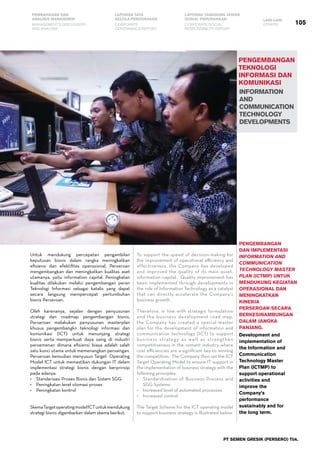
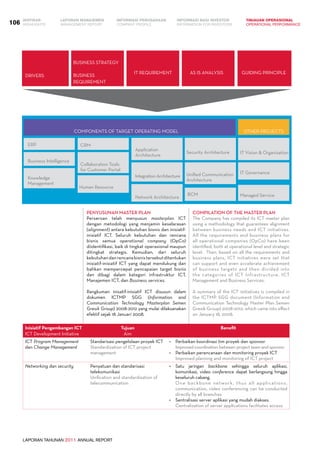
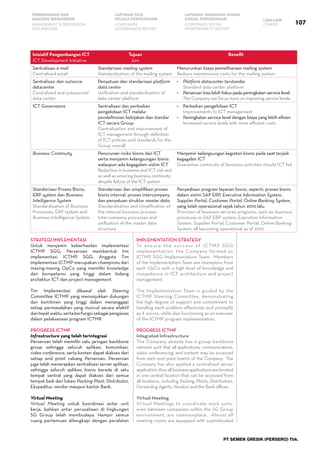
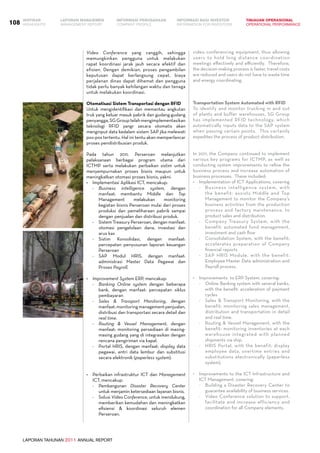
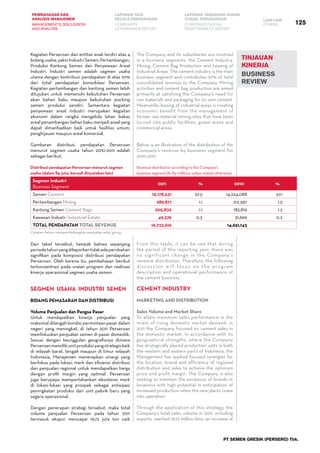
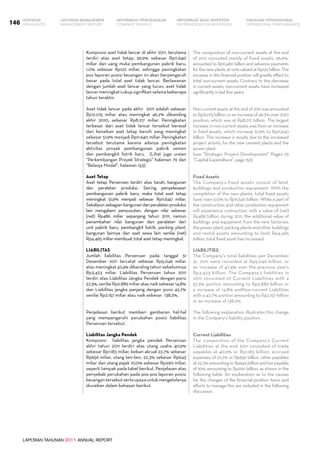
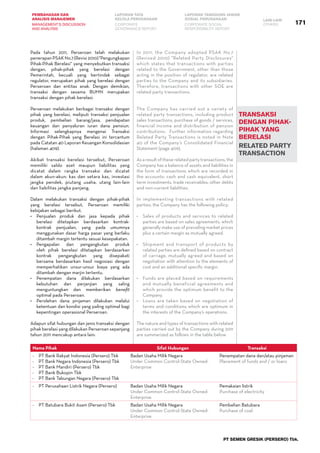
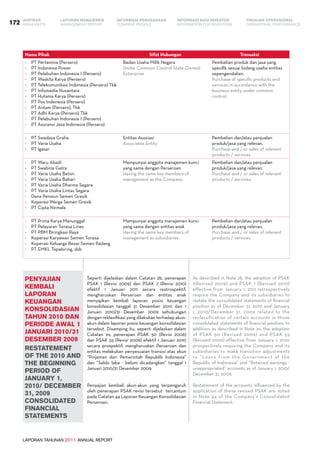
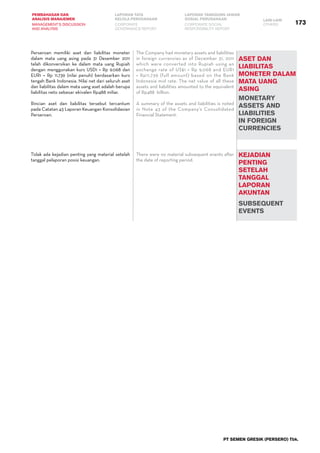
LAPORAN MANAJEMEN INFORMASI BAGI INVESTOR TINJAUAN OPERASIONAL
Management Report INFORMATION FOR INVESTORS OPERATIONAL PERFORMANCE56 INFORMASI PERUSAHAANIKHTISAR
COMPANY PROFILEHIGHLIGHTS
Grafik
Kinerja
Saham
composition
stock
performance
Company Share Performance
on the Indonesia Stock
Exchange 2010 and 2011
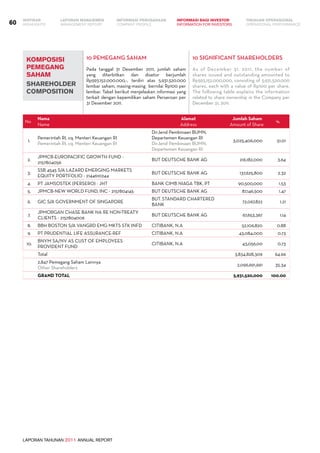
Grafik Kinerja Saham
Perseroan di Bursa Efek
Indonesia 2010 dan 2011
Januari - Desember 2011 JanuarY - DeCember 2011
Januari - Desember 2010 JanuarY - DeCember 2010
0
10,000
20,000
30,000
40,000
50,000
60,000
70,000
0
1,000
2,000
3,000
4,000
5,000
6,000
7,000
8,000
9,000
10,000
11,000
12,000
46,1%
0
5,000
10,000
15,000
20,000
25,000
30,000
35,000
0
1000.0
2000.0
3000.0
4000.0
5000.0
6000.0
7000.0
8000.0
9000.0
10000.0
11000.0
12000.0
3.2%
Awal/Opening:
SMGR: Rp 9,450
JCI : 3,703.51
Akhir/Closing:
SMGR: Rp 11,450
JCI : 3,821.99
Price (Rp/share)
21.2%
1-Jan
30
-Dec
1-Jan
30
-Dec
Volume (per’000) - (RHS)SMGR (LHS) JCI (LHS)
SMGR (LHS) JCI (LHS)
Key Market
Current share price
52 week high
52 week low
Market Cap.
11.450
11.450
7.650
67,915bn
1,26
1,26
0,84
7,489
IDR USD
Price (Rp/share)
Volume
10.000
25,2 %
Akhir/Closing:
SMGR: Rp 9,450
JCI : 3,703.51
Awal/Opening:
SMGR: Rp 7,550
JCI : 2,534.35
Key Market Data
Current share price
52 week high
52 week low
Market Cap.
9.450
10.150
7.300
56,052bn
1,05
1,13
0,81
6,228mm
IDR USD
0
10,000
20,000
30,000
40,000
50,000
60,000
70,000
0
1,000
2,000
3,000
4,000
5,000
6,000
7,000
8,000
9,000
10,000
11,000
12,000
46,1%
0
5,000
10,000
15,000
20,000
25,000
30,000
35,000
0
1000.0
2000.0
3000.0
4000.0
5000.0
6000.0
7000.0
8000.0
9000.0
10000.0
11000.0
12000.0
3.2%
Awal/Opening:
SMGR: Rp 9,450
JCI : 3,703.51
Akhir/Closing:
SMGR: Rp 11,450
JCI : 3,821.99
Price (Rp/share)
21.2%
1-Jan
30
-Dec
1-Jan
30
-Dec
Volume (per’000) - (RHS)SMGR (LHS) JCI (LHS)
SMGR (LHS) JCI (LHS)
Key Market
Current share price
52 week high
52 week low
Market Cap.
11.450
11.450
7.650
67,915bn
1,26
1,26
0,84
7,489
IDR USD
Price (Rp/share)
Volume
10.000
25,2 %
Akhir/Closing:
SMGR: Rp 9,450
JCI : 3,703.51
Awal/Opening:
SMGR: Rp 7,550
JCI : 2,534.35
Key Market Data
Current share price
52 week high
52 week low
Market Cap.
9.450
10.150
7.300
56,052bn
1,05
1,13
0,81
6,228mm
IDR USD
57
PEMBAHASAN DAN
ANALISIS MANAJEMEN
LAPORAN TATA
KELOLA PERUSAHAAN
LAPORAN TANGGUNG JAWAB
SOSIAL PERUSAHAAN LAIN-LAIN
MANAGEMENT’S DISCUSSION
AND ANALYSIS
CORPORATE
GOVERNANCE REPORT
CORPORATE SOCIAL
RESPONSIBILITY REPORT
OTHERS
PT SEMEN GRESIK (PERSERO) Tbk.
Periode
Period
Tertinggi
Highest
Terendah
Lowest
Penutupan
Closing
Volume (Jumlah Saham)
Volume (No of shares)
Kuartal Pertama
First Quarter
10,000 7,650 9,100 523,353,000
Kuartal Kedua
Second Quarter
9,750 9,200 9,600 341,794,500
Kuartal Ketiga
Third Quarter
10,000 7,700 8,300 487,544,000
Kuartal Keempat
Fourth Quarter
11,450 7,700 11,450 389,988,500
Periode
Period
Tertinggi
Highest
Terendah
Lowest
Penutupan
Closing
Volume (Jumlah Saham)
Volume (No of shares)
Kuartal Pertama
First Quarter
8,100 7,300 7,300 351,400,000
Kuartal Kedua
Second Quarter
9,000 7,700 8,750 721,236,500
Kuartal Ketiga
Third Quarter
9,900 8,600 9,900 481,119,000
Kuartal Keempat
Fourth Quarter
10,150 9,200 9,450 621,337,000
Harga dan Volume Saham per
Kuartal di Bursa Efek Indonesia
(Rupiah)
Company Share Performance
on the Indonesia Stock
Exchange (rupiah)
2010
2011
LAPORAN TAHUNAN 2011 ANNUAL REPORT
LAPORAN MANAJEMEN INFORMASI BAGI INVESTOR TINJAUAN OPERASIONAL
Management Report INFORMATION FOR INVESTORS OPERATIONAL PERFORMANCE58 INFORMASI PERUSAHAANIKHTISAR
COMPANY PROFILEHIGHLIGHTS
pembayaran dividen dividend payment
Keterangan
Description
2010 2009 2008 2007 2006
Laba bersih
Net Income
3,633 miliar billion 3,326 miliar billion 2,523 miliar billion 1,775 miliar billion 1,296 miliar billion
Rasio pembayaran dividen
Dividend Pay out Ratio
50% 55% 50% 50% 50%
Dividen Dibayarkan
Dividend paid
1,816,7 miliar billion 1,829.6 miliar billion 1,261 miliar billion 887,7 miliar billion 647.76 miliar billion
Dividen per saham
Dividend per share
306.26 308.45 215.19 149.66 1,092.06
Tanggal pembayaran
Payment date
August 15, 2011 August 5, 2010 August 7, 2009 June 17, 2008 August 7, 2007
kronologi pencatatan saham chronology of share listing
Keterangan
Description
Satuan
Unit
Go Public
Peningkatan
Modal Dasar
Increase of
Authorized
Capital
Right Issue
Peningkatan Modal
Dasar
Increase of
Authorized Capital
Stock Split Share Buyback Share Sellback
Modal dasar
Authorized capital
Saham
Share
500,000,000 741,440,000 741,440,000 2,000,000,000 20,000,000,000 20,000,000,000 20,000,000,000
Modal
ditempatkan dan
disetor
Issued and paid
capital
Saham
Share
148,288,000 148,288,000 593,152,000 593,152,000 5,931,520,000 5,251,120,000 5,931,520,000
Saham yang dibeli
kembali
Treasury stock
Saham
Share
(68,032,000)
Saham dijual
kembali
Share sellback
Saham
Share
68,032,000
Tanggal
pencatatan saham
di BEI
The date of share
listing at IDX
- July 8, 1991 -
June 2, 1995
August, 1995
- 7-Aug-07
Oct 13, 08 -
Jan 09, 09
Oct 6-7, 09
ikhtisar
saham,
pembayaran
dividen dan
kronologi
pencatatan
saham
HIGHLIGHTS
OF STOCKS,
DIVIDENDS AND
STOCK LISTING
HISTORY
59
PEMBAHASAN DAN
ANALISIS MANAJEMEN
LAPORAN TATA
KELOLA PERUSAHAAN
LAPORAN TANGGUNG JAWAB
SOSIAL PERUSAHAAN LAIN-LAIN
MANAGEMENT’S DISCUSSION
AND ANALYSIS
CORPORATE
GOVERNANCE REPORT
CORPORATE SOCIAL
RESPONSIBILITY REPORT
OTHERS
PT SEMEN GRESIK (PERSERO) Tbk.
KOMPOSISI
PEMEGANG
SAHAM
SHAREHOLDER
composition
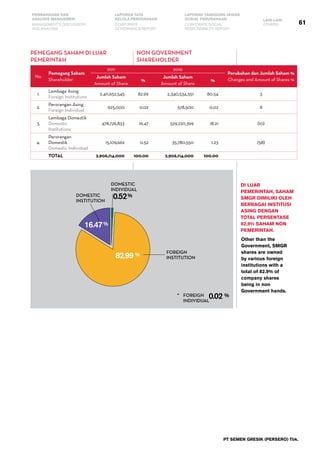
komposisi pemegang saham
per 31 desember 2011
komposisi pemegang saham
per 31 desember 2010
government RI
SHAREHOLDER COMPOSITION
PER deCember 31, 2011
SHAREHOLDER COMPOSITION
PER deCember 31, 2010
51.01
40.66
8.07
%
%
%
FOREIGN
INSTITUTION
DOMESTIC INSTITUTION
DOMESTIC
INDIVIDUAL 0.25%
*
* FOREIGN
INDIVIDUAL 0.01%
8.92%
DOMESTIC
INSTITUTION
0.01
0.60
%
%
DOMESTIC
INDIVIDUAL
FOREIGN
INDIVIDUAL
government RI
51.01%
39.46%FOREIGN
INSTITUTION
LAPORAN TAHUNAN 2011 ANNUAL REPORT
LAPORAN MANAJEMEN INFORMASI BAGI INVESTOR TINJAUAN OPERASIONAL
Management Report INFORMATION FOR INVESTORS OPERATIONAL PERFORMANCE60 INFORMASI PERUSAHAANIKHTISAR
COMPANY PROFILEHIGHLIGHTS
KOMPOSISI
PEMEGANG
SAHAM
SHAREHOLDER
COMPOSITION
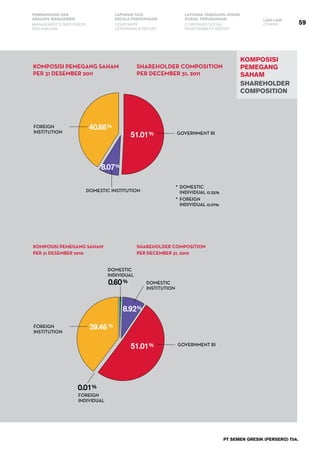
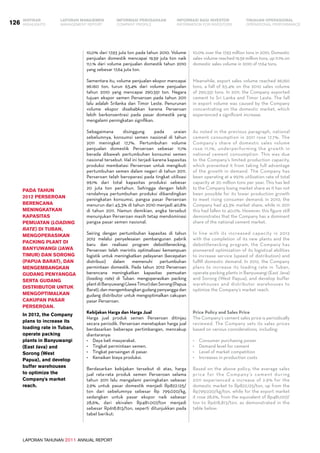
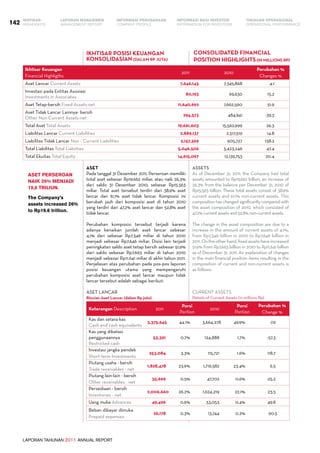
Pada tanggal 31 Desember 2011, jumlah saham
yang diterbitkan dan disetor berjumlah
Rp593.152.000.000,-, terdiri atas 5.931.520.000
lembar saham, masing-masing bernilai Rp100 per
lembar. Tabel berikut menjelaskan informasi yang
terkait dengan kepemilikan saham Perseroan per
31 Desember 2011.
As of December 31, 2011, the number of
shares issued and outstanding amounted to
Rp593,152,000,000, consisting of 5,931,520,000
shares, each with a value of Rp100 per share.
The following table explains the information
related to share ownership in the Company per
December 31, 2011.
10 PEMEGANG SAHAM 10 SIGNIFICANT SHAREHOLDERS
No
Nama
Name
Alamat
Address
Jumlah Saham
Amount of Share
%
1.
Pemerintah RI, cq. Menteri Keuangan RI
DirJend Pembinaan BUMN,
Departemen Keuangan RI
DirJend Pembinaan BUMN,
Departemen Keuangan RI
3,025,406,000 51.01
2.
JPMCB-EUROPACIFIC GROWTH FUND -
2157804056
BUT DEUTSCHE BANK AG 216,182,000 3.64
3.
SSB 4545 S/A LAZARD EMERGING MARKETS
EQUITY PORTFOLIO - 2144610244
BUT DEUTSCHE BANK AG 137,625,800 2.32
4. PT JAMSOSTEK (PERSERO) - JHT BANK CIMB NIAGA TBK, PT 90,500,000 1.53
5. JPMCB-NEW WORLD FUND, INC - 2157804145 BUT DEUTSCHE BANK AG 87,146,500 1.47
6. GIC S/A GOVERNMENT OF SINGAPORE
BUT. STANDARD CHARTERED
BANK
72,067,822 1.21
7.
JPMORGAN CHASE BANK NA RE NON-TREATY
CLIENTS - 2157804006
BUT DEUTSCHE BANK AG 67,653,367 1.14
8. BBH BOSTON S/A VANGRD EMG MKTS STK INFD CITIBANK, N.A 52,106,820 0.88
9. PT PRUDENTIAL LIFE ASSURANCE-REF CITIBANK, N.A 43,084,000 0.73
10.
BNYM SA/NV AS CUST OF EMPLOYEES
PROVIDENT FUND
CITIBANK, N.A 43,056,00 0.73
Total Total 3,834,828,309 64.66
2,847 Pemegang Saham Lainnya
Other Shareholders
2,096,691,691 35.34
GRAND TOTAL 5,931,520,000 100.00
61
PEMBAHASAN DAN
ANALISIS MANAJEMEN
LAPORAN TATA
KELOLA PERUSAHAAN
LAPORAN TANGGUNG JAWAB
SOSIAL PERUSAHAAN LAIN-LAIN
MANAGEMENT’S DISCUSSION
AND ANALYSIS
CORPORATE
GOVERNANCE REPORT
CORPORATE SOCIAL
RESPONSIBILITY REPORT
OTHERS
PT SEMEN GRESIK (PERSERO) Tbk.
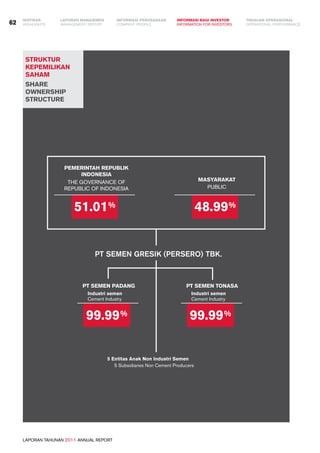
pemegang saham di luar
pemerintah
non government
shareholder
No.
Pemegang Saham
Shareholder
2011 2010
Perubahan dan Jumlah Saham %
Changes and Amount of Shares %
Jumlah Saham
Amount of Share
%
Jumlah Saham
Amount of Share
%
1.
Lembaga Asing
Foreign Institutions
2,411,652,545 82.99 2,340,534,551 80.54 3
2.
Perorangan Asing
Foreign Individual
625,000 0.02 578,500 0.02 8
3.
Lembaga Domestik
Domestic
Institutions
478,726,833 16.47 529,220,399 18.21 (10)
4.
Perorangan
Domestik
Domestic Individual
15,109,662 0.52 35,780,550 1.23 (58)
Total 2,906,114,000 100.00 2,906,114,000 100.00
Di luar
Pemerintah, saham
SMGR dimiliki oleh
berbagai institusi
asing dengan
total persentase
82,9% saham non
Pemerintah.
Other than the
Government, SMGR
shares are owned
by various foreign
institutions with a
total of 82.9% of
company shares
being in non
Government hands.
16.47%
DOMESTIC
INSTITUTION
0.52%
DOMESTIC
INDIVIDUAL
82.99 % FOREIGN
INSTITUTION
0.02 %* FOREIGN
INDIVIDUAL
LAPORAN TAHUNAN 2011 ANNUAL REPORT
LAPORAN MANAJEMEN INFORMASI BAGI INVESTOR TINJAUAN OPERASIONAL
Management Report INFORMATION FOR INVESTORS OPERATIONAL PERFORMANCE62 INFORMASI PERUSAHAANIKHTISAR
COMPANY PROFILEHIGHLIGHTS
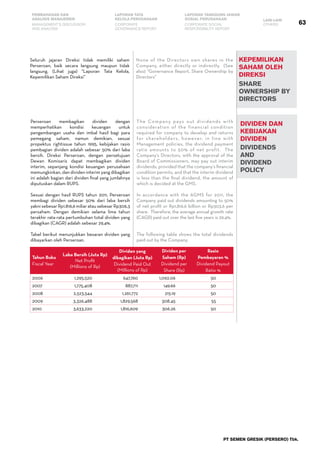
STRUKTUR
KEPEMILIKAN
SAHAM
SHARE
OWNERSHIP
STRUCTURE
PT SEMEN GRESIK (PERSERO) Tbk.
99.99%
pt semen tonasa
Industri semen
Cement Industry
99.99%
pt semen PADANG
Industri semen
Cement Industry
5 Entitas Anak Non Industri Semen
5 Subsidiaries Non Cement Producers
51.01%
PEMERINTAH REPUBLIK
INDONESIA
THE GOVERNANCE OF
REPUBLIC OF INDONESIA
48.99%
MASYARAKAT
PUBLIC
63
PEMBAHASAN DAN
ANALISIS MANAJEMEN
LAPORAN TATA
KELOLA PERUSAHAAN
LAPORAN TANGGUNG JAWAB
SOSIAL PERUSAHAAN LAIN-LAIN
MANAGEMENT’S DISCUSSION
AND ANALYSIS
CORPORATE
GOVERNANCE REPORT
CORPORATE SOCIAL
RESPONSIBILITY REPORT
OTHERS
PT SEMEN GRESIK (PERSERO) Tbk.
KEPEMILIKAN
SAHAM OLEH
DIREKSI
Share
Ownership by
Directors
Seluruh jajaran Direksi tidak memiliki saham
Perseroan, baik secara langsung maupun tidak
langsung. (Lihat juga) “Laporan Tata Kelola,
Kepemilikan Saham Direksi”
None of the Directors own shares in the
Company, either directly or indirectly. (See
also) “Governance Report, Share Ownership by
Directors”
dividen dan
kebijakan
dividen
dividendS
and
dividend
policy
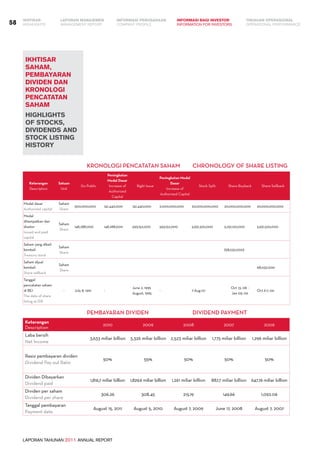
Perseroan membagikan dividen dengan
memperhatikan kondisi keuangan untuk
pengembangan usaha dan imbal hasil bagi para
pemegang saham, namun demikian, sesuai
propektus rightissue tahun 1995, kebijakan rasio
pembagian dividen adalah sebesar 50% dari laba
bersih. Direksi Perseroan, dengan persetujuan
Dewan Komisaris dapat membagikan dividen
interim, sepanjang kondisi keuangan perusahaan
memungkinkan, dan dividen interim yang dibagikan
ini adalah bagian dari dividen final yang jumlahnya
diputuskan dalam RUPS.
Sesuai dengan hasil RUPS tahun 2011, Perseroan
membagi dividen sebesar 50% dari laba bersih
yakni sebesar Rp1.816,6 miliar atau sebesar Rp306,3
persaham. Dengan demikian selama lima tahun
terakhir rata-rata pertumbuhan total dividen yang
dibagikan (CAGR) adalah sebesar 29,4%.
Tabel berikut menunjukkan besaran dividen yang
dibayarkan oleh Perseroan.
The Company pays out dividends with
consideration of the financial condition
required for company to develop and returns
for shareholders, however, in line with
Management policies, the dividend payment
ratio amounts to 50% of net profit. The
Company’s Directors, with the approval of the
Board of Commissioners, may pay out interim
dividends, provided that the company’s financial
condition permits, and that the interim dividend
is less than the final dividend, the amount of
which is decided at the GMS.
In accordance with the AGMS for 2011, the
Company paid out dividends amounting to 50%
of net profit or Rp1,816.6 billion or Rp303.6 per
share. Therefore, the average annual growth rate
(CAGR) paid out over the last five years is 29.4%.
The following table shows the total dividends
paid out by the Company.
Tahun Buku
Fiscal Year
Laba Bersih (Juta Rp)
Net Profit
(Millions of Rp)
Dividen yang
dibagikan (Juta Rp)
Dividend Paid Out
(Millions of Rp)
Dividen per
Saham (Rp)
Dividend per
Share (Rp)
Rasio
Pembayaran %
Dividend Payout
Ratio %
2006 1,295,520 647,760 1,092.06 50
2007 1,775,408 887,711 149.66 50
2008 2,523,544 1,261,772 215.19 50
2009 3,326,488 1,829,568 308.45 55
2010 3,633,220 1,816,609 306.26 50
kondisi
pasar
modal dan
kinerja
saham
perseroan
capital
market
conditions
and
performance
of company
shares
LAPORAN TAHUNAN 2011 ANNUAL REPORT
LAPORAN MANAJEMEN INFORMASI BAGI INVESTOR TINJAUAN OPERASIONAL
Management Report INFORMATION FOR INVESTORS OPERATIONAL PERFORMANCE64 INFORMASI PERUSAHAANIKHTISAR
COMPANY PROFILEHIGHLIGHTS
Kondisi Pasar Modal
Kondisi perekonomian global yang tidak menentu
sepanjang tahun 2011 turut berpengaruh terhadap
kinerja bursa saham di seluruh dunia. Bayang-
bayang krisis finansial kawasan Uni Eropa dan
defisit anggaran Amerika Serikat memegang
andil besar pada melambatnya kembali trend
pemulihan ekonomi 2010 global pasca krisis di
awal 2009. Seiring perkembangan krisis finansial
di kawasan Uni Eropa yang semakin merebak di
awal kuartal ke III, seluruh bursa utama di berbagai
belahan dunia bergejolak. Perdagangan saham
berlangsung dengan volatilitas yang tajam dan
berpola bearish. Akibatnya, secara umum indeks
bursa utama diberbagai kawasan mencatatkan
loss di akhir tahun.
Kegiatan transaksi di Bursa Efek Indonesia (BEI)
mulai kuartal ke 3 di tahun 2011 juga mengalami
volatilitas yang tinggi, dengan ritme perdagangan
yang susah diprediksi. Setelah mencatat kenaikan
indeks sebesar 13% dari penutupan Indeks Harga
Saham Gabungan (IHSG) akhir tahun 2010 di angka
3.703 dan mencapai titik tertinggi pada posisi
4.195, di tanggal 2 Agustus 2011, indeks kemudian
mengalami koreksi dengan volatilitas yang tinggi.
Pada tanggal 19September2011 bahkan terjadi
koreksi indeks tertinggi dalam perdagangan
sehari di BEI. Dibuka pada posisi indeks 3.843,
indeks terkoreksi sebesar -15%, turun ke angka
3.428 sebelum akhirnya ditutup pada posisi
di angka 3.426 (terkoreksi 10%). Angka indeks
perdagangan harian terendah terjadi pada tanggal
26 September, pada angka 3.217, untuk kemudian
secara berangsur-angsur, IHSG BEI menguat.
Pada akhir tahun, IHSG ditutup pada posisi 3.822,
atau menguat sebesar 3,2% dari angka penutupan
tahun 2010, sebesar 3.703. Kinerja bursa Indonesia
tersebut termasuk tiga terbaik di dunia, dibawah
Dow-Jones dan Bursa Filipina. Adapun Rata-rata
frekuensi transaksi bursa harian adalah sebesar
117.328 kali transaksi dan rata-rata volume transaksi
bursa harian sebesar 5,30 miliar unit saham.
Dengan raihan tersebut, nilai kapitalisasi pasar
seluruh saham emiten di BEI adalah sebesar
Rp3.537 triliun, naik 9% dari Rp3.247 triiun di akhir
tahun 2010.
Seiring volatilitas yang terjadi di bursa, saham-
saham dalam kelompok bluechips mencatat kinerja
yang bervariasi. Sebagian kecil mencatat kenaikan,
namun lebih banyak yang mengalami penurunan
harga dibandingkan penutupan di tahun 2010 lalu.
Kinerja Saham Perseroan
Saham Perseroan tercatat di Bursa Efek Indonesia
(dahulu BEJ) sejak tahun 1991, sebagai satu-satunya
BUMN industri semen di bursa. Kode perdagangan
saham Perseroan di BEI adalah SMGR. Selain
tercatat di papan utama, saham SMGR tercatat
sebagai anggota dari Jakarta Mining Index, LQ45
kenaikan ihsg
di tahun 2011,
masuk ke dalam
tiga besar bursa
berkinerja terbaik
di seluruh dunia.
Increase on the IDX
in 2011, in the three
best for performance
in the world.
3.2%
STOCK MARKET CONDITION
The uncertain condition of the global economy
during 2011 has affected the performances of
stock markets across the world. The shadows
of the financial crisis in the European Union
and the double deficit in the USA have played a
large part in slowing the trend toward economic
recovery in 2010 after the crisis in early 2009.
As the financial crisis in the European Union
has become increasingly widespread during the
start of Q3, all the major stock exchanges in
every corner of the world were in turmoil. Share
trading continued to be highly volatile and with a
bearish tendency. As a result, many of the main
stock exchanges recorded a loss at year-end.
Transactions on the Indonesia Stock Exchange
starting in Q3/2011 were also very volatile with
a trading rhythm that was difficult to predict.
Having recorded an index increase of 13% on
the closing figure of 3,703 as of end 2010 on the
Jakarta Composite Index (JCI) and reaching the
highest point of 4,195 on August 2, 2011, the index
then experienced a highly volatile correction.
On September 19, 2011, the highest single
day index correction on the Indonesia Stock
Exchange occurred. Opening with an index
position of 3,843, the index corrected falling
15% to 4,428 before finally closing at a position
of 3,426 (a correction of 10%). The lowest daily
trade index figure was on September 26, at 3,217),
after this the JCI gradually strengthened.
As of the end of the year, JCI closed at a position of
3,822, up 3.2% from the 3,703 closing figure for 2010.
The performance of the Indonesia Stock Exchange
was among the three best in the world, below the
Dow Jones and the Philippine Stock Exchange.
The average frequency of daily transactions on the
exchange was 117,328 transactions with an average
daily transaction volume of 5.30 billion share units.
With this achievement, the market capitalization for
all issuers’ shares on the Indonesia Stock Exchange
amounted to Rp3,537 trillion, an increase of 9%
from Rp3,247 trillion as of end 2010.
In line with the volatility on the stock markets,
blue-chip shares recorded a variety of results.
A fraction recorded an increase, however, the
majority fell in price compared to the close
of 2010.
THE PERFORMANCE OF COMPANY
SHARE
The Company’s shares have been listed on the
Indonesia Stock Exchange (IDX) (previously Jakarta
Stock Exchange) since 1991 as the only SOE cement
producer on the exchange. The Company’s trading
code on the IDX is SMGR. As well as being listed on
the main board, SMGR shares are also listed on the
65
PEMBAHASAN DAN
ANALISIS MANAJEMEN
LAPORAN TATA
KELOLA PERUSAHAAN
LAPORAN TANGGUNG JAWAB
SOSIAL PERUSAHAAN LAIN-LAIN
MANAGEMENT’S DISCUSSION
AND ANALYSIS
CORPORATE
GOVERNANCE REPORT
CORPORATE SOCIAL
RESPONSIBILITY REPORT
OTHERS
PT SEMEN GRESIK (PERSERO) Tbk.
(45 saham terlikuid si BEI), Jakarta Islamic Index,
Indeks Bisnis-27 dan Indeks Kompas 100.
Volatilitas pasar modal sepanjang tahun 2011 turut
mempengaruhi pergerakan saham SMGR, baik dari
sisi harga maupun volume transaksi.
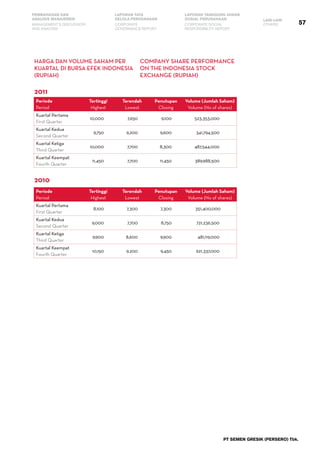
Harga penutupan saham semen Gresik di akhir
Desember 2010 adalah Rp 9.450 per saham. Namun
seiring dengan dinamika pasar, harga saham SMGR
pada quartal pertama 2011 sempat turun dan
menyentuhhargaterendahsebesarRp7.650sebelum
akhirnya ditutup pada posisi Rp9.100 per saham.
Volume perdagangan saham SMGR selama kuartal
pertama mancapai 523.353.000 lembar saham.
Pada kuartal II, kondisi pasar modal global maupun
nasional cukup kondusif, menyebabkan terjadinya
peningkatan aktivitas perdagangan di Bursa.
Sentimen positif tersebut membuat, juga berimbas
pada kenaikan saham SMGR sebesar 5,5% menajdi
Rp9.600 persaham diakhir perdagangan kuartal
kedua. Volume saham yang diperdagangkan selama
kuartal ke II ini menurun 34,6% menjadi sebesar
341.794.500 lembar saham.
Pada kuartal ke III sentimen negatif dari
merebaknya krisis finansial di kawasan Eropa
dan defisit ganda Amerika Serikat melanda bursa
saham di seluruh dunia. Pasar berbalik arah
menjadi bearish, bahkan sempat terjadi koreksi
besar-besaran pada seluruh bursa utama di akhir
kuartal ke-3. IHSG sempat mencatat koreksi
hingga 10% dalam perdagangan 1 hari.
Saham Perseroan tidak terlepas dari gejolak
tersebut dan sempat mencatat harga terendah di
Jakarta Mining Index, LQ45 (45 most liquid shares
on the IDX), Jakarta Islamic Index, Bisnis-27 Index
and Kompas 100 Index.
Capital market volatility during 2011 influenced
SMGR share movements, both in price and
transaction volume.
The closing price for Semen Gresik shares at the
end of December 2010 was Rp9,450 per share.
However, in line with the dynamic market, SMGR
shares in Q1/2011 had fallen and reached their
lowest price at Rp7,650 before finally closing
at Rp9,100 per share. The trading volume for
SMGR shares during the first quarter reached
523,353,000 shares.
In Q2, both the global market and national market
conditions were more favorable, prompting an
increase in trading activity on the exchange. The
positive sentiment impacted on SMGR shares
by 5.5%, increasing to Rp9,600 per share by the
end of the second quarter. The volume of shares
traded in Q2 fell 34.6% to 341,794,500 shares.
In Q3, negative sentiment resulting from the
financial crisis in Europe and the double deficit
in the USA affected all the stock markets across
the world. The markets turned back from being
bearish, and even witnessed a large correction
across all the main exchanges at the end of
Q3. The IDX also witnessed a 10% correction in
trading in just one day.
The Company’s shares could not escape the
turmoil and recorded their lowest position
LAPORAN TAHUNAN 2011 ANNUAL REPORT
LAPORAN MANAJEMEN INFORMASI BAGI INVESTOR TINJAUAN OPERASIONAL
Management Report INFORMATION FOR INVESTORS OPERATIONAL PERFORMANCE66 INFORMASI PERUSAHAANIKHTISAR
COMPANY PROFILEHIGHLIGHTS
posisi Rp7.700 sebelum akhirnya ditutup pada harga
sebesar Rp8.600 per-saham di-akhir kuartal ke-3.
Volume perdagangan saham SMGR pada periode
ini meningkat menjadi 487.544.000 lembar saham.
Pada kuartal ke IV, ekspektasi peningkatan
perekonomian dan realisasi proyek-proyek
pembangunan konstruksi membuat harga
saham-saham yang terkait dengan kegiatan
konstruksi meningkat. Untuk SMGR, kondisi
ini berkorelasi positif dengan ekspektasi
penyelesaian pebangunan pabrik baru. Saham
SMGR kembali diburu investor dan kembali
mengalami peningkatan harga, hingga pada akhir
tahun 2011 ditutup pada posisi Rp11.450per saham.
Posisi penutupan ini menunjukkan harga SMGR
meningkat sebesar 21,2% dari posisi penutupan
tahun 2010, yang berada pada angka Rp9.450 per
lembar saham.
Peningkatan tersebut lebih tinggi dari peningkatan
indeks yang hanya sebesar 3,2%, dan lebih tinggi
dari kenaikan harga saham peer industri semen
yang sebesar 7% (INTP) dan minus 3% (SMCB).
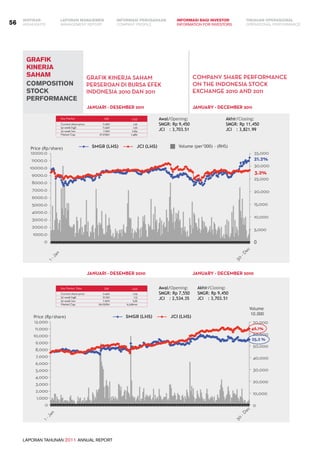
Pola pergerakan saham SMGR, seperti ditunjukkan
pada grafik di halaman 58 bergerak searah dengan
grafik pergerakan IHSG.
OPINI PELAKU PASAR MODAL
Berikut adalah kutipan beberapa analis pasar
modal di Indonesia atas kinerja saham dan kinerja
Perseroan. Para pembaca diharapkan memandang
seluruh pendapat tersebut sebagai masukan
ataupun pembanding atas keputusan investasi
yang akan dilakukan. Perseroan menyajikan kutipan
opini semata-mata dalam rangka memberikan
gambaran obyektif dari pihak diluar perusahaan
akan keseluruhan hasil kinerja Perseroan.
FORUM ANALIS
PenyelesaianpabrikbarudiTubandanTonasadalam
waktu dekat akan menambah kapasitas SMGR
sebesar total 5 juta ton per tahun dan membuat
SMGR mampu mengikuti momentum pertumbuhan
permintaan hingga tahun 2013. Penyelesaian
pabrik baru juga mengindikasikan hanya SMGR
yang merealisasikan investasi tambahan kapasitas
sampai tahun 2012. Sehingga memungkinkan SMGR
merebutkembalipangsapasaryangsempatterambil
oleh kompetitor karena kendala keterbatasan
pasokan yang dialami sebelumnya. Kekhawatiran
adanya pendatang baru potensial yang saat ini
tengah melakukan FS membuat produsen eksisting
menahan kenaikan harga, termasuk SMGR. Saat
kunjungan lapangan, Manajemen menyatakan total
volume penjualan tahun 2011 bisa mencapai kisaran
19,6-19,7 juta ton, lebih tinggi dari prediksi kami yang
berkisar 19,1 juta ton.
Kami memberi rating Buy (12 Desember 2011),
dengan target harga Rp 11.700 dan P/E sebesar
12,6x dari harga penutupan saat ini sebesar Rp9.550,
menunjukan potensi kenaikan sebesar 22,5%.
of Rp7,700 before finally closing at Rp8,600
per share at the end of Q3. The trading
volume for SMGR during this period rose to
487,544,000 shares.
In the fourth quarter, expectations of economic
improvement, ratification of the Land Bill
(releasing land for infrastructure requirements)
and the realization of construction projects
saw the price of shares related to construction
rise. For SMGR, this condition correlated with
expectations for the completion of a new plant.
Investors were tracking down SMGR shares and
the share price rose once more, ending 2011 at
a position of Rp11,450 per share. This closing
position demonstrated an increase of 21.2% in
SMGR share price over the closing position in
201 of Rp9,450 per share.
This increase is much greater than the 3.2%
increase of the index and was also higher than
share price increases of cement industry peers
also listed on the IDX. SMGR stock movements,
as shown in the graph on page 58 moved in the
same direction as demonstrated on the graph
showing JCI stock movements.
opinion of stock market
analysts
FollowingaresomequotesregardingtheCompany’s
performance and share performance from several
stock market analysts in Indonesia. The reader
should regard the entirety of this opinion as input
or comparison on investment decisions to be made.
The Company presents these opinion excerpts
solely to provide an objective picture from parties
outside the company regarding the company’s
overall performance.
FORUM ANALYSTS
CompletionofthenewplantsinTubanandTonasa
in the near future will add capacity for SMGR of a
total 5 million tons per year and enable SMGR to
follow momentum resulting from demand growth
until the end of 2013. The completion of these
new plants also indicates that only SMGR will
realize investment in additional capacity in 2012.
This should allow SMGR to claw back some of
the market share taken by its competitors due
to the obstacle of limited supply it experienced.
The worry is that the potential newcomers
currently carrying out feasibility studies will
cause the existing producers to hold onto price
increases, including SMGR. During a site visit,
the Management stated total sales volume for
2011 would reach approximately 19.6-19.7 million
tons, higher than our predication of around 19.1
million tons.
We gave a Buy rating (December 12, 2011), with
a target price of Rp11,700 and P/E of 12.6x from
the current closing price of Rp9,550, showing
potential for a 22.5% increase.
Andy Lesmana ,
Nomura Equity
Researh
harga saham
smgr naik.
SMGR share
price rose.
21.2%
67
PEMBAHASAN DAN
ANALISIS MANAJEMEN
LAPORAN TATA
KELOLA PERUSAHAAN
LAPORAN TANGGUNG JAWAB
SOSIAL PERUSAHAAN LAIN-LAIN
MANAGEMENT’S DISCUSSION
AND ANALYSIS
CORPORATE
GOVERNANCE REPORT
CORPORATE SOCIAL
RESPONSIBILITY REPORT
OTHERS
PT SEMEN GRESIK (PERSERO) Tbk.
Rachman
Koeswanto, PT
Deutsche Bank
Verdhana Indonesia
Kami menilai harga saham SMGR saat ini sudah
cukup baik mengingat perusahan tidak memiliki
ruang untuk meningkatkan harga jual dan adanya
tekanan pada biaya produksi. Selain tingkat
permintaan relatif lemah, harga semen relatif
mendatar disebabkan kekhawatiran para produsen
padapotensipersaingandimasamendatangkarena
adanya rencana investasi baru di sektor ini.
Oleh karena itu, kami (28 Oktober 2011),
merekomendasikan posisi Hold untuk saham ini,
dengan harga saat ini adalah Rp9.400 pada EV/
EBITDA sebesar 7,2x. Target harga dalam 12 bulan
mendatang adalah Rp10.250 persaham.
SMGR akan memiliki share sebesar 42% dari
total kapasitas produksi nasional sebesar 59,4
juta ton di tahun 2012 seiring dengan selesainya
pambangunan 2 unit pabrik baru berkapasitas
total 5 juta ton. Kami juga memprediksi SMGR
akan mampu mencatat pertumbuhan penjualan
14% dan menaikan harga jual sebesar 3,5%
sehingga meningkatkan profitabilitas sebesar
1% diatas raihan tahun 2011. Kami memandang
risiko-risiko utama yang akan dihadapi di tahun
2012 adalah kenaikan harga BBM, listrik dan biaya
distribusi yang akan menekan profitabilitas jika
kenaikan harga jual tidak mencukupi. Kami melihat
SMGR akan mampu meningkatkan kembali pangsa
pasarnya yang sempat turun karena keterbatasan
kapasitas produksi di tahun sebelumnya. Kami
juga melihat saham SMGR saat ini (29 Nov 2011)
pada harga Rp8.850, diperdagangkan dengan P/E
terendah diantara peer industri, yakni sebesar
12,3x dan sudah seharusnya dinilai kembali.
Oleh karenanya kami meningkatkan prospek harga
SMGR, menjadi Rp 12.350 dari harga saat ini (Nov
2011) sebesar Rp8.850 per saham, pada perkiraan
P/E sebesar 16x.
Pemberlakuan Undang-undang Pembebasan
Tanah tanggal 16 Des 2011, membuat kami
memandang SMGR memiliki potensi pertumbuhan
volume penjualan jangka menengah sebesar
14% dari perkiraan sebelumnya, sebesar 8%.
Hal ini memberikan potensi peningkatan total
pendapatan rata-rata sebesar 20% untuk
periode ’12-’16. Kejelasan peraturan pembebasan
tanah diperkirakan akan mendorong realisasi
infrastruktur dan meningkatkan pertumbuhan
properti yang berdampak pada kenaikan
permintaan semen. Realisasi pembangunan pabrik
baru dengan tambahan kpasitas total 5 juta ton
p.a akan membuat SMGR mampu mengikuti
trend pertumbuhan permintaan semen di masa
mendatang, dan meraih kembali pangsa pasarnya
yang sempat turun karena keterbatasan kapasitas.
Dengan dasar tersebut, kami (14 Des 2011)
memandang saham SMGR dengan Outperform
(potensikenaikandiatas10%)dariposisipenutupan
We judge the SMGR share price to be reasonable
considering the company does not have the
scope to increase selling prices and the pressure
on production costs. Alongside a relatively weak
demand, the price of cement is relatively flat
due to the concern from producers regarding
potential competition in the future resulting
from planned new investment in this sector.
For these reasons, we (October 28, 2011)
recommend a Hold position for these shares,
with the current price of Rp9,400 and EV/
EBITDA of 7.2x. The target price in the coming 12
months is Rp10,250 per share.
SMGR will have a 42% share of total national
production capacity amounting to 59.4 million
tons in 2012 with the completion of its 2 new
plants with a total capacity of 5 million tons. We
also predict that SMGR will record sales growth
of 14% and increase its selling price by 3.5%,
thus increasing profitability by 1% over 2011’s
achievements. We consider the main risks for
2012 to be the increase in fuel prices, electricity
and distribution costs, which will pressure
profitability if the increase in sales price is
insufficient. We consider SMGR able to win back
market share that it lost due to limited capacity
in the previous year. We also see SMGR share
currently (November 29, 2011) at Rp8,850, traded
with the lowest P/E of its industry peers at 12.3x
and should be revalued.
For these reasons, we raised the prospect for
the SMGR share price to Rp12,350 from the
current price (November 2011) of Rp8,850 per
share, with an expected P/E of 16x.
The enactment of the Land Law on December
16, 2011 resulted in us viewing SMGR as having
the potential for medium-term sales volume to
increase to 14%, up from previous estimates of
8%. This provides the potential for an average
increase in total revenue of 20% for the 2012-
2016 period. Clarification of the Land Law is
expected to drive infrastructure realization and
increase property growth, thus increasing the
demand for cement. The fruition of the new
plants with a total capacity of 5 million tons per
year will give SMGR the ability to follow trends
for the growing demand for cement in the future
and win back the market share it lost due to
limited capacity.
On this basis, we (December 14, 2011) view
SMGR shares as Outperform (potential to
increase greater than 10%) from the current
Swati Chopra,
Merrill Lynch
Riaz Hyder,
Mcquarrie
Equities Researh
LAPORAN TAHUNAN 2011 ANNUAL REPORT
LAPORAN MANAJEMEN INFORMASI BAGI INVESTOR TINJAUAN OPERASIONAL
Management Report INFORMATION FOR INVESTORS OPERATIONAL PERFORMANCE68 INFORMASI PERUSAHAANIKHTISAR
COMPANY PROFILEHIGHLIGHTS
saat ini (13 Des 2011) sebesar Rp.10.750 per saham.
Target harga adalah Rp 12.750 dalam 12 bulan
kedepan berdasar metode DCF, mencerminkan
PER sebesar 12,6x.
Kami yakin perkiraan laba bersih Perseroan
sebesar Rp4,1 triliun akan tercapai. Hal terpenting
dari SMGR adalah di tahun 2012 dan seterusnya
perusahaan akan memiliki tambahan kapasitas
sehingga keterbatasan kemampuan pasok saat ini
akan teratasi.
Dengan demikian, kami (31 Oktober 2011) tetap
merekomendasikan Buy, dengan target harga
saham SMGR Rp11.000 per saham dari harga saat
ini sebesar Rp9.400, menunjukan potensi kenaikan
sebesar 17%. Target harga tersebut mencerminkan
P/E sebesar 14,1x.
SMGR telah merevisi prediksi pertumbuhan
konsumsi dari sekitar 8-10% menjadi minimal
13%. Kami juga melihat minimnya pengaruh
ketidak pastian perekonomian global terhadap
pertumbuhan konsumsi semen di Indonesia. Oleh
karenanya kami memprediksi SMGR mencatat
pertumbuhan volume penjualan domestik sebesar
9% (sebelumnya 6%) di tahun 2011 dan sebesar
12% di tahun 2012. Peningkatan permintaan
mendukung terjadinya kenaikan harga dan SMGR
telah meningkatkan harga jual sekitar 3%. Dilain
pihak harga batubara yang merupakan komponen
biaya produksi utama (sekitar 30%), turun 12% dari
posisi tertingginya di bulan Februari 2011. SMGR
telah menyusun rencana belanja modal dengan
prudent hingga 2015, termasuk penambahan
kapasitas baru mencapai 10 juta ton p.a hingga
tahun 2015.
Kami (18 Oktober 2011) memandang SMGR memiliki
rencana pertumbuhan yang terstruktur, sehingga
memberikan status Outperform pada potensi
kenaian harga SMGR. Harga penutupan saat ini
adalah Rp8.950 dan target harga adalah Rp10.400
dalam 12 bulan kedepan, pada EPS 14x. Hal ini
mengindikasikan potensi kenaikan sebesar 16%.
closing position (December 13, 2011) at Rp10,750
per share. Our target price is Rp12,750 in the
coming 12 months based on the DCF method,
reflecting PER of 12.6x.
We believe that the Company will achieve a
net profit of Rp4.1 trillion. The note of import
for SMGR in 2012 and going forward is that the
company has additional capacity, thus resolving
the problem of limited supply capabilities.
Therefore, we (October 31, 2011) continue to
recommend Buy, with a target price per SMGR
share of Rp11,000 up from the current price of
Rp9,400, showing potential for a 17% increase.
This target price reflects the P/E of 14.1x.
SMGR has revised its consumer growth
prediction from around 8-10% to a minimum
of 13%. We also note the minimal effect of
global economic uncertainty on the growth of
cement consumption in Indonesia. Therefore,
we predict SMGR will record a growth in sales
volume domestically of 9% (previously 6%) in
2011 and 12% in 2012. Rising demand will support
a price increase and SMGR will raise prices by
approximately 3%. Meanwhile, the price of coal,
which is a main production cost component
(approximately 30%) will fall 12% from its highest
position in February 2011. SMGR has devised a
prudent capital expenditure plan through 2015,
including the addition of 10 million tons capacity
per year until 2015.
On October 18, 2011 we viewed SMGR as having
a structured planned growth and have given
an Outperform status for the potential price
increase of SMGR. The current closing price
is Rp8,950 and target price is Rp10,400 in the
coming 12 months, with EPS 14x. This indicates a
potential increase of 16%.
Teguh Hartanto,
Bahana
Di Shui, CLSA
69
PEMBAHASAN DAN
ANALISIS MANAJEMEN
LAPORAN TATA
KELOLA PERUSAHAAN
LAPORAN TANGGUNG JAWAB
SOSIAL PERUSAHAAN LAIN-LAIN
MANAGEMENT’S DISCUSSION
AND ANALYSIS
CORPORATE
GOVERNANCE REPORT
CORPORATE SOCIAL
RESPONSIBILITY REPORT
OTHERS
PT SEMEN GRESIK (PERSERO) Tbk.
Program ekspansi SMGR berjalan dengan baik,
sehingga Perseroan akan memiliki tambahan
kapasitas total sebesar 5 juta ton di tahun
2012. Tambahan kapasitas ini akan membuat
SMGR mampu mengatasi kendala keterbatasan
pasokan, terutama di pasar luar Jawa yang
tumbuh lebih cepat. Manajemen SMGR
memberi sinyal adanya kenaikan harga sesuai
strategi perusahaan yang lebih mendahulukan
tercapainya peningkatan margin laba dibanding
pangsa pasar. Saat ini SMGR beroperasi dengan
kapasitas penuh dan menguasai pangsa pasar
sebesar 40%. SMGR juga tengah menerapkan
langkah diversifikasi sumber energi, termasuk
menggunakah batubara kalori lebih rendah
dengan tujuan menekan biaya produksi.
Oleh karena itu, kami (18 Agustus 2011) tetap
merekomendasikan Buy pada saham SMGR
dengan target harga sebesar Rp10.300 dalam
3 bulan kedepan, mencerminkan tingkat P/E
sebesar 12,7x.
SMGR’s expansion program is going well and the
Company will have additional total capacity of
5 million tons per year in 2012. This additional
capacity will mean that SMGR is able to handle
the limited supply problem, in particular for
markets outside of Java which grow more rapidly.
The SMGR management has signaled a price
increase in line with the company’s strategy to
further prioritize profit margins ahead of market
share. At this time, SMGR is operating at full
capacity and controls 40% of market share.
SMGR is also is in the midst of applying steps to
diversify energy sources, including using lower
calorie coal to reduce production costs.
For these reasons, we (August 18, 2011) hold
to our Buy recommendation for SMGR shares
with a target price of Rp10,300 in the coming 3
months, reflecting a P/E level of 12.7x.
Chandra Pasaribu,
Danareksa
LAPORAN TAHUNAN 2011 ANNUAL REPORT
LAPORAN MANAJEMEN INFORMASI BAGI INVESTOR TINJAUAN OPERASIONAL
Management Report INFORMATION FOR INVESTORS OPERATIONAL PERFORMANCE70 INFORMASI PERUSAHAANIKHTISAR
COMPANY PROFILEHIGHLIGHTS
nama lembaga
dan profesi
penunjang
pasar modal
Names of
Institutions
and Stock
Market
Supporting
Professionals
Auditor
KAP Purwantono, Suherman dan Surja
Anggota Ernst & Young Global Limited
Indonesia Stock Exchange Building
Tower 2, 7th Floor
Jakarta 12190, Indonesia
Ph.	: (021) 5289 5000
Fax	: (021) 5289 4100
Biro Adminstrasi Efek
PT Datindo Entrycom
Puri Datindo
Belakang Wisma Diners Club
Jl. Jendral Sudirman Kav. 34-35, Jakarta 10220
Tel. (62-21) 5709009
Fax (62-21) 5709026
e-mail : deone@indosat.net.id
www.datindo.com
PT Datindo Entrycom merupakan Biro Administrasi
Efek Saham Perseroan. Semua pertanyaan
pemegang saham terdaftar tentang hal-hal
yang berhubungan dengan status pendaftaran
pemegang saham, dividen, kehilangan atau
kecurian sertifikasi saham, penggantian alamat,
dan hal-hal lainnya dapat dialamatkan ke alamat
tersebut diatas.
Auditor
KAP Purwantono, Suherman dan Surja
Member of Ernst & Young Global Limited
Indonesia Stock Exchange Building
Tower 2, 7th Floor
Jakarta 12190, Indonesia
Ph.	: (021) 5289 5000
Fax	: (021) 5289 4100
SECURITIES ADMINISTRATION BUREAU
PT Datindo Entrycom
Puri Datindo
Belakang Wisma Diners Club
Jl. Jendral Sudirman Kav. 34-35, Jakarta 10220
Tel. (62-21) 5709009
Fax (62-21) 5709026
e-mail : deone@indosat.net.id
www.datindo.com
PT Datindo Entrycom is the Company’s
Securities Administration Bureau. All questions
from registered shareholders regarding matters
related to registration status of shareholders,
dividends, loss or theft of share certificates,
change in address, and other matters, may be
addressed to the address above.
71
PEMBAHASAN DAN
ANALISIS MANAJEMEN
LAPORAN TATA
KELOLA PERUSAHAAN
LAPORAN TANGGUNG JAWAB
SOSIAL PERUSAHAAN LAIN-LAIN
MANAGEMENT’S DISCUSSION
AND ANALYSIS
CORPORATE
GOVERNANCE REPORT
CORPORATE SOCIAL
RESPONSIBILITY REPORT
OTHERS
PT SEMEN GRESIK (PERSERO) Tbk.
Kantor Notaris
NY. POERBANINGSIH ADI WARSITO, SH
S.K. Men. Keh. R.I Nomor: M-96-HT.03.01-TH 1984,
tertanggal: 7 Desember 1984
S.K. Mendagri Nomor: 141 / DJA /1985, tertanggal:
5 Juni 1985
Jl. Panglima Polim V/11, Kebayoran Baru,
Jakarta 12160
Telp. 7244650 - 7392801 - 7209542 - 7394629 -
7398569
Fax. 7265090
Email: poerbaningsih@yahoo.com;
poerbaningsih@uninet.net.id
Bank
PT Bank Mandiri (Persero) Tbk
PT Bank Negara Indonesia (Persero) Tbk
PT Bank Rakyat Indonesia (Persero) Tbk
PT Bank Central Asia Tbk
NOTARY OFFICE
NY. POERBANINGSIH ADI WARSITO, SH
S.K. Men. Keh. R.I Nomor: M-96-HT.03.01-TH
1984, dated on: 7 Desember 1984
S.K. Mendagri Nomor: 141 / DJA /1985,
dated on: 5 Juni 1985
Jl. Panglima Polim V/11, Kebayoran Baru,
Jakarta 12160
Telp. 7244650 - 7392801 - 7209542 - 7394629 -
7398569
Fax. 7265090
Email: poerbaningsih@yahoo.com;
poerbaningsih@uninet.net.id
Bank
PT Bank Mandiri (Persero) Tbk
PT Bank Negara Indonesia (Persero) Tbk
PT Bank Rakyat Indonesia (Persero) Tbk
PT Bank Central Asia Tbk
Pengelolaan
Lingkungan Hidup
Environmental Management
SMGR uses waste from other industries as an ancillary
raw material in the production process, as well as
fulfilling defined Environmental Quality Standards.
SMGR gunakan limbah industri lain
sebagai bahan baku penolong dalam
proses produksi selain memenuhi
ketentuan BML yang ditetapkan.
P.94
Risiko dan
Manajemen Risiko
Risk and Risk Management
High commitment to protect the Company from
risk, while creating business growth opportunities.
Komitmen tinggi untuk menghindarkan
Perseroan dari risiko sekaligus
menciptakan peluang pertumbuhan usaha.
P.110
PT SEMEN GRESIK (PERSERO) Tbk.
73
TINJAUAN OPERASIONAL
Operational Performance
Strategi
Bisnis
Pengelolaan K-3
Business Strategy
HSE Management
Ensuring business growth and best
financial performance.
SMGR provides suitable personal protection
equipment and consistently safeguards the
work environment and occupational safety.
Memastikan pertumbuhan usaha dan
pencapaian kinerja keuangan terbaik.
SMGR menyediakan peralatan
pelindung diri yang memadai
dan konsisten menjaga
kesehatan lingkungan kerja dan
keamanan kerja.
P.74 P.100
Pembangunan
PABRIK baru dan
fasilitas Distribusi
Construction of new plant
and Distribution Facilities
Realizing the Long Term Plan to ensure
sustainable growth and performance.
Realisasi Rencana Jangka Panjang
untuk menjamin pertumbuhan dan
kinerja yang berkesinambungan.
P.79
Pengelolaan
sumber daya
manusia
Human resources Management
Preparing the most talented Human Capital
to ensure the Company is a cement industry
leader in Indonesia and Southeast Asia.
Mempersiapkan Human Capital
bertalenta terbaik untuk memastikan
Perseroan sebagai pemimpin
industri persemenan di Indonesia
dan kawasan Asia Tenggara.
P.84
Inovasi
Perseroan
CORPORATE Innovations
SMGR facilitates and manages its employees'
innovations through the application of well directed
and planned Innovation Management.
SMGR memfasilitasi dan mengelolaan
daya inovasi para pegawai dengan
menerapkan Manajemen Inovasi yang
terarah dan terencana dengan baik.
P.103
Pengembangan
Teknologi
Informasi dan
Komunikasi
Development of Information and
Communication Technology
Specific design and development to support
operational efficiency, increase profitability and
to win competition.
Desain dan pengembangan khusus
guna mendukung efisiensi operasional,
mendukung peningkatan profitabilitas
dan memenangkan persaingan.
P.105
LAPORAN TAHUNAN 2011 ANNUAL REPORT
LAPORAN MANAJEMEN INFORMASI BAGI INVESTOR TINJAUAN OPERASIONAL
Management Report INFORMATION FOR INVESTORS OPERATIONAL PERFORMANCE74 INFORMASI PERUSAHAANIKHTISAR
COMPANY PROFILEHIGHLIGHTS
strategi
bisnis
business
strategy
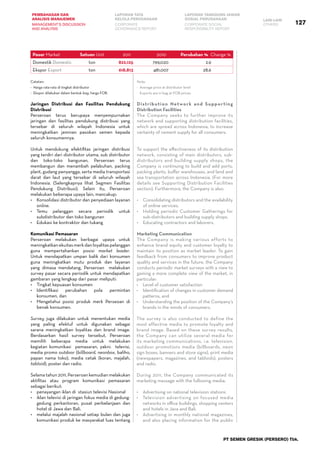
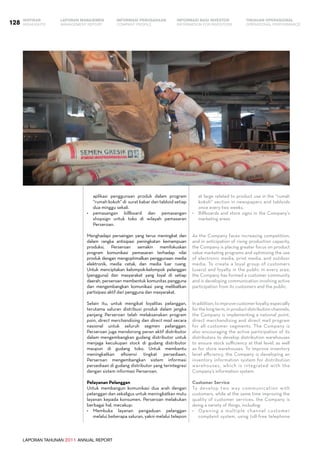
Perseroan telah menyusun strategi bisnis dan
menuangkan dalam rencana kegiatan baik
dalam jangka pendek maupun panjang. Dalam
proses penyusunan strategi tersebut, Perseroan
senantiasa berupaya untuk meraih pertumbuhan
berkelanjutan dan memaksimalkan nilai pemegang
saham dengan mempertimbangkan tingkat risiko
yang dapat diterima.
Berikut adalah uraian ringkas seluruh inisiatif
strategi yang disusun dan diterapkan.
RENCANA STRATEGIS JANGKA
PANJANG
Permintaan semen di Indonesia diproyeksikan
akan tetap tinggi di masa depan karena dipicu oleh
empatfaktorutama.Pertama,adanyapertumbuhan
ekonomi domestik yang berkelanjutan dengan
tingkat pertumbuhan rata-rata diatas 6%. Kedua,
belanja pemerintah pada proyek infrastruktur
yang meningkat dalam lima tahun kedepan akan
menjadi stimulus tersendiri bagi pertumbuhan
permintaan semen. Ketiga, tingkat suku bunga
pinjaman yang kondusif. Keempat, konsumsi
semen per kapita di Indonesia yang masih berada
di bawah rata-rata konsumsi semen di negara
ASEAN yang memberikan peluang pertumbuhan
permintaan semen di masa depan.
	
Mempertimbangkan potensi pertumbuhan
konsumsi semen tersebut, Perseroan selalu
melakukan review atas 6 kritikal issue yang telah
ditetapkan sebagai landasan strategi pertumbuhan
yang berkelanjutan, yang dapat disampaikan
sebagai berikut.
The Company has developed a business strategy
that contains both short- and long-term actions.
In the process of developing this strategy, the
Company has made every effort to achieve
sustainable growth and maximize value for
shareholders while taking into consideration an
acceptable level of risk.
Following is a brief explanation of all the strategic
initiatives developed and applied.
LONG-TERM STRATEGIC PLAN
The demand for cement in Indonesia is projected
to remain high in future triggered by four main
factors. First, continuing domestic economic
growth with an average growth rate of over 6%.
Second, government spending on infrastructure
projects will increase in the coming five years
and provide its own stimulus for cement demand.
Third, the favorable interest rate for financing.
Fourth, per capita cement demand in Indonesia
is still below average consumption for ASEAN
countries and this provides an opportunity for a
growing demand for cement in the future.
Considering the potential for cement
consumption to grow, the Company continually
reviews its 6 defined critical issues as a
foundation for a sustainable growth strategy,
summarized below.
PT SEMEN GRESIK (PERSERO) Tbk.
75
PEMBAHASAN DAN
ANALISIS MANAJEMEN
LAPORAN TATA
KELOLA PERUSAHAAN
LAPORAN TANGGUNG JAWAB
SOSIAL PERUSAHAAN LAIN-LAIN
MANAGEMENT’S DISCUSSION
AND ANALYSIS
CORPORATE
GOVERNANCE REPORT
CORPORATE SOCIAL
RESPONSIBILITY REPORT
OTHERS
1.	 Pertumbuhan Kapasitas
2.	 Pengamanan Energi
3.	 Penguatan Citra Korporasi
4.	 Pemenuhan Kebutuhan Konsumen
5.	 Penguatan Faktor Penunjang
6.	 Pengendalian Risiko Utama
Uraian dan Implementasi
1.	 Pertumbuhan Kapasitas:
	 Untuk memenuhi pertumbuhan permintaan
semen di Indonesia, Perseroan berupaya
untuk mengembangkan kapasitas, melalui
pertumbuhan organik maupun non-organik.
Dalam rangka merealisasikan pertumbuhan
organik, saat ini Perseroan sedang dalam tahap
penyelesaian pembangunan pabrik baru di Jawa
dan di Sulawesi dengan kapasitas total 5 juta ton
per tahun. Perseroan juga melakukan program
upgrading fasilitas pabrik yang ada untuk
meningkatkan yield dan kapasitas produksi.
	 Perseroan juga senantiasa melakukan kajian
terkait peluang untuk mengembangkan
kepasitas melalui pertumbuhan non-organik
baik di dalam maupun di luar negeri.
2.	 Pengamanan Energi:
	 Perseroan telah melaksanakan dan senantiasa
melakukan evaluasi pengamanan energi
secara prudent, untuk menjamin keamanan
pasokan batubara dan menjaga keseimbangan
antara pasokan listrik dari pihak ketiga
dengan pembangkit listrik milik sendiri.
Untuk mengamankan kebutuhan batubara,
Perseroan melakukan kontrak pengadaan
jangka panjang yang ditinjau setiap periode
1.	 Capacity Growth
2.	 Energy Security
3.	 Strengthening The Corporate Image
4.	 Fulfilling Consumer Requirements
5.	 Strengthening Supporting Factors
6.	 Managing Prime Risks
Description and Implementation
1.	 Capacity Growth:
	 To fulfill the growing demand for cement in
Indonesia, the Company has made efforts to
expand capacity through both organic and
non-organic growth. To realize organic growth,
at this time the Company is in the final stages
of building new plants in Java and Sulawesi
with a total capacity of 5 million tons per year.
The Company is also carrying out a factory
facility upgrading program to improve yields
and production capacity.
	 The Company also always studies
opportunities to grow capacity through
non-organic growth both domestically and
overseas.
2.	 Energy Security:
	 The Company has implemented and is always
evaluating the prudence of its energy security,
ensuring the security of its coal supply and
maintaining a balance between third-party
electricity supply and its own power plant.
To secure coal demand, the Company’s
long-term procurement contract, which is
periodically reviewed, carefully considers
Kapasitas
produksi
Perseroan akan
senantiasa
ditingkatkan
secara terukur
dan terencana
sejalan dengan
PErtumbuhan
permintaan semen.
The Company’s
production capacity
will continue to
rise in a measured
and planned way
in line with cement
demand growth.
LAPORAN TAHUNAN 2011 ANNUAL REPORT
LAPORAN MANAJEMEN INFORMASI BAGI INVESTOR TINJAUAN OPERASIONAL
Management Report INFORMATION FOR INVESTORS OPERATIONAL PERFORMANCE76 INFORMASI PERUSAHAANIKHTISAR
COMPANY PROFILEHIGHLIGHTS
tertentu, dan mempertimbangkan dengan
seksama pengelolaan lahan tambang yang akan
dilaksanakan oleh entitas anak.
	 Untuk mengamankan pasokan energi listrik,
Perseroan saat ini membangun pembangkit
listrik berkapasitas 2x35 MW berbahan bakar
batubara di Sulawesi untuk kebutuhan pabrik
baru di lokasi tersebut.
3.	 Penguatan Citra Korporasi.
	 Dalam rangka penguatan citra korporasi,
Perseroan telah melaksanaan program-program
sebagai berikut:
•	 Clean Development Mechanism (CDM) yang
meliputi: pemanfaatan panas buang untuk
pembangkit listrik (waste heat recovery
power generator), bahan bakar alternatif,
penggunaan alternatif bahan baku.
•	 Pengelolaan Tanggung Jawab Sosial dan
Lingkungan yang berkesinambungan.
•	 Meningkatkan kualitas penerapan Tata
Kelola Perusahaan.
4.	 Pemenuhan kebutuhan konsumen.
	 Dalam rangka memenuhi kebutuhan konsumen,
Perseroan telah melaksanakan berbagai
program pengembangan produk yang sesuai
dengan kebutuhan konsumen dengan menjaga
kualitas produk. Disamping itu Perseroan juga
telah mengembangkan jaringan distribusi untuk
menjamin kelancaran pasokan. Perseroan
berupaya meningkatkan kepuasan dan loyalitas
konsumen yang telah terjaga baik, melalui
pemahaman atas kebutuhan produk dan
jaminan pasokan untuk mengokohkan citra
merek Perseroan.
5.	 Penguatan Faktor Penunjang:
	 Untuk mendukung pengembangan usaha,
Perseroan telah melakukan penyempurnaan
atas seluruh sarana pendukung aktifitas
Perseroanuntukmenjadikatalissecaralangsung
dalam mempercepat pertumbuhan bisnis yang
meliputi: organization capital, information
capital dan human capital.
6.	 Pengendalian Risiko Utama:
	 Prinsip kehati-hatian (Prudent Management)
senantiasa menjadi dasar bagi Perseroan dalam
menjalankan aktifitas bisnis. Berdasarkan hal
tersebut Perseroan menerapkan pengelolaan
risiko pada setiap aspek bisnis yang dijalankan
melalui pemantauan dan mitigasi atas setiap
risiko utama sehingga mampu memaksimumkan
efektifitas operasional Perseroan.
Dari seluruh kerangka strategi yang telah disusun,
Perseroan berkeyakinan dapat menyelaraskan
penerapannya ke dalam kegiatan jangka pendek
melalui empat fokus pengelolan strategi – revenue
management, cost management, capacity
managementdanincreasingcompetitiveadvantage
– untuk mendukung percepatan pertumbuhan
dalam 10 tahun kedepan dan seterusnya.
mine management implemented by its
subsidiary.
	
	 To secure its supply of electricity, the
Company is currently building a coal-fired
power plant with a 2 x 35 MW capacity in
Sulawesi to meet the demands of the new
plant at that location.
3.	 Strengthening The Corporate Image:
	 To strengthen the corporate image, the
Company has implemented the following
programs:
•	 Clean Development Mechanism (CDM)
which includes: waste heat recovery
power generators, alternative fuels, use of
alternative raw materials.
•	 Sustainable Social Responsibility and
Environmental Management.
•	 Improving the quality of Corporate
Governance implementation.
4.	 Fulfilling Consumer Requirements:
	 To fulfill consumer requirements, the
Company has implemented various product
development programs to suit consumer
requirements and maintain product quality.
As well as this, the Company has also
developed its distribution network to ensure
smooth supply. The Company is making
efforts to improve customer satisfaction and
loyalty, which is already well maintained, by
understanding product needs and ensuring
supply to strengthen the Company’s image.
5.	 Strengthen Supporting Factors:
	 To support business development, the
Company has improved all of its supporting
facilities as a direct catalyst to accelerate
business growth, covering organization capital,
information capital and human capital.
6.	 Managing Prime Risks:
	 The principle of prudence (Prudent
Management) has always been the basis for
the Company in implementing its business
activities. Based on this, the Company applies
risk management to every aspect of business
by monitoring and mitigating every prime
risk so as to maximize the effectiveness of
Company operations.
Of all the framework strategies developed,
the Company believes that it can align their
implementation into its short-term activities
through four strategic management focus points
– revenue management, cost management,
capacitymanagementandincreasingcompetitive
advantage – to support accelerated growth in the
coming 10 years and further into the future.
77
PEMBAHASAN DAN
ANALISIS MANAJEMEN
LAPORAN TATA
KELOLA PERUSAHAAN
LAPORAN TANGGUNG JAWAB
SOSIAL PERUSAHAAN LAIN-LAIN
MANAGEMENT’S DISCUSSION
AND ANALYSIS
CORPORATE
GOVERNANCE REPORT
CORPORATE SOCIAL
RESPONSIBILITY REPORT
OTHERS
PT SEMEN GRESIK (PERSERO) Tbk.
FOKUS PENGELOLAAN STRATEGIS
Perseroan menyelaraskan penerapan strategi
pengembangan jangka panjang tersebut kedalam
kegiatan jangka pendek melalui empat fokus
pengelolan strategi – revenue management, cost
management, capacity management dan increasing
competitive advantage – untuk mendukung
percepatan pertumbuhan.
Revenue Management
Strategi ini sangat erat dengan kegiatan pemasaran
Perseroan. Dengan strategi revenue management,
pola dan strategi pemasaran selalu ditinjau ulang,
sebaran penjualan produk diutamakan pada
daerah yang memberikan marjin laba usaha optimal
melalui program optimasi distribusi sehingga
daerah pemasaran dan pola angkutan disesuaikan.
Cost Management
Dengan strategi ini management memfokuskan
pada upaya efisiensi biaya melalui pengelolaan
bahan baku, kemasan, energi, pemeliharaan,
pola distribusi dan moda pengangkutan sehingga
produk Perseroan memiliki daya saing maksimal.
Pemilihan jenis bahan bakar dan pola angkutan
produk dibenahi untuk menekan pengaruh
kenaikan biaya produksi yang signifikan.
Capacity Management
Peningkatan kapasitas produksi dilaksanakan
dan dirancang secara seksama baik untuk
pembangunan pabrik baru maupun up-grading
existing fasilitas produksi. Hal ini menjadikan
Perseroan mampu memenuhi permintaan pasar
yang meningkat dan dapat menjaga kestabilan
operasi dengan tingkat utilisasi yang tinggi.
Increasing Competitive Advantage
Untuk meningkatkan keunggulan bersaing,
Perseroan melaksanakan implementasi program-
program restrukturisasi korporasi, restrukturisasi
entitas anak, pengembangan kompetensi SDM dan
penyempurnaan Information and Communication
Technology.
PROGRAM SINERGI
Perseroanmelaksanakansinergiuntukmemanfaatkan
keunggulan geografis dari letak fasilitas produksi
Perseroanyangtersebarditigawilayahpertumbuhan
utamaIndonesia,sehinggamemilikidayajangkaulebih
luas. Sinergi yang meliputi berbagai bidang termasuk
engineering, pengadaan, produksi, pemasaran,
distribusi dan keuangan ini memungkinkan
penekanan biaya operasional Perseroan sehingga
lebih meningkatkan daya saing.
Program Sinergi pada awalnya juga dimaksudkan
sebagai bagian upaya Perseroan untuk ekspansi
daerah pemasaran dan meningkatkan kinerja.
Kini dengan berhasilnya program pengembangan
kapasitas melalui program debottlenecking dan
semakindekatnyapenyelesaianpembangunanpabrik
baru. Sinergi seluruh aspek operasional maupun
keuangan semakin ditingkatkan untuk meningkatkan
efisiensi dan kinerja keuangan Perseroan.
STRATEGIC MANAGEMENT FOCUS
The Company harmonizes the application of its
long-term strategic development into short-term
activities with four strategic management focus
points – revenue management, cost management,
capacity management and increasing competitive
advantage – to support accelerated growth.
Revenue Management
This strategy is closely related to the Company’s
marketing activities. Through revenue
management, marketing patterns and strategies
are always reviewed and distribution of products
for sale is prioritized to areas with optimum
profit margins through a distribution optimization
program ensuring that regional marketing and
transportation patterns can be adapted.
Cost Management
This strategy enables the management to focus on
cost efficiency efforts through the management of raw
materials, packaging, energy, maintenance, distribution
patterns and transportation methods, ensuring
that the Company’s products have the greatest
competitive edge. Selecting the type of fuel and
product transportation pattern allows the pressure of
productioncostincreasestobeaddressed.
Capacity Management
Increased production capacity is carefully
implemented and planned with development of
new plants and upgrading of existing production
facilities. This allows the Company to fulfill rising
market demand and maintain stable operations
with high utilization levels.
Increasing Competitive Advantage
To increase its competitive advantage, the
Company implements corporate restructuring
programs, subsidiary restructuring, development
of HR competencies and improvements to
Information and Communication Technology.
SYNERGY PROGRAM
The Company has implemented synergy to
take advantage of the geographical location of
its production facilities spread across three of
Indonesia’s main growth areas, thus enabling a
greater reach. Synergies involve various fields,
including engineering, production, marketing,
distribution and finances and allow for a
reduction in the Company’s operational costs
and improve its competitiveness.
The Synergy Program was initially intended to
be part of the Company’s regional marketing
expansionandperformanceimprovementprogram.
Now, with the success of its capacity development
program through debottlenecking and the rapidly
approaching completion of its new plants, synergy
of all operational aspects, including finances, are
being increased to maximize efficiency and the
Company’s financial performance.
LAPORAN TAHUNAN 2011 ANNUAL REPORT
LAPORAN MANAJEMEN INFORMASI BAGI INVESTOR TINJAUAN OPERASIONAL
Management Report INFORMATION FOR INVESTORS OPERATIONAL PERFORMANCE78 INFORMASI PERUSAHAANIKHTISAR
COMPANY PROFILEHIGHLIGHTS
PROSPEK 2012 DAN STRATEGI BISNIS
DI TAHUN 2012
Memasuki tahun 2012, walaupun perekonomian
global masih dihadapkan pada ancaman krisis
sebagai akibat masih berlarutnya kondisi di
kawasan Uni Eropa dan defisit Amerika, namun
banyak analis memproyeksikan ekonomi dunia,
terutama kawasan Asia Pasifik akan tetap tumbuh
sekalipun dengan tingkat yang sedikit lebih rendah.
Demikian pula dengan perekonomian Indonesia
yang diproyeksikan oleh akan tumbuh pada kisaran
6,4%-6,5%, menggambarkan tetap baiknya prospek
bisnis 2012 di Indonesia. Kestabilan perekonomian
makro, naiknya peringkat utang luar negeri menjadi
“investment grade” dan kestabilan suku bunga
yang semakin favorable membuat optimisme para
ekonom tetap tinggi, kendati Indonesia dihadapkan
pada semakin rendahnya produksi minyak bumi
ditengah meningkatnya harga dalam beberapa
bulan terakhir.
Secara Industri, Perseroan memproyeksikan
pertumbuhan permintaan semen domestik pada
kisaran 8,0%, setelah pada tahun 2011 lalu sempat
melonjak sebesar 17,7%. Proyeksi ini sangat wajar,
mengingatpertumbuhanekonomiyangmendukung
pasar retail dan semakin banyaknya rencana
realisasi proyek-proyek konstruksi baik bangunan
real estate maupun infrastruktur. Meningkatnya
kebutuhan semen di tahun 2012 menjanjikan
peluang yang besar bagi Perseroan untuk meraih
kinerja yang lebih baik lagi.
Disamping itu, proyeksi tingkat suku bunga SBI
dari Departemen Keuangan RI sebesar 6,0% turut
mendukung iklim investasi yang semakin baik.
Dengan tingkat suku bungatersebut,diproyeksikan
penjualan kredit perumahan akan semakin tinggi.
Demikian pula dengan realisasi proyek-proyek
konstruksi yang akan memperoleh dukungan dana
dengan biaya yang relatif murah.
Dengan seluruh gambaran ringkas membaiknya
prospek indikator-indikator tersebut, Perseroan
mempersiapkan rencana, target dan strategi
operasionaltahun2012yangmemungkinkandiraihnya
peluang dan kinerja operasional secara optimal.
Perseroan akan tetap konsekuen menjalankan
empat elemen fokus pengelolaan strategi, Revenue
management, Cost management, Capacity
Management dan Increasing competitive advantage.
Perseroan juga akan semakin meningkatkan peran
dukungan Teknologi Informasi dalam menjalankan
seluruh inisiatif strategi tersebut.
Penyelesaian unit pabrik baru dan keberhasilan
program debottlenecking memiliki implikasi positif
bagi Perseroan, berupa terbukanya peluang
untuk mengikuti dinamika peningkatan konsumsi
semen dalam negeri dan kembali meningkatkan
pangsa pasar. Perseroan juga berinisiatif untuk
mengintensifkanProgramSinergidengandukungan
teknologi informasi agar mendapatkan efisiensi
distribusi dan operasional pemeliharaan yang
semakin rendah sehingga semakin meningkatkan
kinerja keuangan.
PROSPECTS AND BUSINESS
STRATEGY IN 2012
As we enter 2012, even though the global
economy is facing the threat of crisis as a
result of the spreading conditions from the
European Union and the deficit in America,
many analysts are projecting that the world
economy, in particular in the Asia Pacific region,
will grow, even if at lower levels. Similarly, this
is the conclusion for the Indonesian economy,
which is predicted to grow at around 6.4-6.5%
demonstrating the continuance of Indonesia’s
healthy business prospects in 2012. The stability
of macroeconomic factors, the improvement
in the state foreign debt rating to “investment
grade” and the stability of favorable interest
rates have encouraged economists to remain
optimistic, even though Indonesia is facing lower
natural gas production in the midst of rising
prices over the last few months.
With regards to the industry, the Company
projects growth in domestic demand for cement
at around 8.0%, after the surge in 2011 of 17.7%.
This projection is very reasonable considering
economic growth supports the retail market
along with the increasing number of construction
projects being realized for real estate and
infrastructure. Rising demand for cement in 2012
promises great opportunities for the Company
to achieve even better performance.
Alongside this, the RI Ministry of Finance
is predicting SBI interest rates of 6%, also
supporting an improving investment climate.
With this level of interest rate, it is predicted
that sales of housing financing will increase. This
will in turn see the realization of construction
projects as relatively cheap financing support
is attainable.
With all these improving indicators, the
Company has prepared a plan, target and
operational strategy for 2012 that facilitates
it achieving opportunities and optimum
operational performance. The Company will
continue to consistently execute its four focuses
of strategic management, Revenue management,
Cost management, Capacity Management
and Increasing Competitive Advantage. The
Company will also increase the support role
of Information Technology in carrying out all of
these strategic initiatives.
The completion of its new plants and the success
of the debottlenecking program have positive
implications for the Company in the form of
opening up opportunities to follow the dynamic
increase in domestic cement consumption
and taking back market share. The Company
has also taken the initiative of intensifying its
Synergy Program with the support of information
technology to achieve efficient distribution
and operations with lower maintenance, thus
increasing financial performance.
79
PEMBAHASAN DAN
ANALISIS MANAJEMEN
LAPORAN TATA
KELOLA PERUSAHAAN
LAPORAN TANGGUNG JAWAB
SOSIAL PERUSAHAAN LAIN-LAIN
MANAGEMENT’S DISCUSSION
AND ANALYSIS
CORPORATE
GOVERNANCE REPORT
CORPORATE SOCIAL
RESPONSIBILITY REPORT
OTHERS
PT SEMEN GRESIK (PERSERO) Tbk.
PEMBANGUNAN
PABRIK DAN
FASILITAS
DISTRIBUSI
BUILDING
PRODUCTION
AND
DISTRIBUTION
FACILITIES
Perseroan
merancang dan
merealisasikan
pembangunan
fasilitas produksi
maupun distribusi
dengan seksama
dan telah
memperhitungkan
seluruh faktor
risiko untuk
menjamin
pertumbuhan
usaha yang
berkelanjutan.
The Company
designs and realizes
construction of
production and
distribution facilities
with care and has
factored in all risk
factors to ensure
sustainable business
growth.
Dalam rangka mengembangkan usaha, Perseroan
merealisasikan berbagai rencana investasi dengan
tujuan meningkatkan kapasitas produksi maupun
untuk mendukung efisiensi distribusi. Untuk
meningkatkan kapasitas produksi, Perseroan
menempuh dua cara, yakni membangun pabrik
baru dalam skema pembangunan proyek strategis
dan menjalankan program debottlenecking. Untuk
mendukung efisiensi dan memperluas cakupan
pasar, Perseroan memprioritaskan pembangunan
packing plant, di-ikuti dengan peningkatan
fasilitas pelabuhan, gudang penyangga dan
mengembangkan teknologi informasi untuk
mendukung distribusi produknya.
Perkembangan Pembangunan
Proyek Strategis
Pembangunan Pabrik Semen di Jawa
Sesuai dengan keputusan RUPSLB pada 10
Desember 2007 tentang pembangunan pabrik
semen baru di Pulau Jawa dan Pulau Sulawesi,
perkembangan proyek pabrik semen di Pulau
Jawa yang terletak di Kabupaten Tuban, Jawa
Timur mendekati tahap penyelesaian. Pada akhir
tahun 2011, pembangunan pabrik Tuban IV dengan
kapasitas 2,5 juta ton per tahun tersebut telah
mencapai 97,6%, dengan rincian progres sebagai
berikut:
Perkembangan Pembangunan Pabrik Semen di Jawa
Description Weight %
31-Dec-2011
Planning % Actual %
Preparation 0.12 100.00 100.00
Management 5.58 100.00 99.18
Engineering 4.14 100.00 100.00
Procurement 69.41 100.00 99.83
Construction 18.77 100.00 91.83
Commissioning 1.97 21.60 66.95
Total 100 98.46 97.65
Proyek Pabrik Tuban IV pada akhir tahun 2011
telah menunjukkan penyelesaian beberapa
fasilitas pabrik seperti cement silo, cement
packing, dan gudang-gudang penyimpanan raw
material serta sudah dilakukannya test percobaan
dengan menggunakan material untuk fasilitas
tersebut, sedangkan beberapa fasilitas antara lain
seperti Crusher, Mill, Preheater, dan Kiln telah
diselesaikan pada bulan Februari 2012.
Sampai laporan ini dibuat pada April 2012, proyek
Pembangunan Pabrik Semen Tuban IV telah
menyelesaikan pembangunannya dan memasuki
tahap ujicoba produksi (commissioning). Pabrik
Tuban IV diharapkan beroperasi secara komersial
pada semester dua tahun 2012.
Pembangunan Pabrik Semen di Sulawesi
Pembangunan pabrik semen di Pulau Sulawesi
yang terletak di Kabupaten Pangkep, Sulawesi
Selatan mengalami keterlambatan penyelesaian
dari rencana akhir tahun 2011 menjadi akhir
To develop its business, the Company has
realized various planned investments with
the aim of increasing production capacity and
supporting distribution efficiency. To increase
production capacity, the Company has taken
two paths, i.e. building new plants as per its
strategic building scheme and implementing a
debottlenecking program. To support efficiency
and expand market reach, the Company has
prioritized building packing plants, followed by
increased port and buffer warehouse facilities
and developments in information technology to
support product distribution.
DevelopmentsintheStrategic
Building Project
Cement Plant Construction in Java
In accordance with the decision of the EGM on
December 10, 2007 regarding the construction
ofnewcementplantsonJavaIslandandSulawesi
Island, we are nearing completion of the cement
plant in Java, which is located in Tuban Regency,
East Java. As of end 2011, construction of the
Tuban IV plant with its capacity of 2.5 million
tons per year had reached 97.6% completion
with details of its progress as follows:
Building Developments for the Cement Plant in Java
The Tuban IV Plant Project as of end 2011 had
seen completion of various plant facilities,
including the cement silo, cement packing and
a warehouse for raw material storage, as well as
trials using materials for those facilities, while
various other facilities such as the Crusher, Mill,
Pre-heater and Kiln have been completed at
February 2012.
At the time this report was made at April 2012,
the Tuban IV Plant Project had completed all
construction process and currently entering
commissioning stages. It is expected that the
Tuban IV Plant will commence commercial
operations in half 2/ 2102.
Cement Plant Construction in Sulawesi
Construction completion of the cement plant
in Sulawesi, located in Pangkep Regency, South
Sulawesi, has been delayed from its planned end
of 2011 to the end of the first quarter of 2012. As
LAPORAN TAHUNAN 2011 ANNUAL REPORT
LAPORAN MANAJEMEN INFORMASI BAGI INVESTOR TINJAUAN OPERASIONAL
Management Report INFORMATION FOR INVESTORS OPERATIONAL PERFORMANCE80 INFORMASI PERUSAHAANIKHTISAR
COMPANY PROFILEHIGHLIGHTS
semester I tahun 2012. Pada akhir tahun 2011
Pembangunan Pabrik semen Tonasa V dengan
kapasitas 2,5 juta telah mencapai 93,6%, dengan
rincian sebagai berikut:
Perkembangan Pembangunan Pabrik Semen di Sulawesi
Description Weight %
31-Dec-2011
Planning % Actual %
Preparation 0.98 100.00 100.00
Management 3.43 100.00 98.19
Engineering 4.53 100.00 100.00
Procurement 60.40 100.00 99.26
Construction 28.67 100.00 78.86
Commissioning 1.99 100.00 5.05
Total 100 100.00 93.65
Perseroan telah melakukan identifikasi
permasalahan atas keterlambatan proyek pabrik
baru Tonasa V yang disebabkan antara lain:
1.	 kondisi cuaca yang mengakibatkan penundaan
pengangkutan peralatan pabrik dari luar
pulau Sulawesi dan juga berdampak pada
penundaan pelaksanaan pekerjaan konstruksi
di lokasi proyek;
2.	 ketersediaan tenaga kerja pelaksana proyek
yang secara kuantitas belum dapat memenuhi
kebutuhansesuairencanasehinggapelaksanaan
pekerjaan konstruksi mengalami keterlambatan.
Perseroantelahmelakukanlangkah-langkahtindak
lanjut untuk dapat mempercepat penyelesaian
pabrik baru Tonasa V.
of end 2011, construction of the Tonasa V cement
plant with 2.5 million tons capacity had reached
93.6% completion with the following details:
Building Developments for the Cement Plant in Sulawesi
The Company identified the causes for delays in
the new Tonasa V plant project, which include:
1.	 Weather conditions resulted in transportation
postponements for plant equipment from
outside Sulawesi and had a delaying effect on
construction at the project;
2.	 Insufficient labor for planned project
implementation resulting in construction
work being delayed.
The Company has taken steps to resolve these
problems and accelerate completion of the new
Tonasa V plant.
81
PEMBAHASAN DAN
ANALISIS MANAJEMEN
LAPORAN TATA
KELOLA PERUSAHAAN
LAPORAN TANGGUNG JAWAB
SOSIAL PERUSAHAAN LAIN-LAIN
MANAGEMENT’S DISCUSSION
AND ANALYSIS
CORPORATE
GOVERNANCE REPORT
CORPORATE SOCIAL
RESPONSIBILITY REPORT
OTHERS
PT SEMEN GRESIK (PERSERO) Tbk.
Sampai dengan Maret 2012, perkembangan pabrik
semen baru di Sulawesi mencapai 96,04% dan
diharapkan dapat diselesaikan pada kuartal ketiga
tahun 2012.
Pembangunan Pembangkit Listrik di Sulawesi
Untuk memenuhi peningkatan kebutuhan daya
listrik untuk pabrik baru tersebut, Perseroan
melakukan pembangunan pembangkit listrik di
Kabupaten Pangkep, Sulawesi Selatan dengan
kapasitas 2 x 35 MW. Pada akhir tahun 2011
penyelesaian pembangunan pembangkit listrik
tersebut telah mencapai 68.6%. Detail progres
dapat dilihat pada tabel berikut:
Perkembangan Pembangunan Pembangkit Listrik
di Sulawesi
Keterangan
Description
Berat
Weight %
31-Dec-2011
Planning % Actual %
Preparation 2.63 100.00 100.00
Management 4.60 70.68 72.17
Engineering 5.75 99.77 98.62
Procurement 55.13 85.86 82.25
Construction 26.45 51.63 43.98
Commissioning 5.44 0.00 0.18
Total 100 72.61 68.61
Sampai dengan akhir bulan Maret 2012,
penyelesaian proyek pembangkit listrik telah
mencapai 82,91% dan diharapkan dapat
diselesaikan pada kuartal ketiga tahun 2012.
Proyek UPGRADING
Upgrading merupakan upaya modifikasi atau
penggantian peralatan produksi yang ada untuk
meningkatkan kapasitasnya. Perseroan melakukan
langkah upgrading fasilitas pabrik yang ada yang
dilakukan secara bertahap sejak tahun 2008 dan
direncanakan selesai seluruhnya pada tahun 2012.
Peralatan yang ditingkatkan kapasitasnya meliputi
area pyroprocess, coal dan cement grinding.
Pada tahun 2011, penyelesaian peningkatan
kapasitas pabrik Semen Gresik Group meliputi:
Semen Gresik
Upgrading Pabrik Tuban.
Untuk pabrik Tuban 1 Perseroan telah melakukan
final acceptance test. Sedangkan untuk pabrik Tuban
2 dan 3, melaksanakan modifikasi main burner, inlet
cooler dan membangun coal mill baru. Hasil yang
diperoleh adalah kapasitas desain berubah menjadi:
-	 Tuban 1, dari kapasitas 7.500 ton per hari (tpd)
menjadi 9.000 tpd
-	 Tuban 2, dari kapasitas 7.800 tpd menjadi 8.500
tpd
-	 Tuban 3, dari kapasitas 7.800 tpd menjadi 8.500
tpd
As of March 2012, development of the new
plant in Sulawesi had reached 96.04% and was
expected to be completed by third quarter of
2012.
Construction of a Power Plant in Sulawesi
To fulfill increasing needs for electrical power for
the new plants, the Company has built a power
plant in Pangkep regency, South Sulawesi, with a
capacity of 2 x 35 MW. As of end 2011, the power
plant had reached 68.6% completion. Progress
details are shown in the following table:
Building Developments for the Power Plant in Sulawesi
As of March 2012, development of the new
power plant in Sulawesi had reached 82.91% and
was expected to be completed by the end of the
third quarter of 2012.
UPGRADING Project
Upgrading is part of the efforts to modify or
change existing production equipment to
improve capacity. The Company has been
gradually implementing upgrading steps at its
existing plants since 2008 and completion is
planned for 2012. Equipment with upgraded
capacity is in the areas of pyroprocessing, coal
and cement grinding.
In 2011, completion of capacity improvements in
Semen Gresik Group plants included:
Semen Gresik
Upgrading Tuban Plant
The Company has conducted its final acceptance test
on Tuban 1 plant. While in Tuban 2 and 3 modifications
are being undertaken on the main burner and inlet
cooler, and a new coal mill is being built. These
modificationshavechangeddesignedcapacity:
-	 Tuban 1, from a capacity of 7,500 tons per day
(tpd) to 9,000 tpd
-	 Tuban 2, from a capacity of 7,800 tpd to
8,500 tpd
-	 Tuban 3, from a capacity of 7,800 tpd to
8,500 tpd
LAPORAN TAHUNAN 2011 ANNUAL REPORT
LAPORAN MANAJEMEN INFORMASI BAGI INVESTOR TINJAUAN OPERASIONAL
Management Report INFORMATION FOR INVESTORS OPERATIONAL PERFORMANCE82 INFORMASI PERUSAHAANIKHTISAR
COMPANY PROFILEHIGHLIGHTS
Pabrik
Plant
Kapasitas Awal kiln
(tpd)
Initial Kiln Capacity
(tpd)
Kapasitas Produksi Hasil Proses Upgrading
Production Capacity After Upgrading (tpd)
Tahun 2009 2010 2011
Tuban I 7,500 7,700 7,900 8,500
Tuban II 7,800 7,800 7,900 8,000
Tuban III 7,800 7,800 7,900 8,000
	
Perseroan saat ini tengah membangun vertical
finish mill dengan realisasi pembangunan mencapai
50% dengan target penyelesaian tahun 2012.
Perseroan juga telah menyelesaikan kontrak
pengadaan peralatan utama dalam rangka realisasi
pembangunan 1 unit cement mill baru berkapasitas
250 ton/hari yang ditargetkan selesai di tahun 2013.
Semen Padang
Peningkatan kapasitas juga dilakukan di Pabrik
Semen Padang dengan target produksi semen
menjadi sebesar 6,5 juta ton, dilakukan secara
bertahap mulai tahun 2008 sampai dengan tahun
2011. Peningkatan pabrik di Padang telah selesai,
sehingga kapasitas produksi padang kini menjadi
sebesar 6,5 juta ton per tahun.
Pembangunan Packing Plant
Untuk mendukung sarana distribusi, Perseroan
saat ini telah mengoperasikan 19 unit packing
plant yang tersebar di seluruh wilayah Indonesia.
Pada tahun 2011 Perseroan telah menyelesaikan
tambahan 2 packing plant. Hingga tahun 2016
Perseroan merencanakan tambahan 13 unit
packing plant. Tujuan pembangunan packing plant
tersebut adalah:
The Company is currently in the midst of building
a vertical finish mill, which is at 50% completion
and is targeted for completion in 2012. The
Company has also completed a major equipment
procurement contract to support construction of
1 new cement mill with a capacity of 250 tons per
day with completion targeted for 2013.
Semen Padang
Increased cement production capacity has
also been targeted at Semen Padang plant
increasing to 6.5 million tons and has been
implemented in stages from 2008 until 2011.
Improvements at the plant in Padang have been
completed and capacity has now achieved 6.5
million tons per year.
Packing Plant Construction
To support its distribution facilities, the
Company currently operates 19 packing plants
spread across Indonesia. In 2011, the Company
completed an additional 2 packing plants. Until
2016, the Company plans to add a further 13
packing plants. The purpose of these additional
packing plants is:
PT SEMEN GRESIK (PERSERO) Tbk.
83
PEMBAHASAN DAN
ANALISIS MANAJEMEN
LAPORAN TATA
KELOLA PERUSAHAAN
LAPORAN TANGGUNG JAWAB
SOSIAL PERUSAHAAN LAIN-LAIN
MANAGEMENT’S DISCUSSION
AND ANALYSIS
CORPORATE
GOVERNANCE REPORT
CORPORATE SOCIAL
RESPONSIBILITY REPORT
OTHERS
•	 Efisiensi biaya transportasi, distribusi dan
pengantongan.
•	 Menjamin kontinuitas pasokan semen di wilayah
pemasaran Perseroan.
Penyelesaian pembangunan pabrik baru
dan fasilitas pendukung distribusi tersebut
membuat Perseroan semakin siap menyambut
peluang peningkatan permintaan domestik dan
meningkatkan pangsa pasar di masa mendatang.
Upgrading, Upaya Mensiasati
•	 Improved efficiency in transportation,
distribution and packaging costs.
•	 Guaranteeing continuity of cement supply in
all the Company’s marketing areas.
Completion of the new plants and distribution
facilities will ensure the Company is ready to
welcome the challenges of increasing demand
for cement domestically and to improve its
market share in the coming years.
Keterbatasan Kapasitas
Mulai tahun 2006 Perseroan telah beroperasi
hingga 96% dari kapasitas desain awal. Perseroan
telah merencanakan pembangunan pabrik baru
sejak tahun 2006, dengan realisasi pembangunan
ditargetkan dimulai pada tahun 2008. Kondisi
ektsternal yang tidak memungkinkan membuat
Perseroan menunda realisasi tersebut. Namun
demikian penambahan kapasitas harus tetap
dilakukan, mengingat pada tahun 2007 beberapa
unit produksi Perseroan telah beroperasi diatas
100% kapasitas desain awal.
Dengan mempergunakan kemampuan rancang
bangun SDM yang dimiliki, mulai tahun 2007
Perseroan meluncurkan program debottlenecking,
yakni rekayasa rancang bangun dari unit yang
telah ada agar kapasitas-nya bisa ditingkatkan
dari kapasitas desain awal. Rancang bangun unit
dilakukan pada bagian-bagian tertentu dari unit
pabrik eksisting dan diterapkan pada unit-unit
pabrik di Tuban dan di Indarung, Padang. Setelah
4 tahun program ini dijalankan, maka kapasitas
produksi Perseroan berkembang menjadi 20 juta
ton, sebagai berikut:
	
Kapasitas Desain Awal (2006)
Initial Design Capacity (2006)
Hasil Upgrading (2011)
After Upgrading (2011)
Unit Pabrik Tuban Tuban Plant Unit 8,200 9,400
Unit Pabrik Indarung Indarung Plant Unit 5,240 6,300
Unit Tonasa Tonasa Unit 3,480 4,300
Total 16,920 20,000
Satuan : 000 ton/tahun Units: 000 ton/year
Secara umum Proyek Peningkatan Kapasitas
Pabrik tersebut memerlukan investasi sebesar
USD34,9 per ton semen, jumlah ini jauh dibawah
investasi untuk pembangunan pabrik baru sekitar
USD120,0 per ton semen di lokasi yang sudah ada
(brown field project).
Upgrading, Efforts to Anticipate Capacity Limitations
Starting in 2006, the Company was operating
at 96% capacity of the initial design. The
Company had been planning on building new
plants since 2006, with construction targeted
to commence in 2008. External conditions
prompted the Company to postpone this
achievement. However, additional capacity was
still essential, considering that in 2007 several of
the Company’s production units were operating
at above 100% of initial design capacity.
Making the most of its Human Resources’ design
and construction abilities, in 2007 the Company
launched its debottlenecking program, i.e.
reengineering designs of existing units so that
capacity could be increased over that of the
initial design. Design and construction of these
units was implemented in certain areas from
existing plant units and applied in the Tuban and
Indarung plant units in Padang. Four years after
the commencement of this program, production
capacity in the Company had grown to 20 million
tons, as follows:
In general, the Plant Capacity upgrading Project
has required investment of US$34.9 per ton of
cement; this total is far below investment required
to construct a new plant at approximately US$120
per ton of cement in current locations (brown field
projects).
LAPORAN TAHUNAN 2011 ANNUAL REPORT
LAPORAN MANAJEMEN INFORMASI BAGI INVESTOR TINJAUAN OPERASIONAL
Management Report INFORMATION FOR INVESTORS OPERATIONAL PERFORMANCE84 INFORMASI PERUSAHAANIKHTISAR
COMPANY PROFILEHIGHLIGHTS
Perseroan melaksanakan program pengelolaan
dan pengembangan kompetensi Human Capital
(HC) sejalan dengan rencana pengembangan
usaha. Human Capital dikelola dengan
menggunakan sistem manajemen HC berbasis
kompetensi, sehingga kualitas HC perusahaan
dapat ditingkatkan sejalan dengan kebutuhan
organisasi dan tantangan usaha yang dihadapi
oleh perusahaan baik di pasar domestik maupun
di pasar global.
Sebagai bagian dari pengembangan usaha jangka
panjang, Perseroan menyusun Human Capital
Master Plan (HCMP) yang terstandarisasi,
terintegrasi dan terimplementasi dengan baik
dengan tujuan terciptanya HC Perseroan dengan
karakter utama yang disebut: GREAT, HC yang
memiliki karakter Global Orientation Mind,
Reliable in Strategic way, Enthusiasm to innovate,
Accord in harmony, Toward Good Business
Ethics. HCMP juga diharapkan melahirkan para
“CONCRETE LEADER” yang mampu Create
the vision, Organize dan develop the people,
Negotiate in strategic way, Change Leader, Result
driven, Emphaty to motivate others, Tactical in
solving problems, Endurance.
Melalui HCMP seperti tergambar di bawah,
Perseroan mengembangkan HC untuk menjamin
tercapainya visi dan misi perusahaan.
PENGELOLAAN
SUMBER DAYA
MANUSIA
HUMAN capital
management
The Company implements a Human Capital (HC)
management and competency development
program in line with its business development
plan. Human Capital is managed using an HC
Management System based on competency,
such that the company’s HC quality can be
increased in line with organizational needs and
business challenges faced by the company both
domestically and in the global market.
As a part of its long-term business development,
the Company has developed a Human Capital
Master Plan (HCMP), which is well standardized,
integrated and implemented and aims to create
Company Human Capital for which the main
characteristic is: GREAT, a Global Orientation
Mind,ReliableinStrategicways,havingEnthusiasm
to innovate, Accord in harmony, Toward Good
Business Ethics. HCMP is also expected to give
birth to “CONCRETE LEADERS” who are able to
Create the vision, Organize and develop people,
Negotiate in strategic ways, be Change Leaders,
Results driven, have Empathy to motivate
others, be Tactical in solving problems, and have
Endurance.
Through HCMP, as demonstrated below, the
Company develops HC to guarantee the
achievement of the company vision and mission.
Implementasi
HCMP Tahap kedua,
introduksi budaya
Perusahaan dan
pembentukan
karakter
baru menuju
pengelolaan Human
Capital industri
persemenan
berkelas
internasional.
Phase two
implementation of
HCMP introduced the
Corporate Culture
and formed new
characteristics to create
international class
Human Capital in the
cement industry.
85
PEMBAHASAN DAN
ANALISIS MANAJEMEN
LAPORAN TATA
KELOLA PERUSAHAAN
LAPORAN TANGGUNG JAWAB
SOSIAL PERUSAHAAN LAIN-LAIN
MANAGEMENT’S DISCUSSION
AND ANALYSIS
CORPORATE
GOVERNANCE REPORT
CORPORATE SOCIAL
RESPONSIBILITY REPORT
OTHERS
PT SEMEN GRESIK (PERSERO) Tbk.
SETTING HUMAN CAPITAL
FOUNDATION
GROWTH &
STRENGTHENING
EXCELLENT PERFORMANCE WORLD CLASS
ORGANIZATION
2009-2010 2011 2012 2013
PROCESS
Group Corporate•	
Alignment
Corporate Structure•	
Alignment
HC Optimization•	 HC International standard•	
HCM System Foundation•	
set-up & standardization
Improved HCM System•	 HCM System•	
enchancement
International Standard•	
Organization
Leadership Development•	
Pilot
Competency Model•	
set-up
High Performance HC•	
System elaboration
High Performance HC•	
System
Build Performance based•	
remuneration system
Excellent culture•	
Internalization
Performance based•	
cultutre development
OUTCOME
Alignment Process in•	
Organization
Standardized organization•	 High Performance•	
Culture
Company of Cgoice•	
Standardizeed HCM•	
System
Standardized HC•	
management processes
Improved Employee•	
Performance &
Productivity
Employer of Choice•	
Standardized HCM•	
System
Implementasi HCMP
Tahun 2011 merupakan tahap kedua implementasi
HCMP yang disebut growth & strengthening,
dan telah berhasil memperkuat pondasi yang
telah dilaksanakan tahun sebelumnya. Beberapa
program utama yang diselesaikan mencakup:
•	 HRIS (Human Resource Information System)
	 Perseroan telah mengimplementasikan HRIS
tahap I, dengan submodul: Organization
Management, Personnel Administration, Time
Management dan Payroll. Implementasi HRIS
tahap I ini membuat pekerjaan administrasi
kepegawaian menjadi terintegrasi.
	 Integrasi sistem personnel administration
dan payroll system dengan standar yang
telah baku pada tiga operating company
(opsco) akan memudahkan pemeliharaan
data pegawai dan pelaksanaan layanan
20%
90%
100%
71,5%
HCMP Implementation
The year 2011 saw stage two of HCMP
implementation, growth & strengthening, which
is successfully strengthening the foundation
created in previous years. Several main programs
have been completed, including:
•	 HRIS (Human Resource Information System)
	 The Company has implemented stage I
HRIS, with the sub modules: Organization
Management, Personnel Administration, Time
Management and Payroll. Implementation
of HRIS stage I resulted in integration of
employment administration.
	 Integration of the personnel administration
and payroll systems with standards already
standardized at the three Operating
Companies (OpsCo) will facilitate the
maintenance of employee data and the
LAPORAN TAHUNAN 2011 ANNUAL REPORT
LAPORAN MANAJEMEN INFORMASI BAGI INVESTOR TINJAUAN OPERASIONAL
Management Report INFORMATION FOR INVESTORS OPERATIONAL PERFORMANCE86 INFORMASI PERUSAHAANIKHTISAR
COMPANY PROFILEHIGHLIGHTS
kepegawaian lainnya, sehingga mengubah
cakupan pengelolaan manajemen bidang
SDM dari hal-hal yang bersifat operasional
menjadi lebih bersifat strategis.
	 Standardisasi sistem manajemen SDM juga
memungkinkan pelaksanaan perpindahan SDM
bertalenta tinggi dari satu opsco ke opsco
lainnya dengan lebih mudah.
•	 Reward Management
	 Perseroan telah menyelesaikan dan
mengimplementasikan standardisasi job
grading sebagai dasar pelaksanaan reward
management system dengan menggunakan
Hay reference level, walau masih memerlukan
tahap sosialisasi yag lebih intensif. Melalui
reward system berdasar job value tersebut
Perseroan berharap akan terjadi peningkatan
kesetaraan internal dan terbentuk reward
strategy yang kompetitif.
	 Selain meletakkan dasar grading system,
Perseroan juga telah mendesain standarisasi
struktur remunerasi di seluruh opsco.
Didukung dengan HRIS maka standarisasi
tersebut memudahkan proses administrasi
kepersonaliaan terutama terkait tour of duty
bagi pegawai ke seluruh opsco.
	 Sejalan dengan standardisasi struktur
remunerasi dilakukan juga upaya pembentukan
performance based culture – dengan model
insentif berdasarkan kinerja. Dalam sub proyek
EmployeePerformanceManagement,Perseroan
menetapkan standardisasi penilaian pegawai
dengan berdasarkan kriteria KPI dan kriteria
Kompetensi. Hasil penilaian kedua kriteria akan
mendasari keputusan penetapan merit increase
dan pemberian insentif. Melalui cara tersebut
diharapkan akan terbentuk perilaku karyawan
yang selaras dengan KPI perusahaan.
•	 Manpower Planning
	 Sejalan dengan implementasi Rencana Jangka
Panjang Perusahaan (RJPP), Perseroan
melakukan review terhadap perencanaan SDM,
dengan tujuan memvalidasi alignment kualifikasi,
jumlahdanpenambahanSDMagarsesuaidengan
perkembangan usaha. Untuk memperkuat
validitas review, Perseroan melakukan workload
Analysis di jajaran kepengurusan. Melalui upaya
tersebut, Perseroan kemudian merumuskan
jumlah optimal SDM pendukung operasional
perusahaan pada masa depan dalam dokumen
Manpower Planning sampai dengan tahun 2030.
•	 Manajemen  Kinerja
	 Padatahun2010,Perseroantelahmenyelesaikan
kerangkamanajemenKeyPerformanceIndicator
(KPI) sebagai upaya penjaminan pencapaian
target dalam operasionalisasi strategi
perusahaan, sebagai salah satu subproyek
dalam rangka implementasi Performance
Management System di seluruh opsco. Pada
implementation of other employee services,
thus changing the scope of HR management
from an operational nature to a more
strategic nature.
	 Standardization of the HR management
system will also allow for highly talented
human capital to be transferred from one
operating company to another more easily.
•	 Reward Management
	 TheCompanyhascompletedandimplemented
standardized Job Grading as a basis to
implement a reward management system
using the Hay Reference Level, even though
this still requires intensive dissemination.
With a reward system based on job value,
the Company hopes to see an increase in
internal equality and the establishment of a
competitive reward strategy.
	 Having laid the foundation for the grading
system, the Company has also designed
a standardized remuneration structure
for all opsco. Supported by HRIS, this
standardization facilitates personnel
administration, in particular related to tours of
duty, for employees at all opsco.
	 In line with the remuneration standardization,
efforts have also been made to create a
performance-based culture, with an incentive
model based on performance. In the sub project,
Employee Performance Management, the
Companyhasstandardizedemployeeevaluations
based on KPI criteria and Competency criteria.
The results of evaluation on these two criteria
will form the basis for decisions related to merit
increases and provision of incentives. It is hoped
that this method will shape employee behavior
consistent with company KPI.
•	 Manpower Planning
	 In line with the implementation of the Company
Long-Term Plan (RJPP), the Company has
reviewed its HR planning with the aim of
validating alignment qualifications, as well as
total and additional manpower required in line
with business developments. To strengthen
the validity of the review, the Company used
Workload Analysis for the management levels.
Through this work, the Company was then able
to calculate the optimum number of employees
to support operations in the future and
document it in Manpower Planning to 2030.
•	 Performance Management
	 In 2010, the Company completed its Key
Performance Indicator (KPI) management
framework as part of its efforts to achieve
company strategic targets, one of its sub
projectsintheimplementationofPerformance
Management Systems in all opsco. In 2011, the
87
PEMBAHASAN DAN
ANALISIS MANAJEMEN
LAPORAN TATA
KELOLA PERUSAHAAN
LAPORAN TANGGUNG JAWAB
SOSIAL PERUSAHAAN LAIN-LAIN
MANAGEMENT’S DISCUSSION
AND ANALYSIS
CORPORATE
GOVERNANCE REPORT
CORPORATE SOCIAL
RESPONSIBILITY REPORT
OTHERS
PT SEMEN GRESIK (PERSERO) Tbk.
tahun 2011 Perseroan telah menyelesaikan
penyusunan kerangka peta strategi dan KPI yang
mengadopsi model balanced score card (BSC).
	 Selanjutnya pada tahun 2012 mendatang
implementasi sepenuhnya Performance
Management System tersebut akan didukung
dengan aplikasi sistem informasi. Dengan
demikian seluruh strategi perusahaan dapat
dilaksanakan secara sistematis dan tersusun
menurut hierarki organisasi yang berjenjang
untuk mendukung pencapaian tujuan
perusahaan, baik dalam jangka pendek maupun
jangka panjang.
•	 Budaya Korporasi
	 Salah satu subproyek yang penting yang telah
berhasil diselesaikan di tahun 2011 adalah
perumusan kembali Budaya Korporasi Semen
Gresik Group (SGG), yaitu CHAMPS dengan
komponen:
	 Compete with sinergized and clear vision
	 Having spirit of Continuous Learning
	 Act with high accountability
	 Meet Customer Expectation
	 Perform ethically with high integrity
	 Strengthening Teamwork
	 Nilai-nilai unggul Budaya korporasi tersebut
akanmendasarisetiaplangkahoperasionalyang
ditempuh Perseroan dalam rangka menjalankan
strategi dan mencapai visinya. Sosialisasi dan
internalisasi budaya perusahaan tersebut akan
mulai dilaksanakan pada tahun 2012.
•	 Pelatihan dan Pengembangan
	 Untuk menjamin terciptanya GREAT Human
Capital, Perseroan menyelenggarakan program
pendidikan dan pelatihan, yang dikelompokkan
menjadi tiga kelompok besar diklat: Teknis,
Umum dan Kepemimpinan. Pembentukan
GREAT HUMAN CAPITAL melalui diklat
umum didasarkan pada Kompetensi Inti,
yakni: team work, continuous learning, service
orientation dan proffessionalism. Diklat umum
yang dikombinasikan dengan pernilain kinerja
pegawaiberdasarkanpadakompetensi tersebut
diharapkan akan membentuk budaya dan
perilaku yang mencerminkan dan menumbuh
kembangkan karakter dalam CHAMPS yang
membentuk GREAT Human Capital.
	 Selain diklat umum dilakukan diklat teknis dalam
rangka mencetak pegawai yang kompeten di
bidangnya. Kompetensi teknis inti perusahaan
berupa Produksi Semen, Engineering dan
pengembangan bidang Persemenan merupakan
area utama diklat teknis.
•	 Pengembangan Kepemimpinan
	 Program pengembangan Kepemimpinan
Perseroan dibagi dalam beberapa jenjang
manajerial, yaitu: Supervisory Management
Course (SMC) untuk tingkat Kepala Regu,
General Management Course (GMC) untuk
Company also completed preparation of
its strategy map and KPI, which adopts the
balanced score card (BSC) model.
	 Subsequently, in 2012, implementation of
the full Performance Management System
will be supported by an information system
application. Thus, the Company’s overall
strategy can be implemented systematically
and in a structured manner according to
a tiered organization hierarchy to support
achievement of company targets, both in the
short and long term.
•	 Corporate Culture
	 An important sub project that has been
successfully completed in 2011 was the
reformation of the Semen Gresik Group
Corporate Culture, or CHAMPS, with the
following components:
	 Compete with synergized and clear vision
	 Having the spirit of Continuous Learning
	 Act with high accountability
	 Meet Customer Expectations
	 Perform ethically with high integrity
	 Strengthening Teamwork
	
	 The superior values of the Corporate Culture
will underpin each operational step taken
by the Company in the implementation of
its strategy and achievement of its vision.
Dissemination and internalization of the
Corporate Culture will start in 2012.
•	 Training and Development
	 To ensure the creation of GREAT Human
Capital, the Company organizes education
and training programs that are divided into
three main groups, i.e. Technical, General and
Leadership Training & Development. The
formation of GREAT Human Capital through
general training and development is based on
Core Competencies, i.e.: teamwork, continuous
learning,serviceorientationandprofessionalism.
General training and development combined
with employee performance evaluations based
on Competencies are hoped to create a culture
and behavior that reflects and imbues character
development in CHAMPS to form GREAT
Human Capital.
	 As well as General Training and Development,
Technical Training and Development is also
available to create employees competent
in their field. Core technical competencies
are in the fields of Cement Production,
Engineering and Cement Development.
•	 Leadership Development
	 The program to develop Company Leaders
is divided into several managerial levels:
Supervisory Management Course (SMC)
for Team Leaders, General Management
Course (GMC) for Section Heads, Middle
Penyelesaian
kerangka
manajemen KPI dan
adopsi Balanced
Scorecard sebagai
dasar implementasi
Performance
Management
System yang
menyeluruh.
Completion of the
KPI management
framework and
adoption of the
Balanced Scorecard
as the basis for
implementation
of the overall
Performance
Management
System.
LAPORAN TAHUNAN 2011 ANNUAL REPORT
LAPORAN MANAJEMEN INFORMASI BAGI INVESTOR TINJAUAN OPERASIONAL
Management Report INFORMATION FOR INVESTORS OPERATIONAL PERFORMANCE88 INFORMASI PERUSAHAANIKHTISAR
COMPANY PROFILEHIGHLIGHTS
tingkat Kepala Seksi, Middle Management
Course (MMC) untuk tingkat Kepala Bagian
dan Advanced Management Course (AMC)
untuk tingkat Kepala Departemen.
	 Melalui program berjenjang tersebut
Perseroan menyusun leadership development
yang merupakan salah satu fokus HCMP,
sebagai acuan bagi program pengembangan
kepemimpinan yang memiliki kompetensi inti
maupun kompetensi kepemimpinan.
	 Kompetensi kepemimpinan yang dikembangkan
Perseroan mencakup: adaptability, problem
solving, change leadership, visionary leadership,
planning organizing dan developing people.
Melalui program pengembangan kepemimpinan,
diharapkan proses suksesi kepemimpinan
Perseroan dapat terpelihara dengan baik
Selanjutnya pada tahun 2012 Perseroan akan
melanjutkan implementasi HCMP tahap II yaitu
growth & strengthening dengan target terjadinya
akselerasi kemampuan dan kinerja HC secara
signifikan guna mendukung pencapaian tujuan
termasuk mempersiapkan HC Perseroan dalam
menyambut terbukanya peluang dari naiknya
permintaan semen domestik guna meningkatkan
kembali pangsa pasar dengan dukungan pabrik
baru dan fasilitas pendukung lainnya.
Pelaksanaan Program
Pelatihan dan Pengembangan
Sebagaimana telah dijelaskan pada uraian
implementasi HCMP di atas, Perseroan
merencanakan pengembangan kompetensi
sesuai dengan kebutuhan organisasi dan potensi
pegawai. Sebagai realisasi pelaksanaan program
pelatihan dan pengembangan, pada tahun 2011
Perseroan telah menyelenggarakan berbagai
program pelatihan internal dan eksternal yang
diikuti oleh pegawai dari berbagai tingkat jabatan.
Jenis pelatihan yang diselenggarakan juga
beragam sesuai dengan kebutuhan dan sesuai
dengan program pengembangan kompetensi
yang telah ditetapkan.
Pada tahun 2011, Perseroan menyelenggarakan
serangkain program pelatihan yang diikuti oleh
total 16.175 peserta dari jumlah 5.419 pegawai.
Dengan demikian, seorang pegawai bisa mengikuti
lebih dari satu jenis pelatihan dalam rangka
meningkatkan kompetensinya.
Alokasi dana untuk pelaksanaan pelatihan dan
pendidikan adalah sebesar Rp18,8 miliar atau rata-
rata sebesar Rp3,5 juta per pegawai, dengan resume
jenis pelatihan dan jumlah peserta sebagai berikut.
Management Course (MMC) for Division
Heads and Advanced Management Course
(AMC) for Heads of Department.
	 Through this layered program, the Company
has leadership development as one of the
focuses of HCMP, as well as a reference for
leadership development programs with core
competencies and leadership competency.
	 Leadership competencies developed by the
Company cover: adaptability, problem solving,
change in leadership, visionary leadership,
planning organizing and developing people.
Through this leadership program it is hoped
that succession within Company leadership
will be well managed.
Further, in 2012, the Company will continue with
theimplementationofHCMPphaseII,growthand
strengthening, targeting significantly accelerated
human capital abilities and performance to
support the achievement of objectives, including
preparing the Company’s HC to welcome the
opportunities provided through increased
demand for cement domestically and to increase
market share with the support of the new plants
and other supporting facilities.
Training and Development
Program Implementation
As explained in the above description of HCMP
implementation, the Company plans competency
developments in accordance with organizational
needs and employee potential. In realization of
this, through its education and training program in
2011, the Company organized various internal and
external training programs in which employees
of various levels took part. There were also a
variety of types of training program in line with
requirements and established competency
development programs.
In 2011, the Company organized a range of
training programs with 16,175 participants or a
total of 5,419 employees. Thus, employees could
take part in more than one type of training to
increase their competencies.
Funding allocated for training and education
amounted to Rp18.8 billion, or an average of Rp3.5
million per employee, with a summary of types of
training and number of participants as follows:
PT SEMEN GRESIK (PERSERO) Tbk.
89
PEMBAHASAN DAN
ANALISIS MANAJEMEN
LAPORAN TATA
KELOLA PERUSAHAAN
LAPORAN TANGGUNG JAWAB
SOSIAL PERUSAHAAN LAIN-LAIN
MANAGEMENT’S DISCUSSION
AND ANALYSIS
CORPORATE
GOVERNANCE REPORT
CORPORATE SOCIAL
RESPONSIBILITY REPORT
OTHERS
Jenis Pelatihan
Type of Training
Group Perseroan SG Group
Operasional Operational Staf Staff Manajer Manager
Jumlah Peserta
Participant
Jam Pelatihan
Hours Training
Jumlah Peserta
Participant
Jam Pelatihan
Hours Training
Jumlah Peserta
Participant
Jam Pelatihan
Hours Training
Teknis Fungsional
Technical Functionality
2,271 22,581 823 14,554 441 17,987
Manajemen
Management
1,444 46,388 1,227 17,943 1,678 24,352
Umum General 3,042 37,691 1,994 33,862 2,649 49,632
Sertifikasi Certification 796 8,384 204 3,238 146 9,645
Selain melalui pelatihan, Perseroan
menyelenggarakan program knowledge
management untuk meningkatkan kompetensi
pegawai. Program ini berupa penyediaan
berbagai media dan fasilitas bagi setiap pegawai
untuk berbagi pengetahuan dan informasi
melaui artikel yang dapat diakses oleh setiap
pegawai seperti tabloid Perseroan, diklat online,
intranet dll.
Pelayanan SDM berbasis HRIS
Sebagai bagian pelaksanaan HCMP, pada
tahun 2011, Perseroan mulai menerapkan sistem
paperless office yang terintegrasi ke dalam HRIS
dengan menyediakan fasilitas Employee Self
Service (ESS) yang merupakan penerapan sistem
personnel administration dari implementasi
HCMP. Fasilitas ESS meliputi:
•	 Pencarian data pegawai;
•	 Informasi personal: cuti, presensi, lembur, dan
Surat Perintah Perjalanan Dinas (SPPD);
•	 Statistik kepegawaian
•	 Lembur paperless dan approval mobile
•	 Manajemen waktu
•	 Diklat online: rencana pelatihan, realisasi
pelatihan dan perpustakaan online
•	 Hiperkes: Check up, DC, kacamata dan biaya
kesehatan
•	 Peduli Sehat online, fitur pada modul berisi
artikel-artikel tentang kesehatan serta
penyelenggaraan seminar kesehatan.
Penerapan sistem ini diharapkan memudahkan
pelayanan kepegawaian serta membantu pegawai
melakukan pekerjaannya dengan lebih baik.
Sistem Remunerasi
Perseroan memberikan remunerasi berupa gaji
pokok, tunjangan (tunjangan jabatan, tunjangan
makan, tunjangan presensi, tunjangan cuti, THR
dll ) serta adanya insentif yang didasarkan atau
dikaitkan langsung dengan kinerja perseroan bagi
pegawai berupa insentif kinerja 3 bulanan dan
jasa produksi.
Sejalan dengan implementasi HCMP di tahun 2011,
Perseroan menerapkan sistem payroll dengan
standardisasi sistem HRIS yang terintegrasi, yaitu:
1.	 Standardisasi grading yang semula tingkat
golongan menjadi Personal Grade (level 6 –
22)
As well as training programs, the Company
conducts training through a Knowledge
Management program to improve employee
competence. This program is provided through a
variety of media and facilities for each employee
to share knowledge and information through
articles that can be accessed by every employee,
such as the Company tabloid, Online Training &
Development, Intranet, etc.
HRIS-based HR Services
As part of the HCMP implementation, in 2011
the Company started to apply an integrated
paperless office system within HRIS supplying
facilities such as Employee Self Service
(ESS), which is the application of a personnel
administration system implemented from HCMP.
ESS facilities include:
•	 Searching for employee data;
•	 Personal information: holidays, attendance,
overtime and official travel warrants (SPPD);
•	 Employment statistics
•	 Paperless overtime and Mobile Approval
•	 Time Management
•	 Online training: planned training, realized
training and online library
•	 Health: Checkup, DC, Eyeglasses and Health
Costs
•	 Health Care online featuring modules
containing articles on health, as well as
organization of health seminars.
The application of this system is hoped to
facilitate employee services as well assist
employees to do their jobs better.
Remuneration System
The Company provides remuneration in the form
of base salary, allowances (position allowance,
food allowance, attendance allowance, holiday
allowance, Lebaran bonus, etc.), as well as
incentives based on or directly related to
company performance in the form of 3 monthly
performance and production service incentives.
In line with the implementation of HCMP in
2011, the Company applies a payroll system
standardized with the integrated HRIS system:
1.	 Standardization of grading to Personal Grade
(level 6 – 22)
LAPORAN TAHUNAN 2011 ANNUAL REPORT
LAPORAN MANAJEMEN INFORMASI BAGI INVESTOR TINJAUAN OPERASIONAL
Management Report INFORMATION FOR INVESTORS OPERATIONAL PERFORMANCE90 INFORMASI PERUSAHAANIKHTISAR
COMPANY PROFILEHIGHLIGHTS
2.	 Standardisasi Job Grade:
•	 PT Semen Gresik (Persero) Tbk. sudah
selesai, dengan konsultan Hay Group
•	 PT Semen Padang dan PT Semen Tonasa
masih dalam tahap pengukuran
3. 	Standardisasi Remunerasi untuk menyamakan
ketigaopcodengannilaisesuaikapasitasmasing-
masing perusahaan.
Penerapan sistem ERP-SAP membuat terjadinya
simplifikasi operasional SDM Perseroan, dengan
keunggulan:
•	 Proses perpindahan pegawai yang bertalenta
tinggi dari satu opco ke opco lainnya dapat
dilakukan dengan lebih mudah
•	 Standarisasi remunerasi dan job grade dapat
digunakan untuk menunjang implementasi
Sistem Manajemen Kinerja Pegawai (SMKK) di
tahun 2012.
Kesehatan Pegawai
Dalam rangka optimalisasi pengelolaan pelayanan
kesehatan yang diberikan kepada pegawai dan
keluarga tertanggung, mulai pertengahan tahun
2011, Perseroan menggunakan sistem asuransi
kesehatan.Sisteminidiharapkandapatmemberikan
nilai tambah kepada pegawai, diantaranya melalui
standarisasi mutu layanan, perluasan jaringan
providerpelayanankesehatandanpelayanansecara
cashless bila dilakukan pada jaringan provider.
Dengan penggunaan asuransi, pegawai dapat
memperoleh pelayanan kesehatan di semua
provider yang tersebar di seluruh Indonesia.
Sehingga, bila terjadi keadaan gawat-darurat yang
membutuhkan penanganan rawat jalan, rawat inap
dan tindakan lain yang diperlukan, dapat secara
langsung ditanggung oleh asuransi.
Penggunaan sistem Asuransi yang diterapkan di
Semen Gresik merujuk pada pelaksanaan prinsip
managed care, yakni pelayanan oleh provider
asuransi diberikan berdasarkan pada kebutuhan
medis pasien melalui tata cara penyelenggaraan
pelayanan kesehatan yang tepat guna. Sehingga, apa
pun pelayanan medis yang dibutuhkan, sejauh hal
tersebut merupakan kebutuhan dan indikasi medis
pasien, maka pelayanan tersebut dapat diberikan.
Perseroan mengharapkan pelaksanaan asuransi
kesehatan ini dapat memberikan daya dukung
bagi pertumbuhan usaha yang lebih baik,
khususnya mengantisipasi kebutuhan perluasan
cakupan wilayah pelayanan kesehatan sejalan
dengan peningkatan mobilitas pegawai sesuai
kebutuhan Perusahaan.
Penghargaan Pegawai
Perseroan juga memberikan penghargaan yang
layak bagi pegawai yang berprestasi seperti: juara
GKM (Gugus Kendali Mutu), SGGAI (Semen Gresik
Group Award on Innovation), SS (Sistem Saran),
5R, kesenian, olahraga dll, penghargaan kepada
Pegawai Teladan serta Tanda Ikatan Batin dengan
masa kerja 10, 15, 20, 25, 30 dan 35 tahun.
2.	 Standardization of Job Grade:
•	 PTSemenGresik(Persero)Tbkiscompleted,
with consultation from Hay Group
•	 PT Semen Padang and PT Semen Tonasa
are still in the measurement phase
3. 	Standardization of Remuneration to bring
the three OpsCo into uniformity with values
according to the capacity of each company.
Application of the ERP-SAP system has simplified
HR operations for the Company and has the
following strengths:
•	 The process to transfer highly talented
employees from one operating company to
another is easier
•	 Standardized remuneration and Job Grades
can be used to support the implementation
of the Employee Performance Management
System in 2012.
Employee Health
In optimizing management of the health
services provided to employees and their
dependent families, as of mid 2011 the Company
has been using a health insurance system. This
system is expected to provide added value
for employees, including standardized service
quality, a greater network of health-care
providers and cashless service if using one of
the providers within the network.
With the use of this insurance system, employees
can obtain health services from all providers
across Indonesia. Thus, in the case of an
emergency requiring outpatient treatment,
hospitalization or other action, it can be handled
immediately by the insurance.
Use of the Insurance system applied by Semen
Gresik is based on the principle of managed
care, where services are given by the insurance
provider based on the patient’s medical needs
through appropriate health-care procedures.
Thus, whatever the medical service required, as
far as it is medically required and indicated for
the patient, the service can be provided.
The Company hopes that the implementation
of this health insurance will provide support for
better business growth, in particular anticipating
the need to expand health-care coverage in line
with the Company’s requirement for increased
mobility in its employees on company business.
Employee Awards
The Company also provides suitable awards for
employees with excellent performance, including:
the Quality Control Groups Award, SGGAI (Semen
Gresik GroupAward on Innovation), SS (Suggestion
System), 5R, Art, Sport, etc., awards for Outstanding
Employees, as well as Long Service Awards for
employment periods of 10, 15, 20, 25, 30 and 35 years.
Pelayanan
Kesehatan Pegawai
menggunakan
asuransi dengan
prinsip Managed
care yang sesuai
dengan kebutuhan
medis pasien
melalui tata cara
penyelenggaraan
pelayanan
kesehatan yang
tepat guna.
The Employee
Health Service
utilizes insurance
with the principle
of Managed Care
in line with the
patient’s medical
requirements,
through the
provision of
appropriate health
services.
PT SEMEN GRESIK (PERSERO) Tbk.
91
PEMBAHASAN DAN
ANALISIS MANAJEMEN
LAPORAN TATA
KELOLA PERUSAHAAN
LAPORAN TANGGUNG JAWAB
SOSIAL PERUSAHAAN LAIN-LAIN
MANAGEMENT’S DISCUSSION
AND ANALYSIS
CORPORATE
GOVERNANCE REPORT
CORPORATE SOCIAL
RESPONSIBILITY REPORT
OTHERS
Rekrutmen, Promosi dan Mutasi
Pada tahun 2011 Perseroan melakukan rekrutmen
dan pengangkatan pegawai sebanyak 187 orang dan
merencanakan proses rekrutmen lanjutan di tahun
2012 untuk memenuhi kebutuhan SDM sesuai
kompetensi yang dibutuhkan guna mendukung
program pengembangan perusahaan.
Selain itu, telah dilakukan promosi sebanyak
446 pegawai dan mutasi sebanyak 806 pegawai.
Pelaksanaan promosi dilakukan dengan
metode asesmen dan fit & proper test. Dalam
seluruh rangkaian proses rekrutmen, pelatihan,
promosi dan pemberian remunerasi, Perseroan
menerapkan asas kesetaraan kesempatan kepada
seluruh karyawannya dengan tidak membedakan
ras, agama dan gender, namun semata-mata
berdasarkan pemenuhan kualifikasi, kompetensi
dan kebutuhan operasional.
Demografi Pegawai
Sebagaibagiandaripelaksanaanprosesregenerasi,
sekaligus reposisi dan reorganisasi seiring dengan
pengembangan Perseroan dan rencana ekspansi
di masa mendatang, perusahaan melakukan
penyesuaian jumlah pegawai seiring dengan
perkembangan usaha. Jumlah pegawai Perseroan
selama tiga tahun terakhir terus berubah. Tahun
2009, total pegawai adalah 5.596 orang, tahun
2010 menjadi 5.232 orang, dan per tanggal 30
Desember 2011, menjadi 5.419 karena adanya
rekrutmen baru sebanyak 187 pegawai. Perincian
pegawai Perseroan tahun 2011 berdasarkan jenjang
manajemen, umur, dan tingkat pendidikan adalah
sebagai berikut:
Tabel & Grafik Jumlah pegawai Semen Gresik Group
berdasarkan jenjang Manajemen, 2011
Jenjang Manajemen Management Level Group Perseroan SG Group
Kepala Departemen dan sederajat
Department Head and equivalent
81
Kepala Biro dan sederajat
Bureau Head and equivalent
268
Kepala Seksi dan sederajat
Section Head and equivalent
509
Kepala Regu dan sederajat
Team Leader and equivalent
1,517
Pelaksana Foreman 3,044
Jumlah Total 5,419
Recruitment, Promotion and
Rotation
In 2011, the Company recruited and promoted
187 employees and planned further recruitment
in 2012 to fulfill the need for competencies
corresponding to company development
requirements.
In addition, the Company promoted 446
employees and rotated duties for 806 employees.
These promotions were based on assessment
methods and fit and proper tests. At every stage
of the recruitment, training, promotion and
remuneration process, the Company applies the
principle of equal opportunity for all employees
with no distinction as to race, religion or gender,
relying solely on qualifications, competence and
operational requirements.
Employee Demographics
As part of the regeneration implementation
process, while at the same time repositioning and
reorganizing in line with Company developments
and future expansion plans, the Company
adjusted the number of its employees to suit
business development. The total number of
employees over the last three years has changed
continually. In 2009, the Company employed
5,596 employees, in 2010 there were 5,232
employees and as of December 30, 2011, there
were 5,419 employees, based on management
level, age, and educational level as follows:
Table & Graph - Total Employees in Semen Gresik
Group based on Management Level, 2011
LAPORAN TAHUNAN 2011 ANNUAL REPORT
LAPORAN MANAJEMEN INFORMASI BAGI INVESTOR TINJAUAN OPERASIONAL
Management Report INFORMATION FOR INVESTORS OPERATIONAL PERFORMANCE92 INFORMASI PERUSAHAANIKHTISAR
COMPANY PROFILEHIGHLIGHTS
Tabel Jumlah Pegawai Semen Gresik Group
berdasarkan umur, 2010-2011
Umur
Age
Group Perseroan Company Group
2010 2011
Jumlah Pegawai
Number of Employee
%
Jumlah Pegawai
Number of Employee
%
> 40 tahun years old 3,290 64 2,608 48
31-40 tahun years old 1,216 23 1,823 34
25-30 tahun years old 620 11 624 12
< 25 tahun years old 106 2 364 7
Jumlah total 5,232 100 5,419 100
81
268
3,044
1,517
509
PELAKSANA
KEPALA DEPARTEMEN DAN SEDERAJAT
KEPALA REGU
DAN SEDERAJAT
KEPALA SEKSI
DAN SEDERAJAT
KEPALA BIRO DAN
SEDERAJAT
Grafik persentase Pegawai berdasarkan Umur dari
tahun 2010 ke 2011
2010
7%
2%
11%
23%
64%
12%
34%
48%
2011
<25 tahun years old >40 tahun years old25-30 tahun years old 31-40 tahun years old
Total Employees in Semen Gresik Group based on age,
2010-2011
Percentage of Employees based on Age 2010 to 2011
Team leader
and equivalent
Section Head
and equivalent
Dept. Head and equivalent
Bureau and equivalent
Foreman
PT SEMEN GRESIK (PERSERO) Tbk.
93
PEMBAHASAN DAN
ANALISIS MANAJEMEN
LAPORAN TATA
KELOLA PERUSAHAAN
LAPORAN TANGGUNG JAWAB
SOSIAL PERUSAHAAN LAIN-LAIN
MANAGEMENT’S DISCUSSION
AND ANALYSIS
CORPORATE
GOVERNANCE REPORT
CORPORATE SOCIAL
RESPONSIBILITY REPORT
OTHERS
Tabel Jumlah pegawai Semen Gresik Group
berdasarkan Tingkat Pendidikan
Jenjang
Pendidikan
Education Level
Group Perseroan Company Group
2010 2011
Jumlah Pegawai
Total Employee
%
Jumlah Pegawai
Total Employee
%
Pascasarjana
Post Graduate
121 2.3 123 2.3
Sarjana
Bachelor's Degree
1,003 19.2 1,059 19.5
D3 3-year Diploma 448 8.6 613 11.3
SLTA High School 3,112 59.5 3,224 59.5
SLTP
Junior High School
295 5.6 197 3.6
SDElementary school 235 4.5 185 3.4
Lain-lain Others 18 0.3 18 0.3
Jumlah Total 5,232 100 5,419 100
Semen Gresik Group Total Employees based on
Education Level
2010
0.3% 3.4% 3.6%
59.5%
11.3%
19.5%
2.3%
0.3% 4.5% 5.6%
59.5%
8.6%
19.2%
19.2%
2011
Lain-lain
Others
SD
Elementary Schools
SLTP
Junir High School
SLTA
High School
D3
3-Year Diploma
Sarjana
Bachelor's Degree
Pascasarjana
Post Graduate
LAPORAN TAHUNAN 2011 ANNUAL REPORT
LAPORAN MANAJEMEN INFORMASI BAGI INVESTOR TINJAUAN OPERASIONAL
Management Report INFORMATION FOR INVESTORS OPERATIONAL PERFORMANCE94 INFORMASI PERUSAHAANIKHTISAR
COMPANY PROFILEHIGHLIGHTS
PENGELOLAAN
LINGKUNGAN
HIDUP
Environmental
Management
Perseroan menerapkan produksi berwawasan
lingkungan (green industry) sebagai wujud
komitmen terhadap lingkungan dan bentuk
kepedulian terhadap kualitas lingkungan hidup.
Komitmen Perseroan dalam melaksanakan
pengelolaan lingkungan hidup sebagai bagian
penerapan falsafah 3P, yakni keseimbangan antara
Profit (kinerja ekonomi), People (peningkatan
kehidupan masyarakat) dan Planet (menjaga
lingkungan bumi), dituangkan kedalam Kebijakan
Perseroan, sebagai berikut:
Mengelola dan mengendalikan seluruh kegiatan
yang dapat memberikan manfaat bagi para
pemangku kepentingan (stakeholders) dengan
senantiasa menaati peraturan dan perundang-
undangan yang berlaku, melakukan pengelolaan
lingkungan yang lebih baik, termasuk upaya
pencegahan pencemaran, kecelakaan kerja dan
penyakitakibatkerjadenganselalumemperhatikan
dampak penting, risiko dan praktek terbaik Good
CorporateGovernance(GCG)dalammewujudkan
visi “Menjadi Perusahaan Persemenan Terkemuka
di Indonesia dan Asia Tenggara”.
Perseroan berinisiatif memadukan berbagai fungsi
pelestarian lingkungan hidup kedalam kebijakan
Perseroan yang meliputi kegiatan: penataan,
pemanfaatan, pengembangan, pemeliharaan,
pemulihan, pengawasan dan pengendalian
lingkungan hidup. Keberhasilan pengelolaan
lingkungan hidup merupakan salah satu pilar untuk
menjamin pertumbuhan berkelanjutan.
Perseroan kemudian secara terencana,
memadukan lingkungan hidup termasuk sumber
daya, ke dalam proses bisnis untuk menjamin
kemampuan, kesejahteraan, dan mutu hidup
generasi masa kini dan generasi masa depan
serta menerapkan berbagai program kegiatan
pengelolaan lingkungan.
Program Pantau Lingkungan
Merupakan kegiatan monitoring lingkungan yang
dilakukan secara rutin dalam upaya pemenuhan
terhadap peraturan perundangan Lingkungan.
Pemantauan rutin dilakukan terhadap: emisi udara
cerobong pabrik; kualitas udara ambien; tingkat
kebisinganlingkungan;konsentrasidebuareaPabrik;
iklim kerja; kualitas air buangan, air badan air dan
air laut; serta pemantauan keberadaan air bawah
tanah. Pemeriksaan atas parameter Baku Mutu
Lingkungan (BML) secara rutin berkala dilakukan
baik oleh internal Perseroan maupun oleh badan
independen yang berkompeten. Pemeriksaan
dilakukan pada beberapa titik pengambilan sampel
sesuai ketentuan yang berlaku.
Tabel hasil pemantauan sesuai parameter BML
yang berlaku adalah sebagai berikut.
Bagi Perseroan,
keberhasilan
pengelolaan
lingkungan
merupakan
salah satu pilar
perwujudan
pembangunan
berkelanjutan.
For the Company,
success in
environmental
management is
one of the pillars
for the realization
of sustainable
development.
The Company applies environmentally friendly
production (green industry) in realization of
its commitment to the environment and as a
reflection of its care for environmental quality.
T h e C o m p a n y ’s c o m m i t m e n t t o t h e
implementation of environmental management as
part of the application of its 3P philosophy, i.e. a
balance between Profit (economic performance),
People (improving community life) and Planet
(safeguarding the Earth’s environment), is
contained in the Company Policy:
Manage and control all activities that can
provide benefit to the stakeholders, always
obeying applicable rules and regulations,
better managing the environment, including in
pollution prevention, occupational accidents
and occupational illness, always paying
attention to significant effects, risks and the
best practices of Good Corporate Governance
(GCG) in realizing our vision “To Be The Leading
Cement Company in Southeast Asia”.
The Company took the initiative to integrate
various environmental management functions
into Company policies, including: structuring,
utilization, development, maintenance,
restoration, supervision and environmental
control. The success of environmental
management is one of the pillars guaranteeing
sustainable growth.
The Company then, in a planned manner,
included the environment and natural resources
in its business processes thus ensuring capability,
welfare, and quality of life for the current
generation and future generations. Various
environmental management programs were also
implemented.
Environmental Monitoring
Program
Environmental monitoring is carried out routinely to
fulfill environmental legislation. Routine monitoring
is conducted on: air emissions from factory
chimneys; ambient air quality; environmental
noise levels; dust concentration around the
factory; work environment; water quality – waste
water, surface water, and sea water; as well as
monitoring underground water. Assessment of
the Environmental Quality Standards is routinely
carried out both internally by the Company and
by a competent independent body. Assessment
is conducted at several points where samples are
taken, in accordance with applicable regulations.
Monitoring results in accordance with applicable
Environmental Quality Standards are as follows:
95
PEMBAHASAN DAN
ANALISIS MANAJEMEN
LAPORAN TATA
KELOLA PERUSAHAAN
LAPORAN TANGGUNG JAWAB
SOSIAL PERUSAHAAN LAIN-LAIN
MANAGEMENT’S DISCUSSION
AND ANALYSIS
CORPORATE
GOVERNANCE REPORT
CORPORATE SOCIAL
RESPONSIBILITY REPORT
OTHERS
PT SEMEN GRESIK (PERSERO) Tbk.
Emisi Cerobong rata-rata, Tuban, Tahun 2011
Parameter Lingkungan Environmental Parameter Baku Mutu Quality Standard Satuan Units Hasil Pengukuran Results
Raw Mill :
Nitrogen dioksida, NO2
Nitrogen dioxide
Sulfur dioksida, SO2
Sulphur dioxide
Partikulat debu Dust particulates
1.000
800
80
mg/m3
mg/m3
mg/m3
23,15
1,79
14,66
Clinker cooler 80 mg/m3
15,42
Coal Mill 80 mg/m3
46,89
Cement Mill 80 mg/m3
15,24
Cement Packer 80 mg/m3
10,65
Udara Ambient rata-rata, Tuban, Tahun 2011
Parameter Lingkungan Environmental Parameter Baku Mutu Quality Standard Satuan Units Hasil Pengukuran Results
Karbon monoksida, CO Carbon monoxide 20 mg/m3
0,4325
Oksida nitrogen, NOX Nitrogen Oxide 0,05 mg/m3
0,0121
Sulfur dioksida, SO2
Sulphur Dioxide 0,1 mg/m3
0,0018
Hidrogen sulfida, H2
S Hydrogen Sulphide 0,03 mg/m3
0,0001
Amonia, NH3
Ammonia 2 mg/m3
0,0754
Oksidan, O3
Ozone 0,1 mg/m3
0,0038
Partikulat debu Dust particulates 0,23 mg/m3
0,0768
Timah hitam, Pb Lead 0,06 mg/m3
0,0000
Hidrokarbon, HC Hydrocarbon 0,24 mg/m3
Tidak terdeteksi
Limbah Cair Domestik, rata-rata Tuban dan Gresik,
Tahun 2011
Parameter Lingkungan Environmental Parameter Baku Mutu Quality Standard Satuan Units Hasil Pengukuran Results
pH 6,0 - 9,0 mg/m3
7,0
BOD 100 mg/m3
12,06
TSS 100 mg/m3
18,00
Minyak/lemak Oil/grease 10 mg/m3
Tidak terdeteksi Undetectable
Program Kelola Lingkungan
Perseroan melaksanakan berbagai kegiatan
Program Kelola Lingkungan dalam upaya
pencegahan pencemaran dan polusi, serta
membangun ”Budaya Produksi Hijau” dalam
pengoperasian pabrik melalui kegiatan:
•	 Pengendalian Pencemaran Udara
	 Dalam upaya pencegahan pencemaran udara,
seluruhfasilitasproduksiyangdimilikiPerseroan
dilengkapi dengan peralatan penangkap debu
seperti Electrostatic Precipitator (EP), cyclone,
conditioning tower, dan bag house filter.
	 Selain penggunaan peralatan yang memadai,
Perseroan menyediaan buffer zone, melakukan
penanaman pohon pada area green belt di
sekitar lahan bahan baku dan green barrier di
dalam dan sekitar pabrik yang berfungsi untuk
mengurangi pencemaran udara.
•	 Pengendalian Pencemaran Air
	 Untuk mencegah pencemaran air akibat
terbawanya zat pencemar oleh air hujan,
Perseroan melakukan upaya pencegahan
melalui: pembuatan slabing beton, pembuatan
Average Emissions from Factory Chimneys, Tuban, 2011
Average Ambient Air, Tuban, 2011
Domestic Liquid Waste, average for Tuban and Gresik,
2011
Environmental Management
Program
The Company conducts various Environmental
Management Programs to prevent pollution
and has also built a “Green Production Culture”
in its factory operations through the following
activities:
•	 Controlling Air Pollution
	 In the effort to prevent air pollution, all
the Company’s production facilities are
equipped with dust trapping equipment such
as Electrostatic Precipitators (EP), cyclones,
conditioning towers, and bag house filters.
	 Other than making use of satisfactory
equipment, the Company has created a
buffer zone, planting trees in a green belt
area around the raw material site, and a green
barrier in and around the factory to reduce air
pollution.
•	 Controlling Waste Water
	 To prevent water pollution resulting from
contaminants carried in the rain, the Company
takes preventative actions, including: use of
concrete slabs, use of water channels, and
LAPORAN TAHUNAN 2011 ANNUAL REPORT
LAPORAN MANAJEMEN INFORMASI BAGI INVESTOR TINJAUAN OPERASIONAL
Management Report INFORMATION FOR INVESTORS OPERATIONAL PERFORMANCE96 INFORMASI PERUSAHAANIKHTISAR
COMPANY PROFILEHIGHLIGHTS
saluran air, dan pengoperasian oil trap, diikuti
pemantauan kualitas air secara periodik
baik oleh internal Perseroan maupun oleh
laboratorium independen.
Program Konservasi Sumberdaya
Perseroan juga memberi perhatian pada upaya
efisiensi pemanfaatan sumber daya alam
dan energi untuk menjaga kelangsungan dan
ketersediaannya. Oleh sebab itu Perseroan
melakukan langkah konservasi sumberdaya,
melalui program sebagai berikut:
1.	Efisiensi Energi
	 Dalam rangka pengamanan energi, Perseroan
melakukan program efisiensi energi melalui
upaya-upaya:
•	 Melakukan audit dan pengelolaan energi
dalam upaya efisiensi energi listrik dan
energi panas. Langkah ini ditindak lanjuti
dengan:
-	 Melakukan peningkatan unjuk kerja
peralatandanpengendalianoperasipabrik
dalam rangka penghematan energi.
-	 Meningkatkan kapasitas produksi dan
mengoptimalkan pengendalian operasi,
sehingga index biaya bahan bakar/ton
produk menjadi lebih kecil.
•	 Pemanfaatan BBMA (Bahan Bakar dan
Material Alternatif) dari produk samping
industri lain sebagai pengganti bahan yang
berasal dari alam. Energi alternatif sebagai
bahan bakar yang digunakan misalnya oil
sludge dan biomassa dari sekam padi,
cocopeat, sisa tembakau dan lain-lain.
2.	 Pengelolaan limbah B3 dan non-B3.
	 Pengelolaan limbah B3 dan non B3 dilakukan
dengan cermat dan hati-hati, dengan
selalu mengedapankan aspek pemenuhan
terhadap peraturan perundangan. Upaya
”co-processing” lebih diutamakan untuk
menjamin bahwa limbah yang dihasilkan
dapat dimanfaatkan kembali kedalam proses
operation of oil traps, followed by periodic
monitoring of water quality both internally
by the Company and by an independent
laboratory.
ResourceConservationProgram
The Company also pays attention to efficiencies
in the use of natural resources and energy to
safeguard continuity and availability. Therefore,
the Company conserves natural resources
through various programs:
1.	Energy Efficiency
	 To conserve energy, the Company conducts
energy efficiency programs, including:
•	 Auditing and managing energy for more
efficient use of electricity and thermal
power. This is then followed up by:
-	 Increasing equipment performance
and controlling factory operations to
conserve energy.
-	 Increasing production capacity and
optimizingoperationalcontroltoreduce
the index cost of fuel/ton.
•	 Using Fuel and Alternative Fuels from
byproducts of other industries as a
replacement for fuel derived from nature.
Alternative matter which can be used as
fuel energy includes oil sludge and biomass
from rice husks, coco peat, tobacco waste
and other materials.
2.	Management of B3 and non-B3 Waste
	 Management of B3 and non-B3 waste is done
very carefully and cautiously, always focusing
on complying with legislation. Efforts at "co-
processing" are prioritized to ensure that
the resulting waste can be recycled in the
production process in accordance with the
97
PEMBAHASAN DAN
ANALISIS MANAJEMEN
LAPORAN TATA
KELOLA PERUSAHAAN
LAPORAN TANGGUNG JAWAB
SOSIAL PERUSAHAAN LAIN-LAIN
MANAGEMENT’S DISCUSSION
AND ANALYSIS
CORPORATE
GOVERNANCE REPORT
CORPORATE SOCIAL
RESPONSIBILITY REPORT
OTHERS
PT SEMEN GRESIK (PERSERO) Tbk.
produksi sesuai dengan prinsip 3R (Reduce,
Reuse dan Recycle), sebagai berikut:
•	 Memanfaatkan oli bekas untuk pelumasan
peralatan pabrik.
•	 Memanfaatkan majun & kaos tangan yang
terkontaminasi dengan oli/minyak untuk
bahan bakar alternatif.
•	 Melakukan recycle tumpahan material reject
untuk dikembalikan ke proses produksi
3.	 Konservasi Air
	 Pengelolaan konservasi air dilakukan melalui
upaya pemanfaatan air hujan dan air buangan
pabrikuntukdigunakankembali(recycle)sebagai
air proses dalam rangka efisiensi penggunaan
air. Pengelolaan juga dilakukan melalui kegiatan
pemeliharaan dan inspeksi saluran distribusi
air (perpipaan, valve, dll) secara kontinyu, yang
salah satu manfaatnya untuk pengairan area
persawahan milik masyarakat sekitar.
4.	 Keanekaragaman Hayati
	 Perlindungankeanekaragamandilakukanmelalui
upaya reklamasi lahan pasca penambangan dan
penghijauan.
•	 Reklamasi lahan pasca penambangan
	 Kegiatanreklamasilahanpascapenambangan
dilakukan sesuai dengan dokumen AMDAL-
UKL/UPL.Beberapakegiatanreklamasiyang
telah dilakukan oleh Perseroan meliputi:
-	 Pemanfaatan bekas lahan tambang
tanah sebagai waduk penampungan air,
perikanan dan sarana hiburan.
-	 Pemanfaatanbekastambanguntukkegiatan
pertanian, perumahan, perkantoran,
industri dan sebagai tempat usaha.
-	 Revegetasi sebagian bekas bekas
lahan tambang dengan melakukan
penanaman tanaman pelindung dan
tanaman produktif.
	 Pada tahun 2011 Perseroan sudah melakukan
reklamasi lahan tambang seluas 20 ha
dengan melakukan penanaman sekitar
43.000 batang pohon.
•	 Penghijauan
	 Perseroan melakukan upaya penghijauan
secara terencana dan kontinyu, dengan
serangkaian kegiatan meliputi :
-	 Penghijauan Green Belt dan Green
Barrier dikelola dengan pola kemitraan
bersama warga sekitar Perseroan.
-	 Penanaman pohon di tepian jalan raya
antara Gresik-Lamongan-Sedayu –Tuban
sepanjang sekitar 150 km
	 Selama tahun 2011 melalui pelaksanaan
berbagai program penghijaun di berbagai
area, Perseroan telah berhasil menanam
berbagai jenis pohon penghijauan dengan
jumlah tanaman mencapai 129.465 batang
pohon, dengan rincian jenis kegiatan, lokasi
dan jumlah penanaman sebagai berikut.
3R principle (Reduce, Reuse and Recycle), as
follows:
•	 Use of used oil to lubricate factory
equipment.
•	 Use of cloths and gloves contaminated
with oil as an alternative fuel.
•	 Recycling spills of reject material into the
production process.
3.	Water Conservation
	 Water conservation is through the recycling
of rain and factory waste water to be used
as processing water and to promote efficient
use of water. Conservation is also carried
out through continuous maintenance and
inspection of water distribution channels
(pipes, valves, etc.), one benefit of which is
irrigating the local communities’ paddy fields.
4.	Biodiversity
	 Every effort is also made to protect
biodiversity by reclaiming and re-greening
post-mining land.
•	 Reclaiming land after mining
	 Land reclamation after mining has been
completed is implemented in accordance
with the Environmental Impact Analysis
-EnvironmentalManagementandMonitoring
Plan(AMDAL-UKL/UPL). TheCompanyhas
various reclamation programs, including:
-	 Use of post-mining land as water
reservoirs for fishing and recreation.
-	 Use of former mines for farming,
housing, offices, industry and business.
-	 Replanting part of the former mine
using cover and productive plants.
	 In 2011, the Company reclaimed 20 ha
of mine land and planted approximately
43,000 trees.
•	 Planting
	 The company carries out reforestation in
a planned and continual manner through a
variety of activities, including:
-	 Planting a Green Belt and Green
Barrier managed in partnership with
communities around the Company.
-	 Planting trees along 150 km of roadside
between Gresik-Lamongan-Sedayu-
Tuban
	 During 2011, through the implementation of
various re-greening programs in a variety of
areas, the Company successfully planted
129,465 trees of various kinds. Details of the
activity, location and number of trees planted
are as follows:
LAPORAN TAHUNAN 2011 ANNUAL REPORT
LAPORAN MANAJEMEN INFORMASI BAGI INVESTOR TINJAUAN OPERASIONAL
Management Report INFORMATION FOR INVESTORS OPERATIONAL PERFORMANCE98 INFORMASI PERUSAHAANIKHTISAR
COMPANY PROFILEHIGHLIGHTS
Kegiatan
Activity
Lokasi
Location
Jumlah Pohon
No. of Trees
1. Reboisasi lahan
Land reforestation
lahan kritis dan pinggir pantai
Critical land and seashore
24,000
2. Revegetasi
Re-vegetation
lahan tambang & sekitar pabrik
Mine sites & around plants
45,918
3. Tanaman lindung
Protective trees
turus jalan raya
Main roads
59,547
Implementasi CDM
Perseroan sudah mengembangkan Proyek Clean
Development Mechanism (CDM) sejak tahun
2009, sebagai bentuk partisipasi atas upaya
bersama mengatasi efek pemanasan global.
Progress proyek CDM hingga akhir tahun 2011,
adalah sebagai berikut:
•	 Proyek CDM ”Partial substitution of fossil
fuels with biomass at Semen Gresik cement
plant in Tuban” sudah teregistrasi di UNFCCC
pada tanggal 25 Februari 2011. Direncanakan
pada pertengahan tahun 2012 akan dilakukan
verifikasi monitoring CER tahap pertama.
•	 Proyek CDM ”Partial substitution of fossil fuels
with biomass at Semen Gresik cement plant in
Tonasa” sudah mendapatkan persetujuan dari
DNPI (Dewan nasional Perubahan Iklim) dan
saat ini dalam proses registrasi di UNFCCC.
•	 Proyek Waste Heat Gas Recovery Power
Generation (WHPRG) di Semen Padang
saat ini telah operasional dan memberikan
tambahan daya listrik sebesar 8 MVA.
Bebagai upaya perbaikan terhadap kinerja
lingkungan yang terus dilakukan dalam upaya
membangun lingkungan perusahaan yang
berwawasan hijau dan sebagai bentuk kepedulian
terhadap Perseroan terhadap kualitas lingkungan,
sehingga Perseroan dapat mempertahankan
Peringkat PROPER HIJAU dari Kementerian
Negara Lingkungan Hidup .
SelainituPerseroanjugamendapatkanpenghargaan
dan GREEN INDUSTRY dari Kementerian
Perindustrian dan penghargaan Indonesia Green
Awards 2011 dari Majalah Bisnis & CSR.
Partisipasi pada upaya
Penghargaan
PROPER Hijau
menunjukan
pengakuan akan
keberhasilan
kami dalam
pengelolaan
lingkungan.
The PROPER Green
award shows
recognition of our
environmental
management success.
CDM Implementation
The Company developed its Clean Development
Mechanism (CDM) project, which has been
active since 2009, as part of its participation in
efforts to counteract global warming.
CDM progress to end 2011 is as follows:
•	 CDM project ”Partial substitution of fossil
fuels with biomass at Semen Gresik cement
plant in Tuban” was registered with UNFCCC
on February 25, 2011. In mid 2012, first stage
CER verification monitoring is planned.
•	 CDM project ”Partial substitution of fossil
fuels with biomass at Semen Gresik cement
plant in Tonasa” was approved by the National
Board on Climate Change (DNPI) and is now
being registered with UNFCCC.
•	 The Waste Heat Gas Recovery Power
Generation (WHPRG) project at Semen
Padang is operational and provides an
additional 8 MVA electricity.
The Company has carried out a variety of
programs to improve environmental performance
in its attempts to build a green company, and in
recognition of its case for environmental quality
the Company has maintained its PROPER
GREEN rank from the State Ministry for the
Environment.
In addition, the Company has also received a
GREEN INDUSTRY award from the Ministry
of Industry in its Indonesia Green Awards 2011
from Bisnis & CSR Magazine.
PT SEMEN GRESIK (PERSERO) Tbk.
99
PEMBAHASAN DAN
ANALISIS MANAJEMEN
LAPORAN TATA
KELOLA PERUSAHAAN
LAPORAN TANGGUNG JAWAB
SOSIAL PERUSAHAAN LAIN-LAIN
MANAGEMENT’S DISCUSSION
AND ANALYSIS
CORPORATE
GOVERNANCE REPORT
CORPORATE SOCIAL
RESPONSIBILITY REPORT
OTHERS
Perseroan sejak beberapa tahun terakhir
menerapkan program CDM (Clean Development
Mechanism) dengan salah satu tujuan menurunkan
besaran emisi CO2
yang ditengarai merupakan
gas pemicu gejala pemanasan global. Perseroan
berpartisipasi aktif dalam upaya mengurangi
besaran emisi CO2
dari proses produksi di pabrik
maupun dari aktifitas perekonomian di lingkungan
sekitarnya. Salah satu bentuk partisipasi tersebut
dengan mengikuti program pengurangan emisi
karbon skala global dalam kerangka UNFCCC, dan
meregistrasikan proyek CDM yang dijalankannya
dengan judul “Partial substitution of fossil fuels
with biomass at Semen Gresik cement plant in
Tuban” dan “Partial substitution of fossil fuels with
biomass at Semen Gresik cement plant in Tonasa”
Dalam program tersebut, Perseroan menerapkan
inovasiprosesproduksidenganmenggantikanbahan
bakar bakar tak terbarukan dengan limbah produksi
pertanian (biomass). Jenis biomass yang digunakan
adalah sekam padi, cocopeat, serbuk gergajian dan
tobacco reject. Sekam padi merupakan limbah
proses penggilingan padi, cocopeat adalah hasil
samping dari proses pengolahan serat kabut kelapa
(cocofibre) sedang tobaco reject limbah produksi
industri pengolahan tembakau.
Pasokan biomass diperoleh dari daerah sekitar
lokasi pabrik yang merupakan daerah pertanian,
sehingga mempunyai potensi pasokan cukup
melimpah. Penggunaan sumber bahan bakar
alternatif biomass tersebut di tahun 2011 telah
mampu menggantikan pemakaian batu bara
sebesar sebesar 2,5%. Selain manfaat ekonomis
langsung, partisipasi Perseroan dalam kerangka
UNFCCC juga bisa berpotensi memberikan
tambahan penghasilan dari carbon trade yang
didapatkan setelah dilakukan verifikasi CER.
Disamping itu, pemanfaatan biomass juga
memberikan kontribusi bagi pemberdayaan
masyarakat sekitar dengan adanya aktifitas
pengumpulan, transportasi dan pemasok biomas.
Penggunaan bahan alternatif ini membawa
banyak manfaat baik bagi Perseroan, pelestarian
lingkungan (menurunkan kadar emisi CO2
) dan
masyarakat (nilai ekonomi dari limbah biomass dan
kebersihan lingkungan).
pengurangan emisi karbon melalui proyek CDM
Participation in efforts to reduce carbon emissions through the CDM project
Over the last few years, the Company has applied
its CDM (Clean Development Mechanism)
program with the single aim of reducing carbon
(CO2) emissions, which are suspected to be the
trigger for global warming. The Company actively
participates in efforts to reduce CO2 emissions
from the production process at all its plants, as
well as economic activities in the surrounding
environment. One form of this participation has
been joining the global program to reduce carbon
emissions within the framework of UNFCCC, with
which it has registered its CDM project entitled
“Partial substitution of fossil fuels with biomass at
Semen Gresik cement plant in Tuban” and “Partial
substitution of fossil fuels with biomass at Semen
Gresik cement plant in Tonasa”.
In this program, the Company applies innovative
production processes replacing non renewable
fossil fuels with agricultural waste products
(biomass). The types of biomass used include
rice husks, coco peat, sawdust and tobacco
reject. Rice husks are a waste byproduct of rice
milling, coco peat is a byproduct of processing
coco fiber, while tobacco reject is industrial
waste from tobacco processing.
Biomass supplies are obtained locally to the
plants which are close to agricultural areas,
thus having relatively abundant supply. Use
of biomass as an alternative fuel in 2011 has
replaced 2.5% of coal use. In addition to
the direct economic benefit, the Company’s
participation within the UNFCCC framework
has the potential to provide additional results
from the carbon trade which can be conducted
after CER verification.
In addition, the use of biomass also contributes
to local community welfare through collection,
transportation and supply of biomass.
This use of alternative fuels has many benefits
for the Company, environmental conservation
(reducing CO2
emissions) and the public
(economic value from biomass waste and a clean
environment).
LAPORAN TAHUNAN 2011 ANNUAL REPORT
LAPORAN MANAJEMEN INFORMASI BAGI INVESTOR TINJAUAN OPERASIONAL
Management Report INFORMATION FOR INVESTORS OPERATIONAL PERFORMANCE100 INFORMASI PERUSAHAANIKHTISAR
COMPANY PROFILEHIGHLIGHTS
keselamatan
dan
kesehatan
kerja
Occupational
Health and
Safety
Pengelolaan K3 merupakan upaya Perseroan
untuk menjamin keselamatan dan kesehatan
kerja para karyawan Perseroan dan entitas
anak yang bertugas di lingkungan perusahaan,
termasuk kesehatan masyarakat sekitar secara
berkesinambungan. Perseroan menerapkan sistim
operasional terakreditasi, yakni Sistim Manajemen
Keselamatan & Kesehatan Kerja (SMK3),
OHSAS 18001: 2007 yang keduanya disertifikasi
oleh Sucofindo (2011) dan Sistem Manajemen
Lingkungan ISO 14001 : 2004. Perseroan juga
menerapkan program 5R dan Sistem Saran.
Program yang dilakukan meliputi:
•	 Program Identifikasi & Penilaian Dampak
Kegiatan (IPDK) sebagai bagian dari penerapan
manajemen resiko di bidang K3;
•	 Program pencegahan kecelakaan kerja dan
penyakit akibat kerja;
•	 Program pengukuran lingkungan kerja dan
lingkungan Perusahaan;
•	 Program pelayanan kesehatan kerja;
•	 Program pemantauan 10 besar penyakit di
puskesmas sekitar perusahaan dan
•	 Program asuransi tenaga kerja (Jamsostek).
Perseroan melaksanakan Program IPDK untuk
menetapkan acuan dan skala prioritas dalam
mengelola aspek K3, dilaksanakan secara rutin
untuk merancang dan mengevaluasi pelaksanaan
kegiatan K3.
Berdasarkan evaluasi atas data kecelakaan kerja
dan rencana pengembangan di tahun-tahun
mendatang termasuk dalam rangka menyiapkan
seluruh jajaran sehubungan dengan semakin
dekatnya tahap operasi komersial unit pabrik baru,
Perseroan menekankan pencegahan kejadian
kecelakaan kerja melalui pelaksanaan berbagai
kegiatan mencakup:
•	 Melakukan kegiatan safety patrol,
pengawasan terhadap unsafe action
dan unsafe condition serta pengawasan
pekerjaan di dalam proses produksi.
•	 Melakukan kegiatan Safety talk 2 minggu sekali
dalam unit kerja.
•	 Pengadaan Alat Pelindung Diri (APD).
•	 Pembuatan dan perawatan rambu norma K3
(safety promotion).
•	 Pemeriksaan peralatan pemadam kebakaran (fire
system alarm, APAR, hydrant dan mobil PMK).
•	 Investigasi menyeluruh pada setiap kejadian
kecelakaan kerja.
•	 Melakukan pelatihan mengenai K3 terhadap
semua karyawan: yakni training fire ground
sebulan sekali, simulasi kegiatan tanggap darurat
dan sertifikasi ahli K3 dan ahli kebakaran.
•	 Membuat papan informasi K3 dimasing-masing
unit kerja.
•	 Penegakan aturan kecepatan kendaraan di area
pabrik.
The Company continually prioritizes occupational
health and safety to guarantee the safety and work
healthofitsemployees,andthoseofitssubsidiaries
assigned within the corporate environment, as well
as local public health. The Company applies an
accredited operational system, i.e. the Health &
Safety At Work Management System (SMK3) and
OHSAS 18001:2007, both of which were certified
by Sucofindo in 2011, and an Environmental
Management System ISO 14001:2004. The
Company also applies the 5R system and a
Suggestion System.
Programs which have been implemented include:
•	 Identification & Activity Impact Assessment
(IPDK) as part of the application of risk
management in occupational health and safety;
•	 Prevention of work accidents and work related
illness;
•	 Measurement of the work and Company
environment;
•	 Occupational health service;
•	 Monitoring of the 10 most significant illnesses
at the health clinic local to the company; and
•	 Social security / employment insurance
(Jamsostek).
The Company has implemented its IPDK Program
to set a reference level and priority scale for
occupational health and safety aspects, which
is routinely carried out to design and assess
implementation of occupational health and safety.
Based on evaluation of work accident data and
planned developments in the coming years,
including preparing all ranks for the approaching
commercial operational stage of the new plants,
the Company is stressing workplace accident
prevention through the implantation of various
activities, including:
•	 Conducting a safety patrol supervising unsafe
actions and unsafe conditions, as well as
supervising work in the production process.
•	 Holding Safety Talks every two weeks in work
units.
•	 Provision of Personal Protection Equipment
(PPE).
•	 Creation and maintenance of occupational
health & safety signs (safety promotion).
•	 Examining fire extinguishing equipment (fire
alarms, light fire extinguishers, hydrants and
fire engines).
•	 Complete investigation of every work
accident.
•	 Conducting occupational health and safety
training for all employees: fire training once a
month, emergency response simulations and
expert certification in occupational health and
safety and fire.
•	 Create occupational health and safety
information boards in each work unit
•	 Enforce vehicle speed rules in the factory area.
101
PEMBAHASAN DAN
ANALISIS MANAJEMEN
LAPORAN TATA
KELOLA PERUSAHAAN
LAPORAN TANGGUNG JAWAB
SOSIAL PERUSAHAAN LAIN-LAIN
MANAGEMENT’S DISCUSSION
AND ANALYSIS
CORPORATE
GOVERNANCE REPORT
CORPORATE SOCIAL
RESPONSIBILITY REPORT
OTHERS
PT SEMEN GRESIK (PERSERO) Tbk.
•	 Meningkatkan kegiatan P2K3 unit kerja.
•	 Sertifikasi peralatan angkat angkut di dalam
pabrik.
Selain itu, Perseroan meningkatkan koordinasi
antar unit kerja terkait untuk melengkapi
dan melakukan pelatihan penggunaan safety
device peralatan coal mill untuk mengantisipasi
pemakaian batubara low calorie yang semakin
meningkat dan mudah terbakar. Perseroan juga
menambah fasilitas APAR dan Hydrant di area
yang rawan kebakaran, menambah Bag Filter di
area Finish Mill untuk mengurangi terjadinya emisi
debu dan menambah jalur evakuasi di area yang
rawan terjadi kebakaran.
Seluruh upaya pencegahan kecelakaan kerja
tersebutsemakinditingkatkan,mengingatsepanjang
tahun2011,frekuensikejadianbertambah,sekalipun
tingkat fatality yang mengakibatkan kehilangan
jam kerja (FSI) berhasil diturunkan. Peningkatan
frekuensi kejadian kecelakaan banyak dipengaruhi
oleh pelaksanaan pekerjaan upgrading. Adapun
grafik frekuensi kecelakaan kerja dan grafik FSI
adalah sebagai berikut.
Perseroan
menambah
Fasilitas APAR
dan Hydrant,
meningkatkan
pelatihan K3 dan
menegakkan
aturan K3 dengan
tegas untuk
meminimalisir
kejadian
kecelakaan kerja.
Committed to
safeguarding
occupational health
and safety to create
a comfortable work
environment and
to encourage work
productivity.
•	 Increase occupational health and safety
committee activities in work units.
•	 Certifying lifting and haulage equipment in
the factory.
In addition, the Company has increased
coordination between work units related to
completion and training in the use of safety
device equipment in the coal mill in anticipation
of the increasing use of low calorie coal which
burns more easily.  The Company has also
provided additional light fire extinguishers and
hydrants in areas prone to fire, added bag filters
in the Finish Mill to reduce dust, as well as adding
evacuation paths in areas prone to fire.  
All these efforts to prevent work accidents
have been increased due to an increased
frequency of occurrences even though the
fatality level resulting in work hours lost has
fallen.  The increased frequency of accidents is
predominantly as a result of upgrading activities.  
Following are graphs of accident frequency rate
and severity rate.
FREKUENSI
FREQUENCY RATE
FREKUENSI
saverity RATE
000
000 000002 026
001 001 001
2,756
000
008
085
07
07
06
06
08
08
09
09
10
10
11
11
Selain meningkatkan upaya pencegahan kecelakaan
kerja, Perseroan terus berupaya untuk menjaga dan
meningkatkan kualitas lingkungan kerja. Perseroan
melakukan pemantauan kondisi lingkungan kerja,
terutama tingkat kebisingan dan kualitas udara
(debu), dengan hasil sebagai berikut:
As well as increasing efforts to prevent work
accidents, the Company continues to maintain
and improve the quality of the work environment.  
The Company monitors work environment
conditions, in particular noise levels and air
quality (dust), with the following results:
LAPORAN TAHUNAN 2011 ANNUAL REPORT
LAPORAN MANAJEMEN INFORMASI BAGI INVESTOR TINJAUAN OPERASIONAL
Management Report INFORMATION FOR INVESTORS OPERATIONAL PERFORMANCE102 INFORMASI PERUSAHAANIKHTISAR
COMPANY PROFILEHIGHLIGHTS
Data resulting from work environment monitoring, 2011
The Company is committed to ensuring the
Data pemantauan lingkungan kerja tahun 2011
Parameter Lingkungan Kerja
Environment Parameter
NAB
Satuan
Unit
Hasil Rata-rata Pengukuran
Average Measurement
Debu lingkungan kerja
Dust
10 mg/m3
1,75
Kebisingan lingkungan kerja
Noise
85 dB 80,4
Perseroan berkomitmen untuk menjaga kesehatan
para pekerjanya. Selain melibatkan tenaga medis
profesional untuk memonitor dampak positif
kesehatan kerja terhadap tingkat produktifitas,
Perseroan juga melakukan inisiatif pemeliharaan
kesehatan kerja melalui pelaksanaan berbagai
program, mencakup:
•	 Program pemeriksaan kesehatan prakerja,
berkala maupun khusus.
•	 Program monitoring kesehatan: evaluasi dan
konsultasi hasil medical check-up, evaluasi
riwayat perawatan medis maupun surveillance
kesehatan kerja.
•	 Promotive dan preventif: penyelenggaraan
seminar kesehatan, penyediaan informasi
kesehatan intranet dan training kegawat
daruratan.
•	 Kuratif; pengobatan dan pemeliharaan
kesehatanmelaluisistempembiayaan  Asuransi
Kesehatan.
•	 Rehabilitatif; pengobatan medis di RS dan
penyesuaian pekerjaan (okupansi) terhadap
kondisi kesehatan di tempat kerja.
•	 Pembinaan dan pengawasan lingkungan kerja
dan sanitasi
•	 Pencegahan dan pengobatan terhadap penyakit
umum dan penyakit akibat tenaga kerja
•	 Pembinaan dan pengawasan gizi serta
penyelenggara makanan
•	 Melakukan rehabilitasi medis dan okupasional
Perseroan melaksanakan pemantauan 10
besar penyakit terbanyak di puskesmas sekitar
Perusahaan, serta pengobatan gratis untuk turut
meningkatkan aspek kesehatan masyarakat.
Tujuan penerapan K3 dengan baik dan benar
oleh Perseroan adalah menciptakan lingkungan
kerja yang bersih, sehat dan nyaman. Atas upaya
dibidang K3 ini, pada tahun 2011 Perseroan
mendapatkan Penghargaan Emas pada Lomba
Penerapan 5 R tingkat Jawa Timur.
health of its workforce.  As well as involving
medical professionals to monitor the positive
effect of work health on productivity levels, the
Company has also taken the initiative to care
for work health through the implementation of a
variety of programs, including:
•	 Health assessments prior to starting
work, periodically during employment and
specifically.
•	 Health monitoring: evaluation and
consultation regarding medical check-up
results, evaluation of medical history, and
monitoring occupational health.
•	 Promoting and preventing: organizing health
seminars, providing health information on the
intranet and emergency response training.
•	 Curative treatments; medicating and caring
for health through a Health Insurance system.
•	 Rehabilitative treatments; medical treatment at
hospital, adjusted to occupation in relation to
health conditions in the working environment.
•	 Guidanceandsupervisionofworkenvironment
and sanitation.
•	 Prevention and treatment of general illnesses
and work related illness.
•	 Nutritional guidance and supervision, as well
as food provision.
•	 Medical and occupational rehabilitation.
The Company monitors the 10 most common
illnesses at the health clinic local to the Company
and provides free medication to improve aspects
of public health.  
The aim of the Company in implementing
occupational health and safety properly and
accurately is to create a clean, healthy and
comfortable working environment.  As a result
of all its efforts, in 2011 the Company was
awarded a Gold Medal at the East Java 5R
Application Race.
PT SEMEN GRESIK (PERSERO) Tbk.
103
PEMBAHASAN DAN
ANALISIS MANAJEMEN
LAPORAN TATA
KELOLA PERUSAHAAN
LAPORAN TANGGUNG JAWAB
SOSIAL PERUSAHAAN LAIN-LAIN
MANAGEMENT’S DISCUSSION
AND ANALYSIS
CORPORATE
GOVERNANCE REPORT
CORPORATE SOCIAL
RESPONSIBILITY REPORT
OTHERS
Sebagai implementesi rencana pengembangan
jangka panjang, Perseroan telah menyusun tahapan
transformasi korporasi yang dimulai dengan
tahapan konsolidasi, sinergi dan pengembangan
bisnis. Memasuki periode pengembangan bisnis,
Perseroan telah menerapkan pengelolaan inovasi
yang dimulai sejak tahun 2009.  
Perseroan berkeyakinan bahwa inovasi merupakan
salah satu upaya untuk meningkatkan daya saing
menuju pertumbuhan yang berkelanjutan. Dalam
rangka menumbuhkan semangat berinovasi,
Perseroan secara berkelanjutan melakukan
penggalian ide-ide kreatif yang sejalan dengan
strategi Perseroan.  
Kategori Inovasi
Inovasi yang diterapkan di Perseroan terdiri atas
dua kategori yaitu :
•	 Incremental Innovation
	 Adalah suatu usaha/kegiatan untuk menemukan
dan mengeliminasi penyebab utama suatu
permasalahansertamemastikantidakterulangnya
permasalahan tersebut, melalui kegiatan GKM
(Gugus kendali Mutu), SS (Sistem Saran), Program
5R (Ringkas, Resik, Rapi, Rawat, Rajin), dan TPM
(Total Productive Maintenance)
•	 Breakthrough Innovation
	 Adalah suatu usaha untuk menemukan,
merencanakan, dan mengimplementasikan ide
baru yang memberikan dampak positif secara
signifikan melalui penerapan Management
Inovasi di lingkungan Perseroan (MI-SGG) dan
kegiatan kompetisi inovasi.
ManajemenInovasiSemenGresikGroup(MI-SGG)
adalah tata kelola yang meliputi promosi, stimulasi,
inisiasi, implementasi dokumentasi dan apresiasi
inovasi di lingkungan Semen Gresik Group dalam
rangka peningkatan daya saing, sustainabilitas dan
nilai Perseroan.
Latar belakang perlunya diterapkan MI-SGG
adalah:
1.	 Inovasi merupakan salah satu faktor kunci untuk
meningkatkan daya saing,   sustainabilitas dan
nilai Perseroan.
2.	 Pemenuhan kriteria Malcolm Baldrige untuk
mencapai  bisnis ekselen yang digunakan dalam
penilaian IQA (Indonesian Quality Award).
3.	 Pemenuhan terhadap persyaratan-persyaratan
sistems manajemen yang diterapkan oleh
masing–masing perusahaan di lingkungan SGG.
4.	 Inovasi merupakan salah satu Pilar
Total Productive Maintenance (Focused
Improvement).
5.	 Inovasi adalah salah satu nilai-nilai yang
terkandung dalam Budaya Perusahaan di
lingkungan SGG.
6.	 Belum adanya tata kelola mengenai inovasi
secara efektif dan sistematis di lingkungan
Semen Gresik Group.
inovasi
perseroan
corporate
innovation
In implementing its long-term plan, the Company
has developed a corporation transformation
stage starting with a consolidation, synergy and
business development phase. Entering into the
business development stage, the Company is
implementing innovation management, having
started in 2009.
The Company believes that innovations are a way
of increasing competitiveness and encouraging
sustainable growth. To imbue a sense of
innovation, the Company is continually looking
for creative ideas in line with the Company’s
strategy.  
Innovation Categories
The Company implements two categories of
innovation:
•	 Incremental Innovation
	 These are attempts / activities aimed at
finding and eliminating the main causes of
problems and ensuring no recurrence of the
problems. Activities involve Quality Control
Groups, System Suggestions, the 5R Program
(brief, clean, tidy, maintained, diligent) and
TPM (Total Productive Maintenance)
•	 Breakthrough Innovation
	 These are efforts to find, plan and implement
new ideas resulting in a significant positive
impact through the application of Innovation
Management within the Company (MI-SGG),
as well as innovation competitions.
Semen Gresik Group Management Innovation
(MI-SGG) is governance involving promotion,
stimulation, initiation, documentation and
appreciationofinnovationwithintheSemenGresik
Group environment to increase competitiveness,
sustainability and Company value.
The background reasoning for the application of
MI-SGG is:
1.	 Innovations are a key factor in increasing
competitiveness, sustainability and corporate
value.
2.	 Fulfillment of the Malcolm Baldrige criteria
to achieve business excellence used in IQA
(Indonesian Quality Award) evaluations.
3.	 Fulfillment of management system
requirements applied by each company
within the SGG environment.
4.	 Innovation is one of the Pillars of Total
Produc tive Maintenance (Focused
Improvement).
5.	 Innovation is one of the values contained
within the SGG’s Corporate Culture.
6.	 There has been no governance related to
effective and systematic innovation within the
Semen Gresik Group environment.
Upaya
Meningkatkan
Daya Saing Dan
Mempercepat
Terwujudnya Visi
Perusahaan.
Efforts to Improve
Competitiveness
and Accelerate
Realization of the
Company’s Vision.
LAPORAN TAHUNAN 2011 ANNUAL REPORT
LAPORAN MANAJEMEN INFORMASI BAGI INVESTOR TINJAUAN OPERASIONAL
Management Report INFORMATION FOR INVESTORS OPERATIONAL PERFORMANCE104 INFORMASI PERUSAHAANIKHTISAR
COMPANY PROFILEHIGHLIGHTS
Tujuan penerapan MI-SGG adalah :
1.	 Memberikan stimulus kepada seluruh karyawan
untuk berinovasi sesuai dengan nilai-nilai dalam
Budaya Perusahaan.
2.	 Sebagai media untuk menampung ide inovasi
dari seluruh karyawan.
3.	 Mendokumentasikan inovasi dan media sharing
knowledge.
4.	 Sebagai media pembelajaran berkelanjutan
(continuous learning).
5.	 Memberikan apresiasi terhadap inovasi-inovasi
yang dilakukan karyawan.
6.	 Merencanakan, menetapkan target dan
mengelola pelaksanaan inovasi.
7.	 Mendukung penerapan Baldrige Criteria for
Performance Excellence (Indonesian Quality
Award/IQA)
8.	 Meningkatkan daya saing, sustainabilitas dan
nilai Perseroan.
Kegiatan SGG Award On
Innovation (SGG-AI)
Melalui kegiatan SGG Award on Innovation (SGG-
AI) diharapkan mampu menciptakan budaya
baru untuk berinovasi sebagai karakteristik tata
nilai karyawan SGG, meningkatkan keunggulan
kompetitif dan meningkatkan konsolidasi di
lingkungan SGG sekaligus memberikan apresiasi
terhadap karyawan, unit bisnis dan korporasi
yang berdampak positif pada peningkatan kinerja
Perseroan secara umum.
SGG-AI dilaksanakan setiap tahun dilingkungan
Perseroan, pada tahun 2011 terdiri tiga kelompok
inovasi, yaitu:
•	 Bahan baku dan produk
•	 Teknologi dan proses produksi
•	 Proses bisnis
Proses seleksi untuk menjadi nominator dilakukan
oleh Tim Penilai independen yang kompeten yang
berasal dari profesional dan kalangan akademis.
Hasil kegiatan SGG-AI di-implementasikan dan
dilakukan monitoring secara periodik untuk
memastikan bahwa inovasi tersebut membawa
dampak peningkatan efisiensi bagi Perseroan.
Penerapan Manajemen Inovasi merupakan
media pemberian apresiasi kepada karyawan
yang berprestasi dalam menumbuhkan semangat
berinovasi dan berkompetisi dalam upaya
menciptakan budaya inovasi untuk berfikir kritis
dan kreatif. Hasil karya inovasi selanjutnya dikelola
sebagai kekayaan intelektual Perseroan.
Our goals from the application of MI-SGG are:
1.	 Providing stimulus to all employees to
innovate in accordance with the values of the
Corporate Culture.
2.	 As a medium to accommodate innovative
ideas from all employees.
3.	 To document innovation and as a medium for
sharing knowledge.
4.	 As a medium for continuous learning.
5.	 To show appreciation for employee
innovations.
6.	 To plan, set targets and manage innovation
implementation.
7.	 To support application of the Baldrige Criteria
for Performance Excellence (Indonesian
Quality Award/IQA).
8.	 To improve competitiveness, sustainability
and corporate value.
SGG Award On Innovation
(SGG-AI) Activities
Through SGG Award on Innovation (SGG-AI)
activities, it is hoped a new culture will be created
with innovation as a characteristic value of SGG
employees; it will increase competitive excellence
and improve consolidation within the SGG
environment, while at the same time showing
appreciation to employees, business units and
corporations that have a positive impact on the
Company’s performance in general.
SGG-AI is held once a year within the Company;
in 2011 there were three innovation groups:
•	 Raw materials and products
•	 Technology and production processes
•	 Business processes
The nomination selection process is implemented
by an Independent Evaluation Team whose
competence is both professional and academic.
SGG-AI results are implemented and monitored
periodically to ensure that the innovation brings
about improved efficiency for the Company.
The application of Innovation Management is a
method of showing appreciation to employees
who excel in fostering the spirit of innovation
and competition to create a culture of innovation
based on critical and creative thinking. The
results of these innovations are managed as the
Company’s intellectual property.
PT SEMEN GRESIK (PERSERO) Tbk.
105
PEMBAHASAN DAN
ANALISIS MANAJEMEN
LAPORAN TATA
KELOLA PERUSAHAAN
LAPORAN TANGGUNG JAWAB
SOSIAL PERUSAHAAN LAIN-LAIN
MANAGEMENT’S DISCUSSION
AND ANALYSIS
CORPORATE
GOVERNANCE REPORT
CORPORATE SOCIAL
RESPONSIBILITY REPORT
OTHERS
pengembangan
teknologi
informasi dan
komunikasi
INFORMATION
AND
COMMUNICATION
TECHNOLOGY
DEVELOPMENTS
Untuk mendukung percepatan pengambilan
keputusan bisnis dalam rangka meningkatkan
efisiensi dan efektifitas operasional, Perseroan
mengembangkan dan meningkatkan kualitas aset
utamanya, yaitu information capital. Peningkatan
kualitas dilakukan melalui pengembangan peran
Teknologi Informasi sebagai katalis yang dapat
secara langsung mempercepat pertumbuhan
bisnis Perseroan.
Oleh karenanya, sejalan dengan penyusunan
strategi dan roadmap pengembangan bisnis,
Perseroan melakukan penyusunan masterplan
khusus pengembangkn teknologi informasi dan
komunikasi (ICT) untuk menunjang strategi
bisnis serta memperkuat daya saing di industri
persemenan dimana efisiensi biaya adalah salah
satu kunci utama untuk memenangkan persaingan.
Perseroan kemudian menyusun Target  Operating
Model ICT untuk memastikan dukungan IT dalam
implementasi strategi bisnis dengan berprinsip
pada adanya:
•	 Standarisasi Proses Bisnis dan Sistem SGG
•	 Peningkatan level otomasi proses
•	 Peningkatan kontrol
SkemaTargetoperatingmodelICTuntukmendukung
strategi bisnis digambarkan dalam skema berikut.
Pengembangan
dan implementasi
Information and
Communication
Technology Master
Plan (ICTMP) untuk
mendukung kegiatan
operasional dan
meningkatkan
kinerja
Perseroan secara
berkesinambungan
dalam jangka
panjang.
Development and
implementation of
the Information and
Communication
Technology Master
Plan (ICTMP) to
support operational
activities and
improve the
Company’s
performance
sustainably and for
the long term.
To support the speed of decision-making for
the improvement of operational efficiency and
effectiveness, the Company has developed
and improved the quality of its main asset,
information capital.  Quality improvement has
been implemented through developments in
the role of Information Technology as a catalyst
that can directly accelerate the Company’s
business growth.  
Therefore, in line with strategic formulation
and the business development road map,
the Company has created a special master
plan for the development of information and
communication technology (ICT) to support
business strategy as well as strengthen
competitiveness in the cement industry where
cost efficiencies are a significant key to winning
the competition.  The Company then set the ICT
Target Operating Model to ensure IT support in
the implementation of business strategy with the
following principles:
•	 Standardization of Business Process and
SGG Systems
•	 Increased level of automated processes
•	 Increased control
The Target Scheme for the ICT operating model
to support business strategy is illustrated below.
LAPORAN TAHUNAN 2011 ANNUAL REPORT
LAPORAN MANAJEMEN INFORMASI BAGI INVESTOR TINJAUAN OPERASIONAL
Management Report INFORMATION FOR INVESTORS OPERATIONAL PERFORMANCE106 INFORMASI PERUSAHAANIKHTISAR
COMPANY PROFILEHIGHLIGHTS
Penyusunan Master Plan
Perseroan telah menyusun masterplan ICT
dengan metodologi yang menjamin keselarasan
(alignment) antara kebutuhan bisnis dan inisiatif-
inisiatif ICT. Seluruh kebutuhan dan rencana
bisnis semua operational company (OpCo)
diidentifikasi, baik di tingkat operasional maupun
ditingkat strategis. Kemudian, dari seluruh
kebutuhandanrencanabisnistersebutditentukan
inisiatif-inisiatif ICT yang dapat mendukung dan
bahkan mempercepat pencapaian target bisnis
dan dibagi dalam kategori infrastruktur ICT,
Manajemen ICT, dan Business services.
Rangkuman inisatif-inisiatif ICT disusun dalam
dokumen ICTMP SGG (Information and
Communication Technology Masterplan Semen
Gresik Group) 2008-2012 yang mulai dilaksanakan
efektif sejak 18 Januari 2008.
Business Strategy
DRIVERS Business 
Requirement
IT Requirement AS IS ANALYSIS GUIDING PRINCIPLE
IT Governance
Managed Service
Business Intelligence
Knowledge
Management
ERP
Collaboration Tools
for Customer Portal
Human Resource
CRM
Integration Architecture
Network Architecture
Application
Architecture
Unified Communication
Architecture
BCM
Security Architecture IT Vision & Organization
COMPONENTS OF TARGET OPERATING MODEL OTHER PROJECTS
Inisiatif Pengembangan ICT
ICT Development Initiative
Tujuan
Aim
Benefit
ICT Program Management  
dan Change Management
Standarisasi pengelolaan proyek ICT
Standardization of ICT project
management
•	 Perbaikan koordinasi tim proyek dan sponsor
	 Improved coordination between project team and sponsor
•	 Perbaikan perencanaan dan monitoring proyek ICT
	 Improved planning and monitoring of ICT project
Networking dan security Penyatuan dan standarisasi
telekomunikasi
Unification and standardization of
telecommunication
•	 Satu jaringan backbone sehingga seluruh aplikasi,
komunikasi, video conference dapat berlangsung hingga
keseluruh cabang.
	 One backbone network, thus all applications,
communication, video conferencing can be conducted
directly by all branches
•	 Sentralisasi server aplikasi yang mudah diakses.
	 Centralization of server applications facilitates access
Compilation of the Master Plan
The Company has compiled its ICT master plan
using a methodology that guarantees alignment
between business needs and ICT initiatives.  
All the requirements and business plans for
all operational companies (OpCo) have been
identified, both at operational level and strategic
level.  Then, based on all the requirements and
business plans, ICT initiatives were set that
can support and even accelerate achievement
of business targets and then divided into
the categories of ICT Infrastructure, ICT
Management and Business Services.
A summary of the ICT initiatives is compiled in
the ICTMP SGG document (Information and
Communication Technology Master Plan Semen
Gresik Group) 2008-2012, which came into effect
on January 18, 2008.
107
PEMBAHASAN DAN
ANALISIS MANAJEMEN
LAPORAN TATA
KELOLA PERUSAHAAN
LAPORAN TANGGUNG JAWAB
SOSIAL PERUSAHAAN LAIN-LAIN
MANAGEMENT’S DISCUSSION
AND ANALYSIS
CORPORATE
GOVERNANCE REPORT
CORPORATE SOCIAL
RESPONSIBILITY REPORT
OTHERS
PT SEMEN GRESIK (PERSERO) Tbk.
Inisiatif Pengembangan ICT
ICT Development Initiative
Tujuan
Aim
Benefit
Sentralisasi e-mail
Centralized email
Standarisasi mailing system
Standardization of the mailing system
Menurunkan biaya pemeliharaan mailing system
Reduce maintenance costs for the mailing system
Sentralisasi dan outsorce
datacenter
Centralized and outsourced
data center
Penyatuan dan standarisasi platform
data center
Unification and standardization of
data center platform
•	 Platform datacenter terstandar
	 Standard data center platform
•	 Perseroan bisa lebih fokus pada peningkatan service level.
	 The Company can focus more on improving service levels.
ICT Governance Sentralisasi dan perbaikan
pengelolaan ICT melalui
pendefinisian kebijakan dan standar
ICT secara Group
Centralization and improvement of
ICT management through definition
of ICT policies and standards for the
Group overall
•	 Perbaikan pengelolaan ICT
	 Improvements to ICT management
•	 Peningkatan service level dengan biaya yang lebih efisien
	 Increased service levels with more efficient costs
Business Continuity Penurunan risiko bisnis dan ICT
serta menjamin kelangsungan bisnis
walaupun ada kegagalam sistim ICT
Reduction in business and ICT risk and
as well as ensuring business continuity
despite failure of the ICT system
Menjamin kelangsungan kegiatan bisnis pada saat terjadi
kegagalan ICT
Guarantee continuity of business activities should ICT fail
Standarisasi Proses Bisnis,
ERP system dan Business
Intelligence System
Standardization of Business
Processes, ERP system and
Business Intelligence System
Standarisasi dan simplifikasi proses
bisnis internal, proses intercompany
dan penyatuan struktur master data
Standardization and simplification of
the internal business process,
Inter-company processes and
unification of the master data
structure
Penyediaan program layanan bisnis, seperti: proses bisnis
dalam sistim SAP ERP, Executive Information System,
Supplier Portal, Customer Portal, Online Banking System,
yang telah operasional sejak tahun 2010 lalu.
Provision of business services programs, such as: business
processes in SAP ERP system, Executive Information
System, Supplier Portal, Customer Portal, Online Banking
System, all becoming operational as of 2010.
Strategi implementasi
Untuk menjamin keberhasilan implementasi
ICTMP SGG, Perseroan membentuk tim
implementasi ICTMP SGG. Anggota Tim
implementasi ICTMP merupakan champions dari
masing-masing OpCo yang memiliki knowledge
dan kompetensi yang tinggi dalam bidang
arsitektur ICT dan project management.
Tim Implementasi dikawal oleh Steering
Committee ICTMP yang menunjukkan dukungan
dan komitmen yang tinggi dalam menanggapi
setiap permasalahan yang muncul secara efektif
dantepatwaktu,sertaberfungsisebagaipengawas
dalam pelaksanaan program ICTMP.
Progress ICTMP
Infrastructure yang telah terintegrasi
Perseroan telah memiliki satu jaringan backbone
group sehingga seluruh aplikasi, komunikasi,
video conference, serta konten dapat diakses dari
setiap end point cabang Perseroan. Perseroan
juga telah menerapkan sentralisasi server aplikasi,
sehingga seluruh aplikasi bisnis berada di satu
tempat sentral yang dapat diakses dari semua
tempat baik dari lokasi Packing Plant, Distributor,
Ekspeditur, vendor maupun kantor Bank.
Virtual Meeting
Virtual Meeting untuk koordinasi antar unit
kerja, bahkan antar perusahaan di lingkungan
SG Group telah membudaya. Hampir semua
ruang pertemuan dilengkapi dengan peralatan
Implementation Strategy
To ensure the success of ICTMP SGG
implementation, the Company formed an
ICTMP SGG Implementation Team.  Members
of the Implementation Team are champions from
each OpCo with a high level of knowledge and
competence in ICT architecture and project
management.  
The Implementation Team is guided by the
ICTMP Steering Committee, demonstrating
the high degree of support and commitment to
handling each problem effectively and promptly
as it occurs, while also functioning as an overseer
of the ICTMP program implementation.  
Progress ICTMP
Integrated Infrastructure
The Company already has a group backbone
network such that all applications, communications,
video conferencing, and content may be accessed
from each end point branch of the Company.  The
Company has also applied a centralized server
application,thusallbusinessapplicationsarelocated
in one central location that can be accessed from
all locations, including Packing Plants, Distributors,
Forwarding Agents, Vendors and the Bank offices.
Virtual Meeting
Virtual Meetings to coordinate work units,
even between companies within the SG Group
environment, are commonplace.  Almost all
meeting rooms are equipped with sophisticated
LAPORAN TAHUNAN 2011 ANNUAL REPORT
LAPORAN MANAJEMEN INFORMASI BAGI INVESTOR TINJAUAN OPERASIONAL
Management Report INFORMATION FOR INVESTORS OPERATIONAL PERFORMANCE108 INFORMASI PERUSAHAANIKHTISAR
COMPANY PROFILEHIGHLIGHTS
Video Conference yang canggih, sehingga
memungkinkan pengguna untuk melakukan
rapat koordinasi jarak jauh secara efektif dan
efisien. Dengan demikian, proses pengambilan
keputusan dapat berlangsung cepat, biaya
perjalanan dinas dapat dihemat dan pengguna
tidak perlu banyak kehilangan waktu dan tenaga
untuk melakukan koordinasi.
Otomatisasi Sistem Transportasi dengan RFID
Untuk mengidentifikasi dan memantau angkutan
truk yang keluar masuk pabrik dan gudang-gudang
penyangga, SG Group telah mengimplementasikan
teknologi RFID yangr secara otomatis akan
menginput data kedalam sistem SAP jika melewati
pos-pos tertentu. Hal ini tentu akan memperlancar
proses pendistribusian produk.
Pada tahun 2011, Perseroan melanjutkan
pelaksanaan berbagai program utama dari
ICTMP serta melakukan perbaikan sistim untuk
menyempurnakan proses bisnis maupun untuk
meningkatkan otomasi proses bisnis, yakni:
•	 Implementasi Aplikasi ICT, mencakup:
-	 Business intelligence system, dengan
manfaat: membantu Middle dan Top
Management melakukan monitoring
kegiatan bisnis Perseroan mulai dari proses
produksi dan pemeliharaan pabrik sampai
dengan penjualan dan distribusi produk.
-	 Sistem Treasury Perseroan, dengan manfaat:
otomasi pengelolaan dana, investasi dan
arus kas
-	 Sistim Konsolidasi, dengan manfaat:
percepatan penyusunan laporan keuangan
Perseroan
-	 SAP Modul HRIS, dengan manfaat:
administrasi Master Data Pegawai dan
Proses Payroll.
•	 Improvement System ERP, mencakup:
-	 Banking Online system dengan beberapa
bank, dengan manfaat: percepatan siklus
pembayaran
-	 Sales & Transport Monitoring, dengan
manfaat:monitoringmanagementpenjualan,
distribusi dan transportasi secara detail dan
real time.
-	 Routing & Vessel Management, dengan
manfaat: monitoring persediaan di masing-
masing gudang yang di integrasikan dengan
rencana pengiriman via kapal.
-	 Portal HRIS, dengan manfaat: display data
pegawai, entri data lembur dan substitusi
secara elektronik (paperless system).
•	 Perbaikan infrastruktur ICT dan Management
ICT, mencakup:
-	 Pembangunan Disaster Recovery Center
untuk menjamin ketersediaan layanan bisnis.
-	 Solusi Video Conference, untuk mendukung,
memberikan kemudahan dan meningkatkan
efisiensi & koordinasi seluruh elemen
Perseroan.
video conferencing equipment, thus allowing
users to hold long distance coordination
meetings effectively and efficiently.  Therefore,
the decision-making process is faster, travel costs
are reduced and users do not have to waste time
and energy coordinating.  
Transportation System Automated with RFID
To identify and monitor trucking in and out
of plants and buffer warehouses, SG Group
has implemented RFID technology, which
automatically inputs data to the SAP system
when passing certain points.  This certainly
expedites the process of product distribution.  
In 2011, the Company continued to implement
various key programs for ICTMP, as well as
conducting system improvements to refine the
business process and increase automation of
business processes.  These included:
•	 Implementation of ICT Applications, covering
-	 Business intelligence system, with
the benefit: assists Middle and Top
Management to monitor the Company’s
business activities from the production
process and factory maintenance, to
product sales and distribution.
-	 Company Treasury System, with the
benefit: automated fund management,
investment and cash flow
-	 Consolidation System, with the benefit:
accelerates preparation of Company
financial reports
-	 SAP HRIS Module, with the benefit:
Employee Master Data administration and
Payroll process.
•	 Improvements  to ERP System, covering:
-	 Online Banking system with several banks,
with the benefit: acceleration of payment
cycles
-	 Sales & Transport Monitoring, with the
benefit: monitoring sales management,
distribution and transportation in detail
and real time.
-	 Routing & Vessel Management, with the
benefit: monitoring inventories at each
warehouse integrated with planned
shipments via ship.  
-	 HRIS Portal, with the benefit: display
employee data, overtime entries and
substitutions electronically (paperless
system).
•	 Improvements to the ICT Infrastructure and
ICT Management, covering:
-	 Building a Disaster Recovery Center to
guarantee availability of business services.
-	 Video Conference solution to support,
facilitate and increase efficiency and
coordination for all Company elements.
109
PEMBAHASAN DAN
ANALISIS MANAJEMEN
LAPORAN TATA
KELOLA PERUSAHAAN
LAPORAN TANGGUNG JAWAB
SOSIAL PERUSAHAAN LAIN-LAIN
MANAGEMENT’S DISCUSSION
AND ANALYSIS
CORPORATE
GOVERNANCE REPORT
CORPORATE SOCIAL
RESPONSIBILITY REPORT
OTHERS
PT SEMEN GRESIK (PERSERO) Tbk.
-	 Implementasi ICT Governance untuk
meningkatkan tata kelola ICT Perseroan.
Perseroan bertekad untuk merealisasikan seluruh
programpengembanganICTyangtercantumdalam
ICTMP sebagai bagian dari peningkatan kesiapan
Perseroan menyambut operasional pabrik baru
dalam rangka meraih peluang peningkatan usaha
dan memberikan peningkatan kinerja dalam jangka
pendek maupun panjang.
Business Impact Dari Pengembangan ICT
•	 Standardisasi dan konsolidasi
	 Standardisasi business proses internal
diantara SG, SP, dan ST telah berhasil
dilaksanakan melalui implementasi single
system ERP, yaitu SAP. Dengan proses bisnis
yang telah distandarkan, maka konsolidasi
laporan keuangan dan operasional lainnya
menjadi sangat mudah dan dapat disajikan
dengan cepat.
	 Selain itu, seluruh karyawan kini memiliki
terminologi dan bahasa yang sama, seperti
kode material, kode akun, menu aplikasi ERP
(T-code) sehingga knowledge sharing diantara
seluruh karyawan Perseroan dapat berlangsung
dengan maksimal.
•	 Budaya Perusahaan
	 Single system SAP ERP juga menumbuhkan
persamaan terminologi, sehingga komunikasi
antar perusahaan dalam perseroan semakin
lancar. Transparansi informasi semakin
meningkat, sehingga anatar perusahaan dalam
grupPerseroandapatsalingberbagistrategidan
pengalaman untuk menghadapi peningkatan
persaingandanmemanfaatkanpeluang-peluang
yang tercipta dari pertumbuhan pasar.
	 Dengan video conference, komunikasi dan
koordinasi anatar karyawan juga menjadi
semakin efisien. Interaksi yang lebih intensif
dan efisien dengan dukungan IT, diharapkan
dapat mendorong terjadinya perubahan
budaya perusahaan, sehingga seluruh jajaran
Perseroan lebih cepat beradaptasi dengan
lingkungan dunia usaha yang dinamis.
•	 IT Shared service
	 Sejalan dengan penerapan sistem layanan
bisnis (business service) secara tunggal dan
tersentralisasi, maka pengelolaan layanan
bisnis (business service) untuk seluruh OpCo
juga dilakukan secara tersentralisasi (shared
service). Dengan penerapan shared service,
maka kebijakan-kebijakan strategis group dan
standarisasi proses bisnis dapat dijaga, dengan
biaya operasional yang lebih efisien.
Atas seluruh upaya pengembangan ICT tersebut,
terutama dalam implementasi ICT Governance,
Perseroan mendapatkan penghargaan berupa
Peringkat 2 ICT Governence Award kategori
BUMN industri manufaktur tahun 2011 dari
Kementrian BUMN.
Perseroan telah
mengaplikasikan
vitur video
conference
untuk mendukung
komunikasi dan
koordinasi yang
semakin efisien.
The Company makes
full use of Video
Conferencing to
support efficient
communication and
coordination.
-	 Implementation of ICT Governance to
improve ICT governance by the Company.
The Company is committed to realizing the
entire ICT development program as detailed in
the ICTMP as a part of its increased readiness to
welcome operations at the new plants and take
advantage of opportunities to increase business
and achieve improved performance in the short
and long term.  
Business Impact of ICT Developments
•	 Standardization and consolidation
	 Standardization of internal business
processes between SG, SP and ST has been
successfully implemented through a single
system ERP, i.e. SAP.  With a standardized
business process, consolidation of financial
and other operational reports is much easier
and can be presented much more quickly.  
	
	 In addition, all employees now have the
same terminology and language for material
codes, account codes, ERP application
menus (T-codes) facilitating immediate and
maximum knowledge sharing between the
Company’s employees.  
•	 Corporate Culture
	 The SAP ERP single system has also
fostered use of the same terminology,
thus communication within and between
companies is smoother.  This has led to
greater information transparency, enabling
companies within the group to share
strategies and experience in facing increased
competition and to exploit opportunities
created by market growth.  
	 With the use of video conferencing,
communication and coordination between
employees has also become more efficient.  
Interaction has intensified and is more
efficient with IT support, and is expected to
drive changes in corporate culture, allowing all
ranks in the Company to adapt more quickly
to the dynamic business environment.  
•	 IT Shared service
	 In line with the application of a single,
centralized business service system,
management of business services for all
OpCo can also be centralized (shared
service).  With the application of a shared
service, the group’s strategic policies and
standardized business processes can be
maintained and operational costs are more
efficient.  
For all the efforts entailed in developing this
ICT, in particular the implementation of ICT
Governance, the SOE Ministry has awarded
the Company a Rank 2 ICT Governance Award
in the manufacturing industry SOE category
for 2011.
LAPORAN TAHUNAN 2011 ANNUAL REPORT
LAPORAN MANAJEMEN INFORMASI BAGI INVESTOR TINJAUAN OPERASIONAL
Management Report INFORMATION FOR INVESTORS OPERATIONAL PERFORMANCE110 INFORMASI PERUSAHAANIKHTISAR
COMPANY PROFILEHIGHLIGHTS
Perseroan menyadari bahwa dengan mengelola
risiko secara efektif dan optimal akan menciptakan,
melindungi, meningkatkan nilai pemegang saham,
dan juga meningkatkan kepastian peningkatan
pertumbuhan dan keberlangsungan usaha.
Kebijakan Manajemen Risiko
Perseroan menetapkan Kebijakan Manajemen
Risiko yang digunakan sebagai acuan dalam
penerapan dan pengelolaan risiko, serta merupakan
dasar bagi pengambilan keputusan yang terkait
dengan pengelolaan risiko. Agar pengelolaan risiko
berjalan dengan efektif dan optimal, Perseroan
memiliki Komitmen untuk :
•	 Menerapkan manajemen risiko secara
berkesinambungan di seluruh proses
pengelolaan Perusahaan, entitas anak dan/atau
afiliasi dan proyek di unit kerja yang mempunyai
dan bertanggungjawab atas pengelolaan risiko
serta pihak-pihak dan individu yang bekerja
untuk dan/atau atas nama Perusahaan baik
secara langsung maupun tidak langsung yang
berpengaruh terhadap pencapaian tujuan dan
sasaran Perusahaan.
•	 Menjadikan manajemen risiko sebagai bagian
yangterintegrasidanmembudayadalampraktik
bisnis dan pengambilan keputusan Perusahaan
sehingga secara berkesinambungan mampu
mendukung tercapainya sasaran Perusahaan
melalui pengelolaan risiko.
•	 Melakukan monitoring secara aktif atas kondisi
lingkungan internal dan eksternal Perusahaan
dengan melakukan identifikasi dan analisis
terhadap potensi risiko serta mitigasinya
sesuai dengan batas risiko yang dapat diterima
Perusahaan (risk tolerance).
•	 Melakukan konsultasi dan komunikasi secara
proaktif dan efektif mengenai penerapan
manajemen risiko yang dilakukan Perusahaan.
Kebijakan Manajemen Risiko dikomunikasikan
kepada seluruh pegawai, untuk menjadi dasar
bagi semua pihak dalam melaksanakan tugas
dan tanggungjawabnya dengan senantiasa
memperhatikan faktor pengelolaan risiko secara
tepat dan optimal.  (Lihat juga uraian Tata Kelola
Perusahaan “Pengelolaan Risiko”)
Mengidentifikasi
dan memitigasi
seluruh risiko yang
dihadapi Perseroan
dengan metode
yang sesuai secara
berkesinambungan
sebagai bagian
implementasi tata
kelola perusahaan
yang baik.
Identifying and
mitigating all risks
the Company faces
with sustainable
methods as part of
the implementation
of good corporate
governance.
The Company realizes that effective and optimal
riskmanagementwillcreate,protectandincrease
value for shareholders, while also increasing
growth certainty and business continuity.  
Risk Management Policy
The Company has defined a Risk Management
Policy that is used as a reference for the
application of risk management, as well as
forming a basis for decision making related to
risk management.  To facilitate risk management
running effectively and optimally, the Company
is committed to:
•	 The ongoing application of risk management
for all management processes in the
Company, its subsidiaries and / or affiliates
and projects within work units having and
responsible for risk, as well as parties and
individuals working for and / or on behalf of
the Company, either directly or indirectly,
affecting the achievement of the Company’s
goals and objectives.  
•	 Making risk management an integrated
and entrenched part of business practices
and decision making in the Company, thus
supporting the achievement of the Company’s
objectives through management of risk on an
ongoing basis.  
•	 Actively monitoring the environment internal
and external to the Company, identifying
and analyzing potential risks and mitigating
them in accordance with the Company’s risk
tolerance.   
•	 Consulting and communicating proactively
and effectively regarding the Company’s
application of risk management.  
The Risk Management policy is communicated
to all employees and forms the basis for all
parties to consider accurate and optimal risk
management factors in carrying out their duties
and responsibilities.   
(See also Corporate Governance “Risk
Management”)
risiko dan
manajemen
risiko
risk and risk
management
Perseroan berkomitmen untuk mendukung terus
pengembangan program ICT dan mengharapkan
kerja keras seluruh pihak terkait dari level
manajemen, pelaksana maupun vendor demi
menjamin keberhasilannya serta optimalnya peran
ICT dalam meningkatkan kinerja Perseroan secara
berkesimbungan di masa mendatang.
The Company is committed to supporting the
continued development of its ICT program and
expects hard work from all the parties involved,
from the management level to implementers
and vendors, to ensure its success and the
optimal role of ICT in sustainably improving the
Company’s performance into the future.
111
PEMBAHASAN DAN
ANALISIS MANAJEMEN
LAPORAN TATA
KELOLA PERUSAHAAN
LAPORAN TANGGUNG JAWAB
SOSIAL PERUSAHAAN LAIN-LAIN
MANAGEMENT’S DISCUSSION
AND ANALYSIS
CORPORATE
GOVERNANCE REPORT
CORPORATE SOCIAL
RESPONSIBILITY REPORT
OTHERS
PT SEMEN GRESIK (PERSERO) Tbk.
Risk Management Framework
TheCompanypreviouslyappliedriskmanagement
with reference to the Australian / New Zealand
Standard 4360 (AS/NZS) framework and
Committee of Sponsoring Organizations of The
Treadway Commission (COSO).  Effective 2011,
the Company transformed its risk management
standard from the AS/NZS standard and
COSO standard to ISO 31000.  The target of
this transformation was to align the application
of risk management with efforts to achieve
the Company’s vision and mission, as well as
improving the quality of GCG application.  
ISO 31000 is an international standard used
for risk management guidelines issued by the
International Organization for Standardization
(ISO) and not developed for the purpose of
certification.  ISO 31000 was issued on 13
November 2009 and is a development of the
AS/NZS 4360:2004 standard which was issued
by Standard Australia.  
As a guideline for the implementation of Risk
Management, the Company developed an
internal system and framework which became
the core infrastructure in the application of
risk management.  This system and framework
is the “House of Risk Semen Gresik” (HORSG).  
HORSG regulates all the Company’s risk
management infrastructure thus ensuring that
all risk management application is aligned and
supports the Company’s performance.  
Risk Based Audit Risk management evaluatiOn
Risk management information
system (it)
Risk Assessment
MONITORING &
REVIEW
Organization Structure Risk Evaluation GuidelineRisk ProcedureRisk Policy
REPORTING
Risk MITIGATION
Framework Manajemen Risiko
Penerapan manajemen risiko Perseroan mengacu
padaframeworkAustralian/NewZealandStandard
4360 (AS/NZS) dan Committee of Sponsoring
Organizations of The Treadway Commission
(COSO). Mulai tahun 2011, Perseroan melakukan
transformasistandarmanajemenrisikodaristandar
AS/NZS dan standar COSO menjadi standar
ISO 31000. Adapun sasaran dari transformasi
tersebut adalah untuk menyelaraskan penerapan
manajemen risiko dengan upaya pancapaian visi
dan misi Perseroan, selain untuk meningkatkan
kualitas peneraan GCG.
ISO 31000 adalah standar internasional yang
digunakan dalam pedoman penerapan manajemen
risiko yang diterbitkan oleh International
Organization for Standardization (ISO) dan tidak
dikembangkan untuk tujuan sertifikasi. ISO 31000
diterbitkanpada13November2009yangmerupakan
pengembangan standar AS/NZS 4360:2004 yang
dikeluarkan oleh Standard Australia.
Sebagai pedoman pelaksanaan manajemen risiko,
Perseroan mengembangkan sistem dan kerangka
acuan internal yang menjadi infrastruktur inti dalam
penerapan manajemen risiko. Sistem dan kerangka
tersebut adalah “House of Risk Semen Gresik”
(HORSG). HORSG mengatur seluruh infrastruktur
manajemen risiko yang dimiliki oleh Perseroan
sehingga pelaksanaan manajemen risiko Perseroan
berjalan selaras dan mendukung kinerja Perseroan.
House of Risk PT Semen Gresik (Persero) Tbk
LAPORAN TAHUNAN 2011 ANNUAL REPORT
LAPORAN MANAJEMEN INFORMASI BAGI INVESTOR TINJAUAN OPERASIONAL
Management Report INFORMATION FOR INVESTORS OPERATIONAL PERFORMANCE112 INFORMASI PERUSAHAANIKHTISAR
COMPANY PROFILEHIGHLIGHTS
Dalam penerapan manajemen risiko serta
implementasi berbagai program yang
menyertainya, Perseroan telah melakukan
berbagai langkah antisipasi guna meminimalisir
hambatan yang ada melalui pelaksanaan
sosialisasi berkala kepada seluruh elemen, baik
internal maupun eksternal. Selain itu, Perseroan
membangun sistem “Risk Management Portal”
sebagai sistem knowledge management
penerapan risiko. Dengan sosialisasi secara
berkala dan pengembangan sistem pengelolaan
yang baik, diharapkan manajemen risiko dapat
menjadi budaya yang mendasari seluruh
aktivitas Perseroan.
Struktur Organisasi
Manajemen Risiko
Secara organisasi, Perseroan telah membentuk
Unit Manajemen Risiko yang berperan sebagai
koordinator dalam penerapan manajemen risiko.
Unit tersebut merancang sistem manajemen risiko,
merancang framework & road map pengembangan
dan penyempurnaan infrastruktur yang dibutuhkan
dalam penerapan manajemen risiko, memfasilitasi
dan mensosialisasikan kegiatan-kegiatan yang
berkaitan dengan penerapan manajemen risiko, dll.
Berbagai strategi dan program kerja dilakukan
agar pengelolaan risiko Perusahaan dilakukan
secara konsisten dan berkesinambungan, sehingga
mampu meningkatkan kepastian Perusahaan dalam
mencapai sasaran serta merealisasikan berbagai
peluang bisnis yang ada.
Dalam pengelolaan risiko, terdapat keterkaitan
yang erat antara Unit Manajemen Risiko selaku
Corporate Risk Manager, pemilik proses bisnis
(business process owner) selaku Risk Coordinator,
dan Unit v selaku Risk Control. Pengelolaan
risiko merupakan tanggung jawab pemilik proses
bisnis (business process owner), sehingga seluruh
pemilik proses bisnis bertanggung jawab atas
risiko, pengendalian atas risiko, serta penanganan
risiko/mitigasi. Perusahaan menunjuk risk officer
di seluruh proses bisnis yang bertanggung jawab
untuk mengelola risiko dan melakukan pemantauan
risiko.
In the application of risk management and its
various accompanying programs, the Company
has taken several anticipative steps to minimize
obstacles through regular dissemination to all
elements, both internal and external.  In addition,
the Company has developed a “Risk Management
Portal” system to function as a knowledge
management system for the application of risk
management.   By periodically communicating
this, and with a good management system, it is
expected that risk management will become
entrenched and form the basis for all activities in
the Company.  
RiskManagementOrganization
Structure
Organizationally, the Company has formed a
Risk Management Unit, the role of which is to
coordinate the application of risk management.  
This unit designed the risk management system,
as well as the framework and road map to
develop and improve the required infrastructure
for risk management application, facilitates
and disseminates activities related to risk
management, etc.  
Various strategies and work programs have
been implemented so that risk management in
the Company is implemented consistently and
sustainably, thus increasing certainty for the
Company in achieving its objectives and realizing
the various available business opportunities.  
In risk management, there is a strong relationship
between the Risk Management Unit as Corporate
Risk Manager, business process owner as Risk
Coordinator, and the Internal Audit Unit as
Risk Control.  The management of risk is the
responsibility of the business process owner,
such that all business process owners are
responsible for risk, risk control, and mitigation of
risk.  The Company has appointed a Risk Officer
in all business processes that are responsible for
risk management and risk monitoring.  
Risk Sponsor
corporate risk
management
risk coordinator
risk officer risk manager
risk control/audit
risk owner
113
PEMBAHASAN DAN
ANALISIS MANAJEMEN
LAPORAN TATA
KELOLA PERUSAHAAN
LAPORAN TANGGUNG JAWAB
SOSIAL PERUSAHAAN LAIN-LAIN
MANAGEMENT’S DISCUSSION
AND ANALYSIS
CORPORATE
GOVERNANCE REPORT
CORPORATE SOCIAL
RESPONSIBILITY REPORT
OTHERS
PT SEMEN GRESIK (PERSERO) Tbk.
Periodically, the business process owner
conducts risk assessment which is then
submitted to the Risk Management Unit for
monitoring and passed on to the Internal Audit
Unit.  The risk assessment results are judged for
their effectiveness in controlling and mitigating
risk by the Internal Audit Unit.  Further, the
results of the risk assessment are also used as
input for risk based audit.  
Risk Management Application
Procedures
The Company has compiled a Risk Management
Application Procedure as further elaboration
of the Risk Management Policy, which provides
a more detailed explanation of the process
and stages undertaken in carrying out risk
management.  In this procedure, the steps
required for risk assessment are explained in
detail in accordance with the framework used
by the Company to apply risk management.   
This involves the steps for setting context,
identifying risk, risk analysis, risk evaluation, risk
mitigation, monitoring and risk review, as well as
communication and consultation.  
Secara periodik, pemilik proses bisnis melakukan risk
assessment yang selanjutnya disampaikan kepada
Unit Manajemen Risiko untuk dilakukan monitoring
dan disampaikan kepada Unit Internal Audit.  Hasil
risk assessment dinilai efektifitas dari pengendalian
dan penganganannya (mitigasi risiko) oleh Unit
Internal Audit. Selain itu,hasil risk assessment juga
digunakan sebagai masukan dalam melakukan audit
yang berbasis risiko (risk based audit).
Prosedur Penerapan
Manajemen Risiko
Perseroan menyusun Prosedur Penerapan
Manajemen Risiko sebagai penjabaran lebih
lanjut dari Kebijakan Manajemen Risiko, yang
memberikanpenjelasanyanglebihrinciatasproses
dan tahapan yang dilakukan dalam melakukan
pengelolaan risiko. Dalam prosedur tersebut
diuraikan secara detail mengenai langkah-langkah
yang dilakukan dalam melakukan risk assessment
sesuai dengan framework penerapan manajemen
risiko yang digunakan Perseroan. Yaitu meliputi
tahap penetapan konteks, identifikasi risiko,
analisis risiko, evaluasi risiko, penanganan risiko
(mitigasi), pemantauan dan review risiko, serta
komunikasi dan konsultasi.
LAPORAN TAHUNAN 2011 ANNUAL REPORT
LAPORAN MANAJEMEN INFORMASI BAGI INVESTOR TINJAUAN OPERASIONAL
Management Report INFORMATION FOR INVESTORS OPERATIONAL PERFORMANCE114 INFORMASI PERUSAHAANIKHTISAR
COMPANY PROFILEHIGHLIGHTS
Penerapan Manajemen Risiko
Untuk menjaga keberlangsungan usaha,
mencegah terjadinya dampak risiko yang fatal
dan mengelola risiko menjadi sebuah peluang
usaha, Perseroan menerapkan Enterprise Wide
Risk Management (EWRM) secara terintegrasi
pada seluruh sistem manajemen perusahaan.
Perseroan menerapkan EWRM sebagai bagaian
dari upaya meningkatkan kualitas penerapan
GCG dengan tujuan menciptakan pertumbuhan
usaha sekaligus memperbaiki kinerja Perseroan
dalam jangka panjang.
Perseroan menerapkan EWRM terintegrasi
sejak tahun 2005 dengan garis besar tahap
pengembangan sebagai berikut:
Tahap
Persiapan (‘05-‘07) Implementasi (’08-’09) Pengembangan (’10-‘13)
Tahap pembentukan dan persiapan
infrastruktur pelaksanaan EWRM,
dengan kegiatan mencakup:
Formation and preparation phase
of EWRM infrastructure, with the
following activities:
Penerapan manajemen risiko hasil
rancangan dan analisa pada tahap
persiapan, dengan kegiatan mencakup:
Application of risk management
design and analysis from the
preparation phase, with the
following activities:
Pengembangan terhadap struktur dan sistem yang
telah diimplementasikan guna menguji konsistensi dan
sustainability dari sistem yang telah dimiliki Perseroan,
dengan berbagai kegiatan mencakup:
Developing the structure and system implemented to
study consistency and sustainability of the Company’s
system, with various activities including:
-	 Pembentukan Unit Manajemen
Risiko
	 FormationoftheRiskManagement
Unit
-	 Penyiapan kompetensi personil
	 Preparation of competent
personnel
-	 Penyusunan kebijakan
manajemen risiko
	 Compiling risk management
policy
-	 Pembentukan tim manajemen
risiko
	 Forming the risk management team
-	 Penyusunan prosedur
	 Preparation of procedures
-	 Integrasi manajemen risiko dengan kebijakan dan
prosedur yang ada;
	 Integration of risk management with current
policies and procedures;
-	 Penyusunan pedoman evaluasi Risk Maturity Level
Perseroan untuk self assessment;
	 Developing guidelines to evaluate the Company’s
Risk Maturity Level for self assessment;
-	 Implementasi Value at Risk;
	 Implementing Value at Risk;
-	 Pilot proyect risk assessment di
Div Produksi dan Pemasaran
	 Pilot project risk assessment in
the Production and Marketing
Division
-	 Pembentukan Komite Strategi,
Manajemen Risiko dan Investasi.
	 Formation of Committee for
Strategy, Risk Management and
Investment
-	 Audit pelaksanaan manajemen
risiko oleh Komite Audit
	 Risk management implementation
audit by the Audit Committee
-	 Penyusunan manual manajemen
risiko
	 D eve l o p m e n t o f t h e r i s k
management manual
-	 Inisiasi penyusunan kajian risiko
strategis di Perseroan
	 Initiatingpreparationforastrategic
risk study in the Company
-	 Penyusunan roadmap manajemen
risiko
	 Compilation of the road map for
risk management
-	 Sosialisasi dan traianing
manajemen risiko di seluruh
elemen Perseroan
	 Risk management dissemination
and training for all elements in
the Company
- Risk assesment di seluruh unit
kerja
	 Risk assessment in all work units
-	 Pengukuran risk maturity
level pertama olah lembaga
independen
	 Measurement of first risk maturity
level by independent institution
-	 Pelaksanaan kajian risiko terkait
isu strategis dan operasional oleh
Perseroan
	 Implementation of risk study
related to strategic issues and
operations by the Company
-	 Penerapan Internal Control of Financial Reporting;
	 Applying Internal Control of Financial Reporting;
-	 Penerapan Key Risk Indicator (KRI) untuk KPI
Korporat;
	 ApplicationofKeyRiskIndicator(KRI)forCorporate
KPI;
-	 Pengukuran Risk Maturity Level kedua oleh lembaga
independen;
	 Measurement of second Risk Maturity Level by
independent institution;
-	 Implementasi framework ISO 31000;
	 Implementing ISO 31000 framework;
-	 Penerapan Risk Control Self Assessment;
	 Application of Risk Control Self Assessment;
-	 Pembangunan Website Risk Management Portal;
	 Development of Risk Management website Portal;
-	 Perancangan dan implementasi Integrated
Management System;
	 DesigningandimplementingIntegratedManagement
System;
-	 Self Assessment Risk Maturity Level;
-	 Otomasi Risk Assessment
	 Automated Risk Assessment
ApplicationofRiskManagement
To ensure business continuity, avoid the
possibility of fatal risk and for risk management
as a business opportunity, the Company applies
Enterprise Wide Risk Management (EWRM)
in an integrated manner for all the company’s
management systems.  The Company applies
EWRM as part of its efforts to improve the
quality of GCG application with the aim of
creating business growth while improving the
Company’s performance in the long term.  
The Company has been applying integrated
EWRM since 2005 and the general outline of the
development phase is as follows:
PT SEMEN GRESIK (PERSERO) Tbk.
115
PEMBAHASAN DAN
ANALISIS MANAJEMEN
LAPORAN TATA
KELOLA PERUSAHAAN
LAPORAN TANGGUNG JAWAB
SOSIAL PERUSAHAAN LAIN-LAIN
MANAGEMENT’S DISCUSSION
AND ANALYSIS
CORPORATE
GOVERNANCE REPORT
CORPORATE SOCIAL
RESPONSIBILITY REPORT
OTHERS
Evaluasi Penerapan Manajemen
Risiko (Risk Management
Maturity Level)
Perusahaan secara periodik melakukan evaluasi
penerapan manjemen risiko untuk menilai tingkat
kecukupan rancangan dan efektivitas pelaksanaan
prosesmanajemenrisiko,sertatingkatkematangan
(maturity level) dalam penerapan manajemen
risiko. Ruang lingkup pelaksanaan evaluasi meliputi
semua aspek yang mendukung pelaksanaan
manajemen risiko di Perusahaan.
Tingkat kematangan (maturity level) penerapan
manajemen risiko merupakan suatu proses
yang dimulai dari munculnya inisiatif penerapan
manajemen risiko secara personal, hingga
terciptanya kondisi penerapan manajemen risiko
yang mampu memberikan keutungan kompetitif
bagi Perusahaan. Penilaian evaluasi penerapan
manajemen risiko memberikan rentang hasil
penilaian dari score 1 hingga 5, yang dimulai dari
initial (level 1), repeatable (level 2), defined (level
3), managed (level 4), dan optimised (level 5).
Tahun 2011 telah dilakukan evaluasi penerapan
manjemen risiko dengan menggunakan kriteria
penilaian AS:NZS yang terdiri dari tujuh kriteria
penilaian,yaitu:penetapankonteks(riskmanagement
contects), identifikasi risiko (risk identification),
analisis risiko (risk analysis), evaluasi risiko (risk
evaluation), penanganan risiko (risk mitigation),
komunikasi dan konsultasi (communication and
consultation), serta pemantauan dan pengawasan
(monitoring dan review).
Evaluating Risk Management
Application (Risk Management
Maturity Level)
The Company periodically evaluates the
application of risk management to assess the
design adequacy and effectiveness of risk
management processes, as well as the maturity
level in risk management application.  The scope
of the evaluation covers all aspects supporting
risk management in the Company.  
Thematuritylevelofriskmanagementapplication
is the process starting from the initiative to apply
risk management personally, to the creation
of a risk management environment that is
able to provide competitive benefit to the
Company.  There are a range of scores judging
the  application of risk management from 1 to 5,
starting from initial (level 1), repeatable (level 2),
defined (level 3), managed (level 4), to optimized
(level 5).
In 2011, risk management application was
assessed using the AS/NZS evaluation criteria,
which consists of seven criteria: risk management
context, risk identification, risk analysis, risk
evaluation, risk mitigation, communication and
consultation, as well as monitoring and review.
The Company’s maturity level score in 2011
LAPORAN TAHUNAN 2011 ANNUAL REPORT
LAPORAN MANAJEMEN INFORMASI BAGI INVESTOR TINJAUAN OPERASIONAL
Management Report INFORMATION FOR INVESTORS OPERATIONAL PERFORMANCE116 INFORMASI PERUSAHAANIKHTISAR
COMPANY PROFILEHIGHLIGHTS
Score maturity level yang diperoleh Perusahaan
di tahun 2011 adalah 3.48 (level defined), sehingga
dapat diartikan bahwa Perusahaan telah memiliki
komitmen manajemen risiko yang didukung
oleh infrastruktur (struktur organisasi, kebijakan
manajemenrisiko,prosedurmanajemen risiko)dan
telah dilakukan pengelolaan risiko yang memadai,
dengan rincian maturity score sebagai berikut:
No
Risk Evaluation Components                         Maturity Score
1. Risk Management Contects 4,0107
2. Risk Identification 3,3333
3. Risk Analysis 3,1250
4. Risk Evaluation 4,1667
5. Risk Mitigation 3,1250
6. Comunication & Consultation 3,0208
7. Monitoring & Review 3,7500
Total Maturity Score 3,4870
Perseroan terus berupaya untuk
menyempurnakan dan mengembangkan sistem
pengelolaan risiko,dengan berbagai rencana/
program kerja yang akan dilakukan di tahun 2012.
Sehingga diharapkan pada periode berikutnya
Perusahaanmemperolehnilaitingkatkematangan
(maturity level) yang terus meningkat.
Risk Management Information
System
Sebagai kelanjutan dari rangkaian proses
pengembangan infrastruktur manajemen
risiko, Perseroan merancang road map untuk
mengembangkan dan memanfaatkan teknologi
informasi (TI)   yang memadai guna mendukung
proses pengelolaan risiko dengan lebih optimal,
terotomasi, dan terintegrasi dengan sistem
manajemen yang ada di Perseroan.  
Perseroan telah mengembangkan berbagai
sistem manajemen, antara lain Sistem Manajemen
Kinerja (KPI), Sistem Manajemen Proses Bisnis,
dan Sistem Manajemen Risiko. Integrasi antara
pengelolaan kinerja, pengelolaan risiko, dan
proses bisnis diperlukan untuk menciptakan
efektivitas dan keselarasan dalam pencapaian
sasaran strategis Perseroan.
Asesmen dan Mitigasi High
Level Corporate Risk
Perseroan secara berkala melakukan asesmen
risiko setiap tahun. Pada tahun 2011, Perseroan
telah melakukan asesmen pada proses bisnis dan
KPI Perseroan serta telah mengidentifikasi 258
(dua ratus lima puluh delapan) risiko signifikan
pada seluruh departemen. Dari risiko signifikan
yang teridentifikasi, Perseroan menetapkan high
level corporate risk untuk mengantisipasi potensi
risiko yang dianggap paling signifikan dalam
menghambat pencapaian tujuan Perseroan.
was 3.48 (defined level), which means that the
Company is committed to risk management,
supported by infrastructure (organization
structure, risk management policy, risk
management procedure) and has implemented
sufficient risk management, with details of the
maturity score below:
The Company continues with its efforts to refine
and develop its risk management system using
various plans / work programs throughout 2012.  
We expect in the next period, the Company will
attain a higher maturity level score and be able
to continue rising.  
Risk Management Information
System
In continuation of the risk management
infrastructure development, the Company has
designed a road map for development and use
of satisfactory information technology (IT) to
optimally support the risk management process
in an automated and integrated matter with the
current management systems in the Company.  
The Company has developed various management
systems, including the Performance Management
System(KPI),BusinessProcessManagementSystem,
and the Risk Management System.  Integration
between the management of performance, risk
management and business process is required to
create effective and aligned achievement of the
Company’s strategic objectives.  
Assessment and Mitigation of
High Level Corporate Risk
The Company annually conducts risk
assessments.  In 2011, the Company assessed
business processes and the Company’s KPI,
as well as identifying 258 (two hundred fifty
eight) significant risks across all departments.  
Of the identified significant risks, the Company
defined high level corporate risk in anticipation
of potential risk that could be considered
significant in preventing the achievement of the
Company’s objectives.  
Perseroan telah
melakukan
identifikasi 258
risiko signifikan
dan melaksanakan
mitigasi risiko yang
masuk kategori
high corporate.
The Company
has identified 258
significant risks
and carried out
risk mitigation for
those ranked high
corporate risk.
117
PEMBAHASAN DAN
ANALISIS MANAJEMEN
LAPORAN TATA
KELOLA PERUSAHAAN
LAPORAN TANGGUNG JAWAB
SOSIAL PERUSAHAAN LAIN-LAIN
MANAGEMENT’S DISCUSSION
AND ANALYSIS
CORPORATE
GOVERNANCE REPORT
CORPORATE SOCIAL
RESPONSIBILITY REPORT
OTHERS
PT SEMEN GRESIK (PERSERO) Tbk.
Untuk mengubah potensi risiko menjadi peluang
yang dapat menghasilkan profitabilitas bagi
Perseroan, maka Perseroan telah mengidentifikasi
beberapa langkah pengendalian dan mitigasi atas
seluruh risiko terutama high level corporate risk
guna meminimalkan kemungkinan dan dampak
terjadinya risiko.
Beberapa risiko kelompok  “High Level Corporate
Risk “ yang di-identifikasi dan dilakukan mitigasinya
selama tahun 2011 mencakup risiko-risiko pada
tabel berikut:
Nama Risiko Risk Indikator Risiko Risk Indicator Mitigasi yang Dilakukan Mitigation Applied
Risiko Bahan Baku
Raw material risk
-	 Peningkatan kapasitas produksi.
	 Increased production capacity.
-	 Kelambatan pembebasan lahan.
	 Delays in land acquisition.
-	 Keterbatasan supplai dan kualitas
bahan baku.
	 Limited supply and quality of raw
materials.
-	 Komunikasi aktif dengan pemasok, masyarakat dan
Pemda setempat.
	 Active communication with suppliers, the public and
local government.
-	 Perluasan dan pembebasan lahan penghasil bahan baku.
	 Expansion and acquisition of raw material producing land.
Risiko Kapasitas Produksi
Production capacity risk
-	 Naiknya permintaan semen dengan
cepat karena pembangunan
infrastruktur dan naiknya taraf hidup
masyarakat.
	 Rapidly rising demand for cement due
to infrastructure development and
rising standards of living
-	 Utilitas kapasitas sudah maksimal.
	 Capacity utilization is at maximum limit
-	 Pelaksanaan program debottlenecking.
	 Implement debottlenecking program.
-	 Percepatan penyelesaian pembangunan pabrik
semen baru.
	 Accelerate completion of new cement plant
construction.
Risiko Kompetisi Bisnis
Business Competition Risk
Implementasi Perjanjian ACFTA yang
memungkinkan masuknya investor baru di
industri semen (terutama dari China)
Implementation of ACFTA Agreement
permitting entry of new investors to the
cement industry (in particular China).
-	 Perluasan jaringan pemasaran.
	 Expand marketing network.
-	 Penambahan packing plant.
	 Additional packing plant.
-	 Menambah pembangun pabrik baru.
	 Additional construction of new cement plants.
Risiko Pengembangan Usaha
Business Development Risk
Meningkatnya harapan dari customer
terhadap produk yang praktis, tepat guna
dan harga yang kompetitif.
Rising customer expectations for products
that are practical, appropriate, and
competitively priced.
-	 Analisis kebutuhan customer.
     Analysis of customer needs.
- 	 Efisiensi proses.
     Process efficiency.
- 	 Diversifikasi produk.
     Product diversification.
- 	 Inovasi pada setiap aspek kegiatan bisnis.
     Innovations to every aspect of business activity.
Risiko Energi
Energy Risk	
-	 Ketidak stabilan harga energi.
	 Instability of energy prices.
-	 Keterbatasan suplai energi.
	 Limited supply of energy.
-	 Pengaturan pola operasi saat beban puncak.
	 Regulate operation patterns at peak times.
-	 Pengembangan energi alternatif.
	 Develop alternative energies.
-	 Membangun power plant sendiri.
	 Build own power plant.
-	 Mengadakan kontrak jangka panjang untuk
pembelian batubara dan pembelian secara
bersama antara Perseroan dan entitas anak agar
mendapatkan harga yang menguntungkan.
	 Establish long term contracts for coal purchases
and joint purchasing between the Company and its
subsidiaries to obtain a more favorable price.
Risiko Teknologi Informasi
Information Technology Risk
-	 Hambatan integrasi sistem.
	 Obstacles to system integration.
-	 Perbedaan sistem operasi.
	 Differences in operating systems.
-	 Standarisasi sistem operasi.
	 Standardization of operating systems.
-	 Pengembangan TI yang terencana dalam ICTMP.
	 Development of IT planned in ICTMP.
Changing risk potential is an opportunity that
can result in profitability for the Company, as
the Company has identified several control and
mitigation steps for all risks, in particular high
level corporate risk, to minimize their possibility
and the effect.  
Several groups of “High Level Corporate Risk”
were identified and mitigated during 2011,
including those in the following table:
LAPORAN TAHUNAN 2011 ANNUAL REPORT
LAPORAN MANAJEMEN INFORMASI BAGI INVESTOR TINJAUAN OPERASIONAL
Management Report INFORMATION FOR INVESTORS OPERATIONAL PERFORMANCE118 INFORMASI PERUSAHAANIKHTISAR
COMPANY PROFILEHIGHLIGHTS
Nama Risiko Risk Indikator Risiko Risk Indicator Mitigasi yang Dilakukan Mitigation Applied
Risiko Distribusi dan
Transportasi
Distribution and
Transportation Risk
-	 Gangguan cuaca ekstrem.
	 Extreme weather disturbances
-	 Terbatasnya moda angkutan.
	 Limited modes of transportation
-	 Peningkatan efektifitas distribusi melalui
pengurangan sistem multiple handling.
	 Increase effectiveness of distribution through
reduction of multiple handling
-	 Penambahan pembangunan packing plant di daerah-
daerah yang strategis
	 Construction of additional packing plants in strategic
areas
-	 Optimalisasi sinergi distribusi dan transportasi
	 Optimize distribution and transportation synergy
Risiko Keuangan
Financial Risk
-	 Fluktuasi nilai wajar arus kas masa
depan suatu instrumen keuangan
karena perubahan harga pasar, yang
terkait dengan tingkat suku bunga, nilai
tukar mata uang asing dan harga pasar.
	 Fluctuations in the value of fair future
cash flows as a financial instrument due
to changes in market prices related
to interest levels, exchange rates and
market prices.
-	 Eskposur/kewajiban dalam valas,
pendapatan dalam rupiah.
	 Exposure / liabilities in foreign exchange,
revenue in rupiah
-	 Melakukan lindung nilai arus kas dengan
menggunakan instrumen keuangan non derivatif
melalui pembelian spot mata uang asing.
	 Protect cash flow value using non derivative financial
instruments through spot purchase of foreign
exchange.
-	 Monitor dan review kebijakan hedging.
	 Monitor and review hedging policy.
-	 Optimalisasi pengelolaan excess cash.
	 Optimization of excess cash management.
Risiko SDM
Labor Risk
-	 Kurangnya produktifitas SDM.
	 Insufficient productivity from HR.
-	 Ketidak puasan atas carrier path.
	 Dissatisfaction with career path
-	 Kurangnya apresiasi berkaitan
manajemen penilaian kinerja.
	 Lack of appreciation related to
performance evaluation management.
-	 Pelaksanaan HCMP dalam meningkatkan
kompetensi pegawai.
	 Implement HCMP to increase employee
competencies.
-	 Pemberian remunerasi berbasis kompetensi
	 Provide remuneration based on competence
-	 Implementasi balenced scorecard dan KPI dalam
menentukan carrier path maupun pemberian
remunerasi
	 Implement balanced scorecard and KPI to define
career path and to set remuneration.
Melalui berbagai langkah mitigasi terhadap risiko-
risiko utama yang masuk kelompok high risk
maupun extreem risk secara berkesinambungan,
maka pada tahun 2011 Perseroan juga berhasil
mengelola dan menurunkan kategori risiko
dari beberapa risiko tersebut. Berbagai risiko
yang telah berhasil di mitigasi sehingga dapat
diturunkan kategorinya menjadi risiko sedang atau
manageable, mencakup:
•	 Risiko Kapasitas Produksi
	 Perseroan telah berhasil melakukan langkah-
langkah mitigasi untuk mengatasi risiko
kapasitas produksi melalui optimalisasi
produksi, meningkatkan utilisasi peralatan
produksi dan meningkatkan output produksi
yakni dengan menyelesaikan Project
Debottlenecking pada beberapa unit fasiitas
produksi. Upaya lain yang dilakukan adalah
memastikan penyelesaian pembangunan
pabrik  batu sesuai schedule.
•	 Risiko Kompetisi Bisnis
	 Perseroan melakukan mitigasi dengan selalu
mengedepankan inovasi tidak hanya dalam
hal pengembangan produk, namun juga pada
seluruh rangkaian proses bisnis. Perseroan
juga berupaya meningkatkan jaringan bisnis
Through the various ongoing mitigation steps
taken against prime risks falling into the high
or extreme risk groups, in 2011 the Company
successfully managed and reduced the risk
category of several of these risks.  Some of the
risks which have been successfully mitigated
against and reduced in category to medium or
manageable include:
•	 Production Capacity Risk
	 The Company has taken mitigating steps to
handle the production capacity risk through
optimizing production, increasing utilization
of production equipment and increasing
production output with the completion
of the Debottlenecking Project at various
production units.  Other efforts have been
made to ensure on schedule completion of
the new plants.  
•	 Business Competition Risk
	 The Company has mitigated this risk by
always promoting innovation, not only
for product development, but also for all
business processes.  The Company has also
made efforts to improve its business network
PT SEMEN GRESIK (PERSERO) Tbk.
119
PEMBAHASAN DAN
ANALISIS MANAJEMEN
LAPORAN TATA
KELOLA PERUSAHAAN
LAPORAN TANGGUNG JAWAB
SOSIAL PERUSAHAAN LAIN-LAIN
MANAGEMENT’S DISCUSSION
AND ANALYSIS
CORPORATE
GOVERNANCE REPORT
CORPORATE SOCIAL
RESPONSIBILITY REPORT
OTHERS
untuk mempermudah pemenuhan kebutuhan
customer, selain semakin mengoptimalkan
promosi dan komunikasi pemasaran sebagai
sarana edukasi bagi customer.
•	 Risiko Energi Listrik
	 Perseroan melakukan pengaturan pola operasi
peralatan pada saat beban puncak, optimalisasi
operasi peralatan di Luar Waktu Beban Puncak
(LWBP), pembangunan pembangkit listrik, dan
melakukan kontrak jangka panjang dengan
PLN sebagai langkah konkrit dari mitigasi yang
dilakukan untuk mengantisipasi terjadinya risiko
energi listrik.
•	 Risiko Kiln Breakdown
	 Untuk memitigasi risiko kiln breakdown,
Perusahaan telah berhasil melakukan
optimalisasi pengaturan pola operasi dan
pemeliharaan secara rutin dan terencana.
Mengingat pentingya pengelolaan risiko
dalam mencegah Perseroan dari dampak yang
ditimbulkan, maka manajemen dan seluruh elemen
terkait akan semakin meningkatkan upayanya
untuk menjadikan pengelolaan risiko menjadi
budaya dalam pelaksanaan seluruh kegiatan.
to facilitate fulfillment of customer needs,
as well as optimizing promotions and market
communication as a means of educating the
customer.  
•	 Electricity Risk
	 The Company has regulated its equipment
operation pattern at peak hours, optimized
operations during Non Peak Times, built a
power plant, and entered into long term
contracts with PLN (the State electricity
supplier) as concrete steps to anticipate risk
to the supply of electricity.
•	 Kiln Breakdown Risk
	 To mitigate the risk of kiln breakdown, the
Company has successfully optimized its
operating patterns and routine and planned
maintenance.  
Considering the importance of risk management
in protecting the Company from possible
effects, the management and all related
elements will increase their efforts to make risk
management an integral part of the culture for
the implementation of all activities.
LAPORAN TAHUNAN 2011 ANNUAL REPORT
INFORMASI BAGI INVESTOR TINJAUAN OPERASIONAL
INFORMATION FOR INVESTORS OPERASIONAL PERFORMANCE120
LAPORAN TAHUNAN 2011 ANNUAL REPORT
INFORMASI BAGI INVESTOR TINJAUAN OPERASIONAL
INFORMATION FOR INVESTORS OPERASIONAL PERFORMANCE120 INFORMASI BAGI INVESTOR TINJAUAN OPERASIONAL
INFORMATION FOR INVESTORS OPERASIONAL PERFORMANCE120
LAPORAN TAHUNAN 2011 ANNUAL REPORT
120
PEMBAHASAN
DAN ANALISIS
MANAJEMEN
Management’s Discussion
and Analysis
TINJAUAN
EKONOMI DAN
INDUSTRI
economy and industry overview
GDP grew 6.5%, inflation 3.79%, Indonesian
sovereign debt becomes investment grade.
Consumption grows 17.7%, Indonesia
needs new cement plants.
GDP tumbuh 6,5%, inflasi 3,79%,
Indonesia raih Investment grade.
Konsumsi tumbuh 17,7%, Indonesia
perlu pabrik semen baru.
PEMASARAN
marketing
Sales Volume increased 11.1%, Semen Gresik
controlled 40.8% (forty point eight percent) of the
domestic cement market
Customer Services: Semen Gresik completed
handling of all customer complaints.
Volume penjualan naik 11,1%, Semen
Gresik kuasai 40,8% pasar semen
Layanan Pelanggan: Semen Gresik
selesaikan seluruh keluhan pelanggan.
PRODUKSI
production
Semen Gresik starts using electricity
generated by exhaust gas.
Semen Gresik absorbs industrial waste.
Semen Gresik mulai gunakan listrik
energi gas buang.
Semen Gresik serap limbah industri.
P.122
P.125
P.129
PT SEMEN GRESIK (PERSERO) Tbk.
121
PT SEMEN GRESIK (PERSERO) Tbk
PEMBAHASAN DAN
ANALISIS MANAJEMEN
LAPORAN TATA
KELOLA PERUSAHAAN
LAPORAN TANGGUNG JAWAB
SOSIAL PERUSAHAAN LAIN-LAIN
MANAGEMENT’S DISCUSSION
AND ANALYSIS
CORPORATE
GOVERNANCE REPORT
CORPORATE SOCIAL
RESPONSIBILITY REPORT
OTHERS 121
PT SEMEN GRESIK (PERSERO) Tbk
PEMBAHASAN DAN
ANALISIS MANAJEMEN
LAPORAN TATA
KELOLA PERUSAHAAN
LAPORAN TANGGUNG JAWAB
SOSIAL PERUSAHAAN LAIN-LAIN
MANAGEMENT’S DISCUSSION
AND ANALYSIS
CORPORATE
GOVERNANCE REPORT
CORPORATE SOCIAL
RESPONSIBILITY REPORT
OTHERS
Revenue
PENDAPATAN
14.2
%
PENELITIAN DAN
PENGEMBANGAN
research and development
Controlling production costs, Semen Gresik
has converted to utilizing low calorie coal.
Semen Gresik uses employee innovations
to improve efficiency
Kendalikan biaya produksi, Semen
Gresik lakukan konversi penggunaan
batubara kalori rendah.
Semen Gresik manfaatkan hasil inovasi
karyawan untuk tingkatkan efisiensi
P.132
P.135
Revenue growth 14.2% net profit increases 8.0%
breaking through Rp3.9 trillion.
Pertumbuhan Pendapatan 14,2% laba bersih
meningkat 8,0% menjadi Rp3,9 triliun.
BELANJA MODAL
capital expenditure
Realizing capital expenditure of Rp 4.2 trillion, Semen
Gresik adds 5 million tons capacity from 2 new plants.
Realisasi belanja modal capai Rp 4,2 Triliun,
Semen Gresik tambah kapasitas 5 juta ton
dari 2 unit pabrik baru.
Goal
PENCAPAIAN
4.2Triliun
Trilion
P.153
P.168
Semen Gresik has implemented IFRS
Convergence
Semen Gresik telah melaksanakan
Konvergensi IFRS
persiapan dan
pelaksanaan
konvergensi ifrs
PREPARATION AND IMPLEMENTATION
OF IFRS CONVERGENCE
financial performance REVIEW
TINJAUAN KINERJA
KEUANGAN
121
P.136EFISIENSI BIAYA
COST EFFICIENCY
Cost of revenue increase, Semen Gresik inposed
efficiency programs.
Biaya pokok pendapatan meningkat, Semen
Gresik melakukan program efisiensi.
P.151
KEMAMPUAN
MEMBAYAR
Utang
solvency
Low debt ratio and improving billing quality,
Semen Gresik has the opportunity to obtain
funding for further expansion .
Rasio utang rendah dan kualitas
tagihan meningkat, Semen Gresik
punya peluang raih pendanaan
untuk lanjutkan ekspansi.
LAPORAN TAHUNAN 2011 ANNUAL REPORT
LAPORAN MANAJEMEN INFORMASI BAGI INVESTOR TINJAUAN OPERASIONAL
Management Report INFORMATION FOR INVESTORS OPERATIONAL PERFORMANCE122 INFORMASI PERUSAHAANIKHTISAR
COMPANY PROFILEHIGHLIGHTS
Tinjauan Umum Perekonomian
Indonesia
Kendati kondisi perekonomian global kurang
kondusif sebagai dampak krisis finansial yang
melanda kawasan Uni Eropa, perekonomian
Indonesia yang lebih banyak berorientasi pada
pasar domestik mampu mencatat pertumbuhan
yang baik. Didukung dengan tetap baiknya
pemasaran produk pertambangan dan
perkebunan utama serta kuatnya permintaan
domestik, perekonomian Indonesia tumbuh
sekitar 6,5%, lebih tinggi dari tingkat
pertumbuhan 6,1% ditahun 2010.
Indikator perekonomian lainnya juga menunjukkan
perkembangan menggembirakan, yakni inflasi
sebesar 3,79% yang lebih rendah dari tingkat
pertumbuhan GDP, suku bunga rujukan BI pada
kisaran 6,0% dan cadangan devisa mencapai
angka US$110,1 miliar. Hal positif lain dari
perekonomian Indonesia di tahun 2011 lalu adalah
dinaikannya peringkat utang luar negeri menjadi
investment grade (BBB-) dengan outlook stabil
oleh pemeringkat independen internasional, Fitch
dan oleh Moody’s Investor Service (Baaa3). Pasar
modal Indonesia juga tetap mencatat prestasi,
masuk tiga bursa berkinerja terbaik di seluruh
dunia, dengan mencatatkan peningkatan indeks
sebesar 3,2% ditutup pada level 3.821,9.
Dengan seluruh indikator ekonomi makro
tersebut, banyak ekonom berpendapat,
perekonomian Indonesia masih tetap berada
pada jalur pertumbuhan dengan prospek yang
tetap baik di masa mendatang. Hal ini didasari
pada pertumbuhan GDP beberapa tahun terakhir
yang lebih banyak dipengaruhi oleh kuatnya
permintaan domestik, sehingga relatif lebih tahan
terhadap guncangan eksternal sebagai imbas
kurang kondusifnya perekonomian global.
Tinjauan Industri
Sampai akhir tahun 2011, belum ada perubahan
signifikan pada struktur industri semen Indonesia.
Kondisi perekonomian yang mulai membaik
sejak akhir tahun 2010, membuat beberapa
pelaku industri semen utama di Indonesia mulai
mempertimbangkan realisasi rencana investasi,
berupa penambahan unit produksi yang sempat
tertunda. Namun demikian, realisasi pembangunan
pabrik baru dari pelaku industri lain tersebut hingga
kini masih belum terlaksana.
Dalam kurun waktu tersebut, hanya Perseroan
yang telah merealisasikan pembangunan dua unit
pabrik baru di Sulawesi dan Jawa, dengan kapasitas
masing-masing sebesar 2,5 juta ton. Dua unit pabrik
semen tersebut   dijadwalkan mulai beroperasi
secarakomersialpadakuartalkeduadanakhirtahun
2012. Penambahan kapasitas dari dua pabrik semen
tersebut akan membuat total kapasitas terpasang
nasional di tahun 2012 mendatang meningkat
menjadi 59,4 juta ton dari kapasitas di akhir tahun
2011 yang masih sebesar 54,4 juta ton semen per
tahun (sumber: Riset internal).
Completion of the
new plants and
implementation of the
optimization program
to answer rising
domestic demand for
cement accompanied
by additional
distribution facilities
and settlement of all
customer complaints
to handle competition,
guarantees business
growth and sustainable
performance
improvements
TINJAUAN
EKONOMI,
TINJAUAN
INDUSTRI DAN
PROSPEK
USAHA
economy
review,
industry
review and
business
prospects
Penyelesaian
pembangunan
pabrik baru dan
pelaksanaan
program optimasi
untuk menjawab
peningkatan
permintaan semen
domestik yang
disertai penambahan
fasilitas distribusi
dan penuntasan
keluhan pelanggan
untuk memenangkan
persaingan,
menjamin
pertumbuhan usaha
dan meningkatkan
kinerja secara
berkelanjutan.
General Review of the
Indonesian Economy
Even though the global economy is not
especially favorable as a result of the financial
crisis overshadowing the European Union,
the Indonesian economy is more orientated
toward the domestic market and was able
to record good growth.  Supported by the
continued market strength for mining and main
plantation products, as well as the strength
of domestic consumption, the Indonesian
economy grew approximately 6.5%, higher
than growth in 2010 of 6.1%.  
Other economic indicators also demonstrated
exciting growth; inflation of 3.79% is lower than
GDP growth, Bank Indonesia reference interest
rates are around 6.0% and foreign reserves
have reached US$110.1 billion.  Other positive
points from the Indonesian economy in 2011
include the raising of Indonesia’s foreign debt to
investment grade (BBB-) with a stable outlook by
independent international ratings agency Fitch,
as well as by Moody’s Investor Service (Baaa3).  
The Indonesian capital market also recorded
good results, becoming among the three best
performers in the world with the index rising
3.2% and closing at 3,821.9.
With all these macroeconomic indicators,
many economists are of the opinion that the
Indonesian economy is still on the growth track
with good prospects for the future.  This is
based on GDP growth over the last few years
being more heavily influenced by the strength
of domestic demand, thus being relatively more
resilient to external shocks resulting from the
less favorable global economy.  
Industry Review
Until end 2011, there was no significant change in
the structure of the Indonesian cement industry.  
Economic conditions started to improve from
early 2010, resulting in some of the main players
in the Indonesian cement industry starting
to consider realizing planned investments in
the form of postponed additional production
units.  However, the realization of new plant
construction by other industry players has not
occurred to date.  
In the near future, only the Company will
realize construction of two new plants, one
each in Sulawesi and Java, each with a capacity
of 2.5 million tons.  These two cement plants
are scheduled to start commercial operations
in the second quarter and end of 2012.  The
additional capacity of the two plants will bring
total installed national capacity in 2012 to a total
of 59.4 million tons from the capacity as of end
2011 of 54.4 million tons of cement per annum
(source: Internal research).
123
PEMBAHASAN DAN
ANALISIS MANAJEMEN
LAPORAN TATA
KELOLA PERUSAHAAN
LAPORAN TANGGUNG JAWAB
SOSIAL PERUSAHAAN LAIN-LAIN
MANAGEMENT’S DISCUSSION
AND ANALYSIS
CORPORATE
GOVERNANCE REPORT
CORPORATE SOCIAL
RESPONSIBILITY REPORT
OTHERS
PT SEMEN GRESIK (PERSERO) Tbk.
Produksi, Penjualan dan
Prospek Usaha
Total produksi semen nasional pada tahun 2011
naik sebesar 19,2% dari 37,9 juta ton di akhir tahun
2010, menjadi 45,2 juta ton. Sementara permintaan
semen nasional tumbuh secara mengejutkan
sebesar 17,7% dari 40,8 juta ton menjadi 48,0 juta
ton, diluar perkiraan para pelaku industri yang
mengestimasikisarantingkatpertumbuhansebesar
8-10%. Pertumbuhan permintaan semen tahun
2011 tersebut dipicu oleh peningkatan kegiatan di
sektor properti dan realisasi proyek infrastruktur
di dalam negeri.
Sepanjang tahun 2011, konsumsi semen di wilayah
Jawa yang menyerap sekitar 55,2% dari konsumsi
domestik naik sebesar 20,5% menjadi 26,5 juta ton
dari 22 juta ton di tahun 2010, sedangkan konsumsi
semen wilayah luar Jawa mampu tumbuh sebesar
14,4%, menjadi 21,5 juta ton, dari 18,8 juta ton di
tahun 2010.
Production, National Cement
Sales and Business Prospects
Total national cement production in 2011 rose
19.2% from 37.9 million tons as of end 2010 to 45.2
million tons. Meanwhile, national demand for
cement rose sharply by 17.7% from 40.8 million
tonsto48.0milliontons,beyondtheexpectations
of industry experts who had estimated around
8-10% growth. The rising demand for cement
in 2011 was triggered by rising activity in the
property sector and the realization of domestic
infrastructure projects.  
During 2011, consumption of cement in Java
absorbed 55.2% of domestic consumption, an
increase of 20.5% to 26.5 million tons, up from
22 million tons in 2010, while consumption of
cement outside Java achieved 14.4% growth
to 21.5 million tons, up from 18.8 million tons
in 2010.
KONSUMSI SEMEN
DOMESTIK
(dalam juta ton)
DOMESTIC CEMENT
CONSUMPTION
(in million tons)
07
07
14.5
16.8
17.5 18.8
21.5
08
08
09
09
10
10
11
11
19.6
21.2
21.6
22.0
26.5
Jawa Java
Luar Jawa
Outside Java
Sumatera naik 13,8%
Sumatera up 13.8%
Kalimantan naik 18,6%
Kalimantan up 18.6%
Sulawesi naik 15,7%
Sulawesi up 15.7%
Daerah lainnya naik 8,0%
Other areas up 8.0%
Konsumsi di jawa
naik 20,5%
Consumption in
Java rose 20.5%
Kenaikan konsumsi semen di Sumatera, Kalimantan
dan Sulawesi masing-masing sebesar 13,8%, 18,6%
dan 15,7% dipicu oleh naiknya kembali harga-harga
komoditas. Daerah-daerah tersebut merupakan
wilayah yang cocok untuk areal perkebunan dan
kaya akan bahan-bahan tambang, baik mineral
dasar (Sulawesi) maupun tambang batubara
(Sumatera dan Kalimantan).
Mengikuti pola kenaikan konsumsi semen,
penjualan semen Perseroan di wilayah Sumatera
mengalami peningkatan pula sebesar 9,7%.
Demikian pula angka penjualan di Kalimantan
dan Sulawesi berturut-turut mengalami kenaikan
sebesar 4,3% dan 15,2%. Sedangkan pada pasar
terbesar nasional, yaitu pulau Jawa, penjualan
Perseroan mengalami peningkatan sebesar 13,2%.
Rising cement consumption in Sumatera,
Kalimantan and Sulawesi, respectively at 13.8%,
18.6% and 15.7% was triggered by a rising price
in commodities. These areas are highly suitable
for plantations and are rich in mine products,
both base minerals (Sulawesi) and coal mines
(Sumatera and Kalimantan).
Following the pattern for rising cement demand,
sales of the Company’s cement in Sumatera also
rose by 9.7%. Sales figures in Kalimantan and
Sulawesi also rose, respectively 4.3% and 15.2%.  
Meanwhile in the largest national market, the
island of Java, sales rose by 13.2%.
Konsumsi Consumption
LAPORAN TAHUNAN 2011 ANNUAL REPORT
LAPORAN MANAJEMEN INFORMASI BAGI INVESTOR TINJAUAN OPERASIONAL
Management Report INFORMATION FOR INVESTORS OPERATIONAL PERFORMANCE124 INFORMASI PERUSAHAANIKHTISAR
COMPANY PROFILEHIGHLIGHTS
Dimasa mendatang, khususnya tahun 2012, dampak
krisis global masih akan berlanjut walaupun tidak
memberikan dampak yang besar pada pasar semen
domestik.Seiringdenganmakinkondusifnyasituasi
perekonomian Indonesia sebagaimana diprediksi
oleh para ekonom dunia, konsumsi semen nasional
diyakini akan terus meningkat.
Permintaan semen di luar pulau Jawa, terutama
Sumatera, Kalimantan dan Sulawesi diprediksi akan
mengalami pertumbuhan lebih cepat dibandingkan
konsumsi di pulau Jawa. Hal ini seiring dengan
peningkatan kegiatan perekonomian berbasis
sumber daya alam yang makin didukung dengan
ketersediaan infrastruktur di daerah-daerah
tersebut.Selainitu,realisasiMasterPlanPercepatan
dan Perluasan Pembangunan Ekonomi Indonesia
(MP3EI) 2011-2025 diperkirakan turut berkontribusi
terhadap peningkatan konsumsi semen nasional.
Prediksi pertumbuhan perekonomian Indonesia
yang terus meningkat mulai 6,5% di tahun 2011,
hingga mencapai 7-8% per tahun mulai 2012,
diperkirakan membuat permintaan semen
domestik tumbuh rata-rata sebesar 6,0% di tahun
2012, dan kemudian meningkat sebesar 7-8% per
tahun. Pertumbuhan permintaan yang positif ini,
melahirkan potensi pertumbuhan bagi Perseroan.
Terutama dengan terselesaikannya proyek-proyek
penambahan kapasitas seperti pabrik baru di
Tuban (Jawa Timur), maupun di Pangkep (Sulawesi
Selatan)sertaproyekdebottlenecking/optimalisasi
kapasitas produksi. Perseroan optimis di tahun
2012, angka penjualan akan mengalami peningkatan
yang signifikan serta berpeluang untuk merubah
capaian market share menjadi lebih baik.
In the coming years, specifically in 2012, the effects
of the global crisis will continue, even though the
effect on the domestic cement market will not be
great.  In line with the more favorable economic
conditions in Indonesia, as predicted by world
economists, it is believed that consumption of
cement nationally will continue to increase.  
Demand for cement outside Java, in particular in
Sumatera, Kalimantan and Sulawesi, is predicted to
grow faster in comparison to consumption in Java.  
This is in line with the increased natural resource-
based economic activity, which is being supported
by the growing availability of infrastructure in these
areas.  In addition, the realization of the Master
Plan for Acceleration and Expansion of Indonesia’s
Economic Development (MP3EI) throughout 2011-
2025 is expected to contribute to the rising trend
for national cement consumption.
Predictions for continuing economic growth in
Indonesia from 6.5% in 2011 to 7-8% per annum
starting from 2012, is expected to result in
domestic demand for cement growing at an
average of 6.0% in 2012, and then increasing
to 7-8% per annum.  This positive growth in
demand will give rise to potential growth for
the Company, especially with the completion
of additional capacity projects, such as the
new plants in Tuban (East Java) and Pangkep
(South Sulawesi), as well as debottlenecking /
optimizing production capacity.  The Company
is optimistic that in 2012 sales figures will
increase significantly while opportunities to win
market share will improve.
125
PEMBAHASAN DAN
ANALISIS MANAJEMEN
LAPORAN TATA
KELOLA PERUSAHAAN
LAPORAN TANGGUNG JAWAB
SOSIAL PERUSAHAAN LAIN-LAIN
MANAGEMENT’S DISCUSSION
AND ANALYSIS
CORPORATE
GOVERNANCE REPORT
CORPORATE SOCIAL
RESPONSIBILITY REPORT
OTHERS
PT SEMEN GRESIK (PERSERO) Tbk.
TINJAUAN
KINERJA
business
REVIEW
Kegiatan Perseroan dan entitas anak terdiri atas 4
bidangusaha,yakniIndustriSemen,Pertambangan,
Produksi Kantong Semen dan Penyewaan Areal
Industri. Industri semen adalah segmen usaha
utama dengan kontribusi pendapatan di atas 97%
dari total pendapatan konsolidasi Perseroan.
Kegiatan pertambangan dan kantong semen lebih
ditujukan untuk memenuhi kebutuhan Perseroan
akan bahan baku maupun kebutuhan packing
semen produksi sendiri. Sementara kegiatan
penyewaan areal industri merupakan kegiatan
ekonomi dalam rangka mengelola lahan bekas
areal penambangan bahan baku menjadi areal yang
dapat dimanfaatkan baik untuk fasilitas umum,
penghijauan maupun areal komersial.
Gambaran distribusi pendapatan Perseroan
menurut segmen usaha tahun 2010-2011 adalah
sebagai berikut.
Distribusi pendapatan Perseroan menurut segmen
usaha (dalam Rp juta, kecuali dinyatakan lain)
Segmen Industri
Business Segment
2011 % 2010 %
Semen Cement 16,178,531 97.5 14,224,088 97.1
Pertambangan Mining 289,871 1.1 212,567 1.5
Kantong Semen Cement Bags 205,839 1.1 182,819 1.2
Kawasan Industri Industrial Estate 49,376 0.3 31,669 0.2
Total Pendapatan Total Revenue 16,723,616 14,651,143
Catatan: belum mempertimbangkan penjualan antar group
Dari tabel tersebut, tampak bahwa sepanjang
periodetahunyangdilaporkantidakadaperubahan
signifikan pada komposisi distribusi pendapatan
Perseroan. Oleh karena itu, pembahasan berikut
terkonsentrasi pada uraian program dan realisasi
kinerja operasional segmen usaha semen.
SEGMEN USAHA INDUSTRI SEMEN
Bidang Pemasaran dan Distribusi
Volume Penjualan dan Pangsa Pasar
Untuk mendapatkan kinerja penjualan yang
maksimal ditengah kondisi permintaan pasar dalam
negeri yang meningkat, di tahun 2011 Perseroan
memfokuskan penjualan semen di pasar domestik.
Sesuai dengan keunggulan geografisnya dimana
Perseroanmemilikiunitproduksiyangstrategisbaik
di wilayah barat, tengah maupun di timur wilayah
Indonesia, Manajemen menerapkan sinergi yang
berfokus pada lokasi, merk dan efisiensi distribusi
dan penjualan regional untuk mendapatkan harga
dengan profit margin yang optimal. Perseroan
juga berupaya mempertahankan eksistensi merk
di lokasi-lokasi yang prospek sebagai antisipasi
peningkatan produksi dari unit pabrik baru yang
segera operasional.
Dengan penerapan strategi tersebut, maka total
volume penjualan Perseroan pada tahun 2011
termasuk ekspor mencapai 19,72 juta ton naik
The Company and its subsidiaries are involved
in 4 business segments: the Cement Industry,
Mining, Cement Bag Production and Leasing of
Industrial Areas. The cement industry is the main
business segment and contributes 97% of total
consolidated revenue to the Company. Mining
activities and cement bag production are aimed
primarily at satisfying the Company’s need for
raw materials and packaging for its own cement.
Meanwhile, leasing of industrial areas is creating
economic benefit from the management of
former raw material mining sites that have been
turned into public facilities, green areas and
commercial areas.
Below is an illustration of the distribution of the
Company’s revenue by business segment for
2010-2011.
Revenue distribution according to the Company’s
business segment (In Rp millions, unless stated otherwise)
From this table, it can be see that during
the period of this reporting year, there was
no significant change in the Company’s
revenue distribution. Therefore, the following
discussion will focus on the program
description and operational performance of
the cement business.
CEMENT INDUSTRY
Marketing and Distribution
Sales Volume and Market Share
To attain maximum sales performance in the
midst of rising domestic market demand, in
2011 the Company focused on cement sales in
the domestic market. In accordance with its
geographical strengths, where the Company
has strategically placed production units in both
the western and eastern parts of Indonesia, the
Management has applied focused synergies for
the location, brand and efficiency of regional
distribution and sales to achieve the optimum
price and profit margin. The Company is also
seeking to maintain the existence of brands in
locations with high potential in anticipation of
increased production when the new plants come
into operation.
Through the application of this strategy, the
Company’s total sales volume in 2011, including
exports, reached 19.72 million tons, an increase of
LAPORAN TAHUNAN 2011 ANNUAL REPORT
LAPORAN MANAJEMEN INFORMASI BAGI INVESTOR TINJAUAN OPERASIONAL
Management Report INFORMATION FOR INVESTORS OPERATIONAL PERFORMANCE126 INFORMASI PERUSAHAANIKHTISAR
COMPANY PROFILEHIGHLIGHTS
10,0% dari 17,93 juta ton pada tahun 2010. Volume
penjualan domestik mencapai 19,59 juta ton naik
11,1.% dari volume penjualan domestik tahun 2010
yang sebesar 17,64 juta ton.
Sementara itu, volume penjualan ekspor mancapai
96.160 ton, turun 63,4% dari volume penjualan
tahun 2010 yang mencapai 290.551 ton. Negara
tujuan ekspor semen Perseroan pada tahun 2011
lalu adalah Srilanka dan Timor Leste. Penurunan
volume ekspor disebabkan karena Perseroan
lebih berkonsentrasi pada pasar domestik yang
mengalami peningkatan signifikan.
Sebagaimana disinggung pada uraian
sebelumnya, konsumsi semen nasional di tahun
2011 meningkat 17,7%. Pertumbuhan volume
penjualan domestik Perseroan sebesar 11,1%
berada dibawah pertumbuhan konsumsi semen
nasional tersebut. Hal ini terjadi karena kapasitas
produksi membatasi Perseroan untuk mengikuti
pertumbuhan semen dalam negeri di tahun 2011.
Perseroan telah beroperasi pada tingkat utilisasi
99,1% dari total kapasitas produksi sebesar
20 juta ton pertahun. Sehingga dengan lebih
rendahnya pertumbuhan produksi dibandingkan
peningkatan konsumsi, pangsa pasar Perseroan
menurun dari 43,3% di tahun 2010 menjadi 40,8%
di tahun 2011. Namun demikian, angka tersebut
menunjukan Perseroan masih tetap mendominasi
pangsa pasar semen nasional.
Seiring dengan pertumbuhan kapasitas di tahun
2012 melalui penyelesaian pembangunan pabrik
baru dan realisasi program debottlenecking,
Perseroan telah merintis optimalisasi kemampuan
logistik untuk meningkatkan pelayanan (kecepatan
distribusi) dalam memenuhi pertumbuhan
permintaan domestik. Pada tahun 2012 Perseroan
berencana meningkatkan kapasitas pemuatan
(loading rate) di Tuban. mengoperasikan packing
plantdiBanyuwangi(JawaTimur)danSorong(Papua
Barat), dan mengembangkan gudang penyangga dan
gudang distributor untuk mengoptimalkan cakupan
pasar Perseroan.
Kebijakan Harga dan Harga Jual
Harga jual produk semen Perseroan ditinjau
secara periodik. Perseroan menetapkan harga jual
berdasarkan beberapa pertimbangan, mencakup
diantaranya:
•	 Daya beli masyarakat.
•	 Tingkat permintaan semen.
•	 Tingkat persaingan di pasar.
•	 Kenaikan biaya produksi.
Berdasarkan kebijakan tersebut di atas, harga
jual rata-rata produk semen Perseroan selama
tahun 2011 lalu mengalami peningkatan sebesar
2,9% untuk pasar domestik menjadi Rp822.125/
ton dari sebelumnya sebesar Rp 799,020/kg,
sedangkan untuk pasar ekspor naik sebesar
28,6%, dari ekivalen Rp481.007/ton menjadi
sebesar Rp618.813/ton, seperti ditunjukkan pada
tabel berikut:
Pada tahun
2012 Perseroan
berencana
meningkatkan
kapasitas
pemuatan (loading
rate) di Tuban,
mengoperasikan
packing plant di
Banyuwangi (Jawa
Timur) dan Sorong
(Papua Barat), dan
mengembangkan
gudang penyangga
serta gudang
distributor untuk
mengoptimalkan
cakupan pasar
Perseroan.
In 2012, the Company
plans to increase its
loading rate in Tuban,
operate packing
plants in Banyuwangi
(East Java) and
Sorong (West
Papua), and develop
buffer warehouses
to optimize the
Company's market
reach.
10.0% over the 17.93 million tons in 2010. Domestic
sales volume reached 19.59 million tons, up 11.1% on
domestic sales volume in 2010 of 17.64 tons.
Meanwhile, export sales volume reached 96,160
tons, a fall of 63.4% on the 2010 sales volume
of 290,551 tons. In 2011, the Company exported
cement to Sri Lanka and Timor Leste. The fall
in export volume was caused by the Company
concentrating on the domestic market, which
experienced a significant increase.
As noted in the previous paragraph, national
cement consumption in 2011 rose 17.7%. The
Company’s share of domestic sales volume
rose 11.1%, underperforming the growth in
national cement consumption. This was due
to the Company’s limited production capacity,
which prevented it from taking full advantage
of the growth in demand. The Company has
been operating at a 99.1% utilization rate of total
capacity at 20 million tons per year. This has led
to the Company losing market share as it has not
been possible for its lower production growth
to meet rising consumer demand; in 2010, the
Company had 43.3% market share, while in 2011
this had fallen to 40.0%. However, this figure still
demonstrates that the Company has a dominant
share of the national cement market.
In line with its increased capacity in 2012
with the completion of its new plants and the
debottlenecking program, the Company has
pioneered optimization of its logistical abilities
to increase service (speed of distribution) and
fulfill domestic demand. In 2012, the Company
plans to increase its loading rate in Tuban,
operate packing plants in Banyuwangi (East Java)
and Sorong (West Papua), and develop buffer
warehouses and distributor warehouses to
optimize the Company’s market reach.
Price Policy and Sales Price
The Company’s cement sales price is periodically
reviewed. The Company sets its sales prices
based on various considerations, including:
•	 Consumer purchasing power
•	 Demand level for cement
•	 Level of market competition
•	 Increases in production costs
Based on the above policy, the average sales
price for the Company’s cement during
2011 experienced a increase of 2.9% for the
domestic market to Rp822,125/ton, up from the
Rp799,020/kg/ton, while for the export market
it rose 28.6%, from the equivalent of Rp481,007/
ton to Rp618,813/ton, as demonstrated in the
table below:
127
PEMBAHASAN DAN
ANALISIS MANAJEMEN
LAPORAN TATA
KELOLA PERUSAHAAN
LAPORAN TANGGUNG JAWAB
SOSIAL PERUSAHAAN LAIN-LAIN
MANAGEMENT’S DISCUSSION
AND ANALYSIS
CORPORATE
GOVERNANCE REPORT
CORPORATE SOCIAL
RESPONSIBILITY REPORT
OTHERS
PT SEMEN GRESIK (PERSERO) Tbk.
Pasar Market Satuan Unit 2011 2010 Perubahan %  Change %
Domestik Domestic ton 822,125 799,020 2.9
Ekspor Export ton 618,813 481,007 28.6
Catatan:
-  Harga rata-rata di tingkat distributor
-  Ekspor dilakukan dalam bentuk bag, harga FOB.
Jaringan Distribusi dan Fasilitas Pendukung
Distribusi
Perseroan terus berupaya menyempurnakan
jaringan dan fasilitas pendukung distribusi yang
tersebar di seluruh wilayah Indonesia untuk
meningkatkan jaminan pasokan semen kepada
seluruh konsumennya.
Untuk mendukung efektifitas jaringan distribusi
yang terdiri dari distributor utama, sub distributor
dan toko-toko bangunan, Perseroan terus
membangun dan menambah pelabuhan, packing
plant, gudang penyangga, serta media transportasi
darat dan laut yang tersebar di seluruh wilayah
Indonesia. (Selengkapnya lihat Segmen Fasilitas
Pendukung Distribusi). Selain itu, Perseroan
melakukan beberapa upaya lain, mancakup:
•	 Konsolidasi distributor dan penyediaan layanan
online.
•	 Temu pelanggan secara periodik untuk
subdistributor dan toko bangunan
•	 Edukasi ke kontraktor dan tukang
Komunikasi Pemasaran
Perseroan melakukan berbagai upaya untuk
meningkatkanekuitasmerkdanloyalitaspelanggan
guna mempertahankan posisi market leader.
Untuk mendapatkan umpan balik dari konsumen
guna meningkatkan mutu produk dan layanan
yang dimasa mendatang, Perseroan   melakukan
survey pasar secara periodik untuk mendapatkan
gambaran yang lengkap dari pasar meliputi:
•	 Tingkat kepuasan konsumen
•	 Identifikasi perubahan pola permintan
konsumen, dan
•	 Mengetahui posisi produk merk Perseoan di
benak konsumen.
Survey juga dilakukan untuk menentukan media
yang paling efektuf untuk digunakan sebagai
sarana meningkatkan loyalitas dan brand image.
Berdasarkan hasil survey tersebut, Perseroan
memilih beberapa media untuk melakukan
kegiatan komunikasi   pemasaran, yakni:   televisi,
media promo outdoor (billboard, neonbox, baliho,
papan nama toko), media cetak (koran, majalah,
tabloid), poster dan radio.
Selama tahun 2011, Perseroan kemudian melakukan
aktifitas atau program komunikasi pemasaran
sebagai berikut:
•	 penayangan iklan di  stasiun televisi Nasional
•	 iklan televisi di jaringan fokus media di gedung-
gedung perkantoran, pusat perbelanjaan dan
hotel di Jawa dan Bali.
•	 melalui majalah nasional setiap bulan dan juga
komunikasi produk ke masyarakat luas tentang
Note:
-  Average price at distributor level
-  Exports are in bag at FOB prices.
Distribution Network and Supporting
Distribution Facilities
The Company seeks to further improve its
network and supporting distribution facilities,
which are spread across Indonesia, to increase
certainty of cement supply for all consumers.
To support the effectiveness of its distribution
network, consisting of main distributors, sub-
distributors and building supply shops, the
Company is continuing to build and add ports,
packing plants, buffer warehouses, and land and
sea transportation across Indonesia. (For more
details see Supporting Distribution Facilities
section). Furthermore, the Company is also:
•	 Consolidating distributors and the availability
of online services.
•	 Holding periodic Customer Gatherings for
sub-distributors and building supply shops.
•	 Educating contractors and laborers.
Marketing Communication
The Company is making various efforts to
enhance brand equity and customer loyalty to
maintain its position as market leader. To gain
feedback from consumers to improve product
quality and services in the future, the Company
conducts periodic market surveys with a view to
gaining a more complete view of the market, in
particular:
•	 Level of customer satisfaction
•	 Identification of changes in customer demand
patterns, and
•	 Understanding the position of the Company’s
brands in the minds of consumers.
The survey is also conducted to define the
most effective media to promote loyalty and
brand image. Based on these survey results,
the Company can utilize several media for
its marketing communications, i.e. television,
outdoor promotions media (billboards, neon
sign boxes, banners and store signs), print media
(newspapers, magazines, and tabloids), posters
and radio.
During 2011, the Company communicated its
marketing message with the following media:
•	 Advertising on national television stations
•	 Television advertising on focused media
networks in office buildings, shopping centers
and hotels in Java and Bali.
•	 Advertising in monthly national magazines,
and also placing information for the public
LAPORAN TAHUNAN 2011 ANNUAL REPORT
LAPORAN MANAJEMEN INFORMASI BAGI INVESTOR TINJAUAN OPERASIONAL
Management Report INFORMATION FOR INVESTORS OPERATIONAL PERFORMANCE128 INFORMASI PERUSAHAANIKHTISAR
COMPANY PROFILEHIGHLIGHTS
aplikasi penggunaan produk dalam program
“rumah kokoh” di  surat kabar dan tabloid setiap
dua minggu sekali.
•	 pemasangan billboard dan pemasangan
shopsign untuk toko di wilayah pemasaran
Perseroan.
Menghadapi persaingan yang terus meningkat dan
dalam rangka antisipasi peningkatan kemampuan
produksi, Perseroan semakin memfokuskan
program komunikasi pemasaran terhadap nilai
produk dengan mengoptimalkan penggunaan media
elektronik, media cetak, dan media luar ruang.
Untuk menciptakan kelompok-kelompok pelanggan
(pengguna) dan masyarakat yang loyal di setiap
daerah, perseroan membentuk komunitas pengguna
dan mengembangkan komunikasi yang melibatkan
partisipasi aktif dari pengguna dan masyarakat.
Selain itu, untuk mengikat loyalitas pelanggan,
terutama saluran distribusi produk dalam jangka
panjang Perseroan telah melaksanakan program
poin, direct merchandising dan direct mail secara
nasional untuk seluruh segmen pelanggan.
Perseroan juga mendorong peran aktif distributor
dalam mengembangkan gudang distributor untuk
menjaga kecukupan stock di gudang distributor
maupun di gudang toko. Untuk membantu
meningkatkan efisiensi tingkat persediaan,
Perseroan mengembangkan sistem informasi
persediaan di gudang distributor yang terintegrasi
dengan sistem informasi Perseroan.
Pelayanan Pelanggan
Untuk membangun komunikasi dua arah dengan
pelanggan dan sekaligus untuk meningkatkan mutu
layanan kepada konsumen, Perseroan melakukan
berbagai hal, mecakup:
•	 Membuka layanan pengaduan pelanggan
melalui beberapa saluran, yakni melalui telepon
at large related to product use in the “rumah
kokoh” section in newspapers and tabloids
once every two weeks.
•	 Billboards and store signs in the Company’s
marketing areas.
As the Company faces increasing competition,
and in anticipation of rising production capacity,
the Company is placing greater focus on product
value marketing programs and optimizing the use
of electronic media, print media, and outdoor
media. To create a loyal group of customers
(users) and loyalty in the public in every area,
the Company has formed a customer community
and is developing communication involving active
participation from its customers and the public.
Inaddition,toimprovecustomerloyalty,especially
forthelongterm,inproductdistributionchannels,
the Company is implementing a national point,
direct merchandising and direct mail program
for all customer segments. The Company is
also encouraging the active participation of its
distributors to develop distribution warehouses
to ensure stock sufficiency at that level, as well
as for store warehouses. To improve inventory
level efficiency, the Company is developing an
inventory information system for distribution
warehouses, which is integrated with the
Company’s information system.
Customer Service
To develop two way communication with
customers, while at the same time improving the
quality of customer services, the Company is
doing a variety of things, including:
•	 Opening a multiple channel customer
complaint system, using toll-free telephone
PT SEMEN GRESIK (PERSERO) Tbk.
129
PEMBAHASAN DAN
ANALISIS MANAJEMEN
LAPORAN TATA
KELOLA PERUSAHAAN
LAPORAN TANGGUNG JAWAB
SOSIAL PERUSAHAAN LAIN-LAIN
MANAGEMENT’S DISCUSSION
AND ANALYSIS
CORPORATE
GOVERNANCE REPORT
CORPORATE SOCIAL
RESPONSIBILITY REPORT
OTHERS
bebas pulsa, surat, e-mail, dan SMS.
•	 Penerbitkan bulletin sebagai media komunikasi
dengan Saluran Distribusi Semen Gresik.
•	 Pemberian cideramata kepada pimpinan
distributor yang sedang merayakan ulang tahun.  
Perseroan menyelesaikan seluruh 48 (empat puluh
delapan) keluhan pelanggan yang disampaikan
sepanjang tahun 2011, dengan menerapkan
berbagai tindakan, mencakup:
•	 Semua keluhan pelanggan yang masuk diterima
dengan baik, dicatat dan segera di respon.
•	 Berkoordinasi dengan Tim Pelayanan Teknis
untuk melakukan kunjungan dan klarifikasi ke
Pelanggan yang menyampaikan keluhan.
•	 Apabila diperlukan, Tim Pelayanan Teknis,
dengan fasilitas mobile bag,   melakukan uji
sample di lapangan.
•	 Melakukan evaluasi dan penyelesaian keluhan.
Adapun rincian keluhan pelanggan yang diterima
sepanjang tahun 2011 adalah sebagai berikut.
Jumlah Keluhan yang Masuk di tahun 2011
Number of Complaints in 2011
SG SP ST SGG
KUALITAS QUALITY 6 1 1 8
Warna Color 2 2
Long Setting 2 1 3
Kuat Tekan Compressive Strength 1 1
Gagal Produk Product Failure 2 2
KEMASAN PACKAGING - 5 30 35
Pecah Split 5 30 35
BERAT WEIGHT 1 - - 1
Selisih berat Weight Inconsistency 1 1
DISTRIBUSI DISTRIBUTION - - 4 4
Keterlambatan kirim Late Distribution 3 3
Semen mengeras Hardened  Cement 1 1
TOTAL 7 6 35 48
Perseroan juga melakukan evaluasi secara tuntas
terhadap setiap keluhan yang disampaikan
dan berkoordinasi dengan pihak terkait untuk
mencegah terjadinya keluhan serupa. Selain itu
Perseroan menyelenggarakan program kunjungan
secara rutin oleh tim pelayanan teknis ke
pelanggan pabrikan, ready mixed dan proyek guna
memberikan pendampingan dalam pemrosesan
semen menjadi produk lanjutan.
Untuk menjaga keselamatan dan kesehatan
pelanggan, Perseroan senantiasa menjaga
mutu kantong semen yang digunakan dan
mempertimbangkan dengan cermat volume dan
berat total tiap zak semen untuk pasar retail.
	
Bidang Produksi
Kapasitas Terpasang dan Volume Produksi
Sampai akhir tahun 2011 total kapasitas produksi
semen terpasang Perseroan adalah sebesar
20.000.000 ton, terdiri dari Semen Gresik
9.400.000 ton, Semen Padang 6.300.000 ton dan
numbers, letter, email and SMS.
•	 Issuing a bulletin as a means of communicating
with Semen Gresik Distribution Channels.
•	 Giving birthday gifts / souvenirs to lead
distributors.
The Company has resolved all 48 (forty eight)
customer complaints it received during 2011, and
has taken the following resultant actions:
•	 All customer complaints are accepted, noted
and receive a prompt response.
•	 Coordination with the Technical Service Team
leads to a site visit and explanation to the
Customer making the complaint.
•	 Where necessary, the Technical Service
Team will use mobile facilities to field test a
sample.
•	 Evaluate and resolve complaints.
Following are customer complaints received in
2011.
Perseroan
menyelesaikan
seluruh keluhan
pelanggan dan
berkomitmen
untuk memperbaiki
layanan maupun
mutu produk.
The Company
has settled
all customer
complaints and
is committed to
improving service
and product
quality.
The Company also conducts a complete
evaluation on every complaint and coordinates
with the related parties to avoid the possibility of
a recurrence. In addition, the Company organizes
routine visits from the technical service team to
manufacturing customers, ready mixed and
project customers to provide guidance in
processing cement into finished products.
Untuk menjaga keselamatan dan kesehatan
pelanggan, Perseroan senantiasa menjaga
mutu kantong semen yang digunakan dan
memeprtimbangkan dengan cermat volume dan
berat total tiap zak semen untuk pasar retail.
Production
Installed Capacity and Production Volume
To end 2011, the Company had a total installed
capacity for cement production of 20 million
tons, consisting of 9.4 million tons from Semen
Gresik, 6.3 million tons from Semen Padang and
LAPORAN TAHUNAN 2011 ANNUAL REPORT
LAPORAN MANAJEMEN INFORMASI BAGI INVESTOR TINJAUAN OPERASIONAL
Management Report INFORMATION FOR INVESTORS OPERATIONAL PERFORMANCE130 INFORMASI PERUSAHAANIKHTISAR
COMPANY PROFILEHIGHLIGHTS
Semen Tonasa 4.300.000   ton. Total kapasaitas
terpasang tersebut adalah sekitar 38,1% dari
kapasitas Nasional.
Total kapasitas terpasang Perseroan ini segera
meningkat menjadi sebesar 25 juta ton pada akhir
tahun 2012, dengan selesainya pembangunan 2 unit
baru berkapasitas masing-masing sebesar 2,5 juta ton.
Produksi semen Perseroan pada tahun 2011 naik
sebesar 8,9% menjadi 19.811.861 ton dari sebesar
18.185.339 ton di tahun 2010. Peningkatan realisasi
produksi ditunjang oleh kinerja peralatan produksi
yang lebih handal dan keberhasilan program
peningkatan kapasitas terpasang perseroan
melalui program Debottlenecking.
Perkembangan produksi, kapasitan produksi dan
utilisasi 2010-2011(dalam ton, kecuali dinyatakan lain)
Aspek Aspect 2011 2010 Perubahan % Change %
Produksi Production 19,811,861 18,185,339 8.9
Kapasitas Capacity 20,000,000 19,000,000 5.3
Utilisasi Utilization 99.1% 95,7%
Penggunaan Energi
Dalam proses produksi semen, batubara
merupakan bahan bakar utama untuk operasi kiln.
Seiring dengan peningkatan produksi clinker dan
substitusi pemakaian batubara dari medium ke low
calory, maka total konsumsi batubara Perseroan
di tahun 2011 menjadi   sebesar 3.217.864 ton,
naik 16,0% dari penggunaan batubara di tahun
sebelumnya,sebesar2.774.792ton.Produksiclinker
tahun 2011 naik sebesar 6,5%, dari 15.047.100 ton di
tahun 2010 menjadi sebesar 16.027.956 ton.
Selain batubara, proses produksi semen
membutuhkan energi listrik yang cukup besar.
Kebutuhan energi listrik Perseroan ditahun 2011,
meningkat 6,9% menjadi sebesar 1.893.788 dari
konsumsi sebesar 1.771.356 MWH  di tahun 2010,
seiring dengan peningkatan produksi semen.
Tabel penggunaan energi utama, 2010-2011
Jenis Energi Type of Energy Satuan Unit 2011 2010 % Perubahan  Change %
Batubara Coal Ton 3,217,864 2,774,792 16.0
Listrik Electricity MWH 1,893,788 1,771,356 6.9
Total biaya energi berkisar 38% dari beban pokok
pendapatan. Mempertimbangkan tarif dasar listrik
maupunhargabatubarayangcenderungmeningkat,
Perseroan kemudian melakukan langkah-langkah
efisiensi untuk menekan biaya energi.
Penerapan Produksi Berwawasan Lingkungan
Sebagai upaya menerapkan proses produksi
berwawasanlingkungan,Perseroanmelakukankegiatan
pengelolaan lingkungan secara berkesinambungan
denganmenerapkansistemmanajementerkaitdengan
lingkungan yang meliputi: SML ISO-14001:2004,
Sistem Manajemen Keselamatan dan Kesehatan Kerja
(SMK3), OHSAS 18001:2007, menerapkan program
continual improvement, 5R dan Sistem Saran yang
4.3 million tons from Semen Tonasa. This installed
capacity was approximately 38.1% of National
capacity.
The Company’s total installed capacity will soon
increase to 25 million tons by end 2012 with the
completion of its two new plants, each with a
capacity of 2.5 million tons.
The Company’s cement production in 2011 rose
8.9% to 19,811,861 tons, up from 18,185,339 tons in
2010. This increase in realized production was
supported by stronger production equipment
performance and the success of the Company’s
installed capacity increase program through
debottlenecking.
Product, Capacity and Utilization on Development,
2010-2011 (in tons, unless otherwise stated)
Energy Consumption
In cement production, coal is used as the main
fuel for kiln operations. In line with the increased
production of clinker and the changing use of
coal from medium to low calorie, the Company’s
total coal consumption in 2011 rose to 3,217,864
tons, up 16.0% from the previous year’s 2,774,792
tons. The production of clinker in 2011 rose 6.5%
from 15,047,100 tons in 2010 to 16,027,956 tons.
Other than coal, the cement production
process requires large amounts of electricity.
The Company’s electricity requirement in 2011
rose 6.9% to 1,893,788 MWh from the 1,771,356
MWh in 2010, in line with the increase in cement
production.
Main Energy Use, 2010-2011
Dari kapasitas
produksi semen
Nasional adalah
total kapasitas
Perseroan yang
mencapai 20,0 juta
ton di tahun 2011.
From total national
cement production
levels, the Company’s
total production
capacity reached 20.0
million tons in 2011.
38.1%
Total cost of energy is approximately 38% of
cost of revenue. Bearing in mind that electricity
rates and the price of coal tend to increase, the
Company has taken efficiency steps to reduce
energy costs.
Environmentally Friendly Production
In its efforts to apply environmentally friendly
production methods, the Company is implementing
sustainable environmental management using
related management system applications, including:
ISO-14001:2004 for environmental management,
SMK3, Occupational Health & Safety Management
System OHSAS 18001:2007, 5R continual
improvement program, and a Suggestion System,
131
PEMBAHASAN DAN
ANALISIS MANAJEMEN
LAPORAN TATA
KELOLA PERUSAHAAN
LAPORAN TANGGUNG JAWAB
SOSIAL PERUSAHAAN LAIN-LAIN
MANAGEMENT’S DISCUSSION
AND ANALYSIS
CORPORATE
GOVERNANCE REPORT
CORPORATE SOCIAL
RESPONSIBILITY REPORT
OTHERS
PT SEMEN GRESIK (PERSERO) Tbk.
seluruhnya terintegrasi dalam Sistem Manajemen
Semen Gresik (SMSG).
Perseroan juga ikut berpartisipasi aktif dalam
upaya menurunkan efek pemanasan global (global
warming) dengan menerapkan program Clean
Development Mechanism (CDM), diantaranya:
-	 Memanfaatkan biomass (sekam padi, serabut
kelapa, bonggol jagung, tobacco waste, oil
sludge, dan lain-lain) sebagai substitusi bahan
bakar.
-	 Mengembangkan Waste Heat Recovery
Generation (WHPRG), yaitu pembangkit listrik
yang memanfaatkan gas buang (panas) dari
peralatan produksi.
-	 Penggantian bahan perusak ozon secara
bertahap seperti: bahan APAR, freon,dll.
-	 Meningkatkan produksi Blended cement
Proyek CDM ”Partial substitution of fossil fuels
with biomass at Semen Gresik cement plant in
Tuban” teregistrasi di UNFCCC pada tanggal 25
Februari 2011 dan sudah dilakukan persiapan untuk
verifikasiCERyangdijadwalkanpertengahantahun
2012. (Lihat pembahasan Pengelolaan Lingkungan,   
hal 94)
all of which are integrated with the Semen Gresik
Management System (SGMS).
The Company also actively participates in efforts
to reduce global warming through the application
of its Clean Development Mechanism (CDM)
program, including:
-	 Use of biomass (rice husks, coconut fiber,
corn husks, tobacco waste, oil sludge, and
others) as a substitute fuel.
-	 Development of a Waste Heat Recovery
Generation (WHPRG), which generates
electricity using (hot) exhaust gas from
production equipment.
-	 Gradual replacement of ozone-damaging
materials such as: APAR, Freon, etc.
-	 Increasing production of blended cement.
The CDM program ”Partial substitution of fossil
fuels with biomass at Semen Gresik cement
plant in Tuban” was registered with UNFCCC
on February 25, 2011 and has undergone
preparations for CER verification, which is
scheduled for mid 2012. (See discussion on
Environmental Management, page94)
Project WHPRG:
Penghematan
sambil menjaga
kelestarian
lingkungan
Proses pembakaran terak menghasilkan panas buang yang dapat
dimanfaatkan menjadi sumber tenaga penggerak generator yang
mampu menghasilkan listrik untuk digunakan sendiri.
Perseroan telah membangun instalasi WHPRG di areal produksi
Semen Padang dan mulai beroperasi sejak Oktober tahun 2011. Dari
pengoperasian instalasi WHPRG tersebut Perseroan mendapatkan
pasokan listrik dengan kapasitas sebesar 8 MVA untuk mengurangi
kebutuhan suplai tenaga listrik dari PLN.
Potensi penghematan yang dapat diperoleh dari operasional
WHPRG tersebut adalah sekitar 10% dari kebutuhan operasional
unit listrik di Padang dan mereduksi emisi gas CO2 sebesar 43.000
ton per tahun.
Memperhatikan manfaat yang dapat diperoleh baik terhadap
kinerja operasional maupun terhadap pelestarian lingkungan,
Perseroan berencana mengembangkan WHPRG ini pada unit di
Semen Gresik dan Semen Tonasa.
The combustion process produces waste heat that can be used
as a power source for a generator that is capable of producing
electricity for its own use.
The Company built the WHPRG installation at the Semen
Padang operation area and started operations in October 2011.
The operation of this WHPRG installation provides 8MVA
electricity for the Company, reducing its requirements from
electricity supplier PLN.
Potential savings from the operation of the WHPRG installation
are estimated at 10% of Semen Padang’s operational
requirements with a reduction in CO2 emissions of 43,000 tons
per annum.
Noting the benefits for both operational performance and
environmental protection, the Company plans to build WHPRG
units at Semen Gresik and Semen Tonasa.
WHPRG Project:
Making 
Savings While 
Conserving the 
Environment
LAPORAN TAHUNAN 2011 ANNUAL REPORT
LAPORAN MANAJEMEN INFORMASI BAGI INVESTOR TINJAUAN OPERASIONAL
Management Report INFORMATION FOR INVESTORS OPERATIONAL PERFORMANCE132 INFORMASI PERUSAHAANIKHTISAR
COMPANY PROFILEHIGHLIGHTS
Bidang Penelitian dan Pengembangan
Perseroan melakukan Penelitian dan
Pengembangan sebagai langkah strategis
dalam upaya meningkatkan kinerja Perseroan
melalui program inovasi, efisiensi dan continous
improvement yang dilakukan secara konsisten
dan berkelanjutan dalam upaya menjamin
meningkatnya pertumbuhan jangka panjang
Perseroan maupun saat menghadapi periode
penuh tantangan di tahun 2011. Kegiatan penelitian
dan pengembangan yang dilakukan mencakup:
Pengembangan Produk
Kegiatan penelitian dan pengembangan produk
dilakukan untuk menghasilkan produk kualitas
tinggi dengan biaya yang lebih efisien, meliputi:
•	 Pengembanganprodukblendedcement  meliputi:
Portland Pozzolan Cement (PPC), Special
Blended Cement (SBC) dan Portland Composit
Cement (PCC) yang diimplementasikan di
semua pabrik milik Perseroan,
•	 Penelitian dan pengembangan di bidang aplikasi
produk untuk mendukung pelanggan pabrikan,
ready mix dan proyek.
perseroan
melakukan
inovasi untuk
memproduksi
semen berkualitas
tinggi dengan biaya
yang efisien.
The Company
innovates to
produce high
quality, cost
efficient cement.
Research and Development
The Company conducts research and
development as part of its strategic steps
to improve Company performance through
innovation, efficiency and continuous
improvement programs, which are carried out
consistently seeking to guarantee improvements
in long term growth and in facing challenging
times such as in 2011. Research and development
activities include:
Product Development
Product research and development is conducted
to create high quality, cost efficient products,
including:
•	 Development of blended cement products,
including: Portland Pozzolan Cement (PPC),
Special Blended Cement (SBC) and Portland
Composite Cement (PCC), all of which are
produced at all the Company’s plants;
•	 Product application to support factory
customers, ready mix and project customers.
PT SEMEN GRESIK (PERSERO) Tbk.
133
PEMBAHASAN DAN
ANALISIS MANAJEMEN
LAPORAN TATA
KELOLA PERUSAHAAN
LAPORAN TANGGUNG JAWAB
SOSIAL PERUSAHAAN LAIN-LAIN
MANAGEMENT’S DISCUSSION
AND ANALYSIS
CORPORATE
GOVERNANCE REPORT
CORPORATE SOCIAL
RESPONSIBILITY REPORT
OTHERS
Pengembangan Kemasan
Perseroan melakukan   kegiatan pengembangan
kemasan dalam rangka efisiensi, menekan
pengaruh kenaikan harga bahan baku kemasan
dan menurunkan pemakaian kraft paper sebagai
bentuk kepedulian terhadap efek pemanasan
global, melalui:
•	 maksimalisasi penggunaan kantong  yang lebih
ekonomis,
•	 implementasi kantong kraft 2 ply 85 gsm
menggantikan kantong kraft 90 gsm
Pengembangan Bahan Baku dan Bahan Bakar
Kegiatan yang dilakukan dalam rangka
pengembangan ini meliputi:
•	 Melakukan penelitian, pengembangan dan
penerapan pemanfaatan bahan baku dan
bahan bakar alternatif (AFR) meliputi antara
lain: fly ash, copper slag, gypsum purified,
valley ash, oil sludge dan dust tobacco.
•	 Melakukan kajian untuk mencari sumber
bahan baku baru antara lain melalui pemetaan
dan eksekusi kepemilikan lahan potensial.
•	 Melakukan upgrade fasilitas produksi dan
penambahanCoalMillbaruuntukpenggunaan
batubara low calorie.
•	 penggunaanbahanbakaralternatif(Alternative
Fuel) dari biomass untuk mendukung efisiensi
serta sebagai wujud kepedulian Perseroan
dalam hal pengurangan efek gas rumah kaca
(global warming).
Pengamanan Energi dan Penghematan Energi
Dalam upaya menjamin ketersediaan pasokan
energi untuk keberlangsungan operasional
pabrik dan efisiensi energi, Perseroan melakukan
langkah-langkah:
•	 Melakukan kontrak jangka panjang batubara
dengan perusahaan pertambangan batubara,
•	 Membentuk entitas anak yang bergerak di
bidang pertambangan batubara
•	 Melakukan kontrak kerjasama dengan PLN
dalam rangka pengamanan pasokan listrik serta
untuk mendapatkan tarif listrik yang kompetitif
•	 Membangun Pembangkit Listrik 2 x 35 MW di
Pabrik Tonasa
Penghargaan Penelitian dan Pengembangan
Sebagai bentuk apresiasi atas kinerja inovasi di
bidang penelitian dan pengembangan, Perseroan
mendapatkan penghargaan kategori Lembaga
Litbang di Industri Terbaik pada “Anugerah Iptek
Tahun 2011 Pranata Litbang (Prayogasala)” yang
diberikan langsung oleh Presiden RI pada Hari
Kebangkitan Teknologi Nasional (Hakteknas)           
ke-16 pada tanggal 10 Agustus 2011.
Packaging Developments
The Company has been conducting packaging
developments in the interests of efficiency,
reducing the influence of rising raw material
prices, and reducing the use of craft paper out
of concern for the effects of global warming,
through:
•	 Maximizing the use of more economic bags;
•	 Using 2 ply 85 gsm, instead of 90 gsm, craft
bags
Raw Materials and Fuel Developments
Developments in these areas include:
•	 Conducting research, develop and implement
the use of alternative raw materials and fuels
(AFR), including: fly ash, copper slag, purified
gypsum, valley ash, oil sludge and tobacco
dust.
•	 Conducting studies to find new sources of raw
materials, including mapping and ownership
execution of potential areas.
•	 Upgrading production facilities and adding
new Coal Mills to make use of low calorie
coal.
•	 Use of Alternative Fuel from biomass to
support efficiencies, as well as a reflection of
the Company’s concern and efforts to reduce
the effects of global warming.
Securing and Saving Energy
In its efforts to guarantee energy supply for
the continuity of factory operations and in the
interests of energy efficiency, the Company has
taken the following steps:
•	 Entered into a long term coal contract with
coal mining companies;
•	 Formed a coal mining subsidiary;
•	 Entered into a cooperative agreement
with PLN to secure electricity supply and
competitive tariff;
•	 Built a Power Plant with 2 x 35 MW capacity
near the Tonasa plant.
Research and Development Awards
In appreciation of its innovative performance
in research and development, the Company
has received awards for Best Research and
Development in Industry category at the 2011
“Anugerah Iptek Pranata Litbang (Prayogasala)”
presented personally by the President of the
Republic of Indonesia on the Celebration of 16th
National Technology Day (Hakteknas) on August
10, 2011.
LAPORAN TAHUNAN 2011 ANNUAL REPORT
LAPORAN MANAJEMEN INFORMASI BAGI INVESTOR TINJAUAN OPERASIONAL
Management Report INFORMATION FOR INVESTORS OPERATIONAL PERFORMANCE134 INFORMASI PERUSAHAANIKHTISAR
COMPANY PROFILEHIGHLIGHTS
Pemanfatan
Limbah Industri
Secara
Co-Processing
Co-Processing 
Industrial 
Waste
Proses produksi terak yang memerlukan suhu
tinggi juga dimanfaatkan oleh Perseroan untuk
menunjukkan partisipasi dalam mengatasi limbah
industri.“Dapur”tempatpembakaranterakdengan
panas berkisar 1.300o
C membuat beberapa jenis
logam berat berubah menjadi senyawa oksida
yang tidak berbahaya bagi lingkungan namun
meningkatkan kualitas semen yang dihasilkan.  
Kondisi ini memungkinkan “dapur” terak tersebut
difungsikan sebagai incinerator untuk mengolah
limbah industri tertentu yang masuk kategori B3.
Oleh karena itu sejak beberapa tahun terakhir
Perseroan semakin mengintensifkan penggunaan
bahan limbah industri tersebut dalam proses
produksi terak, yakni copper slag, clay alumina,
gypsum purified, dan fly ash.
Copper slag merupakan limbah kategori B3 dari
proses peleburan tembaga, kaya akan unsur besi
dan silikat. Clay alumina, termasuk jenis B3 yang
berasal dari proses absorpsi pada pengolahan
minyak, Gypsum purified adalah limbah dari proses
desulfurisasi PLTU dan petrochemical. Fly Ash
adalah limbah pembakaran batubara pada PLTU
berbahan bakar batubara.
Tahun2011,Perseroanmemanfaatkanbahan-bahan
limbah industri lain secara co-processing berkisar
681.668 Ton.
Mengingat dampak positifnya bagi lingkungan dan
memberi nilai ekonomis, Perseroan akan terus
mengembangkan pemanfaatan limbah dari industri
tertentu sebagai bahan baku penolong alternatif.
The slag production process requires high heat
that is also used by the Company to demonstrate
its management of industrial waste. In the
“kitchen”, slag is heated in kilns at 1,300o
C, which
causes various types of heavy metals to become
oxidized compounds that are not dangerous to
the environment, but do improve the resulting
quality of cement. These conditions allow the
slag “kitchen” to function as an incinerator
processing certain industrial waste materials into
category B3.
For this reason, over the last few years, the
Company has been intensifying the use of
industrial waste in its slag production process,
i.e. copper slag, clay alumina, purified gypsum
and fly ash.
Copper slag is a B3 category industrial waste
formed in the process of smelting copper, rich
in iron and silicate traces. Clay alumina is also
categorized B3 and is derived from the absorption
process in oil processing; purified gypsum is waste
from the desulfurization process in steam power
plants and for petrochemicals. Fly ash is a coal
combustion waste from coal fired power plants.
In 2011, the Company made use of approximately
681,668 tons of waste materials from other
industries through co-processing.
Noting the positive effect on the environment
and the economic value, the Company will
continue developing the use of waste from
certain industries as an alternative fuel source.
STORAGE PREPARATION OF OIL SLUDGE UNLOADING PROCESS
PUTSMEISTER PUMPIN TO ILC
PT SEMEN GRESIK (PERSERO) Tbk.
135
PEMBAHASAN DAN
ANALISIS MANAJEMEN
LAPORAN TATA
KELOLA PERUSAHAAN
LAPORAN TANGGUNG JAWAB
SOSIAL PERUSAHAAN LAIN-LAIN
MANAGEMENT’S DISCUSSION
AND ANALYSIS
CORPORATE
GOVERNANCE REPORT
CORPORATE SOCIAL
RESPONSIBILITY REPORT
OTHERS
TINJAUAN
KINERJA
keuangan
FINANCIAL
PERFORMANCE
REVIEW
Uraian tinjauan kinerja keuangan berikut adalah
cerminan hasil operasional Perseroan yang
dijelaskan pada Bab Tinjauan Operasional.
Pembahasan dan analisis berikut mengacu pada
Laporan Keuangan Konsolidasian Perseroan untuk
tahun-tahun yang berakhir pada 31 Desember
2011 dan 2010 yang disajikan dalam buku Laporan
Tahunan ini. Laporan Keuangan tersebut telah
diaudit oleh Kantor Akuntan Publik Purwantono,
Suherman & Surja – member firm of Ernst & Young
Global Limited. Pemahaman atas uraian tinjauan
keuangan ini harap memperhatikan Laporan
Keuangan Konsolidasi sebagai bagian yang tidak
terpisahkan dari Laporan Tahunan ini.  
Secara garis besar, pencapaian kinerja keuangan
Perseroan diuraikan sebagai berikut:
Ikhtisar Laporan Laba Rugi
Konsolidasian
Tabel Ikhtisar Laba Rugi Konsolidasian Perseroan,
2010-2011 (dalam Rp juta)
Laba Rugi
Statements of Income
2011 2010
Perubahan %
Changes %
Pendapatan  Revenue 16,378,794 14,344,189 14.2
Beban Pokok Pendapatan  Cost of Revenue 8,891,868 7,534,079 18.0
Laba Bruto Gross Profit 7,486,926 6,810,110 9.9
Beban Usaha  Operating Expenses 2,594,795 2,300,165 12.8
Laba Usaha Operating Income 4,892,131 4,509,944 8.5
Laba Bersih  Net Income 3,925,442 3,633,220 8.0
EBITDA* 5,401,962 4,969,531 8.7
Jumlah Rata-rata Tertimbang Saham
Beredar (dalam ribuan)
Total Outstanding Shares
(in thousand of shares)
5,931,520 5,931,520 0.0
Laba per Saham Dasar (Rupiah)
Basic Earnings per Share (in Rupiah)
662 613 8.0
Catatan  
* Dihitung dengan laba usaha (selain pendapatan dan
beban operasi lainnya) ditambah dengan deplesi,
depresiasi dan amortisasi.
Notes
* Calculated by operating income (excluded other operating income,
expenses) plus depreciation and amortization.
PENDAPATAN
Pada tahun 2011 pendapatan Perseroan
mencapai Rp16.378 miliar, meningkat 14,2%
dibanding tahun 2010, yang sebesar Rp14.344
miliar. Kontribusi pendapatan tersebut
diperoleh dari penjualan semen sebesar
98,8% dan penjualan produk lain sebesar
1,2%. Kenaikan pendapatan tersebut terutama
berasal dari peningkatan volume penjualan
semen sebesar 10,0% dan peningkatan harga
rata-rata semen domestik sebesar 2,9%.
Di pasar domestik, Perseroan berhasil membukukan
pendapatan sebesar Rp16.319 miliar atau meningkat
14,8%diatastahunsebelumnyayangsebesarRp14.218
miliar, sedangkan pendapatan ekspor mengalami
penurunan sebesar 52,9% menjadi sebesar Rp60
miliar dibandingkan tahun 2010 yang sebesar
Rp126 miliar, karena Perseroan lebih memfokuskan
penjualan pada pasar di dalam negeri.
The following financial per formance
review reflects the Company’s operational
performance as explained in the Operational
Performance Chapter. This discussion and
analysis refers to the Company’s Consolidated
Financial Statements for the years ending
December 31, 2011 and 2010 presented in
this Annual Report. The Financial Statements
were audited by Public Accounting Firm
Purwantono, Suherman & Surja – a member
firm of Ernst & Young Global Limited. The
financial performance review refers to points
in the Consolidated Financial Statements,
which is an integral part of this Annual Report.
Overall, the Company’s financial performance
is described as follows:
HighlightsoftheConsolidated
IncomeStatement
Summary of the Company’s Consolidated Income
Statement, 2010-2011 (in millions Rp)
REVENUE
In 2011, the Company achieved revenue totaling
Rp16,378 billion, an increase of 14.2% compared to
2010,whichtotaledRp14,344billion.Contributions
to revenue were 98.8% from cement sales, with
other products contributing 1.2%. The increase
in revenue was mainly due to an increase in
cement sales at 10.0% and an average increase in
domestic cement prices of 2.9%
In the domestic market, the Company recorded
revenue of Rp16,319 billion, an increase of  14.8%
on the previous year’s Rp14,218 billion, while
export revenue decreased 52.9% to Rp60 billion
in comparison to 2010’s Rp126 billion due to
the Company focusing on sales in the domestic
market.
Pendapatan
Perseroan naik
sebesar 14,2%
menjadi Rp16,378
miliar terutama
berasal dari
naiknya volume
penjualan
sebesar 10,0%
dan naiknya rata-
rata harga jual
semen domestik
sebesar 2,9%.
Company revenue
increase nny 14.2%
to Rp16.378 trillion,
which is mainly
contributed by a
10% increase in
sales volume and an
average domestic
price increase for
cement of 2.9%.
LAPORAN TAHUNAN 2011 ANNUAL REPORT
LAPORAN MANAJEMEN INFORMASI BAGI INVESTOR TINJAUAN OPERASIONAL
Management Report INFORMATION FOR INVESTORS OPERATIONAL PERFORMANCE136 INFORMASI PERUSAHAANIKHTISAR
COMPANY PROFILEHIGHLIGHTS
Secara geografis, wilayah pemasaran Jawa
memberikan kontribusi pendapatan sebesar
Rp8.486 miliar atau 51,8% dari total pendapatan
Perseroan dan tumbuh   19,0% dari tahun
sebelumnya yang mencapai Rp7.134 miliar. Wilayah
pemasaran luar Jawa memberikan kontribusi
pendapatan sebesar Rp7.833 miliar atau 47,8% dari
total pendapatan dan meningkat 10,6% dari tahun
2010 yang sebesar Rp7.084 miliar.
Total volume penjualan semen Perseroan tahun 2011
adalah sebesar  tercatat 19,72 juta ton atau meningkat
10,0% dari tahun 2010 yang sebesar 17,93 juta ton.
BEBAN POKOK PENDAPATAN
Beban pokok utama dalam proses pembuatan
semen adalah biaya bahan bakar (batubara), tenaga
listrik, biaya distribusi dan biaya kemasan. Dua
komponen beban pokok, yakni bahan bakar dan
biaya listrik mendominasi dengan kontribusi total
sekitar 40% beban pokok. Untuk mengendalikan
peningkatan komponen utama beban pokok
ini, Perseroan melakukan berbagai upaya untuk
menekan laju kenaikan beban pokok produksi,
seperti penjelasan berikut.
Wilayah
pemasaran Jawa
berkontribusi
sebesar 51,8%
total pendapatan
dan wilayah
luar Jawa
berkontribusi
sebesar 47,8% dari
total pendapatan
Perseroan.
The marketing area
of Java contributes
51.8% of total revenue
while the area outside
Java contributes
47.8% of total revenue
to the Company.
Geographically, the marketing area of Java
provided the largest contribution to revenue at
Rp8,486 billion, or 51.8% of the Company’s total
revenue and grew 19.0% over the previous year’s
Rp7,134 billion. The marketing area outside Java
contributed Rp7,833 billion or 47.8% of total
revenue, an increase of 10.6% on 2010’s Rp7,084
billion.
The Company’s total cement sales for 2011
reached 19.72 million tons or an increase of 10.0%
over the 17.93 million tons sold in 2010.
COST OF REVENUE
The main costs in cement production are for
fuel (coal), electricity, distribution and packaging.
Two of these main components, fuel and
electricity, dominate with a total contribution
of approximately 39% of the cost of revenue. To
control increases in these main components, the
Company has applied various steps to reduce
the cost of revenue, as summarized below.
Komposisi Beban Pokok Tahun 2011 (%)
Cost Composition 2011 (%)
Komposisi Beban Pokok Tahun 2010 (%)
Cost Composition 2010 (%)
11%
16%7%
38%
Bahan Bakar Fuel
Listrik Electricity
Distribusi Distribution
Kemasan Packaging
Fabrikasi lain Other Manufacturing
28%29%
11%
15%
7%
39%
BebanpokokpendapatanPerseroanpadatahun2011
adalah sebesar Rp8.892 miliar,  naik 18,0% dari tahun
sebelumnya yang sebesar Rp7.534 miliar. Beberapa
komponen beban pokok utama yang mempengaruhi
kenaikan tersebut dan upaya yang dilakukan
manajemen untuk mengendalikannya adalah:
•	 Biaya Energi
	 Komponen biaya energi yang utama adalah bahan
bakar dan listrik yang masing-masing mencapai
29% dan 11% dari total beban pokok pendapatan.
-	 Bahan bakar (batubara)
	 Harga batubara selama tahun 2011
mengalami peningkatan, akibat meningkatnya
penggunaannya sebagai bahan bakar PLTU di
The Company’s cost of revenue in 2011 was
amounted of Rp8,892 billion, an increase of 18.0%
from the previous year’s Rp7,534 billion. Several
main cost components influenced this increase
and efforts taken by the Management to control
them are as follow:
•	 Energy Costs
	 The main components of energy costs are fuel
and electricity, amounting to 29% and 11% of
total cost of revenue respectively.
-	 Fuel (coal)
	 The price of coal during 2011 increased as a
result of its increasing use as fuel in power
plants in Indonesia and across Asia, as well
137
PEMBAHASAN DAN
ANALISIS MANAJEMEN
LAPORAN TATA
KELOLA PERUSAHAAN
LAPORAN TANGGUNG JAWAB
SOSIAL PERUSAHAAN LAIN-LAIN
MANAGEMENT’S DISCUSSION
AND ANALYSIS
CORPORATE
GOVERNANCE REPORT
CORPORATE SOCIAL
RESPONSIBILITY REPORT
OTHERS
PT SEMEN GRESIK (PERSERO) Tbk.
dalam negeri maupun di kawasan Asia serta
keterbatasan pasokan dari Australia sebagai
dampak banjir besar di kawasan tambang
batubara, Queensland, di akhir tahun 2010.
Pasokan dari Australia ini diprakirakan baru
pulih pada tahun 2012 mendatang.
	 Harga Batubara Acuan (HBA) pada akhir
tahun 2011 adalah sebesar USD 112,67/ton
meningkat 9,0%dari harga Desember 2010
sebesar USD103,41.    
	 Perseroan menyadari bahwa biaya batu bara
merupakankomponenterbesardaristruktur
beban pokok pendapatan, oleh karena itu
Perseroan melakukan upaya yang serius
dalam hal pengendaliannya. Upaya yang
dilakukan Perseroan antara lain mengatur
komposisi pemakaian batubara pada tingkat
kalori yang tepat untuk memperoleh harga
yang efisien dan menjaga optimasi tingkat
Heat Consumption. Pengendalian beban
pokok ini   berdampak signifikan terhadap
keseluruhan beban pokok per ton produk.
-	 Listrik
	 Kenaikan tarif dasar listrik yang diberlakukan
mulai pertengahan 2010 dari Rp584/
kwh menjadi Rp605/kwh merupakan
salah satu unsur yang mempengaruhi
kenaikan biaya listrik di tahun 2011. Selain
hal tersebut penambahan daya sebagai
akibat dari beroperasinya mesin baru untuk
meningkatkan kapasitas produksi juga
mempengaruhikenaikantersebut.Menyadari
hal tersebut, Perseroan melakukan upaya-
upaya untuk meminimalisasi pengaruh yang
timbul dengan cara sebagai berikut:
•	 Membangun Power Plant
•	 Mengoperasikan sumber listrik sendiri
berbahan bakar batubarayanglebih efisien.
•	 Inovasi teknologi, yakni membuat
generator listrik dengan bahan bakar gas
buang proses produksi (WHPRG) (lihat
kembali “Penelitian dan Pengembangan,
Penggunaan Energi”, hal. 133).
•	 Kampanye hemat listrik non-operasional.
•	 Distribusi
	 Adanya peningkatan aktifitas pengiriman ke
gudang penyangga dan packing plant dalam
rangka mengoptimalkan utilisasi gudang
penyangga dan packing plant serta adanya
regulasi di beberapa daerah yang membatasi
batas maksimum berat muatan yang diangkut
turut mempengaruhi peningkatan biaya
distribusi. Hal ini membuat Perseroan
senantiasa mencari jalan untuk menjamin
pasokan dan mendapatkan pola distribusi yang
efisien.
	 Berbagai cara yang dilakukan manajemen dalam
mengendalikan beban distribusi ini mencakup:
-	 Penerapan sinergi distribusi dan pemasaran
dari ketiga perusahaan untuk memasok
as due to restricted supply from Australia
as a result of the extensive flooding in the
coal mining area of Queensland at the end
of 2010. Supplies from Australia are not
expected to recover until 2012.
	 The Coal Reference Price (HBA) at
the end of 2011 was US$112.67/ton, an
increase of 9.0% compared to the price in
December 2010 of US$103.41.
	 The Company realizes that the cost of
coal is the largest component in the cost
of revenue structure. Therefore, the
Company is taking serious steps to control
this, such managing coal usage to that with
the most appropriate calories for more
efficient pricing and to maintain optimum
levels of heat consumption. Control over
this cost component has had a significant
effect on overall cost per ton of product.
-	 Electricity
	 The mid-2010 increase in the basic
electricity tariff from Rp584/kwh to
Rp605/kwh was one of the main causes of
the increasing cost of electricity  in 2011. In
addition, the operation of new machinery
to increase production capacity also
resulted in increased use of electricity.
Therefore the Company took steps to
minimize this effect as follow:
•	 Building a Power Plant
•	 Operating the Company’s power plants
using more efficient coal.
•	 Technical innovations, including
creating a generator utilizing exhaust
gas produced during the production
process (WHPRG) (see “Research and
Development, Energy Use”, page 133).
• 	 A campaign to save electricity for non-
operational use.
•	 Distribution
	 There have been increased deliveries to
buffer warehouses and packing plants to
optimize buffer warehouse and packing
plant utilization, as well as regulations in
some areas that limit the maximum load
carried, which have contributed to increased
distribution costs. Hence the Company to
continually seek ways to secure supplies and
find the most efficient distribution pattern.
	 The management has applied the following
measures to control distribution costs, including:
-	 Applying distribution and marketing synergy
between the three companies supplying
LAPORAN TAHUNAN 2011 ANNUAL REPORT
LAPORAN MANAJEMEN INFORMASI BAGI INVESTOR TINJAUAN OPERASIONAL
Management Report INFORMATION FOR INVESTORS OPERATIONAL PERFORMANCE138 INFORMASI PERUSAHAANIKHTISAR
COMPANY PROFILEHIGHLIGHTS
semen ke pasar utama dengan jarak yang
terdekat. (lihat kembali uraian “Program
Sinergi” dan “Revenue Management”, hal 77).
-	 Pembangunan packing plant dan pelabuhan
bongkar muat di area strategis, untuk
meningkatkan efisiensi transportasi
dan distribusi. (lihat kembali uraian
“Perkembangan Proyek Strategis’, hal 79).
•	 Kemasan
	 Sekalipun kebutuhan kantong kemasan
dipenuhi oleh produksi entitas anak, namun
kenaikan harga kertas kraft yang rata-rata
mencapai angka diatas 20% di tahun 2011,
membuat manajemen menerapkan langkah
penghematan, yakni mencakup:
-	 Inovasi kantong kemasan dari 3 ply,
menjadi 2 ply (Lihat uraian “Penelitian dan
pengembangan”, Pengembangan kemasan,
hal 133).
-	 Implementasi kantong kraft 2 ply 85 gsm
menggantikan kantong kraft 90 gsm.
•	 Biaya Fabrikasi Lainnya
	 Sebesar 38% beban pokok terdiri atas biaya
bahan baku, bahan penolong, pemeliharaan dan
lain-lain. Perseroan melakukan upaya efisiensi
untuk mengendalikan peningkatan biaya ini.
	
Berbagai upaya tersebut, membuat tingkat
kenaikan beban pokok pendapatan per ton produk  
berhasildibatasipadakisaran7,4%,dariRp421ribu/
ton di tahun 2010 menjadi sebesar Rp452 ribu/ton
ditahun 2011. Namun demikian jika dilihat dari rasio
beban pokok pendapatan terhadap pendapatan
(COGS to Revenue), maka rasio ini di tahun 2011
adalah sebesar 54,3% atau naik sebesar 1,8% dari
tahun sebelumnya yang sebesar 52,5%.
Perseroan akan terus menerapkan hasil-hasil
kegiatan Penelitian dan Pengembangan, sehingga
besaranbebanpokokpendapataninidapatditekan
dan dikendalikan melalui usaha-usaha sinergi,
efisiensi dan aplikasi inovasi untuk membatasi laju
kenaikan beban pokok produksi yang dilakukan
Perseroan menunjukkan hasilnya.
Laba Bruto
Kenaikan pendapatan Perseroan yang mampu
diimbangi dengan pengendalian atas beban pokok
pendapatan membuat laba bruto Perseroan di
tahun 2011 mengalami peningkatan sebesar 9,9%
dari angka Rp6.810 miliar di tahun 2010 menjadi
sebesar Rp7.487 miliar di tahun 2011.
Sedangkan marjin laba bruto Perseroan turun
menjadi 45,7% dibanding 47,5% di tahun 2010.
Beban Usaha
Beban usaha Perseroan tahun 2011 sebesar
Rp2.595 miliar atau meningkat 12,8% dari tahun
sebelumnya sebesar Rp2.300 miliar. Peningkatan
ini terutama dipengaruhi oleh peningkatan beban
penjualan sebesar 11,9%, sehingga di tahun 2011
menjadi sebesar Rp1.380 miliar serta beban umum
dan administrasi yang naik sebesar 16,7%, menjadi
cement to the main markets with the closest
distance. (see “Synergy Program” and “
Revenue Management”, page 77)
-	 Construction of packing plants and loading
and unloading ports in strategic areas to
improve transportation and distribution
efficiencies. (See “Development of
Strategic Projects”, page 79)
• 	 Packaging
	 Even though the need for packing bags
is supplies by production in a subsidiary
company, the price of craft paper has
increased on average by over 20% in 2011,
prompting the management to apply the
following measures:
-	 The innovation to replace 3 ply paper
with 2 ply paper for packing bags. (see
“Research and Development”, Packaging
developments, page 133)
-	 Implementing use of 2 ply 85 gsm craft
paper to replace 90 gsm craft paper.
• 	 Other Manufacturing Cost
	 accountedfor38%oftotalcostconsistingofraw
materials, supporting material, maintenance,
etc. The Company has introduced an efficiency
program to manage the cost.
	
These various efforts have resulted in the
increase in cost of revenue per ton of product
being limited to approximately 7.4%, from Rp421
thousand/ton in 2010 to Rp452 thousand/ton
in 2011. However, by the ratio cost of revenue
against revenue (COGS to Revenue), in 2011 the
ratio was 54.3% or an increase of 1.8% over the
previous year’s 52.5%.
The Company will continue to apply the results
of its Research and Development to reduce and
control the cost of revenue through synergy,
efficiency and the application of innovations
that have shown significant results.
Gross Profit
The increased revenue and the Company’s
ability to control the cost of revenue has resulted
in an increase in gross profit in 2011 of 9.9% from
Rp6,810 billion in 2010 to Rp7,487 billion in 2011.
The Company’s gross profit margin has
decreased to 45.7% compared to 47.5% in 2010.
OPERATING EXPENSES
The Company’s operating expenses in 2011 was
amounted to Rp2,595 billion, an increase of 12.8%
from the previous year’s Rp2,300 billion. This
increase was mainly due to the increase of selling
expenses at 11.9%, that in 2011 selling expenses
was amounted of Rp1,380 billion, while general
and administration expenses increased 16.7% to
perseroan
melaksanakan
berbagai program
efisien dan
menerapkan hasil
inovasi kegiatan
litbang untuk
mengendalikan
beban pokok
produksi.
The Company
has implemented
various efficiency
programs and applied
innovations resulting
from research and
development to
control costs of
manufacturing.
PT SEMEN GRESIK (PERSERO) Tbk.
139
PEMBAHASAN DAN
ANALISIS MANAJEMEN
LAPORAN TATA
KELOLA PERUSAHAAN
LAPORAN TANGGUNG JAWAB
SOSIAL PERUSAHAAN LAIN-LAIN
MANAGEMENT’S DISCUSSION
AND ANALYSIS
CORPORATE
GOVERNANCE REPORT
CORPORATE SOCIAL
RESPONSIBILITY REPORT
OTHERSCOMPANY PROFILE
Komponen utama beban penjualan di tahun 2011
terdiri atas ongkos angkut dan bongkar, sebesar
Rp1.109 miliar   (80,3%), biaya promosi sebesar
Rp113 miliar (8,3%), Gaji, upah dan remunerasi
lain sebesar Rp106 miliar (7,7%), serta biaya-biaya
lainnya sebesar Rp52 miliar (3,8%). Kenaikan
beban penjualan terutama disebabkan oleh
naiknya beban ongkos angkut dan bongkar seiring
dengan meningkatnya volume pengiriman semen
ke pelanggan.
Untuk mengendalikan komponen biaya ini,
manajemen menerapkan strategi revenue
management, dimana penjualan difokuskan pada
area dengan tingkat margin maksimal. Upaya lain
yang dilakukan adalah membangun packing plant
untuk menekan ongkos angkut dan biaya bongkar
per ton produk yang didistribusikan.
Komposisi Utama Beban Usaha, 2010-2011 (dalam Rp miliar)
Main Composition of Operating Expenses, 2010-2011 (in billions Rp)
11
1,380
1,269
10
1,234
1,087
General and Administration Expenses
Selling Expenses
Beban Umum dan Administrasi
Beban Penjualan
The main components of selling expenses in
2011 consisted of transportation and handling of
Rp1,109 billion (80.3%), promotion expenses of
Rp113 billion (8.3%), salaries, allowances and other
remuneration at Rp106 billion (7.7%), and other
costs amounting to Rp52 billion (3.8%). The main
factor for the increase in the selling expenses was
the increase in expenses for transportation and
handling, which were in line with the increased
volume of cement deliveries to customers.
Kenaikan beban
usaha terutama
disebabkan
oleh naiknya
beban penjualan
sebesar 11,9%.
Increase in operating
expenses were
mainly caused by
a rise in selling
expense by 11.9%.
To control these cost components, the
m a n a ge m e n t h a s a p p l i e d a r eve n u e
management strategy, in which sales are
focused in areas with maximum margins. Other
efforts applied is building packing plants to
reduce transportation and handling costs per
ton of distributed product.   
Komponen Beban Penjualan, 2010-2011 (dalam Rp miliar)
Selling Expenses Components, 2010-2011 (in billions Rp)
Others
Salaries Allowance and Other Remuneration
Promotion
Transportation and Handling
Lain-lain
Gaji, Upah dan Remunerasi Lainnya
Promosi
Ongkos Angkut & Bongkar
11
1,109
113
106
52
10
923
168
93
50
Kenaikan beban
penjualan
terutama
disebabkan oleh
naiknya beban
ongkos angkut
dan bongkar
seiring dengan
meningkatnya
volume
pengiriman semen
ke pelanggan.
The increase in
selling expense
mainly due to
an increase in
transportation and
handling which
wer in line with the
increased volume of
sales delivered to
customers.
sebesar Rp1.269 miliar dan pendapatan operasi
lainnya bersih sebesar Rp54 miliar.
Rp1,269 billion and net other operating income
of Rp54 billion.
LAPORAN TAHUNAN 2011 ANNUAL REPORT
LAPORAN MANAJEMEN INFORMASI BAGI INVESTOR TINJAUAN OPERASIONAL
Management Report INFORMATION FOR INVESTORS OPERATIONAL PERFORMANCE140 INFORMASI PERUSAHAANIKHTISAR
COMPANY PROFILEHIGHLIGHTS
Komponen utama beban umum dan adminstrasi di
tahun 2011 adalah biaya gaji, upah dan remunerasi
lainnya sebesar Rp571 miliar (45,0%), biaya Program
Kemitraan dan Bina Lingkungan (PKBL) sebesar
Rp211miliar(16,6%),biayapemeliharaansebesarRp98
miliar (7,7%), biaya kantor sebesar Rp64 miliar (5,1%)
dan biaya lainnya. Mengingat komponen biaya utama
dari beban umum dan administrasi adalah biaya
terkait SDM, maka Manajemen lebih memandang
komponen biaya ini sebagai salah satu tools untuk
memotivasi peningkatan kinerja individual maupun
Perseroan secara keseluruhan. Salah satu jalan yang
ditempuh adalah mengaitkan kinerja, yang dinilai
dengan tools balanced scorecard dan ketercapaian
key performance indicator (KPI) dengan besaran
bonus karyawan. (Lihat kembali uraian “Pengelolaan
SDM, Manajemen Kinerja”, hal 87).
Pengelolaan komponen beban usaha ini membuat
tingkat efisiensi biaya ini yang diukur dengan rasio
beban usaha terhadap total pendapatan (SGA to
Revenue) di tahun 2011 adalah sebesar 15,8%, sedikit
menurun dari rasio di 2010 yang sebesar 16,0%.
Penghasilan/(Beban) Lain-lain
Pada tahun 2011 Perseroan membukukan
pendapatan lain-lain (net) sebesar Rp183 miliar,
turun 10,2% dari nilai sebesar Rp203 miliar di
tahun 2010. Penyebab utama penurunan ini adalah
turunnya tingkat bunga dari penempatan dana kas
dan setara kas dalam rupiah maupun dalam mata
uangasingdenganrentangtingkatbunga3,9%-8,7%
(rupiah) dan 2,0%-2,7% (USD). Dengan demikian,
pendapatan keuangan Perseroan di tahun 2011
adalah sebesar Rp210 miliar turun 8,4% dari tahun
2010, sebesar Rp230 miliar. (Lihat uraian “Kas dan
Setara Kas”, hal 143).
Selainitu,Perseroanjugamenanggungbiayakeuangan
dengan nilai sebesar Rp28 miliar di tahun 2011.
LABA USAHA, MARJIN DAN EBITDA
Dengan memperhitungkan beban usaha seperti
dijelaskan diatas, Perseroan mencatat laba usaha
tahun 2011 sebesar Rp4.892 miliar atau meningkat
8,5% dibanding tahun sebelumnya sebesar Rp4.510
Komponen Beban Umum dan Administrasi, 2010-2011 (dalam Rp miliar)
General and Administration Expenses Components, 2010-2011 (in billions Rp)
Others
Maintenance
Office Supplies
Partnership Program & Community
Development
Salaries Allowance and Other Remunerations
Lain-lain
Pemeliharaan
Keperluan Kantor
PKBL
Gaji, Upah dan Remunerasi Lainnya
11
571
211
98
325
64
10
500
159
87
284
57
Komponen biaya
utama dari
beban umum dan
administrasi
adalah biaya
terkait SDM
dan Perseroan
memandang
komponen biaya
ini sebagai salah
satu tools untuk
memotivasi
peningkatan
kinerja individual
maupun
Perseroan secara
keseluruhan.
The main cost
component in
general and
administration
expenses is related
to Human Capital
and the Company
views this cost
component as a
motivational tool to
improve individual
and overall
performance of the
Company.
The main component of general and administration
expenses in 2011 was salaries, allowances and other
remuneration amounting to Rp571 billion (45.0%),
Partnership and CommunityProgram Development  
amounting to Rp211 billion (16.6%), maintenance
costs of Rp98 billion (7.7%), office supplies of Rp64
billion (5.1%) and other expense. Considering
that the main cost component in general and
administration expenses is related to human capital  
the management tends to view this component as
a motivational tool to improve individual and overall
performance of the company. One of the methods
applied is to link employee performance, which is
assessed using the balanced scorecard tool and
key performance indicators (KPI) achievements,
to the employee bonus. (see “HR Management,
Performance Assessment”, page87).
Management of this cost component resulted
in the level of cost efficiencies measured by the
ratio operating expenses to total revenue (SGA to
Revenue) in 2011 decrease slightly to 15.8% from the
2010 ratio of 16.0%.
  
OTHER INCOME /(EXPENSES)
In 2011, the Company recorded other income
(net) of Rp183 billion, a decrease of 10.2% from
the Rp203 billion in 2010. This decrease was
due to the lower rate of interest received on
cash and cash equivalent funds placed in rupiah
and foreign currencies with a range of interest
rates at 3.9% - 8.75% (rupiah) and 2.00% - 2.7%
(USD). Thus, in 2011, the Company’s finance
income amounted to Rp210 billion, a decrease
of 8.4% from interest received in 2010, which
amounted to Rp230 billion. (see “Cash and Cash
Equivalent” , page 143).
Meanwhile, the Company had finance costs of
Rp28 billion in 2011.  
OPERATING INCOME, MARGINS AND EBITDA
By taking into account operating expenses as
explained above, the Company has recorded
operating income in 2011 of Rp4,892 billion, or an
increase of 8.5% compared to the previous year’s
PT SEMEN GRESIK (PERSERO) Tbk.
141
PEMBAHASAN DAN
ANALISIS MANAJEMEN
LAPORAN TATA
KELOLA PERUSAHAAN
LAPORAN TANGGUNG JAWAB
SOSIAL PERUSAHAAN LAIN-LAIN
MANAGEMENT’S DISCUSSION
AND ANALYSIS
CORPORATE
GOVERNANCE REPORT
CORPORATE SOCIAL
RESPONSIBILITY REPORT
OTHERS
miliar, namun marjin laba usaha menjadi 29,9% atau
turun 1,5% dari tahun 2010 yang sebesar 31,4%.
EBITDA tahun 2011 mencapai Rp5.402 miliar atau
meningkat 8,7% dibandingkan tahun sebelumnya
sebesar Rp4.970 miliar namun marjin EBITDA
Perseroan turun 1,6% dari 34,6% di tahun 2010
menjadi sebesar 33,0% pada tahun 2011.
BEBAN PAJAK PENGHASILAN
Jumlah beban pajak adalah sebesar Rp1.135 miliar,
naik 6,7% dari Rp1.064 miliar di tahun 2010 seiring
dengan naiknya laba sebelum pajak penghasilan
sebesar 7,8%. Sesuai Undang-Undang (UU) No.7
Tahun 1983 mengenai Pajak Penghasilan yang
diubah untuk keempat kalinya dengan UU No.36
Tahun 2008 yang mencakup perubahan tarif pajak
penghasilan badan, dari sebelumnya menggunakan
tarif pajak bertingkat, menjadi tarif tunggal, yaitu
28% untuk tahun fiskal 2009 menjadi sebesar 25%
untuk tahun fiskal 2010 dan seterusnya. Revisi UU
ini berlaku efektif sejak 1 Januari 2009.
Di samping itu, sesuai Peraturan Menteri Keuangan
No. 238/PMK.03/2008 tanggal 30 Desember 2008,
Perseroan juga tetap memperoleh penurunan
tambahantarifpajakpenghasilansebesar5%sebagai
insentif karena memenuhi kriteria sebagaimana
yang dimaksud dalam peraturan tersebut.
Dengan pemenuhan seluruh ketentuan perpajakan
sebagaimana disinggung diatas, Perseroan membayar
pajak senilai Rp1.135 miliar ke kas negara. Sepanjang
tahun pelaporan Perseroan senantiasa memenuhi
kewajiban pembayaran pajak dengan baik, sehingga
tidak ada sengketa perpajakan yang harus diselesaikan.
Kepentingan Non Pengendali
Kepentingan non pengendali atas laba bersih
entitas anak naik 15,2% menjadi Rp30 miliar,
disebabkan terjadinya kenaikan kinerja keuangan
beberapa entitas anak.
Laba Bersih dan Laba Per Saham Dasar
Dengan perhitungan beban pajak tersebut,
Perseroan mampu membukukan laba yang dapat
diatribusikan kepada pemilik induk sebesar
Rp3.925 miliar atau meningkat 8,0% dibanding
tahun sebelumnya sebesar Rp3.633 miliar sehingga
marjin laba bersih mencapai 24,0% atau turun 1,4%
dari tahun lalu yang sebesar 25,3%.
Laba bersih per saham dasar menjadi Rp662 per
lembar   atau meningkat 8,0% dari tahun 2010
sebesar Rp613 per lembar saham yang menunjukkan
Perseroankembalimampumemberikanpeningkatan
nilai kepada pemegang saham.
LABA KOMPREHENSIF TAHUN BERJALAN
Perseroan memiliki pendapatan komprehensif lain
terkait dengan keuntungan yang belum direalisasi
atas investasi efek dan cadangan atas lindung
nilai arus kas, masing-masing sebesar Rp363 juta
dan Rp5 miliar, sehingga laba komprehensif tahun
berjalan setelah pajak adalah sebesar Rp3.961 miliar,
naik 8,3% dari tahun 2010 sebesar Rp3.656 miliar.
Rp4,510 billion. However, the operating income
margin is 29.9% or a decrease of 1.5% from the
31.4% in 2010.
EBITDA in 2011 reached Rp5,402 billion, an
increase of 8.7% compared to the previous year’s
Rp4,970 billion. However, the Company’s EBITDA
margin decreased 1.6% from 34.6% in 2010 to
33.0% in 2011.
INCOME TAX EXPENSE
Income tax expenses amounted to Rp1,135 billion,
an increase of 6.7% from Rp1,064 billion in 2010
in line with the increased profits before income
tax of 7.8%. In accordance with Law No.7/1983
on Income Tax, which was amended four times
resulting in Law No.36/2008 covering changes
to income tax rates for business entities, which
having previously used incremental tax rates
using a single tariff of 28% for the fiscal year
2009, becoming 25% for fiscal year 2010 and
so on. This revised Law came into effect as of  
January 1, 2009.
In addition, in accordance with of the Minister of
Finance Regulation No. 238/PMK.03/2008 dated
December 30, 2008, the Company continues to
receive an additional 5% reduction on its income
tax rate as an incentive for fulfilling all the criteria
of this regulation.
In compliance with all the tax provisions
mentioned above, the Company paid Rp1,135
billion for Corporate income tax. Throughout the
reporting year, the Company continued to fulfill
its tax obligations, and therefore there are no tax
disputes to be resolved.
Non-Controlling Interests
Non-controlling interests for net profit from
subsidiaries increased 15.2% to Rp30 billion
due to improved financial performance in
subsidiaries.
NETPROFITANDBASICEARNINGSPERSHARE
By taking into account tax expenses as
mentioned above, the Company was able to
record profit attributed to the parent company
totaling Rp3,925 billion, or an increase of 8.0%
compared to the previous year at Rp3,633 billion,
thus net margin was 24.0%, or a decrease of 1.4%
over the previous year’s 25.3%.
Basic earnings per share were Rp662, an increase
of 8.0% over the Rp613 in 2010, showing that the
Company was able to provide value added for its
shareholders.
COMPREHENSIVE income for the year
The Company had other comprehensive income
relatedtounrealizedgainoninvestmentinsecurities
and cash flow hedge reserve amounting to Rp363
million and Rp5 billion respectively. Therefore, total
comprehensive income for the year after tax was
amounted to Rp3,961 billion, an increase of 8.3%
from the previous year’s Rp3,656 billion.
LAPORAN TAHUNAN 2011 ANNUAL REPORT
LAPORAN MANAJEMEN INFORMASI BAGI INVESTOR TINJAUAN OPERASIONAL
Management Report INFORMATION FOR INVESTORS OPERATIONAL PERFORMANCE142 INFORMASI PERUSAHAANIKHTISAR
COMPANY PROFILEHIGHLIGHTS
Ikhtisar posisi keuangan
konsolidasian (dalam rp juta)
Aset
Pada tanggal 31 Desember 2011, Perseroan memiliki
total aset sebesar Rp19.662 miliar, atau naik 26,3%
dari saldo 31 Desember 2010, sebesar Rp15.563
miliar. Total aset tersebut terdiri dari 38,9% aset
lancar dan 61,1% aset tidak lancar. Komposisi ini
berubah jauh dari komposisi aset di tahun 2010
yang terdiri dari 47,2% aset lancar dan 52,8% aset
tidak lancar.
Perubahan komposisi tersebut terjadi karena
adanya kenaikan jumlah aset lancar sebesar
4,1% dari sebesar Rp7.346 miliar di tahun 2010
menjadi sebesar Rp7.646 miliar. Disisi lain terjadi
peningkatan saldo aset tetap bersih sebesar 51,9%
dari saldo sebesar Rp7.663 miliar di tahun 2010
menjadi sebesar Rp11.641 miliar di akhir tahun 2011.
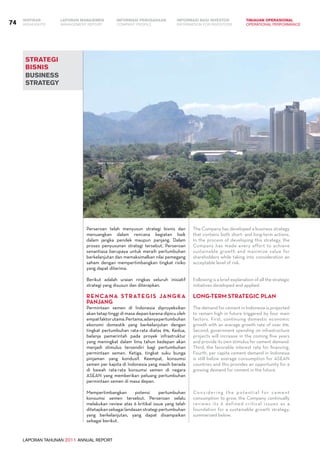
Penjelasan atas perubahan pada pos-pos laporan
posisi keuangan utama yang mempengaruhi
perubahan komposisi aset lancar maupun tidak
lancar tersebut adalah sebagai berikut:
Aset Lancar
Rincian Aset Lancar (dalam Rp juta)
Keterangan Description 2011
Porsi
Portion
2010
Porsi
Portion
Perubahan %
Change %
Kas dan setara kas
Cash and cash equivalents
3,375,645 44.1% 3,664,278 49.9% -7.9
Kas yang dibatasi
penggunaannya
Restricted cash
53,361 0.7% 124,888 1.7% -57.3
Investasi jangka pendek
Short-term Investments
253,084 3.3% 115,721 1.6% 118.7
Piutang usaha - bersih
Trade receivables - net
1,828,478 23.9% 1,716,582 23.4% 6.5
Piutang lain-lain - bersih
Other receivables - net
35,699 0.5% 47,702 0.6% -25.2
Persediaan - bersih
Inventories - net
2,006,660 26.2% 1,624,219 22.1% 23.5
Uang muka Advances 49,496 0.6% 33,053 0.4% 49.8
Beban dibayar dimuka
Prepaid expenses
26,178 0.3% 13,744 0.2% 90.5
Ikhtisar Keuangan
Financial Highligths
2011 2010
Perubahan %
Changes %
Aset Lancar Current Assets 7,646,145 7,345,868 4.1
Investasi pada Entitas Asosiasi
Investments in Associates
80,193 69,630 15.2
Aset Tetap-bersih Fixed Assets-net 11,640,692 7,662,560 51.9
Aset Tidak Lancar Lainnya- bersih
Other Non-Current Assets-net
294,573 484,941 -39.3
Total Aset Total Assets 19,661,603 15,562,999 26.3
Liabilitas Lancar Current Liabilities 2,889,137 2,517,519 14.8
Liabilitas Tidak Lancar Non - Current Liabilities 2,157,369 905,727 138.2
Total Liabilitas Total Liabiities 5,046,506 3,423,246 47.4
Total Ekuitas Total Equity 14,615,097 12,139,753 20.4
ASSETS
As of December 31, 2011, the Company had total
assets amounted to Rp19,662 billion, an increase of
26.3% from the balance per December 31, 2010 of
Rp15,563 billion. These total assets consist of 38.9%
current assets and 61.1% non-current assets. This
composition has changed significantly compared with
the asset composition of 2010, which consisted of
47.2% current assets and 52.8% non-current assets.
The change in the asset composition are due to a
increase in the amount of current assets of 4.1%,
from Rp7,346 billion in 2010 to Rp7,646 billion in
2011.Ontheotherhand,fixedassetshaveincreased
51.9% from Rp7,663 billion in 2010 to Rp11,641 billion
as of December 31, 2011. An explanation of changes
in the main financial position items resulting in the
composition of current and non-current assets is
as follows:
Current Assets
Details of Current Assets (in millions Rp)
CONSOLIDATED FINANCIAL
POSITION HIGHLIGHTS(in millions rp)
aset perseroan
naik 26% menjadi
19,6 triliun.
The Company’s
assets increased 26%
to Rp19.6 trillion.
PT SEMEN GRESIK (PERSERO) Tbk.
143
PEMBAHASAN DAN
ANALISIS MANAJEMEN
LAPORAN TATA
KELOLA PERUSAHAAN
LAPORAN TANGGUNG JAWAB
SOSIAL PERUSAHAAN LAIN-LAIN
MANAGEMENT’S DISCUSSION
AND ANALYSIS
CORPORATE
GOVERNANCE REPORT
CORPORATE SOCIAL
RESPONSIBILITY REPORT
OTHERS
Keterangan Description 2011
Porsi
Portion
2010
Porsi
Portion
Perubahan %
Change %
Pajak dibayar dimuka
Prepaid taxes
17,543 0.2% 5,682 0.1% 208.8
Jumlah Total 7.646,145 100.0% 7,345,868 100.0% 4.1
Komposisi utama aset lancar adalah kas dan setara
kas, 44,1%, Piutang usaha, 23,9%, Persediaan 26,2%,
investasi jangka pendek 3,3%, kas yang dibatasi
penggunaanya 0,7%,  uang muka 0,6% dan lainnya
1,7%. Peningkatan aset lancar hingga sebesar 4,1%
tersebut diatas adalah akibat perubahan posisi pos-
pos utama aset lancar tersebut, yakni pos laporan
posisi keuangan kas dan setara kas turun sebesar
7,9% dan kas setara kas yang dibatasi penggunaannya
turun sebesar 57,3%, sedangkan pos piutang usaha
naik 6,5%, persedian naik 23,5%, investasi jangka
pendek naik 118,7% dan uang muka naik 49,8%.
Penjelasan atas penyebab perubahan posisi aset
lancar tersebut adalah sebagai berikut.
Kas dan Setara Kas Serta Kas setara Kas yang
Dibatasi Penggunaannya
Pengelolaan kas dan setara kas dilakukan secara
prudent melalui manajemen cash cycle yang optimal
dan pembentukan manajemen portfolio yang
sehat atas excess cash Perseroan dengan tetap
memperhatikan risk dan return yang menguntungkan.
Rincian Kas dan Setara Kas (dalam Rp juta)
Keterangan Description 2011 Porsi Portion 2010 Porsi Portion
Perubahan %
Change %
Kas Cash 2,089 0.1% 1,634 0,0% 27,9
Bank Banks
Rupiah 179,017 5.1% 187,154 4.9% -4.3
Dolar Amerika USD 3,728 0.1% 11,049 0.3% -66.3
Euro 2,339 0.1% 10,275 0.3% -77.2
Dolar Singapura SGD 52 0.0% 33 0.0% 59.6
Total Bank 185,136 5.3% 208,511 5.5% -11.2
Deposito Deposits
Rupiah 3,336,781 94.7% 3,420,041 90.1% -2.4
Dolar Amerika USD - 0.0% 39,650 1.0% -100.0
Euro - 0.0% 127,329 3.4% -100.0
Total Deposito Total Deposits 3,336,781 94.7% 3,587,021 94.5% -7.0
Total Kas dan Setara Kas
Total Cash and Cash Equivalents
3,524,006 100.0% 3,797,166 100.0% -7.2
Saldo kas dan setara kas pada akhir tahun 2011 yang
terdiri dari kas sebesar Rp3.524 miliar, ditempatkan
di rekening giro sebesar Rp185 miliar atau 5,3%  
serta deposito berjangka dan call deposits sebesar
Rp3.337 miliar atau sebesar 94,7%.
The main composition of current assets is cash
and cash equivalents at 44.1%, trade receivables
at 23.9%, inventories at 26.2%, short term
investments 3.3%, restricted cash 0.7%, advance
payments 0.6% and others 1.7%. The increase
in current assets of 4.1% is due to the change
in the main current assets items above, i.e.
financial position items cash and cash equivalent
decreasing 7.9% and restricted cash and cash
equivalents decreasing 57.3%, while trade
receivables increased 6.5%, inventories increase
23.5%, short term investments increased 118.7%
and advance payments increased 49.8%.
Explanations for the changes to current asset
positions are as follows.
Cash and Cash Equivalents and Restricted
Cash and Cash Equivalents
Cash and cash equivalents have been managed
prudently with optimum cash cycle management
and a healthy portfolio for excess cash, which
takes into account risk and profitable return.  
Cash and Cash Equivalents (in millions Rp)
Cash and cash equivalents at the end of 2011
which consisted of cash of Rp3.524 billion,
placed in a checking account at Rp185 billion,
or 5.3% and time deposits and call deposits
amounting to Rp3.337 billion or by 94.7%.
Penuruan akun
kas dan setara
kas serta kas
yang dibatasi
penggunaannya
disebabkan oleh
penggunaan
dana untuk
penyelesaian
pembangunan
proyek strategis.
The decrease in the
restricted cash and
cash equivalents
were due to the use
of funds to complete
strategic construction
projects.
LAPORAN TAHUNAN 2011 ANNUAL REPORT
LAPORAN MANAJEMEN INFORMASI BAGI INVESTOR TINJAUAN OPERASIONAL
Management Report INFORMATION FOR INVESTORS OPERATIONAL PERFORMANCE144 INFORMASI PERUSAHAANIKHTISAR
COMPANY PROFILEHIGHLIGHTS
Dari dua tabel tersebut tampak bahwa penurunan
terbesar terjadi pada komponen deposito
dalam mata uang dolar. Hal ini karena kedua
jenis instrumen tersebut adalah komponen dana
yang dialokasikan untuk pembelian mesin dan
peralatan unit pabrik baru yang didatangkan dari
Eropa. Perseroan menganggarkan dana pembelian
tersebut dalam mata uang yang relevan agar
terhindar dari risiko fluktuasi mata uang dan oleh
karenanya juga terhindar dari risiko penundaan
pengiriman karena keterlambatan pembayaran.
Seiring dengan kemajuan proyek pembangunan
pabrik semen baru dan pembangkit listrik, dana ini
terpakai, sehingga saldonya terus menurun. (lihat
juga uraian “Perkembangan Proyek Strategis”).
Sementara penurunan saldo deposito dalam
mata uang rupiah, lebih disebabkan Perseroan
memerlukan dana tersebut untuk keperluan modal
kerja, baik dalam rangka pembelian bahan baku,
maupun barang modal lain yang harus dilakukan
dalam mata uang rupiah. Hal ini dilakukan untuk
meningkatkan operasi pabrik sebagai respon atas
naiknya permintaan semen di pasar domestik.
Kas dan setara kas Perseroan mayoritas
ditempatkan dalam bentuk deposito pada bank
dengan tingkat kesehatan yang baik antara lain: di
PT Bank Mandiri (Persero) Tbk, PT Bank Negara
Indonesia (Persero) Tbk, PT Bank Rakyat Indonesia
(Persero) Tbk, PT Bank Central Asia Tbk, PT Bank
CIMB Niaga Tbk dan bank lainnya.
Atas penempatan dana tersebut, Perseroan
mendapatkan pendapatan bunga dengan tingkat
bunga untuk deposito rupiah sebesar 3,9%-8,7%  
(lihat juga uraian “Penghasilan/(Beban) Lainnya”,
hal 140).
Piutang Usaha
Piutang usaha Perseroan tercatat sebesar Rp1.828
miliar atau naik 6,5%  dari akhir tahun 2010 sebesar
Rp1.717 miliar, diakibatkan oleh naiknya operasional
Perseroan untuk merespon peningkatan permintaan
pelanggan. Peningkatan piutang usaha juga
diakibatkan oleh penerapan strategi pemasaran.  
Oleh karena itu, rata-rata tingkat kolektibilitas
piutang mengalami kenaikan menjadi 36 hari dari
37 hari di tahun sebelumnya. Hal ini diraih dengan
dukungan Teknologi Informasi yang dikembangkan,
sehingga Perseroan mampu menjaga kualitas
piutangnya agar senantiasa terkelola dengan baik
From the two tables above, it can be seen that
the largest reduction is in the dollar deposit
component and these two financial instruments
are funding components allocated for the
purchase of machinery and equipment from
Europe. The Company budgeted these funds
in the relevant currency to avoid the risk of
currency fluctuations, thereby also avoiding the
risk of shipment delay due to delayed payment.
In line with the construction progress of the new
cement plant and the power plant, these funds
have been used and the balance has decreased.
(see “Development of Strategic Projects”)
Meanwhile, the decrease in the balance of
deposits in rupiah was due to the Company
used the funds for working capital to purchase
raw materials and other capital goods in rupiah.
This was related to an increase in production in
response to higher demand for cement in the
domestic market.
Most of the Company’s cash and cash equivalent
are placed on deposit in healthy banks, such
as: PT Bank Mandiri (Persero) Tbk, PT Bank
Negara Indonesia (Persero) Tbk, PT Bank Rakyat
Indonesia (Persero) Tbk, PT Bank Central Asia
Tbk, Deutsche Bank, PT Bank CIMB Niaga Tbk
and PT Bank Mega Tbk.
For the placement of these funds, the Company
received interest on Rupiah deposits ranging
of 3.9% - 8.7%. (see “Other Income/(Expenses”,
page 140).
Trade Receivables
The Company has a trade receivables position
of Rp1,828 billion, or an increase of 6.5% from
the end of 2010’s Rp1,717 billion, as a result of the
Company’s increased production in response to
higher demand for cement. The increase in trade
receivables is also due to the application of the
marketing strategy.
Hence, the average collection period increased
to 36 days from 37 the previous year. However,
with the support of developed IT, the Company
managed to maintain the quality of its receivables
so that they remain well managed and have a high
Keterangan Description 2011
Porsi
Portion
2010
Porsi
Portion
Perubahan %
Change %
Rupiah 3,517,887 99.83% 3,608,829 95.04% -2.5
Dolar Amerika USD 3,728 0.10% 50,700 1.34% -92.6
Euro 2,339 0.07% 137,604 3.62% -98.3
Dolar Singapura SGD 52 0.00% 32 0.00% 62,5
Total Kas dan Setara Kas
Total Cash and Cash Equivalents
3,524,006 100.00% 3,797,165 100.00% -7.2
Cash and Cash Equivalents Per Currency
(in millions Rp)
Kas dan Setara Kas Per Mata Uang
(Dalam Rp juta)
145
PEMBAHASAN DAN
ANALISIS MANAJEMEN
LAPORAN TATA
KELOLA PERUSAHAAN
LAPORAN TANGGUNG JAWAB
SOSIAL PERUSAHAAN LAIN-LAIN
MANAGEMENT’S DISCUSSION
AND ANALYSIS
CORPORATE
GOVERNANCE REPORT
CORPORATE SOCIAL
RESPONSIBILITY REPORT
OTHERS
PT SEMEN GRESIK (PERSERO) Tbk.
dan memiliki tingkat kolektibilitas yang tinggi.
Dengan demikian jumlah cadangan yang dialokasikan
sebagai kompensasi penurunan nilai berada dalam
tingkat yang wajar sesuai kebijakan Perusahaan.
Berikut ini tabel yang menunjukkan persentase
piutang terhadap pendapatan mencapai 11,2%
lebih baik dari tahun lalu yang mencapai 12,0%.
Tabel umur piutang usaha Perseroan, 31 Desember
2010 dan 2011 (dalam Rp juta)
Kategori Category
Jumlah Total
Perubahan Change %
2011 2010
Lancar Current 1,643,569 1,450,746 13.3
1-45 hari days 153,236 222,751 -31.2
46-135 hari days 27,360 49,122 -44.3
136-365 hari days 17,360 16,249 6.8
Lebih dari 365 hari More than 365 days 44,617 43,121 3.5
Jumlah Total 1,886,143 1,781,989 5.8
Penyisihan penurunan nilai
Allowances of impairment
(57,665) (65,407) -11.8
Jumlah piutang usaha-bersih
Total trade receivables-net
1,828,478 1,716,582 6.5
Pendapatan Revenue 16,378,794 14,344,189 14.2
% Piutang usaha terhadap Pendapatan
% Trade receivable to revenue
11.2% 12.0% -0.8
Persediaan
Persediaan bersih pada akhir tahun 2011 adalah
Rp2.007miliarataunaiksebesar23,5%dibandingkan
posisiakhirtahunsebelumnyasebesarRp1.624miliar.
Saldo persediaan tersebut terdiri dari persediaan
bahan baku dan penolong sebesar Rp976 miliar,
suku cadang bersih sebesar Rp626 miliar, barang
dalam proses sebesar Rp337 miliar, barang dalam
perjalanan sebesar Rp40 miliar, barang jadi sebesar
Rp77 miliar dan tanah sebesar Rp2 miliar.
Peningkatan posisi persediaan tersebut dilakukan
untuk memenuhi lonjakan permintaan semen
sepanjang tahun 2011 dan mengantisipasi
berlanjutnya kenaikan permintaan semen di awal
tahun 2012 serta persiapan masa commisioning
pabrik semen baru.
ASET TIDAK LANCAR
Tabel Komposisi Aset Tidak Lancar (dalam Rp juta)
Keterangan Description 2011 Porsi Portion 2010 Porsi Portion %
Aset pajak tangguhan
Deferred tax on assets
106,488 0.9% 95,684 1.2% 11.3
Investasi pada entitas asosiasi
Investments in associates
80,193 0.7% 69,630 0.8% 15.2
Properti investasi - bersih
Investment property - net
25,582 0.2% 21,753 0.3% 17.6
Aset tetap-bersih Fixed assets-net 11,640,692 96.9% 7,662,560 93.3% 51.9
Beban tangguhan-bersih
Deferred charges-net
22,867 0.2% 21,342 0.3% 7.1
Uang muka pembangunan pabrik baru
Advances for construction of new plants
121,606 1.0% 328,960 4.0% -63.0
Aset lain-lain Other assets 18,029 0.2% 17,202 0.2% 4.8
Jumlah Total 12,015,458 100.0% 8,217,131 100.0% 46.2
Perseroan
mengelola
kualitas Piutang
Usaha dengan
baik untuk
meminimalisir
risiko tidak
tertagih dan
membentuk
penyisihan yang
memadai.
The Company
has managed the
quality of its Trade
Receivables well to
minimize the credit
risk and provide
sufficient allowance
for impairment.
level of collectibility. As a result, the allowance for
impairment is at a reasonable level in accordance
with Company policy.
The following table shows percentage receivables to
income which reached 11.2%, an improvement over
the previous year’s 12.0%.
  
Age of the Company’s trade receivables per
December 31, 2010 and 2011 (In millions Rp)	
	 	 	 	 	
Inventories
Net inventories at the end of 2011 was amounted
to Rp2,007 billion, an increase of 23.5%
compared to the position as of the end of the
previous year at Rp1,624 billion. The inventories
balance consists of raw and indirect materials
at Rp976 billion, net spare parts at Rp626 billion,
work in process of Rp337 billion, goods in transit
of Rp40 billion, finished goods at Rp77 billion and
land at Rp2 billion.
The increase in inventories is due to higher
demand for cement during 2011 and anticipation
of a continuing increase in demand in early 2012,
along with the commissioning of the new cement
plants.  
Non-Current Assets
Composition of Non-Current Assets  (in millions Rp)
LAPORAN TAHUNAN 2011 ANNUAL REPORT
LAPORAN MANAJEMEN INFORMASI BAGI INVESTOR TINJAUAN OPERASIONAL
Management Report INFORMATION FOR INVESTORS OPERATIONAL PERFORMANCE146 INFORMASI PERUSAHAANIKHTISAR
COMPANY PROFILEHIGHLIGHTS
Komposisi aset tidak lancar di akhir 2011, terutama
terdiri atas aset tetap, 96,9% sebesar Rp11.640
miliar dan uang muka pembangunan pabrik baru,
1,0% sebesar Rp122 miliar, sehingga peningkatan
pos laporan posisi keuangan ini akan berpengaruh
besar pada total aset tidak lancar. Berlawanan
dengan jumlah aset lancar yang turun, aset tidak
lancar meningkat cukup signifikan selama beberapa
tahun terakhir.
Aset tidak lancar pada akhir  2011 adalah sebesar
Rp12.015 miliar atau meningkat 46,2% dibanding
akhir 2010, sebesar Rp8.217 miliar. Peningkatan
terbesar dari aset tidak lancar tersebut berasal
dari kenaikan aset tetap bersih yang meningkat
sebesar 51,9% menjadi Rp11.640 miliar. Peningkatan
tersebut terutama karena adanya peningkatan
aktivitas proyek pembangunan pabrik semen
dan pembangkit listrik baru.   (Lihat juga uraian
“Perkembangan Proyek Strategis” halaman 79 dan
“Belanja Modal”, halaman 153).
Aset Tetap
Aset tetap Perseroan terdiri atas tanah, bangunan
dan peralatan produksi. Seiring penyelesaian
pembangunan pabrik baru, maka total aset tetap
meningkat 51,9% menjadi sebesar Rp11.640 miliar.
Sekalipun sebagian bangunan dan peralatan produksi
lain mengalami penyusutan, dengan nilai sebesar
(net) Rp486 miliar sepanjang tahun 2011, namun
penambahan nilai bangunan dan peralatan dari
unit pabrik baru, pembangkit listrik, packing plant,
bangunan lainnya dan aset sewa lain senilai (net)
Rp4.465 miliar membuat total aset tetap meningkat.
LIABILITAS
Jumlah liabilitas Perseroan pada tanggal 31
Desember 2011 tercatat sebesar Rp5.046 miliar
atau meningkat 47,4% dibanding tahun sebelumnya
Rp3.423 miliar. Liabilitas Perseroan tahun 2011
terdiri atas Liabilitas Jangka Pendek dengan porsi
57,3%,senilaiRp2.889miliarataunaiksebesar14,8%
dan Liabilitas jangka panjang dengan porsi 42,7%
senilai Rp2.157 miliar atau naik sebesar  138,2%.
Penjelasan berikut memberi gambaran hal-hal
yang mempengaruhi perubahan posisi liabilitas
Perseroan tersebut.
Liabilitas Jangka Pendek
Komposisi   liabilitas jangka pendek Perseroan
akhir tahun 2011 terdiri atas utang usaha 40,9%
sebesar Rp1.183 miliar, beban akrual 22,7% sebesar
Rp656 miliar, utang lain-lain, 22,3% sebesar Rp643
miliar dan utang pajak 10,0% sebesar Rp290 miliar,
seperti tampak pada tabel berikut. Penjelasan atas
penyebab perubahan pada pos-pos laporan posisi
keuangantersebutsertaupayauntukmengelolanya
diuraikan dalam bahasan berikut.
The composition of non-current assets at the end
of 2011 consisted mainly of fixed assets, 96.9%,
amounted to Rp11,460 billion and advance payments
for the new plants at 1.0% valued at Rp122 billion. The
increase in this financial position will greatly effect to
total non-current assets. Contrary to the decrease
in current assets, non-current assets have increased
significantly in last few years.
Non-currentassetsattheendof2011wasamounted
to Rp12,015 billion, or an increase of 46.2% over 2010
position, which was at Rp8,217 billion. The largest
increase in non-current assets was from an increase
in fixed assets, which increase 51.9% to Rp11,640
billion. This increase is mostly due to the increased
project activity for the new cement plants and the
power plant.
(see “Strategic Project Development” Pages 79
“Capital Expenditure”, page 153).
Fixed Assets
The Company’s fixed assets consist of land,
buildings and production equipment. With the
completion of the new plants, total fixed assets
have risen 51.9% to Rp11,640 billion. While a part of
the construction and other production equipment
will experience contraction, with a value of (net)
Rp486 billion during 2011, the additional value of
buildings and equipment from the new factories,
the power plant, packing plants and other buildings
and rental assets amounting to (net) Rp4,465
billion, total fixed asset has increased.
LIABILITIES
The Company’s total liabilities per December
31, 2011 were recorded at Rp5,046 billion, or
an increase of 47.4% over the previous year’s
Rp3,423 billion. The Company’s liabilities in
2011 consisted of Current Liabilities with a
57.3% portion amounting to Rp2,889 billion or
a increase of 14.8% andNon-current Liabilities
with a 42.7% portion amounting to Rp2,157 billion
or an increase of 138.2%.
The following explanation illustrates this change
in the Company’s liability position.
Current Liabilities
The composition of the Company’s Current
Liabilities at the end 2011 consisted of trade
payables at 40.9% or Rp1,183 billion, accrued
expenses of 22.7% or Rp656 billion, other payables
at 22.3% amounting to Rp643 billion and tax payable
of 10% amounting to Rp290 billion, as shown in the
following table. An explanation as to the causes
for the changes of the financial position items and
efforts to manage this are included in the following
discussion.
PT SEMEN GRESIK (PERSERO) Tbk.
147
PEMBAHASAN DAN
ANALISIS MANAJEMEN
LAPORAN TATA
KELOLA PERUSAHAAN
LAPORAN TANGGUNG JAWAB
SOSIAL PERUSAHAAN LAIN-LAIN
MANAGEMENT’S DISCUSSION
AND ANALYSIS
CORPORATE
GOVERNANCE REPORT
CORPORATE SOCIAL
RESPONSIBILITY REPORT
OTHERS
Tabel Komposisi Liabilitas Jangka Pendek (dalam Rp juta)
Keterangan Description 2011 Porsi Portion 2010 Porsi Portion %
Utang usaha Trade payables 1,182,562 40.9% 970,812 38.6% 21.8
Utang lain-lain Other payables 643,134 22.3% 482,243 19.2% 33.4
Beban akrual Accrued expenses 655,984 22.7% 723,107 28.7% -9.3
Utang pajak Taxes payable 290,107 10.0% 222,697 8.8% 30.3
Uang muka penjualan Sales advances 39,560 1.4% 32,025 1.3% 23.5
Bagian lancar atas liabilitas jangka panjang
Current maturities of long-term liabiities
77,790 2.7% 86,635 3.4% -10.2
Jumlah Total 2,889,137 100.00% 2,517,519 100.00% 14.8
Utang Usaha
Posisi utang usaha pada akhir tahun 2011 naik
sebesar 40,9% menjadi Rp1.183 miliar dibandingkan
dengan tahun sebelumnya sebesar Rp971  miliar.
Kenaikan tersebut disebabkan oleh semakin
tingginya aktivitas operasional yang membuat
Perseroan meningkatkan pembelian bahan-bahan
baku maupun bahan penolong yang diperlukan.
Melalui pengelolaan utang usaha yang semakin
berkualitas tersebut, maka rata-rata periode
pembayaran (APP) di tahun 2011 pada level 38 hari,
lebih baik dari level 44 hari di tahun sebelumnya.
Hal ini menunjukkan Perseroan berkomitmen
meningkatkan hubungan kerja yang semakin baik dan
berkualitas dengan para pemasok.
Dalam rangka menjaga hubungan dengan
pemasok, Perseroan memberikan jaminan
pembayaran yang tepat waktu sepanjang seluruh
prosedur dan dokumen penagihan lengkap.
Perseroan mengandalkan dukungan Teknologi
Informasi yang terus dikembangkan (Lihat juga
uraian “Pengembangan Teknologi Informasi”, hal
105) untuk melakukan verifikasi dokumen dan
menerapkan e-procurement untuk memperoleh
kualitas jasa dan barang yang baik dengan
harga kompetitif serta untuk memonitor dan
mendapatkan pemasok yang bonafide.
Utang lain-lain
Utang lain-lain meningkat signifikan dibanding
tahun lalu, sebagai akibat peningkatan utang
proyek terkait aktifitas pembangunan pabrik
semen dan pembangkit listrik baru. (lihat uraian
“Perkembangan Proyek Strategis”, hal 79).
Beban Akrual
Posisi beban akrual pada akhir tahun 2011 sebesar
Rp656 miliar atau turun sebesar 9,3% dari tahun
2010 yang sebesar Rp723 miliar. Hal ini terutama
diakibatkan oleh adanya penyesuaian atas program
promosi penjualan terkait dengan permintaan
semen domestik yang meningkat.
Utang Pajak
Posisi utang pajak pada akhir tahun 2011 sebesar
Rp290 miliar atau naik 30,3% dari angka tahun
2010 yang sebesar Rp223 miliar, sebagai akibat
meningkatnya kinerja Perseroan, seperti dijelaskan
pada uraian Beban Pajak Penghasilan.
Current Liabilities Composition  (in millions Rp)
Trade Payables
The trade payables position at the end of 2011
increased 40.9% to Rp1,183 billion compared to
the previous year, which recorded Rp971 billion.
This increase was due to higher operational
activities resulting in the need to purchase more
raw and indirect materials.
With improved management of trade payables,
the average payment period (APP) in 2011 was
38 days, an improvement compared to the 44
days previous year. This shows that the Company
is commiteed to increase quality business
relationship with supplier.
To maintain relations with suppliers, the
Company guarantees timely payment provided
that all procedures and billing documents are
complete. The Company relies on continually
evolving Information Technology support (see
“InformationTechnologyDevelopments”page105
) to verify documents and apply e-procurement
to obtain high quality goods and services at a
competitive price, as well as monitoring and
obtaining bona fide suppliers.
  
Other Payables
Other payables have increased significantly
on the previous year as a result of increased
payables related to activity in the cement plants
and power plant projects. (see “Development of
Strategic Projects” page 79)
Accrued Expenses
The accrued expenses position at the end of 2011
amounted to Rp656 billion, or a decrease of 9.3%
on 2010 which was Rp723 billion. This is mainly
as a result of adjustments in the sales promotion
programs related to increasing domestic demand
for cement.
Tax Payable
The tax payable positionat the end of 2011 was
amounted to Rp290 billion, an increase of 30.3%
from the 2010 position of Rp223 billion, as a
result of the Company’s increased performance,
as explained in the description on Income Tax
Expenses.
LAPORAN TAHUNAN 2011 ANNUAL REPORT
LAPORAN MANAJEMEN INFORMASI BAGI INVESTOR TINJAUAN OPERASIONAL
Management Report INFORMATION FOR INVESTORS OPERATIONAL PERFORMANCE148 INFORMASI PERUSAHAANIKHTISAR
COMPANY PROFILEHIGHLIGHTS
Liabilitas Jangka Panjang
Komposisi liabilitas jangka panjang akhir tahun
2011, didominasi oleh pos laporan posisi keuangan
liabilitas jangka panjang (setelah dikurangi bagian
jangka pendek) 84,1% sebesar Rp1.813 miliar dan
liabilitas imbalan kerja,  12,5% sebesar Rp269 miliar.
Rincian Liabilitas Jangka Panjang (dalam Rp juta)
Keterangan Description 2011 Porsi Portion 2010 Porsi Portion %
Liabilitas pajak tangguhan Deferred tax liabilities 1,471 0.1% 6,680 0.7% -78.0
Liabilitas imbalan kerja Employee benefits liabilities 269,377 12.5% 216,982 24.0% 24.1
Liabilitas jangka panjang-setelah dikurangi bagian yang jatuh
tempo dalam satu tahun
Long-term debt - net of current maturities
1,813,477 84.1% 599,626 66.2% 202.4
Liabilitias jangka panjang lainnya Other non-current liabilities 73,044 3.4% 82,440 9.1% -11.4
Jumlah Total 2,157,369 100.00% 905,727 100.00% 138.2
Secara total posisi liabilitas jangka panjang akhir
tahun 2011 mengalami kenaikan 138,2% menjadi  
sebesar Rp2.157 miliar terutama disebabkan oleh:
•	 Penarikan pinjaman bank jangka panjang
sebesar Rp1.115 miliar dalam rangka pendanaan
proyek pembangunan pabrik semen dan
pembangkit listrik baru.
•	 Penambahan liabilitas imbalan kerja sebesar
24,1% senilai Rp52 miliar.
	 Perseroan menerapkan PSAK No. 24
(Revisi 2004) tentang "Imbalan Kerja" dalam
memperhitungkan manfaat karyawan.
MODAL dan STRUKTUR MODAL
Jumlah modal/ekuitas per 31 Desember 2011 adalah
sebesar Rp14.615 miliar atau meningkat 20,4% dari
tahun sebelumnya yang sebesar Rp12.140 miliar.
Ekuitas terdiri atas modal ditempatkan dan telah
disetor sebesar Rp593 miliar, tambahan modal
disetor Rp1.458 miliar, saldo laba yang dicadangkan
sebesar Rp253 miliar, dan saldo laba yang belum
dicadangkan sebesar Rp12.154 miliar. Peningkatan
ekuitas di 2011 terutama dipengaruhi oleh laba
tahun berjalan.
Kebijakan Struktur Modal
Perseroan menetapkan kebijakan struktur modal
yang mampu mencerminkan perimbangan antara
penggunaan komposisi modal sendiri dengan
pinjaman/utang yang terdiri dari utang jangka
pendek dan utang jangka panjang agar dapat
memaksimalkan nilai perusahaan. Seiring dengan
kebutuhan dana untuk pembangunan pabrik
semen, Perseroan senantiasa menjaga struktur
modal agar sesuai atau tidak melebihi financial
covenant yang dipersyaratkan dalam perjanjian
pinjaman dengan pihak kreditur.
Adapun secara umum kebijakan struktur
permodalan Perseroan yang diijalankan adalah:
•	 Struktur modal senantiasa
mempertimbangkan keseimbangan antara
risiko keuangan dan harus relevan dengan
tingkat pengembalian dalam upaya
meningkatkan nilai perusahaan.
-	 Dilakukan dengan memperhitungkan
penggunaan besaran dan struktur utang
NON-CURRENT Liabilities
The composition of non-current liabilities as of
end 2011 was dominated by the financial position
item of long term liabilities (net of the short term
portion) at 84.1% or Rp1,813 billion, and employee
benefit liabilities at 12.5% or Rp269 billion.  
Details of Non-Current Liabilities (In millions Rp)
Overall, the position for non-current liabilities as
of end 2011 experienced a 138.2% increase to
Rp2,157 billion, predominantly as a result of:
•	 Drawdown of a long term bank loan of Rp1,115
billion to fund the new cement factories and
the power plant construction projects.
•	 Additional employment benefit liabilities
amounting to 24.1% or a value of Rp52 billion.
	 The Company applies PSAK (Indonesian
financial accounting standards) No.24
(revised 2004) regarding Employee Benefits
to calculate employee benefits.
CAPITAL and CAPITAL STRUCTURE
Total capital / equity per December 31, 2011
amounted to Rp14,615 billion or an increase of
20.4% over the previous year at Rp12,140 billion.
Equity consists of issued and paid up capital
at Rp593 billion, additional paid up capital of
Rp1,458 billion, and unappropriated retained
earnings amounting to Rp12,154 billion. The
increased equity in 2011 was predominantly
influenced by profit for the year.
Capital Structure Policy
The Company has established a capital
structure policy that is able to reflect the
balance between the use of its own capital
with loan / debt consisting of short term debt
and long term debt in order to maximize the
value of the company. Along with the funding
requirements for the construction of the
cement factories, the Company is continuing
to maintain its capital structure so as to match
or not exceed the financial covenants in loan
agreements with lenders.
In general, the Company’s capital structure
policy being implemented is:
• 	 The capital structure continually balances
financial risk which must be relevant to rate
of return while increasing the value of the
Company.
-	 This is implemented by calculating the
scale of use and debt structure resulting in
149
PEMBAHASAN DAN
ANALISIS MANAJEMEN
LAPORAN TATA
KELOLA PERUSAHAAN
LAPORAN TANGGUNG JAWAB
SOSIAL PERUSAHAAN LAIN-LAIN
MANAGEMENT’S DISCUSSION
AND ANALYSIS
CORPORATE
GOVERNANCE REPORT
CORPORATE SOCIAL
RESPONSIBILITY REPORT
OTHERS
PT SEMEN GRESIK (PERSERO) Tbk.
yang menimbulkan liabilitas keuangan
(tingkat bunga) dan mempengaruhi kondisi
likuiditas perusahaan.
-	 Mengoptimalkan rentabilitas ekonomi dan
rentabilitas modal sendiri yang menghasilkan
peningkatan laba per saham.
•	 Struktur modal ditinjau dengan melakukan
evaluasi hubungan antara financial leverage,
nilai perusahaan dan biaya modal sehingga
dicapai financial trade off yang reasonable.
•	 Struktur modal diupayakan optimal dengan
mengatur kombinasi utang dan modal sendiri
(ekuitas) yang dapat memaksimalkan nilai
Perseroan.
•	 Kombinasi struktur modal ditetapkan setelah
melakukan analisa sensitivitas dengan berbagai
variasi asumsi inti yang paling mungkin dihadapi
oleh Perseroan.
Perseroan mengawasi modal dengan
menggunakan rasio pengungkit (gearing ratio),
denganmembagitotalpinjamanberdampakbunga
dengan total ekuitas yang dapat diatribusikan
kepadapemilikentitasinduk.KebijakanPerseroan
adalah menjaga rasio pengungkit dalam kisaran
dari perusahaan terkemuka di Indonesia untuk
mengamankan akses terhadap pendanaan
pada biaya yang rasional. Termasuk dalam total
pinjaman berdampak bunga   adalah pinjaman
bank jangka pendek, pinjaman bank jangka
panjang, pinjaman kepada Pemerintah Republik
Indonesia, dan liabilitas sewa pembiayaan.
Melalui pelaksanaan kebijakan struktur modal
yang konsisten, posisi total liabilitas berefek
bunga akhir tahun 2011 adalah sebesar Rp1.872
miliar, rasio liabilitas terhadap ekuitas Perseroan
adalah sebesar 12,9%. Hal ini menunjukkan
kemampuan membayar utang yang kuat sekaligus
masih besarnya potensi Perseroan untuk
mendapatkan dana pinjaman bagi pembiayaan
ekspansi di masa mendatang. (lihat juga “Rasio-
rasio Keuangan, Solvency”)
Dividen
Selama5tahunbukuterakhirdividenyangdibagikan
Perseroan tumbuh rata-rata sebesar 50%.
Sesuai hasil RUPST pada tanggal 28 Juni 2011,
Perseroan membagikan dividen per lembar
saham sebesar Rp306,26 (angka penuh). Setelah
dikurangi dengan dividen interim sebesar Rp58
(angka penuh), maka sisa dividen tunai final
sebesar Rp248,26 (angka penuh) (Selengkapnya
lihat “Informasi Investor, Kebijakan Dividen” AR-
2011, hal 63)
MODAL KERJA BERSIH
Semakin meningkatnya kebutuhan dana untuk
membiayai investasi strategis Perseroan membuat      
modal kerja bersih Perseroan mengalami
penurunan. Secara keseluruhan modal kerja bersih
Perseroan tahun 2011 turun sebesar 1,5% dari
Rp4.828 miliar pada tahun 2010 menjadi Rp4.757
miliar pada tahun 2011.
financial liability (interest) and influencing
the liquidity of the Company.
-	 Optimizing an economic rate of return
and capital rate of return which results in
increased profit per share.
•	 The capital structure is reviewed assessing
the relationship between financial leverage,
company value and cost of capital, thus
achieving a reasonable financial trade off.
•	 Efforts are made to optimize capital structure
regulating the combination of debt and
capital (equity) which can maximize Company
value.
•	 Combined capital structures are determined
after analyzing the sensitivity and various
core assumptions which the Company is most
likely to face.
The Company monitors capital using a gearing
ratio dividing total interest bearing loans with
total equity to obtain total equity attributable
to the parent entity. The Company’s policy is to
maintain its gearing ratio within the gearing ratio
range of the leading companies in Indonesia in
order to secure access to finance at a reasonable
cost. Included in interest bearing loans are short-
term bank loans and long-term bank loans, loan
to Government of The Republic of Indonesia,
and finance lease liabilities.
Through consistently implementing the capital
structure policy, the total interest bearing
liability position as of end 2011 was Rp1,872
billion, thus the ratio of liabilities to equity
was 12.9%. This demonstrates the strong
ability to repay debt, while also reflecting the
Company’s strong potential to obtain loans
to fund future expansion. (see also “Financial
Ratios, Solvency”)
DIVIDENDS
During the last five fiscal years the Company
dividends paid out have grown on average by 50%.
In accordance with the results of the AGM on June
28, 2011, the Company is paying dividends per share
of Rp306.26 (full amount). After deducting the
interim payout of Rp58 (full amount), the remaining
final cash dividend is Rp248.26 (full amount). (For
more details see “Investor Information, Dividend
Policy” AR-2011, page 63)
NET WORKING CAPITAL
The increasing demand of fund to realizing
Company's strategic investment resulted in
decrease of net working capital. Overall, the
Company’s net working capital in 2011 decrease  
1.5% from Rp4,828 billion in 2010 to Rp4,757
billion in 2011.
Perseroan
mengawasi
modal dengan
menggunakan
rasio pengungkit
(gearing ratio),
dengan membagi
total pinjaman
berdampak bunga
dengan total
ekuitas yang dapat
diatribusikan
kepada pemilik
entitas induk.
The Company
monitors capital
using a gearing
ratio dividing total
interest bearing
loans with total
equity to obtain total
equity attributable
to parent entity.
LAPORAN TAHUNAN 2011 ANNUAL REPORT
LAPORAN MANAJEMEN INFORMASI BAGI INVESTOR TINJAUAN OPERASIONAL
Management Report INFORMATION FOR INVESTORS OPERATIONAL PERFORMANCE150 INFORMASI PERUSAHAANIKHTISAR
COMPANY PROFILEHIGHLIGHTS
Perseroan mampu mendanai seluruh kebutuhan
modal kerja untuk  operasional perusahaan serta
dapat mendanai investasi strategis dari excess
cash yang ada.
Arus Kas
Tabel berikut merupakan ringkasan arus kas
Perseroan untuk tahun yang berakhir pada tanggal-
tanggal 31 Desember 2011 dan 2010:
(dalam Rp juta)
The Company has been able to fund all
working capital requirements for operations,
as well as fund strategic investment, from
available excess cash.
CASH FLOW
The following table details the Company’s cash
flow for the years ending December 31, 2011
and 2010:
(in millions Rp)
Keterangan Description 2011 2010
Perubahan%
Change%
Arus kas bersih yang diperoleh dari aktivitas operasi
Net cash flow provided by operating activities
4,415,753 3,378,416 30.7
Arus kas bersih yang digunakan untuk aktivitas investasi
Net cash flow used in investing activities
(4,295,179) (1,771,240) 142.5
Arus kas bersih yang digunakan untuk aktivitas pendanaan
Net cash flow used in financing activities
(409,207) (1,353,162) -69.8
(Penurunan)/Kenaikan bersih kas dan setara kas
Net (decrease)/increase in cash and cash equivalent
(288,633) 254,015 -213.6
Kas dan setara kas pada awal tahun
Cash and cash equivalents at the beginning of the year
3,664,278 3,410,263 7.4
Kas dan setara kas pada akhir tahun
Cash and cash equivalents at the end of the year
3,375,645 3,664,278 -7.9
Arus Kas dari Aktivitas Operasi
Arus kas bersih Perseroan yang diperoleh
dari aktivitas operasi sebesar Rp4.416 miliar
meningkat 30,7% dibanding tahun 2010.
Peningkatan tersebut terutama karena naiknya
penerimaan dari pelanggan sebesar Rp2.241
miliar dan penurunan pembayaran pajak
penghasilan sebesar Rp287 miliar.
Arus Kas dari Aktivitas Investasi
Arus kas untuk aktivitas investasi selama tahun
2011 adalah sebesar Rp4.295 miliar atau naik
142,5% dari tahun sebelumnya. Pembelanjaan
modal ini difokuskan untuk mendanai investasi
strategis Perseroan baik jangka pendek maupun
jangka panjang terutama yang berkaitan dengan
upaya meningkatkan efisiensi dan penambahan
kapasitas produksi.
Arus Kas dari Aktivitas Pendanaan
Arus kas bersih yang digunakan untuk aktivitas
pendanaan pada tahun 2011 sebesar Rp409
miliar, turun 69,8%. Penurunan tersebut terutama
dipengaruhi oleh penurunan pembayaran dividen
ke pemegang saham yang telah dibayar sebagai
dividen interim pada tahun 2010 sebesar Rp344
miliar. Pada tahun 2011 Perseroan juga melakukan
penarikan pinjaman bank sebesar Rp1.147 miliar
untuk mendanai proyek pembangunan pabrik
semen dan pembangkit listrik baru di Sulawesi.
Pada 31 Desember 2011 saldo kas dan setara kas
dari keseluruhan kegiatan usaha sebesar Rp3.376
miliar atau lebih rendah 7,9% dari saldo kas dan
setara kas tahun 2010 sebesar Rp3.664 miliar.
Cash Flow from Operations
T h e C o m p a n y ’s n e t c a s h f l o w f r o m
operational activities amounted to Rp4,416
billion, an increase of 30.7% on 2010. This
increase was predominantly due to higher
revenues from customers, amounting to
Rp2,241 billion, and a reduction in income
tax payments to Rp287 billion.   
Cash Flow from Investment
Cash flow for investment activities during 2011
amounted to Rp4,295 billion, an increase of
142.5% from the previous year. Capital spending
is focused on funding the Company’s strategic
investments, both short term and long term,
specificallythoserelatedtoimprovingefficiencies
and increasing production capacity.   
Cash Flow from Funding
Net cash flow utilized for funding activities in
2011 amounted to Rp409 billion, a decrease of
69.8%. This decrease was mainly influenced by
the decline in dividend payments to shareholders
who had received an interim dividend in 2010
amounting to Rp344 billion. In 2011, the Company
also took out a bank loan of Rp1,147 billion to fund
the construction of the new cement factories and
the power plant in Sulawesi.
As of December 31, 2011, the balance of cash and
cash equivalents for all business activities amounted
to Rp3,376 billion, or 7.9% lower from the cash and
cash equivalent balance in 2010 of Rp3,664 billion.
PT SEMEN GRESIK (PERSERO) Tbk.
151
PEMBAHASAN DAN
ANALISIS MANAJEMEN
LAPORAN TATA
KELOLA PERUSAHAAN
LAPORAN TANGGUNG JAWAB
SOSIAL PERUSAHAAN LAIN-LAIN
MANAGEMENT’S DISCUSSION
AND ANALYSIS
CORPORATE
GOVERNANCE REPORT
CORPORATE SOCIAL
RESPONSIBILITY REPORT
OTHERS
RASIO-RASIO KEUANGAN
Rasio-rasio Keuangan Financial Ratios 2011 2010 Perubahan % Change %
Marjin laba bruto Gross Profit Margin 45.7% 47.5% -1.8
Marjin laba usaha Operating Margin 29.9% 31.4% -1.6
Marjin laba bersih Net Profit Margin 24.0% 25.3% -1,3
Marjin EBITDA EBITDA Margin 33.0% 34.6% -1.7
EBITDA terhadap Bunga ( x ) a)
Interest Coverage
195.7 190.4 5.3
Laba Thd Ekuitas Return to Equity 27.1% 30.3% -3.2
Laba Thd Total Aset Return to Assets 20.0% 23.3% -3.3
Lancar Current 264.7% 291.8% -27.1
Liabilitas Thd Aset ( x )
Total Debt to Assets
0.1 0.0 5.3
a) Efektif sejak Januari 2008 telah diterapkan PSAK 30 (Revisi 2007) yang mengharuskan beban keuangan semua dialokasikan
pada periode masa)
a) Effective since January 2008 has applied IAS 30 (2007 edition) which requires that all finance charges allocated to future
periods)
Likuiditas
Rasio ini menunjukkan kemampuan Perseroan
dalam memenuhi liabilitas jangka pendeknya yang
akan jatuh tempo, dihitung dengan membagi aset
lancar dengan liabilitas jangka pendek. Tahun 2011
rasio likuiditas Perseroan adalah sebesar 264,7%,
turun 27,1% dari tahun 2010 sebesar 291,8%, karena
penurunan kas dan setara kas, kas dan setara
kas yang dibatasi penggunaannya serta investasi
jangka pendek dalam rangka pendanaan proyek
pabrik semen dan pembangkit listrik baru.
Kemampuan membayar utang (Solvency)
Menunjukkan kemampuan Perseroan dalam
memenuhi liabilitas, baik jangka pendek maupun
jangka panjang yang ditunjukkan dengan
melakukan pengukuran liabilitas terhadap ekuitas
maupun terhadap total aset.
Pada tahun 2011, kemampuan membayar utang
Perseroan relatif stabil dibandingkan dengan
tahun sebelumnya. Tambahan penarikan pinjaman
baru pada tahun 2011 menyebabkan solvabilitas
terhadap aset Perseroan mencapai 0,1x atau naik
0,05x pada tahun 2010. Sedangkan solvabilitas
terhadap ekuitas relatif sama dengan tahun 2010
yakni sebesar 0,1x. Hal ini menunjukkan Perseroan
mulaimeningkatkanporsipendanaanekspansidari
pinjaman, dalam batas yang aman. Angka tersebut
masih berada pada level yang sangat aman untuk
memperoleh pinjaman baru.
Perseroan memperoleh peringkat kredit korporat
dari institusi pemeringkat internasional, yaitu
Moody’syangmemberikanpemeringkatanBa1stable
di tahun 2011. Peringkat tersebut mencerminkan
kekuatan kredit Perseroan yang cukup baik karena
profil kinerja operasional yang semakin kuat, posisi
dominan dalam industri, tren permintaan semen
yang positif serta bisnis yang stabil.
Rincian dari seluruh liabilitas Perseroan yang
berefek bunga adalah sebagai berikut:
FINANCIAL RATIOS
Liquidity
This ratio demonstrates the Company’s ability
to fulfill its short term liabilities as they mature,
calculated by dividing current assets by short
term liabilities. In 2011, the Company’s liquidity
ratio was 264.7%, a decrease of 27.1% from 2010’s
291.8%, due to the reduction in cash and cash
equivalents, use of restricted cash and cash
equivalents, and short term investments to fund
the cement factory and power plant projects.
Solvency
This demonstrates the Company’s ability
to fulfill its liabilities, both short term and
long term and is demonstrated by measuring
liabilities against equity as well as measurement
of total assets.
In 2011, the Company’s ability to pay debt was
relatively stable compared to the previous
year. The additional new loan in 2011 provided
solvency against the Company’s assets, which
reached 0.01x%, an increase of 0.05x over
2010. Meanwhile, solvency to equity was
relatively same with 2010 figures of 0.1x. This
demonstrates that the Company is starting to
increase its expansion funding portion from
loans within safe limits. This figure is still at a
very safe level to obtain new funding.
The Company has obtained a corporate
credit rating of Ba1 stable for 2011 from
international ratings agency Moody’s. This
rating demonstrates that the Company’s
credit strength is relatively good due to
its strengthening operational performance,
dominant position in the industry, positive trend
for cement demand and stable business.
Details of all the Company’s interest bearing
liabilities are as follows:
LAPORAN TAHUNAN 2011 ANNUAL REPORT
LAPORAN MANAJEMEN INFORMASI BAGI INVESTOR TINJAUAN OPERASIONAL
Management Report INFORMATION FOR INVESTORS OPERATIONAL PERFORMANCE152 INFORMASI PERUSAHAANIKHTISAR
COMPANY PROFILEHIGHLIGHTS
LAPORAN TAHUNAN 2011 ANNUAL REPORT
Meanwhile, the EBITDA / interest expense +
principle for 2011 amounted to 51.6x, up from
29.5x in 2010 and the liability ratio to EBITDA in
2011 was 0.3x, up from 0.1x in 2010, demonstrating
the Company’s debt capacity remains high. The
position of liabilities to capital for 2011 was at
0.1%, which is very similar to the previous year.
This is illustrated in the solvency ratio table
following.
Pinjaman Berefek Bunga (dalam Rp juta)
Interest Bearing Debt (in million Rp)
2011 2010
Bagian lancar atas liabilitas jangka panjang:
Current maturities of long-term liabilities:
- Pemerintah Republik Indonesia
The Government of The Republic of Indonesia
- Bank
- Sewa pembiayaan Finance Lease
1,791
37,744
18,873
10,737
28,095
23,329
58,408 62,161
Liabilitas jangka panjang:
Long-term liabilities:
- Pemerintah Republik Indonesia
The Government of The Republic of Indonesia
- Bank
- Sewa pembiayaan Finance Lease
-
1,737,580
75,898
1,562
544,406
52,239
1,813,478 598,207
Total 1,871,886 660,368
Sementara itu, rasio EBITDA/interest
expense+principletahun2011adalahsebesar51,6x naik
dari posisi 29,5x ditahun 2010 dan rasio liabilitas
terhadap Ebitda pada tahun 2011 adalah 0,3x, naik
dari angka 0,1x di tahun 2010, yang menunjukkan
debt capacity perseroan masih besar. Sedangkan
posisi liabilitas terhadap kapital pada tahun 2011
berada pada level 0,1% atau relatif sama dengan
tahun lalu. Hal ini ditunjukkan dalam tabel-tabel
rasio solvensi, berikut.
2011 2010
Utang* Terhadap Ekuitas (x)
Debt* to Equity (x)
0.1 0.1
Utang*/Ebitda (x)
Debt*/EBITDA (x)
0.3 0.1
Ebitda/Beban Bunga (x)
EBITDA/Interest Expense (x)
195.7 190.4
DSCR** (Ebitda/Beban Bunga + Pokok Pinjaman) (x)
EBITDA/Interest Expense + Principal (x)
51.6 29.5
* Utang berefek bunga
* Interest bearing debt
** Debt Service Coverage Ratio
Manajemen Utang
Untuk mengantisipasi kebutuhan pendanaan bagi
pelaksanaan program ekspansi di masa mendatang,
Perseroan menerapkan manajemen utang, yang
menegaskan bahwa penarikan pinjaman baru
hanya dilaksanakan setelah mempertimbangkan
kebutuhan dan kemampuan dalam mendanai
investasi strategis dengan mengupayakan tingkat
biaya pinjaman yang kompetitif.
Kolektibilitas Piutang
Tingkat kolektibilitas piutang (average collection
period/ACP) dihitung dengan membandingkan
rata-rata piutang dengan pendapatan dikalikan
jumlah hari dalam setahun (365 hari). Pada tahun
2011 tingkat kolektibilitas piutang sebesar 36 hari
lebih cepat dari tahun sebelumnya, yakni 37 hari.
(Lihat juga bahasan mengenai “Piutang Usaha”,
hal 144).
Debt Management
In anticipation of funding requirements to
implement expansion programs in future, the
Company applies debt management which
emphasizes that any new loan may only be
taken after consideration of requirements and
ability to fund strategic investments by seeking
competitive rates for funding.
Collectability of Receivables
The collectability of receivables level (average
collection period/ACP) is calculated by
comparing average receivables with income
times total days per year (365 days). In 2011, the
Company’s collectability of receivables level was
36 days, faster than the previous year at 37 days.
(see also “Receivables” page 144)
153
PEMBAHASAN DAN
ANALISIS MANAJEMEN
LAPORAN TATA
KELOLA PERUSAHAAN
LAPORAN TANGGUNG JAWAB
SOSIAL PERUSAHAAN LAIN-LAIN
MANAGEMENT’S DISCUSSION
AND ANALYSIS
CORPORATE
GOVERNANCE REPORT
CORPORATE SOCIAL
RESPONSIBILITY REPORT
OTHERS
PT SEMEN GRESIK (PERSERO) Tbk.
Profitabilitas
Upaya Perseroan untuk melakukan pengendalian
biaya ditengah keterbatasan kapasitas produksi
dan adanya kenaikan beberapa komponen beban
pokok penjualan dan beban usaha membuat
Rasio profitabilitas tahun 2011 mengalami sedikit
penurunan dibandingkan tahun 2010 sebagaimana
tampak pada tabel rasio keuangan atas, dengan
rasio net profit margin 2011, adalah sebesar 24,0%,
turun dari posisi 25,3% di tahun 2010 . Marjin
laba bruto Perseroan di tahun 2011 adalah 45,7%,
marjin laba usaha 29,9%, sementara marjin EBITDA
mencapai 33,0%. (lihat juga uraian “Beban Pokok”
dan “Beban Usaha”, hal 136 dan 138).
Rentabilitas
Menunjukkan ukuran kemampuan Perseroan
dalam menghasilkan laba bersih dengan
menggunakan sumber daya yang tersedia.
Penerapan strategi revenue management
dan cost management membuat Perseroan
mencatat pertumbuhan pendapatan sekaligus
pertumbuhan laba yang signifikan.
Rentabilitas terhadap ekuitas (Return On Equity)
mencapai 27,1%, mengalami penurunan dari
tahun 2010 yang sebesar 30,3%. Rentabilitas
terhadap aset (Return on Asset) juga mengalami
penurunan, menjadi 20,0% yang pada tahun 2010
yang sebesar 23,3 %.
Turunnya rentabilitas terhadap aset karena
peningkatan aset belum berpengaruh signifikan
terhadap peningkatan volume penjualan. Sebagian
aset tersebut masih dalam tahap penyelesaian
pembangunan, belum berproduksi. Selain itu
Perseroan menggunakan dana internal yang lebih
tinggi dibanding dana eksternal untuk mendanai
pembangunan proyek pembangunan pabrik
semen dan pembangkit listrik.
REALISASI BELANJA MODAL
(dalam Rp juta)
2011 2010 %
Perolehan aset tetap Acquisition of fixed assets 4,069,138 3,205,014 27.0
Uang muka pembangunan pabrik baru
Advances for construction of new plants
121,020 298,063 -59.4
Penambahan beban tangguhan neto
Additions to deferred charges net
5,220 2,749 89.9
Total 4,195,378 3,505,827 19.7
Realisasi belanja modal Perseroan pada tahun
2011 sebesar Rp4.195 miliar atau meningkat 19,7%
dari tahun lalu sebesar Rp3.506 miliar. Belanja
modal Perseroan terdiri atas investasi strategis
dan investasi non strategis.
Investasi strategis ditujukan untuk menambah
kapasitas produksi, menjamin kelangsungan
pasokan bahan baku dan penolong, meningkatkan
efisiensi biaya dan meningkatkan daya saing
Perseroan. Investasi non strategis ditujukan
Profitability
The Company’s efforts to control costs in the
midst of limited production capacity along with
the increasing cost of several components of cost
of goods sold and operating expenses has caused
the profitability ratio for 2011 to decrease slightly
in comparison to 2010, as demonstrated in the
financial ratio table above, with a net profit margin
in 2011 of 24.0%, down from 25.3% in 2010. The
Company’s gross profit margin in 2011 was 45.7%,
operatingexpensesmargin29.9%,whiletheEBITDA
margin reached 33.0%. (see “Cost of Revenue” and
“Operating Expenses”, page 136 and 138)
Returns
Demonstrating a measurement of the Company’s
abilitytoearnnetprofitusingavailableresources.
The application of the revenue management and
cost management strategy has resulted in the
Company recording growth in income, while also
recording significant growth in profits.
Return on Equity reached 27.1%, a decrease
from 2010 which amounted to 30.3%. Return on
Assets also decreased to 20.0%, while in 2010 it
was 23.3%.
The decrease in return on assets is due to
the fact that the increase in assets has not
significantly influenced the sales volume
yet. Some of these assets are still in the
construction phase and therefore not in
production. In addition, the Company is using
a higher level of internal funding than external
funding for the construction of the cement
factories and power plant.
REALIZATION OF CAPITAL
EXPENDITURE (in millions Rp)
Realization of capital expenditure by the Company
for 2011 amounted to Rp4,195 billion, or an increase
of 19.7% over the previous year at Rp3,506 billion.
The Company’s capital expenditure consists of
strategic investments and non strategic investments.
Strategic investments are aimed at adding
production capacity, ensuring continuity of raw and
ancillary material supply, improving cost efficiencies
and increasing the Company’s competitiveness.
Non-strategic investments are aimed at maintaining
LAPORAN TAHUNAN 2011 ANNUAL REPORT
LAPORAN MANAJEMEN INFORMASI BAGI INVESTOR TINJAUAN OPERASIONAL
Management Report INFORMATION FOR INVESTORS OPERATIONAL PERFORMANCE154 INFORMASI PERUSAHAANIKHTISAR
COMPANY PROFILEHIGHLIGHTS
untuk mempertahankan tingkat produksi dan
efisiensi operasi, termasuk antara lain menjaga
kelangsungan operasi, memenuhi regulasi dan
menunjang kelangsungan operasi.
Selama tahun 2011, investasi strategis meliputi:
program upgrading, pembangunan pabrik
semen baru, pembangunan pembangkit listrik,
pembangunan packing plant, pengembangan
konversi & konservasi energi, pengembangan
Information Communication Technology dan
HCMP. (Lihat juga “Perkembangan Proyek
Strategis”).
Investasi non strategis antara lain: perawatan rutin,
perbaikan maupun pengembalian standar operasi
peralatan produksi.
production levels and operational efficiencies,
including, among others, ensuring operational
continuity, fulfilling regulations and supporting
operational continuity.
During 2011, strategic investment included:
the upgrading program, construction of new
cement factories, construction of a power plant,
construction of packing plants, energy conversion
and conservation, developments to Information
Communication Technology and HCMP. (see
“Development of Strategic Projects”)
Non strategic investment included: routine
maintenance, improvements and restoring
operational standards to production equipment.
PT SEMEN GRESIK (PERSERO) Tbk.
155
PEMBAHASAN DAN
ANALISIS MANAJEMEN
LAPORAN TATA
KELOLA PERUSAHAAN
LAPORAN TANGGUNG JAWAB
SOSIAL PERUSAHAAN LAIN-LAIN
MANAGEMENT’S DISCUSSION
AND ANALYSIS
CORPORATE
GOVERNANCE REPORT
CORPORATE SOCIAL
RESPONSIBILITY REPORT
OTHERS
TINJAUAN
KINERJA
entitas anak
konsolidasi
Consolidated
Performance
Review of the
Subsidiaries
Segmen Usaha Semen
PT Semen Padang (SP)
SP dimiliki oleh Perseroan dengan persentase
kepemilikan 99,99%, berlokasi di Indarung, Padang,
Sumatera Barat. Lokasi SP sangat strategis untuk
mendistribusikan semen di daerah pasar utama SP
di wilayah Sumatera dan menjadikan SP sebagai
pemasok kebutuhan semen terbesar di wilayah
Sumatera dan sebagian Jawa. Di samping itu, SP
juga melakukan ekspor ke Srilanka. SP merupakan
pintu utama ekspor Perseroan karena lokasinya
paling dekat dengan tujuan ekspor. Untuk
mendukung pemasarannya, SP mengoperasikan
beberapa fasilitas pengantongan semen di daerah
pasar seperti Padang, Banda Aceh, Medan, Batam,
Jakarta, Banten dan Dumai.
Semen Padang
merupakan pintu
utama ekspor
Perseroan ke
beberapa negara
karena lokasinya
paling dekat
dengan tujuan
ekspor.
Semen Padang is
the Company’s main
export gateway for
several countries
thanks to its proximity
to export markets.
Jenis semen yang diproduksi oleh SP mencakup
Ordinary Portland Cement (OPC), Portland
Pozzolan Cement (PPC), Portland Composite
Cement (PCC), Oil Well Cement (OWC), Super
Masonry Cement (SMC).
SP mempunyai kapasitas produksi terpasang
sebesar 6.300.000 ton per tahun yang dihasilkan
oleh 4 (empat) unit pabrik. Selama tahun 2011,SP
memproduksi semen sebanyak 6.151.636 ton,
dengan tingkat utilisasi sebesar 97,6%. Produksi
ini , yaitu :
Cement Business
PT Semen Padang (SP)
SP is 99.99% owned by the Company and is
located in Indarung, Padang, West Sumatera.
SP is very strategically located for cement
distribution in its main market area of Sumatera,
while it is also the supplier for cement distributed
across Sumatera and parts of Java. In addition,
SP also exports to Srilanka. It is the Company’s
main export gateway due to its proximity to
export markets. To support its marketing, SP
also operates several cement packaging facilities
in market areas including Padang, Banda Aceh,
Medan, Batam, Jakarta, Banten and Dumai.
The types of cement produced by SP include
Ordinary Portland Cement (OPC), Portland
Pozzolan Cement (PPC), Portland Composite
Cement (PCC), Oil Well Cement (OWC), and
Super Masonry Cement (SMC).
SP has an installed production capacity of
6,300,000 tons per year produced by its 4 (four)
factories. During 2011, SP produced 6,151,636 tons
of cement, at a utilization level of 97.6%.
LAPORAN TAHUNAN 2011 ANNUAL REPORT
LAPORAN MANAJEMEN INFORMASI BAGI INVESTOR TINJAUAN OPERASIONAL
Management Report INFORMATION FOR INVESTORS OPERATIONAL PERFORMANCE156 INFORMASI PERUSAHAANIKHTISAR
COMPANY PROFILEHIGHLIGHTS
LAPORAN TAHUNAN 2011 ANNUAL REPORT
Ikhtisar Kinerja Keuangan
Tabel ikhtisar kinerja keuangan SP selama 2011
dibanding 2010 disajikan sebagai berikut:
(dalam Rp juta)
Produksi dan Penjualan
Tahun 2011, produksi semen SP mencapai
6.151.636 ton atau naik 8,39% dari tahun 2010,
sebesar 5.675.227 ton. Peningkatan tersebut
disebabkan karena Perseroan berhasil mengatasi
dampak bencana alam gempa bumi di Padang
yang sempat menyebabkan peralatan produksi
mengalami gangguan operasi, dan telah selesainya
pelaksanaan program debottlenecking di salah
satu unit produksi.
Di pasar domestik SP mencatat volume penjualan
sebesar 6,2 juta ton atau naik 8,77% dari 5,7 juta
ton pada tahun lalu, sedangkan di pasar ekspor
turun 90,14 % menjadi 19.197 ton dibandingkan
194.770 ton di tahun sebelumnya. Penurunan
penjualan ke pasar ekspor ini dikarenakan SP lebih
memprioritaskan penjualan di pasar domestik yang
memiliki marjin lebih baik.
Profitabilitas
Total pendapatan SP mencapai Rp.4.775 miliar
atau naik sebesar 12,1 % dari tahun 2010 sebesar
Rp4.261 miliar, hal ini dikarenakan adanya kenaikan
harga jual rata-rata sebesar 6,7 %.
Setelah memperhitungkan beban pokok
pendapatan sebesar Rp3.377miliar dan beban
usaha sebesar Rp437 miliar, maka diperoleh laba
usaha sebesar Rp961 miliar atau meningkat 10,0%
dari Rp874 miliar di tahun sebelumnya. Marjin
operasi menjadi sebesar 20,1% atau turun 0,3%
dari 20,4% pada tahun 2010.
EBITDA naik 11,3% menjadi Rp1.136 miliar dari
tahun sebelumnya sebesar Rp1.021 miliar sehingga
Nama Pabrik 2011 2010 Perubahan % Change %
Indarung II 700 660 6.1
Indarung III 780 760 2.6
Indarung IV 1,920 1,620 18.5
Indarung V 2,900 2,860 1.4
Total Kapasitas Total Capacity 6,300 5,900 6.8
Produksi Production 6,152 5,675 8.4
Tingkat Utilisasi (%) Level of Utilization (%) 97.6 96.2 1.4
Keterangan Description 2011 2010 Perubahan Change
Pendapatan Revenues 4,775,240 4,261,251 12.1
Beban Pokok Pendapatan Cost of Revenues 3,376,950 3,007,688 12.3
Laba Bruto Gross Profit 1,398,290 1,253,562 11.6
Beban Usaha Operating Expenses 436,906 379,830 15.0
Laba Usaha Operating Profit 961,384 873,733 10.3
EBITDA 1,136,155 1,020,835 11.3
Laba Bersih Net Profit 728,976 647,845 12.5
Ekuitas Equity 2,601,732 2,195,035 18.5
ROE (%) 28.02 29.51 -5.1
Net Margin (%) 15.3 15.2 0.1
Tingkat kenaikan
produksi semen
dari Semen Tonasa
di tahun 2011.
Level of increased
production from
Semen Tonasa in
2011.
6.1%
Financial Performance Highlights
SP’s financial performance review for 2011
compared to 2010 is presented below:
(in millions Rp)
Production and Sales
In 2011, cement production at SP reached
6,151,636 tons or an increase of 8.39% over 2010
at 5,675,227 tons. This increase was due to the
Company successfully managing the effects of
the earthquake in Padang, which saw disruption
of some production equipment, as well as
completion of the de-bottlenecking program at
one of its production units.
In the domestic market, SP recorded sales of 6.2
million tons, an increase of 8.77% over the 5.7
million tons last year, while the export market
decreased 90.14% to 19,197 tons, compared to the
194,770 tons the previous year. This reduction in
sales to export markets was due to SP prioritizing
domestic sales with a better margin.
Profitability
Total revenue for SP reached Rp4,775 billion,
a rise of 12.1% over the Rp4,261 billion in
2010, due to an increased selling price of an
average 6.7%.
After accounting for cost of revenue at
Rp3,377 billion and operating expenses at
Rp437 billion, an operating profit of Rp961
billion was achieved, a 10.0% increase over
the Rp874 billion of the previous year. The
operating margin was 20.1%, a decrease of
0.3% from 20.4% in 2010.
EBITDA increased 11.3% to Rp1,136 billion
from the previous year’s Rp1,021 billion, with
157
PEMBAHASAN DAN
ANALISIS MANAJEMEN
LAPORAN TATA
KELOLA PERUSAHAAN
LAPORAN TANGGUNG JAWAB
SOSIAL PERUSAHAAN LAIN-LAIN
MANAGEMENT’S DISCUSSION
AND ANALYSIS
CORPORATE
GOVERNANCE REPORT
CORPORATE SOCIAL
RESPONSIBILITY REPORT
OTHERS
PT SEMEN GRESIK (PERSERO) Tbk.
marjin EBITDA menjadi 23,7% atau turun 0,2%.
Peningkatan EBITDA terutama berasal dari
peningkatan penjualan.
Penghasilan lain-lain (bersih) adalah sebesar Rp22
miliar dan beban pajak sebesar Rp252 miliar,
sehingga laba bersih mencapai Rp729 miliar atau
meningkat 12,5% dari Rp648 miliar pada tahun
sebelumnya. Kenaikan laba bersih terutama karena
keberhasilan SP meningkatkan penjualan.
Dengan demikian Net Margin sebesar 15,3% atau
meningkat 0,1% di atas tahun 2010 yang sebesar
15,2%. Pencapaian ini menghasilkan Return on
Equity pada tahun 2011 sebesar 28,0% menurun
1,5% dibanding tahun 2010, sebesar 29,5%.
Lain-lain
Kantor Akuntan Publik telah memberikan opini wajar
dalamsemuahalyangmaterialataslaporankeuangan
konsolidasian SP dan entitas anak untuk tahun yang
berakhir pada tanggal 31 Desember 2011.
SP telah mendapatkan akreditasi manajemen
mutu ISO 9001 : 2000 berupa sertifikat No. QSC
00517 dari Sucofindo ICS, pengakuan terhadap
mutu jenis semen OWC dari American Petroleum
Institute (API) berupa sertifikat No. 10A-0044
pada tahun 1995, dan akreditasi sistim manajemen
lingkungan ISO 14001: 2004, sertifikat No. EMS
00013 dari Sucofindo ICS serta SMK3, OHSAS
18001 dan ISO 17025.
SP memiliki entitas anak:
-	 PT Sepatim Batamtama (SB)
	 SB berlokasi di Batam, Riau, yang bergerak di
bidang perdagangan umum, pengantongan
semen, kontraktor, jasa dan pengangkutan
umum. Penyertaan SP sebesar 85% dan Dana
Pensiun Semen Padang sebesar 15%. Nilai aset
SB pada akhir tahun 2011 sebesar Rp.24,75 miliar.
Nilai penjualan SB di tahun adalah sebesar
Rp.65,62 miliar dengan perolehan rugi bersih
sebesar Rp.0,26 miliar (sebelum eliminasi).
Laporan keuangan SB dikonsolidasikan ke
laporan keuangan SP.
-	 PT Bima Sepaja Abadi (BSA)
	 BSA berlokasi di Tanjung Priok, Jakarta. Bidang
usaha BSA meliputi perdagangan umum dan
peragenan (perwakilan) perusahaan lain,
pengantongan semen, dan kegiatan yang
berhubungan dengan perdagangan semen.
SP memiliki saham sebesar 80% dan PT. Bima
IntanKencana sebesar 20%. Nilai aset BSA
pada akhir tahun 2011 sebesar Rp. 96,72 miliar.
Nilai penjualan SB di tahun adalah sebesar
Rp.317,72 miliar dengan perolehan laba bersih
sebesar Rp.11,48 miliar (sebelum eliminasi).
Laporan keuangan SB dikonsolidasikan ke
laporan keuangan SP.
-	 PT Igasar
	 Merupakan entitas asosiasi SP yang berlokasi
di Padang, Sumatera Barat. Bidang usaha PT
the EBITDA margin at 23.7%, or a decrease
of 0.2%. The increase in EBITDA was
predominantly due to increased sales.
Other income (net) amounted to Rp22 billion
with tax expenses of Rp252 billion, thus new
profit reached Rp729 billion, an increase of
12.5% from Rp648 billion the previous year.
The increase in net profit was predominantly
due to SP’s success in increasing sales.
Therefore, Net Margin amounted to 15.3%,
an increase of 0.1% over 2010’s 15.2%. This
achievement resulted in Return on Equity
in 2011 reaching 28.0%, a decrease of 1.5%
compared to 2010 at 29.5%.
Miscellaneous
The Public Accounting Firm gave its opinion as
fair in all material aspects for the consolidated
financial statements of SP and its subsidiaries for
the year ending December 31, 2011.
SP has attained ISO 9001:2000 accreditation for
quality management in the form of certificate No.
QSC00517fromSucofindoICS,acknowledgment
of the quality of its OWC cement from the
American Petroleum Institute (API) in the form
of certificate No. 10A-0044 in 1995, and ISO
14001:2004 environmental management system
accreditation with certificate No. EMS 00013
from Sucofindo ICS, as well as SMK3, OHSAS
18001 and ISO 17025 accreditation.
SP owns subsidiaries:
-	 PT Sepatim Batamtama (SB)
	 SB is located in Batam, Riau, and is active
in the fields of general trading, cement
packaging, contracting, service provision and
public transportation. SB is 85% owned by SP
and 15% by the Semen Padang Pension Fund.
As of end 2011, SB’s asset value was Rp24.75
billion. Sales value for the year amounted
to Rp65.62 billion with a net loss of Rp0.26
billion (prior to eliminations). SB’s financial
statements are consolidated with SP’s
financial statements.
-	 PT Bima Sepaja Abadi (BSA)
	 BSA is located in Tanjung Priok, Jakarta. Its
fields of business include general trading and
agency (representation) for other companies,
cement packaging, and activities related to
trading cement. SP owns 80% of BSA shares,
while PT Bima Intan Kencana owns 20%.
BSA’s asset value as of end 2011 amounted to
Rp96.72 billion. Sales value at SB for the year
amounted to Rp317.72 billion with net profit
of Rp11.48 billion (prior to eliminations). BSA’s
financial statements are consolidated with
those of SP.
-	 PT Igasar
	 PT Igasar is an associate company to SP
located in Padang, West Sumatera. Its fields
LAPORAN TAHUNAN 2011 ANNUAL REPORT
LAPORAN MANAJEMEN INFORMASI BAGI INVESTOR TINJAUAN OPERASIONAL
Management Report INFORMATION FOR INVESTORS OPERATIONAL PERFORMANCE158 INFORMASI PERUSAHAANIKHTISAR
COMPANY PROFILEHIGHLIGHTS
Igasar meliputi: Distribusi semen, transportasi
dan alat berat; Produksi bahan bangunan;
Perdagangan umum.
	 Saham PT Igasar dipegang oleh Koperasi
KaryawanSemenPadangsebesar68%,Yayasan
Igasar sebesar 20% dan SP sebesar 12%.
-	 PT Sumatera Utara Perkasa Semen
	 PT Sumatera Utara Perkasa Semen (“SUPS”),
dahulu PT Deli Semen, adalah entitas asosiasi
PT Semen Padang dan tempat kedudukan di
Medan, Sumatera Utara. Bidang usaha SUPS
meliputi jasa pengantongan dan pembuatan
kantong semen.
	 Saham SUPS dipegang oleh Husman Painan
sebesar 68%, Dana Pensiun Semen Padang
sebesar 18%, SP sebesar 10% dan PT PPI
sebesar 4%.
PT Semen Tonasa (ST)
Saham ST dimiliki oleh Perseroan sebesar 99,99%,
bergerak di industri persemenan dan berlokasi di
Biringere,Pangkep,SulawesiSelatan.STmempunyai
kapasitas produksi terpasang sebesar 4,3 juta ton
per tahun yang dihasilkan oleh 3 (tiga) unit pabrik,
yaitu; Tonasa II, Tonasa III dan Tonasa IV.
(dalam ribuan ton)
of business include: cement distribution,
transportation and heavy equipment;
production of building supplies; general
trading.
	 Shares in PT Igasar are held by the Semen
Padang Employees’ Cooperative at 68%,
Igasar Foundation at 20% and SP at 12%.
-	 PT Sumatera Utara Perkasa Semen
	 PT Sumatera Utara Perkasa Semen (“SUPS”),
previously PT Deli Semen, is an associate
company to PT Semen Padang and located
in Medan, North Sumatera. SUPS’ field of
business includes packaging services and
production of cement bags.
	 Shares in SUPS are held by Husman Painan
with 68%, the Semen Padang Pension Fund
with 18%, SP with 10% and PT PPI with 4%.
PT Semen Tonasa (ST)
The Company owns 99.99% of ST, a cement
producer located in Biringere, Pangkep, South
Sulawesi. ST has an installed production capacity
of 4.3million tons per year produced by 3 (three)
factories; Tonasa II, Tonasa III and Tonasa IV.
(in thousands of tons)
Nama Pabrik 2011 2010 Perubahan % Change %
Tonasa II 700 650 7.7
Tonasa III 700 650 7.7
Tonasa IV 2,900 2,800 3.6
Total Kapasitas Total Capacity 4,300 4,100 4.9
Produksi Production 3,869 3,648 6.1
Tingkat Utilisasi (%) Level of Utilization (%) 90.0 89,0 1.1
Jenis semen yang diproduksi oleh ST mencakup
jenis semen Ordinary Portland Cement (OPC),
Portland Composite Cement (PCC) dan Portland
Pozzolan Cement (PPC). ST sedang membangun
pabrik semen baru, Tonasa V dengan kapasitas
sebesar 2,5 juta ton per tahun. Unit pabrik baru
tersebutdirencanakanakanmulaiberoperasitahun
2012. Disamping itu ST juga sedang membangun
pembangkit listrik dengan kapasitas 2x35 MW dan
direncanakan akan beroperasi pada tahun 2012.
Lokasi ST sangat strategis untuk mendistribusikan
semen di daerah pasar utama Perseroan di
wilayah Indonesia bagian Timur. Daerah pasar ST
antara lain wilayah Sulawesi, Kalimantan dan Nusa
Tenggara. Untuk mendukung pemasarannya, ST
mengoperasikan beberapa fasilitas pengantongan
semen antara lain di Bitung, Samarinda,
Banjarmasin, Bali, Ambon dan Palu.
Ikhtisar Kinerja Keuangan
Tabel ikhtisar kinerja keuangan ST selama 2011
dibandingkan 2010 disajikan dalam tabel berikut:
The types of cement produced by ST include
Ordinary Portland Cement (OPC), Portland
Composite Cement (PCC) and Portland
Pozzolan Cement (PPC). ST is currently building
a new cement factory, Tonasa V with a capacity
of 2.5 million tons per year. Production at the
new factory is expected to commence in 2012. In
addition, ST is also building a power plant with a
capacity of 2 x 35 , which is expected to go into
operation in 2012.
ST is very strategically located to distribute
cement to the Company’s main market areas
in eastern Indonesia. ST’s market areas include
Sulawesi, Kalimantan and Nusa Tenggara. In
support of its marketing, ST operates several
cement packaging plants, including in Bitung,
Samarinda, Banjarmasin, Bali, Ambon and Palu.
Financial Performance Highlights
Financial Performance Highlights for ST during
2011 in comparison to 2010 are presented in the
following table:
159
PEMBAHASAN DAN
ANALISIS MANAJEMEN
LAPORAN TATA
KELOLA PERUSAHAAN
LAPORAN TANGGUNG JAWAB
SOSIAL PERUSAHAAN LAIN-LAIN
MANAGEMENT’S DISCUSSION
AND ANALYSIS
CORPORATE
GOVERNANCE REPORT
CORPORATE SOCIAL
RESPONSIBILITY REPORT
OTHERS
PT SEMEN GRESIK (PERSERO) Tbk.
(dalam Rp juta)
Keterangan Description 2011 2010 Perubahan % Change %
Pendapatan Revenues 3,039,863 2,723,864 11,6
Beban Pokok Pendapatan Cost of Revenues 1,964,029 1,682,722 16,7
Laba Bruto Gross Profit 1,075,834 1,041,142 3,3
Beban Usaha Operating Expenses 338,979 302,983 11,9
Laba Usaha Operating Profit 736,855 738,159 (0,2)
EBITDA 846,348 840,401 0,3
Laba Bersih Net Profit 544,889 542,996 0,3
Ekuitas Equity 2,238,279 1,941,683 15,3
ROE (%) 24,3 28 (3,7)
Net Margin (%) 17,9 19,9 (2,0)
Produksi Dan Penjualan
Selama tahun 2011 produksi semen ST mencapai
3.868.704 ton atau naik 6,1% dari tahun 2010,
sebesar 3.648.159 ton. Peningkatan tersebut
didukung oleh semakin lancarnya aktifitas operasi
dengan mengoptimalkan program total preventive
maintenance secara rutin untuk mendukung
stabilitas produksi pabrik Tonasa II, III, dan IV.
Seiring dengan peningkatan permintaan
kebutuhan semen di pasar domestik, penjualan
ST mencapai volume 3,8 juta ton, atau naik 8,6%
dari penjualan sebesar 3,5 juta ton di tahun 2010,
sedangkan penjualan ekspor mencapai 77 ribu
ton, turun dari volume sebesar 103 ribu ton di
tahun sebelumnya.
Khusus untuk pasar Sulawesi ST mampu memasok
semen sebesar 2.118 ribu ton atau meningkat 15,2%
dibanding tahun 2010 sebesar 1.838 ribu ton. Hal
ini seiring dengan peningkatan kebutuhan semen
di Sulawesi yang mencapai 3.521 ribu ton atau
meningkat 15,8% dari tahun 2010 yang sebesar
3.041 ribu ton.
Keberhasilan ST dalam meningkatkan volume
penjualan di pasar domestik ini membuat pangsa
pasar ST menjadi 7,9% dari demand nasional
Profitabilitas
Pada tahun 2011, ST berhasil membukukan
pendapatan sebesar Rp3.040 miliar atau naik
11,6% dari tahun 2010 yang sebesar Rp2.724 miliar.
Peningkatan dicapai berkat kontribusi naiknya
volume penjualan total sebesar 8,6% dan naiknya
harga jual rata-rata sebesar 3,3% dari tahun
sebelumnya.
Setelahmemperhitungkanbebanpokokpendapatan
sebesar Rp1.964 miliar dan beban usaha sebesar
Rp339 miliar, diperoleh laba usaha sebesar Rp737
miliar atau turun 2,0% dari tahun 2010, sebesar
Rp738 miliar dengan marjin operasi sebesar 24,2%
lebih rendah dari nilai 27,1% di tahun tahun 2010.
Pencapaian ini menghasilkan EBITDA sebesar
Rp846 miliar dan Marjin EBITDA sebesar 27,8%
atau turun 0,7% dari tahun sebelumnya, sebesar
27,1%. Interest Coverage Ratio pada tahun 2011
naik menjadi 140 kali, sebagai dampak dari
bertambahnya outstanding pinjaman sehubungan
(in millions Rp)
Production and Sales
During 2011, cement production at ST reached
3,868,704 tons, an increase of 6.1% over 2010,
which amounted to 3,648,159 tons. This increase
was supported by smoother operations resulting
from the total preventive maintenance optimization
program being routinely implemented to support
production stability at Tonasa II, III, and IV factories.
In line with the increasing demand for cement on the
domestic market, ST’s sales reached a volume of 3.8
million tons, up 8.6% from the previous sales volume
of 3.5 million tons in 2010, while export sales reached
77 thousand tons, a decrease from the sales volume
in the previous year of 103 thousand tons.
SpecificallyfortheSulawesimarket,STsupplied2,118
thousand tons of cement, or an increase of 15.2%
compared to 2010 which reached 1,838 thousand
tons. This is in line with rising cement requirements
in Sulawesi which reached 3,521 thousand tons or
an increase of 15.8% over 2010, which amounted to
3,041 thousand tons.
ST’s success in increasing its sales volume in the
domestic market meant it took 7.9% market share
from national demand.
Profitability
In 2011, ST recorded income of Rp3,040 billion,
or a rise of 11.60% from 2010, which amounted
to Rp2,724 billion. This increase was achieved
thanks to an increased contribution from total
sales volume of 8.6% and an increase in sales
price of an average 3.3% on the previous year.
After calculating cost of income at Rp1,964
billion and operating expenses of Rp339 billion,
operating profit amounted to Rp737 billion, or a
decrease of 2.0% over 2010’s Rp738 billion with
an operating margin of 24.2%, lower than the
27.1% in 2010.
This achievement resulted in EBITDA of Rp846
billion and EBITDA margin of 27.8%, or a decline
of 0.7% from the previous year’s 27.1%. Interest
Coverage Ratio in 2011 increased to 140 times, as
a result of additional outstanding loans related to
LAPORAN TAHUNAN 2011 ANNUAL REPORT
LAPORAN MANAJEMEN INFORMASI BAGI INVESTOR TINJAUAN OPERASIONAL
Management Report INFORMATION FOR INVESTORS OPERATIONAL PERFORMANCE160 INFORMASI PERUSAHAANIKHTISAR
COMPANY PROFILEHIGHLIGHTS
dengan pelaksanaan pembangunan pabrik baru
dan unit pembangkit listrik baru.
Setelah memperhitungkan pendapatan lain-
lain (bersih) sebesar Rp5,2 miliar dan beban
pajak sebesar Rp198 miliar, maka diperoleh laba
bersih sebesar Rp545 miliar atau meningkat
0,3% dari laba tahun 2010, sebesar Rp543 miliar.
Pencapaian ini menghasilkan Net Margin sebesar
17,9% atau turun sebesar 2% dari tahun lalu, 19,9%.
Pencapaian ini juga memberikan Return on Equity
pada tahun 2011 menjadi sebesar 24,3% turun
3,7% dari tahun 2010, sebesar 28,0%. Pencapaian
kinerja yang baik tersebut merupakan hasil dari
semakin baiknya sinergi dalam grup.
Lain-lain
Kantor Akuntan Publik telah memberikan opini
wajar dalam semua hal yang material atas laporan
keuangan ST untuk tahun yang berakhir pada
tanggal 31 Desember 2011.
ST telah mendapatkan akreditasi manajemen
mutu ISO 9001:2000, sistem manajemen
lingkungan ISO 14001:2004 dari SGS Yarsley
International Sertification Services Limited,
sertifikasi keselamatan kerja di areal pelabuhan
dan kapal laut dengan telah diraih ISPS Code dan
telah menerapkan SMK3.
SEGMEN USAHA NON SEMEN
Industri Pertambangan
PT United Tractors Semen Gresik (UTSG)
UTSG berlokasi di Tuban, Jawa Timur dan
bergerak di bidang pertambangan, perdagangan
dan pemberian jasa. Saham UTSG dimiliki oleh
Perseroan sebesar 55% dan PT United Tractors
Tbk sebesar 45%. Kegiatan utama UTSG
diprioritaskan untuk menunjang kegiatan produksi
Perseroan, khususnya dalam hal penyediaan jasa
penambangan batu kapur dan tanah liat.
Produksi dan Penjualan
Padatahun2011,totalproduksipenambangankapur
UTSG adalah 10.547.902 ton dan tanah liat sebesar
2.493.276 ton, seluruhnya digunakan sebagai bahan
baku pembuatan semen oleh Perseroan.
Selain menambang kapur dan tanah liat
untuk Perseroan, UTSG juga memberikan
jasa penambangan untuk pihak lain yang
membutuhkan. Volume jasa penambangan untuk
pihak lain tersebut pada tahun 2011 mencapai
total sebesar 608.685 BCM dan 7.037.913 ton.
UTSG juga memberikan jasa rental alat berat yang
di tahun 2011 mencapai 108.792 jam.
Profitabilitas
Pendapatan UTSG pada umumnya diperoleh dari
hasil jasa tambang batu kapur dan tanah liat, jasa
peledakan, sewa peralatan dan penjualan tanah
liat.ProfitabilitasUTSGdiukurdarikemampuannya
dalam menyediakan bahan baku bagi Perseroan
dengan cara se efisien mungkin dan kemampuan
the construction of the new factory and power
plant.
After calculating other income (net) of Rp5.2
billion and tax expenses of Rp198 billion, net
profit obtained amounted to Rp545 billion, or
an increase of 0.3% from 2010’s Rp543 billion.
This achievement resulted in a Net Margin of
17.9%, or a decrease of 2% on the previous year’s
19.9%. This resulted in a Return on Equity in 2011
of 24.3%, a fall of 3.7% from 2010’s 28.0%. Good
performance achievements were a result of
improved synergy within the group.
Miscellaneous
A Public Accounting Firm gave the opinion
unqualified in all material aspects for ST’s
financial statement for the year ending
December 31, 2011.
ST has achieved accreditation in management
systems,includingISO9001:2000,environmental
management system ISO 14001:2004 from SGS
Yarsley International Certification Services
Limited, certification in occupational safety in
port areas and for ships complying with the ISPS
Code and SMK3.
NON CEMENT BUSINESS
Mining Industry
PT United Tractors Semen Gresik (UTSG)
UTSG is located in Tuban, East Java, and
operates in the fields of mining, trading and
service provision. The Company owns 55%
of UTSG shares while PT United Tractors
Tbk owns 45%. The business of UTSG is
mainly prioritized to support the Company’s
production activities, specifically supplying
limestone and clay mining services.
Production and Sales
In 2011, UTSG mining produced a total of
10,547,902 tons of limestone and 2,493,276 tons
of clay, all of which was used as raw material for
the Company to produce cement.
In addition to mining limestone and clay for the
Company, UTSG also provides mining services to
other parties. Mining services for other parties
in 2011 amounted to 608,685 BCM and 7,037,913
tons. UTSG also provides heavy equipment
leasing services, which in 2011 reached 108,792
hours.
Profitability
UTSG’s income comes primarily from limestone
and clay mining services, blasting services,
equipment leasing and sales of clay. UTSG’s
profitability is measured in its ability to supply
raw materials to the Company as efficiently
as possible and its ability to leverage its
161
PEMBAHASAN DAN
ANALISIS MANAJEMEN
LAPORAN TATA
KELOLA PERUSAHAAN
LAPORAN TANGGUNG JAWAB
SOSIAL PERUSAHAAN LAIN-LAIN
MANAGEMENT’S DISCUSSION
AND ANALYSIS
CORPORATE
GOVERNANCE REPORT
CORPORATE SOCIAL
RESPONSIBILITY REPORT
OTHERS
PT SEMEN GRESIK (PERSERO) Tbk.
untuk memanfaatkan kompetensinya dibidang
penambangan maupun pengelolaan armada alat
berat yang dimiliki.
Pada tahun 2011 UTSG membukukan pendapatan
sebesar Rp290 miliar atau naik 36,4% dari tahun
2010, sebesar Rp213 miliar (sebelum eliminasi).
Sebesar 36% dari nilai pendapatan UTSG sebelum
tersebut merupakan nilai penjualan non grup,
yakni pendapatan dari jasa penambangan yang
meningkat hingga 350% dan penyewaan alat berat
yang meningkat 24%.
Setelah memperhitungkan beban pokok
pendapatan sebesar Rp251 miliar dan beban
usaha sebesar Rp21 miliar maka laba usaha yang
dihasilkan pada tahun 2011 adalah Rp17 miliar naik
11,6% dari tahun sebelumnya yang sebesar Rp15
miliar. Pencapaian ini menghasilkan Operating
Margin sebesar 5,9%, turun 1,3% dari angka 7,2%
di tahun sebelumnya. EBITDA adalah Rp50 miliar
sehingga EBITDA Margin 17,1% atau lebih rendah
0,3% dari posisi 17,5% di tahun 2010.
Interest Coverage Ratio pada tahun 2011 sebesar
5,9 kali turun dari angka 9,01 kali di tahun 2010,
sebagai dampak bertambahnya pinjaman pihak
ketiga dalam rangka penambahan dan peremajaan
peralatan. Net margin adalah sebesar 2,4% atau
turun dari 4,6% ditahun 2010.
Lain-lain
Kantor Akuntan Publik telah memberikan opini
wajar dalam semua hal yang material, posisi
keuangan UTSG untuk tahun yang berakhir pada
tanggal 31 Desember 2011.
UTSG telah memperoleh sertifikat ISO 9001:2000
dari Quality Endorsed Company untuk manajemen
mutu dan sertifikat ISO 14001:2004 dari Certified
Environmental Company. UTSG juga telah
memperoleh sertifikat Astra Green Company
dan Astra Friendly Company yang merupakan
penghargaan yang diberikan kepada perusahaan
yang tergolong dalam group dan assosiasi Astra
International terhadap implementasi manajemen
LK3H dan kepedulian perusahaan terhadap
lingkungan sosial perusahaan.
Kantong Kemasan
PT Industri Kemasan Semen Gresik (IKSG)
IKSG bergerak di bidang pembuatan kemasan
atau industri kemasan, perdagangan dan jasa,
yang berlokasi di Tuban Jawa Timur. Komposisi
pemegang saham adalah Perseroan sebesar 60%,
PT Fajar Mas Murni sebesar 30%, dan PT Newlong
Indonesia sebesar 10%.
Dalam menjalankan kegiatan operasinya, IKSG
memiliki mesin sebanyak 4 line pasted dan 2 line
jahit woven dengan total kapasitas terpasang
pasted 200,6 juta kantong per tahun dan total
kapasitas terpasang jahit woven 28,7 juta kantong
per tahun. Hasil produksi IKSG diprioritaskan
untuk memenuhi kebutuhan Perseroan.
competency in mining and the management of its
heavy equipment fleet.
In 2011, UTSG recorded income amounting to
Rp290 billion, an increase of 36.4% over 2010
at Rp213 billion (prior to eliminations). Of this
income, 36% is from non group sales, i.e. an
increase in mining services of 350% and heavy
equipment leasing, which increased 24%.
After calculating cost of revenue at Rp251 billion
and operating expenses of Rp21 billion, operating
profit in 2011 reached Rp17 billion, an increase
of 11.6% on the previous year’s Rp15 billion. This
achievement resulted in an Operating Margin
of 5.9%, a decrease of 1.3% from the 7.2% the
previous year. EBITDA was Rp50 billion and
EBITDA Margin 17.1%, or 0.3% lower than the
17.5% position in 2010.
Interest Coverage Ratio in 2011 amounted to
5.9 times, a decrease from the 9.01 times in
2010, as a result of additional third party loans
for the purpose of adding to and replacing
equipment. Net margin was 2.4%, a reduction
from 4.6% in 2010.
Miscellaneous
A Public Accounting Firm gave the opinion fair
in all material aspects for the UTSG financial
position for the year ending December 31, 2011.
UTSG has certification in a variety of fields,
including ISO 9001:2000 as a Quality Endorsed
Company for quality management and ISO
14001:2004 as a Certified Environmental
Company.UTSGalsoholdsAstraGreenCompany
and Astra Friendly Company certification,
which are awards given to companies within
or associated with Astra International for the
implementation of HSE management systems
and corporate social responsibility programs.
Packaging Bags
PT Industri Kemasan Semen Gresik (IKSG)
IKSG produces packaging and is also active in
trading and service provision, and is located in
Tuban, East Java. Shareholder composition in
IKSG is 60% the Company, 30% PT Fajar Mas
Murni, and 10%PT Newlong Indonesia.
In conducting its business operations, IKSG owns
4 line pasted and 2 line woven stitch machines
with a total installed capacity of 200.6 million
pasted bags per year and 28.7 million woven
stitch bags per year. Production at IKSG is
prioritized to fulfill Company requirements.
LAPORAN TAHUNAN 2011 ANNUAL REPORT
LAPORAN MANAJEMEN INFORMASI BAGI INVESTOR TINJAUAN OPERASIONAL
Management Report INFORMATION FOR INVESTORS OPERATIONAL PERFORMANCE162 INFORMASI PERUSAHAANIKHTISAR
COMPANY PROFILEHIGHLIGHTS
Produksi dan Penjualan
Volume produksi kantong di tahun 2011 mencapai
214,87 juta kantong, naik 5,6% dari produksi tahun
2010, sebesar 203,44 juta kantong. Dengan volume
sebesar itu berarti IKSG telah beroperasi pada
tingkat utilitas sebesar 86%. Untuk mengantisipasi
peningkatan kebutuhan Induk Perseroan akan
kantong semen yang bermutu, IKSG mulai
merencanakanpenambahanliniproduksisebanyak
1 (Satu) unit. Sekitar 90% hasil produksi kantong
semen IKSG diserap oleh Perseroan, sisanya di
jual ke produsen semen lain.
Profitabilitas
Total pendapatan pada tahun 2011 sebesar Rp206
miliar atau naik 12,6% dari tahun 2010, sebesar
Rp183 miliar (sebelum eliminasi).
Setelah memperhitungkan beban pokok
pendapatan sebesar Rp141 miliar dan beban usaha
sebesar Rp20 miliar, sehingga diperoleh laba
usaha sebesar Rp45 miliar atau naik 2,5% dari
tahun sebelumnya, sebesar Rp43 miliar. Operating
Margin sebesar 21% atau 1,6% di bawah tahun 2010,
sebesar 22,6%. EBITDA mencapai sebesar Rp52
miliar sehingga EBITDA Margin sebesar 25% atau
2,9% di bawah tahun 2010, sebesar 27,9%.
Dengan memperhitungkan beban lain-lain (bersih)
sebesar Rp169 juta dan beban pajak sebesar Rp12
miliar, maka diperoleh laba bersih sebesar Rp33
miliar atau 4,2% di atas tahun sebelumnya, sebesar
Rp31 miliar. Dengan demikian Net Margin menjadi
sebesar 15,8% atau turun 1,2% dari tahun 2010,
sebesar 17,1%. Pencapaian ini juga memberikan
Return on Equity pada tahun 2011 sebesar 22,1%
atau turun 2% dari tahun 2010, sebesar24,0%.
Lain-lain
Kantor Akuntan Publik telah memberikan opini
wajar dalam semua hal yang material atas laporan
keuangan IKSG untuk tahun yang berakhir pada
tanggal 31 Desember 2011.
Dalam bidang pengelolaan perusahaan, IKSG
telah memperoleh Sertifikat ISO 9001 : 2000 dari
LIoyd’s Register Quality Assurance dan Sertifikat
SMK3 dari PT Sucofindo, Jakarta.
Real Estate
PT Kawasan Industri Gresik (KIG)
KIG berlokasi di Gresik, Jawa Timur yang
bergerak di bidang industrial estate yang meliputi
perolehan, pengembangan, penjualan dan
persewaan tanah industri, gudang, ruko maupun
bangunan pabrik siap pakai (BPSP) di dalam
dan luar kawasan, termasuk konstruksi untuk
pengembangan fasilitas umum seperti jalan,
penyediaan air, listrik dan lain - lain. Kepemilikan
saham Perseroan sebesar 65% dan PT Petrokimia
Gresik (Persero) sebesar 35%.
Production and Sales
Bag production volume in 2011 reached 214.87
million bags, an increase of 5.6% from 2010
production of 203.44 million bags. At this
production volume, IKSG is operating at a
utilization level of 86%. In anticipation of rising
demand from the parent company for quality
cement bags, IKSG has started planning an
additional production line. Approximately 90%
of IKSG’s production of cement bags is absorbed
by the Company, with the remainder sold to
other cement producers.
Profitability
Total revenue in 2011 amounted to Rp206 billion,
or an increase of 12.6% on 2010, which achieved
Rp183 billion (prior to eliminations).
After calculating cost of revenue at Rp141 billion
and operating expenses at Rp20 billion, operating
profit amounted to Rp45 billion, or an increase of
2.5% on the previous year’s Rp43 billion. The
Operating Margin was 21%, or 1.6% below that
of 2010, which recorded 22.6%. EBITDA reached
Rp52 billion, thus the EBITDA Margin amounted
to 25%, or 2.9% below that of 2010 at 27.9%.
Calculating other (net) expense amounted Rp2
billion and tax expenses at Rp169 million, net profit
amounted to Rp33 billion, or a 4.2% increase on
the previous year’s Rp31 billion. Therefore, Net
Margin amounted to 15.8%, or a decrease of 1.2%
on 2010, which achieved 17.1%. This achievement
provided a Return on Equity in 2011 of 22.1%, or a
decrease of 2% on 2010, which recorded 24.0%.
Miscellaneous
A Public Accounting Office gave the opinion
fair in all material aspects for the IKSG
financial statement for the year ending
December 31, 2011.
In the field of company management, IKSG has
been awarded certification in ISO 9001:2000
from Lloyd’s Register Quality Assurance and
SMK3 certification from PT Sucofindo, Jakarta.
Real Estate
PT Kawasan Industri Gresik (KIG)
KIG is located in Gresik, East Java, and
is involved in industrial estates, including
acquisition, development, sales and rental of
industrial land, warehousing, shop-houses, and
ready to use factory buildings, both within and
outside its estates, including construction for
the development of public facilities, including
roads, water and electricity services, and others.
The Company owns 65% of KIG shares, while PT
Petrokimia Gresik (Persero) owns 35%.
PT SEMEN GRESIK (PERSERO) Tbk.
163
PEMBAHASAN DAN
ANALISIS MANAJEMEN
LAPORAN TATA
KELOLA PERUSAHAAN
LAPORAN TANGGUNG JAWAB
SOSIAL PERUSAHAAN LAIN-LAIN
MANAGEMENT’S DISCUSSION
AND ANALYSIS
CORPORATE
GOVERNANCE REPORT
CORPORATE SOCIAL
RESPONSIBILITY REPORT
OTHERS
Volume Penjualan
KIG mengelola lahan kawasan industri seluas
141 ha, dengan 97 ha diantaranya adalah areal
persewaan dan areal lahan untuk dijual. KIG juga
mengelola areal pergudangan seluas 49.852 m2
untuk disewakan, mengelola BPSP seluas 12.960
m2 dan mengelola 50 unit ruko.
Selama tahun 2011, seiring dengan peningkatan
kegiatan perekonomian di sekitar areal
kelolaannya, KIG mampu meningkatkan volume
penjualan produk dan jasanya. Dari total area
kawasan industri, KIG mampu menyewakan 7 ha,
dan menjual area seluas 6 ha. KIG juga mampu
menyewakan area pergudangan seluas 6 ha.
Profitabilitas
Total pendapatan usaha pada tahun 2011 sebesar
Rp49 miliar atau naik 53,1% dari tahun 2010
sebesar Rp32 miliar.
Setelah memperhitungkan beban pokok
pendapatan sebesar Rp8 miliar dan beban usaha
sebesar Rp11 miliar, maka diperoleh laba usaha
sebesar Rp30 miliar, meningkat 100% dari tahun
sebelumnya, sebesar Rp15 miliar. Operating
Margin sebesar 14% di atas periode tahun 2010.
EBITDA mencapai sebesar Rp40 miliar sehingga
EBITDA Margin 82% atau 5% di atas tahun 2010.
Dengan memperhitungkan penghasilan lain-lain
(bersih) sebesar Rp7 miliar dan beban pajak sebesar
Rp5 miliar, maka diperoleh laba bersih sebesar Rp32
miliarataumeningkat57%daritahunsebelumnyayang
menghasilkan Net Margin sebesar 65,7%, mengalami
peningkatan 0,6% dari tahun 2010. Pencapaian ini
juga meghasilkan Return on Equity pada tahun 2011
sebesar 27,9% atau naik 6% dari tahun 2010.
Lain-lain
Kantor Akuntan Publik telah memberikan opini
wajar dalam semua hal yang material atas laporan
keuangan KIG untuk tahun yang berakhir pada
tanggal 31 Desember 2011.
SEGMEN USAHA LAINNYA
Perseroan memiliki beberapa entitas asosiasi yang
didalam laporan keuangan konsolidasian dicatat
dengan metode ekuitas dan biaya. Kegiatan entitas
asosiasi ini bervariasi, namun pada umumnya
dilakukan dalam rangka mendukung operasional
Perseroan. Beberapa entitas asosiasi tersebut
tercakup dalam uraian berikut:
PT Swadaya Graha (SWG)
SWG terletak di Gresik, Jawa Timur dan bergerak
dalam bidang fabrikasi baja, kontraktor sipil,
kontraktor mekanikal & elektrikal, persewaan alat-
alat berat & konstruksi, bengkel & manufaktur,
developer,jasapemeliharaan,sertabiroengineering.
Komposisi kepemilikan saham di SWG dipegang
oleh Perseroan sebesar 25,0%, Dana Pensiun
Semen Gresik 62,5%, PT Varia Usaha 8,06%, dan
Koperasi Warga Semen Gresik 4,44%.
Sales Volume
KIG manages 141 ha of industrial land, 97 ha of
which is rental land and land for sale. KIG also
manages a warehousing estate measuring 49,852
m2 that is available for rent, and manages BPSP,
which measures 12,960 m2, as well as 50 shop-
houses.
During 2011, in line with increasing economic
activity around the area that it manages, KIG was
able to increase sales volume of its products and
services. From the total industrial area under its
control, KIG rented 7 ha and sold 6 ha. KIG was
also successful in renting out a warehousing area
of 6 ha.
Profitability
Total revenue in 2011 amounted to Rp49 billion,
or an increase of 53.1% over 2010’s Rp32 billion.
After calculating cost of revenue at Rp8 billion
and operating expenses at Rp11 billion, operating
profit reached Rp30 billion, a 100% increase
over the previous year which achieved Rp15
billion. The Operating Margin was recorded at
14% above that of 2010. EBITDA reached Rp40
billion, thus the EBITDA Margin was 82%, or 5%
higher than in 2010.
Other revenue (net) was calculated at Rp7
billion and tax expenses at Rp5 billion, thus net
profit amounted to Rp32 billion, or an increase
of 57% on the previous year which achieved a
Net Margin of 65.7%, an increase of 0.6% over
2010. This achievement also resulted in a return
on equity in 2011 of 27.9%, an increase of 6%
over 2010.
Miscellaneous
A Public Accounting Office gave the
opinion fair in all material aspects for the
KIG financial statement for the year ending
December 31, 2011.
OTHER BUSINESS SEGMENTS
The Company has various associate companies that
are recorded in the consolidated financial statement
using the equity and expense method. The business
activities of these associate companies are varied
but in general support the Company’s operations.
Several of the associate companies are included in
the following description.
PT Swadaya Graha (SWG)
SWG is located in Gresik, East Java, and
produces steel, is a civil contractor and
mechanical and electrical contractor, leases
heavy and construction equipment, owns repair
shops and manufacturing, is a developer, offers
maintenance services and is an engineering
bureau. The Company owns 25% of SWG, while
62.5% is owned by the Semen Gresik Pension
Fund, 8.06% by PT Varia Usaha and 4.44% by the
Semen Gresik Employees Cooperative.
LAPORAN TAHUNAN 2011 ANNUAL REPORT
LAPORAN MANAJEMEN INFORMASI BAGI INVESTOR TINJAUAN OPERASIONAL
Management Report INFORMATION FOR INVESTORS OPERATIONAL PERFORMANCE164 INFORMASI PERUSAHAANIKHTISAR
COMPANY PROFILEHIGHLIGHTS
Dalam bidang pengelolaan perusahaan, SWG telah
memperoleh Sertifikat ISO 9001:2008 dari Lloyd’s
Register Quality Assurance dan Sertifikat SMK3
standard OHSAS 18001:2007 dari PT Sucofindo
(Persero), Implementasi 5S yang dimulai bulan
Nopember 2011.
SWG mempunyai entitas anak :
-	 PT Swabina Gatra:
	 Lokasi di Gresik, Jawa Timur, yang mempunyai
bidangusahaindustriairminumdalamkemasan;
jasa tenaga kerja, pembersihan, pengantongan;
pergudangan, perdagangan, pemeliharaan
peralatan; travel, taman wisata Giri Wana Tirta
dan persewaan. Komposisi kepemilikan saham
terdiri dari SWG sebesar 6,7%, PT Varia Usaha
sebesar 6,7%, Koperasi Wredatama 13,3%, dan
Dana Pensiun Semen Gresik 73,3%.
PT Varia Usaha (VU)
VU merupakan entitas anak Perseroan yang
berlokasi di Gresik, Jawa Timur, bergerak
dalam bidang jasa pengangkutan umum dan
ekspedisi dengan menggunakan/memakai
truk dan/atau dengan kereta api, perdagangan
termasuk ekspor impor antar pulau dalam negeri,
keagenan, distributor, usaha perdagangan lainnya,
perindustrian dan pembangunan, pertambangan
(meliputi kegiatan: penyelidikan umum, eksplorasi,
eksploitasi, pemurnian, pengangkutan dan
penjualan hasil pertambangan). Komposisi
kepemilikan saham di VU dimiliki oleh Perseroan
sebesar 24,9%, Dana Pensiun Semen Gresik 48,7%,
dan Koperasi Warga Semen Gresik 26,4%.
Untuk meraih peluang usaha yang muncul dengan
berbagai aspek dan prasyaratnya, VU melakukan
pemekaran bidang usaha dalam wujud mendirikan
beberapa entitas anak, yaitu : PT Varia Usaha
Beton, PT Waru Abadi, PT Varia Usaha Dharma
Segara, PT Varia Usaha Lintas Segara. Dalam
bidang pengelolaan perusahaan, VU telah
memperoleh Sertifikat ISO 9001:2000 dari SGS
Indonesia.
In the field of business management, SWG
has obtained ISO 9001:2008 certification
from Lloyd’s Register Quality Assurance and
SMK3 certification to OHSAS 18001:2007
standards from PT Sucofindo (Persero), while 5S
Implementation started in November 2011.
SWG has a subsidiary:
-	 PT Swabina Gatra:
	 Located in Gresik, East Java, it business
activities involve packaged drinking
water; employment services, cleaning,
and packaging; warehousing, trading,
equipment maintenance; travel, Giri Wana
Tirta tourist site and leasing. SWG owns
6.7% of the company, PT Varia Usaha owns
6.7%, Wredatama Cooperative 13.3%, and the
Semen Gresik Pension Fund 73.3%.
PT Varia Usaha (VU)
VU is a subsidiary of the Company located
in Gresik, East Java, and is involved in public
transportation and facilitating transportation
through the use of trucks and / or trains, trading
including export and import, both inter-island
and domestically, agency, distribution, other
trading, industry and construction, mining
(including: general investigation, exploration,
exploitation, refining, transportation and sales
of mine products). The Company owns 24.9% of
VU, the Semen Gresik Pension Fund owns 48.7%,
and Semen Gresik Employees Cooperative owns
26.4%.
To take full advantage of business opportunities
as they arise with their various aspects and
preconditions, VU has expanded its business
reach through the establishment of various
subsidiaries, including: PT Varia Usaha Beton,
PT Waru Abadi, PT Waru Abadi, PT Varia Usaha
Dharma Segara, and PT Varia Usaha Lintas Segara.
In the field of company management, VU has ISO
9001:2000 certification from SGS Indonesia.
PT SEMEN GRESIK (PERSERO) Tbk.
165
PEMBAHASAN DAN
ANALISIS MANAJEMEN
LAPORAN TATA
KELOLA PERUSAHAAN
LAPORAN TANGGUNG JAWAB
SOSIAL PERUSAHAAN LAIN-LAIN
MANAGEMENT’S DISCUSSION
AND ANALYSIS
CORPORATE
GOVERNANCE REPORT
CORPORATE SOCIAL
RESPONSIBILITY REPORT
OTHERS
PT Eternit Gresik (EG)
EG merupakan entitas anak Perseroan yang
berlokasi di Gresik, Jawa Timur. Ruang lingkup
kegiatan perusahaan meliputi industri bahan
bangunan non asbestos dan cetakan. Saham EG
dimiliki oleh Perseroan sebesar 17,57% dan Team
S.A. 82,4%.
Dalam bidang pengelolaan perusahaan, EG telah
memperoleh Sertifikat ISO 9001 : 2000 dan ISO
14001 : 2004 dari Benchmark Australia, serta
OHSAS 18001 : 2007 tentang Keselamatan dan
Kesehatan Kerja juga dari Benchmark Australia.
PT Eternit Gresik (EG)
EG is a subsidiary of the Company located in
Gresik, East Java. Its scope of business includes
non asbestos and printed building supplies. The
Company owns 17.57% of EG shares, while Team
S.A. owns 82.4%.
In the field of company management, EG
has certification in ISO 9001:2000 and ISO
14001:2004 from Benchmark Australia, as well as
OHSAS 18001:2007 for Occupational Health and
Safety from Benchmark Australia.
informasi
material
MATERIAL
INFORMATION
PROGRAM EKSPANSI
Pada periode pelaporan, Perseroan tengah
menyelesaikan pembangunan 2 unit pabrik semen
baru masing-masing berkapasitas 2,5 juta ton
per tahun di Tuban (Jawa Timur) dan di Pangkep
(Sulawesi Selatan), dan 1 unit pembangkit listrik di
Pangkep, berkapasitas 2x35 MW sebagai bagian
rencana ekspansi. Penjelasan lebih rinci mengenai
realisasi ekspansi ini dapat dilihat pada uraian
“Perkembangan Pembangunan Proyek Strategis”.
Selain program ekspansi tersebut, pada periode
pelaporan, Perseroan tidak melakukan rencana
korporasi lain mencakup: investasi, divestasi,
akuisisi maupun restrukturisasi utang.
TRANSAKSI BENTURAN
KEPENTINGAN
Padaperiodepelaporan,tidakadatransaksibenturan
kepentingan yang dilakukan oleh Peseroan.
TRANSAKSI LINDUNG NILAI
Pada tahun 2010 Perseroan dan entitas anak (ST)
melakukan lindung nilai arus kas atas kontrak
pengadaan barang dalam mata uang asing untuk
pabrik semen dan pembangkit listrik dengan
menggunakan instrumen keuangan non derivatif
melalui pembelian spot mata uang asing yaitu
Dolar Amerika Serikat dan Euro. Lindung nilai ini
dilakukan untuk mengelola risiko fluktuasi nilai
tukar mata uang asing yang mungkin terjadi akibat
komitmen pengadaan barang dan jasa tersebut
dalam USD dan EUR.
Hasil pengujian efektivitas lindung nilai arus kas di
atas secara prospektif dan retrospektif terbukti
efektif. Sehingga, selisih kurs valuta asing yang
timbul dari instrumen lindung nilai non-derivatif
tersebut diakui sebagai pendapatan komprehensif
lainnya. Selisih kurs valuta asing tersebut akan
diakui sebagai bagian dari harga perolehan aset
yang dilindung nilai. Jumlah selisih kurs mata uang
asing yang dicatat di dalam akun tersebut per
tanggal 31 Desember 2011 adalah laba sebesar
Rp3,6 juta dan jumlah yang telah diakui sebagai
bagian dari biaya perolehan aset adalah sebesar
Rp93,4 miliar.
EXPANSION PROGRAM
During this reporting period, the Company is
the midst of completing construction of 2 new
cement plants, each with a capacity of 2.5 million
tons per year, one in Tuban (East Java) and one
in Pangkep (South Sulawesi), as well as 1 power
plant in Pangkep with a capacity of 2 x 35 MW,
as part of its expansion plan. A more detailed
explanation can be found in “Development of
Strategic Construction Projects”.
Other than the expansion program, in this
reporting period, the Company has made no
other corporate plans involving: investment,
divestment, acquisition or debt restructuring.
CONFLICT OF INTEREST
TRANSACTIONS
In the reporting period, the Company has made
no conflict of interest transactions.
HEDGING TRANSACTIONS
In 2010, the Company and its subsidiary (ST)
entered into cash flow hedges for procurement
of goods and services contracts in foreign
currencies for the new cement plants and power
plant using non-derivative financial instruments
through spot purchase of foreign currencies i.e.
United States Dollars and Euro. These hedging
transactions were entered into to manage
the risk of fluctuations in foreign currency
exchange rates that may occur as a result of the
commitment to procure the goods and services
in USD and EUR.
Theresultsofprospectiveandretrospectivetesting
of the hedge effectiveness of the above mentioned
cash flow hedges were proven to be effective. As a
result, the foreign currencies exchange differences
arising from the translation of the non-derivative
hedging instrument into Rupiah are recognized
under other comprehensive income. These foreign
currency exchange differences will be recognized
as part of acquisition costs of the underlying assets
being hedged. Total foreign currency exchange
differences recognized under this account as of
December 31, 2011 were a gain amount of Rp3.6
million while the amount that has been recognized
as part of the acquisition cost of assets amounted
to Rp93.4 billion.
LAPORAN TAHUNAN 2011 ANNUAL REPORT
LAPORAN MANAJEMEN INFORMASI BAGI INVESTOR TINJAUAN OPERASIONAL
Management Report INFORMATION FOR INVESTORS OPERATIONAL PERFORMANCE166 INFORMASI PERUSAHAANIKHTISAR
COMPANY PROFILEHIGHLIGHTS
Lihat Catatan 32 Laporan Keuangan Konsolidasian
mengenai transaksi lindung nilai ini.
PINJAMAN PERBANKAN
Dalam rangka penyelesaian pembangunan
proyek strategis, Perseroan melakukan perjanjian
pinjaman dengan perbankan baik berupa fasilitas
pinjaman jangka pendek maupun jangka panjang.
Untuk pinjaman jangka pendek, fasilitas pinjaman
berupa pembukaan L/C, penerbitan Surat
Kredit Berdokumen Dalam Negeri (SKBDN) dan
Trust Receipt yang dilaksanakan langsung oleh
Perseroan maupun melalui entitas anak dengan
tiga bank berelasi (entitas sepengendalian) yakni
PT Bank Rakyat Indonesia (Persero) Tbk, PT
Bank Mandiri (Persero) Tbk dan PT Bank Negara
Indonesia (Persero) Tbk. Tidak ada saldo pinjaman
jangka pendek pada tanggal 31 Desember 2011 atas
fasilitas pinjaman perbankan tersebut.
Untuk pinjaman jangka panjang, Perseroan (melalui
entitas anak), mendapatkan fasilitas pinjaman dari
Sindikasi Bank berelasi, fasilitas pinjaman langsung
dari PT Bank CIMB Niaga Tbk dan PT Bank Rakyat
Indonesia (Persero) Tbk.
Pinjaman Sindikasi dilakukan oleh entitas anak, PT
Semen Tonasa (ST) dalam rangka pembangunan
satu unit pabrik semen baru Tonasa V dan
pembangkit listrik 2x35 MW. Perjanjian kredit
sindikasi ditanda tangani oleh ST dengan PT Bank
Mandiri (Persero) Tbk (selaku Pimpinan Sindikasi),
PT Bank Rakyat Indonesia (Persero) Tbk, PT Bank
Jatim, dan PT Bank Sulawesi Selatan (selanjutnya
disebut sebagai Bank Sindikasi) dengan fasilitas
kredit maksimum sebesar Rp3.547 miliar atau
68% dari jumlah nilai investasi untuk Tonasa V dan
Pembangkit Listrik.
Fasilitas kredit tersebut terdiri dari:
•	 Fasilitas kredit investasi dengan jumlah
maksimum Rp3.166 miliar. Fasilitas ini termasuk
fasilitas NCL dalam bentuk fasilitas LC dan/
atau SKBDN
•	 Fasilitas kredit investasi bunga masa konstruksi
sebesar maksimum Rp381 miliar. Fasilitas ini
hanya dapat digunakan untuk melunasi 68%
dari beban bunga selama masa tenggang
sebagaimana didefinisikan dalam perjanjian
kredit sindikasi tersebut.
Fasilitas kredit sindikasi tersebut dijamin dengan
aset tetap berupa tanah, bangunan, mesin-mesin,
dan peralatan milik ST. Fasilitas tersebut juga
mendapat jaminan berupa corporate guarantee,
cash deficit guarantee, dan cost overrun guarantee
dari Perseroan.
Sampai dengan tanggal 31 Desember 2011, ST
telah melakukan penarikan pinjaman sebesar
Rp1.660miliar dan mengakui utang bunga atas
pinjaman sindikasi pada tanggal 31 Desember 2011
sebesar Rp90 miliar (2010: Rp11 miliar).
See Note 32 of the Consolidated Financial
Statement (Audited) regarding hedging
transactions.
BANK LOANS
In order to complete construction of the strategic
projects, the Company entered into agreements
for bank loans, both short and long term.
For short term loans, the loan facilities are in
the form of Letters of Credit (L/C), Domestic
Letters of Credit (SKBDN) and Trust Receipts
executed by the Company directly, as well as
through its subsidiaries, with three related banks
(entities under common control), i.e. PT Bank
Rakyat Indonesia (Persero) Tbk, PT Bank Mandiri
(Persero) Tbk and PT Bank Negara Indonesia
(Persero) Tbk. As of December 31, 2011, there
was no balance on short term loans from these
bank loan facilities.
For long term loans, the Company (through
its subsidiary), executed a loan facility from a
related Bank Syndicate, a direct loan facility from
PT Bank CIMB Niaga Tbk and PT Bank Rakyat
Indonesia (Persero) Tbk.
The Syndicated Loan was executed by the
subsidiary, PT Semen Tonasa (ST) for the
construction of its cement plant Tonasa V and
its 2 x 35 MW power plant. This syndicated
credit agreement was signed by ST and PT Bank
Mandiri (Persero) Tbk (as Syndicate Leader), PT
Bank Rakyat Indonesia (Persero) Tbk, PT Bank
Jatim, and PT Bank Sulawesi Selatan (further
referred to as Syndicate Bank) with a maximum
credit facility of Rp3,547 billion, or 68% of the
total investment value of Tonasa V and the Power
Plant.
These facilities comprise the following:
•	 Investment credit facility with a maximum
facility amount of Rp3,166 billion. This
• 	 facility includes an NCL facility in the form of
LC and / or SKBDN.
Credit facility for interest during the construction
period with a maximum facility amount of
Rp381 billion. This facility is only to be used for
payment of 68% of interest charges during the
grace period as defined in the syndicated credit
agreement.
The syndicated loan agreement is secured by
ST’s fixed assets comprising of land, buildings,
machinery and equipment. This facility is also
guaranteed by a corporate guarantee, a cash
deficit guarantee, and a cost overrun guarantee
from the Company.
Through December 31, 2011, ST has withdrawn
Rp1,660 billion of the loan amount and recorded
accrued interest on the syndicated loan as of
December 31, 2011 amounting to Rp90 billion
(2010: Rp11 billion).
PT SEMEN GRESIK (PERSERO) Tbk.
167
PEMBAHASAN DAN
ANALISIS MANAJEMEN
LAPORAN TATA
KELOLA PERUSAHAAN
LAPORAN TANGGUNG JAWAB
SOSIAL PERUSAHAAN LAIN-LAIN
MANAGEMENT’S DISCUSSION
AND ANALYSIS
CORPORATE
GOVERNANCE REPORT
CORPORATE SOCIAL
RESPONSIBILITY REPORT
OTHERS
Keterangan selengkapnya mengenai pinjaman
perbankan tersebut dapat dilihat pada Catatan
18.a dan 18.b pada Laporan Keuangan Konsolidasian
Perseroan, hal 364 & 369).
IKATAN MATERIAL UNTUK
INVESTASI BARANG MODAL
Perseroan memiliki ikatan untuk pembelian barang
modal berdasarkan kontrak dengan pihak tertentu
sehubungan dengan pengadaan barang dalam
rangka pembangunan pabrik semen di Tuban,
dengan nilai ikatan per tanggal 31 Desember 2011
adalah sebesar ekivalen Rp165,4 miliar. Selain itu,
melalui entitas anak (ST) Perseroan juga memiliki
ikatan serupa untuk pembangunan pabrik semen
dan pembangkit listrik di Pangkep, Sulawesi dengan
jumlah ikatan per tanggal 31 Desember 2011 adalah
sebesar ekivalen Rp876,4 miliar.
Perseroan melakukan ikatan dalam denominasi
mata uang Rupiah, Euro dan Dolar AS. Sumber
dana ikatan adalah kombinasi pinjaman dan dana
kas internal dalam persentasi tertentu. Perseroan
menempatkan sejumlah dana untuk pembayaran
ikatan tersebut dalam mata uang yang relevan dan
ditempatkan dalam bentuk deposito yang terikat
dan dicatat sebagai dana “Kas dan setara kas
yang dibatasi penggunaanya”. Untuk melindungi
nilai dana dimaksud dari risiko perubahan kurs,
Perseroan melakukan transaksi lindung nilai (Lihat
juga penjelasan “Transaksi Lindung Nilai”)
Keterangan mengenai ikatan material tersebut
dapat dilihat pada Catatan no 39.c dan 39.d pada
Laporan Keuangan Konsolidasian Perseroan,
hal 403 & 405).
Transaksi Material
Tidak ada transaksi material yang dilakukan
Perseroan selama tahun 2011. Batasan transaksi
material adalah sebagaimana dimaksud dalam
Peraturan Bapemam-LK no IX.E.2 tanggal 25
Nov 2009 (Kep-413/BL/2009) tentang ”Transaksi
Material dan Perubahan Kegiatan Usaha Utama”.
Kejadian Luar Biasa
Efek Kejadian Gempa di Padang
Pada tanggal 30 September 2009 pukul 17.16
waktu setempat telah terjadi gempa bumi dengan
kekuatan 7,6 skala Richter yang berpusat di daerah
SumateraBarat,kuranglebihsekitar104kmsebelah
barat lokasi Pabrik Semen Padang. Operasi pabrik
sempat berhenti karena tergangggunya pasokan
listrik dari PLN. Setelah melakukan pengecekan,
pada umumnya peralatan produksi utama tidak
mengalami kerusakan dan dapat beroperasi
dengan baik, namun terdapat kerusakan pada
fasilitas penunjang, berupa kerusakan trafo
pada pembangkit listrik yang harus mengalami
penggantian. Upaya penggantian memerlukan
waktu cukup lama, sehingga sempat mengganggu
operasional peralatan produksi utama.
Further information regarding these bank
loans can be seen in Note 18.a and 18.b of the
Company’s Consolidated Financial Statement,
page 364 & 369).
SIGNIFICANT COMMITMENTS FOR
CAPITAL EXPENDITURE
The Company has significant commitments for the
purchase of capital goods based on contracts with
specific parties for the provision of goods required
for the construction of the Tuban cement plant,
with a commitment as of December 31, 2011 of
equivalent to Rp165.4 billion. In addition, through
its subsidiary (ST), the Company is similarly
committed for the construction of a cement plant
and power plant in Pangkep, Sulawesi, with a
commitment as of December 31, 2011 amounting to
the equivalent of Rp876.4 billion.
The Company has commitments in foreign currency
denominations of Euro and US Dollars, as well as
Rupiah. Thesourceoffundsforthesecommitments
is a combination of loans and internal cash funds
withspecificpercentages. TheCompanyhasplaced
funds to pay for these commitments in the relevant
currencyandplacedthefundsincommitteddeposit
accounts which are recorded as “Restricted use
cash and cash equivalent”. To protect the value of
the funds from the risk of fluctuating currency rates,
the Company has entered into hedge transactions
(see also the explanation in “Hedging Transactions”).
Information regarding significant commitments
can be seen in Note no 39.c and 39.d of the
Company’s Consolidated Financial Statement,
page 403 & 405).
Material Transactions
The Company had no material transactions
during 2011. The limit to material transactions is
as defined in Bapemam-LK Regulation no IX.E.2
dated November 25, 2009 (Kep-413/BL/2009)
regarding ”Material Transactions and Changes to
Core Business Activities”.
Extraordinary Events
Effects of the Padang Earthquake
On September 30, 2009 at 17.16 local time,
there was an earthquake measuring 7.6 on
the Richter scale centered in West Sumatera,
approximately 104km west of the Semen Padang
plant. Operations were temporarily halted
due to disruption in the electricity supply from
PLN. Having carried out checks, in general the
main production equipment was undamaged
and still operated within normal parameters;
however, identified damage to ancillary facilities
in the form of transformers at the power plant,
which had to be replaced. Repairs were time
consuming and main factory operations were
disrupted.
transaksi
material dan
kejadian luar
biasa
MATERIAL
TRANSACTIONS
AND
EXTRAORDINARY
EVENTS
LAPORAN TAHUNAN 2011 ANNUAL REPORT
LAPORAN MANAJEMEN INFORMASI BAGI INVESTOR TINJAUAN OPERASIONAL
Management Report INFORMATION FOR INVESTORS OPERATIONAL PERFORMANCE168 INFORMASI PERUSAHAANIKHTISAR
COMPANY PROFILEHIGHLIGHTS
Padatahun2011,seluruhperbaikanyangdiperlukan
telah selesai dilaksanakan sehingga seluruh unit
produksi di Padang telah beroperasi kembali.
Perubahan Peraturan
Pada tahun Pelaporan tidak ada Perubahan
Peraturan Baru yang berpengaruh signifikan
terhadap operasional Perseroan.
Perubahan Perhitungan
Insentif Tarif Pajak
Sesuai data yang didapat dari Badan Administrasi
Efek, PT Datindo Entrycom No DE/I/2011-0011
mengenai laporan bulanan kepemilikan saham
Perseroan, di tahun 2011 tidak ada lagi pemilik
saham non-Pemerintah yang menjadi mayoritas
dalam kepemilikan saham Perseroan. Oleh
karenanya, sesuai dengan Peraturan Pemerintah
No.81 Tahun 2007, Perseroan berhak memperoleh
penurunan tarif Pajak Penghasilan sebesar 5%
lebih rendah dari tarif tertinggi Pajak Penghasilan
Wajib Pajak Dalam Negeri.
Perseroan telah mengakui dampak perubahan
tarif pajak tersebut sebesar Rp12,9 miliar di tahun
2010 sebagai bagian dari beban pajak tangguhan
dalam laporan laba rugi konsolidasian pada tahun
2010. Untuk tahun 2011, tidak ada lagi dampak
perubahan tarif pajak yang dibukukan. (Catatan 11
c. Laporan Konsolidasian Perseroan).
Berdasarkan komitmen Ikatan Akuntan Indonesia
(“IAI”) untuk memberlakukan Standar Akuntansi
Keuangan berbasis IFRS per 1 Januari 2012, dan
sesuai surat edaran Menteri BUMN Nomor :
SE05/MBU/2009 tanggal 2 April 2009 yang
menginstruksikan Direksi BUMN untuk melakukan
persiapan konfergensi IFRS, serta mengacu
Undang-undang No. 40 Tahun 2007 tentang
Perseroan Terbatas pasal 66 ayat 3, bahwa laporan
keuangan harus disusun berdasarkan standar
akuntansi keuangan, maka Perseroan, entitas anak,
dan entitas asosiasi melakukan beberapa langkah
sebagai berikut:
1.	 Membentuk Tim Proyek Keuangan dan Akuntansi
Grup Semen Gresik yang telah disepakati melalui
Surat Keputusan Bersama Nomor SP : 276/SKD/
DIRUT/05.11; Nomor SG: 037/KPTS/DIR/05.2011;
Nomor ST: 058/KPTS/HK.00.02/10.00/05.2011,
tanggal 27 Juni 2011. Salah satu sub tim proyek
tersebut adalah Tim Implementasi IFRS yang
bertugas untuk melakukan:
a.	 Penyempurnaan kebijakan akuntansi.
b.	 Penyempurnaan SOP bidang akuntansi.
c.	 Memastikan ketepatan implementasi IFRS
tahun 2011 dan 2012.
2.	 Menunjuk konsultan untuk
mengimplementasikan konfergensi IFRS
ke dalam kebijakan dan manual akuntansi
In 2011, all the necessary repairs had been
completed and all production units in Padang
were able to function as they had previously.
Changes in Regulations
In this reporting year, there were no Changes or
New Regulations which had significant affect on
the Company’s operations.
Changes to Tax rate
Incentive Calculations
In accordance with data obtained from the
Securities Administration Agency, PT Datindo
Entrycom, No DE/I/2011-0011 regarding
the Company’s monthly share ownership
report, in 2011 the Company no longer had
non-Government majority share ownership.
Therefore, in accordance with Government
Regulation No.81/2007, the Company was
entitled to a reduction in Income Tax of 5%
from the highest tariff for Domestic Income Tax
Obligation.
The Company recognized the effect of this
change in tax tariff, amounting to Rp12.9 billion
in 2010, as part of the deferred tax expenses
in its consolidated income statement for
2010. For 2011, there is no longer any effect
recorded related to this change in tax tariff.
(Note 11.c of the Company’s Consolidated
Financial Statement).
PERUBAHAN
PERATURAN DAN
PERUNDANGAN
YANG RELEVAN
DAN DAMPAKNYA
TERHADAP
KINERJA
PERUSAHAAN
CHANGES IN
RELEVANT
REGULATIONS
AFFECTING THE
COMPANY’S
PERFORMANCE
persiapan dan
pelaksanaan
konvergensi
ifrs
PREPARATION
AND
IMPLEMENTATION
OF IFRS
CONVERGENCE
Based on the commitment of the Indonesian
Accounting Association (“IAI”) to implement
Financial Accounting Standards based on IFRS per
January1,2012,andinaccordancewithcircularletter
of the SOE Minister No. SE05/MBU/2009 dated
April 2, 2009 which instructs the Board of Directors
to implement preparations for IFRS convergence,
as well as referring to Law No.40/2007 regarding
Limited Liability Companies article 66 point 3 that
statesfinancialstatementsmustbepresentedbased
on financial accounting standards, the Company,
its subsidiaries, and associate entities have taken
various steps, as follows:
1.	 Formed Semen Gresik Financial and
Accounting Project Team as agreed in Joint
DecisionLettersNo.SP:276/SKD/DIRUT/05.11;
No. SG: 037/KPTS/DIR/05.2011; and No. ST:
058/KPTS/HK.00.02/10.00/05.2011 all dated
June 27, 2011. One of the sub teams for the
project is the IFRS Implementation Team
which is assigned to:
a.	 Improve accounting policies.
b.	 Improve accounting SOP.
c.	 Ensure accurate compliance with IFRS 2011
and 2012.
2.	 Appoint a consultant to implement IFRS
convergence into policies and into the
Company’s accounting manuals. Through
PT SEMEN GRESIK (PERSERO) Tbk.
169
PEMBAHASAN DAN
ANALISIS MANAJEMEN
LAPORAN TATA
KELOLA PERUSAHAAN
LAPORAN TANGGUNG JAWAB
SOSIAL PERUSAHAAN LAIN-LAIN
MANAGEMENT’S DISCUSSION
AND ANALYSIS
CORPORATE
GOVERNANCE REPORT
CORPORATE SOCIAL
RESPONSIBILITY REPORT
OTHERS
Perseroan. Melalui proses tender, maka
Perseroan telah menunjuk KAP Tanudiredja,
Wibisana, & Rekan yang berafiliasi dengan
PricewaterhouseCooper (PWC) sebagai
konsultan implementasi IFRS di Perseroan
dengan ruang lingkup pekerjaan sebagaimana
poin 1 tersebut di atas khususnya untuk
standar baru yang mulai diterapkan per 1
Januari 2011 dan 2012 di Perseroan, entitas
anak, maupun entitas asosiasi.
3.	 Melakukan pelatihan/workshop atas
implementasi IFRS baik secara in-house
training maupun pelatihan yang diadakan oleh
pihak lain, terutama IAI.
4.	 Aktif dalam kegiatan yang berhubungan
dengan penerapan IFRS seperti public
hearing, sosialisasi, diskusi bersama, dsb., yang
diselenggarakan IAI, Kementerian BUMN,
maupun Asosiasi Emiten Indonesia.
Tahapan implementasi IFRS yang dilakukan oleh
Perseroan, entitas anak, dan entitas asosiasi
mencakup 4 tahap, yaitu :
a.	 Studi awal, yang mencakup analisis atas kebijakan
akuntansi perusahaan, penyelenggaraan in-house
training, serta penyusunan gap analysis.
b.	 Konversi dan issues resolution, yang mencakup
proses penyusunan kebijakan akuntansi
grup dan penyusunan posisi teknis (technical
position) akuntansi dalam rangka penyusunan
laporan keuangan 2011.
c.	 Integrasi perubahan – level pelaporan
(reporting level), yang mencakup review dan
penyesuaian terhadap standar akuntansi baru
dalam laporan keuangan 2011 dan 2012, serta
melakukan observasi potensi standar baru
yang berpengaruh terhadap sistem informasi.
d.	 Integrasi perubahan – level transaksi (transaction
level), yang mencakup pembaharuan akun,
manual akuntansi, serta pendampingan dalam
implementasi sistem informasinya.
Keseluruhan implementasi IFRS tersebut di
harapkan dapat selesai pada akhir April 2012.
Berdasarkan gap analysis yang telah dilakukan,
Perseroan menjelaskan dampak pemberlakuan
standar akuntansi baru yang berlaku sejak 1
Januari 201, sebagaimana diungkapkan pada urian
“Perubahan Kebijakan Akuntansi” berikut.
a tender process, the Company appointed
Public Accounting Firm Tanudiredja,
Wibisana & Partner who are affiliated with
PricewaterhouseCooper (PWC) as the
Company’s IFRS implementation consultant,
with a scope of work covering point 1 above,
specifically for new standards being applied
per January 1, 2011 and 2012 in the Company,
its subsidiaries and associate entities.
3.	 Conducted training / workshops on IFRS
implementation, both in the form of in-house
training and training held by other parties,
especially IAI.
4.	 Actively joined programs related to IFRS
implementation, including public hearings,
dissemination, joint discussions, etc., held
by the IAI, SOE Ministry, and the Indonesia
Public Listed Companies Association.
The Company, its subsidiaries and associate
entities have implemented 4 stages of IFRS, as
follows:
a.	 Initial studies, covering analysis of company
accounting policies, holding in-house training,
and developing a gap analysis.
b.	 Conversion and issue resolution, covering
group accounting policy development and
development of an accounting technical
position for the preparation of the 2011
financial statement.
c.	 Integrating changes to reporting levels,
covering reviews and adjustments to new
accounting standards for 2011 and 2012
financial statements, as well as observing
potential new standards which influence the
information system.
d.	 Integrating changes to transaction levels,
covering renewing accounts, accounting
manuals, as well as assistance in the
implementation of information systems.
Overall, implementation of IFRS is hoped to be
complete by end April 2012.
Based on the implemented gap analysis, the
Company can explain the effect of the new
accounting standards which come into effect per
January 1, 2011, as described below.
perubahan
kebijakan
akuntansi dan
pengungkapan
chaNGES TO
ACCOUNTING
AND DISCLOSURE
POLICIES
Perseroan telah melakukan beberapa perubahan
kebijakan akuntansi dan pengungkapan agar lebih
sesuai dengan revisi PSAK yang diterbitkan oleh
Ikantan Akuntan Indonesia. Standar akuntansi
baru yang berlaku sejak 1 Januari 2011 dan memiliki
dampak signifikan bagi Perseroan dan entitas anak
adalah :
•	 PSAK No. 1 (Revisi 2009) “Penyajian Laporan
Keuangan” menggantikan PSAK 1 (Revisi 1998)
dengan judul yang sama. PSAK ini diterapkan
secara retrospektif. Penerapan Standar ini
mengakibatkan perubahan penyajian laporan
The Company has made various changes to its
accounting and disclosure policy to bring it into
alignment with PSAK revisions which have been
issued by the Indonesian Accounting Association.
The revisions to Accounting Standards as effective
on 1 January 2011 and have significant impact to the
Company and subsidiary as follows:
•	 PSAK No. 1 (Revised 2009) “Presentation of
FinancialStatements”whichsupersedesPSAKNo.
1 (Revised 1998) with the same title. This Standard
has been applied retrospectively. Application
of this standard results in changes of general
LAPORAN TAHUNAN 2011 ANNUAL REPORT
LAPORAN MANAJEMEN INFORMASI BAGI INVESTOR TINJAUAN OPERASIONAL
Management Report INFORMATION FOR INVESTORS OPERATIONAL PERFORMANCE170 INFORMASI PERUSAHAANIKHTISAR
COMPANY PROFILEHIGHLIGHTS
keuangan konsolidasian secara keseluruhan,
antara lain: penyajian laporan laba rugi
komprehensif konsolidasian dan hak minoritas
menjadi kepentingan non pengendali yang
disajikan dalam ekuitas, serta pengungkapan
tentang manajemen risiko permodalan.
•	 PSAK No. 5 (Revisi 2009) “Segmen Operasi"
menggantikan PSAK No. 5 (Revisi 2000)
“Pelaporan Segmen". PSAK ini telah diterapkan
secara retrospektif. PSAK No. 5 (Revisi 2009)
mengharuskan segmen operasi diidentifikasi
berdasarkan pelaporan internal tentang
komponen-komponen Perseroan dan entitas
anak yang dievaluasi secara teratur oleh
pengambil keputusan operasional. Sedangkan
PSAK No. 5 (Revisi 2000), mengharuskan
Perseroan dan entitas anak mengidentifikasi
segmen usaha dan geografis dengan
mengunakan pendekatan risiko dan manfaat.
•	 PSAK No. 7 (Revisi 2010) "Pengungkapan Pihak-
Pihak Berelasi“, menggantikan PSAK No. 7
(Reformat2007),“PengungkapanPihak-pihakyang
MempunyaiHubunganIstimewa“.Standarinitelah
diterapkan secara retrospektif. Sesuai dengan
Standar ini, pihak-pihak yang berelasi dengan
Pemerintah, kecuali yang bertindak sebagai
regulator, merupakan pihak yang berelasi dengan
Perseroan dan entitas anak. Standar sebelumnya
mengecualikan pengungkapan transaksi dengan
Badan Usaha Milik Negara (“BUMN”) sebagai
transaksi dengan pihak berelasi.
Beberapa standar akuntansi keuangan baru dan
revisi yang akan berlaku efektif mulai tanggal 1
Januari 2012 yang diperkirakan berdampak pada
penyajian dan pengungkapan dalam laporan
keuangan adalah sebagai berikut:
•	 PSAK No. 60 (2010) “Instrumen Keuangan:
Pengungkapan” menggantikan PSAK 50 (Revisi
2006) “Instrumen Keuangan: Penyajian dan
Pengungkapan”. Standar ini mensyaratkan
beragam tambahan pengungkapan dalam
laporan keuangan yang memungkinkan para
pengguna untuk mengevaluasi signifikansi
instrumen keuangan atas posisi dan kinerja
keuangan; dan jenis dan besarnya risiko yang
timbul dari instrumen keuangan yang mana
Perseroan dan entitas anak terekspos selama
periode dan pada akhir periode pelaporan,
dan bagaimana Perseroan dan entitas anak
mengelola risiko-risiko tersebut.
•	 PSAKNo.61(2010)“AkuntansiHibahPemerintah
dan Pengungkapan Bantuan Pemerintah”. PSAK
ini memberikan pedoman penerapan akuntansi
dan pengungkapan, atas hibah pemerintah
dan pengungkapan atas bentuk lain bantuan
pemerintah.
Informasi selengkapnya mengenai Standar
Akuntansi berbasis IFRS yang berlaku pada tahun
2011 dan setelahnya dapat dilihat pada Catatan
2b, Catatan atas Laporan Keuangan Konsolidasian
Perseroan dan entitas anak.
presentation of consolidated financial statements,
among others: presentation of consolidated
statements of comprehensive income and
minority interest to non-controlling interest that is
presented as part of equity, as well as disclosure
on capital risk management.
•	 PSAKNo.5(Revised2009)“OperatingSegments”
which supersedes PSAK No.5 (Revised 2000)
“Segment Reporting”. This Standard has been
applied retrospectively. PSAK No.5 (Revised
2009) requires that operating segments are
identified based on internal reporting of the
components of the Company and its subsidiaries
and evaluated regularly by the chief operating
decision maker. Meanwhile, PSAK No.5 (Revised
2000) requires the Company and its subsidiaries
identifybusinessandgeographicalsegmentsusing
the risks and benefits approach.
•	 PSAK No.7 (Revised 2010), “Related Party
Disclosures” which supersedes PSAK No.7
(Reformatted 2007) with the same title. This
Standard has been applied retrospectively. In
accordance with this Standard, Government-
related entities, except for those which are in
position as regulators, are considered as related
parties to the Company and its subsidiaries.
The previous standard excludes disclosure of
transactions with State Owned Enterprises
(“SOE”) as transactions with related parties.
The following new accounting standard and
other revision that effectively as of 1 January
2012 which expected have significant impact
into presentation and disclosure of financial
statements:
•	 PSAK No. 60 (2010) “Financial Instruments:
Disclosures” which supersedes PSAK No.50
(Revised 2006) “Financial Instruments:
Presentation and Disclosures”. Requirement of
new standard have a diverse in presentation on
reporting that possible for Company evaluation
financial instrument that significant upon finance
performance and position; also risk type and
magnitude arising from financial instrument that
has been exposed by Company and subsidiary
during reporting period, and how Company and
subsidiary manage those risks.
•	 PSAK No. 61 (2010) "Accounting for Government
GrantsandDisclosureofGovernmentAssistance".
This PSAK provide accounting guidelines in
implementation and disclosure upon government
grants and other government aid.
Further information regarding accounting
standard based IFRS that can be seen in
Note 2.b, upon the Company’s and subsidiary
Consolidated Financial Statement.
PT SEMEN GRESIK (PERSERO) Tbk.
171
PEMBAHASAN DAN
ANALISIS MANAJEMEN
LAPORAN TATA
KELOLA PERUSAHAAN
LAPORAN TANGGUNG JAWAB
SOSIAL PERUSAHAAN LAIN-LAIN
MANAGEMENT’S DISCUSSION
AND ANALYSIS
CORPORATE
GOVERNANCE REPORT
CORPORATE SOCIAL
RESPONSIBILITY REPORT
OTHERS
TRANSAKSI
DENGAN PIHAK-
PIHAK YANG
BERELASI
RELATED PARTY
TRANSACTION
In 2011, the Company adopted PSAK No.7
(Revised 2010) "Related Party Disclosures“
which states that transactions with parties
related to the Government, other than those
acting in the position of regulator, are related
parties to the Company and its subsidiaries.
Therefore, transactions with other SOE are
related party transactions.
The Company has carried out a variety of
related party transactions, including product
sales transactions, purchase of goods / services,
financial income and distribution of pension
contributions. Further information regarding
Related Party Transactions is noted in Note
40 of the Company’s Consolidated Financial
Statement (page 409).
Asaresultoftheserelatedpartytransactions,the
Company has a balance of assets and liabilities in
the form of transactions which are recorded in
the accounts: cash and cash equivalent, short
term investments, trade receivables, other debts
and non-current liabilities.
In implementing transactions with related
parties, the Company has the following policy:
•	 Sales of products and services to related
parties are based on sales agreements, which
generally make use of prevailing market prices
plus a certain margin as mutually agreed.
•	 Shipment and transport of products by
related parties are defined based on contract
of carriage, mutually agreed and based on
negotiation with attention to the elements of
cost and an additional specific margin.
•	 Funds are placed based on requirements
and mutually beneficial agreements and
which provide the optimum benefit to the
Company.
•	 Loans are taken based on negotiation of
terms and conditions which are optimum in
the interests of the Company’s operations.
The nature and types of transactions with related
parties carried out by the Company during 2011
are summarized as follows in the table below.
Pada tahun 2011, Perseroan telah melakukan
penerapanPSAKNo.7(Revisi2010)"Pengungkapan
Pihak-Pihak Berelasi“ yang menyebutkan transaksi
dengan, pihak-pihak yang berelasi dengan
Pemerintah, kecuali yang bertindak sebagai
regulator, merupakan pihak yang berelasi dengan
Perseroan dan entitas anak. Dengan demikian,
transaksi dengan sesama BUMN merupakan
transaksi dengan pihak berelasi.
Perseroan melakukan berbagai transaksi dengan
pihak yang berelasi, meliputi transaksi penjualan
produk, pembelian barang/jasa, pendapatan
keuangan dan penyaluran iuran dana pensiun.
Informasi selengkapnya mengenai Transaksi
dengan Pihak-Pihak yang Berelasi ini tercantum
pada Catatan 40 Laporan Keuangan Konsolidasian
(halaman 409).
Akibat transaksi berelasi tersebut, Perseroan
memiliki saldo aset maupun liabilitas yang
dicatat dalam rangka transaksi dan dicatat
dalam akun-akun: kas dan setara kas, investasi
jangka pendek, piutang usaha, utang lain-lain
dan liabilitas jangka panjang.
Dalam melakukan transaksi dengan pihak-pihak
yang berelasi tersebut, Perseroan memiliki
kebijakan sebagai berikut.
•	 Penjualan produk dan jasa kepada pihak
berelasi ditetapkan berdasarkan kontrak-
kontrak penjualan, yang pada umumnya
menggunakan dasar harga pasar yang berlaku
ditambah margin tertentu sesuai kesepakatan.
•	 Pengapalan dan pengangkutan produk
oleh pihak berelasi ditetapkan berdasarkan
kontrak pengangkutan yang disepakati
bersama berdasarkan hasil negosiasi dengan
memperhatikan unsur-unsur biaya yang ada
ditambah dengan marjin tertentu.
•	 Penempatan dana dilakukan berdasarkan
kebutuhan dan perjanjian yang saling
menguntungkan dan memberikan benefit
optimal pada Perseroan.
•	 Perolehan dana pinjaman dilakukan melalui
ketentuan dan kondisi yang paling optimal bagi
kepentingan operasional Perseroan.
Adapun sifat hubungan dan jenis transaksi dengan
pihak berelasi yang dilakukan Perseroan sepanjang
tahun 2011 mencakup antara lain:
Nama Pihak Sifat Hubungan Transaksi
-	 PT Bank Rakyat Indonesia (Persero) Tbk
-	 PT Bank Negara Indonesia (Persero) Tbk
-	 PT Bank Mandiri (Persero) Tbk
-	 PT Bank Bukopin Tbk
-	 PT Bank Tabungan Negara (Persero) Tbk
Badan Usaha Milik Negara
Under Common Control-State Owned-
Enterprise
Penempatan dana dan/atau pinjaman
Placement of funds and / or loans
-	 PT Perusahaan Listrik Negara (Persero) Badan Usaha Milik Negara
Under Common Control-State Owned-
Enterprise
Pemakaian listrik
Purchase of electricity
-	 PT Batubara Bukit Asam (Persero) Tbk Badan Usaha Milik Negara
Under Common Control-State Owned-
Enterprise
Pembelian Batubara
Purchase of coal
LAPORAN TAHUNAN 2011 ANNUAL REPORT
LAPORAN MANAJEMEN INFORMASI BAGI INVESTOR TINJAUAN OPERASIONAL
Management Report INFORMATION FOR INVESTORS OPERATIONAL PERFORMANCE172 INFORMASI PERUSAHAANIKHTISAR
COMPANY PROFILEHIGHLIGHTS
Nama Pihak Sifat Hubungan Transaksi
-	 PT Pertamina (Persero)
-	 PT Indonesia Power
-	 PT Pelabuhan Indonesia I (Persero)
-	 PT Waskita Karya (Persero)
-	 PT Telekomunikasi Indonesia (Persero) Tbk
-	 PT Infomedia Nusantara
-	 PT Hutama Karya (Persero)
-	 PT Pos Indonesia (Persero)
-	 PT Antam (Persero), Tbk
-	 PT Adhi Karya (Persero) Tbk
-	 PT Pelabuhan Indonesia I (Persero)
-	 PT Asuransi Jasa Indonesia (Persero)
Badan Usaha Milik Negara
Under Common Control-State Owned-
Enterprise
Pembelian produk dan jasa yang
spesifik sesuai bidang usaha entitas
sepengendalian.
Purchase of specific products and
services in accordance with the
business entity under common
control.
-	 PT Swadaya Graha
-	 PT Varia Usaha
-	 PT Igasar
Entitas Asosiasi
Associates Entity
Pembelian dan/atau penjualan
produk/jasa yang relevan.
Purchase and / or sales of relevant
products / services
-	 PT Waru Abadi
-	 PT Swabina Gatra
-	 PT Varia Usaha Beton
-	 PT Varia Usaha Bahari
-	 PT Varia Usaha Dharma Segara
-	 PT Varia Usaha Lintas Segara
-	 Dana Pensiun Semen Gresik
-	 Koperasi Warga Semen Gresik
-	 PT Cipta Nirmala
Mempunyai anggota manajemen kunci
yang sama dengan Perseroan
Having the same key members of
management as the Company
Pembelian dan/atau penjualan
produk/jasa yang relevan.
Purchase and / or sales of relevant
products / services.
-	 PT Prima Karya Manunggal
-	 PT Pelayaran Tonasa Lines
-	 PT PBM Biringkasi Raya
-	 Koperasi Karyawan Semen Tonasa
-	 Koperasi Keluarga Besar Semen Padang
-	 PT EMKL Topabiring, dsb
Mempunyai anggota manajemen kunci
yang sama dengan entitas anak
Having the same key members of
management as subsidiaries
Pembelian dan/atau penjualan
produk/jasa yang relevan.
Purchase and / or sales of relevant
products / services
Seperti dijelaskan dalam Catatan 2b, penerapan
PSAK 1 (Revisi 2009) dan PSAK 7 (Revisi 2010)
efektif 1 Januari 2011 secara restrospektif,
mengharuskan Perseroan dan entitas anak
menyajikan kembali laporan posisi keuangan
konsolidasian tanggal 31 Desember 2010 dan 1
Januari 2010/31 Desember 2009 sehubungan
dengan reklasifikasi yang dilakukan terhadap akun-
akun dalam laporan posisi keuangan konsolidasian
tersebut. Disamping itu, seperti dijelaskan dalam
Catatan 2o, penerapan PSAK 50 (Revisi 2006)
dan PSAK 55 (Revisi 2006) efektif 1 Januari 2010
secara prospektif, mengharuskan Perseroan dan
entitas melakukan penyesuaian transisi atas akun
“Pinjaman dari Pemerintah Republik Indonesia”
dan “Saldo laba - belum dicadangkan” tanggal 1
Januari 2010/31 Desember 2009.
Penyajian kembali akun-akun yang terpengaruh
oleh penerapan PSAK revisi tersebut tercantum
pada Catatan 44 Laporan Keuangan Konsolidasian
Perseroan.
penyajian
kembali
laporan
keuangan
konsolidasian
tahun 2010 dan
periode awal 1
januari 2010/31
desember 2009
restatement
of the 2010 and
the beginning
period of
january 1,
2010/ december
31, 2009
consolidated
financial
statements
As described in Note 2b, the adoption of PSAK
1(Revised 2009) and PSAK 7 (Revised 2010)
effective from January 1, 2011 retrospectively
require the Company and its subsidiaries to
restate the consolidated statements of financial
position as of December 31, 2010 and January
1, 2010/December 31, 2009 related to the
reclassification of certain accounts in those
consolidated statements of financial position. In
addition, as described in Note 2o, the adoption
of PSAK 50 (Revised 2006) and PSAK 55
(Revised 2006) effective from January 1, 2010
prospectively requiring the Company and its
subsidiaries to make transition adjustments
to “Loans from the Government of the
Republic of Indonesia” and “Retained earnings -
unappropriated” accounts as of January 1, 2010/
December 31, 2009.
Restatement of the accounts influenced by the
application of these revised PSAK are noted
in Note 44 of the Company’s Consolidated
Financial Statement.
PT SEMEN GRESIK (PERSERO) Tbk.
173
PEMBAHASAN DAN
ANALISIS MANAJEMEN
LAPORAN TATA
KELOLA PERUSAHAAN
LAPORAN TANGGUNG JAWAB
SOSIAL PERUSAHAAN LAIN-LAIN
MANAGEMENT’S DISCUSSION
AND ANALYSIS
CORPORATE
GOVERNANCE REPORT
CORPORATE SOCIAL
RESPONSIBILITY REPORT
OTHERS
aset dan
liabilitas
moneter dalam
mata uang
asing
kejadian
penting
setelah
tanggal
LAPORAN
AKUNTAN
MONETARY
ASSETS AND
LIABILITIES
IN FOREIGN
CURRENCIES
subsequent
events
Perseroan memiliki aset dan liabilitas moneter
dalam mata uang asing pada 31 Desember 2011
telah dikonversikan ke dalam mata uang Rupiah
dengan menggunakan kurs USD1 = Rp 9.068 dan
EUR1 = Rp 11.739 (nilai penuh) berdasarkan kurs
tengah Bank Indonesia. Nilai net dari seluruh aset
dan liabilitas dalam mata uang aset adalah berupa
liabilitas neto sebesar ekivalen Rp488 miliar.
Rincian aset dan liabilitas tersebut tercantum
pada Catatan 43 Laporan Keuangan Konsolidasian
Perseroan.
Tidak ada kejadian penting yang material setelah
tanggal pelaporan posisi keuangan.
The Company had monetary assets and liabilities
in foreign currencies as of December 31, 2011
which were converted into Rupiah using an
exchange rate of US$1 = Rp 9,068 and EUR1
= Rp11,739 (full amount) based on the Bank
Indonesia mid rate. The net value of all these
assets and liabilities amounted to the equivalent
of Rp488 billion.
A summary of the assets and liabilities is noted
in Note 43 of the Company’s Consolidated
Financial Statement.
There were no material subsequent events after
the date of reporting period.
174
LAPORAN PELAKSANAAN
TATA KELOLA PERUSAHAAN
Corporate Governance Report
WHISTLE
BLOWING POLICY
The answer to claims for transparency, accountability
and fairness in business dealing with the Company.
Jawaban atas tuntutan transparansi,
akuntabilitas dan fairness dalam
berhubungan bisnis dengan Perseroan.
P.185
PEDOMAN KODE
ETIK
CODE OF CONDUCT
The Code to maintain and guide relationships with
stakeholders in accordance with ethical business
standards that must be understood and implemented
by every level of the Company.
Pedoman untuk menjaga dan membina
hubungan dengan semua Pemangku
Kepentingan (stakeholders) sesuai
standar etika bisnis yang harus
dipahami dan dijalankan oleh segenap
jajaran Perseroan.
P.203
Internal Audit
Internal Audit
Perseroan memiliki staf internal audit
dengan sertifikasi yang memadai.
The Company employees internal audit staff with
satisfactory certification.
P.198
INDIKATOR KINERJA
KORPORAT
(KPI Corporate)
Corporate Key Performance
Indicators (Corporate KPI)
Measurements to assess the performance of the
Boards of Commissioners and Directors are mutually
agreed and reported to the GMS.
Ukuran untuk menilai kinerja Dewan
Komisaris dan Direksi yang disepakati
bersama dan dilaporkan dalam RUPS.
P.234
SMSG
SGMS
The main pillar in GCG application to create a
healthy corporate culture for the implementation of
all business processes in the Company.
Pilar utama penerapan prinsip-prinsip GCG
untuk mewujudkan budaya korporasi yang
baik dalam pelaksanaan seluruh proses
bisnis Perseroan.
P.194
BUDAYA
PERUSAHAAN
CORPORATE CULTURE
“CHAMPS” is the acronym for the Corporate Culture
and contains the values and beliefs of everyone at the
Company in carrying out their duties.
“CHAMPS” akronim Budaya Perusahaan
yang mengandung nilai-nilai pedoman
dan keyakinan insan Perseroan dalam
melaksanakan tugasnya.
P.206
175
PEMBAHASAN DAN
ANALISIS MANAJEMEN
LAPORAN TATA
KELOLA PERUSAHAAN
LAPORAN TANGGUNG JAWAB
SOSIAL PERUSAHAAN LAIN-LAIN
MANAGEMENT’S DISCUSSION
AND ANALYSIS
CORPORATE
GOVERNANCE REPORT
CORPORATE SOCIAL
RESPONSIBILITY REPORT
OTHERS
PT SEMEN GRESIK (PERSERO) Tbk.
175
SEKRETARIS
PERUSAHAAN
CORPORATE Secretary
Menjembatani komunikasi
Perseroan dengan Regulator dan
komunitas pasar modal.
P.248komite-komite
penunjang
dewan komisaris
board of commisioner's
supporting coMmittee
Supporting effectivenes for supervisory duties of
Board of Commissioners.
Mendukung efektivitas pelaksanaan tugas
pengawasan Dewan Komisaris.
P.235
Bridging communications between the Company,
Regulators and the capital market community.
LAPORAN TAHUNAN 2011 ANNUAL REPORT
LAPORAN MANAJEMEN INFORMASI BAGI INVESTOR TINJAUAN OPERASIONAL
Management Report INFORMATION FOR INVESTORS OPERATIONAL PERFORMANCE176 INFORMASI PERUSAHAANIKHTISAR
COMPANY PROFILEHIGHLIGHTS
LAPORAN TAHUNAN 2011 ANNUAL REPORT
Perseroan menyadari pentingnya praktik terbaik
Good Corporate Governance (GCG) sebagai
perangkat untuk meningkatkan kinerja dan
akuntabilitas kepada para pemangku kepentingan.
Komitmen tinggi penerapan GCG telah
memperkuatdayasaingperseroan,memaksimalkan
nilai perseroan, mengelola sumber daya dan
risiko lebih efektif dan efisien, serta menciptakan
keberhasilan demi menjamin peningkatan kinerja
usaha dan pertumbuhan jangka panjang bagi
pemegang saham secara etis, legal, berkelanjutan,
dan tetap memperhatikan kepentingan serta
keadilan bagi pemangku kepentingan lainnya
Penerapan tata kelola perusahaan yang Baik
secara konsisten merupakan faktor yang sangat
penting dalam pengelolaan perseroan mengingat
risiko dan tantangan yang dihadapi oleh perseroan
yang semakin meningkat. Penerapan tata
kelola merupakan wujud kepatuhan Perseroan
terhadap Peraturan Menteri Negara BUMN
No: Per-01/MBU/2011 tentang Penerapan Tata
Kelola Perusahaan Yang Baik (Good Corpoprate
Governance)padaBUMN.Dalammengembangkan
pengelolaan dan penerapan GCG, Perseroan
senantiasa memperhatikan ketentuan dalam
Pedoman Umum Good Corporate Governance
Indonesia yang dikeluarkan oleh Komite Nasional
Kebijakan Governance serta memperhatikan
praktik bisnis terbaik.
Perseroan senantiasa berkomitmen penuh
melaksanakan tata kelola perusahaan yang
Baik di seluruh tingkatan dan jenjang organisasi
The Company understands the importance
of best Good Corporate Governance (GCG)
practices as a tool to improve performance
and accountability to the stakeholders. Our
strong commitment to the application of GCG
has strengthened company competitiveness,
maximized company values, managed resources
and risks more effectively and efficiently, while
creating success in ensuring improved business
performance and ethical, legal and sustainable
long-term growth for the shareholders, at the
same time being fair to and taking account of the
interests of other stakeholders.
The application of consistent good corporate
governance is an important aspect in company
management, bearing in mind that the risks and
challenges facing the company are increasing.
The application of corporate governance
in the Company is also in compliance with
SOE State Minister’s Regulation No. Per-
01/MBU/2011 regarding Good Corporate
Governance in State-Owned Enterprises. In
developing GCG management and application,
the Company always takes into account
provisions in the General Guideline for Good
Corporate Governance in Indonesia issued by
the Governance Policy National Committee as
well as best business practices.
The Company remains fully committed to the
application of Good Corporate Governance at
all levels and ranks of the organization referring
177
PEMBAHASAN DAN
ANALISIS MANAJEMEN
LAPORAN TATA
KELOLA PERUSAHAAN
LAPORAN TANGGUNG JAWAB
SOSIAL PERUSAHAAN LAIN-LAIN
MANAGEMENT’S DISCUSSION
AND ANALYSIS
CORPORATE
GOVERNANCE REPORT
CORPORATE SOCIAL
RESPONSIBILITY REPORT
OTHERS
PT SEMEN GRESIK (PERSERO) Tbk.
Perseroan
senantiasa
berkomitmen
penuh
melaksanakan
Tata Kelola
Perusahaan yang
Baik di seluruh
tingkatan dan
jenjang organisasi
The Company
is always fully
committed to the
implementation of
Good Corporate
Governance at all
levels and ranks of
the organization
dengan berpedoman pada berbagai ketentuan
dan persyaratan terkait dengan pelaksanaan Tata
Kelola Perusahaan yang Baik yang diwujudkan di
antaranya dalam:
•	 Pelaksanaan peran dan tanggung jawab yang
jelas dan terpisah antara Dewan Komisaris
dan Direksi;
•	 Fokus pada rencana strategis jangka panjang
perseroan dan Kepatutan kegiatan usaha;
•	 Terbuka dan adil terhadap   pemangku
kepentingan serta perlindungan hak-hak
pemegang saham minoritas;
•	 Penerapan fungsi kepatuhan, auditor internal
dan auditor eksternal;
•	 Sistem pengambilan keputusan yang efektif;
•	 Tanggung jawab terhadap isu-isu sosial,
lingkungan dan pembangunan;
•	 Kelengkapan dan pelaksanaan tugas komite-
komite dan satuan kerja yang menjalankan
fungsi pengendalian internal;
•	 Penerapan manajemen risiko, termasuk sistem
pengendalian internal;
•	 Transparansi kondisi keuangan dan non
keuangan perseroan.
Sedangkan untuk mengoptimalkan penerapan
tata Kelola perusahaan yang baik, perseroan
senantiasa melakukan penguatan infrastruktur
dan soft structure GCG, restrukturisasi internal,
perbaikan fungsi dan proses pengendalian
internal yang mengarah kepada praktek terbaik
GCG, penyesuaian dan pembaharuan sistem
dan prosedur yang diperlukan untuk mendukung
pelaksanaan tata kelola perusahaan yang Baik dan
efektif. Selain itu Perseroan juga selalu konsisten
untuk melakukan assessment penerapan GCG
yang dilakukan oleh pihak independen (BPKP
Provinsi Jawa Timur) dan hasil rekomendasinya
selalu menjadi bagian dari proses peningkatan
penerapan GCG.
to the various provisions and conditions related
to the implementation of Good Corporate
Governance, including:
•	 Implementation of clear and separate
roles and responsibilities for the Board of
Commissioners and Board of Directors;
•	 Focusing on the company’s long-term strategic
plan and compliance with business activities;
•	 Transparency and fairness to stakeholders as
well as protection of minority shareholders’
rights;
•	 Application of compliance, internal and
external auditor functions;
•	 Effective decision making system;
•	 Responsibility toward social, environmental
and development issues;
•	 Complete and functioning committees and
work units carrying out their internal control
function;
•	 Application of risk management, including an
internal control system;
•	 Transparency regarding financial and non-
financial conditions in the compan.
Meanwhile, to optimize the application of good
corporate governance, the company is always
strengthening its GCG infrastructure and soft
structure, restructuring internally, improving
internal control functions and processes that
lead to the best practice of GCG, adjusting and
renewing necessary systems and procedures to
support the implementation of effective good
corporate governance. In addition, the Company
consistently carries out assessments regarding
GCG application conducted by an independent
third party (BPKP East Java) and its resulting
recommendations are always a part of the
improvement process for GCG application.
TUJUAN
penerapan
gcg
GCG AIMS
Sejalandenganvisidanmisiperusahaan,Perseroan
berkomitmen untuk menjadikan GCG sebagai
budaya dalam mengelola perusahaan. Untuk
mencapai tujuan tersebut, Perseroan menetapkan
misi GCG sebagai berikut:
•	 Mewujudkan tercapainya kesinambungan
perusahaan melalui pengelolaan yang
didasarkan pada prinsip transparansi,
akuntabilitas, responsibilitas, independensi
serta kewajaran dan kesetaraan;
•	 Mewujudkan pemberdayaan fungsi dan
kemandirian masing-masing organ perusahaan,
yaitu Rapat Umum Pemegang Saham, Dewan
Komisaris, dan Direksi;
•	 Mewujudkan seluruh organ perusahaan dalam
pengambilan keputusan senantiasa dilandasi oleh
nilai moral yang tinggi dan kepatuhan terhadap
peraturan dan perundang-undangan yang berlaku.
Perseroan menerapkan prinsip tata kelola yang
baik untuk menjamin tercapainya hasil yang
optimal dalam penerapan GCG,meliputi:
In line with the company vision and mission, the
Company is committed to making GCG part
of the company’s culture and management. To
achieve this aim, the Company has set the GCG
mission as follows:
•	 The realization of corporate sustainability
through management based on the principles
of transparency, accountability, responsibility,
independence, as well as fairness and equality;
•	 Therealizationoffunctionalempowermentand
the independence of individual instruments
of the company, i.e. General Meeting of
Shareholders, Board of Commissioners, and
Board of Directors;
•	 The realization of all instruments of the
company always making decisions based on
high moral values and in compliance with
relevant laws and regulations.
The Company applies the principles of good
corporate governance to ensure the achievement
of optimum results through the application of
GCG, including:
LAPORAN TAHUNAN 2011 ANNUAL REPORT
LAPORAN MANAJEMEN INFORMASI BAGI INVESTOR TINJAUAN OPERASIONAL
Management Report INFORMATION FOR INVESTORS OPERATIONAL PERFORMANCE178 INFORMASI PERUSAHAANIKHTISAR
COMPANY PROFILEHIGHLIGHTS
•	 Meningkatnya kinerja Perseroan, melalui
terciptanyaprosespengambilankeputusanyang
lebih baik, meningkatnya efisiensi operasional
Perseroan serta lebih meningkatnya pelayanan
kepada pemangku kepentingan;
•	 Meningkatnya corporate value, melalui
peningkatan kinerja keuangan dan minimalisasi
risiko keputusan investasi yang mengandung
benturan kepentingan;
•	 Meningkatnya kepercayaan investor;
•	 Tercapainya stakeholder satisfaction akibat
peningkatan corporate value dan dividen
Perseroan;
•	 Mengarahkan dan mengendalikan hubungan
kerja organ perseroan yaitu Rapat Umum
Pemegang Saham, Dewan Komisaris dan
Direksi;
•	 Meningkatkan pertanggungjawaban
pengelolaan Perseroan kepada Pemegang
Saham dengan tetap memperhatikan
kepentingan para stakeholders.
•	 Menciptakan kejelasan hubungan kerja antara
perusahaan dengan para stakeholders.
•	 Mengarahkanpencapaianvisidanmisiperseroan
dan meningkatkan profesionalismesumber daya
manusia;
•	 Mendorong dan mendukung pengembangan
usaha, pengelolaan sumber daya perusahaan
dan pengelolaan risiko secara lebih efektif
sehingga dapat meningkatkan nilai perseroan.
Melalui komitmen yang tinggi dan konsistensi
terhadap penerapan tata kelola perusahaan yang
baik, Perseroan meyakini akan dapat mencegah
praktik-praktik Korupsi, Kolusi dan Nepotisme
(KKN) serta meningkatkan fungsi pengawasan
dalam pengelolaan Perseroan. Selain hal tersebut
konsistensi penerapan GCG diharapkan juga dapat
meningkatkan kinerja usaha dan pertumbuhan
berkelanjutan,yangpadaakhirnyaakanmeningkatkan
nilai Perseroan (corporate value) bagi pemegang
saham dan pemangku kepentingan lainnya.
Komitmen Manajemen atas kepatuhan terhadap
GCG terdiri dari beberapa kebijakan dan
ketentuan terkait di antaranya dengan penetapan
tugas dan tanggung jawab dari setiap fungsi yang
berhubungan dengan perencanaan, pelaksanaan,
dan pengelolaan pengendalian internal
perusahaan, menentukan tingkat yang tepat atas
pengelolaan pengendalian internal perusahaan,
pencapaian target, merancang kebijakan prosedur
dan pengendalian pengungkapan, dokumentasi,
pelaporan, dan menyediakan pernyataan tertulis
mengenai hasil efektivitas ICOFR dan hasil self
assessment yang dilakukan secara periodik.
•	 Improving Company performance through the
creation of better decision making processes,
improving Company operational efficiency
and improving service to stakeholders.
•	 Improving corporate value through
improvements to financial performance and
minimizing the risk of investment decisions
that contain conflict of interest;
•	 Improving investor trust;
•	 Achieving stakeholder satisfaction due to
increasing corporate value and Company
dividends;
•	 Directing and controlling working relations of
company instruments, i.e. General Meeting of
Shareholders, Board of Commissioners and
Board of Directors;
•	 I m p r o v i n g C o m p a n y m a n a g e m e n t
accountability to the Shareholders by taking
into account stakeholder interests.
•	 Creating a clear working relationship between
the company and the stakeholders.
•	 Directing achievement of the company’s
vision and mission and increasing the
professionalism of human resources.
•	 Encouraging and supporting more effective
business development, management of
company resources and risk management to
increase the corporate value.
With high commitment and consistency in the
application of good corporate governance, the
Company believes it will overcome the practices
of Corruption, Collusion and Nepotism, as
well as improve supervisory functions in the
management of the Company. In addition to
this, it is hoped that consistent application of
GCG will also sustainably improve business
performance and growth, which will in turn
increase corporate value for shareholders and
other stakeholders.
The Management is committed to compliance
with GCG and has implemented various
related policies and stipulations, including the
establishment of duties and responsibilities
for every function related to planning,
implementation and management of company
internal controls; setting appropriate levels
for company internal control management;
achievement of targets; designing disclosure
control policies and procedures; documentation,
reporting, and provision of written statements
regarding the effectiveness of ICOFR; and the
results of periodic self assessment.
179
PEMBAHASAN DAN
ANALISIS MANAJEMEN
LAPORAN TATA
KELOLA PERUSAHAAN
LAPORAN TANGGUNG JAWAB
SOSIAL PERUSAHAAN LAIN-LAIN
MANAGEMENT’S DISCUSSION
AND ANALYSIS
CORPORATE
GOVERNANCE REPORT
CORPORATE SOCIAL
RESPONSIBILITY REPORT
OTHERS
PT SEMEN GRESIK (PERSERO) Tbk.
PEDOMAN,
STRUKTUR DAN
MEKANISME
TATA KELOLA
GUIDELINES,
STRUCTURE AND
GOVERNANCE
MECHANISM
Tata kelola perusahaan telah berjalan dengan
baik dan senantiasa dilandasi cara kerja yang
etis, transparan, dan atas dasar kepercayaan.
Perseroan juga memiliki struktur tata kelola
yang lengkap: memperhatikan kepentingan para
pemangku kepentingan, mengelola risiko bisnis,
menjaga nama baik, dan memiliki tanggung jawab
sosial perusahaan terhadap masyarakat, termasuk
kesejahteraan warga sekitar dan lingkungan,
sedangkan standar kerja yang diterapkan
Perseroan mengutamakan etika, kejujuran,
keterbukaan, dan akuntabilitas yang berlaku
untuk semua tingkatan dan jajaran organisasi.
Pedoman
Padatahun2011,Perseroantelahmenyempurnakan
Board Manual dan Pedoman Kode Etik sebagai
salah satu implementasi dari pelaksanaan
Pedoman GCG dan telah diberlakukan melalui
surat keputusan Direksi.
Board Manual ini merupakan pedoman kerja
Dewan Komisaris, Direksi, dan perangkatnya yang
bertujuan untuk:
1.	 mempermudah Dewan Komisaris dan Direksi
dalammemahamiperaturan-peraturanyangterkait
dengan tata kerja Dewan Komisaris dan Direksi;
2.	 menjadi rujukan tentang tugas pokok, fungsi
kerjadanmeningkatkankualitassertaefektivitas
hubungan kerja antar kedua organ;
3.	 menerapkan asas-asas GCG yakni transparansi,
akuntabilitas, responsibilitas, independensi,
dan fairness (kewajaran).
Sebagai implementasi penerapan tata kelola,
Perseroan secara terus-menerus melakukan
penyempurnaan atas StandardOperatingProcedure
(SOP) pada seluruh proses bisnis yang tertuang di
dalam Sistem Manajemen Semen Gresik (SMSG).
SebagaikerangkapelaksanaanGCGyangdiprakarsai
oleh Dewan Komisaris dan Direksi, Perseroan
melengkapi seluruh soft structure yang dibutuhkan
dalam pengelolaan perusahaan sesuai dengan kaidah
GCG. Kerangka kebijakan soft structure tersebut
meliputi Pedoman Pelaksanaan GCG, Pedoman
KodeEtikPerusahaan,ManualBoard,ITGovernance
dan kebijakan-kebijakanlainnya, yang ditandatangani
oleh Dewan Komisaris dan Direksi.
Infrastruktur Penerapan GCG Perseroan
Infrastruktur Infrastructure Soft Structure
 RUPS
General Meeting of Shareholders
 Budaya Perusahaan
Corporate Culture
 Dewan Komisaris
Board of Commssioners
 Pedoman GCG
GCG Manual
 Komite Pendukung Komisaris:
Commissioners Support Committee:
• Komite Audit Audit Committee
• Komite Strategi, Investasi dan Risiko
Strategic, Risk and Investment Committee
• Komite GCG GCG Committee
• Komite Nominasi & Remunerasi
Nomination & Remuneration Committe
• Oversight Committee
 Pedoman Kode Etik
Code of Conduct Manual
 Manual Board
 Charter
 Kebijakan Perusahaan
Corporate Policy
Corporate governance is running well and
is always based on ethical work methods, is
transparent and based on trust. The Company
also has a complete governance structure:
paying attention to the interests of stakeholders,
business risk management, safeguarding the
good name of the company and having a sense of
corporate social responsibility toward the public,
including the welfare of local citizens and their
environment, while working standards applied
in the Company emphasize ethics, honesty,
transparency, and accountability at all levels and
ranks of the organization.
Guidelines
In 2011, the Company improved its Board
Manual and Code of Conduct as part of the
implementation of GCG Guidelines and enacted
these through a decision letter from the Board
of Directors.
The Board Manual is a working guideline for the
Board of Commissioners, Board of Directors, and
their instruments, which aims at:
1.	 Facilitating the Boards of Commissioners
and Directors understanding of regulations
related to their work;
2.	 Beingareferenceforbasicduties,workfunctions
and improving the quality and effectiveness of
work relationships between the two Boards;
3.	 Applying the GCG principles of transparency,
accountability, responsibility, independence
and fairness.
In implementing governance, the Company
continually improves its Standard Operating
Procedures (SOP) for all business processes
included in the Semen Gresik Management
System (SGMS).
As a GCG framework initiated by the Boards of
Commissioners and Directors, the Company is
completing all its soft structures as required by the
company management in accordance with GCG
rules. This soft structure policy framework covers
Guidelines for Implementation of GCG, Company
Code of Conduct, Board Manual, IT Governance
and other policies, and is signed by the Board of
Commissioners and Board of Directors.
Perseroan
senantiasa
melakukan
penyempurnaan
terhadap soft
structure
pengelolaan
perusahaan sesuai
kaidah GCG dan
meningkatkan
effektivitas
pengelolaan
infrastructure-nya.
The Company always
improves its soft
structures for company
management in
accordance with GCG
rules and management
of the infrastructure
always improves
effectiveness.
LAPORAN TAHUNAN 2011 ANNUAL REPORT
LAPORAN MANAJEMEN INFORMASI BAGI INVESTOR TINJAUAN OPERASIONAL
Management Report INFORMATION FOR INVESTORS OPERATIONAL PERFORMANCE180 INFORMASI PERUSAHAANIKHTISAR
COMPANY PROFILEHIGHLIGHTS
Infrastruktur Infrastructure Soft Structure
 Sekretaris Perusahaan
Corporate Secretary
SMSG
• Manual (Level 1)
• Prosedur (Level 2)
• Work Instruction (Level 3)
• Record
 Manajemen Risiko
Risk Management
 Internal Audit Audit Internal  Whistle Blower System
 Eksternal Audit Audit External
Pedoman dan kebijakan tersebut secara jelas
mengatur segala aspek pengelolaan perusahaan,
termasuk di antaranya memberikan definisi visi,
misi dan nilai-nilai Perseroan; menjelaskan kebijakan
penyusunan strategi, penyusunan organisasi,
kesekretariatan korporasi, manajemen risiko, sistem
pengendalian intern dan pengawasan, standar
etika, keuangan, akuntansi, pengelolaan SDM,
dan sebagainya. Dengan kelengkapan kompetensi
pemrakarsa praktik GCG dan kelengkapan soft
structure penunjangnya, maka Perseroan meyakini
tata kelola perusahaan sebagaimana tergambar
dalam struktur dibawah dapat berjalan dengan baik.
Keseluruhan pedoman dan aturan tersebut telah
memperhatikan butir-butir yang terkandung dalam
“Pedoman Umum Good Corporate Governance
Indonesia”, UU no 40 tahun 2007 tentang
Perseroan Terbatas, dan praktik-praktik GCG yang
lazim digunakan.
Struktur
Sesuai dengan Undang-Undang No 40 Tahun 2007
tentang Perseroan Terbatas, organ perusahaan
terdiri dari Rapat Umum Pemegang Saham (RUPS),
Dewan Komisaris, dan Direksi. Kepengurusan
perseroan menganut sistem dua badan (two
boards system), yaitu Dewan Komisaris dan Direksi,
yang memiliki wewenang dan tanggung jawab yang
jelas sesuai fungsinya masing-masing sebagaimana
diamanatkan dalam anggaran dasar dan peraturan
perundang-undangan.
Perseroan telah memiliki infrastruktur yang
diperlukan dalam rangka implementasi GCG,
dijajaran Dewan Komisaris telah dibentuk komite-
komite fungsional untuk memberdayakan fungsi
kepengawasan. Demikian pula di jajaran Direksi
telah dibentuk unit kerja yang mengendalikan,
mengawal dan bertanggung jawab atas
implementasi GCG dan juga bertugas sebagai
mitra kerja dari komite-komite di bawah Dewan
Komisaris, sebagaimana bagan di bawah ini.
Struktur tata kelola di Perseroan adalah sebagai
berikut:
These guidelines and policies clearly regulate
all aspects of company management, including
providing a definition of the Company’s vision,
mission and corporate values; describes the
reasoning for strategy development, organization
structure, Corporate Secretary functions, risk
management, internal control and supervision
systems, ethical standards, finances, accountancy,
HR management, and so on. With this complete
set of competencies to initiate the practice of GCG
and the completeness of its supporting structures,
the Company believes that corporate governance,
as illustrated in the structure, can work well.
The guidelines and regulations in their entirety
have been formulated in consideration of points
contained within the “General Guideline for
Good Corporate Governance in Indonesia”, Law
No.40/2007 regarding Limited Companies, and
GCG practices that are normally used.
Structure
In accordance with Law No.40/2007 regarding
Limited Companies, the Company’s Instruments
consist of the General Meeting of Shareholders
(GMS), Board of Commissioners, and Board of
Directors. Management of the Company adheres
to the two boards system, i.e. the Board of
Commissioners and the Board of Directors, each
with its own clear authority and responsibility
according to its functions as mandated in the
articles of association and legislation.
The Company has the necessary infrastructure
for the implementation of GCG; the Board
of Commissioners has formed functional
committees to empower supervisory functions.
Meanwhile, the Board of Directors has also
formed work units to control, initiate and be
responsible for implementation of GCG, as well
as assigning them as working partners to the
committees under the Board of Commissioners,
as demonstrated below.
TheCompany’s governancestructureisasfollows:
PT SEMEN GRESIK (PERSERO) Tbk.
181
PEMBAHASAN DAN
ANALISIS MANAJEMEN
LAPORAN TATA
KELOLA PERUSAHAAN
LAPORAN TANGGUNG JAWAB
SOSIAL PERUSAHAAN LAIN-LAIN
MANAGEMENT’S DISCUSSION
AND ANALYSIS
CORPORATE
GOVERNANCE REPORT
CORPORATE SOCIAL
RESPONSIBILITY REPORT
OTHERS
Mekanisme Tata Kelola
Perseroan
Sebagaimana tergambar dalam struktur tersebut,
dalam forum RUPS, para pemegang saham dapat
melakukan pengambilan keputusan penting
berkaitan dengan investasi yang telah ditanamkan
di Perseroan. Keputusan yang diambil dalam
RUPS didasarkan pada kepentingan Perseroan.
RUPS atau Pemegang Saham tidak dapat
melakukan intervensi terhadap tugas, fungsi
dan wewenang Dewan Komisaris dan Direksi
dengan tidak mengurangi wewenang RUPS untuk
menjalankan haknya sesuai dengan anggaran
dasar dan peraturan perundang-undangan.
Dengan kedudukan yang setara, para pemegang
saham akan mempertimbangkan dengan seksama
keputusannya demi kepentingan jangka panjang
Perseroan. Setelah keputusan diambil, maka RUPS
kemudian akan menyerahkan segala kewenangan
pengawasan dan pelaksanaan keputusan tersebut
kepada Dewan Komisaris dan Direksi. Hal ini sesuai
dengan anggaran dasar Perseroan dan peraturan
perundangan yang berlaku.
Pengelolaan perusahaan dan pelaksanaan atas
setiap keputusan RUPS tersebut dilakukan oleh
Direksi. Dewan Komisaris kemudian melakukan
pengawasan dan memberikan nasihat untuk
memastikan bahwa tujuan Perseroan serta
keputusan RUPS tersebut dilaksanakan dan
dicapai. Dengan tugas dan tanggung jawab
yang sedemikian besar dalam menjaga
keberlangsungan Perseroan, Dewan Komisaris
dibantu oleh komite penunjang sedangkan
Direksi dibantu oleh unit kerja yang terkait
dengan mekanisme tata kelola tersebut.
Dewan Komisaris
Board of Commissioners
Direksi
Board of Directors
Komite
SMRI
SMRI
Committee
Komite
Audit
Audit
Committee
Komite
GCG
GCG
Committee
Komite
Nomisasi &
Remunerasi
Nomination &
Remuneration
Committee
Komite
Oversight
Oversight
Committee
Sekretaris
Perusahaan
Corporate
Secretary
Depart.
Hukum &
Manajemen
Risiko
Legal & Risk
Management
Depart.
Depart.
Litbang &
Jaminan
Mutu
R&D Depart.
and Quality
Assurance
Depart.
Pengelolaan
Lingkungan &
Sosial Korporasi
Environment
Depart. &
Corporate Social
Internal
Audit
Audit
Internal
Depart.
SDM
Depart.
of Human
Resource
Governance Mechanism
As illustrated in these structures, in the GMS
forum the shareholders can make important
decisions related to investments made by the
Company. Decisions made at the GMS are
based on the Company’s interests. The GMS
and the Shareholders may not intervene in
relation to the duties, functions and authority
of the Board of Commissioners and the Board
of Directors, without detracting from the
authority of the GMS to implement its rights
in accordance with the articles of association
and legislation. On an equal footing, the
shareholders will carefully consider decisions
for the long-term interest of the Company.
After decisions have been made, the GMS
then transfers all authority for supervision over
and implementation of these decisions to the
Boards of Commissioners and Directors. This
is in accordance with the Company’s articles of
association and prevailing legislation.
The Board of Directors is responsible for
company management and the implementation
of all decisions made by the GMS. The Board of
Commissioners then supervises and provides
advice to ensure the Company’s aims and the
decisions made by the GMS are implemented
and achieved. With such far-reaching duties
and responsibilities to ensure the continuity
of the Company, supporting committees assist
the Board of Commissioners, while work units
related to the governance mechanism assist the
Board of Directors.
LAPORAN TAHUNAN 2011 ANNUAL REPORT
LAPORAN MANAJEMEN INFORMASI BAGI INVESTOR TINJAUAN OPERASIONAL
Management Report INFORMATION FOR INVESTORS OPERATIONAL PERFORMANCE182 INFORMASI PERUSAHAANIKHTISAR
COMPANY PROFILEHIGHLIGHTS
kebijakan
tata kelola
perusahaan
corporate
governance
policies
Perseroan terus melengkapi aturan kebijakan
operasional sebagai bagian dari Panduan GCG
untuk menunjang peningkatan penerapan tata-
kelola perusahaan yang baik. Beberapa aturan
kebijakan (soft-structure) yang telah selesai disusun
dan diimplementasikan mencakup di antaranya:
Board Manual
Board Manual ini merupakan pedoman kerja
Dewan Komisaris, Direksi, dan perangkatnya yang
bertujuan untuk:
•	 mempermudah Dewan Komisaris dan Direksi
dalam memahami peraturan-peraturan yang
terkait dengan tata kerja Dewan Komisaris
dan Direksi;
•	 menjadi rujukan tentang tugas pokok, fungsi
kerjadanmeningkatkankualitassertaefektivitas
hubungan kerja antar kedua organ;
•	 menerapkan asas-asas GCG yakni transparansi,
akuntabilitas, responsibilitas, independensi, dan
fairness (kewajaran).
Board Manual ini berlaku bagi organ perusahaan
yaitu RUPS, Dewan Komisaris dan Direksi di
lingkungan Perusahaan dengan mengacu pada
ketentuan dan peraturan perundang-undangan
yang berlaku, anggaran dasar, dan arahan
pemegang saham yang ditetapkan dalam Rapat
Umum Pemegang Saham (RUPS) yang mengatur
tata kerja Dewan Komisaris dan Direksi.
Sebagai pedoman kerja, Board Manual ini
mengatur tentang penetapan kebijakan perseroan
oleh Direksi yaitu:
•	 Kebijakan yang diambil oleh Direksi di dalam
menjalankan, mengarahkan, dan mengendalikan
kegiatan kerja tertentu atau menyelesaikan
suatu permasalahan tertentu, yang substansi
permasalahan atau kegiatan kerja dimaksud
belum diatur dalam suatu aturan yang baku.
•	 Kebijakan yang diambil oleh Direksi dapat
berupa suatu kebijakan yang diambil melalui
rapat Direksi, atau dapat pula merupakan
kebijakan yang diambil secara individual tanpa
adanya rapat dimaksud.
Prinsip-prinsip yang harus dipatuhi oleh Direksi
dalam membuat kebijakaan meliputi:
•	 Dalam hal suatu kebijakan yang diambil oleh
Direksi merupakan sesuatu yang substansinya
menyangkut citra perusahaan, risiko, atau
konsekuensi material maka kebijakan tersebut
harus mendapat persetujuan rapat Direksi;
•	 Dalam hal kebijakan di atas dilakukan oleh
direktur Perusahaan sesuai dengan sektor/
bidang tugasnya, maka direktur yang
bersangkutan bertanggung jawab atas kebijakan
tersebut sampai dengan kebijakan tersebut
dapat disetujui Rapat Direksi;
•	 Dalam hal kebijakan yang diambil oleh Direksi
mempunyai substansi yang sama dan dilakukan
secara terus menerus sehingga menjadi suatu
kebutuhan Perusahaan sehari-hari maka
direktur yang bersangkutan perlu mengusulkan
kepada direksi untuk menjadikan kebijakan
The Company continues to add to its operational
policies in support of GCG Guidelines to
promote improvements in good corporate
governance application. Several policies
(soft structures) have been completed and
implemented, covering:
Board Manual
The Board Manual is a working guideline for the
Board of Commissioners, Board of Directors, and
their instruments, which aims at:
•	 Facilitating the Boards of Commissioners
and Directors’ understanding of regulations
related to their work;
•	 Being a reference for basic duties, work
functions and improving the quality and
effectiveness of work relationships between
the two Boards;
•	 Applying the GCG principles of transparency,
accountability, responsibility, independence
and fairness.
The Board Manual is valid for all instruments of the
company, i.e. GMS, Board of Commissioners and
Board of Directors within the Company and refers
to prevailing provisions, laws and regulations, the
articles of association, and directions from the
shareholders as decided in the General Meeting
of Shareholders (GMS) which governs the work of
the Boards of Commissioners and Directors.
As a working guideline, the Board Manual
regulates the setting of company policies by the
Directors:
•	 Policies that are adopted by the Board
of Directors in conducting, directing, and
controlling certain work activities or resolving
certain problems, where the substance of the
problem or work activity in question is not
formally regulated in a standard rule.
•	 Policies adopted by the Board of Directors
may be in the form of a policy made by the
Board of Directors meeting, or in the form of
an individual policy made without referring to
such a meeting.
The principles to be complied with by the Board
of Directors in making policies include:
•	 Where a policy made by the Board of Directors
substantially involves the company’s image,
risk, or material consequence, the policy must
be approved in a Board of Directors meeting;
•	 In the case that a policy is made by a Company
director in accordance with the duties of
his sector / field, the director in question is
responsible for the policy until it is approved
at a Board of Directors Meeting;
•	 In the case that a policy made by a Director
has the same substance and is continually
implemented thus becoming a daily
requirement for the Company, the director
in question must recommend that the Board
183
PEMBAHASAN DAN
ANALISIS MANAJEMEN
LAPORAN TATA
KELOLA PERUSAHAAN
LAPORAN TANGGUNG JAWAB
SOSIAL PERUSAHAAN LAIN-LAIN
MANAGEMENT’S DISCUSSION
AND ANALYSIS
CORPORATE
GOVERNANCE REPORT
CORPORATE SOCIAL
RESPONSIBILITY REPORT
OTHERS
PT SEMEN GRESIK (PERSERO) Tbk.
yang dilakukannya sebagai suatu peraturan
yang mengikat;
•	 Dalam mengambil kebijakan atau keputusan
atas suatu permasalahan yang timbul, setiap
direktur wajib mempertimbangkan beberapa
hal sebagai berikut:
-	 Itikad baik;
-	 Pertimbangan rasional dan informasi yang
cukup;
-	 Investigasi memadai terhadap permasalahan
yang ada serta berbagai kemungkinan
pemecahannya beserta dampak positif dan
negatifnya bagi Perseroan;
-	 Dibuat berdasarkan pertimbangan semata-
mata untuk kepentingan Perusahaan;
-	 Koordinasi dengan direktur lainnya
khususnya untuk suatu kebijakan yang akan
berdampak langsung maupun tidak langsung
kepada tugas dan kewenangan serta
kebijakan Direktur lainnya.
•	 Dalam menjalankan kewajiban sehari-hari,
Direksi senantiasa mempertimbangkan
kesesuaian tindakan dengan rencana dan tujuan
Perseroan;
•	 Pendelegasian wewenang Direksi kepada
Karyawan atau pihak lain untuk melakukan
perbuatan hukum atas nama Perseroan wajib
dinyatakan dalam bentuk dokumen tertulis dan
disetujui oleh Direktur Utama;
•	 Bentuk-bentuk kebijakan pengurusan
Perseroan seperti Surat Keputusan dan
lain-lain, diatur dalam dokumen Perusahaan
tersendiri.
of directors make this policy a binding
regulation;
•	 In making policies or decisions related to a
problem that has arisen, each director shall
consider the following matters:
-	 Good faith;
-	 Rational consideration and sufficient
information;
-	 Satisfactory investigation of the problem
and various methods of resolving it, as well
as the positive and negative effects on the
Company;
-	 Consideration solely of the Company’s
interests;
-	 Coordination with other directors,
especially for a policy that will have a
direct or indirect impact on the duties,
authority and policies of another Director.
•	 In carrying out their daily duties, Directors
always consider the appropriateness of
actions against the Company’s plans and
goals;
•	 Delegation of the authority of the Board of
Directors to an Employee or another party
to carry out legal actions on behalf of the
Company shall be stated in writing and
approved by the President Director;
•	 Policies related to Company administration,
suchasDecisionLetters,etc.,shallbeorganized
into separate Company documents.
Perseroan telah
menetapkan tata
laksana hubungan
kerja yang baik
antara Dewan
Komisaris dengan
Direksi agar
masing-masing
organ perusahaan
tersebut dapat
bekerja sesuai
fungsinya masing-
masing dengan
efektif dan efisien.
The Company has
defined working
relationship procedures
between the Board of
Commissioners and the
Board of Directors so
that each instrument
of the Company can
work effectively and
efficiently according to
its function.
LAPORAN TAHUNAN 2011 ANNUAL REPORT
LAPORAN MANAJEMEN INFORMASI BAGI INVESTOR TINJAUAN OPERASIONAL
Management Report INFORMATION FOR INVESTORS OPERATIONAL PERFORMANCE184 INFORMASI PERUSAHAANIKHTISAR
COMPANY PROFILEHIGHLIGHTS
Tata Laksana Hubungan Kerja
Perseroan telah menetapkan tata laksana
hubungan kerja yang baik antara Dewan Komisaris
dengan Direksi. Ini merupakan salah satu hal yang
sangat penting agar masing-masing organ tersebut
dapat bekerja sesuai fungsinya masing-masing
dengan efektif dan efisien. Prinsip-prinsip dalam
menjaga hubungan kerja yang baik antara Dewan
Komisaris dengan Direksi adalah sebagai berikut:
•	 Dewan Komisaris menghormati fungsi dan
peran Direksi dalam mengurus Perseroan
sebagaimana telah diatur dalam peraturan
perundang-undangan maupun Anggaran Dasar
Perseroan;
•	 Direksi menghormati fungsi dan peran Dewan
Komisaris dalam melakukan pengawasan
dan pemberian nasihat terhadap kebijakan
pengurusan Perusahaan;
•	 Setiap hubungan kerja antara Dewan Komisaris
dengan Direksi merupakan hubungan yang
bersifat formal, yaitu senantiasa dilandasi oleh
suatu mekanisme baku atau korespondensi
yang dapat dipertanggungjawabkan;
•	 Setiap hubungan kerja yang bersifat informal
dapat saja dilakukan oleh masing-masing
Anggota Dewan Komisaris dan Direksi, namun
tidak dapat dipakai sebagai kebijakan formal
sebelummelaluimekanismeataukorespondensi
yang dapat dipertanggungjawabkan;
•	 Dewan Komisaris baik bersama-sama
maupun sendiri-sendiri setiap waktu dalam
jam kerja kantor Perseroan berhak memasuki
bangunan dan halaman atau tempat lain
yang dipergunakan atau yang dikuasai oleh
Perseroan dan berhak memeriksa semua
pembukuan, surat dan alat bukti lainnya,
memeriksa dan mencocokkan keadaan
uang kas dan lain-lain serta berhak untuk
mengetahui segala tindakan yang telah
dijalankan oleh Direksi;
•	 Dewan Komisaris harus mendapatkan akses
informasi Perseroan secara tepat waktu dan
lengkap;
•	 Direksi dan setiap direktur wajib memberikan
penjelasan tentang segala hal yang ditanyakan
oleh Dewan Komisaris;
•	 Direksibertanggungjawabuntukmemastikan
bahwa informasi mengenai Perseroan
diberikan kepada Dewan Komisaris secara
tepat waktu dan lengkap dan bertanggung
jawab untuk menyampaikan laporan-laporan
yang diperlukan oleh Dewan Komisaris
secara berkala sesuai dengan ketentuan
yang berlaku;
•	 Dewan Komisaris mempunyai wewenang
meminta Direksi dan/atau pejabat lain di bawah
Direksi dengan sepengetahuan Direksi untuk
menghadiri rapat Dewan Komisaris
•	 Dewan Komisaris mempunyai wewenang
menghadiri Rapat Direksi dan memberikan
pandangan-pandangan terhadap hal-hal yang
dibicarakan.
Governance of Working
Relationships
The Company has determined governance of
good working relationships between the Board
of Commissioners and the Board of Directors is
of great importance to enable each instrument
to work in accordance with its function in an
effective and efficient manner. The principles to
maintaining a good working relationship between
the Board of Commissioners and the Board of
Directors are as follows:
•	 The Board of Commissioners respects the
function and role of the Board of Directors
in running the Company as stipulated in
regulations and the Company’s Articles of
Association;
•	 The Board of Directors respects the function
and role of the Board of Commissioners in
providing supervision and policy advice with
regard to the running of the Company;
•	 All working relationships between the
Boards of Commissioners and Directors are
formal, based on a standard mechanism or
correspondence that can be accounted for;
•	 Informal relationships between members of
the Boards of Commissioners and Directors
are permissible; however they may not be
used to make formal policies prior to such
policies undergoing the mechanism or
correspondence that can be accounted for;
•	 The Board of Commissioners, both
collectively and individually, at any time
during Company working hours has the right
to enter buildings and compounds or other
places used or controlled by the Company
and has the right to check all records,
documents and other evidence, to check and
tally cash and other instruments, and has the
right to be aware of all actions taken by the
Board of Directors;
•	 The Board of Commissioners must have
access to complete Company information
promptly;
•	 The Board of Directors and each Director must
provide explanations regarding all matters as
requested by the Board of Commissioners;
•	 The Board of Directors is responsible for
ensuring all information regarding the
Company is provided to the Board of
Commissioners in its entirety and on time
and is responsible for submitting reports
required by the Board of Commissioners
periodically in accordance with prevailing
regulations;
•	 The Board of Commissioners has the authority
to request the Board of Directors and/or other
officials under the Board of Directors with the
knowledge of the Board of Directors to attend
the Board of Commissioners meeting;
•	 The Board of Commissioners has the authority
to attend a Board of Directors Meeting and
provide opinions on matters being discussed.
PEMBAHASAN DAN
ANALISIS MANAJEMEN
LAPORAN TATA
KELOLA PERUSAHAAN
LAPORAN TANGGUNG JAWAB
SOSIAL PERUSAHAAN LAIN-LAIN
MANAGEMENT’S DISCUSSION
AND ANALYSIS
CORPORATE
GOVERNANCE REPORT
CORPORATE SOCIAL
RESPONSIBILITY REPORT
OTHERS
PT SEMEN GRESIK (PERSERO) Tbk.
185
SistEm Pelaporan Pelanggaran
Perseroan telah memiliki perangkat pelaporan
pelanggaran berupa kotak saran SG-5000 yang
menampung segala keluhan, pengaduan, dan
laporan dari pihak internal serta eksternal. Unit
kerja yang bertanggung jawab mengelola kotak
saran tersebut secara periodik mencatat dan
memilah pengaduan. Selanjutnya unit kerja yang
berwenang dan unit kerja internal audit harus
menindaklanjuti pengaduan yang bersifat Kolusi
Korupsi dan Nepotisme (KKN).
Perseroan telah selesai mereview,
menyempurnakan, memberlakukan dan tengah
mensosialisasikan Sistem Pelaporan Pelanggaran
(Whistleblowing Policy) .sebagai tindak lanjut atas
tuntutan transparansi, akuntabilitas, dan fairness
dalam berhubungan bisnis dengan Perseroan.
Tujuan dari penerapan sistem pelaporan
pelanggaran ini di antaranya:
•	 Memberikan wadah dan panduan bagi
pelapor untuk menyampaikan dugaan adanya
penyimpangan atau pelanggaran terhadap
kebijakan dan ketentuan perusahaan serta
peraturan perundang-undangan;
•	 Membangun sistem penanganan pengaduan
yang tanggap, transparan, aman, dan
bertanggung jawab;
•	 Merupakan bagian dari pengendalian internal;
•	 Salah satu cara paling efektif untuk mencegah
dan memerangi praktik yang bertentangan
dengan praktik Good Governance adalah
melalui mekanisme pelaporan pelanggaran
(whistle Blowing system)
Dengan sistem pelaporan pelanggaran yang
disempurnakan tersebut, diharapkan dapat
menciptakan iklim kondusif dan mendorong
pelaporan pelanggaran yang dapat menimbulkan
kerugian finansial maupun nonfinansial yang dapat
merusak citra Perseroan; mengurangi kerugian
yangterjadiakibatpelanggaranmelaluideteksidini,
dan mencegah kemungkinan terjadinya masalah
akibat terjadinya suatu pelanggaran. Perseroan
menyediakan media pelaporan, menetapkan
prosedur pelaporan, termasuk kejelasan jenis-jenis
pelaporan yang dapat dilaporkan.
Perseroan menjamin kerahasiaan pelapor, kecuali
apabila pengungkapan tersebut diperlukan dalam
kaitan dengan laporan atau penyidikan yang
dilakukan oleh pihak berwajib. Bahkan Perseroan
memberikan penghargaan yang sesuai untuk
laporan yang terbukti kebenarannya dan manakala
pelapor tidak terlibat di dalamnya.
Pengelolaan Risiko Perseroan
Wilayah operasional yang tersebar luas Perseroan
akan selalu menghadapi tantangan bisnis yang
kompetitif serta berbagai risiko dalam menjalankan
usahanya.Olehkarenaitu,Perseroanmenyusundan
menetapkan Kebijakan Manajemen Risiko sebagai
bagian dari sistem pengawasan dan pengendalian
internal dengan tujuan akhir meminimalisasi potensi
kerugian yang mungkin terjadi.
Whistle-Blowing Policy
The Company has a mechanism for reporting
violations through the SG-5000 suggestion
box that is for all grievances, complaints, and
reports from internal and external parties. The
work unit responsible manages the suggestion
box periodically, recording and sorting the
complaints. Subsequently, the authorized work
unit and the internal audit work unit follow up on
any complaints related to Collusion, Corruption
and Nepotism.
The Company is currently improving its Whistle-
Blowing Policy in follow up to demands for
transparency, accountability, and fairness in
relation to the Company’s business.
The aims of this whistle-blowing policy include:
•	 Provision of a forum and guidance for
complainants to submit their allegations or
irregularities or violations of the company’s
policies and provisions as well as regulations
and legislation;
•	 To create a responsive complaints handling
system that is transparent, safe and
responsible;
•	 As part of internal control,
•	 One of the most effective methods to prevent
and combat practices contrary to Good
Governance practices is through a mechanism
to report violations (whistle-blowing system).
With an enhanced violation reporting system, it
is hoped that a positive climate will be created to
encourage the reporting of violations that cause
financial and non-financial loss and can damage
the Company’s image; reduce loss resulting from
violations through early detection, and reduce
the possibility of problems occurring due to
violations. The Company supplies a medium for
reporting and has defined a reporting procedure,
including explanations of the types of report that
can be made.
The Company guarantees the confidentiality
of complainants, except where disclosure is
required in relation to a report or investigation
being conducted by the authorities. The
Company will even give appropriate awards for
reporting that is proven to be truthful and where
the complainant is not an involved party.
Corporate Risk Management
The Company’s operational area is widely
spread out and will always face challenges from
competitive business as well as a variety of risks
associated with running a business. Therefore,
the Company has designed and enacted a Risk
Management Policy as part of its supervision and
internal control system with the ultimate aim of
minimizing potential losses that could occur.
Implementing a
violation reporting
system to strengthen
the early detection
system and encourage
participation by the
public and employees
having the courage to
act to prevent fraud
and corruption and
report it to a party that
can handle the matter.
Perseroan telah
mengimplementasi-
kansistim
pelaporan
pelanggaran
untuk memperkuat
sistim deteksi dini
dan mendorong
partisipasi
masyarakat
dan karyawan
perusahaan
agar lebih
berani bertindak
mencegah
terjadinya
kecurangan dan
korupsi dengan
melaporkannya ke
pihak yang dapat
menanganinya.
LAPORAN TAHUNAN 2011 ANNUAL REPORT
LAPORAN MANAJEMEN INFORMASI BAGI INVESTOR TINJAUAN OPERASIONAL
Management Report INFORMATION FOR INVESTORS OPERATIONAL PERFORMANCE186 INFORMASI PERUSAHAANIKHTISAR
COMPANY PROFILEHIGHLIGHTS
Perseroan menindaklanjuti penetapan kebijakan
manajemen risiko dengan membentuk satuan
pengendalian risiko. Satuan ini dibentuk sebagai
upaya meningkatkan pengelolaan risiko secara
terus-menerus, tepat, dan komprehensif.
Pengelolaan risiko disertai upaya mitigasi risiko
yang telah diidentifikasi, sehingga Perseroan
mampu meningkatkan kepastian dalam mencapai
tujuannya, mampu merealisasikan peluang bisnis
yang ada dengan meminimalisasi potensi risiko
dan kerugian yang mungkin terjadi. (Selengkapnya
lihat uraian “Risiko dan Manajemen Risiko”,
halaman 110)
Standar Akuntansi
KebijakanakuntansiPerseroanharusmerefleksikan
setiap transaksi keuangan dan perubahan aset
serta menjamin bahwa semua transaksi keuangan
tercatat secara akurat sesuai dengan Standar
Akuntansi Keuangan Indonesia. Oleh karena itu :
a)	 Perseroan akan selalu memperbaiki kebijakan
akuntansi yang dimiliki agar selalu sesuai dengan
Standar Akuntansi Keuangan Indonesia;
b)	 Setiap jajaran perusahaan yang bertanggung
jawab atas fungsi-fungsi keuangan harus
memahami dan menjalankan kebijakan
perusahaan bidang keuangan secara konsisten;
c)	 Setiap jajaran perusahaan yang bertanggung
jawab atas fungsi-fungsi keuangan harus
memperlakukan informasi keuangan sesuai
dengan kewenangannya.
Transaksi Benturan Kepentingan
Perseroan telah menetapkan peraturan "Transaksi
Benturan Kepentingan", yang menegaskan bahwa
pihak-pihak internal dan eksternal Perseroan
yang memiliki peluang tersangkut dalam transaksi
dimaksud dilarang terlibat dalam proses
pembuatan keputusan menyangkut transaksi
tersebut. Dengan demikian, seluruh bagian organ
Perseroan dapat terhindar dari dominasi oleh satu
pihak terhadap pihak lainnya, bebas dari segala
pengaruh dan tekanan sehingga pengambilan
keputusan mengenai transaksi yang mengandung
benturan kepentingan dapat dilakukan secara
obyektif. Untuk mencegah terjadinya benturan
kepentingan, seluruh jajaran Direksi tidak
memiliki saham Perseroan, baik secara langsung
maupun tidak langsung. Seluruh Direksi juga tidak
diperkenankan memiliki saham pada perusahaan
terafiliasi dengan Perseroan dan saham pada
entitas anak.
Transaksi Dengan Pihak yang
Memiliki Hubungan istimewa
Perseroan mempunyai transaksi dengan pihak-pihak
yang memiliki hubungan istimewa, yaitu perusahaan-
perusahaan di bawah grup Semen Gresik dan
perusahaan-perusahaan lain yang memiliki pengurus
yangsamadengandan/atauberasaldariSemenGresik.
Transaksi dengan pihak-pihak yang memiliki hubungan
berelasi tersebut dilakukan secara transparan dan
wajar sehingga kepentingan Pemegang Saham dan
Semen Gresik tidak dirugikan.
The Company followed up the risk management
policy with the formation of a Risk Control
unit. This unit has been formed as an attempt
to improve risk management on a continual
basis, accurately and comprehensively. The
management of risk is accompanied by efforts to
mitigate identified risk, so enabling the Company
to improve certainty in achieving its goals,
take advantage of business opportunities and
minimize potential risk and loss. (See “Risk and
Risk Management” for more detailed information,
page 110 )
Accountancy Standards
The Company’s accountancy policy must reflect
every financial transaction and change in assets, as
well as ensuring all financial transactions are recorded
accuratelyinaccordancewiththeIndonesianFinancial
Accountancy Standards. Therefore:
a)	 The Company will always improve its
accountancy policies to ensure continued
compliance with the Indonesian Financial
Accountancy Standards;
b)	 Every line of the Company that is responsible
for financial functions must understand and
consistently implement company policies on
finance;
c)	 Every line of the Company that is responsible
for financial functions must treat the financial
information in accordance with its authority.
Conflict of Interest
Transactions
The Company has a regulation for “Conflict of
Interest Transactions” in which it is emphasized
that both parties internal and external to the
Company with the opportunity to be involved
in such a transaction are prohibited from being
involved in the decision making process related
to that transaction. As such, all members of
the Company’s instruments can avoid being
dominated as one party by another and are free
from all influence and pressure, thus resulting
in decisions related to conflict of interest
transactions being made objectively. To avoid
the possibility of conflict of interest, none of the
Board of Directors own shares in the Company,
either directly or indirectly. The Directors are
also prohibited from owning shares in companies
affiliated with the Company and in subsidiaries.
Transactions with Related
Parties
The Company enters into transactions with
related parties, i.e. Companies under the Semen
Gresik Group and other companies with the
same management and/or originating from
Semen Gresik. These transactions are conducted
transparently and fairly to ensure that neither
the interests of the Shareholders nor Semen
Gresik suffer losses.
PT SEMEN GRESIK (PERSERO) Tbk.
187
PEMBAHASAN DAN
ANALISIS MANAJEMEN
LAPORAN TATA
KELOLA PERUSAHAAN
LAPORAN TANGGUNG JAWAB
SOSIAL PERUSAHAAN LAIN-LAIN
MANAGEMENT’S DISCUSSION
AND ANALYSIS
CORPORATE
GOVERNANCE REPORT
CORPORATE SOCIAL
RESPONSIBILITY REPORT
OTHERS
Transaksi Orang Dalam
Sebagai salah satu perusahaan publik yang
terdaftar di BEI, Perseroan memiliki aturan
mengenai transaksi orang dalam. Selain diatur
dalam kode etik, Perseroan mengeluarkan aturan
terkait hal ini dengan mangacu pada Pasal 95
Undang-Undang No. 8 tahun 1995 tentang Pasar
Modal melarang orang dalam untuk membeli
atau menjual efek perusahaan tercatat, kecuali
jika memenuhi pengecualian sebagaimana diatur
dalam Peraturan BAPEPAM No. XI.C.1, tentang
“Transaksi Efek Yang Tidak Dilarang Bagi Orang
Dalam”. Pedoman Etika Bisnis dan Etika Kerja
Perseroan juga menyatakan bahwa Perseroan
memegang teguh peraturan perundang-undangan
yang berlaku mengenai informasi orang dalam
khususnya dalam hal akses informasi yang sensitif
dan bersifat rahasia.
Dalam kasus-kasus tertentu, seperti pada saat
Program Pembelian Kembali Saham (Share Buy-
back) Perseroan mengeluarkan pengumuman yang
melarang Dewan Komisaris, Direksi dan pegawai
untuk melakukan transaksi saham Perseroan
selama program tersebut berlangsung.
Larangan Pemberian dan
Penerimaan Hadiah dan Donasi
Setiap pihak di dalam maupun di luar lingkungan
Perseroan, dalam menjalankan kegiatan operasional
sehari-hari, dilarang memberi atau menerima
hadiah dan donasi. Larangan ini diberlakukan
karena penerimaan dan pemberian hadiah atau
bantuan dalam pekerjaan dan donasi, dapat
menyebabkan benturan kepentingan dan atau
turunnya kepercayaan publik terhadap integritas
perusahaan.
Pengadaan Barang/Jasa
Perseroan menerapkan kebijakan pengadaan yang
transaparan dan akuntabel, memenuhi prinsip-
prinsipefektifdanefisien,terbukadanbersaingadil
dan tidak diskriminatif. Proses pengadaan barang
dan jasa diupayakan melalui persaingan yang sehat
sesuaidenganperaturan dan perundang-undangan
yang berlaku dan menghindari terjadinya transaksi
benturan kepentingan.
Pengendalian Kualitas Produk
Sebagai bagian dari implementasi tanggung jawab
Perseroanterhadapparapelanggandankonsumen
produknya, Perseroan menerapkan sistem
manajemen mutu terpadu tentang pengendalian
kualitas produk dan jasa yang dihasilkan oleh
Perseroan. Jaminan kualitas produk dan jasa
merupakan hasil dari serangkaian kegiatan proses
produksi yang sesuai dengan standar internasional
yang dilakukan pada setiap kegiatan produksi dan
distribusi Perseroan.
Remunerasi
Sistem remunerasi Dewan Komisaris dan
Direksi didasarkan atas asas kewajaran dan
kinerja perusahaan.
Insider Trading
As a publically listed company registered on the
IDX, the Company has regulations regarding
insider trading. As well as being regulated in
the Code of Conduct, the Company has issued
a regulation related to this matter referring to
the Article 95 Law No.8/1995 regarding Capital
Market Law and Capital Markets regulation
which forbids Insiders from buying or selling
listed company shares, except as regulated
by Bapepam Regulation No.XI.C.1 regarding
“Share Trading Not Prohibited for Insiders”. The
Company’s Business Ethics and Work Ethics
Guidelines also state that the Company closely
adheres to applicable laws regarding insider
trading, especially in terms of access to sensitive
or confidential information.
In certain cases, such as during the Company’s
Share Buy-back program, the Company issued a
statement prohibiting Commissioners, Directors
and employees from transacting Company
shares during the program.
Prohibition on Giving and
Receiving Gifts or Donations
In carrying out their daily operational activities,
every party within or outside the Company’s
environment is forbidden from giving or receiving
gifts or donations. This prohibition has been
enacted because accepting and giving donations
or gifts or assistance in the course of work can
cause conflicts of interest and/or reduce public
trust in the integrity of the company.
Procurement of Goods /
Services
The Company applies a procurement policy
that is transparent and accountable, meets
the principles of effectiveness and efficiency,
openness and fair competition and is non-
discriminative. The procurement process for
goods and services is carried out through healthy
competition in accordance with valid regulations
and stipulations and avoids conflicts of interest.
Product Quality Control
As part of its implementation of responsibility
to its customers and consumers of its products,
the Company applies an integrated quality
management system to control the quality of the
products and services it produces. Guaranteed
product and service quality is the result of a
series of activities related to the production
process in accordance with international
standards implemented at every stage of
production and distribution.
Remuneration
The remuneration system for the Board of
Commissioners and the Board of Directors is
based on the principles of fairness and company
performance.
Dewan Komisaris,
Direksi dan Pegawai
setiap tahunnya
diwajibkan membuat
pernyataan
tertulis di atas
materai bahwa
masing-masing
yang bersangkutan
tidak memberikan
sesuatu dan
atau menerima
sesuatu yang dapat
mempengaruhi
pengambilan
keputusan.
The Board of
Commissioners,
Board of Directors
and all employees are
annually required to
make a signed, written
statement declaring that
they have not given nor
accepted anything that
may influence decision
making.
LAPORAN TAHUNAN 2011 ANNUAL REPORT
LAPORAN MANAJEMEN INFORMASI BAGI INVESTOR TINJAUAN OPERASIONAL
Management Report INFORMATION FOR INVESTORS OPERATIONAL PERFORMANCE188 INFORMASI PERUSAHAANIKHTISAR
COMPANY PROFILEHIGHLIGHTS
Remunerasi untuk Dewan Komisaris ditentukan
berdasarkan tingkat remunerasi Perusahaan yang
ditetapkan oleh RUPS sesuai arahan Pemegang
Saham Seri-A Dwi Warna.
Remunerasi untuk Direksi ditetapkan oleh RUPS
dengan memperhatikan usulan Dewan Komisaris.
Untuk kepentingan Perusahaan, honorarium,
tantiem dan fasilitas lainnya ditetapkan
berdasarkan keputusan RUPS, sesuai arahan
Pemegang Saham Seri A Dwi Warna.
Keterbukaan Informasi
Pelaksanaan keterbukaan informasi didasarkan
pada kebijakan klasifikasi informasi yang
dikembangkan sesuai dengan ketentuan anggaran
dasar dan peraturan perundang-undangan yang
berlaku. Informasi yang tidak bersifat rahasia
dapat dipublikasikan dan diakses oleh masyarakat
melalui sarana dan fasilitas yang ada. Perseroan
menyediakan dan memberitahukan informasi-
informasi yang harus segera disampaikan kepada
para pemangku kepentingan dalam rangka proses
pengambilan keputusan yang cepat.
Informasi penting diungkapkan secara tepat
waktu, akurat, jelas, dan obyektif dalam Laporan
Tahunan dan Laporan Keuangan Perusahaan
kepada pemegang saham dan instansi Pemerintah
yang terkait sesuai dengan ketentuan Anggaran
Dasar dan peraturan perundang-undangan yang
berlaku. Peraturan lengkap mengenai kebijakan
ini, misalnya prosedur komunikasi dengan pihak
eksternal, merupakan pijakan bagi Sekretaris
Perusahaan menjalankan kegiatannya.
Manajemen Kinerja
Perseroan menetapkan Key Performance Indicator
(KPI) sebagai ukuran kinerja yang harus dicapai
oleh manajemen sebagai tolok ukur pencapaian
target dalam operasionalisasi strategi. Saat ini
perseroan mengimplementasikan pengukuran
kinerja pada level holding dan di-casscade ke
operasional company pada level fungsional.
Untuk memastikan bahwa KPI yang ditetapkan
selaras dengan pencapain visi dan misi perseroan
senantiasa dilakukan alignment secara vertical
dan horizontal.
Dalam upaya tercapainya Sasaran strategi,
perseroan melakukan inisiatif strategi yang
di antaranya: Pembangunan Pabrik Baru dan
Pembangkit Tenaga Listrik, Implementasi ICTMP,
Program Peningkatan Kapasitas (Debottlenecking),
Pengembangan Usaha /Bisnis Perseroan,
Implementasi HCMP, Inovasi dan Continues
Improvement.
Pelaksanaan kebijakan manajemen kinerja ini
secara keseluruhan menggunakan tools Balanced
Scorecard (BSC) yang meliputi pengukuran
berdasarkan prespektif keuangan, customer,
internal business proses, dan learning and growth.
Remuneration for the Board of Commissioners
is set based on Company remuneration levels
as set by the GMS in accordance with direction
from the Series A Shareholders.
Remuneration for the Board of Directors is set by
theGMSinaccordancewithrecommendationsfrom
the Board of Commissioners. In the interests of the
Company, honoraria, bonuses and other facilities
are set based on GMS decision in accordance with
direction from the Series A Shareholders.
Disclosure of Information
Disclosure of information is based on information
classification policies developed in accordance
with provisions in the articles of association
and applicable regulations and legislation. Non-
confidential information can be published and
accessed by the public through the available
facilities and infrastructure. Information that
needs to be submitted to Stakeholders to
facilitate rapid decision making is supplied
promptly by the Company and notification
made.
Important information is disclosed promptly,
accurately, clearly and objectively in the
Company’s Annual Report and Financial
Statements to the Shareholders and relevant
Government Institutions in accordance with
provisions of the Articles of Association and
applicable laws and regulations. The full
regulations related to this policy, such as the
communication procedure with external parties,
are the basis for the Corporate Secretary to
carry out his duties.
Performance Management
The Company has set Key Performance
Indicators (KPI) as a performance measurement
that must be achieved by management
as a benchmark for target achievement in
operating strategy. The Company has currently
implemented performance measurements at the
holding company level and is cascading these to
the operational companies at the functional level.
To ensure that KPI are applied equally to achieve
the company’s vision and mission, vertical and
horizontal alignment will be carried out.
In its efforts to achieve strategic targets, the
company has implemented various strategic
initiatives, including: Building New Factories
and a Power Plant, Implementing ICTMP
(Information and Communication Technology
Master Plan), Capacity Improvement Program
(Debottlenecking), Business Development,
Implementation of HCMP (Human Capital
Master Plan), Innovation and Continuous
Improvement.
Implementation of the performance management
polices overall makes use of Balanced Scorecard
tools, which involve measurements based on
the perspectives of finance, customer, internal
business process, and learning and growth.
Perseroan
senantiasa
menyampaikan
informasi penting
dengan tepat waktu,
akurat, jelas dan
objektif.
The Company always
submits important
information on time,
accurately, clearly and
objectively.
PT SEMEN GRESIK (PERSERO) Tbk.
189
PEMBAHASAN DAN
ANALISIS MANAJEMEN
LAPORAN TATA
KELOLA PERUSAHAAN
LAPORAN TANGGUNG JAWAB
SOSIAL PERUSAHAAN LAIN-LAIN
MANAGEMENT’S DISCUSSION
AND ANALYSIS
CORPORATE
GOVERNANCE REPORT
CORPORATE SOCIAL
RESPONSIBILITY REPORT
OTHERS
Salah satu bentuk implementasinya, progres
pencapaian KPI dan program optimalisasi kinerja
korporasi dibahas secara rutin, dengan periode
setiap bulan dalam rapat Direksi dan dilaporkan
kepada Dewan Komisaris. Dengan mengadopsi
model Balance Score Card (BSC) diharapkan
seluruh strategi Perseroan dapat dilaksanakan
secara sistematis dan tersusun menurut hierarki
organisasi yang berjenjang untuk mendukung
pencapaian tujuan perusahaan, baik dalam jangka
pendek maupun jangka panjang.
One form of its implementation, the progress
in achieving KPI and optimization of corporate
performance, is routinely discussed every month
at a Board of Directors Meeting and reported to
the Board of Commissioners. With the adoption
of this Balanced Score Card (BSC) model, it
is hoped that all the Company’s strategies can
be implemented systematically and developed
according to organizational hierarchy supporting
the achievement of the company’s goals, both in
the short and long term.
assessment
penerapan
gcg
assessment
of gcg
application
Perseroan melakukan assesment pelaksanaan
Praktik GCG dengan tujuan mengukur
kedalamanimplementasipraktekGCGsekaligus
mendapatkan umpan balik bagi perbaikannya
pada masa mendatang. Dalam penilaiannya,
Assesor juga merekomendasikan dilakukannya
beberapa perbaikan dalam penerapan praktik
GCG yang meliputi:
1.	 Hak dan tanggung jawab pemegang saham
(RUPS);
2.	 Kebijakan GCG;
3.	 Penerapan GCG atas organ-organ Dewan
Komisaris,komiteDewanKomisaris,Direksi,Satuan
Pengawas Internal dan Sekretaris Perusahaan;
4.	 Pengungkapan informasi (Disclosure);
5.	 Komitmen.
Peningkatan Capaian Skor Assessment GCG
The Company carries out assessment of its GCG
practices with the aim of measuring the depth
of GCG implementation while at the same time
gaining feedback for future improvements. In
the evaluation, the Assessor also recommended
several improvements to the application of GCG,
as follows:
1.	 Rights and responsibilities of shareholders
(GMS);
2.	 GCG Policy;
3.	 The application of GCG to the Commissioners,
Commissioners’ Committees, Directors, Internal
Supervision Unit and Corporate Secretary;
4.	 Disclosure of information;
5.	 Commitment.
83,88%
88,31% 88,91% 90%
08 09 10 11
5 ASPEK
5 ASPECTS
50 INDIKATOR
50 INDICATORS
154 PARAMATER
Hak dan tanggung
jawab pemegang saham
Right and responsibility
of stakeholders





Kebijakan GCG
GCG Policy
Penerapan GCG
GCG Application
Pengungkapan informasi
Disclosure
Komitmen
Commitmment
CAPAIAN
RESULT
CAPAIAN
RESULT
CAPAIAN
RESULT
CAPAIAN
RESULT
CAPAIAN SKOR GCG SEMEN GRESIK
Metodologi yang digunakan dalam assessment
adalah penyamaan persepsi dengan pihak
counterpart di Perseroan, review dokumen terkait,
penyebaran kuesioner kepada responden, dan
wawancara dengan pihak terkait.
Perseroan telah menindaklanjuti sebagian
besar rekomendasi dari 27 rekomendasi
BPKP perwakilan Jawa Timur yang melakukan
assessment penerapan GCG, di antaranya.
The methodology used to assess is bringing
perception into line with counterparts in
the Company, review of related documents,
conducting a survey through the dissemination of a
questionnaire, and interviews with relevant parties.
The Company has followed up on the majority
of the 27 recommendations made by the East
Java representative of BPKP, who conducted
the GCG assessment, including:
SEMEN GRESIK GCG SCORE RESULTS
LAPORAN TAHUNAN 2011 ANNUAL REPORT
LAPORAN MANAJEMEN INFORMASI BAGI INVESTOR TINJAUAN OPERASIONAL
Management Report INFORMATION FOR INVESTORS OPERATIONAL PERFORMANCE190 INFORMASI PERUSAHAANIKHTISAR
COMPANY PROFILEHIGHLIGHTS
REKOMENDASI RECOMMENDATION TINDAK LANJUT FOLLOW UP ACTION
Menaati sistem fit and proper test yang telah ditetapkan,
baik ketaatan pada mekanisme penjaringan calon Direksi
maupun batas-batas waktu penetapan.
Abide by the fit and proper test stipulated, both in applying
the mechanism to select candidate Directors and the time
limits set.
Pada pelaksanaan fit and proper test calon direktur pemasaran tahun 2010
dari sumber internal sudah dilakukan sebagaimana mekanisme yang berlaku.
Implementation of the fit and proper test for candidate Marketing Directors
for 2010 from internal sources was carried out in accordance with the
mechanism.
Mengatur tentang perangkapan jabatan bagi komisaris
baik mengenai jenis jabatan yang boleh dirangkap maupun
jumlah maksimal jabatan komisaris yang boleh dirangkap.
Regulate the holding of multiple positions for
commissioners, both the permissible types of position and
maximum number of positions he may hold.
Kewenangan Pemegang Saham.
For Shareholders to authorize
Menetapkan sistem penilaian kepatutan dan kelayakan
(fit and proper test) bagi calon anggota Komisaris dan
melakukan penilaian kinerja komisaris secara individual
selain penilaian kinerja secara kolegial.
Enact a fit and proper test for candidate commissioners
and carry out performance evaluations on commissioners
individually and collectively.
Kewenangan Pemegang Saham.
For Shareholders to authorize.
Melakukan penilaian kinerja direksi secara individual selain
penilaian kinerja secara kolegial.
Implement performance evaluations for directors
individually and collectively.
Dalam proses penyelesaian menggunakan konsep BSC .
Process being completed, using the BSC concept
Memutakhirkan bahan untuk pelaksanaan orientasi bagi
komisaris baru dan melaksanakan program pengenalan bagi
komisaris yang baru diangkat dalam RUPS LB tanggal 11
Maret 2011.
Update orientation materials for new commissioners
and implement an orientation program for the new
commissioner appointed at the EGM on March, 11 2011.
•	 ProgramOrientasi  dilakukanolehDekom  padatanggal18Maret2011,seminggu
setelah RUPS-LB dimana setiap Komite menjelaskan Charternya masing2,
Program Kerjanya, Komposisi Anggota dan outstanding issus yg terkait dgn
Program Kerjanya.
	 The Orientation Program was conducted by the Board of Commissioners
on March 18, 2011, one week after the EGM; each committee explained
its Charter, Work Program, Member Composition and outstanding issues
related to its Work Program.
•	 Bahan yg akan digunakan selalu dimutakhirkan   sesuai dengan   “situasi,
kondisi dan waktu/kapan” Program Orientasi tsb dilakukan.
	 Materials used are always being updated in accordance with the “situation,
condition and timing”. The Orientation Program has been carried out.
Mengajukan nama calon direksi menggunakan kriteria
yang telah ditetapkan dalam SK 034/12/2010 tanggal 27
Desember 2010.
Submit names of candidate directors using criteria set out
in SK 034/12/2010 dated December 27, 2010.	
Telah dilakukan ketika mengajukan calon anggota direksi pad RUPSLB 28
September 2011.
Implemented when candidate directors were submitted at the EGM on
September 28, 2011.
Menyusun kriteria seleksi dan prosedur nominasi bagi
komisaris, direksi, dan eksekutif lainnya yang akan diterapkan
di Perusahaan.
Compile selection criteria and procedures for commissioner,
director and other executive nominations to be applied in the
Company.
Khusus untuk eksekutif lainnya, kecuali kepala satuan audit internal, masih
dalam pembahasan dengan manajemen.
Specifically for other executives, with the exception of the internal audit unit,
this is still being discussed with the management.
Menyusun pedoman untuk pelaksanaan tugas untuk
melakukan evaluasi kecukupan internal control dan IcoFR.
Compile a guideline for implementation of duties to
evaluate the adequacy of internal control and ICoFR.
SOP Internal Audit telah dimiliki (termasuk pedoman pelaksanaan tugas
untuk melakukan evaluasi kecukupan internal control dan ICoFR versi IA)
namun blue print control dalam ICoFR sedang dalam proses penyelesaian
oleh konsultan.
An Internal Audit SOP exists (including guidelines for implementation of duties
to evaluate the adequacy of internal control and ICoFR version IA); however the
control blueprint on ICoFR is being completed by a consultant.
Melakukan penerbitan laporan hasil audit secara tepat
waktu sesuai jadwal dalam perencanaan agar meningkatan
manfaat laporan hasil audit.
Issue a report on the audit results promptly in accordance with
the schedule in the plan to increase the benefit from the audit
results.
Akan dilakukan penyesuaian jadwal audit dengan kegiatan auditee, karena
keterlambatan disebabkan (1) tanggapan dan (2) klariifikasi dari auditee.
The audit schedule will be adjusted to the auditees’ activities due to delays
caused by (1) response, and (2) clarification from the auditee.
Melakukan pemantauan tindak lanjut atas temuan audit
baik internal maupun eksternal dan melaporkannya secara
periodik
Monitor follow-ups on audit findings, both internal and
external and report on this periodically.
Monitoring Tindak Lanjut (MTL) akan dilakukan dan dilaporkan secara
periodik tanpa harus menunggu kesiapan auditee.
Follow Up Monitoring will be implemented and reported periodically without
waiting for the auditee’s readiness.
PEMBAHASAN DAN
ANALISIS MANAJEMEN
LAPORAN TATA
KELOLA PERUSAHAAN
LAPORAN TANGGUNG JAWAB
SOSIAL PERUSAHAAN LAIN-LAIN
MANAGEMENT’S DISCUSSION
AND ANALYSIS
CORPORATE
GOVERNANCE REPORT
CORPORATE SOCIAL
RESPONSIBILITY REPORT
OTHERS
PT SEMEN GRESIK (PERSERO) Tbk.
191
roadmap
penerapan
gcg
roadmap
for gcg
application
Tujuan dan sasaran awal road map penerapan
GCG Perseroan adalah menumbuhkan komitmen
manajemen dalam menerapkan GCG dan senantiasa
diikuti langkah penyempurnaan dan konsistensi
penerapannya. Penyempurnaan soft stucture
bertujuan melengkapi kebijakan pendukung, selain
meningkatkan tanggung jawab dalam menjaga
segenap kepentingan stakeholders.
Sedangkan, infrastruktur GCG dilengkapi
dengan melakukan penyempurnaan organisasi
yang diperlukan. Perseroan telah menetapkan
gambaran tahapan penerapan GCG Perseroan
dengan tujuan menjadi perusahaan yang beretika
dan bertanggung jawab, dengan menjadikan
praktek tata kelola yang baik sebagai budaya dalam
pengelolaan perusahaan, sebagai berikut:
PERUSAHAAN YANG BERETIKA DAN BERTANGGUNG JAWAB
ETHICAL AND RESPONSIBLE COMPANY
Organ Perusahaan
Company Organs
Komite Penunjang
Support Committees
Pedoman GCG
GCG Manual
Pedoman Kode Etik
GCG Code of Conduct
Sistim & Prosedur
System & Procedure
Manual Board
Whistleblowing System
Charter
 GCG menjadi budaya
bagi stakeholder
GCG becomes part
of teh corporate
management culture
Ulasan
Review
Asesmen
Assessment
Audit










INFRASTRUKTUR &
SOFTSTRUCTURE
INFRASTRUCTURE &
SOFTSTRUCTURE
PENYEMPURNAAN
BERKELANJUTAN
CONTINUED
PERFECTION
SASARAN
TARGET
Rencana Peningkatan Praktik
GCG
Sebagai tindak lanjut dan komitmen tinggi atas
berkesinambungannyapeningkatanpraktikGCGpada
seluruh level operasional, Perseroan merencanakan
beberapa kegiatan penting terkait praktik GCG.
Kegiatan dimaksud mencakup di antaranya :
•	 Melengkapi seluruh soft structure yang belum
ada dan melakukan kajian bagi penyempurnaan
yang sudah ada demi meningkatkan kualitas
penerapan GCG;
•	 Perseroan akan melakukan monitoring,
pelaporan secara reguler dan review atas
penerapanGCGsertamemfasilitasiassessment
oleh pihak independen terhadap implementasi
GCG di Perseroan untuk mendapatkan feed-
back penerapan GCG.
The initial aims and targets of the road map for
GCG application are to cultivate management
commitment to the application of GCG and
continually taking steps to refine its application
and consistency. Improvements to the soft
structure aim at completing supporting policies,
aswellasimprovingresponsibilityinsafeguarding
stakeholders’ interests.
Meanwhile, the GCG infrastructure is completed
with the necessary organizational refinement.
The Company has illustrated the stages of the
Company’s GCG application, aiming to create
an ethical and responsible company, with good
governance practices imbued in the culture of
managing the company, as follows:
Improvement Plan for GCG
Practices
As a follow up and demonstrating our high
commitment to continually improving GCG
practices at all operational levels, the Company
plans several important activities related to the
practice of GCG. These activities include:
•	 Completing all soft structures and conducting
a study on current improvements to improve
the quality of GCG application;
•	 The Company will monitor, regularly report
and review GCG application, as well as
facilitate assessment by an independent
party regarding GCG implementation in
the Company to obtain feedback on its
application.
LAPORAN TAHUNAN 2011 ANNUAL REPORT
LAPORAN MANAJEMEN INFORMASI BAGI INVESTOR TINJAUAN OPERASIONAL
Management Report INFORMATION FOR INVESTORS OPERATIONAL PERFORMANCE192 INFORMASI PERUSAHAANIKHTISAR
COMPANY PROFILEHIGHLIGHTS
Perseroan memastikan bahwa prinsip-prinsip
dasar GCG diterapkan pada setiap aspek bisnis
dan di semua jajaran. Prinsip dasar tata kelola
perusahaan meliputi keterbukaan (transparency),
akuntabilitas (accountability), responsibilitas
(responsibility), independensi (independency)
serta kewajaran dan kesetaraan (fairness).
Sejalan dengan program transformasi korporasi
dan inovasi yang terus berkembang, Perseroan
senantiasa melengkapi berbagai pranata organisasi
dan membangun mekanisme pengelolaan bisnis
yang andal. Hal ini diwujudkan melalui penerapan
praktik-praktik tata kelola perusahaan yang
baik (GCG) pada seluruh tingkatan dan jenjang
organisasi secara konsisten sehingga akan
memastikan terciptanya keseimbangan bisnis
secara paripurna dan menyeluruh (360 derajat)
bagi seluruh pemegang saham dan seluruh
kepentingan, baik ekonomi maupun sosial, individu
dengan kelompok, internal juga eksternal, jangka
pendek dan jangka panjang serta kepentingan
pemegang saham dan pemegang saham akan
menuju pada titik keseimbangan.
Penerapan asas transparansi dilakukan melalui
pelaksanaan berbagai kegiatan dan media
komunikasi yang intensif dan dikelola secara
profesional, sehingga para investor, pemegang
saham, kreditur, masyarakat, serta seluruh
pemangku kepentingan dapat mengetahui
kinerja dan kegiatan pengelolaan perusahaan
secara merata.
Perseroan melaksanakan prinsip akuntabilitas
dengan menitikberatkan pada peningkatan
fungsi dan peran setiap Organ Perusahaan
GOVERNANCE PERUSAHAAN YANG BAIK & PENCIPTAAN NILAI-NILAI
good corporate governance &
Mematuhi semua
hukum & peraturan yang
berhubungan dengan GCG
(wajib & sukarela)
Comply to all GCG
guidelines both mandatory
and policies
Pengoperasian yang
dikendalikan melalui
internal control yang
baik & implementasi
manajemen risiko
Excellent operational
through internal control &
risk management
Menjadi perusahaan yang
berwarga masyarakat
yang baik melalui
implementasi tanggung
jawab sosial perusahaan
GCG PERUSAHAAN
YANG BERWARGA
MASYARAKAT YANG BAIK
GOOD CORPORATE
CITIZEN
GCG PERUSAHAAN YANG
TERKELOLA DENGAN BAIK
GOOD GOVERNED
CORPORATION
GCG GOVERNANCE
PERUSAHAAN YANG BAIK
GOOD CORPORATE
GOVERNANCE
PERSIAPAN
IMPLENTASI
IMPLEMENTATION
PREPARATION
implementasi
gcg
gcg
implementation
Seluruh Karyawan,
Direksi dan
Dewan Komisaris
senantiasa
melakukan fungsi
sesuai dengan
mandat yang
diberikan dengan
pembagian tugas
yang jelas, terinci
dan terukur serta
mempertanggung
jawabkan tindakan
yang dilakukan.
All Employees, Directors
and Commissioners
always carry out their
function in accordance
with the mandate
given, a clear division
of duties, detailed
and measured and
accountable for their
actions.
The Company ensures that the basic principles
of GCG are applied at every aspect of the
business and at every level. The basic principles
of corporate governance are transparency,
accountability, responsibility, independence and
fairness.
In line with this corporate transformation
program and continually evolving innovations,
the Company always complements its various
organizational institutions and develops strong
business management mechanisms. This is
created through the consistent application
of good corporate governance practices at
all levels and ranks of the organization, thus
ensuring the creation of sustainable business
perfectly and entirely (360 degrees) for all
stakeholders and all interests, both economically
and socially, individual and collectively, internally
and externally, in the short term and the long
term and in the interests of shareholders and
stakeholders to head to a point of balance.
The principle of transparency is implemented
through various activities and intensive
professionally managed media communications,
such that investors, shareholders, creditors, the
public and all stakeholders can be equally aware
of the performance and management of the
company.
The Company implements the principle of
accountability with the emphasis on improving
the function and role of every Company and
Management Instrument, thus enabling the
193
PEMBAHASAN DAN
ANALISIS MANAJEMEN
LAPORAN TATA
KELOLA PERUSAHAAN
LAPORAN TANGGUNG JAWAB
SOSIAL PERUSAHAAN LAIN-LAIN
MANAGEMENT’S DISCUSSION
AND ANALYSIS
CORPORATE
GOVERNANCE REPORT
CORPORATE SOCIAL
RESPONSIBILITY REPORT
OTHERS
PT SEMEN GRESIK (PERSERO) Tbk.
dan Manajemen sehingga pengelolaan usaha
Perusahaan dapat berjalan dengan baik.
Perseroan menerapkan sistim pengendalian
internal dengan sebagian tugasnya adalah
melakukan pengawasan internal.
Perseroan menerapkan asas tanggung-jawab
dengan senantiasa berpegang teguh pada
prinsip kehati-hatian dan memastikan kepatuhan
terhadap ketentuan dan peraturan perundang-
undangan yang berlaku.
Penerapan prinsip kemandirian atau
independency dilaksanakan dengan proses
pengambilan keputusan yang bebas dari
benturan kepentingan (conflict of interest)
serta pengaruh/tekanan dari pihak manapun
yang tidak sesuai dengan peraturan perundang-
undangan yang berlaku dan prinsip-prinsip
korporasi yang sehat.
Perseroan menerapkan azas kesetaraan dengan
memperlakukan seluruh pemegang saham secara
berimbang (equal treatment) antara hak dan
kewajiban yang diberikan kepada dan oleh Perseroan.
Perseroan membuka akses informasi kepada seluruh
pemangku kepentingan untuk memberikan sumbang
saran bagi kemajuan Perseroan, namun Perseroan
juga menetapkan aturan kerahasiaan informasi yang
membatasi akses informasi oleh pihak-pihak yang tidak
berkepentingan.
Beberapa program yang dilaksanakan pada tahun
2011sebagaibuktikomitmenmanajemenPerseroan
dalam penerapan GCG di antaranya adalah :
•	 Penyempurnaan Board Manual dan Pedoman
Kode Etik;
•	 Pengkomunikasian dan sosialisasi penerapan
GCG dilakukan secara bertahap kepada
pemangku kepentingan;
•	 Pemenuhan fungsi liaison officer sesuai dengan
perencanaannya;
•	 Pemenuhan ketentuan Pasar Modal;
•	 Penyelesaian tindak lanjut  rekomendasi BPKP
atas assessment tahun buku 2010;
•	 Pelaksanaan assessment GCG oleh BPKP
Perwakilan Jawa Timur tahun buku 2011.
Keberhasilan Perseroan menerapkan tata kelola
perusahaan yang baik secara konsisten membuahkan
penghargaan dari lembaga independen dalam
berbagai perspektif, di antaranya:
•	 GCG Award 2011 sebagai   Indonesia Trusted
Companies Best on Investors and Analysts
Assessment Survey dari Majalah SWA bekerja
sama dengan The Indonesian Institute For
Corporate Governance (IICG)
•	 2011 Corporate Governance Award  Kategori  
Best Disclosure & Transparancy dari Majalah
Business Review bekerja sama dengan
The Indonesian Institute For Corporate
Directorship (IICD)
Company to be well managed. The Company
applies an internal control system, with some of
the duties being internal supervision.
The Company applies the principle of
accountability holding fast to the principles
of prudence and ensuring compliance with
applicable provisions and regulations.
Application of the principle of independence
is through decision making free from conflict of
interest and influence / pressure from any party
and not in accordance with the principles of a
healthy corporation.
The Company applies the principle of fairness
by giving all its stakeholders equal treatment
between the rights and responsibilities given to
and by the Company. The Company has open
access to information for all stakeholders to
provide suggestions and recommendations for
the Company’s progress. However, the Company
also holds to confidentiality regulations that limit
access to information by unauthorized parties.
Several programs have been run in 2011 as proof
of the Company management’s commitment to
the application of GCG, including:
•	 Improvements to the Board Manual and Code
of Conduct;
•	 Communication and disseminating GCG
application has been carried out gradually to
all stakeholders;
•	 Fulfillment of the Liaison Officer function in
accordance with planning;
•	 Fulfillment of Capital Market regulations;
•	 Completion of follow up recommendations
made by BPKP on the 2010 assessment;
•	 GCG assessment by BPKP East Java
representative for the financial year 2011.
The Company’s success in consistently applying
good corporate governance has resulted in
awards from various independent institutions
from various perspectives, including:
•	 GCG Award 2011 as Indonesia Trusted
Companies Best on Investors and Analysts
Assessment Survey from SWA Magazine in
cooperation with The Indonesian Institue For
Corporate Governance (IICG)
•	 2011 Corporate Governance Award Best
Disclosure & Transparancy Category from
Majalah Business Review in cooperation
with The Indonesian Institue For Corporate
Directorship (IICD)
Seluruh Karyawan,
Direksi dan
Dewan Komisaris
senantiasa
menjalankan tugas
secara profesional
tanpa benturan
kepentingan dan
tekanan dari
pihak manapun
dan mencegah
terjadinya
pengambilan
keputusan yang
mengandung
benturan
kepentingan.
All Employees,
Directors and the Board
of Commissioners
conduct their duties
professionally without
conflict of interest
or pressure from any
party and avoid the
occurrence of decision
making that could invite
conflict of interest.
•	 The Best Senior Management IR Support 2011
from Ekonomi Alpha Magazine South East
Asia, September 2011.
•	 State Owned Enterprise Non Financial
Industry Category Ranked Very Good from
Info Bank BUMN Awards, October 2011
•	 10 Best Performing Companies by Forbes
Magazine, December 2011
•	 Indonesia Award SWA 100 Best Wealth
Creators for Asean Best Public Companies
Category June, 2011.
•	 GCG Implementation Assessment by
Financial Supervision and Development
Board (BPKP) East Java Representative
ranking Very Good and score of 90%.
LAPORAN TAHUNAN 2011 ANNUAL REPORT
LAPORAN MANAJEMEN INFORMASI BAGI INVESTOR TINJAUAN OPERASIONAL
Management Report INFORMATION FOR INVESTORS OPERATIONAL PERFORMANCE194 INFORMASI PERUSAHAANIKHTISAR
COMPANY PROFILEHIGHLIGHTS
•	 The Best Senior Management IR Support 2011
dari Majalah Ekonomi Alpha South East Asia,
September 2011.
•	 BUMN Kategori Industri Non-Kuangan yang
Berprediakat Sangat Bagus dari Info Bank
BUMN Awards, Oktober 2011
•	 10 Perusahaan Berkinerja Terbaik Versi Majalah
Forbes, Desember 2011
•	 Penghargaan Indonesia SWA 100 Best Wealth
Creators untuk Kategori Asean Best Public
Companies Juni, 2011
•	 Assessment implementasi GCG oleh Badan
Pengawasan Keuangan dan Pembangunan
Perwakilan Jawa Timur dengan predikat Sangat
Baik dan skor capaian 90%.
Implementasi prinsip-prinsip dasar GCG
tersebut dalam operasional Perseroan
dijelaskan dalam uraian fungsi-fungsi utama
dalam pengelolaan perusahaan berikut.
PENERAPAN PRINSIP-PRINSIP GCG
MELALUI SISTEM MANAJEMEN
SEMEN GRESIK
Perseroan menerapkan prinsip-prinsip Good
Corporate Governance (GCG) secara konsekuen
melalui sistem manajemen terintegrasi yaitu
Sistem Manajemen Semen Gresik (SMSG) untuk
meningkatkan daya saing dan kepercayaan
pemangku kepentingan (stakeholders).
Perseroan telah menerbitkan surat keputusan
tentang SMSG sebagai bentuk komitmen
manajemen dalam menerapkan tata kelola
perusahaan yang baik. SMSG meliputi: Sistem
Manajemen Mutu ISO 9001:2008, Sistem
Manajemen Lingkungan ISO 14001:2004, Sistem
Manajemen Keselamatan & Kesehatan Kerja,
Sistem Manajemen K-3 OHSAS 18001:2007 dan
Sistem Manajemen Laboratorium ISO 17025:2005,
dan Sistem Manajemen Risiko.
SMSG merupakan
wadah seluruh
proses bisnis
Perseroan yang
menjamin seluruh
aktivitas Perseroan
dijalankan sesuai
dengan prinsip-
prinsip Tata Kelola
Perusahaan
SGMS is a forum for all
the Company’s business
processes ensuring the
Company’s business
activities are in line
with the principles of
Corporate Governance
Implementation of the basic principles of GCG
in the Company’s operations is explained in
the main functions in the management of the
following companies.
APPLICATION OF GCG PRINCIPLES
THROUGH SEMEN GRESIK
MANAGEMENT SYSTEM
The Company applies the principles of Good
Corporate Governance (GCG) consistently
through an integrated management system, i.e.
Semen Gresik Management System (SGMS) to
increase competitiveness and stakeholder trust.
The Company has issued a decision letter
regarding SGMS to demonstrate the
management’s commitment to the application
of good corporate governance. SGMS covers:
Quality Management System ISO 9001:2008,
Environmental Management System ISO
14001:2004, Occupational Health and Safety
Management System OHSAS 18001:2007 and
Laboratory Management System ISO 17025:2005,
and a Risk Management System.
PEMBAHASAN DAN
ANALISIS MANAJEMEN
LAPORAN TATA
KELOLA PERUSAHAAN
LAPORAN TANGGUNG JAWAB
SOSIAL PERUSAHAAN LAIN-LAIN
MANAGEMENT’S DISCUSSION
AND ANALYSIS
CORPORATE
GOVERNANCE REPORT
CORPORATE SOCIAL
RESPONSIBILITY REPORT
OTHERS
PT SEMEN GRESIK (PERSERO) Tbk.
Penerapan SMSG merupakan salah satu upaya
untuk membentuk perilaku etis dalam pengelolaan
bisnis guna menciptakan dan mengembangkan
budaya perusahaan (corporate culture) yang baik.
Selain hal di atas, implementasi SMSG merupakan
refleksi dari prinsip-prinsip GCG yang meliputi
keterbukaan (transparency), akuntabilitas
(accountability), responsibilitas (responsibility),
independensi (independency) serta kewajaran dan
kesetaraan (fairness).
•	 Keterbukaan (transparency)
	 Ditetapkannya kebijakan, prosedur, instruksi
kerja yang mencakup semua kegiatan dalam
pengelolaan Perseroan melalui Document
Control System dan pelaksanaan proses bisnis
melalui Enterprise Resources Planning SAP.
Hal tersebut untuk menjamin keterbukaan
dan kemudahan akses bagi pihak terkait serta
kemudahan melaksanakan pengawasan dan
pengendalian internal dan eksternal.
•	 Akuntabilitas (accountability)
	 Perseroan telah menetapkan struktur organisasi
beserta uraian tugas dan tanggung jawab
setiap unit kerja yang diatur didalam kebijakan,
prosedur, dan instruksi kerja untuk menjamin
pengelolaan proses bisnis Perseroan berjalan
secara efektif.
•	 Responsibilitas (responsibility)
	 Seluruh kebijakan, prosedur, dan instruksi kerja
disusun untuk memastikan pemenuhan dan
kepatuhan terhadap ketentuan dan peraturan
perundangan yang berlaku, serta mengacu
pada prinsip-prinsip korporasi yang sehat.
•	 Independensi (independency)
	 Seluruh kebijakan, prosedur dan instruksi kerja
disusun berdasarkan best practises untuk
menjamin profesionalisme dan memastikan
tidak ada benturan kepentingan dan tekanan
dari pihak manapun sehinggga terwujud sistim
pengendalian internal yang efektif.
•	 Kewajaran dan kesetaraan (fairness)
	 Seluruhkebijakan,prosedur,daninstruksikerjayang
ditetapkan Perseroan senantiasa memperhatikan
aspek keadilan dan kesetaraan dalam memenuhi
hak-hak stakeholders sesuai dengan manfaat dan
kontribusi yang diberikan kepada perusahaan.
SMSG yang berisi kebijakan, prosedur, dan
instruksi kerja merupakan pilar utama penerapan
prinsip-prinsip GCG untuk mewujudkan budaya
korporasi yang baik dalam pelaksanaan seluruh
proses bisnis Perseroan.
Untuk memastikan implementasi SMSG berjalan
secara efektif dan efisien maka Perseroan
membentuk Tim Peningkatan dan Penyempurnaan
Mutu SMSG (Tim P2M SMSG) melalui surat
keputusan yang diperbarui setiap tahun. Adapun
tugas dan kewenanganya adalah:
•	 Melakukan   kajian ulang, penyempurnaan
dan peningkatan sistem manajemen sesuai
pedoman Sistem Manajemen Mutu ISO 9004;
•	 Melakukan integrasi sistem-sistem yang ada,
meliputi integrasi proses, dokumentasi, dan
implementasi;
The application of SGMS is one demonstration
of the efforts to generate ethical behavior
in business management, thus creating and
developing a healthy corporate culture.
In addition to the above, the implementation
of SGMS is a reflection of the principles of
GCG, which are transparency, accountability,
responsibility, independence and fairness.
•	 Transparency
	 Enactment of policies, procedures and work
instructions covering all activities in company
management through the Document Control
System and implementation of business
processes through Enterprise Resources
Planning SAP. This ensures transparency and
ease of access for related parties carrying out
supervisory and internal and external control
functions.
•	 Accountability
	 T h e C o m p a n y h a s e st a b l i s h e d a n
organizational structure as well as defining
duties and responsibilities for each work unit,
regulated in policies, procedures and work
instructions to guarantee effective running of
the Company’s business processes.
•	 Responsibility
	 All policies, procedures and work instructions
are developed to ensure fulfillment and
compliance with applicable provisions and
regulations, as well as being based on the
principles of a healthy corporation.
•	 Independency
	 All policies, procedures and work instructions
are developed based on best practices to
ensure professionalism and that there is no
conflict of interest or pressure from any party,
thus creating an effective internal control
system.
•	 Fairness
	 All policies, procedures, and work instructions
developed by the Company take full account of
the principles of fairness and equality in fulfilling
the rights of stakeholders in accordance with the
benefits and contributions made to the Company.
The policies, procedures, and work instructions
contained within SGMS form a main pillar in the
application of GCG and creation of a healthy
corporate culture to conduct all the Company’s
business processes.
To ensure SGMS is implemented effectively and
efficiently, the Company has formed a Team to
Increase and Improve SGMS Quality based on
a decision letter that is renewed annually. The
team’s duties and authority are as follows:
•	 Review, refine and improve the management
system in accordance with guidelines from
ISO 9004 Quality Management System;
•	 Integrate current systems related to the
integration process, documentation and
implementation;
195
LAPORAN TAHUNAN 2011 ANNUAL REPORT
LAPORAN MANAJEMEN INFORMASI BAGI INVESTOR TINJAUAN OPERASIONAL
Management Report INFORMATION FOR INVESTORS OPERATIONAL PERFORMANCE196 INFORMASI PERUSAHAANIKHTISAR
COMPANY PROFILEHIGHLIGHTS
•	 Melakukan penyempurnaan dan peningkatan
sistem otomasi dokumen melalui software
pengendalian dokumen;
•	 Melakukan evaluasi efektivitas penerapan
Sistem manajemen dan closing out findings atas
hasil internal audit dan hasil eksternal audit.
Perseroan juga menerbitkan surat keputusan
tentang Penerapan Sistem Kendali Mutu dalam
rangkamenjaminpeningkatanberkesinambungan
dalam penerapan SMSG melalui kegiatan Gugus
Kendali Mutu, program 5R (Ringkas, Rapi, Resik,
Rawat, dan Rajin), Sistem Saran, Total Productive
Maintenance. Total Productive Maintenance kini
telah ditingkatkan dengan penerapan Realibility
Centered Maintenance (RCM) dan Proyek
Kendali Mutu untuk mencapai pengelolaan
operasional berkelas internasional sesuai
dengan visi Perseroan.
Di samping hal di atas, Perseroan juga telah
menerapkan manajemen inovasi dalam upaya
meningkatkan daya saing dan semangat konsolidasi
Semen Gresik Group (SGG) untuk meningkatkan
akselerasi pencapaian visi Perseroan.
Peningkatan dan penyempurnaan sistem
manajemen tahun 2011, menghasilkan hal-hal
sebagai berikut :
•	 OptimalisasiIntegrasiRiskManagementkedalam
Sistem Manajemen Semen Gresik (SMSG)
•	 Re-akreditasi Sistem Manajemen Laboratorium  
SNI ISO/IEC 17025:2008 dan memperluas
lingkup untuk batubara oleh Komite Akreditasi
Nasional.
•	 Menerapkan Manajemen Inovasi SGG dan
penyelenggaraan Semen Gresik Group Award
on Innovation dalam rangka menumbuhkan
budaya inovasi di Perusahaan dan memperkuat
semangat konsolidasi SGG.
•	 Penyelenggaraan Konvensi Mutu Semen Gresik
Group dalam rangka penerapan kegiatan
perbaikan berkesinambungan dan memperkuat
semangat konsolidasi SGG.
•	 Refine and improve the document automation
system through the use of document control
software;
•	 Evaluate the effectiveness of Management
System application and closing out findings
from the internal and external audits.
The Company has also issued a decision letter
regarding the Application of Quality Control
Systems to guarantee continuous improvements
in the application of SGMS through Quality
Control Groups, the 5R Program (brief, clean, tidy,
maintained, diligent), Suggestion System, and Total
Productive Maintenance. The Total Productive
Maintenanceprogramhasnowbeenupgradedwith
theapplicationofReliabilityCenteredMaintenance
(RCM) and the Quality Control Project to achieve
international standards of operational management
in accordance with the Company’s vision.
Inadditiontotheabove,theCompanyhasalsoapplied
innovative management in its efforts to improve
competitiveness and the spirit of consolidation within
the Semen Gresik Group (SGG) and to accelerate
achievement of the Company’s vision.
These improvements and refinements to the
management system in 2011 have resulted in the
following:
•	 Optimizing Risk Management in the Semen
Gresik Management System (SGMS)
•	 Reaccreditation in Laboratory Management
Systems SNI ISO/IEC 17025:2008 and
expansion of scope for coal by the National
Accreditation Committee.
•	 Application of SGG Innovation Management
and organization of the Semen Gresik Group
Award on Innovation to imbue the Company
with an innovative culture and strengthen the
spirit of consolidation within SGG.
•	 Organization of Semen Gresik Group
Quality Convention to implement activities
strengthening the spirit of continuous
improvement and consolidation within SGG.
197
PEMBAHASAN DAN
ANALISIS MANAJEMEN
LAPORAN TATA
KELOLA PERUSAHAAN
LAPORAN TANGGUNG JAWAB
SOSIAL PERUSAHAAN LAIN-LAIN
MANAGEMENT’S DISCUSSION
AND ANALYSIS
CORPORATE
GOVERNANCE REPORT
CORPORATE SOCIAL
RESPONSIBILITY REPORT
OTHERS
PT SEMEN GRESIK (PERSERO) Tbk.
•	 Being included in Nominee SNI Award 2011 in
the large goods company category organized
by BSN.
•	 Achieving a Good Performance score at
the Indonesian Quality Award 2011 event
organized by the IQA Foundation.
•	 Being awarded PROPER GREEN grade by
the State Minister for the Environment.
•	 Being awarded Level IV Green Industry by
the Ministry of Industry.
•	 Being awarded PRAYOGASALA 2011 by the
Office of the State Minister of Research and
Technology.
•	 Being awarded a Pioneering Technology
award 2011 by the Minister of Industry.
•	 Receiving recognition for “continual
improvement program” activities in national
and international conventions, as follows:
-	 2Goldand1SilverattheIndonesianQuality
Convention (IQC) 2011 in Balikpapan.
-	 1 Platinum, 8 Gold, 2 Silver and 1 Bronze at
the Work Quality and National Productivity
Gathering 2011 in Makassar.
-	 Team Excellence Competition at the
International Exposition Team Excellence
(IETEX) 2011 in Singapore.
-	 Gold Award at APQO/NQPCN’s
International Conference on Quality 2011
in Singapore.
-	 GoldAwardattheInternationalConvention
on Quality Control Circle (ICQCC) 2011 in
Japan.
SUPERVISION AND INTERNAL
CONTROL
ICoFR Program Application
The Company is currently developing
implementation for ICoFR (Internal Control over
Financial Reporting), a process of satisfactory
internal control for company management,
specifically ensuring the reliability of published
financial reporting. The implementation stages
for ICoFR are as follows:
Memilih dan memilah akun
signifikan berdasarkan
prioritasnya
Separate and choose
significant account
Dokumentasi Documentation:
- Proses bisnis
Business process
- Kontrol dalam pelaporan
keuangan
Control in financial report
Menyusun Setting up:
- Matriks kontrol risiko
Risk control matrix
- Strategi audit Audit strategy
- Kertas kerja unit
	 Lorem ipsum
Melakukan test atas:
Evaluation onto::
- Kontrol pada pelaporan
keuangan
Financial reporting control
- Efektifitas pelaksanaan kontrol
	 Effectivity of control
implementation
IDENTIFIKASI
IDENTIFICATION
PEMETAAN
MAPPING
DESAIN
DESIGN
PENGUJIAN
TESTING
TAHAP 1
STEP 1
TAHAP 2
STEP 2
TAHAP 3
STEP 3
TAHAP 4
STEP 4
•	 Memperoleh anugerah Nominee SNI Award
2011 dalam kategori perusahaan besar barang
yang diselenggarakan oleh BSN.
•	 Mendapat peningkatan score di level Good
PerformancedalamacaraIndonesianQualityAward
2011 yang diselenggarakan oleh IQA Foundation.
•	 Mendapat penghargaan PROPER peringkat
HIJAU dari Kementerian Negara Lingkungan
Hidup.
•	 Memperoleh Anugerah Industri Hijau level IV
yang diselenggarakan oleh Kementerian Negara
Perindustrian R.I.
•	 Memperoleh Anugerah PRAYOGASALA 2011
yang diselenggarakan oleh Kementerian Negara
Riset dan Teknologi R.I.
•	 MemperolehAnugerahRINTISANTEKNOLOGI
2011 yang diselenggarakan oleh Kementrian
Negara Perindustrian R.I.
•	 Memperoleh penghargaan dalam kegiatan
continual improvement program dalam konvensi
nasional dan internasional, sebagai berikut :
-	 Penghargaan 2 Emas dan 1 Perak pada
Indonesian Quality Convention (IQC) 2011
di Balikpapan.
-	 Penghargaan 1 Platinum, 8 Emas, 2 Perak
dan 1 perunggu pada Temu Karya Mutu &
Produktivitas Nasional (TKMPN) 2011 di
Makassar.
-	 Team Excellence Competition pada
International Exposition Team Excellence
(IETEX) 2011 di Singapore.
-	 Gold Award pada APQO/NQPCN’s
International Conference on Quality 2011 di
Singapore.
-	 Gold Award pada International Convention
on Quality Control Circle (ICQCC) 2011 di
Jepang.
PENGAWASAN DAN PENGENDALIAN
INTERNAL
Program Penerapan ICoFR
Perseroan saat ini sedang mengembangkan
implementasi Internal Control over Financial
Reporting (ICoFR) yakni proses pengendalian
internal yang memadai dalam pengelolaan
perusahaan, khususnya dalam menjamin keandalan
pelaporan keuangan yang dipublikasikan. Tahapan
pelaksanaan implementasi ICoFR tersebut adalah
sebagai berikut:
Roadmap implementasi ICoFR
LAPORAN TAHUNAN 2011 ANNUAL REPORT
LAPORAN MANAJEMEN INFORMASI BAGI INVESTOR TINJAUAN OPERASIONAL
Management Report INFORMATION FOR INVESTORS OPERATIONAL PERFORMANCE198 INFORMASI PERUSAHAANIKHTISAR
COMPANY PROFILEHIGHLIGHTS
Proyek IcoFR merupakan proyek berkelanjutan
yangtelahdimulaipadatahun2010danditargetkan
selesai pada akhir tahun 2012. Implementasi tahap
1 telah diselesaikan pada bulan Mei 2011 dan
dilanjutkan dengan implementasi tahap 2.
Hingga akhir tahun 2011, status proses pelaksanaan
tahap 2 (pemetaan) implementasi ICoFR meliputi:
•	 Mendokumentasikan alur transaksi pada unit
bisnis yang memberikan dampak material pada
unsur-unsur laporan keuangan.
•	 Mendokumentasikanlevelcontroldalamtingkat
entitas, tingkat transaksional, dan teknologi
informasi melalui wawancara, konfirmasi, dan
rekonfirmasi di masing-masing business process
owner untuk menentukan jenis risiko pada
masing-masing tingkatan kontrol.
•	 Mendapatkan dokumen key control yang paling
penting dan mendasar dari hasil identifikasi
proses bisnis.
•	 Menganalisis efektivitas kontrol yang ada dan
menyusun rekomendasinya.
Internal Audit
Internal Audit merupakan satuan pengawasan
internal Perseroan, yang bertugas melakukan
evaluasi efektivitas pengendalian internal
secara obyektif dan memberikan konsultasi atas
pelaksanaan kegiatan usaha Perseroan beserta
entitas anak.
Dalam melakukan tugasnya Internal Audit
mengacu pada Piagam Internal Audit (Audit
Charter) yang telah disahkan oleh Direktur Utama
dan disetujui oleh Komisaris Independen selaku
Ketua Komite Audit pada tanggal 27 Desember
2010 yang disempurnakan tanggal 17 Februari
2012. Audit charter ini secara garis besar memuat
visi, misi, struktur organisasi, wewenang, tugas dan
tanggung jawab, persyaratan dan profesionalisme
auditor, tata cara pelaksanaan audit, serta kode
etik auditor internal.
Aktivitas Internal Audit adalah bagian dari proses
tata kelola perusahaan yang memberikan jaminan
atas sistem pengendalian internal, efektivitas
dan efisiensi operasi, ketaatan terhadap aturan
dan perundang-undangan serta ketepatan dan
keandalan pelaporan keuangan. Sehingga dapat
memberikan nilai tambah bagi Perseroan dan
memperbaiki operasional organisasi.
Aktivitas Internal Audit memfokuskan pada
pengendalian risiko transaksi saat ini dan masa
mendatang, dengan menitikberatkan pada
penanganan hambatan dan penyimpangan, serta
memberikan masukan kepada manajemen yang
bersifatkonstruktifdankonsultatifuntukmemberikan
alternatif pemecahan dan rekomendasi.
Kedudukan Unit Kerja Internal Audit
Untuk menjamin independensinya kedudukan
Internal Audit pada struktur organisasi perusahaan
berada pada satu level yang diatur sedemikian
rupa sehingga dapat menjamin pelaksanaan
The ICoFR project started in 2010 and is
targeted for completion by end 2012. Stage 1
implementation was completed in May 2011 and
is being followed on by stage 2.
As of end 2011, the status of stage 2 (mapping) of
ICoFR implementation includes:
•	 Documenting transaction flows to business
units having material effect on elements of
financial statements.
•	 Documenting level control at entity
level, transactional level, and information
technology using interviews, confirmation and
reconfirmation with each business process
owner to set risk types at each control level.
•	 Obtain the most important key control
documents from the business process
identification results.
•	 Analyze effectiveness of existing control and
compile recommendations.
Internal Audit
Internal Audit is the Company’s internal
supervision unit assigned to objectively evaluate
the effectiveness of internal controls and
provide consultation on implementation of the
Company’s business activities and those of its
subsidiaries.
In carrying out its duties, the Internal Audit
refers to the Internal Audit Charter that was
ratified by the President Director and approved
by the Independent Commissioner as Chair of
the Audit Committee on December 27, 2010 and
further refined on February 17, 2012. The Audit
Charter in general contains the vision, mission,
organizational structure, authority, duties and
responsibilities, conditions and professionalism
of the auditors, audit implementation method, as
well as the internal auditor’s Code of Conduct.
The activities of the Internal Audit are part of
the corporate governance process that provides
assurances over the internal control system,
effectiveness and efficiency of operations,
compliance with regulations and legislation,
as well as accuracy and reliability of financial
reports. This provides additional value for the
Company and improves organization operations.
Internal Audit activities are focused on
controlling transaction risks currently and in the
future, with emphasis on handling obstacles and
distortions, as well as providing constructive
and consultative input to the management
and providing alternative resolutions and
recommendations.
Placement of the Internal Audit
Work Unit
To ensure the independent placement of the
Internal Audit within the company’s organization
structure, it is set on a single level, regulated as
Sistem pengawasan
dan pengendalian
internal
dilaksanakan
secara sistematis
dan berjenjang
demi tercapainya
kinerja dan tujuan
jangka panjang
Perseroan dengan
efisien serta
sesuai peraturan
perundangan yang
berlaku.
The supervision
and internal control
system is implemented
systematically and
hierarchically to
achieve performance
and the Companys long
term goals efficiently
and in accordance with
applicable legislation.
199
PEMBAHASAN DAN
ANALISIS MANAJEMEN
LAPORAN TATA
KELOLA PERUSAHAAN
LAPORAN TANGGUNG JAWAB
SOSIAL PERUSAHAAN LAIN-LAIN
MANAGEMENT’S DISCUSSION
AND ANALYSIS
CORPORATE
GOVERNANCE REPORT
CORPORATE SOCIAL
RESPONSIBILITY REPORT
OTHERS
PT SEMEN GRESIK (PERSERO) Tbk.
kewenangannya secara independen, bebas dari
intervensi pihak lain. Adapun struktur Internal
Audit dalam organisasi Perseroan digambarkan
pada bagan berikut.
STRUKTUR INTERNAL AUDIT
STRUCTURE OF AUDIT INTERNAL
Komite Audit
Audit Commitee
Kepala
Departemen
Auditee
Biro Audit Komersial
& Sisitim Mnj
Bureau of Commercial
& Mng Syst Audit
Biro Audit Akuntansi
& Keuangan
Bureau of Accounting
& Finance Audit
Direktur Utama
President
Director
Biro Audit Teknik
Bureau of
Technical Audit
Komisaris
Independen
Independent
Commissioner
Internal Audit
Audit Internal
Dept. Hukum & MR
Corporate Risk
Unit Audit Internal dipimpin oleh seorang Kepala
Internal Audit yang diangkat dan diberhentikan
oleh Direktur Utama atas persetujuan Dewan
Komisaris. Kepala Internal Audit bertanggung
jawab kepada Direktur Utama.
Jumlah seluruh anggota auditor internal Perseroan
di tahun 2011 adalah 19 orang, terdiri dari Kepala
Internal Audit, 3 Biro Audit, dan 15 Staf Biro Audit.
Adapun sertifikasi berkaitan dengan pelaksanaan
tugas audit yang dimiliki adalah sebagai barikut.
Sertifikasi yang telah dimiliki oleh anggota Internal
Audit Perseroan, 2011
Sertifikasi Certification Jumlah Total
Profesional Internal Audit (PIA) 5
Qualified Internal Audit (QIA) 2
Certified Risk Management (CRM) 1
Certified Information System Audit (CISA) 1
Perseroan berencana meningkatkan kualitas
pelaksanaan internal audit dengan meningkatkan
kompetensi dan kualifikasi internal audit dengan
sertifikat profesional yang meliputi Profesional
Internal Auditor (PIA), Qualified Internal Auditor
(QIA), Certified Risk Management (CRM), Certified
Internal Auditor (CIA), Certified Information
System Auditor (CISA), Certified Control Self
Assesment (CCSA), Certified Fraud Examiner
(CFE), International Standard Organization (ISO)
dan SMK3.
such to guarantee independent implementation
of its authority, free from intervention by other
parties. The structure of the Internal Audit unit
within the Company’s organization is illustrated
in the following section.
The Internal Audit Unit is headed by the Internal
Audit Head who is appointed and dismissed by
the President Director with the approval of the
Board of Commissioners. The Internal Audit
Head is responsible to the President Director.
In 2011, the Company had a total of 19 internal
auditors, consisting of the Internal Audit Head,
3 Audit Bureaux and 15 Audit Bureau staff
members. Certification held by members of the
Internal Audit unit related to the implementation
of audit duties are as follows:
Certification held by members of the Company’s
Internal Audit Unit in 2011
The Company intends to improve the quality of its
internal audits by increasing the competency and
qualificationsofitsinternalauditorswithprofessional
certification, including Professional Internal Auditor
(PIA), Qualified Internal Auditor (QIA), Certified
Risk Management (CRM), Certified Internal Auditor
(CIA), Certified Information System Auditor
(CISA), Certified Control Self Assessment (CCSA),
Certified Fraud Examiner (CFE), International
Standard Organization (ISO) and Occupational
Health & Safety Management System.
LAPORAN TAHUNAN 2011 ANNUAL REPORT
LAPORAN MANAJEMEN INFORMASI BAGI INVESTOR TINJAUAN OPERASIONAL
Management Report INFORMATION FOR INVESTORS OPERATIONAL PERFORMANCE200 INFORMASI PERUSAHAANIKHTISAR
COMPANY PROFILEHIGHLIGHTS
Pelaksanaan Tugas
Unit Kerja Internal Audit bertugas memastikan
pencapaian tujuan dan kelangsungan usaha
dengan:
•	 Melakukan evaluasi terhadap pelaksanaan
program kerja.
•	 Memberikan saran dalam upaya memperbaiki
efektivitas proses pengendalian risiko dan
kontrol.
•	 Melakukan evaluasi kepatuhan terhadap
peraturan, pelaksanaan GCG dan perundang-
undangan.
•	 Memfasilitasi dan mendukung kelancaran
pelaksanaan audit oleh Auditor Eksternal.
Pelaksanaan Audit yang dilakukan oleh Unit Kerja
Internal Audit bertujuan memberikan jasa konsultasi,
evaluasi yang objektif dan independen melalui
analisa,penilaian,rekomendasidalamlingkupinternal
control, tata kelola, pengelolaan risiko, termasuk
penilaian ketaatan terhadap peraturan perundang-
undangan,penangananpengaduanmasyarakat,untuk
meningkatkan efektivitas dan efisiensi Perseroan.
Selain dilakukan oleh Unit Kerja Internal Audit,
Perseroan juga memiliki fungsi pengawasan dan
pengendalian yang melekat pada unit fungsional
(embedded internal control), antara lain:
•	 Pengawasan dan pengendalian yang berkaitan
dengan penggunaan atau realisasi dana sesuai
dengan anggaran (fungsi budgeting) yang
ditetapkan.
•	 Pengawasan dan pengendalian yang melekat
pada unit bisnis termasuk unit-unit pendukung
(embeddedinternalcontrol)yangmengharuskan
unit pelaksana tersebut bertanggung jawab
kepadaDirekturyangmembawahiunitdimaksud.
Fungsiyangdimaksudadalahpreventivecontrol,
yakni memastikan kepatuhan dan pemenuhan
persyaratan yang telah ditetapkan sebelum
suatu kegiatan operasional dilaksanakan.
•	 Penerapan standar akuntansi yang harus
merefleksikan setiap transaksi keuangan dan
perubahan aset serta menjamin bahwa semua
transaksi keuangan tercatat secara akurat sesuai
dengan Standar Akuntansi Keuangan Indonesia.
Selama tahun 2011 aktivitas audit dilakukan
berdasarkan risk based audit yang meliputi Audit
Operasional, Audit Sistem Manajemen dan Audit
Khusus, sebagai berikut:
•	 Audit Operasional, dilakukan pembahasan
atas beberapa isu dan telah dilakukan tindak
lanjut, yang meliputi proses bisnis Penjualan
dan Distribusi, Pengadaan dan Pergudangan,
Produksi dan Capex, Akuntansi & Keuangan
(Analytical Review dan ICoFR), serta
Sistem Informasi dengan dilakukannya Post
Implementation Review atas implementasi ERP
System Application Product (SAP).
•	 Audit Sistem Manajemen Semen Gresik,
meliputi beberapa Sistem Manajemen ISO
9001, ISO 14000, ISO 18000, ISO 17025, SMK3,
Proper, Industri Hijau, dan Pengelolaan Sosial &
Lingkungan Korporasi.
Internal Audit Work Unit
The Internal Audit Work Unit is assigned duties
to ensure the achievement of goals and business
continuity, including:
•	 Evaluating implementation of work programs.
•	 Providing advice related to efforts to improve
the effectiveness of risk control processes.
•	 Evaluating compliance with regulations, GCG
implementation and legislation.
•	 Facilitating and supporting the smooth
implementation of audits conducted by the
External Auditors.
Audits are carried out by the Internal Audit
Work Unit with the aim of providing consultation
services, objective and independent analysis-based
evaluation, assessment, recommendations on internal
controls, governance, risk management - including
assessing compliance with legislation, and handling
public complaints in the interests of improving the
effectiveness and efficiency of the Company.
In addition to the work of the Internal Audit
Work Unit, supervision and control is also an
integral part of the Company’s functional units
(embedded internal control), including:
•	 Defined supervision and control related to use
or realization of budgeted funds (budgeting).
•	 Supervision and control is an integral
part of business units, including ancillary
units (embedded internal control), which
requires the Director heading the unit to be
responsible for it. This fulfills preventative
control requirements, ensuring compliance
with and fulfillment of regulations defined
prior to any operational activity being
carried out.
•	 Application of accountancy standards must
reflect every financial transaction and change
to assets, as well as ensuring that all financial
transactions are recorded accurately in
accordance with the Indonesian Financial
Accounting Standards.
During 2011, audit activities were mainly risk
based audits covering Operational Audit,
Management System Audit and Special Audits,
as follows:
•	 The Operational Audit included discussion
of several issues that have been followed up,
including Sales and Distribution, Provision
and Warehousing, Production and Capex,
Accountancy and Finance (Analytical
Review and ICoFR), as well as Information
Systems with Post-Implementation Review
of the ERP System Application Product
(SAP).
•	 The Semen Gresik Management System Audit,
which included several Management Systems
ISO 9001, ISO 14000, ISO 18000, ISO 17025,
SMK3, “Proper”, Green Industry, and Social &
Corporate Environment Management.

Annual report 2011-3

  • 1.
    LAPORAN TAHUNAN 2011ANNUAL REPORT LAPORAN MANAJEMEN INFORMASI BAGI INVESTOR TINJAUAN OPERASIONAL Management Report INFORMATION FOR INVESTORS OPERATIONAL PERFORMANCE56 INFORMASI PERUSAHAANIKHTISAR COMPANY PROFILEHIGHLIGHTS Grafik Kinerja Saham composition stock performance Company Share Performance on the Indonesia Stock Exchange 2010 and 2011 Grafik Kinerja Saham Perseroan di Bursa Efek Indonesia 2010 dan 2011 Januari - Desember 2011 JanuarY - DeCember 2011 Januari - Desember 2010 JanuarY - DeCember 2010 0 10,000 20,000 30,000 40,000 50,000 60,000 70,000 0 1,000 2,000 3,000 4,000 5,000 6,000 7,000 8,000 9,000 10,000 11,000 12,000 46,1% 0 5,000 10,000 15,000 20,000 25,000 30,000 35,000 0 1000.0 2000.0 3000.0 4000.0 5000.0 6000.0 7000.0 8000.0 9000.0 10000.0 11000.0 12000.0 3.2% Awal/Opening: SMGR: Rp 9,450 JCI : 3,703.51 Akhir/Closing: SMGR: Rp 11,450 JCI : 3,821.99 Price (Rp/share) 21.2% 1-Jan 30 -Dec 1-Jan 30 -Dec Volume (per’000) - (RHS)SMGR (LHS) JCI (LHS) SMGR (LHS) JCI (LHS) Key Market Current share price 52 week high 52 week low Market Cap. 11.450 11.450 7.650 67,915bn 1,26 1,26 0,84 7,489 IDR USD Price (Rp/share) Volume 10.000 25,2 % Akhir/Closing: SMGR: Rp 9,450 JCI : 3,703.51 Awal/Opening: SMGR: Rp 7,550 JCI : 2,534.35 Key Market Data Current share price 52 week high 52 week low Market Cap. 9.450 10.150 7.300 56,052bn 1,05 1,13 0,81 6,228mm IDR USD 0 10,000 20,000 30,000 40,000 50,000 60,000 70,000 0 1,000 2,000 3,000 4,000 5,000 6,000 7,000 8,000 9,000 10,000 11,000 12,000 46,1% 0 5,000 10,000 15,000 20,000 25,000 30,000 35,000 0 1000.0 2000.0 3000.0 4000.0 5000.0 6000.0 7000.0 8000.0 9000.0 10000.0 11000.0 12000.0 3.2% Awal/Opening: SMGR: Rp 9,450 JCI : 3,703.51 Akhir/Closing: SMGR: Rp 11,450 JCI : 3,821.99 Price (Rp/share) 21.2% 1-Jan 30 -Dec 1-Jan 30 -Dec Volume (per’000) - (RHS)SMGR (LHS) JCI (LHS) SMGR (LHS) JCI (LHS) Key Market Current share price 52 week high 52 week low Market Cap. 11.450 11.450 7.650 67,915bn 1,26 1,26 0,84 7,489 IDR USD Price (Rp/share) Volume 10.000 25,2 % Akhir/Closing: SMGR: Rp 9,450 JCI : 3,703.51 Awal/Opening: SMGR: Rp 7,550 JCI : 2,534.35 Key Market Data Current share price 52 week high 52 week low Market Cap. 9.450 10.150 7.300 56,052bn 1,05 1,13 0,81 6,228mm IDR USD
  • 2.
    57 PEMBAHASAN DAN ANALISIS MANAJEMEN LAPORANTATA KELOLA PERUSAHAAN LAPORAN TANGGUNG JAWAB SOSIAL PERUSAHAAN LAIN-LAIN MANAGEMENT’S DISCUSSION AND ANALYSIS CORPORATE GOVERNANCE REPORT CORPORATE SOCIAL RESPONSIBILITY REPORT OTHERS PT SEMEN GRESIK (PERSERO) Tbk. Periode Period Tertinggi Highest Terendah Lowest Penutupan Closing Volume (Jumlah Saham) Volume (No of shares) Kuartal Pertama First Quarter 10,000 7,650 9,100 523,353,000 Kuartal Kedua Second Quarter 9,750 9,200 9,600 341,794,500 Kuartal Ketiga Third Quarter 10,000 7,700 8,300 487,544,000 Kuartal Keempat Fourth Quarter 11,450 7,700 11,450 389,988,500 Periode Period Tertinggi Highest Terendah Lowest Penutupan Closing Volume (Jumlah Saham) Volume (No of shares) Kuartal Pertama First Quarter 8,100 7,300 7,300 351,400,000 Kuartal Kedua Second Quarter 9,000 7,700 8,750 721,236,500 Kuartal Ketiga Third Quarter 9,900 8,600 9,900 481,119,000 Kuartal Keempat Fourth Quarter 10,150 9,200 9,450 621,337,000 Harga dan Volume Saham per Kuartal di Bursa Efek Indonesia (Rupiah) Company Share Performance on the Indonesia Stock Exchange (rupiah) 2010 2011
  • 3.
    LAPORAN TAHUNAN 2011ANNUAL REPORT LAPORAN MANAJEMEN INFORMASI BAGI INVESTOR TINJAUAN OPERASIONAL Management Report INFORMATION FOR INVESTORS OPERATIONAL PERFORMANCE58 INFORMASI PERUSAHAANIKHTISAR COMPANY PROFILEHIGHLIGHTS pembayaran dividen dividend payment Keterangan Description 2010 2009 2008 2007 2006 Laba bersih Net Income 3,633 miliar billion 3,326 miliar billion 2,523 miliar billion 1,775 miliar billion 1,296 miliar billion Rasio pembayaran dividen Dividend Pay out Ratio 50% 55% 50% 50% 50% Dividen Dibayarkan Dividend paid 1,816,7 miliar billion 1,829.6 miliar billion 1,261 miliar billion 887,7 miliar billion 647.76 miliar billion Dividen per saham Dividend per share 306.26 308.45 215.19 149.66 1,092.06 Tanggal pembayaran Payment date August 15, 2011 August 5, 2010 August 7, 2009 June 17, 2008 August 7, 2007 kronologi pencatatan saham chronology of share listing Keterangan Description Satuan Unit Go Public Peningkatan Modal Dasar Increase of Authorized Capital Right Issue Peningkatan Modal Dasar Increase of Authorized Capital Stock Split Share Buyback Share Sellback Modal dasar Authorized capital Saham Share 500,000,000 741,440,000 741,440,000 2,000,000,000 20,000,000,000 20,000,000,000 20,000,000,000 Modal ditempatkan dan disetor Issued and paid capital Saham Share 148,288,000 148,288,000 593,152,000 593,152,000 5,931,520,000 5,251,120,000 5,931,520,000 Saham yang dibeli kembali Treasury stock Saham Share (68,032,000) Saham dijual kembali Share sellback Saham Share 68,032,000 Tanggal pencatatan saham di BEI The date of share listing at IDX - July 8, 1991 - June 2, 1995 August, 1995 - 7-Aug-07 Oct 13, 08 - Jan 09, 09 Oct 6-7, 09 ikhtisar saham, pembayaran dividen dan kronologi pencatatan saham HIGHLIGHTS OF STOCKS, DIVIDENDS AND STOCK LISTING HISTORY
  • 4.
    59 PEMBAHASAN DAN ANALISIS MANAJEMEN LAPORANTATA KELOLA PERUSAHAAN LAPORAN TANGGUNG JAWAB SOSIAL PERUSAHAAN LAIN-LAIN MANAGEMENT’S DISCUSSION AND ANALYSIS CORPORATE GOVERNANCE REPORT CORPORATE SOCIAL RESPONSIBILITY REPORT OTHERS PT SEMEN GRESIK (PERSERO) Tbk. KOMPOSISI PEMEGANG SAHAM SHAREHOLDER composition komposisi pemegang saham per 31 desember 2011 komposisi pemegang saham per 31 desember 2010 government RI SHAREHOLDER COMPOSITION PER deCember 31, 2011 SHAREHOLDER COMPOSITION PER deCember 31, 2010 51.01 40.66 8.07 % % % FOREIGN INSTITUTION DOMESTIC INSTITUTION DOMESTIC INDIVIDUAL 0.25% * * FOREIGN INDIVIDUAL 0.01% 8.92% DOMESTIC INSTITUTION 0.01 0.60 % % DOMESTIC INDIVIDUAL FOREIGN INDIVIDUAL government RI 51.01% 39.46%FOREIGN INSTITUTION
  • 5.
    LAPORAN TAHUNAN 2011ANNUAL REPORT LAPORAN MANAJEMEN INFORMASI BAGI INVESTOR TINJAUAN OPERASIONAL Management Report INFORMATION FOR INVESTORS OPERATIONAL PERFORMANCE60 INFORMASI PERUSAHAANIKHTISAR COMPANY PROFILEHIGHLIGHTS KOMPOSISI PEMEGANG SAHAM SHAREHOLDER COMPOSITION Pada tanggal 31 Desember 2011, jumlah saham yang diterbitkan dan disetor berjumlah Rp593.152.000.000,-, terdiri atas 5.931.520.000 lembar saham, masing-masing bernilai Rp100 per lembar. Tabel berikut menjelaskan informasi yang terkait dengan kepemilikan saham Perseroan per 31 Desember 2011. As of December 31, 2011, the number of shares issued and outstanding amounted to Rp593,152,000,000, consisting of 5,931,520,000 shares, each with a value of Rp100 per share. The following table explains the information related to share ownership in the Company per December 31, 2011. 10 PEMEGANG SAHAM 10 SIGNIFICANT SHAREHOLDERS No Nama Name Alamat Address Jumlah Saham Amount of Share % 1. Pemerintah RI, cq. Menteri Keuangan RI Pemerintah RI, cq. Menteri Keuangan RI DirJend Pembinaan BUMN, Departemen Keuangan RI DirJend Pembinaan BUMN, Departemen Keuangan RI 3,025,406,000 51.01 2. JPMCB-EUROPACIFIC GROWTH FUND - 2157804056 BUT DEUTSCHE BANK AG 216,182,000 3.64 3. SSB 4545 S/A LAZARD EMERGING MARKETS EQUITY PORTFOLIO - 2144610244 BUT DEUTSCHE BANK AG 137,625,800 2.32 4. PT JAMSOSTEK (PERSERO) - JHT BANK CIMB NIAGA TBK, PT 90,500,000 1.53 5. JPMCB-NEW WORLD FUND, INC - 2157804145 BUT DEUTSCHE BANK AG 87,146,500 1.47 6. GIC S/A GOVERNMENT OF SINGAPORE BUT. STANDARD CHARTERED BANK 72,067,822 1.21 7. JPMORGAN CHASE BANK NA RE NON-TREATY CLIENTS - 2157804006 BUT DEUTSCHE BANK AG 67,653,367 1.14 8. BBH BOSTON S/A VANGRD EMG MKTS STK INFD CITIBANK, N.A 52,106,820 0.88 9. PT PRUDENTIAL LIFE ASSURANCE-REF CITIBANK, N.A 43,084,000 0.73 10. BNYM SA/NV AS CUST OF EMPLOYEES PROVIDENT FUND CITIBANK, N.A 43,056,00 0.73 Total Total 3,834,828,309 64.66 2,847 Pemegang Saham Lainnya Other Shareholders 2,096,691,691 35.34 GRAND TOTAL 5,931,520,000 100.00
  • 6.
    61 PEMBAHASAN DAN ANALISIS MANAJEMEN LAPORANTATA KELOLA PERUSAHAAN LAPORAN TANGGUNG JAWAB SOSIAL PERUSAHAAN LAIN-LAIN MANAGEMENT’S DISCUSSION AND ANALYSIS CORPORATE GOVERNANCE REPORT CORPORATE SOCIAL RESPONSIBILITY REPORT OTHERS PT SEMEN GRESIK (PERSERO) Tbk. pemegang saham di luar pemerintah non government shareholder No. Pemegang Saham Shareholder 2011 2010 Perubahan dan Jumlah Saham % Changes and Amount of Shares % Jumlah Saham Amount of Share % Jumlah Saham Amount of Share % 1. Lembaga Asing Foreign Institutions 2,411,652,545 82.99 2,340,534,551 80.54 3 2. Perorangan Asing Foreign Individual 625,000 0.02 578,500 0.02 8 3. Lembaga Domestik Domestic Institutions 478,726,833 16.47 529,220,399 18.21 (10) 4. Perorangan Domestik Domestic Individual 15,109,662 0.52 35,780,550 1.23 (58) Total 2,906,114,000 100.00 2,906,114,000 100.00 Di luar Pemerintah, saham SMGR dimiliki oleh berbagai institusi asing dengan total persentase 82,9% saham non Pemerintah. Other than the Government, SMGR shares are owned by various foreign institutions with a total of 82.9% of company shares being in non Government hands. 16.47% DOMESTIC INSTITUTION 0.52% DOMESTIC INDIVIDUAL 82.99 % FOREIGN INSTITUTION 0.02 %* FOREIGN INDIVIDUAL
  • 7.
    LAPORAN TAHUNAN 2011ANNUAL REPORT LAPORAN MANAJEMEN INFORMASI BAGI INVESTOR TINJAUAN OPERASIONAL Management Report INFORMATION FOR INVESTORS OPERATIONAL PERFORMANCE62 INFORMASI PERUSAHAANIKHTISAR COMPANY PROFILEHIGHLIGHTS STRUKTUR KEPEMILIKAN SAHAM SHARE OWNERSHIP STRUCTURE PT SEMEN GRESIK (PERSERO) Tbk. 99.99% pt semen tonasa Industri semen Cement Industry 99.99% pt semen PADANG Industri semen Cement Industry 5 Entitas Anak Non Industri Semen 5 Subsidiaries Non Cement Producers 51.01% PEMERINTAH REPUBLIK INDONESIA THE GOVERNANCE OF REPUBLIC OF INDONESIA 48.99% MASYARAKAT PUBLIC
  • 8.
    63 PEMBAHASAN DAN ANALISIS MANAJEMEN LAPORANTATA KELOLA PERUSAHAAN LAPORAN TANGGUNG JAWAB SOSIAL PERUSAHAAN LAIN-LAIN MANAGEMENT’S DISCUSSION AND ANALYSIS CORPORATE GOVERNANCE REPORT CORPORATE SOCIAL RESPONSIBILITY REPORT OTHERS PT SEMEN GRESIK (PERSERO) Tbk. KEPEMILIKAN SAHAM OLEH DIREKSI Share Ownership by Directors Seluruh jajaran Direksi tidak memiliki saham Perseroan, baik secara langsung maupun tidak langsung. (Lihat juga) “Laporan Tata Kelola, Kepemilikan Saham Direksi” None of the Directors own shares in the Company, either directly or indirectly. (See also) “Governance Report, Share Ownership by Directors” dividen dan kebijakan dividen dividendS and dividend policy Perseroan membagikan dividen dengan memperhatikan kondisi keuangan untuk pengembangan usaha dan imbal hasil bagi para pemegang saham, namun demikian, sesuai propektus rightissue tahun 1995, kebijakan rasio pembagian dividen adalah sebesar 50% dari laba bersih. Direksi Perseroan, dengan persetujuan Dewan Komisaris dapat membagikan dividen interim, sepanjang kondisi keuangan perusahaan memungkinkan, dan dividen interim yang dibagikan ini adalah bagian dari dividen final yang jumlahnya diputuskan dalam RUPS. Sesuai dengan hasil RUPS tahun 2011, Perseroan membagi dividen sebesar 50% dari laba bersih yakni sebesar Rp1.816,6 miliar atau sebesar Rp306,3 persaham. Dengan demikian selama lima tahun terakhir rata-rata pertumbuhan total dividen yang dibagikan (CAGR) adalah sebesar 29,4%. Tabel berikut menunjukkan besaran dividen yang dibayarkan oleh Perseroan. The Company pays out dividends with consideration of the financial condition required for company to develop and returns for shareholders, however, in line with Management policies, the dividend payment ratio amounts to 50% of net profit. The Company’s Directors, with the approval of the Board of Commissioners, may pay out interim dividends, provided that the company’s financial condition permits, and that the interim dividend is less than the final dividend, the amount of which is decided at the GMS. In accordance with the AGMS for 2011, the Company paid out dividends amounting to 50% of net profit or Rp1,816.6 billion or Rp303.6 per share. Therefore, the average annual growth rate (CAGR) paid out over the last five years is 29.4%. The following table shows the total dividends paid out by the Company. Tahun Buku Fiscal Year Laba Bersih (Juta Rp) Net Profit (Millions of Rp) Dividen yang dibagikan (Juta Rp) Dividend Paid Out (Millions of Rp) Dividen per Saham (Rp) Dividend per Share (Rp) Rasio Pembayaran % Dividend Payout Ratio % 2006 1,295,520 647,760 1,092.06 50 2007 1,775,408 887,711 149.66 50 2008 2,523,544 1,261,772 215.19 50 2009 3,326,488 1,829,568 308.45 55 2010 3,633,220 1,816,609 306.26 50
  • 9.
    kondisi pasar modal dan kinerja saham perseroan capital market conditions and performance of company shares LAPORANTAHUNAN 2011 ANNUAL REPORT LAPORAN MANAJEMEN INFORMASI BAGI INVESTOR TINJAUAN OPERASIONAL Management Report INFORMATION FOR INVESTORS OPERATIONAL PERFORMANCE64 INFORMASI PERUSAHAANIKHTISAR COMPANY PROFILEHIGHLIGHTS Kondisi Pasar Modal Kondisi perekonomian global yang tidak menentu sepanjang tahun 2011 turut berpengaruh terhadap kinerja bursa saham di seluruh dunia. Bayang- bayang krisis finansial kawasan Uni Eropa dan defisit anggaran Amerika Serikat memegang andil besar pada melambatnya kembali trend pemulihan ekonomi 2010 global pasca krisis di awal 2009. Seiring perkembangan krisis finansial di kawasan Uni Eropa yang semakin merebak di awal kuartal ke III, seluruh bursa utama di berbagai belahan dunia bergejolak. Perdagangan saham berlangsung dengan volatilitas yang tajam dan berpola bearish. Akibatnya, secara umum indeks bursa utama diberbagai kawasan mencatatkan loss di akhir tahun. Kegiatan transaksi di Bursa Efek Indonesia (BEI) mulai kuartal ke 3 di tahun 2011 juga mengalami volatilitas yang tinggi, dengan ritme perdagangan yang susah diprediksi. Setelah mencatat kenaikan indeks sebesar 13% dari penutupan Indeks Harga Saham Gabungan (IHSG) akhir tahun 2010 di angka 3.703 dan mencapai titik tertinggi pada posisi 4.195, di tanggal 2 Agustus 2011, indeks kemudian mengalami koreksi dengan volatilitas yang tinggi. Pada tanggal 19September2011 bahkan terjadi koreksi indeks tertinggi dalam perdagangan sehari di BEI. Dibuka pada posisi indeks 3.843, indeks terkoreksi sebesar -15%, turun ke angka 3.428 sebelum akhirnya ditutup pada posisi di angka 3.426 (terkoreksi 10%). Angka indeks perdagangan harian terendah terjadi pada tanggal 26 September, pada angka 3.217, untuk kemudian secara berangsur-angsur, IHSG BEI menguat. Pada akhir tahun, IHSG ditutup pada posisi 3.822, atau menguat sebesar 3,2% dari angka penutupan tahun 2010, sebesar 3.703. Kinerja bursa Indonesia tersebut termasuk tiga terbaik di dunia, dibawah Dow-Jones dan Bursa Filipina. Adapun Rata-rata frekuensi transaksi bursa harian adalah sebesar 117.328 kali transaksi dan rata-rata volume transaksi bursa harian sebesar 5,30 miliar unit saham. Dengan raihan tersebut, nilai kapitalisasi pasar seluruh saham emiten di BEI adalah sebesar Rp3.537 triliun, naik 9% dari Rp3.247 triiun di akhir tahun 2010. Seiring volatilitas yang terjadi di bursa, saham- saham dalam kelompok bluechips mencatat kinerja yang bervariasi. Sebagian kecil mencatat kenaikan, namun lebih banyak yang mengalami penurunan harga dibandingkan penutupan di tahun 2010 lalu. Kinerja Saham Perseroan Saham Perseroan tercatat di Bursa Efek Indonesia (dahulu BEJ) sejak tahun 1991, sebagai satu-satunya BUMN industri semen di bursa. Kode perdagangan saham Perseroan di BEI adalah SMGR. Selain tercatat di papan utama, saham SMGR tercatat sebagai anggota dari Jakarta Mining Index, LQ45 kenaikan ihsg di tahun 2011, masuk ke dalam tiga besar bursa berkinerja terbaik di seluruh dunia. Increase on the IDX in 2011, in the three best for performance in the world. 3.2% STOCK MARKET CONDITION The uncertain condition of the global economy during 2011 has affected the performances of stock markets across the world. The shadows of the financial crisis in the European Union and the double deficit in the USA have played a large part in slowing the trend toward economic recovery in 2010 after the crisis in early 2009. As the financial crisis in the European Union has become increasingly widespread during the start of Q3, all the major stock exchanges in every corner of the world were in turmoil. Share trading continued to be highly volatile and with a bearish tendency. As a result, many of the main stock exchanges recorded a loss at year-end. Transactions on the Indonesia Stock Exchange starting in Q3/2011 were also very volatile with a trading rhythm that was difficult to predict. Having recorded an index increase of 13% on the closing figure of 3,703 as of end 2010 on the Jakarta Composite Index (JCI) and reaching the highest point of 4,195 on August 2, 2011, the index then experienced a highly volatile correction. On September 19, 2011, the highest single day index correction on the Indonesia Stock Exchange occurred. Opening with an index position of 3,843, the index corrected falling 15% to 4,428 before finally closing at a position of 3,426 (a correction of 10%). The lowest daily trade index figure was on September 26, at 3,217), after this the JCI gradually strengthened. As of the end of the year, JCI closed at a position of 3,822, up 3.2% from the 3,703 closing figure for 2010. The performance of the Indonesia Stock Exchange was among the three best in the world, below the Dow Jones and the Philippine Stock Exchange. The average frequency of daily transactions on the exchange was 117,328 transactions with an average daily transaction volume of 5.30 billion share units. With this achievement, the market capitalization for all issuers’ shares on the Indonesia Stock Exchange amounted to Rp3,537 trillion, an increase of 9% from Rp3,247 trillion as of end 2010. In line with the volatility on the stock markets, blue-chip shares recorded a variety of results. A fraction recorded an increase, however, the majority fell in price compared to the close of 2010. THE PERFORMANCE OF COMPANY SHARE The Company’s shares have been listed on the Indonesia Stock Exchange (IDX) (previously Jakarta Stock Exchange) since 1991 as the only SOE cement producer on the exchange. The Company’s trading code on the IDX is SMGR. As well as being listed on the main board, SMGR shares are also listed on the
  • 10.
    65 PEMBAHASAN DAN ANALISIS MANAJEMEN LAPORANTATA KELOLA PERUSAHAAN LAPORAN TANGGUNG JAWAB SOSIAL PERUSAHAAN LAIN-LAIN MANAGEMENT’S DISCUSSION AND ANALYSIS CORPORATE GOVERNANCE REPORT CORPORATE SOCIAL RESPONSIBILITY REPORT OTHERS PT SEMEN GRESIK (PERSERO) Tbk. (45 saham terlikuid si BEI), Jakarta Islamic Index, Indeks Bisnis-27 dan Indeks Kompas 100. Volatilitas pasar modal sepanjang tahun 2011 turut mempengaruhi pergerakan saham SMGR, baik dari sisi harga maupun volume transaksi. Harga penutupan saham semen Gresik di akhir Desember 2010 adalah Rp 9.450 per saham. Namun seiring dengan dinamika pasar, harga saham SMGR pada quartal pertama 2011 sempat turun dan menyentuhhargaterendahsebesarRp7.650sebelum akhirnya ditutup pada posisi Rp9.100 per saham. Volume perdagangan saham SMGR selama kuartal pertama mancapai 523.353.000 lembar saham. Pada kuartal II, kondisi pasar modal global maupun nasional cukup kondusif, menyebabkan terjadinya peningkatan aktivitas perdagangan di Bursa. Sentimen positif tersebut membuat, juga berimbas pada kenaikan saham SMGR sebesar 5,5% menajdi Rp9.600 persaham diakhir perdagangan kuartal kedua. Volume saham yang diperdagangkan selama kuartal ke II ini menurun 34,6% menjadi sebesar 341.794.500 lembar saham. Pada kuartal ke III sentimen negatif dari merebaknya krisis finansial di kawasan Eropa dan defisit ganda Amerika Serikat melanda bursa saham di seluruh dunia. Pasar berbalik arah menjadi bearish, bahkan sempat terjadi koreksi besar-besaran pada seluruh bursa utama di akhir kuartal ke-3. IHSG sempat mencatat koreksi hingga 10% dalam perdagangan 1 hari. Saham Perseroan tidak terlepas dari gejolak tersebut dan sempat mencatat harga terendah di Jakarta Mining Index, LQ45 (45 most liquid shares on the IDX), Jakarta Islamic Index, Bisnis-27 Index and Kompas 100 Index. Capital market volatility during 2011 influenced SMGR share movements, both in price and transaction volume. The closing price for Semen Gresik shares at the end of December 2010 was Rp9,450 per share. However, in line with the dynamic market, SMGR shares in Q1/2011 had fallen and reached their lowest price at Rp7,650 before finally closing at Rp9,100 per share. The trading volume for SMGR shares during the first quarter reached 523,353,000 shares. In Q2, both the global market and national market conditions were more favorable, prompting an increase in trading activity on the exchange. The positive sentiment impacted on SMGR shares by 5.5%, increasing to Rp9,600 per share by the end of the second quarter. The volume of shares traded in Q2 fell 34.6% to 341,794,500 shares. In Q3, negative sentiment resulting from the financial crisis in Europe and the double deficit in the USA affected all the stock markets across the world. The markets turned back from being bearish, and even witnessed a large correction across all the main exchanges at the end of Q3. The IDX also witnessed a 10% correction in trading in just one day. The Company’s shares could not escape the turmoil and recorded their lowest position
  • 11.
    LAPORAN TAHUNAN 2011ANNUAL REPORT LAPORAN MANAJEMEN INFORMASI BAGI INVESTOR TINJAUAN OPERASIONAL Management Report INFORMATION FOR INVESTORS OPERATIONAL PERFORMANCE66 INFORMASI PERUSAHAANIKHTISAR COMPANY PROFILEHIGHLIGHTS posisi Rp7.700 sebelum akhirnya ditutup pada harga sebesar Rp8.600 per-saham di-akhir kuartal ke-3. Volume perdagangan saham SMGR pada periode ini meningkat menjadi 487.544.000 lembar saham. Pada kuartal ke IV, ekspektasi peningkatan perekonomian dan realisasi proyek-proyek pembangunan konstruksi membuat harga saham-saham yang terkait dengan kegiatan konstruksi meningkat. Untuk SMGR, kondisi ini berkorelasi positif dengan ekspektasi penyelesaian pebangunan pabrik baru. Saham SMGR kembali diburu investor dan kembali mengalami peningkatan harga, hingga pada akhir tahun 2011 ditutup pada posisi Rp11.450per saham. Posisi penutupan ini menunjukkan harga SMGR meningkat sebesar 21,2% dari posisi penutupan tahun 2010, yang berada pada angka Rp9.450 per lembar saham. Peningkatan tersebut lebih tinggi dari peningkatan indeks yang hanya sebesar 3,2%, dan lebih tinggi dari kenaikan harga saham peer industri semen yang sebesar 7% (INTP) dan minus 3% (SMCB). Pola pergerakan saham SMGR, seperti ditunjukkan pada grafik di halaman 58 bergerak searah dengan grafik pergerakan IHSG. OPINI PELAKU PASAR MODAL Berikut adalah kutipan beberapa analis pasar modal di Indonesia atas kinerja saham dan kinerja Perseroan. Para pembaca diharapkan memandang seluruh pendapat tersebut sebagai masukan ataupun pembanding atas keputusan investasi yang akan dilakukan. Perseroan menyajikan kutipan opini semata-mata dalam rangka memberikan gambaran obyektif dari pihak diluar perusahaan akan keseluruhan hasil kinerja Perseroan. FORUM ANALIS PenyelesaianpabrikbarudiTubandanTonasadalam waktu dekat akan menambah kapasitas SMGR sebesar total 5 juta ton per tahun dan membuat SMGR mampu mengikuti momentum pertumbuhan permintaan hingga tahun 2013. Penyelesaian pabrik baru juga mengindikasikan hanya SMGR yang merealisasikan investasi tambahan kapasitas sampai tahun 2012. Sehingga memungkinkan SMGR merebutkembalipangsapasaryangsempatterambil oleh kompetitor karena kendala keterbatasan pasokan yang dialami sebelumnya. Kekhawatiran adanya pendatang baru potensial yang saat ini tengah melakukan FS membuat produsen eksisting menahan kenaikan harga, termasuk SMGR. Saat kunjungan lapangan, Manajemen menyatakan total volume penjualan tahun 2011 bisa mencapai kisaran 19,6-19,7 juta ton, lebih tinggi dari prediksi kami yang berkisar 19,1 juta ton. Kami memberi rating Buy (12 Desember 2011), dengan target harga Rp 11.700 dan P/E sebesar 12,6x dari harga penutupan saat ini sebesar Rp9.550, menunjukan potensi kenaikan sebesar 22,5%. of Rp7,700 before finally closing at Rp8,600 per share at the end of Q3. The trading volume for SMGR during this period rose to 487,544,000 shares. In the fourth quarter, expectations of economic improvement, ratification of the Land Bill (releasing land for infrastructure requirements) and the realization of construction projects saw the price of shares related to construction rise. For SMGR, this condition correlated with expectations for the completion of a new plant. Investors were tracking down SMGR shares and the share price rose once more, ending 2011 at a position of Rp11,450 per share. This closing position demonstrated an increase of 21.2% in SMGR share price over the closing position in 201 of Rp9,450 per share. This increase is much greater than the 3.2% increase of the index and was also higher than share price increases of cement industry peers also listed on the IDX. SMGR stock movements, as shown in the graph on page 58 moved in the same direction as demonstrated on the graph showing JCI stock movements. opinion of stock market analysts FollowingaresomequotesregardingtheCompany’s performance and share performance from several stock market analysts in Indonesia. The reader should regard the entirety of this opinion as input or comparison on investment decisions to be made. The Company presents these opinion excerpts solely to provide an objective picture from parties outside the company regarding the company’s overall performance. FORUM ANALYSTS CompletionofthenewplantsinTubanandTonasa in the near future will add capacity for SMGR of a total 5 million tons per year and enable SMGR to follow momentum resulting from demand growth until the end of 2013. The completion of these new plants also indicates that only SMGR will realize investment in additional capacity in 2012. This should allow SMGR to claw back some of the market share taken by its competitors due to the obstacle of limited supply it experienced. The worry is that the potential newcomers currently carrying out feasibility studies will cause the existing producers to hold onto price increases, including SMGR. During a site visit, the Management stated total sales volume for 2011 would reach approximately 19.6-19.7 million tons, higher than our predication of around 19.1 million tons. We gave a Buy rating (December 12, 2011), with a target price of Rp11,700 and P/E of 12.6x from the current closing price of Rp9,550, showing potential for a 22.5% increase. Andy Lesmana , Nomura Equity Researh harga saham smgr naik. SMGR share price rose. 21.2%
  • 12.
    67 PEMBAHASAN DAN ANALISIS MANAJEMEN LAPORANTATA KELOLA PERUSAHAAN LAPORAN TANGGUNG JAWAB SOSIAL PERUSAHAAN LAIN-LAIN MANAGEMENT’S DISCUSSION AND ANALYSIS CORPORATE GOVERNANCE REPORT CORPORATE SOCIAL RESPONSIBILITY REPORT OTHERS PT SEMEN GRESIK (PERSERO) Tbk. Rachman Koeswanto, PT Deutsche Bank Verdhana Indonesia Kami menilai harga saham SMGR saat ini sudah cukup baik mengingat perusahan tidak memiliki ruang untuk meningkatkan harga jual dan adanya tekanan pada biaya produksi. Selain tingkat permintaan relatif lemah, harga semen relatif mendatar disebabkan kekhawatiran para produsen padapotensipersaingandimasamendatangkarena adanya rencana investasi baru di sektor ini. Oleh karena itu, kami (28 Oktober 2011), merekomendasikan posisi Hold untuk saham ini, dengan harga saat ini adalah Rp9.400 pada EV/ EBITDA sebesar 7,2x. Target harga dalam 12 bulan mendatang adalah Rp10.250 persaham. SMGR akan memiliki share sebesar 42% dari total kapasitas produksi nasional sebesar 59,4 juta ton di tahun 2012 seiring dengan selesainya pambangunan 2 unit pabrik baru berkapasitas total 5 juta ton. Kami juga memprediksi SMGR akan mampu mencatat pertumbuhan penjualan 14% dan menaikan harga jual sebesar 3,5% sehingga meningkatkan profitabilitas sebesar 1% diatas raihan tahun 2011. Kami memandang risiko-risiko utama yang akan dihadapi di tahun 2012 adalah kenaikan harga BBM, listrik dan biaya distribusi yang akan menekan profitabilitas jika kenaikan harga jual tidak mencukupi. Kami melihat SMGR akan mampu meningkatkan kembali pangsa pasarnya yang sempat turun karena keterbatasan kapasitas produksi di tahun sebelumnya. Kami juga melihat saham SMGR saat ini (29 Nov 2011) pada harga Rp8.850, diperdagangkan dengan P/E terendah diantara peer industri, yakni sebesar 12,3x dan sudah seharusnya dinilai kembali. Oleh karenanya kami meningkatkan prospek harga SMGR, menjadi Rp 12.350 dari harga saat ini (Nov 2011) sebesar Rp8.850 per saham, pada perkiraan P/E sebesar 16x. Pemberlakuan Undang-undang Pembebasan Tanah tanggal 16 Des 2011, membuat kami memandang SMGR memiliki potensi pertumbuhan volume penjualan jangka menengah sebesar 14% dari perkiraan sebelumnya, sebesar 8%. Hal ini memberikan potensi peningkatan total pendapatan rata-rata sebesar 20% untuk periode ’12-’16. Kejelasan peraturan pembebasan tanah diperkirakan akan mendorong realisasi infrastruktur dan meningkatkan pertumbuhan properti yang berdampak pada kenaikan permintaan semen. Realisasi pembangunan pabrik baru dengan tambahan kpasitas total 5 juta ton p.a akan membuat SMGR mampu mengikuti trend pertumbuhan permintaan semen di masa mendatang, dan meraih kembali pangsa pasarnya yang sempat turun karena keterbatasan kapasitas. Dengan dasar tersebut, kami (14 Des 2011) memandang saham SMGR dengan Outperform (potensikenaikandiatas10%)dariposisipenutupan We judge the SMGR share price to be reasonable considering the company does not have the scope to increase selling prices and the pressure on production costs. Alongside a relatively weak demand, the price of cement is relatively flat due to the concern from producers regarding potential competition in the future resulting from planned new investment in this sector. For these reasons, we (October 28, 2011) recommend a Hold position for these shares, with the current price of Rp9,400 and EV/ EBITDA of 7.2x. The target price in the coming 12 months is Rp10,250 per share. SMGR will have a 42% share of total national production capacity amounting to 59.4 million tons in 2012 with the completion of its 2 new plants with a total capacity of 5 million tons. We also predict that SMGR will record sales growth of 14% and increase its selling price by 3.5%, thus increasing profitability by 1% over 2011’s achievements. We consider the main risks for 2012 to be the increase in fuel prices, electricity and distribution costs, which will pressure profitability if the increase in sales price is insufficient. We consider SMGR able to win back market share that it lost due to limited capacity in the previous year. We also see SMGR share currently (November 29, 2011) at Rp8,850, traded with the lowest P/E of its industry peers at 12.3x and should be revalued. For these reasons, we raised the prospect for the SMGR share price to Rp12,350 from the current price (November 2011) of Rp8,850 per share, with an expected P/E of 16x. The enactment of the Land Law on December 16, 2011 resulted in us viewing SMGR as having the potential for medium-term sales volume to increase to 14%, up from previous estimates of 8%. This provides the potential for an average increase in total revenue of 20% for the 2012- 2016 period. Clarification of the Land Law is expected to drive infrastructure realization and increase property growth, thus increasing the demand for cement. The fruition of the new plants with a total capacity of 5 million tons per year will give SMGR the ability to follow trends for the growing demand for cement in the future and win back the market share it lost due to limited capacity. On this basis, we (December 14, 2011) view SMGR shares as Outperform (potential to increase greater than 10%) from the current Swati Chopra, Merrill Lynch Riaz Hyder, Mcquarrie Equities Researh
  • 13.
    LAPORAN TAHUNAN 2011ANNUAL REPORT LAPORAN MANAJEMEN INFORMASI BAGI INVESTOR TINJAUAN OPERASIONAL Management Report INFORMATION FOR INVESTORS OPERATIONAL PERFORMANCE68 INFORMASI PERUSAHAANIKHTISAR COMPANY PROFILEHIGHLIGHTS saat ini (13 Des 2011) sebesar Rp.10.750 per saham. Target harga adalah Rp 12.750 dalam 12 bulan kedepan berdasar metode DCF, mencerminkan PER sebesar 12,6x. Kami yakin perkiraan laba bersih Perseroan sebesar Rp4,1 triliun akan tercapai. Hal terpenting dari SMGR adalah di tahun 2012 dan seterusnya perusahaan akan memiliki tambahan kapasitas sehingga keterbatasan kemampuan pasok saat ini akan teratasi. Dengan demikian, kami (31 Oktober 2011) tetap merekomendasikan Buy, dengan target harga saham SMGR Rp11.000 per saham dari harga saat ini sebesar Rp9.400, menunjukan potensi kenaikan sebesar 17%. Target harga tersebut mencerminkan P/E sebesar 14,1x. SMGR telah merevisi prediksi pertumbuhan konsumsi dari sekitar 8-10% menjadi minimal 13%. Kami juga melihat minimnya pengaruh ketidak pastian perekonomian global terhadap pertumbuhan konsumsi semen di Indonesia. Oleh karenanya kami memprediksi SMGR mencatat pertumbuhan volume penjualan domestik sebesar 9% (sebelumnya 6%) di tahun 2011 dan sebesar 12% di tahun 2012. Peningkatan permintaan mendukung terjadinya kenaikan harga dan SMGR telah meningkatkan harga jual sekitar 3%. Dilain pihak harga batubara yang merupakan komponen biaya produksi utama (sekitar 30%), turun 12% dari posisi tertingginya di bulan Februari 2011. SMGR telah menyusun rencana belanja modal dengan prudent hingga 2015, termasuk penambahan kapasitas baru mencapai 10 juta ton p.a hingga tahun 2015. Kami (18 Oktober 2011) memandang SMGR memiliki rencana pertumbuhan yang terstruktur, sehingga memberikan status Outperform pada potensi kenaian harga SMGR. Harga penutupan saat ini adalah Rp8.950 dan target harga adalah Rp10.400 dalam 12 bulan kedepan, pada EPS 14x. Hal ini mengindikasikan potensi kenaikan sebesar 16%. closing position (December 13, 2011) at Rp10,750 per share. Our target price is Rp12,750 in the coming 12 months based on the DCF method, reflecting PER of 12.6x. We believe that the Company will achieve a net profit of Rp4.1 trillion. The note of import for SMGR in 2012 and going forward is that the company has additional capacity, thus resolving the problem of limited supply capabilities. Therefore, we (October 31, 2011) continue to recommend Buy, with a target price per SMGR share of Rp11,000 up from the current price of Rp9,400, showing potential for a 17% increase. This target price reflects the P/E of 14.1x. SMGR has revised its consumer growth prediction from around 8-10% to a minimum of 13%. We also note the minimal effect of global economic uncertainty on the growth of cement consumption in Indonesia. Therefore, we predict SMGR will record a growth in sales volume domestically of 9% (previously 6%) in 2011 and 12% in 2012. Rising demand will support a price increase and SMGR will raise prices by approximately 3%. Meanwhile, the price of coal, which is a main production cost component (approximately 30%) will fall 12% from its highest position in February 2011. SMGR has devised a prudent capital expenditure plan through 2015, including the addition of 10 million tons capacity per year until 2015. On October 18, 2011 we viewed SMGR as having a structured planned growth and have given an Outperform status for the potential price increase of SMGR. The current closing price is Rp8,950 and target price is Rp10,400 in the coming 12 months, with EPS 14x. This indicates a potential increase of 16%. Teguh Hartanto, Bahana Di Shui, CLSA
  • 14.
    69 PEMBAHASAN DAN ANALISIS MANAJEMEN LAPORANTATA KELOLA PERUSAHAAN LAPORAN TANGGUNG JAWAB SOSIAL PERUSAHAAN LAIN-LAIN MANAGEMENT’S DISCUSSION AND ANALYSIS CORPORATE GOVERNANCE REPORT CORPORATE SOCIAL RESPONSIBILITY REPORT OTHERS PT SEMEN GRESIK (PERSERO) Tbk. Program ekspansi SMGR berjalan dengan baik, sehingga Perseroan akan memiliki tambahan kapasitas total sebesar 5 juta ton di tahun 2012. Tambahan kapasitas ini akan membuat SMGR mampu mengatasi kendala keterbatasan pasokan, terutama di pasar luar Jawa yang tumbuh lebih cepat. Manajemen SMGR memberi sinyal adanya kenaikan harga sesuai strategi perusahaan yang lebih mendahulukan tercapainya peningkatan margin laba dibanding pangsa pasar. Saat ini SMGR beroperasi dengan kapasitas penuh dan menguasai pangsa pasar sebesar 40%. SMGR juga tengah menerapkan langkah diversifikasi sumber energi, termasuk menggunakah batubara kalori lebih rendah dengan tujuan menekan biaya produksi. Oleh karena itu, kami (18 Agustus 2011) tetap merekomendasikan Buy pada saham SMGR dengan target harga sebesar Rp10.300 dalam 3 bulan kedepan, mencerminkan tingkat P/E sebesar 12,7x. SMGR’s expansion program is going well and the Company will have additional total capacity of 5 million tons per year in 2012. This additional capacity will mean that SMGR is able to handle the limited supply problem, in particular for markets outside of Java which grow more rapidly. The SMGR management has signaled a price increase in line with the company’s strategy to further prioritize profit margins ahead of market share. At this time, SMGR is operating at full capacity and controls 40% of market share. SMGR is also is in the midst of applying steps to diversify energy sources, including using lower calorie coal to reduce production costs. For these reasons, we (August 18, 2011) hold to our Buy recommendation for SMGR shares with a target price of Rp10,300 in the coming 3 months, reflecting a P/E level of 12.7x. Chandra Pasaribu, Danareksa
  • 15.
    LAPORAN TAHUNAN 2011ANNUAL REPORT LAPORAN MANAJEMEN INFORMASI BAGI INVESTOR TINJAUAN OPERASIONAL Management Report INFORMATION FOR INVESTORS OPERATIONAL PERFORMANCE70 INFORMASI PERUSAHAANIKHTISAR COMPANY PROFILEHIGHLIGHTS nama lembaga dan profesi penunjang pasar modal Names of Institutions and Stock Market Supporting Professionals Auditor KAP Purwantono, Suherman dan Surja Anggota Ernst & Young Global Limited Indonesia Stock Exchange Building Tower 2, 7th Floor Jakarta 12190, Indonesia Ph. : (021) 5289 5000 Fax : (021) 5289 4100 Biro Adminstrasi Efek PT Datindo Entrycom Puri Datindo Belakang Wisma Diners Club Jl. Jendral Sudirman Kav. 34-35, Jakarta 10220 Tel. (62-21) 5709009 Fax (62-21) 5709026 e-mail : deone@indosat.net.id www.datindo.com PT Datindo Entrycom merupakan Biro Administrasi Efek Saham Perseroan. Semua pertanyaan pemegang saham terdaftar tentang hal-hal yang berhubungan dengan status pendaftaran pemegang saham, dividen, kehilangan atau kecurian sertifikasi saham, penggantian alamat, dan hal-hal lainnya dapat dialamatkan ke alamat tersebut diatas. Auditor KAP Purwantono, Suherman dan Surja Member of Ernst & Young Global Limited Indonesia Stock Exchange Building Tower 2, 7th Floor Jakarta 12190, Indonesia Ph. : (021) 5289 5000 Fax : (021) 5289 4100 SECURITIES ADMINISTRATION BUREAU PT Datindo Entrycom Puri Datindo Belakang Wisma Diners Club Jl. Jendral Sudirman Kav. 34-35, Jakarta 10220 Tel. (62-21) 5709009 Fax (62-21) 5709026 e-mail : deone@indosat.net.id www.datindo.com PT Datindo Entrycom is the Company’s Securities Administration Bureau. All questions from registered shareholders regarding matters related to registration status of shareholders, dividends, loss or theft of share certificates, change in address, and other matters, may be addressed to the address above.
  • 16.
    71 PEMBAHASAN DAN ANALISIS MANAJEMEN LAPORANTATA KELOLA PERUSAHAAN LAPORAN TANGGUNG JAWAB SOSIAL PERUSAHAAN LAIN-LAIN MANAGEMENT’S DISCUSSION AND ANALYSIS CORPORATE GOVERNANCE REPORT CORPORATE SOCIAL RESPONSIBILITY REPORT OTHERS PT SEMEN GRESIK (PERSERO) Tbk. Kantor Notaris NY. POERBANINGSIH ADI WARSITO, SH S.K. Men. Keh. R.I Nomor: M-96-HT.03.01-TH 1984, tertanggal: 7 Desember 1984 S.K. Mendagri Nomor: 141 / DJA /1985, tertanggal: 5 Juni 1985 Jl. Panglima Polim V/11, Kebayoran Baru, Jakarta 12160 Telp. 7244650 - 7392801 - 7209542 - 7394629 - 7398569 Fax. 7265090 Email: poerbaningsih@yahoo.com; poerbaningsih@uninet.net.id Bank PT Bank Mandiri (Persero) Tbk PT Bank Negara Indonesia (Persero) Tbk PT Bank Rakyat Indonesia (Persero) Tbk PT Bank Central Asia Tbk NOTARY OFFICE NY. POERBANINGSIH ADI WARSITO, SH S.K. Men. Keh. R.I Nomor: M-96-HT.03.01-TH 1984, dated on: 7 Desember 1984 S.K. Mendagri Nomor: 141 / DJA /1985, dated on: 5 Juni 1985 Jl. Panglima Polim V/11, Kebayoran Baru, Jakarta 12160 Telp. 7244650 - 7392801 - 7209542 - 7394629 - 7398569 Fax. 7265090 Email: poerbaningsih@yahoo.com; poerbaningsih@uninet.net.id Bank PT Bank Mandiri (Persero) Tbk PT Bank Negara Indonesia (Persero) Tbk PT Bank Rakyat Indonesia (Persero) Tbk PT Bank Central Asia Tbk
  • 17.
    Pengelolaan Lingkungan Hidup Environmental Management SMGRuses waste from other industries as an ancillary raw material in the production process, as well as fulfilling defined Environmental Quality Standards. SMGR gunakan limbah industri lain sebagai bahan baku penolong dalam proses produksi selain memenuhi ketentuan BML yang ditetapkan. P.94 Risiko dan Manajemen Risiko Risk and Risk Management High commitment to protect the Company from risk, while creating business growth opportunities. Komitmen tinggi untuk menghindarkan Perseroan dari risiko sekaligus menciptakan peluang pertumbuhan usaha. P.110
  • 18.
    PT SEMEN GRESIK(PERSERO) Tbk. 73 TINJAUAN OPERASIONAL Operational Performance Strategi Bisnis Pengelolaan K-3 Business Strategy HSE Management Ensuring business growth and best financial performance. SMGR provides suitable personal protection equipment and consistently safeguards the work environment and occupational safety. Memastikan pertumbuhan usaha dan pencapaian kinerja keuangan terbaik. SMGR menyediakan peralatan pelindung diri yang memadai dan konsisten menjaga kesehatan lingkungan kerja dan keamanan kerja. P.74 P.100 Pembangunan PABRIK baru dan fasilitas Distribusi Construction of new plant and Distribution Facilities Realizing the Long Term Plan to ensure sustainable growth and performance. Realisasi Rencana Jangka Panjang untuk menjamin pertumbuhan dan kinerja yang berkesinambungan. P.79 Pengelolaan sumber daya manusia Human resources Management Preparing the most talented Human Capital to ensure the Company is a cement industry leader in Indonesia and Southeast Asia. Mempersiapkan Human Capital bertalenta terbaik untuk memastikan Perseroan sebagai pemimpin industri persemenan di Indonesia dan kawasan Asia Tenggara. P.84 Inovasi Perseroan CORPORATE Innovations SMGR facilitates and manages its employees' innovations through the application of well directed and planned Innovation Management. SMGR memfasilitasi dan mengelolaan daya inovasi para pegawai dengan menerapkan Manajemen Inovasi yang terarah dan terencana dengan baik. P.103 Pengembangan Teknologi Informasi dan Komunikasi Development of Information and Communication Technology Specific design and development to support operational efficiency, increase profitability and to win competition. Desain dan pengembangan khusus guna mendukung efisiensi operasional, mendukung peningkatan profitabilitas dan memenangkan persaingan. P.105
  • 19.
    LAPORAN TAHUNAN 2011ANNUAL REPORT LAPORAN MANAJEMEN INFORMASI BAGI INVESTOR TINJAUAN OPERASIONAL Management Report INFORMATION FOR INVESTORS OPERATIONAL PERFORMANCE74 INFORMASI PERUSAHAANIKHTISAR COMPANY PROFILEHIGHLIGHTS strategi bisnis business strategy Perseroan telah menyusun strategi bisnis dan menuangkan dalam rencana kegiatan baik dalam jangka pendek maupun panjang. Dalam proses penyusunan strategi tersebut, Perseroan senantiasa berupaya untuk meraih pertumbuhan berkelanjutan dan memaksimalkan nilai pemegang saham dengan mempertimbangkan tingkat risiko yang dapat diterima. Berikut adalah uraian ringkas seluruh inisiatif strategi yang disusun dan diterapkan. RENCANA STRATEGIS JANGKA PANJANG Permintaan semen di Indonesia diproyeksikan akan tetap tinggi di masa depan karena dipicu oleh empatfaktorutama.Pertama,adanyapertumbuhan ekonomi domestik yang berkelanjutan dengan tingkat pertumbuhan rata-rata diatas 6%. Kedua, belanja pemerintah pada proyek infrastruktur yang meningkat dalam lima tahun kedepan akan menjadi stimulus tersendiri bagi pertumbuhan permintaan semen. Ketiga, tingkat suku bunga pinjaman yang kondusif. Keempat, konsumsi semen per kapita di Indonesia yang masih berada di bawah rata-rata konsumsi semen di negara ASEAN yang memberikan peluang pertumbuhan permintaan semen di masa depan. Mempertimbangkan potensi pertumbuhan konsumsi semen tersebut, Perseroan selalu melakukan review atas 6 kritikal issue yang telah ditetapkan sebagai landasan strategi pertumbuhan yang berkelanjutan, yang dapat disampaikan sebagai berikut. The Company has developed a business strategy that contains both short- and long-term actions. In the process of developing this strategy, the Company has made every effort to achieve sustainable growth and maximize value for shareholders while taking into consideration an acceptable level of risk. Following is a brief explanation of all the strategic initiatives developed and applied. LONG-TERM STRATEGIC PLAN The demand for cement in Indonesia is projected to remain high in future triggered by four main factors. First, continuing domestic economic growth with an average growth rate of over 6%. Second, government spending on infrastructure projects will increase in the coming five years and provide its own stimulus for cement demand. Third, the favorable interest rate for financing. Fourth, per capita cement demand in Indonesia is still below average consumption for ASEAN countries and this provides an opportunity for a growing demand for cement in the future. Considering the potential for cement consumption to grow, the Company continually reviews its 6 defined critical issues as a foundation for a sustainable growth strategy, summarized below.
  • 20.
    PT SEMEN GRESIK(PERSERO) Tbk. 75 PEMBAHASAN DAN ANALISIS MANAJEMEN LAPORAN TATA KELOLA PERUSAHAAN LAPORAN TANGGUNG JAWAB SOSIAL PERUSAHAAN LAIN-LAIN MANAGEMENT’S DISCUSSION AND ANALYSIS CORPORATE GOVERNANCE REPORT CORPORATE SOCIAL RESPONSIBILITY REPORT OTHERS 1. Pertumbuhan Kapasitas 2. Pengamanan Energi 3. Penguatan Citra Korporasi 4. Pemenuhan Kebutuhan Konsumen 5. Penguatan Faktor Penunjang 6. Pengendalian Risiko Utama Uraian dan Implementasi 1. Pertumbuhan Kapasitas: Untuk memenuhi pertumbuhan permintaan semen di Indonesia, Perseroan berupaya untuk mengembangkan kapasitas, melalui pertumbuhan organik maupun non-organik. Dalam rangka merealisasikan pertumbuhan organik, saat ini Perseroan sedang dalam tahap penyelesaian pembangunan pabrik baru di Jawa dan di Sulawesi dengan kapasitas total 5 juta ton per tahun. Perseroan juga melakukan program upgrading fasilitas pabrik yang ada untuk meningkatkan yield dan kapasitas produksi. Perseroan juga senantiasa melakukan kajian terkait peluang untuk mengembangkan kepasitas melalui pertumbuhan non-organik baik di dalam maupun di luar negeri. 2. Pengamanan Energi: Perseroan telah melaksanakan dan senantiasa melakukan evaluasi pengamanan energi secara prudent, untuk menjamin keamanan pasokan batubara dan menjaga keseimbangan antara pasokan listrik dari pihak ketiga dengan pembangkit listrik milik sendiri. Untuk mengamankan kebutuhan batubara, Perseroan melakukan kontrak pengadaan jangka panjang yang ditinjau setiap periode 1. Capacity Growth 2. Energy Security 3. Strengthening The Corporate Image 4. Fulfilling Consumer Requirements 5. Strengthening Supporting Factors 6. Managing Prime Risks Description and Implementation 1. Capacity Growth: To fulfill the growing demand for cement in Indonesia, the Company has made efforts to expand capacity through both organic and non-organic growth. To realize organic growth, at this time the Company is in the final stages of building new plants in Java and Sulawesi with a total capacity of 5 million tons per year. The Company is also carrying out a factory facility upgrading program to improve yields and production capacity. The Company also always studies opportunities to grow capacity through non-organic growth both domestically and overseas. 2. Energy Security: The Company has implemented and is always evaluating the prudence of its energy security, ensuring the security of its coal supply and maintaining a balance between third-party electricity supply and its own power plant. To secure coal demand, the Company’s long-term procurement contract, which is periodically reviewed, carefully considers Kapasitas produksi Perseroan akan senantiasa ditingkatkan secara terukur dan terencana sejalan dengan PErtumbuhan permintaan semen. The Company’s production capacity will continue to rise in a measured and planned way in line with cement demand growth.
  • 21.
    LAPORAN TAHUNAN 2011ANNUAL REPORT LAPORAN MANAJEMEN INFORMASI BAGI INVESTOR TINJAUAN OPERASIONAL Management Report INFORMATION FOR INVESTORS OPERATIONAL PERFORMANCE76 INFORMASI PERUSAHAANIKHTISAR COMPANY PROFILEHIGHLIGHTS tertentu, dan mempertimbangkan dengan seksama pengelolaan lahan tambang yang akan dilaksanakan oleh entitas anak. Untuk mengamankan pasokan energi listrik, Perseroan saat ini membangun pembangkit listrik berkapasitas 2x35 MW berbahan bakar batubara di Sulawesi untuk kebutuhan pabrik baru di lokasi tersebut. 3. Penguatan Citra Korporasi. Dalam rangka penguatan citra korporasi, Perseroan telah melaksanaan program-program sebagai berikut: • Clean Development Mechanism (CDM) yang meliputi: pemanfaatan panas buang untuk pembangkit listrik (waste heat recovery power generator), bahan bakar alternatif, penggunaan alternatif bahan baku. • Pengelolaan Tanggung Jawab Sosial dan Lingkungan yang berkesinambungan. • Meningkatkan kualitas penerapan Tata Kelola Perusahaan. 4. Pemenuhan kebutuhan konsumen. Dalam rangka memenuhi kebutuhan konsumen, Perseroan telah melaksanakan berbagai program pengembangan produk yang sesuai dengan kebutuhan konsumen dengan menjaga kualitas produk. Disamping itu Perseroan juga telah mengembangkan jaringan distribusi untuk menjamin kelancaran pasokan. Perseroan berupaya meningkatkan kepuasan dan loyalitas konsumen yang telah terjaga baik, melalui pemahaman atas kebutuhan produk dan jaminan pasokan untuk mengokohkan citra merek Perseroan. 5. Penguatan Faktor Penunjang: Untuk mendukung pengembangan usaha, Perseroan telah melakukan penyempurnaan atas seluruh sarana pendukung aktifitas Perseroanuntukmenjadikatalissecaralangsung dalam mempercepat pertumbuhan bisnis yang meliputi: organization capital, information capital dan human capital. 6. Pengendalian Risiko Utama: Prinsip kehati-hatian (Prudent Management) senantiasa menjadi dasar bagi Perseroan dalam menjalankan aktifitas bisnis. Berdasarkan hal tersebut Perseroan menerapkan pengelolaan risiko pada setiap aspek bisnis yang dijalankan melalui pemantauan dan mitigasi atas setiap risiko utama sehingga mampu memaksimumkan efektifitas operasional Perseroan. Dari seluruh kerangka strategi yang telah disusun, Perseroan berkeyakinan dapat menyelaraskan penerapannya ke dalam kegiatan jangka pendek melalui empat fokus pengelolan strategi – revenue management, cost management, capacity managementdanincreasingcompetitiveadvantage – untuk mendukung percepatan pertumbuhan dalam 10 tahun kedepan dan seterusnya. mine management implemented by its subsidiary. To secure its supply of electricity, the Company is currently building a coal-fired power plant with a 2 x 35 MW capacity in Sulawesi to meet the demands of the new plant at that location. 3. Strengthening The Corporate Image: To strengthen the corporate image, the Company has implemented the following programs: • Clean Development Mechanism (CDM) which includes: waste heat recovery power generators, alternative fuels, use of alternative raw materials. • Sustainable Social Responsibility and Environmental Management. • Improving the quality of Corporate Governance implementation. 4. Fulfilling Consumer Requirements: To fulfill consumer requirements, the Company has implemented various product development programs to suit consumer requirements and maintain product quality. As well as this, the Company has also developed its distribution network to ensure smooth supply. The Company is making efforts to improve customer satisfaction and loyalty, which is already well maintained, by understanding product needs and ensuring supply to strengthen the Company’s image. 5. Strengthen Supporting Factors: To support business development, the Company has improved all of its supporting facilities as a direct catalyst to accelerate business growth, covering organization capital, information capital and human capital. 6. Managing Prime Risks: The principle of prudence (Prudent Management) has always been the basis for the Company in implementing its business activities. Based on this, the Company applies risk management to every aspect of business by monitoring and mitigating every prime risk so as to maximize the effectiveness of Company operations. Of all the framework strategies developed, the Company believes that it can align their implementation into its short-term activities through four strategic management focus points – revenue management, cost management, capacitymanagementandincreasingcompetitive advantage – to support accelerated growth in the coming 10 years and further into the future.
  • 22.
    77 PEMBAHASAN DAN ANALISIS MANAJEMEN LAPORANTATA KELOLA PERUSAHAAN LAPORAN TANGGUNG JAWAB SOSIAL PERUSAHAAN LAIN-LAIN MANAGEMENT’S DISCUSSION AND ANALYSIS CORPORATE GOVERNANCE REPORT CORPORATE SOCIAL RESPONSIBILITY REPORT OTHERS PT SEMEN GRESIK (PERSERO) Tbk. FOKUS PENGELOLAAN STRATEGIS Perseroan menyelaraskan penerapan strategi pengembangan jangka panjang tersebut kedalam kegiatan jangka pendek melalui empat fokus pengelolan strategi – revenue management, cost management, capacity management dan increasing competitive advantage – untuk mendukung percepatan pertumbuhan. Revenue Management Strategi ini sangat erat dengan kegiatan pemasaran Perseroan. Dengan strategi revenue management, pola dan strategi pemasaran selalu ditinjau ulang, sebaran penjualan produk diutamakan pada daerah yang memberikan marjin laba usaha optimal melalui program optimasi distribusi sehingga daerah pemasaran dan pola angkutan disesuaikan. Cost Management Dengan strategi ini management memfokuskan pada upaya efisiensi biaya melalui pengelolaan bahan baku, kemasan, energi, pemeliharaan, pola distribusi dan moda pengangkutan sehingga produk Perseroan memiliki daya saing maksimal. Pemilihan jenis bahan bakar dan pola angkutan produk dibenahi untuk menekan pengaruh kenaikan biaya produksi yang signifikan. Capacity Management Peningkatan kapasitas produksi dilaksanakan dan dirancang secara seksama baik untuk pembangunan pabrik baru maupun up-grading existing fasilitas produksi. Hal ini menjadikan Perseroan mampu memenuhi permintaan pasar yang meningkat dan dapat menjaga kestabilan operasi dengan tingkat utilisasi yang tinggi. Increasing Competitive Advantage Untuk meningkatkan keunggulan bersaing, Perseroan melaksanakan implementasi program- program restrukturisasi korporasi, restrukturisasi entitas anak, pengembangan kompetensi SDM dan penyempurnaan Information and Communication Technology. PROGRAM SINERGI Perseroanmelaksanakansinergiuntukmemanfaatkan keunggulan geografis dari letak fasilitas produksi Perseroanyangtersebarditigawilayahpertumbuhan utamaIndonesia,sehinggamemilikidayajangkaulebih luas. Sinergi yang meliputi berbagai bidang termasuk engineering, pengadaan, produksi, pemasaran, distribusi dan keuangan ini memungkinkan penekanan biaya operasional Perseroan sehingga lebih meningkatkan daya saing. Program Sinergi pada awalnya juga dimaksudkan sebagai bagian upaya Perseroan untuk ekspansi daerah pemasaran dan meningkatkan kinerja. Kini dengan berhasilnya program pengembangan kapasitas melalui program debottlenecking dan semakindekatnyapenyelesaianpembangunanpabrik baru. Sinergi seluruh aspek operasional maupun keuangan semakin ditingkatkan untuk meningkatkan efisiensi dan kinerja keuangan Perseroan. STRATEGIC MANAGEMENT FOCUS The Company harmonizes the application of its long-term strategic development into short-term activities with four strategic management focus points – revenue management, cost management, capacity management and increasing competitive advantage – to support accelerated growth. Revenue Management This strategy is closely related to the Company’s marketing activities. Through revenue management, marketing patterns and strategies are always reviewed and distribution of products for sale is prioritized to areas with optimum profit margins through a distribution optimization program ensuring that regional marketing and transportation patterns can be adapted. Cost Management This strategy enables the management to focus on cost efficiency efforts through the management of raw materials, packaging, energy, maintenance, distribution patterns and transportation methods, ensuring that the Company’s products have the greatest competitive edge. Selecting the type of fuel and product transportation pattern allows the pressure of productioncostincreasestobeaddressed. Capacity Management Increased production capacity is carefully implemented and planned with development of new plants and upgrading of existing production facilities. This allows the Company to fulfill rising market demand and maintain stable operations with high utilization levels. Increasing Competitive Advantage To increase its competitive advantage, the Company implements corporate restructuring programs, subsidiary restructuring, development of HR competencies and improvements to Information and Communication Technology. SYNERGY PROGRAM The Company has implemented synergy to take advantage of the geographical location of its production facilities spread across three of Indonesia’s main growth areas, thus enabling a greater reach. Synergies involve various fields, including engineering, production, marketing, distribution and finances and allow for a reduction in the Company’s operational costs and improve its competitiveness. The Synergy Program was initially intended to be part of the Company’s regional marketing expansionandperformanceimprovementprogram. Now, with the success of its capacity development program through debottlenecking and the rapidly approaching completion of its new plants, synergy of all operational aspects, including finances, are being increased to maximize efficiency and the Company’s financial performance.
  • 23.
    LAPORAN TAHUNAN 2011ANNUAL REPORT LAPORAN MANAJEMEN INFORMASI BAGI INVESTOR TINJAUAN OPERASIONAL Management Report INFORMATION FOR INVESTORS OPERATIONAL PERFORMANCE78 INFORMASI PERUSAHAANIKHTISAR COMPANY PROFILEHIGHLIGHTS PROSPEK 2012 DAN STRATEGI BISNIS DI TAHUN 2012 Memasuki tahun 2012, walaupun perekonomian global masih dihadapkan pada ancaman krisis sebagai akibat masih berlarutnya kondisi di kawasan Uni Eropa dan defisit Amerika, namun banyak analis memproyeksikan ekonomi dunia, terutama kawasan Asia Pasifik akan tetap tumbuh sekalipun dengan tingkat yang sedikit lebih rendah. Demikian pula dengan perekonomian Indonesia yang diproyeksikan oleh akan tumbuh pada kisaran 6,4%-6,5%, menggambarkan tetap baiknya prospek bisnis 2012 di Indonesia. Kestabilan perekonomian makro, naiknya peringkat utang luar negeri menjadi “investment grade” dan kestabilan suku bunga yang semakin favorable membuat optimisme para ekonom tetap tinggi, kendati Indonesia dihadapkan pada semakin rendahnya produksi minyak bumi ditengah meningkatnya harga dalam beberapa bulan terakhir. Secara Industri, Perseroan memproyeksikan pertumbuhan permintaan semen domestik pada kisaran 8,0%, setelah pada tahun 2011 lalu sempat melonjak sebesar 17,7%. Proyeksi ini sangat wajar, mengingatpertumbuhanekonomiyangmendukung pasar retail dan semakin banyaknya rencana realisasi proyek-proyek konstruksi baik bangunan real estate maupun infrastruktur. Meningkatnya kebutuhan semen di tahun 2012 menjanjikan peluang yang besar bagi Perseroan untuk meraih kinerja yang lebih baik lagi. Disamping itu, proyeksi tingkat suku bunga SBI dari Departemen Keuangan RI sebesar 6,0% turut mendukung iklim investasi yang semakin baik. Dengan tingkat suku bungatersebut,diproyeksikan penjualan kredit perumahan akan semakin tinggi. Demikian pula dengan realisasi proyek-proyek konstruksi yang akan memperoleh dukungan dana dengan biaya yang relatif murah. Dengan seluruh gambaran ringkas membaiknya prospek indikator-indikator tersebut, Perseroan mempersiapkan rencana, target dan strategi operasionaltahun2012yangmemungkinkandiraihnya peluang dan kinerja operasional secara optimal. Perseroan akan tetap konsekuen menjalankan empat elemen fokus pengelolaan strategi, Revenue management, Cost management, Capacity Management dan Increasing competitive advantage. Perseroan juga akan semakin meningkatkan peran dukungan Teknologi Informasi dalam menjalankan seluruh inisiatif strategi tersebut. Penyelesaian unit pabrik baru dan keberhasilan program debottlenecking memiliki implikasi positif bagi Perseroan, berupa terbukanya peluang untuk mengikuti dinamika peningkatan konsumsi semen dalam negeri dan kembali meningkatkan pangsa pasar. Perseroan juga berinisiatif untuk mengintensifkanProgramSinergidengandukungan teknologi informasi agar mendapatkan efisiensi distribusi dan operasional pemeliharaan yang semakin rendah sehingga semakin meningkatkan kinerja keuangan. PROSPECTS AND BUSINESS STRATEGY IN 2012 As we enter 2012, even though the global economy is facing the threat of crisis as a result of the spreading conditions from the European Union and the deficit in America, many analysts are projecting that the world economy, in particular in the Asia Pacific region, will grow, even if at lower levels. Similarly, this is the conclusion for the Indonesian economy, which is predicted to grow at around 6.4-6.5% demonstrating the continuance of Indonesia’s healthy business prospects in 2012. The stability of macroeconomic factors, the improvement in the state foreign debt rating to “investment grade” and the stability of favorable interest rates have encouraged economists to remain optimistic, even though Indonesia is facing lower natural gas production in the midst of rising prices over the last few months. With regards to the industry, the Company projects growth in domestic demand for cement at around 8.0%, after the surge in 2011 of 17.7%. This projection is very reasonable considering economic growth supports the retail market along with the increasing number of construction projects being realized for real estate and infrastructure. Rising demand for cement in 2012 promises great opportunities for the Company to achieve even better performance. Alongside this, the RI Ministry of Finance is predicting SBI interest rates of 6%, also supporting an improving investment climate. With this level of interest rate, it is predicted that sales of housing financing will increase. This will in turn see the realization of construction projects as relatively cheap financing support is attainable. With all these improving indicators, the Company has prepared a plan, target and operational strategy for 2012 that facilitates it achieving opportunities and optimum operational performance. The Company will continue to consistently execute its four focuses of strategic management, Revenue management, Cost management, Capacity Management and Increasing Competitive Advantage. The Company will also increase the support role of Information Technology in carrying out all of these strategic initiatives. The completion of its new plants and the success of the debottlenecking program have positive implications for the Company in the form of opening up opportunities to follow the dynamic increase in domestic cement consumption and taking back market share. The Company has also taken the initiative of intensifying its Synergy Program with the support of information technology to achieve efficient distribution and operations with lower maintenance, thus increasing financial performance.
  • 24.
    79 PEMBAHASAN DAN ANALISIS MANAJEMEN LAPORANTATA KELOLA PERUSAHAAN LAPORAN TANGGUNG JAWAB SOSIAL PERUSAHAAN LAIN-LAIN MANAGEMENT’S DISCUSSION AND ANALYSIS CORPORATE GOVERNANCE REPORT CORPORATE SOCIAL RESPONSIBILITY REPORT OTHERS PT SEMEN GRESIK (PERSERO) Tbk. PEMBANGUNAN PABRIK DAN FASILITAS DISTRIBUSI BUILDING PRODUCTION AND DISTRIBUTION FACILITIES Perseroan merancang dan merealisasikan pembangunan fasilitas produksi maupun distribusi dengan seksama dan telah memperhitungkan seluruh faktor risiko untuk menjamin pertumbuhan usaha yang berkelanjutan. The Company designs and realizes construction of production and distribution facilities with care and has factored in all risk factors to ensure sustainable business growth. Dalam rangka mengembangkan usaha, Perseroan merealisasikan berbagai rencana investasi dengan tujuan meningkatkan kapasitas produksi maupun untuk mendukung efisiensi distribusi. Untuk meningkatkan kapasitas produksi, Perseroan menempuh dua cara, yakni membangun pabrik baru dalam skema pembangunan proyek strategis dan menjalankan program debottlenecking. Untuk mendukung efisiensi dan memperluas cakupan pasar, Perseroan memprioritaskan pembangunan packing plant, di-ikuti dengan peningkatan fasilitas pelabuhan, gudang penyangga dan mengembangkan teknologi informasi untuk mendukung distribusi produknya. Perkembangan Pembangunan Proyek Strategis Pembangunan Pabrik Semen di Jawa Sesuai dengan keputusan RUPSLB pada 10 Desember 2007 tentang pembangunan pabrik semen baru di Pulau Jawa dan Pulau Sulawesi, perkembangan proyek pabrik semen di Pulau Jawa yang terletak di Kabupaten Tuban, Jawa Timur mendekati tahap penyelesaian. Pada akhir tahun 2011, pembangunan pabrik Tuban IV dengan kapasitas 2,5 juta ton per tahun tersebut telah mencapai 97,6%, dengan rincian progres sebagai berikut: Perkembangan Pembangunan Pabrik Semen di Jawa Description Weight % 31-Dec-2011 Planning % Actual % Preparation 0.12 100.00 100.00 Management 5.58 100.00 99.18 Engineering 4.14 100.00 100.00 Procurement 69.41 100.00 99.83 Construction 18.77 100.00 91.83 Commissioning 1.97 21.60 66.95 Total 100 98.46 97.65 Proyek Pabrik Tuban IV pada akhir tahun 2011 telah menunjukkan penyelesaian beberapa fasilitas pabrik seperti cement silo, cement packing, dan gudang-gudang penyimpanan raw material serta sudah dilakukannya test percobaan dengan menggunakan material untuk fasilitas tersebut, sedangkan beberapa fasilitas antara lain seperti Crusher, Mill, Preheater, dan Kiln telah diselesaikan pada bulan Februari 2012. Sampai laporan ini dibuat pada April 2012, proyek Pembangunan Pabrik Semen Tuban IV telah menyelesaikan pembangunannya dan memasuki tahap ujicoba produksi (commissioning). Pabrik Tuban IV diharapkan beroperasi secara komersial pada semester dua tahun 2012. Pembangunan Pabrik Semen di Sulawesi Pembangunan pabrik semen di Pulau Sulawesi yang terletak di Kabupaten Pangkep, Sulawesi Selatan mengalami keterlambatan penyelesaian dari rencana akhir tahun 2011 menjadi akhir To develop its business, the Company has realized various planned investments with the aim of increasing production capacity and supporting distribution efficiency. To increase production capacity, the Company has taken two paths, i.e. building new plants as per its strategic building scheme and implementing a debottlenecking program. To support efficiency and expand market reach, the Company has prioritized building packing plants, followed by increased port and buffer warehouse facilities and developments in information technology to support product distribution. DevelopmentsintheStrategic Building Project Cement Plant Construction in Java In accordance with the decision of the EGM on December 10, 2007 regarding the construction ofnewcementplantsonJavaIslandandSulawesi Island, we are nearing completion of the cement plant in Java, which is located in Tuban Regency, East Java. As of end 2011, construction of the Tuban IV plant with its capacity of 2.5 million tons per year had reached 97.6% completion with details of its progress as follows: Building Developments for the Cement Plant in Java The Tuban IV Plant Project as of end 2011 had seen completion of various plant facilities, including the cement silo, cement packing and a warehouse for raw material storage, as well as trials using materials for those facilities, while various other facilities such as the Crusher, Mill, Pre-heater and Kiln have been completed at February 2012. At the time this report was made at April 2012, the Tuban IV Plant Project had completed all construction process and currently entering commissioning stages. It is expected that the Tuban IV Plant will commence commercial operations in half 2/ 2102. Cement Plant Construction in Sulawesi Construction completion of the cement plant in Sulawesi, located in Pangkep Regency, South Sulawesi, has been delayed from its planned end of 2011 to the end of the first quarter of 2012. As
  • 25.
    LAPORAN TAHUNAN 2011ANNUAL REPORT LAPORAN MANAJEMEN INFORMASI BAGI INVESTOR TINJAUAN OPERASIONAL Management Report INFORMATION FOR INVESTORS OPERATIONAL PERFORMANCE80 INFORMASI PERUSAHAANIKHTISAR COMPANY PROFILEHIGHLIGHTS semester I tahun 2012. Pada akhir tahun 2011 Pembangunan Pabrik semen Tonasa V dengan kapasitas 2,5 juta telah mencapai 93,6%, dengan rincian sebagai berikut: Perkembangan Pembangunan Pabrik Semen di Sulawesi Description Weight % 31-Dec-2011 Planning % Actual % Preparation 0.98 100.00 100.00 Management 3.43 100.00 98.19 Engineering 4.53 100.00 100.00 Procurement 60.40 100.00 99.26 Construction 28.67 100.00 78.86 Commissioning 1.99 100.00 5.05 Total 100 100.00 93.65 Perseroan telah melakukan identifikasi permasalahan atas keterlambatan proyek pabrik baru Tonasa V yang disebabkan antara lain: 1. kondisi cuaca yang mengakibatkan penundaan pengangkutan peralatan pabrik dari luar pulau Sulawesi dan juga berdampak pada penundaan pelaksanaan pekerjaan konstruksi di lokasi proyek; 2. ketersediaan tenaga kerja pelaksana proyek yang secara kuantitas belum dapat memenuhi kebutuhansesuairencanasehinggapelaksanaan pekerjaan konstruksi mengalami keterlambatan. Perseroantelahmelakukanlangkah-langkahtindak lanjut untuk dapat mempercepat penyelesaian pabrik baru Tonasa V. of end 2011, construction of the Tonasa V cement plant with 2.5 million tons capacity had reached 93.6% completion with the following details: Building Developments for the Cement Plant in Sulawesi The Company identified the causes for delays in the new Tonasa V plant project, which include: 1. Weather conditions resulted in transportation postponements for plant equipment from outside Sulawesi and had a delaying effect on construction at the project; 2. Insufficient labor for planned project implementation resulting in construction work being delayed. The Company has taken steps to resolve these problems and accelerate completion of the new Tonasa V plant.
  • 26.
    81 PEMBAHASAN DAN ANALISIS MANAJEMEN LAPORANTATA KELOLA PERUSAHAAN LAPORAN TANGGUNG JAWAB SOSIAL PERUSAHAAN LAIN-LAIN MANAGEMENT’S DISCUSSION AND ANALYSIS CORPORATE GOVERNANCE REPORT CORPORATE SOCIAL RESPONSIBILITY REPORT OTHERS PT SEMEN GRESIK (PERSERO) Tbk. Sampai dengan Maret 2012, perkembangan pabrik semen baru di Sulawesi mencapai 96,04% dan diharapkan dapat diselesaikan pada kuartal ketiga tahun 2012. Pembangunan Pembangkit Listrik di Sulawesi Untuk memenuhi peningkatan kebutuhan daya listrik untuk pabrik baru tersebut, Perseroan melakukan pembangunan pembangkit listrik di Kabupaten Pangkep, Sulawesi Selatan dengan kapasitas 2 x 35 MW. Pada akhir tahun 2011 penyelesaian pembangunan pembangkit listrik tersebut telah mencapai 68.6%. Detail progres dapat dilihat pada tabel berikut: Perkembangan Pembangunan Pembangkit Listrik di Sulawesi Keterangan Description Berat Weight % 31-Dec-2011 Planning % Actual % Preparation 2.63 100.00 100.00 Management 4.60 70.68 72.17 Engineering 5.75 99.77 98.62 Procurement 55.13 85.86 82.25 Construction 26.45 51.63 43.98 Commissioning 5.44 0.00 0.18 Total 100 72.61 68.61 Sampai dengan akhir bulan Maret 2012, penyelesaian proyek pembangkit listrik telah mencapai 82,91% dan diharapkan dapat diselesaikan pada kuartal ketiga tahun 2012. Proyek UPGRADING Upgrading merupakan upaya modifikasi atau penggantian peralatan produksi yang ada untuk meningkatkan kapasitasnya. Perseroan melakukan langkah upgrading fasilitas pabrik yang ada yang dilakukan secara bertahap sejak tahun 2008 dan direncanakan selesai seluruhnya pada tahun 2012. Peralatan yang ditingkatkan kapasitasnya meliputi area pyroprocess, coal dan cement grinding. Pada tahun 2011, penyelesaian peningkatan kapasitas pabrik Semen Gresik Group meliputi: Semen Gresik Upgrading Pabrik Tuban. Untuk pabrik Tuban 1 Perseroan telah melakukan final acceptance test. Sedangkan untuk pabrik Tuban 2 dan 3, melaksanakan modifikasi main burner, inlet cooler dan membangun coal mill baru. Hasil yang diperoleh adalah kapasitas desain berubah menjadi: - Tuban 1, dari kapasitas 7.500 ton per hari (tpd) menjadi 9.000 tpd - Tuban 2, dari kapasitas 7.800 tpd menjadi 8.500 tpd - Tuban 3, dari kapasitas 7.800 tpd menjadi 8.500 tpd As of March 2012, development of the new plant in Sulawesi had reached 96.04% and was expected to be completed by third quarter of 2012. Construction of a Power Plant in Sulawesi To fulfill increasing needs for electrical power for the new plants, the Company has built a power plant in Pangkep regency, South Sulawesi, with a capacity of 2 x 35 MW. As of end 2011, the power plant had reached 68.6% completion. Progress details are shown in the following table: Building Developments for the Power Plant in Sulawesi As of March 2012, development of the new power plant in Sulawesi had reached 82.91% and was expected to be completed by the end of the third quarter of 2012. UPGRADING Project Upgrading is part of the efforts to modify or change existing production equipment to improve capacity. The Company has been gradually implementing upgrading steps at its existing plants since 2008 and completion is planned for 2012. Equipment with upgraded capacity is in the areas of pyroprocessing, coal and cement grinding. In 2011, completion of capacity improvements in Semen Gresik Group plants included: Semen Gresik Upgrading Tuban Plant The Company has conducted its final acceptance test on Tuban 1 plant. While in Tuban 2 and 3 modifications are being undertaken on the main burner and inlet cooler, and a new coal mill is being built. These modificationshavechangeddesignedcapacity: - Tuban 1, from a capacity of 7,500 tons per day (tpd) to 9,000 tpd - Tuban 2, from a capacity of 7,800 tpd to 8,500 tpd - Tuban 3, from a capacity of 7,800 tpd to 8,500 tpd
  • 27.
    LAPORAN TAHUNAN 2011ANNUAL REPORT LAPORAN MANAJEMEN INFORMASI BAGI INVESTOR TINJAUAN OPERASIONAL Management Report INFORMATION FOR INVESTORS OPERATIONAL PERFORMANCE82 INFORMASI PERUSAHAANIKHTISAR COMPANY PROFILEHIGHLIGHTS Pabrik Plant Kapasitas Awal kiln (tpd) Initial Kiln Capacity (tpd) Kapasitas Produksi Hasil Proses Upgrading Production Capacity After Upgrading (tpd) Tahun 2009 2010 2011 Tuban I 7,500 7,700 7,900 8,500 Tuban II 7,800 7,800 7,900 8,000 Tuban III 7,800 7,800 7,900 8,000 Perseroan saat ini tengah membangun vertical finish mill dengan realisasi pembangunan mencapai 50% dengan target penyelesaian tahun 2012. Perseroan juga telah menyelesaikan kontrak pengadaan peralatan utama dalam rangka realisasi pembangunan 1 unit cement mill baru berkapasitas 250 ton/hari yang ditargetkan selesai di tahun 2013. Semen Padang Peningkatan kapasitas juga dilakukan di Pabrik Semen Padang dengan target produksi semen menjadi sebesar 6,5 juta ton, dilakukan secara bertahap mulai tahun 2008 sampai dengan tahun 2011. Peningkatan pabrik di Padang telah selesai, sehingga kapasitas produksi padang kini menjadi sebesar 6,5 juta ton per tahun. Pembangunan Packing Plant Untuk mendukung sarana distribusi, Perseroan saat ini telah mengoperasikan 19 unit packing plant yang tersebar di seluruh wilayah Indonesia. Pada tahun 2011 Perseroan telah menyelesaikan tambahan 2 packing plant. Hingga tahun 2016 Perseroan merencanakan tambahan 13 unit packing plant. Tujuan pembangunan packing plant tersebut adalah: The Company is currently in the midst of building a vertical finish mill, which is at 50% completion and is targeted for completion in 2012. The Company has also completed a major equipment procurement contract to support construction of 1 new cement mill with a capacity of 250 tons per day with completion targeted for 2013. Semen Padang Increased cement production capacity has also been targeted at Semen Padang plant increasing to 6.5 million tons and has been implemented in stages from 2008 until 2011. Improvements at the plant in Padang have been completed and capacity has now achieved 6.5 million tons per year. Packing Plant Construction To support its distribution facilities, the Company currently operates 19 packing plants spread across Indonesia. In 2011, the Company completed an additional 2 packing plants. Until 2016, the Company plans to add a further 13 packing plants. The purpose of these additional packing plants is:
  • 28.
    PT SEMEN GRESIK(PERSERO) Tbk. 83 PEMBAHASAN DAN ANALISIS MANAJEMEN LAPORAN TATA KELOLA PERUSAHAAN LAPORAN TANGGUNG JAWAB SOSIAL PERUSAHAAN LAIN-LAIN MANAGEMENT’S DISCUSSION AND ANALYSIS CORPORATE GOVERNANCE REPORT CORPORATE SOCIAL RESPONSIBILITY REPORT OTHERS • Efisiensi biaya transportasi, distribusi dan pengantongan. • Menjamin kontinuitas pasokan semen di wilayah pemasaran Perseroan. Penyelesaian pembangunan pabrik baru dan fasilitas pendukung distribusi tersebut membuat Perseroan semakin siap menyambut peluang peningkatan permintaan domestik dan meningkatkan pangsa pasar di masa mendatang. Upgrading, Upaya Mensiasati • Improved efficiency in transportation, distribution and packaging costs. • Guaranteeing continuity of cement supply in all the Company’s marketing areas. Completion of the new plants and distribution facilities will ensure the Company is ready to welcome the challenges of increasing demand for cement domestically and to improve its market share in the coming years. Keterbatasan Kapasitas Mulai tahun 2006 Perseroan telah beroperasi hingga 96% dari kapasitas desain awal. Perseroan telah merencanakan pembangunan pabrik baru sejak tahun 2006, dengan realisasi pembangunan ditargetkan dimulai pada tahun 2008. Kondisi ektsternal yang tidak memungkinkan membuat Perseroan menunda realisasi tersebut. Namun demikian penambahan kapasitas harus tetap dilakukan, mengingat pada tahun 2007 beberapa unit produksi Perseroan telah beroperasi diatas 100% kapasitas desain awal. Dengan mempergunakan kemampuan rancang bangun SDM yang dimiliki, mulai tahun 2007 Perseroan meluncurkan program debottlenecking, yakni rekayasa rancang bangun dari unit yang telah ada agar kapasitas-nya bisa ditingkatkan dari kapasitas desain awal. Rancang bangun unit dilakukan pada bagian-bagian tertentu dari unit pabrik eksisting dan diterapkan pada unit-unit pabrik di Tuban dan di Indarung, Padang. Setelah 4 tahun program ini dijalankan, maka kapasitas produksi Perseroan berkembang menjadi 20 juta ton, sebagai berikut: Kapasitas Desain Awal (2006) Initial Design Capacity (2006) Hasil Upgrading (2011) After Upgrading (2011) Unit Pabrik Tuban Tuban Plant Unit 8,200 9,400 Unit Pabrik Indarung Indarung Plant Unit 5,240 6,300 Unit Tonasa Tonasa Unit 3,480 4,300 Total 16,920 20,000 Satuan : 000 ton/tahun Units: 000 ton/year Secara umum Proyek Peningkatan Kapasitas Pabrik tersebut memerlukan investasi sebesar USD34,9 per ton semen, jumlah ini jauh dibawah investasi untuk pembangunan pabrik baru sekitar USD120,0 per ton semen di lokasi yang sudah ada (brown field project). Upgrading, Efforts to Anticipate Capacity Limitations Starting in 2006, the Company was operating at 96% capacity of the initial design. The Company had been planning on building new plants since 2006, with construction targeted to commence in 2008. External conditions prompted the Company to postpone this achievement. However, additional capacity was still essential, considering that in 2007 several of the Company’s production units were operating at above 100% of initial design capacity. Making the most of its Human Resources’ design and construction abilities, in 2007 the Company launched its debottlenecking program, i.e. reengineering designs of existing units so that capacity could be increased over that of the initial design. Design and construction of these units was implemented in certain areas from existing plant units and applied in the Tuban and Indarung plant units in Padang. Four years after the commencement of this program, production capacity in the Company had grown to 20 million tons, as follows: In general, the Plant Capacity upgrading Project has required investment of US$34.9 per ton of cement; this total is far below investment required to construct a new plant at approximately US$120 per ton of cement in current locations (brown field projects).
  • 29.
    LAPORAN TAHUNAN 2011ANNUAL REPORT LAPORAN MANAJEMEN INFORMASI BAGI INVESTOR TINJAUAN OPERASIONAL Management Report INFORMATION FOR INVESTORS OPERATIONAL PERFORMANCE84 INFORMASI PERUSAHAANIKHTISAR COMPANY PROFILEHIGHLIGHTS Perseroan melaksanakan program pengelolaan dan pengembangan kompetensi Human Capital (HC) sejalan dengan rencana pengembangan usaha. Human Capital dikelola dengan menggunakan sistem manajemen HC berbasis kompetensi, sehingga kualitas HC perusahaan dapat ditingkatkan sejalan dengan kebutuhan organisasi dan tantangan usaha yang dihadapi oleh perusahaan baik di pasar domestik maupun di pasar global. Sebagai bagian dari pengembangan usaha jangka panjang, Perseroan menyusun Human Capital Master Plan (HCMP) yang terstandarisasi, terintegrasi dan terimplementasi dengan baik dengan tujuan terciptanya HC Perseroan dengan karakter utama yang disebut: GREAT, HC yang memiliki karakter Global Orientation Mind, Reliable in Strategic way, Enthusiasm to innovate, Accord in harmony, Toward Good Business Ethics. HCMP juga diharapkan melahirkan para “CONCRETE LEADER” yang mampu Create the vision, Organize dan develop the people, Negotiate in strategic way, Change Leader, Result driven, Emphaty to motivate others, Tactical in solving problems, Endurance. Melalui HCMP seperti tergambar di bawah, Perseroan mengembangkan HC untuk menjamin tercapainya visi dan misi perusahaan. PENGELOLAAN SUMBER DAYA MANUSIA HUMAN capital management The Company implements a Human Capital (HC) management and competency development program in line with its business development plan. Human Capital is managed using an HC Management System based on competency, such that the company’s HC quality can be increased in line with organizational needs and business challenges faced by the company both domestically and in the global market. As a part of its long-term business development, the Company has developed a Human Capital Master Plan (HCMP), which is well standardized, integrated and implemented and aims to create Company Human Capital for which the main characteristic is: GREAT, a Global Orientation Mind,ReliableinStrategicways,havingEnthusiasm to innovate, Accord in harmony, Toward Good Business Ethics. HCMP is also expected to give birth to “CONCRETE LEADERS” who are able to Create the vision, Organize and develop people, Negotiate in strategic ways, be Change Leaders, Results driven, have Empathy to motivate others, be Tactical in solving problems, and have Endurance. Through HCMP, as demonstrated below, the Company develops HC to guarantee the achievement of the company vision and mission. Implementasi HCMP Tahap kedua, introduksi budaya Perusahaan dan pembentukan karakter baru menuju pengelolaan Human Capital industri persemenan berkelas internasional. Phase two implementation of HCMP introduced the Corporate Culture and formed new characteristics to create international class Human Capital in the cement industry.
  • 30.
    85 PEMBAHASAN DAN ANALISIS MANAJEMEN LAPORANTATA KELOLA PERUSAHAAN LAPORAN TANGGUNG JAWAB SOSIAL PERUSAHAAN LAIN-LAIN MANAGEMENT’S DISCUSSION AND ANALYSIS CORPORATE GOVERNANCE REPORT CORPORATE SOCIAL RESPONSIBILITY REPORT OTHERS PT SEMEN GRESIK (PERSERO) Tbk. SETTING HUMAN CAPITAL FOUNDATION GROWTH & STRENGTHENING EXCELLENT PERFORMANCE WORLD CLASS ORGANIZATION 2009-2010 2011 2012 2013 PROCESS Group Corporate• Alignment Corporate Structure• Alignment HC Optimization• HC International standard• HCM System Foundation• set-up & standardization Improved HCM System• HCM System• enchancement International Standard• Organization Leadership Development• Pilot Competency Model• set-up High Performance HC• System elaboration High Performance HC• System Build Performance based• remuneration system Excellent culture• Internalization Performance based• cultutre development OUTCOME Alignment Process in• Organization Standardized organization• High Performance• Culture Company of Cgoice• Standardizeed HCM• System Standardized HC• management processes Improved Employee• Performance & Productivity Employer of Choice• Standardized HCM• System Implementasi HCMP Tahun 2011 merupakan tahap kedua implementasi HCMP yang disebut growth & strengthening, dan telah berhasil memperkuat pondasi yang telah dilaksanakan tahun sebelumnya. Beberapa program utama yang diselesaikan mencakup: • HRIS (Human Resource Information System) Perseroan telah mengimplementasikan HRIS tahap I, dengan submodul: Organization Management, Personnel Administration, Time Management dan Payroll. Implementasi HRIS tahap I ini membuat pekerjaan administrasi kepegawaian menjadi terintegrasi. Integrasi sistem personnel administration dan payroll system dengan standar yang telah baku pada tiga operating company (opsco) akan memudahkan pemeliharaan data pegawai dan pelaksanaan layanan 20% 90% 100% 71,5% HCMP Implementation The year 2011 saw stage two of HCMP implementation, growth & strengthening, which is successfully strengthening the foundation created in previous years. Several main programs have been completed, including: • HRIS (Human Resource Information System) The Company has implemented stage I HRIS, with the sub modules: Organization Management, Personnel Administration, Time Management and Payroll. Implementation of HRIS stage I resulted in integration of employment administration. Integration of the personnel administration and payroll systems with standards already standardized at the three Operating Companies (OpsCo) will facilitate the maintenance of employee data and the
  • 31.
    LAPORAN TAHUNAN 2011ANNUAL REPORT LAPORAN MANAJEMEN INFORMASI BAGI INVESTOR TINJAUAN OPERASIONAL Management Report INFORMATION FOR INVESTORS OPERATIONAL PERFORMANCE86 INFORMASI PERUSAHAANIKHTISAR COMPANY PROFILEHIGHLIGHTS kepegawaian lainnya, sehingga mengubah cakupan pengelolaan manajemen bidang SDM dari hal-hal yang bersifat operasional menjadi lebih bersifat strategis. Standardisasi sistem manajemen SDM juga memungkinkan pelaksanaan perpindahan SDM bertalenta tinggi dari satu opsco ke opsco lainnya dengan lebih mudah. • Reward Management Perseroan telah menyelesaikan dan mengimplementasikan standardisasi job grading sebagai dasar pelaksanaan reward management system dengan menggunakan Hay reference level, walau masih memerlukan tahap sosialisasi yag lebih intensif. Melalui reward system berdasar job value tersebut Perseroan berharap akan terjadi peningkatan kesetaraan internal dan terbentuk reward strategy yang kompetitif. Selain meletakkan dasar grading system, Perseroan juga telah mendesain standarisasi struktur remunerasi di seluruh opsco. Didukung dengan HRIS maka standarisasi tersebut memudahkan proses administrasi kepersonaliaan terutama terkait tour of duty bagi pegawai ke seluruh opsco. Sejalan dengan standardisasi struktur remunerasi dilakukan juga upaya pembentukan performance based culture – dengan model insentif berdasarkan kinerja. Dalam sub proyek EmployeePerformanceManagement,Perseroan menetapkan standardisasi penilaian pegawai dengan berdasarkan kriteria KPI dan kriteria Kompetensi. Hasil penilaian kedua kriteria akan mendasari keputusan penetapan merit increase dan pemberian insentif. Melalui cara tersebut diharapkan akan terbentuk perilaku karyawan yang selaras dengan KPI perusahaan. • Manpower Planning Sejalan dengan implementasi Rencana Jangka Panjang Perusahaan (RJPP), Perseroan melakukan review terhadap perencanaan SDM, dengan tujuan memvalidasi alignment kualifikasi, jumlahdanpenambahanSDMagarsesuaidengan perkembangan usaha. Untuk memperkuat validitas review, Perseroan melakukan workload Analysis di jajaran kepengurusan. Melalui upaya tersebut, Perseroan kemudian merumuskan jumlah optimal SDM pendukung operasional perusahaan pada masa depan dalam dokumen Manpower Planning sampai dengan tahun 2030. • Manajemen Kinerja Padatahun2010,Perseroantelahmenyelesaikan kerangkamanajemenKeyPerformanceIndicator (KPI) sebagai upaya penjaminan pencapaian target dalam operasionalisasi strategi perusahaan, sebagai salah satu subproyek dalam rangka implementasi Performance Management System di seluruh opsco. Pada implementation of other employee services, thus changing the scope of HR management from an operational nature to a more strategic nature. Standardization of the HR management system will also allow for highly talented human capital to be transferred from one operating company to another more easily. • Reward Management TheCompanyhascompletedandimplemented standardized Job Grading as a basis to implement a reward management system using the Hay Reference Level, even though this still requires intensive dissemination. With a reward system based on job value, the Company hopes to see an increase in internal equality and the establishment of a competitive reward strategy. Having laid the foundation for the grading system, the Company has also designed a standardized remuneration structure for all opsco. Supported by HRIS, this standardization facilitates personnel administration, in particular related to tours of duty, for employees at all opsco. In line with the remuneration standardization, efforts have also been made to create a performance-based culture, with an incentive model based on performance. In the sub project, Employee Performance Management, the Companyhasstandardizedemployeeevaluations based on KPI criteria and Competency criteria. The results of evaluation on these two criteria will form the basis for decisions related to merit increases and provision of incentives. It is hoped that this method will shape employee behavior consistent with company KPI. • Manpower Planning In line with the implementation of the Company Long-Term Plan (RJPP), the Company has reviewed its HR planning with the aim of validating alignment qualifications, as well as total and additional manpower required in line with business developments. To strengthen the validity of the review, the Company used Workload Analysis for the management levels. Through this work, the Company was then able to calculate the optimum number of employees to support operations in the future and document it in Manpower Planning to 2030. • Performance Management In 2010, the Company completed its Key Performance Indicator (KPI) management framework as part of its efforts to achieve company strategic targets, one of its sub projectsintheimplementationofPerformance Management Systems in all opsco. In 2011, the
  • 32.
    87 PEMBAHASAN DAN ANALISIS MANAJEMEN LAPORANTATA KELOLA PERUSAHAAN LAPORAN TANGGUNG JAWAB SOSIAL PERUSAHAAN LAIN-LAIN MANAGEMENT’S DISCUSSION AND ANALYSIS CORPORATE GOVERNANCE REPORT CORPORATE SOCIAL RESPONSIBILITY REPORT OTHERS PT SEMEN GRESIK (PERSERO) Tbk. tahun 2011 Perseroan telah menyelesaikan penyusunan kerangka peta strategi dan KPI yang mengadopsi model balanced score card (BSC). Selanjutnya pada tahun 2012 mendatang implementasi sepenuhnya Performance Management System tersebut akan didukung dengan aplikasi sistem informasi. Dengan demikian seluruh strategi perusahaan dapat dilaksanakan secara sistematis dan tersusun menurut hierarki organisasi yang berjenjang untuk mendukung pencapaian tujuan perusahaan, baik dalam jangka pendek maupun jangka panjang. • Budaya Korporasi Salah satu subproyek yang penting yang telah berhasil diselesaikan di tahun 2011 adalah perumusan kembali Budaya Korporasi Semen Gresik Group (SGG), yaitu CHAMPS dengan komponen: Compete with sinergized and clear vision Having spirit of Continuous Learning Act with high accountability Meet Customer Expectation Perform ethically with high integrity Strengthening Teamwork Nilai-nilai unggul Budaya korporasi tersebut akanmendasarisetiaplangkahoperasionalyang ditempuh Perseroan dalam rangka menjalankan strategi dan mencapai visinya. Sosialisasi dan internalisasi budaya perusahaan tersebut akan mulai dilaksanakan pada tahun 2012. • Pelatihan dan Pengembangan Untuk menjamin terciptanya GREAT Human Capital, Perseroan menyelenggarakan program pendidikan dan pelatihan, yang dikelompokkan menjadi tiga kelompok besar diklat: Teknis, Umum dan Kepemimpinan. Pembentukan GREAT HUMAN CAPITAL melalui diklat umum didasarkan pada Kompetensi Inti, yakni: team work, continuous learning, service orientation dan proffessionalism. Diklat umum yang dikombinasikan dengan pernilain kinerja pegawaiberdasarkanpadakompetensi tersebut diharapkan akan membentuk budaya dan perilaku yang mencerminkan dan menumbuh kembangkan karakter dalam CHAMPS yang membentuk GREAT Human Capital. Selain diklat umum dilakukan diklat teknis dalam rangka mencetak pegawai yang kompeten di bidangnya. Kompetensi teknis inti perusahaan berupa Produksi Semen, Engineering dan pengembangan bidang Persemenan merupakan area utama diklat teknis. • Pengembangan Kepemimpinan Program pengembangan Kepemimpinan Perseroan dibagi dalam beberapa jenjang manajerial, yaitu: Supervisory Management Course (SMC) untuk tingkat Kepala Regu, General Management Course (GMC) untuk Company also completed preparation of its strategy map and KPI, which adopts the balanced score card (BSC) model. Subsequently, in 2012, implementation of the full Performance Management System will be supported by an information system application. Thus, the Company’s overall strategy can be implemented systematically and in a structured manner according to a tiered organization hierarchy to support achievement of company targets, both in the short and long term. • Corporate Culture An important sub project that has been successfully completed in 2011 was the reformation of the Semen Gresik Group Corporate Culture, or CHAMPS, with the following components: Compete with synergized and clear vision Having the spirit of Continuous Learning Act with high accountability Meet Customer Expectations Perform ethically with high integrity Strengthening Teamwork The superior values of the Corporate Culture will underpin each operational step taken by the Company in the implementation of its strategy and achievement of its vision. Dissemination and internalization of the Corporate Culture will start in 2012. • Training and Development To ensure the creation of GREAT Human Capital, the Company organizes education and training programs that are divided into three main groups, i.e. Technical, General and Leadership Training & Development. The formation of GREAT Human Capital through general training and development is based on Core Competencies, i.e.: teamwork, continuous learning,serviceorientationandprofessionalism. General training and development combined with employee performance evaluations based on Competencies are hoped to create a culture and behavior that reflects and imbues character development in CHAMPS to form GREAT Human Capital. As well as General Training and Development, Technical Training and Development is also available to create employees competent in their field. Core technical competencies are in the fields of Cement Production, Engineering and Cement Development. • Leadership Development The program to develop Company Leaders is divided into several managerial levels: Supervisory Management Course (SMC) for Team Leaders, General Management Course (GMC) for Section Heads, Middle Penyelesaian kerangka manajemen KPI dan adopsi Balanced Scorecard sebagai dasar implementasi Performance Management System yang menyeluruh. Completion of the KPI management framework and adoption of the Balanced Scorecard as the basis for implementation of the overall Performance Management System.
  • 33.
    LAPORAN TAHUNAN 2011ANNUAL REPORT LAPORAN MANAJEMEN INFORMASI BAGI INVESTOR TINJAUAN OPERASIONAL Management Report INFORMATION FOR INVESTORS OPERATIONAL PERFORMANCE88 INFORMASI PERUSAHAANIKHTISAR COMPANY PROFILEHIGHLIGHTS tingkat Kepala Seksi, Middle Management Course (MMC) untuk tingkat Kepala Bagian dan Advanced Management Course (AMC) untuk tingkat Kepala Departemen. Melalui program berjenjang tersebut Perseroan menyusun leadership development yang merupakan salah satu fokus HCMP, sebagai acuan bagi program pengembangan kepemimpinan yang memiliki kompetensi inti maupun kompetensi kepemimpinan. Kompetensi kepemimpinan yang dikembangkan Perseroan mencakup: adaptability, problem solving, change leadership, visionary leadership, planning organizing dan developing people. Melalui program pengembangan kepemimpinan, diharapkan proses suksesi kepemimpinan Perseroan dapat terpelihara dengan baik Selanjutnya pada tahun 2012 Perseroan akan melanjutkan implementasi HCMP tahap II yaitu growth & strengthening dengan target terjadinya akselerasi kemampuan dan kinerja HC secara signifikan guna mendukung pencapaian tujuan termasuk mempersiapkan HC Perseroan dalam menyambut terbukanya peluang dari naiknya permintaan semen domestik guna meningkatkan kembali pangsa pasar dengan dukungan pabrik baru dan fasilitas pendukung lainnya. Pelaksanaan Program Pelatihan dan Pengembangan Sebagaimana telah dijelaskan pada uraian implementasi HCMP di atas, Perseroan merencanakan pengembangan kompetensi sesuai dengan kebutuhan organisasi dan potensi pegawai. Sebagai realisasi pelaksanaan program pelatihan dan pengembangan, pada tahun 2011 Perseroan telah menyelenggarakan berbagai program pelatihan internal dan eksternal yang diikuti oleh pegawai dari berbagai tingkat jabatan. Jenis pelatihan yang diselenggarakan juga beragam sesuai dengan kebutuhan dan sesuai dengan program pengembangan kompetensi yang telah ditetapkan. Pada tahun 2011, Perseroan menyelenggarakan serangkain program pelatihan yang diikuti oleh total 16.175 peserta dari jumlah 5.419 pegawai. Dengan demikian, seorang pegawai bisa mengikuti lebih dari satu jenis pelatihan dalam rangka meningkatkan kompetensinya. Alokasi dana untuk pelaksanaan pelatihan dan pendidikan adalah sebesar Rp18,8 miliar atau rata- rata sebesar Rp3,5 juta per pegawai, dengan resume jenis pelatihan dan jumlah peserta sebagai berikut. Management Course (MMC) for Division Heads and Advanced Management Course (AMC) for Heads of Department. Through this layered program, the Company has leadership development as one of the focuses of HCMP, as well as a reference for leadership development programs with core competencies and leadership competency. Leadership competencies developed by the Company cover: adaptability, problem solving, change in leadership, visionary leadership, planning organizing and developing people. Through this leadership program it is hoped that succession within Company leadership will be well managed. Further, in 2012, the Company will continue with theimplementationofHCMPphaseII,growthand strengthening, targeting significantly accelerated human capital abilities and performance to support the achievement of objectives, including preparing the Company’s HC to welcome the opportunities provided through increased demand for cement domestically and to increase market share with the support of the new plants and other supporting facilities. Training and Development Program Implementation As explained in the above description of HCMP implementation, the Company plans competency developments in accordance with organizational needs and employee potential. In realization of this, through its education and training program in 2011, the Company organized various internal and external training programs in which employees of various levels took part. There were also a variety of types of training program in line with requirements and established competency development programs. In 2011, the Company organized a range of training programs with 16,175 participants or a total of 5,419 employees. Thus, employees could take part in more than one type of training to increase their competencies. Funding allocated for training and education amounted to Rp18.8 billion, or an average of Rp3.5 million per employee, with a summary of types of training and number of participants as follows:
  • 34.
    PT SEMEN GRESIK(PERSERO) Tbk. 89 PEMBAHASAN DAN ANALISIS MANAJEMEN LAPORAN TATA KELOLA PERUSAHAAN LAPORAN TANGGUNG JAWAB SOSIAL PERUSAHAAN LAIN-LAIN MANAGEMENT’S DISCUSSION AND ANALYSIS CORPORATE GOVERNANCE REPORT CORPORATE SOCIAL RESPONSIBILITY REPORT OTHERS Jenis Pelatihan Type of Training Group Perseroan SG Group Operasional Operational Staf Staff Manajer Manager Jumlah Peserta Participant Jam Pelatihan Hours Training Jumlah Peserta Participant Jam Pelatihan Hours Training Jumlah Peserta Participant Jam Pelatihan Hours Training Teknis Fungsional Technical Functionality 2,271 22,581 823 14,554 441 17,987 Manajemen Management 1,444 46,388 1,227 17,943 1,678 24,352 Umum General 3,042 37,691 1,994 33,862 2,649 49,632 Sertifikasi Certification 796 8,384 204 3,238 146 9,645 Selain melalui pelatihan, Perseroan menyelenggarakan program knowledge management untuk meningkatkan kompetensi pegawai. Program ini berupa penyediaan berbagai media dan fasilitas bagi setiap pegawai untuk berbagi pengetahuan dan informasi melaui artikel yang dapat diakses oleh setiap pegawai seperti tabloid Perseroan, diklat online, intranet dll. Pelayanan SDM berbasis HRIS Sebagai bagian pelaksanaan HCMP, pada tahun 2011, Perseroan mulai menerapkan sistem paperless office yang terintegrasi ke dalam HRIS dengan menyediakan fasilitas Employee Self Service (ESS) yang merupakan penerapan sistem personnel administration dari implementasi HCMP. Fasilitas ESS meliputi: • Pencarian data pegawai; • Informasi personal: cuti, presensi, lembur, dan Surat Perintah Perjalanan Dinas (SPPD); • Statistik kepegawaian • Lembur paperless dan approval mobile • Manajemen waktu • Diklat online: rencana pelatihan, realisasi pelatihan dan perpustakaan online • Hiperkes: Check up, DC, kacamata dan biaya kesehatan • Peduli Sehat online, fitur pada modul berisi artikel-artikel tentang kesehatan serta penyelenggaraan seminar kesehatan. Penerapan sistem ini diharapkan memudahkan pelayanan kepegawaian serta membantu pegawai melakukan pekerjaannya dengan lebih baik. Sistem Remunerasi Perseroan memberikan remunerasi berupa gaji pokok, tunjangan (tunjangan jabatan, tunjangan makan, tunjangan presensi, tunjangan cuti, THR dll ) serta adanya insentif yang didasarkan atau dikaitkan langsung dengan kinerja perseroan bagi pegawai berupa insentif kinerja 3 bulanan dan jasa produksi. Sejalan dengan implementasi HCMP di tahun 2011, Perseroan menerapkan sistem payroll dengan standardisasi sistem HRIS yang terintegrasi, yaitu: 1. Standardisasi grading yang semula tingkat golongan menjadi Personal Grade (level 6 – 22) As well as training programs, the Company conducts training through a Knowledge Management program to improve employee competence. This program is provided through a variety of media and facilities for each employee to share knowledge and information through articles that can be accessed by every employee, such as the Company tabloid, Online Training & Development, Intranet, etc. HRIS-based HR Services As part of the HCMP implementation, in 2011 the Company started to apply an integrated paperless office system within HRIS supplying facilities such as Employee Self Service (ESS), which is the application of a personnel administration system implemented from HCMP. ESS facilities include: • Searching for employee data; • Personal information: holidays, attendance, overtime and official travel warrants (SPPD); • Employment statistics • Paperless overtime and Mobile Approval • Time Management • Online training: planned training, realized training and online library • Health: Checkup, DC, Eyeglasses and Health Costs • Health Care online featuring modules containing articles on health, as well as organization of health seminars. The application of this system is hoped to facilitate employee services as well assist employees to do their jobs better. Remuneration System The Company provides remuneration in the form of base salary, allowances (position allowance, food allowance, attendance allowance, holiday allowance, Lebaran bonus, etc.), as well as incentives based on or directly related to company performance in the form of 3 monthly performance and production service incentives. In line with the implementation of HCMP in 2011, the Company applies a payroll system standardized with the integrated HRIS system: 1. Standardization of grading to Personal Grade (level 6 – 22)
  • 35.
    LAPORAN TAHUNAN 2011ANNUAL REPORT LAPORAN MANAJEMEN INFORMASI BAGI INVESTOR TINJAUAN OPERASIONAL Management Report INFORMATION FOR INVESTORS OPERATIONAL PERFORMANCE90 INFORMASI PERUSAHAANIKHTISAR COMPANY PROFILEHIGHLIGHTS 2. Standardisasi Job Grade: • PT Semen Gresik (Persero) Tbk. sudah selesai, dengan konsultan Hay Group • PT Semen Padang dan PT Semen Tonasa masih dalam tahap pengukuran 3. Standardisasi Remunerasi untuk menyamakan ketigaopcodengannilaisesuaikapasitasmasing- masing perusahaan. Penerapan sistem ERP-SAP membuat terjadinya simplifikasi operasional SDM Perseroan, dengan keunggulan: • Proses perpindahan pegawai yang bertalenta tinggi dari satu opco ke opco lainnya dapat dilakukan dengan lebih mudah • Standarisasi remunerasi dan job grade dapat digunakan untuk menunjang implementasi Sistem Manajemen Kinerja Pegawai (SMKK) di tahun 2012. Kesehatan Pegawai Dalam rangka optimalisasi pengelolaan pelayanan kesehatan yang diberikan kepada pegawai dan keluarga tertanggung, mulai pertengahan tahun 2011, Perseroan menggunakan sistem asuransi kesehatan.Sisteminidiharapkandapatmemberikan nilai tambah kepada pegawai, diantaranya melalui standarisasi mutu layanan, perluasan jaringan providerpelayanankesehatandanpelayanansecara cashless bila dilakukan pada jaringan provider. Dengan penggunaan asuransi, pegawai dapat memperoleh pelayanan kesehatan di semua provider yang tersebar di seluruh Indonesia. Sehingga, bila terjadi keadaan gawat-darurat yang membutuhkan penanganan rawat jalan, rawat inap dan tindakan lain yang diperlukan, dapat secara langsung ditanggung oleh asuransi. Penggunaan sistem Asuransi yang diterapkan di Semen Gresik merujuk pada pelaksanaan prinsip managed care, yakni pelayanan oleh provider asuransi diberikan berdasarkan pada kebutuhan medis pasien melalui tata cara penyelenggaraan pelayanan kesehatan yang tepat guna. Sehingga, apa pun pelayanan medis yang dibutuhkan, sejauh hal tersebut merupakan kebutuhan dan indikasi medis pasien, maka pelayanan tersebut dapat diberikan. Perseroan mengharapkan pelaksanaan asuransi kesehatan ini dapat memberikan daya dukung bagi pertumbuhan usaha yang lebih baik, khususnya mengantisipasi kebutuhan perluasan cakupan wilayah pelayanan kesehatan sejalan dengan peningkatan mobilitas pegawai sesuai kebutuhan Perusahaan. Penghargaan Pegawai Perseroan juga memberikan penghargaan yang layak bagi pegawai yang berprestasi seperti: juara GKM (Gugus Kendali Mutu), SGGAI (Semen Gresik Group Award on Innovation), SS (Sistem Saran), 5R, kesenian, olahraga dll, penghargaan kepada Pegawai Teladan serta Tanda Ikatan Batin dengan masa kerja 10, 15, 20, 25, 30 dan 35 tahun. 2. Standardization of Job Grade: • PTSemenGresik(Persero)Tbkiscompleted, with consultation from Hay Group • PT Semen Padang and PT Semen Tonasa are still in the measurement phase 3. Standardization of Remuneration to bring the three OpsCo into uniformity with values according to the capacity of each company. Application of the ERP-SAP system has simplified HR operations for the Company and has the following strengths: • The process to transfer highly talented employees from one operating company to another is easier • Standardized remuneration and Job Grades can be used to support the implementation of the Employee Performance Management System in 2012. Employee Health In optimizing management of the health services provided to employees and their dependent families, as of mid 2011 the Company has been using a health insurance system. This system is expected to provide added value for employees, including standardized service quality, a greater network of health-care providers and cashless service if using one of the providers within the network. With the use of this insurance system, employees can obtain health services from all providers across Indonesia. Thus, in the case of an emergency requiring outpatient treatment, hospitalization or other action, it can be handled immediately by the insurance. Use of the Insurance system applied by Semen Gresik is based on the principle of managed care, where services are given by the insurance provider based on the patient’s medical needs through appropriate health-care procedures. Thus, whatever the medical service required, as far as it is medically required and indicated for the patient, the service can be provided. The Company hopes that the implementation of this health insurance will provide support for better business growth, in particular anticipating the need to expand health-care coverage in line with the Company’s requirement for increased mobility in its employees on company business. Employee Awards The Company also provides suitable awards for employees with excellent performance, including: the Quality Control Groups Award, SGGAI (Semen Gresik GroupAward on Innovation), SS (Suggestion System), 5R, Art, Sport, etc., awards for Outstanding Employees, as well as Long Service Awards for employment periods of 10, 15, 20, 25, 30 and 35 years. Pelayanan Kesehatan Pegawai menggunakan asuransi dengan prinsip Managed care yang sesuai dengan kebutuhan medis pasien melalui tata cara penyelenggaraan pelayanan kesehatan yang tepat guna. The Employee Health Service utilizes insurance with the principle of Managed Care in line with the patient’s medical requirements, through the provision of appropriate health services.
  • 36.
    PT SEMEN GRESIK(PERSERO) Tbk. 91 PEMBAHASAN DAN ANALISIS MANAJEMEN LAPORAN TATA KELOLA PERUSAHAAN LAPORAN TANGGUNG JAWAB SOSIAL PERUSAHAAN LAIN-LAIN MANAGEMENT’S DISCUSSION AND ANALYSIS CORPORATE GOVERNANCE REPORT CORPORATE SOCIAL RESPONSIBILITY REPORT OTHERS Rekrutmen, Promosi dan Mutasi Pada tahun 2011 Perseroan melakukan rekrutmen dan pengangkatan pegawai sebanyak 187 orang dan merencanakan proses rekrutmen lanjutan di tahun 2012 untuk memenuhi kebutuhan SDM sesuai kompetensi yang dibutuhkan guna mendukung program pengembangan perusahaan. Selain itu, telah dilakukan promosi sebanyak 446 pegawai dan mutasi sebanyak 806 pegawai. Pelaksanaan promosi dilakukan dengan metode asesmen dan fit & proper test. Dalam seluruh rangkaian proses rekrutmen, pelatihan, promosi dan pemberian remunerasi, Perseroan menerapkan asas kesetaraan kesempatan kepada seluruh karyawannya dengan tidak membedakan ras, agama dan gender, namun semata-mata berdasarkan pemenuhan kualifikasi, kompetensi dan kebutuhan operasional. Demografi Pegawai Sebagaibagiandaripelaksanaanprosesregenerasi, sekaligus reposisi dan reorganisasi seiring dengan pengembangan Perseroan dan rencana ekspansi di masa mendatang, perusahaan melakukan penyesuaian jumlah pegawai seiring dengan perkembangan usaha. Jumlah pegawai Perseroan selama tiga tahun terakhir terus berubah. Tahun 2009, total pegawai adalah 5.596 orang, tahun 2010 menjadi 5.232 orang, dan per tanggal 30 Desember 2011, menjadi 5.419 karena adanya rekrutmen baru sebanyak 187 pegawai. Perincian pegawai Perseroan tahun 2011 berdasarkan jenjang manajemen, umur, dan tingkat pendidikan adalah sebagai berikut: Tabel & Grafik Jumlah pegawai Semen Gresik Group berdasarkan jenjang Manajemen, 2011 Jenjang Manajemen Management Level Group Perseroan SG Group Kepala Departemen dan sederajat Department Head and equivalent 81 Kepala Biro dan sederajat Bureau Head and equivalent 268 Kepala Seksi dan sederajat Section Head and equivalent 509 Kepala Regu dan sederajat Team Leader and equivalent 1,517 Pelaksana Foreman 3,044 Jumlah Total 5,419 Recruitment, Promotion and Rotation In 2011, the Company recruited and promoted 187 employees and planned further recruitment in 2012 to fulfill the need for competencies corresponding to company development requirements. In addition, the Company promoted 446 employees and rotated duties for 806 employees. These promotions were based on assessment methods and fit and proper tests. At every stage of the recruitment, training, promotion and remuneration process, the Company applies the principle of equal opportunity for all employees with no distinction as to race, religion or gender, relying solely on qualifications, competence and operational requirements. Employee Demographics As part of the regeneration implementation process, while at the same time repositioning and reorganizing in line with Company developments and future expansion plans, the Company adjusted the number of its employees to suit business development. The total number of employees over the last three years has changed continually. In 2009, the Company employed 5,596 employees, in 2010 there were 5,232 employees and as of December 30, 2011, there were 5,419 employees, based on management level, age, and educational level as follows: Table & Graph - Total Employees in Semen Gresik Group based on Management Level, 2011
  • 37.
    LAPORAN TAHUNAN 2011ANNUAL REPORT LAPORAN MANAJEMEN INFORMASI BAGI INVESTOR TINJAUAN OPERASIONAL Management Report INFORMATION FOR INVESTORS OPERATIONAL PERFORMANCE92 INFORMASI PERUSAHAANIKHTISAR COMPANY PROFILEHIGHLIGHTS Tabel Jumlah Pegawai Semen Gresik Group berdasarkan umur, 2010-2011 Umur Age Group Perseroan Company Group 2010 2011 Jumlah Pegawai Number of Employee % Jumlah Pegawai Number of Employee % > 40 tahun years old 3,290 64 2,608 48 31-40 tahun years old 1,216 23 1,823 34 25-30 tahun years old 620 11 624 12 < 25 tahun years old 106 2 364 7 Jumlah total 5,232 100 5,419 100 81 268 3,044 1,517 509 PELAKSANA KEPALA DEPARTEMEN DAN SEDERAJAT KEPALA REGU DAN SEDERAJAT KEPALA SEKSI DAN SEDERAJAT KEPALA BIRO DAN SEDERAJAT Grafik persentase Pegawai berdasarkan Umur dari tahun 2010 ke 2011 2010 7% 2% 11% 23% 64% 12% 34% 48% 2011 <25 tahun years old >40 tahun years old25-30 tahun years old 31-40 tahun years old Total Employees in Semen Gresik Group based on age, 2010-2011 Percentage of Employees based on Age 2010 to 2011 Team leader and equivalent Section Head and equivalent Dept. Head and equivalent Bureau and equivalent Foreman
  • 38.
    PT SEMEN GRESIK(PERSERO) Tbk. 93 PEMBAHASAN DAN ANALISIS MANAJEMEN LAPORAN TATA KELOLA PERUSAHAAN LAPORAN TANGGUNG JAWAB SOSIAL PERUSAHAAN LAIN-LAIN MANAGEMENT’S DISCUSSION AND ANALYSIS CORPORATE GOVERNANCE REPORT CORPORATE SOCIAL RESPONSIBILITY REPORT OTHERS Tabel Jumlah pegawai Semen Gresik Group berdasarkan Tingkat Pendidikan Jenjang Pendidikan Education Level Group Perseroan Company Group 2010 2011 Jumlah Pegawai Total Employee % Jumlah Pegawai Total Employee % Pascasarjana Post Graduate 121 2.3 123 2.3 Sarjana Bachelor's Degree 1,003 19.2 1,059 19.5 D3 3-year Diploma 448 8.6 613 11.3 SLTA High School 3,112 59.5 3,224 59.5 SLTP Junior High School 295 5.6 197 3.6 SDElementary school 235 4.5 185 3.4 Lain-lain Others 18 0.3 18 0.3 Jumlah Total 5,232 100 5,419 100 Semen Gresik Group Total Employees based on Education Level 2010 0.3% 3.4% 3.6% 59.5% 11.3% 19.5% 2.3% 0.3% 4.5% 5.6% 59.5% 8.6% 19.2% 19.2% 2011 Lain-lain Others SD Elementary Schools SLTP Junir High School SLTA High School D3 3-Year Diploma Sarjana Bachelor's Degree Pascasarjana Post Graduate
  • 39.
    LAPORAN TAHUNAN 2011ANNUAL REPORT LAPORAN MANAJEMEN INFORMASI BAGI INVESTOR TINJAUAN OPERASIONAL Management Report INFORMATION FOR INVESTORS OPERATIONAL PERFORMANCE94 INFORMASI PERUSAHAANIKHTISAR COMPANY PROFILEHIGHLIGHTS PENGELOLAAN LINGKUNGAN HIDUP Environmental Management Perseroan menerapkan produksi berwawasan lingkungan (green industry) sebagai wujud komitmen terhadap lingkungan dan bentuk kepedulian terhadap kualitas lingkungan hidup. Komitmen Perseroan dalam melaksanakan pengelolaan lingkungan hidup sebagai bagian penerapan falsafah 3P, yakni keseimbangan antara Profit (kinerja ekonomi), People (peningkatan kehidupan masyarakat) dan Planet (menjaga lingkungan bumi), dituangkan kedalam Kebijakan Perseroan, sebagai berikut: Mengelola dan mengendalikan seluruh kegiatan yang dapat memberikan manfaat bagi para pemangku kepentingan (stakeholders) dengan senantiasa menaati peraturan dan perundang- undangan yang berlaku, melakukan pengelolaan lingkungan yang lebih baik, termasuk upaya pencegahan pencemaran, kecelakaan kerja dan penyakitakibatkerjadenganselalumemperhatikan dampak penting, risiko dan praktek terbaik Good CorporateGovernance(GCG)dalammewujudkan visi “Menjadi Perusahaan Persemenan Terkemuka di Indonesia dan Asia Tenggara”. Perseroan berinisiatif memadukan berbagai fungsi pelestarian lingkungan hidup kedalam kebijakan Perseroan yang meliputi kegiatan: penataan, pemanfaatan, pengembangan, pemeliharaan, pemulihan, pengawasan dan pengendalian lingkungan hidup. Keberhasilan pengelolaan lingkungan hidup merupakan salah satu pilar untuk menjamin pertumbuhan berkelanjutan. Perseroan kemudian secara terencana, memadukan lingkungan hidup termasuk sumber daya, ke dalam proses bisnis untuk menjamin kemampuan, kesejahteraan, dan mutu hidup generasi masa kini dan generasi masa depan serta menerapkan berbagai program kegiatan pengelolaan lingkungan. Program Pantau Lingkungan Merupakan kegiatan monitoring lingkungan yang dilakukan secara rutin dalam upaya pemenuhan terhadap peraturan perundangan Lingkungan. Pemantauan rutin dilakukan terhadap: emisi udara cerobong pabrik; kualitas udara ambien; tingkat kebisinganlingkungan;konsentrasidebuareaPabrik; iklim kerja; kualitas air buangan, air badan air dan air laut; serta pemantauan keberadaan air bawah tanah. Pemeriksaan atas parameter Baku Mutu Lingkungan (BML) secara rutin berkala dilakukan baik oleh internal Perseroan maupun oleh badan independen yang berkompeten. Pemeriksaan dilakukan pada beberapa titik pengambilan sampel sesuai ketentuan yang berlaku. Tabel hasil pemantauan sesuai parameter BML yang berlaku adalah sebagai berikut. Bagi Perseroan, keberhasilan pengelolaan lingkungan merupakan salah satu pilar perwujudan pembangunan berkelanjutan. For the Company, success in environmental management is one of the pillars for the realization of sustainable development. The Company applies environmentally friendly production (green industry) in realization of its commitment to the environment and as a reflection of its care for environmental quality. T h e C o m p a n y ’s c o m m i t m e n t t o t h e implementation of environmental management as part of the application of its 3P philosophy, i.e. a balance between Profit (economic performance), People (improving community life) and Planet (safeguarding the Earth’s environment), is contained in the Company Policy: Manage and control all activities that can provide benefit to the stakeholders, always obeying applicable rules and regulations, better managing the environment, including in pollution prevention, occupational accidents and occupational illness, always paying attention to significant effects, risks and the best practices of Good Corporate Governance (GCG) in realizing our vision “To Be The Leading Cement Company in Southeast Asia”. The Company took the initiative to integrate various environmental management functions into Company policies, including: structuring, utilization, development, maintenance, restoration, supervision and environmental control. The success of environmental management is one of the pillars guaranteeing sustainable growth. The Company then, in a planned manner, included the environment and natural resources in its business processes thus ensuring capability, welfare, and quality of life for the current generation and future generations. Various environmental management programs were also implemented. Environmental Monitoring Program Environmental monitoring is carried out routinely to fulfill environmental legislation. Routine monitoring is conducted on: air emissions from factory chimneys; ambient air quality; environmental noise levels; dust concentration around the factory; work environment; water quality – waste water, surface water, and sea water; as well as monitoring underground water. Assessment of the Environmental Quality Standards is routinely carried out both internally by the Company and by a competent independent body. Assessment is conducted at several points where samples are taken, in accordance with applicable regulations. Monitoring results in accordance with applicable Environmental Quality Standards are as follows:
  • 40.
    95 PEMBAHASAN DAN ANALISIS MANAJEMEN LAPORANTATA KELOLA PERUSAHAAN LAPORAN TANGGUNG JAWAB SOSIAL PERUSAHAAN LAIN-LAIN MANAGEMENT’S DISCUSSION AND ANALYSIS CORPORATE GOVERNANCE REPORT CORPORATE SOCIAL RESPONSIBILITY REPORT OTHERS PT SEMEN GRESIK (PERSERO) Tbk. Emisi Cerobong rata-rata, Tuban, Tahun 2011 Parameter Lingkungan Environmental Parameter Baku Mutu Quality Standard Satuan Units Hasil Pengukuran Results Raw Mill : Nitrogen dioksida, NO2 Nitrogen dioxide Sulfur dioksida, SO2 Sulphur dioxide Partikulat debu Dust particulates 1.000 800 80 mg/m3 mg/m3 mg/m3 23,15 1,79 14,66 Clinker cooler 80 mg/m3 15,42 Coal Mill 80 mg/m3 46,89 Cement Mill 80 mg/m3 15,24 Cement Packer 80 mg/m3 10,65 Udara Ambient rata-rata, Tuban, Tahun 2011 Parameter Lingkungan Environmental Parameter Baku Mutu Quality Standard Satuan Units Hasil Pengukuran Results Karbon monoksida, CO Carbon monoxide 20 mg/m3 0,4325 Oksida nitrogen, NOX Nitrogen Oxide 0,05 mg/m3 0,0121 Sulfur dioksida, SO2 Sulphur Dioxide 0,1 mg/m3 0,0018 Hidrogen sulfida, H2 S Hydrogen Sulphide 0,03 mg/m3 0,0001 Amonia, NH3 Ammonia 2 mg/m3 0,0754 Oksidan, O3 Ozone 0,1 mg/m3 0,0038 Partikulat debu Dust particulates 0,23 mg/m3 0,0768 Timah hitam, Pb Lead 0,06 mg/m3 0,0000 Hidrokarbon, HC Hydrocarbon 0,24 mg/m3 Tidak terdeteksi Limbah Cair Domestik, rata-rata Tuban dan Gresik, Tahun 2011 Parameter Lingkungan Environmental Parameter Baku Mutu Quality Standard Satuan Units Hasil Pengukuran Results pH 6,0 - 9,0 mg/m3 7,0 BOD 100 mg/m3 12,06 TSS 100 mg/m3 18,00 Minyak/lemak Oil/grease 10 mg/m3 Tidak terdeteksi Undetectable Program Kelola Lingkungan Perseroan melaksanakan berbagai kegiatan Program Kelola Lingkungan dalam upaya pencegahan pencemaran dan polusi, serta membangun ”Budaya Produksi Hijau” dalam pengoperasian pabrik melalui kegiatan: • Pengendalian Pencemaran Udara Dalam upaya pencegahan pencemaran udara, seluruhfasilitasproduksiyangdimilikiPerseroan dilengkapi dengan peralatan penangkap debu seperti Electrostatic Precipitator (EP), cyclone, conditioning tower, dan bag house filter. Selain penggunaan peralatan yang memadai, Perseroan menyediaan buffer zone, melakukan penanaman pohon pada area green belt di sekitar lahan bahan baku dan green barrier di dalam dan sekitar pabrik yang berfungsi untuk mengurangi pencemaran udara. • Pengendalian Pencemaran Air Untuk mencegah pencemaran air akibat terbawanya zat pencemar oleh air hujan, Perseroan melakukan upaya pencegahan melalui: pembuatan slabing beton, pembuatan Average Emissions from Factory Chimneys, Tuban, 2011 Average Ambient Air, Tuban, 2011 Domestic Liquid Waste, average for Tuban and Gresik, 2011 Environmental Management Program The Company conducts various Environmental Management Programs to prevent pollution and has also built a “Green Production Culture” in its factory operations through the following activities: • Controlling Air Pollution In the effort to prevent air pollution, all the Company’s production facilities are equipped with dust trapping equipment such as Electrostatic Precipitators (EP), cyclones, conditioning towers, and bag house filters. Other than making use of satisfactory equipment, the Company has created a buffer zone, planting trees in a green belt area around the raw material site, and a green barrier in and around the factory to reduce air pollution. • Controlling Waste Water To prevent water pollution resulting from contaminants carried in the rain, the Company takes preventative actions, including: use of concrete slabs, use of water channels, and
  • 41.
    LAPORAN TAHUNAN 2011ANNUAL REPORT LAPORAN MANAJEMEN INFORMASI BAGI INVESTOR TINJAUAN OPERASIONAL Management Report INFORMATION FOR INVESTORS OPERATIONAL PERFORMANCE96 INFORMASI PERUSAHAANIKHTISAR COMPANY PROFILEHIGHLIGHTS saluran air, dan pengoperasian oil trap, diikuti pemantauan kualitas air secara periodik baik oleh internal Perseroan maupun oleh laboratorium independen. Program Konservasi Sumberdaya Perseroan juga memberi perhatian pada upaya efisiensi pemanfaatan sumber daya alam dan energi untuk menjaga kelangsungan dan ketersediaannya. Oleh sebab itu Perseroan melakukan langkah konservasi sumberdaya, melalui program sebagai berikut: 1. Efisiensi Energi Dalam rangka pengamanan energi, Perseroan melakukan program efisiensi energi melalui upaya-upaya: • Melakukan audit dan pengelolaan energi dalam upaya efisiensi energi listrik dan energi panas. Langkah ini ditindak lanjuti dengan: - Melakukan peningkatan unjuk kerja peralatandanpengendalianoperasipabrik dalam rangka penghematan energi. - Meningkatkan kapasitas produksi dan mengoptimalkan pengendalian operasi, sehingga index biaya bahan bakar/ton produk menjadi lebih kecil. • Pemanfaatan BBMA (Bahan Bakar dan Material Alternatif) dari produk samping industri lain sebagai pengganti bahan yang berasal dari alam. Energi alternatif sebagai bahan bakar yang digunakan misalnya oil sludge dan biomassa dari sekam padi, cocopeat, sisa tembakau dan lain-lain. 2. Pengelolaan limbah B3 dan non-B3. Pengelolaan limbah B3 dan non B3 dilakukan dengan cermat dan hati-hati, dengan selalu mengedapankan aspek pemenuhan terhadap peraturan perundangan. Upaya ”co-processing” lebih diutamakan untuk menjamin bahwa limbah yang dihasilkan dapat dimanfaatkan kembali kedalam proses operation of oil traps, followed by periodic monitoring of water quality both internally by the Company and by an independent laboratory. ResourceConservationProgram The Company also pays attention to efficiencies in the use of natural resources and energy to safeguard continuity and availability. Therefore, the Company conserves natural resources through various programs: 1. Energy Efficiency To conserve energy, the Company conducts energy efficiency programs, including: • Auditing and managing energy for more efficient use of electricity and thermal power. This is then followed up by: - Increasing equipment performance and controlling factory operations to conserve energy. - Increasing production capacity and optimizingoperationalcontroltoreduce the index cost of fuel/ton. • Using Fuel and Alternative Fuels from byproducts of other industries as a replacement for fuel derived from nature. Alternative matter which can be used as fuel energy includes oil sludge and biomass from rice husks, coco peat, tobacco waste and other materials. 2. Management of B3 and non-B3 Waste Management of B3 and non-B3 waste is done very carefully and cautiously, always focusing on complying with legislation. Efforts at "co- processing" are prioritized to ensure that the resulting waste can be recycled in the production process in accordance with the
  • 42.
    97 PEMBAHASAN DAN ANALISIS MANAJEMEN LAPORANTATA KELOLA PERUSAHAAN LAPORAN TANGGUNG JAWAB SOSIAL PERUSAHAAN LAIN-LAIN MANAGEMENT’S DISCUSSION AND ANALYSIS CORPORATE GOVERNANCE REPORT CORPORATE SOCIAL RESPONSIBILITY REPORT OTHERS PT SEMEN GRESIK (PERSERO) Tbk. produksi sesuai dengan prinsip 3R (Reduce, Reuse dan Recycle), sebagai berikut: • Memanfaatkan oli bekas untuk pelumasan peralatan pabrik. • Memanfaatkan majun & kaos tangan yang terkontaminasi dengan oli/minyak untuk bahan bakar alternatif. • Melakukan recycle tumpahan material reject untuk dikembalikan ke proses produksi 3. Konservasi Air Pengelolaan konservasi air dilakukan melalui upaya pemanfaatan air hujan dan air buangan pabrikuntukdigunakankembali(recycle)sebagai air proses dalam rangka efisiensi penggunaan air. Pengelolaan juga dilakukan melalui kegiatan pemeliharaan dan inspeksi saluran distribusi air (perpipaan, valve, dll) secara kontinyu, yang salah satu manfaatnya untuk pengairan area persawahan milik masyarakat sekitar. 4. Keanekaragaman Hayati Perlindungankeanekaragamandilakukanmelalui upaya reklamasi lahan pasca penambangan dan penghijauan. • Reklamasi lahan pasca penambangan Kegiatanreklamasilahanpascapenambangan dilakukan sesuai dengan dokumen AMDAL- UKL/UPL.Beberapakegiatanreklamasiyang telah dilakukan oleh Perseroan meliputi: - Pemanfaatan bekas lahan tambang tanah sebagai waduk penampungan air, perikanan dan sarana hiburan. - Pemanfaatanbekastambanguntukkegiatan pertanian, perumahan, perkantoran, industri dan sebagai tempat usaha. - Revegetasi sebagian bekas bekas lahan tambang dengan melakukan penanaman tanaman pelindung dan tanaman produktif. Pada tahun 2011 Perseroan sudah melakukan reklamasi lahan tambang seluas 20 ha dengan melakukan penanaman sekitar 43.000 batang pohon. • Penghijauan Perseroan melakukan upaya penghijauan secara terencana dan kontinyu, dengan serangkaian kegiatan meliputi : - Penghijauan Green Belt dan Green Barrier dikelola dengan pola kemitraan bersama warga sekitar Perseroan. - Penanaman pohon di tepian jalan raya antara Gresik-Lamongan-Sedayu –Tuban sepanjang sekitar 150 km Selama tahun 2011 melalui pelaksanaan berbagai program penghijaun di berbagai area, Perseroan telah berhasil menanam berbagai jenis pohon penghijauan dengan jumlah tanaman mencapai 129.465 batang pohon, dengan rincian jenis kegiatan, lokasi dan jumlah penanaman sebagai berikut. 3R principle (Reduce, Reuse and Recycle), as follows: • Use of used oil to lubricate factory equipment. • Use of cloths and gloves contaminated with oil as an alternative fuel. • Recycling spills of reject material into the production process. 3. Water Conservation Water conservation is through the recycling of rain and factory waste water to be used as processing water and to promote efficient use of water. Conservation is also carried out through continuous maintenance and inspection of water distribution channels (pipes, valves, etc.), one benefit of which is irrigating the local communities’ paddy fields. 4. Biodiversity Every effort is also made to protect biodiversity by reclaiming and re-greening post-mining land. • Reclaiming land after mining Land reclamation after mining has been completed is implemented in accordance with the Environmental Impact Analysis -EnvironmentalManagementandMonitoring Plan(AMDAL-UKL/UPL). TheCompanyhas various reclamation programs, including: - Use of post-mining land as water reservoirs for fishing and recreation. - Use of former mines for farming, housing, offices, industry and business. - Replanting part of the former mine using cover and productive plants. In 2011, the Company reclaimed 20 ha of mine land and planted approximately 43,000 trees. • Planting The company carries out reforestation in a planned and continual manner through a variety of activities, including: - Planting a Green Belt and Green Barrier managed in partnership with communities around the Company. - Planting trees along 150 km of roadside between Gresik-Lamongan-Sedayu- Tuban During 2011, through the implementation of various re-greening programs in a variety of areas, the Company successfully planted 129,465 trees of various kinds. Details of the activity, location and number of trees planted are as follows:
  • 43.
    LAPORAN TAHUNAN 2011ANNUAL REPORT LAPORAN MANAJEMEN INFORMASI BAGI INVESTOR TINJAUAN OPERASIONAL Management Report INFORMATION FOR INVESTORS OPERATIONAL PERFORMANCE98 INFORMASI PERUSAHAANIKHTISAR COMPANY PROFILEHIGHLIGHTS Kegiatan Activity Lokasi Location Jumlah Pohon No. of Trees 1. Reboisasi lahan Land reforestation lahan kritis dan pinggir pantai Critical land and seashore 24,000 2. Revegetasi Re-vegetation lahan tambang & sekitar pabrik Mine sites & around plants 45,918 3. Tanaman lindung Protective trees turus jalan raya Main roads 59,547 Implementasi CDM Perseroan sudah mengembangkan Proyek Clean Development Mechanism (CDM) sejak tahun 2009, sebagai bentuk partisipasi atas upaya bersama mengatasi efek pemanasan global. Progress proyek CDM hingga akhir tahun 2011, adalah sebagai berikut: • Proyek CDM ”Partial substitution of fossil fuels with biomass at Semen Gresik cement plant in Tuban” sudah teregistrasi di UNFCCC pada tanggal 25 Februari 2011. Direncanakan pada pertengahan tahun 2012 akan dilakukan verifikasi monitoring CER tahap pertama. • Proyek CDM ”Partial substitution of fossil fuels with biomass at Semen Gresik cement plant in Tonasa” sudah mendapatkan persetujuan dari DNPI (Dewan nasional Perubahan Iklim) dan saat ini dalam proses registrasi di UNFCCC. • Proyek Waste Heat Gas Recovery Power Generation (WHPRG) di Semen Padang saat ini telah operasional dan memberikan tambahan daya listrik sebesar 8 MVA. Bebagai upaya perbaikan terhadap kinerja lingkungan yang terus dilakukan dalam upaya membangun lingkungan perusahaan yang berwawasan hijau dan sebagai bentuk kepedulian terhadap Perseroan terhadap kualitas lingkungan, sehingga Perseroan dapat mempertahankan Peringkat PROPER HIJAU dari Kementerian Negara Lingkungan Hidup . SelainituPerseroanjugamendapatkanpenghargaan dan GREEN INDUSTRY dari Kementerian Perindustrian dan penghargaan Indonesia Green Awards 2011 dari Majalah Bisnis & CSR. Partisipasi pada upaya Penghargaan PROPER Hijau menunjukan pengakuan akan keberhasilan kami dalam pengelolaan lingkungan. The PROPER Green award shows recognition of our environmental management success. CDM Implementation The Company developed its Clean Development Mechanism (CDM) project, which has been active since 2009, as part of its participation in efforts to counteract global warming. CDM progress to end 2011 is as follows: • CDM project ”Partial substitution of fossil fuels with biomass at Semen Gresik cement plant in Tuban” was registered with UNFCCC on February 25, 2011. In mid 2012, first stage CER verification monitoring is planned. • CDM project ”Partial substitution of fossil fuels with biomass at Semen Gresik cement plant in Tonasa” was approved by the National Board on Climate Change (DNPI) and is now being registered with UNFCCC. • The Waste Heat Gas Recovery Power Generation (WHPRG) project at Semen Padang is operational and provides an additional 8 MVA electricity. The Company has carried out a variety of programs to improve environmental performance in its attempts to build a green company, and in recognition of its case for environmental quality the Company has maintained its PROPER GREEN rank from the State Ministry for the Environment. In addition, the Company has also received a GREEN INDUSTRY award from the Ministry of Industry in its Indonesia Green Awards 2011 from Bisnis & CSR Magazine.
  • 44.
    PT SEMEN GRESIK(PERSERO) Tbk. 99 PEMBAHASAN DAN ANALISIS MANAJEMEN LAPORAN TATA KELOLA PERUSAHAAN LAPORAN TANGGUNG JAWAB SOSIAL PERUSAHAAN LAIN-LAIN MANAGEMENT’S DISCUSSION AND ANALYSIS CORPORATE GOVERNANCE REPORT CORPORATE SOCIAL RESPONSIBILITY REPORT OTHERS Perseroan sejak beberapa tahun terakhir menerapkan program CDM (Clean Development Mechanism) dengan salah satu tujuan menurunkan besaran emisi CO2 yang ditengarai merupakan gas pemicu gejala pemanasan global. Perseroan berpartisipasi aktif dalam upaya mengurangi besaran emisi CO2 dari proses produksi di pabrik maupun dari aktifitas perekonomian di lingkungan sekitarnya. Salah satu bentuk partisipasi tersebut dengan mengikuti program pengurangan emisi karbon skala global dalam kerangka UNFCCC, dan meregistrasikan proyek CDM yang dijalankannya dengan judul “Partial substitution of fossil fuels with biomass at Semen Gresik cement plant in Tuban” dan “Partial substitution of fossil fuels with biomass at Semen Gresik cement plant in Tonasa” Dalam program tersebut, Perseroan menerapkan inovasiprosesproduksidenganmenggantikanbahan bakar bakar tak terbarukan dengan limbah produksi pertanian (biomass). Jenis biomass yang digunakan adalah sekam padi, cocopeat, serbuk gergajian dan tobacco reject. Sekam padi merupakan limbah proses penggilingan padi, cocopeat adalah hasil samping dari proses pengolahan serat kabut kelapa (cocofibre) sedang tobaco reject limbah produksi industri pengolahan tembakau. Pasokan biomass diperoleh dari daerah sekitar lokasi pabrik yang merupakan daerah pertanian, sehingga mempunyai potensi pasokan cukup melimpah. Penggunaan sumber bahan bakar alternatif biomass tersebut di tahun 2011 telah mampu menggantikan pemakaian batu bara sebesar sebesar 2,5%. Selain manfaat ekonomis langsung, partisipasi Perseroan dalam kerangka UNFCCC juga bisa berpotensi memberikan tambahan penghasilan dari carbon trade yang didapatkan setelah dilakukan verifikasi CER. Disamping itu, pemanfaatan biomass juga memberikan kontribusi bagi pemberdayaan masyarakat sekitar dengan adanya aktifitas pengumpulan, transportasi dan pemasok biomas. Penggunaan bahan alternatif ini membawa banyak manfaat baik bagi Perseroan, pelestarian lingkungan (menurunkan kadar emisi CO2 ) dan masyarakat (nilai ekonomi dari limbah biomass dan kebersihan lingkungan). pengurangan emisi karbon melalui proyek CDM Participation in efforts to reduce carbon emissions through the CDM project Over the last few years, the Company has applied its CDM (Clean Development Mechanism) program with the single aim of reducing carbon (CO2) emissions, which are suspected to be the trigger for global warming. The Company actively participates in efforts to reduce CO2 emissions from the production process at all its plants, as well as economic activities in the surrounding environment. One form of this participation has been joining the global program to reduce carbon emissions within the framework of UNFCCC, with which it has registered its CDM project entitled “Partial substitution of fossil fuels with biomass at Semen Gresik cement plant in Tuban” and “Partial substitution of fossil fuels with biomass at Semen Gresik cement plant in Tonasa”. In this program, the Company applies innovative production processes replacing non renewable fossil fuels with agricultural waste products (biomass). The types of biomass used include rice husks, coco peat, sawdust and tobacco reject. Rice husks are a waste byproduct of rice milling, coco peat is a byproduct of processing coco fiber, while tobacco reject is industrial waste from tobacco processing. Biomass supplies are obtained locally to the plants which are close to agricultural areas, thus having relatively abundant supply. Use of biomass as an alternative fuel in 2011 has replaced 2.5% of coal use. In addition to the direct economic benefit, the Company’s participation within the UNFCCC framework has the potential to provide additional results from the carbon trade which can be conducted after CER verification. In addition, the use of biomass also contributes to local community welfare through collection, transportation and supply of biomass. This use of alternative fuels has many benefits for the Company, environmental conservation (reducing CO2 emissions) and the public (economic value from biomass waste and a clean environment).
  • 45.
    LAPORAN TAHUNAN 2011ANNUAL REPORT LAPORAN MANAJEMEN INFORMASI BAGI INVESTOR TINJAUAN OPERASIONAL Management Report INFORMATION FOR INVESTORS OPERATIONAL PERFORMANCE100 INFORMASI PERUSAHAANIKHTISAR COMPANY PROFILEHIGHLIGHTS keselamatan dan kesehatan kerja Occupational Health and Safety Pengelolaan K3 merupakan upaya Perseroan untuk menjamin keselamatan dan kesehatan kerja para karyawan Perseroan dan entitas anak yang bertugas di lingkungan perusahaan, termasuk kesehatan masyarakat sekitar secara berkesinambungan. Perseroan menerapkan sistim operasional terakreditasi, yakni Sistim Manajemen Keselamatan & Kesehatan Kerja (SMK3), OHSAS 18001: 2007 yang keduanya disertifikasi oleh Sucofindo (2011) dan Sistem Manajemen Lingkungan ISO 14001 : 2004. Perseroan juga menerapkan program 5R dan Sistem Saran. Program yang dilakukan meliputi: • Program Identifikasi & Penilaian Dampak Kegiatan (IPDK) sebagai bagian dari penerapan manajemen resiko di bidang K3; • Program pencegahan kecelakaan kerja dan penyakit akibat kerja; • Program pengukuran lingkungan kerja dan lingkungan Perusahaan; • Program pelayanan kesehatan kerja; • Program pemantauan 10 besar penyakit di puskesmas sekitar perusahaan dan • Program asuransi tenaga kerja (Jamsostek). Perseroan melaksanakan Program IPDK untuk menetapkan acuan dan skala prioritas dalam mengelola aspek K3, dilaksanakan secara rutin untuk merancang dan mengevaluasi pelaksanaan kegiatan K3. Berdasarkan evaluasi atas data kecelakaan kerja dan rencana pengembangan di tahun-tahun mendatang termasuk dalam rangka menyiapkan seluruh jajaran sehubungan dengan semakin dekatnya tahap operasi komersial unit pabrik baru, Perseroan menekankan pencegahan kejadian kecelakaan kerja melalui pelaksanaan berbagai kegiatan mencakup: • Melakukan kegiatan safety patrol, pengawasan terhadap unsafe action dan unsafe condition serta pengawasan pekerjaan di dalam proses produksi. • Melakukan kegiatan Safety talk 2 minggu sekali dalam unit kerja. • Pengadaan Alat Pelindung Diri (APD). • Pembuatan dan perawatan rambu norma K3 (safety promotion). • Pemeriksaan peralatan pemadam kebakaran (fire system alarm, APAR, hydrant dan mobil PMK). • Investigasi menyeluruh pada setiap kejadian kecelakaan kerja. • Melakukan pelatihan mengenai K3 terhadap semua karyawan: yakni training fire ground sebulan sekali, simulasi kegiatan tanggap darurat dan sertifikasi ahli K3 dan ahli kebakaran. • Membuat papan informasi K3 dimasing-masing unit kerja. • Penegakan aturan kecepatan kendaraan di area pabrik. The Company continually prioritizes occupational health and safety to guarantee the safety and work healthofitsemployees,andthoseofitssubsidiaries assigned within the corporate environment, as well as local public health. The Company applies an accredited operational system, i.e. the Health & Safety At Work Management System (SMK3) and OHSAS 18001:2007, both of which were certified by Sucofindo in 2011, and an Environmental Management System ISO 14001:2004. The Company also applies the 5R system and a Suggestion System. Programs which have been implemented include: • Identification & Activity Impact Assessment (IPDK) as part of the application of risk management in occupational health and safety; • Prevention of work accidents and work related illness; • Measurement of the work and Company environment; • Occupational health service; • Monitoring of the 10 most significant illnesses at the health clinic local to the company; and • Social security / employment insurance (Jamsostek). The Company has implemented its IPDK Program to set a reference level and priority scale for occupational health and safety aspects, which is routinely carried out to design and assess implementation of occupational health and safety. Based on evaluation of work accident data and planned developments in the coming years, including preparing all ranks for the approaching commercial operational stage of the new plants, the Company is stressing workplace accident prevention through the implantation of various activities, including: • Conducting a safety patrol supervising unsafe actions and unsafe conditions, as well as supervising work in the production process. • Holding Safety Talks every two weeks in work units. • Provision of Personal Protection Equipment (PPE). • Creation and maintenance of occupational health & safety signs (safety promotion). • Examining fire extinguishing equipment (fire alarms, light fire extinguishers, hydrants and fire engines). • Complete investigation of every work accident. • Conducting occupational health and safety training for all employees: fire training once a month, emergency response simulations and expert certification in occupational health and safety and fire. • Create occupational health and safety information boards in each work unit • Enforce vehicle speed rules in the factory area.
  • 46.
    101 PEMBAHASAN DAN ANALISIS MANAJEMEN LAPORANTATA KELOLA PERUSAHAAN LAPORAN TANGGUNG JAWAB SOSIAL PERUSAHAAN LAIN-LAIN MANAGEMENT’S DISCUSSION AND ANALYSIS CORPORATE GOVERNANCE REPORT CORPORATE SOCIAL RESPONSIBILITY REPORT OTHERS PT SEMEN GRESIK (PERSERO) Tbk. • Meningkatkan kegiatan P2K3 unit kerja. • Sertifikasi peralatan angkat angkut di dalam pabrik. Selain itu, Perseroan meningkatkan koordinasi antar unit kerja terkait untuk melengkapi dan melakukan pelatihan penggunaan safety device peralatan coal mill untuk mengantisipasi pemakaian batubara low calorie yang semakin meningkat dan mudah terbakar. Perseroan juga menambah fasilitas APAR dan Hydrant di area yang rawan kebakaran, menambah Bag Filter di area Finish Mill untuk mengurangi terjadinya emisi debu dan menambah jalur evakuasi di area yang rawan terjadi kebakaran. Seluruh upaya pencegahan kecelakaan kerja tersebutsemakinditingkatkan,mengingatsepanjang tahun2011,frekuensikejadianbertambah,sekalipun tingkat fatality yang mengakibatkan kehilangan jam kerja (FSI) berhasil diturunkan. Peningkatan frekuensi kejadian kecelakaan banyak dipengaruhi oleh pelaksanaan pekerjaan upgrading. Adapun grafik frekuensi kecelakaan kerja dan grafik FSI adalah sebagai berikut. Perseroan menambah Fasilitas APAR dan Hydrant, meningkatkan pelatihan K3 dan menegakkan aturan K3 dengan tegas untuk meminimalisir kejadian kecelakaan kerja. Committed to safeguarding occupational health and safety to create a comfortable work environment and to encourage work productivity. • Increase occupational health and safety committee activities in work units. • Certifying lifting and haulage equipment in the factory. In addition, the Company has increased coordination between work units related to completion and training in the use of safety device equipment in the coal mill in anticipation of the increasing use of low calorie coal which burns more easily. The Company has also provided additional light fire extinguishers and hydrants in areas prone to fire, added bag filters in the Finish Mill to reduce dust, as well as adding evacuation paths in areas prone to fire. All these efforts to prevent work accidents have been increased due to an increased frequency of occurrences even though the fatality level resulting in work hours lost has fallen. The increased frequency of accidents is predominantly as a result of upgrading activities. Following are graphs of accident frequency rate and severity rate. FREKUENSI FREQUENCY RATE FREKUENSI saverity RATE 000 000 000002 026 001 001 001 2,756 000 008 085 07 07 06 06 08 08 09 09 10 10 11 11 Selain meningkatkan upaya pencegahan kecelakaan kerja, Perseroan terus berupaya untuk menjaga dan meningkatkan kualitas lingkungan kerja. Perseroan melakukan pemantauan kondisi lingkungan kerja, terutama tingkat kebisingan dan kualitas udara (debu), dengan hasil sebagai berikut: As well as increasing efforts to prevent work accidents, the Company continues to maintain and improve the quality of the work environment. The Company monitors work environment conditions, in particular noise levels and air quality (dust), with the following results:
  • 47.
    LAPORAN TAHUNAN 2011ANNUAL REPORT LAPORAN MANAJEMEN INFORMASI BAGI INVESTOR TINJAUAN OPERASIONAL Management Report INFORMATION FOR INVESTORS OPERATIONAL PERFORMANCE102 INFORMASI PERUSAHAANIKHTISAR COMPANY PROFILEHIGHLIGHTS Data resulting from work environment monitoring, 2011 The Company is committed to ensuring the Data pemantauan lingkungan kerja tahun 2011 Parameter Lingkungan Kerja Environment Parameter NAB Satuan Unit Hasil Rata-rata Pengukuran Average Measurement Debu lingkungan kerja Dust 10 mg/m3 1,75 Kebisingan lingkungan kerja Noise 85 dB 80,4 Perseroan berkomitmen untuk menjaga kesehatan para pekerjanya. Selain melibatkan tenaga medis profesional untuk memonitor dampak positif kesehatan kerja terhadap tingkat produktifitas, Perseroan juga melakukan inisiatif pemeliharaan kesehatan kerja melalui pelaksanaan berbagai program, mencakup: • Program pemeriksaan kesehatan prakerja, berkala maupun khusus. • Program monitoring kesehatan: evaluasi dan konsultasi hasil medical check-up, evaluasi riwayat perawatan medis maupun surveillance kesehatan kerja. • Promotive dan preventif: penyelenggaraan seminar kesehatan, penyediaan informasi kesehatan intranet dan training kegawat daruratan. • Kuratif; pengobatan dan pemeliharaan kesehatanmelaluisistempembiayaan Asuransi Kesehatan. • Rehabilitatif; pengobatan medis di RS dan penyesuaian pekerjaan (okupansi) terhadap kondisi kesehatan di tempat kerja. • Pembinaan dan pengawasan lingkungan kerja dan sanitasi • Pencegahan dan pengobatan terhadap penyakit umum dan penyakit akibat tenaga kerja • Pembinaan dan pengawasan gizi serta penyelenggara makanan • Melakukan rehabilitasi medis dan okupasional Perseroan melaksanakan pemantauan 10 besar penyakit terbanyak di puskesmas sekitar Perusahaan, serta pengobatan gratis untuk turut meningkatkan aspek kesehatan masyarakat. Tujuan penerapan K3 dengan baik dan benar oleh Perseroan adalah menciptakan lingkungan kerja yang bersih, sehat dan nyaman. Atas upaya dibidang K3 ini, pada tahun 2011 Perseroan mendapatkan Penghargaan Emas pada Lomba Penerapan 5 R tingkat Jawa Timur. health of its workforce. As well as involving medical professionals to monitor the positive effect of work health on productivity levels, the Company has also taken the initiative to care for work health through the implementation of a variety of programs, including: • Health assessments prior to starting work, periodically during employment and specifically. • Health monitoring: evaluation and consultation regarding medical check-up results, evaluation of medical history, and monitoring occupational health. • Promoting and preventing: organizing health seminars, providing health information on the intranet and emergency response training. • Curative treatments; medicating and caring for health through a Health Insurance system. • Rehabilitative treatments; medical treatment at hospital, adjusted to occupation in relation to health conditions in the working environment. • Guidanceandsupervisionofworkenvironment and sanitation. • Prevention and treatment of general illnesses and work related illness. • Nutritional guidance and supervision, as well as food provision. • Medical and occupational rehabilitation. The Company monitors the 10 most common illnesses at the health clinic local to the Company and provides free medication to improve aspects of public health. The aim of the Company in implementing occupational health and safety properly and accurately is to create a clean, healthy and comfortable working environment. As a result of all its efforts, in 2011 the Company was awarded a Gold Medal at the East Java 5R Application Race.
  • 48.
    PT SEMEN GRESIK(PERSERO) Tbk. 103 PEMBAHASAN DAN ANALISIS MANAJEMEN LAPORAN TATA KELOLA PERUSAHAAN LAPORAN TANGGUNG JAWAB SOSIAL PERUSAHAAN LAIN-LAIN MANAGEMENT’S DISCUSSION AND ANALYSIS CORPORATE GOVERNANCE REPORT CORPORATE SOCIAL RESPONSIBILITY REPORT OTHERS Sebagai implementesi rencana pengembangan jangka panjang, Perseroan telah menyusun tahapan transformasi korporasi yang dimulai dengan tahapan konsolidasi, sinergi dan pengembangan bisnis. Memasuki periode pengembangan bisnis, Perseroan telah menerapkan pengelolaan inovasi yang dimulai sejak tahun 2009. Perseroan berkeyakinan bahwa inovasi merupakan salah satu upaya untuk meningkatkan daya saing menuju pertumbuhan yang berkelanjutan. Dalam rangka menumbuhkan semangat berinovasi, Perseroan secara berkelanjutan melakukan penggalian ide-ide kreatif yang sejalan dengan strategi Perseroan. Kategori Inovasi Inovasi yang diterapkan di Perseroan terdiri atas dua kategori yaitu : • Incremental Innovation Adalah suatu usaha/kegiatan untuk menemukan dan mengeliminasi penyebab utama suatu permasalahansertamemastikantidakterulangnya permasalahan tersebut, melalui kegiatan GKM (Gugus kendali Mutu), SS (Sistem Saran), Program 5R (Ringkas, Resik, Rapi, Rawat, Rajin), dan TPM (Total Productive Maintenance) • Breakthrough Innovation Adalah suatu usaha untuk menemukan, merencanakan, dan mengimplementasikan ide baru yang memberikan dampak positif secara signifikan melalui penerapan Management Inovasi di lingkungan Perseroan (MI-SGG) dan kegiatan kompetisi inovasi. ManajemenInovasiSemenGresikGroup(MI-SGG) adalah tata kelola yang meliputi promosi, stimulasi, inisiasi, implementasi dokumentasi dan apresiasi inovasi di lingkungan Semen Gresik Group dalam rangka peningkatan daya saing, sustainabilitas dan nilai Perseroan. Latar belakang perlunya diterapkan MI-SGG adalah: 1. Inovasi merupakan salah satu faktor kunci untuk meningkatkan daya saing, sustainabilitas dan nilai Perseroan. 2. Pemenuhan kriteria Malcolm Baldrige untuk mencapai bisnis ekselen yang digunakan dalam penilaian IQA (Indonesian Quality Award). 3. Pemenuhan terhadap persyaratan-persyaratan sistems manajemen yang diterapkan oleh masing–masing perusahaan di lingkungan SGG. 4. Inovasi merupakan salah satu Pilar Total Productive Maintenance (Focused Improvement). 5. Inovasi adalah salah satu nilai-nilai yang terkandung dalam Budaya Perusahaan di lingkungan SGG. 6. Belum adanya tata kelola mengenai inovasi secara efektif dan sistematis di lingkungan Semen Gresik Group. inovasi perseroan corporate innovation In implementing its long-term plan, the Company has developed a corporation transformation stage starting with a consolidation, synergy and business development phase. Entering into the business development stage, the Company is implementing innovation management, having started in 2009. The Company believes that innovations are a way of increasing competitiveness and encouraging sustainable growth. To imbue a sense of innovation, the Company is continually looking for creative ideas in line with the Company’s strategy. Innovation Categories The Company implements two categories of innovation: • Incremental Innovation These are attempts / activities aimed at finding and eliminating the main causes of problems and ensuring no recurrence of the problems. Activities involve Quality Control Groups, System Suggestions, the 5R Program (brief, clean, tidy, maintained, diligent) and TPM (Total Productive Maintenance) • Breakthrough Innovation These are efforts to find, plan and implement new ideas resulting in a significant positive impact through the application of Innovation Management within the Company (MI-SGG), as well as innovation competitions. Semen Gresik Group Management Innovation (MI-SGG) is governance involving promotion, stimulation, initiation, documentation and appreciationofinnovationwithintheSemenGresik Group environment to increase competitiveness, sustainability and Company value. The background reasoning for the application of MI-SGG is: 1. Innovations are a key factor in increasing competitiveness, sustainability and corporate value. 2. Fulfillment of the Malcolm Baldrige criteria to achieve business excellence used in IQA (Indonesian Quality Award) evaluations. 3. Fulfillment of management system requirements applied by each company within the SGG environment. 4. Innovation is one of the Pillars of Total Produc tive Maintenance (Focused Improvement). 5. Innovation is one of the values contained within the SGG’s Corporate Culture. 6. There has been no governance related to effective and systematic innovation within the Semen Gresik Group environment. Upaya Meningkatkan Daya Saing Dan Mempercepat Terwujudnya Visi Perusahaan. Efforts to Improve Competitiveness and Accelerate Realization of the Company’s Vision.
  • 49.
    LAPORAN TAHUNAN 2011ANNUAL REPORT LAPORAN MANAJEMEN INFORMASI BAGI INVESTOR TINJAUAN OPERASIONAL Management Report INFORMATION FOR INVESTORS OPERATIONAL PERFORMANCE104 INFORMASI PERUSAHAANIKHTISAR COMPANY PROFILEHIGHLIGHTS Tujuan penerapan MI-SGG adalah : 1. Memberikan stimulus kepada seluruh karyawan untuk berinovasi sesuai dengan nilai-nilai dalam Budaya Perusahaan. 2. Sebagai media untuk menampung ide inovasi dari seluruh karyawan. 3. Mendokumentasikan inovasi dan media sharing knowledge. 4. Sebagai media pembelajaran berkelanjutan (continuous learning). 5. Memberikan apresiasi terhadap inovasi-inovasi yang dilakukan karyawan. 6. Merencanakan, menetapkan target dan mengelola pelaksanaan inovasi. 7. Mendukung penerapan Baldrige Criteria for Performance Excellence (Indonesian Quality Award/IQA) 8. Meningkatkan daya saing, sustainabilitas dan nilai Perseroan. Kegiatan SGG Award On Innovation (SGG-AI) Melalui kegiatan SGG Award on Innovation (SGG- AI) diharapkan mampu menciptakan budaya baru untuk berinovasi sebagai karakteristik tata nilai karyawan SGG, meningkatkan keunggulan kompetitif dan meningkatkan konsolidasi di lingkungan SGG sekaligus memberikan apresiasi terhadap karyawan, unit bisnis dan korporasi yang berdampak positif pada peningkatan kinerja Perseroan secara umum. SGG-AI dilaksanakan setiap tahun dilingkungan Perseroan, pada tahun 2011 terdiri tiga kelompok inovasi, yaitu: • Bahan baku dan produk • Teknologi dan proses produksi • Proses bisnis Proses seleksi untuk menjadi nominator dilakukan oleh Tim Penilai independen yang kompeten yang berasal dari profesional dan kalangan akademis. Hasil kegiatan SGG-AI di-implementasikan dan dilakukan monitoring secara periodik untuk memastikan bahwa inovasi tersebut membawa dampak peningkatan efisiensi bagi Perseroan. Penerapan Manajemen Inovasi merupakan media pemberian apresiasi kepada karyawan yang berprestasi dalam menumbuhkan semangat berinovasi dan berkompetisi dalam upaya menciptakan budaya inovasi untuk berfikir kritis dan kreatif. Hasil karya inovasi selanjutnya dikelola sebagai kekayaan intelektual Perseroan. Our goals from the application of MI-SGG are: 1. Providing stimulus to all employees to innovate in accordance with the values of the Corporate Culture. 2. As a medium to accommodate innovative ideas from all employees. 3. To document innovation and as a medium for sharing knowledge. 4. As a medium for continuous learning. 5. To show appreciation for employee innovations. 6. To plan, set targets and manage innovation implementation. 7. To support application of the Baldrige Criteria for Performance Excellence (Indonesian Quality Award/IQA). 8. To improve competitiveness, sustainability and corporate value. SGG Award On Innovation (SGG-AI) Activities Through SGG Award on Innovation (SGG-AI) activities, it is hoped a new culture will be created with innovation as a characteristic value of SGG employees; it will increase competitive excellence and improve consolidation within the SGG environment, while at the same time showing appreciation to employees, business units and corporations that have a positive impact on the Company’s performance in general. SGG-AI is held once a year within the Company; in 2011 there were three innovation groups: • Raw materials and products • Technology and production processes • Business processes The nomination selection process is implemented by an Independent Evaluation Team whose competence is both professional and academic. SGG-AI results are implemented and monitored periodically to ensure that the innovation brings about improved efficiency for the Company. The application of Innovation Management is a method of showing appreciation to employees who excel in fostering the spirit of innovation and competition to create a culture of innovation based on critical and creative thinking. The results of these innovations are managed as the Company’s intellectual property.
  • 50.
    PT SEMEN GRESIK(PERSERO) Tbk. 105 PEMBAHASAN DAN ANALISIS MANAJEMEN LAPORAN TATA KELOLA PERUSAHAAN LAPORAN TANGGUNG JAWAB SOSIAL PERUSAHAAN LAIN-LAIN MANAGEMENT’S DISCUSSION AND ANALYSIS CORPORATE GOVERNANCE REPORT CORPORATE SOCIAL RESPONSIBILITY REPORT OTHERS pengembangan teknologi informasi dan komunikasi INFORMATION AND COMMUNICATION TECHNOLOGY DEVELOPMENTS Untuk mendukung percepatan pengambilan keputusan bisnis dalam rangka meningkatkan efisiensi dan efektifitas operasional, Perseroan mengembangkan dan meningkatkan kualitas aset utamanya, yaitu information capital. Peningkatan kualitas dilakukan melalui pengembangan peran Teknologi Informasi sebagai katalis yang dapat secara langsung mempercepat pertumbuhan bisnis Perseroan. Oleh karenanya, sejalan dengan penyusunan strategi dan roadmap pengembangan bisnis, Perseroan melakukan penyusunan masterplan khusus pengembangkn teknologi informasi dan komunikasi (ICT) untuk menunjang strategi bisnis serta memperkuat daya saing di industri persemenan dimana efisiensi biaya adalah salah satu kunci utama untuk memenangkan persaingan. Perseroan kemudian menyusun Target Operating Model ICT untuk memastikan dukungan IT dalam implementasi strategi bisnis dengan berprinsip pada adanya: • Standarisasi Proses Bisnis dan Sistem SGG • Peningkatan level otomasi proses • Peningkatan kontrol SkemaTargetoperatingmodelICTuntukmendukung strategi bisnis digambarkan dalam skema berikut. Pengembangan dan implementasi Information and Communication Technology Master Plan (ICTMP) untuk mendukung kegiatan operasional dan meningkatkan kinerja Perseroan secara berkesinambungan dalam jangka panjang. Development and implementation of the Information and Communication Technology Master Plan (ICTMP) to support operational activities and improve the Company’s performance sustainably and for the long term. To support the speed of decision-making for the improvement of operational efficiency and effectiveness, the Company has developed and improved the quality of its main asset, information capital. Quality improvement has been implemented through developments in the role of Information Technology as a catalyst that can directly accelerate the Company’s business growth. Therefore, in line with strategic formulation and the business development road map, the Company has created a special master plan for the development of information and communication technology (ICT) to support business strategy as well as strengthen competitiveness in the cement industry where cost efficiencies are a significant key to winning the competition. The Company then set the ICT Target Operating Model to ensure IT support in the implementation of business strategy with the following principles: • Standardization of Business Process and SGG Systems • Increased level of automated processes • Increased control The Target Scheme for the ICT operating model to support business strategy is illustrated below.
  • 51.
    LAPORAN TAHUNAN 2011ANNUAL REPORT LAPORAN MANAJEMEN INFORMASI BAGI INVESTOR TINJAUAN OPERASIONAL Management Report INFORMATION FOR INVESTORS OPERATIONAL PERFORMANCE106 INFORMASI PERUSAHAANIKHTISAR COMPANY PROFILEHIGHLIGHTS Penyusunan Master Plan Perseroan telah menyusun masterplan ICT dengan metodologi yang menjamin keselarasan (alignment) antara kebutuhan bisnis dan inisiatif- inisiatif ICT. Seluruh kebutuhan dan rencana bisnis semua operational company (OpCo) diidentifikasi, baik di tingkat operasional maupun ditingkat strategis. Kemudian, dari seluruh kebutuhandanrencanabisnistersebutditentukan inisiatif-inisiatif ICT yang dapat mendukung dan bahkan mempercepat pencapaian target bisnis dan dibagi dalam kategori infrastruktur ICT, Manajemen ICT, dan Business services. Rangkuman inisatif-inisiatif ICT disusun dalam dokumen ICTMP SGG (Information and Communication Technology Masterplan Semen Gresik Group) 2008-2012 yang mulai dilaksanakan efektif sejak 18 Januari 2008. Business Strategy DRIVERS Business Requirement IT Requirement AS IS ANALYSIS GUIDING PRINCIPLE IT Governance Managed Service Business Intelligence Knowledge Management ERP Collaboration Tools for Customer Portal Human Resource CRM Integration Architecture Network Architecture Application Architecture Unified Communication Architecture BCM Security Architecture IT Vision & Organization COMPONENTS OF TARGET OPERATING MODEL OTHER PROJECTS Inisiatif Pengembangan ICT ICT Development Initiative Tujuan Aim Benefit ICT Program Management dan Change Management Standarisasi pengelolaan proyek ICT Standardization of ICT project management • Perbaikan koordinasi tim proyek dan sponsor Improved coordination between project team and sponsor • Perbaikan perencanaan dan monitoring proyek ICT Improved planning and monitoring of ICT project Networking dan security Penyatuan dan standarisasi telekomunikasi Unification and standardization of telecommunication • Satu jaringan backbone sehingga seluruh aplikasi, komunikasi, video conference dapat berlangsung hingga keseluruh cabang. One backbone network, thus all applications, communication, video conferencing can be conducted directly by all branches • Sentralisasi server aplikasi yang mudah diakses. Centralization of server applications facilitates access Compilation of the Master Plan The Company has compiled its ICT master plan using a methodology that guarantees alignment between business needs and ICT initiatives. All the requirements and business plans for all operational companies (OpCo) have been identified, both at operational level and strategic level. Then, based on all the requirements and business plans, ICT initiatives were set that can support and even accelerate achievement of business targets and then divided into the categories of ICT Infrastructure, ICT Management and Business Services. A summary of the ICT initiatives is compiled in the ICTMP SGG document (Information and Communication Technology Master Plan Semen Gresik Group) 2008-2012, which came into effect on January 18, 2008.
  • 52.
    107 PEMBAHASAN DAN ANALISIS MANAJEMEN LAPORANTATA KELOLA PERUSAHAAN LAPORAN TANGGUNG JAWAB SOSIAL PERUSAHAAN LAIN-LAIN MANAGEMENT’S DISCUSSION AND ANALYSIS CORPORATE GOVERNANCE REPORT CORPORATE SOCIAL RESPONSIBILITY REPORT OTHERS PT SEMEN GRESIK (PERSERO) Tbk. Inisiatif Pengembangan ICT ICT Development Initiative Tujuan Aim Benefit Sentralisasi e-mail Centralized email Standarisasi mailing system Standardization of the mailing system Menurunkan biaya pemeliharaan mailing system Reduce maintenance costs for the mailing system Sentralisasi dan outsorce datacenter Centralized and outsourced data center Penyatuan dan standarisasi platform data center Unification and standardization of data center platform • Platform datacenter terstandar Standard data center platform • Perseroan bisa lebih fokus pada peningkatan service level. The Company can focus more on improving service levels. ICT Governance Sentralisasi dan perbaikan pengelolaan ICT melalui pendefinisian kebijakan dan standar ICT secara Group Centralization and improvement of ICT management through definition of ICT policies and standards for the Group overall • Perbaikan pengelolaan ICT Improvements to ICT management • Peningkatan service level dengan biaya yang lebih efisien Increased service levels with more efficient costs Business Continuity Penurunan risiko bisnis dan ICT serta menjamin kelangsungan bisnis walaupun ada kegagalam sistim ICT Reduction in business and ICT risk and as well as ensuring business continuity despite failure of the ICT system Menjamin kelangsungan kegiatan bisnis pada saat terjadi kegagalan ICT Guarantee continuity of business activities should ICT fail Standarisasi Proses Bisnis, ERP system dan Business Intelligence System Standardization of Business Processes, ERP system and Business Intelligence System Standarisasi dan simplifikasi proses bisnis internal, proses intercompany dan penyatuan struktur master data Standardization and simplification of the internal business process, Inter-company processes and unification of the master data structure Penyediaan program layanan bisnis, seperti: proses bisnis dalam sistim SAP ERP, Executive Information System, Supplier Portal, Customer Portal, Online Banking System, yang telah operasional sejak tahun 2010 lalu. Provision of business services programs, such as: business processes in SAP ERP system, Executive Information System, Supplier Portal, Customer Portal, Online Banking System, all becoming operational as of 2010. Strategi implementasi Untuk menjamin keberhasilan implementasi ICTMP SGG, Perseroan membentuk tim implementasi ICTMP SGG. Anggota Tim implementasi ICTMP merupakan champions dari masing-masing OpCo yang memiliki knowledge dan kompetensi yang tinggi dalam bidang arsitektur ICT dan project management. Tim Implementasi dikawal oleh Steering Committee ICTMP yang menunjukkan dukungan dan komitmen yang tinggi dalam menanggapi setiap permasalahan yang muncul secara efektif dantepatwaktu,sertaberfungsisebagaipengawas dalam pelaksanaan program ICTMP. Progress ICTMP Infrastructure yang telah terintegrasi Perseroan telah memiliki satu jaringan backbone group sehingga seluruh aplikasi, komunikasi, video conference, serta konten dapat diakses dari setiap end point cabang Perseroan. Perseroan juga telah menerapkan sentralisasi server aplikasi, sehingga seluruh aplikasi bisnis berada di satu tempat sentral yang dapat diakses dari semua tempat baik dari lokasi Packing Plant, Distributor, Ekspeditur, vendor maupun kantor Bank. Virtual Meeting Virtual Meeting untuk koordinasi antar unit kerja, bahkan antar perusahaan di lingkungan SG Group telah membudaya. Hampir semua ruang pertemuan dilengkapi dengan peralatan Implementation Strategy To ensure the success of ICTMP SGG implementation, the Company formed an ICTMP SGG Implementation Team. Members of the Implementation Team are champions from each OpCo with a high level of knowledge and competence in ICT architecture and project management. The Implementation Team is guided by the ICTMP Steering Committee, demonstrating the high degree of support and commitment to handling each problem effectively and promptly as it occurs, while also functioning as an overseer of the ICTMP program implementation. Progress ICTMP Integrated Infrastructure The Company already has a group backbone network such that all applications, communications, video conferencing, and content may be accessed from each end point branch of the Company. The Company has also applied a centralized server application,thusallbusinessapplicationsarelocated in one central location that can be accessed from all locations, including Packing Plants, Distributors, Forwarding Agents, Vendors and the Bank offices. Virtual Meeting Virtual Meetings to coordinate work units, even between companies within the SG Group environment, are commonplace. Almost all meeting rooms are equipped with sophisticated
  • 53.
    LAPORAN TAHUNAN 2011ANNUAL REPORT LAPORAN MANAJEMEN INFORMASI BAGI INVESTOR TINJAUAN OPERASIONAL Management Report INFORMATION FOR INVESTORS OPERATIONAL PERFORMANCE108 INFORMASI PERUSAHAANIKHTISAR COMPANY PROFILEHIGHLIGHTS Video Conference yang canggih, sehingga memungkinkan pengguna untuk melakukan rapat koordinasi jarak jauh secara efektif dan efisien. Dengan demikian, proses pengambilan keputusan dapat berlangsung cepat, biaya perjalanan dinas dapat dihemat dan pengguna tidak perlu banyak kehilangan waktu dan tenaga untuk melakukan koordinasi. Otomatisasi Sistem Transportasi dengan RFID Untuk mengidentifikasi dan memantau angkutan truk yang keluar masuk pabrik dan gudang-gudang penyangga, SG Group telah mengimplementasikan teknologi RFID yangr secara otomatis akan menginput data kedalam sistem SAP jika melewati pos-pos tertentu. Hal ini tentu akan memperlancar proses pendistribusian produk. Pada tahun 2011, Perseroan melanjutkan pelaksanaan berbagai program utama dari ICTMP serta melakukan perbaikan sistim untuk menyempurnakan proses bisnis maupun untuk meningkatkan otomasi proses bisnis, yakni: • Implementasi Aplikasi ICT, mencakup: - Business intelligence system, dengan manfaat: membantu Middle dan Top Management melakukan monitoring kegiatan bisnis Perseroan mulai dari proses produksi dan pemeliharaan pabrik sampai dengan penjualan dan distribusi produk. - Sistem Treasury Perseroan, dengan manfaat: otomasi pengelolaan dana, investasi dan arus kas - Sistim Konsolidasi, dengan manfaat: percepatan penyusunan laporan keuangan Perseroan - SAP Modul HRIS, dengan manfaat: administrasi Master Data Pegawai dan Proses Payroll. • Improvement System ERP, mencakup: - Banking Online system dengan beberapa bank, dengan manfaat: percepatan siklus pembayaran - Sales & Transport Monitoring, dengan manfaat:monitoringmanagementpenjualan, distribusi dan transportasi secara detail dan real time. - Routing & Vessel Management, dengan manfaat: monitoring persediaan di masing- masing gudang yang di integrasikan dengan rencana pengiriman via kapal. - Portal HRIS, dengan manfaat: display data pegawai, entri data lembur dan substitusi secara elektronik (paperless system). • Perbaikan infrastruktur ICT dan Management ICT, mencakup: - Pembangunan Disaster Recovery Center untuk menjamin ketersediaan layanan bisnis. - Solusi Video Conference, untuk mendukung, memberikan kemudahan dan meningkatkan efisiensi & koordinasi seluruh elemen Perseroan. video conferencing equipment, thus allowing users to hold long distance coordination meetings effectively and efficiently. Therefore, the decision-making process is faster, travel costs are reduced and users do not have to waste time and energy coordinating. Transportation System Automated with RFID To identify and monitor trucking in and out of plants and buffer warehouses, SG Group has implemented RFID technology, which automatically inputs data to the SAP system when passing certain points. This certainly expedites the process of product distribution. In 2011, the Company continued to implement various key programs for ICTMP, as well as conducting system improvements to refine the business process and increase automation of business processes. These included: • Implementation of ICT Applications, covering - Business intelligence system, with the benefit: assists Middle and Top Management to monitor the Company’s business activities from the production process and factory maintenance, to product sales and distribution. - Company Treasury System, with the benefit: automated fund management, investment and cash flow - Consolidation System, with the benefit: accelerates preparation of Company financial reports - SAP HRIS Module, with the benefit: Employee Master Data administration and Payroll process. • Improvements to ERP System, covering: - Online Banking system with several banks, with the benefit: acceleration of payment cycles - Sales & Transport Monitoring, with the benefit: monitoring sales management, distribution and transportation in detail and real time. - Routing & Vessel Management, with the benefit: monitoring inventories at each warehouse integrated with planned shipments via ship. - HRIS Portal, with the benefit: display employee data, overtime entries and substitutions electronically (paperless system). • Improvements to the ICT Infrastructure and ICT Management, covering: - Building a Disaster Recovery Center to guarantee availability of business services. - Video Conference solution to support, facilitate and increase efficiency and coordination for all Company elements.
  • 54.
    109 PEMBAHASAN DAN ANALISIS MANAJEMEN LAPORANTATA KELOLA PERUSAHAAN LAPORAN TANGGUNG JAWAB SOSIAL PERUSAHAAN LAIN-LAIN MANAGEMENT’S DISCUSSION AND ANALYSIS CORPORATE GOVERNANCE REPORT CORPORATE SOCIAL RESPONSIBILITY REPORT OTHERS PT SEMEN GRESIK (PERSERO) Tbk. - Implementasi ICT Governance untuk meningkatkan tata kelola ICT Perseroan. Perseroan bertekad untuk merealisasikan seluruh programpengembanganICTyangtercantumdalam ICTMP sebagai bagian dari peningkatan kesiapan Perseroan menyambut operasional pabrik baru dalam rangka meraih peluang peningkatan usaha dan memberikan peningkatan kinerja dalam jangka pendek maupun panjang. Business Impact Dari Pengembangan ICT • Standardisasi dan konsolidasi Standardisasi business proses internal diantara SG, SP, dan ST telah berhasil dilaksanakan melalui implementasi single system ERP, yaitu SAP. Dengan proses bisnis yang telah distandarkan, maka konsolidasi laporan keuangan dan operasional lainnya menjadi sangat mudah dan dapat disajikan dengan cepat. Selain itu, seluruh karyawan kini memiliki terminologi dan bahasa yang sama, seperti kode material, kode akun, menu aplikasi ERP (T-code) sehingga knowledge sharing diantara seluruh karyawan Perseroan dapat berlangsung dengan maksimal. • Budaya Perusahaan Single system SAP ERP juga menumbuhkan persamaan terminologi, sehingga komunikasi antar perusahaan dalam perseroan semakin lancar. Transparansi informasi semakin meningkat, sehingga anatar perusahaan dalam grupPerseroandapatsalingberbagistrategidan pengalaman untuk menghadapi peningkatan persaingandanmemanfaatkanpeluang-peluang yang tercipta dari pertumbuhan pasar. Dengan video conference, komunikasi dan koordinasi anatar karyawan juga menjadi semakin efisien. Interaksi yang lebih intensif dan efisien dengan dukungan IT, diharapkan dapat mendorong terjadinya perubahan budaya perusahaan, sehingga seluruh jajaran Perseroan lebih cepat beradaptasi dengan lingkungan dunia usaha yang dinamis. • IT Shared service Sejalan dengan penerapan sistem layanan bisnis (business service) secara tunggal dan tersentralisasi, maka pengelolaan layanan bisnis (business service) untuk seluruh OpCo juga dilakukan secara tersentralisasi (shared service). Dengan penerapan shared service, maka kebijakan-kebijakan strategis group dan standarisasi proses bisnis dapat dijaga, dengan biaya operasional yang lebih efisien. Atas seluruh upaya pengembangan ICT tersebut, terutama dalam implementasi ICT Governance, Perseroan mendapatkan penghargaan berupa Peringkat 2 ICT Governence Award kategori BUMN industri manufaktur tahun 2011 dari Kementrian BUMN. Perseroan telah mengaplikasikan vitur video conference untuk mendukung komunikasi dan koordinasi yang semakin efisien. The Company makes full use of Video Conferencing to support efficient communication and coordination. - Implementation of ICT Governance to improve ICT governance by the Company. The Company is committed to realizing the entire ICT development program as detailed in the ICTMP as a part of its increased readiness to welcome operations at the new plants and take advantage of opportunities to increase business and achieve improved performance in the short and long term. Business Impact of ICT Developments • Standardization and consolidation Standardization of internal business processes between SG, SP and ST has been successfully implemented through a single system ERP, i.e. SAP. With a standardized business process, consolidation of financial and other operational reports is much easier and can be presented much more quickly. In addition, all employees now have the same terminology and language for material codes, account codes, ERP application menus (T-codes) facilitating immediate and maximum knowledge sharing between the Company’s employees. • Corporate Culture The SAP ERP single system has also fostered use of the same terminology, thus communication within and between companies is smoother. This has led to greater information transparency, enabling companies within the group to share strategies and experience in facing increased competition and to exploit opportunities created by market growth. With the use of video conferencing, communication and coordination between employees has also become more efficient. Interaction has intensified and is more efficient with IT support, and is expected to drive changes in corporate culture, allowing all ranks in the Company to adapt more quickly to the dynamic business environment. • IT Shared service In line with the application of a single, centralized business service system, management of business services for all OpCo can also be centralized (shared service). With the application of a shared service, the group’s strategic policies and standardized business processes can be maintained and operational costs are more efficient. For all the efforts entailed in developing this ICT, in particular the implementation of ICT Governance, the SOE Ministry has awarded the Company a Rank 2 ICT Governance Award in the manufacturing industry SOE category for 2011.
  • 55.
    LAPORAN TAHUNAN 2011ANNUAL REPORT LAPORAN MANAJEMEN INFORMASI BAGI INVESTOR TINJAUAN OPERASIONAL Management Report INFORMATION FOR INVESTORS OPERATIONAL PERFORMANCE110 INFORMASI PERUSAHAANIKHTISAR COMPANY PROFILEHIGHLIGHTS Perseroan menyadari bahwa dengan mengelola risiko secara efektif dan optimal akan menciptakan, melindungi, meningkatkan nilai pemegang saham, dan juga meningkatkan kepastian peningkatan pertumbuhan dan keberlangsungan usaha. Kebijakan Manajemen Risiko Perseroan menetapkan Kebijakan Manajemen Risiko yang digunakan sebagai acuan dalam penerapan dan pengelolaan risiko, serta merupakan dasar bagi pengambilan keputusan yang terkait dengan pengelolaan risiko. Agar pengelolaan risiko berjalan dengan efektif dan optimal, Perseroan memiliki Komitmen untuk : • Menerapkan manajemen risiko secara berkesinambungan di seluruh proses pengelolaan Perusahaan, entitas anak dan/atau afiliasi dan proyek di unit kerja yang mempunyai dan bertanggungjawab atas pengelolaan risiko serta pihak-pihak dan individu yang bekerja untuk dan/atau atas nama Perusahaan baik secara langsung maupun tidak langsung yang berpengaruh terhadap pencapaian tujuan dan sasaran Perusahaan. • Menjadikan manajemen risiko sebagai bagian yangterintegrasidanmembudayadalampraktik bisnis dan pengambilan keputusan Perusahaan sehingga secara berkesinambungan mampu mendukung tercapainya sasaran Perusahaan melalui pengelolaan risiko. • Melakukan monitoring secara aktif atas kondisi lingkungan internal dan eksternal Perusahaan dengan melakukan identifikasi dan analisis terhadap potensi risiko serta mitigasinya sesuai dengan batas risiko yang dapat diterima Perusahaan (risk tolerance). • Melakukan konsultasi dan komunikasi secara proaktif dan efektif mengenai penerapan manajemen risiko yang dilakukan Perusahaan. Kebijakan Manajemen Risiko dikomunikasikan kepada seluruh pegawai, untuk menjadi dasar bagi semua pihak dalam melaksanakan tugas dan tanggungjawabnya dengan senantiasa memperhatikan faktor pengelolaan risiko secara tepat dan optimal. (Lihat juga uraian Tata Kelola Perusahaan “Pengelolaan Risiko”) Mengidentifikasi dan memitigasi seluruh risiko yang dihadapi Perseroan dengan metode yang sesuai secara berkesinambungan sebagai bagian implementasi tata kelola perusahaan yang baik. Identifying and mitigating all risks the Company faces with sustainable methods as part of the implementation of good corporate governance. The Company realizes that effective and optimal riskmanagementwillcreate,protectandincrease value for shareholders, while also increasing growth certainty and business continuity. Risk Management Policy The Company has defined a Risk Management Policy that is used as a reference for the application of risk management, as well as forming a basis for decision making related to risk management. To facilitate risk management running effectively and optimally, the Company is committed to: • The ongoing application of risk management for all management processes in the Company, its subsidiaries and / or affiliates and projects within work units having and responsible for risk, as well as parties and individuals working for and / or on behalf of the Company, either directly or indirectly, affecting the achievement of the Company’s goals and objectives. • Making risk management an integrated and entrenched part of business practices and decision making in the Company, thus supporting the achievement of the Company’s objectives through management of risk on an ongoing basis. • Actively monitoring the environment internal and external to the Company, identifying and analyzing potential risks and mitigating them in accordance with the Company’s risk tolerance. • Consulting and communicating proactively and effectively regarding the Company’s application of risk management. The Risk Management policy is communicated to all employees and forms the basis for all parties to consider accurate and optimal risk management factors in carrying out their duties and responsibilities. (See also Corporate Governance “Risk Management”) risiko dan manajemen risiko risk and risk management Perseroan berkomitmen untuk mendukung terus pengembangan program ICT dan mengharapkan kerja keras seluruh pihak terkait dari level manajemen, pelaksana maupun vendor demi menjamin keberhasilannya serta optimalnya peran ICT dalam meningkatkan kinerja Perseroan secara berkesimbungan di masa mendatang. The Company is committed to supporting the continued development of its ICT program and expects hard work from all the parties involved, from the management level to implementers and vendors, to ensure its success and the optimal role of ICT in sustainably improving the Company’s performance into the future.
  • 56.
    111 PEMBAHASAN DAN ANALISIS MANAJEMEN LAPORANTATA KELOLA PERUSAHAAN LAPORAN TANGGUNG JAWAB SOSIAL PERUSAHAAN LAIN-LAIN MANAGEMENT’S DISCUSSION AND ANALYSIS CORPORATE GOVERNANCE REPORT CORPORATE SOCIAL RESPONSIBILITY REPORT OTHERS PT SEMEN GRESIK (PERSERO) Tbk. Risk Management Framework TheCompanypreviouslyappliedriskmanagement with reference to the Australian / New Zealand Standard 4360 (AS/NZS) framework and Committee of Sponsoring Organizations of The Treadway Commission (COSO). Effective 2011, the Company transformed its risk management standard from the AS/NZS standard and COSO standard to ISO 31000. The target of this transformation was to align the application of risk management with efforts to achieve the Company’s vision and mission, as well as improving the quality of GCG application. ISO 31000 is an international standard used for risk management guidelines issued by the International Organization for Standardization (ISO) and not developed for the purpose of certification. ISO 31000 was issued on 13 November 2009 and is a development of the AS/NZS 4360:2004 standard which was issued by Standard Australia. As a guideline for the implementation of Risk Management, the Company developed an internal system and framework which became the core infrastructure in the application of risk management. This system and framework is the “House of Risk Semen Gresik” (HORSG). HORSG regulates all the Company’s risk management infrastructure thus ensuring that all risk management application is aligned and supports the Company’s performance. Risk Based Audit Risk management evaluatiOn Risk management information system (it) Risk Assessment MONITORING & REVIEW Organization Structure Risk Evaluation GuidelineRisk ProcedureRisk Policy REPORTING Risk MITIGATION Framework Manajemen Risiko Penerapan manajemen risiko Perseroan mengacu padaframeworkAustralian/NewZealandStandard 4360 (AS/NZS) dan Committee of Sponsoring Organizations of The Treadway Commission (COSO). Mulai tahun 2011, Perseroan melakukan transformasistandarmanajemenrisikodaristandar AS/NZS dan standar COSO menjadi standar ISO 31000. Adapun sasaran dari transformasi tersebut adalah untuk menyelaraskan penerapan manajemen risiko dengan upaya pancapaian visi dan misi Perseroan, selain untuk meningkatkan kualitas peneraan GCG. ISO 31000 adalah standar internasional yang digunakan dalam pedoman penerapan manajemen risiko yang diterbitkan oleh International Organization for Standardization (ISO) dan tidak dikembangkan untuk tujuan sertifikasi. ISO 31000 diterbitkanpada13November2009yangmerupakan pengembangan standar AS/NZS 4360:2004 yang dikeluarkan oleh Standard Australia. Sebagai pedoman pelaksanaan manajemen risiko, Perseroan mengembangkan sistem dan kerangka acuan internal yang menjadi infrastruktur inti dalam penerapan manajemen risiko. Sistem dan kerangka tersebut adalah “House of Risk Semen Gresik” (HORSG). HORSG mengatur seluruh infrastruktur manajemen risiko yang dimiliki oleh Perseroan sehingga pelaksanaan manajemen risiko Perseroan berjalan selaras dan mendukung kinerja Perseroan. House of Risk PT Semen Gresik (Persero) Tbk
  • 57.
    LAPORAN TAHUNAN 2011ANNUAL REPORT LAPORAN MANAJEMEN INFORMASI BAGI INVESTOR TINJAUAN OPERASIONAL Management Report INFORMATION FOR INVESTORS OPERATIONAL PERFORMANCE112 INFORMASI PERUSAHAANIKHTISAR COMPANY PROFILEHIGHLIGHTS Dalam penerapan manajemen risiko serta implementasi berbagai program yang menyertainya, Perseroan telah melakukan berbagai langkah antisipasi guna meminimalisir hambatan yang ada melalui pelaksanaan sosialisasi berkala kepada seluruh elemen, baik internal maupun eksternal. Selain itu, Perseroan membangun sistem “Risk Management Portal” sebagai sistem knowledge management penerapan risiko. Dengan sosialisasi secara berkala dan pengembangan sistem pengelolaan yang baik, diharapkan manajemen risiko dapat menjadi budaya yang mendasari seluruh aktivitas Perseroan. Struktur Organisasi Manajemen Risiko Secara organisasi, Perseroan telah membentuk Unit Manajemen Risiko yang berperan sebagai koordinator dalam penerapan manajemen risiko. Unit tersebut merancang sistem manajemen risiko, merancang framework & road map pengembangan dan penyempurnaan infrastruktur yang dibutuhkan dalam penerapan manajemen risiko, memfasilitasi dan mensosialisasikan kegiatan-kegiatan yang berkaitan dengan penerapan manajemen risiko, dll. Berbagai strategi dan program kerja dilakukan agar pengelolaan risiko Perusahaan dilakukan secara konsisten dan berkesinambungan, sehingga mampu meningkatkan kepastian Perusahaan dalam mencapai sasaran serta merealisasikan berbagai peluang bisnis yang ada. Dalam pengelolaan risiko, terdapat keterkaitan yang erat antara Unit Manajemen Risiko selaku Corporate Risk Manager, pemilik proses bisnis (business process owner) selaku Risk Coordinator, dan Unit v selaku Risk Control. Pengelolaan risiko merupakan tanggung jawab pemilik proses bisnis (business process owner), sehingga seluruh pemilik proses bisnis bertanggung jawab atas risiko, pengendalian atas risiko, serta penanganan risiko/mitigasi. Perusahaan menunjuk risk officer di seluruh proses bisnis yang bertanggung jawab untuk mengelola risiko dan melakukan pemantauan risiko. In the application of risk management and its various accompanying programs, the Company has taken several anticipative steps to minimize obstacles through regular dissemination to all elements, both internal and external. In addition, the Company has developed a “Risk Management Portal” system to function as a knowledge management system for the application of risk management. By periodically communicating this, and with a good management system, it is expected that risk management will become entrenched and form the basis for all activities in the Company. RiskManagementOrganization Structure Organizationally, the Company has formed a Risk Management Unit, the role of which is to coordinate the application of risk management. This unit designed the risk management system, as well as the framework and road map to develop and improve the required infrastructure for risk management application, facilitates and disseminates activities related to risk management, etc. Various strategies and work programs have been implemented so that risk management in the Company is implemented consistently and sustainably, thus increasing certainty for the Company in achieving its objectives and realizing the various available business opportunities. In risk management, there is a strong relationship between the Risk Management Unit as Corporate Risk Manager, business process owner as Risk Coordinator, and the Internal Audit Unit as Risk Control. The management of risk is the responsibility of the business process owner, such that all business process owners are responsible for risk, risk control, and mitigation of risk. The Company has appointed a Risk Officer in all business processes that are responsible for risk management and risk monitoring. Risk Sponsor corporate risk management risk coordinator risk officer risk manager risk control/audit risk owner
  • 58.
    113 PEMBAHASAN DAN ANALISIS MANAJEMEN LAPORANTATA KELOLA PERUSAHAAN LAPORAN TANGGUNG JAWAB SOSIAL PERUSAHAAN LAIN-LAIN MANAGEMENT’S DISCUSSION AND ANALYSIS CORPORATE GOVERNANCE REPORT CORPORATE SOCIAL RESPONSIBILITY REPORT OTHERS PT SEMEN GRESIK (PERSERO) Tbk. Periodically, the business process owner conducts risk assessment which is then submitted to the Risk Management Unit for monitoring and passed on to the Internal Audit Unit. The risk assessment results are judged for their effectiveness in controlling and mitigating risk by the Internal Audit Unit. Further, the results of the risk assessment are also used as input for risk based audit. Risk Management Application Procedures The Company has compiled a Risk Management Application Procedure as further elaboration of the Risk Management Policy, which provides a more detailed explanation of the process and stages undertaken in carrying out risk management. In this procedure, the steps required for risk assessment are explained in detail in accordance with the framework used by the Company to apply risk management. This involves the steps for setting context, identifying risk, risk analysis, risk evaluation, risk mitigation, monitoring and risk review, as well as communication and consultation. Secara periodik, pemilik proses bisnis melakukan risk assessment yang selanjutnya disampaikan kepada Unit Manajemen Risiko untuk dilakukan monitoring dan disampaikan kepada Unit Internal Audit. Hasil risk assessment dinilai efektifitas dari pengendalian dan penganganannya (mitigasi risiko) oleh Unit Internal Audit. Selain itu,hasil risk assessment juga digunakan sebagai masukan dalam melakukan audit yang berbasis risiko (risk based audit). Prosedur Penerapan Manajemen Risiko Perseroan menyusun Prosedur Penerapan Manajemen Risiko sebagai penjabaran lebih lanjut dari Kebijakan Manajemen Risiko, yang memberikanpenjelasanyanglebihrinciatasproses dan tahapan yang dilakukan dalam melakukan pengelolaan risiko. Dalam prosedur tersebut diuraikan secara detail mengenai langkah-langkah yang dilakukan dalam melakukan risk assessment sesuai dengan framework penerapan manajemen risiko yang digunakan Perseroan. Yaitu meliputi tahap penetapan konteks, identifikasi risiko, analisis risiko, evaluasi risiko, penanganan risiko (mitigasi), pemantauan dan review risiko, serta komunikasi dan konsultasi.
  • 59.
    LAPORAN TAHUNAN 2011ANNUAL REPORT LAPORAN MANAJEMEN INFORMASI BAGI INVESTOR TINJAUAN OPERASIONAL Management Report INFORMATION FOR INVESTORS OPERATIONAL PERFORMANCE114 INFORMASI PERUSAHAANIKHTISAR COMPANY PROFILEHIGHLIGHTS Penerapan Manajemen Risiko Untuk menjaga keberlangsungan usaha, mencegah terjadinya dampak risiko yang fatal dan mengelola risiko menjadi sebuah peluang usaha, Perseroan menerapkan Enterprise Wide Risk Management (EWRM) secara terintegrasi pada seluruh sistem manajemen perusahaan. Perseroan menerapkan EWRM sebagai bagaian dari upaya meningkatkan kualitas penerapan GCG dengan tujuan menciptakan pertumbuhan usaha sekaligus memperbaiki kinerja Perseroan dalam jangka panjang. Perseroan menerapkan EWRM terintegrasi sejak tahun 2005 dengan garis besar tahap pengembangan sebagai berikut: Tahap Persiapan (‘05-‘07) Implementasi (’08-’09) Pengembangan (’10-‘13) Tahap pembentukan dan persiapan infrastruktur pelaksanaan EWRM, dengan kegiatan mencakup: Formation and preparation phase of EWRM infrastructure, with the following activities: Penerapan manajemen risiko hasil rancangan dan analisa pada tahap persiapan, dengan kegiatan mencakup: Application of risk management design and analysis from the preparation phase, with the following activities: Pengembangan terhadap struktur dan sistem yang telah diimplementasikan guna menguji konsistensi dan sustainability dari sistem yang telah dimiliki Perseroan, dengan berbagai kegiatan mencakup: Developing the structure and system implemented to study consistency and sustainability of the Company’s system, with various activities including: - Pembentukan Unit Manajemen Risiko FormationoftheRiskManagement Unit - Penyiapan kompetensi personil Preparation of competent personnel - Penyusunan kebijakan manajemen risiko Compiling risk management policy - Pembentukan tim manajemen risiko Forming the risk management team - Penyusunan prosedur Preparation of procedures - Integrasi manajemen risiko dengan kebijakan dan prosedur yang ada; Integration of risk management with current policies and procedures; - Penyusunan pedoman evaluasi Risk Maturity Level Perseroan untuk self assessment; Developing guidelines to evaluate the Company’s Risk Maturity Level for self assessment; - Implementasi Value at Risk; Implementing Value at Risk; - Pilot proyect risk assessment di Div Produksi dan Pemasaran Pilot project risk assessment in the Production and Marketing Division - Pembentukan Komite Strategi, Manajemen Risiko dan Investasi. Formation of Committee for Strategy, Risk Management and Investment - Audit pelaksanaan manajemen risiko oleh Komite Audit Risk management implementation audit by the Audit Committee - Penyusunan manual manajemen risiko D eve l o p m e n t o f t h e r i s k management manual - Inisiasi penyusunan kajian risiko strategis di Perseroan Initiatingpreparationforastrategic risk study in the Company - Penyusunan roadmap manajemen risiko Compilation of the road map for risk management - Sosialisasi dan traianing manajemen risiko di seluruh elemen Perseroan Risk management dissemination and training for all elements in the Company - Risk assesment di seluruh unit kerja Risk assessment in all work units - Pengukuran risk maturity level pertama olah lembaga independen Measurement of first risk maturity level by independent institution - Pelaksanaan kajian risiko terkait isu strategis dan operasional oleh Perseroan Implementation of risk study related to strategic issues and operations by the Company - Penerapan Internal Control of Financial Reporting; Applying Internal Control of Financial Reporting; - Penerapan Key Risk Indicator (KRI) untuk KPI Korporat; ApplicationofKeyRiskIndicator(KRI)forCorporate KPI; - Pengukuran Risk Maturity Level kedua oleh lembaga independen; Measurement of second Risk Maturity Level by independent institution; - Implementasi framework ISO 31000; Implementing ISO 31000 framework; - Penerapan Risk Control Self Assessment; Application of Risk Control Self Assessment; - Pembangunan Website Risk Management Portal; Development of Risk Management website Portal; - Perancangan dan implementasi Integrated Management System; DesigningandimplementingIntegratedManagement System; - Self Assessment Risk Maturity Level; - Otomasi Risk Assessment Automated Risk Assessment ApplicationofRiskManagement To ensure business continuity, avoid the possibility of fatal risk and for risk management as a business opportunity, the Company applies Enterprise Wide Risk Management (EWRM) in an integrated manner for all the company’s management systems. The Company applies EWRM as part of its efforts to improve the quality of GCG application with the aim of creating business growth while improving the Company’s performance in the long term. The Company has been applying integrated EWRM since 2005 and the general outline of the development phase is as follows:
  • 60.
    PT SEMEN GRESIK(PERSERO) Tbk. 115 PEMBAHASAN DAN ANALISIS MANAJEMEN LAPORAN TATA KELOLA PERUSAHAAN LAPORAN TANGGUNG JAWAB SOSIAL PERUSAHAAN LAIN-LAIN MANAGEMENT’S DISCUSSION AND ANALYSIS CORPORATE GOVERNANCE REPORT CORPORATE SOCIAL RESPONSIBILITY REPORT OTHERS Evaluasi Penerapan Manajemen Risiko (Risk Management Maturity Level) Perusahaan secara periodik melakukan evaluasi penerapan manjemen risiko untuk menilai tingkat kecukupan rancangan dan efektivitas pelaksanaan prosesmanajemenrisiko,sertatingkatkematangan (maturity level) dalam penerapan manajemen risiko. Ruang lingkup pelaksanaan evaluasi meliputi semua aspek yang mendukung pelaksanaan manajemen risiko di Perusahaan. Tingkat kematangan (maturity level) penerapan manajemen risiko merupakan suatu proses yang dimulai dari munculnya inisiatif penerapan manajemen risiko secara personal, hingga terciptanya kondisi penerapan manajemen risiko yang mampu memberikan keutungan kompetitif bagi Perusahaan. Penilaian evaluasi penerapan manajemen risiko memberikan rentang hasil penilaian dari score 1 hingga 5, yang dimulai dari initial (level 1), repeatable (level 2), defined (level 3), managed (level 4), dan optimised (level 5). Tahun 2011 telah dilakukan evaluasi penerapan manjemen risiko dengan menggunakan kriteria penilaian AS:NZS yang terdiri dari tujuh kriteria penilaian,yaitu:penetapankonteks(riskmanagement contects), identifikasi risiko (risk identification), analisis risiko (risk analysis), evaluasi risiko (risk evaluation), penanganan risiko (risk mitigation), komunikasi dan konsultasi (communication and consultation), serta pemantauan dan pengawasan (monitoring dan review). Evaluating Risk Management Application (Risk Management Maturity Level) The Company periodically evaluates the application of risk management to assess the design adequacy and effectiveness of risk management processes, as well as the maturity level in risk management application. The scope of the evaluation covers all aspects supporting risk management in the Company. Thematuritylevelofriskmanagementapplication is the process starting from the initiative to apply risk management personally, to the creation of a risk management environment that is able to provide competitive benefit to the Company. There are a range of scores judging the application of risk management from 1 to 5, starting from initial (level 1), repeatable (level 2), defined (level 3), managed (level 4), to optimized (level 5). In 2011, risk management application was assessed using the AS/NZS evaluation criteria, which consists of seven criteria: risk management context, risk identification, risk analysis, risk evaluation, risk mitigation, communication and consultation, as well as monitoring and review. The Company’s maturity level score in 2011
  • 61.
    LAPORAN TAHUNAN 2011ANNUAL REPORT LAPORAN MANAJEMEN INFORMASI BAGI INVESTOR TINJAUAN OPERASIONAL Management Report INFORMATION FOR INVESTORS OPERATIONAL PERFORMANCE116 INFORMASI PERUSAHAANIKHTISAR COMPANY PROFILEHIGHLIGHTS Score maturity level yang diperoleh Perusahaan di tahun 2011 adalah 3.48 (level defined), sehingga dapat diartikan bahwa Perusahaan telah memiliki komitmen manajemen risiko yang didukung oleh infrastruktur (struktur organisasi, kebijakan manajemenrisiko,prosedurmanajemen risiko)dan telah dilakukan pengelolaan risiko yang memadai, dengan rincian maturity score sebagai berikut: No Risk Evaluation Components Maturity Score 1. Risk Management Contects 4,0107 2. Risk Identification 3,3333 3. Risk Analysis 3,1250 4. Risk Evaluation 4,1667 5. Risk Mitigation 3,1250 6. Comunication & Consultation 3,0208 7. Monitoring & Review 3,7500 Total Maturity Score 3,4870 Perseroan terus berupaya untuk menyempurnakan dan mengembangkan sistem pengelolaan risiko,dengan berbagai rencana/ program kerja yang akan dilakukan di tahun 2012. Sehingga diharapkan pada periode berikutnya Perusahaanmemperolehnilaitingkatkematangan (maturity level) yang terus meningkat. Risk Management Information System Sebagai kelanjutan dari rangkaian proses pengembangan infrastruktur manajemen risiko, Perseroan merancang road map untuk mengembangkan dan memanfaatkan teknologi informasi (TI) yang memadai guna mendukung proses pengelolaan risiko dengan lebih optimal, terotomasi, dan terintegrasi dengan sistem manajemen yang ada di Perseroan. Perseroan telah mengembangkan berbagai sistem manajemen, antara lain Sistem Manajemen Kinerja (KPI), Sistem Manajemen Proses Bisnis, dan Sistem Manajemen Risiko. Integrasi antara pengelolaan kinerja, pengelolaan risiko, dan proses bisnis diperlukan untuk menciptakan efektivitas dan keselarasan dalam pencapaian sasaran strategis Perseroan. Asesmen dan Mitigasi High Level Corporate Risk Perseroan secara berkala melakukan asesmen risiko setiap tahun. Pada tahun 2011, Perseroan telah melakukan asesmen pada proses bisnis dan KPI Perseroan serta telah mengidentifikasi 258 (dua ratus lima puluh delapan) risiko signifikan pada seluruh departemen. Dari risiko signifikan yang teridentifikasi, Perseroan menetapkan high level corporate risk untuk mengantisipasi potensi risiko yang dianggap paling signifikan dalam menghambat pencapaian tujuan Perseroan. was 3.48 (defined level), which means that the Company is committed to risk management, supported by infrastructure (organization structure, risk management policy, risk management procedure) and has implemented sufficient risk management, with details of the maturity score below: The Company continues with its efforts to refine and develop its risk management system using various plans / work programs throughout 2012. We expect in the next period, the Company will attain a higher maturity level score and be able to continue rising. Risk Management Information System In continuation of the risk management infrastructure development, the Company has designed a road map for development and use of satisfactory information technology (IT) to optimally support the risk management process in an automated and integrated matter with the current management systems in the Company. The Company has developed various management systems, including the Performance Management System(KPI),BusinessProcessManagementSystem, and the Risk Management System. Integration between the management of performance, risk management and business process is required to create effective and aligned achievement of the Company’s strategic objectives. Assessment and Mitigation of High Level Corporate Risk The Company annually conducts risk assessments. In 2011, the Company assessed business processes and the Company’s KPI, as well as identifying 258 (two hundred fifty eight) significant risks across all departments. Of the identified significant risks, the Company defined high level corporate risk in anticipation of potential risk that could be considered significant in preventing the achievement of the Company’s objectives. Perseroan telah melakukan identifikasi 258 risiko signifikan dan melaksanakan mitigasi risiko yang masuk kategori high corporate. The Company has identified 258 significant risks and carried out risk mitigation for those ranked high corporate risk.
  • 62.
    117 PEMBAHASAN DAN ANALISIS MANAJEMEN LAPORANTATA KELOLA PERUSAHAAN LAPORAN TANGGUNG JAWAB SOSIAL PERUSAHAAN LAIN-LAIN MANAGEMENT’S DISCUSSION AND ANALYSIS CORPORATE GOVERNANCE REPORT CORPORATE SOCIAL RESPONSIBILITY REPORT OTHERS PT SEMEN GRESIK (PERSERO) Tbk. Untuk mengubah potensi risiko menjadi peluang yang dapat menghasilkan profitabilitas bagi Perseroan, maka Perseroan telah mengidentifikasi beberapa langkah pengendalian dan mitigasi atas seluruh risiko terutama high level corporate risk guna meminimalkan kemungkinan dan dampak terjadinya risiko. Beberapa risiko kelompok “High Level Corporate Risk “ yang di-identifikasi dan dilakukan mitigasinya selama tahun 2011 mencakup risiko-risiko pada tabel berikut: Nama Risiko Risk Indikator Risiko Risk Indicator Mitigasi yang Dilakukan Mitigation Applied Risiko Bahan Baku Raw material risk - Peningkatan kapasitas produksi. Increased production capacity. - Kelambatan pembebasan lahan. Delays in land acquisition. - Keterbatasan supplai dan kualitas bahan baku. Limited supply and quality of raw materials. - Komunikasi aktif dengan pemasok, masyarakat dan Pemda setempat. Active communication with suppliers, the public and local government. - Perluasan dan pembebasan lahan penghasil bahan baku. Expansion and acquisition of raw material producing land. Risiko Kapasitas Produksi Production capacity risk - Naiknya permintaan semen dengan cepat karena pembangunan infrastruktur dan naiknya taraf hidup masyarakat. Rapidly rising demand for cement due to infrastructure development and rising standards of living - Utilitas kapasitas sudah maksimal. Capacity utilization is at maximum limit - Pelaksanaan program debottlenecking. Implement debottlenecking program. - Percepatan penyelesaian pembangunan pabrik semen baru. Accelerate completion of new cement plant construction. Risiko Kompetisi Bisnis Business Competition Risk Implementasi Perjanjian ACFTA yang memungkinkan masuknya investor baru di industri semen (terutama dari China) Implementation of ACFTA Agreement permitting entry of new investors to the cement industry (in particular China). - Perluasan jaringan pemasaran. Expand marketing network. - Penambahan packing plant. Additional packing plant. - Menambah pembangun pabrik baru. Additional construction of new cement plants. Risiko Pengembangan Usaha Business Development Risk Meningkatnya harapan dari customer terhadap produk yang praktis, tepat guna dan harga yang kompetitif. Rising customer expectations for products that are practical, appropriate, and competitively priced. - Analisis kebutuhan customer. Analysis of customer needs. - Efisiensi proses. Process efficiency. - Diversifikasi produk. Product diversification. - Inovasi pada setiap aspek kegiatan bisnis. Innovations to every aspect of business activity. Risiko Energi Energy Risk - Ketidak stabilan harga energi. Instability of energy prices. - Keterbatasan suplai energi. Limited supply of energy. - Pengaturan pola operasi saat beban puncak. Regulate operation patterns at peak times. - Pengembangan energi alternatif. Develop alternative energies. - Membangun power plant sendiri. Build own power plant. - Mengadakan kontrak jangka panjang untuk pembelian batubara dan pembelian secara bersama antara Perseroan dan entitas anak agar mendapatkan harga yang menguntungkan. Establish long term contracts for coal purchases and joint purchasing between the Company and its subsidiaries to obtain a more favorable price. Risiko Teknologi Informasi Information Technology Risk - Hambatan integrasi sistem. Obstacles to system integration. - Perbedaan sistem operasi. Differences in operating systems. - Standarisasi sistem operasi. Standardization of operating systems. - Pengembangan TI yang terencana dalam ICTMP. Development of IT planned in ICTMP. Changing risk potential is an opportunity that can result in profitability for the Company, as the Company has identified several control and mitigation steps for all risks, in particular high level corporate risk, to minimize their possibility and the effect. Several groups of “High Level Corporate Risk” were identified and mitigated during 2011, including those in the following table:
  • 63.
    LAPORAN TAHUNAN 2011ANNUAL REPORT LAPORAN MANAJEMEN INFORMASI BAGI INVESTOR TINJAUAN OPERASIONAL Management Report INFORMATION FOR INVESTORS OPERATIONAL PERFORMANCE118 INFORMASI PERUSAHAANIKHTISAR COMPANY PROFILEHIGHLIGHTS Nama Risiko Risk Indikator Risiko Risk Indicator Mitigasi yang Dilakukan Mitigation Applied Risiko Distribusi dan Transportasi Distribution and Transportation Risk - Gangguan cuaca ekstrem. Extreme weather disturbances - Terbatasnya moda angkutan. Limited modes of transportation - Peningkatan efektifitas distribusi melalui pengurangan sistem multiple handling. Increase effectiveness of distribution through reduction of multiple handling - Penambahan pembangunan packing plant di daerah- daerah yang strategis Construction of additional packing plants in strategic areas - Optimalisasi sinergi distribusi dan transportasi Optimize distribution and transportation synergy Risiko Keuangan Financial Risk - Fluktuasi nilai wajar arus kas masa depan suatu instrumen keuangan karena perubahan harga pasar, yang terkait dengan tingkat suku bunga, nilai tukar mata uang asing dan harga pasar. Fluctuations in the value of fair future cash flows as a financial instrument due to changes in market prices related to interest levels, exchange rates and market prices. - Eskposur/kewajiban dalam valas, pendapatan dalam rupiah. Exposure / liabilities in foreign exchange, revenue in rupiah - Melakukan lindung nilai arus kas dengan menggunakan instrumen keuangan non derivatif melalui pembelian spot mata uang asing. Protect cash flow value using non derivative financial instruments through spot purchase of foreign exchange. - Monitor dan review kebijakan hedging. Monitor and review hedging policy. - Optimalisasi pengelolaan excess cash. Optimization of excess cash management. Risiko SDM Labor Risk - Kurangnya produktifitas SDM. Insufficient productivity from HR. - Ketidak puasan atas carrier path. Dissatisfaction with career path - Kurangnya apresiasi berkaitan manajemen penilaian kinerja. Lack of appreciation related to performance evaluation management. - Pelaksanaan HCMP dalam meningkatkan kompetensi pegawai. Implement HCMP to increase employee competencies. - Pemberian remunerasi berbasis kompetensi Provide remuneration based on competence - Implementasi balenced scorecard dan KPI dalam menentukan carrier path maupun pemberian remunerasi Implement balanced scorecard and KPI to define career path and to set remuneration. Melalui berbagai langkah mitigasi terhadap risiko- risiko utama yang masuk kelompok high risk maupun extreem risk secara berkesinambungan, maka pada tahun 2011 Perseroan juga berhasil mengelola dan menurunkan kategori risiko dari beberapa risiko tersebut. Berbagai risiko yang telah berhasil di mitigasi sehingga dapat diturunkan kategorinya menjadi risiko sedang atau manageable, mencakup: • Risiko Kapasitas Produksi Perseroan telah berhasil melakukan langkah- langkah mitigasi untuk mengatasi risiko kapasitas produksi melalui optimalisasi produksi, meningkatkan utilisasi peralatan produksi dan meningkatkan output produksi yakni dengan menyelesaikan Project Debottlenecking pada beberapa unit fasiitas produksi. Upaya lain yang dilakukan adalah memastikan penyelesaian pembangunan pabrik batu sesuai schedule. • Risiko Kompetisi Bisnis Perseroan melakukan mitigasi dengan selalu mengedepankan inovasi tidak hanya dalam hal pengembangan produk, namun juga pada seluruh rangkaian proses bisnis. Perseroan juga berupaya meningkatkan jaringan bisnis Through the various ongoing mitigation steps taken against prime risks falling into the high or extreme risk groups, in 2011 the Company successfully managed and reduced the risk category of several of these risks. Some of the risks which have been successfully mitigated against and reduced in category to medium or manageable include: • Production Capacity Risk The Company has taken mitigating steps to handle the production capacity risk through optimizing production, increasing utilization of production equipment and increasing production output with the completion of the Debottlenecking Project at various production units. Other efforts have been made to ensure on schedule completion of the new plants. • Business Competition Risk The Company has mitigated this risk by always promoting innovation, not only for product development, but also for all business processes. The Company has also made efforts to improve its business network
  • 64.
    PT SEMEN GRESIK(PERSERO) Tbk. 119 PEMBAHASAN DAN ANALISIS MANAJEMEN LAPORAN TATA KELOLA PERUSAHAAN LAPORAN TANGGUNG JAWAB SOSIAL PERUSAHAAN LAIN-LAIN MANAGEMENT’S DISCUSSION AND ANALYSIS CORPORATE GOVERNANCE REPORT CORPORATE SOCIAL RESPONSIBILITY REPORT OTHERS untuk mempermudah pemenuhan kebutuhan customer, selain semakin mengoptimalkan promosi dan komunikasi pemasaran sebagai sarana edukasi bagi customer. • Risiko Energi Listrik Perseroan melakukan pengaturan pola operasi peralatan pada saat beban puncak, optimalisasi operasi peralatan di Luar Waktu Beban Puncak (LWBP), pembangunan pembangkit listrik, dan melakukan kontrak jangka panjang dengan PLN sebagai langkah konkrit dari mitigasi yang dilakukan untuk mengantisipasi terjadinya risiko energi listrik. • Risiko Kiln Breakdown Untuk memitigasi risiko kiln breakdown, Perusahaan telah berhasil melakukan optimalisasi pengaturan pola operasi dan pemeliharaan secara rutin dan terencana. Mengingat pentingya pengelolaan risiko dalam mencegah Perseroan dari dampak yang ditimbulkan, maka manajemen dan seluruh elemen terkait akan semakin meningkatkan upayanya untuk menjadikan pengelolaan risiko menjadi budaya dalam pelaksanaan seluruh kegiatan. to facilitate fulfillment of customer needs, as well as optimizing promotions and market communication as a means of educating the customer. • Electricity Risk The Company has regulated its equipment operation pattern at peak hours, optimized operations during Non Peak Times, built a power plant, and entered into long term contracts with PLN (the State electricity supplier) as concrete steps to anticipate risk to the supply of electricity. • Kiln Breakdown Risk To mitigate the risk of kiln breakdown, the Company has successfully optimized its operating patterns and routine and planned maintenance. Considering the importance of risk management in protecting the Company from possible effects, the management and all related elements will increase their efforts to make risk management an integral part of the culture for the implementation of all activities.
  • 65.
    LAPORAN TAHUNAN 2011ANNUAL REPORT INFORMASI BAGI INVESTOR TINJAUAN OPERASIONAL INFORMATION FOR INVESTORS OPERASIONAL PERFORMANCE120 LAPORAN TAHUNAN 2011 ANNUAL REPORT INFORMASI BAGI INVESTOR TINJAUAN OPERASIONAL INFORMATION FOR INVESTORS OPERASIONAL PERFORMANCE120 INFORMASI BAGI INVESTOR TINJAUAN OPERASIONAL INFORMATION FOR INVESTORS OPERASIONAL PERFORMANCE120 LAPORAN TAHUNAN 2011 ANNUAL REPORT 120 PEMBAHASAN DAN ANALISIS MANAJEMEN Management’s Discussion and Analysis TINJAUAN EKONOMI DAN INDUSTRI economy and industry overview GDP grew 6.5%, inflation 3.79%, Indonesian sovereign debt becomes investment grade. Consumption grows 17.7%, Indonesia needs new cement plants. GDP tumbuh 6,5%, inflasi 3,79%, Indonesia raih Investment grade. Konsumsi tumbuh 17,7%, Indonesia perlu pabrik semen baru. PEMASARAN marketing Sales Volume increased 11.1%, Semen Gresik controlled 40.8% (forty point eight percent) of the domestic cement market Customer Services: Semen Gresik completed handling of all customer complaints. Volume penjualan naik 11,1%, Semen Gresik kuasai 40,8% pasar semen Layanan Pelanggan: Semen Gresik selesaikan seluruh keluhan pelanggan. PRODUKSI production Semen Gresik starts using electricity generated by exhaust gas. Semen Gresik absorbs industrial waste. Semen Gresik mulai gunakan listrik energi gas buang. Semen Gresik serap limbah industri. P.122 P.125 P.129
  • 66.
    PT SEMEN GRESIK(PERSERO) Tbk. 121 PT SEMEN GRESIK (PERSERO) Tbk PEMBAHASAN DAN ANALISIS MANAJEMEN LAPORAN TATA KELOLA PERUSAHAAN LAPORAN TANGGUNG JAWAB SOSIAL PERUSAHAAN LAIN-LAIN MANAGEMENT’S DISCUSSION AND ANALYSIS CORPORATE GOVERNANCE REPORT CORPORATE SOCIAL RESPONSIBILITY REPORT OTHERS 121 PT SEMEN GRESIK (PERSERO) Tbk PEMBAHASAN DAN ANALISIS MANAJEMEN LAPORAN TATA KELOLA PERUSAHAAN LAPORAN TANGGUNG JAWAB SOSIAL PERUSAHAAN LAIN-LAIN MANAGEMENT’S DISCUSSION AND ANALYSIS CORPORATE GOVERNANCE REPORT CORPORATE SOCIAL RESPONSIBILITY REPORT OTHERS Revenue PENDAPATAN 14.2 % PENELITIAN DAN PENGEMBANGAN research and development Controlling production costs, Semen Gresik has converted to utilizing low calorie coal. Semen Gresik uses employee innovations to improve efficiency Kendalikan biaya produksi, Semen Gresik lakukan konversi penggunaan batubara kalori rendah. Semen Gresik manfaatkan hasil inovasi karyawan untuk tingkatkan efisiensi P.132 P.135 Revenue growth 14.2% net profit increases 8.0% breaking through Rp3.9 trillion. Pertumbuhan Pendapatan 14,2% laba bersih meningkat 8,0% menjadi Rp3,9 triliun. BELANJA MODAL capital expenditure Realizing capital expenditure of Rp 4.2 trillion, Semen Gresik adds 5 million tons capacity from 2 new plants. Realisasi belanja modal capai Rp 4,2 Triliun, Semen Gresik tambah kapasitas 5 juta ton dari 2 unit pabrik baru. Goal PENCAPAIAN 4.2Triliun Trilion P.153 P.168 Semen Gresik has implemented IFRS Convergence Semen Gresik telah melaksanakan Konvergensi IFRS persiapan dan pelaksanaan konvergensi ifrs PREPARATION AND IMPLEMENTATION OF IFRS CONVERGENCE financial performance REVIEW TINJAUAN KINERJA KEUANGAN 121 P.136EFISIENSI BIAYA COST EFFICIENCY Cost of revenue increase, Semen Gresik inposed efficiency programs. Biaya pokok pendapatan meningkat, Semen Gresik melakukan program efisiensi. P.151 KEMAMPUAN MEMBAYAR Utang solvency Low debt ratio and improving billing quality, Semen Gresik has the opportunity to obtain funding for further expansion . Rasio utang rendah dan kualitas tagihan meningkat, Semen Gresik punya peluang raih pendanaan untuk lanjutkan ekspansi.
  • 67.
    LAPORAN TAHUNAN 2011ANNUAL REPORT LAPORAN MANAJEMEN INFORMASI BAGI INVESTOR TINJAUAN OPERASIONAL Management Report INFORMATION FOR INVESTORS OPERATIONAL PERFORMANCE122 INFORMASI PERUSAHAANIKHTISAR COMPANY PROFILEHIGHLIGHTS Tinjauan Umum Perekonomian Indonesia Kendati kondisi perekonomian global kurang kondusif sebagai dampak krisis finansial yang melanda kawasan Uni Eropa, perekonomian Indonesia yang lebih banyak berorientasi pada pasar domestik mampu mencatat pertumbuhan yang baik. Didukung dengan tetap baiknya pemasaran produk pertambangan dan perkebunan utama serta kuatnya permintaan domestik, perekonomian Indonesia tumbuh sekitar 6,5%, lebih tinggi dari tingkat pertumbuhan 6,1% ditahun 2010. Indikator perekonomian lainnya juga menunjukkan perkembangan menggembirakan, yakni inflasi sebesar 3,79% yang lebih rendah dari tingkat pertumbuhan GDP, suku bunga rujukan BI pada kisaran 6,0% dan cadangan devisa mencapai angka US$110,1 miliar. Hal positif lain dari perekonomian Indonesia di tahun 2011 lalu adalah dinaikannya peringkat utang luar negeri menjadi investment grade (BBB-) dengan outlook stabil oleh pemeringkat independen internasional, Fitch dan oleh Moody’s Investor Service (Baaa3). Pasar modal Indonesia juga tetap mencatat prestasi, masuk tiga bursa berkinerja terbaik di seluruh dunia, dengan mencatatkan peningkatan indeks sebesar 3,2% ditutup pada level 3.821,9. Dengan seluruh indikator ekonomi makro tersebut, banyak ekonom berpendapat, perekonomian Indonesia masih tetap berada pada jalur pertumbuhan dengan prospek yang tetap baik di masa mendatang. Hal ini didasari pada pertumbuhan GDP beberapa tahun terakhir yang lebih banyak dipengaruhi oleh kuatnya permintaan domestik, sehingga relatif lebih tahan terhadap guncangan eksternal sebagai imbas kurang kondusifnya perekonomian global. Tinjauan Industri Sampai akhir tahun 2011, belum ada perubahan signifikan pada struktur industri semen Indonesia. Kondisi perekonomian yang mulai membaik sejak akhir tahun 2010, membuat beberapa pelaku industri semen utama di Indonesia mulai mempertimbangkan realisasi rencana investasi, berupa penambahan unit produksi yang sempat tertunda. Namun demikian, realisasi pembangunan pabrik baru dari pelaku industri lain tersebut hingga kini masih belum terlaksana. Dalam kurun waktu tersebut, hanya Perseroan yang telah merealisasikan pembangunan dua unit pabrik baru di Sulawesi dan Jawa, dengan kapasitas masing-masing sebesar 2,5 juta ton. Dua unit pabrik semen tersebut dijadwalkan mulai beroperasi secarakomersialpadakuartalkeduadanakhirtahun 2012. Penambahan kapasitas dari dua pabrik semen tersebut akan membuat total kapasitas terpasang nasional di tahun 2012 mendatang meningkat menjadi 59,4 juta ton dari kapasitas di akhir tahun 2011 yang masih sebesar 54,4 juta ton semen per tahun (sumber: Riset internal). Completion of the new plants and implementation of the optimization program to answer rising domestic demand for cement accompanied by additional distribution facilities and settlement of all customer complaints to handle competition, guarantees business growth and sustainable performance improvements TINJAUAN EKONOMI, TINJAUAN INDUSTRI DAN PROSPEK USAHA economy review, industry review and business prospects Penyelesaian pembangunan pabrik baru dan pelaksanaan program optimasi untuk menjawab peningkatan permintaan semen domestik yang disertai penambahan fasilitas distribusi dan penuntasan keluhan pelanggan untuk memenangkan persaingan, menjamin pertumbuhan usaha dan meningkatkan kinerja secara berkelanjutan. General Review of the Indonesian Economy Even though the global economy is not especially favorable as a result of the financial crisis overshadowing the European Union, the Indonesian economy is more orientated toward the domestic market and was able to record good growth. Supported by the continued market strength for mining and main plantation products, as well as the strength of domestic consumption, the Indonesian economy grew approximately 6.5%, higher than growth in 2010 of 6.1%. Other economic indicators also demonstrated exciting growth; inflation of 3.79% is lower than GDP growth, Bank Indonesia reference interest rates are around 6.0% and foreign reserves have reached US$110.1 billion. Other positive points from the Indonesian economy in 2011 include the raising of Indonesia’s foreign debt to investment grade (BBB-) with a stable outlook by independent international ratings agency Fitch, as well as by Moody’s Investor Service (Baaa3). The Indonesian capital market also recorded good results, becoming among the three best performers in the world with the index rising 3.2% and closing at 3,821.9. With all these macroeconomic indicators, many economists are of the opinion that the Indonesian economy is still on the growth track with good prospects for the future. This is based on GDP growth over the last few years being more heavily influenced by the strength of domestic demand, thus being relatively more resilient to external shocks resulting from the less favorable global economy. Industry Review Until end 2011, there was no significant change in the structure of the Indonesian cement industry. Economic conditions started to improve from early 2010, resulting in some of the main players in the Indonesian cement industry starting to consider realizing planned investments in the form of postponed additional production units. However, the realization of new plant construction by other industry players has not occurred to date. In the near future, only the Company will realize construction of two new plants, one each in Sulawesi and Java, each with a capacity of 2.5 million tons. These two cement plants are scheduled to start commercial operations in the second quarter and end of 2012. The additional capacity of the two plants will bring total installed national capacity in 2012 to a total of 59.4 million tons from the capacity as of end 2011 of 54.4 million tons of cement per annum (source: Internal research).
  • 68.
    123 PEMBAHASAN DAN ANALISIS MANAJEMEN LAPORANTATA KELOLA PERUSAHAAN LAPORAN TANGGUNG JAWAB SOSIAL PERUSAHAAN LAIN-LAIN MANAGEMENT’S DISCUSSION AND ANALYSIS CORPORATE GOVERNANCE REPORT CORPORATE SOCIAL RESPONSIBILITY REPORT OTHERS PT SEMEN GRESIK (PERSERO) Tbk. Produksi, Penjualan dan Prospek Usaha Total produksi semen nasional pada tahun 2011 naik sebesar 19,2% dari 37,9 juta ton di akhir tahun 2010, menjadi 45,2 juta ton. Sementara permintaan semen nasional tumbuh secara mengejutkan sebesar 17,7% dari 40,8 juta ton menjadi 48,0 juta ton, diluar perkiraan para pelaku industri yang mengestimasikisarantingkatpertumbuhansebesar 8-10%. Pertumbuhan permintaan semen tahun 2011 tersebut dipicu oleh peningkatan kegiatan di sektor properti dan realisasi proyek infrastruktur di dalam negeri. Sepanjang tahun 2011, konsumsi semen di wilayah Jawa yang menyerap sekitar 55,2% dari konsumsi domestik naik sebesar 20,5% menjadi 26,5 juta ton dari 22 juta ton di tahun 2010, sedangkan konsumsi semen wilayah luar Jawa mampu tumbuh sebesar 14,4%, menjadi 21,5 juta ton, dari 18,8 juta ton di tahun 2010. Production, National Cement Sales and Business Prospects Total national cement production in 2011 rose 19.2% from 37.9 million tons as of end 2010 to 45.2 million tons. Meanwhile, national demand for cement rose sharply by 17.7% from 40.8 million tonsto48.0milliontons,beyondtheexpectations of industry experts who had estimated around 8-10% growth. The rising demand for cement in 2011 was triggered by rising activity in the property sector and the realization of domestic infrastructure projects. During 2011, consumption of cement in Java absorbed 55.2% of domestic consumption, an increase of 20.5% to 26.5 million tons, up from 22 million tons in 2010, while consumption of cement outside Java achieved 14.4% growth to 21.5 million tons, up from 18.8 million tons in 2010. KONSUMSI SEMEN DOMESTIK (dalam juta ton) DOMESTIC CEMENT CONSUMPTION (in million tons) 07 07 14.5 16.8 17.5 18.8 21.5 08 08 09 09 10 10 11 11 19.6 21.2 21.6 22.0 26.5 Jawa Java Luar Jawa Outside Java Sumatera naik 13,8% Sumatera up 13.8% Kalimantan naik 18,6% Kalimantan up 18.6% Sulawesi naik 15,7% Sulawesi up 15.7% Daerah lainnya naik 8,0% Other areas up 8.0% Konsumsi di jawa naik 20,5% Consumption in Java rose 20.5% Kenaikan konsumsi semen di Sumatera, Kalimantan dan Sulawesi masing-masing sebesar 13,8%, 18,6% dan 15,7% dipicu oleh naiknya kembali harga-harga komoditas. Daerah-daerah tersebut merupakan wilayah yang cocok untuk areal perkebunan dan kaya akan bahan-bahan tambang, baik mineral dasar (Sulawesi) maupun tambang batubara (Sumatera dan Kalimantan). Mengikuti pola kenaikan konsumsi semen, penjualan semen Perseroan di wilayah Sumatera mengalami peningkatan pula sebesar 9,7%. Demikian pula angka penjualan di Kalimantan dan Sulawesi berturut-turut mengalami kenaikan sebesar 4,3% dan 15,2%. Sedangkan pada pasar terbesar nasional, yaitu pulau Jawa, penjualan Perseroan mengalami peningkatan sebesar 13,2%. Rising cement consumption in Sumatera, Kalimantan and Sulawesi, respectively at 13.8%, 18.6% and 15.7% was triggered by a rising price in commodities. These areas are highly suitable for plantations and are rich in mine products, both base minerals (Sulawesi) and coal mines (Sumatera and Kalimantan). Following the pattern for rising cement demand, sales of the Company’s cement in Sumatera also rose by 9.7%. Sales figures in Kalimantan and Sulawesi also rose, respectively 4.3% and 15.2%. Meanwhile in the largest national market, the island of Java, sales rose by 13.2%. Konsumsi Consumption
  • 69.
    LAPORAN TAHUNAN 2011ANNUAL REPORT LAPORAN MANAJEMEN INFORMASI BAGI INVESTOR TINJAUAN OPERASIONAL Management Report INFORMATION FOR INVESTORS OPERATIONAL PERFORMANCE124 INFORMASI PERUSAHAANIKHTISAR COMPANY PROFILEHIGHLIGHTS Dimasa mendatang, khususnya tahun 2012, dampak krisis global masih akan berlanjut walaupun tidak memberikan dampak yang besar pada pasar semen domestik.Seiringdenganmakinkondusifnyasituasi perekonomian Indonesia sebagaimana diprediksi oleh para ekonom dunia, konsumsi semen nasional diyakini akan terus meningkat. Permintaan semen di luar pulau Jawa, terutama Sumatera, Kalimantan dan Sulawesi diprediksi akan mengalami pertumbuhan lebih cepat dibandingkan konsumsi di pulau Jawa. Hal ini seiring dengan peningkatan kegiatan perekonomian berbasis sumber daya alam yang makin didukung dengan ketersediaan infrastruktur di daerah-daerah tersebut.Selainitu,realisasiMasterPlanPercepatan dan Perluasan Pembangunan Ekonomi Indonesia (MP3EI) 2011-2025 diperkirakan turut berkontribusi terhadap peningkatan konsumsi semen nasional. Prediksi pertumbuhan perekonomian Indonesia yang terus meningkat mulai 6,5% di tahun 2011, hingga mencapai 7-8% per tahun mulai 2012, diperkirakan membuat permintaan semen domestik tumbuh rata-rata sebesar 6,0% di tahun 2012, dan kemudian meningkat sebesar 7-8% per tahun. Pertumbuhan permintaan yang positif ini, melahirkan potensi pertumbuhan bagi Perseroan. Terutama dengan terselesaikannya proyek-proyek penambahan kapasitas seperti pabrik baru di Tuban (Jawa Timur), maupun di Pangkep (Sulawesi Selatan)sertaproyekdebottlenecking/optimalisasi kapasitas produksi. Perseroan optimis di tahun 2012, angka penjualan akan mengalami peningkatan yang signifikan serta berpeluang untuk merubah capaian market share menjadi lebih baik. In the coming years, specifically in 2012, the effects of the global crisis will continue, even though the effect on the domestic cement market will not be great. In line with the more favorable economic conditions in Indonesia, as predicted by world economists, it is believed that consumption of cement nationally will continue to increase. Demand for cement outside Java, in particular in Sumatera, Kalimantan and Sulawesi, is predicted to grow faster in comparison to consumption in Java. This is in line with the increased natural resource- based economic activity, which is being supported by the growing availability of infrastructure in these areas. In addition, the realization of the Master Plan for Acceleration and Expansion of Indonesia’s Economic Development (MP3EI) throughout 2011- 2025 is expected to contribute to the rising trend for national cement consumption. Predictions for continuing economic growth in Indonesia from 6.5% in 2011 to 7-8% per annum starting from 2012, is expected to result in domestic demand for cement growing at an average of 6.0% in 2012, and then increasing to 7-8% per annum. This positive growth in demand will give rise to potential growth for the Company, especially with the completion of additional capacity projects, such as the new plants in Tuban (East Java) and Pangkep (South Sulawesi), as well as debottlenecking / optimizing production capacity. The Company is optimistic that in 2012 sales figures will increase significantly while opportunities to win market share will improve.
  • 70.
    125 PEMBAHASAN DAN ANALISIS MANAJEMEN LAPORANTATA KELOLA PERUSAHAAN LAPORAN TANGGUNG JAWAB SOSIAL PERUSAHAAN LAIN-LAIN MANAGEMENT’S DISCUSSION AND ANALYSIS CORPORATE GOVERNANCE REPORT CORPORATE SOCIAL RESPONSIBILITY REPORT OTHERS PT SEMEN GRESIK (PERSERO) Tbk. TINJAUAN KINERJA business REVIEW Kegiatan Perseroan dan entitas anak terdiri atas 4 bidangusaha,yakniIndustriSemen,Pertambangan, Produksi Kantong Semen dan Penyewaan Areal Industri. Industri semen adalah segmen usaha utama dengan kontribusi pendapatan di atas 97% dari total pendapatan konsolidasi Perseroan. Kegiatan pertambangan dan kantong semen lebih ditujukan untuk memenuhi kebutuhan Perseroan akan bahan baku maupun kebutuhan packing semen produksi sendiri. Sementara kegiatan penyewaan areal industri merupakan kegiatan ekonomi dalam rangka mengelola lahan bekas areal penambangan bahan baku menjadi areal yang dapat dimanfaatkan baik untuk fasilitas umum, penghijauan maupun areal komersial. Gambaran distribusi pendapatan Perseroan menurut segmen usaha tahun 2010-2011 adalah sebagai berikut. Distribusi pendapatan Perseroan menurut segmen usaha (dalam Rp juta, kecuali dinyatakan lain) Segmen Industri Business Segment 2011 % 2010 % Semen Cement 16,178,531 97.5 14,224,088 97.1 Pertambangan Mining 289,871 1.1 212,567 1.5 Kantong Semen Cement Bags 205,839 1.1 182,819 1.2 Kawasan Industri Industrial Estate 49,376 0.3 31,669 0.2 Total Pendapatan Total Revenue 16,723,616 14,651,143 Catatan: belum mempertimbangkan penjualan antar group Dari tabel tersebut, tampak bahwa sepanjang periodetahunyangdilaporkantidakadaperubahan signifikan pada komposisi distribusi pendapatan Perseroan. Oleh karena itu, pembahasan berikut terkonsentrasi pada uraian program dan realisasi kinerja operasional segmen usaha semen. SEGMEN USAHA INDUSTRI SEMEN Bidang Pemasaran dan Distribusi Volume Penjualan dan Pangsa Pasar Untuk mendapatkan kinerja penjualan yang maksimal ditengah kondisi permintaan pasar dalam negeri yang meningkat, di tahun 2011 Perseroan memfokuskan penjualan semen di pasar domestik. Sesuai dengan keunggulan geografisnya dimana Perseroanmemilikiunitproduksiyangstrategisbaik di wilayah barat, tengah maupun di timur wilayah Indonesia, Manajemen menerapkan sinergi yang berfokus pada lokasi, merk dan efisiensi distribusi dan penjualan regional untuk mendapatkan harga dengan profit margin yang optimal. Perseroan juga berupaya mempertahankan eksistensi merk di lokasi-lokasi yang prospek sebagai antisipasi peningkatan produksi dari unit pabrik baru yang segera operasional. Dengan penerapan strategi tersebut, maka total volume penjualan Perseroan pada tahun 2011 termasuk ekspor mencapai 19,72 juta ton naik The Company and its subsidiaries are involved in 4 business segments: the Cement Industry, Mining, Cement Bag Production and Leasing of Industrial Areas. The cement industry is the main business segment and contributes 97% of total consolidated revenue to the Company. Mining activities and cement bag production are aimed primarily at satisfying the Company’s need for raw materials and packaging for its own cement. Meanwhile, leasing of industrial areas is creating economic benefit from the management of former raw material mining sites that have been turned into public facilities, green areas and commercial areas. Below is an illustration of the distribution of the Company’s revenue by business segment for 2010-2011. Revenue distribution according to the Company’s business segment (In Rp millions, unless stated otherwise) From this table, it can be see that during the period of this reporting year, there was no significant change in the Company’s revenue distribution. Therefore, the following discussion will focus on the program description and operational performance of the cement business. CEMENT INDUSTRY Marketing and Distribution Sales Volume and Market Share To attain maximum sales performance in the midst of rising domestic market demand, in 2011 the Company focused on cement sales in the domestic market. In accordance with its geographical strengths, where the Company has strategically placed production units in both the western and eastern parts of Indonesia, the Management has applied focused synergies for the location, brand and efficiency of regional distribution and sales to achieve the optimum price and profit margin. The Company is also seeking to maintain the existence of brands in locations with high potential in anticipation of increased production when the new plants come into operation. Through the application of this strategy, the Company’s total sales volume in 2011, including exports, reached 19.72 million tons, an increase of
  • 71.
    LAPORAN TAHUNAN 2011ANNUAL REPORT LAPORAN MANAJEMEN INFORMASI BAGI INVESTOR TINJAUAN OPERASIONAL Management Report INFORMATION FOR INVESTORS OPERATIONAL PERFORMANCE126 INFORMASI PERUSAHAANIKHTISAR COMPANY PROFILEHIGHLIGHTS 10,0% dari 17,93 juta ton pada tahun 2010. Volume penjualan domestik mencapai 19,59 juta ton naik 11,1.% dari volume penjualan domestik tahun 2010 yang sebesar 17,64 juta ton. Sementara itu, volume penjualan ekspor mancapai 96.160 ton, turun 63,4% dari volume penjualan tahun 2010 yang mencapai 290.551 ton. Negara tujuan ekspor semen Perseroan pada tahun 2011 lalu adalah Srilanka dan Timor Leste. Penurunan volume ekspor disebabkan karena Perseroan lebih berkonsentrasi pada pasar domestik yang mengalami peningkatan signifikan. Sebagaimana disinggung pada uraian sebelumnya, konsumsi semen nasional di tahun 2011 meningkat 17,7%. Pertumbuhan volume penjualan domestik Perseroan sebesar 11,1% berada dibawah pertumbuhan konsumsi semen nasional tersebut. Hal ini terjadi karena kapasitas produksi membatasi Perseroan untuk mengikuti pertumbuhan semen dalam negeri di tahun 2011. Perseroan telah beroperasi pada tingkat utilisasi 99,1% dari total kapasitas produksi sebesar 20 juta ton pertahun. Sehingga dengan lebih rendahnya pertumbuhan produksi dibandingkan peningkatan konsumsi, pangsa pasar Perseroan menurun dari 43,3% di tahun 2010 menjadi 40,8% di tahun 2011. Namun demikian, angka tersebut menunjukan Perseroan masih tetap mendominasi pangsa pasar semen nasional. Seiring dengan pertumbuhan kapasitas di tahun 2012 melalui penyelesaian pembangunan pabrik baru dan realisasi program debottlenecking, Perseroan telah merintis optimalisasi kemampuan logistik untuk meningkatkan pelayanan (kecepatan distribusi) dalam memenuhi pertumbuhan permintaan domestik. Pada tahun 2012 Perseroan berencana meningkatkan kapasitas pemuatan (loading rate) di Tuban. mengoperasikan packing plantdiBanyuwangi(JawaTimur)danSorong(Papua Barat), dan mengembangkan gudang penyangga dan gudang distributor untuk mengoptimalkan cakupan pasar Perseroan. Kebijakan Harga dan Harga Jual Harga jual produk semen Perseroan ditinjau secara periodik. Perseroan menetapkan harga jual berdasarkan beberapa pertimbangan, mencakup diantaranya: • Daya beli masyarakat. • Tingkat permintaan semen. • Tingkat persaingan di pasar. • Kenaikan biaya produksi. Berdasarkan kebijakan tersebut di atas, harga jual rata-rata produk semen Perseroan selama tahun 2011 lalu mengalami peningkatan sebesar 2,9% untuk pasar domestik menjadi Rp822.125/ ton dari sebelumnya sebesar Rp 799,020/kg, sedangkan untuk pasar ekspor naik sebesar 28,6%, dari ekivalen Rp481.007/ton menjadi sebesar Rp618.813/ton, seperti ditunjukkan pada tabel berikut: Pada tahun 2012 Perseroan berencana meningkatkan kapasitas pemuatan (loading rate) di Tuban, mengoperasikan packing plant di Banyuwangi (Jawa Timur) dan Sorong (Papua Barat), dan mengembangkan gudang penyangga serta gudang distributor untuk mengoptimalkan cakupan pasar Perseroan. In 2012, the Company plans to increase its loading rate in Tuban, operate packing plants in Banyuwangi (East Java) and Sorong (West Papua), and develop buffer warehouses to optimize the Company's market reach. 10.0% over the 17.93 million tons in 2010. Domestic sales volume reached 19.59 million tons, up 11.1% on domestic sales volume in 2010 of 17.64 tons. Meanwhile, export sales volume reached 96,160 tons, a fall of 63.4% on the 2010 sales volume of 290,551 tons. In 2011, the Company exported cement to Sri Lanka and Timor Leste. The fall in export volume was caused by the Company concentrating on the domestic market, which experienced a significant increase. As noted in the previous paragraph, national cement consumption in 2011 rose 17.7%. The Company’s share of domestic sales volume rose 11.1%, underperforming the growth in national cement consumption. This was due to the Company’s limited production capacity, which prevented it from taking full advantage of the growth in demand. The Company has been operating at a 99.1% utilization rate of total capacity at 20 million tons per year. This has led to the Company losing market share as it has not been possible for its lower production growth to meet rising consumer demand; in 2010, the Company had 43.3% market share, while in 2011 this had fallen to 40.0%. However, this figure still demonstrates that the Company has a dominant share of the national cement market. In line with its increased capacity in 2012 with the completion of its new plants and the debottlenecking program, the Company has pioneered optimization of its logistical abilities to increase service (speed of distribution) and fulfill domestic demand. In 2012, the Company plans to increase its loading rate in Tuban, operate packing plants in Banyuwangi (East Java) and Sorong (West Papua), and develop buffer warehouses and distributor warehouses to optimize the Company’s market reach. Price Policy and Sales Price The Company’s cement sales price is periodically reviewed. The Company sets its sales prices based on various considerations, including: • Consumer purchasing power • Demand level for cement • Level of market competition • Increases in production costs Based on the above policy, the average sales price for the Company’s cement during 2011 experienced a increase of 2.9% for the domestic market to Rp822,125/ton, up from the Rp799,020/kg/ton, while for the export market it rose 28.6%, from the equivalent of Rp481,007/ ton to Rp618,813/ton, as demonstrated in the table below:
  • 72.
    127 PEMBAHASAN DAN ANALISIS MANAJEMEN LAPORANTATA KELOLA PERUSAHAAN LAPORAN TANGGUNG JAWAB SOSIAL PERUSAHAAN LAIN-LAIN MANAGEMENT’S DISCUSSION AND ANALYSIS CORPORATE GOVERNANCE REPORT CORPORATE SOCIAL RESPONSIBILITY REPORT OTHERS PT SEMEN GRESIK (PERSERO) Tbk. Pasar Market Satuan Unit 2011 2010 Perubahan % Change % Domestik Domestic ton 822,125 799,020 2.9 Ekspor Export ton 618,813 481,007 28.6 Catatan: - Harga rata-rata di tingkat distributor - Ekspor dilakukan dalam bentuk bag, harga FOB. Jaringan Distribusi dan Fasilitas Pendukung Distribusi Perseroan terus berupaya menyempurnakan jaringan dan fasilitas pendukung distribusi yang tersebar di seluruh wilayah Indonesia untuk meningkatkan jaminan pasokan semen kepada seluruh konsumennya. Untuk mendukung efektifitas jaringan distribusi yang terdiri dari distributor utama, sub distributor dan toko-toko bangunan, Perseroan terus membangun dan menambah pelabuhan, packing plant, gudang penyangga, serta media transportasi darat dan laut yang tersebar di seluruh wilayah Indonesia. (Selengkapnya lihat Segmen Fasilitas Pendukung Distribusi). Selain itu, Perseroan melakukan beberapa upaya lain, mancakup: • Konsolidasi distributor dan penyediaan layanan online. • Temu pelanggan secara periodik untuk subdistributor dan toko bangunan • Edukasi ke kontraktor dan tukang Komunikasi Pemasaran Perseroan melakukan berbagai upaya untuk meningkatkanekuitasmerkdanloyalitaspelanggan guna mempertahankan posisi market leader. Untuk mendapatkan umpan balik dari konsumen guna meningkatkan mutu produk dan layanan yang dimasa mendatang, Perseroan melakukan survey pasar secara periodik untuk mendapatkan gambaran yang lengkap dari pasar meliputi: • Tingkat kepuasan konsumen • Identifikasi perubahan pola permintan konsumen, dan • Mengetahui posisi produk merk Perseoan di benak konsumen. Survey juga dilakukan untuk menentukan media yang paling efektuf untuk digunakan sebagai sarana meningkatkan loyalitas dan brand image. Berdasarkan hasil survey tersebut, Perseroan memilih beberapa media untuk melakukan kegiatan komunikasi pemasaran, yakni: televisi, media promo outdoor (billboard, neonbox, baliho, papan nama toko), media cetak (koran, majalah, tabloid), poster dan radio. Selama tahun 2011, Perseroan kemudian melakukan aktifitas atau program komunikasi pemasaran sebagai berikut: • penayangan iklan di stasiun televisi Nasional • iklan televisi di jaringan fokus media di gedung- gedung perkantoran, pusat perbelanjaan dan hotel di Jawa dan Bali. • melalui majalah nasional setiap bulan dan juga komunikasi produk ke masyarakat luas tentang Note: - Average price at distributor level - Exports are in bag at FOB prices. Distribution Network and Supporting Distribution Facilities The Company seeks to further improve its network and supporting distribution facilities, which are spread across Indonesia, to increase certainty of cement supply for all consumers. To support the effectiveness of its distribution network, consisting of main distributors, sub- distributors and building supply shops, the Company is continuing to build and add ports, packing plants, buffer warehouses, and land and sea transportation across Indonesia. (For more details see Supporting Distribution Facilities section). Furthermore, the Company is also: • Consolidating distributors and the availability of online services. • Holding periodic Customer Gatherings for sub-distributors and building supply shops. • Educating contractors and laborers. Marketing Communication The Company is making various efforts to enhance brand equity and customer loyalty to maintain its position as market leader. To gain feedback from consumers to improve product quality and services in the future, the Company conducts periodic market surveys with a view to gaining a more complete view of the market, in particular: • Level of customer satisfaction • Identification of changes in customer demand patterns, and • Understanding the position of the Company’s brands in the minds of consumers. The survey is also conducted to define the most effective media to promote loyalty and brand image. Based on these survey results, the Company can utilize several media for its marketing communications, i.e. television, outdoor promotions media (billboards, neon sign boxes, banners and store signs), print media (newspapers, magazines, and tabloids), posters and radio. During 2011, the Company communicated its marketing message with the following media: • Advertising on national television stations • Television advertising on focused media networks in office buildings, shopping centers and hotels in Java and Bali. • Advertising in monthly national magazines, and also placing information for the public
  • 73.
    LAPORAN TAHUNAN 2011ANNUAL REPORT LAPORAN MANAJEMEN INFORMASI BAGI INVESTOR TINJAUAN OPERASIONAL Management Report INFORMATION FOR INVESTORS OPERATIONAL PERFORMANCE128 INFORMASI PERUSAHAANIKHTISAR COMPANY PROFILEHIGHLIGHTS aplikasi penggunaan produk dalam program “rumah kokoh” di surat kabar dan tabloid setiap dua minggu sekali. • pemasangan billboard dan pemasangan shopsign untuk toko di wilayah pemasaran Perseroan. Menghadapi persaingan yang terus meningkat dan dalam rangka antisipasi peningkatan kemampuan produksi, Perseroan semakin memfokuskan program komunikasi pemasaran terhadap nilai produk dengan mengoptimalkan penggunaan media elektronik, media cetak, dan media luar ruang. Untuk menciptakan kelompok-kelompok pelanggan (pengguna) dan masyarakat yang loyal di setiap daerah, perseroan membentuk komunitas pengguna dan mengembangkan komunikasi yang melibatkan partisipasi aktif dari pengguna dan masyarakat. Selain itu, untuk mengikat loyalitas pelanggan, terutama saluran distribusi produk dalam jangka panjang Perseroan telah melaksanakan program poin, direct merchandising dan direct mail secara nasional untuk seluruh segmen pelanggan. Perseroan juga mendorong peran aktif distributor dalam mengembangkan gudang distributor untuk menjaga kecukupan stock di gudang distributor maupun di gudang toko. Untuk membantu meningkatkan efisiensi tingkat persediaan, Perseroan mengembangkan sistem informasi persediaan di gudang distributor yang terintegrasi dengan sistem informasi Perseroan. Pelayanan Pelanggan Untuk membangun komunikasi dua arah dengan pelanggan dan sekaligus untuk meningkatkan mutu layanan kepada konsumen, Perseroan melakukan berbagai hal, mecakup: • Membuka layanan pengaduan pelanggan melalui beberapa saluran, yakni melalui telepon at large related to product use in the “rumah kokoh” section in newspapers and tabloids once every two weeks. • Billboards and store signs in the Company’s marketing areas. As the Company faces increasing competition, and in anticipation of rising production capacity, the Company is placing greater focus on product value marketing programs and optimizing the use of electronic media, print media, and outdoor media. To create a loyal group of customers (users) and loyalty in the public in every area, the Company has formed a customer community and is developing communication involving active participation from its customers and the public. Inaddition,toimprovecustomerloyalty,especially forthelongterm,inproductdistributionchannels, the Company is implementing a national point, direct merchandising and direct mail program for all customer segments. The Company is also encouraging the active participation of its distributors to develop distribution warehouses to ensure stock sufficiency at that level, as well as for store warehouses. To improve inventory level efficiency, the Company is developing an inventory information system for distribution warehouses, which is integrated with the Company’s information system. Customer Service To develop two way communication with customers, while at the same time improving the quality of customer services, the Company is doing a variety of things, including: • Opening a multiple channel customer complaint system, using toll-free telephone
  • 74.
    PT SEMEN GRESIK(PERSERO) Tbk. 129 PEMBAHASAN DAN ANALISIS MANAJEMEN LAPORAN TATA KELOLA PERUSAHAAN LAPORAN TANGGUNG JAWAB SOSIAL PERUSAHAAN LAIN-LAIN MANAGEMENT’S DISCUSSION AND ANALYSIS CORPORATE GOVERNANCE REPORT CORPORATE SOCIAL RESPONSIBILITY REPORT OTHERS bebas pulsa, surat, e-mail, dan SMS. • Penerbitkan bulletin sebagai media komunikasi dengan Saluran Distribusi Semen Gresik. • Pemberian cideramata kepada pimpinan distributor yang sedang merayakan ulang tahun. Perseroan menyelesaikan seluruh 48 (empat puluh delapan) keluhan pelanggan yang disampaikan sepanjang tahun 2011, dengan menerapkan berbagai tindakan, mencakup: • Semua keluhan pelanggan yang masuk diterima dengan baik, dicatat dan segera di respon. • Berkoordinasi dengan Tim Pelayanan Teknis untuk melakukan kunjungan dan klarifikasi ke Pelanggan yang menyampaikan keluhan. • Apabila diperlukan, Tim Pelayanan Teknis, dengan fasilitas mobile bag, melakukan uji sample di lapangan. • Melakukan evaluasi dan penyelesaian keluhan. Adapun rincian keluhan pelanggan yang diterima sepanjang tahun 2011 adalah sebagai berikut. Jumlah Keluhan yang Masuk di tahun 2011 Number of Complaints in 2011 SG SP ST SGG KUALITAS QUALITY 6 1 1 8 Warna Color 2 2 Long Setting 2 1 3 Kuat Tekan Compressive Strength 1 1 Gagal Produk Product Failure 2 2 KEMASAN PACKAGING - 5 30 35 Pecah Split 5 30 35 BERAT WEIGHT 1 - - 1 Selisih berat Weight Inconsistency 1 1 DISTRIBUSI DISTRIBUTION - - 4 4 Keterlambatan kirim Late Distribution 3 3 Semen mengeras Hardened Cement 1 1 TOTAL 7 6 35 48 Perseroan juga melakukan evaluasi secara tuntas terhadap setiap keluhan yang disampaikan dan berkoordinasi dengan pihak terkait untuk mencegah terjadinya keluhan serupa. Selain itu Perseroan menyelenggarakan program kunjungan secara rutin oleh tim pelayanan teknis ke pelanggan pabrikan, ready mixed dan proyek guna memberikan pendampingan dalam pemrosesan semen menjadi produk lanjutan. Untuk menjaga keselamatan dan kesehatan pelanggan, Perseroan senantiasa menjaga mutu kantong semen yang digunakan dan mempertimbangkan dengan cermat volume dan berat total tiap zak semen untuk pasar retail. Bidang Produksi Kapasitas Terpasang dan Volume Produksi Sampai akhir tahun 2011 total kapasitas produksi semen terpasang Perseroan adalah sebesar 20.000.000 ton, terdiri dari Semen Gresik 9.400.000 ton, Semen Padang 6.300.000 ton dan numbers, letter, email and SMS. • Issuing a bulletin as a means of communicating with Semen Gresik Distribution Channels. • Giving birthday gifts / souvenirs to lead distributors. The Company has resolved all 48 (forty eight) customer complaints it received during 2011, and has taken the following resultant actions: • All customer complaints are accepted, noted and receive a prompt response. • Coordination with the Technical Service Team leads to a site visit and explanation to the Customer making the complaint. • Where necessary, the Technical Service Team will use mobile facilities to field test a sample. • Evaluate and resolve complaints. Following are customer complaints received in 2011. Perseroan menyelesaikan seluruh keluhan pelanggan dan berkomitmen untuk memperbaiki layanan maupun mutu produk. The Company has settled all customer complaints and is committed to improving service and product quality. The Company also conducts a complete evaluation on every complaint and coordinates with the related parties to avoid the possibility of a recurrence. In addition, the Company organizes routine visits from the technical service team to manufacturing customers, ready mixed and project customers to provide guidance in processing cement into finished products. Untuk menjaga keselamatan dan kesehatan pelanggan, Perseroan senantiasa menjaga mutu kantong semen yang digunakan dan memeprtimbangkan dengan cermat volume dan berat total tiap zak semen untuk pasar retail. Production Installed Capacity and Production Volume To end 2011, the Company had a total installed capacity for cement production of 20 million tons, consisting of 9.4 million tons from Semen Gresik, 6.3 million tons from Semen Padang and
  • 75.
    LAPORAN TAHUNAN 2011ANNUAL REPORT LAPORAN MANAJEMEN INFORMASI BAGI INVESTOR TINJAUAN OPERASIONAL Management Report INFORMATION FOR INVESTORS OPERATIONAL PERFORMANCE130 INFORMASI PERUSAHAANIKHTISAR COMPANY PROFILEHIGHLIGHTS Semen Tonasa 4.300.000 ton. Total kapasaitas terpasang tersebut adalah sekitar 38,1% dari kapasitas Nasional. Total kapasitas terpasang Perseroan ini segera meningkat menjadi sebesar 25 juta ton pada akhir tahun 2012, dengan selesainya pembangunan 2 unit baru berkapasitas masing-masing sebesar 2,5 juta ton. Produksi semen Perseroan pada tahun 2011 naik sebesar 8,9% menjadi 19.811.861 ton dari sebesar 18.185.339 ton di tahun 2010. Peningkatan realisasi produksi ditunjang oleh kinerja peralatan produksi yang lebih handal dan keberhasilan program peningkatan kapasitas terpasang perseroan melalui program Debottlenecking. Perkembangan produksi, kapasitan produksi dan utilisasi 2010-2011(dalam ton, kecuali dinyatakan lain) Aspek Aspect 2011 2010 Perubahan % Change % Produksi Production 19,811,861 18,185,339 8.9 Kapasitas Capacity 20,000,000 19,000,000 5.3 Utilisasi Utilization 99.1% 95,7% Penggunaan Energi Dalam proses produksi semen, batubara merupakan bahan bakar utama untuk operasi kiln. Seiring dengan peningkatan produksi clinker dan substitusi pemakaian batubara dari medium ke low calory, maka total konsumsi batubara Perseroan di tahun 2011 menjadi sebesar 3.217.864 ton, naik 16,0% dari penggunaan batubara di tahun sebelumnya,sebesar2.774.792ton.Produksiclinker tahun 2011 naik sebesar 6,5%, dari 15.047.100 ton di tahun 2010 menjadi sebesar 16.027.956 ton. Selain batubara, proses produksi semen membutuhkan energi listrik yang cukup besar. Kebutuhan energi listrik Perseroan ditahun 2011, meningkat 6,9% menjadi sebesar 1.893.788 dari konsumsi sebesar 1.771.356 MWH di tahun 2010, seiring dengan peningkatan produksi semen. Tabel penggunaan energi utama, 2010-2011 Jenis Energi Type of Energy Satuan Unit 2011 2010 % Perubahan Change % Batubara Coal Ton 3,217,864 2,774,792 16.0 Listrik Electricity MWH 1,893,788 1,771,356 6.9 Total biaya energi berkisar 38% dari beban pokok pendapatan. Mempertimbangkan tarif dasar listrik maupunhargabatubarayangcenderungmeningkat, Perseroan kemudian melakukan langkah-langkah efisiensi untuk menekan biaya energi. Penerapan Produksi Berwawasan Lingkungan Sebagai upaya menerapkan proses produksi berwawasanlingkungan,Perseroanmelakukankegiatan pengelolaan lingkungan secara berkesinambungan denganmenerapkansistemmanajementerkaitdengan lingkungan yang meliputi: SML ISO-14001:2004, Sistem Manajemen Keselamatan dan Kesehatan Kerja (SMK3), OHSAS 18001:2007, menerapkan program continual improvement, 5R dan Sistem Saran yang 4.3 million tons from Semen Tonasa. This installed capacity was approximately 38.1% of National capacity. The Company’s total installed capacity will soon increase to 25 million tons by end 2012 with the completion of its two new plants, each with a capacity of 2.5 million tons. The Company’s cement production in 2011 rose 8.9% to 19,811,861 tons, up from 18,185,339 tons in 2010. This increase in realized production was supported by stronger production equipment performance and the success of the Company’s installed capacity increase program through debottlenecking. Product, Capacity and Utilization on Development, 2010-2011 (in tons, unless otherwise stated) Energy Consumption In cement production, coal is used as the main fuel for kiln operations. In line with the increased production of clinker and the changing use of coal from medium to low calorie, the Company’s total coal consumption in 2011 rose to 3,217,864 tons, up 16.0% from the previous year’s 2,774,792 tons. The production of clinker in 2011 rose 6.5% from 15,047,100 tons in 2010 to 16,027,956 tons. Other than coal, the cement production process requires large amounts of electricity. The Company’s electricity requirement in 2011 rose 6.9% to 1,893,788 MWh from the 1,771,356 MWh in 2010, in line with the increase in cement production. Main Energy Use, 2010-2011 Dari kapasitas produksi semen Nasional adalah total kapasitas Perseroan yang mencapai 20,0 juta ton di tahun 2011. From total national cement production levels, the Company’s total production capacity reached 20.0 million tons in 2011. 38.1% Total cost of energy is approximately 38% of cost of revenue. Bearing in mind that electricity rates and the price of coal tend to increase, the Company has taken efficiency steps to reduce energy costs. Environmentally Friendly Production In its efforts to apply environmentally friendly production methods, the Company is implementing sustainable environmental management using related management system applications, including: ISO-14001:2004 for environmental management, SMK3, Occupational Health & Safety Management System OHSAS 18001:2007, 5R continual improvement program, and a Suggestion System,
  • 76.
    131 PEMBAHASAN DAN ANALISIS MANAJEMEN LAPORANTATA KELOLA PERUSAHAAN LAPORAN TANGGUNG JAWAB SOSIAL PERUSAHAAN LAIN-LAIN MANAGEMENT’S DISCUSSION AND ANALYSIS CORPORATE GOVERNANCE REPORT CORPORATE SOCIAL RESPONSIBILITY REPORT OTHERS PT SEMEN GRESIK (PERSERO) Tbk. seluruhnya terintegrasi dalam Sistem Manajemen Semen Gresik (SMSG). Perseroan juga ikut berpartisipasi aktif dalam upaya menurunkan efek pemanasan global (global warming) dengan menerapkan program Clean Development Mechanism (CDM), diantaranya: - Memanfaatkan biomass (sekam padi, serabut kelapa, bonggol jagung, tobacco waste, oil sludge, dan lain-lain) sebagai substitusi bahan bakar. - Mengembangkan Waste Heat Recovery Generation (WHPRG), yaitu pembangkit listrik yang memanfaatkan gas buang (panas) dari peralatan produksi. - Penggantian bahan perusak ozon secara bertahap seperti: bahan APAR, freon,dll. - Meningkatkan produksi Blended cement Proyek CDM ”Partial substitution of fossil fuels with biomass at Semen Gresik cement plant in Tuban” teregistrasi di UNFCCC pada tanggal 25 Februari 2011 dan sudah dilakukan persiapan untuk verifikasiCERyangdijadwalkanpertengahantahun 2012. (Lihat pembahasan Pengelolaan Lingkungan, hal 94) all of which are integrated with the Semen Gresik Management System (SGMS). The Company also actively participates in efforts to reduce global warming through the application of its Clean Development Mechanism (CDM) program, including: - Use of biomass (rice husks, coconut fiber, corn husks, tobacco waste, oil sludge, and others) as a substitute fuel. - Development of a Waste Heat Recovery Generation (WHPRG), which generates electricity using (hot) exhaust gas from production equipment. - Gradual replacement of ozone-damaging materials such as: APAR, Freon, etc. - Increasing production of blended cement. The CDM program ”Partial substitution of fossil fuels with biomass at Semen Gresik cement plant in Tuban” was registered with UNFCCC on February 25, 2011 and has undergone preparations for CER verification, which is scheduled for mid 2012. (See discussion on Environmental Management, page94) Project WHPRG: Penghematan sambil menjaga kelestarian lingkungan Proses pembakaran terak menghasilkan panas buang yang dapat dimanfaatkan menjadi sumber tenaga penggerak generator yang mampu menghasilkan listrik untuk digunakan sendiri. Perseroan telah membangun instalasi WHPRG di areal produksi Semen Padang dan mulai beroperasi sejak Oktober tahun 2011. Dari pengoperasian instalasi WHPRG tersebut Perseroan mendapatkan pasokan listrik dengan kapasitas sebesar 8 MVA untuk mengurangi kebutuhan suplai tenaga listrik dari PLN. Potensi penghematan yang dapat diperoleh dari operasional WHPRG tersebut adalah sekitar 10% dari kebutuhan operasional unit listrik di Padang dan mereduksi emisi gas CO2 sebesar 43.000 ton per tahun. Memperhatikan manfaat yang dapat diperoleh baik terhadap kinerja operasional maupun terhadap pelestarian lingkungan, Perseroan berencana mengembangkan WHPRG ini pada unit di Semen Gresik dan Semen Tonasa. The combustion process produces waste heat that can be used as a power source for a generator that is capable of producing electricity for its own use. The Company built the WHPRG installation at the Semen Padang operation area and started operations in October 2011. The operation of this WHPRG installation provides 8MVA electricity for the Company, reducing its requirements from electricity supplier PLN. Potential savings from the operation of the WHPRG installation are estimated at 10% of Semen Padang’s operational requirements with a reduction in CO2 emissions of 43,000 tons per annum. Noting the benefits for both operational performance and environmental protection, the Company plans to build WHPRG units at Semen Gresik and Semen Tonasa. WHPRG Project: Making Savings While Conserving the Environment
  • 77.
    LAPORAN TAHUNAN 2011ANNUAL REPORT LAPORAN MANAJEMEN INFORMASI BAGI INVESTOR TINJAUAN OPERASIONAL Management Report INFORMATION FOR INVESTORS OPERATIONAL PERFORMANCE132 INFORMASI PERUSAHAANIKHTISAR COMPANY PROFILEHIGHLIGHTS Bidang Penelitian dan Pengembangan Perseroan melakukan Penelitian dan Pengembangan sebagai langkah strategis dalam upaya meningkatkan kinerja Perseroan melalui program inovasi, efisiensi dan continous improvement yang dilakukan secara konsisten dan berkelanjutan dalam upaya menjamin meningkatnya pertumbuhan jangka panjang Perseroan maupun saat menghadapi periode penuh tantangan di tahun 2011. Kegiatan penelitian dan pengembangan yang dilakukan mencakup: Pengembangan Produk Kegiatan penelitian dan pengembangan produk dilakukan untuk menghasilkan produk kualitas tinggi dengan biaya yang lebih efisien, meliputi: • Pengembanganprodukblendedcement meliputi: Portland Pozzolan Cement (PPC), Special Blended Cement (SBC) dan Portland Composit Cement (PCC) yang diimplementasikan di semua pabrik milik Perseroan, • Penelitian dan pengembangan di bidang aplikasi produk untuk mendukung pelanggan pabrikan, ready mix dan proyek. perseroan melakukan inovasi untuk memproduksi semen berkualitas tinggi dengan biaya yang efisien. The Company innovates to produce high quality, cost efficient cement. Research and Development The Company conducts research and development as part of its strategic steps to improve Company performance through innovation, efficiency and continuous improvement programs, which are carried out consistently seeking to guarantee improvements in long term growth and in facing challenging times such as in 2011. Research and development activities include: Product Development Product research and development is conducted to create high quality, cost efficient products, including: • Development of blended cement products, including: Portland Pozzolan Cement (PPC), Special Blended Cement (SBC) and Portland Composite Cement (PCC), all of which are produced at all the Company’s plants; • Product application to support factory customers, ready mix and project customers.
  • 78.
    PT SEMEN GRESIK(PERSERO) Tbk. 133 PEMBAHASAN DAN ANALISIS MANAJEMEN LAPORAN TATA KELOLA PERUSAHAAN LAPORAN TANGGUNG JAWAB SOSIAL PERUSAHAAN LAIN-LAIN MANAGEMENT’S DISCUSSION AND ANALYSIS CORPORATE GOVERNANCE REPORT CORPORATE SOCIAL RESPONSIBILITY REPORT OTHERS Pengembangan Kemasan Perseroan melakukan kegiatan pengembangan kemasan dalam rangka efisiensi, menekan pengaruh kenaikan harga bahan baku kemasan dan menurunkan pemakaian kraft paper sebagai bentuk kepedulian terhadap efek pemanasan global, melalui: • maksimalisasi penggunaan kantong yang lebih ekonomis, • implementasi kantong kraft 2 ply 85 gsm menggantikan kantong kraft 90 gsm Pengembangan Bahan Baku dan Bahan Bakar Kegiatan yang dilakukan dalam rangka pengembangan ini meliputi: • Melakukan penelitian, pengembangan dan penerapan pemanfaatan bahan baku dan bahan bakar alternatif (AFR) meliputi antara lain: fly ash, copper slag, gypsum purified, valley ash, oil sludge dan dust tobacco. • Melakukan kajian untuk mencari sumber bahan baku baru antara lain melalui pemetaan dan eksekusi kepemilikan lahan potensial. • Melakukan upgrade fasilitas produksi dan penambahanCoalMillbaruuntukpenggunaan batubara low calorie. • penggunaanbahanbakaralternatif(Alternative Fuel) dari biomass untuk mendukung efisiensi serta sebagai wujud kepedulian Perseroan dalam hal pengurangan efek gas rumah kaca (global warming). Pengamanan Energi dan Penghematan Energi Dalam upaya menjamin ketersediaan pasokan energi untuk keberlangsungan operasional pabrik dan efisiensi energi, Perseroan melakukan langkah-langkah: • Melakukan kontrak jangka panjang batubara dengan perusahaan pertambangan batubara, • Membentuk entitas anak yang bergerak di bidang pertambangan batubara • Melakukan kontrak kerjasama dengan PLN dalam rangka pengamanan pasokan listrik serta untuk mendapatkan tarif listrik yang kompetitif • Membangun Pembangkit Listrik 2 x 35 MW di Pabrik Tonasa Penghargaan Penelitian dan Pengembangan Sebagai bentuk apresiasi atas kinerja inovasi di bidang penelitian dan pengembangan, Perseroan mendapatkan penghargaan kategori Lembaga Litbang di Industri Terbaik pada “Anugerah Iptek Tahun 2011 Pranata Litbang (Prayogasala)” yang diberikan langsung oleh Presiden RI pada Hari Kebangkitan Teknologi Nasional (Hakteknas) ke-16 pada tanggal 10 Agustus 2011. Packaging Developments The Company has been conducting packaging developments in the interests of efficiency, reducing the influence of rising raw material prices, and reducing the use of craft paper out of concern for the effects of global warming, through: • Maximizing the use of more economic bags; • Using 2 ply 85 gsm, instead of 90 gsm, craft bags Raw Materials and Fuel Developments Developments in these areas include: • Conducting research, develop and implement the use of alternative raw materials and fuels (AFR), including: fly ash, copper slag, purified gypsum, valley ash, oil sludge and tobacco dust. • Conducting studies to find new sources of raw materials, including mapping and ownership execution of potential areas. • Upgrading production facilities and adding new Coal Mills to make use of low calorie coal. • Use of Alternative Fuel from biomass to support efficiencies, as well as a reflection of the Company’s concern and efforts to reduce the effects of global warming. Securing and Saving Energy In its efforts to guarantee energy supply for the continuity of factory operations and in the interests of energy efficiency, the Company has taken the following steps: • Entered into a long term coal contract with coal mining companies; • Formed a coal mining subsidiary; • Entered into a cooperative agreement with PLN to secure electricity supply and competitive tariff; • Built a Power Plant with 2 x 35 MW capacity near the Tonasa plant. Research and Development Awards In appreciation of its innovative performance in research and development, the Company has received awards for Best Research and Development in Industry category at the 2011 “Anugerah Iptek Pranata Litbang (Prayogasala)” presented personally by the President of the Republic of Indonesia on the Celebration of 16th National Technology Day (Hakteknas) on August 10, 2011.
  • 79.
    LAPORAN TAHUNAN 2011ANNUAL REPORT LAPORAN MANAJEMEN INFORMASI BAGI INVESTOR TINJAUAN OPERASIONAL Management Report INFORMATION FOR INVESTORS OPERATIONAL PERFORMANCE134 INFORMASI PERUSAHAANIKHTISAR COMPANY PROFILEHIGHLIGHTS Pemanfatan Limbah Industri Secara Co-Processing Co-Processing Industrial Waste Proses produksi terak yang memerlukan suhu tinggi juga dimanfaatkan oleh Perseroan untuk menunjukkan partisipasi dalam mengatasi limbah industri.“Dapur”tempatpembakaranterakdengan panas berkisar 1.300o C membuat beberapa jenis logam berat berubah menjadi senyawa oksida yang tidak berbahaya bagi lingkungan namun meningkatkan kualitas semen yang dihasilkan. Kondisi ini memungkinkan “dapur” terak tersebut difungsikan sebagai incinerator untuk mengolah limbah industri tertentu yang masuk kategori B3. Oleh karena itu sejak beberapa tahun terakhir Perseroan semakin mengintensifkan penggunaan bahan limbah industri tersebut dalam proses produksi terak, yakni copper slag, clay alumina, gypsum purified, dan fly ash. Copper slag merupakan limbah kategori B3 dari proses peleburan tembaga, kaya akan unsur besi dan silikat. Clay alumina, termasuk jenis B3 yang berasal dari proses absorpsi pada pengolahan minyak, Gypsum purified adalah limbah dari proses desulfurisasi PLTU dan petrochemical. Fly Ash adalah limbah pembakaran batubara pada PLTU berbahan bakar batubara. Tahun2011,Perseroanmemanfaatkanbahan-bahan limbah industri lain secara co-processing berkisar 681.668 Ton. Mengingat dampak positifnya bagi lingkungan dan memberi nilai ekonomis, Perseroan akan terus mengembangkan pemanfaatan limbah dari industri tertentu sebagai bahan baku penolong alternatif. The slag production process requires high heat that is also used by the Company to demonstrate its management of industrial waste. In the “kitchen”, slag is heated in kilns at 1,300o C, which causes various types of heavy metals to become oxidized compounds that are not dangerous to the environment, but do improve the resulting quality of cement. These conditions allow the slag “kitchen” to function as an incinerator processing certain industrial waste materials into category B3. For this reason, over the last few years, the Company has been intensifying the use of industrial waste in its slag production process, i.e. copper slag, clay alumina, purified gypsum and fly ash. Copper slag is a B3 category industrial waste formed in the process of smelting copper, rich in iron and silicate traces. Clay alumina is also categorized B3 and is derived from the absorption process in oil processing; purified gypsum is waste from the desulfurization process in steam power plants and for petrochemicals. Fly ash is a coal combustion waste from coal fired power plants. In 2011, the Company made use of approximately 681,668 tons of waste materials from other industries through co-processing. Noting the positive effect on the environment and the economic value, the Company will continue developing the use of waste from certain industries as an alternative fuel source. STORAGE PREPARATION OF OIL SLUDGE UNLOADING PROCESS PUTSMEISTER PUMPIN TO ILC
  • 80.
    PT SEMEN GRESIK(PERSERO) Tbk. 135 PEMBAHASAN DAN ANALISIS MANAJEMEN LAPORAN TATA KELOLA PERUSAHAAN LAPORAN TANGGUNG JAWAB SOSIAL PERUSAHAAN LAIN-LAIN MANAGEMENT’S DISCUSSION AND ANALYSIS CORPORATE GOVERNANCE REPORT CORPORATE SOCIAL RESPONSIBILITY REPORT OTHERS TINJAUAN KINERJA keuangan FINANCIAL PERFORMANCE REVIEW Uraian tinjauan kinerja keuangan berikut adalah cerminan hasil operasional Perseroan yang dijelaskan pada Bab Tinjauan Operasional. Pembahasan dan analisis berikut mengacu pada Laporan Keuangan Konsolidasian Perseroan untuk tahun-tahun yang berakhir pada 31 Desember 2011 dan 2010 yang disajikan dalam buku Laporan Tahunan ini. Laporan Keuangan tersebut telah diaudit oleh Kantor Akuntan Publik Purwantono, Suherman & Surja – member firm of Ernst & Young Global Limited. Pemahaman atas uraian tinjauan keuangan ini harap memperhatikan Laporan Keuangan Konsolidasi sebagai bagian yang tidak terpisahkan dari Laporan Tahunan ini. Secara garis besar, pencapaian kinerja keuangan Perseroan diuraikan sebagai berikut: Ikhtisar Laporan Laba Rugi Konsolidasian Tabel Ikhtisar Laba Rugi Konsolidasian Perseroan, 2010-2011 (dalam Rp juta) Laba Rugi Statements of Income 2011 2010 Perubahan % Changes % Pendapatan Revenue 16,378,794 14,344,189 14.2 Beban Pokok Pendapatan Cost of Revenue 8,891,868 7,534,079 18.0 Laba Bruto Gross Profit 7,486,926 6,810,110 9.9 Beban Usaha Operating Expenses 2,594,795 2,300,165 12.8 Laba Usaha Operating Income 4,892,131 4,509,944 8.5 Laba Bersih Net Income 3,925,442 3,633,220 8.0 EBITDA* 5,401,962 4,969,531 8.7 Jumlah Rata-rata Tertimbang Saham Beredar (dalam ribuan) Total Outstanding Shares (in thousand of shares) 5,931,520 5,931,520 0.0 Laba per Saham Dasar (Rupiah) Basic Earnings per Share (in Rupiah) 662 613 8.0 Catatan * Dihitung dengan laba usaha (selain pendapatan dan beban operasi lainnya) ditambah dengan deplesi, depresiasi dan amortisasi. Notes * Calculated by operating income (excluded other operating income, expenses) plus depreciation and amortization. PENDAPATAN Pada tahun 2011 pendapatan Perseroan mencapai Rp16.378 miliar, meningkat 14,2% dibanding tahun 2010, yang sebesar Rp14.344 miliar. Kontribusi pendapatan tersebut diperoleh dari penjualan semen sebesar 98,8% dan penjualan produk lain sebesar 1,2%. Kenaikan pendapatan tersebut terutama berasal dari peningkatan volume penjualan semen sebesar 10,0% dan peningkatan harga rata-rata semen domestik sebesar 2,9%. Di pasar domestik, Perseroan berhasil membukukan pendapatan sebesar Rp16.319 miliar atau meningkat 14,8%diatastahunsebelumnyayangsebesarRp14.218 miliar, sedangkan pendapatan ekspor mengalami penurunan sebesar 52,9% menjadi sebesar Rp60 miliar dibandingkan tahun 2010 yang sebesar Rp126 miliar, karena Perseroan lebih memfokuskan penjualan pada pasar di dalam negeri. The following financial per formance review reflects the Company’s operational performance as explained in the Operational Performance Chapter. This discussion and analysis refers to the Company’s Consolidated Financial Statements for the years ending December 31, 2011 and 2010 presented in this Annual Report. The Financial Statements were audited by Public Accounting Firm Purwantono, Suherman & Surja – a member firm of Ernst & Young Global Limited. The financial performance review refers to points in the Consolidated Financial Statements, which is an integral part of this Annual Report. Overall, the Company’s financial performance is described as follows: HighlightsoftheConsolidated IncomeStatement Summary of the Company’s Consolidated Income Statement, 2010-2011 (in millions Rp) REVENUE In 2011, the Company achieved revenue totaling Rp16,378 billion, an increase of 14.2% compared to 2010,whichtotaledRp14,344billion.Contributions to revenue were 98.8% from cement sales, with other products contributing 1.2%. The increase in revenue was mainly due to an increase in cement sales at 10.0% and an average increase in domestic cement prices of 2.9% In the domestic market, the Company recorded revenue of Rp16,319 billion, an increase of 14.8% on the previous year’s Rp14,218 billion, while export revenue decreased 52.9% to Rp60 billion in comparison to 2010’s Rp126 billion due to the Company focusing on sales in the domestic market. Pendapatan Perseroan naik sebesar 14,2% menjadi Rp16,378 miliar terutama berasal dari naiknya volume penjualan sebesar 10,0% dan naiknya rata- rata harga jual semen domestik sebesar 2,9%. Company revenue increase nny 14.2% to Rp16.378 trillion, which is mainly contributed by a 10% increase in sales volume and an average domestic price increase for cement of 2.9%.
  • 81.
    LAPORAN TAHUNAN 2011ANNUAL REPORT LAPORAN MANAJEMEN INFORMASI BAGI INVESTOR TINJAUAN OPERASIONAL Management Report INFORMATION FOR INVESTORS OPERATIONAL PERFORMANCE136 INFORMASI PERUSAHAANIKHTISAR COMPANY PROFILEHIGHLIGHTS Secara geografis, wilayah pemasaran Jawa memberikan kontribusi pendapatan sebesar Rp8.486 miliar atau 51,8% dari total pendapatan Perseroan dan tumbuh 19,0% dari tahun sebelumnya yang mencapai Rp7.134 miliar. Wilayah pemasaran luar Jawa memberikan kontribusi pendapatan sebesar Rp7.833 miliar atau 47,8% dari total pendapatan dan meningkat 10,6% dari tahun 2010 yang sebesar Rp7.084 miliar. Total volume penjualan semen Perseroan tahun 2011 adalah sebesar tercatat 19,72 juta ton atau meningkat 10,0% dari tahun 2010 yang sebesar 17,93 juta ton. BEBAN POKOK PENDAPATAN Beban pokok utama dalam proses pembuatan semen adalah biaya bahan bakar (batubara), tenaga listrik, biaya distribusi dan biaya kemasan. Dua komponen beban pokok, yakni bahan bakar dan biaya listrik mendominasi dengan kontribusi total sekitar 40% beban pokok. Untuk mengendalikan peningkatan komponen utama beban pokok ini, Perseroan melakukan berbagai upaya untuk menekan laju kenaikan beban pokok produksi, seperti penjelasan berikut. Wilayah pemasaran Jawa berkontribusi sebesar 51,8% total pendapatan dan wilayah luar Jawa berkontribusi sebesar 47,8% dari total pendapatan Perseroan. The marketing area of Java contributes 51.8% of total revenue while the area outside Java contributes 47.8% of total revenue to the Company. Geographically, the marketing area of Java provided the largest contribution to revenue at Rp8,486 billion, or 51.8% of the Company’s total revenue and grew 19.0% over the previous year’s Rp7,134 billion. The marketing area outside Java contributed Rp7,833 billion or 47.8% of total revenue, an increase of 10.6% on 2010’s Rp7,084 billion. The Company’s total cement sales for 2011 reached 19.72 million tons or an increase of 10.0% over the 17.93 million tons sold in 2010. COST OF REVENUE The main costs in cement production are for fuel (coal), electricity, distribution and packaging. Two of these main components, fuel and electricity, dominate with a total contribution of approximately 39% of the cost of revenue. To control increases in these main components, the Company has applied various steps to reduce the cost of revenue, as summarized below. Komposisi Beban Pokok Tahun 2011 (%) Cost Composition 2011 (%) Komposisi Beban Pokok Tahun 2010 (%) Cost Composition 2010 (%) 11% 16%7% 38% Bahan Bakar Fuel Listrik Electricity Distribusi Distribution Kemasan Packaging Fabrikasi lain Other Manufacturing 28%29% 11% 15% 7% 39% BebanpokokpendapatanPerseroanpadatahun2011 adalah sebesar Rp8.892 miliar, naik 18,0% dari tahun sebelumnya yang sebesar Rp7.534 miliar. Beberapa komponen beban pokok utama yang mempengaruhi kenaikan tersebut dan upaya yang dilakukan manajemen untuk mengendalikannya adalah: • Biaya Energi Komponen biaya energi yang utama adalah bahan bakar dan listrik yang masing-masing mencapai 29% dan 11% dari total beban pokok pendapatan. - Bahan bakar (batubara) Harga batubara selama tahun 2011 mengalami peningkatan, akibat meningkatnya penggunaannya sebagai bahan bakar PLTU di The Company’s cost of revenue in 2011 was amounted of Rp8,892 billion, an increase of 18.0% from the previous year’s Rp7,534 billion. Several main cost components influenced this increase and efforts taken by the Management to control them are as follow: • Energy Costs The main components of energy costs are fuel and electricity, amounting to 29% and 11% of total cost of revenue respectively. - Fuel (coal) The price of coal during 2011 increased as a result of its increasing use as fuel in power plants in Indonesia and across Asia, as well
  • 82.
    137 PEMBAHASAN DAN ANALISIS MANAJEMEN LAPORANTATA KELOLA PERUSAHAAN LAPORAN TANGGUNG JAWAB SOSIAL PERUSAHAAN LAIN-LAIN MANAGEMENT’S DISCUSSION AND ANALYSIS CORPORATE GOVERNANCE REPORT CORPORATE SOCIAL RESPONSIBILITY REPORT OTHERS PT SEMEN GRESIK (PERSERO) Tbk. dalam negeri maupun di kawasan Asia serta keterbatasan pasokan dari Australia sebagai dampak banjir besar di kawasan tambang batubara, Queensland, di akhir tahun 2010. Pasokan dari Australia ini diprakirakan baru pulih pada tahun 2012 mendatang. Harga Batubara Acuan (HBA) pada akhir tahun 2011 adalah sebesar USD 112,67/ton meningkat 9,0%dari harga Desember 2010 sebesar USD103,41. Perseroan menyadari bahwa biaya batu bara merupakankomponenterbesardaristruktur beban pokok pendapatan, oleh karena itu Perseroan melakukan upaya yang serius dalam hal pengendaliannya. Upaya yang dilakukan Perseroan antara lain mengatur komposisi pemakaian batubara pada tingkat kalori yang tepat untuk memperoleh harga yang efisien dan menjaga optimasi tingkat Heat Consumption. Pengendalian beban pokok ini berdampak signifikan terhadap keseluruhan beban pokok per ton produk. - Listrik Kenaikan tarif dasar listrik yang diberlakukan mulai pertengahan 2010 dari Rp584/ kwh menjadi Rp605/kwh merupakan salah satu unsur yang mempengaruhi kenaikan biaya listrik di tahun 2011. Selain hal tersebut penambahan daya sebagai akibat dari beroperasinya mesin baru untuk meningkatkan kapasitas produksi juga mempengaruhikenaikantersebut.Menyadari hal tersebut, Perseroan melakukan upaya- upaya untuk meminimalisasi pengaruh yang timbul dengan cara sebagai berikut: • Membangun Power Plant • Mengoperasikan sumber listrik sendiri berbahan bakar batubarayanglebih efisien. • Inovasi teknologi, yakni membuat generator listrik dengan bahan bakar gas buang proses produksi (WHPRG) (lihat kembali “Penelitian dan Pengembangan, Penggunaan Energi”, hal. 133). • Kampanye hemat listrik non-operasional. • Distribusi Adanya peningkatan aktifitas pengiriman ke gudang penyangga dan packing plant dalam rangka mengoptimalkan utilisasi gudang penyangga dan packing plant serta adanya regulasi di beberapa daerah yang membatasi batas maksimum berat muatan yang diangkut turut mempengaruhi peningkatan biaya distribusi. Hal ini membuat Perseroan senantiasa mencari jalan untuk menjamin pasokan dan mendapatkan pola distribusi yang efisien. Berbagai cara yang dilakukan manajemen dalam mengendalikan beban distribusi ini mencakup: - Penerapan sinergi distribusi dan pemasaran dari ketiga perusahaan untuk memasok as due to restricted supply from Australia as a result of the extensive flooding in the coal mining area of Queensland at the end of 2010. Supplies from Australia are not expected to recover until 2012. The Coal Reference Price (HBA) at the end of 2011 was US$112.67/ton, an increase of 9.0% compared to the price in December 2010 of US$103.41. The Company realizes that the cost of coal is the largest component in the cost of revenue structure. Therefore, the Company is taking serious steps to control this, such managing coal usage to that with the most appropriate calories for more efficient pricing and to maintain optimum levels of heat consumption. Control over this cost component has had a significant effect on overall cost per ton of product. - Electricity The mid-2010 increase in the basic electricity tariff from Rp584/kwh to Rp605/kwh was one of the main causes of the increasing cost of electricity in 2011. In addition, the operation of new machinery to increase production capacity also resulted in increased use of electricity. Therefore the Company took steps to minimize this effect as follow: • Building a Power Plant • Operating the Company’s power plants using more efficient coal. • Technical innovations, including creating a generator utilizing exhaust gas produced during the production process (WHPRG) (see “Research and Development, Energy Use”, page 133). • A campaign to save electricity for non- operational use. • Distribution There have been increased deliveries to buffer warehouses and packing plants to optimize buffer warehouse and packing plant utilization, as well as regulations in some areas that limit the maximum load carried, which have contributed to increased distribution costs. Hence the Company to continually seek ways to secure supplies and find the most efficient distribution pattern. The management has applied the following measures to control distribution costs, including: - Applying distribution and marketing synergy between the three companies supplying
  • 83.
    LAPORAN TAHUNAN 2011ANNUAL REPORT LAPORAN MANAJEMEN INFORMASI BAGI INVESTOR TINJAUAN OPERASIONAL Management Report INFORMATION FOR INVESTORS OPERATIONAL PERFORMANCE138 INFORMASI PERUSAHAANIKHTISAR COMPANY PROFILEHIGHLIGHTS semen ke pasar utama dengan jarak yang terdekat. (lihat kembali uraian “Program Sinergi” dan “Revenue Management”, hal 77). - Pembangunan packing plant dan pelabuhan bongkar muat di area strategis, untuk meningkatkan efisiensi transportasi dan distribusi. (lihat kembali uraian “Perkembangan Proyek Strategis’, hal 79). • Kemasan Sekalipun kebutuhan kantong kemasan dipenuhi oleh produksi entitas anak, namun kenaikan harga kertas kraft yang rata-rata mencapai angka diatas 20% di tahun 2011, membuat manajemen menerapkan langkah penghematan, yakni mencakup: - Inovasi kantong kemasan dari 3 ply, menjadi 2 ply (Lihat uraian “Penelitian dan pengembangan”, Pengembangan kemasan, hal 133). - Implementasi kantong kraft 2 ply 85 gsm menggantikan kantong kraft 90 gsm. • Biaya Fabrikasi Lainnya Sebesar 38% beban pokok terdiri atas biaya bahan baku, bahan penolong, pemeliharaan dan lain-lain. Perseroan melakukan upaya efisiensi untuk mengendalikan peningkatan biaya ini. Berbagai upaya tersebut, membuat tingkat kenaikan beban pokok pendapatan per ton produk berhasildibatasipadakisaran7,4%,dariRp421ribu/ ton di tahun 2010 menjadi sebesar Rp452 ribu/ton ditahun 2011. Namun demikian jika dilihat dari rasio beban pokok pendapatan terhadap pendapatan (COGS to Revenue), maka rasio ini di tahun 2011 adalah sebesar 54,3% atau naik sebesar 1,8% dari tahun sebelumnya yang sebesar 52,5%. Perseroan akan terus menerapkan hasil-hasil kegiatan Penelitian dan Pengembangan, sehingga besaranbebanpokokpendapataninidapatditekan dan dikendalikan melalui usaha-usaha sinergi, efisiensi dan aplikasi inovasi untuk membatasi laju kenaikan beban pokok produksi yang dilakukan Perseroan menunjukkan hasilnya. Laba Bruto Kenaikan pendapatan Perseroan yang mampu diimbangi dengan pengendalian atas beban pokok pendapatan membuat laba bruto Perseroan di tahun 2011 mengalami peningkatan sebesar 9,9% dari angka Rp6.810 miliar di tahun 2010 menjadi sebesar Rp7.487 miliar di tahun 2011. Sedangkan marjin laba bruto Perseroan turun menjadi 45,7% dibanding 47,5% di tahun 2010. Beban Usaha Beban usaha Perseroan tahun 2011 sebesar Rp2.595 miliar atau meningkat 12,8% dari tahun sebelumnya sebesar Rp2.300 miliar. Peningkatan ini terutama dipengaruhi oleh peningkatan beban penjualan sebesar 11,9%, sehingga di tahun 2011 menjadi sebesar Rp1.380 miliar serta beban umum dan administrasi yang naik sebesar 16,7%, menjadi cement to the main markets with the closest distance. (see “Synergy Program” and “ Revenue Management”, page 77) - Construction of packing plants and loading and unloading ports in strategic areas to improve transportation and distribution efficiencies. (See “Development of Strategic Projects”, page 79) • Packaging Even though the need for packing bags is supplies by production in a subsidiary company, the price of craft paper has increased on average by over 20% in 2011, prompting the management to apply the following measures: - The innovation to replace 3 ply paper with 2 ply paper for packing bags. (see “Research and Development”, Packaging developments, page 133) - Implementing use of 2 ply 85 gsm craft paper to replace 90 gsm craft paper. • Other Manufacturing Cost accountedfor38%oftotalcostconsistingofraw materials, supporting material, maintenance, etc. The Company has introduced an efficiency program to manage the cost. These various efforts have resulted in the increase in cost of revenue per ton of product being limited to approximately 7.4%, from Rp421 thousand/ton in 2010 to Rp452 thousand/ton in 2011. However, by the ratio cost of revenue against revenue (COGS to Revenue), in 2011 the ratio was 54.3% or an increase of 1.8% over the previous year’s 52.5%. The Company will continue to apply the results of its Research and Development to reduce and control the cost of revenue through synergy, efficiency and the application of innovations that have shown significant results. Gross Profit The increased revenue and the Company’s ability to control the cost of revenue has resulted in an increase in gross profit in 2011 of 9.9% from Rp6,810 billion in 2010 to Rp7,487 billion in 2011. The Company’s gross profit margin has decreased to 45.7% compared to 47.5% in 2010. OPERATING EXPENSES The Company’s operating expenses in 2011 was amounted to Rp2,595 billion, an increase of 12.8% from the previous year’s Rp2,300 billion. This increase was mainly due to the increase of selling expenses at 11.9%, that in 2011 selling expenses was amounted of Rp1,380 billion, while general and administration expenses increased 16.7% to perseroan melaksanakan berbagai program efisien dan menerapkan hasil inovasi kegiatan litbang untuk mengendalikan beban pokok produksi. The Company has implemented various efficiency programs and applied innovations resulting from research and development to control costs of manufacturing.
  • 84.
    PT SEMEN GRESIK(PERSERO) Tbk. 139 PEMBAHASAN DAN ANALISIS MANAJEMEN LAPORAN TATA KELOLA PERUSAHAAN LAPORAN TANGGUNG JAWAB SOSIAL PERUSAHAAN LAIN-LAIN MANAGEMENT’S DISCUSSION AND ANALYSIS CORPORATE GOVERNANCE REPORT CORPORATE SOCIAL RESPONSIBILITY REPORT OTHERSCOMPANY PROFILE Komponen utama beban penjualan di tahun 2011 terdiri atas ongkos angkut dan bongkar, sebesar Rp1.109 miliar (80,3%), biaya promosi sebesar Rp113 miliar (8,3%), Gaji, upah dan remunerasi lain sebesar Rp106 miliar (7,7%), serta biaya-biaya lainnya sebesar Rp52 miliar (3,8%). Kenaikan beban penjualan terutama disebabkan oleh naiknya beban ongkos angkut dan bongkar seiring dengan meningkatnya volume pengiriman semen ke pelanggan. Untuk mengendalikan komponen biaya ini, manajemen menerapkan strategi revenue management, dimana penjualan difokuskan pada area dengan tingkat margin maksimal. Upaya lain yang dilakukan adalah membangun packing plant untuk menekan ongkos angkut dan biaya bongkar per ton produk yang didistribusikan. Komposisi Utama Beban Usaha, 2010-2011 (dalam Rp miliar) Main Composition of Operating Expenses, 2010-2011 (in billions Rp) 11 1,380 1,269 10 1,234 1,087 General and Administration Expenses Selling Expenses Beban Umum dan Administrasi Beban Penjualan The main components of selling expenses in 2011 consisted of transportation and handling of Rp1,109 billion (80.3%), promotion expenses of Rp113 billion (8.3%), salaries, allowances and other remuneration at Rp106 billion (7.7%), and other costs amounting to Rp52 billion (3.8%). The main factor for the increase in the selling expenses was the increase in expenses for transportation and handling, which were in line with the increased volume of cement deliveries to customers. Kenaikan beban usaha terutama disebabkan oleh naiknya beban penjualan sebesar 11,9%. Increase in operating expenses were mainly caused by a rise in selling expense by 11.9%. To control these cost components, the m a n a ge m e n t h a s a p p l i e d a r eve n u e management strategy, in which sales are focused in areas with maximum margins. Other efforts applied is building packing plants to reduce transportation and handling costs per ton of distributed product. Komponen Beban Penjualan, 2010-2011 (dalam Rp miliar) Selling Expenses Components, 2010-2011 (in billions Rp) Others Salaries Allowance and Other Remuneration Promotion Transportation and Handling Lain-lain Gaji, Upah dan Remunerasi Lainnya Promosi Ongkos Angkut & Bongkar 11 1,109 113 106 52 10 923 168 93 50 Kenaikan beban penjualan terutama disebabkan oleh naiknya beban ongkos angkut dan bongkar seiring dengan meningkatnya volume pengiriman semen ke pelanggan. The increase in selling expense mainly due to an increase in transportation and handling which wer in line with the increased volume of sales delivered to customers. sebesar Rp1.269 miliar dan pendapatan operasi lainnya bersih sebesar Rp54 miliar. Rp1,269 billion and net other operating income of Rp54 billion.
  • 85.
    LAPORAN TAHUNAN 2011ANNUAL REPORT LAPORAN MANAJEMEN INFORMASI BAGI INVESTOR TINJAUAN OPERASIONAL Management Report INFORMATION FOR INVESTORS OPERATIONAL PERFORMANCE140 INFORMASI PERUSAHAANIKHTISAR COMPANY PROFILEHIGHLIGHTS Komponen utama beban umum dan adminstrasi di tahun 2011 adalah biaya gaji, upah dan remunerasi lainnya sebesar Rp571 miliar (45,0%), biaya Program Kemitraan dan Bina Lingkungan (PKBL) sebesar Rp211miliar(16,6%),biayapemeliharaansebesarRp98 miliar (7,7%), biaya kantor sebesar Rp64 miliar (5,1%) dan biaya lainnya. Mengingat komponen biaya utama dari beban umum dan administrasi adalah biaya terkait SDM, maka Manajemen lebih memandang komponen biaya ini sebagai salah satu tools untuk memotivasi peningkatan kinerja individual maupun Perseroan secara keseluruhan. Salah satu jalan yang ditempuh adalah mengaitkan kinerja, yang dinilai dengan tools balanced scorecard dan ketercapaian key performance indicator (KPI) dengan besaran bonus karyawan. (Lihat kembali uraian “Pengelolaan SDM, Manajemen Kinerja”, hal 87). Pengelolaan komponen beban usaha ini membuat tingkat efisiensi biaya ini yang diukur dengan rasio beban usaha terhadap total pendapatan (SGA to Revenue) di tahun 2011 adalah sebesar 15,8%, sedikit menurun dari rasio di 2010 yang sebesar 16,0%. Penghasilan/(Beban) Lain-lain Pada tahun 2011 Perseroan membukukan pendapatan lain-lain (net) sebesar Rp183 miliar, turun 10,2% dari nilai sebesar Rp203 miliar di tahun 2010. Penyebab utama penurunan ini adalah turunnya tingkat bunga dari penempatan dana kas dan setara kas dalam rupiah maupun dalam mata uangasingdenganrentangtingkatbunga3,9%-8,7% (rupiah) dan 2,0%-2,7% (USD). Dengan demikian, pendapatan keuangan Perseroan di tahun 2011 adalah sebesar Rp210 miliar turun 8,4% dari tahun 2010, sebesar Rp230 miliar. (Lihat uraian “Kas dan Setara Kas”, hal 143). Selainitu,Perseroanjugamenanggungbiayakeuangan dengan nilai sebesar Rp28 miliar di tahun 2011. LABA USAHA, MARJIN DAN EBITDA Dengan memperhitungkan beban usaha seperti dijelaskan diatas, Perseroan mencatat laba usaha tahun 2011 sebesar Rp4.892 miliar atau meningkat 8,5% dibanding tahun sebelumnya sebesar Rp4.510 Komponen Beban Umum dan Administrasi, 2010-2011 (dalam Rp miliar) General and Administration Expenses Components, 2010-2011 (in billions Rp) Others Maintenance Office Supplies Partnership Program & Community Development Salaries Allowance and Other Remunerations Lain-lain Pemeliharaan Keperluan Kantor PKBL Gaji, Upah dan Remunerasi Lainnya 11 571 211 98 325 64 10 500 159 87 284 57 Komponen biaya utama dari beban umum dan administrasi adalah biaya terkait SDM dan Perseroan memandang komponen biaya ini sebagai salah satu tools untuk memotivasi peningkatan kinerja individual maupun Perseroan secara keseluruhan. The main cost component in general and administration expenses is related to Human Capital and the Company views this cost component as a motivational tool to improve individual and overall performance of the Company. The main component of general and administration expenses in 2011 was salaries, allowances and other remuneration amounting to Rp571 billion (45.0%), Partnership and CommunityProgram Development amounting to Rp211 billion (16.6%), maintenance costs of Rp98 billion (7.7%), office supplies of Rp64 billion (5.1%) and other expense. Considering that the main cost component in general and administration expenses is related to human capital the management tends to view this component as a motivational tool to improve individual and overall performance of the company. One of the methods applied is to link employee performance, which is assessed using the balanced scorecard tool and key performance indicators (KPI) achievements, to the employee bonus. (see “HR Management, Performance Assessment”, page87). Management of this cost component resulted in the level of cost efficiencies measured by the ratio operating expenses to total revenue (SGA to Revenue) in 2011 decrease slightly to 15.8% from the 2010 ratio of 16.0%. OTHER INCOME /(EXPENSES) In 2011, the Company recorded other income (net) of Rp183 billion, a decrease of 10.2% from the Rp203 billion in 2010. This decrease was due to the lower rate of interest received on cash and cash equivalent funds placed in rupiah and foreign currencies with a range of interest rates at 3.9% - 8.75% (rupiah) and 2.00% - 2.7% (USD). Thus, in 2011, the Company’s finance income amounted to Rp210 billion, a decrease of 8.4% from interest received in 2010, which amounted to Rp230 billion. (see “Cash and Cash Equivalent” , page 143). Meanwhile, the Company had finance costs of Rp28 billion in 2011. OPERATING INCOME, MARGINS AND EBITDA By taking into account operating expenses as explained above, the Company has recorded operating income in 2011 of Rp4,892 billion, or an increase of 8.5% compared to the previous year’s
  • 86.
    PT SEMEN GRESIK(PERSERO) Tbk. 141 PEMBAHASAN DAN ANALISIS MANAJEMEN LAPORAN TATA KELOLA PERUSAHAAN LAPORAN TANGGUNG JAWAB SOSIAL PERUSAHAAN LAIN-LAIN MANAGEMENT’S DISCUSSION AND ANALYSIS CORPORATE GOVERNANCE REPORT CORPORATE SOCIAL RESPONSIBILITY REPORT OTHERS miliar, namun marjin laba usaha menjadi 29,9% atau turun 1,5% dari tahun 2010 yang sebesar 31,4%. EBITDA tahun 2011 mencapai Rp5.402 miliar atau meningkat 8,7% dibandingkan tahun sebelumnya sebesar Rp4.970 miliar namun marjin EBITDA Perseroan turun 1,6% dari 34,6% di tahun 2010 menjadi sebesar 33,0% pada tahun 2011. BEBAN PAJAK PENGHASILAN Jumlah beban pajak adalah sebesar Rp1.135 miliar, naik 6,7% dari Rp1.064 miliar di tahun 2010 seiring dengan naiknya laba sebelum pajak penghasilan sebesar 7,8%. Sesuai Undang-Undang (UU) No.7 Tahun 1983 mengenai Pajak Penghasilan yang diubah untuk keempat kalinya dengan UU No.36 Tahun 2008 yang mencakup perubahan tarif pajak penghasilan badan, dari sebelumnya menggunakan tarif pajak bertingkat, menjadi tarif tunggal, yaitu 28% untuk tahun fiskal 2009 menjadi sebesar 25% untuk tahun fiskal 2010 dan seterusnya. Revisi UU ini berlaku efektif sejak 1 Januari 2009. Di samping itu, sesuai Peraturan Menteri Keuangan No. 238/PMK.03/2008 tanggal 30 Desember 2008, Perseroan juga tetap memperoleh penurunan tambahantarifpajakpenghasilansebesar5%sebagai insentif karena memenuhi kriteria sebagaimana yang dimaksud dalam peraturan tersebut. Dengan pemenuhan seluruh ketentuan perpajakan sebagaimana disinggung diatas, Perseroan membayar pajak senilai Rp1.135 miliar ke kas negara. Sepanjang tahun pelaporan Perseroan senantiasa memenuhi kewajiban pembayaran pajak dengan baik, sehingga tidak ada sengketa perpajakan yang harus diselesaikan. Kepentingan Non Pengendali Kepentingan non pengendali atas laba bersih entitas anak naik 15,2% menjadi Rp30 miliar, disebabkan terjadinya kenaikan kinerja keuangan beberapa entitas anak. Laba Bersih dan Laba Per Saham Dasar Dengan perhitungan beban pajak tersebut, Perseroan mampu membukukan laba yang dapat diatribusikan kepada pemilik induk sebesar Rp3.925 miliar atau meningkat 8,0% dibanding tahun sebelumnya sebesar Rp3.633 miliar sehingga marjin laba bersih mencapai 24,0% atau turun 1,4% dari tahun lalu yang sebesar 25,3%. Laba bersih per saham dasar menjadi Rp662 per lembar atau meningkat 8,0% dari tahun 2010 sebesar Rp613 per lembar saham yang menunjukkan Perseroankembalimampumemberikanpeningkatan nilai kepada pemegang saham. LABA KOMPREHENSIF TAHUN BERJALAN Perseroan memiliki pendapatan komprehensif lain terkait dengan keuntungan yang belum direalisasi atas investasi efek dan cadangan atas lindung nilai arus kas, masing-masing sebesar Rp363 juta dan Rp5 miliar, sehingga laba komprehensif tahun berjalan setelah pajak adalah sebesar Rp3.961 miliar, naik 8,3% dari tahun 2010 sebesar Rp3.656 miliar. Rp4,510 billion. However, the operating income margin is 29.9% or a decrease of 1.5% from the 31.4% in 2010. EBITDA in 2011 reached Rp5,402 billion, an increase of 8.7% compared to the previous year’s Rp4,970 billion. However, the Company’s EBITDA margin decreased 1.6% from 34.6% in 2010 to 33.0% in 2011. INCOME TAX EXPENSE Income tax expenses amounted to Rp1,135 billion, an increase of 6.7% from Rp1,064 billion in 2010 in line with the increased profits before income tax of 7.8%. In accordance with Law No.7/1983 on Income Tax, which was amended four times resulting in Law No.36/2008 covering changes to income tax rates for business entities, which having previously used incremental tax rates using a single tariff of 28% for the fiscal year 2009, becoming 25% for fiscal year 2010 and so on. This revised Law came into effect as of January 1, 2009. In addition, in accordance with of the Minister of Finance Regulation No. 238/PMK.03/2008 dated December 30, 2008, the Company continues to receive an additional 5% reduction on its income tax rate as an incentive for fulfilling all the criteria of this regulation. In compliance with all the tax provisions mentioned above, the Company paid Rp1,135 billion for Corporate income tax. Throughout the reporting year, the Company continued to fulfill its tax obligations, and therefore there are no tax disputes to be resolved. Non-Controlling Interests Non-controlling interests for net profit from subsidiaries increased 15.2% to Rp30 billion due to improved financial performance in subsidiaries. NETPROFITANDBASICEARNINGSPERSHARE By taking into account tax expenses as mentioned above, the Company was able to record profit attributed to the parent company totaling Rp3,925 billion, or an increase of 8.0% compared to the previous year at Rp3,633 billion, thus net margin was 24.0%, or a decrease of 1.4% over the previous year’s 25.3%. Basic earnings per share were Rp662, an increase of 8.0% over the Rp613 in 2010, showing that the Company was able to provide value added for its shareholders. COMPREHENSIVE income for the year The Company had other comprehensive income relatedtounrealizedgainoninvestmentinsecurities and cash flow hedge reserve amounting to Rp363 million and Rp5 billion respectively. Therefore, total comprehensive income for the year after tax was amounted to Rp3,961 billion, an increase of 8.3% from the previous year’s Rp3,656 billion.
  • 87.
    LAPORAN TAHUNAN 2011ANNUAL REPORT LAPORAN MANAJEMEN INFORMASI BAGI INVESTOR TINJAUAN OPERASIONAL Management Report INFORMATION FOR INVESTORS OPERATIONAL PERFORMANCE142 INFORMASI PERUSAHAANIKHTISAR COMPANY PROFILEHIGHLIGHTS Ikhtisar posisi keuangan konsolidasian (dalam rp juta) Aset Pada tanggal 31 Desember 2011, Perseroan memiliki total aset sebesar Rp19.662 miliar, atau naik 26,3% dari saldo 31 Desember 2010, sebesar Rp15.563 miliar. Total aset tersebut terdiri dari 38,9% aset lancar dan 61,1% aset tidak lancar. Komposisi ini berubah jauh dari komposisi aset di tahun 2010 yang terdiri dari 47,2% aset lancar dan 52,8% aset tidak lancar. Perubahan komposisi tersebut terjadi karena adanya kenaikan jumlah aset lancar sebesar 4,1% dari sebesar Rp7.346 miliar di tahun 2010 menjadi sebesar Rp7.646 miliar. Disisi lain terjadi peningkatan saldo aset tetap bersih sebesar 51,9% dari saldo sebesar Rp7.663 miliar di tahun 2010 menjadi sebesar Rp11.641 miliar di akhir tahun 2011. Penjelasan atas perubahan pada pos-pos laporan posisi keuangan utama yang mempengaruhi perubahan komposisi aset lancar maupun tidak lancar tersebut adalah sebagai berikut: Aset Lancar Rincian Aset Lancar (dalam Rp juta) Keterangan Description 2011 Porsi Portion 2010 Porsi Portion Perubahan % Change % Kas dan setara kas Cash and cash equivalents 3,375,645 44.1% 3,664,278 49.9% -7.9 Kas yang dibatasi penggunaannya Restricted cash 53,361 0.7% 124,888 1.7% -57.3 Investasi jangka pendek Short-term Investments 253,084 3.3% 115,721 1.6% 118.7 Piutang usaha - bersih Trade receivables - net 1,828,478 23.9% 1,716,582 23.4% 6.5 Piutang lain-lain - bersih Other receivables - net 35,699 0.5% 47,702 0.6% -25.2 Persediaan - bersih Inventories - net 2,006,660 26.2% 1,624,219 22.1% 23.5 Uang muka Advances 49,496 0.6% 33,053 0.4% 49.8 Beban dibayar dimuka Prepaid expenses 26,178 0.3% 13,744 0.2% 90.5 Ikhtisar Keuangan Financial Highligths 2011 2010 Perubahan % Changes % Aset Lancar Current Assets 7,646,145 7,345,868 4.1 Investasi pada Entitas Asosiasi Investments in Associates 80,193 69,630 15.2 Aset Tetap-bersih Fixed Assets-net 11,640,692 7,662,560 51.9 Aset Tidak Lancar Lainnya- bersih Other Non-Current Assets-net 294,573 484,941 -39.3 Total Aset Total Assets 19,661,603 15,562,999 26.3 Liabilitas Lancar Current Liabilities 2,889,137 2,517,519 14.8 Liabilitas Tidak Lancar Non - Current Liabilities 2,157,369 905,727 138.2 Total Liabilitas Total Liabiities 5,046,506 3,423,246 47.4 Total Ekuitas Total Equity 14,615,097 12,139,753 20.4 ASSETS As of December 31, 2011, the Company had total assets amounted to Rp19,662 billion, an increase of 26.3% from the balance per December 31, 2010 of Rp15,563 billion. These total assets consist of 38.9% current assets and 61.1% non-current assets. This composition has changed significantly compared with the asset composition of 2010, which consisted of 47.2% current assets and 52.8% non-current assets. The change in the asset composition are due to a increase in the amount of current assets of 4.1%, from Rp7,346 billion in 2010 to Rp7,646 billion in 2011.Ontheotherhand,fixedassetshaveincreased 51.9% from Rp7,663 billion in 2010 to Rp11,641 billion as of December 31, 2011. An explanation of changes in the main financial position items resulting in the composition of current and non-current assets is as follows: Current Assets Details of Current Assets (in millions Rp) CONSOLIDATED FINANCIAL POSITION HIGHLIGHTS(in millions rp) aset perseroan naik 26% menjadi 19,6 triliun. The Company’s assets increased 26% to Rp19.6 trillion.
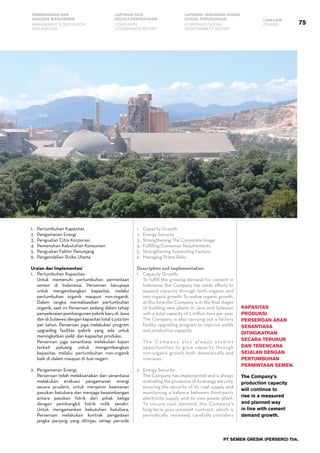
  • 88.
    PT SEMEN GRESIK(PERSERO) Tbk. 143 PEMBAHASAN DAN ANALISIS MANAJEMEN LAPORAN TATA KELOLA PERUSAHAAN LAPORAN TANGGUNG JAWAB SOSIAL PERUSAHAAN LAIN-LAIN MANAGEMENT’S DISCUSSION AND ANALYSIS CORPORATE GOVERNANCE REPORT CORPORATE SOCIAL RESPONSIBILITY REPORT OTHERS Keterangan Description 2011 Porsi Portion 2010 Porsi Portion Perubahan % Change % Pajak dibayar dimuka Prepaid taxes 17,543 0.2% 5,682 0.1% 208.8 Jumlah Total 7.646,145 100.0% 7,345,868 100.0% 4.1 Komposisi utama aset lancar adalah kas dan setara kas, 44,1%, Piutang usaha, 23,9%, Persediaan 26,2%, investasi jangka pendek 3,3%, kas yang dibatasi penggunaanya 0,7%, uang muka 0,6% dan lainnya 1,7%. Peningkatan aset lancar hingga sebesar 4,1% tersebut diatas adalah akibat perubahan posisi pos- pos utama aset lancar tersebut, yakni pos laporan posisi keuangan kas dan setara kas turun sebesar 7,9% dan kas setara kas yang dibatasi penggunaannya turun sebesar 57,3%, sedangkan pos piutang usaha naik 6,5%, persedian naik 23,5%, investasi jangka pendek naik 118,7% dan uang muka naik 49,8%. Penjelasan atas penyebab perubahan posisi aset lancar tersebut adalah sebagai berikut. Kas dan Setara Kas Serta Kas setara Kas yang Dibatasi Penggunaannya Pengelolaan kas dan setara kas dilakukan secara prudent melalui manajemen cash cycle yang optimal dan pembentukan manajemen portfolio yang sehat atas excess cash Perseroan dengan tetap memperhatikan risk dan return yang menguntungkan. Rincian Kas dan Setara Kas (dalam Rp juta) Keterangan Description 2011 Porsi Portion 2010 Porsi Portion Perubahan % Change % Kas Cash 2,089 0.1% 1,634 0,0% 27,9 Bank Banks Rupiah 179,017 5.1% 187,154 4.9% -4.3 Dolar Amerika USD 3,728 0.1% 11,049 0.3% -66.3 Euro 2,339 0.1% 10,275 0.3% -77.2 Dolar Singapura SGD 52 0.0% 33 0.0% 59.6 Total Bank 185,136 5.3% 208,511 5.5% -11.2 Deposito Deposits Rupiah 3,336,781 94.7% 3,420,041 90.1% -2.4 Dolar Amerika USD - 0.0% 39,650 1.0% -100.0 Euro - 0.0% 127,329 3.4% -100.0 Total Deposito Total Deposits 3,336,781 94.7% 3,587,021 94.5% -7.0 Total Kas dan Setara Kas Total Cash and Cash Equivalents 3,524,006 100.0% 3,797,166 100.0% -7.2 Saldo kas dan setara kas pada akhir tahun 2011 yang terdiri dari kas sebesar Rp3.524 miliar, ditempatkan di rekening giro sebesar Rp185 miliar atau 5,3% serta deposito berjangka dan call deposits sebesar Rp3.337 miliar atau sebesar 94,7%. The main composition of current assets is cash and cash equivalents at 44.1%, trade receivables at 23.9%, inventories at 26.2%, short term investments 3.3%, restricted cash 0.7%, advance payments 0.6% and others 1.7%. The increase in current assets of 4.1% is due to the change in the main current assets items above, i.e. financial position items cash and cash equivalent decreasing 7.9% and restricted cash and cash equivalents decreasing 57.3%, while trade receivables increased 6.5%, inventories increase 23.5%, short term investments increased 118.7% and advance payments increased 49.8%. Explanations for the changes to current asset positions are as follows. Cash and Cash Equivalents and Restricted Cash and Cash Equivalents Cash and cash equivalents have been managed prudently with optimum cash cycle management and a healthy portfolio for excess cash, which takes into account risk and profitable return. Cash and Cash Equivalents (in millions Rp) Cash and cash equivalents at the end of 2011 which consisted of cash of Rp3.524 billion, placed in a checking account at Rp185 billion, or 5.3% and time deposits and call deposits amounting to Rp3.337 billion or by 94.7%. Penuruan akun kas dan setara kas serta kas yang dibatasi penggunaannya disebabkan oleh penggunaan dana untuk penyelesaian pembangunan proyek strategis. The decrease in the restricted cash and cash equivalents were due to the use of funds to complete strategic construction projects.
  • 89.
    LAPORAN TAHUNAN 2011ANNUAL REPORT LAPORAN MANAJEMEN INFORMASI BAGI INVESTOR TINJAUAN OPERASIONAL Management Report INFORMATION FOR INVESTORS OPERATIONAL PERFORMANCE144 INFORMASI PERUSAHAANIKHTISAR COMPANY PROFILEHIGHLIGHTS Dari dua tabel tersebut tampak bahwa penurunan terbesar terjadi pada komponen deposito dalam mata uang dolar. Hal ini karena kedua jenis instrumen tersebut adalah komponen dana yang dialokasikan untuk pembelian mesin dan peralatan unit pabrik baru yang didatangkan dari Eropa. Perseroan menganggarkan dana pembelian tersebut dalam mata uang yang relevan agar terhindar dari risiko fluktuasi mata uang dan oleh karenanya juga terhindar dari risiko penundaan pengiriman karena keterlambatan pembayaran. Seiring dengan kemajuan proyek pembangunan pabrik semen baru dan pembangkit listrik, dana ini terpakai, sehingga saldonya terus menurun. (lihat juga uraian “Perkembangan Proyek Strategis”). Sementara penurunan saldo deposito dalam mata uang rupiah, lebih disebabkan Perseroan memerlukan dana tersebut untuk keperluan modal kerja, baik dalam rangka pembelian bahan baku, maupun barang modal lain yang harus dilakukan dalam mata uang rupiah. Hal ini dilakukan untuk meningkatkan operasi pabrik sebagai respon atas naiknya permintaan semen di pasar domestik. Kas dan setara kas Perseroan mayoritas ditempatkan dalam bentuk deposito pada bank dengan tingkat kesehatan yang baik antara lain: di PT Bank Mandiri (Persero) Tbk, PT Bank Negara Indonesia (Persero) Tbk, PT Bank Rakyat Indonesia (Persero) Tbk, PT Bank Central Asia Tbk, PT Bank CIMB Niaga Tbk dan bank lainnya. Atas penempatan dana tersebut, Perseroan mendapatkan pendapatan bunga dengan tingkat bunga untuk deposito rupiah sebesar 3,9%-8,7% (lihat juga uraian “Penghasilan/(Beban) Lainnya”, hal 140). Piutang Usaha Piutang usaha Perseroan tercatat sebesar Rp1.828 miliar atau naik 6,5% dari akhir tahun 2010 sebesar Rp1.717 miliar, diakibatkan oleh naiknya operasional Perseroan untuk merespon peningkatan permintaan pelanggan. Peningkatan piutang usaha juga diakibatkan oleh penerapan strategi pemasaran. Oleh karena itu, rata-rata tingkat kolektibilitas piutang mengalami kenaikan menjadi 36 hari dari 37 hari di tahun sebelumnya. Hal ini diraih dengan dukungan Teknologi Informasi yang dikembangkan, sehingga Perseroan mampu menjaga kualitas piutangnya agar senantiasa terkelola dengan baik From the two tables above, it can be seen that the largest reduction is in the dollar deposit component and these two financial instruments are funding components allocated for the purchase of machinery and equipment from Europe. The Company budgeted these funds in the relevant currency to avoid the risk of currency fluctuations, thereby also avoiding the risk of shipment delay due to delayed payment. In line with the construction progress of the new cement plant and the power plant, these funds have been used and the balance has decreased. (see “Development of Strategic Projects”) Meanwhile, the decrease in the balance of deposits in rupiah was due to the Company used the funds for working capital to purchase raw materials and other capital goods in rupiah. This was related to an increase in production in response to higher demand for cement in the domestic market. Most of the Company’s cash and cash equivalent are placed on deposit in healthy banks, such as: PT Bank Mandiri (Persero) Tbk, PT Bank Negara Indonesia (Persero) Tbk, PT Bank Rakyat Indonesia (Persero) Tbk, PT Bank Central Asia Tbk, Deutsche Bank, PT Bank CIMB Niaga Tbk and PT Bank Mega Tbk. For the placement of these funds, the Company received interest on Rupiah deposits ranging of 3.9% - 8.7%. (see “Other Income/(Expenses”, page 140). Trade Receivables The Company has a trade receivables position of Rp1,828 billion, or an increase of 6.5% from the end of 2010’s Rp1,717 billion, as a result of the Company’s increased production in response to higher demand for cement. The increase in trade receivables is also due to the application of the marketing strategy. Hence, the average collection period increased to 36 days from 37 the previous year. However, with the support of developed IT, the Company managed to maintain the quality of its receivables so that they remain well managed and have a high Keterangan Description 2011 Porsi Portion 2010 Porsi Portion Perubahan % Change % Rupiah 3,517,887 99.83% 3,608,829 95.04% -2.5 Dolar Amerika USD 3,728 0.10% 50,700 1.34% -92.6 Euro 2,339 0.07% 137,604 3.62% -98.3 Dolar Singapura SGD 52 0.00% 32 0.00% 62,5 Total Kas dan Setara Kas Total Cash and Cash Equivalents 3,524,006 100.00% 3,797,165 100.00% -7.2 Cash and Cash Equivalents Per Currency (in millions Rp) Kas dan Setara Kas Per Mata Uang (Dalam Rp juta)
  • 90.
    145 PEMBAHASAN DAN ANALISIS MANAJEMEN LAPORANTATA KELOLA PERUSAHAAN LAPORAN TANGGUNG JAWAB SOSIAL PERUSAHAAN LAIN-LAIN MANAGEMENT’S DISCUSSION AND ANALYSIS CORPORATE GOVERNANCE REPORT CORPORATE SOCIAL RESPONSIBILITY REPORT OTHERS PT SEMEN GRESIK (PERSERO) Tbk. dan memiliki tingkat kolektibilitas yang tinggi. Dengan demikian jumlah cadangan yang dialokasikan sebagai kompensasi penurunan nilai berada dalam tingkat yang wajar sesuai kebijakan Perusahaan. Berikut ini tabel yang menunjukkan persentase piutang terhadap pendapatan mencapai 11,2% lebih baik dari tahun lalu yang mencapai 12,0%. Tabel umur piutang usaha Perseroan, 31 Desember 2010 dan 2011 (dalam Rp juta) Kategori Category Jumlah Total Perubahan Change % 2011 2010 Lancar Current 1,643,569 1,450,746 13.3 1-45 hari days 153,236 222,751 -31.2 46-135 hari days 27,360 49,122 -44.3 136-365 hari days 17,360 16,249 6.8 Lebih dari 365 hari More than 365 days 44,617 43,121 3.5 Jumlah Total 1,886,143 1,781,989 5.8 Penyisihan penurunan nilai Allowances of impairment (57,665) (65,407) -11.8 Jumlah piutang usaha-bersih Total trade receivables-net 1,828,478 1,716,582 6.5 Pendapatan Revenue 16,378,794 14,344,189 14.2 % Piutang usaha terhadap Pendapatan % Trade receivable to revenue 11.2% 12.0% -0.8 Persediaan Persediaan bersih pada akhir tahun 2011 adalah Rp2.007miliarataunaiksebesar23,5%dibandingkan posisiakhirtahunsebelumnyasebesarRp1.624miliar. Saldo persediaan tersebut terdiri dari persediaan bahan baku dan penolong sebesar Rp976 miliar, suku cadang bersih sebesar Rp626 miliar, barang dalam proses sebesar Rp337 miliar, barang dalam perjalanan sebesar Rp40 miliar, barang jadi sebesar Rp77 miliar dan tanah sebesar Rp2 miliar. Peningkatan posisi persediaan tersebut dilakukan untuk memenuhi lonjakan permintaan semen sepanjang tahun 2011 dan mengantisipasi berlanjutnya kenaikan permintaan semen di awal tahun 2012 serta persiapan masa commisioning pabrik semen baru. ASET TIDAK LANCAR Tabel Komposisi Aset Tidak Lancar (dalam Rp juta) Keterangan Description 2011 Porsi Portion 2010 Porsi Portion % Aset pajak tangguhan Deferred tax on assets 106,488 0.9% 95,684 1.2% 11.3 Investasi pada entitas asosiasi Investments in associates 80,193 0.7% 69,630 0.8% 15.2 Properti investasi - bersih Investment property - net 25,582 0.2% 21,753 0.3% 17.6 Aset tetap-bersih Fixed assets-net 11,640,692 96.9% 7,662,560 93.3% 51.9 Beban tangguhan-bersih Deferred charges-net 22,867 0.2% 21,342 0.3% 7.1 Uang muka pembangunan pabrik baru Advances for construction of new plants 121,606 1.0% 328,960 4.0% -63.0 Aset lain-lain Other assets 18,029 0.2% 17,202 0.2% 4.8 Jumlah Total 12,015,458 100.0% 8,217,131 100.0% 46.2 Perseroan mengelola kualitas Piutang Usaha dengan baik untuk meminimalisir risiko tidak tertagih dan membentuk penyisihan yang memadai. The Company has managed the quality of its Trade Receivables well to minimize the credit risk and provide sufficient allowance for impairment. level of collectibility. As a result, the allowance for impairment is at a reasonable level in accordance with Company policy. The following table shows percentage receivables to income which reached 11.2%, an improvement over the previous year’s 12.0%. Age of the Company’s trade receivables per December 31, 2010 and 2011 (In millions Rp) Inventories Net inventories at the end of 2011 was amounted to Rp2,007 billion, an increase of 23.5% compared to the position as of the end of the previous year at Rp1,624 billion. The inventories balance consists of raw and indirect materials at Rp976 billion, net spare parts at Rp626 billion, work in process of Rp337 billion, goods in transit of Rp40 billion, finished goods at Rp77 billion and land at Rp2 billion. The increase in inventories is due to higher demand for cement during 2011 and anticipation of a continuing increase in demand in early 2012, along with the commissioning of the new cement plants. Non-Current Assets Composition of Non-Current Assets (in millions Rp)
  • 91.
    LAPORAN TAHUNAN 2011ANNUAL REPORT LAPORAN MANAJEMEN INFORMASI BAGI INVESTOR TINJAUAN OPERASIONAL Management Report INFORMATION FOR INVESTORS OPERATIONAL PERFORMANCE146 INFORMASI PERUSAHAANIKHTISAR COMPANY PROFILEHIGHLIGHTS Komposisi aset tidak lancar di akhir 2011, terutama terdiri atas aset tetap, 96,9% sebesar Rp11.640 miliar dan uang muka pembangunan pabrik baru, 1,0% sebesar Rp122 miliar, sehingga peningkatan pos laporan posisi keuangan ini akan berpengaruh besar pada total aset tidak lancar. Berlawanan dengan jumlah aset lancar yang turun, aset tidak lancar meningkat cukup signifikan selama beberapa tahun terakhir. Aset tidak lancar pada akhir 2011 adalah sebesar Rp12.015 miliar atau meningkat 46,2% dibanding akhir 2010, sebesar Rp8.217 miliar. Peningkatan terbesar dari aset tidak lancar tersebut berasal dari kenaikan aset tetap bersih yang meningkat sebesar 51,9% menjadi Rp11.640 miliar. Peningkatan tersebut terutama karena adanya peningkatan aktivitas proyek pembangunan pabrik semen dan pembangkit listrik baru. (Lihat juga uraian “Perkembangan Proyek Strategis” halaman 79 dan “Belanja Modal”, halaman 153). Aset Tetap Aset tetap Perseroan terdiri atas tanah, bangunan dan peralatan produksi. Seiring penyelesaian pembangunan pabrik baru, maka total aset tetap meningkat 51,9% menjadi sebesar Rp11.640 miliar. Sekalipun sebagian bangunan dan peralatan produksi lain mengalami penyusutan, dengan nilai sebesar (net) Rp486 miliar sepanjang tahun 2011, namun penambahan nilai bangunan dan peralatan dari unit pabrik baru, pembangkit listrik, packing plant, bangunan lainnya dan aset sewa lain senilai (net) Rp4.465 miliar membuat total aset tetap meningkat. LIABILITAS Jumlah liabilitas Perseroan pada tanggal 31 Desember 2011 tercatat sebesar Rp5.046 miliar atau meningkat 47,4% dibanding tahun sebelumnya Rp3.423 miliar. Liabilitas Perseroan tahun 2011 terdiri atas Liabilitas Jangka Pendek dengan porsi 57,3%,senilaiRp2.889miliarataunaiksebesar14,8% dan Liabilitas jangka panjang dengan porsi 42,7% senilai Rp2.157 miliar atau naik sebesar 138,2%. Penjelasan berikut memberi gambaran hal-hal yang mempengaruhi perubahan posisi liabilitas Perseroan tersebut. Liabilitas Jangka Pendek Komposisi liabilitas jangka pendek Perseroan akhir tahun 2011 terdiri atas utang usaha 40,9% sebesar Rp1.183 miliar, beban akrual 22,7% sebesar Rp656 miliar, utang lain-lain, 22,3% sebesar Rp643 miliar dan utang pajak 10,0% sebesar Rp290 miliar, seperti tampak pada tabel berikut. Penjelasan atas penyebab perubahan pada pos-pos laporan posisi keuangantersebutsertaupayauntukmengelolanya diuraikan dalam bahasan berikut. The composition of non-current assets at the end of 2011 consisted mainly of fixed assets, 96.9%, amounted to Rp11,460 billion and advance payments for the new plants at 1.0% valued at Rp122 billion. The increase in this financial position will greatly effect to total non-current assets. Contrary to the decrease in current assets, non-current assets have increased significantly in last few years. Non-currentassetsattheendof2011wasamounted to Rp12,015 billion, or an increase of 46.2% over 2010 position, which was at Rp8,217 billion. The largest increase in non-current assets was from an increase in fixed assets, which increase 51.9% to Rp11,640 billion. This increase is mostly due to the increased project activity for the new cement plants and the power plant. (see “Strategic Project Development” Pages 79 “Capital Expenditure”, page 153). Fixed Assets The Company’s fixed assets consist of land, buildings and production equipment. With the completion of the new plants, total fixed assets have risen 51.9% to Rp11,640 billion. While a part of the construction and other production equipment will experience contraction, with a value of (net) Rp486 billion during 2011, the additional value of buildings and equipment from the new factories, the power plant, packing plants and other buildings and rental assets amounting to (net) Rp4,465 billion, total fixed asset has increased. LIABILITIES The Company’s total liabilities per December 31, 2011 were recorded at Rp5,046 billion, or an increase of 47.4% over the previous year’s Rp3,423 billion. The Company’s liabilities in 2011 consisted of Current Liabilities with a 57.3% portion amounting to Rp2,889 billion or a increase of 14.8% andNon-current Liabilities with a 42.7% portion amounting to Rp2,157 billion or an increase of 138.2%. The following explanation illustrates this change in the Company’s liability position. Current Liabilities The composition of the Company’s Current Liabilities at the end 2011 consisted of trade payables at 40.9% or Rp1,183 billion, accrued expenses of 22.7% or Rp656 billion, other payables at 22.3% amounting to Rp643 billion and tax payable of 10% amounting to Rp290 billion, as shown in the following table. An explanation as to the causes for the changes of the financial position items and efforts to manage this are included in the following discussion.
  • 92.
    PT SEMEN GRESIK(PERSERO) Tbk. 147 PEMBAHASAN DAN ANALISIS MANAJEMEN LAPORAN TATA KELOLA PERUSAHAAN LAPORAN TANGGUNG JAWAB SOSIAL PERUSAHAAN LAIN-LAIN MANAGEMENT’S DISCUSSION AND ANALYSIS CORPORATE GOVERNANCE REPORT CORPORATE SOCIAL RESPONSIBILITY REPORT OTHERS Tabel Komposisi Liabilitas Jangka Pendek (dalam Rp juta) Keterangan Description 2011 Porsi Portion 2010 Porsi Portion % Utang usaha Trade payables 1,182,562 40.9% 970,812 38.6% 21.8 Utang lain-lain Other payables 643,134 22.3% 482,243 19.2% 33.4 Beban akrual Accrued expenses 655,984 22.7% 723,107 28.7% -9.3 Utang pajak Taxes payable 290,107 10.0% 222,697 8.8% 30.3 Uang muka penjualan Sales advances 39,560 1.4% 32,025 1.3% 23.5 Bagian lancar atas liabilitas jangka panjang Current maturities of long-term liabiities 77,790 2.7% 86,635 3.4% -10.2 Jumlah Total 2,889,137 100.00% 2,517,519 100.00% 14.8 Utang Usaha Posisi utang usaha pada akhir tahun 2011 naik sebesar 40,9% menjadi Rp1.183 miliar dibandingkan dengan tahun sebelumnya sebesar Rp971 miliar. Kenaikan tersebut disebabkan oleh semakin tingginya aktivitas operasional yang membuat Perseroan meningkatkan pembelian bahan-bahan baku maupun bahan penolong yang diperlukan. Melalui pengelolaan utang usaha yang semakin berkualitas tersebut, maka rata-rata periode pembayaran (APP) di tahun 2011 pada level 38 hari, lebih baik dari level 44 hari di tahun sebelumnya. Hal ini menunjukkan Perseroan berkomitmen meningkatkan hubungan kerja yang semakin baik dan berkualitas dengan para pemasok. Dalam rangka menjaga hubungan dengan pemasok, Perseroan memberikan jaminan pembayaran yang tepat waktu sepanjang seluruh prosedur dan dokumen penagihan lengkap. Perseroan mengandalkan dukungan Teknologi Informasi yang terus dikembangkan (Lihat juga uraian “Pengembangan Teknologi Informasi”, hal 105) untuk melakukan verifikasi dokumen dan menerapkan e-procurement untuk memperoleh kualitas jasa dan barang yang baik dengan harga kompetitif serta untuk memonitor dan mendapatkan pemasok yang bonafide. Utang lain-lain Utang lain-lain meningkat signifikan dibanding tahun lalu, sebagai akibat peningkatan utang proyek terkait aktifitas pembangunan pabrik semen dan pembangkit listrik baru. (lihat uraian “Perkembangan Proyek Strategis”, hal 79). Beban Akrual Posisi beban akrual pada akhir tahun 2011 sebesar Rp656 miliar atau turun sebesar 9,3% dari tahun 2010 yang sebesar Rp723 miliar. Hal ini terutama diakibatkan oleh adanya penyesuaian atas program promosi penjualan terkait dengan permintaan semen domestik yang meningkat. Utang Pajak Posisi utang pajak pada akhir tahun 2011 sebesar Rp290 miliar atau naik 30,3% dari angka tahun 2010 yang sebesar Rp223 miliar, sebagai akibat meningkatnya kinerja Perseroan, seperti dijelaskan pada uraian Beban Pajak Penghasilan. Current Liabilities Composition (in millions Rp) Trade Payables The trade payables position at the end of 2011 increased 40.9% to Rp1,183 billion compared to the previous year, which recorded Rp971 billion. This increase was due to higher operational activities resulting in the need to purchase more raw and indirect materials. With improved management of trade payables, the average payment period (APP) in 2011 was 38 days, an improvement compared to the 44 days previous year. This shows that the Company is commiteed to increase quality business relationship with supplier. To maintain relations with suppliers, the Company guarantees timely payment provided that all procedures and billing documents are complete. The Company relies on continually evolving Information Technology support (see “InformationTechnologyDevelopments”page105 ) to verify documents and apply e-procurement to obtain high quality goods and services at a competitive price, as well as monitoring and obtaining bona fide suppliers. Other Payables Other payables have increased significantly on the previous year as a result of increased payables related to activity in the cement plants and power plant projects. (see “Development of Strategic Projects” page 79) Accrued Expenses The accrued expenses position at the end of 2011 amounted to Rp656 billion, or a decrease of 9.3% on 2010 which was Rp723 billion. This is mainly as a result of adjustments in the sales promotion programs related to increasing domestic demand for cement. Tax Payable The tax payable positionat the end of 2011 was amounted to Rp290 billion, an increase of 30.3% from the 2010 position of Rp223 billion, as a result of the Company’s increased performance, as explained in the description on Income Tax Expenses.
  • 93.
    LAPORAN TAHUNAN 2011ANNUAL REPORT LAPORAN MANAJEMEN INFORMASI BAGI INVESTOR TINJAUAN OPERASIONAL Management Report INFORMATION FOR INVESTORS OPERATIONAL PERFORMANCE148 INFORMASI PERUSAHAANIKHTISAR COMPANY PROFILEHIGHLIGHTS Liabilitas Jangka Panjang Komposisi liabilitas jangka panjang akhir tahun 2011, didominasi oleh pos laporan posisi keuangan liabilitas jangka panjang (setelah dikurangi bagian jangka pendek) 84,1% sebesar Rp1.813 miliar dan liabilitas imbalan kerja, 12,5% sebesar Rp269 miliar. Rincian Liabilitas Jangka Panjang (dalam Rp juta) Keterangan Description 2011 Porsi Portion 2010 Porsi Portion % Liabilitas pajak tangguhan Deferred tax liabilities 1,471 0.1% 6,680 0.7% -78.0 Liabilitas imbalan kerja Employee benefits liabilities 269,377 12.5% 216,982 24.0% 24.1 Liabilitas jangka panjang-setelah dikurangi bagian yang jatuh tempo dalam satu tahun Long-term debt - net of current maturities 1,813,477 84.1% 599,626 66.2% 202.4 Liabilitias jangka panjang lainnya Other non-current liabilities 73,044 3.4% 82,440 9.1% -11.4 Jumlah Total 2,157,369 100.00% 905,727 100.00% 138.2 Secara total posisi liabilitas jangka panjang akhir tahun 2011 mengalami kenaikan 138,2% menjadi sebesar Rp2.157 miliar terutama disebabkan oleh: • Penarikan pinjaman bank jangka panjang sebesar Rp1.115 miliar dalam rangka pendanaan proyek pembangunan pabrik semen dan pembangkit listrik baru. • Penambahan liabilitas imbalan kerja sebesar 24,1% senilai Rp52 miliar. Perseroan menerapkan PSAK No. 24 (Revisi 2004) tentang "Imbalan Kerja" dalam memperhitungkan manfaat karyawan. MODAL dan STRUKTUR MODAL Jumlah modal/ekuitas per 31 Desember 2011 adalah sebesar Rp14.615 miliar atau meningkat 20,4% dari tahun sebelumnya yang sebesar Rp12.140 miliar. Ekuitas terdiri atas modal ditempatkan dan telah disetor sebesar Rp593 miliar, tambahan modal disetor Rp1.458 miliar, saldo laba yang dicadangkan sebesar Rp253 miliar, dan saldo laba yang belum dicadangkan sebesar Rp12.154 miliar. Peningkatan ekuitas di 2011 terutama dipengaruhi oleh laba tahun berjalan. Kebijakan Struktur Modal Perseroan menetapkan kebijakan struktur modal yang mampu mencerminkan perimbangan antara penggunaan komposisi modal sendiri dengan pinjaman/utang yang terdiri dari utang jangka pendek dan utang jangka panjang agar dapat memaksimalkan nilai perusahaan. Seiring dengan kebutuhan dana untuk pembangunan pabrik semen, Perseroan senantiasa menjaga struktur modal agar sesuai atau tidak melebihi financial covenant yang dipersyaratkan dalam perjanjian pinjaman dengan pihak kreditur. Adapun secara umum kebijakan struktur permodalan Perseroan yang diijalankan adalah: • Struktur modal senantiasa mempertimbangkan keseimbangan antara risiko keuangan dan harus relevan dengan tingkat pengembalian dalam upaya meningkatkan nilai perusahaan. - Dilakukan dengan memperhitungkan penggunaan besaran dan struktur utang NON-CURRENT Liabilities The composition of non-current liabilities as of end 2011 was dominated by the financial position item of long term liabilities (net of the short term portion) at 84.1% or Rp1,813 billion, and employee benefit liabilities at 12.5% or Rp269 billion. Details of Non-Current Liabilities (In millions Rp) Overall, the position for non-current liabilities as of end 2011 experienced a 138.2% increase to Rp2,157 billion, predominantly as a result of: • Drawdown of a long term bank loan of Rp1,115 billion to fund the new cement factories and the power plant construction projects. • Additional employment benefit liabilities amounting to 24.1% or a value of Rp52 billion. The Company applies PSAK (Indonesian financial accounting standards) No.24 (revised 2004) regarding Employee Benefits to calculate employee benefits. CAPITAL and CAPITAL STRUCTURE Total capital / equity per December 31, 2011 amounted to Rp14,615 billion or an increase of 20.4% over the previous year at Rp12,140 billion. Equity consists of issued and paid up capital at Rp593 billion, additional paid up capital of Rp1,458 billion, and unappropriated retained earnings amounting to Rp12,154 billion. The increased equity in 2011 was predominantly influenced by profit for the year. Capital Structure Policy The Company has established a capital structure policy that is able to reflect the balance between the use of its own capital with loan / debt consisting of short term debt and long term debt in order to maximize the value of the company. Along with the funding requirements for the construction of the cement factories, the Company is continuing to maintain its capital structure so as to match or not exceed the financial covenants in loan agreements with lenders. In general, the Company’s capital structure policy being implemented is: • The capital structure continually balances financial risk which must be relevant to rate of return while increasing the value of the Company. - This is implemented by calculating the scale of use and debt structure resulting in
  • 94.
    149 PEMBAHASAN DAN ANALISIS MANAJEMEN LAPORANTATA KELOLA PERUSAHAAN LAPORAN TANGGUNG JAWAB SOSIAL PERUSAHAAN LAIN-LAIN MANAGEMENT’S DISCUSSION AND ANALYSIS CORPORATE GOVERNANCE REPORT CORPORATE SOCIAL RESPONSIBILITY REPORT OTHERS PT SEMEN GRESIK (PERSERO) Tbk. yang menimbulkan liabilitas keuangan (tingkat bunga) dan mempengaruhi kondisi likuiditas perusahaan. - Mengoptimalkan rentabilitas ekonomi dan rentabilitas modal sendiri yang menghasilkan peningkatan laba per saham. • Struktur modal ditinjau dengan melakukan evaluasi hubungan antara financial leverage, nilai perusahaan dan biaya modal sehingga dicapai financial trade off yang reasonable. • Struktur modal diupayakan optimal dengan mengatur kombinasi utang dan modal sendiri (ekuitas) yang dapat memaksimalkan nilai Perseroan. • Kombinasi struktur modal ditetapkan setelah melakukan analisa sensitivitas dengan berbagai variasi asumsi inti yang paling mungkin dihadapi oleh Perseroan. Perseroan mengawasi modal dengan menggunakan rasio pengungkit (gearing ratio), denganmembagitotalpinjamanberdampakbunga dengan total ekuitas yang dapat diatribusikan kepadapemilikentitasinduk.KebijakanPerseroan adalah menjaga rasio pengungkit dalam kisaran dari perusahaan terkemuka di Indonesia untuk mengamankan akses terhadap pendanaan pada biaya yang rasional. Termasuk dalam total pinjaman berdampak bunga adalah pinjaman bank jangka pendek, pinjaman bank jangka panjang, pinjaman kepada Pemerintah Republik Indonesia, dan liabilitas sewa pembiayaan. Melalui pelaksanaan kebijakan struktur modal yang konsisten, posisi total liabilitas berefek bunga akhir tahun 2011 adalah sebesar Rp1.872 miliar, rasio liabilitas terhadap ekuitas Perseroan adalah sebesar 12,9%. Hal ini menunjukkan kemampuan membayar utang yang kuat sekaligus masih besarnya potensi Perseroan untuk mendapatkan dana pinjaman bagi pembiayaan ekspansi di masa mendatang. (lihat juga “Rasio- rasio Keuangan, Solvency”) Dividen Selama5tahunbukuterakhirdividenyangdibagikan Perseroan tumbuh rata-rata sebesar 50%. Sesuai hasil RUPST pada tanggal 28 Juni 2011, Perseroan membagikan dividen per lembar saham sebesar Rp306,26 (angka penuh). Setelah dikurangi dengan dividen interim sebesar Rp58 (angka penuh), maka sisa dividen tunai final sebesar Rp248,26 (angka penuh) (Selengkapnya lihat “Informasi Investor, Kebijakan Dividen” AR- 2011, hal 63) MODAL KERJA BERSIH Semakin meningkatnya kebutuhan dana untuk membiayai investasi strategis Perseroan membuat modal kerja bersih Perseroan mengalami penurunan. Secara keseluruhan modal kerja bersih Perseroan tahun 2011 turun sebesar 1,5% dari Rp4.828 miliar pada tahun 2010 menjadi Rp4.757 miliar pada tahun 2011. financial liability (interest) and influencing the liquidity of the Company. - Optimizing an economic rate of return and capital rate of return which results in increased profit per share. • The capital structure is reviewed assessing the relationship between financial leverage, company value and cost of capital, thus achieving a reasonable financial trade off. • Efforts are made to optimize capital structure regulating the combination of debt and capital (equity) which can maximize Company value. • Combined capital structures are determined after analyzing the sensitivity and various core assumptions which the Company is most likely to face. The Company monitors capital using a gearing ratio dividing total interest bearing loans with total equity to obtain total equity attributable to the parent entity. The Company’s policy is to maintain its gearing ratio within the gearing ratio range of the leading companies in Indonesia in order to secure access to finance at a reasonable cost. Included in interest bearing loans are short- term bank loans and long-term bank loans, loan to Government of The Republic of Indonesia, and finance lease liabilities. Through consistently implementing the capital structure policy, the total interest bearing liability position as of end 2011 was Rp1,872 billion, thus the ratio of liabilities to equity was 12.9%. This demonstrates the strong ability to repay debt, while also reflecting the Company’s strong potential to obtain loans to fund future expansion. (see also “Financial Ratios, Solvency”) DIVIDENDS During the last five fiscal years the Company dividends paid out have grown on average by 50%. In accordance with the results of the AGM on June 28, 2011, the Company is paying dividends per share of Rp306.26 (full amount). After deducting the interim payout of Rp58 (full amount), the remaining final cash dividend is Rp248.26 (full amount). (For more details see “Investor Information, Dividend Policy” AR-2011, page 63) NET WORKING CAPITAL The increasing demand of fund to realizing Company's strategic investment resulted in decrease of net working capital. Overall, the Company’s net working capital in 2011 decrease 1.5% from Rp4,828 billion in 2010 to Rp4,757 billion in 2011. Perseroan mengawasi modal dengan menggunakan rasio pengungkit (gearing ratio), dengan membagi total pinjaman berdampak bunga dengan total ekuitas yang dapat diatribusikan kepada pemilik entitas induk. The Company monitors capital using a gearing ratio dividing total interest bearing loans with total equity to obtain total equity attributable to parent entity.
  • 95.
    LAPORAN TAHUNAN 2011ANNUAL REPORT LAPORAN MANAJEMEN INFORMASI BAGI INVESTOR TINJAUAN OPERASIONAL Management Report INFORMATION FOR INVESTORS OPERATIONAL PERFORMANCE150 INFORMASI PERUSAHAANIKHTISAR COMPANY PROFILEHIGHLIGHTS Perseroan mampu mendanai seluruh kebutuhan modal kerja untuk operasional perusahaan serta dapat mendanai investasi strategis dari excess cash yang ada. Arus Kas Tabel berikut merupakan ringkasan arus kas Perseroan untuk tahun yang berakhir pada tanggal- tanggal 31 Desember 2011 dan 2010: (dalam Rp juta) The Company has been able to fund all working capital requirements for operations, as well as fund strategic investment, from available excess cash. CASH FLOW The following table details the Company’s cash flow for the years ending December 31, 2011 and 2010: (in millions Rp) Keterangan Description 2011 2010 Perubahan% Change% Arus kas bersih yang diperoleh dari aktivitas operasi Net cash flow provided by operating activities 4,415,753 3,378,416 30.7 Arus kas bersih yang digunakan untuk aktivitas investasi Net cash flow used in investing activities (4,295,179) (1,771,240) 142.5 Arus kas bersih yang digunakan untuk aktivitas pendanaan Net cash flow used in financing activities (409,207) (1,353,162) -69.8 (Penurunan)/Kenaikan bersih kas dan setara kas Net (decrease)/increase in cash and cash equivalent (288,633) 254,015 -213.6 Kas dan setara kas pada awal tahun Cash and cash equivalents at the beginning of the year 3,664,278 3,410,263 7.4 Kas dan setara kas pada akhir tahun Cash and cash equivalents at the end of the year 3,375,645 3,664,278 -7.9 Arus Kas dari Aktivitas Operasi Arus kas bersih Perseroan yang diperoleh dari aktivitas operasi sebesar Rp4.416 miliar meningkat 30,7% dibanding tahun 2010. Peningkatan tersebut terutama karena naiknya penerimaan dari pelanggan sebesar Rp2.241 miliar dan penurunan pembayaran pajak penghasilan sebesar Rp287 miliar. Arus Kas dari Aktivitas Investasi Arus kas untuk aktivitas investasi selama tahun 2011 adalah sebesar Rp4.295 miliar atau naik 142,5% dari tahun sebelumnya. Pembelanjaan modal ini difokuskan untuk mendanai investasi strategis Perseroan baik jangka pendek maupun jangka panjang terutama yang berkaitan dengan upaya meningkatkan efisiensi dan penambahan kapasitas produksi. Arus Kas dari Aktivitas Pendanaan Arus kas bersih yang digunakan untuk aktivitas pendanaan pada tahun 2011 sebesar Rp409 miliar, turun 69,8%. Penurunan tersebut terutama dipengaruhi oleh penurunan pembayaran dividen ke pemegang saham yang telah dibayar sebagai dividen interim pada tahun 2010 sebesar Rp344 miliar. Pada tahun 2011 Perseroan juga melakukan penarikan pinjaman bank sebesar Rp1.147 miliar untuk mendanai proyek pembangunan pabrik semen dan pembangkit listrik baru di Sulawesi. Pada 31 Desember 2011 saldo kas dan setara kas dari keseluruhan kegiatan usaha sebesar Rp3.376 miliar atau lebih rendah 7,9% dari saldo kas dan setara kas tahun 2010 sebesar Rp3.664 miliar. Cash Flow from Operations T h e C o m p a n y ’s n e t c a s h f l o w f r o m operational activities amounted to Rp4,416 billion, an increase of 30.7% on 2010. This increase was predominantly due to higher revenues from customers, amounting to Rp2,241 billion, and a reduction in income tax payments to Rp287 billion. Cash Flow from Investment Cash flow for investment activities during 2011 amounted to Rp4,295 billion, an increase of 142.5% from the previous year. Capital spending is focused on funding the Company’s strategic investments, both short term and long term, specificallythoserelatedtoimprovingefficiencies and increasing production capacity. Cash Flow from Funding Net cash flow utilized for funding activities in 2011 amounted to Rp409 billion, a decrease of 69.8%. This decrease was mainly influenced by the decline in dividend payments to shareholders who had received an interim dividend in 2010 amounting to Rp344 billion. In 2011, the Company also took out a bank loan of Rp1,147 billion to fund the construction of the new cement factories and the power plant in Sulawesi. As of December 31, 2011, the balance of cash and cash equivalents for all business activities amounted to Rp3,376 billion, or 7.9% lower from the cash and cash equivalent balance in 2010 of Rp3,664 billion.
  • 96.
    PT SEMEN GRESIK(PERSERO) Tbk. 151 PEMBAHASAN DAN ANALISIS MANAJEMEN LAPORAN TATA KELOLA PERUSAHAAN LAPORAN TANGGUNG JAWAB SOSIAL PERUSAHAAN LAIN-LAIN MANAGEMENT’S DISCUSSION AND ANALYSIS CORPORATE GOVERNANCE REPORT CORPORATE SOCIAL RESPONSIBILITY REPORT OTHERS RASIO-RASIO KEUANGAN Rasio-rasio Keuangan Financial Ratios 2011 2010 Perubahan % Change % Marjin laba bruto Gross Profit Margin 45.7% 47.5% -1.8 Marjin laba usaha Operating Margin 29.9% 31.4% -1.6 Marjin laba bersih Net Profit Margin 24.0% 25.3% -1,3 Marjin EBITDA EBITDA Margin 33.0% 34.6% -1.7 EBITDA terhadap Bunga ( x ) a) Interest Coverage 195.7 190.4 5.3 Laba Thd Ekuitas Return to Equity 27.1% 30.3% -3.2 Laba Thd Total Aset Return to Assets 20.0% 23.3% -3.3 Lancar Current 264.7% 291.8% -27.1 Liabilitas Thd Aset ( x ) Total Debt to Assets 0.1 0.0 5.3 a) Efektif sejak Januari 2008 telah diterapkan PSAK 30 (Revisi 2007) yang mengharuskan beban keuangan semua dialokasikan pada periode masa) a) Effective since January 2008 has applied IAS 30 (2007 edition) which requires that all finance charges allocated to future periods) Likuiditas Rasio ini menunjukkan kemampuan Perseroan dalam memenuhi liabilitas jangka pendeknya yang akan jatuh tempo, dihitung dengan membagi aset lancar dengan liabilitas jangka pendek. Tahun 2011 rasio likuiditas Perseroan adalah sebesar 264,7%, turun 27,1% dari tahun 2010 sebesar 291,8%, karena penurunan kas dan setara kas, kas dan setara kas yang dibatasi penggunaannya serta investasi jangka pendek dalam rangka pendanaan proyek pabrik semen dan pembangkit listrik baru. Kemampuan membayar utang (Solvency) Menunjukkan kemampuan Perseroan dalam memenuhi liabilitas, baik jangka pendek maupun jangka panjang yang ditunjukkan dengan melakukan pengukuran liabilitas terhadap ekuitas maupun terhadap total aset. Pada tahun 2011, kemampuan membayar utang Perseroan relatif stabil dibandingkan dengan tahun sebelumnya. Tambahan penarikan pinjaman baru pada tahun 2011 menyebabkan solvabilitas terhadap aset Perseroan mencapai 0,1x atau naik 0,05x pada tahun 2010. Sedangkan solvabilitas terhadap ekuitas relatif sama dengan tahun 2010 yakni sebesar 0,1x. Hal ini menunjukkan Perseroan mulaimeningkatkanporsipendanaanekspansidari pinjaman, dalam batas yang aman. Angka tersebut masih berada pada level yang sangat aman untuk memperoleh pinjaman baru. Perseroan memperoleh peringkat kredit korporat dari institusi pemeringkat internasional, yaitu Moody’syangmemberikanpemeringkatanBa1stable di tahun 2011. Peringkat tersebut mencerminkan kekuatan kredit Perseroan yang cukup baik karena profil kinerja operasional yang semakin kuat, posisi dominan dalam industri, tren permintaan semen yang positif serta bisnis yang stabil. Rincian dari seluruh liabilitas Perseroan yang berefek bunga adalah sebagai berikut: FINANCIAL RATIOS Liquidity This ratio demonstrates the Company’s ability to fulfill its short term liabilities as they mature, calculated by dividing current assets by short term liabilities. In 2011, the Company’s liquidity ratio was 264.7%, a decrease of 27.1% from 2010’s 291.8%, due to the reduction in cash and cash equivalents, use of restricted cash and cash equivalents, and short term investments to fund the cement factory and power plant projects. Solvency This demonstrates the Company’s ability to fulfill its liabilities, both short term and long term and is demonstrated by measuring liabilities against equity as well as measurement of total assets. In 2011, the Company’s ability to pay debt was relatively stable compared to the previous year. The additional new loan in 2011 provided solvency against the Company’s assets, which reached 0.01x%, an increase of 0.05x over 2010. Meanwhile, solvency to equity was relatively same with 2010 figures of 0.1x. This demonstrates that the Company is starting to increase its expansion funding portion from loans within safe limits. This figure is still at a very safe level to obtain new funding. The Company has obtained a corporate credit rating of Ba1 stable for 2011 from international ratings agency Moody’s. This rating demonstrates that the Company’s credit strength is relatively good due to its strengthening operational performance, dominant position in the industry, positive trend for cement demand and stable business. Details of all the Company’s interest bearing liabilities are as follows:
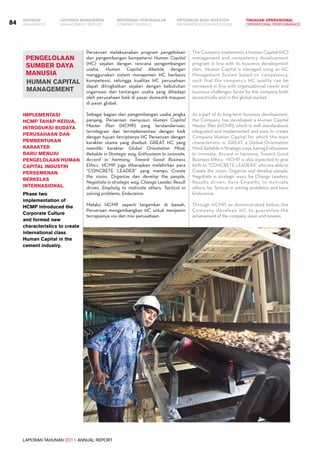
  • 97.
    LAPORAN TAHUNAN 2011ANNUAL REPORT LAPORAN MANAJEMEN INFORMASI BAGI INVESTOR TINJAUAN OPERASIONAL Management Report INFORMATION FOR INVESTORS OPERATIONAL PERFORMANCE152 INFORMASI PERUSAHAANIKHTISAR COMPANY PROFILEHIGHLIGHTS LAPORAN TAHUNAN 2011 ANNUAL REPORT Meanwhile, the EBITDA / interest expense + principle for 2011 amounted to 51.6x, up from 29.5x in 2010 and the liability ratio to EBITDA in 2011 was 0.3x, up from 0.1x in 2010, demonstrating the Company’s debt capacity remains high. The position of liabilities to capital for 2011 was at 0.1%, which is very similar to the previous year. This is illustrated in the solvency ratio table following. Pinjaman Berefek Bunga (dalam Rp juta) Interest Bearing Debt (in million Rp) 2011 2010 Bagian lancar atas liabilitas jangka panjang: Current maturities of long-term liabilities: - Pemerintah Republik Indonesia The Government of The Republic of Indonesia - Bank - Sewa pembiayaan Finance Lease 1,791 37,744 18,873 10,737 28,095 23,329 58,408 62,161 Liabilitas jangka panjang: Long-term liabilities: - Pemerintah Republik Indonesia The Government of The Republic of Indonesia - Bank - Sewa pembiayaan Finance Lease - 1,737,580 75,898 1,562 544,406 52,239 1,813,478 598,207 Total 1,871,886 660,368 Sementara itu, rasio EBITDA/interest expense+principletahun2011adalahsebesar51,6x naik dari posisi 29,5x ditahun 2010 dan rasio liabilitas terhadap Ebitda pada tahun 2011 adalah 0,3x, naik dari angka 0,1x di tahun 2010, yang menunjukkan debt capacity perseroan masih besar. Sedangkan posisi liabilitas terhadap kapital pada tahun 2011 berada pada level 0,1% atau relatif sama dengan tahun lalu. Hal ini ditunjukkan dalam tabel-tabel rasio solvensi, berikut. 2011 2010 Utang* Terhadap Ekuitas (x) Debt* to Equity (x) 0.1 0.1 Utang*/Ebitda (x) Debt*/EBITDA (x) 0.3 0.1 Ebitda/Beban Bunga (x) EBITDA/Interest Expense (x) 195.7 190.4 DSCR** (Ebitda/Beban Bunga + Pokok Pinjaman) (x) EBITDA/Interest Expense + Principal (x) 51.6 29.5 * Utang berefek bunga * Interest bearing debt ** Debt Service Coverage Ratio Manajemen Utang Untuk mengantisipasi kebutuhan pendanaan bagi pelaksanaan program ekspansi di masa mendatang, Perseroan menerapkan manajemen utang, yang menegaskan bahwa penarikan pinjaman baru hanya dilaksanakan setelah mempertimbangkan kebutuhan dan kemampuan dalam mendanai investasi strategis dengan mengupayakan tingkat biaya pinjaman yang kompetitif. Kolektibilitas Piutang Tingkat kolektibilitas piutang (average collection period/ACP) dihitung dengan membandingkan rata-rata piutang dengan pendapatan dikalikan jumlah hari dalam setahun (365 hari). Pada tahun 2011 tingkat kolektibilitas piutang sebesar 36 hari lebih cepat dari tahun sebelumnya, yakni 37 hari. (Lihat juga bahasan mengenai “Piutang Usaha”, hal 144). Debt Management In anticipation of funding requirements to implement expansion programs in future, the Company applies debt management which emphasizes that any new loan may only be taken after consideration of requirements and ability to fund strategic investments by seeking competitive rates for funding. Collectability of Receivables The collectability of receivables level (average collection period/ACP) is calculated by comparing average receivables with income times total days per year (365 days). In 2011, the Company’s collectability of receivables level was 36 days, faster than the previous year at 37 days. (see also “Receivables” page 144)
  • 98.
    153 PEMBAHASAN DAN ANALISIS MANAJEMEN LAPORANTATA KELOLA PERUSAHAAN LAPORAN TANGGUNG JAWAB SOSIAL PERUSAHAAN LAIN-LAIN MANAGEMENT’S DISCUSSION AND ANALYSIS CORPORATE GOVERNANCE REPORT CORPORATE SOCIAL RESPONSIBILITY REPORT OTHERS PT SEMEN GRESIK (PERSERO) Tbk. Profitabilitas Upaya Perseroan untuk melakukan pengendalian biaya ditengah keterbatasan kapasitas produksi dan adanya kenaikan beberapa komponen beban pokok penjualan dan beban usaha membuat Rasio profitabilitas tahun 2011 mengalami sedikit penurunan dibandingkan tahun 2010 sebagaimana tampak pada tabel rasio keuangan atas, dengan rasio net profit margin 2011, adalah sebesar 24,0%, turun dari posisi 25,3% di tahun 2010 . Marjin laba bruto Perseroan di tahun 2011 adalah 45,7%, marjin laba usaha 29,9%, sementara marjin EBITDA mencapai 33,0%. (lihat juga uraian “Beban Pokok” dan “Beban Usaha”, hal 136 dan 138). Rentabilitas Menunjukkan ukuran kemampuan Perseroan dalam menghasilkan laba bersih dengan menggunakan sumber daya yang tersedia. Penerapan strategi revenue management dan cost management membuat Perseroan mencatat pertumbuhan pendapatan sekaligus pertumbuhan laba yang signifikan. Rentabilitas terhadap ekuitas (Return On Equity) mencapai 27,1%, mengalami penurunan dari tahun 2010 yang sebesar 30,3%. Rentabilitas terhadap aset (Return on Asset) juga mengalami penurunan, menjadi 20,0% yang pada tahun 2010 yang sebesar 23,3 %. Turunnya rentabilitas terhadap aset karena peningkatan aset belum berpengaruh signifikan terhadap peningkatan volume penjualan. Sebagian aset tersebut masih dalam tahap penyelesaian pembangunan, belum berproduksi. Selain itu Perseroan menggunakan dana internal yang lebih tinggi dibanding dana eksternal untuk mendanai pembangunan proyek pembangunan pabrik semen dan pembangkit listrik. REALISASI BELANJA MODAL (dalam Rp juta) 2011 2010 % Perolehan aset tetap Acquisition of fixed assets 4,069,138 3,205,014 27.0 Uang muka pembangunan pabrik baru Advances for construction of new plants 121,020 298,063 -59.4 Penambahan beban tangguhan neto Additions to deferred charges net 5,220 2,749 89.9 Total 4,195,378 3,505,827 19.7 Realisasi belanja modal Perseroan pada tahun 2011 sebesar Rp4.195 miliar atau meningkat 19,7% dari tahun lalu sebesar Rp3.506 miliar. Belanja modal Perseroan terdiri atas investasi strategis dan investasi non strategis. Investasi strategis ditujukan untuk menambah kapasitas produksi, menjamin kelangsungan pasokan bahan baku dan penolong, meningkatkan efisiensi biaya dan meningkatkan daya saing Perseroan. Investasi non strategis ditujukan Profitability The Company’s efforts to control costs in the midst of limited production capacity along with the increasing cost of several components of cost of goods sold and operating expenses has caused the profitability ratio for 2011 to decrease slightly in comparison to 2010, as demonstrated in the financial ratio table above, with a net profit margin in 2011 of 24.0%, down from 25.3% in 2010. The Company’s gross profit margin in 2011 was 45.7%, operatingexpensesmargin29.9%,whiletheEBITDA margin reached 33.0%. (see “Cost of Revenue” and “Operating Expenses”, page 136 and 138) Returns Demonstrating a measurement of the Company’s abilitytoearnnetprofitusingavailableresources. The application of the revenue management and cost management strategy has resulted in the Company recording growth in income, while also recording significant growth in profits. Return on Equity reached 27.1%, a decrease from 2010 which amounted to 30.3%. Return on Assets also decreased to 20.0%, while in 2010 it was 23.3%. The decrease in return on assets is due to the fact that the increase in assets has not significantly influenced the sales volume yet. Some of these assets are still in the construction phase and therefore not in production. In addition, the Company is using a higher level of internal funding than external funding for the construction of the cement factories and power plant. REALIZATION OF CAPITAL EXPENDITURE (in millions Rp) Realization of capital expenditure by the Company for 2011 amounted to Rp4,195 billion, or an increase of 19.7% over the previous year at Rp3,506 billion. The Company’s capital expenditure consists of strategic investments and non strategic investments. Strategic investments are aimed at adding production capacity, ensuring continuity of raw and ancillary material supply, improving cost efficiencies and increasing the Company’s competitiveness. Non-strategic investments are aimed at maintaining
  • 99.
    LAPORAN TAHUNAN 2011ANNUAL REPORT LAPORAN MANAJEMEN INFORMASI BAGI INVESTOR TINJAUAN OPERASIONAL Management Report INFORMATION FOR INVESTORS OPERATIONAL PERFORMANCE154 INFORMASI PERUSAHAANIKHTISAR COMPANY PROFILEHIGHLIGHTS untuk mempertahankan tingkat produksi dan efisiensi operasi, termasuk antara lain menjaga kelangsungan operasi, memenuhi regulasi dan menunjang kelangsungan operasi. Selama tahun 2011, investasi strategis meliputi: program upgrading, pembangunan pabrik semen baru, pembangunan pembangkit listrik, pembangunan packing plant, pengembangan konversi & konservasi energi, pengembangan Information Communication Technology dan HCMP. (Lihat juga “Perkembangan Proyek Strategis”). Investasi non strategis antara lain: perawatan rutin, perbaikan maupun pengembalian standar operasi peralatan produksi. production levels and operational efficiencies, including, among others, ensuring operational continuity, fulfilling regulations and supporting operational continuity. During 2011, strategic investment included: the upgrading program, construction of new cement factories, construction of a power plant, construction of packing plants, energy conversion and conservation, developments to Information Communication Technology and HCMP. (see “Development of Strategic Projects”) Non strategic investment included: routine maintenance, improvements and restoring operational standards to production equipment.
  • 100.
    PT SEMEN GRESIK(PERSERO) Tbk. 155 PEMBAHASAN DAN ANALISIS MANAJEMEN LAPORAN TATA KELOLA PERUSAHAAN LAPORAN TANGGUNG JAWAB SOSIAL PERUSAHAAN LAIN-LAIN MANAGEMENT’S DISCUSSION AND ANALYSIS CORPORATE GOVERNANCE REPORT CORPORATE SOCIAL RESPONSIBILITY REPORT OTHERS TINJAUAN KINERJA entitas anak konsolidasi Consolidated Performance Review of the Subsidiaries Segmen Usaha Semen PT Semen Padang (SP) SP dimiliki oleh Perseroan dengan persentase kepemilikan 99,99%, berlokasi di Indarung, Padang, Sumatera Barat. Lokasi SP sangat strategis untuk mendistribusikan semen di daerah pasar utama SP di wilayah Sumatera dan menjadikan SP sebagai pemasok kebutuhan semen terbesar di wilayah Sumatera dan sebagian Jawa. Di samping itu, SP juga melakukan ekspor ke Srilanka. SP merupakan pintu utama ekspor Perseroan karena lokasinya paling dekat dengan tujuan ekspor. Untuk mendukung pemasarannya, SP mengoperasikan beberapa fasilitas pengantongan semen di daerah pasar seperti Padang, Banda Aceh, Medan, Batam, Jakarta, Banten dan Dumai. Semen Padang merupakan pintu utama ekspor Perseroan ke beberapa negara karena lokasinya paling dekat dengan tujuan ekspor. Semen Padang is the Company’s main export gateway for several countries thanks to its proximity to export markets. Jenis semen yang diproduksi oleh SP mencakup Ordinary Portland Cement (OPC), Portland Pozzolan Cement (PPC), Portland Composite Cement (PCC), Oil Well Cement (OWC), Super Masonry Cement (SMC). SP mempunyai kapasitas produksi terpasang sebesar 6.300.000 ton per tahun yang dihasilkan oleh 4 (empat) unit pabrik. Selama tahun 2011,SP memproduksi semen sebanyak 6.151.636 ton, dengan tingkat utilisasi sebesar 97,6%. Produksi ini , yaitu : Cement Business PT Semen Padang (SP) SP is 99.99% owned by the Company and is located in Indarung, Padang, West Sumatera. SP is very strategically located for cement distribution in its main market area of Sumatera, while it is also the supplier for cement distributed across Sumatera and parts of Java. In addition, SP also exports to Srilanka. It is the Company’s main export gateway due to its proximity to export markets. To support its marketing, SP also operates several cement packaging facilities in market areas including Padang, Banda Aceh, Medan, Batam, Jakarta, Banten and Dumai. The types of cement produced by SP include Ordinary Portland Cement (OPC), Portland Pozzolan Cement (PPC), Portland Composite Cement (PCC), Oil Well Cement (OWC), and Super Masonry Cement (SMC). SP has an installed production capacity of 6,300,000 tons per year produced by its 4 (four) factories. During 2011, SP produced 6,151,636 tons of cement, at a utilization level of 97.6%.
  • 101.
    LAPORAN TAHUNAN 2011ANNUAL REPORT LAPORAN MANAJEMEN INFORMASI BAGI INVESTOR TINJAUAN OPERASIONAL Management Report INFORMATION FOR INVESTORS OPERATIONAL PERFORMANCE156 INFORMASI PERUSAHAANIKHTISAR COMPANY PROFILEHIGHLIGHTS LAPORAN TAHUNAN 2011 ANNUAL REPORT Ikhtisar Kinerja Keuangan Tabel ikhtisar kinerja keuangan SP selama 2011 dibanding 2010 disajikan sebagai berikut: (dalam Rp juta) Produksi dan Penjualan Tahun 2011, produksi semen SP mencapai 6.151.636 ton atau naik 8,39% dari tahun 2010, sebesar 5.675.227 ton. Peningkatan tersebut disebabkan karena Perseroan berhasil mengatasi dampak bencana alam gempa bumi di Padang yang sempat menyebabkan peralatan produksi mengalami gangguan operasi, dan telah selesainya pelaksanaan program debottlenecking di salah satu unit produksi. Di pasar domestik SP mencatat volume penjualan sebesar 6,2 juta ton atau naik 8,77% dari 5,7 juta ton pada tahun lalu, sedangkan di pasar ekspor turun 90,14 % menjadi 19.197 ton dibandingkan 194.770 ton di tahun sebelumnya. Penurunan penjualan ke pasar ekspor ini dikarenakan SP lebih memprioritaskan penjualan di pasar domestik yang memiliki marjin lebih baik. Profitabilitas Total pendapatan SP mencapai Rp.4.775 miliar atau naik sebesar 12,1 % dari tahun 2010 sebesar Rp4.261 miliar, hal ini dikarenakan adanya kenaikan harga jual rata-rata sebesar 6,7 %. Setelah memperhitungkan beban pokok pendapatan sebesar Rp3.377miliar dan beban usaha sebesar Rp437 miliar, maka diperoleh laba usaha sebesar Rp961 miliar atau meningkat 10,0% dari Rp874 miliar di tahun sebelumnya. Marjin operasi menjadi sebesar 20,1% atau turun 0,3% dari 20,4% pada tahun 2010. EBITDA naik 11,3% menjadi Rp1.136 miliar dari tahun sebelumnya sebesar Rp1.021 miliar sehingga Nama Pabrik 2011 2010 Perubahan % Change % Indarung II 700 660 6.1 Indarung III 780 760 2.6 Indarung IV 1,920 1,620 18.5 Indarung V 2,900 2,860 1.4 Total Kapasitas Total Capacity 6,300 5,900 6.8 Produksi Production 6,152 5,675 8.4 Tingkat Utilisasi (%) Level of Utilization (%) 97.6 96.2 1.4 Keterangan Description 2011 2010 Perubahan Change Pendapatan Revenues 4,775,240 4,261,251 12.1 Beban Pokok Pendapatan Cost of Revenues 3,376,950 3,007,688 12.3 Laba Bruto Gross Profit 1,398,290 1,253,562 11.6 Beban Usaha Operating Expenses 436,906 379,830 15.0 Laba Usaha Operating Profit 961,384 873,733 10.3 EBITDA 1,136,155 1,020,835 11.3 Laba Bersih Net Profit 728,976 647,845 12.5 Ekuitas Equity 2,601,732 2,195,035 18.5 ROE (%) 28.02 29.51 -5.1 Net Margin (%) 15.3 15.2 0.1 Tingkat kenaikan produksi semen dari Semen Tonasa di tahun 2011. Level of increased production from Semen Tonasa in 2011. 6.1% Financial Performance Highlights SP’s financial performance review for 2011 compared to 2010 is presented below: (in millions Rp) Production and Sales In 2011, cement production at SP reached 6,151,636 tons or an increase of 8.39% over 2010 at 5,675,227 tons. This increase was due to the Company successfully managing the effects of the earthquake in Padang, which saw disruption of some production equipment, as well as completion of the de-bottlenecking program at one of its production units. In the domestic market, SP recorded sales of 6.2 million tons, an increase of 8.77% over the 5.7 million tons last year, while the export market decreased 90.14% to 19,197 tons, compared to the 194,770 tons the previous year. This reduction in sales to export markets was due to SP prioritizing domestic sales with a better margin. Profitability Total revenue for SP reached Rp4,775 billion, a rise of 12.1% over the Rp4,261 billion in 2010, due to an increased selling price of an average 6.7%. After accounting for cost of revenue at Rp3,377 billion and operating expenses at Rp437 billion, an operating profit of Rp961 billion was achieved, a 10.0% increase over the Rp874 billion of the previous year. The operating margin was 20.1%, a decrease of 0.3% from 20.4% in 2010. EBITDA increased 11.3% to Rp1,136 billion from the previous year’s Rp1,021 billion, with
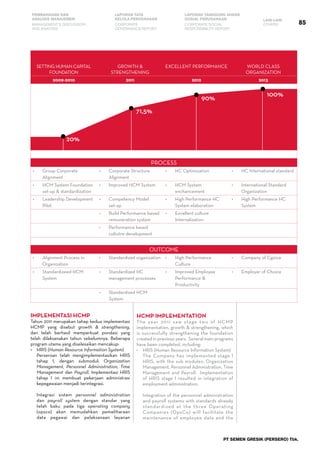
  • 102.
    157 PEMBAHASAN DAN ANALISIS MANAJEMEN LAPORANTATA KELOLA PERUSAHAAN LAPORAN TANGGUNG JAWAB SOSIAL PERUSAHAAN LAIN-LAIN MANAGEMENT’S DISCUSSION AND ANALYSIS CORPORATE GOVERNANCE REPORT CORPORATE SOCIAL RESPONSIBILITY REPORT OTHERS PT SEMEN GRESIK (PERSERO) Tbk. marjin EBITDA menjadi 23,7% atau turun 0,2%. Peningkatan EBITDA terutama berasal dari peningkatan penjualan. Penghasilan lain-lain (bersih) adalah sebesar Rp22 miliar dan beban pajak sebesar Rp252 miliar, sehingga laba bersih mencapai Rp729 miliar atau meningkat 12,5% dari Rp648 miliar pada tahun sebelumnya. Kenaikan laba bersih terutama karena keberhasilan SP meningkatkan penjualan. Dengan demikian Net Margin sebesar 15,3% atau meningkat 0,1% di atas tahun 2010 yang sebesar 15,2%. Pencapaian ini menghasilkan Return on Equity pada tahun 2011 sebesar 28,0% menurun 1,5% dibanding tahun 2010, sebesar 29,5%. Lain-lain Kantor Akuntan Publik telah memberikan opini wajar dalamsemuahalyangmaterialataslaporankeuangan konsolidasian SP dan entitas anak untuk tahun yang berakhir pada tanggal 31 Desember 2011. SP telah mendapatkan akreditasi manajemen mutu ISO 9001 : 2000 berupa sertifikat No. QSC 00517 dari Sucofindo ICS, pengakuan terhadap mutu jenis semen OWC dari American Petroleum Institute (API) berupa sertifikat No. 10A-0044 pada tahun 1995, dan akreditasi sistim manajemen lingkungan ISO 14001: 2004, sertifikat No. EMS 00013 dari Sucofindo ICS serta SMK3, OHSAS 18001 dan ISO 17025. SP memiliki entitas anak: - PT Sepatim Batamtama (SB) SB berlokasi di Batam, Riau, yang bergerak di bidang perdagangan umum, pengantongan semen, kontraktor, jasa dan pengangkutan umum. Penyertaan SP sebesar 85% dan Dana Pensiun Semen Padang sebesar 15%. Nilai aset SB pada akhir tahun 2011 sebesar Rp.24,75 miliar. Nilai penjualan SB di tahun adalah sebesar Rp.65,62 miliar dengan perolehan rugi bersih sebesar Rp.0,26 miliar (sebelum eliminasi). Laporan keuangan SB dikonsolidasikan ke laporan keuangan SP. - PT Bima Sepaja Abadi (BSA) BSA berlokasi di Tanjung Priok, Jakarta. Bidang usaha BSA meliputi perdagangan umum dan peragenan (perwakilan) perusahaan lain, pengantongan semen, dan kegiatan yang berhubungan dengan perdagangan semen. SP memiliki saham sebesar 80% dan PT. Bima IntanKencana sebesar 20%. Nilai aset BSA pada akhir tahun 2011 sebesar Rp. 96,72 miliar. Nilai penjualan SB di tahun adalah sebesar Rp.317,72 miliar dengan perolehan laba bersih sebesar Rp.11,48 miliar (sebelum eliminasi). Laporan keuangan SB dikonsolidasikan ke laporan keuangan SP. - PT Igasar Merupakan entitas asosiasi SP yang berlokasi di Padang, Sumatera Barat. Bidang usaha PT the EBITDA margin at 23.7%, or a decrease of 0.2%. The increase in EBITDA was predominantly due to increased sales. Other income (net) amounted to Rp22 billion with tax expenses of Rp252 billion, thus new profit reached Rp729 billion, an increase of 12.5% from Rp648 billion the previous year. The increase in net profit was predominantly due to SP’s success in increasing sales. Therefore, Net Margin amounted to 15.3%, an increase of 0.1% over 2010’s 15.2%. This achievement resulted in Return on Equity in 2011 reaching 28.0%, a decrease of 1.5% compared to 2010 at 29.5%. Miscellaneous The Public Accounting Firm gave its opinion as fair in all material aspects for the consolidated financial statements of SP and its subsidiaries for the year ending December 31, 2011. SP has attained ISO 9001:2000 accreditation for quality management in the form of certificate No. QSC00517fromSucofindoICS,acknowledgment of the quality of its OWC cement from the American Petroleum Institute (API) in the form of certificate No. 10A-0044 in 1995, and ISO 14001:2004 environmental management system accreditation with certificate No. EMS 00013 from Sucofindo ICS, as well as SMK3, OHSAS 18001 and ISO 17025 accreditation. SP owns subsidiaries: - PT Sepatim Batamtama (SB) SB is located in Batam, Riau, and is active in the fields of general trading, cement packaging, contracting, service provision and public transportation. SB is 85% owned by SP and 15% by the Semen Padang Pension Fund. As of end 2011, SB’s asset value was Rp24.75 billion. Sales value for the year amounted to Rp65.62 billion with a net loss of Rp0.26 billion (prior to eliminations). SB’s financial statements are consolidated with SP’s financial statements. - PT Bima Sepaja Abadi (BSA) BSA is located in Tanjung Priok, Jakarta. Its fields of business include general trading and agency (representation) for other companies, cement packaging, and activities related to trading cement. SP owns 80% of BSA shares, while PT Bima Intan Kencana owns 20%. BSA’s asset value as of end 2011 amounted to Rp96.72 billion. Sales value at SB for the year amounted to Rp317.72 billion with net profit of Rp11.48 billion (prior to eliminations). BSA’s financial statements are consolidated with those of SP. - PT Igasar PT Igasar is an associate company to SP located in Padang, West Sumatera. Its fields
  • 103.
    LAPORAN TAHUNAN 2011ANNUAL REPORT LAPORAN MANAJEMEN INFORMASI BAGI INVESTOR TINJAUAN OPERASIONAL Management Report INFORMATION FOR INVESTORS OPERATIONAL PERFORMANCE158 INFORMASI PERUSAHAANIKHTISAR COMPANY PROFILEHIGHLIGHTS Igasar meliputi: Distribusi semen, transportasi dan alat berat; Produksi bahan bangunan; Perdagangan umum. Saham PT Igasar dipegang oleh Koperasi KaryawanSemenPadangsebesar68%,Yayasan Igasar sebesar 20% dan SP sebesar 12%. - PT Sumatera Utara Perkasa Semen PT Sumatera Utara Perkasa Semen (“SUPS”), dahulu PT Deli Semen, adalah entitas asosiasi PT Semen Padang dan tempat kedudukan di Medan, Sumatera Utara. Bidang usaha SUPS meliputi jasa pengantongan dan pembuatan kantong semen. Saham SUPS dipegang oleh Husman Painan sebesar 68%, Dana Pensiun Semen Padang sebesar 18%, SP sebesar 10% dan PT PPI sebesar 4%. PT Semen Tonasa (ST) Saham ST dimiliki oleh Perseroan sebesar 99,99%, bergerak di industri persemenan dan berlokasi di Biringere,Pangkep,SulawesiSelatan.STmempunyai kapasitas produksi terpasang sebesar 4,3 juta ton per tahun yang dihasilkan oleh 3 (tiga) unit pabrik, yaitu; Tonasa II, Tonasa III dan Tonasa IV. (dalam ribuan ton) of business include: cement distribution, transportation and heavy equipment; production of building supplies; general trading. Shares in PT Igasar are held by the Semen Padang Employees’ Cooperative at 68%, Igasar Foundation at 20% and SP at 12%. - PT Sumatera Utara Perkasa Semen PT Sumatera Utara Perkasa Semen (“SUPS”), previously PT Deli Semen, is an associate company to PT Semen Padang and located in Medan, North Sumatera. SUPS’ field of business includes packaging services and production of cement bags. Shares in SUPS are held by Husman Painan with 68%, the Semen Padang Pension Fund with 18%, SP with 10% and PT PPI with 4%. PT Semen Tonasa (ST) The Company owns 99.99% of ST, a cement producer located in Biringere, Pangkep, South Sulawesi. ST has an installed production capacity of 4.3million tons per year produced by 3 (three) factories; Tonasa II, Tonasa III and Tonasa IV. (in thousands of tons) Nama Pabrik 2011 2010 Perubahan % Change % Tonasa II 700 650 7.7 Tonasa III 700 650 7.7 Tonasa IV 2,900 2,800 3.6 Total Kapasitas Total Capacity 4,300 4,100 4.9 Produksi Production 3,869 3,648 6.1 Tingkat Utilisasi (%) Level of Utilization (%) 90.0 89,0 1.1 Jenis semen yang diproduksi oleh ST mencakup jenis semen Ordinary Portland Cement (OPC), Portland Composite Cement (PCC) dan Portland Pozzolan Cement (PPC). ST sedang membangun pabrik semen baru, Tonasa V dengan kapasitas sebesar 2,5 juta ton per tahun. Unit pabrik baru tersebutdirencanakanakanmulaiberoperasitahun 2012. Disamping itu ST juga sedang membangun pembangkit listrik dengan kapasitas 2x35 MW dan direncanakan akan beroperasi pada tahun 2012. Lokasi ST sangat strategis untuk mendistribusikan semen di daerah pasar utama Perseroan di wilayah Indonesia bagian Timur. Daerah pasar ST antara lain wilayah Sulawesi, Kalimantan dan Nusa Tenggara. Untuk mendukung pemasarannya, ST mengoperasikan beberapa fasilitas pengantongan semen antara lain di Bitung, Samarinda, Banjarmasin, Bali, Ambon dan Palu. Ikhtisar Kinerja Keuangan Tabel ikhtisar kinerja keuangan ST selama 2011 dibandingkan 2010 disajikan dalam tabel berikut: The types of cement produced by ST include Ordinary Portland Cement (OPC), Portland Composite Cement (PCC) and Portland Pozzolan Cement (PPC). ST is currently building a new cement factory, Tonasa V with a capacity of 2.5 million tons per year. Production at the new factory is expected to commence in 2012. In addition, ST is also building a power plant with a capacity of 2 x 35 , which is expected to go into operation in 2012. ST is very strategically located to distribute cement to the Company’s main market areas in eastern Indonesia. ST’s market areas include Sulawesi, Kalimantan and Nusa Tenggara. In support of its marketing, ST operates several cement packaging plants, including in Bitung, Samarinda, Banjarmasin, Bali, Ambon and Palu. Financial Performance Highlights Financial Performance Highlights for ST during 2011 in comparison to 2010 are presented in the following table:
  • 104.
    159 PEMBAHASAN DAN ANALISIS MANAJEMEN LAPORANTATA KELOLA PERUSAHAAN LAPORAN TANGGUNG JAWAB SOSIAL PERUSAHAAN LAIN-LAIN MANAGEMENT’S DISCUSSION AND ANALYSIS CORPORATE GOVERNANCE REPORT CORPORATE SOCIAL RESPONSIBILITY REPORT OTHERS PT SEMEN GRESIK (PERSERO) Tbk. (dalam Rp juta) Keterangan Description 2011 2010 Perubahan % Change % Pendapatan Revenues 3,039,863 2,723,864 11,6 Beban Pokok Pendapatan Cost of Revenues 1,964,029 1,682,722 16,7 Laba Bruto Gross Profit 1,075,834 1,041,142 3,3 Beban Usaha Operating Expenses 338,979 302,983 11,9 Laba Usaha Operating Profit 736,855 738,159 (0,2) EBITDA 846,348 840,401 0,3 Laba Bersih Net Profit 544,889 542,996 0,3 Ekuitas Equity 2,238,279 1,941,683 15,3 ROE (%) 24,3 28 (3,7) Net Margin (%) 17,9 19,9 (2,0) Produksi Dan Penjualan Selama tahun 2011 produksi semen ST mencapai 3.868.704 ton atau naik 6,1% dari tahun 2010, sebesar 3.648.159 ton. Peningkatan tersebut didukung oleh semakin lancarnya aktifitas operasi dengan mengoptimalkan program total preventive maintenance secara rutin untuk mendukung stabilitas produksi pabrik Tonasa II, III, dan IV. Seiring dengan peningkatan permintaan kebutuhan semen di pasar domestik, penjualan ST mencapai volume 3,8 juta ton, atau naik 8,6% dari penjualan sebesar 3,5 juta ton di tahun 2010, sedangkan penjualan ekspor mencapai 77 ribu ton, turun dari volume sebesar 103 ribu ton di tahun sebelumnya. Khusus untuk pasar Sulawesi ST mampu memasok semen sebesar 2.118 ribu ton atau meningkat 15,2% dibanding tahun 2010 sebesar 1.838 ribu ton. Hal ini seiring dengan peningkatan kebutuhan semen di Sulawesi yang mencapai 3.521 ribu ton atau meningkat 15,8% dari tahun 2010 yang sebesar 3.041 ribu ton. Keberhasilan ST dalam meningkatkan volume penjualan di pasar domestik ini membuat pangsa pasar ST menjadi 7,9% dari demand nasional Profitabilitas Pada tahun 2011, ST berhasil membukukan pendapatan sebesar Rp3.040 miliar atau naik 11,6% dari tahun 2010 yang sebesar Rp2.724 miliar. Peningkatan dicapai berkat kontribusi naiknya volume penjualan total sebesar 8,6% dan naiknya harga jual rata-rata sebesar 3,3% dari tahun sebelumnya. Setelahmemperhitungkanbebanpokokpendapatan sebesar Rp1.964 miliar dan beban usaha sebesar Rp339 miliar, diperoleh laba usaha sebesar Rp737 miliar atau turun 2,0% dari tahun 2010, sebesar Rp738 miliar dengan marjin operasi sebesar 24,2% lebih rendah dari nilai 27,1% di tahun tahun 2010. Pencapaian ini menghasilkan EBITDA sebesar Rp846 miliar dan Marjin EBITDA sebesar 27,8% atau turun 0,7% dari tahun sebelumnya, sebesar 27,1%. Interest Coverage Ratio pada tahun 2011 naik menjadi 140 kali, sebagai dampak dari bertambahnya outstanding pinjaman sehubungan (in millions Rp) Production and Sales During 2011, cement production at ST reached 3,868,704 tons, an increase of 6.1% over 2010, which amounted to 3,648,159 tons. This increase was supported by smoother operations resulting from the total preventive maintenance optimization program being routinely implemented to support production stability at Tonasa II, III, and IV factories. In line with the increasing demand for cement on the domestic market, ST’s sales reached a volume of 3.8 million tons, up 8.6% from the previous sales volume of 3.5 million tons in 2010, while export sales reached 77 thousand tons, a decrease from the sales volume in the previous year of 103 thousand tons. SpecificallyfortheSulawesimarket,STsupplied2,118 thousand tons of cement, or an increase of 15.2% compared to 2010 which reached 1,838 thousand tons. This is in line with rising cement requirements in Sulawesi which reached 3,521 thousand tons or an increase of 15.8% over 2010, which amounted to 3,041 thousand tons. ST’s success in increasing its sales volume in the domestic market meant it took 7.9% market share from national demand. Profitability In 2011, ST recorded income of Rp3,040 billion, or a rise of 11.60% from 2010, which amounted to Rp2,724 billion. This increase was achieved thanks to an increased contribution from total sales volume of 8.6% and an increase in sales price of an average 3.3% on the previous year. After calculating cost of income at Rp1,964 billion and operating expenses of Rp339 billion, operating profit amounted to Rp737 billion, or a decrease of 2.0% over 2010’s Rp738 billion with an operating margin of 24.2%, lower than the 27.1% in 2010. This achievement resulted in EBITDA of Rp846 billion and EBITDA margin of 27.8%, or a decline of 0.7% from the previous year’s 27.1%. Interest Coverage Ratio in 2011 increased to 140 times, as a result of additional outstanding loans related to
  • 105.
    LAPORAN TAHUNAN 2011ANNUAL REPORT LAPORAN MANAJEMEN INFORMASI BAGI INVESTOR TINJAUAN OPERASIONAL Management Report INFORMATION FOR INVESTORS OPERATIONAL PERFORMANCE160 INFORMASI PERUSAHAANIKHTISAR COMPANY PROFILEHIGHLIGHTS dengan pelaksanaan pembangunan pabrik baru dan unit pembangkit listrik baru. Setelah memperhitungkan pendapatan lain- lain (bersih) sebesar Rp5,2 miliar dan beban pajak sebesar Rp198 miliar, maka diperoleh laba bersih sebesar Rp545 miliar atau meningkat 0,3% dari laba tahun 2010, sebesar Rp543 miliar. Pencapaian ini menghasilkan Net Margin sebesar 17,9% atau turun sebesar 2% dari tahun lalu, 19,9%. Pencapaian ini juga memberikan Return on Equity pada tahun 2011 menjadi sebesar 24,3% turun 3,7% dari tahun 2010, sebesar 28,0%. Pencapaian kinerja yang baik tersebut merupakan hasil dari semakin baiknya sinergi dalam grup. Lain-lain Kantor Akuntan Publik telah memberikan opini wajar dalam semua hal yang material atas laporan keuangan ST untuk tahun yang berakhir pada tanggal 31 Desember 2011. ST telah mendapatkan akreditasi manajemen mutu ISO 9001:2000, sistem manajemen lingkungan ISO 14001:2004 dari SGS Yarsley International Sertification Services Limited, sertifikasi keselamatan kerja di areal pelabuhan dan kapal laut dengan telah diraih ISPS Code dan telah menerapkan SMK3. SEGMEN USAHA NON SEMEN Industri Pertambangan PT United Tractors Semen Gresik (UTSG) UTSG berlokasi di Tuban, Jawa Timur dan bergerak di bidang pertambangan, perdagangan dan pemberian jasa. Saham UTSG dimiliki oleh Perseroan sebesar 55% dan PT United Tractors Tbk sebesar 45%. Kegiatan utama UTSG diprioritaskan untuk menunjang kegiatan produksi Perseroan, khususnya dalam hal penyediaan jasa penambangan batu kapur dan tanah liat. Produksi dan Penjualan Padatahun2011,totalproduksipenambangankapur UTSG adalah 10.547.902 ton dan tanah liat sebesar 2.493.276 ton, seluruhnya digunakan sebagai bahan baku pembuatan semen oleh Perseroan. Selain menambang kapur dan tanah liat untuk Perseroan, UTSG juga memberikan jasa penambangan untuk pihak lain yang membutuhkan. Volume jasa penambangan untuk pihak lain tersebut pada tahun 2011 mencapai total sebesar 608.685 BCM dan 7.037.913 ton. UTSG juga memberikan jasa rental alat berat yang di tahun 2011 mencapai 108.792 jam. Profitabilitas Pendapatan UTSG pada umumnya diperoleh dari hasil jasa tambang batu kapur dan tanah liat, jasa peledakan, sewa peralatan dan penjualan tanah liat.ProfitabilitasUTSGdiukurdarikemampuannya dalam menyediakan bahan baku bagi Perseroan dengan cara se efisien mungkin dan kemampuan the construction of the new factory and power plant. After calculating other income (net) of Rp5.2 billion and tax expenses of Rp198 billion, net profit obtained amounted to Rp545 billion, or an increase of 0.3% from 2010’s Rp543 billion. This achievement resulted in a Net Margin of 17.9%, or a decrease of 2% on the previous year’s 19.9%. This resulted in a Return on Equity in 2011 of 24.3%, a fall of 3.7% from 2010’s 28.0%. Good performance achievements were a result of improved synergy within the group. Miscellaneous A Public Accounting Firm gave the opinion unqualified in all material aspects for ST’s financial statement for the year ending December 31, 2011. ST has achieved accreditation in management systems,includingISO9001:2000,environmental management system ISO 14001:2004 from SGS Yarsley International Certification Services Limited, certification in occupational safety in port areas and for ships complying with the ISPS Code and SMK3. NON CEMENT BUSINESS Mining Industry PT United Tractors Semen Gresik (UTSG) UTSG is located in Tuban, East Java, and operates in the fields of mining, trading and service provision. The Company owns 55% of UTSG shares while PT United Tractors Tbk owns 45%. The business of UTSG is mainly prioritized to support the Company’s production activities, specifically supplying limestone and clay mining services. Production and Sales In 2011, UTSG mining produced a total of 10,547,902 tons of limestone and 2,493,276 tons of clay, all of which was used as raw material for the Company to produce cement. In addition to mining limestone and clay for the Company, UTSG also provides mining services to other parties. Mining services for other parties in 2011 amounted to 608,685 BCM and 7,037,913 tons. UTSG also provides heavy equipment leasing services, which in 2011 reached 108,792 hours. Profitability UTSG’s income comes primarily from limestone and clay mining services, blasting services, equipment leasing and sales of clay. UTSG’s profitability is measured in its ability to supply raw materials to the Company as efficiently as possible and its ability to leverage its
  • 106.
    161 PEMBAHASAN DAN ANALISIS MANAJEMEN LAPORANTATA KELOLA PERUSAHAAN LAPORAN TANGGUNG JAWAB SOSIAL PERUSAHAAN LAIN-LAIN MANAGEMENT’S DISCUSSION AND ANALYSIS CORPORATE GOVERNANCE REPORT CORPORATE SOCIAL RESPONSIBILITY REPORT OTHERS PT SEMEN GRESIK (PERSERO) Tbk. untuk memanfaatkan kompetensinya dibidang penambangan maupun pengelolaan armada alat berat yang dimiliki. Pada tahun 2011 UTSG membukukan pendapatan sebesar Rp290 miliar atau naik 36,4% dari tahun 2010, sebesar Rp213 miliar (sebelum eliminasi). Sebesar 36% dari nilai pendapatan UTSG sebelum tersebut merupakan nilai penjualan non grup, yakni pendapatan dari jasa penambangan yang meningkat hingga 350% dan penyewaan alat berat yang meningkat 24%. Setelah memperhitungkan beban pokok pendapatan sebesar Rp251 miliar dan beban usaha sebesar Rp21 miliar maka laba usaha yang dihasilkan pada tahun 2011 adalah Rp17 miliar naik 11,6% dari tahun sebelumnya yang sebesar Rp15 miliar. Pencapaian ini menghasilkan Operating Margin sebesar 5,9%, turun 1,3% dari angka 7,2% di tahun sebelumnya. EBITDA adalah Rp50 miliar sehingga EBITDA Margin 17,1% atau lebih rendah 0,3% dari posisi 17,5% di tahun 2010. Interest Coverage Ratio pada tahun 2011 sebesar 5,9 kali turun dari angka 9,01 kali di tahun 2010, sebagai dampak bertambahnya pinjaman pihak ketiga dalam rangka penambahan dan peremajaan peralatan. Net margin adalah sebesar 2,4% atau turun dari 4,6% ditahun 2010. Lain-lain Kantor Akuntan Publik telah memberikan opini wajar dalam semua hal yang material, posisi keuangan UTSG untuk tahun yang berakhir pada tanggal 31 Desember 2011. UTSG telah memperoleh sertifikat ISO 9001:2000 dari Quality Endorsed Company untuk manajemen mutu dan sertifikat ISO 14001:2004 dari Certified Environmental Company. UTSG juga telah memperoleh sertifikat Astra Green Company dan Astra Friendly Company yang merupakan penghargaan yang diberikan kepada perusahaan yang tergolong dalam group dan assosiasi Astra International terhadap implementasi manajemen LK3H dan kepedulian perusahaan terhadap lingkungan sosial perusahaan. Kantong Kemasan PT Industri Kemasan Semen Gresik (IKSG) IKSG bergerak di bidang pembuatan kemasan atau industri kemasan, perdagangan dan jasa, yang berlokasi di Tuban Jawa Timur. Komposisi pemegang saham adalah Perseroan sebesar 60%, PT Fajar Mas Murni sebesar 30%, dan PT Newlong Indonesia sebesar 10%. Dalam menjalankan kegiatan operasinya, IKSG memiliki mesin sebanyak 4 line pasted dan 2 line jahit woven dengan total kapasitas terpasang pasted 200,6 juta kantong per tahun dan total kapasitas terpasang jahit woven 28,7 juta kantong per tahun. Hasil produksi IKSG diprioritaskan untuk memenuhi kebutuhan Perseroan. competency in mining and the management of its heavy equipment fleet. In 2011, UTSG recorded income amounting to Rp290 billion, an increase of 36.4% over 2010 at Rp213 billion (prior to eliminations). Of this income, 36% is from non group sales, i.e. an increase in mining services of 350% and heavy equipment leasing, which increased 24%. After calculating cost of revenue at Rp251 billion and operating expenses of Rp21 billion, operating profit in 2011 reached Rp17 billion, an increase of 11.6% on the previous year’s Rp15 billion. This achievement resulted in an Operating Margin of 5.9%, a decrease of 1.3% from the 7.2% the previous year. EBITDA was Rp50 billion and EBITDA Margin 17.1%, or 0.3% lower than the 17.5% position in 2010. Interest Coverage Ratio in 2011 amounted to 5.9 times, a decrease from the 9.01 times in 2010, as a result of additional third party loans for the purpose of adding to and replacing equipment. Net margin was 2.4%, a reduction from 4.6% in 2010. Miscellaneous A Public Accounting Firm gave the opinion fair in all material aspects for the UTSG financial position for the year ending December 31, 2011. UTSG has certification in a variety of fields, including ISO 9001:2000 as a Quality Endorsed Company for quality management and ISO 14001:2004 as a Certified Environmental Company.UTSGalsoholdsAstraGreenCompany and Astra Friendly Company certification, which are awards given to companies within or associated with Astra International for the implementation of HSE management systems and corporate social responsibility programs. Packaging Bags PT Industri Kemasan Semen Gresik (IKSG) IKSG produces packaging and is also active in trading and service provision, and is located in Tuban, East Java. Shareholder composition in IKSG is 60% the Company, 30% PT Fajar Mas Murni, and 10%PT Newlong Indonesia. In conducting its business operations, IKSG owns 4 line pasted and 2 line woven stitch machines with a total installed capacity of 200.6 million pasted bags per year and 28.7 million woven stitch bags per year. Production at IKSG is prioritized to fulfill Company requirements.
  • 107.
    LAPORAN TAHUNAN 2011ANNUAL REPORT LAPORAN MANAJEMEN INFORMASI BAGI INVESTOR TINJAUAN OPERASIONAL Management Report INFORMATION FOR INVESTORS OPERATIONAL PERFORMANCE162 INFORMASI PERUSAHAANIKHTISAR COMPANY PROFILEHIGHLIGHTS Produksi dan Penjualan Volume produksi kantong di tahun 2011 mencapai 214,87 juta kantong, naik 5,6% dari produksi tahun 2010, sebesar 203,44 juta kantong. Dengan volume sebesar itu berarti IKSG telah beroperasi pada tingkat utilitas sebesar 86%. Untuk mengantisipasi peningkatan kebutuhan Induk Perseroan akan kantong semen yang bermutu, IKSG mulai merencanakanpenambahanliniproduksisebanyak 1 (Satu) unit. Sekitar 90% hasil produksi kantong semen IKSG diserap oleh Perseroan, sisanya di jual ke produsen semen lain. Profitabilitas Total pendapatan pada tahun 2011 sebesar Rp206 miliar atau naik 12,6% dari tahun 2010, sebesar Rp183 miliar (sebelum eliminasi). Setelah memperhitungkan beban pokok pendapatan sebesar Rp141 miliar dan beban usaha sebesar Rp20 miliar, sehingga diperoleh laba usaha sebesar Rp45 miliar atau naik 2,5% dari tahun sebelumnya, sebesar Rp43 miliar. Operating Margin sebesar 21% atau 1,6% di bawah tahun 2010, sebesar 22,6%. EBITDA mencapai sebesar Rp52 miliar sehingga EBITDA Margin sebesar 25% atau 2,9% di bawah tahun 2010, sebesar 27,9%. Dengan memperhitungkan beban lain-lain (bersih) sebesar Rp169 juta dan beban pajak sebesar Rp12 miliar, maka diperoleh laba bersih sebesar Rp33 miliar atau 4,2% di atas tahun sebelumnya, sebesar Rp31 miliar. Dengan demikian Net Margin menjadi sebesar 15,8% atau turun 1,2% dari tahun 2010, sebesar 17,1%. Pencapaian ini juga memberikan Return on Equity pada tahun 2011 sebesar 22,1% atau turun 2% dari tahun 2010, sebesar24,0%. Lain-lain Kantor Akuntan Publik telah memberikan opini wajar dalam semua hal yang material atas laporan keuangan IKSG untuk tahun yang berakhir pada tanggal 31 Desember 2011. Dalam bidang pengelolaan perusahaan, IKSG telah memperoleh Sertifikat ISO 9001 : 2000 dari LIoyd’s Register Quality Assurance dan Sertifikat SMK3 dari PT Sucofindo, Jakarta. Real Estate PT Kawasan Industri Gresik (KIG) KIG berlokasi di Gresik, Jawa Timur yang bergerak di bidang industrial estate yang meliputi perolehan, pengembangan, penjualan dan persewaan tanah industri, gudang, ruko maupun bangunan pabrik siap pakai (BPSP) di dalam dan luar kawasan, termasuk konstruksi untuk pengembangan fasilitas umum seperti jalan, penyediaan air, listrik dan lain - lain. Kepemilikan saham Perseroan sebesar 65% dan PT Petrokimia Gresik (Persero) sebesar 35%. Production and Sales Bag production volume in 2011 reached 214.87 million bags, an increase of 5.6% from 2010 production of 203.44 million bags. At this production volume, IKSG is operating at a utilization level of 86%. In anticipation of rising demand from the parent company for quality cement bags, IKSG has started planning an additional production line. Approximately 90% of IKSG’s production of cement bags is absorbed by the Company, with the remainder sold to other cement producers. Profitability Total revenue in 2011 amounted to Rp206 billion, or an increase of 12.6% on 2010, which achieved Rp183 billion (prior to eliminations). After calculating cost of revenue at Rp141 billion and operating expenses at Rp20 billion, operating profit amounted to Rp45 billion, or an increase of 2.5% on the previous year’s Rp43 billion. The Operating Margin was 21%, or 1.6% below that of 2010, which recorded 22.6%. EBITDA reached Rp52 billion, thus the EBITDA Margin amounted to 25%, or 2.9% below that of 2010 at 27.9%. Calculating other (net) expense amounted Rp2 billion and tax expenses at Rp169 million, net profit amounted to Rp33 billion, or a 4.2% increase on the previous year’s Rp31 billion. Therefore, Net Margin amounted to 15.8%, or a decrease of 1.2% on 2010, which achieved 17.1%. This achievement provided a Return on Equity in 2011 of 22.1%, or a decrease of 2% on 2010, which recorded 24.0%. Miscellaneous A Public Accounting Office gave the opinion fair in all material aspects for the IKSG financial statement for the year ending December 31, 2011. In the field of company management, IKSG has been awarded certification in ISO 9001:2000 from Lloyd’s Register Quality Assurance and SMK3 certification from PT Sucofindo, Jakarta. Real Estate PT Kawasan Industri Gresik (KIG) KIG is located in Gresik, East Java, and is involved in industrial estates, including acquisition, development, sales and rental of industrial land, warehousing, shop-houses, and ready to use factory buildings, both within and outside its estates, including construction for the development of public facilities, including roads, water and electricity services, and others. The Company owns 65% of KIG shares, while PT Petrokimia Gresik (Persero) owns 35%.
  • 108.
    PT SEMEN GRESIK(PERSERO) Tbk. 163 PEMBAHASAN DAN ANALISIS MANAJEMEN LAPORAN TATA KELOLA PERUSAHAAN LAPORAN TANGGUNG JAWAB SOSIAL PERUSAHAAN LAIN-LAIN MANAGEMENT’S DISCUSSION AND ANALYSIS CORPORATE GOVERNANCE REPORT CORPORATE SOCIAL RESPONSIBILITY REPORT OTHERS Volume Penjualan KIG mengelola lahan kawasan industri seluas 141 ha, dengan 97 ha diantaranya adalah areal persewaan dan areal lahan untuk dijual. KIG juga mengelola areal pergudangan seluas 49.852 m2 untuk disewakan, mengelola BPSP seluas 12.960 m2 dan mengelola 50 unit ruko. Selama tahun 2011, seiring dengan peningkatan kegiatan perekonomian di sekitar areal kelolaannya, KIG mampu meningkatkan volume penjualan produk dan jasanya. Dari total area kawasan industri, KIG mampu menyewakan 7 ha, dan menjual area seluas 6 ha. KIG juga mampu menyewakan area pergudangan seluas 6 ha. Profitabilitas Total pendapatan usaha pada tahun 2011 sebesar Rp49 miliar atau naik 53,1% dari tahun 2010 sebesar Rp32 miliar. Setelah memperhitungkan beban pokok pendapatan sebesar Rp8 miliar dan beban usaha sebesar Rp11 miliar, maka diperoleh laba usaha sebesar Rp30 miliar, meningkat 100% dari tahun sebelumnya, sebesar Rp15 miliar. Operating Margin sebesar 14% di atas periode tahun 2010. EBITDA mencapai sebesar Rp40 miliar sehingga EBITDA Margin 82% atau 5% di atas tahun 2010. Dengan memperhitungkan penghasilan lain-lain (bersih) sebesar Rp7 miliar dan beban pajak sebesar Rp5 miliar, maka diperoleh laba bersih sebesar Rp32 miliarataumeningkat57%daritahunsebelumnyayang menghasilkan Net Margin sebesar 65,7%, mengalami peningkatan 0,6% dari tahun 2010. Pencapaian ini juga meghasilkan Return on Equity pada tahun 2011 sebesar 27,9% atau naik 6% dari tahun 2010. Lain-lain Kantor Akuntan Publik telah memberikan opini wajar dalam semua hal yang material atas laporan keuangan KIG untuk tahun yang berakhir pada tanggal 31 Desember 2011. SEGMEN USAHA LAINNYA Perseroan memiliki beberapa entitas asosiasi yang didalam laporan keuangan konsolidasian dicatat dengan metode ekuitas dan biaya. Kegiatan entitas asosiasi ini bervariasi, namun pada umumnya dilakukan dalam rangka mendukung operasional Perseroan. Beberapa entitas asosiasi tersebut tercakup dalam uraian berikut: PT Swadaya Graha (SWG) SWG terletak di Gresik, Jawa Timur dan bergerak dalam bidang fabrikasi baja, kontraktor sipil, kontraktor mekanikal & elektrikal, persewaan alat- alat berat & konstruksi, bengkel & manufaktur, developer,jasapemeliharaan,sertabiroengineering. Komposisi kepemilikan saham di SWG dipegang oleh Perseroan sebesar 25,0%, Dana Pensiun Semen Gresik 62,5%, PT Varia Usaha 8,06%, dan Koperasi Warga Semen Gresik 4,44%. Sales Volume KIG manages 141 ha of industrial land, 97 ha of which is rental land and land for sale. KIG also manages a warehousing estate measuring 49,852 m2 that is available for rent, and manages BPSP, which measures 12,960 m2, as well as 50 shop- houses. During 2011, in line with increasing economic activity around the area that it manages, KIG was able to increase sales volume of its products and services. From the total industrial area under its control, KIG rented 7 ha and sold 6 ha. KIG was also successful in renting out a warehousing area of 6 ha. Profitability Total revenue in 2011 amounted to Rp49 billion, or an increase of 53.1% over 2010’s Rp32 billion. After calculating cost of revenue at Rp8 billion and operating expenses at Rp11 billion, operating profit reached Rp30 billion, a 100% increase over the previous year which achieved Rp15 billion. The Operating Margin was recorded at 14% above that of 2010. EBITDA reached Rp40 billion, thus the EBITDA Margin was 82%, or 5% higher than in 2010. Other revenue (net) was calculated at Rp7 billion and tax expenses at Rp5 billion, thus net profit amounted to Rp32 billion, or an increase of 57% on the previous year which achieved a Net Margin of 65.7%, an increase of 0.6% over 2010. This achievement also resulted in a return on equity in 2011 of 27.9%, an increase of 6% over 2010. Miscellaneous A Public Accounting Office gave the opinion fair in all material aspects for the KIG financial statement for the year ending December 31, 2011. OTHER BUSINESS SEGMENTS The Company has various associate companies that are recorded in the consolidated financial statement using the equity and expense method. The business activities of these associate companies are varied but in general support the Company’s operations. Several of the associate companies are included in the following description. PT Swadaya Graha (SWG) SWG is located in Gresik, East Java, and produces steel, is a civil contractor and mechanical and electrical contractor, leases heavy and construction equipment, owns repair shops and manufacturing, is a developer, offers maintenance services and is an engineering bureau. The Company owns 25% of SWG, while 62.5% is owned by the Semen Gresik Pension Fund, 8.06% by PT Varia Usaha and 4.44% by the Semen Gresik Employees Cooperative.
  • 109.
    LAPORAN TAHUNAN 2011ANNUAL REPORT LAPORAN MANAJEMEN INFORMASI BAGI INVESTOR TINJAUAN OPERASIONAL Management Report INFORMATION FOR INVESTORS OPERATIONAL PERFORMANCE164 INFORMASI PERUSAHAANIKHTISAR COMPANY PROFILEHIGHLIGHTS Dalam bidang pengelolaan perusahaan, SWG telah memperoleh Sertifikat ISO 9001:2008 dari Lloyd’s Register Quality Assurance dan Sertifikat SMK3 standard OHSAS 18001:2007 dari PT Sucofindo (Persero), Implementasi 5S yang dimulai bulan Nopember 2011. SWG mempunyai entitas anak : - PT Swabina Gatra: Lokasi di Gresik, Jawa Timur, yang mempunyai bidangusahaindustriairminumdalamkemasan; jasa tenaga kerja, pembersihan, pengantongan; pergudangan, perdagangan, pemeliharaan peralatan; travel, taman wisata Giri Wana Tirta dan persewaan. Komposisi kepemilikan saham terdiri dari SWG sebesar 6,7%, PT Varia Usaha sebesar 6,7%, Koperasi Wredatama 13,3%, dan Dana Pensiun Semen Gresik 73,3%. PT Varia Usaha (VU) VU merupakan entitas anak Perseroan yang berlokasi di Gresik, Jawa Timur, bergerak dalam bidang jasa pengangkutan umum dan ekspedisi dengan menggunakan/memakai truk dan/atau dengan kereta api, perdagangan termasuk ekspor impor antar pulau dalam negeri, keagenan, distributor, usaha perdagangan lainnya, perindustrian dan pembangunan, pertambangan (meliputi kegiatan: penyelidikan umum, eksplorasi, eksploitasi, pemurnian, pengangkutan dan penjualan hasil pertambangan). Komposisi kepemilikan saham di VU dimiliki oleh Perseroan sebesar 24,9%, Dana Pensiun Semen Gresik 48,7%, dan Koperasi Warga Semen Gresik 26,4%. Untuk meraih peluang usaha yang muncul dengan berbagai aspek dan prasyaratnya, VU melakukan pemekaran bidang usaha dalam wujud mendirikan beberapa entitas anak, yaitu : PT Varia Usaha Beton, PT Waru Abadi, PT Varia Usaha Dharma Segara, PT Varia Usaha Lintas Segara. Dalam bidang pengelolaan perusahaan, VU telah memperoleh Sertifikat ISO 9001:2000 dari SGS Indonesia. In the field of business management, SWG has obtained ISO 9001:2008 certification from Lloyd’s Register Quality Assurance and SMK3 certification to OHSAS 18001:2007 standards from PT Sucofindo (Persero), while 5S Implementation started in November 2011. SWG has a subsidiary: - PT Swabina Gatra: Located in Gresik, East Java, it business activities involve packaged drinking water; employment services, cleaning, and packaging; warehousing, trading, equipment maintenance; travel, Giri Wana Tirta tourist site and leasing. SWG owns 6.7% of the company, PT Varia Usaha owns 6.7%, Wredatama Cooperative 13.3%, and the Semen Gresik Pension Fund 73.3%. PT Varia Usaha (VU) VU is a subsidiary of the Company located in Gresik, East Java, and is involved in public transportation and facilitating transportation through the use of trucks and / or trains, trading including export and import, both inter-island and domestically, agency, distribution, other trading, industry and construction, mining (including: general investigation, exploration, exploitation, refining, transportation and sales of mine products). The Company owns 24.9% of VU, the Semen Gresik Pension Fund owns 48.7%, and Semen Gresik Employees Cooperative owns 26.4%. To take full advantage of business opportunities as they arise with their various aspects and preconditions, VU has expanded its business reach through the establishment of various subsidiaries, including: PT Varia Usaha Beton, PT Waru Abadi, PT Waru Abadi, PT Varia Usaha Dharma Segara, and PT Varia Usaha Lintas Segara. In the field of company management, VU has ISO 9001:2000 certification from SGS Indonesia.
  • 110.
    PT SEMEN GRESIK(PERSERO) Tbk. 165 PEMBAHASAN DAN ANALISIS MANAJEMEN LAPORAN TATA KELOLA PERUSAHAAN LAPORAN TANGGUNG JAWAB SOSIAL PERUSAHAAN LAIN-LAIN MANAGEMENT’S DISCUSSION AND ANALYSIS CORPORATE GOVERNANCE REPORT CORPORATE SOCIAL RESPONSIBILITY REPORT OTHERS PT Eternit Gresik (EG) EG merupakan entitas anak Perseroan yang berlokasi di Gresik, Jawa Timur. Ruang lingkup kegiatan perusahaan meliputi industri bahan bangunan non asbestos dan cetakan. Saham EG dimiliki oleh Perseroan sebesar 17,57% dan Team S.A. 82,4%. Dalam bidang pengelolaan perusahaan, EG telah memperoleh Sertifikat ISO 9001 : 2000 dan ISO 14001 : 2004 dari Benchmark Australia, serta OHSAS 18001 : 2007 tentang Keselamatan dan Kesehatan Kerja juga dari Benchmark Australia. PT Eternit Gresik (EG) EG is a subsidiary of the Company located in Gresik, East Java. Its scope of business includes non asbestos and printed building supplies. The Company owns 17.57% of EG shares, while Team S.A. owns 82.4%. In the field of company management, EG has certification in ISO 9001:2000 and ISO 14001:2004 from Benchmark Australia, as well as OHSAS 18001:2007 for Occupational Health and Safety from Benchmark Australia. informasi material MATERIAL INFORMATION PROGRAM EKSPANSI Pada periode pelaporan, Perseroan tengah menyelesaikan pembangunan 2 unit pabrik semen baru masing-masing berkapasitas 2,5 juta ton per tahun di Tuban (Jawa Timur) dan di Pangkep (Sulawesi Selatan), dan 1 unit pembangkit listrik di Pangkep, berkapasitas 2x35 MW sebagai bagian rencana ekspansi. Penjelasan lebih rinci mengenai realisasi ekspansi ini dapat dilihat pada uraian “Perkembangan Pembangunan Proyek Strategis”. Selain program ekspansi tersebut, pada periode pelaporan, Perseroan tidak melakukan rencana korporasi lain mencakup: investasi, divestasi, akuisisi maupun restrukturisasi utang. TRANSAKSI BENTURAN KEPENTINGAN Padaperiodepelaporan,tidakadatransaksibenturan kepentingan yang dilakukan oleh Peseroan. TRANSAKSI LINDUNG NILAI Pada tahun 2010 Perseroan dan entitas anak (ST) melakukan lindung nilai arus kas atas kontrak pengadaan barang dalam mata uang asing untuk pabrik semen dan pembangkit listrik dengan menggunakan instrumen keuangan non derivatif melalui pembelian spot mata uang asing yaitu Dolar Amerika Serikat dan Euro. Lindung nilai ini dilakukan untuk mengelola risiko fluktuasi nilai tukar mata uang asing yang mungkin terjadi akibat komitmen pengadaan barang dan jasa tersebut dalam USD dan EUR. Hasil pengujian efektivitas lindung nilai arus kas di atas secara prospektif dan retrospektif terbukti efektif. Sehingga, selisih kurs valuta asing yang timbul dari instrumen lindung nilai non-derivatif tersebut diakui sebagai pendapatan komprehensif lainnya. Selisih kurs valuta asing tersebut akan diakui sebagai bagian dari harga perolehan aset yang dilindung nilai. Jumlah selisih kurs mata uang asing yang dicatat di dalam akun tersebut per tanggal 31 Desember 2011 adalah laba sebesar Rp3,6 juta dan jumlah yang telah diakui sebagai bagian dari biaya perolehan aset adalah sebesar Rp93,4 miliar. EXPANSION PROGRAM During this reporting period, the Company is the midst of completing construction of 2 new cement plants, each with a capacity of 2.5 million tons per year, one in Tuban (East Java) and one in Pangkep (South Sulawesi), as well as 1 power plant in Pangkep with a capacity of 2 x 35 MW, as part of its expansion plan. A more detailed explanation can be found in “Development of Strategic Construction Projects”. Other than the expansion program, in this reporting period, the Company has made no other corporate plans involving: investment, divestment, acquisition or debt restructuring. CONFLICT OF INTEREST TRANSACTIONS In the reporting period, the Company has made no conflict of interest transactions. HEDGING TRANSACTIONS In 2010, the Company and its subsidiary (ST) entered into cash flow hedges for procurement of goods and services contracts in foreign currencies for the new cement plants and power plant using non-derivative financial instruments through spot purchase of foreign currencies i.e. United States Dollars and Euro. These hedging transactions were entered into to manage the risk of fluctuations in foreign currency exchange rates that may occur as a result of the commitment to procure the goods and services in USD and EUR. Theresultsofprospectiveandretrospectivetesting of the hedge effectiveness of the above mentioned cash flow hedges were proven to be effective. As a result, the foreign currencies exchange differences arising from the translation of the non-derivative hedging instrument into Rupiah are recognized under other comprehensive income. These foreign currency exchange differences will be recognized as part of acquisition costs of the underlying assets being hedged. Total foreign currency exchange differences recognized under this account as of December 31, 2011 were a gain amount of Rp3.6 million while the amount that has been recognized as part of the acquisition cost of assets amounted to Rp93.4 billion.
  • 111.
    LAPORAN TAHUNAN 2011ANNUAL REPORT LAPORAN MANAJEMEN INFORMASI BAGI INVESTOR TINJAUAN OPERASIONAL Management Report INFORMATION FOR INVESTORS OPERATIONAL PERFORMANCE166 INFORMASI PERUSAHAANIKHTISAR COMPANY PROFILEHIGHLIGHTS Lihat Catatan 32 Laporan Keuangan Konsolidasian mengenai transaksi lindung nilai ini. PINJAMAN PERBANKAN Dalam rangka penyelesaian pembangunan proyek strategis, Perseroan melakukan perjanjian pinjaman dengan perbankan baik berupa fasilitas pinjaman jangka pendek maupun jangka panjang. Untuk pinjaman jangka pendek, fasilitas pinjaman berupa pembukaan L/C, penerbitan Surat Kredit Berdokumen Dalam Negeri (SKBDN) dan Trust Receipt yang dilaksanakan langsung oleh Perseroan maupun melalui entitas anak dengan tiga bank berelasi (entitas sepengendalian) yakni PT Bank Rakyat Indonesia (Persero) Tbk, PT Bank Mandiri (Persero) Tbk dan PT Bank Negara Indonesia (Persero) Tbk. Tidak ada saldo pinjaman jangka pendek pada tanggal 31 Desember 2011 atas fasilitas pinjaman perbankan tersebut. Untuk pinjaman jangka panjang, Perseroan (melalui entitas anak), mendapatkan fasilitas pinjaman dari Sindikasi Bank berelasi, fasilitas pinjaman langsung dari PT Bank CIMB Niaga Tbk dan PT Bank Rakyat Indonesia (Persero) Tbk. Pinjaman Sindikasi dilakukan oleh entitas anak, PT Semen Tonasa (ST) dalam rangka pembangunan satu unit pabrik semen baru Tonasa V dan pembangkit listrik 2x35 MW. Perjanjian kredit sindikasi ditanda tangani oleh ST dengan PT Bank Mandiri (Persero) Tbk (selaku Pimpinan Sindikasi), PT Bank Rakyat Indonesia (Persero) Tbk, PT Bank Jatim, dan PT Bank Sulawesi Selatan (selanjutnya disebut sebagai Bank Sindikasi) dengan fasilitas kredit maksimum sebesar Rp3.547 miliar atau 68% dari jumlah nilai investasi untuk Tonasa V dan Pembangkit Listrik. Fasilitas kredit tersebut terdiri dari: • Fasilitas kredit investasi dengan jumlah maksimum Rp3.166 miliar. Fasilitas ini termasuk fasilitas NCL dalam bentuk fasilitas LC dan/ atau SKBDN • Fasilitas kredit investasi bunga masa konstruksi sebesar maksimum Rp381 miliar. Fasilitas ini hanya dapat digunakan untuk melunasi 68% dari beban bunga selama masa tenggang sebagaimana didefinisikan dalam perjanjian kredit sindikasi tersebut. Fasilitas kredit sindikasi tersebut dijamin dengan aset tetap berupa tanah, bangunan, mesin-mesin, dan peralatan milik ST. Fasilitas tersebut juga mendapat jaminan berupa corporate guarantee, cash deficit guarantee, dan cost overrun guarantee dari Perseroan. Sampai dengan tanggal 31 Desember 2011, ST telah melakukan penarikan pinjaman sebesar Rp1.660miliar dan mengakui utang bunga atas pinjaman sindikasi pada tanggal 31 Desember 2011 sebesar Rp90 miliar (2010: Rp11 miliar). See Note 32 of the Consolidated Financial Statement (Audited) regarding hedging transactions. BANK LOANS In order to complete construction of the strategic projects, the Company entered into agreements for bank loans, both short and long term. For short term loans, the loan facilities are in the form of Letters of Credit (L/C), Domestic Letters of Credit (SKBDN) and Trust Receipts executed by the Company directly, as well as through its subsidiaries, with three related banks (entities under common control), i.e. PT Bank Rakyat Indonesia (Persero) Tbk, PT Bank Mandiri (Persero) Tbk and PT Bank Negara Indonesia (Persero) Tbk. As of December 31, 2011, there was no balance on short term loans from these bank loan facilities. For long term loans, the Company (through its subsidiary), executed a loan facility from a related Bank Syndicate, a direct loan facility from PT Bank CIMB Niaga Tbk and PT Bank Rakyat Indonesia (Persero) Tbk. The Syndicated Loan was executed by the subsidiary, PT Semen Tonasa (ST) for the construction of its cement plant Tonasa V and its 2 x 35 MW power plant. This syndicated credit agreement was signed by ST and PT Bank Mandiri (Persero) Tbk (as Syndicate Leader), PT Bank Rakyat Indonesia (Persero) Tbk, PT Bank Jatim, and PT Bank Sulawesi Selatan (further referred to as Syndicate Bank) with a maximum credit facility of Rp3,547 billion, or 68% of the total investment value of Tonasa V and the Power Plant. These facilities comprise the following: • Investment credit facility with a maximum facility amount of Rp3,166 billion. This • facility includes an NCL facility in the form of LC and / or SKBDN. Credit facility for interest during the construction period with a maximum facility amount of Rp381 billion. This facility is only to be used for payment of 68% of interest charges during the grace period as defined in the syndicated credit agreement. The syndicated loan agreement is secured by ST’s fixed assets comprising of land, buildings, machinery and equipment. This facility is also guaranteed by a corporate guarantee, a cash deficit guarantee, and a cost overrun guarantee from the Company. Through December 31, 2011, ST has withdrawn Rp1,660 billion of the loan amount and recorded accrued interest on the syndicated loan as of December 31, 2011 amounting to Rp90 billion (2010: Rp11 billion).
  • 112.
    PT SEMEN GRESIK(PERSERO) Tbk. 167 PEMBAHASAN DAN ANALISIS MANAJEMEN LAPORAN TATA KELOLA PERUSAHAAN LAPORAN TANGGUNG JAWAB SOSIAL PERUSAHAAN LAIN-LAIN MANAGEMENT’S DISCUSSION AND ANALYSIS CORPORATE GOVERNANCE REPORT CORPORATE SOCIAL RESPONSIBILITY REPORT OTHERS Keterangan selengkapnya mengenai pinjaman perbankan tersebut dapat dilihat pada Catatan 18.a dan 18.b pada Laporan Keuangan Konsolidasian Perseroan, hal 364 & 369). IKATAN MATERIAL UNTUK INVESTASI BARANG MODAL Perseroan memiliki ikatan untuk pembelian barang modal berdasarkan kontrak dengan pihak tertentu sehubungan dengan pengadaan barang dalam rangka pembangunan pabrik semen di Tuban, dengan nilai ikatan per tanggal 31 Desember 2011 adalah sebesar ekivalen Rp165,4 miliar. Selain itu, melalui entitas anak (ST) Perseroan juga memiliki ikatan serupa untuk pembangunan pabrik semen dan pembangkit listrik di Pangkep, Sulawesi dengan jumlah ikatan per tanggal 31 Desember 2011 adalah sebesar ekivalen Rp876,4 miliar. Perseroan melakukan ikatan dalam denominasi mata uang Rupiah, Euro dan Dolar AS. Sumber dana ikatan adalah kombinasi pinjaman dan dana kas internal dalam persentasi tertentu. Perseroan menempatkan sejumlah dana untuk pembayaran ikatan tersebut dalam mata uang yang relevan dan ditempatkan dalam bentuk deposito yang terikat dan dicatat sebagai dana “Kas dan setara kas yang dibatasi penggunaanya”. Untuk melindungi nilai dana dimaksud dari risiko perubahan kurs, Perseroan melakukan transaksi lindung nilai (Lihat juga penjelasan “Transaksi Lindung Nilai”) Keterangan mengenai ikatan material tersebut dapat dilihat pada Catatan no 39.c dan 39.d pada Laporan Keuangan Konsolidasian Perseroan, hal 403 & 405). Transaksi Material Tidak ada transaksi material yang dilakukan Perseroan selama tahun 2011. Batasan transaksi material adalah sebagaimana dimaksud dalam Peraturan Bapemam-LK no IX.E.2 tanggal 25 Nov 2009 (Kep-413/BL/2009) tentang ”Transaksi Material dan Perubahan Kegiatan Usaha Utama”. Kejadian Luar Biasa Efek Kejadian Gempa di Padang Pada tanggal 30 September 2009 pukul 17.16 waktu setempat telah terjadi gempa bumi dengan kekuatan 7,6 skala Richter yang berpusat di daerah SumateraBarat,kuranglebihsekitar104kmsebelah barat lokasi Pabrik Semen Padang. Operasi pabrik sempat berhenti karena tergangggunya pasokan listrik dari PLN. Setelah melakukan pengecekan, pada umumnya peralatan produksi utama tidak mengalami kerusakan dan dapat beroperasi dengan baik, namun terdapat kerusakan pada fasilitas penunjang, berupa kerusakan trafo pada pembangkit listrik yang harus mengalami penggantian. Upaya penggantian memerlukan waktu cukup lama, sehingga sempat mengganggu operasional peralatan produksi utama. Further information regarding these bank loans can be seen in Note 18.a and 18.b of the Company’s Consolidated Financial Statement, page 364 & 369). SIGNIFICANT COMMITMENTS FOR CAPITAL EXPENDITURE The Company has significant commitments for the purchase of capital goods based on contracts with specific parties for the provision of goods required for the construction of the Tuban cement plant, with a commitment as of December 31, 2011 of equivalent to Rp165.4 billion. In addition, through its subsidiary (ST), the Company is similarly committed for the construction of a cement plant and power plant in Pangkep, Sulawesi, with a commitment as of December 31, 2011 amounting to the equivalent of Rp876.4 billion. The Company has commitments in foreign currency denominations of Euro and US Dollars, as well as Rupiah. Thesourceoffundsforthesecommitments is a combination of loans and internal cash funds withspecificpercentages. TheCompanyhasplaced funds to pay for these commitments in the relevant currencyandplacedthefundsincommitteddeposit accounts which are recorded as “Restricted use cash and cash equivalent”. To protect the value of the funds from the risk of fluctuating currency rates, the Company has entered into hedge transactions (see also the explanation in “Hedging Transactions”). Information regarding significant commitments can be seen in Note no 39.c and 39.d of the Company’s Consolidated Financial Statement, page 403 & 405). Material Transactions The Company had no material transactions during 2011. The limit to material transactions is as defined in Bapemam-LK Regulation no IX.E.2 dated November 25, 2009 (Kep-413/BL/2009) regarding ”Material Transactions and Changes to Core Business Activities”. Extraordinary Events Effects of the Padang Earthquake On September 30, 2009 at 17.16 local time, there was an earthquake measuring 7.6 on the Richter scale centered in West Sumatera, approximately 104km west of the Semen Padang plant. Operations were temporarily halted due to disruption in the electricity supply from PLN. Having carried out checks, in general the main production equipment was undamaged and still operated within normal parameters; however, identified damage to ancillary facilities in the form of transformers at the power plant, which had to be replaced. Repairs were time consuming and main factory operations were disrupted. transaksi material dan kejadian luar biasa MATERIAL TRANSACTIONS AND EXTRAORDINARY EVENTS
  • 113.
    LAPORAN TAHUNAN 2011ANNUAL REPORT LAPORAN MANAJEMEN INFORMASI BAGI INVESTOR TINJAUAN OPERASIONAL Management Report INFORMATION FOR INVESTORS OPERATIONAL PERFORMANCE168 INFORMASI PERUSAHAANIKHTISAR COMPANY PROFILEHIGHLIGHTS Padatahun2011,seluruhperbaikanyangdiperlukan telah selesai dilaksanakan sehingga seluruh unit produksi di Padang telah beroperasi kembali. Perubahan Peraturan Pada tahun Pelaporan tidak ada Perubahan Peraturan Baru yang berpengaruh signifikan terhadap operasional Perseroan. Perubahan Perhitungan Insentif Tarif Pajak Sesuai data yang didapat dari Badan Administrasi Efek, PT Datindo Entrycom No DE/I/2011-0011 mengenai laporan bulanan kepemilikan saham Perseroan, di tahun 2011 tidak ada lagi pemilik saham non-Pemerintah yang menjadi mayoritas dalam kepemilikan saham Perseroan. Oleh karenanya, sesuai dengan Peraturan Pemerintah No.81 Tahun 2007, Perseroan berhak memperoleh penurunan tarif Pajak Penghasilan sebesar 5% lebih rendah dari tarif tertinggi Pajak Penghasilan Wajib Pajak Dalam Negeri. Perseroan telah mengakui dampak perubahan tarif pajak tersebut sebesar Rp12,9 miliar di tahun 2010 sebagai bagian dari beban pajak tangguhan dalam laporan laba rugi konsolidasian pada tahun 2010. Untuk tahun 2011, tidak ada lagi dampak perubahan tarif pajak yang dibukukan. (Catatan 11 c. Laporan Konsolidasian Perseroan). Berdasarkan komitmen Ikatan Akuntan Indonesia (“IAI”) untuk memberlakukan Standar Akuntansi Keuangan berbasis IFRS per 1 Januari 2012, dan sesuai surat edaran Menteri BUMN Nomor : SE05/MBU/2009 tanggal 2 April 2009 yang menginstruksikan Direksi BUMN untuk melakukan persiapan konfergensi IFRS, serta mengacu Undang-undang No. 40 Tahun 2007 tentang Perseroan Terbatas pasal 66 ayat 3, bahwa laporan keuangan harus disusun berdasarkan standar akuntansi keuangan, maka Perseroan, entitas anak, dan entitas asosiasi melakukan beberapa langkah sebagai berikut: 1. Membentuk Tim Proyek Keuangan dan Akuntansi Grup Semen Gresik yang telah disepakati melalui Surat Keputusan Bersama Nomor SP : 276/SKD/ DIRUT/05.11; Nomor SG: 037/KPTS/DIR/05.2011; Nomor ST: 058/KPTS/HK.00.02/10.00/05.2011, tanggal 27 Juni 2011. Salah satu sub tim proyek tersebut adalah Tim Implementasi IFRS yang bertugas untuk melakukan: a. Penyempurnaan kebijakan akuntansi. b. Penyempurnaan SOP bidang akuntansi. c. Memastikan ketepatan implementasi IFRS tahun 2011 dan 2012. 2. Menunjuk konsultan untuk mengimplementasikan konfergensi IFRS ke dalam kebijakan dan manual akuntansi In 2011, all the necessary repairs had been completed and all production units in Padang were able to function as they had previously. Changes in Regulations In this reporting year, there were no Changes or New Regulations which had significant affect on the Company’s operations. Changes to Tax rate Incentive Calculations In accordance with data obtained from the Securities Administration Agency, PT Datindo Entrycom, No DE/I/2011-0011 regarding the Company’s monthly share ownership report, in 2011 the Company no longer had non-Government majority share ownership. Therefore, in accordance with Government Regulation No.81/2007, the Company was entitled to a reduction in Income Tax of 5% from the highest tariff for Domestic Income Tax Obligation. The Company recognized the effect of this change in tax tariff, amounting to Rp12.9 billion in 2010, as part of the deferred tax expenses in its consolidated income statement for 2010. For 2011, there is no longer any effect recorded related to this change in tax tariff. (Note 11.c of the Company’s Consolidated Financial Statement). PERUBAHAN PERATURAN DAN PERUNDANGAN YANG RELEVAN DAN DAMPAKNYA TERHADAP KINERJA PERUSAHAAN CHANGES IN RELEVANT REGULATIONS AFFECTING THE COMPANY’S PERFORMANCE persiapan dan pelaksanaan konvergensi ifrs PREPARATION AND IMPLEMENTATION OF IFRS CONVERGENCE Based on the commitment of the Indonesian Accounting Association (“IAI”) to implement Financial Accounting Standards based on IFRS per January1,2012,andinaccordancewithcircularletter of the SOE Minister No. SE05/MBU/2009 dated April 2, 2009 which instructs the Board of Directors to implement preparations for IFRS convergence, as well as referring to Law No.40/2007 regarding Limited Liability Companies article 66 point 3 that statesfinancialstatementsmustbepresentedbased on financial accounting standards, the Company, its subsidiaries, and associate entities have taken various steps, as follows: 1. Formed Semen Gresik Financial and Accounting Project Team as agreed in Joint DecisionLettersNo.SP:276/SKD/DIRUT/05.11; No. SG: 037/KPTS/DIR/05.2011; and No. ST: 058/KPTS/HK.00.02/10.00/05.2011 all dated June 27, 2011. One of the sub teams for the project is the IFRS Implementation Team which is assigned to: a. Improve accounting policies. b. Improve accounting SOP. c. Ensure accurate compliance with IFRS 2011 and 2012. 2. Appoint a consultant to implement IFRS convergence into policies and into the Company’s accounting manuals. Through
  • 114.
    PT SEMEN GRESIK(PERSERO) Tbk. 169 PEMBAHASAN DAN ANALISIS MANAJEMEN LAPORAN TATA KELOLA PERUSAHAAN LAPORAN TANGGUNG JAWAB SOSIAL PERUSAHAAN LAIN-LAIN MANAGEMENT’S DISCUSSION AND ANALYSIS CORPORATE GOVERNANCE REPORT CORPORATE SOCIAL RESPONSIBILITY REPORT OTHERS Perseroan. Melalui proses tender, maka Perseroan telah menunjuk KAP Tanudiredja, Wibisana, & Rekan yang berafiliasi dengan PricewaterhouseCooper (PWC) sebagai konsultan implementasi IFRS di Perseroan dengan ruang lingkup pekerjaan sebagaimana poin 1 tersebut di atas khususnya untuk standar baru yang mulai diterapkan per 1 Januari 2011 dan 2012 di Perseroan, entitas anak, maupun entitas asosiasi. 3. Melakukan pelatihan/workshop atas implementasi IFRS baik secara in-house training maupun pelatihan yang diadakan oleh pihak lain, terutama IAI. 4. Aktif dalam kegiatan yang berhubungan dengan penerapan IFRS seperti public hearing, sosialisasi, diskusi bersama, dsb., yang diselenggarakan IAI, Kementerian BUMN, maupun Asosiasi Emiten Indonesia. Tahapan implementasi IFRS yang dilakukan oleh Perseroan, entitas anak, dan entitas asosiasi mencakup 4 tahap, yaitu : a. Studi awal, yang mencakup analisis atas kebijakan akuntansi perusahaan, penyelenggaraan in-house training, serta penyusunan gap analysis. b. Konversi dan issues resolution, yang mencakup proses penyusunan kebijakan akuntansi grup dan penyusunan posisi teknis (technical position) akuntansi dalam rangka penyusunan laporan keuangan 2011. c. Integrasi perubahan – level pelaporan (reporting level), yang mencakup review dan penyesuaian terhadap standar akuntansi baru dalam laporan keuangan 2011 dan 2012, serta melakukan observasi potensi standar baru yang berpengaruh terhadap sistem informasi. d. Integrasi perubahan – level transaksi (transaction level), yang mencakup pembaharuan akun, manual akuntansi, serta pendampingan dalam implementasi sistem informasinya. Keseluruhan implementasi IFRS tersebut di harapkan dapat selesai pada akhir April 2012. Berdasarkan gap analysis yang telah dilakukan, Perseroan menjelaskan dampak pemberlakuan standar akuntansi baru yang berlaku sejak 1 Januari 201, sebagaimana diungkapkan pada urian “Perubahan Kebijakan Akuntansi” berikut. a tender process, the Company appointed Public Accounting Firm Tanudiredja, Wibisana & Partner who are affiliated with PricewaterhouseCooper (PWC) as the Company’s IFRS implementation consultant, with a scope of work covering point 1 above, specifically for new standards being applied per January 1, 2011 and 2012 in the Company, its subsidiaries and associate entities. 3. Conducted training / workshops on IFRS implementation, both in the form of in-house training and training held by other parties, especially IAI. 4. Actively joined programs related to IFRS implementation, including public hearings, dissemination, joint discussions, etc., held by the IAI, SOE Ministry, and the Indonesia Public Listed Companies Association. The Company, its subsidiaries and associate entities have implemented 4 stages of IFRS, as follows: a. Initial studies, covering analysis of company accounting policies, holding in-house training, and developing a gap analysis. b. Conversion and issue resolution, covering group accounting policy development and development of an accounting technical position for the preparation of the 2011 financial statement. c. Integrating changes to reporting levels, covering reviews and adjustments to new accounting standards for 2011 and 2012 financial statements, as well as observing potential new standards which influence the information system. d. Integrating changes to transaction levels, covering renewing accounts, accounting manuals, as well as assistance in the implementation of information systems. Overall, implementation of IFRS is hoped to be complete by end April 2012. Based on the implemented gap analysis, the Company can explain the effect of the new accounting standards which come into effect per January 1, 2011, as described below. perubahan kebijakan akuntansi dan pengungkapan chaNGES TO ACCOUNTING AND DISCLOSURE POLICIES Perseroan telah melakukan beberapa perubahan kebijakan akuntansi dan pengungkapan agar lebih sesuai dengan revisi PSAK yang diterbitkan oleh Ikantan Akuntan Indonesia. Standar akuntansi baru yang berlaku sejak 1 Januari 2011 dan memiliki dampak signifikan bagi Perseroan dan entitas anak adalah : • PSAK No. 1 (Revisi 2009) “Penyajian Laporan Keuangan” menggantikan PSAK 1 (Revisi 1998) dengan judul yang sama. PSAK ini diterapkan secara retrospektif. Penerapan Standar ini mengakibatkan perubahan penyajian laporan The Company has made various changes to its accounting and disclosure policy to bring it into alignment with PSAK revisions which have been issued by the Indonesian Accounting Association. The revisions to Accounting Standards as effective on 1 January 2011 and have significant impact to the Company and subsidiary as follows: • PSAK No. 1 (Revised 2009) “Presentation of FinancialStatements”whichsupersedesPSAKNo. 1 (Revised 1998) with the same title. This Standard has been applied retrospectively. Application of this standard results in changes of general
  • 115.
    LAPORAN TAHUNAN 2011ANNUAL REPORT LAPORAN MANAJEMEN INFORMASI BAGI INVESTOR TINJAUAN OPERASIONAL Management Report INFORMATION FOR INVESTORS OPERATIONAL PERFORMANCE170 INFORMASI PERUSAHAANIKHTISAR COMPANY PROFILEHIGHLIGHTS keuangan konsolidasian secara keseluruhan, antara lain: penyajian laporan laba rugi komprehensif konsolidasian dan hak minoritas menjadi kepentingan non pengendali yang disajikan dalam ekuitas, serta pengungkapan tentang manajemen risiko permodalan. • PSAK No. 5 (Revisi 2009) “Segmen Operasi" menggantikan PSAK No. 5 (Revisi 2000) “Pelaporan Segmen". PSAK ini telah diterapkan secara retrospektif. PSAK No. 5 (Revisi 2009) mengharuskan segmen operasi diidentifikasi berdasarkan pelaporan internal tentang komponen-komponen Perseroan dan entitas anak yang dievaluasi secara teratur oleh pengambil keputusan operasional. Sedangkan PSAK No. 5 (Revisi 2000), mengharuskan Perseroan dan entitas anak mengidentifikasi segmen usaha dan geografis dengan mengunakan pendekatan risiko dan manfaat. • PSAK No. 7 (Revisi 2010) "Pengungkapan Pihak- Pihak Berelasi“, menggantikan PSAK No. 7 (Reformat2007),“PengungkapanPihak-pihakyang MempunyaiHubunganIstimewa“.Standarinitelah diterapkan secara retrospektif. Sesuai dengan Standar ini, pihak-pihak yang berelasi dengan Pemerintah, kecuali yang bertindak sebagai regulator, merupakan pihak yang berelasi dengan Perseroan dan entitas anak. Standar sebelumnya mengecualikan pengungkapan transaksi dengan Badan Usaha Milik Negara (“BUMN”) sebagai transaksi dengan pihak berelasi. Beberapa standar akuntansi keuangan baru dan revisi yang akan berlaku efektif mulai tanggal 1 Januari 2012 yang diperkirakan berdampak pada penyajian dan pengungkapan dalam laporan keuangan adalah sebagai berikut: • PSAK No. 60 (2010) “Instrumen Keuangan: Pengungkapan” menggantikan PSAK 50 (Revisi 2006) “Instrumen Keuangan: Penyajian dan Pengungkapan”. Standar ini mensyaratkan beragam tambahan pengungkapan dalam laporan keuangan yang memungkinkan para pengguna untuk mengevaluasi signifikansi instrumen keuangan atas posisi dan kinerja keuangan; dan jenis dan besarnya risiko yang timbul dari instrumen keuangan yang mana Perseroan dan entitas anak terekspos selama periode dan pada akhir periode pelaporan, dan bagaimana Perseroan dan entitas anak mengelola risiko-risiko tersebut. • PSAKNo.61(2010)“AkuntansiHibahPemerintah dan Pengungkapan Bantuan Pemerintah”. PSAK ini memberikan pedoman penerapan akuntansi dan pengungkapan, atas hibah pemerintah dan pengungkapan atas bentuk lain bantuan pemerintah. Informasi selengkapnya mengenai Standar Akuntansi berbasis IFRS yang berlaku pada tahun 2011 dan setelahnya dapat dilihat pada Catatan 2b, Catatan atas Laporan Keuangan Konsolidasian Perseroan dan entitas anak. presentation of consolidated financial statements, among others: presentation of consolidated statements of comprehensive income and minority interest to non-controlling interest that is presented as part of equity, as well as disclosure on capital risk management. • PSAKNo.5(Revised2009)“OperatingSegments” which supersedes PSAK No.5 (Revised 2000) “Segment Reporting”. This Standard has been applied retrospectively. PSAK No.5 (Revised 2009) requires that operating segments are identified based on internal reporting of the components of the Company and its subsidiaries and evaluated regularly by the chief operating decision maker. Meanwhile, PSAK No.5 (Revised 2000) requires the Company and its subsidiaries identifybusinessandgeographicalsegmentsusing the risks and benefits approach. • PSAK No.7 (Revised 2010), “Related Party Disclosures” which supersedes PSAK No.7 (Reformatted 2007) with the same title. This Standard has been applied retrospectively. In accordance with this Standard, Government- related entities, except for those which are in position as regulators, are considered as related parties to the Company and its subsidiaries. The previous standard excludes disclosure of transactions with State Owned Enterprises (“SOE”) as transactions with related parties. The following new accounting standard and other revision that effectively as of 1 January 2012 which expected have significant impact into presentation and disclosure of financial statements: • PSAK No. 60 (2010) “Financial Instruments: Disclosures” which supersedes PSAK No.50 (Revised 2006) “Financial Instruments: Presentation and Disclosures”. Requirement of new standard have a diverse in presentation on reporting that possible for Company evaluation financial instrument that significant upon finance performance and position; also risk type and magnitude arising from financial instrument that has been exposed by Company and subsidiary during reporting period, and how Company and subsidiary manage those risks. • PSAK No. 61 (2010) "Accounting for Government GrantsandDisclosureofGovernmentAssistance". This PSAK provide accounting guidelines in implementation and disclosure upon government grants and other government aid. Further information regarding accounting standard based IFRS that can be seen in Note 2.b, upon the Company’s and subsidiary Consolidated Financial Statement.
  • 116.
    PT SEMEN GRESIK(PERSERO) Tbk. 171 PEMBAHASAN DAN ANALISIS MANAJEMEN LAPORAN TATA KELOLA PERUSAHAAN LAPORAN TANGGUNG JAWAB SOSIAL PERUSAHAAN LAIN-LAIN MANAGEMENT’S DISCUSSION AND ANALYSIS CORPORATE GOVERNANCE REPORT CORPORATE SOCIAL RESPONSIBILITY REPORT OTHERS TRANSAKSI DENGAN PIHAK- PIHAK YANG BERELASI RELATED PARTY TRANSACTION In 2011, the Company adopted PSAK No.7 (Revised 2010) "Related Party Disclosures“ which states that transactions with parties related to the Government, other than those acting in the position of regulator, are related parties to the Company and its subsidiaries. Therefore, transactions with other SOE are related party transactions. The Company has carried out a variety of related party transactions, including product sales transactions, purchase of goods / services, financial income and distribution of pension contributions. Further information regarding Related Party Transactions is noted in Note 40 of the Company’s Consolidated Financial Statement (page 409). Asaresultoftheserelatedpartytransactions,the Company has a balance of assets and liabilities in the form of transactions which are recorded in the accounts: cash and cash equivalent, short term investments, trade receivables, other debts and non-current liabilities. In implementing transactions with related parties, the Company has the following policy: • Sales of products and services to related parties are based on sales agreements, which generally make use of prevailing market prices plus a certain margin as mutually agreed. • Shipment and transport of products by related parties are defined based on contract of carriage, mutually agreed and based on negotiation with attention to the elements of cost and an additional specific margin. • Funds are placed based on requirements and mutually beneficial agreements and which provide the optimum benefit to the Company. • Loans are taken based on negotiation of terms and conditions which are optimum in the interests of the Company’s operations. The nature and types of transactions with related parties carried out by the Company during 2011 are summarized as follows in the table below. Pada tahun 2011, Perseroan telah melakukan penerapanPSAKNo.7(Revisi2010)"Pengungkapan Pihak-Pihak Berelasi“ yang menyebutkan transaksi dengan, pihak-pihak yang berelasi dengan Pemerintah, kecuali yang bertindak sebagai regulator, merupakan pihak yang berelasi dengan Perseroan dan entitas anak. Dengan demikian, transaksi dengan sesama BUMN merupakan transaksi dengan pihak berelasi. Perseroan melakukan berbagai transaksi dengan pihak yang berelasi, meliputi transaksi penjualan produk, pembelian barang/jasa, pendapatan keuangan dan penyaluran iuran dana pensiun. Informasi selengkapnya mengenai Transaksi dengan Pihak-Pihak yang Berelasi ini tercantum pada Catatan 40 Laporan Keuangan Konsolidasian (halaman 409). Akibat transaksi berelasi tersebut, Perseroan memiliki saldo aset maupun liabilitas yang dicatat dalam rangka transaksi dan dicatat dalam akun-akun: kas dan setara kas, investasi jangka pendek, piutang usaha, utang lain-lain dan liabilitas jangka panjang. Dalam melakukan transaksi dengan pihak-pihak yang berelasi tersebut, Perseroan memiliki kebijakan sebagai berikut. • Penjualan produk dan jasa kepada pihak berelasi ditetapkan berdasarkan kontrak- kontrak penjualan, yang pada umumnya menggunakan dasar harga pasar yang berlaku ditambah margin tertentu sesuai kesepakatan. • Pengapalan dan pengangkutan produk oleh pihak berelasi ditetapkan berdasarkan kontrak pengangkutan yang disepakati bersama berdasarkan hasil negosiasi dengan memperhatikan unsur-unsur biaya yang ada ditambah dengan marjin tertentu. • Penempatan dana dilakukan berdasarkan kebutuhan dan perjanjian yang saling menguntungkan dan memberikan benefit optimal pada Perseroan. • Perolehan dana pinjaman dilakukan melalui ketentuan dan kondisi yang paling optimal bagi kepentingan operasional Perseroan. Adapun sifat hubungan dan jenis transaksi dengan pihak berelasi yang dilakukan Perseroan sepanjang tahun 2011 mencakup antara lain: Nama Pihak Sifat Hubungan Transaksi - PT Bank Rakyat Indonesia (Persero) Tbk - PT Bank Negara Indonesia (Persero) Tbk - PT Bank Mandiri (Persero) Tbk - PT Bank Bukopin Tbk - PT Bank Tabungan Negara (Persero) Tbk Badan Usaha Milik Negara Under Common Control-State Owned- Enterprise Penempatan dana dan/atau pinjaman Placement of funds and / or loans - PT Perusahaan Listrik Negara (Persero) Badan Usaha Milik Negara Under Common Control-State Owned- Enterprise Pemakaian listrik Purchase of electricity - PT Batubara Bukit Asam (Persero) Tbk Badan Usaha Milik Negara Under Common Control-State Owned- Enterprise Pembelian Batubara Purchase of coal
  • 117.
    LAPORAN TAHUNAN 2011ANNUAL REPORT LAPORAN MANAJEMEN INFORMASI BAGI INVESTOR TINJAUAN OPERASIONAL Management Report INFORMATION FOR INVESTORS OPERATIONAL PERFORMANCE172 INFORMASI PERUSAHAANIKHTISAR COMPANY PROFILEHIGHLIGHTS Nama Pihak Sifat Hubungan Transaksi - PT Pertamina (Persero) - PT Indonesia Power - PT Pelabuhan Indonesia I (Persero) - PT Waskita Karya (Persero) - PT Telekomunikasi Indonesia (Persero) Tbk - PT Infomedia Nusantara - PT Hutama Karya (Persero) - PT Pos Indonesia (Persero) - PT Antam (Persero), Tbk - PT Adhi Karya (Persero) Tbk - PT Pelabuhan Indonesia I (Persero) - PT Asuransi Jasa Indonesia (Persero) Badan Usaha Milik Negara Under Common Control-State Owned- Enterprise Pembelian produk dan jasa yang spesifik sesuai bidang usaha entitas sepengendalian. Purchase of specific products and services in accordance with the business entity under common control. - PT Swadaya Graha - PT Varia Usaha - PT Igasar Entitas Asosiasi Associates Entity Pembelian dan/atau penjualan produk/jasa yang relevan. Purchase and / or sales of relevant products / services - PT Waru Abadi - PT Swabina Gatra - PT Varia Usaha Beton - PT Varia Usaha Bahari - PT Varia Usaha Dharma Segara - PT Varia Usaha Lintas Segara - Dana Pensiun Semen Gresik - Koperasi Warga Semen Gresik - PT Cipta Nirmala Mempunyai anggota manajemen kunci yang sama dengan Perseroan Having the same key members of management as the Company Pembelian dan/atau penjualan produk/jasa yang relevan. Purchase and / or sales of relevant products / services. - PT Prima Karya Manunggal - PT Pelayaran Tonasa Lines - PT PBM Biringkasi Raya - Koperasi Karyawan Semen Tonasa - Koperasi Keluarga Besar Semen Padang - PT EMKL Topabiring, dsb Mempunyai anggota manajemen kunci yang sama dengan entitas anak Having the same key members of management as subsidiaries Pembelian dan/atau penjualan produk/jasa yang relevan. Purchase and / or sales of relevant products / services Seperti dijelaskan dalam Catatan 2b, penerapan PSAK 1 (Revisi 2009) dan PSAK 7 (Revisi 2010) efektif 1 Januari 2011 secara restrospektif, mengharuskan Perseroan dan entitas anak menyajikan kembali laporan posisi keuangan konsolidasian tanggal 31 Desember 2010 dan 1 Januari 2010/31 Desember 2009 sehubungan dengan reklasifikasi yang dilakukan terhadap akun- akun dalam laporan posisi keuangan konsolidasian tersebut. Disamping itu, seperti dijelaskan dalam Catatan 2o, penerapan PSAK 50 (Revisi 2006) dan PSAK 55 (Revisi 2006) efektif 1 Januari 2010 secara prospektif, mengharuskan Perseroan dan entitas melakukan penyesuaian transisi atas akun “Pinjaman dari Pemerintah Republik Indonesia” dan “Saldo laba - belum dicadangkan” tanggal 1 Januari 2010/31 Desember 2009. Penyajian kembali akun-akun yang terpengaruh oleh penerapan PSAK revisi tersebut tercantum pada Catatan 44 Laporan Keuangan Konsolidasian Perseroan. penyajian kembali laporan keuangan konsolidasian tahun 2010 dan periode awal 1 januari 2010/31 desember 2009 restatement of the 2010 and the beginning period of january 1, 2010/ december 31, 2009 consolidated financial statements As described in Note 2b, the adoption of PSAK 1(Revised 2009) and PSAK 7 (Revised 2010) effective from January 1, 2011 retrospectively require the Company and its subsidiaries to restate the consolidated statements of financial position as of December 31, 2010 and January 1, 2010/December 31, 2009 related to the reclassification of certain accounts in those consolidated statements of financial position. In addition, as described in Note 2o, the adoption of PSAK 50 (Revised 2006) and PSAK 55 (Revised 2006) effective from January 1, 2010 prospectively requiring the Company and its subsidiaries to make transition adjustments to “Loans from the Government of the Republic of Indonesia” and “Retained earnings - unappropriated” accounts as of January 1, 2010/ December 31, 2009. Restatement of the accounts influenced by the application of these revised PSAK are noted in Note 44 of the Company’s Consolidated Financial Statement.
  • 118.
    PT SEMEN GRESIK(PERSERO) Tbk. 173 PEMBAHASAN DAN ANALISIS MANAJEMEN LAPORAN TATA KELOLA PERUSAHAAN LAPORAN TANGGUNG JAWAB SOSIAL PERUSAHAAN LAIN-LAIN MANAGEMENT’S DISCUSSION AND ANALYSIS CORPORATE GOVERNANCE REPORT CORPORATE SOCIAL RESPONSIBILITY REPORT OTHERS aset dan liabilitas moneter dalam mata uang asing kejadian penting setelah tanggal LAPORAN AKUNTAN MONETARY ASSETS AND LIABILITIES IN FOREIGN CURRENCIES subsequent events Perseroan memiliki aset dan liabilitas moneter dalam mata uang asing pada 31 Desember 2011 telah dikonversikan ke dalam mata uang Rupiah dengan menggunakan kurs USD1 = Rp 9.068 dan EUR1 = Rp 11.739 (nilai penuh) berdasarkan kurs tengah Bank Indonesia. Nilai net dari seluruh aset dan liabilitas dalam mata uang aset adalah berupa liabilitas neto sebesar ekivalen Rp488 miliar. Rincian aset dan liabilitas tersebut tercantum pada Catatan 43 Laporan Keuangan Konsolidasian Perseroan. Tidak ada kejadian penting yang material setelah tanggal pelaporan posisi keuangan. The Company had monetary assets and liabilities in foreign currencies as of December 31, 2011 which were converted into Rupiah using an exchange rate of US$1 = Rp 9,068 and EUR1 = Rp11,739 (full amount) based on the Bank Indonesia mid rate. The net value of all these assets and liabilities amounted to the equivalent of Rp488 billion. A summary of the assets and liabilities is noted in Note 43 of the Company’s Consolidated Financial Statement. There were no material subsequent events after the date of reporting period.
  • 119.
    174 LAPORAN PELAKSANAAN TATA KELOLAPERUSAHAAN Corporate Governance Report WHISTLE BLOWING POLICY The answer to claims for transparency, accountability and fairness in business dealing with the Company. Jawaban atas tuntutan transparansi, akuntabilitas dan fairness dalam berhubungan bisnis dengan Perseroan. P.185 PEDOMAN KODE ETIK CODE OF CONDUCT The Code to maintain and guide relationships with stakeholders in accordance with ethical business standards that must be understood and implemented by every level of the Company. Pedoman untuk menjaga dan membina hubungan dengan semua Pemangku Kepentingan (stakeholders) sesuai standar etika bisnis yang harus dipahami dan dijalankan oleh segenap jajaran Perseroan. P.203 Internal Audit Internal Audit Perseroan memiliki staf internal audit dengan sertifikasi yang memadai. The Company employees internal audit staff with satisfactory certification. P.198 INDIKATOR KINERJA KORPORAT (KPI Corporate) Corporate Key Performance Indicators (Corporate KPI) Measurements to assess the performance of the Boards of Commissioners and Directors are mutually agreed and reported to the GMS. Ukuran untuk menilai kinerja Dewan Komisaris dan Direksi yang disepakati bersama dan dilaporkan dalam RUPS. P.234 SMSG SGMS The main pillar in GCG application to create a healthy corporate culture for the implementation of all business processes in the Company. Pilar utama penerapan prinsip-prinsip GCG untuk mewujudkan budaya korporasi yang baik dalam pelaksanaan seluruh proses bisnis Perseroan. P.194 BUDAYA PERUSAHAAN CORPORATE CULTURE “CHAMPS” is the acronym for the Corporate Culture and contains the values and beliefs of everyone at the Company in carrying out their duties. “CHAMPS” akronim Budaya Perusahaan yang mengandung nilai-nilai pedoman dan keyakinan insan Perseroan dalam melaksanakan tugasnya. P.206
  • 120.
    175 PEMBAHASAN DAN ANALISIS MANAJEMEN LAPORANTATA KELOLA PERUSAHAAN LAPORAN TANGGUNG JAWAB SOSIAL PERUSAHAAN LAIN-LAIN MANAGEMENT’S DISCUSSION AND ANALYSIS CORPORATE GOVERNANCE REPORT CORPORATE SOCIAL RESPONSIBILITY REPORT OTHERS PT SEMEN GRESIK (PERSERO) Tbk. 175 SEKRETARIS PERUSAHAAN CORPORATE Secretary Menjembatani komunikasi Perseroan dengan Regulator dan komunitas pasar modal. P.248komite-komite penunjang dewan komisaris board of commisioner's supporting coMmittee Supporting effectivenes for supervisory duties of Board of Commissioners. Mendukung efektivitas pelaksanaan tugas pengawasan Dewan Komisaris. P.235 Bridging communications between the Company, Regulators and the capital market community.
  • 121.
    LAPORAN TAHUNAN 2011ANNUAL REPORT LAPORAN MANAJEMEN INFORMASI BAGI INVESTOR TINJAUAN OPERASIONAL Management Report INFORMATION FOR INVESTORS OPERATIONAL PERFORMANCE176 INFORMASI PERUSAHAANIKHTISAR COMPANY PROFILEHIGHLIGHTS LAPORAN TAHUNAN 2011 ANNUAL REPORT Perseroan menyadari pentingnya praktik terbaik Good Corporate Governance (GCG) sebagai perangkat untuk meningkatkan kinerja dan akuntabilitas kepada para pemangku kepentingan. Komitmen tinggi penerapan GCG telah memperkuatdayasaingperseroan,memaksimalkan nilai perseroan, mengelola sumber daya dan risiko lebih efektif dan efisien, serta menciptakan keberhasilan demi menjamin peningkatan kinerja usaha dan pertumbuhan jangka panjang bagi pemegang saham secara etis, legal, berkelanjutan, dan tetap memperhatikan kepentingan serta keadilan bagi pemangku kepentingan lainnya Penerapan tata kelola perusahaan yang Baik secara konsisten merupakan faktor yang sangat penting dalam pengelolaan perseroan mengingat risiko dan tantangan yang dihadapi oleh perseroan yang semakin meningkat. Penerapan tata kelola merupakan wujud kepatuhan Perseroan terhadap Peraturan Menteri Negara BUMN No: Per-01/MBU/2011 tentang Penerapan Tata Kelola Perusahaan Yang Baik (Good Corpoprate Governance)padaBUMN.Dalammengembangkan pengelolaan dan penerapan GCG, Perseroan senantiasa memperhatikan ketentuan dalam Pedoman Umum Good Corporate Governance Indonesia yang dikeluarkan oleh Komite Nasional Kebijakan Governance serta memperhatikan praktik bisnis terbaik. Perseroan senantiasa berkomitmen penuh melaksanakan tata kelola perusahaan yang Baik di seluruh tingkatan dan jenjang organisasi The Company understands the importance of best Good Corporate Governance (GCG) practices as a tool to improve performance and accountability to the stakeholders. Our strong commitment to the application of GCG has strengthened company competitiveness, maximized company values, managed resources and risks more effectively and efficiently, while creating success in ensuring improved business performance and ethical, legal and sustainable long-term growth for the shareholders, at the same time being fair to and taking account of the interests of other stakeholders. The application of consistent good corporate governance is an important aspect in company management, bearing in mind that the risks and challenges facing the company are increasing. The application of corporate governance in the Company is also in compliance with SOE State Minister’s Regulation No. Per- 01/MBU/2011 regarding Good Corporate Governance in State-Owned Enterprises. In developing GCG management and application, the Company always takes into account provisions in the General Guideline for Good Corporate Governance in Indonesia issued by the Governance Policy National Committee as well as best business practices. The Company remains fully committed to the application of Good Corporate Governance at all levels and ranks of the organization referring
  • 122.
    177 PEMBAHASAN DAN ANALISIS MANAJEMEN LAPORANTATA KELOLA PERUSAHAAN LAPORAN TANGGUNG JAWAB SOSIAL PERUSAHAAN LAIN-LAIN MANAGEMENT’S DISCUSSION AND ANALYSIS CORPORATE GOVERNANCE REPORT CORPORATE SOCIAL RESPONSIBILITY REPORT OTHERS PT SEMEN GRESIK (PERSERO) Tbk. Perseroan senantiasa berkomitmen penuh melaksanakan Tata Kelola Perusahaan yang Baik di seluruh tingkatan dan jenjang organisasi The Company is always fully committed to the implementation of Good Corporate Governance at all levels and ranks of the organization dengan berpedoman pada berbagai ketentuan dan persyaratan terkait dengan pelaksanaan Tata Kelola Perusahaan yang Baik yang diwujudkan di antaranya dalam: • Pelaksanaan peran dan tanggung jawab yang jelas dan terpisah antara Dewan Komisaris dan Direksi; • Fokus pada rencana strategis jangka panjang perseroan dan Kepatutan kegiatan usaha; • Terbuka dan adil terhadap pemangku kepentingan serta perlindungan hak-hak pemegang saham minoritas; • Penerapan fungsi kepatuhan, auditor internal dan auditor eksternal; • Sistem pengambilan keputusan yang efektif; • Tanggung jawab terhadap isu-isu sosial, lingkungan dan pembangunan; • Kelengkapan dan pelaksanaan tugas komite- komite dan satuan kerja yang menjalankan fungsi pengendalian internal; • Penerapan manajemen risiko, termasuk sistem pengendalian internal; • Transparansi kondisi keuangan dan non keuangan perseroan. Sedangkan untuk mengoptimalkan penerapan tata Kelola perusahaan yang baik, perseroan senantiasa melakukan penguatan infrastruktur dan soft structure GCG, restrukturisasi internal, perbaikan fungsi dan proses pengendalian internal yang mengarah kepada praktek terbaik GCG, penyesuaian dan pembaharuan sistem dan prosedur yang diperlukan untuk mendukung pelaksanaan tata kelola perusahaan yang Baik dan efektif. Selain itu Perseroan juga selalu konsisten untuk melakukan assessment penerapan GCG yang dilakukan oleh pihak independen (BPKP Provinsi Jawa Timur) dan hasil rekomendasinya selalu menjadi bagian dari proses peningkatan penerapan GCG. to the various provisions and conditions related to the implementation of Good Corporate Governance, including: • Implementation of clear and separate roles and responsibilities for the Board of Commissioners and Board of Directors; • Focusing on the company’s long-term strategic plan and compliance with business activities; • Transparency and fairness to stakeholders as well as protection of minority shareholders’ rights; • Application of compliance, internal and external auditor functions; • Effective decision making system; • Responsibility toward social, environmental and development issues; • Complete and functioning committees and work units carrying out their internal control function; • Application of risk management, including an internal control system; • Transparency regarding financial and non- financial conditions in the compan. Meanwhile, to optimize the application of good corporate governance, the company is always strengthening its GCG infrastructure and soft structure, restructuring internally, improving internal control functions and processes that lead to the best practice of GCG, adjusting and renewing necessary systems and procedures to support the implementation of effective good corporate governance. In addition, the Company consistently carries out assessments regarding GCG application conducted by an independent third party (BPKP East Java) and its resulting recommendations are always a part of the improvement process for GCG application. TUJUAN penerapan gcg GCG AIMS Sejalandenganvisidanmisiperusahaan,Perseroan berkomitmen untuk menjadikan GCG sebagai budaya dalam mengelola perusahaan. Untuk mencapai tujuan tersebut, Perseroan menetapkan misi GCG sebagai berikut: • Mewujudkan tercapainya kesinambungan perusahaan melalui pengelolaan yang didasarkan pada prinsip transparansi, akuntabilitas, responsibilitas, independensi serta kewajaran dan kesetaraan; • Mewujudkan pemberdayaan fungsi dan kemandirian masing-masing organ perusahaan, yaitu Rapat Umum Pemegang Saham, Dewan Komisaris, dan Direksi; • Mewujudkan seluruh organ perusahaan dalam pengambilan keputusan senantiasa dilandasi oleh nilai moral yang tinggi dan kepatuhan terhadap peraturan dan perundang-undangan yang berlaku. Perseroan menerapkan prinsip tata kelola yang baik untuk menjamin tercapainya hasil yang optimal dalam penerapan GCG,meliputi: In line with the company vision and mission, the Company is committed to making GCG part of the company’s culture and management. To achieve this aim, the Company has set the GCG mission as follows: • The realization of corporate sustainability through management based on the principles of transparency, accountability, responsibility, independence, as well as fairness and equality; • Therealizationoffunctionalempowermentand the independence of individual instruments of the company, i.e. General Meeting of Shareholders, Board of Commissioners, and Board of Directors; • The realization of all instruments of the company always making decisions based on high moral values and in compliance with relevant laws and regulations. The Company applies the principles of good corporate governance to ensure the achievement of optimum results through the application of GCG, including:
  • 123.
    LAPORAN TAHUNAN 2011ANNUAL REPORT LAPORAN MANAJEMEN INFORMASI BAGI INVESTOR TINJAUAN OPERASIONAL Management Report INFORMATION FOR INVESTORS OPERATIONAL PERFORMANCE178 INFORMASI PERUSAHAANIKHTISAR COMPANY PROFILEHIGHLIGHTS • Meningkatnya kinerja Perseroan, melalui terciptanyaprosespengambilankeputusanyang lebih baik, meningkatnya efisiensi operasional Perseroan serta lebih meningkatnya pelayanan kepada pemangku kepentingan; • Meningkatnya corporate value, melalui peningkatan kinerja keuangan dan minimalisasi risiko keputusan investasi yang mengandung benturan kepentingan; • Meningkatnya kepercayaan investor; • Tercapainya stakeholder satisfaction akibat peningkatan corporate value dan dividen Perseroan; • Mengarahkan dan mengendalikan hubungan kerja organ perseroan yaitu Rapat Umum Pemegang Saham, Dewan Komisaris dan Direksi; • Meningkatkan pertanggungjawaban pengelolaan Perseroan kepada Pemegang Saham dengan tetap memperhatikan kepentingan para stakeholders. • Menciptakan kejelasan hubungan kerja antara perusahaan dengan para stakeholders. • Mengarahkanpencapaianvisidanmisiperseroan dan meningkatkan profesionalismesumber daya manusia; • Mendorong dan mendukung pengembangan usaha, pengelolaan sumber daya perusahaan dan pengelolaan risiko secara lebih efektif sehingga dapat meningkatkan nilai perseroan. Melalui komitmen yang tinggi dan konsistensi terhadap penerapan tata kelola perusahaan yang baik, Perseroan meyakini akan dapat mencegah praktik-praktik Korupsi, Kolusi dan Nepotisme (KKN) serta meningkatkan fungsi pengawasan dalam pengelolaan Perseroan. Selain hal tersebut konsistensi penerapan GCG diharapkan juga dapat meningkatkan kinerja usaha dan pertumbuhan berkelanjutan,yangpadaakhirnyaakanmeningkatkan nilai Perseroan (corporate value) bagi pemegang saham dan pemangku kepentingan lainnya. Komitmen Manajemen atas kepatuhan terhadap GCG terdiri dari beberapa kebijakan dan ketentuan terkait di antaranya dengan penetapan tugas dan tanggung jawab dari setiap fungsi yang berhubungan dengan perencanaan, pelaksanaan, dan pengelolaan pengendalian internal perusahaan, menentukan tingkat yang tepat atas pengelolaan pengendalian internal perusahaan, pencapaian target, merancang kebijakan prosedur dan pengendalian pengungkapan, dokumentasi, pelaporan, dan menyediakan pernyataan tertulis mengenai hasil efektivitas ICOFR dan hasil self assessment yang dilakukan secara periodik. • Improving Company performance through the creation of better decision making processes, improving Company operational efficiency and improving service to stakeholders. • Improving corporate value through improvements to financial performance and minimizing the risk of investment decisions that contain conflict of interest; • Improving investor trust; • Achieving stakeholder satisfaction due to increasing corporate value and Company dividends; • Directing and controlling working relations of company instruments, i.e. General Meeting of Shareholders, Board of Commissioners and Board of Directors; • I m p r o v i n g C o m p a n y m a n a g e m e n t accountability to the Shareholders by taking into account stakeholder interests. • Creating a clear working relationship between the company and the stakeholders. • Directing achievement of the company’s vision and mission and increasing the professionalism of human resources. • Encouraging and supporting more effective business development, management of company resources and risk management to increase the corporate value. With high commitment and consistency in the application of good corporate governance, the Company believes it will overcome the practices of Corruption, Collusion and Nepotism, as well as improve supervisory functions in the management of the Company. In addition to this, it is hoped that consistent application of GCG will also sustainably improve business performance and growth, which will in turn increase corporate value for shareholders and other stakeholders. The Management is committed to compliance with GCG and has implemented various related policies and stipulations, including the establishment of duties and responsibilities for every function related to planning, implementation and management of company internal controls; setting appropriate levels for company internal control management; achievement of targets; designing disclosure control policies and procedures; documentation, reporting, and provision of written statements regarding the effectiveness of ICOFR; and the results of periodic self assessment.
  • 124.
    179 PEMBAHASAN DAN ANALISIS MANAJEMEN LAPORANTATA KELOLA PERUSAHAAN LAPORAN TANGGUNG JAWAB SOSIAL PERUSAHAAN LAIN-LAIN MANAGEMENT’S DISCUSSION AND ANALYSIS CORPORATE GOVERNANCE REPORT CORPORATE SOCIAL RESPONSIBILITY REPORT OTHERS PT SEMEN GRESIK (PERSERO) Tbk. PEDOMAN, STRUKTUR DAN MEKANISME TATA KELOLA GUIDELINES, STRUCTURE AND GOVERNANCE MECHANISM Tata kelola perusahaan telah berjalan dengan baik dan senantiasa dilandasi cara kerja yang etis, transparan, dan atas dasar kepercayaan. Perseroan juga memiliki struktur tata kelola yang lengkap: memperhatikan kepentingan para pemangku kepentingan, mengelola risiko bisnis, menjaga nama baik, dan memiliki tanggung jawab sosial perusahaan terhadap masyarakat, termasuk kesejahteraan warga sekitar dan lingkungan, sedangkan standar kerja yang diterapkan Perseroan mengutamakan etika, kejujuran, keterbukaan, dan akuntabilitas yang berlaku untuk semua tingkatan dan jajaran organisasi. Pedoman Padatahun2011,Perseroantelahmenyempurnakan Board Manual dan Pedoman Kode Etik sebagai salah satu implementasi dari pelaksanaan Pedoman GCG dan telah diberlakukan melalui surat keputusan Direksi. Board Manual ini merupakan pedoman kerja Dewan Komisaris, Direksi, dan perangkatnya yang bertujuan untuk: 1. mempermudah Dewan Komisaris dan Direksi dalammemahamiperaturan-peraturanyangterkait dengan tata kerja Dewan Komisaris dan Direksi; 2. menjadi rujukan tentang tugas pokok, fungsi kerjadanmeningkatkankualitassertaefektivitas hubungan kerja antar kedua organ; 3. menerapkan asas-asas GCG yakni transparansi, akuntabilitas, responsibilitas, independensi, dan fairness (kewajaran). Sebagai implementasi penerapan tata kelola, Perseroan secara terus-menerus melakukan penyempurnaan atas StandardOperatingProcedure (SOP) pada seluruh proses bisnis yang tertuang di dalam Sistem Manajemen Semen Gresik (SMSG). SebagaikerangkapelaksanaanGCGyangdiprakarsai oleh Dewan Komisaris dan Direksi, Perseroan melengkapi seluruh soft structure yang dibutuhkan dalam pengelolaan perusahaan sesuai dengan kaidah GCG. Kerangka kebijakan soft structure tersebut meliputi Pedoman Pelaksanaan GCG, Pedoman KodeEtikPerusahaan,ManualBoard,ITGovernance dan kebijakan-kebijakanlainnya, yang ditandatangani oleh Dewan Komisaris dan Direksi. Infrastruktur Penerapan GCG Perseroan Infrastruktur Infrastructure Soft Structure  RUPS General Meeting of Shareholders  Budaya Perusahaan Corporate Culture  Dewan Komisaris Board of Commssioners  Pedoman GCG GCG Manual  Komite Pendukung Komisaris: Commissioners Support Committee: • Komite Audit Audit Committee • Komite Strategi, Investasi dan Risiko Strategic, Risk and Investment Committee • Komite GCG GCG Committee • Komite Nominasi & Remunerasi Nomination & Remuneration Committe • Oversight Committee  Pedoman Kode Etik Code of Conduct Manual  Manual Board  Charter  Kebijakan Perusahaan Corporate Policy Corporate governance is running well and is always based on ethical work methods, is transparent and based on trust. The Company also has a complete governance structure: paying attention to the interests of stakeholders, business risk management, safeguarding the good name of the company and having a sense of corporate social responsibility toward the public, including the welfare of local citizens and their environment, while working standards applied in the Company emphasize ethics, honesty, transparency, and accountability at all levels and ranks of the organization. Guidelines In 2011, the Company improved its Board Manual and Code of Conduct as part of the implementation of GCG Guidelines and enacted these through a decision letter from the Board of Directors. The Board Manual is a working guideline for the Board of Commissioners, Board of Directors, and their instruments, which aims at: 1. Facilitating the Boards of Commissioners and Directors understanding of regulations related to their work; 2. Beingareferenceforbasicduties,workfunctions and improving the quality and effectiveness of work relationships between the two Boards; 3. Applying the GCG principles of transparency, accountability, responsibility, independence and fairness. In implementing governance, the Company continually improves its Standard Operating Procedures (SOP) for all business processes included in the Semen Gresik Management System (SGMS). As a GCG framework initiated by the Boards of Commissioners and Directors, the Company is completing all its soft structures as required by the company management in accordance with GCG rules. This soft structure policy framework covers Guidelines for Implementation of GCG, Company Code of Conduct, Board Manual, IT Governance and other policies, and is signed by the Board of Commissioners and Board of Directors. Perseroan senantiasa melakukan penyempurnaan terhadap soft structure pengelolaan perusahaan sesuai kaidah GCG dan meningkatkan effektivitas pengelolaan infrastructure-nya. The Company always improves its soft structures for company management in accordance with GCG rules and management of the infrastructure always improves effectiveness.
  • 125.
    LAPORAN TAHUNAN 2011ANNUAL REPORT LAPORAN MANAJEMEN INFORMASI BAGI INVESTOR TINJAUAN OPERASIONAL Management Report INFORMATION FOR INVESTORS OPERATIONAL PERFORMANCE180 INFORMASI PERUSAHAANIKHTISAR COMPANY PROFILEHIGHLIGHTS Infrastruktur Infrastructure Soft Structure  Sekretaris Perusahaan Corporate Secretary SMSG • Manual (Level 1) • Prosedur (Level 2) • Work Instruction (Level 3) • Record  Manajemen Risiko Risk Management  Internal Audit Audit Internal  Whistle Blower System  Eksternal Audit Audit External Pedoman dan kebijakan tersebut secara jelas mengatur segala aspek pengelolaan perusahaan, termasuk di antaranya memberikan definisi visi, misi dan nilai-nilai Perseroan; menjelaskan kebijakan penyusunan strategi, penyusunan organisasi, kesekretariatan korporasi, manajemen risiko, sistem pengendalian intern dan pengawasan, standar etika, keuangan, akuntansi, pengelolaan SDM, dan sebagainya. Dengan kelengkapan kompetensi pemrakarsa praktik GCG dan kelengkapan soft structure penunjangnya, maka Perseroan meyakini tata kelola perusahaan sebagaimana tergambar dalam struktur dibawah dapat berjalan dengan baik. Keseluruhan pedoman dan aturan tersebut telah memperhatikan butir-butir yang terkandung dalam “Pedoman Umum Good Corporate Governance Indonesia”, UU no 40 tahun 2007 tentang Perseroan Terbatas, dan praktik-praktik GCG yang lazim digunakan. Struktur Sesuai dengan Undang-Undang No 40 Tahun 2007 tentang Perseroan Terbatas, organ perusahaan terdiri dari Rapat Umum Pemegang Saham (RUPS), Dewan Komisaris, dan Direksi. Kepengurusan perseroan menganut sistem dua badan (two boards system), yaitu Dewan Komisaris dan Direksi, yang memiliki wewenang dan tanggung jawab yang jelas sesuai fungsinya masing-masing sebagaimana diamanatkan dalam anggaran dasar dan peraturan perundang-undangan. Perseroan telah memiliki infrastruktur yang diperlukan dalam rangka implementasi GCG, dijajaran Dewan Komisaris telah dibentuk komite- komite fungsional untuk memberdayakan fungsi kepengawasan. Demikian pula di jajaran Direksi telah dibentuk unit kerja yang mengendalikan, mengawal dan bertanggung jawab atas implementasi GCG dan juga bertugas sebagai mitra kerja dari komite-komite di bawah Dewan Komisaris, sebagaimana bagan di bawah ini. Struktur tata kelola di Perseroan adalah sebagai berikut: These guidelines and policies clearly regulate all aspects of company management, including providing a definition of the Company’s vision, mission and corporate values; describes the reasoning for strategy development, organization structure, Corporate Secretary functions, risk management, internal control and supervision systems, ethical standards, finances, accountancy, HR management, and so on. With this complete set of competencies to initiate the practice of GCG and the completeness of its supporting structures, the Company believes that corporate governance, as illustrated in the structure, can work well. The guidelines and regulations in their entirety have been formulated in consideration of points contained within the “General Guideline for Good Corporate Governance in Indonesia”, Law No.40/2007 regarding Limited Companies, and GCG practices that are normally used. Structure In accordance with Law No.40/2007 regarding Limited Companies, the Company’s Instruments consist of the General Meeting of Shareholders (GMS), Board of Commissioners, and Board of Directors. Management of the Company adheres to the two boards system, i.e. the Board of Commissioners and the Board of Directors, each with its own clear authority and responsibility according to its functions as mandated in the articles of association and legislation. The Company has the necessary infrastructure for the implementation of GCG; the Board of Commissioners has formed functional committees to empower supervisory functions. Meanwhile, the Board of Directors has also formed work units to control, initiate and be responsible for implementation of GCG, as well as assigning them as working partners to the committees under the Board of Commissioners, as demonstrated below. TheCompany’s governancestructureisasfollows:
  • 126.
    PT SEMEN GRESIK(PERSERO) Tbk. 181 PEMBAHASAN DAN ANALISIS MANAJEMEN LAPORAN TATA KELOLA PERUSAHAAN LAPORAN TANGGUNG JAWAB SOSIAL PERUSAHAAN LAIN-LAIN MANAGEMENT’S DISCUSSION AND ANALYSIS CORPORATE GOVERNANCE REPORT CORPORATE SOCIAL RESPONSIBILITY REPORT OTHERS Mekanisme Tata Kelola Perseroan Sebagaimana tergambar dalam struktur tersebut, dalam forum RUPS, para pemegang saham dapat melakukan pengambilan keputusan penting berkaitan dengan investasi yang telah ditanamkan di Perseroan. Keputusan yang diambil dalam RUPS didasarkan pada kepentingan Perseroan. RUPS atau Pemegang Saham tidak dapat melakukan intervensi terhadap tugas, fungsi dan wewenang Dewan Komisaris dan Direksi dengan tidak mengurangi wewenang RUPS untuk menjalankan haknya sesuai dengan anggaran dasar dan peraturan perundang-undangan. Dengan kedudukan yang setara, para pemegang saham akan mempertimbangkan dengan seksama keputusannya demi kepentingan jangka panjang Perseroan. Setelah keputusan diambil, maka RUPS kemudian akan menyerahkan segala kewenangan pengawasan dan pelaksanaan keputusan tersebut kepada Dewan Komisaris dan Direksi. Hal ini sesuai dengan anggaran dasar Perseroan dan peraturan perundangan yang berlaku. Pengelolaan perusahaan dan pelaksanaan atas setiap keputusan RUPS tersebut dilakukan oleh Direksi. Dewan Komisaris kemudian melakukan pengawasan dan memberikan nasihat untuk memastikan bahwa tujuan Perseroan serta keputusan RUPS tersebut dilaksanakan dan dicapai. Dengan tugas dan tanggung jawab yang sedemikian besar dalam menjaga keberlangsungan Perseroan, Dewan Komisaris dibantu oleh komite penunjang sedangkan Direksi dibantu oleh unit kerja yang terkait dengan mekanisme tata kelola tersebut. Dewan Komisaris Board of Commissioners Direksi Board of Directors Komite SMRI SMRI Committee Komite Audit Audit Committee Komite GCG GCG Committee Komite Nomisasi & Remunerasi Nomination & Remuneration Committee Komite Oversight Oversight Committee Sekretaris Perusahaan Corporate Secretary Depart. Hukum & Manajemen Risiko Legal & Risk Management Depart. Depart. Litbang & Jaminan Mutu R&D Depart. and Quality Assurance Depart. Pengelolaan Lingkungan & Sosial Korporasi Environment Depart. & Corporate Social Internal Audit Audit Internal Depart. SDM Depart. of Human Resource Governance Mechanism As illustrated in these structures, in the GMS forum the shareholders can make important decisions related to investments made by the Company. Decisions made at the GMS are based on the Company’s interests. The GMS and the Shareholders may not intervene in relation to the duties, functions and authority of the Board of Commissioners and the Board of Directors, without detracting from the authority of the GMS to implement its rights in accordance with the articles of association and legislation. On an equal footing, the shareholders will carefully consider decisions for the long-term interest of the Company. After decisions have been made, the GMS then transfers all authority for supervision over and implementation of these decisions to the Boards of Commissioners and Directors. This is in accordance with the Company’s articles of association and prevailing legislation. The Board of Directors is responsible for company management and the implementation of all decisions made by the GMS. The Board of Commissioners then supervises and provides advice to ensure the Company’s aims and the decisions made by the GMS are implemented and achieved. With such far-reaching duties and responsibilities to ensure the continuity of the Company, supporting committees assist the Board of Commissioners, while work units related to the governance mechanism assist the Board of Directors.
  • 127.
    LAPORAN TAHUNAN 2011ANNUAL REPORT LAPORAN MANAJEMEN INFORMASI BAGI INVESTOR TINJAUAN OPERASIONAL Management Report INFORMATION FOR INVESTORS OPERATIONAL PERFORMANCE182 INFORMASI PERUSAHAANIKHTISAR COMPANY PROFILEHIGHLIGHTS kebijakan tata kelola perusahaan corporate governance policies Perseroan terus melengkapi aturan kebijakan operasional sebagai bagian dari Panduan GCG untuk menunjang peningkatan penerapan tata- kelola perusahaan yang baik. Beberapa aturan kebijakan (soft-structure) yang telah selesai disusun dan diimplementasikan mencakup di antaranya: Board Manual Board Manual ini merupakan pedoman kerja Dewan Komisaris, Direksi, dan perangkatnya yang bertujuan untuk: • mempermudah Dewan Komisaris dan Direksi dalam memahami peraturan-peraturan yang terkait dengan tata kerja Dewan Komisaris dan Direksi; • menjadi rujukan tentang tugas pokok, fungsi kerjadanmeningkatkankualitassertaefektivitas hubungan kerja antar kedua organ; • menerapkan asas-asas GCG yakni transparansi, akuntabilitas, responsibilitas, independensi, dan fairness (kewajaran). Board Manual ini berlaku bagi organ perusahaan yaitu RUPS, Dewan Komisaris dan Direksi di lingkungan Perusahaan dengan mengacu pada ketentuan dan peraturan perundang-undangan yang berlaku, anggaran dasar, dan arahan pemegang saham yang ditetapkan dalam Rapat Umum Pemegang Saham (RUPS) yang mengatur tata kerja Dewan Komisaris dan Direksi. Sebagai pedoman kerja, Board Manual ini mengatur tentang penetapan kebijakan perseroan oleh Direksi yaitu: • Kebijakan yang diambil oleh Direksi di dalam menjalankan, mengarahkan, dan mengendalikan kegiatan kerja tertentu atau menyelesaikan suatu permasalahan tertentu, yang substansi permasalahan atau kegiatan kerja dimaksud belum diatur dalam suatu aturan yang baku. • Kebijakan yang diambil oleh Direksi dapat berupa suatu kebijakan yang diambil melalui rapat Direksi, atau dapat pula merupakan kebijakan yang diambil secara individual tanpa adanya rapat dimaksud. Prinsip-prinsip yang harus dipatuhi oleh Direksi dalam membuat kebijakaan meliputi: • Dalam hal suatu kebijakan yang diambil oleh Direksi merupakan sesuatu yang substansinya menyangkut citra perusahaan, risiko, atau konsekuensi material maka kebijakan tersebut harus mendapat persetujuan rapat Direksi; • Dalam hal kebijakan di atas dilakukan oleh direktur Perusahaan sesuai dengan sektor/ bidang tugasnya, maka direktur yang bersangkutan bertanggung jawab atas kebijakan tersebut sampai dengan kebijakan tersebut dapat disetujui Rapat Direksi; • Dalam hal kebijakan yang diambil oleh Direksi mempunyai substansi yang sama dan dilakukan secara terus menerus sehingga menjadi suatu kebutuhan Perusahaan sehari-hari maka direktur yang bersangkutan perlu mengusulkan kepada direksi untuk menjadikan kebijakan The Company continues to add to its operational policies in support of GCG Guidelines to promote improvements in good corporate governance application. Several policies (soft structures) have been completed and implemented, covering: Board Manual The Board Manual is a working guideline for the Board of Commissioners, Board of Directors, and their instruments, which aims at: • Facilitating the Boards of Commissioners and Directors’ understanding of regulations related to their work; • Being a reference for basic duties, work functions and improving the quality and effectiveness of work relationships between the two Boards; • Applying the GCG principles of transparency, accountability, responsibility, independence and fairness. The Board Manual is valid for all instruments of the company, i.e. GMS, Board of Commissioners and Board of Directors within the Company and refers to prevailing provisions, laws and regulations, the articles of association, and directions from the shareholders as decided in the General Meeting of Shareholders (GMS) which governs the work of the Boards of Commissioners and Directors. As a working guideline, the Board Manual regulates the setting of company policies by the Directors: • Policies that are adopted by the Board of Directors in conducting, directing, and controlling certain work activities or resolving certain problems, where the substance of the problem or work activity in question is not formally regulated in a standard rule. • Policies adopted by the Board of Directors may be in the form of a policy made by the Board of Directors meeting, or in the form of an individual policy made without referring to such a meeting. The principles to be complied with by the Board of Directors in making policies include: • Where a policy made by the Board of Directors substantially involves the company’s image, risk, or material consequence, the policy must be approved in a Board of Directors meeting; • In the case that a policy is made by a Company director in accordance with the duties of his sector / field, the director in question is responsible for the policy until it is approved at a Board of Directors Meeting; • In the case that a policy made by a Director has the same substance and is continually implemented thus becoming a daily requirement for the Company, the director in question must recommend that the Board
  • 128.
    183 PEMBAHASAN DAN ANALISIS MANAJEMEN LAPORANTATA KELOLA PERUSAHAAN LAPORAN TANGGUNG JAWAB SOSIAL PERUSAHAAN LAIN-LAIN MANAGEMENT’S DISCUSSION AND ANALYSIS CORPORATE GOVERNANCE REPORT CORPORATE SOCIAL RESPONSIBILITY REPORT OTHERS PT SEMEN GRESIK (PERSERO) Tbk. yang dilakukannya sebagai suatu peraturan yang mengikat; • Dalam mengambil kebijakan atau keputusan atas suatu permasalahan yang timbul, setiap direktur wajib mempertimbangkan beberapa hal sebagai berikut: - Itikad baik; - Pertimbangan rasional dan informasi yang cukup; - Investigasi memadai terhadap permasalahan yang ada serta berbagai kemungkinan pemecahannya beserta dampak positif dan negatifnya bagi Perseroan; - Dibuat berdasarkan pertimbangan semata- mata untuk kepentingan Perusahaan; - Koordinasi dengan direktur lainnya khususnya untuk suatu kebijakan yang akan berdampak langsung maupun tidak langsung kepada tugas dan kewenangan serta kebijakan Direktur lainnya. • Dalam menjalankan kewajiban sehari-hari, Direksi senantiasa mempertimbangkan kesesuaian tindakan dengan rencana dan tujuan Perseroan; • Pendelegasian wewenang Direksi kepada Karyawan atau pihak lain untuk melakukan perbuatan hukum atas nama Perseroan wajib dinyatakan dalam bentuk dokumen tertulis dan disetujui oleh Direktur Utama; • Bentuk-bentuk kebijakan pengurusan Perseroan seperti Surat Keputusan dan lain-lain, diatur dalam dokumen Perusahaan tersendiri. of directors make this policy a binding regulation; • In making policies or decisions related to a problem that has arisen, each director shall consider the following matters: - Good faith; - Rational consideration and sufficient information; - Satisfactory investigation of the problem and various methods of resolving it, as well as the positive and negative effects on the Company; - Consideration solely of the Company’s interests; - Coordination with other directors, especially for a policy that will have a direct or indirect impact on the duties, authority and policies of another Director. • In carrying out their daily duties, Directors always consider the appropriateness of actions against the Company’s plans and goals; • Delegation of the authority of the Board of Directors to an Employee or another party to carry out legal actions on behalf of the Company shall be stated in writing and approved by the President Director; • Policies related to Company administration, suchasDecisionLetters,etc.,shallbeorganized into separate Company documents. Perseroan telah menetapkan tata laksana hubungan kerja yang baik antara Dewan Komisaris dengan Direksi agar masing-masing organ perusahaan tersebut dapat bekerja sesuai fungsinya masing- masing dengan efektif dan efisien. The Company has defined working relationship procedures between the Board of Commissioners and the Board of Directors so that each instrument of the Company can work effectively and efficiently according to its function.
  • 129.
    LAPORAN TAHUNAN 2011ANNUAL REPORT LAPORAN MANAJEMEN INFORMASI BAGI INVESTOR TINJAUAN OPERASIONAL Management Report INFORMATION FOR INVESTORS OPERATIONAL PERFORMANCE184 INFORMASI PERUSAHAANIKHTISAR COMPANY PROFILEHIGHLIGHTS Tata Laksana Hubungan Kerja Perseroan telah menetapkan tata laksana hubungan kerja yang baik antara Dewan Komisaris dengan Direksi. Ini merupakan salah satu hal yang sangat penting agar masing-masing organ tersebut dapat bekerja sesuai fungsinya masing-masing dengan efektif dan efisien. Prinsip-prinsip dalam menjaga hubungan kerja yang baik antara Dewan Komisaris dengan Direksi adalah sebagai berikut: • Dewan Komisaris menghormati fungsi dan peran Direksi dalam mengurus Perseroan sebagaimana telah diatur dalam peraturan perundang-undangan maupun Anggaran Dasar Perseroan; • Direksi menghormati fungsi dan peran Dewan Komisaris dalam melakukan pengawasan dan pemberian nasihat terhadap kebijakan pengurusan Perusahaan; • Setiap hubungan kerja antara Dewan Komisaris dengan Direksi merupakan hubungan yang bersifat formal, yaitu senantiasa dilandasi oleh suatu mekanisme baku atau korespondensi yang dapat dipertanggungjawabkan; • Setiap hubungan kerja yang bersifat informal dapat saja dilakukan oleh masing-masing Anggota Dewan Komisaris dan Direksi, namun tidak dapat dipakai sebagai kebijakan formal sebelummelaluimekanismeataukorespondensi yang dapat dipertanggungjawabkan; • Dewan Komisaris baik bersama-sama maupun sendiri-sendiri setiap waktu dalam jam kerja kantor Perseroan berhak memasuki bangunan dan halaman atau tempat lain yang dipergunakan atau yang dikuasai oleh Perseroan dan berhak memeriksa semua pembukuan, surat dan alat bukti lainnya, memeriksa dan mencocokkan keadaan uang kas dan lain-lain serta berhak untuk mengetahui segala tindakan yang telah dijalankan oleh Direksi; • Dewan Komisaris harus mendapatkan akses informasi Perseroan secara tepat waktu dan lengkap; • Direksi dan setiap direktur wajib memberikan penjelasan tentang segala hal yang ditanyakan oleh Dewan Komisaris; • Direksibertanggungjawabuntukmemastikan bahwa informasi mengenai Perseroan diberikan kepada Dewan Komisaris secara tepat waktu dan lengkap dan bertanggung jawab untuk menyampaikan laporan-laporan yang diperlukan oleh Dewan Komisaris secara berkala sesuai dengan ketentuan yang berlaku; • Dewan Komisaris mempunyai wewenang meminta Direksi dan/atau pejabat lain di bawah Direksi dengan sepengetahuan Direksi untuk menghadiri rapat Dewan Komisaris • Dewan Komisaris mempunyai wewenang menghadiri Rapat Direksi dan memberikan pandangan-pandangan terhadap hal-hal yang dibicarakan. Governance of Working Relationships The Company has determined governance of good working relationships between the Board of Commissioners and the Board of Directors is of great importance to enable each instrument to work in accordance with its function in an effective and efficient manner. The principles to maintaining a good working relationship between the Board of Commissioners and the Board of Directors are as follows: • The Board of Commissioners respects the function and role of the Board of Directors in running the Company as stipulated in regulations and the Company’s Articles of Association; • The Board of Directors respects the function and role of the Board of Commissioners in providing supervision and policy advice with regard to the running of the Company; • All working relationships between the Boards of Commissioners and Directors are formal, based on a standard mechanism or correspondence that can be accounted for; • Informal relationships between members of the Boards of Commissioners and Directors are permissible; however they may not be used to make formal policies prior to such policies undergoing the mechanism or correspondence that can be accounted for; • The Board of Commissioners, both collectively and individually, at any time during Company working hours has the right to enter buildings and compounds or other places used or controlled by the Company and has the right to check all records, documents and other evidence, to check and tally cash and other instruments, and has the right to be aware of all actions taken by the Board of Directors; • The Board of Commissioners must have access to complete Company information promptly; • The Board of Directors and each Director must provide explanations regarding all matters as requested by the Board of Commissioners; • The Board of Directors is responsible for ensuring all information regarding the Company is provided to the Board of Commissioners in its entirety and on time and is responsible for submitting reports required by the Board of Commissioners periodically in accordance with prevailing regulations; • The Board of Commissioners has the authority to request the Board of Directors and/or other officials under the Board of Directors with the knowledge of the Board of Directors to attend the Board of Commissioners meeting; • The Board of Commissioners has the authority to attend a Board of Directors Meeting and provide opinions on matters being discussed.
  • 130.
    PEMBAHASAN DAN ANALISIS MANAJEMEN LAPORANTATA KELOLA PERUSAHAAN LAPORAN TANGGUNG JAWAB SOSIAL PERUSAHAAN LAIN-LAIN MANAGEMENT’S DISCUSSION AND ANALYSIS CORPORATE GOVERNANCE REPORT CORPORATE SOCIAL RESPONSIBILITY REPORT OTHERS PT SEMEN GRESIK (PERSERO) Tbk. 185 SistEm Pelaporan Pelanggaran Perseroan telah memiliki perangkat pelaporan pelanggaran berupa kotak saran SG-5000 yang menampung segala keluhan, pengaduan, dan laporan dari pihak internal serta eksternal. Unit kerja yang bertanggung jawab mengelola kotak saran tersebut secara periodik mencatat dan memilah pengaduan. Selanjutnya unit kerja yang berwenang dan unit kerja internal audit harus menindaklanjuti pengaduan yang bersifat Kolusi Korupsi dan Nepotisme (KKN). Perseroan telah selesai mereview, menyempurnakan, memberlakukan dan tengah mensosialisasikan Sistem Pelaporan Pelanggaran (Whistleblowing Policy) .sebagai tindak lanjut atas tuntutan transparansi, akuntabilitas, dan fairness dalam berhubungan bisnis dengan Perseroan. Tujuan dari penerapan sistem pelaporan pelanggaran ini di antaranya: • Memberikan wadah dan panduan bagi pelapor untuk menyampaikan dugaan adanya penyimpangan atau pelanggaran terhadap kebijakan dan ketentuan perusahaan serta peraturan perundang-undangan; • Membangun sistem penanganan pengaduan yang tanggap, transparan, aman, dan bertanggung jawab; • Merupakan bagian dari pengendalian internal; • Salah satu cara paling efektif untuk mencegah dan memerangi praktik yang bertentangan dengan praktik Good Governance adalah melalui mekanisme pelaporan pelanggaran (whistle Blowing system) Dengan sistem pelaporan pelanggaran yang disempurnakan tersebut, diharapkan dapat menciptakan iklim kondusif dan mendorong pelaporan pelanggaran yang dapat menimbulkan kerugian finansial maupun nonfinansial yang dapat merusak citra Perseroan; mengurangi kerugian yangterjadiakibatpelanggaranmelaluideteksidini, dan mencegah kemungkinan terjadinya masalah akibat terjadinya suatu pelanggaran. Perseroan menyediakan media pelaporan, menetapkan prosedur pelaporan, termasuk kejelasan jenis-jenis pelaporan yang dapat dilaporkan. Perseroan menjamin kerahasiaan pelapor, kecuali apabila pengungkapan tersebut diperlukan dalam kaitan dengan laporan atau penyidikan yang dilakukan oleh pihak berwajib. Bahkan Perseroan memberikan penghargaan yang sesuai untuk laporan yang terbukti kebenarannya dan manakala pelapor tidak terlibat di dalamnya. Pengelolaan Risiko Perseroan Wilayah operasional yang tersebar luas Perseroan akan selalu menghadapi tantangan bisnis yang kompetitif serta berbagai risiko dalam menjalankan usahanya.Olehkarenaitu,Perseroanmenyusundan menetapkan Kebijakan Manajemen Risiko sebagai bagian dari sistem pengawasan dan pengendalian internal dengan tujuan akhir meminimalisasi potensi kerugian yang mungkin terjadi. Whistle-Blowing Policy The Company has a mechanism for reporting violations through the SG-5000 suggestion box that is for all grievances, complaints, and reports from internal and external parties. The work unit responsible manages the suggestion box periodically, recording and sorting the complaints. Subsequently, the authorized work unit and the internal audit work unit follow up on any complaints related to Collusion, Corruption and Nepotism. The Company is currently improving its Whistle- Blowing Policy in follow up to demands for transparency, accountability, and fairness in relation to the Company’s business. The aims of this whistle-blowing policy include: • Provision of a forum and guidance for complainants to submit their allegations or irregularities or violations of the company’s policies and provisions as well as regulations and legislation; • To create a responsive complaints handling system that is transparent, safe and responsible; • As part of internal control, • One of the most effective methods to prevent and combat practices contrary to Good Governance practices is through a mechanism to report violations (whistle-blowing system). With an enhanced violation reporting system, it is hoped that a positive climate will be created to encourage the reporting of violations that cause financial and non-financial loss and can damage the Company’s image; reduce loss resulting from violations through early detection, and reduce the possibility of problems occurring due to violations. The Company supplies a medium for reporting and has defined a reporting procedure, including explanations of the types of report that can be made. The Company guarantees the confidentiality of complainants, except where disclosure is required in relation to a report or investigation being conducted by the authorities. The Company will even give appropriate awards for reporting that is proven to be truthful and where the complainant is not an involved party. Corporate Risk Management The Company’s operational area is widely spread out and will always face challenges from competitive business as well as a variety of risks associated with running a business. Therefore, the Company has designed and enacted a Risk Management Policy as part of its supervision and internal control system with the ultimate aim of minimizing potential losses that could occur. Implementing a violation reporting system to strengthen the early detection system and encourage participation by the public and employees having the courage to act to prevent fraud and corruption and report it to a party that can handle the matter. Perseroan telah mengimplementasi- kansistim pelaporan pelanggaran untuk memperkuat sistim deteksi dini dan mendorong partisipasi masyarakat dan karyawan perusahaan agar lebih berani bertindak mencegah terjadinya kecurangan dan korupsi dengan melaporkannya ke pihak yang dapat menanganinya.
  • 131.
    LAPORAN TAHUNAN 2011ANNUAL REPORT LAPORAN MANAJEMEN INFORMASI BAGI INVESTOR TINJAUAN OPERASIONAL Management Report INFORMATION FOR INVESTORS OPERATIONAL PERFORMANCE186 INFORMASI PERUSAHAANIKHTISAR COMPANY PROFILEHIGHLIGHTS Perseroan menindaklanjuti penetapan kebijakan manajemen risiko dengan membentuk satuan pengendalian risiko. Satuan ini dibentuk sebagai upaya meningkatkan pengelolaan risiko secara terus-menerus, tepat, dan komprehensif. Pengelolaan risiko disertai upaya mitigasi risiko yang telah diidentifikasi, sehingga Perseroan mampu meningkatkan kepastian dalam mencapai tujuannya, mampu merealisasikan peluang bisnis yang ada dengan meminimalisasi potensi risiko dan kerugian yang mungkin terjadi. (Selengkapnya lihat uraian “Risiko dan Manajemen Risiko”, halaman 110) Standar Akuntansi KebijakanakuntansiPerseroanharusmerefleksikan setiap transaksi keuangan dan perubahan aset serta menjamin bahwa semua transaksi keuangan tercatat secara akurat sesuai dengan Standar Akuntansi Keuangan Indonesia. Oleh karena itu : a) Perseroan akan selalu memperbaiki kebijakan akuntansi yang dimiliki agar selalu sesuai dengan Standar Akuntansi Keuangan Indonesia; b) Setiap jajaran perusahaan yang bertanggung jawab atas fungsi-fungsi keuangan harus memahami dan menjalankan kebijakan perusahaan bidang keuangan secara konsisten; c) Setiap jajaran perusahaan yang bertanggung jawab atas fungsi-fungsi keuangan harus memperlakukan informasi keuangan sesuai dengan kewenangannya. Transaksi Benturan Kepentingan Perseroan telah menetapkan peraturan "Transaksi Benturan Kepentingan", yang menegaskan bahwa pihak-pihak internal dan eksternal Perseroan yang memiliki peluang tersangkut dalam transaksi dimaksud dilarang terlibat dalam proses pembuatan keputusan menyangkut transaksi tersebut. Dengan demikian, seluruh bagian organ Perseroan dapat terhindar dari dominasi oleh satu pihak terhadap pihak lainnya, bebas dari segala pengaruh dan tekanan sehingga pengambilan keputusan mengenai transaksi yang mengandung benturan kepentingan dapat dilakukan secara obyektif. Untuk mencegah terjadinya benturan kepentingan, seluruh jajaran Direksi tidak memiliki saham Perseroan, baik secara langsung maupun tidak langsung. Seluruh Direksi juga tidak diperkenankan memiliki saham pada perusahaan terafiliasi dengan Perseroan dan saham pada entitas anak. Transaksi Dengan Pihak yang Memiliki Hubungan istimewa Perseroan mempunyai transaksi dengan pihak-pihak yang memiliki hubungan istimewa, yaitu perusahaan- perusahaan di bawah grup Semen Gresik dan perusahaan-perusahaan lain yang memiliki pengurus yangsamadengandan/atauberasaldariSemenGresik. Transaksi dengan pihak-pihak yang memiliki hubungan berelasi tersebut dilakukan secara transparan dan wajar sehingga kepentingan Pemegang Saham dan Semen Gresik tidak dirugikan. The Company followed up the risk management policy with the formation of a Risk Control unit. This unit has been formed as an attempt to improve risk management on a continual basis, accurately and comprehensively. The management of risk is accompanied by efforts to mitigate identified risk, so enabling the Company to improve certainty in achieving its goals, take advantage of business opportunities and minimize potential risk and loss. (See “Risk and Risk Management” for more detailed information, page 110 ) Accountancy Standards The Company’s accountancy policy must reflect every financial transaction and change in assets, as well as ensuring all financial transactions are recorded accuratelyinaccordancewiththeIndonesianFinancial Accountancy Standards. Therefore: a) The Company will always improve its accountancy policies to ensure continued compliance with the Indonesian Financial Accountancy Standards; b) Every line of the Company that is responsible for financial functions must understand and consistently implement company policies on finance; c) Every line of the Company that is responsible for financial functions must treat the financial information in accordance with its authority. Conflict of Interest Transactions The Company has a regulation for “Conflict of Interest Transactions” in which it is emphasized that both parties internal and external to the Company with the opportunity to be involved in such a transaction are prohibited from being involved in the decision making process related to that transaction. As such, all members of the Company’s instruments can avoid being dominated as one party by another and are free from all influence and pressure, thus resulting in decisions related to conflict of interest transactions being made objectively. To avoid the possibility of conflict of interest, none of the Board of Directors own shares in the Company, either directly or indirectly. The Directors are also prohibited from owning shares in companies affiliated with the Company and in subsidiaries. Transactions with Related Parties The Company enters into transactions with related parties, i.e. Companies under the Semen Gresik Group and other companies with the same management and/or originating from Semen Gresik. These transactions are conducted transparently and fairly to ensure that neither the interests of the Shareholders nor Semen Gresik suffer losses.
  • 132.
    PT SEMEN GRESIK(PERSERO) Tbk. 187 PEMBAHASAN DAN ANALISIS MANAJEMEN LAPORAN TATA KELOLA PERUSAHAAN LAPORAN TANGGUNG JAWAB SOSIAL PERUSAHAAN LAIN-LAIN MANAGEMENT’S DISCUSSION AND ANALYSIS CORPORATE GOVERNANCE REPORT CORPORATE SOCIAL RESPONSIBILITY REPORT OTHERS Transaksi Orang Dalam Sebagai salah satu perusahaan publik yang terdaftar di BEI, Perseroan memiliki aturan mengenai transaksi orang dalam. Selain diatur dalam kode etik, Perseroan mengeluarkan aturan terkait hal ini dengan mangacu pada Pasal 95 Undang-Undang No. 8 tahun 1995 tentang Pasar Modal melarang orang dalam untuk membeli atau menjual efek perusahaan tercatat, kecuali jika memenuhi pengecualian sebagaimana diatur dalam Peraturan BAPEPAM No. XI.C.1, tentang “Transaksi Efek Yang Tidak Dilarang Bagi Orang Dalam”. Pedoman Etika Bisnis dan Etika Kerja Perseroan juga menyatakan bahwa Perseroan memegang teguh peraturan perundang-undangan yang berlaku mengenai informasi orang dalam khususnya dalam hal akses informasi yang sensitif dan bersifat rahasia. Dalam kasus-kasus tertentu, seperti pada saat Program Pembelian Kembali Saham (Share Buy- back) Perseroan mengeluarkan pengumuman yang melarang Dewan Komisaris, Direksi dan pegawai untuk melakukan transaksi saham Perseroan selama program tersebut berlangsung. Larangan Pemberian dan Penerimaan Hadiah dan Donasi Setiap pihak di dalam maupun di luar lingkungan Perseroan, dalam menjalankan kegiatan operasional sehari-hari, dilarang memberi atau menerima hadiah dan donasi. Larangan ini diberlakukan karena penerimaan dan pemberian hadiah atau bantuan dalam pekerjaan dan donasi, dapat menyebabkan benturan kepentingan dan atau turunnya kepercayaan publik terhadap integritas perusahaan. Pengadaan Barang/Jasa Perseroan menerapkan kebijakan pengadaan yang transaparan dan akuntabel, memenuhi prinsip- prinsipefektifdanefisien,terbukadanbersaingadil dan tidak diskriminatif. Proses pengadaan barang dan jasa diupayakan melalui persaingan yang sehat sesuaidenganperaturan dan perundang-undangan yang berlaku dan menghindari terjadinya transaksi benturan kepentingan. Pengendalian Kualitas Produk Sebagai bagian dari implementasi tanggung jawab Perseroanterhadapparapelanggandankonsumen produknya, Perseroan menerapkan sistem manajemen mutu terpadu tentang pengendalian kualitas produk dan jasa yang dihasilkan oleh Perseroan. Jaminan kualitas produk dan jasa merupakan hasil dari serangkaian kegiatan proses produksi yang sesuai dengan standar internasional yang dilakukan pada setiap kegiatan produksi dan distribusi Perseroan. Remunerasi Sistem remunerasi Dewan Komisaris dan Direksi didasarkan atas asas kewajaran dan kinerja perusahaan. Insider Trading As a publically listed company registered on the IDX, the Company has regulations regarding insider trading. As well as being regulated in the Code of Conduct, the Company has issued a regulation related to this matter referring to the Article 95 Law No.8/1995 regarding Capital Market Law and Capital Markets regulation which forbids Insiders from buying or selling listed company shares, except as regulated by Bapepam Regulation No.XI.C.1 regarding “Share Trading Not Prohibited for Insiders”. The Company’s Business Ethics and Work Ethics Guidelines also state that the Company closely adheres to applicable laws regarding insider trading, especially in terms of access to sensitive or confidential information. In certain cases, such as during the Company’s Share Buy-back program, the Company issued a statement prohibiting Commissioners, Directors and employees from transacting Company shares during the program. Prohibition on Giving and Receiving Gifts or Donations In carrying out their daily operational activities, every party within or outside the Company’s environment is forbidden from giving or receiving gifts or donations. This prohibition has been enacted because accepting and giving donations or gifts or assistance in the course of work can cause conflicts of interest and/or reduce public trust in the integrity of the company. Procurement of Goods / Services The Company applies a procurement policy that is transparent and accountable, meets the principles of effectiveness and efficiency, openness and fair competition and is non- discriminative. The procurement process for goods and services is carried out through healthy competition in accordance with valid regulations and stipulations and avoids conflicts of interest. Product Quality Control As part of its implementation of responsibility to its customers and consumers of its products, the Company applies an integrated quality management system to control the quality of the products and services it produces. Guaranteed product and service quality is the result of a series of activities related to the production process in accordance with international standards implemented at every stage of production and distribution. Remuneration The remuneration system for the Board of Commissioners and the Board of Directors is based on the principles of fairness and company performance. Dewan Komisaris, Direksi dan Pegawai setiap tahunnya diwajibkan membuat pernyataan tertulis di atas materai bahwa masing-masing yang bersangkutan tidak memberikan sesuatu dan atau menerima sesuatu yang dapat mempengaruhi pengambilan keputusan. The Board of Commissioners, Board of Directors and all employees are annually required to make a signed, written statement declaring that they have not given nor accepted anything that may influence decision making.
  • 133.
    LAPORAN TAHUNAN 2011ANNUAL REPORT LAPORAN MANAJEMEN INFORMASI BAGI INVESTOR TINJAUAN OPERASIONAL Management Report INFORMATION FOR INVESTORS OPERATIONAL PERFORMANCE188 INFORMASI PERUSAHAANIKHTISAR COMPANY PROFILEHIGHLIGHTS Remunerasi untuk Dewan Komisaris ditentukan berdasarkan tingkat remunerasi Perusahaan yang ditetapkan oleh RUPS sesuai arahan Pemegang Saham Seri-A Dwi Warna. Remunerasi untuk Direksi ditetapkan oleh RUPS dengan memperhatikan usulan Dewan Komisaris. Untuk kepentingan Perusahaan, honorarium, tantiem dan fasilitas lainnya ditetapkan berdasarkan keputusan RUPS, sesuai arahan Pemegang Saham Seri A Dwi Warna. Keterbukaan Informasi Pelaksanaan keterbukaan informasi didasarkan pada kebijakan klasifikasi informasi yang dikembangkan sesuai dengan ketentuan anggaran dasar dan peraturan perundang-undangan yang berlaku. Informasi yang tidak bersifat rahasia dapat dipublikasikan dan diakses oleh masyarakat melalui sarana dan fasilitas yang ada. Perseroan menyediakan dan memberitahukan informasi- informasi yang harus segera disampaikan kepada para pemangku kepentingan dalam rangka proses pengambilan keputusan yang cepat. Informasi penting diungkapkan secara tepat waktu, akurat, jelas, dan obyektif dalam Laporan Tahunan dan Laporan Keuangan Perusahaan kepada pemegang saham dan instansi Pemerintah yang terkait sesuai dengan ketentuan Anggaran Dasar dan peraturan perundang-undangan yang berlaku. Peraturan lengkap mengenai kebijakan ini, misalnya prosedur komunikasi dengan pihak eksternal, merupakan pijakan bagi Sekretaris Perusahaan menjalankan kegiatannya. Manajemen Kinerja Perseroan menetapkan Key Performance Indicator (KPI) sebagai ukuran kinerja yang harus dicapai oleh manajemen sebagai tolok ukur pencapaian target dalam operasionalisasi strategi. Saat ini perseroan mengimplementasikan pengukuran kinerja pada level holding dan di-casscade ke operasional company pada level fungsional. Untuk memastikan bahwa KPI yang ditetapkan selaras dengan pencapain visi dan misi perseroan senantiasa dilakukan alignment secara vertical dan horizontal. Dalam upaya tercapainya Sasaran strategi, perseroan melakukan inisiatif strategi yang di antaranya: Pembangunan Pabrik Baru dan Pembangkit Tenaga Listrik, Implementasi ICTMP, Program Peningkatan Kapasitas (Debottlenecking), Pengembangan Usaha /Bisnis Perseroan, Implementasi HCMP, Inovasi dan Continues Improvement. Pelaksanaan kebijakan manajemen kinerja ini secara keseluruhan menggunakan tools Balanced Scorecard (BSC) yang meliputi pengukuran berdasarkan prespektif keuangan, customer, internal business proses, dan learning and growth. Remuneration for the Board of Commissioners is set based on Company remuneration levels as set by the GMS in accordance with direction from the Series A Shareholders. Remuneration for the Board of Directors is set by theGMSinaccordancewithrecommendationsfrom the Board of Commissioners. In the interests of the Company, honoraria, bonuses and other facilities are set based on GMS decision in accordance with direction from the Series A Shareholders. Disclosure of Information Disclosure of information is based on information classification policies developed in accordance with provisions in the articles of association and applicable regulations and legislation. Non- confidential information can be published and accessed by the public through the available facilities and infrastructure. Information that needs to be submitted to Stakeholders to facilitate rapid decision making is supplied promptly by the Company and notification made. Important information is disclosed promptly, accurately, clearly and objectively in the Company’s Annual Report and Financial Statements to the Shareholders and relevant Government Institutions in accordance with provisions of the Articles of Association and applicable laws and regulations. The full regulations related to this policy, such as the communication procedure with external parties, are the basis for the Corporate Secretary to carry out his duties. Performance Management The Company has set Key Performance Indicators (KPI) as a performance measurement that must be achieved by management as a benchmark for target achievement in operating strategy. The Company has currently implemented performance measurements at the holding company level and is cascading these to the operational companies at the functional level. To ensure that KPI are applied equally to achieve the company’s vision and mission, vertical and horizontal alignment will be carried out. In its efforts to achieve strategic targets, the company has implemented various strategic initiatives, including: Building New Factories and a Power Plant, Implementing ICTMP (Information and Communication Technology Master Plan), Capacity Improvement Program (Debottlenecking), Business Development, Implementation of HCMP (Human Capital Master Plan), Innovation and Continuous Improvement. Implementation of the performance management polices overall makes use of Balanced Scorecard tools, which involve measurements based on the perspectives of finance, customer, internal business process, and learning and growth. Perseroan senantiasa menyampaikan informasi penting dengan tepat waktu, akurat, jelas dan objektif. The Company always submits important information on time, accurately, clearly and objectively.
  • 134.
    PT SEMEN GRESIK(PERSERO) Tbk. 189 PEMBAHASAN DAN ANALISIS MANAJEMEN LAPORAN TATA KELOLA PERUSAHAAN LAPORAN TANGGUNG JAWAB SOSIAL PERUSAHAAN LAIN-LAIN MANAGEMENT’S DISCUSSION AND ANALYSIS CORPORATE GOVERNANCE REPORT CORPORATE SOCIAL RESPONSIBILITY REPORT OTHERS Salah satu bentuk implementasinya, progres pencapaian KPI dan program optimalisasi kinerja korporasi dibahas secara rutin, dengan periode setiap bulan dalam rapat Direksi dan dilaporkan kepada Dewan Komisaris. Dengan mengadopsi model Balance Score Card (BSC) diharapkan seluruh strategi Perseroan dapat dilaksanakan secara sistematis dan tersusun menurut hierarki organisasi yang berjenjang untuk mendukung pencapaian tujuan perusahaan, baik dalam jangka pendek maupun jangka panjang. One form of its implementation, the progress in achieving KPI and optimization of corporate performance, is routinely discussed every month at a Board of Directors Meeting and reported to the Board of Commissioners. With the adoption of this Balanced Score Card (BSC) model, it is hoped that all the Company’s strategies can be implemented systematically and developed according to organizational hierarchy supporting the achievement of the company’s goals, both in the short and long term. assessment penerapan gcg assessment of gcg application Perseroan melakukan assesment pelaksanaan Praktik GCG dengan tujuan mengukur kedalamanimplementasipraktekGCGsekaligus mendapatkan umpan balik bagi perbaikannya pada masa mendatang. Dalam penilaiannya, Assesor juga merekomendasikan dilakukannya beberapa perbaikan dalam penerapan praktik GCG yang meliputi: 1. Hak dan tanggung jawab pemegang saham (RUPS); 2. Kebijakan GCG; 3. Penerapan GCG atas organ-organ Dewan Komisaris,komiteDewanKomisaris,Direksi,Satuan Pengawas Internal dan Sekretaris Perusahaan; 4. Pengungkapan informasi (Disclosure); 5. Komitmen. Peningkatan Capaian Skor Assessment GCG The Company carries out assessment of its GCG practices with the aim of measuring the depth of GCG implementation while at the same time gaining feedback for future improvements. In the evaluation, the Assessor also recommended several improvements to the application of GCG, as follows: 1. Rights and responsibilities of shareholders (GMS); 2. GCG Policy; 3. The application of GCG to the Commissioners, Commissioners’ Committees, Directors, Internal Supervision Unit and Corporate Secretary; 4. Disclosure of information; 5. Commitment. 83,88% 88,31% 88,91% 90% 08 09 10 11 5 ASPEK 5 ASPECTS 50 INDIKATOR 50 INDICATORS 154 PARAMATER Hak dan tanggung jawab pemegang saham Right and responsibility of stakeholders      Kebijakan GCG GCG Policy Penerapan GCG GCG Application Pengungkapan informasi Disclosure Komitmen Commitmment CAPAIAN RESULT CAPAIAN RESULT CAPAIAN RESULT CAPAIAN RESULT CAPAIAN SKOR GCG SEMEN GRESIK Metodologi yang digunakan dalam assessment adalah penyamaan persepsi dengan pihak counterpart di Perseroan, review dokumen terkait, penyebaran kuesioner kepada responden, dan wawancara dengan pihak terkait. Perseroan telah menindaklanjuti sebagian besar rekomendasi dari 27 rekomendasi BPKP perwakilan Jawa Timur yang melakukan assessment penerapan GCG, di antaranya. The methodology used to assess is bringing perception into line with counterparts in the Company, review of related documents, conducting a survey through the dissemination of a questionnaire, and interviews with relevant parties. The Company has followed up on the majority of the 27 recommendations made by the East Java representative of BPKP, who conducted the GCG assessment, including: SEMEN GRESIK GCG SCORE RESULTS
  • 135.
    LAPORAN TAHUNAN 2011ANNUAL REPORT LAPORAN MANAJEMEN INFORMASI BAGI INVESTOR TINJAUAN OPERASIONAL Management Report INFORMATION FOR INVESTORS OPERATIONAL PERFORMANCE190 INFORMASI PERUSAHAANIKHTISAR COMPANY PROFILEHIGHLIGHTS REKOMENDASI RECOMMENDATION TINDAK LANJUT FOLLOW UP ACTION Menaati sistem fit and proper test yang telah ditetapkan, baik ketaatan pada mekanisme penjaringan calon Direksi maupun batas-batas waktu penetapan. Abide by the fit and proper test stipulated, both in applying the mechanism to select candidate Directors and the time limits set. Pada pelaksanaan fit and proper test calon direktur pemasaran tahun 2010 dari sumber internal sudah dilakukan sebagaimana mekanisme yang berlaku. Implementation of the fit and proper test for candidate Marketing Directors for 2010 from internal sources was carried out in accordance with the mechanism. Mengatur tentang perangkapan jabatan bagi komisaris baik mengenai jenis jabatan yang boleh dirangkap maupun jumlah maksimal jabatan komisaris yang boleh dirangkap. Regulate the holding of multiple positions for commissioners, both the permissible types of position and maximum number of positions he may hold. Kewenangan Pemegang Saham. For Shareholders to authorize Menetapkan sistem penilaian kepatutan dan kelayakan (fit and proper test) bagi calon anggota Komisaris dan melakukan penilaian kinerja komisaris secara individual selain penilaian kinerja secara kolegial. Enact a fit and proper test for candidate commissioners and carry out performance evaluations on commissioners individually and collectively. Kewenangan Pemegang Saham. For Shareholders to authorize. Melakukan penilaian kinerja direksi secara individual selain penilaian kinerja secara kolegial. Implement performance evaluations for directors individually and collectively. Dalam proses penyelesaian menggunakan konsep BSC . Process being completed, using the BSC concept Memutakhirkan bahan untuk pelaksanaan orientasi bagi komisaris baru dan melaksanakan program pengenalan bagi komisaris yang baru diangkat dalam RUPS LB tanggal 11 Maret 2011. Update orientation materials for new commissioners and implement an orientation program for the new commissioner appointed at the EGM on March, 11 2011. • ProgramOrientasi dilakukanolehDekom padatanggal18Maret2011,seminggu setelah RUPS-LB dimana setiap Komite menjelaskan Charternya masing2, Program Kerjanya, Komposisi Anggota dan outstanding issus yg terkait dgn Program Kerjanya. The Orientation Program was conducted by the Board of Commissioners on March 18, 2011, one week after the EGM; each committee explained its Charter, Work Program, Member Composition and outstanding issues related to its Work Program. • Bahan yg akan digunakan selalu dimutakhirkan sesuai dengan “situasi, kondisi dan waktu/kapan” Program Orientasi tsb dilakukan. Materials used are always being updated in accordance with the “situation, condition and timing”. The Orientation Program has been carried out. Mengajukan nama calon direksi menggunakan kriteria yang telah ditetapkan dalam SK 034/12/2010 tanggal 27 Desember 2010. Submit names of candidate directors using criteria set out in SK 034/12/2010 dated December 27, 2010. Telah dilakukan ketika mengajukan calon anggota direksi pad RUPSLB 28 September 2011. Implemented when candidate directors were submitted at the EGM on September 28, 2011. Menyusun kriteria seleksi dan prosedur nominasi bagi komisaris, direksi, dan eksekutif lainnya yang akan diterapkan di Perusahaan. Compile selection criteria and procedures for commissioner, director and other executive nominations to be applied in the Company. Khusus untuk eksekutif lainnya, kecuali kepala satuan audit internal, masih dalam pembahasan dengan manajemen. Specifically for other executives, with the exception of the internal audit unit, this is still being discussed with the management. Menyusun pedoman untuk pelaksanaan tugas untuk melakukan evaluasi kecukupan internal control dan IcoFR. Compile a guideline for implementation of duties to evaluate the adequacy of internal control and ICoFR. SOP Internal Audit telah dimiliki (termasuk pedoman pelaksanaan tugas untuk melakukan evaluasi kecukupan internal control dan ICoFR versi IA) namun blue print control dalam ICoFR sedang dalam proses penyelesaian oleh konsultan. An Internal Audit SOP exists (including guidelines for implementation of duties to evaluate the adequacy of internal control and ICoFR version IA); however the control blueprint on ICoFR is being completed by a consultant. Melakukan penerbitan laporan hasil audit secara tepat waktu sesuai jadwal dalam perencanaan agar meningkatan manfaat laporan hasil audit. Issue a report on the audit results promptly in accordance with the schedule in the plan to increase the benefit from the audit results. Akan dilakukan penyesuaian jadwal audit dengan kegiatan auditee, karena keterlambatan disebabkan (1) tanggapan dan (2) klariifikasi dari auditee. The audit schedule will be adjusted to the auditees’ activities due to delays caused by (1) response, and (2) clarification from the auditee. Melakukan pemantauan tindak lanjut atas temuan audit baik internal maupun eksternal dan melaporkannya secara periodik Monitor follow-ups on audit findings, both internal and external and report on this periodically. Monitoring Tindak Lanjut (MTL) akan dilakukan dan dilaporkan secara periodik tanpa harus menunggu kesiapan auditee. Follow Up Monitoring will be implemented and reported periodically without waiting for the auditee’s readiness.
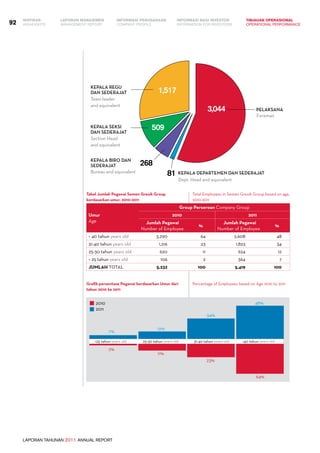
  • 136.
    PEMBAHASAN DAN ANALISIS MANAJEMEN LAPORANTATA KELOLA PERUSAHAAN LAPORAN TANGGUNG JAWAB SOSIAL PERUSAHAAN LAIN-LAIN MANAGEMENT’S DISCUSSION AND ANALYSIS CORPORATE GOVERNANCE REPORT CORPORATE SOCIAL RESPONSIBILITY REPORT OTHERS PT SEMEN GRESIK (PERSERO) Tbk. 191 roadmap penerapan gcg roadmap for gcg application Tujuan dan sasaran awal road map penerapan GCG Perseroan adalah menumbuhkan komitmen manajemen dalam menerapkan GCG dan senantiasa diikuti langkah penyempurnaan dan konsistensi penerapannya. Penyempurnaan soft stucture bertujuan melengkapi kebijakan pendukung, selain meningkatkan tanggung jawab dalam menjaga segenap kepentingan stakeholders. Sedangkan, infrastruktur GCG dilengkapi dengan melakukan penyempurnaan organisasi yang diperlukan. Perseroan telah menetapkan gambaran tahapan penerapan GCG Perseroan dengan tujuan menjadi perusahaan yang beretika dan bertanggung jawab, dengan menjadikan praktek tata kelola yang baik sebagai budaya dalam pengelolaan perusahaan, sebagai berikut: PERUSAHAAN YANG BERETIKA DAN BERTANGGUNG JAWAB ETHICAL AND RESPONSIBLE COMPANY Organ Perusahaan Company Organs Komite Penunjang Support Committees Pedoman GCG GCG Manual Pedoman Kode Etik GCG Code of Conduct Sistim & Prosedur System & Procedure Manual Board Whistleblowing System Charter  GCG menjadi budaya bagi stakeholder GCG becomes part of teh corporate management culture Ulasan Review Asesmen Assessment Audit           INFRASTRUKTUR & SOFTSTRUCTURE INFRASTRUCTURE & SOFTSTRUCTURE PENYEMPURNAAN BERKELANJUTAN CONTINUED PERFECTION SASARAN TARGET Rencana Peningkatan Praktik GCG Sebagai tindak lanjut dan komitmen tinggi atas berkesinambungannyapeningkatanpraktikGCGpada seluruh level operasional, Perseroan merencanakan beberapa kegiatan penting terkait praktik GCG. Kegiatan dimaksud mencakup di antaranya : • Melengkapi seluruh soft structure yang belum ada dan melakukan kajian bagi penyempurnaan yang sudah ada demi meningkatkan kualitas penerapan GCG; • Perseroan akan melakukan monitoring, pelaporan secara reguler dan review atas penerapanGCGsertamemfasilitasiassessment oleh pihak independen terhadap implementasi GCG di Perseroan untuk mendapatkan feed- back penerapan GCG. The initial aims and targets of the road map for GCG application are to cultivate management commitment to the application of GCG and continually taking steps to refine its application and consistency. Improvements to the soft structure aim at completing supporting policies, aswellasimprovingresponsibilityinsafeguarding stakeholders’ interests. Meanwhile, the GCG infrastructure is completed with the necessary organizational refinement. The Company has illustrated the stages of the Company’s GCG application, aiming to create an ethical and responsible company, with good governance practices imbued in the culture of managing the company, as follows: Improvement Plan for GCG Practices As a follow up and demonstrating our high commitment to continually improving GCG practices at all operational levels, the Company plans several important activities related to the practice of GCG. These activities include: • Completing all soft structures and conducting a study on current improvements to improve the quality of GCG application; • The Company will monitor, regularly report and review GCG application, as well as facilitate assessment by an independent party regarding GCG implementation in the Company to obtain feedback on its application.
  • 137.
    LAPORAN TAHUNAN 2011ANNUAL REPORT LAPORAN MANAJEMEN INFORMASI BAGI INVESTOR TINJAUAN OPERASIONAL Management Report INFORMATION FOR INVESTORS OPERATIONAL PERFORMANCE192 INFORMASI PERUSAHAANIKHTISAR COMPANY PROFILEHIGHLIGHTS Perseroan memastikan bahwa prinsip-prinsip dasar GCG diterapkan pada setiap aspek bisnis dan di semua jajaran. Prinsip dasar tata kelola perusahaan meliputi keterbukaan (transparency), akuntabilitas (accountability), responsibilitas (responsibility), independensi (independency) serta kewajaran dan kesetaraan (fairness). Sejalan dengan program transformasi korporasi dan inovasi yang terus berkembang, Perseroan senantiasa melengkapi berbagai pranata organisasi dan membangun mekanisme pengelolaan bisnis yang andal. Hal ini diwujudkan melalui penerapan praktik-praktik tata kelola perusahaan yang baik (GCG) pada seluruh tingkatan dan jenjang organisasi secara konsisten sehingga akan memastikan terciptanya keseimbangan bisnis secara paripurna dan menyeluruh (360 derajat) bagi seluruh pemegang saham dan seluruh kepentingan, baik ekonomi maupun sosial, individu dengan kelompok, internal juga eksternal, jangka pendek dan jangka panjang serta kepentingan pemegang saham dan pemegang saham akan menuju pada titik keseimbangan. Penerapan asas transparansi dilakukan melalui pelaksanaan berbagai kegiatan dan media komunikasi yang intensif dan dikelola secara profesional, sehingga para investor, pemegang saham, kreditur, masyarakat, serta seluruh pemangku kepentingan dapat mengetahui kinerja dan kegiatan pengelolaan perusahaan secara merata. Perseroan melaksanakan prinsip akuntabilitas dengan menitikberatkan pada peningkatan fungsi dan peran setiap Organ Perusahaan GOVERNANCE PERUSAHAAN YANG BAIK & PENCIPTAAN NILAI-NILAI good corporate governance & Mematuhi semua hukum & peraturan yang berhubungan dengan GCG (wajib & sukarela) Comply to all GCG guidelines both mandatory and policies Pengoperasian yang dikendalikan melalui internal control yang baik & implementasi manajemen risiko Excellent operational through internal control & risk management Menjadi perusahaan yang berwarga masyarakat yang baik melalui implementasi tanggung jawab sosial perusahaan GCG PERUSAHAAN YANG BERWARGA MASYARAKAT YANG BAIK GOOD CORPORATE CITIZEN GCG PERUSAHAAN YANG TERKELOLA DENGAN BAIK GOOD GOVERNED CORPORATION GCG GOVERNANCE PERUSAHAAN YANG BAIK GOOD CORPORATE GOVERNANCE PERSIAPAN IMPLENTASI IMPLEMENTATION PREPARATION implementasi gcg gcg implementation Seluruh Karyawan, Direksi dan Dewan Komisaris senantiasa melakukan fungsi sesuai dengan mandat yang diberikan dengan pembagian tugas yang jelas, terinci dan terukur serta mempertanggung jawabkan tindakan yang dilakukan. All Employees, Directors and Commissioners always carry out their function in accordance with the mandate given, a clear division of duties, detailed and measured and accountable for their actions. The Company ensures that the basic principles of GCG are applied at every aspect of the business and at every level. The basic principles of corporate governance are transparency, accountability, responsibility, independence and fairness. In line with this corporate transformation program and continually evolving innovations, the Company always complements its various organizational institutions and develops strong business management mechanisms. This is created through the consistent application of good corporate governance practices at all levels and ranks of the organization, thus ensuring the creation of sustainable business perfectly and entirely (360 degrees) for all stakeholders and all interests, both economically and socially, individual and collectively, internally and externally, in the short term and the long term and in the interests of shareholders and stakeholders to head to a point of balance. The principle of transparency is implemented through various activities and intensive professionally managed media communications, such that investors, shareholders, creditors, the public and all stakeholders can be equally aware of the performance and management of the company. The Company implements the principle of accountability with the emphasis on improving the function and role of every Company and Management Instrument, thus enabling the
  • 138.
    193 PEMBAHASAN DAN ANALISIS MANAJEMEN LAPORANTATA KELOLA PERUSAHAAN LAPORAN TANGGUNG JAWAB SOSIAL PERUSAHAAN LAIN-LAIN MANAGEMENT’S DISCUSSION AND ANALYSIS CORPORATE GOVERNANCE REPORT CORPORATE SOCIAL RESPONSIBILITY REPORT OTHERS PT SEMEN GRESIK (PERSERO) Tbk. dan Manajemen sehingga pengelolaan usaha Perusahaan dapat berjalan dengan baik. Perseroan menerapkan sistim pengendalian internal dengan sebagian tugasnya adalah melakukan pengawasan internal. Perseroan menerapkan asas tanggung-jawab dengan senantiasa berpegang teguh pada prinsip kehati-hatian dan memastikan kepatuhan terhadap ketentuan dan peraturan perundang- undangan yang berlaku. Penerapan prinsip kemandirian atau independency dilaksanakan dengan proses pengambilan keputusan yang bebas dari benturan kepentingan (conflict of interest) serta pengaruh/tekanan dari pihak manapun yang tidak sesuai dengan peraturan perundang- undangan yang berlaku dan prinsip-prinsip korporasi yang sehat. Perseroan menerapkan azas kesetaraan dengan memperlakukan seluruh pemegang saham secara berimbang (equal treatment) antara hak dan kewajiban yang diberikan kepada dan oleh Perseroan. Perseroan membuka akses informasi kepada seluruh pemangku kepentingan untuk memberikan sumbang saran bagi kemajuan Perseroan, namun Perseroan juga menetapkan aturan kerahasiaan informasi yang membatasi akses informasi oleh pihak-pihak yang tidak berkepentingan. Beberapa program yang dilaksanakan pada tahun 2011sebagaibuktikomitmenmanajemenPerseroan dalam penerapan GCG di antaranya adalah : • Penyempurnaan Board Manual dan Pedoman Kode Etik; • Pengkomunikasian dan sosialisasi penerapan GCG dilakukan secara bertahap kepada pemangku kepentingan; • Pemenuhan fungsi liaison officer sesuai dengan perencanaannya; • Pemenuhan ketentuan Pasar Modal; • Penyelesaian tindak lanjut rekomendasi BPKP atas assessment tahun buku 2010; • Pelaksanaan assessment GCG oleh BPKP Perwakilan Jawa Timur tahun buku 2011. Keberhasilan Perseroan menerapkan tata kelola perusahaan yang baik secara konsisten membuahkan penghargaan dari lembaga independen dalam berbagai perspektif, di antaranya: • GCG Award 2011 sebagai Indonesia Trusted Companies Best on Investors and Analysts Assessment Survey dari Majalah SWA bekerja sama dengan The Indonesian Institute For Corporate Governance (IICG) • 2011 Corporate Governance Award Kategori Best Disclosure & Transparancy dari Majalah Business Review bekerja sama dengan The Indonesian Institute For Corporate Directorship (IICD) Company to be well managed. The Company applies an internal control system, with some of the duties being internal supervision. The Company applies the principle of accountability holding fast to the principles of prudence and ensuring compliance with applicable provisions and regulations. Application of the principle of independence is through decision making free from conflict of interest and influence / pressure from any party and not in accordance with the principles of a healthy corporation. The Company applies the principle of fairness by giving all its stakeholders equal treatment between the rights and responsibilities given to and by the Company. The Company has open access to information for all stakeholders to provide suggestions and recommendations for the Company’s progress. However, the Company also holds to confidentiality regulations that limit access to information by unauthorized parties. Several programs have been run in 2011 as proof of the Company management’s commitment to the application of GCG, including: • Improvements to the Board Manual and Code of Conduct; • Communication and disseminating GCG application has been carried out gradually to all stakeholders; • Fulfillment of the Liaison Officer function in accordance with planning; • Fulfillment of Capital Market regulations; • Completion of follow up recommendations made by BPKP on the 2010 assessment; • GCG assessment by BPKP East Java representative for the financial year 2011. The Company’s success in consistently applying good corporate governance has resulted in awards from various independent institutions from various perspectives, including: • GCG Award 2011 as Indonesia Trusted Companies Best on Investors and Analysts Assessment Survey from SWA Magazine in cooperation with The Indonesian Institue For Corporate Governance (IICG) • 2011 Corporate Governance Award Best Disclosure & Transparancy Category from Majalah Business Review in cooperation with The Indonesian Institue For Corporate Directorship (IICD) Seluruh Karyawan, Direksi dan Dewan Komisaris senantiasa menjalankan tugas secara profesional tanpa benturan kepentingan dan tekanan dari pihak manapun dan mencegah terjadinya pengambilan keputusan yang mengandung benturan kepentingan. All Employees, Directors and the Board of Commissioners conduct their duties professionally without conflict of interest or pressure from any party and avoid the occurrence of decision making that could invite conflict of interest.
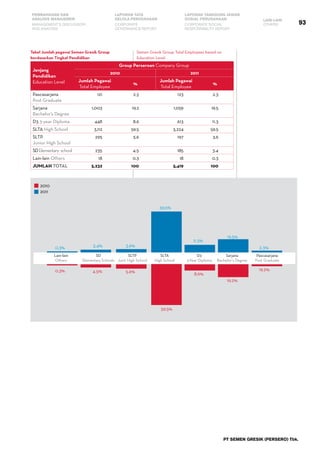
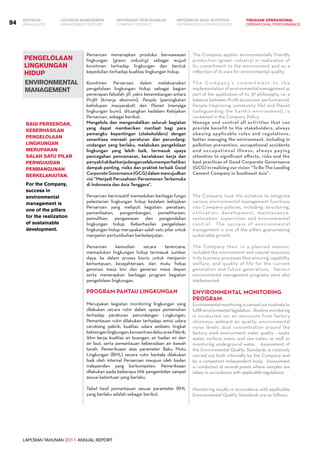
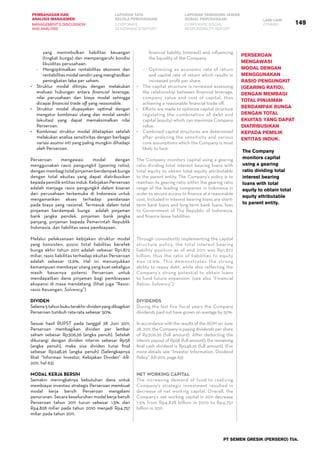
  • 139.
    • The BestSenior Management IR Support 2011 from Ekonomi Alpha Magazine South East Asia, September 2011. • State Owned Enterprise Non Financial Industry Category Ranked Very Good from Info Bank BUMN Awards, October 2011 • 10 Best Performing Companies by Forbes Magazine, December 2011 • Indonesia Award SWA 100 Best Wealth Creators for Asean Best Public Companies Category June, 2011. • GCG Implementation Assessment by Financial Supervision and Development Board (BPKP) East Java Representative ranking Very Good and score of 90%. LAPORAN TAHUNAN 2011 ANNUAL REPORT LAPORAN MANAJEMEN INFORMASI BAGI INVESTOR TINJAUAN OPERASIONAL Management Report INFORMATION FOR INVESTORS OPERATIONAL PERFORMANCE194 INFORMASI PERUSAHAANIKHTISAR COMPANY PROFILEHIGHLIGHTS • The Best Senior Management IR Support 2011 dari Majalah Ekonomi Alpha South East Asia, September 2011. • BUMN Kategori Industri Non-Kuangan yang Berprediakat Sangat Bagus dari Info Bank BUMN Awards, Oktober 2011 • 10 Perusahaan Berkinerja Terbaik Versi Majalah Forbes, Desember 2011 • Penghargaan Indonesia SWA 100 Best Wealth Creators untuk Kategori Asean Best Public Companies Juni, 2011 • Assessment implementasi GCG oleh Badan Pengawasan Keuangan dan Pembangunan Perwakilan Jawa Timur dengan predikat Sangat Baik dan skor capaian 90%. Implementasi prinsip-prinsip dasar GCG tersebut dalam operasional Perseroan dijelaskan dalam uraian fungsi-fungsi utama dalam pengelolaan perusahaan berikut. PENERAPAN PRINSIP-PRINSIP GCG MELALUI SISTEM MANAJEMEN SEMEN GRESIK Perseroan menerapkan prinsip-prinsip Good Corporate Governance (GCG) secara konsekuen melalui sistem manajemen terintegrasi yaitu Sistem Manajemen Semen Gresik (SMSG) untuk meningkatkan daya saing dan kepercayaan pemangku kepentingan (stakeholders). Perseroan telah menerbitkan surat keputusan tentang SMSG sebagai bentuk komitmen manajemen dalam menerapkan tata kelola perusahaan yang baik. SMSG meliputi: Sistem Manajemen Mutu ISO 9001:2008, Sistem Manajemen Lingkungan ISO 14001:2004, Sistem Manajemen Keselamatan & Kesehatan Kerja, Sistem Manajemen K-3 OHSAS 18001:2007 dan Sistem Manajemen Laboratorium ISO 17025:2005, dan Sistem Manajemen Risiko. SMSG merupakan wadah seluruh proses bisnis Perseroan yang menjamin seluruh aktivitas Perseroan dijalankan sesuai dengan prinsip- prinsip Tata Kelola Perusahaan SGMS is a forum for all the Company’s business processes ensuring the Company’s business activities are in line with the principles of Corporate Governance Implementation of the basic principles of GCG in the Company’s operations is explained in the main functions in the management of the following companies. APPLICATION OF GCG PRINCIPLES THROUGH SEMEN GRESIK MANAGEMENT SYSTEM The Company applies the principles of Good Corporate Governance (GCG) consistently through an integrated management system, i.e. Semen Gresik Management System (SGMS) to increase competitiveness and stakeholder trust. The Company has issued a decision letter regarding SGMS to demonstrate the management’s commitment to the application of good corporate governance. SGMS covers: Quality Management System ISO 9001:2008, Environmental Management System ISO 14001:2004, Occupational Health and Safety Management System OHSAS 18001:2007 and Laboratory Management System ISO 17025:2005, and a Risk Management System.
  • 140.
    PEMBAHASAN DAN ANALISIS MANAJEMEN LAPORANTATA KELOLA PERUSAHAAN LAPORAN TANGGUNG JAWAB SOSIAL PERUSAHAAN LAIN-LAIN MANAGEMENT’S DISCUSSION AND ANALYSIS CORPORATE GOVERNANCE REPORT CORPORATE SOCIAL RESPONSIBILITY REPORT OTHERS PT SEMEN GRESIK (PERSERO) Tbk. Penerapan SMSG merupakan salah satu upaya untuk membentuk perilaku etis dalam pengelolaan bisnis guna menciptakan dan mengembangkan budaya perusahaan (corporate culture) yang baik. Selain hal di atas, implementasi SMSG merupakan refleksi dari prinsip-prinsip GCG yang meliputi keterbukaan (transparency), akuntabilitas (accountability), responsibilitas (responsibility), independensi (independency) serta kewajaran dan kesetaraan (fairness). • Keterbukaan (transparency) Ditetapkannya kebijakan, prosedur, instruksi kerja yang mencakup semua kegiatan dalam pengelolaan Perseroan melalui Document Control System dan pelaksanaan proses bisnis melalui Enterprise Resources Planning SAP. Hal tersebut untuk menjamin keterbukaan dan kemudahan akses bagi pihak terkait serta kemudahan melaksanakan pengawasan dan pengendalian internal dan eksternal. • Akuntabilitas (accountability) Perseroan telah menetapkan struktur organisasi beserta uraian tugas dan tanggung jawab setiap unit kerja yang diatur didalam kebijakan, prosedur, dan instruksi kerja untuk menjamin pengelolaan proses bisnis Perseroan berjalan secara efektif. • Responsibilitas (responsibility) Seluruh kebijakan, prosedur, dan instruksi kerja disusun untuk memastikan pemenuhan dan kepatuhan terhadap ketentuan dan peraturan perundangan yang berlaku, serta mengacu pada prinsip-prinsip korporasi yang sehat. • Independensi (independency) Seluruh kebijakan, prosedur dan instruksi kerja disusun berdasarkan best practises untuk menjamin profesionalisme dan memastikan tidak ada benturan kepentingan dan tekanan dari pihak manapun sehinggga terwujud sistim pengendalian internal yang efektif. • Kewajaran dan kesetaraan (fairness) Seluruhkebijakan,prosedur,daninstruksikerjayang ditetapkan Perseroan senantiasa memperhatikan aspek keadilan dan kesetaraan dalam memenuhi hak-hak stakeholders sesuai dengan manfaat dan kontribusi yang diberikan kepada perusahaan. SMSG yang berisi kebijakan, prosedur, dan instruksi kerja merupakan pilar utama penerapan prinsip-prinsip GCG untuk mewujudkan budaya korporasi yang baik dalam pelaksanaan seluruh proses bisnis Perseroan. Untuk memastikan implementasi SMSG berjalan secara efektif dan efisien maka Perseroan membentuk Tim Peningkatan dan Penyempurnaan Mutu SMSG (Tim P2M SMSG) melalui surat keputusan yang diperbarui setiap tahun. Adapun tugas dan kewenanganya adalah: • Melakukan kajian ulang, penyempurnaan dan peningkatan sistem manajemen sesuai pedoman Sistem Manajemen Mutu ISO 9004; • Melakukan integrasi sistem-sistem yang ada, meliputi integrasi proses, dokumentasi, dan implementasi; The application of SGMS is one demonstration of the efforts to generate ethical behavior in business management, thus creating and developing a healthy corporate culture. In addition to the above, the implementation of SGMS is a reflection of the principles of GCG, which are transparency, accountability, responsibility, independence and fairness. • Transparency Enactment of policies, procedures and work instructions covering all activities in company management through the Document Control System and implementation of business processes through Enterprise Resources Planning SAP. This ensures transparency and ease of access for related parties carrying out supervisory and internal and external control functions. • Accountability T h e C o m p a n y h a s e st a b l i s h e d a n organizational structure as well as defining duties and responsibilities for each work unit, regulated in policies, procedures and work instructions to guarantee effective running of the Company’s business processes. • Responsibility All policies, procedures and work instructions are developed to ensure fulfillment and compliance with applicable provisions and regulations, as well as being based on the principles of a healthy corporation. • Independency All policies, procedures and work instructions are developed based on best practices to ensure professionalism and that there is no conflict of interest or pressure from any party, thus creating an effective internal control system. • Fairness All policies, procedures, and work instructions developed by the Company take full account of the principles of fairness and equality in fulfilling the rights of stakeholders in accordance with the benefits and contributions made to the Company. The policies, procedures, and work instructions contained within SGMS form a main pillar in the application of GCG and creation of a healthy corporate culture to conduct all the Company’s business processes. To ensure SGMS is implemented effectively and efficiently, the Company has formed a Team to Increase and Improve SGMS Quality based on a decision letter that is renewed annually. The team’s duties and authority are as follows: • Review, refine and improve the management system in accordance with guidelines from ISO 9004 Quality Management System; • Integrate current systems related to the integration process, documentation and implementation; 195
  • 141.
    LAPORAN TAHUNAN 2011ANNUAL REPORT LAPORAN MANAJEMEN INFORMASI BAGI INVESTOR TINJAUAN OPERASIONAL Management Report INFORMATION FOR INVESTORS OPERATIONAL PERFORMANCE196 INFORMASI PERUSAHAANIKHTISAR COMPANY PROFILEHIGHLIGHTS • Melakukan penyempurnaan dan peningkatan sistem otomasi dokumen melalui software pengendalian dokumen; • Melakukan evaluasi efektivitas penerapan Sistem manajemen dan closing out findings atas hasil internal audit dan hasil eksternal audit. Perseroan juga menerbitkan surat keputusan tentang Penerapan Sistem Kendali Mutu dalam rangkamenjaminpeningkatanberkesinambungan dalam penerapan SMSG melalui kegiatan Gugus Kendali Mutu, program 5R (Ringkas, Rapi, Resik, Rawat, dan Rajin), Sistem Saran, Total Productive Maintenance. Total Productive Maintenance kini telah ditingkatkan dengan penerapan Realibility Centered Maintenance (RCM) dan Proyek Kendali Mutu untuk mencapai pengelolaan operasional berkelas internasional sesuai dengan visi Perseroan. Di samping hal di atas, Perseroan juga telah menerapkan manajemen inovasi dalam upaya meningkatkan daya saing dan semangat konsolidasi Semen Gresik Group (SGG) untuk meningkatkan akselerasi pencapaian visi Perseroan. Peningkatan dan penyempurnaan sistem manajemen tahun 2011, menghasilkan hal-hal sebagai berikut : • OptimalisasiIntegrasiRiskManagementkedalam Sistem Manajemen Semen Gresik (SMSG) • Re-akreditasi Sistem Manajemen Laboratorium SNI ISO/IEC 17025:2008 dan memperluas lingkup untuk batubara oleh Komite Akreditasi Nasional. • Menerapkan Manajemen Inovasi SGG dan penyelenggaraan Semen Gresik Group Award on Innovation dalam rangka menumbuhkan budaya inovasi di Perusahaan dan memperkuat semangat konsolidasi SGG. • Penyelenggaraan Konvensi Mutu Semen Gresik Group dalam rangka penerapan kegiatan perbaikan berkesinambungan dan memperkuat semangat konsolidasi SGG. • Refine and improve the document automation system through the use of document control software; • Evaluate the effectiveness of Management System application and closing out findings from the internal and external audits. The Company has also issued a decision letter regarding the Application of Quality Control Systems to guarantee continuous improvements in the application of SGMS through Quality Control Groups, the 5R Program (brief, clean, tidy, maintained, diligent), Suggestion System, and Total Productive Maintenance. The Total Productive Maintenanceprogramhasnowbeenupgradedwith theapplicationofReliabilityCenteredMaintenance (RCM) and the Quality Control Project to achieve international standards of operational management in accordance with the Company’s vision. Inadditiontotheabove,theCompanyhasalsoapplied innovative management in its efforts to improve competitiveness and the spirit of consolidation within the Semen Gresik Group (SGG) and to accelerate achievement of the Company’s vision. These improvements and refinements to the management system in 2011 have resulted in the following: • Optimizing Risk Management in the Semen Gresik Management System (SGMS) • Reaccreditation in Laboratory Management Systems SNI ISO/IEC 17025:2008 and expansion of scope for coal by the National Accreditation Committee. • Application of SGG Innovation Management and organization of the Semen Gresik Group Award on Innovation to imbue the Company with an innovative culture and strengthen the spirit of consolidation within SGG. • Organization of Semen Gresik Group Quality Convention to implement activities strengthening the spirit of continuous improvement and consolidation within SGG.
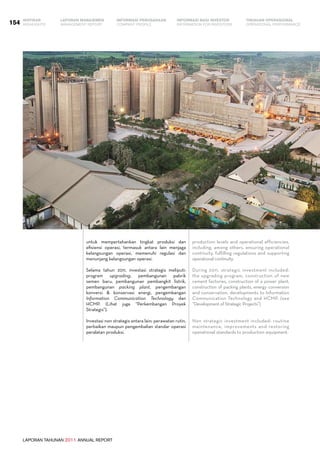
  • 142.
    197 PEMBAHASAN DAN ANALISIS MANAJEMEN LAPORANTATA KELOLA PERUSAHAAN LAPORAN TANGGUNG JAWAB SOSIAL PERUSAHAAN LAIN-LAIN MANAGEMENT’S DISCUSSION AND ANALYSIS CORPORATE GOVERNANCE REPORT CORPORATE SOCIAL RESPONSIBILITY REPORT OTHERS PT SEMEN GRESIK (PERSERO) Tbk. • Being included in Nominee SNI Award 2011 in the large goods company category organized by BSN. • Achieving a Good Performance score at the Indonesian Quality Award 2011 event organized by the IQA Foundation. • Being awarded PROPER GREEN grade by the State Minister for the Environment. • Being awarded Level IV Green Industry by the Ministry of Industry. • Being awarded PRAYOGASALA 2011 by the Office of the State Minister of Research and Technology. • Being awarded a Pioneering Technology award 2011 by the Minister of Industry. • Receiving recognition for “continual improvement program” activities in national and international conventions, as follows: - 2Goldand1SilverattheIndonesianQuality Convention (IQC) 2011 in Balikpapan. - 1 Platinum, 8 Gold, 2 Silver and 1 Bronze at the Work Quality and National Productivity Gathering 2011 in Makassar. - Team Excellence Competition at the International Exposition Team Excellence (IETEX) 2011 in Singapore. - Gold Award at APQO/NQPCN’s International Conference on Quality 2011 in Singapore. - GoldAwardattheInternationalConvention on Quality Control Circle (ICQCC) 2011 in Japan. SUPERVISION AND INTERNAL CONTROL ICoFR Program Application The Company is currently developing implementation for ICoFR (Internal Control over Financial Reporting), a process of satisfactory internal control for company management, specifically ensuring the reliability of published financial reporting. The implementation stages for ICoFR are as follows: Memilih dan memilah akun signifikan berdasarkan prioritasnya Separate and choose significant account Dokumentasi Documentation: - Proses bisnis Business process - Kontrol dalam pelaporan keuangan Control in financial report Menyusun Setting up: - Matriks kontrol risiko Risk control matrix - Strategi audit Audit strategy - Kertas kerja unit Lorem ipsum Melakukan test atas: Evaluation onto:: - Kontrol pada pelaporan keuangan Financial reporting control - Efektifitas pelaksanaan kontrol Effectivity of control implementation IDENTIFIKASI IDENTIFICATION PEMETAAN MAPPING DESAIN DESIGN PENGUJIAN TESTING TAHAP 1 STEP 1 TAHAP 2 STEP 2 TAHAP 3 STEP 3 TAHAP 4 STEP 4 • Memperoleh anugerah Nominee SNI Award 2011 dalam kategori perusahaan besar barang yang diselenggarakan oleh BSN. • Mendapat peningkatan score di level Good PerformancedalamacaraIndonesianQualityAward 2011 yang diselenggarakan oleh IQA Foundation. • Mendapat penghargaan PROPER peringkat HIJAU dari Kementerian Negara Lingkungan Hidup. • Memperoleh Anugerah Industri Hijau level IV yang diselenggarakan oleh Kementerian Negara Perindustrian R.I. • Memperoleh Anugerah PRAYOGASALA 2011 yang diselenggarakan oleh Kementerian Negara Riset dan Teknologi R.I. • MemperolehAnugerahRINTISANTEKNOLOGI 2011 yang diselenggarakan oleh Kementrian Negara Perindustrian R.I. • Memperoleh penghargaan dalam kegiatan continual improvement program dalam konvensi nasional dan internasional, sebagai berikut : - Penghargaan 2 Emas dan 1 Perak pada Indonesian Quality Convention (IQC) 2011 di Balikpapan. - Penghargaan 1 Platinum, 8 Emas, 2 Perak dan 1 perunggu pada Temu Karya Mutu & Produktivitas Nasional (TKMPN) 2011 di Makassar. - Team Excellence Competition pada International Exposition Team Excellence (IETEX) 2011 di Singapore. - Gold Award pada APQO/NQPCN’s International Conference on Quality 2011 di Singapore. - Gold Award pada International Convention on Quality Control Circle (ICQCC) 2011 di Jepang. PENGAWASAN DAN PENGENDALIAN INTERNAL Program Penerapan ICoFR Perseroan saat ini sedang mengembangkan implementasi Internal Control over Financial Reporting (ICoFR) yakni proses pengendalian internal yang memadai dalam pengelolaan perusahaan, khususnya dalam menjamin keandalan pelaporan keuangan yang dipublikasikan. Tahapan pelaksanaan implementasi ICoFR tersebut adalah sebagai berikut: Roadmap implementasi ICoFR
  • 143.
    LAPORAN TAHUNAN 2011ANNUAL REPORT LAPORAN MANAJEMEN INFORMASI BAGI INVESTOR TINJAUAN OPERASIONAL Management Report INFORMATION FOR INVESTORS OPERATIONAL PERFORMANCE198 INFORMASI PERUSAHAANIKHTISAR COMPANY PROFILEHIGHLIGHTS Proyek IcoFR merupakan proyek berkelanjutan yangtelahdimulaipadatahun2010danditargetkan selesai pada akhir tahun 2012. Implementasi tahap 1 telah diselesaikan pada bulan Mei 2011 dan dilanjutkan dengan implementasi tahap 2. Hingga akhir tahun 2011, status proses pelaksanaan tahap 2 (pemetaan) implementasi ICoFR meliputi: • Mendokumentasikan alur transaksi pada unit bisnis yang memberikan dampak material pada unsur-unsur laporan keuangan. • Mendokumentasikanlevelcontroldalamtingkat entitas, tingkat transaksional, dan teknologi informasi melalui wawancara, konfirmasi, dan rekonfirmasi di masing-masing business process owner untuk menentukan jenis risiko pada masing-masing tingkatan kontrol. • Mendapatkan dokumen key control yang paling penting dan mendasar dari hasil identifikasi proses bisnis. • Menganalisis efektivitas kontrol yang ada dan menyusun rekomendasinya. Internal Audit Internal Audit merupakan satuan pengawasan internal Perseroan, yang bertugas melakukan evaluasi efektivitas pengendalian internal secara obyektif dan memberikan konsultasi atas pelaksanaan kegiatan usaha Perseroan beserta entitas anak. Dalam melakukan tugasnya Internal Audit mengacu pada Piagam Internal Audit (Audit Charter) yang telah disahkan oleh Direktur Utama dan disetujui oleh Komisaris Independen selaku Ketua Komite Audit pada tanggal 27 Desember 2010 yang disempurnakan tanggal 17 Februari 2012. Audit charter ini secara garis besar memuat visi, misi, struktur organisasi, wewenang, tugas dan tanggung jawab, persyaratan dan profesionalisme auditor, tata cara pelaksanaan audit, serta kode etik auditor internal. Aktivitas Internal Audit adalah bagian dari proses tata kelola perusahaan yang memberikan jaminan atas sistem pengendalian internal, efektivitas dan efisiensi operasi, ketaatan terhadap aturan dan perundang-undangan serta ketepatan dan keandalan pelaporan keuangan. Sehingga dapat memberikan nilai tambah bagi Perseroan dan memperbaiki operasional organisasi. Aktivitas Internal Audit memfokuskan pada pengendalian risiko transaksi saat ini dan masa mendatang, dengan menitikberatkan pada penanganan hambatan dan penyimpangan, serta memberikan masukan kepada manajemen yang bersifatkonstruktifdankonsultatifuntukmemberikan alternatif pemecahan dan rekomendasi. Kedudukan Unit Kerja Internal Audit Untuk menjamin independensinya kedudukan Internal Audit pada struktur organisasi perusahaan berada pada satu level yang diatur sedemikian rupa sehingga dapat menjamin pelaksanaan The ICoFR project started in 2010 and is targeted for completion by end 2012. Stage 1 implementation was completed in May 2011 and is being followed on by stage 2. As of end 2011, the status of stage 2 (mapping) of ICoFR implementation includes: • Documenting transaction flows to business units having material effect on elements of financial statements. • Documenting level control at entity level, transactional level, and information technology using interviews, confirmation and reconfirmation with each business process owner to set risk types at each control level. • Obtain the most important key control documents from the business process identification results. • Analyze effectiveness of existing control and compile recommendations. Internal Audit Internal Audit is the Company’s internal supervision unit assigned to objectively evaluate the effectiveness of internal controls and provide consultation on implementation of the Company’s business activities and those of its subsidiaries. In carrying out its duties, the Internal Audit refers to the Internal Audit Charter that was ratified by the President Director and approved by the Independent Commissioner as Chair of the Audit Committee on December 27, 2010 and further refined on February 17, 2012. The Audit Charter in general contains the vision, mission, organizational structure, authority, duties and responsibilities, conditions and professionalism of the auditors, audit implementation method, as well as the internal auditor’s Code of Conduct. The activities of the Internal Audit are part of the corporate governance process that provides assurances over the internal control system, effectiveness and efficiency of operations, compliance with regulations and legislation, as well as accuracy and reliability of financial reports. This provides additional value for the Company and improves organization operations. Internal Audit activities are focused on controlling transaction risks currently and in the future, with emphasis on handling obstacles and distortions, as well as providing constructive and consultative input to the management and providing alternative resolutions and recommendations. Placement of the Internal Audit Work Unit To ensure the independent placement of the Internal Audit within the company’s organization structure, it is set on a single level, regulated as Sistem pengawasan dan pengendalian internal dilaksanakan secara sistematis dan berjenjang demi tercapainya kinerja dan tujuan jangka panjang Perseroan dengan efisien serta sesuai peraturan perundangan yang berlaku. The supervision and internal control system is implemented systematically and hierarchically to achieve performance and the Companys long term goals efficiently and in accordance with applicable legislation.
  • 144.
    199 PEMBAHASAN DAN ANALISIS MANAJEMEN LAPORANTATA KELOLA PERUSAHAAN LAPORAN TANGGUNG JAWAB SOSIAL PERUSAHAAN LAIN-LAIN MANAGEMENT’S DISCUSSION AND ANALYSIS CORPORATE GOVERNANCE REPORT CORPORATE SOCIAL RESPONSIBILITY REPORT OTHERS PT SEMEN GRESIK (PERSERO) Tbk. kewenangannya secara independen, bebas dari intervensi pihak lain. Adapun struktur Internal Audit dalam organisasi Perseroan digambarkan pada bagan berikut. STRUKTUR INTERNAL AUDIT STRUCTURE OF AUDIT INTERNAL Komite Audit Audit Commitee Kepala Departemen Auditee Biro Audit Komersial & Sisitim Mnj Bureau of Commercial & Mng Syst Audit Biro Audit Akuntansi & Keuangan Bureau of Accounting & Finance Audit Direktur Utama President Director Biro Audit Teknik Bureau of Technical Audit Komisaris Independen Independent Commissioner Internal Audit Audit Internal Dept. Hukum & MR Corporate Risk Unit Audit Internal dipimpin oleh seorang Kepala Internal Audit yang diangkat dan diberhentikan oleh Direktur Utama atas persetujuan Dewan Komisaris. Kepala Internal Audit bertanggung jawab kepada Direktur Utama. Jumlah seluruh anggota auditor internal Perseroan di tahun 2011 adalah 19 orang, terdiri dari Kepala Internal Audit, 3 Biro Audit, dan 15 Staf Biro Audit. Adapun sertifikasi berkaitan dengan pelaksanaan tugas audit yang dimiliki adalah sebagai barikut. Sertifikasi yang telah dimiliki oleh anggota Internal Audit Perseroan, 2011 Sertifikasi Certification Jumlah Total Profesional Internal Audit (PIA) 5 Qualified Internal Audit (QIA) 2 Certified Risk Management (CRM) 1 Certified Information System Audit (CISA) 1 Perseroan berencana meningkatkan kualitas pelaksanaan internal audit dengan meningkatkan kompetensi dan kualifikasi internal audit dengan sertifikat profesional yang meliputi Profesional Internal Auditor (PIA), Qualified Internal Auditor (QIA), Certified Risk Management (CRM), Certified Internal Auditor (CIA), Certified Information System Auditor (CISA), Certified Control Self Assesment (CCSA), Certified Fraud Examiner (CFE), International Standard Organization (ISO) dan SMK3. such to guarantee independent implementation of its authority, free from intervention by other parties. The structure of the Internal Audit unit within the Company’s organization is illustrated in the following section. The Internal Audit Unit is headed by the Internal Audit Head who is appointed and dismissed by the President Director with the approval of the Board of Commissioners. The Internal Audit Head is responsible to the President Director. In 2011, the Company had a total of 19 internal auditors, consisting of the Internal Audit Head, 3 Audit Bureaux and 15 Audit Bureau staff members. Certification held by members of the Internal Audit unit related to the implementation of audit duties are as follows: Certification held by members of the Company’s Internal Audit Unit in 2011 The Company intends to improve the quality of its internal audits by increasing the competency and qualificationsofitsinternalauditorswithprofessional certification, including Professional Internal Auditor (PIA), Qualified Internal Auditor (QIA), Certified Risk Management (CRM), Certified Internal Auditor (CIA), Certified Information System Auditor (CISA), Certified Control Self Assessment (CCSA), Certified Fraud Examiner (CFE), International Standard Organization (ISO) and Occupational Health & Safety Management System.
  • 145.
    LAPORAN TAHUNAN 2011ANNUAL REPORT LAPORAN MANAJEMEN INFORMASI BAGI INVESTOR TINJAUAN OPERASIONAL Management Report INFORMATION FOR INVESTORS OPERATIONAL PERFORMANCE200 INFORMASI PERUSAHAANIKHTISAR COMPANY PROFILEHIGHLIGHTS Pelaksanaan Tugas Unit Kerja Internal Audit bertugas memastikan pencapaian tujuan dan kelangsungan usaha dengan: • Melakukan evaluasi terhadap pelaksanaan program kerja. • Memberikan saran dalam upaya memperbaiki efektivitas proses pengendalian risiko dan kontrol. • Melakukan evaluasi kepatuhan terhadap peraturan, pelaksanaan GCG dan perundang- undangan. • Memfasilitasi dan mendukung kelancaran pelaksanaan audit oleh Auditor Eksternal. Pelaksanaan Audit yang dilakukan oleh Unit Kerja Internal Audit bertujuan memberikan jasa konsultasi, evaluasi yang objektif dan independen melalui analisa,penilaian,rekomendasidalamlingkupinternal control, tata kelola, pengelolaan risiko, termasuk penilaian ketaatan terhadap peraturan perundang- undangan,penangananpengaduanmasyarakat,untuk meningkatkan efektivitas dan efisiensi Perseroan. Selain dilakukan oleh Unit Kerja Internal Audit, Perseroan juga memiliki fungsi pengawasan dan pengendalian yang melekat pada unit fungsional (embedded internal control), antara lain: • Pengawasan dan pengendalian yang berkaitan dengan penggunaan atau realisasi dana sesuai dengan anggaran (fungsi budgeting) yang ditetapkan. • Pengawasan dan pengendalian yang melekat pada unit bisnis termasuk unit-unit pendukung (embeddedinternalcontrol)yangmengharuskan unit pelaksana tersebut bertanggung jawab kepadaDirekturyangmembawahiunitdimaksud. Fungsiyangdimaksudadalahpreventivecontrol, yakni memastikan kepatuhan dan pemenuhan persyaratan yang telah ditetapkan sebelum suatu kegiatan operasional dilaksanakan. • Penerapan standar akuntansi yang harus merefleksikan setiap transaksi keuangan dan perubahan aset serta menjamin bahwa semua transaksi keuangan tercatat secara akurat sesuai dengan Standar Akuntansi Keuangan Indonesia. Selama tahun 2011 aktivitas audit dilakukan berdasarkan risk based audit yang meliputi Audit Operasional, Audit Sistem Manajemen dan Audit Khusus, sebagai berikut: • Audit Operasional, dilakukan pembahasan atas beberapa isu dan telah dilakukan tindak lanjut, yang meliputi proses bisnis Penjualan dan Distribusi, Pengadaan dan Pergudangan, Produksi dan Capex, Akuntansi & Keuangan (Analytical Review dan ICoFR), serta Sistem Informasi dengan dilakukannya Post Implementation Review atas implementasi ERP System Application Product (SAP). • Audit Sistem Manajemen Semen Gresik, meliputi beberapa Sistem Manajemen ISO 9001, ISO 14000, ISO 18000, ISO 17025, SMK3, Proper, Industri Hijau, dan Pengelolaan Sosial & Lingkungan Korporasi. Internal Audit Work Unit The Internal Audit Work Unit is assigned duties to ensure the achievement of goals and business continuity, including: • Evaluating implementation of work programs. • Providing advice related to efforts to improve the effectiveness of risk control processes. • Evaluating compliance with regulations, GCG implementation and legislation. • Facilitating and supporting the smooth implementation of audits conducted by the External Auditors. Audits are carried out by the Internal Audit Work Unit with the aim of providing consultation services, objective and independent analysis-based evaluation, assessment, recommendations on internal controls, governance, risk management - including assessing compliance with legislation, and handling public complaints in the interests of improving the effectiveness and efficiency of the Company. In addition to the work of the Internal Audit Work Unit, supervision and control is also an integral part of the Company’s functional units (embedded internal control), including: • Defined supervision and control related to use or realization of budgeted funds (budgeting). • Supervision and control is an integral part of business units, including ancillary units (embedded internal control), which requires the Director heading the unit to be responsible for it. This fulfills preventative control requirements, ensuring compliance with and fulfillment of regulations defined prior to any operational activity being carried out. • Application of accountancy standards must reflect every financial transaction and change to assets, as well as ensuring that all financial transactions are recorded accurately in accordance with the Indonesian Financial Accounting Standards. During 2011, audit activities were mainly risk based audits covering Operational Audit, Management System Audit and Special Audits, as follows: • The Operational Audit included discussion of several issues that have been followed up, including Sales and Distribution, Provision and Warehousing, Production and Capex, Accountancy and Finance (Analytical Review and ICoFR), as well as Information Systems with Post-Implementation Review of the ERP System Application Product (SAP). • The Semen Gresik Management System Audit, which included several Management Systems ISO 9001, ISO 14000, ISO 18000, ISO 17025, SMK3, “Proper”, Green Industry, and Social & Corporate Environment Management.