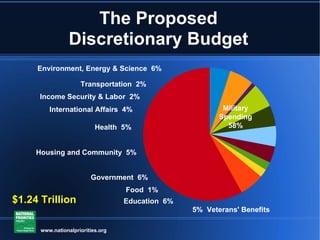
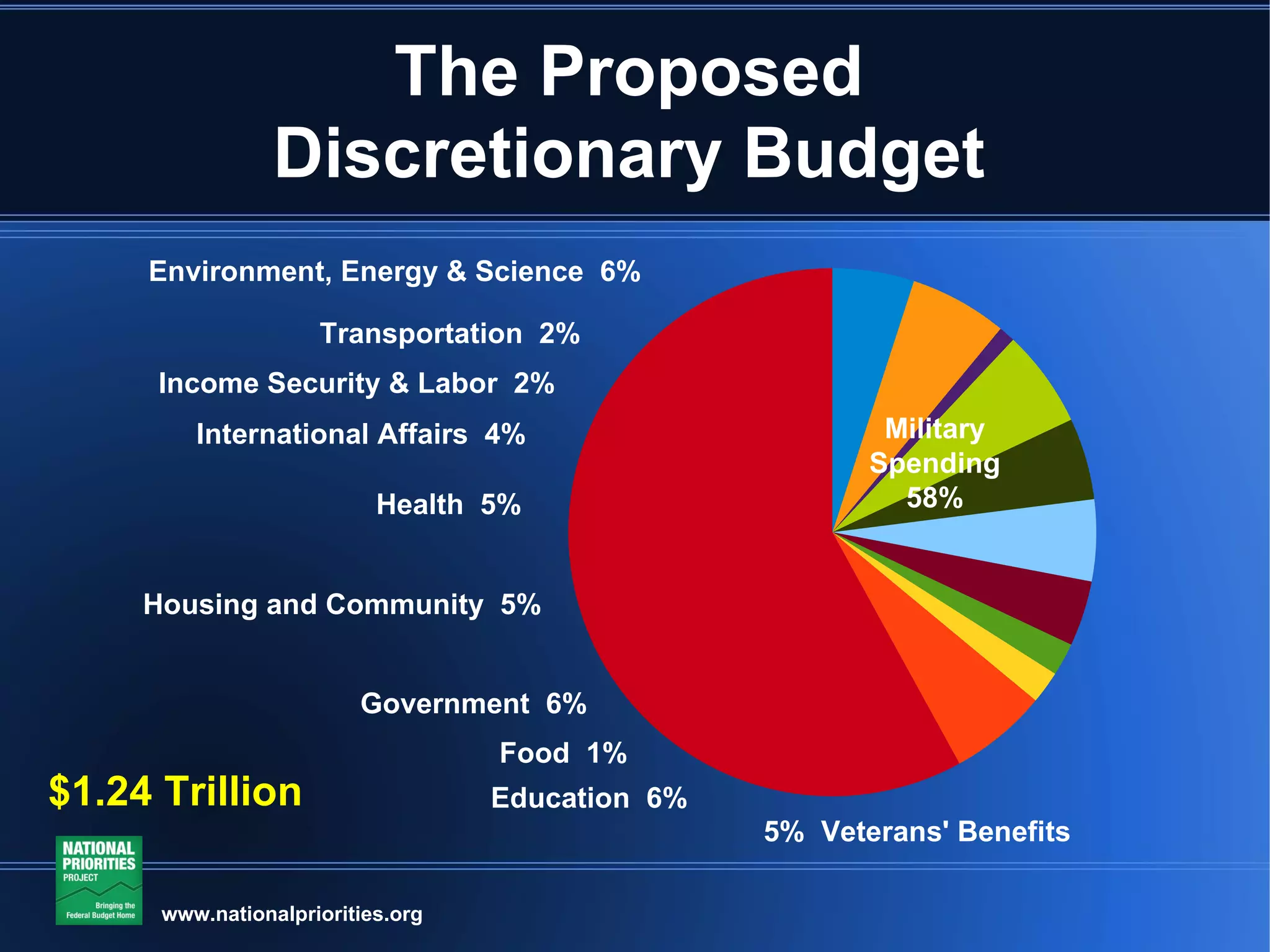
The Proposed Discretionary Budget Military Spending 58% Environment, Energy & Science  6% Transportation  2% Income Security & Labor  2% International Affairs  4% Health  5% Housing and Community  5% Government  6% Food  1% Education  6% 5%  Veterans' Benefits $1.24 Trillion www.nationalpriorities.org
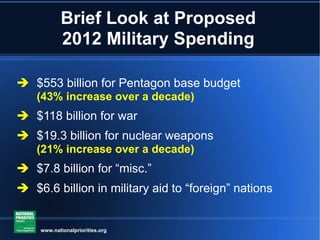
Brief Look at Proposed 2012 Military Spending $553 billion for Pentagon base budget (43% increase over a decade) $118 billion for war $19.3 billion for nuclear weapons (21% increase over a decade) $7.8 billion for “misc.” $6.6 billion in military aid to “foreign” nations www.nationalpriorities.org
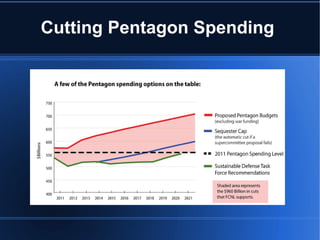
Cutting Pentagon Spending
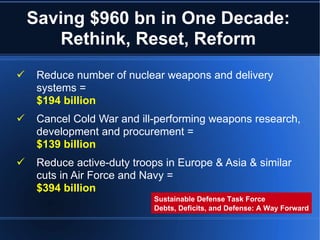
Saving $960 bn in One Decade: Rethink, Reset, Reform Reduce number of nuclear weapons and delivery systems = $194 billion Cancel Cold War and ill-performing weapons research, development and procurement = $139 billion Reduce active-duty troops in Europe & Asia & similar cuts in Air Force and Navy = $394 billion Sustainable Defense Task Force Debts, Deficits, and Defense: A Way Forward
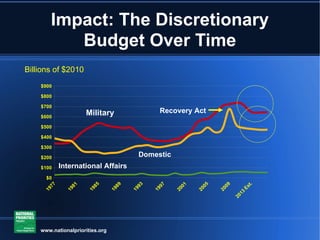
Impact: The Discretionary Budget Over Time Domestic Military Recovery Act Billions of $2010 International Affairs www.nationalpriorities.org
Brief Look at Waste, Fraud, and Abuse In a 10.6 letter from Tom Carper to Leon Panetta DOD Inspector General notes inability to recoup approx.  $200 million  in delinquent debts due to poor (basic) record keeping Commission on Wartime Contracting found  $30bn to $60bn  in largely avoidable DOD waste and fraud related to Iraq and Afghanistan wars Government Accountability Office found  $402bn  in  total major weapons system overruns ;  up from $42bn in 2000 www.nationalpriorities.org
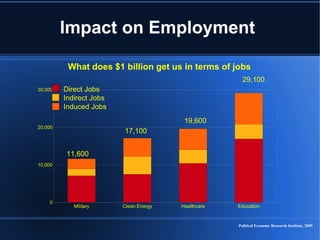
Impact on Employment Political Economy Research Institute, 2009 What does $1 billion get us in terms of jobs Direct Jobs Indirect Jobs Induced Jobs 11,600 17,100 19,600 29,100
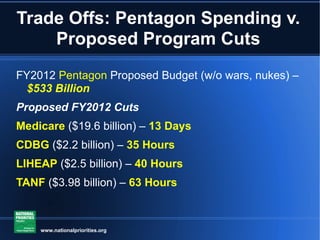
Trade Offs: Pentagon Spending v. Proposed Program Cuts FY2012  Pentagon  Proposed Budget (w/o wars, nukes) –  $533 Billion Proposed FY2012 Cuts Medicare  ($19.6 billion) –  13 Days CDBG  ($2.2 billion) –  35 Hours LIHEAP  ($2.5 billion) –  40 Hours TANF  ($3.98 billion) –  63 Hours www.nationalpriorities.org
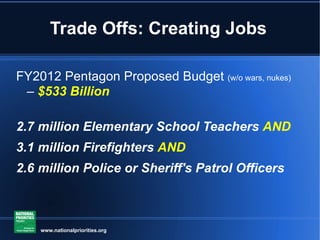
Trade Offs: Creating Jobs FY2012 Pentagon Proposed Budget  (w/o wars, nukes)  –  $533 Billion 2.7 million Elementary School Teachers  AND 3.1 million Firefighters  AND 2.6 million Police or Sheriff's Patrol Officers  www.nationalpriorities.org
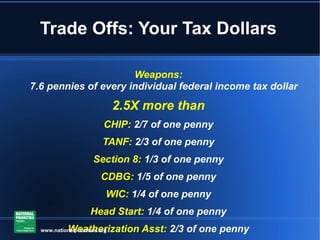
Trade Offs: Your Tax Dollars Weapons: 7.6 pennies of every individual federal income tax dollar 2.5X more than CHIP:  2/7 of one penny TANF:  2/3 of one penny Section 8:  1/3 of one penny CDBG:  1/5 of one penny WIC:  1/4 of one penny Head Start:  1/4 of one penny Weatherization Asst:  2/3 of one penny www.nationalpriorities.org
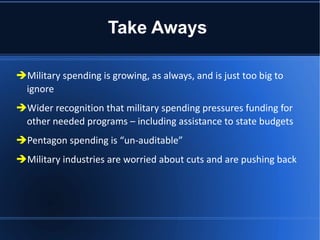
Take Aways Military spending is growing, as always, and is just too big to ignore Wider recognition that military spending pressures funding for other needed programs – including assistance to state budgets Pentagon spending is “un-auditable”  Military industries are worried about cuts and are pushing back

Annual Meeting Budget Presentation

  • 1.
    The Proposed DiscretionaryBudget Military Spending 58% Environment, Energy & Science 6% Transportation 2% Income Security & Labor 2% International Affairs 4% Health 5% Housing and Community 5% Government 6% Food 1% Education 6% 5% Veterans' Benefits $1.24 Trillion www.nationalpriorities.org
  • 2.
    Brief Look atProposed 2012 Military Spending $553 billion for Pentagon base budget (43% increase over a decade) $118 billion for war $19.3 billion for nuclear weapons (21% increase over a decade) $7.8 billion for “misc.” $6.6 billion in military aid to “foreign” nations www.nationalpriorities.org
  • 3.
  • 4.
    Saving $960 bnin One Decade: Rethink, Reset, Reform Reduce number of nuclear weapons and delivery systems = $194 billion Cancel Cold War and ill-performing weapons research, development and procurement = $139 billion Reduce active-duty troops in Europe & Asia & similar cuts in Air Force and Navy = $394 billion Sustainable Defense Task Force Debts, Deficits, and Defense: A Way Forward
  • 5.
    Impact: The DiscretionaryBudget Over Time Domestic Military Recovery Act Billions of $2010 International Affairs www.nationalpriorities.org
  • 6.
    Brief Look atWaste, Fraud, and Abuse In a 10.6 letter from Tom Carper to Leon Panetta DOD Inspector General notes inability to recoup approx. $200 million in delinquent debts due to poor (basic) record keeping Commission on Wartime Contracting found $30bn to $60bn in largely avoidable DOD waste and fraud related to Iraq and Afghanistan wars Government Accountability Office found $402bn in total major weapons system overruns ; up from $42bn in 2000 www.nationalpriorities.org
  • 7.
    Impact on EmploymentPolitical Economy Research Institute, 2009 What does $1 billion get us in terms of jobs Direct Jobs Indirect Jobs Induced Jobs 11,600 17,100 19,600 29,100
  • 8.
    Trade Offs: PentagonSpending v. Proposed Program Cuts FY2012 Pentagon Proposed Budget (w/o wars, nukes) – $533 Billion Proposed FY2012 Cuts Medicare ($19.6 billion) – 13 Days CDBG ($2.2 billion) – 35 Hours LIHEAP ($2.5 billion) – 40 Hours TANF ($3.98 billion) – 63 Hours www.nationalpriorities.org
  • 9.
    Trade Offs: CreatingJobs FY2012 Pentagon Proposed Budget (w/o wars, nukes) – $533 Billion 2.7 million Elementary School Teachers AND 3.1 million Firefighters AND 2.6 million Police or Sheriff's Patrol Officers www.nationalpriorities.org
  • 10.
    Trade Offs: YourTax Dollars Weapons: 7.6 pennies of every individual federal income tax dollar 2.5X more than CHIP: 2/7 of one penny TANF: 2/3 of one penny Section 8: 1/3 of one penny CDBG: 1/5 of one penny WIC: 1/4 of one penny Head Start: 1/4 of one penny Weatherization Asst: 2/3 of one penny www.nationalpriorities.org
  • 11.
    Take Aways Militaryspending is growing, as always, and is just too big to ignore Wider recognition that military spending pressures funding for other needed programs – including assistance to state budgets Pentagon spending is “un-auditable” Military industries are worried about cuts and are pushing back