Press Preview 
October 27, 2014
Vision Federal Market Forecast Press Policy 
TechAmericaFoundation.org 
The Vision Forecast represents the collective work and 
intellectual analysis of the Vision team. The presentations and 
slides are the opinion of the TechAmerica Foundation Vision 
process and do not represent the opinion of any individual 
person or company on the team. Presenters merely convey the 
collective outcome, and their presentations do not necessarily 
reflect their personal or professional view nor that of their 
companies.
Vision: 50 Years of Forecasting the Federal IT Market 
Research Methodology Facts: 
• Secured 360+ interviews with government 
officials, industry executives and think tank 
analysts 
• Forecasts for 10 years in defense and 5 years in 
civilian IT budgets 
• 25 forecasting teams covering defense and 
civilian agencies 
• 99 participants representing 34 companies for 
the defense IT forecast 
• 232 participants representing 53 companies for 
the civilian IT forecast 
• Research process begins in April and culminates 
with the Vision Conference in October 
TechAmericaFoundation.org 
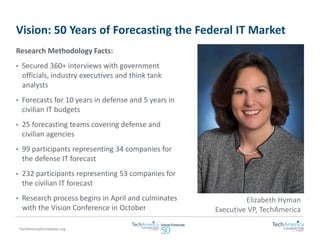
Elizabeth Hyman 
Executive VP, TechAmerica
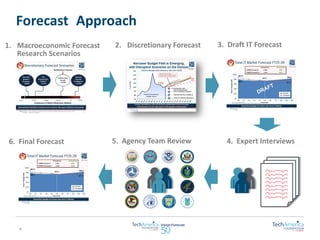
Forecast Approach 
5. Agency Team Review 4. Expert Interviews 
4 
2. Discretionary Forecast 
1. Macroeconomic Forecast 
Research Scenarios 
3. Draft IT Forecast 
6. Final Forecast
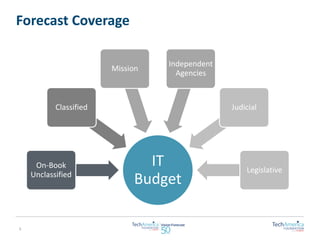
Forecast Coverage 
5 
IT 
Budget 
On-Book 
Unclassified 
Classified 
Mission 
Independent 
Agencies 
Judicial 
Legislative
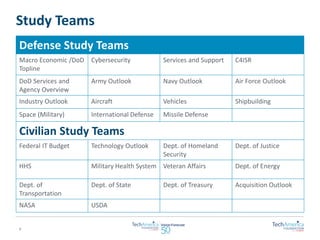
Study Teams 
6 
Defense Study Teams 
Macro Economic /DoD 
Topline 
Cybersecurity Services and Support 
C4ISR 
DoD Services and 
Agency Overview 
Army Outlook Navy Outlook Air Force Outlook 
Industry Outlook Aircraft Vehicles Shipbuilding 
Space (Military) International Defense Missile Defense 
Civilian Study Teams 
Federal IT Budget Technology Outlook Dept. of Homeland 
Security 
Dept. of Justice 
HHS Military Health System Veteran Affairs Dept. of Energy 
Dept. of 
Transportation 
Dept. of State Dept. of Treasury Acquisition Outlook 
NASA USDA
Macroeconomic & Defense Forecast Rich Ashooh, DoD Vision Chair
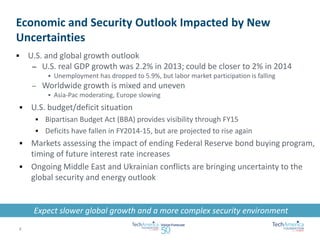
Economic and Security Outlook Impacted by New 
Uncertainties 
 U.S. and global growth outlook 
– U.S. real GDP growth was 2.2% in 2013; could be closer to 2% in 2014 
 Unemployment has dropped to 5.9%, but labor market participation is falling 
– Worldwide growth is mixed and uneven 
 Asia-Pac moderating, Europe slowing 
 U.S. budget/deficit situation 
 Bipartisan Budget Act (BBA) provides visibility through FY15 
 Deficits have fallen in FY2014-15, but are projected to rise again 
 Markets assessing the impact of ending Federal Reserve bond buying program, 
timing of future interest rate increases 
 Ongoing Middle East and Ukrainian conflicts are bringing uncertainty to the 
global security and energy outlook 
Expect slower global growth and a more complex security environment 
8
Defense 
16% 
$608B 
Social 
Security 
23% 
$893B 
Medicare 
14% 
$528B 
Other 
Mandatory 
18% 
$679B 
Medicaid 
9% 
$337B 
Defense 
11% 
$630B 
Social Security 
25% 
Medicare $1,492B 
15% 
$857B 
Medicaid 
9% 
$545B 
Other 
Mandatory 
16% 
$983B 
Interest 
14% 
$804B 
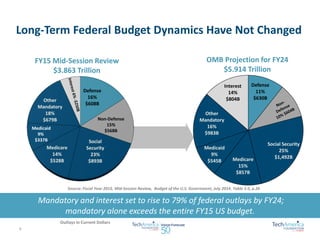
Long-Term Federal Budget Dynamics Have Not Changed 
Mandatory and interest set to rise to 79% of federal outlays by FY24; 
mandatory alone exceeds the entire FY15 US budget. 
Outlays in Current Dollars 
FY15 Mid-Session Review 
$3.863 Trillion 
OMB Projection for FY24 
$5.914 Trillion 
Non-Defense 
15% 
$568B 
Source: Fiscal Year 2015, Mid-Session Review, Budget of the U.S. Government, July 2014, Table S-5, p.26 
9
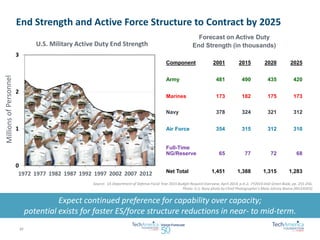
End Strength and Active Force Structure to Contract by 2025 
Expect continued preference for capability over capacity; 
potential exists for faster ES/force structure reductions in near- to mid-term. 
0 
1 
2 
3 
1972 1977 1982 1987 1992 1997 2002 2007 2012 
U.S. Military Active Duty End Strength 
Forecast on Active Duty 
End Strength (in thousands) 
Component 2001 2015 2020 2025 
Army 481 490 435 420 
Marines 173 182 175 173 
Navy 378 324 321 312 
Air Force 354 315 312 310 
Full-Time 
NG/Reserve 65 77 72 68 
Net Total 1,451 1,388 1,315 1,283 
Source: US Department of Defense Fiscal Year 2015 Budget Request Overview, April 2014, p.A-2; FY2014 DoD Green Book, pp. 255-256. 
Photo: U.S. Navy photo by Chief Photographer's Mate Johnny Bivera (RELEASED) 
10
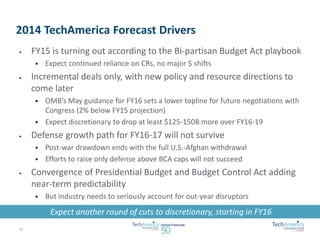
2014 TechAmerica Forecast Drivers 
 FY15 is turning out according to the Bi-partisan Budget Act playbook 
 Expect continued reliance on CRs, no major $ shifts 
 Incremental deals only, with new policy and resource directions to 
come later 
 OMB’s May guidance for FY16 sets a lower topline for future negotiations with 
Congress (2% below FY15 projection) 
 Expect discretionary to drop at least $125-150B more over FY16-19 
 Defense growth path for FY16-17 will not survive 
 Post-war drawdown ends with the full U.S.-Afghan withdrawal 
 Efforts to raise only defense above BCA caps will not succeed 
 Convergence of Presidential Budget and Budget Control Act adding 
near-term predictability 
 But industry needs to seriously account for out-year disruptors 
Expect another round of cuts to discretionary, starting in FY16 
11
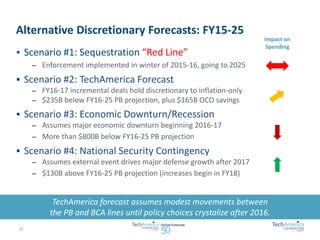
Alternative Discretionary Forecasts: FY15-25 
 Scenario #1: Sequestration “Red Line” 
– Enforcement implemented in winter of 2015-16, going to 2025 
 Scenario #2: TechAmerica Forecast 
– FY16-17 incremental deals hold discretionary to inflation-only 
– $235B below FY16-25 PB projection, plus $165B OCO savings 
 Scenario #3: Economic Downturn/Recession 
– Assumes major economic downturn beginning 2016-17 
– More than $800B below FY16-25 PB projection 
 Scenario #4: National Security Contingency 
– Assumes external event drives major defense growth after 2017 
– $130B above FY16-25 PB projection (increases begin in FY18) 
TechAmerica forecast assumes modest movements between 
the PB and BCA lines until policy choices crystalize after 2016. 
Impact on 
Spending 
12
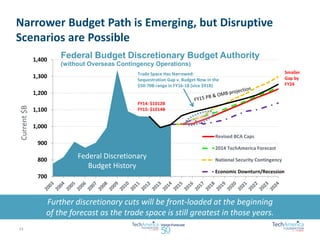
Narrower Budget Path is Emerging, but Disruptive 
Scenarios are Possible 
Further discretionary cuts will be front-loaded at the beginning 
of the forecast as the trade space is still greatest in those years. 
700 
800 
900 
1,000 
1,100 
1,200 
1,300 
1,400 
Current $B 
Federal Budget Discretionary Budget Authority 
(without Overseas Contingency Operations) 
Revised BCA Caps 
2014 TechAmerica Forecast 
National Security Contingency 
Economic Downturn/Recession 
Trade Space Has Narrowed: 
Sequestration Gap v. Budget Now in the 
$50-70B range in FY16-18 (vice $91B) 
Smaller 
Gap by 
FY24 
Federal Discretionary 
Budget History 
FY14: $1012B 
FY15: $1014B 
13
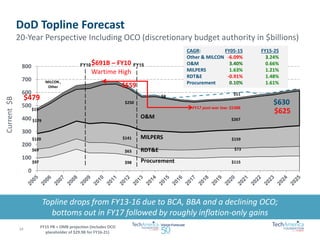
DoD Topline Forecast 
20-Year Perspective Including OCO (discretionary budget authority in $billions) 
Topline drops from FY13-16 due to BCA, BBA and a declining OCO; 
bottoms out in FY17 followed by roughly inflation-only gains 
Federal Discretionary 
Budget History 
0 
100 
200 
300 
400 
500 
600 
700 
800 
$8 
FY17 post-war low: $538B 
MILCON , 
Other 
$63 RDT&E 
$141 
$250 
$559 
Current $B 
$98 
$73 
$159 
$267 
$625 
$115 
$11 
$630 
FY15 PB + OMB projection (includes OCO 
placeholder of $29.9B for FY16-21) 
$69 
$120 
$179 
$97 
$15 
$479 
CAGR: FY05-15 FY15-25 
Other & MILCON -6.09% 3.24% 
O&M 3.40% 0.66% 
MILPERS 1.63% 1.21% 
RDT&E -0.91% 1.48% 
Procurement 0.10% 1.61% 
$691B – FY10 
Wartime High 
FY10 FY15 
14
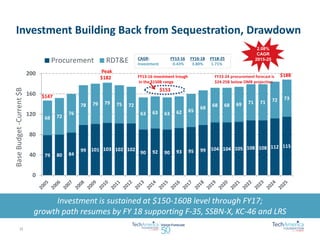
Investment Building Back from Sequestration, Drawdown 
Investment is sustained at $150-160B level through FY17; 
growth path resumes by FY 18 supporting F-35, SSBN-X, KC-46 and LRS 
Federal Discretionary 
Budget History 
79 80 84 
99 101 103 102 102 
90 92 90 93 95 99 104 104 105 108 108 112 115 
68 72 
76 
78 79 79 75 72 
63 63 63 62 65 
68 68 68 69 71 71 72 73 
0 
40 
80 
120 
160 
200 
Procurement RDT&E CAGR: FY13-16 FY16-18 FY18-25 
Investment 0.43% 3.80% 1.71% 
Base Budget -Current $B 
$147 
$153 
$188 
2.08% 
CAGR 
2015-25 
Peak 
$182 FY13-16 investment trough 
in the $150B range 
FY23-24 procurement forecast is 
$24-25B below OMB projection 
15
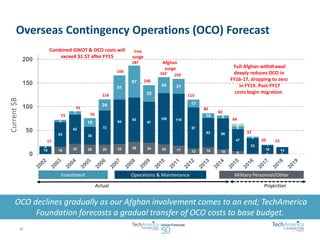
Overseas Contingency Operations (OCO) Forecast 
OCO declines gradually as our Afghan involvement comes to an end; TechAmerica 
Foundation forecasts a gradual transfer of OCO costs to base budget. 
Federal Discretionary 
Budget History 
15 22 20 20 22 26 24 20 17 12 15 10 6 1 1 0 
15 
53 
62 
38 
72 
94 
93 
87 
108 110 
87 
62 66 
47 
33 
18 14 
2 
5 
7 
19 
24 
51 
67 
35 
34 31 
17 
10 6 
6 
3 
1 
5 
0 
50 
100 
150 
200 
17 
91 
73 
166 
116 
76 
82 
115 
162 159 
146 
20 
64 
86 
Full Afghan withdrawal 
deeply reduces OCO in 
FY16-17, dropping to zero 
in FY19. Post-FY17 
costs begin migration 
37 
Actual Projection 
Investment Operations & Maintenance Military Personnel/Other 
Current $B 
Iraq 
surge 
Afghan 
surge 
15 
Combined GWOT & OCO costs will 
exceed $1.5T after FY15 
187 
16
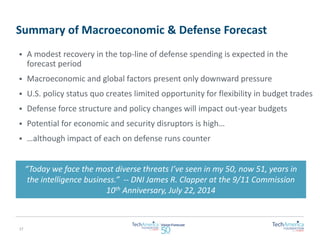
Summary of Macroeconomic & Defense Forecast 
“Today we face the most diverse threats I’ve seen in my 50, now 51, years in 
the intelligence business.” -- DNI James R. Clapper at the 9/11 Commission 
10th Anniversary, July 22, 2014 
 A modest recovery in the top-line of defense spending is expected in the 
forecast period 
 Macroeconomic and global factors present only downward pressure 
 U.S. policy status quo creates limited opportunity for flexibility in budget trades 
 Defense force structure and policy changes will impact out-year budgets 
 Potential for economic and security disruptors is high… 
 …although impact of each on defense runs counter 
17
Federal IT Forecast Robert Haas, Vision Strategic Forecast Council
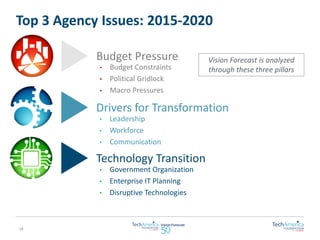
Top 3 Agency Issues: 2015-2020 
19 
Budget Pressure 
• Budget Constraints 
• Political Gridlock 
• Macro Pressures 
Drivers for Transformation 
• Leadership 
• Workforce 
• Communication 
Technology Transition 
• Government Organization 
• Enterprise IT Planning 
• Disruptive Technologies 
Vision Forecast is analyzed 
through these three pillars
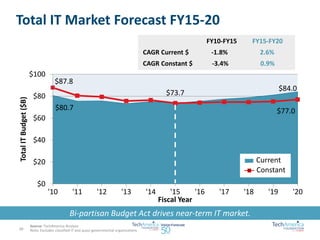
Total IT Market Forecast FY15-20 
$80.7 
$73.7 
$84.0 
$87.8 
$77.0 
$0 
$20 
$40 
$60 
$80 
$100 
'10 '11 '12 '13 '14 '15 '16 '17 '18 '19 '20 
Total IT Budget ($B) 
Fiscal Year 
FY10-FY15 FY15-FY20 
CAGR Current $ -1.8% 2.6% 
CAGR Constant $ -3.4% 0.9% 
Source: TechAmerica Analysis 
Note: Excludes classified IT and quasi-governmental organizations 
Bi-partisan Budget Act drives near-term IT market. 
20 
Current 
Constant
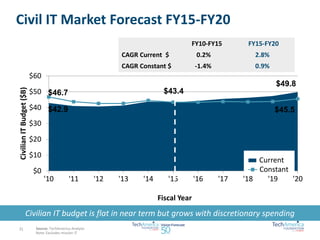
$42.9 
$43.4 
$49.8 
$46.7 
$45.5 
$0 
$10 
$20 
$30 
$40 
$50 
$60 
'10 '11 '12 '13 '14 '15 '16 '17 '18 '19 '20 
Civilian IT Budget ($B) 
Fiscal Year 
Civil IT Market Forecast FY15-FY20 
FY10-FY15 FY15-FY20 
CAGR Current $ 0.2% 2.8% 
CAGR Constant $ -1.4% 0.9% 
Source: TechAmerica Analysis 
Note: Excludes mission IT 
Civilian IT budget is flat in near term but grows with discretionary spending 
21 
Current 
Constant
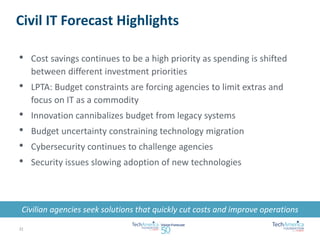
Civil IT Forecast Highlights 
• Cost savings continues to be a high priority as spending is shifted 
between different investment priorities 
• LPTA: Budget constraints are forcing agencies to limit extras and 
focus on IT as a commodity 
• Innovation cannibalizes budget from legacy systems 
• Budget uncertainty constraining technology migration 
• Cybersecurity continues to challenge agencies 
• Security issues slowing adoption of new technologies 
Civilian agencies seek solutions that quickly cut costs and improve operations 
22
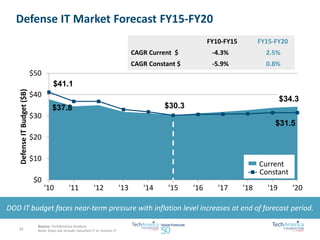
$37.8 $30.3 
$34.3 
$41.1 
$31.5 
$0 
$10 
$20 
$30 
$40 
$50 
'10 '11 '12 '13 '14 '15 '16 '17 '18 '19 '20 
Defense IT Budget ($B) 
Fiscal Year 
Defense IT Market Forecast FY15-FY20 
FY10-FY15 FY15-FY20 
CAGR Current $ -4.3% 2.5% 
CAGR Constant $ -5.9% 0.8% 
Source: TechAmerica Analysis 
Note: Does not include classified IT or mission IT 
DOD IT budget faces near-term pressure with inflation level increases at end of forecast period. 
23 
Current 
Constant
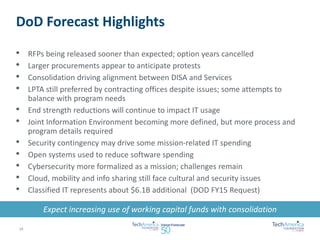
DoD Forecast Highlights 
• RFPs being released sooner than expected; option years cancelled 
• Larger procurements appear to anticipate protests 
• Consolidation driving alignment between DISA and Services 
• LPTA still preferred by contracting offices despite issues; some attempts to 
balance with program needs 
• End strength reductions will continue to impact IT usage 
• Joint Information Environment becoming more defined, but more process and 
program details required 
• Security contingency may drive some mission-related IT spending 
• Open systems used to reduce software spending 
• Cybersecurity more formalized as a mission; challenges remain 
• Cloud, mobility and info sharing still face cultural and security issues 
• Classified IT represents about $6.1B additional (DOD FY15 Request) 
Expect increasing use of working capital funds with consolidation 
24
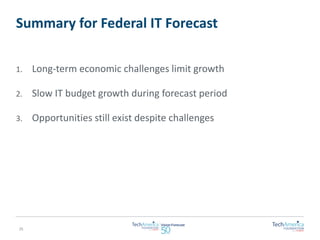
Summary for Federal IT Forecast 
1. Long-term economic challenges limit growth 
2. Slow IT budget growth during forecast period 
3. Opportunities still exist despite challenges 
25

2014 TechAmerica Foundation Vision Forecast Overview

  • 1.
  • 2.
    Vision Federal MarketForecast Press Policy TechAmericaFoundation.org The Vision Forecast represents the collective work and intellectual analysis of the Vision team. The presentations and slides are the opinion of the TechAmerica Foundation Vision process and do not represent the opinion of any individual person or company on the team. Presenters merely convey the collective outcome, and their presentations do not necessarily reflect their personal or professional view nor that of their companies.
  • 3.
    Vision: 50 Yearsof Forecasting the Federal IT Market Research Methodology Facts: • Secured 360+ interviews with government officials, industry executives and think tank analysts • Forecasts for 10 years in defense and 5 years in civilian IT budgets • 25 forecasting teams covering defense and civilian agencies • 99 participants representing 34 companies for the defense IT forecast • 232 participants representing 53 companies for the civilian IT forecast • Research process begins in April and culminates with the Vision Conference in October TechAmericaFoundation.org Elizabeth Hyman Executive VP, TechAmerica
  • 4.
    Forecast Approach 5.Agency Team Review 4. Expert Interviews 4 2. Discretionary Forecast 1. Macroeconomic Forecast Research Scenarios 3. Draft IT Forecast 6. Final Forecast
  • 5.
    Forecast Coverage 5 IT Budget On-Book Unclassified Classified Mission Independent Agencies Judicial Legislative
  • 6.
    Study Teams 6 Defense Study Teams Macro Economic /DoD Topline Cybersecurity Services and Support C4ISR DoD Services and Agency Overview Army Outlook Navy Outlook Air Force Outlook Industry Outlook Aircraft Vehicles Shipbuilding Space (Military) International Defense Missile Defense Civilian Study Teams Federal IT Budget Technology Outlook Dept. of Homeland Security Dept. of Justice HHS Military Health System Veteran Affairs Dept. of Energy Dept. of Transportation Dept. of State Dept. of Treasury Acquisition Outlook NASA USDA
  • 7.
    Macroeconomic & DefenseForecast Rich Ashooh, DoD Vision Chair
  • 8.
    Economic and SecurityOutlook Impacted by New Uncertainties  U.S. and global growth outlook – U.S. real GDP growth was 2.2% in 2013; could be closer to 2% in 2014  Unemployment has dropped to 5.9%, but labor market participation is falling – Worldwide growth is mixed and uneven  Asia-Pac moderating, Europe slowing  U.S. budget/deficit situation  Bipartisan Budget Act (BBA) provides visibility through FY15  Deficits have fallen in FY2014-15, but are projected to rise again  Markets assessing the impact of ending Federal Reserve bond buying program, timing of future interest rate increases  Ongoing Middle East and Ukrainian conflicts are bringing uncertainty to the global security and energy outlook Expect slower global growth and a more complex security environment 8
  • 9.
    Defense 16% $608B Social Security 23% $893B Medicare 14% $528B Other Mandatory 18% $679B Medicaid 9% $337B Defense 11% $630B Social Security 25% Medicare $1,492B 15% $857B Medicaid 9% $545B Other Mandatory 16% $983B Interest 14% $804B Long-Term Federal Budget Dynamics Have Not Changed Mandatory and interest set to rise to 79% of federal outlays by FY24; mandatory alone exceeds the entire FY15 US budget. Outlays in Current Dollars FY15 Mid-Session Review $3.863 Trillion OMB Projection for FY24 $5.914 Trillion Non-Defense 15% $568B Source: Fiscal Year 2015, Mid-Session Review, Budget of the U.S. Government, July 2014, Table S-5, p.26 9
  • 10.
    End Strength andActive Force Structure to Contract by 2025 Expect continued preference for capability over capacity; potential exists for faster ES/force structure reductions in near- to mid-term. 0 1 2 3 1972 1977 1982 1987 1992 1997 2002 2007 2012 U.S. Military Active Duty End Strength Forecast on Active Duty End Strength (in thousands) Component 2001 2015 2020 2025 Army 481 490 435 420 Marines 173 182 175 173 Navy 378 324 321 312 Air Force 354 315 312 310 Full-Time NG/Reserve 65 77 72 68 Net Total 1,451 1,388 1,315 1,283 Source: US Department of Defense Fiscal Year 2015 Budget Request Overview, April 2014, p.A-2; FY2014 DoD Green Book, pp. 255-256. Photo: U.S. Navy photo by Chief Photographer's Mate Johnny Bivera (RELEASED) 10
  • 11.
    2014 TechAmerica ForecastDrivers  FY15 is turning out according to the Bi-partisan Budget Act playbook  Expect continued reliance on CRs, no major $ shifts  Incremental deals only, with new policy and resource directions to come later  OMB’s May guidance for FY16 sets a lower topline for future negotiations with Congress (2% below FY15 projection)  Expect discretionary to drop at least $125-150B more over FY16-19  Defense growth path for FY16-17 will not survive  Post-war drawdown ends with the full U.S.-Afghan withdrawal  Efforts to raise only defense above BCA caps will not succeed  Convergence of Presidential Budget and Budget Control Act adding near-term predictability  But industry needs to seriously account for out-year disruptors Expect another round of cuts to discretionary, starting in FY16 11
  • 12.
    Alternative Discretionary Forecasts:FY15-25  Scenario #1: Sequestration “Red Line” – Enforcement implemented in winter of 2015-16, going to 2025  Scenario #2: TechAmerica Forecast – FY16-17 incremental deals hold discretionary to inflation-only – $235B below FY16-25 PB projection, plus $165B OCO savings  Scenario #3: Economic Downturn/Recession – Assumes major economic downturn beginning 2016-17 – More than $800B below FY16-25 PB projection  Scenario #4: National Security Contingency – Assumes external event drives major defense growth after 2017 – $130B above FY16-25 PB projection (increases begin in FY18) TechAmerica forecast assumes modest movements between the PB and BCA lines until policy choices crystalize after 2016. Impact on Spending 12
  • 13.
    Narrower Budget Pathis Emerging, but Disruptive Scenarios are Possible Further discretionary cuts will be front-loaded at the beginning of the forecast as the trade space is still greatest in those years. 700 800 900 1,000 1,100 1,200 1,300 1,400 Current $B Federal Budget Discretionary Budget Authority (without Overseas Contingency Operations) Revised BCA Caps 2014 TechAmerica Forecast National Security Contingency Economic Downturn/Recession Trade Space Has Narrowed: Sequestration Gap v. Budget Now in the $50-70B range in FY16-18 (vice $91B) Smaller Gap by FY24 Federal Discretionary Budget History FY14: $1012B FY15: $1014B 13
  • 14.
    DoD Topline Forecast 20-Year Perspective Including OCO (discretionary budget authority in $billions) Topline drops from FY13-16 due to BCA, BBA and a declining OCO; bottoms out in FY17 followed by roughly inflation-only gains Federal Discretionary Budget History 0 100 200 300 400 500 600 700 800 $8 FY17 post-war low: $538B MILCON , Other $63 RDT&E $141 $250 $559 Current $B $98 $73 $159 $267 $625 $115 $11 $630 FY15 PB + OMB projection (includes OCO placeholder of $29.9B for FY16-21) $69 $120 $179 $97 $15 $479 CAGR: FY05-15 FY15-25 Other & MILCON -6.09% 3.24% O&M 3.40% 0.66% MILPERS 1.63% 1.21% RDT&E -0.91% 1.48% Procurement 0.10% 1.61% $691B – FY10 Wartime High FY10 FY15 14
  • 15.
    Investment Building Backfrom Sequestration, Drawdown Investment is sustained at $150-160B level through FY17; growth path resumes by FY 18 supporting F-35, SSBN-X, KC-46 and LRS Federal Discretionary Budget History 79 80 84 99 101 103 102 102 90 92 90 93 95 99 104 104 105 108 108 112 115 68 72 76 78 79 79 75 72 63 63 63 62 65 68 68 68 69 71 71 72 73 0 40 80 120 160 200 Procurement RDT&E CAGR: FY13-16 FY16-18 FY18-25 Investment 0.43% 3.80% 1.71% Base Budget -Current $B $147 $153 $188 2.08% CAGR 2015-25 Peak $182 FY13-16 investment trough in the $150B range FY23-24 procurement forecast is $24-25B below OMB projection 15
  • 16.
    Overseas Contingency Operations(OCO) Forecast OCO declines gradually as our Afghan involvement comes to an end; TechAmerica Foundation forecasts a gradual transfer of OCO costs to base budget. Federal Discretionary Budget History 15 22 20 20 22 26 24 20 17 12 15 10 6 1 1 0 15 53 62 38 72 94 93 87 108 110 87 62 66 47 33 18 14 2 5 7 19 24 51 67 35 34 31 17 10 6 6 3 1 5 0 50 100 150 200 17 91 73 166 116 76 82 115 162 159 146 20 64 86 Full Afghan withdrawal deeply reduces OCO in FY16-17, dropping to zero in FY19. Post-FY17 costs begin migration 37 Actual Projection Investment Operations & Maintenance Military Personnel/Other Current $B Iraq surge Afghan surge 15 Combined GWOT & OCO costs will exceed $1.5T after FY15 187 16
  • 17.
    Summary of Macroeconomic& Defense Forecast “Today we face the most diverse threats I’ve seen in my 50, now 51, years in the intelligence business.” -- DNI James R. Clapper at the 9/11 Commission 10th Anniversary, July 22, 2014  A modest recovery in the top-line of defense spending is expected in the forecast period  Macroeconomic and global factors present only downward pressure  U.S. policy status quo creates limited opportunity for flexibility in budget trades  Defense force structure and policy changes will impact out-year budgets  Potential for economic and security disruptors is high…  …although impact of each on defense runs counter 17
  • 18.
    Federal IT ForecastRobert Haas, Vision Strategic Forecast Council
  • 19.
    Top 3 AgencyIssues: 2015-2020 19 Budget Pressure • Budget Constraints • Political Gridlock • Macro Pressures Drivers for Transformation • Leadership • Workforce • Communication Technology Transition • Government Organization • Enterprise IT Planning • Disruptive Technologies Vision Forecast is analyzed through these three pillars
  • 20.
    Total IT MarketForecast FY15-20 $80.7 $73.7 $84.0 $87.8 $77.0 $0 $20 $40 $60 $80 $100 '10 '11 '12 '13 '14 '15 '16 '17 '18 '19 '20 Total IT Budget ($B) Fiscal Year FY10-FY15 FY15-FY20 CAGR Current $ -1.8% 2.6% CAGR Constant $ -3.4% 0.9% Source: TechAmerica Analysis Note: Excludes classified IT and quasi-governmental organizations Bi-partisan Budget Act drives near-term IT market. 20 Current Constant
  • 21.
    $42.9 $43.4 $49.8 $46.7 $45.5 $0 $10 $20 $30 $40 $50 $60 '10 '11 '12 '13 '14 '15 '16 '17 '18 '19 '20 Civilian IT Budget ($B) Fiscal Year Civil IT Market Forecast FY15-FY20 FY10-FY15 FY15-FY20 CAGR Current $ 0.2% 2.8% CAGR Constant $ -1.4% 0.9% Source: TechAmerica Analysis Note: Excludes mission IT Civilian IT budget is flat in near term but grows with discretionary spending 21 Current Constant
  • 22.
    Civil IT ForecastHighlights • Cost savings continues to be a high priority as spending is shifted between different investment priorities • LPTA: Budget constraints are forcing agencies to limit extras and focus on IT as a commodity • Innovation cannibalizes budget from legacy systems • Budget uncertainty constraining technology migration • Cybersecurity continues to challenge agencies • Security issues slowing adoption of new technologies Civilian agencies seek solutions that quickly cut costs and improve operations 22
  • 23.
    $37.8 $30.3 $34.3 $41.1 $31.5 $0 $10 $20 $30 $40 $50 '10 '11 '12 '13 '14 '15 '16 '17 '18 '19 '20 Defense IT Budget ($B) Fiscal Year Defense IT Market Forecast FY15-FY20 FY10-FY15 FY15-FY20 CAGR Current $ -4.3% 2.5% CAGR Constant $ -5.9% 0.8% Source: TechAmerica Analysis Note: Does not include classified IT or mission IT DOD IT budget faces near-term pressure with inflation level increases at end of forecast period. 23 Current Constant
  • 24.
    DoD Forecast Highlights • RFPs being released sooner than expected; option years cancelled • Larger procurements appear to anticipate protests • Consolidation driving alignment between DISA and Services • LPTA still preferred by contracting offices despite issues; some attempts to balance with program needs • End strength reductions will continue to impact IT usage • Joint Information Environment becoming more defined, but more process and program details required • Security contingency may drive some mission-related IT spending • Open systems used to reduce software spending • Cybersecurity more formalized as a mission; challenges remain • Cloud, mobility and info sharing still face cultural and security issues • Classified IT represents about $6.1B additional (DOD FY15 Request) Expect increasing use of working capital funds with consolidation 24
  • 25.
    Summary for FederalIT Forecast 1. Long-term economic challenges limit growth 2. Slow IT budget growth during forecast period 3. Opportunities still exist despite challenges 25