Interactive Maps for
Managing Asset Flood
Risk Across Manchester
Anneka Lowis BSc, MSc - JBA Consulting
Dr Barry Hankin BSc, FCIWEM, C.WEM - JBA Consulting
Dr Tariq M Ziad, BSc, MSc, PhD, CEng, MICE – MCC
Esther Goodship BSc, MRes, C.WEM, CSci, CEnv, MCIWEM - MCC
Background
• Section 21 of the Flood and Water
Management Act 2010
• Lead Local Flood Authority (LLFA) duty to
establish and maintain
– A register of structures that are likely to have a
significant effect on flood risk
– A record of information about each of those structures
or features, including information about ownership
and state of repair
Aims
• Create a Flood Risk Asset Register
– Location and type of asset and watercourse
– Details on asset condition to be populated by LLFA

• Enable the LLFA to prioritise maintenance
– Quantify properties and infrastructure at risk
– Spatially differentiate and visualise flood risk

– Provide an understanding of the relative risks from
asset blockage across the city
Methodology

Asset
Register
Flood Hazard
Grids
Impact
Analysis
Interactive
Maps
Creation of Asset Register
Existing Records
•Spreadsheet
•Paper records
•GIS layers

Records Combined
•Duplicates consolidated
•Location and Type recorded
•Unique ID

Intersecting GIS Layers
Asset Register
•960 assets
•463 assessed
for flood risk
•Roads
•Railways, Metro
•Watercourse
Flood Modelling
Hydrology
16

Q5

14

Q30

Flow m 3/s

12

Q100

10

Q200

8

Q1000

6
4
2
0
0

2

4

6

•463 assets
•58 return periods
10
12

•Depth
•Hazard
•Velocity

Time (hrs)

JFLOW+
•Rapid 2D overland flood model
•100% blocked scenario
•Unblocked or partial blockage
scenarios in future work

Flood Grids
•6945 (463 * 5 * 3)
•GIS format
Impact Analysis
Receptors
•National Receptor Dataset (NRD)
•Residential
•Non Residential
Ground Floor
•Key Infrastructure
•Roads, Railways, Metrolink

Frism
•JBA’s ArcGIS based impact
analysis software
•Batch consequence analysis
•Flood metrics calculated for each
asset and return period modelled

Metrics

•Detailed Count
•Damages
•Lengths
Damages
•NRD property type
•Depth within property footprint
•MCM depth damage curve
•Floor area
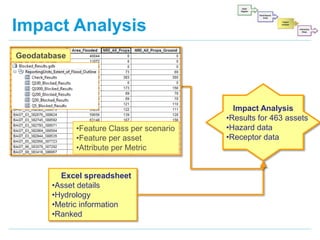
Impact Analysis
Geodatabase

•Feature Class per scenario
•Feature per asset
•Attribute per Metric

Excel spreadsheet
•Asset details
•Hydrology
•Metric information
•Ranked

Impact Analysis
•Results for 463 assets
•Hazard data
•Receptor data
Interactive Maps
Solution

Challenge
• Clearly present asset
blockage data

•

– 463 independent assets
– Flood Hazard grids
– Impact analysis

• Viewable to non technical
users without GIS software •

Suite of interactive PDFs
– Individual asset report
containing flood maps and
impact analysis tables
– Overview maps summarising
information at the ward level
– Interlinked PDFs

Viewable to non technical
users without GIS software
Asset Map Package
Data
•Asset information
•Flood grids
•Receptors
•Impact analysis

Automated Mapping
•Data driven pages
(ArcGIS)
•Python scripting
•One map package per
asset modelled(463)

Map Package

•Multipage PDF
•Depth, Hazard, Velocity
•5 return periods
Asset Map Package
Data
•Asset information
•Asset information
•Flood grids
•Flood grids
•Receptors
•Receptors
•Impact analysis
•Impact analysis
Interactive Overview Maps
Ward Map

Overview Map
Linked to
Ward Map
•Coloured by
number of assets

•Spatial relationship
•Coloured by impact
•Appreciation of risk
for each asset

Interactive Maps
•Easy to navigate
•Drill down detail
Map Animation

13
Further Work
• Benefit calculations
– Unblocked or partial blockage modelling
– Annual Average damages
– Benefit of culvert maintenance

• Increase interactivity of individual PDFs
– Dropdowns to allow users to switch between depth, hazard and
velocity grids
• Advantages: Reduce file sizes
• Disadvantages: Increasing complexity
Map Animation

16
Conclusions and Outcomes
• GIS techniques have been used to visualise local
flood risk from bridge and culvert assets
– GIS automation and python scripting has streamlined the process of
generating interactive risk maps from large quantities of data
– Repeatable operation

• Maps viewable by those without GIS software
– Easy to disseminate and print

– Provides an understanding of the relative flood risk from asset
blockage around the City
– Allows asset maintenance to be prioritised
Conclusions and Outcomes
• Creation of Manchester City Council’s Flood Risk
Asset Register
• Satisfies their requirements under the Flood and
Water Management Act 2010
– Asset location
– Understanding of asset risk
– Visualisation of local flood risk
– Prioritisation for flood risk management and maintenance
– Accessible outputs

Interactive Maps for Managing Asset Flood Risk Across Manchester (Anneka Lowis, JBA)

  • 1.
    Interactive Maps for ManagingAsset Flood Risk Across Manchester Anneka Lowis BSc, MSc - JBA Consulting Dr Barry Hankin BSc, FCIWEM, C.WEM - JBA Consulting Dr Tariq M Ziad, BSc, MSc, PhD, CEng, MICE – MCC Esther Goodship BSc, MRes, C.WEM, CSci, CEnv, MCIWEM - MCC
  • 2.
    Background • Section 21of the Flood and Water Management Act 2010 • Lead Local Flood Authority (LLFA) duty to establish and maintain – A register of structures that are likely to have a significant effect on flood risk – A record of information about each of those structures or features, including information about ownership and state of repair
  • 3.
    Aims • Create aFlood Risk Asset Register – Location and type of asset and watercourse – Details on asset condition to be populated by LLFA • Enable the LLFA to prioritise maintenance – Quantify properties and infrastructure at risk – Spatially differentiate and visualise flood risk – Provide an understanding of the relative risks from asset blockage across the city
  • 4.
  • 5.
    Creation of AssetRegister Existing Records •Spreadsheet •Paper records •GIS layers Records Combined •Duplicates consolidated •Location and Type recorded •Unique ID Intersecting GIS Layers Asset Register •960 assets •463 assessed for flood risk •Roads •Railways, Metro •Watercourse
  • 6.
    Flood Modelling Hydrology 16 Q5 14 Q30 Flow m3/s 12 Q100 10 Q200 8 Q1000 6 4 2 0 0 2 4 6 •463 assets •58 return periods 10 12 •Depth •Hazard •Velocity Time (hrs) JFLOW+ •Rapid 2D overland flood model •100% blocked scenario •Unblocked or partial blockage scenarios in future work Flood Grids •6945 (463 * 5 * 3) •GIS format
  • 7.
    Impact Analysis Receptors •National ReceptorDataset (NRD) •Residential •Non Residential Ground Floor •Key Infrastructure •Roads, Railways, Metrolink Frism •JBA’s ArcGIS based impact analysis software •Batch consequence analysis •Flood metrics calculated for each asset and return period modelled Metrics •Detailed Count •Damages •Lengths Damages •NRD property type •Depth within property footprint •MCM depth damage curve •Floor area
  • 8.
    Impact Analysis Geodatabase •Feature Classper scenario •Feature per asset •Attribute per Metric Excel spreadsheet •Asset details •Hydrology •Metric information •Ranked Impact Analysis •Results for 463 assets •Hazard data •Receptor data
  • 9.
    Interactive Maps Solution Challenge • Clearlypresent asset blockage data • – 463 independent assets – Flood Hazard grids – Impact analysis • Viewable to non technical users without GIS software • Suite of interactive PDFs – Individual asset report containing flood maps and impact analysis tables – Overview maps summarising information at the ward level – Interlinked PDFs Viewable to non technical users without GIS software
  • 10.
    Asset Map Package Data •Assetinformation •Flood grids •Receptors •Impact analysis Automated Mapping •Data driven pages (ArcGIS) •Python scripting •One map package per asset modelled(463) Map Package •Multipage PDF •Depth, Hazard, Velocity •5 return periods
  • 11.
    Asset Map Package Data •Assetinformation •Asset information •Flood grids •Flood grids •Receptors •Receptors •Impact analysis •Impact analysis
  • 12.
    Interactive Overview Maps WardMap Overview Map Linked to Ward Map •Coloured by number of assets •Spatial relationship •Coloured by impact •Appreciation of risk for each asset Interactive Maps •Easy to navigate •Drill down detail
  • 13.
  • 15.
    Further Work • Benefitcalculations – Unblocked or partial blockage modelling – Annual Average damages – Benefit of culvert maintenance • Increase interactivity of individual PDFs – Dropdowns to allow users to switch between depth, hazard and velocity grids • Advantages: Reduce file sizes • Disadvantages: Increasing complexity
  • 16.
  • 17.
    Conclusions and Outcomes •GIS techniques have been used to visualise local flood risk from bridge and culvert assets – GIS automation and python scripting has streamlined the process of generating interactive risk maps from large quantities of data – Repeatable operation • Maps viewable by those without GIS software – Easy to disseminate and print – Provides an understanding of the relative flood risk from asset blockage around the City – Allows asset maintenance to be prioritised
  • 18.
    Conclusions and Outcomes •Creation of Manchester City Council’s Flood Risk Asset Register • Satisfies their requirements under the Flood and Water Management Act 2010 – Asset location – Understanding of asset risk – Visualisation of local flood risk – Prioritisation for flood risk management and maintenance – Accessible outputs