Contents
What is a Lifecycle?
Mammals
Amphibians
Reptiles
Insects
Birds
What is a Lifecycle?
• What is a life cycle?
• What life cycles do you know about?
• Can you describe the life cycle of an animal
or plant?
Back to contents
Animal life cycle
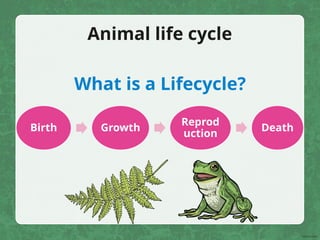
Birth Growth
Reprod
uction
Death
What is a Lifecycle?
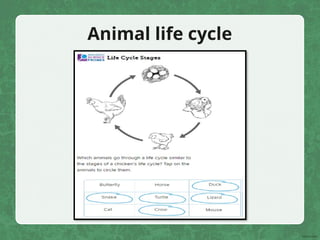
Animal life cycle
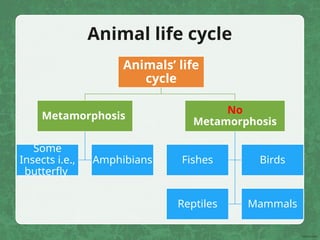
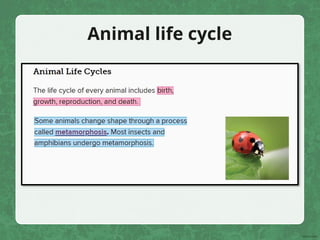
Animals’ life
cycle
Metamorphosis
Some
Insects i.e.,
butterfly
Amphibians
No
Metamorphosis
Fishes Birds
Reptiles Mammals
Animal life cycle
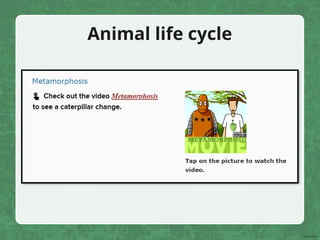
Metamorpho
sis
Meta = Change
Morpho =
Shape
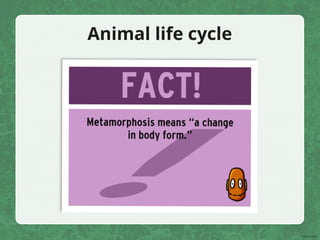
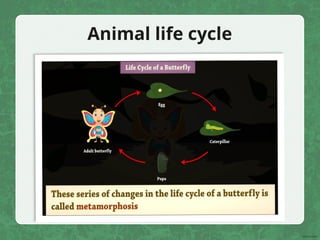
Meta-morphosis: is change in body
shape, Or to change thing into a
different thing.
Animal life cycle
Animal life cycle
Animal life cycle
Insects
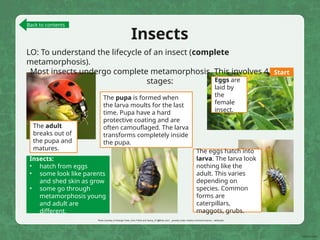
LO: To understand the lifecycle of an insect (complete
metamorphosis).
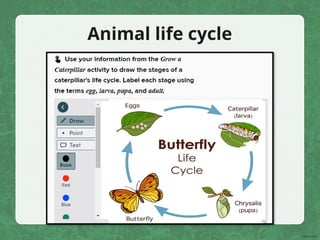
Most insects undergo complete metamorphosis. This involves 4 main
stages: Eggs are
laid by
the
female
insect.
The eggs hatch into
larva. The larva look
nothing like the
adult. This varies
depending on
species. Common
forms are
caterpillars,
maggots, grubs.
The adult
breaks out of
the pupa and
matures.
Insects:
• hatch from eggs
• some look like parents
and shed skin as grow
• some go through
metamorphosis young
and adult are
different.
The pupa is formed when
the larva moults for the last
time. Pupa have a hard
protective coating and are
often camouflaged. The larva
transforms completely inside
the pupa.
Photo courtesy of Strange Ones, Eran Finkle and Sandy_R (@flickr.com) - granted under creative commons licence – attribution
Back to contents
Start
Animal life cycle
Insects
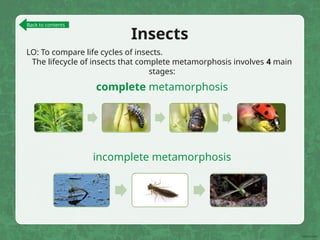
LO: To compare life cycles of insects.
The lifecycle of insects that complete metamorphosis involves 4 main
stages:
complete metamorphosis
incomplete metamorphosis
Back to contents
Animal life cycle
Animal life cycle
Animal life cycle
Animal life cycle
https://youtu.be/3kZD6rlSLUw
https://youtu.be/kVm5k99PnBk?si=ReTnSB77vT9j5V
-z
https://youtu.be/LWOb8k0kbXY?si=x35NO11zwSNqbK_n
https://youtu.be/kVm5k99PnBk?si=MqGzvMTUgeCI1QLj
https://youtu.be/TvmQiWpgX5c?si=UwofKASJa0dMHR
9u
Videos..
Animal life cycle
Animal life cycle
Insects
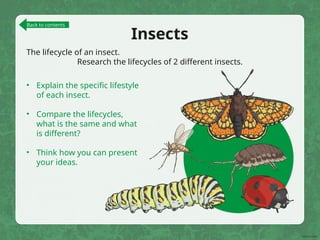
The lifecycle of an insect.
Research the lifecycles of 2 different insects.
• Explain the specific lifestyle
of each insect.
• Compare the lifecycles,
what is the same and what
is different?
• Think how you can present
your ideas.
Back to contents
Animal life cycle
Amphibian
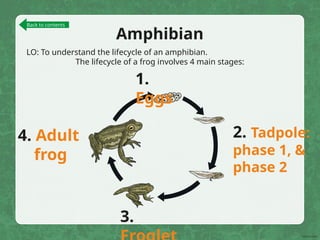
LO: To understand the lifecycle of an amphibian.
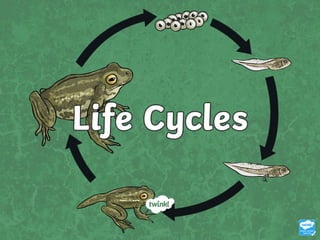
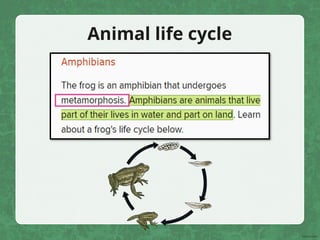
The lifecycle of a frog involves 4 main stages:
Back to contents
1.
Eggs
4. Adult
frog
3.
2. Tadpole:
phase 1, &
phase 2
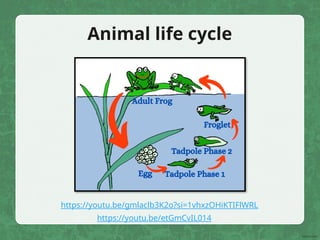
https://youtu.be/etGmCvIL014
https://youtu.be/gmlaclb3K2o?si=1vhxzOHiKTIFlWRL
Animal life cycle
Amphibian
LO: To understand the lifecycle of an amphibian.
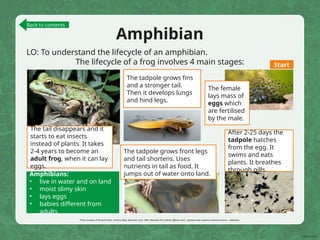
The lifecycle of a frog involves 4 main stages:
The female
lays mass of
eggs which
are fertilised
by the male.
After 2-25 days the
tadpole hatches
from the egg. It
swims and eats
plants. It breathes
through gills.
The tadpole grows front legs
and tail shortens. Uses
nutrients in tail as food. It
jumps out of water onto land.
Amphibians:
• live in water and on land
• moist slimy skin
• lays eggs
• babies different from
adults
The tadpole grows fins
and a stronger tail.
Then it develops lungs
and hind legs.
The tail disappears and it
starts to eat insects
instead of plants. It takes
2-4 years to become an
adult frog, when it can lay
eggs.
Photo courtesy of Richard.Fisher, Anthony Masi, Benimoto, born 1945, Beckwith-Zink (Diane) (@flickr.com) - granted under creative commons licence – attribution
Start
Back to contents
Animal life cycle
Life Cycles
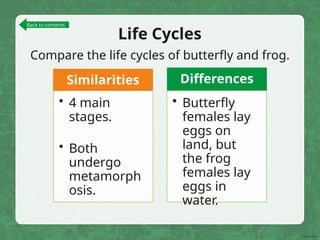
Compare the life cycles of butterfly and frog.
Similarities
• 4 main
stages.
• Both
undergo
metamorph
osis.
Differences
• Butterfly
females lay
eggs on
land, but
the frog
females lay
eggs in
water.
Back to contents
Animal life cycle
Animal life cycle
Animal life cycle
Reptiles
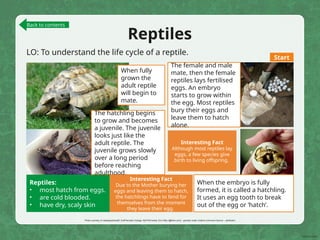
LO: To understand the life cycle of a reptile.
The female and male
mate, then the female
reptiles lays fertilised
eggs. An embryo
starts to grow within
the egg. Most reptiles
bury their eggs and
leave them to hatch
alone.
Reptiles:
• most hatch from eggs.
• are cold blooded.
• have dry, scaly skin
Photo courtesy of vastateparksstaff, EraPhernalia Vintage, MyFWCmedia, Eric Kilby (@flickr.com) - granted under creative commons licence – attribution
When the embryo is fully
formed, it is called a hatchling.
It uses an egg tooth to break
out of the egg or ‘hatch’.
The hatchling begins
to grow and becomes
a juvenile. The juvenile
looks just like the
adult reptile. The
juvenile grows slowly
over a long period
before reaching
adulthood.
When fully
grown the
adult reptile
will begin to
mate.
Interesting Fact
Although most reptiles lay
eggs, a few species give
birth to living offspring.
Interesting Fact
Due to the Mother burying her
eggs and leaving them to hatch,
the hatchlings have to fend for
themselves from the moment
they leave their egg.
Back to contents
Start
Reptiles
To understand the life cycle of a reptile.
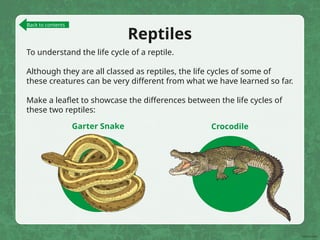
Although they are all classed as reptiles, the life cycles of some of
these creatures can be very different from what we have learned so far.
Make a leaflet to showcase the differences between the life cycles of
these two reptiles:
Garter Snake Crocodile
Back to contents
Birds
LO: To understand the lifecycle of a bird.
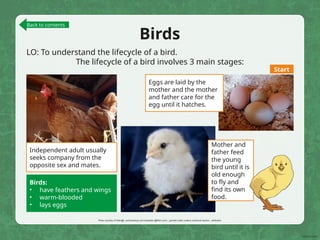
The lifecycle of a bird involves 3 main stages:
Eggs are laid by the
mother and the mother
and father care for the
egg until it hatches.
Mother and
father feed
the young
bird until it is
old enough
to fly and
find its own
food.
Independent adult usually
seeks company from the
opposite sex and mates.
Birds:
• have feathers and wings
• warm-blooded
• lays eggs
Back to contents
Start
Photo courtesy of Katie@!, portmanteaus and mazaletel (@flickr.com) - granted under creative commons licence – attribution
Animal life cycle
Animal life cycle
Animal life cycle
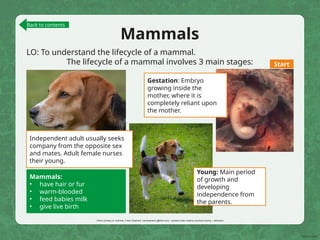
Mammals
LO: To understand the lifecycle of a mammal.
The lifecycle of a mammal involves 3 main stages:
Gestation: Embryo
growing inside the
mother, where it is
completely reliant upon
the mother.
Young: Main period
of growth and
developing
independence from
the parents.
Independent adult usually seeks
company from the opposite sex
and mates. Adult female nurses
their young.
Mammals:
• have hair or fur
• warm-blooded
• feed babies milk
• give live birth
Photo courtesy of euthman, Frank Shepherd, camerashake (@flickr.com) - granted under creative commons licence – attribution
Back to contents
Start
Animal life cycle
Animal life cycle
Animal life cycle
Animal life cycle
Animal life cycle-----------------------

Animal life cycle-----------------------

  • 2.
    Contents What is aLifecycle? Mammals Amphibians Reptiles Insects Birds
  • 3.
    What is aLifecycle? • What is a life cycle? • What life cycles do you know about? • Can you describe the life cycle of an animal or plant? Back to contents
  • 4.
  • 5.
    Birth Growth Reprod uction Death What isa Lifecycle? Animal life cycle
  • 6.
  • 7.
    Metamorpho sis Meta = Change Morpho= Shape Meta-morphosis: is change in body shape, Or to change thing into a different thing. Animal life cycle
  • 8.
  • 9.
  • 10.
    Insects LO: To understandthe lifecycle of an insect (complete metamorphosis). Most insects undergo complete metamorphosis. This involves 4 main stages: Eggs are laid by the female insect. The eggs hatch into larva. The larva look nothing like the adult. This varies depending on species. Common forms are caterpillars, maggots, grubs. The adult breaks out of the pupa and matures. Insects: • hatch from eggs • some look like parents and shed skin as grow • some go through metamorphosis young and adult are different. The pupa is formed when the larva moults for the last time. Pupa have a hard protective coating and are often camouflaged. The larva transforms completely inside the pupa. Photo courtesy of Strange Ones, Eran Finkle and Sandy_R (@flickr.com) - granted under creative commons licence – attribution Back to contents Start
  • 11.
  • 12.
    Insects LO: To comparelife cycles of insects. The lifecycle of insects that complete metamorphosis involves 4 main stages: complete metamorphosis incomplete metamorphosis Back to contents
  • 13.
  • 14.
  • 15.
  • 16.
  • 17.
  • 18.
  • 19.
    Insects The lifecycle ofan insect. Research the lifecycles of 2 different insects. • Explain the specific lifestyle of each insect. • Compare the lifecycles, what is the same and what is different? • Think how you can present your ideas. Back to contents
  • 20.
  • 21.
    Amphibian LO: To understandthe lifecycle of an amphibian. The lifecycle of a frog involves 4 main stages: Back to contents 1. Eggs 4. Adult frog 3. 2. Tadpole: phase 1, & phase 2
  • 22.
  • 23.
    Amphibian LO: To understandthe lifecycle of an amphibian. The lifecycle of a frog involves 4 main stages: The female lays mass of eggs which are fertilised by the male. After 2-25 days the tadpole hatches from the egg. It swims and eats plants. It breathes through gills. The tadpole grows front legs and tail shortens. Uses nutrients in tail as food. It jumps out of water onto land. Amphibians: • live in water and on land • moist slimy skin • lays eggs • babies different from adults The tadpole grows fins and a stronger tail. Then it develops lungs and hind legs. The tail disappears and it starts to eat insects instead of plants. It takes 2-4 years to become an adult frog, when it can lay eggs. Photo courtesy of Richard.Fisher, Anthony Masi, Benimoto, born 1945, Beckwith-Zink (Diane) (@flickr.com) - granted under creative commons licence – attribution Start Back to contents
  • 24.
  • 25.
    Life Cycles Compare thelife cycles of butterfly and frog. Similarities • 4 main stages. • Both undergo metamorph osis. Differences • Butterfly females lay eggs on land, but the frog females lay eggs in water. Back to contents
  • 26.
  • 27.
  • 28.
  • 29.
    Reptiles LO: To understandthe life cycle of a reptile. The female and male mate, then the female reptiles lays fertilised eggs. An embryo starts to grow within the egg. Most reptiles bury their eggs and leave them to hatch alone. Reptiles: • most hatch from eggs. • are cold blooded. • have dry, scaly skin Photo courtesy of vastateparksstaff, EraPhernalia Vintage, MyFWCmedia, Eric Kilby (@flickr.com) - granted under creative commons licence – attribution When the embryo is fully formed, it is called a hatchling. It uses an egg tooth to break out of the egg or ‘hatch’. The hatchling begins to grow and becomes a juvenile. The juvenile looks just like the adult reptile. The juvenile grows slowly over a long period before reaching adulthood. When fully grown the adult reptile will begin to mate. Interesting Fact Although most reptiles lay eggs, a few species give birth to living offspring. Interesting Fact Due to the Mother burying her eggs and leaving them to hatch, the hatchlings have to fend for themselves from the moment they leave their egg. Back to contents Start
  • 30.
    Reptiles To understand thelife cycle of a reptile. Although they are all classed as reptiles, the life cycles of some of these creatures can be very different from what we have learned so far. Make a leaflet to showcase the differences between the life cycles of these two reptiles: Garter Snake Crocodile Back to contents
  • 31.
    Birds LO: To understandthe lifecycle of a bird. The lifecycle of a bird involves 3 main stages: Eggs are laid by the mother and the mother and father care for the egg until it hatches. Mother and father feed the young bird until it is old enough to fly and find its own food. Independent adult usually seeks company from the opposite sex and mates. Birds: • have feathers and wings • warm-blooded • lays eggs Back to contents Start Photo courtesy of Katie@!, portmanteaus and mazaletel (@flickr.com) - granted under creative commons licence – attribution
  • 32.
  • 33.
  • 34.
  • 35.
    Mammals LO: To understandthe lifecycle of a mammal. The lifecycle of a mammal involves 3 main stages: Gestation: Embryo growing inside the mother, where it is completely reliant upon the mother. Young: Main period of growth and developing independence from the parents. Independent adult usually seeks company from the opposite sex and mates. Adult female nurses their young. Mammals: • have hair or fur • warm-blooded • feed babies milk • give live birth Photo courtesy of euthman, Frank Shepherd, camerashake (@flickr.com) - granted under creative commons licence – attribution Back to contents Start
  • 36.
  • 37.
  • 38.
  • 39.