PREVENTING ANIMAL
CRUELTY
By Mary M. Hatfield,
LVMT,M.Ed, LAT
For C.A.I.T.
WHAT IS ANIMAL ABUSE?
 Cruelty occurs any time an animal is made to
suffer or feel needless pain, whether the
person did it intentionally or through neglect.
 INTENTIONAL: A person intends to hurt an
animal, often times, maliciously, and results in
severe physical injury or death
 NEGLECT: An animal suffers because he is not
given the necessities of life.
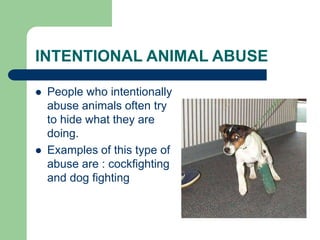
INTENTIONAL ANIMAL ABUSE
 People who intentionally
abuse animals often try
to hide what they are
doing.
 Examples of this type of
abuse are : cockfighting
and dog fighting
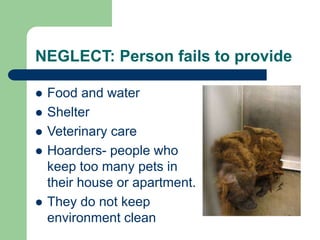
NEGLECT: Person fails to provide
 Food and water
 Shelter
 Veterinary care
 Hoarders- people who
keep too many pets in
their house or apartment.
 They do not keep
environment clean
TENNESSEE STATE LAW-definition
of animal cruelty is, any person
who:
 Commits an offense intentionally and knowingly
tortures, maims or grossly overworks an animal.
 Fails to provide necessary food, water or shelter for
an animal in that person’s custody.
 Abandons an animal in that person’s custody
 Transports or confines an animal in a cruel manner
 Inflicts injuries or pain, by any method, including
blistering compounds to the legs or hooves of horses
in order to make them sore for any purpose
including, but not limited to, competition in horse
shows and similar events.
SPECIFIC ANIMAL ABUSE LAWS
 TCA 39-14-203 Cock and Animal Fighting
– Definition- It is unlawful to own, possess, keep use or
train any bull, bear, dog, cock or other animal for the
purpose of fighting, baiting or injuring another such
animal, for amusement, sport or gain
– PENALTY- CLASS A MISDEMEANOR
– CLASS E FELONY IF ANY ANIMAL OTHER THAN A
COCK
– CLASS C MISDEMEANOR- for knowing spectator or
such events
NOTE: It is not an offense to own, possess or keep cock for the purpose
of selling or transporting cocks to a location in which possession or
keeping of such cock is legal
SPECIFIC LAWS
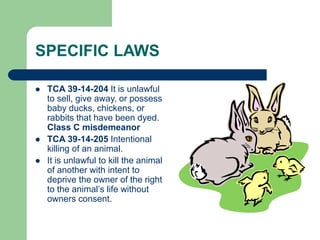
 TCA 39-14-204 It is unlawful
to sell, give away, or possess
baby ducks, chickens, or
rabbits that have been dyed.
Class C misdemeanor
 TCA 39-14-205 Intentional
killing of an animal.
 It is unlawful to kill the animal
of another with intent to
deprive the owner of the right
to the animal’s life without
owners consent.
TCA 39-14-205
 Justification for killing another person’s animal
if there is a reasonable belief that the animal
was creating an imminent danger of death or
serious bodily injury to people or to animals
owned by that person
 A person is not justified in killing an animal
while trespassing on the property of the owner
of the animal.
TCA 39-14-211 LIVESTOCK ABUSE
 No person should enter property, arrest or
confiscate livestock (equine or other animals used
for human utilization or consumption), unless prior to
or at the same time of
action, the livestock in
question is examined
by the county extension
agent of that county.
LIVESTOCK ABUSE
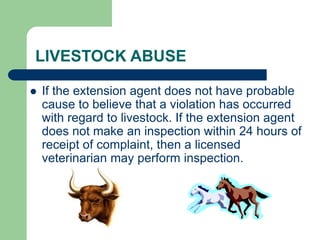
 If the extension agent does not have probable
cause to believe that a violation has occurred
with regard to livestock. If the extension agent
does not make an inspection within 24 hours of
receipt of complaint, then a licensed
veterinarian may perform inspection.
Pedro, the abandoned dog
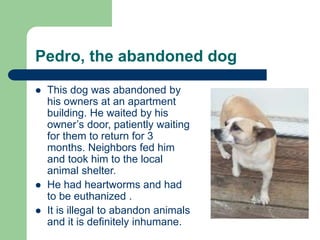
 This dog was abandoned by
his owners at an apartment
building. He waited by his
owner’s door, patiently waiting
for them to return for 3
months. Neighbors fed him
and took him to the local
animal shelter.
 He had heartworms and had
to be euthanized .
 It is illegal to abandon animals
and it is definitely inhumane.
Hoarders, a community problem
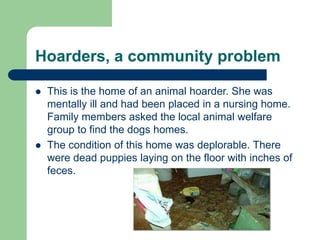
 This is the home of an animal hoarder. She was
mentally ill and had been placed in a nursing home.
Family members asked the local animal welfare
group to find the dogs homes.
 The condition of this home was deplorable. There
were dead puppies laying on the floor with inches of
feces.
Hoarder (continued)
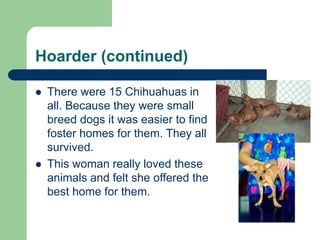
 There were 15 Chihuahuas in
all. Because they were small
breed dogs it was easier to find
foster homes for them. They all
survived.
 This woman really loved these
animals and felt she offered the
best home for them.
Hoarder (continued)
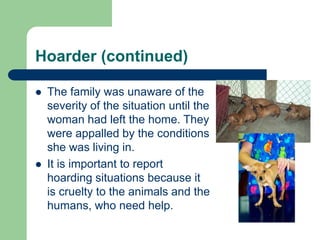
 The family was unaware of the
severity of the situation until the
woman had left the home. They
were appalled by the conditions
she was living in.
 It is important to report
hoarding situations because it
is cruelty to the animals and the
humans, who need help.
TCA 39-14-212 AGRAVATED
CRUELTY TO ANIMALS
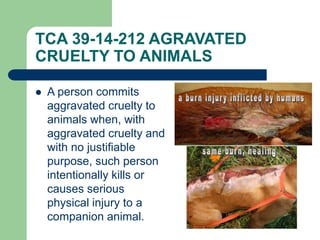
 A person commits
aggravated cruelty to
animals when, with
aggravated cruelty and
with no justifiable
purpose, such person
intentionally kills or
causes serious
physical injury to a
companion animal.
TCA 39-14-212 AGRAVATED
CRUELTY TO ANIMALS
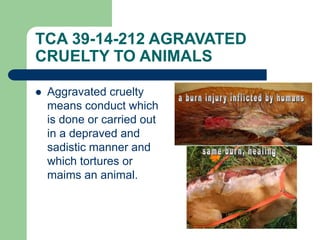
 Aggravated cruelty
means conduct which
is done or carried out
in a depraved and
sadistic manner and
which tortures or
maims an animal.
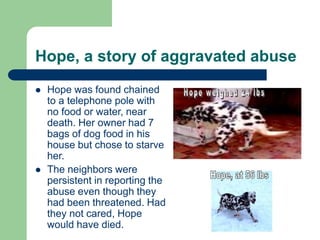
Hope, a story of aggravated abuse
 Hope was found chained
to a telephone pole with
no food or water, near
death. Her owner had 7
bags of dog food in his
house but chose to starve
her.
 The neighbors were
persistent in reporting the
abuse even though they
had been threatened. Had
they not cared, Hope
would have died.
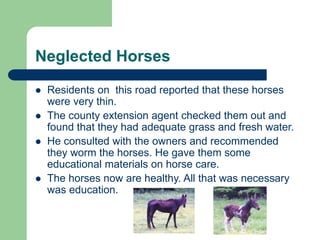
Neglected Horses
 Residents on this road reported that these horses
were very thin.
 The county extension agent checked them out and
found that they had adequate grass and fresh water.
 He consulted with the owners and recommended
they worm the horses. He gave them some
educational materials on horse care.
 The horses now are healthy. All that was necessary
was education.
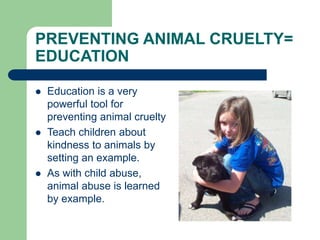
PREVENTING ANIMAL CRUELTY=
EDUCATION
 Education is a very
powerful tool for
preventing animal cruelty
 Teach children about
kindness to animals by
setting an example.
 As with child abuse,
animal abuse is learned
by example.
For more information,
please contact CAIT
www.vet.utk.edu/cait
cait@utk.edu
865-755-2276

Preventing_Animal_Cruelty.ppt

  • 1.
    PREVENTING ANIMAL CRUELTY By MaryM. Hatfield, LVMT,M.Ed, LAT For C.A.I.T.
  • 2.
    WHAT IS ANIMALABUSE?  Cruelty occurs any time an animal is made to suffer or feel needless pain, whether the person did it intentionally or through neglect.  INTENTIONAL: A person intends to hurt an animal, often times, maliciously, and results in severe physical injury or death  NEGLECT: An animal suffers because he is not given the necessities of life.
  • 3.
    INTENTIONAL ANIMAL ABUSE People who intentionally abuse animals often try to hide what they are doing.  Examples of this type of abuse are : cockfighting and dog fighting
  • 4.
    NEGLECT: Person failsto provide  Food and water  Shelter  Veterinary care  Hoarders- people who keep too many pets in their house or apartment.  They do not keep environment clean
  • 5.
    TENNESSEE STATE LAW-definition ofanimal cruelty is, any person who:  Commits an offense intentionally and knowingly tortures, maims or grossly overworks an animal.  Fails to provide necessary food, water or shelter for an animal in that person’s custody.  Abandons an animal in that person’s custody  Transports or confines an animal in a cruel manner  Inflicts injuries or pain, by any method, including blistering compounds to the legs or hooves of horses in order to make them sore for any purpose including, but not limited to, competition in horse shows and similar events.
  • 6.
    SPECIFIC ANIMAL ABUSELAWS  TCA 39-14-203 Cock and Animal Fighting – Definition- It is unlawful to own, possess, keep use or train any bull, bear, dog, cock or other animal for the purpose of fighting, baiting or injuring another such animal, for amusement, sport or gain – PENALTY- CLASS A MISDEMEANOR – CLASS E FELONY IF ANY ANIMAL OTHER THAN A COCK – CLASS C MISDEMEANOR- for knowing spectator or such events NOTE: It is not an offense to own, possess or keep cock for the purpose of selling or transporting cocks to a location in which possession or keeping of such cock is legal
  • 7.
    SPECIFIC LAWS  TCA39-14-204 It is unlawful to sell, give away, or possess baby ducks, chickens, or rabbits that have been dyed. Class C misdemeanor  TCA 39-14-205 Intentional killing of an animal.  It is unlawful to kill the animal of another with intent to deprive the owner of the right to the animal’s life without owners consent.
  • 8.
    TCA 39-14-205  Justificationfor killing another person’s animal if there is a reasonable belief that the animal was creating an imminent danger of death or serious bodily injury to people or to animals owned by that person  A person is not justified in killing an animal while trespassing on the property of the owner of the animal.
  • 9.
    TCA 39-14-211 LIVESTOCKABUSE  No person should enter property, arrest or confiscate livestock (equine or other animals used for human utilization or consumption), unless prior to or at the same time of action, the livestock in question is examined by the county extension agent of that county.
  • 10.
    LIVESTOCK ABUSE  Ifthe extension agent does not have probable cause to believe that a violation has occurred with regard to livestock. If the extension agent does not make an inspection within 24 hours of receipt of complaint, then a licensed veterinarian may perform inspection.
  • 11.
    Pedro, the abandoneddog  This dog was abandoned by his owners at an apartment building. He waited by his owner’s door, patiently waiting for them to return for 3 months. Neighbors fed him and took him to the local animal shelter.  He had heartworms and had to be euthanized .  It is illegal to abandon animals and it is definitely inhumane.
  • 12.
    Hoarders, a communityproblem  This is the home of an animal hoarder. She was mentally ill and had been placed in a nursing home. Family members asked the local animal welfare group to find the dogs homes.  The condition of this home was deplorable. There were dead puppies laying on the floor with inches of feces.
  • 13.
    Hoarder (continued)  Therewere 15 Chihuahuas in all. Because they were small breed dogs it was easier to find foster homes for them. They all survived.  This woman really loved these animals and felt she offered the best home for them.
  • 14.
    Hoarder (continued)  Thefamily was unaware of the severity of the situation until the woman had left the home. They were appalled by the conditions she was living in.  It is important to report hoarding situations because it is cruelty to the animals and the humans, who need help.
  • 15.
    TCA 39-14-212 AGRAVATED CRUELTYTO ANIMALS  A person commits aggravated cruelty to animals when, with aggravated cruelty and with no justifiable purpose, such person intentionally kills or causes serious physical injury to a companion animal.
  • 16.
    TCA 39-14-212 AGRAVATED CRUELTYTO ANIMALS  Aggravated cruelty means conduct which is done or carried out in a depraved and sadistic manner and which tortures or maims an animal.
  • 17.
    Hope, a storyof aggravated abuse  Hope was found chained to a telephone pole with no food or water, near death. Her owner had 7 bags of dog food in his house but chose to starve her.  The neighbors were persistent in reporting the abuse even though they had been threatened. Had they not cared, Hope would have died.
  • 18.
    Neglected Horses  Residentson this road reported that these horses were very thin.  The county extension agent checked them out and found that they had adequate grass and fresh water.  He consulted with the owners and recommended they worm the horses. He gave them some educational materials on horse care.  The horses now are healthy. All that was necessary was education.
  • 19.
    PREVENTING ANIMAL CRUELTY= EDUCATION Education is a very powerful tool for preventing animal cruelty  Teach children about kindness to animals by setting an example.  As with child abuse, animal abuse is learned by example.
  • 20.
    For more information, pleasecontact CAIT www.vet.utk.edu/cait cait@utk.edu 865-755-2276