Angular 2 for Beginners
Oswald Campesato
Consultant/Training:
www.iquarkt.com
ocampesato@yahoo.com
What is Angular 2?
• Open source framework for Web apps (from Google)
• component-based architecture
• Knowledge of Angular 1.x is not required
• Web/Mobile/ServerSide
• Production status (09/14/2016)
• Github: https://github.com/angular.io
Features of Angular 2
• One-way data binding (by default)
• Two-way data binding (optional)
• Dependency injection (in constructors)
• Support for ES5/ES6/TypeScript
• Angular 2 can be 5x faster than Angular 1.x
• Performance comparable to React(?)
Features of Angular 2
• Support for Forms/Routes/Pipes (aka filters)
• Support for HTTP requests
• Support for FRP (Functional Reactive Programming)
• Support for Observables/Promises
• Recommendation: learn TypeScript
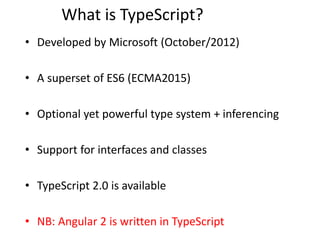
What is TypeScript?
• Developed by Microsoft (October/2012)
• A superset of ES6 (ECMA2015)
• Optional yet powerful type system + inferencing
• Support for interfaces and classes
• TypeScript 2.0 is available
• NB: Angular 2 is written in TypeScript
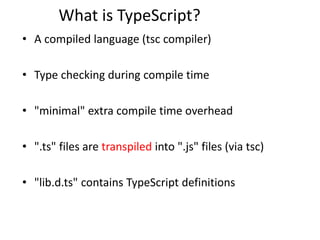
What is TypeScript?
• A compiled language (tsc compiler)
• Type checking during compile time
• "minimal" extra compile time overhead
• ".ts" files are transpiled into ".js" files (via tsc)
• "lib.d.ts" contains TypeScript definitions
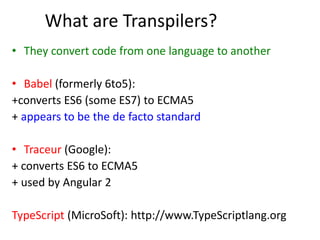
What are Transpilers?
• They convert code from one language to another
• Babel (formerly 6to5):
+converts ES6 (some ES7) to ECMA5
+ appears to be the de facto standard
• Traceur (Google):
+ converts ES6 to ECMA5
+ used by Angular 2
TypeScript (MicroSoft): http://www.TypeScriptlang.org
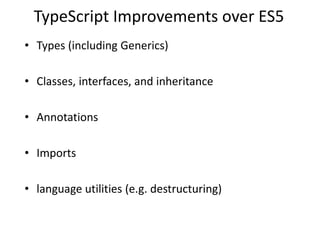
TypeScript Improvements over ES5
• Types (including Generics)
• Classes, interfaces, and inheritance
• Annotations
• Imports
• language utilities (e.g. destructuring)
TypeScript Variables
• var isDone: boolean = false;
• var height: number = 6;
• var name: string = "dave";
• var myList:number[] = [1, 2, 3]; // option #1
• var myList:Array<number> = [1, 2, 3]; // option #2
• var changeMe: any = 4;
• changeMe = "I’m a string now";
• var myList:any[] = [3, true, "pizza"];
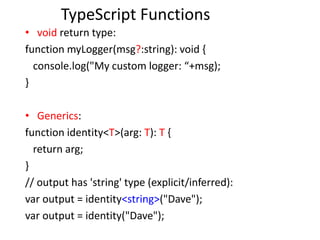
TypeScript Functions
• void return type:
function myLogger(msg?:string): void {
console.log("My custom logger: “+msg);
}
• Generics:
function identity<T>(arg: T): T {
return arg;
}
// output has 'string' type (explicit/inferred):
var output = identity<string>("Dave");
var output = identity("Dave");
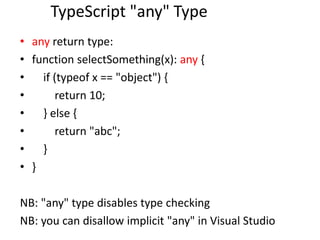
TypeScript "any" Type
• any return type:
• function selectSomething(x): any {
• if (typeof x == "object") {
• return 10;
• } else {
• return "abc";
• }
• }
NB: "any" type disables type checking
NB: you can disallow implicit "any" in Visual Studio
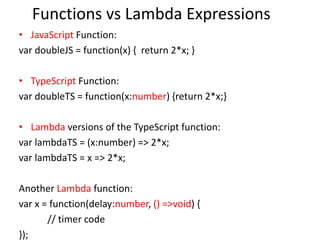
Functions vs Lambda Expressions
• JavaScript Function:
var doubleJS = function(x) { return 2*x; }
• TypeScript Function:
var doubleTS = function(x:number) {return 2*x;}
• Lambda versions of the TypeScript function:
var lambdaTS = (x:number) => 2*x;
var lambdaTS = x => 2*x;
Another Lambda function:
var x = function(delay:number, () =>void) {
// timer code
});
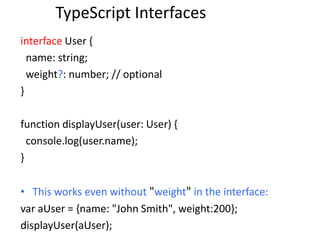
TypeScript Interfaces
interface User {
name: string;
weight?: number; // optional
}
function displayUser(user: User) {
console.log(user.name);
}
• This works even without "weight" in the interface:
var aUser = {name: "John Smith", weight:200};
displayUser(aUser);
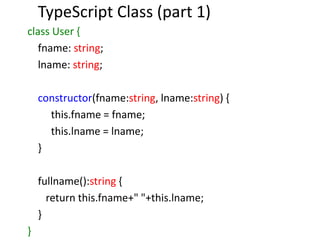
TypeScript Class (part 1)
class User {
fname: string;
lname: string;
constructor(fname:string, lname:string) {
this.fname = fname;
this.lname = lname;
}
fullname():string {
return this.fname+" "+this.lname;
}
}
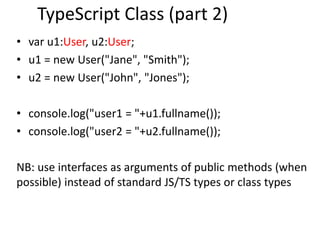
TypeScript Class (part 2)
• var u1:User, u2:User;
• u1 = new User("Jane", "Smith");
• u2 = new User("John", "Jones");
• console.log("user1 = "+u1.fullname());
• console.log("user2 = "+u2.fullname());
NB: use interfaces as arguments of public methods (when
possible) instead of standard JS/TS types or class types
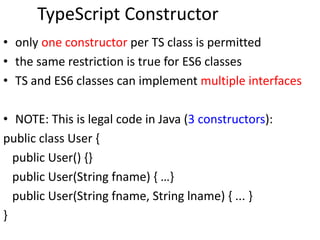
TypeScript Constructor
• only one constructor per TS class is permitted
• the same restriction is true for ES6 classes
• TS and ES6 classes can implement multiple interfaces
• NOTE: This is legal code in Java (3 constructors):
public class User {
public User() {}
public User(String fname) { …}
public User(String fname, String lname) { ... }
}
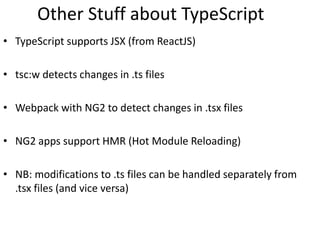
Other Stuff about TypeScript
• TypeScript supports JSX (from ReactJS)
• tsc:w detects changes in .ts files
• Webpack with NG2 to detect changes in .tsx files
• NG2 apps support HMR (Hot Module Reloading)
• NB: modifications to .ts files can be handled separately from
.tsx files (and vice versa)
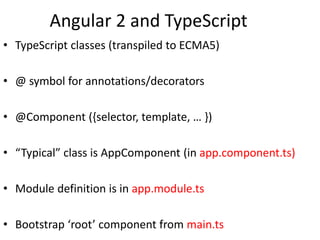
Angular 2 and TypeScript
• TypeScript classes (transpiled to ECMA5)
• @ symbol for annotations/decorators
• @Component ({selector, template, … })
• “Typical” class is AppComponent (in app.component.ts)
• Module definition is in app.module.ts
• Bootstrap ‘root’ component from main.ts
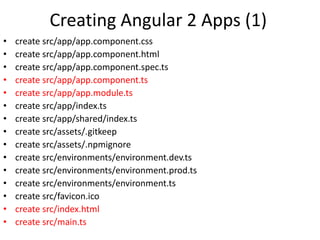
Creating Angular 2 Apps (1)
A) Use the Angular CLI (WIP) to generate:
Application files/scaffolding/test-related files
Install angular-cli:
[sudo] npm install -g angular-cli@1.0.0-beta.11-webpack.8
Create an NG2 app:
+ ng new myapp
NOTE: current version of angular-cli might not work for large
projects with multiple modules.
Creating Angular 2 Apps (1)
• create src/app/app.component.css
• create src/app/app.component.html
• create src/app/app.component.spec.ts
• create src/app/app.component.ts
• create src/app/app.module.ts
• create src/app/index.ts
• create src/app/shared/index.ts
• create src/assets/.gitkeep
• create src/assets/.npmignore
• create src/environments/environment.dev.ts
• create src/environments/environment.prod.ts
• create src/environments/environment.ts
• create src/favicon.ico
• create src/index.html
• create src/main.ts
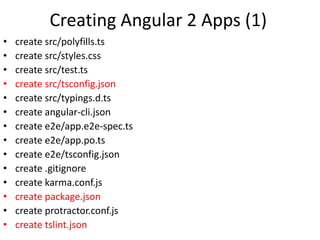
Creating Angular 2 Apps (1)
• create src/polyfills.ts
• create src/styles.css
• create src/test.ts
• create src/tsconfig.json
• create src/typings.d.ts
• create angular-cli.json
• create e2e/app.e2e-spec.ts
• create e2e/app.po.ts
• create e2e/tsconfig.json
• create .gitignore
• create karma.conf.js
• create package.json
• create protractor.conf.js
• create tslint.json
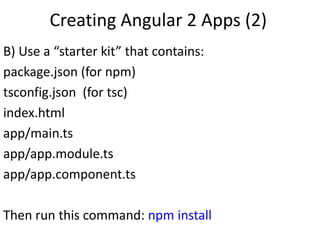
Creating Angular 2 Apps (2)
B) Use a “starter kit” that contains:
package.json (for npm)
tsconfig.json (for tsc)
index.html
app/main.ts
app/app.module.ts
app/app.component.ts
Then run this command: npm install
Creating Angular 2 Apps (3)
C) angular2-webpack-starter
[sudo] npm install –g angular2-webpack-starter
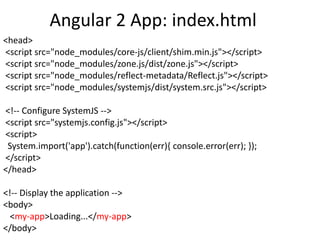
Angular 2 App: index.html
<head>
<script src="node_modules/core-js/client/shim.min.js"></script>
<script src="node_modules/zone.js/dist/zone.js"></script>
<script src="node_modules/reflect-metadata/Reflect.js"></script>
<script src="node_modules/systemjs/dist/system.src.js"></script>
<!-- Configure SystemJS -->
<script src="systemjs.config.js"></script>
<script>
System.import('app').catch(function(err){ console.error(err); });
</script>
</head>
<!-- Display the application -->
<body>
<my-app>Loading...</my-app>
</body>
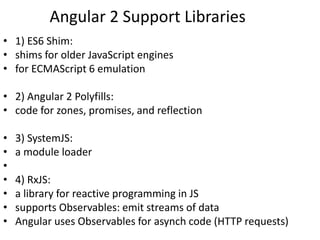
Angular 2 Support Libraries
• 1) ES6 Shim:
• shims for older JavaScript engines
• for ECMAScript 6 emulation
• 2) Angular 2 Polyfills:
• code for zones, promises, and reflection
• 3) SystemJS:
• a module loader
•
• 4) RxJS:
• a library for reactive programming in JS
• supports Observables: emit streams of data
• Angular uses Observables for asynch code (HTTP requests)
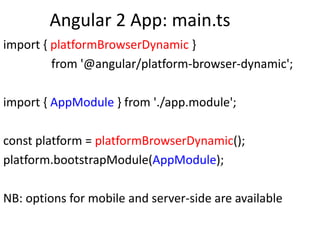
Angular 2 App: main.ts
import { platformBrowserDynamic }
from '@angular/platform-browser-dynamic';
import { AppModule } from './app.module';
const platform = platformBrowserDynamic();
platform.bootstrapModule(AppModule);
NB: options for mobile and server-side are available
Angular 2 App: app.module.ts
import { NgModule } from '@angular/core';
import { BrowserModule } from '@angular/platform-browser';
import { AppComponent } from './app.component';
@NgModule({
imports: [ BrowserModule ],
declarations: [ AppComponent ],
bootstrap: [ AppComponent ]
})
export class AppModule { }
https://devblog.dymel.pl/2016/09/29/angular2-modules/
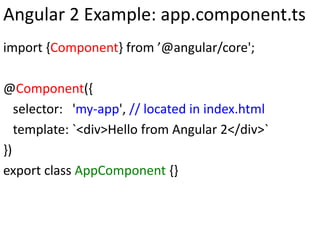
Angular 2 Example: app.component.ts
import {Component} from ’@angular/core';
@Component({
selector: 'my-app', // located in index.html
template: `<div>Hello from Angular 2</div>`
})
export class AppComponent {}
What is Functional Reactive Programming (FRP)?
• 1) Functional programming:
• is more declarative
• often has more abstraction
• can involve higher order functions
• 2) Reactive Programming was introduced in 1997:
“programming with asynchronous data streams”
• Multiple toolkits/libraries available
• event-driven instead of proactive
• Supported languages JS, Java, Scala, Android, Swift, Go, ....
NB: Elm is an FRP language: http://elm-lang.org/
What is Functional Reactive Programming (FRP)?
A) Functional Reactive Programming:
• a programming paradigm that was created by Conal Elliott
• his definition has very specific semantics:
• https://stackoverflow.com/questions/1028250/what-is-
functional-reactive-programming
B) looser definition of FRP: a combination of 2 other concepts:
• Reactive Programming: focuses on asynchronous data streams,
which you can listen to and react accordingly
• Functional Programming: emphasizes calculations via
mathematical-style functions, immutability and expressiveness,
and minimizes the use of variables and state
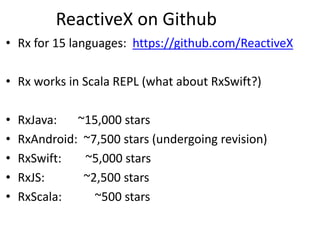
ReactiveX on Github
• Rx for 15 languages: https://github.com/ReactiveX
• Rx works in Scala REPL (what about RxSwift?)
• RxJava: ~15,000 stars
• RxAndroid: ~7,500 stars (undergoing revision)
• RxSwift: ~5,000 stars
• RxJS: ~2,500 stars
• RxScala: ~500 stars
Popular JavaScript Toolkits for FRP
• RxJS: https://github.com/Reactive-Extensions/RxJS
• Bacon.js: https://baconjs.github.io/
• Kefir.js: https://rpominov.github.io/kefir/
• most.js: https://github.com/cujojs/most
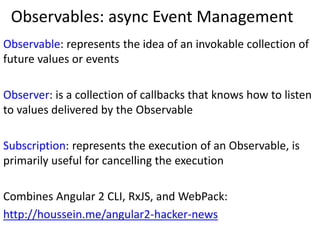
Observables: async Event Management
Observable: represents the idea of an invokable collection of
future values or events
Observer: is a collection of callbacks that knows how to listen
to values delivered by the Observable
Subscription: represents the execution of an Observable, is
primarily useful for cancelling the execution
Combines Angular 2 CLI, RxJS, and WebPack:
http://houssein.me/angular2-hacker-news
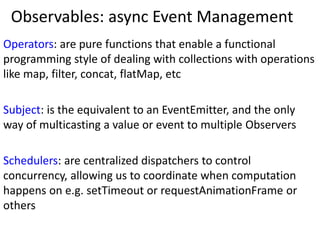
Observables: async Event Management
Operators: are pure functions that enable a functional
programming style of dealing with collections with operations
like map, filter, concat, flatMap, etc
Subject: is the equivalent to an EventEmitter, and the only
way of multicasting a value or event to multiple Observers
Schedulers: are centralized dispatchers to control
concurrency, allowing us to coordinate when computation
happens on e.g. setTimeout or requestAnimationFrame or
others
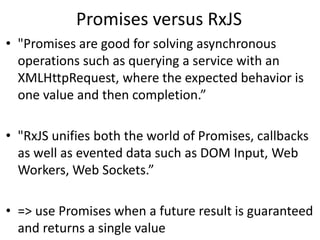
Promises versus RxJS
• "Promises are good for solving asynchronous
operations such as querying a service with an
XMLHttpRequest, where the expected behavior is
one value and then completion.”
• "RxJS unifies both the world of Promises, callbacks
as well as evented data such as DOM Input, Web
Workers, Web Sockets.”
• => use Promises when a future result is guaranteed
and returns a single value
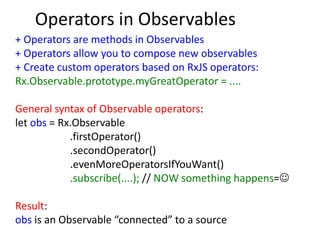
Operators in Observables
+ Operators are methods in Observables
+ Operators allow you to compose new observables
+ Create custom operators based on RxJS operators:
Rx.Observable.prototype.myGreatOperator = ....
General syntax of Observable operators:
let obs = Rx.Observable
.firstOperator()
.secondOperator()
.evenMoreOperatorsIfYouWant()
.subscribe(....); // NOW something happens=
Result:
obs is an Observable “connected” to a source
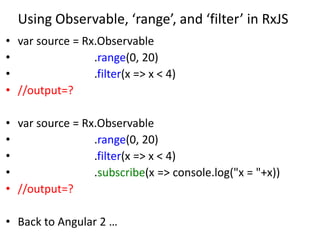
Using Observable, ‘range’, and ‘filter’ in RxJS
• var source = Rx.Observable
• .range(0, 20)
• .filter(x => x < 4)
• //output=?
• var source = Rx.Observable
• .range(0, 20)
• .filter(x => x < 4)
• .subscribe(x => console.log("x = "+x))
• //output=?
• Back to Angular 2 …
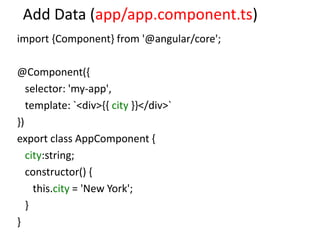
Add Data (app/app.component.ts)
import {Component} from '@angular/core';
@Component({
selector: 'my-app',
template: `<div>{{ city }}</div>`
})
export class AppComponent {
city:string;
constructor() {
this.city = 'New York';
}
}
List of Users (app.component.ts)
import {Component} from '@angular/core';
@Component({
selector: 'my-app',
template: `<div><ul>
<li *ngFor='let user of users'> {{ user }} </li>
</ul></div>`
})
export class AppComponent {
users:string[]; // or users:Array<string>;
constructor() {
this.users = ['Jane', 'Dave', 'Tom'];
}
}
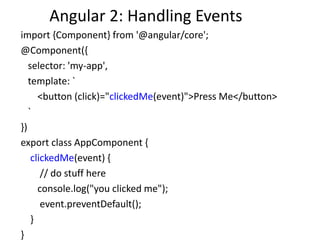
Angular 2: Handling Events
import {Component} from '@angular/core';
@Component({
selector: 'my-app',
template: `
<button (click)="clickedMe(event)">Press Me</button>
`
})
export class AppComponent {
clickedMe(event) {
// do stuff here
console.log("you clicked me");
event.preventDefault();
}
}
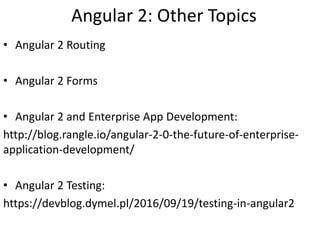
Angular 2: Other Topics
• Angular 2 Routing
• Angular 2 Forms
• Angular 2 and Enterprise App Development:
http://blog.rangle.io/angular-2-0-the-future-of-enterprise-
application-development/
• Angular 2 Testing:
https://devblog.dymel.pl/2016/09/19/testing-in-angular2
What about ES6?
• Arrow functions and 'let' keyword
• Block scopes
• Classes and inheritance
• Default parameters
• Destructured assignment
• Generators, Iterators, Maps, and Sets
• Promises and Rest parameters
• Spread operator
• Template Literals
NB: These features are often used in Angular 2 apps
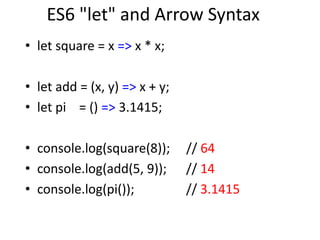
ES6 "let" and Arrow Syntax
• let square = x => x * x;
• let add = (x, y) => x + y;
• let pi = () => 3.1415;
• console.log(square(8)); // 64
• console.log(add(5, 9)); // 14
• console.log(pi()); // 3.1415
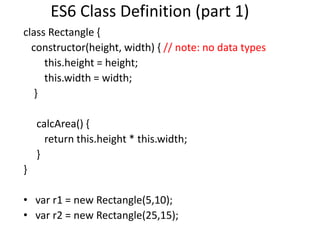
ES6 Class Definition (part 1)
class Rectangle {
constructor(height, width) { // note: no data types
this.height = height;
this.width = width;
}
calcArea() {
return this.height * this.width;
}
}
• var r1 = new Rectangle(5,10);
• var r2 = new Rectangle(25,15);
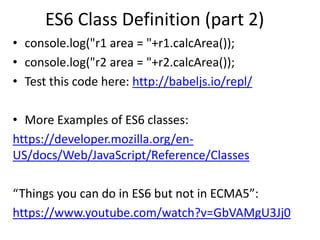
ES6 Class Definition (part 2)
• console.log("r1 area = "+r1.calcArea());
• console.log("r2 area = "+r2.calcArea());
• Test this code here: http://babeljs.io/repl/
• More Examples of ES6 classes:
https://developer.mozilla.org/en-
US/docs/Web/JavaScript/Reference/Classes
“Things you can do in ES6 but not in ECMA5”:
https://www.youtube.com/watch?v=GbVAMgU3Jj0
Browser Status for ES6
• Modern IE: https://goo.gl/56n7IL
• Mozilla: https://goo.gl/iSNDf9
• Chrome: https://www.chromestatus.com/features#ES6
Other Useful ES6 Links
https://github.com/lukehoban/es6features
http://kangax.github.io/compat-table/es6/
https://dev.modern.ie/platform/status/?filter=f3f0000bf&search=es6
https://developer.mozilla.org/en-
US/docs/Web/JavaScript/New_in_JavaScript/ECMAScript_6_support_i
n_Mozilla
https://medium.com/@bojzi/overview-of-the-javascript-ecosystem-
8ec4a0b7a7be
What Should I Learn???
• Main features of ES6 and TypeScript 2.0
• "basic" Angular 2.0 and best practices
• Select an IDE:
WebStorm 10: free 30-day trial ($49/year)
Visual Studio Code (free)
Atom (free) with atom-TypeScript extension
• Command Line Tools:
npm, webpack, browserify (older), broccoli
https://github.com/addyosmani/es6-tools
Other Technologies to Learn
• Sass/Bootstrap 4 (previous: less)
• HandleBars/Nunjucks (previous: Jade/EJS)
• Material Design (and MDL)
• Firebase/AngularFire
• D3.js for Data Visualization
• Ionic (=Angular for Mobile) & NativeScript
Angular 2 + NativeScript
• NativeScript (Telerik) is similar to JavaScript
• “competitor” to React Native(?)
• creates cross-platform native mobile apps
• Install NativeScript:
[sudo] npm install -g nativescript
Angular 2 + React Native
Detailed article:
http://www.javascripttuts.com/native-app-combining-
angular-2-react-native/
Step 1: https://github.com/angular/react-native-renderer
Step 2: npm install -g gulp react-native-cli typings
Step 3: npm install
Step 4: gulp init
Step 5: gulp start.android
Step 6: gulp start.ios
NB: use Java8 (not Java9) and set JAVA_HOME (Android)
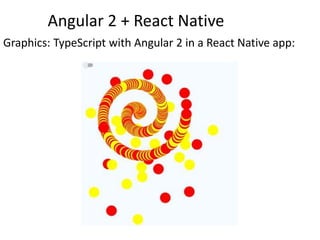
Angular 2 + React Native
Graphics: TypeScript with Angular 2 in a React Native app:
Angular 2 and Ionic 2
• toolkit for hybrid cross-platform mobile apps
• Install Ionic 2:
[sudo] npm install -g cordova ionic@beta
• Create an Ionic 2 app:
[sudo] ionic start Ionic2FirstApp blank --v2
• Ionic Native:
http://ionicframework.com/docs/v2/native
Angular 2 + Flux
• Flux is a design pattern (Facebook)
• unidirectional data flow
• Many Flux implementations available (at least 17):
flummox, fluxxor, marty, mcfly, …
• Comparison of Flux implementations:
https://github.com/voronianski/flux-comparison
• Angular 2 works with Flux implementations
Angular 2 + Redux
• Redux: the most popular Flux implementation
• Application data is stored outside of applications
• Key parts: Actions, Dispatcher, reducer, and Store(s)
• Alt and Mobx: simpler alternatives to Redux
• Angular 2 works with Redux
Angular 2 + GraphQL
• GraphQL: a server-side schema for application data
• Can “wrap” NoSQL and relational stores
• GraphQL server processes requests and returns data
• GraphiQL: https://github.com/skevy/graphiql-app
• GraphQL does not need Relay (but Relay needs GraphQL)
• Angular 2 works with GraphQL
GraphQL: What is it?
• a schema for graph-oriented data (Facebook/2012)
• well-suited for micro-service style backends
• created for specifying finer-grained queries
• provides interface between client and server
• client requests data from GraphQL server
• data requests are based on GraphQL queries
• => write queries against the schema
GraphQL versus REST
• a “finer-grained” alternative to REST
• REST is all-or-nothing: an “entity” is returned
• GraphQL returns a subset of elements of an “entity”
• Falcor from Netflix: alternative to GraphQL (no schema)
GraphQL: What it isn’t
• GQL does not dictate a server language
• GQL does not dictate a storage/back-end
• GQL is a query language without a database
GraphQL: What Does it Do?
• It exposes a single endpoint
• the endpoint parses and executes a query
• The query executes over a type system
• the type system is defined in the application server
• the type system is available via introspection (a GQL API)
GraphQL Server Structure
GraphQL servers have three components:
• 1) GraphQL “core” (JavaScript and other languages)
• 2) Type Definitions (maps app code to internal system)
• 3) Application code (business logic)
GraphQL Core: Five Components
• 1) Frontend lexer/parser: an AST [Relay uses parser]
• 2) Type System: GraphQLObjectType (a class)
• 3) Introspection: for querying types
• 4) Validation: is a query valid in the app’s schema?
• 5) Execution: manage query execution (via the AST)
The GraphiQL IDE
• https://github.com/skevy/graphiql-
app/blob/master/README.md
• https://github.com/skevy/graphiql-app/releases
• OSX: brew cask install graphiql
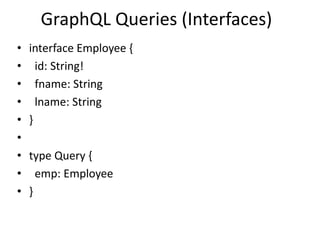
GraphQL Queries (Interfaces)
• interface Employee {
• id: String!
• fname: String
• lname: String
• }
•
• type Query {
• emp: Employee
• }
GraphQL Queries
• Query:
• {
• emp {
• fname
• }
• }
• Result:
• {
• "data": [{
• "emp": {
• "fname": "John"
• }
• }]
• }
GraphQL Queries
• query EmpNameQuery {
• emp {
• fname
• lname
• }
• }
• The result of the preceding query is here:
• {
• "data": [
• "emp": {
• "fname": "John",
• "lname": "Smith"
• }
• ]
• }
GraphQL Websites
• Apollo: http://www.apollostack.com/
“consolidates” data (removes duplicates in a tree)
• Reindex: https://www.reindex.io/blog/redux-and-
relay
• Scaphold: scaphold.io
• Upcoming SF conference: http://graphqlsummit.com/
Angular 2 + Relay
• Relay: a “wrapper” around client-side components
• Data requests from a component “go through” Relay
• Relay sends data requests to a GraphQL server
• Data is returned to client application
• Data is displayed according to application code/logic
• Angular 2 works with Relay
Angular 2 + Future Releases
• Angular 2.0.1: 09/23/2016
• Angular 2.1.0: beta release (includes 2.0.1)
• https://github.com/angular/angular/blob/master/CHANGELOG.
md
Recent/Upcoming Books and Training
1) HTML5 Canvas and CSS3 Graphics (2013)
2) jQuery, CSS3, and HTML5 for Mobile (2013)
3) HTML5 Pocket Primer (2013)
4) jQuery Pocket Primer (2013)
5) HTML5 Mobile Pocket Primer (2014)
6) D3 Pocket Primer (2015)
7) Python Pocket Primer (2015)
8) SVG Pocket Primer (2016)
9) CSS3 Pocket Primer (2016)
10) Angular 2 Pocket Primer (2017)

Angular2

  • 1.
    Angular 2 forBeginners Oswald Campesato Consultant/Training: www.iquarkt.com ocampesato@yahoo.com
  • 2.
    What is Angular2? • Open source framework for Web apps (from Google) • component-based architecture • Knowledge of Angular 1.x is not required • Web/Mobile/ServerSide • Production status (09/14/2016) • Github: https://github.com/angular.io
  • 3.
    Features of Angular2 • One-way data binding (by default) • Two-way data binding (optional) • Dependency injection (in constructors) • Support for ES5/ES6/TypeScript • Angular 2 can be 5x faster than Angular 1.x • Performance comparable to React(?)
  • 4.
    Features of Angular2 • Support for Forms/Routes/Pipes (aka filters) • Support for HTTP requests • Support for FRP (Functional Reactive Programming) • Support for Observables/Promises • Recommendation: learn TypeScript
  • 5.
    What is TypeScript? •Developed by Microsoft (October/2012) • A superset of ES6 (ECMA2015) • Optional yet powerful type system + inferencing • Support for interfaces and classes • TypeScript 2.0 is available • NB: Angular 2 is written in TypeScript
  • 6.
    What is TypeScript? •A compiled language (tsc compiler) • Type checking during compile time • "minimal" extra compile time overhead • ".ts" files are transpiled into ".js" files (via tsc) • "lib.d.ts" contains TypeScript definitions
  • 7.
    What are Transpilers? •They convert code from one language to another • Babel (formerly 6to5): +converts ES6 (some ES7) to ECMA5 + appears to be the de facto standard • Traceur (Google): + converts ES6 to ECMA5 + used by Angular 2 TypeScript (MicroSoft): http://www.TypeScriptlang.org
  • 8.
    TypeScript Improvements overES5 • Types (including Generics) • Classes, interfaces, and inheritance • Annotations • Imports • language utilities (e.g. destructuring)
  • 9.
    TypeScript Variables • varisDone: boolean = false; • var height: number = 6; • var name: string = "dave"; • var myList:number[] = [1, 2, 3]; // option #1 • var myList:Array<number> = [1, 2, 3]; // option #2 • var changeMe: any = 4; • changeMe = "I’m a string now"; • var myList:any[] = [3, true, "pizza"];
  • 10.
    TypeScript Functions • voidreturn type: function myLogger(msg?:string): void { console.log("My custom logger: “+msg); } • Generics: function identity<T>(arg: T): T { return arg; } // output has 'string' type (explicit/inferred): var output = identity<string>("Dave"); var output = identity("Dave");
  • 11.
    TypeScript "any" Type •any return type: • function selectSomething(x): any { • if (typeof x == "object") { • return 10; • } else { • return "abc"; • } • } NB: "any" type disables type checking NB: you can disallow implicit "any" in Visual Studio
  • 12.
    Functions vs LambdaExpressions • JavaScript Function: var doubleJS = function(x) { return 2*x; } • TypeScript Function: var doubleTS = function(x:number) {return 2*x;} • Lambda versions of the TypeScript function: var lambdaTS = (x:number) => 2*x; var lambdaTS = x => 2*x; Another Lambda function: var x = function(delay:number, () =>void) { // timer code });
  • 13.
    TypeScript Interfaces interface User{ name: string; weight?: number; // optional } function displayUser(user: User) { console.log(user.name); } • This works even without "weight" in the interface: var aUser = {name: "John Smith", weight:200}; displayUser(aUser);
  • 14.
    TypeScript Class (part1) class User { fname: string; lname: string; constructor(fname:string, lname:string) { this.fname = fname; this.lname = lname; } fullname():string { return this.fname+" "+this.lname; } }
  • 15.
    TypeScript Class (part2) • var u1:User, u2:User; • u1 = new User("Jane", "Smith"); • u2 = new User("John", "Jones"); • console.log("user1 = "+u1.fullname()); • console.log("user2 = "+u2.fullname()); NB: use interfaces as arguments of public methods (when possible) instead of standard JS/TS types or class types
  • 16.
    TypeScript Constructor • onlyone constructor per TS class is permitted • the same restriction is true for ES6 classes • TS and ES6 classes can implement multiple interfaces • NOTE: This is legal code in Java (3 constructors): public class User { public User() {} public User(String fname) { …} public User(String fname, String lname) { ... } }
  • 17.
    Other Stuff aboutTypeScript • TypeScript supports JSX (from ReactJS) • tsc:w detects changes in .ts files • Webpack with NG2 to detect changes in .tsx files • NG2 apps support HMR (Hot Module Reloading) • NB: modifications to .ts files can be handled separately from .tsx files (and vice versa)
  • 18.
    Angular 2 andTypeScript • TypeScript classes (transpiled to ECMA5) • @ symbol for annotations/decorators • @Component ({selector, template, … }) • “Typical” class is AppComponent (in app.component.ts) • Module definition is in app.module.ts • Bootstrap ‘root’ component from main.ts
  • 19.
    Creating Angular 2Apps (1) A) Use the Angular CLI (WIP) to generate: Application files/scaffolding/test-related files Install angular-cli: [sudo] npm install -g angular-cli@1.0.0-beta.11-webpack.8 Create an NG2 app: + ng new myapp NOTE: current version of angular-cli might not work for large projects with multiple modules.
  • 20.
    Creating Angular 2Apps (1) • create src/app/app.component.css • create src/app/app.component.html • create src/app/app.component.spec.ts • create src/app/app.component.ts • create src/app/app.module.ts • create src/app/index.ts • create src/app/shared/index.ts • create src/assets/.gitkeep • create src/assets/.npmignore • create src/environments/environment.dev.ts • create src/environments/environment.prod.ts • create src/environments/environment.ts • create src/favicon.ico • create src/index.html • create src/main.ts
  • 21.
    Creating Angular 2Apps (1) • create src/polyfills.ts • create src/styles.css • create src/test.ts • create src/tsconfig.json • create src/typings.d.ts • create angular-cli.json • create e2e/app.e2e-spec.ts • create e2e/app.po.ts • create e2e/tsconfig.json • create .gitignore • create karma.conf.js • create package.json • create protractor.conf.js • create tslint.json
  • 22.
    Creating Angular 2Apps (2) B) Use a “starter kit” that contains: package.json (for npm) tsconfig.json (for tsc) index.html app/main.ts app/app.module.ts app/app.component.ts Then run this command: npm install
  • 23.
    Creating Angular 2Apps (3) C) angular2-webpack-starter [sudo] npm install –g angular2-webpack-starter
  • 24.
    Angular 2 App:index.html <head> <script src="node_modules/core-js/client/shim.min.js"></script> <script src="node_modules/zone.js/dist/zone.js"></script> <script src="node_modules/reflect-metadata/Reflect.js"></script> <script src="node_modules/systemjs/dist/system.src.js"></script> <!-- Configure SystemJS --> <script src="systemjs.config.js"></script> <script> System.import('app').catch(function(err){ console.error(err); }); </script> </head> <!-- Display the application --> <body> <my-app>Loading...</my-app> </body>
  • 25.
    Angular 2 SupportLibraries • 1) ES6 Shim: • shims for older JavaScript engines • for ECMAScript 6 emulation • 2) Angular 2 Polyfills: • code for zones, promises, and reflection • 3) SystemJS: • a module loader • • 4) RxJS: • a library for reactive programming in JS • supports Observables: emit streams of data • Angular uses Observables for asynch code (HTTP requests)
  • 26.
    Angular 2 App:main.ts import { platformBrowserDynamic } from '@angular/platform-browser-dynamic'; import { AppModule } from './app.module'; const platform = platformBrowserDynamic(); platform.bootstrapModule(AppModule); NB: options for mobile and server-side are available
  • 27.
    Angular 2 App:app.module.ts import { NgModule } from '@angular/core'; import { BrowserModule } from '@angular/platform-browser'; import { AppComponent } from './app.component'; @NgModule({ imports: [ BrowserModule ], declarations: [ AppComponent ], bootstrap: [ AppComponent ] }) export class AppModule { } https://devblog.dymel.pl/2016/09/29/angular2-modules/
  • 28.
    Angular 2 Example:app.component.ts import {Component} from ’@angular/core'; @Component({ selector: 'my-app', // located in index.html template: `<div>Hello from Angular 2</div>` }) export class AppComponent {}
  • 29.
    What is FunctionalReactive Programming (FRP)? • 1) Functional programming: • is more declarative • often has more abstraction • can involve higher order functions • 2) Reactive Programming was introduced in 1997: “programming with asynchronous data streams” • Multiple toolkits/libraries available • event-driven instead of proactive • Supported languages JS, Java, Scala, Android, Swift, Go, .... NB: Elm is an FRP language: http://elm-lang.org/
  • 30.
    What is FunctionalReactive Programming (FRP)? A) Functional Reactive Programming: • a programming paradigm that was created by Conal Elliott • his definition has very specific semantics: • https://stackoverflow.com/questions/1028250/what-is- functional-reactive-programming B) looser definition of FRP: a combination of 2 other concepts: • Reactive Programming: focuses on asynchronous data streams, which you can listen to and react accordingly • Functional Programming: emphasizes calculations via mathematical-style functions, immutability and expressiveness, and minimizes the use of variables and state
  • 31.
    ReactiveX on Github •Rx for 15 languages: https://github.com/ReactiveX • Rx works in Scala REPL (what about RxSwift?) • RxJava: ~15,000 stars • RxAndroid: ~7,500 stars (undergoing revision) • RxSwift: ~5,000 stars • RxJS: ~2,500 stars • RxScala: ~500 stars
  • 32.
    Popular JavaScript Toolkitsfor FRP • RxJS: https://github.com/Reactive-Extensions/RxJS • Bacon.js: https://baconjs.github.io/ • Kefir.js: https://rpominov.github.io/kefir/ • most.js: https://github.com/cujojs/most
  • 33.
    Observables: async EventManagement Observable: represents the idea of an invokable collection of future values or events Observer: is a collection of callbacks that knows how to listen to values delivered by the Observable Subscription: represents the execution of an Observable, is primarily useful for cancelling the execution Combines Angular 2 CLI, RxJS, and WebPack: http://houssein.me/angular2-hacker-news
  • 34.
    Observables: async EventManagement Operators: are pure functions that enable a functional programming style of dealing with collections with operations like map, filter, concat, flatMap, etc Subject: is the equivalent to an EventEmitter, and the only way of multicasting a value or event to multiple Observers Schedulers: are centralized dispatchers to control concurrency, allowing us to coordinate when computation happens on e.g. setTimeout or requestAnimationFrame or others
  • 35.
    Promises versus RxJS •"Promises are good for solving asynchronous operations such as querying a service with an XMLHttpRequest, where the expected behavior is one value and then completion.” • "RxJS unifies both the world of Promises, callbacks as well as evented data such as DOM Input, Web Workers, Web Sockets.” • => use Promises when a future result is guaranteed and returns a single value
  • 36.
    Operators in Observables +Operators are methods in Observables + Operators allow you to compose new observables + Create custom operators based on RxJS operators: Rx.Observable.prototype.myGreatOperator = .... General syntax of Observable operators: let obs = Rx.Observable .firstOperator() .secondOperator() .evenMoreOperatorsIfYouWant() .subscribe(....); // NOW something happens= Result: obs is an Observable “connected” to a source
  • 37.
    Using Observable, ‘range’,and ‘filter’ in RxJS • var source = Rx.Observable • .range(0, 20) • .filter(x => x < 4) • //output=? • var source = Rx.Observable • .range(0, 20) • .filter(x => x < 4) • .subscribe(x => console.log("x = "+x)) • //output=? • Back to Angular 2 …
  • 38.
    Add Data (app/app.component.ts) import{Component} from '@angular/core'; @Component({ selector: 'my-app', template: `<div>{{ city }}</div>` }) export class AppComponent { city:string; constructor() { this.city = 'New York'; } }
  • 39.
    List of Users(app.component.ts) import {Component} from '@angular/core'; @Component({ selector: 'my-app', template: `<div><ul> <li *ngFor='let user of users'> {{ user }} </li> </ul></div>` }) export class AppComponent { users:string[]; // or users:Array<string>; constructor() { this.users = ['Jane', 'Dave', 'Tom']; } }
  • 40.
    Angular 2: HandlingEvents import {Component} from '@angular/core'; @Component({ selector: 'my-app', template: ` <button (click)="clickedMe(event)">Press Me</button> ` }) export class AppComponent { clickedMe(event) { // do stuff here console.log("you clicked me"); event.preventDefault(); } }
  • 41.
    Angular 2: OtherTopics • Angular 2 Routing • Angular 2 Forms • Angular 2 and Enterprise App Development: http://blog.rangle.io/angular-2-0-the-future-of-enterprise- application-development/ • Angular 2 Testing: https://devblog.dymel.pl/2016/09/19/testing-in-angular2
  • 42.
    What about ES6? •Arrow functions and 'let' keyword • Block scopes • Classes and inheritance • Default parameters • Destructured assignment • Generators, Iterators, Maps, and Sets • Promises and Rest parameters • Spread operator • Template Literals NB: These features are often used in Angular 2 apps
  • 43.
    ES6 "let" andArrow Syntax • let square = x => x * x; • let add = (x, y) => x + y; • let pi = () => 3.1415; • console.log(square(8)); // 64 • console.log(add(5, 9)); // 14 • console.log(pi()); // 3.1415
  • 44.
    ES6 Class Definition(part 1) class Rectangle { constructor(height, width) { // note: no data types this.height = height; this.width = width; } calcArea() { return this.height * this.width; } } • var r1 = new Rectangle(5,10); • var r2 = new Rectangle(25,15);
  • 45.
    ES6 Class Definition(part 2) • console.log("r1 area = "+r1.calcArea()); • console.log("r2 area = "+r2.calcArea()); • Test this code here: http://babeljs.io/repl/ • More Examples of ES6 classes: https://developer.mozilla.org/en- US/docs/Web/JavaScript/Reference/Classes “Things you can do in ES6 but not in ECMA5”: https://www.youtube.com/watch?v=GbVAMgU3Jj0
  • 46.
    Browser Status forES6 • Modern IE: https://goo.gl/56n7IL • Mozilla: https://goo.gl/iSNDf9 • Chrome: https://www.chromestatus.com/features#ES6
  • 47.
    Other Useful ES6Links https://github.com/lukehoban/es6features http://kangax.github.io/compat-table/es6/ https://dev.modern.ie/platform/status/?filter=f3f0000bf&search=es6 https://developer.mozilla.org/en- US/docs/Web/JavaScript/New_in_JavaScript/ECMAScript_6_support_i n_Mozilla https://medium.com/@bojzi/overview-of-the-javascript-ecosystem- 8ec4a0b7a7be
  • 48.
    What Should ILearn??? • Main features of ES6 and TypeScript 2.0 • "basic" Angular 2.0 and best practices • Select an IDE: WebStorm 10: free 30-day trial ($49/year) Visual Studio Code (free) Atom (free) with atom-TypeScript extension • Command Line Tools: npm, webpack, browserify (older), broccoli https://github.com/addyosmani/es6-tools
  • 49.
    Other Technologies toLearn • Sass/Bootstrap 4 (previous: less) • HandleBars/Nunjucks (previous: Jade/EJS) • Material Design (and MDL) • Firebase/AngularFire • D3.js for Data Visualization • Ionic (=Angular for Mobile) & NativeScript
  • 50.
    Angular 2 +NativeScript • NativeScript (Telerik) is similar to JavaScript • “competitor” to React Native(?) • creates cross-platform native mobile apps • Install NativeScript: [sudo] npm install -g nativescript
  • 51.
    Angular 2 +React Native Detailed article: http://www.javascripttuts.com/native-app-combining- angular-2-react-native/ Step 1: https://github.com/angular/react-native-renderer Step 2: npm install -g gulp react-native-cli typings Step 3: npm install Step 4: gulp init Step 5: gulp start.android Step 6: gulp start.ios NB: use Java8 (not Java9) and set JAVA_HOME (Android)
  • 52.
    Angular 2 +React Native Graphics: TypeScript with Angular 2 in a React Native app:
  • 53.
    Angular 2 andIonic 2 • toolkit for hybrid cross-platform mobile apps • Install Ionic 2: [sudo] npm install -g cordova ionic@beta • Create an Ionic 2 app: [sudo] ionic start Ionic2FirstApp blank --v2 • Ionic Native: http://ionicframework.com/docs/v2/native
  • 54.
    Angular 2 +Flux • Flux is a design pattern (Facebook) • unidirectional data flow • Many Flux implementations available (at least 17): flummox, fluxxor, marty, mcfly, … • Comparison of Flux implementations: https://github.com/voronianski/flux-comparison • Angular 2 works with Flux implementations
  • 55.
    Angular 2 +Redux • Redux: the most popular Flux implementation • Application data is stored outside of applications • Key parts: Actions, Dispatcher, reducer, and Store(s) • Alt and Mobx: simpler alternatives to Redux • Angular 2 works with Redux
  • 56.
    Angular 2 +GraphQL • GraphQL: a server-side schema for application data • Can “wrap” NoSQL and relational stores • GraphQL server processes requests and returns data • GraphiQL: https://github.com/skevy/graphiql-app • GraphQL does not need Relay (but Relay needs GraphQL) • Angular 2 works with GraphQL
  • 57.
    GraphQL: What isit? • a schema for graph-oriented data (Facebook/2012) • well-suited for micro-service style backends • created for specifying finer-grained queries • provides interface between client and server • client requests data from GraphQL server • data requests are based on GraphQL queries • => write queries against the schema
  • 58.
    GraphQL versus REST •a “finer-grained” alternative to REST • REST is all-or-nothing: an “entity” is returned • GraphQL returns a subset of elements of an “entity” • Falcor from Netflix: alternative to GraphQL (no schema)
  • 59.
    GraphQL: What itisn’t • GQL does not dictate a server language • GQL does not dictate a storage/back-end • GQL is a query language without a database
  • 60.
    GraphQL: What Doesit Do? • It exposes a single endpoint • the endpoint parses and executes a query • The query executes over a type system • the type system is defined in the application server • the type system is available via introspection (a GQL API)
  • 61.
    GraphQL Server Structure GraphQLservers have three components: • 1) GraphQL “core” (JavaScript and other languages) • 2) Type Definitions (maps app code to internal system) • 3) Application code (business logic)
  • 62.
    GraphQL Core: FiveComponents • 1) Frontend lexer/parser: an AST [Relay uses parser] • 2) Type System: GraphQLObjectType (a class) • 3) Introspection: for querying types • 4) Validation: is a query valid in the app’s schema? • 5) Execution: manage query execution (via the AST)
  • 63.
    The GraphiQL IDE •https://github.com/skevy/graphiql- app/blob/master/README.md • https://github.com/skevy/graphiql-app/releases • OSX: brew cask install graphiql
  • 64.
    GraphQL Queries (Interfaces) •interface Employee { • id: String! • fname: String • lname: String • } • • type Query { • emp: Employee • }
  • 65.
    GraphQL Queries • Query: •{ • emp { • fname • } • } • Result: • { • "data": [{ • "emp": { • "fname": "John" • } • }] • }
  • 66.
    GraphQL Queries • queryEmpNameQuery { • emp { • fname • lname • } • } • The result of the preceding query is here: • { • "data": [ • "emp": { • "fname": "John", • "lname": "Smith" • } • ] • }
  • 67.
    GraphQL Websites • Apollo:http://www.apollostack.com/ “consolidates” data (removes duplicates in a tree) • Reindex: https://www.reindex.io/blog/redux-and- relay • Scaphold: scaphold.io • Upcoming SF conference: http://graphqlsummit.com/
  • 68.
    Angular 2 +Relay • Relay: a “wrapper” around client-side components • Data requests from a component “go through” Relay • Relay sends data requests to a GraphQL server • Data is returned to client application • Data is displayed according to application code/logic • Angular 2 works with Relay
  • 69.
    Angular 2 +Future Releases • Angular 2.0.1: 09/23/2016 • Angular 2.1.0: beta release (includes 2.0.1) • https://github.com/angular/angular/blob/master/CHANGELOG. md
  • 70.
    Recent/Upcoming Books andTraining 1) HTML5 Canvas and CSS3 Graphics (2013) 2) jQuery, CSS3, and HTML5 for Mobile (2013) 3) HTML5 Pocket Primer (2013) 4) jQuery Pocket Primer (2013) 5) HTML5 Mobile Pocket Primer (2014) 6) D3 Pocket Primer (2015) 7) Python Pocket Primer (2015) 8) SVG Pocket Primer (2016) 9) CSS3 Pocket Primer (2016) 10) Angular 2 Pocket Primer (2017)