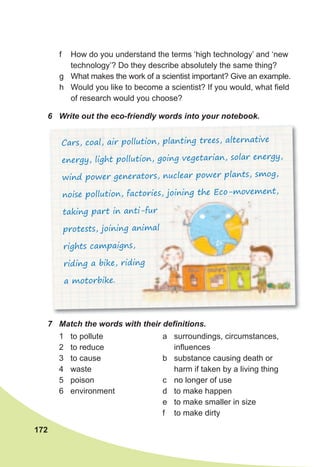
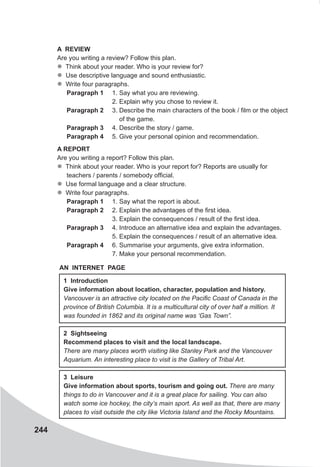
Карпюк О. Д.
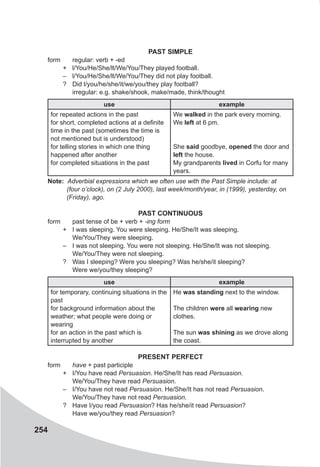
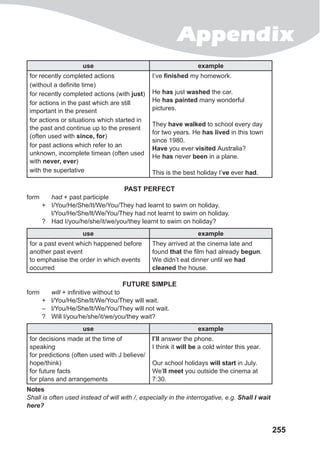
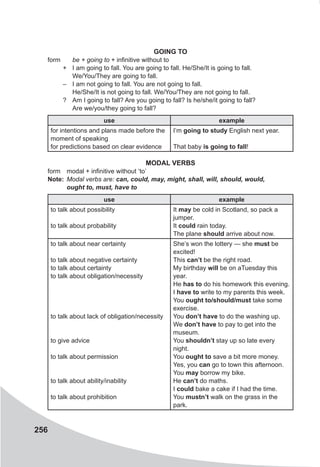
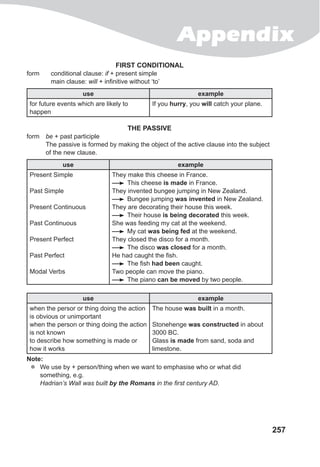
Англійська мова (9-й рік навчання) (English (the 9th year of studies)) :
підручник для 9-го класу загальноосвітніх навчальних закладів. —
Тернопіль : „Видавництво Астон”, 2017. — 288 с. : іл.
ISBN 978-966-308-686-6
К 26
Підручник завершує серію навчальних видань, створених для
основної школи на основі авторської концепції формування учнівської
здатності до міжкультурного спілкування, що передбачає більшу
соціокультурну спрямованість процесу навчання англійської мови, в
центрі якого знаходиться особистість учня та його потреби в умовах
сучасного світу, що глобалізується.
УДК 811.111(075.3)
К 26
Рекомендовано	Міністерством	освіти	і	науки	України
(наказ МОН України № 417 від 20.03.2017)
Видано за рахунок державних коштів.
Продаж заборонено.
Автор та видавництво висловлюють щиру подяку	Нетелі	Хенлет,
магістру Колумбійського університету, відповідальному волонтеру
Корпусу Миру США в Україні (2014-2016) за літературне редагування
підручника.
© О. Д. Карпюк, 2017
© ТзОВ „Видавництво Астон”, 2017ISBN 978-966-308-686-6
Експерти, які здійснили експертизу даного підручника під час
проведення конкурсного відбору проектів підручників для 9 класу
загальноосвітніх навчальних закладів і зробили висновок про
доцільність надання підручнику грифа “Рекомендовано Міністерством
освіти і науки України”:
Тилятинська	Н.	М., методист іноземних мов Бучацького районного
комунального методичного кабінету,
Тернопільська область;
Українець	С.	О., вчитель загальноосвітньої школи І-ІІІ ст. № 38,
м. Полтава, вчитель вищої категорії, вчитель-
методист.
— символ, що позначає вправи, які мають аудіосупровід,
котрий можна завантажити за посиланням:
https://www.libra-terra.com.ua/userfiles/audio/karpiuk-audio-9-klas-zag-2017.zip
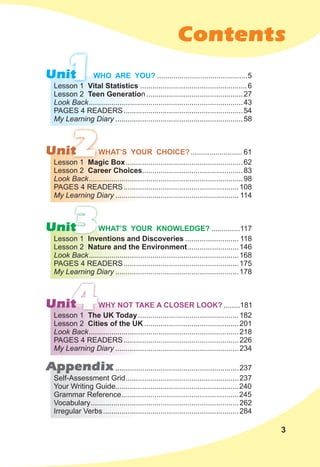
Contents
1
2
3
4
Unit
Unit
Unit
Unit
Appendix............................................................237
Lesson 1 Vital Statistics ....................................................6
Lesson 2 Teen Generation...............................................27
Look Back...........................................................................43
PAGES 4 READERS..........................................................54
My Learning Diary ..............................................................58
Lesson 1 Magic Box.........................................................62
Lesson 2 Career Choices.................................................83
Look Back...........................................................................98
PAGES 4 READERS........................................................108
My Learning Diary ............................................................ 114
Lesson 1 Inventions and Discoveries .......................... 118
Lesson 2 Nature and the Environment.........................146
Look Back.........................................................................168
PAGES 4 READERS........................................................175
My Learning Diary ............................................................178
Lesson 1 The UK Today.................................................182
Lesson 2 Cities of the UK ..............................................201
Look Back.........................................................................218
PAGES 4 READERS........................................................226
My Learning Diary ............................................................234
Self-Assessment Grid.......................................................237
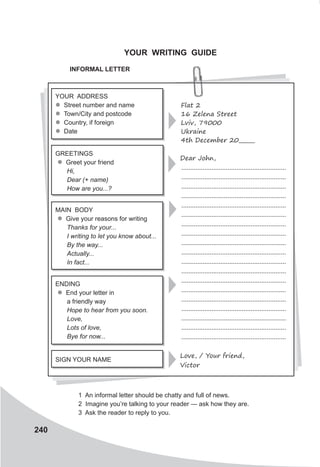
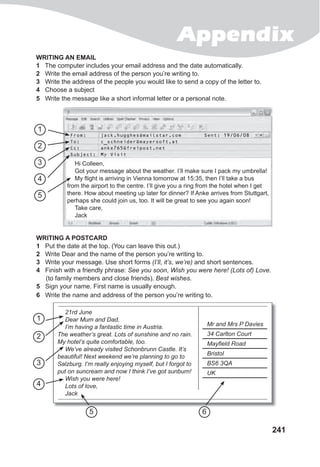
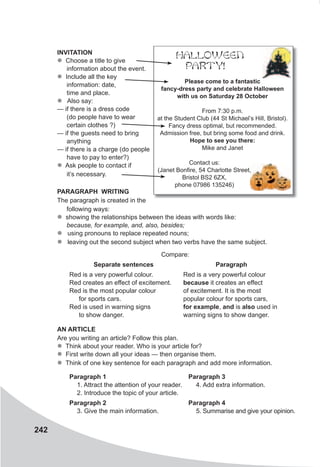
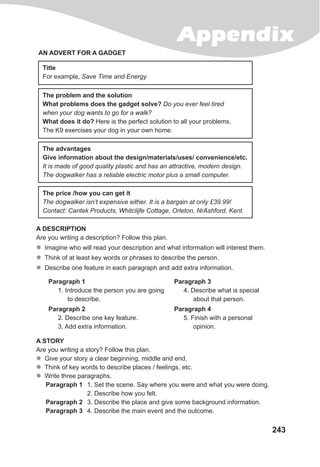
Your Writing Guide............................................................240
Grammar Reference.........................................................245
Vocabulary........................................................................262
Irregular Verbs..................................................................284
WHO ARE YOU? ............................................5
WHAT’S YOUR CHOICE?......................... 61
WHAT’S YOUR KNOWLEDGE? ..............117
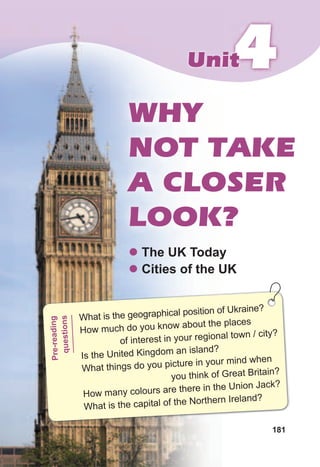
WHY NOT TAKE A CLOSER LOOK? ........181
3
4
Dear Student,
I hope very much that you will enjoy your learning process with
English 9. I have chosen four main themes, each representing a
different dimension of your life. In each unit you will find a variety
of learning activities related to different topics of that unit. These
tasks will give you plenty of opportunities to develop both your
general knowledge and English language skills (reading,
listening, writing and speaking), as well as your English grammar.
The book contains a rich vocabulary for you to learn and
remember so that you will be ready to succeed in all your exams
and in your use of English later on in life.
I wish you an interesting and successful year of English studies!
Oksana Karpyuk
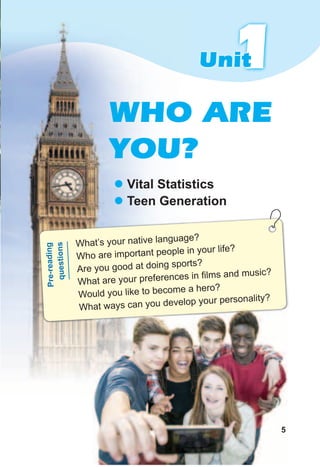
What’s your native language?
Who are important people in your life?
Are you good at doing sports?
What are your preferences in films and music?
Would you like to become a hero?
What ways can you develop your personality?
Pre-reading
questions
11Unit
WHO ARE
YOU?
z Vital Statistics
z Teen Generation
5
What ways can you develop your personality?
5
VITAL STATISTICS
1	 Think	and	say.
rEaDING & vocabularyrEaDING & vocabularyrEaDING & vocabulary
zz If you want to get to know someone, what would you
want to know about him / her ?
2	 Read	Peter’s	blog	and	fi	nd	out	if	the	statements	
on	page	7	are	true	or	false.
Call me Archibald. My real
name isn’t important. In this
blog I want to share my ideas
with other kids my age. It isn’t
always easy to talk to our
parents or even friends. I’m
sure you understand me.
Here is some information
about myself. I’m 14 years old. I
play water polo. I go to the
swimming pool every day except
at the weekend. I’m a good
swimmer and player although I’m
not very tall or very strong. I’m
also interested in photography. I
use my dad’s small digital
camera. It takes great pictures.
I’ve got lots of photos of my
friends (of one classmate
especially!). I read books about
superheroes like Superman. I’m
not a superhero myself but I hate
injustice and I’d like to have some
special powers, too.
I haven’t got any brothers or
sisters. My parents work hard
and spend a lot of time at work,
so I’m often alone at home. My
mum’s a teacher. She prepares
for school and she always talks
6
7
Lesson 1
although [ɔːlˈðəʊ]
injustice [ɪnˈdʒʌstɪs]
digital [ˈdɪdʒɪtl]
the sense of humour
[sens əv ˈhju:mə]
Vocabulary box
3	 Work	in	pairs	to	answer	
the	questions.	
1 Think of one example
of injustice. Do you
hate injustice?
2 Who in your family
has a good sense of
humour?
And in your class?
3 Do you know any
jokes? Are you good
at telling jokes?
4 Do you have good
manners? Think of
one example of good
manners.
about her pupils. I sometimes get
upset because maybe she thinks
they’re better than me. My mum
says that Pete is such a good
pupil. I think he reads my blog.
My dad’s a mechanic and he
fixes cars. He tells jokes all the
time and he is never serious. He
thinks he has a sense of humour
but his jokes aren’t always funny!
I have a pet parrot. His name
is James. He’s got a cage in my
room but he rarely stays in it.
He usually flies around. He is
friendly but he isn’t polite; he
hasn’t got good manners. He
never uses the toilet! He also
bites computer cables and
sometimes my finger!
E-mail me!
1 Peter uses his real name
in his blog.
2 Peter plays water polo five
days a week.
3 Peter’s an only child in the family.
4 Peter’s mum works in a school.
5 Peter’s dad thinks he’s funny.
6 James is Peter’s cat.
8
5	 Work	in	small	groups.	
zz Which of the following topics do you think are important to
know about a person and which ones are unimportant? If you
could cut out four of these topics, which would they be? What
do the people sitting near you think?
	name
	pets
	nationality
	likes
	favourite music
	birth sign
	favourite colour
	brothers and sisters
	age
	religion
	dislikes
	interests
zz What else would you like to know about a person?
6	 Brian	James	was	interviewed	for	a	teenage	
magazine.	Read	the	teenager’s	talk	about	
himself	and	fi	nd	out	the	information	to	
answer	the	questions	on	page	9.
4	 Complete	the	sentences	about	yourself.
I am interested in …
In my free time I …
My favourite school subject is …
My favourite singer / group is …
My favourite books are …
I usually wear …
My surname is …
My form teacher is …
I love to cook and make some fab Italian dishes. I love
cooking for girls. Cooking for two is much more fun than
cooking for yourself. I’ve got an older sister and a
younger brother who’s a cute 13. I’m a Gemini — my
birthday’s May 29th. I love animals — I’ve got two dogs
and a fish. I listen to rap music. I work out, ride horses,
surf and snow-ski. I love Mars bars and dry roasted
peanuts. I love living in sunny California. Where else can
you go skiing in March and then go back to the beach?
9
Lesson 1
9
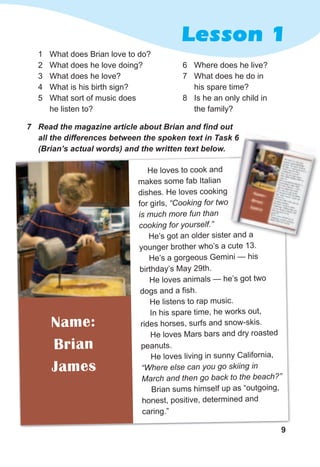
He loves to cook and
makes some fab Italian
dishes. He loves cooking
for girls, “Cooking for two
is much more fun than
cooking for yourself.”
He’s got an older sister and a
younger brother who’s a cute 13.
He’s a gorgeous Gemini — his
birthday’s May 29th.
He loves animals — he’s got two
dogs and a fish.
He listens to rap music.
In his spare time, he works out,
rides horses, surfs and snow-skis.
He loves Mars bars and dry roasted
peanuts.
He loves living in sunny California,
“Where else can you go skiing in
March and then go back to the beach?”
Brian sums himself up as “outgoing,
honest, positive, determined and
caring.”
Name:
Brian
James
1 What does Brian love to do?
2 What does he love doing?
3 What does he love?
4 What is his birth sign?
5 What sort of music does
he listen to?
7	 Read	the	magazine	article	about	Brian	and	fi	nd	out	
all	the	differences	between	the	spoken	text	in	Task	6	
(Brian’s	actual	words)	and	the	written	text	below.
6 Where does he live?
7 What does he do in
his spare time?
8 Is he an only child in
the family?
He’s got an older sister and a
all	the	differences	between	the	spoken	text	in	Task	6
10
8	 Read	and	match	the	words	with	the	same	meaning.
Brian uses ‘fab’ and ‘cute’. Words like these are typical of
teenagers. Here are some common ‘teen’ words in the left column.
1 cute
2 cool
3 fab
4 fight
5 folks
6 gear
7 guy
8 mate
9 hang out
a excellent
b small and nice
c very good; okay; nice; no problem
d argument
e parents
f friend
g clothes
h spend time with friends
i person
9	a)	Match	different	meanings	of	the	verb	‘work	out’	
with	the	appropriate1
	sentences.
a to find a solution
b to calculate
c to understand
d to develop in a particular
way (of a situation)
e to do physical exercise
1 The plan worked out
quite well.
2 Can you work out how
much it will all cost?
3 I’m going to work out in
the gym this evening.
4 I can’t work her out.
5 I’ve worked out how we
can get there.
b)	Make	up	your	own	sentences	with	at	least	
three	different	meanings	of	the	verb.
1
appropriate [əˈprəʊpriət] — відповідний
three	different	meanings	of	the	verb.three	different	meanings	of	the	verb.
11
Lesson 1
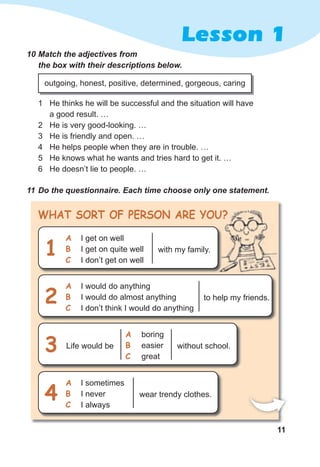
10	Match	the	adjectives	from	
the	box	with	their	descriptions	below.
1 He thinks he will be successful and the situation will have
a good result. …
2 He is very good-looking. …
3 He is friendly and open. …
4 He helps people when they are in trouble. …
5 He knows what he wants and tries hard to get it. …
6 He doesn’t lie to people. …
11	Do	the	questionnaire.	Each	time	choose	only	one	statement.
WHaT SorT oF PerSoN are you?
outgoing, honest, positive, determined, gorgeous, caring
with my family.
I get on well
I get on quite well
I don’t get on well
a
b
c
1
wear trendy clothes.
I sometimes
I never
I always
a
b
c
4
without school.Life would be
boring
easier
great
a
b
c
3
to help my friends.
I would do anything
I would do almost anything
I don’t think I would do anything
a
b
c
2
Mostly As — You’re a very serious and responsible young
person. Your parents must be proud of you and
your friends are lucky to have you. However,
loosen up a bit. Life should be fun too.
Mostly Bs — Life is fun to you. You do only things you like.
However, it’s time to realize that we often have
to do things that are not so pleasant. The
sooner you learn that, the better.
Mostly Cs — You don’t care about anyone or anything, do
you? Be careful. You might end up alone and
disappointed.
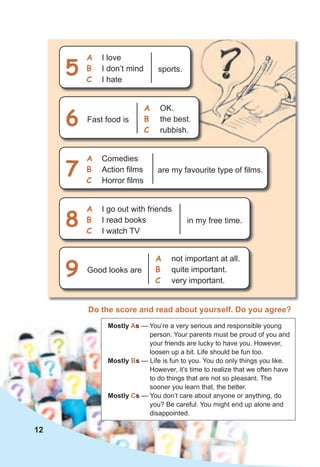
sports.
I love
I don’t mind
I hate
a
b
c
5
are my favourite type of films.
Comedies
Action films
Horror films
a
b
c
7
in my free time.
I go out with friends
I read books
I watch TV
a
b
c
8
Fast food is
OK.
the best.
rubbish.
a
b
c
6
Good looks are
not important at all.
quite important.
very important.
a
b
c
9
Do the score and read about yourself. Do you agree?
12
13
Lesson 1
GraMMar
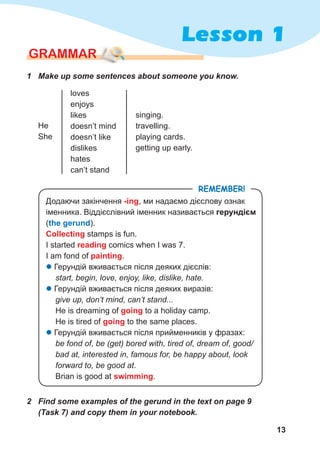
1	 Make	up	some	sentences	about	someone	you	know.
He
She
loves
enjoys
likes
doesn’t mind
doesn’t like
dislikes
hates
can’t stand
singing.
travelling.
playing cards.
getting up early.
Додаючи закінчення -ing, ми надаємо дієслову ознак
іменника. Віддієслівний іменник називається герундієм
(the gerund).
Collecting stamps is fun.
I started reading comics when I was 7.
I am fond of painting.
z Герундій вживається після деяких дієслів:
start, begin, love, enjoy, like, dislike, hate.
z Герундій вживається після деяких виразів:
give up, don’t mind, can’t stand...
He is dreaming of going to a holiday camp.
He is tired of going to the same places.
z Герундій вживається після прийменників у фразах:
be fond of, be (get) bored with, tired of, dream of, good/
bad at, interested in, famous for, be happy about, look
forward to, be good at.
Brian is good at swimming.
remember!
2	 Find	some	examples	of	the	gerund	in	the	text	on	page	9	
(Task	7)	and	copy	them	in	your	notebook.
14
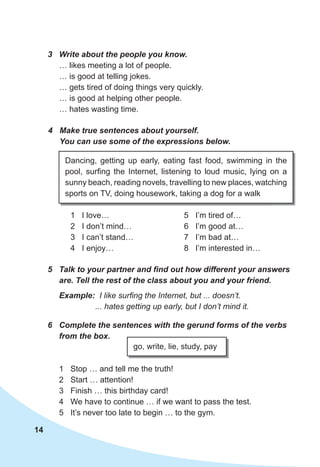
5	 Talk	to	your	partner	and	fi	nd	out	how	different	your	answers	
are.	Tell	the	rest	of	the	class	about	you	and	your	friend.
3	 Write	about	the	people	you	know.
… likes meeting a lot of people.
… is good at telling jokes.
… gets tired of doing things very quickly.
… is good at helping other people.
… hates wasting time.
4	 Make	true	sentences	about	yourself.	
You	can	use	some	of	the	expressions	below.
1 I love…
2 I don’t mind…
3 I can’t stand…
4 I enjoy…
5 I’m tired of…
6 I’m good at…
7 I’m bad at…
8 I’m interested in…
Dancing, getting up early, eating fast food, swimming in the
pool, surfing the Internet, listening to loud music, lying on a
sunny beach, reading novels, travelling to new places, watching
sports on TV, doing housework, taking a dog for a walk
Example: I like surfing the Internet, but ... doesn’t.
... hates getting up early, but I don’t mind it.
6	 Complete	the	sentences	with	the	gerund	forms	of	the	verbs	
from	the	box.
go, write, lie, study, pay
1 Stop … and tell me the truth!
2 Start … attention!
3 Finish … this birthday card!
4 We have to continue … if we want to pass the test.
5 It’s never too late to begin … to the gym.
Lesson 1
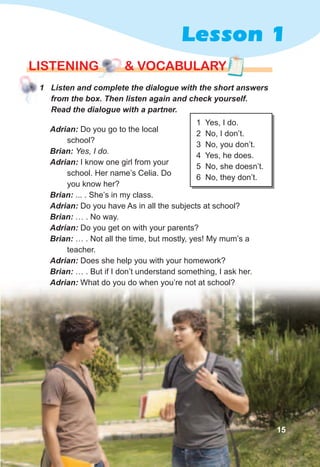
lISTENING & vocabularylISTENING & vocabularylISTENING & vocabulary
1 Yes, I do.
2 No, I don’t.
3 No, you don’t.
4 Yes, he does.
5 No, she doesn’t.
6 No, they don’t.
Adrian:	Do you go to the local
school?
Brian:	Yes, I do.
Adrian:	I know one girl from your
school. Her name’s Celia. Do
you know her?
Brian:	... . She’s in my class.
Adrian:	Do you have As in all the subjects at school?
Brian:	… . No way.
Adrian:	Do you get on with your parents?
Brian:	… . Not all the time, but mostly, yes! My mum’s a
teacher.
Adrian:	Does she help you with your homework?
Brian:	… . But if I don’t understand something, I ask her.
Adrian:	What do you do when you’re not at school?
15
1	 Listen	and	complete	the	dialogue	with	the	short	answers	
from	the	box.	Then	listen	again	and	check	yourself.	
Read	the	dialogue	with	a	partner.
Brian:	I’m in a water polo team.
Adrian:	Why do you play? Do your parents push you?
Brian:	… . I play because I want to.
Adrian:	Can I come and watch you?
Brian:	Yes, you can.
Adrian:	Do you have a dog?
Brian:	No, I don’t. I have a parrot. His name is James.
Adrian:	Does he speak? Does he have a cage?
Brian:	No, he doesn’t speak, but he’s very clever. He has a cage
in my room.
Adrian:	What does he do? Does he do any tricks?
Brian:	… . He plays and he sits on my shoulder.
Adrian:		And how about girls? Is there a girl that you like? Do I
know her?
Brian:	… . You ask too many questions. Bye. See you.
Adrian:	Hey, wait a moment! Do you have a mobile phone?
What’s your number?
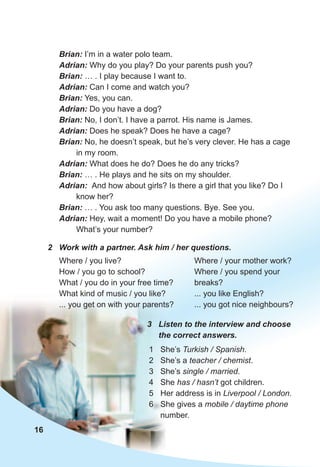
2	 Work	with	a	partner.	Ask	him	/	her	questions.
Where / you live?
How / you go to school?
What / you do in your free time?
What kind of music / you like?
... you get on with your parents?
3	 Listen	to	the	interview	and	choose	
the	correct	answers.
1 She’s Turkish / Spanish.
2 She’s a teacher / chemist.
3 She’s single / married.
4 She has / hasn’t got children.
5 Her address is in Liverpool / London.
6 She gives a mobile / daytime phone
number.
Where / your mother work?
Where / you spend your
breaks?
... you like English?
... you got nice neighbours?
16
17
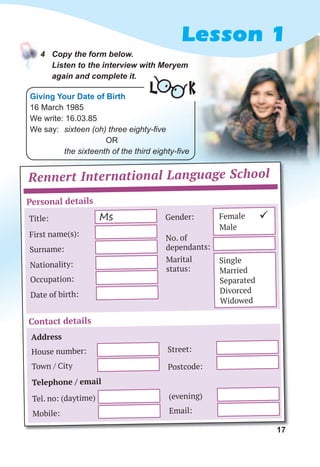
4	 Copy	the	form	below.	
Listen	to	the	interview	with	Meryem	
again	and	complete	it.
Lesson 1
17
Rennert International Language School
Personal details
Contact details
Title: Gender:
Surname:
Town / City Postcode:
Occupation:
Tel. no: (daytime) (evening)
Date of birth:
Mobile: Email:
No. of
dependants:
First name(s):
House number: Street:
Nationality:
Marital
status:
Ms Female
Male
Single
Married
Separated
Divorced
Widowed
ü
Address
Telephone / email
Giving Your Date of Birth
16 March 1985
We write: 16.03.85
We say: sixteen (oh) three eighty-five
OR
the sixteenth of the third eighty-five
L K
18
5	 Work in pairs. Speak on the
difference of the information in
the dialogue in Task 1 and the
interview in Task 3. Then study
the table below.
meaning word example
single or married man
married woman
single woman
single or married woman
Mr
Mrs
Miss
Ms
Miss
family name surname Ostapenko
first name(s) forename (s) Iryna
day, month, and year
you were born
date of birth 24 December 1990
nationality Ukrainian
first language mother tongue Ukrainian
home address
37 Zelena St, Ap.12
Lviv
Ukraine
phone number during
the day
daytime tel [+38032] 234-09-44
‘no’ means 'number' mobile no 067 900 75 32
email address email address irynaostap@i.ua
married or single? marital status single
job occupation nurse
elementary?
intermediate?
etc. tick = ü
level of English
(please tick)
elementary ü
intermediate
advanced
your name written by
yourself
signature Iryna Ostapenko
divorced [dɪˈvɔːst]
female [ˈfiːmeɪl]
male [meɪl]
single [ˈsɪŋɡl]
Vocabulary Box
19
Lesson 1
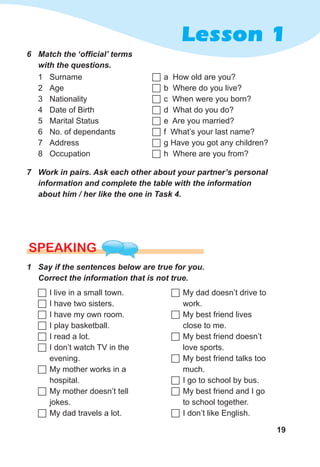
6	 Match	the	‘offi	cial’	terms	
with	the	questions.
1 Surname
2 Age
3 Nationality
4 Date of Birth
5 Marital Status
6 No. of dependants
7 Address
8 Occupation
	a How old are you?
	b Where do you live?
	c When were you born?
	d What do you do?
	e Are you married?
	f What’s your last name?
	g Have you got any children?
	h Where are you from?
7	 Work	in	pairs.	Ask	each	other	about	your	partner’s	personal	
information	and	complete	the	table	with	the	information	
about	him	/	her	like	the	one	in	Task	4.
SPEaKING
1	 Say	if	the	sentences	below	are	true	for	you.		
Correct	the	information	that	is	not	true.
	I live in a small town.
	I have two sisters.
	I have my own room.
	I play basketball.
	I read a lot.
	I don’t watch TV in the
evening.
	My mother works in a
hospital.
	My mother doesn’t tell
jokes.
	My dad travels a lot.
	My dad doesn’t drive to
work.
	My best friend lives
close to me.
	My best friend doesn’t
love sports.
	My best friend talks too
much.
	I go to school by bus.
	My best friend and I go
to school together.
	I don’t like English.
20
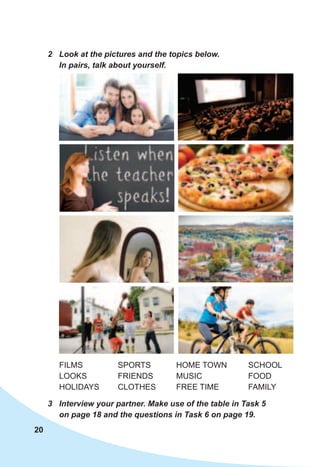
2	 Look	at	the	pictures	and	the	topics	below.	
In	pairs,	talk	about	yourself.
3	 Interview	your	partner.	Make	use	of	the	table	in	Task	5	
on	page	18	and	the	questions	in	Task	6	on	page	19.	
FILMS
LOOKS
HOLIDAYS
SPORTS
FRIENDS
CLOTHES
HOME TOWN
MUSIC
FREE TIME
SCHOOL
FOOD
FAMILY
21
Lesson 1
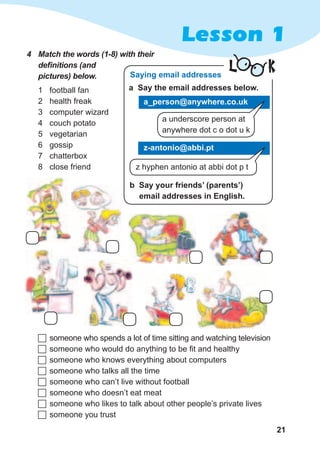
4	 Match	the	words	(1-8)	with	their	
defi	nitions	(and	
pictures)	below.
1 football fan
2 health freak
3 computer wizard
4 couch potato
5 vegetarian
6 gossip
7 chatterbox
8 close friend
	someone who spends a lot of time sitting and watching television
	someone who would do anything to be fit and healthy
	someone who knows everything about computers
	someone who talks all the time
	someone who can’t live without football
	someone who doesn’t eat meat
	someone who likes to talk about other people’s private lives
	someone you trust
L K
b Say your friends’ (parents’)
email addresses in English.
a underscore person at
anywhere dot c o dot u k
Saying email addresses
a Say the email addresses below.
a_person@anywhere.co.uk
z-antonio@abbi.pt
z hyphen antonio at abbi dot p t
22
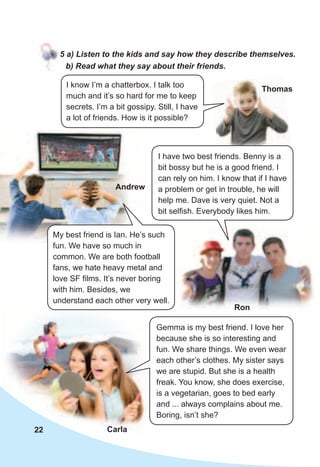
5	a)	Listen	to	the	kids	and	say	how	they	describe	themselves.
I know I’m a chatterbox. I talk too
much and it’s so hard for me to keep
secrets. I’m a bit gossipy. Still, I have
a lot of friends. How is it possible?
Gemma is my best friend. I love her
because she is so interesting and
fun. We share things. We even wear
each other’s clothes. My sister says
we are stupid. But she is a health
freak. You know, she does exercise,
is a vegetarian, goes to bed early
and ... always complains about me.
Boring, isn’t she?
Carla
Ron
Andrew
Thomas
My best friend is Ian. He’s such
fun. We have so much in
common. We are both football
fans, we hate heavy metal and
love SF films. It’s never boring
with him. Besides, we
understand each other very well.
b)	Read	what	they	say	about	their	friends.
I have two best friends. Benny is a
bit bossy but he is a good friend. I
can rely on him. I know that if I have
a problem or get in trouble, he will
help me. Dave is very quiet. Not a
bit selfish. Everybody likes him.
Lesson 1
7	 Tell	your	class	about	your	best	friend.
zz Say what your friend is like, what you do
together and what you like best about him / her.
zz Try to remember an incident when your friend
proved to be a real friend.
6	 Work	in	groups.	Think	of	people	
you	know	and	who	have	these	
qualities.	Speak	in	turns.
Phil
Who is...
... bossy?
... not selfish?
... lonely?
... talkative?
I don’t know what a good friend is because I don’t
have any. The TV and my computer are my best
friends. My parents are angry at me. They call me
a couch potato because I spend so much time in
front of the TV set. They say I should go out and
find myself a friend. The truth is I don’t know how
to make friends. My classmates call me a
computer wizard and they say they admire me.
Still, they never invite me to their parties or call
me out. I’m very unhappy about that, but I don’t
show it. You know, nothing can take the place of
a friend, not even a computer or a TV set. Phil
friends. My parents are angry at me. They call me
23
chatterbox [ˈtʃætəbɒks]
to admire [ədˈmaɪə]
to complain [kəmˈpleɪn]
to prove [pruːv]
to rely [rɪˈlaɪ]
gossipy [ˈɡɒsɪpɪ]
Vocabulary box
c)	Work	in	pairs.	Speak	on	the	following.
1 Why does Thomas say that it’s strange he has so many friends?
2 Why do Andrew and Ian get on so well?
3 Why does everybody like Dave?
4 Why does Carla’s sister think
that Carla and her friend
are stupid?
5 Why are Phil’s parents
angry at him?
... fun to be with?
... gossipy?
24
WrITING
zz I was born on a cold winter night in my native
Bennington, Oklahoma. I do not remember much of my
early childhood, but my mum said that I was a very
active, curious, and communicative child. I would ask
dozens of questions each minute, even without waiting
for the answers. I suppose that was why my parents
offered me books and educational movies as early as my
third birthday.
zz Fortunately, my thirst for knowledge did not come to an
end when I was at school. I was fond of history and
science.This passion helped me gain good knowledge in
these areas.Today, I am a student at a law school, and I
feel very happy about it.
zz I am certain that my good results in studies will become
my ticket to a better tomorrow. I want to become a
lawyer. I study hard and devote my free time to reading
reviews and watching interviews with recognized
specialists in the field.
zz Of course, I understand that life is not just a bed of roses,
and challenges or difficulties are an integral element of
life. Since my parents could not help me cover my
college expenses1
in full, I combine a part-time job and
full-time study to earn my living and my education. I feel
satisfied at the beginning of every month when I receive
my salary2
and plan how I will spend my money.
1
expenses [ɪkˈspensɪz] — витрати 2
a salary [ˈsæləri] — заробітна плата
1	 Read	the	sample	of	autobiography	and	consider	
the	questions	on	page	25.
25
Lesson 1
1 What famous quote1
can describe your life?
2 Which 3 adjectives can be used to describe you as a person?
3 Who influenced your personal development?
4 What are your best and worst childhood memories?
5 What is your family social and ethnic background?
6 What are your relations with parents and other relatives?
7 What are your goals for the future?
8 What places would you like to visit and why?
9 What skills would you like to develop and why?
10 What was the most memorable day in your life?
11 What was the most important lesson you have ever learnt in
your life?
12 What are the most important values in life,
in your opinion?
An autobiography is a written account of the life of a
person written by that person. In other words, it is the
story that people wrote about themselves. It is just like the
biography that includes such things as time and place of
their birth, an overview of their personality, their likes and
dislikes, and the special events that shaped their life.
remember!
1
a quote [kwəʊt] — цитата
26
1 I was born in…
2 I was an active (or quiet, shy, curious, etc.) child.
3 My childhood dream was…
4 My earliest memory is…
5 I am grateful to my parents (or teachers, friends, etc.)
because…
6 My role model was…
7 My lifetime dream is…
8 The most memorable day of my life was…
9 One phrase that I will never forget is…
10 If only one of my dreams could come true, I would wish
for…
11 My main belief in life is…
12 I am driven by my desire / passion / wish to…
13 The main lesson that my parents taught me was…
14 The childhood hobby that most shaped my personality is…
15 One event that influenced who I am today is…
16 My motto in life is…
17 My favourite book / movie / author is…
18 When I was growing up, I always dreamed of becoming a…
19 One thing I wish I knew five (or ten, twenty, etc.) years ago
is that…
20 My favourite childhood picture is…
2	 Present	yourself	in	a	
written	way	(150-200	
words).	Use	some	of	
the	questions	on	
page	25	and	the	
phrases	below.
27
Lesson 2
rEaDING & vocabularyrEaDING & vocabularyrEaDING & vocabulary
TEEN
GENERATION
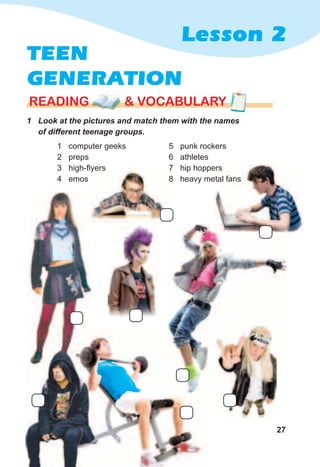
1	 Look	at	the	pictures	and	match	them	with	the	names	
of	different	teenage	groups.
1 computer geeks
2 preps
3 high-flyers
4 emos
5 punk rockers
6 athletes
7 hip hoppers
8 heavy metal fans
28
2	 Read the descriptions of different teenage groups
and match them with the right names from Task 1.
	Looks and fancy clothes are very important for them, and they
sometimes spend hours in the bathroom just to get the perfect
hairstyle or match the right outfit. You might call them fashion
victims, because they love designer labels and always keep up
with the latest trends. They don’t generally have problems with
school or teachers, but they have no special interests. When it
comes to music, they listen to anything played on radio stations
and MTV, as long as it’s not too loud. And their favourite hang-
out? Shopping centres, of course, especially at weekends!
	They are simply ingenious when it comes to computers. Very
few people can actually understand them when they talk about
the latest software or new gadgets, which is when they get
irritated! They are brilliant at science subjects, especially Maths
and Physics, and schoolwork in general is rarely a problem for
them. When it comes to clothes, they grab whatever is clean in
their room. They are not too picky about music either, but rock,
heavy metal or hip hop are among their favourites. They mix
well with skaters, since skateboarding is often their favourite
pastime. Their favourite hang-outs are computer labs, cyber
cafes or any other place with a computer nearby.
	They are fascinated by African American urban culture, so
baggy clothes and baseball caps are their most usual outfit.
They don’t consider graffiti vandalism, but an art form, so you
can see their drawings on city walls, but sometimes in their
notebooks or the school bathrooms, too. Of course, rap and
hip hop are their favourite music, but girls frequently prefer
R&B, and they are especially fond of hip-hop dance. Most hip
hoppers are very good with words and rhymes, and know a lot
about politics and global problems, so it’s good to have them
on your debate team. They love playing basketball in their free
time, so school playgrounds are among their favourite hang-
ʊ
29
Lesson 2
outs. Let’s not forget the
clubs, when there is a rap battle!
	School is the centre of their world, and most of them already have
a clear idea about their future career. They are very ambitious and
competitive, but also hard-working, so they never forget to do their
homework. That’s why other students sometimes call them nerds.
They are extremely well-behaved, which is why they are almost
always teacher’s pets. They’re not particularly fashion-conscious,
but they like neat and casual clothes. They are not picky about
popular music, but some of them like to join their parents at
concerts of classical music. Although most teenagers find books
boring, they really enjoy reading, so libraries are definitely among
their favourite hang-outs.
	Their sports career is as important as school for them, and
most of them miss a lot of classes because of preparations for
important competitions. That’s why they sometimes have a lot
of schoolwork to catch up. At the same time, they do well in
exams, but unlike some other students, they are certainly
excellent at PE. A jogging suit is their most usual outfit, simply
because it is the most comfortable one. It is also quite logical
that they spend most of their free time in a gym, but sports
events are also among their favourite hang-outs.
3	 Work in pairs to answer 	
the following questions about 	
the teenage groups.
1	 Who doesn’t really care about
clothes?
2	 Who enjoys dancing?
3	 Who is fashion-conscious?
4	 Who is very responsible about
schoolwork?
5	 Who spends a lot of time in a gym?
6	 Who likes drawing graffiti?
hang-out [ˊhæŋaʊt]
outfit [ˈaʊtfɪt]
software [ˈsɒftweə]
trend [trend]
victim [ˈvɪktɪm]
to grab [ɡræb]
to irritate [ˈɪrɪteɪt]
casual [ˈkæʒʊəl]
fascinated [ˈfæsɪneɪtɪd]
picky [ˈpɪki]
Vocabulary Box
30
4	 Work	in	groups	of	fi	ve.	
a)	Copy	the	profi	le	grid	below.	Each	student	reads	
one	description	again	and	fi	lls	in	the	profi	le	for	
a	particular	teenage	group.
b)	Speak	on	the	following	questions.
zz Would you join any of these teenage groups?
zz Which teenage group would you join and why?
5	a)	Look	up	these	adjectives	in	the	descriptions	of	teenage	
groups	in	Task	2	and	answer	the	questions	below.
How would you describe someone...
1 ...who cares a lot about what clothes to wear?
2 ...who is very clever?
3 ...who is hard to please?
4 ...who likes success and competition?
picky, ingenious, competitive, fashion-conscious
Teenage
group:
Computer
geeks
Preps
High-
flyers
Hip
hoppers
Athletes
Looks and
clothes:
School:
Hobbies and
interests:
Music:
Favourite
hang-outs:
31
Lesson 2
b)	Work	in	pairs.	Guess	what	these	
words	mean.	Look	them	up	in	the	descriptions	
of	teenage	groups	and	answer	the	questions.
1 What school subjects are you fond of?
2 Do you know anyone who is a teacher’s pet?
3 Do you keep up with the latest fashion trends?
4 What is your favourite hang-out?
5 Can you describe your favourite outfit?
6 Can you think of any examples of vandalism in
your school?
7 What is your favourite pastime?
8 Which gadget couldn’t you live without?
GraMMar
an outfit, a hang-out, to keep up with, a teacher’s
pet, a gadget, pastime, vandalism, to be fond of
remember!
The Gerund (Герундій)
Герундій — це неособова форма дієслова,
що має властивості дієслова та іменника.
Розрізняють чотири форми герундія:
Forms of the Gerund Active Passive
Simple writing being written
Perfect having written having been written
Герундій у реченні може
виконувати функції підмета.
E.g. Swimming is my hobby.
Герундій у реченні може
виконувати функції додатка.
E.g. She is fond of singing.
She enjoys singing.
32
1	 Read and write about your (your mum’s, your friend’s, etc)
hobbies as in the example below.
Nearly everyone has a hobby of some kind: stamp collecting,
reading, painting, solving crossword puzzles, bird-watching,
knitting, listening to music, growing roses, playing the piano,
guitar or accordion, embroidering1
, woodcarving2
, playing chess,
dominoes or billiard, collecting postcards, horseback riding, or
gardening.
Example:
My hobby is picking mushrooms.
My mum’s hobbies are knitting and cooking.
My father’s hobby is collecting coins.
1
embroidering [ɪmˈbroɪdərɪŋ] — вишивання
2
woodcarving [ˈwʊdkɑ:vɪŋ] — різьба по дереву
Типова помилка:
Olga enjoys to travel.
Правильна структура:
Olga enjoys travelling.
to enjoy
to finish
to dislike
to give up
can’t stand
don’t mind
to be worth
to begin
to start
to like
to hate
to prefer
to love
to stop
to continue
to go on
doing something
to do something
doing
something
Example:
Alison likes reading. (Взагалі)
Alison likes to read newspapers.
(В конкретному випадку)
L K
Дієслова, які вживаються як з
герундієм, так і з інфінітивом:
Дієслова, які вживаються
лише з герундієм.
33
Lesson 2
Типова помилка: I look forward to hear from you.
Правильна структура: I look forward to hearing from you.
Герундій вживається після деяких дієслів з прийменниками:
to depend on — залежати від
to rely on — покладатися на
to insist on — наполягати на
to agree to — погоджуватися з
to hear of — чути про
to think of — думати про
to be fond of — захоплюватися
to be sure of — бути впевненим в чомусь
to be pleased at / with — 	бути задоволеним чимось
	 або кимось
to be surprised at — дивуватися чомусь
to be interested in — цікавитися чимось
to be afraid of — боятися чогось
to look forward to — чекати з нетерпінням
2	 Read and write a few true sentences of what you like
and don’t like doing.
My favourite sport is ice-skating. I enjoy dancing to pop music.
Skating is also a very good way of keeping fit. What about you?
What is your favourite sport? Say what you think about these
leisure activities: watching films on TV, dancing, swimming in the
river, going out with friends, fishing, cycling, climbing, picking up
mushrooms, jogging, boating, skiing, camping, etc. I often go
swimming, fishing, sailing and riding. How often do you go skating?
Remember!
Example: I like getting presents.
I hate getting up early.
My favourite leisure time activity is …
I don’t enjoy …
34
6	 Answer the questions.
1	 What films do you think are worth seeing?
2	 Do you enjoy travelling by plane? Why?
3	 What do you do after coming home from school?
4	 Which do you enjoy more, going to the theatre or going to the
cinema?
5	 Do you like or dislike travelling long distances by train?
4	 Fill in the gaps using the gerund or the infinitive.
Mr Brown likes (sit) … at home and (read) … the newspapers in
the evening. Joan, his wife, enjoys (read) … novels. Natalie likes
(to go) … for a walk in the evening. Alison’s hobby is (listen) … to
classical music.
5	 Be a polite person and begin the following commands with
‘Would you mind…?’
Example: Wait in the hall.
Would you mind waiting in the hall?
3	 Write out all of the sentences with the gerund form
from Task 6 of Lesson 1 (page 8).
1	 Come back later.
2	 Sit in the second row.
3	 Open the window.
4	 Close the door.
5	 Give this message to
Mr Brown.
6	 Give this book to
Alison.
7	 Explain it again.
8	 Hold my bag.
9	 Read your question again.
10	Write what you said on
the board.
11	Sit in the next row.
12	Learn vocabulary
on page 5.
13	Complete exercise 6
on page 23.
14	Go and sit next
to George.
I (really) like/enjoy/love … (very much)
I (don’t) like …
35
Lesson 2
7	 Make	up	one	sentence	from	two.	Use	the	perfect	form	
of	the	gerund.	Explain	its	use.
Example: I have read this book. I remember.
I remember having read this book.
He entered the room. Nobody noticed him.
Nobody noticed his having entered the room.
1 I have shown him the letter. I am sure.
2 I have given her the magazine. I remember.
3 He has been so rude. He is sorry.
4 We have seen this play. We are sure.
5 She has asked me about it. Nobody noticed this.
8	 Work	in	pairs.	Make	up	your	dialogue	using	the	expressions	
below.
zz Excuse me for interrupting you.
zz Do you mind my reading here?
zz I’m afraid of going there.
zz I’m looking forward to seeing you.
lISTENING & vocabularylISTENING & vocabularylISTENING & vocabulary
1	 Look	at	these	words	and	get	their	meanings.	
smart clothes =
well groomed =
scooter =
accessories =
stylish, elegant clothes
tidy
a light motorbike with a small engine
things that you wear or carry that
match your clothes, for example,
a piece of jewellery or a bag.
6 When do you expect
to stop studying English?
7 What places are worth visiting in your town?
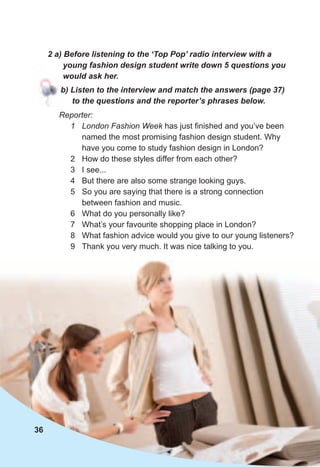
2	a)	Before	listening	to	the	‘Top	Pop’	radio	interview	with	a	
young	fashion	design	student	write	down	5	questions	you	
would	ask	her.
b)	Listen	to	the	interview	and	match	the	answers	(page	37)	
to	the	questions	and	the	reporter’s	phrases	below.
Reporter:
1 London Fashion Week has just finished and you’ve been
named the most promising fashion design student. Why
have you come to study fashion design in London?
2 How do these styles differ from each other?
3 I see...
4 But there are also some strange looking guys.
5 So you are saying that there is a strong connection
between fashion and music.
6 What do you personally like?
7 What’s your favourite shopping place in London?
8 What fashion advice would you give to our young listeners?
9 Thank you very much. It was nice talking to you.
36
37
Lesson 2
с)	Write	down	the	words	connected	with	fashion	from	
the	text	of	the	interview.
	Some young people have
money and they spend quite a lot
of it on clothes. They like wearing smart clothes, loafers,
tight fitting sportswear. They like riding scooters. Their hair
is well groomed and they have regular haircuts.
	But there are more and more people who like wearing
comfortable clothes. They are more in touch with the
natural world. They think that today’s world revolves too
much around money.
	Well, comfortable clothes ... with style.
	Camden Lock Market. You can get anything you want there
— fake Levi’s, leopard print swimsuits, old records,
jewellery made from recycled metal. It attracts an amazing
mixture of people, so it’s fun just watching them. I often get
inspired there.
	Well, London is the right place to be because it’s famous for
its street fashion and a lot of second-hand shops or
markets - so young people can buy cheap clothes and
create their own style.
	Yeah, of course. Some young people like dying their hair in
bright colours. In big cities they are also connected with
punk and rave.
	Yes. Fashion and music have always been connected. Let’s
say heavy metal is associated with leather jackets, long
hair, tattoos, powerful motorbikes. While Punk was famous
for a lot of strange accessories like chains, safety pins, and
of course spiky hair, Rap goes together with baggy clothes.
	Well, I’d say a person’s style depends on the imagination,
not that much on money. I really believe in creating a style
that doesn’t cost much. Fashion should be more on the
artistic side. Today it is still a big business.
38
3	 Say	if	the	following	statements	are	true	or	false.
1 Fashion and music are often connected.
2 Some people dye their hair in strange colours.
3 Camden Lock Market is a place where
one can buy second-hand clothes.
4 Ibby believes one can’t look
fashionable without spending
a lot of money.
5 Rappers like baggy clothes.
4	 Choose	the	right	answer.
1 A promising fashion designer is
a) a person who keeps promises.
b) a person who will become very successful.
2 Second-hand shops are the ones that
a) are not close to your home.
b) sell clothes that somebody else has already worn.
3 Fashion is a big business. It means
a) that there are a lot of fashion designers in this business.
b) that there is a lot of money in it.
5	a)	Before	listening	remember	what	you	know	
about	British	youth.
b)	Listen	to	the	information	about	British	traditional	youth	
organizations	and	complete	the	sentences	below.
1 Different trends like …, … and … appeared in the British society.
2 … is the most famous traditional youth organization.
3 This organization was founded by … in …
4 An organization for girls was founded in … and was called …
5 … was formed to defend interests of students.
6 … and … are religious organizations.
7 … provides hostels for young travellers.
8 … offers a wide choice of sporting and social activities.
hostel [ˈhɒstl]
item [ˈaɪtəm]
leather [ˈleðə]
message [ˈmesɪdʒ]
sportwear [ˈspɔːtweə]
spiky [ˈspaɪki]
to provide [prəˈvaɪd]
to revolve [rɪˈvɒlv]
Vocabulary box
39
Lesson 2
SPEaKING
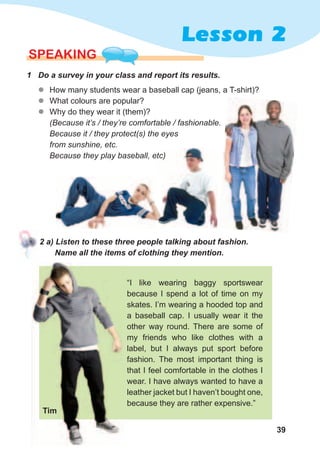
1	 Do	a	survey	in	your	class	and	report	its	results.
zz How many students wear a baseball cap (jeans, a T-shirt)?
zz What colours are popular?
zz Why do they wear it (them)?
(Because it’s / they’re comfortable / fashionable.
Because it / they protect(s) the eyes
from sunshine, etc.
Because they play baseball, etc)
2	a)	Listen	to	these	three	people	talking	about	fashion.	
Name	all	the	items	of	clothing	they	mention.
“I like wearing baggy sportswear
because I spend a lot of time on my
skates. I’m wearing a hooded top and
a baseball cap. I usually wear it the
other way round. There are some of
my friends who like clothes with a
label, but I always put sport before
fashion. The most important thing is
that I feel comfortable in the clothes I
wear. I have always wanted to have a
leather jacket but I haven’t bought one,
because they are rather expensive.”
Because they play baseball, etc)
Tim
40
b)	Match	the	words	with	their	defi	nitions.
1 label
2 fuss
3 give in
4 pick
5 glittery
	shiny
	choose
	a little piece of material fixed to an item of
clothing with information about it
	a time when people are very excited about
something that is usually not that important
	stop fighting against somebody or something
c)	Insert	the	words	above	in	the	phrases	below.
a … evening dress, designer’s …, … a jacket you like,
make a … about something, … to someone’s demands
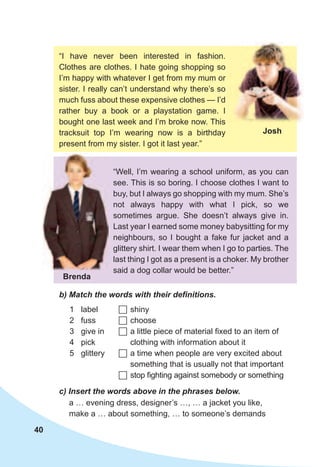
“Well, I’m wearing a school uniform, as you can
see. This is so boring. I choose clothes I want to
buy, but I always go shopping with my mum. She’s
not always happy with what I pick, so we
sometimes argue. She doesn’t always give in.
Last year I earned some money babysitting for my
neighbours, so I bought a fake fur jacket and a
glittery shirt. I wear them when I go to parties. The
last thing I got as a present is a choker. My brother
said a dog collar would be better.”
“I have never been interested in fashion.
Clothes are clothes. I hate going shopping so
I’m happy with whatever I get from my mum or
sister. I really can’t understand why there’s so
much fuss about these expensive clothes — I’d
rather buy a book or a playstation game. I
bought one last week and I’m broke now. This
tracksuit top I’m wearing now is a birthday
present from my sister. I got it last year.”
josh
Brenda
41
Lesson 2
d)	Make		a	presentation	about	
yourself.	Mention	what	you	usually	wear,	
your	favourite	clothes	and	attitude	to	fashion.
3	 Work	in	pairs.	Speak	on	the	topics.
zz What kind of music do you like?
zz What kind of clothes do the stars in your favourite group wear?
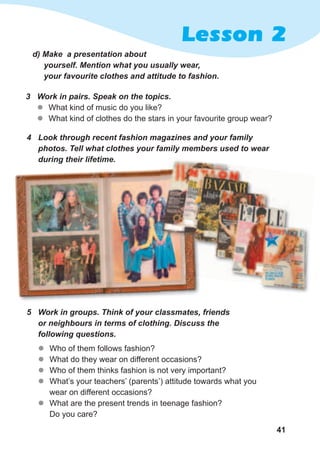
4	 Look	through	recent	fashion	magazines	and	your	family	
photos.	Tell	what	clothes	your	family	members	used	to	wear	
during	their	lifetime.
zz Who of them follows fashion?
zz What do they wear on different occasions?
zz Who of them thinks fashion is not very important?
zz What’s your teachers’ (parents’) attitude towards what you
wear on different occasions?
zz What are the present trends in teenage fashion?
Do you care?
5	 Work	in	groups.	Think	of	your	classmates,	friends	
or	neighbours	in	terms	of	clothing.	Discuss	the	
following	questions.
42
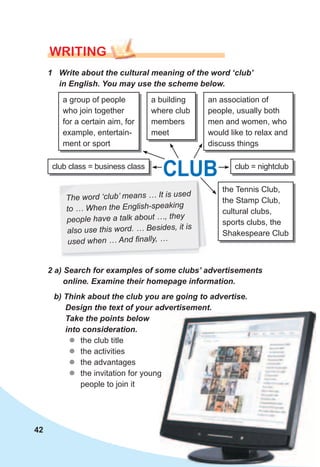
The word ‘club’ means … It is used
to … When the English-speaking
people have a talk about …, they
also use this word. … Besides, it is
used when … And finally, …
WrITING
1	 Write	about	the	cultural	meaning	of	the	word	‘club’	
in	English.	You	may	use	the	scheme	below.
a group of people
who join together
for a certain aim, for
example, entertain-
ment or sport
an association of
people, usually both
men and women, who
would like to relax and
discuss things
the Tennis Club,
the Stamp Club,
cultural clubs,
sports clubs, the
Shakespeare Club
club = nightclubclub class = business class
a building
where club
members
meet
CLUB
b)	Think	about	the	club	you	are	going	to	advertise.	
Design	the	text	of	your	advertisement.	
Take	the	points	below	
into	consideration.
zz the club title
zz the activities
zz the advantages
zz the invitation for young
people to join it
2	a)	Search	for	examples	of	some	clubs’	advertisements	
online.	Examine	their	homepage	information.
Lessons 1-2L K BACK!
1	 Complete	the	sentences	with	the	words	from	the	box.
computer geek (twice), fascinated, enjoys,
fashion-conscious, hip hoppers
1 My best friend is quite … and she always keeps up with the
latest trends.
2 I am … by black Americans and their culture.
3 I love new gadgets, but I wouldn’t call myself a … .
4 I don’t like rap music, but I get on well with some … in my
school.
5 A … usually doesn’t care about fashion.
6 I always see your friend in the library. I’m sure he … reading
and learning a lot.
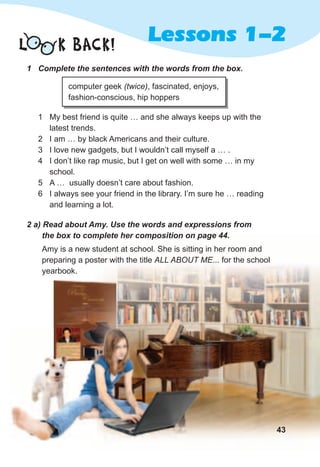
2	a)	Read	about	Amy.	Use	the	words	and	expressions	from	
the	box	to	complete	her	composition	on	page	44.
Amy is a new student at school. She is sitting in her room and
preparing a poster with the title ALL ABOUT ME... for the school
yearbook.
43
44
ALL ABOUT ME...
I don’t know where to begin, because I don’t like talking
about myself. I don’t fit in any group, especially the
popular ones. I’m not … because I don’t think much
about clothes. I just wear what’s comfortable, so I guess
preps would look down on me. My mum thinks I spend
too much time in front of the computer, but I only use
it for schoolwork and chatting. Anyway, she always says
I should go out more. I love classical music. Whenever I
…, I play the piano. I also like dancing, but I have
absolutely no talent for it. I guess hip hoppers wouldn’t
like to see me in their dance group. And, let’s not forget
my reading. I read tons of books, and they are not just
for my English class. That’s why libraries are my
favourite … . My dad thinks I should do some sports,
but I’m simply not much of an athlete. And I hate PE!
Other than that, school is not a problem for me,
although I’m not ambitious and … like high-flyers. I’m
excellent at Chemistry, but History gives me a headache.
I never speak up in class, so who would want me on
their debate team? I’m such a boring person! Thank
God I have Sugar. I always talk to him. I tell him all my
secrets, and he’s always there for me. Dogs are great
friends, aren’t they?
feel down, competitive, fashion-conscious, hang-outs
b)	Work	in	small	groups.	Discuss	the	questions	below.
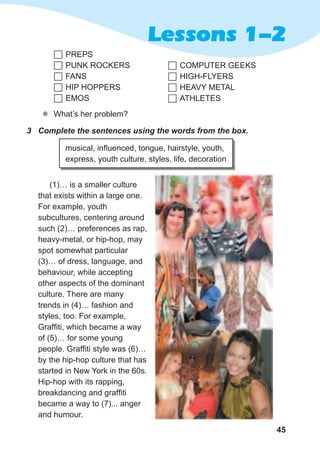
zz Which of the following teenage groups (page 45) does she
mention in her composition? Does she have anything in
common with them?
45
Lessons 1-2
zz What’s her problem?
	PREPS
	PUNK ROCKERS
	FANS
	HIP HOPPERS
	EMOS
	COMPUTER GEEKS
	HIGH-FLYERS
	HEAVY METAL
	ATHLETES
3	 Complete	the	sentences	using	the	words	from	the	box.
musical, influenced, tongue, hairstyle, youth,
express, youth culture, styles, life, decoration
(1)… is a smaller culture
that exists within a large one.
For example, youth
subcultures, centering around
such (2)… preferences as rap,
heavy-metal, or hip-hop, may
spot somewhat particular
(3)… of dress, language, and
behaviour, while accepting
other aspects of the dominant
culture. There are many
trends in (4)… fashion and
styles, too. For example,
Graffiti, which became a way
of (5)… for some young
people. Graffiti style was (6)…
by the hip-hop culture that has
started in New York in the 60s.
Hip-hop with its rapping,
breakdancing and graffiti
became a way to (7)... anger
and humour.
46
Today young people like to use body modification. Tattoos can
be found on everyone from Robbie Williams to Angelina Jolie,
and even Princess Anne of England’s daughter has her (8)...
pierced. These days most people use body art simply as (9)... . It
has become a fashion statement, in the same way that an item of
clothing or (10)... might be.
4	 Open the brackets using gerunds instead of infinitives.
5	 Transform the sentences using gerunds instead of infinitives.
Example: He postponed (make) … a decision.
He postponed making a decision.
Example: We continue to study English.
We continue studying English.
1	 I began (read) … a novel yesterday.
2	 We had started (write) … the exercise before the teacher
came in.
3	 It has stopped (rain) … . I hate (go) … out in the rain.
4	 My uncle has given up (smoke) … and now prefers (eat) …
sweets.
5	 I like (come) … to school by bus but I hate (stand) … in the
rain and (wait) … for it.
6	 I love (eat) … oranges, but I dislike (peel) … them.
7	 We enjoyed (see) … you and (hear) … all your news.
1	 She has just finished to read an article about the natural
resources of Ukraine.
2	 My father intends to spend his holidays in the Carpathians.
3	 My sister began to work in this beautiful Ukrainian city five
years ago.
4	 I have just begun to translate the text into Ukrainian.
5	 We preferred to go to Kyiv by plane.
47
Lessons 1-2
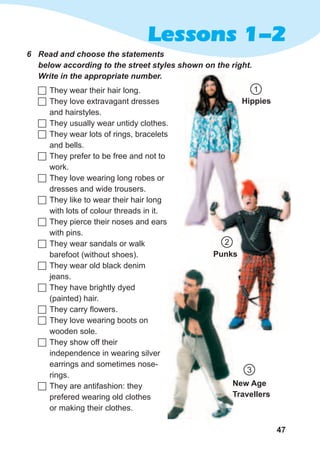
6	 Read	and	choose	the	statements	
below	according	to	the	street	styles	shown	on	the	right.	
Write	in	the	appropriate	number.
	They wear their hair long.
	They love extravagant dresses
and hairstyles.
	They usually wear untidy clothes.
	They wear lots of rings, bracelets
and bells.
	They prefer to be free and not to
work.
	They love wearing long robes or
dresses and wide trousers.
	They like to wear their hair long
with lots of colour threads in it.
	They pierce their noses and ears
with pins.
	They wear sandals or walk
barefoot (without shoes).
	They wear old black denim
jeans.
	They have brightly dyed
(painted) hair.
	They carry flowers.
	They love wearing boots on
wooden sole.
	They show off their
independence in wearing silver
earrings and sometimes nose-
rings.
	They are antifashion: they
prefered wearing old clothes
or making their clothes.
Hippies
Punks
New Age
Travellers
1
2
3
48
7 a) Do the questionnaire to find out if you are music mad
(crazy).
YOUR SCORE:
6 points each for every a) answer
4 points each for every b) answer
2 points each for every c) answer
0 points each for every d) answer
Your results:
If you scored 40 or more, you are
completely music mad. You live
and breathe for music. You are
probably a musician yourself!
1 How often do you buy new
CDs/albums/cassettes?
	a) once a week
	b) once a month
	c) once a year
	d) never
3 Do you read music
magazines?
	a) often
	b) regularly
	c) rarely
	d) never
5 Do you sing in a choir
or play in a band?
	a) Yes, often.
	b) Yes, regularly.
	c) Yes, but rarely.
	d) No, never.
7 Do you listen to music
outside the home, e.g.,
on a personal stereo?
	a) often
	b) regularly
	c) rarely
	d) never
2 How often do you go to
live concerts?
	a) once a week
	b) once a month
	c) once a year
	d) never
4 Do you play a musical
instrument?
	a) Yes, often.
	b) Yes, regularly.
	c) Yes, but rarely.
	d) No, never.
6 How often do you listen
to music at home?
	a) often
	b) regularly
	c) rarely
	d) never
8 Do you listen to music...
	a) when you are
working/studying?
	b) in the bath?
	c) on the way to school?
	d) in bed?
49
Lessons 1-2
b)	Choose	one	of	the	topics	below	and,	in	groups,	make	up	a	
questionnaire	similar	to	the	above	‘Are	you	Music	Mad?’.	
Use	the	questionnaire	to	fi	nd	out	about	other	mates.
zz ‘Are you TV Mad?’
zz ‘Are you Computer Games Mad?’
zz ‘Are you Video Mad?’
zz ‘Are you Movie Mad?’
If you scored 20-39, you take an
active interest in music. You probably choose your friends
according to whether they like the same type of music as you do.
If you scored 10-19, then music is not your main leisure interest.
You probably prefer sport or reading, for example.
If you scored 9 or less, you are musically brain dead. You probably
don’t know the difference between Mozart and Madonna!
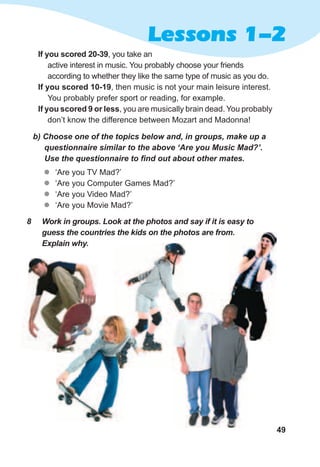
8	 Work	in	groups.	Look	at	the	photos	and	say	if	it	is	easy	to	
guess	the	countries	the	kids	on	the	photos	are	from.	
Explain	why.
guess	the	countries	the	kids	on	the	photos	are	from.
50
b)	Work	in	pairs.	Use	the	
glossary	on	page	51	and	
rewrite	the	dialogue	(page	
53)	in	Weblish.	Each	of	
you	should	write	only	
one	part,	either	Sally’s	
or	Al’s.	
b)	Work	in	pairs.	Use	the	
glossary	on	page	51	and	
rewrite	the	dialogue	(page	
53)	in	Weblish.	Each	of	
you	should	write	only	
one	part,	either	Sally’s	
9	a)	Try	to	read	a	message	from	
Kate’s	phone	(on	the	right).	
What	is	it	about?
hi an! how is ur
trip? my frnds and
me r very by her.
dey all send thr lv
to u. wot r your
plans 4 the rest of
the holidays? rite,
please. c u soon
ur K81
a glossary [ˈɡlɒsəri] — глосарій,
невеликий словник
thanx — thanks
cos — because
dumbo — stupid
best — best wishes
wanna — do you want to
just thought — I just thought
cheer him — it’ll cheer him up
u bet — you bet (this means a strong ‘Yes!’)
— do you want to
— I just thought
Young people express themselves,
for example, in Weblish, a new
shorthand English used in text
messaging and in the Internet chat
rooms. Weblish is a kind of ‘slang’
— idiomatic English which often
breaks the rules of correct English.
For example, capital letters are not
used. Here is a glossary1
of some of
the key expressions and symbols
used in chat rooms.
u — you
c — see
2 — to
r — are
b — be
4 — for
nite — night
yup — yes
Do you KNoW?
51
Lessons 1-2
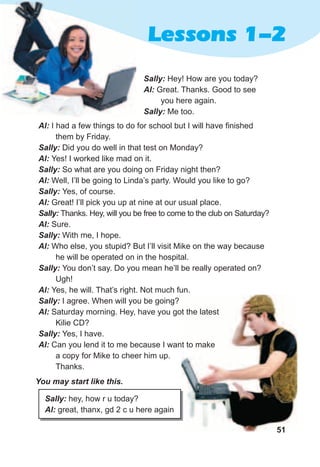
Sally:	Hey! How are you today?
Al:	Great. Thanks. Good to see
you here again.
Sally:	Me too.
51
You	may	start	like	this.
Sally:	hey, how r u today?
Al:	great, thanx, gd 2 c u here again
Al:	I had a few things to do for school but I will have finished
them by Friday.
Sally:	Did you do well in that test on Monday?
Al:	Yes! I worked like mad on it.
Sally:	So what are you doing on Friday night then?
Al:	Well, I’ll be going to Linda’s party. Would you like to go?
Sally:	Yes, of course.
Al:	Great! I’ll pick you up at nine at our usual place.
Sally:	Thanks. Hey, will you be free to come to the club on Saturday?
Al:	Sure.
Sally:	With me, I hope.
Al:	Who else, you stupid? But I’ll visit Mike on the way because
he will be operated on in the hospital.
Sally:	You don’t say. Do you mean he’ll be really operated on?
Ugh!
Al:	Yes, he will. That’s right. Not much fun.
Sally:	I agree. When will you be going?
Al:	Saturday morning. Hey, have you got the latest
Kilie CD?
Sally:	Yes, I have.
Al:	Can you lend it to me because I want to make
a copy for Mike to cheer him up.
Thanks.
52
	Phil: I’m a punk. And all punks have crazy hair, you know. I
often change the colour. Sometimes it’s pink or green.
	Leo: The hairdresser shaves it once a week. That’s expensive,
but I don’t have to buy shampoo, conditioner or gel.
	John: I don’t look like a girl. Lots of men have ponytails —
look at Bono in U2.
	Sam: I never go to the hairdresser. I do it myself — I just cut
the ends and the fringe1
in front of a mirror.
	Robin: It takes hours to do. I like it because it is traditional.
African women wear their hair like this.
10	Discuss	in	groups	of	three.	
a Do you agree that music, television and movies cross the
boundaries? Why?
b Is a new generation appearing on the world scene? Prove
your opinion.
c Do computers create a new kind of neighbourhood? Why?
d What are the new ways of learning English?
e Do teenagers like to be different?
f What is Weblish? Why did it appear?
11	Read	and	match	the	names	with	the	photographs.
1
2 54
3
1
a fringe [frindz] — чубок, чубчик
53
Lessons 1-2
FILE FOR
PROJECTStep 1. On separate sheets of paper write
about your tastes in clothes, subjects you like at school,
hobbies and interests, tastes in music, favourite hang-
outs, or anything else that you think might be interesting
for other people to know about you.
Step 2. Find some photographs or draw some pictures.
Step 3. Make a poster using your writings and pictures.
Step 4. Display your poster and comment on it in class.
13	Prepare	a	mini	poster	about	yourself,	with	the	title	ALL	
ABOUT	ME...,	for	the	school	yearbook.	
Display your poster and comment on it in class.
School Yearbook
ALL ABOUT ME…
1 Online friends are not real friends.
2 People often lie online. That’s why you
can’t trust anyone.
3 Internet friendships take teenagers away
from real people and friends.
4 Parents should have control
over what their teenagers
are doing on the net.
5 Teen bloggers are often
careless. They say too much
about themselves and this
makes it possible for weirdos
to track them down.
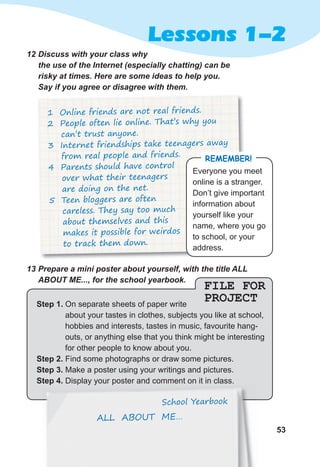
12	Discuss	with	your	class	why	
the	use	of	the	Internet	(especially	chatting)	can	be	
risky	at	times.	Here	are	some	ideas	to	help	you.	
Say	if	you	agree	or	disagree	with	them.
Everyone you meet
online is a stranger.
Don’t give important
information about
yourself like your
name, where you go
to school, or your
address.
remember!
YOUTH CULTURES
The term ‘culture’ can be defined
as language, dress, beliefs, manners
and tastes in food or music of a
particular2
group.
The concept3
of youth culture
appeared inAmerica in the 1950s and
spread to Britain in the 1960s. It was
a result of the improvement in
Western economics, which meant
that teenagers had money to spend.
There was the development of
music and fashion industries with the
orientation to the youth market. New
groups of young people dressed in
Italian-style and leather4
clothes
appeared. They were called Mods.
But there were young people who
were against the materialistic wealth
and stressed on spiritual5
values.
They tried to show their protest in
wearing unusual clothes, hair dress
or in other ways. Thus in the 1960s
b)	Read	the	article	and	check	your	answers	in	task	a).	
1
in italics [i9tBliks] — виділений курсивом
2
particular [p39tikjUl3] — окремий
3
a concept [9kAnsept] — поняття
54
1	a)	Read	the	statements	and	say	if	they	are	true	or	false.
1 Youth cultures are connected with fashion and music tastes.
2 Youth cultures don’t influence the society.
3 Rap fashion is a big business today.
4 Hippies are violent people.
5 Being a punk or a rapper is a silly thing.
4
leather [9leq3] — шкіряний
5
spiritual [spiritju:3l] — духовний
Lessons 1-2
and 1970s Hippies appeared.
These young people usually had
long hair and wore second-hand
clothes. They liked to say, ‘Make
love, not war.’ Hippies were
against the Vietnam War and
showed their peaceful feelings in
their rock songs. Some of them
are still popular — ‘Give Peace a
Chance’ and ‘All You Need is
Love’.
In the mid 1970s punk rock
appeared. Punks were not peace
loving, but full of hate. There
was a great unemployment
(especially among young people)
at that time. Many teenagers
blamed1
the society and in punk
movement they expressed their
negative feelings. Punks often
had brightly coloured hair and
wore clothes that could shock
people. Later these movements
influenced some other aspects of
life. For example, Punk became a
clothes design style and punk
magazines ‘fanzines’, fan clubs,
posters appeared.
As a large number of teens
today watch music videos, these
influence their minds. Teens
watch cool Rappers, who look
and sound unusual and they want
55
PAGESPAGES
4READERS
a belief [bi9lI:f]
a conclusion [k3n9klu:zn]
an image [9imidz]
a movement [9mu:vm3nt]
an opportunity [0Ap39tju:nitI]
unemployment
[0ynim9plcim3nt]
wealth [wel8]
to consume [k3n9sju:m]
to enable [i9neibl]
violent [9vai3l3nt]
Vocabulary box
1
to blame [bleim] — звинувачувати
56
a piece of that image. They wear the
same clothes, sing violent lyrics and
feel very cool.
Rap and hip-hop were born in the
ghettoes1
of New York over 30 years
ago. Rap fashion is big business today.
Theclothes,sometimesveryexpensive
from Prada and Gucci, Ralph Lauren
and Polo, express a lack2
of respect for
tradition and authority3
. Rappers wear
huge gold necklaces and drive costly
cars. There is also a rap language or
rather a slang, used by many teens.
Such artists as Justin Timberlake and
Eminem use it in their songs. Many
rap songs make teenagers believe that
money is the most important thing in
the world.
An analysis of different youth
cultures which have appeared and
influenced each other helps to make
the following conclusions. Here they are.
z Youth cultures are formed in reaction to society’s values.
z Youth cultures help young people become independent of
their families.
z They are consumer products sold to the young.
z These cultures give young people the opportunity to be
something different before they agree and accept
society’s values.
z Youth cultures enable young people to express
themselves by choosing the style that suits them.
z The values of a youth culture do not matter4
— just have
1
a ghetto [9get3U] — резервація, гето
2
a lack [l2k] — нестача; відсутність
3
authority [c:98AritI] — влада
4
to matter [9m2t3] — мати значення
57
PAGESPAGES
4READERS
2	a)	Read	the	article	again,	copy	the	chart	below	and	complete	it.
b)	Look	through	your	chart	and	match	the	youth	groups	
with	the	photos	1-4.
Youth group When Clothes Music
Mods 1950s and 1960s
Hippies
Punks
Rappers
3	 Discuss	the	questions	in	groups.
zz Why do youth cultures exist?
zz What are their functions?
zz What are the youth cultures of today?
4	 Choose	one	of	the	youth	cultures	and	make	a	presentation	
of	it.	Describe	the	language,	beliefs,	manners,	tastes	in	
music	and	clothes	of	its	young	representatives2
.
1 2 43
to be different from those of the
older generation.
Are they good or bad? No one can say. But it’s quite clear
that youth cultures can bring change to a society and help young
people in their search for identity1
.
1
a search for identity [ai9dentitI] — (тут) пошук шляхів самовираження
2
a representative [0repri9xent3tiv] — представник
The topics of this unit are ……..…………..........................……………
……………………………………………………….......………………….
I find this unit very easy / quite easy / quite difficult / very difficult.
(Underline what is true for you)
I think that the most important thing I have learnt is …………...………
…………………………………………………………………………..…...
…………………………………………………………………………...…..
The most difficult thing for me was ………………………………………
………………..………………………………………………………….…..
The things that I enjoyed most in the Unit were ....……..………………
……………………………………………………………………………….
……………………...………………………………………………………..
The things that I didn’t enjoy were …………..…………………………..
……………...………………………………………………………………..
The ways I used working with the Unit were ....…………….….……….
…………………………………………………………………………….....
……………………………………………………………………………….
My favourite activities / tasks were ……………….............…………….
……………...………………………………………………………………..
The new grammar I have learnt in the Unit is ……...…………………
……………...………………………………………………………………..
The best lesson I had in my English class was .....................…...……
……………...………………………………………………………………..
The things that are easy to read are .………...………………………….
……………...………………………………………………………………..
The topics of this unit are ……..…………..........................……………
Photocopy for Your Portfolio
My Learning Diary
58
Photocopy for Your Portfolio
The things that are easy to listen to ………….................………………
……………...………………………………………………………………..
The things that are easy to talk about ……………………......…………
……………...………………………………………………………………..
The things that are easy to write about ...………...…………………….
……………...………………………………………………………………..
The things that are difficult to read about …................………………..
……………...………………………………………………………………..
The things that are difficult to listen to .………………………………….
……………...………………………………………………………………..
The things that are difficult to talk about …………..……………………
……………...………………………………………………………………..
The things that are difficult to write about ……..……………………….
……………...………………………………………………………………..
Three things I would like to remember from this unit are …..…………
……………...………………………………………………………………..
……………...………………………………………………………………..
………………….....…………. because ……………................….……..
……………...………………………………………………………………..
I would like to improve my pronunciation / spelling / vocabulary /
grammar / fluency. (Underline what is true for you.)
The things that I would like to learn are ..............................................
……………...………………………………………………………………..
……………...………………………………………………………………..
You	have	fi	nished	the	unit.	Choose	the	adjectives	
that	best	describe	how	you	feel	about	it.? Are	there	any	things	which	you	don’t	understand	very	
well	and	would	like	to	study	again?
59
Lessons 1-2
606060
My Learning Diary
After the unit I can:
Photocopy for Your Portfolio
NOW I CAN
zz name types of teenage groups and youth styles
zz name different fashion styles
zz give someone my personal information
zz ask information about a person
zz describe a person and his / her preferences
zz share ideas about my life
zz talk about someone’s interests
zz express my opinion about a person
zz read and understand about youth cultures and groups
zz listen and understand about British youth organisations
zz talk about the activities in youth clubs
zz understand and use the gerund form of the verb
zz say an email address in English
zz understand the informal style of communication
zz write a message to a friend in Weblish
zz express my attitude to fashion
zz do an interview
zz complete a form with personal details
zz write my autobiography
zz write a blog about my hobby and interests
zz advertise a youth club
MY WORK
222UnitUnit
61
WHAT’S
YOUR
CHOICE?
z Magic Box
z Career Choices
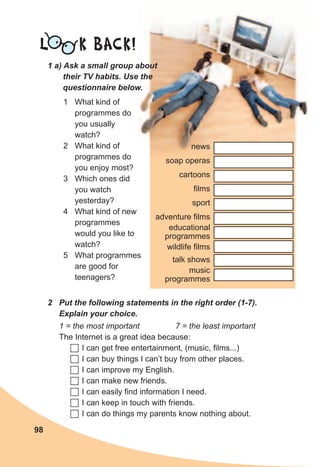
How often do you watch television?
Is there a great choice of TV programmes
in your country?
Is the Internet important in your life? Why?
How much do you know about your
parents’ jobs?
Have you ever thought about your future career?
What skills and knowledge are important
for your future life?
Pre-reading
questions
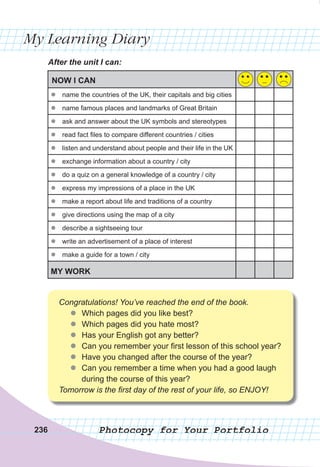
MAGIC BOX
1	a)	Guess	the	meanings	of	the	words	in	the	left	column,	
then	match	two	columns.
rEaDING & vocabularyrEaDING & vocabularyrEaDING & vocabulary
1 website
2 chat room
3 native speaker
4 education
	a speaker of a language who has
spoken it since early childhood
	the knowledge or skill that you get
through a learning process
	a site on the Internet where a number
of users can communicate
	a page that is linked to related pages
b)	Read	the	text	and	name	three	things	about	
the	Internet	you	fi	nd	the	most	important.
The Internet is one of the most powerful educational tools
which is always ready for use. Within seconds you can learn
about new civilisations, travel to the past or the future, see
fantastic pictures of nature, islands, cities or works of art. You
can go to chat rooms, hear touching human stories, and, what is
most important, you can see the eyes of your students lit with
excitement.
zz Your Language Exchange Online Community
Find a partner in the online community
and practise your foreign
language (any language) with
a native speaker who is
learning your language.
zz Foreign Language
Education Sites
Many sites are
helpful in learning
and teaching foreign
languages.
62
63
Lesson 1
2	 Match	the	words	with	their	defi	nitions.	
	the Internet
	to download
	e-mail
	to blog
	website
	password
	blogger
	to surf
	chat room
1 to use the Internet while
looking for information
2 a secret word or a phrase that
you need to know to be
allowed to use a computer
system
3 to write about your activities
and opinions on the net (like
keeping an online diary) so
that other people can read and
discuss them
4 a way of sending messages
and information to other
people by means of computers
connected in a network
5 a person who writes an online
diary
6 to move information from a
larger computer system to a
smaller one
7 an international computer
network connecting other
networks and computers from
companies, universities,
different organisations, etc.
8 an area on the Internet where
you can communicate with
each other
9 a place connected to the
Internet, where a company, an
organisation or an individual
puts information
an excitement
[ɪkˈsaɪtmənt]
a network [ˈnetwɜːk]
a tool [tuːl]
to connect [kəˈnekt]
to download
[ˌdaʊnˈləʊd]
to surf [sɜːf]
human [ˈhjuːmən]
native [ˈneɪtɪv]
related [rɪˈleɪtɪd]
Vocabulary box
64
3	a)	Read	the	statements	below.		Copy	them	in	your	notebooks	
under	the	headings:
GOOD / BAD
b)	Add	some	more	good	or	bad	points.
Children surf the Internet and
can’t concentrate on other things.
It helps us see
faraway places.
The Internet keeps children company
so they learn how to be on their own.
It helps us be more tolerant because we learn
how people are different in different places.
People don’t talk at home
but surf the Internet.
Children can learn
more about the world.
You can meet famous
and interesting people.
Children watch different sites late
at night and don’t get enough sleep.
It entertains.
It’s easier to watch videos than
read books. So children read less.
65
4	a)	Look	at	the	TV	programme	types	
below	and	say	what	you	would	like	to	watch	tonight.
TV-guide
b)	Make	your	own	top-ten	list	of	TV	programmes.
c)	Compare	with	your	partner.
1 live concerts
2 a sports programme
3 a documentary
4 a news magazine
5 a film
6 a celebrity gossip show
7 a police drama
8 a music video
9 the news
10 a cartoon
11 a soap opera
12 a comedy programme
13 the weather
14 TV adverts
15 an educational programme
16 an interview
17 nature & wildlife
18 fashion & style
19 science & technology
20 health & medicine
21 a quiz show
22 a talk show
23 a talent show
24 a reality show
Lesson 1
66
1 TV NEWS
2 TV SERIAL
3 ACTION FILM
4 CARTOON
5 TV COMMERCIAL
6 SPORTS PROGRAMME
7 QUIZ
8 TV FOR SCHOOL
9 CONCERT
10 DOCUMENTARY
11 TALK SHOW
12 DRAMA
	Our chewing gum makes
your teeth white.
	The President is visiting
London.
	And it’s in the net. A goal.
That makes it two-nil.
	Me, me! Catch me if you can!
	The polar bear likes playing
in the snow.
	Who discovered Australia?
You’ve got ten seconds.
	And the singer is Miss Gloria
Jackson, live!
	Here is a laser gun for you,
Mr Bond.
	Our guest today is the
famous writer: Miss Cherry
Stone.
	And today we have English.
Ready, steady, go!
	I want to die. Oh, why did he
have to leave me?
	See the next episode of
Mobamba Bay on Saturday.
5	 Test	your	knowledge	of	TV	stereotypes.	
Match	the	programme	type	with	the	text	on	the	right.
6	 Have	a	quick	look	at	the	argument	in	the	following	
dialogue	and	say	what	it	is	about.	Choose	a),	b)	or	c).
a) a TV guide
b) a reality show
c) a film
Hana:	Have you seen the TV guide
anywhere? I can’t find it. I’m the
only one in class who hasn’t
seen the new reality show yet.
anywhere? I can’t find it. I’m the
67
Lesson 1
Grandma:	No, I haven’t. But
we’ve already argued about these
shows. They’re just a poor substitute for real life. What you
hear there is just a small talk, shallow chit-chat and gossip.
No criteria. No clue what clever people have said or written
about. Come on, Hana, start reading, talk to real people. Get
a life of your own.
Hana:	How unfair! You’re such a typical teacher. These shows
aren’t school. They’re real life. Hallo? You always talk about
books and people from the past. Who cares?
Grandma:	That’s exactly what I am talking about. Who cares...!?
How immature! You have picked up that attitude from such
cheap reality shows and soaps.
Hana:	No, I’ve picked it up from my gang. From real life. And the
shows aren’t cheap.
Grandma:	What they offer is trash. Most of these young people
have poor education, no higher goals in life and are
desperate to do anything stupid or provocative just to be in
front of the cameras.
Hana:		What do you mean poor
education? As far as I know all of
them finished some secondary
school or even university.
criteria [kraɪˈtɪərɪə]
a dignity [ˈdɪɡnɪti]
a reliability
[rɪˌlaɪəˈbɪlɪti]
to avoid [əˈvɔɪd]
to judge [dʒʌdʒ]|
to substitute
[ˈsʌbstɪtjuːt]
desperate [ˈdespərət]
shallow [ˈʃæləʊ]
spiritual [ˈspɪrɪtʃʊəl]
Vocabulary box
68
Grandma: Well, that’s just something formal. But what are their
ambitions in life? What can you learn from them? Anything
about literature? About culture? About anything spiritual?
Just eating, giggling, flirting and fooling around.
Hana: But they talk about normal stuff, like fashion, food, love...
Grandma: What do you mean, love? Those young people usually
don’t know the meaning of true love. Where’s the romance
here, growing together, sharing of life’s highs and lows,
loyalty and the sacrifice in the name of love?
Hana: Oh, Gran, you’re so old-fashioned. And way too critical.
You always use big words like sacrifice, dignity, principles
and stuff. That’s so yesterday.
Grandma: Maybe. But, let’s make an experiment. As a teacher I
like good films about teachers. Here’s a DVD with my
favourite film. It’s DEAD POETS’ SOCIETY. If you want to
watch that reality show of yours at my place, watch the film
first and then tell me what you think of it. I promise you
the film will open a whole new world for you.
7 a) Find the corresponding paraphrase for these words:
1	 attitude
2	 desperate
3	 provocative
4	 criteria
5	 trash
6	 loyalty
7	 sacrifice
8	 perspective
	when you do or don’t do something in
the name of love or some higher
principle
	a frame of mind, an opinion, a view
	trying very hard to achieve or avoid
something
	annoying, offensive, challenging, not
ordinary
	a kind of pattern, a standard to judge
something
	angle, a personal view of a situation
	something unimportant, junk, rubbish
	a kind of bond you feel with someone,
reliability
69
Lesson 1
b)	Write	at	least	three	
paraphrases	of	your	own	
and	challenge	the	class	to	guess.
8	a)	Choose	at	least	three	simple	words	that	you	
use	and	three	compicated	(‘big’)	ones.
zz Is there a difference in meaning?
b)	Use	at	least	three	simple	and	three	
‘big’	words	in	your	own	sentences.
chit-chat, small talk, no clue, ambition, gossip,
perspective, criteria, sacrifice, flirting, dignity,
education, eating, orientation, principles,
gang, fooling around, loyalty, stuff
9	a)	Agree	or	disagree	with	1	or	2.	
1 Only show-offs use big words.
2 Teenagers always use simple words.
b)	In	groups,	discuss	on	the	items	above.	Support	your	
opinion	with	arguments	and	examples.
lISTENINGlISTENINGlISTENING
1	 Listen	to	the	short	story	where	Stacey	and	Charlotte	
are	main	characters	and	choose	the	correct	answer	
to	each	question	below.
1 What did Stacey and Charlotte decide to watch?
a) an interview
b) a cooking show
c) a new programme
70
2 What did they switch on?
a) channel 47
b) MTV
c) CNN
3 What did they watch?
a) a science fiction
programme
b) a western
c) a ghost story
2	a)	Describe	the	picture.	
Do	you	think	the	spectators	are	upset?
b)	Read	about	the	situation	and	listen	to	the	dialogue.
Brian and Adrian are playing a guessing game. Brian is
describing what is going on in the commercial. Adrian is
trying to guess what the commercial is for.
3 What did they watch?
And now let’s take a short
break for commercials. Stay
with us. Don’t go away!
71
Lesson 1
Listen	and	when	you	hear	
a	beep,	guess	with	Adrian.	
(There	are	six	guesses.)
c)	Listen	to	the	dialogue	again	and	put	the	things	
below	in	the	order	as	they	are	mentioned	in	
the	commercials.
	chewing gum
	mobile phone
	camera
3	 Work	in	pairs.	Check	if	you	know	the	meanings	of	the	words	
and	phrases	from	the	box	and	answer	the	questions	below.
a brand, to advertise, to switch channels, to turn off
the sound, to jump to conclusions, to take a picture
1 What is your favourite brand of crisps / chewing gum /
toothpaste?
2 Where do companies advertise their products?
3 Do you often switch channels when you watch TV?
4 When do you turn off the sound of your TV?
5 Is jumping to conclusions good or bad?
6 Do you take pictures?
	crisps
	toothpaste
	trainers
72
4	a)	Before	listening	to	Judy’s	report	(about	the	television	
viewing	habits	of	pupils	in	her	class)	for	the	school	
newspaper	decide	if	the	statements	below	are	true	or	false.
1 Many of the pupils in Judy’s class are TV addicts.
2 Teenagers prefer TV to other things.
3 Soap operas are popular with girls and boys.
4 A lot of teenagers watch videos at the weekends.
5 Half the pupils have satellite or cable TV.
6 Most pupils have a TV in their homes.
b)	Listen	and	check	whether	your	answers	in	4	a)	were	correct.
an addict [92dikt]
an expert [9ekspE:t]
a finding [9faindiN]
to view [vju:]
contrary [9kAntr3rI]
z to conduct
a survey (an
experiment, etc)
Vocabulary box
5	 Interview	your	classmates	to	fi	nd	out	how	many	people	
in	your	class...
a) never or seldom watch television
b) watch TV from 2 to 4 hours a day
c) watch TV more than 4 hours a day
d) watch only their favourite programmes
e) watch anything that is on
f) prefer watching: z films z TV games z musical programmes
z documentaries z educational programmes
z cartoons z sports programmes
73
Lesson 1
g) like to watch TV alone
h) prefer watching TV with their family and friends
i) watch TV: z to have a good laugh z to learn something new
z to relax z to while away the time
z for other reasons
j) think that TV is a blessing1
k) think that TV is a curse2
GraMMar
Defining relative clause
(Обмежувальне
означальне речення)
Non-defining relative clause
(Описове
означальне речення)
My sister who lives in England
has a pet kangaroo.
My sister, who lives in
England, has a pet kangaroo.
Коментар:
Промовець може мати багато
сестер, тому він повинен
сказати слухачеві про яку саме
сестру він говорить.
Промовець має лише одну
сестру і подає слухачеві
певну додаткову інформацію
стосовно неї.
Defining Relative Clauses
It’s a show where there are three contestants.
They spin a wheel which/that has prizes and penalties on.
It was a girl who spoke Japanese.
Liz looked at the man whose hair was long.
That was the time when I got bad marks at school.
1	 Read	and	compare.
1
a blessing [9blesiN] — благословення 2
a curse [kE:s] — прокляття
74
Remember!
Non-Defining Relative Clauses
Bill , who never watches TV, likes reading books.
London
television
, which has broadcast
since 1936,
is one of the oldest.
Mary
, whose family lives
very far,
lives in London now.
In London , where he studies, he has spent 3 years already.
Defining Relative Clauses
Інформація в обежувальному означальному реченні є
необхідною. Без неї речення не буде мати сенсу.
Порівняйте: A school is a place where you study.
A school is a place.
Обмежувальні означальні речення ніколи не виділяються комами.
Example:
The book which I bought yesterday is excellent.
The lady who just left the shop had a monkey in her bag.
The man that is waiting for you has a pleasant smile on his face.
L K
Використовуйте
відносні займенники.
People > who, whose, that
Places > where, that
Things > which, whose, that
2 a) Fill in the sentences with
‘who’ or ‘which / that’.
1	 That’s the shop … sells
good sports clothes.
2	 I’m the runner … came
first in the race.
3	 He’s the doctor … works
in our local hospital.
4	 Elen is the girl … lives next door.
5	 Red Cross is a charity organisation … gives aid to countries
around the world.
6	 Jenny likes Jim, ... is an honest guy.
75
Lesson 1
Remember!
Non-Defining Relative Clauses
Описові означальні речення дають додаткову інформацію про
іменник. Такі речення завжди виділяються комами.
Example: London, which is the capital of England,
has a population of 10 mln people.
My uncle George, who is in hospital now, likes to play with matches.
My office, where I work every day, is painted yellow.
b) Fill in the sentences with 	
‘whose’, ‘where’ or ‘when’.
1	 I like to visit places … nobody else goes.
2	 The island … I go on holiday is a beautiful place.
3	 I spoke to the woman … daughter I know.
4	 Linda is the student … exam results were fantastic.
5	 That was the year … I started playing the guitar.
6	 This is the place ... your parents met each other for the first time.
L K‘That’ ніколи не вживається
з описовим означальним реченням.
Типова помилка: Larry Lorry, that lives in London, loves lilies.
Правильне речення: Larry Lorry, who lives in London, loves lilies.
3	 Copy and add commas to change these defining relative
clauses to non-defining relative ones.
1	 My friend who has a red bicycle wants to sign up for the Tour
de France.
2	 The city where more than a million people live never sleeps.
3	 The gorilla which ran away from the zoo is hiding somewhere
in the forest.
4	 Bettie’s boss whose office is in New York bought Bettie a
bouquet of flowers.
5	 Cheetas which are yellow and have black spots can run up to
120 km/h.
76
4	 Combine three given parts to form one non-defining relative
clause.
Example: Victor’s sister — does ballet — loves eating peanuts.
Victor’s sister, who does ballet, loves eating peanuts.
a	 The statue — made of pure gold — has been stolen.
b	 Ottawa — capital of Canada — is very cold in wintertime.
c	 My uncle’s farm — we go to every summer — is the best
place on Earth.
d	 Dan — my brother-in-law — has his own successful business.
e	 Tina — you liked her photos so much — is coming to visit us
tonight.
5	 Match the beginnings with the endings to make
correct sentences.
6	 Put letter ‘d’ if the relative clause is defining
or letter ‘n’ if it is non-defining.
1	 The programme that I watched on TV last night was very
interesting.
2	 My dog, which I bought a year ago, has given birth to 8 puppies!
3	 Walter’s grandmother, who lives in Scotland, got married
yesterday.
1	 We met your friend
2	 Giraffes are animals
3	 Thomas Edison was the
scientist
4	 I’ve got some relatives
5	 Vesuvius is the volcano
6	 The Beatles recorded
songs
7	 There is a ferry
8	 A microwave is a machine
a	 that were popular all over the
world.
b	 who plays the violin.
c	 that goes from Venice to Corfu.
d	 who invented1
the electric light.
e	 that cooks food quickly.
f	 which come from Africa.
g	 who were born in Turkey.
h	 which destroyed the city of
Pompeii.
1
to invent [ɪnˈvent]— винайти
77
Lesson 1
4 Jessica and John, who have
moved in next door, are both dentists.
5 The tree we planted last month is growing nicely.
6 Bill Gates, who is the richest man on earth, lives in Medina,
Washington.
7 My child who’s afraid of spiders wants to go camping this
weekend.
8 The man that I told you about has asked Minnie out on a date.
9 The hotel, where you can book a room, has two swimming
pools and a bar.
10 The shop where you can buy a map is just down the road from
here.
SPEaKING
1	 Work	in	pairs	to	fi	nd	out	about	your	partner’s	online	habits.	
Speak	on	the	following	questions.
1 Do you have a computer?
2 Do you have an e-mail address?
3 Do you check your e-mails every day?
4 How often do you surf the net?
5 What are your favourite websites?
6 Do you know any teen websites?
7 Have you downloaded anything recently?
8 Do you have an online friend?
9 When did this friendship start?
10 Have you ever done any online shopping?
11 What did you buy?
12 Are you a blogger?
13 What do teen bloggers write about?
14 Why do they do it?
77
Have you ever done any online shopping?Have you ever done any online shopping?
78
commercial [kəˈmɜːʃl]
politics [ˈpɒlɪtɪks]
preference [ˈprefrəns]
to advertise
[ˈædvətaɪz]
to plug [plʌɡ]
to roar [rɔː]
Vocabulary box
2	a)	Listen	and	read	the	dialogue.	
Then	order	the	topics	the	girls	are	talking	about:		
 boxes,  the Internet  puppies
R U ALWAYS PLUGGED IN?
Ana’s friend has come over to her place.
Ana:	Hi. Good to see you. How are you?
Sara:	Dead bored. I see you’re plugged in again. Just like always.
Ana:	I’m just watching Gloria Glam on Youtube. I can forward
you the address.
Sara:	Don’t. I hardly ever go online. Internet’s boring. And Gloria
Glam sucks.
Ana:	Come on! Internet’s amazing! I always look for the words
I’m interested in. There’s fantastic stuff like this film about
St Bernard’s puppies. They’re so cute...
Sara:	Not interested, thanx. Animals smell.
Ana:	Come on, Sara. You should find yourself some passion,
some interest.
Sara:	You sound like my mum. She keeps saying: Why don’t
you take up swimming? Why don’t you play the piano?
Why don’t you collect boxes? Boxes! Hallo!
Ana:	I like boxes, too. I think they are
mysterious.
Sara:	A wooden box. Some mystery!
You open it and see there’s
nothing inside. Aaaah! (She
yawns.) I’m so bored.
b)	Speak	on	the	following.
zz Which girl has got a lot of interests?
zz Which hasn’t got any? How do you explain it?
zz What do you think? Interests come...
a) from your parents
b) from school c) from your own head
d) from a combination of all factors.
[rɔː]
Lesson 1
Asking for Preferences
Preference is liking one thing better than another.
The expressions of asking for and stating preferences may be
divided into formal and those used with friends (informal).
Here are some helpful phrases:
zz Which do you prefer / like better, football or tennis?
zz What would you prefer, to watch news or a quiz show?
zz Do you feel like watching drama? (informal)
Possible Answers:
zz Well, I’m not all that keen, actually.
zz No, not really, I’d prefer to watch a quiz show.
zz Oh, I don’t mind watching drama.
zz Well, I must say I don’t really have any preferences here.
zz I must say both sound equally good to me.
zz No, thank you, I’d rather not watch TV.
zz I’d rather watch football.
coNVerSaTIoNal GuIDe
c)	Act	out	the	dialogue	in	pairs.
3	a)	Work	in	pairs.	Say	how	many	different	
kinds	of	TV	programmes	you	can	think	
of.	Read	a	page	from	a	TV	guide	and	
see	if	you	can	fi	nd	them.
b)	Decide	what	you	would	like	to	
watch	today.	Then	talk	to	your	
partner	and	compare	your	choices.
TELEVISION PROGRAMME GUIDE
BBC1
07.00 BBC BREAKFAST NEWS followed by weather report.
07.30 NEIGHBOURS — soap opera. Andy finds out that Jill’s
in love with Ron. He decides to do something about it.
08.15 WILDLIFE on One
An interesting documentary about endangered species.
TELEVISION PROGRAMME GUIDE
79
4	 Answer	the	questions	below.	Then	talk	to	your	partner	
and	check	if	you	have	anything	in	common.
zz How much TV do you
watch?
zz When do you usually
watch it?
zz What do you never watch?
ITV
12.00 ROSIE AND RAY
A new episode that brings more fun to your homes. Rosie
and Ray move house. You’ll roar with laughter.
12.30 ROBOWAR
It’s 2086. A new generation of robots invades the earth.
BBC2
09.00 WHEEL OF FORTUNE
A game show. Today it’s celebrities.
10.30 TOP CATS
The exciting new adventures of the popular cartoon
characters.
11.00 SEEN BY CAMERA
This week John Parsley visits the fantastic sights of India.
CHANNEL 4
02.00 VIDEOTECH
The latest gossip and sounds in the music world.
02.30 FA CUP
Football semi-finals.
04.30 SURPRISE, SURPRISE
More prizes to win.
05.00 READY, STEADY, COOK
Today learn how to prepare vegetarian dishes.
zz What’s your favourite
programme?
zz Do your parents let you
stay up late and watch the
late TV shows or films?
80
81
Lesson 1
5	a)	Work	in	pairs.	Choose	fi	ve	
products	which	TV	commercials	most	often	advertise.
cars
shampoos
trainers
b)	Share	your	ideas	with	each	other.	Consider	the	following	
questions.	
zz Do you like watching commercials? Why? Why not?
zz Are there too many commercials on TV?
zz How do you feel when they show commercials in the middle
of a good film or an interesting match? What do you do? Do
you switch channels?
zz If you like the commercial, do you want to buy the product it
advertises?
zz Are commercials always true?
zz Can you name some famous people who are in
commercials? What do they advertise?
6	 Share	what	you	prefer	to	watch	on	TV	and	explain	why	
opinions	about	TV	programmes	differ.	You	may	start	like	this:
As for me, I always try to watch interesting films, different TV
games and musical programmes. Political shows take up a lot of
time on TV, but I don’t like them. As for films, I prefer thrillers or
detectives. Different quiz-shows are also very popular with
members of my family…
sports events; symphony concerts; the Animal World;
travels and travellers; meetings and discussions between
famous people; poets reading their own poems, interviews
with famous people; talks on history, geography, science;
old songs and new; critics talking about new books, films,
plays, works of art; competitions and quizzes
pet food
drinks
make-up
cleaning products
mobile phones
chewing gum
food
toothpaste
snacks
82
7	 Discuss	the	answers	to	the	questions	in	a	small	group.
a Do you like programmes made in Ukraine?
b How well do you know BBC World, CNN, MTV, Viva or Star
TV? What do you think of them? What language do they
broadcast in?
c What other global channels do you watch? Do you listen to
any foreign radio stations? Which ones? What language do
global broadcasters use today?
d How can satellite TV help language learners?
1	 Write	a	paragraph	about	the	role	of	mass	media	in	our	life.	
Consider	the	items	below.
WrITING
zz How do you find out what’s happening in the world?
zz Do you ever listen to the radio? What programmes do you like?
zz How important is TV to you?
zz Do you like the same TV programmes as your parents?
zz What’s the difference between reading the news in the
newspaper and watching it on TV?
zz Do you think computers will replace newspapers and TV in the
future?
2	 Describe	a	game	show	on	television	in	Ukraine.	
Make	your	description	according	to	the	questions	below.	
Include	relative	clauses	where	possible.
zz What is the name of the
programme?
zz When is it on?
zz Who is the host / hostess?
zz Who are the contestants?
zz What do the contestants
have to do?
zz How do people score?
zz How do contestants win?
zz What do the winners get?
83
Lesson 2
CAREER
CH0ICES
1	 Read	the	article	and	be	ready	to	answer	the	following	
questions.
rEaDING & vocabularyrEaDING & vocabularyrEaDING & vocabulary
zz What idea has become old-fashioned?
zz Where will many people work in the future?
zz Which skills have become very important?
One of the most important
decisions in the life of every
person is to choose the right
career or occupation. With
hundreds jobs to choose from,
it’s never too early to begin
thinking about your future
career.
As a teenager today, you
can expect to work for
approximately 40 years. During
this time, you may have several
jobs. Changes in the world will
affect the jobs available. The
idea of a ‘job for life’has already
become old-fashioned. In the
future most people will work for
several companies instead of
just for one. A lot of people
already work from home,
connected to the Internet, and
there will be many more in the
years to come.
84
We often speak of full-time jobs or part-time jobs, regular jobs
or odd jobs. People may lose their jobs, become unemployed and
have to look for new jobs. Different jobs require different things.
For example, some require special training and meeting people,
others require a good imagination or travelling a lot, physical
strength or working late hours…
Choosing a career is not easy. A lot of people are encouraged
by their teachers, parents and friends. Some people change their
minds many times or follow in someone’s footsteps. Others are
influenced by certain people or certain events. When you look for
a career, you should look carefully at all aspects of the job. You
must also take a good look at yourself.
Firstly, it is important to consider your interests. You may enjoy
working with people, or you may enjoy working with your hands.
You may like reading, using words, and writing. Numbers and
solving problems may hold a special appeal to you.
Secondly, you should find out what your aptitudes are. Your
aptitudes are your natural abilities or talents. An aptitude means it
is easy for you to learn certain things. One way to focus on your
aptitudes is to ask yourself some questions:
zz In what school subjects do I get the highest marks?
zz What talents or natural abilities do I seem to have? (talking,
writing, singing, painting or taking objects apart and putting
them back together)
zz What do I think I could learn
to do well?
zz What do other people think I
could do?
Besides, there are special
aptitude tests you can take.
Careers officers can help and
advise young people to get good
training in order to have some
skills.
an aptitude [92ptitju:d]
a career [k39ri3]
employment [im9plcim3nt]
to affect [39fekt]
to require [ri9kwai3]
available [39veil3bl]
certain [9sE:tn]
(un)employed [(0yn)im9plcid]
l in smb’s footsteps
Vocabulary Box
85
Lesson 2
Thirdly, different people are
good at different skills. A skill is the learnt capacity for doing
something. For example, you can possess skills in typing, drafting,
cooking, sewing and auto repair. It’s useful to learn the skills like
leadership skills, teamwork skills, critical thinking, writing and
reading skills, etc.
Communication skills, in general, should be at the top of the
list. Communicating with people, especially from other cultures,
understanding their minds and culture, will be even more important
in the future. English has become the international language of
communication. Millions of people use it in their jobs every day. In
the future most people will need English for their jobs.
We live in the computer age. There are about 100 million
computers in the world at the moment. You don’t need to be a
computer genius to work with a computer but your computer skills
need to be good and you have to work on them all the time.
Education is important in your future career prospects. A high
school graduate has a better chance. Specialised training opens
up even more
job opportunities.
You can get this
training in
vocational high
school, in a
college, in
vocational-
techni­cal school,
or through on-
the-job training.
Remember!
A career is a professional growth a
person does in his or her life, usually in
one field.
A job is the work that a person does
regularly in order to earn money.
A profession is a job that requires special
training, often a university education.
An occupation is a job or profession.
2	 Complete the sentences based on the article.
a	 It’s never too early to begin …
b	 Changes in the world will …
c	 We often speak of full-time jobs or …
86
d	 People may lose their jobs and …
e	 Some jobs require …
f	 In their career choices some people are influenced by … and
a lot of people are encouraged by …, some follow …
g	 Your aptitudes are …
h	 Skills are …
i	 Specialised training opens ...
1	 What is one of the most important decisions in the life of any
personality?
2	 Is choosing a career easy?
3	 What does the phrase ‘to take a good look at oneself’ mean?
4	 What questions can help to focus on aptitudes?
5	 Who can help young people to get good training?
6	 What are the examples of skills that can be useful?
7	 Why is education important?
8	 Where can you get specialised training?
3	 Answer the questions.
4	 Fill in with the words ‘job’, ‘profession’, ‘occupation’ or ‘career’.
a	 — How long has Linda been unemployed?
— She’s been looking for a … for two months.
b	 Please, write your … on this form and hand it in.
c	 His … as a boxer came to an end after that fight.
d	 My mother is a doctor. I like this … and I may follow her
in her footsteps.
5 a) Read the text below and guess the missing word
and the job which is described.
I work six days from seven in the morning till half past two in
the afternoon.
I really like my job. I take … to 250 addresses. I really like it
when I give somebody a … and it makes them happy. It means
my job is important to many people. However, I don’t like rainy
and snowy days and I can’t stand dogs.
87
Lesson 2
a … travels with someone important and protects them from attack
a … repairs toilets, baths and sinks
a … cuts and does ladies’ hair
a … operates and controls a plane
a … tries to get secret information about another country
a … helps a doctor to look after sick people
a … repairs cars
a … shops, cooks and cleans the house for someone
an … designs houses and buildings
a … writes programmes for computers
b)		In	pairs,	think	and	write	down	
as	many	jobs	as	you	can	during	one	minute.	
How many jobs can you and your friend think of in one minute?
Compare	your	results	with	the	class.
6	 Find	the	names	of	jobs	in	the	snake	below	and	match	right	
descriptions	to	them.
1	 Say	which	of	the	jobs	are	traditional	career	choices	for	men	
and	which	are	for	women.	Explain	why	this	is	so.
lISTENING
2	 Listen	to	Ana’s	story	and	say	if	the	
statements	below	are	true	or	false.
a Ana is a car and truck mechanic.
b She has always wanted to do this job.
c She has her own workshop now.
3	 Listen	to	the	story	again	
and	answer	the	questions.
1 What job did Ana do?
2 Why did she give up this job?
3 Why did she buy a book on car
repairs one day?
4 What did she do after that?
5 What makes her a successful
mechanic today?
4	 Listen	to	the	interview	with	Bruno	for	‘Active	Teenagers’,	a	
school		magazine,	and	fi	nd	out	what	his	summer	plans	are.
88
89
Lesson 2
b)	In	pairs,	agree	or	disagree.	Explain	why.	
Bruno is too young to travel abroad alone.
5	a)	Write	about	Bruno.	
Put	the	verbs	into	the	correct	form.
What happened last summer?
Last summer Bruno (have) … a job. He (not like) … it at first.
He (have to) … get up early. After two weeks he (start) …
enjoying it. He (meet) … a lot of people, (earn) … some money
and (have) … a good time. The job (be) … his mum’s idea. She
(think) … Bruno (need) … some action.
What is going to happen this summer?
This summer Bruno (work) … in a pizzeria. He (deliver) …
pizzas. He (earn) … some money. Then he (visit) … his friend
Anita in Sweden. He (take) … a bus. He (stay) … in Stockholm
most of the time.
6	 Read	the	following	sentences	and	say	if	you	agree	
or	disagree	with	them.
At home Agree Disagree
1 Girls do more housework than boys.
2 Boys have more freedom than girls.
At school
3 Girls are better pupils than boys.
4 Boys are better at sports than girls.
5 Boys are better at maths and physics
than girls.
6 Girls are better at languages and art
than boys.
7 Girls are more polite than boys.
Later on in life
8 Men get better jobs than women.
9 Very few women get to be managers.
10 Men have more free time.
90
GraMMar
Say	why	you	agree	with	some	of	the	statements	
above.	Use	the	ideas	below.
I agree that … because...
zz parents are less worried about boys
zz girls spend more time studying
zz girls are not as fast as boys
zz parents don’t ask them to
do much at home
zz boys are better at numbers than girls
zz girls speak more than boys
zz parents expect them to be
zz for women the family is more
important than work
zz men don’t help much at home
RELATIVE PRONOUNS
1	a)	Look	at	the	sentences	(a-d)	and	complete	the	rules	in	the	box.	
a The career that comes to mind is most probably a	doctor.
b Columbus was the person that brought cocoa beans to Europe.
c It was H. Cortes who really brought chocolate to Europe.
d They considered it a divine drink which gave energy to
those who drank it.
1 We use the relative pronoun … for people.
a which b who
2 We use the relative pronoun … for animals and things.
a which b who
3 We use the relative pronoun … for people and things.
a who b that
b)	Copy	the	rules	in	your	notebook.
91
Lesson 2
2	 Complete	the	following	sentences	
with	‘who’	or	‘which’.
1 Peter Parker is a photographer … changes into Spider-Man to
fight criminals.
2 Batman has a special car … can travel very fast.
3 Superman is the best-known hero of American comic books …
fights for truth and justice.
4 The only thing that can harm Superman is a green rock …
comes from the planet Krypton.
5 He is a well-known character in American comics … wears a
bat costume.
6 Not only can he climb buildings and high walls but he can also
catch criminals in a web … he throws over them.
3	 Work	in	pairs.	Think	of	four	words	and	write	defi	nitions	of	
these	words	in	your	notebook.	Then	read	your	defi	nitions	
and	let	your	partner	guess.
For	example:	 — It’s a person who works in a restaurant.
— a waiter / waitress
— It’s a thing which you use for writing.
— a pen or a pencil
Start	your	defi	nitions	with:
It’s a person... It’s somebody... or It’s a thing... It’s something…
4	 Look	at	the	following	sentences	and	complete	
the	rules	below,	choosing	the	correct	item.
a That’s the boy whose cat disappeared.
b That’s the village where my mother was born.
c I still remember the time when we met.
Match	the	sentences	(a-c)	with	the	rules	(1-3).
1 We use where / when for a place.
2 We use whose / when for a time.
3 We use whose / where for possessions.
92
5	 Choose the correct pronoun to complete the sentences.
a	 The jeans where / which my mother bought are too small.
b	 I’d like to meet the girl who / which wrote that poem.
c	 That was the time where / when I had straight As at school.
d	 Is that the boy which / whose dog I found?
e	 That’s the shop that / where I bought my bike.
f	 Is that the kind of food that / who you like?
6	 Fill in the gaps with ‘who’, ‘which’, ‘whose’, ‘where’, ‘when’.
1	 What do you call the profession … is the most popular
nowadays?
2	 It’s a new kind of car … runs on electricity.
3	 That’s the shop … they sell skateboards.
4	 That’s the boy … dog attacked me.
5	 I remember the day … there was a festival in our town.
6	 A job is the work … a person does regularly in order to earn
money.
7	 The people … live above our flat are very noisy.
8	 The school subject … everybody likes is PE.
9	 I hate people … complain all the time.
10	A profession is a job … requires special training, often a
university education.
7	 Finish the sentences in any way you like.
1	 A good friend is someone who …
2	 A secret is something which...
3	 Home is the place where...
4	 Christmas is the time when…
5	 A career is a professional growth …
Lesson 2
SPEaKING
1	a)	In	groups,	read	the	list	of	some	important	jobs	and	
explain	what	people	in	those	jobs	do.	
zz accountant [39kaUnt3nt]
zz architect [94:kitekt]
zz carpenter [9k4:p3nt3]
zz chef [Sef]
zz model (fashion model)
zz interpreter / translator
zz computer operator
zz dentist
zz editor
zz photographer [f39tAgr3f3]
zz pharmacist [9f4:m3sist]
zz electrician [i0lek9triSn]
zz interior [in9ti3ri3] decorator
zz machine [m39SI:n] operator
zz engineer [endzi9ni3]
zz estate [i9steit] agent
zz fashion designer
zz fireman
zz designer [di9xain3]
zz hairdresser
zz journalist
zz lawyer [9lc:j3]
zz musician [mju:9xiSn]
zz physician [fi9xiSn]
zz physicist [9fixisist]
zz receptionist
zz social worker
zz sports instructor
zz surgeon [9sE:dz3n]
zz travel agent
zz vet (veterinarian)
93
z surgeon
travel agent
vet (veterinarian)
z surgeon
z travel agent
z vet (veterinarian)
b)	Refer	the	jobs	above	to	the	characteristics	below.
1 dangerous jobs
2 jobs which require a university degree
3 jobs which are primarily done by men
4 jobs which are primarily done by women
5 jobs which are the most prestigious
6 jobs which are the least prestigious
7 jobs which are well paid
8 jobs which are low paid
2	 Say	what	you	think	on	the	following	questions.
1 Can men and women really do any job they like?
2 What may be some of the problems?
3 What are you good at?
4 What subjects at school are difficult for you?
5 What subjects are you really interested in?
6 What subjects are you not interested in?
7 What jobs do you do at home?
8 Which of them do you like doing and which of them do you
hate doing? Why?
3	 Work	in	pairs.	Choose	a	job.	Think	of	at	least	three	things	
you	do	in	this	job.	Let	the	class	guess	the	profession.	Think	
of	various	jobs	and	take	turns.
Example: A, “I’ve just finished the plan of your house.”
B, “You are a person who is called an architect.”
4	 Say	what	qualities	these	jobs	require.
an accountant
a journalist
a nurse
a shop assistant
an estate agent
an architect
a carpenter
a police officer
a lawyer
a dentist
a plumber
a judge
94
active, attentive,
brave, careful, caring,
creative, disciplined,
fair, honest, punctual,
reliable, skillful, smart,
sociable
95
Lesson 2
Career officer: Please, take a seat.
You: ...
Career officer: Now, what’s your name?
You: ...
Career officer: Where do you
go to school?
You: ...
Career officer: What kind
of a pupil are you?
You: ...
Career officer: Which are your
favourite school subjects?
You: ...
Career officer: Do you have good marks in those subjects?
You: ...
Career officer: Which subjects are you really good at?
You: ...
Career officer: Which subjects are you not so good at?
You: ...
Career officer: Do you have any hobbies? Something you like doing?
You: ...
Career officer: What sort of job would you like to have one day?
You: ...
Career officer: Why do you think you’d
like doing that?
You: ...
Career officer: Thank you very much.
I’d like you to take
this test now…
You: ...
5	 Imagine	you	are	being	
interviewed	by	a	career	offi	cer.	Complete	
the	conversation	and	act	it	out	with	your	partner.
babysitting [9beibIsitiN]
a campaign [k2m9pein]
a volunteer [0vAl3n9ti3]
to take up [9teik 9yp]
z to be excited
about smth
z to work hard
Vocabulary box
96
6	 In	groups,	speak	on	the	items.
zz Four factors that influence career choices.
zz How do hobbies and interests affect career choices?
zz The difference between an aptitude and a skill.
zz How does education influence career advancement1
?
7	 Role-play	the	situation	in	a	group	of	three.
A, imagine that you are an employer2
interviewing teens for a part-
time job. Think of a kind of job and list five qualities that you would
look for in the employee.Take them into account while interviewing
the candidates and decide which candidate suits the job more.
B,C,youarethecandidatestohaveapart-timejob.Youareinterviewed
by the employer, so be ready to answer his/her questions.
1
an advancement [3d9v4:nsm3nt] — просування вперед; успіх; (тут) зростання
2
an employer [im9plci3] — роботодавець
8	 Divide	into	two	teams	to	debate	on	the	statements	below.
Success means having
a well-paid job.
Success means doing
something that makes
you happy!
97
Lesson 2
2	 Do	an	individual	research	work.
a List three of your interests.
b Next, list two skills you have that match your interests.
c Do a research paper on a career that calls for your interest
and skills.
d At the end of your paper state whether this career would suit
you.
WrITING
1	a)	Think	about	some	qualities	of	a	good	babysitter	/	shop	
assistant	/	DJ,	etc.	and	make	up	a	job	questionnaire.
b)	Interview	your	partner	and	write	your	report	about	
if	he	/	she	can	do	this	job	and	explain	why.
98
L K BACK!
1	a)	Ask	a	small	group	about	
their	TV	habits.	Use	the	
questionnaire	below.
1 What kind of
programmes do
you usually
watch?
2 What kind of
programmes do
you enjoy most?
3 Which ones did
you watch
yesterday?
4 What kind of new
programmes
would you like to
watch?
5 What programmes
are good for
teenagers?
2	 Put	the	following	statements	in	the	right	order	(1-7).	
Explain	your	choice.
1 = the most important 7 = the least important
The Internet is a great idea because:
	I can get free entertainment, (music, films...)
	I can buy things I can’t buy from other places.
	I can improve my English.
	I can make new friends.
	I can easily find information I need.
	I can keep in touch with friends.
	I can do things my parents know nothing about.
news
soap operas
cartoons
films
sport
adventure films
educational
programmes
wildlife films
talk shows
music
programmes
99
Lessons 1-2
3	 Say	which	of	these	you	often	
see	/	don’t	see	in	TV	commercials.	Explain	why	it	is	so.
zz happy families
zz puppies
zz people who are ill
zz bright colours
zz pretty girls
zz famous people
zz people who are old and tired
zz teenagers with problems
zz dirty streets
zz old dogs
zz young people in nice clothes
zz dark colours
4	 Work	in	pairs.	Think	of	your	favourite	commercial.	
Describe	what	is	going	on	to	your	parnter.	
She	/	He	should	guess	what	the	commercial	is	for.
5	a)	Match	the	lines	(a-i)	on	page	102	to	make	a	dialogue	with	
the	lines	(1-10)	below.	Then	listen	to	the	text	and	check.
1 2 3 4 5 6 7 8
EMILY
1 Hi David. I can’t start my recorder.
And I have this chat show at five.
2 Well, the host is a famous teenage psychologist.
3 And the kids write anonymous questions.
4 No, it’s a great show. I haven’t missed
a single one yet. And I have my
French class at five. Help!
5 Tell me which buttons to
press to get it started.
6 Come on, it’s urgent.
7 The what button?
How do you spell it?
8 OK, I’ve found it. What now?
9 David, you saved my life. You’re an angel!
10 Ugh, I’ve never been good at spelling, but here you are:
A - n - g - e -l. See you at school tomorrow.
DAVID
a See you.
b So what do you want from me?
c Teenage problems. “I’ve been in love with this girl but I don’t
know how to tell her...”
d Or, “I’ve got bad skin problems. Please help!” It all sounds boring.
e D - V - D - H - D. And mode is m - o - d - e, silly. Don’t panic.
f What chat show?
g Do you see the DVD HD mode button?
h A what? How do you spell it?
i Press it together with the red button to start the recording. Is
anything happening?
b)	Read	the	dialogue	out	with	a	partner.	Act	it	out	in	pairs.
6	 Read	the	description	of	a	game	show	and	change	all	the	
relative	clauses	into	defi	ning	and	non-defi	ning	ones.
The Generation Game, which is on television on Saturday
evenings, is a very popular game show. The host of the
programme is Bruce Forsyth, who is a well-known comedian. The
contestants are pairs of people who are from different
generations of the same family, for example, father and daughter
or aunt and nephew. The contestants have to do funny activities,
like dancing activity and making models. Experts who have
shown the contestants how to do the activities then give them
scores. In the first round two pairs play against each other. The
pair that gets the higher score goes through to the last round. In
the second round another two
pairs play against each other.
In the last round the two pairs
who won the first two rounds
play against each other. At
the end a lot of different
prizes are shown to the
100
Lessons 1-2
winning pair. The prizes, which
include televisions, holidays, toys, vases, sports equipment, etc,
pass in front of the pair on a conveyor belt. Then the pair of
contestants has to remember as many of the prizes as possible
in one minute. They get all the prizes that they remember.
7	a)	Complete	the	text	with	the	words	from	the	box.
commercial, programmes, channel, Broadcasting, owners,
educational, commercials, television, advertisements
The British (1)… Corporation
(BBC) has two television channels
BBC1 and BBC2; the Independent
Broadcasting Authority2 (IBA) has
one (2)… ITV. In addition, there is
another independent (3)…
channel — Channel 4.
The BBC gets its funds1
from license fee2
which
all (4)… of televisions must pay. There are no
commercials on BBC (5)… . The IBA
channels are funded by television
(6)… (commercials).
Commercials occur at
breaks within and between
(7)… . Political and religious
(8)… and advertisements for
tobacco are forbidden.
Both the BBC and the IBA
produce (9)… programmes for
schools.
1
funds [fʌnd] — фінанси
2
license fee [ˈlaɪsns fi:] — ліцензійний збір
TV IN BRITAIN
101
breaks within and between
(7)… . Political and religious
(8)… and advertisements for
Both the BBC and the IBA
1
from license fee2
which
all (4)… of televisions must pay. There are no
commercials on BBC (5)… . The IBA
channels are funded by televisionchannels are funded by television
which
all (4)… of televisions must pay. There are no
commercials on BBC (5)… . The IBA
channels are funded by television
102
8	 Do	a	survey.
a)	Make	a	questionnaire	using	the	scheme	below.	
Include	the	names	of	six	programmes.	
b)	Look	and	
say	what	
program-
mes	are	
the	most	
common	
on	British	
TV.
c)	Share	the	information	about	television	
in	Britain	with	your	partner.
The names
of the programmes
I like it I don’t like it I don’t know it
Name .......................................................................................
How many hours do you watch TV each week? ......................
When do you watch TV? .........................................................
Do you like these programmes? ..............................................
b)	Ask	fi	ve	people	the	questions	in	your	questionnaire.	
c)	Make	a	graph	to	show	the	favourite	programmes	of	your	
interviewees.	Add	your	commentary.
News
13%
Entertainment
15,5%
Children’s
7%
Films
10,5%
General
Information
14%
Sport
6,5%
Drama
16%
Schools and
Education
15,5%
Other
2%
103
Lessons 1-2
9	 Role-play the situation in pairs. 	
Imagine that your friend and you were offered to run
a youth channel on local television and you agreed.
a	 What would you call your channel?
b	 How are you going to make it different from the existing adult’s
and children’s channels?
c	 What kind of programmes do you want to have on your channel?
d	 When will the programmes on your channel begin and finish?
e	 What programmes are you going to show in prime time?
f	 Will there be any commercials? If yes, what kind?
g	 What kind of films (if any) would you show on your channel?
Make a 3 minute presentation about the channel you 	
are going to run.
Decide on the following:
a	 a person whose job is to help people with the law or talk for
them in court;
b	 a person whose business is to buy, sell or look after houses/
land for people;
c	 a person who works to improve bad social conditions and help
people in need;
d	 a person who welcomes or deals with people arriving at a
hotel, at a place of business, visiting a doctor;
e	 a person trained to look after sick animals;
f	 a person whose job is to work with electricity;
g	 a person who prepares or organises a newspaper, periodical
or book;
h	 a person who studies chemistry or a scientist who specialises
in chemistry;
i	 a person who makes and sells medicines;
j	 a person who owns a travel agency or works there and whose
business is to arrange travels.
10	Guess the names of the jobs using these explanations.
104
11	Choose	the	adjectives	from	the	box	to	complete	
the	sentences	and	characterise	the	occupations.
1 — You are not going to tell me that the life of an engineer is
not as … as the life of an architect.
— Well, I spend a lot of time travelling. Sometimes 5 or 6
hours a day in my car. It’s very … .
2 Can you agree that the jobs of photographers, writers and
journalists are …?
3 Mary says that teaching is a very … and … profession.
4 Jobs of plumbers and carpenters can be characterised as … .
5 Last year John gave up a really … business career and came
to some remote area to become a farmer.
6 I have always thought that any job in the theatre is very … .
7 People who work as firemen should be brave as their job is
very … .
8 Careers of fashion models are very … nowadays.
9 People who work as accountants love numbers but I think that
working with numbers is very …
exhausting, interesting, pleasant, tiring, skilful, dangerous,
exciting, monotonous, creative, popular, rewarding
12	a)	Read	a	career	offi	cer’s	point	of	view	as	
for	career	choices	of	the	British.
HELEN HUNT IS A CAREER OFFICER IN MANCHESTER
Career choices are certainly changing. Traditionally, girls
used to choose jobs like working in shops, nursing or teaching.
Nowadays, they are more interested in other jobs, like
advertising, the computer industry and even some unusual
jobs like car mechanics. Boys are also interested in all kinds of
jobs. We try to make them aware of all job possibilities.
Take housekeeping, for example. We have had some boys
who have chosen it as their career and they are doing fine. The
105
Lessons 1-2
13	a)	Read	and	speak	on	what	some	young	people	say	in	their	
letters	about	their	ambitions	and	plans	for	the	summer.
important thing, of course, is to
judge somebody’s work by how a person does it, not by what sex
a person is. We have visited a lot of schools and talked to many
pupils and parents. We have noticed that in families where boys
and girls share the housework equally, children are more open to
different careers and jobs. Everything begins at home,
I would say.
b)	Complete	
the	sentences.
1 Helen works in …
2 Career choices are …
3 Girls are more interested in …
4 Some boys are interested in …
5 We should judge somebody’s work by …
6 Everything begins at …
7 In families where boys and girls share the housework,
children are …
This hasn’t been a good year for me. I’m sick
and tired of school, teachers and marks. This
summer I’d like to sleep a lot and forget about
everything. I have a feeling I’m not going to
do it, though. My parents are very unhappy
with my marks so I’m probably going to take
some summer courses to improve1
my marks.
Pete
1
to improve [im9pru:v] — покращувати
106
M� �r�end� sa� I’� �e�r�2
�u� I
d��’� ca��. A�� I ca�� �b�u� i� ���
e���r���en�. I’� ���� to �� a�
ec�lo�is� ��� da�. I’�� t��e� pa� ��
ma�� ca�pai�n�. M� �rs� ��� wa�
aga�ns� ��� fas� f�o� �n�us�r�. I wa�
�n�� 9 �ear� �l� a� ��� ����. T�i�
����e� I’� g��n� to �ea� a
ca�pai�� aga�ns� ��� loc��
��perma��e� �ha�� . T�e�
wan� to ���l� a �h�p��n�
�en��� �� a� a�ea �
w�o�lan� �ea� �� h���.
Sar��
Football is number one for me. I don’t like school.
I’m going to leave school as soon as possible. I’d
like to be a professional footballer and get a
place in the national team. Football is
everything: money, fame1
and travelling.
This summer I’m going to spend 3 weeks
in the camp for talented young
footballers. I’m going to work hard, I
know, but some important people are going
to be there and who knows? Maybe I won’t
have to go back to school ever again.
Paul
Football is number one for me. I don’t like school.
I’m going to leave school as soon as possible. I’d
like to be a professional footballer and get a
place in the national team. Football is
everything: money, fame
This summer I’m going to spend 3 weeks
know, but some important people are going
to be there and who knows? Maybe I won’t
have to go back to school ever again.
Paul
Football is number one for me. I don’t like school.
I’m going to leave school as soon as possible. I’d
like to be a professional footballer and get a
place in the national team. Football is
everything: money, fame
know, but some important people are going
to be there and who knows? Maybe I won’t
have to go back to school ever again.
Paul
����e� I’� g��n� to �ea� a
ca�pai�� aga�ns� ��� loc��
����e� I’� g��n� to �ea� a
ca�pai�� aga�ns� ��� loc��
1
fame [feim] — слава 2
a weird [wi3d] — дивак
107
I’m crazy about travelling. Every summer I try to see a
new country. I’ve already been to many places. On my
bike, of course. I’d like to travel all over the world on it.
This summer we’re going to spend 5 weeks touring
Scandinavia. It’s going to be fun, I’m sure.
Chris
b)	Fill	in	the	grid	based	on	the	information	
from	the	letters	above.
a Are you interested in foreign languages?
How many can you speak?
b Would you like to get a babysitting job in a foreign country?
c Are you crazy about travelling? What are you crazy about?
d Have you ever taken part in a campaign against
or for something? What was it?
e Have you ever won a competition?
f Have you taken up any new activities or sports recently?
What are they?
g Are you sick and tired of school and marks?
h Are you going to take any courses this summer?
i Do you need to improve your marks?
j What do you often volunteer to do at home or at school?
14	Ask	and	answer	in	pairs,	then	report	back	to	the	class.
15	Discuss	in	groups	which	of	the	jobs	are	traditional	career	
choices	for	men	and	which	are	traditional	career	choices	for	
women	in	Ukraine.	Don’t	forget	the	jobs	you	mentioned	before.
Name
Ambition
would	like	to
Plan
is	going	to
Lessons 1-2
108
TV MOZAIC
(1) Some of us are ready to spend hours in front of the blue
screens of our home cinema theatres, which sometimes
demonstrate new and unusual shows. One of them is called
Who Wants to Be a Millionaire?.
(2) The show is a worldwide hit. The contestants are
ordinary1
peoplechosenfromthosewhoringaspecialtelephone
number. The programme makers don’t meet the contestants
until they arrive at the station. To win the jackpot a contestant
The floor is the people attending a public meeting or the
public meeting place where people sit. The studio floor is the
place where we can see studio audiences. The floor
manager organises the work on the studio floor following the
instructions of the director of a programme. He or she gets the
director’s instructions through the headphones which he or
she has on his ears. The floor manager doesn’t use a
microphone. He or she uses gestures or signs.
1	 Read	the	sentences	and	try	to	guess	the	meaning	
of	the	words	in	bold.
2	 Listen	and	read	the	article.	Match	its	seven	
paragraphs	to	the	topics	(a-g).	
a a face of a TV channel
b the effect the viewers of the show feel
c in front of the blue screen
d what makes a successful announcer
e the rules for contestants
f the people who make a top programme
g what makes the show successful
1
ordinary [ˈɔːdɪnri] — звичайний
109
has to answer 15 questions
correctly. For each of these, they are shown the questions and
four possible answers before deciding whether to play on or
not. Then the contestant chooses an answer. If it is correct,
they can stay in the game.
(3) The programme is very popular because viewers like
to see ordinary people making decisions. When a contestant
thinksheknowstheanswerbutisn’tsurethereisanexcitement
in the studio. The music becomes louder and the cold blue
lights become darker. Some contestants take up to 15 minutes
to answer a question, but we only see their worst moments.
The fact that we can see the answers on the screen makes the
game seem easier. All the time, the cameras take lots of
pictures of the contestant struggling with the decision. This is
a part of the appeal1
.
(4) For the viewers the show offers a chance to feel that they
could do better than any of the players, for the contestant — a
chance to win a lot of money and to be a star for a short moment.
PAGESPAGES
4READERS
an announcer [39naUns3]
confidence [9kAnfid3ns]
a majority [m39dzAritI]
a representative
[0repri9xent3tiv]
a technician [tek9niSn]
a vision [9vizn]
worldwide [9wE:ld0waid]
z to go on air
z to make decisions
Vocabulary box
1
an appeal [əˈpiːl] — заклик,
звернення
110
(5) What does it take to make a top programme on TV? Lots
of imagination, lots of energy, and lots of people. Who are
these people?
Here you are.
The director is responsible for the programme. From the
control room, the director decides which images to use at each
stage.
It’s a very tiring job. The director must discuss the
programme with the presenters before the show goes on air.
The floor manager is the director’s representative on the
studio floor. He/she doesn’t have to make many decisions:
the director’s instructions come through headphones. The
floor manager must follow the director’s instructions and
orders.
The camera operators must follow the director’s
instructions on where to take the
camera. They should have enough
technical expertise1
to change camera
lenses2
.
The sound engineers control
everything from microphones to
mixing desks with a thousand lights
and buttons. They are technical
experts but they shouldn’t ignore the
director’s instructions.
The presenters or the talk show
1
an expertise [0ekspE:9tI:x] — експертиза
2
lenses [9lenxix] — лінзи
3
male and female [9meil 2nd 9fI:meil] — чоловіки
і жінки
4
an autocue [9c:teUkju:] — телевізійний суфлер
Presenters
Autocue
111
PAGESPAGES
4READERS
hosts all have to arrive at the
studios early enough for the make-up session. All
presenters, male and female3
, have to wear make-up
because the cameras can make people look funny.
Presenters don’t have to learn their lines because they can
read them from the autocue4
.
There are many other people: the vision manager, the
production secretary, several technicians, and many
others. It really takes a crowd to make a TV show!
(6) Everyone mentioned above is necessary but a face
of any TV channel greatly depends on its announcers.
(7) What is the right personality to give a face to TV
programme? There are several answers. A good
appearance (an attractive face and a reasonably good
figure) and the ability to hold himself / herself well.
Camera operators
Floor
manager
112
3	 Work	in	pairs	to	answer	the	questions.
a What is the director responsible for?
b What is the floor manager? What are his duties?
c Must the camera operator have technical expertise?
d What does the sound engineer do?
e Is it necessary for the presenters to learn their lines?
f What other people are in the process of making a show?
4	 Work	in	groups.	Discuss	the	following	items.
zz Which of the qualities of a TV announcer mentioned in the
article do you consider really very important and which
ones, in your opinion, do not matter a lot?
zz Are there any other qualities to be considered in addition
to those mentioned in the text?
zz Name a successful host of some TV programme. Explain
your choice.
Next comes intelligence and a good memory. Then you should
have a friendly and likeable manner. The right kind of voice
is important. And in this connection confidence is the most
important thing of all, the ability to be posed and at ease
before the cameras. If you have this gift by nature, you’ve
gained a fortune: not too many have it. The majority of people
start thinking about it when they face a microphone or a
camera.
113
PAGESPAGES
4READERS
5	 Read	and	role-play	the	situation	in	pairs.
6	 Write	a	paragraph	about	a	TV	programme	which	appeals	
to	you	most.
zz Express your opinion about
the role of the talk-show host.
zz Do you agree that television created many popular
personalities?
zz Name a well-known TV announcer, a famous singer, a TV
sporting reporter who enjoys popularity, a popular TV
journalist and say what made these people so popular.
What attracts the TV-viewers?
It’s easy to visit a TV studio in the UK because a lot of
programmes have studio audiences. If you phone the local
TV station, they’ll tell you when to visit, and which
programmes you can see. Imagine you are telling your friend
about your visit to the studio. Your friend is asking questions.
You may start like this:
A: First they told us to wait in a queue.
B: Oh, yeah? (Really?)
A: And then…
My Learning Diary
Photocopy for Your Portfolio114
The topics of this unit are ……..…………..........................……………
……………………………………………………….......………………….
I find this unit very easy / quite easy / quite difficult / very difficult.
(Underline what is true for you)
I think that the most important thing I have learnt is …………...………
…………………………………………………………………………..…...
…………………………………………………………………………...…..
The most difficult thing for me was ………………………………………
………………..………………………………………………………….…..
The things that I enjoyed most in the Unit were ....……..………………
……………………………………………………………………………….
……………………...………………………………………………………..
The things that I didn’t enjoy were …………..…………………………..
……………...………………………………………………………………..
The ways I used working with the Unit were ....…………….….……….
…………………………………………………………………………….....
……………………………………………………………………………….
My favourite activities / tasks were ……………….............…………….
……………...………………………………………………………………..
The new grammar I have learnt in the Unit is ……...…………………
……………...………………………………………………………………..
The best lesson I had in my English class was .....................…...……
……………...………………………………………………………………..
The things that are easy to read are .………...………………………….
……………...………………………………………………………………..
The topics of this unit are ……..…………..........................……………
Photocopy for Your Portfolio
Lessons 1-2
115
The things that are easy to listen to ………….................………………
……………...………………………………………………………………..
The things that are easy to talk about ……………………......…………
……………...………………………………………………………………..
The things that are easy to write about ...………...…………………….
……………...………………………………………………………………..
The things that are difficult to read about …................………………..
……………...………………………………………………………………..
The things that are difficult to listen to .………………………………….
……………...………………………………………………………………..
The things that are difficult to talk about …………..……………………
……………...………………………………………………………………..
The things that are difficult to write about ……..……………………….
……………...………………………………………………………………..
Three things I would like to remember from this unit are …..…………
……………...………………………………………………………………..
……………...………………………………………………………………..
………………….....…………. because ……………................….……..
……………...………………………………………………………………..
I would like to improve my pronunciation / spelling / vocabulary /
grammar / fluency. (Underline what is true for you.)
The things that I would like to learn are ..............................................
……………...………………………………………………………………..
……………...………………………………………………………………..
You	have	fi	nished	the	unit.	Choose	the	adjectives	
that	best	describe	how	you	feel	about	it.? Are	there	any	things	which	you	don’t	understand	very	
well	and	would	like	to	study	again?
My Learning Diary
Photocopy for Your Portfolio116
After the unit I can:
NOW I CAN
zz name different types of TV programmes
zz name various professions and jobs
zz read and understand a TV guide
zz listen and understand about TV and its role in the society
zz ask and answer about TV preferences
zz describe a TV programme
zz understand and use relative clauses
zz listen and read about different professions and jobs
zz characterise a profession / occupation
zz ask and answer about plans and ambitions
zz make a questionnaire
zz talk about the ways of the Internet use
zz express my attitude to TV advertisement
zz talk about career choices
zz take part in the interview with a career officer
zz discuss about the good and bad influence of the Internet
zz discuss about needs in skills and abilities for a job/
profession
zz debate about success in life
zz do a survey on people’s TV habits
zz write a letter about my ambitions and plans
MY WORK
117
33Unit
WHAT’S YOUR
KNOWLEDGE?
z Inventions
and Discoveries
z Nature and
the Environment
What do you know about the first computer?
Why is science so important?
How well do you know Ukrainian
inventors and scientists?
What is nature to you?
Do you know the reasons of climate change?
In what ways can people improve ecology?
Pre-reading
questions
INVENTIONS
AND DISCOVERIES
1	 Read	this	quotation.	Say	what	Simon	Newcomb	
got	wrong?	Think	of	at	least	3	reasons	
why	fl	ying	is	practical.
lISTENING
2	a)	Find	the	right	ending	from	the	box.
1 A person who designs buildings is called…
2 A person who designs engines and
machines is called…
3 A person who has invented / designed
something that hasn’t existed before is
called…
4 A person who creates work of arts,
paintings and drawings is called…
an inventor.
an artist.
an architect.
an engineer.
Simon Newcomb
(1835-1909)
got	wrong?	Think	of	at	least	3	reasons	got	wrong?	Think	of	at	least	3	reasons	
why	fl	ying	is	practical.
2	a)	Find	the	right	ending	from	the	box.
“Machines heavier than air willnever fly. It is not practical.It will never be important andit is probably impossible.”
118
4 A person who creates work of arts,
paintings and drawings is called…
119
Lesson 1
b)	Look	at	these	names	below	
and	say	who	these	people	were.	
What	did	they	have	in	common?
zz The brothers Wilbur and Orville Wright
zz Leonardo da Vinci
zz Daedalus and Icarus
c)	Listen	and	fi	nd	the	answers	
to	the	questions	above.
1 Daedalus and Icarus escaped by sea.
2 Daedalus crashed because he flew too close to the coast.
3 Leonardo’s flying machine had wings and pedals.
4 Leonardo launched his machine from Monte Ceceri in Italy.
5 Lilienthal studied the flying of birds.
6 The Wright brothers ran a small car factory.
3	 Listen	again	and	decide	whether	these	sentences	
are	true	or	false.
120
4	a)	Listen	about	Daedalus	and	his	son	again	
and	fi	nd	the	words	which	mean.
— a building in which you can spend
years without finding your way out I…………..
— not easy c…………..
— something you shouldn’t tell other people s…………..
— candles are made of it w…………..
— to die under water d…………..
b)	Listen	about	Leonardo	da	Vinci	
and	match.
c)	Listen	about	the	brothers	
Wright	and	name	all	the	
parts	of	an	aeroplane.
1 launch
2 in reverse
3 descriptions
4 pedals
	parts of a bicycle
	something that
tells you what
something is like
	backwards
	send into the sky
p………….., e…………..,
t………….., s………….. of
w ………….., p…………..
5	 Name	those	who	said	these	
sentences.
1 “This horse is still too slow!” — ...
2 “Well done! 47 seconds longer!”
— ...
3 “Why do we need wax?” — ...
4 “I’m really glad it has been
published!” — ...
5 “Don’t go too close to the sun!” — ...
6 “I’m going to move the wings with pedals!” — ...
an inventor [ɪnˈventə]
a reason [ˈriːzən]
to exist [ɪɡˈzɪst]
to launch [lɔːntʃ]
impossible [ɪmˈpɒsəbl]
Vocabulary box
121
Lesson 1
6	 Complete	the	following	sentences.
1 Daedalus was an artist and inventor who ...
2 Icarus was Daedalus’s son who ...
3 Minos was the king who ...
4 Leonardo was an Italian artist who ...
5 Lilienthal was an inventor and writer who ...
6 The Wright Brothers were the Americans who ...
7	а)	Do	the	quiz	in	pairs.	Match	events	with	years.
FIRSTS QUIZ
1 People first flew
2 People first ate hamburgers
3 The European first wore glasses
4 People first used mobile phones
5 People first printed books
6 People first watched TV
7 People first travelled by train
8 People watched the first movie
9 People first went to a pizza restaurant
10 People used the first computer
	in 1941.
	in 1905.
	in 1903.
	in 1889.
	in 1895.
	in 1825.
	in 1935.
	in 1448.
	in 1984.
	in 1310.
b)	Listen	and	check.
People used the first computer
122
c)	Choose	the	words	you	don’t	know.	
Ask	your	friend	or	teacher	what	they	mean.
d)	Read	the	stories	and	insert	the	past	simple	of	the	verbs	
from	the	box.
make, wait, buy, eat, open, use, flip, fly
THE FIRST
PIZZA RESTAURANT
Ancient Greeks … a flat
bread with many toppings.
The very first pizza
restaurant was the Antica
Pizzeria in Alba, Italy. It …
its doors in 1830 and is still
in business today.
flat, topping, a hot-air balloon, to flip, a coin, to weigh
THE FIRST
COMPUTER
In 1941 Sir Harold
Thomas Flower created the
first electronic computer. It
was enormous and it filled
the whole room. The British
secret service … it for
breaking German secret
radio messages.
in business today.in business today.
123
Lesson 1
THE FIRST
MOBILE PHONE
Motorola, we call it “the Brick”
today, was the first mobile phone.
It weighed 1 kilo. People … for
hours to buy it. They … it for
4 000 US dollars.
THE FIRST FLIGHT
People made the first kites in 400 B.C. Leonardo da Vinci …
many drawings of helicopters. In 1783 the French Montgolfier
brothers first flew in a hot-air balloon. On 14th December 1903
the Wright brothers from America were ready to fly a plane. Who
would be the first?
They … a coin and
Wilbur won. But, he
crashed to the
ground. The
following day it was
Orville’s turn. He …
for 12 seconds, at
120 feet (37 metres).
8	 Work	in	pairs	to	answer	the	questions.
1 How was the first computer different from a laptop?
2 How heavy is your mobile phone?
3 Do you like pizza? Is it healthy food?
4 Was the first flight long?
5 Did any of the facts surprise you?
9	 Work	in	groups	to	discuss	the	following	questions.	
zz Why are these firsts important?
zz How did they change people’s lives?
zz Which three do you think are the most important?
Motorola, we call it “the Brick”
today, was the first mobile phone.
8	 Work	in	pairs	to	answer	the	questions.
124
a	 science about the earth, including the origin
and history of rocks
b	 science about the structure of substances1
and how they react when they are combined2
c	 science about plants and their structure
d	 science about the life of plants and animals
e	 science about matter and energy such as
heat, light, sound, etc.
vocabulary
1	 Match the sciences with their definitions.
2	 Look at the definitions
of sciences in Task 1
and say what each of
the scientists studies.
chemistry
biology
physics
botany
geology
1
a substance [9sybst3ns] — речовина
2
to combine [kem9bain] — об’єднувати(ся); сполучати
L K
a subject
or studies
a person who
is an expert
in the studies
science
biology
chemistry
physics
botany
geology
psychology
linguistics
physiology
history
politics
mathematics
music
scientist
biologist
chemist
physicist
botanist
geologist
psychologist
linguist
physiologist
historian
politician
mathematician
musician
A chemist is also a
person who prepares
and sells medicines
and sometimes
cosmetics. This
person is also called
a pharmacist. A
physicist is not the
same as a physician.
A physician is
another word for a
doctor.
Note
125
Lesson 1
Charles Darwin was a…
Isaac Newton was a…
Dmitry Mendeleyev was a…
Nicola Copernic was an…
Ivan Pavlov was a…
Michael Faraday was a…
3	a)	Tell	about	what	scientists	
these	people	were.
b)	Start	the	sentences	with	the	words	from	the	box.
1 … is the study of the way in which language works.
2 … is the science of the stars. It deals with the Earth,
the Moon, the Sun and other planets.
3 … is the science of mental life which studies human
and animal behaviour.
4 … deals with the scientific observation and study of the
phenomena of weather and climate.
5 … is the science of life. It deals with a great diversity of
life forms.
biology, astronomy, meteorology, linguistics, psychology
Michael
Faraday
Isaac
Newton
Ivan
Pavlov
Dmitry
Mendeleyev
Charles
Darwin
Nicola
Copernic
126
5	 Look	at	the	‘Word	
Building’	table	and	say	
what	suffi	xes	and	prefi	xes	
are	used	to	change	one	
part	of	speech	to	the	
other.	Explain	the	
meanings	of	made	up	
words	using	the	origins.
an invention [in9venSn]
a theory [98i3rI]
to construct [k3n9strykt]
to discover [dis9kyv3]
to invent [in9vent]
Vocabulary box
Example: A physicist is a person who deals with physics.
WorD buIlDING
Noun
physics
science
Verb
to sleep
to help
to create
to pollute
to invent
to train
to recycle
to believe
to live
to discover
to develop
Noun
atom
volcano
danger
fame
person
origin
power
peace
Adjective
usual
popular
Noun
physicist
scientist
Noun
sleep
help
creation
pollution
invention
training
recycling
belief
life
discovery
development
Adjective
atomic
volcanic
dangerous
famous
personal
original
powerful
peaceful
Adjective
unusual
unpopular
4	 Say	what	subjects	belong	to	the	branches	of	science	from	
the	grid.
natural
sciences
physical
sciences
social
sciences
humanities
... ... ... ...
127
Lesson 1
6	 Look	at	the	word	map	and	try	
to	add	some	words	according	to	the	word	groups.
an explorer [ik9splc:r3]
exploration [0ekspl39reiSn]
an observer [3b9xE:v3]
observation [0Abx39veiSn]
to explore [ik9splc:]
to observe [3b9xE:v]
z to succeed [sCk9sI:d] in
Vocabulary box
EXPERIMENTS
DISCOVERIES
INVENTIONS
SUBjECTS
rocket
hovercraft
...
solar system
theory of evolution
...
computer
telephone
...
chemistry
physics
...
7	 Speak	of	the	natural	sciences	you	study	at	school.
zz What does each of them study?
zz Which one is your favourite?
zz Which one don’t you like?
rEaDING & GraMMarrEaDING & GraMMarrEaDING & GraMMar
1	a)	Read	about	Serhiy	Korolyov	and	complete	
the	text	with	the	words	from	the	box.
rocket, tested, engineering, scientist, developing,
industry, graduated, space, founders, research
Academician Serhiy Pavlovych Korolyov,
the famous (1)… and designer of space-
rocket systems, was born in the city of
Zhytomyr in the family of a teacher. From
1927 he worked in the aircraft (2)… . In
1930, without leaving his job, he (3)… from
Moscow Bauman Higher Technical School
and finished a flying school in Zhytomyr in
the same year.
After a meeting with Tsiolkovsky and
studying his ideas, Korolyov became a (4)…
enthusiast. He was one of the (5)… of
modern space-rocket engineering1
.
In 1933, when the Group for Studying Jet
Propulsion2
was organised, and the first
experimental rockets were made and (6)…,
Korolyov took part in its work.
Afterwards Korolyov devoted
128
1
engineering [0endzi9ni3riN] —
машинобудування;
інженерна майстерність
2
Jet Propulsion [pr39pylSn] —
реактивний рух
Lesson 1
himself to (7)… space-rocket
engineering. In 1957 the first Earth satellites in the world were
put into orbit with the help of the systems he had designed1
and
the far side of the Moon was photographed.
b)	Work	in	pairs	to	answer	the	questions.
1 Who is Serhiy Pavlovych Korolyov?
2 When did Korolyov graduate from
Moscow Bauman Higher Technical
School?
3 What connection with aviation did
Korolyov have before he became
interested in cosmonautics
[0kAxm39nc:tiks]?
4 What was the result of Korolyov’s
meeting with Tsiolkovsky?
5 What was done in space research
under Korolyov’s control?
1
to design [di9xain] — (тут) проектувати,
конструювати
He controlled the spaceships, in which
man first flew into (8)… and from which
he walked out into space.
Korolyov trained many scientists and
engineers who are now leading the work
in (9)… institutes and designing office
buildings which specialise in the sphere
of space-rocket (10)… .
129
130
PRESENT PASSIVE
Додаток речення активного стану стає підметом у реченні
пасивного стану. У реченні пасивного стану повідомляємо про
те, що відбувається із підметом. Порівняйте:
remember!
The	Science	Museum is	
visited by hundreds of tourists
every day. (Passive Voice)
Hundreds of tourists visit
the	Science	Museum
every day. (Active Voice)
2	 Complete	the	following	sentences	with	the	right	form	
of	the	present	simple	passive	(positive	or	negative)	
of	the	verbs	in	the	box.
1 Steam locomotives were used in the past, but they … today.
2 A lot of experiments … in Chemistry classes.
3 Science subjects … to be difficult to understand by many
students.
4 Old and precious things … and looked after in a museum.
5 ‘Science Night’ … for children and their parents when they …
to spend an evening doing fun science-based activities and
then spend the night in the museum among the exhibits.
6 Some amazing inventions and discoveries … at the Science
Museum.
keep, do, find, organize, consider, invite, use
3	a)	Do	the	quiz	and	fi	nd	out	how	much	you	know	about	
inventions	and	inventors.
1 The theory of relativity was developed by
a) Isaac Newton. b) Albert Einstein.
2 The first step on the Moon was taken by
a) Neil Armstrong. b) Yuri Gagarin.
3 The first bicycle was built in
a) 1839. b) 1920.
131
Lesson 1
PAST PASSIVE
was/were + the past participle
The theory of relativity was developed by Albert Einstein.
Radium and polonium were discovered by Marie Curie.
Remember!
4 The radioactive elements radium
and polonium were discovered by
a) Marie Curie. b) William Rontgen.
5 Television was invented in
a) 1930. b) 1926.
6 The steam engine was constructed by
a) James Watt. b) George Stephenson.
7 Hot baths and central heating were first used by
a) the Greeks. b) the Romans.
8 The first rocket was launched by
a) Robert Goddard in 1926. b) Enrico Fermi in 1932.
b) Find all the examples of the past passive in the quiz.
c) Read and say what you know about past passive forms.
4	 Make right sentences.
The first computer
The first telescope
The first skyscrapers
Some laws on volume
The thermometer
The first bridge
Anaesthetics	
was
were
developed
made
built
discovered
invented
constructed
used
in 1848 in Britain.
in 1608 in Holland.
in 1884 in Chicago.
by Archimedes.
in 1714.
in the city of
Babylon
in 2200 BC.
in surgery for
the first time
in 1847.
You don’t like Science? Physics
gives you a headache? You’ll defi-
nitely change your mind if you go to
the Science Museum, which is an
amazing place to visit even if you’re
not interested in science. It is fasci-
nating to see so many remarkable
inventions which humanity has cre-
ated. They are wonderfully restored
and displayed in chronological order,
telling the story of man’s technologi-
cal and scientific achievements.
Steam engines, locomotives, full-
sized aeroplanes and helicopters,
cars, space shuttles and the earliest
and latest computers are included in
its various collections, as well as
such historic exhibits as Puffing Billy
THE SCIENCE MUSEUM —
(the oldest steam locomotive), a re-
construction of Crick and Watson’s
model of DNA or an Apollo space
capsule. And these are just some of
the amazing things which aren’t
seen every day. But, what makes this
museum so special? Throughout the
museum there are many interactive
exhibits where you can see for your-
self how they work.
Puffing Billy
5	 Read	about	the	Science	Museum	and	fi	nd	out:
zz which famous inventions and discoveries
are displayed in the museum
zz what you can do at the museum
zz what makes it special
132
Lesson 1
NOT JUST ANOTHER MUSEUM!
For example, there’s a light aer-
oplane which is fastened to the
floor, so you can climb into the pi-
lot’s cabin and see how the tail
moves when you move the controls.
And for those who think that sci-
ence is complicated, at the Science
Museum you can do experiments,
solve scientific problems, and see
how it all makes sense. Science and
nature documentaries are shown in
the IMAX 3D Cinema, some of them
in 3-D. No wonder this awesome
place is often compared to a theme
park about science, which is why it is
visited by hundreds of tourists every
day, and is especially enjoyed by
young people.
Apollo space capsule
to invent to discover
to create something new
Nobody knows who
invented the wheel.
to find, see or learn of something
no one knew before
Galileo discovered the planet
Jupiter [9dzu:pit3].
L K
техніка
science and technology;
agricultural technology;
a high level of technology
технологія
People have a special
technology to do this.
Our laboratory uses the
very latest technology.
THECHNOLOGY
L K
133
the television set, the personal computer, the fridge, DNA,
the washing machine, the heart transplant, the atomic bomb,
the automobile, the personal stereo, the mobile phone
6	 Match	the	words	with	their	defi	nitions.	
1 remarkable
2 to fasten
3 humanity
4 an achievement
5 an exhibit
6 a theme park
	human beings in general
	something important or
successful that you have done
	something that is shown,
especially in a museum
	amazing, worth remembering
	an amusement park based on
a single subject
	to make something fixed
7	 Read	and	name	some	important	inventions	
and	discoveries	of	the	20th	and	21st	century.	
a)	Work	in	pairs	to	answer	the	following	questions.
zz In what way have inventions changed our lives?
zz Which ones have had the greatest impact on most people
around the world?
zz Which ones would be the most difficult to live without?
zz Which one is the most important for you personally?
zz Are there any inventions that are harmful?
zz Are there any inventions or discoveries that you would
add to this list?
134
135
Lesson 1
1 The structure of _________ was deciphered in 1953, by
Francis Crick and James Watson. In 1992, the first map
of the human genome was produced in France, which
would help scientists to treat some diseases that we
inherit from our parents and grandparents.
2 _________ was invented by a Scottish
inventor John Logie Baird in 1926, and it
was first demonstrated in Selfridges, a
department store in London. It was built
of old cans, bicycle parts, lenses, string
and sealing wax.
3 The first _________ that was made for
individual use was called Apple II, and it was
launched in 1977 by Apple Computers. It was
sealed in a plastic case: it had a keyboard, a
video unit and removable floppy discs. It
was sold for € 3800 in today’s money.
4 The world’s first practical four-wheeled
_________ that was powered by a gasoline engine was
designed and built in 1885 by Karl Benz. But the first cars
were mass-produced by
Henry Ford, after he
introduced his
Model T in 1910,
which was the
first affordable
car.
first affordable
car.
an achievement
[əˈtʃiːvmənt]
cell [sel]
humanity [hjuːˈmænɪti]
affordable [əˈfɔːdəbl]
awesome [ˈɔːsəm]
harmful [ˈhɑːmfəl]
remote [rɪˈməʊt]
Vocabulary box
b)	Complete	the	texts	(1-4)	with	
the	names	of	the	corresponding	
inventions	and	discoveries	from	Task	(a).
, and it was
. It was
sealed in a plastic case: it had a keyboard, a
136
SPEaKING
1	a)	Match	the	pictures	of	the	inventions	of	recent	years	
with	their	names	(1-6).
8	 Say	if	the	following	sentences	are	true	or	false.
1 The structure of DNA was discovered in 1992.
2 The television set was first shown in a bookshop.
3 The first personal computer was launched by Microsoft.
4 The first affordable cars were produced in the USA.
9	 Complete	the	following	sentences	with	the	past	simple	
passive	of	the	verbs	in	brackets.
1 The first TV remote controls … (use) in the 1950s in the USA.
One of the early models … (develop) in 1952, and it … (call)
‘Lazy Bones’.
2 In 1996 a sheep called ‘Dolly’ … (clone) by British scientists from
a single cell that … (take) from a six-year-old female sheep.
3 Clothes … (hand-wash) by rubbing the clothing with rocks in a
river, or by using a wash board before the invention of the
washing machine.
4 The first affordable cars … (produce) by Henry Ford.
5 Text messages … (use) in Asia and Europe before they
became popular in the USA in the mid 2000s.
6 The Internet began in 1969 as The Arpanet data network,
which … (establish) by the US Department of Defense and …
(suppose) to link computer networks at several universities
and research laboratories in the United States.
1 a play station
2 a digital camera
3 a mountain bike
4 roller skates
5 mp3 player
6 a mobile phone
137
Lesson 1Lesson 1
Which inventions are fun?
Which ones are fashionable?
Do all of them appeal only to young people?
Which of them is the best invention in recent years? Why?
b)	Answer	the	questions.	
2	 Match	the	beginnings	with	the	endings	to	make	
correct	sentences.
1 When you listen to your
MP3, surf the Internet or
use your mobile phone,
2 If you have a pastime of
your own choice,
3 Any hobby will change
your teen’s life
4 The lives of most
teenagers depend on
5 No matter what kind of
hobby it is,
6 If you learn English,
	you can try to create
posters of your country
for English speaking
tourists.
	you can “unplug” and
focus on sports and
opportunities in real life.
	for the better.
	electricity and batteries.
	you are plugged in.
	it gives you a sense of
purpose in life.
138
3	 Split	up	in	two	groups.	Listen	to	four	descriptions	of	
various	objects.	The	group	which	is	the	fi	rst	to	guess	
what	is	being	described	wins.
4	a)	Guess	the	objects	mentioned	below.
I was born in the late fifties.
I’m getting more and more popular every year.
I’m plugged in approximately every other day.
I’m the most important item in most people’s lives.
Nowadays you can put me in a small pocket.
I hear all your secrets.
I was born about 150 years ago.
I don’t run on batteries.
I don’t run on electricity.
I am unplugged, independent and free.
I can take you anywhere.
In some cities I have special tracks.
1
2
A m _ _ _ _ _ p_ _ _ _
A b _ _ e
b)	Make	your	own	riddle	for	the	class	to	guess.	
Use	any	noun	from	this	unit.	Write	in	the	fi	rst	
person	singular.	
I am usually... You can see me in... I don’t…
purpose [ˈpɜːpəs]
riddle [ˈrɪdl]
to depend [dɪˈpend] (on)
recent [ˈriːsnt]
Vocabulary box1 ........................
2 ........................
3 ........................
4 ........................
139
Lesson 1
A
Task for pupil A. Read the first letter and then answer your
partner’s questions.
Task for pupil B. Read the second letter (page 142) and then
answer your partner’s questions.
Dear ‘English Bridge’,
I’d like to tell about the invention of telephone.
It was invented by Alexander Bell in 1875.
Alexander Bell was born in Edinburgh, Scotland.
When his family went to America, he was given a
teaching position with deaf 1
people and he became
interested in speech. His work was financed by the
father of one of his pupils. The story goes that Bell
invented the telephone by accident. At
that time he was experimenting with the
telegraph. He spilled some acid 2
and called
his assistant. “Come here, Mr Watson, I
want to see you.” Watson was in the
other room and he heard Bell through
apparatus 3
. The first telephone exchange
which connected 21 people happened in
1878. The first communication satellite
was launched in 1962.
With best regards,
Peter
5	a)	Work	in	pairs	following	
the	tasks	in	items	a)	and	b).
1
deaf — глухий
2
an acid [92sid] — кислота
3
an apparatus [02pe9reit3s] — апарат, прилад
140
Hi, everybody!
I think that one of the most important inventions for
the mankind1
is the first accurate clock which was
designed by Christian Huygens in 1657. Christian
Huygens was born in the Hague, Holland.
Mechanical clocks were made in the 14th century but
they were too inaccurate to have minute hands2
.
Shadow clocks3
or sundials are the oldest
instruments for telling the time. They were developed
more than 4,000 years ago. Water clocks were used in
ancient Egypt. Time was measured4
by how long it took
water to flow out of holes in a container. Sand clocks
were used in the Middle Ages. If they took an
hour to empty they were called hourglasses5
.
Today they are still often used as kitchen
egg-timers6
.
Pocket watches were invented in about
1500 and wristwatches started to get popular
around 1900 when they were made mainly
in France and Switzerland.
With my best wishes,
Julia
1
mankind [0m2n9kaind] — людство
2
a hand [h2nd] — (тут) стрілка годинника
3
a shadow clock [9S2deU] — сонячний годинник
4
to measure [9mez3] — вимірювати
5
an hourglass [9aU3gl4:s] — пісковий годинник
6
an egg-timer [9eg0taim3] — годинник для варки яєць
were used in the Middle Ages. If they took an
hour to empty they were called hourglasses
Today they are still often used as kitchen
egg-timers
1500 and wristwatches started to get popular
around 1900 when they were made mainly
in France and Switzerland.
With my best wishes,
Julia
were used in the Middle Ages. If they took an
hour to empty they were called hourglasses
Today they are still often used as kitchen
egg-timers
1500 and wristwatches started to get popular
around 1900 when they were made mainly
in France and Switzerland.
With my best wishes,
Julia
B
141
Lesson 1
Pupil B, ask pupil A about the invention of the telephone and
after your partner’s answer circle the right option.
1 When was the telephone invented?
a) in 1895 b) in 1901 c) in 1875
2 Where was Alexander Bell born?
3 What kind of job was Alexander Bell given when he got to
America?
a) a teaching position with blind people
b) a teaching position with deaf people
4 Who was his work financed by?
a) his father b) his best friend c) his pupil’s father
5 What were the first words spoken over the telephone?
a) “Hello, Bell speaking. Can I speak to Mr Watson, please?”
b) “Come here, Mr Watson, I want to see you.”
6 When was the first communication satellite launched?
a) in 1962 b) in 1958 c) in 1968
b) Pupil A, ask pupil B about 	
the invention of the clock and after your
partner’s answer circle the right option.
1	 When was the first accurate clock designed?
a) in 1657 b) in 1637 c) in 1700
2	 When were shadow clocks first used?
a) 3000 years ago b) 4000 years ago c) 2000 year ago
3	 When were mechanical clocks made?
a) in the 13th century b) in the 15th century
c) in the 14th century
4	 What kind of clocks were used in ancient Egypt?
a) hourglasses b) water clocks
5	 When were sand glasses used?
a) in the Middle Ages b) after 1700
6	 Where were the first wristwatches made?
a) in England and Germany b) in France and Switzerland
142
6	a)	Listen	about	three	scientists.	Mark	each	sentence	with	
‘T’	if	the	statement	is	true,	and	with	‘F’	if	it	is	false.
	1 Galileo Galilei made his first scientific discovery at the
age of 19.
	2 He became Professor of Mathematics at the university
when he was 60.
	3 As a boy Isaac Newton built a model of a telescope.
	4 The sails of the model could turn only when there was
a wind.
	5 Albert Einstein was very hard-working and attentive at
the lessons in school.
	6 Einstein is a founder of ‘The Theory of Relativity’.
b)	Speak	about	the	life	of	a	scientist	who	interests	you	very	
much.	You	may	use	the	words:
to put a theory [98i3rI] into practice
to do the research [ri9sE:tS] work
successful [sek9sesf3l]
to get interested in
to graduate from
to study
to experiment
to publish
Galileo GalileiIsaac NewtonAlbert Einstein
143
Lesson 1
zz Do you like science lessons?
zz Which is your favourite scientific subject: biology, chemistry
or physics?
zz Are you good at Maths?
zz Would you like to do more science experiments in school?
zz Have you ever used a computer?
zz Have you ever bought a science book or magazine?
7	 Do	a	science	survey.	
In	groups,	ask	each	other	the	questions	below.	
Write	down	the	answers.	Report	the	results	in	class.
8	 Work	in	small	groups.	Discuss	the	predictions	
about	the	future.
a People will use their TVs to control their lives.
For example, you will be able to do your
shopping, use your bank account and control the
lights and heating in the house through the TV.
b Robots will do all the boring jobs.
c People will have fewer diseases and health
problems.
zz Do you think it will happen? Why/why not?
zz Will it be a good thing or not?
9	a)	Comment	on	the	statements	
and	say	what	moves	a	man	
to	discover	the	world. “Scientific work
must have no object
except to find out
the truth.”the truth.”
“Great explorers
went overseas
because they were
curious people.”
“If you never
thought of asking
a question, you
are not interested
in having the
answer.”
144
T�� w��l� i� so ���� � a ����e� � ���ng�,
I’� ���� �� �h��l� ��� �� a� hap�� a� ��ng�.
�r�� ‘Hap�� Th�u�h� ’
�� R���� L��i� S�e�ens��
b)	Work	in	pairs.	Make	a	list	of	examples	to	show	that	you	are	
able	to	apply	the	knowledge	and	skills	you	got	at	school	in	
different	situations.
What qualities do you think are
needed to succeed in a scientific
research? Do you think you will be
able to carry out a scientific research?
If you chose a scientific career, what
would you like to become and why?
10	a)	Read	and	fi	nd	out	the	main	idea	
of	the	extract	from	the	poem.
disease [dɪˈziːz]
to apply [əˈplaɪ]
curious [ˈkjʊərɪəs]
overseas [ˌəʊvəˈsiːz]
mainly [ˈmeɪnli]
Vocabulary box
145
Lesson 1
WrITING
b)	Read	and	discuss	in	small	groups.
zz When you think of discoveries, what ideas come to your mind?
zz Everywhere you look, there are discoveries to be made.
Each day we learn a little more about the world around us.
What discoveries of your own have you made?
2	a)	Write	about	any	invention	or	discovery	you	like.		
1
polonium [p39l3UnI3m] — полоній
2
radium [9reidj3m] — радій
1	 Search	for	the	information	about	life	and	work	of	any	famous	
scientist	/	inventor	you	like.	Make	a	biography	chart.
3
leukemia [lu:9kI:mI3] — лейкемія
1867 — born in Warsaw, Poland
1891 — started studies at
Sorbonne University in
Paris
1895 — married Pierre Curie
1898 — discovered polonium1
MARIA SKLODOWSKA-CURIE
(1867–1934)
1867 — born in Warsaw, Poland
MARIA SKLODOWSKA-CURIE
1903 — won the Nobel Prize in physics
for the discovery of radioactivity
1906 — became the first woman-professor
1911 — won the Nobel Prize in chemistry
for her studies on radium2
1934 — died of leukemia3
b)	Prepare	to	present	your	story	in	class	with	pictures	to	
illustrate	the	things	and	ideas	you	are	going	to	mention	about.
NATURE AND
THE ENVIRONMENT
1	 Choose	the	correct	word	to	complete	the	sentences	that	
describe	the	world	today.
rEaDING & vocabularyrEaDING & vocabularyrEaDING & vocabulary
1 The population of the world is (growing / becoming) smaller.
2 Our climate is changing. The world is becoming (colder /
warmer). The Arctic ice is melting.
3 (Not everybody / Everybody) has clean water.
There are dry places and polluted rivers.
4 We produce (little / a lot of) rubbish.
5 There (are / aren’t) many endangered animal and plant species.
2	 Match	each	sentence	in	Task	1	with	one	prediction	
about	the	future	of	the	world	below.
	A lot of people will be thirsty.
	There will be many more people in the world.
	They will disappear.
	Rubbish will pollute the land and the sea.
	Polar bears won’t have enough space to hunt.
146
147
Lesson 2
3	 Match	the	words	with	the	pictures.
1 Climate change
2 Rubbish
3 Growing population
4 Pollution
5 Endangered animals
and plants
4	 Work	in	groups.	Answer	each	question	and	then	read	the	text.	
Compare	your	answers	with	those	in	the	text.	Are	they	similar?
1 Is population growing in all parts of the world?
The world population is growing. Every day 200.000 people
are born on our planet. That’s a lot of babies! In the future
there will be many more people and they will need more food,
water, houses and energy. Most children are born in poor
countries. Many of them don’t have enough food and don’t go
to school. In some countries in Europe there are not many
children and families are becoming smaller. Do you know
anybody who has many brothers and sisters?
2 Are people responsible for the climate
change that is happening?
Something is happening to our climate. It
is getting warmer. Our springs and
summers are very hot and there isn’t so
much snow in winter. The Arctic ice is
melting. Earth’s climate has changed many
times. There have been ice ages and
warmer periods but now these changes
are happening fast. Are we responsible for
this? Most scientists (but not all) say yes.
We need to stop the global warming.
3 Why do we need water?
Nobody can live without water. Everybody needs
it for drinking, cooking and washing. However,
for one in five people in the world it is difficult to
get clean water. I hope you are somebody who
turns off the water in the bathroom and in the
kitchen, and doesn’t leave it running for nothing.
We must be careful with water. We have to save
it. Pessimists say that we won’t have enough
water in the future. We will be thirsty!
4 Why do we produce so much rubbish?
Our cars and our factories pollute the air. Many rivers and
lakes are also polluted. And on land there is rubbish
everywhere. It is ugly to see this, and it is dangerous for wild
animals. Do we want a world like that? We go
shopping and bring home plastic bags. We
want new things all the time. We buy a
new mobile phone and throw away the
old one. When you throw something
away, it doesn’t just disappear.
Can we do anything about it?
148
3 Why do we need water?
Nobody can live without water. Everybody needs
it for drinking, cooking and washing. However,
for one in five people in the world it is difficult to
get clean water. I hope you are somebody who
turns off the water in the bathroom and in the
kitchen, and doesn’t leave it running for nothing.
We must be careful with water. We have to save
it. Pessimists say that we won’t have enough
water in the future. We will be thirsty!
The Animal World is in Danger!
Protect
the Environment!
Think About
the Planet!
Help Nature!
149
5	 Explain	the	following	headings	in	newspapers.
Lesson 2
5 What is the best way
to protect endangered animals and plants?
Many plants and animals are in
danger. We are destroying the
places where they live. The best
way to save them is to protect
these places. Forest and jungle
animals and plants are in danger
because we are cutting down trees. It is
difficult for animals in the sea because the sea is
becoming polluted and there is too much fishing. Polar bears
can only hunt on ice, but every year more and more ice
disappears. Plants and animals are
able to change. It is called evolution.
But the evolution is very slow and we
are changing our world quickly. Some
species will be able to
follow the changes.
For example,
foxes now
often come to
town to look
for rubbish. But
many species
will disappear.
danger [ˈdeɪndʒə]
environment
[ɪnˈvaɪərənmənt]
pollution [pəˈluːʃn]
to pollute [pəˈluːt]
to protect [prəˈtekt]
to recycle [ˌriːˈsaɪkl]
to reduce [rɪˈdjuːs]
to reuse [ˌriːˈjuːz]
to save [seɪv]
environmental
[ɪnˌvaɪərənˈmentl]
Vocabulary box
6	 Look	at	the	charts	below	and	explain	the	following.
zz What is the environment?
zz What do THE THREE Rs stand for?
If you care about
the environment,
always remember
THE THREE Rs!
7	a)	Read	the	letters	and	speak	on	kids’	
opinions	about	saving	the	Earth.
I think there are a lot of ways we can help to save the
Earth. One way is to remember the three Rs. I save the
plastic bags we get at the grocery store and use them again. I
save plastic food containers. They make good toys to play in
sand and water. Before I buy something, I ask myself the following
questions, “Do I really need this? Is it recyclable? If I
have to throw it away, will it harm the environment?”
I have a bird feeder that I fill by myself. I want
to be the kid who saves the Earth!
Jackie
SAVE OUR PLANET!
ENVIRONMENT
animals
land air
people
plants
water
150
chat
151
The problem of the environment is much spoken about on
TV, radio, and in the newspapers. But my friends and I don’t
really talk about it. I know Greenpeace and Friends of the
Earth. But in our school we don’t have an environmental
programme. There are special magazines about nature. My
favourite magazine is the Sport News. I’m in the school football
team. We play football twice a week. I’m
going to be a football star.
Nick
SAVE OUR PLANET!
zz Do you think Jackie is a person who is saving the Earth? Why?
zz Which of the three Rs does she remember to follow? How
does she reuse things?
zz Does Nick follow the three Rs rules? Why doesn’t he help to
keep the world healthy?
9	a)	Copy	the	grid	on	page	152.	Read	the	following	explanations	
and	match	them	with	the	words	from	the	box.
ecology, pollution, energy, cars, the Earth, rainforest, nuclear
testing, garbage, environmental problems, animals in danger
1 It is rubbish, waste or other things we throw away.
2 It is a thick forest in tropical parts of the world, like in Amazon area.
3 It is our planet.
4 We have so many of them, like air, sea, and land pollution,
holes in the ozone layer and so on.
chat
Lesson 2
8	 Work	in	pairs	to	answer	the	questions.
152
5 They are experiments with nuclear
weapons (like bombs).
6 It is the process of making our environ-
ment dirty and unhealthy for living.
7 It can come from nuclear, electrical,
solar or wind power.
8 It is a very big problem of our time. If
we don’t protect them, they will
disappear forever.
9 A great deal of pollution comes from
the fumes (gases) they give off. We
should walk or use bikes instead,
whenever we can.
10 It is the science that studies the relations of plants, animals
and people to each other and to their environment.
The	fi	rst	letters	of	the	words	give	you	a	name	of	a	very	
important	international	organisation	which	works	to	
protect	the	environment.
b)	How	many	defi	nitions	can	you	learn	by	heart	
in	two	minutes?	Say	them	to	your	group.
lISTENING
1	 Here	are	some	questions	from	the	quiz.	
How	many	can	you	answer?
1 	 Name at least two examples of a climate change.
2 	 Name at least two types of renewable energy.
3 	 What is the greenhouse effect?
4 	 Which of these gases is not a greenhouse gas: carbon
dioxide, methane or oxygen?
g garbage
Lesson 2
3	a)	Listen	about	the	environment	
protection	programme	and	
explain	what	a	‘green	school’	is.
5 	 Complete the three Rs that are
important for the future of our planet: reduce, reuse and ...
6 	 Name at least two consequences of global warming.
2	a)	Listen	to	the	
quiz	and	put	
the	questions	
in	the	right	
order.
b)	Listen	once	again	
and	write	the	
answers	in	your	
notebook.
AN ECOLOGY QUIZAN ECOLOGY QUIZAN ECOLOGY QUIZ
LOVRODORA
153
a container [k3n9tein3]
oxygen [9Aksidz3n]
a surface [9sE:fis]
a survival [s39vaivl]
waste [weist]
coastal [9k3Ustl]
Vocabulary box
154
b)	In	pairs,	answer	the	questions.
4	 Examine	the	scheme	and	explain	what	
way	one	can	keep	the	three	Rs	rules.
zz Buy recycled
and
recyclable
items when
purchasing
new products.
zz This bag is
not a toy
— keep it
away from
children.
zz This bag is
reusable.
zz This bag is
recyclable.
zz This bag can
be reused
and it is
recyclable.
zz Do not litter
after use.
Tires, auto
hoses, carpet
padding
1 What is Dee West?
2 Where does she work?
3 How long has she
worked there?
4 What is her responsibility?
5 How many children attend the Green Schools?
6 What do they learn at school?
7 Why do you think they call them ‘Green Schools’?
8 What kind of things can be recycled?
9 How do American children protect trees?
10 How can you help to protect the environment?
PLASTIC
ALUMINIUM
GLASS
METAL
CLOTH
PAPER
RUBBER
Toys, mulch,
packaging,
garbage bags
Cans, foil,
doors, window
frames
Newspapers,
paper boxes
Cans, steel
piping,
sewer lids
Carpets,
blankets,
padding
Bottles,
jars, bulbs
155
5	 Read	the	tips	and	report	what	they	want	you	to	do.	Work	in	pairs.
a Put glass bottles to a bottle bank.
b Don’t buy products in plastic
containers (use bottles,
boxes, bags).
c Take paper bags into shops.
d Don’t throw away plastic bags.
Make sure you use them more than once.
e Collect and recycle newspapers.
f Don’t replace a notebook until it is completely filled out.
g Don’t take baths. Take quick showers.
h Don’t leave the water running while brushing your teeth.
i Give away old clothes to someone who may need them.
j Walk, use your bike or public transport instead of a car.
k Don’t leave the light on when you leave the room.
l Plant trees and flowers.
Report	on	all	the	hints.
This logo indicates
the item is made from
recycled materials.
Do you KNoW?
Lesson 2
Example: They ask me to take glass bottles
to a bottle bank.
They ask me not to buy products
in plastic containers.
155
l Plant trees and flowers.
This logo
indicates that the item
can be recycled.
156
6	a)	Listen	to	the	conversation	between	Lovro	and	his	sister	
Dora	and	say	what	they	are	arguing	about.
b)	Match	at	least	fi	ve	words	on	the	left	with	the	words	
on	the	right.	Copy	them	in	your	notebook.
c)	Listen	to	the	conversation	between	Lovro	and	his	sister	
again	and	tick	the	pairs	of	words	from	Task	(a)	that	
Lovro	mentions.
1 waste
2 have
3 plant
4 turn up
5 recycle
6 save
7 leave
8 use
a the heating
b paper
c our planet
d the light on
e a dishwasher
f a bath
g water
h trees
7	a)	Finish	the	sentences.	If	necessary,	listen	again.
1 Dora doesn’t turn off the tap while brushing …
2 She leaves the light …
3 She never puts bottles …
4 She always brings a lot of …
5 She always takes …
6 She always has …
7 She always keeps the TV …
8 She turns up …
If you don’t turn off the tap while brushing your teeth you’ll
waste too much water.
If you don’t switch off the light when you’re not in the room, you
won’t save energy.
b)	Give	some	warnings1
	to	Dora.	Use	the	examples:
1
warning [9wc:ni60] — застереження, попepeдження
157
Lesson 2
GraMMar
1	 Match.
1 If we pollute the air with
our cars and factories
2 If people throw rubbish
from their cities into the
oceans
3 If people get around on
foot, by bike or by boat
4 If farmers cut down
thousands of trees that are
in the tropical rainforests
5 If the air is not clean
	there won’t be so much
pollution in the air.
	they will kill animals and
plants and they’ll
disappear forever.
	you’ll have to wear a
mask.
	we’ll have serious health
problems for thousands of
people all over the world.
	they will kill millions of fish.
remember!
Умовні речення 1-ro тuny
(Conditional І)
У цьому типі речень виражається умова, за якої може
відбутись реальна дія у майбутньому.
Вживаємо if + present simple + will або won’t.
If people pollute the seas and the air they will	become ill.
умова
if clause
present simple
головне речення
main clause
future simple
If we don’t	kill	animals we’ll	give them a chance to survive.
Або
We’ll	give animals a chance to survive if we don’t	kill them.
L K
Після IF ми не вживаємо WILL (future simple)
If it will start raining... = WRONG!
If it starts raining... = RIGHT
158
4	 Complete	the	sentences.
1 If you don’t litter...
2 If we reuse things ...
3 If people clean up after
picnics ...
4 If people recycle old
magazines and books …
5 If you turn off the lights
when you leave a room …
2	 Remember	about	Dora	and	answer	the	questions	with	
the	words	in	brackets.
1 What will Dora save if she turns off the tap while brushing her
teeth? (water resources on the Earth)
2 What will Dora do if she keeps the TV on standby?
(save electricity)
3 What will Dora help to do if she always puts the plastic bottles
in the bottle bank? (recycle)
4 What will Dora do if she doesn’t turn up the heating all the
time (reduce the use of energy)
5 What will Dora do if she uses her knowledge on ecology in
practice? (save our planet)
3	 Fill	in	the	gaps	with	the	right	tenses	of	the	verbs	in	brackets.
1 If we ... (to have) enough water, we ... (to be) thirsty.
2 More species ... (to survive) if we ... (to protect) nature.
3 We ... (to reduce) the use of natural resources if we ...
(to recycle) old and used things.
4 Clean water... (not; to be) a problem if
people ... (to stop) throwing rubbish into
the seas and rivers.
5 Many animals and plants ...
(not; to be) in danger if we ...
(to stop) killing the animals and
(not; to cut down) the trees.
159
Lesson 2
SPEaKING
1	 Read	and	guess	the	meanings	of	these	opinions.	
“The greatness of a nation
can be judged by the way
its animals are treated.”
Mahatma Gandhi
“The earth does not
belong to man; man
belongs to the earth.”
Chief Seattle
This means
that…
2	a)	Read	the	defi	nitions	and	guess	the	meanings	of	the	words	
in	bold.
Mahatma Gandhi
“To take care of the planet is
to take care of our own house.”
The Dalai Lama
This means
that…
This means
that…
The Dalai Lama
When a plant or
animal is gone
forever, we say it
is extinct. The
natural habitat
is a place where
an animal or a
plant is normally
found.
Endangered
species are
groups of plants
or animals that
are in danger of
becoming extinct.
in	bold.in	bold.
160
b)	Guess	the	problems	and	make	sentences.
3	 In	small	groups,	do	the	tasks	below.	
a)	Imagine	that	you’re	a	member	of	a	team	that	is	working	
to	save	8	endangered	species	below.	Look	over	the	list	
carefully	and	then	number	the	animals	in	the	order	in	
which	you	would	try	to	save	them,	from	1	(the	most	
important	species	to	save)	to	8	(the	least	important).
The African
elephant
Panda
Rhinos
Sea turtles
Horn
Ivory tusks
is
are
used
killed
hunted
caught
eaten
endangered
for sport.
for its tusks.
for their horns.
by water pollution.
for their shell and meat.
by other animals.
by the disappearance of bamboo.
by the growing population of Africa.
as a medicine.
for making jewellery.
leopardzebra peacock
cheetah
tree frog
buffalo
elephant
chameleon
161
Lesson 2
One ton of
recycled paper
can save 17
trees.
Eight million tons
of oil are spilled
into the Earths’
oceans every year.
Eight million tonsEight million tons
We are running out of
space in which we can
get rid of garbage.
One solution to this
problem is recycling.
Forests cover 30%
of the Earth’s land.
They produce
oxygen. Protecting
all the forests is the
key to our survival.
Every
person
produces
about 650
tons of
garbage
during his/
her lifetime.
b)	Discuss	the	questions.
1 What basis did you decide your ranking on: usefulness to
humans? beauty? size? species that live in your country?
2 Why are most people more interested in saving larger and
more beautiful animals than smaller and less beautiful ones?
all the forests is the
key to our survival.
produces
about 650
during his/
Some scientists say that
one species of plant,
animal or insect
becomes extinct every
day. In the next 20 years,
one-fifth of all species
could become extinct.
one-fifth of all species
could become extinct.
Glass produced from recycled
glass reduces related air
pollution by 20% and water
pollution by 50%.
Oceans cover more than 70% of
the Earth’s surface. Life began in
the oceans. Today, coastal waters
have become very polluted, and
whales and dolphins are killed in
great numbers.
Do you KNoW?
1 It is important to recycle old paper.
2 Forests are not terribly important for us.
3 Ocean and sea life are in danger.
4 Oil spills are a great source of pollution.
5 Not very many species are in danger of
becoming extinct.
6 We still have enough space for garbage.
7 It is environmentally friendly to produce
glass from recycled glass.
5	a)	Get	some	information	and	answer	
the	questions.
There are over 300 nature
centres in British cities and
more than 30 in London.
Children go there with their
teachers to study and enjoy
nature. There are a lot of
environment groups in
Britain: Friends of the
Earth, Greenpeace, London
Wildlife Trust, etc. These
activities are suggested by
Liverpool Ecology Group.
Do you know this holiday?
Do you think this holiday is for
all people all over the world?
162
4	 Read	the	information	and	agree	or	disagree	
with	the	statements	below.
No 1. I agree. We
should recycle old
paper in order to
save woods and
forests on the
planet.
LIVERPOOL
ECOLOGY GROUP
Activities (january - May)
jan. 12 How to help Wild
Birds in Winter is
explained by Sally
Harkness.
jan. 26 How to Build a Bird
Table is explained by Bob
Hopkins.
Mar. 8 Water pollution is
discussed.
May 3 Wild Flowers:
the situation in the
b)	Speak	on	the	activities	above.	
Say	which	ones	you	would	like	
to	take	part	in.	Explain	why.
I’d like to take part in…
… to listen to…
Because I’m interested in…
I can…
It’s important (not) to…
I don’t like any of these activities.
Because I’m not interested in…
I don’t think it’s important.
It’s better to…
countryside is reported on
by Janet Symens.
May 17 How to Plant a Tree
The report is made by Ann
Smales from the World
Wildlife Fund.
May 31 How We Can Collect
Old Newspapers is
discussed.
163
Lesson 2
habitat [ˈhæbɪtæt]
oxygen [ˈɒksɪdʒən]
to preserve [prɪˈzɜːv]
to spill [spɪl]
to survive [səˈvaɪvl]
endangered [ɪnˊdeɪndʒəd]
extinct [ɪkˊstɪŋkt]
to get rid of [ˈɡet rɪd]
to run out of [rʌn aʊt]
Vocabulary box
164
6	 Imagine	the	situation	and	answer	
the	question.	Work	in	pairs.
In London Zoo
there is a problem
now. It is very
expensive to keep
animals. The
animals are given
to those who can
take care of them.
zz What animal
would you
adopt? Why?
7	a)	Say	how	you	think	everyone	can	show	his/her	concern	with	
the	cleanliness	and	beauty	of	the	place	where	he/she	lives.
You	may	use	the	following:
zz plant greenery;
zz protect trees in parks
and yards;
zz take care of;
zz preserve a healthy and
clean environment;
b)	Speak	on	your	contribution.	
What do you do to keep your city clean?
L KA cause is what produces an effect,
which makes a thing happen.
A reason is a fact which is put forward as a motive
or an explanation in order to justify some conclusion.
zz keep the greenery fresh;
zz not to pollute with;
zz keep clean;
zz collect rubbish.
165
Lesson 2
c)	Speak	on	your	suggestions	of	the	ways	out.	
The	winner	will	be	the	group	whose	list	is	the	longest.
Ways out:
8	a)	Work	in	groups.	
Sum	up	the	ecological	problems	and	mention	their	reasons.
b)	Play	an	Ecology	Problems	Game.	Make	a	list	of	practical	
ways	to	help	our	planet.	Use	the	words	mentioned	in	the	
box	below.
Example:
1 We shouldn’t leave the lights on and waste electricity.
2 We should always write on both sides of the paper to save it.
Problems: Reasons:
9	a)	Learn	how	to	introduce	suggestions.
Let’s ...
For a start we could ...
Why don’t we ...
We might ...
We could ...
Do you think we should ...
Do you think we might ...
It might be an idea to ...
gardens
pets
trees
rivers
the sea
paper
electricity
tins
bottles
petrol
animals
birds
food
shopping
166
b)	Read	the	following	reactions	to	suggestions.	
Divide	them	into	3	groups:	positive,	negative	and	neutral.
Why not?
I suppose you’re right.
What good would that do?
That’s a good idea!
Now you’re talking.
Do you really think
that would work?
c)	Work	in	small	groups.	Use	the	expressions	above	in	a	
discus	sion	about	an	environmental	issue	you	are	interested	in.
WrITING
Do you KNoW?
Ukraine is famous for its beautiful nature. There are many
picturesque places in the Carpathians and Polissia. Hares
and deer, wolves and foxes are part of a wildlife of these
areas. There are more than 3,000 lakes with lots of fish (like
the Shatsk lakes) in the north-west.
167
1	 Choose	animals	which	are	endangered	species	in	Ukraine	
and	write	your	action	plan	to	protect	them.
1 Read about the animals to get information about their lifestyles.
2 Find a map of Ukraine and identify the habitats.
3 Make a leaflet saying that all these animals show the signs of
preserved nature.
4 Look for other similar clubs and societies on the Interent.
Make contact.
5 See their action plan. Exchange information. Be proactive.
6 Write your action plan with steps which can help to protect
these animals.
2	 Write	a	letter	to	your	friend.	Share	your	opinions	about	
the	protection	of	nature.	Write	about	your	school	
recycling	drives	and	other	things	that	you	and	your	
classmates	do	to	make	the	world	a	better	place.	Ask	
about	the	activities	he/she	takes	part	in	at	school.
Lesson 2
The wolf is the largest member of
the dog family. It is one of the most
valuable predators. Wolves live in
thick forests but their natural habitat is
shrinking. The wolf is a negative figure
in many fairy tales. The main causes
of their dying out are: illegal shooting,
killing on roads and a lack of food.
of their dying out are: illegal shooting,
killing on roads and a lack of food.
The white stork is considered to bring good luck in
many European countries. However, their number is
getting smaller. In many Ukrainian villages
storks fly freely around. Life has shown
that with the help of local inhabitants
it is possible to preserve the
habitats of the stork.
168
L K BACK!
1	 Complete the sentences using ‘discover’, ‘discovery’
or ‘invent’, ‘invention’ in the right form.
1	 Writing was probably the most revolutionary of all human … .
2	 The 15th-17th centuries were the time of great geographic … .
3	 Who … the computer?
4	 Penicillin was … by Alexander Fleming.
5	 In what country was money first …?
6	 When did they …oil in the North Sea?
7	 The … of the atom meant the beginning of a new era in
physics.
8	 Australia was … for Europeans by James Cook.
9	 The mobile telephone is a wonderful … .
2	 Put a name to each of these sciences.
a	 ... is the study of things that occur naturally such as heat,
light, sound, electricity, magnetism, etc.
b	 ... is the science of living things.
c	 ... is the science dealing with measurements, numbers and
quantities.
d	 ... is the scientific study of the Earth through its rocks, soil1
,
etc.
e	 ... is the scientific planning of a machine, road, bridge, etc.
f	 ... is the scientific study of the planets, stars, the Sun, etc of
outer space.
g	 ... is the science that deals with the nature of substances
and the ways in which they act on, or combine with each
other.
h	 ... is the scientific study of plants.
i	 ... is the scientific study of animals.
j	 ... is the branch of biology that deals with the study of
microorganisms.
1
soil [sɔɪl] — грунт, земля
169
Lessons 1-2
3	 Match	the	inventions	and	
discoveries	with	the	people	and	dates	and	write	sentences	
about	inventions/discoveries	using	the	Passive	Voice.
Example: radium / discover
Radium was discovered by Marie Curie in 1911.
Michael Faraday
in 1825
Charles Babbage
in 1812
Thomas Edison
in 1879
Isaac Newton
in 1665
Karl Benz
in 1885
1 the first calculating
machine / invent
2 electric current / discover
3 a petrol-driven car / build
4 the law of gravitation /
discover
5 the electric light bulb /
invent
4	a)	Before	listening	think	about	Eugene	Paton	and	
say	what	you	have	heard	of	him.	Guess	if	the	
statements	below	are	true	or	false.
a Eugene Paton was born in Moscow in 1870.
b His father was Russian Consul in Nice,
France.
c Paton graduated from Dresden Medical
Institute and later became a famous
surgeon.
Eugene Paton was born in Moscow in 1870.
WORD LIST
an award [39wc:d] — нагорода
a consul [9kAnsl] — консул
a degree [di9grI:] — ступінь
Nice [nI:s] — м. Ніцца
a title [9taitl] — титул
to award [39wc:d] — нагороджувати
electric welding — електрозварювання
boltless — без болтів
honourable [9An3r3bl] — почесний
Soviet — радянський
d Eugene Paton graduated from St Petersburg University and
then had a project of the Dresden railway station.
e He got a degree of a railway engineer at Dresden
Polytechnical Institute.
f Paton was a founder of bridge-building.
g At the age of 60 he took up the electric welding.
h He headed the construction of the first wooden bridge in Kyiv.
i The bridge is 2000 metres long.
j The name of Paton has been given to the bridge and to the
Research Institute in St Petersburg.
170
b)	Look	through	
the	Word	List	
and	listen	to	
the	biography	
of	Eugene		
Paton.	Check	
your	answers.
Lessons 1-2
c)	Listen	to	the	biography	
of	Paton	again	and	answer	the	questions.
a Where was Eugene Paton born?
b What higher educational institutions did he study in?
c What project did he have to his credit when he became
a student of St Petersburg University?
d What institution did he found?
e How old was Eugene Paton when he headed the design
and construction of the first boltless bridge in Kyiv?
f Why did Eugene Paton change his profession when he
was 60?
171
5	 Work	in	groups.	Discuss	the	following	questions.
a What discoveries in the history of mankind do you regard as
the most important?
b What inventions in the history of mankind do you regard as
the most important?
c Which of the centuries in your opinion saw the greatest
inventions and discoveries?
d What things can you describe as wonders of modern
science? And why are they such?
e Can you remember any outstanding names of well-known
scientists, explorers, inventors and discoverers in Ukraine,
Western Europe and the USA?
6	 Write	out	the	eco-friendly	words	into	your	notebook.
Cars, coal, air pollution, planting trees, alternative
energy, light pollution, going vegetarian, solar energy,
wind power generators, nuclear power plants, smog,
noise pollution, factories, joining the Eco-movement,
taking part in anti-fur
protests, joining animal
rights campaigns,
riding a bike, riding
a motorbike.
7	 Match	the	words	with	their	defi	nitions.
172
f How do you understand the terms ‘high technology’ and ‘new
technology’? Do they describe absolutely the same thing?
g What makes the work of a scientist important? Give an example.
h Would you like to become a scientist? If you would, what field
of research would you choose?
1 to pollute
2 to reduce
3 to cause
4 waste
5 poison
6 environment
a surroundings, circumstances,
influences
b substance causing death or
harm if taken by a living thing
c no longer of use
d to make happen
e to make smaller in size
f to make dirty
Lessons 1-2
have to, must,
shouldn’t, can,
should, could,
mustn’t
9	 Speak	in	groups	about	the	environmental	problems	in	our	
country.	What	can	you	say	about	the	environmental	
problems	in	Ukraine?
10	Discuss	in	groups	how	you	treat	the	environment.
Is it ours? Do we have the right to destroy it?
What have we been doing to it?
Have we been making it better or worse?
What are the results of that?
11	Think	about	the	environmental	situation	in	your	town	
or	place.	Make	notes	and	prepare	your	speech.	
Present	your	speech	in	class.
In my country are
the forests
the rivers
the seas
the animals
the birds
cut down.
polluted.
destroyed.
killed.
captured and sold
in pet stores.
173
1 We … recycle things to get rid of garbage.
2 One ton of recycled paper … save 17 trees.
3 People … protect all the forests as they
are keys to our survival.
4 We … be interested in saving more animals.
5 People … kill the African elephant for its tusks.
6 Eco-friendly people … keep the environment clean.
7 You … turn up the heating all the time to reduce the
use of energy.
8	 Complete	the	sentences	with	
the	appropriate	modal	verbs.
12	Make	the	‘Earth	Day	Poster’.	
Work	in	groups.
FILE FOR
PROJECTStep 1
Discuss your ideas about how ecological education for people
of different age groups can be organised. How can ecological
education be organised at school?
Step 2
Devise a questionnaire to interview school teachers (members
of the school administration, your schoolmates) in order to find
out their views on the importance of environmental protection.
Step 3
Interview your schoolmates and your teachers to collect
suggestions on what practical steps the school can take in order
to make the school environment clean, tidy and pleasant.
Step 4
Discuss the suggestions made by the interviewees.
Decide which of them can be effectively realised.
Step 5
Design and produce posters to be placed in the school building
which call upon the students to treat their environment with
respect and care.
Step 6
Arrange a display of the posters and select the best.
174
175
PAGESPAGES
4READERS
1	 Listen	and	read	the	text.	
Put	the	number	of	each	paragraph	
next	to	the	appropriate	headline	below.	
A GENTLE GENIUS
1. If someone calls you an ‘Einstein’
[9ainstain], consider it a compliment. It
means that you are compared to one of
the greatest minds of the twentieth
century. Actually, many people believe that he was one of the
most intelligent people ever born. He had the IQ (intelligence
quotient) of a genius.
2. Albert Einstein was not only a genius but also a gentle man.
He loved music, children and sailing. He wore his shoes without
socks and he rarely had a haircut. He is called a genius because
many of his scientific discoveries were far ahead of their time. He
is remembered as a gentle person because he believed that all
nations should live without war. He often spoke for peace.
3. Albert was born in Ulm, Germany. He was an unusual child.
He seemed to be very slow and dreamy and his parents were
worried about him. He started to talk later than most children did.
As a schoolboy, he thought a long
time before answering questions. But
he was far from being stupid. He
learned mathematics and loved to use
it in thinking about science.
	His Childhood
	The Atomic Bomb
	An ‘Einstein’
	Life in Germany
	A Young Scientist
	Einstein as a Person
	The End of His Life
a genius [9dzI:nI3s]
a quotient [9kw3US3nt]
publicity [py9blisitI]
relativity [0rel39tivitI]
Vocabulary box
176
4. He studied physics in Switzerland where he got his first job. In
his spare time, he wrote out some of his original ideas on physics. In
1905 he published an article on his special theory of relativity. It caused
asensationamongscientists.Inthearticlehesaidthatthebasicqualities
of objects (mass, length and time) changed when they moved at high
speeds, closer to the speed of light.
5. In 1914 Einstein moved to Germany. He got a teaching job at
the Royal PrussianAcademy of Sciences. Four months later, Germany
went to war. World War I started. Einstein made himself very
unpopular because he was against the war.
In 1921 he got the Nobel Prize in physics. He became very famous,
almost like a movie star. His picture was in many newspapers but he
was a shy man and didn’t like the publicity much. However, when
Hitler came to power in Germany, Einstein decided to speak for peace.
He said it was wrong for one person to kill another and that all men
should refuse to be soldiers. Hitler didn’t like any of his beliefs. There
was another problem. Einstein was Jewish and Hitler hated Jews.
Einstein’s life was in danger and that was why he and his wife
moved to the United States.
6. During World War II Einstein was worried that German scien-
tists, controlled by Hitler, would create the atomic bomb which would
help Germany win the war. Even though Einstein never took any part
in the creation of the bomb, it was partly his ideas that helped scientists
make it. He knew very well how dangerous such a bomb would be.
Close to the end of World War II American scientists developed
the bomb first. When Einstein found out about it he wrote to the
American President asking him not to use the bomb because it was
very, very dangerous. It made him very sad when the bomb was
actually dropped on Hiroshima, Japan, in 1945. He wrote once:
“Science is a powerful instrument. How it is used depends on man
himself, not on the instrument.Aknife is useful for the lives of human
beings, but it can also be used to kill.”
7. After World War II Einstein continued to work both for science
and for peace. In 1955, he died in his sleep at the age of seventy-six.
177
PAGESPAGES
4READERS
2	 Answer	the	following	questions.
a Who was Albert Einstein?
b Where was he born?
c Where did he live for a long time?
d What is he famous for?
e What did he get for his work?
f What made him very sad?
g What does it mean when someone calls you an ‘Einstein’?
h What does IQ stand for?
3	 In	pairs,	follow	the	order	of	the	headlines	in	Task	1	to	ask	
and	answer	about	Albert	Einstein.
4	 Look	at	the	text	and	fi	nd	the	words	for:
kind, not violent — g…
an extremely clever person — g…
free time — s… t…
a piece of writing — a…
make something happen — c…
great interest or surprise — s…
a person of Hebrew religion — j…
be involved in something — t… p…
5	 Write	down	the	questions	to	which	the	following	
statements	are	the	answers.
1 In Ulm, Germany.
2 Because he was a
slow, dreamy boy.
3 Physics in
Switzerland.
4 His article on the
theory of relativity.
5 To Germany.
6	 Role-play	the	interview	in	pairs.	One	of	you	is	a	person	
who	knows	Einstein	and	the	other	is	a	reporter.	
6 Because he was against the
war.
7 In 1921.
8 Because his life was in danger.
9 He was very worried.
10 To tell American President.
11 He was very sad.
12 He was 76.
My Learning Diary
Photocopy for Your Portfolio178
The topics of this unit are ……..…………..........................……………
……………………………………………………….......………………….
I find this unit very easy / quite easy / quite difficult / very difficult.
(Underline what is true for you)
I think that the most important thing I have learnt is …………...………
…………………………………………………………………………..…...
…………………………………………………………………………...…..
The most difficult thing for me was ………………………………………
………………..………………………………………………………….…..
The things that I enjoyed most in the Unit were ....……..………………
……………………………………………………………………………….
……………………...………………………………………………………..
The things that I didn’t enjoy were …………..…………………………..
……………...………………………………………………………………..
The ways I used working with the Unit were ....…………….….……….
…………………………………………………………………………….....
……………………………………………………………………………….
My favourite activities / tasks were ……………….............…………….
……………...………………………………………………………………..
The new grammar I have learnt in the Unit is ……...…………………
……………...………………………………………………………………..
The best lesson I had in my English class was .....................…...……
……………...………………………………………………………………..
The things that are easy to read are .………...………………………….
……………...………………………………………………………………..
The topics of this unit are ……..…………..........................……………
Photocopy for Your Portfolio 179
Lessons 1-2
The things that are easy to listen to ………….................………………
……………...………………………………………………………………..
The things that are easy to talk about ……………………......…………
……………...………………………………………………………………..
The things that are easy to write about ...………...…………………….
……………...………………………………………………………………..
The things that are difficult to read about …................………………..
……………...………………………………………………………………..
The things that are difficult to listen to .………………………………….
……………...………………………………………………………………..
The things that are difficult to talk about …………..……………………
……………...………………………………………………………………..
The things that are difficult to write about ……..……………………….
……………...………………………………………………………………..
Three things I would like to remember from this unit are …..…………
……………...………………………………………………………………..
……………...………………………………………………………………..
………………….....…………. because ……………................….……..
……………...………………………………………………………………..
I would like to improve my pronunciation / spelling / vocabulary /
grammar / fluency. (Underline what is true for you.)
The things that I would like to learn are ..............................................
……………...………………………………………………………………..
……………...………………………………………………………………..
You	have	fi	nished	the	unit.	Choose	the	adjectives	
that	best	describe	how	you	feel	about	it.? Are	there	any	things	which	you	don’t	understand	very	
well	and	would	like	to	study	again?
My Learning Diary
Photocopy for Your Portfolio
After	the	unit	I	can:
180
NOW I CAN
zz name different sciences and experts in various studies
zz use suffixes and prefixes to create different parts of speech
zz name environmental problems
zz read and listen about science and technology
zz listen and read about the environment
zz read and understand about endangered species
zz ask and answer about famous scientists and inventors
zz do the quiz on scientists / inventors / discoveries / inventions
zz understand and use passive forms of the verb
zz understand and use the First Conditional
zz talk about well-known inventions and discoveries
zz describe a history of an invention
zz exchange information about a scientist
zz explain different environmental problems
zz give recommendations about how to “be green”
zz give warnings as to the incorrect ecology behaviour
zz exchange ideas about animals protection
zz give suggestions to improve the situation with the
environment
zz discuss the predictions about the development of science
in the future
zz discuss the ways to protect the environment
zz write a biography of an inventor / scientist
MY WORK
181
444UnitUnit
WHY
NOT TAKE
A CLOSER
LOOK?
z The UK Today
z Cities of the UK
What is the geographical position of Ukraine?
How much do you know about the places
of interest in your regional town / city?
Is the United Kingdom an island?
What things do you picture in your mind when
you think of Great Britain?
How many colours are there in the Union Jack?
What is the capital of the Northern Ireland?
Pre-reading
questions
182
THE UK TODAY
1	a)	Find	Great	Britain	on	the	map	and	write	down	as	many	things	
about	the	country	that	come	into	your	mind	as	you	can.
rEaDING & vocabularyrEaDING & vocabularyrEaDING & vocabulary
b)	Work	in	small	groups.	Compare	your	lists.
2		a)	Choose	the	correct	word.
1 The UK includes / consists of four parts: England, Scotland,
Wales and Northern Ireland.
2 When people mention / refer to the country, most of them
shorten its name to the United Kingdom, the UK or Britain.
3 The North Sea and the English Canal / Channel separate /
divide the island from Europe.
4 The climate is manipulated / influenced by the Gulf Stream.
5 Northern Ireland which occupies / conquers the north-
eastern state / part of Ireland lies to the west, across / round
the Irish Sea.
b)	Fill	in	the	gaps	with	the	prepositions	by,	to,	of,	off.
1 Great Britain is an island lying ... the north-western coastline
... Europe.
2 The UK is often referred ... as Britain.
3 The UK consists ... four parts.
4 Due ... the influence ... the Gulf Stream the UK has a warm
and mild weather.
5 Two islands are separated ... the Irish Sea.
6 The UK is washed ... the Atlantic Ocean.
7 The main rivers ... Great Britain are the Thames and the Severn.
c)	Make	up	sentences	with	the	words	and	word-combinations.
thanks to
to produce
to border
to be surrounded by
to be situated in
the official name
to be washed by
to consist of
183
Lesson 1
d)	Say	what	you	know	about	
the	geographical	position	of	the	UK.
184
3	 Read	the	text	and	say	what	new	
information	you’ve	discovered	
about	the	country.	Guess	the	
meanings	of	the	words	in	bold.
The UK is made up of England,
Scotland, Wales and Northern Ireland. The
rest of Ireland is an independent country.
The official name of the country is the
United Kingdom of Great Britain and
Northern Ireland. ‘Great Britain’ refers
only to England, Scotland and Wales,
not to Northern Ireland.
There are also several islands which are closely linked with
the UK but are not a part of it: the Channel Islands and the Isle of
Man. They have their own governments and are called ‘Crown
dependencies’. There are also several British overseas territories
in other parts of the world, such as St Helena and the Falkland
Islands. They are also linked to the UK but are not a part of it.
The UK is located in the north west of Europe.
The longest distance on the mainland is from John
O’Groats on the north coast of Scotland to Land’s
End in the south-west corner of England. It is about
870 miles (approximately 1,400 kilometres).
The UK is governed by the parliament sitting
in Westminster. Scotland, Wales and Northern
Ireland also have parliaments or assemblies
of their own, with devolved1
powers in
defined areas.
The UK today is a more diverse
society than it was 100 years ago, in
both ethnic and religious terms. Post-war
immigration means that nearly 10% of the
The UK is
The longest distance on the mainland is from John
O’Groats on the north coast of Scotland to Land’s
End in the south-west corner of England. It is about
870 miles (approximately 1,400 kilometres).
The UK is
in Westminster. Scotland, Wales and Northern
Ireland also have parliaments or assemblies
of their own, with devolved
1
devolved [dɪˈvɒlvd] — переданий (про повноваження, владу)
185
Lesson 1
4	 Say	if	the	statements	below	are	true	or	false.
a The UK consists of England, Scotland, Wales and Ireland.
b Great Britain doesn’t refer to Northern Ireland.
c The Isle of Man and Falkland Islands are a part of the UK.
d Scotland has got its own parliament.
e The longest distance on the mainland is about 1 400 km.
f The population of the UK is multinational.
g Most people live in the countryside.
5	 Work	in	pairs.
a)	Take	it	in	turns	to	describe	the	photos	below.	Say	which	
ones	represent	traditions	of	the	country,	and	which	ones	
represent	ordinary	life	today.
population has a parent or
grandparent born outside the UK. The UK continues to be a
multinational and multiracial society with a rich and varied culture.
Most people live in towns and cities but much of Britain is still a
countryside. Many people continue to visit the countryside for holidays
and for leisure activities such as walking, camping and fishing.
186
b)	Look	at	your	lists	you’ve	written	in	Task	1	and	fi	nd	out	how	
many	items	are	typical	of	the	life	of	ordinary	people	who	
live	in	Britain	today	and	how	many	of	them	are	traditional	
items	or	stereotypes.
6	 Do	the	quiz	about	the	biggest	part	of	the	UK	—	England.
1 England is only one part of the United Kingdom. How many
countries are there in the UK?
a) two b) three c) four d) five
2 What’s the capital of England?
a) Liverpool b) London c) Manchester d) Glasgow
3 Who is the patron saint of England?
a) St George b) St Patrick c) St Andrew d) St David
4 Which of these writers is not English?
a) Charles Dickens b) Agatha Christie
c) J.R.R. Tolkien d) Mark Twain
5 Which of these actors is not English?
a) Rowan Atkinson b) Jude Law
c) Daniel Craig d) Ewan McGregor
7	 Look	at	the	England	factfi	le	
and	check	your	answers.
 England is the biggest part of the United Kingdom of Great
Britain and Northern Ireland. There are four countries in the
UK — England, Scotland, Wales and Northern Ireland.
 It shares land borders with Scotland to the north and Wales
to the west.
 England got its name from the Angles, one of the Germanic
tribes who settled during the 5th and 6th centuries. In Old
English the word Anglaland meant “land of the Angles”.
 England’s population is about 51 million, around 84% of the
population of the UK.
England
a) Charles Dickens b) Agatha Christie
Which of these actors is not English?
d) Ewan McGregor
a) Charles Dickens b) Agatha Christie
Which of these actors is not English?
d) Ewan McGregor
187
Lesson 1
 London is the capital of England and the UK. It’s also the
largest city in Europe.
The national flag of England, known as St George’s Cross,
has been the national flag since the 13th century. In 1606,
the St George Cross became part of the Union Jack, the
flag of the United Kingdom.
The patron saint of England is St George and the National
Day of England is St George’s Day, on 23 April.
The national symbol of England is the Tudor rose, also
known as the Rose of England.
The most famous English universities are Oxford and
Cambridge.
The most popular sport in England is football, followed by
cricket, rugby, tennis, badminton, squash and many others.
 Some famous English writers are William Shakespeare,
Charles Dickens, Agatha Christie, J.R.R. Tolkien and many
others.
There are a lot of famous singers from England: John
Lennon, Paul McCartney, David Bowie, Robbie Williams,
Mick Jagger, Elton John, to name just a few.
 Well-known English actors are Rowan Atkinson, Daniel
Craig, Jude Law, Clive Owen, Michael Caine, etc.
8	 Work	in	pairs.	Student	A	prepares	the	questions	A	and	
student	B	prepares	the	questions	B	in	their	notebooks.	Then	
ask	the	partner	your	questions	with	the	books	shut.
A
1 How many countries/UK?
2 What/capital/England?
3 What/name/English flag?
4 What/most popular sport?
5 Can/name/famous singers?
B
1 How/England/its name?
2 How many people/England?
3 Who/patron saint/England?
4 What/symbol/England?
5 Can/name/well-known actors?
England
188
lISTENING
1	a)	Say	what	comes	to	your	mind	when	you	think	of	Scottish,	
Welsh,	English	and	Irish	people.
… people are … . They wear … . They work in … .
They are … . They live in … . Etc.
b)	Look	at	the	pictures	and	describe	which	country	
the	people	in	the	pictures	are	from.
	England 	Scotland 	Wales 	Northern Ireland
2	 Listen	to	two	people	and	complete	the	gaps	in	the	texts	
below.
I’m a teacher in a big city in … Ireland with two … .
It’s called Londonderry and Derry. In the past there
were problems between … who wanted to be
British and people who wanted to be … but it’s
better now. I just say I’m Northern Irish.
1
4
2
3
189
Lesson 1
3	a)	Listen	and	repeat	after	the	speaker.
England [9iNgl3nd]; Ireland [9ai3l3nd];
Wales [weilx]; Scotland [9skQAtl3nd].
b)	Pronounce	the	names	of	the	cities.
London [9lYynd3n]; Cardiff [k4:dif];
Belfast [9belf4:st]; Edinburgh [9edinbyry].
c)	Listen	to	some	information	about	each	country	of	the	UK.	
Then	match	the	famous	places	with	each	country.
1 England
2 Scotland
3 Northern Ireland
4 Wales
a Conwy Castle
b The London Eye
c Ben Nevis
d Giant’s Causeway
I live with my mum and … in Birmingham, in England. My
mum’s from Yorkshire. She’s very funny but has a different
accent to me. We often visit my mum’s …in Leeds. My
grandparents were born in Jamaica, in the Caribbean, and
came here to … . My dad says he’s British but my Mum
says she’s … . I say I’m black British.
d)	Copy	the	table	into	your	notebook.	Listen	about	the	
countries	of	the	UK	again	and	complete	the	table.
Country Population Symbol
Famous
place
Famous
for …
1 England
2 Scotland
3
Northern
Ireland
4 Wales
4	a)	Listen	to	Duncan	and	Fiona	to	fi	nd	out	their	
homeland.	Choose	the	right	word.
1 Duncan would like to clear up some
a) misunderstandings
b) legends
c) traditions
2 Fiona is talking about
her home town of
a) Glasgow
b) Edinburgh
c) Aberdeen
3 She is also giving
information about:
a) a royal plane
b) a royal yacht
c) a royal train
4 Duncan is telling
Harry Potter’s fans to visit
a) Edinburgh Castle
b) the Highlands
c) a philosopher
190
Harry Potter’s fans to visitHarry Potter’s fans to visitHarry Potter’s fans to visit
191
Lesson 1
5	a)	Match	the	parts	of	the	sentences.	
1 Scotland is a country in
2 The national flag (blue with
the white cross)
3 Edinburgh is the capital of
Scotland and
4 Scotland is surrounded by
5 There are about 3 000 smaller
and bigger lakes in Scotland
6 There are almost 800
7 Tartan is a woolen material
with crossed stripes of
different
8 Scotland occupies
	islands in Scotland.
	the Atlantic Ocean and
the North Sea.
	the north of the United
Kingdom.
	is known as St Andrew
cross.
	called lochs.
	its second largest city.
	a third of Great Britain.
	colours. The particular
pattern is the symbol
of a clan or a family.
b)	Work	in	groups.	Make	your	plan	to	speak	about	Scotland.	
Use	the	information	you’ve	learned	about	the	country	
during	the	lesson.
b)	Listen	once	again	
and	complete	these	sentences.
1 Scotsmen sometimes wear …
2 Bagpipes are their …
3 There is a list of a dozen castles which …
4 There are just two lochs with …
5 Edinburgh is famous for …
6 The Royal Yacht
Britannia is …
7 They spent their
honeymoon on the
royal yacht: …
8 These two Harry Potter
films were shot in
the Highlands: …
192
GraMMar
PAST TENSES REVISION
1	 Match	each	tense	form	with	the	situation(s)	of	its	use.
1 Past Simple
2 Past Continuous
3 Past Perfect
	for a past activity beginning before a
past event and continuing until or
after it. For the event we use ‘when’ +
the past simple
	for completed actions, events and
situations in the past
	to talk about something that
happened before a past event. In
sentences that have ‘when’ + past
simple, to show that one event
happened before the other.
	for an unfinished activity around a
time in the past
2	 Put	the	verbs	in	brackets	using	Past	Simple	or	Past	
Continuous	form	to	complete	the	sentences.
1 They (wait) for her when she finally (arrive).
2 I (see) Carol at the party. She (wear) a beautiful dress.
3 When she (get) a steady job, they (buy) a better house.
4 I (read) the Economist, while my sister (watch) BBC 1.
5 He (burn) his hand when he (cook) dinner.
6 When I arrived, the lecture had already started and the
professor (write) on the overhead projector.
7 I (write) a letter when the lights went out.
8 I (share) a flat with him when we were students. He always
(complain) about my untidiness.
9 He suddenly (realise) that he (travel) in the wrong direction.
10 You (look) very busy when I (see) you last night. What you
(do)?
193
Lesson 1
3	 Choose Past Simple or Past Perfect 	
form to complete the sentences with the verbs in brackets.
1	 I (to want) to see you yesterday.
2	 He (to tell) me that he (to see) me the day before yesterday.
3	 There (to be) a strong wind last week.
4	 Pete (to find) the toy which he (to lose).
5	 When I (to run) a mile, I (to be) very tired.
6	 The tourist (to speak) about places he (to visit).
7	 When Mike (to be) a child he (to study) music.
8	 After he (to check up) his students’ papers he (to go) to bed.
9	 They (to complete) all the preparations for the trip by 5 o’clock.
10	On leaving the hospital the man (to thank) the doctor who (to
cure) him of his disease.
11	In the morning all the passengers (to feel) good after the night
they (to spend) in the comfortable sleeper.
12	Last night he (to complete) the experiment which he (to begin)
some months before.
13	They (to be) friends for some ten years before Mike (to meet) them.
14	He (to find) the girl even more beautiful than he (to expect) her to be.
15	Sam (to forget) that the Stones (to ask) him to dinner a week before.
FUTURE TENSES Revision
4	 Match each way of expressing future on the left with the
situation(s) of its use on the right.
1	 going to
2	 Future Simple
3	 Present
Continuous
	for a definite plan or arrangement for
the nearest future (with words like
TOMORROW, ON SATURDAY, etc.;)
	for a plan, an intention or a decision
	for the speaker’s spontaneous
reaction at the time of speaking (e.g.
offering help).
	for a prediction
	for a promise
5	 Which	question	form	sounds	better?
a Are you writing / Will you write to me soon?
b Are you returning / Will you return my book to the library?
c Will you help / Are you helping me with the dishes?
d Will you open / Are you opening the window for me?
6	 Make	at	least	fi	ve	questions	using	these	prompts.
Are you going to …
visit your aunt in hospital?
ask her about her cousin?
buy that new computer game?
do your homework after school?
7	 Complete	the	sentences.
a We’re going to the cinema on Saturday? … you … (come)?
b Can you come to my place tonight or …you … (sing) in the choir?
c …you… (play) for our club on Saturday?
d … your sister … (take) the dog for a walk after school?
SPEaKING
1	 Work	in	pairs.	Look	at	the	factfi	les	and	compare	the	
countries.
phone your friend?
call a taxi?
do it by yourself?
wear that new cardigan?
WALES
Total population: 2.5 million
Capital: Cardiff
National day: March 1st
(St David’s Day)National symbols: dragon,
leek, daffodil
National symbols:
leek, daffodil
ENGLAND
Total population: 49 million
Capital: London
National day: April 23rd
(St George’s Day)
National symbols: red rose,
lion, bulldog
194
195
Lesson 1
The United Kingdom
of Great Britain
and Northern Ireland
Borders
Symbols
Location
Mountains Rivers
People Countries and
their capitals
Other names
Which of them …
a has the largest / smallest population?
b has a national day in spring?
c has a national day in autumn?
d has a blue and white flag?
e has a red, green and white flag?
f has a white and red flag?
2	a)	Look	at	the	map	of	the	UK	and	complete	the	Word	Map	below	
in	your	notebooks.in	your	notebooks.in	your	notebooks.
b)	Using	the	Word	Map	prepare	
the	presentation	of	the	UK.
c)	Work	in	a	group.	One	of	you	presents	the	country.	Others	
should	add	some	facts	to	complete	his	/	her	presentation.
SCOTLAND
Total population: 5 million
Capital: Edinburgh
National day: November 30th
(St Andrew’s Day)
National symbols: thistle,
tartan
NOTHERN
IRELAND
Total population: 1.5 million
Capital: Belfast
National day: March 17th
(St Patrick’s Day)
National symbol: shamrock
1 Wales is a part of Great Britain and it is in
a the north.
b the south.
c the east.
d the west.
2 What’s the capital
of Wales?
a Liverpool
b Cardiff
c London
d Glasgow
3 Who is the patron
saint of Wales?
a St Patrick
b St David
c St George
d St Andrew
4 Which of these symbols
is not Welsh?
a the leek
b the rose
c the daffodil
d the red dragon
5 Which of these actors is not Welsh?
a Anthony Hopkins
b Sean Connery
c Timothy Dalton
d Catherine Zeta-Jones
3	a)	In	pairs,	do	the	quiz.
196
5 Which of these actors is not Welsh?5 Which of these actors is not Welsh?
197
Lesson 1
b)	Look	at	the	Wales	factfi	le	
and	check	your	answers.
197
and	check	your	answers.and	check	your	answers.
 Wales is a country that lies to the west of England,
and shares a border with it.
 It has a population of just under 3 million people.
 The official languages are Welsh and English.
About 20% of the population speak Welsh.
 The capital city is Cardiff.
 Much of Wales is mountainous. The highest
mountain is Snowdon (1,085 m).
 The patron saint is St David. He is known as “David,
the water drinker” since he drank only water and
didn’t eat meat. He was a vegetarian for spiritual
reasons. He lived for over a hundred years.
 The symbols of Wales are the red Welsh dragon,
the leek and the daffodil.
 The most popular sport is rugby.
 Wales is known for its sheep farming.
 People call Wales “the land of song” probably
because of their sing-song intonation and also
because the Welsh are very musical.
 Singers Shirley Bassey and Tom Jones are Welsh
and so is the pop group the Manic Street Preachers.
 One of the most popular children’s authors, Roald
Dahl, was born in Wales (his parents were
Norwegian) and Dylan Thomas was a famous
Welsh writer poet.
 Here are some famous actors from Wales: Richard
Burton, Timothy Dalton, Anthony Hopkins, Catherine
Zeta-Jones.
 Mount Everest was named after the Welshman Sir
George Everest.
Wales
198
4	 Work	in	pairs.	Student	A	prepares	the	questions	A	and	
student	B	prepares	the	questions	B	in	their	notebooks.	Now	
ask	the	partner	your	questions	with	the	books	shut.
A
1 Where … ?
2 … speak Welsh?
3 … capital …?
4 ... the patron saint ...?
5 ... symbols …?
6 Why ... “the land of song”?
B
1 … inhabitants …?
2 ...official languages …?
3 … the highest mountain …?
4 … eat meat?
5 … sport?
6 … famous actors … ?
5	a)	Listen	to	Cathy	and	Mark	and	write	out	the	things	
from	the	box	they	mention.
Dinosaur Park, the Bronze Age, Snowdon, the Welsh dragon,
the underground tour, Cardiff, coal mine, Bone Cave, Big Pit
b)	Listen	again.	Put	the	lines	in	the	correct	order	to	make	sense.
	a lamp weighing about 5 kilos. If you visit Dan-yr-Ogof
	life-size dinosaur models. In the Bone Cave you’ll see
	Big Pit was once a coal mine but now it’s a museum.
If you take the underground
	showcaves, you’ll see the Cathedral Cave, Bone Cave
and the Dinosaur
199
Lesson 1
A
1 Hi, Nataly, haven’t seen you for a long time! What have you
been doing?
2 Wales? What can be interesting about it? No big cities, no
beautiful scenery, no interesting facts…
3 What do you mean? Don’t the Welsh speak English?
4 Is Welsh different from English?
5 Interesting. And what about the cities? I heard that there are
few cities there, rather small ones.
6 (Looking through the book): You are right. It says, “Cardiff is
an industrial city, which also has a castle, a cathedral, a
university.” OK. But what about the scenery?
7 I’ve always thought that Wales is a kind of green fields,
forests and farms.
8 Tell me a few words about the Mount Snowdon.
6	a)	Read	and	number	the	sentences	of	B	in	the	correct	order	to	
make	up	a	dialogue	between	A	and	B.
1
Сeltic [9keltik] — кельтський 2
Gaelic [9geilik] — гаельський
B
	a Ann, you are wrong here. The book I’m reading says,
“When visitors cross the border from England into Wales,
they soon understand that they are entering a country with
its own geography, culture, traditions and language.”
	b They do. But the Welsh language is spoken widely here, too.
	c I’ve been working on my report about Wales and have
spent a lot of time in the library.
	d Very much so. Welsh is one of the Celtic1
languages, like
Scottish and Irish are Gaelic2
.
	tour, you will go 90 metres
underground with a helmet on and carrying
	human bones which date back to the Bronze Age.
	park, which is one of the largest in the world with a hundred
200
1	 Write	a	blog	about	the	UK.	Create	your	own	pages	about	
each	country	using	pictures	and	short	texts	about	places	
that	interest	you.	(Be	ready	to	continue	to	develop	a	British	
Culture	Blog	in	the	following	lesson	of	this	Unit.)
b)	Act	out	the	dialogue	in	pairs.
7	 Work	in	groups.	Make	your	plan	to	speak	about	Wales.	Use	
the	information	you’ve	learned	about	the	country	during	the	
lesson.
8	 Discuss	in	groups.
zz Have you ever been to the UK?
— If yes, where did you go and what did you see?
Give	your	impressions.
— If not, where would you like to go?
Explain	your	choice.
WrITING
	e The west coast, mid Wales and North Wales are wild and
beautiful. Wales has high mountains, including Snowdon,
the 2nd highest mountain in Britain.
	f Let’s not argue. I know at least one big city in Wales. It’s
Cardiff, the capital and the main port.
	g Got interested? OK. Here are my notes. I made them during
the lecture by Mr Roger Davis, a visiting professor from
Wales. If you’re really interested you can look through my
notes. And now I am sorry, Ann. I’ve got to run. See you!
	h And you’re right. But it is also a land of mountains and
valleys, streams and waterfalls. In North Wales you can
follow mountain path1
for miles and miles.
1
a path [p4:8] — стежка
Lesson 2
201
CITIES
OF THE UK
rEaDING
1	a)	Read	and	say	what	makes	London	a	unique	city.
WHAT IS LONDON?
Speaking about London you should remember that it is unlike
any other city in the world. It has wide streets but low houses.
This city has never been planned and it has many parts which
are different from each other.
Modern London is really three cities: the City of London, a
commercial and trade1
centre, the City of Westminster (the West
End) that can be called the historical centre of London with lots of
historical places and famous parks, and the City of Southwark
(the East End), where workers live.
London stands on the deep river Thames, which runs into the
North Sea, so all kinds of ships can come into the port of London.
There is so much to see in London that even Londoners can
always find new places of interest. They like to say, “When a man
is tired of London, he is tired of life.”
There are nearly 300 places of interest that are worth seeing
in London. They range from magnificent National Gallery to Old
1
commercial and trade [k39mER:Sl 3nd treid] — комерційний і торговий
202
St Thomas’ Operating Theatre, and from ancient Charterhouse to
modern Canary Wharf. Among numerous museums, galleries,
churches, parks and gardens there are ten top tourist attractions.
Everyone who arrives to London for the first time should start with
St Paul’s Cathedral, Hampton Court, Buckingham Palace
(Changing of the Guard), the British Museum, the National Gallery,
Madam Tussaud’s, the Houses of Parliament, the Tower of
London and the Victoria and Albert Museum.
The oldest part of London is Lud Hill, where the city originated.
About a mile west of it there is Westminster Palace, where the king
lived and the Parliament met, and there is also Westminster Abbey,
the coronation church. The British Museum is the largest and
richest museum in the world. It was founded in 1753 and contains
one of the world’s richest collections of antiquities. The Egyptian
Galleries contain human and animal mummies. Madam Tussaud’s
Museum is an exhibition of hundreds of life-size wax models of
famous people of yesterday
and today. Here you can meet
Marilyn Monroe, Elton John,
Picasso, the Royal Family,
the Beatles and many others.
b)	Ask	and	answer	in	pairs.
1 Why do they say that London is unlike any other city in the world?
2 What is modern London?
3 Where can you go to see historical places?
4 What part of London is good for doing shopping?
5 Why can all kinds of ships come into the port of London?
6 What do Londoners say about their city?
7 What is the oldest part of London?
8 What is Westminster Palace?
9 What is the largest and the richest museum in the world?
What unique collections does it contain?
10 What can one see in Madam Tussaud’s Museum?
203
Lesson 2
2 a) Read the stories 	
and match them with the people on page 206.
My friends like to go to Soho.
It is a district in the centre of
London. It is known for its
nightclubs, casinos and
restaurants. I enjoy every
evening spent there. And, of
course, I like Piccadilly Circus,
known for its lovely night-life.
I am interested in history.
And I am fond of going to
museums. My favourite
places in London are the
Tower of London, the National
Gallery, the Tate Gallery, the
British Museum and, of
course, Madame Tussaud’s.
Sightseeing has become a hobby
for many people. When tourists
come to London, they visit
Westminster Abbey first of all.
That’s because a lot of famous
people are buried there. Then, there
is Buckingham Palace, the official
home of the British Royal family. My
favourite sight in London is St
Paul’s Cathedral and, of course, I
am fond of Hyde Park, St James’
Park and Regent’s Park. It’s so nice
to walk there in any weather!
I am fond of music, especially classical music. I am sure
London is the right place for lovers of music. First of all, there
is the Royal Opera House, which is called Covent Garden. I am
a regular visitor of Albert Hall. Most of all I like the
Promenades. It’s a specific concert where there are no seats.
You are free to come and go when you want. The Proms, as
we call them, are extremely popular.
I am a student of the
Academy of Music. It’s
an important music
college. I have a lot of
friends who study in
London. Some of my
friends study at the
Royal Academy of
Dramatic Arts. We
often meet in the
library of the British
Museum. We all love
London very much.
a b
d
e
c
204
b)	Prove	that	London	is	a	great	attraction	for	thousands	
of	people	with	different	interests.
3	 Work	in	groups	and	see	how	well	you	know	London’s	places	
of	interest.	Answer	the	questions.
1 Where can you see the British Prime Minister?
2 Which building has got the memorials of many famous men?
3 What palace is the living place for the British Queen?
4 Where would you go to see beautiful paintings?
5 Which square in London is round?
6 What palace has got the famous clock tower?
4	a)	Read	and	say	which	of	the	places	from	the	box	(page	205)
the	Ukrainian	travellers	have	visited.
zz They have taken photos of themselves with the Prime
Minister and Michael Jackson.
zz They have seen the Queen’s crown.
zz They have looked at the stars.
zz They have seen the memorial to Christopher Wren.
Barbara
Mike
“London is
the city for
sightseeing.”
Pamela
Eddie
David
“London is a
cultural centre
of Europe.”
“First of all, London
is an educational
centre to me.” “London is a centre
of entertainment.”
“London is a
musical centre
of Europe.”
205
Lesson 2
Trafalgar Square, Piccadilly Circus, Tower Bridge,
Westminster Palace, The Royal Observatory (Greenwich),
Downing Street, Buckingham Palace, The Tower of London,
Westminster Abbey, British Museum, National Gallery,
Madam Tussaud’s, St Paul’s Cathedral, London Eye
b)	Say	which	of	the	places	they	haven’t	visited	yet.
5	a)	Read	about	London,	fi	nd	additional	information	in	reference	
books	or	in	the	Internet	resources	and	share	it	with	your	
classmates.
6	a)	Match	the	buildings	with	the	cities	they	come	from.
b)	Make	a	list	of	seven	to	ten	questions	to	see	if	your	
classmates	can	answer	them.
	Belfast 	London 	Cardiff 	Edinburgh
1 Millenium Centre
3 St Paul’s Cathedral
2 Edinburgh Castle
4 City Hall
b)	Listen	to	the	information	to	check	your	answers.
206
c)	Choose	one	of	the	fact	fi	les	below	but	don’t	tell	anyone	
which	one.	Others	will	try	to	guess	the	name	of	the	city	
asking	questions.
Example:What’s the population of the city?
What’s the name of the river?
What famous buildings can you see there?
What can you do there? What festivals are there? Etc.
Population: 7,5 million
River: the River Thames
Famous buildings:
Westminster, St Paul’s
Cathedral, the ‘Gherkin’
Things to do: visit the
museums and galleries, go on
a river walk or boat trip, go to
a West End show
Festivals: Notting Hill Carnival,
Lord Mayor’s show
A London B Edinburgh
Population: 488,000
River: the Firth of Forth is near
Famous buildings: Edinburgh
Castle, Scottish Parliament,
the Old Town
Things to do: go shopping
down the Royal Mile, walk to
Arthur’s Seat and the I Royal
Botanic Gardens
Festivals: Edinburgh
International Festival of Arts
Population: 328,000
River: the River Taff
Famous buildings: Cardiff
Castle, Llandaff Cathedral,
the Millennium Centre and
stadium
Things to do: visit Cardiff Bay,
walk through Bute Park, visit
Caerphilly Castle
Festivals: Cardiff Festival, the
Mardi Gras festival
C Cardiff
Population: 277,000
River: the River Lagan
Famous buildings: City Hall,
Grand Opera House, Linen
Hall Library
Things to do: visit the
Cathedral Quarter and the
Titanic Quarter
Festivals: Cathedral Quarter
Arts Festival, St Patrick’s Day
Parade
D Belfast
Lesson 2
207
7	 Find	information	about	
Edinburgh	(in	guide	books	or	
in	the	internet	resources).	Then	ask	and	answer	in	pairs.
1 Where does Edinburgh lie?
2 What is the ‘old town’ like?
3 Where is the modern town situated?
4 What famous people lived in Edinburgh?
5 What museums are there in Edinburgh?
6 What gives a special charm to the city?
1	a)	Listen	and	name	all	the	cities	that	are	mentioned.
lISTENING
b)	Listen	again	and	complete	the	table	in	your	notebook.
city famous for what to do
1
2
3
2	a)	Before	listening	about	Birmingham	look	through	the	words	
and	get	acquainted	with	
some	places	of	interest	
in	this	city	(see	page	208).
WORD LIST
upland — височина
navigable — судноплавний
county — графство
borough [9byrC] — містечко
iron ore [c:] — залізна руда
brassware — латунні вироби
208
Birmingham
Crest
b)	Listen	about	Birmingham	and	fi	nd	out	what	the	
importance	of	the	city	is.
c)	Listen	again,	then	ask	and	answer	the	questions	in	pairs.
1 Is Birmingham a provincial town?
2 Where is it situated?
3 Is Birmingham an old city?
4 When did it get its name?
5 What does Birmingham produce?
Birmingham Town Hall Nelson StatueThe Queens Arms Pub
The University of Birmingham
Birmingham St Philip’s
Cathedral
The Bull Ring is a major
commercial area
Centenary Square, Hall of Memory
209
Lesson 2
Glasgow
Crest
3	a)	Look	at	the	photos	and	guess	
the	name	of	the	city	you’re	going	to	listen	about.
b)	Look	through	the	words,	then	listen	to	the	text,	in	which	
they	are	used.	
cluster — група; to increase — збільшувати; to destroy
— руйнувати; vehicle — транспорт; went wrong — йшли не
так; marine engine [mC9rI:n 9endzin] — морський двигун.
View of the River Clyde from Glasgow Bridge looking east
People’s Palace
Museum of Religion Museum of Transport
210
с)	Listen	again	and	make	a	list	of	5	questions	to	ask	your	
classmates	about	the	city.
d)	Work	in	small	groups.	Ask	and	answer	your	questions	
(from	‘c’).	Listen	to	check	up	your	answers.
4	 Role-play	the	situation	in	pairs.
A, you’ve been to Birmingham / Glasgow / etc. Answer B’s
questions.
B, you’re interested in getting information about the city.
Ask A questions.
5	 Say	what	city	you’d	like	to	visit	and	explain	why.
PASSIVE VOICE REVISION
1	 Choose	the	correct	passive	form.
1 The city (is founded / was founded) in the 18th century.
2 It is (known / was known) as an administrative regional centre
20 years ago.
3 Well-known resorts (are located / were located) in the south of
the country now.
4 London (is said / was said) to be one of the most expensive
cities in Europe.
5 Historically the town (is first mentioned / was first mentioned)
in 1256.
6 For centuries it (is ruined / was ruined) repeatedly by foreign
aggressors.
7 The city’s treasures (are restored / were restored) by
architects and men of arts last century.
8 People say that New York (is first seen / was first seen) by an
Italian navigator.
GraMMar
211
Lesson 2
9	 According to a Ukrainian
tradition the honoured guests
(are welcomed / were welcomed) with bread and salt.
10	Yesterday I visited the museum which I (was recommended /
had been recommended) to see before.
a The film (was made / made) in Australia, but the story (was
taken place / took place) in Africa. The story (wrote / was
written) by one of the best American scriptwriters. The film
(was shown / showed) to the journalists yesterday afternoon.
Those who (were seen / saw) it liked it very much and (were
written / wrote) very good reviews.
b Ann (got / was got) a new bike for Christmas. This morning she
(was taken / took) it to school and (was left / left) it in the
schoolyard. When she came out of school, the bike (went /
was gone). (Was it stolen? / Did it steal?) Ann (was shocked /
shocked). The school principal (informed / was informed) about
it and he (called / was called the police). All the students
(questioned / were questioned). The next morning Ann (found /
was found) the bike parked in front of her house. There was
also a note saying, “Sorry, it (borrowed / was borrowed) only
for a day.”
2	 Circle the correct answer.
1 “The pyramids weren’t built (build) by the Greeks.”
“Who were they built by?”
“The Egyptians.”
2 “President Kennedy ... (kill) in New York.”
“Where ... he ... then?” “In Dallas.”
3	 Tom and Bob are comparing their answers from a general
knowledge quiz. Use the words in brackets to make simple
past passive negative and interrogative sentences. Look at
the example:
212
3 “The battle of Hastings ... (fight) in 1266.”
“When ... it ...?”
“In 1066.”
4 “Albert Einstein ... (bear) in the US.”
“Where ... he ...?”
“In Germany.”
5 “Penicillin ... (discover) by Charles Darwin.”
“Who ... it ... by?”
“Alexander Fleming.”
6 “The first step on the Moon ... (make) by Yury Gagarin.”
“Who ... it ... by?”
“Neil Armstrong.”
1	 The flag of the United Kingdom ... (call) the Union Jack.
2	 Thanksgiving ... (celebrate) in November.
3	 The Civil War ... (fight) between 1860 and 1865.
4	 Bagpipes ... (make) of sheepskin.
They ... (play) in Scotland.
5	 Abraham Lincoln ... (shoot) in the theatre.
6	 The Declaration of Independence ... (sign) on July 4th,
1774.
7	 The Washington Monument ... (dedicate) to the first
president of the USA.
8	 The World Trade Center ... (destroy) in a terrorist attack on
September 11th, 2001.
9	 The Statue of Liberty ... (give) to the Americans by the
French.
10	The Metropolitan Museum ... (visit) by millions of art lovers
every year.
11	Australia ... (call) Down Under.
12	Hockey ... (invent) in Canada.
13	Computers and silicon chips ... (produce) in Silicon Valley.
4	 Fill in the sentences with the present passive
or the past passive forms.
Lesson 2
14 The Republic of Ireland ... (create)
in 1921.
15 Wool from Australia ... (export) to many countries all over the
world.
16 The Olympic Games 2000 ... (hold) in Sydney.
SPEaKING
1	 Work	in	groups	of	three.	
Test	yourselves	and	do	the	following	quiz.
1 What is the name of the theatre where Shakespeare
staged his plays?
2 Where does the daily ceremony of the Changing
of the Guard take place?
3 What is the name of the clock in the clock tower
of the Houses of Parliament?
4 Where is a huge Christmas tree decorated every
Christmas?
5 Where are the statues and tombs of famous
English writers situated?
6 What is the oldest of London royal parks?
7 How many pences are there in one pound?
8 In Britain, cars are driven on the ... side of the road.
LONDONMINI-QUIZ
213
2	 In	pairs,	dramatize	the	dialogue.	Then	change	the	places	and	
give	right	directions	using	the	map	of	central	London	below.
ASKING THE WAY
Peter:	... tell me the way to the British Museum, please?
Passer-by:	Yes, certainly. Go straight along this road as far as
the traffic lights, then turn left there...
Peter:	...
Passer-by:	Oh, yes, you can get a bus or go by underground if
you like.
Peter:	...
Passer-by:	The bus stop’s over there by the Wimpy Bar and
you’ll see the underground station a little way along on the
right-hand side of the road.
Peter:	...
Passer-by:	...
214
215
Lesson 2
Liverpool is the
third largest
industrial city in
Britain. Besides, it is
a centre of pop
music. We are proud
of the fact, that
Liverpool is known
as the city where the
Beatles started.
3	 Imagine	you’ve	been	to	London.	
Describe	your	sightseeing	tour	to	your	classmates.
4	a)	Read	the	viewpoints.	Find	and	underline	the	sentences	
which	explain	why	the	citizens	are	proud	of	their	cities.
b)	Sum	up	the	facts	and	explain	why	the	citizens	are	proud	
of	Birmingham,	Liverpool,	Aberdeen	and	Manchester.	
Use	the	scheme:
First of all ... It is also ...
Besides, ... That’s why ...
Birmingham is
an industrial city.
It is the second
largest industrial
city in Britain. It’s
also a centre of
music and the
arts. We are
proud of the Art
Gallery in the city.
Yes, Aberdeen is
the most important
industrial centre of
Scotland. It is the
number one oil
centre of Scotland.
Besides, Aberdeen
is a cultural centre,
too. I’m proud of
my city.
Manchester was
known for its wool
and cotton
industries. Now the
city is the cultural
and financial centre
of the northwest of
England. I’m proud
of our famous
football team
Manchester United.
216
6	 Read	these	adverts	and	fi	nd	the	places	on	the	map	of	Great	
Britain.
5	 Work	in	groups.	Think	of	the	differences	between	London	
and	the	rest	of	England.
a)	Brainstorm	your	ideas.
b)	Choose	the	speaker	and	compare	your	ideas	with	other	
groups.
Being one of the world-beating
attractions, it is a journey through
therichhistoryofOxfordUniversity
unfolds.TheOxfordstoryisrevealed
here: the exhibition uses a careful
synthesis of sound, vision and
special effects to explore the rich
history of the University.
Many famous Oxford graduates
are vividly brought to life:
zz the astronomer Edmund
Halley can be seen
discovering his famous comet
in the mid of the 17th century;
zz Dr johnson, the celebrated
tea drinker and lexicographer;
zz Christopher Wren, architect
of St Paul’s Cathedral;
zz Writing under the pseudonym
Lewis Carroll, a young Oxford
maths Don and clergyman
named Charles Dodgson;
zz Many British Prime Ministers
studied at Oxford and surprise,
surprise, they studied here!
Decorated in the
Chinese taste with an
IndianexteriorthisRegency
Palaceisquitebreathtaking.
The famous seaside
residence was originally a
farmhouse, but the
transformation into its
current Indian style was
made by John Nash
between 1815 and 1822.
Enter a fantasy world
filled with mythical
creatures, astonishing
colours and superb
craftmanship including
many original furnishing
decorations.
Witness the extrava-
gance of the Music Room.
Enjoy the delightful
walled garden including the
pets’ cemetry and the 13th
century parish church of St
Peter.
217
Lesson 2
b)	Make	up	a	presentation	
of	one	of	the	places	below.	Speak	about	how	these	
places	are	attractive	(remarkable,	impressive,	enjoyable,	etc.)
1	 Choose	one	of	the	places	of	
interest	in	the	UK	(museum,	
castle,	palace,	monument	
etc.)	Using	information	
make	an	advertisement	of	
the	place	to	attract	visitors.
WrITING
217
Discover the story of the
world’s most vibrant city
Come and experience the story of
London, told through eight permanent,
world-class, free galleries. Tracing the
history of the city from prehistoric times
through to the present day, the Museum
of London takes in Roman sculpture,
medieval treasures, original Georgian
costume and a fully recreated Victorian
high street along the way! Located in
the heart of the City, it’s the perfect
place to start any trip to the capital.
MUSEUM OF LONDON
150 London Wall, near St Paul’s Cathedral
museumoflondon.org.uk
L K BACK!
1	 Listen	about	one	of	the	countries	of	the	UK	and	complete	
the	sentences.
1 Wales lies on the …
2 It is well-known for its…
3 Snowdonia National Park
is the area around …
4 Welsh is one of the …
2	a)	Read	about	the	capital	of	Wales	and	say	what	places	
of	interest	attract	your	attention.
CARDIFF
It is a well-known fact that Cardiff is the capital of Wales. It lies
near the mouth of the river Taff, which flows into the English
Channel. Romans first occupied this place
about 75 BC, they built a fort there. In the 3rd-
4th centuries they built a massive wall around
it. Nowadays people can still observe its traces.
When Roman forces left Britain, all the people
followed their example. Only 700 years later
5 Wales has two official
languages: …
6 The Welsh like …
7 On the national flag
of Wales there is …
218
219
with the coming of Normans, they came back to live there again.
For some people today Cardiff seems too Victorian, too formal
and too dignified. But in fact it is not really so. Cardiff is a relaxed
city with a thriving cultural life. The New Theatre of Cardiff
performs all kinds of music and entertainment.
You won’t see dirty docklands and provincial mediocrity in
Cardiff. The Castle is the first thing that catches visitor’s eye. It is
situated in the heart of the city and parkland and acres of greenery
surround it. The Castle with its Roman foundation, medieval core
and rich Victorian mansion presents itself as the best jewel in
Cardiff’s crown. Splendid neoclassical white-stoned architectural
ensemble of the Civic Centre, the City Hall, National Museum, Law
Courts and University buildings are wonderful sights of the city.
National Museum of Cardiff contains a world-class collection
of impressionist paintings, it is considered one of the greatest
collections outside Paris and St Petersburg.
219
Lessons 1-2
Cardiff University Cardiff Bay Old Cardiff Castle
National Museum CardiffCardiff
b)	Make	a	list	of	ten	questions	to	see	if	your	classmates	
can	answer	them.
3	 Read	about	Manchester,	then	ask	and	answer	
the	questions	after	the	text	in	pairs.
MANCHESTER
Manchester began when a wooden fort was
built by the Roman army on a plateau about 80 AD.
The fort was rebuilt in stone about 200 AD. Soon a
civilian settlement grew up around the fort.
In the 7th century the Saxons created a new
village, but it was tiny. The surrounding area was thinly populated
and was mostly forest. The Saxons called any Roman town or fort
a caester. They called the old fort at Manchester Mamm caester.
The village nearby took its name from the fort. By 1086 the
settlement was called Mamecester. In time the name changed to
Manchester. In 919 the king repaired the old Roman fort as a
defence against the Danes.
In the early 19th century Manchester became world famous as
Cardiff is quite an ancient town, but only in the 19th century
did it become a centre of export trade in coal. The First and the
Second World Wars stopped the demand for Welsh coal both at
home and abroad, and the growth of the city almost stopped.
Cardiff today is not like what it was earlier. There are many
shopping malls, Victorian shopping arcades, cafes, bistros and
many places where one can taste the locally brewed beer.
Welcome to Cardiff!
Manchester
Crest
220
a manufacturing centre. Wool, silk
and cotton were manufactured
and vast numbers of working
people worked 12 hour days in the
mills. There were also a paper
making industry and iron foundries.
Manchester University was
founded in 1903. The central
library was built in 1934.
Today Manchester is a large city and it is situated in the
Northwest of England. It stands on the River Irwell, which is a
tributary of the Mersey River. Manchester is one of the major ports
in England. It was famous for its wool and cotton industries but
now it is a financial and business centre. When Britain was an
Empire, Manchester was called a Cottonpolis for its cotton mills in
the city and in the small towns around it.
Manchester can also be proud of its Business School, which is the
best in Britain. Music industry is also developing in Manchester, many
popandrockbandsplayinnightclubs.EverybodyknowsManchester’s
two football teams — Manchester United and Manchester City.
In general Manchester forms the opinion of a beautiful city, but
unfortunately many of its old buildings were destroyed by the Irish
RepublicanArmybombingin1996.Itwasanillegalmilitaryorganisation
which wanted Northern Ireland to leave the UK and become a part of
the Irish Republic. In 1996 the city centre was ruined by IRA bombs
but it was rebuilt. The phoenix rose from the ashes.
Lessons 1-2
Civil justice CentreThe Manchester Metropolitan University
221
Manchester Ship Canal
222
1 When was Manchester founded?
2 When was the fort rebuilt in stone?
3 When was the village of Manchester
made into a town?
4 When did Manchester become world
famous as a manufacturing centre?
5 Why do we call the city ‘the phoenix’?
6 Is Manchester a big city?
7 Where does it stand?
8 What is it famous for?
4	 Role-play	the	situation	in	a	group	of	three.
A, you’ve got a pen friend from Manchester. He/she told you
about his / her city. Answer your classmate’s questions.
B, C, you are interested in where A’s pen friend lives.
Ask A the questions.
5	 Find	these	towns	/	cities	on	the	map	on	page	225.
a A city in the south east of England, made famous
by Chaucer’s tales of medieval pilgrims,
b The most northerly town shown on the map, which
is a centre for mountaineering and winter sports.
c The second largest city of Ireland and, since 1921,
the capital of Northern Ireland.
d About 80 km north west of London, this town in
the south of England is the home of the country’s
oldest university.
e A small but well known seaside resort in the north
east of England.
f A busy little town in North Wales where for
the first time in 1301 an English king’s son
was proclaimed the Prince of Wales.
g England’s second largest city in the Midlands.
It is larger than Manchester or Nottingham.
Manchester
Town Hall
223
Lessons 1-2Lessons 1-2
6	 Copy	the	map	above,	then	read	about	the	towns	
and	add	their	names	to	it.	
Leeds in West Yorkshire is a great commercial city, and its
people are very proud of it. Some of the warehouses and factories
which made it a wealthy city in the 18th and 19th centuries were
destroyed some twenty to thirty years ago, but recently many have
been renovated and developed for commercial or residential use.
There are now many new buildings, as well as important historical
buildings in the city centre.
Norwich was one of the chief provincial cities of medieval
England. When its walls were constructed (1197-1223), they
enclosed almost a square mile, an area as big as that of the City of
London. By that time it had become the capital of East Anglia. Its
majestic cathedral and the narrow winding streets around it still
remind the visitor of those ancient times.
Durham. Whatever travellers see or do not see in England,
they must see this city, in the north east, just south of Newcastle
upon Tyne. No one can forget the sight of its cathedral and castle
rising together on a steep hill overlooking a loop in the River Wear,
which almost surrounds them. The cathedral itself is one of the
great medieval buildings of Europe.
Edinburgh has long been the capital of Scotland. Edinburgh
Castle is Edinburgh’s principal building, dominating the city,
perched on a rock over a hundred metres above sea level. Another
224
important building is the Palace of Holyrood House, founded by
James IV around 1500. In between the castle and the palace is the
Royal Mile, which was the centre of Edinburgh life before the 17th
century and is fascinating to visit now.
Liverpool, a port in the north west of England, has a quality
that is not found in quite the same way anywhere else in England:
the quality of grandeur. Liverpool has this grandeur in its site on
the broad Mersey river (more than half a mile wide) with the houses
rising above it; in its great dock buildings, its broad streets, and its
two enormous cathedrals.
Brighton is a seaside resort on the English Channel. Only 50
miles (80km) from London, it offers a good variety of lively
entertainment. It is a cheerful place, bustling and crowded in the
summer, but alive at every season of the year. Its royal pavilion is
a masterpiece of eccentric English architecture.
7 a) Look through the unit and complete the table with the
missing information in your notebook.
Country Interesting sights Things to see Things to do
England
Scotland
Northern
Ireland
Wales
b) Report back to the class. While listening to your classmates,
fill in the missing information about the countries of the UK
that you haven’t mentioned.
8	 Role-play the situation in pairs.
A, you’re going to visit Britain. Ask B for recommendations
what places of interest are worth seeing there.
B, you have been to some British cities last summer.
You liked Edinburgh the most. Persuade A to visit the city.
225
Lessons 1-2
9	a)	Work	in	pairs.	Plan	a	day	out	
in	London,	thinking	about	the	famous	places	
you’d	like	to	visit	and	the	sights	to	see.	
Share	your	ideas	with	other	classmates.
b)	Continue	your	presentation	as	a	discussion	with	the	whole	
class	asking	them	for	their	feeback	and	for	other	
interesting	ideas.
10	Make	a	poster	about	one	
of	the	countries	of	the	UK.
FILE FOR
PROJECT1 Split up in four groups. Each group
chooses one country of the UK.
2 Find some information about the big cities
of the country you’ve chosen.
3 Design your poster with the texts, photos and maps.
4 Display your poster in class and
present the country.present the country.
226
1	a)	Guess	the	names	of	these	Ukrainian	cities	/	towns.
1 The symbol of the city is the famous Potemkin Stairs on
Prymorski Boulevard.
2 It is a health resort which is known for its medical water
Naftusia.
3 The city lies on the right bank of the Desna River,
approximately 150 km from Kyiv and is one of the oldest
cities in Ukraine.
4 There is a museum Pysanka in this town of Ivano-
Frankivsk region, that is the only museum in the world
which exhibits the works of pysanka painting.
5 It is the town and district centre in Transcarpathian region
which is known by its charming Palanok Castle of the
14-17th centuries.
6 Khortytsia is a historical-cultural preserve that is located
in this city.
7 It is the town in Chercasy region, where there is a unique
park, built by Belgian engineer L. Metletz at the request of
Count S. Potocki and named in honour of his wife Sofia.
b)	Find	these	cities	/	towns	on	the	map	of	Ukraine.
2	 Read	about	one	of	the	wonderful	cities	of	Ukraine	and	using	
the	map	on	page	230	try	to	fi	nd	all	the	places	mentioned.
LVIV — FLORENCE OF EASTERN EUROPE
750 year-old Lviv is one of the oldest cities in Ukraine and the
most peculiar in its historical development. The city is situated on
the hills of the Roztochya Natural Reserve where the main
European watershed lies. For its geographical position and
historical tradition Lviv was meant to play a significant part in the
life of Central and Eastern Europe.
Lviv with its 830 000 inhabitants, mostly Ukrainians, occupies
theterritoryof155sqkm.Thecityisanimportanttrade,educational,
scientific and cultural centre. Foreign investment into this region is
227
PAGESPAGES
4READERS
growing rapidly. Modern Lviv is a stunning urban panorama,
splendid mix of different national traditions, hectic business
life and open-hearted hospitality.
SIGHTS OF LVIV
The uniqueness of the city was formed under the influence of
Mediterranean humanism between East and West. The central part
of Lviv became a historical-architectural preserve and in 1998 was
included into the UNESCO List of the World Heritage Sites. Lviv
boastsabout2000historical,architecturalandculturalmonuments.
The city centre is located in a place which is picturesquely
surrounded by seven hills. Architectural masterpieces are framed
by fresh greenery of the numerous parks. The inimitable
Lviv and the High Castle
228
architectural landscape of Lviv reflects the wise face of the Past,
which is also concentrated in priceless exhibits of the museums and
libraries. All this together with the enchanting atmosphere has made
Lviv an important centre of international tourism.
Lviv offers a wide range of entertainment to its guests. Theatres
and the Opera House in particular, galleries and concert halls, the
big Circus, night and art clubs, swimming pools and tennis courts
attract tourists.
THE PRINCE’S CITY
On the top point (413 m) of Lviv, in XIII century Prince Danylo
of Halych built a castle for his son Leo, who gave his name to the
city. Pidzamche is the area under the hill, which forms the preserve
of the oldest cult buildings. Among them, the XIII-century St John
the Baptist Church and St Nicholas Church, Neo-Roman Snowy
Mary Cathedral (XIV century) and Renaissance Ensemble of the
Benedictine Nunnery (1597).
The Ensemble of Greek Catholic St George Cathedral, the
masterpiece of Rococo style, built by B. Meretini in the 18th century
is adorned with the sculptures of the outstanding master Joseph Pinsel.
THE HEART OF OLD LVIV
Walking the narrow paved streets of Lviv, you come across the
grey-haired Past everywhere. In the heart of old Lviv there are
plenty of houses, which are worth your attention. First of all, it is
Lviv Opera House Lviv St George Cathedral
229
PAGESPAGES
4READERS
the ensemble of the Rynok Square
with the City Hall and 44 buildings, among which there are the
Blackstone Palace, the Venetian House and the marvelous
Royal Palace (today the History Museum) with its Italian
Courtyard. You should not fail to visit the Pharmacy Museum
(2, Drukarska Str.) which was founded in 1735. Here you can
taste a healing ‘iron wine’made according to the ancient recipe.
Teatralna Street leads to the Theatre of Stanislav Skarbek
(today Theatre named after M.Zankovetska) which is built in
the style of classicism. Nearby you can enjoy the view of the
Jesuit Cathedral (XVII century), Natural History Museum,
People’s House (behind the statues of Venus and Mars). Next to
it lies the Ivan Pidcova Square with a former Guard-House.
Where Halytska Street crosses the Cathedral Square you will
admire an architectural pearl of early XVII century – The Boims
Chapel. The façade and interior will impress you with filigree
stone carving. Rynok Square is fringed with picturesque little
streets, each with its own peculiar atmosphere.
Lviv is a city of temples. Over 80 beautiful domes and
towers of sacral buildings dominate the panorama of Lviv from
the High Castle. The most fascinating ones are concentrated in
the city centre. Various styles and building traditions blend into
the harmonious mixture of Byzantine, Roman and Gothic as
well as Renaissance, Baroque and Classicism. The Lvivians
Lviv History Museum Lviv Theatre M. Zankovetska
230
1 Town Hall
2 Roman-Catholic Cathedral
of St Mary and Boims Chapel
3 Ensemble of the Church
of Assumption
4 Church of the Dominicans
(Museum of History of Religion)
5 Gunpowder Tower
6 Church of St Michael
7 Church of Purification
8 Town Arsenal
9 Church of Poor Clares (Museum
of Sacral Baroque Sculpture)
10 Ensemble of Bernardine
Monastery and Church
11 Armenian Cathedral
12 Church of Transfiguration
13 Opera House
14 Benedictine Church
(Church of All Saints)
15 Church of Mother of God’s
Unwearying Help)
16 Former Church of St Casimir
17 Church of St John the Baptist
(Museum of Lviv Ancient Relics)
18 Church of St Nicholas
19 Former Church and Collegium
of the Jesuits
20 Museum of Ethnography
21 National Museum
22 M. Zankovetska Theatre
23 Church of St George
always demonstrated ethnic and religious tolerance. Different
Christian churches co-exist in Lviv: Orthodox, Roman Catholic,
Greek Catholic, Protestant and Armenian. There are Synagogues
for the Jewish community.
1
4
3
9
10
11
12
13
14
16
18
17
15
19
20
22
23
21
5
7
8
6
2
231
PAGESPAGES
4READERS
THE CAPITAL
OF GALICIA
Next to the old city centre there is another one, which was
formed in XIX – beginning of XX century. It is built mainly along
theShevchenkoAvenue,theA.MickiewiczSquareandtheLiberty
Avenue. The Lvivians like to go for a walk there. This part of the
city is unforgettably beautiful because of the houses built in the
style of Art Nouveau and Historism – the George Hotel, the
Ethnographic Museum, the National Museum and the others.
Liberty Avenue in the south direction is crowned with the
marvelous Opera House built in 1900, with a dense sculptural-
painting décor and a well-known curtain “Parnasus” by H.
Siemiradzki. The imposing buildings of the new city centre
were created in the “Austrian” epoch, when Lviv, as ‘heart and
mind’ of the autonomous Galicia was living through the hectic
technological development. Near the central avenues you can
see other exciting civil and dwelling houses. Potocki Palace
looks as if it was transferred here from the banks of the river
Loire or Seine. The Copernicus street leads to the classical
buildings – the Library named after V. Stefanyk.
The Park named after Franko is near the Central Post Office and
the square in front of the park is occupied by the solemn building of
the National University (former Parliament of Galicia). Your eye
can catch the wonderful building of the Opera House, too.
The Lychakiv Cemetry The A. Mickiewicz Square
232
3	 Choose	the	correct	item.
1 The uniqueness of the city was formed … Mediterranean
humanism between East and West.
a) due to b) under the influence of c) with the help of
2 In the heart of old Lviv there are plenty of houses, which are … .
a) worth your attention b) founded in 1735 c) named after the
famous Lvivians
3 Prince Danylo of Halych built … .
a) a marvelous Royal Palace b) solemn building of the
National University c) a castle for his son Leo
Lviv is rich in valuable museum collections with rare ancient
objects, masterpieces of the Ukrainian and West European fine
arts, personal belongings of famous historic figures, ancient icons
and sculptures. The Lychakiv Cemetry is a museum in the open. It
is a preserve of memorial plastic art of late XVIII-XX centuries.
Here lie the bodies of many outstanding Lvivians – politicians,
scholars and artists.
SPEND YOUR TIME IN LVIV
You’ll meet sincere and polite people in Lviv and will be pleased
with good service. Comfortable hotels, tourist agencies with highly-
skilled guides, stylish restaurants with unique dishes of Ukrainian,
European and Asian cuisine guarantee
excellent and enjoyable stay in the city.
Lviv National University
European and Asian cuisine guarantee
233
PAGESPAGES
4READERS
4	 Role-play	the	situation	in	pairs.
A, you’ve just arrived to Lviv. You come to a tourist agency to
choose an excursion.
B, you’re a travel agent. Give some information about the city
and tell A about different sightseeing tours around Lviv.
5	 Prepare	a	guide	for	the	town	or	city	where	you	live.	
Include	the	following	information:
how to get there where to stay what to see
what to do what to eat what to buy
4 Theatre named after
M. Zankovetska is built in the style of …
a) Renaissance b) Classicism c) Rococo
5 The city centre is located in a place which is picturesquely
surrounded by
a) seven hills b) plenty of houses
c) different Christian churches
6 Over 80 beautiful domes and towers of sacral buildings are
opened to your eye from … .
a) the Rynok Square b) St. George Cathedral
c) the High Castle
7 In the Museum Pharmacy, which was founded in 1735, you can
taste some …
a) dishes of Ukrainian cuisine b) European wines c) ‘iron wine’
8 Liberty Avenue in the south direction is crowned with
the marvelous …
a) curtain “Parnasus” by H. Siemiradzki b) Opera House
c) solemn building of the National University
9 The Lychakiv Cemetry is …
a) a museum in the open b) a place for the Jewish community
c) a place built in “Austrian period’
10 … guarantees enjoyable stay at the city.
a) Technological development b) Historical development
c) Good service
The topics of this unit are ……..…………..........................……………
……………………………………………………….......………………….
I find this unit very easy / quite easy / quite difficult / very difficult.
(Underline what is true for you)
I think that the most important thing I have learnt is …………...………
…………………………………………………………………………..…...
…………………………………………………………………………...…..
The most difficult thing for me was ………………………………………
………………..………………………………………………………….…..
The things that I enjoyed most in the Unit were ....……..………………
……………………………………………………………………………….
……………………...………………………………………………………..
The things that I didn’t enjoy were …………..…………………………..
……………...………………………………………………………………..
The ways I used working with the Unit were ....…………….….……….
…………………………………………………………………………….....
……………………………………………………………………………….
My favourite activities / tasks were ……………….............…………….
……………...………………………………………………………………..
The new grammar I have learnt in the Unit is ……...……..……………
……………...………………………………………………………………..
The best lesson I had in my English class was .....................…...……
……………...………………………………………………………………..
The things that are easy to read are .………...………………………….
……………...………………………………………………………………..
The topics of this unit are ……..…………..........................……………
Photocopy for Your Portfolio234
My Learning Diary
Photocopy for Your Portfolio
Lessons 1-2
The things that are easy to listen to ………….................………………
……………...………………………………………………………………..
The things that are easy to talk about ……………………......…………
……………...………………………………………………………………..
The things that are easy to write about ...………...…………………….
……………...………………………………………………………………..
The things that are difficult to read about …................………………..
……………...………………………………………………………………..
The things that are difficult to listen to .………………………………….
……………...………………………………………………………………..
The things that are difficult to talk about …………..……………………
……………...………………………………………………………………..
The things that are difficult to write about ……..……………………….
……………...………………………………………………………………..
Three things I would like to remember from this unit are …..…………
……………...………………………………………………………………..
……………...………………………………………………………………..
………………….....…………. because ……………................….……..
……………...………………………………………………………………..
I would like to improve my pronunciation / spelling / vocabulary /
grammar / fluency. (Underline what is true for you.)
The things that I would like to learn are ..............................................
……………...………………………………………………………………..
……………...………………………………………………………………..
You	have	fi	nished	the	unit.	Choose	the	adjectives	
that	best	describe	how	you	feel	about	it.? Are	there	any	things	which	you	don’t	understand	very	
well	and	would	like	to	study	again?
235
My Learning Diary
Photocopy for Your Portfolio
After	the	unit	I	can:
NOW I CAN
zz name the countries of the UK, their capitals and big cities
zz name famous places and landmarks of Great Britain
zz ask and answer about the UK symbols and stereotypes
zz read fact files to compare different countries / cities
zz listen and understand about people and their life in the UK
zz exchange information about a country / city
zz do a quiz on a general knowledge of a country / city
zz express my impressions of a place in the UK
zz make a report about life and traditions of a country
zz give directions using the map of a city
zz describe a sightseeing tour
zz write an advertisement of a place of interest
zz make a guide for a town / city
MY WORK
236
Congratulations! You’ve reached the end of the book.
zz Which pages did you like best?
zz Which pages did you hate most?
zz Has your English got any better?
zz Can you remember your first lesson of this school year?
zz Have you changed after the course of the year?
zz Can you remember a time when you had a good laugh
during the course of this year?
Tomorrow is the first day of the rest of your life, so ENJOY!
Appendix
237
Self-Assessment Grid
(according to European Language Framework)
listening reading
B2
I can understand extended speech and
lectures and follow even complex lines of
argument provided if the topic is reasonably
familiar. I can understand most TV news and
current affairs programmes. I can understand
the majority of films in standard dialect.
I can read articles and reports
concerned with contemporary
problems in which the writers adopt
particular attitudes or viewpoints.
I can understand contemporary
literary prose.
B1+
I can understand speech with requests and
problems explanations. I can understand
contents of conversations, discussions,
lectures and reports on familiar topics,
although cannot recognise some phrases
and expressions.
I can understand simple familiar
information in letters, leaflets,
directions, newspaper articles. I can
understand the gist of specialised
simple structured texts within my
own field.
B1
I can understand the main points of clear
standard speech on familiar matters regularly
encountered in work, school, leisure, etc. I
can understand the main point of many radio
or TV programmes on current affairs or topics
of personal or professional interest when the
delivery is relatively slow and clear.
I can understand texts that consist
mainly of high frequency everyday
or job-related language. I can
understand the description of
events, feelings and wishes in
personal letters.
A2+
I can understand everyday speech when
the delivery is standard and clear. I can
understand the main point of TV shows,
films, where visual reception plays important
role. I can understand the gist of short
lectures, familiar stories, when speech is
relatively slow and clear.
I can read simple texts about things
I’m interested in, leaflets, short
official documents, simple and clear
instructions, short descriptions of
events.
A2
I can understand phrases and the highest
frequency vocabulary related to areas of
most immediate personal relevance (e.g.
very basic personal and family infor-mation,
shopping, employment). I can catch the main
point in short, clear, simple messages and
announcements.
I can read very short, simple texts.
I can find specific, predictable
information in simple everyday
material such as advertisements,
prospectuses, menus and
timetables and I can understand
short simple personal letters.
A1+
I can understand and follow simple
directions. I can understand simple questions
concerning my experience, as well as simple
everyday dialogues, supported with mimic
and gestures.
I can understand simple illustrated
texts, guides, game directions,
instruction for the use of familiar
things. I can find relevant information
in simple and familiar texts.
A1
I can understand familiar words and very
basic phrases concerning myself, my family
and immediate concrete surroun-dings when
people speak slowly and clearly.
I can understand familiar names,
words and very simple sentences,
for example, on notices and posters
or in catalogues.
238
spoken interaction spoken production
I can interact with a degree of fluency and
spontaneity that makes regular interaction with
native speakers quite possible. I can take an
active part in discussion in familiar contexts,
accounting for and sustaining my views.
I can interact with a degree of fluency
and spontaneity that makes regular
interaction with native speakers quite
possible. I can take an active part
in discussion in familiar contexts,
accounting for and sustaining my views.
I can hold a conversation on familiar topics
without delays and pauses, using simple
language tools. I can explain my attitude and
respond to the questions. I can summarise
and synthesise information.
I can talk about my own experience,
describe my attitude to the events.
I can make short presentations and
reports, followed by my comments and
conclusions.
I can deal with most situations likely to
arise whilst travelling in an area where the
language is spoken. I can enter unprepared
into conversation on topics that are familiar, of
personal interest or pertinent to everyday life
(e.g. family, hobbies, work, travel and current
events).
I can connect phrases in a simple
way in order to describe experiences
and events, my dreams, hopes and
ambitions. I can briefly give reasons and
explanations for opinions and plans. I
can narrate a story or relate the plot of a
book or film and describe my reactions.
I can exchange opinions and information on
familiar topics in predicted everyday situations.
I can ask another person to help when I need
it.
I can express myself in monologue to
talk about my feelings, everyday aspects
of my environment (people, local area,
study) using simple language tools.
I can communicate in simple and routine tasks
requiring a simple and direct exchange of
information on familiar topics and activities. I
can handle very short social exchanges, even
though I can’t usually understand enough to
keep the conversation going myself.
I can use a series of phrases and
sentences
to describe in simple terms my family
and other people, living conditions, my
educational background and my present
or most recent school.
I can greet other people and introduce myself.
I can respond to the greeting and ask how
someone feels. I can order food and drinks. I
can do everyday shopping.
I can express myself with simple
connected sentences to give a short
simple description of myself and my
environment. I can talk about what I can
see in a picture and describe other people.
I can interact in a simple way if the other
person is prepared to repeat or rephrase
things at a slower rate of speech and help
me formulate what I’m trying to say. I can
ask and answer simple questions in areas of
immediate need or on very familiar topics.
I can use simple phrases and sentences
to describe where I live and people I
know.
Appendix
239
writing
B2
I can write clear, detailed text on a wide range
of subjects related to my interests. I can write an
essay or report, passing on information or giving
reasons in support of or against a particular
point of view. I can write letters highlighting the
personal significance of events and experiences.
B1+
I can write short reports and explanations
with simple structure within field of my direct
charge. I can write simple clearly structured
texts, make a summary, argumentation of my
doing or views.
B1
I can write simple connected text on topics which
are familiar or of personal interest. I can write
personal letters describing experiences and
impressions.
A2+
I can write short simple texts, create messages
to describe the topic, problem, etc. I can
describe my dreams, hopes and expectations.
A2
I can write short, simple notes and mes-sages.
I can write a very simple personal letter, for
example, thanking someone for something.
A1+
I can copy words, sentences without mistakes,
write names of countries, buildings and food.
I can write short connected paragraph about
myself, my place and my family.
A1
I can write a short, simple postcard, for
example, sending holiday greetings. I can fill
in forms with personal details, for example,
entering my name, nationality and address on
a hotel registration form.
COMMON
EUROPEAN
FRAMEWORK
Council of Europe
240
1 An informal letter should be chatty and full of news.
2 Imagine you’re talking to your reader — ask how they are.
3 Ask the reader to reply to you.
YOUR ADDRESS
z Street number and name
z Town/City and postcode
z Country, if foreign
z Date
MAIN BODY
z Give your reasons for writing
Thanks for your...
I writing to let you know about...
By the way...
Actually...
In fact...
GREETINGS
z Greet your friend
Hi,
Dear (+ name)
How are you...?
ENDING
z End your letter in
a friendly way
Hope to hear from you soon.
Love,
Lots of love,
Bye for now...
SIGN YOUR NAME
Flat 2
16 Zelena Street
Lviv, 79000
Ukraine
4th December 20______
Dear John,
...........................................................
...........................................................
...........................................................
...........................................................
...........................................................
...........................................................
...........................................................
...........................................................
...........................................................
...........................................................
...........................................................
...........................................................
...........................................................
...........................................................
...........................................................
...........................................................
...........................................................
...........................................................
...........................................................
Love, / Your friend,
Victor
INFORMAL LETTER
YOUR WRITING GUIDE
Appendix
241
WRITING AN EMAIL
1 The computer includes your email address and the date automatically.
2 Write the email address of the person you’re writing to.
3 Write the address of the people you would like to send a copy of the letter to.
4 Choose a subject
5 Write the message like a short informal letter or a personal note.
WRITING A POSTCARD
1 Put the date at the top. (You can leave this out.)
2 Write Dear and the name of the person you’re writing to.
3 Write your message. Use short forms (I’ll, it’s, we’re) and short sentences.
4 Finish with a friendly phrase: See you soon, Wish you were here! (Lots of) Love.
(to family members and close friends). Best wishes.
5 Sign your name. First name is usually enough.
6 Write the name and address of the person you’re writing to.
Hi Colleen,
Got your message about the weather. I’ll make sure I pack my umbrella!
My flight is arriving in Vienna tomorrow at 15:35, then I’ll take a bus
from the airport to the centre. I’ll give you a ring from the hotel when I get
there. How about meeting up later for dinner? If Anke arrives from Stuttgart,
perhaps she could join us, too. It will be great to see you again soon!
Take care,
Jack
From: jack.hugghes@mailstar.com Sent: 19/06/08
To: c_schneider@mayersoft.at
Cc: anke765@freipost.net
Subject: My Visit
Got your message about the weather. I’ll make sure I pack my umbrella!
My flight is arriving in Vienna tomorrow at 15:35, then I’ll take a bus
from the airport to the centre. I’ll give you a ring from the hotel when I get
there. How about meeting up later for dinner? If Anke arrives from Stuttgart,
perhaps she could join us, too. It will be great to see you again soon!
Take care,Take care,
Jack
1
1
2
2
3
3
4
4
5
65
21rd June
Dear Mum and Dad,
I’m having a fantastic time in Austria.
The weather’s great. Lots of sunshine and no rain.
My hotel’s quite comfortable, too.
We’ve already visited Schonbrunn Castle. It’s
beautiful! Next weekend we’re planning to go to
Salzburg. I’m really enjoying myself, but I forgot to
put on suncream and now I think I’ve got sunburn!
Wish you were here!
Lots of love,
Jack
Mr and Mrs P Davies
34 Carlton Court
Mayfield Road
Bristol
BS6 3QA
UK
242
INVITATION
z Choose a title to give
information about the event.
z Include all the key
information: date,
time and place.
z Also say:
— if there is a dress code
(do people have to wear
certain clothes ?)
— if the guests need to bring
anything
— if there is a charge (do people
have to pay to enter?)
z Ask people to contact if
it’s necessary.
PARAGRAPH WRITING
The paragraph is created in the
following ways:
z showing the relationships between the ideas with words like:
because, for example, and, also, besides;
z using pronouns to replace repeated nouns;
z leaving out the second subject when two verbs have the same subject.
Compare:
Separate sentences Paragraph
Red is a very powerful colour.
Red creates an effect of excitement.
Red is the most popular colour
for sports cars.
Red is used in warning signs
to show danger.
Red is a very powerful colour
because it creates an effect
of excitement. It is the most
popular colour for sports cars,
for example, and is also used in
warning signs to show danger.
AN ARTICLE
Are you writing an article? Follow this plan.
z Think about your reader. Who is your article for?
z First write down all your ideas — then organise them.
z Think of one key sentence for each paragraph and add more information.
Paragraph 1
1. Attract the attention of your reader.
2. Introduce the topic of your article.
Paragraph 3
4. Add extra information.
Paragraph 2
3. Give the main information.
Paragraph 4
5. Summarise and give your opinion.
HALLOWEEN
PARTY!
Please come to a fantastic
fancy-dress party and celebrate Halloween
with us on Saturday 28 October
From 7:30 p.m.
at the Student Club (44 St Michael’s Hill, Bristol).
Fancy dress optimal, but recommended.
Admission free, but bring some food and drink.
Hope to see you there:
Mike and Janet
Contact us:
(Janet Bonfire, 54 Charlotte Street,
Bristol BS2 6ZX,
phone 07986 135246)
Appendix
243
A DESCRIPTION
Are you writing a description? Follow this plan.
l Imagine who will read your description and what information will interest them.
l Think of at least key words or phrases to describe the person.
l Describe one feature in each paragraph and add extra information.
Paragraph 1
1. Introduce the person you are going
to describe.
Paragraph 3
4. Describe what is special
about that person.
Paragraph 2
2. Describe one key feature.
3. Add extra information.
Paragraph 4
5. Finish with a personal
opinion.
A STORY
Are you writing a story? Follow this plan.
l Give your story a clear beginning, middle and end.
l Think of key words to describe places / feelings, etc.
l Write three paragraphs.
Paragraph 1	 1. Set the scene. Say where you were and what you were doing.
	 2. Describe how you felt.
Paragraph 2	 3. Describe the place and give some background information.
Paragraph 3	 4. Describe the main event and the outcome.
An Advert for a Gadget
Title
For example, Save Time and Energy
The problem and the solution
What problems does the gadget solve? Do you ever feel tired
when your dog wants to go for a walk?
What does it do? Here is the perfect solution to all your problems.
The K9 exercises your dog in your own home.
The advantages
Give information about the design/materials/uses/ convenience/etc.
It is made of good quality plastic and has an attractive, modern design.
The dogwalker has a reliable electric motor plus a small computer.
The price /how you can get it
The dogwalker isn’t expensive either. It is a bargain at only £39.99!
Contact: Cantek Products, Whitclijfe Cottage, Orleton, NrAshford, Kent.
244
A REVIEW
Are you writing a review? Follow this plan.
l Think about your reader. Who is your review for?
l Use descriptive language and sound enthusiastic.
l Write four paragraphs.
Paragraph 1	 1. Say what you are reviewing.
	 2. Explain why you chose to review it.
Paragraph 2	 3. Describe the main characters of the book / film or the object
	 of the game.
Paragraph 3	 4. Describe the story / game.
Paragraph 4	 5. Give your personal opinion and recommendation.
A REPORT
Are you writing a report? Follow this plan.
l Think about your reader. Who is your report for? Reports are usually for
teachers / parents / somebody official.
l Use formal language and a clear structure.
l Write four paragraphs.
Paragraph 1	 1. Say what the report is about.
Paragraph 2	 2. Explain the advantages of the first idea.
	 3. Explain the consequences / result of the first idea.
Paragraph 3	 4. Introduce an alternative idea and explain the advantages.
	 5. Explain the consequences / result of an alternative idea.
Paragraph 4	 6. Summarise your arguments, give extra information.
	 7. Make your personal recommendation.
An Internet Page
1 Introduction
Give information about location, character, population and history.
Vancouver is an attractive city located on the Pacific Coast of Canada in the
province of British Columbia. It is a multicultural city of over half a million. It
was founded in 1862 and its original name was ‘Gas Town”.
2 Sightseeing
Recommend places to visit and the local landscape.
There are many places worth visiting like Stanley Park and the Vancouver
Aquarium. An interesting place to visit is the Gallery of Tribal Art.
3 Leisure
Give information about sports, tourism and going out. There are many
things to do in Vancouver and it is a great place for sailing. You can also
watch some ice hockey, the city’s main sport. As well as that, there are many
places to visit outside the city like Victoria Island and the Rocky Mountains.
Appendix
245
ARTICLES
A/AN — THE INDEFINITE ARTICLE
use example
We use a before a consonant and
an before a vowel. But it depends
on the pronunciation of the
following word, not the spelling.
a cat
a uniform
a one-day trip
an elephant
an interesting story
an hour
We use a / an only with singular
countable nouns.
a pencil an orange
We use a / an with jobs. She’s a nurse. He’s an engineer.
We use a / an when we are
talking about a person or thing for
the first time.
We saw a girl with a dog.
We use the when we talk about
it again.
The girl was very little and the dog was big.
We use a in some expressions
when it means ‘every’.
once a day (once every day)
twice a year
three times a week, etc.
We use a in some expressions of
quantity.
a lot of people
a number of pupils
a few questions
We use a in some fixed
expressions.
have a cold
have a headache
take a picture
have (take) a bath /shower
sleep like a log
go for a walk, etc.
THE — THE DEFINITE ARTICLE
The means ‘you know which one/ones I mean’.
It can be used before any noun, singular or plural.
use example
We use the when we talk about
something that has been mentioned
before.
I bought a shirt and a sweater. The shirt is
red and the sweater is blue.
We use the when it is clear what we
mean.
Open the door! (You can see which one.)
Turn on the TV!
GRAMMAR
REFERENCE
(Ãðàìàòè÷íèé äîâ³äíèê)
246
use example
We use the with persons or things
that are unique (there’s only one).
When I was in Rome I saw the Pope.
Don’t sit in the sun. It’s too hot.
We use the with some time
expressions.
in the evening	 in the morning
in the afternoon	 at the weekend
We use the with musical instruments. Can you play the piano?
We use the with superlatives and
ordinal numbers.
She’s the fastest runner in our class but
today I was the first to finish the race.
We use the with some names.
a) with the names of rivers, seas and
oceans
b) with the names of groups of
islands and mountain ranges
c) with the names of countries that
include a union, a republic or a
kingdom
d) with the names of hotels, cinemas,
theatres, museums and buildings
e) with family names in the plural
the Amazon	 the Black Sea
the Pacific Ocean
the Bahamas	 the Alps
the United States	 the United Kingdom
the Republic of Croatia
But: Croatia, England, Canada
the Hilton	 the Broadway Cinema
the National Theatre	 the Science Museum
the Empire State Building
The Greens are coming to dinner tonight.
We use the in some fixed expresions. listen to the radio	 But: watch TV
go to the cinema	 go to the theatre
go to the doctor’s	 go to the dentist’s
call the police
live at the seaside, live in the country
on the left, on the right, in the middle, etc.
NO ARTICLE
There are a number of situations when we use no article.
use example
We use no article with the names of
people.
This is Paul Smith.
In general, we use no article with the
names of continents, countries and
cities.
He’s from London.
Brazil is a country in South America.
We use no article with the names of
streets, squares, parks and bridges.
Tower Bridge, Hyde Park, Trafalgar Square
and Oxford Street are all in London.
We use no article with the names of
lakes, islands and mountains in the
singular.
Lake Michigan is in the States.
Ben Nevis is a mountain in Scotland.
We use no article with the names of
languages, school subjects, sports and
games.
Can you speak French?
History is my favourite subject.
He loves football and chess.
Appendix
247
use example
We use no article with the names of
the days and months.
I’ll see you on Monday.
The course ends in June.
We use no article with the names of
meals.
Let’s have breakfast.
What time is dinner?
What time is supper?
We use no article in a number of
common expressions.
go to school, go to work, go to church
go home, at home
go to prison / be in prison (as a prisoner)
go to hospital / be in hospital (as a patient)
go on holiday
go to bed
travel by car / by plane/ by bus/ by train
come on foot
fall in love, etc.
Countable — Uncountable Nouns
Countable nouns are those that can be counted (one apple, two apples, etc.).
Uncountable nouns are those that cannot be counted (water, bread, etc.).
Uncountable nouns take a singular verb and are not used with a/an.
use example
Groups of uncountable nouns include:
zz mass nouns
zz subjects of study
zz sports
zz languages
zz diseases
zz natural phenomena
zz collective nouns
zz certain other nouns
milk, sugar, wine, etc.
Physics, History, Geography, etc.
football, cricket, tennis
Arabic, French, Chinese
chickenpox, malaria, measles
rain, snow, mist
money, furniture, luggage
accommodation, anger, luck
Some / Any / No & their compounds
Some, any and no are used with uncountable nouns and plural countable nouns:
some water some potatoes.
use example
Some and its compounds (somebody,
someone, something, somewhere,
etc.) are normally used in affirmative
sentences.
There is some wine left in the bottle.
248
use example
Some and its compounds are also
used in interrogative sentences when
we expect a positive answer, for
example when we make an offer or
request.
Would you like something to drink?
Any and its compounds (anyone,
anything, etc.) are usually used in
interrogative sentences.
Has anyone seen Jim today?
Not any is used in negative sentences. There isn’t any petrol in the tank.
Any and its compounds can also be
used with negative words such as
without, never, rarely.
I have never met anyone like him before.
When any and its compounds are
used in affirmative sentences there is
a difference in meaning.
You can do anything you like.
(it doesn’t matter what)
Anyone could have done that,
(it doesn’t matter who)
No and its compounds can be
used instead of not any in negative
sentences.
Laura didn’t say anything. (= She said
nothing)
There wasn’t anybody in the house.
(= There was nobody in the house.)
Note: We use a singular verb with compounds of some, any and no.
There is nothing they can do.
A few / Few — A little / Little
A few and few are used with plural countable nouns.
A little and little are used with uncountable nouns.
use example
A few means ‘not many, but enough’. We have a few apples.
We can make an apple pie. Few means
‘hardly any, almost none’ and can be
used with very for emphasis.
There were (very) few people queuing in
the bank.
A little means ‘not much, but enough’. There is a little coffee left — would you
like another cup?
Little means ‘hardly any, almost none’
and can be used with very for emphasis.
There is (very) little sugar left. I’ll go and
buy some.
Appendix
249
A lot of / lots of — much — many
use example
A lot of / lots of are used with both plural
countable and uncountable nouns. They
are normally used in affirmative sentences.
The of is omitted when a lot / lots are not
followed by a noun.
There are a lot / lots of oranges in
the fridge. I can make some juice.
Much and many are usually used in
negative or interrogative sentences. Much is
used with uncountable nouns and many is
used with plural countable nouns.
There aren’t many parks in the
centre of the city. Did you spend
much money at the supermarket?
How much and how many are used in
questions and negations.
How much + uncountable noun amount
How many + countable noun number
How much pepper shall I put in the
soup?
How many children do they have?
Too much is used with uncountable nouns.
It has a negative meaning and shows that
there is more of something than is wanted or
needed.
He couldn’t sleep because the
children were making too much
noise.
Too many is used with plural countable
nouns. It has the same negative meaning as
too much.
It was very crowded. There were too
many people there.
We use many/much/some/any/most/(a)
few/(a) little/several/one/two, etc. + of
followed by the/that/this/ these/those and
then a noun when talking about a specific
group.
Some of the houses in that district
are very expensive. (houses in that
district)
But: Some houses are very
expensive. (houses in general)
PRONOUNS
PERSONAL
PRONOUNS
POSSESSIVE
PRONOUNS
ABSOLUTE
PRONOUNS
SUBJECT OBJECT (used with a noun} (used without a noun}
I me my book It’s mine.
You you your cap It’s yours.
He him his room It’s his.
She her her room It’s hers.
It it its tail
We us our house It’s ours.
You you your dog It’s yours.
They them their car It’s theirs.
250
PERSONAL PRONOUNS have two forms:
subject form object form
I have got a book.
Where is Mary? Is she coming?
Where is Bruno? He is late.
They are lovely.
Give me the book, please.
Tell her to come.
We are waiting for him.
We love them.
We use POSSESSIVE and ABSOLUTE PRONOUNS
to show that something belongs to somebody.
Possessive pronouns
are followed by a noun.
Absolute pronouns
are used without a noun.
For example:
That isn’t my pencil.
Is this your bag?
This can’t be their cat.
Mine is here.
My bag is old and yours is new.
Theirs is black and white.
REFLEXIVE PRONOUNS
use example
Singular pronouns end in -self
myself
yourself
himself
herself
itself
The plural forms end in -selves
ourselves
yourselves
themselves
We use reflexive pronouns after the verb
when the subject and the object are the
same person.
I hurt myself when I fell down.
She made herself a cup of coffee.
Note: We often use reflexive pronouns after: behave, burn, control, cut, defend,
enjoy, help, hurt, introduce, kill and teach.
use example
Reflexive pronouns are also used after a
verb + preposition.
She spoke to herself.
He looked at himself in the mirror.
Take care of yourself.
She did it by herself. (on her own)
Sometimes we use reflexive pronouns for
emphasis.
Prince Charles himself painted the
pictures.
Appendix
251
Comparatives: adjectives
use: to compare two things, people, etc.
form example
one-syllable adjectives: usually adjective
+ -er (+ than)
one-syllable adjectives ending in a short
vowel followed by a consonant: usually
double the last consonant + -er (+ than)
adjectives ending in -e: usually adjective
+ -r (+ than)
Drums are louder than violins.
Chillies are hotter than onions.
I think peaches are nicer than apples.
two-syllable adjectives ending in -y.
usually change -y to -ier (+ than)
most two-syllable adjectives and
adjectives with three or more syllables:
more + adjective (+ than)
Pete is noisier than Tom.
The Emperor Nero was more famous
than the Emperor Tiberius.
Notes:
zz We use as + adjective + as to say that two people or things are the same.
Example: He is as tail as his father.
zz ‘The film was not as/so interesting as the book’ means the same as ‘The book
was more interesting than the film’.
zz ‘Lemons are not as big as oranges’ means the same as ‘Oranges are bigger than
lemons’.
Superlatives: adjectives
use: to compare three or more things, people, etc.
use example
one-syllable adjectives:
usually the + adjective + -est
one-syllable adjectives ending in a short
vowel followed by a consonant: usually
the + adjective with last consonant
doubled + -est
adjectives ending in -e: usually
the + adjective + -st
two-syllable adjectives ending in -y.
the + adjective with -y changed to -iest
most two-syllable adjectives and
adjectives with three or more syllables:
the most + adjective
Are drums the loudest musical
instrument?
Chillies are the hottest vegetables.
I think peaches are the nicest fruit in the
world.
Pete is the noisiest boy in the school.
Nero was the most famous Roman
emperor.
252
IRREGULAR COMPARATIVES AND SUPERLATIVES: ADJECTIVES
adjective comparative superlative
good
bad
far
much/many
little
old
better
worse
farther/further
more
less
older/elder
the best
the worst
the farthest/furthest
the most
the least
the oldest/eldest
COMPARATIVES: ADVERBS
use: to compare two actions, etc
form example
two-syllable adverbs:
usually more + adverb
adverbs with the same form as
adjectives: adverb + -er
Sue speaks more quietly than
My grandmother lived longer than my
grandfather
SUPERLATIVES: ADVERBS
use: to compare three or more actions, etc.
form example
one-syllable adverbs: usually the most +
adverb
adverbs with the same form as
adjectives:
the + adverb + -est
Sue speaks the most quietly,
My grandfather lived the longest in our
family.
THE VERB: PRESENT SIMPLE
form	+	 I/You like pasta. He/She/It likes pasta. We/You/They like pasta,
	 –	 I/You don’t like pasta. He/She/It doesn’t like pasta. We/You/They don’t like
pasta.
	 ?	 Do I/you like pasta? Does he/she/it like pasta? Do we/you/they like pasta?
The present simple is used to talk about things which happen or exist all the time, not
just at the moment of speaking.
use example
for repeated actions — often used with
adverbs of frequency (e.g. always, often,
sometimes, never)
for general truths, facts and states
for timetables and programmes (often
made by someone else, not the speaker)
for present actions in commentaries or
stories
The postman always delivers the letters
at 8:00 am.
Our bodies contain five litres of blood.
She has four dogs. They live in the
country.
Lunch is at 1 pm.
The horse Starlight is in the lead.
Appendix
253
PRESENT CONTINUOUS
form		 be + verb + -ing form
	 +	 I am reading. You are reading. He/She/It is reading. We/You/They are
reading.
	 –	 I am not reading. You are not reading. He/She/It is not reading.
		 We/You/They are not reading.
	 ?	 Am I reading? Are you reading? Is he/she/it reading? Are we/you/they
reading?
use example
for incomplete actions taking place at the
moment of speaking
for temporary situations in the present
I’m talking on the phone — I’ll be
finished soon.
It’s raining at the moment.
for changes taking place at the present
time (sometimes used with more and
more)
to express irritation (used with always)
for future arrangements (often used
with adverbs of time, e.g. tomorrow, this
weekend)
The weather is getting hot.
Our teacher is always giving us extra
homework!
I’m meeting my friends at 6:00 pm.
STATIVE VERBS
Some verbs are usually used only in the Present Simple, not in the Present Continuous.
use verbs example
for talking about the
senses
for talking about thinking
for talking about feeling
for talking about
possession
for situations which stay
the same
appear, feel, hear, see,
seem, smell, sound, taste
agree, appear, believe,
disagree, forget, imagine,
know, prefer; promise,
remember; realise, think,
recognise, understand
like, love, dislike, hate,
want, wish
belong, have/have got,
own, possess
be, contain, deserve,
include, need
You seem tired.
That smells wonderful!
He sounds annoyed.
He thinks she’s happy.
I know what you mean.
We prefer to walk.
I love Italian paintings.
The coat belongs to that
woman.
He has a motorbike.
I own my car.
The trees are tall.
He needs a holiday.
254
PAST SIMPLE
form		 regular: verb + -ed
	 +	 l/You/He/She/lt/We/You/They played football.
	 –	 l/You/He/She/lt/We/You/They did not play football.
	 ?	 Did l/you/he/she/it/we/you/they play football?
		 irregular: e.g. shake/shook, make/made, think/thought
use example
for repeated actions in the past
for short, completed actions at a definite
time in the past (sometimes the time is
not mentioned but is understood)
for telling stories in which one thing
happened after another
for completed situations in the past
We walked in the park every morning.
We left at 6 pm.
She said goodbye, opened the door and
left the house.
My grandparents lived in Corfu for many
years.
Note: Adverbial expressions which we often use with the Past Simple include: at
(four o’clock), on (2 July 2000), last week/month/year, in (1999), yesterday, on
(Friday), ago.
PAST CONTINUOUS
form		 past tense of be + verb + -ing form
	 +	 I was sleeping. You were sleeping. He/She/It was sleeping.
		 We/You/They were sleeping.
	 –	 I was not sleeping. You were not sleeping. He/She/It was not sleeping.
		 We/You/They were not sleeping.
	 ?	 Was I sleeping? Were you sleeping? Was he/she/it sleeping?
		 Were we/you/they sleeping?
use example
for temporary, continuing situations in the
past
for background information about the
weather; what people were doing or
wearing
for an action in the past which is
interrupted by another
He was standing next to the window.
The children were all wearing new
clothes.
The sun was shining as we drove along
the coast.
PRESENT PERFECT
form		 have + past participle
	 +	 I/You have read Persuasion. He/She/It has read Persuasion.
		 We/You/They have read Persuasion.
	 –	 I/You have not read Persuasion. He/She/It has not read Persuasion.
		 We/You/They have not read Persuasion.
	 ?	 Have I/you read Persuasion? Has he/she/it read Persuasion?
		 Have we/you/they read Persuasion?
Appendix
255
use example
for recently completed actions
(without a definite time)
for recently completed actions (with just)
for actions in the past which are still
important in the present
for actions or situations which started in
the past and continue up to the present
(often used with since, for)
for past actions which refer to an
unknown, incomplete timean (often used
with never, ever)
with the superlative
I’ve finished my homework.
He has just washed the car.
He has painted many wonderful
pictures.
They have walked to school every day
for two years. He has lived in this town
since 1980.
Have you ever visited Australia?
He has never been in a plane.
This is the best holiday I’ve ever had.
PAST PERFECT
form		 had + past participle
	 +	 I/You/He/She/It/We/You/They had learnt to swim on holiday.
		 l/You/He/She/lt/We/You/They had not learnt to swim on holiday.
	 ?	 Had I/you/he/she/it/we/you/they learnt to swim on holiday?
use example
for a past event which happened before
another past event
to emphasise the order in which events
occurred
They arrived at the cinema late and
found that the film had already begun.
We didn’t eat dinner until we had
cleaned the house.
FUTURE SIMPLE
form		 will + infinitive without to
	 +	 l/You/He/She/lt/We/You/They will wait.
	 –	 l/You/He/She/lt/We/You/They will not wait.
	 ?	 Will l/you/he/she/it/we/you/they wait?
use example
for decisions made at the time of
speaking
for predictions (often used with J believe/
hope/think)
for future facts
for plans and arrangements
I’ll answer the phone.
I think it will be a cold winter this year.
Our school holidays will start in July.
We’ll meet you outside the cinema at
7:30.
Notes
Shall is often used instead of will with /, especially in the interrogative, e.g. Shall I wait
here?
256
GOING TO
form		 be + going to + infinitive without to
	 +	 I am going to fall. You are going to fall. He/She/It is going to fall.
		 We/You/They are going to fall.
	 –	 I am not going to fall. You are not going to fall.
		 He/She/It is not going to fall. We/You/They are not going to fall.
	 ?	 Am I going to fall? Are you going to fall? Is he/she/it going to fall?
		 Are we/you/they going to fall?
use example
for intentions and plans made before the
moment of speaking
for predictions based on clear evidence
I’m going to study English next year.
That baby is going to fall!
MODAL VERBS
form	 modal + infinitive without ‘to’
Note:	 Modal verbs are: can, could, may, might, shall, will, should, would, 	
ought to, must, have to
use example
to talk about possibility
to talk about probability
It may be cold in Scotland, so pack a
jumper.
It could rain today.
The plane should arrive about now.
to talk about near certainty
to talk about negative certainty
to talk about certainty
to talk about obligation/necessity
to talk about lack of obligation/necessity
to give advice
to talk about permission
to talk about ability/inability
to talk about prohibition
She’s won the lottery — she must be
excited!
This can’t be the right road.
My birthday will be on aTuesday this
year.
He has to do his homework this evening.
I have to write to my parents this week.
You ought to/should/must take some
exercise.
You don’t have to do the washing up.
We don’t have to pay to get into the
museum.
You shouldn’t stay up so late every
night.
You ought to save a bit more money.
Yes, you can go to town this afternoon.
You may borrow my bike.
He can’t do maths.
I could bake a cake if I had the time.
You mustn’t walk on the grass in the
park.
Appendix
257
FIRST CONDITIONAL
form		 conditional clause: if + present simple
		 main clause: will + infinitive without ‘to’
use example
for future events which are likely to
happen
If you hurry, you will catch your plane.
THE PASSIVE
form		 be + past participle
		 The passive is formed by making the object of the active clause into the subject
of the new clause.
use example
Present Simple
Past Simple
Present Continuous
Past Continuous
Present Perfect
Past Perfect
Modal Verbs
They make this cheese in France.
	 This cheese is made in France.
They invented bungee jumping in New Zealand.
	 Bungee jumping was invented in New Zealand.
They are decorating their house this week.
	 Their house is being decorated this week.
She was feeding my cat at the weekend.
	 My cat was being fed at the weekend.
They closed the disco for a month.
	 The disco was closed for a month.
He had caught the fish.
	 The fish had been caught.
Two people can move the piano.
	 The piano can be moved by two people.
use example
when the persor or thing doing the action
is obvious or unimportant
when the person or thing doing the action
is not known
to describe how something is made or
how it works
The house was built in a month.
Stonehenge was constructed in about
3000 BC.
Glass is made from sand, soda and
limestone.
Note:
zz We use by + person/thing when we want to emphasise who or what did
something, e.g.
Hadrian’s Wall was built by the Romans in the first century AD.
258
RELATIVE CLAUSES
pronoun use example
who
whose
which
where
when
why
for people
possessive of who
for things
for places
for time
for reasons
People who live in glass houses shouldn’t throw stones.
Whose bicycle is this?
The book which my brother gave me was really exciting.
I saw the house where my mother was born.
That was a time when he travelled a lot.
I don’t know why she is so annoyed.
Note:
zz Sometimes we can use that instead of which, e.g. The book that my brother gave
me is really exciting.
zz Commas are used in non-defining relative clauses which give extra or unessential
information, e.g. The book, which my brother gave me for my birthday, is really
exciting.
zz No commas are used in defining relative clauses which give essential information,
e.g. This is the book that/which my brother gave me.
GERUNDS AND INFINITIVES
gerund
(-ing form used as noun)
infinitive
with to
infinitive
without to
Swimming is good for
you. I enjoy swimming.
Common verbs and
phrases followed by a
gerund -ing form:
admit, avoid deny, can’t
help, do you mind?,
consider, dislike, enjoy,
feel like, finish, give up,
imagine, mention, practise,
risk, suggest
I want to watch TV this
evening.
Common verbs and
phrases followed by an
infinitive with to: afford,
agree, appear, arrange,
ask, attempt, begin*, can’t
stand*, care, choose,
consent continue, decide,
expect, fail, forget,
happen, hate*, help,
hesitate, hope, intend*,
learn, like*, love*, manage,
mean, offer, ought,
prefer*, prepare, pretend,
promise, refuse, regret*,
remember*, seem, start*,
swear, try* want wish
I would rather play
tennis.
Common verbs and
phrases followed by an
infinitive without to:
can, could, may, might,
must, shall, will, would
rather
Note: The verbs marked * can be followed by either an infinitive without to
or a gerund -ing form, but there may be a change in meaning.
Appendix
259
QUESTION TAGS
Question tags often follow sentences in speech and informal writing. We use them
when we want to check if something is true.
use example
This is a regular statement but if we are not
sure, we can check by adding a question
tag.
We are playing tennis this afternoon,
aren’t we?
The meaning of a question tag is: ‘Is it true?’ ‘Do you agree?’
form example
We make the question tag in the same way
we make an ordinary question. It consists
of an auxiliary + a pronoun. But when the
main sentence is positive, the question tag
is negative.
When the main sentence is negative, the
question tag is positive.
She is very nice, isn’t she?
You don’t know the answer, do you?
use example
If there is only the verb be in the main
sentence, we repeat it in the question tag.
It is a nice day, isn’t it?
Mrs Green wasn’t at home, was she?
But: I’m very late, aren’t I?
The question tag for I’m is aren’t I?
use example
If there is a modal auxiliary verb (can, could,
must, should, will, would, etc.) in the main
sentence, we repeat it in the question tag.
If there is an auxiliary verb (be, have, do)
in the main sentence, we repeat it in the
question tag.
If there is no auxiliary verb in the main
sentence, we use do in the question tag.
You can’t understand me, can you?
They should be here, shouldn’t they?
Peter could help us, couldn’t he?
You won’t tell anyone, will you?
She is doing well, isn’t she?
It was raining, wasn’t it?
You haven’t seen Jack, have you?
Your mum doesn’t speak German,
does she?
She didn’t lose the tickets, did she?
You play the piano, don’t you?
Tim gave you this book, didn’t he?
260
Rules for Punctuation
Capital Letters
A capital letter is used:
zz to begin a sentence.
This is my father.
zz for days of the week, months and public holidays.
Sunday, December, Christmas
zz for names of people and places.
My teacher’s name is Mary and she’s from Cardiff, Wales.
zz for people’s titles.
Mr and Mrs Smith; Dr Stevens; Professor Brown; etc.
zz for nationalities and languages.
They are Portuguese.
He’s fluent in Spanish and German.
Note: The personal pronoun I is always a capital letter.
Tom and I are going to the park.
Full Stop (.)
A full stop is used:
zz to end a sentence that is not a question or an exclamation.
We’re having a great time. There’s so much to do here in Madrid.
Comma (,)
A comma is used:
zz to separate words in a list.
We need milk, cheese, butter and orange juice.
zz to separate a non-identifying relative clause (i.e. a clause giving extra information
which is not essential to the meaning of the main clause) from the main clause.
Anna, who is a singer, lives in Moscow.
zz after certain linking words/phrases (e.g. in addition to this; for example, however,
in conclusion, etc).
In addition to this, Tom is a generous person. ‘.’
zz when if-clauses begin sentences.
If you take her advice, you won’t get lost.
Note: No comma is used, however, when the if-clause follows the main clause.
zz to separate question tags from the rest of the sentence.
Ms Jones is your history teacher, isn’t she?
Question Mark (?)
A question mark is used:
zz to end a direct question.
What time is it?
Exclamation Mark (!)
An exclamation mark is used:
zz to end an exclamatory sentence, i.e. a sentence showing admiration, surprise, joy,
anger, etc.
That’s great! What a nice dress
Appendix
261
Quotation Marks (' ' " ")
Quotation marks are used:
zz in direct speech to report the exact words someone said.
'We are leaving at 10am,' said John.
"How old are you?" he asked me.
Colon (:)
A colon is used:
zz to introduce a list.
There were four of us on the boot: my mother, my father, my cousin Tony and me.
Brackets ()
Brackets are used:
zz to separate extra information from the rest of the sentence.
These days, you can buy popular newspapers
(i.e. The New York Times, The Observer, etc) almost anywhere in the world.
Apostrophe (')
An apostrophe is used:
zz in short forms to show that one or more letters or numbers have been left out.
I'm I= I am) writing to tell you about...
He left for Spain in the summer of '99. (=1999)
zz before or after the possessive -s to show ownership or the relationship between
people.
Tim's house, my sister's husband (singular noun + 's)
my parents' friends (plural noun + ')
men's hats (Irregular plural + 's)
262
A
abroad [39brc:d] закордоном; закордон
аbsolutely [02bs39lu:tlI] цілком;
безумовно; абсолютно
absorbing [3b9sc:biN] захоплюючий;
поглинальний
accept [3k9sept] приймати
access [92kses] 1. n. доступ; 2. v. мати
доступ, одержати доступ
according to відповідно до, згідно з
accountant [3’kaunt3nt] економіст,
бухгалтер
achieve [39tSI:v] досягати; добиватися
achievement [39tSI:vm3nt] досягнення
acquaintance [39kweint3ns]
1. n. знайомство; 2. adj. знайомий
acquire [39kwai3] набувати, здобувати;
одержувати
act [2kt] діяти; (театр.) виконувати
(роль), грати
action film бойовик
activity [2k9tivitI] діяльність
addict [92dikt] наркоман
addiction [39dikSn] залежність,
схильність; згубна звичка
adult [92dylt] дорослий
advance [2d9v4:ns] просування уперед;
успіх
advanced [2d9v4:nst] передовий;
прогресивний; вищий (про курс,
рівень)
adventure [3d9ventS3] пригода
advert [‘BdvE:t] реклама
advertising [9BdvCtaixiN] реклама
affect [39fekt] впливати
afford [39fc:d] мати змогу, бути
спроможним; дозволяти собі
affordable [3’fc:d3bl] доступний по ціні
agency [9eidzCnsI] агенція
aid [eid] допомога
aim [eim] прагнути; цілити(ся)
aircraft [‘e3kr4ft] авіаційний
alike [39Llaik] схожий, подібний
allow [39laU] дозволяти
along [39lQQZAN] вздовж
although [c:l9q3U] хоч
amazing [39meixiN] дивовижний
ambitious [2m9biS3s] честолюбний; що
прагне (чогось, до чогось)
amount [39maUnt] кількість
amusing [39mju:xiN] кумедний; смішний
anaesthetic [0Bn3s’8etik] анастезія,
наркоз
ancient [‘ein13nt] давній, древній
announcer [39naUns3] диктор
annoying [3’nciiN] такий, що дратує
annual [92nju3l] щорічний, річний
antiquity [2n’tikw3ti] антикварна річ,
антикваріат
apology [39pAl3dzI] перепрошення,
вибачення
appeal [39pI:l] 1. n. звернення; прохання;
привабливість; 2. v. апелювати,
звертатися із закликом; посилатися
appearance [39pi3r3ns] зовнішній
вигляд, зовнішність
applaud [39plc:d] аплодувати, плескати
(в долоні)
appliance [39plai3ns] прилад, пристрій
VOCABULARY
(Ñëîâíèê) Прийняті позначення:
n. = noun (іменник)
v. = verb (дієслово)
adj. = adjective (прикметник)
adv. = adverb (прислівник)
prep. = preposition (прийменник)
pron. = pronoun (займенник)
conj. = conjunction (сполучник)
Appendix
263
applicant [92plik3nt] прохач; кандидат
application [02pli9keiSn] заява; заявка
apply [39plai] застосовувати;
прикладати
apply for a job подавати заяву на
працевлаштування
appointment [39pcintm3nt] призначення,
зустріч
appreciate [39prI:SIeit] оцінювати;
цінувати
appropriate [39pr3UprI3t] відповідний
approximately [3’prAksim3tli] приблизно
aptitude [92ptitju:d] схильність;
здібність
area [9e3rI3] площа, ділянка; район
argue [94:gju:] сперечатися;
аргументувати; переконувати
arrange [39reindz] упорядковувати;
домовлятися
art [4:t] мистецтво
artist [94:tist] художник; митець, артист
as a result у результаті
as far as I know наскільки мені
відомо...
as much as possible наскільки
можливо
as soon as щойно, як тільки
at ease вільно
at once відразу
at the bottom (of) внизу (чогось)
at the chemist’s в аптеці
at the same time тоді ж; у той самий
час
atmosphere [92tm3sfi3] атмосфера
attend [39tend] бути присутнім,
відвідувати; приділяти увагу;
піклуватися, турбуватися
attitude [92titju:d] ставлення
attract [39tr2kt] приваблювати
attractive [39tr2ktiv] привабливий
audience [9c:dI3ns] аудиторія; публіка,
слухачі
author [9c:83] автор
available [39veil3bl] наявний
average [92vridz] 1. n. середнє число;
2. adj. середній
avoid [39vcid] уникати
award [39wc:d] 1. n. нагорода;
2. v. нагороджувати; присуджувати
award the title присуджувати титул
awesome [‘c:s3m] чудовий,
неймовірний
B
babysitting [9beibIsitiN] робота по
догляду за дітьми
background [9b2kgraUnd] задній план,
фон
bay [bei] бухта
be [bI:] (was/were, been) бути; існувати
be a waste of time марно гаяти час
be available бути доступним,
наявним
be brought up [brc:t] бути
вихованим, виховуватись
be buried бути похованим
be engaged in бути зайнятим
чимось
be excited about smth бути
зворушеним / схвильованим (через
щось)
be expert (on smth) бути експертом
(з чогось)
be founded бути заснованим
be full of smth бути наповненим
(чимось)
be in danger перебувати у небезпеці
be in trouble бути в біді
be involved in бути вплутаним в,
бути залученим до
be off вирушати, іти (геть)
be on бути включеним;
демонструватися (про фільм)
be out of order вийти з ладу
264
be over закінчитися
be proud of пишатися (кимось /
чимось)
be responsible for бути
відповідальним за (щось)
be satisfied with бути задоволеним
(чимось)
be under pressure перебувати під
тиском
be well equipped бути добре
оснащеним
become extinct вимирати, щезати
begin [bi9gin] (began, begun)
починати(ся)
behave [bi9heiv] поводитися
behaviour [bi9heivj3] поведінка
belief [bi9lI:f] віра; вірування
believe [bi9lI:v] вірити
belong [bi9lAN] належати
beloved (by) [bi9lyvd] коханий,
улюблений
benefit [9benifit] перевага; користь
beside [bi9said] поруч, коло, біля
best [best] найкращий
bin [bin] корзина; резервуар
blanket [9bl2Nkit] шерстяна (вовняна)
ковдра
boarding school [9bc:diN 0sku:l] пансіон,
закрита навчальна установа; школа-
інтернат
book [bUk] заносити в книгу;
замовляти, брати квиток
border (on) [9bc:d3] 1. n. кордон, межа;
2. v. межувати
boring [9bc:riN] нудний
borrow [‘bAr3u] позичати (у когось)
bossy [9bAsI] такий, що розпоряджається /
верховодить усім
bother [9bAq3] набридати; турбувати(ся)
bottom [9bAt3m] дно; низ
bowl [b3Ul] миска; ваза
brains [breinx] мозок (як їжа); розумові
здібності, інтелект
branch [br4:ntS] гілка; галузь
brand [br2nd] фабрична марка; сорт,
якість
breathe [brI:q] дихати
breathtaking [‘bre80teikiN] неймовірний;
такий, від якого перехоплює подих
bricklayer [9briklei3] муляр
brief [brI:f] короткий
brilliant [9brilI3nt] блискучий; яскравий;
визначний, видатний
bring [briN] (brought, brought)
приносити, приводити; привозити
broadcast [9brc:dk4:st] 1. n. радіомов-
лення; радіопередача;
2. (broadcast, broadcast) v.
передавати по радіо; вести
радіопередачу; транслювати
bulb [bylb] лампочка
bunch [byntS] в’язка, пучок; група
burn [bE:n] (burnt, burnt) палити; горіти
bury [9berI] ховати (мертвих); заривати
в землю
button [‘bytn] кнопка, клавіша
C
campaign [k2m9pein] кампанія
capture [9k2ptS3] брати в полон;
захоплювати силою; спіймати,
схопити; привернути (увагу)
care [ke3] турбуватися, піклуватися
care about somebody піклуватися
про когось
career [k39ri3] кар’єра
careful [9ke3f3l] обережний; уважний
caring [9ke3riN] турботливий
carpenter [9k4:p3nt3] тесляр; столяр
carton [9k4:t3n] картон, картонна
коробка
cash [k2S] готівка
cashier [k29Si3] касир
cast [k4:st] склад виконавців,
акторський склад
castle [9k4:sl] замок; палац; фортеця
Appendix
265
casual [9k2zu3l] випадковий; недбалий
catch [kBtS] (caught, caught) ловити;
збагнути
catch the eye привертати увагу
catch up (with) наздоганяти
cater [9keit3] обслуговувати; догоджати,
намагатися догодити
cathedral [k398I:dr3l] кафедральний
собор
cause [kc:x] 1. n. причина;
2. v. спричиняти
cautious [9kc:S3s] обережний,
передбачливий
caving [9keiviN] відвідування чи огляд
печер
cell [sel] клітка (біол.)
century [9sentS3rI] століття
certain [9sE:tn] певний; упевнений
challenge [9tS2lindz] 1. n. виклик; 2. v.
кидати виклик, викликати (to – на
щось)
chance [tS4:ns] випадок; можливість;
шанс
channel [9tS2nl] канал
character [9k2rIkt@3] герой, персонаж
chart [tS4:t] карта; діаграма, схема
charter [9tS4:t3] грамота; привілей;
статут
chat [tS2t] балакати; теревенити
check (up) [9tSekyp] перевіряти
check out звільнити номер у готелі;
відмітитися по закінченні робочого
дня
cheer [tSiC] підбадьорювати; тішити
cheer smb up підбадьорювати
когось
chef [Sef] головний кухар
chemist [9kemist] anтeкap
chemistry [‘kemistri] хімія
choice [tScis] вибір
chore [tSc:] (амер.) хатня робота
circle [9sE:kl] обертатися; оточувати
circumstance [‘sE:k3mst3ns] обставина
claim [kleim] вимагати; претендувати
clue [klu:] підказка
coach [k3UtS] карета; репетитор
coal [k3ul] вугілля
coastal [9k3Ustl] береговий
come [kym] (came, come) приходити,
приїжджати
come across наштовхнутися
(на щось); випадково зустрітися
(з кимось)
commercial [k39mE:Sl] 1. n. реклама;
2. adj. комерційний
common [9kAm3n] звичайний; спільний
communicate [k39mju:nikeit]
спілкуватися; передавати;
повідомляти
communication [k30mju:ni9keiSn]
спілкування
communicator [k39mju:nikeit3]
комунікатор
community [k39mju:n3tI] община,
громада
compare [k3m9pe3] порівнювати
compete [k3m9pI:t] змагатися
competition [0kAmpi9tiSn] змагання
competitive [k3m9pet3tiv] конкурентний;
конкурсний
complaint [k3m9pleint] скарга
complete [k3m9plI:t] повний
completion [k3m9plI:Sn] завершення,
закінчення
complicated [9kAmplikeitid] складний
compose [k3m9p3Ux] створювати,
складати
composition [0kAmp39xiSn] твір
comprehensive [0kAmpri9hensiv]
всебічний
comprehensive school
загальноосвітня школа
compulsory [k3m9pyls3rI] обов’язковий
computer animation film фільм з
комп’ютерними спецефектами
266
concern [k3n9sE:n] стосуватися, мати
відношення; турбувати(ся)
conclude [k3n9klu:d] робити висновок;
укладати (договір)
conclusion [k3n9klu:zn] завершення;
висновок
condition [k3n9diSn] стан; умова
conduct [kCn9dykt] вести; проводити
(збори тощо)
conduct a survey / an experiment,
etc проводити дослідження /
експеримент тощо
conductor [k3n9dykt3] кондуктор
confidence [9kAnfid3ns] довіра
connected [k39nektid] пов’язаний (із)
consequence [9kAnsikw3ns] наслідок
consider [k3n9sid3] розглядати;
обмірковувати; вважати, гадати
considerable [k3n9sid3r3bl] значний
considerably [k3n9sid3r3blI] значно,
чимало
consist [k3n9sist] складатися
construct [k3n9strykt] будувати,
споруджувати
consult [k3n9sylt] радитися,
консультуватися
consume [k3n9sju:m] споживати
contain [k3n9tein] містити (мати) в собі;
вміщати
container [k3n9tein3] контейнер;
резервуар
contents [9kAntents] зміст; вміст
contestant [k3n9test3nt] суперник
contrary [9kAntr3rI] протилежний
contribute [k3n9tribju:t] робити внесок;
сприяти
convenient [k3n9vI:nI3nt] зручний
cope [9k3Up] справитися, упоратися
cope with someone’s problem
упоратися з чиєюсь проблемою
cosy [9k3UxI] затишний
cotton [9kAtn] бавовна; бавовняний
couple [9kypl] пара
course [kc:s] курс; шлях
cover [9kyv3] 1. n. обкладинка;
2. v. покривати; накривати
create [krI9eit] створювати
creative [krI9eitive] творчий
creativity [0krI:ei9tivitI] творчість
credit card [9kredit k4:d] кредитна
картка
criteria [krai9ti3ri3] критерій
cuisine [kwi9xI:n] кухня (про кулінарні
традиції, набір страв)
cultivation [0kylti9veiSn] культивування
curious [9kju3ri3s] цікавий; такий, який
цікавиться
current [9kyr3nt] 1. n. струм
(електричний) ; 2. adj. поточний
curriculum [k39rikjUl3m] курс навчання;
навчальний план; розклад
custom [9kyst3m] звичай
cut down [kyt daUn] вирубати
D
daffodil [9d2f3dil] нарцис
damage [9d2midz] завдавати збитків;
пошкодити
danger [9deindz3] небезпека
dangerous [9deindz3r3s] небезпечний
data [9deit3] дані, відомості; інформація
(амер.)
death [de8] смерть
decide [di9said] вирішувати
decision [di’sizn] рішення
decisive [di9saisiv] вирішальний;
рішучий
defence [di9fens] захист
defend [di’fend] захищати
define [di9fain] визначати
definitely [9defin3tlI] напевно, точно;
звісно
definition [0def39ni1n] визначення
degree [di9grI:] ступінь; градус
delay [di9lei] затримка; зволікання
Appendix
267
delicious [di9liS@3s] чудовий (на смак);
дуже смачний
deliver [di9liv3@] доставляти, постачати
department [dI9p4:tm@3nt] відділ
depend (on, upon) [di9pend] залежати (від)
desert [9dex3t] пустеля
design [di9xain] задумувати; планувати;
проектувати; конструювати
designer shop студія дизайну
desparate [d5sp(3)ret] безутішний
destroy [di9strci] руйнувати
develop [di9vel3p] розвивати(ся)
devote [di9v3Ut] присвячувати
devoted [di9v3Utid] відданий
diary [9dai3rI] щоденник
die [dai] вмирати
differ [9dIf3@] відрізнятись
difference [9dIfr3@ns] різниця
different [9dIfr3@nt] різний, інший
difficult [9difik3lt] важкий, трудний
difficulty [9difik3ltI] важкість, трудність
dignified [9dignifaid] гідний
dignity [9dign3ti] n. гідність
dime [daim] монета в 10 центів (амер.)
direction [di9rekSn] напрямок
disadvantage [0dis3d9v4:ntidz] недолік
disappear [0dis39pi3] зникати
disappoint [0dis39pcint] розчаровувати
disappointing [0dis39pcintiN] невтішний;
що викликає розчарування
disciplined [9disiplind] дисциплінований
discover [dis9kyv3] відкривати; виявляти
disease [di9xI:x] хвороба
display [di9splei] показувати, виставляти
напоказ
diverse [dai9vE:s] різноманітний
divorce [di9vc:s] 1. n. розлучення;
2. v. розлучатися
do / go sightseeing оглядати
визначні місця
do [du:] (did, done) робити
do chores займатися хатньою
роботою
do harm (good) to робити шкоду
(добро)
do householding (duties)
виконувати домашню роботу
(обов’язки)
do one’s best робити все можливе
dockland [9dAkl2nd] район доків
dominant [9dAmin3nt] переважаючий,
основний
dominate [9dAmineit] переважати;
панувати; домінувати
doubt [daUt] сумнів
download [9daunl3ud] завантажувати
(на комп’ютер)
draft [dr4:ft] чернетка; проект
draughts [dr4:fts] шашки (гра)
draw [drc:] 1. n. нічия; 2. v. тягнути
drive [draiv] акція (дія)
dry [drai] 1. adj. сухий; 2. v. сушити(ся),
висушувати
due [dju:] належний; гідний
due to smth завдяки чомусь
E
each [I:tS] кожний
each other [I:tS 9yq3] один одного
earn [E:n] заробляти
earn money заробляти гроші
earn somebody’s living заробляти
на чиєсь прожиття
easy [9I:xI] зручний, легкий
easy-going [0I:xI9g3UiN] добродушно-
веселий; безтурботний
ecology [i9kAl3dzI] екологія
economy [i9kAn3mI] економіка
edition [i9diSn] видання; випуск
educated [9edjUkeitid] освічений
education [0edjU9keiSn] освіта
effect [i9fekt] дія, вплив; наслідок,
результат
Egyptian [i9dzip1n] єгипетський
electricity [i0lek9trisitI] електрика
268
embrace [im9breis] охоплювати,
оточувати; включати, містити (в собі)
embroidery [im9brcid3rI] вишивання;
вишивка
employee [im9plciI:] найнятий на роботу
employment [im9plcim3nt] праця,
робота (за наймом); служба
empty [9emptI] порожній
enable [i9neibl] давати змогу
(можливість)
enclose [in9kl3Ux] оточувати; вкладати
(в конверт тощо); додавати
encourage [in9kyridz] підбадьорювати;
заохочувати
end in a draw завершуватися внічию
endangered [in9deindz3d] підданий
небезпеці
ending [9endiN] закінчення, кінець
energy [9en3dzI] енергія
engage [in9geidz] займатися; бути
зайнятим
enormous [i9nc:m3s] величезний
enormously [i9nc:m3slI] надзвичайно;
вкрай; дуже
enrich [in9ritS] збагачувати
entertain [0ent39tein] розважати,
забавляти
entertaining [0ent39teiniN] забавний,
розважальний
entertainment [0ent39teinm3nt] розвага,
забава
enthusiast [in98ju:xi2st] ентузіаст
enthusiastic [in08ju:xI92stik] сповнений
ентузіазму; захоплений
entrance exam [9entr3ns ig9x2m]
вступний екзамен
entry [9entrI] вхід
environment [in9vair3nm3nt]
навколишнє середовище
environmental [in0vair3n9mentl]
природний; природноохоронний
equal [9I:kw3l] 1. adj. рівний;
2. v. дорівнювати
equally [9I:kw3lI] порівну; рівно,
однаково
equipment [i9kwipm3nt] устаткування,
обладнання
escape [is’keip] зникати
essay [9esei] нарис, есе
essential [i9senSl] істотний, важливий
establish [i9st2bliS] засновувати;
установлювати
estate agent [i9steit 9eidz3nt] агент з
нерухомості
even [9I:vn] навіть
event [i9vent] подія; захід (вечір, прийом
тощо); змагання; вид спорту; спорт.
номер (у програмі)
eventually [i9ventSu3lI] кінець кінцем,
зрештою
ever [9ev@3] коли-небудь
evolution [0i:v39lu:1n] еволюція, розвиток
exam [ig9x2m] іспит, екзамен
examine [ig9x2min] екзаменувати;
оглядати
excellent [9eks3l3nt] відмінний
except [ik9sept] за винятком, крім
exchange [iks9tSeindzZ] обмінювати(ся)
excited about [ik9syitid 39baUt]
схвильований від
excitement [ik9saitm3nt] хвилювання
exciting [ik9saitiN] хвилюючий
exhausting [ig9zc:stiN] виснажений
exhibit [0eksi9biSn] 1. n. експонат; показ;
експозиція; виставка;
2. v. виставляти на показ
exist [ig9xist] існувати
existence [ig9xist3ns] існування
expect [ik9spekt] очікувати
expedition [0ekspi9diSn] експедиція
expensive [ik9spensiv] дорогий
experience [ik9spi3ri3ns] переживати;
відчувати
expert [9ekspE:t] фахівець; експерт
explain (to) [ik9splein] пояснювати
exploration [0ekspl39reiSn] дослідження
Appendix
269
explore [ik9splc:] досліджувати
explorer [ik9splc:r3] дослідник;
мандрівник
exponent [ik9sp3Un3nt] інтерпретатор;
виконавець (музичного твору);
представник (теорії); тип, зразок;
експонент
exposition [0eksp39xiSn] виставка,
експозиція
expository [eks9pAxit3rI] описовий;
експозиційний
express [ik9spres] висловлювати
extend [ik9stend] протягувати(ся),
тягти(ся); простягати(ся)
extinct [ik9stiNkt] вимерлий; зниклий
extinction [ik9stiNkS3n] вимирання;
зникнення
extremely [ik9strI:mlI] вкрай,
надзвичайно, дуже
F
facility [f39silitI] легкість; здатність;
уміння; доступність
factory [9f2ktCrI] фабрика; завод
fail the exam провалитись на
екзамені
failure [9feilj3] невдача, провал;
неспроможність
faithful [9fei8fl] вірний
fall [fc:l] (fell, fallen) падати
fall ill захворіти
fame [feim] слава, популярність
famous (for) [9feim3s] славетний;
знаменитий; відомий
fan [f2n] вболівальник, прихильник
far [f4:] 1. adj. далекий; 2. adv. далеко
as far as I know… наскільки мені
відомо
faraway [0f4:r39wei] віддалений, дальній
fashion [9f2Sn] фасон; мода, стиль
fashionable [9f2Sn3bl] модний; світський
fault [fc:lt] помилка; провина
feature [9fI:tS3] риса; ознака, властивість
fee [fI:] плата; гонорар; внесок
feel [fI:l] (felt, felt) відчувати
feel like doing smth бути схильним
до виконання чогось
festive [9festiv] святковий; веселий
fiction [9fikSn] белетристика; художня
література
field [fI:ld] поле; галузь, сфера
figure [9fig3] цифра
file [fail] папка, швидкозшивач; файл
fin [fin] плавець (риби)
finance [9fain2ns] 1. n. фінанси;
2. v. фінансувати
finding [9faindiN] знахідка
fit [fit] 1. v. відповідати (чомусь);
годитися; пасувати (до чогось);
2. adj. здоровий, у добрій формі
floor manager помічник режисера
flow [fl3U] (flew, flown) текти; протікати
fluent [9flu:3nt] плавний, вільний (про
мову)
fluently [9flu:3ntlI] плавно; вільно
focus (on) [9f3Uk3s] зосереджувати(ся)
(на)
folder [9f3Uld3] канцелярська папка,
швидкозшивач; папка, директорія
footstep [9fUtstep] крок; слід
for pleasure для задоволення
forbid [f39bid] забороняти
forehead [9fArid] лоб, чоло
forever [f3r9ev3] назавжди
fort [f3:t] форт, укріплення, захисна
споруда
founder [9faund3] засновник
frankly speaking відверто кажучи
freedom [9fri:d3m] свобода
fresco [9fresk3U] фреска; фресковий
живопис
fresh [freS] свіжий
freshman [9freSm3n] першокурсник;
амер. новачок (у школі)
frozen [9fr3Uxn] замерзлий; заморожений
270
full [fUl] повний; наповнений
full-time [0fUl 9taim] що забирає весь
(робочий) час; що забирає повний
робочий день
future [9fju:tS@3] 1. n. майбутнє;
2. adj. майбутній
G
gadget [9g2dzit] пристрій; технічна
новинка
gain [gein] одержувати, здобувати
gain a fortune досягти удачі
garbage [9g4:bidz] сміття
general [9dzen3r3l] загальний
generation [0dzen39reiSn] покоління
generous [9dzen3r3s] великодушний;
благородний; щедрий
genius [9dzI:nI3s] геній, геніальна
людина
genre [9zAnr3] манера, стиль;
літературний жанр
get [get] (got, got) одержувати; ставати
get a degree отримати ступінь
get along жити в злагоді, уживатися
get married одружитися
get on (well/badly) поживати (добре/
погано); просуватися (добре/погано)
get rid of [get rid 3v] позбавлятись
get to know дізнатися
get together збиратися разом
get worse погіршуватися
give [giv] (gave, given) давати
give a chance давати можливість
give a hand надавати допомогу
give trouble завдавати
неприємностей
give up [0giv9yp] покинути;
відмовитися (від звички)
global [9gl3Ubl] глобальний
globe [gl3Ub] земна куля
go [gCU] (went, gone) іти, ходити
go on air виступати по радіо,
телебаченні
go on doing smth продовжувати
робити щось
go well іти добре
go wrong іти неправильним шляхом
goods [gUdx] товар, товари
grade [greid] клас (амер.); оцінка
(амер.)
graduate [9gr2dzuit] (амер.) 1. n.
випускник вищого навчального
закладу; той, що закінчив будь-який
навчальний заклад;
2. v. [9gr2dzueit] закінчувати (вищий)
навчальний заклад
greedy [9grI:dI] жадібний
guarantee [0g2r3n9tI:] гарантувати;
ручатися
guess [ges] здогадуватися
H
habit [9h2bit] звичка
habitat [9h2bit2t] батьківщина, місце
поширення (тварин, рослин);
природне середовище
hairdresser [9he3dresa] перукар
hard-working [0h4:d9wE:kiN]
працелюбний, працьовитий
harmful [9h4:mf3l] шкідливий
have a quarrel посваритися
have in common мати щось спільне
heading [9hediN] заголовок; рубрика
headline [9hedlain] газетний заголовок
headmaster [0hed9m4:st3] директор
школи
headphones [9hedf3Unx] навушники
health [9hel8T] здоров’я
healthy [9hel8iT] здоровий
hear [hI3@] (heard, heard) чути, почути
heart [h4:t] серце
hedge [hedz] живопліт; огорожа
helmet [9helmit] n. шолом
herd [hE:d] стадо, череда
hereditary [hi9redit3rI] спадковий;
успадкований
Appendix
271
high school [9hai sku:l] середня школа
highlands [9hail3ndx] узгір’я
highway [9haiwei] магістраль; шосе
hold [hCUld] (held, held) тримати
hold smb’s attention (interest, etc)
привертати чиюсь увагу / інтерес,
тощо
home-made [0h3Um 9meid] домашнього
виготовлення
honest [9Anist] чесний
honourable [9An3r3bl] чесний,
благородний; почесний
honoured [9An3d] почесний
horn [hc:n] ріг
horrible [9hAribl] жахливий
horror film фільм жахів
hospitable [9hAspit3bl] гостинний
host [h3Ust] ведучий; господар
hostess [9h3ustis] ведуча, господиня
householding [9haUs0h3UldiN] домашній
however [haU9ev3] як би не; проте, однак
human [9hju:m3n] людина
humanities [hju:9m2nitix] гуманітарні
науки
humanity [hju9m2n3ti] людство, люди
hunter [9hynt3] мисливець
I
icon [9aikAn] ікона; іконка, символ
identify [ai9dentifai] ототожнювати(ся);
визначати
ignore [ig9nc:] ігнорувати; не звертати
уваги
illegal [i9lI:gl] незаконний, нелегальний
image [9imidz] образ
imagination [i0m2dzi9neiSn] уява
imagine [I9m2dzZIn] уявляти
immature [0im39tjv3] недорозвинутий,
незрілий, молодий
immediately [i9mI:dI3tlI] негайно,
невідкладно
immense [i9mens] величезний,
здоровенний
import [9impc:t] імпортувати, ввозити
impossible [im9pAsibl] неможливий
impress [im9pres] вражати
impression [im9preSn] враження
impressive [im9presiv] вражаючий
improve [im9pru:v] покращувати,
удосконалювати
in general взагалі, загалом
in order to для того, щоб
in order у порядку
in particular особливо, зокрема
in smb’s footsteps по чиїхось слідах
in the north на півночі
in the sale у продажу
in the square на площі
include [in9klu:d] містити в собі;
включати
incomplete [0ink3m9plI:t] неповний;
незакінчений
increase [in9krI:s] збільшувати(ся);
зростати
increasing [in9krI:siN] зростаючий
independence [0indi9pend3@ns]
незалежність
independent [indi9pend3@nt] незалежний
indicate [9indikeit] вказувати
industrial [in9dystrI3l] промисловий
industry [9ind3strI] промисловість
influence [9influ3ns] 1. n. вплив;
2. v. справляти вплив; впливати
information [0inf@39meiSn] інформація
inhabit [in9h2bit] жити, мешкати;
населяти
inhabitant [in9h2bit3nt] (постійний)
мешканець, житель
inherit [in9herit] успадковувати;
переймати, запозичувати
injection [in9dzekSn] упорскування;
ін’єкція
insist [in9sist] наполягати
inspiration [0inspi9reiSn] натхнення
272
inspire [in9spai3] надихати
instead (of) [in9sted] замість
intelligent [in9telidz3nt] розумний
interpreter [in9tE:prit3] перекладач в
усній формі
interschool [0int39sku:l] міжшкільний
introduce [0intr39dju:s] запроваджувати;
знайомити
introduction [0intr@39dykSn] вступ;
знайомство
introductory [0intr39dykt3rI] вступний
invent [in9vent] винаходити;
придумувати
invention [in9ventSn] винахід, відкриття
inventor [in9vent3] винахідник
investigate [in9vestigeit] досліджувати;
розслідувати
investigation [in0vesti9geiSn]
дослідження; розслідування
invitation [0invi9teiSn] запрошення
invite [in9vait] запрошувати
involve [in9vAlv] втягувати, залучати;
містити в собі
iron [9ai3n] 1. n. праска; 2. v. прасувати
irregular [i9regjUl@3] неправильний
It doesn’t matter! Це не має
значення!
item [9ait3m] пункт, параграф;
питання; окремий предмет;
повідомлення, замітка (в газеті)
ivory [9aiv3rI] слонова кістка
J
jealous [9dzel3s] ревнивий; заздрісний
journalist [9dzE:n3list] журналіст
judge [dzydz] судити
junior [9dzu:nI3] молодший
K
keep [kI:p] (kept, kept) тримати,
берегти
keep doing smth продовжувати
робити щось
keep fit підтримувати форму
keep in touch підтримувати
стосунки, підтримувати контакт
kick [kik] ударяти (бити) ногою; бити
(про м’яч), пробити
kill [kil] убивати
kin [kin] рідня, родичі; близькість
kindergarten [9kind3g4:tn] дитячий садок
kit [kit] спорядження; набір
інструментів (робітника)
knowledge [9nAlidzZ] знання
L
laugh [l4:f] сміятись
launch [lc:ntS] запускати
law [lc:] закон
lawyer [9lc:j3] юрист; адвокат
lay [lei] (laid, laid) класти, покласти
lay eggs нестися, класти яйця
lazy [9leixI] лінивий
lead [lI:d] (led, led) вести
leaflet [9lI:flit] листок; листівка
lean [lI:n] (over) згинатися над
learn [lE:n] (learnt, learnt) 1. (ви)вчити;
2. дізнатися
	 learn by heart вивчати напам’ять
least, the [lI:st] 1. adj. найменший;
2. adv. найменш
leave [lI:v] (left, left) залишати; піти,
поїхати
leave for school виходити з дому до
школи
Let me see. Дайте подумати.
level [9levl] рівень
licenсe [9laisns] ліцензія; свідоцтво;
патент
lie [laI] (lay, lain) лежати, спочивати
	 lie in the sun загоряти
lie [lai] брехня, неправда
lifestyle [9laifstail] стиль (спосіб) життя
lightning [9laitniN] блискавка
link [liNk] з’єднувати, зв’язувати
linking [9liNkiN] той, що зв’язує
Appendix
273
local [9l3Ukl] місцевий
locate [l3U9keit] визначати
місцезнаходження
location [l3U9keiSn] розташування; місце
перебування
logo [9l3ug3u] логотип, знак
lonely [9l3UnlI] самотній, одинокий
look [lUk] дивитися
look around оглядати(ся)
look at подивитися
look for шукати
look happy (ill, tired, etc) мати
щасливий (хворий, змучений тощо)
вигляд
look like бути схожим
look out виглядати (з чогось)
look through дивитися у (вікно);
переглядати
look up smth in the dictionary
шукати щось у словнику
lose touch втратити контакт,
втратити зв‘язок
loss [lAs] втрата
loving care [0lyviN 9ke3] турбота з
любов’ю
low [l3u] низький
lowlands [9l3Ul3ndx] низина, долина
loyalty [9lci3lti] лояльність,
поблажливість
M
made-up stories вигадані оповідання
magnificent [m2g9nifis3nt] чудовий,
величний
main course головна страва
mainly [9meinli] головним чином,
переважно
major [9meidz3] більший; головний;
старший
majority [m39dzAritI] більшість
make [meik] (made, made) робити
make a living заробляти на
прожиття
make an acquaintance
познайомитися
make an appointment призначити
зустріч
make an impression on smb
справити враження на когось
make decisions приймати рішення
make peace помиритися
make smb angry розсердити когось
make smb aware of smth давати
комусь знати про щось
make-up [9meikyp] грим; косметика
mammal [9m2ml] ссавець
mankind [m2n9kaind] людство
mansion [9man1(3)n] заміський будинок,
особняк
market stall [0m4:kit 9stc:l] прилавок,
місце, лоток на ринку
married [9m2rid] одружений
mash [m2S] розминати, розчавлювати
master [9m4:st3] магістр
match [m2tS] підходити під пару,
відповідати
matter [9m2t3] справа
meadow [9med3U] луг
mean [mI:n] (meant, meant) означати;
мати на увазі
meaning [9mI:niN] значення
measure [9mez3] міра; мірка
medicine [9meds3n] ліки
member [9memb3] член
membership [9memb3Sip] членство
memorial [mi9mc:rI3l] пам’ятник,
меморіал
memorise [9mem3raix] запам’ятовувати;
заучувати напам’ять
mend [mend] лагодити; ремонтувати
menu bar рядок меню
message [9mesidz] послання
method [9me83d] метод
microphone [9maikr3f3Un] мікрофон
mild [maild] м’який; помірний
274
mind [maind] розум; думка
mine [main] шахта
minor [9main3] 1. n. неповнолітній;
2. adj. менший
miss [mis] промахнутися; пропустити
mix [miks] змішувати, мішати
mixed [mikst] змішаний
mixture [9mikstS3] суміш
mode [m3ud] режим (роботи)
modern [9mAdn] сучасний
mood [mu:d] настрій
mountainous [9maUntin3s] гористий,
гірський
move [mu:v] рухати(ся); переміщати(ся)
move away віддалятися;
відсуватися; від’їжджати
movement [9mu:vm3nt] рух
mummy [9mymi] мумія
musician [mju:9xiSn] музикант
mustard [9myst3d] гірчиця
mutual [9mju:tSu3l] взаємний
mysterious [mi9sti3rI3s] таємничий;
незбагненний
N
narrator [n3@9reit3@] оповідач
narrow [9n2r3U] звужувати(ся)
nation [@9neISn] нація
national [9n2Sn3l] національний
nationality [9n2S39n2lItI] національність
native [9neitiv] рідний (мова, місто);
місцевий (житель)
native speaker [0neitiv 9spI:k3] носій
мови
natural [9n2tSr3@l] природний
natural habitat природне
середовище
natural resources [rI:9sc:six] природні
ресурси
nearly [9ni3lI] майже
necessary [9nes@3s@3rI] необхідний
need [nI:d] потребувати
nephew [‘nevju:] племінник
net [net] сітка
network [9netwE:k] мережа
New Zealand [nju: 9xI:l@3nd] Нова Зеландія
nickname [9nikneim] прізвисько
noble [9n3Ubl] благородний; знатний
noisy [9ncixI] шумний
non-fiction [0nAn9fikSn] документальна
(наукова) література; нехудожня
література
north [9nc:T8] північ
northern [9nc:q3n] північний
nothing [9nyOiN] ніщо, нічого
Nothing of the kind! Нічого
подібного!
novel [9nAvl] роман
novelist [9nAvlist] письменник-романіст
nowadays [9naU3deix] сьогодення
nuclear [9nju:klI3] ядерний
nuclear weapon [9wep3n] test
випробовування ядерної зброї
nuclear weapon ядерна зброя
nurse [nE:s] няня, доглядальниця;
медсестра
nursery [9nE:s3rI] (school) дитячі ясла
O
obligatory [39blig3trI] обов’язковий
observation [0Abx39veiSn] спостереження
observe [3b9xE:v] спостерігати
observer [3b9xE:v3] спостерігач
obviously [9AbvI3slI] явно, очевидно
occasion [39keizn] випадок, нагода;
привід, підстава
occupation [0AkjU9peiSn] заняття, рід
занять; професія
occupy [9AkjUpai] займати
ocean [9CUS3@n] океан
odd [Ad] зайвий
of course [kc:s] звичайно,
безперечно
off [Af] прислівник, що вказує на
віддаленість у часі, “відбуття”
offensive [39fensiv] образливий
Appendix
275
offer [9Af3] 1. v. пропонувати;
2. n. пропозиція
official [39fiSl] чиновник; службовець
often [Afn] часто
oil [cil] олія
on [An] на
once [wyns] одного разу, колись
once upon a time колись, одного
разу (у казці), давним-давно
online [9Anlain] неавтономний, що
підключений до сітки
opinion [39pinj3n] думка; погляд
opportunity [0Ap39tju:nitI] нагода,
можливість
optional [9ApS3nl] необов’язковий,
факультативний
order [9c:d@3] порядок
ordinary [9c:d3nerI] звичайний
organize [9c:g3naix] організовувати
origin [9Aridzin] походження
original [39ridzin3l] 1. n. оригінал;
2. adj. оригінальний, вихідний
originate (from) [39ridzineit] брати
початок, походити від; давати
початок; породжувати
other [9yD@q3] інший
outcome [9aUtkym] наслідок, результат
outdoor activities розваги та інші види
діяльності просто неба
outdoors [9aUt9dc:x] зовні, просто неба
outline [9aUtlain] обрис, контур; ескіз,
нарис
	 outlook [9aUtlUk] вид; кругозір
outside [9aUtsaId] ззовні, назовні, поза
outstanding [aUt9st2ndiN] видатний,
знаменитий
oven [9yvn] піч; духовка
overseas [03uv39si:(x)] закордоном; за-
кордонний
own [9cun] власний
owner [93Un3] власник
oxygen [9Aksidz3n] кисень
ozone [93uz3un] n. озон
P
Pacific Ocean [p@39sifik 9CUS3@n] Тихий
океан
painting [9peintiN] картина; живопис
panic [9p2nik] 1. n. паніка;
2. v. панікувати
paradise [9p2r3dais] рай
paraphrase [9p2r3freix]
переформулювати, перефразувати
part [p4:t] частина; роль (театр.)
participant [p4:9tisip3nt] учасник
participate [p4:9tisipeit] брати участь
particular [pC9tikjUlC] особливий
part-time [0p4:t9taim] 1. n. неповний
робочий день; 2. adj. не повністю
зайнятий
passion [9p2Sn] пристрасть
patient [9peiSnt] 1. n. пацієнт;
2. adj. терплячий; наполегливий
patron [9peitr3n] покровитель
pattern [9p2tn] взірець
pay [pei] (paid, paid) платити
penalty [9penltI] покарання, кара
per cent [p39sent] відсоток, процент
perfect [9pE:fikt] досконалий
perform [p39fc:m] виконувати;
здійснювати
performance [p39fc:m3ns] виконання;
вистава
performer [p39fc:m3] виконавець
perhaps [p39h2ps] можливо
permanent [9pE:m3n3nt] постійний
permission [p39miSn] дозвіл
permit [p39mit] дозволяти
person [pE:sn] людина, особа
personal [9pE:sCnCl] особистий
personality [0pE:s39n2litI] особистість
perspective [p39spektiv] перспектива
pharmacist [9f4:m3sist] фармацевт
phenomenon [fi9nAmin3n] (phenomena
pl.) феномен
phrase [freIx] фраза
276
physician [fi9xi1n] терапевт
physicist [9fixisist] фізик
pick up [pik] піднімати; підбирати;
добувати; приймати (про сигнали,
передачі)
piece [pI:s] кусок, шматок; твір
мистецтва
pile [pail] купа
piling [9pailiN] збирання (звалювання) в
купу
plain food [9plein (fu:d)] проста їжа
play draughts грати в шашки
pleasure [9pleZ@z3] приємність,
задоволення
plenty [9plentI] достаток; безліч
plot [plAt] сюжет, фабула
plug (in) [plyg] включати, втикати
plumber [9plym3] водопровідник;
паяльщик
poetry [9p3UitrI] поезія
point [pcint] указувати
poison [9pcixn] отрута
polar [9p3ul3] полярний, північний
polite [p39lait] ввічливий
politeness [p39laitnis] ввічливість
politics [9pAlitiks] політика
pollute [p39lu:t] забруднювати
pollution [p39lu:S3n] забруднення
popularity [0pApjU9l2ritI] популярність
population [0pApjU9leiSn] населення
possess [p39xes] володіти
possibility [0pAsi9bilitI] можливість
possible [9pAsibl] можливий
pour [pc:] лити(ся)
power [9pau3] влада
practise (in) [9pr2ktis] тренувати(ся)
практикувати(ся)
predator [9pred3t3] хижак
predict [pri9dikt] провіщати;
передбачати
prediction [pri9dikSn] передбачення,
провіщення
prefer [pri9f#E:] віддавати перевагу
preference [9prefr3ns] уподобання;
надання переваги
preparation [0prep3@9reiSn] приготування
prepare for smth [pri9peC] готувати(ся)
до чогось
preposition [9prep@39xiSn] прийменник
preschool [9prI:sku:l] дошкільний
prescribe [pri9skraib] прописувати
prescribe some medicine
прописувати деякі ліки
preserve [pri9xE:v] зберігати
pressure [9preSC] тиск
pretend [pri’tend] прикидатися, удавати
prevent [pri9vent] запобігати;
перешкоджати
price [prais] ціна
primary [9praim3rI] первинний;
початковий
prime time [9praim 0taim] кращий
ефірний час
principal [9prins3pl] 1. n. директор
школи (амер.); 2. adj. головний,
основний
private [9praivit] приватний; особистий
probably [9prAb3bl9] можливо
process [9pr3Uses] розпочинати процес;
піддавати (технічному) процесу;
обробляти
produce [pr39dju:s] виробляти
prominent [9prAmin3nt] відомий,
визначний, видатний
promise [9prAmis] обіцяти
pronoun [9pr3UnaUn] займенник
pronounce [pr@39naUns] вимовляти
pronunciation [pr@39nynsI9eiSn] вимова
propagate [9prAp3geit] розмножува-
ти(ся); розповсюджувати(ся);
поширювати(ся)
proper [9prAp3@] відповідний; правильний
protect [pr39tekt] захищати
proud [praUd] гордий; з почуттям
гідності
prove [pru:v] доводити, засвідчувати
Appendix
277
proverb [9prA@vE:b] прислів’я
provide [prC9vaid] постачати; надавати
provide material about надавати
матеріал про
provincial [pr39vin1l] провінційний
psychologist [sai9kAl3dzist] психолог
public [9pyblIk] 1. n. публіка;
громадськість; 2. adj. публічний,
громадський
publicity [py9blisitI] публічність,
гласність; слава, популярність
publish [9pybliS] видавати, публікувати
pudding [9pUdiN] пудинг
pull [pUl] тягнути (на себе)
punish [9pyniS] карати
punishment [9pyniSm3nt] покарання
puppet [9pypit] маріонетка; лялька
purchase [9pE:t13s] покупка
purpose [9pE:p3s] мета
push [pUS] штовхати (від себе)
Q
qualification [0kwAlifi9keiSn]
кваліфікація
quality [9kwAlitI] якість
quarrel [9kwAr3l] 1. n. сварка;
2. v. сваритися
quotation [kw3u9tei1n] вислів, цитата
queue [kju:] 1. n. черга;
2. v. стояти в черзі
quotient [9kw3USnt] частка
R
rainforest [9rein0fArist] тропічний ліс
raise [reix] піднімати
range [reindz] ряд, пасмо, гривка
rare [re3] рідкий; рідкісний
raw [rc:] сирий; недоварений
ready-made clothes [0redI 9meid] готовий
одяг
realise [9rI:3laix] уявляти собі,
усвідомлювати; здійснювати;
реалізовувати
reason [9rI:xn] 1. n. причина; розум;
2. v. міркувати, обмірковувати
receive [ri9sI:v] одержувати, отримувати
recent [9ri:snt] недавній
recently [9rI:sntlI] недавно
recipient [ri9sipI3nt] одержувач
recognise [9rek3gnaix] упізнавати;
визнавати
record [9rekc:d] n. запис (аудіо, відео);
[ri9kc:d] v. записувати
recover [ri9kyv3] видужувати
recyclable [0rI:9saikl3bl] повторно
використаний
recycle [0rI:9saik3l] переробляти
вторинну сировину, рециркулювати
reduce [ri9dju:s] знижувати,
зменшувати; послаблювати
refer [ri9fE:] відсилати; посилатися;
стосуватися
referee [0ref39rI:] суддя (спорт.), рефері
reflect [ri9flekt] відбивати; відображати
regional [9rI:dz3nl] місцевий;
регіональний
regular [9regjUl3] правильний;
регулярний
regular verbs [9vE:bx] правильні
дієслова
regularly [9regjUl3lI] правильно;
регулярно
rehearsal [ri9h##E:s3@l] репетиція
related [ri9leitid] споріднений;
пов’язаний
relation [ri9leiSn] зв’язок; стосунки
relations [ri9leiSnx] стосунки, взаємини
relationship [ri9leiS3@nSip] родинний
зв’язок; стосунки
relative [9rel3@tiv] родич
relativity [0rel39tivitI] відносність; теорія
відносності
relax [ri9l2ks] розслаблятися;
відпочивати
relaxing [ri9l2ksiN] розслаблюючий
278
release [ri9lI:s] випускати; звільняти
reliability [ri0lai39bil3ti] надійність
reliable [ri9lai3bl] надійний
relieve [ri9lI:v] полегшувати
remain [ri9mein] залишатися
remarkable [ri9m4:k3bl] визначний,
помітний
remember [ri9memb3@] пам’ятати
remind [ri9maind] нагадувати
remote [ri9m3ut] віддалений
remote control дистанційний пульт
керування
repair [ri9pe3@] ремонтувати, лагодити
report [ri9pc:t] 1. n. повідомлення;
2. v. передавати; повідомляти
reported [ri9pc:tid] переданий,
повідомлений
reporter [rI9pc:t3@] репортер
represent [0repri9xent] відображати,
формулювати, пояснювати
representative [0repri9xent3tiv]
представник
request [ri9kwest] прохання
require [ri9kwai3] вимагати; потребувати
(чогось)
requirement [ri9kwai3m3nt] вимога
research [ri9sE:tS] дослідження,
вивчення
reserved [ri9xE:vd] стриманий,
нетовариський
resort [ri9xc:t] курорт
resource [ri9sc:s] ресурс
respect [ri9spekt] 1. n. повага; 2. v.
поважати
responsibility [ri0spAnsi9bilitI]
відповідальність
responsible [ri9spAnsibl] відповідальний
rest [rest] 1. n. відпочинок;
2. v. відпочивати
restore [ri9stc:] відновлювати
return [ri9tE:n] повертатися
reusable [ri:9ju:x3b3l] здатний для
повторного використання
reuse [0rI:9ju:x] повторно
використовувати
review [ri9vju:] повторювати (матеріал)
rewarding [ri9wc:di6] вартий
riddle [9ridl] загадка
roar [rc:] шум, сміх
roll [r3Ul] згорток; кругла булочка
rotating [r3U9teitiN] обертовий (про
масу); обертальний (про рух)
rough [ryf] брутальний, грубий;
нерівний (про поверхню)
row [reU] ряд
rowing [9r3UiN] веслування
royal [9rci3l] королівський
rubbish [9rybiS] сміття, мотлох
rude [ru:d] грубий, образливий
rural [9rU3r3l] сільський
S
sacrifice [9s2krifais] жертва; приносити
в жертву
sadly [9s2dlI] сумно
safe [seif] безпечний
safely [9seiflI] благополучно, безпечно
safety [9seiftI] безпека
sail [seil] плавати
sailing [9seiliN] плавання;
мореплавство; плавання під
вітрилами
sailor [9seil3] моряк
saint [seint] святий
salary [9s2l3rI] заробітна плата
sale [seil] продаж
salesman [9seilxm3n] продавець
salesperson [9seilxpE:sn] продавець
same [seim] такий же, однаковий
satellite [9s2tClait] супутник,
супутниковий
satisfy [9s2tisfai] задовольняти
save [seiv] рятувати; зберігати;
заощаджувати
say [sei] (said, said) сказати
	 Say it right. Скажи правильно.
Appendix
279
scenary [9sI:n(3)ri] пейзаж, декорації
scene [sI:n] сцена
scenery [9sI:n3rI] 1. (театральні)
декорації; 2. пейзаж, ландшафт
science [9sai3ns] наука
scold [sk3Uld] сварити(ся), лаяти(ся)
score [skc:] 1. n. рахунок;
2. v. підраховувати очки, вести
рахунок; набирати очки
screen [skrI:n] екран
script [skript] почерк; рукописний
шрифт; сценарій
scuba diving підводне плавання
seaman [9sI:m3n] моряк
secondary [9sek3nd3rI] другий; середній
section [9sekSn] секція; розділ
security [si9kjU3r3tI] безпека
see [sI:] (saw, seen) бачити
See you later. Побачимося пізніше.
seek [sI:k] (sought, sought) шукати;
намагатися
seem [sI:m] здаватися
seldom [9seld3m] рідко
select [si9lekt] вибирати
selection [si9lekSn] відбір, набір
selfish [9selfiS] егоїстичний
sell [sel] (sold, sold) продавати
send [send] (sent, sent) відсилати,
надсилати
senior [9sI:nI3] старший; амер. студент
старшого курсу, учень старших
класів; амер. студент останнього
курсу, учень випускного класу
sense [sens] почуття, відчуття;
значення
sensitive [9sens3tiv] чутливий;
уразливий
sentence [9sent3ns] речення
separate [9sep3reit] 1. v. відокремлю-
вати, відділяти; 2. adj. [9seprit]
окремий
serve [sE:v] 1. служити; 2.
обслуговувати
set [set] 1. n. набір; 2. v. (set, set)
ставити; поміщати; встановлювати
(час, правило); заходити (про сонце)
set a table накривати стіл
setting [9setiN] оточення, навколишня
обстановка; постановка (фільму)
settle [9setl] поселяти(сь)
sew [s3U] шити
shake / hold hands потиснути руки
shake [Seik] (shook, shaken) трясти
shall [S2l] буду, будемо, будуть
Shall I do it? Мені це зробити?
shallow [9S2l3U] неглибокий, мілкий
shape [Seip] форма
share [Se3] ділитися
share impressions ділитися
враженнями
shark [S4:k] акула
sheet [SI:t] простирадло; аркуш
shine [Sain] (shone, shone [SAn]) світити
shoplifter [9SAp0lift3] крамничний злодій
shore [Sc:] берег
shortage [9Sc:tidz] недостача, нестача,
брак
shot-putting [9SAtpUtiN] штовхання ядра
shout (at smb) [SaUt] кричати (на
когось)
shy [Sai] соромливий, сором’язливий
sick [sik] хворий
side [said] бік
sightseeing [9sait0sI:iN] огляд визначних
місць
sightseeing tour [9sait0sI:iN 9tU3]
екскурсія визначними місцями
sign [sain] 1. n. знак; сигнал;
2. v. підписувати
signature [9sign3tS3] підпис
silly [9silI] дурний; нерозумний
silver [9silv3] срібний
similar [9sim3l3] подібний, схожий
simple [9simpl] простий
since [sins] відтоді, з того часу як
280
single ticket [9siNgl 9tikit] квиток в один
кінець
singular [9si6gjul3] однина
size [saix] розмір
skill [skil] уміння, здатність; досвід,
майстерність; здібності
skilled [skild] кваліфікований, умілий
skin [skin] шкіра
slice [slais] 1. n. скибочка; 2. v. різати
тонкими скибочками
slim [slim] тонкий, стрункий, тендітний
slow [sl3U] повільний
smart [sm4:t] розумний; кмітливий;
нарядний
smell [smel] 1. n. запах;
2. v. (smelt, smelt) нюхати
smile [smail] усміхатися
smile at somebody посміхнутися
комусь
smooth [smu:q] гладенький, рівний
snail [sneil] слимак
snake [sneik] змія
sneeze [snI:x] чхати
so [seU] таким чином, так
So many countries in the world! Так
багато країн у світі!
sociable [9s3US3bl] товариський,
компанійський; дружелюбний
society [s39sai3tI] суспільство;
товариство; об’єднання
solar [9s3ul3] сонячний
solution [s39lu:Sn] рішення
solve [sAlv] вирішувати, розв’язувати
soon [su:n] скоро; незабаром
soul [s3Ul] душа
sound [saUnd] n. звук; v. звучати
sound producer [9saUnd 0pr39dju:s3]
звукорежисер
source [sc:s] джерело
soured [9saU3d] кислий
south [saU8T] південь
southern [9syq3n] південний
space [speis] космос
spaceship [9speis0Sip] космічний корабель
Spain [spein] Іспанія
Spanish [9sp2niS] іспанський
spare [spe3] вільний
speak [spI:k] (spoke, spoken)
розмовляти
special [9speS3l] особливий; спеціальний
specialty [9speS3ltI] особливість; фах;
спеціальний асортимент
species [9spI:SI:x] вид; рід, різновид
specimen [9spesimCn] зразок, взірець
specious [9spI:S3s] правдоподібний;
пристойний
spectator [spek9teit3] глядач
spell [spel] (spelt, spelt) писати/
вимовляти по літерах
spelling [9speliN] написання, правопис,
орфографія
spend [spend] (spent, spent)
1. проводити (час); 2. витрачати
spiced [9spaist] пряний; присмачений
спеціями
spicy [9spaisI] присмачений спеціями;
змішаний із спеціями; пряний
spill [spil] потік, злива
spin [spin] (span, spun; spun) вертіти,
крутити; прясти
spiritual [9spirit1u3l] духовний
spoil [spcil] (spoilt, spoilt) псувати
spot [spAt] (розм.) помітити, відмічати
spread [spred] (spread, spread)
розстилати; простягати(ся);
поширювати, розповсюджувати
spread the table cloth розстилати
скатертину
square [skwe3@] n. 1. квадрат; площа;
2. adj. квадратний
squid [skwid] наживка (для ловлі риби)
St [snt] (скор.) святий
staff [st4:f] штат, штати (службовців
тощо)
stage [steidz] 1. n. сцена; естрада;
2. v. ставити (п’єсу)
Appendix
281
stuff room учительська кімната
subscribe to (periodicals)
передплачувати (періодичні
видання)
substance [9sybst3ns] речовина
substantial [s3b9st2nSl] істотний,
важливий
substitute [9sybstitju:t] заміна, замінник,
заступник
succeed (in doing smth) досягати
мети; мати успіх (у чомусь)
succeed in [s3k9si:d] досягати мети в,
мати успіх в
success [s3k9ses] успіх
successful [s3k9sesfl] успішний
suddenly [9sydnlI] раптом
suffer [9syf3] терпіти; страждати
suggestion [s39dzest1n] пропозиція
suit [su:t] задовольняти; влаштовувати;
годитися, пасувати
suitcase [9su:tkeis] валіза
summary [9sym3rI] короткий виклад,
резюме
suntan [9synt2n] засмага
supervise [9su:p3vaix] наглядати
supply [s39plai] 1. n. постачання;
2. v. постачати
support [s39pc:t] підтримувати
sure [SU3] впевнений
surface [9sE:fis] поверхня
surfing [9sEL:fiN] серфінг
surgeon [9sE:dz3n] хірург
surname [9sE:neim] прізвище
surprise [s3@9praix] 1. сюрприз;
2. здивування
surround [s39raUnd] оточувати
survey [9sE:vei] дослідження,
опитування
survival [s39vaivl] виживання
survive [s39vaiv] пережити; вижити
sweep [swI:p] (swept, swept) замітати
symbol [9simbl] символ
state-financed [9steit fai9n2nst]
фінансований державою
statement [9steitm3nt] заява,
твердження
stay [stei] зупинятися, перебувати
stay at a hotel зупинитися в готелі
stay fit перебувати у хорошій формі
stay in bed лежати в ліжку, хворіти
stay with smb залишитися в когось
steal [sti:l] красти
stew [stju:] тушкувати(ся)
stick [stik] 1. n. палиця, палка;
2. v. наклеювати, приклеювати
still [stil] все ще
stimulation [0stimjU9leiSn] стимуляція;
спонукання
stir [stE:] ворушити(ся); розмішувати
stock [stAk] запас; асортимент;
інвентар
stomach [9stym3k] шлунок
store [stc:] магазин (великий)
stork [stc:k] лелека
straight [streit] прямо
straight ahead прямо вперед
strait [streit] протока
strand [str2nd] сісти на мілину;
викидати(ся) на берег
strange [streindz] незнайомий; дивний;
чужий
straw [strc:] солома; соломинка
strengthen [9streN8n] підсилювати(ся);
зміцнювати
stressful [9stresf3l] стресовий
stretch [stretS] простягатися; тягтися
strict [strikt] суворий
strike [straik] (struck, struck) бити,
вдаряти; вражати
string [striN] струна
stripe [straip] полоска
strong [strAN] сильний
studio floor [0stju:dI3U 9flc:]
кінознімальний павільйон
stuff [styf] набивати; фарширувати
282
synonym [9sinonim] синонім
table of contents зміст (видання)
T
tablecloth [9teiblklA8] скатертина
tactful [9t2ktfl] тактовний
tag [t2g] ярлик, етикетка
take [9teik] (took, taken) брати
take an exam складати іспит
take care (of) піклуватися
take medicine приймати ліки
take part (in) брати участь (у)
take something easy не брати
близько до серця
take up [9teik 9yp] займатися
(чимось); братися (до чогось)
take upon oneself responsibility
брати на себе відповідальність
talkative [9tc:k3tiv] балакучий
tan [t2n] загар, засмага
tape [teip] стрічка; магнітофонна стрічка
tease [tI:x] дражнити
technician [tek9niSn] технік
technique [tek9nI:k] техніка; технічні
прийоми
technology [tek9nAl3dzI] техніка;
технологія
teen [tI:n] (розм.) підліток
teenager [9tI:neidz3] підліток
televise [9telivaix] передавати
телевізійну програму
temper [9temp3] натура; характер;
настрій
tendency [9tend3nsI] тенденція;
схильність
terrible [9terCbl] жахливий
territory [9terit3rI] територія
the other day іншого дня
the same той самий
theme [8I:m] тема
theory [98i3rI] теорія
there once was був собі якось
thorough [98yr3] ретельний; ґрунтовний
thriller [98ril3] трилер, бойовик
throw [8r3U] (threw, thrown) кидати
tidy [9taidI] охайний, акуратний
title [9taitl] заголовок; титул
to be off забратись, піти геть
to be on бути включеним
tobogganing [t39bAg3niN] санний спорт
tolerance [9tAl3r3ns] терпимість
tool [tu:l] інструмент
touch [tytS] 1. n. дотик; контакт,
спілкування, зв’язок;
2. v. (до)торкатися
tower [9taU3] башта, вежа
trade [treid] заняття, ремесло;
професія; торгівля
train [trein] виховувати; навчати;
тренувати(ся)
training [9treiniN] виховання; навчання;
тренування
trait [treit] характерна риса;
особливість; властивість
trеasure [9trez3] скарб
treat [trI:t] поводитися, ставитися;
лікувати
trend [trend] напрям; тенденція
trendy [9trendI] брендовий
tribe [traib] плем’я
tributary [9tribjUt3rI] притока
trophy [9tr3UfI] трофей
trouble [9tryb(3)l] біда, проблема, халепа
true-to-life [0tru: t3 9laif] реалістичний,
життєво правдивий
truthful [9tru:8f3l] правдивий
turned-up задертий догори, кирпатий
turnip [9tE:nip] ріпа
tusk [tysk] ікло
tutor [9tju:t3] репетитор; наставник
typical [9tipik3l] типовий
U
under the conditions за умов
unemployed [(0yn)im9plcid] безробітний,
незайнятий
Appendix
283
unemployment [0ynim9plcim3nt] безробіття
unique [ju9nI:k] унікальний; незвичайний
universal [0ju:ni9vE:sl] загальний; всесвітній
university [0ju:ni9vE:sitI] університет
unless [3n9les] якщо не
unplug [yn9plyg] вимикати, виймати
unusual [yn9ju:zu3l] незвичайний,
незвичний
upset [0yp9set] засмучений
use [ju:x] уживати, використовувати
use one’s brains використовувати
чийсь розум; мізкувати
used up (розм.) виснажений, зморений
usefulness [9ju:sf(U)ln3s] користь
user [9ju:x3] споживач; користувач
V
vacancy [9veik3nsI] порожнеча;
незайняте місце; вакансія
valley [9v2lI] долина
valuable [9v2lju3bl] цінний
value [9v2lju:] вартість; цінність
varied [9ve3rid] різноманітний
variety [v39rai3tI] різноманітність
venture [9ventS3] 1. n. ризикована
справа; ризикований намір;
2. v. ризикувати; наважуватися
view [vju:] 1. n. вигляд; погляд, думка;
2. v. оглядати
viewpoint [vju:pcint] точка зору
violent [9vai3l3nt] несамовитий,
шалений; лютий
vision [9vizn] зір; бачення
vocational [v3u9kei1n3l] професійний
voice [vcis] голос
volunteer [0vAl3n9ti3] доброволець,
волонтер
vote [v3Ut] голосувати
W
warn [wc:n] попереджати; застерігати
warning [9wc:niN] попередження,
застереження
waste [weist] 1. n. розтрачання;
марнування; відходи;
2. v. марнувати, марно витрачати
wax [w2ks] воск; восковий
weak [wI:k] слабкий, кволий
wealth [wel8] багатство
weapon [9wepcn] зброя
weird [wi3d] (розм.) дивний,
чудернацький
weirdo [9wiCdCU] (розм.) дивакувата
людина, дивак
well (badly) stocked з великим
(малим) асортиментом
well (badly) stocked з різноманітним
(широким) асортиментом
western [9west3n] 1. n. (амер.) вестерн,
ковбойський фільм; 2. adj. західний
whale [weil] кит
wildlife [9waildlaif] (амер.) жива природа;
тварини (птахи, риби) у природі,
заповіднику
witness [9witn3s] бути свідком; свідчити
wizard [9wix3d] чарівник, чаклун
wonder [9wynd3] цікавитися, бажати
знати; запитувати себе
wool [wUl] вовна, шерсть
work [wE:k] працювати, робити
work hard важко працювати
work on smb’s own працювати
самостійно
workaholic [0wE:kC9hAlik] трудоголік
workshop [9wE:kSAPp] майстерня
worldwide [0wE:ld9waid] всесвітній;
поширений по всьому світу
284
I II III
be [bI:] was [wAx], were [wE:] been [bI:n] бути; існувати
beat [bI:t] beat [bI:t] beaten [9bI:tn] бити
become [bi9kym] became [bi9keim] become [bi9kym] ставати; робитися
begin [bi9gin] began [bi9gBn] begun [bi9gyn] починати(ся)
bend [bend] bent [bent] bent [bent] згинати(ся)
bite [bait] bit [bit] bitten [9bitn] кусати(ся)
blow [blCU] blew [blu:] blown [blCUn] дути
break [breik] broke [brCUk] broken [9brCUkCn] ламати(ся)
bring [briN] brought [brc:t] brought [brc:t] приносити
build [bild] built [bilt] built [bilt] будувати
burn [bE:n] burnt [bE:nt] burnt [bE:nt] палити,
спалювати
buy [bai] bought [bc:t] bought [bc:t] купувати
catch [kBtS] caught [kc:t] caught [kc:t] ловити; збагнути
choose [tSu:x] chose [tJSCUx] chosen [9tSCUxn] вибирати
come [kym] came [keim] come [kym] приходити
cost [kAst] cost [kAst] cost [kAst] коштувати
creep [krI:p] crept [krept] crept [krept] повзати
cut [kyt] cut [kyt] cut [kyt] різати
do [du:] did [did] done [dyn] робити
draw [drc:] drew [dru:] drawn [drc:n] малювати; тягти
drink [driNk] drank [drBNk] drunk [dryNk] пити
drive [draiv] drove [drCUv] driven [9drivn] везти, їхати
eat [I:t] ate [eit] eaten [9I:tn] їсти
fall [fc:l] fell [fel] fallen [9fc:ln] падати
feel [fI:l] felt [felt] felt [felt] відчувати
fight [fait] fought [fc:t] fought [fc:t] боротися
find [faind] found [faUnd] found [faUnd] знаходити
fly [flai] flew [flu:] flown [flCUn] літати
forecast [9fc:k4:st] forecast [9fc:k4:st] forecast [9fc:k4:st] провіщати; робити
прогноз,
прогнозувати
forget [fC9get] forgot [fC9gAt] forgotten [fC9gAtn] забувати
IRREGULAR VERBS
Appendix
285
(Íåïðàâèëüí³ ä³ºñëîâà)
I II III
forgive [fe9giv] forgave [fC9geiv] forgiven [fC9givn] прощати
freeze [frI:x] froze [frCUx] frozen [9frCUxn] заморожувати
get [get] got [gAt] got [gAt] одержувати;
ставати
give [giv] gave [geiv] given [9givn] давати
go [gCU] went [went] gone [gAn] іти, ходити
grow [grCU] grew [gru:] grown [grCUn] рости
hang [hBN] hung [hyN] hung [hyN] вішати; висіти
have [hBv] had [hBd] had [hBd] мати
hear [hiC] heard [hE:d] heard [hE:d] чути
hide [haid] hid [hid] hidden [9hidn] ховати;
приховувати
hit [hit] hit [hit] hit [hit] ударяти; влучати
hold [hCUld] held [held] held [held] тримати
hurt [hE:t] hurt [hE:t] hurt [hE:t] завдати болю;
ударити
keep [kI:p] kept [kept] kept [kept] тримати, берегти
know [nCU] knew [nju:] known [nCUn] знати
lay [lei] laid [leid] laid [leid] класти
lead [lI:d] led [led] led [led] вести
learn [lE:n] learnt [lE:nt] learnt [lE:nt] учити, засвоювати
leave [lI:v] left [left] left [left] залишати; піти,
поїхати
lend [lend] lent [lent] lent [lent] позичати (комусь)
let [let] let [let] let [let] дозволяти
lie [lai] lay [lei] lain [lein] лежати
light [lait] lit [lit] lit [lit] освітлювати(ся)
lose [lu:x] lost [lAst] lost [lAst] губити
make [meik] made [meid] made [meid] робити
mean [mI:n] meant [ment] meant [ment] означати
meet [mI:t] met [met] met [met] зустрічати
pay [pei] paid [peid] paid [peid] платити
put [pUt] put [pUt] put [pUt] класти
286
I II III
read [rI:d] read [red] read [red] читати
retell [0rI:9tel] retold [rI:9tCUld] retold [rI:9tCUld] переказати
ride [raid] rode [rCUd] ridden [9ridn] їздити верхи
ring [riN] rang [rBN] rung [ryN] дзвонити
rise [raix] rose [rCUx] risen [9rixn] підніматися
run [ryn] ran [rBn] run [ryn] бігти
say [sei] said [sed] said [sed] сказати, говорити
see [sI:] saw [sc:] seen [sI:n] бачити
seek [sI:k] sought [sc:t] sought [sc:t] шукати,
розшукувати
sell [sel] sold [sCUld] sold [sCUld] продавати
send [send] sent [sent] sent [sent] посилати;
передавати
set [set] set [set] set [set] поміщати;
заходити
(про сонце)
shake [SJeik] shook [JSUk] shaken [9SJeikCn] трясти
shine [JSain] shone [JSAn] shone [JSAn] сяяти, світити
shoot [SJu:t] shot [JSAt] shot [JSAt] стріляти
show [JSCU] showed [JSCUd] shown [FSCUn] показувати
shut [JSyt] shut [JSyt] shut [JSyt] закривати
sing [siN] sang [sBN] sung [syN] співати
sink [siNk] sank [sBNk] sunk [syNk] тонути, потопати;
занурювати
sit [sit] sat [sBt] sat [sBt] сидіти
sleep [slI:p] slept [slept] slept [slept] спати
smell [smel] smelled, smelt smelled, smelt чути (відчувати)
[smeld], [smelt] [smeld], [smelt] запах; нюхати
speak [spI:k] spoke [spCUk] spoken [9spCUkCn] говорити
spell [spel] spelt [spelt] spelt [spelt] вимовляти (слово)
по літерах
spend [spend] spent [spent] spent [spent] витрачати (гроші)
spin [spin] spun [spyn] spun [spyn] прясти;
крутити(ся),
вертіти(ся)
Appendix
287
I II III
spread [spred] spread [spred] spread [spred] розповсюджувати
stand [stBnd] stood [stUd] stood [stUd] стояти
steal [stI:l] stole [st3Ul] stolen [9st3Ul3n] красти
stick [stik] stuck [styk] stuck [styk] встромляти,
колоти
strike [straik] struck [stryk] struck [stryk] ударяти
sweep [swI:p] swept [swept] swept [swept] мести, змітати
swim [swim] swam [swBm] swum [swym] плавати
take [teik] took [tUk] taken [9teikCn] брати
teach [tI:tSJJ] taught [tc:t] taught [tc:t] навчати
tell [tel] told [tCUld] told [tCUld] сказати,
розповідати
think [G8iNk] thought [8c:t] thought [8c:t] думати
throw [Q8rCU] threw [8ru:] thrown [G8rCUn] кидати
understand understood understood розуміти
[0yndC9stBnd] [0yndC9stUd] [0yndC9stUd]
wake [weik] woke [wCUk] woken [9wCUkCn] прокидатися
wear [weC] wore [wc:] worn [wc:n] носити (одяг)
weep [wI:p] wept [wept] wept [wept] плакати
win [win] won [wyn] won [wyn] вигравати,
перемагати
write [rait] wrote [rCUt] written [9ritn] писати
Навчальне видання
Карпюк Оксана Дмитрівна
Англійська мова
(9-й рік навчання)
Підручник для 9 класу загальноосвітніх навчальних закладів.
English 9
Рекомендовано Міністерством освіти і науки України
Англійською та українською мовами
Видано за рахунок державних коштів.
Продаж заборонено.
Редактор Наталія Батрин, Ігор Миколів
Художник Олена Волошинська
Дизайн і комп’ютерна верстка Андрій Костишин, Мар’яна Тераз
Підписано до друку 15.06.2017. Формат 70х100 1/16.
Гарнітура Аріал. Папір офсетний. Друк офсетний.
Умовн. друк. арк. 23,328. Обл.-вид.арк. 25,6.
Тираж 284 604 прим.
Зам. №
ТзОВ «Видавництво Астон», 46006, м. Тернопіль, вул. Гайова, 8.
Свідоцтво про внесення до Державного реєстру суб’єктів
видавничої справи ТР № 28 від 9.06.2005 р.

Anglijska 9-klas-karpjuk-2017

  • 2.
    Карпюк О. Д. Англійськамова (9-й рік навчання) (English (the 9th year of studies)) : підручник для 9-го класу загальноосвітніх навчальних закладів. — Тернопіль : „Видавництво Астон”, 2017. — 288 с. : іл. ISBN 978-966-308-686-6 К 26 Підручник завершує серію навчальних видань, створених для основної школи на основі авторської концепції формування учнівської здатності до міжкультурного спілкування, що передбачає більшу соціокультурну спрямованість процесу навчання англійської мови, в центрі якого знаходиться особистість учня та його потреби в умовах сучасного світу, що глобалізується. УДК 811.111(075.3) К 26 Рекомендовано Міністерством освіти і науки України (наказ МОН України № 417 від 20.03.2017) Видано за рахунок державних коштів. Продаж заборонено. Автор та видавництво висловлюють щиру подяку Нетелі Хенлет, магістру Колумбійського університету, відповідальному волонтеру Корпусу Миру США в Україні (2014-2016) за літературне редагування підручника. © О. Д. Карпюк, 2017 © ТзОВ „Видавництво Астон”, 2017ISBN 978-966-308-686-6 Експерти, які здійснили експертизу даного підручника під час проведення конкурсного відбору проектів підручників для 9 класу загальноосвітніх навчальних закладів і зробили висновок про доцільність надання підручнику грифа “Рекомендовано Міністерством освіти і науки України”: Тилятинська Н. М., методист іноземних мов Бучацького районного комунального методичного кабінету, Тернопільська область; Українець С. О., вчитель загальноосвітньої школи І-ІІІ ст. № 38, м. Полтава, вчитель вищої категорії, вчитель- методист. — символ, що позначає вправи, які мають аудіосупровід, котрий можна завантажити за посиланням: https://www.libra-terra.com.ua/userfiles/audio/karpiuk-audio-9-klas-zag-2017.zip
  • 3.
    Contents 1 2 3 4 Unit Unit Unit Unit Appendix............................................................237 Lesson 1 VitalStatistics ....................................................6 Lesson 2 Teen Generation...............................................27 Look Back...........................................................................43 PAGES 4 READERS..........................................................54 My Learning Diary ..............................................................58 Lesson 1 Magic Box.........................................................62 Lesson 2 Career Choices.................................................83 Look Back...........................................................................98 PAGES 4 READERS........................................................108 My Learning Diary ............................................................ 114 Lesson 1 Inventions and Discoveries .......................... 118 Lesson 2 Nature and the Environment.........................146 Look Back.........................................................................168 PAGES 4 READERS........................................................175 My Learning Diary ............................................................178 Lesson 1 The UK Today.................................................182 Lesson 2 Cities of the UK ..............................................201 Look Back.........................................................................218 PAGES 4 READERS........................................................226 My Learning Diary ............................................................234 Self-Assessment Grid.......................................................237 Your Writing Guide............................................................240 Grammar Reference.........................................................245 Vocabulary........................................................................262 Irregular Verbs..................................................................284 WHO ARE YOU? ............................................5 WHAT’S YOUR CHOICE?......................... 61 WHAT’S YOUR KNOWLEDGE? ..............117 WHY NOT TAKE A CLOSER LOOK? ........181 3
  • 4.
    4 Dear Student, I hopevery much that you will enjoy your learning process with English 9. I have chosen four main themes, each representing a different dimension of your life. In each unit you will find a variety of learning activities related to different topics of that unit. These tasks will give you plenty of opportunities to develop both your general knowledge and English language skills (reading, listening, writing and speaking), as well as your English grammar. The book contains a rich vocabulary for you to learn and remember so that you will be ready to succeed in all your exams and in your use of English later on in life. I wish you an interesting and successful year of English studies! Oksana Karpyuk
  • 5.
    What’s your nativelanguage? Who are important people in your life? Are you good at doing sports? What are your preferences in films and music? Would you like to become a hero? What ways can you develop your personality? Pre-reading questions 11Unit WHO ARE YOU? z Vital Statistics z Teen Generation 5 What ways can you develop your personality? 5
  • 6.
    VITAL STATISTICS 1 Think and say. rEaDING& vocabularyrEaDING & vocabularyrEaDING & vocabulary zz If you want to get to know someone, what would you want to know about him / her ? 2 Read Peter’s blog and fi nd out if the statements on page 7 are true or false. Call me Archibald. My real name isn’t important. In this blog I want to share my ideas with other kids my age. It isn’t always easy to talk to our parents or even friends. I’m sure you understand me. Here is some information about myself. I’m 14 years old. I play water polo. I go to the swimming pool every day except at the weekend. I’m a good swimmer and player although I’m not very tall or very strong. I’m also interested in photography. I use my dad’s small digital camera. It takes great pictures. I’ve got lots of photos of my friends (of one classmate especially!). I read books about superheroes like Superman. I’m not a superhero myself but I hate injustice and I’d like to have some special powers, too. I haven’t got any brothers or sisters. My parents work hard and spend a lot of time at work, so I’m often alone at home. My mum’s a teacher. She prepares for school and she always talks 6
  • 7.
    7 Lesson 1 although [ɔːlˈðəʊ] injustice[ɪnˈdʒʌstɪs] digital [ˈdɪdʒɪtl] the sense of humour [sens əv ˈhju:mə] Vocabulary box 3 Work in pairs to answer the questions. 1 Think of one example of injustice. Do you hate injustice? 2 Who in your family has a good sense of humour? And in your class? 3 Do you know any jokes? Are you good at telling jokes? 4 Do you have good manners? Think of one example of good manners. about her pupils. I sometimes get upset because maybe she thinks they’re better than me. My mum says that Pete is such a good pupil. I think he reads my blog. My dad’s a mechanic and he fixes cars. He tells jokes all the time and he is never serious. He thinks he has a sense of humour but his jokes aren’t always funny! I have a pet parrot. His name is James. He’s got a cage in my room but he rarely stays in it. He usually flies around. He is friendly but he isn’t polite; he hasn’t got good manners. He never uses the toilet! He also bites computer cables and sometimes my finger! E-mail me! 1 Peter uses his real name in his blog. 2 Peter plays water polo five days a week. 3 Peter’s an only child in the family. 4 Peter’s mum works in a school. 5 Peter’s dad thinks he’s funny. 6 James is Peter’s cat.
  • 8.
    8 5 Work in small groups. zz Whichof the following topics do you think are important to know about a person and which ones are unimportant? If you could cut out four of these topics, which would they be? What do the people sitting near you think?  name  pets  nationality  likes  favourite music  birth sign  favourite colour  brothers and sisters  age  religion  dislikes  interests zz What else would you like to know about a person? 6 Brian James was interviewed for a teenage magazine. Read the teenager’s talk about himself and fi nd out the information to answer the questions on page 9. 4 Complete the sentences about yourself. I am interested in … In my free time I … My favourite school subject is … My favourite singer / group is … My favourite books are … I usually wear … My surname is … My form teacher is … I love to cook and make some fab Italian dishes. I love cooking for girls. Cooking for two is much more fun than cooking for yourself. I’ve got an older sister and a younger brother who’s a cute 13. I’m a Gemini — my birthday’s May 29th. I love animals — I’ve got two dogs and a fish. I listen to rap music. I work out, ride horses, surf and snow-ski. I love Mars bars and dry roasted peanuts. I love living in sunny California. Where else can you go skiing in March and then go back to the beach?
  • 9.
    9 Lesson 1 9 He lovesto cook and makes some fab Italian dishes. He loves cooking for girls, “Cooking for two is much more fun than cooking for yourself.” He’s got an older sister and a younger brother who’s a cute 13. He’s a gorgeous Gemini — his birthday’s May 29th. He loves animals — he’s got two dogs and a fish. He listens to rap music. In his spare time, he works out, rides horses, surfs and snow-skis. He loves Mars bars and dry roasted peanuts. He loves living in sunny California, “Where else can you go skiing in March and then go back to the beach?” Brian sums himself up as “outgoing, honest, positive, determined and caring.” Name: Brian James 1 What does Brian love to do? 2 What does he love doing? 3 What does he love? 4 What is his birth sign? 5 What sort of music does he listen to? 7 Read the magazine article about Brian and fi nd out all the differences between the spoken text in Task 6 (Brian’s actual words) and the written text below. 6 Where does he live? 7 What does he do in his spare time? 8 Is he an only child in the family? He’s got an older sister and a all the differences between the spoken text in Task 6
  • 10.
    10 8 Read and match the words with the same meaning. Brian uses‘fab’ and ‘cute’. Words like these are typical of teenagers. Here are some common ‘teen’ words in the left column. 1 cute 2 cool 3 fab 4 fight 5 folks 6 gear 7 guy 8 mate 9 hang out a excellent b small and nice c very good; okay; nice; no problem d argument e parents f friend g clothes h spend time with friends i person 9 a) Match different meanings of the verb ‘work out’ with the appropriate1 sentences. a to find a solution b to calculate c to understand d to develop in a particular way (of a situation) e to do physical exercise 1 The plan worked out quite well. 2 Can you work out how much it will all cost? 3 I’m going to work out in the gym this evening. 4 I can’t work her out. 5 I’ve worked out how we can get there. b) Make up your own sentences with at least three different meanings of the verb. 1 appropriate [əˈprəʊpriət] — відповідний three different meanings of the verb.three different meanings of the verb.
  • 11.
    11 Lesson 1 10 Match the adjectives from the box with their descriptions below. 1 Hethinks he will be successful and the situation will have a good result. … 2 He is very good-looking. … 3 He is friendly and open. … 4 He helps people when they are in trouble. … 5 He knows what he wants and tries hard to get it. … 6 He doesn’t lie to people. … 11 Do the questionnaire. Each time choose only one statement. WHaT SorT oF PerSoN are you? outgoing, honest, positive, determined, gorgeous, caring with my family. I get on well I get on quite well I don’t get on well a b c 1 wear trendy clothes. I sometimes I never I always a b c 4 without school.Life would be boring easier great a b c 3 to help my friends. I would do anything I would do almost anything I don’t think I would do anything a b c 2
  • 12.
    Mostly As —You’re a very serious and responsible young person. Your parents must be proud of you and your friends are lucky to have you. However, loosen up a bit. Life should be fun too. Mostly Bs — Life is fun to you. You do only things you like. However, it’s time to realize that we often have to do things that are not so pleasant. The sooner you learn that, the better. Mostly Cs — You don’t care about anyone or anything, do you? Be careful. You might end up alone and disappointed. sports. I love I don’t mind I hate a b c 5 are my favourite type of films. Comedies Action films Horror films a b c 7 in my free time. I go out with friends I read books I watch TV a b c 8 Fast food is OK. the best. rubbish. a b c 6 Good looks are not important at all. quite important. very important. a b c 9 Do the score and read about yourself. Do you agree? 12
  • 13.
    13 Lesson 1 GraMMar 1 Make up some sentences about someone you know. He She loves enjoys likes doesn’tmind doesn’t like dislikes hates can’t stand singing. travelling. playing cards. getting up early. Додаючи закінчення -ing, ми надаємо дієслову ознак іменника. Віддієслівний іменник називається герундієм (the gerund). Collecting stamps is fun. I started reading comics when I was 7. I am fond of painting. z Герундій вживається після деяких дієслів: start, begin, love, enjoy, like, dislike, hate. z Герундій вживається після деяких виразів: give up, don’t mind, can’t stand... He is dreaming of going to a holiday camp. He is tired of going to the same places. z Герундій вживається після прийменників у фразах: be fond of, be (get) bored with, tired of, dream of, good/ bad at, interested in, famous for, be happy about, look forward to, be good at. Brian is good at swimming. remember! 2 Find some examples of the gerund in the text on page 9 (Task 7) and copy them in your notebook.
  • 14.
    14 5 Talk to your partner and fi nd out how different your answers are. Tell the rest of the class about you and your friend. 3 Write about the people you know. …likes meeting a lot of people. … is good at telling jokes. … gets tired of doing things very quickly. … is good at helping other people. … hates wasting time. 4 Make true sentences about yourself. You can use some of the expressions below. 1 I love… 2 I don’t mind… 3 I can’t stand… 4 I enjoy… 5 I’m tired of… 6 I’m good at… 7 I’m bad at… 8 I’m interested in… Dancing, getting up early, eating fast food, swimming in the pool, surfing the Internet, listening to loud music, lying on a sunny beach, reading novels, travelling to new places, watching sports on TV, doing housework, taking a dog for a walk Example: I like surfing the Internet, but ... doesn’t. ... hates getting up early, but I don’t mind it. 6 Complete the sentences with the gerund forms of the verbs from the box. go, write, lie, study, pay 1 Stop … and tell me the truth! 2 Start … attention! 3 Finish … this birthday card! 4 We have to continue … if we want to pass the test. 5 It’s never too late to begin … to the gym.
  • 15.
    Lesson 1 lISTENING &vocabularylISTENING & vocabularylISTENING & vocabulary 1 Yes, I do. 2 No, I don’t. 3 No, you don’t. 4 Yes, he does. 5 No, she doesn’t. 6 No, they don’t. Adrian: Do you go to the local school? Brian: Yes, I do. Adrian: I know one girl from your school. Her name’s Celia. Do you know her? Brian: ... . She’s in my class. Adrian: Do you have As in all the subjects at school? Brian: … . No way. Adrian: Do you get on with your parents? Brian: … . Not all the time, but mostly, yes! My mum’s a teacher. Adrian: Does she help you with your homework? Brian: … . But if I don’t understand something, I ask her. Adrian: What do you do when you’re not at school? 15 1 Listen and complete the dialogue with the short answers from the box. Then listen again and check yourself. Read the dialogue with a partner.
  • 16.
    Brian: I’m in awater polo team. Adrian: Why do you play? Do your parents push you? Brian: … . I play because I want to. Adrian: Can I come and watch you? Brian: Yes, you can. Adrian: Do you have a dog? Brian: No, I don’t. I have a parrot. His name is James. Adrian: Does he speak? Does he have a cage? Brian: No, he doesn’t speak, but he’s very clever. He has a cage in my room. Adrian: What does he do? Does he do any tricks? Brian: … . He plays and he sits on my shoulder. Adrian: And how about girls? Is there a girl that you like? Do I know her? Brian: … . You ask too many questions. Bye. See you. Adrian: Hey, wait a moment! Do you have a mobile phone? What’s your number? 2 Work with a partner. Ask him / her questions. Where / you live? How / you go to school? What / you do in your free time? What kind of music / you like? ... you get on with your parents? 3 Listen to the interview and choose the correct answers. 1 She’s Turkish / Spanish. 2 She’s a teacher / chemist. 3 She’s single / married. 4 She has / hasn’t got children. 5 Her address is in Liverpool / London. 6 She gives a mobile / daytime phone number. Where / your mother work? Where / you spend your breaks? ... you like English? ... you got nice neighbours? 16
  • 17.
    17 4 Copy the form below. Listen to the interview with Meryem again and complete it. Lesson 1 17 RennertInternational Language School Personal details Contact details Title: Gender: Surname: Town / City Postcode: Occupation: Tel. no: (daytime) (evening) Date of birth: Mobile: Email: No. of dependants: First name(s): House number: Street: Nationality: Marital status: Ms Female Male Single Married Separated Divorced Widowed ü Address Telephone / email Giving Your Date of Birth 16 March 1985 We write: 16.03.85 We say: sixteen (oh) three eighty-five OR the sixteenth of the third eighty-five L K
  • 18.
    18 5 Work inpairs. Speak on the difference of the information in the dialogue in Task 1 and the interview in Task 3. Then study the table below. meaning word example single or married man married woman single woman single or married woman Mr Mrs Miss Ms Miss family name surname Ostapenko first name(s) forename (s) Iryna day, month, and year you were born date of birth 24 December 1990 nationality Ukrainian first language mother tongue Ukrainian home address 37 Zelena St, Ap.12 Lviv Ukraine phone number during the day daytime tel [+38032] 234-09-44 ‘no’ means 'number' mobile no 067 900 75 32 email address email address irynaostap@i.ua married or single? marital status single job occupation nurse elementary? intermediate? etc. tick = ü level of English (please tick) elementary ü intermediate advanced your name written by yourself signature Iryna Ostapenko divorced [dɪˈvɔːst] female [ˈfiːmeɪl] male [meɪl] single [ˈsɪŋɡl] Vocabulary Box
  • 19.
    19 Lesson 1 6 Match the ‘offi cial’ terms with the questions. 1Surname 2 Age 3 Nationality 4 Date of Birth 5 Marital Status 6 No. of dependants 7 Address 8 Occupation  a How old are you?  b Where do you live?  c When were you born?  d What do you do?  e Are you married?  f What’s your last name?  g Have you got any children?  h Where are you from? 7 Work in pairs. Ask each other about your partner’s personal information and complete the table with the information about him / her like the one in Task 4. SPEaKING 1 Say if the sentences below are true for you. Correct the information that is not true.  I live in a small town.  I have two sisters.  I have my own room.  I play basketball.  I read a lot.  I don’t watch TV in the evening.  My mother works in a hospital.  My mother doesn’t tell jokes.  My dad travels a lot.  My dad doesn’t drive to work.  My best friend lives close to me.  My best friend doesn’t love sports.  My best friend talks too much.  I go to school by bus.  My best friend and I go to school together.  I don’t like English.
  • 20.
  • 21.
    21 Lesson 1 4 Match the words (1-8) with their defi nitions (and pictures) below. 1football fan 2 health freak 3 computer wizard 4 couch potato 5 vegetarian 6 gossip 7 chatterbox 8 close friend  someone who spends a lot of time sitting and watching television  someone who would do anything to be fit and healthy  someone who knows everything about computers  someone who talks all the time  someone who can’t live without football  someone who doesn’t eat meat  someone who likes to talk about other people’s private lives  someone you trust L K b Say your friends’ (parents’) email addresses in English. a underscore person at anywhere dot c o dot u k Saying email addresses a Say the email addresses below. a_person@anywhere.co.uk z-antonio@abbi.pt z hyphen antonio at abbi dot p t
  • 22.
    22 5 a) Listen to the kids and say how they describe themselves. I know I’ma chatterbox. I talk too much and it’s so hard for me to keep secrets. I’m a bit gossipy. Still, I have a lot of friends. How is it possible? Gemma is my best friend. I love her because she is so interesting and fun. We share things. We even wear each other’s clothes. My sister says we are stupid. But she is a health freak. You know, she does exercise, is a vegetarian, goes to bed early and ... always complains about me. Boring, isn’t she? Carla Ron Andrew Thomas My best friend is Ian. He’s such fun. We have so much in common. We are both football fans, we hate heavy metal and love SF films. It’s never boring with him. Besides, we understand each other very well. b) Read what they say about their friends. I have two best friends. Benny is a bit bossy but he is a good friend. I can rely on him. I know that if I have a problem or get in trouble, he will help me. Dave is very quiet. Not a bit selfish. Everybody likes him.
  • 23.
    Lesson 1 7 Tell your class about your best friend. zzSay what your friend is like, what you do together and what you like best about him / her. zz Try to remember an incident when your friend proved to be a real friend. 6 Work in groups. Think of people you know and who have these qualities. Speak in turns. Phil Who is... ... bossy? ... not selfish? ... lonely? ... talkative? I don’t know what a good friend is because I don’t have any. The TV and my computer are my best friends. My parents are angry at me. They call me a couch potato because I spend so much time in front of the TV set. They say I should go out and find myself a friend. The truth is I don’t know how to make friends. My classmates call me a computer wizard and they say they admire me. Still, they never invite me to their parties or call me out. I’m very unhappy about that, but I don’t show it. You know, nothing can take the place of a friend, not even a computer or a TV set. Phil friends. My parents are angry at me. They call me 23 chatterbox [ˈtʃætəbɒks] to admire [ədˈmaɪə] to complain [kəmˈpleɪn] to prove [pruːv] to rely [rɪˈlaɪ] gossipy [ˈɡɒsɪpɪ] Vocabulary box c) Work in pairs. Speak on the following. 1 Why does Thomas say that it’s strange he has so many friends? 2 Why do Andrew and Ian get on so well? 3 Why does everybody like Dave? 4 Why does Carla’s sister think that Carla and her friend are stupid? 5 Why are Phil’s parents angry at him? ... fun to be with? ... gossipy?
  • 24.
    24 WrITING zz I wasborn on a cold winter night in my native Bennington, Oklahoma. I do not remember much of my early childhood, but my mum said that I was a very active, curious, and communicative child. I would ask dozens of questions each minute, even without waiting for the answers. I suppose that was why my parents offered me books and educational movies as early as my third birthday. zz Fortunately, my thirst for knowledge did not come to an end when I was at school. I was fond of history and science.This passion helped me gain good knowledge in these areas.Today, I am a student at a law school, and I feel very happy about it. zz I am certain that my good results in studies will become my ticket to a better tomorrow. I want to become a lawyer. I study hard and devote my free time to reading reviews and watching interviews with recognized specialists in the field. zz Of course, I understand that life is not just a bed of roses, and challenges or difficulties are an integral element of life. Since my parents could not help me cover my college expenses1 in full, I combine a part-time job and full-time study to earn my living and my education. I feel satisfied at the beginning of every month when I receive my salary2 and plan how I will spend my money. 1 expenses [ɪkˈspensɪz] — витрати 2 a salary [ˈsæləri] — заробітна плата 1 Read the sample of autobiography and consider the questions on page 25.
  • 25.
    25 Lesson 1 1 Whatfamous quote1 can describe your life? 2 Which 3 adjectives can be used to describe you as a person? 3 Who influenced your personal development? 4 What are your best and worst childhood memories? 5 What is your family social and ethnic background? 6 What are your relations with parents and other relatives? 7 What are your goals for the future? 8 What places would you like to visit and why? 9 What skills would you like to develop and why? 10 What was the most memorable day in your life? 11 What was the most important lesson you have ever learnt in your life? 12 What are the most important values in life, in your opinion? An autobiography is a written account of the life of a person written by that person. In other words, it is the story that people wrote about themselves. It is just like the biography that includes such things as time and place of their birth, an overview of their personality, their likes and dislikes, and the special events that shaped their life. remember! 1 a quote [kwəʊt] — цитата
  • 26.
    26 1 I wasborn in… 2 I was an active (or quiet, shy, curious, etc.) child. 3 My childhood dream was… 4 My earliest memory is… 5 I am grateful to my parents (or teachers, friends, etc.) because… 6 My role model was… 7 My lifetime dream is… 8 The most memorable day of my life was… 9 One phrase that I will never forget is… 10 If only one of my dreams could come true, I would wish for… 11 My main belief in life is… 12 I am driven by my desire / passion / wish to… 13 The main lesson that my parents taught me was… 14 The childhood hobby that most shaped my personality is… 15 One event that influenced who I am today is… 16 My motto in life is… 17 My favourite book / movie / author is… 18 When I was growing up, I always dreamed of becoming a… 19 One thing I wish I knew five (or ten, twenty, etc.) years ago is that… 20 My favourite childhood picture is… 2 Present yourself in a written way (150-200 words). Use some of the questions on page 25 and the phrases below.
  • 27.
    27 Lesson 2 rEaDING &vocabularyrEaDING & vocabularyrEaDING & vocabulary TEEN GENERATION 1 Look at the pictures and match them with the names of different teenage groups. 1 computer geeks 2 preps 3 high-flyers 4 emos 5 punk rockers 6 athletes 7 hip hoppers 8 heavy metal fans
  • 28.
    28 2 Read thedescriptions of different teenage groups and match them with the right names from Task 1.  Looks and fancy clothes are very important for them, and they sometimes spend hours in the bathroom just to get the perfect hairstyle or match the right outfit. You might call them fashion victims, because they love designer labels and always keep up with the latest trends. They don’t generally have problems with school or teachers, but they have no special interests. When it comes to music, they listen to anything played on radio stations and MTV, as long as it’s not too loud. And their favourite hang- out? Shopping centres, of course, especially at weekends!  They are simply ingenious when it comes to computers. Very few people can actually understand them when they talk about the latest software or new gadgets, which is when they get irritated! They are brilliant at science subjects, especially Maths and Physics, and schoolwork in general is rarely a problem for them. When it comes to clothes, they grab whatever is clean in their room. They are not too picky about music either, but rock, heavy metal or hip hop are among their favourites. They mix well with skaters, since skateboarding is often their favourite pastime. Their favourite hang-outs are computer labs, cyber cafes or any other place with a computer nearby.  They are fascinated by African American urban culture, so baggy clothes and baseball caps are their most usual outfit. They don’t consider graffiti vandalism, but an art form, so you can see their drawings on city walls, but sometimes in their notebooks or the school bathrooms, too. Of course, rap and hip hop are their favourite music, but girls frequently prefer R&B, and they are especially fond of hip-hop dance. Most hip hoppers are very good with words and rhymes, and know a lot about politics and global problems, so it’s good to have them on your debate team. They love playing basketball in their free time, so school playgrounds are among their favourite hang- ʊ
  • 29.
    29 Lesson 2 outs. Let’snot forget the clubs, when there is a rap battle!  School is the centre of their world, and most of them already have a clear idea about their future career. They are very ambitious and competitive, but also hard-working, so they never forget to do their homework. That’s why other students sometimes call them nerds. They are extremely well-behaved, which is why they are almost always teacher’s pets. They’re not particularly fashion-conscious, but they like neat and casual clothes. They are not picky about popular music, but some of them like to join their parents at concerts of classical music. Although most teenagers find books boring, they really enjoy reading, so libraries are definitely among their favourite hang-outs.  Their sports career is as important as school for them, and most of them miss a lot of classes because of preparations for important competitions. That’s why they sometimes have a lot of schoolwork to catch up. At the same time, they do well in exams, but unlike some other students, they are certainly excellent at PE. A jogging suit is their most usual outfit, simply because it is the most comfortable one. It is also quite logical that they spend most of their free time in a gym, but sports events are also among their favourite hang-outs. 3 Work in pairs to answer the following questions about the teenage groups. 1 Who doesn’t really care about clothes? 2 Who enjoys dancing? 3 Who is fashion-conscious? 4 Who is very responsible about schoolwork? 5 Who spends a lot of time in a gym? 6 Who likes drawing graffiti? hang-out [ˊhæŋaʊt] outfit [ˈaʊtfɪt] software [ˈsɒftweə] trend [trend] victim [ˈvɪktɪm] to grab [ɡræb] to irritate [ˈɪrɪteɪt] casual [ˈkæʒʊəl] fascinated [ˈfæsɪneɪtɪd] picky [ˈpɪki] Vocabulary Box
  • 30.
    30 4 Work in groups of fi ve. a) Copy the profi le grid below. Each student reads one description again and fi lls in the profi le for a particular teenage group. b) Speak on the following questions. zz Wouldyou join any of these teenage groups? zz Which teenage group would you join and why? 5 a) Look up these adjectives in the descriptions of teenage groups in Task 2 and answer the questions below. How would you describe someone... 1 ...who cares a lot about what clothes to wear? 2 ...who is very clever? 3 ...who is hard to please? 4 ...who likes success and competition? picky, ingenious, competitive, fashion-conscious Teenage group: Computer geeks Preps High- flyers Hip hoppers Athletes Looks and clothes: School: Hobbies and interests: Music: Favourite hang-outs:
  • 31.
    31 Lesson 2 b) Work in pairs. Guess what these words mean. Look them up in the descriptions of teenage groups and answer the questions. 1 Whatschool subjects are you fond of? 2 Do you know anyone who is a teacher’s pet? 3 Do you keep up with the latest fashion trends? 4 What is your favourite hang-out? 5 Can you describe your favourite outfit? 6 Can you think of any examples of vandalism in your school? 7 What is your favourite pastime? 8 Which gadget couldn’t you live without? GraMMar an outfit, a hang-out, to keep up with, a teacher’s pet, a gadget, pastime, vandalism, to be fond of remember! The Gerund (Герундій) Герундій — це неособова форма дієслова, що має властивості дієслова та іменника. Розрізняють чотири форми герундія: Forms of the Gerund Active Passive Simple writing being written Perfect having written having been written Герундій у реченні може виконувати функції підмета. E.g. Swimming is my hobby. Герундій у реченні може виконувати функції додатка. E.g. She is fond of singing. She enjoys singing.
  • 32.
    32 1 Read andwrite about your (your mum’s, your friend’s, etc) hobbies as in the example below. Nearly everyone has a hobby of some kind: stamp collecting, reading, painting, solving crossword puzzles, bird-watching, knitting, listening to music, growing roses, playing the piano, guitar or accordion, embroidering1 , woodcarving2 , playing chess, dominoes or billiard, collecting postcards, horseback riding, or gardening. Example: My hobby is picking mushrooms. My mum’s hobbies are knitting and cooking. My father’s hobby is collecting coins. 1 embroidering [ɪmˈbroɪdərɪŋ] — вишивання 2 woodcarving [ˈwʊdkɑ:vɪŋ] — різьба по дереву Типова помилка: Olga enjoys to travel. Правильна структура: Olga enjoys travelling. to enjoy to finish to dislike to give up can’t stand don’t mind to be worth to begin to start to like to hate to prefer to love to stop to continue to go on doing something to do something doing something Example: Alison likes reading. (Взагалі) Alison likes to read newspapers. (В конкретному випадку) L K Дієслова, які вживаються як з герундієм, так і з інфінітивом: Дієслова, які вживаються лише з герундієм.
  • 33.
    33 Lesson 2 Типова помилка:I look forward to hear from you. Правильна структура: I look forward to hearing from you. Герундій вживається після деяких дієслів з прийменниками: to depend on — залежати від to rely on — покладатися на to insist on — наполягати на to agree to — погоджуватися з to hear of — чути про to think of — думати про to be fond of — захоплюватися to be sure of — бути впевненим в чомусь to be pleased at / with — бути задоволеним чимось або кимось to be surprised at — дивуватися чомусь to be interested in — цікавитися чимось to be afraid of — боятися чогось to look forward to — чекати з нетерпінням 2 Read and write a few true sentences of what you like and don’t like doing. My favourite sport is ice-skating. I enjoy dancing to pop music. Skating is also a very good way of keeping fit. What about you? What is your favourite sport? Say what you think about these leisure activities: watching films on TV, dancing, swimming in the river, going out with friends, fishing, cycling, climbing, picking up mushrooms, jogging, boating, skiing, camping, etc. I often go swimming, fishing, sailing and riding. How often do you go skating? Remember! Example: I like getting presents. I hate getting up early. My favourite leisure time activity is … I don’t enjoy …
  • 34.
    34 6 Answer thequestions. 1 What films do you think are worth seeing? 2 Do you enjoy travelling by plane? Why? 3 What do you do after coming home from school? 4 Which do you enjoy more, going to the theatre or going to the cinema? 5 Do you like or dislike travelling long distances by train? 4 Fill in the gaps using the gerund or the infinitive. Mr Brown likes (sit) … at home and (read) … the newspapers in the evening. Joan, his wife, enjoys (read) … novels. Natalie likes (to go) … for a walk in the evening. Alison’s hobby is (listen) … to classical music. 5 Be a polite person and begin the following commands with ‘Would you mind…?’ Example: Wait in the hall. Would you mind waiting in the hall? 3 Write out all of the sentences with the gerund form from Task 6 of Lesson 1 (page 8). 1 Come back later. 2 Sit in the second row. 3 Open the window. 4 Close the door. 5 Give this message to Mr Brown. 6 Give this book to Alison. 7 Explain it again. 8 Hold my bag. 9 Read your question again. 10 Write what you said on the board. 11 Sit in the next row. 12 Learn vocabulary on page 5. 13 Complete exercise 6 on page 23. 14 Go and sit next to George. I (really) like/enjoy/love … (very much) I (don’t) like …
  • 35.
    35 Lesson 2 7 Make up one sentence from two. Use the perfect form of the gerund. Explain its use. Example:I have read this book. I remember. I remember having read this book. He entered the room. Nobody noticed him. Nobody noticed his having entered the room. 1 I have shown him the letter. I am sure. 2 I have given her the magazine. I remember. 3 He has been so rude. He is sorry. 4 We have seen this play. We are sure. 5 She has asked me about it. Nobody noticed this. 8 Work in pairs. Make up your dialogue using the expressions below. zz Excuse me for interrupting you. zz Do you mind my reading here? zz I’m afraid of going there. zz I’m looking forward to seeing you. lISTENING & vocabularylISTENING & vocabularylISTENING & vocabulary 1 Look at these words and get their meanings. smart clothes = well groomed = scooter = accessories = stylish, elegant clothes tidy a light motorbike with a small engine things that you wear or carry that match your clothes, for example, a piece of jewellery or a bag. 6 When do you expect to stop studying English? 7 What places are worth visiting in your town?
  • 36.
    2 a) Before listening to the ‘Top Pop’ radio interview with a young fashion design student write down 5 questions you would ask her. b) Listen to the interview and match the answers (page 37) to the questions and the reporter’s phrases below. Reporter: 1 London FashionWeek has just finished and you’ve been named the most promising fashion design student. Why have you come to study fashion design in London? 2 How do these styles differ from each other? 3 I see... 4 But there are also some strange looking guys. 5 So you are saying that there is a strong connection between fashion and music. 6 What do you personally like? 7 What’s your favourite shopping place in London? 8 What fashion advice would you give to our young listeners? 9 Thank you very much. It was nice talking to you. 36
  • 37.
    37 Lesson 2 с) Write down the words connected with fashion from the text of the interview.  Some youngpeople have money and they spend quite a lot of it on clothes. They like wearing smart clothes, loafers, tight fitting sportswear. They like riding scooters. Their hair is well groomed and they have regular haircuts.  But there are more and more people who like wearing comfortable clothes. They are more in touch with the natural world. They think that today’s world revolves too much around money.  Well, comfortable clothes ... with style.  Camden Lock Market. You can get anything you want there — fake Levi’s, leopard print swimsuits, old records, jewellery made from recycled metal. It attracts an amazing mixture of people, so it’s fun just watching them. I often get inspired there.  Well, London is the right place to be because it’s famous for its street fashion and a lot of second-hand shops or markets - so young people can buy cheap clothes and create their own style.  Yeah, of course. Some young people like dying their hair in bright colours. In big cities they are also connected with punk and rave.  Yes. Fashion and music have always been connected. Let’s say heavy metal is associated with leather jackets, long hair, tattoos, powerful motorbikes. While Punk was famous for a lot of strange accessories like chains, safety pins, and of course spiky hair, Rap goes together with baggy clothes.  Well, I’d say a person’s style depends on the imagination, not that much on money. I really believe in creating a style that doesn’t cost much. Fashion should be more on the artistic side. Today it is still a big business.
  • 38.
    38 3 Say if the following statements are true or false. 1 Fashionand music are often connected. 2 Some people dye their hair in strange colours. 3 Camden Lock Market is a place where one can buy second-hand clothes. 4 Ibby believes one can’t look fashionable without spending a lot of money. 5 Rappers like baggy clothes. 4 Choose the right answer. 1 A promising fashion designer is a) a person who keeps promises. b) a person who will become very successful. 2 Second-hand shops are the ones that a) are not close to your home. b) sell clothes that somebody else has already worn. 3 Fashion is a big business. It means a) that there are a lot of fashion designers in this business. b) that there is a lot of money in it. 5 a) Before listening remember what you know about British youth. b) Listen to the information about British traditional youth organizations and complete the sentences below. 1 Different trends like …, … and … appeared in the British society. 2 … is the most famous traditional youth organization. 3 This organization was founded by … in … 4 An organization for girls was founded in … and was called … 5 … was formed to defend interests of students. 6 … and … are religious organizations. 7 … provides hostels for young travellers. 8 … offers a wide choice of sporting and social activities. hostel [ˈhɒstl] item [ˈaɪtəm] leather [ˈleðə] message [ˈmesɪdʒ] sportwear [ˈspɔːtweə] spiky [ˈspaɪki] to provide [prəˈvaɪd] to revolve [rɪˈvɒlv] Vocabulary box
  • 39.
    39 Lesson 2 SPEaKING 1 Do a survey in your class and report its results. zzHow many students wear a baseball cap (jeans, a T-shirt)? zz What colours are popular? zz Why do they wear it (them)? (Because it’s / they’re comfortable / fashionable. Because it / they protect(s) the eyes from sunshine, etc. Because they play baseball, etc) 2 a) Listen to these three people talking about fashion. Name all the items of clothing they mention. “I like wearing baggy sportswear because I spend a lot of time on my skates. I’m wearing a hooded top and a baseball cap. I usually wear it the other way round. There are some of my friends who like clothes with a label, but I always put sport before fashion. The most important thing is that I feel comfortable in the clothes I wear. I have always wanted to have a leather jacket but I haven’t bought one, because they are rather expensive.” Because they play baseball, etc) Tim
  • 40.
    40 b) Match the words with their defi nitions. 1 label 2 fuss 3give in 4 pick 5 glittery  shiny  choose  a little piece of material fixed to an item of clothing with information about it  a time when people are very excited about something that is usually not that important  stop fighting against somebody or something c) Insert the words above in the phrases below. a … evening dress, designer’s …, … a jacket you like, make a … about something, … to someone’s demands “Well, I’m wearing a school uniform, as you can see. This is so boring. I choose clothes I want to buy, but I always go shopping with my mum. She’s not always happy with what I pick, so we sometimes argue. She doesn’t always give in. Last year I earned some money babysitting for my neighbours, so I bought a fake fur jacket and a glittery shirt. I wear them when I go to parties. The last thing I got as a present is a choker. My brother said a dog collar would be better.” “I have never been interested in fashion. Clothes are clothes. I hate going shopping so I’m happy with whatever I get from my mum or sister. I really can’t understand why there’s so much fuss about these expensive clothes — I’d rather buy a book or a playstation game. I bought one last week and I’m broke now. This tracksuit top I’m wearing now is a birthday present from my sister. I got it last year.” josh Brenda
  • 41.
    41 Lesson 2 d) Make a presentation about yourself. Mention what you usually wear, your favourite clothes and attitude to fashion. 3 Work in pairs. Speak on the topics. zzWhat kind of music do you like? zz What kind of clothes do the stars in your favourite group wear? 4 Look through recent fashion magazines and your family photos. Tell what clothes your family members used to wear during their lifetime. zz Who of them follows fashion? zz What do they wear on different occasions? zz Who of them thinks fashion is not very important? zz What’s your teachers’ (parents’) attitude towards what you wear on different occasions? zz What are the present trends in teenage fashion? Do you care? 5 Work in groups. Think of your classmates, friends or neighbours in terms of clothing. Discuss the following questions.
  • 42.
    42 The word ‘club’means … It is used to … When the English-speaking people have a talk about …, they also use this word. … Besides, it is used when … And finally, … WrITING 1 Write about the cultural meaning of the word ‘club’ in English. You may use the scheme below. a group of people who join together for a certain aim, for example, entertain- ment or sport an association of people, usually both men and women, who would like to relax and discuss things the Tennis Club, the Stamp Club, cultural clubs, sports clubs, the Shakespeare Club club = nightclubclub class = business class a building where club members meet CLUB b) Think about the club you are going to advertise. Design the text of your advertisement. Take the points below into consideration. zz the club title zz the activities zz the advantages zz the invitation for young people to join it 2 a) Search for examples of some clubs’ advertisements online. Examine their homepage information.
  • 43.
    Lessons 1-2L KBACK! 1 Complete the sentences with the words from the box. computer geek (twice), fascinated, enjoys, fashion-conscious, hip hoppers 1 My best friend is quite … and she always keeps up with the latest trends. 2 I am … by black Americans and their culture. 3 I love new gadgets, but I wouldn’t call myself a … . 4 I don’t like rap music, but I get on well with some … in my school. 5 A … usually doesn’t care about fashion. 6 I always see your friend in the library. I’m sure he … reading and learning a lot. 2 a) Read about Amy. Use the words and expressions from the box to complete her composition on page 44. Amy is a new student at school. She is sitting in her room and preparing a poster with the title ALL ABOUT ME... for the school yearbook. 43
  • 44.
    44 ALL ABOUT ME... Idon’t know where to begin, because I don’t like talking about myself. I don’t fit in any group, especially the popular ones. I’m not … because I don’t think much about clothes. I just wear what’s comfortable, so I guess preps would look down on me. My mum thinks I spend too much time in front of the computer, but I only use it for schoolwork and chatting. Anyway, she always says I should go out more. I love classical music. Whenever I …, I play the piano. I also like dancing, but I have absolutely no talent for it. I guess hip hoppers wouldn’t like to see me in their dance group. And, let’s not forget my reading. I read tons of books, and they are not just for my English class. That’s why libraries are my favourite … . My dad thinks I should do some sports, but I’m simply not much of an athlete. And I hate PE! Other than that, school is not a problem for me, although I’m not ambitious and … like high-flyers. I’m excellent at Chemistry, but History gives me a headache. I never speak up in class, so who would want me on their debate team? I’m such a boring person! Thank God I have Sugar. I always talk to him. I tell him all my secrets, and he’s always there for me. Dogs are great friends, aren’t they? feel down, competitive, fashion-conscious, hang-outs b) Work in small groups. Discuss the questions below. zz Which of the following teenage groups (page 45) does she mention in her composition? Does she have anything in common with them?
  • 45.
    45 Lessons 1-2 zz What’sher problem?  PREPS  PUNK ROCKERS  FANS  HIP HOPPERS  EMOS  COMPUTER GEEKS  HIGH-FLYERS  HEAVY METAL  ATHLETES 3 Complete the sentences using the words from the box. musical, influenced, tongue, hairstyle, youth, express, youth culture, styles, life, decoration (1)… is a smaller culture that exists within a large one. For example, youth subcultures, centering around such (2)… preferences as rap, heavy-metal, or hip-hop, may spot somewhat particular (3)… of dress, language, and behaviour, while accepting other aspects of the dominant culture. There are many trends in (4)… fashion and styles, too. For example, Graffiti, which became a way of (5)… for some young people. Graffiti style was (6)… by the hip-hop culture that has started in New York in the 60s. Hip-hop with its rapping, breakdancing and graffiti became a way to (7)... anger and humour.
  • 46.
    46 Today young peoplelike to use body modification. Tattoos can be found on everyone from Robbie Williams to Angelina Jolie, and even Princess Anne of England’s daughter has her (8)... pierced. These days most people use body art simply as (9)... . It has become a fashion statement, in the same way that an item of clothing or (10)... might be. 4 Open the brackets using gerunds instead of infinitives. 5 Transform the sentences using gerunds instead of infinitives. Example: He postponed (make) … a decision. He postponed making a decision. Example: We continue to study English. We continue studying English. 1 I began (read) … a novel yesterday. 2 We had started (write) … the exercise before the teacher came in. 3 It has stopped (rain) … . I hate (go) … out in the rain. 4 My uncle has given up (smoke) … and now prefers (eat) … sweets. 5 I like (come) … to school by bus but I hate (stand) … in the rain and (wait) … for it. 6 I love (eat) … oranges, but I dislike (peel) … them. 7 We enjoyed (see) … you and (hear) … all your news. 1 She has just finished to read an article about the natural resources of Ukraine. 2 My father intends to spend his holidays in the Carpathians. 3 My sister began to work in this beautiful Ukrainian city five years ago. 4 I have just begun to translate the text into Ukrainian. 5 We preferred to go to Kyiv by plane.
  • 47.
    47 Lessons 1-2 6 Read and choose the statements below according to the street styles shown on the right. Write in the appropriate number.  Theywear their hair long.  They love extravagant dresses and hairstyles.  They usually wear untidy clothes.  They wear lots of rings, bracelets and bells.  They prefer to be free and not to work.  They love wearing long robes or dresses and wide trousers.  They like to wear their hair long with lots of colour threads in it.  They pierce their noses and ears with pins.  They wear sandals or walk barefoot (without shoes).  They wear old black denim jeans.  They have brightly dyed (painted) hair.  They carry flowers.  They love wearing boots on wooden sole.  They show off their independence in wearing silver earrings and sometimes nose- rings.  They are antifashion: they prefered wearing old clothes or making their clothes. Hippies Punks New Age Travellers 1 2 3
  • 48.
    48 7 a) Dothe questionnaire to find out if you are music mad (crazy). YOUR SCORE: 6 points each for every a) answer 4 points each for every b) answer 2 points each for every c) answer 0 points each for every d) answer Your results: If you scored 40 or more, you are completely music mad. You live and breathe for music. You are probably a musician yourself! 1 How often do you buy new CDs/albums/cassettes?  a) once a week  b) once a month  c) once a year  d) never 3 Do you read music magazines?  a) often  b) regularly  c) rarely  d) never 5 Do you sing in a choir or play in a band?  a) Yes, often.  b) Yes, regularly.  c) Yes, but rarely.  d) No, never. 7 Do you listen to music outside the home, e.g., on a personal stereo?  a) often  b) regularly  c) rarely  d) never 2 How often do you go to live concerts?  a) once a week  b) once a month  c) once a year  d) never 4 Do you play a musical instrument?  a) Yes, often.  b) Yes, regularly.  c) Yes, but rarely.  d) No, never. 6 How often do you listen to music at home?  a) often  b) regularly  c) rarely  d) never 8 Do you listen to music...  a) when you are working/studying?  b) in the bath?  c) on the way to school?  d) in bed?
  • 49.
    49 Lessons 1-2 b) Choose one of the topics below and, in groups, make up a questionnaire similar to the above ‘Are you Music Mad?’. Use the questionnaire to fi nd out about other mates. zz ‘Areyou TV Mad?’ zz ‘Are you Computer Games Mad?’ zz ‘Are you Video Mad?’ zz ‘Are you Movie Mad?’ If you scored 20-39, you take an active interest in music. You probably choose your friends according to whether they like the same type of music as you do. If you scored 10-19, then music is not your main leisure interest. You probably prefer sport or reading, for example. If you scored 9 or less, you are musically brain dead. You probably don’t know the difference between Mozart and Madonna! 8 Work in groups. Look at the photos and say if it is easy to guess the countries the kids on the photos are from. Explain why. guess the countries the kids on the photos are from.
  • 50.
    50 b) Work in pairs. Use the glossary on page 51 and rewrite the dialogue (page 53) in Weblish. Each of you should write only one part, either Sally’s or Al’s. b) Work in pairs. Use the glossary on page 51 and rewrite the dialogue (page 53) in Weblish. Each of you should write only one part, either Sally’s 9 a) Try to read a message from Kate’s phone (on the right). What is it about? hi an! howis ur trip? my frnds and me r very by her. dey all send thr lv to u. wot r your plans 4 the rest of the holidays? rite, please. c u soon ur K81 a glossary [ˈɡlɒsəri] — глосарій, невеликий словник thanx — thanks cos — because dumbo — stupid best — best wishes wanna — do you want to just thought — I just thought cheer him — it’ll cheer him up u bet — you bet (this means a strong ‘Yes!’) — do you want to — I just thought Young people express themselves, for example, in Weblish, a new shorthand English used in text messaging and in the Internet chat rooms. Weblish is a kind of ‘slang’ — idiomatic English which often breaks the rules of correct English. For example, capital letters are not used. Here is a glossary1 of some of the key expressions and symbols used in chat rooms. u — you c — see 2 — to r — are b — be 4 — for nite — night yup — yes Do you KNoW?
  • 51.
    51 Lessons 1-2 Sally: Hey! Howare you today? Al: Great. Thanks. Good to see you here again. Sally: Me too. 51 You may start like this. Sally: hey, how r u today? Al: great, thanx, gd 2 c u here again Al: I had a few things to do for school but I will have finished them by Friday. Sally: Did you do well in that test on Monday? Al: Yes! I worked like mad on it. Sally: So what are you doing on Friday night then? Al: Well, I’ll be going to Linda’s party. Would you like to go? Sally: Yes, of course. Al: Great! I’ll pick you up at nine at our usual place. Sally: Thanks. Hey, will you be free to come to the club on Saturday? Al: Sure. Sally: With me, I hope. Al: Who else, you stupid? But I’ll visit Mike on the way because he will be operated on in the hospital. Sally: You don’t say. Do you mean he’ll be really operated on? Ugh! Al: Yes, he will. That’s right. Not much fun. Sally: I agree. When will you be going? Al: Saturday morning. Hey, have you got the latest Kilie CD? Sally: Yes, I have. Al: Can you lend it to me because I want to make a copy for Mike to cheer him up. Thanks.
  • 52.
    52  Phil: I’m apunk. And all punks have crazy hair, you know. I often change the colour. Sometimes it’s pink or green.  Leo: The hairdresser shaves it once a week. That’s expensive, but I don’t have to buy shampoo, conditioner or gel.  John: I don’t look like a girl. Lots of men have ponytails — look at Bono in U2.  Sam: I never go to the hairdresser. I do it myself — I just cut the ends and the fringe1 in front of a mirror.  Robin: It takes hours to do. I like it because it is traditional. African women wear their hair like this. 10 Discuss in groups of three. a Do you agree that music, television and movies cross the boundaries? Why? b Is a new generation appearing on the world scene? Prove your opinion. c Do computers create a new kind of neighbourhood? Why? d What are the new ways of learning English? e Do teenagers like to be different? f What is Weblish? Why did it appear? 11 Read and match the names with the photographs. 1 2 54 3 1 a fringe [frindz] — чубок, чубчик
  • 53.
    53 Lessons 1-2 FILE FOR PROJECTStep1. On separate sheets of paper write about your tastes in clothes, subjects you like at school, hobbies and interests, tastes in music, favourite hang- outs, or anything else that you think might be interesting for other people to know about you. Step 2. Find some photographs or draw some pictures. Step 3. Make a poster using your writings and pictures. Step 4. Display your poster and comment on it in class. 13 Prepare a mini poster about yourself, with the title ALL ABOUT ME..., for the school yearbook. Display your poster and comment on it in class. School Yearbook ALL ABOUT ME… 1 Online friends are not real friends. 2 People often lie online. That’s why you can’t trust anyone. 3 Internet friendships take teenagers away from real people and friends. 4 Parents should have control over what their teenagers are doing on the net. 5 Teen bloggers are often careless. They say too much about themselves and this makes it possible for weirdos to track them down. 12 Discuss with your class why the use of the Internet (especially chatting) can be risky at times. Here are some ideas to help you. Say if you agree or disagree with them. Everyone you meet online is a stranger. Don’t give important information about yourself like your name, where you go to school, or your address. remember!
  • 54.
    YOUTH CULTURES The term‘culture’ can be defined as language, dress, beliefs, manners and tastes in food or music of a particular2 group. The concept3 of youth culture appeared inAmerica in the 1950s and spread to Britain in the 1960s. It was a result of the improvement in Western economics, which meant that teenagers had money to spend. There was the development of music and fashion industries with the orientation to the youth market. New groups of young people dressed in Italian-style and leather4 clothes appeared. They were called Mods. But there were young people who were against the materialistic wealth and stressed on spiritual5 values. They tried to show their protest in wearing unusual clothes, hair dress or in other ways. Thus in the 1960s b) Read the article and check your answers in task a). 1 in italics [i9tBliks] — виділений курсивом 2 particular [p39tikjUl3] — окремий 3 a concept [9kAnsept] — поняття 54 1 a) Read the statements and say if they are true or false. 1 Youth cultures are connected with fashion and music tastes. 2 Youth cultures don’t influence the society. 3 Rap fashion is a big business today. 4 Hippies are violent people. 5 Being a punk or a rapper is a silly thing. 4 leather [9leq3] — шкіряний 5 spiritual [spiritju:3l] — духовний
  • 55.
    Lessons 1-2 and 1970sHippies appeared. These young people usually had long hair and wore second-hand clothes. They liked to say, ‘Make love, not war.’ Hippies were against the Vietnam War and showed their peaceful feelings in their rock songs. Some of them are still popular — ‘Give Peace a Chance’ and ‘All You Need is Love’. In the mid 1970s punk rock appeared. Punks were not peace loving, but full of hate. There was a great unemployment (especially among young people) at that time. Many teenagers blamed1 the society and in punk movement they expressed their negative feelings. Punks often had brightly coloured hair and wore clothes that could shock people. Later these movements influenced some other aspects of life. For example, Punk became a clothes design style and punk magazines ‘fanzines’, fan clubs, posters appeared. As a large number of teens today watch music videos, these influence their minds. Teens watch cool Rappers, who look and sound unusual and they want 55 PAGESPAGES 4READERS a belief [bi9lI:f] a conclusion [k3n9klu:zn] an image [9imidz] a movement [9mu:vm3nt] an opportunity [0Ap39tju:nitI] unemployment [0ynim9plcim3nt] wealth [wel8] to consume [k3n9sju:m] to enable [i9neibl] violent [9vai3l3nt] Vocabulary box 1 to blame [bleim] — звинувачувати
  • 56.
    56 a piece ofthat image. They wear the same clothes, sing violent lyrics and feel very cool. Rap and hip-hop were born in the ghettoes1 of New York over 30 years ago. Rap fashion is big business today. Theclothes,sometimesveryexpensive from Prada and Gucci, Ralph Lauren and Polo, express a lack2 of respect for tradition and authority3 . Rappers wear huge gold necklaces and drive costly cars. There is also a rap language or rather a slang, used by many teens. Such artists as Justin Timberlake and Eminem use it in their songs. Many rap songs make teenagers believe that money is the most important thing in the world. An analysis of different youth cultures which have appeared and influenced each other helps to make the following conclusions. Here they are. z Youth cultures are formed in reaction to society’s values. z Youth cultures help young people become independent of their families. z They are consumer products sold to the young. z These cultures give young people the opportunity to be something different before they agree and accept society’s values. z Youth cultures enable young people to express themselves by choosing the style that suits them. z The values of a youth culture do not matter4 — just have 1 a ghetto [9get3U] — резервація, гето 2 a lack [l2k] — нестача; відсутність 3 authority [c:98AritI] — влада 4 to matter [9m2t3] — мати значення
  • 57.
    57 PAGESPAGES 4READERS 2 a) Read the article again, copy the chart below and complete it. b) Look through your chart and match the youth groups with the photos 1-4. Youth group WhenClothes Music Mods 1950s and 1960s Hippies Punks Rappers 3 Discuss the questions in groups. zz Why do youth cultures exist? zz What are their functions? zz What are the youth cultures of today? 4 Choose one of the youth cultures and make a presentation of it. Describe the language, beliefs, manners, tastes in music and clothes of its young representatives2 . 1 2 43 to be different from those of the older generation. Are they good or bad? No one can say. But it’s quite clear that youth cultures can bring change to a society and help young people in their search for identity1 . 1 a search for identity [ai9dentitI] — (тут) пошук шляхів самовираження 2 a representative [0repri9xent3tiv] — представник
  • 58.
    The topics ofthis unit are ……..…………..........................…………… ……………………………………………………….......…………………. I find this unit very easy / quite easy / quite difficult / very difficult. (Underline what is true for you) I think that the most important thing I have learnt is …………...……… …………………………………………………………………………..…... …………………………………………………………………………...….. The most difficult thing for me was ……………………………………… ………………..………………………………………………………….….. The things that I enjoyed most in the Unit were ....……..……………… ………………………………………………………………………………. ……………………...……………………………………………………….. The things that I didn’t enjoy were …………..………………………….. ……………...……………………………………………………………….. The ways I used working with the Unit were ....…………….….………. ……………………………………………………………………………..... ………………………………………………………………………………. My favourite activities / tasks were ……………….............……………. ……………...……………………………………………………………….. The new grammar I have learnt in the Unit is ……...………………… ……………...……………………………………………………………….. The best lesson I had in my English class was .....................…...…… ……………...……………………………………………………………….. The things that are easy to read are .………...…………………………. ……………...……………………………………………………………….. The topics of this unit are ……..…………..........................…………… Photocopy for Your Portfolio My Learning Diary 58
  • 59.
    Photocopy for YourPortfolio The things that are easy to listen to ………….................……………… ……………...……………………………………………………………….. The things that are easy to talk about ……………………......………… ……………...……………………………………………………………….. The things that are easy to write about ...………...……………………. ……………...……………………………………………………………….. The things that are difficult to read about …................……………….. ……………...……………………………………………………………….. The things that are difficult to listen to .…………………………………. ……………...……………………………………………………………….. The things that are difficult to talk about …………..…………………… ……………...……………………………………………………………….. The things that are difficult to write about ……..………………………. ……………...……………………………………………………………….. Three things I would like to remember from this unit are …..………… ……………...……………………………………………………………….. ……………...……………………………………………………………….. ………………….....…………. because ……………................….…….. ……………...……………………………………………………………….. I would like to improve my pronunciation / spelling / vocabulary / grammar / fluency. (Underline what is true for you.) The things that I would like to learn are .............................................. ……………...……………………………………………………………….. ……………...……………………………………………………………….. You have fi nished the unit. Choose the adjectives that best describe how you feel about it.? Are there any things which you don’t understand very well and would like to study again? 59 Lessons 1-2
  • 60.
    606060 My Learning Diary Afterthe unit I can: Photocopy for Your Portfolio NOW I CAN zz name types of teenage groups and youth styles zz name different fashion styles zz give someone my personal information zz ask information about a person zz describe a person and his / her preferences zz share ideas about my life zz talk about someone’s interests zz express my opinion about a person zz read and understand about youth cultures and groups zz listen and understand about British youth organisations zz talk about the activities in youth clubs zz understand and use the gerund form of the verb zz say an email address in English zz understand the informal style of communication zz write a message to a friend in Weblish zz express my attitude to fashion zz do an interview zz complete a form with personal details zz write my autobiography zz write a blog about my hobby and interests zz advertise a youth club MY WORK
  • 61.
    222UnitUnit 61 WHAT’S YOUR CHOICE? z Magic Box zCareer Choices How often do you watch television? Is there a great choice of TV programmes in your country? Is the Internet important in your life? Why? How much do you know about your parents’ jobs? Have you ever thought about your future career? What skills and knowledge are important for your future life? Pre-reading questions
  • 62.
    MAGIC BOX 1 a) Guess the meanings of the words in the left column, then match two columns. rEaDING &vocabularyrEaDING & vocabularyrEaDING & vocabulary 1 website 2 chat room 3 native speaker 4 education  a speaker of a language who has spoken it since early childhood  the knowledge or skill that you get through a learning process  a site on the Internet where a number of users can communicate  a page that is linked to related pages b) Read the text and name three things about the Internet you fi nd the most important. The Internet is one of the most powerful educational tools which is always ready for use. Within seconds you can learn about new civilisations, travel to the past or the future, see fantastic pictures of nature, islands, cities or works of art. You can go to chat rooms, hear touching human stories, and, what is most important, you can see the eyes of your students lit with excitement. zz Your Language Exchange Online Community Find a partner in the online community and practise your foreign language (any language) with a native speaker who is learning your language. zz Foreign Language Education Sites Many sites are helpful in learning and teaching foreign languages. 62
  • 63.
    63 Lesson 1 2 Match the words with their defi nitions.  theInternet  to download  e-mail  to blog  website  password  blogger  to surf  chat room 1 to use the Internet while looking for information 2 a secret word or a phrase that you need to know to be allowed to use a computer system 3 to write about your activities and opinions on the net (like keeping an online diary) so that other people can read and discuss them 4 a way of sending messages and information to other people by means of computers connected in a network 5 a person who writes an online diary 6 to move information from a larger computer system to a smaller one 7 an international computer network connecting other networks and computers from companies, universities, different organisations, etc. 8 an area on the Internet where you can communicate with each other 9 a place connected to the Internet, where a company, an organisation or an individual puts information an excitement [ɪkˈsaɪtmənt] a network [ˈnetwɜːk] a tool [tuːl] to connect [kəˈnekt] to download [ˌdaʊnˈləʊd] to surf [sɜːf] human [ˈhjuːmən] native [ˈneɪtɪv] related [rɪˈleɪtɪd] Vocabulary box
  • 64.
    64 3 a) Read the statements below. Copy them in your notebooks under the headings: GOOD / BAD b) Add some more good or bad points. Childrensurf the Internet and can’t concentrate on other things. It helps us see faraway places. The Internet keeps children company so they learn how to be on their own. It helps us be more tolerant because we learn how people are different in different places. People don’t talk at home but surf the Internet. Children can learn more about the world. You can meet famous and interesting people. Children watch different sites late at night and don’t get enough sleep. It entertains. It’s easier to watch videos than read books. So children read less.
  • 65.
    65 4 a) Look at the TV programme types below and say what you would like to watch tonight. TV-guide b) Make your own top-ten list of TV programmes. c) Compare with your partner. 1 live concerts 2a sports programme 3 a documentary 4 a news magazine 5 a film 6 a celebrity gossip show 7 a police drama 8 a music video 9 the news 10 a cartoon 11 a soap opera 12 a comedy programme 13 the weather 14 TV adverts 15 an educational programme 16 an interview 17 nature & wildlife 18 fashion & style 19 science & technology 20 health & medicine 21 a quiz show 22 a talk show 23 a talent show 24 a reality show Lesson 1
  • 66.
    66 1 TV NEWS 2TV SERIAL 3 ACTION FILM 4 CARTOON 5 TV COMMERCIAL 6 SPORTS PROGRAMME 7 QUIZ 8 TV FOR SCHOOL 9 CONCERT 10 DOCUMENTARY 11 TALK SHOW 12 DRAMA  Our chewing gum makes your teeth white.  The President is visiting London.  And it’s in the net. A goal. That makes it two-nil.  Me, me! Catch me if you can!  The polar bear likes playing in the snow.  Who discovered Australia? You’ve got ten seconds.  And the singer is Miss Gloria Jackson, live!  Here is a laser gun for you, Mr Bond.  Our guest today is the famous writer: Miss Cherry Stone.  And today we have English. Ready, steady, go!  I want to die. Oh, why did he have to leave me?  See the next episode of Mobamba Bay on Saturday. 5 Test your knowledge of TV stereotypes. Match the programme type with the text on the right. 6 Have a quick look at the argument in the following dialogue and say what it is about. Choose a), b) or c). a) a TV guide b) a reality show c) a film Hana: Have you seen the TV guide anywhere? I can’t find it. I’m the only one in class who hasn’t seen the new reality show yet. anywhere? I can’t find it. I’m the
  • 67.
    67 Lesson 1 Grandma: No, Ihaven’t. But we’ve already argued about these shows. They’re just a poor substitute for real life. What you hear there is just a small talk, shallow chit-chat and gossip. No criteria. No clue what clever people have said or written about. Come on, Hana, start reading, talk to real people. Get a life of your own. Hana: How unfair! You’re such a typical teacher. These shows aren’t school. They’re real life. Hallo? You always talk about books and people from the past. Who cares? Grandma: That’s exactly what I am talking about. Who cares...!? How immature! You have picked up that attitude from such cheap reality shows and soaps. Hana: No, I’ve picked it up from my gang. From real life. And the shows aren’t cheap. Grandma: What they offer is trash. Most of these young people have poor education, no higher goals in life and are desperate to do anything stupid or provocative just to be in front of the cameras. Hana: What do you mean poor education? As far as I know all of them finished some secondary school or even university. criteria [kraɪˈtɪərɪə] a dignity [ˈdɪɡnɪti] a reliability [rɪˌlaɪəˈbɪlɪti] to avoid [əˈvɔɪd] to judge [dʒʌdʒ]| to substitute [ˈsʌbstɪtjuːt] desperate [ˈdespərət] shallow [ˈʃæləʊ] spiritual [ˈspɪrɪtʃʊəl] Vocabulary box
  • 68.
    68 Grandma: Well, that’sjust something formal. But what are their ambitions in life? What can you learn from them? Anything about literature? About culture? About anything spiritual? Just eating, giggling, flirting and fooling around. Hana: But they talk about normal stuff, like fashion, food, love... Grandma: What do you mean, love? Those young people usually don’t know the meaning of true love. Where’s the romance here, growing together, sharing of life’s highs and lows, loyalty and the sacrifice in the name of love? Hana: Oh, Gran, you’re so old-fashioned. And way too critical. You always use big words like sacrifice, dignity, principles and stuff. That’s so yesterday. Grandma: Maybe. But, let’s make an experiment. As a teacher I like good films about teachers. Here’s a DVD with my favourite film. It’s DEAD POETS’ SOCIETY. If you want to watch that reality show of yours at my place, watch the film first and then tell me what you think of it. I promise you the film will open a whole new world for you. 7 a) Find the corresponding paraphrase for these words: 1 attitude 2 desperate 3 provocative 4 criteria 5 trash 6 loyalty 7 sacrifice 8 perspective  when you do or don’t do something in the name of love or some higher principle  a frame of mind, an opinion, a view  trying very hard to achieve or avoid something  annoying, offensive, challenging, not ordinary  a kind of pattern, a standard to judge something  angle, a personal view of a situation  something unimportant, junk, rubbish  a kind of bond you feel with someone, reliability
  • 69.
    69 Lesson 1 b) Write at least three paraphrases of your own and challenge the class to guess. 8 a) Choose at least three simple words that you use and three compicated (‘big’) ones. zz Isthere a difference in meaning? b) Use at least three simple and three ‘big’ words in your own sentences. chit-chat, small talk, no clue, ambition, gossip, perspective, criteria, sacrifice, flirting, dignity, education, eating, orientation, principles, gang, fooling around, loyalty, stuff 9 a) Agree or disagree with 1 or 2. 1 Only show-offs use big words. 2 Teenagers always use simple words. b) In groups, discuss on the items above. Support your opinion with arguments and examples. lISTENINGlISTENINGlISTENING 1 Listen to the short story where Stacey and Charlotte are main characters and choose the correct answer to each question below. 1 What did Stacey and Charlotte decide to watch? a) an interview b) a cooking show c) a new programme
  • 70.
    70 2 What didthey switch on? a) channel 47 b) MTV c) CNN 3 What did they watch? a) a science fiction programme b) a western c) a ghost story 2 a) Describe the picture. Do you think the spectators are upset? b) Read about the situation and listen to the dialogue. Brian and Adrian are playing a guessing game. Brian is describing what is going on in the commercial. Adrian is trying to guess what the commercial is for. 3 What did they watch? And now let’s take a short break for commercials. Stay with us. Don’t go away!
  • 71.
    71 Lesson 1 Listen and when you hear a beep, guess with Adrian. (There are six guesses.) c) Listen to the dialogue again and put the things below in the order as they are mentioned in the commercials.  chewing gum  mobilephone  camera 3 Work in pairs. Check if you know the meanings of the words and phrases from the box and answer the questions below. a brand, to advertise, to switch channels, to turn off the sound, to jump to conclusions, to take a picture 1 What is your favourite brand of crisps / chewing gum / toothpaste? 2 Where do companies advertise their products? 3 Do you often switch channels when you watch TV? 4 When do you turn off the sound of your TV? 5 Is jumping to conclusions good or bad? 6 Do you take pictures?  crisps  toothpaste  trainers
  • 72.
    72 4 a) Before listening to Judy’s report (about the television viewing habits of pupils in her class) for the school newspaper decide if the statements below are true or false. 1 Many ofthe pupils in Judy’s class are TV addicts. 2 Teenagers prefer TV to other things. 3 Soap operas are popular with girls and boys. 4 A lot of teenagers watch videos at the weekends. 5 Half the pupils have satellite or cable TV. 6 Most pupils have a TV in their homes. b) Listen and check whether your answers in 4 a) were correct. an addict [92dikt] an expert [9ekspE:t] a finding [9faindiN] to view [vju:] contrary [9kAntr3rI] z to conduct a survey (an experiment, etc) Vocabulary box 5 Interview your classmates to fi nd out how many people in your class... a) never or seldom watch television b) watch TV from 2 to 4 hours a day c) watch TV more than 4 hours a day d) watch only their favourite programmes e) watch anything that is on f) prefer watching: z films z TV games z musical programmes z documentaries z educational programmes z cartoons z sports programmes
  • 73.
    73 Lesson 1 g) liketo watch TV alone h) prefer watching TV with their family and friends i) watch TV: z to have a good laugh z to learn something new z to relax z to while away the time z for other reasons j) think that TV is a blessing1 k) think that TV is a curse2 GraMMar Defining relative clause (Обмежувальне означальне речення) Non-defining relative clause (Описове означальне речення) My sister who lives in England has a pet kangaroo. My sister, who lives in England, has a pet kangaroo. Коментар: Промовець може мати багато сестер, тому він повинен сказати слухачеві про яку саме сестру він говорить. Промовець має лише одну сестру і подає слухачеві певну додаткову інформацію стосовно неї. Defining Relative Clauses It’s a show where there are three contestants. They spin a wheel which/that has prizes and penalties on. It was a girl who spoke Japanese. Liz looked at the man whose hair was long. That was the time when I got bad marks at school. 1 Read and compare. 1 a blessing [9blesiN] — благословення 2 a curse [kE:s] — прокляття
  • 74.
    74 Remember! Non-Defining Relative Clauses Bill, who never watches TV, likes reading books. London television , which has broadcast since 1936, is one of the oldest. Mary , whose family lives very far, lives in London now. In London , where he studies, he has spent 3 years already. Defining Relative Clauses Інформація в обежувальному означальному реченні є необхідною. Без неї речення не буде мати сенсу. Порівняйте: A school is a place where you study. A school is a place. Обмежувальні означальні речення ніколи не виділяються комами. Example: The book which I bought yesterday is excellent. The lady who just left the shop had a monkey in her bag. The man that is waiting for you has a pleasant smile on his face. L K Використовуйте відносні займенники. People > who, whose, that Places > where, that Things > which, whose, that 2 a) Fill in the sentences with ‘who’ or ‘which / that’. 1 That’s the shop … sells good sports clothes. 2 I’m the runner … came first in the race. 3 He’s the doctor … works in our local hospital. 4 Elen is the girl … lives next door. 5 Red Cross is a charity organisation … gives aid to countries around the world. 6 Jenny likes Jim, ... is an honest guy.
  • 75.
    75 Lesson 1 Remember! Non-Defining RelativeClauses Описові означальні речення дають додаткову інформацію про іменник. Такі речення завжди виділяються комами. Example: London, which is the capital of England, has a population of 10 mln people. My uncle George, who is in hospital now, likes to play with matches. My office, where I work every day, is painted yellow. b) Fill in the sentences with ‘whose’, ‘where’ or ‘when’. 1 I like to visit places … nobody else goes. 2 The island … I go on holiday is a beautiful place. 3 I spoke to the woman … daughter I know. 4 Linda is the student … exam results were fantastic. 5 That was the year … I started playing the guitar. 6 This is the place ... your parents met each other for the first time. L K‘That’ ніколи не вживається з описовим означальним реченням. Типова помилка: Larry Lorry, that lives in London, loves lilies. Правильне речення: Larry Lorry, who lives in London, loves lilies. 3 Copy and add commas to change these defining relative clauses to non-defining relative ones. 1 My friend who has a red bicycle wants to sign up for the Tour de France. 2 The city where more than a million people live never sleeps. 3 The gorilla which ran away from the zoo is hiding somewhere in the forest. 4 Bettie’s boss whose office is in New York bought Bettie a bouquet of flowers. 5 Cheetas which are yellow and have black spots can run up to 120 km/h.
  • 76.
    76 4 Combine threegiven parts to form one non-defining relative clause. Example: Victor’s sister — does ballet — loves eating peanuts. Victor’s sister, who does ballet, loves eating peanuts. a The statue — made of pure gold — has been stolen. b Ottawa — capital of Canada — is very cold in wintertime. c My uncle’s farm — we go to every summer — is the best place on Earth. d Dan — my brother-in-law — has his own successful business. e Tina — you liked her photos so much — is coming to visit us tonight. 5 Match the beginnings with the endings to make correct sentences. 6 Put letter ‘d’ if the relative clause is defining or letter ‘n’ if it is non-defining. 1 The programme that I watched on TV last night was very interesting. 2 My dog, which I bought a year ago, has given birth to 8 puppies! 3 Walter’s grandmother, who lives in Scotland, got married yesterday. 1 We met your friend 2 Giraffes are animals 3 Thomas Edison was the scientist 4 I’ve got some relatives 5 Vesuvius is the volcano 6 The Beatles recorded songs 7 There is a ferry 8 A microwave is a machine a that were popular all over the world. b who plays the violin. c that goes from Venice to Corfu. d who invented1 the electric light. e that cooks food quickly. f which come from Africa. g who were born in Turkey. h which destroyed the city of Pompeii. 1 to invent [ɪnˈvent]— винайти
  • 77.
    77 Lesson 1 4 Jessicaand John, who have moved in next door, are both dentists. 5 The tree we planted last month is growing nicely. 6 Bill Gates, who is the richest man on earth, lives in Medina, Washington. 7 My child who’s afraid of spiders wants to go camping this weekend. 8 The man that I told you about has asked Minnie out on a date. 9 The hotel, where you can book a room, has two swimming pools and a bar. 10 The shop where you can buy a map is just down the road from here. SPEaKING 1 Work in pairs to fi nd out about your partner’s online habits. Speak on the following questions. 1 Do you have a computer? 2 Do you have an e-mail address? 3 Do you check your e-mails every day? 4 How often do you surf the net? 5 What are your favourite websites? 6 Do you know any teen websites? 7 Have you downloaded anything recently? 8 Do you have an online friend? 9 When did this friendship start? 10 Have you ever done any online shopping? 11 What did you buy? 12 Are you a blogger? 13 What do teen bloggers write about? 14 Why do they do it? 77 Have you ever done any online shopping?Have you ever done any online shopping?
  • 78.
    78 commercial [kəˈmɜːʃl] politics [ˈpɒlɪtɪks] preference[ˈprefrəns] to advertise [ˈædvətaɪz] to plug [plʌɡ] to roar [rɔː] Vocabulary box 2 a) Listen and read the dialogue. Then order the topics the girls are talking about:  boxes,  the Internet  puppies R U ALWAYS PLUGGED IN? Ana’s friend has come over to her place. Ana: Hi. Good to see you. How are you? Sara: Dead bored. I see you’re plugged in again. Just like always. Ana: I’m just watching Gloria Glam on Youtube. I can forward you the address. Sara: Don’t. I hardly ever go online. Internet’s boring. And Gloria Glam sucks. Ana: Come on! Internet’s amazing! I always look for the words I’m interested in. There’s fantastic stuff like this film about St Bernard’s puppies. They’re so cute... Sara: Not interested, thanx. Animals smell. Ana: Come on, Sara. You should find yourself some passion, some interest. Sara: You sound like my mum. She keeps saying: Why don’t you take up swimming? Why don’t you play the piano? Why don’t you collect boxes? Boxes! Hallo! Ana: I like boxes, too. I think they are mysterious. Sara: A wooden box. Some mystery! You open it and see there’s nothing inside. Aaaah! (She yawns.) I’m so bored. b) Speak on the following. zz Which girl has got a lot of interests? zz Which hasn’t got any? How do you explain it? zz What do you think? Interests come... a) from your parents b) from school c) from your own head d) from a combination of all factors. [rɔː]
  • 79.
    Lesson 1 Asking forPreferences Preference is liking one thing better than another. The expressions of asking for and stating preferences may be divided into formal and those used with friends (informal). Here are some helpful phrases: zz Which do you prefer / like better, football or tennis? zz What would you prefer, to watch news or a quiz show? zz Do you feel like watching drama? (informal) Possible Answers: zz Well, I’m not all that keen, actually. zz No, not really, I’d prefer to watch a quiz show. zz Oh, I don’t mind watching drama. zz Well, I must say I don’t really have any preferences here. zz I must say both sound equally good to me. zz No, thank you, I’d rather not watch TV. zz I’d rather watch football. coNVerSaTIoNal GuIDe c) Act out the dialogue in pairs. 3 a) Work in pairs. Say how many different kinds of TV programmes you can think of. Read a page from a TV guide and see if you can fi nd them. b) Decide what you would like to watch today. Then talk to your partner and compare your choices. TELEVISION PROGRAMME GUIDE BBC1 07.00 BBC BREAKFAST NEWS followed by weather report. 07.30 NEIGHBOURS — soap opera. Andy finds out that Jill’s in love with Ron. He decides to do something about it. 08.15 WILDLIFE on One An interesting documentary about endangered species. TELEVISION PROGRAMME GUIDE 79
  • 80.
    4 Answer the questions below. Then talk to your partner and check if you have anything in common. zz Howmuch TV do you watch? zz When do you usually watch it? zz What do you never watch? ITV 12.00 ROSIE AND RAY A new episode that brings more fun to your homes. Rosie and Ray move house. You’ll roar with laughter. 12.30 ROBOWAR It’s 2086. A new generation of robots invades the earth. BBC2 09.00 WHEEL OF FORTUNE A game show. Today it’s celebrities. 10.30 TOP CATS The exciting new adventures of the popular cartoon characters. 11.00 SEEN BY CAMERA This week John Parsley visits the fantastic sights of India. CHANNEL 4 02.00 VIDEOTECH The latest gossip and sounds in the music world. 02.30 FA CUP Football semi-finals. 04.30 SURPRISE, SURPRISE More prizes to win. 05.00 READY, STEADY, COOK Today learn how to prepare vegetarian dishes. zz What’s your favourite programme? zz Do your parents let you stay up late and watch the late TV shows or films? 80
  • 81.
    81 Lesson 1 5 a) Work in pairs. Choose fi ve products which TV commercials most often advertise. cars shampoos trainers b) Share your ideas with each other. Consider the following questions. zz Doyou like watching commercials? Why? Why not? zz Are there too many commercials on TV? zz How do you feel when they show commercials in the middle of a good film or an interesting match? What do you do? Do you switch channels? zz If you like the commercial, do you want to buy the product it advertises? zz Are commercials always true? zz Can you name some famous people who are in commercials? What do they advertise? 6 Share what you prefer to watch on TV and explain why opinions about TV programmes differ. You may start like this: As for me, I always try to watch interesting films, different TV games and musical programmes. Political shows take up a lot of time on TV, but I don’t like them. As for films, I prefer thrillers or detectives. Different quiz-shows are also very popular with members of my family… sports events; symphony concerts; the Animal World; travels and travellers; meetings and discussions between famous people; poets reading their own poems, interviews with famous people; talks on history, geography, science; old songs and new; critics talking about new books, films, plays, works of art; competitions and quizzes pet food drinks make-up cleaning products mobile phones chewing gum food toothpaste snacks
  • 82.
    82 7 Discuss the answers to the questions in a small group. a Doyou like programmes made in Ukraine? b How well do you know BBC World, CNN, MTV, Viva or Star TV? What do you think of them? What language do they broadcast in? c What other global channels do you watch? Do you listen to any foreign radio stations? Which ones? What language do global broadcasters use today? d How can satellite TV help language learners? 1 Write a paragraph about the role of mass media in our life. Consider the items below. WrITING zz How do you find out what’s happening in the world? zz Do you ever listen to the radio? What programmes do you like? zz How important is TV to you? zz Do you like the same TV programmes as your parents? zz What’s the difference between reading the news in the newspaper and watching it on TV? zz Do you think computers will replace newspapers and TV in the future? 2 Describe a game show on television in Ukraine. Make your description according to the questions below. Include relative clauses where possible. zz What is the name of the programme? zz When is it on? zz Who is the host / hostess? zz Who are the contestants? zz What do the contestants have to do? zz How do people score? zz How do contestants win? zz What do the winners get?
  • 83.
    83 Lesson 2 CAREER CH0ICES 1 Read the article and be ready to answer the following questions. rEaDING& vocabularyrEaDING & vocabularyrEaDING & vocabulary zz What idea has become old-fashioned? zz Where will many people work in the future? zz Which skills have become very important? One of the most important decisions in the life of every person is to choose the right career or occupation. With hundreds jobs to choose from, it’s never too early to begin thinking about your future career. As a teenager today, you can expect to work for approximately 40 years. During this time, you may have several jobs. Changes in the world will affect the jobs available. The idea of a ‘job for life’has already become old-fashioned. In the future most people will work for several companies instead of just for one. A lot of people already work from home, connected to the Internet, and there will be many more in the years to come.
  • 84.
    84 We often speakof full-time jobs or part-time jobs, regular jobs or odd jobs. People may lose their jobs, become unemployed and have to look for new jobs. Different jobs require different things. For example, some require special training and meeting people, others require a good imagination or travelling a lot, physical strength or working late hours… Choosing a career is not easy. A lot of people are encouraged by their teachers, parents and friends. Some people change their minds many times or follow in someone’s footsteps. Others are influenced by certain people or certain events. When you look for a career, you should look carefully at all aspects of the job. You must also take a good look at yourself. Firstly, it is important to consider your interests. You may enjoy working with people, or you may enjoy working with your hands. You may like reading, using words, and writing. Numbers and solving problems may hold a special appeal to you. Secondly, you should find out what your aptitudes are. Your aptitudes are your natural abilities or talents. An aptitude means it is easy for you to learn certain things. One way to focus on your aptitudes is to ask yourself some questions: zz In what school subjects do I get the highest marks? zz What talents or natural abilities do I seem to have? (talking, writing, singing, painting or taking objects apart and putting them back together) zz What do I think I could learn to do well? zz What do other people think I could do? Besides, there are special aptitude tests you can take. Careers officers can help and advise young people to get good training in order to have some skills. an aptitude [92ptitju:d] a career [k39ri3] employment [im9plcim3nt] to affect [39fekt] to require [ri9kwai3] available [39veil3bl] certain [9sE:tn] (un)employed [(0yn)im9plcid] l in smb’s footsteps Vocabulary Box
  • 85.
    85 Lesson 2 Thirdly, differentpeople are good at different skills. A skill is the learnt capacity for doing something. For example, you can possess skills in typing, drafting, cooking, sewing and auto repair. It’s useful to learn the skills like leadership skills, teamwork skills, critical thinking, writing and reading skills, etc. Communication skills, in general, should be at the top of the list. Communicating with people, especially from other cultures, understanding their minds and culture, will be even more important in the future. English has become the international language of communication. Millions of people use it in their jobs every day. In the future most people will need English for their jobs. We live in the computer age. There are about 100 million computers in the world at the moment. You don’t need to be a computer genius to work with a computer but your computer skills need to be good and you have to work on them all the time. Education is important in your future career prospects. A high school graduate has a better chance. Specialised training opens up even more job opportunities. You can get this training in vocational high school, in a college, in vocational- techni­cal school, or through on- the-job training. Remember! A career is a professional growth a person does in his or her life, usually in one field. A job is the work that a person does regularly in order to earn money. A profession is a job that requires special training, often a university education. An occupation is a job or profession. 2 Complete the sentences based on the article. a It’s never too early to begin … b Changes in the world will … c We often speak of full-time jobs or …
  • 86.
    86 d People maylose their jobs and … e Some jobs require … f In their career choices some people are influenced by … and a lot of people are encouraged by …, some follow … g Your aptitudes are … h Skills are … i Specialised training opens ... 1 What is one of the most important decisions in the life of any personality? 2 Is choosing a career easy? 3 What does the phrase ‘to take a good look at oneself’ mean? 4 What questions can help to focus on aptitudes? 5 Who can help young people to get good training? 6 What are the examples of skills that can be useful? 7 Why is education important? 8 Where can you get specialised training? 3 Answer the questions. 4 Fill in with the words ‘job’, ‘profession’, ‘occupation’ or ‘career’. a — How long has Linda been unemployed? — She’s been looking for a … for two months. b Please, write your … on this form and hand it in. c His … as a boxer came to an end after that fight. d My mother is a doctor. I like this … and I may follow her in her footsteps. 5 a) Read the text below and guess the missing word and the job which is described. I work six days from seven in the morning till half past two in the afternoon. I really like my job. I take … to 250 addresses. I really like it when I give somebody a … and it makes them happy. It means my job is important to many people. However, I don’t like rainy and snowy days and I can’t stand dogs.
  • 87.
    87 Lesson 2 a …travels with someone important and protects them from attack a … repairs toilets, baths and sinks a … cuts and does ladies’ hair a … operates and controls a plane a … tries to get secret information about another country a … helps a doctor to look after sick people a … repairs cars a … shops, cooks and cleans the house for someone an … designs houses and buildings a … writes programmes for computers b) In pairs, think and write down as many jobs as you can during one minute. How many jobs can you and your friend think of in one minute? Compare your results with the class. 6 Find the names of jobs in the snake below and match right descriptions to them. 1 Say which of the jobs are traditional career choices for men and which are for women. Explain why this is so. lISTENING
  • 88.
    2 Listen to Ana’s story and say if the statements below are true or false. a Anais a car and truck mechanic. b She has always wanted to do this job. c She has her own workshop now. 3 Listen to the story again and answer the questions. 1 What job did Ana do? 2 Why did she give up this job? 3 Why did she buy a book on car repairs one day? 4 What did she do after that? 5 What makes her a successful mechanic today? 4 Listen to the interview with Bruno for ‘Active Teenagers’, a school magazine, and fi nd out what his summer plans are. 88
  • 89.
    89 Lesson 2 b) In pairs, agree or disagree. Explain why. Bruno istoo young to travel abroad alone. 5 a) Write about Bruno. Put the verbs into the correct form. What happened last summer? Last summer Bruno (have) … a job. He (not like) … it at first. He (have to) … get up early. After two weeks he (start) … enjoying it. He (meet) … a lot of people, (earn) … some money and (have) … a good time. The job (be) … his mum’s idea. She (think) … Bruno (need) … some action. What is going to happen this summer? This summer Bruno (work) … in a pizzeria. He (deliver) … pizzas. He (earn) … some money. Then he (visit) … his friend Anita in Sweden. He (take) … a bus. He (stay) … in Stockholm most of the time. 6 Read the following sentences and say if you agree or disagree with them. At home Agree Disagree 1 Girls do more housework than boys. 2 Boys have more freedom than girls. At school 3 Girls are better pupils than boys. 4 Boys are better at sports than girls. 5 Boys are better at maths and physics than girls. 6 Girls are better at languages and art than boys. 7 Girls are more polite than boys. Later on in life 8 Men get better jobs than women. 9 Very few women get to be managers. 10 Men have more free time.
  • 90.
    90 GraMMar Say why you agree with some of the statements above. Use the ideas below. I agree that… because... zz parents are less worried about boys zz girls spend more time studying zz girls are not as fast as boys zz parents don’t ask them to do much at home zz boys are better at numbers than girls zz girls speak more than boys zz parents expect them to be zz for women the family is more important than work zz men don’t help much at home RELATIVE PRONOUNS 1 a) Look at the sentences (a-d) and complete the rules in the box. a The career that comes to mind is most probably a doctor. b Columbus was the person that brought cocoa beans to Europe. c It was H. Cortes who really brought chocolate to Europe. d They considered it a divine drink which gave energy to those who drank it. 1 We use the relative pronoun … for people. a which b who 2 We use the relative pronoun … for animals and things. a which b who 3 We use the relative pronoun … for people and things. a who b that b) Copy the rules in your notebook.
  • 91.
    91 Lesson 2 2 Complete the following sentences with ‘who’ or ‘which’. 1Peter Parker is a photographer … changes into Spider-Man to fight criminals. 2 Batman has a special car … can travel very fast. 3 Superman is the best-known hero of American comic books … fights for truth and justice. 4 The only thing that can harm Superman is a green rock … comes from the planet Krypton. 5 He is a well-known character in American comics … wears a bat costume. 6 Not only can he climb buildings and high walls but he can also catch criminals in a web … he throws over them. 3 Work in pairs. Think of four words and write defi nitions of these words in your notebook. Then read your defi nitions and let your partner guess. For example: — It’s a person who works in a restaurant. — a waiter / waitress — It’s a thing which you use for writing. — a pen or a pencil Start your defi nitions with: It’s a person... It’s somebody... or It’s a thing... It’s something… 4 Look at the following sentences and complete the rules below, choosing the correct item. a That’s the boy whose cat disappeared. b That’s the village where my mother was born. c I still remember the time when we met. Match the sentences (a-c) with the rules (1-3). 1 We use where / when for a place. 2 We use whose / when for a time. 3 We use whose / where for possessions.
  • 92.
    92 5 Choose thecorrect pronoun to complete the sentences. a The jeans where / which my mother bought are too small. b I’d like to meet the girl who / which wrote that poem. c That was the time where / when I had straight As at school. d Is that the boy which / whose dog I found? e That’s the shop that / where I bought my bike. f Is that the kind of food that / who you like? 6 Fill in the gaps with ‘who’, ‘which’, ‘whose’, ‘where’, ‘when’. 1 What do you call the profession … is the most popular nowadays? 2 It’s a new kind of car … runs on electricity. 3 That’s the shop … they sell skateboards. 4 That’s the boy … dog attacked me. 5 I remember the day … there was a festival in our town. 6 A job is the work … a person does regularly in order to earn money. 7 The people … live above our flat are very noisy. 8 The school subject … everybody likes is PE. 9 I hate people … complain all the time. 10 A profession is a job … requires special training, often a university education. 7 Finish the sentences in any way you like. 1 A good friend is someone who … 2 A secret is something which... 3 Home is the place where... 4 Christmas is the time when… 5 A career is a professional growth …
  • 93.
    Lesson 2 SPEaKING 1 a) In groups, read the list of some important jobs and explain what people in those jobs do. zz accountant[39kaUnt3nt] zz architect [94:kitekt] zz carpenter [9k4:p3nt3] zz chef [Sef] zz model (fashion model) zz interpreter / translator zz computer operator zz dentist zz editor zz photographer [f39tAgr3f3] zz pharmacist [9f4:m3sist] zz electrician [i0lek9triSn] zz interior [in9ti3ri3] decorator zz machine [m39SI:n] operator zz engineer [endzi9ni3] zz estate [i9steit] agent zz fashion designer zz fireman zz designer [di9xain3] zz hairdresser zz journalist zz lawyer [9lc:j3] zz musician [mju:9xiSn] zz physician [fi9xiSn] zz physicist [9fixisist] zz receptionist zz social worker zz sports instructor zz surgeon [9sE:dz3n] zz travel agent zz vet (veterinarian) 93 z surgeon travel agent vet (veterinarian) z surgeon z travel agent z vet (veterinarian)
  • 94.
    b) Refer the jobs above to the characteristics below. 1 dangerous jobs 2jobs which require a university degree 3 jobs which are primarily done by men 4 jobs which are primarily done by women 5 jobs which are the most prestigious 6 jobs which are the least prestigious 7 jobs which are well paid 8 jobs which are low paid 2 Say what you think on the following questions. 1 Can men and women really do any job they like? 2 What may be some of the problems? 3 What are you good at? 4 What subjects at school are difficult for you? 5 What subjects are you really interested in? 6 What subjects are you not interested in? 7 What jobs do you do at home? 8 Which of them do you like doing and which of them do you hate doing? Why? 3 Work in pairs. Choose a job. Think of at least three things you do in this job. Let the class guess the profession. Think of various jobs and take turns. Example: A, “I’ve just finished the plan of your house.” B, “You are a person who is called an architect.” 4 Say what qualities these jobs require. an accountant a journalist a nurse a shop assistant an estate agent an architect a carpenter a police officer a lawyer a dentist a plumber a judge 94 active, attentive, brave, careful, caring, creative, disciplined, fair, honest, punctual, reliable, skillful, smart, sociable
  • 95.
    95 Lesson 2 Career officer:Please, take a seat. You: ... Career officer: Now, what’s your name? You: ... Career officer: Where do you go to school? You: ... Career officer: What kind of a pupil are you? You: ... Career officer: Which are your favourite school subjects? You: ... Career officer: Do you have good marks in those subjects? You: ... Career officer: Which subjects are you really good at? You: ... Career officer: Which subjects are you not so good at? You: ... Career officer: Do you have any hobbies? Something you like doing? You: ... Career officer: What sort of job would you like to have one day? You: ... Career officer: Why do you think you’d like doing that? You: ... Career officer: Thank you very much. I’d like you to take this test now… You: ... 5 Imagine you are being interviewed by a career offi cer. Complete the conversation and act it out with your partner. babysitting [9beibIsitiN] a campaign [k2m9pein] a volunteer [0vAl3n9ti3] to take up [9teik 9yp] z to be excited about smth z to work hard Vocabulary box
  • 96.
    96 6 In groups, speak on the items. zz Fourfactors that influence career choices. zz How do hobbies and interests affect career choices? zz The difference between an aptitude and a skill. zz How does education influence career advancement1 ? 7 Role-play the situation in a group of three. A, imagine that you are an employer2 interviewing teens for a part- time job. Think of a kind of job and list five qualities that you would look for in the employee.Take them into account while interviewing the candidates and decide which candidate suits the job more. B,C,youarethecandidatestohaveapart-timejob.Youareinterviewed by the employer, so be ready to answer his/her questions. 1 an advancement [3d9v4:nsm3nt] — просування вперед; успіх; (тут) зростання 2 an employer [im9plci3] — роботодавець 8 Divide into two teams to debate on the statements below. Success means having a well-paid job. Success means doing something that makes you happy!
  • 97.
    97 Lesson 2 2 Do an individual research work. aList three of your interests. b Next, list two skills you have that match your interests. c Do a research paper on a career that calls for your interest and skills. d At the end of your paper state whether this career would suit you. WrITING 1 a) Think about some qualities of a good babysitter / shop assistant / DJ, etc. and make up a job questionnaire. b) Interview your partner and write your report about if he / she can do this job and explain why.
  • 98.
    98 L K BACK! 1 a) Ask a small group about their TV habits. Use the questionnaire below. 1What kind of programmes do you usually watch? 2 What kind of programmes do you enjoy most? 3 Which ones did you watch yesterday? 4 What kind of new programmes would you like to watch? 5 What programmes are good for teenagers? 2 Put the following statements in the right order (1-7). Explain your choice. 1 = the most important 7 = the least important The Internet is a great idea because:  I can get free entertainment, (music, films...)  I can buy things I can’t buy from other places.  I can improve my English.  I can make new friends.  I can easily find information I need.  I can keep in touch with friends.  I can do things my parents know nothing about. news soap operas cartoons films sport adventure films educational programmes wildlife films talk shows music programmes
  • 99.
    99 Lessons 1-2 3 Say which of these you often see / don’t see in TV commercials. Explain why it is so. zzhappy families zz puppies zz people who are ill zz bright colours zz pretty girls zz famous people zz people who are old and tired zz teenagers with problems zz dirty streets zz old dogs zz young people in nice clothes zz dark colours 4 Work in pairs. Think of your favourite commercial. Describe what is going on to your parnter. She / He should guess what the commercial is for. 5 a) Match the lines (a-i) on page 102 to make a dialogue with the lines (1-10) below. Then listen to the text and check. 1 2 3 4 5 6 7 8 EMILY 1 Hi David. I can’t start my recorder. And I have this chat show at five. 2 Well, the host is a famous teenage psychologist. 3 And the kids write anonymous questions. 4 No, it’s a great show. I haven’t missed a single one yet. And I have my French class at five. Help! 5 Tell me which buttons to press to get it started. 6 Come on, it’s urgent. 7 The what button? How do you spell it? 8 OK, I’ve found it. What now? 9 David, you saved my life. You’re an angel! 10 Ugh, I’ve never been good at spelling, but here you are: A - n - g - e -l. See you at school tomorrow.
  • 100.
    DAVID a See you. bSo what do you want from me? c Teenage problems. “I’ve been in love with this girl but I don’t know how to tell her...” d Or, “I’ve got bad skin problems. Please help!” It all sounds boring. e D - V - D - H - D. And mode is m - o - d - e, silly. Don’t panic. f What chat show? g Do you see the DVD HD mode button? h A what? How do you spell it? i Press it together with the red button to start the recording. Is anything happening? b) Read the dialogue out with a partner. Act it out in pairs. 6 Read the description of a game show and change all the relative clauses into defi ning and non-defi ning ones. The Generation Game, which is on television on Saturday evenings, is a very popular game show. The host of the programme is Bruce Forsyth, who is a well-known comedian. The contestants are pairs of people who are from different generations of the same family, for example, father and daughter or aunt and nephew. The contestants have to do funny activities, like dancing activity and making models. Experts who have shown the contestants how to do the activities then give them scores. In the first round two pairs play against each other. The pair that gets the higher score goes through to the last round. In the second round another two pairs play against each other. In the last round the two pairs who won the first two rounds play against each other. At the end a lot of different prizes are shown to the 100
  • 101.
    Lessons 1-2 winning pair.The prizes, which include televisions, holidays, toys, vases, sports equipment, etc, pass in front of the pair on a conveyor belt. Then the pair of contestants has to remember as many of the prizes as possible in one minute. They get all the prizes that they remember. 7 a) Complete the text with the words from the box. commercial, programmes, channel, Broadcasting, owners, educational, commercials, television, advertisements The British (1)… Corporation (BBC) has two television channels BBC1 and BBC2; the Independent Broadcasting Authority2 (IBA) has one (2)… ITV. In addition, there is another independent (3)… channel — Channel 4. The BBC gets its funds1 from license fee2 which all (4)… of televisions must pay. There are no commercials on BBC (5)… . The IBA channels are funded by television (6)… (commercials). Commercials occur at breaks within and between (7)… . Political and religious (8)… and advertisements for tobacco are forbidden. Both the BBC and the IBA produce (9)… programmes for schools. 1 funds [fʌnd] — фінанси 2 license fee [ˈlaɪsns fi:] — ліцензійний збір TV IN BRITAIN 101 breaks within and between (7)… . Political and religious (8)… and advertisements for Both the BBC and the IBA 1 from license fee2 which all (4)… of televisions must pay. There are no commercials on BBC (5)… . The IBA channels are funded by televisionchannels are funded by television which all (4)… of televisions must pay. There are no commercials on BBC (5)… . The IBA channels are funded by television
  • 102.
    102 8 Do a survey. a) Make a questionnaire using the scheme below. Include the names of six programmes. b) Look and say what program- mes are the most common on British TV. c) Share the information about television in Britain with your partner. The names ofthe programmes I like it I don’t like it I don’t know it Name ....................................................................................... How many hours do you watch TV each week? ...................... When do you watch TV? ......................................................... Do you like these programmes? .............................................. b) Ask fi ve people the questions in your questionnaire. c) Make a graph to show the favourite programmes of your interviewees. Add your commentary. News 13% Entertainment 15,5% Children’s 7% Films 10,5% General Information 14% Sport 6,5% Drama 16% Schools and Education 15,5% Other 2%
  • 103.
    103 Lessons 1-2 9 Role-playthe situation in pairs. Imagine that your friend and you were offered to run a youth channel on local television and you agreed. a What would you call your channel? b How are you going to make it different from the existing adult’s and children’s channels? c What kind of programmes do you want to have on your channel? d When will the programmes on your channel begin and finish? e What programmes are you going to show in prime time? f Will there be any commercials? If yes, what kind? g What kind of films (if any) would you show on your channel? Make a 3 minute presentation about the channel you are going to run. Decide on the following: a a person whose job is to help people with the law or talk for them in court; b a person whose business is to buy, sell or look after houses/ land for people; c a person who works to improve bad social conditions and help people in need; d a person who welcomes or deals with people arriving at a hotel, at a place of business, visiting a doctor; e a person trained to look after sick animals; f a person whose job is to work with electricity; g a person who prepares or organises a newspaper, periodical or book; h a person who studies chemistry or a scientist who specialises in chemistry; i a person who makes and sells medicines; j a person who owns a travel agency or works there and whose business is to arrange travels. 10 Guess the names of the jobs using these explanations.
  • 104.
    104 11 Choose the adjectives from the box to complete the sentences and characterise the occupations. 1 — Youare not going to tell me that the life of an engineer is not as … as the life of an architect. — Well, I spend a lot of time travelling. Sometimes 5 or 6 hours a day in my car. It’s very … . 2 Can you agree that the jobs of photographers, writers and journalists are …? 3 Mary says that teaching is a very … and … profession. 4 Jobs of plumbers and carpenters can be characterised as … . 5 Last year John gave up a really … business career and came to some remote area to become a farmer. 6 I have always thought that any job in the theatre is very … . 7 People who work as firemen should be brave as their job is very … . 8 Careers of fashion models are very … nowadays. 9 People who work as accountants love numbers but I think that working with numbers is very … exhausting, interesting, pleasant, tiring, skilful, dangerous, exciting, monotonous, creative, popular, rewarding 12 a) Read a career offi cer’s point of view as for career choices of the British. HELEN HUNT IS A CAREER OFFICER IN MANCHESTER Career choices are certainly changing. Traditionally, girls used to choose jobs like working in shops, nursing or teaching. Nowadays, they are more interested in other jobs, like advertising, the computer industry and even some unusual jobs like car mechanics. Boys are also interested in all kinds of jobs. We try to make them aware of all job possibilities. Take housekeeping, for example. We have had some boys who have chosen it as their career and they are doing fine. The
  • 105.
    105 Lessons 1-2 13 a) Read and speak on what some young people say in their letters about their ambitions and plans for the summer. important thing,of course, is to judge somebody’s work by how a person does it, not by what sex a person is. We have visited a lot of schools and talked to many pupils and parents. We have noticed that in families where boys and girls share the housework equally, children are more open to different careers and jobs. Everything begins at home, I would say. b) Complete the sentences. 1 Helen works in … 2 Career choices are … 3 Girls are more interested in … 4 Some boys are interested in … 5 We should judge somebody’s work by … 6 Everything begins at … 7 In families where boys and girls share the housework, children are … This hasn’t been a good year for me. I’m sick and tired of school, teachers and marks. This summer I’d like to sleep a lot and forget about everything. I have a feeling I’m not going to do it, though. My parents are very unhappy with my marks so I’m probably going to take some summer courses to improve1 my marks. Pete 1 to improve [im9pru:v] — покращувати
  • 106.
    106 M� �r�end� sa�I’� �e�r�2 �u� I d��’� ca��. A�� I ca�� �b�u� i� ��� e���r���en�. I’� ���� to �� a� ec�lo�is� ��� da�. I’�� t��e� pa� �� ma�� ca�pai�n�. M� �rs� ��� wa� aga�ns� ��� fas� f�o� �n�us�r�. I wa� �n�� 9 �ear� �l� a� ��� ����. T�i� ����e� I’� g��n� to �ea� a ca�pai�� aga�ns� ��� loc�� ��perma��e� �ha�� . T�e� wan� to ���l� a �h�p��n� �en��� �� a� a�ea � w�o�lan� �ea� �� h���. Sar�� Football is number one for me. I don’t like school. I’m going to leave school as soon as possible. I’d like to be a professional footballer and get a place in the national team. Football is everything: money, fame1 and travelling. This summer I’m going to spend 3 weeks in the camp for talented young footballers. I’m going to work hard, I know, but some important people are going to be there and who knows? Maybe I won’t have to go back to school ever again. Paul Football is number one for me. I don’t like school. I’m going to leave school as soon as possible. I’d like to be a professional footballer and get a place in the national team. Football is everything: money, fame This summer I’m going to spend 3 weeks know, but some important people are going to be there and who knows? Maybe I won’t have to go back to school ever again. Paul Football is number one for me. I don’t like school. I’m going to leave school as soon as possible. I’d like to be a professional footballer and get a place in the national team. Football is everything: money, fame know, but some important people are going to be there and who knows? Maybe I won’t have to go back to school ever again. Paul ����e� I’� g��n� to �ea� a ca�pai�� aga�ns� ��� loc�� ����e� I’� g��n� to �ea� a ca�pai�� aga�ns� ��� loc�� 1 fame [feim] — слава 2 a weird [wi3d] — дивак
  • 107.
    107 I’m crazy abouttravelling. Every summer I try to see a new country. I’ve already been to many places. On my bike, of course. I’d like to travel all over the world on it. This summer we’re going to spend 5 weeks touring Scandinavia. It’s going to be fun, I’m sure. Chris b) Fill in the grid based on the information from the letters above. a Are you interested in foreign languages? How many can you speak? b Would you like to get a babysitting job in a foreign country? c Are you crazy about travelling? What are you crazy about? d Have you ever taken part in a campaign against or for something? What was it? e Have you ever won a competition? f Have you taken up any new activities or sports recently? What are they? g Are you sick and tired of school and marks? h Are you going to take any courses this summer? i Do you need to improve your marks? j What do you often volunteer to do at home or at school? 14 Ask and answer in pairs, then report back to the class. 15 Discuss in groups which of the jobs are traditional career choices for men and which are traditional career choices for women in Ukraine. Don’t forget the jobs you mentioned before. Name Ambition would like to Plan is going to Lessons 1-2
  • 108.
    108 TV MOZAIC (1) Someof us are ready to spend hours in front of the blue screens of our home cinema theatres, which sometimes demonstrate new and unusual shows. One of them is called Who Wants to Be a Millionaire?. (2) The show is a worldwide hit. The contestants are ordinary1 peoplechosenfromthosewhoringaspecialtelephone number. The programme makers don’t meet the contestants until they arrive at the station. To win the jackpot a contestant The floor is the people attending a public meeting or the public meeting place where people sit. The studio floor is the place where we can see studio audiences. The floor manager organises the work on the studio floor following the instructions of the director of a programme. He or she gets the director’s instructions through the headphones which he or she has on his ears. The floor manager doesn’t use a microphone. He or she uses gestures or signs. 1 Read the sentences and try to guess the meaning of the words in bold. 2 Listen and read the article. Match its seven paragraphs to the topics (a-g). a a face of a TV channel b the effect the viewers of the show feel c in front of the blue screen d what makes a successful announcer e the rules for contestants f the people who make a top programme g what makes the show successful 1 ordinary [ˈɔːdɪnri] — звичайний
  • 109.
    109 has to answer15 questions correctly. For each of these, they are shown the questions and four possible answers before deciding whether to play on or not. Then the contestant chooses an answer. If it is correct, they can stay in the game. (3) The programme is very popular because viewers like to see ordinary people making decisions. When a contestant thinksheknowstheanswerbutisn’tsurethereisanexcitement in the studio. The music becomes louder and the cold blue lights become darker. Some contestants take up to 15 minutes to answer a question, but we only see their worst moments. The fact that we can see the answers on the screen makes the game seem easier. All the time, the cameras take lots of pictures of the contestant struggling with the decision. This is a part of the appeal1 . (4) For the viewers the show offers a chance to feel that they could do better than any of the players, for the contestant — a chance to win a lot of money and to be a star for a short moment. PAGESPAGES 4READERS an announcer [39naUns3] confidence [9kAnfid3ns] a majority [m39dzAritI] a representative [0repri9xent3tiv] a technician [tek9niSn] a vision [9vizn] worldwide [9wE:ld0waid] z to go on air z to make decisions Vocabulary box 1 an appeal [əˈpiːl] — заклик, звернення
  • 110.
    110 (5) What doesit take to make a top programme on TV? Lots of imagination, lots of energy, and lots of people. Who are these people? Here you are. The director is responsible for the programme. From the control room, the director decides which images to use at each stage. It’s a very tiring job. The director must discuss the programme with the presenters before the show goes on air. The floor manager is the director’s representative on the studio floor. He/she doesn’t have to make many decisions: the director’s instructions come through headphones. The floor manager must follow the director’s instructions and orders. The camera operators must follow the director’s instructions on where to take the camera. They should have enough technical expertise1 to change camera lenses2 . The sound engineers control everything from microphones to mixing desks with a thousand lights and buttons. They are technical experts but they shouldn’t ignore the director’s instructions. The presenters or the talk show 1 an expertise [0ekspE:9tI:x] — експертиза 2 lenses [9lenxix] — лінзи 3 male and female [9meil 2nd 9fI:meil] — чоловіки і жінки 4 an autocue [9c:teUkju:] — телевізійний суфлер Presenters Autocue
  • 111.
    111 PAGESPAGES 4READERS hosts all haveto arrive at the studios early enough for the make-up session. All presenters, male and female3 , have to wear make-up because the cameras can make people look funny. Presenters don’t have to learn their lines because they can read them from the autocue4 . There are many other people: the vision manager, the production secretary, several technicians, and many others. It really takes a crowd to make a TV show! (6) Everyone mentioned above is necessary but a face of any TV channel greatly depends on its announcers. (7) What is the right personality to give a face to TV programme? There are several answers. A good appearance (an attractive face and a reasonably good figure) and the ability to hold himself / herself well. Camera operators Floor manager
  • 112.
    112 3 Work in pairs to answer the questions. a Whatis the director responsible for? b What is the floor manager? What are his duties? c Must the camera operator have technical expertise? d What does the sound engineer do? e Is it necessary for the presenters to learn their lines? f What other people are in the process of making a show? 4 Work in groups. Discuss the following items. zz Which of the qualities of a TV announcer mentioned in the article do you consider really very important and which ones, in your opinion, do not matter a lot? zz Are there any other qualities to be considered in addition to those mentioned in the text? zz Name a successful host of some TV programme. Explain your choice. Next comes intelligence and a good memory. Then you should have a friendly and likeable manner. The right kind of voice is important. And in this connection confidence is the most important thing of all, the ability to be posed and at ease before the cameras. If you have this gift by nature, you’ve gained a fortune: not too many have it. The majority of people start thinking about it when they face a microphone or a camera.
  • 113.
    113 PAGESPAGES 4READERS 5 Read and role-play the situation in pairs. 6 Write a paragraph about a TV programme which appeals to you most. zzExpress your opinion about the role of the talk-show host. zz Do you agree that television created many popular personalities? zz Name a well-known TV announcer, a famous singer, a TV sporting reporter who enjoys popularity, a popular TV journalist and say what made these people so popular. What attracts the TV-viewers? It’s easy to visit a TV studio in the UK because a lot of programmes have studio audiences. If you phone the local TV station, they’ll tell you when to visit, and which programmes you can see. Imagine you are telling your friend about your visit to the studio. Your friend is asking questions. You may start like this: A: First they told us to wait in a queue. B: Oh, yeah? (Really?) A: And then…
  • 114.
    My Learning Diary Photocopyfor Your Portfolio114 The topics of this unit are ……..…………..........................…………… ……………………………………………………….......…………………. I find this unit very easy / quite easy / quite difficult / very difficult. (Underline what is true for you) I think that the most important thing I have learnt is …………...……… …………………………………………………………………………..…... …………………………………………………………………………...….. The most difficult thing for me was ……………………………………… ………………..………………………………………………………….….. The things that I enjoyed most in the Unit were ....……..……………… ………………………………………………………………………………. ……………………...……………………………………………………….. The things that I didn’t enjoy were …………..………………………….. ……………...……………………………………………………………….. The ways I used working with the Unit were ....…………….….………. ……………………………………………………………………………..... ………………………………………………………………………………. My favourite activities / tasks were ……………….............……………. ……………...……………………………………………………………….. The new grammar I have learnt in the Unit is ……...………………… ……………...……………………………………………………………….. The best lesson I had in my English class was .....................…...…… ……………...……………………………………………………………….. The things that are easy to read are .………...…………………………. ……………...……………………………………………………………….. The topics of this unit are ……..…………..........................……………
  • 115.
    Photocopy for YourPortfolio Lessons 1-2 115 The things that are easy to listen to ………….................……………… ……………...……………………………………………………………….. The things that are easy to talk about ……………………......………… ……………...……………………………………………………………….. The things that are easy to write about ...………...……………………. ……………...……………………………………………………………….. The things that are difficult to read about …................……………….. ……………...……………………………………………………………….. The things that are difficult to listen to .…………………………………. ……………...……………………………………………………………….. The things that are difficult to talk about …………..…………………… ……………...……………………………………………………………….. The things that are difficult to write about ……..………………………. ……………...……………………………………………………………….. Three things I would like to remember from this unit are …..………… ……………...……………………………………………………………….. ……………...……………………………………………………………….. ………………….....…………. because ……………................….…….. ……………...……………………………………………………………….. I would like to improve my pronunciation / spelling / vocabulary / grammar / fluency. (Underline what is true for you.) The things that I would like to learn are .............................................. ……………...……………………………………………………………….. ……………...……………………………………………………………….. You have fi nished the unit. Choose the adjectives that best describe how you feel about it.? Are there any things which you don’t understand very well and would like to study again?
  • 116.
    My Learning Diary Photocopyfor Your Portfolio116 After the unit I can: NOW I CAN zz name different types of TV programmes zz name various professions and jobs zz read and understand a TV guide zz listen and understand about TV and its role in the society zz ask and answer about TV preferences zz describe a TV programme zz understand and use relative clauses zz listen and read about different professions and jobs zz characterise a profession / occupation zz ask and answer about plans and ambitions zz make a questionnaire zz talk about the ways of the Internet use zz express my attitude to TV advertisement zz talk about career choices zz take part in the interview with a career officer zz discuss about the good and bad influence of the Internet zz discuss about needs in skills and abilities for a job/ profession zz debate about success in life zz do a survey on people’s TV habits zz write a letter about my ambitions and plans MY WORK
  • 117.
    117 33Unit WHAT’S YOUR KNOWLEDGE? z Inventions andDiscoveries z Nature and the Environment What do you know about the first computer? Why is science so important? How well do you know Ukrainian inventors and scientists? What is nature to you? Do you know the reasons of climate change? In what ways can people improve ecology? Pre-reading questions
  • 118.
    INVENTIONS AND DISCOVERIES 1 Read this quotation. Say what Simon Newcomb got wrong? Think of at least 3 reasons why fl ying is practical. lISTENING 2 a) Find the right ending from the box. 1A person who designs buildings is called… 2 A person who designs engines and machines is called… 3 A person who has invented / designed something that hasn’t existed before is called… 4 A person who creates work of arts, paintings and drawings is called… an inventor. an artist. an architect. an engineer. Simon Newcomb (1835-1909) got wrong? Think of at least 3 reasons got wrong? Think of at least 3 reasons why fl ying is practical. 2 a) Find the right ending from the box. “Machines heavier than air willnever fly. It is not practical.It will never be important andit is probably impossible.” 118 4 A person who creates work of arts, paintings and drawings is called…
  • 119.
    119 Lesson 1 b) Look at these names below and say who these people were. What did they have in common? zz Thebrothers Wilbur and Orville Wright zz Leonardo da Vinci zz Daedalus and Icarus c) Listen and fi nd the answers to the questions above. 1 Daedalus and Icarus escaped by sea. 2 Daedalus crashed because he flew too close to the coast. 3 Leonardo’s flying machine had wings and pedals. 4 Leonardo launched his machine from Monte Ceceri in Italy. 5 Lilienthal studied the flying of birds. 6 The Wright brothers ran a small car factory. 3 Listen again and decide whether these sentences are true or false.
  • 120.
    120 4 a) Listen about Daedalus and his son again and fi nd the words which mean. — a buildingin which you can spend years without finding your way out I………….. — not easy c………….. — something you shouldn’t tell other people s………….. — candles are made of it w………….. — to die under water d………….. b) Listen about Leonardo da Vinci and match. c) Listen about the brothers Wright and name all the parts of an aeroplane. 1 launch 2 in reverse 3 descriptions 4 pedals  parts of a bicycle  something that tells you what something is like  backwards  send into the sky p………….., e………….., t………….., s………….. of w ………….., p………….. 5 Name those who said these sentences. 1 “This horse is still too slow!” — ... 2 “Well done! 47 seconds longer!” — ... 3 “Why do we need wax?” — ... 4 “I’m really glad it has been published!” — ... 5 “Don’t go too close to the sun!” — ... 6 “I’m going to move the wings with pedals!” — ... an inventor [ɪnˈventə] a reason [ˈriːzən] to exist [ɪɡˈzɪst] to launch [lɔːntʃ] impossible [ɪmˈpɒsəbl] Vocabulary box
  • 121.
    121 Lesson 1 6 Complete the following sentences. 1Daedalus was an artist and inventor who ... 2 Icarus was Daedalus’s son who ... 3 Minos was the king who ... 4 Leonardo was an Italian artist who ... 5 Lilienthal was an inventor and writer who ... 6 The Wright Brothers were the Americans who ... 7 а) Do the quiz in pairs. Match events with years. FIRSTS QUIZ 1 People first flew 2 People first ate hamburgers 3 The European first wore glasses 4 People first used mobile phones 5 People first printed books 6 People first watched TV 7 People first travelled by train 8 People watched the first movie 9 People first went to a pizza restaurant 10 People used the first computer  in 1941.  in 1905.  in 1903.  in 1889.  in 1895.  in 1825.  in 1935.  in 1448.  in 1984.  in 1310. b) Listen and check. People used the first computer
  • 122.
    122 c) Choose the words you don’t know. Ask your friend or teacher what they mean. d) Read the stories and insert the past simple of the verbs from the box. make, wait, buy,eat, open, use, flip, fly THE FIRST PIZZA RESTAURANT Ancient Greeks … a flat bread with many toppings. The very first pizza restaurant was the Antica Pizzeria in Alba, Italy. It … its doors in 1830 and is still in business today. flat, topping, a hot-air balloon, to flip, a coin, to weigh THE FIRST COMPUTER In 1941 Sir Harold Thomas Flower created the first electronic computer. It was enormous and it filled the whole room. The British secret service … it for breaking German secret radio messages. in business today.in business today.
  • 123.
    123 Lesson 1 THE FIRST MOBILEPHONE Motorola, we call it “the Brick” today, was the first mobile phone. It weighed 1 kilo. People … for hours to buy it. They … it for 4 000 US dollars. THE FIRST FLIGHT People made the first kites in 400 B.C. Leonardo da Vinci … many drawings of helicopters. In 1783 the French Montgolfier brothers first flew in a hot-air balloon. On 14th December 1903 the Wright brothers from America were ready to fly a plane. Who would be the first? They … a coin and Wilbur won. But, he crashed to the ground. The following day it was Orville’s turn. He … for 12 seconds, at 120 feet (37 metres). 8 Work in pairs to answer the questions. 1 How was the first computer different from a laptop? 2 How heavy is your mobile phone? 3 Do you like pizza? Is it healthy food? 4 Was the first flight long? 5 Did any of the facts surprise you? 9 Work in groups to discuss the following questions. zz Why are these firsts important? zz How did they change people’s lives? zz Which three do you think are the most important? Motorola, we call it “the Brick” today, was the first mobile phone. 8 Work in pairs to answer the questions.
  • 124.
    124 a science aboutthe earth, including the origin and history of rocks b science about the structure of substances1 and how they react when they are combined2 c science about plants and their structure d science about the life of plants and animals e science about matter and energy such as heat, light, sound, etc. vocabulary 1 Match the sciences with their definitions. 2 Look at the definitions of sciences in Task 1 and say what each of the scientists studies. chemistry biology physics botany geology 1 a substance [9sybst3ns] — речовина 2 to combine [kem9bain] — об’єднувати(ся); сполучати L K a subject or studies a person who is an expert in the studies science biology chemistry physics botany geology psychology linguistics physiology history politics mathematics music scientist biologist chemist physicist botanist geologist psychologist linguist physiologist historian politician mathematician musician A chemist is also a person who prepares and sells medicines and sometimes cosmetics. This person is also called a pharmacist. A physicist is not the same as a physician. A physician is another word for a doctor. Note
  • 125.
    125 Lesson 1 Charles Darwinwas a… Isaac Newton was a… Dmitry Mendeleyev was a… Nicola Copernic was an… Ivan Pavlov was a… Michael Faraday was a… 3 a) Tell about what scientists these people were. b) Start the sentences with the words from the box. 1 … is the study of the way in which language works. 2 … is the science of the stars. It deals with the Earth, the Moon, the Sun and other planets. 3 … is the science of mental life which studies human and animal behaviour. 4 … deals with the scientific observation and study of the phenomena of weather and climate. 5 … is the science of life. It deals with a great diversity of life forms. biology, astronomy, meteorology, linguistics, psychology Michael Faraday Isaac Newton Ivan Pavlov Dmitry Mendeleyev Charles Darwin Nicola Copernic
  • 126.
    126 5 Look at the ‘Word Building’ table and say what suffi xes and prefi xes are used to change one part of speech to the other. Explain the meanings of made up words using the origins. an invention[in9venSn] a theory [98i3rI] to construct [k3n9strykt] to discover [dis9kyv3] to invent [in9vent] Vocabulary box Example: A physicist is a person who deals with physics. WorD buIlDING Noun physics science Verb to sleep to help to create to pollute to invent to train to recycle to believe to live to discover to develop Noun atom volcano danger fame person origin power peace Adjective usual popular Noun physicist scientist Noun sleep help creation pollution invention training recycling belief life discovery development Adjective atomic volcanic dangerous famous personal original powerful peaceful Adjective unusual unpopular 4 Say what subjects belong to the branches of science from the grid. natural sciences physical sciences social sciences humanities ... ... ... ...
  • 127.
    127 Lesson 1 6 Look at the word map and try to add some words according to the word groups. anexplorer [ik9splc:r3] exploration [0ekspl39reiSn] an observer [3b9xE:v3] observation [0Abx39veiSn] to explore [ik9splc:] to observe [3b9xE:v] z to succeed [sCk9sI:d] in Vocabulary box EXPERIMENTS DISCOVERIES INVENTIONS SUBjECTS rocket hovercraft ... solar system theory of evolution ... computer telephone ... chemistry physics ... 7 Speak of the natural sciences you study at school. zz What does each of them study? zz Which one is your favourite? zz Which one don’t you like?
  • 128.
    rEaDING & GraMMarrEaDING& GraMMarrEaDING & GraMMar 1 a) Read about Serhiy Korolyov and complete the text with the words from the box. rocket, tested, engineering, scientist, developing, industry, graduated, space, founders, research Academician Serhiy Pavlovych Korolyov, the famous (1)… and designer of space- rocket systems, was born in the city of Zhytomyr in the family of a teacher. From 1927 he worked in the aircraft (2)… . In 1930, without leaving his job, he (3)… from Moscow Bauman Higher Technical School and finished a flying school in Zhytomyr in the same year. After a meeting with Tsiolkovsky and studying his ideas, Korolyov became a (4)… enthusiast. He was one of the (5)… of modern space-rocket engineering1 . In 1933, when the Group for Studying Jet Propulsion2 was organised, and the first experimental rockets were made and (6)…, Korolyov took part in its work. Afterwards Korolyov devoted 128 1 engineering [0endzi9ni3riN] — машинобудування; інженерна майстерність 2 Jet Propulsion [pr39pylSn] — реактивний рух
  • 129.
    Lesson 1 himself to(7)… space-rocket engineering. In 1957 the first Earth satellites in the world were put into orbit with the help of the systems he had designed1 and the far side of the Moon was photographed. b) Work in pairs to answer the questions. 1 Who is Serhiy Pavlovych Korolyov? 2 When did Korolyov graduate from Moscow Bauman Higher Technical School? 3 What connection with aviation did Korolyov have before he became interested in cosmonautics [0kAxm39nc:tiks]? 4 What was the result of Korolyov’s meeting with Tsiolkovsky? 5 What was done in space research under Korolyov’s control? 1 to design [di9xain] — (тут) проектувати, конструювати He controlled the spaceships, in which man first flew into (8)… and from which he walked out into space. Korolyov trained many scientists and engineers who are now leading the work in (9)… institutes and designing office buildings which specialise in the sphere of space-rocket (10)… . 129
  • 130.
    130 PRESENT PASSIVE Додаток реченняактивного стану стає підметом у реченні пасивного стану. У реченні пасивного стану повідомляємо про те, що відбувається із підметом. Порівняйте: remember! The Science Museum is visited by hundreds of tourists every day. (Passive Voice) Hundreds of tourists visit the Science Museum every day. (Active Voice) 2 Complete the following sentences with the right form of the present simple passive (positive or negative) of the verbs in the box. 1 Steam locomotives were used in the past, but they … today. 2 A lot of experiments … in Chemistry classes. 3 Science subjects … to be difficult to understand by many students. 4 Old and precious things … and looked after in a museum. 5 ‘Science Night’ … for children and their parents when they … to spend an evening doing fun science-based activities and then spend the night in the museum among the exhibits. 6 Some amazing inventions and discoveries … at the Science Museum. keep, do, find, organize, consider, invite, use 3 a) Do the quiz and fi nd out how much you know about inventions and inventors. 1 The theory of relativity was developed by a) Isaac Newton. b) Albert Einstein. 2 The first step on the Moon was taken by a) Neil Armstrong. b) Yuri Gagarin. 3 The first bicycle was built in a) 1839. b) 1920.
  • 131.
    131 Lesson 1 PAST PASSIVE was/were+ the past participle The theory of relativity was developed by Albert Einstein. Radium and polonium were discovered by Marie Curie. Remember! 4 The radioactive elements radium and polonium were discovered by a) Marie Curie. b) William Rontgen. 5 Television was invented in a) 1930. b) 1926. 6 The steam engine was constructed by a) James Watt. b) George Stephenson. 7 Hot baths and central heating were first used by a) the Greeks. b) the Romans. 8 The first rocket was launched by a) Robert Goddard in 1926. b) Enrico Fermi in 1932. b) Find all the examples of the past passive in the quiz. c) Read and say what you know about past passive forms. 4 Make right sentences. The first computer The first telescope The first skyscrapers Some laws on volume The thermometer The first bridge Anaesthetics was were developed made built discovered invented constructed used in 1848 in Britain. in 1608 in Holland. in 1884 in Chicago. by Archimedes. in 1714. in the city of Babylon in 2200 BC. in surgery for the first time in 1847.
  • 132.
    You don’t likeScience? Physics gives you a headache? You’ll defi- nitely change your mind if you go to the Science Museum, which is an amazing place to visit even if you’re not interested in science. It is fasci- nating to see so many remarkable inventions which humanity has cre- ated. They are wonderfully restored and displayed in chronological order, telling the story of man’s technologi- cal and scientific achievements. Steam engines, locomotives, full- sized aeroplanes and helicopters, cars, space shuttles and the earliest and latest computers are included in its various collections, as well as such historic exhibits as Puffing Billy THE SCIENCE MUSEUM — (the oldest steam locomotive), a re- construction of Crick and Watson’s model of DNA or an Apollo space capsule. And these are just some of the amazing things which aren’t seen every day. But, what makes this museum so special? Throughout the museum there are many interactive exhibits where you can see for your- self how they work. Puffing Billy 5 Read about the Science Museum and fi nd out: zz which famous inventions and discoveries are displayed in the museum zz what you can do at the museum zz what makes it special 132
  • 133.
    Lesson 1 NOT JUSTANOTHER MUSEUM! For example, there’s a light aer- oplane which is fastened to the floor, so you can climb into the pi- lot’s cabin and see how the tail moves when you move the controls. And for those who think that sci- ence is complicated, at the Science Museum you can do experiments, solve scientific problems, and see how it all makes sense. Science and nature documentaries are shown in the IMAX 3D Cinema, some of them in 3-D. No wonder this awesome place is often compared to a theme park about science, which is why it is visited by hundreds of tourists every day, and is especially enjoyed by young people. Apollo space capsule to invent to discover to create something new Nobody knows who invented the wheel. to find, see or learn of something no one knew before Galileo discovered the planet Jupiter [9dzu:pit3]. L K техніка science and technology; agricultural technology; a high level of technology технологія People have a special technology to do this. Our laboratory uses the very latest technology. THECHNOLOGY L K 133
  • 134.
    the television set,the personal computer, the fridge, DNA, the washing machine, the heart transplant, the atomic bomb, the automobile, the personal stereo, the mobile phone 6 Match the words with their defi nitions. 1 remarkable 2 to fasten 3 humanity 4 an achievement 5 an exhibit 6 a theme park  human beings in general  something important or successful that you have done  something that is shown, especially in a museum  amazing, worth remembering  an amusement park based on a single subject  to make something fixed 7 Read and name some important inventions and discoveries of the 20th and 21st century. a) Work in pairs to answer the following questions. zz In what way have inventions changed our lives? zz Which ones have had the greatest impact on most people around the world? zz Which ones would be the most difficult to live without? zz Which one is the most important for you personally? zz Are there any inventions that are harmful? zz Are there any inventions or discoveries that you would add to this list? 134
  • 135.
    135 Lesson 1 1 Thestructure of _________ was deciphered in 1953, by Francis Crick and James Watson. In 1992, the first map of the human genome was produced in France, which would help scientists to treat some diseases that we inherit from our parents and grandparents. 2 _________ was invented by a Scottish inventor John Logie Baird in 1926, and it was first demonstrated in Selfridges, a department store in London. It was built of old cans, bicycle parts, lenses, string and sealing wax. 3 The first _________ that was made for individual use was called Apple II, and it was launched in 1977 by Apple Computers. It was sealed in a plastic case: it had a keyboard, a video unit and removable floppy discs. It was sold for € 3800 in today’s money. 4 The world’s first practical four-wheeled _________ that was powered by a gasoline engine was designed and built in 1885 by Karl Benz. But the first cars were mass-produced by Henry Ford, after he introduced his Model T in 1910, which was the first affordable car. first affordable car. an achievement [əˈtʃiːvmənt] cell [sel] humanity [hjuːˈmænɪti] affordable [əˈfɔːdəbl] awesome [ˈɔːsəm] harmful [ˈhɑːmfəl] remote [rɪˈməʊt] Vocabulary box b) Complete the texts (1-4) with the names of the corresponding inventions and discoveries from Task (a). , and it was . It was sealed in a plastic case: it had a keyboard, a
  • 136.
    136 SPEaKING 1 a) Match the pictures of the inventions of recent years with their names (1-6). 8 Say if the following sentences are true or false. 1 Thestructure of DNA was discovered in 1992. 2 The television set was first shown in a bookshop. 3 The first personal computer was launched by Microsoft. 4 The first affordable cars were produced in the USA. 9 Complete the following sentences with the past simple passive of the verbs in brackets. 1 The first TV remote controls … (use) in the 1950s in the USA. One of the early models … (develop) in 1952, and it … (call) ‘Lazy Bones’. 2 In 1996 a sheep called ‘Dolly’ … (clone) by British scientists from a single cell that … (take) from a six-year-old female sheep. 3 Clothes … (hand-wash) by rubbing the clothing with rocks in a river, or by using a wash board before the invention of the washing machine. 4 The first affordable cars … (produce) by Henry Ford. 5 Text messages … (use) in Asia and Europe before they became popular in the USA in the mid 2000s. 6 The Internet began in 1969 as The Arpanet data network, which … (establish) by the US Department of Defense and … (suppose) to link computer networks at several universities and research laboratories in the United States. 1 a play station 2 a digital camera 3 a mountain bike 4 roller skates 5 mp3 player 6 a mobile phone
  • 137.
    137 Lesson 1Lesson 1 Whichinventions are fun? Which ones are fashionable? Do all of them appeal only to young people? Which of them is the best invention in recent years? Why? b) Answer the questions. 2 Match the beginnings with the endings to make correct sentences. 1 When you listen to your MP3, surf the Internet or use your mobile phone, 2 If you have a pastime of your own choice, 3 Any hobby will change your teen’s life 4 The lives of most teenagers depend on 5 No matter what kind of hobby it is, 6 If you learn English,  you can try to create posters of your country for English speaking tourists.  you can “unplug” and focus on sports and opportunities in real life.  for the better.  electricity and batteries.  you are plugged in.  it gives you a sense of purpose in life.
  • 138.
    138 3 Split up in two groups. Listen to four descriptions of various objects. The group which is the fi rst to guess what is being described wins. 4 a) Guess the objects mentioned below. I wasborn in the late fifties. I’m getting more and more popular every year. I’m plugged in approximately every other day. I’m the most important item in most people’s lives. Nowadays you can put me in a small pocket. I hear all your secrets. I was born about 150 years ago. I don’t run on batteries. I don’t run on electricity. I am unplugged, independent and free. I can take you anywhere. In some cities I have special tracks. 1 2 A m _ _ _ _ _ p_ _ _ _ A b _ _ e b) Make your own riddle for the class to guess. Use any noun from this unit. Write in the fi rst person singular. I am usually... You can see me in... I don’t… purpose [ˈpɜːpəs] riddle [ˈrɪdl] to depend [dɪˈpend] (on) recent [ˈriːsnt] Vocabulary box1 ........................ 2 ........................ 3 ........................ 4 ........................
  • 139.
    139 Lesson 1 A Task forpupil A. Read the first letter and then answer your partner’s questions. Task for pupil B. Read the second letter (page 142) and then answer your partner’s questions. Dear ‘English Bridge’, I’d like to tell about the invention of telephone. It was invented by Alexander Bell in 1875. Alexander Bell was born in Edinburgh, Scotland. When his family went to America, he was given a teaching position with deaf 1 people and he became interested in speech. His work was financed by the father of one of his pupils. The story goes that Bell invented the telephone by accident. At that time he was experimenting with the telegraph. He spilled some acid 2 and called his assistant. “Come here, Mr Watson, I want to see you.” Watson was in the other room and he heard Bell through apparatus 3 . The first telephone exchange which connected 21 people happened in 1878. The first communication satellite was launched in 1962. With best regards, Peter 5 a) Work in pairs following the tasks in items a) and b). 1 deaf — глухий 2 an acid [92sid] — кислота 3 an apparatus [02pe9reit3s] — апарат, прилад
  • 140.
    140 Hi, everybody! I thinkthat one of the most important inventions for the mankind1 is the first accurate clock which was designed by Christian Huygens in 1657. Christian Huygens was born in the Hague, Holland. Mechanical clocks were made in the 14th century but they were too inaccurate to have minute hands2 . Shadow clocks3 or sundials are the oldest instruments for telling the time. They were developed more than 4,000 years ago. Water clocks were used in ancient Egypt. Time was measured4 by how long it took water to flow out of holes in a container. Sand clocks were used in the Middle Ages. If they took an hour to empty they were called hourglasses5 . Today they are still often used as kitchen egg-timers6 . Pocket watches were invented in about 1500 and wristwatches started to get popular around 1900 when they were made mainly in France and Switzerland. With my best wishes, Julia 1 mankind [0m2n9kaind] — людство 2 a hand [h2nd] — (тут) стрілка годинника 3 a shadow clock [9S2deU] — сонячний годинник 4 to measure [9mez3] — вимірювати 5 an hourglass [9aU3gl4:s] — пісковий годинник 6 an egg-timer [9eg0taim3] — годинник для варки яєць were used in the Middle Ages. If they took an hour to empty they were called hourglasses Today they are still often used as kitchen egg-timers 1500 and wristwatches started to get popular around 1900 when they were made mainly in France and Switzerland. With my best wishes, Julia were used in the Middle Ages. If they took an hour to empty they were called hourglasses Today they are still often used as kitchen egg-timers 1500 and wristwatches started to get popular around 1900 when they were made mainly in France and Switzerland. With my best wishes, Julia B
  • 141.
    141 Lesson 1 Pupil B,ask pupil A about the invention of the telephone and after your partner’s answer circle the right option. 1 When was the telephone invented? a) in 1895 b) in 1901 c) in 1875 2 Where was Alexander Bell born? 3 What kind of job was Alexander Bell given when he got to America? a) a teaching position with blind people b) a teaching position with deaf people 4 Who was his work financed by? a) his father b) his best friend c) his pupil’s father 5 What were the first words spoken over the telephone? a) “Hello, Bell speaking. Can I speak to Mr Watson, please?” b) “Come here, Mr Watson, I want to see you.” 6 When was the first communication satellite launched? a) in 1962 b) in 1958 c) in 1968 b) Pupil A, ask pupil B about the invention of the clock and after your partner’s answer circle the right option. 1 When was the first accurate clock designed? a) in 1657 b) in 1637 c) in 1700 2 When were shadow clocks first used? a) 3000 years ago b) 4000 years ago c) 2000 year ago 3 When were mechanical clocks made? a) in the 13th century b) in the 15th century c) in the 14th century 4 What kind of clocks were used in ancient Egypt? a) hourglasses b) water clocks 5 When were sand glasses used? a) in the Middle Ages b) after 1700 6 Where were the first wristwatches made? a) in England and Germany b) in France and Switzerland
  • 142.
    142 6 a) Listen about three scientists. Mark each sentence with ‘T’ if the statement is true, and with ‘F’ if it is false.  1 Galileo Galileimade his first scientific discovery at the age of 19.  2 He became Professor of Mathematics at the university when he was 60.  3 As a boy Isaac Newton built a model of a telescope.  4 The sails of the model could turn only when there was a wind.  5 Albert Einstein was very hard-working and attentive at the lessons in school.  6 Einstein is a founder of ‘The Theory of Relativity’. b) Speak about the life of a scientist who interests you very much. You may use the words: to put a theory [98i3rI] into practice to do the research [ri9sE:tS] work successful [sek9sesf3l] to get interested in to graduate from to study to experiment to publish Galileo GalileiIsaac NewtonAlbert Einstein
  • 143.
    143 Lesson 1 zz Doyou like science lessons? zz Which is your favourite scientific subject: biology, chemistry or physics? zz Are you good at Maths? zz Would you like to do more science experiments in school? zz Have you ever used a computer? zz Have you ever bought a science book or magazine? 7 Do a science survey. In groups, ask each other the questions below. Write down the answers. Report the results in class. 8 Work in small groups. Discuss the predictions about the future. a People will use their TVs to control their lives. For example, you will be able to do your shopping, use your bank account and control the lights and heating in the house through the TV. b Robots will do all the boring jobs. c People will have fewer diseases and health problems. zz Do you think it will happen? Why/why not? zz Will it be a good thing or not? 9 a) Comment on the statements and say what moves a man to discover the world. “Scientific work must have no object except to find out the truth.”the truth.” “Great explorers went overseas because they were curious people.” “If you never thought of asking a question, you are not interested in having the answer.”
  • 144.
    144 T�� w��l� i�so ���� � a ����e� � ���ng�, I’� ���� �� �h��l� ��� �� a� hap�� a� ��ng�. �r�� ‘Hap�� Th�u�h� ’ �� R���� L��i� S�e�ens�� b) Work in pairs. Make a list of examples to show that you are able to apply the knowledge and skills you got at school in different situations. What qualities do you think are needed to succeed in a scientific research? Do you think you will be able to carry out a scientific research? If you chose a scientific career, what would you like to become and why? 10 a) Read and fi nd out the main idea of the extract from the poem. disease [dɪˈziːz] to apply [əˈplaɪ] curious [ˈkjʊərɪəs] overseas [ˌəʊvəˈsiːz] mainly [ˈmeɪnli] Vocabulary box
  • 145.
    145 Lesson 1 WrITING b) Read and discuss in small groups. zz Whenyou think of discoveries, what ideas come to your mind? zz Everywhere you look, there are discoveries to be made. Each day we learn a little more about the world around us. What discoveries of your own have you made? 2 a) Write about any invention or discovery you like. 1 polonium [p39l3UnI3m] — полоній 2 radium [9reidj3m] — радій 1 Search for the information about life and work of any famous scientist / inventor you like. Make a biography chart. 3 leukemia [lu:9kI:mI3] — лейкемія 1867 — born in Warsaw, Poland 1891 — started studies at Sorbonne University in Paris 1895 — married Pierre Curie 1898 — discovered polonium1 MARIA SKLODOWSKA-CURIE (1867–1934) 1867 — born in Warsaw, Poland MARIA SKLODOWSKA-CURIE 1903 — won the Nobel Prize in physics for the discovery of radioactivity 1906 — became the first woman-professor 1911 — won the Nobel Prize in chemistry for her studies on radium2 1934 — died of leukemia3 b) Prepare to present your story in class with pictures to illustrate the things and ideas you are going to mention about.
  • 146.
    NATURE AND THE ENVIRONMENT 1 Choose the correct word to complete the sentences that describe the world today. rEaDING & vocabularyrEaDING & vocabularyrEaDING & vocabulary 1 The population of the world is (growing / becoming) smaller. 2 Our climate is changing. The world is becoming (colder / warmer). The Arctic ice is melting. 3 (Not everybody / Everybody) has clean water. There are dry places and polluted rivers. 4 We produce (little / a lot of) rubbish. 5 There (are / aren’t) many endangered animal and plant species. 2 Match each sentence in Task 1 with one prediction about the future of the world below.  A lot of people will be thirsty.  There will be many more people in the world.  They will disappear.  Rubbish will pollute the land and the sea.  Polar bears won’t have enough space to hunt. 146
  • 147.
    147 Lesson 2 3 Match the words with the pictures. 1Climate change 2 Rubbish 3 Growing population 4 Pollution 5 Endangered animals and plants 4 Work in groups. Answer each question and then read the text. Compare your answers with those in the text. Are they similar? 1 Is population growing in all parts of the world? The world population is growing. Every day 200.000 people are born on our planet. That’s a lot of babies! In the future there will be many more people and they will need more food, water, houses and energy. Most children are born in poor countries. Many of them don’t have enough food and don’t go to school. In some countries in Europe there are not many children and families are becoming smaller. Do you know anybody who has many brothers and sisters?
  • 148.
    2 Are peopleresponsible for the climate change that is happening? Something is happening to our climate. It is getting warmer. Our springs and summers are very hot and there isn’t so much snow in winter. The Arctic ice is melting. Earth’s climate has changed many times. There have been ice ages and warmer periods but now these changes are happening fast. Are we responsible for this? Most scientists (but not all) say yes. We need to stop the global warming. 3 Why do we need water? Nobody can live without water. Everybody needs it for drinking, cooking and washing. However, for one in five people in the world it is difficult to get clean water. I hope you are somebody who turns off the water in the bathroom and in the kitchen, and doesn’t leave it running for nothing. We must be careful with water. We have to save it. Pessimists say that we won’t have enough water in the future. We will be thirsty! 4 Why do we produce so much rubbish? Our cars and our factories pollute the air. Many rivers and lakes are also polluted. And on land there is rubbish everywhere. It is ugly to see this, and it is dangerous for wild animals. Do we want a world like that? We go shopping and bring home plastic bags. We want new things all the time. We buy a new mobile phone and throw away the old one. When you throw something away, it doesn’t just disappear. Can we do anything about it? 148 3 Why do we need water? Nobody can live without water. Everybody needs it for drinking, cooking and washing. However, for one in five people in the world it is difficult to get clean water. I hope you are somebody who turns off the water in the bathroom and in the kitchen, and doesn’t leave it running for nothing. We must be careful with water. We have to save it. Pessimists say that we won’t have enough water in the future. We will be thirsty!
  • 149.
    The Animal Worldis in Danger! Protect the Environment! Think About the Planet! Help Nature! 149 5 Explain the following headings in newspapers. Lesson 2 5 What is the best way to protect endangered animals and plants? Many plants and animals are in danger. We are destroying the places where they live. The best way to save them is to protect these places. Forest and jungle animals and plants are in danger because we are cutting down trees. It is difficult for animals in the sea because the sea is becoming polluted and there is too much fishing. Polar bears can only hunt on ice, but every year more and more ice disappears. Plants and animals are able to change. It is called evolution. But the evolution is very slow and we are changing our world quickly. Some species will be able to follow the changes. For example, foxes now often come to town to look for rubbish. But many species will disappear. danger [ˈdeɪndʒə] environment [ɪnˈvaɪərənmənt] pollution [pəˈluːʃn] to pollute [pəˈluːt] to protect [prəˈtekt] to recycle [ˌriːˈsaɪkl] to reduce [rɪˈdjuːs] to reuse [ˌriːˈjuːz] to save [seɪv] environmental [ɪnˌvaɪərənˈmentl] Vocabulary box
  • 150.
    6 Look at the charts below and explain the following. zz Whatis the environment? zz What do THE THREE Rs stand for? If you care about the environment, always remember THE THREE Rs! 7 a) Read the letters and speak on kids’ opinions about saving the Earth. I think there are a lot of ways we can help to save the Earth. One way is to remember the three Rs. I save the plastic bags we get at the grocery store and use them again. I save plastic food containers. They make good toys to play in sand and water. Before I buy something, I ask myself the following questions, “Do I really need this? Is it recyclable? If I have to throw it away, will it harm the environment?” I have a bird feeder that I fill by myself. I want to be the kid who saves the Earth! Jackie SAVE OUR PLANET! ENVIRONMENT animals land air people plants water 150 chat
  • 151.
    151 The problem ofthe environment is much spoken about on TV, radio, and in the newspapers. But my friends and I don’t really talk about it. I know Greenpeace and Friends of the Earth. But in our school we don’t have an environmental programme. There are special magazines about nature. My favourite magazine is the Sport News. I’m in the school football team. We play football twice a week. I’m going to be a football star. Nick SAVE OUR PLANET! zz Do you think Jackie is a person who is saving the Earth? Why? zz Which of the three Rs does she remember to follow? How does she reuse things? zz Does Nick follow the three Rs rules? Why doesn’t he help to keep the world healthy? 9 a) Copy the grid on page 152. Read the following explanations and match them with the words from the box. ecology, pollution, energy, cars, the Earth, rainforest, nuclear testing, garbage, environmental problems, animals in danger 1 It is rubbish, waste or other things we throw away. 2 It is a thick forest in tropical parts of the world, like in Amazon area. 3 It is our planet. 4 We have so many of them, like air, sea, and land pollution, holes in the ozone layer and so on. chat Lesson 2 8 Work in pairs to answer the questions.
  • 152.
    152 5 They areexperiments with nuclear weapons (like bombs). 6 It is the process of making our environ- ment dirty and unhealthy for living. 7 It can come from nuclear, electrical, solar or wind power. 8 It is a very big problem of our time. If we don’t protect them, they will disappear forever. 9 A great deal of pollution comes from the fumes (gases) they give off. We should walk or use bikes instead, whenever we can. 10 It is the science that studies the relations of plants, animals and people to each other and to their environment. The fi rst letters of the words give you a name of a very important international organisation which works to protect the environment. b) How many defi nitions can you learn by heart in two minutes? Say them to your group. lISTENING 1 Here are some questions from the quiz. How many can you answer? 1  Name at least two examples of a climate change. 2  Name at least two types of renewable energy. 3  What is the greenhouse effect? 4  Which of these gases is not a greenhouse gas: carbon dioxide, methane or oxygen? g garbage
  • 153.
    Lesson 2 3 a) Listen about the environment protection programme and explain what a ‘green school’ is. 5  Complete the three Rs that are important for the future of our planet: reduce, reuse and ... 6  Name at least two consequences of global warming. 2 a) Listen to the quiz and put the questions in the right order. b) Listen once again and write the answers in your notebook. AN ECOLOGY QUIZAN ECOLOGY QUIZAN ECOLOGY QUIZ LOVRODORA 153 a container [k3n9tein3] oxygen [9Aksidz3n] a surface [9sE:fis] a survival [s39vaivl] waste [weist] coastal [9k3Ustl] Vocabulary box
  • 154.
    154 b) In pairs, answer the questions. 4 Examine the scheme and explain what way one can keep the three Rs rules. zz Buyrecycled and recyclable items when purchasing new products. zz This bag is not a toy — keep it away from children. zz This bag is reusable. zz This bag is recyclable. zz This bag can be reused and it is recyclable. zz Do not litter after use. Tires, auto hoses, carpet padding 1 What is Dee West? 2 Where does she work? 3 How long has she worked there? 4 What is her responsibility? 5 How many children attend the Green Schools? 6 What do they learn at school? 7 Why do you think they call them ‘Green Schools’? 8 What kind of things can be recycled? 9 How do American children protect trees? 10 How can you help to protect the environment? PLASTIC ALUMINIUM GLASS METAL CLOTH PAPER RUBBER Toys, mulch, packaging, garbage bags Cans, foil, doors, window frames Newspapers, paper boxes Cans, steel piping, sewer lids Carpets, blankets, padding Bottles, jars, bulbs
  • 155.
    155 5 Read the tips and report what they want you to do. Work in pairs. a Putglass bottles to a bottle bank. b Don’t buy products in plastic containers (use bottles, boxes, bags). c Take paper bags into shops. d Don’t throw away plastic bags. Make sure you use them more than once. e Collect and recycle newspapers. f Don’t replace a notebook until it is completely filled out. g Don’t take baths. Take quick showers. h Don’t leave the water running while brushing your teeth. i Give away old clothes to someone who may need them. j Walk, use your bike or public transport instead of a car. k Don’t leave the light on when you leave the room. l Plant trees and flowers. Report on all the hints. This logo indicates the item is made from recycled materials. Do you KNoW? Lesson 2 Example: They ask me to take glass bottles to a bottle bank. They ask me not to buy products in plastic containers. 155 l Plant trees and flowers. This logo indicates that the item can be recycled.
  • 156.
    156 6 a) Listen to the conversation between Lovro and his sister Dora and say what they are arguing about. b) Match at least fi ve words on the left with the words on the right. Copy them in your notebook. c) Listen to the conversation between Lovro and his sister again and tick the pairs of words from Task (a) that Lovro mentions. 1 waste 2 have 3plant 4 turn up 5 recycle 6 save 7 leave 8 use a the heating b paper c our planet d the light on e a dishwasher f a bath g water h trees 7 a) Finish the sentences. If necessary, listen again. 1 Dora doesn’t turn off the tap while brushing … 2 She leaves the light … 3 She never puts bottles … 4 She always brings a lot of … 5 She always takes … 6 She always has … 7 She always keeps the TV … 8 She turns up … If you don’t turn off the tap while brushing your teeth you’ll waste too much water. If you don’t switch off the light when you’re not in the room, you won’t save energy. b) Give some warnings1 to Dora. Use the examples: 1 warning [9wc:ni60] — застереження, попepeдження
  • 157.
    157 Lesson 2 GraMMar 1 Match. 1If we pollute the air with our cars and factories 2 If people throw rubbish from their cities into the oceans 3 If people get around on foot, by bike or by boat 4 If farmers cut down thousands of trees that are in the tropical rainforests 5 If the air is not clean  there won’t be so much pollution in the air.  they will kill animals and plants and they’ll disappear forever.  you’ll have to wear a mask.  we’ll have serious health problems for thousands of people all over the world.  they will kill millions of fish. remember! Умовні речення 1-ro тuny (Conditional І) У цьому типі речень виражається умова, за якої може відбутись реальна дія у майбутньому. Вживаємо if + present simple + will або won’t. If people pollute the seas and the air they will become ill. умова if clause present simple головне речення main clause future simple If we don’t kill animals we’ll give them a chance to survive. Або We’ll give animals a chance to survive if we don’t kill them. L K Після IF ми не вживаємо WILL (future simple) If it will start raining... = WRONG! If it starts raining... = RIGHT
  • 158.
    158 4 Complete the sentences. 1 Ifyou don’t litter... 2 If we reuse things ... 3 If people clean up after picnics ... 4 If people recycle old magazines and books … 5 If you turn off the lights when you leave a room … 2 Remember about Dora and answer the questions with the words in brackets. 1 What will Dora save if she turns off the tap while brushing her teeth? (water resources on the Earth) 2 What will Dora do if she keeps the TV on standby? (save electricity) 3 What will Dora help to do if she always puts the plastic bottles in the bottle bank? (recycle) 4 What will Dora do if she doesn’t turn up the heating all the time (reduce the use of energy) 5 What will Dora do if she uses her knowledge on ecology in practice? (save our planet) 3 Fill in the gaps with the right tenses of the verbs in brackets. 1 If we ... (to have) enough water, we ... (to be) thirsty. 2 More species ... (to survive) if we ... (to protect) nature. 3 We ... (to reduce) the use of natural resources if we ... (to recycle) old and used things. 4 Clean water... (not; to be) a problem if people ... (to stop) throwing rubbish into the seas and rivers. 5 Many animals and plants ... (not; to be) in danger if we ... (to stop) killing the animals and (not; to cut down) the trees.
  • 159.
    159 Lesson 2 SPEaKING 1 Read and guess the meanings of these opinions. “Thegreatness of a nation can be judged by the way its animals are treated.” Mahatma Gandhi “The earth does not belong to man; man belongs to the earth.” Chief Seattle This means that… 2 a) Read the defi nitions and guess the meanings of the words in bold. Mahatma Gandhi “To take care of the planet is to take care of our own house.” The Dalai Lama This means that… This means that… The Dalai Lama When a plant or animal is gone forever, we say it is extinct. The natural habitat is a place where an animal or a plant is normally found. Endangered species are groups of plants or animals that are in danger of becoming extinct. in bold.in bold.
  • 160.
    160 b) Guess the problems and make sentences. 3 In small groups, do the tasks below. a) Imagine that you’re a member of a team that is working to save 8 endangered species below. Look over the list carefully and then number the animals in the order in which you would try to save them, from 1 (the most important species to save) to 8 (the least important). The African elephant Panda Rhinos Seaturtles Horn Ivory tusks is are used killed hunted caught eaten endangered for sport. for its tusks. for their horns. by water pollution. for their shell and meat. by other animals. by the disappearance of bamboo. by the growing population of Africa. as a medicine. for making jewellery. leopardzebra peacock cheetah tree frog buffalo elephant chameleon
  • 161.
    161 Lesson 2 One tonof recycled paper can save 17 trees. Eight million tons of oil are spilled into the Earths’ oceans every year. Eight million tonsEight million tons We are running out of space in which we can get rid of garbage. One solution to this problem is recycling. Forests cover 30% of the Earth’s land. They produce oxygen. Protecting all the forests is the key to our survival. Every person produces about 650 tons of garbage during his/ her lifetime. b) Discuss the questions. 1 What basis did you decide your ranking on: usefulness to humans? beauty? size? species that live in your country? 2 Why are most people more interested in saving larger and more beautiful animals than smaller and less beautiful ones? all the forests is the key to our survival. produces about 650 during his/ Some scientists say that one species of plant, animal or insect becomes extinct every day. In the next 20 years, one-fifth of all species could become extinct. one-fifth of all species could become extinct. Glass produced from recycled glass reduces related air pollution by 20% and water pollution by 50%. Oceans cover more than 70% of the Earth’s surface. Life began in the oceans. Today, coastal waters have become very polluted, and whales and dolphins are killed in great numbers. Do you KNoW?
  • 162.
    1 It isimportant to recycle old paper. 2 Forests are not terribly important for us. 3 Ocean and sea life are in danger. 4 Oil spills are a great source of pollution. 5 Not very many species are in danger of becoming extinct. 6 We still have enough space for garbage. 7 It is environmentally friendly to produce glass from recycled glass. 5 a) Get some information and answer the questions. There are over 300 nature centres in British cities and more than 30 in London. Children go there with their teachers to study and enjoy nature. There are a lot of environment groups in Britain: Friends of the Earth, Greenpeace, London Wildlife Trust, etc. These activities are suggested by Liverpool Ecology Group. Do you know this holiday? Do you think this holiday is for all people all over the world? 162 4 Read the information and agree or disagree with the statements below. No 1. I agree. We should recycle old paper in order to save woods and forests on the planet.
  • 163.
    LIVERPOOL ECOLOGY GROUP Activities (january- May) jan. 12 How to help Wild Birds in Winter is explained by Sally Harkness. jan. 26 How to Build a Bird Table is explained by Bob Hopkins. Mar. 8 Water pollution is discussed. May 3 Wild Flowers: the situation in the b) Speak on the activities above. Say which ones you would like to take part in. Explain why. I’d like to take part in… … to listen to… Because I’m interested in… I can… It’s important (not) to… I don’t like any of these activities. Because I’m not interested in… I don’t think it’s important. It’s better to… countryside is reported on by Janet Symens. May 17 How to Plant a Tree The report is made by Ann Smales from the World Wildlife Fund. May 31 How We Can Collect Old Newspapers is discussed. 163 Lesson 2 habitat [ˈhæbɪtæt] oxygen [ˈɒksɪdʒən] to preserve [prɪˈzɜːv] to spill [spɪl] to survive [səˈvaɪvl] endangered [ɪnˊdeɪndʒəd] extinct [ɪkˊstɪŋkt] to get rid of [ˈɡet rɪd] to run out of [rʌn aʊt] Vocabulary box
  • 164.
    164 6 Imagine the situation and answer the question. Work in pairs. In LondonZoo there is a problem now. It is very expensive to keep animals. The animals are given to those who can take care of them. zz What animal would you adopt? Why? 7 a) Say how you think everyone can show his/her concern with the cleanliness and beauty of the place where he/she lives. You may use the following: zz plant greenery; zz protect trees in parks and yards; zz take care of; zz preserve a healthy and clean environment; b) Speak on your contribution. What do you do to keep your city clean? L KA cause is what produces an effect, which makes a thing happen. A reason is a fact which is put forward as a motive or an explanation in order to justify some conclusion. zz keep the greenery fresh; zz not to pollute with; zz keep clean; zz collect rubbish.
  • 165.
    165 Lesson 2 c) Speak on your suggestions of the ways out. The winner will be the group whose list is the longest. Ways out: 8 a) Work in groups. Sum up the ecological problems and mention their reasons. b) Play an Ecology Problems Game. Make a list of practical ways to help our planet. Use the words mentioned in the box below. Example: 1We shouldn’t leave the lights on and waste electricity. 2 We should always write on both sides of the paper to save it. Problems: Reasons: 9 a) Learn how to introduce suggestions. Let’s ... For a start we could ... Why don’t we ... We might ... We could ... Do you think we should ... Do you think we might ... It might be an idea to ... gardens pets trees rivers the sea paper electricity tins bottles petrol animals birds food shopping
  • 166.
    166 b) Read the following reactions to suggestions. Divide them into 3 groups: positive, negative and neutral. Why not? I supposeyou’re right. What good would that do? That’s a good idea! Now you’re talking. Do you really think that would work? c) Work in small groups. Use the expressions above in a discus sion about an environmental issue you are interested in. WrITING Do you KNoW? Ukraine is famous for its beautiful nature. There are many picturesque places in the Carpathians and Polissia. Hares and deer, wolves and foxes are part of a wildlife of these areas. There are more than 3,000 lakes with lots of fish (like the Shatsk lakes) in the north-west.
  • 167.
    167 1 Choose animals which are endangered species in Ukraine and write your action plan to protect them. 1 Readabout the animals to get information about their lifestyles. 2 Find a map of Ukraine and identify the habitats. 3 Make a leaflet saying that all these animals show the signs of preserved nature. 4 Look for other similar clubs and societies on the Interent. Make contact. 5 See their action plan. Exchange information. Be proactive. 6 Write your action plan with steps which can help to protect these animals. 2 Write a letter to your friend. Share your opinions about the protection of nature. Write about your school recycling drives and other things that you and your classmates do to make the world a better place. Ask about the activities he/she takes part in at school. Lesson 2 The wolf is the largest member of the dog family. It is one of the most valuable predators. Wolves live in thick forests but their natural habitat is shrinking. The wolf is a negative figure in many fairy tales. The main causes of their dying out are: illegal shooting, killing on roads and a lack of food. of their dying out are: illegal shooting, killing on roads and a lack of food. The white stork is considered to bring good luck in many European countries. However, their number is getting smaller. In many Ukrainian villages storks fly freely around. Life has shown that with the help of local inhabitants it is possible to preserve the habitats of the stork.
  • 168.
    168 L K BACK! 1 Complete the sentences using ‘discover’, ‘discovery’ or ‘invent’, ‘invention’ in the right form. 1 Writing was probably the most revolutionary of all human … . 2 The 15th-17th centuries were the time of great geographic … . 3 Who … the computer? 4 Penicillin was … by Alexander Fleming. 5 In what country was money first …? 6 When did they …oil in the North Sea? 7 The … of the atom meant the beginning of a new era in physics. 8 Australia was … for Europeans by James Cook. 9 The mobile telephone is a wonderful … . 2 Put a name to each of these sciences. a ... is the study of things that occur naturally such as heat, light, sound, electricity, magnetism, etc. b ... is the science of living things. c ... is the science dealing with measurements, numbers and quantities. d ... is the scientific study of the Earth through its rocks, soil1 , etc. e ... is the scientific planning of a machine, road, bridge, etc. f ... is the scientific study of the planets, stars, the Sun, etc of outer space. g ... is the science that deals with the nature of substances and the ways in which they act on, or combine with each other. h ... is the scientific study of plants. i ... is the scientific study of animals. j ... is the branch of biology that deals with the study of microorganisms. 1 soil [sɔɪl] — грунт, земля
  • 169.
    169 Lessons 1-2 3 Match the inventions and discoveries with the people and dates and write sentences about inventions/discoveries using the Passive Voice. Example:radium / discover Radium was discovered by Marie Curie in 1911. Michael Faraday in 1825 Charles Babbage in 1812 Thomas Edison in 1879 Isaac Newton in 1665 Karl Benz in 1885 1 the first calculating machine / invent 2 electric current / discover 3 a petrol-driven car / build 4 the law of gravitation / discover 5 the electric light bulb / invent 4 a) Before listening think about Eugene Paton and say what you have heard of him. Guess if the statements below are true or false. a Eugene Paton was born in Moscow in 1870. b His father was Russian Consul in Nice, France. c Paton graduated from Dresden Medical Institute and later became a famous surgeon. Eugene Paton was born in Moscow in 1870.
  • 170.
    WORD LIST an award[39wc:d] — нагорода a consul [9kAnsl] — консул a degree [di9grI:] — ступінь Nice [nI:s] — м. Ніцца a title [9taitl] — титул to award [39wc:d] — нагороджувати electric welding — електрозварювання boltless — без болтів honourable [9An3r3bl] — почесний Soviet — радянський d Eugene Paton graduated from St Petersburg University and then had a project of the Dresden railway station. e He got a degree of a railway engineer at Dresden Polytechnical Institute. f Paton was a founder of bridge-building. g At the age of 60 he took up the electric welding. h He headed the construction of the first wooden bridge in Kyiv. i The bridge is 2000 metres long. j The name of Paton has been given to the bridge and to the Research Institute in St Petersburg. 170 b) Look through the Word List and listen to the biography of Eugene Paton. Check your answers.
  • 171.
    Lessons 1-2 c) Listen to the biography of Paton again and answer the questions. a Wherewas Eugene Paton born? b What higher educational institutions did he study in? c What project did he have to his credit when he became a student of St Petersburg University? d What institution did he found? e How old was Eugene Paton when he headed the design and construction of the first boltless bridge in Kyiv? f Why did Eugene Paton change his profession when he was 60? 171 5 Work in groups. Discuss the following questions. a What discoveries in the history of mankind do you regard as the most important? b What inventions in the history of mankind do you regard as the most important? c Which of the centuries in your opinion saw the greatest inventions and discoveries? d What things can you describe as wonders of modern science? And why are they such? e Can you remember any outstanding names of well-known scientists, explorers, inventors and discoverers in Ukraine, Western Europe and the USA?
  • 172.
    6 Write out the eco-friendly words into your notebook. Cars, coal,air pollution, planting trees, alternative energy, light pollution, going vegetarian, solar energy, wind power generators, nuclear power plants, smog, noise pollution, factories, joining the Eco-movement, taking part in anti-fur protests, joining animal rights campaigns, riding a bike, riding a motorbike. 7 Match the words with their defi nitions. 172 f How do you understand the terms ‘high technology’ and ‘new technology’? Do they describe absolutely the same thing? g What makes the work of a scientist important? Give an example. h Would you like to become a scientist? If you would, what field of research would you choose? 1 to pollute 2 to reduce 3 to cause 4 waste 5 poison 6 environment a surroundings, circumstances, influences b substance causing death or harm if taken by a living thing c no longer of use d to make happen e to make smaller in size f to make dirty
  • 173.
    Lessons 1-2 have to,must, shouldn’t, can, should, could, mustn’t 9 Speak in groups about the environmental problems in our country. What can you say about the environmental problems in Ukraine? 10 Discuss in groups how you treat the environment. Is it ours? Do we have the right to destroy it? What have we been doing to it? Have we been making it better or worse? What are the results of that? 11 Think about the environmental situation in your town or place. Make notes and prepare your speech. Present your speech in class. In my country are the forests the rivers the seas the animals the birds cut down. polluted. destroyed. killed. captured and sold in pet stores. 173 1 We … recycle things to get rid of garbage. 2 One ton of recycled paper … save 17 trees. 3 People … protect all the forests as they are keys to our survival. 4 We … be interested in saving more animals. 5 People … kill the African elephant for its tusks. 6 Eco-friendly people … keep the environment clean. 7 You … turn up the heating all the time to reduce the use of energy. 8 Complete the sentences with the appropriate modal verbs.
  • 174.
    12 Make the ‘Earth Day Poster’. Work in groups. FILE FOR PROJECTStep 1 Discussyour ideas about how ecological education for people of different age groups can be organised. How can ecological education be organised at school? Step 2 Devise a questionnaire to interview school teachers (members of the school administration, your schoolmates) in order to find out their views on the importance of environmental protection. Step 3 Interview your schoolmates and your teachers to collect suggestions on what practical steps the school can take in order to make the school environment clean, tidy and pleasant. Step 4 Discuss the suggestions made by the interviewees. Decide which of them can be effectively realised. Step 5 Design and produce posters to be placed in the school building which call upon the students to treat their environment with respect and care. Step 6 Arrange a display of the posters and select the best. 174
  • 175.
    175 PAGESPAGES 4READERS 1 Listen and read the text. Put the number of each paragraph next to the appropriate headline below. A GENTLEGENIUS 1. If someone calls you an ‘Einstein’ [9ainstain], consider it a compliment. It means that you are compared to one of the greatest minds of the twentieth century. Actually, many people believe that he was one of the most intelligent people ever born. He had the IQ (intelligence quotient) of a genius. 2. Albert Einstein was not only a genius but also a gentle man. He loved music, children and sailing. He wore his shoes without socks and he rarely had a haircut. He is called a genius because many of his scientific discoveries were far ahead of their time. He is remembered as a gentle person because he believed that all nations should live without war. He often spoke for peace. 3. Albert was born in Ulm, Germany. He was an unusual child. He seemed to be very slow and dreamy and his parents were worried about him. He started to talk later than most children did. As a schoolboy, he thought a long time before answering questions. But he was far from being stupid. He learned mathematics and loved to use it in thinking about science.  His Childhood  The Atomic Bomb  An ‘Einstein’  Life in Germany  A Young Scientist  Einstein as a Person  The End of His Life a genius [9dzI:nI3s] a quotient [9kw3US3nt] publicity [py9blisitI] relativity [0rel39tivitI] Vocabulary box
  • 176.
    176 4. He studiedphysics in Switzerland where he got his first job. In his spare time, he wrote out some of his original ideas on physics. In 1905 he published an article on his special theory of relativity. It caused asensationamongscientists.Inthearticlehesaidthatthebasicqualities of objects (mass, length and time) changed when they moved at high speeds, closer to the speed of light. 5. In 1914 Einstein moved to Germany. He got a teaching job at the Royal PrussianAcademy of Sciences. Four months later, Germany went to war. World War I started. Einstein made himself very unpopular because he was against the war. In 1921 he got the Nobel Prize in physics. He became very famous, almost like a movie star. His picture was in many newspapers but he was a shy man and didn’t like the publicity much. However, when Hitler came to power in Germany, Einstein decided to speak for peace. He said it was wrong for one person to kill another and that all men should refuse to be soldiers. Hitler didn’t like any of his beliefs. There was another problem. Einstein was Jewish and Hitler hated Jews. Einstein’s life was in danger and that was why he and his wife moved to the United States. 6. During World War II Einstein was worried that German scien- tists, controlled by Hitler, would create the atomic bomb which would help Germany win the war. Even though Einstein never took any part in the creation of the bomb, it was partly his ideas that helped scientists make it. He knew very well how dangerous such a bomb would be. Close to the end of World War II American scientists developed the bomb first. When Einstein found out about it he wrote to the American President asking him not to use the bomb because it was very, very dangerous. It made him very sad when the bomb was actually dropped on Hiroshima, Japan, in 1945. He wrote once: “Science is a powerful instrument. How it is used depends on man himself, not on the instrument.Aknife is useful for the lives of human beings, but it can also be used to kill.” 7. After World War II Einstein continued to work both for science and for peace. In 1955, he died in his sleep at the age of seventy-six.
  • 177.
    177 PAGESPAGES 4READERS 2 Answer the following questions. a Whowas Albert Einstein? b Where was he born? c Where did he live for a long time? d What is he famous for? e What did he get for his work? f What made him very sad? g What does it mean when someone calls you an ‘Einstein’? h What does IQ stand for? 3 In pairs, follow the order of the headlines in Task 1 to ask and answer about Albert Einstein. 4 Look at the text and fi nd the words for: kind, not violent — g… an extremely clever person — g… free time — s… t… a piece of writing — a… make something happen — c… great interest or surprise — s… a person of Hebrew religion — j… be involved in something — t… p… 5 Write down the questions to which the following statements are the answers. 1 In Ulm, Germany. 2 Because he was a slow, dreamy boy. 3 Physics in Switzerland. 4 His article on the theory of relativity. 5 To Germany. 6 Role-play the interview in pairs. One of you is a person who knows Einstein and the other is a reporter. 6 Because he was against the war. 7 In 1921. 8 Because his life was in danger. 9 He was very worried. 10 To tell American President. 11 He was very sad. 12 He was 76.
  • 178.
    My Learning Diary Photocopyfor Your Portfolio178 The topics of this unit are ……..…………..........................…………… ……………………………………………………….......…………………. I find this unit very easy / quite easy / quite difficult / very difficult. (Underline what is true for you) I think that the most important thing I have learnt is …………...……… …………………………………………………………………………..…... …………………………………………………………………………...….. The most difficult thing for me was ……………………………………… ………………..………………………………………………………….….. The things that I enjoyed most in the Unit were ....……..……………… ………………………………………………………………………………. ……………………...……………………………………………………….. The things that I didn’t enjoy were …………..………………………….. ……………...……………………………………………………………….. The ways I used working with the Unit were ....…………….….………. ……………………………………………………………………………..... ………………………………………………………………………………. My favourite activities / tasks were ……………….............……………. ……………...……………………………………………………………….. The new grammar I have learnt in the Unit is ……...………………… ……………...……………………………………………………………….. The best lesson I had in my English class was .....................…...…… ……………...……………………………………………………………….. The things that are easy to read are .………...…………………………. ……………...……………………………………………………………….. The topics of this unit are ……..…………..........................……………
  • 179.
    Photocopy for YourPortfolio 179 Lessons 1-2 The things that are easy to listen to ………….................……………… ……………...……………………………………………………………….. The things that are easy to talk about ……………………......………… ……………...……………………………………………………………….. The things that are easy to write about ...………...……………………. ……………...……………………………………………………………….. The things that are difficult to read about …................……………….. ……………...……………………………………………………………….. The things that are difficult to listen to .…………………………………. ……………...……………………………………………………………….. The things that are difficult to talk about …………..…………………… ……………...……………………………………………………………….. The things that are difficult to write about ……..………………………. ……………...……………………………………………………………….. Three things I would like to remember from this unit are …..………… ……………...……………………………………………………………….. ……………...……………………………………………………………….. ………………….....…………. because ……………................….…….. ……………...……………………………………………………………….. I would like to improve my pronunciation / spelling / vocabulary / grammar / fluency. (Underline what is true for you.) The things that I would like to learn are .............................................. ……………...……………………………………………………………….. ……………...……………………………………………………………….. You have fi nished the unit. Choose the adjectives that best describe how you feel about it.? Are there any things which you don’t understand very well and would like to study again?
  • 180.
    My Learning Diary Photocopyfor Your Portfolio After the unit I can: 180 NOW I CAN zz name different sciences and experts in various studies zz use suffixes and prefixes to create different parts of speech zz name environmental problems zz read and listen about science and technology zz listen and read about the environment zz read and understand about endangered species zz ask and answer about famous scientists and inventors zz do the quiz on scientists / inventors / discoveries / inventions zz understand and use passive forms of the verb zz understand and use the First Conditional zz talk about well-known inventions and discoveries zz describe a history of an invention zz exchange information about a scientist zz explain different environmental problems zz give recommendations about how to “be green” zz give warnings as to the incorrect ecology behaviour zz exchange ideas about animals protection zz give suggestions to improve the situation with the environment zz discuss the predictions about the development of science in the future zz discuss the ways to protect the environment zz write a biography of an inventor / scientist MY WORK
  • 181.
    181 444UnitUnit WHY NOT TAKE A CLOSER LOOK? zThe UK Today z Cities of the UK What is the geographical position of Ukraine? How much do you know about the places of interest in your regional town / city? Is the United Kingdom an island? What things do you picture in your mind when you think of Great Britain? How many colours are there in the Union Jack? What is the capital of the Northern Ireland? Pre-reading questions
  • 182.
    182 THE UK TODAY 1 a) Find Great Britain on the map and write down as many things about the country that come into your mind as you can. rEaDING& vocabularyrEaDING & vocabularyrEaDING & vocabulary b) Work in small groups. Compare your lists. 2 a) Choose the correct word. 1 The UK includes / consists of four parts: England, Scotland, Wales and Northern Ireland. 2 When people mention / refer to the country, most of them shorten its name to the United Kingdom, the UK or Britain. 3 The North Sea and the English Canal / Channel separate / divide the island from Europe. 4 The climate is manipulated / influenced by the Gulf Stream. 5 Northern Ireland which occupies / conquers the north- eastern state / part of Ireland lies to the west, across / round the Irish Sea. b) Fill in the gaps with the prepositions by, to, of, off. 1 Great Britain is an island lying ... the north-western coastline ... Europe. 2 The UK is often referred ... as Britain. 3 The UK consists ... four parts. 4 Due ... the influence ... the Gulf Stream the UK has a warm and mild weather. 5 Two islands are separated ... the Irish Sea. 6 The UK is washed ... the Atlantic Ocean. 7 The main rivers ... Great Britain are the Thames and the Severn. c) Make up sentences with the words and word-combinations. thanks to to produce to border to be surrounded by to be situated in the official name to be washed by to consist of
  • 183.
  • 184.
    184 3 Read the text and say what new information you’ve discovered about the country. Guess the meanings of the words in bold. The UKis made up of England, Scotland, Wales and Northern Ireland. The rest of Ireland is an independent country. The official name of the country is the United Kingdom of Great Britain and Northern Ireland. ‘Great Britain’ refers only to England, Scotland and Wales, not to Northern Ireland. There are also several islands which are closely linked with the UK but are not a part of it: the Channel Islands and the Isle of Man. They have their own governments and are called ‘Crown dependencies’. There are also several British overseas territories in other parts of the world, such as St Helena and the Falkland Islands. They are also linked to the UK but are not a part of it. The UK is located in the north west of Europe. The longest distance on the mainland is from John O’Groats on the north coast of Scotland to Land’s End in the south-west corner of England. It is about 870 miles (approximately 1,400 kilometres). The UK is governed by the parliament sitting in Westminster. Scotland, Wales and Northern Ireland also have parliaments or assemblies of their own, with devolved1 powers in defined areas. The UK today is a more diverse society than it was 100 years ago, in both ethnic and religious terms. Post-war immigration means that nearly 10% of the The UK is The longest distance on the mainland is from John O’Groats on the north coast of Scotland to Land’s End in the south-west corner of England. It is about 870 miles (approximately 1,400 kilometres). The UK is in Westminster. Scotland, Wales and Northern Ireland also have parliaments or assemblies of their own, with devolved 1 devolved [dɪˈvɒlvd] — переданий (про повноваження, владу)
  • 185.
    185 Lesson 1 4 Say if the statements below are true or false. aThe UK consists of England, Scotland, Wales and Ireland. b Great Britain doesn’t refer to Northern Ireland. c The Isle of Man and Falkland Islands are a part of the UK. d Scotland has got its own parliament. e The longest distance on the mainland is about 1 400 km. f The population of the UK is multinational. g Most people live in the countryside. 5 Work in pairs. a) Take it in turns to describe the photos below. Say which ones represent traditions of the country, and which ones represent ordinary life today. population has a parent or grandparent born outside the UK. The UK continues to be a multinational and multiracial society with a rich and varied culture. Most people live in towns and cities but much of Britain is still a countryside. Many people continue to visit the countryside for holidays and for leisure activities such as walking, camping and fishing.
  • 186.
    186 b) Look at your lists you’ve written in Task 1 and fi nd out how many items are typical of the life of ordinary people who live in Britain today and how many of them are traditional items or stereotypes. 6 Do the quiz about the biggest part of the UK — England. 1 Englandis only one part of the United Kingdom. How many countries are there in the UK? a) two b) three c) four d) five 2 What’s the capital of England? a) Liverpool b) London c) Manchester d) Glasgow 3 Who is the patron saint of England? a) St George b) St Patrick c) St Andrew d) St David 4 Which of these writers is not English? a) Charles Dickens b) Agatha Christie c) J.R.R. Tolkien d) Mark Twain 5 Which of these actors is not English? a) Rowan Atkinson b) Jude Law c) Daniel Craig d) Ewan McGregor 7 Look at the England factfi le and check your answers.  England is the biggest part of the United Kingdom of Great Britain and Northern Ireland. There are four countries in the UK — England, Scotland, Wales and Northern Ireland.  It shares land borders with Scotland to the north and Wales to the west.  England got its name from the Angles, one of the Germanic tribes who settled during the 5th and 6th centuries. In Old English the word Anglaland meant “land of the Angles”.  England’s population is about 51 million, around 84% of the population of the UK. England a) Charles Dickens b) Agatha Christie Which of these actors is not English? d) Ewan McGregor a) Charles Dickens b) Agatha Christie Which of these actors is not English? d) Ewan McGregor
  • 187.
    187 Lesson 1  Londonis the capital of England and the UK. It’s also the largest city in Europe. The national flag of England, known as St George’s Cross, has been the national flag since the 13th century. In 1606, the St George Cross became part of the Union Jack, the flag of the United Kingdom. The patron saint of England is St George and the National Day of England is St George’s Day, on 23 April. The national symbol of England is the Tudor rose, also known as the Rose of England. The most famous English universities are Oxford and Cambridge. The most popular sport in England is football, followed by cricket, rugby, tennis, badminton, squash and many others.  Some famous English writers are William Shakespeare, Charles Dickens, Agatha Christie, J.R.R. Tolkien and many others. There are a lot of famous singers from England: John Lennon, Paul McCartney, David Bowie, Robbie Williams, Mick Jagger, Elton John, to name just a few.  Well-known English actors are Rowan Atkinson, Daniel Craig, Jude Law, Clive Owen, Michael Caine, etc. 8 Work in pairs. Student A prepares the questions A and student B prepares the questions B in their notebooks. Then ask the partner your questions with the books shut. A 1 How many countries/UK? 2 What/capital/England? 3 What/name/English flag? 4 What/most popular sport? 5 Can/name/famous singers? B 1 How/England/its name? 2 How many people/England? 3 Who/patron saint/England? 4 What/symbol/England? 5 Can/name/well-known actors? England
  • 188.
    188 lISTENING 1 a) Say what comes to your mind when you think of Scottish, Welsh, English and Irish people. … people are… . They wear … . They work in … . They are … . They live in … . Etc. b) Look at the pictures and describe which country the people in the pictures are from.  England  Scotland  Wales  Northern Ireland 2 Listen to two people and complete the gaps in the texts below. I’m a teacher in a big city in … Ireland with two … . It’s called Londonderry and Derry. In the past there were problems between … who wanted to be British and people who wanted to be … but it’s better now. I just say I’m Northern Irish. 1 4 2 3
  • 189.
    189 Lesson 1 3 a) Listen and repeat after the speaker. England [9iNgl3nd];Ireland [9ai3l3nd]; Wales [weilx]; Scotland [9skQAtl3nd]. b) Pronounce the names of the cities. London [9lYynd3n]; Cardiff [k4:dif]; Belfast [9belf4:st]; Edinburgh [9edinbyry]. c) Listen to some information about each country of the UK. Then match the famous places with each country. 1 England 2 Scotland 3 Northern Ireland 4 Wales a Conwy Castle b The London Eye c Ben Nevis d Giant’s Causeway I live with my mum and … in Birmingham, in England. My mum’s from Yorkshire. She’s very funny but has a different accent to me. We often visit my mum’s …in Leeds. My grandparents were born in Jamaica, in the Caribbean, and came here to … . My dad says he’s British but my Mum says she’s … . I say I’m black British.
  • 190.
    d) Copy the table into your notebook. Listen about the countries of the UK again and complete the table. Country Population Symbol Famous place Famous for… 1 England 2 Scotland 3 Northern Ireland 4 Wales 4 a) Listen to Duncan and Fiona to fi nd out their homeland. Choose the right word. 1 Duncan would like to clear up some a) misunderstandings b) legends c) traditions 2 Fiona is talking about her home town of a) Glasgow b) Edinburgh c) Aberdeen 3 She is also giving information about: a) a royal plane b) a royal yacht c) a royal train 4 Duncan is telling Harry Potter’s fans to visit a) Edinburgh Castle b) the Highlands c) a philosopher 190 Harry Potter’s fans to visitHarry Potter’s fans to visitHarry Potter’s fans to visit
  • 191.
    191 Lesson 1 5 a) Match the parts of the sentences. 1 Scotlandis a country in 2 The national flag (blue with the white cross) 3 Edinburgh is the capital of Scotland and 4 Scotland is surrounded by 5 There are about 3 000 smaller and bigger lakes in Scotland 6 There are almost 800 7 Tartan is a woolen material with crossed stripes of different 8 Scotland occupies  islands in Scotland.  the Atlantic Ocean and the North Sea.  the north of the United Kingdom.  is known as St Andrew cross.  called lochs.  its second largest city.  a third of Great Britain.  colours. The particular pattern is the symbol of a clan or a family. b) Work in groups. Make your plan to speak about Scotland. Use the information you’ve learned about the country during the lesson. b) Listen once again and complete these sentences. 1 Scotsmen sometimes wear … 2 Bagpipes are their … 3 There is a list of a dozen castles which … 4 There are just two lochs with … 5 Edinburgh is famous for … 6 The Royal Yacht Britannia is … 7 They spent their honeymoon on the royal yacht: … 8 These two Harry Potter films were shot in the Highlands: …
  • 192.
    192 GraMMar PAST TENSES REVISION 1 Match each tense form with the situation(s) of its use. 1 Past Simple 2 Past Continuous 3 Past Perfect  for a past activity beginning before a past event and continuing until or after it. For the event we use ‘when’ + the past simple  for completed actions, events and situations in the past  to talk about something that happened before a past event. In sentences that have ‘when’ + past simple, to show that one event happened before the other.  for an unfinished activity around a time in the past 2 Put the verbs in brackets using Past Simple or Past Continuous form to complete the sentences. 1 They (wait) for her when she finally (arrive). 2 I (see) Carol at the party. She (wear) a beautiful dress. 3 When she (get) a steady job, they (buy) a better house. 4 I (read) the Economist, while my sister (watch) BBC 1. 5 He (burn) his hand when he (cook) dinner. 6 When I arrived, the lecture had already started and the professor (write) on the overhead projector. 7 I (write) a letter when the lights went out. 8 I (share) a flat with him when we were students. He always (complain) about my untidiness. 9 He suddenly (realise) that he (travel) in the wrong direction. 10 You (look) very busy when I (see) you last night. What you (do)?
  • 193.
    193 Lesson 1 3 ChoosePast Simple or Past Perfect form to complete the sentences with the verbs in brackets. 1 I (to want) to see you yesterday. 2 He (to tell) me that he (to see) me the day before yesterday. 3 There (to be) a strong wind last week. 4 Pete (to find) the toy which he (to lose). 5 When I (to run) a mile, I (to be) very tired. 6 The tourist (to speak) about places he (to visit). 7 When Mike (to be) a child he (to study) music. 8 After he (to check up) his students’ papers he (to go) to bed. 9 They (to complete) all the preparations for the trip by 5 o’clock. 10 On leaving the hospital the man (to thank) the doctor who (to cure) him of his disease. 11 In the morning all the passengers (to feel) good after the night they (to spend) in the comfortable sleeper. 12 Last night he (to complete) the experiment which he (to begin) some months before. 13 They (to be) friends for some ten years before Mike (to meet) them. 14 He (to find) the girl even more beautiful than he (to expect) her to be. 15 Sam (to forget) that the Stones (to ask) him to dinner a week before. FUTURE TENSES Revision 4 Match each way of expressing future on the left with the situation(s) of its use on the right. 1 going to 2 Future Simple 3 Present Continuous  for a definite plan or arrangement for the nearest future (with words like TOMORROW, ON SATURDAY, etc.;)  for a plan, an intention or a decision  for the speaker’s spontaneous reaction at the time of speaking (e.g. offering help).  for a prediction  for a promise
  • 194.
    5 Which question form sounds better? a Areyou writing / Will you write to me soon? b Are you returning / Will you return my book to the library? c Will you help / Are you helping me with the dishes? d Will you open / Are you opening the window for me? 6 Make at least fi ve questions using these prompts. Are you going to … visit your aunt in hospital? ask her about her cousin? buy that new computer game? do your homework after school? 7 Complete the sentences. a We’re going to the cinema on Saturday? … you … (come)? b Can you come to my place tonight or …you … (sing) in the choir? c …you… (play) for our club on Saturday? d … your sister … (take) the dog for a walk after school? SPEaKING 1 Work in pairs. Look at the factfi les and compare the countries. phone your friend? call a taxi? do it by yourself? wear that new cardigan? WALES Total population: 2.5 million Capital: Cardiff National day: March 1st (St David’s Day)National symbols: dragon, leek, daffodil National symbols: leek, daffodil ENGLAND Total population: 49 million Capital: London National day: April 23rd (St George’s Day) National symbols: red rose, lion, bulldog 194
  • 195.
    195 Lesson 1 The UnitedKingdom of Great Britain and Northern Ireland Borders Symbols Location Mountains Rivers People Countries and their capitals Other names Which of them … a has the largest / smallest population? b has a national day in spring? c has a national day in autumn? d has a blue and white flag? e has a red, green and white flag? f has a white and red flag? 2 a) Look at the map of the UK and complete the Word Map below in your notebooks.in your notebooks.in your notebooks. b) Using the Word Map prepare the presentation of the UK. c) Work in a group. One of you presents the country. Others should add some facts to complete his / her presentation. SCOTLAND Total population: 5 million Capital: Edinburgh National day: November 30th (St Andrew’s Day) National symbols: thistle, tartan NOTHERN IRELAND Total population: 1.5 million Capital: Belfast National day: March 17th (St Patrick’s Day) National symbol: shamrock
  • 196.
    1 Wales isa part of Great Britain and it is in a the north. b the south. c the east. d the west. 2 What’s the capital of Wales? a Liverpool b Cardiff c London d Glasgow 3 Who is the patron saint of Wales? a St Patrick b St David c St George d St Andrew 4 Which of these symbols is not Welsh? a the leek b the rose c the daffodil d the red dragon 5 Which of these actors is not Welsh? a Anthony Hopkins b Sean Connery c Timothy Dalton d Catherine Zeta-Jones 3 a) In pairs, do the quiz. 196 5 Which of these actors is not Welsh?5 Which of these actors is not Welsh?
  • 197.
    197 Lesson 1 b) Look at the Wales factfi le and check your answers. 197 and check your answers.and check your answers.  Walesis a country that lies to the west of England, and shares a border with it.  It has a population of just under 3 million people.  The official languages are Welsh and English. About 20% of the population speak Welsh.  The capital city is Cardiff.  Much of Wales is mountainous. The highest mountain is Snowdon (1,085 m).  The patron saint is St David. He is known as “David, the water drinker” since he drank only water and didn’t eat meat. He was a vegetarian for spiritual reasons. He lived for over a hundred years.  The symbols of Wales are the red Welsh dragon, the leek and the daffodil.  The most popular sport is rugby.  Wales is known for its sheep farming.  People call Wales “the land of song” probably because of their sing-song intonation and also because the Welsh are very musical.  Singers Shirley Bassey and Tom Jones are Welsh and so is the pop group the Manic Street Preachers.  One of the most popular children’s authors, Roald Dahl, was born in Wales (his parents were Norwegian) and Dylan Thomas was a famous Welsh writer poet.  Here are some famous actors from Wales: Richard Burton, Timothy Dalton, Anthony Hopkins, Catherine Zeta-Jones.  Mount Everest was named after the Welshman Sir George Everest. Wales
  • 198.
    198 4 Work in pairs. Student A prepares the questions A and student B prepares the questions B in their notebooks. Now ask the partner your questions with the books shut. A 1 Where… ? 2 … speak Welsh? 3 … capital …? 4 ... the patron saint ...? 5 ... symbols …? 6 Why ... “the land of song”? B 1 … inhabitants …? 2 ...official languages …? 3 … the highest mountain …? 4 … eat meat? 5 … sport? 6 … famous actors … ? 5 a) Listen to Cathy and Mark and write out the things from the box they mention. Dinosaur Park, the Bronze Age, Snowdon, the Welsh dragon, the underground tour, Cardiff, coal mine, Bone Cave, Big Pit b) Listen again. Put the lines in the correct order to make sense.  a lamp weighing about 5 kilos. If you visit Dan-yr-Ogof  life-size dinosaur models. In the Bone Cave you’ll see  Big Pit was once a coal mine but now it’s a museum. If you take the underground  showcaves, you’ll see the Cathedral Cave, Bone Cave and the Dinosaur
  • 199.
    199 Lesson 1 A 1 Hi,Nataly, haven’t seen you for a long time! What have you been doing? 2 Wales? What can be interesting about it? No big cities, no beautiful scenery, no interesting facts… 3 What do you mean? Don’t the Welsh speak English? 4 Is Welsh different from English? 5 Interesting. And what about the cities? I heard that there are few cities there, rather small ones. 6 (Looking through the book): You are right. It says, “Cardiff is an industrial city, which also has a castle, a cathedral, a university.” OK. But what about the scenery? 7 I’ve always thought that Wales is a kind of green fields, forests and farms. 8 Tell me a few words about the Mount Snowdon. 6 a) Read and number the sentences of B in the correct order to make up a dialogue between A and B. 1 Сeltic [9keltik] — кельтський 2 Gaelic [9geilik] — гаельський B  a Ann, you are wrong here. The book I’m reading says, “When visitors cross the border from England into Wales, they soon understand that they are entering a country with its own geography, culture, traditions and language.”  b They do. But the Welsh language is spoken widely here, too.  c I’ve been working on my report about Wales and have spent a lot of time in the library.  d Very much so. Welsh is one of the Celtic1 languages, like Scottish and Irish are Gaelic2 .  tour, you will go 90 metres underground with a helmet on and carrying  human bones which date back to the Bronze Age.  park, which is one of the largest in the world with a hundred
  • 200.
    200 1 Write a blog about the UK. Create your own pages about each country using pictures and short texts about places that interest you. (Be ready to continue to develop a British Culture Blog in the following lesson of this Unit.) b) Act out the dialogue in pairs. 7 Work in groups. Make your plan to speak about Wales. Use the information you’ve learned about the country during the lesson. 8 Discuss in groups. zz Have you ever been to the UK? — If yes, where did you go and what did you see? Give your impressions. — If not, where would you like to go? Explain your choice. WrITING  e The west coast, mid Wales and North Wales are wild and beautiful. Wales has high mountains, including Snowdon, the 2nd highest mountain in Britain.  f Let’s not argue. I know at least one big city in Wales. It’s Cardiff, the capital and the main port.  g Got interested? OK. Here are my notes. I made them during the lecture by Mr Roger Davis, a visiting professor from Wales. If you’re really interested you can look through my notes. And now I am sorry, Ann. I’ve got to run. See you!  h And you’re right. But it is also a land of mountains and valleys, streams and waterfalls. In North Wales you can follow mountain path1 for miles and miles. 1 a path [p4:8] — стежка
  • 201.
    Lesson 2 201 CITIES OF THEUK rEaDING 1 a) Read and say what makes London a unique city. WHAT IS LONDON? Speaking about London you should remember that it is unlike any other city in the world. It has wide streets but low houses. This city has never been planned and it has many parts which are different from each other. Modern London is really three cities: the City of London, a commercial and trade1 centre, the City of Westminster (the West End) that can be called the historical centre of London with lots of historical places and famous parks, and the City of Southwark (the East End), where workers live. London stands on the deep river Thames, which runs into the North Sea, so all kinds of ships can come into the port of London. There is so much to see in London that even Londoners can always find new places of interest. They like to say, “When a man is tired of London, he is tired of life.” There are nearly 300 places of interest that are worth seeing in London. They range from magnificent National Gallery to Old 1 commercial and trade [k39mER:Sl 3nd treid] — комерційний і торговий
  • 202.
    202 St Thomas’ OperatingTheatre, and from ancient Charterhouse to modern Canary Wharf. Among numerous museums, galleries, churches, parks and gardens there are ten top tourist attractions. Everyone who arrives to London for the first time should start with St Paul’s Cathedral, Hampton Court, Buckingham Palace (Changing of the Guard), the British Museum, the National Gallery, Madam Tussaud’s, the Houses of Parliament, the Tower of London and the Victoria and Albert Museum. The oldest part of London is Lud Hill, where the city originated. About a mile west of it there is Westminster Palace, where the king lived and the Parliament met, and there is also Westminster Abbey, the coronation church. The British Museum is the largest and richest museum in the world. It was founded in 1753 and contains one of the world’s richest collections of antiquities. The Egyptian Galleries contain human and animal mummies. Madam Tussaud’s Museum is an exhibition of hundreds of life-size wax models of famous people of yesterday and today. Here you can meet Marilyn Monroe, Elton John, Picasso, the Royal Family, the Beatles and many others. b) Ask and answer in pairs. 1 Why do they say that London is unlike any other city in the world? 2 What is modern London? 3 Where can you go to see historical places? 4 What part of London is good for doing shopping? 5 Why can all kinds of ships come into the port of London? 6 What do Londoners say about their city? 7 What is the oldest part of London? 8 What is Westminster Palace? 9 What is the largest and the richest museum in the world? What unique collections does it contain? 10 What can one see in Madam Tussaud’s Museum?
  • 203.
    203 Lesson 2 2 a)Read the stories and match them with the people on page 206. My friends like to go to Soho. It is a district in the centre of London. It is known for its nightclubs, casinos and restaurants. I enjoy every evening spent there. And, of course, I like Piccadilly Circus, known for its lovely night-life. I am interested in history. And I am fond of going to museums. My favourite places in London are the Tower of London, the National Gallery, the Tate Gallery, the British Museum and, of course, Madame Tussaud’s. Sightseeing has become a hobby for many people. When tourists come to London, they visit Westminster Abbey first of all. That’s because a lot of famous people are buried there. Then, there is Buckingham Palace, the official home of the British Royal family. My favourite sight in London is St Paul’s Cathedral and, of course, I am fond of Hyde Park, St James’ Park and Regent’s Park. It’s so nice to walk there in any weather! I am fond of music, especially classical music. I am sure London is the right place for lovers of music. First of all, there is the Royal Opera House, which is called Covent Garden. I am a regular visitor of Albert Hall. Most of all I like the Promenades. It’s a specific concert where there are no seats. You are free to come and go when you want. The Proms, as we call them, are extremely popular. I am a student of the Academy of Music. It’s an important music college. I have a lot of friends who study in London. Some of my friends study at the Royal Academy of Dramatic Arts. We often meet in the library of the British Museum. We all love London very much. a b d e c
  • 204.
    204 b) Prove that London is a great attraction for thousands of people with different interests. 3 Work in groups and see how well you know London’s places of interest. Answer the questions. 1 Wherecan you see the British Prime Minister? 2 Which building has got the memorials of many famous men? 3 What palace is the living place for the British Queen? 4 Where would you go to see beautiful paintings? 5 Which square in London is round? 6 What palace has got the famous clock tower? 4 a) Read and say which of the places from the box (page 205) the Ukrainian travellers have visited. zz They have taken photos of themselves with the Prime Minister and Michael Jackson. zz They have seen the Queen’s crown. zz They have looked at the stars. zz They have seen the memorial to Christopher Wren. Barbara Mike “London is the city for sightseeing.” Pamela Eddie David “London is a cultural centre of Europe.” “First of all, London is an educational centre to me.” “London is a centre of entertainment.” “London is a musical centre of Europe.”
  • 205.
    205 Lesson 2 Trafalgar Square,Piccadilly Circus, Tower Bridge, Westminster Palace, The Royal Observatory (Greenwich), Downing Street, Buckingham Palace, The Tower of London, Westminster Abbey, British Museum, National Gallery, Madam Tussaud’s, St Paul’s Cathedral, London Eye b) Say which of the places they haven’t visited yet. 5 a) Read about London, fi nd additional information in reference books or in the Internet resources and share it with your classmates. 6 a) Match the buildings with the cities they come from. b) Make a list of seven to ten questions to see if your classmates can answer them.  Belfast  London  Cardiff  Edinburgh 1 Millenium Centre 3 St Paul’s Cathedral 2 Edinburgh Castle 4 City Hall b) Listen to the information to check your answers.
  • 206.
    206 c) Choose one of the fact fi les below but don’t tell anyone which one. Others will try to guess the name of the city asking questions. Example:What’s the populationof the city? What’s the name of the river? What famous buildings can you see there? What can you do there? What festivals are there? Etc. Population: 7,5 million River: the River Thames Famous buildings: Westminster, St Paul’s Cathedral, the ‘Gherkin’ Things to do: visit the museums and galleries, go on a river walk or boat trip, go to a West End show Festivals: Notting Hill Carnival, Lord Mayor’s show A London B Edinburgh Population: 488,000 River: the Firth of Forth is near Famous buildings: Edinburgh Castle, Scottish Parliament, the Old Town Things to do: go shopping down the Royal Mile, walk to Arthur’s Seat and the I Royal Botanic Gardens Festivals: Edinburgh International Festival of Arts Population: 328,000 River: the River Taff Famous buildings: Cardiff Castle, Llandaff Cathedral, the Millennium Centre and stadium Things to do: visit Cardiff Bay, walk through Bute Park, visit Caerphilly Castle Festivals: Cardiff Festival, the Mardi Gras festival C Cardiff Population: 277,000 River: the River Lagan Famous buildings: City Hall, Grand Opera House, Linen Hall Library Things to do: visit the Cathedral Quarter and the Titanic Quarter Festivals: Cathedral Quarter Arts Festival, St Patrick’s Day Parade D Belfast
  • 207.
    Lesson 2 207 7 Find information about Edinburgh (in guide books or in the internet resources). Then ask and answer in pairs. 1Where does Edinburgh lie? 2 What is the ‘old town’ like? 3 Where is the modern town situated? 4 What famous people lived in Edinburgh? 5 What museums are there in Edinburgh? 6 What gives a special charm to the city? 1 a) Listen and name all the cities that are mentioned. lISTENING b) Listen again and complete the table in your notebook. city famous for what to do 1 2 3 2 a) Before listening about Birmingham look through the words and get acquainted with some places of interest in this city (see page 208). WORD LIST upland — височина navigable — судноплавний county — графство borough [9byrC] — містечко iron ore [c:] — залізна руда brassware — латунні вироби
  • 208.
    208 Birmingham Crest b) Listen about Birmingham and fi nd out what the importance of the city is. c) Listen again, then ask and answer the questions in pairs. 1 Is Birminghama provincial town? 2 Where is it situated? 3 Is Birmingham an old city? 4 When did it get its name? 5 What does Birmingham produce? Birmingham Town Hall Nelson StatueThe Queens Arms Pub The University of Birmingham Birmingham St Philip’s Cathedral The Bull Ring is a major commercial area Centenary Square, Hall of Memory
  • 209.
    209 Lesson 2 Glasgow Crest 3 a) Look at the photos and guess the name of the city you’re going to listen about. b) Look through the words, then listen to the text, in which they are used. cluster —група; to increase — збільшувати; to destroy — руйнувати; vehicle — транспорт; went wrong — йшли не так; marine engine [mC9rI:n 9endzin] — морський двигун. View of the River Clyde from Glasgow Bridge looking east People’s Palace Museum of Religion Museum of Transport
  • 210.
    210 с) Listen again and make a list of 5 questions to ask your classmates about the city. d) Work in small groups. Ask and answer your questions (from ‘c’). Listen to check up your answers. 4 Role-play the situation in pairs. A, you’vebeen to Birmingham / Glasgow / etc. Answer B’s questions. B, you’re interested in getting information about the city. Ask A questions. 5 Say what city you’d like to visit and explain why. PASSIVE VOICE REVISION 1 Choose the correct passive form. 1 The city (is founded / was founded) in the 18th century. 2 It is (known / was known) as an administrative regional centre 20 years ago. 3 Well-known resorts (are located / were located) in the south of the country now. 4 London (is said / was said) to be one of the most expensive cities in Europe. 5 Historically the town (is first mentioned / was first mentioned) in 1256. 6 For centuries it (is ruined / was ruined) repeatedly by foreign aggressors. 7 The city’s treasures (are restored / were restored) by architects and men of arts last century. 8 People say that New York (is first seen / was first seen) by an Italian navigator. GraMMar
  • 211.
    211 Lesson 2 9 Accordingto a Ukrainian tradition the honoured guests (are welcomed / were welcomed) with bread and salt. 10 Yesterday I visited the museum which I (was recommended / had been recommended) to see before. a The film (was made / made) in Australia, but the story (was taken place / took place) in Africa. The story (wrote / was written) by one of the best American scriptwriters. The film (was shown / showed) to the journalists yesterday afternoon. Those who (were seen / saw) it liked it very much and (were written / wrote) very good reviews. b Ann (got / was got) a new bike for Christmas. This morning she (was taken / took) it to school and (was left / left) it in the schoolyard. When she came out of school, the bike (went / was gone). (Was it stolen? / Did it steal?) Ann (was shocked / shocked). The school principal (informed / was informed) about it and he (called / was called the police). All the students (questioned / were questioned). The next morning Ann (found / was found) the bike parked in front of her house. There was also a note saying, “Sorry, it (borrowed / was borrowed) only for a day.” 2 Circle the correct answer. 1 “The pyramids weren’t built (build) by the Greeks.” “Who were they built by?” “The Egyptians.” 2 “President Kennedy ... (kill) in New York.” “Where ... he ... then?” “In Dallas.” 3 Tom and Bob are comparing their answers from a general knowledge quiz. Use the words in brackets to make simple past passive negative and interrogative sentences. Look at the example:
  • 212.
    212 3 “The battleof Hastings ... (fight) in 1266.” “When ... it ...?” “In 1066.” 4 “Albert Einstein ... (bear) in the US.” “Where ... he ...?” “In Germany.” 5 “Penicillin ... (discover) by Charles Darwin.” “Who ... it ... by?” “Alexander Fleming.” 6 “The first step on the Moon ... (make) by Yury Gagarin.” “Who ... it ... by?” “Neil Armstrong.” 1 The flag of the United Kingdom ... (call) the Union Jack. 2 Thanksgiving ... (celebrate) in November. 3 The Civil War ... (fight) between 1860 and 1865. 4 Bagpipes ... (make) of sheepskin. They ... (play) in Scotland. 5 Abraham Lincoln ... (shoot) in the theatre. 6 The Declaration of Independence ... (sign) on July 4th, 1774. 7 The Washington Monument ... (dedicate) to the first president of the USA. 8 The World Trade Center ... (destroy) in a terrorist attack on September 11th, 2001. 9 The Statue of Liberty ... (give) to the Americans by the French. 10 The Metropolitan Museum ... (visit) by millions of art lovers every year. 11 Australia ... (call) Down Under. 12 Hockey ... (invent) in Canada. 13 Computers and silicon chips ... (produce) in Silicon Valley. 4 Fill in the sentences with the present passive or the past passive forms.
  • 213.
    Lesson 2 14 TheRepublic of Ireland ... (create) in 1921. 15 Wool from Australia ... (export) to many countries all over the world. 16 The Olympic Games 2000 ... (hold) in Sydney. SPEaKING 1 Work in groups of three. Test yourselves and do the following quiz. 1 What is the name of the theatre where Shakespeare staged his plays? 2 Where does the daily ceremony of the Changing of the Guard take place? 3 What is the name of the clock in the clock tower of the Houses of Parliament? 4 Where is a huge Christmas tree decorated every Christmas? 5 Where are the statues and tombs of famous English writers situated? 6 What is the oldest of London royal parks? 7 How many pences are there in one pound? 8 In Britain, cars are driven on the ... side of the road. LONDONMINI-QUIZ 213
  • 214.
    2 In pairs, dramatize the dialogue. Then change the places and give right directions using the map of central London below. ASKING THEWAY Peter: ... tell me the way to the British Museum, please? Passer-by: Yes, certainly. Go straight along this road as far as the traffic lights, then turn left there... Peter: ... Passer-by: Oh, yes, you can get a bus or go by underground if you like. Peter: ... Passer-by: The bus stop’s over there by the Wimpy Bar and you’ll see the underground station a little way along on the right-hand side of the road. Peter: ... Passer-by: ... 214
  • 215.
    215 Lesson 2 Liverpool isthe third largest industrial city in Britain. Besides, it is a centre of pop music. We are proud of the fact, that Liverpool is known as the city where the Beatles started. 3 Imagine you’ve been to London. Describe your sightseeing tour to your classmates. 4 a) Read the viewpoints. Find and underline the sentences which explain why the citizens are proud of their cities. b) Sum up the facts and explain why the citizens are proud of Birmingham, Liverpool, Aberdeen and Manchester. Use the scheme: First of all ... It is also ... Besides, ... That’s why ... Birmingham is an industrial city. It is the second largest industrial city in Britain. It’s also a centre of music and the arts. We are proud of the Art Gallery in the city. Yes, Aberdeen is the most important industrial centre of Scotland. It is the number one oil centre of Scotland. Besides, Aberdeen is a cultural centre, too. I’m proud of my city. Manchester was known for its wool and cotton industries. Now the city is the cultural and financial centre of the northwest of England. I’m proud of our famous football team Manchester United.
  • 216.
    216 6 Read these adverts and fi nd the places on the map of Great Britain. 5 Work in groups. Think of the differences between London and the rest of England. a) Brainstorm your ideas. b) Choose the speaker and compare your ideas with other groups. Beingone of the world-beating attractions, it is a journey through therichhistoryofOxfordUniversity unfolds.TheOxfordstoryisrevealed here: the exhibition uses a careful synthesis of sound, vision and special effects to explore the rich history of the University. Many famous Oxford graduates are vividly brought to life: zz the astronomer Edmund Halley can be seen discovering his famous comet in the mid of the 17th century; zz Dr johnson, the celebrated tea drinker and lexicographer; zz Christopher Wren, architect of St Paul’s Cathedral; zz Writing under the pseudonym Lewis Carroll, a young Oxford maths Don and clergyman named Charles Dodgson; zz Many British Prime Ministers studied at Oxford and surprise, surprise, they studied here! Decorated in the Chinese taste with an IndianexteriorthisRegency Palaceisquitebreathtaking. The famous seaside residence was originally a farmhouse, but the transformation into its current Indian style was made by John Nash between 1815 and 1822. Enter a fantasy world filled with mythical creatures, astonishing colours and superb craftmanship including many original furnishing decorations. Witness the extrava- gance of the Music Room. Enjoy the delightful walled garden including the pets’ cemetry and the 13th century parish church of St Peter.
  • 217.
    217 Lesson 2 b) Make up a presentation of one of the places below. Speak about how these places are attractive (remarkable, impressive, enjoyable, etc.) 1 Choose one of the places of interest in the UK (museum, castle, palace, monument etc.) Using information make an advertisement of the place to attract visitors. WrITING 217 Discoverthe story of the world’s most vibrant city Come and experience the story of London, told through eight permanent, world-class, free galleries. Tracing the history of the city from prehistoric times through to the present day, the Museum of London takes in Roman sculpture, medieval treasures, original Georgian costume and a fully recreated Victorian high street along the way! Located in the heart of the City, it’s the perfect place to start any trip to the capital. MUSEUM OF LONDON 150 London Wall, near St Paul’s Cathedral museumoflondon.org.uk
  • 218.
    L K BACK! 1 Listen about one of the countries of the UK and complete the sentences. 1 Wales lies on the … 2 It is well-known for its… 3 Snowdonia National Park is the area around … 4 Welsh is one of the … 2 a) Read about the capital of Wales and say what places of interest attract your attention. CARDIFF It is a well-known fact that Cardiff is the capital of Wales. It lies near the mouth of the river Taff, which flows into the English Channel. Romans first occupied this place about 75 BC, they built a fort there. In the 3rd- 4th centuries they built a massive wall around it. Nowadays people can still observe its traces. When Roman forces left Britain, all the people followed their example. Only 700 years later 5 Wales has two official languages: … 6 The Welsh like … 7 On the national flag of Wales there is … 218
  • 219.
    219 with the comingof Normans, they came back to live there again. For some people today Cardiff seems too Victorian, too formal and too dignified. But in fact it is not really so. Cardiff is a relaxed city with a thriving cultural life. The New Theatre of Cardiff performs all kinds of music and entertainment. You won’t see dirty docklands and provincial mediocrity in Cardiff. The Castle is the first thing that catches visitor’s eye. It is situated in the heart of the city and parkland and acres of greenery surround it. The Castle with its Roman foundation, medieval core and rich Victorian mansion presents itself as the best jewel in Cardiff’s crown. Splendid neoclassical white-stoned architectural ensemble of the Civic Centre, the City Hall, National Museum, Law Courts and University buildings are wonderful sights of the city. National Museum of Cardiff contains a world-class collection of impressionist paintings, it is considered one of the greatest collections outside Paris and St Petersburg. 219 Lessons 1-2 Cardiff University Cardiff Bay Old Cardiff Castle National Museum CardiffCardiff
  • 220.
    b) Make a list of ten questions to see if your classmates can answer them. 3 Read about Manchester, then ask and answer the questions after the text in pairs. MANCHESTER Manchester beganwhen a wooden fort was built by the Roman army on a plateau about 80 AD. The fort was rebuilt in stone about 200 AD. Soon a civilian settlement grew up around the fort. In the 7th century the Saxons created a new village, but it was tiny. The surrounding area was thinly populated and was mostly forest. The Saxons called any Roman town or fort a caester. They called the old fort at Manchester Mamm caester. The village nearby took its name from the fort. By 1086 the settlement was called Mamecester. In time the name changed to Manchester. In 919 the king repaired the old Roman fort as a defence against the Danes. In the early 19th century Manchester became world famous as Cardiff is quite an ancient town, but only in the 19th century did it become a centre of export trade in coal. The First and the Second World Wars stopped the demand for Welsh coal both at home and abroad, and the growth of the city almost stopped. Cardiff today is not like what it was earlier. There are many shopping malls, Victorian shopping arcades, cafes, bistros and many places where one can taste the locally brewed beer. Welcome to Cardiff! Manchester Crest 220
  • 221.
    a manufacturing centre.Wool, silk and cotton were manufactured and vast numbers of working people worked 12 hour days in the mills. There were also a paper making industry and iron foundries. Manchester University was founded in 1903. The central library was built in 1934. Today Manchester is a large city and it is situated in the Northwest of England. It stands on the River Irwell, which is a tributary of the Mersey River. Manchester is one of the major ports in England. It was famous for its wool and cotton industries but now it is a financial and business centre. When Britain was an Empire, Manchester was called a Cottonpolis for its cotton mills in the city and in the small towns around it. Manchester can also be proud of its Business School, which is the best in Britain. Music industry is also developing in Manchester, many popandrockbandsplayinnightclubs.EverybodyknowsManchester’s two football teams — Manchester United and Manchester City. In general Manchester forms the opinion of a beautiful city, but unfortunately many of its old buildings were destroyed by the Irish RepublicanArmybombingin1996.Itwasanillegalmilitaryorganisation which wanted Northern Ireland to leave the UK and become a part of the Irish Republic. In 1996 the city centre was ruined by IRA bombs but it was rebuilt. The phoenix rose from the ashes. Lessons 1-2 Civil justice CentreThe Manchester Metropolitan University 221 Manchester Ship Canal
  • 222.
    222 1 When wasManchester founded? 2 When was the fort rebuilt in stone? 3 When was the village of Manchester made into a town? 4 When did Manchester become world famous as a manufacturing centre? 5 Why do we call the city ‘the phoenix’? 6 Is Manchester a big city? 7 Where does it stand? 8 What is it famous for? 4 Role-play the situation in a group of three. A, you’ve got a pen friend from Manchester. He/she told you about his / her city. Answer your classmate’s questions. B, C, you are interested in where A’s pen friend lives. Ask A the questions. 5 Find these towns / cities on the map on page 225. a A city in the south east of England, made famous by Chaucer’s tales of medieval pilgrims, b The most northerly town shown on the map, which is a centre for mountaineering and winter sports. c The second largest city of Ireland and, since 1921, the capital of Northern Ireland. d About 80 km north west of London, this town in the south of England is the home of the country’s oldest university. e A small but well known seaside resort in the north east of England. f A busy little town in North Wales where for the first time in 1301 an English king’s son was proclaimed the Prince of Wales. g England’s second largest city in the Midlands. It is larger than Manchester or Nottingham. Manchester Town Hall
  • 223.
    223 Lessons 1-2Lessons 1-2 6 Copy the map above, then read about the towns and add their names to it. Leeds in West Yorkshire is a great commercial city, and its people are very proud of it. Some of the warehouses and factories which made it a wealthy city in the 18th and 19th centuries were destroyed some twenty to thirty years ago, but recently many have been renovated and developed for commercial or residential use. There are now many new buildings, as well as important historical buildings in the city centre. Norwich was one of the chief provincial cities of medieval England. When its walls were constructed (1197-1223), they enclosed almost a square mile, an area as big as that of the City of London. By that time it had become the capital of East Anglia. Its majestic cathedral and the narrow winding streets around it still remind the visitor of those ancient times. Durham. Whatever travellers see or do not see in England, they must see this city, in the north east, just south of Newcastle upon Tyne. No one can forget the sight of its cathedral and castle rising together on a steep hill overlooking a loop in the River Wear, which almost surrounds them. The cathedral itself is one of the great medieval buildings of Europe. Edinburgh has long been the capital of Scotland. Edinburgh Castle is Edinburgh’s principal building, dominating the city, perched on a rock over a hundred metres above sea level. Another
  • 224.
    224 important building isthe Palace of Holyrood House, founded by James IV around 1500. In between the castle and the palace is the Royal Mile, which was the centre of Edinburgh life before the 17th century and is fascinating to visit now. Liverpool, a port in the north west of England, has a quality that is not found in quite the same way anywhere else in England: the quality of grandeur. Liverpool has this grandeur in its site on the broad Mersey river (more than half a mile wide) with the houses rising above it; in its great dock buildings, its broad streets, and its two enormous cathedrals. Brighton is a seaside resort on the English Channel. Only 50 miles (80km) from London, it offers a good variety of lively entertainment. It is a cheerful place, bustling and crowded in the summer, but alive at every season of the year. Its royal pavilion is a masterpiece of eccentric English architecture. 7 a) Look through the unit and complete the table with the missing information in your notebook. Country Interesting sights Things to see Things to do England Scotland Northern Ireland Wales b) Report back to the class. While listening to your classmates, fill in the missing information about the countries of the UK that you haven’t mentioned. 8 Role-play the situation in pairs. A, you’re going to visit Britain. Ask B for recommendations what places of interest are worth seeing there. B, you have been to some British cities last summer. You liked Edinburgh the most. Persuade A to visit the city.
  • 225.
    225 Lessons 1-2 9 a) Work in pairs. Plan a day out in London, thinking about the famous places you’d like to visit and the sights to see. Share your ideas with other classmates. b) Continue your presentation as a discussion with the whole class asking them for their feeback and for other interesting ideas. 10 Make a poster about one of the countries of the UK. FILE FOR PROJECT1Split up in four groups. Each group chooses one country of the UK. 2 Find some information about the big cities of the country you’ve chosen. 3 Design your poster with the texts, photos and maps. 4 Display your poster in class and present the country.present the country.
  • 226.
    226 1 a) Guess the names of these Ukrainian cities / towns. 1 The symbolof the city is the famous Potemkin Stairs on Prymorski Boulevard. 2 It is a health resort which is known for its medical water Naftusia. 3 The city lies on the right bank of the Desna River, approximately 150 km from Kyiv and is one of the oldest cities in Ukraine. 4 There is a museum Pysanka in this town of Ivano- Frankivsk region, that is the only museum in the world which exhibits the works of pysanka painting. 5 It is the town and district centre in Transcarpathian region which is known by its charming Palanok Castle of the 14-17th centuries. 6 Khortytsia is a historical-cultural preserve that is located in this city. 7 It is the town in Chercasy region, where there is a unique park, built by Belgian engineer L. Metletz at the request of Count S. Potocki and named in honour of his wife Sofia. b) Find these cities / towns on the map of Ukraine. 2 Read about one of the wonderful cities of Ukraine and using the map on page 230 try to fi nd all the places mentioned. LVIV — FLORENCE OF EASTERN EUROPE 750 year-old Lviv is one of the oldest cities in Ukraine and the most peculiar in its historical development. The city is situated on the hills of the Roztochya Natural Reserve where the main European watershed lies. For its geographical position and historical tradition Lviv was meant to play a significant part in the life of Central and Eastern Europe. Lviv with its 830 000 inhabitants, mostly Ukrainians, occupies theterritoryof155sqkm.Thecityisanimportanttrade,educational, scientific and cultural centre. Foreign investment into this region is
  • 227.
    227 PAGESPAGES 4READERS growing rapidly. ModernLviv is a stunning urban panorama, splendid mix of different national traditions, hectic business life and open-hearted hospitality. SIGHTS OF LVIV The uniqueness of the city was formed under the influence of Mediterranean humanism between East and West. The central part of Lviv became a historical-architectural preserve and in 1998 was included into the UNESCO List of the World Heritage Sites. Lviv boastsabout2000historical,architecturalandculturalmonuments. The city centre is located in a place which is picturesquely surrounded by seven hills. Architectural masterpieces are framed by fresh greenery of the numerous parks. The inimitable Lviv and the High Castle
  • 228.
    228 architectural landscape ofLviv reflects the wise face of the Past, which is also concentrated in priceless exhibits of the museums and libraries. All this together with the enchanting atmosphere has made Lviv an important centre of international tourism. Lviv offers a wide range of entertainment to its guests. Theatres and the Opera House in particular, galleries and concert halls, the big Circus, night and art clubs, swimming pools and tennis courts attract tourists. THE PRINCE’S CITY On the top point (413 m) of Lviv, in XIII century Prince Danylo of Halych built a castle for his son Leo, who gave his name to the city. Pidzamche is the area under the hill, which forms the preserve of the oldest cult buildings. Among them, the XIII-century St John the Baptist Church and St Nicholas Church, Neo-Roman Snowy Mary Cathedral (XIV century) and Renaissance Ensemble of the Benedictine Nunnery (1597). The Ensemble of Greek Catholic St George Cathedral, the masterpiece of Rococo style, built by B. Meretini in the 18th century is adorned with the sculptures of the outstanding master Joseph Pinsel. THE HEART OF OLD LVIV Walking the narrow paved streets of Lviv, you come across the grey-haired Past everywhere. In the heart of old Lviv there are plenty of houses, which are worth your attention. First of all, it is Lviv Opera House Lviv St George Cathedral
  • 229.
    229 PAGESPAGES 4READERS the ensemble ofthe Rynok Square with the City Hall and 44 buildings, among which there are the Blackstone Palace, the Venetian House and the marvelous Royal Palace (today the History Museum) with its Italian Courtyard. You should not fail to visit the Pharmacy Museum (2, Drukarska Str.) which was founded in 1735. Here you can taste a healing ‘iron wine’made according to the ancient recipe. Teatralna Street leads to the Theatre of Stanislav Skarbek (today Theatre named after M.Zankovetska) which is built in the style of classicism. Nearby you can enjoy the view of the Jesuit Cathedral (XVII century), Natural History Museum, People’s House (behind the statues of Venus and Mars). Next to it lies the Ivan Pidcova Square with a former Guard-House. Where Halytska Street crosses the Cathedral Square you will admire an architectural pearl of early XVII century – The Boims Chapel. The façade and interior will impress you with filigree stone carving. Rynok Square is fringed with picturesque little streets, each with its own peculiar atmosphere. Lviv is a city of temples. Over 80 beautiful domes and towers of sacral buildings dominate the panorama of Lviv from the High Castle. The most fascinating ones are concentrated in the city centre. Various styles and building traditions blend into the harmonious mixture of Byzantine, Roman and Gothic as well as Renaissance, Baroque and Classicism. The Lvivians Lviv History Museum Lviv Theatre M. Zankovetska
  • 230.
    230 1 Town Hall 2Roman-Catholic Cathedral of St Mary and Boims Chapel 3 Ensemble of the Church of Assumption 4 Church of the Dominicans (Museum of History of Religion) 5 Gunpowder Tower 6 Church of St Michael 7 Church of Purification 8 Town Arsenal 9 Church of Poor Clares (Museum of Sacral Baroque Sculpture) 10 Ensemble of Bernardine Monastery and Church 11 Armenian Cathedral 12 Church of Transfiguration 13 Opera House 14 Benedictine Church (Church of All Saints) 15 Church of Mother of God’s Unwearying Help) 16 Former Church of St Casimir 17 Church of St John the Baptist (Museum of Lviv Ancient Relics) 18 Church of St Nicholas 19 Former Church and Collegium of the Jesuits 20 Museum of Ethnography 21 National Museum 22 M. Zankovetska Theatre 23 Church of St George always demonstrated ethnic and religious tolerance. Different Christian churches co-exist in Lviv: Orthodox, Roman Catholic, Greek Catholic, Protestant and Armenian. There are Synagogues for the Jewish community. 1 4 3 9 10 11 12 13 14 16 18 17 15 19 20 22 23 21 5 7 8 6 2
  • 231.
    231 PAGESPAGES 4READERS THE CAPITAL OF GALICIA Nextto the old city centre there is another one, which was formed in XIX – beginning of XX century. It is built mainly along theShevchenkoAvenue,theA.MickiewiczSquareandtheLiberty Avenue. The Lvivians like to go for a walk there. This part of the city is unforgettably beautiful because of the houses built in the style of Art Nouveau and Historism – the George Hotel, the Ethnographic Museum, the National Museum and the others. Liberty Avenue in the south direction is crowned with the marvelous Opera House built in 1900, with a dense sculptural- painting décor and a well-known curtain “Parnasus” by H. Siemiradzki. The imposing buildings of the new city centre were created in the “Austrian” epoch, when Lviv, as ‘heart and mind’ of the autonomous Galicia was living through the hectic technological development. Near the central avenues you can see other exciting civil and dwelling houses. Potocki Palace looks as if it was transferred here from the banks of the river Loire or Seine. The Copernicus street leads to the classical buildings – the Library named after V. Stefanyk. The Park named after Franko is near the Central Post Office and the square in front of the park is occupied by the solemn building of the National University (former Parliament of Galicia). Your eye can catch the wonderful building of the Opera House, too. The Lychakiv Cemetry The A. Mickiewicz Square
  • 232.
    232 3 Choose the correct item. 1 Theuniqueness of the city was formed … Mediterranean humanism between East and West. a) due to b) under the influence of c) with the help of 2 In the heart of old Lviv there are plenty of houses, which are … . a) worth your attention b) founded in 1735 c) named after the famous Lvivians 3 Prince Danylo of Halych built … . a) a marvelous Royal Palace b) solemn building of the National University c) a castle for his son Leo Lviv is rich in valuable museum collections with rare ancient objects, masterpieces of the Ukrainian and West European fine arts, personal belongings of famous historic figures, ancient icons and sculptures. The Lychakiv Cemetry is a museum in the open. It is a preserve of memorial plastic art of late XVIII-XX centuries. Here lie the bodies of many outstanding Lvivians – politicians, scholars and artists. SPEND YOUR TIME IN LVIV You’ll meet sincere and polite people in Lviv and will be pleased with good service. Comfortable hotels, tourist agencies with highly- skilled guides, stylish restaurants with unique dishes of Ukrainian, European and Asian cuisine guarantee excellent and enjoyable stay in the city. Lviv National University European and Asian cuisine guarantee
  • 233.
    233 PAGESPAGES 4READERS 4 Role-play the situation in pairs. A, you’vejust arrived to Lviv. You come to a tourist agency to choose an excursion. B, you’re a travel agent. Give some information about the city and tell A about different sightseeing tours around Lviv. 5 Prepare a guide for the town or city where you live. Include the following information: how to get there where to stay what to see what to do what to eat what to buy 4 Theatre named after M. Zankovetska is built in the style of … a) Renaissance b) Classicism c) Rococo 5 The city centre is located in a place which is picturesquely surrounded by a) seven hills b) plenty of houses c) different Christian churches 6 Over 80 beautiful domes and towers of sacral buildings are opened to your eye from … . a) the Rynok Square b) St. George Cathedral c) the High Castle 7 In the Museum Pharmacy, which was founded in 1735, you can taste some … a) dishes of Ukrainian cuisine b) European wines c) ‘iron wine’ 8 Liberty Avenue in the south direction is crowned with the marvelous … a) curtain “Parnasus” by H. Siemiradzki b) Opera House c) solemn building of the National University 9 The Lychakiv Cemetry is … a) a museum in the open b) a place for the Jewish community c) a place built in “Austrian period’ 10 … guarantees enjoyable stay at the city. a) Technological development b) Historical development c) Good service
  • 234.
    The topics ofthis unit are ……..…………..........................…………… ……………………………………………………….......…………………. I find this unit very easy / quite easy / quite difficult / very difficult. (Underline what is true for you) I think that the most important thing I have learnt is …………...……… …………………………………………………………………………..…... …………………………………………………………………………...….. The most difficult thing for me was ……………………………………… ………………..………………………………………………………….….. The things that I enjoyed most in the Unit were ....……..……………… ………………………………………………………………………………. ……………………...……………………………………………………….. The things that I didn’t enjoy were …………..………………………….. ……………...……………………………………………………………….. The ways I used working with the Unit were ....…………….….………. ……………………………………………………………………………..... ………………………………………………………………………………. My favourite activities / tasks were ……………….............……………. ……………...……………………………………………………………….. The new grammar I have learnt in the Unit is ……...……..…………… ……………...……………………………………………………………….. The best lesson I had in my English class was .....................…...…… ……………...……………………………………………………………….. The things that are easy to read are .………...…………………………. ……………...……………………………………………………………….. The topics of this unit are ……..…………..........................…………… Photocopy for Your Portfolio234 My Learning Diary
  • 235.
    Photocopy for YourPortfolio Lessons 1-2 The things that are easy to listen to ………….................……………… ……………...……………………………………………………………….. The things that are easy to talk about ……………………......………… ……………...……………………………………………………………….. The things that are easy to write about ...………...……………………. ……………...……………………………………………………………….. The things that are difficult to read about …................……………….. ……………...……………………………………………………………….. The things that are difficult to listen to .…………………………………. ……………...……………………………………………………………….. The things that are difficult to talk about …………..…………………… ……………...……………………………………………………………….. The things that are difficult to write about ……..………………………. ……………...……………………………………………………………….. Three things I would like to remember from this unit are …..………… ……………...……………………………………………………………….. ……………...……………………………………………………………….. ………………….....…………. because ……………................….…….. ……………...……………………………………………………………….. I would like to improve my pronunciation / spelling / vocabulary / grammar / fluency. (Underline what is true for you.) The things that I would like to learn are .............................................. ……………...……………………………………………………………….. ……………...……………………………………………………………….. You have fi nished the unit. Choose the adjectives that best describe how you feel about it.? Are there any things which you don’t understand very well and would like to study again? 235
  • 236.
    My Learning Diary Photocopyfor Your Portfolio After the unit I can: NOW I CAN zz name the countries of the UK, their capitals and big cities zz name famous places and landmarks of Great Britain zz ask and answer about the UK symbols and stereotypes zz read fact files to compare different countries / cities zz listen and understand about people and their life in the UK zz exchange information about a country / city zz do a quiz on a general knowledge of a country / city zz express my impressions of a place in the UK zz make a report about life and traditions of a country zz give directions using the map of a city zz describe a sightseeing tour zz write an advertisement of a place of interest zz make a guide for a town / city MY WORK 236 Congratulations! You’ve reached the end of the book. zz Which pages did you like best? zz Which pages did you hate most? zz Has your English got any better? zz Can you remember your first lesson of this school year? zz Have you changed after the course of the year? zz Can you remember a time when you had a good laugh during the course of this year? Tomorrow is the first day of the rest of your life, so ENJOY!
  • 237.
    Appendix 237 Self-Assessment Grid (according toEuropean Language Framework) listening reading B2 I can understand extended speech and lectures and follow even complex lines of argument provided if the topic is reasonably familiar. I can understand most TV news and current affairs programmes. I can understand the majority of films in standard dialect. I can read articles and reports concerned with contemporary problems in which the writers adopt particular attitudes or viewpoints. I can understand contemporary literary prose. B1+ I can understand speech with requests and problems explanations. I can understand contents of conversations, discussions, lectures and reports on familiar topics, although cannot recognise some phrases and expressions. I can understand simple familiar information in letters, leaflets, directions, newspaper articles. I can understand the gist of specialised simple structured texts within my own field. B1 I can understand the main points of clear standard speech on familiar matters regularly encountered in work, school, leisure, etc. I can understand the main point of many radio or TV programmes on current affairs or topics of personal or professional interest when the delivery is relatively slow and clear. I can understand texts that consist mainly of high frequency everyday or job-related language. I can understand the description of events, feelings and wishes in personal letters. A2+ I can understand everyday speech when the delivery is standard and clear. I can understand the main point of TV shows, films, where visual reception plays important role. I can understand the gist of short lectures, familiar stories, when speech is relatively slow and clear. I can read simple texts about things I’m interested in, leaflets, short official documents, simple and clear instructions, short descriptions of events. A2 I can understand phrases and the highest frequency vocabulary related to areas of most immediate personal relevance (e.g. very basic personal and family infor-mation, shopping, employment). I can catch the main point in short, clear, simple messages and announcements. I can read very short, simple texts. I can find specific, predictable information in simple everyday material such as advertisements, prospectuses, menus and timetables and I can understand short simple personal letters. A1+ I can understand and follow simple directions. I can understand simple questions concerning my experience, as well as simple everyday dialogues, supported with mimic and gestures. I can understand simple illustrated texts, guides, game directions, instruction for the use of familiar things. I can find relevant information in simple and familiar texts. A1 I can understand familiar words and very basic phrases concerning myself, my family and immediate concrete surroun-dings when people speak slowly and clearly. I can understand familiar names, words and very simple sentences, for example, on notices and posters or in catalogues.
  • 238.
    238 spoken interaction spokenproduction I can interact with a degree of fluency and spontaneity that makes regular interaction with native speakers quite possible. I can take an active part in discussion in familiar contexts, accounting for and sustaining my views. I can interact with a degree of fluency and spontaneity that makes regular interaction with native speakers quite possible. I can take an active part in discussion in familiar contexts, accounting for and sustaining my views. I can hold a conversation on familiar topics without delays and pauses, using simple language tools. I can explain my attitude and respond to the questions. I can summarise and synthesise information. I can talk about my own experience, describe my attitude to the events. I can make short presentations and reports, followed by my comments and conclusions. I can deal with most situations likely to arise whilst travelling in an area where the language is spoken. I can enter unprepared into conversation on topics that are familiar, of personal interest or pertinent to everyday life (e.g. family, hobbies, work, travel and current events). I can connect phrases in a simple way in order to describe experiences and events, my dreams, hopes and ambitions. I can briefly give reasons and explanations for opinions and plans. I can narrate a story or relate the plot of a book or film and describe my reactions. I can exchange opinions and information on familiar topics in predicted everyday situations. I can ask another person to help when I need it. I can express myself in monologue to talk about my feelings, everyday aspects of my environment (people, local area, study) using simple language tools. I can communicate in simple and routine tasks requiring a simple and direct exchange of information on familiar topics and activities. I can handle very short social exchanges, even though I can’t usually understand enough to keep the conversation going myself. I can use a series of phrases and sentences to describe in simple terms my family and other people, living conditions, my educational background and my present or most recent school. I can greet other people and introduce myself. I can respond to the greeting and ask how someone feels. I can order food and drinks. I can do everyday shopping. I can express myself with simple connected sentences to give a short simple description of myself and my environment. I can talk about what I can see in a picture and describe other people. I can interact in a simple way if the other person is prepared to repeat or rephrase things at a slower rate of speech and help me formulate what I’m trying to say. I can ask and answer simple questions in areas of immediate need or on very familiar topics. I can use simple phrases and sentences to describe where I live and people I know.
  • 239.
    Appendix 239 writing B2 I can writeclear, detailed text on a wide range of subjects related to my interests. I can write an essay or report, passing on information or giving reasons in support of or against a particular point of view. I can write letters highlighting the personal significance of events and experiences. B1+ I can write short reports and explanations with simple structure within field of my direct charge. I can write simple clearly structured texts, make a summary, argumentation of my doing or views. B1 I can write simple connected text on topics which are familiar or of personal interest. I can write personal letters describing experiences and impressions. A2+ I can write short simple texts, create messages to describe the topic, problem, etc. I can describe my dreams, hopes and expectations. A2 I can write short, simple notes and mes-sages. I can write a very simple personal letter, for example, thanking someone for something. A1+ I can copy words, sentences without mistakes, write names of countries, buildings and food. I can write short connected paragraph about myself, my place and my family. A1 I can write a short, simple postcard, for example, sending holiday greetings. I can fill in forms with personal details, for example, entering my name, nationality and address on a hotel registration form. COMMON EUROPEAN FRAMEWORK Council of Europe
  • 240.
    240 1 An informalletter should be chatty and full of news. 2 Imagine you’re talking to your reader — ask how they are. 3 Ask the reader to reply to you. YOUR ADDRESS z Street number and name z Town/City and postcode z Country, if foreign z Date MAIN BODY z Give your reasons for writing Thanks for your... I writing to let you know about... By the way... Actually... In fact... GREETINGS z Greet your friend Hi, Dear (+ name) How are you...? ENDING z End your letter in a friendly way Hope to hear from you soon. Love, Lots of love, Bye for now... SIGN YOUR NAME Flat 2 16 Zelena Street Lviv, 79000 Ukraine 4th December 20______ Dear John, ........................................................... ........................................................... ........................................................... ........................................................... ........................................................... ........................................................... ........................................................... ........................................................... ........................................................... ........................................................... ........................................................... ........................................................... ........................................................... ........................................................... ........................................................... ........................................................... ........................................................... ........................................................... ........................................................... Love, / Your friend, Victor INFORMAL LETTER YOUR WRITING GUIDE
  • 241.
    Appendix 241 WRITING AN EMAIL 1The computer includes your email address and the date automatically. 2 Write the email address of the person you’re writing to. 3 Write the address of the people you would like to send a copy of the letter to. 4 Choose a subject 5 Write the message like a short informal letter or a personal note. WRITING A POSTCARD 1 Put the date at the top. (You can leave this out.) 2 Write Dear and the name of the person you’re writing to. 3 Write your message. Use short forms (I’ll, it’s, we’re) and short sentences. 4 Finish with a friendly phrase: See you soon, Wish you were here! (Lots of) Love. (to family members and close friends). Best wishes. 5 Sign your name. First name is usually enough. 6 Write the name and address of the person you’re writing to. Hi Colleen, Got your message about the weather. I’ll make sure I pack my umbrella! My flight is arriving in Vienna tomorrow at 15:35, then I’ll take a bus from the airport to the centre. I’ll give you a ring from the hotel when I get there. How about meeting up later for dinner? If Anke arrives from Stuttgart, perhaps she could join us, too. It will be great to see you again soon! Take care, Jack From: jack.hugghes@mailstar.com Sent: 19/06/08 To: c_schneider@mayersoft.at Cc: anke765@freipost.net Subject: My Visit Got your message about the weather. I’ll make sure I pack my umbrella! My flight is arriving in Vienna tomorrow at 15:35, then I’ll take a bus from the airport to the centre. I’ll give you a ring from the hotel when I get there. How about meeting up later for dinner? If Anke arrives from Stuttgart, perhaps she could join us, too. It will be great to see you again soon! Take care,Take care, Jack 1 1 2 2 3 3 4 4 5 65 21rd June Dear Mum and Dad, I’m having a fantastic time in Austria. The weather’s great. Lots of sunshine and no rain. My hotel’s quite comfortable, too. We’ve already visited Schonbrunn Castle. It’s beautiful! Next weekend we’re planning to go to Salzburg. I’m really enjoying myself, but I forgot to put on suncream and now I think I’ve got sunburn! Wish you were here! Lots of love, Jack Mr and Mrs P Davies 34 Carlton Court Mayfield Road Bristol BS6 3QA UK
  • 242.
    242 INVITATION z Choose atitle to give information about the event. z Include all the key information: date, time and place. z Also say: — if there is a dress code (do people have to wear certain clothes ?) — if the guests need to bring anything — if there is a charge (do people have to pay to enter?) z Ask people to contact if it’s necessary. PARAGRAPH WRITING The paragraph is created in the following ways: z showing the relationships between the ideas with words like: because, for example, and, also, besides; z using pronouns to replace repeated nouns; z leaving out the second subject when two verbs have the same subject. Compare: Separate sentences Paragraph Red is a very powerful colour. Red creates an effect of excitement. Red is the most popular colour for sports cars. Red is used in warning signs to show danger. Red is a very powerful colour because it creates an effect of excitement. It is the most popular colour for sports cars, for example, and is also used in warning signs to show danger. AN ARTICLE Are you writing an article? Follow this plan. z Think about your reader. Who is your article for? z First write down all your ideas — then organise them. z Think of one key sentence for each paragraph and add more information. Paragraph 1 1. Attract the attention of your reader. 2. Introduce the topic of your article. Paragraph 3 4. Add extra information. Paragraph 2 3. Give the main information. Paragraph 4 5. Summarise and give your opinion. HALLOWEEN PARTY! Please come to a fantastic fancy-dress party and celebrate Halloween with us on Saturday 28 October From 7:30 p.m. at the Student Club (44 St Michael’s Hill, Bristol). Fancy dress optimal, but recommended. Admission free, but bring some food and drink. Hope to see you there: Mike and Janet Contact us: (Janet Bonfire, 54 Charlotte Street, Bristol BS2 6ZX, phone 07986 135246)
  • 243.
    Appendix 243 A DESCRIPTION Are youwriting a description? Follow this plan. l Imagine who will read your description and what information will interest them. l Think of at least key words or phrases to describe the person. l Describe one feature in each paragraph and add extra information. Paragraph 1 1. Introduce the person you are going to describe. Paragraph 3 4. Describe what is special about that person. Paragraph 2 2. Describe one key feature. 3. Add extra information. Paragraph 4 5. Finish with a personal opinion. A STORY Are you writing a story? Follow this plan. l Give your story a clear beginning, middle and end. l Think of key words to describe places / feelings, etc. l Write three paragraphs. Paragraph 1 1. Set the scene. Say where you were and what you were doing. 2. Describe how you felt. Paragraph 2 3. Describe the place and give some background information. Paragraph 3 4. Describe the main event and the outcome. An Advert for a Gadget Title For example, Save Time and Energy The problem and the solution What problems does the gadget solve? Do you ever feel tired when your dog wants to go for a walk? What does it do? Here is the perfect solution to all your problems. The K9 exercises your dog in your own home. The advantages Give information about the design/materials/uses/ convenience/etc. It is made of good quality plastic and has an attractive, modern design. The dogwalker has a reliable electric motor plus a small computer. The price /how you can get it The dogwalker isn’t expensive either. It is a bargain at only £39.99! Contact: Cantek Products, Whitclijfe Cottage, Orleton, NrAshford, Kent.
  • 244.
    244 A REVIEW Are youwriting a review? Follow this plan. l Think about your reader. Who is your review for? l Use descriptive language and sound enthusiastic. l Write four paragraphs. Paragraph 1 1. Say what you are reviewing. 2. Explain why you chose to review it. Paragraph 2 3. Describe the main characters of the book / film or the object of the game. Paragraph 3 4. Describe the story / game. Paragraph 4 5. Give your personal opinion and recommendation. A REPORT Are you writing a report? Follow this plan. l Think about your reader. Who is your report for? Reports are usually for teachers / parents / somebody official. l Use formal language and a clear structure. l Write four paragraphs. Paragraph 1 1. Say what the report is about. Paragraph 2 2. Explain the advantages of the first idea. 3. Explain the consequences / result of the first idea. Paragraph 3 4. Introduce an alternative idea and explain the advantages. 5. Explain the consequences / result of an alternative idea. Paragraph 4 6. Summarise your arguments, give extra information. 7. Make your personal recommendation. An Internet Page 1 Introduction Give information about location, character, population and history. Vancouver is an attractive city located on the Pacific Coast of Canada in the province of British Columbia. It is a multicultural city of over half a million. It was founded in 1862 and its original name was ‘Gas Town”. 2 Sightseeing Recommend places to visit and the local landscape. There are many places worth visiting like Stanley Park and the Vancouver Aquarium. An interesting place to visit is the Gallery of Tribal Art. 3 Leisure Give information about sports, tourism and going out. There are many things to do in Vancouver and it is a great place for sailing. You can also watch some ice hockey, the city’s main sport. As well as that, there are many places to visit outside the city like Victoria Island and the Rocky Mountains.
  • 245.
    Appendix 245 ARTICLES A/AN — THEINDEFINITE ARTICLE use example We use a before a consonant and an before a vowel. But it depends on the pronunciation of the following word, not the spelling. a cat a uniform a one-day trip an elephant an interesting story an hour We use a / an only with singular countable nouns. a pencil an orange We use a / an with jobs. She’s a nurse. He’s an engineer. We use a / an when we are talking about a person or thing for the first time. We saw a girl with a dog. We use the when we talk about it again. The girl was very little and the dog was big. We use a in some expressions when it means ‘every’. once a day (once every day) twice a year three times a week, etc. We use a in some expressions of quantity. a lot of people a number of pupils a few questions We use a in some fixed expressions. have a cold have a headache take a picture have (take) a bath /shower sleep like a log go for a walk, etc. THE — THE DEFINITE ARTICLE The means ‘you know which one/ones I mean’. It can be used before any noun, singular or plural. use example We use the when we talk about something that has been mentioned before. I bought a shirt and a sweater. The shirt is red and the sweater is blue. We use the when it is clear what we mean. Open the door! (You can see which one.) Turn on the TV! GRAMMAR REFERENCE (Ãðàìàòè÷íèé äîâ³äíèê)
  • 246.
    246 use example We usethe with persons or things that are unique (there’s only one). When I was in Rome I saw the Pope. Don’t sit in the sun. It’s too hot. We use the with some time expressions. in the evening in the morning in the afternoon at the weekend We use the with musical instruments. Can you play the piano? We use the with superlatives and ordinal numbers. She’s the fastest runner in our class but today I was the first to finish the race. We use the with some names. a) with the names of rivers, seas and oceans b) with the names of groups of islands and mountain ranges c) with the names of countries that include a union, a republic or a kingdom d) with the names of hotels, cinemas, theatres, museums and buildings e) with family names in the plural the Amazon the Black Sea the Pacific Ocean the Bahamas the Alps the United States the United Kingdom the Republic of Croatia But: Croatia, England, Canada the Hilton the Broadway Cinema the National Theatre the Science Museum the Empire State Building The Greens are coming to dinner tonight. We use the in some fixed expresions. listen to the radio But: watch TV go to the cinema go to the theatre go to the doctor’s go to the dentist’s call the police live at the seaside, live in the country on the left, on the right, in the middle, etc. NO ARTICLE There are a number of situations when we use no article. use example We use no article with the names of people. This is Paul Smith. In general, we use no article with the names of continents, countries and cities. He’s from London. Brazil is a country in South America. We use no article with the names of streets, squares, parks and bridges. Tower Bridge, Hyde Park, Trafalgar Square and Oxford Street are all in London. We use no article with the names of lakes, islands and mountains in the singular. Lake Michigan is in the States. Ben Nevis is a mountain in Scotland. We use no article with the names of languages, school subjects, sports and games. Can you speak French? History is my favourite subject. He loves football and chess.
  • 247.
    Appendix 247 use example We useno article with the names of the days and months. I’ll see you on Monday. The course ends in June. We use no article with the names of meals. Let’s have breakfast. What time is dinner? What time is supper? We use no article in a number of common expressions. go to school, go to work, go to church go home, at home go to prison / be in prison (as a prisoner) go to hospital / be in hospital (as a patient) go on holiday go to bed travel by car / by plane/ by bus/ by train come on foot fall in love, etc. Countable — Uncountable Nouns Countable nouns are those that can be counted (one apple, two apples, etc.). Uncountable nouns are those that cannot be counted (water, bread, etc.). Uncountable nouns take a singular verb and are not used with a/an. use example Groups of uncountable nouns include: zz mass nouns zz subjects of study zz sports zz languages zz diseases zz natural phenomena zz collective nouns zz certain other nouns milk, sugar, wine, etc. Physics, History, Geography, etc. football, cricket, tennis Arabic, French, Chinese chickenpox, malaria, measles rain, snow, mist money, furniture, luggage accommodation, anger, luck Some / Any / No & their compounds Some, any and no are used with uncountable nouns and plural countable nouns: some water some potatoes. use example Some and its compounds (somebody, someone, something, somewhere, etc.) are normally used in affirmative sentences. There is some wine left in the bottle.
  • 248.
    248 use example Some andits compounds are also used in interrogative sentences when we expect a positive answer, for example when we make an offer or request. Would you like something to drink? Any and its compounds (anyone, anything, etc.) are usually used in interrogative sentences. Has anyone seen Jim today? Not any is used in negative sentences. There isn’t any petrol in the tank. Any and its compounds can also be used with negative words such as without, never, rarely. I have never met anyone like him before. When any and its compounds are used in affirmative sentences there is a difference in meaning. You can do anything you like. (it doesn’t matter what) Anyone could have done that, (it doesn’t matter who) No and its compounds can be used instead of not any in negative sentences. Laura didn’t say anything. (= She said nothing) There wasn’t anybody in the house. (= There was nobody in the house.) Note: We use a singular verb with compounds of some, any and no. There is nothing they can do. A few / Few — A little / Little A few and few are used with plural countable nouns. A little and little are used with uncountable nouns. use example A few means ‘not many, but enough’. We have a few apples. We can make an apple pie. Few means ‘hardly any, almost none’ and can be used with very for emphasis. There were (very) few people queuing in the bank. A little means ‘not much, but enough’. There is a little coffee left — would you like another cup? Little means ‘hardly any, almost none’ and can be used with very for emphasis. There is (very) little sugar left. I’ll go and buy some.
  • 249.
    Appendix 249 A lot of/ lots of — much — many use example A lot of / lots of are used with both plural countable and uncountable nouns. They are normally used in affirmative sentences. The of is omitted when a lot / lots are not followed by a noun. There are a lot / lots of oranges in the fridge. I can make some juice. Much and many are usually used in negative or interrogative sentences. Much is used with uncountable nouns and many is used with plural countable nouns. There aren’t many parks in the centre of the city. Did you spend much money at the supermarket? How much and how many are used in questions and negations. How much + uncountable noun amount How many + countable noun number How much pepper shall I put in the soup? How many children do they have? Too much is used with uncountable nouns. It has a negative meaning and shows that there is more of something than is wanted or needed. He couldn’t sleep because the children were making too much noise. Too many is used with plural countable nouns. It has the same negative meaning as too much. It was very crowded. There were too many people there. We use many/much/some/any/most/(a) few/(a) little/several/one/two, etc. + of followed by the/that/this/ these/those and then a noun when talking about a specific group. Some of the houses in that district are very expensive. (houses in that district) But: Some houses are very expensive. (houses in general) PRONOUNS PERSONAL PRONOUNS POSSESSIVE PRONOUNS ABSOLUTE PRONOUNS SUBJECT OBJECT (used with a noun} (used without a noun} I me my book It’s mine. You you your cap It’s yours. He him his room It’s his. She her her room It’s hers. It it its tail We us our house It’s ours. You you your dog It’s yours. They them their car It’s theirs.
  • 250.
    250 PERSONAL PRONOUNS havetwo forms: subject form object form I have got a book. Where is Mary? Is she coming? Where is Bruno? He is late. They are lovely. Give me the book, please. Tell her to come. We are waiting for him. We love them. We use POSSESSIVE and ABSOLUTE PRONOUNS to show that something belongs to somebody. Possessive pronouns are followed by a noun. Absolute pronouns are used without a noun. For example: That isn’t my pencil. Is this your bag? This can’t be their cat. Mine is here. My bag is old and yours is new. Theirs is black and white. REFLEXIVE PRONOUNS use example Singular pronouns end in -self myself yourself himself herself itself The plural forms end in -selves ourselves yourselves themselves We use reflexive pronouns after the verb when the subject and the object are the same person. I hurt myself when I fell down. She made herself a cup of coffee. Note: We often use reflexive pronouns after: behave, burn, control, cut, defend, enjoy, help, hurt, introduce, kill and teach. use example Reflexive pronouns are also used after a verb + preposition. She spoke to herself. He looked at himself in the mirror. Take care of yourself. She did it by herself. (on her own) Sometimes we use reflexive pronouns for emphasis. Prince Charles himself painted the pictures.
  • 251.
    Appendix 251 Comparatives: adjectives use: tocompare two things, people, etc. form example one-syllable adjectives: usually adjective + -er (+ than) one-syllable adjectives ending in a short vowel followed by a consonant: usually double the last consonant + -er (+ than) adjectives ending in -e: usually adjective + -r (+ than) Drums are louder than violins. Chillies are hotter than onions. I think peaches are nicer than apples. two-syllable adjectives ending in -y. usually change -y to -ier (+ than) most two-syllable adjectives and adjectives with three or more syllables: more + adjective (+ than) Pete is noisier than Tom. The Emperor Nero was more famous than the Emperor Tiberius. Notes: zz We use as + adjective + as to say that two people or things are the same. Example: He is as tail as his father. zz ‘The film was not as/so interesting as the book’ means the same as ‘The book was more interesting than the film’. zz ‘Lemons are not as big as oranges’ means the same as ‘Oranges are bigger than lemons’. Superlatives: adjectives use: to compare three or more things, people, etc. use example one-syllable adjectives: usually the + adjective + -est one-syllable adjectives ending in a short vowel followed by a consonant: usually the + adjective with last consonant doubled + -est adjectives ending in -e: usually the + adjective + -st two-syllable adjectives ending in -y. the + adjective with -y changed to -iest most two-syllable adjectives and adjectives with three or more syllables: the most + adjective Are drums the loudest musical instrument? Chillies are the hottest vegetables. I think peaches are the nicest fruit in the world. Pete is the noisiest boy in the school. Nero was the most famous Roman emperor.
  • 252.
    252 IRREGULAR COMPARATIVES ANDSUPERLATIVES: ADJECTIVES adjective comparative superlative good bad far much/many little old better worse farther/further more less older/elder the best the worst the farthest/furthest the most the least the oldest/eldest COMPARATIVES: ADVERBS use: to compare two actions, etc form example two-syllable adverbs: usually more + adverb adverbs with the same form as adjectives: adverb + -er Sue speaks more quietly than My grandmother lived longer than my grandfather SUPERLATIVES: ADVERBS use: to compare three or more actions, etc. form example one-syllable adverbs: usually the most + adverb adverbs with the same form as adjectives: the + adverb + -est Sue speaks the most quietly, My grandfather lived the longest in our family. THE VERB: PRESENT SIMPLE form + I/You like pasta. He/She/It likes pasta. We/You/They like pasta, – I/You don’t like pasta. He/She/It doesn’t like pasta. We/You/They don’t like pasta. ? Do I/you like pasta? Does he/she/it like pasta? Do we/you/they like pasta? The present simple is used to talk about things which happen or exist all the time, not just at the moment of speaking. use example for repeated actions — often used with adverbs of frequency (e.g. always, often, sometimes, never) for general truths, facts and states for timetables and programmes (often made by someone else, not the speaker) for present actions in commentaries or stories The postman always delivers the letters at 8:00 am. Our bodies contain five litres of blood. She has four dogs. They live in the country. Lunch is at 1 pm. The horse Starlight is in the lead.
  • 253.
    Appendix 253 PRESENT CONTINUOUS form be+ verb + -ing form + I am reading. You are reading. He/She/It is reading. We/You/They are reading. – I am not reading. You are not reading. He/She/It is not reading. We/You/They are not reading. ? Am I reading? Are you reading? Is he/she/it reading? Are we/you/they reading? use example for incomplete actions taking place at the moment of speaking for temporary situations in the present I’m talking on the phone — I’ll be finished soon. It’s raining at the moment. for changes taking place at the present time (sometimes used with more and more) to express irritation (used with always) for future arrangements (often used with adverbs of time, e.g. tomorrow, this weekend) The weather is getting hot. Our teacher is always giving us extra homework! I’m meeting my friends at 6:00 pm. STATIVE VERBS Some verbs are usually used only in the Present Simple, not in the Present Continuous. use verbs example for talking about the senses for talking about thinking for talking about feeling for talking about possession for situations which stay the same appear, feel, hear, see, seem, smell, sound, taste agree, appear, believe, disagree, forget, imagine, know, prefer; promise, remember; realise, think, recognise, understand like, love, dislike, hate, want, wish belong, have/have got, own, possess be, contain, deserve, include, need You seem tired. That smells wonderful! He sounds annoyed. He thinks she’s happy. I know what you mean. We prefer to walk. I love Italian paintings. The coat belongs to that woman. He has a motorbike. I own my car. The trees are tall. He needs a holiday.
  • 254.
    254 PAST SIMPLE form regular:verb + -ed + l/You/He/She/lt/We/You/They played football. – l/You/He/She/lt/We/You/They did not play football. ? Did l/you/he/she/it/we/you/they play football? irregular: e.g. shake/shook, make/made, think/thought use example for repeated actions in the past for short, completed actions at a definite time in the past (sometimes the time is not mentioned but is understood) for telling stories in which one thing happened after another for completed situations in the past We walked in the park every morning. We left at 6 pm. She said goodbye, opened the door and left the house. My grandparents lived in Corfu for many years. Note: Adverbial expressions which we often use with the Past Simple include: at (four o’clock), on (2 July 2000), last week/month/year, in (1999), yesterday, on (Friday), ago. PAST CONTINUOUS form past tense of be + verb + -ing form + I was sleeping. You were sleeping. He/She/It was sleeping. We/You/They were sleeping. – I was not sleeping. You were not sleeping. He/She/It was not sleeping. We/You/They were not sleeping. ? Was I sleeping? Were you sleeping? Was he/she/it sleeping? Were we/you/they sleeping? use example for temporary, continuing situations in the past for background information about the weather; what people were doing or wearing for an action in the past which is interrupted by another He was standing next to the window. The children were all wearing new clothes. The sun was shining as we drove along the coast. PRESENT PERFECT form have + past participle + I/You have read Persuasion. He/She/It has read Persuasion. We/You/They have read Persuasion. – I/You have not read Persuasion. He/She/It has not read Persuasion. We/You/They have not read Persuasion. ? Have I/you read Persuasion? Has he/she/it read Persuasion? Have we/you/they read Persuasion?
  • 255.
    Appendix 255 use example for recentlycompleted actions (without a definite time) for recently completed actions (with just) for actions in the past which are still important in the present for actions or situations which started in the past and continue up to the present (often used with since, for) for past actions which refer to an unknown, incomplete timean (often used with never, ever) with the superlative I’ve finished my homework. He has just washed the car. He has painted many wonderful pictures. They have walked to school every day for two years. He has lived in this town since 1980. Have you ever visited Australia? He has never been in a plane. This is the best holiday I’ve ever had. PAST PERFECT form had + past participle + I/You/He/She/It/We/You/They had learnt to swim on holiday. l/You/He/She/lt/We/You/They had not learnt to swim on holiday. ? Had I/you/he/she/it/we/you/they learnt to swim on holiday? use example for a past event which happened before another past event to emphasise the order in which events occurred They arrived at the cinema late and found that the film had already begun. We didn’t eat dinner until we had cleaned the house. FUTURE SIMPLE form will + infinitive without to + l/You/He/She/lt/We/You/They will wait. – l/You/He/She/lt/We/You/They will not wait. ? Will l/you/he/she/it/we/you/they wait? use example for decisions made at the time of speaking for predictions (often used with J believe/ hope/think) for future facts for plans and arrangements I’ll answer the phone. I think it will be a cold winter this year. Our school holidays will start in July. We’ll meet you outside the cinema at 7:30. Notes Shall is often used instead of will with /, especially in the interrogative, e.g. Shall I wait here?
  • 256.
    256 GOING TO form be+ going to + infinitive without to + I am going to fall. You are going to fall. He/She/It is going to fall. We/You/They are going to fall. – I am not going to fall. You are not going to fall. He/She/It is not going to fall. We/You/They are not going to fall. ? Am I going to fall? Are you going to fall? Is he/she/it going to fall? Are we/you/they going to fall? use example for intentions and plans made before the moment of speaking for predictions based on clear evidence I’m going to study English next year. That baby is going to fall! MODAL VERBS form modal + infinitive without ‘to’ Note: Modal verbs are: can, could, may, might, shall, will, should, would, ought to, must, have to use example to talk about possibility to talk about probability It may be cold in Scotland, so pack a jumper. It could rain today. The plane should arrive about now. to talk about near certainty to talk about negative certainty to talk about certainty to talk about obligation/necessity to talk about lack of obligation/necessity to give advice to talk about permission to talk about ability/inability to talk about prohibition She’s won the lottery — she must be excited! This can’t be the right road. My birthday will be on aTuesday this year. He has to do his homework this evening. I have to write to my parents this week. You ought to/should/must take some exercise. You don’t have to do the washing up. We don’t have to pay to get into the museum. You shouldn’t stay up so late every night. You ought to save a bit more money. Yes, you can go to town this afternoon. You may borrow my bike. He can’t do maths. I could bake a cake if I had the time. You mustn’t walk on the grass in the park.
  • 257.
    Appendix 257 FIRST CONDITIONAL form conditionalclause: if + present simple main clause: will + infinitive without ‘to’ use example for future events which are likely to happen If you hurry, you will catch your plane. THE PASSIVE form be + past participle The passive is formed by making the object of the active clause into the subject of the new clause. use example Present Simple Past Simple Present Continuous Past Continuous Present Perfect Past Perfect Modal Verbs They make this cheese in France. This cheese is made in France. They invented bungee jumping in New Zealand. Bungee jumping was invented in New Zealand. They are decorating their house this week. Their house is being decorated this week. She was feeding my cat at the weekend. My cat was being fed at the weekend. They closed the disco for a month. The disco was closed for a month. He had caught the fish. The fish had been caught. Two people can move the piano. The piano can be moved by two people. use example when the persor or thing doing the action is obvious or unimportant when the person or thing doing the action is not known to describe how something is made or how it works The house was built in a month. Stonehenge was constructed in about 3000 BC. Glass is made from sand, soda and limestone. Note: zz We use by + person/thing when we want to emphasise who or what did something, e.g. Hadrian’s Wall was built by the Romans in the first century AD.
  • 258.
    258 RELATIVE CLAUSES pronoun useexample who whose which where when why for people possessive of who for things for places for time for reasons People who live in glass houses shouldn’t throw stones. Whose bicycle is this? The book which my brother gave me was really exciting. I saw the house where my mother was born. That was a time when he travelled a lot. I don’t know why she is so annoyed. Note: zz Sometimes we can use that instead of which, e.g. The book that my brother gave me is really exciting. zz Commas are used in non-defining relative clauses which give extra or unessential information, e.g. The book, which my brother gave me for my birthday, is really exciting. zz No commas are used in defining relative clauses which give essential information, e.g. This is the book that/which my brother gave me. GERUNDS AND INFINITIVES gerund (-ing form used as noun) infinitive with to infinitive without to Swimming is good for you. I enjoy swimming. Common verbs and phrases followed by a gerund -ing form: admit, avoid deny, can’t help, do you mind?, consider, dislike, enjoy, feel like, finish, give up, imagine, mention, practise, risk, suggest I want to watch TV this evening. Common verbs and phrases followed by an infinitive with to: afford, agree, appear, arrange, ask, attempt, begin*, can’t stand*, care, choose, consent continue, decide, expect, fail, forget, happen, hate*, help, hesitate, hope, intend*, learn, like*, love*, manage, mean, offer, ought, prefer*, prepare, pretend, promise, refuse, regret*, remember*, seem, start*, swear, try* want wish I would rather play tennis. Common verbs and phrases followed by an infinitive without to: can, could, may, might, must, shall, will, would rather Note: The verbs marked * can be followed by either an infinitive without to or a gerund -ing form, but there may be a change in meaning.
  • 259.
    Appendix 259 QUESTION TAGS Question tagsoften follow sentences in speech and informal writing. We use them when we want to check if something is true. use example This is a regular statement but if we are not sure, we can check by adding a question tag. We are playing tennis this afternoon, aren’t we? The meaning of a question tag is: ‘Is it true?’ ‘Do you agree?’ form example We make the question tag in the same way we make an ordinary question. It consists of an auxiliary + a pronoun. But when the main sentence is positive, the question tag is negative. When the main sentence is negative, the question tag is positive. She is very nice, isn’t she? You don’t know the answer, do you? use example If there is only the verb be in the main sentence, we repeat it in the question tag. It is a nice day, isn’t it? Mrs Green wasn’t at home, was she? But: I’m very late, aren’t I? The question tag for I’m is aren’t I? use example If there is a modal auxiliary verb (can, could, must, should, will, would, etc.) in the main sentence, we repeat it in the question tag. If there is an auxiliary verb (be, have, do) in the main sentence, we repeat it in the question tag. If there is no auxiliary verb in the main sentence, we use do in the question tag. You can’t understand me, can you? They should be here, shouldn’t they? Peter could help us, couldn’t he? You won’t tell anyone, will you? She is doing well, isn’t she? It was raining, wasn’t it? You haven’t seen Jack, have you? Your mum doesn’t speak German, does she? She didn’t lose the tickets, did she? You play the piano, don’t you? Tim gave you this book, didn’t he?
  • 260.
    260 Rules for Punctuation CapitalLetters A capital letter is used: zz to begin a sentence. This is my father. zz for days of the week, months and public holidays. Sunday, December, Christmas zz for names of people and places. My teacher’s name is Mary and she’s from Cardiff, Wales. zz for people’s titles. Mr and Mrs Smith; Dr Stevens; Professor Brown; etc. zz for nationalities and languages. They are Portuguese. He’s fluent in Spanish and German. Note: The personal pronoun I is always a capital letter. Tom and I are going to the park. Full Stop (.) A full stop is used: zz to end a sentence that is not a question or an exclamation. We’re having a great time. There’s so much to do here in Madrid. Comma (,) A comma is used: zz to separate words in a list. We need milk, cheese, butter and orange juice. zz to separate a non-identifying relative clause (i.e. a clause giving extra information which is not essential to the meaning of the main clause) from the main clause. Anna, who is a singer, lives in Moscow. zz after certain linking words/phrases (e.g. in addition to this; for example, however, in conclusion, etc). In addition to this, Tom is a generous person. ‘.’ zz when if-clauses begin sentences. If you take her advice, you won’t get lost. Note: No comma is used, however, when the if-clause follows the main clause. zz to separate question tags from the rest of the sentence. Ms Jones is your history teacher, isn’t she? Question Mark (?) A question mark is used: zz to end a direct question. What time is it? Exclamation Mark (!) An exclamation mark is used: zz to end an exclamatory sentence, i.e. a sentence showing admiration, surprise, joy, anger, etc. That’s great! What a nice dress
  • 261.
    Appendix 261 Quotation Marks ('' " ") Quotation marks are used: zz in direct speech to report the exact words someone said. 'We are leaving at 10am,' said John. "How old are you?" he asked me. Colon (:) A colon is used: zz to introduce a list. There were four of us on the boot: my mother, my father, my cousin Tony and me. Brackets () Brackets are used: zz to separate extra information from the rest of the sentence. These days, you can buy popular newspapers (i.e. The New York Times, The Observer, etc) almost anywhere in the world. Apostrophe (') An apostrophe is used: zz in short forms to show that one or more letters or numbers have been left out. I'm I= I am) writing to tell you about... He left for Spain in the summer of '99. (=1999) zz before or after the possessive -s to show ownership or the relationship between people. Tim's house, my sister's husband (singular noun + 's) my parents' friends (plural noun + ') men's hats (Irregular plural + 's)
  • 262.
    262 A abroad [39brc:d] закордоном;закордон аbsolutely [02bs39lu:tlI] цілком; безумовно; абсолютно absorbing [3b9sc:biN] захоплюючий; поглинальний accept [3k9sept] приймати access [92kses] 1. n. доступ; 2. v. мати доступ, одержати доступ according to відповідно до, згідно з accountant [3’kaunt3nt] економіст, бухгалтер achieve [39tSI:v] досягати; добиватися achievement [39tSI:vm3nt] досягнення acquaintance [39kweint3ns] 1. n. знайомство; 2. adj. знайомий acquire [39kwai3] набувати, здобувати; одержувати act [2kt] діяти; (театр.) виконувати (роль), грати action film бойовик activity [2k9tivitI] діяльність addict [92dikt] наркоман addiction [39dikSn] залежність, схильність; згубна звичка adult [92dylt] дорослий advance [2d9v4:ns] просування уперед; успіх advanced [2d9v4:nst] передовий; прогресивний; вищий (про курс, рівень) adventure [3d9ventS3] пригода advert [‘BdvE:t] реклама advertising [9BdvCtaixiN] реклама affect [39fekt] впливати afford [39fc:d] мати змогу, бути спроможним; дозволяти собі affordable [3’fc:d3bl] доступний по ціні agency [9eidzCnsI] агенція aid [eid] допомога aim [eim] прагнути; цілити(ся) aircraft [‘e3kr4ft] авіаційний alike [39Llaik] схожий, подібний allow [39laU] дозволяти along [39lQQZAN] вздовж although [c:l9q3U] хоч amazing [39meixiN] дивовижний ambitious [2m9biS3s] честолюбний; що прагне (чогось, до чогось) amount [39maUnt] кількість amusing [39mju:xiN] кумедний; смішний anaesthetic [0Bn3s’8etik] анастезія, наркоз ancient [‘ein13nt] давній, древній announcer [39naUns3] диктор annoying [3’nciiN] такий, що дратує annual [92nju3l] щорічний, річний antiquity [2n’tikw3ti] антикварна річ, антикваріат apology [39pAl3dzI] перепрошення, вибачення appeal [39pI:l] 1. n. звернення; прохання; привабливість; 2. v. апелювати, звертатися із закликом; посилатися appearance [39pi3r3ns] зовнішній вигляд, зовнішність applaud [39plc:d] аплодувати, плескати (в долоні) appliance [39plai3ns] прилад, пристрій VOCABULARY (Ñëîâíèê) Прийняті позначення: n. = noun (іменник) v. = verb (дієслово) adj. = adjective (прикметник) adv. = adverb (прислівник) prep. = preposition (прийменник) pron. = pronoun (займенник) conj. = conjunction (сполучник)
  • 263.
    Appendix 263 applicant [92plik3nt] прохач;кандидат application [02pli9keiSn] заява; заявка apply [39plai] застосовувати; прикладати apply for a job подавати заяву на працевлаштування appointment [39pcintm3nt] призначення, зустріч appreciate [39prI:SIeit] оцінювати; цінувати appropriate [39pr3UprI3t] відповідний approximately [3’prAksim3tli] приблизно aptitude [92ptitju:d] схильність; здібність area [9e3rI3] площа, ділянка; район argue [94:gju:] сперечатися; аргументувати; переконувати arrange [39reindz] упорядковувати; домовлятися art [4:t] мистецтво artist [94:tist] художник; митець, артист as a result у результаті as far as I know наскільки мені відомо... as much as possible наскільки можливо as soon as щойно, як тільки at ease вільно at once відразу at the bottom (of) внизу (чогось) at the chemist’s в аптеці at the same time тоді ж; у той самий час atmosphere [92tm3sfi3] атмосфера attend [39tend] бути присутнім, відвідувати; приділяти увагу; піклуватися, турбуватися attitude [92titju:d] ставлення attract [39tr2kt] приваблювати attractive [39tr2ktiv] привабливий audience [9c:dI3ns] аудиторія; публіка, слухачі author [9c:83] автор available [39veil3bl] наявний average [92vridz] 1. n. середнє число; 2. adj. середній avoid [39vcid] уникати award [39wc:d] 1. n. нагорода; 2. v. нагороджувати; присуджувати award the title присуджувати титул awesome [‘c:s3m] чудовий, неймовірний B babysitting [9beibIsitiN] робота по догляду за дітьми background [9b2kgraUnd] задній план, фон bay [bei] бухта be [bI:] (was/were, been) бути; існувати be a waste of time марно гаяти час be available бути доступним, наявним be brought up [brc:t] бути вихованим, виховуватись be buried бути похованим be engaged in бути зайнятим чимось be excited about smth бути зворушеним / схвильованим (через щось) be expert (on smth) бути експертом (з чогось) be founded бути заснованим be full of smth бути наповненим (чимось) be in danger перебувати у небезпеці be in trouble бути в біді be involved in бути вплутаним в, бути залученим до be off вирушати, іти (геть) be on бути включеним; демонструватися (про фільм) be out of order вийти з ладу
  • 264.
    264 be over закінчитися beproud of пишатися (кимось / чимось) be responsible for бути відповідальним за (щось) be satisfied with бути задоволеним (чимось) be under pressure перебувати під тиском be well equipped бути добре оснащеним become extinct вимирати, щезати begin [bi9gin] (began, begun) починати(ся) behave [bi9heiv] поводитися behaviour [bi9heivj3] поведінка belief [bi9lI:f] віра; вірування believe [bi9lI:v] вірити belong [bi9lAN] належати beloved (by) [bi9lyvd] коханий, улюблений benefit [9benifit] перевага; користь beside [bi9said] поруч, коло, біля best [best] найкращий bin [bin] корзина; резервуар blanket [9bl2Nkit] шерстяна (вовняна) ковдра boarding school [9bc:diN 0sku:l] пансіон, закрита навчальна установа; школа- інтернат book [bUk] заносити в книгу; замовляти, брати квиток border (on) [9bc:d3] 1. n. кордон, межа; 2. v. межувати boring [9bc:riN] нудний borrow [‘bAr3u] позичати (у когось) bossy [9bAsI] такий, що розпоряджається / верховодить усім bother [9bAq3] набридати; турбувати(ся) bottom [9bAt3m] дно; низ bowl [b3Ul] миска; ваза brains [breinx] мозок (як їжа); розумові здібності, інтелект branch [br4:ntS] гілка; галузь brand [br2nd] фабрична марка; сорт, якість breathe [brI:q] дихати breathtaking [‘bre80teikiN] неймовірний; такий, від якого перехоплює подих bricklayer [9briklei3] муляр brief [brI:f] короткий brilliant [9brilI3nt] блискучий; яскравий; визначний, видатний bring [briN] (brought, brought) приносити, приводити; привозити broadcast [9brc:dk4:st] 1. n. радіомов- лення; радіопередача; 2. (broadcast, broadcast) v. передавати по радіо; вести радіопередачу; транслювати bulb [bylb] лампочка bunch [byntS] в’язка, пучок; група burn [bE:n] (burnt, burnt) палити; горіти bury [9berI] ховати (мертвих); заривати в землю button [‘bytn] кнопка, клавіша C campaign [k2m9pein] кампанія capture [9k2ptS3] брати в полон; захоплювати силою; спіймати, схопити; привернути (увагу) care [ke3] турбуватися, піклуватися care about somebody піклуватися про когось career [k39ri3] кар’єра careful [9ke3f3l] обережний; уважний caring [9ke3riN] турботливий carpenter [9k4:p3nt3] тесляр; столяр carton [9k4:t3n] картон, картонна коробка cash [k2S] готівка cashier [k29Si3] касир cast [k4:st] склад виконавців, акторський склад castle [9k4:sl] замок; палац; фортеця
  • 265.
    Appendix 265 casual [9k2zu3l] випадковий;недбалий catch [kBtS] (caught, caught) ловити; збагнути catch the eye привертати увагу catch up (with) наздоганяти cater [9keit3] обслуговувати; догоджати, намагатися догодити cathedral [k398I:dr3l] кафедральний собор cause [kc:x] 1. n. причина; 2. v. спричиняти cautious [9kc:S3s] обережний, передбачливий caving [9keiviN] відвідування чи огляд печер cell [sel] клітка (біол.) century [9sentS3rI] століття certain [9sE:tn] певний; упевнений challenge [9tS2lindz] 1. n. виклик; 2. v. кидати виклик, викликати (to – на щось) chance [tS4:ns] випадок; можливість; шанс channel [9tS2nl] канал character [9k2rIkt@3] герой, персонаж chart [tS4:t] карта; діаграма, схема charter [9tS4:t3] грамота; привілей; статут chat [tS2t] балакати; теревенити check (up) [9tSekyp] перевіряти check out звільнити номер у готелі; відмітитися по закінченні робочого дня cheer [tSiC] підбадьорювати; тішити cheer smb up підбадьорювати когось chef [Sef] головний кухар chemist [9kemist] anтeкap chemistry [‘kemistri] хімія choice [tScis] вибір chore [tSc:] (амер.) хатня робота circle [9sE:kl] обертатися; оточувати circumstance [‘sE:k3mst3ns] обставина claim [kleim] вимагати; претендувати clue [klu:] підказка coach [k3UtS] карета; репетитор coal [k3ul] вугілля coastal [9k3Ustl] береговий come [kym] (came, come) приходити, приїжджати come across наштовхнутися (на щось); випадково зустрітися (з кимось) commercial [k39mE:Sl] 1. n. реклама; 2. adj. комерційний common [9kAm3n] звичайний; спільний communicate [k39mju:nikeit] спілкуватися; передавати; повідомляти communication [k30mju:ni9keiSn] спілкування communicator [k39mju:nikeit3] комунікатор community [k39mju:n3tI] община, громада compare [k3m9pe3] порівнювати compete [k3m9pI:t] змагатися competition [0kAmpi9tiSn] змагання competitive [k3m9pet3tiv] конкурентний; конкурсний complaint [k3m9pleint] скарга complete [k3m9plI:t] повний completion [k3m9plI:Sn] завершення, закінчення complicated [9kAmplikeitid] складний compose [k3m9p3Ux] створювати, складати composition [0kAmp39xiSn] твір comprehensive [0kAmpri9hensiv] всебічний comprehensive school загальноосвітня школа compulsory [k3m9pyls3rI] обов’язковий computer animation film фільм з комп’ютерними спецефектами
  • 266.
    266 concern [k3n9sE:n] стосуватися,мати відношення; турбувати(ся) conclude [k3n9klu:d] робити висновок; укладати (договір) conclusion [k3n9klu:zn] завершення; висновок condition [k3n9diSn] стан; умова conduct [kCn9dykt] вести; проводити (збори тощо) conduct a survey / an experiment, etc проводити дослідження / експеримент тощо conductor [k3n9dykt3] кондуктор confidence [9kAnfid3ns] довіра connected [k39nektid] пов’язаний (із) consequence [9kAnsikw3ns] наслідок consider [k3n9sid3] розглядати; обмірковувати; вважати, гадати considerable [k3n9sid3r3bl] значний considerably [k3n9sid3r3blI] значно, чимало consist [k3n9sist] складатися construct [k3n9strykt] будувати, споруджувати consult [k3n9sylt] радитися, консультуватися consume [k3n9sju:m] споживати contain [k3n9tein] містити (мати) в собі; вміщати container [k3n9tein3] контейнер; резервуар contents [9kAntents] зміст; вміст contestant [k3n9test3nt] суперник contrary [9kAntr3rI] протилежний contribute [k3n9tribju:t] робити внесок; сприяти convenient [k3n9vI:nI3nt] зручний cope [9k3Up] справитися, упоратися cope with someone’s problem упоратися з чиєюсь проблемою cosy [9k3UxI] затишний cotton [9kAtn] бавовна; бавовняний couple [9kypl] пара course [kc:s] курс; шлях cover [9kyv3] 1. n. обкладинка; 2. v. покривати; накривати create [krI9eit] створювати creative [krI9eitive] творчий creativity [0krI:ei9tivitI] творчість credit card [9kredit k4:d] кредитна картка criteria [krai9ti3ri3] критерій cuisine [kwi9xI:n] кухня (про кулінарні традиції, набір страв) cultivation [0kylti9veiSn] культивування curious [9kju3ri3s] цікавий; такий, який цікавиться current [9kyr3nt] 1. n. струм (електричний) ; 2. adj. поточний curriculum [k39rikjUl3m] курс навчання; навчальний план; розклад custom [9kyst3m] звичай cut down [kyt daUn] вирубати D daffodil [9d2f3dil] нарцис damage [9d2midz] завдавати збитків; пошкодити danger [9deindz3] небезпека dangerous [9deindz3r3s] небезпечний data [9deit3] дані, відомості; інформація (амер.) death [de8] смерть decide [di9said] вирішувати decision [di’sizn] рішення decisive [di9saisiv] вирішальний; рішучий defence [di9fens] захист defend [di’fend] захищати define [di9fain] визначати definitely [9defin3tlI] напевно, точно; звісно definition [0def39ni1n] визначення degree [di9grI:] ступінь; градус delay [di9lei] затримка; зволікання
  • 267.
    Appendix 267 delicious [di9liS@3s] чудовий(на смак); дуже смачний deliver [di9liv3@] доставляти, постачати department [dI9p4:tm@3nt] відділ depend (on, upon) [di9pend] залежати (від) desert [9dex3t] пустеля design [di9xain] задумувати; планувати; проектувати; конструювати designer shop студія дизайну desparate [d5sp(3)ret] безутішний destroy [di9strci] руйнувати develop [di9vel3p] розвивати(ся) devote [di9v3Ut] присвячувати devoted [di9v3Utid] відданий diary [9dai3rI] щоденник die [dai] вмирати differ [9dIf3@] відрізнятись difference [9dIfr3@ns] різниця different [9dIfr3@nt] різний, інший difficult [9difik3lt] важкий, трудний difficulty [9difik3ltI] важкість, трудність dignified [9dignifaid] гідний dignity [9dign3ti] n. гідність dime [daim] монета в 10 центів (амер.) direction [di9rekSn] напрямок disadvantage [0dis3d9v4:ntidz] недолік disappear [0dis39pi3] зникати disappoint [0dis39pcint] розчаровувати disappointing [0dis39pcintiN] невтішний; що викликає розчарування disciplined [9disiplind] дисциплінований discover [dis9kyv3] відкривати; виявляти disease [di9xI:x] хвороба display [di9splei] показувати, виставляти напоказ diverse [dai9vE:s] різноманітний divorce [di9vc:s] 1. n. розлучення; 2. v. розлучатися do / go sightseeing оглядати визначні місця do [du:] (did, done) робити do chores займатися хатньою роботою do harm (good) to робити шкоду (добро) do householding (duties) виконувати домашню роботу (обов’язки) do one’s best робити все можливе dockland [9dAkl2nd] район доків dominant [9dAmin3nt] переважаючий, основний dominate [9dAmineit] переважати; панувати; домінувати doubt [daUt] сумнів download [9daunl3ud] завантажувати (на комп’ютер) draft [dr4:ft] чернетка; проект draughts [dr4:fts] шашки (гра) draw [drc:] 1. n. нічия; 2. v. тягнути drive [draiv] акція (дія) dry [drai] 1. adj. сухий; 2. v. сушити(ся), висушувати due [dju:] належний; гідний due to smth завдяки чомусь E each [I:tS] кожний each other [I:tS 9yq3] один одного earn [E:n] заробляти earn money заробляти гроші earn somebody’s living заробляти на чиєсь прожиття easy [9I:xI] зручний, легкий easy-going [0I:xI9g3UiN] добродушно- веселий; безтурботний ecology [i9kAl3dzI] екологія economy [i9kAn3mI] економіка edition [i9diSn] видання; випуск educated [9edjUkeitid] освічений education [0edjU9keiSn] освіта effect [i9fekt] дія, вплив; наслідок, результат Egyptian [i9dzip1n] єгипетський electricity [i0lek9trisitI] електрика
  • 268.
    268 embrace [im9breis] охоплювати, оточувати;включати, містити (в собі) embroidery [im9brcid3rI] вишивання; вишивка employee [im9plciI:] найнятий на роботу employment [im9plcim3nt] праця, робота (за наймом); служба empty [9emptI] порожній enable [i9neibl] давати змогу (можливість) enclose [in9kl3Ux] оточувати; вкладати (в конверт тощо); додавати encourage [in9kyridz] підбадьорювати; заохочувати end in a draw завершуватися внічию endangered [in9deindz3d] підданий небезпеці ending [9endiN] закінчення, кінець energy [9en3dzI] енергія engage [in9geidz] займатися; бути зайнятим enormous [i9nc:m3s] величезний enormously [i9nc:m3slI] надзвичайно; вкрай; дуже enrich [in9ritS] збагачувати entertain [0ent39tein] розважати, забавляти entertaining [0ent39teiniN] забавний, розважальний entertainment [0ent39teinm3nt] розвага, забава enthusiast [in98ju:xi2st] ентузіаст enthusiastic [in08ju:xI92stik] сповнений ентузіазму; захоплений entrance exam [9entr3ns ig9x2m] вступний екзамен entry [9entrI] вхід environment [in9vair3nm3nt] навколишнє середовище environmental [in0vair3n9mentl] природний; природноохоронний equal [9I:kw3l] 1. adj. рівний; 2. v. дорівнювати equally [9I:kw3lI] порівну; рівно, однаково equipment [i9kwipm3nt] устаткування, обладнання escape [is’keip] зникати essay [9esei] нарис, есе essential [i9senSl] істотний, важливий establish [i9st2bliS] засновувати; установлювати estate agent [i9steit 9eidz3nt] агент з нерухомості even [9I:vn] навіть event [i9vent] подія; захід (вечір, прийом тощо); змагання; вид спорту; спорт. номер (у програмі) eventually [i9ventSu3lI] кінець кінцем, зрештою ever [9ev@3] коли-небудь evolution [0i:v39lu:1n] еволюція, розвиток exam [ig9x2m] іспит, екзамен examine [ig9x2min] екзаменувати; оглядати excellent [9eks3l3nt] відмінний except [ik9sept] за винятком, крім exchange [iks9tSeindzZ] обмінювати(ся) excited about [ik9syitid 39baUt] схвильований від excitement [ik9saitm3nt] хвилювання exciting [ik9saitiN] хвилюючий exhausting [ig9zc:stiN] виснажений exhibit [0eksi9biSn] 1. n. експонат; показ; експозиція; виставка; 2. v. виставляти на показ exist [ig9xist] існувати existence [ig9xist3ns] існування expect [ik9spekt] очікувати expedition [0ekspi9diSn] експедиція expensive [ik9spensiv] дорогий experience [ik9spi3ri3ns] переживати; відчувати expert [9ekspE:t] фахівець; експерт explain (to) [ik9splein] пояснювати exploration [0ekspl39reiSn] дослідження
  • 269.
    Appendix 269 explore [ik9splc:] досліджувати explorer[ik9splc:r3] дослідник; мандрівник exponent [ik9sp3Un3nt] інтерпретатор; виконавець (музичного твору); представник (теорії); тип, зразок; експонент exposition [0eksp39xiSn] виставка, експозиція expository [eks9pAxit3rI] описовий; експозиційний express [ik9spres] висловлювати extend [ik9stend] протягувати(ся), тягти(ся); простягати(ся) extinct [ik9stiNkt] вимерлий; зниклий extinction [ik9stiNkS3n] вимирання; зникнення extremely [ik9strI:mlI] вкрай, надзвичайно, дуже F facility [f39silitI] легкість; здатність; уміння; доступність factory [9f2ktCrI] фабрика; завод fail the exam провалитись на екзамені failure [9feilj3] невдача, провал; неспроможність faithful [9fei8fl] вірний fall [fc:l] (fell, fallen) падати fall ill захворіти fame [feim] слава, популярність famous (for) [9feim3s] славетний; знаменитий; відомий fan [f2n] вболівальник, прихильник far [f4:] 1. adj. далекий; 2. adv. далеко as far as I know… наскільки мені відомо faraway [0f4:r39wei] віддалений, дальній fashion [9f2Sn] фасон; мода, стиль fashionable [9f2Sn3bl] модний; світський fault [fc:lt] помилка; провина feature [9fI:tS3] риса; ознака, властивість fee [fI:] плата; гонорар; внесок feel [fI:l] (felt, felt) відчувати feel like doing smth бути схильним до виконання чогось festive [9festiv] святковий; веселий fiction [9fikSn] белетристика; художня література field [fI:ld] поле; галузь, сфера figure [9fig3] цифра file [fail] папка, швидкозшивач; файл fin [fin] плавець (риби) finance [9fain2ns] 1. n. фінанси; 2. v. фінансувати finding [9faindiN] знахідка fit [fit] 1. v. відповідати (чомусь); годитися; пасувати (до чогось); 2. adj. здоровий, у добрій формі floor manager помічник режисера flow [fl3U] (flew, flown) текти; протікати fluent [9flu:3nt] плавний, вільний (про мову) fluently [9flu:3ntlI] плавно; вільно focus (on) [9f3Uk3s] зосереджувати(ся) (на) folder [9f3Uld3] канцелярська папка, швидкозшивач; папка, директорія footstep [9fUtstep] крок; слід for pleasure для задоволення forbid [f39bid] забороняти forehead [9fArid] лоб, чоло forever [f3r9ev3] назавжди fort [f3:t] форт, укріплення, захисна споруда founder [9faund3] засновник frankly speaking відверто кажучи freedom [9fri:d3m] свобода fresco [9fresk3U] фреска; фресковий живопис fresh [freS] свіжий freshman [9freSm3n] першокурсник; амер. новачок (у школі) frozen [9fr3Uxn] замерзлий; заморожений
  • 270.
    270 full [fUl] повний;наповнений full-time [0fUl 9taim] що забирає весь (робочий) час; що забирає повний робочий день future [9fju:tS@3] 1. n. майбутнє; 2. adj. майбутній G gadget [9g2dzit] пристрій; технічна новинка gain [gein] одержувати, здобувати gain a fortune досягти удачі garbage [9g4:bidz] сміття general [9dzen3r3l] загальний generation [0dzen39reiSn] покоління generous [9dzen3r3s] великодушний; благородний; щедрий genius [9dzI:nI3s] геній, геніальна людина genre [9zAnr3] манера, стиль; літературний жанр get [get] (got, got) одержувати; ставати get a degree отримати ступінь get along жити в злагоді, уживатися get married одружитися get on (well/badly) поживати (добре/ погано); просуватися (добре/погано) get rid of [get rid 3v] позбавлятись get to know дізнатися get together збиратися разом get worse погіршуватися give [giv] (gave, given) давати give a chance давати можливість give a hand надавати допомогу give trouble завдавати неприємностей give up [0giv9yp] покинути; відмовитися (від звички) global [9gl3Ubl] глобальний globe [gl3Ub] земна куля go [gCU] (went, gone) іти, ходити go on air виступати по радіо, телебаченні go on doing smth продовжувати робити щось go well іти добре go wrong іти неправильним шляхом goods [gUdx] товар, товари grade [greid] клас (амер.); оцінка (амер.) graduate [9gr2dzuit] (амер.) 1. n. випускник вищого навчального закладу; той, що закінчив будь-який навчальний заклад; 2. v. [9gr2dzueit] закінчувати (вищий) навчальний заклад greedy [9grI:dI] жадібний guarantee [0g2r3n9tI:] гарантувати; ручатися guess [ges] здогадуватися H habit [9h2bit] звичка habitat [9h2bit2t] батьківщина, місце поширення (тварин, рослин); природне середовище hairdresser [9he3dresa] перукар hard-working [0h4:d9wE:kiN] працелюбний, працьовитий harmful [9h4:mf3l] шкідливий have a quarrel посваритися have in common мати щось спільне heading [9hediN] заголовок; рубрика headline [9hedlain] газетний заголовок headmaster [0hed9m4:st3] директор школи headphones [9hedf3Unx] навушники health [9hel8T] здоров’я healthy [9hel8iT] здоровий hear [hI3@] (heard, heard) чути, почути heart [h4:t] серце hedge [hedz] живопліт; огорожа helmet [9helmit] n. шолом herd [hE:d] стадо, череда hereditary [hi9redit3rI] спадковий; успадкований
  • 271.
    Appendix 271 high school [9haisku:l] середня школа highlands [9hail3ndx] узгір’я highway [9haiwei] магістраль; шосе hold [hCUld] (held, held) тримати hold smb’s attention (interest, etc) привертати чиюсь увагу / інтерес, тощо home-made [0h3Um 9meid] домашнього виготовлення honest [9Anist] чесний honourable [9An3r3bl] чесний, благородний; почесний honoured [9An3d] почесний horn [hc:n] ріг horrible [9hAribl] жахливий horror film фільм жахів hospitable [9hAspit3bl] гостинний host [h3Ust] ведучий; господар hostess [9h3ustis] ведуча, господиня householding [9haUs0h3UldiN] домашній however [haU9ev3] як би не; проте, однак human [9hju:m3n] людина humanities [hju:9m2nitix] гуманітарні науки humanity [hju9m2n3ti] людство, люди hunter [9hynt3] мисливець I icon [9aikAn] ікона; іконка, символ identify [ai9dentifai] ототожнювати(ся); визначати ignore [ig9nc:] ігнорувати; не звертати уваги illegal [i9lI:gl] незаконний, нелегальний image [9imidz] образ imagination [i0m2dzi9neiSn] уява imagine [I9m2dzZIn] уявляти immature [0im39tjv3] недорозвинутий, незрілий, молодий immediately [i9mI:dI3tlI] негайно, невідкладно immense [i9mens] величезний, здоровенний import [9impc:t] імпортувати, ввозити impossible [im9pAsibl] неможливий impress [im9pres] вражати impression [im9preSn] враження impressive [im9presiv] вражаючий improve [im9pru:v] покращувати, удосконалювати in general взагалі, загалом in order to для того, щоб in order у порядку in particular особливо, зокрема in smb’s footsteps по чиїхось слідах in the north на півночі in the sale у продажу in the sale у продажу in the square на площі include [in9klu:d] містити в собі; включати incomplete [0ink3m9plI:t] неповний; незакінчений increase [in9krI:s] збільшувати(ся); зростати increasing [in9krI:siN] зростаючий independence [0indi9pend3@ns] незалежність independent [indi9pend3@nt] незалежний indicate [9indikeit] вказувати industrial [in9dystrI3l] промисловий industry [9ind3strI] промисловість influence [9influ3ns] 1. n. вплив; 2. v. справляти вплив; впливати information [0inf@39meiSn] інформація inhabit [in9h2bit] жити, мешкати; населяти inhabitant [in9h2bit3nt] (постійний) мешканець, житель inherit [in9herit] успадковувати; переймати, запозичувати injection [in9dzekSn] упорскування; ін’єкція insist [in9sist] наполягати inspiration [0inspi9reiSn] натхнення
  • 272.
    272 inspire [in9spai3] надихати instead(of) [in9sted] замість intelligent [in9telidz3nt] розумний interpreter [in9tE:prit3] перекладач в усній формі interschool [0int39sku:l] міжшкільний introduce [0intr39dju:s] запроваджувати; знайомити introduction [0intr@39dykSn] вступ; знайомство introductory [0intr39dykt3rI] вступний invent [in9vent] винаходити; придумувати invention [in9ventSn] винахід, відкриття inventor [in9vent3] винахідник investigate [in9vestigeit] досліджувати; розслідувати investigation [in0vesti9geiSn] дослідження; розслідування invitation [0invi9teiSn] запрошення invite [in9vait] запрошувати involve [in9vAlv] втягувати, залучати; містити в собі iron [9ai3n] 1. n. праска; 2. v. прасувати irregular [i9regjUl@3] неправильний It doesn’t matter! Це не має значення! item [9ait3m] пункт, параграф; питання; окремий предмет; повідомлення, замітка (в газеті) ivory [9aiv3rI] слонова кістка J jealous [9dzel3s] ревнивий; заздрісний journalist [9dzE:n3list] журналіст judge [dzydz] судити junior [9dzu:nI3] молодший K keep [kI:p] (kept, kept) тримати, берегти keep doing smth продовжувати робити щось keep fit підтримувати форму keep in touch підтримувати стосунки, підтримувати контакт kick [kik] ударяти (бити) ногою; бити (про м’яч), пробити kill [kil] убивати kin [kin] рідня, родичі; близькість kindergarten [9kind3g4:tn] дитячий садок kit [kit] спорядження; набір інструментів (робітника) knowledge [9nAlidzZ] знання L laugh [l4:f] сміятись launch [lc:ntS] запускати law [lc:] закон lawyer [9lc:j3] юрист; адвокат lay [lei] (laid, laid) класти, покласти lay eggs нестися, класти яйця lazy [9leixI] лінивий lead [lI:d] (led, led) вести leaflet [9lI:flit] листок; листівка lean [lI:n] (over) згинатися над learn [lE:n] (learnt, learnt) 1. (ви)вчити; 2. дізнатися learn by heart вивчати напам’ять least, the [lI:st] 1. adj. найменший; 2. adv. найменш leave [lI:v] (left, left) залишати; піти, поїхати leave for school виходити з дому до школи Let me see. Дайте подумати. level [9levl] рівень licenсe [9laisns] ліцензія; свідоцтво; патент lie [laI] (lay, lain) лежати, спочивати lie in the sun загоряти lie [lai] брехня, неправда lifestyle [9laifstail] стиль (спосіб) життя lightning [9laitniN] блискавка link [liNk] з’єднувати, зв’язувати linking [9liNkiN] той, що зв’язує
  • 273.
    Appendix 273 local [9l3Ukl] місцевий locate[l3U9keit] визначати місцезнаходження location [l3U9keiSn] розташування; місце перебування logo [9l3ug3u] логотип, знак lonely [9l3UnlI] самотній, одинокий look [lUk] дивитися look around оглядати(ся) look at подивитися look for шукати look happy (ill, tired, etc) мати щасливий (хворий, змучений тощо) вигляд look like бути схожим look out виглядати (з чогось) look through дивитися у (вікно); переглядати look up smth in the dictionary шукати щось у словнику lose touch втратити контакт, втратити зв‘язок loss [lAs] втрата loving care [0lyviN 9ke3] турбота з любов’ю low [l3u] низький lowlands [9l3Ul3ndx] низина, долина loyalty [9lci3lti] лояльність, поблажливість M made-up stories вигадані оповідання magnificent [m2g9nifis3nt] чудовий, величний main course головна страва mainly [9meinli] головним чином, переважно major [9meidz3] більший; головний; старший majority [m39dzAritI] більшість make [meik] (made, made) робити make a living заробляти на прожиття make an acquaintance познайомитися make an appointment призначити зустріч make an impression on smb справити враження на когось make decisions приймати рішення make peace помиритися make smb angry розсердити когось make smb aware of smth давати комусь знати про щось make-up [9meikyp] грим; косметика mammal [9m2ml] ссавець mankind [m2n9kaind] людство mansion [9man1(3)n] заміський будинок, особняк market stall [0m4:kit 9stc:l] прилавок, місце, лоток на ринку married [9m2rid] одружений mash [m2S] розминати, розчавлювати master [9m4:st3] магістр match [m2tS] підходити під пару, відповідати matter [9m2t3] справа meadow [9med3U] луг mean [mI:n] (meant, meant) означати; мати на увазі meaning [9mI:niN] значення measure [9mez3] міра; мірка medicine [9meds3n] ліки member [9memb3] член membership [9memb3Sip] членство memorial [mi9mc:rI3l] пам’ятник, меморіал memorise [9mem3raix] запам’ятовувати; заучувати напам’ять mend [mend] лагодити; ремонтувати menu bar рядок меню message [9mesidz] послання method [9me83d] метод microphone [9maikr3f3Un] мікрофон mild [maild] м’який; помірний
  • 274.
    274 mind [maind] розум;думка mine [main] шахта minor [9main3] 1. n. неповнолітній; 2. adj. менший miss [mis] промахнутися; пропустити mix [miks] змішувати, мішати mixed [mikst] змішаний mixture [9mikstS3] суміш mode [m3ud] режим (роботи) modern [9mAdn] сучасний mood [mu:d] настрій mountainous [9maUntin3s] гористий, гірський move [mu:v] рухати(ся); переміщати(ся) move away віддалятися; відсуватися; від’їжджати movement [9mu:vm3nt] рух mummy [9mymi] мумія musician [mju:9xiSn] музикант mustard [9myst3d] гірчиця mutual [9mju:tSu3l] взаємний mysterious [mi9sti3rI3s] таємничий; незбагненний N narrator [n3@9reit3@] оповідач narrow [9n2r3U] звужувати(ся) nation [@9neISn] нація national [9n2Sn3l] національний nationality [9n2S39n2lItI] національність native [9neitiv] рідний (мова, місто); місцевий (житель) native speaker [0neitiv 9spI:k3] носій мови natural [9n2tSr3@l] природний natural habitat природне середовище natural resources [rI:9sc:six] природні ресурси nearly [9ni3lI] майже necessary [9nes@3s@3rI] необхідний need [nI:d] потребувати nephew [‘nevju:] племінник net [net] сітка network [9netwE:k] мережа New Zealand [nju: 9xI:l@3nd] Нова Зеландія nickname [9nikneim] прізвисько noble [9n3Ubl] благородний; знатний noisy [9ncixI] шумний non-fiction [0nAn9fikSn] документальна (наукова) література; нехудожня література north [9nc:T8] північ northern [9nc:q3n] північний nothing [9nyOiN] ніщо, нічого Nothing of the kind! Нічого подібного! novel [9nAvl] роман novelist [9nAvlist] письменник-романіст nowadays [9naU3deix] сьогодення nuclear [9nju:klI3] ядерний nuclear weapon [9wep3n] test випробовування ядерної зброї nuclear weapon ядерна зброя nurse [nE:s] няня, доглядальниця; медсестра nursery [9nE:s3rI] (school) дитячі ясла O obligatory [39blig3trI] обов’язковий observation [0Abx39veiSn] спостереження observe [3b9xE:v] спостерігати observer [3b9xE:v3] спостерігач obviously [9AbvI3slI] явно, очевидно occasion [39keizn] випадок, нагода; привід, підстава occupation [0AkjU9peiSn] заняття, рід занять; професія occupy [9AkjUpai] займати ocean [9CUS3@n] океан odd [Ad] зайвий of course [kc:s] звичайно, безперечно off [Af] прислівник, що вказує на віддаленість у часі, “відбуття” offensive [39fensiv] образливий
  • 275.
    Appendix 275 offer [9Af3] 1.v. пропонувати; 2. n. пропозиція official [39fiSl] чиновник; службовець often [Afn] часто oil [cil] олія on [An] на once [wyns] одного разу, колись once upon a time колись, одного разу (у казці), давним-давно online [9Anlain] неавтономний, що підключений до сітки opinion [39pinj3n] думка; погляд opportunity [0Ap39tju:nitI] нагода, можливість optional [9ApS3nl] необов’язковий, факультативний order [9c:d@3] порядок ordinary [9c:d3nerI] звичайний organize [9c:g3naix] організовувати origin [9Aridzin] походження original [39ridzin3l] 1. n. оригінал; 2. adj. оригінальний, вихідний originate (from) [39ridzineit] брати початок, походити від; давати початок; породжувати other [9yD@q3] інший outcome [9aUtkym] наслідок, результат outdoor activities розваги та інші види діяльності просто неба outdoors [9aUt9dc:x] зовні, просто неба outline [9aUtlain] обрис, контур; ескіз, нарис outlook [9aUtlUk] вид; кругозір outside [9aUtsaId] ззовні, назовні, поза outstanding [aUt9st2ndiN] видатний, знаменитий oven [9yvn] піч; духовка overseas [03uv39si:(x)] закордоном; за- кордонний own [9cun] власний owner [93Un3] власник oxygen [9Aksidz3n] кисень ozone [93uz3un] n. озон P Pacific Ocean [p@39sifik 9CUS3@n] Тихий океан painting [9peintiN] картина; живопис panic [9p2nik] 1. n. паніка; 2. v. панікувати paradise [9p2r3dais] рай paraphrase [9p2r3freix] переформулювати, перефразувати part [p4:t] частина; роль (театр.) participant [p4:9tisip3nt] учасник participate [p4:9tisipeit] брати участь particular [pC9tikjUlC] особливий part-time [0p4:t9taim] 1. n. неповний робочий день; 2. adj. не повністю зайнятий passion [9p2Sn] пристрасть patient [9peiSnt] 1. n. пацієнт; 2. adj. терплячий; наполегливий patron [9peitr3n] покровитель pattern [9p2tn] взірець pay [pei] (paid, paid) платити penalty [9penltI] покарання, кара per cent [p39sent] відсоток, процент perfect [9pE:fikt] досконалий perform [p39fc:m] виконувати; здійснювати performance [p39fc:m3ns] виконання; вистава performer [p39fc:m3] виконавець perhaps [p39h2ps] можливо permanent [9pE:m3n3nt] постійний permission [p39miSn] дозвіл permit [p39mit] дозволяти person [pE:sn] людина, особа personal [9pE:sCnCl] особистий personality [0pE:s39n2litI] особистість perspective [p39spektiv] перспектива pharmacist [9f4:m3sist] фармацевт phenomenon [fi9nAmin3n] (phenomena pl.) феномен phrase [freIx] фраза
  • 276.
    276 physician [fi9xi1n] терапевт physicist[9fixisist] фізик pick up [pik] піднімати; підбирати; добувати; приймати (про сигнали, передачі) piece [pI:s] кусок, шматок; твір мистецтва pile [pail] купа piling [9pailiN] збирання (звалювання) в купу plain food [9plein (fu:d)] проста їжа play draughts грати в шашки pleasure [9pleZ@z3] приємність, задоволення plenty [9plentI] достаток; безліч plot [plAt] сюжет, фабула plug (in) [plyg] включати, втикати plumber [9plym3] водопровідник; паяльщик poetry [9p3UitrI] поезія point [pcint] указувати poison [9pcixn] отрута polar [9p3ul3] полярний, північний polite [p39lait] ввічливий politeness [p39laitnis] ввічливість politics [9pAlitiks] політика pollute [p39lu:t] забруднювати pollution [p39lu:S3n] забруднення popularity [0pApjU9l2ritI] популярність population [0pApjU9leiSn] населення possess [p39xes] володіти possibility [0pAsi9bilitI] можливість possible [9pAsibl] можливий pour [pc:] лити(ся) power [9pau3] влада practise (in) [9pr2ktis] тренувати(ся) практикувати(ся) predator [9pred3t3] хижак predict [pri9dikt] провіщати; передбачати prediction [pri9dikSn] передбачення, провіщення prefer [pri9f#E:] віддавати перевагу preference [9prefr3ns] уподобання; надання переваги preparation [0prep3@9reiSn] приготування prepare for smth [pri9peC] готувати(ся) до чогось preposition [9prep@39xiSn] прийменник preschool [9prI:sku:l] дошкільний prescribe [pri9skraib] прописувати prescribe some medicine прописувати деякі ліки preserve [pri9xE:v] зберігати pressure [9preSC] тиск pretend [pri’tend] прикидатися, удавати prevent [pri9vent] запобігати; перешкоджати price [prais] ціна primary [9praim3rI] первинний; початковий prime time [9praim 0taim] кращий ефірний час principal [9prins3pl] 1. n. директор школи (амер.); 2. adj. головний, основний private [9praivit] приватний; особистий probably [9prAb3bl9] можливо process [9pr3Uses] розпочинати процес; піддавати (технічному) процесу; обробляти produce [pr39dju:s] виробляти prominent [9prAmin3nt] відомий, визначний, видатний promise [9prAmis] обіцяти pronoun [9pr3UnaUn] займенник pronounce [pr@39naUns] вимовляти pronunciation [pr@39nynsI9eiSn] вимова propagate [9prAp3geit] розмножува- ти(ся); розповсюджувати(ся); поширювати(ся) proper [9prAp3@] відповідний; правильний protect [pr39tekt] захищати proud [praUd] гордий; з почуттям гідності prove [pru:v] доводити, засвідчувати
  • 277.
    Appendix 277 proverb [9prA@vE:b] прислів’я provide[prC9vaid] постачати; надавати provide material about надавати матеріал про provincial [pr39vin1l] провінційний psychologist [sai9kAl3dzist] психолог public [9pyblIk] 1. n. публіка; громадськість; 2. adj. публічний, громадський publicity [py9blisitI] публічність, гласність; слава, популярність publish [9pybliS] видавати, публікувати pudding [9pUdiN] пудинг pull [pUl] тягнути (на себе) punish [9pyniS] карати punishment [9pyniSm3nt] покарання puppet [9pypit] маріонетка; лялька purchase [9pE:t13s] покупка purpose [9pE:p3s] мета push [pUS] штовхати (від себе) Q qualification [0kwAlifi9keiSn] кваліфікація quality [9kwAlitI] якість quarrel [9kwAr3l] 1. n. сварка; 2. v. сваритися quotation [kw3u9tei1n] вислів, цитата queue [kju:] 1. n. черга; 2. v. стояти в черзі quotient [9kw3USnt] частка R rainforest [9rein0fArist] тропічний ліс raise [reix] піднімати range [reindz] ряд, пасмо, гривка rare [re3] рідкий; рідкісний raw [rc:] сирий; недоварений ready-made clothes [0redI 9meid] готовий одяг realise [9rI:3laix] уявляти собі, усвідомлювати; здійснювати; реалізовувати reason [9rI:xn] 1. n. причина; розум; 2. v. міркувати, обмірковувати receive [ri9sI:v] одержувати, отримувати recent [9ri:snt] недавній recently [9rI:sntlI] недавно recipient [ri9sipI3nt] одержувач recognise [9rek3gnaix] упізнавати; визнавати record [9rekc:d] n. запис (аудіо, відео); [ri9kc:d] v. записувати recover [ri9kyv3] видужувати recyclable [0rI:9saikl3bl] повторно використаний recycle [0rI:9saik3l] переробляти вторинну сировину, рециркулювати reduce [ri9dju:s] знижувати, зменшувати; послаблювати refer [ri9fE:] відсилати; посилатися; стосуватися referee [0ref39rI:] суддя (спорт.), рефері reflect [ri9flekt] відбивати; відображати regional [9rI:dz3nl] місцевий; регіональний regular [9regjUl3] правильний; регулярний regular verbs [9vE:bx] правильні дієслова regularly [9regjUl3lI] правильно; регулярно rehearsal [ri9h##E:s3@l] репетиція related [ri9leitid] споріднений; пов’язаний relation [ri9leiSn] зв’язок; стосунки relations [ri9leiSnx] стосунки, взаємини relationship [ri9leiS3@nSip] родинний зв’язок; стосунки relative [9rel3@tiv] родич relativity [0rel39tivitI] відносність; теорія відносності relax [ri9l2ks] розслаблятися; відпочивати relaxing [ri9l2ksiN] розслаблюючий
  • 278.
    278 release [ri9lI:s] випускати;звільняти reliability [ri0lai39bil3ti] надійність reliable [ri9lai3bl] надійний relieve [ri9lI:v] полегшувати remain [ri9mein] залишатися remarkable [ri9m4:k3bl] визначний, помітний remember [ri9memb3@] пам’ятати remind [ri9maind] нагадувати remote [ri9m3ut] віддалений remote control дистанційний пульт керування repair [ri9pe3@] ремонтувати, лагодити report [ri9pc:t] 1. n. повідомлення; 2. v. передавати; повідомляти reported [ri9pc:tid] переданий, повідомлений reporter [rI9pc:t3@] репортер represent [0repri9xent] відображати, формулювати, пояснювати representative [0repri9xent3tiv] представник request [ri9kwest] прохання require [ri9kwai3] вимагати; потребувати (чогось) requirement [ri9kwai3m3nt] вимога research [ri9sE:tS] дослідження, вивчення reserved [ri9xE:vd] стриманий, нетовариський resort [ri9xc:t] курорт resource [ri9sc:s] ресурс respect [ri9spekt] 1. n. повага; 2. v. поважати responsibility [ri0spAnsi9bilitI] відповідальність responsible [ri9spAnsibl] відповідальний rest [rest] 1. n. відпочинок; 2. v. відпочивати restore [ri9stc:] відновлювати return [ri9tE:n] повертатися reusable [ri:9ju:x3b3l] здатний для повторного використання reuse [0rI:9ju:x] повторно використовувати review [ri9vju:] повторювати (матеріал) rewarding [ri9wc:di6] вартий riddle [9ridl] загадка roar [rc:] шум, сміх roll [r3Ul] згорток; кругла булочка rotating [r3U9teitiN] обертовий (про масу); обертальний (про рух) rough [ryf] брутальний, грубий; нерівний (про поверхню) row [reU] ряд rowing [9r3UiN] веслування royal [9rci3l] королівський rubbish [9rybiS] сміття, мотлох rude [ru:d] грубий, образливий rural [9rU3r3l] сільський S sacrifice [9s2krifais] жертва; приносити в жертву sadly [9s2dlI] сумно safe [seif] безпечний safely [9seiflI] благополучно, безпечно safety [9seiftI] безпека sail [seil] плавати sailing [9seiliN] плавання; мореплавство; плавання під вітрилами sailor [9seil3] моряк saint [seint] святий salary [9s2l3rI] заробітна плата sale [seil] продаж salesman [9seilxm3n] продавець salesperson [9seilxpE:sn] продавець same [seim] такий же, однаковий satellite [9s2tClait] супутник, супутниковий satisfy [9s2tisfai] задовольняти save [seiv] рятувати; зберігати; заощаджувати say [sei] (said, said) сказати Say it right. Скажи правильно.
  • 279.
    Appendix 279 scenary [9sI:n(3)ri] пейзаж,декорації scene [sI:n] сцена scenery [9sI:n3rI] 1. (театральні) декорації; 2. пейзаж, ландшафт science [9sai3ns] наука scold [sk3Uld] сварити(ся), лаяти(ся) score [skc:] 1. n. рахунок; 2. v. підраховувати очки, вести рахунок; набирати очки screen [skrI:n] екран script [skript] почерк; рукописний шрифт; сценарій scuba diving підводне плавання seaman [9sI:m3n] моряк secondary [9sek3nd3rI] другий; середній section [9sekSn] секція; розділ security [si9kjU3r3tI] безпека see [sI:] (saw, seen) бачити See you later. Побачимося пізніше. seek [sI:k] (sought, sought) шукати; намагатися seem [sI:m] здаватися seldom [9seld3m] рідко select [si9lekt] вибирати selection [si9lekSn] відбір, набір selfish [9selfiS] егоїстичний sell [sel] (sold, sold) продавати send [send] (sent, sent) відсилати, надсилати senior [9sI:nI3] старший; амер. студент старшого курсу, учень старших класів; амер. студент останнього курсу, учень випускного класу sense [sens] почуття, відчуття; значення sensitive [9sens3tiv] чутливий; уразливий sentence [9sent3ns] речення separate [9sep3reit] 1. v. відокремлю- вати, відділяти; 2. adj. [9seprit] окремий serve [sE:v] 1. служити; 2. обслуговувати set [set] 1. n. набір; 2. v. (set, set) ставити; поміщати; встановлювати (час, правило); заходити (про сонце) set a table накривати стіл setting [9setiN] оточення, навколишня обстановка; постановка (фільму) settle [9setl] поселяти(сь) sew [s3U] шити shake / hold hands потиснути руки shake [Seik] (shook, shaken) трясти shall [S2l] буду, будемо, будуть Shall I do it? Мені це зробити? shallow [9S2l3U] неглибокий, мілкий shape [Seip] форма share [Se3] ділитися share impressions ділитися враженнями shark [S4:k] акула sheet [SI:t] простирадло; аркуш shine [Sain] (shone, shone [SAn]) світити shoplifter [9SAp0lift3] крамничний злодій shore [Sc:] берег shortage [9Sc:tidz] недостача, нестача, брак shot-putting [9SAtpUtiN] штовхання ядра shout (at smb) [SaUt] кричати (на когось) shy [Sai] соромливий, сором’язливий sick [sik] хворий side [said] бік sightseeing [9sait0sI:iN] огляд визначних місць sightseeing tour [9sait0sI:iN 9tU3] екскурсія визначними місцями sign [sain] 1. n. знак; сигнал; 2. v. підписувати signature [9sign3tS3] підпис silly [9silI] дурний; нерозумний silver [9silv3] срібний similar [9sim3l3] подібний, схожий simple [9simpl] простий since [sins] відтоді, з того часу як
  • 280.
    280 single ticket [9siNgl9tikit] квиток в один кінець singular [9si6gjul3] однина size [saix] розмір skill [skil] уміння, здатність; досвід, майстерність; здібності skilled [skild] кваліфікований, умілий skin [skin] шкіра slice [slais] 1. n. скибочка; 2. v. різати тонкими скибочками slim [slim] тонкий, стрункий, тендітний slow [sl3U] повільний smart [sm4:t] розумний; кмітливий; нарядний smell [smel] 1. n. запах; 2. v. (smelt, smelt) нюхати smile [smail] усміхатися smile at somebody посміхнутися комусь smooth [smu:q] гладенький, рівний snail [sneil] слимак snake [sneik] змія sneeze [snI:x] чхати so [seU] таким чином, так So many countries in the world! Так багато країн у світі! sociable [9s3US3bl] товариський, компанійський; дружелюбний society [s39sai3tI] суспільство; товариство; об’єднання solar [9s3ul3] сонячний solution [s39lu:Sn] рішення solve [sAlv] вирішувати, розв’язувати soon [su:n] скоро; незабаром soul [s3Ul] душа sound [saUnd] n. звук; v. звучати sound producer [9saUnd 0pr39dju:s3] звукорежисер source [sc:s] джерело soured [9saU3d] кислий south [saU8T] південь southern [9syq3n] південний space [speis] космос spaceship [9speis0Sip] космічний корабель Spain [spein] Іспанія Spanish [9sp2niS] іспанський spare [spe3] вільний speak [spI:k] (spoke, spoken) розмовляти special [9speS3l] особливий; спеціальний specialty [9speS3ltI] особливість; фах; спеціальний асортимент species [9spI:SI:x] вид; рід, різновид specimen [9spesimCn] зразок, взірець specious [9spI:S3s] правдоподібний; пристойний spectator [spek9teit3] глядач spell [spel] (spelt, spelt) писати/ вимовляти по літерах spelling [9speliN] написання, правопис, орфографія spend [spend] (spent, spent) 1. проводити (час); 2. витрачати spiced [9spaist] пряний; присмачений спеціями spicy [9spaisI] присмачений спеціями; змішаний із спеціями; пряний spill [spil] потік, злива spin [spin] (span, spun; spun) вертіти, крутити; прясти spiritual [9spirit1u3l] духовний spoil [spcil] (spoilt, spoilt) псувати spot [spAt] (розм.) помітити, відмічати spread [spred] (spread, spread) розстилати; простягати(ся); поширювати, розповсюджувати spread the table cloth розстилати скатертину square [skwe3@] n. 1. квадрат; площа; 2. adj. квадратний squid [skwid] наживка (для ловлі риби) St [snt] (скор.) святий staff [st4:f] штат, штати (службовців тощо) stage [steidz] 1. n. сцена; естрада; 2. v. ставити (п’єсу)
  • 281.
    Appendix 281 stuff room учительськакімната subscribe to (periodicals) передплачувати (періодичні видання) substance [9sybst3ns] речовина substantial [s3b9st2nSl] істотний, важливий substitute [9sybstitju:t] заміна, замінник, заступник succeed (in doing smth) досягати мети; мати успіх (у чомусь) succeed in [s3k9si:d] досягати мети в, мати успіх в success [s3k9ses] успіх successful [s3k9sesfl] успішний suddenly [9sydnlI] раптом suffer [9syf3] терпіти; страждати suggestion [s39dzest1n] пропозиція suit [su:t] задовольняти; влаштовувати; годитися, пасувати suitcase [9su:tkeis] валіза summary [9sym3rI] короткий виклад, резюме suntan [9synt2n] засмага supervise [9su:p3vaix] наглядати supply [s39plai] 1. n. постачання; 2. v. постачати support [s39pc:t] підтримувати sure [SU3] впевнений surface [9sE:fis] поверхня surfing [9sEL:fiN] серфінг surgeon [9sE:dz3n] хірург surname [9sE:neim] прізвище surprise [s3@9praix] 1. сюрприз; 2. здивування surround [s39raUnd] оточувати survey [9sE:vei] дослідження, опитування survival [s39vaivl] виживання survive [s39vaiv] пережити; вижити sweep [swI:p] (swept, swept) замітати symbol [9simbl] символ state-financed [9steit fai9n2nst] фінансований державою statement [9steitm3nt] заява, твердження stay [stei] зупинятися, перебувати stay at a hotel зупинитися в готелі stay fit перебувати у хорошій формі stay in bed лежати в ліжку, хворіти stay with smb залишитися в когось steal [sti:l] красти stew [stju:] тушкувати(ся) stick [stik] 1. n. палиця, палка; 2. v. наклеювати, приклеювати still [stil] все ще stimulation [0stimjU9leiSn] стимуляція; спонукання stir [stE:] ворушити(ся); розмішувати stock [stAk] запас; асортимент; інвентар stomach [9stym3k] шлунок store [stc:] магазин (великий) stork [stc:k] лелека straight [streit] прямо straight ahead прямо вперед strait [streit] протока strand [str2nd] сісти на мілину; викидати(ся) на берег strange [streindz] незнайомий; дивний; чужий straw [strc:] солома; соломинка strengthen [9streN8n] підсилювати(ся); зміцнювати stressful [9stresf3l] стресовий stretch [stretS] простягатися; тягтися strict [strikt] суворий strike [straik] (struck, struck) бити, вдаряти; вражати string [striN] струна stripe [straip] полоска strong [strAN] сильний studio floor [0stju:dI3U 9flc:] кінознімальний павільйон stuff [styf] набивати; фарширувати
  • 282.
    282 synonym [9sinonim] синонім tableof contents зміст (видання) T tablecloth [9teiblklA8] скатертина tactful [9t2ktfl] тактовний tag [t2g] ярлик, етикетка take [9teik] (took, taken) брати take an exam складати іспит take care (of) піклуватися take medicine приймати ліки take part (in) брати участь (у) take something easy не брати близько до серця take up [9teik 9yp] займатися (чимось); братися (до чогось) take upon oneself responsibility брати на себе відповідальність talkative [9tc:k3tiv] балакучий tan [t2n] загар, засмага tape [teip] стрічка; магнітофонна стрічка tease [tI:x] дражнити technician [tek9niSn] технік technique [tek9nI:k] техніка; технічні прийоми technology [tek9nAl3dzI] техніка; технологія teen [tI:n] (розм.) підліток teenager [9tI:neidz3] підліток televise [9telivaix] передавати телевізійну програму temper [9temp3] натура; характер; настрій tendency [9tend3nsI] тенденція; схильність terrible [9terCbl] жахливий territory [9terit3rI] територія the other day іншого дня the same той самий theme [8I:m] тема theory [98i3rI] теорія there once was був собі якось thorough [98yr3] ретельний; ґрунтовний thriller [98ril3] трилер, бойовик throw [8r3U] (threw, thrown) кидати tidy [9taidI] охайний, акуратний title [9taitl] заголовок; титул to be off забратись, піти геть to be on бути включеним tobogganing [t39bAg3niN] санний спорт tolerance [9tAl3r3ns] терпимість tool [tu:l] інструмент touch [tytS] 1. n. дотик; контакт, спілкування, зв’язок; 2. v. (до)торкатися tower [9taU3] башта, вежа trade [treid] заняття, ремесло; професія; торгівля train [trein] виховувати; навчати; тренувати(ся) training [9treiniN] виховання; навчання; тренування trait [treit] характерна риса; особливість; властивість trеasure [9trez3] скарб treat [trI:t] поводитися, ставитися; лікувати trend [trend] напрям; тенденція trendy [9trendI] брендовий tribe [traib] плем’я tributary [9tribjUt3rI] притока trophy [9tr3UfI] трофей trouble [9tryb(3)l] біда, проблема, халепа true-to-life [0tru: t3 9laif] реалістичний, життєво правдивий truthful [9tru:8f3l] правдивий turned-up задертий догори, кирпатий turnip [9tE:nip] ріпа tusk [tysk] ікло tutor [9tju:t3] репетитор; наставник typical [9tipik3l] типовий U under the conditions за умов unemployed [(0yn)im9plcid] безробітний, незайнятий
  • 283.
    Appendix 283 unemployment [0ynim9plcim3nt] безробіття unique[ju9nI:k] унікальний; незвичайний universal [0ju:ni9vE:sl] загальний; всесвітній university [0ju:ni9vE:sitI] університет unless [3n9les] якщо не unplug [yn9plyg] вимикати, виймати unusual [yn9ju:zu3l] незвичайний, незвичний upset [0yp9set] засмучений use [ju:x] уживати, використовувати use one’s brains використовувати чийсь розум; мізкувати used up (розм.) виснажений, зморений usefulness [9ju:sf(U)ln3s] користь user [9ju:x3] споживач; користувач V vacancy [9veik3nsI] порожнеча; незайняте місце; вакансія valley [9v2lI] долина valuable [9v2lju3bl] цінний value [9v2lju:] вартість; цінність varied [9ve3rid] різноманітний variety [v39rai3tI] різноманітність venture [9ventS3] 1. n. ризикована справа; ризикований намір; 2. v. ризикувати; наважуватися view [vju:] 1. n. вигляд; погляд, думка; 2. v. оглядати viewpoint [vju:pcint] точка зору violent [9vai3l3nt] несамовитий, шалений; лютий vision [9vizn] зір; бачення vocational [v3u9kei1n3l] професійний voice [vcis] голос volunteer [0vAl3n9ti3] доброволець, волонтер vote [v3Ut] голосувати W warn [wc:n] попереджати; застерігати warning [9wc:niN] попередження, застереження waste [weist] 1. n. розтрачання; марнування; відходи; 2. v. марнувати, марно витрачати wax [w2ks] воск; восковий weak [wI:k] слабкий, кволий wealth [wel8] багатство weapon [9wepcn] зброя weird [wi3d] (розм.) дивний, чудернацький weirdo [9wiCdCU] (розм.) дивакувата людина, дивак well (badly) stocked з великим (малим) асортиментом well (badly) stocked з різноманітним (широким) асортиментом western [9west3n] 1. n. (амер.) вестерн, ковбойський фільм; 2. adj. західний whale [weil] кит wildlife [9waildlaif] (амер.) жива природа; тварини (птахи, риби) у природі, заповіднику witness [9witn3s] бути свідком; свідчити wizard [9wix3d] чарівник, чаклун wonder [9wynd3] цікавитися, бажати знати; запитувати себе wool [wUl] вовна, шерсть work [wE:k] працювати, робити work hard важко працювати work on smb’s own працювати самостійно workaholic [0wE:kC9hAlik] трудоголік workshop [9wE:kSAPp] майстерня worldwide [0wE:ld9waid] всесвітній; поширений по всьому світу
  • 284.
    284 I II III be[bI:] was [wAx], were [wE:] been [bI:n] бути; існувати beat [bI:t] beat [bI:t] beaten [9bI:tn] бити become [bi9kym] became [bi9keim] become [bi9kym] ставати; робитися begin [bi9gin] began [bi9gBn] begun [bi9gyn] починати(ся) bend [bend] bent [bent] bent [bent] згинати(ся) bite [bait] bit [bit] bitten [9bitn] кусати(ся) blow [blCU] blew [blu:] blown [blCUn] дути break [breik] broke [brCUk] broken [9brCUkCn] ламати(ся) bring [briN] brought [brc:t] brought [brc:t] приносити build [bild] built [bilt] built [bilt] будувати burn [bE:n] burnt [bE:nt] burnt [bE:nt] палити, спалювати buy [bai] bought [bc:t] bought [bc:t] купувати catch [kBtS] caught [kc:t] caught [kc:t] ловити; збагнути choose [tSu:x] chose [tJSCUx] chosen [9tSCUxn] вибирати come [kym] came [keim] come [kym] приходити cost [kAst] cost [kAst] cost [kAst] коштувати creep [krI:p] crept [krept] crept [krept] повзати cut [kyt] cut [kyt] cut [kyt] різати do [du:] did [did] done [dyn] робити draw [drc:] drew [dru:] drawn [drc:n] малювати; тягти drink [driNk] drank [drBNk] drunk [dryNk] пити drive [draiv] drove [drCUv] driven [9drivn] везти, їхати eat [I:t] ate [eit] eaten [9I:tn] їсти fall [fc:l] fell [fel] fallen [9fc:ln] падати feel [fI:l] felt [felt] felt [felt] відчувати fight [fait] fought [fc:t] fought [fc:t] боротися find [faind] found [faUnd] found [faUnd] знаходити fly [flai] flew [flu:] flown [flCUn] літати forecast [9fc:k4:st] forecast [9fc:k4:st] forecast [9fc:k4:st] провіщати; робити прогноз, прогнозувати forget [fC9get] forgot [fC9gAt] forgotten [fC9gAtn] забувати IRREGULAR VERBS
  • 285.
    Appendix 285 (Íåïðàâèëüí³ ä³ºñëîâà) I IIIII forgive [fe9giv] forgave [fC9geiv] forgiven [fC9givn] прощати freeze [frI:x] froze [frCUx] frozen [9frCUxn] заморожувати get [get] got [gAt] got [gAt] одержувати; ставати give [giv] gave [geiv] given [9givn] давати go [gCU] went [went] gone [gAn] іти, ходити grow [grCU] grew [gru:] grown [grCUn] рости hang [hBN] hung [hyN] hung [hyN] вішати; висіти have [hBv] had [hBd] had [hBd] мати hear [hiC] heard [hE:d] heard [hE:d] чути hide [haid] hid [hid] hidden [9hidn] ховати; приховувати hit [hit] hit [hit] hit [hit] ударяти; влучати hold [hCUld] held [held] held [held] тримати hurt [hE:t] hurt [hE:t] hurt [hE:t] завдати болю; ударити keep [kI:p] kept [kept] kept [kept] тримати, берегти know [nCU] knew [nju:] known [nCUn] знати lay [lei] laid [leid] laid [leid] класти lead [lI:d] led [led] led [led] вести learn [lE:n] learnt [lE:nt] learnt [lE:nt] учити, засвоювати leave [lI:v] left [left] left [left] залишати; піти, поїхати lend [lend] lent [lent] lent [lent] позичати (комусь) let [let] let [let] let [let] дозволяти lie [lai] lay [lei] lain [lein] лежати light [lait] lit [lit] lit [lit] освітлювати(ся) lose [lu:x] lost [lAst] lost [lAst] губити make [meik] made [meid] made [meid] робити mean [mI:n] meant [ment] meant [ment] означати meet [mI:t] met [met] met [met] зустрічати pay [pei] paid [peid] paid [peid] платити put [pUt] put [pUt] put [pUt] класти
  • 286.
    286 I II III read[rI:d] read [red] read [red] читати retell [0rI:9tel] retold [rI:9tCUld] retold [rI:9tCUld] переказати ride [raid] rode [rCUd] ridden [9ridn] їздити верхи ring [riN] rang [rBN] rung [ryN] дзвонити rise [raix] rose [rCUx] risen [9rixn] підніматися run [ryn] ran [rBn] run [ryn] бігти say [sei] said [sed] said [sed] сказати, говорити see [sI:] saw [sc:] seen [sI:n] бачити seek [sI:k] sought [sc:t] sought [sc:t] шукати, розшукувати sell [sel] sold [sCUld] sold [sCUld] продавати send [send] sent [sent] sent [sent] посилати; передавати set [set] set [set] set [set] поміщати; заходити (про сонце) shake [SJeik] shook [JSUk] shaken [9SJeikCn] трясти shine [JSain] shone [JSAn] shone [JSAn] сяяти, світити shoot [SJu:t] shot [JSAt] shot [JSAt] стріляти show [JSCU] showed [JSCUd] shown [FSCUn] показувати shut [JSyt] shut [JSyt] shut [JSyt] закривати sing [siN] sang [sBN] sung [syN] співати sink [siNk] sank [sBNk] sunk [syNk] тонути, потопати; занурювати sit [sit] sat [sBt] sat [sBt] сидіти sleep [slI:p] slept [slept] slept [slept] спати smell [smel] smelled, smelt smelled, smelt чути (відчувати) [smeld], [smelt] [smeld], [smelt] запах; нюхати speak [spI:k] spoke [spCUk] spoken [9spCUkCn] говорити spell [spel] spelt [spelt] spelt [spelt] вимовляти (слово) по літерах spend [spend] spent [spent] spent [spent] витрачати (гроші) spin [spin] spun [spyn] spun [spyn] прясти; крутити(ся), вертіти(ся)
  • 287.
    Appendix 287 I II III spread[spred] spread [spred] spread [spred] розповсюджувати stand [stBnd] stood [stUd] stood [stUd] стояти steal [stI:l] stole [st3Ul] stolen [9st3Ul3n] красти stick [stik] stuck [styk] stuck [styk] встромляти, колоти strike [straik] struck [stryk] struck [stryk] ударяти sweep [swI:p] swept [swept] swept [swept] мести, змітати swim [swim] swam [swBm] swum [swym] плавати take [teik] took [tUk] taken [9teikCn] брати teach [tI:tSJJ] taught [tc:t] taught [tc:t] навчати tell [tel] told [tCUld] told [tCUld] сказати, розповідати think [G8iNk] thought [8c:t] thought [8c:t] думати throw [Q8rCU] threw [8ru:] thrown [G8rCUn] кидати understand understood understood розуміти [0yndC9stBnd] [0yndC9stUd] [0yndC9stUd] wake [weik] woke [wCUk] woken [9wCUkCn] прокидатися wear [weC] wore [wc:] worn [wc:n] носити (одяг) weep [wI:p] wept [wept] wept [wept] плакати win [win] won [wyn] won [wyn] вигравати, перемагати write [rait] wrote [rCUt] written [9ritn] писати
  • 288.
    Навчальне видання Карпюк ОксанаДмитрівна Англійська мова (9-й рік навчання) Підручник для 9 класу загальноосвітніх навчальних закладів. English 9 Рекомендовано Міністерством освіти і науки України Англійською та українською мовами Видано за рахунок державних коштів. Продаж заборонено. Редактор Наталія Батрин, Ігор Миколів Художник Олена Волошинська Дизайн і комп’ютерна верстка Андрій Костишин, Мар’яна Тераз Підписано до друку 15.06.2017. Формат 70х100 1/16. Гарнітура Аріал. Папір офсетний. Друк офсетний. Умовн. друк. арк. 23,328. Обл.-вид.арк. 25,6. Тираж 284 604 прим. Зам. № ТзОВ «Видавництво Астон», 46006, м. Тернопіль, вул. Гайова, 8. Свідоцтво про внесення до Державного реєстру суб’єктів видавничої справи ТР № 28 від 9.06.2005 р.