Англійська мова
Підручник для 3 класу спеціалізованих шкіл
з поглибленим вивченням англійської мови
Л.В. Калініна, І.В. Самойлюкевич
©	Калініна Л.В., Самойлюкевич І.В.,
2014
©	Видавництво «Генеза», оригінал-
макет, 2014ISBN 978-966-11-0313-8
Рекомендовано Міністерством освіти і науки України
(Наказ МОН України від 17.07.2013 р. № 994)
К17
Калініна Л.В.
	 Англійська мова : підруч. для 3-го кл. спеціаліз. шк.
з поглибл­. вивч. англ. мови / Л.В. Калініна, І.В. Самой­
люкевич. – К. : Генеза, 2014. – 160 с. : іл.
	 ISBN 978-966-11-0313-8.
	 Підручник складається із семи розділів, розроблених
відповідно до нової програми з іноземних мов для 3-го кла-
су шкіл з поглибленим вивченням англійської мови. Кожен  
розділ містить мовленнєвий та мовний матеріал, який сприяє
реалізації основної цілі навчання – формуванню комуніка-
тивної компетенції учнів.
	 Запропонований у виданні текстовий матеріал має соціо­
культурну спрямованість. Вправи та завдання побудовано
на основі інтерактивного підходу з урахуванням індивіду-
альних інтересів та особливостей школярів.
	 Для учнів 3-го класу шкіл з поглибленим вивченням
англійської мови.
УДК 811.111(075.2)
ББК 81.2Aнгл-922
3
Contents
Unit 1	 Me and My Family . . . . . . . . . . . . . . . . . . . . 4
Unit 2	 All Day Long. . . . . . . . . . . . . . . . . . . . . . . 31
Unit 3	 My Home . . . . . . . . . . . . . . . . . . . . . . . . . 55
Unit 4	 My School. . . . . . . . . . . . . . . . . . . . . . . . . 65
Unit 5	 Mealtime. . . . . . . . . . . . . . . . . . . . . . . . . . 86
Unit 6	 Holidays and Traditions. . . . . . . . . . . . . . . 106
Unit 7	 Seasons Dancing. . . . . . . . . . . . . . . . . . . . 128
Vocabulary. . . . . . . . . . . . . . . . . . . . . . . . . . . . . 152
Умовні позначення:
—	Listen! and repeat!	 — Read and say!
—	Talk with friends!	 — Talk with a friend!
—	Listen and role-	 — Write!
	play!	
—	On your own! /
	 Do it yourseff!
4
Unit 1 Me and My Family
lessons 1–2
Learn to talk about summer
Word Box Communication Box
summer fun
to rollerskate
to bathe in the sun   all
day long
to take pictures
Glad to see you again!
I like it a lot.
It is time for ... .
Me, too.
1. Look and say what you like to do in summer.
to slide
to swim
to swing
to play ball games
E x a m p l e: I like to slide in summer. I can slide in the
park.
lessons 1–2
5
2. Listen and repeat.
Summer likes
I like to skip,
I like to jump,
I like to run about.
I like to play, 	 /ö/ – jump, run
I like to sing,
I like to laugh and shout.	 /aU/ – about, shout
3. Look, match and say how we can travel in summer.
to travel by plane
to go by car
to go by train
to go by bus
E x a m p l e: We can travel by car in summer. I love to go
to the seaside by car.
4. Listen and role-play.
Summer Talk
Oksana:	 Hi, Taras! Glad to see you again! How are you?
Taras:	 Hi, Oksana, I’m fine, thanks. And you?
Oksana:	 Great! Summer is fun, isn’t it?
Taras:	 Sure. I love summer weather. Nature is so
beautiful in summer.
Oksana:	 I like it a lot. We can bathe in the sun and in the
sea a lot.
Taras:	 It is also time for sports. I can play football,
volleyball or tennis all day long.
Oksana:	 Me, too.
Unit 1
6
5. Talk with a friend about your summer. Use:
Hi, ____! Glad to ________. How?
Hi, ____. I’m fine, _____. And you?
Great! Summer is ______, isn’t it?
Sure. I love ______________. _______ in summer.
I like it a lot. We can _________.
It is also time for _____. I can _____ all day long.
Me, too.
On your own: Take your summer photo and write what
you like to do in summer.
E x a m p l e: This is my summer photo.
I am at the seaside.
It is hot and sunny.
I like to bathe in the sun.
I can swim in the sea all day
long.
6. Look and guess where these children spend their summer.
E x a m p l e: I think these children spend this summer ... .
lessons 1–2
7
7. Read and say what summer fun these children have.
Summer Fun
I love summer mornings in my granny’s
village. The weather is not very hot.
I can run and jump a lot. My granddad
and I often go for a swim together.
I like summer trips. I usually go to the
seaside with my parents. We can go by
bus or by train. I take a lot of pictures
on my way.
Summer is my favourite season. I often
stay in town in July. It is time for new
hobbies. I can learn to rollerskate or to
ride a scooter.
8. True or False?
1. Andrew can rollerskate.
2. Ann often travels in summer.
3. Taras spends his summer in the village.
4. Andrew loves summer afternoons.
5. All the children have hobbies.
9. Talk with friends about your summer. Use:
I love ... . ... in summer. The weather is ... . We can ... .
I usually ... . It is time for ... .
10. Write a postcard about your summer fun.
Do it yourself! Make a summer postcard for your
international friend.
Andrew
Ann
Taras
Unit 1
8
Me and My Family
lessons3–5
Learn to introduce your family
Word Box Communication Box
family album
to make a film
busy
to adore
to be full of life and energy
What’s on the ...,
I wonder?
Who is that girl with ...?
She is fond of ..., you
know.
I can see that!
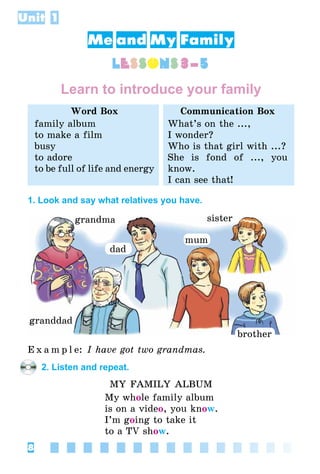
1. Look and say what relatives you have.
grandma
granddad
dad
mum
sister
brother
E x a m p l e: I have got two grandmas.
2. Listen and repeat.
My Family Album
My whole family album
is on a video, you know.
I’m going to take it
to a TV show.
9
lessons 3–5
/əU/ – whole, video, know, show
3. Look, match and say.
to love flower gardening	 to be full of life and energy
to make a film	 to adore animals
E x a m p l e: My grandma loves flower gardening.
4. Listen and role-play.
– What’s on your video, I wonder?
– It’s my family album.
– Who is that girl with a cat in her hands?
– It’s my sister Polly. She is fond of animals, you know.
She adores her pet.
– I can see that!
Unit 1
10
Remember!
What’s on your video?
5. Talk with a friend about your family. Use:
What’s on your ______, I wonder?
It’s my _______________.
Who is that _______ with _______?
It’s my ______________. He/she is fond of ______,
you know. He/she adores ___________.
I can see that!
On your own: Collect 3–5 photos of your relatives and
label them.
E x a m p l e: This is my dad.
6. Look and guess who is who in Paul’s family.
E x a m p l e: This is Paul.
11
lessons 3–5
7. Read and say what every member of this family likes
to do.
My Family Album
I am Paul. I am eight. I like to make films about my
family. This is my video family album. As you see, we are
five altogether: my dad, mum, granny, sister and me.
My parents are doctors. They work in the hospital.
My sister Polly is a schoolgirl. She is fond of animals.
We have got a cat in the house.
My granny doesn’t work, but she is full of life and
energy. She loves flower gardening.
I adore my family.
8. Answer the questions about Paul’s family.
1. How old is Paul?
2. Where do his parents work?
3. Does Polly go to school?
4. They have got a dog in the house, haven’t they?
5. Does his granny grow flowers or vegetables?
9. Talk with friends about your family members and their
likes. Use:
I like ... . She/he likes ...
I love ... . She/he loves ...
I am fond of ... . She/he is fond of ...
I enjoy ... . She/he enjoys ...
I adore ... . She/he adores ...
10. Write about your relatives in your family album.
These are my ... .
They work ... .
They are ... .
They enjoy ... .
Do it yourself! Make the front page for your family album.
Unit 1
12
lessons 6–8
Learn to talk about your parents
Word Box Communication Box
music hall
office
musician
manager
to play the piano
I say, ...
Where is your ... now?
Wow!
What does your ... do?
How interesting!
1. Look and say where the parents work.
hospital
schoolbank
music hall
office farm
E x a m p l e: The girl’s mum works in the hospital.
2. Listen and repeat.
Diddle Diddle Dumpling
Diddle diddle dumpling.
My son John
Goes to bed with his stockings on,
One shoe off,
The other shoe on.
Diddle diddle dumpling
My son John.
13
lessons 6–8
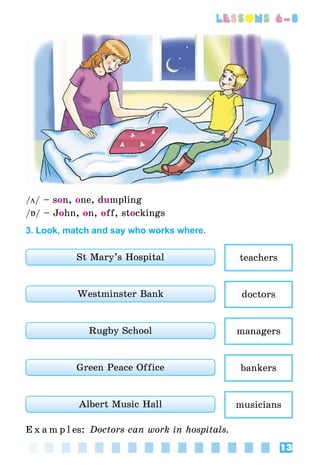
/ö/ – son, one, dumpling
/Á/ – John, on, off, stockings
3. Look, match and say who works where.
St Mary’s Hospital teachers
Westminster Bank doctors
Rugby School managers
Green Peace Office bankers
Albert Music Hall musicians
E x a m p l es: Doctors can work in hospitals.
Unit 1
14
4. Listen and role-pay.
About John’s Parents 
Remember!
He/she works in the hospital.
Susan:	I say, John, where is your mum now?
John:	 She is in the hospital.
Susan:	Is she ill?
John:	 No, she isn’t. She works there. She is a doctor.
Susan:	Wow! And what does your dad do?
John:	 He is a musician. He works in the music hall.
Susan:	How interesting!
5. Talk with a friend about your parents. Use the pattern:
I say, ____, where is your _____ now?
He/she is in the _____. He/she is a _______.
Wow! And what does you ______ do?
She/he is a _____. She/he works in the _____.
How interesting!
On your own: Take your parents’ photos and write what
they do and where they work.
E x a m p l e:  	 This is my mum.
	 	 She is a manager.
	 	 She works in an office.
15
lessons 6–8
6. Look and guess.
1) What kind of doctor John’s
mum is;
2) What musical instrument John’s
dad plays.
E x a m p l e: I think John’s mum is a ... .
7. Read and say what Susan likes about John’s parents.
John’s Family
My friend, John Brown has got a very nice family.
I like his parents a lot. They are kind and jolly people. His
dad, Mr. Brown, is a talented musician. He works in the
music hall. He plays the piano very well. I adore his music
and often go to his concerts.
Mrs Brown is John’s mother. She is a famous eye
doctor. She works at St Mary’s Hospital in London. When
I am ill, she helps me to get well.
The Browns are very friendly. I like to visit them at
weekends.
8. Answer the questions about John’s parents.
1. Are the Browns nice people?
2. Does John’s dad play the piano or the guitar?
3. Where can Susan listen to his music?
4. John’s mum is an eye doctor, isn’t she?
5. How does she help Susan?
9. Talk with friends about your parents. Use:
My parents are ... . My mum is ... . She works in ... .
She can ... . My dad is ... . He works in ... . He can ... .
10. Write about your parents in your family album.
Do it yourself! Make the parents’ page for your family
album.
Unit 1
16
lessons 9–11
Learn to talk about your grandparents
Word Box Communication Box
sewing
cooking
shopping
carving
Really?
How old is ...?
Good for ...!
1. Look and say what these children’s grandparents are busy
doing.
sewing
cooking shopping
carving
E x a m p l e: The boy’s granddad is carving a horse.
2. Listen and repeat.
Little Polly
–	Little Polly, little Polly,
	 Where are you going?
–	I’m going to see my grandma.
	 She is fond of sewing.
–	Little Polly, little Polly
	 How old is your grandma?
–	She is just sixty,
	 and I am fast growing.
17
lessons 9–11
/əU/ – going, sewing, growing
/ŋ/ – going, sewing, growing
3. Look, match and say how old Polly’s and your relatives
are (p. 18).
twenty
twenty-one
twenty-two
twenty-three
twenty-four
twenty-five
twenty-six
twenty-seven
twenty-eight
twenty-nine
thirty
20 21 22 23 24 25 26 27 28 29 30
twenty
thirty
forty
fifty
sixty
seventy
eighty
ninety
one
hundred
20 30 40 50 60 70 80 90 100
Unit 1
18
Polly’s mum (32)
Polly’s dad (41)
Polly’s grandma (56)
Polly’s granddad (73)
E x a m p l e: Polly’s mum is thirty-two and my mum is...
4. Listen and role-play.
Paul:	Hi, Polly! Where are you going?
Polly:	I’m going to my grandma. I want to help her.
Paul:	What is she busy doing?
Polly:	She is sewing a new dress for me. I’m fast growing,
you know.
Paul:	Really? And how old is she?
Polly:	She is just sixty and my granddad is seventy-two.
But they are full of life and energy.
Paul:	Good for them!
Remember!
She is busy cooking.
5. Talk with a friend about your grandparents. Use:
Hi! Where are you going?
I’m going to ____. I want _____.
forty-one
seventy-three
thirty-two
fifty-six
19
lessons 9–11
What is she/he busy doing?
She/he is ______. _____, you know.
She/he is just ______, but she/he is full of _____.
Good for _______!
On your own: Take your grandparents’ photos and write
how old they are and what they are busy doing.
E x a m p l e:   This is my granddad. He is sixty-
four. He is busy carving horses.
6. Look and guess how Polly helps her grandparents.
E x a m p l e: I think Polly helps her grandma.
7. Read and say why Polly likes to visit her grandparents.
About My Grandparents 
My name is Polly. I live with my parents
in Liverpool. I often visit my grandparents
who live nearby. My grandma is just sixty
and my granddad is seventy-two, but they
are full of life and energy. They are always
busy cooking, cleaning, sewing or carving.
Unit 1
20
I like to help them. Sometimes I go shopping with my
granddad or cook with my grandma. We have a good time
together.
I love my grandparents dearly.
8. True or False?
1. Polly’s grandparents live in Liverpool.
2. Polly’s grandparents are over seventy.
3. Polly goes shopping with her grandma.
4. Polly’s grandparents are busy gardening.
5. Polly doesn’t like cooking.
9. Talk with friends about your grandparents. Use:
My grandparents live ... .
My grandma is just ... .
My granddad is ... .
But they are full of ... .
They are busy ... .
My grandma likes ... .
My granddad is fond of ... .
I love ... dearly.
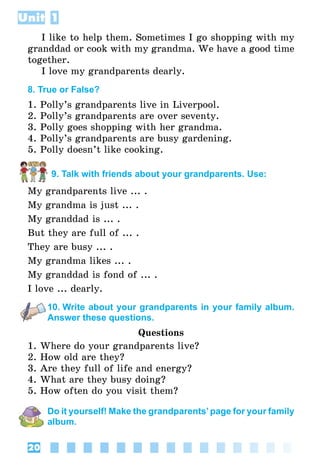
10. Write about your grandparents in your family album.
Answer these questions.
Questions
1. Where do your grandparents live?
2. How old are they?
3. Are they full of life and energy?
4. What are they busy doing?
5. How often do you visit them?
Do it yourself! Make the grandparents’page for your family
album.
21
lessons 12–14
Learn to talk about your sister
or brother
Word Box Communication Box
twin sisters/brothers
an only child
to look alike
fair/red/dark-haired
blue/brown/grey/green-eyed
Sure.
How lucky you are!
... , right?
Great!
1. Look and say if these brothers and/or sisters look alike.
dark-hairedbrown-eyedred-haired
E x a m p l e: These brothers look alike. They are red-haired.
2. Listen and repeat.
Are you sleeping?
Are you sleeping,
Are you sleeping?
Brother John,
Brother John?
Unit 1
22
Morning bells are ringing,
Ding-ding-dong,
Ding-ding-dong.
/I/ – morning, ding, ringing
/ŋ/ – sleeping, dong, ding, morning, ringing
3. Look, match and say what these children look like.
twin brothers	 dark-haired	 blue-eyed
an only child	 to look alike
E x a m p l e: These are twin-brothers. They look alike.
4. Listen and role-play.
Big Brother John
Susan:	I say, John, have you got any brothers or sisters?
John:	 Sure. I have got one brother and two twin sisters.
My brother is five and my sisters are only two.
Susan:	How lucky you are. So you are big Brother John.
Do you look alike?
John:	 Yes, we are all fair-haired and blue-eyed.
23
lessons 12–14
Susan:	Do you like to play with them?
John:	 Of course, I do. We often play hide-and-seek
together. You haven’t got any brothers or sisters,
right?
Susan:	Yes, I am an only child in the family. But I have
got a lot of friends. We have a good time together.
John:	 Great!
Remember!
Have you got any brothers or sisters?
I haven’t got any brothers or sisters.
5. Talk with a friend about your brothers and/or sisters.
Use:
I say, ____, have you got any _____?
Sure. I have got ____. My ___ is ____.
How lucky you are! You are _____.
Do you look alike?
Yes/no ________________.
Do you like to ____________?
Of course, I do. We often ______ together.
You ______, right?
Yes, I am _____. But I have got _______.
We ______ together.
Great!
Unit 1
24
On your own: Take your sister’s/brother’s photos and
write what they look like.
6. Look and guess who is who in John’s family.
7. Read and say what the children in John’s family look
like.
I have got a friend. His name is John. He is a nice,
good-looking boy. John is not an only child in the family.
He has got one brother and two twin sisters. John is eight
25
lessons 12–14
years old, his brother is five and his sisters are only two.
So my friend is Big Brother John.
All the children in the family are good-looking. His
twin sisters look very much alike. They are fair-haired
and blue-eyed. But the brothers do not look alike: John is
fair-haired and his brother is red-haired.
John adores his brother and sisters. He likes to play
with them.
8. Answer the questions about John, his brother and sisters.
1. Is John an only child in the family?
2. How many sisters has he got?
3. Who is red-haired in his family?
4. Are John’s twin sisters blue-eyed or brown-eyed?
5. The children are good-looking, aren’t they?
9. Talk with friends about your brothers and/or sisters.
Use:
I have got ... .
He/she is ... and ... .
He/she is ... years old.
My ... and I look/do not look alike.
I adore ... .
I like to ... with ... .
We often ... together.
10. Write about your brother and/or sister in your family
album. Use:
How many?
How good-looking?
How old?
How much alike?
How often?
Do it yourself! Make your brother’s/sister’s page for your
family album.
Unit 1
26
lessons 15–17
Learn to talk about yourself
Word Box Communication Box
forehead
curl
to help about the house
naughty
to water the plants
to sweep the floor
You look wonderful!
You are very kind.
Behave yourself!
Good girl/boy!
1. Look and say if these children are good or naughty.
to look after toys
to sweep the floor
to water the plants to listen to his/her mum
E x a m p l e: The boy is naughty. He doesn’t look after his
toys.
27
lessons 15–17
2. Listen and repeat.
Little Lizzy
I know Lizzy, a little girl,
Who has got a little curl
right in the middle
of her forehead.
When she is good,
she is very,very good.
And when she is bad,
she is horrid.
/:/ – girl, curl
/l/ – little, Lizzy, curl, girl, middle.
3. Look, match and talk about the girl.
to sweep the floor, a forehead, to water the plants, a curl,
to help about the house
E x a m p l e: The girl has a curl.
4. Listen and role-play.
A Good Girl
Paul:	 Hi, Lizzy, you look wonderful. I really like your
little curl right in the middle of your forehead.
Unit 1
28
Lizzy:	Thank you, Paul. You are very kind.
Paul:	 What are you doing now?
Lizzy:	I am looking after my toys.
Paul:	 Good girl! I know you help your mum about the
house.
Lizzy:	Sure I do. I usually water the plants and sweep the
floor when my mum asks me to.
Paul:	 So, you always listen to your mother, don’t you?
Lizzy:	Most of the time!
Remember!
She listens to her mother most of the time.
She looks after her toys.
5. Talk with a friend about yourself. Use:
Hi, ___, you look ________.
I really like your ____________.
Thank you, ____. You are _______.
What are you __________ now?
I am _______________.
So you always _____, don’t you?
Sure I do. I usually _____________.
Good ______! I know you ________.
Most of the time!
On your own: Take your photo and write about your-
self (p. 29).
29
lessons 15–17
E x a m p l e: I am Andrew. I am eight. I am fair-haired
and blue-eyed.
6. Look and guess what the girl often does at home.
E x a m p l e: I think the girl often waters the plants.
7. Read and say when the girl is very good and when she
is horrid.
A Little Girl with a Little Curl
I know Lizzy, a little girl. She
is very good-looking. She is grey-
eyed and dark-haired. She has got a
little curl right in the middle of her
forehead.
Lizzy is a good little girl. She
listens to her mother most of the
time. When she is good, she is very, very good. She helps
her mum about the house and looks after her toys. Then
her mother says to her, “Good girl!”
Unit 1
30
Sometimes Lizzy is naughty. She doesn’t listen to her
mother. She doesn’t want to read. She doesn’t’ want to
write. She cries and shouts. Then her mum says to her,
“Behave yourself!”
8. True or False?
1. Lizzy is fair-haired.
2. She always listens to her mother.
3. Sometimes Lizzy is bad.
4. She doesn’t want to learn.
5. Lizzy is a pretty girl.
9. Talk with friends about yourself. Use:
My name is ... .
... years old.
I am ...-haired and ...-eyed.
I often ... .
... most of the time.
Sometimes ... .
Then my mum ... .
10. Write about yourself in your family album. Use:
Your name?
Your age?
Your looks?
Your likes?
Your character?
Do it yourself! Make your own page for your family album.
31
Unit 2 All Day Long
lessons 21–23
Learn to talk about
your morning time
Word Box Communication Box
to change
to set the clock
to be late for sth
to be ready for sth
to help sb about the house
What time is it?
It is time to ... .
What’s your hurry?
It is my duty to ... .
1. Look and say what time it is.
eight o’clock
nine o’clockhalf past eight
half past seven
E x a m p l e: It is eight o’clock. It is time to go to school.
Unit 2
32
2. Listen and repeat.
Hickory, Dickory, Dock
Hickory, dickory, dock,
The mouse ran up the clock.
The clock struck one,
The mouse ran down!
Hickory, dickory, dock.
/Á/ – dock, clock
/ö/ – up, struck, one
3. Look, match and say when you usually do it.
to set the clock	 to be late for school
to be ready for breakfast	 to help sb about the house
E x a m p l e: I usually help my mum about the house on
Saturday morning.
4. Listen and role-play.
Morning Time Talk
Alex:	 Good morning, Helen. Where are you going?
What’s your hurry?
Helen:	Hi, Alex. I can’t stop now. I’m going to be late.
Alex:	 Late for what?
33
lessons 21–23
Helen:	Late for school.
Alex:	 Don’t worry. Slow down, slow down. They changed
from summer time to winter time yesterday.
Winter is coming, and the days are getting shorter
and darker.
Helen:	Really? What time is it?
Alex:	 Everyone set the clock one hour back. So it’s not
half past eight now, it’s just half past seven.
Helen:	Thank you, Alex, so much!
Alex:	 Any time. Hickory, dickory, dock. The mouse ran
up the clock ...
Remember!
Winter is coming.
The days are getting shorter and darker.
5. Talk with a friend about time. Use:
Good morning, ____! Where are you ________.
What’s __?
Hi, ____. I can’t _____. I’m going to _____.
Don’t worry. They _______ from ____ to _____.
Really? What time _______?
It’s _______.
Late for _______?
Late for _____.
Thank you ________.
Any time.
Unit 2
34
On your own: Draw the clock and show
your favourite morning time. Write 3–5
sentences about it.
E x a m p l e: It is eight o’clock. It is my
favourite morning time. It is time to go
to school. I usually come to school at
half past eight.
6. Look and guess when English children usually do this.
E x a m p l e: I think English children usually go to school
at ... .
7. Read and say what these children have time for.
About Morning Time
I am William. I am an English schoolboy.
Every morning I go to school. In
England school begins at nine o’clock.
At twelve o’clock I come home to eat.
I go back to school at two o’clock. At
half past five I come home from school.
I am Ginger. My mum says I’m a
morning person. I like to get up early
in the morning. I wash, clean my teeth,
brush my hair and put on my sweater
and jeans. I’m ready for breakfast at
half past seven.
35
lessons 21–23
I am Joan. It is half past seven. I am
helping my mum about the house. It is
my duty to sweep the floor. Then it is
time to go to school. I am not going to
be late.
8. True or False?
1. William is a morning person.
2. Ginger has breakfast at seven o’clock.
3. Joan helps her mum about the house in the morning.
4. William’s school begins at nine.
5. Joan is ready for school.
9. Talk with friends about your morning time. Use:
I am / am not a ... .
I like / don’t like to ... .
At ... o’clock I am / am not ready for ... .
Every morning I ... .
Sometimes I am / am not late for ... .
Then I ... .
10. Write a list of things to do in the morning. Use:
7 o’clock. → It is time to get up.
Half past seven → ... .
...
...
Do it yourself! Make a paper clock and colour your
favourite morning time.
Unit 2
36
lessons 24–26
Learn to talk about
your afternoon time
Word Box Communication Box
housework
yard
to look after sth
to do the room
lawn
handicrafts
... is speaking.
I’m sorry I can’t.
I prefer to ... .
See you later, ... .
1. Look and say what you can do in the afternoon.
to do sth new
to help in the yard
to look after
the toys
to make
a dress
to do
the room
E x a m p l e: I can help my granddad in the yard.
37
lessons 24–26
2. Listen and repeat.
Mary Ann
We have come for Mary Ann,
Mary Ann, Mary Ann,
We have come for Mary Ann,
Can she come out to play?
Mary Ann is sweeping,
She can’t come out to play.
/{/ – Ann, can
3. Look, match and say who can do that in your family.
housework	 yard
to look after the lawn	 handicrafts
E x a m p l e: I can look after the lawn in my family.
4. Listen and role-play.
Afternoon Telephone Talk
Andrew:	 Hello, Mary Ann. Andrew is speaking. Can
you come out to play?
Mary Ann:	Hi, Andrew. I’m sorry, I can’t. I’m helping
my mum about the house.
38
Unit 2
Andrew:	 Good for you! What are
you doing?
Mary Ann:	I’m sweeping the floor
now. It’s our house
cleaning day.
Andrew:	 I don’t like housework.
I prefer to help my
granddad in the yard.
Mary Ann:	What is your duty?
Andrew:	 I must look after the lawn in front of our
house. I’m going to do it now.
Mary Ann:	I’m proud of you, Andrew. See you later in
the afternoon.
Andrew:	 See you. Bye.
Remember!
I am helping my mum about the house now.
I prefer to help my granddad in the yard.
5. Talk with a friend about your other friends. Use:
Hello, _____, ____ is speaking. Can you ____?
Hi, ____. I’m sorry I can’t. I’m ____.
Good for you! What are you _____?
I’m _______ now. It’s ______.
I don’t like ______. I prefer _____.
What is your _____?
I must ______.
39
lessons 24–26
I’m proud ____. See ______.
See ______. Bye!
On your own: Draw a picture of your afternoon time and
write 3–5 sentences about it.
E x a m p l e: I like to help my mum about the house. It is
my duty to do the room. I usually do it in the afternoon.
6. Look and guess what these children know much about.
E x a m p l e: I think Polly has got international friends
from ... .
7. Read and say what the children do in the afternoon.
Jack of All Trades
My name is Mary Ann. I have a friend, Andrew who
is Jack of all trades1
. He is only eight but he can do a lot
of good work. For example, he can help his granddad in
the yard. He often watches DIY programmes on TV and
knows much about handicrafts. I am very proud of him.
My mum says that I am good at housework. I usually
help her to do the rooms. Every Wednesday we have a
1
Jack of all trades – майстер на всі руки
40
Unit 2
house cleaning day. It is my duty to look after my toys
and keep them in order.
Now it is late afternoon. Andrew is at my place. We
are making a doll’s house. We are enjoying it a lot.
8. Answer the questions about Polly and her international
friends.
1. Who is Jack of all trades?
2. What good work can he do?
3. What is the girl good at?
4. When does she have a house cleaning day?
5. The children are playing now, aren’t they?
9. Talk with friends about your afternoon time. Use:
I can ... . I like ... . I am good at ... . I usually ... . It is
my duty to ... .
10. Write a list of things to do on your house cleaning day.
Use the plan.
Plan:
1) My mum’s duty:	 3) My dad’s duty:
2) My duty:	 4) My sister’s / brother’s duty:
Do it yourself! Make a colourful picture of your home after
a house cleaning day.
41
lessons 27–29
Learn to talk about
your evening time
Word Box Communication Box
cowboy’s costume
to put the kettle on
to have tea
to have a problem with sth
to say goodnight
Make yourself at home.
Fantastic!
Surprise!
Oh my!
1. Look and say what different children can do in the evening.
to play on the
computer
to have tea
E x a m p l e: Children can play on their computers or read
books in the evening.
2. Listen and repeat.
Polly Put the Kettle On
Polly put the kettle on.
We’ll all have tea.
/Á/ – Polly, on
/p/ – Polly, put
42
Unit 2
3. Look, match and say what is fun to do in the evening.
a kettle	 to have tea
to say goodnight	 a cowboy’s costume
E x a m p l e: It is fun to have tea together.
4. Listen and role-play.
Good Evening!
Polly:	 Good evening, Polly!
Alex:	 Good evening, Alex! Come in, please.
Make yourself at home.
Polly’s Mother:	 Polly, put the kettle on! We’ll all have tea.
Polly: 	 OK, Mum! Before tea is ready, what can
I do for you, Alex?
Alex:	 I have a problem with this English story.
Please help me.
Polly:	 With pleasure ... And now we can have
fun. You put on this cowboy’s costume
and I will put on a doctor’s white hat.
Alex:	 Fantastic!
Polly’s Mother:	 Kids! Tea is ready!
Polly:	 Surprise!
Polly’s Mother:	 Oh my!
43
lessons 27–29
Remember!
I will put on a doctor’s white hat.
5. Talk with a friend about the news of the day. Use:
Good evening, ________,. Come in, ___.
Make _____. What can I ___?
I have a problem with ______. Please, ______.
With pleasure. _________
Thank you so _____, ____!
Any time. And now we can _______. You _____,
and I will____.
Fantastic!
On your own: Draw a picture of your
evening time and describe it in 2–3
sentences.
E x a m p l e: I like to read books in the
evening. It is a lot of fun. I have a new
adventure book. I am sure I will enjoy it.
6. Look and guess what Alex usually does in the evening.
E x a m p l e: I think Alex usually ... in the evening.
44
Unit 2
7. Read and say if the boy’s evening is the same every
day.
An Evening Email
Hey Polly,
Thank you so much for your help with my English
story! I learnt a lot of new words from you. I enjoyed our
game a lot. The tea was excellent. Your mum’s pie tasted
real good! It was such a special evening!
Usually in the evening I am at home. I play on my
computer or read an interesting book. Then I brush my
teeth, say good night to mum and dad and quickly fall
asleep. It is the same every day.
What about you? What do you usually do in the evening?
Good night!
Alex
8. True or False?
1. Alex never has problems with his home tasks.
2. He usually stays at home in the evening.
3. His friend helped him.
4. The children played an interesting game.
5. Alex asks Polly some questions.
9. Talk with friends about you evening time. Use:
Usually in the evening I ... . I ... or ... . Then I ... . But
sometimes ... . I enjoy ... . My friend and I ... .
10. Write your friend an email about your special evening.
Begin with:
Hey, ... ,
I want to tell you about a very special evening. ...
What about you?
Good night!
...
Do it yourself! Make a picture about your evening time.
45
lessons 30–32
Learn to talk about your bedtime
Word Box Communication Box
to be in bed
to feel sleepy
bedtime story
to promise
tonight
to go to bed in time
Very much the same.
Sleep tight!
Sweet dreams!
1. Look and say what children usually do at their bedtime.
to listen to
a fairy tale
to read
a story
to watch
a cartoon
to listen
to music
E x a m p l e: Children usually listen to a fairytale at their
bedtime.
2. Listen and repeat.
Wee Willie Winkie
Wee Willie Winkie runs through
the town,
Upstairs, downstairs in his night­
gown.
Knocking at the window, crying
through the lock,
46
Unit 2
“Are the children in their beds, for now
It’s eight o’clock?”
/w/ – wee, Willie, winkie, window
/aU/ – town, gown, downstairs, now
3. Look, match and say what these children feel or do at eight
o’clock.
to feel sleepy	 a bedtime story
to be in bed	 to go to bed in time
E x a m p l e: It’s eight o’clock in the evening. This child
feels sleepy.
4. Listen and role-play.
Good Night!
Willie:	 I say, Jane, it’s eight o’clock. It’s bedtime, isn’t it?
Jane:	 Of course, it is. I feel sleepy.
Willie:	 Me, too. It was a busy day with me: I went to
school, did my lessons, played football and what
not. How was your day, I wonder?	
Jane:	 Very much the same. I didn’t play football, of
course, but I went to my dancing class. Now I’m
ready for a bedtime story.
47
lessons 30–32
Willie:	 Are you going to read one?
Jane:	 Not tonight. My mum promised to tell me
something special this time – about Wee Willie
Winkie who runs through the town.
Willie:	 So good night, sleep tight!
Jane:	 Sweet dreams!
Remember!
My mum promised to tell me something special this time.
I didn’t play football.
5. Talk with a friend about your bedtime. Use:
I say ________. It’s _____ o’clock. It’s ___, isn’t it?
Of course, ___. I feel _________.
Me, too. It was a _____ day with me: ______.
How was your _____ , I wonder?
Very much the same. I didn’t ______, of course,
but I ________. Now I’m ready for _______.
Are you going to ___?
Not tonight. My ___ promised to _______.
Good night! Sleep tight!
On your own: Draw a picture of your
favourite bedtime story and de­
scribe it.
E x a m p l e: As for me, I like to listen to
bedtime stories very much. My fafourite
bedtime story is Pinocchio. It is about ...
48
Unit 2
6. Look and guess what Jane still wanted to do when it was
bedtime.
E x a m p l e: I think Jane still wanted to ... .
7. Read and say what helped Jane to go to bed in time.
A Bedtime Story for Jane 
Once there lived a little girl,
Jane, who didn’t want to go to
bed in time, even after a busy
day. When it was bedtime, she
still had so many things to do:
cartoons, games, stories, or
pictures.
One evening the girl’s mum
came into her room and said,
“It’s eight o’clock, dear. Time to
go to bed.” The girl wanted more
time to play. But her mum said, “No more playing. Wee
Willie Winkie is running through the town”. And the
bedtime story began ...
From that time on, the girl always went to bed in time,
ready for another bedtime story.
49
lessons 30–32
8. Label the pictures.
E x a m p l e: It was bedtime.
9. Talk with friends about your bedtime Use:
As for me, ... .
When it is bedtime, I ... .
I still have ... .
I want more time to ... .
But my mum says that it is time to ... .
She promises to ... .
So I am ready ... .
10. Write a note to Wee Willie Wnkie. Use:
Dear ... ,
Thank you so much!
Now it is ... o’clock. I am in bed.
... .
Good night, sleep ... .
Yours, ...
Do it yourself! Make a picture of Wee Willie Winkie.
50
Unit 2
lessons 33–35
Learn to talk about weekend fun
Word Box Communication Box
puppet show
museum
to take sb for a drive
to play hockey
weekdays
What about ...?
Some other day, perhaps.
1. Look and say what these children usually do on weekdays
and at the weekend.
to do the lessons
to help about
the house to go to the park
E x a m p l e: Children usually do their lessons on weekdays.
They can go to the park at the weekend.
2. Listen and repeat.
Jack
All work and no play
Makes Jack a dull boy;
All play and no work
Makes Jack a mere toy.
/OI/ – boy, toy
/eI/ – play, makes
51
lessons 33–35
3. Look, match and say what you know about these children.
a puppet show	 a museum
to take sb for a drive	 to play hockey
E x a m p l e: My dad takes us for a drive on Sunday
morning.
4. Listen and role-play.
Sunday Plans
Peter:	 I say, Mary, tomorrow is Sunday. What are you
plans?
Mary:	I’m going to do my lessons for next week and help
my mum about the house.
Peter:	 What about the puppet show or a game of tennis?
Mary:	I’m sorry I can’t, Peter. Some other day, perhaps.
Peter:	 All work and no play makes Jack a dull boy, you
know.
Mary:	Oh no! What are you going to do tomorrow?
Peter:	 All kinds of fun: a video, tennis, the puppet show
and the swimming pool. Sunday is time to play,
isn’t it?
Mary:	Yes, but all play and no work makes Jack a mere
toy, you know.
Peter:	 Oh, no!
52
Unit 2
Remember!
What are you going to do tomorrow?
5. Talk with a friend about your weekend plans.
I say, _____, tomorrow is _______. What are your
plans?
I am going to _____ and _______.
What about _____ or _______ ?
I’m sorry I can’t, _____. Some other ______.
All _______ makes _______, you know.
Oh, no!
On your own: Take a photo of your weekend fun and write
3–5 sentences about it.
E x a m p l e: I have all kinds of fun at the weekend. I can
watch a video, play tennis, go to the puppet show or the
swimming pool. Sunday is time to play, isn’t it?
53
lessons 33–35
6. Look and guess what Canadian children can do at the
weekend.
E x a m p l e: I think Canadian children can play hockey at
the weekend.
7. Read and say how Jack works and plays at the weekend.
Jack’s Weekend 
I am Jack. I live in Canada. I go
to school on weekdays, but I have a
weekend to myself. It starts on Friday
afternoon and lasts till Sunday evening.
My typical weekend looks like
this. On Friday evenings I can go to
a museum. On Saturday mornings
I usually play hockey with my friends,
then in the afternoon, I do my lessons
and help my parents about the house. My Sunday starts
with a swim in the pool, then my dad takes us for a drive,
with a quiet evening back home.
I try to work and play at the weekend. I don’t want to
hear from anyone that “All work and no play makes Jack
(and I AM Jack, you know) a dull boy” or “All play and no
work makes Jack (me!) a mere toy”.
8. Read and choose.
1. Jack is from ... .
	 а. Britain;    b. Canada;    c. the USA.
54
Unit 2
2. His weekend begins on ... .
	 а. Friday;    b. Saturday;    c. Sunday.
3. Jack can visit ... on Friday evening.
	 а. the theatre;    b. the cinema;    c. a museum.
4. He does his lessons ... .
	 а. on Friday afternoon;    b. on Saturday afternoon;
	 c. on Sunday evening.
5. Jack’s father takes him ... on Sunday.
	 а. to the pool;    b. for a drive;    c. to the farm.
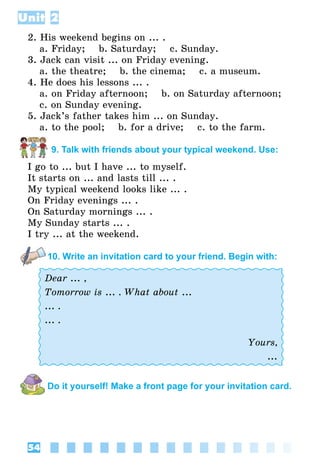
9. Talk with friends about your typical weekend. Use:
I go to ... but I have ... to myself.
It starts on ... and lasts till ... .
My typical weekend looks like ... .
On Friday evenings ... .
On Saturday mornings ... .
My Sunday starts ... .
I try ... at the weekend.
10. Write an invitation card to your friend. Begin with:
Dear ... ,
Tomorrow is ... . What about ...
... .
... .
Yours,
...
Do it yourself! Make a front page for your invitation card.
55
Unit 3 My Home
lessons 39–41
Learn to talk about
the flat you live in
Word Box Communication Box
floor
sitting room
bedroom
bathroom
nursery
kitchen
May I know why?
Unfortunately, ...
1. Look and say what there is in a house.
hall, sitting room, bedroom, bathroom, nursery, toilet,
kitchen
E x a m p l e: There is a big hall in the house.
56
Unit 3
2. Listen and repeat.
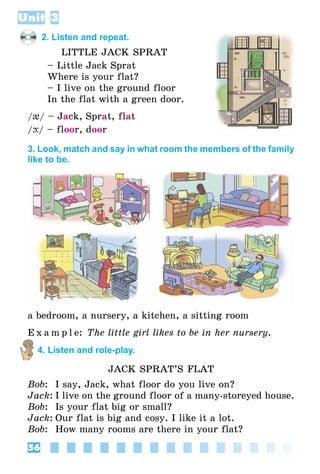
Little Jack Sprat
– Little Jack Sprat
Where is your flat?
– I live on the ground floor
In the flat with a green door.
/{/ – Jack, Sprat, flat
/þ/ – floor, door
3. Look, match and say in what room the members of the family
like to be.
a bedroom, a nursery, a kitchen, a sitting room
E x a m p l e: The little girl likes to be in her nursery.
4. Listen and role-play.
Jack Sprat’s Flat
Bob:	 I say, Jack, what floor do you live on?
Jack:	I live on the ground floor of a many-storeyed house.
Bob:	 Is your flat big or small?
Jack:	Our flat is big and cosy. I like it a lot.
Bob:	 How many rooms are there in your flat?
57
lessons 39–41
Jack:	There are three rooms, a kitchen, a hall and a
bathroom in our flat. But my favourite room is a
nursery.
Bob:	 May I know why?
Jack:	Sure. There are many things I like to use every day:
my books, my computer, my music centre and my
toys. I spend most of my free time there.
Bob:	 I see.
Remember!
– How many rooms are there in your flat?
– There are three rooms, a kitchen and a bathroom in my flat.
5. Talk with your friend about your flat. Use:
I say _______, what floor do you live оn?
I live on ____________ floor.
Is your flat ____ or ______?
Our flat is ______ and _______. I like ______.
How many rooms _________?
May I know why?
There are _____, _____ and _____.
But my favourite room is ______.
Sure. There ________. I spend much of my
time _____.
I see.
58
Unit 3
On your own: Take (or draw) a picture of any room in your
flat and write 3–5 sentences about it.
E x a m p l e: This is a nursery. It is small, but very cosy.
There are many toys in my nursery. I like to play there.
6. Look and guess what the girl didn’t have in her old flat.
E x a m p l e: I think the girl didn’t have ... in her old flat.
7. Read and say why Kate likes their new flat.
Dear grandma,
I’m so happy to tell you that I like our new
flat so much. It is bigger and cosier than our old
flat.
Besides, there are four rooms in our new flat.
One of them is mine! Isn’t it great? Unfortunately,
I didn’t have my own room in the old flat. Now
I spend most of my free time in this room drawing.
59
lessons 39–41
You know, granny, that painting is my greatest
hobby. So I draw many pictures and put them on
the walls of my room. There are pictures of our
new house and flat too. It’s a real display, my
mum says. I am sending you the picture of my
room. Write back and say if you like it.
Yours, Kate
8. Answer the questions.
1. Why is Kate so happy?
2. What does she think of their new flat?
3. How many rooms are there in her new flat?
4. What did Kate put on the walls of her room?
5. What picture is the girl sending to her grandma?
9. Talk with friends about your flat. Use:
I live on ... floor.
There are ... in our flat.
The rooms are ... .
... is the biggest room.
We like ... and ... there.
But my favourite room ... .
There are/is ... in my room.
I like ... and ... there.
10. Write about your flat for a class magazine. Use:
This is a hall ...
This is our sitting room ...
This is our kitchen ...
This is our bathroom ...
This is our bedroom ...
This is our nursery ...
Do it yourself! Draw a plan of your flat.
60
Unit 3
lessons 42–44
Learn to talk about
the room you live in
Word Box Communication Box
furniture
in the middle of ...
carpet
on the right/left
sofa
bookcase
What about ...
Splendid!
As you see ...
1. Look and say where the furniture is.
on the left, on the right, a sofa, in the middle, a bookcase
E x a m p l e: On the left there is a sofa.
61
lessons 42–44
2. Listen and repeat.
Nice Betty Bloom
Nice Betty Bloom
Is in her room,
With a carpet on the floor
And lace curtains on the door.
/ü/ – Bloom, room
/þ/ – floor, door
3. Look, match and say what furniture there is in children’s
rooms.
a bookcase, a carpet, a sofa, a writing table, curtains
E x a m p l e: There is a carpet in the girl’s room.
4. Listen and role-play.
Discussing Your Rooms
Betty:	This is my room, nice and cosy. Do you like it?
John:	 Of course, I do. I also have my own room and I like
it a lot, too.
Betty:	Glad to hear it. Аnd what furniture is there in
your room?
John:	 On the left of the room there is a bookcase. There
are many interesting books in it.
Betty:	No wonder, I know you are fond of reading. And
what is there on the right?
62
Unit 3
John:	 On the right there is a writing table with a computer
on it. Sometimes I play computer games.
Betty:	I adore computer games. There is a computer on
my table too, but the table is in the middle of the
room. What about playing a new game?
John:	 Splendid!
Remember!
– What furniture is there in your room?
– On the left of the room there is a bookcase.
– What is there on the right?
– There is a writing table with a computer on it.
5. Talk with a friend about your rooms. Use:
This is my room, _____ and _____. Do you _____?
Of course, I do. I also have ____ and I _______.
Glad to hear it. And what furniture ________?
Oh, on the left there is _____. There are _______.
No wonder. I know you ______ and what
is there ________?
_______ there is a _______. Sometimes I ______.
I adore ______. There is _______ in my room too,
but it is _______.
What about ______?
Splendid!
63
lessons 42–44
On your own: Take a picture of any
room and write where the furniture
is in it.
E x a m p l e: This is a sitting room.
In the middle of the room there is a
table. There are nice flowers on it. On
the right there is a TV set ...
6. Look and guess what Andrew saw on the walls of Tom’s
room.
E x a m p l e: I think Tom saw ...
7. Read and say what Andrew liked about Tom’s house.
Tom’s Room
I’m Andrew. I have an English friend. His name is
Tom. I spent my last summer holidays at his place and
I liked it a lot.
Tom’s family has a big one-storeyed house. There is a
nice green garden around it. In the middle of the garden
there are some flowerbeds with beautiful roses. English
people are so fond of gardening, you know.
Every member of the family has his/her own room.
Tom’s room is on the left. There is not much furniture
in it: two beds, a writing table with a lamp on it and a
bookcase full of books.
Tom is interested in sports. There are many pictures of
famous English athletes on the walls of his room. He likes
football and David Beckham is his favourite footballer.
64
Unit 3
There is a big poster with the athlete on the door of
Tom’s room. Near the window there is a big football board
game1
and we often played it in rainy weather. But when
the weather was sunny we played football with Tom and
his dad in the yard. As you see, there is much place to
play everywhere. This is what I like most.
8. True or False?
1. Tom’s family lives in a many-storeyed house.
2. English people are fond of gardening.
3. There is much furniture in Tom’s flat.
4. There are many portraits on the walls of Tom’s room.
5. Tom and Andrew played a football board game in Tom’s
room.
9. Talk with friends about your room. Use:
My room is ... .
On the left there is/are ... .
On the right there is/are ... .
In the middle of the room there is/are ... .
I like to ... .
On the walls ... .
You can also see ... in my room.
I often ... .
10. Write about your room to your international friend.
Use:
On the left ...
On the right ...
In the middle ...
On the walls ...
On the table ...
Do it yourself! Draw your own room for Tom.
1
board game – настільна гра
65
Unit 4 My School
lessons 48–50
Learn to talk about things
to do at school
Word Box Communication Box
to work on the computer
laughter
question mark
computer lab
to find information
Both.
Same with me.
I know what you mean.
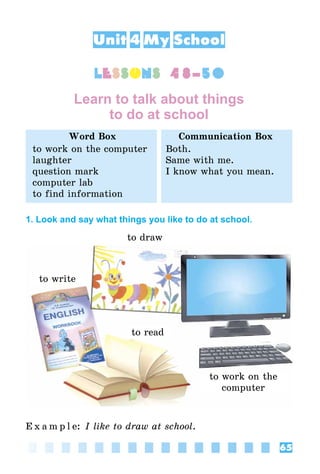
1. Look and say what things you like to do at school.
to write
to read
to work on the
computer
to draw
E x a m p l e: I like to draw at school.
66
Unit 4
2. Listen and repeat.
A Pen and a Pencil
Peter has a pencil,
Peter has a pen.
He draws with his pencil
And writes with his pen.
/p/ – Peter, pencil, pen
/e/ – pencil, pen
3. Look, match and say where these children study.
a question mark	 laughter
to work on the computer	 a computer lab
E x a m p l e: The teacher is talking to the boy with laughter.
4. Listen and role-play.
A Pen or a Pencil?
Mary:	I say, Peter, have you got a pen or a pencil?
Peter:	 Both. I draw with my pencil and write with my
pen. Why do you ask, Mary?
Mary:	I am going to write down my home task.
Peter:	 Here is the pen for you, and I will use the pencil.
Mary:	Thank you, Peter. I know you are always ready to
help.
67
lessons 48–50
Peter:	 Any time. I like school very much. I love to do
different things at school: to read, to write, to
draw and what not. But working on the computer
is my favourite.
Mary:	Same with me. I also enjoy questions and answers.
I want to know more and more.
Peter:	 I know what you mean. I ask very many questions,
too. My teacher once said with laughter, “Peter,
don’t ask so many questions, or you will turn into
a question mark.”
Mary:	How? When? Where? Why?
Remember!
Don’t ask so many questions.
5. Talk with a friend about things to do at school. Use:
I say _____, have you got a ______ or ______?
Both. I ____ with _____ and _______.
Why do you _____, _____?
I’m going to _________________.
Here is _____ for you, I will use _______.
Thank you, ____. I know you are always _____.
Any time. I like _____ very much. I love
__________________. But ______ is my favourite.
Same with me. I also enjoy _______________.
I know what you mean.
68
Unit 4
On your own: Take your pencil-box and write 3–5 senten­
ces about it.
E x a m p l e: This is my pencil-box. It
is small and nice. There I have all the
school things, such as pencils, pens,
erasers, a ruler and others.
6. Look and guess how English children do their home tasks
at school.
E x a m p l e: I think English children do their home tasks ...
7. Read and say what kind of pupil Peter is.
Peter at School
Peter is an English boy. He lives
with his parents in Norwich.
Peter goes to Blue Bell Primary
School1
. He likes his school very
much. He loves to do different things
at school: to read, to write, to draw
and what not. But working on the
computer is his favourite. He can
type his home tasks, do projects
and find new information for his lessons in the school
computer lab.
1
Primary school – початкова школа
69
lessons 48–50
Besides, Peter enjoys questions and answers. He asks
questions about seasons and weather, sport and games,
books and films and what not. He wants to know more and
more. His teacher once said with laughter, “Peter, don’t
ask so many questions, or you will turn into a question
mark.” Peter thought a little, and then again asked a
question, “But tell me, please, how can I hold the dot1
?”
8. True or False?
1. Peter is a primary school pupil.
2. He adores school.
3. He doesn’t like to work on the computer.
4. Peter asks questions about everything.
5. His teacher gave him a question mark.
9. Talk with friends about the things you do at school. Use:
As for me, ... .
I like ... very much.
I love ... .
... is my favourite.
I can ... .
Besides, ... .
I want ... .
10. Write a short letter about your school for a children’s
magazine. Use:
What?
When?
Where?
Who?
How?
Do it yourself! Make a picture of your school for this
children’s magazine.
1
To hold the dot – утримувати крапку
70
Unit 4
lessons 51–53
Learn to talk about
your English lesson
Word Box Communication Box
language school
to have a meeting
cartoon
to try hard
parrot
For example, ...
Perhaps I can’t.
1. Look and say what you can see in the English classroom.
a board
a computer
books
a TV set
E x a m p l e: I can see a computer in the English classroom.
2. Listen and repeat.
     I Love English
I can read, and I can write,
I can speak English, too.
I love learning English.
And what about you?
/ü/ – too, you
/Ö/ – read, speak
71
lessons 51–53
3. Look, match and say how these children learn English.
a language school	 to have a meeting
a cartoon	 to try hard
E x a m p l e: The boy is watching a cartoon at his English
lesson.
4. Listen and role-play.
Do You Speak English?
Ann:	 Hey, Nick. Do you speak English?
Nick:	Don’t you know? I go to the best language school in
our town.
Ann:	 Please help me out! We are having a meeting with an
international guest in our class today, Ron Wright.
He is from Britain. But we all study French, you know.
Nick:	Perhaps, I can’t. I can speak English, but not very
well yet.
Ann:	 Yes, you can! Please come to my French classroom
at two o’clock if you can.
Nick:	OK, I will. I know where it is – to the left of the
computer lab, right?
Ann:	 Exactly. Thank you so much!
Remember!
We are having a meeting with an international guest
in our class today.
72
Unit 4
5. Talk with your friend about learning English. Use:
Hey _______. Do you ____________?
Don’t you know? I go to _______.
Please help _____. We are having ________ today.
But we all _______.
Perhaps, I can’t. I can ____________,
but not ____ yet.
Yes, you can! Please come _________ if you can.
OK, I will. I know where __________, right?
Exactly. Thank _____.
On your own: Take a picture of your English classroom
and describe it.
E x a m p l e: This is my English classroom. It is to the left
of the computer lab. We do a lot of interesting things at
our English lessons there. ...
73
lessons 51–53
6. Look and guess what children like to do at the English lesson.
E x a m p l e: I think сhildren like to ... at the English
lesson.
7. Read and say who helps Nick to learn English.
At the English Lessons
My name is Nick. I live in
Ukraine. I a pupil of the best
language school in my town.
I like to learn English a lot.
I can read, and write, and speak
English, but not very well yet.
We do so many interesting
things at the English lessons.
For example, we watch cartoons, read fairy tales and
write letters and greeting cards. I try hard to talk with
my classmates in English.
Dolly likes to learn English, too. Dolly is a nice, big
parrot. It lives in my classroom. All the children look
after Dolly. The parrot can say some English words. When
any child says, “I can’t” at the English lesson, Dolly says,
“Yes, you can! Yes, you can!” It helps us to learn better.
Isn’t it funny?!
8. Read and choose the correct answer.
1.	What school does Nick go to?
	 a. language school;   b. grammar school;   
	 c. public school.
74
Unit 4
2.	How does he speak English?
	 a. very well;    b. not very well;    c. very little.
3.	What does he NOT do at his English lessons?
	 a. reading;    b. writing;    c. speaking Ukrainian.
4.	What does Nick learn to write?
	 a. novels;    b. letters;    c. poems.
5.	Who helps him to learn English?
	 a. a dog;    b. a fish;    c. a bird.
9. Talk with your friends about your English lessons. Use:
I go to ... school.
I like to learn ... .
I can ... , but not ... .
We do ... .
For example, ... .
I try hard to ... .
... helps us to learn better.
10. Write about your English lesson for the children’s
magazine. Use:
This is the school I go to.
______________________________
______________________________
And this is my English classroom.
______________________________
______________________________
Do it yourself! Draw a picture of your English classroom
for your class magazine.
75
lessons 54–56
Learn to talk about school books
Word Box Communication Box
reader (person)
reader (book)
information
fact
bookshelf
to be full of sth
I am writing to tell you ...
First ... , then ... .
... such as ... .
1. Look and say what these school books are about.
Ukrainian Maths English Nature
Study
E x a m p l e: This school book is about Ukrainian.
2. Listen and repeat.
My Books
We are good friends,
My books and I.
	 We have such fun,
	 My books and I.
	 	 We are good friends.
	 	 Can you say why?
/U/ – good, books
/ö/– such, fun
76
Unit 4
3. Look, match and say where you can see them in your school.
bookshelf	 reader (book)
reader (person)	 facts
E x a m p l e: I can see a bookshelf in my English classroom.
4. Listen and role-play.
School Book Talk
Helen:	 I say, Jack, what were you reading yesterday
when I saw you in the school library?
Jack:	 I was reading a book about animals for my project
in Nature Study.
Helen:	 Was it a school book?
Jack:	 First I read the school book and then I looked
for more information in other books, too. I found
a lot of interesting facts about animal life in a
desert. What did you do in the library?
Helen:	 I took a book for my English lesson.
Jack:	 Wow! What kind of book did you take?
Helen:	 It’s an English reader. It is full of adventure
stories. I was reading a story by Stevenson the
whole evening yesterday.
Jack:	 Good for you! We read and learn, don’t we?
Helen:	 Sure.
77
lessons 54–56
Remember!
What were you reading yesterday when I saw you in
the school library?
I was reading a story by Stevenson the whole evening
yesterday.
I / He / She
We / You / They
WAS
WERE
read+ING
do+ING
5. Talk with your friend about your school books. Use:
I say _______, what were you reading
when _________?
I was reading ____________ for ______.
Was it a ____ book?
First I read ____ and then ______. I found _____.
What did you _____?
How many rooms _________?
I took _____ for _____.
Wow! What kind of _______?
It’s a ______. It is full of _____.
I was reading ________ the whole _____.
Good for ____! We ___ and ___, don’t we?
Sure.
78
Unit 4
On your own: Take (or draw) a school book and write 3–5
sentences about it.
E x a m p l e: This is my school book in Ukrainian. It is full
of interesting facts. I can read them and learn a lot about
my native language.
6. Look and guess where the girl can read books.
E x a m p l e: I think the girl can read books in ... .
7. Read and say if Helen is a great reader.
Dear Reader’s Magazine,
I’m writing to tell you that I adore reading.
I read all kinds of books: school books, story books,
readers, fairy tales and what not.
School books come first in my list. I have
got a lot of them. They are in different school
subjects such as Ukrainian, Maths, English,
Nature Study and others. They are full of
interesting information. I can read and learn a
lot about words, numbers, animals and plants.
There is a very good library in our school. I am
a regular reader there. I often take books from
79
lessons 54–56
the library and read them at home. I was reading
an adventure story by Stevenson the whole evening
yesterday!
Yours,
Helen
8. Answer the questions.
1. What is Helen writing about?
2. What books does she read?
3. What can she learn from school books?
4. Is there a library in her school?
5. What was she doing the whole evening yesterday?
9. Talk with friends about your school books. Use:
I adore ... .
I read ... and what not.
School books come ... .
They are in ... , such as ... .
They are full of ... .
I can read and learn a lot about ... .
I am a ... of our school library.
I often take ...
I was reading ... the whole evening ... .
10. Write about your school books for a reader’s maga­
zine. Use:
My Ukrainian school book.
My English school book.
My school book in Maths.
My school book in Nature Study.
My reader.
My ... .
Do it yourself! Draw your bookshelf and label the school
books on it.
80
Unit 4
lessons 57–59
Learn to talk about your class
Word Box Communication Box
grade
class
this year
take sb for an outing
to move away
Isn’t it amazing?
I’ll try!
Can you imagine?
1. Look and say what classmates can do together in this
classroom.
to read, to learn, to do homework, to  listen to stories,
to play, to talk
E x a m p l e: Classmates can read together in this class­room.
81
lessons 57–59
2. Listen and repeat.
How Many Pupils?
Our class has two Bellas,
Two Jims and two Stellas,
Three Anns and three Dicks,
Five Kates and four Nicks,
Six Sams and eight Bills,
Five Nells and two Jills,
But we have only one Paul.
Can you count them all?
/e/ – Bellas, Stellas, Nells
/I/ – Jims, Dicks, Nicks, Bills, Jills, six
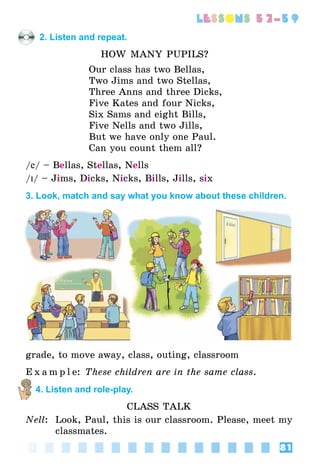
3. Look, match and say what you know about these children.
grade, to move away, class, outing, classroom
E x a m p l e: These children are in the same class.
4. Listen and role-play.
Class Talk
Nell:	 Look, Paul, this is our classroom. Please, meet my
classmates.
82
Unit 4
Paul:	With pleasure. Hello, everyone! My name is Paul.
I’m going to be a new pupil in your class. I was
studying in another town from Grade One to Grade
Three.
Nick:	Hello, Paul! Nice to meet you. I’m Nick.
Kate:	And I’m Kate. Nice to meet you, Paul.
Paul:	Nice to meet you, Nick. Nice to meet you, Kate.
Please tell me about your ..., sorry, our class.
Nell:	 Our class is very friendly. We all like to learn. We
are fond of reading and sports.
Paul:	I’m glad to hear that! Our interests are alike.
Nell:	 And now – surprise! Our class has two Bellas, two
Jims and two Stellas, five Kates and four Nicks.
Paul:	Isn’t it amazing?
Nick:	And now we have only one Paul.
Kate:	Can you count us all?
Paul:	I’ll try! ... Seventeen?
Nell:	 Exactly!
Remember!
–	I was studying in another town from Grade One to Grade Three.
5. Talk with a friend about your сlass. Use:
Look, ___. This is our _______. Please meet ____.
With pleasure. Hello, ___! My name is ___. I’m
going to ____. I was studying ___ from ___ to ___.
Hello, ___. Nice to _____. I’m _____.
Nice to ____, ___. Please, tell me about ______.
Our class is _____. We all like ___.
We are fond of ____.
83
lessons 57–59
I’m glad to hear that. Our interests are ____.
And now – surprise! Our class has ______!
Isn’t it amazing?
On your own: Take a picture of your
class and write 3–5 sentences
about it.
E x a m p l e: Please meet my class.
These are all my classmates. Our class
is very friendly. We all like to learn. We
are fond of reading and sports. ...
6. Look and guess what classmates can do together.
picnicking
a trip
games a home task
E x a m p l e: I think classmates can ... together.
84
Unit 4
7. Read and compare Paul’s old and new classes.
My New Class
Part One
I’m Paul. I am a pupil of Grade Three now. I was
studying in another town from Grade One to Grade
Three. My class had twenty-five pupils. We were all
great friends. We often helped each other with home
tasks and played games together. Our teacher took us for
an outing1
on every holiday when the weather was fine.
I felt so unhappy when my parents told me about moving
away.
Part Two
So I am in a new class this year. Fortunately, the
children are all very friendly. They like to learn. They are
fond of reading and sports. Our interests are alike.
We are seventeen altogether. Can you imagine? We
have two Bellas, two Jims and two Stellas, five Kates and
four Nicks. And now we have only one Paul. It’s me!
1
outing – пікнік
85
lessons 35–36
I still miss my old classmates a lot. But I really enjoy
meeting new people and making new friends in my new
school.
8. True or False?
1. Paul’s old class was bigger than the new one.
2. The children had a lot of fun together.
3. Paul was happy to move away.
4. He and his new classmates have the same interests.
5. Paul likes his new class a lot.
9. Talk with your friends about your class. Use:
I am studying in ... .
My class has ... .
Fortunately, my classmates are ... .
We are ... .
We like to ... .
We are fond of ... .
Our interests are ...
We often ... .
Our teacher takes us for ... on every holiday.
I enjoy ... .
10. Write about your class for your school newspaper.
Use:
What grade?
How many?
What names?
What interests?
How friendly?
How happy?
Do it yourself! Draw a badge for your class and
describe it.
86
Unit 5 Mealtime
lessons 63–65
Learn to talk about your meals
at home
Word Box Communication Box
sandwich
cheese
sausage
butter
yoghurt
biscuits
As a rule, ...
Same with me.
Maybe ...
Tastes differ.
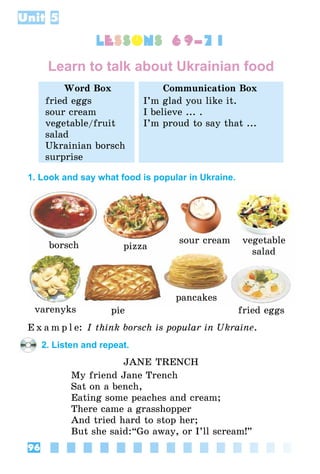
1. Look and say what food children like to eat.
a cheese sandwich
porridge
sweets biscuits
a butter and jam
sandwich
a sausage
sandwich
yoghurt
E x a m p l e: Some children like to eat cheese sandwiches.
87
lessons 63–65
2. Listen and repeat.
Little Tommy Tucker
Little Tommy Tucker,
Sings for his supper:
What shall we give him?
White bread and butter.
/ö/ – Tucker, supper, butter
/w/ – what, we, white
3. Look, match and say what these children have for breakfast
or supper.
sausage sandwiches	 biscuits
yoghurt	 butter and jam sandwiches
porridge	 butter and cheese sandwiches
E x a m p l e: The girl is having porridge for breakfast.
4. Listen and role-play.
Breakfast and Supper Talk
Ann:	 I say, Tommy Tucker, how many meals have you
got a day?
88
Unit 5
Tommy:	 As a rule, I have three: breakfast in the morning,
dinner in the afternoon and supper in the
evening. What about you?
Ann:	 Same with me. We have breakfast and supper at
home. Usually we have porridge for breakfast.
My mum says it’s useful for health.
Tommy:	 Maybe, but I don’t like porridge. I prefer
sandwiches and tea to porridge in the morning.
Ann:	 Tastes differ. In my family we have sandwiches
for supper. Mum says we mustn’t eat much
before going to bed.
Tommy:	 Right. My supper is yoghurt and biscuits.
Ann:	 I see.
Remember!
–	My mum says porridge is useful for health.
–	I prefer sandwiches and tea to porridge in the morning.
5. Talk with a friend about your breakfast and supper.
I say _____, how many meals ________?
As a rule, I __________. And you?
Same with me. We have _______ for breakfast.
My mum says _____.
Maybe, but I don’t like _______. I prefer _____
to ________ in the morning.
Tastes differ. In my family we ______ for supper.
Mum says we mustn’t ________ before going to bed.
Right. My supper __________.
89
lessons 63–65
On your own: Find a picture of your favourite food and
write about it.
E x a m p l e: As for me, I like butter
and jam sandwiches. As a rule, I have
them for breakfast with tea. I make my
sandwiches myself. I like them a lot.
6. Look and guess what food the boy’s pets like for breakfast.
E x a m p l e: I think the boy’s pets like ... for breakfast.
7. Read and say why the boy likes his family supper.
Family Meals
It is breakfast time. My family is at the table. My mum
made different sandwiches. There are cheese sandwiches,
meat sandwiches, butter and jam sandwiches. There is
also tea and coffee on the table. My favourite is a butter
and jam sandwich and I have it with tea.
Then I fix breakfast for my pets. My cat has milk
for breakfast and my dog prefers sausage to milk. Tastes
differ, you know.
In the evening, when all the
family gathers, my mum cooks
supper. Usually, it is a big meal
for my dad. He has sausage or
meat and vegetables for supper.
He is hungry after his working
day. As for me, I adore yoghurt
90
Unit 5
or milk and some biscuits for supper. It is the same with
my sister. But we are happy to sit at one supper table, and
talk, and talk.
8. Read, choose and complete.
1.	 The boy’s favourite sandwich is a ... .
	 а. cheese sandwich;    b. butter and jam sandwich;
	 c. meat sandwich.
2.	 There is also ... on the breakfast table.
	 а. milk and tea;    b. coffee and milk;    
	 c. tea and coffee.
3.	 The boy’s dog prefers ... for breakfast.
	 а. sausage to milk;    b. bread to sausage;    
	 c. por­ridge to tea.
4.	 As a rule, the boy’s ... has a big supper.
	 а. mum;    b. dad;    c. sister.
5.	 The boy’s family like ... at their supper table.
	 а. to sing;    b. to talk;    c. to watch TV.
9. Talk with friends about your breakfast and supper. Use:
As a rule, ... for breakfast. Sometimes we have ... .
My mum says ... . I prefer ... to ... for breakfast. For
supper ... . My favourite supper food ... .
10. Write about your breakfast and supper for your cookery
book. Use:
As a rule ...
As for my supper ...
Do it yourself! Make a front page for your cookery book.
91
lessons 66–68
Learn to talk about your
meals at school
Word Box Communication Box
canteen
to be hungry
to be thirsty
potatoes
cutlets
macaroni
Enjoy your meal!
As you see, ... .
1. Look and say what children can eat at a school canteen.
potatoes
soup
cakes
cutlets
vegetables
fruits
macaroni
pies
E x a m p l e: Children can eat soup at the school canteen.
92
Unit 5
2. Listen and repeat.
The Gingerbread Man
Smiling girls, rosy boys,
Come and buy my little toys;
Monkeys made of gingerbread,
And sugar horses painted red.
/OI/ – boys, toys
/e/ – gingerbread, red
3. Look, match and say what these children are having for
dinner.
cutlets, soup, vegetables pies, macaroni, potatoes
E x a m p l e: The girl is having fish soup for dinner.
4. Listen and role-play.
Enjoy Your Meal!
Peter:	It’s dinner time. I’m very hungry. What about you,
Ann?
Ann:	 I’m not hungry. I’m just thirsty but let’s go to our
school canteen together.
Peter:	Oh, we have mushroom soup today. I like it a lot.
93
lessons 66–68
Ann:	 It’s also my favourite kind of soup. We gather
mushrooms in the forest in autumn and my grandma
can cook the tastiest soup.
Peter:	Oh, your grandma knows much about cooking,
doesn’t she?
Ann:	 So she does. And what else are you going to eat?
Peter:	There are cutlets with baked potatoes. They are to
my taste.
Ann:	 Enjoy your meal, Peter. And I want to have some
mineral water.
Remember!
–	Oh, your grandma knows much about cooking.
–	Cutlets and potatoes are to my taste.
5. Talk with a friend about dinner at your school canteen.
It’s dinner time. I’m ________. And you ________?
I’m not _____, I’m just ______. But let’s ________.
Oh, we have _______ today. I like _________.
It’s also __________.
My ____ cooks the tastiest ___________.
Maybe, but I don’t like _______.
I prefer _____ to ________ in the morning.
Your _____ knows ______ doesn’t she?
So she does_______ and what else _______?
There is ______ and ________ to my taste.
Bon appetit, ______. And I want ________.
94
Unit 5
On your own: Take pictures of food
you can eat at your school canteen
and write 3–5 sentences about it.
E x a m p l e: We can have cutlets with
macaroni in our school canteen. They
are to my taste. I like them a lot.
6. Look and guess what the girl likes most of all in her school
canteen.
E x a m p l e: I think the girl likes ...
7. Read and say who knows much about cooking.
Our School Canteen
Look at the picture. This is our school canteen. As you
see, it is nice and cosy. There are many pictures on the
wall and there are flowers on the tables. The cooks are
very good and kind.
As all the members of my
family are busy on week days, we
don’t have dinner at home. As a
rule, I have dinner in my school
canteen. I often have vegetable
or fish soup, meat or cutlets
with potatoes.
But most of all I adore
school pies. I think our school
95
lessons 66–68
cooks know much about baking. Their apple pies are to
everybody’s taste. Sometimes I take some of them home
and my grandma says that they are even better than hers.
There is also a small buffet in the canteen. If school children
are thirsty, they can buy fruit juice, tea or mineral water
there. I like our school canteen. Do you?
8. Answer the questions.
1. Where does the girl have dinner?
2. Why doesn’t she have it at home?
3. What does the girl have for dinner at the school canteen?
4. What is her favourite dish?
5. Where can schoolchildren buy fruit juice or mineral
water?
9. Talk with friends about your school canteen. Use:
Our school canteen is ... .
There are ... on the walls.
There are ... on the tables.
As a rule, I have ... .
Sometimes I have ... .
... to my taste.
... know much about ... .
I like ... .
10. Write about your dinner in a school canteen for your
cookery book.
I have my dinner in my school
canteen ... .
As you see, ... .
Do it yourself! Draw a picture of your school canteen.
96
Unit 5
lessons 69–71
Learn to talk about Ukrainian food
Word Box Communication Box
fried eggs
sour cream
vegetable/fruit
salad
Ukrainian borsch
surprise
I’m glad you like it.
I believe ... .
I’m proud to say that ...
1. Look and say what food is popular in Ukraine.
borsch pizza
sour cream vegetable
salad
varenyks pie
pancakes
fried eggs
E x a m p l e: I think borsch is popular in Ukraine.
2. Listen and repeat.
Jane Trench
My friend Jane Trench
Sat on a bench,
Eating some peaches and cream;
There came a grasshopper
And tried hard to stop her;
But she said:“Go away, or I’ll scream!”
97
lessons 69–71
/t∫/ – Trench, bench, peaches
/Ö/ – eating, peaches, cream, scream
3. Look, match and say what food these Ukrainian children like.
vegetable/fruit salad, Ukrainian borsch, pancakes, fried
eggs, varenyks, ice cream
E x a m p l e: Some Ukrainian children like fruit and
vegetable salads.
4. Listen and role-play.
Ukrainian Food Talk
Nelly:	I say, Jane Trench, do you like Ukrainian food?
Jane:	 I do. It’s very unusual to me but tasty.
Nelly:	Unusual? What surprised you so much, I wonder?
Jane:	 I believe, you like flour food, like varenyks, pancakes,
pies and cakes. I prefer different fruits to such food.
Nelly:	We also like fruit salads and fruit pies. Ukraine is
rich in fruit, you know.
Jane:	 So it is. Ukrainian borsch is to my taste.
Nelly:	I’m glad you like it. It tastes better with sour
cream. Do you want to try?
Jane:	 I’d love to.
Nelly:	Come to my place on Sunday. My grandma is going
to cook her famous Ukrainian borsch.
98
Unit 5
Remember!
–	Ukraine is rich in fruit.
–	It tastes better with sour cream.
5. Talk with a friend about Ukrainian food. Use:
I say _______, do you like ________?
I do. It is ______, but ________.
_____? What surprises you _____, I wonder?
____ I believe Ukrainians like ______, and
I prefer _____ to such food.
We also like ______. Ukraine is rich in ______,
you know.
Maybe, but I don’t like _______. I prefer _____
to ________ in the morning.
So it is. _______ is to my taste.
I am glad you like it. It tastes better with _____.
Do you want to try?
I’d love to.
Come to my place _______. My mum _______.
On your own: Take a photo (picture)
of your favourite Ukrainian food and
write 3–5 sentences about it.
E x a m p l e: I like Ukrainian food.
Vegetable salad is my favourite dish. It
tastes better with sour cream ... . vegetable salad
99
lessons 69–71
6. Look and guess what foreign guests like to eat at “Ukrainian
Hata”.
E x a m p l e: I believe foreign guests like ... .
7. Read and say what Oksana’s dream is.
Ukrainian Hata
My name is Oksana. I live in Ukraine and as all
Ukrainians, I like Ukrainian food. To me, it is the tastiest.
I’m proud to say that my mum is good at cooking.
She can cook soup, meat and vegetables well. But her
Ukrainian food is very popular in our town.
My mum is a cook at a cafå
“Ukrainian Hata”. She knows
much about cooking. Foreign
guests often come to her cafå.
They adore my mum’s Ukrainian
borsch. They say it tastes better
with pumpushka.
As for me, I like varenyks
very much. Varenyks with sour cream are to my taste.
I’m glad to tell you that my dream is to become a cook
like my mum.
8. True or False?
1. Oksana’s mum is a cook.
2. Oksana’s mum works at a cafå “Ukrainian Hata”.
100
Unit 5
3. Foreign guests like varenyks.
4. As for Oksana, she adores Ukrainian borsch.
5. Oksana’s dream is to become a good cook.
9. Talk with friends about Ukrainian food. Use:
Ukraine is rich in ... .
Many people like ... .
As for me, I adore ... .
It tastes better with ... .
... knows much about cooking.
... is/are to everybody’s taste.
I’m proud to say that ... .
10. Write about Ukrainian food for your cookery book. Use:
Ukrainian Food
Ukrainian food is popular with many people ...
Do it yourself! Make a menu card for the cafå “Ukrainian
Hata”.
101
lessons 72–74
Learn to talk about English food
Word Box Communication Box
cornflakes
toast
marmalade
bacon
cream
lunch
Is it so?
By the way, ...
That’s right.
1. Look and say what food English children adore.
cornflakes porridge bacon
toasts marmalade cream
E x a m p l e: I think English children like cornflakes.
2. Listen and repeat.
Robbin the Bobbin
Robin the Bobbin,	 He ate more meat
the big-bellied Ben,	 than four big men.
/b/ Robin, Bobbin, Ben, big, big-bellied
/e/ Ben, ate, men
102
Unit 5
3. Look, match and say what food these English children are
having.
cornflakes with milk	 cream tea
bacon and eggs	 toasts and marmalade
porridge
E x a m p l e: The children are eating cornflakes with milk.
4. Listen and role-play.
English Food Talk
Andrew:	 Robin the Bobbin, what do English children eat
for breakfast?
Robin the Bobbin: It depends. Some children enjoy porridge,
some – cornflakes with milk or bacon and eggs.
Andrew:	 And what about dinner? Do you have it in the
school canteen?
Robin the Bobbin: No. English children have a bite at
school. Their parents give them fruit and biscuits
or sandwiches. They have dinner at home with
their family.
Andrew:	 They say that English people like tea. Is it so?
Robin the Bobbin: That’s right. Usually we have cream tea
in the afternoon. We also call it white tea.
103
lessons 72–74
Andrew:	 I am also a “tea person” but I prefer tea with
lemon to white tea.
Robin the Bobbin: By the way, it’s four o’clock. It’s just
the time for tea.
Remember!
–	English children have a bite at school.
–	It’s just the time for tea.
5. Talk with a friend about English food. Use:
_______, what do ________ for breakfast?
It depends. Some children have ____,
some _____, __________.
And what about dinner? Do you have ______?
No. English children have _______.
Their parents ________. They have _______.
They say, _________. Is it so?
Maybe, but I don’t like _______. I prefer _____
to ________ in the morning.
I’m also ______. But I prefer ____ to _____.
That’s right. Usually we call it _________.
By the way, it’s _____. It’s just the time _______.
104
Unit 5
On your own: Find a picture of English
food popular in Ukraine and write
3–5 sentences about it.
E x a m p l e: Cornflakes are also popular
in Ukraine. Some children like it with
milk. But I eat them with jam.
6. Look and guess what English food the girl liked most of all.
E x a m p l e: I think the girl liked ... .
7. Read and say what Oksana learnt about food in England.
Dear Mum,
I am in London now. I live at my friend’s place
and learn much interesting there. Most of all I
like English food.
Usually they have four meals a day: breakfast,
lunch, tea and dinner. In Ukraine we have dinner
at two o’clock. English people call it lunch. They
have dinner at 7 o’clock, when we have supper.
Isn’t it interesting?
I like English white tea with toasts and
marmalade. It is really to my taste. By the way,
mum, do you know that English children also adore
sandwiches? I learnt how to make new sandwiches.
105
lessons 72–74
I can make them for my friends. That’s all for
now, mum.
Yours,
Oksana
8. Read, choose and complete.
1.	Oksana lives at her ... place.
	 a. friend’s;    b. grandma’s;    c. English teacher’s.
2.	English people have ... meals a day.
	 a. three;    b. four;    c. five.
3.	At 7 o’clock English people have ... .
	 a. lunch;    b. dinner;    c. tea.
4.	Most of all Oksana liked ... .
	 a. tea with toasts and marmalade;    
	 b. bacon and eggs;
	 c. cornflakes with milk.
5.	Oksana learned how ... .
	 a. to cook dinner;    b. to bake a pie;
	 c. to make new sandwiches.
9. Talk with friends about English food. Use:
They have ... . For breakfast English people ... . Sometimes
they can ... . ... at school. The parents give children ... .
... at home. ... is popular in England. I believe ... .
10. Write about English food for your cookery book.
English people have four meals a day.
...
White tea is popular in England ...
I like English food.
Do it yourself! Make a menu card of the English
food for your Ukrainian friend.
106
Unit 6 Holidays
and Traditions
lessons 78–80
Learn to talk about your
favourite holiday
Word Box Communication Box
to celebrate
to invite
to present
balloon
to decorate
Thanks again.
Thank you for the
invitation.
First of all, ...
1. Look and say what children usually do before their birthday.
to invite balloons, to decorate
tobuypresents
to bake a birthday cake to cook tasty food
E x a m p l e: I usually invite friends for my birthday.
107
lessons 78–80
2. Listen and repeat.
Birthday Cakes
Birthday cakes, birthday cakes,
One for Peter and one for Paul,
An apple, a pear, a plump or
                               a cherry,
And a good present to make
                               us merry.
/þ/ – Paul, all
/e/ – cherry, present, merry
3. Look, match and say who helps these children to celebrate
their birthday.
to take a birthday cake	 to decorate a room
to cook tasty food	 to buy a present
E x a m p l e: The girl’s brother helps her to decorate the
room.
108
Unit 6
4. Listen and reproduce.
Come to My Birthday Party
Paul:	 Hey, Helen, you look great!
Helen:	Thank you, Paul. I have a holiday today. It’s my
birthday today.
Paul:	 Congratulations, a birthday girl! Happy birthday!
My birthday is my favourite holiday, too.
Helen:	Thanks again. My dad and I have already decorated
my room with balloons. My grandma has already
baked a birthday cake and my mum has cooked
some tasty food.
Paul:	 Glad to hear it. So it’s a family holiday, isn’t it?
Helen:	It is. I want to invite you to my birthday party.
It’s fun to celebrate my birthday together.
Paul:	 Thank you for the invitation.
Helen:	Please come to my place at 6 o’clock. OK?
Paul:	 With pleasure.
Remember!
My dad and I have already decorated a room.
My granny has already baked a birthday cake.
My mum has cooked a tasty food.
5. Talk with a friend about your birthday party.
Hey _____ you look ____________.
Thank you. I have ____________.
It’s my ______________.
Congratulations, you are _____.
My birthday is also ______ too.
Thanks again. My ______ have already _____. My
granny has already _____ and my mum has _______.
109
lessons 78–80
You can see _______ and _____.
They make ______.
Glad to hear. So it is _______ isn’t it?
It is. I want ____. It’s fun to ______.
Thank you for the invitation.
Please come to my place _________ OK?
With pleasure.
On your own: Show a picture of your birthday party and
say what you and your family members have already done.
E x a m p l e: This is a picture of my birthday party. I have
already decorated my room with balloons. My brother has
presented me with flowers. My grandma has cooked a
birthday cake.
110
Unit 6
6. Look and guess what the children do at Paul’s birthday party.
E x a m p l e: I think Paul’s friends like ... .
7. Read and say what Paul’s parents have already bought
for his birthday party.
A Birthday Boy
Part One
My name is Paul. I live in a big and friendly family.
I have got my mum and dad, 2 brothers and a little sister.
We celebrate many holidays together. But the biggest
holiday is a birthday of any member of my family.
We have our family traditions of this holiday. First
of all we write nice invitations for relatives and friends.
Usually a birthday boy (or a girl) makes them. We are all
going to celebrate my birthday soon. I have already made
some for my birthday. Then my elder brothers help me to
decorate the sitting room for a birthday party. We have
already made little flags of all colours and my mum has
bought balloons.
Part Two
When guests come, a birthday boy/girl must guess a
present. A guest says the first letter, for example: “b”
and I ask “Is it a ball?” or “Is it a book?”. If it’s right,
I get a present and congratulations. If it’s wrong, I guess
again. Isn’t it fun?
111
lessons 78–80
At the birthday party we eat tasty food, talk and play.
My friends and I like to play computer games. I think my
dad has already bought me a new game. I like this holiday
a lot. It’s the best time for me.
8. True or False?
1. Paul has got an elder sister and two little brothers.
2. Paul’s family has some family traditions.
3. A birthday boy/girl must make a birthday cake.
4. Children decorate the sitting room with little flags and
balloons.
5. Paul likes to guess a present.
6. Paul and his friends are interested in sports.
9. Talk with friends about your birthday party. Use:
My birthday is ... .
As a rule, ... .
My parents often ... .
My brother/sister helps me ... .
At the party we ... .
My friends and I like ... .
I like my ... .
10. Write an invitation card for your birthday party. Use:
Dear ... ,
I’m going to celebrate my ... . I want to invite
you ... . Please, come ... on ... . We’ll have fun!
Yours,
... .
Do it yourself! Make an invitation card for your birthday.
112
Unit 6
lessons 81–83
Learn to talk about English
spring holidays
Word Box Communication Box
Easter
Easter bunny
to roll eggs
ribbon
Traditionally, ... .
Not only that.
1. Look and say what English children can do on holidays.
May Day. May Queen. May Tree. May Dance.
Easter. Easter bunny. Easter egg. To roll eggs.
E x a m p l e: Children like to dance on holidays.
113
lessons 81–83
2. Listen and repeat.
May Day
Jolly girls, jolly boys,
We are coming with a noise.
Our stockings are silk
As white as the milk.
We’ll dance and play
On a sunny May Day.
/eI/ – play, may, day
/OI/ – boys, noise
3. Look, match and say what symbols of English spring holiday
these children like.
Easter bunny	 egg rolling
May Queen	 Easter eggs
May coloured ribbons
E x a m p l e: The girl likes Easter bunny.
114
Unit 6
4. Listen and role-play.
Celebrating Easter
Oksana:	 I say, Paul, are there many spring holidays in
England?
Paul:	 Not many. Traditionally, we celebrate Easter
and May Day.
Oksana:	 And what is your favourite holiday, I wonder?
Paul:	 I adore Easter.
Oksana:	 Do you like Easter eggs? In Ukraine we have
a nice tradifiat to point eggs. We call them
pysankas.
Paul:	 Not only that. I like Easter traditions much
better. I enjoy egg rolling.
Oksana:	 Egg rolling? What is it?
Paul:	 It’s a very interesting competition. Boys roll
eggs down the hill. The winner is a boy whose
egg doesn’t break.
Oksana:	 Have you ever rolled eggs?
Paul:	 Of course I have. Last spring I was the winner.
I got a prize – chocolate Easter Bunny.
Oksana:	 Great! Can you teach us how to do it ?
Paul:	 With pleasure.
Remember!
−	Have you ever rolled eggs?
−	Of course I have.
5.TalkwithafriendaboutEnglishEasteranditstraditions.
I say, ____, are there __________?
Not many. Traditionally, _______________.
And what __________, I wonder?
I adore __________.
115
lessons 81–83
Do you like _________?
Not only that. I like _____ better. I enjoy _____.
Egg rolling? What ________?
It’s a very ______. Boys _______.
A winner ________.
Have you ever __________?
Of course I have. Last spring __________.
Great! Can you _______________?
With pleasure.
On your own: Draw symbols of Eng­lish Easter
and write 3–5 sentences about them.
6. Look and guess what photo Polly Brown shows
to her friends.
E x a m p l e: I think Polly Brown shows the photo of ... .
116
Unit 6
7. Read and say what the dream of every girl is.
May Day Traditions
Part One
Hello, my dear Ukrainian friend,
My name is Polly Brown
and I  want to tell you about my
favourite spring holiday. It’s May
Day. We celebrate it on the first of
May in England. It’s a very merry
holiday. Traditionally, there is a
big parade of green branches and
flowers. They are all symbols of
spring.
Part Two
In many villages children and their elder brothers
and sisters go to the wood to gather “mayflowers”. They
decorate the May Tree with these flowers and ribbons of
different colours.
During the holiday we take one of the ribbons and
dance round the May Tree. It is a very popular spring
tradition. Then we choose a May Queen. As a rule, it is
a very pretty girl in a beautiful dress. She gives prizes
to the best dancers. The dream of every girl is to become
a May Queen. Once I was a May Queen too. Here is my
photo. Do you like it?
8. Read, choose and complete.
1.	Polly celebrates May holiday ... .
	 a. on the first day of May;
	 b. in the middle of May;
	 c. on the last day of May.
2.	There is a traditional parade of ... .
	 a. green trees and flowers; 	 b. the pretty girls;
	 c. nice costumes.
117
lessons 81–83
3.	Children and their elder brothers or sisters go to the
wood to gather ... .
	 a. berries;    b. mayflowers;    c. nuts.
4.	Children dance round ... .
	 a. the streets;    b. the fire;    c. a May Tree.
5.	A May Queen give the winners ... .
	 a. prizes;    b. presents;    c. money.
9. Talk with friends about English spring holidays and
traditions. Use:
Many children in England like ... .
... is a popular tradition on Easter.
Boys adore ... .
With many other children ... is a favourite holiday.
On this day ... .
As a rule, ... .
Traditionally, ... .
As you see, there are ... .
10. Write about one of the English spring holidays for your
classroom display. Use the plan.
What holiday is it?
When do they celebrate it?
What are the holiday symbols?
What are the holiday traditions?
What do children like to do on this day?
Do it yourself! Draw a greeting card for one of the English
spring holidays.
118
Unit 6
lessons 84–86
Learn to talk about American
spring holidays
Word Box Communication Box
to search for ...
especially
egg hunt
to give a concert
to go picnicking
a three-legged race
What a surprise!
Luckily ...
1. Look and say what American children can do on their spring
holidays.
Easter, to search for eggs,
egg hunt
to go picnicking to remember mothers
with flowers
Mother’s Day,
to give a concert
E x a m p l e: Children can search for Easter eggs.
119
lessons 84–86
2. Listen and repeat.
Picnicking
Tally-Ho! Tally-Ho!
A picnicking we go!
We’ll take a cat
And put him in a hat
And never let him go, oh!
/əU/ – ho, go, oh
/{/ – cat, hat, and
3. Look, match and say what holiday traditions these children
like.
egg hunt, holiday concert, three-legged race, picnicking,
holiday flowers
E x a m p l e: The children like egg hunt on Easter.
4. Listen and role-play.
What a Surprise!
Oksana:	 Look here, John, do you celebrate Easter in the
USA?
120
Unit 6
John:	 Of course, we do. And we also have an Easter
egg tradition as you have in Ukraine or Paul has
in England.
Oksana:	 Agreed. The Easter egg tradition is popular
in many countries. Paul told us about a very
interesting egg rolling tradition in England.
And what Easter tradition have you got in the
USA?
John:	 And we have got Easter egg hunts. Traditionally,
parents hide the eggs but they say that Easter
bunny has done it. Children search for Easter
eggs. Those who find them, eat them. It’s fun!
Oksana:	 It really is. Are there any other spring holidays
in your country?
John:	 Yes, there are. It’s Mother’s Day – the most
popular holiday we celebrate in May.
Oksana:	 What a surprise! We celebrate Mother’s Day in
March and May. On these days we present our
mothers with flowers and presents. As a rule,
we give them holiday concerts.
John:	 Same with us. But if the weather is fine, we also
like to go picnicking with mum and dad.
Oksana:	 Luckily, it’s so warm outside today. What about
going on a picnic?
Remember!
−	And what Easter tradition have you got?
−	We have got Easter egg hunts.
5. Talk with a friend about American spring holidays.
Use:
Look here ______, do you _____ in the USA?
Of course, we do. And we also have ________.
121
lessons 84–86
Agreed. Easter eggs _______. Paul told
us about ______. What _____ have you got?
And we have got ____. Traditionally ______, but
they say ______! Children search for ____. It’s fun!
It really is. Are there any _____________?
Yes, there are _____________.
What a surprise! We celebrate __________
in March. On this day _____. As a rule, _______.
Same with us. But if the weather is fine, ______.
Luckily, _________. What about ________?
On your own: Take a Mother’s Day holiday card and
write 3–5 sentences about the holiday.
6. Look and guess what holiday is good for picnicking.
	 Mother’s Day	 May Day	 Easter
E x a m p l e: I think ... is good for picnicking.
122
Unit 6
7. Read and say what holiday is very important and why.
Let’s Have a Picnic
Spring has come to the USA. Many interesting holidays
have come with it.
Many children enjoy Easter. They can eat many tasty
things and they don’t go to school. Who doesn’t like cosy
Easter holidays? It’s time for friends, games and hobbies.
Then comes Mother’s Day. It’s a popular holiday in the
USA. On this day children try to be especially good. They
present their mums with flowers and hand made gifts. But
what they adore most of all is a family picnic. It’s the first
time they go picnicking in spring. Sometimes many relatives
and friends go picnicking together.
The children surprise their parents with races. A three-
legged race is a favourite race with many of them. It’s a
funny race and there are winners or losers. Have you ever
had such a race? Then try, I’m sure you’ll like it.
8. Answer the questions.
1. Why do American children like Easter?
2. What do American children do on Mother’s Day?
3. They enjoy picnicking in spring, don’t they?
4. When can they have a three-legged race?
5. There are no losers on a three-legged race, are there?
9. Talk with friends about American spring holidays. Use:
In spring Americans celebrate ... . ... is an interesting
Easter tradition. Children adore ... . When Mother’s day
comes ... . Most of all children like ... . As a rule, ... .
10. Write about one of American spring holiday for your
class display.
Do it yourself! Make a greeting card for any Ameri­can
holiday.
123
lesson 87–89
Learn to talk about Ukrainian
spring holidays
Word Box Communication Box
April Fools’ Day
to play tricks on sb.
to laugh
the Monument of Glory
Eternal Flame
Look around.
Small wonder.
1. Look and say what Ukrainian children can see on different
spring holidays.
April Fools’ Day,
masks, play tricks,
funny clothes, laugh
9 May – Victory Day
veterans
Monument of Glory
Eternal Flame
124
Unit 6
E x a m p l e: Children can see people in funny clothes on
the 1st
of April.
2. Listen and repeat.
Up and Down
Here we go up, up, up.
Here we go down, down, down.
Here we go backwards and forwards.
Here we go round, round, round.
Here we go to celebrate spring in the town!
/aU/ – down, round, town
3. Look, match and say what these children do on these spring
holidays.
laugh	 holiday flowers
holiday concert	 to honour soldiers
E x a m p l e: The children laugh a lot on April Fools’ Day.
125
lessons 87–89
4. Listen and reproduce.
Victory Day
Oksana:	Look around, Andrew, our town has a holiday!
Look, today there are national flags, flowers and
balloons everywhere.
Andrew:	Small wonder. Today we are celebrating Victory
Day.
Oksana:	Look, veterans are going to the Monument of
Glory. Let’s join them.
Andrew:	I have got flowers. We can put them near the
Eternal Flame.
Oksana:	Good idea. And I want to present veterans with
flowers I have bought this morning. They are
our heroes, brave and nice people.
Andrew:	Agreed. I like this holiday tradition. In my family
we honour veterans.
Oksana:	And what are you going to do in the evening?
There is a big holiday concert in the centre of the
town.
Andrew:	And there is a holiday salute, too. We can see it
together.
Remember!
−	Our town has a holiday look.
−	I like this holiday tradition to honour soldiers who died for our
country.
5. Talk with a friend about Ukrainian spring holidays. Use:
Look around _____. Our town has _____.
There are many _____ everywhere.
Small wonder. Today we are celebrating _____.
Look! Veterans are going _____. Let’s ______.
Let’s ____. I have got ____. We can ______.
126
Unit 6
Good idea. And I want to present ____.
They are our ______.
Agreed. I like this holiday tradition.
And what are you going _______.
There is _____ in the centre of the town.
And there is ________ too. We can ________.
On your own: Take a picture of any spring holiday and
write 3–5 sentences about it.
E x a m p l e: This is the Day of Humour, or April Fools’ Day.
People laugh and make jokes. They put on masks and funny
clothes. They have fun.
6. Look and guess what family tradition Petro’s family has.
E x a m p l e: I think Petro’s family has a tradition ... .
127
lessons 87–89
7. Read and say why Petro’s great granddad cried.
A Great Family Tradition
My name is Petro Denisenko. I’m eight and I live in a
small village with my parents. My granddad and great-
granddad live in Kyiv. It has become a good family
tradition to be together on Victory Day. So my dad, mum
and I come to Kyiv early in the morning. We don’t want
to be late for the parade.
On this day my great-granddad puts on all his medals
and we go to the monument of Glory. There my great-
granddad meets his old friends. They are also veterans.
As a rule, they talk about the war and I like to listen to
them. When we are standing near the Eternal Flame my
great-granddad cries. I think he remembers his friends
who died for their country. I’m happy to be with him at
that moment. He is a hero and I’m proud of him.
8. True or False?
1. Petro lives in Kyiv.
2. The family gather together on Victory Day.
3. Petro’s great-granddad has many medals.
4. The family goes to the park on this day.
5. Petro is proud of his great-granddad.
9. Talk with friends about Ukrainian spring holidays.
There are ... in Ukraine. One of them is ... . On this day
... . Children can see ... ... on Victory Day. As a rule, ... .
I like ... .
10. Write about your family tradition in spring. Use:
What holiday is it? Where do you go on this day? Who do
you go with? What can you see everywhere? What do you
do there? What do you like most of all?
Do it yourself! Make a holiday greeting card for your
International friend.
128
Unit 7 Seasons Dancing
lessons 93–95
Learn to talk about autumn
clothes
Word Box Communication Box
weather forecast
to change
raincoat
wellington boots
to grow taller/bigger/
smaller
... in warm / cold weather
You look great in ... .
Now that you mention it,
I ... .
True, true.
Oops!
1. Look and say in what season(s) you usually wear these
clothes.
a jacket
a woollen hat
a raincoatwelling­ton
boots a pair
of gloves
E x a m p l e: I usually wear a jacket in autumn.
a scarf
129
lessons 93–95
2. Listen and repeat.
Autumn Rhymes
September mild, October gold
are followed by November cold.
	 Rain before seven,
	 Fine before eleven.
/e/ – September, November,
seven, eleven
/əU/ – October, November, gold,
cold
3. Look, match and say what you can do with these things in
autumn.
weather forecast	 wellington boots
a raincoat	 a coat
E x a m p l e: I can wear a raincoat on a rainy day.
130
Unit 7
4. Listen and reproduce.
Autumn Clothes Talk
Paul:	 Hey, Helen, you look great in your red jacket! Is it
new?
Helen:	Thank you, Paul. I wore this jacket on cold days
back in autumn.
Paul:	 Now that you mention it, I remember! But it looked
more like a coat then.
Helen:	True, true. And the sleeves were longer. Ha-ha!
Paul:	 Why? What happened to your jacket? Did it grow
smaller?
Helen:	Of course not! Nothing at all happened to my
jacket. But something happened to me and you!
Paul:	 But what?
Helen:	We have grown taller and bigger since autumn.
Look at your jeans! They are getting shorter and
shorter.
Paul:	 Oops!
Remember!
–	We have grown taller and bigger since autumn.
–	They are getting shorter and shorter.
5. Talk with a friend about your autumn clothes.
Hey, _____, you look _______ in your ____.
____ new?
Thank you. I wore ____________.
Now that you mention it, I remember!
But it looked more like ____.
True, true. And _______ were longer. Ha-ha!
131
lessons 93–95
Why? What happened to _________?
Did ____ grow smaller?
Of course not! Nothing at all happened to _____.
But something happened to _____.
But what?
We have grown ______ and _______.
Look at your ______. ____getting ________.
Oops!
On your own: Draw your autumn clothes and say which of
them have “grown smaller”.
E x a m p l e: This is a picture of my
raincoat. I wore it on rainy days
back in autumn. It has “grown
smaller” since then. The sleeves are
too short. It means I have grown
bigger.
6. Look and guess what the weather is like in England in
autumn (p.p. 131–132).
132
Unit 7
E x a m p l e: I think the weather is ... in England in autumn.
7. Read and say if Helen dresses well in autumn.
Things to Wear in Autumn
I am an English girl. My
name is Helen. I am eight. I live
in a small but friendly family.
I have got my mum, dad, and a
little brother. My brother and
I spend a lot of time outdoors.
We always listen with interest
to the weather forecast for the
next day. Then my parents tell
us how to dress well in warm
or cold weather.
It is especially important
to know what the day will be
like in autumn. The weather
changes very often in this
season. They say September is
mild, October is gold, but November is cold. So my brother
and I need a lot of different clothes: a jacket for a chilly1
1
chilly – прохолодний
133
lessons 93–95
day, a raincoat and a pair of wellington boots to wear if it
rains, a coat, a woollen hat and a scarf for colder weather.
My favourite autumn clothes are my red jacket and a
long scarf. I want to wear them in spring, too. I have just
tried them on. Oh my! The sleeves1
are too short! I have
grown taller and bigger, haven’t I? That means that my
brother is going to wear my jacket soon.
8. True or False?
1. Helen has got a little sister.
2. It is a tradition with Helen’s family to listen to the
weather forecast.
3. Helen has different clothes for different types of
weather.
4. The girl likes to wear a blue jacket in autumn.
5. Her jacket is not big enough for her now.
9. Talk with friends about your autumn clothes. Use:
I spend ... in autumn. My ... always listens to ... . Then
she/he tells me how ... . The weather changes ... . So
I need ... . My favourite autumn clothes are ... . I want
to wear ... .
10. Write the weather forecast for an October day.
It is going to be a ... day. It will ... in the morning.
The afternoon will be ... . Maybe, the weather will ... in
the evening.
Do it yourself! Draw the clothes to wear on an October
day.
1
sleeves – рукава
134
Unit 7
lessons 96–98
Learn to talk about winter
weather
Word Box Communication Box
sleet
snowfall
thunder
sunshine
frost
It can’t be.
... , if you know what I mean.
Sounds like fun.
What a good idea!
It’s all right with me.
You won’t regret it.
1. Look and say what the weather forecast is for these winter
days.
rain / wind
sleet
snowstorm
sunshine
E x a m p l e: It will rain, with a strong wind.
2. Listen and repeat.
Winter Rhymes
Winter’s thunder
Is the world’s wonder.
Snow is so snowy,
When it’s snowing.
/w/ – winter, world, wonder
/əU/ – snow, snowy, snowing
135
lessons 96–98
3. Look, match and say what winter weather these children like.
snowstorm, sleet, sunshine, frost
E x a m p l e: The boy likes a snowstorm.
4. Listen and role-play.
Winter Weather Talk
Oksana:	 I say, Paul, do you like the weather today?
Paul:	 Sure. It’s snowing. What a lot of snow! Let’s
play with snow!
Oksana:	 Oh no! The snow is so ... snowy, if you know
what I mean.
Paul:	 We can make the snow speak under our feet –
“Crickle, crackle, crickle, crrreeet, crrreeet,
crrreeet!”
Oksana:	 Sounds like fun. Oh, have you heard?
Paul:	 Heard what?
Oksana:	 Thunder, I think.
Paul:	 It can’t be. Winter’s thunder is the world’s
wonder, you know. But we have already had a
snowstorm, sleet and rain this winter. It was all
right with me. I just put on my winter coat and
warm boots.
Oksana:	 Me, too. But how do birds feel in winter weather?
136
Unit 7
Paul:	 They find very little to eat. I feel so sorry for
them.
Oksana:	 Let’s come out and feed them with bread crumbs.
Paul:	 What a good idea!
Remember!
–	Have you heard?
–	We have already had a snowstorm, sleet and rain this winter.
5. Talk with a friend about winter weather.
I say, ____, do you like __________ today?
Sure. It’s ________. What a lot of _____!
Let’s _____. __.
Oh no! _________, if you know what I mean.
We can ______.
Sounds like fun.
We have already had ____ this winter.
It was ___ with me I just _____.
Me, too. But how do _______ feel in ______?
They have very little ____. I feel sorry _____.
Let’s _______ and ______.
What a ______ idea!
137
lessons 96–98
On your own: Draw a picture of your favourite type of
winter weather and write 3–5 sentences about it.
E x a m p l e: Winter is all right
with me. I like cold sunny days,
with thick snow on the ground. I
just put on my winter coat and
warm boots. It’s a lot of fun to play
snowballs in such fine weather.
6. Look and guess what kinds of winter Wendy has in India1
.
E x a m p l e: I think Wendy has ... in India.
7. Read and say what is winter.
What is Winter?
Hi, Wendy,
I am writing to answer your question, “What
is winter?” You ask me about it because it is never
cold in India, where you live.
1
India – Індія, країна Південно-Східної Азії
138
Unit 7
So I am going to tell you
about my favourite season.
It is winter when everything
is white with snow: the trees,
the houses, the fields and
the gardens. I’m a winter
person, as my mum says.
I like frost and snow, a lot of snow, when the
snow is so snowy, if you know what I mean. It
is just the day for playing snowballs. On a day
like that, we can make the snow speak under our
feet – “Crickle, crackle, crickle, crrreeet, crrreeet,
crrreeet!” It sounds like fun, doesn’t it?
Regards,
Paul
Hi, it’s me again
We have already had a snowstorm, sleet and
rain this winter. It was all right with me. I just
put on my winter coat and warm boots. But
today my friend Oksana has heard thunder! At
first I didn’t believe her as winter’s thunder is
the world’s wonder, you know. Then I listened
to the weather report and they said it was true.
I couldn’t believe my ears!
Please, come to visit me in the wintertime.
You won’t regret it!
Yours,
Paul
8. Read, choose and complete.
1.	Paul is writing about ... .
	 a. summer;  b. autumn;  c. winter.
139
lessons 59–60
2.	Paul likes to play ... in this season.
	 a. hockey;  b. snowballs;  c. football.
3.	Paul hasn’t had ... this winter.
	 a. a rainbow;  b. a thunderstorm;  c. rain.
4.	... says he is a winter person.
	 a. Paul’s mum;  b. Paul’s dad;  c. Paul’s teacher.
5.	Paul usually puts on ... on a cold winter day.
	 a. a jacket;  b. a raincoat;  c. a coat.
9. Talk with friends about winter. Use:
Winter is ... .
Everything is ... .
... a winter person.
I like ... .
... it you know what I mean.
It is just the day for ... .
On a day like that, ... .
... sounds like fun.
We have already had ... .
I just ... .
10. Write about typical winter weather at your place. Use:
Snow
Thunder
Sleet
Snowstorm
Frost
Do it yourself! Draw a picture of winter for Wendy, an
Indian girl.
140
Unit 7
lessons 99–101
Learn to talk about nature in spring
Word Box Communication Box
shower
to stay indoors
to melt
to appear
to keep warm
to change quickly
It looks / feels / smells like
... .
I know what you mean.
Never mind.
Off we go!
1. Look and say what nature is like in spring.
icicles
snowdrops
strong
winds
green leaves
E x a m p l e: We can see icicles in spring.
2. Listen and repeat.
Spring Time
March winds and
April showers
Bring forth
May flowers.
/aU/ – showers, flowers
/I/ – winds, April, bring
141
lessons 99–101
3. Look, match and say what is happening on these spring
days.
a shower, to stay indoors, to keep warm, to change quickly,
to melt
E x a m p l e: The weather is changing quickly on this
spring day.
4. Listen and role-play.
Spring Talk
Ann:	 Look out of the window, John. Spring has come at
last!
John:	 Yes, it looks like spring, and it feels like spring! I
don’t like to stay indoors.
Ann:	 Nobody does! Let’s go to the park. The snow has
melted almost everywhere, and we can smell spring
there much better!
John:	 Oh, you mean that first snowdrops have already
appeared?
Ann:	 They sure have. But there is a cold wind today.
Let’s walk faster to keep warm.
John:	 Oh, it looks like rain! The weather changes so
quickly in spring!
142
Unit 7
Ann:	 True, true. They say we can have four seasons a
day in spring.
John:	 I know what you mean. It is windy and chilly in
the morning, then it rains or even snows, and after
that it is warm and sunny.
Ann:	 Never mind. March winds and April showers bring
forth May flowers.
John:	 Off we go!
Remember!
You can count:	a snowdrop	– snowdrops
	 a wind 	 – many winds
	 a season 	 – four seasons
	 a day 	 – two days
They say we can have four seasons a day in spring.
You can’t count: spring, rain, snow, weather.
It looks like spring!
5. Talk with a friend about spring. Use:
Look out of the window ______!
Spring _________ at last!
Yes, it looks like _____. It feels like ____.
I don’t want ______.
Nobody does. Let’s _______.
The snow _____ and we can ____ much better!
Oh, you mean ________?
_____ sure _____. But there is _______.
Let’s ____.
Oh, it looks like ______. The weather ______.
143
lessons 99–101
True, true. They say ______.
I know what you mean. ____ in the morning,
then _______, and after that _____.
Never mind. Off we go!
On your own: Draw a picture of nature in spring and
write 3–5 sentences about it.
6. Look and guess how the weather changed one day in April.
E x a m p l e: I think ... is good for picnicking.
7. Read and say what seasons the children had on a spring
walk.
On a Spring Walk
Spring has come at last! It looks like spring. It feels
like spring. Nobody likes to stay indoors. But the weather
in spring can change very quickly, you know.
One day in April my friend John and I went to the
park. It was our first spring walk. The snow melted almost
144
Unit 7
everywhere, first snowdrops appeared, and we could smell
spring there much better.
When we started, the weather was beautiful. The sun
was shining, the sky was blue, and there were no clouds at
all. Then came a strong wind and black clouds. We walked
faster to keep warm. John said, “Look at the sky, Ann! It
looks like rain.” Unfortunately, I didn’t have an umbrella
with me. So when the April shower began, we got very wet
and very cold, too. While we were running to the bus stop,
we even felt some snowflakes on our noses. But when we
got on the bus, it stopped raining. It was sunny again.
No wonder they say we can have four seasons a day in
spring.
8. Answer the questions.
1. Why does nobody like to stay in the room in spring?
2. What does Ann tell us about the weather in spring?
3. The children had an umbrella with them, didn’t they?
4. Did they get wet or cold?
5. How many seasons did they have on that day?
145
lessons 99–101
9. Talk with friends about nature in spring. Use:
Spring ... at last!
The snow ... .
Fist snowdrops ... .
It looks ... .
It feels ... .
It even smells ... .
But the weather can ... .
It can be ... in the morning.
Then ... , and after that ... .
No wonder they say ... .
10. Write about nature in spring for your class weather report.
Use:
What does it look like?
What does it feel like?
What does it smell like?
Do it yourself! Trace and colour a memo for a spring day:
•	how to keep warm;
•	how not to get wet.
146
Unit 7
lessons 102–104
Learn to talk about summer time
Word Box Communication Box
to spend time outdoors
to go out of town
to be tired after sth
flower garden
kitchen garden
to get off the bus
to wait for sb
I can’t wait to see ... .
I don’t want to.
What’s the matter with
you?
What?! Aren’t you ...?
1. Look and say what children can do in summer.
a flower garden,
to spend time outdoors to go out of town,
can’t wait to see sb
E x a m p l e: Children can spend a lot of time outdoors.
2. Listen and repeat.
Summer Rhymes
1.	June too soon,
	 July, stand by;
	 August, it must,
	 September, remember,
	 October, all over.
147
lessons 102–104
2.	Mary, Mary, quite contrary,
	 How does your garden grow?
	 With silver bells and cockle shells,
	 And pretty maids all in a row.
/ü/ – June, too, soon
/³/ – June, July
/əU/ – grow, row, October, over
3. Look, match and say what these children are doing on a
summer day.
flower garden, a kitchen garden, to spend time outdoors,
to get off the bus, to wait for sb
E x a m p l e: The children are spending time outdoors on
this summer day.
4. Listen and reproduce.
Summer Time Talk
Andrew:	 Look here, Mary, our summer holidays are
coming.
Mary:	 So what?
Andrew:	 It means that it is time to play. We can spend
a lot of time outdoors, play all kinds of games,
148
Unit 7
and go to the river or out of town. I can’t wait
to start!
Mary:	 I don’t want to.
Andrew:	 What?! Aren’t you tired after your school year?!
Mary:	 I am, but I don’t want to play.
Andrew:	 And don’t you want to have summer fun? Don’t
you want to have ice cream?
Mary:	 No, I don’t.
Andrew:	 What’s the matter with you? Are you Mary,
Mary, Quite Contrary today?
Mary:	 No, no! I was just kidding. Of course, I do want
to play and I do want to have summer fun!
Andrew:	 Let’s have some ice cream then!
Mary:	 OK! All kinds of ice cream!
Remember!
–	Do you want to play?
–	I don’t want to play.
–	Don’t you want to play?
–	I do want to play.
5. Talk with a friend about summer time. Use:
Look here, ___. Our summer holidays __________.
So what?
It means that it is time to _____. We can ____.
I can’t wait to _____.
I don’t want to.
What?! Aren’t you tired after ________?
Agreed. I like this holiday tradition.
149
And what are you going _______.
There is _____ in the centre of the town.
And there is ________too. We can ________.
On your own: Take your summer photo and write 3–5
sentences about summer fun.
E x a m p l e: This is my summer
photo. I am having a lot of fun.
I am at the river with my family.
We are having ice cream and
playing around.
6. Look and guess what fun Andrew is going to have in summer.
E x a m p l e: I think Andrew is going to ... . It will be a lot
of fun.
7. Read and say why Andrew wanted to go to the village.
Andrew’s Summer Holidays
Part One
One day in June Andrew’s father came home from his
office and said, “Andrew, I have a letter here from your
Aunt Maria. She asks me to send you to her for a week or
two.”
lessons 102–104
150
Unit 7
Aunt Maria was the sister of Andrew’s father and
she lived in a small village, in a very nice house with a
beautiful flower garden in front of it and a large kitchen
garden1
at the back. There was so much fun to have there
in summer time!
Part Two
“Oh, Dad! I can’ wait to see her very much! Please, send
me to her. I want to see Grandfather, too.” The father
looked at Andrew and said, “All right, Andrew, I will,
you must help them in the garden and you must be very
polite when you are there.”
“Of course, I will help Aunt Maria in her flower garden
and I will go for a walk with Grandfather in the evening,
and I will say “Thank you” and “Please” many times a
day!”
The next day Andrew went by bus to see his aunt and
grandfather. When the bus stopped in the small village
where his aunt lived, Andrew got off the bus and crossed
the village street. And there was Grandfather was waiting
for him. Andrew’s summer holidays began!
1
a kitchen garden – город
151
8. True or False?
1. Andrew lived in a small village.
2. His mother told him some news.
3. Andrew wanted to visit his relatives.
4. He promised to be a good boy.
5. His father took him to the village by car.
9. Talk with friends about your summer holidays.
Summer is time to ... .
We can ... .
I can’t wait to ... .
There is so much fun to ... .
I will ... and I will ... .
One day in June, ... .
My summer holidays ... .
10. Write about your summer fun in the calendar. Use:
June July August
Do it yourself! Make a summer diary for your friend.
Lesson 105         An Extra Lesson         Резервний урок
lessons 102–104
152
A
about /ə’baUt/ про
adore /ə’d/ обожнювати
adventure /əd’ventʃə/ пригода
after / ’¸ftə/ після
afternoon / ¸ft@ ʼnün/ полудень
again /ə’gen/ знову
agree /ə’grЦ/ погоджувати
album / ’{lbəm/ альбом
alike /ə’lak/ схожий
altogether /ltə'g{Də/ разом
always / ’lweIz/ завжди
amazing /ə’meIzIŋ/ дивовижний
animal / ’{nIml/ тварина
answer / ’¸nsə/ відповідь
аsk /¸sk/ запитати
athlete / ’{TlÖt/ спортсмен
aunt /¸nt/ тітка
autumn / ʼþt@m/ осінь
B
bacon / ’bekən/ бекон
badge /b{dZ/ значок
bake (v) /beIk/ пекти
banker / ’b{nkə/ банкір
bathe (v) /beID/ купатися
bathroom ванна кімната
beach /bÖ¶/ пляж
beautiful / ʼbjütfl/ гарний
because /b'kÁz/ тому що
become (v) /b’kцm/ ставати
bed /bed/ ліжко
bedroom / ʼbedrüm/ спальня
bedtime/ ʼbedtam/часвідпочивати
begin (began, begun) починати
believe /b'lÖv/ вірити
behave (v) /b'hev/ поводитися
besides /b’sadz/ крім того
bike /bak/ велосипед
bird /bÆ:d/ птах
biscuits / ’bskt/ печиво
board game настільна гра
book /bυk/ книга
bookcase книжкова шафа
bookshelf книжкова полиця
boring / ’bþrŋ/ нудний
borsch /bþS¶/ борщ
both /bəUT/ обидва
boxing / ʼbÁksŋ/ бокс
bread /bred/ хліб
bread crumbs крихти хліба
breakfast / ʼbrekf@st/ сніданок
bright /braIt/ яскравий
broad /brəUd/ широкий
brook /brUk/ струмок
brother / ʼbröDə/ брат
brush /bröS/ щітка
bus /bös/ автобус
busy / ʼbzi/ зайнятий
but /böt/ але
butter / ʼbt@/ масло
buy /baI/ купувати
bye /ba/ до побачення
С
café / ʼk{feI/ кафе
cake /keIk/ печиво
call (v) /kþl/ називати
camera / ’k{mərə/ фотоапарат
can /k{n/ могти
canteen /kən’tn/ їдальня
car racing /k¸ resŋ/ автоперегони
carpet / ’k¸pt/ килим
cartoon /k¸tün/ мультфільм
carving / ’k¸vŋ/ різьблення по
дереву
Vocabulary
153
cat /k{t/ кіт
catch / ’k{¶/ ловити
celebrate / ’seləbret/ святкувати
chair /¶εə/ стілець
champion / ’¶{mpiən/ чемпіон
change /¶en³/ мінятися
check /¶ek/ перевіряти
cheese /¶Öz/ сир
chess /¶es/ шахи
child /¶aIld/ дитина
children / ’¶Ildr(ə)n/ діти
city / ’sIti/ велике місто
class /klÓs/ клас (діти)
classroom класна кімната
clean /klЦn/ чистий
clever / ʼklevə/ розумний
climb /klam/ підніматися
clock /klÁk/ годинник
clothes /kləυDz/ одяг
club /klцb/ клуб
coat /kəUt/ пальто
coffee / ʼkÁfi/ кава
collect (v) колекціонувати; збирати
colour / ʼkцlə/ колір
come /kцm/ приходити
competition/kÁmpə'tSn/змагання
congratulations вітання
cook (n) /kUk/ кухар
cook (v) /kUk/ готувати
cookery book кулінарна книга
cornflakes кукурудзяні пластівці
correctly /kə'rektli/ правильно
costume / ’kÁstjüm/ костюм
cosy / ’kəUzi/ затишний
count / ’kaυnt/ лічити
cowboy / ’kaυbə/ ковбой
cream / ’krÖm/ вершки
cry /kra/ плакати; кричати
curl /kÆ:l/ завивати
curtains /kÆ:tnz/ штори
cutlets / ’kцtləts/ котлети
D
dark /d¸k/ темний
day /de/ день
decorate /dəkə'ret/ прикрашати
diary / ’daəri/ щоденник
different / ’dfrənt/ різні
dining room / ’danŋ rüm/ їдальня
dinner / ’dnə/ обід
DIY (do it yourself) зроби сам
do (did) /dü/ робити
doctor / ’dÁktə/ лікар
dog /dÁg/ пес
doll /dþl/ лялька
door /dþ/ двері
downstairs на нижньому поверсі
dull /dцl/ нецікавий
draw (v) /drþ/ малювати
dream /drÖm/ мрія
dress /dres/ сукня
drive /drav/ їздити на авто
duty / ’djüti/ обов’язок
E
each /Ц¶/ кожен
early / ’Æ:li/ рано
eat (v) /Цt/ їсти
eighty / ’eti/ вісімдесят
embroider /m’brədə/ вишивати
end /end/ кінець
energy / ʼenə³i/ енергія
England / ʼŋgl{nd/ Англія
English / ʼŋglS/ англієць
enjoy (v) /n'³/ насолоджуватися
especially /sʼpeSəli/ особливо
evening / ʼЦvnIÎ/ вечір
every / ʼevr/ кожний
everything / ʼevrTŋ/ все
everywhere / ʼevrIweə/ скрізь
exactly /g'z{ktli/ саме так
example /g’z¸mpl/ приклад
exciting /k’satIŋ/ захоплюючий
154
F
fact /f{kt/ факт
fair-haired / ʼfeəhεəd/ русявий
fairy tale / ʼfeəriteIl/ казка
family / ʼf{mIli/ родина
famous / ʼfeməs/ відомий
fan /f{n/ вболівальник
farm / ʼf¸m/ ферма
fast /f¸st/ швидкий
favourite / ʼfeIv(ə)rIt/ улюблений
feed / ʼfЦd/ годувати
figure skating фігурне катання
find / ʼfaInd/ знайти
fish /fS/ риба
fishing / ʼfSŋ/ риболовля
first /fÆ:st/ перший
flat /fl{t/ квартира
floor /flþ/ поверх
flour food / ʼflaUə füd/ страви
з борошна
flower / ʼflaUə/ квітка
flowerbed / ʼflaUəbed/ квітник
follow / ʼfÁləU/ бути наступним
foot (feet) /füt/ нога
forehead / ʼfþhed/ чоло
foreign / ʼfÁrən/ іноземний
fortunately / ʼfþ¶ənətli/ на щастя
forty / ʼfþti/ сорок
free / ʼfrÖ/ вільний
French /fren¶/ французька мова
friend /frend/ друг
friendly / ʼfrendli/ дружній
frost /frÁst/ мороз
full (of) /fUl/ повний
fun /fцn/ забава
funny / ʼfцni/ смішний
furniture / ʼfÆ:n¶ə/ меблі
future / ʼfjь¶ə/ майбутнє
G
game /gem/ гра
garden /g¸dn/ сад
get off /get əf/ виходити
get up /get цp/ вставати вранці
gingerbread / ʼ³n³əbred/ пряник
girl /gÆ:l/ дівчинка
give (v) /gv/ давати
glad /gl{d/ радий
glove /glцv/ рукавичка
gold /gəυld/ золотий
Good for you! Молодець!
good-looking симпатичний
granddad / ʼgr{nd{d/ дідусь
grandma / ʼgr{ndm¸/ бабуся
great /gret/ чудовий
green /grÖn/ зелений
ground floor перший поверх
grow (v) /grəU/ рости
guess /ges/ здогадуватися
guest /gest/ гість
guitar /gÖ't¸/ гітара
gym /³m/ спортзал
gymnastics /³m'n{stks/ гімнас­
тика
H
hair / ʼheə/ волосся
half /h¸f/ половина
hall /hюl/ зал
hamster / ʼh{mstə/ хом’як
handicraft / ʼh{ndikr¸ft/ ремесло
happen / ʼh{pən/ траплятись
happy / ʼh{pi/ щасливий
hard / ʼh¸d/ наполегливо
hat /h{t/ шапка
health /helT/ здоров’я
hear (heard, heard) /hə/ чути
help /help/ допомагати
hero / ʼhərəU/ герой
high /haI/ високий
hill /hIl/ пагорб
hockey / ʼhÁki/ хокей
155
holiday / ʼhÁlədeI/ свято
holidays / ʼhÁlədeIz/ канікули
home /həUm/ дім (поняття)
hook /hUk/ гачок
horrid / ’hÁrd/ жахливий
horse-riding верхова їзда
hospital / ʼhÁsptl/ лікарня
hour /aUə/ година
house /haυs/ будинок
housework хатня робота
hundred / ʼhцndrəd/ сто
hurry / ʼhцri/ поспішати
I
ice cream / ʼaskrÖm/ морозиво
icicle / ʼaskl/ бурулька
idea /a'də/ ідея
imagine /’m{³n/ уявляти
indoors /n’dþz/ у приміщенні
information /nfə’meSn/ інфор­
мація
interest / ’ntərəst/ цікавість
interested зацікавлений
interesting / ʼIntrəstIÎ/ цікавий
international /Intəʼn{S(ə)n(ə)l/
міжнародний
invitation /Inv'teSn/ запрошення
J
jacket / ʼ³{kIt/ куртка
jam /³{m/ джем
jeans /³Önz/ джинси
join /³n/ приєднуватися
jolly / ʼ³Áli/ веселий
juice / ʼ³üs/ сік
jump /³цmp/ стрибати
K
keep /kÖp/ утримувати
kettle /ketl/ чайник
kid /kId/ дитина
kind /kaInd/ добрий
kingdom / ʼkŋdəm/ королівство
kitchen / ʼktSən/ кухня
knit (v) /nIt/ в’язати
knock /nÁk/ стукати
know (knew, known) /kn@υ/ знати
L
lab /l{b/ лабораторія
label /lebl/ підписати
lamb /l{m/ ягня
lamp /l{mp/ лампа
lane /len/ провулок
language / ʼl{ŋgw³/ мова
last /l¸st/ останній
late /leIt/ пізно
laugh (v) /l¸f/ усміхатися
laughter / ʼl¸ftə/ сміх
lawn /lþn/ газон
learn (v) /lЖ:n/ вчити
leaves / ʼlÖvz/ листя
left /left/ лівий
lesson /lesn/ урок
letter / ʼletə/ лист
library / ʼlabrəri/ бібліотека
life /laf/ життя
like /lak/ подобатися
list /lst/ список
listen /lsn/ слухати
live /lÖv/ жити
lock /lÁk/ замикати
long /lþŋ/ довгий
look /lUk/ дивитися
look after піклуватися
look for шукати
Look here! Послухай!
love /lцv/ любити
lunch / ʼlцn¶/ ланч (обід)
M
macaroni /m{kə'rəUni/ макарони
156
magazine / 'm{gəzn/ журнал
make (made) /meIk/ робити
manager / 'm{nə³ə/ менеджер
many-storeyed / 'menistþrəd/ ба-
гатоповерховий
marmalade / 'm¸məled/ джем
mask /m¸sk/ маска
matter / 'm{tə/ справа
May queen травнева королева
May tree травневе дерево
mean /mÖn/ значити
meat /mÖt/ м’ясо
meet (met, met) /mÖt/ зустрічати
melt /melt/ танути (про сніг)
memo / 'meməU/ пам’ятка
menu / 'menjü/ меню
mere / 'mə/ простий
middle / 'mdl/ середина
mild / 'mald/ м’який
milk /mlk/ молоко
miss /mIs/ нудьгувати
model / 'məUdl/ модель
Monument  of  Glory пам’ятник
Слави
morning / 'mþnŋ/ ранок
mouse /maυs/ миша
move /müv/ переїхати
much /m¶/ багато
mum /mцm/ матуся
museum /mjü'zəm/ музей
musician /mjü’zSn/ музикант
N
name /nem/ ім’я
nature / 'ne¶ə/ природа
naughty / 'nþti/ неслухняний
near /nə/ біля
nearby / 'nIəba/ поряд
neighbor / 'neIbə/ сусід
nest /nest/ гніздо
nestling / 'nestlŋ/ пташеня
never / 'nevə/ ніколи
Never mind! Неважливо!
new /njü/ новий
news /njüz/ новини
newspaper / 'njüspepə/ газета
nice /naIs/ хороший; приємний
night /naIt/ ніч
nightgown / 'natgaUn/ нічна со­
рочка
ninety / 'nati/ дев’яносто
nobody / 'nəUbədi/ ніхто
nose / 'nəUz/ ніс
note / nəUt/ записка
nothing / 'nцTŋ/ ніщо
now / 'naυ/ зараз
number / 'nmbə/ число
nursery / 'nÆ:səri/ дитяча кімната
O
often / ʼÁfn/ часто
old /@υld/ старий
Oops! Ой!
open / ʼ@υp(ə)n/ відкривати
or /þ/ або
order / ʼþd@/ порядок
outdoors на свіжому повітрі
outing / ʼaυtŋ/ пікнік
over / ʼ@υv@/ через щось
P
paint /pent/ малювати
pan /p{n/ сковорідка
pancakes / 'p{nkeks/ млинці
parents / 'peərənts/ батьки
park /p¸k/ парк
parrot / 'p{rət/ папуга
party / 'p¸ti/ вечірка
past /p¸st/ після
peach /pÖ¶/ персик
pear /pe@/ груша
people /pÖpl/ люди
157
perhaps /pə'h{ps/ можливо
pet /pet/ домашній улюбленець
photo / 'fəUtəU/ фото
piano /p'{nəU/ піаніно
picture / 'pk¶ə/ малюнок, фото
picturesque мальовничий
pie /paI/ пиріг
place /ples/ місце
plan /pl{n/ план
plant /pl¸nt/ рослина
play (v) /pleI/ гратися
playground дитячий майданчик
please /plÖz/ будь ласка
pleasure / ʼpleZə/ задоволення
plum tree / ʼplцmtrÖ/ слива
polite /pə'lat/ ввічливий
pool /pül/ басейн
popular / ʼpÁpjülə/ популярний
porridge / ʼpÁr³/ каша
postcard / ʼpəUstk¸d/ листівка
poster / ʼpəUstə/ плакат
potato /pə'tetəU/ картопля
prefer /prə'fÆ:/ надавати перевагу
pretty / ʼprti/ привабливий
primary / ʼpraməri/ початковий
problem / ʼprÁbləm/ проблема
profession /prə'feSn/ професія
programme / ʼprəUgrəm/ програма
project / ʼprÁ³ekt/ проект
promise / ʼprÁms/ обіцянка
proud / ʼpraUd/ пишатися
pupil /pjüpl/ учень
puppet / ʼpцpt/ лялька
put (put) /pUt/ класти
put on одягати (щось)
Q
queen /kwÖn/ королева
question / ʼkwes¶n/ запитання
question mark знак питання
quickly / ʼkwkli/ швидко
R
rabbit / ʼr{bit/ кролик
race /res/ змагання; перегони
rain /ren/ дощ
raincoat / ʼrenkəUt/ плащ
rainy / ʼreni/ дощовий
read (read, read) /rÖd/ читати
reader / ʼrÖdə/ читач
reader / ʼrÖdə/ книга для читання
ready / ʼredi/ готовий
really / ʼrəli/ насправді
regret /rə'gret/ жалкувати
regular / ʼregjələ/ постійний
remember (за)пам’ятати
repeat /r'pÖt/ повторювати
report /r'pþt/ звіт
rhyme /ram/ вірш
rich /r¶/ багатий
ride /rad/ їздити верхи
right /rat/ правий
river / ʼrvə/ річка
rollerskate кататися на роликах
room / ʼrüm/ кімната
rose /rəUz/ троянда
round /raUnd/ навколо
row /rəU/ рядок
rugby / ʼrцgbi/ регбі
run (ran, run) /rцn/ бігати
S
sailor / ʼselə/ моряк
salute /sə'lüt/ салют
same /sem/ той самий
sandwich / ʼs{nw¶/ бутерброд
sausage / ʼsþs³/ сосиска
say (said, said) /se/ говорити
scarf /sk¸f/ шарф
school /skül/ школа
sea /sÖ/ море
season /sÖzn/ пора року
see (saw, seen) /sÖ/ бачити
158
sentence / ʼsentəns/ речення
set (set, set) /set/ ставити
seventy / ʼsevənti/ сімдесят
sew (v) / ʼsəU/ шити
shop /SÁp/ магазин
short /Sþt/ короткий
shout (v) /SaUt/ кричати
show (v) /SəU/ показувати
shower /SaUə/ злива
silver / ʼslvə/ срібний
sister / ʼsstə/ сестра
sitting room / ʼstŋ rüm/ вітальня
sixty / ʼsksti/ шістдесят
skating rink / ʼsketg rŋ/ ковзанка
sleep /slÖp/ спати
Sleep tight! Добраніч!
sleeve /slÖv/ рукав
sleet /slÖt/ сніг з дощем
slow /sləU/ сповільнювати
small /smþl/ маленький
snow /snəU/ сніг
snowdrop / ʼsnəUdrÁp/ пролісок
snowflake / ʼsnəUflek/ сніжинка
snowstorm / ʼsnəUstþm/ хурто­
вина
snowy / ʼsnəUvi/ сніжний
sofa / ʼsəUfə/ диван
sometimes / ʼsцmtamz/ інколи
soon /sün/ незабаром
soup /süp/ суп
sour cream / ʼsaUəkrÖm/ сметана
speak (spoke, spoken) /spÖk/ роз­
мовляти
special / ʼspeSl/ особливий
spend (v) /spend/ проводити
splendid /sp'lendd/ прекрасний
sport /spþt/ спорт
sporty / ʼspþti/ спортивний
spring / ʼsprŋ/ весна
square /skwεə/ площа
stamps /st{mz/ марки
start /st¸t/ починати
stay /ste/ залишатися
stickers / ʼstkəz/ наклейки
stocking / ʼstÁkŋ/ панчоха
stop /stop/ зупинка
story / ʼstÁri/ оповідання
street /strÖt/ вулиця
strike (struck, struck) /strak/ бити
study / ʼstцdi/ вивчення
subject / ʼsцbjəkt/ предмет
such / ʼsц¶/ такий
summer / ʼsцmə/ літо
sun /sцn/ сонце
sunny / ʼsцni/ сонячний
sunshine / ʼsцnSan/ сонячне світло
supper / ʼsцpə/ вечеря
suppose /sə'pəUz/ уявити
sure / ʼSuə/ звичайно
surprise /sə'praz/ сюрприз
sweater / ʼswetə/ светр
sweep /swÖp/ підмітати
swim /swm/ плавати
T
take (took, taken) /tek/ брати
talk (v) /tþk/ розмовляти
tall /tþl/ високий
taste /test/ смак
tasty /testi/ смачний
tea /tÖ/ чай
teach (v) /tÖ¶/ навчати
teacher /tÖ¶ə/ вчитель
team /tÖm/ команда
tell (told, told) /tel/ говорити
tennis / ʼtens/ теніс
thank /T{nk/ дякувати
then /Den/ потім
thing /Tŋ/ річ
think (v) /T{ŋk/ думати
thirsty / ʼTÆ:sti/ спраглий
thirty / ʼTÆ:ti/ тридцять
159
though /DəU/ хоча
thunder / ʼTцndə/ грім
time /tam/ час
tired /taəd/ втомлений
toast /təUst/ тост
today /tə'de/ сьогодні
together /tə'geDə/ разом
tonight /tə'nat/ сьогодні ввечері
tooth (teeth) /tüT/ зуб (зуби)
town /taUn/ маленьке місто
toy /t/ іграшка
tradition /trə'dSn/ традиція
true /trü/ правдивий
try /tra/ спробувати
turn /tÆ:n/ перетворитися
TV /tÖ'vÖ/ телебачення
twins / ʼtwnz/ близнюки
type /tap/ тип
typical / ʼtpkl/ типовий
U
Ukraine /jü'kren/ Україна
Ukrainian /jü'krenən/ українець
umbrella /цmb'relə/ парасолька
uncle /цnkl/ дядько
unfortunately /цn'fþ¶ənətli/ на
жаль
upstairs на верхньому поверсі
useful / ʼjüsfəl/ корисний
usually / ʼjüZUəli/ зазвичай
V
vegetables / ʼvegətəblz/ овочі
very / ʼveri/ дуже
video / ʼvdəU/ відео
village / ʼvlə³/ село
visit (v) / ʼvzt/ відвідувати
W
wait (for) /wet/ чекати
walk /wþk/ прогулянка
wall /wþl/ стіна
want /wÁnt/ хотіти
warm /wþm/ теплий
watch /wÁ¶/ дивитися
water (v) / ʼwþtə/ поливати
wear (wore, worn) /weə/ бути одяг­
неним
weather / ʼweDə/ погода
Wednesday / ʼwenzdi/ середа
week /wÖk/ тиждень
weekday робочий день тижня
weekend вихідні наприкінці тижня
well /wel/ добре
wellington boots / ʼwelŋtn bьts/
гумові чоботи
wet /wet/ вологий
what not /wÁt nÁt/ будь-що
white /wat/ білий
whole /həUl/ цілий
win (v) /wn/ вигравати
wind /wnd/ вітер
window / ʼwndəU/ вікно
winter / ʼwntə/ зима
with /wD/ з
wonder / ʼwцndə/ цікавитися
wonderful / ʼwцndəfəl/ прекрасний;
чудовий
woollen / ʼwþlən/ вовняний
word /wÆ:d/ слово
work (v) /wÆ:k/ працювати
world /wÆ:ld/ світ
write (wrote, written) /rat/ писати
writing  table / ʼratŋ tebl/ пись­
мовий стіл
Y
yard /j¸d/ двір
year /jə/ рік
yellow / ʼjeləU/ жовтий
yesterday / ʼjestəde/ вчора
yoghurt / ʼjÁgət/ йогурт

Підручник Англійська мова 3 клас Л.В. Калініна, І.В. Самойлюкевич

  • 2.
    Англійська мова Підручник для3 класу спеціалізованих шкіл з поглибленим вивченням англійської мови Л.В. Калініна, І.В. Самойлюкевич © Калініна Л.В., Самойлюкевич І.В., 2014 © Видавництво «Генеза», оригінал- макет, 2014ISBN 978-966-11-0313-8 Рекомендовано Міністерством освіти і науки України (Наказ МОН України від 17.07.2013 р. № 994) К17 Калініна Л.В. Англійська мова : підруч. для 3-го кл. спеціаліз. шк. з поглибл­. вивч. англ. мови / Л.В. Калініна, І.В. Самой­ люкевич. – К. : Генеза, 2014. – 160 с. : іл. ISBN 978-966-11-0313-8. Підручник складається із семи розділів, розроблених відповідно до нової програми з іноземних мов для 3-го кла- су шкіл з поглибленим вивченням англійської мови. Кожен розділ містить мовленнєвий та мовний матеріал, який сприяє реалізації основної цілі навчання – формуванню комуніка- тивної компетенції учнів. Запропонований у виданні текстовий матеріал має соціо­ культурну спрямованість. Вправи та завдання побудовано на основі інтерактивного підходу з урахуванням індивіду- альних інтересів та особливостей школярів. Для учнів 3-го класу шкіл з поглибленим вивченням англійської мови. УДК 811.111(075.2) ББК 81.2Aнгл-922
  • 3.
    3 Contents Unit 1 Meand My Family . . . . . . . . . . . . . . . . . . . . 4 Unit 2 All Day Long. . . . . . . . . . . . . . . . . . . . . . . 31 Unit 3 My Home . . . . . . . . . . . . . . . . . . . . . . . . . 55 Unit 4 My School. . . . . . . . . . . . . . . . . . . . . . . . . 65 Unit 5 Mealtime. . . . . . . . . . . . . . . . . . . . . . . . . . 86 Unit 6 Holidays and Traditions. . . . . . . . . . . . . . . 106 Unit 7 Seasons Dancing. . . . . . . . . . . . . . . . . . . . 128 Vocabulary. . . . . . . . . . . . . . . . . . . . . . . . . . . . . 152 Умовні позначення: — Listen! and repeat! — Read and say! — Talk with friends! — Talk with a friend! — Listen and role- — Write! play! — On your own! / Do it yourseff!
  • 4.
    4 Unit 1 Meand My Family lessons 1–2 Learn to talk about summer Word Box Communication Box summer fun to rollerskate to bathe in the sun   all day long to take pictures Glad to see you again! I like it a lot. It is time for ... . Me, too. 1. Look and say what you like to do in summer. to slide to swim to swing to play ball games E x a m p l e: I like to slide in summer. I can slide in the park.
  • 5.
    lessons 1–2 5 2. Listen andrepeat. Summer likes I like to skip, I like to jump, I like to run about. I like to play, /ö/ – jump, run I like to sing, I like to laugh and shout. /aU/ – about, shout 3. Look, match and say how we can travel in summer. to travel by plane to go by car to go by train to go by bus E x a m p l e: We can travel by car in summer. I love to go to the seaside by car. 4. Listen and role-play. Summer Talk Oksana: Hi, Taras! Glad to see you again! How are you? Taras: Hi, Oksana, I’m fine, thanks. And you? Oksana: Great! Summer is fun, isn’t it? Taras: Sure. I love summer weather. Nature is so beautiful in summer. Oksana: I like it a lot. We can bathe in the sun and in the sea a lot. Taras: It is also time for sports. I can play football, volleyball or tennis all day long. Oksana: Me, too.
  • 6.
    Unit 1 6 5. Talk witha friend about your summer. Use: Hi, ____! Glad to ________. How? Hi, ____. I’m fine, _____. And you? Great! Summer is ______, isn’t it? Sure. I love ______________. _______ in summer. I like it a lot. We can _________. It is also time for _____. I can _____ all day long. Me, too. On your own: Take your summer photo and write what you like to do in summer. E x a m p l e: This is my summer photo. I am at the seaside. It is hot and sunny. I like to bathe in the sun. I can swim in the sea all day long. 6. Look and guess where these children spend their summer. E x a m p l e: I think these children spend this summer ... .
  • 7.
    lessons 1–2 7 7. Read andsay what summer fun these children have. Summer Fun I love summer mornings in my granny’s village. The weather is not very hot. I can run and jump a lot. My granddad and I often go for a swim together. I like summer trips. I usually go to the seaside with my parents. We can go by bus or by train. I take a lot of pictures on my way. Summer is my favourite season. I often stay in town in July. It is time for new hobbies. I can learn to rollerskate or to ride a scooter. 8. True or False? 1. Andrew can rollerskate. 2. Ann often travels in summer. 3. Taras spends his summer in the village. 4. Andrew loves summer afternoons. 5. All the children have hobbies. 9. Talk with friends about your summer. Use: I love ... . ... in summer. The weather is ... . We can ... . I usually ... . It is time for ... . 10. Write a postcard about your summer fun. Do it yourself! Make a summer postcard for your international friend. Andrew Ann Taras
  • 8.
    Unit 1 8 Me andMy Family lessons3–5 Learn to introduce your family Word Box Communication Box family album to make a film busy to adore to be full of life and energy What’s on the ..., I wonder? Who is that girl with ...? She is fond of ..., you know. I can see that! 1. Look and say what relatives you have. grandma granddad dad mum sister brother E x a m p l e: I have got two grandmas. 2. Listen and repeat. My Family Album My whole family album is on a video, you know. I’m going to take it to a TV show.
  • 9.
    9 lessons 3–5 /əU/ –whole, video, know, show 3. Look, match and say. to love flower gardening to be full of life and energy to make a film to adore animals E x a m p l e: My grandma loves flower gardening. 4. Listen and role-play. – What’s on your video, I wonder? – It’s my family album. – Who is that girl with a cat in her hands? – It’s my sister Polly. She is fond of animals, you know. She adores her pet. – I can see that!
  • 10.
    Unit 1 10 Remember! What’s onyour video? 5. Talk with a friend about your family. Use: What’s on your ______, I wonder? It’s my _______________. Who is that _______ with _______? It’s my ______________. He/she is fond of ______, you know. He/she adores ___________. I can see that! On your own: Collect 3–5 photos of your relatives and label them. E x a m p l e: This is my dad. 6. Look and guess who is who in Paul’s family. E x a m p l e: This is Paul.
  • 11.
    11 lessons 3–5 7. Read andsay what every member of this family likes to do. My Family Album I am Paul. I am eight. I like to make films about my family. This is my video family album. As you see, we are five altogether: my dad, mum, granny, sister and me. My parents are doctors. They work in the hospital. My sister Polly is a schoolgirl. She is fond of animals. We have got a cat in the house. My granny doesn’t work, but she is full of life and energy. She loves flower gardening. I adore my family. 8. Answer the questions about Paul’s family. 1. How old is Paul? 2. Where do his parents work? 3. Does Polly go to school? 4. They have got a dog in the house, haven’t they? 5. Does his granny grow flowers or vegetables? 9. Talk with friends about your family members and their likes. Use: I like ... . She/he likes ... I love ... . She/he loves ... I am fond of ... . She/he is fond of ... I enjoy ... . She/he enjoys ... I adore ... . She/he adores ... 10. Write about your relatives in your family album. These are my ... . They work ... . They are ... . They enjoy ... . Do it yourself! Make the front page for your family album.
  • 12.
    Unit 1 12 lessons 6–8 Learnto talk about your parents Word Box Communication Box music hall office musician manager to play the piano I say, ... Where is your ... now? Wow! What does your ... do? How interesting! 1. Look and say where the parents work. hospital schoolbank music hall office farm E x a m p l e: The girl’s mum works in the hospital. 2. Listen and repeat. Diddle Diddle Dumpling Diddle diddle dumpling. My son John Goes to bed with his stockings on, One shoe off, The other shoe on. Diddle diddle dumpling My son John.
  • 13.
    13 lessons 6–8 /ö/ –son, one, dumpling /Á/ – John, on, off, stockings 3. Look, match and say who works where. St Mary’s Hospital teachers Westminster Bank doctors Rugby School managers Green Peace Office bankers Albert Music Hall musicians E x a m p l es: Doctors can work in hospitals.
  • 14.
    Unit 1 14 4. Listen androle-pay. About John’s Parents Remember! He/she works in the hospital. Susan: I say, John, where is your mum now? John: She is in the hospital. Susan: Is she ill? John: No, she isn’t. She works there. She is a doctor. Susan: Wow! And what does your dad do? John: He is a musician. He works in the music hall. Susan: How interesting! 5. Talk with a friend about your parents. Use the pattern: I say, ____, where is your _____ now? He/she is in the _____. He/she is a _______. Wow! And what does you ______ do? She/he is a _____. She/he works in the _____. How interesting! On your own: Take your parents’ photos and write what they do and where they work. E x a m p l e:  This is my mum. She is a manager. She works in an office.
  • 15.
    15 lessons 6–8 6. Look andguess. 1) What kind of doctor John’s mum is; 2) What musical instrument John’s dad plays. E x a m p l e: I think John’s mum is a ... . 7. Read and say what Susan likes about John’s parents. John’s Family My friend, John Brown has got a very nice family. I like his parents a lot. They are kind and jolly people. His dad, Mr. Brown, is a talented musician. He works in the music hall. He plays the piano very well. I adore his music and often go to his concerts. Mrs Brown is John’s mother. She is a famous eye doctor. She works at St Mary’s Hospital in London. When I am ill, she helps me to get well. The Browns are very friendly. I like to visit them at weekends. 8. Answer the questions about John’s parents. 1. Are the Browns nice people? 2. Does John’s dad play the piano or the guitar? 3. Where can Susan listen to his music? 4. John’s mum is an eye doctor, isn’t she? 5. How does she help Susan? 9. Talk with friends about your parents. Use: My parents are ... . My mum is ... . She works in ... . She can ... . My dad is ... . He works in ... . He can ... . 10. Write about your parents in your family album. Do it yourself! Make the parents’ page for your family album.
  • 16.
    Unit 1 16 lessons 9–11 Learnto talk about your grandparents Word Box Communication Box sewing cooking shopping carving Really? How old is ...? Good for ...! 1. Look and say what these children’s grandparents are busy doing. sewing cooking shopping carving E x a m p l e: The boy’s granddad is carving a horse. 2. Listen and repeat. Little Polly – Little Polly, little Polly, Where are you going? – I’m going to see my grandma. She is fond of sewing. – Little Polly, little Polly How old is your grandma? – She is just sixty, and I am fast growing.
  • 17.
    17 lessons 9–11 /əU/ –going, sewing, growing /ŋ/ – going, sewing, growing 3. Look, match and say how old Polly’s and your relatives are (p. 18). twenty twenty-one twenty-two twenty-three twenty-four twenty-five twenty-six twenty-seven twenty-eight twenty-nine thirty 20 21 22 23 24 25 26 27 28 29 30 twenty thirty forty fifty sixty seventy eighty ninety one hundred 20 30 40 50 60 70 80 90 100
  • 18.
    Unit 1 18 Polly’s mum(32) Polly’s dad (41) Polly’s grandma (56) Polly’s granddad (73) E x a m p l e: Polly’s mum is thirty-two and my mum is... 4. Listen and role-play. Paul: Hi, Polly! Where are you going? Polly: I’m going to my grandma. I want to help her. Paul: What is she busy doing? Polly: She is sewing a new dress for me. I’m fast growing, you know. Paul: Really? And how old is she? Polly: She is just sixty and my granddad is seventy-two. But they are full of life and energy. Paul: Good for them! Remember! She is busy cooking. 5. Talk with a friend about your grandparents. Use: Hi! Where are you going? I’m going to ____. I want _____. forty-one seventy-three thirty-two fifty-six
  • 19.
    19 lessons 9–11 What isshe/he busy doing? She/he is ______. _____, you know. She/he is just ______, but she/he is full of _____. Good for _______! On your own: Take your grandparents’ photos and write how old they are and what they are busy doing. E x a m p l e:  This is my granddad. He is sixty- four. He is busy carving horses. 6. Look and guess how Polly helps her grandparents. E x a m p l e: I think Polly helps her grandma. 7. Read and say why Polly likes to visit her grandparents. About My Grandparents My name is Polly. I live with my parents in Liverpool. I often visit my grandparents who live nearby. My grandma is just sixty and my granddad is seventy-two, but they are full of life and energy. They are always busy cooking, cleaning, sewing or carving.
  • 20.
    Unit 1 20 I liketo help them. Sometimes I go shopping with my granddad or cook with my grandma. We have a good time together. I love my grandparents dearly. 8. True or False? 1. Polly’s grandparents live in Liverpool. 2. Polly’s grandparents are over seventy. 3. Polly goes shopping with her grandma. 4. Polly’s grandparents are busy gardening. 5. Polly doesn’t like cooking. 9. Talk with friends about your grandparents. Use: My grandparents live ... . My grandma is just ... . My granddad is ... . But they are full of ... . They are busy ... . My grandma likes ... . My granddad is fond of ... . I love ... dearly. 10. Write about your grandparents in your family album. Answer these questions. Questions 1. Where do your grandparents live? 2. How old are they? 3. Are they full of life and energy? 4. What are they busy doing? 5. How often do you visit them? Do it yourself! Make the grandparents’page for your family album.
  • 21.
    21 lessons 12–14 Learn totalk about your sister or brother Word Box Communication Box twin sisters/brothers an only child to look alike fair/red/dark-haired blue/brown/grey/green-eyed Sure. How lucky you are! ... , right? Great! 1. Look and say if these brothers and/or sisters look alike. dark-hairedbrown-eyedred-haired E x a m p l e: These brothers look alike. They are red-haired. 2. Listen and repeat. Are you sleeping? Are you sleeping, Are you sleeping? Brother John, Brother John?
  • 22.
    Unit 1 22 Morning bellsare ringing, Morning bells are ringing, Ding-ding-dong, Ding-ding-dong. /I/ – morning, ding, ringing /ŋ/ – sleeping, dong, ding, morning, ringing 3. Look, match and say what these children look like. twin brothers dark-haired blue-eyed an only child to look alike E x a m p l e: These are twin-brothers. They look alike. 4. Listen and role-play. Big Brother John Susan: I say, John, have you got any brothers or sisters? John: Sure. I have got one brother and two twin sisters. My brother is five and my sisters are only two. Susan: How lucky you are. So you are big Brother John. Do you look alike? John: Yes, we are all fair-haired and blue-eyed.
  • 23.
    23 lessons 12–14 Susan: Do youlike to play with them? John: Of course, I do. We often play hide-and-seek together. You haven’t got any brothers or sisters, right? Susan: Yes, I am an only child in the family. But I have got a lot of friends. We have a good time together. John: Great! Remember! Have you got any brothers or sisters? I haven’t got any brothers or sisters. 5. Talk with a friend about your brothers and/or sisters. Use: I say, ____, have you got any _____? Sure. I have got ____. My ___ is ____. How lucky you are! You are _____. Do you look alike? Yes/no ________________. Do you like to ____________? Of course, I do. We often ______ together. You ______, right? Yes, I am _____. But I have got _______. We ______ together. Great!
  • 24.
    Unit 1 24 On yourown: Take your sister’s/brother’s photos and write what they look like. 6. Look and guess who is who in John’s family. 7. Read and say what the children in John’s family look like. I have got a friend. His name is John. He is a nice, good-looking boy. John is not an only child in the family. He has got one brother and two twin sisters. John is eight
  • 25.
    25 lessons 12–14 years old,his brother is five and his sisters are only two. So my friend is Big Brother John. All the children in the family are good-looking. His twin sisters look very much alike. They are fair-haired and blue-eyed. But the brothers do not look alike: John is fair-haired and his brother is red-haired. John adores his brother and sisters. He likes to play with them. 8. Answer the questions about John, his brother and sisters. 1. Is John an only child in the family? 2. How many sisters has he got? 3. Who is red-haired in his family? 4. Are John’s twin sisters blue-eyed or brown-eyed? 5. The children are good-looking, aren’t they? 9. Talk with friends about your brothers and/or sisters. Use: I have got ... . He/she is ... and ... . He/she is ... years old. My ... and I look/do not look alike. I adore ... . I like to ... with ... . We often ... together. 10. Write about your brother and/or sister in your family album. Use: How many? How good-looking? How old? How much alike? How often? Do it yourself! Make your brother’s/sister’s page for your family album.
  • 26.
    Unit 1 26 lessons 15–17 Learnto talk about yourself Word Box Communication Box forehead curl to help about the house naughty to water the plants to sweep the floor You look wonderful! You are very kind. Behave yourself! Good girl/boy! 1. Look and say if these children are good or naughty. to look after toys to sweep the floor to water the plants to listen to his/her mum E x a m p l e: The boy is naughty. He doesn’t look after his toys.
  • 27.
    27 lessons 15–17 2. Listen andrepeat. Little Lizzy I know Lizzy, a little girl, Who has got a little curl right in the middle of her forehead. When she is good, she is very,very good. And when she is bad, she is horrid. /:/ – girl, curl /l/ – little, Lizzy, curl, girl, middle. 3. Look, match and talk about the girl. to sweep the floor, a forehead, to water the plants, a curl, to help about the house E x a m p l e: The girl has a curl. 4. Listen and role-play. A Good Girl Paul: Hi, Lizzy, you look wonderful. I really like your little curl right in the middle of your forehead.
  • 28.
    Unit 1 28 Lizzy: Thank you,Paul. You are very kind. Paul: What are you doing now? Lizzy: I am looking after my toys. Paul: Good girl! I know you help your mum about the house. Lizzy: Sure I do. I usually water the plants and sweep the floor when my mum asks me to. Paul: So, you always listen to your mother, don’t you? Lizzy: Most of the time! Remember! She listens to her mother most of the time. She looks after her toys. 5. Talk with a friend about yourself. Use: Hi, ___, you look ________. I really like your ____________. Thank you, ____. You are _______. What are you __________ now? I am _______________. So you always _____, don’t you? Sure I do. I usually _____________. Good ______! I know you ________. Most of the time! On your own: Take your photo and write about your- self (p. 29).
  • 29.
    29 lessons 15–17 E xa m p l e: I am Andrew. I am eight. I am fair-haired and blue-eyed. 6. Look and guess what the girl often does at home. E x a m p l e: I think the girl often waters the plants. 7. Read and say when the girl is very good and when she is horrid. A Little Girl with a Little Curl I know Lizzy, a little girl. She is very good-looking. She is grey- eyed and dark-haired. She has got a little curl right in the middle of her forehead. Lizzy is a good little girl. She listens to her mother most of the time. When she is good, she is very, very good. She helps her mum about the house and looks after her toys. Then her mother says to her, “Good girl!”
  • 30.
    Unit 1 30 Sometimes Lizzyis naughty. She doesn’t listen to her mother. She doesn’t want to read. She doesn’t’ want to write. She cries and shouts. Then her mum says to her, “Behave yourself!” 8. True or False? 1. Lizzy is fair-haired. 2. She always listens to her mother. 3. Sometimes Lizzy is bad. 4. She doesn’t want to learn. 5. Lizzy is a pretty girl. 9. Talk with friends about yourself. Use: My name is ... . ... years old. I am ...-haired and ...-eyed. I often ... . ... most of the time. Sometimes ... . Then my mum ... . 10. Write about yourself in your family album. Use: Your name? Your age? Your looks? Your likes? Your character? Do it yourself! Make your own page for your family album.
  • 31.
    31 Unit 2 AllDay Long lessons 21–23 Learn to talk about your morning time Word Box Communication Box to change to set the clock to be late for sth to be ready for sth to help sb about the house What time is it? It is time to ... . What’s your hurry? It is my duty to ... . 1. Look and say what time it is. eight o’clock nine o’clockhalf past eight half past seven E x a m p l e: It is eight o’clock. It is time to go to school.
  • 32.
    Unit 2 32 2. Listen andrepeat. Hickory, Dickory, Dock Hickory, dickory, dock, The mouse ran up the clock. The clock struck one, The mouse ran down! Hickory, dickory, dock. /Á/ – dock, clock /ö/ – up, struck, one 3. Look, match and say when you usually do it. to set the clock to be late for school to be ready for breakfast to help sb about the house E x a m p l e: I usually help my mum about the house on Saturday morning. 4. Listen and role-play. Morning Time Talk Alex: Good morning, Helen. Where are you going? What’s your hurry? Helen: Hi, Alex. I can’t stop now. I’m going to be late. Alex: Late for what?
  • 33.
    33 lessons 21–23 Helen: Late forschool. Alex: Don’t worry. Slow down, slow down. They changed from summer time to winter time yesterday. Winter is coming, and the days are getting shorter and darker. Helen: Really? What time is it? Alex: Everyone set the clock one hour back. So it’s not half past eight now, it’s just half past seven. Helen: Thank you, Alex, so much! Alex: Any time. Hickory, dickory, dock. The mouse ran up the clock ... Remember! Winter is coming. The days are getting shorter and darker. 5. Talk with a friend about time. Use: Good morning, ____! Where are you ________. What’s __? Hi, ____. I can’t _____. I’m going to _____. Don’t worry. They _______ from ____ to _____. Really? What time _______? It’s _______. Late for _______? Late for _____. Thank you ________. Any time.
  • 34.
    Unit 2 34 On yourown: Draw the clock and show your favourite morning time. Write 3–5 sentences about it. E x a m p l e: It is eight o’clock. It is my favourite morning time. It is time to go to school. I usually come to school at half past eight. 6. Look and guess when English children usually do this. E x a m p l e: I think English children usually go to school at ... . 7. Read and say what these children have time for. About Morning Time I am William. I am an English schoolboy. Every morning I go to school. In England school begins at nine o’clock. At twelve o’clock I come home to eat. I go back to school at two o’clock. At half past five I come home from school. I am Ginger. My mum says I’m a morning person. I like to get up early in the morning. I wash, clean my teeth, brush my hair and put on my sweater and jeans. I’m ready for breakfast at half past seven.
  • 35.
    35 lessons 21–23 I amJoan. It is half past seven. I am helping my mum about the house. It is my duty to sweep the floor. Then it is time to go to school. I am not going to be late. 8. True or False? 1. William is a morning person. 2. Ginger has breakfast at seven o’clock. 3. Joan helps her mum about the house in the morning. 4. William’s school begins at nine. 5. Joan is ready for school. 9. Talk with friends about your morning time. Use: I am / am not a ... . I like / don’t like to ... . At ... o’clock I am / am not ready for ... . Every morning I ... . Sometimes I am / am not late for ... . Then I ... . 10. Write a list of things to do in the morning. Use: 7 o’clock. → It is time to get up. Half past seven → ... . ... ... Do it yourself! Make a paper clock and colour your favourite morning time.
  • 36.
    Unit 2 36 lessons 24–26 Learnto talk about your afternoon time Word Box Communication Box housework yard to look after sth to do the room lawn handicrafts ... is speaking. I’m sorry I can’t. I prefer to ... . See you later, ... . 1. Look and say what you can do in the afternoon. to do sth new to help in the yard to look after the toys to make a dress to do the room E x a m p l e: I can help my granddad in the yard.
  • 37.
    37 lessons 24–26 2. Listen andrepeat. Mary Ann We have come for Mary Ann, Mary Ann, Mary Ann, We have come for Mary Ann, Can she come out to play? Mary Ann is sweeping, Mary Ann is sweeping, Mary Ann is sweeping, She can’t come out to play. /{/ – Ann, can 3. Look, match and say who can do that in your family. housework yard to look after the lawn handicrafts E x a m p l e: I can look after the lawn in my family. 4. Listen and role-play. Afternoon Telephone Talk Andrew: Hello, Mary Ann. Andrew is speaking. Can you come out to play? Mary Ann: Hi, Andrew. I’m sorry, I can’t. I’m helping my mum about the house.
  • 38.
    38 Unit 2 Andrew: Goodfor you! What are you doing? Mary Ann: I’m sweeping the floor now. It’s our house cleaning day. Andrew: I don’t like housework. I prefer to help my granddad in the yard. Mary Ann: What is your duty? Andrew: I must look after the lawn in front of our house. I’m going to do it now. Mary Ann: I’m proud of you, Andrew. See you later in the afternoon. Andrew: See you. Bye. Remember! I am helping my mum about the house now. I prefer to help my granddad in the yard. 5. Talk with a friend about your other friends. Use: Hello, _____, ____ is speaking. Can you ____? Hi, ____. I’m sorry I can’t. I’m ____. Good for you! What are you _____? I’m _______ now. It’s ______. I don’t like ______. I prefer _____. What is your _____? I must ______.
  • 39.
    39 lessons 24–26 I’m proud____. See ______. See ______. Bye! On your own: Draw a picture of your afternoon time and write 3–5 sentences about it. E x a m p l e: I like to help my mum about the house. It is my duty to do the room. I usually do it in the afternoon. 6. Look and guess what these children know much about. E x a m p l e: I think Polly has got international friends from ... . 7. Read and say what the children do in the afternoon. Jack of All Trades My name is Mary Ann. I have a friend, Andrew who is Jack of all trades1 . He is only eight but he can do a lot of good work. For example, he can help his granddad in the yard. He often watches DIY programmes on TV and knows much about handicrafts. I am very proud of him. My mum says that I am good at housework. I usually help her to do the rooms. Every Wednesday we have a 1 Jack of all trades – майстер на всі руки
  • 40.
    40 Unit 2 house cleaningday. It is my duty to look after my toys and keep them in order. Now it is late afternoon. Andrew is at my place. We are making a doll’s house. We are enjoying it a lot. 8. Answer the questions about Polly and her international friends. 1. Who is Jack of all trades? 2. What good work can he do? 3. What is the girl good at? 4. When does she have a house cleaning day? 5. The children are playing now, aren’t they? 9. Talk with friends about your afternoon time. Use: I can ... . I like ... . I am good at ... . I usually ... . It is my duty to ... . 10. Write a list of things to do on your house cleaning day. Use the plan. Plan: 1) My mum’s duty: 3) My dad’s duty: 2) My duty: 4) My sister’s / brother’s duty: Do it yourself! Make a colourful picture of your home after a house cleaning day.
  • 41.
    41 lessons 27–29 Learn totalk about your evening time Word Box Communication Box cowboy’s costume to put the kettle on to have tea to have a problem with sth to say goodnight Make yourself at home. Fantastic! Surprise! Oh my! 1. Look and say what different children can do in the evening. to play on the computer to have tea E x a m p l e: Children can play on their computers or read books in the evening. 2. Listen and repeat. Polly Put the Kettle On Polly put the kettle on. Polly put the kettle on. Polly put the kettle on. We’ll all have tea. /Á/ – Polly, on /p/ – Polly, put
  • 42.
    42 Unit 2 3. Look, matchand say what is fun to do in the evening. a kettle to have tea to say goodnight a cowboy’s costume E x a m p l e: It is fun to have tea together. 4. Listen and role-play. Good Evening! Polly: Good evening, Polly! Alex: Good evening, Alex! Come in, please. Make yourself at home. Polly’s Mother: Polly, put the kettle on! We’ll all have tea. Polly: OK, Mum! Before tea is ready, what can I do for you, Alex? Alex: I have a problem with this English story. Please help me. Polly: With pleasure ... And now we can have fun. You put on this cowboy’s costume and I will put on a doctor’s white hat. Alex: Fantastic! Polly’s Mother: Kids! Tea is ready! Polly: Surprise! Polly’s Mother: Oh my!
  • 43.
    43 lessons 27–29 Remember! I willput on a doctor’s white hat. 5. Talk with a friend about the news of the day. Use: Good evening, ________,. Come in, ___. Make _____. What can I ___? I have a problem with ______. Please, ______. With pleasure. _________ Thank you so _____, ____! Any time. And now we can _______. You _____, and I will____. Fantastic! On your own: Draw a picture of your evening time and describe it in 2–3 sentences. E x a m p l e: I like to read books in the evening. It is a lot of fun. I have a new adventure book. I am sure I will enjoy it. 6. Look and guess what Alex usually does in the evening. E x a m p l e: I think Alex usually ... in the evening.
  • 44.
    44 Unit 2 7. Read andsay if the boy’s evening is the same every day. An Evening Email Hey Polly, Thank you so much for your help with my English story! I learnt a lot of new words from you. I enjoyed our game a lot. The tea was excellent. Your mum’s pie tasted real good! It was such a special evening! Usually in the evening I am at home. I play on my computer or read an interesting book. Then I brush my teeth, say good night to mum and dad and quickly fall asleep. It is the same every day. What about you? What do you usually do in the evening? Good night! Alex 8. True or False? 1. Alex never has problems with his home tasks. 2. He usually stays at home in the evening. 3. His friend helped him. 4. The children played an interesting game. 5. Alex asks Polly some questions. 9. Talk with friends about you evening time. Use: Usually in the evening I ... . I ... or ... . Then I ... . But sometimes ... . I enjoy ... . My friend and I ... . 10. Write your friend an email about your special evening. Begin with: Hey, ... , I want to tell you about a very special evening. ... What about you? Good night! ... Do it yourself! Make a picture about your evening time.
  • 45.
    45 lessons 30–32 Learn totalk about your bedtime Word Box Communication Box to be in bed to feel sleepy bedtime story to promise tonight to go to bed in time Very much the same. Sleep tight! Sweet dreams! 1. Look and say what children usually do at their bedtime. to listen to a fairy tale to read a story to watch a cartoon to listen to music E x a m p l e: Children usually listen to a fairytale at their bedtime. 2. Listen and repeat. Wee Willie Winkie Wee Willie Winkie runs through the town, Upstairs, downstairs in his night­ gown. Knocking at the window, crying through the lock,
  • 46.
    46 Unit 2 “Are thechildren in their beds, for now It’s eight o’clock?” /w/ – wee, Willie, winkie, window /aU/ – town, gown, downstairs, now 3. Look, match and say what these children feel or do at eight o’clock. to feel sleepy a bedtime story to be in bed to go to bed in time E x a m p l e: It’s eight o’clock in the evening. This child feels sleepy. 4. Listen and role-play. Good Night! Willie: I say, Jane, it’s eight o’clock. It’s bedtime, isn’t it? Jane: Of course, it is. I feel sleepy. Willie: Me, too. It was a busy day with me: I went to school, did my lessons, played football and what not. How was your day, I wonder? Jane: Very much the same. I didn’t play football, of course, but I went to my dancing class. Now I’m ready for a bedtime story.
  • 47.
    47 lessons 30–32 Willie: Areyou going to read one? Jane: Not tonight. My mum promised to tell me something special this time – about Wee Willie Winkie who runs through the town. Willie: So good night, sleep tight! Jane: Sweet dreams! Remember! My mum promised to tell me something special this time. I didn’t play football. 5. Talk with a friend about your bedtime. Use: I say ________. It’s _____ o’clock. It’s ___, isn’t it? Of course, ___. I feel _________. Me, too. It was a _____ day with me: ______. How was your _____ , I wonder? Very much the same. I didn’t ______, of course, but I ________. Now I’m ready for _______. Are you going to ___? Not tonight. My ___ promised to _______. Good night! Sleep tight! On your own: Draw a picture of your favourite bedtime story and de­ scribe it. E x a m p l e: As for me, I like to listen to bedtime stories very much. My fafourite bedtime story is Pinocchio. It is about ...
  • 48.
    48 Unit 2 6. Look andguess what Jane still wanted to do when it was bedtime. E x a m p l e: I think Jane still wanted to ... . 7. Read and say what helped Jane to go to bed in time. A Bedtime Story for Jane Once there lived a little girl, Jane, who didn’t want to go to bed in time, even after a busy day. When it was bedtime, she still had so many things to do: cartoons, games, stories, or pictures. One evening the girl’s mum came into her room and said, “It’s eight o’clock, dear. Time to go to bed.” The girl wanted more time to play. But her mum said, “No more playing. Wee Willie Winkie is running through the town”. And the bedtime story began ... From that time on, the girl always went to bed in time, ready for another bedtime story.
  • 49.
    49 lessons 30–32 8. Label thepictures. E x a m p l e: It was bedtime. 9. Talk with friends about your bedtime Use: As for me, ... . When it is bedtime, I ... . I still have ... . I want more time to ... . But my mum says that it is time to ... . She promises to ... . So I am ready ... . 10. Write a note to Wee Willie Wnkie. Use: Dear ... , Thank you so much! Now it is ... o’clock. I am in bed. ... . Good night, sleep ... . Yours, ... Do it yourself! Make a picture of Wee Willie Winkie.
  • 50.
    50 Unit 2 lessons 33–35 Learnto talk about weekend fun Word Box Communication Box puppet show museum to take sb for a drive to play hockey weekdays What about ...? Some other day, perhaps. 1. Look and say what these children usually do on weekdays and at the weekend. to do the lessons to help about the house to go to the park E x a m p l e: Children usually do their lessons on weekdays. They can go to the park at the weekend. 2. Listen and repeat. Jack All work and no play Makes Jack a dull boy; All play and no work Makes Jack a mere toy. /OI/ – boy, toy /eI/ – play, makes
  • 51.
    51 lessons 33–35 3. Look, matchand say what you know about these children. a puppet show a museum to take sb for a drive to play hockey E x a m p l e: My dad takes us for a drive on Sunday morning. 4. Listen and role-play. Sunday Plans Peter: I say, Mary, tomorrow is Sunday. What are you plans? Mary: I’m going to do my lessons for next week and help my mum about the house. Peter: What about the puppet show or a game of tennis? Mary: I’m sorry I can’t, Peter. Some other day, perhaps. Peter: All work and no play makes Jack a dull boy, you know. Mary: Oh no! What are you going to do tomorrow? Peter: All kinds of fun: a video, tennis, the puppet show and the swimming pool. Sunday is time to play, isn’t it? Mary: Yes, but all play and no work makes Jack a mere toy, you know. Peter: Oh, no!
  • 52.
    52 Unit 2 Remember! What areyou going to do tomorrow? 5. Talk with a friend about your weekend plans. I say, _____, tomorrow is _______. What are your plans? I am going to _____ and _______. What about _____ or _______ ? I’m sorry I can’t, _____. Some other ______. All _______ makes _______, you know. Oh, no! On your own: Take a photo of your weekend fun and write 3–5 sentences about it. E x a m p l e: I have all kinds of fun at the weekend. I can watch a video, play tennis, go to the puppet show or the swimming pool. Sunday is time to play, isn’t it?
  • 53.
    53 lessons 33–35 6. Look andguess what Canadian children can do at the weekend. E x a m p l e: I think Canadian children can play hockey at the weekend. 7. Read and say how Jack works and plays at the weekend. Jack’s Weekend I am Jack. I live in Canada. I go to school on weekdays, but I have a weekend to myself. It starts on Friday afternoon and lasts till Sunday evening. My typical weekend looks like this. On Friday evenings I can go to a museum. On Saturday mornings I usually play hockey with my friends, then in the afternoon, I do my lessons and help my parents about the house. My Sunday starts with a swim in the pool, then my dad takes us for a drive, with a quiet evening back home. I try to work and play at the weekend. I don’t want to hear from anyone that “All work and no play makes Jack (and I AM Jack, you know) a dull boy” or “All play and no work makes Jack (me!) a mere toy”. 8. Read and choose. 1. Jack is from ... . а. Britain; b. Canada; c. the USA.
  • 54.
    54 Unit 2 2. His weekendbegins on ... . а. Friday; b. Saturday; c. Sunday. 3. Jack can visit ... on Friday evening. а. the theatre; b. the cinema; c. a museum. 4. He does his lessons ... . а. on Friday afternoon; b. on Saturday afternoon; c. on Sunday evening. 5. Jack’s father takes him ... on Sunday. а. to the pool; b. for a drive; c. to the farm. 9. Talk with friends about your typical weekend. Use: I go to ... but I have ... to myself. It starts on ... and lasts till ... . My typical weekend looks like ... . On Friday evenings ... . On Saturday mornings ... . My Sunday starts ... . I try ... at the weekend. 10. Write an invitation card to your friend. Begin with: Dear ... , Tomorrow is ... . What about ... ... . ... . Yours, ... Do it yourself! Make a front page for your invitation card.
  • 55.
    55 Unit 3 MyHome lessons 39–41 Learn to talk about the flat you live in Word Box Communication Box floor sitting room bedroom bathroom nursery kitchen May I know why? Unfortunately, ... 1. Look and say what there is in a house. hall, sitting room, bedroom, bathroom, nursery, toilet, kitchen E x a m p l e: There is a big hall in the house.
  • 56.
    56 Unit 3 2. Listenand repeat. Little Jack Sprat – Little Jack Sprat Where is your flat? – I live on the ground floor In the flat with a green door. /{/ – Jack, Sprat, flat /þ/ – floor, door 3. Look, match and say in what room the members of the family like to be. a bedroom, a nursery, a kitchen, a sitting room E x a m p l e: The little girl likes to be in her nursery. 4. Listen and role-play. Jack Sprat’s Flat Bob: I say, Jack, what floor do you live on? Jack: I live on the ground floor of a many-storeyed house. Bob: Is your flat big or small? Jack: Our flat is big and cosy. I like it a lot. Bob: How many rooms are there in your flat?
  • 57.
    57 lessons 39–41 Jack: There arethree rooms, a kitchen, a hall and a bathroom in our flat. But my favourite room is a nursery. Bob: May I know why? Jack: Sure. There are many things I like to use every day: my books, my computer, my music centre and my toys. I spend most of my free time there. Bob: I see. Remember! – How many rooms are there in your flat? – There are three rooms, a kitchen and a bathroom in my flat. 5. Talk with your friend about your flat. Use: I say _______, what floor do you live оn? I live on ____________ floor. Is your flat ____ or ______? Our flat is ______ and _______. I like ______. How many rooms _________? May I know why? There are _____, _____ and _____. But my favourite room is ______. Sure. There ________. I spend much of my time _____. I see.
  • 58.
    58 Unit 3 On yourown: Take (or draw) a picture of any room in your flat and write 3–5 sentences about it. E x a m p l e: This is a nursery. It is small, but very cosy. There are many toys in my nursery. I like to play there. 6. Look and guess what the girl didn’t have in her old flat. E x a m p l e: I think the girl didn’t have ... in her old flat. 7. Read and say why Kate likes their new flat. Dear grandma, I’m so happy to tell you that I like our new flat so much. It is bigger and cosier than our old flat. Besides, there are four rooms in our new flat. One of them is mine! Isn’t it great? Unfortunately, I didn’t have my own room in the old flat. Now I spend most of my free time in this room drawing.
  • 59.
    59 lessons 39–41 You know,granny, that painting is my greatest hobby. So I draw many pictures and put them on the walls of my room. There are pictures of our new house and flat too. It’s a real display, my mum says. I am sending you the picture of my room. Write back and say if you like it. Yours, Kate 8. Answer the questions. 1. Why is Kate so happy? 2. What does she think of their new flat? 3. How many rooms are there in her new flat? 4. What did Kate put on the walls of her room? 5. What picture is the girl sending to her grandma? 9. Talk with friends about your flat. Use: I live on ... floor. There are ... in our flat. The rooms are ... . ... is the biggest room. We like ... and ... there. But my favourite room ... . There are/is ... in my room. I like ... and ... there. 10. Write about your flat for a class magazine. Use: This is a hall ... This is our sitting room ... This is our kitchen ... This is our bathroom ... This is our bedroom ... This is our nursery ... Do it yourself! Draw a plan of your flat.
  • 60.
    60 Unit 3 lessons 42–44 Learnto talk about the room you live in Word Box Communication Box furniture in the middle of ... carpet on the right/left sofa bookcase What about ... Splendid! As you see ... 1. Look and say where the furniture is. on the left, on the right, a sofa, in the middle, a bookcase E x a m p l e: On the left there is a sofa.
  • 61.
    61 lessons 42–44 2. Listenand repeat. Nice Betty Bloom Nice Betty Bloom Is in her room, With a carpet on the floor And lace curtains on the door. /ü/ – Bloom, room /þ/ – floor, door 3. Look, match and say what furniture there is in children’s rooms. a bookcase, a carpet, a sofa, a writing table, curtains E x a m p l e: There is a carpet in the girl’s room. 4. Listen and role-play. Discussing Your Rooms Betty: This is my room, nice and cosy. Do you like it? John: Of course, I do. I also have my own room and I like it a lot, too. Betty: Glad to hear it. Аnd what furniture is there in your room? John: On the left of the room there is a bookcase. There are many interesting books in it. Betty: No wonder, I know you are fond of reading. And what is there on the right?
  • 62.
    62 Unit 3 John: Onthe right there is a writing table with a computer on it. Sometimes I play computer games. Betty: I adore computer games. There is a computer on my table too, but the table is in the middle of the room. What about playing a new game? John: Splendid! Remember! – What furniture is there in your room? – On the left of the room there is a bookcase. – What is there on the right? – There is a writing table with a computer on it. 5. Talk with a friend about your rooms. Use: This is my room, _____ and _____. Do you _____? Of course, I do. I also have ____ and I _______. Of course, I do. I also have ____ and I _______. Glad to hear it. And what furniture ________? Oh, on the left there is _____. There are _______. No wonder. I know you ______ and what is there ________? _______ there is a _______. Sometimes I ______. I adore ______. There is _______ in my room too, but it is _______. What about ______? Splendid!
  • 63.
    63 lessons 42–44 On yourown: Take a picture of any room and write where the furniture is in it. E x a m p l e: This is a sitting room. In the middle of the room there is a table. There are nice flowers on it. On the right there is a TV set ... 6. Look and guess what Andrew saw on the walls of Tom’s room. E x a m p l e: I think Tom saw ... 7. Read and say what Andrew liked about Tom’s house. Tom’s Room I’m Andrew. I have an English friend. His name is Tom. I spent my last summer holidays at his place and I liked it a lot. Tom’s family has a big one-storeyed house. There is a nice green garden around it. In the middle of the garden there are some flowerbeds with beautiful roses. English people are so fond of gardening, you know. Every member of the family has his/her own room. Tom’s room is on the left. There is not much furniture in it: two beds, a writing table with a lamp on it and a bookcase full of books. Tom is interested in sports. There are many pictures of famous English athletes on the walls of his room. He likes football and David Beckham is his favourite footballer.
  • 64.
    64 Unit 3 There isa big poster with the athlete on the door of Tom’s room. Near the window there is a big football board game1 and we often played it in rainy weather. But when the weather was sunny we played football with Tom and his dad in the yard. As you see, there is much place to play everywhere. This is what I like most. 8. True or False? 1. Tom’s family lives in a many-storeyed house. 2. English people are fond of gardening. 3. There is much furniture in Tom’s flat. 4. There are many portraits on the walls of Tom’s room. 5. Tom and Andrew played a football board game in Tom’s room. 9. Talk with friends about your room. Use: My room is ... . On the left there is/are ... . On the right there is/are ... . In the middle of the room there is/are ... . I like to ... . On the walls ... . You can also see ... in my room. I often ... . 10. Write about your room to your international friend. Use: On the left ... On the right ... In the middle ... On the walls ... On the table ... Do it yourself! Draw your own room for Tom. 1 board game – настільна гра
  • 65.
    65 Unit 4 MySchool lessons 48–50 Learn to talk about things to do at school Word Box Communication Box to work on the computer laughter question mark computer lab to find information Both. Same with me. I know what you mean. 1. Look and say what things you like to do at school. to write to read to work on the computer to draw E x a m p l e: I like to draw at school.
  • 66.
    66 Unit 4 2. Listenand repeat. A Pen and a Pencil Peter has a pencil, Peter has a pen. He draws with his pencil And writes with his pen. /p/ – Peter, pencil, pen /e/ – pencil, pen 3. Look, match and say where these children study. a question mark laughter to work on the computer a computer lab E x a m p l e: The teacher is talking to the boy with laughter. 4. Listen and role-play. A Pen or a Pencil? Mary: I say, Peter, have you got a pen or a pencil? Peter: Both. I draw with my pencil and write with my pen. Why do you ask, Mary? Mary: I am going to write down my home task. Peter: Here is the pen for you, and I will use the pencil. Mary: Thank you, Peter. I know you are always ready to help.
  • 67.
    67 lessons 48–50 Peter: Anytime. I like school very much. I love to do different things at school: to read, to write, to draw and what not. But working on the computer is my favourite. Mary: Same with me. I also enjoy questions and answers. I want to know more and more. Peter: I know what you mean. I ask very many questions, too. My teacher once said with laughter, “Peter, don’t ask so many questions, or you will turn into a question mark.” Mary: How? When? Where? Why? Remember! Don’t ask so many questions. 5. Talk with a friend about things to do at school. Use: I say _____, have you got a ______ or ______? Both. I ____ with _____ and _______. Why do you _____, _____? I’m going to _________________. Here is _____ for you, I will use _______. Thank you, ____. I know you are always _____. Any time. I like _____ very much. I love __________________. But ______ is my favourite. Same with me. I also enjoy _______________. I know what you mean.
  • 68.
    68 Unit 4 On yourown: Take your pencil-box and write 3–5 senten­ ces about it. E x a m p l e: This is my pencil-box. It is small and nice. There I have all the school things, such as pencils, pens, erasers, a ruler and others. 6. Look and guess how English children do their home tasks at school. E x a m p l e: I think English children do their home tasks ... 7. Read and say what kind of pupil Peter is. Peter at School Peter is an English boy. He lives with his parents in Norwich. Peter goes to Blue Bell Primary School1 . He likes his school very much. He loves to do different things at school: to read, to write, to draw and what not. But working on the computer is his favourite. He can type his home tasks, do projects and find new information for his lessons in the school computer lab. 1 Primary school – початкова школа
  • 69.
    69 lessons 48–50 Besides, Peterenjoys questions and answers. He asks questions about seasons and weather, sport and games, books and films and what not. He wants to know more and more. His teacher once said with laughter, “Peter, don’t ask so many questions, or you will turn into a question mark.” Peter thought a little, and then again asked a question, “But tell me, please, how can I hold the dot1 ?” 8. True or False? 1. Peter is a primary school pupil. 2. He adores school. 3. He doesn’t like to work on the computer. 4. Peter asks questions about everything. 5. His teacher gave him a question mark. 9. Talk with friends about the things you do at school. Use: As for me, ... . I like ... very much. I love ... . ... is my favourite. I can ... . Besides, ... . I want ... . 10. Write a short letter about your school for a children’s magazine. Use: What? When? Where? Who? How? Do it yourself! Make a picture of your school for this children’s magazine. 1 To hold the dot – утримувати крапку
  • 70.
    70 Unit 4 lessons 51–53 Learnto talk about your English lesson Word Box Communication Box language school to have a meeting cartoon to try hard parrot For example, ... Perhaps I can’t. 1. Look and say what you can see in the English classroom. a board a computer books a TV set E x a m p l e: I can see a computer in the English classroom. 2. Listen and repeat. I Love English I can read, and I can write, I can speak English, too. I love learning English. And what about you? /ü/ – too, you /Ö/ – read, speak
  • 71.
    71 lessons 51–53 3. Look,match and say how these children learn English. a language school to have a meeting a cartoon to try hard E x a m p l e: The boy is watching a cartoon at his English lesson. 4. Listen and role-play. Do You Speak English? Ann: Hey, Nick. Do you speak English? Nick: Don’t you know? I go to the best language school in our town. Ann: Please help me out! We are having a meeting with an international guest in our class today, Ron Wright. He is from Britain. But we all study French, you know. Nick: Perhaps, I can’t. I can speak English, but not very well yet. Ann: Yes, you can! Please come to my French classroom at two o’clock if you can. Nick: OK, I will. I know where it is – to the left of the computer lab, right? Ann: Exactly. Thank you so much! Remember! We are having a meeting with an international guest in our class today.
  • 72.
    72 Unit 4 5. Talkwith your friend about learning English. Use: Hey _______. Do you ____________? Don’t you know? I go to _______. Please help _____. We are having ________ today. But we all _______. Perhaps, I can’t. I can ____________, but not ____ yet. Yes, you can! Please come _________ if you can. OK, I will. I know where __________, right? Exactly. Thank _____. On your own: Take a picture of your English classroom and describe it. E x a m p l e: This is my English classroom. It is to the left of the computer lab. We do a lot of interesting things at our English lessons there. ...
  • 73.
    73 lessons 51–53 6. Lookand guess what children like to do at the English lesson. E x a m p l e: I think сhildren like to ... at the English lesson. 7. Read and say who helps Nick to learn English. At the English Lessons My name is Nick. I live in Ukraine. I a pupil of the best language school in my town. I like to learn English a lot. I can read, and write, and speak English, but not very well yet. We do so many interesting things at the English lessons. For example, we watch cartoons, read fairy tales and write letters and greeting cards. I try hard to talk with my classmates in English. Dolly likes to learn English, too. Dolly is a nice, big parrot. It lives in my classroom. All the children look after Dolly. The parrot can say some English words. When any child says, “I can’t” at the English lesson, Dolly says, “Yes, you can! Yes, you can!” It helps us to learn better. Isn’t it funny?! 8. Read and choose the correct answer. 1. What school does Nick go to? a. language school; b. grammar school; c. public school.
  • 74.
    74 Unit 4 2. How doeshe speak English? a. very well; b. not very well; c. very little. 3. What does he NOT do at his English lessons? a. reading; b. writing; c. speaking Ukrainian. 4. What does Nick learn to write? a. novels; b. letters; c. poems. 5. Who helps him to learn English? a. a dog; b. a fish; c. a bird. 9. Talk with your friends about your English lessons. Use: I go to ... school. I like to learn ... . I can ... , but not ... . We do ... . For example, ... . I try hard to ... . ... helps us to learn better. 10. Write about your English lesson for the children’s magazine. Use: This is the school I go to. ______________________________ ______________________________ And this is my English classroom. ______________________________ ______________________________ Do it yourself! Draw a picture of your English classroom for your class magazine.
  • 75.
    75 lessons 54–56 Learn totalk about school books Word Box Communication Box reader (person) reader (book) information fact bookshelf to be full of sth I am writing to tell you ... First ... , then ... . ... such as ... . 1. Look and say what these school books are about. Ukrainian Maths English Nature Study E x a m p l e: This school book is about Ukrainian. 2. Listen and repeat. My Books We are good friends, My books and I. We have such fun, My books and I. We are good friends. Can you say why? /U/ – good, books /ö/– such, fun
  • 76.
    76 Unit 4 3. Look,match and say where you can see them in your school. bookshelf reader (book) reader (person) facts E x a m p l e: I can see a bookshelf in my English classroom. 4. Listen and role-play. School Book Talk Helen: I say, Jack, what were you reading yesterday when I saw you in the school library? Jack: I was reading a book about animals for my project in Nature Study. Helen: Was it a school book? Jack: First I read the school book and then I looked for more information in other books, too. I found a lot of interesting facts about animal life in a desert. What did you do in the library? Helen: I took a book for my English lesson. Jack: Wow! What kind of book did you take? Helen: It’s an English reader. It is full of adventure stories. I was reading a story by Stevenson the whole evening yesterday. Jack: Good for you! We read and learn, don’t we? Helen: Sure.
  • 77.
    77 lessons 54–56 Remember! What wereyou reading yesterday when I saw you in the school library? I was reading a story by Stevenson the whole evening yesterday. I / He / She We / You / They WAS WERE read+ING do+ING 5. Talk with your friend about your school books. Use: I say _______, what were you reading when _________? I was reading ____________ for ______. Was it a ____ book? First I read ____ and then ______. I found _____. What did you _____? How many rooms _________? I took _____ for _____. Wow! What kind of _______? It’s a ______. It is full of _____. I was reading ________ the whole _____. Good for ____! We ___ and ___, don’t we? Sure.
  • 78.
    78 Unit 4 On yourown: Take (or draw) a school book and write 3–5 sentences about it. E x a m p l e: This is my school book in Ukrainian. It is full of interesting facts. I can read them and learn a lot about my native language. 6. Look and guess where the girl can read books. E x a m p l e: I think the girl can read books in ... . 7. Read and say if Helen is a great reader. Dear Reader’s Magazine, I’m writing to tell you that I adore reading. I read all kinds of books: school books, story books, readers, fairy tales and what not. School books come first in my list. I have got a lot of them. They are in different school subjects such as Ukrainian, Maths, English, Nature Study and others. They are full of interesting information. I can read and learn a lot about words, numbers, animals and plants. There is a very good library in our school. I am a regular reader there. I often take books from
  • 79.
    79 lessons 54–56 the libraryand read them at home. I was reading an adventure story by Stevenson the whole evening yesterday! Yours, Helen 8. Answer the questions. 1. What is Helen writing about? 2. What books does she read? 3. What can she learn from school books? 4. Is there a library in her school? 5. What was she doing the whole evening yesterday? 9. Talk with friends about your school books. Use: I adore ... . I read ... and what not. School books come ... . They are in ... , such as ... . They are full of ... . I can read and learn a lot about ... . I am a ... of our school library. I often take ... I was reading ... the whole evening ... . 10. Write about your school books for a reader’s maga­ zine. Use: My Ukrainian school book. My English school book. My school book in Maths. My school book in Nature Study. My reader. My ... . Do it yourself! Draw your bookshelf and label the school books on it.
  • 80.
    80 Unit 4 lessons 57–59 Learnto talk about your class Word Box Communication Box grade class this year take sb for an outing to move away Isn’t it amazing? I’ll try! Can you imagine? 1. Look and say what classmates can do together in this classroom. to read, to learn, to do homework, to  listen to stories, to play, to talk E x a m p l e: Classmates can read together in this class­room.
  • 81.
    81 lessons 57–59 2. Listenand repeat. How Many Pupils? Our class has two Bellas, Two Jims and two Stellas, Three Anns and three Dicks, Five Kates and four Nicks, Six Sams and eight Bills, Five Nells and two Jills, But we have only one Paul. Can you count them all? /e/ – Bellas, Stellas, Nells /I/ – Jims, Dicks, Nicks, Bills, Jills, six 3. Look, match and say what you know about these children. grade, to move away, class, outing, classroom E x a m p l e: These children are in the same class. 4. Listen and role-play. Class Talk Nell: Look, Paul, this is our classroom. Please, meet my classmates.
  • 82.
    82 Unit 4 Paul: With pleasure.Hello, everyone! My name is Paul. I’m going to be a new pupil in your class. I was studying in another town from Grade One to Grade Three. Nick: Hello, Paul! Nice to meet you. I’m Nick. Kate: And I’m Kate. Nice to meet you, Paul. Paul: Nice to meet you, Nick. Nice to meet you, Kate. Please tell me about your ..., sorry, our class. Nell: Our class is very friendly. We all like to learn. We are fond of reading and sports. Paul: I’m glad to hear that! Our interests are alike. Nell: And now – surprise! Our class has two Bellas, two Jims and two Stellas, five Kates and four Nicks. Paul: Isn’t it amazing? Nick: And now we have only one Paul. Kate: Can you count us all? Paul: I’ll try! ... Seventeen? Nell: Exactly! Remember! – I was studying in another town from Grade One to Grade Three. 5. Talk with a friend about your сlass. Use: Look, ___. This is our _______. Please meet ____. With pleasure. Hello, ___! My name is ___. I’m going to ____. I was studying ___ from ___ to ___. Hello, ___. Nice to _____. I’m _____. Nice to ____, ___. Please, tell me about ______. Our class is _____. We all like ___. We are fond of ____.
  • 83.
    83 lessons 57–59 I’m gladto hear that. Our interests are ____. And now – surprise! Our class has ______! Isn’t it amazing? On your own: Take a picture of your class and write 3–5 sentences about it. E x a m p l e: Please meet my class. These are all my classmates. Our class is very friendly. We all like to learn. We are fond of reading and sports. ... 6. Look and guess what classmates can do together. picnicking a trip games a home task E x a m p l e: I think classmates can ... together.
  • 84.
    84 Unit 4 7. Readand compare Paul’s old and new classes. My New Class Part One I’m Paul. I am a pupil of Grade Three now. I was studying in another town from Grade One to Grade Three. My class had twenty-five pupils. We were all great friends. We often helped each other with home tasks and played games together. Our teacher took us for an outing1 on every holiday when the weather was fine. I felt so unhappy when my parents told me about moving away. Part Two So I am in a new class this year. Fortunately, the children are all very friendly. They like to learn. They are fond of reading and sports. Our interests are alike. We are seventeen altogether. Can you imagine? We have two Bellas, two Jims and two Stellas, five Kates and four Nicks. And now we have only one Paul. It’s me! 1 outing – пікнік
  • 85.
    85 lessons 35–36 I stillmiss my old classmates a lot. But I really enjoy meeting new people and making new friends in my new school. 8. True or False? 1. Paul’s old class was bigger than the new one. 2. The children had a lot of fun together. 3. Paul was happy to move away. 4. He and his new classmates have the same interests. 5. Paul likes his new class a lot. 9. Talk with your friends about your class. Use: I am studying in ... . My class has ... . Fortunately, my classmates are ... . We are ... . We like to ... . We are fond of ... . Our interests are ... We often ... . Our teacher takes us for ... on every holiday. I enjoy ... . 10. Write about your class for your school newspaper. Use: What grade? How many? What names? What interests? How friendly? How happy? Do it yourself! Draw a badge for your class and describe it.
  • 86.
    86 Unit 5 Mealtime lessons63–65 Learn to talk about your meals at home Word Box Communication Box sandwich cheese sausage butter yoghurt biscuits As a rule, ... Same with me. Maybe ... Tastes differ. 1. Look and say what food children like to eat. a cheese sandwich porridge sweets biscuits a butter and jam sandwich a sausage sandwich yoghurt E x a m p l e: Some children like to eat cheese sandwiches.
  • 87.
    87 lessons 63–65 2. Listenand repeat. Little Tommy Tucker Little Tommy Tucker, Sings for his supper: What shall we give him? White bread and butter. /ö/ – Tucker, supper, butter /w/ – what, we, white 3. Look, match and say what these children have for breakfast or supper. sausage sandwiches biscuits yoghurt butter and jam sandwiches porridge butter and cheese sandwiches E x a m p l e: The girl is having porridge for breakfast. 4. Listen and role-play. Breakfast and Supper Talk Ann: I say, Tommy Tucker, how many meals have you got a day?
  • 88.
    88 Unit 5 Tommy: Asa rule, I have three: breakfast in the morning, dinner in the afternoon and supper in the evening. What about you? Ann: Same with me. We have breakfast and supper at home. Usually we have porridge for breakfast. My mum says it’s useful for health. Tommy: Maybe, but I don’t like porridge. I prefer sandwiches and tea to porridge in the morning. Ann: Tastes differ. In my family we have sandwiches for supper. Mum says we mustn’t eat much before going to bed. Tommy: Right. My supper is yoghurt and biscuits. Ann: I see. Remember! – My mum says porridge is useful for health. – I prefer sandwiches and tea to porridge in the morning. 5. Talk with a friend about your breakfast and supper. I say _____, how many meals ________? As a rule, I __________. And you? Same with me. We have _______ for breakfast. My mum says _____. Maybe, but I don’t like _______. I prefer _____ to ________ in the morning. Tastes differ. In my family we ______ for supper. Mum says we mustn’t ________ before going to bed. Right. My supper __________.
  • 89.
    89 lessons 63–65 On yourown: Find a picture of your favourite food and write about it. E x a m p l e: As for me, I like butter and jam sandwiches. As a rule, I have them for breakfast with tea. I make my sandwiches myself. I like them a lot. 6. Look and guess what food the boy’s pets like for breakfast. E x a m p l e: I think the boy’s pets like ... for breakfast. 7. Read and say why the boy likes his family supper. Family Meals It is breakfast time. My family is at the table. My mum made different sandwiches. There are cheese sandwiches, meat sandwiches, butter and jam sandwiches. There is also tea and coffee on the table. My favourite is a butter and jam sandwich and I have it with tea. Then I fix breakfast for my pets. My cat has milk for breakfast and my dog prefers sausage to milk. Tastes differ, you know. In the evening, when all the family gathers, my mum cooks supper. Usually, it is a big meal for my dad. He has sausage or meat and vegetables for supper. He is hungry after his working day. As for me, I adore yoghurt
  • 90.
    90 Unit 5 or milkand some biscuits for supper. It is the same with my sister. But we are happy to sit at one supper table, and talk, and talk. 8. Read, choose and complete. 1. The boy’s favourite sandwich is a ... . а. cheese sandwich; b. butter and jam sandwich; c. meat sandwich. 2. There is also ... on the breakfast table. а. milk and tea; b. coffee and milk; c. tea and coffee. 3. The boy’s dog prefers ... for breakfast. а. sausage to milk; b. bread to sausage; c. por­ridge to tea. 4. As a rule, the boy’s ... has a big supper. а. mum; b. dad; c. sister. 5. The boy’s family like ... at their supper table. а. to sing; b. to talk; c. to watch TV. 9. Talk with friends about your breakfast and supper. Use: As a rule, ... for breakfast. Sometimes we have ... . My mum says ... . I prefer ... to ... for breakfast. For supper ... . My favourite supper food ... . 10. Write about your breakfast and supper for your cookery book. Use: As a rule ... As for my supper ... Do it yourself! Make a front page for your cookery book.
  • 91.
    91 lessons 66–68 Learn totalk about your meals at school Word Box Communication Box canteen to be hungry to be thirsty potatoes cutlets macaroni Enjoy your meal! As you see, ... . 1. Look and say what children can eat at a school canteen. potatoes soup cakes cutlets vegetables fruits macaroni pies E x a m p l e: Children can eat soup at the school canteen.
  • 92.
    92 Unit 5 2. Listenand repeat. The Gingerbread Man Smiling girls, rosy boys, Come and buy my little toys; Monkeys made of gingerbread, And sugar horses painted red. /OI/ – boys, toys /e/ – gingerbread, red 3. Look, match and say what these children are having for dinner. cutlets, soup, vegetables pies, macaroni, potatoes E x a m p l e: The girl is having fish soup for dinner. 4. Listen and role-play. Enjoy Your Meal! Peter: It’s dinner time. I’m very hungry. What about you, Ann? Ann: I’m not hungry. I’m just thirsty but let’s go to our school canteen together. Peter: Oh, we have mushroom soup today. I like it a lot.
  • 93.
    93 lessons 66–68 Ann: It’salso my favourite kind of soup. We gather mushrooms in the forest in autumn and my grandma can cook the tastiest soup. Peter: Oh, your grandma knows much about cooking, doesn’t she? Ann: So she does. And what else are you going to eat? Peter: There are cutlets with baked potatoes. They are to my taste. Ann: Enjoy your meal, Peter. And I want to have some mineral water. Remember! – Oh, your grandma knows much about cooking. – Cutlets and potatoes are to my taste. 5. Talk with a friend about dinner at your school canteen. It’s dinner time. I’m ________. And you ________? I’m not _____, I’m just ______. But let’s ________. Oh, we have _______ today. I like _________. It’s also __________. My ____ cooks the tastiest ___________. Maybe, but I don’t like _______. I prefer _____ to ________ in the morning. Your _____ knows ______ doesn’t she? So she does_______ and what else _______? There is ______ and ________ to my taste. Bon appetit, ______. And I want ________.
  • 94.
    94 Unit 5 On yourown: Take pictures of food you can eat at your school canteen and write 3–5 sentences about it. E x a m p l e: We can have cutlets with macaroni in our school canteen. They are to my taste. I like them a lot. 6. Look and guess what the girl likes most of all in her school canteen. E x a m p l e: I think the girl likes ... 7. Read and say who knows much about cooking. Our School Canteen Look at the picture. This is our school canteen. As you see, it is nice and cosy. There are many pictures on the wall and there are flowers on the tables. The cooks are very good and kind. As all the members of my family are busy on week days, we don’t have dinner at home. As a rule, I have dinner in my school canteen. I often have vegetable or fish soup, meat or cutlets with potatoes. But most of all I adore school pies. I think our school
  • 95.
    95 lessons 66–68 cooks knowmuch about baking. Their apple pies are to everybody’s taste. Sometimes I take some of them home and my grandma says that they are even better than hers. There is also a small buffet in the canteen. If school children are thirsty, they can buy fruit juice, tea or mineral water there. I like our school canteen. Do you? 8. Answer the questions. 1. Where does the girl have dinner? 2. Why doesn’t she have it at home? 3. What does the girl have for dinner at the school canteen? 4. What is her favourite dish? 5. Where can schoolchildren buy fruit juice or mineral water? 9. Talk with friends about your school canteen. Use: Our school canteen is ... . There are ... on the walls. There are ... on the tables. As a rule, I have ... . Sometimes I have ... . ... to my taste. ... know much about ... . I like ... . 10. Write about your dinner in a school canteen for your cookery book. I have my dinner in my school canteen ... . As you see, ... . Do it yourself! Draw a picture of your school canteen.
  • 96.
    96 Unit 5 lessons 69–71 Learnto talk about Ukrainian food Word Box Communication Box fried eggs sour cream vegetable/fruit salad Ukrainian borsch surprise I’m glad you like it. I believe ... . I’m proud to say that ... 1. Look and say what food is popular in Ukraine. borsch pizza sour cream vegetable salad varenyks pie pancakes fried eggs E x a m p l e: I think borsch is popular in Ukraine. 2. Listen and repeat. Jane Trench My friend Jane Trench Sat on a bench, Eating some peaches and cream; There came a grasshopper And tried hard to stop her; But she said:“Go away, or I’ll scream!”
  • 97.
    97 lessons 69–71 /t∫/ –Trench, bench, peaches /Ö/ – eating, peaches, cream, scream 3. Look, match and say what food these Ukrainian children like. vegetable/fruit salad, Ukrainian borsch, pancakes, fried eggs, varenyks, ice cream E x a m p l e: Some Ukrainian children like fruit and vegetable salads. 4. Listen and role-play. Ukrainian Food Talk Nelly: I say, Jane Trench, do you like Ukrainian food? Jane: I do. It’s very unusual to me but tasty. Nelly: Unusual? What surprised you so much, I wonder? Jane: I believe, you like flour food, like varenyks, pancakes, pies and cakes. I prefer different fruits to such food. Nelly: We also like fruit salads and fruit pies. Ukraine is rich in fruit, you know. Jane: So it is. Ukrainian borsch is to my taste. Nelly: I’m glad you like it. It tastes better with sour cream. Do you want to try? Jane: I’d love to. Nelly: Come to my place on Sunday. My grandma is going to cook her famous Ukrainian borsch.
  • 98.
    98 Unit 5 Remember! – Ukraine isrich in fruit. – It tastes better with sour cream. 5. Talk with a friend about Ukrainian food. Use: I say _______, do you like ________? I do. It is ______, but ________. _____? What surprises you _____, I wonder? ____ I believe Ukrainians like ______, and I prefer _____ to such food. We also like ______. Ukraine is rich in ______, you know. Maybe, but I don’t like _______. I prefer _____ to ________ in the morning. So it is. _______ is to my taste. I am glad you like it. It tastes better with _____. Do you want to try? I’d love to. Come to my place _______. My mum _______. On your own: Take a photo (picture) of your favourite Ukrainian food and write 3–5 sentences about it. E x a m p l e: I like Ukrainian food. Vegetable salad is my favourite dish. It tastes better with sour cream ... . vegetable salad
  • 99.
    99 lessons 69–71 6. Lookand guess what foreign guests like to eat at “Ukrainian Hata”. E x a m p l e: I believe foreign guests like ... . 7. Read and say what Oksana’s dream is. Ukrainian Hata My name is Oksana. I live in Ukraine and as all Ukrainians, I like Ukrainian food. To me, it is the tastiest. I’m proud to say that my mum is good at cooking. She can cook soup, meat and vegetables well. But her Ukrainian food is very popular in our town. My mum is a cook at a cafå “Ukrainian Hata”. She knows much about cooking. Foreign guests often come to her cafå. They adore my mum’s Ukrainian borsch. They say it tastes better with pumpushka. As for me, I like varenyks very much. Varenyks with sour cream are to my taste. I’m glad to tell you that my dream is to become a cook like my mum. 8. True or False? 1. Oksana’s mum is a cook. 2. Oksana’s mum works at a cafå “Ukrainian Hata”.
  • 100.
    100 Unit 5 3. Foreign guestslike varenyks. 4. As for Oksana, she adores Ukrainian borsch. 5. Oksana’s dream is to become a good cook. 9. Talk with friends about Ukrainian food. Use: Ukraine is rich in ... . Many people like ... . As for me, I adore ... . It tastes better with ... . ... knows much about cooking. ... is/are to everybody’s taste. I’m proud to say that ... . 10. Write about Ukrainian food for your cookery book. Use: Ukrainian Food Ukrainian food is popular with many people ... Do it yourself! Make a menu card for the cafå “Ukrainian Hata”.
  • 101.
    101 lessons 72–74 Learn totalk about English food Word Box Communication Box cornflakes toast marmalade bacon cream lunch Is it so? By the way, ... That’s right. 1. Look and say what food English children adore. cornflakes porridge bacon toasts marmalade cream E x a m p l e: I think English children like cornflakes. 2. Listen and repeat. Robbin the Bobbin Robin the Bobbin, He ate more meat the big-bellied Ben, than four big men. /b/ Robin, Bobbin, Ben, big, big-bellied /e/ Ben, ate, men
  • 102.
    102 Unit 5 3. Look,match and say what food these English children are having. cornflakes with milk cream tea bacon and eggs toasts and marmalade porridge E x a m p l e: The children are eating cornflakes with milk. 4. Listen and role-play. English Food Talk Andrew: Robin the Bobbin, what do English children eat for breakfast? Robin the Bobbin: It depends. Some children enjoy porridge, some – cornflakes with milk or bacon and eggs. Andrew: And what about dinner? Do you have it in the school canteen? Robin the Bobbin: No. English children have a bite at school. Their parents give them fruit and biscuits or sandwiches. They have dinner at home with their family. Andrew: They say that English people like tea. Is it so? Robin the Bobbin: That’s right. Usually we have cream tea in the afternoon. We also call it white tea.
  • 103.
    103 lessons 72–74 Andrew: Iam also a “tea person” but I prefer tea with lemon to white tea. Robin the Bobbin: By the way, it’s four o’clock. It’s just the time for tea. Remember! – English children have a bite at school. – It’s just the time for tea. 5. Talk with a friend about English food. Use: _______, what do ________ for breakfast? It depends. Some children have ____, some _____, __________. And what about dinner? Do you have ______? No. English children have _______. Their parents ________. They have _______. They say, _________. Is it so? Maybe, but I don’t like _______. I prefer _____ to ________ in the morning. I’m also ______. But I prefer ____ to _____. That’s right. Usually we call it _________. By the way, it’s _____. It’s just the time _______.
  • 104.
    104 Unit 5 On yourown: Find a picture of English food popular in Ukraine and write 3–5 sentences about it. E x a m p l e: Cornflakes are also popular in Ukraine. Some children like it with milk. But I eat them with jam. 6. Look and guess what English food the girl liked most of all. E x a m p l e: I think the girl liked ... . 7. Read and say what Oksana learnt about food in England. Dear Mum, I am in London now. I live at my friend’s place and learn much interesting there. Most of all I like English food. Usually they have four meals a day: breakfast, lunch, tea and dinner. In Ukraine we have dinner at two o’clock. English people call it lunch. They have dinner at 7 o’clock, when we have supper. Isn’t it interesting? I like English white tea with toasts and marmalade. It is really to my taste. By the way, mum, do you know that English children also adore sandwiches? I learnt how to make new sandwiches.
  • 105.
    105 lessons 72–74 I canmake them for my friends. That’s all for now, mum. Yours, Oksana 8. Read, choose and complete. 1. Oksana lives at her ... place. a. friend’s; b. grandma’s; c. English teacher’s. 2. English people have ... meals a day. a. three; b. four; c. five. 3. At 7 o’clock English people have ... . a. lunch; b. dinner; c. tea. 4. Most of all Oksana liked ... . a. tea with toasts and marmalade; b. bacon and eggs; c. cornflakes with milk. 5. Oksana learned how ... . a. to cook dinner; b. to bake a pie; c. to make new sandwiches. 9. Talk with friends about English food. Use: They have ... . For breakfast English people ... . Sometimes they can ... . ... at school. The parents give children ... . ... at home. ... is popular in England. I believe ... . 10. Write about English food for your cookery book. English people have four meals a day. ... White tea is popular in England ... I like English food. Do it yourself! Make a menu card of the English food for your Ukrainian friend.
  • 106.
    106 Unit 6 Holidays andTraditions lessons 78–80 Learn to talk about your favourite holiday Word Box Communication Box to celebrate to invite to present balloon to decorate Thanks again. Thank you for the invitation. First of all, ... 1. Look and say what children usually do before their birthday. to invite balloons, to decorate tobuypresents to bake a birthday cake to cook tasty food E x a m p l e: I usually invite friends for my birthday.
  • 107.
    107 lessons 78–80 2. Listenand repeat. Birthday Cakes Birthday cakes, birthday cakes, One for Peter and one for Paul, An apple, a pear, a plump or a cherry, And a good present to make us merry. /þ/ – Paul, all /e/ – cherry, present, merry 3. Look, match and say who helps these children to celebrate their birthday. to take a birthday cake to decorate a room to cook tasty food to buy a present E x a m p l e: The girl’s brother helps her to decorate the room.
  • 108.
    108 Unit 6 4. Listenand reproduce. Come to My Birthday Party Paul: Hey, Helen, you look great! Helen: Thank you, Paul. I have a holiday today. It’s my birthday today. Paul: Congratulations, a birthday girl! Happy birthday! My birthday is my favourite holiday, too. Helen: Thanks again. My dad and I have already decorated my room with balloons. My grandma has already baked a birthday cake and my mum has cooked some tasty food. Paul: Glad to hear it. So it’s a family holiday, isn’t it? Helen: It is. I want to invite you to my birthday party. It’s fun to celebrate my birthday together. Paul: Thank you for the invitation. Helen: Please come to my place at 6 o’clock. OK? Paul: With pleasure. Remember! My dad and I have already decorated a room. My granny has already baked a birthday cake. My mum has cooked a tasty food. 5. Talk with a friend about your birthday party. Hey _____ you look ____________. Thank you. I have ____________. It’s my ______________. Congratulations, you are _____. My birthday is also ______ too. Thanks again. My ______ have already _____. My granny has already _____ and my mum has _______.
  • 109.
    109 lessons 78–80 You cansee _______ and _____. They make ______. Glad to hear. So it is _______ isn’t it? It is. I want ____. It’s fun to ______. Thank you for the invitation. Please come to my place _________ OK? With pleasure. On your own: Show a picture of your birthday party and say what you and your family members have already done. E x a m p l e: This is a picture of my birthday party. I have already decorated my room with balloons. My brother has presented me with flowers. My grandma has cooked a birthday cake.
  • 110.
    110 Unit 6 6. Lookand guess what the children do at Paul’s birthday party. E x a m p l e: I think Paul’s friends like ... . 7. Read and say what Paul’s parents have already bought for his birthday party. A Birthday Boy Part One My name is Paul. I live in a big and friendly family. I have got my mum and dad, 2 brothers and a little sister. We celebrate many holidays together. But the biggest holiday is a birthday of any member of my family. We have our family traditions of this holiday. First of all we write nice invitations for relatives and friends. Usually a birthday boy (or a girl) makes them. We are all going to celebrate my birthday soon. I have already made some for my birthday. Then my elder brothers help me to decorate the sitting room for a birthday party. We have already made little flags of all colours and my mum has bought balloons. Part Two When guests come, a birthday boy/girl must guess a present. A guest says the first letter, for example: “b” and I ask “Is it a ball?” or “Is it a book?”. If it’s right, I get a present and congratulations. If it’s wrong, I guess again. Isn’t it fun?
  • 111.
    111 lessons 78–80 At thebirthday party we eat tasty food, talk and play. My friends and I like to play computer games. I think my dad has already bought me a new game. I like this holiday a lot. It’s the best time for me. 8. True or False? 1. Paul has got an elder sister and two little brothers. 2. Paul’s family has some family traditions. 3. A birthday boy/girl must make a birthday cake. 4. Children decorate the sitting room with little flags and balloons. 5. Paul likes to guess a present. 6. Paul and his friends are interested in sports. 9. Talk with friends about your birthday party. Use: My birthday is ... . As a rule, ... . My parents often ... . My brother/sister helps me ... . At the party we ... . My friends and I like ... . I like my ... . 10. Write an invitation card for your birthday party. Use: Dear ... , I’m going to celebrate my ... . I want to invite you ... . Please, come ... on ... . We’ll have fun! Yours, ... . Do it yourself! Make an invitation card for your birthday.
  • 112.
    112 Unit 6 lessons 81–83 Learnto talk about English spring holidays Word Box Communication Box Easter Easter bunny to roll eggs ribbon Traditionally, ... . Not only that. 1. Look and say what English children can do on holidays. May Day. May Queen. May Tree. May Dance. Easter. Easter bunny. Easter egg. To roll eggs. E x a m p l e: Children like to dance on holidays.
  • 113.
    113 lessons 81–83 2. Listenand repeat. May Day Jolly girls, jolly boys, We are coming with a noise. Our stockings are silk As white as the milk. We’ll dance and play On a sunny May Day. /eI/ – play, may, day /OI/ – boys, noise 3. Look, match and say what symbols of English spring holiday these children like. Easter bunny egg rolling May Queen Easter eggs May coloured ribbons E x a m p l e: The girl likes Easter bunny.
  • 114.
    114 Unit 6 4. Listenand role-play. Celebrating Easter Oksana: I say, Paul, are there many spring holidays in England? Paul: Not many. Traditionally, we celebrate Easter and May Day. Oksana: And what is your favourite holiday, I wonder? Paul: I adore Easter. Oksana: Do you like Easter eggs? In Ukraine we have a nice tradifiat to point eggs. We call them pysankas. Paul: Not only that. I like Easter traditions much better. I enjoy egg rolling. Oksana: Egg rolling? What is it? Paul: It’s a very interesting competition. Boys roll eggs down the hill. The winner is a boy whose egg doesn’t break. Oksana: Have you ever rolled eggs? Paul: Of course I have. Last spring I was the winner. I got a prize – chocolate Easter Bunny. Oksana: Great! Can you teach us how to do it ? Paul: With pleasure. Remember! − Have you ever rolled eggs? − Of course I have. 5.TalkwithafriendaboutEnglishEasteranditstraditions. I say, ____, are there __________? Not many. Traditionally, _______________. And what __________, I wonder? I adore __________.
  • 115.
    115 lessons 81–83 Do youlike _________? Not only that. I like _____ better. I enjoy _____. Egg rolling? What ________? It’s a very ______. Boys _______. A winner ________. Have you ever __________? Of course I have. Last spring __________. Great! Can you _______________? With pleasure. On your own: Draw symbols of Eng­lish Easter and write 3–5 sentences about them. 6. Look and guess what photo Polly Brown shows to her friends. E x a m p l e: I think Polly Brown shows the photo of ... .
  • 116.
    116 Unit 6 7. Readand say what the dream of every girl is. May Day Traditions Part One Hello, my dear Ukrainian friend, My name is Polly Brown and I  want to tell you about my favourite spring holiday. It’s May Day. We celebrate it on the first of May in England. It’s a very merry holiday. Traditionally, there is a big parade of green branches and flowers. They are all symbols of spring. Part Two In many villages children and their elder brothers and sisters go to the wood to gather “mayflowers”. They decorate the May Tree with these flowers and ribbons of different colours. During the holiday we take one of the ribbons and dance round the May Tree. It is a very popular spring tradition. Then we choose a May Queen. As a rule, it is a very pretty girl in a beautiful dress. She gives prizes to the best dancers. The dream of every girl is to become a May Queen. Once I was a May Queen too. Here is my photo. Do you like it? 8. Read, choose and complete. 1. Polly celebrates May holiday ... . a. on the first day of May; b. in the middle of May; c. on the last day of May. 2. There is a traditional parade of ... . a. green trees and flowers; b. the pretty girls; c. nice costumes.
  • 117.
    117 lessons 81–83 3. Children andtheir elder brothers or sisters go to the wood to gather ... . a. berries; b. mayflowers; c. nuts. 4. Children dance round ... . a. the streets; b. the fire; c. a May Tree. 5. A May Queen give the winners ... . a. prizes; b. presents; c. money. 9. Talk with friends about English spring holidays and traditions. Use: Many children in England like ... . ... is a popular tradition on Easter. Boys adore ... . With many other children ... is a favourite holiday. On this day ... . As a rule, ... . Traditionally, ... . As you see, there are ... . 10. Write about one of the English spring holidays for your classroom display. Use the plan. What holiday is it? When do they celebrate it? What are the holiday symbols? What are the holiday traditions? What do children like to do on this day? Do it yourself! Draw a greeting card for one of the English spring holidays.
  • 118.
    118 Unit 6 lessons 84–86 Learnto talk about American spring holidays Word Box Communication Box to search for ... especially egg hunt to give a concert to go picnicking a three-legged race What a surprise! Luckily ... 1. Look and say what American children can do on their spring holidays. Easter, to search for eggs, egg hunt to go picnicking to remember mothers with flowers Mother’s Day, to give a concert E x a m p l e: Children can search for Easter eggs.
  • 119.
    119 lessons 84–86 2. Listenand repeat. Picnicking Tally-Ho! Tally-Ho! A picnicking we go! We’ll take a cat And put him in a hat And never let him go, oh! /əU/ – ho, go, oh /{/ – cat, hat, and 3. Look, match and say what holiday traditions these children like. egg hunt, holiday concert, three-legged race, picnicking, holiday flowers E x a m p l e: The children like egg hunt on Easter. 4. Listen and role-play. What a Surprise! Oksana: Look here, John, do you celebrate Easter in the USA?
  • 120.
    120 Unit 6 John: Ofcourse, we do. And we also have an Easter egg tradition as you have in Ukraine or Paul has in England. Oksana: Agreed. The Easter egg tradition is popular in many countries. Paul told us about a very interesting egg rolling tradition in England. And what Easter tradition have you got in the USA? John: And we have got Easter egg hunts. Traditionally, parents hide the eggs but they say that Easter bunny has done it. Children search for Easter eggs. Those who find them, eat them. It’s fun! Oksana: It really is. Are there any other spring holidays in your country? John: Yes, there are. It’s Mother’s Day – the most popular holiday we celebrate in May. Oksana: What a surprise! We celebrate Mother’s Day in March and May. On these days we present our mothers with flowers and presents. As a rule, we give them holiday concerts. John: Same with us. But if the weather is fine, we also like to go picnicking with mum and dad. Oksana: Luckily, it’s so warm outside today. What about going on a picnic? Remember! − And what Easter tradition have you got? − We have got Easter egg hunts. 5. Talk with a friend about American spring holidays. Use: Look here ______, do you _____ in the USA? Of course, we do. And we also have ________.
  • 121.
    121 lessons 84–86 Agreed. Eastereggs _______. Paul told us about ______. What _____ have you got? And we have got ____. Traditionally ______, but they say ______! Children search for ____. It’s fun! It really is. Are there any _____________? Yes, there are _____________. What a surprise! We celebrate __________ in March. On this day _____. As a rule, _______. Same with us. But if the weather is fine, ______. Luckily, _________. What about ________? On your own: Take a Mother’s Day holiday card and write 3–5 sentences about the holiday. 6. Look and guess what holiday is good for picnicking. Mother’s Day May Day Easter E x a m p l e: I think ... is good for picnicking.
  • 122.
    122 Unit 6 7. Readand say what holiday is very important and why. Let’s Have a Picnic Spring has come to the USA. Many interesting holidays have come with it. Many children enjoy Easter. They can eat many tasty things and they don’t go to school. Who doesn’t like cosy Easter holidays? It’s time for friends, games and hobbies. Then comes Mother’s Day. It’s a popular holiday in the USA. On this day children try to be especially good. They present their mums with flowers and hand made gifts. But what they adore most of all is a family picnic. It’s the first time they go picnicking in spring. Sometimes many relatives and friends go picnicking together. The children surprise their parents with races. A three- legged race is a favourite race with many of them. It’s a funny race and there are winners or losers. Have you ever had such a race? Then try, I’m sure you’ll like it. 8. Answer the questions. 1. Why do American children like Easter? 2. What do American children do on Mother’s Day? 3. They enjoy picnicking in spring, don’t they? 4. When can they have a three-legged race? 5. There are no losers on a three-legged race, are there? 9. Talk with friends about American spring holidays. Use: In spring Americans celebrate ... . ... is an interesting Easter tradition. Children adore ... . When Mother’s day comes ... . Most of all children like ... . As a rule, ... . 10. Write about one of American spring holiday for your class display. Do it yourself! Make a greeting card for any Ameri­can holiday.
  • 123.
    123 lesson 87–89 Learn totalk about Ukrainian spring holidays Word Box Communication Box April Fools’ Day to play tricks on sb. to laugh the Monument of Glory Eternal Flame Look around. Small wonder. 1. Look and say what Ukrainian children can see on different spring holidays. April Fools’ Day, masks, play tricks, funny clothes, laugh 9 May – Victory Day veterans Monument of Glory Eternal Flame
  • 124.
    124 Unit 6 E xa m p l e: Children can see people in funny clothes on the 1st of April. 2. Listen and repeat. Up and Down Here we go up, up, up. Here we go down, down, down. Here we go backwards and forwards. Here we go round, round, round. Here we go to celebrate spring in the town! /aU/ – down, round, town 3. Look, match and say what these children do on these spring holidays. laugh holiday flowers holiday concert to honour soldiers E x a m p l e: The children laugh a lot on April Fools’ Day.
  • 125.
    125 lessons 87–89 4. Listenand reproduce. Victory Day Oksana: Look around, Andrew, our town has a holiday! Look, today there are national flags, flowers and balloons everywhere. Andrew: Small wonder. Today we are celebrating Victory Day. Oksana: Look, veterans are going to the Monument of Glory. Let’s join them. Andrew: I have got flowers. We can put them near the Eternal Flame. Oksana: Good idea. And I want to present veterans with flowers I have bought this morning. They are our heroes, brave and nice people. Andrew: Agreed. I like this holiday tradition. In my family we honour veterans. Oksana: And what are you going to do in the evening? There is a big holiday concert in the centre of the town. Andrew: And there is a holiday salute, too. We can see it together. Remember! − Our town has a holiday look. − I like this holiday tradition to honour soldiers who died for our country. 5. Talk with a friend about Ukrainian spring holidays. Use: Look around _____. Our town has _____. There are many _____ everywhere. Small wonder. Today we are celebrating _____. Look! Veterans are going _____. Let’s ______. Let’s ____. I have got ____. We can ______.
  • 126.
    126 Unit 6 Good idea.And I want to present ____. They are our ______. Agreed. I like this holiday tradition. And what are you going _______. There is _____ in the centre of the town. And there is ________ too. We can ________. On your own: Take a picture of any spring holiday and write 3–5 sentences about it. E x a m p l e: This is the Day of Humour, or April Fools’ Day. People laugh and make jokes. They put on masks and funny clothes. They have fun. 6. Look and guess what family tradition Petro’s family has. E x a m p l e: I think Petro’s family has a tradition ... .
  • 127.
    127 lessons 87–89 7. Readand say why Petro’s great granddad cried. A Great Family Tradition My name is Petro Denisenko. I’m eight and I live in a small village with my parents. My granddad and great- granddad live in Kyiv. It has become a good family tradition to be together on Victory Day. So my dad, mum and I come to Kyiv early in the morning. We don’t want to be late for the parade. On this day my great-granddad puts on all his medals and we go to the monument of Glory. There my great- granddad meets his old friends. They are also veterans. As a rule, they talk about the war and I like to listen to them. When we are standing near the Eternal Flame my great-granddad cries. I think he remembers his friends who died for their country. I’m happy to be with him at that moment. He is a hero and I’m proud of him. 8. True or False? 1. Petro lives in Kyiv. 2. The family gather together on Victory Day. 3. Petro’s great-granddad has many medals. 4. The family goes to the park on this day. 5. Petro is proud of his great-granddad. 9. Talk with friends about Ukrainian spring holidays. There are ... in Ukraine. One of them is ... . On this day ... . Children can see ... ... on Victory Day. As a rule, ... . I like ... . 10. Write about your family tradition in spring. Use: What holiday is it? Where do you go on this day? Who do you go with? What can you see everywhere? What do you do there? What do you like most of all? Do it yourself! Make a holiday greeting card for your International friend.
  • 128.
    128 Unit 7 SeasonsDancing lessons 93–95 Learn to talk about autumn clothes Word Box Communication Box weather forecast to change raincoat wellington boots to grow taller/bigger/ smaller ... in warm / cold weather You look great in ... . Now that you mention it, I ... . True, true. Oops! 1. Look and say in what season(s) you usually wear these clothes. a jacket a woollen hat a raincoatwelling­ton boots a pair of gloves E x a m p l e: I usually wear a jacket in autumn. a scarf
  • 129.
    129 lessons 93–95 2. Listenand repeat. Autumn Rhymes September mild, October gold are followed by November cold. Rain before seven, Fine before eleven. /e/ – September, November, seven, eleven /əU/ – October, November, gold, cold 3. Look, match and say what you can do with these things in autumn. weather forecast wellington boots a raincoat a coat E x a m p l e: I can wear a raincoat on a rainy day.
  • 130.
    130 Unit 7 4. Listenand reproduce. Autumn Clothes Talk Paul: Hey, Helen, you look great in your red jacket! Is it new? Helen: Thank you, Paul. I wore this jacket on cold days back in autumn. Paul: Now that you mention it, I remember! But it looked more like a coat then. Helen: True, true. And the sleeves were longer. Ha-ha! Paul: Why? What happened to your jacket? Did it grow smaller? Helen: Of course not! Nothing at all happened to my jacket. But something happened to me and you! Paul: But what? Helen: We have grown taller and bigger since autumn. Look at your jeans! They are getting shorter and shorter. Paul: Oops! Remember! – We have grown taller and bigger since autumn. – They are getting shorter and shorter. 5. Talk with a friend about your autumn clothes. Hey, _____, you look _______ in your ____. ____ new? Thank you. I wore ____________. Now that you mention it, I remember! But it looked more like ____. True, true. And _______ were longer. Ha-ha!
  • 131.
    131 lessons 93–95 Why? Whathappened to _________? Did ____ grow smaller? Of course not! Nothing at all happened to _____. But something happened to _____. But what? We have grown ______ and _______. Look at your ______. ____getting ________. Oops! On your own: Draw your autumn clothes and say which of them have “grown smaller”. E x a m p l e: This is a picture of my raincoat. I wore it on rainy days back in autumn. It has “grown smaller” since then. The sleeves are too short. It means I have grown bigger. 6. Look and guess what the weather is like in England in autumn (p.p. 131–132).
  • 132.
    132 Unit 7 E xa m p l e: I think the weather is ... in England in autumn. 7. Read and say if Helen dresses well in autumn. Things to Wear in Autumn I am an English girl. My name is Helen. I am eight. I live in a small but friendly family. I have got my mum, dad, and a little brother. My brother and I spend a lot of time outdoors. We always listen with interest to the weather forecast for the next day. Then my parents tell us how to dress well in warm or cold weather. It is especially important to know what the day will be like in autumn. The weather changes very often in this season. They say September is mild, October is gold, but November is cold. So my brother and I need a lot of different clothes: a jacket for a chilly1 1 chilly – прохолодний
  • 133.
    133 lessons 93–95 day, araincoat and a pair of wellington boots to wear if it rains, a coat, a woollen hat and a scarf for colder weather. My favourite autumn clothes are my red jacket and a long scarf. I want to wear them in spring, too. I have just tried them on. Oh my! The sleeves1 are too short! I have grown taller and bigger, haven’t I? That means that my brother is going to wear my jacket soon. 8. True or False? 1. Helen has got a little sister. 2. It is a tradition with Helen’s family to listen to the weather forecast. 3. Helen has different clothes for different types of weather. 4. The girl likes to wear a blue jacket in autumn. 5. Her jacket is not big enough for her now. 9. Talk with friends about your autumn clothes. Use: I spend ... in autumn. My ... always listens to ... . Then she/he tells me how ... . The weather changes ... . So I need ... . My favourite autumn clothes are ... . I want to wear ... . 10. Write the weather forecast for an October day. It is going to be a ... day. It will ... in the morning. The afternoon will be ... . Maybe, the weather will ... in the evening. Do it yourself! Draw the clothes to wear on an October day. 1 sleeves – рукава
  • 134.
    134 Unit 7 lessons 96–98 Learnto talk about winter weather Word Box Communication Box sleet snowfall thunder sunshine frost It can’t be. ... , if you know what I mean. Sounds like fun. What a good idea! It’s all right with me. You won’t regret it. 1. Look and say what the weather forecast is for these winter days. rain / wind sleet snowstorm sunshine E x a m p l e: It will rain, with a strong wind. 2. Listen and repeat. Winter Rhymes Winter’s thunder Is the world’s wonder. Snow is so snowy, When it’s snowing. /w/ – winter, world, wonder /əU/ – snow, snowy, snowing
  • 135.
    135 lessons 96–98 3. Look,match and say what winter weather these children like. snowstorm, sleet, sunshine, frost E x a m p l e: The boy likes a snowstorm. 4. Listen and role-play. Winter Weather Talk Oksana: I say, Paul, do you like the weather today? Paul: Sure. It’s snowing. What a lot of snow! Let’s play with snow! Oksana: Oh no! The snow is so ... snowy, if you know what I mean. Paul: We can make the snow speak under our feet – “Crickle, crackle, crickle, crrreeet, crrreeet, crrreeet!” Oksana: Sounds like fun. Oh, have you heard? Paul: Heard what? Oksana: Thunder, I think. Paul: It can’t be. Winter’s thunder is the world’s wonder, you know. But we have already had a snowstorm, sleet and rain this winter. It was all right with me. I just put on my winter coat and warm boots. Oksana: Me, too. But how do birds feel in winter weather?
  • 136.
    136 Unit 7 Paul: Theyfind very little to eat. I feel so sorry for them. Oksana: Let’s come out and feed them with bread crumbs. Paul: What a good idea! Remember! – Have you heard? – We have already had a snowstorm, sleet and rain this winter. 5. Talk with a friend about winter weather. I say, ____, do you like __________ today? Sure. It’s ________. What a lot of _____! Let’s _____. __. Oh no! _________, if you know what I mean. We can ______. Sounds like fun. We have already had ____ this winter. It was ___ with me I just _____. Me, too. But how do _______ feel in ______? They have very little ____. I feel sorry _____. Let’s _______ and ______. What a ______ idea!
  • 137.
    137 lessons 96–98 On yourown: Draw a picture of your favourite type of winter weather and write 3–5 sentences about it. E x a m p l e: Winter is all right with me. I like cold sunny days, with thick snow on the ground. I just put on my winter coat and warm boots. It’s a lot of fun to play snowballs in such fine weather. 6. Look and guess what kinds of winter Wendy has in India1 . E x a m p l e: I think Wendy has ... in India. 7. Read and say what is winter. What is Winter? Hi, Wendy, I am writing to answer your question, “What is winter?” You ask me about it because it is never cold in India, where you live. 1 India – Індія, країна Південно-Східної Азії
  • 138.
    138 Unit 7 So Iam going to tell you about my favourite season. It is winter when everything is white with snow: the trees, the houses, the fields and the gardens. I’m a winter person, as my mum says. I like frost and snow, a lot of snow, when the snow is so snowy, if you know what I mean. It is just the day for playing snowballs. On a day like that, we can make the snow speak under our feet – “Crickle, crackle, crickle, crrreeet, crrreeet, crrreeet!” It sounds like fun, doesn’t it? Regards, Paul Hi, it’s me again We have already had a snowstorm, sleet and rain this winter. It was all right with me. I just put on my winter coat and warm boots. But today my friend Oksana has heard thunder! At first I didn’t believe her as winter’s thunder is the world’s wonder, you know. Then I listened to the weather report and they said it was true. I couldn’t believe my ears! Please, come to visit me in the wintertime. You won’t regret it! Yours, Paul 8. Read, choose and complete. 1. Paul is writing about ... . a. summer; b. autumn; c. winter.
  • 139.
    139 lessons 59–60 2. Paul likesto play ... in this season. a. hockey; b. snowballs; c. football. 3. Paul hasn’t had ... this winter. a. a rainbow; b. a thunderstorm; c. rain. 4. ... says he is a winter person. a. Paul’s mum; b. Paul’s dad; c. Paul’s teacher. 5. Paul usually puts on ... on a cold winter day. a. a jacket; b. a raincoat; c. a coat. 9. Talk with friends about winter. Use: Winter is ... . Everything is ... . ... a winter person. I like ... . ... it you know what I mean. It is just the day for ... . On a day like that, ... . ... sounds like fun. We have already had ... . I just ... . 10. Write about typical winter weather at your place. Use: Snow Thunder Sleet Snowstorm Frost Do it yourself! Draw a picture of winter for Wendy, an Indian girl.
  • 140.
    140 Unit 7 lessons 99–101 Learnto talk about nature in spring Word Box Communication Box shower to stay indoors to melt to appear to keep warm to change quickly It looks / feels / smells like ... . I know what you mean. Never mind. Off we go! 1. Look and say what nature is like in spring. icicles snowdrops strong winds green leaves E x a m p l e: We can see icicles in spring. 2. Listen and repeat. Spring Time March winds and April showers Bring forth May flowers. /aU/ – showers, flowers /I/ – winds, April, bring
  • 141.
    141 lessons 99–101 3. Look,match and say what is happening on these spring days. a shower, to stay indoors, to keep warm, to change quickly, to melt E x a m p l e: The weather is changing quickly on this spring day. 4. Listen and role-play. Spring Talk Ann: Look out of the window, John. Spring has come at last! John: Yes, it looks like spring, and it feels like spring! I don’t like to stay indoors. Ann: Nobody does! Let’s go to the park. The snow has melted almost everywhere, and we can smell spring there much better! John: Oh, you mean that first snowdrops have already appeared? Ann: They sure have. But there is a cold wind today. Let’s walk faster to keep warm. John: Oh, it looks like rain! The weather changes so quickly in spring!
  • 142.
    142 Unit 7 Ann: True,true. They say we can have four seasons a day in spring. John: I know what you mean. It is windy and chilly in the morning, then it rains or even snows, and after that it is warm and sunny. Ann: Never mind. March winds and April showers bring forth May flowers. John: Off we go! Remember! You can count: a snowdrop – snowdrops a wind – many winds a season – four seasons a day – two days They say we can have four seasons a day in spring. You can’t count: spring, rain, snow, weather. It looks like spring! 5. Talk with a friend about spring. Use: Look out of the window ______! Spring _________ at last! Yes, it looks like _____. It feels like ____. I don’t want ______. Nobody does. Let’s _______. The snow _____ and we can ____ much better! Oh, you mean ________? _____ sure _____. But there is _______. Let’s ____. Oh, it looks like ______. The weather ______.
  • 143.
    143 lessons 99–101 True, true.They say ______. I know what you mean. ____ in the morning, then _______, and after that _____. Never mind. Off we go! On your own: Draw a picture of nature in spring and write 3–5 sentences about it. 6. Look and guess how the weather changed one day in April. E x a m p l e: I think ... is good for picnicking. 7. Read and say what seasons the children had on a spring walk. On a Spring Walk Spring has come at last! It looks like spring. It feels like spring. Nobody likes to stay indoors. But the weather in spring can change very quickly, you know. One day in April my friend John and I went to the park. It was our first spring walk. The snow melted almost
  • 144.
    144 Unit 7 everywhere, firstsnowdrops appeared, and we could smell spring there much better. When we started, the weather was beautiful. The sun was shining, the sky was blue, and there were no clouds at all. Then came a strong wind and black clouds. We walked faster to keep warm. John said, “Look at the sky, Ann! It looks like rain.” Unfortunately, I didn’t have an umbrella with me. So when the April shower began, we got very wet and very cold, too. While we were running to the bus stop, we even felt some snowflakes on our noses. But when we got on the bus, it stopped raining. It was sunny again. No wonder they say we can have four seasons a day in spring. 8. Answer the questions. 1. Why does nobody like to stay in the room in spring? 2. What does Ann tell us about the weather in spring? 3. The children had an umbrella with them, didn’t they? 4. Did they get wet or cold? 5. How many seasons did they have on that day?
  • 145.
    145 lessons 99–101 9. Talkwith friends about nature in spring. Use: Spring ... at last! The snow ... . Fist snowdrops ... . It looks ... . It feels ... . It even smells ... . But the weather can ... . It can be ... in the morning. Then ... , and after that ... . No wonder they say ... . 10. Write about nature in spring for your class weather report. Use: What does it look like? What does it feel like? What does it smell like? Do it yourself! Trace and colour a memo for a spring day: • how to keep warm; • how not to get wet.
  • 146.
    146 Unit 7 lessons 102–104 Learnto talk about summer time Word Box Communication Box to spend time outdoors to go out of town to be tired after sth flower garden kitchen garden to get off the bus to wait for sb I can’t wait to see ... . I don’t want to. What’s the matter with you? What?! Aren’t you ...? 1. Look and say what children can do in summer. a flower garden, to spend time outdoors to go out of town, can’t wait to see sb E x a m p l e: Children can spend a lot of time outdoors. 2. Listen and repeat. Summer Rhymes 1. June too soon, July, stand by; August, it must, September, remember, October, all over.
  • 147.
    147 lessons 102–104 2. Mary, Mary,quite contrary, How does your garden grow? With silver bells and cockle shells, And pretty maids all in a row. /ü/ – June, too, soon /³/ – June, July /əU/ – grow, row, October, over 3. Look, match and say what these children are doing on a summer day. flower garden, a kitchen garden, to spend time outdoors, to get off the bus, to wait for sb E x a m p l e: The children are spending time outdoors on this summer day. 4. Listen and reproduce. Summer Time Talk Andrew: Look here, Mary, our summer holidays are coming. Mary: So what? Andrew: It means that it is time to play. We can spend a lot of time outdoors, play all kinds of games,
  • 148.
    148 Unit 7 and goto the river or out of town. I can’t wait to start! Mary: I don’t want to. Andrew: What?! Aren’t you tired after your school year?! Mary: I am, but I don’t want to play. Andrew: And don’t you want to have summer fun? Don’t you want to have ice cream? Mary: No, I don’t. Andrew: What’s the matter with you? Are you Mary, Mary, Quite Contrary today? Mary: No, no! I was just kidding. Of course, I do want to play and I do want to have summer fun! Andrew: Let’s have some ice cream then! Mary: OK! All kinds of ice cream! Remember! – Do you want to play? – I don’t want to play. – Don’t you want to play? – I do want to play. 5. Talk with a friend about summer time. Use: Look here, ___. Our summer holidays __________. So what? It means that it is time to _____. We can ____. I can’t wait to _____. I don’t want to. What?! Aren’t you tired after ________? Agreed. I like this holiday tradition.
  • 149.
    149 And what areyou going _______. There is _____ in the centre of the town. And there is ________too. We can ________. On your own: Take your summer photo and write 3–5 sentences about summer fun. E x a m p l e: This is my summer photo. I am having a lot of fun. I am at the river with my family. We are having ice cream and playing around. 6. Look and guess what fun Andrew is going to have in summer. E x a m p l e: I think Andrew is going to ... . It will be a lot of fun. 7. Read and say why Andrew wanted to go to the village. Andrew’s Summer Holidays Part One One day in June Andrew’s father came home from his office and said, “Andrew, I have a letter here from your Aunt Maria. She asks me to send you to her for a week or two.” lessons 102–104
  • 150.
    150 Unit 7 Aunt Mariawas the sister of Andrew’s father and she lived in a small village, in a very nice house with a beautiful flower garden in front of it and a large kitchen garden1 at the back. There was so much fun to have there in summer time! Part Two “Oh, Dad! I can’ wait to see her very much! Please, send me to her. I want to see Grandfather, too.” The father looked at Andrew and said, “All right, Andrew, I will, you must help them in the garden and you must be very polite when you are there.” “Of course, I will help Aunt Maria in her flower garden and I will go for a walk with Grandfather in the evening, and I will say “Thank you” and “Please” many times a day!” The next day Andrew went by bus to see his aunt and grandfather. When the bus stopped in the small village where his aunt lived, Andrew got off the bus and crossed the village street. And there was Grandfather was waiting for him. Andrew’s summer holidays began! 1 a kitchen garden – город
  • 151.
    151 8. True orFalse? 1. Andrew lived in a small village. 2. His mother told him some news. 3. Andrew wanted to visit his relatives. 4. He promised to be a good boy. 5. His father took him to the village by car. 9. Talk with friends about your summer holidays. Summer is time to ... . We can ... . I can’t wait to ... . There is so much fun to ... . I will ... and I will ... . One day in June, ... . My summer holidays ... . 10. Write about your summer fun in the calendar. Use: June July August Do it yourself! Make a summer diary for your friend. Lesson 105 An Extra Lesson Резервний урок lessons 102–104
  • 152.
    152 A about /ə’baUt/ про adore/ə’d/ обожнювати adventure /əd’ventʃə/ пригода after / ’¸ftə/ після afternoon / ¸ft@ ʼnün/ полудень again /ə’gen/ знову agree /ə’grЦ/ погоджувати album / ’{lbəm/ альбом alike /ə’lak/ схожий altogether /ltə'g{Də/ разом always / ’lweIz/ завжди amazing /ə’meIzIŋ/ дивовижний animal / ’{nIml/ тварина answer / ’¸nsə/ відповідь аsk /¸sk/ запитати athlete / ’{TlÖt/ спортсмен aunt /¸nt/ тітка autumn / ʼþt@m/ осінь B bacon / ’bekən/ бекон badge /b{dZ/ значок bake (v) /beIk/ пекти banker / ’b{nkə/ банкір bathe (v) /beID/ купатися bathroom ванна кімната beach /bÖ¶/ пляж beautiful / ʼbjütfl/ гарний because /b'kÁz/ тому що become (v) /b’kцm/ ставати bed /bed/ ліжко bedroom / ʼbedrüm/ спальня bedtime/ ʼbedtam/часвідпочивати begin (began, begun) починати believe /b'lÖv/ вірити behave (v) /b'hev/ поводитися besides /b’sadz/ крім того bike /bak/ велосипед bird /bÆ:d/ птах biscuits / ’bskt/ печиво board game настільна гра book /bυk/ книга bookcase книжкова шафа bookshelf книжкова полиця boring / ’bþrŋ/ нудний borsch /bþS¶/ борщ both /bəUT/ обидва boxing / ʼbÁksŋ/ бокс bread /bred/ хліб bread crumbs крихти хліба breakfast / ʼbrekf@st/ сніданок bright /braIt/ яскравий broad /brəUd/ широкий brook /brUk/ струмок brother / ʼbröDə/ брат brush /bröS/ щітка bus /bös/ автобус busy / ʼbzi/ зайнятий but /böt/ але butter / ʼbt@/ масло buy /baI/ купувати bye /ba/ до побачення С café / ʼk{feI/ кафе cake /keIk/ печиво call (v) /kþl/ називати camera / ’k{mərə/ фотоапарат can /k{n/ могти canteen /kən’tn/ їдальня car racing /k¸ resŋ/ автоперегони carpet / ’k¸pt/ килим cartoon /k¸tün/ мультфільм carving / ’k¸vŋ/ різьблення по дереву Vocabulary
  • 153.
    153 cat /k{t/ кіт catch/ ’k{¶/ ловити celebrate / ’seləbret/ святкувати chair /¶εə/ стілець champion / ’¶{mpiən/ чемпіон change /¶en³/ мінятися check /¶ek/ перевіряти cheese /¶Öz/ сир chess /¶es/ шахи child /¶aIld/ дитина children / ’¶Ildr(ə)n/ діти city / ’sIti/ велике місто class /klÓs/ клас (діти) classroom класна кімната clean /klЦn/ чистий clever / ʼklevə/ розумний climb /klam/ підніматися clock /klÁk/ годинник clothes /kləυDz/ одяг club /klцb/ клуб coat /kəUt/ пальто coffee / ʼkÁfi/ кава collect (v) колекціонувати; збирати colour / ʼkцlə/ колір come /kцm/ приходити competition/kÁmpə'tSn/змагання congratulations вітання cook (n) /kUk/ кухар cook (v) /kUk/ готувати cookery book кулінарна книга cornflakes кукурудзяні пластівці correctly /kə'rektli/ правильно costume / ’kÁstjüm/ костюм cosy / ’kəUzi/ затишний count / ’kaυnt/ лічити cowboy / ’kaυbə/ ковбой cream / ’krÖm/ вершки cry /kra/ плакати; кричати curl /kÆ:l/ завивати curtains /kÆ:tnz/ штори cutlets / ’kцtləts/ котлети D dark /d¸k/ темний day /de/ день decorate /dəkə'ret/ прикрашати diary / ’daəri/ щоденник different / ’dfrənt/ різні dining room / ’danŋ rüm/ їдальня dinner / ’dnə/ обід DIY (do it yourself) зроби сам do (did) /dü/ робити doctor / ’dÁktə/ лікар dog /dÁg/ пес doll /dþl/ лялька door /dþ/ двері downstairs на нижньому поверсі dull /dцl/ нецікавий draw (v) /drþ/ малювати dream /drÖm/ мрія dress /dres/ сукня drive /drav/ їздити на авто duty / ’djüti/ обов’язок E each /Ц¶/ кожен early / ’Æ:li/ рано eat (v) /Цt/ їсти eighty / ’eti/ вісімдесят embroider /m’brədə/ вишивати end /end/ кінець energy / ʼenə³i/ енергія England / ʼŋgl{nd/ Англія English / ʼŋglS/ англієць enjoy (v) /n'³/ насолоджуватися especially /sʼpeSəli/ особливо evening / ʼЦvnIÎ/ вечір every / ʼevr/ кожний everything / ʼevrTŋ/ все everywhere / ʼevrIweə/ скрізь exactly /g'z{ktli/ саме так example /g’z¸mpl/ приклад exciting /k’satIŋ/ захоплюючий
  • 154.
    154 F fact /f{kt/ факт fair-haired/ ʼfeəhεəd/ русявий fairy tale / ʼfeəriteIl/ казка family / ʼf{mIli/ родина famous / ʼfeməs/ відомий fan /f{n/ вболівальник farm / ʼf¸m/ ферма fast /f¸st/ швидкий favourite / ʼfeIv(ə)rIt/ улюблений feed / ʼfЦd/ годувати figure skating фігурне катання find / ʼfaInd/ знайти fish /fS/ риба fishing / ʼfSŋ/ риболовля first /fÆ:st/ перший flat /fl{t/ квартира floor /flþ/ поверх flour food / ʼflaUə füd/ страви з борошна flower / ʼflaUə/ квітка flowerbed / ʼflaUəbed/ квітник follow / ʼfÁləU/ бути наступним foot (feet) /füt/ нога forehead / ʼfþhed/ чоло foreign / ʼfÁrən/ іноземний fortunately / ʼfþ¶ənətli/ на щастя forty / ʼfþti/ сорок free / ʼfrÖ/ вільний French /fren¶/ французька мова friend /frend/ друг friendly / ʼfrendli/ дружній frost /frÁst/ мороз full (of) /fUl/ повний fun /fцn/ забава funny / ʼfцni/ смішний furniture / ʼfÆ:n¶ə/ меблі future / ʼfjь¶ə/ майбутнє G game /gem/ гра garden /g¸dn/ сад get off /get əf/ виходити get up /get цp/ вставати вранці gingerbread / ʼ³n³əbred/ пряник girl /gÆ:l/ дівчинка give (v) /gv/ давати glad /gl{d/ радий glove /glцv/ рукавичка gold /gəυld/ золотий Good for you! Молодець! good-looking симпатичний granddad / ʼgr{nd{d/ дідусь grandma / ʼgr{ndm¸/ бабуся great /gret/ чудовий green /grÖn/ зелений ground floor перший поверх grow (v) /grəU/ рости guess /ges/ здогадуватися guest /gest/ гість guitar /gÖ't¸/ гітара gym /³m/ спортзал gymnastics /³m'n{stks/ гімнас­ тика H hair / ʼheə/ волосся half /h¸f/ половина hall /hюl/ зал hamster / ʼh{mstə/ хом’як handicraft / ʼh{ndikr¸ft/ ремесло happen / ʼh{pən/ траплятись happy / ʼh{pi/ щасливий hard / ʼh¸d/ наполегливо hat /h{t/ шапка health /helT/ здоров’я hear (heard, heard) /hə/ чути help /help/ допомагати hero / ʼhərəU/ герой high /haI/ високий hill /hIl/ пагорб hockey / ʼhÁki/ хокей
  • 155.
    155 holiday / ʼhÁlədeI/ свято holidays/ ʼhÁlədeIz/ канікули home /həUm/ дім (поняття) hook /hUk/ гачок horrid / ’hÁrd/ жахливий horse-riding верхова їзда hospital / ʼhÁsptl/ лікарня hour /aUə/ година house /haυs/ будинок housework хатня робота hundred / ʼhцndrəd/ сто hurry / ʼhцri/ поспішати I ice cream / ʼaskrÖm/ морозиво icicle / ʼaskl/ бурулька idea /a'də/ ідея imagine /’m{³n/ уявляти indoors /n’dþz/ у приміщенні information /nfə’meSn/ інфор­ мація interest / ’ntərəst/ цікавість interested зацікавлений interesting / ʼIntrəstIÎ/ цікавий international /Intəʼn{S(ə)n(ə)l/ міжнародний invitation /Inv'teSn/ запрошення J jacket / ʼ³{kIt/ куртка jam /³{m/ джем jeans /³Önz/ джинси join /³n/ приєднуватися jolly / ʼ³Áli/ веселий juice / ʼ³üs/ сік jump /³цmp/ стрибати K keep /kÖp/ утримувати kettle /ketl/ чайник kid /kId/ дитина kind /kaInd/ добрий kingdom / ʼkŋdəm/ королівство kitchen / ʼktSən/ кухня knit (v) /nIt/ в’язати knock /nÁk/ стукати know (knew, known) /kn@υ/ знати L lab /l{b/ лабораторія label /lebl/ підписати lamb /l{m/ ягня lamp /l{mp/ лампа lane /len/ провулок language / ʼl{ŋgw³/ мова last /l¸st/ останній late /leIt/ пізно laugh (v) /l¸f/ усміхатися laughter / ʼl¸ftə/ сміх lawn /lþn/ газон learn (v) /lЖ:n/ вчити leaves / ʼlÖvz/ листя left /left/ лівий lesson /lesn/ урок letter / ʼletə/ лист library / ʼlabrəri/ бібліотека life /laf/ життя like /lak/ подобатися list /lst/ список listen /lsn/ слухати live /lÖv/ жити lock /lÁk/ замикати long /lþŋ/ довгий look /lUk/ дивитися look after піклуватися look for шукати Look here! Послухай! love /lцv/ любити lunch / ʼlцn¶/ ланч (обід) M macaroni /m{kə'rəUni/ макарони
  • 156.
    156 magazine / 'm{gəzn/ журнал make(made) /meIk/ робити manager / 'm{nə³ə/ менеджер many-storeyed / 'menistþrəd/ ба- гатоповерховий marmalade / 'm¸məled/ джем mask /m¸sk/ маска matter / 'm{tə/ справа May queen травнева королева May tree травневе дерево mean /mÖn/ значити meat /mÖt/ м’ясо meet (met, met) /mÖt/ зустрічати melt /melt/ танути (про сніг) memo / 'meməU/ пам’ятка menu / 'menjü/ меню mere / 'mə/ простий middle / 'mdl/ середина mild / 'mald/ м’який milk /mlk/ молоко miss /mIs/ нудьгувати model / 'məUdl/ модель Monument  of  Glory пам’ятник Слави morning / 'mþnŋ/ ранок mouse /maυs/ миша move /müv/ переїхати much /m¶/ багато mum /mцm/ матуся museum /mjü'zəm/ музей musician /mjü’zSn/ музикант N name /nem/ ім’я nature / 'ne¶ə/ природа naughty / 'nþti/ неслухняний near /nə/ біля nearby / 'nIəba/ поряд neighbor / 'neIbə/ сусід nest /nest/ гніздо nestling / 'nestlŋ/ пташеня never / 'nevə/ ніколи Never mind! Неважливо! new /njü/ новий news /njüz/ новини newspaper / 'njüspepə/ газета nice /naIs/ хороший; приємний night /naIt/ ніч nightgown / 'natgaUn/ нічна со­ рочка ninety / 'nati/ дев’яносто nobody / 'nəUbədi/ ніхто nose / 'nəUz/ ніс note / nəUt/ записка nothing / 'nцTŋ/ ніщо now / 'naυ/ зараз number / 'nmbə/ число nursery / 'nÆ:səri/ дитяча кімната O often / ʼÁfn/ часто old /@υld/ старий Oops! Ой! open / ʼ@υp(ə)n/ відкривати or /þ/ або order / ʼþd@/ порядок outdoors на свіжому повітрі outing / ʼaυtŋ/ пікнік over / ʼ@υv@/ через щось P paint /pent/ малювати pan /p{n/ сковорідка pancakes / 'p{nkeks/ млинці parents / 'peərənts/ батьки park /p¸k/ парк parrot / 'p{rət/ папуга party / 'p¸ti/ вечірка past /p¸st/ після peach /pÖ¶/ персик pear /pe@/ груша people /pÖpl/ люди
  • 157.
    157 perhaps /pə'h{ps/ можливо pet/pet/ домашній улюбленець photo / 'fəUtəU/ фото piano /p'{nəU/ піаніно picture / 'pk¶ə/ малюнок, фото picturesque мальовничий pie /paI/ пиріг place /ples/ місце plan /pl{n/ план plant /pl¸nt/ рослина play (v) /pleI/ гратися playground дитячий майданчик please /plÖz/ будь ласка pleasure / ʼpleZə/ задоволення plum tree / ʼplцmtrÖ/ слива polite /pə'lat/ ввічливий pool /pül/ басейн popular / ʼpÁpjülə/ популярний porridge / ʼpÁr³/ каша postcard / ʼpəUstk¸d/ листівка poster / ʼpəUstə/ плакат potato /pə'tetəU/ картопля prefer /prə'fÆ:/ надавати перевагу pretty / ʼprti/ привабливий primary / ʼpraməri/ початковий problem / ʼprÁbləm/ проблема profession /prə'feSn/ професія programme / ʼprəUgrəm/ програма project / ʼprÁ³ekt/ проект promise / ʼprÁms/ обіцянка proud / ʼpraUd/ пишатися pupil /pjüpl/ учень puppet / ʼpцpt/ лялька put (put) /pUt/ класти put on одягати (щось) Q queen /kwÖn/ королева question / ʼkwes¶n/ запитання question mark знак питання quickly / ʼkwkli/ швидко R rabbit / ʼr{bit/ кролик race /res/ змагання; перегони rain /ren/ дощ raincoat / ʼrenkəUt/ плащ rainy / ʼreni/ дощовий read (read, read) /rÖd/ читати reader / ʼrÖdə/ читач reader / ʼrÖdə/ книга для читання ready / ʼredi/ готовий really / ʼrəli/ насправді regret /rə'gret/ жалкувати regular / ʼregjələ/ постійний remember (за)пам’ятати repeat /r'pÖt/ повторювати report /r'pþt/ звіт rhyme /ram/ вірш rich /r¶/ багатий ride /rad/ їздити верхи right /rat/ правий river / ʼrvə/ річка rollerskate кататися на роликах room / ʼrüm/ кімната rose /rəUz/ троянда round /raUnd/ навколо row /rəU/ рядок rugby / ʼrцgbi/ регбі run (ran, run) /rцn/ бігати S sailor / ʼselə/ моряк salute /sə'lüt/ салют same /sem/ той самий sandwich / ʼs{nw¶/ бутерброд sausage / ʼsþs³/ сосиска say (said, said) /se/ говорити scarf /sk¸f/ шарф school /skül/ школа sea /sÖ/ море season /sÖzn/ пора року see (saw, seen) /sÖ/ бачити
  • 158.
    158 sentence / ʼsentəns/ речення set(set, set) /set/ ставити seventy / ʼsevənti/ сімдесят sew (v) / ʼsəU/ шити shop /SÁp/ магазин short /Sþt/ короткий shout (v) /SaUt/ кричати show (v) /SəU/ показувати shower /SaUə/ злива silver / ʼslvə/ срібний sister / ʼsstə/ сестра sitting room / ʼstŋ rüm/ вітальня sixty / ʼsksti/ шістдесят skating rink / ʼsketg rŋ/ ковзанка sleep /slÖp/ спати Sleep tight! Добраніч! sleeve /slÖv/ рукав sleet /slÖt/ сніг з дощем slow /sləU/ сповільнювати small /smþl/ маленький snow /snəU/ сніг snowdrop / ʼsnəUdrÁp/ пролісок snowflake / ʼsnəUflek/ сніжинка snowstorm / ʼsnəUstþm/ хурто­ вина snowy / ʼsnəUvi/ сніжний sofa / ʼsəUfə/ диван sometimes / ʼsцmtamz/ інколи soon /sün/ незабаром soup /süp/ суп sour cream / ʼsaUəkrÖm/ сметана speak (spoke, spoken) /spÖk/ роз­ мовляти special / ʼspeSl/ особливий spend (v) /spend/ проводити splendid /sp'lendd/ прекрасний sport /spþt/ спорт sporty / ʼspþti/ спортивний spring / ʼsprŋ/ весна square /skwεə/ площа stamps /st{mz/ марки start /st¸t/ починати stay /ste/ залишатися stickers / ʼstkəz/ наклейки stocking / ʼstÁkŋ/ панчоха stop /stop/ зупинка story / ʼstÁri/ оповідання street /strÖt/ вулиця strike (struck, struck) /strak/ бити study / ʼstцdi/ вивчення subject / ʼsцbjəkt/ предмет such / ʼsц¶/ такий summer / ʼsцmə/ літо sun /sцn/ сонце sunny / ʼsцni/ сонячний sunshine / ʼsцnSan/ сонячне світло supper / ʼsцpə/ вечеря suppose /sə'pəUz/ уявити sure / ʼSuə/ звичайно surprise /sə'praz/ сюрприз sweater / ʼswetə/ светр sweep /swÖp/ підмітати swim /swm/ плавати T take (took, taken) /tek/ брати talk (v) /tþk/ розмовляти tall /tþl/ високий taste /test/ смак tasty /testi/ смачний tea /tÖ/ чай teach (v) /tÖ¶/ навчати teacher /tÖ¶ə/ вчитель team /tÖm/ команда tell (told, told) /tel/ говорити tennis / ʼtens/ теніс thank /T{nk/ дякувати then /Den/ потім thing /Tŋ/ річ think (v) /T{ŋk/ думати thirsty / ʼTÆ:sti/ спраглий thirty / ʼTÆ:ti/ тридцять
  • 159.
    159 though /DəU/ хоча thunder/ ʼTцndə/ грім time /tam/ час tired /taəd/ втомлений toast /təUst/ тост today /tə'de/ сьогодні together /tə'geDə/ разом tonight /tə'nat/ сьогодні ввечері tooth (teeth) /tüT/ зуб (зуби) town /taUn/ маленьке місто toy /t/ іграшка tradition /trə'dSn/ традиція true /trü/ правдивий try /tra/ спробувати turn /tÆ:n/ перетворитися TV /tÖ'vÖ/ телебачення twins / ʼtwnz/ близнюки type /tap/ тип typical / ʼtpkl/ типовий U Ukraine /jü'kren/ Україна Ukrainian /jü'krenən/ українець umbrella /цmb'relə/ парасолька uncle /цnkl/ дядько unfortunately /цn'fþ¶ənətli/ на жаль upstairs на верхньому поверсі useful / ʼjüsfəl/ корисний usually / ʼjüZUəli/ зазвичай V vegetables / ʼvegətəblz/ овочі very / ʼveri/ дуже video / ʼvdəU/ відео village / ʼvlə³/ село visit (v) / ʼvzt/ відвідувати W wait (for) /wet/ чекати walk /wþk/ прогулянка wall /wþl/ стіна want /wÁnt/ хотіти warm /wþm/ теплий watch /wÁ¶/ дивитися water (v) / ʼwþtə/ поливати wear (wore, worn) /weə/ бути одяг­ неним weather / ʼweDə/ погода Wednesday / ʼwenzdi/ середа week /wÖk/ тиждень weekday робочий день тижня weekend вихідні наприкінці тижня well /wel/ добре wellington boots / ʼwelŋtn bьts/ гумові чоботи wet /wet/ вологий what not /wÁt nÁt/ будь-що white /wat/ білий whole /həUl/ цілий win (v) /wn/ вигравати wind /wnd/ вітер window / ʼwndəU/ вікно winter / ʼwntə/ зима with /wD/ з wonder / ʼwцndə/ цікавитися wonderful / ʼwцndəfəl/ прекрасний; чудовий woollen / ʼwþlən/ вовняний word /wÆ:d/ слово work (v) /wÆ:k/ працювати world /wÆ:ld/ світ write (wrote, written) /rat/ писати writing  table / ʼratŋ tebl/ пись­ мовий стіл Y yard /j¸d/ двір year /jə/ рік yellow / ʼjeləU/ жовтий yesterday / ʼjestəde/ вчора yoghurt / ʼjÁgət/ йогурт