Тамара Бондар, Тетяна Пахомова
(5-й рік навчання)
Підручник для 9 класу
загальноосвітніх навчальних закладів
Tamara Bondar,Tetiana Pakhomova
Year 5
A textbook for the ninth form of secondary schools
Рекомендовано
М іністерством освіт и і науки України
Київ
«Методика Паблішинг»
2017
УДК 811.111(075.3)
П21
Рекомендовано Міністерством освіти і науки України
(наказ МОН України від20.03.2017р.№ 417)
Видано за рахунок державних коштів. Продаж заборонено
Експерти, які здійснили експертизу підручника під час проведення конкурсного
відбору проектів підручників для 9 класу загальноосвітніх навчальних закладів
і зробили висновок про доцільність надання підручнику грифа
«Рекомендовано Міністерством освіти і науки України»:
Б. В. Кукса, кандидат педагогічних наук, викладач Прилуцького гуманітарно-педагогічного
коледжу імені І. Я. Франка;
Л. Я. Русінова, старший викладач науково-методичного центру післядипломної освіти
вчителів іноземних мов кафедри суспільно-гуманітарних дисциплін Одеського обласного
інституту удосконалення вчителів.
Видання підготовлено з використанням матеріалів видавництва "Ernst Klett Verlag"
(Orange Line 4, Green Line 4,: Marion Horner, Stephanie Ashford, Jenifer Baer-Engel,
Elizabeth Daymond, Paul Dennis, Axel Plitsch).
Автор і видавництво висловлюють щиру подяку Маріон Ґорнер, Дженіфер Баер-Енгель,
а також видавництву "Ernst Klett Verlag" за надані матеріали,
підтримку і сприяння у реалізації проекту.
Умовні позначення
Давайте поспілкуємося
Давайте послухаємо
Для мого учнівського досьє
CD містить цей матеріал
Вправи підвищеної складності
Робота в парах
Робота в групах
Bondar Tamara, Pakhomova Tetiana
English. (Year 5); a textbook for the ninth form of secondary schools. /Tamara Bondar,
Tetiana Pakhomova, - K .: Metodika Publishing, 2017. - 272 pages.
Бондар Тамара, Пахомова Тетяна
П21 Англійська мова (5-й рік навчання) : підруч. для 9 класу загальноосвіт. навч.
закладів /Т. І. Бондар, Т. Г. Пахомова, - К .: Методика Паблішинг, 2017. - 272 с .: іл.
ISBN 978-617-7462-53-7
УДК 811.111 (075.3)
Let's talk
Let's listen
For my folder
o
*
2SL
&
ISBN 978-617-7462-53-7
©T. І. Бондар, T. Г. Пахомова, 2017
©TOB «Методика Паблішинг»,
оригінал-макет, 2017
Шановні друзі!
Вітаємо вас у новому навчальному році! Бажаємо продовжувати наполегливо
вивчати англійську мову. Сподіваємось, що п'ятий рік з підручником "Joy of English" буде
надзвичайно цікавим. Ми пропонуємо захоплюючі теми, після вивчення яких ви зможете
характеризувати якості особистості та вчинки людей, розповідати про види діяльності,
написати власну біографію, пройти співбесіду, проявити лідерські якості, порівняти
шкільні системи різних країн, розповідати про захоплення у вільний час та протягом
канікул, аргументувати вибір професії, зрозуміти мету волонтерства, надавати загальну
інформацію про Канаду, Австралію, Індію, США,Україну та містоде ви проживаєте, ділитися
враженнями, вирішувати конфліктні ситуації, давати поради, висловлювати свої почуття,
емоції та враження.
Тематикаситуативногоспілкуваннядосить широка:я імоїдрузі, шкільнежиття (улюблений
предмет, плани на майбутнє), кіно, література і театр, англомовні країни, подорож по Україні.
Ви відчуєте гордість за нашу країну, заїї історичне минуле і багате на подіїсьогодення.
Для найкращого розуміння особливостей роботи з підручником пояснимо складники
уроків, що розмішені в колонтитулах.
Check-in нові слова та краєзнавча інформація
Language мовний і мовленнєвий (граматичний) матеріал
Everyday English необхідні фрази для повсякденного спілкування
тренувальні вправи
вправи для слухання
тексти для читання
лексичні вправи
мої уміння
читацький калейдоскоп
проектна робота, тестові завдання
вправи для повторення
Кожен розділ містить різножанрові тексти, що розширюють ваш кругозір. Ми віримо,
що саме читання допомагає ефективно засвоювати мову. Пам'ятайте, чим більше ви
читаєте, тим більший стає ваш словниковий запас, покращується відчуття мови, зростає
інтерес до культури народу мови, яку ви вивчаєте.
У розділі Grammai (граматичний довідник) подано необхідний граматичний матеріал
у таблицях. Поняття, важливі для розуміння правил, виділені курсивом або жирним
шрифтом. Кожне правило проілюстроване прикладом. Правила супроводжуються
схемами та малюнками. Розділ доповнено граматичним матеріалом з підручника за 8
клас, який постійно вживається у підручнику 9 класу. Таким чином, ви маєте можливість
повторити раніше засвоєний матеріал про Simple present і past, present progressive, present
perfect active, degrees of comparison of adjectives та уникнути неправильного вживання
граматичних форм.
У кінці підручника запропоновано розділ Vocabulary (поурочний словник). Слова
поурочного словника подано з транскрипцією, що допомагає працювати з підручником
самостійно. Поурочний словник містить слова в порядку вживання втекстах та завданнях
Get fit!
Overheard
Facts and fiction
Words in action
Skills in action
Free section
Try it out!
Revision
уроку.
Розділ Dictionary (English-Ukrainian) подає слова в алфавітному порядку.
Щиро бажаємо подальших успіхів у вивчення англійської мови!
Автори і видавництво
Contents
Check in Let's listen: Jack's biography 8-9
Let's talk: My personal biography
Language 1 Used to, didn't use to 10
Language 2 Get, make, let, have 11-12
Language 3 Talking about the future 13
Everyday English How I see myself 14
How to talk about personal qualities 15
A letter of application 16
Making a good impression at the interview 17
Get fit Interview etiquette 18
Overheard Let's listen: Mark Zuckerberg 19
Facts and fiction Now that's what I call living 20-23
Words in action More about Mark Zuckerberg 24-25
Zodiac signs and people's character 26-27
Try it out 1 The Bible 28-29
Unit 2 School prepares me for my future
Check in Let's listen: Make a Difference Day 30
Let's talk: Website info 31
Language 1 The present perfect 32
Language 2 Modal verbs: must, mustn't, need,needn't 33
Language 3 The past perfect 34-35
Everyday English The art of leadership 36
Let's listen: Making the first move 37
Get fit School structure 38
Overheard Let's listen: Attention, please! 39
Let's listen: PVHS cheerleader chants 39
Facts and fiction Choosing a career 40-43
Words in action Favourite subjects 44
What is needed for a job? 45
Ready for the homecoming dance? 46-47
4
Contents
Skills in action What's a formal discussion? 48
Stand UP stands for the kids! Will you? 49
Try it out Part-time jobs 50-51
Revision 1 Make, let, have, get, talking about the future, have
someone or have something done, present perfect,
must, mustn't, needn't 52-53
Check in Let's listen and talk: The Chroniclesof Narnia 54-55
Language 1 Using defining relative clauses 56-57
Everyday English Music matters 58
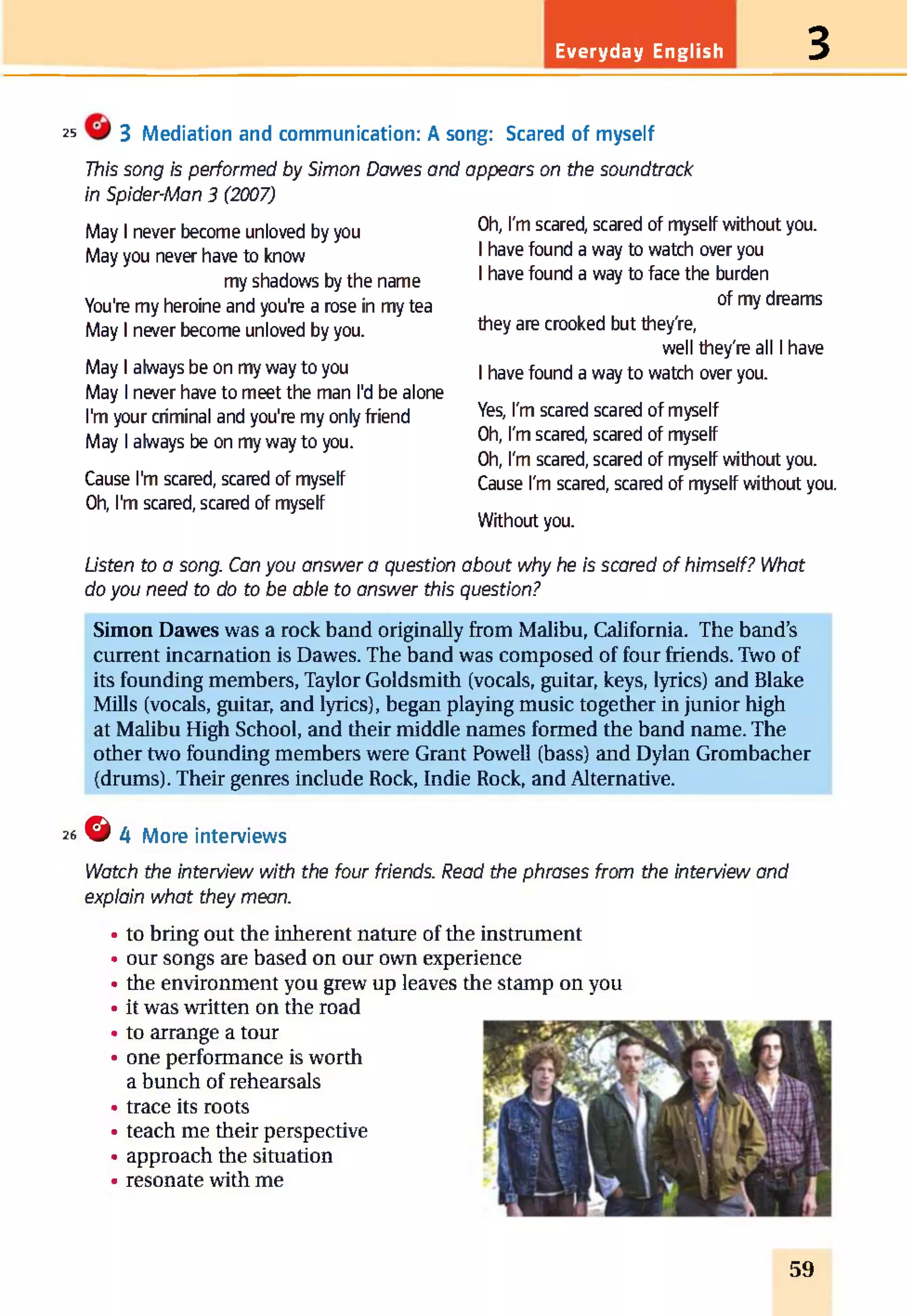
Interviews with the four friends 59
Get fit How to understand an English song? 60
Overheard Let's listen: Musicians 61
Let's listen: Their music 61
Facts and fiction Prince Caspian 62-65
Words in action Let's make a great mobile movie 66-67
Skills in action Letters and e-mails 68-69
Check in Let's listen: Who? 70-72
Let's talk: The best book 72-73
Language 1 So - such, enough - too 74
Language 2 A s...as, not as ...as 75
Everyday English Four steps to create a story 76
Let's listen: The theater bug 77
Theater superstitions 78
About Broadway 79
Get fit How to create tension? 80
Overheard Let's listen: Edgar Allan Poe 81
Let's listen: Mark Twain 81
Facts and fiction Best theater shows for teenagers 82-85
5
Contents
Words in action Let's add depth to language 86
Books you might write once 87
Free section Battle of the books 88-89
Try it out Coraline by Neil Gaiman 90-91
Revision 2 So - such, too - enough, who, which 92-93
Check in Let's listen: What country are they talking about? 94-95
Let's talk: Facts 96
Language 1 The present perfect progressive 97-99
Everyday English Different phrases for different feelings 100-103
Get fit Take part in a discussion 104
Overheard Let's listen: English is everywhere 105
Facts and fiction What Australians think about Americans 106-109
Words in action Fun with words and countries 110-111
Try it out City of Melbourne 112-113
Unit 6 Exploring the world
Check in Let's listen: Out and about 114
Let's talk: A New York City quiz 115
Language 1 The simple present passive 116-117
Language 2 The simple past passive 118-119
Everyday English No time for boredom 120-123
Get fit Effective reading strategy 124
Overheard Let's listen: Sidewalks, mansions, and skyscrapers 125
Facts and fiction Traveler's impressions 126-127
Words in action Ticket types 128-129
Try it out Travel brochures 130-131
Revision 3 The present perfect progressive,
the simple past passive 132-133
6
Contents
Check-in Let's listen: Cherkasy region 134
Let's talk: More about the photos 135
Language If-clauses 136-137
Everyday English Home for Thanksgiving 138-139
Get fit How to write a factual text 140
Overheard Let's listen: Fun activities for teenagers 141
Facts and fiction Traveler's diary 142-143
Words in action At a summer language camp 144-145
Try it out Seneca's story 146-147
Revision 4 If-clause, 148-149
Grammar 150-177
Vocabulary 178-231
Dictionary English - Ukrainian 232-271
7
Check-in1
Unit 1 It's my life
U niversity of
Pennsylvania
L a w School
34 4 3 Sansom Street
Tanenbaum Hall
LIFE is FULL of UPS and DOWNS
The Trick is ENJOY the UPS,
and have the COURAGE
. during the DOWNS.
DID YOU KNOW?
• Most autobiographies, regardless of their
length and target audience, will contain
basic facts like the time and places in
which the person lived.
• There is a difference between a biography
and autobiography. A biography is the
story of a person's life in the words of
another person, while an autobiography
or personal biography is the story of a
person's life in his/her own words.
• According to The Telegraph, the best­
selling biographies of all time include
"Lives of the Twelve Caesars" by
Suetonius, who served as a private
secretary to all the Caesars,- "The Life
of Samuel Johnson" by James Boswell,
which provides insight into an entire era
and "The Life of Charlotte Bronte" by
Elizabeth Gaskell, which offers an inside
look at the great author's life.
• Everyone wants your bio to be shorter.
The shorter your bio, the more people
will read it. No one is impressed by
a long series of unimpressive things.
If you have a great one sentence bio,
people will be curious enough to find
out more.
• You need to put the important facts
first. The fancy term for this is the
inverted pyramid. It comes from the
assumption that with each word in
your bio fewer and fewer people will
keep reading. It's a great assumption
because it's true.
8
Check-in 1
1 Your autobiography
a) Have you ever written your personal biography?
When? Why?
b) Look at the inverted pyramid and answer the
questions in "Most newsworthy info"section.
Example: Who are your parents? When and where
were you born?
1 © 2 Let's listen: Jack's biography
a) Look at the pictures on page 8 and
think how they can be connected.
b) Listen to Jacks' personal biography.
Choose a headline for the story;
one is extra.
a) My goals
b) Who am I?
c) My childhood
d) My ups and downs.
c) Listen to Jacks' personal biography.
Arrange the pictures according to the
story.
Example: Picture 1 represents his ....
d) Think which part ofJack's personal
biography is the most interesting.
Discuss with your partner.
£ 2 3 Let's talk: My personal biography
a) Work with your partner, asking and answering the questions.
1. What do you remember of your childhood?
2. What do parents tell about you as a three-year-old child?
3. What were you passionate about in primary school?
4. Has your passion changed today? How?
5. What are your ups and downs?
6. What are your goals?
b) Think of your own questions.
c) Tellyour friend about him / her. Ask for your friend's permission to tell the group
about him or her.
4 For my folder
a) Discover yourself further by asking your parents
and friends about:
•your childhood •your personality •you as a friend
•your strengths and weakness
b) Make a fact file and present it to your class.
/ADMITTING
YOUR WEAKNESSES
DOES NOT DIMINISH
YOUR STRENGTHS:
IT SHOWS
YOUR COURAGE
ERIN ANDREWS
9
1 Language 1 used to, didn't use
Used to
I am ten years old. It's my first year at middle
school. Middle school is a big transition for me.
I went from a class of 15 to a class of 30.
My biggest difficulty is that middle school
starts 45 minutes later than my elementary
school. I used to start elementary school at 8 in
the morning and finish at twelve. In elementary
school, we used to learn from one teacher.
She explained everything and answered any
and every question, but in middle school there
is one teacher per subject There is also a
difference in workload. In elementary school,
I used to have about an hour of homework a night, and in middle school it became
about two hours. It scares me a bit but I am getting used to it, and that definitely
prepares me for high school.
1 Your turn: Then and now
a) Talk about things you used to do / like, but don't any more,
and what you do / like now. Use the useful phrases from
the box.
Examples:
I used to paint much but now I love taking pictures.
I didn’t use to like healthy food but now I think it’s ok.
Useful phrases
to be interested in
to be good at
to enjoy
to love
to hate
to like
► We use used+to Infinitive to
describe past habits or states.
Note that you can talk about
past habits using past simple
tense with no difference in
meaning. However, used to
phrase is better to contrast two
habits in time and it's more
emotional. -» g-i
2 Match
Match the phrases in the left column with the phrases in the right column.
I used to eat a lot of chocolate but
Paul used to study in London but
He used to take the bus to school but
When I was a child I didn’t use to eat cheese
My parents used to go to a very
traditional school
I used to really enjoy his company but
She used to play the piano a lot but
We used to go to the beach for our holidays
My father used to ride a motorbike but
When I lived in the city
now he walks.
but now I eat a lot.
now I find him boring.
now I am on a diet.
when we were young children.
I often used to go to the theater,
now he studies in Ukraine,
now she plays the guitar,
where they wore uniforms,
now he drives.
10
get, make, let, have Language 2 1
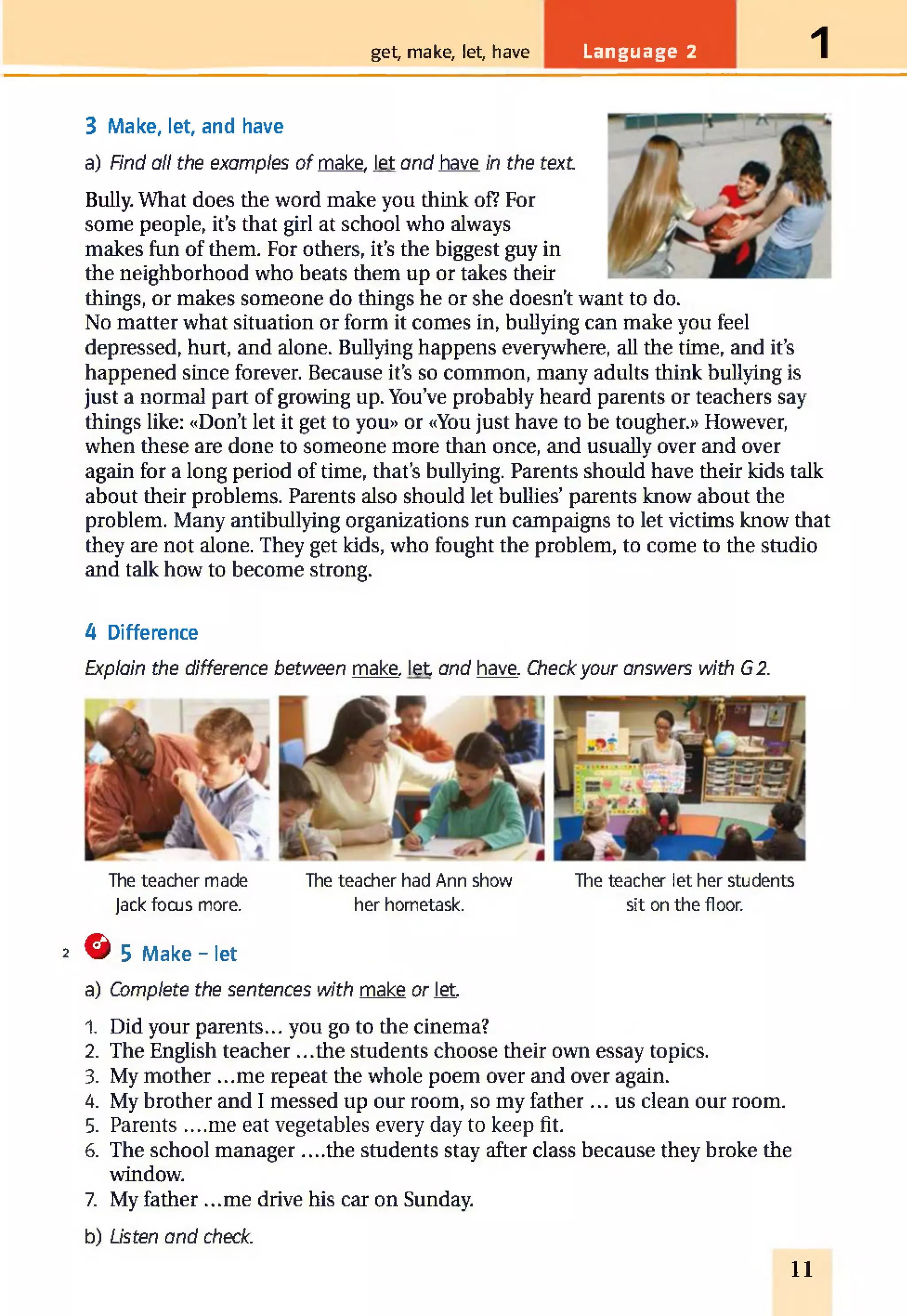
3 Make, let, and have
a) Find all the examples of make, let and have in the text
Bully. What does the word make you think of? For
some people, it’s that girl at school who always
makes fun of them. For others, it’s the biggest guy in
the neighborhood who beats them up or takes their
things, or makes someone do things he or she doesn’t want to do.
No matter what situation or form it comes in, bullying can make you feel
depressed, hurt, and alone. Bullying happens everywhere, all the time, and it’s
happened since forever. Because it’s so common, many adults think bullying is
just a normal part of growing up. You’ve probably heard parents or teachers say
things like: «Don’t let it get to you» or «You just have to be tougher.» However,
when these are done to someone more than once, and usually over and over
again for a long period of time, that’s bullying. Parents should have their kids talk
about their problems. Parents also should let bullies’parents know about the
problem. Many antibullying organizations run campaigns to let victims know that
they are not alone. They get kids, who fought the problem, to come to the studio
and talk how to become strong.
4 Difference
Explain the difference between make, let and have. Checkyour answers with G2.
The teacher made The teacher had Ann show The teacher let her students
Jack focus more. her hometask. sit on the floor.
2 © 5 Make - let
a) Complete the sentences with make or let.
1. Did your parents... you go to the cinema?
2. The English teacher ...the students choose their own essay topics.
3. My mother ...me repeat the whole poem over and over again.
4. My brother and I messed up our room, so my father ... us clean our room.
5. Parents ....me eat vegetables every day to keep fit.
6. The school manager ....the students stay after class because they broke the
window.
7. My father ...me drive his car on Sunday.
b) Listen and check.
11
1 Language 2 get, make, let, have
3 6 Get - have
a) Complete the sentences with have or get Put the verbs into the correct tense.
1. Our mother ... us to clean the room yesterday.
2. The teacher ... every student to write a story about their hometown.
3. Our teacher... us clean up our classroom on Sunday mornings.
4. I’ll... Sally to wash the dishes when she comes.
5. Your computer is making some strange sounds. I think you should ...
a technician to look at it.
6. We bought a new computer, and we ... my brother install the new game for us.
7. I had little time, so I ... my brother complete my homework last night.
b) Listen and check.
7 Two forms
Active form
Have + somebody + do (verb 1) +
something
In active form, we use somebody and
base form of the verb (verb 1) after the
verb «have».
Passive form
Have + something + done (verb 3) +
(by someone)
In passive form, we use something and
past participle of the verb (verb 3) after
the verb «have». -* G2
Choose the right word.
1. Mary had the nurse check / checked her temperature.
2. I must have the mechanic check / checked my car.
3. We’ve had a web designer make / made our website.
4. Mary had her temperature checked/ check by the nurse.
5. I must have my car checked / checked by the mechanic.
6. We’ve had our website make / made by a web designer.
8 Unscramble
Make the right sentences by putting the words in the right order.
1. She • never • her • lets • me • drive • car
2. We • are • room • painted • getting • the • living
3. You • mechanic • must • the • brakes • have • the
4. him • apologize • Sam • made • for •
the • mistake
5. The • collect • the • teacher • made •
me • garbage
6. The • secretary • boss • the • report •
will • get • the • to • write
7. The • doctor • give • up • made • smoking • her
• controlled • by
One o f the simplest ways
to stay happy is to let go
o f all o f the things that
make you sad.
12
Talking about the future Language 3 1
Talking about the future
1 Remind yourself of the forms
First look at the information on the right Then read
the dialogue and find examples of how to talk about
the future. Explain why the different tenses are used.
Naomi’s sister Lucy, a college student, wants to
earn some money.
^ • present progressive: for
future arrangements
• 'will' future: for
personal predictions
• 'going to' future: for
plans or when it is
already clear what is
going to happen
• simple present: for
'timetable' information
Lucy: Hey, Naomi, have you heard my news?
Naomi: No, but I can see you’re going to tell me! So go on.
Lucy: Well, I phoned about a Saturday job in a shoe shop, and I’m going for
an interview with the manager tomorrow!
Naomi: Oh, that’s cool. Well, good luck!
Lucy: Thanks. The interview starts at 9.45.1don’t expect it’ll take too long.
Naomi: What are you going to wear?
2 Say what Naomi is doing next week
a) Use Naomi's notes to give the information.
Example: On Monday she is having her hair
cut. Her appointment is at 4.30.
Hair appointment —
^ Geog. p r0ject presentation!
Wed 11.15 interview P’borough
Regional college
Volleyball Thurs after school
b) What arrangements do you and your
partner have for next week?
Ask and answer questions.
1. Are you going anywhere special next week?
2. What are you doing after school on ...?
3. What time does/is ...? ...?
Sat 12A O meet Grandad a t station
Charity W alk Sun - start
outside sports centre 10 am
Phone personal adviser
3
a)
b)
1.
2.
0 c)
Talk about plans for the future
Go on with what Marco tells his friends
about his plans for a great life. Find your own verbs.
“When I leave school, I’m going to study IT at uni.
Then I’m going to start...”
Marco's friends want to have a little fun with him.
Use your own ideas to make their predictions.
“Sorry, but I don’t think your plans will work out!”
“It’s quite possible that/Maybe ... will/won’t ...”
Your turn: Flow do you see your own future? Write a paragraph describing your plans
and predicting whatyour life will be like. (You needn't be too serious!)
13
Everyday English1
HOW I SEE MYSELF]:
Read the following sentences. Ifyou
think a sentence describes you, give
yourself one point for the colour of that
sentence. If there are two colours, give
yourself a point for each. The colour for
1 .1enjoy painting and drawing.
2 .1am quick at learning how to use new
technical equipment
3. One of my favourite subjects is
Chemistry. •
4 .1enjoy watching TV commercials. •
5 .1like helping people.
6 .1am interested in why firms lose money
or make money. •
7.1write my own computer programmes.
8 .1am good at making my own
decisions, but I am also a reliable team
member. • •
9 .1enjoy making my bedroom look nice.
10.1am interested in nature.
11.1am good with numbers. •
12. Writing stories or plays is fun.
13.1sometimes raise money for
charities. •
14.1love cooking and thinking of my own
recipes.
Green: You are good with people and
would enjoy a job in a field like health,
social work, education or management,
e.g. a nurse, a teacher, a personnel
manager. If you prefer animals, you could
be a vet or work in a zoo.
Blue: A job where you are involved in
science or technology and where you can
use your practical skills would suit you,
e.g. a research scientist, an engineer.
which you have most points at
the end of the questionnaire is the one
that suits you best (although other
colours may also be important). Find out
what this means by reading your colour
profile below.
15.1would like to make things that I can
sell. •
16.1compare prices when I go shopping. •
17.1know how much I can earn on money
in the bank. •
18.1enjoy performing on stage.
19.1like hanging out with friends.
20. It would be fun to make a machine that
uses wind power.
21.1try to be tactful.
22.1have an idea for a great new
invention. •
23.1like making guests feel welcome.
24. Music helps me to express my feelings.
25.1enjoy examining things to find out
how they work.
26.1am (would like to be) in a dance
group. •
27.1always try to win competitions or races. •
28.1am interested in the design and
construction of buildings.
Yellow: As a creative person, you would
be suited to a job in design or in some
form of art or entertainment, e.g. an
architect, a cartoon artist, a musician.
Red: The business world is full of
different opportunities for ambitious,
competitive people like you. You could
become a banker or a lawyer, or you
could even found your own company -
if you haven't already done it!
1 Talk about the questionnaire
a) Do the questionnaire. Do you agree b) Think of morejobs and more sentences
with what it says about you? for each colour.
Say why or why not
14
Everyday English 1
2 How to: Talk about personal qualities
a) Look at what a student tells her personal
adviser. Then collect words and phrases
to describe your own personal qualities.
The Useful phrases can help. You can also
use phrases from the questionnaire on page 14.
I like challenges
I'm good at solving
problems. I can work
alone, but I prefer to
work in a team. I'd
say I'm an ambitious
person.
USEFUL PHRASES
• I think/l'd say I'm reliable/practical/creative/patient/...
• I'm (not so) good/with children/at using words/...
• I find it easy/fun/... to meet people/leam new skills/...
• I (don't) like deadlines/computers/challenges/...
• I prefer to work alone/outside/...
TIP
Ask your teacher or use
a dictionary for any new
words you need. Collect
'personal vocabulary' in
your folder.
b) In groups, take turns to presentyourselves. Tell the truth, but try to stress your good
qualities. Listen critically to the others in your group and make helpful suggestions.
4 Mediation and communication: Personal stories
a) You are going to listen to three personal stories of school leaders. Summarize the
information completing the sentences in the boxes below.
Mark
Student government
president
Sandy
Outreach
coordinator
Mathew
Student newspaper
correspondent
Mark always wanted to be ...
He likes ...
He never...
He keeps his team ...
Sandy helps ...
She raises ...
She has done...
Mathew brings...
He is ....
He understands ...
He wants
b) Are you a leader? Who is a leader in your class? Why do you think so?
c) Write a profile for your leaders and post them on your school website.
15
Everyday English
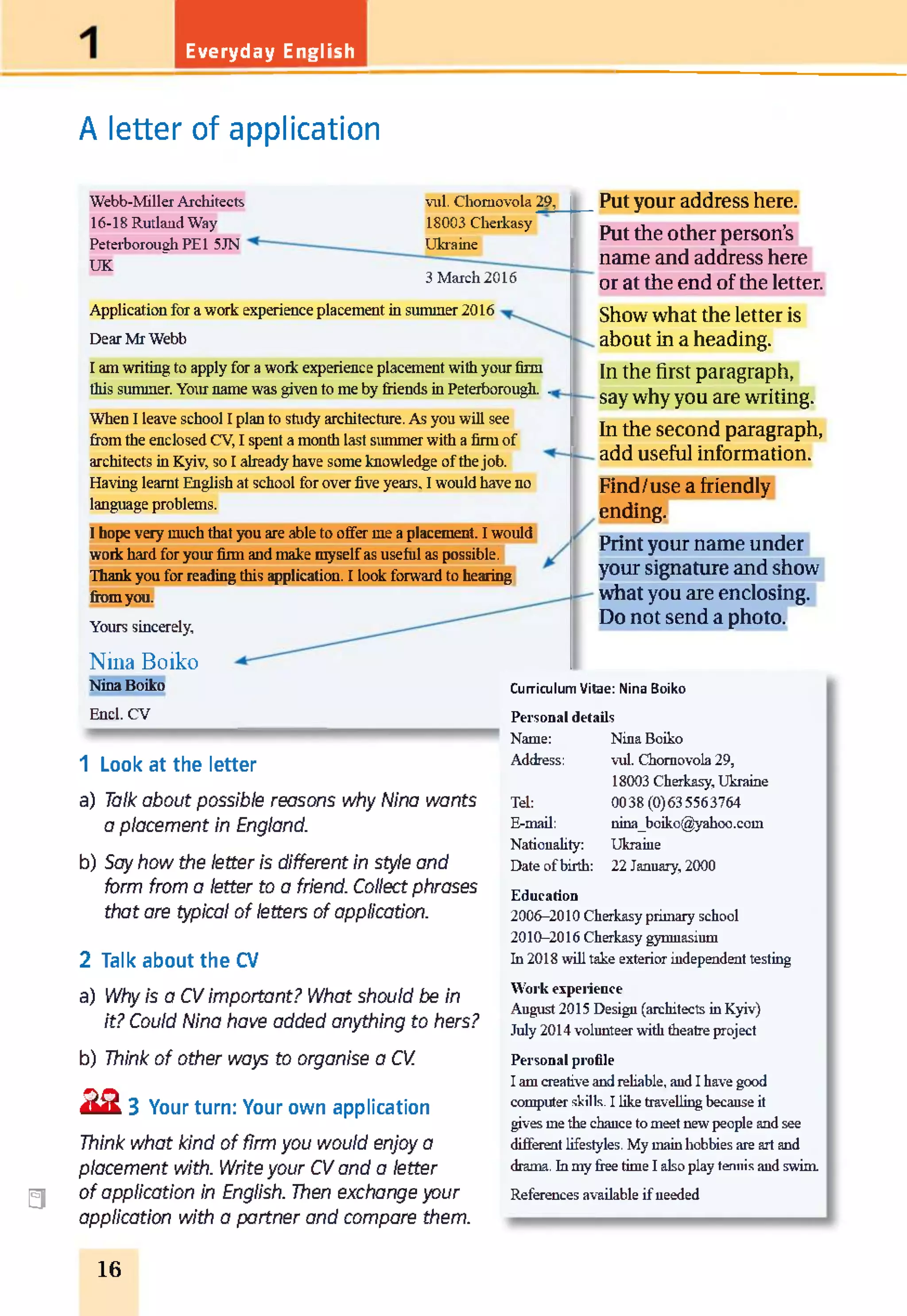
A letter of application
Webb-Miller Architects
16-18 Rutland Way
Peterborough PE 1 5JN
UK
vul. Chomovola 29,
18003 Cherkasy
Ukraine
3 March 2016
Application for a work experience placement in summer 2016
Dear Mr Webb
I am writing to apply for a work experience placement with your firm
this summer. Your name was given to me by friends in Peterborough. .
When I leave school I plan to study architecture. As you will see
from the enclosed CV, I spent a month last summer with a firm of
architects in Kyiv, so I already have some knowledge of the job.
Having learnt English at school for over five years. I would have no
language problems.
I hope very much that you are able to offer me a placement. I would
work hard for your firm and make myselfas useful as possible.
Thank you for reading this application. I look forward to hearing
from you.
Yours sincerely.
a
Nina Boiko
Nina Boiko
Enel. CV
1 Look at the letter
a) Talk about possible reasons why Nina wants
a placement in England.
b) Say how the letter is different in style and
form from a letter to a friend. Collect phrases
that are typical of letters of application.
2 Talk about the Cl
a) Why is a CV important? What should be in
it? Could Nina have added anything to hers?
b) Think of other ways to organise a CV.
2 2 3 Your turn: Your own application
Think what kind of firm you would enjoy a
placement with. Writeyour CV and a letter
of application in English. Then exchange your
application with a partner and compare them.
Put your address here.
Put the other person’s
name and address here
or at the end of the letter.
Show what the letter is
about in a heading.
In the first paragraph,
say why you are writing.
In the second paragraph,
add useful information.
Find/use a friendly
ending.
Print your name under
your signature and show
what you are enclosing.
Do not send a photo.
Curriculum Vitae: Nina Boiko
Personal details
Name:
Address:
Tel:
E-mail:
Nationality:
Date of birth:
Nina Boiko
vul. Chomovola 29,
18003 Cherkasy, Ukraine
0038(0)635563764
nina_boiko@yahoo.com
Ukraine
22 January, 2000
Education
2006-2010 Cherkasy primary school
2010-2016 Cherkasy gymnasium
In 2018 will take exterior independent testing
Work experience
August 2015 Design (architects in Kyiv)
July 2014 volunteer with theatre project
Personal profile
I am creative and reliable, and I have good
computer skills. I like travelling because it
gives me the chance to meet new people and see
different lifestyles. My main hobbies are art and
drama. In my free time I also play tennis and swim
References available if needed
16
Everyday English 1
Making a good impression at an interview
When you have an interview for a job or for work experience, you are almost always
in competition with other people, so it is very important to make a good impression.
22 1 Talk about how to prepare before the day of the interview
Say what information you should get or whatyou should do to ...
1. ... be in the right place by the right time. 2. ... look suitable for the job.
3. ... have answers ready to give at the interview. 4. ... show you are really
interested in that company. 5. ... feel fresh on the day.
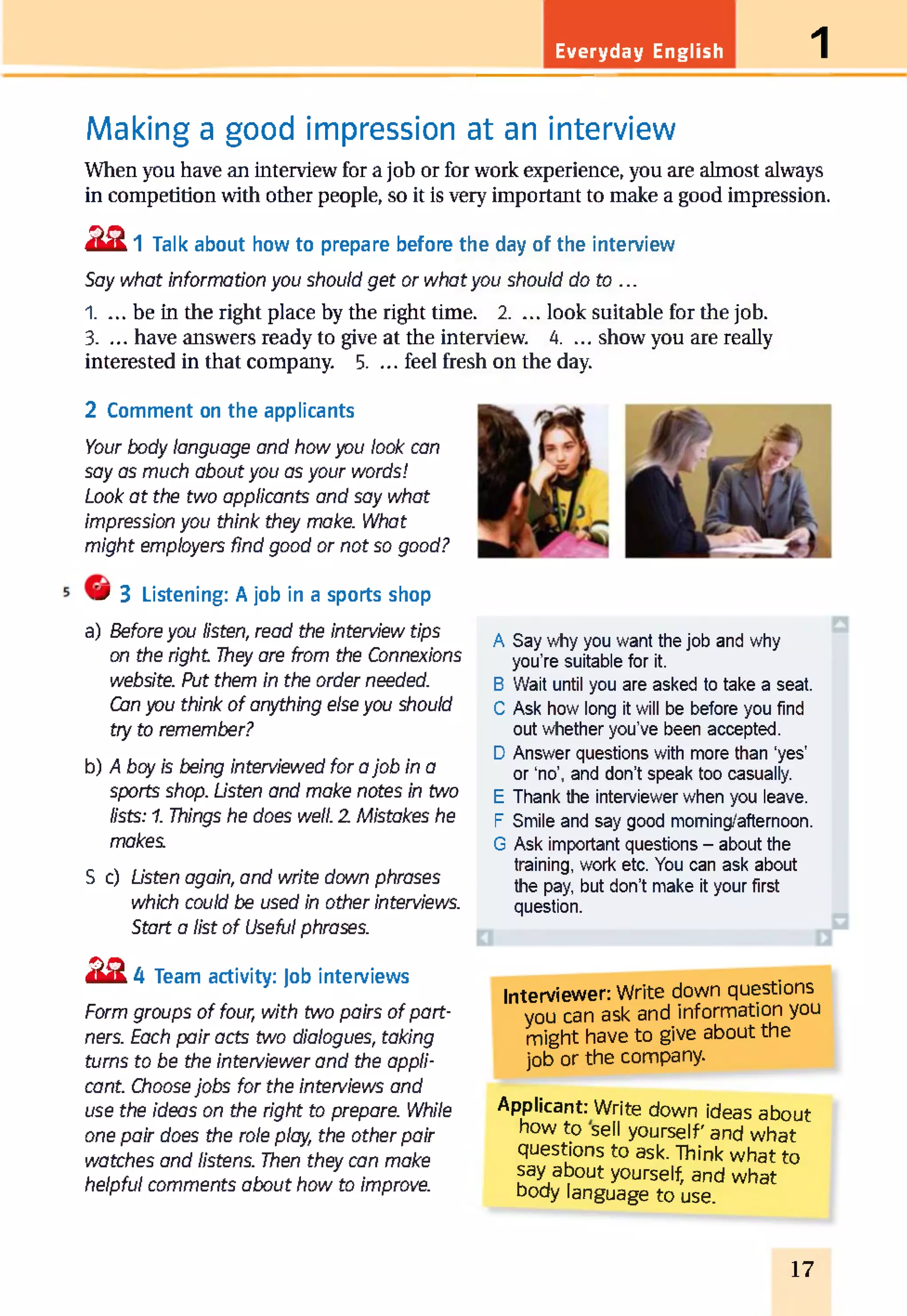
2 Comment on the applicants
Your body language and how you look can
say as much about you as your words!
Look at the two applicants and say what
impression you think they make. What
might employers find good or not so good?
'J S Listening: A job in a sports shop
a) Before you listen, read the interview tips
on the right They are from the Connexions
website. Put them in the order needed.
Can you think of anything else you should
try to remember?
b) A boy is being interviewed for ajob in a
sports shop. Listen and make notes in two
lists: 1. Things he does well. 2 Mistakes he
makes.
S c) Listen again, and write down phrases
which could be used in other interviews.
Start a list of Useful phrases.
2 2 4 Team activity: Job interviews
Form groups of four, with two pairs of part­
ners. Each pair acts two dialogues, taking
turns to be the interviewer and the appli­
cant. Choose jobs for the interviews and
use the ideas on the right to prepare. While
one pair does the role play, the other pair
watches and listens. Then they can make
helpful comments about how to improve.
A Say why you want the job and why
you're suitable for it.
B Wait until you are asked to take a seat.
C Ask how long it will be before you find
out whether you've been accepted.
D Answer questions with more than ‘yes’
or ‘no’, and don’t speak too casually.
E Thank the interviewer when you leave.
F Smile and say good moming/aftemoon.
G Ask important questions - about the
training, work etc. You can ask about
the pay, but don’t make it your first
question.
Interviewer: Write down questions
you can ask and information you
might have to give about the
job or the company.
Applicant: Write down ideas about
how to sell yourself' and what
questions to ask. Think what to
say about yourself, and what
body language to use.
17
Get fit!1
INTERVIEW ETIQUETTE
It's vital that you prepare for the interview
employer. These tips will help you.
• Rehearse. There are several questions
that will be asked during an interview:
"Why do you want to work here?"
"What are your strengths and
weaknesses?" So be prepared with
insightful answers.
• Brush up on Body Language
Don't: sit with your arms and legs
crossed, keep your hands in your lap,
twirl your hair.
• Dress and smile. It's always better
to overdress than underdress. A
dark suit (jacket and pants or skirt)
and a crisp white shirt, and clean,
professional shoes will be perfect in
most cases. Smile naturally!
BQQO0B
with your advisor or summer job
• Ask questions.
Such as details about the type of
work, the corporate culture, and
the typical career path. And don't
be scared to speak up: not asking
questions can signal that you're
uninformed or uninterested.
• Send a proper "Thank you" note
Express your thanks for the
interviewer's time and for the
chance to learn more about the
company. No need to go overboard
and—please—do not send a gift or
flowers after the interview (yes, it's
been done).
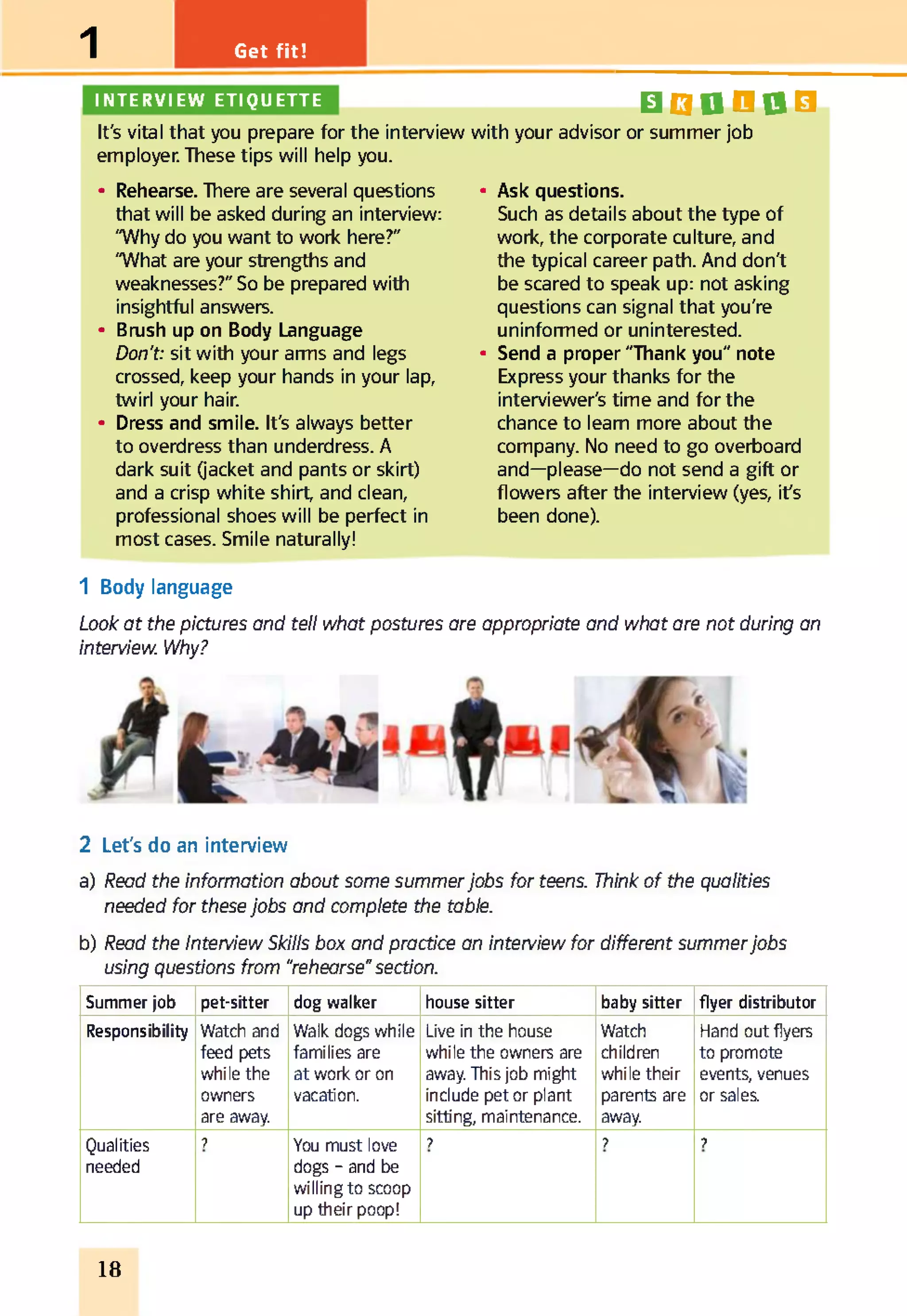
1 Body language
Look at the pictures and tell what postures are appropriate and what are not during an
interview. Why?
2 Let's do an interview
a) Read the information about some summerjobs for teens. Think of the qualities
needed for these jobs and complete the table.
b) Read the Interview Skills box and practice an interview for different summerjobs
using questions from “rehearse"section.
Summer job pet-sitter dog walker house sitter baby sitter flyer distributor
Responsibility Watch and
feed pets
while the
owners
are away.
Walk dogs while
families are
at work or on
vacation.
Live in the house
while the owners are
away. This job might
include pet or plant
sitting, maintenance.
Watch
children
while their
parents are
away.
Hand out flyers
to promote
events, venues
or sales.
Qualities
needed
? You must love
dogs - and be
willing to scoop
up their poop!
? ? ?
18
Overhead
© 1 Let's listen: Mark Zuckerberg
Listen and complete the gaps.
Mark Elliot Zuckerberg was born on May the 14th, 1984. He
is the creator o f__________________ Facebook. He was
a star student at school, winning__________________ ,
maths and physics. He also excelled in Classical studies.
He studied Psychology and Computer Science at Harvard
University,__________________ created Facebook. His
__________________ his becoming Time magazine’s Person Of The Year for 2010.
Zuckerberg excelled in everything__________________ . He was captain of the
school fencing team, spoke many languages and was a __________________
programmer. While other kids played computer games, he designed them. He
created his first network while in high school__________________ the computers
in his father’s dental surgery. He also built a media player__________________
interest of Microsoft and AOL.
Zuckerberg started at Harvard in September 2002. In his first year, he created
Facemash, a Facebook predecessor, th a t________________ the college’s best
looking people from__________________ .He launched Facebook from his Harvard
room in February 2004. It was the start of__________________ that would people
worldwide and make him the world’s youngest billionaire.
In 2010, Zuckerberg signed a promise called the «Giving Pledge», in which he
promised to __________________ of his life wealth to charity.
© 2 Let's listen: Believe (Justin Bieber)
Listen to the song and think how it can help you to achieve success.
Believe, believe, believe, believe
I don't know how I got here
I knew it wouldn't be easy
But your faith in me was so clear
It didn't matter how many times
I got knocked on the floor
But you knew one day
I would be standing tall
Just look at me now
Cause everything starts from
something
But something would be nothing
Nothing if your heart didn't
dream with me
Where would I be, if you didn't believe
(Believe) Believe...
There were days when
I was just broken, you know
There were nights when I was doubting myself
But you kept my heart from falling
It didn't matter how many times
I got knocked on the floor
But you knew one day I would be standing tall
Just look at us now
Cause ...
Where would I be, if you, if you
If you didn't believe
Would I know how it feels to
Touch the sky, if you didn't believe, believe, believe
It didn't matter how many times I got
knocked on the floor
You knew one day I would be standing tall
Just look at us now
Cause ...
19
Facts and fiction1
8© Now that's what I call living!
The following text is from a British novel about a boy who is trying
to discover what kind of person he is. ‘Now that’s what I call living!’
is the title of a little story told by the boy in the novel.
1 Before you read
What do people mean when they say someone is weird?
What does the word mean to you?
Here’s a little story.
This guy, let’s call him Jimmy, he lives with his family in an old school bus in New
Mexico. There’s him, his mom and dad and his five brothers and sisters, all in this
old bus. They’re driving it all around New Mexico and up into California, staying in
different places, just bumming around.
Only one day the poor old bus dies. “Dag nabbit,” it says, at the end of too many
hot and hard days, Tve had enough of ol’Route 66, or wherever we are. I’m off to
meet the great bus-builder in the sky.”
So when they get to the next corner, Dad turns the wheel and the hippy bus, for
the first time in its life, doesn’t follow. Yes, for the first time in its long life, it does
what it damn well wants. Goes straight on and offthe road, down a slope and finally
stops upside-down on its roof.
And would you believe it! Mom and Dad and Jimmy and the other five little
Brokers all climb out of the doors and windows, every one of them just fine.
And Dad says, after he’s counted them all quickly, “OK. That’s the last time I
live in a bus.”And off he goes and buys a tent. A big old army tent. And they’re off
again, stopping here and there, and life’s not so bad until one day the poor old tent
is grabbed by a tornado, up into the air and away. And Dad says, “OK. That’s the last
time I live in a tent.”
So they go to the coast, where he buys an old boat. One that’s seen better days,
of course. And they’re planning to live off what they can get from the sea, only
none of them has any idea about fishing. Two fishes they catch that first day, two
fishes between the seven of them, and Jesus might have been able to feed the five
thousand like that, but Mom and Dad, no way.
A storm starts and they can’t get back into the harbour. So they’re out all night,
thrown around by the waves at their most extreme. And Dad doesn’t know much
about sailing a boat, I’m afraid, not having had much experience because he grew
up as far from the sea as anybody can get, but he manages. Just about, he manages.
And when they finally get back to dry land, Mom and Jimmy and the five brothers
and sisters all say, like they’ve been rehearsing it for days, although they haven’t
actually, “Listen, Dad,”they say. “That’s the last time we live in a boat. It’s time to get
you act together, start living in the real world, find yourself a job and us a home!”
And he does, in a way. He gets them a big trailer to live in and he turns himselfinto
a taxi-driving part-time gardener (although he doesn’t know a lot about gardens,
20
Facts and fiction 1
and he thinks he can drive a cab the way he used to drive that poor old bus, not
well at all).
And Jimmy and the rest of the kids have a more normal life after that, with a
roof over their heads, and schools, and enough food. But every one of them has
been affected by their unusual childhood and so they can never quite match other
people’s narrow expectations. In other words, they’re weird. Real weird.
One grows up to be an artist in Ulan Bator, another becomes a wrestler in Southern
Winnipeg and a third is a lion tamer in Outer Mongolia. (I actually haven’t any idea
what they did - it didn’t tell you in the Sunday Information where I read about this
Jimmy guy, but never mind, I’m sure that’s what story-telling is all about, making it
up as you go along.) And each one of them goes their own crazy way.
2 Stop and think
What do you think an unusual childhood is? How might it affect your later life?
And Jimmy?Well, I can tell you a bit more about Jimmy. Jimmy saves lives. Jimmy
studies and passes exams, and passes more exams, and Jimmy becomes a doctor.
And not for Jimmy the nice easy life of a town doctor in the American Midwest,
oh no. Jimmy goes to the Congo. Jimmy goes to a village in the middle of Africa,
a village of great poverty, a village with lots of disease and no doctors at all. There
Jimmy starts a hospital, and there Jimmy saves lives. Lots and lots of lives.
People hear about this, and they come from miles around, on animals, on foot,
any way they can get there. They camp outside and wait until Jimmy can help them.
As many as his few medicines allow.
And the people love Jimmy because he has a special gift. He can cure with drugs
and he can cure with his hands. He’s thin and he has white skin and he wears little
round John Lennon glasses like his father before him. Well, all those Africans think
he’s the strangest guy they’ve ever seen, but they respect him. They respect him and
they love him.
For he can cure anything, almost. He comes to your bed when no one else wants
to come to your bed, holds your hand when no one else wants to hold your hand,
and he talks to you gently, sometimes in your language and sometimes in his. And
you don’t understand what he’s saying and you don’t know how holding your hand
is going to make you feel better, but it does.
21
Facts and fiction1
And from time to time Jimmy leaves. He leaves his hospital in the hands of the
African doctors and nurses he’s trained, and he flies back home to America and he
begs for drugs and money to go on with his work.
And he travels all around, talking to businessmen and politicians and church
groups and colleges and anyone who’ll listen. And he tells them about women dying
because there is no clean water, and children dying because they need medicine
that costs fifty cents in the United States. And he shows them photos of hungry
people and photos of disease and he shows them pictures that would make anyone
with even half a heart cry.
And this Jimmy, he shows all these people a photo of a girl who was brought to
the hospital one night. She’d been carried twenty miles. She’s completely bald and
her body is thin and her arms and legs are like sticks. Then, would you believe it!
Here’s a picture of her a few months later, with a beautiful head of hair, a round
face, and a big happy smile!
“So put your hands into your pockets,” says Jimmy, “deep, deep down into the
large pockets of the west. Because the poor are suffering. All over the world the poor
are suffering, and it’s up to you to help them.”
And they do! They take out their wallets, the businessmen. They open their doors,
the bankers. They clear out their drug cupboards, the doctors, and they give our
Jimmy what he needs to go on for another few months.
And the drugs he gets, he uses to cure people. And the money he gets, he spends
on cleaning the water system so there’s no more disease. And the rest of the money
he spends on schools. Schools to give people an education. And one of the things
he makes them teach people in the schools and the villages is how not to get AIDS.
So that’s Jimmy. That’s what he does, that boy I was telling you about, the one
who grew up in a bus, travelling around New Mexico.
And it’s all true, because I read it in a Sunday paper some time ago. I’ve changed
the names and the facts a bit, but it’s more or less all true.
And if you’re still wondering why I’m telling you Jimmy’s story, not mine, then
you don’t understand what I’m talking about at all. I’m talking about life! I’m talking
about not just living the same old way everybody else does. I’m talking about getting
out there and doing something real.
Because that’s what I call living! That’s what I call living!
(From Who is Jesse Flood? by Malachy Doyle)
22
Facts and fiction 1
22 3 Talk about Jimmy
1. How is Jimmy’s life different from most other people’s lives?
2. Why did he become the kind of person he is?
4 Look at the style
How is a story told in the first person different from one written in the third person?
Find typical phrases in the text
5 Examine the text structure
Divide the text into parts. Write down what each part is about
Start: Childhood: line 1- ...
6 Father's story
Look at the pictures and describe Jimmy's father's life.
7 Jimmy's story
a) Think ofJimmy's activities in America. How does he raise money? Why does he need
the money?
b) What does he do with the money in the Congo?
8 Writing texts: Biographies
Choose one ofJimmy's brothers or sisters and write their biography. You can make
things up if you want to!
9 Create an ad for Jimmy's campaign for Africa
^ 10 Collaborative writing: Biographies
In groups of four, decide on a person thatyou all know or admire. It can be someone famous
Make a plan of the person's life, usingyour text structure from exercise 5 to helpyou. Then
each ofyou writes one part of the biography. Check and improveyour texts together. Is the
style ofyour texts the same? Then readyour complete biography to your dass.
23
Words in action1
9 W 1 More about Mark Zuckerberg
a) Listen to the text again
on page ... and match
the words from the article
on the left with their
synonyms on the right.
n
creator creation
star talented
invention top
excelled maker
skilled attention
interest shone
select link
launched frequently
connect choose
influential give
regularly started
donate important
b) Choose the right word in each of the pairs of italics.
Mark Elliot Zuckerberg was bom / birth on May the 14th, 1984. He is the creator /
created of the social media site Facebook. He was a moon / star student at school,
winning prizes in astronomy, maths and physics. He also excelled / excellent in
Classical studies. He studied Psychology and Computer Science at Harvard
University, which is where he created Facebook. His inventor / invention led
to he / his becoming Time magazine’s Person OfThe Year for 2010.
Zuckerberg excelled in everything he did in his young / youth. He was captain
of the school fences /fencing team, spoke many languages and was a highly/
height skilled computer programmer. While other kids played computer games,
he designed them. He created his first network wilt / while in high school to /
by connect all of the computers in his father’s dental surgery. He also built a
media player which attracted the interested / interest of Microsoft and AOL.
Zuckerberg started at Harvard in September 2002. In his first year, he created
Facemash, a Facebook processor / predecessor, that let students choice /
select the college’s best looking people from a selection of photos. He launched
/ lunched Facebook from his Harvard room in February 2004. It was the start
of a rollercoaster attraction / ride that would joined / connect half a billion /
thousand people worldwide and make him the world’s youngest billionaire.
Mark Zuckerberg is now one of the most influence / influential people on the
planet. He has dined/dimmed with the president of the USA and regularly/
regilar attends global economic summits and technology forums. He stated: «The
thing I really care about is the mission, making the world openly / open." In 2010,
Zuckerberg signed a promise called the “Giving Pledge”, in which he promised
to donation / donate at least half/ halves of his life wealth to charity.
24
Words in action 1
c) What Mark's achievements do these pictures represent?
© d) Form nouns of the following verbs. Listen to a recording and check
create lunch influence state promise
choose attract dine care donate
launch connect attend sign
3 Play with prefixes
a) Form the antonyms
of the following
fair helpful
happy sure moral
with the dictionary.
usual interesting
active polite
regular appropriate
b) Use the adjectives in your sentences. Use such
phrases as “can be a little"or “...can be a bit"
or “not always"so that they sound less negative.
► You can easily form opposite
in meaning adjectives using
negative prefixes ir, im, in, il,
dis, un
responsible - irresponsible
reliable - unreliable
logical - illogical
loyal - disloyal
sincere - insincere
mature - immature
Example: She can be a little disorganized sometimes. Dan is not always mature.
4
a)
active, curious, and communicative
Givers' qualities
Although there are many different types of
generous people, there are some common traits
that the mostgenerous people share. Look at
those qualities and explain their meaning Use
the English-English dictionary ifyou need.
“People wait until late in their career
to give back. But why wait when
there is so much to be done?”
- Mark Zuckerberg on joining
‘Giving Pledge’
optimism
altruism trust
energy ability to lead
b) Which of these qualities do you have? Why do you think so?
5 Be aware of takers
There are people who love taking. There are some warning signals that can tellyou that
you are dealing with a taker.
• They are impatient and hate to wait.
• They interrupt or butt into conversations.
• They act as if they are always right.
• They act as if they are never wrong.
• They blame others for their faults.
• They never appreciate your help.
• They aren’t motivated to care or do anything unless it gets them something.
иь«/ rfs -Нм«/
4т> MOV«/ ort.
25
Words in action1
6 Zodiac signs and people's characters
a) Find your zodiac sign and analyze if it describes you accurately. Tellyour partner what
is right and what is wrong.
Capricorn
22 December
19 January
People are sensible
and organized, but
sometimes can be
conceited.
Aquarius
20 January
18 February
are very loyal, but
they can be a little
insensitive at times.
Pisces
19 February
20 March
can be very romantic,
and are always
sympathetic
Taurus
20 April
20 May
are calm and
patient, but also very
materialistic.
Gemini
21 May
20 June
are very witty, but
they tend to be a little
impatient
Cancer
21 June
22 July
are very kind and
helpful, but they can
sometimes be very
moody.
Virgo
23 August
22 September
are hardworking, but a
little bit fussy and very
critical.
Libra
23 September
22 October
are artistic, but they
tend to be indecisive.
Scorpio
23 October
21 November
are often passionate
but sometimes
a little cruel.
Aries
21 March
19 April
are extremely energetic
and adventurous.
Leo
23 July
22 August
are very sociable, but
can often be vain as
well.
Sagittarius
22 November
21 December
are always cheerful and
optimistic, but they always
tend to be reckless.
26
Words in action 1
b) Read the descriptions and write adjectives that describe your strengths and
weaknesses.
Strengths organized
Weaknesses
c) Givejustification for every adjective, describing yourself.
Example: I am organized. I keep things in order, so it is easy to find what I need.
Autobiographical Poem
An autobiographical poem is a poem that
the author writes about himself.
Line 1: Your first name
Line 2: Four adjectives that describe you
Line 3: Son/daughter o f..., Brother/sister o f...
Line 4: Lover of (three people or ideas or a
combination)
Line 5: Who feels (three sensations or emotions)
Line 6: Who find happines in (three things)
Line 7: Who needs (three things)
Line 8: Who gives (three things)
Line 9: Who fears (three things)
Line 10: Who would like to see (three things)
Line 11: Who enjoys (three things)
Line 12: Who likes to wear (three things)
Line 13: Add something you want to say
Line 14:Your last name only
YOU CAN ALREADY
v'' Distinguish between
autobiography and biography.
^ Talk about personal
biography.
✓ Describe people's character.
✓ Use used to, make, let, have,
and get.
✓ Talk about the future using different
constructions.
✓ Explore your strengths and weaknesses.
✓ Talk about people's accomplishments.
✓ Write a letter of application.
✓ Prepare yourself for the interview.
✓ Write poems.
V
7 Autobiographical poem
Tamara,
Strong, creative, enthusiastic, and caring,
A daughter of Ivan and Lena, a sister of
Dmytro,
Loves being with the family, exploring life,
Feels excited, loved, and taken care of,
Is happy when she sees the sun, learns a
new thing or feels a new emotion,
Needs time with the dearest, strength to
break old habits, and spirit to stand up to
bullies,
Gives her time,joy, and energy,
Fears stupidity, lies, and dishonesty,
Would like to see the world, ocean bottom
and her great-grandchildren,
Enjoys communicating, supporting, and
caring,
Wears earrings, scarfs, and smile,
Wants people to be happy,
Yarova
27
The Bible
A young man from a wealthy family was about to graduate from high school. It
was the custom in that affluent neighborhood for the parents to give the graduate
an automobile. Bill and his father had spent months looking at cars, and the week
before graduation they found the perfect car. Bill was certain that the car would
be his on graduation night.
Imagine his disappointment when, on the eve of his graduation, Bill’s father
handed him a gift-wrapped Bible! Bill was so angry; he threw the Bible down and
stormed out of the house. He and his father never saw each other again. It was
the news of his father’s death that brought Bill home again.
As he sat one night, going through his father’s possessions that he was to inherit,
he came across the Bible his father had given him. He brushed away the dust and
opened it to find a cashier’s check, dated the day of his graduation, in the exact
amount of the car they had chosen.
Beckah Fink
Check these words in the dictionary.
affluent • disappointment • gift-wrapped • stormed • go through •
possessions • brush away • amount
A Reading
Read the text and complete the sentences.
a. A young man was from
1 a poor family. 2 a wealthy family. 3 an orphanage.
b. Parents always gave the graduate
1 a car. 2 the Bible. 3 a watch.
c. Looking for a car Bill and his father spent
1 a month. 2 a year. 3 months.
d. Bill’s father handed him
1 a wrapped box. 2 the Bible. 3 money.
e. Bill was so
1 happy. 2 excited. 3 furious.
f. After his father’s death Bill found
1 a cashier’s check. 2 a letter. 3 a testament.
28
Try it out!
B Language
Read the sentences. How does Beckah say them?
a. It was the custom in that wealthy community for the parents to give the
graduate a car.
b. Bill and his father looked for a car for months.
c. The week before graduation they came across the perfect automobile.
d. He and his father never met again.
e. He dusted the Bible.
11 © C Listening
Look through the statements before you start listening. Listen to Kelly's graduation
speech and mark the statement as true (7) or false (F).
a. Kelly is a senior who is ready to graduate and move forward in the world.
b. She measured the time spent in high school in bad marks and losses.
c. After she graduates, she will measure her time at school in friendships.
d. Kelly’s speech is about her future career.
D Mediation and communication
You and your friend think of some questions to conduct a survey
among students in Year 11. Here are some questions you can use
to begin it Conduct the survey and report results to your class.
a. Are you happy to leave school?
b. What makes you feel so?
c. What will you miss?
d. Will you receive any gifts from your parents on your graduation?
e. Have your discussed your gift with your parents?
E Writing as a process
You are asked to write an article for a school newspaper about school graduates.
The topic is "Saying 'good bye' to school."
1 Skills. Do not get anxious with your writing. Remember that writing is more about
Re-Writing. Follow the steps.
a. After you have conducted the survey, sort out answers.
b. Think what questions triggered the most interesting answers.
c. Plan your article.
d. Write the draft.
e. Read the draft to your partner at school.
f. Come back home and rewrite it again. We are sure that you have some
different opinions.
Sometimes, you may come up with three or more copies of the same article. Choose the
one you and your friends like the most.
29
Check-in
Unit 2 School prepares me
for my
prepares
future
Home | Curriculum | | Students | Parents
EARAPISE VALLEY
High School (PVHS)
CLU BS ft ACTIVITIES
BREAKING NEWS
YEARBOOK CLUB
first meeting
last year
plans for this year
SPORTS CLUBS
football
- dates for games
- practice
baseball
- dates for games
- practice
HOMECOMING CLUB
• cheerieaders
-tryouts
• dance
• parade/rally
OTHER CLUBS
Breaking news! Breaking news! Breaking news!
Make a Difference Day:
9th Grade students win prize.
At the beginning of the month the school
organized a 'Make a Difference Day'
for all classes. Each class did projects
or activities which helped other people.
There was a prize for the best project:
a class trip to a theme park!
Click here to find out more.
The winners!
1 A school website
a) What clubs and activities are there at Paradise Valley High School?
b) Who or what can you see in the photos above?
c) Read ‘Breaking news'. What do the students do on ‘Make a Difference Day'?
Do you have anything like this at your school? If yes, what do you do then?
12 ^ 2 Let's listen: Make a Difference Day
a) Listen to an interview with PVHS students.
1. When is ‘Make a Difference Day’?
2. Which project won - the Chinese Day
Project or the Garden Project?
3. Which theme park did they go to?
b) Listen again. What did a class do
for ‘Chinese Day'? Choose from
the phrases.
put seats in cafeteria • put flowers
on tables • put pictures on wall
• put flowers in garden • made
food •played music •sang songs •
wore clothes
30
Check-in 2
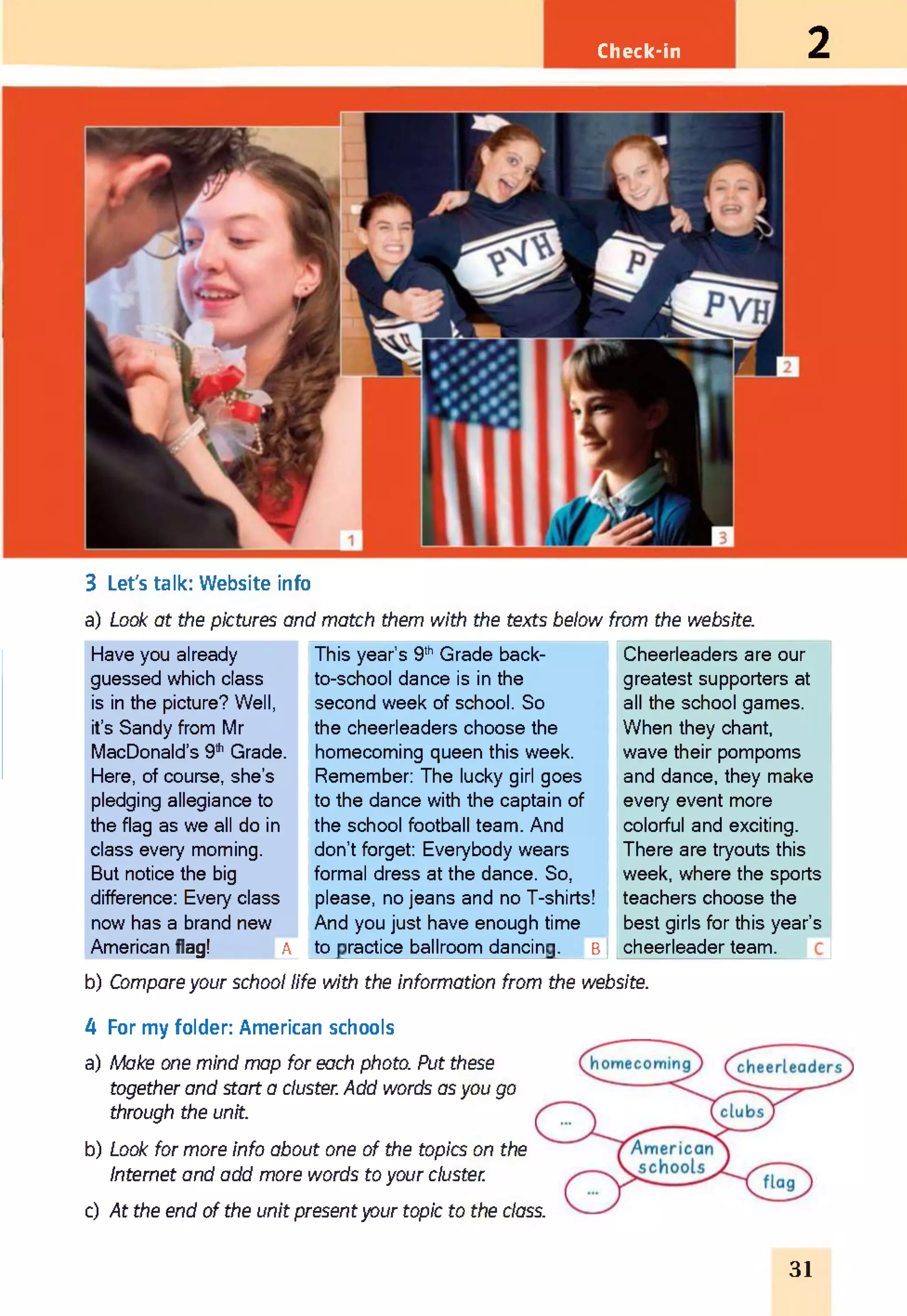
3 Let's talk: Website info
a) Look at the pictures and match them with the texts below from the website.
Have you already
guessed which class
is in the picture? Well,
it’s Sandy from Mr
MacDonald’s 9thGrade.
Here, of course, she’s
pledging allegiance to
the flag as we all do in
class every morning.
But notice the big
difference: Every class
now has a brand new
American flag! A
This year’s 9thGrade back-
to-school dance is in the
second week of school. So
the cheerleaders choose the
homecoming queen this week.
Remember: The lucky girl goes
to the dance with the captain of
the school football team. And
don’t forget: Everybody wears
formal dress at the dance. So,
please, no jeans and no T-shirts!
And you just have enough time
to practice ballroom dancing. B
Cheerleaders are our
greatest supporters at
all the school games.
When they chant,
wave their pompoms
and dance, they make
every event more
colorful and exciting.
There are tryouts this
week, where the sports
teachers choose the
best girls for this year’s
cheerleader team.
b) Compare your school life with the information from the website.
U For my folder: American schools
a) Make one mind map for each photo. Put these
together and start a cluster. Add words as you go
through the unit.
b) Look for more info about one of the topics on the
Internet and add more words to your cluster.
c) At the end of the unit presentyour topic to the class.
31
2 Language 1 the present perfect
► We use the present perfect for actions which happened at an unstated time in the
past, or to express actions which have finished so recently that there is evidence in
the present, or to talk about experiences.
... some of you have already been___ Our ... club hasn't started yet.
You can also use 'ever'for questions: ... have you ever visited ... ? -»G6
School yearbooks
A student at PVHS is telling you about school yearbooks on the Internet:
“I’m sure some of you have already been to the US. But have you ever
visited a high school here? Well, if not, you probably haven’t heard
about yearbooks. A yearbook has lots of photos of important people
and events which have happened during the year: who got a prize,
who dated who at the homecoming dance, etc. It’s a lot of work! But
luckily, our English teacher has promised to help us this year.
The best thing to do: Look at a yearbook!
But our Grade Yearbook Club
hasn’t started yet. Next week is
our first meeting - so I haven’t got
any material to show you.
But have a look at these pages
from last year’s yearbook.”
1 Let's talk: About yearbooks
a) Read the description above. What is a yearbook? Explain it to your partner.
b) Look at the text again and make sentences about yearbooks.
Hi, I'm Ellroy from
Paradise Valley
High ...
1. u .
Some of you
You probably
They tell you about events which
But luckily our English teacher
The 9thGrade Yearbook Club
+
has
hasn’t
have
haven’t
+
promised to help us this year,
started yet.
already been to the US.
you ever visited a high school here?
heard about yearbooks,
happened during the year.
^ c ) Has your class ever made a yearbook? Ifyou want to, look on pages... for ideas.
2 Plans for a yearbook
What have the students already done? What haven't they done yet?
Example: 1. Tammy and Dave have already planned .... 2. But Brad hasn’t ... yet.
Tammy and Dave: plan yearbook ✓ •collect jokes X •make a list of teachers ✓ •
Brad: write about homecoming X • interview students ✓ • take photos of cheerleaders X
32
must, mustn't, need, needn't Language 2
Home | Curriculum | Clubs&Activities | | Parents VAMVSE VALLEY
School Rules!
1. Remember!
If you have been ill, your parents needn’t write
a letter. But you must bring an absence slip.
One of your parents must
sign the slip!
If you are late, you must go to the school
office before you go to your class.
2. Stop!
You needn’t wear school uniform. But in
school you mustn’t wear clothes with
adverts for alcohol, drugs, tobacco or a gang.
And you mustn’t bring guns, knives, drugs or
cigarettes to school.
3. Ask!
During lessons students mustn’t leave the
classroom without a permission slip.
A. Think!
If you have a problem, you mustn’t contact
your teacher at home. If your parents want to
phone the school, they must do this
during the day or they can send an e-mail
at any time.
High School (PVHS)
3 Rules to remember must
<
mustn't
a) Look at the rules and complete the sentences.
Example: 1. If you have been ill, your parents needn’t write a letter.
needn't
1. Ifyou have been ill, your....
2. One of your parents ....
3. Ifyou are late.......
4. ... wear school uniform.
5. But in school you ....
6. You ... guns.......
7. During lessons students ....
8. Ifyou have a problem, you .... Your parents .
b) What about your school rules? What is the same/different? Make two lists.
4 A game: What rule is it?
Invent a rule. One ofyou starts to draw it Can the other groups guess your rule?
2 Language 3 the past perfect
^ The past perfect expresses the idea that something occurred before another
action in the past. It can also show that something happened before a specific
time in the past
[had + past participle] -»G7
1 A date
Read the story and find the examples of the past perfect
Last weekend, Mark and Trisha went on a
date. Mark took Trisha to the golf course.
Mark loved to golf. He had learned to golf
as a child. He had even played on a team
in his childhood.
Before that day, Trisha had never golfed.
She didn’t know how to hold the golf club.
She didn’t know the rules.
Mark taught Trisha how to play. After
Trisha had learned the basics, she hit the
ball. It was a good hit. Mark had taught Trisha well.
2 Let's practice
Rewrite the following sentences as negative or positive sentences, yes/no questions,
WH-questions (using the underlined word or phrase) and tag questions.
Examples for the sentence “Brett had finished his task before lunch.”
Negative: Brett hadn't finished his task before lunch.
Yes/No Question: Had Brett finished his task before
lunch?
WH-Question: Who had finished the task before lunch?
Tag question: Brett had finished his task before lunch,
hadn't he? -»G7
1. He had learned to golf as a child.
2. Before that day, Trisha had never golfed.
3. Mark had taught Trisha well.
3 Questions
Answer the following questions. Use the past perfect tense.
1. What had Mark learned to do as a child?
2. Before that day, had Trisha ever golfed?
3. When did Trisha finally hit her first ball? Had Mark taught her well?
34
the past perfect Language 3 2
4 Dancing with the stars - DWTS
Last night, Dane and Emily danced in a
competition. The danced a salsa dance. They had
practiced for 6 months before they had danced in
the competition. They were very good.
Dane and Emily’s friends were in the audience.
Before that night, they had never seen Dane and
Emily dance. Dane and Emily had never danced in
front of anyone before the competition.
After everyone had danced, the judges announced the winners. Dane and Emily
won. They were the best dancers in the competition. Emily said she had never
practiced so hard before. She was glad they had practiced a lot.
5 Questions
a) Answer the following questions. Use the past perfect tense.
1. How long had Dane and Emily practiced before the competition?
2. Before that night, who had seen Dane and Emily dance?
3. What happened after everyone had danced?
b) Rewrite the following sentences as positive or negative sentences, yes/no questions,
WH-questions (Using the underlined word or phrase) and tag questions.
1. They had practiced for 6 months.
2. Before that night, they had never seen Dane and Emily dance.
3. They had practiced a lot.
6 Changes
Turn the following sentences into the past perfect
1. They___________ (finish) the game before it rained.
2. She__________ (save) her money for two months before she bought the car.
3. I _____________(meet) him before he was my teacher.
4. Tina said she_________ (find) my purse in the car.
5. She woke up early because she___________ (take) a new job.
7 A story
Complete a story with the verb in the past perfect.
I ___________(never/see) such beautiful sights before I visited Paris in 2015.1
________ (save) money for five years before I booked a trip to Paris. I was very
excited. Before my trip to Paris, I _________(never/be) out of the United States.
When I went to Paris, I spent many days touring the city. The city was big.
Sometimes I got lost and asked for directions. I asked for directions in French.
That was easy because I _________ (study) French for 2 years before I visited
France. By the time I left Paris, I __________ (tour) many beautiful places. The
Eiffel Tower, Notre Dame Cathedral were just a few of the places I saw. Before I
visited Paris, I _________ (see) those places on the Internet.
35
Everyday English2
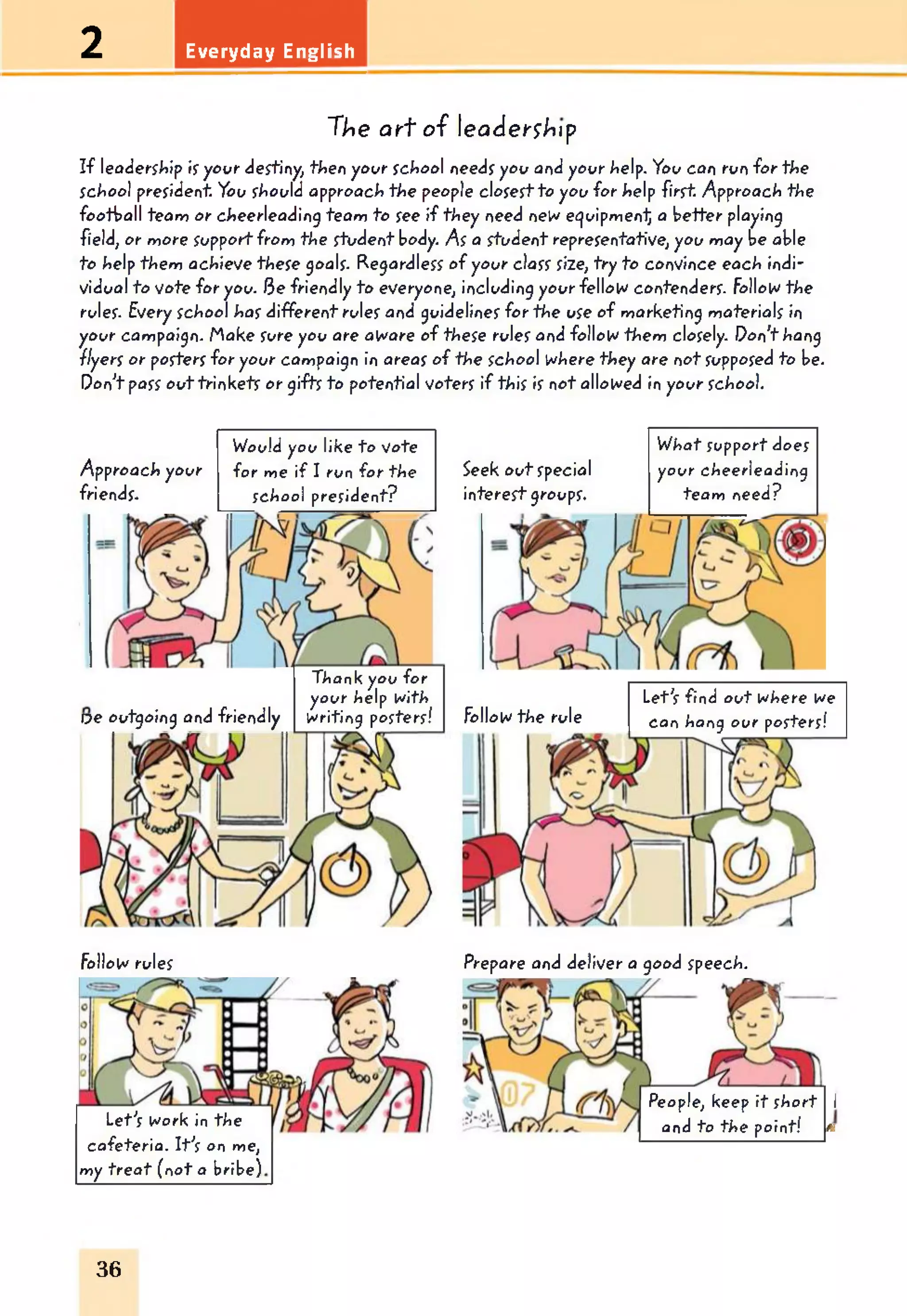
The a rt o-f leaAership
I f leaderfiiip if your destiny, then your school needs you and your help. You can run f or the
School president. You should approach the people closest to you for help first. Approach the
football team or cheerleading team to see if they need new equipment, a better playing
■field, or more Support from the student body. As a student representative, you may be able
to help them achieve these goals. Regardless of your class size, try to convince each indi­
vidual to Vote for you. 6e friendly to everyone, including your fellow contenders. Follow the
rules. Every school has different rules and guidelines for the use of marketing material? in
your campaign, hake Sure you are aware of these rules and follow them clofely. Don't hang
flyers or posters for your campaign in areas of the school where they are not Supposed to be.
Don't pass out trinkets or gifts to potential voters if this if not allowed in your school.
Approach your
friends.
Would you like to Vote
f o r m e i f I run for th e Seek o u t fpecial
V/hat su p p o rt do es
y o u r ch e e rle a d in g
Sch o o l p re sid e n t? in te re st groups. te a m need?
pe outgoing and friendly
Thank yo u fo r
y o u r h e lp With
W ritin g posters! Follow the rule
Let'? find o u t w h ere We
c a n hang o u r posters!
Follow rule? Prepare and deliver a good speech.
ie t 's W ork in th e
c a fe te ria . It's on me,
my t r e a t (n o t a bribe)
People, keep it s h o rt I
and to th e point! r
36
Everyday English 2
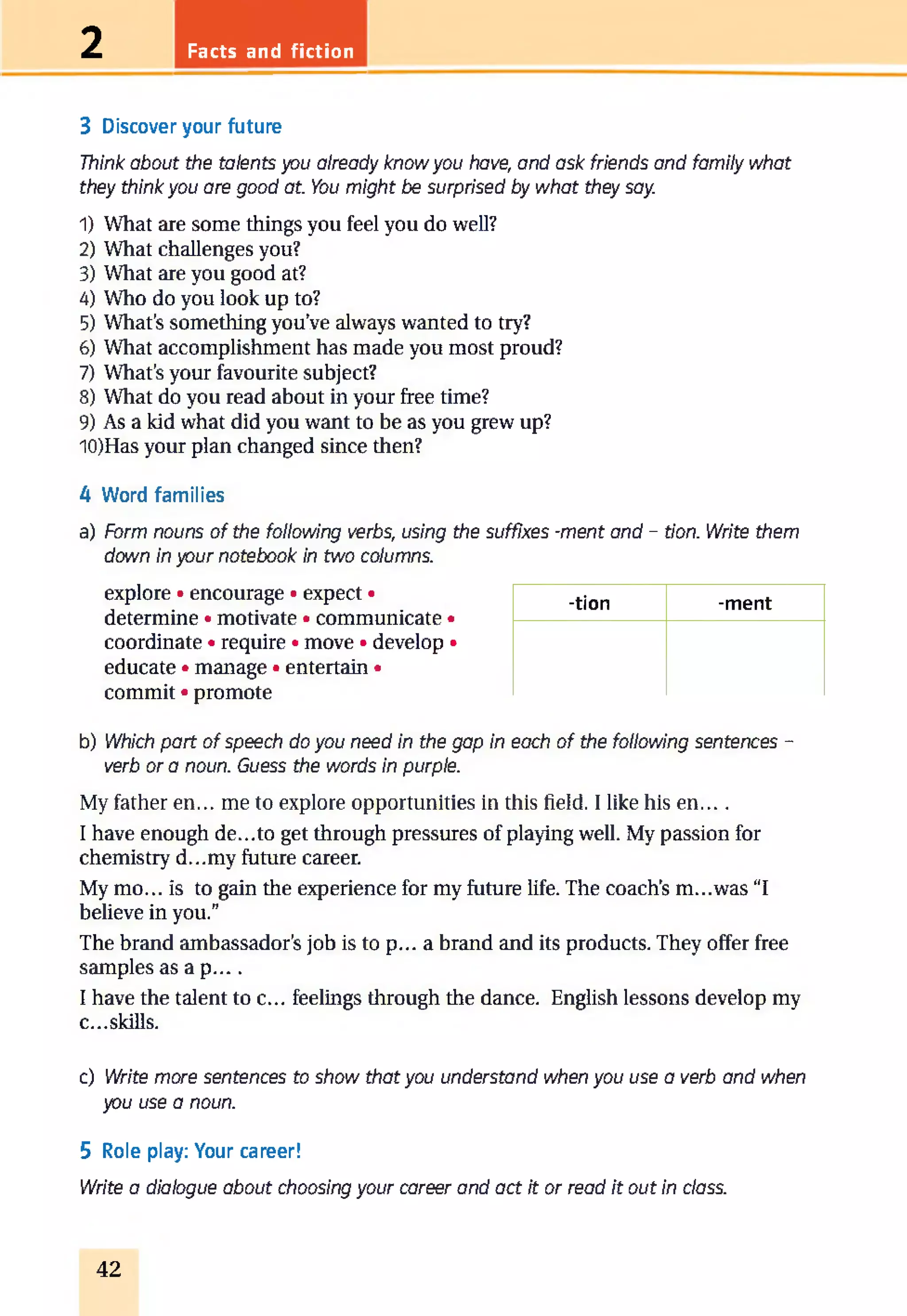
1 How to do it!
a) Read the following tips and decide which steps are the most important (1) and the
least important.
Approach your friends.
Seek out special interest groups.
Be outgoing and friendly
Follow the school rule
Prepare and deliver a good speech.
Go to all of your meetings as often as you can.
Advertise yourself.
Make a few (2-3) larger posters on the poster board.
Get a bunch of people to wear T-shirts that support you.
b) Discuss your list in groups of five.
Example: The most important step for me is to be outgoing and friendly, because
friends give you a lot of support.
2 The most difficult thing
What is the most difficult thing
for you when you are running for
a school president? Talk about it
in your group.
Example: The most difficult thing
for me is preparing a
speech.
i b © 3 Let's listen: Making the first move
a) Listen to the dialogues and match the names of the candidates with their ideas.
asking friends to vote for me • getting
help from the school football team •
identifying important student issues •
being friendly to everyone • being friendly
to my contenders • writing a speech •
speaking in front of my peers • writing
slogans • advertising myself • answering
questions truthfully
Example: Charlie wants to...
... switch to digital forms.
... use iPads to access eBooks.
... increase spending on career education.
... recycle and reuse supplies.
Charlie Nina
Terri Tammy
b) Listen to the dialogues again. Make a list of phrases for plans.
4 Mediation and communication: P lan s... plans
a) You and your partner are acting out the dialogue you like the most in Exercise 3. Use
the expressions from our list
b) Discuss whose plans are the most realistic? Why? Why not?
37
Get fit!
School structure in Ukraine
Read the text Discuss the text withyour partner.
For Ukrainian pupils school begins at the age
of six and primary school lasts four years.
A middle school is for scholars aged 10 to 15.
The curriculum includes the Ukrainian language1
and literature, a foreign language, algebra, biology, chemistry, geography,
geometry, history, physics, music, art, and physical education. After Year 9 pupils
sit for state exams in the Ukrainian language, mathematics and the one that the
school has chosen. After taking exams, pupils receive their basic school leaving
certificates.
Then 3 years may be spent at high school or upper secondary school leading to
a matriculation school certificate or atestat. In the process, pupils take a series
of state assessment tests and then exterior independent standardized tests.
The pupils can check their knowledge of the Ukrainian language and literature,
English (German, French, Spanish) as well as biology, chemistry, geography,
mathematics, and physics.
Comparing schools in the UK and the US
a) Read the text Discuss similarities and differences of the school
systems.
In the UK pupils leave primary school and then go to a
comprehensive or grammar school at the age of 11 (Year 7). They
can leave at 16. If they pass their GCSE exams, they can do two
more years in the upper school, where they can take A-levels.
In the US most students graduate from elementary school and go to a middle
school (6th, 7thand 8thGrade). Then they move to a high school (9thto 12thGrade).
Some may leave school at 16 but in many states they must stay at school until
they are 18. Students must take school tests each year.
Most students in the US go to public schools. In the UK a public school is a
private school. And there is another difference. In the UK a student goes to
college or university and only these students can graduate.
At secondary school during Key Stage 3 (Years 7 to 9, ages 11-14) children are
taught science, design and technology (ICT), history, geography, art and design,
music, physical education, a modern foreign language, citizenship, careers
education and guidance (during Year 9), sex and relationship education (SRE),
religious education (parents have the right to withdraw children from this lesson).
Careers education and guidance are about realizing the potential and nourishing
the dreams of the next generation.
b) Write a text atx)utyour own school.
c) As always, ask a partner oryour teacher to check your text
38
-W W v
Overhead
^ 1 Let's listen: Attention, please!
a) Before first period at PVHS there are often announcements.
Listen, check the box and say what each announcement is about.
Example: Announcement 1 is about__
Topics
lockers • homecoming rally • the video wall
girls' soccer • homecoming parade
b) When can/mustyou go to the places in part a)?
Example: You can/must go to ... any day__
Times
before first period • on Thursday at lunchtime • on Wednesday, at 4 p.m. • any day
at lunchtime • by the end of the week
2 Sounds: PVHS cheerleader chants
a) Listen to the chants from Paradise Valley High and practise them in groups.
Yes! Yes! P - V - H - S !
We're the best! P - V - H - S !
Yes! Yes! P - V - H - S !
Nothing less! P - V - H - S !
ü f c V H S
P - V - H - S ! Let it begin! - Let's fight! - Let's win!
Eagles score! Eagles are fair -
P - V - H - S ! But Eagles dare!
Let's have more! So you take care!
Go, Eagles! Go!
b) Write a chant foryour school/club.
16 Q 3 A song: Rrst date
In the car I just can't wait,
to pick you up on our very first__
Is it ... if I hold your hand?
Is it wrong if I think it's lame1to dance?
Do you like my ... hair?
Would you guess that I didn't know what to ...?
I'm too ... of what you think
You make me ... so I really can't eat.
Let's go, don't ..., this night's almost over.
Honest2, let's make this ... last3forever4
Forever and ever, let's make this last forever (2x)
(Tr. L Barker/Th. DeLonge/M. Hoppus
© EMI Music Publishing Germany GmbH &Co. KG)
stupid
l- c0qI [ scared I | wait
a) Read the text Where can you
put in the words from the box?
b) Listen. Wereyou right?
'lame |leim|, 2honest ['must], *to last [la:st], ‘forever [fa'rcvs]
39
Facts and fiction2
17
a treasurer
wants to be an insurance
agent
a captain of soccer team
wants to become a
professional soccer player
a school correspondent
wants to become a brand
ambassador
a class president
plans to become a
game tester
JÖottRA
a volunteer in a dog shelter
considers a pet stylist
career
04»
cheerleaders
eager to become professional
entertainers on football team
w A. There are many people who influence my decision to select this career field.
One of my early mentors is a business friend of my mother, who works in the insurance
industry and encourages me to explore opportunities in this field. I think she points me
in the right direction to explore the possibilities. I think I have qualities necessary to
become a good insurance agent. I am honest. Agents are expected to tell the truth up
front. Besides, I am energetic. One of the most important traits of a good insurance
agent is that they appear to be excited and eager at all times.
w I want to become a professional football player for the money, fame, and joy. So now I
play for fun. I have a drive and passion which matters much to me. I have determination to
get through many training, stresses, downs and pressures of playing well. I have a true love
for the game. So, one day I will play at Chelsea. I will gain the experience of training with top
players and at top facilities, playing every week in big stadiums. That's my motivation.
v r A brand ambassador is someone who promotes a brand and its products to their
network trying to increase brand awareness and driving sales. Brand ambassadors use
their fame, looks, talent, smarts, fans, reputation, etc to get exposure for the brand. Actors,
musicians, models are paid a lot to be brand ambassadors for a specified term. NBA basketball
player Tony Parker was paid $600,000 USD to be the global ambassador forTissot watches.
40
Facts and fiction 2
So I need to become famous first. I can do it if I get into "Dance with the Stars" program.
I have the innate talent to interpret and communicate stories and feelings through the
dance. I can work with other people. I always take direction from my choreographer, and
coordinate my dance routines with other dancers in the company.
© I want to work as a game tester. Most companies do not require a college degree
to be hired as a game tester. But if I get a degree, then I have a much better chance of
moving into higher-paying jobs, or moving into other areas of game development like
art, design or programming. To be honest, those other jobs almost always pay a lot more
than a job as a tester. So I want to have a career in the game industry; so it's smart to
get an education. Also, to be a good tester you need to be disciplined and focused. I pay
attention in school and get good grades. What is more, I also learn about game design by
reading through some of the top game design books. I take technical writing, computer
programming (introduction), project management that will help me in my future.
© I am thinking of becoming a pet stylists or groomer. I will bathe animals and trim
their hair and nails. I might work in pet stores, styling salons, animal clinics and animal
rescue organizations or be self-employed. Mobile businesses that offer pet styling services
are also growing in demand, since pets can stay in more familiar surroundings. I need to
have physical stamina since pet groomers spend many hours standing, and care must be
taken with animals that might nip at unfamiliar people. I have necessary skills. I am strong
enough to stand as long as I will need to and I am patient. I will obtain my skills through a
short-term training program at grooming salons. One day when I have enough experience
in this job I might want to start my own salon. Of course, I might consider taking basic
business courses to learn how to manage employees and handle business operations.
V Becoming a professional entertainer starts with building a particular set of talents,
such as acting, singing, telling jokes, playing a sport or performing magic tricks. We spend
long hours training and practicing our skills. We know that we could receive training
through an academic program, or our skills might be self-taught. We think, we don't need a
formal education to become professional entertainers. We started preparing for this career
playing in plays at the school theater. We also try writing screenplays or scenes to perform.
At the music club, we learn song writing. We are witty. We can make people laugh. We are
willing to commit the hours and sacrifice to reach the top.
1 Before you read: Students' plans for the future
a) Describe students' qualities in the pictures.
b) Read the stories. Wereyou right?
2 The characters
a) Choose an adjective which you think
describes each of these people best
b) Find a sentence in the story which
tells you this.
determined •funny •energetic
Tyler •talented • patient • disciplined
jay • hard-working • goal-oriented •
Cal focused • witty • eager • honest •
motivated • cooperative • strong
•eager
41
Facts and fiction2
3 Discover your future
Think about the talents you already know you have, and ask friends and family what
they think you are good at. You might be surprised by what they say.
1) What are some things you feel you do well?
2) What challenges you?
3) What are you good at?
4) Who do you look up to?
5) What’s something you’ve always wanted to try?
6) What accomplishment has made you most proud?
7) What’s your favourite subject?
8) What do you read about in your free time?
9) As a kid what did you want to be as you grew up?
10) Has your plan changed since then?
4 Word families
a) Form nouns of the following verbs, using the suffixes -ment and - tion. Write them
down in your notebook in two columns.
explore • encourage • expect •
determine • motivate • communicate •
coordinate • require • move • develop •
educate • manage • entertain •
commit • promote
-tion -ment
b) Which part of speech do you need in the gap in each of the following sentences -
verb or a noun. Guess the words in purple.
My father en... me to explore opportunities in this field. I like his e n ....
I have enough de...to get through pressures of playing well. My passion for
chemistry d...my future career.
My mo... is to gain the experience for my future life. The coach’s m...was “I
believe in you.”
The brand ambassador’s job is to p... a brand and its products. They offer free
samples a s a p ....
I have the talent to c... feelings through the dance. English lessons develop my
c...skills.
c) Write more sentences to show that you understand when you use a verb and when
you use a noun.
5 Role play: Your career!
Write a dialogue about choosing your career and act it or read it out in class.
42
Facts and fiction 2
READING SKILLS
Reading for research
When you are doing research, especially on the Internet, different reading skills can help
you to choose the right texts and then to get the information you need from them.
1 Skim to get the gist
First use the title of this text to guess the topic. Then skim the text to see ifyou are right
The MySpace Age
by Jonathan Duffy, BBC News Magazine
In only a couple of years MySpace went from zero to being
a top five website which no self-respecting US teenager
can ignore. And the same thing has happened in Britain.
MySpace is what is known as a social networking site. It’s
by far the biggest, with over 100 million users around the
world. Others include Facebook, Bebo, Friendster and Yahoo
360, all offering users a host of functions - blogging, forums,
instant messaging, personal profiles, photo albums. Want
to see someone who’s into the same music or films as you,
or someone you just fancy? Send a message, and if they’re
interested, hey, you’ve made a friend. Social networking sites
make money out of advertising, and the success of MySpace
is being used by companies to target potential customers.
For example, anyone who mentions an interest in kite-surfing
can expect a mass of e-mails trying to sell them the latest
equipment. The easy development of relationships online is
also changing the nature of friendship. Briana Dougherty,
25, has 224 “friends” on MySpace, although some are not
individuals but bands she likes. Stella Sims, 26, sees a
competitive streak among users. “It’s a statement of how
popular you are,” says Stella. Not everyone may understand
the idea of setting out one’s personal life to an audience of
millions. MySpace users, however, show little sign of finding it
a problem to deal with their extensive friendship networks.
'Andi"
Girl, 17years old
Birmingham, UK
Andi's quick info:
Hi, my name is Andi and
I'm 17years old. I'm here
to fine! new friends. How
about sending mean
e-mail?
Andi’s friends:
Shirin Lisa Tess
[more]
Andi’s interests:
Pop music, love
stories, movies, my
friends [more]
2 Scan to get the facts you want
You are researching the pros and cons for people using social networking sites. Look
for what the text above says about this. (Only look up important new words.)
3 Check the source
a) Why is it important to check the source of information you find on the Internet?
b) Look more closely at the text above. Are there any reasons against using the social
networking sites? Could you make a list of cons that everybody should be aware of
when using social networking sites?
43
Words in action2
1 Favourite subjects
a) Read an article for the school contest
about student's favorite subject.
b) Think of your favourite subject and
prove whyyou like it. Here are some of
the ideas to help you.
having small-group discussions
My Favorite Subject
My favorite subject in school is world
history. In the f irst place, I love to learn
the geographical locations of the world map
Besides that, it is interesting to know
important historical events. Finally, knowing
world history helps me to understand
today's world. I love to read anything that
teaches me more about the history of
the world.
working on a project solving equations
writing essays for my folder
naming compounds
getting pushups or sit u d s learning addition, subtraction, multiplication and division
I iparnine the art of problem reduction] Iunderstanding chemjstry in everyday life]
working in drills learning new phrases and grammar material | |playing basketball
writing reactions learning about types of chemical reactions, atomic theory
ENGLISH
Sort words
MATHS
ii& a) Decide which category (subjects) the words belong to. Some words can belong
to more than one category. Explain why.
Geometry Physics Geography Chemistry Literature English PE
map • angle • three toe-touches • distillation • border • nation • line • fable • circle
• Pythagorean Theorem •dialogue «jump •monologue •syllable •acid •chlorine •electron
• organic • triangle • laser • pollution • run • synthesis • oxygen • table • temperature
• weight • water • global • hemisphere • equator • nucleus • mountain • radiation • five
sit-ups •ballad • stress • historical fiction • legend •square
b) Think of more words to fill the grid.
c) Work in groups of four. Tell the word which will start with the last letter of
previous word. The one who will tell the last word will win the game.
Example: A: distillation, B: nucleus ..C: s...
44
Words in action 2
3 Learn to recognize suffixes
a) A suffix is an added word ending that
makes another word. Guess the new
words in blue on the right. You already
know other words from the same word
family.
b) Make lists of typical suffixes for nouns
and adjectives. Give at least two
examples for every suffix.
c) Think of more typical suffixes.
I'm not sure what kind of employment is
best for me. I'm quite imaginative -
I once won a prize with a drawing of an
alien. I don't think I'd like to work for a
huge organization. Of course I want an
enjoyable job. I need to be successful,
too. Money is a weakness of mine. I
definitely want a good lifestyle.
4 What is needed for a job?
a) What kind of person do you need to be for the jobs in the photos?
5 Match the American and British words
a) You already know some differences between American English (AE) and British
English (BE). Look at the words below and pair up words with the same meaning.
pupil • break • autumn •Year 1 • year •elementary school •grade • recess •
kindergarten •fall • student • primary school • anorak • bill • bin • city center •
crisps •football •jacket •garbage can • downtown •check • potato chips • soccer
© b) Listen, check, and change ifyou need. Explain the meaning of the words you learned.
c) Change the AE words in blue into the BE words.
Don’t throw your trash in the street - put it into the garbage can.
My brother is an elementary school student.
Kindergarten students have lunch at 11 o’clock.
Let’s meet in the downtown in 10 minutes.
It’s cold outside. Don’t forget your jacket.
My friend loves soccer. I do too.
I don’t eat potato chips. It’s unhealthy. - Neither do I.
A 20-minute recess is enough to discuss the latest news after the weekend.
45
6 School words
a) Make a grid. Use the headings: British schools, American schools, Ukrainian schools.
Put the words from the box under the right heading. Some words can belong to
more than one category.
baseball • pupil • Make a Difference Day • Grade 9 •
American football • cheerleaders • school uniform • Year 9 • holidays •
• Ukrainian language • student • football • vacation • vyshyvanka
b) Think of more school words and add them to your lists.
7 Let's look: Ready for the homecoming dance?
Its time for the homecoming dance. Look at the two pictures.
What has/hasn't Miles done? And what about Sharleen? Use the box for help.
dyed hair • put on jacket • bought flowers • cleaned shoes •
put tickets in wallet • chosen jewellery • put on dress • done hair •
collected Sharleen • packed evening bag
Words in action 2
8 Messages from the dance
Three students wrote text messages from the dance. Rewrite their messages with long
9 Different school rules
Choose the right words and complete this e-mail from an American girl.
Hi Kate,
You are my ... student. Our class teacher said we can
... an e-mail to our partner. I have read your school ... .
We have some different rules and I ... to tell you about
them. You probably know that we ... wear a school ... .
You can wear your own ... here.
But you can't wear T-shirts with ... on them for things
like drugs and ... . You ... smoke in school or on the
way there. There are some other rules but you needn't
know about them ... you are here. Oh and I must tell
you about the ... dance. Dress is ... so you must bring
a long ... with you.
Bye! Terri
□
rules exchange
uniform
alcohol
needn't
want
:
I formal
dress i
YOU CAN ALREADY
✓ Develop a school
webpage.
v'' Report school news.
✓ Plan a year book.
✓ Plan a project.
^ Follow school rules.
✓
✓
✓
✓
✓
✓
Use present perfect and past perfect.
Compare school rules.
Talk about a school yearbook.
Compare schools in Ukraine, the UK, and the USA.
Describe your personality and career.
Write messages.
47
Skills in action
1 What's a formal discussion?
Use the picture and the texts and explain toyour partner what happens in a formal discussion.
Students choose a statement
Exam ple: "How can volunteers
help kids in need?"
Speakers prepare arguments
for or against it
&
2 Planning
a formal
discussion
Plan a discussion.
The skills box can
help you.
GROUND RULES FOR DISCUSSION
1. We will listen while others 3. We will listen and think
are talking. about everyone's ideas.
2 We will cooperate: try to 4. We can ask each other
get along with each other. questions to help us to
understand everyone's ideas.
1. Agree on a statement, for
example: “How can volunteers
help kids in need?” Use the
phrases to help you.
► How about... ?
I think ... is a good statement.
I've got a better idea. Let's say,
Who's for/against ... ?
2. Choose a chairperson.
What should he/she do
and when? Write a list.
The phrases can help.
► Welcome the group: Good moming/afternoon/ ....
Introduce the statement: Our statement is ....
Introduce the speakers:... and ... will speak for/against it.
Ask people to vote: Who is for/against ... ?
3. Collect arguments. Use the
collage on the opposite page.
Write sentences. You can use
some of the phrases in the box.
► I think ... streets are dangerous because
The facts show us that ....
... is/are not the only problem in ....
Kids in ... are frightened because ....
4. Choose some speakers.
They must write down their
arguments. They can speak for
or against the statement.
► I agree/don't agree w ith ___
In my opinion ....
You say that .... I think that's a prejudice
That isn't true fo r ....
48
Skills in action
StandUP stands up for kids! Will you
Choose any statement from these texts start a discussion. Follow the ground rules for
discussion.
A typical volunteer in Ukraine is a teenage girl, with a secondary
school diploma and a better-than-average financial status. She
wants to help others and make this society a better place. Some
20 percent of her fellow volunteers want to spend even more
time volunteering than they already do. In contrast, a typical
volunteer in Western Europe is a married woman over 30 with
children. Volunteering abroad is also a good way to find a job
and gain practical experience. Another difference with the West
is even more striking: The practice is neither popular in Ukraine
nor firmly encouraged by government. Nonetheless, there are
organizations in Ukraine that specialize in volunteer activities
to various degrees.
Three include: United Nations Volunteers, Dobra Volta and
1 Altematyva V.
--------------------
Dobra Volia and Altematyva V are scout
clubs similar to American scouting
organizations. UN Volunteers has served
as a coordinator and catalyst for other
organizations, whereas in many other
nations, government or civil society
organizations take on these roles.
Dear Friends and Supporters,
Have you ever thought about volunteering
your time to a local charity or community
organization? There are many different
reasons for you to start volunteering:
• to help others
• to learn about an activity or organization
that interests you
• to beat boredom (if you find yourself
sitting around the house feeling totally
bored, volunteering in an activity you
epjoycan be a great wayto change things)
• to overcome a loss you have experienced
(one of the best ways to help yourself in
a time of loss is to help others)
• to gain perspective on life (there is no
better way to understand your blessings
than to help people in need)
Volunteering is encouraged on the state
level in the USA, but has no widespread
following or support in Ukraine. There
are some 500 volunteers that work for
the Kyiv Volunteer School in Kyiv, most
of them aged 14-18 years old. They help
children with disabilities, orphans and
HIV positive people.
A student, Anna Yanyf, who enrolled in International
Volunteer Day celebrations wrote:"Sometimes you
need to change something in your life: the passive
contemplation in front ofyour computer for the real
world, put theoretical knowledge into practice, take
action, and make a child smile.There is a lotto do for
this country. I would like to help, meet new people,
share ideas and do something useful."
One volunteer started the environmental
project. It encourages people to use
ecologically friendly bags instead
of plastic ones when going to a
supermarket. “It’s very hard to love this
country and the people who live in it
who throw garbage on the streets. We
need to start changes with ourselves."
Kids in Ukraine need volunteers’
help. You can volunteer at
orphanages to teach English,
lead children in songs, music,
dance, sports, and other
activities, teach cooking or
handcrafts, act as mentor, and
generally just spend time talking
and sharing...
49
Try it out!
19 O A Listening
1 Part a)
Look at the photos above. Listen to part a) and match each photo with a name: Jason,
Marie, Carly or Ramon.
2 Part b)
Listen to part b) and find the correct answers about Ramon.
a. Ramon
1 got a bike for his
birthday.
b. He has a job
1 in a company.
c. He has to
1 ride bikes.
d. He gets
1 five dollars a day.3
2 got a bike from
his dad.
2 in a bike store.
2 test bikes.
2 15 dollars an hour.
3 borrowed a bike.
3 in a deli.
3 deliver parts of bikes.
3 five dollars an hour.
3 Part c)
Listen to part c). Which of the words in these sentences is wrong?
a. I get seven dollars an hour for looking after kids.
b. You’re silly, Marie.
c. What do you do if you want a new bike?
d. I can borrow more if I work around the house.
e. I think it’s better to have a job inside.
f. A game of baseball is what you need.
g. I have to be home at six o’clock.
50
20 4 All parts
Listen to parts a), b) and c). The names in these sentences are mixed up2. Correct them.
a. The friends are waiting for Carly.
b. Jason is always tired in class.
c. Marie has to get up at 6 on Saturdays.
d. Ramon’s dad won’t let him have a job.
e. Carly gets 50 dollars a month.
f. Marie meets lots of interesting people.
g. Jason wants to go home and work.
h. Marie needs a game of basketball.
B Speaking
1 Role play
You are talking to an American kid about part-time jobs. Answer his/her questions.
American: What do kids in Ukraine do when school finishes?
You: ...
American: Do you get pocket money? How much? Do you have to do jobs
at home?
You: ...
American: Can you have a part-time job while3you are still at school?
You: ...
American: What sort of jobs can kids do?
You: ...*
* 2 Reporting
What do you think Jason tells his dad when he gets home?
Use these verbs: meet •want to • borrow •get • help •worry • should • look after
Start like this: Dad, I met Ramon in the park this afternoon. We wanted to ....
'part-time [,pa:t ‘taim], 2mixed up [,mikst_'Ap], ’while |wail], ‘flow chart [flau ,tjat], 5to agree la'gri:]
51
R1 Revision
21 - J 1 Make, let, have, get (-»G2)
Complete the sentences with “make", “let", “have"and “get'. Listen and checkyour answers.
1. Sam really wants a dog, but his parents don’t ....him have a pet.
2. The teacher ...each of her students write an essay describing their future goals
in life.
3. Sally ... me take off my shoes before I went into her house. She said she
wanted to keep the carpet clean.
4. My parents ... the courier take a copy of my application over to FLEX office last
week.
5. Diane thinks television is a waste of time, so she won’t ... her children watch
TV.
6. Marcus ... me ride his new bike. I couldn’t believe how fast it was.
7. How did you ... the doctor to make a house call?
8. Tommy didn’t want to go to his cousin’s birthday, but his mom ... him go.
9. I can’t believe the zoo keeper ... you feed the snake. That was so cool.
10.1... the translator recheck his work several times to make sure there would be
no misunderstandings.
“ O 2 Talking about the future (-* G5)
Put the verbs in the correct form (will, going to, simple present or present progressive).
Listen and check your answers.
1. I love London. I .... probably go there next year.
2. Our train (leave) at 4:47.
3. What (wear / you) at the party tonight?
4. I haven’t made up my mind yet. But I think I (find) something nice in my
mum’s wardrobe.
5. This is my last day here. I (go) back to England tomorrow.
6. Hurry up! The conference (begin) in 20 minutes.
7. My horoscope says that I (meet) an old friend this week.
8. Look at these big black clouds! It (rain)
9. Here is the weather forecast. Tomorrow (be) dry and sunny.
» O 3 Have someone do or have something done (-*G2)
Choose the right word. Listen and check your answers.
1. I have the cleaners wash / washed the floor every day.
2. She will have Taner paint / painted the house.
3. Please have your secretary fax /faxed me the letter.
4. I have the floor cleaned / clean by the cleaners every day.
5. She will have the house paint / painted by Tom.
6. Please have the letter fax / faxed me by your secretary.
“My father
didn’t tell me
how to live; He
lived and let me
watch him do
it.”
C stB C T BudlS^jn K ilin d
52
Revision R1
4 Getting ready for the homecoming parade (present perfect -»G6)
a) The drama club at Paradise Valley High School wants to take part in the homecoming
parade. At their last meeting the students in the club made a list of things to do.
Then they started to do them. Look at the list What have they already done?
Example: They’ve already put the club on the parade list in the Activities Office.
TO DO before homecoming parade:
>/ m out the dub on the oarade list in the Activities OfficeI ' " •
• finish famous drama characters’ clothes
1/ • make drama club flags
t/ • choose photos from our last play for the brochure
■ A/ritp tbp r.nntinns nnd tbp n rtid p n b n u t n ur npvt nlnu'1 r ’ '1 r J
• print new drama club brochures
/ • order balloons with the PVHS drama club loao
• blow up the balloons
• ask the video club to make a video of us on the day
• meet for a last practice before the big event!
b) What haven't they done yet?
5 Rules at the homecoming parade ('must', 'mustn't; 'needn't -» gs)
The organizers have made rules and tips for the event
Make sentences about what the students at the parade must, mustn't or needn't do.
Example: Clubs which take part m ustn’t arrive after 3 o’clock in the afternoon.
Clubs which take part
You really
Your club
But you
At the parade you
You
In fact you really
Remember: You
But you
You
must
■I mustn’t
needn’t
+
arrive after 3 o’clock in the afternoon,
be late!
keep their queue number with them.
all stay in the right order until the end ofthe event.
worry about photos. The camera club will be on the job!
take drinks in glass bottles on the parade.
take drinks at all!You can get them free at club stalls!
never throw any rubbish onto the street.
carry it around with you during the event.
give paper cups and other rubbish to someone at a stall.
5 Your own School or club event ('must', 'mustn't', 'needn't' -* G8)
Think of an event at your school or club and make rules and give tips about what the
people there must, mustn't or needn't do.
53
Check-in3
1 Daniel jacob Raddiffe
(born 23 July, 1989) is
an English actor best
known for his role as
Harry Potter.
2 Emma Charlotte Duerre
Watson (born 15 April,
1990) is a British actress,
model, and activist known
for her first professional
acting role as Hermione
Granger in the Harry
Potter film series.
3 Rupert Alexander Lloyd
Grint (bom 24 August,
1988) is an English actor
who rose to prominence
playing Ron Weasley,
one of the three main
characters in the Harry
Potter film series.
1 Are they your favorite actors?
What film series did this main trio of stars appear? Look at the actors and try to
describe their personal character traits (not film characters). The fact file box gives you
some interesting examples from their lives to prove the character trait
2 You are a researcher
Search the Internet and find some more
interesting facts about Emma, Daniel, and
Rupert to describe their character traits.
Use the Wiki pages. Adjectives in the box
might help you to stay focused.
^ Fact file
Daniel achieved A grades in the three AS-level exams that he took in 2006.
Grint took an avid interest in theatre, performing in school productions of a local theatre.
Emma encourages young girls not to behave like princesses, but rather be active in
helping others.
Adjectives: emotional, hard-working,
confident, educated, loyal, determined,
strong-willed, ambitious, encouraging,
intelligent
► We might infer a character trait from
something a character does only once,
or we might draw our conclusions from
a series of things the character says and
does.
I think that Daniel is smart because ...
I guess Emma is ...
I consider Rupert ...
54
Check-in З
4 Georgina Helen 5 Anna Katherine
"Georgie" Henley Popplewell
(born 9 July, 1995) is (born 16 December,
an English actress, 1988) is a British film
best known for her actress known for
portrayal of Lucy her role as Susan
Pevensie in The Pevensie in The
Chronicles of Narnia Chronicles of Narnia
film series. film series.
6 William Peter 7 Alexander Amin Casper
Moseley "Skandar" Keynes
(born 27 April, 1987) ([ keinz]; bom 5
is an English actor, September 1991) is an
known for his roles English former actor. He
as Peter Pevensie in is best known for starring
the film series The as Edmund Pevensie in
Chronicles of Narnia. The Chronicles of Narnia
film series.
DID YOU KNOW?
• The Chronicles of Narnia is a series of fantasy
films from Walden Media.
• It is based on The Chronicles of Narnia, a series
of novels written by C. S. Lewis.
• From the seven novels, there have been three film
adaptations so far - The Lion, the Witch and the
Wardrobe (2005), Prince Caspian (2008) and The
Voyage of the Dawn Treader (2010) which have
grossed over $1.5 billion worldwide among them.
• Harry Potter is a British film series based on the
Harry Potter novels by author J. K. Rowling.
• The series is distributed by Warner
Bros, and consists of eight fantasy
films beginning with Harry Potter and
the Philosopher's Stone (2001) and
culminating with Harry Potter and the
Deathly Hallows - Part 2 (2011).
• It is the second highest-grossing film
series with $7.7 billion in worldwide
receipts, of which seven out of eight
films are among the 50 highest-
grossing films.
24 3 Let's listen and talk: The Chronicles of Narnia: Interview
a) Listen to the interview with Anna Popplewell and William Moseley.
b) Talk about teenagers'perception of the “Narnia" their auditioning, creating a feeling
of family, acting with animatronic animals.
4 For my folder: Info from the Internet
Find out more information about The Chronicles of Narnia on the Internet. Then answer
the questions.
1. What is lion’s name who guided children in Narnia?
2. What is Narnia?
3. Who are the main characters (protagonists) in the film series?
4. What character is an antagonist (opposes the protagonists)?
55
3 Language 1 Remember: Using defining relative clauses
► You use relative pronouns when you introduce a relative clause:
... was the first person who produced photos ....
The photos which he took___
The first public movie which people saw ___ -* G10
IMPORTANT PEOPLE IN FILM HISTORY
The journey from the first still (still picture) to the first movie (a film which
moves) lasted about 70 years. It took another 30 years to go from silent
movies to talkies (motion pictures with sound).
1877
;r>ffdt frf
1. Eadweard Muybridge was the first person
who produced photos of motion. The photos
which he took were of a horse. He set up 24
cameras and put a string on the shutter of
each one. But it was the horse which took
the photos! As it ran, it broke the strings. This
opened the shutters. Light fell onto the film
and this produced the photos.
2. A famous American inventor, Thomas
Edison, invented the Kinetoscope. But it was
his assistant who built it. The Kinetoscope was
a box with some film and a light bulb. The film
showed a series of stills. But a motor moved the
film quickly across the light and it became a
movie.
3. Edwin Porter directed the first western.
Its tide was ‘The Great Train Robbery’.
And it was the first public movie which people
saw in the US.
4. They built the first film studio in Hollywood.
Stage actors and actresses were more famous
them those who acted in movies. But this soon
changed and the rise of movie stars began.
Charlie Chaplin was one of the first actors who
became a star.
5. The first ‘talkie’, ‘The Jazz Singer’, made film
history. But two years later it was a silent movie
which got the Oscar for Best Film.
56
Remember: Using defining relative clauses Language 1 3
1 Who did what?
a) Read the texts on page 56. Find the name of the person who did these things:
first produced photos of motion • invented the Kinetoscope • was one of the
first stars in Hollywood • built the Kinetoscope • directed the first Western
b) Tellyour partner about them. Start like this: It was ... who first produced
photos of motion.
2 People in the movie business
Read the text again and make sentences which explain the underlined words.
Use 'who'or 'which'. Example: 1. Actors and actresses are people who ....
1. Actors and actresses are people they give to people in the movie business.
2. Atalkie is a film act in movies or plays.
3. A film studio is a place
who
which
had some film and a light bulb.
4. The Kinetoscope was a box + + tells a story about cowboys.
5. AWestern is a movie has sound in it.
6. Movie stars are people they use to make movies.
7. Oscars are awards are popular and famous for their movies.
3 Let's look: A movie poster
a) Complete the sentences and describe the poster for ‘‘Prince Caspian". Use “who'or “which.'
1. I can see four chidren w ho__
2. Peter is hodling a sword which he received__
3. Susan was second bom who ....
4. I can see Lucy__
5. Lucy is holding a dagger __
6. There is also a m an __
7. He is riding a horse ....
8. He is holding a sword__
b) Think of your own poster for this film and describe it using 'who' and “which'.
4 Let's talk: Talking about a movie
Talk to a partner about a film which you know. What sort of film is it?
Where does it take place?
Who acts in it?
Do you know the actors
from other films? Compare
it with other films which
you like. Did it get any awards?
It's a fantasy/... film/... which takes place in __
... is in it.
He's/she's the one who was so good/bad/... in ....
The film is about__
But... is more exciting/interesting than__
It got an Oscar/the Best Song Award/... in the year__
57
Everyday English3
Music matters
1 Let's talk: My music
a) What sort of music do you like most and least?
Make a list and add the names of singers/rappers/
groups that make this sort of music.
KÜ3E J Q Ö 0
independent
alternative
heavy metal
punk
b) Discuss the music
and the people in
your lists in part a).
Why do/don't you
like them?
► So you like ... most/least. Why?
Because ... is a great/rubbish guitar player/singer/__
Because the music/song/... makes me feel happy/sick/__
2 Messages in a music chat room
a) When you chat, you can use slang
words or short forms which you
never write in other situations. Read
the messages and make two lists.
slang/short form
Peace!
ur
boyz
normal/long form
Hello!
you are (you're)
b) Read the messages again. Which style of music do the teenagers like?
Welcome to Teentalk’s message boards.
You have to register before you can post a message. Just click on register.
To view a message, just click on the forum which you want to visit.
Strictly for gangstas
Peace! So ur Atlanta (home of OutKast and Lil Jon) boyc or girlies (14—16) and hip hop mudk
and bling blings ur style - Cum to the Harland Club Teen Center next Saturday at 6 pm and
learn to rap with uz. If u’ve written a rap, then bring it with u. We’ll teach ya how to free­
style and diss other rappers. So chill out! Peace and c ya soon. Tuzie and Blugirl
Rock is our thing
Hi! We’re 14 n 15 n we’re from Atlanta. My homie and I like indie and rock music — Green Day,
Led Zepplin etc. We don’t wanna diss anyone, but maybe you know a disco which plays ‘our’
music? U c, we can only listen to our sound on old CDs! Just post us a message. CU. Carly + Jo
Any musicians (rock, metal, punk) in/around Austin?
Hi. If you’re from Austin and you want to make music, read this! My friends and I live in
Round Rock, a suburb of Austin. We aren’t gangsters and we don’t wear jewelry. We’re trying
to form a band and we’re looking for a drummer, a bass player and a singer. Right now there
are only 3 of us: 2 guitar players and a singer. We’re into almost everything — rock, pop,
funk, Latino, EXCEPT HIP HOP (no disrespect to you gangsters!). We’re all 15 and at high
school. So if you’re around our age and are interested, e-mail us or check us out at myspace.
com. We hope to hear from ya! CU Rick, Sally an’ Sam
c) Use the words from part a) and ► Hi/Peace/Hello! I'm/we're ... years old.
answerone of the chat room I'm/we're from ................music is my/our style.
messages. The phrases can help you. l/we write raps/sing/play —
58
Everyday English 3
25 3 Mediation and communication: A song: Scared of myself
This song is performed by Simon Dawes and appears on the soundtrack
in Spider-Man 3 (2007)
May I never become unloved by you
May you never have to know
my shadows by the name
You're my heroine and you're a rose in my tea
May I never become unloved by you.
May I always be on my way to you
May I never have to meet the man I'd be alone
I'm your criminal and you're my only friend
May I always be on my way to you.
Cause I'm scared, scared of myself
Oh, I'm scared, scared of myself
Oh, I'm scared, scared of myself without you.
I have found a way to watch over you
I have found a way to face the burden
of my dreams
they are crooked but they're,
well they're all I have
I have found a way to watch over you.
Yes, I'm scared scared of myself
Oh, I'm scared, scared of myself
Oh, I'm scared, scared of myself without you.
Cause I'm scared, scared of myself without you.
Without you.
Listen to a song. Can you answer a question about why he is scared of himself? What
do you need to do to be able to answer this question?
Simon Dawes was a rock band originally from Malibu, California. The band’s
current incarnation is Dawes. The band was composed of four friends. Two of
its founding members, Taylor Goldsmith (vocals, guitar, keys, lyrics) and Blake
Mills (vocals, guitar, and lyrics), began playing music together in junior high
at Malibu High School, and their middle names formed the band name. The
other two founding members were Grant Powell (bass) and Dylan Grombacher
(drums). Their genres include Rock, Indie Rock, and Alternative.
26 G AMore interviews
Watch the interview with the four friends. Read the phrases from the interview and
explain what they mean.
to bring out the inherent nature of the instrument
our songs are based on our own experience
the environment you grew up leaves the stamp on you
it was written on the road
to arrange a tour
one performance is worth
a bunch of rehearsals
trace its roots
teach me their perspective
approach the situation
resonate with me
59
Get fit!
LISTENING Q Q Q D Q B
How to understand an English song?
Many songs tell a story about the lives of young people - their dreams and
problems. Other songs have a special message. Without the lyrics in front of you,
it may be difficult, to understand a song in English. These tips may help you:
1. Look at the cover of the CD. The cover can give you a clue what the song is
all about
2. Listen to the song. Write down all the words that you recognize.
3. Listen to the song one more time. Listen to the sentence, in which the new
word appears.
4. A new word? Do not worry! If you hear an unfamiliar word, think about what
it could mean.
5. Listen to the refrain. It often tells the main idea or the main problem of the song.
6. Listen to each stanza. They will tell you the story.
7. Listen to the song again. Write a story. Sit back and enjoy it!
If you want to check yourself, go on the Internet. You can find lyrics of any
song quite easily.
A song: The Supreme being teaches Spider-Man how to be in love
a) Follow the steps in the skills box as you listen to the song. Answer the questions.
1. What do you know about Spider-man? Describe him in two or three
sentences. These phrases can help you:
to wear red and blue outfit • consider oneself a hero and a sinless person •
fight crim inals • to wear black outfit • nobody knows him • he has got
the power of a spider • he is on love with ...
2. Listen. Which of the words above are in the song?
3. Listen to the sentences which the words are in.
4. Listen again. Stop when you hear the words
‘Mohammed Ali’. Listen to the sentence they are in.
Write the sentences to describe Mohammed
Ali’s actions.
5. Which sentence in the refrain tells you that
the person needs help?
6. Choose one ‘idea’for each of the three verses:
• he is not ready to tell the truth
• he is about to let people know the truth
• the truth is revealed
60
Overhead
1 Before you listen: Musicians
a) Describe the three people in the pictures. What are they wearing?
b) How do the people look - friendly/unfriendly, happy/unhappy,... ?
^ c) Which musician would you like to meet? Why? What would you ask him or say
to him?
« © 2 Let's listen: Their music
a) Listen to three interviews. Match each interview with a picture from exercise 1 a).
Why do you think this?
Example: I think picture ... is of the guy in the first interview.
He looks like ..., who is a famous ... singer/musician/star.
b) Now listen to three short pieces of music. Match them with a style. Choose from the box.
reggae • pop • rock • hip hop • country • dancehall •
R&B • soul • folk • rap • heavy metal
c) Now match each music style with a picture from exercise 1.
29 3 Let's listen: Teenage boys by Carol J.
They are just teenage boys running wild and free
Mama can't stop them boys, gotta let them be
But she worries about them day and night
She is wondering if they're gonna be alright
They are just teenage boys running wild and free
Mama's lovewas strong and true
No matterwhat the boys will do
They can't take that from her you see
They are just teenage boys running wild and free
Mama can't stop them boys, gotta let them be
She loves them boys with all her heart
She don't understand how they drifted apart
But mama just let them be
'cuz they are teenage boys running wild and free
Running wild and free
Mama can't stop them boys, gotta let them be
But she worries about them day and night
She is wondering if they're gonna be alright
They are just teenage boys running wild and free
When they was small she had control
They would do as they were told
But nowthey've grown up you see
And they are just teenage boys runningwild and free
They are just teenage boys running wild and free
Mama can't stop them boys, gotta let them be
She loves them boys with all her heart
She don't understand howthey drifted apart
Mama just let them be
'cuz they are teenage boys running wild and free
61
Facts and fiction3
30 © Prince Caspian
A While standing on a British railway
station, Peter, Susan, Edmund, and Lucy
Pevensie are magically whisked away to
a beach near an old and ruined castle.
They determine the ruin is Cair Paravel,
where they ruled as the Kings and Queens
of Narnia, and discover the treasure vault
where Peter's sword and shield, Susan's
bow and arrows, and Lucy's botde of
magical cordial and dagger are stored.
Susan's horn for summoning help is
missing, as she left it in the woods the
day they returned to England after their prior visit to Narnia. Although only a year
has passed in England, centuries have passed in Narnia.
B The children intervene to rescue Trumpkin, the dwarf, from soldiers who
have brought him to the ruins to drown him. Trumpkin tells the children that
since their disappearance, a race of men called Telmarines have invaded Narnia,
driving the Talking Beasts into the wilderness and pushing even their memory
underground. Narnia is ruled by King Miraz and his wife Queen Prunaprismia,
but the rightful king is Miraz’s nephew, Prince Caspian, who has gained the
support of the Old Namians.
C Miraz usurped the throne by killing his brother, Caspian's father King
Caspian EX. Miraz tolerated Caspian as heir until his own son was born. Prince
Caspian, until that point ignorant of his uncle's deeds, escaped from Miraz's
Casde with the aid of his tutor Doctor Cornelius, who schooled him in the lore
of Old Narnia, and gave him Queen Susan's horn. Caspian fled into the forest
but was knocked unconscious when his horse bolted. He awoke in the den of
a talking badger, Trufflehunter, and two dwarfs, Nikabrik and Trumpkin, who
accepted Caspian as their king.
D The badger and dwarves took Caspian to meet many creatures of Old Narnia.
During a midnight council on Dancing I^awn, Doctor Cornelius arrived to
warn them of the approach of King Miraz and his army; he urged them to flee
to Aslan's How in the great woods near Cair Paravel. The Telmarines followed
the Narnians to the How, and after several skirmishes the Namians appeared
close to defeat. At a second war council, they discussed whether to use Queen
Susan's horn, and whether it would bring Aslan or the Kings and Queens of the
golden age. Not knowing where help would arrive, they dispatched Pattertwig the
Squirrel to Lantern Waste and Trumpkin to Cair Paravel; it is then that Trumpkin
was captured by the Telmarines and rescued by the Pevensies.
62
Facts and fiction 3
E Trumpkin and the Pevensies make their way to Caspian. They try to save
time by travelling up Glasswater Creek, but lose their way. Lucy sees Aslan
and wants to follow where he leads, but the others do not believe her and
follow their original course, which becomes increasingly difficult. In the night,
Aslan calls Lucy and tells her she must awaken the others and insist they
follow her on Aslan's path. When the others obey, they begin to see Aslan's
shadow, then Aslan himself. Aslan sends Peter, Edmund, and Trumpkin ahead
to Aslan's How to deal with treachery brewing there, and follows with Susan
and Lucy.
F Peter, Edmund, and Trumpkin enter Aslan’s How; they overhear Nikabrik
and his confederates, a Hag and a Wer-Wolf, trying to convince Caspian,
Cornelius, and Trufflehunter to help them resurrect the White Witch in hopes
of using her power to defeat Miraz. A fight ensues, and Nikabrik and his
comrades are slain. Peter challenges Miraz to single combat. Miraz accepts
the challenge, goaded by Lords Glozelle and Sopespian. Miraz also feels his
pride is on the line. Peter and Miraz duke it out old-school style with swords
and armor. But their duel is cut short when two Telmarine lords, Glozelle and
Sopespian, betray and stab Miraz in the back (literally). The Telmarines fight
the Narnians, but with Peter and Edmund in command, the Narnians beat
them back to the river.
G Wait, but what were Susan and Lucy up to during all this? Well, they
were with Aslan invading the town of Beruna. With the gods and creatures
of old, they scared off the Telmarines who were scared of the old ways while
accepting others into their fold. Victory and success! Caspian becomes King
of Narnia, and the Old Narnians can again live freely in their land. Aslan
allows the Telmarines who wish to remain in Narnia to do so, but teleports
the others to an island in our world. As for Peter, Susan, Edmund, and Lucy,
they have to return to
their own world, too.
For Peter and Susan,
it’s bittersweet as Aslan
says they’ve become too
old to return to Narnia
again (a.k.a. too tall
to ride this ride). It’s
hinted that Edmund
and Lucy will return one
day, though. And with
that, they return to the
railway station and the
promise of the coming
school year after one
last summer adventure.
63
Facts and fiction3
1 Before you read: The title
Look at the title of the book. What do you think it is about?
* 1i) 2 The plot
a) Read the story and match the characters with the information about them.
Lucy Pevensie is the oldest of the Pevensie siblings who is High-King of Narnia.
Edmund Pevensie is the second oldest of the Pevensie children. She uses a bow and arrow.
Peter Pevensie is the rightful Telmarine King, who becomes King of Narnia.
Susan Pevensie is a talking mouse who freed Aslan and was thus given the gift of
speech. He is a fearless swordsman and supporter of Aslan and Caspian.
Prince Caspian is the youngest Pevensie child who is the first to see Aslan again.
Aslan half-dwarf and half-human, is a tutor to Caspian and aids in the
Narnians' defeat of the Telmarines.
Doctor Cornelius is the Great Lion, who created Narnia.
Reepicheep is the third Pevensie child. Unlike his older siblings, he trusts Lucy's
sighting of Aslan.
b) Listen and check.
3 Watch Prince Caspian
Discover many virtues of its characters. As you do, fill in this table. You may need to look up
some of these words in the dictionary. Say as in the example: Peter shows courage when he
...or Reepicheep is humble when he­
Peter Susan Edmund Lucy Reepicheep King Miraz Aslan
serious wise loyal loyal courageous proud wise
leader cautious courageous supportive humble arrogant compassionate
brave logical caring dangerous mysterious
chivalrous mature benevolent
ft For my folder: A succession of actions
a) Read the story and make a list of action words, e.g. determine, discover.
Action verb Noun Who /what did that? Why?
were whisked away Peter, Susan, Edmund, Lucy magic
determine the ruin children
b) Talk about the events expressed by the action words.
c) Draw some pictures to illustrate these events.
d) Expbin to your friends whyyou have chosen this part
64
Facts and fiction 3
32 ( y 5 Match
Match the characters with their descriptions. Listen and check your answers.
1. Peter a)
Pevensie b)
2. Prince c)
Caspian
3. Lucy Pevensie d)
4. Miraz f)
5. Edmund
Pevensie g)
6. Trufflehunter
7. Nikabrik h)
8. Aslan i)
is a cruel leader with no compassion or honor,
is the High King of Narnia and is a natural leader,
has to make a quick escape from his home in the middle
of the night.
possesses a diamond flask containing a healing cordial,
is a dwarfwho is killed when a fight breaks out after he tries
to introduce dark magic as a means of acquiring power,
brought his flashlight with him into Narnia and is an
accomplished warrior and leader,
is a badger who remembers the ancient ways of Narnia,
created the world of Narnia.
5 Aslan
Aslan, also known as the Great Lion, is the creator and one true king of the world
of Narnia, and generally a representation of all that is good.
a) Read the poem and describe Aslans' character.
“Wrong will be right when Aslan comes in sight,
At the sound of his roar, sorrows will be no more,
When he bares his teeth, winter meets its death,
And when he shakes his mane, we shall have spring again...”
From The Lion, the Witch and the Wardrobe, by C.S. Lewis
b) Read the text about Aslan. What can you add to the description?
As he appears in Narnia, Aslan is a large, talking lion, who is terrifying,
magnificent and beautiful all at once. He appears in different sizes to different
people, although he himself never changes; as people grow in wisdom and
character, they can perceive more of his greatness. Aslan is very wise, and a
powerful force for good, but as Namians often say, “He’s not a tame lion.”
He is dangerous, and an unconquerable enemy, but he is unquestionably good.
Aslan is the one true king of Narnia; all of its inhabitants have faith in him, and
obey him absolutely. Generally, he comes to Narnia to aid its leaders and heroes
on important missions for external and personal peace, and to protect it from
various evils. He watches over Narnia constandy, although he does not choose to
solve all of its problems for its inhabitants. Aslan also periodically brings humans
from Earth, both to help Narnia, and to teach both peoples important lessons.
6 Creative essay
When the Pevensie children arrive in Narnia unexpectedly, they have a few items with
them from Enghnd, such as Edmund's electric torch, their lunches, a pocket knife, and
some matches. Write an essay in which select three items you would want to have with
you if you were whisked away to Narnia and explain whyyou chose those items.
65
Words in action3
1 Let's make a great mobile movie.
1. Take time to get to know your mobile device so you can take full advantage of
its features and abilities to get the best shots.
2. The sunlight is your best friend. When shooting outside, keep the light behind
your camera and on the subject’s face.
3. Focus on close ups. Learn about the 5-shot sequence, which is made up of
mostly close up shots and clearly demonstrates action in your scenario.
The five-shot filming technique is popular
in video and slideshow productions
In a five-shot sequence, the first shot is a close-up ofa subject’s hands - a pianist,
for example, tickling the ivories. The next shot is a close-up of the subject’s face.
For the third shot, move back from the action and capture a medium shot of
the subject. Next, move to an “over-the-shoulder” shot. Standing just behind
the subject, shoot downward toward the action - hands on the keyboard, for
example - showing what’s happening from a point-of-view. For the final shot,
think of the most creative composition possible. You might use an unusual
angle, shooting from the ground or high above the subject’s head, or you might
move far away and capture an extreme wide-angle shot. You could capture the
pianist from the other end of the room or stage, for example.
Once these patterns are mastered, you can mix and match them in lots of crea­
tive ways to create more complex sequences. Multiple sequences make scenes.
And long-form video stories - even feature-length films - are ultimately made
from lots of short shot sequences arranged back-to-back to build complex,
multi-part scenes.
2 Arrange a five-shot technique
Look at the pictures and arrange them in a five-shot sequence. Put the numbers in the
boxes. Explain why.
66
Words in action 3
3 Words which describe
a) Make a 'positive'(+) and a 'negative' (-)
list from the words in the box.
Add more words to your lists.
b) Choose words from your lists and write
sentences about three things and three
people. Here are some tips:
fantastic • outrageous • sad •
glamorous • interesting • dramatic •
tasty • awesome • old • dirty •
bored • boring • trendy • awful •
yukky • rich • cool • spicy • famous
• funny • spooky • terrible • lonely •
friendly • exciting • popular
a star a film clothes a holiday friends a CD/DVD
4 Three musicians
a) What words can you use to describe the
pictures? Make a mind map for each one.
1 A rapper 2 A rock guitar 3 A Latino singer
player
b) Look at each picture again for
five seconds. Then close your
book and answer the questions.
1. Which musician isn’t wearing
sun glasses?
2. Who has a tattoo?
3. Who is wearing jewellery?
4. What is one of the musicians
playing?
5 Synonyms
a) Find the word with the same meanings. Example: movie -» film
A: movie • prize • homie • still • B: make • style • strange • award •
produce • type • alien photo • film • friend
b) Use the words in box B to explain the words in box A.
Example: ’Movie’means the same as ‘film’.
YOU CAN ALREADY
Describe movie characters from
the Chronicles of Narnia, Harry
Porter, or your favorite movie.
✓ Describe important people in
film history.
✓ Describe people or objects
with 'who' and 'which'.
i/ Make your own movie poster.
Discuss music and people in it
✓ Read and understand teenagers' message
boards.
Interpret songs.
Express likes, dislikes when talking about
(un)friendly people and being aware of
prejudices (learn how to be tolerant with
people who are different).
/ Make a movie.
67
1 Letters and e-mails
Look at the two texts. You can see which is an e-mail and which is a letter.
Read the skills boxes and explain the difference to your partner.
Hi, Josh! I just wanted to tell you about yesterday - I had the most embarrassing
moment in my life! I was in the Blue Parrot Deli with Susi. Mel came in but I didn't
see her. She sat behind our table. I told Susi how great she looked and asked her
if she wanted to go to the movies with me. She was surprised. "What about Mel?"
she asked. And I said, "Oh, that's over." Suddenly Mel was there at our table. She
threw her milkshake all over my new T-shirt and walked out. What do I do now?
I know you are older and wiser*1 than me. Bye, Todd
Dear Todd,
Thank you for your e-mail. I can understand why you are worried and I’ll try to help.
I know that I am your older brother but I am not always wiser. I met a girl last
week at the station. Our train was late so we started talking. It was so interesting
that we missed the next two trains and I arrived home at midnight. I sent my
girlfriend, Tania, a text message to say that I couldn’t get home earlier because
there were no trains. I didn’t say a word about the other girl.
The problem was that Tania was on the first train. She was surprised when I
didn’t get on. And she was really angry about the fact that I lied to her.
Maybe you and I need to be more careful or more honest! If you really like Mel,
then you shouldn’t do anything to hurt her. I hope this helps. Write and let me
know what happens.
Best wishes2,
Josh
□
2394 East Boulevard
Los Angeles, CA 90126
June 14
B Q O n i S B 0 Q D n o n
Planning a letter
1. Write your address and postal code.
2 Write the date.
3. Then comes Dear + name.
4. After coma you begin a new line with
a capital letter.
5. Give a reason why you write.
6. Start every new idea with a new paragraph.
7. Finish your letter with closing remarks.
8.Then write your name.
Planning e-mail
1. Hi or hello and a first name
2The first word is capitalized.
3. Name one reason why you
write.
4.Closing remarks.
5. Your name.
‘wise |waiz], 2best wishes (best ‘wijiz]
68
□□
Skills in action
£ & 2 Most embarrassing moments
a) Read one of the two e-mails which kids sent to a youth magazine in California.
Your partner reads the other one.
b) Tellyour partner about the embarrassing moment What happened?
Use the pictures to help you.
embarrassing
moments!
I was on my bike, on the way home
from school. I wanted to be a pop star
and I started to sing my favorite song
- it was really loud. I imagined that
the bell on my bike was a microphone.
I threw back my head and closed my
eyes - suddenly the bike hit a car. It was
outside the house of a boy in my class.
I didn't hurt myself. But I looked up. He
was there at the door with another boy
from my class. I felt like a real idiot.
Emma, LA ( RED GRADE » » » )
Q Near the end of the homecoming
dance I went to the bathroom. When I
got back, everyone had a partner for a
slow dance. There was only one person
who was alone. It was our new sports
teacher. She asked me to dance and
I couldn't say 'no'! Just imagine! I was
only five feet two and she was over 6
feet tall. My friends all started to laugh
and I couldn't dance because I was so
embarrassed1.
José, San Diego
( RED GRADE # # )
S Letters to a magazine
a) Think about an embarrassing moment
which you or a friend had.
Write three or four sentences about it
Use the skills box to help you.
WRITING BODO0B
1. Where did it happen?
2 Who was there?
3. Who said what?
4.What happened?
b) Write a letter or e-mail to a magazine. Tell them about the embarrassing moment
Use the skills boxes on the opposite page to help you. Have you forgotten anything?
‘embarrassed [inibaerast]
69
Check-in
33
Unit 4 Discover books and
theater
Mark TWain was born on the 30th of November, 1835 - in a town
called Florida in the American state of Missouri. He was known
as "Samuel Langhorne Clemens.” He grew up in Hannibal,
another Missouri town. Sam (Mark Twain) used places from
his childhood as settings for his famous stories. At 17, Sam
Clemens left Hannibal for St. Louis. He had a printer’s job
there, but he also started working on river boats. By 1859, he
was a licensed river pilot. The name by which Samuel Clemens
became famous—Mark Twain—has everything to do with his
work on the Mississippi River. It’s actually a river term which
means “two fathoms” (or 12 feet). If the depth of the river was
two fathoms—or, Mark TWain—it was safe to move a vessel,
such as a steamboat, along the Mississippi River. In 1876,
he published The A d ven tu res o f Tom S aw yer, a story about
the adventures of a young boy and his friend, Huckleberry
Finn in St. Petersburg, Missouri. In 1889 TWain published The
A d ven tu res o f H u ckleberry Finn, which is considered by many to
be a sequel of The A d ven tu res o f Tom S aw yer.
J.K. Rowling is a British novelist best known as the author of the
Harry Potter fantasy series. The books have gained worldwide
attention, won multiple awards, sold more than 400 million
copies and been adapted into award-winning movies as well.
Her books have been translated into 65 languages.
J. K. Rowling was born July 31,1965, in Yate, Gloucestershire,
England. J. K. Rowling wrote her first story when she was very
young. It was about a rabbit called Rabbit who is visited by his
friends when he gets sick with the measles. Rowling attended
Exeter University where she graduated in 1987 with a degree in
French and Classics. She also taught English in Portugal before
returning with her daughter to Scotland. The idea for the Harry
Potter books came to Rowling in 1990 when she was on a train
ride to London. She began thinking about a boy wizard and
all his adventures. When she reached her flat in London she
began writing the story. She would end up in cafes and would
write her manuscripts on pads of paper. Her first book was
completed on an old typewriter. Rowling and her family still live
in Scotland where she supports charities that help victims of
multiple sclerosis and single-parent families.
70
Check-in 4
35
Born on January 19,1809, in Boston, Massachusetts, writer,
poet critic, and editor E dgar A lla n P o es tales of mystery
and horror gave birth to the modern detective story. Many
of his works including The Tell-Tale H eart and « o f
th e H ouse o f Usher, became literary classics. The R aven,
which he published in 1845, is considered among the
best-known poems in American literature. Edgar A1an
Poe’s short stories and poems captured the imagination
and interest of readers around the world. His imaginative
storytelling led to literary innovations, earning him the
nickname «Father of the Detective Story.» Some aspects of
his life, like his literature, is shrouded unuystery
Clive S. Lewis, the writer of the Narnia stories, was born in
Northern Ireland in 1898. He studied at Oxford University
in England. He was a soldier in World War I (1914-1918). For
most of his life, he worked as a professor, teaching university
students at Oxford and Cambridge.
His most famous stories are for children, about the fantasy
world of Narnia. Lewis wrote serious books for adults too,
about literature and religion, and science fiction stories.
Many children enjoy reading The Lion, th e W itch a n d th e
W ardrobe. It is the most famous book by C.S. Lewis. There are
6 more books in The C hronicles o f N a rn ia series. The N a rn ia
books have been translated into more than 45 languages. You
can enjoy the adventures in films and on TV too
DID YOU KNOW?
• Obsessed with cats, Edgar often wrote with
a cat on his shoulder.
• For his poem The Raven Poe originally
wanted to use a parrot instead of a raven,
but he thought it didn't evoke the right tone.
• With very little formal schooling, Mark
Twain spent evenings in libraries educating
himself where school had left off.
• Twain loved baseball and understood it
well, which was not well known until later
in his life.
• Bermuda was always a favorite of Twain's
getaways.
• j.K. Rowling and Harry Potter share the
same birthday: July 31st.
• The original HARRY POTTER manuscript
was rejected by 12 publishing houses
before Bloomsbury picked it up.
• J.K. Rowling went from being
unemployed to becoming a multi­
millionaire in five years.
• There was a big old wardrobe in Lewis'
boyhood home in Belfast. He and his
brother sat in it, telling stories.
• Lucy in the Narnia stories was named
after Lucy Barfield, daughter of a friend
of Lewis.
• C.S. Lewis liked mice and would never
trap them. Reepicheep is a talking mouse
in The Voyage of the Dawn Treader.
71
Check-in4
1 What do you read?
a) What books do you like reading? Who are the authors?
b) Look at the photos of famous American and British writers. What books by these
authors have you read? Why?
c) Which of these books would you like to read? Discuss with your partner. Start like this.
A: I’d like to read the book by ...
B: Do you want to read it in the original?
d) With your partner discuss authors' short bios (biographies). Start like this.
A: You know, I don’t know anything about Mark Twain.
B: Neither do I. May be it’s because he lived long time ago?
A: Anyway, let’s see what we can find out about him...
» O 2 Let's listen: Who?
Listen to the four bits of script and tell who wrote the book?
Example: Script 1 could be about... written b y __
3 Writers and facts
Read the fact box and complete the sentences.
1. Edgar Allan Poe was obsessed with
2. EA Poe wanted to make his story more
tense by calling i t ....................
3. M. Twain received little formal
4. M. Twain enjoyed going to .... to relax.
4 Let's talk: The best book!
Look at the table of genres below. For every genre, you can see a list of books.
Choose a book you would like to read and explain your choice.
► The book is titled ...
It's fantasy, historical novel, romance, mystery...
5. Harry Potter was bom o n ............
6. It w as...................... that accepted
J. K. Rowling’s manuscript for
publishing.
7. As a little boy, Lewis liked telling
stories in a ...........
8. Lewis was a ..............lover.
Genres
Genre means
"type".
What is this? Books
Fictional story
(FS)
includes settings, characters,
and / or plot that have been made
up in an author's imagination.
If 1Stay, Cara's Kindness,
Twilight, New Moon, Eclipse
72
Check-in 4
Traditional litera­
ture (TL)
Stories that are passed down from
one group to another in history. This
includes folktales, legends, fables,
fairy tales, tall tales, and myths from
different cultures.
Cinderella, The Beast and
the Beauty, Little Red Riding
Hood.
Fantasy (F) A story including elements that are
impossible, such as talking animals
or magical powers.
Harry Potter, The Chronicles
of Narnia, When the Sea
Turned to Silver.
Mystery (M) A suspenseful story about a puzzling
event that is not solved until the end
of the story.
The Raven, the Golden Bug,
Cloud and Wallfish.
Historical fiction
(HF)
A fictional story that takes place in
a particular time period in the past
Often the setting is real, but the
characters are made up from the
author's imagination.
To Kill the Mocking Bird, Girl
with a Pearl Earring, Little
Women, The Adventures of
Huckelburry Finn.
Science fiction
(SF)
A type of fantasy that uses science
and technology (robots, time
machines, etc)
The Time Machine, Star
Treck, Star Wars.
Realistic fiction
(RF)
A story using made-up characters
but could happen in real life.
The Secret Hum ofa Daisy,
Fish in a Tree, Notes from the
Dog, Small as an Elephant
Non-fiction Texts are based on factual
information and true accounts.
A Butterfly is Patient, The
Noisy Paint Box.
Autobiography
(AB)
The story of a real person's life that
is written by that person.
In Real life: The Journey to
a Pixelated World, Taking
Flight: From War Orphan to
Star Ballerina.
Biography (B) The story of a real person's life that
is written by another person.
Who was Albert Einstein?
Who was Amelia Earhart?
Informational (1) Texts that provide facts about a
variety of topics (sports, animals,
science, history, career, geography,
space, weather, etc)
The Titanic, The Seven
Wonders of the World, 500
Amazing Facts.
Poetry (P) is verse written to create a response of
thought and feeling from the reader. It
often uses rhythm and rhyme.
Heart to Heart, the Best
Poems Ever, What Have You
Lost?
Drama is literature that is written in order
to be performed.
The Importance of Being
Earnest, Doctor Faustus,
Romeo andJuliet
73
4 Language so - such, enough - too
So +adjective, so + adverb Such +adjective + noun or such +noun
-* G12
1 So or such?
Complete the sentences with so or such.
1. She is ... funny. She always makes me laugh.
2. These students are ... hardworking. They prepare every project.
3. The movie was ... good that I saw it five times.
4. Terry speaks English ...fluently that I thought he was American.
5. Many students never discuss ... topics in class, but I think it is important to
teach children to question media.
6. Jerry had never seen ...high mountains. He thought they were spectacular.
7. Fred is ... witty. He is always telling jokes and making people laugh.
8. How could you say ...horrible things to me?
9. There was ... little interest in the talk.
2 Too - enough
Fill in the correct words.
1.
2.
3.
4.
5.
6.
7.
8.
3
1.
2.
3.
4
5.
6.
7.
8.
There were ... many questions to answer so I only did three.
The classroom wasn’t .... hot so I turned the heating on.
I didn’t buy the textbook because it was ... expensive.
The biography was ... complicated to understand.
There wasn’t ... time to finish writing so I didn’t manage to.
I put a scarf on because it was cold....
Cherkasy is big ... for three universities.
Pensioners don’t have .... money to pay the bills.
Choose the correct phrase to fill in the gap.
^ Too and enough
indicate degree.
They are used with
adjectives.
Too means more
than what is
needed.
Enough means
sufficient.
It was________________so we didn’t get it.
a) expensive enough b) too expensive c)
It’s ____________to read; I don’t understand it at all.
a) enough difficult b) too difficult c)
They didn’t sell___________ to make it worthwhile.
a) tickets enough b) enough tickets c)
There were_________ people there.
a) too b) too many.
It’s not________ to sort things out.
a) enough late b) late enough c)
It’s ___________ to pass.
a) enough difficult, b) too difficult.
He ate_________and fell ill.
a) enough much b) much enough c)
I didn’t get__________ last night and I’m exhausted.
a) enough sleep b) sleep enough c)
enough expensive,
difficult enough
too tickets
too late
too much
too sleep
74
as...as, not as...as Language 4
We use as + adjective / adverb + as to make comparisons when the things we are
comparing are equal in some way. -» g h
1 Discussing Genres
Read the statements and voice your opinion. Do you agree? Disagree? Why? Why not?
A well - written biography is as rare as a well - lived life - T h om as C arlyle
Every following book of Harry Potter is as exciting as the previous one.
Reading fantasy is as fascinating as entering a new reality.
The most recent fables are not as clear as the old ones.
Reading a popular book is as exciting as meeting with a famous book author.
Love for mystery is as infectious as a flu.
The story of R om eo a n d J u liet is as heartbreaking as in The Titanic.
Biography books are as encouraging as autobiographies.
Reading a textbook is not so time consuming as writing.
2 ASAP - as soon as possible
Read the sentences, underline the phrases with as ...as +possibility.
1. Reading this book, I tried to learn
as many facts as I could.
2. She was as passionate as she could
about literature.
3. Trying to cheer her mom up, he
read as much as he could.
4. I visited our school library as often
as possible.
5. Try to read as fast as possible but also
reading.
3 As much, as many
The quantity adjective (much or many) depends if the noun in the comparison is
countable or uncountable. Complete the sentences with much or many.
1. When I think of myself now, it’s hard to believe I
read a s ..........books as my friend.
2. The A d ven tu res o f H u ckleberry Finn was
translated into a s ...... languages as H arry P otter.
3. The A lch em ist had a s ........ success as
The D a V inci C ode did.
4. Reading non-fiction story requires a s ..........
patience as science fiction does.
5. Read a s ........ chapters of the book as you can.
6. My understanding of The B u tterfly is P a tien t
was just a s ...... as any young girl who reads
non-fiction.
► When we want to make
comparisons referring
to quantity, we use as
much as with uncountable
nouns and as many
as with plural nouns:
Greg makes as much
money as Mick but not as
much as Neil.
There weren't as many
people there as I expected.
-» G11
^ As ... as + possibility
We often use expressions of possibility
or ability after as ... as:
Can you come as soon as possible?
Go to as many places as you can.
We got here as fast as we could. G11
make sure you understand what you are
75
Everyday English4
1 Four steps to create a good story
Let's learn how we can create a plot outline for your novel in less
than an hour that is emotionally compelling and dramatically sound?
It's easier than you think.
1. The first element to include in your plot outline is the Story
Goal, what your protagonist wants to achieve or the problem
he/she wants to resolve. It is “what the story is all about.”There
are many ways we could involve other characters in this goal.
38 © a) Listen to a dialogue and tell which plot sounds more appealing
2. Once you have decided on a Story Goal, your next step is
to ask yourself, “What disaster will happen if the goal is
not achieved? What is my protagonist afraid will happen
if he/she doesn’t achieve the goal or solve the problem?”
The combination of goal and consequence creates the
main dramatic tension in your plot. It’s a carrot and stick
approach that makes the plot meaningful.
39 © b) Listen to a dialogue and tell ifyou would be interested to read the story? Why? Whynot?
3. Requirements is the third element of your plot outline.
Requirements create a state of excited anticipation in the
reader’s mind, as he looks forward to the protagonist’s
success. You can think of this as a checklist of one or more
events. As the Requirements are met in the course of the
novel, the reader will feel the characters are getting closer to
the attainment of the goal.
40 © c) Listen to a dialogue and make a list of requirements.
4. With your Story Goal in mind, ask yourself what the outcome of your
characters’pursuit of that goal will be. Will they, in particular your protagonist,
achieve the Goal? Will they solve the Problem?
If the answer is no, then in classical terms, your novel will be a tragedy.
If the answer is yes, your plot will be what classical writers called a comedy,
regardless whether or not it is humorous.
(“Comedy,” before the advent of movies,
simply meant a drama that ended happily.)
You may already have a feeling about
whether the story you are working on
should end happily or unhappily. If you are
uncertain, try asking yourself the following
plot development questions. Do I want
my reader to understand or learn from my
characters’failures, or from their successes?
76
Everyday English 4
*1 2 Let's Listen: "The Theatre Bug" by D. M. Larson
This play script is a scene about two teens who are starting to like each other
during the auditions for a drama club. Biff is a male cheerleader who is in
detention because he punched a football player for saying something terrible about
him. jasmine is a former cheerleader who decides to try drama. This scene is from
a published play called the «Ghosts of Detention» by D. M. Larson which is set in
the 1980's. If you want to stage this play in your school drama club, follow the link:
reedramaplays.blogspot.com/2014/10/the-theatre-bug-scene-for-2-actors-1.html
BIFF: Hey, Jasmine. That was great.
JASMINE:Oh, hey, Biff. I didn’t know you were doing the play too.
BIFF:I didn’t really have a choice.
JASMINE:Is that why you had to quit cheerleading?
BIFF:Yeah... plus I hit a football player.
JASMINE:Yeah... that was kind of funny. How many football players get knocked
out by cheerleaders?
BIFF:I guess it is kind of funny. So you’re not cheerleading anymore?
JASMINE:They cut me.
BIFF:What?
JASMINE:The new captain hates me.
BIFF:But you’re awesome... I mean... you’re so much better than her.
JASMINE:That’s the problem.
BIFF:I’ll talk to her if you want.
JASMINE:No, that’s okay. I want to try drama now.
BIFF:That’s cool.
JASMINE:Yeah... and even better that there is a friend here too.
BIFF:Right on.
(They have a quiet, shy, awkward moment)
BIFF (CONT.) So you... uh... are still looking for your Prince Charming?
JASMINE:What? Oh! The monologue... yeah, I guess so. I picked the monologue
because that’s how I feel sometimes. Where’s my Prince Charming?
Where’s my happy ending? You see all those movies and wonder why all
our lives can’t be that way. I keep waiting for that movie moment where
everything turns around for me... where something amazing happens...
or someone amazing comes along and sweeps me off my feet.
BIFF:Yeah. You were great... with the monologue... I really believed you were
some princess. Very cool.
JASMINE:Thanks... I practiced it a lot. I wanted to be good.
3 Tell me
You friend didn't watch the play. Answer his questions.
1. What do you think about this play?
2. Who are the main characters in the play?
3. Which character seems more interesting to you? Why?
4. Could you describe Biff’s and Jasmine’s character?
5. What’s the play about?
77
Everyday English4
y 4 Theater superstitions
Theater goers are superstitious, because of things that can (and do) go wrong in a
performance. Here are some superstitions and their explanations. Listen and discuss.
1. It is bad luck to wear the color blue onstage, unless it
was matched with something silver. In the early days of
theater costuming, it was extremely difficult to make blue
dye, and thus expensive to purchase.
2. Peacock feathers should never be brought on stage, either
as a costume element, prop or part of a set as chaos will
ensue. There are many stories of sets collapsing, curtains
catching alight and other disastrous events during
performances with peacock feathers.
3. It is bad luck to have mirrors on stage. The myth is that
many believe that mirrors are a reflection of the soul and
breaking one can mean seven years of bad luck.
4. To wish someone ‘Good luck’before a show is bad luck.
Generally, the expression “Break a Leg” replaces the phrase “Good luck”. The
story is that if the audience demands numerable curtain calls and the actors
are moving on and off stage via the wings they may ‘break the legs’, ‘legs’being
a common name for side curtains.
“3 5 Are you superstitious?
Listen to the text about more theater
superstitions and fill in the table.
6 Some common superstitions
How common are these superstitions for your community?
If a friend gives you a knife, you should give him/her a coin.
If a black cat crosses your path, you will have bad luck.
If you spill salt you must throw some over your left shoulder.
If you have an itchy ear, someone is talking about you.
Superstition Meaning
Blue color Bad luck
7 What do you think?
What is the difference between superstition and science? Discuss the following
statements in groups. Use the discussion phrases to express your opinion.
These are some common superstitions. Many superstitions originated during a
time when there were no scientific explanations for events that happened. People
used to believe in witches, magic, dragons, and fairies. There are still people who
continue to believe in superstitions and live their lives according to these beliefs.
8 For your folder
Write the ‘theater’ words in your notebook. Search the Internet for more superstitions.
Presentyour stories in class.
78
Everyday English 4
9 Mediation and communication: About Broadway
You and your friend are reading some interesting facts about Broadway. Answer his /
her questions.
The term refers to the lights along Broadway. Broadway theaters were among the
first to wow crowds by using electric bulbs on signs. They completely lit up the
night in “white” light. The nickname remains popular today because the millions
of lights on theater marquees and billboard advertisements still light up the night
sky along Broadway. It’s located in New York City between 41st and 54th streets
from 6th Avenue to 9th Avenue. This includes the area known as Time Square.
There is a difference between a Broadway Theater and an Off-Broadway Theater.
It has to do with the audience seating capacity. A “Broadway Theater” must
have a seating capacity of 500 seats or more, while an Off-Broadway theater has
100-499 seats. Off-Off-Broadway theaters have fewer than 100 seats. The longest
running Broadway show is Phantom of the Opera written by Andrew Lloyd
Webber. It is currendy the longest running show in Broadway history. It opened
on January 26,1988 and is still going strong! Cats is the second longest show,
having run from Oct. 1982 to Sept. 2000. It was also written by Andrew Lloyd
Webber! Broadway shows are one of the most popular tourist attractions in New
York City. For the 2012 - 2013 season, Broadway shows grossed over $1.1 billion in
ticket sales with over 12 million tickets sold.
Many people believe the theatrical productions on Broadway are the best in the
world. Each year, the best Broadway shows are awarded Tony Awards. Check out
Tony Awards Fun Facts.1
1. Why is Broadway called “The
Great White Way”?
2. Where is “Broadway” exactly?
3. What is the difference between
a Broadway Theater and an
Off-Broadway Theater?
4. What is the longest running
Broadway show?
5. How much money do
Broadway shows make?
10 For your folder: A book to be written
Outline a plot foryour school drama club. You can choose from these ideas or think of
your own.
You have a mysterious friend who tries to make your life easier.
Your neighbor is an elderly, lonely person who made a lot of mistakes in the life and
doesn't want the protagonist to make the same mistake he/she did.
Anita is a happy young person who likes caring about animals.
79
Get fit!
BQQI10B
4
"The suspense is terrible. I hope it will last." 0. Wilde
Writers want to engage their reader in a story, to make the book interesting. In
order to do this authors build a sense of tension, or suspense. This is what the
reader anticipates, wants to know, looks forward to. There are several major steps
that will help you as a writer to create tension.
Step 1: Create engaging and dynamic characters with opposing goals (protagonist -
antagonist)
Step 2: Choose a conflict that is important to your characters.
Step 3: Create several peaks where tension is the highest.
Step 4: Allow tension to ebb and flow: Don't keep your reader in constant tension -
let them breathe.
Step 5: Keep making the reader ask questions: Uncertainty and the need to know
are powerful storytelling tools.
Step 6: Create tension both in characters' inner lives and in the world around them.
Step 7: Make sure there are multiple sources of tension (examples: sickness, the
character gets into a serious car accident, social isolation, family is breaking
up, school problems, grappling with an antagonist on different issues)
Step 8: Make the story unfold in a shorter, more urgent space of time.
«© The Gold Bug (by E.A. Poe)
Read and analyze the story with your partners. Use the skills box to see what steps
were followed and how? Why do you think so?
Many years ago, I met Mr. William Legrand. He m o f an ancientfamily, and had once been
wealthy; but a series o f misfortunes had reduced him to want. To ал-oid thefurther disasters, he
left New Orleans, and took up his residence at Sullivan s Island, near Charleston, South Carolina.
This Island is a very singular one. It consists o f little else than the sea sand, and is about three
miles long. It is separatedfrom the main land by a tiny creek, a favorite resort o f the marsh-hen.
The whole island is covered with a dense undergrowth o f the sweet myrtle. The shrub here often
attains the height offifteen or twentyfeet.
Notfarfivm the eastern or mom remote end o f the island, Legrand had built himselfa small hut,
which he occupied when Ifirst, by mere accident, made his acquaintance. This soon turned into
friendship. Ifound him well educated, with unusual powers o f mind, and subject to perverse moods
o f alternate enthusiasm and melancholy. He had with him many books, but rarely employed them.
His chiefamusements were gunning andfishing, or walking along the beach in quest o fshells.
The winters in the latitude o f Sullivan s Island are seldom very’se’ere, and in thefall o f the year
it is a rare event indeed when afire is considered necessary’. About the middle o f October, IS ’',
there occurred, however, a day’o f remarkable chilliness. Just before sunset I scrambled my way
to the hut o f myfriend. Upon reaching the hut I rapped, and getting no reply, soughtfo r the key;
unlocked the door and went in. A finefire Mas blazing upon the hearth. It was a novelty, and by
no means an ungrateful one. I took an arm-chair and awaited patiently the arrh'al o f my hosts.
Soon after dark they’ arrived, and gm e me a most cordial welcome. Legrand was in one o f his
fits o f enthusiasm. He had hunted down and secured a scarabaeus which he beliw ed to be totally
new, but in respect to which he wished to have my’opinion tomorrow.
“And why not to-night? ” I asked, rubbing my hands over the blaze, and wishing the whole tribe
o fSCarabaei at the de il. (ful text is available a t: http://xnDads.virginia.edu/~lT/per/poe/gold bug.htm )
80
м 1  Ы  }
Overhead
« w 1 Let's listen: Edgar Allan Poe
a) Before you listen: Work with your partner and discuss EA Poe's life facts.
b) Read the incomplete sentences, then listen to the story and complete the gaps.
1. He wrote horror, poetry, criticism, fiction____________.
2. EA . Poe was called by many_____________________.
3. He was writing poetry when he was about___________.
4. He worked______________.
5. He settled down in _________________ .
6. His primary occupation was a ___________________ .
7. He had a reputation for being a harsh_______________.
8. During his life time he barely made his____________from his writing.
46 Q 2 Let's listen: Mark Twain
Listen to the facts from Mark Twain's biography and choose the correct word to
complete the information.
1. He grew up in the frontier village of Hannibal, Missouri, hard on the banks of the
a) Missouri River. b) Mississippi River. c) Colorado River.
2. Like Mark Twain, Tom Sayer is a
a) dreamer. b) adventurer. c) cynic.
3. Mark Twain’s plays were to remind adults
a) what they once were themselves.
b) what they wanted to become.
c) what they wanted to achieve.
4. His imagined ideal ended when he was
a) 20. b) 12. c) 40.
5. He left school to become a
a) pilot. b) printer’s apprentice. c) shoemaker.
6. At the age of 22 he grabbed the chance to enact his greatest boyhood dream to be a
a) writer. b) barrister. c) a steamboat man.
7. In his later writings he presented himself as a
a) charming character. b) silent assistant. c)bubbling apprentice.
8. In fact Mark Twain was an extremely skilled
a) pilot. b) parrot. c) protestor.
47 3 Let's listen: Paperback Writer by the Beatles
Dear Sir or Madam, will you read my book?
It took me years to write, will you take a look?
It's based on a novel by a man named Lear
And I need a job, so I want to be a
paperback writer (x 2)
It's the dirty story of a dirty man
And his clinging wife doesn't understand
His son is working for the Daily Mail
It's a steady job but he wants to be a paperback writer
Paperback writer (x 2)
It's a thousand pages, give or take a few
I'll be writing more in a week or two
I can make it longer if you like the style
I can change it round and I want to be
a paperback writer (x 2)
81
Facts and fiction4
^ Ô Best theater shows for teenagers
A Living close to London has so many advantages, but one of the best has to be
the array of theatre productions on offer. From the Lion King to The Mousetrap,
visitors travel from all over the world to take advantage of the West End shows.
With a daughter now verging on the teenage years, I explore the best shows in
London for teens and tweens.
“Mum, what show will we see in London this year?” asks my younger.
Every summer, we plan a special day out, just me and my daughter. As a family,
we do so much, and both children are busy with various weekend pursuits, and
it can be difficult to get any one-to-one time as a parent with each of our kids.
So, she and I plan a day in the summer holidays to visit London. We began when
my son was a baby, to get some time together that was all about her, and it’s a
tradition which has lasted.
We shop - what once was a four-hour stint in Hamley’s is now a full-scale
fashion expedition along Regent and Oxford streets; we eat - ice-cream for tea
in Haagen Dazs was always a favourite, but now when she’s older it’s more likely
to be macarons at the Café Royal. And then there’s the theatre. It started with
Oliver! And we’ve since seen Mamma Mia, Wicked, and Charlie and the Chocolate
Factory.
But she’s older now, and on the cusp of being able to manage some older themes,
which opens up even more theatre options. So, I’ve been exploring the reviews
to decide what we should add to our list. Here’s my round up of the best London
theatre shows for teenagers.
B Matilda. We actually saw Matilda when my children were
nine and six respectively. All four of us were spellbound for
the entire show. The acting is impeccable and energetic, the
staging is so clever, and the music is so addictive that it has
boosted my daughter’s desire to practice her piano. She is
so intent on learning to perform ‘Naughty.’My own opinion
is that it is much, much better than its colleague Charlie
and the Chocolate Factory. Tim Minchin’s hilarious lyrics
is bringing it to life in a way that even Roald Dahl couldn’t
They might mumble about it in advance, but teens will come
out as inspired as everyone else.
C Wicked. The classic battle between good and evil is always a hit, and Wicked
continues to draw visitors, ten years after its opening
night in London. It’s the one show we’ve seen that my
daughter is keen to see a second time, and it’s always
a close call whether to go for something new, or this
Wizard of Oz remake she loved so much. What I think
works for teenagers is the whole ‘coming of age’angle
to the story, the suggestion that not all bad people Wicked  *
82
Facts and fiction 4
start out bad, and how a multitude of facets
go into creating the person you eventually
become.
D War Horse. If your teen isn’t keen on
musicals, War Horse might be a good
choice. There is music, but in a much
less glitzy, showy way than the traditional
musical theatre shows, and the real
excellence of the production is the puppetry. I saw this with my husband, and
initially I wondered if the men manipulating the puppet animals would distract
me from enjoying the performance. It’s testimony to the brilliance of both the
performers, and the models, that after only a few minutes, I totally forgot that
there weren’t real horses on that stage. Any teenager who has enjoyed reading the
Morpurgo classic in his younger years will love it.
E The Mousetrap. Not closing down any time soon is The Mousetrap, which
is in its 64th year in the West End. The Agatha Christie thriller continues to ask
audience members at the end of the play not to reveal its ‘twist’ending, and try
as I might, I couldn’t discover it in online reviews. This show is so iconic as to be a
must-see, and remembering how much I loved the easy reading style of a Christie
novel as a teenager myself, it’s bound to be a hit with teens.
F Billy Elliot. Definitely a show for children who have mastered an
understanding of when and when not to swear, Billy Elliot is nevertheless
gripping even for younger teenagers. I was
concerned that the gritty subject matter of the
miner’s strike, and the hardship that went with
it, might be too dry for my then ten year old, but
she absolutely loved it. The show is not without its
frivolity to punctuate the serious nature of the topic,
and it prompted a long discussion on our way home
of the trade unions, and the working class struggle of №MUSICAl
the 1980’s which she found fascinating.
G The Lion King is a great story to enjoy with kids. A young lion prince is born
in Africa, thus making his uncle Scar the second in line to the throne. Scar plots
with the hyenas to kill King Mufasa and Prince Simba, thus making himself
King. The King is killed and Simba is led to believe by Scar that it was his fault,
and so flees the kingdom in shame. After years of exile he
is persuaded to return home to overthrow the usurper and
claim the kingdom as his own thus completing the “Circle of
Life”. I’ve added this one in because really, why not? I’d defy
anyone, of any age, not to absolutely adore the staging, the
costumes, and the story of this long-running West End show.
We’ve seen it three times, and I’d totally go again - it’s the
pinnacle ofWest End greatness for me. Absolutely brilliant!
83
Facts and fiction4
1 Before you read: Love for the theater
a) How often do you go to the theater? Why? Why not?
b) Read the reasons why people go to the theater. Check the reasons you agree with.
First and foremost, the theatre brings people together.
For many, theatre has become a tradition.
Theatre shows allow us to escape for a time being.
Theatre performances can even help you deal with difficulties by going through
similar situations with you.
This can create a special energy that you can actually feel.
Going to the theater builds the foundation for the future of theater, for future
playwrights, directors, actors, and other creative professionals, so that humanity
can continue the beautiful cycle of culture.
You learn about other people, other
cultures, other lives.
It can inform your own life.
It transports you into the world of the
characters.
It is a good experience, entertaining
and a good night out.
There is usually a good atmosphere.
£ 2 2 The theater posters
a) Look at the posters in the text. Can you guess what the play will be about?
Example: I think the play will be about a funny, little girl w ho__
b) How can posters describe the play? Can the picture alone convey the main idea?
Example: I think yes, for example, a black witch hat means that the play is about
something horrible.
3 Matilda: Language to talk about impressions
a) Remember how Matilda impressed the family.
acting setting music lyrics the entire show
b) How did the show impress the girl?
c) Have you ever felt the desire to start doing something new after reading a book or
watching a movie?
d) Read the texts again and answer the questions in the table on each play.
84
Facts and fiction 4
Sample questions:
1 Wicked
Tick the reasons why the girl likes the
Wicked play?
1. It is scary
2. She likes the message of the play.
3. Acting is superb!
4. She understands it very well.
2 War Hoarse
Rephrase the word in italics
1. Ifyour teen isn’t keen on musicals...
2. the puppetry...
3. and initially I wondered...
4. I totally forgot...
3 The Mousetrap
Who wrote the Mousetrap?
What is the genre of this story?
Have you read any books by this
author?
What is amazing about this play?
4 Billy Elliot
Match the words with their definitions
master stress, emphasize
grip make people do or say sth
concerned manage
prompt hold the interest
punctuate worried, troubled
5 The Lion King
Watch the play on YouTube. Discuss
the plot with your classmates. Is the
play different from the cartoon? How
different?
6 For my folder: Rnal decision
Choose the play you would like to see and
write reasons why?
i£ & 4 Survey
a) Read the following questions and choose some
you would like to ask your classmates after the
school show.
Why did you come to the show?
Do you know someone in the play?
Was the ticket price.... too low/just right/too
high?
How many of the shows do you come to
every year?
Would you come to a show if you didn’t
know someone in the cast?
What has been your favorite show?
What would you like to see?
b) Complete a survey by adding your own questions. Conduct a survey.
c) Reportyour results in class and make conclusions.
85
Words in action4
1 Let's add depth to language
a) Label the pictures with the words: a bee, a bat, a kitten, a clam, a bug, coal, a
monkey. What adjectives can you think of to describe each picture?
Ass/ w
49 G b ) Complete the following similes with the words in a). Listen to the recording and
check.
cute as.... as busy as... as snug as.......in a rug as blind as ....
as happy as.... as agile as... as black as...
c) Match the similes with their explanations
as agile as a monkey comparing someone's level of energy to a fast-flying bee
as black as coal comparing someone who is very cozy to how comfortable a
bug can be in a rug
as happy as a clam implying someone can move as well as a monkey does
as snug as a bug in
a rug
comparing the color of something dark to the very-dark coal
color
cute as a kitten indicating that the person cannot see any better than a bat
as blind as a bat comparing someone's happiness to the contentment of a
clam
as busy as a bee someone looks to the way a kitten looks
2 Classification
Put the words in the correct columns. Some words may go in more than one column.
audition • lyrics • composer • playwright • observant • booking office • act •chapter
• cover • book review • orchestra •arrogant •conflict • program •curtain • literary
critic •soundtrack • action •plot • album •best-seller* instruments • interval • voice
• loyal • passion • horror •fantasy • make-up «detective story* paperback • cast •
fable* loving •
Books Theater Characters Music Film
86
Words in action 4
3 Books you might write once
a) These pictures are on the cover of some books. Create an attractive title for the book.
Think what genre that can reflect.
Example: I think that the title for cover 1 would be “The World Around Us.”
It’s a good title, because it captures the overall idea of the author:
be more attentive to the environment around us.
b) Think of a plot for your future book. What pictures would you have on the cover?
What title would you come up with?
4 Reading journal
a) Reading books in the original always helps to improve your language tremendously.
Having a reading journal helps you better understand the book in the original. The
template for your reading journal has you think more about the book.
The title of the book: Treasure Island
The author: Robert Louis Stevenson
Time: the 18thcentury
Main events
(on the page)
Setting Characters with some
characteristics
Lines from the
passage you like
P.6
A beggar came to the
house
Jim's house Jim Hawkins, a boy who
lives with his parents in
the inn.
b) Start reading a story from your Reading project section in the back of this textbook.
Make notes in your reading journal as you read a story.
S k c) Share your impressions with your friends.
87
Free section
All over the world, the Battle of the books is an event held at a growing number
of schools and universities. At the end of the school year, you can have one, too -
maybe even together with other schools in your town or area.
What is the “battle”?
You take part in the competition by reading from the book list given to you by your
teacher at the beginning of the school year. In the batde, you answer questions
about the books you have read. Because the battle is held during the last two weeks
of the school year, you have lots of time to read the books. The reading list may
include books you have read before. It is a
good idea to summarize each book which
you can then reread before the battle.
How does the competition work?
In some countries, the day begins with a
meeting in the cafeteria, a morning snack
and what the teams must do that day. Then
students become team members and are sent
to their first round ofthe “Battle.”They play
several rounds, each against a different team.
One teacher (orgroup ofteachers) gives the
points. At the end ofthe morning, points are
added up and the two teams with the most
points are invited to a “Grand batde”after
lunch, with the other teams as their audience.
Other versions of the competition are
played in the afternoon only, with teams
from one class or from different classes
playing each other.
In the version presented here, there are
three different sections. Each section
features tasks that look at different aspects
of the books. Here are some example
questions about the novel Silverfin by
Charlie Higson, a great book about the
childhood days ofJames Bond.
Section one: Questions
In this section, you will be asked
specific questions about the
contents of a book.
For example:
? How did James's parents die?
? Describe Randolph Hellebore.
? Who is Red Kelly?
Section two: Interpretation
In this section, you have to do more
than just repeat facts: You have to
show your understanding of the
characters, of their motives, and
talk about the book itself.
For example:
? Name some of James's special
talents. What does he learn as a
boy that he can use later in the
three adult novels?
? Describe parts of the novel that
are very exciting.
? At the end of the novel, George
decides to help James. Do you
find this believable?
88
Free section
Section three: Creative writing
In this final section, you will have to write
your own texts.This can be in writing, but
sometimes you might also be asked to do a
role play with the characters in one of the
books you've read. For example:
? Write the plot for another Young James
Bond novel, based on a James Bond
movie.
? Write the plot for a similar novel based on
another fictitious (female?) character.
? Imagine James meets George during the
competition. What could happen between
them? What could they say to each other?
Act out their dialogue.
Here are some of the books you have seen in Joy ofEnglish. You have only read
parts of these books. Your teacher might like to add or take away some of the tides,
depending on what kind of books you (and your teacher) are interested in:
Lockhart, Sally The R u b y in th e S m o k e (in Year 8)
Colfer, Eoin B en n y a n d O m a r (in Year 8)
Stevenson, Robert Louis Treasure Islan d (in Year 8)
White, Terence Hanbury The L egend o f K in g A rth u r (in Year 7)
Wilde, Oscar The C a n terville G host (in Year 7)
FAQS
Here are the answers to some frequently asked questions (FAQs):
1. Do I have to read all the books on the list?
No, you don't. Most students read only about half of the books.
The more you read, the easier it is to win the competition. In your
team, there will be other students who have read only some of
the books, too.
2. Do we need to have prizes for the winning teams?
Absolutely! But keep them to a minimum. The idea is to read a lot, not to win big
prizes.
3. Do we need other schools to have a battle or can we have one only at my school?
It is best to start small. The first time you fight a battle, it is best to do it alone at
your school. It is always good, however, to have other schools in your area "fight"
their own battle. In the second year, plan on having an area-wide battle.
Enjoy reading the books, have a good "battle" and good luck!
89
Try it out!
» © Coraline by N eil Gaiman
Coraline discm’ered the door a little while after they moved into the house. It was a very
old house - it had an attic under the roof and a cellar under the ground and an overgrown
garden with huge old trees in it. Coraline’s fam ily didn't own all o f the house, it was too big
fo r that. Instead they owned part o f it.
There were other people who lived in the old house. Miss Spink and Miss Forcible lived in
theflat below Coraline’s, on the groundfloor. They/were both old and round, and they Ih’ed in
theirfla t with a number o f ageing highland terriers who had names like Hamish and Andrew
and Jock. Once upon a time M iss Spink and Miss Forcible had been actresses, as Miss Spink
told Coraline thefirst time she met her.
“You see, Caroline, ” Miss Spink said, getting Coraline’s name wrong, “Both m yself and
Miss Forcible were famous actresses, in our time. We trod the boards, luwy. Oh, don’t let
Hamish eat the fruit cake, or h e’ll be up all night with his tummy. ”
“I t’s Coraline. Not Caroline. Coraline, ’’ said Coraline.
In the flat above Coraline’s, under the roof, was a crazy old man with a big moustache.
He told Coraline that he Mas training a mouse circus. He wouldn’t let anyone see it. “One day,
little Caroline, when they are all ready, e eryone in the whole world will see the wonders o f my
mouse circus. You ask me why you cannot see it now. Is that what you asked me?"
“No, ” said Coraline quietly, “I asked you not to call me Caroline. I t’s Coraline. ”
“The reason you cannot see the Mouse Circus, ” said the man upstairs, “is that the mice
are not yet ready and rehearsed. Coraline didn’t think there really was a mouse circus. She
thought the old man was probably making it up.
The day after they moved in, Coraline went exploring. She explored the garden. It Mas a
big garden: at the very back was an old tennis court, but no-one in the house played tennis
and thefence around the court had holes in it and the net had mostly rotted away; there was
an old rose garden, filled with stunted, flyblown rose-bushes; there was a rockery that was all
rocks; there Mas a fairy ring, made o f squidgy’ brown toadstools which smelled dreadful if you
accidentally trod on them. There Mas also a well. M iss Spink and Miss Forcible made a point
o f telling Coraline how dangerous the well was, on thefirst day Coraline’s fam ily moved in,
and Mam ed her to be sure she kept away from it. So Coraline set off to explorefo r it, so that
she knew where it was, to keep away from it properly.
A Reading
1 Read the sentences and choose the correct answers,
a. Coraline and her family moved into
1) the big house. 2) the old house. 3)the new house.
b. Coraline's parents
1) owned the entire house. 2) owned part of the house. 3) rented the flat.
c. Hamish and Andrew and jock were
1) dogs. 2) cats. 3) mice.
d. Miss Spink called the girl
1) Coraline. 2) Cara. 3) Caroline.
2 Read the questions and choose the correct answers
a. When did Coraline start exploring the new place?
1) on the day they moved. 2) after the day they moved. 3) in three days.
90
b. What could happen if Hamish ate some fruit cake?
1) It could want more. 2) It could sleep.
c. What did Coraline ask the old man?
1) to let her see the mice. 2) to stop calling her Caroline.
d. Why didn't Coraline want to see the mice?
1) She didn't believe the 2) She was afraid of mice.
old man.
e. Why did Coraline want to explore the well?
1) to keep away from it. 2) to play around it
B Skills
1 Make nouns from these verbs
a. own b. train c. wonder d. rehearse
e. explore f. play g. smell h.wam
C Language
Think of Coraline and choose adjectives to describe her character. Explain why you think so.
curious • adventurous • shy • attentive • naughty • noisy • smart • sociable
D Mediation and communication
With a partner answer the following questions.
a. Why did Coraline want to explore the place?
b. How old could the girl be?
c. Did she continue exploring the grounds after she found a well? Why? Why not?
d. Why do children like to see new places?
si 'J E Listening
Listen to the continuation of the story about Coraline and complete the sentences.
a. Coraline spent first two weeks
1) exploring the garden and the grounds.
2) playing with the cat.
3) looking for a hedgehog.
b. One day it was raining Coraline wanted
1) to read a book. 2) to watch a movie. 3) to explore.
c. Watching TV, she got interested in
1) a school program 2) a natural history program 3) stock market.
d. Her parents worked
1) far from home. 2) from home. 3) at a nearby market.
F Writing
1 Complete the text about Coraline.
The title of the story i s .......................It was written b y .....................I think that the
title for this story is good because....................... The story takes place i n .............
times. The main character i s ................ I believe that the most important theme
in this story i s ..................... The reason I think so is that..........
2 Your opinion
Do you think Coraline is curious? Why? Why not?
3). It could get sick.
3) to show her around.
3) the mice were not
ready.
3) to make sure it was
dangerous.
91
R2 Revision
1 So - such
Complete the sentences with sq or such.
1. That new song is ... cool that it hit the top ten within a week of being released.
2. Martha is ... a good cook that she is writing her own book of family recipes.
3. I don’t know if that is ... a good idea. Maybe we should try something else.
4. She has ... many books that she needs two more bookshelves to put them on.
5. That takes ... little time and effort that you might as well do it yourself.
6. Please, don’t drive ... fast. I’m terrified we’re going to have an accident.
7. He speaks ... slowly.
8. They are such enthusiastic young people.
2 Too - enough
Fill in the correct word: too or enough.
1. I left the coffee for a minute to cool because it was ... hot to drink.
2. He wasn’t strong ... to lift that heavy box.
3. There aren’t ...books in the library.
4. Do you have ... information to help me with this problem?
5. This book is ...difficult for a little child.
6. I don’t have ... time to prepare this project.
7. He didn’t work hard ... to pass the exam.
8. She was ... tired to walk.
3 More similies
Make more similes and use them in your stories.
brave - lion thin - toothpick different - night bright - button sweet - sugar
and day
4 Who or which?
Complete the sentences with the relative pronouns who or which.
1. That’s Peter, the boy .... has just arrived at the airport.
2. Thank you very much for your e-mail.... was very interesting.
3. Mr Richards .... is a taxi driver, lives on the corner.
4. We often visit our aunt in Norwich... is in East Anglia.
5. This is the girl... comes from Australia.
6. He bought all the tools ... are required to fix his old car.
7. This is the girl... he fell in love with in Barcelona.
8. I don’t know ... did it.
92
Revision R2
Going to school in Australia
A teacher from Manchester has been teaching for a year in Australia. She has written
this text about the Australian school system for her class back home.
Here in Australia the school year starts at the beginning of February, after the long
summer holidays, and there are four terms of 9-10 weeks each. The school day
usually starts at about 8 am, Monday to Friday, going on until 2.30 or 3 pm. After
that we have extra activities like music and drama. The Australians are crazy about
sport, rugby and cricket being especially popular.
Education is organized by the individual states (New South Wales, Queensland,
etc.). In each state there are free schools (“government schools”) attended by almost
70% of all Australian students. The other 30-40% go to fee-paying independent
schools. At both types of school the students usually wear uniform. All children
must start school by the age of 6 (earlier in some states), and they must stay at
school until they are 15 (when they are usually in Year 10), with most Australian
students staying on until the end of the final Year 12.
The national curriculum regulates what Australians learn at both government
and independent schools in all states. The eight main subject areas are Maths,
Society and the Environment, Science, the Arts, Economics, Technology, Health and
Physical Education - and English. English is a second language for many students in
Australia - for immigrants and Aboriginal families. Special English lessons are very
important in the Northern Territory, where there are a large number of Aboriginal
students (33%). This territory is huge, with outback desert, tropical rainforest, few
towns, and a very scattered population.
One answer to this problem is the “School of the Air”, a radio service offering
schooling for younger children in isolated areas. It was started in Alice Springs in the
1950s. This system has developed, and today multimedia IT is an important aspect
of distance education for all ages. Now a good education can be given to children in
Aboriginal settlements and in isolated small schools and farms in the outback. Not
surprisingly, distance learning systems are used in almost all states in Australia.
1 Understanding the text: Australian schools
a) Are these sentences right or wrong? Or is the information not in the text?
1. Australian students often spend time in school after normal/official lessons are over.
2. Most students in Australia leave school when they are 15.
3. There are official exams at the end ofYear 12.
4. Many immigrant students come from countries where English is not the first
language.
5. In the Northern Territory almost all the people live in towns.
6. “Distance learning” is an education system for Aboriginals only.
b) Correct the sentences that are wrong.
c) What is different about schools in Ukraine? Copy this Australia Ukraine
grid, then make notes about the schoolyear, the school starts _ peb
day, and the subjects.
93
Check-in5
Unit 5 The world speaks English
52
A CANADA
Population: 33 million
(36th in the world)
Area: 9.9 million square kilometers (2nd)
Independent from Britain since: Legal
independence in 1982.
Canada with its forests, tundra, the
Rocky Mountains, and big cities with
skyscrapers has a strong European
feeling too: Canada has a large-French
speaking population. Besides, the
British monarchy portrait on Canadian
money is just another reminder that
Canada and the UK still share the
same head of state. For tourists it is
often surprising how some places in
British Columbia and Quebec can look,
sound and feel almost more British
than Britain or more French than
France.
B AUSTRALIA
Population: 21 million
(53rdin the world)
Area: 7.7 square kilometers (6th)
Independent from Britain since: 1901
(British monarch still head of state)
Australia or 'down under' has been a
continent for 50 million years, completely
separated from the rest of the world, so
it's no wonder that Australia's animal
world has become unique. Lots of visitors
to Australia love the endlessness of the
dry outback, where you can drive for days
without seeing another car. There are many
deserts and rainforests, but they aren't the
best places for settlement. That's why most
people live on or near the coasts and that's
where the big cities have grown. Australia
is the perfect place with its warm climate
and beautiful coasts.
Let's talk: What do you think about these countries?
a) What interesting or exciting things did you
like about these countries? Use the ‘Useful phrases'
box to describe your feelings.
Example: I find Canada.....because you
can ....there.
b) Work with your partner. What country would
your friend like to visit first? Last? Why?
Useful phrases
extremely exciting
quite amazing
worth visiting
completely out of this world
pretty cool
too brilliant for words
94
Check-in
C IN D IA
Population: 1.1 billion
(2nd in the world after China)
Area: 3.1 square kilometers (7th)
Independent from Britain since:
1947.
India is rich in culture and
tradition. English is not the mother
tongue for most Indians - there
are over 20 other languages, as
well as many dialects of the main
language Hindi. But English is
used a lot in government and
business. India has become a huge
success story in the IT industry.
Although India is a poor country,
many people who love its culture
never actually go to see the
poverty in the streets and the
country. They travel to enjoy what
they like most - food, music, and
films. Bollywood films with their
love stories have millions of fans
everywhere in the world.
D T H E USA
Population: 324.227 billion
(3rdin the world)
Area: 22.294 square kilometers (4th)
Independent from Britain since: 1776
The current 50-star American flag was
designed by a 17-year-old as a school project
in 1958. According to the World Giving Index,
Americans are the most likely people in the
world to help a stranger. The day Congress
voted the country free from British rule is
July 2,1776. July 4 is just when John Hancock
put the first signature on the Declaration
of Independence to spread the word. The
United States has dozens of major cities,
including 31 'global cities': New York City, Los
Angeles, Chicago, Washington DC, Boston, San
Francisco, Miami, and Atlanta. The Mississippi
and Missouri Rivers combine to form the
longest river system in the US and the fourth
longest in the world. The tallest mountain in
the US is Mt McKinley, located in the state of
Alaska. It reaches 20,320 ft (6,194 m) above
sea level. Hawaii is the most recent of the 50
states in the US (joining in 1959) and is the
only one made up entirely of islands.
53 o 2 Let's listen: What country are they talking about?
Look at the photos and listen. What counties are students talking about?
Example: I think Jake (Ram, Cindy, Victoria) is talking about....
95
Check-in5
DID YOU KNOW?
• English is the language of many lands (it's the
official language of 67 countries)
• English originates from Old English, which is
its earliest historical form from the 5thcentury.
There was no punctuation until the 15thcentury.
• The oldest Old English word still used today
that has the same direct meaning is 'town'.
Town has kept the same meaning as its
original Old English word "tun" meaning area
of dwelling.
• The most widely used English word is 'the'.
• The legendary playwright was
responsible for many of the things we
say and write today. These include the
words 'fashionable' 'advertising' and
'laughable' and the phrase 'fight fire
with fire' which means to respond to
attack with a similar form of attack.
• A new word is added to
the dictionary every two hours.
• 'Go.' is the shortest grammatically
correct sentence in English
3 Let's talk: Facts
a) Read the fact file about English and complete the grid.
The most widely
used word
The oldest
word
The shortest
word
Modern words from
Shakespearean time
Any new words to add in
the dictionary now?
b) Speak with your partner and ask his/her understanding of the fact file.
Example: A: What words from Shakespearean time do you know?
B: As a matter of fact, my favorite word from that time is ...
^ 4 Team activity: Impressions of the countries
a) In groups of four, choose one statement you like the most
1. “When you come to live in the USA, you feel at home right away.”
2. “Why leave Canada? Where else would you want to be?”
3. “Indians are the Italians of Asia and vice versa. Every man is a singer when
he is happy, and every woman is a dancer when she walks to the shop at the
comer. For them, food is the music inside the body and music is the food
inside the heart.”
4. “The people are immensely likable— cheerful, extrovert, quick-witted, and
obliging. Their cities are safe and clean and nearly always built on water. The
food is excellent. The sun nearly always shines. There is coffee on every corner.
Life doesn’t get much better than this.”
b) Each member of the group takes one of the statements and forms a new group with
other students who have the same one. Inyour new group, discuss the statement:
What does it tellyou about the country, the people there, or the speaker?
5 For my folder
Find out more interesting and funny facts about English. Make an e-poster and present
it to the class.
96
the present perfect progressive Language 1 5
1 Diego's diner
Diners are very popular with New Yorkers for breakfast, lunch, and for snacks at any
time. Diego has been working in his own diner for two years now. But it is hard work.
He has been cooking since seven o'clock this morning and four hours later he still hasn't
hod a break. Look at the pictures and decide which sentence describes which picture.
A. I hope these eggs are not mine. You left them on that plate five minutes ago,
and since then they’ve just been getting cold there.
B. Where are our breakfasts? Come on! We’ve been waiting for fifteen minutes
already.
C. Mmm! Delicious! Your bagels are the best, Diego! That’s why I’ve been coming
here since January!
D. Er...Oh, this is hopeless. I’ve been trying to get his attention since I came in,
but the waiter doesn’t notice me!
E. Hey, Diego. Someone put these three dollars on the counter for you ages ago. If
you don’t want them, I’ll take them!
2 Describe the situation in the diner
a) Put the correct parts together and write the sentences down.
1. Diego has been cooking
2. Some people have been waiting
3. Someone has been coming
4. The eggs have been getting
5. Three dollars have been lying
6. One customer has been trying
+
for their breakfasts
to get Diego’s
attention
on the counter
to Diego’s diner
without a break
cold on the plate
for ages,
since 7 o’clock,
for five minutes,
for fifteen minutes,
since she came in.
since last January.
b) Look at the examples of the present perfect progressive. How do you form this
tense?
3 Find the rules
Look at the time phrases in your sentences from exercise 1. Compare the words and
phrases that are used with for and with since. Explain when you use which preposition.
97
5 Language 1 the present perfect progressive
54 y 4 What do Diego's customers say to each other?
1) Find the correct answers and complete them with for and since. Listen and check.
Example: 1. Be patient! We’ve only been waiting for a minute.
1. Where are our eggs and bacon? ...
2. Do you want another bagel, too? ...
3. Hm. I can’t decide what to order....
4. My stomach is really empty....
5. Poor Diego looks tired....
6. Hey! Am I late? ...
7. Look! It’s wet outside now....
a. Mine too. It’s been giving me loud
signals O hours.
b. Be patient! We’ve only been waiting
O a minute.
c. I know. It’s been raining O the last
five minutes.
d. No, thanks. I’ve been trying not to eat
them O last Friday.
e. Come on. You’ve been looking at
them O - ages.
f. No wonder. He’s been working .„ 0
early this morning.
g. Yes! I’ve been standing here Q half
past twelve.
b) How long have some customers been coming to the diner? Make sentences with
since.
Start: I’ve been coming here since Diego
opened the diner.
Student B: I’ve been coming here since I...
5 Mark's story
a) Complete the correct present perfect progressive forms with for or since.
Diego / open the diner/ • I /start/
to work in the area • I /discover the
delicious bagel • the diner in the next
street / close •a friend / first ring me
_________(any more ideas?)_________
“I was bom in Ukraine but I ....... (live)
in Canada ... 2014. My first language
is Ukrainian, but I .....(speak) English
...a long time. My business is good;
i t .....(grow) fast... I started it. I
.....(work) here ...two years now, and
some customers.....(come) ...the first
day. I am so busy that I .....(look) for
an assistant ...Christmas.
My wife has her own job. She
.....(drive) Sky trains ...ten years, and
she enjoys it. Our kids are still too
young to help. Anyway, they......
dream of other jobs...they started to
think about the future. Elena wants to
be a dancer. She.....(dance) ...she was
able to walk. And Rob is crazy about
basketball. H e.....(play) on the school
team ... two years already.”
b) Say how long you and your family or friends have been doing things.
Example: We’ve been travelling since Monday.
98
the present perfect progressive Language 1 5
22 sHow to: Get someone's attention
Make dialogues for these situations. The useful phrases can help you to start.
Example: 1.A: Over here, please! I’d like a glass of juice. - B: Sure,...
1. You are trying to get a glass of juice on a
plane.
2. Before you can pay for a ticket a man
pushes in front of you.
3. You aren’t the only one who wants to talk
to the guide.
4. You are in a restaurant. So far the waiter
hasn’t noticed you.
5. The assistant in the travel agency is
phoning a friend.
6. Everyone is asking the star to sign their
program. You, too!
► Useful phrases
Excuse me!
Over here, please!
I'd like to order, please!
Hey, it's my turn!
Just a moment!
Could you please help me?
b) Look at the pictures and decide which sentence (1-6) describes the picture.
99
Everyday English5
1 Different phrases for different feelings
a) Check Useful phrases box for different
feelings you can experience when
travelling. Start four lists with these
headings: happiness, expectation,
surprise, sympathy.
Happiness Expectation Surprise Sympathy
b) Respond to the remarks using
Useful phrases as in the example.
Example: A: You know what? David has
lost his mobile phone.
B: How terrible! But Theft Alerts
Useful phrases
I didn't expect that! •I'm really
enjoying it • I'm looking forward to. •
How terrible! • I hope...* I wish I could
help! •That's amazing! • I never felt
so good! • it's very sad. • I'm on top
of the world. • I think it'll be...I am
on cloud nine. • I'm a happy camper.
• I'm jumping for joy. • It upsets me.
• I'm sorry to hear that. •That's too
bad. •What can I do to help? • Is there
anything I can do for you? •Would
you like to talk about it? •What's the
matter? •You seem sad. Tell me all
about it. •Why the long face?
in help.
1. Something has bitten me. It hurts so much.
2. I have been standing in the line for five hours!
3. I won a trip to Egypt!
4. I have been sitting in the sun since morning. I feel dizzy.
5. Eventually I have seen the Buckingham Palace.
6. I miss my family. I need to see them as soon as possible.
7. My vacation has been really spontaneous.
8. I am a brave adventurer.
9. My trip to Australia cost me an arm and a leg.
10.1 am under the weather. I am singing the blues.
55 O 2 Let's listen: Dialogues
Listen to the dialogues and complete the gaps with the phrases.
A: I need help..............my vacation.
B: Sure, where would you like to go?
A: I ................where to go yet.
B: Do you enjoy warm or cold climates?
A: I am thinking that I might enjoy a
make your reservations
planning to spend on
tropical climate
B: I have some brochures here that you might like to look at.
A: These look great!
B: Do you know how much you want........... this vacation?
A: I have about a thousand dollars to spend on this trip.
B: Well, take these brochures, and get back to me when you want to.
Idea bank
I need help: planning my vacation, making a plane reservation, making a hotel
reservation, buying a plane ticket, booking a flight online
100
Everyday English 5
56 o 3 Let's listen: Two different stories
a) Before you listen: Are you always happy when you go on a trip? Why? Why not?
Describe a situation when you felt extremely happy or disappointed?
b) Listen to Gita's and Jack's stories about India. How do they feel? What makes them
feel so?
c) Listen to the stories again and find captions for the pictures.
Example: Picture 1 is a street hawker (selling food at the door) Continue...
4 India
a) These sentences have been jumbled. Decide with your partner which sentences
describe positive experience and which sentences talk about depressing impressions.
Write them in two columns.
Every time I set my foot at Delhi Airport and smell the muggy and humid air
I hate it. The cities are so polluted your throat hurts. I can’t explain what I like
about India. Conversely the tiger preserves and farming country are delightful.
Women are beautifully dressed and yet nowhere in professional life except for
a very few. The beggars are miserable. Perhaps, it is simple things like street
hawkers coming to your door to sell vegetables and fruits etc. I wonder why
I love India, perhaps it is sense of belonging, not feeling odd because of your
accent, your long hair, being able to put mehndi on without others wondering.
Just the feeling of home makes me want to go to India. I see no evidence the
government is doing anything about the open sewers, road safety.
b) Look at these two columns in your notebook and explain what makes sentences
belong to these columns.
Example: I think this sentence sounds positive because of the adjective
“delightful” or “It is good that people take care of their country.”
Positive experience Depressing impressions
The tiger preserves are delightful She smelt the muggy and humid air
101
Everyday English5
5 Travel is a form of learning
a) Let's take one reason to travel which is ‘Travel is a form of learning"and look at the
supporting points.
• You learn because real life experience is outside the classroom;
• you learn the native language of the place you’re going to visit;
✓ • you learn how the cultures around the world vary;
• you learn the nation’s history;
• you discover nature;
• you learn to do new things;
• you learn new social skills;
• you learn to be independent;
• you learn about yourself.
b) Work with your partner and decide which supporting point is explained by the
expressions in the table below.
Example: I think phrases in the first column can describe learning the country’s
culture
1 2? 3? 4?
arts and
crafts,
food and
fashion,
habits of
the people
living in
that place.
self discovery, face
your fears,
realize your
hidden potential,
change your
priorities,
appreciate the
present moment,
break your routine.
appreciate nature
in all its glory,
the chirping
sounds of the
birds, the songs
of the rivers,
the howling of
animals.
you're pretty much forced to be
outgoing and meet new people,
you practice in talking to lots
of people, you practice meeting
people from many different
countries, you practice the
process of making friends,
you practice in hanging around
people one-on-one and in
groups.
c) Make a list of possible phrases for other supporting points, that were not mentioned
in the table.
d) Discuss every supporting point with your friend.
e) Take reasons for travelling from Ex.1, p.104 and follow the same procedure: develop
supporting points and explain them in detail.
is a way of meeting
other peoples
getting in touch with
other cultures
a source of career
development
? ?
102
Everyday English 5
57 U 6 Let's listen: My Calcutta
Amina recalls her life in Calcutta many years ago.
a) Listen and write notes (Who? Where? What?).
b) Answer the questions.
Was Amina raised in India?
Did she spend summer with her parents?
Did she run barefoot?
Did she play golf?
Did she watch TV?
Did she play the computer?
Was she awarded for her good behavior?
Did she buy milk in the store?
Were Amina’s children born in India?
c) Listen again and find the correct answers to the questions where you answered “no".
7 Arguments
What’s your impression about the sentence “Women are beautifully dressed and
yet they are nowhere in professional life except for a very few”? Why?
a) Learn the right phrases to say what you think and to answer other people. Put these
phrases into two lists: One list is for “I agree phrases" and another list is for “I think I
disagree."
Well, it’s true that... b u t...
As you can see......
I think it’s quite clear that...
I see what you mean but...
Yes, don’t forget that...
It’s obvious that...
Now, I’m sure you’ll agree that...
You may be right, but in my opinion,...
I’m afraid, I don’t agree...
I’d like to make another point.
b) With your partner discuss the saying about women's role in different societies
worldwide. Use the phrases from the boxes to support your partner's opinion or
disagree with your partner.
Support bank
They voice their opinion and get equal rights.
Women are seen as wives who cook, clean, and take care of the kids.
They don’t work. That’s the result of discrimination.
Women can reach their goals. They get a good education and well-paying jobs.
Women are faced with more responsibility than men.
103
Get fit!5
Take part in a discussion
Discussions are a great way to solve problems, find the appropriate solutions
and suggest some recommendations. However, you need to remember some
ground rules to have a good discussion.
First step is to collect information about the topic you are going to discuss.
Then learn how to present your arguments. Learn the right phrase to say what
you think and to answer other people. Now, you are ready to have a discussion.
Remember some ground rules: use only positive language, respect each other,
and relate to your friend’s opinions, using the phrases on page 103.
1 Get ready to talk
Skim the text and decide whether it is useful or interesting foryou. With your partner
collect whatyou have learned about youth travel. Use mind maps or clusters to present
the information.
Youth travel is important because it is a market for the future - not just for the
future development of the young people themselves, but also the places they
visit. WYSE Travel Confederation research shows that young travelers often
spend more than other tourists. What’s more, young travelers are the pioneers
who discover new destinations, because they are at the cutting edge of using
new technology. Young travelers gain cultural benefits from their travel, and
contribute to the places they visit. For young people travel is a form of learning,
a way of meeting other people, getting in touch with other cultures. Travel is a
source of career development. Travel is a means of self-development. Travel is
part of young peoples’identity - you are where you’ve been.
2 Let's discuss
Do you agree or disagree with the statement that travelling is a means of self-
discovery? Why?
a) Collect the information about the topic.
b) Practice presenting your arguments. Forexample: I believe that travelling makes you
far more confident as it forces you to cope with a series of challenging situations,
givingyou the assurance that you AREcapable of doing things that you perhaps
previously thought you weren't. These situations can come in all forms - meeting new
people, getting lost, having your possessions stolen - but the feeling of overcoming
each one will always be the same and equally rewarding.
c) Ifyou answer other people's arguments, be always polite. For example: I do agree
with you that travelling makes you far more confident I would like to add that
travelling makes you more interesting. All these stories that youlI come back with
make travelers such fascinating people.
d) Continue discussing the statement
e) Write a report on the statement 'Travel is a source of career development"
104
-'WWv
Overhead
5* w 1 Let's listen: English is everywhere
Listen to the lecturer speaking about English as
a global language. Tick (V) if the statement has
been mentioned by the speaker.
1. The English speaking world had a
population of just eight million in
1603.
DO YOU SPEAK
ENGLISH ?
I
□ 2. English is usually based on the
standards of either American English or British English.
□ 3. The British empire controlled a quarter of the planet in the beginning of
the 20th century.
□ 4. English became the world language after the WWII.
5. Basic Global English is based on a 750-word vocabulary.
□ 6. Because of the US leading role, English is everywhere.
59 © 2 Let's listen: On top of the world
Before you listen: What things help people to be on the top of the world?
Listen to the song. Wereyou right?
"On Top Of The World"
If you love somebody
Better tell them while they're here 'cause
They just may run away from you
You'll never know quite when, well
Then again it just depends on
How long of time is left for you
I've had the highest mountains
I've had the deepest rivers
You can have it all but life keeps movingI
I take it in but don't look down
'Cause I'mon top of the worid, 'ay
I'm on top of the worid, 'ay
Waiting on this for a while now
Paying my dues to the dirt
I've been waiting to smile, 'ay
Been holding it in for a while, 'ay
Take youwith me if I can
Been dreaming of this since a child
I'm on top of the worid.
I'vetried to cut these comers
Tryto take the easy way out
I kept on falling short of something
I coulda gave up then but
Then again I couldn't have 'cause
I'vetraveled all this way for something
I take it in but don't look down
'Cause I'mon top of the worid, 'ay
I'mon top of the worid, 'ay
Waiting on this for a while now
Paying my dues to the dirt
I've been waiting to smile, 'ay
Been holding it in for a while, 'ay
Take you with me if I can
Been dreaming of this since a child
I'mon top of the worid.
And I know it's hard when you're falling down
And it's a long way up when you hit the ground
Get up now, get up, get up now.
105
Facts and fiction5
J 1 Before you read
a) Think what you know about the USA and Australia including big cities, weather,
people, sports, interesting facts, flora, fauna, nature, and food.
b) Read the text and compare ifyou have that information on your list.
What Australians think about Americans
A. Now being Australian I have to admit that I still don’t believe anywhere really
beats the Australian coast, but I’m going to go out on a limb here and say that
America’s coasdine matches it. You should see the stunning scenery down Oregon
highway 101, or Big Sur in California, or the Outer Banks of North Carolina.
B. In Australia, college football is huge and cheerleading is a sport. I’ll never
forget rocking up to my first college football event in the US and the stadium was
full of about 40,000 screaming fans. The whole town was there. Not only that but
there were brass bands, baton twirlers, and cheerleaders. Now these cheerleaders
are not your run of the mill pom-pom shaking girls you might find at half-time in
Australia - they are expert acrobats.
C. Many students you meet at US universities are from other parts of the
country. It seems something of an American tradition to broaden one’s horizons
by applying to study in a different state. This is handy because it allows you to
meet people from all over the country in a short period of time. But at the same
time, I met many Americans who, once their studies were done, were happy to
settle somewhere and not travel again, despite having never left the country.
In contrast, Australians tend to go to university in their home city, and embark
on an international trip during a gap year or over summer or once studies are
finished. I seem to run into Australians wherever I go in the world. Many of them
have never travelled outside their home state within Australia though!
D. There are so many levels of eating out in the US. There are three main “food
groups” I miss when I’m back home in Oz. The hamburger, for one thing, is a
national art form and you can get it everywhere. The crispiest bacon, the freshest
ingredients, cooked exacdy
how you like it, my mouth is
watering just thinking about
it. I also miss American style
barbeque. If you’ve ever been to
a Buffalo Wild Wings you’ll know
what I mean. Ribs, wings and
fries with barbeque sauce. And
celery sticks and iced tea. Yes,
yes, you can get this sort of food
anywhere in the Western world
but again, you can’t get it as good
106
Facts and fiction 5
anywhere as the US has it. (And this is coming from a guy from a country with a
strong barbeque tradition).
E. In Australia, or at least in Sydney, a stranger that talks to people randomly is
safely (and sadly) assumed to be insane, or annoying. In America, everyone talks
to you. It’s the norm. I love that. Americans that I met at work or college would be
instantly inviting me to parties or on snowboarding trips. Some of those friends
have given me more love and support than I ever knew back home in Australia.
Also, America is the only place where I’ve sat in a park (in Portland), feeling glum
and lonely and depressed, and had a homeless man walk up to me in his rags and
say “Don’t worry man. Everything’s going to work out.”That blew my mind.
F. They have loads of dangerous animals but worry about Australia’s snakes and
spiders. In the US, you can be gored by a grizzly bear, trampled by a bison, tom
to shreds by a coyote, or bitten by a bobcat, yet they kept asking me how I deal
with Australia’s ‘dangerous wildlife’!Yeah, those kangaroos and koalas are pretty
scary...
G. The Internet is fast... really fast. The US has the best internet in the world.
And why not, since they invented it. And nobody from the internet company
will ever ask you how much you need your download limit to be. It’s always
unlimited. Brilliant. I realize though this says more about the shoddiness of
Australian internet than anything else...
61 © What Americans think about Australians
A. Australia is called the land down under because it is below the equator. It
is one of the seven continents of the world. It is also a country. The first people
to live in Australia were aborigines. Aboriginal means first. They were like first
Native Americans. Today there are still aborigines in Australia. Some live on
reservations, some live on ranches (called stations or property) or in cities. You
can see some examples of their
beautiful art if you visit Australia.
B. Australia is like the United
States in many ways. Most people
live in or near cities. They speak
English. Australia is made up of six
states and two territories. It is about
the size of the United States (not
including Alaska.) Canberra is the
capital of Australia.
C. The weather in Australia is
warm and pleasant. The warmest
months in Australia happen when
it is winter in the United States. t«sit
107
Facts and fiction5
January and February are the warmest months, with average temperatures
between 65° and 70° F. June and July are the coldest months, with an average July
temperature of about 50° F, except in the Australian Alps, where temperatures
average 35° F.
D. The middle part of the country is called the outback. The outback does not
get very much rain and is very dry. Not very many people live in the outback. In
the outback, there are some sheep and cattle ranches (property). There are about
ten times more sheep than people in Australia. Sheep are raised for wool and for
meat. In Australia, what Americans call a ranch is known as a station. Stations
are very big. Some stations are so big they have to use planes to keep track of
the animals. There are not many schools in the outback. Children who live on
stations and cannot get to school use a two-way radio to hear their teachers’
lessons.
E. The most famous animals in Australia are marsupials. A marsupial is
a mammal that has a pouch to carry its young. Some kangaroos can jump
30 feet. The koala sometimes stays in the same tree for days and is endan­
gered. The Great Barrier Reef is also in Australia. It is made up of coral and
algae. Corals are tiny invertebrate animals. The Great Barrier Reef is about
1250 miles long. There is a channel of water that separates the reef from the
Queensland coast. It is the largest deposit of coral in the world. It is also the
world’s largest living structure.
F. Captain James Cook claimed Australia for England in 1770. It was first used
as a prison colony by the English. The first free settlers landed in Sydney in 1793.
Today Sydney is Australia’s largest city. The Sydney Opera House is one of the
most unique buildings in the world. Australia’s national sport is cricket. Cricket is
a little bit like American baseball but it is played with eleven players and wickets.
Australia won the Cricket World Cup in 1999 and 2003. Another favorite sport
in Australia is Australian Rules Football. It is a little bit like soccer and rugby.
Rugby and soccer are also extremely popular. Australia is also famous for the
boomerang. The aborigines used the boomerang as a weapon. Today, children
use it as a toy.
2 Similar and different
a) Read the text and fill in the table. Ifyou don't have necessary information look in the
textbook Year 7 for Ukraine or search the Internet
The U5A Australia Ukraine
nickname melting pot down under / Oz 2
first people
108
Facts and fiction 5
language
capital
the warmest month
the coldest month
farms (names)
animals
national sport
food
people
it is famous for
a) Compare or contrast the three countries. Use the phrases from the box. Follow the
example.
Example: The warmest months in Australia are January and February, while in
Ukraine they are the coldest.
English is spoken in both Australia and the USA.
People are generous in Ukraine. The same is true about the USA and
Australia.
to contrast to compare
however likewise
in contrast both Ukraine and the USA
opposite to the same is true about
whereas as....as
while like
3 Writing texts: Your own idea
a) Work alone or with a partner. First choose a country. Then use books or the Internet
to find facts to present the country. Write a short text of 8-10 sentences foryour
folder.
b) Useyour text from a) and prepare a “Didyou know poster?"foryour classroom. Use
photos or draw pictures that go with your texts.
c) Imagine you have a travel club meeting. Present the countryyou would like to go to.
109
Words in action5
1 Fun with words and countries
a) Find as many words foryour table as you can to describe the countries
cities culture traditions geography symbols people hobbies
b) Ifyou want to add more categories, you are welcome.
2 Word formation
Some words can be verbs and nouns. Ifyou already know one form of the word, you can
understand the other forms.
a) Write the sentences whereyou use nouns as verbs.
Example: That was a smell of a real Australian barbeque.
I smelled a real Australian barbeque.
1. I had a visit from my brother.
2. There was a change in his voice at age 13.
3. She felt the touch of snowflakes on her face.
4. He did not like the sound of their composition.
5. You can observe the travels of the planets around the sun.
b) Write the sentences where these words are used as verbs and nouns.
force, wonder, accent, dress, break, practice, control.
3 Be an editor!
Read the e-mail below. In every sentence, there is an extra word. Underline this word.
110
Words in action 5
4 Your decision
Sort the words: What do you need for a trip to Australia and the USA inJanuary? In
some cases you'll need similar items, however, most items will be different Why?
coat • pants • ski parka • athletic shoes • sungalsses •tooth brush •tooth paste •
shampoo • E-reader •travel pillow • travel adapter •dress •charges • swimsuit • one
pair of jeans • light jacket •gloves • long sleeve top •scarf •vest •sandals •flip-flops
• earmuffs • thermal underwear •wide brimmed hat • umbrella •jumper •anorak
The USA Australia
Obligatory items Optional items Obligatory items Optional items
5 Travel phrases
a) Match the words to make a good travel phrase
1. broaden a. people
2. meet b. in touch with
3. gain c. a career
4. get d. new social skills
5. learn e. horizons
6. develop f. vegetables
7. sell g. cultural benefits
8. run h. the muggy air
9. smell i. no evidence
10.see j. barefoot
«2 O b) Listen and checkyour answers.
c) Remember the situations where these travel phrases are used.
YOU CAN ALREADY
Describe the English-speaking
countries.
Describe your impressions of the
countries.
^ Use the present progressive tense.
^ Get people's attention using useful
phrases.
Support your ideas with specific
arguments.
^ Describe different feelings.
✓ Discuss women's role in different
societies.
✓ Use the discussion rules.
^ Contrast and compare countries by
finding similarities and differences
between countries.
I l l
CITY OF MELBOURNE
I would like to take the opportunity to share some of
my impressions and thoughts about Australia, far away
country. The trip was long and tiresome. The flight
from Kyiv to Australia is very long, but when you step
foot on this far away continent and see this beauty
the long trip seems less burdensome. Our destination
was Melbourne. It is a modern and beautiful city with
wonderful architecture, wide and endless boulevards,
fast and comfortable transportation, and large green
parks. Despite the fact that it is an industrial country
the oceans that encircle the continent are surprisingly
clean and clear. Melbourne is a rich commercial center, a very lively metropolis. Sydney was
our second stop. The architecture and the national parks of this city exceeded in beauty
and splendor those of our first stop. Sidney is considered one of the most beautiful cities
of the world. Together, these two cities, Melbourne and Sydney, represent Australia. The
country has been beautifully developed and has managed to use in a positive way the
manpower that arrived from all parts of Asia and Europe. The inhabitants of the country
took advantage of the land's natural resources and at the same time they showed great
respect for the environment. It is a multicultural society, though the leading ethnicity is
Anglo-Saxon. The country's democratic system is mirrored by the security and prosperity
that it offers to its citizens. Here young people can find opportunities for advancement and
old age is treated with reverence and respect. The latter is the element that distinguishes
the level of civilization of any country. Generally speaking, Australia is a modern country
that offers many possibilities of development and progress.
A Reading
1 Read the text. Are these sentences right or wrong?
1. The trip to Australia was exciting.
2 First, they arrived in Melbourne.
3. Melbourne is heavily polluted.
4. Sydney is a beautiful city.
5. Many people from different countries
came to work in Australia.
6. People in Australia waste their
natural resources.
7. It's a multinational country.
8. The elderly are protected by the
government.
2 For sentences choose the correct answer 1,2 or 3.
a) I ............to take the opportunity to share some of my impressions and thoughts
about Australia.
1) would like 2) should 3) like
b) The country........beautifully developed.
1) was 2) has been 3) will have been
c) Sidney................................one of the most beautiful cities of the world.
1) is considered 2) considers 3) had been
d) The country's democratic system ..................... by the security and prosperity that
it offers to its citizens.
1) mirrors 2) will be mirrored 3) is mirrored.
112
B Language
1 Read the text again and fill in the missing prepositions.
a. He shared his impressions ... Australia.
b. The fligh t.........Kyiv to Australia is very long.
c. It is a modem city.....wonderful architecture.
d. The architecture of Sidney exceeded........beauty that of Melbourne.
e. Many people arrived........all parts of Asia and Europe in Australia.
f. People show great respect........the environment.
g. The country's democratic system is mirrored .... the security and prosperity.
h. Here young people can find opportunities..........advancement.
2 Remember all the adjectives used to describe the cities in Australia. The first letter
has been given.
L____________ T____________ B____________ M___________
B____________ W____________ E____________ F____________
C________ I________ c________ c________
C M ediation and com m unication
You have a picture of your favourite destination. Answer your friend's questions about
this picture.
63 U D Listening
Which of these problems did people have? Put a tick (/).
The airport was crowded. The flights were delayed. The city was too noisy.
It was too hot. Impatient drivers. He left his passport at home.
He lost his ticket His luggage was lost. He missed the flight
E Skills
Making a comparison.
How are two cities Melbourne and Sydney alike? Different?
F W riting
1 Use your notes from part E and compete the sentences. Try to make some guesses.
The architecture of Sydney exceeds that__
The parks in Sydney are better__
Both cities represent__
I think that streets in Sydney are so they are ...in Melbourne.
1think that Sydney is ... than Melbourne.
2 Your opinion
Search the Internet and find more facts about these two cities: location, territory,
population, sights. What do think of them? Which city would you like to visit? Why?
113
Check-in6
Unit 6 Exploring the world1
1 :
■ ••
* ■ ■ • . »
. nK . . . .
j/rK L « a « ”, 1 * - ‘ * 2 " f l C s l
•• X m l i T n r T ^ H l : I 4 :
' B I F
■ - “
i G y m m v i s >m k ; • m • • • ••; ■; 1
[ " ~ ~ H K m •*
S : : z j i r i
1 A big city
a) What do you know about New York Gty?
Start a mind map foryour folder. Continue it
as you go through the unit.
b) Look at photo 1. What canyou see? Describe
the photo in two or three sentences. Perhaps
your mind map can helpyou.
people big city
« O 2 Let's listen: Out and about
a) Look at all the photos and listen. Where are
the people?
b) Talk about all the pictures. Use the words in
the box.
► I can see ... in the foreground/
background.
There's ... on the right/left.
There is/are ... at the top/
bottom.
114
Check-in 6
2 The Statue of Liberty
3 In the foreground: A jogger on Brooklyn Bridge
4 Kids with kickboards on steps, in Brooklyn
5 Neon lights, stores and theaters on
Times Square, Manhattan*•
DID YOU KNOW?
• More than 8 million people live in New York City.
Over a third of them were bom outside the US.
• New York has five boroughs: Manhattan,
Brooklyn, Queens, the Bronx and Staten Island.
• Each borough has neighborhoods. One of the
most famous is Chinatown in Manhattan.
• Manhattan has lots of skyscrapers. The Empire
State Building was one of the first.
• The Statue of Liberty in New York
Harbor is a symbol of freedom. A
famous island in the harbor is Ellis
Island. Millions of immigrants landed
there in the past.
• Central Park is the safest public park
in the US. It has lakes, playgrounds
and lots of fields for ball games.
3 Let's talk: A New York City quiz
a) Read the fact box and write
questions for a partner.
b) Close your books and ask and
answer questions about New York
City (NYC).
► How many people live /were bom ...?
How many ... does New York City have?
What is its name/are their names?
What is the name of/are the names of ...?
Where is/are ...?
What happened once/in the past in/on ...?
4 For my folder: A skyscraper
a) Find out more about the Empire State Building on the Internet.
These questions can help you: 1. When did they build it?
2. How high is it?
3. How many steps has it got?
b) Make a fact file with pictures and present it to your class.
115
6 Language 1 the simple present passive
65 U 1 Family vacations in New York
Family vacations in New York can be rewarding experiences or absolute disasters - it all
depends on pre-trip homework. Planningyour trip is the key. Here are some frequently
visited places in New York.
A. Vanderbilt Mansion gives you a taste
of the good life from the Gilded Age. The
Vanderbilt Mansion, a national historic
site, is located in Hyde Park. N.Y. Vanderbilt
Mansion is open daily for guided tours from
9 a.m. to 5 p.m. It is closed on Thanksgiving,
Christmas and New Year's Day. Guided tours
are required for access to the mansion.
B. American Museum of Natural History is world
renowned for its amazing collection of animal
displays and dinosaur bones. It also has an IMAX
theater, shows and special exhibits for the little ones.
The American Museum of Natural History is open
daily from 10 a.m. to 5:45 p.m. The museum is closed
on Thanksgiving and Christmas Day. Discounts are
given to students,
C. FAO Schwarz NewYork City
Kids of all ages, as well as adults are kids at
heart. FAO Schwarz New York City is for kids
and adults alike. More than 20,000 colored
lights and the famous giant dance-on piano
keyboard are featured in the Grand Hall.
Workshops for kids are conducted here too.
Store hours are 9:30 a.m. to 7 p.m. Monday
through Sunday. Price: Free.
D. Home of Franklin D. Rooseve
is located in Hyde Park. Franklin D. Roosevelt, was
the 32nd president of the United States. There is the
first U.S. Presidential Library and the Rose Garden,
where FDR is buried. A wealth of information about
the United States’longest-serving president is
provided by the guided tour of the house. The Home
of Franklin D. Roosevelt is open daily from 9 a.m. to
5 p.m. daily. It is closed on Thanksgiving, Christmas
and NewYear's Day. Guided tours are required for access to the home. The grounds
are open from sunrise to sunset daily year-round. Kids 15 and younger are free.
seniors, and children.
116
the simple present passive Language 1 6
2 Rules to remember when travelling
a) Fill in the gaps with 'is' or ‘are’.
1. Hotel rooms... reserved in advance. 2. The
flight... booked at least two months before
the trip. 3. Bags ... packed carefully. 4. The trip
.....planned long before. 5. The trip advising
websites ... checked. 6. The camera battery ...
charged well. 7. There is no need to leave a
tip. Service... included in the bill. 8. Money ...
saved. 9. The expenses ... estimated. 10. The
travel insurance... bought.
3 How are banana chips made?
a) Here is a recipe of banana chips. Turn the
following sentences in the present simple passive,
eg. First a special machine rinses the bananas. -
Thebananas are rinsed by a speaal machine.
To change a sentence from the active
into the passive, we need to put the
object in the first place and make it
the subject in the passive sentence.
e.g. The U. S. Office of Education pre­
pared the Special Report, (active)
e.g. The Special Report was prepared
by U. S. Office of Education, (passive)
The present simple passive
be in the present simple + past
participle
is, am, are +past participle
The past participle of the regular
verbs
V+ed: worked, asked, played, toured
The past participle of the irregular
verbs
V3: taken, seen, brought, broken
-* G14,15
1. Next we put the clean bananas into a chipping machine.
2. The chipping machine slices them into thin chips.
3. After we distribute them.
4. We leave them to dry.
4. Once they are dry, we fry the banana chips in hot oil.
5. Then we remove the cooked banana chips from the fryers with a special sieve.
6. After they are cooled we add spices for extra taste.
7. Finally, we package the banana chips.
8. The stores around the world sell them nicely.
b) Complete the sentences with the words in the box. Use the passive form of the verbs.
add • fry • leave • ✓ make • peel • put • remove • rinse • sell • slice • soak
The flowchart shows how banana chips are made . First, the bananas______ and
then they_______ in water. Next the clean bananas_________ into a chipping
machine where they_______ into thin chips. After this they_____ . Once they are
dry, the banana chips_____ in hot oil in large deep fat fryers. The cooked banana
chips_____ from the fryers using a special sieve which allows all of the oil to
drain off. The banana chips__________ to cool. When
they have reached the right temperature, spices_____
for extra taste. Finally, the banana chips are packaged
ready to be distributed around the world and____ .
66 O c) Listen and check.
117
6 Language 2 the simple past passive
► As you can see we form the passive with the verb to be in the past simple was, were
and the past participle of the main verb.
e.g. The book was written in 1999.
e.g. The students were taken to the library yesterday.
67 © 1 When, why , what, and how?
a) Read the information tellingyou about the history of
A. A horse and buggy (in American English) or
horse and carriage (in British English and American
English) refers to a light, simple, two-person
carriage of the late 18th, 19thand early 20Ihcenturies.
It was drawn usually by one or sometimes by two
horses. It was also called a roadster. It was made
with two wheels in England and the United States, and with four wheels in the
United States as well. It had a folding or falling top.
B. The early type of electric motor was invented by
a Hungarian in 1828. He created a tiny model car that
was powered by his new motor. In 1834, the first electric
motor was invented in the USA. This motor was installed
in a small model car. The Flocken Elektrowagen of 1888
by German inventor Andreas Flocken was regarded and is
still regarded as the first real electric car of the world.
C. The Twentieth Century
Limited was the flagship train of the New York
Central &Hudson River Railroad (NYC&HR).
It was created by George H. Daniels. Daniels was
a marketing wizard: the NYC&HR as America’s
Greatest Railroad was branded by him in 1890.
Red-hatted porters, or ‘redcaps’, to assist passengers with baggage for free were
introduced in 1896. Books and magazines advertising resorts and sights along
railroad routes were published. The dining car and depot restaurant food and
service were re-imagined.
D. Who was the first to fly an airpl
for being the first to fly an airplane was given
to Wilbur (1867-1912) and Orville Wright (1871-1948).
Four controlled flights were made in a powered
vehicle on Dec. 17,1903. The unique feature of the
Wright brothers’aircraft was that the wings were
rolled right or left, the nose was pitched up or down, and yawed from side to side.
b) Find the sentences with the past simple passive and write them in your notebook.
-» G14,15
vehicles.
118
the simple past passive Language 2 6
2 Buses in London
a) London celebrated theyear of the bus. Read a paragraph from Kevin's history essay
about history of buses and put the verbs in brackets into the past simple passive forms
As we know the year of the bus (launch) by the Mayor of London three months ago.
Buses have a long and interesting history in the capital. Buses were not always red.
Before 1907, buses (paint) in different colours to tell their route. Fierce competition
between bus companies (win) by London General Omnibus Company (LGOC).
It became the biggest bus operator in the capital. In order to stand out from the
competition their buses (paint) red. Then numbers on the buses (introduce) to
signify different routes. The Routemaster bus is symbolic of today’s London.
b) Research history of the bus in your city and write a paragraph.
3 Hotel amenities for teens
a) Change the sentences in the past simple passive.
It’s a great time to be a teen at Four Seasons Hotel Boston.
On arrival, guests ages 13 to 19 got a card with a code and
a URL that both led to Virtual Amenity website. They chose
a drink, a snack and a prize there. To claim their amenity,
teens simply called In-Room Dining. There teens placed
their complimentary order. The hotel delivered it in 20 minutes or less.
4 Preparation is over
Yourparents andyou finishedpreparing for the holidayjust a minute ago. Preparation took
so much time butyou want to check itagain and write who did it and when it was done.
Example: book a hotel - mother - a month ago
The hotel was booked by my mother a month ago.
confirm the check-in time at a hotel - father - a week ago
book the flight - father - a month ago
confirm the flight time - father - yesterday
buy snacks - mother - yesterday
check luggage number and weight restrictions - mother - yesterday
check luggage fees - mother - yesterday
do laundry and/or dry cleaning - 1- yesterday
check the weather conditions - 1- yesterday
pack up all of the items in your bags - mother - yesterday
5 For my folder: Transport in Ukraine
Write an e-mail to your friend answering the following questions.
1. What was the first transport in your place?
2. When did the first bus/trolley/tram appear in your location?
3. What was the fare 20/10/5/1 year ago?
4. What other facts can you tell about transport
in your place (bus models, size, challenges)?
119
Everyday English6
“ 1U 1 No time for boredom...
a) Listen to the hotel ad and complete the gaps.
free teenager basketball
sport excursions ; fitness
Even in rain the holiday is great fun in our hotel! Look
forward to a superb________ programme, to great
' v
-
excursions, adventurous experience - all while making new
friends. Even in bad weather there is always something to do: in our huge indoor
play arena on 1.600 m2, the largest indoor playground of all hotels in Austria
you will find all sorts of attractive leisure facilities: football,________ , hockey,
trampoline with 3 fields and the list goes on. We intentionally do not offer any
electronic entertainments or digital screens.
• Generous sport offer in the hotel: indoor and outdoor tennis, beach volleyball,
beach soccer, professional selection of bicycles (free hire), perfectly well
equipped_________ gym (from 15 years), archery.
• Hotel cinema with attractive up-to-date film programme.
• ____ Wi-Fi everywhere in the hotel.
• All year round leisure activities’programme specially for teenagers 35 hrs a
week from Su-Fr and also in the evenings.
• Various archery pares, climbing schools, scooter downhill_______ in the valley.
b) Discuss with your partner why the holiday in the hotel is great fun.
c) Choose one activity from the list and explain to your partner whyyou like it.
Some phrases in the box below can help you. Use phrases like "Iwould rather",
7 prefer" 7 would like".
Example: I would rather play on a trampoline because I really enjoy making ups
and downs. I like exercising.
► Explanations We often use words like
To have a family adventure in the forest. prefer, would prefer, would
To keep in touch with my friends through social rather to talk or ask about
networking sites.
It's my sport because I'm not the competitive
preferences.
type. Archery lets me go at my own pace. 1prefer living on my own.
1hate walking. Would you prefer to see a
1am a cycling enthusiast. 1like how the electric movie or go to a club?
bike masters every ascent with little effort. Would you rather go
shopping with me?
120
Everyday English 6
69 2 Let's listen: At a bus station
a) Listen to the dialogues and correct the information.
A: Can I help you?
B: Yes, please. Is there a bus to London?
A: Yes, every other day.
B: What time does it leave?
A: At 8:00 a.m.
B: And what time does it get back?
A: About 9:30 p.m.
B: How much is the fare?
A: Twenty pounds.
B: Can I book a seat for this Thursday?
A: Certainly. That’ll be twenty pounds, please.
A: Here you are.
B: Thank you. Here is your ticket,
b) Act out dialogues with your partners.
A: Does this bus go to the park?
B: No, you have to get off at the
church and take a 19.
A: Can you tell me where to get off?
B: It’s the next stop but one.
***
A: Do you go to the seafront?
B: No, we only go as far as the
museum, but you can walk
from there.
A: How much further is it?
B: It’s quite away yet, but I’ll tell
you in good time.
c) Make up your own dialogues asking about the direction in your place, where
the bus goes, about the fare, where you should get off? Be polite.
3 Let's look: Atourist's day
Look at the map and the pictures.
What did the tourist do/see/visit
and when?
Start like this:
At eight o’clock he ate
breakfast in his hotel
in .... A t__
0930 Liberty Island
Italy 1
‘own
Chinatown* gQlQO
121
6
70 © 4 Let's listen: Essential travel luggage items
a) Before you listen: What are these pictures?
Example: Picture A is a ...
A
b) The travel agent is talking about essential travel luggage items. Listen and look at
the pictures. Has she talked about all the pictures?
c) Listen and read the sentences. Practice reading to your partner.
1. You are always allowed to carry on one suitcase and one ‘personal item’such
as a purse, laptop bag, briefcase, or backpack. Really, that ‘personal item’can
be anything you want, as long as it can fit under the seat in front of you. (And
really, nobody will stop you from stashing it in the overhead compartment if
there is room).
2. The carry-on usually sees the least wear and tear because you’re the only one
who ever handles it. This item is the top priority for travelers, and the best part
is that you don’t have to worry about baggage carelessly tossed around.
3. A large wheeled suitcase should have durable wheels and a retractable
handle. But unlike a carry-on, your suitcase is not limited by the airlines’size
requirements. Since you’ll check this item, you need to worry more about
weight than size.
5 Let's talk: Ordering a walking tour
Read and act out a diabgue. Change names, dates, places, and appearance.
Kim: Hello, Kim speaking, can I help you?
Danny: Yes, please. My name’s Danny. I’d like to go on a walking tour of the
Kim: Great! There’s one every Monday morning and I’m the guide.
Danny: Where do people meet?
Kim: At the entrance to the central bus station at exactly eight thirty.
Danny: How will I recognize you?
Kim: I always carry a sign that says ‘WalkingTours’.
Danny: What do you look like?
Kim: I’ve got long black hair. I’m tall and I always wear big, yellow hat.
Danny: Thanks. It won’t be difficult to find you. See you tomorrow.
city.
122
Everyday English 6
Let's play: Join our walking tour!
You're a walking tour guide. Invite tourists advertising the places you are going to take
them to. Be ready to answer their questions: how early someone should arrive for their
tour, where tours start and how one can get there, which eateries (eating out places)
they will visit, ifyou offer team building activities, ifyou offer tours for small groups, if
you have walks specifically for children?
is*. ^3
â H 8
Together
Everyone
A c h i e v e s * - ^
More ^
7 Mediation and Communication
Donald, a British student, wants to go on a sightseeing tour ofyour town. He is very
interested in people and history, and he's hoping to have some fun on the tour. Tell
Donald which of these tours would be best for him and why?
Join Cherkasy
walking tours!
Tours are organized
from 15 May to 15
September.
In English on Mon,
Wed, Fri, Sun.
In German on Tue,
Thu, Sat.
In Ukrainian on Tue,
Fri, Sat.
Start time 11:00.
Meeting point:
Wedding Palace.
Bus tours for our guests!
Big Bus Tour is the perfect
introduction to a city.
You’ll enjoy panoramic views
of our finest churches and old
buildings, including......
During the tour, you can
learn about the history of
the city through our digital
personal commentary,
which also highlights the top
attractions and landmarks of
significance.
Explore the city in a
city tour taxi!
You will make your
own route.
It is easy to book.
You might use your
digital tour guide.
However, we advise
to listen to our taxi
drivers who will tell you
hundreds of personal
stories about the
history of our city.
8 For my folder: My favorite route
Think ofyour own route. Write a list of places you want to show and explain why.
123
READING B Q D O 0 B
List-map-table is an effective reading strategy that encourages you to improve your
understanding the content, and to learn categorization skills.
1. Look through the text in order to understand what it is about.
2. You can look up new words if they help you understand the sentence.
3. Take notes of the most important fact or events. You can organize them as a list,
or mind map, or a table.
c) Table*111
4. Read the text one more time. Do you need to make any changes?
5.Look at your notes. How can you use them for your presentation?
1 A factual text
a) Read the text What is it about? Look up the new words in the dictionary.
b ) Use the skills box and write notes about the flights.
Maximum speeds, the longest flights, flight attendants’weight and pilots’meals -
here are some little-known facts about air travel and its history.
1. Many airlines have a rule that each pilot flying the aircraft eats a different
meal, in order to minimize the risk of all pilots on board being ill.
2. One third of the world’s airports are in the USA.
3. The first flight attendants had to weigh less than 115 pounds, be unmarried
and be trained nurses.
4. An online check-in facility was first introduced by Alaskan Airlines in 1999.
6. In 1987, American Airlines saved an estimated $40,000 by giving one less olive
in each salad served in first class.
7. The world’s busiest commercial airport is Hartsfield-Jackson Airport (ATL)
in Atlanta, with 970,000 airplane movements a year. It’s followed by Chicago
(ORD), London (LHR), Tokyo (HND), Los Angeles (LAX).
8. A Boeing 747 is made up of six million parts.
9. Since 2004, the longest scheduled long-haul flight was the Singapore Airlines flight
21 from Newark to Singapore, which takes 18.5 hours via an Airbus A340-500.
10.The longest flight is now a Delta flight between Johannesburg and Atlanta,
which at 17 hours has the longest duration.
11.The maximum speed of a Boeing 747 is 955 km/h.
12.At any given hour, 61,000 people are airborne over the US.
13.British Airways passengers consume six tons of caviar per year.
c) Didyou use a mind map/list/grid? Compare your notes. Didyou all have the
same points?
a) List
Flights
Each pilot eats a
different meal
b) Mind map
a) Flights
b) Each airline has a rule
c) The biggest airport (where)
Overhead
w 1 Let's listen: Sidewalks, mansions, and skyscrapers
a) Every week DJ Ray from 'Sunrise NY' chats with people in Central Park. Today he is
talking to a house-sitter, a Mohawk steelworker and a sidewalk painter. Which do you
think is which?
Example: I think picture 1 is the ... because I can see__
b) Now listen to
the interviews
and write notes.
c) Use your notes and talk about Karim, Laurie andJack.
Start like this: Karim is from the Bronx. He ....
72 2 Sounds: British or American English?
a) Listen to the words.
b) Now listen to the sentences. Which speaker is American and which one is English?
Speaker 1 is __ Speaker 2 is ___
73 3 Let's listen to a song: Time to move
Tom Petty from the album "Wildflowers"
It's time to move on, time to get going
What lies ahead I have no way of knowing
But under my feet, baby, grass is growing
It's time to move on, it's time to get going
Broken skyline, movin' through the airport
She's an honest defector
Conscientious objector
Now her own protector
Broken skyline, which way to love land
Which way to something better
Which way to forgiveness
Which way do, I go
It's time to move on, time to get going
. * n
p
What lies ahead I have no way of knowing
But under my feet, baby, grass is growing
It's time to move on, it's time to get going
Sometime later, getting the words wrong
Wasting the meaning, and losing the rhyme
Nauseous adrenaline
Like breakin' up a dog fight
Like a deer in the headlights
Frozen in real time
I'm losing my mind
It's time to move on, time to get going
What lies ahead I have no way of knowing
But under my feet, baby, grass is growing
It's time to move on, it's time to get going
125
Facts and fiction6
74© Travelers impressions
A. Meeting the nicest person in Lithuania
I arrived at Siarliai, a small Lithuanian town by bus
to look at the ‘hill of crosses’. I had just missed the
connecting bus that was supposed to take me there, so
I took a taxi, spending much more than I had planned.
We drove through the fields, far away from the city.
When we reached the hill the driver looked at me: „Wait?
The bus is far away“- „No, thanks, I can walk“- „No, I’ll wait, you can’t stay here.“-
„No, thanks.“ I got out of the car and walked towards the hill, hoping I would find my
way back. When I came back an hour later the driver was still there: „1will take you to
the city - no money“.That was the moment I fell in love with Lithuania.
B. The power of spontaneity - College, friendship, and travel!
I live in Fullerton, California and attend CSUF with my friends. None of us knew
each other before coming to college, but we were all brought together by sheer
luck. Our friendships have blossomed and we have been on so many adventures
together throughout the first semester of school. It was sad to be heading home
for the winter break, but when we returned to school it felt too good to be
reunited! Our first weekend back we decided to take a trip to Santa Monica, which
is about an hour away from Fullerton (depending on traffic). We found a parking
spot, and strolled to the pier to find florescent
lights and ocean smells. I am a videographer so
naturally I filmed some of the fun moments with
my friends and later turned it into the video. We
had dinner at a café and took pictures at sunset
with the beach in the background. This night of
spontaneity is now one of my favorite memories
with the girls and I will cherish it always.
C. Catching the train with the police
After our Freedom Trail tour, we wandered around China Town in Boston in
search of our next thing to do. We ended up reaching the train station and
thought that maybe it would be cool to check out Gillette Stadium. We didn’t
put much thought into it and next thing we knew, we were on the train towards
Walpole station. It was quite a hassle getting to
“Patriot Place” but we found it to be a cool spot
to chill out. However, we failed to realize that
there would be a back-to-back football match
happening that late afternoon. We lingered
around too long and there were no means for
us to get back to Walpole station. (Traffic was
down, making it impossible for cabs to come in,
and it was a long walk away).
126
Facts and fiction 6
When we saw a policeman down the street, we ran up to him asking about other
alternatives to rush back to Walpole for the last train leaving in 10 minutes. To our
disbelief, he offered us a ride in the police car. So, thanks to the Boston Police, we
were back in Boston safe and sound, just in time to catch our bus to New York.
D. Travel with Rose-Colored Glasses - My Nicaragua Experience
Nicaragua was not kind to me. My luggage was delayed, I had a violent bout
of food poisoning. My belongings were wet with rainwater when a hostel roof
collapsed, and I suffered through a week-long illness. And when my wallet was
stolen from my hostel dorm room? I had had enough. But if Nicaragua taught me
nothing else, it’s that every single experience is valuable. Every experience shapes
you; I learned from those hardships and am better off because of them. Travel
comes with no guarantees except that it’ll be worth it. And now when I look back
on those memories, I see Nicaragua through rose-colored glasses.
1 Before you read: Can you guess?
a) Read the titles. What do you think these stories are about?
b) Look at the pictures. What do they tellyou?
2 Why?
Read parts A-D. Decide which story is the most exciting, the scariest.
the most
exciting
why?
Ok
why?
the scariest
why?
the one like you
have already had
why?
the one you would
like to experience
why?
3 Opposites
Choose the most exciting and the scariest travel story and write facts in the table to
compare them.
the most exciting travel story the scariest travel story
missed the connecting bus (©)
4 We say
How does the saying “All is well that ends well"refer to these stories?
5 Your impressions
Write an e-mail to your friend where you describe your travel story (it can be even a
weekend trip).
127
Words in action6
1 Aquiz: London or New York Gty?
a) Read each sentence. Is it about London or New York City?
1. There was a terrible fire in 1666.
2. The city has got five boroughs.
3. There’s an island with a museum on it.
4. You can see a famous clock from a capsule.
5. There’s a famous tower which is over 900 years old.
6. You can see a big statue of a woman with a torch.
7. There’s a very rich and famous family in a palace.
8. It’s got a huge park with lakes and fields, e.g. for baseball.
b) What are the names of the things which are underlined?
2 2 c) Now write more quiz sentences foryour partner.
2 Ticket Types
a) Tickets are of different types. We need to have tickets when we use public transport
going to places in the city or travelling between cities. We buy tickets to travel by bus,
by trolley, by underground, by tram, by train, and by plane. Look at the pictures of
different tickets and tell how long they are valid?
TICKET
Q
TICKET
OMtnu
1№N$SMl icia
1 DAY PASS
9-1
•iiOv _ _
? April 21. 2015 Ptl j L
SAM PLE “
T—^ <5| Q Nil Alt
Hj v I Bud«p*t béflet
l Ifim iu m i «mnMyrtinrli
MonthlyBuOoprnpau
. 02.JO :
y».—# *
C230
iji ”
17MS«
b) Read the information and decide about pluses and minuses of these tickets.
One-way Ticket
Valid for use within
four hours of the date
and time sold. One-way
tickets will be honored
for one-way passage
away from the point
of origin, including
stopovers/transfers,
within the zone limits.
Day Pass
Day passes are
honored for
unlimited travel
within zone
limits. Valid for
use through the
last train on the
service day on
which sold.
Monthly Pass
The Monthly Pass is valid for
use for the calendar month for
which issued. Monthly passes
are used for unlimited weekday
trips between zones indicated
on the pass. On Saturdays,
Sundays and holidays, the
pass is used for unlimited trips
between all zones.
128
Words in action 6
3 Discounts
These are some rules for giving discounts to certain categories of customers in the USA.
Can you get a discount?
Senior / Disabled / Youth / Medicare Cardholder
Full fares will apply to all customers 19 years of age or older except those who
qualify for an Eligible Discount ticket, which is approximately 50 percent of the full-
fare price. Conductors and fare inspectors may request proof of age or eligibility.
4 Match
1. Senior a)
2. Disabled
3. Youth b)
4. Medicare cardholder c)
5. Group Sales d)
e)
5 In a picture
a) The words below can be useful ifyou want to say what's in a picture.
Find their opposites from the box on the right.
a discount for field trips or big group of friends at
a 10 percent over regular fares.
customers 18 years old or younger.
customers who have a Medicare card.
customers 65 years of age or older.
customers having a valid identification of disability.
inside
above
in front of on the left
at the top |in the foreground! under
behind • below • on the right •
on top of • in the background •
at the bottom • outside
* b) Use the words to describe the pictures in exercise 3, p. 121.
YOU CAN ALREADY
v'' Discuss the history of vehicles.
^ Talk about buses and routes.
✓ Prepare for the trip.
✓ Use different types of the tickets.
✓ Describe your travel impressions.
✓ Use effective reading strategies.
s /
^ Describe how transport developed
in the UK and Ukraine.
^ Plan your day in a new city.
Talk about your luggage.
^ Describe sights in New York City.
^ Advise your friend on his or her future travel.
^ Plan your vacation activities.
129
Try it out!
Travel Brochure
A. Our Family Adventures brochure contains a huge range of holidays
designed specifically with families in mind. Choose from wildlife,
discovery and activity holidays throughout Europe, Africa, the Middle
East, Asia and the Americas.
B. Our Walking and Trekking brochure presents a range of walks and treks across the world.
Whether you're an experienced trekker or an adventurous first timer, we offer a wide range
of destinations, durations and activity levels.
COur brochure comprises a comprehensive range of small ship expedition voyages
to the Arctic and Antarctic regions, including Spitsbergen, Greenland, Iceland, and
Antarctica itself.
D. Our Worldwide Adventures brochure tells about all our cultural and multi-activity
holidays. There are a huge number of authentic travel experiences to choose from across
Europe, Asia, the Americas, and Africa.
E. Our Cycling Adventures brochure contains our biggest and most innovative range
of small group cycling adventures ever, with nearly 60 inspiring routes in countries as
diverse as Cuba, Jordan, Albania, Italy, France, Vietnam, and Burma.
A Reading
1 Read the information given in the brochures above.
Decide what information (A B C D E) you will use i f __ One sentence is extra.
1. Your family likes spending time together exploring new places walking.
2. Your family is adventurous enough to sail.
3. Your family is ready to spend a week on bicycles.
4. Your family would like to become a real team going though family building
activities.
5. Your family really is into new cultures and meeting new people.
6. Your family prefers quiet holidays where you can relax from the daily routine.
2 Expand the information given in the brochures by choosing the sentences that fit the plot.
a) You will meet new people when you explore performances, learn to knit or crochet,
watch artists at work, join a choir, create a pottery with a professional.
b) While parents settle back in a hammock, teens can go kayaking, sailing and
snorkelling in crystal-clear waters. Game viewing in national parks gathers the family
together. If you are a budding naturalist who wants to combine a big game with big
adventures, many family safari destinations are ideal.
c) Don't bother to buy your own cycling gear. We offer a wide range of bikes, helmets,
cycling clothes, packs and bags.
d) It won't be dangerous only difficult, you just need to have right clothes, food,
overnight shelter and insect repellents.
e) You will kayak through ice fields, photograph wildlife and scenery found nowhere else
on the planet, cross country ski or snowshoe the Antarctic Circle.
130
B Language
Find the five words and phrases in the texts that can describe different types of holidays.
C Skills
1 Make nouns and adjectives from these verbs
a) cycle b) trek c) walk d) sail
e) discover f) experience g) inspire h) choose
Complete the definitions
a) A brochure is
1 a small booklet. 2
b) Wildlife is
a credit card. 3 a ticket.
1 people. 2 undomesticated 3 maps.
c) A destination is
animals living in the wild.
1 a leaflet. 2
d) A journey is
a journey's end. 3 a route.
1 a long journey to a
distant place by sea.
e) An adventure is
2 an ocean. 3 amusement.
1 a meeting. 2 an advertisement. 3 an exciting or very
unusual experience.
Mediation and communication
Interview your friends about their holidays they will never forget.
O E Listening: Teens' frequently asked questions about travelling
Use the right word to answer the following questions.
a) Does our trip involve homestay?
1Yes 2 No 3 under special circumstances
b) Do you get special rates at hotels?
1 No 2 Yes 3 Not always
c) How do I stay in touch with parents and friends back at home?
1 laptop 2 hotelservice 3 smartphones
d) How do you handle disciplinary issues?
1 send participants home 2 call the police 3 fine participants
F Writing
Create a story. Just like a good novel pulls in a reader, the client wants to feel as if he
or she is going on an adventure. In paragraph form (full sentences) write a convincing
argument for why the vacation spot is the best place to visit
R3 Revision
1 Have or has?
Complete the sentences with have or has.
1. She.....been asking questions all day long.
2. They.....been climbing the mountain for two days
3. We....been washing the dishes since 9 o’clock.
4. You ....been repairing your computer for a month.
5. It...been snowing since morning.
6. The boy....been playing in the snow all day.
7. Cathy.....been dreaming to visit Australia since her childhood.
8. Cindy and Bob.....been studying English for an hour.
2 Since or for
Decide whether you have to use since or for.
1. I have been waiting...... 4 o’clock.
2. Sue has only been waiting...... six years.
3. Tim and Tina have been learning English....... 20 minutes.
4. Fred and Frida have been learning French...... 2015.
5. Joe and Josephine have been going out together......Valentine’s Day.
6. Mary has been saving money to go to New York.......many years.
7. You have been watching this channel........hours.
8. We have been living here........ 2 months.
3 Negative sentences
Write negative sentences in the present perfect progressive.
1. We / not / in the mountains / walk ->__________________.
2. Beatrice / not / in Boston / teach ->___________________ .
3. Ricky / not / the car / wash ->________________________ .
4. She / not / a poem / write ->_________________________ .
5. We / not / tea / drink -»_____________________________ .
6. We / not / our rooms / clean -> ______________________ .
7. The children / not / on the floor / sleep ->______________.
8. Jeff and Linda / not / cycle ->_________________________.
9. Christine / not / her home / decorate ->.______________ .
10.The cat / not / on the chair / lie / all day ->.____________ .
A Questions
Ask questions with how long and since whea
He has been working in this company since 2010._________________
I have been waiting for you since two o'clock.____________________
132
Revision R3
He has been playing tennis for five hours.________________________________
He has been leaning English for five years.._______________________________
She has been working for the travel agency since 2014._____________________
5 Passive Voice
Choose between the active and passive forms of the verb.
1. The Cape of Good Hope ... (discovered / was discovered) by Bartolomeo Dias.
2. The clown ... (entertained / was entertained) the public.
3. We ... (arrived/ were arrived) at the camp in time.
4. Many experiments ... (did/ were done) under water.
5. Many people ... (invited / were invited) to the festival.
6. They... (discussed / were discussed) many exciting things.
7. I ... (learnt / was learnt) many interesting things in this unit.
8. What artist... (painted / was painted) this picture?
6 On your own
Put the verbs in brackets into the correct past passive or past active tense.
1. We (visit) by our teacher.
2. My friend Paul (bear) in Dallas.
3. She (go) to school in Boston.
4. Antony (grow up) in the country.
5. The new shopping centre (build) last year.
6. The film (produce / not) in Hollywood.
7. Barbara (know) James very well.
8. We (spend / not) all day on the beach.
9. They (visit) their granny.
10.The pictures of the mountains (take) during the holiday in the Himalayas.
7 Shakespeare wrote Hamlet.
Write the sentences in the passive voice.
1. Shakespeare wrote Hamlet.
2. Columbus discovered America in 1492.
3. Anna painted the Wilsons' house.
4. The American team won the cup.
5. Philip took a picture of the sea.
6. My parents read 'Da Vinci Code'.
7. My mother saw Mike.
8. My brother found a purse.
9. My uncle drew a beautiful landscape.
10.Mary and Alice brought a cake.
133
Check-in7
Unit 7 Home and away
Welcome to the Buky Canyon
The Buky Canyon remains one of the hidden gems of Ukrainian attractions. Located in the heart of
Ukraine, about 180 km away from Kiev and 30 km away from Zhashkiv, it attracts millions of visitors
every year. This canyon is relatively small, approximately 5 km (or 3 miles) long, 20 m (22 yd.) deep
and anywhere from 20 to 40 m wide. This canyon was formed by the Hirs'kyi Tikych river. These
granitic rocks create a picturesque landscape in the form of steep diffsand tumultuous rapids.
1 High over the canyon
a) What do you know about places in Ukraine?
b) How do you think the people would feel
in picture 1?Here are some ideas.
► Wow, isn't the view of ... awesome/...!
We travelled so far but I'm so glad we came.
When I look down, I fe el__
76 Let's listen: Cherkasy region.
Listen and tick things that are described
in the text.
C3 0 Q □ 0
scenery psi:nri] - the country's
natural features, e.g., mountains,
deserts, forests
dizzy ['dizi] - unable to stand
steadily because you are looking
down from a high place
dramatic [dra'maetik] - exciting and
impressive
national park [,n<efhl 'pa:k] - the land
which is protected by a
government because of its beauty
the date of founding • territory • culture • food • population • borders • historical
past • fauna • geographic location • climate • rivers • natural resources • sights
134
Check-in 7
DID YOU KNOW?
• Chyhyryn is a city and important historic site
located in the Cherkasy Region of central
Ukraine.
• Zamkova Gora can tell you many different
stories about how Cossacks fought with
Turkish and Polish invaders.
• From 1648 to 1669 the city was the Cossacks
Hetman capital.
• lllinska Church was built by the order of
Bohdan Khmelnytsky in 1653.The church is
pictured on one of the paintings by Taras
Shevchenko in 1845. The church is also
pictured on 5 hryvnia banknote, which is
currently in circulation in Ukraine.
• Chyhyryn is always connected with
Bohdan Khmelnytsky who founded his
Hetman's residence here.
• Chyhyryn is the most popular national
park. It received the national status
in 1995.
2 Let's talk: More about the photos
a) Read the fact box. Look at all the photos and their captions. Match the photos
with the info in the fact box
b) Which place in the photos do you find
interesting? Tellyour partner why.
№ 3 For my folder: The central Ukraine
a) Find out more about the place which you chose
in exercise 2 from books, brochures or the Internet
Use the skills box.
b) Make a poster and present the place to your class.
INTERNET B Q D O 0 O
1. Surf the Internet to find
some additional information.
2.Add items to a country,
place and topic, e.g. central
Ukraine, Chyhyryn, Subotiv.
3. Look at the first 4-5 different
websites.
4. You can also search under
Images.
135
Language if-clauses
► We use the present simple form in if-sentences (clauses) and future in the main
sentences (clauses). This means that the event in the main clause only takes place
if the condition in the if-dause is fulfilled.
If they visit the ranch, the boys will see__ If you go you'll have__
If you don't like you won't (will not) enjoy__ 1
77© Let's listen: Lviv is a capital of festivals
Lviv is an extremely attractive tourist city for children in Ukraine.
If you spend three days in Lviv celebrating Easter, you’ll participate
in a vast array of different events. If you don’t like to dance or sing,
you won’t enjoy this kind of a holiday.
Pysanka (Easter eggs) Festival is a family event The main idea of the
festival is to give time for families with kids to have fun. If you want
to decorate eggs, you will need eggs, pin or needle, paint egg car­
tons, and paintbrushes. Ifyou come to the festival faster in a Grove“,
you’ll learn about the traditions of the spring time and take part in
the Easter celebrations. If you love dancing, well teach you “Kryvyi
Tanets’, the Crooked Dance, a continuous dance of a group of people.
https://www.youtube.com/watch?v=AjGiN5FwTeI
If you enjoy singing, you’ll learn hayivka, an old Ukrainian ceremo­
nial song that celebrates the arrival of spring. Singing haivka is one
of the oldest Ukrainian Easter traditions traced back to pagan times.
If you love being active, you’ll take part in lots of competitions, and
entertainments. Little guests will be enabled to attend glade “Willow
seals’, where children can play and have fun all day, learning folk
customs and traditions. Lviv is also the second European capital of
chocolate after Bern in Switzerland. If you have a sweet tooth, you’ll
be impressed. You’ll also see chocolate making process and try to
make some Easter eggs. So, call the agent and book tickets today!
Ecotourism in Ukraine is the best way to spend time actively
If you are a rom antic person, you‘ll enjoy horseback riding trips. You can rent
horses alm ost in every village for a horse-riding trip in the Carpathians and get
horseback riding lessons. The m ost com m on breed here is called “hutsulyky”.
Although these horses are calm, you’ll need a pair of cowboy boots. Or you can
explore caves. In order to explore safely, we will teach you some im portant skills.
If you have been bitten by a climbing bug, our qualified instructors will teach you
how to climb safely. Make sure you wear a helm et. In the evening, you will enjoy
a cup of herbal tea sitting at a campfire and chatting. But w hatever activity you
choose, you and your family will never forget your vacation in W estern Ukraine.
1 Two different holidays
a) Look at the holiday brochures. Choose activities you would like to visit Why?
b) What activities do you usually do in your area on Easter?
136
if-clauses Language 7
2 2 2 Let's talk: Which holiday?
a) Look at the brochures again. Which holiday is better for
two young adults, for pupils on a class trip, for a family
with kids? What do you think? Why?
interesting fun
exciting' f ... 1
b) Which place would you like to visit? Why? Discuss with a partner.
3 If they go to Lviv, ...
a) Look through the brochures again on page 136 and find all the 'ifClauses in them.
b) Tymur is 18 and his brother, Mark, is 15. They are thinking about a holiday together in
Lviv. If they go there, what will it be like? Match the sentence parts.
1. Ifthey visit Lviv,...
2. Ifthey don’t like to dance,...
3. IfTymur goes to the dance,...
4. IfMark doesn’t like chocolate,...
5. Ifthey are interested in singing,...
6. IfTymur wants a chocolate egg,...
...he will learn how to dance the crooked dance.
... he’ll go to a chocolate factory.
...he won’t buy any chocolate. He will take a
master class making it.
...the boys will enjoy many different events.
... they won’t go there. They’ll paint eggs.
... they’ll learn haivka.
2 2 U Role play: Dancing or horse-riding?
Bruce and Mark are trying to decide where to go.
One ofyou plays Bruce, the other plays Mark.
Bruce: Well, ecotourism sounds good.
What do you think?
Mark: Well, yeah, but we’ll get really dirty.
I think the festivals in Lviv sounds
better.We learn so many traditions.
Bruce: Yes, if that’s what you want.
But if I can, I’ll climb the canyon!
Mark: Oh, yeah! Me, too!
Bruce: OK, so I guess it’s ecotourism,
then, eh?
Ecotourism* Lviv festivals
need a helmet • have to learn
to crooked dance • learn a lot of
climbing skills •find out all about
the mountains and caves • listen to
boring stories •join a master class in
chocolate making • go on camping
trips •visit a singing festival •take
part in park entertainment programs
... • go horseback riding •take a bus
tour • have lots o f...
5 For my folder: 'Selling' a holiday
a) Make a poster for a dream
holiday (or one of the holidays
in the brochures) with the
activities which you can do there.
b) Show the poster to your class
and 'sell'your holiday.
Who 'sold' their holiday best?
► If visitors come to Lviv/..., they'll ....
If you go to ..., you w on't....
If you love riding/spectacular views/..., you'll__
If you want to ..., we'll teach/take you ....
If you don't like ..., we'll ....
137
Everyday English7
1 Let's talk: Times and distances
The US is huge. So a lot of people travel long distances to visit friends and family,
for example, for the most important holiday in the US - Thanksgiving.
a) Look at the map above. How far is it from Seattle to Miami? And from LA to NYC?
Ask your partner more questions like these about distances.
b) Look at the time zones on the map.
Ask your partner about the difference in time between cities in the US.
Example: If it’s 9:30 p.m. in Denver, what time is it in Chicago?
c) Look at the map and the info in the grid.
Talk about how you can travel from Denver to other cities. Use the phrases below.
d) Discuss the distances in Ukraine (by car, by bus or by train). How far is it from Kyiv to
your place? Or from Kyiv to Lviv?
Denver to ... by car4 by plane4
Seattle 28:30 2:50
Los Angeles 23:50 2:30
Miami 42:30 3:35
New York City 37:00 3:40
*in hours and minutes
► How far is it from Denver to ... ?
How long does it take by plane?
What if I go by car?
It's about ... miles/km.
It takes ... hours.
It's much longer - It takes about__
138
Everyday English 7
2 Travel troubles
2 2 a) Read the email (A) and theadvert(B). Complete the sentences below with thebest word.
I just saw the weather report on
TV. Do you really have snow up A
there in Colorado? It's over 80
degrees here in New Mexico. They
showed pictures of the chaos on
the Interstates. And lots of flights
are delayed. By the way, you'll be
one of 56 million Americans who
are traveling home for Thanksgiving
tomorrow! So don't get lost!
□ □ □
( V 1 N HU
Ifyou are stranded or have a breakdown,
don't spend Thanksgiving at a rest area on
the Interstate 40. Dinah's Motel & Diner isjust
past Exit 140. OK, it isn't home and you won't
get a turkey dinner. But our pancakes with
bacon and eggs (over easy or sunny side up)
are real tasty and our rooms are comfortable!
1. Both texts are about
a. Colorado. b. Thanksgiving.
2. Text A describes the
a. TV. b. way.
3. Text B describes a place to have
a. a breakdown. b. a turkey.
c. motels,
c. weather,
c. pancakes.
3 Mediation and communication: Turkey Hotline
You find this info about Thanksgiving on the Internet Youryounger brother reads it, too.
But he doesn't understand everything. Answer his questions.
Tomorrow is the 4th Thursday in November!
That’s right: It’s Thanksgiving! So do you have everything planned for the special day
without stress for your family? No?
Well, let’s look at the problem: This year the big dinner is not at your grandparents’
home. For the first time it’s your mom’s job to do the cooking for the whole family. But
like many Americans she never cooks. So what should she do with the 201b frozen bird which she
has just bought?
Tell her not to panic! If she phones us at the Turkey Hotline’, we’ll tell her how to thaw, cook and serve
it So tomorrow you can all relax and remember the first people who came to the US from England on a
ship called the ‘Mayflower’. That was in 1620 and they had the first ‘thanksgiving’dinner then.
1. What will take place on the 4th 3.
Thursday in November? 4.
2. I came across the word ‘problem’. 5.
What is the problem? 6.
This is not a chicken in the picture, right?
What is the ‘hodine’?
What happened in 1620?
Why is the holiday celebrated?
4 For my folder: A special holiday
Thanksgiving is a very special holiday for many Americans. What's the most important
holiday foryou and your family? Do you have to travel anywhere for it? What do you do
on this day? Write five sentences about it
139
Get fit!7
HOW TO WRITE A FACTUAL TEXT B Q Q O Q B
You write fiction texts for information / statistics without an opinion or feelings
on the subject matter. Keep your text short. Divide your text into three parts: a
brief introduction, a 'main part7, and a conclusion. Think of the sentences with
words but, and, because, so that, if to make sure they are connected properly.
Topic of survey: Free time and holidays
Survey group: 9thGrade, high school, California Number: 200
What's your favorite kind of vacation? summer camp 14.5% beach 72% city trip 9% other 4.5%
What's your favorite place (in US)? California 45% Hawaii 26% Las Vegas 2% other 27%
What's your favorite place (outside US)? Mexico 55% Canada 19% Europe 7% other 19%
This was a survey about free time and holidays. The survey group were 200 9thGrade
students at a Californian high school.
First of all, the grid shows that most of the students liked beach holidays. Very few of the
young people chose summer camp. Only nine per cent wanted to go on city trips. Almost no
students wanted a different type of vacation.
Secondly, the grid shows that in the US California was more popular than Hawaii. And
almost no students chose Las Vegas. But outside the US, Mexico was the most popular
country because over half the class chose it. Canada was the second most popular country.
Very few students chose a holiday in Europe.
So the results show that a beach holiday was the most popular type of vacation in this
survey group and that Mexico was the most popular place.
1 From numbers to words
Look at the statistics and read the text. Then answer the questions.
1. What is the students’favourite kind of holiday?
2. What are the most popular and second most popular places in the US?
3. Which country do they like better - Canada or Mexico?
2 Your survey
a) Do a holiday survey in your chss and collect statistics like this:
favourite kind of holiday skiing ...% beach ...%
favourite place (in Ukraine) ...........% ...........%
favourite country (in Europe) ...........% ...........%
b) Write a short text
on the topic.
The tips and the
phrases can
help you.
First of all .... / Secondly .... more popular than
The results show that.... very few/less than ... %
The most/second most popular over half
140
m I  N  }
Overhead
78 w 1 Let's listen: Fun activities for teenagers
a) Before you listen: What do you know about activities teenagers in Ukraine enjoy?
b) While you are listening, find the right word to complete the sentences.
Teens love their g a d g ets / g a rm en ts.
Teens can play Texting M a n ia / M afia.
The one with the most guests at the meeting wins a p rize / cry.
Some teens enjoy sin g in g / d a n c in g in front of their peers.
No bobbing for letters / apples.
c) Listen again and mark sentences if they are true (T) and false (F).
EHThere are some group games that are always popular.
□ Teens hate their gadgets.
□ Teens can dance Texting Mania.
EH Sweet Treats combine eating and bobbing.
□ We can even put the treat in a bucket of water.
79 © 2 Let's listen: Ukraine is you
Many people find it difficult to translate songs because the true meaning can become
lost in the translation. Many of the phrases seem unusual in English but they do provide
a very good indication of the Ukrainian language or how differently people think. What
do you think of the following translation of the song «Україна - це ти»?
https://www.youtube.com/watch?v=HBLzV2P2y_s
My name is Motherland, a gentle wing of a stork
My name is Ukraine, the heat of the sun
My name's an embroidered shirt, a stitch on the linen white
My name is the blue blue sky, with a little sunflower under it
Music by Tina Karol,
Ukrainian lyrics by Tina Karol,
Mykola Brovchenko
These are father's words: Ukraine is me
These are mother's songs: Ukraine is you
My name is the widest steppes
My name is the taste of bread
Last school bell, the greyheaded Dnipro's mist
My name is hope
My name is love
My name is high-minded dream
And trust that the God with us
These are father's words: Ukraine is me
These are mother's songs: Ukraine is you
My name is a lullaby
My name is the freedom
My name is a family
My name is the kind word
Which will save the whole world
These are father's words: Ukraine is me
These are mother's songs: Ukraine is you
Ukraine is you
141
Facts and fiction7
boO Traveler's diary
A Couple of days ago I came back from a really good
trip to Ukraine. When I was telling everyone about my
plans they were really suspicious and concerned about
my safety, just like it was with my recent trip to Iran.
After all media keep telling us how Ukraine is a war
zone these days and we all remember the tragic story of
Malaysian Airlines flight shot down. So is it safe to travel
to Ukraine?
B Is it safe to travel to Ukraine? In short: YES! I always
thought that Ukraine is one of the safest countries I’ve
been to. I don’t have a good explanation for that but I’d guess it’s due to the fact
that this country isn’t that spoiled yet. People are friendly and open, good and
less busy there. I know now it’s just simplifying but that’s how I see it. While in
the Western world people spend their free time in shopping centers or behind
the computer screens in Ukraine it’s more about being outdoors and hanging out
with friends / family.
C Anyway, I’ve been to Ukraine four times now and I don’t recall even one
situation when I thought something was wrong and when I felt in danger. Of
course, like always and everywhere, use your common sense in every situation. If
you feel unsafe, don’t push yourself to keep going. I, for example, don’t feel very
comfortable walking in the evening in new places but never had this problem in
Ukraine. No one really bothered me on the streets but when I asked for directions
or the right bus there were at least few people around willing to help me.
Sometimes I didn’t even have to ask and they were already helping. Ukraine really
is a welcoming country, only maybe with bigger problems that anywhere else. But
tourists won’t feel the difference from other places in the region.
D How is travelling around Ukraine? Of course, on the big and busy train
stations, you need to be extra cautious and keep your belongings close but still
I haven’t seen any suspicious people. Same goes for the bus stations where it’s
trickier as you also need to find your bus (but there’ll be always someone willing
to help you). From Kyiv to Lviv I took a night train and traveled in the cheapest
class. My ticket for 8 hours’journey cost around 140 UAH /5€/$7 so almost
nothing. The ticket also included bed linen and tea. I don’t know how familiar
you’re with platskart, the type of the carriage without any compartments, like
open space with beds. Actually, it feels much safer as there’re so many people
around it’s almost impossible to steal something. Besides every carriage has its
own guard (conductor). My train was fully booked but already at 8pm everyone
was in bed and at 9.30pm all the lights were turned off and people went to sleep.
My only concern there was how safe sleeping on the upper bed it is. There was no
protection and I was full of fear I would fall down. But after all I had a really good
sleep there!
Is it safe to travel to
Ukraine?
142
Facts and fiction 7
E Accommodation in Ukraine. In Chernihiv
and Kyiv I stayed in the hostels and I had a
feeling I was the only tourist (and especially
foreign tourist) there yet both places
were full. It looked like people were living
there. I figured it out from some kitchen
conversations. But then I read somewhere
that in bigger cities in Ukraine these days it’s
cheaper to stay in the hostel dorm than to
rent a room in the flat. So many people who came to work, live in those tourist-
orientated places. It’s kind of unusual for people travelling but I didn’t have a
problem with that. I always stayed in single rooms and it was pretty reasonable.
Just one last word: this post shows my impressions and experience from the
visit in Ukraine last year. If you decide to go I can guarantee you won’t regret it!
Ukraine is really amazing! I’m already trying to plan my next trip there. I want to
return to Kyiv really badly and explore more of its culture better!
1 Before you read
Is it safe to live in Ukraine? Is it safe for foreign tourists to visit our country? Why?
2 Places and action
a) Read the story and add action words to describe the following places.
I K y iv l hostels busy train stations
welcoming country eastern part of Ukraine on the train
b) Describe howJack, the author, felt in different places.
Example: Jack felt safe in Ukraine because there was nothing to worry about.
c) Describe Ukrainians as Jack perceived them.
Example: Ukrainians are friendly; they are always ready to help.
3 The best experience
What part ofJack's diary do you like the most? Why? Make a mind map to help you to
describe this part.
4 For my folder: Going places
Imagine you are going
on an adventure trip to
Chyhyryn. What places would
you like to see? Write about
your trip there. These
questions can help you.
► How would you go there? Why?
Where would you like to stay? Why?
How long would you like to stay? Why?
Would you like to meet your peers in Chyhyryn? Why?
How would you contact them?
What would you like to see there? Why?
143
Words in action7
1 Ukraine
a) Collect words and phrases in mind maps for Ukraine.
2 Let's look: At a summer language camp.
a) Summer is coming. Are you going to a summer language camp? Where are you
going? Work with your partner and describe your trip to a summer camp.
b) Look at the activities that you might have at a language summer camp? What things
shouldyou pack to be able to participate in many activities?
c) Match the words with the pictures. You can use words several times if they match
the picture.
a swimming suit • play drama • participate in the talent show • play water ball
• set up a tent • sing • interview people • do a project about different cultures
• take pictures • jump • swim in the river • build a team • play the guitar • hold
competitions • camera • crayons • make a poster • act out a play • swimming trunks
• play energizers • do a scavenger hunt • explore new places • beach activities • to
compete • get suntan • wear make-up • catch a ball • flags • collaborate • sandplay
1 Set up a tent 2 3
4 5 play water ball 6
d) Think of more words to describe summer camp activities Bring pictures to describe them.
144
Words in action 7
3 Definitions: Guess what?
a) What are these activities in the pictures?
b) Match the definitions with the activities from a).
1. The act or pastime of visiting sights
of interest.
2. the act of sketching things
3. the act of creating a musical piece
4. fun activity that helps kids learn
5. the act of getting knowledge
6. the act of examining liquids
4 A campers' talk Useful phrases
Express your feelings about different situations.
1. We swam in the swimming pool twice a day!
2. Next language camp will be held in the mountains.
3. I met so many great people.
4. The weather is awful!
5. My friend broke a leg. He will stay at home
instead of going to a summer camp.
6. I won the prize in the competition!
7. Our team is working hard on the project.
I didn't expect that! •
I'm really enjoying it •
I'm looking forward to
• How terrible! • I hope
... • I never felt so good!
• I wish I could help •
That's amazing! • It's
very sad! • I'm on top of
the world! • I think, it'll
be ...
YOU CAN A L R E A D Y
v'' Talk about the best way to spend time actively in Ukraine.
✓ Describe favorite holidays in Ukraine and the USA.
✓ Conduct a survey and describe the results.
✓ Describe why Ukraine is a safe place to visit,
v'' Talk about summer camps activities.
145
Try it out!
Seneca's Story
My name is Seneca and I am an English teacher
living in Kiev. I arrived in Ukraine for the first time
one year ago. Was life in Ukraine similar to that in
America? I had no idea, but when I told my friends
and family I was moving here, everyone said. “Bring
a coat. It’s going to be very cold!”
A colleague also told me that I shouldn’t smile when walking down the street, hi America,
we are known for smiling a lot. “People will think you’re crazy, if you smile so much
in public,” my colleague said. I had never been to the region before, so I didn’t know if
this was true. To be safe, I decided it was better to keep a serious expression in public.
Imagine my surprise when I saw Ukrainians smiling and laughing with friends and family
everywhere around town! People always smile at me here, especially when they want to
practice their English.
I also quickly learned that family is very important to Ukrainians, hi fact, it is common
here for young people to live with then families longer, even until they get married. This
is very different in my country. American children often leave then parents' home when
they are 18 years old. sometimes moving very far away from their family to go to college.
After they leave, parents may send their children small packages filled with treats and gifts
to remind them of home. But in Ukraine. I soon learned that parents often fill an entire
suitcase with fresh vegetables from then village and send it on a train to then children in
the big city. How intriguing! Ukrainian parents really love to take care of then children.
A Reading
1 Understanding
Read the text and choose the best answer from 1-3.
a) Her friends advised her to bring
1. an audio guide 2. a laptop 3. a coat
b) To be safe she decided
1. to walk with friends. 2 to be serious 3. to learn about Ukraine.
c) In Ukraine the families
1. are of great importance. 2.are neglected. 3. are talked about.
d) American children become independent
1. when they are 16. 2 when they are 21. 3. when they are 18.
e) American parents
1. are like Ukrainian parents. 2. may send some little gifts to their children.
3. never send anything to their children,
e) Ukrainian parents
1. are loving, protective, and caring. 2. never call their children. 3. are very busy.
146
2 Right or wrong
Read the text again. Decide which statement is true or false.
a. This is Seneca's second visit in Ukraine.
b. Her friends were much concerned about her.
c. Seneca followed her friends advice to avoid smiling in public.
d. Ukrainians like smiling and laughing with friends and family.
e. Young people in Ukraine live with their families until they are 17.
f. Small packages filled with treats and gifts remind children of home.
g. Ukrainians are not family oriented.
B Language
Find the phrases in the text with the same or similar meaning
a. I came b. I had no clue c. You are nuts d. speak English e. It's a tradition f. food
si U C Listening
Listen to the text and find eight changes to it
D Speaking
1 Skills
Collect opinions about the place you live in, the local people, the scenery and landscapes,
places of interest, famous landmarks or sights in your area. Make a list of things
the place
you live in
the local
people
the scenery
and landscapes
places
of interest
famous
landmarks
Kyiv
Cherkasy welcoming breathtaking Hill of Glory The Dnipro
Kharkiv
2 Role play
You are interviewing some residents in your place. You want to know if:
They are proud of the place they live in,
Why they feel special about this place,
What makes this place outstanding,
How they can improve the place.
E W riting
1 Your opinion.
Do you think the place where you live is great for foreign visitors? Why? Why not? Write
two reasons.
2 A list of things-to-do
A cousin who lives in Canada is planning to see you and your family in Ukraine. Write a
plan of things -to-do with your cousin. Explain what you would like to show him and why.
147
R4 Revision
1 If you
a) Match the words with a picture.
The Kyiv Pechersk Lavra St. Sophia's Cathedral The Lviv Opera House
b) Compete the sentences. Use the words for the pictures.
1. If you look at the reverse side of one-hryvnia bill, you will see ...
2. If you look at the reverse side of two-hryvnia bill, you will see ...
3. Ifyou look at the reverse side of five- hryvnia bill, you will see ...
4. If you look at the reverse side of ten-hryvnia bill, you will see ...
5. If you look at the reverse side of twenty- hryvnia bill, you will see ...
6. Ifyou look at the reverse side of fifty- hryvnia bill, you will see ....
c) What will you see or do ifyou go to the places depicted on the banknotes?
Example: If I go to the historic center of Kyiv I will see (enjoy) the Independence
Square, the Volodymyrska Hirka, and the Golden Gates.
82 © 2 Chubby Bunnies
a) Before you listen: Look at the rules of the game “Chubby bunny"and arrange them in
the correct order. We showed you where the game starts.
□ Stuff one marshmallow into a cheek and say, “Chubby Bunnies”,
n You should not spit out any marshmallows.
□ Continue putting marshmallows until you absolutely can’t fit another
marshmallow into your mouth.
E Take a giant bag of marshmallows.
□ The person who can say the words “chubby bunnies” with the mouth most
crammed with marshmallows is the winner.
148
Revision R4
4 Match: Lviv is a city of festivals
Match the words to their definitions.
1. Easter a) a custom passed on from generation to generation
2. Pysanka b) an old Ukrainian ceremonial song
3. the Crooked Dance c) Easter painted eggs
4. hayivka d) a strong liking for sweet foods
5. a sweet tooth e) a religious holiday
6. tradition f) a continuous dance of a groups of people
5 Guess what?
Choose the best words that fits the context
If you are l . a ........... person, you will enjoy horseback riding trips. You can
2 .......horses almost in every village for a horse-riding trip. You ‘11need a pair of
3 ...........to ride a horse. In order to be safe and protect yourself, you need to
learn some important 4.... ... .You’ll never5..........vacations in Western Ukraine.
1. a) sociable b) romantic c) honest
2. a) buy b) rent c) borrow
3. a) trekking boots b) sneakers c) cowboy boots
4. a) skills b) rules c) history
5. a) appreciate b) remember c) forget
6 Thanksgiving
a) Classify the following words into four different categories.
roasted turkey, happy, cook, excited,
stressed, buy, anxious, grill, apple pie,
“Mayflower” cranberry source, worried,
mashed potato, grateful, stuff, serve, thaw,
pumpkin pie, relax, apple juice, remember,
Indians, com, 1620, have dinner b) Write a story about Thanksgiving.
7 The Buky Canyon
Read the definitions and write the correct words or expressions.
1. the country’s natural features, e.g. mountain, deserts, forests: s_____________
2. unable to stand steadily because you’re looking down from a high place: d_____
3. exciting and impressive: d__________________.
4. the land which is protected by government because of its beauty: n_____p
5. something interesting or enjoyable that people want to visit, see, or do: a_______
6. a deep valley with steep rock sides and often a stream or river flowing through
it: c_____________ _.
7. very pretty or charming: like a painted picture: p_______________.
8. a picture that shows a natural scene of land or the countryside: 1__________ .
food feelings actions history
149
Grammar
G 1 Used to , didn't use to
G
We use 'used to’for something that happened regularly in the past but no longer
happens.
• Ben used to travel a lot in his job but now, since his promotion, he doesn’t.
• I used to walk to school but now I take the bus.
We also use it for something that was true but no longer is.
• There used to be a cinema in the town but now there isn’t.
• She used to have really long hair but she’s had it all cut off.
• I didn’t use to like him but now I do.
‘Used to do’is different from ‘to be used to doing’and ‘to get used to doing’.
Negative___________________________________________________________
The negative of used to is most commonly didn't use to.
It didn’t use to b e so cro w d ed in th e sh o p s a s it is n ow adays.
In very formal styles, we can use the negative form u sed n o t to:
She used not to live a s p o o rly a s sh e d o es now.
Querttans_______________________________________________________
The most common form of question is auxiliary did + use to.
I th in k w e m e t once, a co u p le o f yea rs ago. Did y o u use to w o rk w ith K evin H arris?
G 2 g e t, m ake, let, have
Get Make Let have
We express the
idea of somebody
else to do
something. We
require something
to be done by
somebody else (by
a third person).
get+someboy +to
do
M a k e is used to
force somebody
else to do
something. We
require something
to be done by using
power, influence or
authority.
make+someboy +do
We use let to
allow somebody
to do something.
We give a
permission to
somebody to do
something.
let+someboy +do
We use this
structure to talk
about having
something
done by a third
person.
have+someboy
+do
Mary had the
nurse check her
temperature
150
Grammar G
Get Let
I get my sister to help me.
I must get my sister to help me.
Do you get your sister to help you?
Did you get your sister to help you?
I will get my sister to help me.
She gets her sister to help her.
I got my sister to help me.
I have got my sister to help me.
I can get my sister to help me.
I am going to get my sister to help
me.
I should get my sister to help me.
She never lets me drive her car.
Will you please let me use your
camera?
Did your father let you come with us?
She has just let the kids play in the
garden.
I can let you go to the cinema if you
do your homework.
I may let you borrow my bike, but you
must promise to bring it tomorrow.
a n d to use m o re ten ses a n d
m o d a ls is possible.
a n d to use m o re E nglish tenses
a n d m o d a ls is possible.
Make Have
His father made him clean the car.
My mother makes me cook at
weekends.
A police officer can make us stop.
You should make your son clean his
own room.
The Commander has made soldiers
get up early.
Did the teacher make you do your
homework?
I think she will make you stay here all
day.
a n d to use m o re ten ses a n d
m o d a ls is possible.
Mary had the nurse check her
temperature.
I must have the mechanic check my
car.
We’ve had a web designer make our
website.
I have the cleaners wash the floor
every day.
She will have Taner paint the house.
Please, have your secretary fax me the
letter.
There is a difference between get and have. To get someone to do something
suggests that you talked to the person and convinced him to do something. To
have someone do something simply states that you arranged for someone to do
something, whether or not that person did it voluntarily.
151
GrammarG
Get -> have -> make
‘Have’can be followed by passive or active verb forms
Active Form Passive form
Have +somebody +do (verb 1) +
something
In active form, we use somebodv and
base form of the verb fverh 11 after the
verb ‘have’.
Have +something +done (verb 3) +
(by someone)
In passive form, we use something
and past participle of the verb
(verb 3) after the verb ‘have’.
Mary had the nurse check her
temperature.
I must have the mechanic check my car.
We’ve had a web designer make our
website.
I have the cleaners wash the floor every
day.
She will have Tom paint the house.
Please have your secretary fax me the
letter.
Mary had her temperature checked
by the nurse.
I must have my car checked by the
mechanic.
We’ve had our website made by a
web designer.
I have the floor cleaned by the
cleaners every day.
She will have the house painted by
Tom.
Please have the letter faxed me by
your secretary.
G 3 The future The 'wilT-future
We use 'will-future' to talk about things that are certain to happen in the future,-
to say what we think will happen in the future; to express our decision to do
something while we are speaking - something that we didn't plan. We form 'will-
future' with the help of the long form will or short form -'ll and the bare infinitive of
the main verb (without particle to).
In general questions we put will before the subject. In special questions we put first
Special question word + will. In short answers we use will or won't.
Time expressions: I'm afraid, probably, maybe, I'm sure, I think, Ipromise, I hope, I know.
Affirmative statements
I’m sure we’ll five out of town. I promise I’ll work harder next year.
I think a garden will mean more work. I know our team will win.
Negations
I promise I won’t be late. I’m afraid she won’t pass her exam.
I’m tired. - OK. We won’t walk. I’m hungry. - Ok, we won’t stay long.
152
Grammar G
Questions
What will happen? What will we do tomorrow?
Will we live out of town? Will we rehearse our play?
-Yes, we will. / No, we won’t. -Yes, we will./ No, we won’t.
Shall is used with / and We in questions, suggestions and offers.
Shall I help you with your bags?
What will /w on't happen if
We use the present simple form in if-sentences (clauses) and future in the main
sentences (clauses). This means that the event in the main clause only takes place
if the condition in the if-clause is fulfilled.
Statements
If -sentence (clause) - Present Result clause - Future
If we meet in the street, we will run just for fun.
Negative
If -sentence (clause) - Present Result clause - Future
If we don’t meet in the street, we won’t run just for fun.
Yes/ no questions
Result clause - Future If -sentence (clause) - Present
Will he come to our western square
dance evening if he has time?
Statements
Yes, he will.
Short answers
Negatives
No, he won’t.
83 © Listen to the poem “If”
by Rudyard Kipling
If you can keep your head when all about you
Are losing theirs and blaming it on you,
Ifyou can trust yourself when all men doubt you,
But make allowance for their doubting too;
Ifyou can wait and not be tired by waiting,
Or being lied about, don't deal in lies,
Or being hated, don't give way to hating
And yet don't look too good, nor talk too wise:
Ifyou can talk with crowds and keep your virtue,
Or walk with Kings—nor lose the common touch,
If neither foes nor lovingfriends can hurt you,
If all men count with you, but none too much;
If you can fill the unforgiving minute
With sixty seconds' worth of distance run,
Yours is the Earth and everythingthat's in it,
And-which is more—you'll be a Man, my son!
153
G 4 After / Before / When
Such words as before, after, when, or while may be added to a clause to express
that a second activity occurs earlier than, later than or at the same time as the
activity in the main clause. If the verb in the main clause is present tense, the verb
in clause following the preposition is also present.
Relate the timing of two activities
PRESENT-HABITUAL VERB IS PRESENT
after, before, when, while + CLAUSE
We watch a movie after he arrives, (later than) habit
We make popcorn before he arrives, (earlier than)
We make popcorn while he drives here, (ongoing- same time activities)
We sit down when he arrives, (at that moment)
We go out to dinner as soon as the movie ends, (immediately following)
Such words as before, after, when, or while may also be added to a clause with a
future tense verb expression will or (be) going to. However, the verb in the clause
remains in the present tense form.
FUTURE - SCHEDULED ACTIVITY
MAIN CLAUSE
We will watch a movie
We are going to make popcorn
We will be making popcorn
We will sit down
We will go out to dinner
We won’t start eating
We will pay our bill
We will have had a good time
VERB IS PRESENT
after, before, when, while + CLAUSE
after he arrives. *(will arrive) (later
than)
before he arrives, (earlier than)
while he is driving here, (ongoing-
same time activities)
when he arrives, (at that moment)
as soon as the movie ends.
(immediately following)
once the movie ends, (immediately
following)
until everyone receives food.
(immediately following)
as dinner ends, (in the last moments of
the first activity.)
by the time the evening ends, (in the
time before) (future perfect).
154
Grammar G
G 5 Talking about the future
When we know about the future we normally use the present tense.
• For something scheduled or arranged,
use the simple present
We have a lesson next Monday.
The train arrives at 6.30 in the
morning.
The holidays start next week.
It is my birthday tomorrow.
• For plans or arrangements, use the
present progressive
I’m playing football tomorrow.
They are coming to see us
tomorrow.
We’re having a party at Christmas.
We use (be) going to:
• To talk about plans and intentions:
I’m going to drive to work today.
They are going to move to Manchester.
• When we can see that something is likely to happen:
Be careful! You are going to fall.
Look at those black clouds. I think it’s going to rain.
We use will to talk about the future:
• When we make predictions:
It will be a nice day tomorrow.
I think Brazil will win the World Cup.
I’m sure you will enjoy the film.
• To make offers and promises:
I'll see you tomorrow.
We'll send you an email.
• To mean want to or be willing to:
I hope you will come to my party.
George says he will help us.
• To talk about offers and promises:
Tim will be at the meeting.
Mary will help with the cooking.
We often use verbs like would like, plan, want, mean, hope, expect to talk about
the future:
What are you going to do next year? I’d like to go to University.
We plan to go to France for our holidays.
George wants to buy a new car.
155
The present perfect activeG 6
We use the present perfect to talk about past experiences in our lives. It is not
important when they happened. Or we use it for actions which have recently finished
and their results are visible in the present Look at the pictures of Tom in his room. In
picture 1 on the left he is renovating his room. In picture 2 you see the room clean and
tidy. He has just renovated his room. To show the result we use the present perfect
I am painting the wall. I have painted the walls.
I have put the books on the shelf.
I have cleaned the window.
I have broken the bed.
My hair has gone pink.
We form the present perfect with the auxiliary verb have/has and the past
participle. We form the past participle of regular verbs by adding -ed to the verb,
e.g. clean - cleaned, study-studied. We form the past participle of irregular verbs
differently, e.g. give-given. The time expressions include: just, already, never. They go
between the verb have/has and the past participle.
Remember: we use has with he, she, it
He has just washed his hair. He has just broken his bed.
He has already put his clothes in the He has already put books on the shelf,
wardrobe.
He has never painted the walls before. He has never renovated his room before.
Use already, just and never
and remember them forever.
Spelling
for most verbs we add -ed washed, asked
for verbs ending in -e, we add -d
for verbs ending in consonant +y, we change
type -typed, decide -decided
this to -ied study-studied, carry-carried
for stressed short vowel between two
consonants we double the final consonant +ed
stop - stopped
156
Grammar G
The present perfect: Questions and short answers
We form questions by putting have or has before the subject pronoun. The typical
signal words for questions in the present perfect are ever and yet. In short answers
we only use Ves or No, the subject pronoun and have or has. We do not repeat the
whole question.
Have we told you about the show yet? Have you ever made a web site?
-Yes, you have. /No, you haven’t. -Yes, I have. /No, I haven’t.
Has she ever surfed the Internet?
-Yes, she has. /No, she hasn’t.
We use already mostly in statements and yet in questions and negatives, for
example: Have we told about the show yet? - Yes, you have already told us
about it. But we haven’t seen it yet.
The present perfect: Negation
We form negations by putting not between have or has and the past participle.
Usually we use short forms. We place yet at the end of the sentence.
You haven’t answered my question.
The shop hasn’t closed yet.
They haven’t read our letter yet.
The present perfect: Special questions
We form questions with question words by putting what, why, where, who at the
beginning of the sentence. Have or has follow directly after question words.
What has Terry done to his hair?
- It’s not his hair, it’s only a wig.
Where have you put my bag?
- On the table.
Why have you changed your hair?
- Because I didn’t like it.
Who has ever been to England?
- 1have.
Where have you bought this magnet?
- In the store over there.
What have you done to your camera?
- 1have left it somewhere.
Why has Nadiia cooked stuffed peppers?
- To treat her guests.
Who has ever been to Chyhyryn?
- 1have.
Present perfect or simple past
Simple past Present perfect
1finished work an hour ago.
Time expressions: yesterday, in summer/
June/ 2013/ ago/ last week/month/year,
I've finished my work.
Time expressions: ever, never, just,
yet, already, this week/month/year
157
GrammarG
G 7 The Past Perfect [had + past participle]
Examples:
• You had studied English before you moved to New York.
• Had you studied English before you moved to New York?
• You had not studied English before you moved to New York.
Complete List ofPast Perfect Forms
USE 1 Completed Action Before Something in the Past
C«:x |_____Past Present Future
The Past Perfect expresses the idea that something occurred before another action
in the past. It can also show that something happened before a specific time in
the past
Examples:
• I had never seen such a beautiful beach before I went to Australia.
• Tony knew Istanbul so well because he had visited the city several times.
• Had Susan ever studied Thai before she moved to Thailand?
• She only understood the movie because she had read the book.
• Kristine had never been to an opera before last night.
• We were not able to get a hotel room because we had not booked in advance.
• A: Had you ever visited the U.S. before your trip in 2015?
B: Yes, I had been to the U.S. once before.
USE 2 Duration Before Something in the Past (Non-Continuous Verbs)
I------NX I__________
Past Present Future
With state verbs and some non-conti nuous uses of mixed verbs, we use the past
perfect to show that something started in the past and continued up until another
action in the past
Examples:
• We had had that car for ten years before it broke down.
• By the time Alex finished his studies, he had been in London for over eight
years.
• They felt bad about selling the house because they had owned it for more than
forty years.
158
Grammar G
Although the above use of past perfect is normally limited to state verbs and
non-continuous uses of mixed verbs, the words 'live' 'work' 'teach', and 'study' are
sometimes used in this way even though they are action verbs.
IMPORTANT Specific Times with the Past Perfect
X X I_______
Past Present Future
Unlike with the Present Perfect, it is possible to use specific time words or phrases
with the Past Perfect. Although this is possible, it is usually not necessary.
Example:
• She had visited her Japanese relatives once in 2013 before she moved in with
them in 2015.
MOREOVER
If the past perfect action did occur at a specific time, the simple past can be used
instead of the past perfect when 'before' or 'after' is used in the sentence. The
words 'before' and 'after' actually tell you what happens first, so the past perfect is
optional. For this reason, both sentences below are correct.
Examples:
• She had visited her Japanese relatives once in 2013 before she moved in with
them in 2015.
• She visited her Japanese relatives once in 2013 before she moved in with them
in 2015.
HOWEVER
c » X I_______
Past Present Future
If the past perfect is not referring to an action at a specific time, past perfect is
not optional. Compare the examples below. Here past perfect is referring to a lack
of experience rather than an action at a specific time. For this reason, simple past
cannot be used.
Examples:
• She never saw a bear before she moved to Alaska. Not Correct
• She had never seen a bear before she moved to Alaska. Correct
159
GrammarG
PAST PERFECT + JUST
'Just' is used with the past perfect to refer to an event that was only a short time
earlier than before now, e.g.
Examples:
• The train hadjust left when I arrived at the station.
• She had just left the room when the police arrived.
• I hadjust put the washing out when it started to rain.
G 8 Modal verbs The m odal verbs ‘can/can't, m ust/ mustn't, needn't'
Modal verbs are different from main verbs. We use can/can't to talk about the
ability and possibility in the present; must to express necessity, duty or obligation;
mustn't shows that it is important NOT to do something = it's FORBIDDEN; needn't
explains that it is not necessary to do something; need is used as a modal verb
mainly in questions and negations.
They have the same forms in all persons. They come before the subject in questions
and take 'not' after them in negations. They take the infinitive without 'to' after
them.
Affirmative statements and negations
I can swim
but I can’t dive.
You must be careful
but you needn’t worry.
I must attend the meeting.
(I have decided - duty, obligation).
I must study hard to pass exams.
(It’s my duty).
You mustn’t swim when
the red flag is flying.
You mustn’t feed the animals.
(It’s forbidden to feed the animals)
You don’t need to have a visa to visit
Australia ifyou are Australian.
You don’t need to do the shopping.
I’ll do it later. (It is not necessary)
I can run
but I can’t speak Spanish.
You must remember to phone the
doctor but you needn’t stay in bed.
You must attend the meeting.
(It is necessary).
You must study hard to pass exams.
(It’s necessary).
You mustn’t take sweets from
people you don’t know.
You mustn’t take dogs to the restaurant.
(It’s prohibited to take dogs into the
restaurant).
I needn’t do maths today. There will be no
lesson tomorrow.
You needn’t do the shopping. I’ll do it later.
(It is not necessary).
Questions
Can you swim very fast? Can I use this mobile phone in the UK?
Can’t we run around in a swimsuit? Can’t you surf the Internet?
Who can’t swim? Who can’t use the Google maps?
Need I talk to the teacher today? Need I fill in an application form today?
160
Grammar G
Test yourself
Complete the sentences. Use ‘can/can't, must, mustn't, needn't'.
We ... escape! We ... go through the trees. We ... take the helicopter. We ... get
across the river but we ... swim. We ... take the boat. We ... wait. We ... hurry up!
G 9 Modal verbs The modal verbs 'may', ‘m ay not, 'should', 'shouldn’t, ‘shall’
We use may to express possibility = it's possible, it's likely / perhaps, may not to
refuse permission, May...? to ask permission when we do not know the other person
well (it is rather formal and not used very often in modern spoken English); should
and shouldn't to give advice or to talk about what we think is right or wrong; shall to
make offers and suggestions and to ask for advice, suggestion or instruction.
- Shall I?Shall we..? What shall we?
You should means something like I
th in k it is a g o o d idea fo r y o u to d o it.
You shouldn't means something like /
th in k it is a b a d id ea fo r y o u to d o it.
You look pale. I think you should eat
more vegetables.
You shouldn’t be so selfish.
You shouldn’t be so rude.
Tip!W e d o n o t use shouldn't w here there isn 't a n y o b lig a tio n a t all.
In stea d w e use don't have to o r don't need to, needn’t.
Affirmative statements
It may rain later today. (It is possible)
Pete may come with us. (It is possible)
You should take it easy.
She should go to bed early.
We should go somewhere exciting for
our holiday.
Negations
I may not have time to do it today.
(it is possible)
You shouldn’t get angry.
He shouldn’t work so much.
Questions
May I borrow your pen? (You do not
know the other person well)
May we think about it? (at a formal
meeting)
May I go now? (asking a teacher)
Should we tell her the truth?
What should I do?
Shouldn’t we try to finish it now?
Shall I help you choose Sam’s present?
(offer)
Shall we go to the football match
tonight? (suggestion).
Where shall we go tonight? (asking for
suggestion)
What shall we do? (asking for advice)
161
GrammarG
ENGLISH
► Can, may, must, should, need, shall and their negative forms can't,
may not, mustn't, shouldn't and needn't are modal auxiliaries.
► You always use them with the infinitive of a main verb.
^ There is no 'to' between the auxiliary and the main verb.
► The present tense forms have no s in the 3rd person singular
(except need - He needs).
The m odal verbs 'must', 'm ustn’t', 'needn't', 'should' and 'shouldn't'
• You must eat fruits every day. It’s
healthy.
• He mustn’t eat chips. They’re
unhealthy.
• We needn’t go jogging every day.
Every second day is OK.
• You should drink more.
• They shouldn’t think about the
future very often.
• Must we go on a diet?
- No, you needn’t.
• What needn’t we do today?
• You must read this book. It’s
fantastic.
• You mustn’t park here. It’s not
allowed.
• You needn’t buy any paint.
I have enough.
• You should look for a better job.
• You shouldn’t spend so much money.
• Must we take part in the meeting?
- No, you needn’t.
• Do you need to go to the dentist?
I needn't stay home
from school, but I
mustn't do sports
Test yourself
a) Read the notices on the tree. Now write what you ‘must or ‘mustn’t do.
b) Complete the sentences. Use ‘must/‘mustn't,
‘can’or ‘needn't'.
1. You ... bring sandwiches with you.
2. You ... buy some in the Jungle Café.
3. You ... worry about the weather.
It’s always warm.
4. You ... be afraid of the animals but
you ... go too near them.
162
Grammar G
84 W Grammar in songs
What's the key to learning English well?
Is it determination and persistence?
Or is it something that people are just born with?
We think it's neither of those things.
The key is to make learning English fun through the right tools and habits.
And one of the best tools is sitting right there all along, right inside your smartphone.
Ifyou haven’t already been doing it, it’s not too late to start - to learn English
through songs and music.
G 10 Relative clauses
1. We use relative clauses to identify or give additional information about nouns
or indefinite pronouns as someone, somebody, something, another, and otherfs).
e.g. I know the woman who lives there. (The relative clause identifies the
woman we are talking about), e.g. Kyiv is the city which attracts tourists. (The
relative clause gives additional information about the city). Someone who has a
lot of friends is lucky. (The relative clause directly follows the noun or pronoun
which it is identifying or describing).
2. Sentences with relative clause can be seen as a combination of two sentences,
e.g. I have a friend. + He loves to shop. = I have a friend who loves to shop.
We use who or that for people e.g. I have a friend who lives in Kyiv. Which or
that are used for places or things, e.g. New York is the city which never sleeps.
Whose + noun is used for people’s possessions e.g. He is the man whose dog
barks all day. _________________________________________
sentence
This is the girl who broke the school record.
defining relative clausemain clause
The player who/that scores most goals in the competition will
win a prize.
We're looking for people who/that want to help on sports day.
163
Cricket is a game which/that is very popular in Britain, but not in Ukraine.
Where are the tennis balls which /that were on this chair only a minute ago?
object subject
The man who/that you can see in the picture
is a famous American
football star.
The man you can see in the picture
is a famous American
football star.
Is that the equipment which/that cricket players use?
Is that the equipment —» cricket players use?
I met a girl «-
There are a few athletes «-
I don't know any towns «-
whose grandmother played at Wimbledon,
whose names I've never heard before,
whose skateparks are as good as ours.
This is a tennis racket
Most of the boys
that
which
with which
that
who
to whom
Roger Federer played with.
Roger Federer played.
I was talking to are Liverpool fans.
I was talking are Liverpool fans.
ENGLISH SUMMARY
► A defining relative clause gives you important information about a noun.
^ You use the relative pronoun who for people and the relative pronoun which for
things. You can use that for people and things.
► When the relative pronoun is the object of the relative clause, you can leave it
out A relative clause without a relative pronoun is a contact clause.
► When people or things belong together, you can use the relative pronoun
whose.
► If the verb in a defining relative clause has a preposition {play with, talk to), put
the preposition after the verb.
164
Grammar G
G 11 a s.. .as, not as.. .as
We use as + adjective / adverb + as to make comparisons when the things we are
comparing are equal in some way.
Simile is a figure of speech that compares two things, showing similarities
between two different things. We can find simile examples in our daily speech.
We often hear comments like “John is as slow as a snail". Using similes attracts the
attention and appeals directly to the senses of listeners or readers, e.g. The world's
biggest bull is as big as a small elephant
We use n o t a s ... a s to make comparisons between things which aren’t equal:
I t’s not as heavy as I th o u g h t it w o u ld be, actu ally.
T hey d id r tt read as well as th ey u su a lly do.
We can modify n o t a s ... a s by using n o t q u ite as or n o t n early as:
The seco n d race w a s not quite as easy as th e fir s t one. (The second race was
easy but the first one was easier.)
These n ew sh oes are not nearly as comfortable as m y o ld ones. (My old shoes
are a lot more comfortable than these new shoes.)
We can also use not so ...as. N o t s o ... as is less common than n o t a s ... as:
The cyclin g w a s g o o d b u t not so hard as th e cross co u n try sk iin g w e did.
As ... as + possibility
We often use expressions of
possibility or ability after a s ... as:
C an yo u co m e as soon as possible?
Go to as many places as you can.
W e g o t here asfast as we could.
When we want to make comparisons
referring to quantity,
we use a s m u ch a s with uncountable
nouns and a s m a n y a s with plural nouns:
Greg m a k es as much money as M ick b u t
not as much as N eil.
There w eren't as many people there as I
expected.__________
Too and enough
Too and enough indicate degree. They are used with adjectives.
Too means more than what is needed.
He is too old to play football with the
kids.
He has too manyfriends.
She has got too much patience
Enough means sufficient.
Dave is intelligent enough to do the
right thing. You’re not workingfast
enough.
I don’t have enough time.
165
GrammarG
G 12 So + adjective (so difficult), so + adverb (so slowly)
We often use so when we mean ‘to such a g rea t e x te n t’. With this meaning, so is
a degree adverb that modifies adjectives and other adverbs.
U sing th a t ca m era is easy. W hy is sh e m a k in g it so difficu lt?
I ’m so rry I ’m w a lk in g so slow ly. I ’ve h u rt m y an kle.
It doesn't a lw a y s w o rk o u t so w ell.
We often use so with that.
H e’s so la zy that h e n ever h elp s o u t w ith th e h ousew ork.
It w a s so d a rk (that) w e co u ld h a rd ly see.
Such
We don’t use so before an adjective +a noun (attributive adjective). We use such.
She e m a ile d us such lovely p ictu res o f h er a n d Enzo.
N ot:... so lovely pictures ...
We use such not so to modify noun phrases.
She is such a h a rd -w o rk in g colleague.
N ot:... so a hard-working colleague.
I t’s ta k en th em such a lo n g tim e to sen d th e tra vel brochures.
N ot:... so a long time ...
So much and so many
We use so before much, many, little andfew.
There w ere so many p eo p le on th e beach it w a s d ifficu lt to g e t in to th e sea.
There are sofew p e o p le w h o k n o w w h a t it is like in o u r co u n try fo r o th er p eo p le
fr o m d ifferen t cultures.
You've eaten so little a n d I've ea ten so much!
We use so much, not so, before comparatives.
I fe e l so much b etter a fter I ’ve been fo r a run in th e park.
Not: I feel so better ...
M y h ou se is so much co ld er th a n yours.
We can use such (as a determiner) before a noun phrase to add emphasis.
W e visited suchfa sc in a tin g p la ces o n o u r trip th rou gh cen tra l A sia.
She h a s such lo vely hair.
She liv e d in such loneliness, (formal)
We use such before the indefinite article, aJan:
W e h a d such an a w fu l m ea l a t th a t restaurant!
Not: We had a such awful m eal...
166
Grammar G
Su ch ... that
We can use a that-clause after a noun phrase with such.
H e is such a b a d -te m p e re d p erson that n o o n e can w o rk w ith h im fo r long.
It w a s such a long a n d difficu lt exam that I w a s co m p letely ex h au sted a t th e end.
G 1 3 Present Perfect Progressive
The present perfect progressive expresses an action that recently stopped or is still
going on. It puts emphasis on the duration or course of the action.
Form of Present Perfect Progressive
Positive Negative
I / you / we / they I have been
speaking.
he / she / it He has been
speaking.
I have not been
speaking.
He has not been
speaking.
Question
Have I been
speaking?
Has he been
speaking?
Exceptions in Spelling
Exceptions in spelling when adding ing
final e is dropped
(but: ee is not changed)
after a short, stressed vowel, the final consonant
is doubled
/as final consonant after a vowel is doubled
(in British English)
final ie becomes y
Example
come - coming
(but: agree - agreeing)
sit - sitting
travel - travelling
lie - lying
Use of Present Perfect Progressive
• puts emphasis on the duration or course of an action (not the result)
Example: She h a s been w ritin g for two hours.
• action that recently stopped or is still going on
Example: I h a ve been livin g here since 2001.
• finished action that influenced the present
Example: I h a ve been w o rk in g all afternoon.
Signal Words of Present Perfect Progressive
• all day, for 4 years, since 2015, how long?, the whole week
167
GrammarG
G 14 From active to passive
We use the passive when the person who carries out the action is unknown or
unimportant We use the passive when the action itself is more important than the
person who carries it out as in the news, formal writing, and instructions.
To change a sentence from the active into the passive, we need to put the object
in the first place and make it the subject in the passive sentence. e.g. Millions of
people read the websites. The websites are read by millions of people.
subject object
Active
Passive
Matt Stirling
The role of 'Justin'
the role of 'justin',
by Matt Stirling.
subject by-agent
Simple Present
Simple Past
Present perfect
The passive forms are
Be Past participle (V3)
regular irregular
am, is are washed sold
was, were washed sold
have been, has been washed sold
Object 1 (Person) ■ Object 2 (Thing)
An assistant showed the actors the studio.
The actors were shown the studio. The studio was shown to the actors.
Passive
ENGLISH SUMMARY^
Subject 1 (Passive 1) Subject 2 (Passive 2)
Verbs like give, offer, promise, send, show, bring, tell, teach, promise, buy,
write, award, sell, grant etc. can have two objects: They gave her a CD.
If you want to stress who is given or offered something, you can use the
personal passive: She was given a CD.
If a 'thing' (the CD) becomes the subject of the passive sentence, the person is put
at the end of the passive sentence with the preposition to: The CDwas given to her.
However, it is more usual for passive sentences to begin with the person.
Passive 1 (personal passive) Passive 2
Everyone was sent a brochure with
a lot of useful information.
A brochure with a lot of useful information
was sent to everyone in the group.
The people were given all the
information.
All the information was given to the
people who had come to the casting.
168
Grammar G
G 15 The agent with the passive voice
The agent is the person or thing that performs the action and is the subject of
the active sentence. In most passive sentences, the agent is not mentioned. If it is
mentioned, however, it is usually preceded by the preposition by.
The p ig eo n s w ere d isp ersed b y a to u rist w a lk in g p a st. (Atourist walking past
dispersed the pigeons.)
H e w a s h it b y a fa llin g bran ch w h ile w a lk in g in th e w oods. (Afalling branch hit
him while he was walking in the woods.)
The instrument is an object that is not the doer of the action but something that
the doer uses in performing the action. If it is mentioned in the passive sentence,
it is preceded by the preposition with:
The cro w d s w ere d isp ersed w ith tea r gas. (The police dispersed the crowds with
tear gas.)
H e w a s h it w ith a bran ch w h ile w a lk in g in th e w oods. (Someone hit him with a
branch while he was walking in the woods.)
(In the two passive sentences above, the agent is not mentioned. In the first
sentence the identity of the agent is obvious, while in the second one it is
unknown.)
With is also often used with the verbs fill, crowd, cram and pack:
The b o ttle w a s fille d w ith su g a r free coke.
The h a ll w a s cro w d ed w ith p e o p le w a itin g fo r th e m ayor.
O u r ro o m is cra m m e d w ith fu rn itu re.
The preposition in is often used with cover:
W hen I lo o k ed o u t th e w in d o w in th e m orn in g, I s a w th a t th e streets w ere
covered in snow .
G 1 6 Large num bers
We don't normally write numbers with words, but it's possible to do this - and of
course this will show how we say the numbers.
In writing large numbers, American English uses a comma ( , ) to separate
thousands, millions, etc. American English also uses a hyphen ( - ) to separate
'tens' words (twenty, fifty, etc) and 'ones' words (one, three, six, etc)
Group 1
written said
1,011 one thousand eleven
21,011 twenty-one thousand eleven
721,011 seven hundred twenty-one thousand eleven
169
GrammarG
Group 2
written said
1,256,721 one million two hundred fifty-six thousand seven
hundred twenty-one
31,256,721 thirty-one million two hundred fifty-six thousand seven
hundred twenty-one
631,256,721 six hundred thirty-one million two hundred fifty-six
thousand seven hundred twenty-one
Group 3
written said
1,492,638,526
one billion four hundred ninety-two million six hundred
thirty-eight thousand five hundred twenty-six
41,492,638,526
forty-one billion four hundred ninety-two million six
hundred thirty-eight thousand five hundred twenty-six
nine hundred forty-one billion four hundred ninety-two
941,492,638,526 million six hundred thirty-eight thousand five hundred
twenty-six
G 1 7 Reflexive pronouns
The reflexive pronouns are:
Singular: myself - yourself - himself - herself - itself
Plural: ourselves - yourselves - themselves
We use a reflexive pronoun:
• As a direct object when the object is
the same as the subject of the verb:
I am teaching myself to play the
piano.
Be careful with that knife. You might
cut yourself.
• We can use a reflexive pronoun as
direct object with most transitive
verbs, but these are the most
common:
amuse • blame • cut • dry • enjoy •
help • hurt • introduce • kill •
prepare • satisfy • teach
We do not use a reflexive pronoun after
verbs which describe things people
usually do for themselves, such as
wash, shave, dress:
He washed [himself] in cold water.
He always shaved [himself] before
going out in the evening.
Michael dressed [himself] and got
ready for the party.
• We only use reflexives with these
verbs for emphasis:
He dressed himself in spite of his
injuries.
She’s old enough to wash herself.
170
Grammar G
• Some verbs change their meaning
slightly when they have a reflexive
pronoun as direct object:
Would you like to help yourself to
another drink?
= Would you like to take another
drink.
He busied himself in the kitchen.
= He worked busily in the kitchen.
• As indirect object when the indirect
object is the same as the subject of
the verb:
Would you like to pour yourself a
drink.
• As the object of a preposition when
the object refers to the subject of
the clause:
They had to cook for themselves.
He was feeling very sorry for himself.
I'm hungry. I'll make
Can you see
Poor Jake. He's hurt
Amy only thinks of
Look at that cat. It's washing
We've taught
Why can't you behave
The two girls are looking at
myself something to eat
yourself in the photo, Mel?
limself at football,
herself,
tself.
ourselves how to cook,
yourselves?
themselves in a video.
Shall 1call Charlie for you, Amy?
Can you help me with this exercise?
Hey, this is a cool song!
Mel's dress looks nice.
Do you think Dad should help us?
We won't be there tomorrow.
Did Jake tell you about Amy's and
Mel's party?
No, thank you. I can call him myself.
Why don't you try to do it yourself?
Yes, my brother wrote it himself.
Imagine. She made it herself.
I think we can build the wall ourselves.
You'll have to make lunch yourselves.
No, they told us themselves.
G18 Nouns, Possessives nouns
A noun is a word that names a person, animal, place, thing, or idea. All nouns can
be further classified as proper or common.
Common Nouns
Common nouns are words used
to name general items rather than
specific ones e.g.
a living room, a book, trousers, a
jumper.
You broke my favorite mug.
I really want a new pair of jeans.
Proper Nouns
Proper nouns have two distinct
features: They name specific one-of-
a-kind items, and they begin with
capital letters, no matter where they
occur within a sentence.
I can’t believe you broke my Snoopy
mug.
I really want to buy a new pair of Levis.
171
GrammarG
Countable Nouns are nouns which we can count. They have singular and
plural forms. We usually form the plural by adding - s
irregular plurals
the same form in
the singular and
the plural
man - men, woman - women, foot - feet, tooth - teeth,
mouse - mice,
child - children, goose - geese
some kinds of animals and fish: sheep, deer, trout, cod,
salmon;
some nouns ending in -s: crossroads, means, series,
species, works
Uncountable Nouns are nouns which we cannot count. They don’t have
different plural forms. Uncountable nouns include:
many types of food:
liquids:
materials:
abstract nouns:
others
flour, yoghurt, butter, meat, cheese, rise, buckwheat, etc.
coffee, lemonade, oil, water, etc.
wood, plastic, silver, glass, etc.
knowledge, beauty, justice, freedom, education, love, etc.
research, luggage, hair, weather, advice, news,
information, money, fun,
equipment, litter, rubbish, trash, behavior, etc.
Countable nouns Uncountable nouns
Verbs can take singular or plural always take singular verbs
verbs do not go with a/an/one/two, etc.
Articles always go with a/an/the/ can be used alone or with so m e/a n y/
my, etc. m u c h /little / a little / a lo t o f / lo ts o f/th e !
can be used alone or with in the plural.
so m e/a n y/m a n y/few / a few , Note: we use a/an, one/two, etc. with
a lo t of/ lots o f in the uncountable nouns such as coffee,
plural. tea, soda, juice, etc. when we order
something in a restaurant, café, snack
bar.
e.g. We’ll have three oranges, please.
Rules for possessive nouns
We add an apostrophe + s to most singular nouns and to plural nouns
‘s that do not end in s, e.g. kitten's toy, Sam’s cake, Emma’s interview,
women’s rights, men’s trousers
, We add an apostrophe only to plural nouns that already end in s, e.g.
companies’workers, horses’stalls, countries’capitals
172
Grammar G
G19 The comparison of adjectives
One syllable adjectives
small - smaller - (the) smallest
nice - nicer - (the) nicest
big - bigger - (the) biggest
Two syllable adjectives ending with -y
healthy - healthier - (the) healthiest
tasty - tastier - (the) tastiest
Two and more syllable adjectives
boring - more boring -
(the) most boring
difficult - more difficult -
(the) most difficult
He’s older than my brother.
I think French is as difficult as English.
long - longer - (the) longest
wise - wiser - (the) wisest
fat - fatter - (the) fattest
happy - happier - (the) happiest
hungry - hungrier - (the) hungriest
famous - more famous -
(the)most famous
careful - more careful -
(the) most careful
Sweden is bigger than Britain.
Helen earns as much money as Colin.
good and bad are irregular and you must learn them,
good - better - (the) best
bad - worse - (the) worst
Test yourself
v 1 ✓
' f 
 */
<3Italy Ireland France
1' i l 1
i 1 i i 1
i ! i i 1 J ?
London B erlin N ew York
a) Compare the weather. Use 'good', 'better', 'best'.
Today the weather is good in France.
It's ... in Ireland and it’s ... in Italy.
b) Now compare the weather in London, Berlin
and New York.
Test yourself
old/new short/long b ig /s m a ll
Look at all the clothes and compare them.
Example: The brown sweatshirt is very old. The green sweatshirt is newer than
... .Goon, please!
173
The definite and indefinite articleG 2 0
We use the indefinite article with singular countable nouns when we talk about
them in general e.g. 1want to buy a dress.
With the verbs to be and have (got) - Mary has a dog. It's a German Shepherd.
We use no article or the definite article ‘the’with abstract nouns.
No article The
Life is too short. I’m reading a book about the life of
Francis Drake.
Time goes very quickly. I’ll always remember the time we
spent together.
With by + means of transport:
I usually go to work by bus. I saw her on the bus yesterday.
We can go to Windsor by train. The train to Windsor leaves at 11.35.
With the names of meals
Rhona often cooks lunch herself. The lunch we had at that restaurant
was nice.
We sometimes watch TV after tea. I enjoyed the tea on Shirin’s birthday.
We use the definite article ‘the’ We omit the definite
article ‘the’before
with the names of the rivers, e.g. the Dnipro
with the names of the seas, e.g. the Sea of Azov
with the names of the oceans, e.g. the Atlantic
with the names of the mountain ranges, but: individual mountains,
e.g. the Carpathians e.g. Hoverla
with the names of the groups of islands, but: individual islands, e.g.
e.g. the Bahamas Tahiti
with the names of the channels , e.g. the English
Channel
with the names of the straits, e.g. the Strait of
Dover
with the names of musical instruments and
dances, e.g. the piano, the tango
with the names of the families, e.g. the Smiths
—>
174
Grammar G
with the names of nationalities ending in -sh, but: other plural nationalists
-ch, -ese, e.g. are used with or without the,
the French, the Scottish, the Welsh, the e.g. Americans, Ukrainians,
Japanese the Greek
with titles, e.g. the King, the Prince ofWales, but: no article before tides
the Queen with proper names, e.g.
with the words morning, afternoon, evening
Queen Victoria
but: at night, at midnight,
We use the definite article ‘the’
at noon, by day/night, at 4
o’clock
We omit the definite article
with the words, e.g. beach, cinema, city, coast,
‘the’before
but: not before man
countryside, earth, ground, jungle, radio, pub, (^people)
seaside, sky, station, shop, theatre, village,
weather, world
The + adjective refer to a group of people
usually with the adjectives, e.g. poor, rich, sick,
homeless, disabled, young, old, blind, deaf
but: the Fourth of July, the Cherry Festival, the Holidays, e.g. Christmas,
Jazz Festival. Christmas Eve, New Year’s
Day, New Year’s, New Year’s
Eve,
proper nouns, e.g. Ukraine,
Europe
the names of sports and
games, e.g. football, rugby,
athletics
activities, e.g. swimming
days and months, e.g.
Sunday, January
colors, e.g. red, white
but: when the name of the language is followed languages, e.g. English
by the word ‘language’ the English language
but: when the name of the countries include the names of the countries,
words such as state, kingdom, republic (the e.g. Ukraine, France,
United Kingdom) Germany
or the Netherlands, the I^ebanon, the Sudan,
cities, e.g. Kyiv, London, Paris
175
GrammarG
but the Mall, the London Road, the
High Street, the Strand
streets, e.g. Shevchenko Street
squares, e.g. Trafalgar Square
but: the Bridge of Sights, the Humber
Bridge
bridges, e.g. Tower Bridge
parks, e.g. Hyde Park
railway stations, e.g. Victoria station
lakes, e.g. Lake Geneva
continents, e.g. Africa
but: the John F. Kennedy International airports, e.g., Heathrow Airport,
Airport, Gatwick
Newspapers, e.g. The New York Times, but: magazines, e.g. Newsweek,
The Washington Post. Time.
G 2 1 Verbs and adjectives
be, seem, feel, stay become, get look, smell, sound, taste
The Asian food looked
Rhona was a little shy at Some bands have interesting.
first. become famous in It smelled good and tasted
Manchester. great.
Everything seemed so
strange to her. But soon she I’m getting tired of Some of the names
felt better. this music. sounded unusual.
And she stayed calm when
they all started to speak
Punjabi.
176
Grammar G
Test yourself
Which or who? Fill in the right word.
1. The award ... looks like someone’s uncle is called an ‘Oscar’.
2. The people ... pose on the red carpet before the ceremony are stars.
3. The first award ... MTV gave for music videos was a statue of an astronaut.
85 G So long, Farewell!
YourYear 9 journey is over!
Summer is the great time to
continue having fun with
English. Keep reading books,
listening to music and singing
along, and watching your
favorite English movies. Don’t
forget that practice makes
perfect.
177
V1 Vocabulary
Unit 1 It's my life
Do you remember tips from the last school year?
In the first four textbooks you learned how to improve your vocabulary.
Here again a little summary as a reminder:
• keep working with vocabulary cards,
• continue your vocabulary book,
• take several minutes every day to review the vocabulary,
• practice using these words in different contexts,
• make learning exciting by learning with other students or playing games.
EnjoyJoy of English'.
Check-in
target audience
[,ta:git ’D:dians]
цільова аудиторія Atargetaudience isthe intended
audience or readership of a publication,
advertisement, or other message.
to contain [kan’tein] містити This box contains a pair of shoes.
courage [ kArid3] сміливість, впевненість courage = confidence, and resolution;
bravery
insight [’insait] розуміння, сприйняття The research gives insight into the
theory of evolution.
impressed [im prest] вражений He is not easily impressed.
inverted pyramid
[in’v3:tid piramid]
перевернута піраміда "inverted"or upside-down "pyramid"
newsworthy
[ nju:z W3:9i]
важливий, цікавий newsworthy = of sufficient interest
ups and downs злети та падіння, ра­ Upsanddowns mean alternating periods
[Apsanddaunz] дість та горе of good and bad fortune or spirits.
strength [strer)0] сила, перевага You don't know your own strength.
background
fbaekgraund]
інформація, досвід Her background in the arts is
impressive.
Language 1
used to [’ju:stu] бувало My father usedto ride a motorcycle
before he was married.
transition [traen zijan] перехід The transition from child to adult can
be difficult.
178
Vocabulary V1
workload [ w3:klaud] навантаження We've taken on more staff to cope with
the extra workload.
habit [ haebit] звичка Lorene made a habit of going to bed
early.
to contrast
[’kDntra:st]
порівнювати She contrastedthe situation then with
the present crisis.
to beat up [bi:t Ap] бити, гамселити to beatup = to punch, kick or hit (a
person) severely and repeatedly
common [ koman] звичний It is common for movies to last 90
minutes or more.
to run campaign [ rAn
kaem’pein]
проводити кампанію,
агітувати
Run your own advertising campaign.
victim [viktim] жертва, постраждалий victims of war; victims of an epidemic;
victims of poverty
Language 2
to earn [з:п] заробляти She earns 50 hryvnias an hour.
appointment
[apointmant]
зустріч, призначення,
(назначено)
He arrived before appointment.
IT [ai ti:] інформатика, інформа­
ційні технологи
IT = information technology
Do's in Job Interview
• Dress properly for the job
interview.
• Wear a decent formal pant and
light color shirt.
• Your attire shows that you take
the interview seriously and you
are interested in the position.
• Know the location and exact time of the interview.
• Arrive 10-15 minutes early before the scheduled time.
4
During
• Listen carefully and
speak clearly
• Use proper body
language
• Do not slouch
* Keep eye contact
• Ask questions
the Interview
Everyday English
reliable [ri'laiabl] надійний, вірний They provide a cheap and reliable
member [membar] учасник
service.
member = representative, associate
179
V1 Vocabulary
to raise [reiz] збільшувати, заробля­
ти, підвищувати
A director has to raise an employee's
salary.
tactful ['taektful] тактичний, делікатний That wasn't a very tactfulquestion.
to express [iks'pres] виражати He expressed his surprise at the result.
vet [vet] ветеринар vef = veterinary surgeon, veterinarian
research [ri's3:tj] дослідження, експери­
мент
You say that someone does, conducts,
or carries out research.
ambitious [aem'bijas] амбіційний, цілеспря­
мований
Perhaps you're being too ambitious.
competitive
[karri'petitiv]
конкурентоздатний We must improve our competitive
position.
adviser [ad'vaizar] консультант, експерт adviser = counsellor, authority, teacher,
coach, guide, lawyer, consultant,
solicitor, counsel, aide, tutor, guru,
mentor.
creative [krii'eitiv] творчий, винахідливий Like many creative people, he was very
interesting.
to prefer [pri'f3:r] надавати перевагу 1prefer walking to going by car.
to apply [a'plai] подавати заяву на
(роботу)
= (often followed by: for) to put in an
application or request
enclosing [in'klauzig] додаток Check enclosing for the list of students.
work placement
[w3:k ’pleismant]
виробнича практика Students come to our company on
workplacements.
CV [.si: vi:] біографічна довідка,
резюме
CV = curriculum vitae
reference [ refrans] рекомендаційний лист 1can't find his reference in the files.
to accept [ak'sept] приймати 1ask you toaccept my invitation.
casually [ kae3juali] неофіційно They were smartly but casually dressed.
body language [ bodi
'Iaer]gwid3]
мова міміки та жестів = the gestures, postures, and facial
expressions by which a person
manifests various physical, mental, or
emotional states and communicates
nonverbally with others.
Get Fit!
employer [im'pbiar] працедавець An employer is a person or institution
that hires employees or workers.
weakness ['wi:knis] слабкість I'm afraid doughnuts are my weakness.
180
V1Vocabulary
insightful [’insaitful] змістовний, сповнений
розуміння
insightful- having or showing a very
clear understanding of something
to brush up [brAj Ap] освіжити знання, пов­
торити
to brush up - to refresh one's memory
or renew one's skill regarding
(something)
to cross [krDs] схрещувати Sit straight, don't cross your legs.
lap [læp] коліна He expects the money to fell into his lap.
overdress [aova'dres] вдягнутися занадто
яскраво, святково
overdress underdress
dangle [ dængl] звисати A gold bracelet dangled from his left
wrist.
clanking [klægkir]] брязкучий clanking - having a hard metallic sound
to entail [in'teil] включати, передбачати What does the job entail?
to go overboard [gau не знати міри, переги­ He doesn't play cards often, but when
'aovaba:d] нати палку he does, he tends to go a bit overboard.
maintenance ремонт, технічне обслу­ maintenance - activity involved in
[’meintinans] говування maintaining something in good
working order
Overheard
creator [kri'eitar] засновник George Lucas is the creatorof the Star
Wars films.
to excel [ik'sel] добиватися успіху,
перевершити
Few dancers have excelled her in
virtuosity.
Classical studies
['klaesikal stAdiz]
античність Classicalstudies (Classics) covers the
languages, literature, history, art, and
other cultural aspects of the ancient
Mediterranean world.
to design [di'zain] розробляти, створювати Scholarship is designedfor students.
dental surgery [ dentl стоматологічне відді­ How long has the patient been in
’s3:d3ari] лення (хірургія) dentalsurgery?
predecessor
[’pri:disesar]
попередник He learned everything he knew from
his predecessor.
to launch [b:ntj] запускати, розпочинати The police have launchedan
investigation into the incident.
billionaire [ bilia nea'] мільярдер Billionaire possesses more than a
billion dollars.
to doubt [daut] сумніватися 1doubt it very much!
181
V1 Vocabulary
Facts and fiction
novel ['nDval] новела, роман He had all but finished writing a first
novel.
to bum around тинятися, вештатися, Her son isjust bumming around all day,
[bAm a'raund] байдикувати he is so lazy!
Dag nabbit! От лихо! Жах! Dag nabbit is an exclamation used
[,daeg'naebit] during great surprise.
wheel [wi:l] колесо, кермо It was her first time at the wheel.
hippy [ hipi] хіпі hippy - someone who rejects the
established culture
slope [slaup] схил The car got stuck on a slope.
upside-down догори ногами, пере­ We turned everything upside-down
[Apsaid'daun] вернутий looking forit.
to live off [liv Df] жити за рахунок (чо­ To live offthe fat of the land means to
гось, когось) be rich enough to live well without
having to do very much.
harbour [ho:bar] гавань All the ships stayed in the harbour
during the storm.
dry land [drai laend] суходіл dryland the sea
in a way [ina'wei] певною мірою, деяким 1like the new styles, in a way.
чином
part-time [ pa:t'taim] неповне навантаження, part-time - for or during less than the
неповний робочий день customary or standard time
gardener [ ga:dnar] садівник A gardenerworks in a garden for
pleasure or hire.
cab [kaeb] таксі cab = taxi
to affect [a'fekt] впливати It did not affect my decision.
unusual [An'ju:3ual] незвичайний unusual * usual
quite [kwait] повністю, зовсім I'm quite positive about it.
narrow [’naerau] вузький, обмежений Some people have narrow opinions.
expectation очікування The response exceeded all our
[.ekspek'teijan] expectations.
wrestler ['reslar] борець A wrestlertakes part in the sport of
wrestling.
tamer ['teimar] приборкувач, дресиру­ A tamertrains/tames wild animals.
вальник
poverty [ pDvati] бідність, злидні They lived in extreme poverty.
disease [di'zi:z] хвороба She's suffering from kidney disease.
182
Vocabulary V1
camp [kæmp] табір The camp was in a densely-forested
area.
to suffer [ sAfar] страждати 1can't suffer it a moment longer.
to cure [kjoar] лікувати, виліковувати 1was cured almost overnight.
Words in action
influential
[influ'en/al]
впливовий 1am in quite an influentialjob
to connect [ka'nekt] з'єднувати, зв'язувати The candidate failed to connect with
the voters.
to donate [dau'neit] жертвувати, дарувати He donated $100 to the fund.
to dim [dim] зменшити яскравість,
затуманити
The passing years had not dimmed her
beauty.
accurate ['aekjurit] точний The tests are 90% accurate.
loyal ['bial] вірний, відданий I am happy to have a very loyalfriend.
sincere [sin'siar] щирий, відвертий He accepted her apologies as sincere.
183
V2 Vocabulary
Unit 2 School prepares me for my future
Learning Tip: How to learn vocabulary
• Learn the new vocabulary from the context. While you read, pay close attention to
words you don't know. First, try to figure out their meanings from context. Then look
the words up. Read and listen to challenging material so that you'll be exposed to
many new words.
• FYactice, practice, practice. Research shows that it takes from 10 to 20 repetitions to
really make a word part of your vocabulary.
• It helps to write the word - both the definition and a sentence you make up using
the word - perhaps on an index card that can later be reviewed.
• As soon as you learn a new word, start using it. Review your index cards periodically
to see if you have forgotten any of your new words.
• Say the word aloud to activate your auditory memory. Relate the word to words
you already know. For example, the word colorful consists of the words color and
full. List as many things as you can that could be considered colorful: bands, plants,
objects, roses.
• Create pictures of the word's meaning that involve strong emotions. Think "The
colorful rose turned me into a princess!"
You can apply these strategies every time you learn new words. Soon you will be
rewarded: You will discover the joys of being able to express yourself both in speaking
and writing!
Check-in
curriculum
[ka'rikjalam]
student [ stju:dnt]
high school
['hai ,sku:l]
breaking news
[ breikir] ’nju:z]
yearbook ['jiabokj
шкільний навчальний all the courses of study offered by a
план school
учень в американській
школі, а також студент
вищого навчального
закладу
старша школа (третій
рівень, який забезпечує
повну загальну серед­
ню освіту)
термінове повідомлен­
ня
шкільний щорічник
student(AmE) - pupil (BrE)
A high school is a school in the USA for
people between the ages of 14/15 and
18.
The latest breakingnews around the
world from hundreds of sources, all in
one place.(ad)
a book which comes out every year,
with information about events and
students at the school
184
Vocabulary V2
homecoming зустріч випускників Homecoming is a yearly celebration for
['haumkAmir)] навчальних закладів alumni at a school.
cheerleader чирлідер/черлідер There are often cheerleaders at football
[tjia,li:da] группа підтримки спор­
тивної команди, яка
виступає на стадіоні
перед грою.
games.
tryout [ traiaot] відбірковий виступ to try -> tryout
rally [ raeli] парад a political rally, a demonstration,
march, or parade
grade (AE) [greid] оцінка grade (AmE)- mark(BrE)
prize [praiz] приз, нагорода something valuable which you get if
you do very good work
theme park тематичний парк роз­ an amusement park where the
['0i:m ,pa:k] ваг rides and attractions are based on a
particular theme
Cheerleading
The word 'cheerleading' consists of the two words to cheer and to lead. Cheerleading
thus means literally "lead the audience to cheer." Cheerleading /’tjiarlkdir]/ ranges from
yelling to intense physical activity for sports team motivation, audience entertainment
or competition based upon organized routines. The routines usually range anywhere
from one to three minutes, which may contain many components of tumbling, dance,
jumps, cheers and stunting in order to direct spectators of events to cheer for sports
teams at games or to participate in cheerleading competitions. The yellers, dancers
and athletes involved in cheerleading are called cheerleaders.
Organized cheerleading started as an all-male activity. As early as 1877, Princeton
University had a "Princeton Cheer". This cheer was yelled from the stands by students
at games, as well as by the baseball and football athletes themselves. The cheer,
"Hurrah! Hurrah! Hurrah! Tiger! S-s-s-t! Boom! A-h-h-h!" remains in use with slight
modifications today and is now referred to as the "Locomotive".
In 1898 that University of Minnesota student johnny Campbell directed a crowd in
cheering "Rah, Rah, Rah! Ski-u-mah, Hoo-Rah! Hoo-Rah! Varsity! Varsity! Varsity, Minn-e-
So-Tah!", making Campbell the very first cheerleader and November 2,1898 the official
birth date of organized cheerleading. In 1923, at the University of Minnesota, women
were admitted into cheerleading.
In high school, there are usually two squads per school: varsity and a junior varsity.
Some schools also include a freshman level of cheering in order to develop skills as
the athletes continue to mature. High school cheerleading contains aspects of school
spirit as well as competition. These squads have become part of a year-round cycle,
starting with tryouts in the spring, year-round practice, cheering on teams in the fall
185
V2 Vocabulary
and winter, and participating in cheerleading competitions. Most squads practice at
least three days a week for about two hours each practice during the summer.
The school spirit aspect of cheerleading involves cheering, supporting, and 'pumping
up' the crowd at football games, basketball games, and even at wrestling meets.
Along with this they make posters, perform at pep rallies, and bring school spirit to
the other students.
to pledge [pled3] обіцяти (давати при­
сягу)
to pledge allegiance to the flag
allegiance [a li:d3ns] присяга на вірність
країні
loyalty and obedience owed to one's
country or government
brand new [brænd nju:] новенький I'vejust bought this dress. It'sbrandnew.
homecoming queen королева вечірки зу­ The cheerleaders choose the
[.haomkAmiq kwi:n] стрічі випускників homecoming queen.
captain [ kæptin] капітан captain of a sports team
formal ['fo:ml] офіційний formal language, dress, look
dress [dres] одяг All students wear formal dress at the
dance.
jeans (pi) [d3i:nz] джинси -> 1like bluejeans.
ballroom dancing
[.bodrum da:nsiq ]
бальні танці a formal kind of dancing
dancing ['darnsir)] танці to dance -> dancing
supporter [sa'p3:ta] уболівальник A supporterthinks you're right and
helps you.
to chant [t/a:nt] скандувати Cheerleaders chant.
pompom ['pompom] помпон Cheerleaders wave pompoms.
usually brightly colored fluffy ball held
by cheerleaders
colorful (AE) [ kAlafl] різнобарвний, розмаїтий colorful (AmE) - colourful (BrE)
cluster [klAsta] кластер, скупчення Put mind maps together and start a
cluster.
Language
to date [deit] ходити на побачення,
зустрічатися
If you date someone, you go out with
them.
luckily [Тлкіїі] на щастя lucky -> luckily
material [ma'tiarial] матеріал, інформація things (for example ideas, information
etc.) which help you to make or write
something
186
Vocabulary V2
ill [il] хворий If you've been ill, you must bring an
absence slip.
absence ['æbsns] відсутність Everyone noticed her absence
slip [slip] записка від батьків One of your parents should sign an
absence slip.
advert ['ædv3:t] реклама This is a good advert for milk.
alcohol [ ælkahol] алкоголь adverts for alcohol
drug [drAg] наркотики You mustn't bring alcohol or drugs to
school.
tobacco [ta'bækau] табак Tobacco smoke is very unhealthy.
gang [gærj] банда, група людей зі
спільними інтересами
I'm throwing a party for the gang 1
bowl with.
cigarette [ sigr'et] цигарка The main ingredient in cigarettes is
tobacco.
to contact [’kontækt] зв'язатись з If you want to contactsomeone, you
can call them or write an e-mail.
at any time
[æt ,eni ’taim]
в будь-який час You can always visit us. = You can visit
us at any time.
2. Don't read from your PowerPoint slides
7 Tips to ensure that your
presentation is not boring
і. Don't read from your script
Involve the audience
4. Be passionate and excited about your topic
5. Use your stories to engage the audience
. Use appropriate and congruent body language
7. Show the audience that you care about them
Everyday English
destiny [ destini]
student body
[stju:dant bDdi]
доля destiny = fate, fortune, lot
студентський колектив, A studentbody means all the students
орган enrolled at an educational institution.
187
V2 Vocabulary
to convince [kan'vins] переконувати 1hope this will convince you to change
your mind.
to vote [vaut] голосувати to vote -> vote
contender
[kan'tendar]
кандидат, суперник Her trainer said yesterday that she
would be a strong contenderfor a place
in the baseball team.
campaign [kaem'pein] кампанія, агітація a presidential campaign;an advertising
campaign
to seek out [ si:k aut] вишукувати, звертатися We should strengthen old friendships
and seek out new friendships.
outgoing [ aut gaoir]] дружелюбний outgoing = friendly and sociable
speech [spi:tj] промова A speech is a form of communication in
spoken language, made by a speaker
before an audience.
to the point [ta da
’paint]
по суті, влучно The candidate answers briefly and to
thepoint.
bribe [braib] хабар, підкуп An old woman tried to use dessert as a
bribeto get the child to cooperate.
truthfully [ tru:0fali] чесно, правильно,
правдиво
Stories should be reported truthfully
and accurately.
supply [sa'plai] ресурси,запаси Our supply of milk is low.
to start small
[,sta:t ’small]
розпочинати з малого What I'm starting to notice more
and more, is that great things almost
always startsmall.
recognized
['rekagnaizd]
відомий Mark Antokolsky is a recognized master
of sculptural portrait.
to stand out from the відрізнятися, виділя­ We try tostandout fromthecrowdby
crowd [staend aut
from da kraud]
тися producing movies and TV programs
that no one else would produce.
to consider [kan'sidar] вирішувати, розгляда­
ти, брати до уваги
We consideredtaking the train instead
of the bus.
to estimate [ estimeit] оцінювати toestimate = to calculate
approximately
versus [ v3:sas] проти, порівняно Books versus e-books: what is better?
Useful phrases: Dating
If you want to go out with a girl or a boy, you can use the following phrases.
Hi, there! Would you like to go to the movies with me?
Do you want to go to the dance with me?
188
Vocabulary V2
Oh yes, that would be great!
Yes, I'd love to go with you!
Thank you, but I've already got other plans for the weekend.
Oh, I'm so sorry! I'm already going out with ...
Shall we meet at...?
I'll pick you up at eight o'clock.
You're looking cute.
Well, I'll see you around.
Get Fit!
scholar ['skoldr] учень a sch o la r = a student
basic school ['beisik основна школа Basic sch o o l is an academic prep school
skurl] that develops excellence through an
basic school leaving свідоцтво про базо­
emphasis on reading, writing and math,
to receive a b a sic sch o o l leaving
certificate [ beisik ву загальну середню certificate
sku:l 'li:viQ sa'tifikit] освіту
high school [hai sku:l] старша школа Most high sch o o ls challenge students
or upper secondary with rigorous academic programs
school ['Apa to prepare them for the demands of
'sekandari sku:l] today's world.
(Ukraine)
matriculation school атестат про повну за­ Three years spent at upper secondary
certificate гальну середню освіту school lead to a m atriculation sch o o l
[ma trikjo'leifan sku:l certificate or'atestat'.
sa'tifikit]
state (final) державна підсумкова The students sit for their final
attestation [steit fainl атестація attestation examinations at the end
ætes'teijan] of both basic and general secondary
external independent зовнішнє незалежне
education.
Many polls show that most Ukrainians
testing [eks'tarnal тестування believe that external in dependent
,indi'pendant testirj] testing is better than standard entrance
to highlight ['hailait] вирізнити (маркером
exams.
Pay attention to the hig h lig h ted words.
to pass [pars]
слова в тексті)
здавати to pa ss an exam or a test
upper [ Apa] вищий up per <r> lower
to graduate закінчувати If you graduate, you leave school (AE)
[grædjueit] or university (BE) after your final exams.
189
V2 Vocabulary
elementary school
(AE) [eli'mentri sku:l]
початкова школа the first school where American
children go
middle school (AE)
[ midi ,sku:l]
основна школа (США) Children at middleschool in the US are
usually 11 to 14 years old.
may [mei] можна May 1come in?
public school
[ pAblik sku:l]
державна школа, що
фінансується штатом
public versus private school
university
[ju:niv3:sati]
університет Higher education includes vocational
schools, colleges and universities.
Word building
to begin ->
to build ->
to date ->
to feel ->
to mean ->
to meet ->
to paint ->
the beginning
a building
dating
a feeling
the meaning
a meeting
a painting
Overheard
Attention! [a'ten/n] Увага!
period (AE) [ piariad] урок period (AE) - lesson (BE)
announcement оголошення An announcement gives people
[a'nauntsmant] information about what has happened
or will happen.
soccer (AE) [’sDka] футбол soccer(AE) - football (BE)
chant [tja:nt] римівка Achant (from French chanter) is the
rhythmic speaking or singing of words
or sounds.
less [les] менше more <-> less
to dare [dea] насмілитися Nobody dares to go. = Everyone is too
frightened to go.
to take care [teik kea] Дивіться! (обережно) But Eagles dare
Take care До побачення! So you takecare
Facts and fiction
insurance [in'Juarans] страхування Insurance stands for means of
protection against risk or injury.
190
Vocabulary V2
brand ambassador обличчя рекламної Brand ambassador is a marketing
[,brænd æm'bæsadar] кампанії term for a person employed by a
company to promote its products or
services.
dog shelter [dDg
Jeltar] ]
притулок для собак A dog in a dogshelter is waiting for
adoption.
to be eager['i:gar] бажати, мати намір eager= having or showing keen
interest, intense desire, or impatient
expectancy
Mentor [ mentD:r] керівник, наставник,
учитель
Mentor= adviser, consultant, counselor
to encourage
[in'kArid3]
надихати You must encourage him to try again.
to explore [iks'pb:r] досліджувати The oceans have not yet been fully
explored.
to matter [ maetar] значити You're all that matters to me.
brand awareness визнання торгової Brandawareness means marketing the
[,brænd a'weanis] марки extent to which consumers are aware
of a particular product or service.
to drive sales [ draiv збільшувати збут (об'єм 1want to drivesales, so 1must sell more
seilz] продажу) than usual.
innate [i'neit] природній, вроджений A teacher has an innate knowledge of
right and wrong.
to interpret [in't3:prit] пояснювати, тлумачити How do you interpret his behavior?
routine [ru:'ti:n] танець, хореографіч­
ний номер
1adore our new dance routine.
self-employed
[.selfim'pbid]
підприємець 1am self-employed, so 1am earning my
living from my own profession.
demand [di'ma:nd] попит The teacher is in great demand as a
speaker.
surrounding
[sa'raondir]]
оточення, середовище 1dream of a peaceful holiday home in
beautiful surroundings.
to manage [ mænid3] керувати tomanage = to have charge of; direct
or administer
self-taught [self'tD:t] той, хто навчився само­
стійно (самоучка)
Inna is a self-taught musician.
screenplay [ skri:nplei] сценарій A screenplay is a script for a movie.
witty [’witi] розумний, дотепний He's very witty (= clever).
to sacrifice [ sækrifais] жертвувати Her mom sacrificed everything for her.
191
Words in action
equation [i'kwei3an] рівняння
compound складне слово, хімічна
[’kompaund] сполука
PE (physical
education) ( pi: i:)
фізкультура
fable [ feibl] байка
to shrug LfrAg] пожимати (плечима)
hemisphere півсфера
[’hemisfiar] півкуля (географія)
xy+xy=2xy is an equation.
Organic compounds contain carbon in
their molecules.
PE = physical education
Each tale has the timeless quality of
fable.
When I asked him if he knew what had
happened, he just shrugged.
heading ['hediq] заголовок
Vocabulary
Unit 3 Stars in your eyes?
Learning tips: Keep on learning
Memorizing new words is a huge part of learning a new language and yet it seems to
be so difficult to accomplish. Yet, you need to understand that reading makes learning
new vocabulary easier and more enjoyable. Reading is the best way to be exposed to
a rich and wide vocabulary. And remember: you can read whatever you want! You can
read literature books if that is what you enjoy, but if you don't, try reading a comic book
or a magazine. We have so many interesting stories in this textbook for you to read and
discuss. Don't skip them. Read and enjoy them.
Recording yourself is another strategy that can help you leam new vocabulary. By
hearing your own voice say the words out loud and feeling your mouth move, you are
making even more connections in your brain. So, use a camera, your phone or your
webcam to record yourself practicing your new vocabulary words and using them in the
sentences you made.
The next step is to talk with a friend. If you do not have any native English speaking
friends, don't worry! just invite another friend who wants to learn English out for a cup
of tea and practice. To get the most out of these conversations, we suggest that each
week you choose a different topic (use your textbook for topics). This way you will be
using different vocabulary. Make sure to spend an hour or two to make a list of words
you would like to use before meeting your friend.
These strategies are an easy, fun and relaxing way to boost your language skills. Plus,
you will be learning about other things as well: win, win!
Check-in
trio [ triao]
to infer [іпТз:г
тріо
робити висновок
Trio is a group of three individuals.
Toinfer means to conclude from
evidence or by reasoning.
A trait is a distinguishing characteristic
or quality, esp. of one's personal nature.
todraw = to formulate or devise from
evidence or data at hand
aconclusion = ajudgment
trait [treit] риса (характеру)
to draw [dro:] робити висновок
conclusion
[kan'klu:3dn]
AS-level exam випускний іспит у Advanced Subsidiary Level, A1 Level or
школі, який дає право AS Level
на вступ в університет
(Англія, Уельс)
висновок
193
V3 Vocabulary
avid [ aevid] жадаючий, завзятий,
спраглий
enthusiastic: an avid reader
to encourage
[in'kAridj]
заохочувати to inspire with hope, courage, or
confidence
to behave [bi'heiv] поводитися to behave = to conduct oneself in a
specified way
loyal fbial] вірний loyal = faithful
determined
[di‘t3:mind]
рішучий She is determinedto be a doctor.
fantasy [ faentasi, фентезі (літературний Fantasy is a genre of fiction or other
’faentazi] жанр фантастичної
літератури)
artistic work characterized by fanciful
or supernatural elements.
chronicles ['kronikalz] хроніки Chronicles are a detailed narrative
record or report.
adaptation
[.aedaep'tei/an]
екранізація The film is an adaptation of a short
novel.
dawn [da:n] світанок I'll see you at dawn.
treader [ treda]
The Voyage of the
Dawn Treader
подорожуючий (той хто
йде)
«Підкорювач зорі»
або «Плавання на край
світу» (український
переклад)
tread ->treader, one who treads (walks)
to gross [graus] заробляти на фільмах
( з продажу квитків у
кінотеатрах)
Togross means to earn as a total
income or profit before deductions.
highest-grossing
['haiist grausiq]
найкасовіший (фільм) Harry Potter is the second highest-
grossing film series.
series [ siariz] серіал, серія (фільмів) The Chronicles of Narnia is a series of
fantasy films.
hallows [ haelauz] реліквії Harry Potter and Deathly Hallows
Harry Potter and Гарі Поттер і смертельні HarryPotterand Deathly Hallows is the
Deathly Hallows реліквії seventh and final novel of the Harry
Potter series.
world receipts касові збори в загаль­ This film series is with $7.7 billion in
[ri'si:ts] носвітовому масштабі worldreceipts.
to personify
[p3:'sDnifai]
втілювати, уособлювати = to represent
to sneak [sni:k] пробратися Tosneak means to go quietly and
secretly.
194
Vocabulary
protagonist
[prao'taeganist]
to oppose [a'pauz]
antagonist
[aen'taeganist]
протистояти
персонаж (літературно­
го твору), який протидіє
головному герою
головний герой
The principal character in opposition
to the protagonist or hero of a
narrative or drama.
the leading character of a drama or
other literary work
What character opposes the
protagonist?
Holliwood fhDliwud]
Hollywood is the oldest film industry in the world which was originated 121 years ago.
Best known for one of the world's biggest entertainment industries, Hollywood has
been the dream destination for those who seek fortune and fame for decades now. This
famous district which is just a few minutes' drive from downtown Los Angeles, houses
some of the biggest stars and studios around. Here are 10 things you never knew about
Hollywood.
Fact one: Harvey and Daeida Wilcox owned a ranch called Hollywood where the modern-
day Mecca of entertainment stands!
Fact two: The first movie to be made in Hollywood was 'In Old California' in 1910. This
was a 17-minute short film by legendary director D.W. Griffith, who was also responsible
for the groundbreaking 'Birth Of A Nation.'
Fact three: Prior to 1910, there were no movie theaters in the Hollywood district-because
they were banned!
Fact four: Nestor Studio was the first movie studio to be set up in Hollywood. It was
set up at 6121 Sunset Blvd. by the Centaur Co. of New Jersey at a rented roadhouse way
back in 1911.
Fact five: In 1918, four brothers, who were by trade soap salesmen from Ohio, set up a
studio in Hollywood. They called their new venture Warner Brothers!
Fact six: The world-famous 'HOLLYWOOD' sign came about in 1923, when a real estate
agent called Harry Chandler decided to advertise properties in the locality. It cost
him $21,000 to raise the 'HOLLYWOODLAND' sign that was initially meant to stay on
for eighteen months only. In 1949, the sign was edited to read just 'HOLLYWOOD.' The
Hollywood sign itself has several interesting (and tragic) stories associated with it
Fact seven: 'The Jazz Singer/ a 1927 movie directed by Alan Crosland, starring Al Johnson
and May McAvoy, was the first talkie--or film with sound-made in Hollywood. This
89-minute classic cost a then-staggering $422,000 to make.
Fact eight: The costliest Hollywood movie till date is the 2007'Pirates Of The Caribbean:
At World's End.' This Johnny Depp-starrer was directed by Gore Verbinski and cost a
whopping $300 million. Of course, it made close to a billion dollars!
Fact nine: The annual Academy Awards or Oscars were first held in 1929 at the Hollywood
195
V3 Vocabulary
Roosevelt Hotel. This fairly cozy banquet was attended by 270 people. Only 15 different
awards were presented on that night However, in true Hollywood fashion, even back
then there was an after-party!
Fact ten: Cecile B. DeMille's 1914 film 'The Squaw Man' was the first ever movie made
exclusively in a Hollywood studio. Now, 500-700 movies are released in Hollywood every
year, and that's about half the number of films released in India every year!
Language
to produce [pra djuis] виробляти, створювати toproduce = to compose, create, or
bring out by intellectual or physical
effort
still (picture) fstil
.pikt/a]
фотографія A stillor still picture is a photo.
silent movie [.sailant німе кіно (фільми без A silentmovie is a film without sound.
'mu:vi] синхронно записаного
звуку)
silent [ sailant] мовчазний,тихий made without spoken dialogue - silent
movies
talkie [ ta:ki] звукове кіно (фільм,
який, на відміну від
«німого кіно», супрово­
джується звуком)
A talkie is a film with sound.
motion [ mau/n] рух to move -> motion
to set up [set Ap] встановити setup cameras
string [strii]] мотузка He put a string on the shutter of each
camera.
shutter [ /Ata] затвор A shutter limits the passage of light in
a camera or allows light to enter by
opening and closing an aperture.
inventor [in'venta] винахідник to invent -> invention -> inventor
Kinetoscope кінетоскоп - апарат Thomas Edison invented the
[ki'netaskaup] для розглядання фо­
тознімків, які швидко
змінюються і створюють
враження, що знятий
об'єкт рухається.
Kinetoscope.
motor ['maota] мотор A motor moved the film across the
light and it became a movie.
to direct [di'rekt] режисерувати director -> todirect
196
stage [steid3]
rise [raiz]
сцена
підйом
In a play people act on the stage.
to rise -> arise
Music styles
alternative альтернативний рок Latino узагальнена назва музичних
стилей і жанрів країн Латин­
ської Америки
country кантрі (сільська музика) pop поп музика - напрямок су­
часної музики, вид сучасної
масової культури
dancehall Денсхолл як музична струк­
тура з'явилась у 80-х на
Ямайці на основі регі ритму
але грається швидше
Dunk напрям у рок-музиці, що виник
у середині 1970-х рр. у США і
Великобританії, у якому поєд­
нувалися соціальний протест і
музичне неприйняття тодішніх
форм року
folk фолк, народна музика R&B ритм і блюз— музичний стиль
пісенно-танцювального жанру.
funk фанк, музичний напрямок
афроамериканської музики
rap ритмічний речитатив, який
читають під біт
heavy metal хеві-метал (жанр рок музи­
ки, початковий напрямок
металу)
reqqae напрямок сучасної музики,
що сформувався в 1960-х на
Ямайці
hip hop музичний жанр rock узагальнена назва низки на­
прямків популярної музики
independent
(indie)
інді (незалежна) музика
містить музичні жанри, для
яких характерна неза­
лежність від комерційної
поп-музики.
soul соул - жанр популярної музики
афро-американського похо­
дження, який виник в півден­
них штатах США в 1950-і роки
на основі ритм-енд-блюза
metal музичний жанр (різновид
рок музики)
Everyday English
matter [ maeta] справа everyday matters
to matter [ maeta] мати значення, бути It doesn't matter how rich you are. It's
важливим what you do with your life that really
matters.
197
V3 Vocabulary
least [li:st] найменше That's the least 1can do for you.
rapper fraepa] репер to rap -> arapper
independent
[.indi'pendant]
незалежний Independent music
alternative
[3:l't3:nativ]
альтернативний рок He plays alternative.
heavy [’hevi] важкий Is that box too heavy for you to lift?
metal fmetl] метал Metal is a hard material.
heavy metal
[,hevi 'metl]
хеві-метал 1like heavymetal.
punk [pAqk] панк Punk is a music style.
guitar [gi'ta:] гітара play the guitar, play a guitar -> David
can play the guitar.
chat room ['tjaet rum] чат You can post a message in a chatroom.
slang [slaeq] сленг When you chat, you can use slang
words.
to register [ red3ista] реєструвати You need to register before sending an
application.
to post [paust] помістити He posted a message.
to view [vju:] переглянути a view -> to view
forum [fo:ram] форум an Internet forum
gangster [gaeqsta] розбійник, хуліган 'Gangsta'is a slang word for gangster.
bling bling (slang)
[bliq 'blirj]
цяцьки (сленг) ювелірні
вироби
Bling bling is a slang word for 'jewelry'.
to freestyle (slang)
[frirstail]
імпровізувати We'll teach you how to freestyle.
to diss (slang) [dis]
Chill out! [t/il aut]
принижувати
Охолонь! Заспокойся!
If you diss someone, you say
something which makes them angry.
homie (slang)
['haumi]
дружбан (сленг) Homie is a slang word for 'friend'.
indie [ indi] інді (незалежна) музика
містить музичні жанри,
для яких характерна
незалежність від ко­
мерційної поп-музики.
He likes indie and rock music.
musician [mju:'zijn] музикант music -> musical -> musician
198
V3Vocabulary
suburb [ sAb3:b] околиця, передмістя a suburb of Austin
to form [f3:m] утворювати, організу­
вати
We are trying toform a band.
drummer [’drAma] барабанщик A drummer is a person who plays the
drums.
bass [bses] бас He's a bass player.
to be into [bi: inta] захоплюватися, цікави­
тися
They areinto almost everything.
funk [fAQk] фанк, музичний напря­
мок афроамерикан-
ської музики
Listen online to Classic Funk in London,
the United States.
except [ik'sept] за винятком Everybody's here, exceptJenny.
disrespect
[.disri'spekt]
неповага No disrespectto you, gangsters.
to e-mail ['i:meil] надіслати електронне
повідомлення
Please, e-mailme.
to check out
[tjek 'aot]
зайти на (сайт) Check usout at myspace.com.
incarnation
[inkcr'neijan]
втілення The band's current incarnation is
Dawes [d d:z].
vocals [ vaokalz] вокал, голос Celine Dion's got some vocals!(She's
got a great voice).
lyrics fliriks] текст пісні Who wrote lyrics?
to bring out [brirj aot] проявляти, відтворю­
вати
We try to bring out the inherent nature
of the guitar.
stamp [staemp] відбиток The environment left the stamp on
him.
rehearsal [ri'h3:sal] репетиція Rehearsals are necessary.
to trace [treis] прослідкувати 1can't trace his roots.
to resonate [ rezaneit] робити сильнішим,
підсилювати, відгукува­
тися, резонувати
My songs resonate with my mood.
Slang words
With the popularity and rise in real-time text-based communications, such as Facebook,
Twitter, instant messaging, email, Internet and online gaming services, chat rooms,
discussion boards and mobile phone text messaging (SMS), a new texting language
199
V3 Vocabulary
emerged. According to a survey of 700 students ages 12 to 17 by the Pew Internet &
American Life Project 85 percent of the students reported using a form of electronic
communication, whether through instant messaging, text messaging, or social media.
Growing up in a technological era, high school students may be unaware they are using
language shortcuts in the classroom. Slang terms and text-speak such as IDK (I don't
know), SMH (shaking my head), and BTW (by the way) have become a common sight on
student assignments, befuddling some high school teachers who are unsure how to fix
this growing problem.
Useful phrases: An Internet forum
These phrases can help you to participate in the Internet forums
AMA Ask Me Anything
DAE Does Anyone Else? e.g. Does anyone else enjoy making chocolate?
DM Direct Message or to receive direct messages from anyone on Twitter
ELI5 Explain Like I'm 5 (explain complex issue in simple terms)
ICYMI In Case You Missed - It It's a way of saying, "You might have already seen this,
but if not, here you go."
FTFY Fixed That For You - You say something that has an obvious unintentional
mistake, another person on the Internet corrects it for you, adding, "FTFY."
Get Fit!
Supreme being верховна істота (Всеви- Supremebeing taught Super-Man.
[su’prkm bi:ir)] ШНІЙ)
outfit [ autfit] одяг
to consider [kan'sidar] вважати
sinless [ sinlis] безгрішний
criminal [ kriminl] злочинець
spider [ spaidar] павук
refrain [ri'frein] приспів
chorus ['ko:ras] приспів
verse [v3:s] куплет
outfit= clothes
People considered him a hero.
sinless = free from sin or guilt; innocent;
pure
Super-man fought criminals.
Spider-Man has got the power ofaspider.
Refrain is the part of a song that you
sing again and again (between the
different verses).
A chorus usually has different lyric and
music content to the verse and bridge.
Whereas a refrain is usually a repeated
line or phrase incorporated lyrically
and musically within the verse itself...
This song has got ten verses'.
200
Overheard
unfriendly [An'frendli] непривітний They were very unfriendlyto us.
guy [gai] хлопець, юнак guys = people
wild [waild] невгамовний wild = uncontrolled
to drift apart
[drift a'pa:t]
розлучитися drift apart = separate
Facts and fiction
to whisk away [wisk] змітати To remove something with quick light
sweeping motions:The waiter whisked
the crumbs away.
vault [vd:It] підвал, склеп an underground storeroom
sword [sa:d] меч a weapon, typically having a long,
sharp-edged blade: He drew his sword
from its sheath.
shield [Jl:ld] щит He had a sword and no shield.
bow [bau] лук -ручна зброя для
метання стріл, яка має
вигляд стягнутої тяти­
вою дуги.
A bow is a weapon.
arrow [ aerau] стріла An arrow is fired from a bow.
cordial ['kaidial] напій cordial = drink, e.g. tonic
dagger [ daegar] кинджал a short, swordlike weapon with a
pointed blade and a handle
to store [stD:r] зберігати fostore = to keep
horn [ha:n] ріг, ріжок (муз.інстру-
мент)
Susan's horn is for summoning help.
to summon [ sAman] кликати, звати (на до­
помогу)
tosummon = to call forth or bring out
prior ['praiar] попередній prior = before
intervene [jnta'vkn] втручатися tointervene = to take part
to rescue [ reskju:] рятувати The children rescueTrumpkin the dwarf
from soldiers.
dwarf [dwa:f] карлик a small creature with magical powers
wilderness [ wildanis] глушина, пустеля a wild area of a country
to gain [gein] одержувати, досягати to gain = to obtain
to escape [is'keip] рятуватись, звільнятись Prince escapedfrom Miraz's castle.
201
to flee [fli:] (fled (pt,
PP)>
рятуватися втечею Caspian fled into the forest.
unconscious
[An’konjas]
несвідомий He was knocked unconscious when his
horse bolted.
to bolt [bault] понести (про коня) He was knocked unconscious when his
horse bolted.
den [den] нора, притулок He awoke in the den of a talking
badger.
badger [’baed3ar] борсук He awoke in the den of a talking
badger.
council [ kaonsl] рада, нарада During a midnight councilthey
discussed many matters.
how [hau] склеп Aslan's How was a hilly mound of earth
that covered what had once been the
Stone Table to the south of the town
of Beruna in the Kingdom of Narnia,
built during the Dark Age. It was also
the place where Aslan was sacrificing
his own life to the White Witch so that
Edmund wouldn't get killed by Jadis.
Words in action
sequence [’si:kwans] послідовність Learn about a 5-shot sequence.
scenario [si'na:riau] сценарій Let's try another scenario.
shot [fDt] знімок, кадр The next shot is a close-up shot.
close-up [ klouz Ap] знімок крупним (вели- Close-ups are one of the standard
ким)планом shots.
medium [’miidiam] середній Foods which contain only medium
levels of sodium.
medium shot знімок середнім пла­ Move back from the action and capture
['mi:diam Jot] ном a medium shot of the subject.
over-the shoulder знімок з-за плеча You need to stand just behind the
shot [ aovarda subject to capture an ‘over-the-
'Jauldar] shoulder'- shot.
angle [ aerjgl] кут You might use an unusual angle
shooting from the ground.
to capture [ kaeptjar] схопити You might move far away and capture
an extreme wide-angle shot.
202
Vocabulary VA
Unit 4 Discover books and theater
Check-in
editor [ editar] редактор, автор пере­
дових статей
She has been appointed a fashion
editor.
raven ['reivn] ворона Ravens are among the smartest of all
birds.
imaginative
[i'mæd3inativ]
захопливий, творчий, з
багатою уявою
This essay is interesting and
imaginative.
to shroud [fraud] огортати, вкривати,
обволікати
The castle was shrouded in mist.
river pilot ['rivar
pailat]
річний лоцман A Mississippi RiverPilot is responsible
for guiding ships along the Mississippi
River.
to have everything to
do with
бути повністю
зумовленим, зв'язаний,
все про...
This has nothing to do with Mary, and
everything todo with them, and John
knows it.
fathom [ fæôam] сажень water five fathoms deep
steamboat
['stiimbaut]
пароплав A steamboat is a ship driven by steam.
sequel ['siikwal] продовження It's a sequelto a story about a boy
called Matthew.
novelist [ nDvalist] автор роману Dickens was a great novelist.
measles ['mi:zlz] кір People usually get measles in
childhood.
pad [pæd] блокнот A pad is a number of sheets of paper
glued together at one edge to form a
tablet.
typewriter друкарська машинка
raitar
sclerosis [skli'rausis]
The Lion, the Witch
and the Wardrobe
obsessed [ab'sest]
to evoke [i'vauk]
getaway [’getawei]
склероз
Лев, чаклунка і стара
шафа
залежний, схиблений
(на чомусь)
викликати, спонукати
місце для
короткотривалої
відпустки, втеча, при­
тулок
The cause of multiple sclerosis is
unknown.
TheLion, the Witchand the Wardrobe is
a fantasy novel for children by
C. S. Lewis.
She's obsessed with becoming rich.
Use the words that evoke a smile.
A getaway means a place suitable for a
vacation.
Event #7
Wolf tries to tr
pig #3 to com
out of house.
ick
e
Event #6
Big Bad W olf can t blow
down brick house.
Event #4
Big Bad Wolf blows housi
down and eats pig U2
WJJjM
Event #3
Event #2 P»9 #2 builds
Big Bad Wolf blows hous< house of wood,
down and eats pig #1.
Event #1
Pig #1 builds
house of straw.
EXPOSITION:
Three little pigs leave
home for the first
time.
RESOLUTION: Pig
#3 cooks and eats Big
Bad Wolf for revenge.
PLOT DIAGRAM EXAMPLE
The Three Little Rigs
Language
fragile [’fræd3ail] крихкий
simile [’simili] порівняння
Watch the fragile vase.
'Her hair was like silk'is a simile.
204
Vocabulary VA
snail [sneil] равлик The old man walked along at a snail's
pace.
plot [plot] сюжетна лінія The play has a very complicated plot.
tall tale [ toil teil] байка A talltale is an improbable (unusual or
incredible or fanciful) story.
puzzling [ pAZlil]] головоломка, те, що
спантеличує
His letter poses a number ofpuzzling
questions.
mystery [ mistari] детективний роман,
містика
(Literary & Literary Critical Terms) a
story, film, etc, which arouses suspense
and curiosity because of facts
concealed
fascinating
['faesineitir)]
захопливий,чаруючий Lately 1read a fascinating story.
Everyday English
compelling захопливий, той, що His new novel makes compelling
[kam'pelirj] викликає (емоцГО reading.
tension ftenjan] напруження There is a lot of tension between them.
carrot-and-stick
[’kaeratand'stik]
батіг і пряник They took a carrot-and-stickapproach
to the rehabilitation ofjuvenile
offenders.
meaningful багатозначний, ціле­ Nothing meaningful is ever discussed
['mimirjful] спрямований at these meetings.
anticipation
[aentisi'pei/an]
передчуття We waited in great anticipation.
attainment
[a'teinmant]
досягнення They showed their educational
attainments.
pursuit [pa'sjuit] переслідування, пошук The thief ran down the street with a
policeman in pursuit.
advent [ aedvant] наступ, поява, прибуття We were waiting for the advent of the
holiday season.
detention [di'tenjan] затримка, утримання The criminals are in detention.
former [ b:mar] колишній, минулий In formertimes people did not travel
so much.
superstition
[,su:pastijan]
забобон, марновірство There is an old superstitionthat those
who marry in May will have bad luck.
prop [prop] реквізит A prop is any of the articles other than
costumes and scenery used by an actor
or performer during a performance on
stage or in a film.
205
VA Vocabulary
to ensue [in'sju:] спричиняти, викликати The panic that ensuedfrom the false
news report was unforeseen.
alight [a'lait] запалений,охоплений
полум'ям
His eyes were alightwith joy.
Break a Leg! [ breik
a 'leg]
bulb [bAlb]
Щоб ти ногу зламав!
(побажання успіху)
лампочка
Let's all go and do our best. Breakaleg!
Vmarquee [ma:'ki:] піддашок (навіс) з нео­
новими вогнями
A rooflike structure, often bearing a
signboard, projecting over an entrance,
as to a theater or hotel is called a
marquee.
seating capacity
['si:tirj ka'paesiti]
кількість місць seatingcapacity- the number of
people that can be seated in a vehicle
or auditorium or stadium etc.
to go strong не здаватися, зберігати Grandpa is such an inspiration—he's
[.gau'strDr)] силу, триматися 92 and still goingstrong with a more
active social life than 1have!
Get Fit!
suspense [sas'pens] напруга, очікування,
інтрига
The suspense became unbearable.
ebb and flow прилив та відлив, The ebbandflowof democracy
[eband'flao] швидка зміна, злети та
падіння
through history is a fascinating subject.
singular ['siQgjular] незвичайний, своєрід­
ний
singular= unusual or striking
marsh-hen [ ma:Jhen] шотландська куріпка
dense [dens] густий We made our way through denseforest.
206
Vocabulary VA
undergrowth
[AndagraaS]
myrtle ['m3:tl]
shrub [/глЬ]
hut [hAt]
чагарник
мирт, лавр
чагарник, кущ
хатина,халупа
She tripped over in the thick
undergrowth.
Myrtlegrows in the northern
Mediterranean region and the Black
Sea Coast.
He has planted bushes and shrubs in
his garden.
Never leave a garage or garden hut
unlocked.
perverse [pa'v3:s]
to blaze [bleiz]
hearth [ha:0]
зіпсований, помил­
ковий, спотворений,
упертий
горіти, полум'яніти
піч, камін
Не seems to take a perverse pleasure in
being disagreeable.
The gardens blazedwith colour.
quest [kwest] пошук a questfor diamonds
fit [fit] напад The child noticed fits ofjealousy.
scarabaeus
[.skaerabiias]
амулет, жук-скарабей scarabaeus - scarabaeid beetle
considered divine by ancient Egyptians
Overhead
harsh [ha:J] різкий, жорстокий,
грубий
It's a pity she has such a loud harsh
voice.
frontier [ frAntiar] кордон, прикордонний It wasn't difficult to cross the frontier.
cynic [’sinik] цинік He is a cynic- he thinks no-one is really
unselfish.
apprentice [a'prentis] вихованець, учень,
помічник
1started off as an apprentice and
worked my way up.
boyhood [ baihud] хлоп'яцтво Boyhood memories are so interesting.
protester [pra testar] протестант Protesters say the government is
corrupt.
to ding [kliq] липнути, чіплятися The smell clung to her clothes.
207
Vocabulary
Facts and fiction
production
[pra'dAkJan]
to verge [v3:d3]
stint [stint]
macaron [ mækar'an] макарон (макарун)
вистава, постановка Let's до to see a new Broadway
production of a musical.
переходити, граничити, Her land verges on the neighboring
township.
After a briefstint in a law firm he went
to Hong Kong.
вступати
термін, норма
on the cusp of [kAsp] напередодні, на рубежі on the cuspofa new era
round up [ raund Ap] огляд It's a roundup of the day's news.
spellbound
[’spelbaund]
зачарований The audience was spellbound.
impeccable
[im'pekabl]
бездоганний She has impeccabletaste in clothes.
to boost [burst] збільшувати, розширю­
вати, посилювати
We've boosted the sales figures.
hilarious [hi'learias] смішний, кумедний He had a fund of hilarioustales.
keen [kirn] охочий, бажаючий, ма­
ючий намір, завзятий
I was keen to get started.
facet [ faesit] грань, аспект There are several facets to this
question.
glitzy [ glitsi] пафосний, розкішний, It was one of the glitziest ski resorts in
гламурний the world.
ancillary [aen'silari] допоміжний, додатковий ancillary= auxiliary, supplementary
puppetry [ pApitri] ляльковий театр
* Jk. A.
testimony [’testimani] підтвердження
iconic [ai konik] традиціинии, популяр­
ний, всесвітньовідомий
The living room piled with documents
is a testimonyto her dedication to
work.
Steve Gleason gives hilarious interview
with Cooper Manning 10 years after
iconicplay.
208
gripping [ gripin]
frivolity [fri'VDliti]
to prompt [prompt]
to plot [plot]
exile feksail]
to overthrow
[,auva'0rau]
usurper [ju:'z3:par]
захопливий
легковажність, несер­
йозність
спонукати, викликати
організовувати змову
вигнання
скинути
узурпатор, загарбник,
самозванець
I read a gripping story.
I have no time for frivolities.
I was prompted by a desire to see
justice done.
They are awaiting trial for plotting
against the state.
He spent many years in exile.
The government has been overthrown.
The king's uncle was a usurperof the
throne.
OLD THEATER ADVERTISEMENT
Ik n ln -lU ia L r—Hr.
»ПИ І1І(і,пВиТ.
m ІШ—TіГтмИШІИІ я
M H S N 1S B E T T
Hiss JASEJtoöAUÄT.
1er fkr MrnrMI •!
MSJSIETT
TW* IU W (Ч П І Н І К И t M i
M A T R I M O N Y
Н Е Н П і I « ! !
niriut :
LIONRING!!• U l І І Ц І Е І И
«m am ш я а v*и г
mroauишгпнu
WILD ANIMALS!
Ml Mila MU IUI lh
ТИШ НАЬ ENTRY
m > n U T .
H a ) a l N i IUw i I b m l n .
» « т * , » . ~
O L I V E R
T W I S T !» . ї м r« m i a » r > п ч г м і
л ч i f а ч « » а м і a m.
••■••••*•••
M fHTfMl UIIWMM.
• • • Ill ■ ••••
........ •••
• і>пді"чіі« ііа м г •
Words in action
agile ['аебзаіі]
snug [snAg]
paperback [ peipabæk]
рухливий, в'юнкий,
швидкий
зручно схований, роз­
міщений, вкритий
м'яка обкладинка
The antelope is very agile.
The children were snug in bed during
the blizzard.
Paperback novels are cheaper.
209
V5 Vocabulary
Unit 5 The world speaks English
Check-in
tundra [ Undra] тундра Tundra is a treeless area beyond the
timberline in high-latitude regions.
reminder [ri'maindar] нагадування It's a reminderof the good old days.
endlessness
['endlisnas ]
безкінечність endlessness - the property of being (or
seeming to be) without end
outback [ aotbaek] малонаселений район
Австралії
Outback is the remote rural part of a
country, especially of Australia or New
Zealand.
desert ['dezat] пустеля Parts of the country are like a desert.
rainforest [rein,fDrist] тропічний ліс Rainforest is an an area of dense
tropical evergreen forest with a very
heavy annual rainfall.
settlement
[setlmant]
поселення the settlement of America
extremely [iks'tri:mli] надзвичайно He did extremelywell in the exam.
worth [w3:0] вартий It's worth a lot of money.
pretty fpriti] достатньо, сильно,
досить
She got prettygood marks.
Hindi [ hindi:] хінді Hindi is the literary and official
language of northern India.
Bollywood [bDliwud] кіноіндустрія Індії Bollywood is the Hindi-language film
industry based in Mumbai.
World Giving Index Всесвітній індекс благо­
дійності
The WorldGivingIndex is a leading
study on global generosity.
to originate
[a'rid3ineit]
походити With whom did the idea originate?
punctuation пунктуація, знаки Comma, full stop, question mark etc.
[,pAr]ktju'ei/an] розділу are the punctuation marks.
dwelling [dwelii)] проживання, житло dwelling = a place to live in.
playwright [ pleirait] драматург He is a famous playwright.
laughable ['la:fabl] смішний, комічний He offered me a laughable sum for the
picture.
immensely [i'mensli] надто, надмірно, без­
межно
1was immenselygrateful.
210
Vocabulary V5
likable [ laikdbl] приємний, симпатич­
ний, привабливий
He was an immensely likable man.
cheerful [ tpaful] милий, приємний,
бадьорий
to feel cheerful; be in a cheerful mood
quick-witted кмітливий, винахідли­ He is quick-wittedand rarely lets an
[,kwik'witid] вий opportunity slip by.
obliging [d'blaid3in] люб'язний, поступли­
вий
He was a most polite and obliging
young man.
e-poster ['i:,paustar] електронний постер electronic poster
Language 1
hopeless [ hauplis] безнадійний His attempt to swim the river was
hopeless from the beginning.
no wonder [паи
wAndar]
не дивно No wonderthe baby is crying. She's
wet.
diner ['dainar] закусочна, придорож­
ній ресторан
I came into a dinerwhere I sometimes
stop for coffee.
Everyday English
sympathy ['simpaGi] співчуття We expressed our sympathyfor her
loss.
happy camper [ hæpi веселун, задоволена a contented, satisfied, or
kæmpar] собою людина uncomplaining person
long face [Idi]' feis] похмурий,кислий
вигляд
long face- an unhappy or gloomy
expression
to bite [bait] кусати The dog bit his leg.
eventually [i'ventjoali] нарешті He eventuallyagreed that she was
right.
adventurer
[ad'ventjarar]
шукач пригод A round-the-world adventurer is very
brave.
under the weather
['Anda ôa ’weGa]
почуватися погано,
недужий
I'm feeling underthe weatherthis week.
to sing the blues [sir)
da blu:z]
жалітися, сумувати Computer programmers are singing the
blues because business is bad and no
one is hiring.
hawker [’ho:kar] вуличний торговець It was a visitor and not a hawkerat the
door.
to jumble [ d3Ambl] перемішувати Dividers are made to keep the files
fromjumbling.
211
V5 Vocabulary
muggy [ mAgi] задушливий It was muggy and overcast.
humid ['hjuimid] вологий It is a humid day.
throat [9raut] горло She had a sore throat.
conversely [kDn'v3:sli] навпаки, з іншого боку The word converselyis an adverb that
means 'the opposite'or'on the other
hand'.
preserve [pri'z3:v] заповідник We visited one of the world's great
wildlife preserves.
beggar [begar] жебрак Now 1am a beggar, having lost
everything except life.
miserable ['mizarabl] обездолений, нещас­ Ruth was looking miserable.
ний
mehndi [ mendi] мехенді, розпис хною
sewer [sjuar] каналізація Sewer is an underground pipe or
channel for carrying away water from
drains.
to voice [vois] озвучувати He voicedthe discontent of the whole
group.
WYSE Travel Всесвітня студентська WorldYouthStudentandEducational
Confederation та освітня туристична
конфедерація
TravelConfederation
evidence ['evidans] доказ ( докази) The play's long run on Broadway is
evidence of its great popularity.
discrimination дискримінація Discrimination is unfair treatment of a
person.
benefit [ benifit] перевага The nurse explained the benefits of
regular exercise.
Get Fit!
appropriate відповідний, доречний Her clothes were appropriate to the
[apraupriit] occasion.
solution [sa lu:Jan] рішення, відповідь 1found the solution to a crossword.
212
Vocabulary V5
ground [graund] основний A ground rule is a basic rule about
what should be done in a particular
situation, event.
to vary [veari] відрізнятися Designs may varyfrom the illustration
on the box.
to face fears
[feis'fiarz]
дивитися страху у вічі 17 inspiring quotes to help you face
your fears.
glory [ gb:ri] слава He had his moment of glorywhen he
won the London Marathon.
howling [‘haulirj] виття I heard the howling wolf in the woods.
Overhead
to mention [’menjan] зазначати, згадувати,
вказувати
I've never heard him mention his father.
to cut comers [kAt йти шляхом найменшо­ I won't cutcornersjust to save money. I
’kainaz] го опору put quality first.
coulda fkuda] мігби/мав би coulda = could have
Facts and fiction
to beat [bi:t]
go out on a limb [lim]
stunning [ stAnir]]
to rock up [rDk Ap]
brass band
[,bra:s'baend]
baton twirler [ baetan
,tw3:lar]
to broaden [bn:dn]
handy [’hændi]
перевершувати
ризикувати
неперевершений, кар­
коломний
прибувати
духовий оркестр
жонглер тростиною,
жезлом
розширювати
зручно розташований,
зручний для
користування
Our prices cannot be beaten.
I don't want to go outon alimb, but I
think we can afford to do it.
You look absolutely stunning.
to rockup = to arrive
A band composed ofbrass and
sometimes percussion instruments.
A baton twirlertwirls a baton.
Travel broadens the mind.
This lively town is handy for Londoners.
213
crispy fkrispi]
to water [ wD:tar]
celery stick [ selari
,stik]
randomly [ raendamli]
insane [in'sein]
annoying [a'noiii]]
glum [gUm]
rag [raeg]
to trample [ traempl]
shred [fred]
bobcat [ bobkaet]
shoddiness ['Jodinis]
aborigine
[aeba'ridjini]
to average [ aevaridj]
ranch [ra:ntj]
wool [wol]
хрусткий Check out our other grilled chicken or
crispychicken.
наповнюватися слиною Her mouth watered.
паличка селери
довільно, хаотично,
іноді
душевнохворий, з пси­
хічними розладами
надокучливий
похмурий
лахміття, ганчірка
затоптати
клапоть, шматок
This is rather frustrating since it
happens so randomlywithout much
useful information, there is not
an absolute solution to tackle this
problem.
If Itold them that, they'd think I was
insane.
Ifind her very annoying.
What are you both looking so glum
about?
I'll polish my bike with this old rag.
Don't trample the flowers.
Her dress hung in shreds.
рись
убогість, shoddiness = of poor quality
недоброякісність
абориген An aborigine is an original inhabitant of
a country, especially of Australia.
налічувати в середньо- His expenses averaged 15 dollars a day.
му
ранчо, ферма To manage or work on a ranch.
шерсть It's made of wool.
214
Vocabulary V5
station [’steijan]
marsupial
[ma:'su:pial]
mammal [rnæmal]
to endanger
[in'deind3ar]
algae [ æld3i:]
invertebrate
[in'v3:tibrit]
ферма (Australian & New Zealand) A large
ranch on which livestock, especially
cattle or sheep, are raised.
сумчаста тварина The kangaroo is a marsupial.
ссавець
загрожувати, наражати
на небезпеку
водорості
безхребетна тварина
Monkeys are mammals.
Drunk drivers endangerthe lives of
others.
algae = seaweed
Amoeba is an invertebrate.
Aboriginal Art Symbols
Words in action
to lag behind відставати
[laegbi'haind]
helm [helm] штурвал, кермо
disruption [dis'rApJan] розпад
Sales are lagging behind this year
compared to last year.
A position of leadership or control: at
the helm of the government.
= break, discontinuance,
discontinuation, discontinuity,
interruption, pause, suspension
215
V5 Vocabulary
Speaking Aussie style ... and not only
Young people use a lot of slang in every country. Here are some of the most widely used
slang words.
Aussie Australia The USA The UK - Britons
Can you find out
yourself?
buddy, pal, or dude a
close friend.
Mate -a close friend.
Arvo afternoon Feeling blue; have
the blues — a feeling
of depression or
sadness.
Ace -brilliant or excellent.
Avo avocado Down to earth —
practical and lacking
pretense.
Knackered - a great word and
phrase used to describe tiredness
and exhaustion.
Barby short for
barbecue
Cram — to study
feverishly before an
exam
Blinding -a positive term meaning
excellent, great, or superb.
"Big night" = Avery
good time out with
friends for the evening.
Couch potato — a
lazy person.
The bee's knees - a rather lovely
term used to describe someone or
something you think the world of.
Crook = III or sick Drive up the wall —
to irritate
Nice one - used almost always
sarcastically in common British
lexicon.
Exy = expensive For real — honestly. Scrummy used as a wonderful term
for when something is truly delicious
and mouth-wateringly good.
Footy = Australian rules
football
Piece of cake — easy
or effortlessly.
Rubbish used to mean both general
waste and trash, and to also express
disbelief in
216
Vocabulary V6
Unit 6 Exploring the world
Check-in*•
background
[’baekgraund]
тло, на тлі in the background
top [top] вершина the highest point of something
unit [’ju:nit] розділ There are five units in the textbook.
perhaps [pa haeps] можливо Perhapsyou mind map will help you.
foreground передній план foreground background
['fo:graund] на передньому плані in theforeground<-> in the background
jogger [ d3Dga] бігун підтюпцем to jog -> ajogger
kickboard [ kik bard] самокат Parents love their children's kickboards
(scooters).
step [step] східець Mind the step.
neon [ ni:Dn] неоновий (яскравого
кольору) флуоресцент­
ний (про вогні)
There are lots of neon lights on Times
Square.
theater [ 0iata] театр theater (AE) - theatre (BE)
borough [ bAra] район Queens is one of New York's five
boroughs.
at the front
[at Sa 'frAnt]
на початку(книги) at the frontof your book
neighborhood (AE)
['neibahud]
район neighborhood (AE) - neighbourhood
(BE)
skyscraper
['skai,skreipa]
хмарочос A skyscraperis a very high building.
harbor (AE) [’ha:ba] гавань harbor (AE) - harbour(BE)
symbol [’simbl] символ The Statue of Liberty in New York
Harbor is a symbol of freedom.
freedom [ fri:dam] свобода free -> freedom
immigrant [ imigrant] іммігрант somebody who has left their home
country and come to live in another one
public [ pAblik] громадський private <->public
Interesting facts about New York
• Most of Manhattan is a giant grid, so people will give you directions like "It's on 52nd
Street between 5thand 6th." From that you know the exact block you are going to: the
block of 52ndStreet that falls between 5thand 6thAvenues. Having a grid is also pretty
217
V6 Vocabulary
handy for measuring distance: So, if you are on 50thStreet and 6thAvenue and need to
go to 30thStreet and 2ndAvenue, you have about 1 mile to walk south and 1 mile to walk
east Remember this when judging whether or not a subway ride is worth it
In New York the streets have numbers instead of names. The difference between streets
and avenues is very critical and it's definitely something everyone needs to understand.
The most basic thing to remember is that avenues run north and south while streets
run east and west. Many streets in New York only accommodate one-way traffic. A
general rule of thumb is that even numbered streets have eastbound traffic while odd
numbered streets carry westbound traffic.
One final note about streets in Manhattan: parking on the street is notoriously difficult,
and the signs telling you when/where to park can be complicated enough to warrant
placement in the Da Vinci Code. Parking itself is an entirely different post, but be
warned that it can be nightmarish for the impatient driver.
The first weekend in November is full of excitement, hope and enthusiasm. Millions of
people of all ages and from all walks of life come together to celebrate the New York City
Marathon. On November 1, nearly 50,000people ran tine 2015 TCS New York City Marathon.
• Macy's, established in 1858, is the Great American Department Store. From the
beginning, Macy's logo has included a star, which comes from a tattoo that Macy got
as a teenager when he worked on a Nantucket whaling ship, the Emily Morgan. In 1902,
the flagship store moved uptown to Herald Square at 34th Street and Broadway. Macy's
Herald Square was the first building to have the modern-day escalator,- some of the
wooden escalators are still in use today.
Macy's has continued to be a trendsetter. Today, "America's Largest Department Store"
covers an entire city block with 11 levels of the latest fashions for you and your home.
Macy's offers a first class selection of top fashion brands including Ralph Lauren, Calvin
Klein, Clinique, Estee Lauder & Levis. In addition to shoes and clothing, Macy's has a
wide variety of housewares, gifts, and furniture.
Would you like to live in a big city like New York? What do you think are the advantages
and disadvantages of such a city compared to your hometown?
Language 1
Gilded Age [ gildid
eid3]
золотий вік The period in American history from
about 1870 to 1900 when upper
classes accumulated a great wealth
and enjoyed opulent lifestyles.
guide [gaid] гід One who shows the way by leading,
directing, or advising.
guided tour
['gaidid toa]
екскурсія у супроводі
гіда
A tour guided by the guide.
access ['aeksasj вхід у, доступ до (інтер-
нету)
access to
218
Vocabulary V6
mansion [ mænjan] маєток a large and imposing house
renowned [ri'naond] видатний renowned = famous
IMAX ['aimaeks] кінопроекційна систе­
ма для показу фільмів,
знятих на плівці 70 мм.
A process of film projection using
a giant screen on which an image
approximately ten times larger than
standard is projected
IMAX theater кінотеатр для пока­ IMAXTheateris a dome theater that is
['aimaeks Giata] зу широкоекранних
фільмів на надзвичайно
великих екранах
truly unique in a number of ways.
display [di'splei] показ, виставка display =a public exhibition.
discount [ dis kaunt] знижка Discounts are given to students,
seniors, and children.
FAO Schwartz магазин іграшок FAOSchwarz was founded under
the name'Toy Bazaar'by German
immigrant Frederick August Otto
Schwarz.
giant [ d3aiant] величезний marked by exceptionally great size, or
power
keyboard ['ki:,bo:d] клавіші (піаніно) A piano is a keyboard instrument.
to feature [ fi t/ar] помістити to delineate the main characteristics
of; depict.
to conduct [kan'dAkt] проводити(майстер Workshops for kids are conducted here
(workshops) класи) too.
longest-serving президент, що найдов­ Franklin D. Roosevelt was the longest-
president ['iDQast
’s3:vir) ’prezidant]
ше перебував на посаді servingpresident.
to require [ri'kwaia] потребувати, вимагати to have need of; depend upon; want
free [fri:] безкоштовний costing nothing
year-round
['jia'raond]
круглий рік continuing throughout the year
a year-round job
to reserve [ri‘z3:v] замовляти кімнати, 1have reserved two tickets for tonight's
rooms, tickets квитки show.
flight [fiait] рейс, переліт the long flight from Seattle to Little
Rock.
to book [bok] the
flight
замовляти квитки на
рейс
1booked the flight to Ukraine.
to charge [t/a:d3]
the battery
заряджати батарею to supply with a quantity of electric
charge or electrical energy
219
V6 Vocabulary
to leave [li:v] залишити чайові Not many people leave tips.
a tip [tip]
bill [bil] рахунок an account for food and drink in a
restaurant, hotel (BrE) = check (AmE)
banana chips бананові чіпси deep fried slices of bananas
[ba'næna tjips]
to chip [tjip] різати на куски to chop or cut with an axe or other
implement.
spices [spaisiz] специ, приправи aromatic vegetable substances, such
as ginger, cinnamon, nutmeg, used as
flavouring
to package [ paekid3] упаковувати to wrap in or put into a package
flowchart [flau tja:t] графічне (схематичне)
зображення процесу
(виробництва)
a schematic representation of a
sequence of operations, as in a
manufacturing process
sieve [siv] решето, сито a utensil for straining liquids
to drain off [drein] відціджувати, стекти
(прожир)
to remove (a liquid) by a steady,
gradual process
The flowchart below shows how banana chips are made.
Summarise the information by selecting and reporting the main features and make
comparisons where relevant
220
Vocabulary V6
Language 2
to assign [a'sain] a
definite date
призначити дату We assigneda day for the meeting.
colonial times
[ka'launial taimz]
колоніальний період In the colonialtimes the settlers came
to America for many reasons.
key [ki:] ключовий, основний The decision will be key.
buggy [ bAgi] візок A buggy is a small, light, one-horse
carriage usually having four wheels in
the United States and two wheels in
Great Britain.
carriage [ kaerid3] карета, візок carriage - a vehicle with wheels drawn
by one or more horses
to draw [dro:] тягнути 1saw a team of horses drawing a
wagon.
roadster [ raudstar] екіпаж, родстер roadster - a small lightweight carriage,
drawn by a single horse
to power [pauar] приводити в дію, рух Turbines are powered by steam.
flagship [ flaegjlp] флагман, провідний,
найкращий представ­
ник
The newspaper is the flagship of his
media empire.
to introduce засновувати, представ­ The plant was introduced into America
[,intra'dju:s] ляти, вводити in i 899.
resort [ri'za:t] курорт, місце відпочинку Brighton is a popular resort.
car [ka:r] вагон A mail car is a railway car in which mail
is transported and sorted.
to reimagine
[rii'maedjin]
переосмислювати In 2016 education was reimagined.
to give credit віддавати належне, We should give the pianist creditfor her
[giv 'kredit] хвалити,ставити на
заслугу
work in the program.
vehicle [vi:ikl] транспортний засіб This vehicle is designed for navigation
in water.
airplane ['ea plein] літак The two men were accused of the
airplane bombing.
operator [ Dpareitar] оператор a person who operates a motor vehicle
to signify [ signifai] позначати A red traffic light signifies that traffic
must stop.
amenity [a'mi:niti] зручність, об'єкт бла­
гоустрою
The hotel has very good amenities.
221
V6 Vocabulary
arrival [a'raival] приїзд, приліт, прибуття Their arrivalwas delayed by traffic.
URL [ ju:.a:r'el ] уніфікований вказівник
(адреса) ресурсу
= uniform resource locator
complimentary безкоштовний, у пода- He had complimentary tickets for the
[.kDmpli'mentari] рунок show.
check-in [’tjekin] реєстрація, заїзд Your check-in time is an hour before
departure.
to confirm [kan'f3:m] підтверджувати He confirmed that he would appear in
court.
dimension
[di'menjan]
розмір They did not realize the dimensions of
the problem.
restriction [ris'trikjan] обмеження, заборона Even in a free democracy a person's
behaviour must be subject to certain
restrictions.
Everyday English
superb [su:'p3:b] прекрасний, непере-
вершений
The cheetah is a superb animal.
adventurous
[ad'ventjaras]
пригодницький We had a very adventurous time
getting here.
indoor[inda/] в приміщенні, удома, Stay indoors till you've finished your
homework.
attractive [a'traektiv] привабливий The idea was attractive to her.
facility [fa'siliti] заклад, приміщення The company offers day-care facilities
for children.
intentionally
[in'ten/nali]
навмисно I've never intentionally hurt anyone.
hire [ haiar] прокат, аренда We've got it on hire for a week.
archery [ aitjari] лучники, спорядження
для стрільби з лука
1. the art, practice, or skill of shooting
with a bow and arrow.
2. an archer's equipment.
3. a group of archers.
up to date [ Apta
'deit]
сучасний, новітній in accord with the latest styles,
information, or technology.
downhill [ daun'hil] спуск, уклін the downward slope of a hill
ascent [a'sent] підйом The ascent of Mount Everest.
seafront ['si:frAnt] узбережжя, частина
міста біля моря
a part of a town with its buildings
facing the sea
222
suitcase [’suitkeis] валіза, чемодан
purse [p3:s] сумочка, гаманець 1looked in my purse for some change.
backpack [baekpaek] рюкзак It is very comfortable to travel with a
backpack.
to stash [staej] ховати, класти He had stashed money away in a secret
place.
compartment
[kam'paitmant]
відсік, ящик, камера The drawer was divided into
compartments.
carry-on [.kaeri'Dn] ручна поклажа My carry-on is of a size suitable for
being carried onto the airplane.
wear and tear [ wear
and 'tear]
знос Driving in freezing weather means lots
of wearand tearon your car.
carelessly [ ksalisli] неуважно, безтурботно,
недобросовісно
She carelessly raised the children's
hopes without thinking of their
possible disappointment.
durable [ djuarabl] надійний, довготрива­
лий, з великим термі­
ном служби
long-lasting, long-lived, lasting,
undestroyable, indestructible
retractable
[ri'traektabl]
висувний An aeroplane has retractable wheels.
landmark ['laendma:k] пам'ятка, визначне
місце
The Ambassador Hotel is a Los Angeles
landmark.
Get Fit!
little-known
[Jitl'naon]
маловідомий little-known = not widely known; not
famed
board [bord] борт The entire class was on boardfor the
excursion to the park.
flight attendant
[’flaita.tendant]
бортпровідник A flightattendant assists passengers in
an aircraft.
unmarried
['An'mærid]
нежонатий, незаміжня Unmarried = not married; having no
spouse
acronym [ ækranim] акронім An acronym is a word formed by
combining the initial letters of a
multipart name.
movement [mu:vmant] виліт, рух, переліт There was movement behind the door.
223
V6 Vocabulary
Overheard
sidewalk(AE)
[saidwo:k]
доріжка для пішоходів pavement (BrE) = sidewalk (AE)
house-sitter
fhaussitar]
домогосподарка A house-sitter lives in and looks after a
house during the absence of its owner
or owners.
steelworker людина, яка працює з A steelworker is a person who works
['sti:l,w3:kar] металом in a plant that manufactures steel or
works with steel.
painter [ peintar] художник Apainter is a person who paints, either
as an artist or worker.
top of the heap
(figurative meaning)
[top av da hi:p]
найвища посада = a position superior to everyone else.
to melt away [ melt
a'wei]
зникати These town blues are melting away.
Facts and fiction
nicest [naisest] наймиліший nice - nicer - the nicest
connecting [ka'nektir)] пересадочний 1have to catch a connecting bus.
spontaneity спонтанність, стихій­ 1.The quality or condition of being
[.spDnta'neiiti] ність spontaneous.
2. Spontaneous behavior, impulse, or
movement.
CSUF Каліфорнійскький
державний університет
Фуллертон
California State University, Fullerton
sheer [Jiar] чистий,легкий Her singing was a sheerdelight.
to blossom [ blosam] розквітати The child blossomed into a beauty.
to head [hed] направлятися We headedtoward town.
to reunite ['ri:ju:'nait] возз'єднуватися Eventually the family was reunited.
to depend [di'pend] залежати Children must depend on their parents.
to stroll [straul] прогулюватися He strolled along the street.
florescent [fb:‘resent] квітучий Spring is the exact time when the
florescent period begins.
to cherish [ tjerij] цінувати He genuinely loved and cherished his
children.
to wander [ wDndar] тинятися, прогулюва­
тися
We spent the morning wandering
round the old town.
224
Vocabulary V6
hassle [‘haesl] перепона, труднощі,
морока
1don't think it's worth the money or
the hassle.
to linger [ lir)gar] затримуватися, замеш-
катися
He lingeredfor weeks in a coma.
disbelief [ disba'liif] недовіра, заперечення She stared at him in disbelief.
ride [raid] поїздка (підвозити) Would you give me a ridel
violent [ vaialant] жорстокий He has a violent temper.
bout [baut] приступ 1was suffering with a bout of nerves.
poisoning [ paiznii]] отруєння The actor died ofpoisoning.
hostel ['hDstal] готель, хостел, гуртожи­
ток
She spent two years living in a hostel,
with no possessions.
to collapse [ka'laeps] падати, обрушуватися The bridge collapsedduring the storm.
dorm room [daim кімната в гуртожитку A dorm room is a large sleeping room
,ru:m] (номер на декілька
місць)
containing several beds.
to shape [Jeip] формувати The cook shapes the dough into
baguettes.
Words in action
to honor [ ona] оплачувати, виконувати We'll honour our agreement.
passage [ paesid3] рейс, прохід Only medical supply trucks were
granted safe passage through enemy
territory.
stopover [ stDpauvar] транзитна зупинка The Sunday flights will make a stopover
in Paris.
transfer [ traensfar] пересадка The train broke down and passengers
were transferredto a bus
disabled [dis'eibld] недієздатна людина,
інвалід
1saw a disabled soldier.
medicare державна програма об­ a U.S. government program of medical
fmed i.kear] слуговування преста­
рілих
insurance for aged or disabled persons
fare inspector
[fsarin'spektar]
контролер A fareinspectorchecks the tickets.
proof [pru:f] доказ, підтвердження Do you have any proofof this?
eligibility
[ elid3dibiliti]
правомочність eligibility of a candidate for office
225
V7 Vocabulary
Unit 7 Home and away
Leaning tips
Many of us may fondly recall the song School's Out for Summer and the summer fun that it
represented: sunshine, ice cream, and long days at the pool and park. Summer seemed like
a time for exploration, for fun, and for giving your brain a break.
These days, our idyllic views of summerhave undergone a transformation. Studies have shown
that long summer breaks can have a significant impact on learning, and can result in learning
loss, which can compound year after year. So, rather than being a time for lolling in the sun,
summer should be a time when you are studying English or any other subject you love.
You have learned different strategies how to learn vocabulary. We would advise you to keep
on learning in the summer time too. Surf the Internet. On the Internet, you can research a
topic you are interested in using a search engine, visit your favourite websites, watch music
videos, create your own video and upload it for other people to see, maintain contact with
your friends using a social networking site, write your thoughts in a blog, learn what is
happening in the world by reading news websites, etc.
Your local school can offeryou summer learning options too. Look for language Summer Camp.
It can offer a fun and casual environmentfor children to learn the English language and culture.
Activities usually vary by age group and according to the camp's weekly theme. Some activities
may include ceramics, music, dance, science experiments, cooking, and field trips.
Still have questions?You can askyour teachers, parents, and friends aboutmore opportunities
to learn. Enjoy!
Check-in
scenery fsknri]
dizzy [ dizi]
пейзаж
викликати запаморо­
чення голови, захоплю­
ючий дух
what you see around you when you're
out in the country
The view of the canyon can make you
dizzy.
226
V7Vocabulary
dramatic [dra'mætik]
national park
Lnæjanal pa:k]
rapids [ ræpidz]
cossacks [ kDsæks]
banknote
['baegknaot]
in circulation
[,s3:kjo'leiJan]
status [ stei tas,
stæt as]
caption [ kæpjn]
image [ imid3]
ефектний, вражаючий
національний парк
річні пороги
козаки
грошовий знак, банкно­
та (паперові гроші)
в обігу
dramatic = spectacular
Are there any nationalparks in you
country?
usually plural Scliffsand rapids
Ukrainians kozak, a member of self-
governing communities (aTurkish
word taken to mean "adventurer,
freebooter")
a five-hryvnia banknote
serving as a medium of exchange
статус national status
підпис під фото Look at the photos and their captions.
зображення You can also search under images.
PROTECTION LAYERS OF HRYVNIA
Thin lines forming pattern with gradient color Polymer filaments incorporated in paper
Watermarks in the shape of UkrainianTrident
Language
array [a'rei] низка an array of events
pin [pin] шпилька Use pins to keep the material in place
as you work.
needle [ ni:dl] голка a small instrument with a sharp point
at one end and an eye or hole for
thread at the other to make stitches in
sewing
227
V7 Vocabulary
egg cartons [eg ka:tan] коробка для яєць
pagan [ peigan] язичницький
the Crooked Dance
['krokid ,da:ns]
Кривий танець
to attend [a'tend] відвідувати
have a sweet tooth ласунка, ласун
riding [ raidir)] їзда (верхова, на
мотоциклі)
horseback riding
['ha:sbæk .raidir)]
верхова їзда
cave [keiv] печера
bitten by a clim bing мати сильне
bug [bittn bai a бажання займатися
klaimii) bAg] скелелазінням
instructor [in'strAktar] інструктор, учитель,
тренер
helmet [ helmit] шолом
cam pfirefkæm pfaia] табірне багаття
to join [d33in] записатися, брати
участь
hayivka [ha'iivka] веснянка
ecotourism
['i:.kao,toarizam ]
екотуризм
a box made of cardboard
pertaining to pagans or their religion.
The Crooked Dance is a popular kind of
dance in Western Ukraine.
I would be happy toattend Pysanka
Festival.
to desire to eat many sweet foods-
especially candy and pastries.
My father has been into riding
motorcycles since he was 17.
to ride on the back of a horse
You need some important skills to be
able to explore caves safely.
What will you do ifyou have been
bitten byaclimbing bug?
instruct -> instructor
a metal, leather covering to protect
the head. Soldiers wear helmets when
fighting.
I miss sitting at a campfire and chatting.
Join a master class in chocolate
making!
Hayivka is a spring dance performed in
Ukraine.
Ecotourism is a form of tourism
involving visiting fragile and relatively
undisturbed natural areas.
Ukrainian embroidery (Ukrainian: Вишивка,
Vyshyvka) occupies an important place among
the various branches of Ukrainian decorative
arts. Embroidery has a rich history in Ukraine,
and has long appeared in Ukrainian folk dress
as well as played a part in traditional Ukrainian
weddings and other celebrations. Appearing all
across the country, Ukrainian embroidery varies
228
Vocabulary V7
depending on the region of origin. From Poltava, Kyiv, and Chernihiv in the east, to Volyn and
Polissia in the northwest, to Bukovyna, and the Hutsul area in the southwest, the designs have a
long history which defines its ornamental motifs and compositions, as well as its favorite choice
of colors and types of stitches.
Everyday English
holiday fhDladei] свято There's no school today, it's a public
holiday.
zone [zaun] зона timezones
chaos [ keiDs] хаос, безлад When everything goes wrong at the
same time, there's chaos.
to delay [di lei] затримувати If there's bad weather, flights are often
delayed.
by the way між іншим Bythe way, we are going to the USA
[,bai <5a wei] this summer.
rest area [ rest earia] зона відпочинку If you need a break during your trip,
you can go to a rest area.
exit ['eksit] транспортна розв'язка If you're traveling through Louisiana,
and need some delicious, hot food in a
family friendly atmosphere, take Exit40
and go south!
dinner ['dina] обід the biggest meal ofthe day. For most
Americans that's the same as supper,
though some people have their big meal
at lunch time and so call that dinner.
over easy [ auvar 'i:zi] яєчня - портмоне або
яєчня в торбинці
eggs cooked on both sides
sunny side up яєчня - глазунья Would you like your eggs over easy or
[ sAni said Ap] sunnyside upl
motel [mau'tel] готель, мотель A motel is an establishment that
provides lodging for motorists in
rooms usually having direct access to
an open parking area.
hotline ['hDt.lain] гаряча лінія Our hotline works 24/7/365.
Get Fit!
camp [kæmp]
survey ['s3:vei]
табір
опитування, досліджен­
ня
a group of buildings or tents
We are doing a survey of the literature
on the subject.
229
V7 Vocabulary
Overheard
gadget [ gaed3it]
to bob [bob]
chubby bunnies
[ t/лЬі 'Ьлпіг]
прилад, пристрій
виловлювати ротом (з
води)
щокаті зайчики (наби­
вати рот зефіром)
She wants a handy gadgetfor slicing
vegetables.
At the party we bobbed for apples.
stork [sta:k] лелека Storks are large, long-legged, long­
necked wading birds.
Facts and fiction
couple [ kApI] декілька There are a couple of police officers
standing guard.
suspicious [sas'pifas] сумнівний, підозрілий Paul was a suspicious man.
war [wa:r] війна The larger army will win the war.
to shoot down
[Ju:t daun]
збивати toshootdown = to bring down (an
aircraft, for example) by hitting and
damaging with gunfire or a missile
Ministry of Foreign Міністерство закордон­ Every hour of every day, the Ministryof
Affairs ['ministri av
'fDrin a'feaz]
них справ ForeignAffairs promotes the interests
of the country abroad.
actually [aektjuali] фактично, взагалі-то She didn't actually see the accident.
disturbingly
[dis't3:bir)li]
приголомшливо a disturbingly large number
to stumble [ stAmbl] натикатися 1stumbled across this book today in a
shop.
exhibition [ eksi'bijan] виставка Our exhibition of award-winning
photos is shown worldwide in 100
cities.
spoiled [spoilt] зіпсований This meat is spoiled.
to recall [ri ka:!] пригадувати I can't recall exactly what we agreed.
cautious ['ko:Jas] обережний, пильний She used to trust everyone but she's
more cautious now.
230
V7Vocabulary
guard [ga:d] охоронець, кондуктор There was a guard with the prisoner
every hour of the day.
protection захисне обладнання, Riot shields acted as protection against
[pra'tekjan] кріплення the attack.
reasonable [ ri:znabl] недорогий, помірний,
доступний
We saw the bracelets at reasonable
prices.
to regret [ri'gret] жалкувати We regretany inconvenience caused by
the delay.
Words in action
to hold [hauld]
crayons [ kreians]
проводити, тримати
олівці, кольорова
крейда
The meeting will be held next week.
to collaborate співпрацювати
[ka'laebareit]
energizer [’enad5aizar] гра-розминка
sandplay [ saend plei] гра з піском
He and his brother collaborated on a
book about aeroplanes
The Energizer is an activity that can be
run to warm up the team and promote
group interaction.
231
DictionaryD
English-Ukrainian Dictionary
A
a,an[a;an] неозначенийартикль
abit[a’bit] трішки
afew[a'fju:] декілька
alot[a lot] багато
alotof[a lotav] багато
aweek[a wi:k] тиждень
about[a'baut] про
outandabout[autanda'baut] подорожувати
tojumpabout[бзлтр a'baut] підстрибувати,
підскакувати,метушитися
Whatabout... ?[wDta'baut] якщодо...?
What'sthefilmabout?[wotsба filma baut] Про
щофільм?
aborigine [аеЬагібзіпі] абориген
above [abAv] над
abovesea level [a'bAvsi: ’levl] надрівнемморя
abroad [a'bn:d] закордоном
absence [aebsns] відсутність
accent['aeksnt] вимова;акцент
toaccept [ak'sept] приймати
access [aeksas] вхіду,доступдо(інтернету)
accessory [ak'sesari] додатковий,другорядний;
аксесуар,щоприкрашаєщось
accident [aeksidnt] випадок,аварія
toaccommodate [akomadeit] розміщувати,
забезпечуватижитлом,задовольнятиособливі
потреби
toaccomplish [аклтріі]] виконати,завершити,
досягнути
toaccountfor[akauntfo:r] нараховувати
accurate[aekjurit] точний
toachieve [atjiv] досягати
acrobatics [aekra'baetiks] акробатика
acronym[aekranim] акронім
across [akros] впоперек;через
toact [aekt] грати(втеатрі)
action[aek/n] дія;вчинок
actionline [aekjnlain] сюжетналінія
active [aektiv] активний
activity[aektiviti] діяльність
actor [aekta] актор
actress [aektras] актриса
actually [aektjuali] фактично,взагалі-то
ad [aed] реклама
adaptation [aedaep'teijan] екранізація
toadd[aed] додавати
toadmit [ad'mit] допускати, приймати,впускати,
уявляти,визнавати
address [adres] адреса
adjective [aed3aktiv] прикметник
adolescence [aedaolesns] юнацтво
advanced [ad'va:nst] просунутий,підвищений
advent faedvant] наступ,поява,прибуття
adventure [ad'ventja] пригода
adventureplayground[ad'ventja pleigraund]
дитячийігровиймайданчик
adventurer[ad'ventjara1] шукачпригод
adventurous[ad'ventjaras] пригодницький
adverb[aedv3:b] прислівник
adverbofmanner[aedv3:bav maena] прислівник
способудії
advert[aedv3:t] реклама
toadvertise [aedvataiz] рекламувати
advice [ad'vais] порада
toadvise [ad'vaiz] радити
adviser [ad'vaiza'j консультант,експерт
aerial ['e(a)rial] повітряний,ефірний
*tobeafraid(of) [bi:afreid] боятися(когось,
чогось)
affair [a'feaz] справа
MinistryofForeignAffairs ['ministriav'forina'feaz]
Міністерствозакордоннихсправ
toaffect [a'fekt] впливати
affectionate [a'fekfanit] люблячий,ласкавий,
ніжний
after[a:fta] після
afternoon[a:fta'nu:n] часпісляполудня
afternoontea [o:ftanu:n ti:] чайo5 годині
intheafternoon [tin6i a:fta'nu:n] вдень
aftershave [a:fta]eiv] лосьйонпіслягоління
again [a'gen] знову
against [a'genst] проти;навпроти
age[eid3] вік
agent[eid3nt] агент
aggressive [a'gresiv] агресивний
ago[a'gau] тому(прочас)
agile [аебзаіі] рухливий,в'юнкий,швидкий
аіг[еа] повітря
ontheair [,Dnді'еа] вефірі
open-air[aopneaT підвідкритимнебом,
надворі
airplane [ea,pleln] літак
airport [eap3:t] аеропорт
alarm[ala:m] метушня,тривога
alarmdock [a'larm klok] будильник
alcohol [aelkahol] алкоголь
А-levels(pi) [eilevlz] brit.екзаменирівня«А»,що
даютьправонавступдопрестижнихуніверситетів
alienfeilian] чужий,чужинець
toalign [а'Іаіп] вирівнювати, розміщувативодну
лінію
alight [a'lait] запалений,охопленийполум'ям
alive[alaiv] живий
аІІ[з:І] весь;всі
232
Dictionary D
inall [іп'з:І] всього
allegiance [a'li^ns] присяганавірністькраїні
algae [аеісізі:] водорості
almost [admaustj майже
alone[a'laun] один;самотній;наодинці
along[а'Іод] вздовж,по
alphabet [aelfabet] алфавіт
alphabetical [aelfa'betikl] алфавітний
already [od'redi] вже
also[folsau] також
alternative [3:l't3:nativ] альтернативнийрок
although [з:Гбаи] хоч
always [o:lweiz] завжди
a.m. [ei'em] дополудня(прочас)
ambassador[aem'baesada'] представник
brandambassador[braendaem'baesada'] обличчя
рекламноїкампанії
ambitious [aembijas] амбіційний,цілеспрямований
ambulance [aembjalans] машинашвидкої
допомоги
amenity [a'mi:niti] зручність,об'єктблагоустрою
American [a'merikan] американський;
американець/американка
Americanfootball [a.merikan futbo:!] футбол
ancient [einjnt] стародавній;античний
ancillary [aen'silari] допоміжний,додатковий
and [send] і
angle [aerjgl] кут
angry[aerjgri] сердитий
tobeangrywith [bi: 'aeggriwid] гніватисяна...
animal [’aeniml] тварина
animal home[aenimal ^haum] притулокдля
тварин
announcement [anaunsmant] оголошення
annoying[з'пзііі]] надокучливий
annual [aenjual] річний
annual meantemperature['aenjusl mi:n
'tempritja'] середньорічнатемпература
anorak [aenarak] теплакуртканаблискавці з
каптуром
another [а'плба] щеодин;другий;інший
answer[a:nsa] відповідь
toanswer[o:nsa] відповідати
answerphone [a:nsafaun] автовідповідач
antagonist [aen'taeganist] персонаж(літературного
твору),якийпротидієголовномугерою
anticipation [aentisi'pei/an] передчуття
antique [aen'ti:k] старовинний
any[епі] який-небудь;будь-який
anybody [eni bodi] хто-небудь;будь-хто
anything[епібід] що-небудь;будь-що
anywhere [eniwea] скрізь,всюди
application [aepli'kei[(a)n] заява,прохання
toapply [aplai] подаватизаявуна(роботу)
appointment [apaintmant] зустріч,призначення,
(назначено)
appreciate [a'pri:Jieit] цінувати
apprentice [aprentis] вихованець,учень, помічник
appropriate [a'praupriit] відповідний,доречний
apricot ['eiprikDt] абрикос
apple[аері] яблуко
April [eipril] квітень
arch [a:tj] арка
archery[a:t[ari] лучники,спорядженнядля
стрільбизлука
area [еагіа] площа;район
restarea [rest еагіа] зонавідпочинку
arena[агі:па] арена;стадіон
toargue [a:gju:] сперечатися,доводити
argument ['a:gjamantj суперечка;доказ
tohaveanargument [haevan a:gjamant]
сперечатися
arm[a:m] рука
around [araund] всюди;навкруги
tobumaround [Ьлт a raund] тинятися,
вештатися,байдикувати
arrangement[a'reindjmant] план
array[a'rei] низка
toarrest [a'rest] арештовувати
arrival [a'raival] приїзд,приліт,прибуття
toarrive[a'raiv] прибувати;приїжджати
arrow[aerau] стріла
Art [o:t] мистецтво
as [aez;az] як
as ...as [aez... aez;az... az] таксамоякі
as longas [az'logaz] поки;доки
aswelIas [az'welaz] таксамояк
ascent [a'sent] підйом
toask[a:sk] питати
toask(for) ['o:skfa] просити(щось)
asleep[ho:fa'sli:p] сонний,увісні
halfasleep [ha:fa’sli:p] спросоння,у
напівсонномустані
*tobeasleep[bi:a'sli:p] спати
AS-levelexam випускнийіспитушколі,якийдає
правонавступвуніверситет(Англія,Уельс)
assembly[a'sembli] збори
toassign [a'sain](adefinitedate) призначитидату
assistant [a'sistnt] помічник;асистент
shopassistant ['fopasistnt] продавець
at [aet;at] в;біля;на
atfirst [at ’f3:st] спочатку
athome [at haum] вдома
atleast [at ’li:st] щонайменше;принаймні
atnight[at nait] вночі
atonce[at wAns] відразу;раптом
attheback [atба'baek] позаду
atthebottom[atба botam] внизу
atthemoment[atба maumant] зараз
atthetop[atба'top] нагорі
athlete [ae0li:t] спортсмен,атлет
athletics [aeS'letiks] легкаатлетика,фізкультура
233
DictionaryD
toattack [a'taek] атакувати
attainment [a'teinmant] досягнення
toattend [a'tend] відвідувати,бутиприсутнім
attendant [a'tendantj провідник,обслуговуючий
персонал
flightattendant [flaita.tendant] бортпровідник
Attention! [atenjn] Увага!
attestation [aetesteijan] атестація
state(final)attestation [steit fainlaetesteijan]
державнапідсумковаатестація
attractive [atraektiv] привабливий
audienceIndians] публіка
targetaudience [,ta:gitb:dians] цільовааудиторія
audition [a:'dijn] слухання;прослуховування
August[xgast] серпень
aunt [a:nt] тітка
Australian [Ds'treilian] австралійський;
австралієць/австралійка
authentic [a:'0entik] справжній,автентичний
autograph [b:tagra:f] автограф
autumn [xtam] осінь
average [aevrid3] середній;звичайний
toaverage [ aevaridj] налічувативсередньому
avid [aevid] жадаючий,завзятий,спраглий
away[a’wei] далеко
torunaway(глпa’wei] побігти;утекти
towhiskaway[wisk] змітати
awesome[xsamj чудовий,дивовижний,
надзвичайний
awful [xfl] жахливий
axis [aeksis] вісь
x-axis [eks aeksis] вісьx(абсцис)
y-axis ['wai aeksis] вісьу(ординат)
В
baby,babies(pi) [beibi; beibiz] дитя,немовля;діти,
немовлята
back[baek] спина
attheback[atЗа baek] позаду
likethebackofmyhand[baekavmai haend]
знати,яксвоїп'ятьпальців
back[baek] назад;позаду
backline[baek lain] лініязахисту
background [baekgraond] інформація,досвідтло,
назадньомуплані
backpack[baekpaek] рюкзак
bad [baed] поганий
badluck[,baedM] невезіння
badger [baed3ar] борсук
badminton[baedmintan] бадмінтон
bag [baeg] мішок;сумка
school bag[sku:l baeg] портфель
sleepingbag[sli:pig baeg] спальниймішок
baggy [baegi] «мішкуватий»,вільногокрою
baker[’beika] пекар
ball [ba:l] м'яч
golfball [golfЬз:І] м'ячдлягривгольф
balloon[ba lu:n] повітрянакуля
ballroomdancing[Ьз:1гит da:nsig] бальнітанці
ban[baen] забороняти
banana [bana:na] банан
togobananas[gau ba’nccnaz] збожеволіти
bananachips [banaenatjips] бананові чіпси
band [baend] група,гурт
brass band[bra:s’baend] духовийоркестр
steel band[sti:l ’baend] шумовийоркестр
bandage [baendid3] пов'язка
tobang[baeg] ударяти;гуркотіти
piggybank[pigi baegk] скарбничка
banknote[baegknaut] грошовийзнак,банкнота
(паперові гроші)
buggy[bAgi] візок
burgerbar [Ьз:да bo:] закусочна
bar[ba:r] бар,буфет,закусочна
snackbar[snaekba:r] буфет,закусочна
barefoot['bsafot] босий
barely[beali] лише,усього
bark[ba:k] гавкіт
tobark [ba:k] гавкати;гримати
barn[ba:n] сарай,клуня
bamowl [ba:naul] сипуха(рідкіснийвидсови)
base [beis] основа;база,місцестарту
baseball [’beisbo:!] бейсбол
basement [’beismant] підвальнеприміщення
basic [beisik] основний
basicschool [’beisiksku:l] основнашкола
basicschool leavingcertificate [beisiksku:l ’li:vig
sa’tifikit] свідоцтвопробазовузагальнусередню
освіту
basketball [baskitbxl] баскетбол
bass [baes] бас
bat [baet] бита;ракетка(бейсбол);удар(битою,
ракеткою);
tobat [baet] бити
bathroom[ba:0rum] ваннакімната
baton [baetan] тростина,жезл
batontwirler [baetan twaila1] жонглер
тростиною,жезлом
batter[’baeta] той,хтоб'є(м'яч)угрі
battery[baetri] батарея
ВС(=beforeChrist) [bi:’si:] донашоїери
*tobe[bi:] бути
tobeafraid(of) [bi:a’freid] боятися(когось;
чогось)
tobeangrywith [bi: ’aeggriwid] гніватисяна
tobeasleep[bi:a’sli:p] спати
tobecalled [bi: ’ko:ld] називатися;матиназву,
ім'я
tobecold[bi: kauld] мерзнути
tobefedup[bi: Jed лр] набриднути
tobefrightened(of) [bi: fraitnd] бутиналяканим
tobefun [bi: ’fAn] бутивеселим
234
Dictionary D
tobegoodwith ... [bi: 'gudwid] бутидобримз
tobeinahurry[bi:inа Ьлгі] поспішати
tobelost[bi:11Dst] заблукати
tobemissing [bi: ’misig] бутивідсутнім
tobenutsabout[bi: ,nMsa'baut] дуже
подобатися,зїхатизглузду(черезкогось)
tobeon[bi: Dn] відбуватися;
tobepleasedwith [bi: 'pli:zdwid] бути
задоволеним
toberight [bi: rait] матирацію
tobetrapped [bi: traept] потрапитидопастки
tobeupset [bi:Ap'set] бутизасмученим
tobewelcometojoinus[bi:'welkam] будь-ласка,
приєднуйтесь
tobeworried [bi: WArid] бутисхвильованим
tobewrong [bi: 'rog] помилятися
was/were bom[Ьз:п] народився
beach [bi:tj] пляж
bean [bi:n] біб
limabeans [laima bi:nz] лімськаквасоля
beard [biad] борода
*tobeat [bi:t] перевершувати
*tobeatup[bi:t лр] бити,гамселити
beautiful [bju:t'rfl] вродливий
because[bi'koz] томущо
*tobecome[bi'клт] робитися,ставати
bed [bed] ліжко
day-bed[’dei.bed] кушетка
togetoutofbed[getautav bed] вставати
bedroom[bedrum] спальня
beet [|ugar,bi:t] буряк
sugar beet[jugar,bi:t] цукровийбуряк
before [bi'fo:] перед,до
beggar[begar] жебрак
*tobegin [bi gin] починати(ся)
beginning[bi'ginig] початок
tobehave[bi'heiv] поводитися
behind[bihaind] за;позаду
being[bi:ig] істота
tolagbehind[laegbi'haind] відставати
Supremebeing[so'pri:m'bi:ig] верховнаістота
(Всевишній)
tobelieve [bi'li:v] вірити
bell [bel] дзвін;дзвоник
Thebell rings, [ба belrigz] дзвенитьдзвоник
tobelongto[bi'lor)ta] належати
belongings [bi'lDgigz] речі
below[bi'lau] під:нижче
benefit [benifit] перевага
Bermuda [b3:'mju:da] Бермудськіострови
beside [bi'said] поручз,коло
best [best] найкращий
*tobet [bet] битисяобзаклад
better[beta] кращий
between [bitwi:n] між
big [big] великий
bike [baik] велосипед
bybike [bai baik] велосипедом
bill [bil] рахунок
billionaire [ЬіІіа'пєаг] мільярдер
bin [bin] контейнердлясміття
compostbin [kompDstbin] компостнийящик
recyclingbin [,ri:'saikligbin] корзинадлясміття
bird [b3:d] пташка
abind'seyeview[ab3:dzaivju:] краєвидзвисоти
пташиногопольоту
tokilltwobirdswithonestone [kil ’tu: b3:dzwi6
1WAn staun] однимпостріломдвохзайцівубити
birth [Ьз:0] народження
birthday[Ьз:9сІеі] деньнародження
biscuit [biskit] тістечко,печиво
bit [bit] кусок,шматок,відрізок
abit [a'bit] трішки
*tobite [bait] кусати
beverage [bevarid3] напій
fizzybeverage ['fizi bevarid3] газованийнапій
black [blaek] чорний
blackcurrant [blaek'kAr(a)nt) чорнасмородина
blanket [blsegkit] вовнянаковдра
wetblanket[wet blaegkit] людина,щопсує
іншимрадість
to blaze [bleiz] горіти,полум'яніти
blazer [bleizar] піджак
blind [blaind] сліпий
blingbling [blig blig] цяцьки(сленг)ювелірні
вироби
blizzard [blizard] завірюха
block[blok] будівля,квартал
officeblock['Dfisblok] адміністративна(офісна)
будівля
teachingblock[ti:t[igblok] навчальнийкорпус
bloke [blauk] паруб'яга
blond [blond] білявий
blond(e)-haired [blond head] білявий,білява
blood[bUd] кров
bloody[blAdi] скривавлений,поганий
to blossom[blDsam] розквітати
blouse [blauz] блуза,сорочка
*toblow[blau] дути
toblowup[blau лр] роздувати
blue[blu:] синій,блакитний
board[bo:d] дошка,борт
noticeboard[nautisbo:d] дошкаоголошень
boardgame[ba:d geim] настільнагра
boat [baut] човен
to bob [bob] виловлюватиротом(зводи)
bobcat[bobkaet] рись
bodice [bodis] корсет
body[bodi] тіло,площа
bodylanguage [bDdi Iaeggwid3] мовамімікита
жестів
Bollywood[ bDli wod] кіноіндустріяІндії
235
DictionaryD
tobolt [bault] понести(проконя)
book [buk] книга
exercisebook[eksasaiz buk] зошит
tobook[buk] замовляти
bookworm[bokcW3im] книголюб
toboost [bu:st] збільшувати,розширювати,
посилювати
boot [bu:t] черевик
rubberboots(pi) [,глЬз 'bu:ts] гумовічоботи
rugbyboots [,глдЬі buitz] взуттядлярегбі
toborder[bo:dar] межувати
bored [ba:d] той,щонудьгує
boring[toirig] нудний
"was/werebom[bain] народився
borough [Ьлгз] район
toborrow[Ьогзи] позичати(укогось)
both [Ьзиб] обидва
it'snobother[bods] жоднихпроблем
tobother [Ьобз] турбувати
bottle fbDtl] пляшка
atthebottom[at бз 1bDtam) насподі, на дні, унизу
(сторінки)
bout [baot] приступ
bow[Ьзо] уклін;лук-ручназброядляме-тання
стріл,якамаєвиглядстягнутоїтятивоюдуги
totakeabow[teik зЬзо] вклонитисяна
аплодисменти,заслуговуватипохвали
bowl [ЬзиІ] миска,чаша,кубок
box, boxes(pi) [boks; bDksiz] коробка(ки)
phonebox ['faun boks] таксофон
boy[boi] хлопчик
boyfriend [’boifrend] хлопець,коханий
boyhood [baihod] хлоп'яцтво
brand [braend] бренд,марка
brandambassador[braendaembaesada'] обличчя
рекламноїкампанії
brandawareness [,braendawEanis] визнання
торговоїмарки
brandnew[braendnju:] новенький
brave [breiv] сміливий,відважний
bread [bred] хліб
breadroll [bredraol] булочка,рогалик
break [breik] перерва
*tobreak [breik] ламати(ся),розбивати(ся)
Breaka Leg! [breikз 'leg] Щобтиногузламав!
(побажанняуспіху)
tobrakearecord [breikз 'retold] побитирекорд
tobreak-dance [breikdoins] танцюватибрейк
breakingnews [breikig 'njuiz] термінове
повідомлення
breakfast [brekfast] сніданок
tohavebreakfast [haev brekfast] снідати
breakup ['breik,лр] розірваннявідносин
bribe[braib] хабар,підкуп
bridge [brid3] міст
firebrigade [fais bri geid] пожежнакоманда
brilliant ['briljant] блискучий, видатний
*to bring [brig] приносити
to bring in [brig 'in] запроваджувати; приносити
(прибутки)
to bring out [brig aut] проявляти, відтворювати
bring it to boil[brig it to bail] довести до кипіння
British [briti]] британський
British Isles [briti] ailz] Британські острови
to broaden [braidn] розширювати
brochure [Ьгзи]з] брошура
broken fbraukn] розбитий
brother [ Ьглбз] брат
brown [braun] коричневий
browser [ web braozar] браузер
web-browser [ web braozar] інтернет-браузер
(система перегляду та направлення інформації в
Інтернет)
to brush up [Ьгл[ лр] освіжити знання, повторити
Brussels [ brASlz] брюссельський
Brussels sprouts ['brAsIz spraots] брюссельська
капуста
speech [spi:t|] промова
speech bubble ['spilt] ,ЬлЬІ] хмаринка з текстом
у коміксах
*to build [bild] будувати
building [ bildig] будівля
bulb [ЬлІЬ] лампочка
bully ['buli] задирака,хвалько
to bully [ buli] чіплятися, задиратися
to bum around [Ьлт a'raond] тинятися, вештатися,
байдикувати
bummed out [bxmd aut] розчарований
*togo bump [дзи 'Ьлтр] наштовхуватися
to bump [Ьлтр] налетіти, «впечататися», вдаряти
burger [Ьзідз] гамбургер
burger bar [ Ьзідз bo:] закусочна
burglar ['Ьзідіз] злодій, грабіжник
*to burn [Ьз:п] горни, палити
to bury ['beri] ховати (мертвих)
bus, buses (pi) [bxs; bxsiz] автобус, автобуси
bus stop [ bxs stop] автобусна зупинка
on the bus [,Dn бз bxs] в автобусі
bush [buj] кущ
businessperson [biznisp3isn] бізнесмен
busy ['bizi] зайнятий
but [Ьлї] але
butter [ bAta] масло
button [ bAtn] ґудзик, кнопка
*to buy [bai] купувати
by [bai] до, біля, при, шляхом; прийменник, який
означає виконавця дії
by bike [bai baik] велосипедом
bye [bai] бувай
c
cab [kaeb] таксі
236
Dictionary D
cafe' [kaefei] кафе
*tochoose [tju:z] вибирати
cafeteria [kaefatiaria] кафетерій
cage [кеібз] клітка
cake [keik] тістечко,торт
calendar [kaelanda] календар
call [ko:l] оклик,виклик
curtaincall [k3:tnb:l] вихіднааплодисменти
emergencycall [im3:d3nsi ,b:l] екстрений
(терміновий)виклик
phonecall [faun ta:l] телефоннийдзвінок
tocall [b:l] телефонувати,кликати,гукати
That'swhat Icall.... [,6aetswot'ai ,b:l] Цея
називаю...
tobecalled [bi: ’b:ld] називатися,матиназву,
ім'я
namecalling[’neim b:lir)] обзивання,
паплюження
caller [b:la] особа,якателефонує
calm [ko:m] спокійний
camera fkaemra] фотоапарат
camp[kaemp] табір
campaign [kaem’pein] кампанія,агітація
*toruncampaign [глп kaempein] проводити
кампанію,агітувати
campfirefkaempfaia] табірнебагаття
camping[kaempir]] кемпінг,місцепривалу
“can [каеп] могти,вміти
toсап [каеп] консервувати
cannedmilk[kaend milk] консервованемолоко
canoe [ka'nu:] каное
tocanoe [ka'nu:] плаватинаканое
cap [kaep] кепка,шапка
capitalcity[kaepitl siti] столиця
capital letter [kaepitl leta] великалітера
capsule [kaepsju:l] оболонка,капсула
caption ['kaep/n] підпис(підфото)
captain [kaeptin] капітан
tocapture [kaept/a] ловити,схопити
car [ko:] автомобіль,вагон
carbohydrates [ ko:bau'haidreits] вуглеводи
card [ka:d] карта
daytravel card [dei traevl ka:d] одноденний
проїзнийквиток
cardtricks [ka:dtriks] картонніфокуси
swipecard [swaipb:d] безконтактнакартка
tocare [kea] піклуватися
totakecare [teik kea] Дивіться!(обережно)
Idon'tcare, [aidaunt kea] менібайдуже
careful fkeafl] обережний,дбайливий
carelessly [kealisli] неуважно,безтурботно,
недобросовісно
caretaker [keateika] доглядач(забудинком),
вихователь
carriage [каегібз] карета,візок
carrot [kaerat] морква
carrot-and-stick[kaeratandstik] батігіпряник
tocarry[kaeri] носити,нести
carry-on[kaeri'Dn] ручнапоклажа
cartoon [ka:'tu:n] мультфільм,малюнок,комікс
case [keis] форма,коробка,ящик
papercase['реіра'keis] папероваформа(для
кексів)
pencil case[pensl,keis] пенал
*tocast [ka:st] зніматися(вкіно)
castle [ko:sl] замок
casually[каезраіі] неофіційно
cat [kaet] кіт
*tocatch [kaetj] ловити,спіймати
catcher['kaetja] кетчер,тойхтоловитьм’яч
cathedral [ka'0i:drl] собор
tocause[b:z] спричиняти
cautious[b:Jas] обережний,пильний
cave [keiv] печера
CD[,si:‘di:] компактдиск
CDplayer[si:'di: pleia] програвачкомпакт-дисків
tocelebrate [seli.breit] святкувати
celeb(rity) [sa'lebriti] знаменитіаь,відомалюдина
celery['selari] селера
celerystick['selari stik] паличкаселери
Celsius( 0 [selsias] Цельсій(протемпературу
повітря)
centre [senta] центр
informationcentre [infa'mei/n senta]
інформаційнийцентр
opportunitycentre [opa'tjumiti 'senta'] центр
длядітейзособливимипотребами
century ['sentjri] століття
certainly[s3:tnli] звичайно
certificate [sa'tifikit] свідоцтво
basicschool leavingcertificate [beisiksku:l ’li:vii)
sa'tifikit] свідоцтвопробазовузагальнусередню
освіту
matriculationschool certificate [matrikju'leijan
sku:lsa'tifikit] атестатпроповнузагальну
середнюосвіту
chain [tjein] ланцюг
chair [tjea] стілець
challenge [tjaelind3] виклик,проблема
chance[t[a:ns] шанс
*totakeyourchance [teikjo: 'tfa:ns] зважитися,
ризикнути
chant[t[a:nt] римівка
tochant [t[a:nt] скандувати
champion[tjaempian] чемпіон
rowingchampion [raoiQ tjaempian] чемпіонз
греблі
change [t[eind3] зміна,переміна
changeofplace [,tjeind3av pleis] змінамісця
tochange [t[eind3] змінюватися),міняти(-ся)
changingroom['tjeind3ir) rum] примірочна,
переодягальня
237
DictionaryD
channel ['t/aenl] канал
chaos [keios] хаос,безлад
tocharge [ф:сІз] нараховувати,утримувати
tocharge [tfa:d3]thebattery заряджатибатарею
charity [tjaeriti] добродійність,милосердя,
благодійність
tocharm[tja:m] зачаровувати
chart [tja:t] діаграма,графік
barchart [bo:r t/a:t] стовпчиковадіаграма
charts(pi) [tja:ts] рейтинги
tochase [tjeis] переслідувати,гнатися
chat [tjaet] дружнярозмова
tochat [tjaet] невимушенорозмовляти
chatroom[tjaet,ru:m] чат
cheap [tji:p] дешевий
tocheck [tjekj перевірити
tocheckout[tjek aot] зайтина(сайт)
check-in [tjekin] реєстрація,заїзд
cheerful [tjiafol] милий,приємний,бадьорий
cheerleader[tjia,li:da] чирлідер/черлідер
cheerleading[tjiarlidii)] черлідинг(спорт.)
cheese [tji:z] сир
tocherish [tjerij] цінувати
chicken ftjikin] курча,курятина, курка(їжа)
child,children(pi) [tjaild; ’tjildrin] дитина,діти(мн.)
onlychild [aunli tjaild] єдинадитина
Chill out! [tjil aut] Охолонь!Заспокойся!
Chinese [tjai'ni:z] китайський
tochip [t ip] різатинакуски
chips(pi) [tjips] чіпси
chocolate[tjDklat] шоколад
chocolatecrispies [tjoklit 'krispiz] шоколадні
пластівці (десерт)
choiceftjais] вибір
tochoke [tjauk] задихатися
tochop [фр] рубати, нарізувати,кришити
chopped[tjopt] січений,рублений
chronicles [kronikalz] хроніки
chubbybunnies [фЬі Ьлпіг] щокатізайчики
(набиватиротзефіром)
church [tj3:tj] церква
cigarette[siga'ret] цигарка
cinema [sinama] кінотеатр
circle [s3:kl] коло
circulation [s3:kju'leijan] обіг
city[’siti] місто(велике)
capital city [ kaepitl siti] столиця
clanking [klaerjkir]] брязкучий
toclap [klaep] плескативдолоні
clash [klaej] конфлікт,протиріччя
class [kla:s] клас
classical [klaesikal] античний, класичний
Qassical studies [klaesikal stAdiz] античнанаука
classroom[klaisrum] класнакімната
dean [kli:n] чистий
toclean [kli:n] прибирати
cleaning ['kli:nii)] чистячий, миючий
cleaning product ['klknigprodAkt] засіб для
чищення
clear [klia] ясний, чистий
to click [klik] клацати
cliff [klifl круча, скеля
to climb ['klaim] підійматися, вилазити
to cling (idii)] липнути, чіплятися
cloakroom [ klaok rom] роздягальня
clock [klok] годинник
alarm dock [a'la:m klDk] будильник
o'dock [a'kbk] година
to close [klauz] закривати
close-up [ klooz лр] знімок крупним (великим)
планом
closed [klauzd] зачинений
clothes (pi) [klaudz] одяг
clothes shop [кіаиб Jop] магазин одягу
cloud [klaud] хмара
cloudy [klaudi] хмарно
clown [klaon] клоун
club [кІлЬ] клуб
clue [klu:] ключ (до здогадки), хід думок
cluster [1klAsta] кластер, скупчення
coach [kautj] тренер, великий автобус для
подорожей
coast [kaust] узбережжя
off the coast [1of ба'kaost] недалеко від берега
(узбережжя)
coastline [ kaust lain] берегова лінія
coat [kaut] пальто
coffee [ kofi:] кава
coke [kauk] кола
cold [kauld] холодний
to be cold [bi: 'kauld] мерзнути
to collaborate [ka'laebareit] співпрацювати
to collapse [ka'laeps] падати, обрушуватися
to collect [ka lekt] колекціонувати
colonial times [ka'laonial taimz] колоніальний
період
college [коїібз] коледж
colour ['кліа] колір
colorful [ кліаб] різнобарвний, розмаїтий
*tocome [клт] приходити
Come on. [клт Dn] Мерщій!
to come back down to earth [ клт baekdaunta
з:0] спуститися на землю
to come down [клт daun] опускатися
to come in [клт in] входити
to come over [клт auva] приходити
to come true [клт ’tru:] здійснюватися
comedy [ komadi] комедія
comic ['komik] комічний, смішний
comment ['koment] коментар, примітка,
тлумачення
commercial [ка тзф і] реклама
238
Dictionary D
tocommit [ka'mit] скоювати(злочин),
присвячувати
common[koman] звичний
Commonwealth [komanwelG] Співдружністьнацій
Commonwealthcountries ['komanwelG kAntriz]
країниСпівдружності націй
communication [ka,mju:ni'keijn] спілкування
company[клтpaпі] компанія
comparative [kam'paerativ] порівняльний,вищий
ступінь
to compare (kam1pea] порівнювати
compartment [kam'paitmant] відсік, ящик, камера
compelling[kam pelii]] захопливий, той, що
викликає (емоції)
competition [kompi'ti[(a)n] змагання, конкурс
competitive [kampetitiv] конкурентоздатний
complete [kam'pli:t] повний, закінчений
tocomplete [kam'pli:t] завершувати
complimentary [kompli'mentari] безкоштовний, у
подарунок
compost [ kompDSt] компостний
compokbin [kDmpDst bin] компостний ящик
compote [ kDmpaot] компот
compound [kompaond] складне слово, хімічна
сполука
comprehensiveschool [kompri'hensiv sku:l]
загальноосвітня школа
tocompromise [kompramaiz] йтинакомпроміс
compulsory[kam'pAlsri] обов'язковий(проосвіту)
computer[kampju:ta] комп'ютер
computersuite[,kam pju:ta swi:t] комп'ютерний
зал
computing[kam pju:tii]] інформатика
concert fkDnsat] концерт
conclusion[кап'кІи:зап] висновок
toconduct [kan dAkt] (workshops) проводити
(майстер класи)
confidence [konfidans] упевненість
confident [konfidant] упевнений
toconfirm[kanfrm] підтверджувати
conflict [’konflikt] конфлікт
toconnect[kanekt] з'єднувати, зв'язувати
connecting [ka nektirj] пересадочний
conqueror[kDtjkra] завойовник
toconsider [kan sidaT вирішувати, розглядати,
брати до уваги
to contact [ kontaekt] зв'язатись з
to contain [kan tein] містити
contender [kan tenda'] кандидат, суперник
content [ kontent] зміст
contest [ kontest] змагання
to continue [kan tinju:] продовжувати(-ся)
contract [ kontraekt] контракт, договір
to contrast [ kontra:st] порівнювати
control [kan'traul] управління, керування
to control [kan'traul] контролювати
conversation [konva'seijn] розмова,бесіда
conversely[kon'v3:sli] навпаки,зіншогобоку
toconvince [kan'vins] переконувати
cook [kuk] кухар
tocook[kuk] готувати
cookingfkukii)] приготування
cool [ku:l] класний,спокійний,крутий, шикарний
tostaycool [stei 'ku:l] зберігатиспокій
copy[корі] копія
tocopy [’корі] копіювати
Cor! [b:] вигукздивування
cordial [b:dial] напій
core[b:r] обов’язковий,головний,профільний
coresubjects [b:r'SAbdjikts] обов’язкові
предмети
corner[b:na] куток, ріг(вулиці)
tocutcomers [kAt b:na] йтишляхом
найменшогоопору
cornflakes ['b:nfleiks] кукурудзяні пластівці
Cornish [b:nij] корнуельський,корнуельці
tocorrect [ka'rekt] виправляти
correct [ka'rekt] правильний
corridor ['korida:] коридор
cossacks [kDsaeks] козаки
cottage [kotidj] котедж,літнядача
couchpotato[kaut]pateitau] лежебока,ледар,
нероба(букв,диваннийовоч)
"could [kud] міг
coulda [kuda] мігби/мавби
council [kaunsl] рада
counter[kaontai прилавок
countdown ['kauntdaun] зворотнійвідлікчасу
country,countries (pi) [kAntri; kAntriz] країна,країни
Commonwealthcountries [’komanwelG
'kAntriz] країниСпівдружностінацій
inthecountry[,inба'bntri] замістом
couple [клрі] декілька
courage [клгісІз] сміливість,впевненість
courier [кигіа] кур'єр
course [b:s] курс,страва(заобідом),протяжність
ofcourse [av b:s] звичайно
court [b:t] суд;корт(спорт)
cousin [kAzn] двоюріднийбратчисестра
cover[bva] обкладинка
cow[bu] корова
crack[kraek] тріщина
atthecrackofdawn[kraekav'da:n] насвітанку
tocrack [kraek] тріснути,розломитися
craft [kra:ft] вправність,майстерність,ремесло
craftsman [’kraiftsman] майаер,ремісник
Crash![kraej] Бах!(гуркіт),тріск,аварія
tocrawl [kro:l] повзати,плентатися
crayons [kreians] олівці,кольоровакрейда
crazy ['kreizi] божевільний
todrivecrazy[draiv'kreizi] зводитизрозуму
tocreak [kri:k] скрипіти
239
DictionaryD
cream [krirm] крем
ice-cream [ais 'kri:m] морозиво
to create [kri'eit] створювати
creative [kri:'eitiv] творчий, винахідливий
creator [kri'eita'] засновник
credit ['kredit] кредит
to give credit [giv kredit] віддавати належне,
хвалити,ставити на заслугу
crew [kru:] команда, екіпаж
cricket [ krikit] крикет
criminal [’kriminl] злочинець
crisp [krisp] чіпси
chocolate crispies ['tfoklit 'krispiz] шоколадні
пластівці (десерт)
crispy [krispi] хрусткий
cross [krDs] поєднання, щось середнє
to cross [kras] схрещувати
crossword (puzzle) ['krosw3:d рлгі] кросворд
crowd [kraud] натовп
*to stand out from the crowd [staend aut from За
kraud] відрізнятися, виділятися
crown [kraunj корона
cruise [kru:z] морська подорож, круїз
cry [krai] плач, крик
to cry [krai] плакати
cup [клр] чашка, кубок
cupboard [ kAbad] буфет, сервант
to cure [kjuar] лікувати, виліковувати
curious [ kjuarias] допитливий
to curl up [кз:І лр] звернутися калачиком
curls [кз:1г] кучері
peroxide curls [pa'roksaid кз:Іг] знебарвлені кучері
current [ lovrant] течія
curriculum [ka'rikjalam] шкільний навчальний план
curry [ клгі] карі (гостра приправа); страва,
приправлена карі (подається з рисом)
curtain ['k3;tn] завіса
curtaincall [ k3:tn ko:l] вихід на аплодисменти
curve [k3:v] крива
cushion ['ku]n] диванна подушка
on the cusp of [kAsp] напередодні, на рубежі
customer [ kAstama] замовник; покупець
customs (pi) [ kAstamz] митниця
*tocut [kAt] відрізати,вирізати
tocutcomers [kAt brna] йти шляхом
найменшого опору
to cut edge [kAt ебз] на сучасному рівні, кори­
стуватися новітніми технологіями (перевагами)
to cut off [kAt av] відрізати, ізолювати
CV [ si: Vi:] біографічна довідка, резюме
cynic[sinik] цинік
D
dad [daed] тато
dagger [ daegar] кинджал
Dagnabbit! [ daeg naebit] Отлихо!Жах!
daily[deili] щоденно
dairy[deari] молочарня
dam[daem] дамба
todance [da:ns] танцювати
dancing [da:nsir)] танці
ballroomdancing [barlrum darnsit)] бальнітанці
dandelion [daendilaian] кульбаба
dangerous[deind3ras] небезпечний
dangle [daeggl] звисати
todare [dea] насмілитися
dark[da:k] темрява
dark[dark] темний
date [deit] дата,число
todecideonthedate [disaidon3a deit] обрати
дату
uptodate [лрta deit] сучасний,новітній
todate [deit] ходитинапобачення,зустрічатися
daughter['da:tar] дочка
dawn[darn] світанок
atthecrackofdawn[kraekav darn] насвітанку
day[dei] день
day-bed ['dei bed] кушетка
daytravel card [dei traevl kard] одноденний
проїзнийквиток
Haveaniceday.[haevanais'dei] Гарногодня!
oneday[wAn dei] одногоразу
sportsday[spartsdei] деньспортивнихзмагань
dead[ded] мертвий
dear[dia] дорогий,милий,любий
Ohdear! [au dia] Бідненький/-а!
Dear... [dia] дорогий;шановний(звертання
улисті)
December [di'semba] грудень
todecide [di said] вирішувати
todecideonthedate [di saidDn3a deit] обрати
дату
todedicate [dedi keit] присвячувати
todeduct [di'dAktj утримувати,списувати(з
банківського рахунку)
definition [defi'nijn] визначення
degreeО [di'gri:] градус,ступінь
todelete [di'lirt] закреслювати,видаляти
todelay[di leid] затримувати
deliberat(e)(-ly) [di libarit(li)] навмисний(-но)
delightful [di'laitful] дивовижний,надзвичайний,
чарівний
todeliver [di'liva] доставляти
demand[di'ma:nd] попит
den [den] нора,притулок
dense[dens] густий
density [densiti] густота
populationdensity[popja'lei/n densiti] густота
населення
dental [dentl] стоматологічний, зубний
dental surgery [ dentl S3:d3ari] стоматологічне
відділення (хірургія)
240
Dictionary D
departmentstore[di'pa:tmantsto:] універмаг
departure[di'pa:tja] відправлення,від'їзд,виліт
todepend [dfpend] залежати
dependent [di pendant] залежний(від),
утриманець
todescribe [di'skraib] описувати
description [di'skrip/n] опис
desert [dezat] пустеля
todesign [di zain] розробляти,створювати
desk[desk] парта
dessert [di z3:t] десерт
todestroy [di'stroi] руйнувати
detective [di'tektiv] детектив,детективний
detectivestory[di'tektiv sto:ri] детектив
storedetective [sto:di.tektiv] співробітник
службибезпекимагазину
detention [di'tenjan] затримка,утримання
determined [di'to:mind] рішучий
devotee [devao'ti:] прихильник,поціновувач
devotion [di'vau|(a)n] відданість
destination [destineijan] пунктпризначення
destiny[destini] доля
dialogue [daialog] діалог
diamond[daiamand] діамант
diary[daiari] щоденник
dictionary [’dik/nri] словник(книга)
todie [dai] помирати
diet [daiat] дієта
togoonadiet[,gauona daiat] сістинадієту
difference [difrnsj різниця
different [difrnt] різний,несхожий
difficult fdifiklt] складний
*todigup[dig лр] розшукувати,розкопувати
digital [dictytl] цифровий
todim[dim] зменшитияскравість,затуманити
dimension[dimenjan] розмір
diningroom[dainii) rum] їдальня
dinner[dina] обід
direct[di'rekt] прямо
todirect [di'rekt] режисерувати
director[di rekta] директор,керівник
dirty [d3:ti] брудний
disabled [diseibtd] недієздатналюдина,інвалід
disagreement [disagri:mant] непорозуміння
todisappear [disa pia] зникати
disappointed [disapointid] розчарований
disaster [diza:sta] катастрофа,халепа
disbelief [disba'li:f] недовіра,заперечення
todiscard [dis'koid] викидати
disco[diskau] дискотека
discount [diskaunt] знижка
todiscover[di’skAva] відкриватидлясебе,
винаходити
todiscuss [di skAs] обговорювати
disease [di’zi:z] хвороба
display [di splei] показ,виставка
disrespect [disri spekt] неповага
disruption [disrApJan] розпад
to diss [dis] принижувати
distance [distns] відстань,дистанція
to distract [distraekt] відволікати
disturbingly[dis'to:bit]li] приголомшливо
to dive [daiv] пірнати
divorcedfrom[di'va:stfrom] розлученийз
dizzy fdizi] викликатизапамороченняголови,
захоплюючийдух
D] [di:'d3ei] диск-жокей,ді-джей
*todo[du:] робити
todosports [du: 'spa:ts] займатисяспортом
dock [dok] пірс, причал
doctor[dokta] лікар
to seeadoctor[si:a dokta] бутинаприйоміу
лікаря
documentary[dokja'mentri] документальний
фільм
docu soap ['dokjusaup] розважальна
телепрограмапрожиттяреальнихлюдей
dog[dog] собака
dog-tired [dog taiad] стомлений
towalkthedog [wa:kба dog] вигулювати
собаку
domino [dominau] доміно
to donate[dao'neit] жертвувати,дарувати
door[do:] двері
nextdoor[nekst da:] посусідавуз,поручз
doorbell [do:bel] двернийдзвінок
doorstep [do:step] поріг
dormroom['daim,ru:m] кімнатавгуртожитку
(номернадекількамісць)
double fdAbl] подвійний
to doubt [daut] сумніватися
dough [dau] тісто
down[daun] вниз,донизу;вертикально(в кросворді)
Godown .... ['дайdaun] йдітьпо
tocomedown [клт daun] спускатися,
опускатися
togodown[gau daun] спускатися,опускатися
toliedown [lai 'daun] лягати,прилягти
toshootdown (fu:t daon] збивати
tositdown[sit daun] сідати,сидіти
upsanddowns [Apsand'daonz] злетитападіння,
радістьтагоре
downhill ['daon'hil] спуск,уклін
DownUnder[daun Anda] Австралія
to download [daun'laud] завантажувати
downstairs [daun'steaz] внизу,нанижньому
поверсі
to drag[draeg] тягнути
to drainoff [drein] відціджувати,стекти(прожир)
drama [dra:ma] драма
dramatic [dra'maetik] драматичний,ефектний,
вражаючий
241
DictionaryD
It'sadraw, [itsa’dn:] нічия
*todraw[dn:] малювати,робитивисновок,
тягнути
dream[dri:m] мрія
dress [dres] одяг
todress [dres] вдягатися
overdress fauvadres] вдягнутисязанадто
яскраво,святково
todrift [drift] летітизавідром,упливати,
todriftapart [driftapa:t] розлучитися
drink [drii)k] напій
*todrink[drirjk] пити
*todrive [draiv] їхати,везти
todrivecrazy [draiv kreizi] зводитизрозуму
todrivesales[draiv‘seilz] збільшуватизбут
(об'ємпродажу)
driver[draiva] водій
todrop [drop] падати,крапати
drown[draon] тонути
drug[drAg] наркотик
drums(pi) [drAmz] барабани
drummerfdrAma] барабанщик
dry[drai] сухий
dryland[drai laend] суходіл
dump[dAmp] звалище,смітник
durable [djoarabl] надійний,довготривалий,з
великимтерміномслужби
during(+noun)fdjuarit]] упродовж(+іменник)
DVD[di:vi:'di:] цифровийвідеодиск
DVDplayer[di:vi:'di: 'pleiaj DVD-програвач
dwarf [dwa:f] карлик
dwelling[dwelirj] проживання,житло
todye[dai] фарбувати
E
each [i:tj] кожний
eachotherfi:t] лба] одинодного
*tobeeager['i:gar] бажати,матинамір
ear [ia] вухо
earbuds [ia bAdz] навушники-вкладки
early[з:Іі] рано
toearn [з:п] заробляти
earth [з:9] земля(планета)
tocomebackdowntoearth['клт baekdaonta
з:0] спуститисяназемлю
east [i:st] захід
easy[’i:zi] легкий/легко,спокійний,терплячий
overeasy[auvar 'i:zi] яєчня- портмонеабо
яєчнявторбинці
*toeat [i:t] їсти
toeavesdrop [i:vzdrop] підслуховувати
ebbandflow[eband'flau] приливтавідлив,швидка
зміна,злетитападіння
toechofekau] відлунювати(прозвук)
ecotourism[c.kautuarizam] екотуризм
edge [есіз] кромка,лезо,край
*tocutedge [kAt ed3] насучасномурівні,
користуватисяновітнімитехнологіями
(перевагами)
tohavetheedge fhævбі' edj] матиперевагу
editor [édita'] редактор,авторпередових
статей
toeducate ['edjokeit] виховувати,даватиосвіту
education[ed3u kei/n] освіта
Physical Education(PE) [fizikled3u’keijn] фізичне
виховання(урок)
primaryeducation [praimari edjokeijan]
початковаосвіта
ReligiousEducation(RE) [ri,lid3ased3u kei]n]
урокрелігії
efficient [i’fijant] умілий,ефективний
egg [eg] яйце
eggcartons [eg ko:tan] коробкадляяєць
elbowfelbau] лікоть
elementary[eli mentri] початковий
elementaryschool [eli’mentri sku:l] початкова
школа
elephant [elifant] слон
elevation[reli vei/an] висота
eligibility [elid3a biliti] правомочність
else [els] ще,крім
e-mail [i:meil] електроннапошта
toe-mail fkmeil] надіслатиелектронне
повідомлення
embarrassing[imbærasir)] незручний(про
положення,ситуацію)
toembroider [im'bnida] вишивати
embroidered[im'bnidad] вишитий
emergency[i'm3:d3nsi] надзвичайнаситуація,
критичнестановище
emergencycall [Ïm3:d3nsi ,b:l] екстрений
(терміновий)виклик
employer[impbiaT працедавець
empty[empti] пустий
toemptyinto[empti 'inta] впадати
enclosing[in'klaozig] додаток
toencourage [in'kArid3] надихати,заохочувати
end[end] кінець,закінчення
intheend [in6i: end] підкінець
toend[end] кінчатися,закінчуватися
toendin [endin] закінчитися
toendanger[in'deind3ar] загрожувати,наражатина
небезпеку
ending['endiq] закінчення,кінець(про
оповідання)
endlessness [ endlisnas] безкінечність
enemyfenami] ворог
energizer ['епабзаіга'] гра-розминка
engine [епбзіп] пристрій,механізм
searchengine [s3:tj епбзіп] інформаційно-
пошуковасистема
English ['irjgliJ] англійський
242
Dictionary D
BBC English [,bi:bi: 'si: 'irjgliJ] бездоганно
правильнаанглійськамова,мовленнядикторів
Бі-бі-сі
toenjoy [іп'бззі] насолоджуватися
enough [i'nAf] достатній;достатнякількість
toensue [in'sju:] спричиняти,викликати
toentail [in'teil] включати,передбачати
toenter [enta] входитиу
toentertain [ta enta'tein] розважати
entertainment(nopi.) [entateinmant] розваги,
розважальнийзахід
entire [intaiaT увесь,цілий
entry[entri] запис(ущоденнику)
envelope[envalaup] конверт
environment [invaiarnmant] оточення,
навколишнєсередовище
equation [i kwei3an] рівняння
er[з:] вираженнявагання,сумніву
erm[з:т] вираженнявагання,нерішучості
escape [i'skeip] втеча
toescape [i'skeip] утекти,уникнути
especially[i'spejli] особливо
toestimate [estimeit] оцінювати
etc. [it’setra] ітакдалі
ethnographic [eGna'graefik] етнографічний
euro[juarau] євро(грошоваодиниця)
European [juara pi:an] європейський
evenfi:vn] навіть
noteven [not i:vn] навітьне
eveningfirvnir)] вечір
intheevening [inЗі: 'i:vniq] ввечері
thatevening [daet'i:vnii]] тоговечора
this evening [dis 'i:vniq] сьогодні ввечері
event [i'vent] подія,захід
eventually[i'ventjuali] нарешті
ever['eva] коли-небудь,будь-коли
every[evri] кожний
everyday[evridei] щоденно
everything[evriGiq] все
tohaveeverythingtodowith бутиповністю
зумовленим,зв'язаний,всепро...
everywhere[evriwea] всюди,скрізь
evidence [evidns] доказ
toevoke[ivauk] викликати,спонукати
exam[igzaem] екзамен,іспит
examination[igzaemi'nei/n:] екзамен
examinationfee [igzaemi'nei|anfi:] платаза
екзамен
example [ig'zcnmpl] приклад
forexample [farig'za:mpl] наприклад
exchange [iks'tjeind3] обмін
exchangefamily[iks'tjeind3 faemli] приймаюча
сім'язаміжнародноюпрограмоюобміну
excited [ik'saitid] схвильований,збуджений,
стурбований
exciting[ik'saitiq] хвилюючий,захоплюючий
Excuse me! [ik skju:z mi] Вибачте!
to excel [ik'sel] добиватися успіху, перевершити
excellence [ eksalans] майстерність, висока якість
except [ik'sept] за винятком
exercise [eksasaiz] вправа
exercise book [ eksasaiz buk] зошит
to exercise [ eksasaiz] вправлятися, тренуватися
exhausted [ig'zo:stid] виснажений, змучений
exhibition [,eksi bijan] виставка
exile [eksail] вигнання
exit [eksit] транспортна розв'язка, вихід
to expect [ik'spekt] очікувати
expectation [ ekspek'teijan] очікування
expensive [ik'spensiv] дорогий
experience [ikspifalrians] (життєвий) досвід,
випадок
experiment [ik'sperimant] експеримент
to explain [ik'splein] пояснювати
to explore [iks'pb:r] досліджувати
to express [iks'pres] виражати
external [eks'tarnal] зовнішній
external independent testing [eks'tarnal
.indi pendant testirj] зовнішнє незалежне
тестування
extra [ ekstra] додатковий
extracurricular ['ekstraka'rikjola'] факультативний,
позакласний
extremely [iks'tri:mli] надзвичайно
eye [ai] око
eye-watering [ ai 'waitarir)] захмарний,
надзвичайно великий/коштовний
eyebrow [ aibrau] брова
F
fable [’feibl] байка
face [feis] обличчя
long face [Idq' feis] похмурий, кислий вигляд
to face [feis] зіткнутися
to face fears [feis'fia'z] дивитися страху у вічі
facet ['faesit] грань, аспект
facility [fa'silitij заклад, приміщення
fact [faekt] факт, дійсність
fact box [ faekt boks] рамка з інформацією
fact file (on) [ faekt fail] фактографічний файл
in fact [in 'faekt] насправді
factory [faektari] завод
metal factory [ metl faektari] металургійний
завод
fair [fea] ярмарок; справедливий
summer fair [ sAma ,fea] літній ярмарок
fair [fea] прекрасний; білявий
fairly [fcali] чесно, справедливо
*to fall [fa:l] падати
to fall in love ['b:l in 'Iav] закохатися
to fall off [f a:l of] спадати, зменшуватися
to fall out [ Ь:І aut] випадати
243
DictionaryD
tofall over[’fb:l 'aova'] перекидатися
fake [feik] іграшковий,несправжній
fame [feim] слава,популярність
family [faemli] родина,сім'я
exchangefamily[ikstjeind3 faemli] приймаюча
сім'язаміжнародноюпрограмоюобміну
familytree [faemlitri:] родовід
traditional nudearfamily [tradijanl nju:kliar
faemili] традиційна(повна)сім'я
singleparentfamily[siqgl pearant faemili]
неповнасім'я
famous [feimas] відомий,видатний
fan [faen] вентилятор,фен
fancy [faensi] витончений,розкішний,елегантний
fantastic [faentaestik] фантастичний,вражаючий
fantasy[faentasi, faentazi] фентезі(літературний
жанрфантастичноїлітератури)
FAQs(frequentlyasked questions) [’frkkwantli ,a:skt
kwestjanz] найчастішізапитання
far [fa:] далекий
sofar fsaufa:] наразі,покищо
togofar [gau fa:] далекосягати,добитися
успіху
fare[fear] платня
fareinspector [fearin'spekta'] контролер
farm[fa:m] ферма
farmer ['fa:ma] фермер
farmhouse [fa:mhaus] житловийбудинокнафермі
fascinating [faesineitirj] захопливий,чаруючий
fashion [faejn] мода
fast [fa:st] швидкий
fastfood [fast fu:d] їжашвидкогоприготування
father [fa:6a] батько
fathom [faedam] сажень
fats [faets] жири
favourite [feivrit] улюблений
FB[feis bok] соціальнамережа«Фейсбук»
fear [fia1] страхі
tofacefears [feis'fia'z] дивитисястрахуувічі
feast [fi:st] святкуваннязвеликоюкількістюїжі
feature ['fi:tjafl характеристика,риса
tofeature ['fitjar] помістити
February[februari] лютий
fee[fi:] платазавхід
examinationfee [igzaemi'neijanfi:] платаза
екзамен
*tofeed [fi:d] годувати
tobefedup[bi: .fed лр] набриднути
*tofeel [fi:l] почувати(ся),відчувати
tofeelfor ['fi:lfa] співчуватикомусь
tofeel sick[fi:l sik] хворіти, почуватинудоту
tofeel sorryfor [fi:l ’sDri] шкодувати
feeling['fi:liqj відчуття,почуття
ferry['fieri] пором,переправа
few[flu:] мало
afew[a'flu:] декілька
fiber [faibar] клітковина
file [fail] папка,файл
fiction [fikjn] фантастика,художнялітература
sciencefiction [.saians fikjn] науковафантастика
field [fi:ld] поле
sportsfield [spa:tsfi:ld] спортивниймайданчик
fieldtrips [fi:ldtrips] екскурсія
fierce [fiasj лютий,несамовитий
fight [fait] бійка
*tofight [fait] битися
figure [figa] число,цифра
tofigureout['figa(r) aot] зрозуміти
fact file(on) [.faekt fail] фактографічнийфайл
tofill in[fil їп] заповнювати, наповнювати
fill out [filaut] заповнити
film [film] фільм
tofilm [film] знімати(фільм,кліп)
final [fainl] кінцевий,останній
finally [fainli] нарешті
*tofind [faind] знайти,знаходити
tofindout[faind aut] дізнатися
fine [fain] пеня,штраф
fine [fain] чудовий,ясний
finger [fiqga] палець(руки)
tofinish ['finij] закінчувати
fire [faia] вогонь,пожежа
firebrigade ['faiabri geid] пожежнакоманда
Where'sthefire? [weazба faia] Дегорить?
firestorm [faiasto:m] вогнянабуря
first [f3:st] перший,спершу
atfirst [at 'f3:st] спершу
fish,fish(pi) [fij] риба
tofish [fij] ловитирибу
fisherman ['fijamanj рибалка(професіяабо
заняття)
fishing ['fijiq] рибналовля
fishingground [fijiq ,graond] рибопромисловий
район,рибальськеугіддя
fit [fit] здоровий;напад
*tohaveafit [haeva fit] сердитися
*tothrowafit['9 raoa'fit] розгніватися,
влаштуватиістерику,заводитися
*tokeepfit ['ki:p fit] підтримуватигарнуфізичну
форму,бутиздоровим
tofit [fit] личити,пасувати;підходитизарозміром
fitness ['fitnis] фізичнаформа,фітнес,тренування
fitnessplan['fitnisplaen] фітнес-план,план
тренувань
fizzy ['fizi] газований
fizzybeverage ['fizi bevarid3] газованийнапій
flag [flaeg] прапор
flagship [flaegjip] флагман,провідний,найкращий
представник
flame [fleim] полум'я
flash [flaej] спалах
flat [fleet] квартира
244
Dictionary D
*toflee [fli:](fled(pt,pp)) рятуватисявтечею
flick [flik] фільм
horrorflick ['hDra'.flik] фільмжахів
flight [flait] політ,рейс
flightattendant[flaitatendant] бортпровідник
flood [fUd] повінь
flashflood [flae/ fbd] несподіванаповінь
floor[fb:] підлога
florescent [flx'resant] квітучий
flour ['flaoa'] борошно
flowchart [flautja:t] графічне(схематичне)
зображенняпроцесу(виробництва)
flower [Ааиа] квітка
flu [flu:] грип
*tofly [flai] літати
focal ffookal] центральний
fog [fog] густийтуман
foggy [fogi] туманний
foil [bil] фольга
silverfoil [’silva'foil] фольга
tofold ['faold] складатибілизну
tofoldlaundry[faold b:ndri] складатибілизну
folder [faulda] папка
tofollowffolau] ітислідом,стежити
following [folauiq] наступний
food [fu:d] їжа
fastfood [fa:st fu:d] їжашвидкогоприготування
foot,feet (pi) [fut;fit] ступня,ступні,фут(міра
довжини)
onfoot [Dn'fut] пішки
football ['futba:!] футбол
Americanfootball [amerikan futba:!]
американськийфутбол
footstep [futstep] слід,відбиток(ноги)
for [fa:;fa] для;упродовж
forexample [farig'za:mpl] наприклад
forhours [far auaz] годинами(довго)
forsupper[fa SApa] навечерю
forecast [fa:ko:st] прогнозпогоди
toforecast ['fa:ka:st] передбачати(погоду)
foregroundfb:graond] переднійплан,на
передньомуплані
foreign [’form] іноземний
Ministryof ForeignAffairs ['ministriav forina'feaz]
Міністерствозакордоннихсправ
*toforget [fa'get] забувати
fork [fa:k] виделка
form[b:m] форма,бланк
toform [fo:m] утворювати,організувати
formal [fo:ml] офіційний
former [fxmar] колишній,минулий
fortune ['fo:t[an] удача,успіх
forumffoxam] форум
longform ['lDi]fo:m] повнаформа
foul [faul] порушення
fragile [fraedjail] крихкий
free [fri:] вільний
freepass [fri: pa:s] вільний(безкоштовний)вхід
freedom [fri:dam] свобода
tofreestyle [fri:stail] імпровізувати
*tofreeze [fri:z] морозити
French [frentj] французький
frequent [frkkwant] частий
fresh [frej] свіжий
Friday [fraidei] п’ятниця
friend [frend] друг
friendly[frendli] дружній
tofrighten away[fraitna'wei] налякати,сполохати
*tobefrightened(of) [bi: fraitnd] бутиналяканим,
переляканим
frightening [fraitnir)] страшний,жахливий
frisbee ['frizbi:] фризбі,літаючийдиск
frivolity [fri'vDliti] легковажність,несерйозність
from [from] з,від
divorcedfrom[dr'va:stfrom] розлученийз
Whereareyoufrom?[wearaja from] Звідкити/
ви?
atthefront [atба frAnt] напочатку(книги)
infrontof [in'frAntav] попереду
frontier['frAntiaT кордон,прикордонний
fruit [fru:t] фрукти
frustrated [frAStreitid] розчарований
fuel [fjual] пальне
full(of) [ful] повний(чогось)
fun [fAn] веселощі
Flavefun! [haev fAn] Веселіться!Розважайтесь!
tohavefun [haev fAn] веселитися
funeral ['fju:nral] похорони
funk [fArjk] фанк,музичнийнапрямок
афроамериканськоїмузики
funny[їлпі] смішний
furious ['fjuarias] несамовитий
furniture ['f3:nit[a] меблі
fuse-box [fju:zboks] блоктопкого???запобіжника
future [fju:t[a] майбутнє
G
gadget [gaedjit] прилад,пристрій
togain [gein] одержувати,досягати
game [geim] гра
miminggame ['maimiqgeim] пантоміма
boardgame[bad geim] настільнагра
gang [gaerj] банда,групалюдейзіспільними
інтересами
gangster[gaerjsta] розбійник,хуліган
garden [go:dn] сад
gardener [ga:dnar] садівник
garlands [’godandz] гірлянди,вінки
garment [’ga:rmnt] предметодягу,одежина
gash [gaej] глибокарана,поріз
gate [geitj ворота
gatherer[gaeSaraT смптяр,збирач
245
DictionaryD
hunter-gathererinstinct [hAntar gaedara' instirjkt]
інстинктмисливця-збирача
GCSE [d3i:si:es'i:] атестатпрозагальнусередню
освіту
g'day [ga’dei] Доброгодня!
Geography [djiDgrafi] географія
German [бзз:тап] німецькамова;німець
*toget [get] отримувати;ставати,діставати;
добувати
togetbored[getba:d] нудьгувати
togethungry[get hArjgri] зголодніти
togetinterestedin[get intrastidin] зацікавитися
togetinto[get into] сідати(вмашину)
togetintosuchastate [get ,intasAt[a steit]
розхвилюватися
togetlost [get’lost] загубитися
togetlostintheshuffle[get lostin6i jAfl]
загубитися
togetoff[get'Df] зійти
togeton [get Dn] сідати(напотяг,автобус)
togeton [get'on] просуватися,робитиуспіхи,
налагоджуватистосунки
togetonto[get'Dnta] сідати(вавтобус)
togetout[get aut] виходити
togetoutofbed[getautav bed] вставати(зліжка)
togetready[get'redi] бутиготовим
toget... right/wrong[get... 'rait/Vdq] зрозуміти
правильно/неправильно
togetthrough [get0ru:] пережити,справлятися,
розбиратися
togettired [get taiad] стомлюватися
togetto [getta] приходитидо
togetup[get 'лр] вставати
toget... wrong [get... Vdi]] неправильно
зрозуміти
getaway[getawei] місцедлякороткотривалої
відпустки,втеча,притулок
ghost [gaust] привид
giant [djaiant] величезний
girl [дз:І] дівчинка
girlfriend [g3:lfrend] дівчина,кохана
gist [d3ist] зміст
*togive [giv] давати
togive ...adirtylook[givad3:ti 'luk]
недоброзичливоглянути
giveup[givлр] відмовлятисявід,залишати
glad [glaed] радий
glam [glaem] глем(муз.)
glass [gla:s] скло
glasses [glaisiz] окуляри
glee [gli:] радість
glitzy [glitsi] пафосний,розкішний,гламурний
glory['gb:rij слава
glove [gUv] рукавичка
toglow[діаи] виблискувати
*togo[gau] іти,їхати
Godown .... [’gaudaun] ітидоцентру(вздовж)
Goleft, [gau left] повернітьліворуч
Goright [gau rait] повернітьправоруч
togobananas [gauba'no:naz] зїхатизглузду
togobump [gau Ьлтр] наштовхнутися
togodown [gau daun] спускатисявниз
togofar [gau fa:] далекоїхати,досягнутиуспіху
togoforawalk[gau fara то:к] пітина
прогулянку
togoin [gau 'in] входити
togo+-ing [gau] іти
togooff[gau of] лунати(сигналтривоги)
togoon [gau'Dn] тривати,продовжуватися
togoonadiet [gauDna daiat] сидітинадієті
togooverboard [gau aovabxd] незнатиміри,
перегинатипалку
togoout[gau aut] виходити
togoover[gau auva] переходити(наіншийбік)
togored [gau red] червоніти(прообличчя)
togostrong[gau strorj] нездаватися,зберігати
силу,триматися
togoup [gau лр] підійматисянагору
togoweak[gau 'wi:k] ослабнути
togowith ['gauwi6] супроводжувати
togowithout[gauwi'daut] обходитись,
залишатисябез
togowrong[gau Yog] збитисязішляху
glum [gUm] похмурий
goal [gaul] ціль,мета
goal post ['gaul paust] стійкаворіт
winninggoal [winit] gaul] переможнийгол
goalkeeper [gaul,ki:pa] воротар
goblin [goblin] домовик
MyGod! [mai god] Божемій!
goggles [gDglz] захисніокуляри
gold [gauld] золото
golf [golf] гольф
golfball [golfЬз:І] м'ячдлягривгольф
good [gud] гарний
Goodgrief! [gud gri:f] Неймовірно!
Goodluck! [gud Ілк] Успіхів!
Goodmorning! [gud 'rro:nir)] Доброгоранку!
I'mgoodat... [aim gudat] Яздібнийу...
to begoodwith ... [bi: gudwid] матидобрі
стосункиз
to haveagoodtime [haevagud taim] добре
провестичас
goodbye [gud'bai] прощання
government [gAvnmant] уряд
tograb [grab] раптовохапати
grade [greid] оцінка
tograduate[gradjueit] закінчувати
grammar[grama] граматика
grammarschool [graema sku:l] середняшкола
gramme[graem] грам
grandad [grandaed] дідусь
246
Dictionary D
grandma [graenma:] бабуся
grandparents [graenpearants] дідусьтабабуся
grass [gra:s] трава
grave [greiv] могила
gravestone [greivstaun] могильнийкамінь;
надгробок
great [greit] чудовий,великий
Greek[gri:k] грек, грецькамова
green [gri:n] зелений
greenhouse [gri:nhaus] теплиця
grey [grei] сірий
grid [grid] таблиця
Goodgrief! [gud grirf] Неймовірно!
togrind [graind] молоти,товкти
gripping [gripig] захопливий
gross [graus] зароблятинафільмах(зпродажу
квитківукінотеатрах)
highest-grossing['haiist'graosirj]] найкасовіший
(фільм)
ground [graund] ґрунт;земля;основний
fishingground ['fijig graund] рибопромисловий
район,рибальськеугіддя
grounded [graundid] покараний,піддомашнім
арештом
group [gru:p] група,гурт
tutorgroup ['tju:tar gru:p] групадлядодаткових
занятьзтьютором
grumpy[grAmpi] похмурий,дратівливий
guard [ga:d] охоронець,кондуктор
toguard [ga:d] охороняти
toguess [ges] відгадувати
guest [gest] гість
guide [gaid] гід
guidedtour [gaididtua] екскурсіяусупроводі гіда
guidebook [gaid,buk] путівник,посібник
GildedAge [gildidеібз] золотийвік
guilder rose ['gildarauz] калина
guitar[gi'ta:] гітара
gumshoe [gAmJu] приватнийдетектив(букв.=
гумовийчобіт)
gun [длп] вогнепальназброя,пістолет
gunshot ['длп/Dt] постріл
gym [бзіт] спортзал
guy[даі] хлопець,юнак
Н
На! [ha:] Ага!
habit [haebit] звичка
hair[hea] волосся
hairdresser [headresa] перукар
half [ha:f] половина
halfanhour[ha:fan aua] півгодини
halfpast(two) ['ha:fpa:st] півна(третю)
half-price [harf'prais] півціни
half-sister[ha:f sista] сестра,ріднатількипо
одномузбатьків
halfway [harf'wei] посередині,наполовині шляху
tomeethalfway['mi:t harf'wei] йтиназустріч
hall [ho:l] зал
hallows [haelauz] реліквії
ham[haem] шинка
hammer[haemal молоток
hand [haend] рука
handmade [haend'meid] ручнаробота
Handsoff! [haendz Df] Рукигеть!
toputone's handson[’potwAnz haendz Dn]
братисядосправи, починати
handbag[haenbaeg] саквояж
handful [haendful] жменя(кількість)
to handle [haendl] вирішувати(проблеми)
to handover[haend auva] передавати
handy[haendi] зручнорозташований,зручнийдля
користування
*tohangout [haerj aut] проводитичас
Hangon! [haegon] Тримайся!Почекай!
to happen[haepn] траплятися
happy['haepi] щасливий
happycamper[haepi kaempa'] веселун,
задоволенасобою людина
harbour[<ha:bar] гавань
harbor(AE) [ha:ba] гавань
hard[ha:d] твердий,важкий
harm[ha:m] шкода,збиток
harsh [ha:J] різкий,жорстокий,грубий
hassle [haesi] перепона,труднощі,морока
hat [haet] капелюх
hate [heit] ненависть
to hate [heit] ненавидіти
*tohave [haev] мати
Haveaniceday. [haevanais dei] Вдалогодня!
Havefun! [haevТлп] Розважайтесь!
tohaveafit [haeva'fit] сердитися,вийтизсебе
tohaveagoodtime [haevagud taim] весело
проводитичас
tohavealook[haeva luk] глянути, поглянути
tohaveanargument [haevan a:gjamant]
посваритися
tohaveaparty[haeva parti] влаштовувати
вечірку
tohave breakfast [haev brekfast] снідати
tohave fun [ haev Тлп] розважатися
tohave got [haev got] мати
tohave supper [haev SApa] вечеряти
tohave to ['haev ta] бутизмушеним
hawker[ho:kar] вуличнийторговець
hayivka [ha'iivka] веснянка
he [hi:] він
head[hed] голова
to head[hed] направлятися
headache[hed eik] головнийбіль
headings ['hedirjz] заголовки,написи
headline [hedjain] заголовок
247
DictionaryD
headphones(pi) [hedfaunz] навушники
healthy [hel0i] здоровий
topoftheheap [topavdahi:p]найвищапосада
*tohear[hia] чути
tohearout[hiar] вислуховувати
hearth [ha:6] піч,камін
heating [hi:tit]] нагрівання,опалення
heavy['hevi] важкий
heavymetal [hevi metl] хеві-метал
heavyrain['hevi 'rein] злива
hectic [hektik] швидкий
height [hait] висота,зріст
helicopterfhelikopta] вертоліт
Hello! [he'lau] Привіт!
helm[helm] штурвал,кермо
helmet [helmat] шолом
help[help] допомога
tohelp [help] допомагати
tohelponeself [helpwAn'self] пригощатися
helpful [helpfal] корисний
helpless [helplas] безпорадний
helpline [helplain] телефондовіри
hemisphere['hemisfiar] півсфера,півкуля
her [Ьз:] її
HerMajesty[ha maed3asti] ЇЇВеличність
here [hia] тут
Hereyouare! [hiaju:vo:] Будьласка!
hero,heroes(pi) ['hiarau; hiarauz] герой,герої
heroine [herauin] героїня
hesitant ['hezitant] ненаважуватися,сумніватися
hey[hei] привітання
Hi! [hai] Привіт!
*tohide[haid] ховатися
high [hai] високий
highschool ['hai ,sku:l] старшашкола
tohighlight [hai.lait] виділяти
hiker[haikar] пішийтурист,спортсмен-ходак
hilarious [hi'learias] смішний,кумедний
him[him] йому
himself [himself] сам
Hindi ['hindi:] хінді
hint [hint] натяк
hiphop['hiphop] xin-xon
hippy['hipi] хіпі
hire [haiar] прокат,аренда
his [hiz] його
History[histari] історія
hit [hit] хіт,популярнапісня
*tohit [hit] ударяти
hobby,hobbies(pi) [hobi; 'hobiz] улюблене
заняття,хобі
hockey[hoki] хокей
icehockey[ais hoki] хокей(нальоду)
*tohold [hauld] проводити, тримати
holiday(s) [hDladei(z)] свята, канікули
home [haum] дім, будинок
animal home[aenimal .haum] притулокдля
тварин
athome[at haum] вдома
homeplate[haum pleit] основнабаза(в
бейсболі)
to take home [ teik haum] забирати додому
homecoming ['haumkAmir]] зустріч випускників
навчальних закладів
homecoming queen [ haomkAmir] ’kwi:n]
королева вечірки зустрічі випускників
homepage [haum реібз] головна сторінка
homework [haumw3:k] домашнє завдання
homie [ haomi] дружбан (сленг)
honest [ Dnist] чесний, відвертий
to honor [ опа] оплачувати, виконувати
to hoot [hurt] кричати (про сову)
to hope [haup] сподіватися
horn [horn] ріг, ріжок (муз.інструмент)
horoscope [ horaskaup] гороскоп
horrible [ horabl] жахливий
horror [lhorar] жах
horror flick ['hora' flik] фільмжахів
horse [hors] кінь
hospital ['hospitl] лікарня
host [haust] хазяїн, господар, телеведучий
to host [haust] приймати (подію, захід)
hostel [ hDStal] готель, хостел, гуртожиток
hot [hot] гарячий
hotel [hau’tel] готель
hotel suite [hau'tel swi:t] номер у готелі
hound [haund] собака, мисливська собака
hour['aua] година
hours [auaz] робочі години
for hours [far auaz] годинами поспіль
half an hour[ harfan ’aua] півгодини
house [haus] будинок
household [haushauld] домашнє господарство,
сім'я
housesitter [haussita'] домогосподарка
housewife pi. housewives [hauswaif] домашня
господиня
how [hau] як
Howareyou?[hau a:ju:] Якутебесправи?
howmany[hau meni] скільки
Howmuchare ... ?[hau mAt]о:] Скільки
коштують... ?
Howmuchis ... ?[hau mAt] iz] Скількикоштує
... ?
Howoldareyou?[hau’auld a:ju:] Скількитобі
років?
howto... [hauta] як...
how [hau] склеп
howling [haulir]] виття
HTML[eitj.ti:em’el] моваHTML(стандартнамова
розміткивеб-сторіноквІнтернеті)
huge [hju:d3] величезний
248
Dictionary D
humid[hju:mid] вологий
hundredfhAndrad] сто
hungryfhArjgri] голодний
togethungry [get'hArjgri] зголодніти
hunt [hAnt] полювання
todoascavenger hunt fskaevind3arhAnt] гратив
«полюваннязапредметами»(американськагра)
hunter fhAnta' gae6arar instirjkt] мисливець
hunter-gatherer instinct ['hAntar gae6arar instirjkt]
інстинктмисливця-збирача
hunting [hAntirj] полювання
*tobeinahurry[bi: in a 'Ьлгі] поспішати
Hurryup! [hAri лр] Ворушись!
hurt [h3:t] біль
*tohurt [h3:t] боліти,завдаватиболю
hut [hAt] хатина,халупа
hydroelectric['haidraui'lektrik] гідроелектричний
hydroelectricplant fhaidraui'lektrikplaint]
гідроелектростанція
I
І [аі] я
I'dliketo[aid laikta] Менібхотілося.
Idon'tcare, [aidaunt kea] Менібайдуже.
I'drather[aid'га:ба] Ябкраще
I'mscared, [aim skead] Меністрашно.
Iwantmy... pierced, [ai 'wontmai... 'piast] Я
хочупроколоти...
identity[ai'dentiti] приналежність
national identityfnaejanl ai'dentiti] національна
приналежність
ice[ais] лід
ice-cream[ais'kri:m] морозиво
icehockey[ais hoki] хокей(нальоду)
icerink[’aisriijk] ковзанка
icebox['aisboks] холодильник,льодник
icon[aikon] ікона
iconic[ai'konik] традиційний,популярний,
всесвітиьовідомий
idea [ai'dia] ідея
noidea [nauai'dia] нематиніякогоуявлення
idiot fidiat] дурень
if [if] якщо
ill [il] хворий
image [imid3] зображення
toimagine [і'таебзіп] уявляти
imaginative [i'maed3inativ] захопливий,творчий,з
багатоюуявою
ІМАХ[aimaeks] кінопроекційнасистемадляпоказу
фільмів,знятихнаплівці70 мм.
ІМАХtheater [aimaeks'0iata] кінотеатрдля
показуширокоекраннихфільмівнанадзвичайно
великихекранах
immensely [i'mensli] надто,надмірно,безмежно
immigrant fimigrant] іммігрант
impeccable [im'pekabl] бездоганний
important [im'poitnt] важливий
impressed [imprest] вражений
impression [im'prejn] враження
to improve [im'pruiv] покращувати,
удосконалювати
in[in] в,у;модний,популярний
inall [in з:І] всього
infact [in'fekt] насправді
infrontof [in frAntav] перед
intheend [indi: end] наприкінці,підкінець
incarnation finka'neijan] втілення
іnch [іnj] дюйм(2,54 cm)
inconvenience [inkan'viinians] турбування,
незручність
independent [indi'pendant] незалежний
independentschool [indi'pendant sku:l]
приватнашкола
Indian[Indian] індієць,індійський
indie ['indi] інді(незалежна)музикаміститьмузичні
жанри,дляякиххарактернанезалежністьвід
комерційноїпоп-музики.
indiemovie[ïn di' mu:vi] незалежнийкінофільм
indoor[ïnda:T вприміщенні,удома,
industry [ïndastri] промисловість
infer [іпЧз:г] робитивисновок
influential [inflo'enfal] впливовий
info[infau] інформація,дані
information [infa'meijn] інформація,дані
informationcentre [infa'meifn senta]
інформаційнийцентр
ingredients [in'griidiants] складовачастина,
інгредієнти
inheritor[inherita] спадкоємець
innate [i neit] природній,вроджений
insane [insein] душевнохворий,зпсихічними
розладами
inside [insaid] всередині
insight [ïnsait] розуміння,сприйняття
insightful fin saitful] змістовний,сповнений
розуміння
inspector[inspektaT інспектор
fareinspector [fsarinspekta'] контролер
toinspire [in'spaia] надихати
toinstill [instil] вселяти(відчуття,надію),
прививати
instinct ['instirjkt] інстинкт
hunter-gathererinstinctfhAntar gæôara' instirjkt]
інстинктмисливця-здобувача
instruction [in'strAkJn] інструкція
instructor[in'strAktar] інструктор,учитель,тренер
insurance[in'Joaransj страхування
intentionally [in'tenfnali] навмисно
interested fintrastid] зацікавлений
togetinterestedin [get intrastid] зацікавитися
чимось
interesting [intrastirj] цікавий
249
DictionaryD
international [inta naefnl] міжнародний
Internet['intanet] інтернет
tosurftheInternet[,s3:fбі іntanet] шукати
інформаціювінтернеті
tointerpret [in't3:prit] пояснювати,тлумачити
intervene [inta'viin] втручатися
interview[’intavju:] інтерв'ю
tointerview[’intavju:] братиінтерв'ю
intervieweefintavjui’i:] людина,якапроходить
опитування/даєінтерв'ю
intimidate [in’timi deit] налякати,залякати
into[into] в,у
tobeinto[bi: ’into] захоплюватися,цікавитися
togetinto[get into] сідати(вмашину)
toruninto [глп into] наштовхуватисяна
tointroduce [intra’djuis] засновувати,
представляти,вводити
introduction[intradAkjn] вступ
toinvent [invent] винаходити
inventor [in’venta] винахідник
invertebrate[in’v3:tibrit] безхребетнатварина
inverted[in’v3:tid] перевернутий
invertedpyramid[in’v3:tid piramid] перевернута
піраміда
invitation [invi’teijn] запрошення
toinvite [invait] запрошувати
Irish [airij] ірландці,ірландськамова
toiron[aian] прасувати
irregular[i’regjala] неправильний
island failand] острів
isle [ail] острів
British Isles[‘britij ailz] Британськіострови
it [it] воно
IT[ai ’ti:] інформатика,інформаційнітехнології
Itsaid__[it sed] сказано...
Italian[i’taelian] італієць,італійськамова
its [its] відit(проречі йтварин)його,її
jacket [d3aekit] піджак
lifejacketflaif djaekit] рятувальнийжилет
jail [d3eil] в'язниця
jam[d3aem] джем
trafficjam ftraefik,d3aem] пробка(тиснява)
вуличногоруху
January[d3aenjuari] січень
jazz [d3aez] джаз
oldjazz [auldd3aez] старийджаз
jealous(of) [d3elas] ревнувати
jeans(pi) [d3i:nz] джинси
jerk [бзз:к] дурень
jewel [d3u:al] коштовність
jewellery [d3u:alri] коштовності,ювелірні
прикраси
job[6306] робота
onthejob [,Dnба d3Db] нароботі
tojog[бзод] бігтипідтюпцем
jogger [бзода] бігунпідтюпцем
joggers [d3Dgarz] спортивні штани
tojoin [(І30ІП] записатися,братиучасть
joke[бзаик] жарт
tojoke [бзаик] жартувати
tojotdown [d3Dt’dam] швидкозаписувати,
робитинотатки
journey[бзз:пі] подорож
judge [бзлбз] суддя
judo[d3u:dao] дзюдо
July [бзїїіаі] липень
tojumble [d3Ambl] перемішувати
longjump [1lor) d3Amp] стрибокудовжину
tojump [бзлтр] стрибати
tojumpabout[бзлтр abaut] стрибативід
радощів
tojumpup[бзлптр лр] підстрибнути
jumper[бзлтраг] джемпер;стрибун
skijumper[ski: бзлтра'] стрибунналижах
june [d3u:n] червень
jungles [d3AQglz] джунглі,густийліс
junkie [бзлдкі] любитель;фанат,залежнийвід...
just [d3Ast] якраз,точно
К
kangaroo[kaeqgaru:] кенгуру
karaoke [,ka:ri’auki] караоке
keen [ki;n] охочий,бажаючий,маючийнамір,
завзятий
*tokeep [ki:p] тримати,зберігати
Keepintouch! fki:p in’tAtj] Залишайсяназв'язку
/Heпропадай/Бувай!
tokeepfit [ki:p’fit] підтримуватигарнуфізичну
форму,бутиздоровим
Keepout! [ki:p aut] Входитизаборонено!
tokeepupwith[ki:p лрwid] невідаавати,бути
нарівні,йтивногу
key[ki:j ключ,клавіша,кнопка,ключовий,
основний
KeyStage [’ki:steid3] ключовийетап
keyboard [’kii boid] клавіатура,клавіші(піаніно)
keyword [ki:w3:d] ключовеслово
kick[kik] удар
tokick [kik] ударяти
kickboard [kik,bard] самокат
kid[kid] дитина
tokill [kil] вбивати
tokilltwobirdswithonestone [kil ’tu: b3:dzwi6
’wah staun] одним пострілом двох зайців убити
kilo(kg) fkilau] кілограм
kilometre fkilau mi:ta;ki’lomita] кілометр
kind [kaind] вид, тип
Kinetoscope [ki’netaskaop] кінетоскоп-апаратдля
розгляданняфотознімків,якішвидкозмінюютьсяі
створюютьвраження,щознятийоб'єктрухається.
250
Dictionary D
king [kit]] король
kingdom [kiQdam] королівство
tokiss [kis] цілувати
PE(physical education) ['pi: і:] фізкультура
PE kit[pi: ’i:kit] спортивнеспорядження
kitchen [kitjin] кухня
kitchenette [kitji'net] невеликакухня
kite [kait] повітрянийзмій
knee [пі:] коліно
knife, knives(pi) [naif;naivz] ніж,ножі
knight [nait] лицар
knock[nok] стукіт
toknock[nok] стукати
toknockout [nok aut] вибивати
*toknow[nau] знати
known [naon] відомий
little-known [litl'naon] маловідомий
Kyivcake ['kijivkeik]торт«Київський»
L
lab(oratory) [laeb;laboratri] лабораторія
lad [laed] хлопець, юнак
Ladyship [leidi/ip] титулледі,їїмилість
lake [leik] озеро
lamb[laem] ягня
land[laend] земля
dryland [drai laend] суходіл
toland[laend] приземлятися
landlinephone['laen(d),lainfaun] стаціонарний
телефон
landmark[laendmcrk] пам'ятка,визначнемісце
language ['Iaei]gwid3] мова
signlanguage[sain Iaer]gwid3] моважестів
bodylanguage [bodi ’laerjgwidj] мовамімікита
жестів
lantern [laentan] ліхтар
lap [laep] коліна
laptop [laeptop] невеликийпортативний
комп'ютер,ноутбук
large [Іа:бз] великий
lark [la:k] жайворонок
tolash [laej] прив'язати
lassi [Iasi] лассі (індійськийнапій)
last [la:st] останній
lastnight [lo:st nait] минулоговечора
late [leit] пізній
later fleita] пізніше
tolaugh [la:f] сміятися
tolaughat[la:fat] сміятисязкогось(чогось)
laughable [la:fabl] смішний,комічний
tolaunch [b:nt/] запускати,розпочинати
tolayout ['lei ’aut] викладати(пояснювати)
leader[li:da] лідер
leaf, leaves(pi) [li:f; li:vz] листок,листя
toleanout [li:n’aut] висовуватися
*tolearn [Із:п] вчитися,навчатися
at least [at'li:st] принаймні,щонайменше
*toleave[li:v] залишати,покидати,від'їжджати
toleave[li:v]atip[tip] залишитичайові
left [left] лівий
Goleft, [gau left] повернітьліворуч
ontheleft [onба left] ліворуч
totumleft[t3:n'left] повернітьліворуч
left [left] те,щозалишилось
leg [leg] нога
BreakaLeg! [breika leg] Щобтиногузламав!
(побажанняуспіху)
leisure [Іезаг] відпочинок
leisurepool [Іезаг pu:l] басейндлявідпочинку
lemonacid ['lemanaesid] лимоннакислота
lemonade [lemaneid] лимонад
*tolend [lend] позичати(комусь)
leprechaun[leprab:n] леприкон
less [les] менше
lesson [lesn] урок
signinglesson[sainig lesn] урокмовижестів
tolet [let] дозволяти
Let's.... [lets] давайте....
letter[’leta] лист,літера
capital letter [kaepiti leta] великалітера
lettuce fletis] салат-латук
level [levl] рівень
level plain [levl plein] пласкарівнина
abovesea level [a'bwsi: 'levl] надрівнемморя
library[laibrari] бібліотека
*tolie[lai] лежати
to liedown [lai 'daun] лягати,прилягати
life, lives(pi) [laif;laivz] життя
lifejacket ['laif d3aekit] рятувальнийжилет
lifeguard [laifgo:d] рятівникнаводі
light [lait] світло
likable [laikabl] приємний,симпатичний,
привабливий
tolike [laik] подобатися
I'dliketo[aid laikta] Менібхотілося
wouldlike[wud laik] хотілосяб
like[laik] схожий,подібний;однаковий
limb[lim] край,крило,лімб
gooutonalimb[lim] ризикувати
lime[laim] лайм
line [lain] лінія
backline[,baek lain] лініязахисту
action line [aekjnlain] сюжетналінія
oceanliner [aujnJaina] океанськийлайнер
tolinger ['lirjgaT затримуватися,замешкатися
link[liqk] ланка,зв'язок
linoleum[li nouliam] лінолеум
lion ['laian] лев
lipbalm['lipbo:m] гігієнічнагубнапомада
list [list] список
tolisten [’lisn] слухати
litter [,litar] сміття
251
DictionaryD
little [litl] маленький
tolive [liv] жити
toliveoff[liv'of] житизарахунок(чогось,
когось)
live [laiv] наживо
XboxLive[iks boks laiv] всесвітняігрова
спільнотаXboxLive
living room flivii] rum] вітальня
local [laukl] місцевий
tolock [lok] замикатиназамок
locker [loka] шафа,щозамикається
logo [laugau] логотип
lonely ['launli] самотній
long [Idq] довгий
aslongas [az Idq az] поки,доки
longface [Idq' feis] похмурий,кислийвигляд
longform ['Idq fo:m] повнаформа
longjump[Idq бзлтр] стрибокудовжину
look [luk] погляд,вигляд;зовнішність
togive ...adirtylook[giv ad3:ti 'luk]
недоброзичливопоглянути
tohavealook[haeva luk] подивитися,глянути
tolook [luk] дивитися;оглядати
tolookafter[luk a:fta] піклуватисяпрокогось,
доглядати
tolookat[lukat] щось
tolookfor ['lukfa] шукати
tolookround[luk'raund] оглядатисянавколо
tolookup[luk лр] дивитисявгору,підводити
очі,шукати,дивитись(слововсловнику)
loose ['lu:s] вільний
toturnloose[t3:n'lu:s] відпускати
*tolose [lu:z] губити,втрачати,програвати
Lostand Found [lost and faund] бюрознахідок
*tobelost[bi:'lost] загубитися
togetlost [get lost] губитися
a lot [a lot] безліч
alotof [a'btav] великакількість
lots (of) ['lotsav] безліч,сила-силенна
lotsoflove[jDtsav'lAv] злюбов'ю
loud [laud] гучний
love [Iav] люблю(вкінцілиста);
tolove [Iav] любити
loyal fbial] вірний,відданий
luck [Ілк] удача,доля
badluck[,baed Ілк] невезіння
Goodluck! [,gud 'Ілк] Щастивам!
luckily [ІлкіІІ] нащастя
lucky ['Ілкі] щасливий;вдалий;удачливий
you're lucky [jua 'Ілкі] тобі пощастило
luggage [Ілдібз] багаж
luggagerack[lAgid3 гаек] полицядлябагажу
lunch [lAntJ] ленч,обід
lunchtime ['lAntjtaim] обідняперерва
lyrics ['links] текстпісні
М
macaron [ maekar'an] макарон(макарун)
machine [таji:n] установка
wavemachine ['weivma'Ji:n] хвильова
установка
mad[maed] божевільний,скажений
magazine [maega'zi:n] журнал
magical ['maed3ik(a)l] магічний
main [mein] головний
maintenance [meintinans] ремонт,технічне
обслуговування
HerMajesty[ha maed3asti] IIВеличність
majority[ma d3Driti] більшість
vastmajority[va:stmad3Driti] переважна
більшість
*tomake[meik] робити,виробляти
tobemadeupof[bi: meid'лрav] складатисяз..
tomakeit ['meikit] досягати(цілі)
tomakesure [meikjua] переконуватися
tomakeup[meik лр] гримуватися,робити
макіяж,придумувати,складати,утворювати
makeup[теіклр] грим,макіяж,косметика
mammal [maemal] ссавець
man,men(pi) [maen; men] чоловік,чоловіки
tomanage [таепібз] керувати
manager[таепібза] керівник,менеджер
adverbofmanner[aedv3:bav maena] прислівник
способудії
manipulation [manipja'lei[(a)n ] маніпулювання,
маніпуляція,фокус
mansion [maenjan] маєток
many[’meni] багато,великакількість
howmany[hau meni] скільки
map [maep] мапа,карта
mindmap[maind maep] асоціативнакарта,
зороваопора
orienteering map[pirian'tiariQ maep] мала
спортивного орієнтування
weather map [weda maep] карта погоди
(синоптична)
marathon[maeraGan] марафон
March [ma:t|] березень
mark [mo:k] знак,позначка;оцінка(ушколі)
tomark [ma:k] позначати
market[ma:kit] ринок,базар
marquee[mo:'ki:] піддашок(навіс)знеоновими
вогнями
marriedto[maeridta] бутиодруженимз
tomarry[maeri] одружуватись
marsh-hen [majhen] шотландськакуріпка
marsupial [ma:'su:pial] сумчастатварина
mash [maej] давити, розминати,розчавлювати
match [maetj] сірник;матч
premiershipmatch ['premiajipmaetj] матчза
першість
252
Dictionary D
tomatch [maetj] підходити,бутидопари
tomatchup[maetjлр] добиратидопари
mate[meit] товариш,друг
material [ma'tiarial] матеріал,інформація
Maths [mae0s] математика
matter['maeta] справа
tomatter[maetar] значити
What'sthematter?[wDts ба maeta] Що
трапилось?
"may[mei] могти,матиможливість
May[mei] травень
maybe[meibi] можливо,мабуть
me[mi:] мені,мене
meal [mi:l] прийманняїжі;їжа
mean [mi:n] середній
annual meantemperature [aenjoal mi:n
tempritja'] середньорічнатемпература
*tomean[mi:n] означати,матинаувазі
meaning['mi:nirj] значення
meaningful ['mi:nir]ful] багатозначний,
цілеспрямований
measles ['mi:zlz] кір
measure ['теза] міра,одиницявиміру
measurement ['тезатаШ] міра
meat [mi:t] м'ясо
meatball ['mi:t,Ьз:І] фрикаделька
media(pi) ['mi:dia] засобимасовоїінформації
mediation[mi:di'eijn] посередництво(в
обговоренні)
medicare ['medikear] державнапрограма
обслуговуванняпрестарілих
medium[’mi:diamj середній
mediumshot['mi:diamJot] знімоксереднім
планом
*tomeet[mi:t] зустрічатися,знайомитись
tomeethalfway[’mi:t,ha:f'wei] йтиназустріч
tomeetneeds ['mi:t ni:dz] задовольнятивимоги
(потреби)
meeting[mirtirj] мітинг,збори,засідання
mehndi [mendi] мехенді,розписхною
tomelt ['melt] танути
tomeltaway['melta'wei] зникати
member [тетЬаЧ учасник
tomention[menjan] зазначати,згадувати,
вказувати
mentor[mento:'] керівник,наставник,учитель
menu [menju:] меню
Meow! [mi:'auj Няв!
mess [mes] безлад
message[mesid3] повідомлення,послання
textmessage[tekst mesidj] текстове
повідомлення,CMC
metal [metl] металургійний,метал
metalfactory ['metl faektari] металургійний
завод
heavymetal [,hevi metl] хеві-метал
metre[‘mi.ta] метр
mice(pi) [mais] миші
microphone [maikrafaun] мікрофон
middle[midi] середина
middleschool ['midi ,sku:l] основнашкола(США)
midnight [midnait] північ(прочас)
mile[mail] миля
milk[milkj молоко
cannedmilk[kaend milk] консервованемолоко
milkman, milkmen(pi) ['milkman; milkmen]
молочар,молочарі
mill [mil] млин,фабрика
million [miljan] мільйон
tomime [maim] наслідувати,передражнювати
miminggame ['maimirjgeim] пантоміма
mind [maind] розум,інтелект,бажання,намір
mindmap ['maindmaep] асоціативнакарта,
зороваопора
Неhadsomethingonhis mind, [maind] Вінщось
замислив
*Wouldyoumind... ?[wudja 'maind] Тине
проти... ?
mineral ['mineral] мінеральний,мінерал
Ministry[’ministri] міністерство
MinistryofForeignAffairs ['ministriav forma'fcaz]
Міністерствозакордоннихсправ
minute t'minit] хвилина
miserable [mizarabl] обездолений, нещасний
tomiss [mis] пропустити,промахнутися,скучати
tomissaturn[misa t3:n] пропуститиповорот
Miss [mis] міс,панянка
missing [‘misirj] відсутній,недостатній
tobemissing[bi: ‘misirj] бутивідсутнім
mistake [mi'steik] помилка
tomistup[mist лр] запотівати
mix [miks] змішувати(ся),домішувати
tomoan[maun] стогнати
mobile [maubail] швидкий,мобільний
model [modi] модель
moment [maumant] момент,мить
atthemoment[atба'maumant] зараз
Monday[rrmndei] понеділок
onMondays [on nwideiz] щопонеділка
money[тлпі] гроші
pocketmoney[pokit тлпі] кишенькові гроші
monkey[тлдki] макак,мавпа
rhesusmonkey[ri:sas ,nwjki] макак-резусабо
макака-резус
month [тлп0] місяць
moodyfmu:di] похмурий,«людинанастрою»
moon[mu:n] місяць(світило)
moor [тз:] заболоченамісцевість
more[тз:] більше
morning[mamiij] ранок
Goodmorning! [gud тз:піі)] Доброгоранку!
inthemoming[ in6a 'm3:nig] зранку
253
DictionaryD
thenextmorning[da nekst’rro:nir)] наступного
ранку
most [maust] найбільший
moss [mDs] мох
mother[тлба] мати
motion [’mao/n] pyx
motor[mauta] мотор
mountain [maontin] гора
mountainrange[maontin геіпбз) гірський
хребет
mouse[maus] миша
mouth [mau0] рот
tomove[mu:v] переїжджати
movement [mu:vmant] виліт,рух,переліт
movie [mu:vi] кінофільм
indiemovie[’indi' mu:vi] незалежнийкінофільм
silentmovie[sailant mu:vi] німекіно(фільмибез
синхроннозаписаногозвуку)
MP3 [етрі:'0 гі:] МПЗ
MP3 player[empi:'0 ri: pleia] МПЗ-плеср
Mr[mista] міаер,пан(узвертанні)
Mrs [’misiz] місіс,пані
much [nriAtj] багато
Howmuchare ... ?[,hau mxtjа:] Скільки
коштують... ?
Howmuchis... ?[hau mxt[iz] Скількикоштує
...?
muddle [’тлбі] плутанина;безлад
muggy ['mAgi] задушливий
multitasking[тлі ti'taeskiq] багатозадачність,
одночасневиконаннякількохсправ
mum[тлт] мама
museum[mju:'zi:am] музей
moss [mDs] мох
music[’mju:zik] музика
musicshop[mju:zik[op] магазинмузичних
інструментів
musical [mju;zikl] музичний,мюзикл
musician [mju:'zijn] музикант
"must [mxst] повинність,зобов'язання
my[mai] мій,моя,моє
МуGod! [mai god] Божемій!
Муnameis .... [mai ’neimiz] Менезвати...
myrtle [тз:И] мирт,лавр
myself [mai self] сам,самостійно
mystery [’mistari] таємниця;детективнийроман,
містика
myth[mi0] міф
N
пате [пеіт] ім'я
Муnameis .... [mai ’пеіт iz] Менезвати...
What'syourname?[wotsja пеіт] Яктебезвати?
namecalling [пеіт b:lit]] обзивання,
паплюження
narrow[naerau] вузький,обмежений
nasty[naisti] неприємний,жахливий,бридкий
national [’naejnl] національний,народний
national identity [’nae/anlai dentiti] національна
приналежність
national park[naejanal po:k] національнийпарк
nationality [naejanaeliti] національність
navigable [naevigabl] судноплавний
near[nia] близько,поблизу,коло
nearly[niali] майже,близько
toneed[ni:d] потребувати
needn't[ni:dnt] непотрібно
tomeetneeds [mi:t’ni:dz] задовольнятивимоги
(потреби)
needle [’ni:dl] голка
negative [negativ] негативний;заперечний
neighbour [neiba] сусідсусідка
neighborhood(AE) [neibahud] район
neon[’піюп] неоновий(яскравогокольору)
флуоресцентний(провогні)
nephew[nefju:] племінник
nervous [’n3:vas] нервовий,неспокійний
net[net] сітка
network[netw3:k] мережа
never [neva] ніколи
new[nju:] новий
brandnew[brand nju:] новенький
news(sg.) [nju:z] новини
breakingnews [breikiq ’nju:z] термінове
повідомлення
newsagent's [’nju:seidjants] газетнийкіоск
newspaper [nju:s,peipa] газета
popularnewspaper[,pDpjala nju:s,peipa]
популярнагазетазвеликимнакладом
newsworthy[’nju:z,w3:3 i] важливий,цікавий
next [nekst] наступний
nextdoor[nekst’da:] поруч,сусідній
nextto [nekstta] біля
(the) nextmorning[(ба),nekst mamiq]
наступногоранку
nice[nais] (nicer- thenicest) милий
nickname [nikneim] псевдонім,прізвисько(розм.)
night [nait] ніч
atnight[at nait] вночі
lastnight [la:st nait] минулоговечора
nightnurse[’naitn3:s] нічнамедсестра
no[nau] ні
noidea[nau aidia] нематижодногоуявлення
noone[’nauwAn] ніхто
tonod [nod] кивати(головою)
noise [naiz] шум
none[пап] ніхто, ніякий
normal [’пз:тІ] нормальний
north[па:0] північ
nose[nauz] ніс
*tostickone's noseup[’stikwxnz nauz ’лр]
задиратиноса
254
Dictionary D
not [nDt] не, НІ
not... yet [jet] ще не
not even [not i:vn] навіть не
note [naut] замітка, нотатка
sick note ['sik naut] медична довідка
to take notes [teik nauts] занотовувати
notebook [nautbok] ноутбук, портативний
комп'ютер
nothing [ПЛ0ІІ)] ніщо, нічого
notice ['nautis] оголошення, повідомлення
notice board [ nautis bo:d] дошка оголошень
to notice [ nautis] помічати, повідомляти
noun [naun] іменник
novel [ nDval] новела, роман
novelist [ novalist] автор роману
November [nau vemba] листопад
now[nau] зараз
right now [,rait nau] саме зараз
nuclear [nju:kliar] повна (сім'я)
traditional nuclear family [tra dijanl nju:kliar
faemili] традиційна (повна) сім'я
null [плі] нуль
number [ плтЬа] число, кількість
phone number [ faun ,плтЬа] номер телефону
to nurture [ n3:tjan виховувати, розвивати,
прищеплювати
nurse [n3:s] медсестра
nuts [nAts] горіхи
*to be nuts about [bi: nAts a baut] зїхати з глузду
(через когось, щось), дуже подобатися
0
obliging [а'ЬІаібзії]] люб'язний, поступливий
observatory [abz3:vatri] обсерваторія,
спостережний пункт
observation platform [,Dbza'veiJ(a)n plaetfe:m ]
оглядовий майданчик
obsessed [ab sest] залежний, схиблений (на
чомусь)
obsessive [absesiv] залежний, схиблений (на
чомусь)
obvious [fobvias] очевидно, зрозуміло,
безсумнівно
occasionally [а кеізпаїі] час від часу, іноді
to occupy [ Dkjo pai] займати
to occur [акз:(г]] з'являтися, виникати
ocean [ аи[п] океан
ocean liner [ aujn laina] океанський лайнер
October [Dk'tauba] жовтень
odd [Dd] дивний, незвичний
of [dv; av] вказує належність, приналежність
of course [av b:s] звичайно
off [of] відстань від, віддалений
to get off [get1Df] зійти
to send off [send 'of] відсилати
offence [a'fens] образа, посягання
to offer [ Dfa] пропонувати
office [’Dfis] офіс
post office [paust Dfis] поштове відділення
office block ['Dfis blok] адміністративна (офісна)
будівля
officer [ Dfisa] чиновник; службовець, офіцер,
поліцейський
often [*Dfn] часто
oh [аи] о! ох! ой!
Oh dear! [аи dia] Боже мій!
Oink-oink! [зідкзідк] хрю-хрю!
ОК[аи'кеі] гаразд!,добре!,згода!
ItisOKwithus[izau'keiwi3 as] Уседобре.
We'reOK.[wiarаи'кеі] Унасуседобре,
old [auld] старий
How old are you? [hau auld ,o: ju:] С кільки тобі
років?
old jazz ['auld d3aez] старий джаз
ollie [ dH] маневр-стрибок разом із дошкою
on [Dn] на
on foot [Dn 'fut] пішки
on Mondays [on nwideiz] щопонеділка
on record [on reb:d] задокументований
on the air [ on бі ea] в ефірі
on the bus [ Dn ба bAs] в автобусі
onthejob [,onda d3ob] по роботі
on the left [Dn ба left] ліворуч
on the right [Dn б а 'rait] праворуч
once [wAns] один раз, колись
at once [at WAns] відразу
one day [wAn dei] одного дня
one(s) [wAn(z)] (в значенні людина)
only [ aunli] тільки, лише, єдиний
only child ['aunli tjaild] єдина дитина
onto [ Dntu:; Dnta] на, в
Oops! [u:ps] ой! ox!
open [ aupn] відкритий
open-air [iaopn,£ar] під відкритим небом,
надворі
to open [ aupan] відкривати
opera [ Dpra] «мильна» опера, спектакль
soap (opera) [saopDpra] «мильна» опера,
спектакль
operator [ Dpareita'] компанія-оператор
opinion [a'pinjan] думка, погляд, переконання
opportunity [,Dpa'tju:niti] можливість
opportunity centre [ Dpa'tju:niti 'senta'] центр
для дітей з особливими потребами
to oppose [a paoz] протистояти
opposite [Dpazit] протилежний
option [ opjn] спосіб, варіант
or [з:] або, чи
orange [огіпбз] апельсин,жовтогарячий
order[oida] наказ,порядок
to order ['a:da] наказувати, наводити порядок
organizer [ organaiza] організатор
255
DictionaryD
toorganize [xganaiz] організовувати,
влаштовувати
orienteering [xriantiarit)] орієнтування
orienteeringmap[xrian'tiarir] maep] мапа
спортивногоорієнтування
tooriginate [a'rktyneit] походити
other['лба] інший
eachother[i:tf лба] одинодного
ourfaua] наш
out[aut] з,зовні
Keepout! [ki:p aut] Heвходити!
outandabout['autanda'baut] подорожувати
outof[autav] поза,за
togetout[get aut] виходити;забиратисягетьз
toknockout[nok aut] перемагати
tosortout[so:t aut] відбирати
totakeout [teik aut] виймати
toworkout[w3:k’aut] виробляти,тренуватися
outback [autbaek] малонаселенийрайонАвстралії
outfit [autfit] комплектодягу(одяг)
outgoing[autgauiq] дружелюбний
outside [aut'said] зовнішній
oval [auvl] овальний
oven [Avn] піч,духовка
over['auva] надвище,через
overthere [auva без] там
tocomeover[клт auva] прийтивгості
overeasy[auvar 'i:zi] яєчня- портмонеабо
яєчнявторбинці
toovercome [auva клт] долати(проблеми,
перешкоди)
overboard [auvabxd] невсобі,забортом
togooverboard[gau auvabaid] незнатиміри,
перегинатипалку
overdress [auva'dres] вдягнутисязанадтояскраво,
святково
overheard [auva'h3:d] підслуханий
barnowl [ba:naul] сипуха(сова)
tooverlook[ta auva'luk] оглядати,виходитина
tooverthrow[auva'Grau] скинути
own [aun] свій,власний
ownerfauna] власник
P
topack[paek] упаковувати,укладати
topackage [paekid3] упаковувати
packet [paekit] пакет,пакунок
pad [paed] блокнот
pagan [peigan] язичницький
page [реібз] сторінка
paidmeoff [peidmiav] меніповернулосявсе
сповна
pain[реіп] біль
paint [peint] фарба
topaint [peint] розфарбовувати
painter [’peintar] художник
pair [pea] пара
pal [pael] товариш
palace [paelis] палац
pan [paen] пательня, сковорода
to panic [ paenik] панікувати
panther [раепба] пантера, леопард
paper [ peipar] папір
paper case [ peipar keis] паперова форма (для
кексів)
paperback [ peipabaek] м'яка обкладинка
paradise [ paera dais] рай
parent [ pearant] один з батьків (мама/тато)
parents (pi) ['pearants] батьки
single parent family [siggl pcarant faemili]
неповна сім'я
park [pa:k] парк
national park [naejanal po:k] національний парк
theme park [Gi:m pa:k] тематичний парк розваг
part [part] частина, частка
*to take part in [teik pa:t in] брати участь у
spare parts ['spsa' pa:ts] запасні частини
part-time [ pa:t taim] неповне навантаження,
неповний робочий день
participant [par'tisapant] учасник
participate [par'tisapeit] брати участь
partner [ pa:tna] партнер
party [ pa:ti] свято, вечірка
to have a party [ haev a pa:ti] влаштовувати
вечірку
pass [pa:s] прохід
to pass [po:s] проходити, минати, здавати
pass on [po:s Dn] передавати
passage [ paesid3] рейс, прохід
passenger [ paesnd3a] пасажир
passion ['pae[(a)n] пристрааь, пристрасне
захоплення
passive [ paesiv] пасивний стан дієслова
passport [ pa:spD:t] паспорт
passports (pi) [ po:sp3:ts] паспортний контроль
past [parst] минуле
half past (two) [ ha:f pa:st] пів на третю
pasta [ paesta] паста, макарони
to paste [peist] ваавляти
path [pa:G] стежка, доріжка
patient [ peijnt] пацієнт, терплячий
pause [рз:г] пауза, перерва
PC[,pi:’si:] британський офіцер поліції
найнижчого рангу
pea [pi:] горох
peace [pi:s] спокій,тиша, мир
pear [pea] груша
pedestal ['pedist(a)l] підніжжя, п'єдестал
peg [peg] гвіздок, гачок
pen [pen] ручка
pence (pi) [pens] монета в один цент
pencil [ pensl] олівець
256
Dictionary D
penal case[pensl,keis] пенал
penknife, penknives (pi) [pennaif; pennaivz]
складанийножик,ножики
people fpiipl] люди
per [рз:] через,по,задопомогою
toperform[pa'foim] виступати
performance [pa'foimans] виступ,спектакль
perhaps [pa'haeps] можливо
period[piariad] урок,заняття
peroxide [pa'roksaid] пероксидний,знебарвлений
peroxidecurls [paroksaidкз:Іг] знебарвлені
кучері
person [p3:sn] людина,особа,особистість
personal [рззпі] особистий;персональний
topersonify[p3:'sDnifai] втілювати,уособлювати
persuasive [pa'sweisiv] переконливий
perverse[pa'v3is] зіпсований,помилковий,
спотворений,впертий
pet [pet] домашнійулюбленець
phone[faun] телефон
phonebox ['faun ,boks] телефоннабудка
phonecall [faun .toil] телефоннийдзвінок
phonenumber[faun nxmba] номертелефону
tophone[faun] телефонувати
phonetic [fa'netik] фонетичний
photo [fautau] фотографія,знімок
tophotograph [faotagraif] знімати(фото),
фотографувати
phrase [freiz] фраза,словосполучення,вираз
physical ['fizikl] фізичний,тілесний
Physical Education(PE) [fizikl ed3u'keijn] фізична
культура(проурок)
topick [рік] збирати,вибирати
topickup[рік лр] піднімати
pickpocket ['рікpDkit] кишеньковийзлодій
picture [pikt/a] картина,малюнок
still (picture) ['stil .pikt/a] фотографія
totakepictures [teik'pikt/az] фотографувати
piece [pi:sj шматок
inonepiece [in wxn pi:s] суцільний(про
купальник)
pier[різ] пірс,причал
Iwantmy... pierced, [аі 'wontmai... piast] Я
хочупроколоти... (зробитипірсинг)
pig [рід] свиня,кабан
piggybank [pigibaegk] скарбничка
pile [pail] стосик(книжок)
pilot [pailat] пілот
riverpilot[rivar'pailat] річнийлоцман
pin[pin] шпилька
pingpong['рід'род] настільнийтеніс(пінг-понг)
pink [pigk] рожевийколір
Pinkerton ['pigkatan] Пінкертон(детектив)
pipe [paip] трубка,труба
pitch [pitj] ігровеполе(вбейсболі),серединаполя
(крикет),газон
pitcher [pit/з] гравець,щоподаєм'яч
apity [piti] шкода
pizza [piitsa] піца
place [pleis] місце,помешкання,житло
changeofplace [,t/eind3 av pleis] змінамісця
totakeplace [teik’pleis] траплятися,матимісце,
сісти,відбуватися
placement [pleismant] працевлаштування
workplacement[w3:k pleismant] виробнича
практика,стажування
plain [plein]рівнина
level plain[lev! plein] пласкарівнина
plan [рігеп] план
fitnessplan ['fitnisplaen] фітнес-план,план
тренувань
to plan [plaen] планувати
plane[plein] літак
plant[pla:nt] рослина
hydroelectricplant ['haidraoi'lektrikplaint]
гідроелектростанція
to plant[plaint] садити(рослини)
plate [pleit] тарілка
homeplate[’haum pleit] основнабаза,місце
гравцязбиткою
play [plei] гра, п'єса
to play[plei] гратися,грати
player [pleia] гравець
CDplayer[sii di:,pleia] програвачкомпакт-
дисків
DVDplayer[diivii'di: .pleia] програвачцифрових
відеодисків
wheelchairplayer['wi:l,t/ear pleia'] гравецьв
інвалідномувізку
playground [pleigraund] ігровиймайданчик
adventureplayground[ad'vent/a pleigraund]
дитячийігровиймайданчик
playwright [pleirait] драматург
please [pliiz] будьласка
*tobepleasedwith [bi: 'pliizdwid] бути
задоволенимчимось
topledge [pled3] обіцяти(даватиприсягу)
plot [plot] сюжетналінія
toplot [plot]організовуватизмову
werenotplowed[plaod] нечистилися
plural ['plural] множина
p.m.[pii'em] післяполудня(прочас)
pocket ['pDkit] кишеня
pocketmoney[pDkit rmni] кишенькові гроші
podcast [pDd.kaist] подкаст(цифровийзапис,
розміщенийвінтернетідлязавантаженняна
персональніаудіоплеєри)
poem[раиіт] вірш
poet [pauit] поет
poetry[pauatri] поезія
poetryslam[pauatri .slaem] змагання
увіршуванні
257
DictionaryD
point[point] крапка,пункт,думка
tothepoint[toба point] посуті,влучно
topoint [point] вказуватина
poisoning['poiznii)] отруєння
police[pa'li:s] поліція
policeman, policemen(pi) [pa'li:sman; pa'liismen]
поліцейський,поліцейські
Polish[paulij] польський,польськамова
polite [pa'lait] ввічливий,чемний
pollution [pa'lu:Jn] забруднення
pompom[pompom] помпон
pond [pond] ставок
pony[pauni] поні
pool [pu:l] басейн
leisurepool [Іезаг pu:l] басейндлявідпочинку
swimmingpool [swimit) pu:l] басейн
poor[pa:;pua] бідний,незаможний
pop[pop] non
popstar [pDp'sta:r] поп-зірка
topopout [pop aut] вискочити,вилетіти,
виступати,з'являтися
popular[popjala] популярний
popularnewspaper [popjalanju:s,peipa]
популярнагазетазвеликимнакладом
population [pDpja lei/n] населення;мешканці,
жителі
populationdensity [.popja lei/n densiti] густота
населення
pork[pa:k] свинина
port [part] порт,гавань
possible [posabl] можливий,ймовірний
post [paust] стовп
goal post[gaul paust] стійкаворіт
topost [paost] помістити
postoffice [paust Dfis] поштовевідділення
postcard [paustkard] поштовалистівка
poster[pausta] плакат,афіша
e-poster[i:,paustar] електроннийпостер
pot [pot] горщик;казанок
potato, potatoes(pi) [pateitau; pateitauz]
картопля
couchpotato [kautjpateitau] лежебока
pottery['pDtari] гончарні вироби
pound(£) [paund] фунт(грошоваодиниця)
pound(lb) [paund] фунт(провагу)
topour [taрз:] лити(-ся),вливати(-ся)
poverty[povati] бідність,злидні
powder [pauda] порошок,пудра
power[paua] сила,влада
powersocket[paua sokit] розетка
topower[pauar] приводитивдію,рух
practice ['praektis] тренування
topractise [praektis] займатися(чимось),
практикувати(-ся);тренувати(-ся)
topray[prei] молитися
predecessor ['prirdisesa'] попередник
prediction [pri'dik|an] передбачення, прогноз
toprefer [pri'f3:r] надаватиперевагу
premiership[premia/ip] першість
premiershipmatch ['premiajipmaetj] матчза
першість
toprepare[pri'pea] готуватися
prescription [pri'skrip/an] припис,рекомендації
present['preznt] подарунок
topresent[pri'zent] представляти
presentation [prezn'teijn] презентація,
представлення
preserve [pri'z3:v] заповідник
president [prezidnt] президент
longest-servingpresident['lorjast S3:vii] 'prezidant]
президент,щонайдовшеперебувавнапосаді
topress [pres] тиснути,натискати
prestigious [pra'stid3as] престижний
pretty[pritij достатньо,сильно,досить
previous ['pri:vias] попередній,щопередував
price[prais] ціна
half-price [,ha:fprais] півціни
pride [praid] гордість
primary['praimari] початковий
primaryeducation [praimari edju'keijan]
початковаосвіта
primaryschool ['praimari sku:l] початковашкола
prince [prins] принц
toprint [print] друкувати
to printout[print aut] роздруковувати
small print[smallprint] примітка,застереження
prior[praiar] попередній
private ['praivit] приватний,особистий
privateschool [praivitsku:l] приватнашкола
prize [praiz] приз,нагорода
probably[probabli] ймовірно,можливо
problem[problem] проблема
toproduce [pra'dju:s] виробляти,створювати
product [prodAkt] засіб,продукт
cleaningproduct['klkniQ.prodAkt] засібдля
чищення
production[pra'dAk/an] вистава,постановка
profile [praufail] профіль,стислаінформація
programme [praugraem] програма(телебачення,
радіо)
project[prod3ekt] проект
promise [promis] обіцянка
topromise [promis] обіцяти
toprompt [prompt] спонукати,викликати
proof [pru:f] доказ,підтвердження
prop [prop] реквізит
pros andcons [prauzaend konz] «за»і«проти»
protagonist [prau'taeganist] головнийгерой
toprotect[pra'tekt] захищати,охороняти
protection[pra'tekjan] захиснеобладнання,
кріплення
proteins [prauti:nz] білки
258
Dictionary D
protester[pra'testa'] протестант
proudof[praudav] пишатися,гордий,
похвальний,задоволений
toprovide [pravaid] давати,забезпечувати
public [барлЬІІк] публіка(слухачі,глядачі),
громадський
publicschool [,рлЬІІк sku:l] приватнашкола,
державнашкола,щофінансуєтьсяштатом
pudding [pudir]] пудинг
topull [pul] тягти
punctuation [,рлізktjо'ei/an] пунктуація,знаки
розділу
punk[рлі}к] панк
pupil [pju:pl] учень
puppetry[pApitri] ляльковийтеатр
purple [рз:рІ] пурпуровийколір
purpose[p3:pas] мета
purse [p3:s] сумочка,гаманець
pursuit [pa'sju:t] переслідування,пошук
topush [puj] штовхати,натискати
*toput [put] (по)класти,(по)ставити
toputdown [put 'daun] записувати,(по)класти,
(по)ставити
toputin[put in] добавити,включити
toputon[put Dn] надягати,наносити(макіяж)
toputout[put aut] гасити,виганяти
toputup[put лр] піднімати,будувати,вішати
toputone'shandson['potwAnz haendz Dn]
братисядосправи,починати
puzzle [рлгі] загадка,головоломка
crosswordpuzzle[krosw3:d рлгі] кросворд
puzzling [pAzliq] головоломка,той,щоспантеличує
pyramid [piramid] піраміда
invertedpyramid[in'v3:tid piramid] перевернута
піраміда
0
quality [kwolati] впливовий(прогазету);якість
quarter[kwxtaj чверть
quarterpast[kwartapo:st] чвертьна(прочас)
quarterto[kwa:tata] чвертьдо
queen [kwi:n] королева
toquench[’kwentj] втамовувати
toquenchthirst [kwentj 03:st] втамовувати
спрагу
quest [kwest] пошук
question fkwestjn] запитання,анкета
queue [kju:] (brit)черга
toqueue [kju:] стоятивчерзі
quick [kwikj швидкий
quiet [kwaiat] тиша,спокій
quiet [kwaiatj тихий,спокійний
quite [kwait] повністю,зовсім
quick-witted [kwik'witid] кмітливий,
винахідливий
quiz [kwiz] короткийтест,вікторина,опитування
R
race [reis] змаганнянашвидкість(збігу),перегони
torunагасе [,глпa reis] братиучастьу
перегонах
rack [raek] полиця
luggagerack['Ugid3 raek] полицядлябагажу
racket [raekit] ракетка
radio[reidiau] радіо
radioshow[reidiau,[au] радіопостановка,
радіовистава
rag [raeg] лахміття,ганчірка
rain [rein] дощ
heavyrain[hevi 'rein] злива
torain[rein] іти,литися(продощ)
rainy[reini] дощовий
It'srainingcatsariddogs [its‘reinirj kaetsand
dDgz] Ллєякізвідра
rainforest ['reinforist] тропічнийліс
to raise [reiz] збільшувати,заробляти, підвищувати
rally [raeli] парад
ramp[raemp] рампа(площадкадляскейтбордингу)
ranch [ra:ntj] ранчо,ферма
randomly[raendamli] довільно,хаотично,іноді
range [reind3] хребет,діапазон
mountainrange [maontin геіпбз] гірський
хребет
wide-ranging [waidreind3iq] багатий(про
словниковийзапас),великий,різноманітний
гар [гзер] легкийудар
to гар[гаер] злегкабити,стукати
rapids [raepidz] річні пороги
rapper [гаера] репер
ratio[Veijiao] співвідношення
raven [reivn] ворона
I'drather[aid га:да] Ябкраще...
to rattle [raetl] стукати,брязкотіти
to reach [ri:tj] досягати
*toread [ri:d] читати
reading ['ri:dif]] читання
ready[redi] готовий,підготовлений
togetready[get ‘redi] готувати
real [rial] дійсний,справжній,реальний
realistic [.ria'listik] реалістичний, правдоподібний
realityshow[ri'aelati,Jau] реаліті-шоу
really['riali] дійсно,насправді
reasonable['ri:znabl] недорогий,помірний,
доступний
torecall [ri'b:l] пригадувати
receipt [ri'si:t] збори,дохід
worldreceipts[ri'si:ts] касовізборив
загальносвітовомумасштабі
reception [ri'sepjn] стійкареєстрації(вготелі)
recipe [resipi:] рецепт
toreckon['rekan] вважати
recognized [rekagnaizd] відомий
259
DictionaryD
toreconcile [’rekansail] відновлюватизв'язок
record [retold] рекорд
tobrakearecord [breika'retold] побитирекорд
onrecord[on retold] задокументовано,
зафіксованоуписьмовомувигляді
torecord [ri’toid] записувати,реєструвати
recycling [rii'saiklit]] переробкавідходів
recyclingbin[rii'saiklig bin] корзинадлясміття
red[red] червоний
togo red [gau red] червоніти(прообличчя)
torefer [ri'f3in означати,стосуватися
ref(eree) [refr'i:] арбітр, рефері
reference [refrans] рекомендаційнийлист
refrain [ri’frein] приспів,рефрен
regardless [rigaidlis] незважаючина../незалежно
ВІД -
toregister [red3ista] реєструвати
registration [red3 istreijn] реєстрація
toregret [ri'gret] жалкувати
regular[regjala] постійнийвідвідувач
rehearsal [ri‘h3isal] репетиція
torehearse [гїіізз] репетирувати(виставу)
toreimagine [rii maed3in] переосмислювати
reliable [ri'laiabl] надійний,вірний
religious [ri'lid3as] релігійний
Religious Education(RE) [rijidjased3u'keijn]
релігієзнавство(предмет)
torelive[rii'liv] переживати,пережити
toremember[ri'memba] пам’ятати
reminder[ri'mainda’] нагадування
renowned[ri'naund] видатний
torepeat [ri'piit] повторювати
toreport [ri'pait] повідомляти
reporter [ri'paita] репортер,кореспондент
torequire[ri'kwaia'] потребувати,мати
необхідність
*toreread[rii'riid] перечитувати
rescue ['reskju:] порятунок
torescue ['reskju:] рятувати,звільняти
research [ri's3itj] дослідження,експеримент
toreserve [ri'z3iv]rooms,tickets замовлятикімнати,
квитки
toresolve [ri'zDlv] вирішувати(проконфліктну
ситуацію)
resolution [reza'luijan] вирішення
toresonate frezaneit] робитисильнішим,
підсилювати,відгукуватися,резонувати
resort[ri'zait] курорт,місцевідпочинку
respect [ri'spekt] повага
response [ri'spons] відповідь,відгук,реакція
rest [rest] відпочинок
restarea ['rest earia] зонавідпочинку
torest [rest] відпочивати
restaurant [restrant] ресторан
restriction [ris'trik/an] обмеження,заборона
toretain [ri'tein] зберігати
retractable [ri'traektabl] висувний
toreunite[riijui'nait] возз’єднуватися
review[ri'vju:] огляд,рецензія
revision [гі'уізп] повторення
*torewrite [rii'rait] переписувати
rhesus [riisas] резус
rhesusmonkey[riisas тлдкі] макак-резусабо
макака-резус
rhyme[raim] рима,римованийвірш
rhyming [raimirj] римування
rice[rais] рис
rich [ritj] багатий,заможний
ride [raid] поїздка(підвозити)
*toride [raid] їхати(верхи,автобусом...)
rider[raida] вершник,наїзник
riding [raidig] їзда(верхова,намотоциклі)
horsebackriding['hoisbaek raidiq] верховаїзда
right [rait] правий;правильний
Goright [gau rait] поверниправоруч
ontheright [onба'rait] праворуч
rightaway[raita'wei] відразу,негайно
rightnow[rait nau] зараз
to beright [bi: ’rait] бутиправим
toget... right[get... 'rait] правильнозрозуміти
toturnright[t3in'rait] повернутиправоруч
ring [rig] кільце
rubberring[глЬа'rig] гумовийплавальнийкруг
*toring [rig] дзвонити
Thebell rings, [ба belrigz] Дзвенитьдзвінок.
Дзвінок!
icerink[aisrigk] ковзанка
rise [raiz] підйом
*torise [raiz] підніматися,вставати
river[riva] річка
riverpilot ['rivar’pailat] річнийлоцман
road [raud] дорога,шлях
roadster [raodsta’] екіпаж,родстер
torob[mb] грабувати,обкрадати
rock[rok] рок
torockup [rok лр] прибувати
role[raul] роль
roll [raul] шар,булочка
breadroll ['bredraul] булочка,рогалик
toroll [raul] котитися
roof[ru:f] дах
room[ru:m; rum] кімната
diningroom[dainigrum] їдальня
dormroom[daim ,ru:m] кімнатавгуртожитку
(номернадекількамісць)
livingroom[Tivigrum] вітальня
changingroom['tjeindjig rum] примірочна,
переодягальня
chatroom[tjaetrum] чат
stienceroom['saiansrum] науковалабораторія
rope [raup] канат,мотузка,трос
ropewalks [raupwalks] ходінняпоканату
260
Dictionary D
rough[rAf] грубий,нерівний;вибоїстий(про
дорогу),тяжкий(прожиття)
round [raund] раунд,круглий
roundup[raundлр] огляд
route[ru:t] маршрут,курс
routine [ru:'ti:nj танець,хореографічнийномер
row[rau] ряд
rowing['rauitj] гребля
rowingchampion [rauirj tfaempian] чемпіонз
греблі
royal [’гзіаі] королівський
RSVP[o:resvi: pi:] чекаємонавідповідь
(примітканазапрошенні)
rubber [глЬа] гума,каучук
rubberboots(pi) [/лЬа'bu:ts] гумові чоботи
rubberring[глЬа гід] гумовийплавальнийкруг
rubbish [глЬі/] мотлох,сміття,дрібниці,
нісенітниця
rucksack ['rnksaek] рюкзак,похідниймішок
rugby['глдЬі] регбі
toruin [ru:in] завдаватишкоди,знищувати
rule [ru:l] правило
ruler['ru:la] лінійка
run[глп] біг
“to run[глп] бігати
torunагасе[глпa reis] братиучастьузабігу
torunaway[глпa'wei] втікати
toruncampaign [mnkaem'pein] проводити
кампанію,агітувати
toruninto [глп mta] доходитидо,впадатив
torunupstairs [,глпAp'steaz] бігтивверх,
забігатинагору
runaway[глпа,wei] утікач
runner[глпа] бігун
rush [глД поспіх,різкийрух
inarush [inа’гл]] поспіхом,квапливо,похапцем
Russian [гл[п] російськамова;російський
S
sad [saed] сумний
safe [seif] безпечний
safely ['seifli] надійно;безризику,безпечно
tosail [seil] плавати(прокорабель)
sacred ['seikrid] святий,священний
tosacrifice [saekrifais] жертвувати
salad [saelad] салат
same[seim] однаковий
thesame[seim] той(цей)самий;одинітойже;
однаковий
sand[saend] пісок
sandplay [saendplei] гразпіском
sandwich[saenwid3] сендвіч,бутерброд
sandy [saendi] піщаний
sample ['saeimpl] зразок,взірець
Saturday[saetadei] субота
sausage [sosid3] ковбаса,сосиска
tosave [seiv] рятувати,заощаджувати
*tosay [sei] говорити,мовити
Itsaid .... [it sed] сказано...
Whatdoes itsay?[,wDt dAzit'sei] Прощомова?
scanning[‘skaenii]] сканування,перегляд,
пошук,обстеження, читаннязметоюшвидкого
знаходженняінформації
scarabaeus [skaera'bi:as] амулет,жук-скарабей
scarf [ska:f] шалик
scared [skead] зляканий,переляканий
Гт scared, [aim skead] Меністрашно
scary [skeari] жахливий,страшний
scavenger [skaevind3ar] прибиральник,двірник
todoascavengerhunt[skaevind3arhAnt] гратив
«полюваннязапредметами»(американськагра)
scenario[si noiriau] сценарій
scene [si:n] сцена,місцеподії
scenery [’si:nri] пейзаж
school [sku:l] школа
school bag[sku:l baeg] шкільнийпортфель
basicschool [beisiksku:l] основнашкола
basicschool leavingcertificate[beisiksku:l 'li:vig
sa’tifikit] свідоцтвопробазовузагальнусередню
освіту
comprehensiveschool [kompri'hensiv sku:l]
загальноосвітняшкола
elementaryschool [eli'mentri ,sku:l] початкова
школа
highschool ['hai ,sku:l] старшашкола
independentschool [,indfpendant sku:l]
приватнашкола
grammarschool [graema,sku:l] середня
класичнашкола
middleschool ['midi ,sku:l] основнашкола(США)
matriculationschool certificate[matrikju'leijan
sku:lsa'tifikit] атестатпроповнузагальну
середнюосвіту
primaryschool ['praimari sku:l] молодшашкола,
початковашкола
privateschool [praivitsku:l] приватнашкола
publicschool [рлЬІІк sku:l] приватнашкола
stateschool [steit sku:l] державнашколаз
безкоштовнимнавчанням
scholar [skolar] учень
scholarship [skolajip] стипендія,грантнанавчання
Science['saians] предметприродничогоциклу,
наука
scienceroom[saiansrum] науковалабораторія
stiencefiction [saians 'fikfn] науковафантастика
scientist [saiantist] учений,науковець,спеціаліст
sclerosis [skli'rausis] склероз
scone [skDn] булка(кругла)
score [sb:] рахунок(угрі)
toscore [sb:] забитигол;зараховувати(угрі),
набирати(очки)
toscorehigh [sb: hai] набративисокібали
261
DictionaryD
Scottish [skoti/] шотландський;шотландець
screen [skri:n] екран
screenshot ['skri:n ,Jot] скріншот,знімок(копія
екрану),відеокадр
screenplay[skri:nplei] сценарій
script [skript] сценарій,текст
sea [si:] море
abovesea level [а'Ьмsi: 'levl] надрівнемморя
seafront [si:frAnt] узбережжя,частинамістабіля
моря
search [s3:tj] пошук
searchengine [s3:t[ епсізіп] інформаційно-
пошуковасистема
seaside[si:said] морськеузбережжя
season [’si:zn] порароку,сезон
seat [si:t] місце
seatingcapacityfsfctiqka'paesiti] кількістьмісць
second [seknd] другий,другорядний
secretary [sekratri] секретар
"tosee [si:] бачити,дивитися,розуміти
Seeyou!['si:ja] Доскороїзустрічі!
toseeadoctor[si:a‘dokta] бутинаприйоміу
лікаря
seed [si:d] сім'я,насіння,зерно
*toseek[si:k] шукати
toseekout [,si:k aut] вишукувати,звертатися
seldom['seldom] рідко
self-employed [selfim'pbid] підприємець
selfish ['selfij] егоїстичний
self-taught [self'ta:t] той,хтонавчивсясамостійно
(самоучка)
"tosell [sel] продавати,торгувати
"tosend [send] посилати;відсилати
tosendin [sendїп] подаватизаяву
tosendoff[send’of] відсилати,виганяти
sense[sens] відчуття
sixthsense ['siksG sens] інтуїція,«шосте
відчуття»
sensible [sensibl] розсудливий
sentence[sentans] речення,вирок
September[sep'temba] вересень
sequence ['si:kwans] послідовність
sequel [si:kwal] продовження
series, series (pi) ['siari:z] серія/серії;випуск/
випуски
servant[s3:vnt] слуга,прислуга
service[’s3:vis] служба,обслуговування
session [sejn] сесія(парламенту,суду);період
"toset [set] ставити,налаштувати,розташовувати
tosetoff[set ’Df] заводити(будильник)
tosetthetable [setба'teibl] накриватинастіл
tosetup [set лр] встановити
settlement [setlmant] поселення
sewer[sjuar] каналізація
"toshake [feik] трясти,струшувати
Shallwe ... ?[Jaelwi:] Давайте... ?
shallow[Jaelau] мілководний;поверховий
toshape [feip] формувати
toshare[fea] ділитися
she [[і:] вона
shed [Jed] повітка,надвірнаприбудова
sheep, sheep(pi) [р:р] вівця,вівці
sheer[fiar] чистий,легкий
shelf, shelves(pi) [Jelf;Jelvz] полиця,полиці
shelter[Jeltar]] притулок
dogshelter [dDg JeltaJ] притулокдлясобак
shield Lflild] щит
ship[fip] корабель
shirt [J3:t] сорочка(чоловіча)
shocked[fDkt] приголомшений,вражений
shoddiness [fodinis] убогість,недоброякісність
shoe[fu:] черевик
"toshoot [fu:t] стріляти
toshootdown [fu:t’daun] збивати
shop[Jdp] магазин,крамниця
shopassistant [Jdp a.sistnt] продавець
sportsshop[spatefop] спортивниймагазин
clothesshop [кіаобJop] магазинодягу
musicshop [mju:zikJop] магазинмузичних
інструментів
shopping[Jopiq] відвіданнямагазину,щобщось
купити
short [fa:t] короткий,невисокий
shorts(pi) [fate] шорти
shot [Jot] знімок,картина
over-theshouldershot [auvarбаjaoldaj знімок
з-заплеча
screenshot[skri:n(Jot] скріншот,знімок(копія)
екрану
"should [fud] модальнедієсловодлявираження
поради
toshout [faut] кричати,вигукувати
show[[аи] показ,вистава
radioshow['reidiau ,Jau] радіопостановка;
радіовистава
realityshow[ri'aelati,Jau] реаліті-шоу
talkshow['to:k,Jau] бесіда(інтерв'ю)звідомою
людиною;ток-шоу
"toshow[Jau] показувати(ся),демонструвати
toshowoff ['Jau Df] демонструватиз
кращогобоку,намагатисясправитивраження,
виставлятися
shower[Jaua] злива
shred [fred] клапоть,шматок
toshred[Jred] різати,рватинаклапті
toshroud [fraud] огортати,вкривати,обволікати
shrub []глЬ] чагарник,кущ
toshrug [Jr/vg] пожимати(плечима)
toshuffle [JXfl] перемішувати,тасувати
shuffle [)лА] плутанина,мішанина
togetlostintheshuffle [get'lostin6i JaA]
загубитися
262
Dictionary D
shutter [ [Ata] затвор
shytyai] сором'язливий
sick [sik] щовідчуваєнудоту;хворий
sick note['sik ,naut] медичнадовідка
tofeel sick[fi:l sik] відчуватинудоту
side [said] бік,сторона
sunnyside up[,SAni said лр] яєчня- глазунья
sides [saidz] переписанароль
sidewalk [said,wo:k] тротуар
sieve[siv] решето,сито
sightseeing ['sait,si:ir)] оглядвизначнихмісць,
пам'яток
sign [sain] знак,прикмета;вивіска
signlanguage [sain laeqgwidj] моважестів
tosign [sain] підписуватися
signanautograph [sainan'o:tagra:f] дати
автограф
signinglesson [sainit] lesn] урокмовижестів
signal [signl] сигнал,знак
tosignify [signifai] позначати
silent ['sailant] німий,мовчазний,тихий
silentmovie[sailant mu:vi] німекіно(фільмибез
синхроннозаписаногозвуку)
silly [sili] нерозумний,безглуздий,кумедний,
дурник
silver ['silva'] срібло,срібний
silverfoil [’silva'foil] фольга
similar [simila] схожий,подібний;однорідний
simile[simili] порівняння
since[sins] зтогочасуяк;відколи,оскільки
sincere [sin'siar] щирий,відвертий
*tosing [sirj] співати
tosingtheblues [sit)5ablu:z] жалітися,сумувати
singer [sirja] співак/співачка
single [sit)gl] одинокий
singleparentfamily[siggl psarant faemili]
неповнасім'я
singular[sii)gjular] незвичайний,своєрідний
*tosink [sit)k](sank(pt)(sunk(pp)j) тонути
sinless [sinlis] безгрішний
sir [S3:] cep,пане(ввічливезвертаннядочоловіка)
Sir [S3:] Сер(титуллицаряабобаронета)
sister[sista] сестра
half-sister [ had,sista] сестра,ріднатількипо
одномузбатьків
*tosit [sit] сидіти
to sit down [sit ’daun] сідати
to sit with [sit wi0] сидітиз
sitcom [sitkDm] комедійнийтелесеріал
situation [sitju'eifn] стан,ситуація,обстановка
to skate [skeit] кататисянаковзанах
skateboard [skeitbo:d] скейтборд,роликовадошка
skateboarding[skeitboidir]] скейтбординг
skatepark [’skeit,po:k] серфінг-парк
skater [skeitar] скейтер
skates (pi) [skeits] ковзани
ski [ski:] лижа
ski jumper [ski: ^ЗАтраЧ стрибун на лижах
skill [skil] майстерність, уміння
skimming [ skimig] швидке читання з метою
вилучення змісту тексту
skip [skip] стрибати, скакати, перестрибувати
skirt [sk3:t] спідниця
sky [skai] небо
skyscraper [skai.skreipa] хмарочос
poetry slam [pauatri slaem] змагання у віршуванні
slamster [slaemsta] учасник конкурсу віршування
slang [slaerj] сленг
*to sleep [sli:p] спати
sleeping bag [ sli:pii] baeg] спальний мішок
sleepy [ sli:pi] сонливий, сонний
sleuth [slu:0] детектив
*to slide [slaid] ковзати
slip [slip] записка від батьків
to slip [slip] прослизнути / вислизнути
slogan [ slaugan] слоган
slope [slaop] схил
slow [slau] повільний, тихий
small [sm3:l] маленький, невеликий
to start small [,sto:t smo:l] розпочинати з малого
smell [smel] запах, нюх
*to smell [smel] відчувати запах, пахнути
to smile [smail] посміхатися
smoke [smauk] дим, кіптява
to smoke [smauk] диміти, палити
smuggler [’srmgla] контрабандист
snack [snaek] легка закуска, снек, перекус
snack bar [ snaek ba:r] буфет, закусочна
snail [sneil] равлик
to snatch [snaetj] красти, намагатися відібрати
to sneak [sni:k] пробратися
to sneeze [sni:z] чхати
to sniff [snif] вдихати (втягувати) носом, сопіти,
нюхати
snow[snau] сніг
to snow [snau] сніжити
snowy [snaui] сніжний
snug [snAg] зручно схований, розміщений, вкритий
so [sau] так, так само, таким чином
so far ['sau fa:] досі; поки що, наразі
soap [saup] мило
docu soap [ dokju saup] розважальна
телепередача про життя відомих людей
soap (opera) ['saup,орга] «мильна» опера,
спектакль
soccer [ sDka] футбол
socket [ sDkit] розетка
power socket ['paua sokit] розетка
soda [ saoda] газований напій
sofa [ saufa] софа, диван
soft [soft] м'який, ніжний
soil [soil] ґрунт
263
DictionaryD
solution [sa'lujan] рішення,відповідь
tosolve [sdIv] вирішувати
some [sAm] деякий,якийсь,трохи
somebody [sAmbadi] хтось,хто-небудь
someone [sAmwAn] хтось,дехто
something [sAmGir]] щось,що-небудь
sometimes [sAmtaimz] інколи,іноді
somewhere [sAmwea] де-небудь,коли-небудь
son [sAn] син
song [sor)] ПІСНЯ
soon [sum] скоро,незабаром
Thesoonerthebetter![ба'su:nar ба betaT
Якнайшвидше!(Чим швидше,тимкраще),
sorry fsDri] якийжалкує,шкодує(прощось,за
чимось)
I'msorryabout.... [aim sdn abaut] Яшкодую
про...
tobesorry[bi: SDri] шкодувати
tofeel sorryfor [fi:l 'sDri] жаліти/шкодувати
sort [sort] вид,сорт,тип
tosort [sort] сортувати,вибирати
tosortout[sort aut] з'ясувати,розібрати
(проблему)
sound[saund] звук,шум
tosound[saund] звучати,даватизвук;дзвеніти
soup [surp] суп
sour[saua] кислий,прокислий
south [sauG] південь
southwest [sauGwest] південно-західний
souvenir[^survania] сувенір;подарунокнапам'ять
spaghetti [spageti] спагеті
spare [spear] запасний
spareparts ['spearports] запасні частини
sparetime[speataim] вільнийчас
tospeak [spirk] говорити,розмовляти
speaking [spirkiq] слухаю(увідповідьна
телефоннийдзвінок)
speaker [spirka] доповідач;промовець,оратор
special [spejal] спеціальний;особливий
today'sspecial [tadeiz ‘spejal] стравадня
speciality [speji'aeliti] спеціальність,фах
tospecializein[spejalaizin] спеціалізуватися
spectacular[spektaekjala] ефектний;імпозантний
speech bubble[spirt] ЬлЬІ] хмаринказтекстом
(підписдомалюнку)
*tospell [spel] писати,вимовлятиполітерах
spellbound [spelbaund] зачарований
spelling [spelii]] правопис,орфографія
*tospend [spend] проводити(час),витрачати
spices [spaisiz] спеції,приправи
spicy[spaisi] гострий, пряний
spider [spaidd'] павук
spin [spin] йтиобертом
spoiled [spoilt] зіпсований
sponge [spAnd3] губка
spontaneity [sponta neiiti] спонтанність,
стихійність
spot [spot] пляма,місце
spooky[spurki] страшний
spoon[spurn] ложка
sport [sport] спорт
sportsday[sportsdei] деньспортивнихзмагань
sportsfield [sportsfirld] ігровиймайданчик
sportsshop[sportsJdp] спортивниймагазин
todosports [du: sports] займатисяспортом
sporty[sporti] спортивний
spring [sprig]весна
sprouts ['sprauts] капуста
Brusselssprouts[‘brAsIz sprauts] брюссельська
капуста
square [skw£9r] площа
stadium[steidiam] стадіон
staff [starf] персонал,колектив
stage [steid3] сцена
KeyStage ['ki:steid3] ключовийетап
stairs (pi) [steaz] сходи
at stake [steik] підпитанням
stall [storl] кіоск,намет(зтоваром)
stall holder['storl haulda] власниккіоску
whiteelephantstall [wait elifantstorl] прилавок
знепотрібнимиречами
stamp[staemp] поштовамарка,відбиток
stand [staend] стенд,трибуна
*tostand [staend] стояти,терпіти
Ican'tstand [ai kaent staend] Ятерпітинеможу...
star [star] зірка
wordstar[w3:dstar] слово,щопотрібновгадати
popstar [popstarT поп-зірка
start [start] початок,старт
tostart [start] починати,братисязащось
starter [starta] закуска
tostash [staej] ховати,класти
state [steit] держава,штат;державний
stateschool ['steit ’skurl] державнашколаз
безкоштовнимнавчанням
state(final) attestation [steit'fainl aetes'tei/an]
державнапідсумковаатестація
statement ['steitmant] заява,твердження
station ['steijn] станція,пост,станція;фермав
Австралії
status [steitas, staetas] статус
tostay[stei] зупинятись(уготелі),залишатись
tostaycool [stei 'kurl] зберігатиспокій
tostayoutlate[stei autleit] затримуватися
tostaywith['steiwi6] зупинитисяу
*tosteal [stirl] красти
steamboat [stirmbaut] пароплав
steel band [,sti:l 'baend] шумовийоркестр,який
граєнаканістрах,бочках
steelworker [,sti:liw3:kar] людина,якапрацюєз
металом
264
Dictionary D
step [step] східець
stepdad [ stepdaed] вітчим
stick [stik] палиця, ціпок
carrot-and-stick [kaeratand'stik] батіг і пряник
celery stick ['selari stik] паличка селери
still [stil] досі; все ще; як і раніше
still (picture) ['stil .piktja] фотографія
stimulate [stimjuleit] заохочувати
stint [stint] термін, норма
stomach [ sUmak] шлунок; живіт
stone [staun] камінь; стоун брит. міра ваги (= 6,35
кг)
to kill two birds with one stone [kil 'tu: b3:dz wi6
'WAn 'staun] одним пострілом двох зайців убити
stop [stop] зупинка
bus stop [ bAS stop] автобусна зупинка
to stop [stop] зупинятися
stopover [ stDpauvar] транзитна зупинка
store [sto:] крамниця, магазин
store detective [sto: ditektiv] співробітник
служби безпеки магазину
department store [di'po:tmant sto:] універмаг
to store [sto:r] зберігати
stork [sto:k] лелека
storm [sto:m] буря, гроза
stormy [stormi] бурхливий, штормовий
story ['sto:ri] оповідання, повість
detective story [di tektiv sto:ri] детектив
strait [streit] протока
strange [streindj] чужий; незнайомий;
stranger [ streind3a] незнайомець, іноземець,
чужинець
straw [stro:] солома, солом'яний
stream [stri:m] струмок
street [stri:t] вулиця
strength [strer)0] сила, перевага
strict [strikt] точний, суворий
string [strirj] мотузка
stripe [straip] магнітна стрічка
to stroll [straul] прогулюватися
strong [stror]] сильний, дужий
*to go strong [ gau strarj] не здаватися, зберігати
силу, триматися
*to stick [stik] (stuck (vb: pt, pp)) прилипати
to get stuck [get stAk] застрягати
to stick one's nose up [ stik wAnz nauz лр]
задирати носа
I was stuck [ ai w d z stAk] Я застряг,
student [ei stjuidant] учень, студент
'A'student [ei stjuidant] відмінник
student body ['stju:dant bodi] студентський
колектив (орган)
studio ['stju:diau] студія, майстерня
study [stAdi] наука
Qassical studies ['klaesikal stAdiz] антична наука
to study [1stAdi] вивчати, досліджувати
to stumble [ stAmbl] натикатися
stunning [ stAniq] неперевершений, карколомний
stupid [ stjurpid] дурний, безглуздий
style [stail] стиль, манера
subject [ sAbd3ikt] тема, шкільний предмет
core subjects [lo:r SAbd3ikts] обов’язкові
предмети
to substitute [ sAbstitjurt] заміняти, підставляти
suburb [ sAb3:b] околиця, передмістя
suddenly [ sAdnli] раптом, зненацька
to suffer [ sAfaT страждати
sugar ['jugal цукор
sugar beet [jugar ,bi:t] цукровий буряк
suggestion [sa'd3estjn] припущення, пропозиція
to suit [sju:t] помістити, пасувати
suitable ['sju:tab(a)l] придатний
suitcase[suitkeis] валіза,чемодан
suite [swi:t] зал, кімната
computer suite^kam'pjuta swi:t] комп'ютерний
зал
hotel suite [hau tel swi:t] номер в готелі
summary [ sAmri] короткий виклад, підсумок
summer [ sAma] літо
summer fair [ SAma ,fea] літній ярмарок
summer term [sAma t3:m] літній семестр
to summon [sAman] кликати, звати (на допомогу)
sun [sAn] сонце
Sunday [ sAndei] неділя
sunny [ SAni] сонячний
sunny side up [ SAni said лр] яєчня - глазунья
suntan [ sAntæn] засмага
super [’su:pa] чудовий, надзвичайний, «супер»
superb [su: p3:b] прекрасний, неперевершений
superlative [su:’p3:lativ] найбільший,
найвеличніший, найвищий ступінь порівняння
прикметників
supermarket [ su:pa,ma:kit] супермаркет, магазин
superstition [ su:pa stijan] забобон, марновірство
supply [sa plai] ресурси, запаси
supper [ sApa] вечеря
for supper [fa SApa] на вечерю
to have supper [haev SApa] вечеряти
supporter [sa po:ta] уболівальник
supreme [su'priim] верховний, головний, вищий
Supreme bang [su'priim bi:iq] верховна істота
(Всевишній)
sure [fua] звичайно, безумовно
to make sure [meik 'Jua] переконатися,
упевнитися
surgery [ s3:d3ari] хурургічне відділення, операція
dental surgery ['dentl S3:d3ari] стоматологічне
відділення (хірургія)
to survive [sa'vaiv] виживати, зберігатися;
переживати
to surf [s3:f] займатися серфінгом
265
DictionaryD
tosurftheInternet[,s3:f6i intanet] шукати
інформаціювінтернеті
surfer[s3:faT користувач
surfing [s3:fii]] серфінг
surprised [sa'praizd] здивований,вражений
surprising [sapraiziq] несподіваний
surrounding [sa'raondirj] оточення,середовище
survey[s3:vei] опитування
suspense [saspens] напруга,очікування,інтрига
suspicious [sas'pijas] сумнівний,підозрілий
swap [swop] обмін
toswap [swop] обмінювати(-ся)
sweatshirt [swetj3:t] бавовнянийспортивний
светр,«світшот»
sweet [swi:t] цукерка
sweet [swi:t] солодкий
toswerve [sW3:v] відхилятисявідпрямогошляху,
звертативбік
*toswim [swim] плавати
swimmer[swima] плавець
swimmingpool [swimir) ,pu:l] басейн
swimsuit ['swimsju:t] купальник
sword[so:d] меч
symbol [simbl] символ,емблема,знак
symbolize ['simbalaiz] символізувати
sympathy[simpaGi] співчуття
system[sistam] система
T
table ['teibl] стіл,дошка,таблиця
tablet PC [taeblit,pi: si:] планшетнийкомп'ютер
table-tennis ['teibl tenis] настільнийтеніс
tosetthetable[setба teibl] накриватинастіл
tactful [taektfol] тактичний,делікатний
totag [taeg] переслідувати;причепитися,
прикріпитися
totagalong[taega'loi)] переслідувати;
слідуватипоп'ятах;впастинахвіст
*totake [teik] брати,взяти
totakeabow[teikabao] вклонитисяна
аплодисменти,заслуговуватипохвали
totakecare[teik kea] Дивіться!(обережно)
Допобачення!
totakehome[,teik haum] забиратидодому
totakenotes [teik nauts] записувати,
занотовувати
totakeoff [teik Df] знімати,відриватисявід
землі
totakeon[teik on] вирішувативажкезавдання,
долатитруднощі,справлятися
totakeout[teik aut] виймати
totakepartin[teik pectin] братиучастьу
totakepictures [teik pikt/az] фотографувати
totakeplace [teik pleis] відбуватися
totakethewrongturn [teikбаnq t3:n]
неправильноповернути
totaketurns [teikt3:nz] робитищосьпочерзі
totakeyourchance [teikjo: ’t[a:nsj зважитися,
ризикнути(нащось)
takeaway[teikawei] їжазсобою
tale [teil] розповідь
talltale [tailteil] байка
talk [t3:k] розмова
talkshow[’to:k,fau] бесіда(інтерв'ю)звідомою
людиною;ток-шоу
totalk [to:k] говорити,розмовляти
totalkto[tD:kta] говоритиз
talkie [txki] звуковекіно(фільм,який,навідміну
від«німогокіно»,супроводжуєтьсязвуком)
talisman [taelisman] талісман,оберіг
tall [t):l] високий
talltale [toilteil] байка
tamer [teimar] приборкувач,дресирувальник
tape ['teip] стрічка
taperecorder[teipri,lo:dar] диктофон,пристрій
длязаписунастрічку
target [ta:git] ціль
targetaudience [,ta:git aidians] цільовааудиторія
totaste [teist] пробуватинасмак,покуштувати
tasty [’teisti] смачний
Pizza istastier. ['pi:tsaiz teistia] Піцасмачніша,
tattoo [tae'tu:] татуювання
taxi ['taeksi] таксі
tea [ti:] чай
afternoontea [,a:ftanu:n 'ti:] чайоп’ятійгодині
*toteach[ti:tj] вчити,навчати
teacher[’tirtja] вчитель
teaching[tiitprj] навчальний
teachingblock[ti:tfir)blok] навчальнийкорпус
team [ti:m] спортивнакоманда
technical ['teknikl] технічний
Technology[tek'noladji] технічніпредмети,
технології
teen [ti:n] підліток
teenage [ti:neid3] підлітковий
teenager ['ti:nеібза] підліток
*totell [tel] розповідати, говорити
temperature [tempratja] температура
annual meantemperature [aenjoal mi:n
temprit[ar] середньорічнатемпература
tennis [tenis] теніс
table-tennis [teibl tenis] настільнийтеніс
tension [tenjan] напруження
tent [tent] намет
term [t3:m] семестр,чверть(навчальнийрік)
summerterm[sAmat3:m] літнійсеместр
temple ('temp(a)l] скроня,храм
terrible[terabl] жахливий
test [test] випробування,контрольнаробота
external independenttesting[ekstamal indi pendant
testir)] зовнішнєнезалежнетестування
totest [test] випробовувати,перевіряти
266
Dictionary D
testimony [testimani] підтвердження
text [tekst] текст
textmessage ['tekst mesidj] текстове
повідомлення,CMC
totext [tekst] набиратитекстовеповідомлення
(CMC)нателефоні
than [dan] ніж(упорівнянні)
tothank [9aer]k] дякувати
thankyou[0aerjk ju:] Дякую!
thanks [0aer]ks] Дякую
thanksto ['©aeqksta] завдяки
that [daet] той,який
that(bad) ['daetbaed] такпогано
thatevening[daet’i:vnii]] тоговечора
That'swhat Icall__[daetswDt ‘ai ,кз:І] Осьщо
яназиваю...
that'swhy[daets,wai] саметому
the [da;di] означенийартикль
theater [0iata] театр
IMAXtheater[aimaeks'0iata] кінотеатрдля
показуширокоекраннихфільмівнанадзвичайно
великихекранах
their[dea] їхній
them[dem] їм
themepark ['0i:m] тема
themepark['0i:mpaik] тематичнийпаркрозваг
then [den] тоді,потім
there [dea] там
overthere [auva dea] онтам
thereare[der а:] є,існує(длямножини)
thereis[der'iz] є,існує(дляоднини)
thesaurus [0i's3:ras] тлумачнийсловник,словник
синонімівтаантонімів
these [di:z] ці
they[Зеі] вони
thick [вік] густий(туман)
thing [0iq] річ
*tothink [0іг]к] думати,гадати
tothinkabout['0iqkabaut] думатипро
tothinkof ['0ir]kav] думатипро
third [03:d] третій
thirst [03:st] спрага
toquenchthirst [kwent]’03:st] втамовуватиспрагу
this [dis] цей,ця,це
thisevening[dis'i:vnit]] цьоговечора
those [dauz] ті
thousand [6auznd] тисяча
thriller ['0rila] трилер
trinket ['triqkit] дрібничка,дрібниця
trio[triao] тріо
throat [0raut] горло
through [0ru:] через,крізь,по
throw[0rau] кидок
*tothrow[0rau] кидати,закидати
tothrowafit ['0raua'fit] розгніватися,
влаштуватиістерику,заводитися
Thursday ['03:zdei] четверг
totick [tik] робитипозначку
ticket ['tikit] квиток
tie [taij краватка
tiger [taiga] тигр
tight [tait] тісний,вузький
time[taim] час,період
atanytime[aet eni ’taim] вбудь-якийчас
part-time[pa:t'taim] неповненавантаження,
неповнийробочийдень
tohaveagoodtime[haevagud 'taim] добре
проводитичас
What'sthetime,please?[wotsda taim pli:z]
Котрагодина,будь-ласка?
Whattime... ?[wot’taim]
totime [taim] сплануватичас
timeline [taimlain] хронологія
timetable ['taimteibl] розклад
tin [tin] консервнабанка
tinyftaini] крихітний
tip [tip] кінчик;чайові
tired['taiad] стомлений
dog-tired [dog taiad] зморений
togettired [get taiad] стомлюватися
title [taitl] заголовок,назва
to [tu;ta] до
tobacco [ta'baekau] табак
today [ta'dei] сьогодні
today'sspecial [tadeiz spejal] стравадня
toe[tau] палецьноги
together [tageda] разом
toilet [toilit] туалет
tomato,tomatoes(pi) [tama:tau;ta ma:tauz]
помідор,помідори
tomorrow[tamorau] завтра
tonguetwister [tAQ twistaj скоромовка
tonight [ta nait] сьогодніввечері
too[tu:] занадто
tool [tu:l] пристрій,інструмент
tooth,teeth (pi) [tu:0;ti:0] зуб,зуби
top[top] вершина
atthetop [atda top] вгорі
topoftheheap [topavdahi:p] найвищапосада
topic [topik] тема
torch,torches(pi) [to:t[; to:tfiz] факел,факели
tortilla [to:'ti:a] тортилья
totoss [tDs] викидати,жбурляти
totouch [Utf] (до)торкатися;торкати(ся)
Keep in touch! ['ki:p in 'Utj] Залишайся на зв'язку
/ He пропадай / Бувай!
tough [tAf] сильний, «крутий»
tour [tuar ] екскурсія
virtualtour['v3:tjual tuar ] віртуальнаекскурсія
tourist [tuarist] турист
towards [ta'wa:dz] до,унапрямідо
tower[taua] башта,вежа
267
DictionaryD
town [taun] місто
toy[tai] іграшка
totrace [treis] прослідкувати
track [traek] трек,доріжка
tradition [tra'di/n] традиція,звичай
traditional [tra'dijanl] традиційний
traditional nuclearfamily[tra'dijanl nju:kliar
faemili] традиційна(повна)сім'я
traffic [traefik] вуличнийрух
trafficjam [traefik djaem] пробка(тиснява)на
дорозі
train [trein] потяг
totrain [trein] тренуватися
trainers [treinaz] кросівки
training[’treinii]] тренування, навчання
trait [treit] риса(характеру)
totrample [traempl] затоптати
transfer [traensfa'j пересадка
transition [traenzijan] перехід
transport [’traenspart] транспорт
transport(nopi.) [traensp3:t] транспортне
сполучення
tobetrapped [bi: traept] попадативхалепу
travel [traevl] подорож,мандрівка
daytravel card [dei traevl ka:d] одноденний
проїзнийквиток
totravel [traevl] подорожувати,мандрувати
treader [treda] подорожуючий(тойхтойде)
tree [tri:] дерево
familytree [faemlitri:] родовід,генеологічне
девево
trendy[trendi] модний,стильний
triangle ['traiaer]g(a)l] трикутник
tributary ftribjotari] притока
trick [trik] хитрість
cardtricks [ka:dtriks] карточніфокуси
trident ['traid(a)nt] тризуб(-ець)
trip [trip] подорож
trolley[’troll] візок(дляречейваеропорту);
трамвай
trophy['traufi] трофей,здобич,нагорода
trouble ftrAbl] неприємність,клопіт
trousers (pi) [trauzaz] шорти,штани
true [tru:] правда
tocometrue [клт ’tru:] збуватися
totrust [tr/vst] вірити
trustworthy [’trAstiw3:6i] той,хтозаслуговуєна
довіру,надійний,вірний
truthfully ['tru:0fali] чесно,правильно, правдиво
totry[trai] пробувати
tryout [traiaut] відбірковийвиступ
T-shirt ['ti:j3:t] теніска
tucker [tAka] їжа
Tuesday [tju:zdei] четверг
tug[tAg] сіпання,ривок
tuition [tju'ifan] платазанавчання
tundra [ tAndra] тундра
tunnel ftAnl] тунель, підземнийхід
Turkish ['t3:kij] турецькамова,турецький
It's your turn, [itsjo: ’t3:n] Твоячерга
toturn [t3:n] повертати
toturnback[t3:n baek] повернутиназад
toturndown [t3:n daun] відмовлятися,
відхиляти
to turn left/right [t3:n left/ rait] повернути
ліворуч/праворуч
to turn loose ['t3:n ’lu:s] відпускати
to turn off [t3:n ’of] вимкнути
to turn over [ t3:n auva] перевернути
to turn round [t3:n 'raund] повертатися
tutor [’tju:tar] вчитель, репетитор
tutor group ['tju:tar gru:p] група для додаткових
занять з тьютором
TV [,ti:'vi:] телебачення
twice [twais] двічі
twirler [ tw3:lar] жонглер
baton twirler [baetan tw3:lar] жонглер
мажоретками
typewriter [ taip,raitar] друкарська машинка
typical [ tipikl] типовий, характерний
u
umbrella [лт'ЬгеІа] парасолька
umpire [ лтраіа] суддя, арбітр
uncle [лдкі] дядько
unconscious [An'kDnjas] несвідомий
under [ лпба] під
underthe weather [Anda ба we0a] почуватися
погано, недужий
to undergo [ Andar'goo ] зазнавати (змін)
underground [ Andagraund] метро
undergrowth [ Andagrao0] чагарник
to underline [ Anda1lain] підкреслити
underlined [ Anda'laindj підкреслений
*to understand [ Anda'staend] розуміти
unfair [лпТеа] несправедливий; неправильний
unfriendly [An'frendli] непривітний
unhappy [An'haepi] нещасний
unhealthy [лп'ИеІві] нездоровий
uniform ['ju:nifb:m] форма
union [’ju:njan] союз, спілка
unit [ju:nit] розділ
university [ju:ni'v3:sati] університет
unmarried [ An'maerid] нежонатий, незаміжня
until [An'til; n'til] доти, поки
unusual [An'ju:3oal] незвичайний
up [лр] вгору
up to [ лр ta] близько
ups and downs [Apsand'daunz] злети та падіння,
радість та горе
Hurryup! [,Ьлгі 'лр] Швидше!
to dig up [dig лр] розшукувати, розкопувати
268
Dictionary D
to get up [get 'лр] вставати
to go up [gau лр] підійматися, сходити (на гору)
to wake up [weik лр] прокидатися
to walk up to [wo:k лр ta] підходити до
What's up? [ wDts лр] У чому справа?
to update [Ap'deit] модернізувати
upper [ лра] вищий
*to be upset [bi: Ap set] бути засмученим
upside-down [ Apsaid daon] догори ногами,
перевернутий
upstairs [Ap steaz] на верхньому поверсі, нагорі
to run upstairs [,глп Apsteaz] підніматися нагору
urban[з:Ьап] міський
URL[ ju:.a:r el ] уніфікований вказівник (адреса)
ресурсу
us [as] нам, нас
use [ju:s] вживання; застосування
to use [ju:z] застосовувати, використовувати
*to be used to [’ju;stu] звикнути, часто робити щось
раніше
useful [ jursfl] корисний
useless [ju:slas] некорисний;непотрібний
usually [ju:3li] зазвичай
usurper Ци:'гз:рзП узурпатор, загарбник,
самозванець
utensils [jui'tensalz] кухонний посуд
V
valuable [Vaeljuabl] цінний, коштовний
van [vaen] фургон, міні-автобус
tovary [ veari] відрізнятися
vast [va:st] переважний, широкий
vast majority [vo:st ma'd3Driti] переважна
більшість
vault [vo:lt] підвал, склеп
vegetable [ ved3tabl] овочі
vegetarian [ved3i'tearian] вегетаріанець
vehicle [Vi:ikl] транспортний засіб
verb [v3:b] дієслово
to verge [v3:d3] переходити, граничити, вступати
verse [v3:s] куплет
versus [ v3:sas] проти, порівняно
very [ veri] дуже
vet [vet] ветеринар
victim [Viktim] жертва, постраждалий
video [Vidiau] відео(-); телевізійний
view [vju:] вигляд; вид: краєвид
toview[vju:] переглянути
viewer [Vju:a] глядач; телеглядач
a viewing platform [a vju:ig 'plaetfo:m] оглядовий
майданчик
viking [ vaikig] вікінг
village [ vilid3] село
violence (no pi.) [’vaialns] жорстокість, насилля
violent [Vaialantj жорстокий
virtual [v3;tjoal] віртуальний
virtual tour ['v3:tjual'tuar ] віртуальна екскурсія
vision [vi3an] видіння
visit [Vizit] відвідування
to visit [Vizit] відвідувати
visitor [Vizita] відвідувач, гість
vital [ vaitl] важливо, необхідно
vitamins [Vitaminz] вітаміни
vocabulary [vau'kaebjalri] словник, запас слів
vocals [Vaokalz] вокал, голос
voice [vois] голос
to voice [vais] озвучувати
volleyball [ vDliba;!] волейбол
to vote [vaut] голосувати
W
to wait [weit] чекати
to wait for ['weit fo:] чекати на
waiter [weita] офіціант
*to wake [weik] вставати
to wake up [weik лр] вставати, прокидатися
walk [wa:k] прогулянка
to go for a walk [ gau far a ’wa:k] ходити на
прогулянку
to walk [wD:k] ходити, гуляти
to walk the dog [wa:k6a dog] вигулювати
собаку
to walk up to [wa:k лр ta] підійти до
wall [wa:l] стіна
wallet [ wolit] гаманець
to wander [ wondar] тинятися, прогулюватися
to want (to) [ wont ta] хотіти
to want sb to do sth [wont] хотіти щоб хтось
щось зробив
to want smb's turn [ wont sAmbadiz 't3:n]
хотіти зробити щось у свою чергу
warJwaiT війна
wardrobe ['w3:draub] гардероб, шафа
warm [wa;m] теплий
to wash [wd]] мити
was following [waz 'folauir)] слідував за
to watch [wot]] переглядати
Watch out! [wot] aut] Обережно!
water [ wo:ta] вода
waterfront [wD:tafrAnt] берегова лінія
to water ['wa:ta(r)] поливати, розбавляти; слинки
течуть
eye-watering [ аі wa:tarig] захмарний,
надзвичайно великий/коштовний
wave [weiv] хвиля
wave machine ['weiv ma'Ji:n] хвильова
установка
to wave [weiv] розвіватися, махати
way [wei] спосіб, шлях
by the way [ bai da 'wei] між іншим
in a way [ina'wei] певною мірою, деяким чином
269
DictionaryD
He is on his way to .... [ hi: iz on hiz 'wei ta] Він на
шляхудо...
Which way ... ? [witj ’wei] Вякий бік...?
we [wi:] ми
weak[wi:k] слабкий
to go weak [gau 'wi:k] слабшати
weakness fwi:knis] слабкість
*towear [wea] носити, одягати
wear and tear ['wea' and tear] знос
weather [we6a] погода
underthe weather [Anda ба we0a] почуватися
погано, недужий
weather map [we6a maep] карта погоди
(синоптична)
weatherman, weathermen (pi) [wedaman;
we6amen] метеоролог
webcam [webkaem] вебкамера
website [websait] веб-сайт, майданчик вінтернеті
Wednesday [ wenzdei] середа
week[wi:k] тиждень
a week [a wi:k] натиждень
weekend [,wi:k'end] вихідні
weight [weit] вага, маса
weird [wiad] дивний
Welcome to ... ['welkam ta] Ласкаво просимо...
You're welcome, [jua welkam] Будьласка, не
варто (подяки)!
to welcome [ welkam] вітати
*tobe welcome to do sth [bi:’welkam] будь ласка,
+дія
well [wei] добре
as well as [az welaz] так само як
welly fweli] гумовий чобіт
Welsh [welfl уельський, валлійський; валлійська
мова, уельсьці
west [west] захід
wet [wet] вологий
wet blanket [wet blaegkit] людина, що псує
іншим радість (задоволення тощо)
what [wot] що
What about... ?[wDtabaut] Як щодо...?
What a laugh! [wDta'la:f] Як смішно!
What a week! [ wot a wi:k] Що за тиждень!
What does it say? [,wot dAz it sei] Про що
йдеться?
What's the film about? [wots ба film a,baut] Про
що фільм?
What's the matter? [wots ба maeta] У чому річ?
What's the time, please? [wots ба 'taim ,pli:z]
Котра година?
What's up? [wots лр] У чому справа?
What's your name? [ wotsja neim] Як вас звати?
Whattime ... ? [wot taim] О котрій годині?
wheel [will] колесо, кермо
wheelchair ['wi:l,tjear] інвалідний візок
wheelchair player ['wi:l,t/ear’pleiar] гравець в
інвалідному візку
when [wen] коли
where [wea] де, куди
Where are you from? [ wear aja from] Звідки ти/
ви?
Where'sthe fire? [ weaz ба faia] Де горить?
which [witj] який, котрий
Which way... ? [witj wei] Вякий бік... ?
to whisk [wisk] збивати, змахувати
to whisk away [wisk] змітати
to whisper [wispa] шепотіти
white [wait] білий
white elephant stall [wait elifant sto:l] крамниця
з непотрібними речами
to whiz [wiz] швидко рухатися, їхати
who [hu:] хто
whose [hu:z] чий? чия? чиє? чиї?
why [wai] чому?
wicked [ wikid] злий, недобрий, неперевершений,
крутий, чудовий (додає емоційності основному
значенню прикметника - страшенно)
wide [waid] широкий
wide-ranging [ waid reind3ii]] багатий (про
словниковий запас), великий, різноманітний
wife, wives (pi) [waif; waivz] дружина, дружини
wig [wig] перука
wild [waild] дикий, невгамовний
wilderness [ wildanis] глушина, пустеля
"will ('ll), won't [wil; waunt] допоміжне дієслово;
слугує для утворення майбутнього часу
willow ['wilau] верба
*to win [win] перемагати
wind [wind] вітер
window [ windauj вікно
to windsurf [ wins3:f] займатися віндсерфінгом
windy[windi] вітряний
winnerfwina] переможець
winter [winta] зима
wish [wij] бажання, побажання
to wish [wij] бажати
I wish I had... [wij] Якбиямав...
with [wi6] з
within [wi'6in] в, у межах
without [wi'daut] без
to go without [ gau wi'daut] обходитись без
witty[witi] розумний,дотепний
wizard [wizad] чарівник
wolf, wolves (pi) [wulf; wulvz] вовк, вовки
woman, women (pi) ['woman;'wimin] жінка, жінки
wood [wud] деревина, дрова
Woof! [wuf] Гав!
wool [wul] шерсть
word [w3:d] слово
word star ['w3:d sta:] слово, що закрите
зірочкою
270
Dictionary D
work [w3:k] робота
work placement [w3:k pleismant] виробнича
практика, стажування
to work [w3:k] працювати
to work out [w3:k aut] тренуватися
workload ['w3:klaodj навантаження
worksheet [ w3:kfi:t] письмове завдання
workshop ['w3:k|op] майстерня; цех, семінар
world [w3:ld] світ
*to be worried [bi: WArid] бути стурбуваним
worry [ wAri] тривога
to worry [ wAri] турбуватися
worse [w3:s] гірший
worst [w3:st] найгірший
worth [w3:0] вартий
‘would [wud] модальне дієслово, що виражає
упертість, наполегливість, бажання
would like [wud laik] хотілося б
Would you mind ...? [wudja maind] Ви не
заперечуєте, якщо... ?
wow [wau] Ого! (здивування)
wrestler [reslar] борець
*to write [rait] писати
to write down [ rait daun] записувати
wrong [rDrj] неправильно
to be wrong [bi: Vdi]] неправильно зрозуміти
to g e t... wrong [get... rDrj] зрозуміти когось
невірно
to go wrong [gau 'rot)] збитися з дороги
X
Xbox Live ['iks bDks laiv] всесвітня ігрова
спільнота Xbox Live
Y
yard [ja:d] ярд(0,914 m)
year [jia] рік
yearbook [jiabok] шкільний щорічник
year-old [j'iar auld] -літній, -річний
yellow [jelau] жовтий
yes [jes] так
yesterday [jestadei] вчора
not... yet [jet] ще не
you [ju:; ja] ти, ви
Here you are! ['hiaju: о:] Ось, будьласка!
thank you ['Gaegkju:] Дякую!
you're lucky [jua Члкі] Вам пощастило!
You're welcome, [jua welkam] Ласкаво просимо!
young Oaq] молодий
your [jo:] твій, ваш
Yours [ja:z] ваш;твій (улисті)
youth [ju:0] молодь
yukky [jAki] відразливий, неприємний, бридкий
Z
zipper fzipa] застібка «блискавка»
zone[zaun] зона
zoo [zu:] зоопарк
zookeeper [ zu:ki:pa] працівник зоопарку
271
Навчальне видання
Бондар Тамара Іванівна
Пахомова Тетяна Геннадіївна
АНГЛІЙСЬКА МОВА
(5-й рік навчання)
Підручник для 9 класу
загальноосвітніх навчальних закладів
Редактор Б он да р Т. І.
Художній редактор та дизайн обкладинки М аш ков П. В.
Комп'ютерна верстка Б ор щ Є. М.
Здано до набору 12.12.201 б. Підписано до друку 19.06.2017
Формат 70x100 1/16. Папір офсет. Облік, видав, арк. 17.
Умови, друк. арк. 22,032.
Замов. №
ТОВ «Методика Паблішинг»
Україна, 01103, Київ, вул. Професора Підвисоцького, 10/10, оф 61. Тел (044) 456-70-57
Свідоцтво про внесення до державного реєстру суб'єкта видавничої справи
ДК № 4395 від 27.08.2012

9

  • 1.
    Тамара Бондар, ТетянаПахомова (5-й рік навчання) Підручник для 9 класу загальноосвітніх навчальних закладів Tamara Bondar,Tetiana Pakhomova Year 5 A textbook for the ninth form of secondary schools Рекомендовано М іністерством освіт и і науки України Київ «Методика Паблішинг» 2017
  • 2.
    УДК 811.111(075.3) П21 Рекомендовано Міністерствомосвіти і науки України (наказ МОН України від20.03.2017р.№ 417) Видано за рахунок державних коштів. Продаж заборонено Експерти, які здійснили експертизу підручника під час проведення конкурсного відбору проектів підручників для 9 класу загальноосвітніх навчальних закладів і зробили висновок про доцільність надання підручнику грифа «Рекомендовано Міністерством освіти і науки України»: Б. В. Кукса, кандидат педагогічних наук, викладач Прилуцького гуманітарно-педагогічного коледжу імені І. Я. Франка; Л. Я. Русінова, старший викладач науково-методичного центру післядипломної освіти вчителів іноземних мов кафедри суспільно-гуманітарних дисциплін Одеського обласного інституту удосконалення вчителів. Видання підготовлено з використанням матеріалів видавництва "Ernst Klett Verlag" (Orange Line 4, Green Line 4,: Marion Horner, Stephanie Ashford, Jenifer Baer-Engel, Elizabeth Daymond, Paul Dennis, Axel Plitsch). Автор і видавництво висловлюють щиру подяку Маріон Ґорнер, Дженіфер Баер-Енгель, а також видавництву "Ernst Klett Verlag" за надані матеріали, підтримку і сприяння у реалізації проекту. Умовні позначення Давайте поспілкуємося Давайте послухаємо Для мого учнівського досьє CD містить цей матеріал Вправи підвищеної складності Робота в парах Робота в групах Bondar Tamara, Pakhomova Tetiana English. (Year 5); a textbook for the ninth form of secondary schools. /Tamara Bondar, Tetiana Pakhomova, - K .: Metodika Publishing, 2017. - 272 pages. Бондар Тамара, Пахомова Тетяна П21 Англійська мова (5-й рік навчання) : підруч. для 9 класу загальноосвіт. навч. закладів /Т. І. Бондар, Т. Г. Пахомова, - К .: Методика Паблішинг, 2017. - 272 с .: іл. ISBN 978-617-7462-53-7 УДК 811.111 (075.3) Let's talk Let's listen For my folder o * 2SL & ISBN 978-617-7462-53-7 ©T. І. Бондар, T. Г. Пахомова, 2017 ©TOB «Методика Паблішинг», оригінал-макет, 2017
  • 3.
    Шановні друзі! Вітаємо васу новому навчальному році! Бажаємо продовжувати наполегливо вивчати англійську мову. Сподіваємось, що п'ятий рік з підручником "Joy of English" буде надзвичайно цікавим. Ми пропонуємо захоплюючі теми, після вивчення яких ви зможете характеризувати якості особистості та вчинки людей, розповідати про види діяльності, написати власну біографію, пройти співбесіду, проявити лідерські якості, порівняти шкільні системи різних країн, розповідати про захоплення у вільний час та протягом канікул, аргументувати вибір професії, зрозуміти мету волонтерства, надавати загальну інформацію про Канаду, Австралію, Індію, США,Україну та містоде ви проживаєте, ділитися враженнями, вирішувати конфліктні ситуації, давати поради, висловлювати свої почуття, емоції та враження. Тематикаситуативногоспілкуваннядосить широка:я імоїдрузі, шкільнежиття (улюблений предмет, плани на майбутнє), кіно, література і театр, англомовні країни, подорож по Україні. Ви відчуєте гордість за нашу країну, заїї історичне минуле і багате на подіїсьогодення. Для найкращого розуміння особливостей роботи з підручником пояснимо складники уроків, що розмішені в колонтитулах. Check-in нові слова та краєзнавча інформація Language мовний і мовленнєвий (граматичний) матеріал Everyday English необхідні фрази для повсякденного спілкування тренувальні вправи вправи для слухання тексти для читання лексичні вправи мої уміння читацький калейдоскоп проектна робота, тестові завдання вправи для повторення Кожен розділ містить різножанрові тексти, що розширюють ваш кругозір. Ми віримо, що саме читання допомагає ефективно засвоювати мову. Пам'ятайте, чим більше ви читаєте, тим більший стає ваш словниковий запас, покращується відчуття мови, зростає інтерес до культури народу мови, яку ви вивчаєте. У розділі Grammai (граматичний довідник) подано необхідний граматичний матеріал у таблицях. Поняття, важливі для розуміння правил, виділені курсивом або жирним шрифтом. Кожне правило проілюстроване прикладом. Правила супроводжуються схемами та малюнками. Розділ доповнено граматичним матеріалом з підручника за 8 клас, який постійно вживається у підручнику 9 класу. Таким чином, ви маєте можливість повторити раніше засвоєний матеріал про Simple present і past, present progressive, present perfect active, degrees of comparison of adjectives та уникнути неправильного вживання граматичних форм. У кінці підручника запропоновано розділ Vocabulary (поурочний словник). Слова поурочного словника подано з транскрипцією, що допомагає працювати з підручником самостійно. Поурочний словник містить слова в порядку вживання втекстах та завданнях Get fit! Overheard Facts and fiction Words in action Skills in action Free section Try it out! Revision уроку. Розділ Dictionary (English-Ukrainian) подає слова в алфавітному порядку. Щиро бажаємо подальших успіхів у вивчення англійської мови! Автори і видавництво
  • 4.
    Contents Check in Let'slisten: Jack's biography 8-9 Let's talk: My personal biography Language 1 Used to, didn't use to 10 Language 2 Get, make, let, have 11-12 Language 3 Talking about the future 13 Everyday English How I see myself 14 How to talk about personal qualities 15 A letter of application 16 Making a good impression at the interview 17 Get fit Interview etiquette 18 Overheard Let's listen: Mark Zuckerberg 19 Facts and fiction Now that's what I call living 20-23 Words in action More about Mark Zuckerberg 24-25 Zodiac signs and people's character 26-27 Try it out 1 The Bible 28-29 Unit 2 School prepares me for my future Check in Let's listen: Make a Difference Day 30 Let's talk: Website info 31 Language 1 The present perfect 32 Language 2 Modal verbs: must, mustn't, need,needn't 33 Language 3 The past perfect 34-35 Everyday English The art of leadership 36 Let's listen: Making the first move 37 Get fit School structure 38 Overheard Let's listen: Attention, please! 39 Let's listen: PVHS cheerleader chants 39 Facts and fiction Choosing a career 40-43 Words in action Favourite subjects 44 What is needed for a job? 45 Ready for the homecoming dance? 46-47 4
  • 5.
    Contents Skills in actionWhat's a formal discussion? 48 Stand UP stands for the kids! Will you? 49 Try it out Part-time jobs 50-51 Revision 1 Make, let, have, get, talking about the future, have someone or have something done, present perfect, must, mustn't, needn't 52-53 Check in Let's listen and talk: The Chroniclesof Narnia 54-55 Language 1 Using defining relative clauses 56-57 Everyday English Music matters 58 Interviews with the four friends 59 Get fit How to understand an English song? 60 Overheard Let's listen: Musicians 61 Let's listen: Their music 61 Facts and fiction Prince Caspian 62-65 Words in action Let's make a great mobile movie 66-67 Skills in action Letters and e-mails 68-69 Check in Let's listen: Who? 70-72 Let's talk: The best book 72-73 Language 1 So - such, enough - too 74 Language 2 A s...as, not as ...as 75 Everyday English Four steps to create a story 76 Let's listen: The theater bug 77 Theater superstitions 78 About Broadway 79 Get fit How to create tension? 80 Overheard Let's listen: Edgar Allan Poe 81 Let's listen: Mark Twain 81 Facts and fiction Best theater shows for teenagers 82-85 5
  • 6.
    Contents Words in actionLet's add depth to language 86 Books you might write once 87 Free section Battle of the books 88-89 Try it out Coraline by Neil Gaiman 90-91 Revision 2 So - such, too - enough, who, which 92-93 Check in Let's listen: What country are they talking about? 94-95 Let's talk: Facts 96 Language 1 The present perfect progressive 97-99 Everyday English Different phrases for different feelings 100-103 Get fit Take part in a discussion 104 Overheard Let's listen: English is everywhere 105 Facts and fiction What Australians think about Americans 106-109 Words in action Fun with words and countries 110-111 Try it out City of Melbourne 112-113 Unit 6 Exploring the world Check in Let's listen: Out and about 114 Let's talk: A New York City quiz 115 Language 1 The simple present passive 116-117 Language 2 The simple past passive 118-119 Everyday English No time for boredom 120-123 Get fit Effective reading strategy 124 Overheard Let's listen: Sidewalks, mansions, and skyscrapers 125 Facts and fiction Traveler's impressions 126-127 Words in action Ticket types 128-129 Try it out Travel brochures 130-131 Revision 3 The present perfect progressive, the simple past passive 132-133 6
  • 7.
    Contents Check-in Let's listen:Cherkasy region 134 Let's talk: More about the photos 135 Language If-clauses 136-137 Everyday English Home for Thanksgiving 138-139 Get fit How to write a factual text 140 Overheard Let's listen: Fun activities for teenagers 141 Facts and fiction Traveler's diary 142-143 Words in action At a summer language camp 144-145 Try it out Seneca's story 146-147 Revision 4 If-clause, 148-149 Grammar 150-177 Vocabulary 178-231 Dictionary English - Ukrainian 232-271 7
  • 8.
    Check-in1 Unit 1 It'smy life U niversity of Pennsylvania L a w School 34 4 3 Sansom Street Tanenbaum Hall LIFE is FULL of UPS and DOWNS The Trick is ENJOY the UPS, and have the COURAGE . during the DOWNS. DID YOU KNOW? • Most autobiographies, regardless of their length and target audience, will contain basic facts like the time and places in which the person lived. • There is a difference between a biography and autobiography. A biography is the story of a person's life in the words of another person, while an autobiography or personal biography is the story of a person's life in his/her own words. • According to The Telegraph, the best­ selling biographies of all time include "Lives of the Twelve Caesars" by Suetonius, who served as a private secretary to all the Caesars,- "The Life of Samuel Johnson" by James Boswell, which provides insight into an entire era and "The Life of Charlotte Bronte" by Elizabeth Gaskell, which offers an inside look at the great author's life. • Everyone wants your bio to be shorter. The shorter your bio, the more people will read it. No one is impressed by a long series of unimpressive things. If you have a great one sentence bio, people will be curious enough to find out more. • You need to put the important facts first. The fancy term for this is the inverted pyramid. It comes from the assumption that with each word in your bio fewer and fewer people will keep reading. It's a great assumption because it's true. 8
  • 9.
    Check-in 1 1 Yourautobiography a) Have you ever written your personal biography? When? Why? b) Look at the inverted pyramid and answer the questions in "Most newsworthy info"section. Example: Who are your parents? When and where were you born? 1 © 2 Let's listen: Jack's biography a) Look at the pictures on page 8 and think how they can be connected. b) Listen to Jacks' personal biography. Choose a headline for the story; one is extra. a) My goals b) Who am I? c) My childhood d) My ups and downs. c) Listen to Jacks' personal biography. Arrange the pictures according to the story. Example: Picture 1 represents his .... d) Think which part ofJack's personal biography is the most interesting. Discuss with your partner. £ 2 3 Let's talk: My personal biography a) Work with your partner, asking and answering the questions. 1. What do you remember of your childhood? 2. What do parents tell about you as a three-year-old child? 3. What were you passionate about in primary school? 4. Has your passion changed today? How? 5. What are your ups and downs? 6. What are your goals? b) Think of your own questions. c) Tellyour friend about him / her. Ask for your friend's permission to tell the group about him or her. 4 For my folder a) Discover yourself further by asking your parents and friends about: •your childhood •your personality •you as a friend •your strengths and weakness b) Make a fact file and present it to your class. /ADMITTING YOUR WEAKNESSES DOES NOT DIMINISH YOUR STRENGTHS: IT SHOWS YOUR COURAGE ERIN ANDREWS 9
  • 10.
    1 Language 1used to, didn't use Used to I am ten years old. It's my first year at middle school. Middle school is a big transition for me. I went from a class of 15 to a class of 30. My biggest difficulty is that middle school starts 45 minutes later than my elementary school. I used to start elementary school at 8 in the morning and finish at twelve. In elementary school, we used to learn from one teacher. She explained everything and answered any and every question, but in middle school there is one teacher per subject There is also a difference in workload. In elementary school, I used to have about an hour of homework a night, and in middle school it became about two hours. It scares me a bit but I am getting used to it, and that definitely prepares me for high school. 1 Your turn: Then and now a) Talk about things you used to do / like, but don't any more, and what you do / like now. Use the useful phrases from the box. Examples: I used to paint much but now I love taking pictures. I didn’t use to like healthy food but now I think it’s ok. Useful phrases to be interested in to be good at to enjoy to love to hate to like ► We use used+to Infinitive to describe past habits or states. Note that you can talk about past habits using past simple tense with no difference in meaning. However, used to phrase is better to contrast two habits in time and it's more emotional. -» g-i 2 Match Match the phrases in the left column with the phrases in the right column. I used to eat a lot of chocolate but Paul used to study in London but He used to take the bus to school but When I was a child I didn’t use to eat cheese My parents used to go to a very traditional school I used to really enjoy his company but She used to play the piano a lot but We used to go to the beach for our holidays My father used to ride a motorbike but When I lived in the city now he walks. but now I eat a lot. now I find him boring. now I am on a diet. when we were young children. I often used to go to the theater, now he studies in Ukraine, now she plays the guitar, where they wore uniforms, now he drives. 10
  • 11.
    get, make, let,have Language 2 1 3 Make, let, and have a) Find all the examples of make, let and have in the text Bully. What does the word make you think of? For some people, it’s that girl at school who always makes fun of them. For others, it’s the biggest guy in the neighborhood who beats them up or takes their things, or makes someone do things he or she doesn’t want to do. No matter what situation or form it comes in, bullying can make you feel depressed, hurt, and alone. Bullying happens everywhere, all the time, and it’s happened since forever. Because it’s so common, many adults think bullying is just a normal part of growing up. You’ve probably heard parents or teachers say things like: «Don’t let it get to you» or «You just have to be tougher.» However, when these are done to someone more than once, and usually over and over again for a long period of time, that’s bullying. Parents should have their kids talk about their problems. Parents also should let bullies’parents know about the problem. Many antibullying organizations run campaigns to let victims know that they are not alone. They get kids, who fought the problem, to come to the studio and talk how to become strong. 4 Difference Explain the difference between make, let and have. Checkyour answers with G2. The teacher made The teacher had Ann show The teacher let her students Jack focus more. her hometask. sit on the floor. 2 © 5 Make - let a) Complete the sentences with make or let. 1. Did your parents... you go to the cinema? 2. The English teacher ...the students choose their own essay topics. 3. My mother ...me repeat the whole poem over and over again. 4. My brother and I messed up our room, so my father ... us clean our room. 5. Parents ....me eat vegetables every day to keep fit. 6. The school manager ....the students stay after class because they broke the window. 7. My father ...me drive his car on Sunday. b) Listen and check. 11
  • 12.
    1 Language 2get, make, let, have 3 6 Get - have a) Complete the sentences with have or get Put the verbs into the correct tense. 1. Our mother ... us to clean the room yesterday. 2. The teacher ... every student to write a story about their hometown. 3. Our teacher... us clean up our classroom on Sunday mornings. 4. I’ll... Sally to wash the dishes when she comes. 5. Your computer is making some strange sounds. I think you should ... a technician to look at it. 6. We bought a new computer, and we ... my brother install the new game for us. 7. I had little time, so I ... my brother complete my homework last night. b) Listen and check. 7 Two forms Active form Have + somebody + do (verb 1) + something In active form, we use somebody and base form of the verb (verb 1) after the verb «have». Passive form Have + something + done (verb 3) + (by someone) In passive form, we use something and past participle of the verb (verb 3) after the verb «have». -* G2 Choose the right word. 1. Mary had the nurse check / checked her temperature. 2. I must have the mechanic check / checked my car. 3. We’ve had a web designer make / made our website. 4. Mary had her temperature checked/ check by the nurse. 5. I must have my car checked / checked by the mechanic. 6. We’ve had our website make / made by a web designer. 8 Unscramble Make the right sentences by putting the words in the right order. 1. She • never • her • lets • me • drive • car 2. We • are • room • painted • getting • the • living 3. You • mechanic • must • the • brakes • have • the 4. him • apologize • Sam • made • for • the • mistake 5. The • collect • the • teacher • made • me • garbage 6. The • secretary • boss • the • report • will • get • the • to • write 7. The • doctor • give • up • made • smoking • her • controlled • by One o f the simplest ways to stay happy is to let go o f all o f the things that make you sad. 12
  • 13.
    Talking about thefuture Language 3 1 Talking about the future 1 Remind yourself of the forms First look at the information on the right Then read the dialogue and find examples of how to talk about the future. Explain why the different tenses are used. Naomi’s sister Lucy, a college student, wants to earn some money. ^ • present progressive: for future arrangements • 'will' future: for personal predictions • 'going to' future: for plans or when it is already clear what is going to happen • simple present: for 'timetable' information Lucy: Hey, Naomi, have you heard my news? Naomi: No, but I can see you’re going to tell me! So go on. Lucy: Well, I phoned about a Saturday job in a shoe shop, and I’m going for an interview with the manager tomorrow! Naomi: Oh, that’s cool. Well, good luck! Lucy: Thanks. The interview starts at 9.45.1don’t expect it’ll take too long. Naomi: What are you going to wear? 2 Say what Naomi is doing next week a) Use Naomi's notes to give the information. Example: On Monday she is having her hair cut. Her appointment is at 4.30. Hair appointment — ^ Geog. p r0ject presentation! Wed 11.15 interview P’borough Regional college Volleyball Thurs after school b) What arrangements do you and your partner have for next week? Ask and answer questions. 1. Are you going anywhere special next week? 2. What are you doing after school on ...? 3. What time does/is ...? ...? Sat 12A O meet Grandad a t station Charity W alk Sun - start outside sports centre 10 am Phone personal adviser 3 a) b) 1. 2. 0 c) Talk about plans for the future Go on with what Marco tells his friends about his plans for a great life. Find your own verbs. “When I leave school, I’m going to study IT at uni. Then I’m going to start...” Marco's friends want to have a little fun with him. Use your own ideas to make their predictions. “Sorry, but I don’t think your plans will work out!” “It’s quite possible that/Maybe ... will/won’t ...” Your turn: Flow do you see your own future? Write a paragraph describing your plans and predicting whatyour life will be like. (You needn't be too serious!) 13
  • 14.
    Everyday English1 HOW ISEE MYSELF]: Read the following sentences. Ifyou think a sentence describes you, give yourself one point for the colour of that sentence. If there are two colours, give yourself a point for each. The colour for 1 .1enjoy painting and drawing. 2 .1am quick at learning how to use new technical equipment 3. One of my favourite subjects is Chemistry. • 4 .1enjoy watching TV commercials. • 5 .1like helping people. 6 .1am interested in why firms lose money or make money. • 7.1write my own computer programmes. 8 .1am good at making my own decisions, but I am also a reliable team member. • • 9 .1enjoy making my bedroom look nice. 10.1am interested in nature. 11.1am good with numbers. • 12. Writing stories or plays is fun. 13.1sometimes raise money for charities. • 14.1love cooking and thinking of my own recipes. Green: You are good with people and would enjoy a job in a field like health, social work, education or management, e.g. a nurse, a teacher, a personnel manager. If you prefer animals, you could be a vet or work in a zoo. Blue: A job where you are involved in science or technology and where you can use your practical skills would suit you, e.g. a research scientist, an engineer. which you have most points at the end of the questionnaire is the one that suits you best (although other colours may also be important). Find out what this means by reading your colour profile below. 15.1would like to make things that I can sell. • 16.1compare prices when I go shopping. • 17.1know how much I can earn on money in the bank. • 18.1enjoy performing on stage. 19.1like hanging out with friends. 20. It would be fun to make a machine that uses wind power. 21.1try to be tactful. 22.1have an idea for a great new invention. • 23.1like making guests feel welcome. 24. Music helps me to express my feelings. 25.1enjoy examining things to find out how they work. 26.1am (would like to be) in a dance group. • 27.1always try to win competitions or races. • 28.1am interested in the design and construction of buildings. Yellow: As a creative person, you would be suited to a job in design or in some form of art or entertainment, e.g. an architect, a cartoon artist, a musician. Red: The business world is full of different opportunities for ambitious, competitive people like you. You could become a banker or a lawyer, or you could even found your own company - if you haven't already done it! 1 Talk about the questionnaire a) Do the questionnaire. Do you agree b) Think of morejobs and more sentences with what it says about you? for each colour. Say why or why not 14
  • 15.
    Everyday English 1 2How to: Talk about personal qualities a) Look at what a student tells her personal adviser. Then collect words and phrases to describe your own personal qualities. The Useful phrases can help. You can also use phrases from the questionnaire on page 14. I like challenges I'm good at solving problems. I can work alone, but I prefer to work in a team. I'd say I'm an ambitious person. USEFUL PHRASES • I think/l'd say I'm reliable/practical/creative/patient/... • I'm (not so) good/with children/at using words/... • I find it easy/fun/... to meet people/leam new skills/... • I (don't) like deadlines/computers/challenges/... • I prefer to work alone/outside/... TIP Ask your teacher or use a dictionary for any new words you need. Collect 'personal vocabulary' in your folder. b) In groups, take turns to presentyourselves. Tell the truth, but try to stress your good qualities. Listen critically to the others in your group and make helpful suggestions. 4 Mediation and communication: Personal stories a) You are going to listen to three personal stories of school leaders. Summarize the information completing the sentences in the boxes below. Mark Student government president Sandy Outreach coordinator Mathew Student newspaper correspondent Mark always wanted to be ... He likes ... He never... He keeps his team ... Sandy helps ... She raises ... She has done... Mathew brings... He is .... He understands ... He wants b) Are you a leader? Who is a leader in your class? Why do you think so? c) Write a profile for your leaders and post them on your school website. 15
  • 16.
    Everyday English A letterof application Webb-Miller Architects 16-18 Rutland Way Peterborough PE 1 5JN UK vul. Chomovola 29, 18003 Cherkasy Ukraine 3 March 2016 Application for a work experience placement in summer 2016 Dear Mr Webb I am writing to apply for a work experience placement with your firm this summer. Your name was given to me by friends in Peterborough. . When I leave school I plan to study architecture. As you will see from the enclosed CV, I spent a month last summer with a firm of architects in Kyiv, so I already have some knowledge of the job. Having learnt English at school for over five years. I would have no language problems. I hope very much that you are able to offer me a placement. I would work hard for your firm and make myselfas useful as possible. Thank you for reading this application. I look forward to hearing from you. Yours sincerely. a Nina Boiko Nina Boiko Enel. CV 1 Look at the letter a) Talk about possible reasons why Nina wants a placement in England. b) Say how the letter is different in style and form from a letter to a friend. Collect phrases that are typical of letters of application. 2 Talk about the Cl a) Why is a CV important? What should be in it? Could Nina have added anything to hers? b) Think of other ways to organise a CV. 2 2 3 Your turn: Your own application Think what kind of firm you would enjoy a placement with. Writeyour CV and a letter of application in English. Then exchange your application with a partner and compare them. Put your address here. Put the other person’s name and address here or at the end of the letter. Show what the letter is about in a heading. In the first paragraph, say why you are writing. In the second paragraph, add useful information. Find/use a friendly ending. Print your name under your signature and show what you are enclosing. Do not send a photo. Curriculum Vitae: Nina Boiko Personal details Name: Address: Tel: E-mail: Nationality: Date of birth: Nina Boiko vul. Chomovola 29, 18003 Cherkasy, Ukraine 0038(0)635563764 nina_boiko@yahoo.com Ukraine 22 January, 2000 Education 2006-2010 Cherkasy primary school 2010-2016 Cherkasy gymnasium In 2018 will take exterior independent testing Work experience August 2015 Design (architects in Kyiv) July 2014 volunteer with theatre project Personal profile I am creative and reliable, and I have good computer skills. I like travelling because it gives me the chance to meet new people and see different lifestyles. My main hobbies are art and drama. In my free time I also play tennis and swim References available if needed 16
  • 17.
    Everyday English 1 Makinga good impression at an interview When you have an interview for a job or for work experience, you are almost always in competition with other people, so it is very important to make a good impression. 22 1 Talk about how to prepare before the day of the interview Say what information you should get or whatyou should do to ... 1. ... be in the right place by the right time. 2. ... look suitable for the job. 3. ... have answers ready to give at the interview. 4. ... show you are really interested in that company. 5. ... feel fresh on the day. 2 Comment on the applicants Your body language and how you look can say as much about you as your words! Look at the two applicants and say what impression you think they make. What might employers find good or not so good? 'J S Listening: A job in a sports shop a) Before you listen, read the interview tips on the right They are from the Connexions website. Put them in the order needed. Can you think of anything else you should try to remember? b) A boy is being interviewed for ajob in a sports shop. Listen and make notes in two lists: 1. Things he does well. 2 Mistakes he makes. S c) Listen again, and write down phrases which could be used in other interviews. Start a list of Useful phrases. 2 2 4 Team activity: Job interviews Form groups of four, with two pairs of part­ ners. Each pair acts two dialogues, taking turns to be the interviewer and the appli­ cant. Choose jobs for the interviews and use the ideas on the right to prepare. While one pair does the role play, the other pair watches and listens. Then they can make helpful comments about how to improve. A Say why you want the job and why you're suitable for it. B Wait until you are asked to take a seat. C Ask how long it will be before you find out whether you've been accepted. D Answer questions with more than ‘yes’ or ‘no’, and don’t speak too casually. E Thank the interviewer when you leave. F Smile and say good moming/aftemoon. G Ask important questions - about the training, work etc. You can ask about the pay, but don’t make it your first question. Interviewer: Write down questions you can ask and information you might have to give about the job or the company. Applicant: Write down ideas about how to sell yourself' and what questions to ask. Think what to say about yourself, and what body language to use. 17
  • 18.
    Get fit!1 INTERVIEW ETIQUETTE It'svital that you prepare for the interview employer. These tips will help you. • Rehearse. There are several questions that will be asked during an interview: "Why do you want to work here?" "What are your strengths and weaknesses?" So be prepared with insightful answers. • Brush up on Body Language Don't: sit with your arms and legs crossed, keep your hands in your lap, twirl your hair. • Dress and smile. It's always better to overdress than underdress. A dark suit (jacket and pants or skirt) and a crisp white shirt, and clean, professional shoes will be perfect in most cases. Smile naturally! BQQO0B with your advisor or summer job • Ask questions. Such as details about the type of work, the corporate culture, and the typical career path. And don't be scared to speak up: not asking questions can signal that you're uninformed or uninterested. • Send a proper "Thank you" note Express your thanks for the interviewer's time and for the chance to learn more about the company. No need to go overboard and—please—do not send a gift or flowers after the interview (yes, it's been done). 1 Body language Look at the pictures and tell what postures are appropriate and what are not during an interview. Why? 2 Let's do an interview a) Read the information about some summerjobs for teens. Think of the qualities needed for these jobs and complete the table. b) Read the Interview Skills box and practice an interview for different summerjobs using questions from “rehearse"section. Summer job pet-sitter dog walker house sitter baby sitter flyer distributor Responsibility Watch and feed pets while the owners are away. Walk dogs while families are at work or on vacation. Live in the house while the owners are away. This job might include pet or plant sitting, maintenance. Watch children while their parents are away. Hand out flyers to promote events, venues or sales. Qualities needed ? You must love dogs - and be willing to scoop up their poop! ? ? ? 18
  • 19.
    Overhead © 1 Let'slisten: Mark Zuckerberg Listen and complete the gaps. Mark Elliot Zuckerberg was born on May the 14th, 1984. He is the creator o f__________________ Facebook. He was a star student at school, winning__________________ , maths and physics. He also excelled in Classical studies. He studied Psychology and Computer Science at Harvard University,__________________ created Facebook. His __________________ his becoming Time magazine’s Person Of The Year for 2010. Zuckerberg excelled in everything__________________ . He was captain of the school fencing team, spoke many languages and was a __________________ programmer. While other kids played computer games, he designed them. He created his first network while in high school__________________ the computers in his father’s dental surgery. He also built a media player__________________ interest of Microsoft and AOL. Zuckerberg started at Harvard in September 2002. In his first year, he created Facemash, a Facebook predecessor, th a t________________ the college’s best looking people from__________________ .He launched Facebook from his Harvard room in February 2004. It was the start of__________________ that would people worldwide and make him the world’s youngest billionaire. In 2010, Zuckerberg signed a promise called the «Giving Pledge», in which he promised to __________________ of his life wealth to charity. © 2 Let's listen: Believe (Justin Bieber) Listen to the song and think how it can help you to achieve success. Believe, believe, believe, believe I don't know how I got here I knew it wouldn't be easy But your faith in me was so clear It didn't matter how many times I got knocked on the floor But you knew one day I would be standing tall Just look at me now Cause everything starts from something But something would be nothing Nothing if your heart didn't dream with me Where would I be, if you didn't believe (Believe) Believe... There were days when I was just broken, you know There were nights when I was doubting myself But you kept my heart from falling It didn't matter how many times I got knocked on the floor But you knew one day I would be standing tall Just look at us now Cause ... Where would I be, if you, if you If you didn't believe Would I know how it feels to Touch the sky, if you didn't believe, believe, believe It didn't matter how many times I got knocked on the floor You knew one day I would be standing tall Just look at us now Cause ... 19
  • 20.
    Facts and fiction1 8©Now that's what I call living! The following text is from a British novel about a boy who is trying to discover what kind of person he is. ‘Now that’s what I call living!’ is the title of a little story told by the boy in the novel. 1 Before you read What do people mean when they say someone is weird? What does the word mean to you? Here’s a little story. This guy, let’s call him Jimmy, he lives with his family in an old school bus in New Mexico. There’s him, his mom and dad and his five brothers and sisters, all in this old bus. They’re driving it all around New Mexico and up into California, staying in different places, just bumming around. Only one day the poor old bus dies. “Dag nabbit,” it says, at the end of too many hot and hard days, Tve had enough of ol’Route 66, or wherever we are. I’m off to meet the great bus-builder in the sky.” So when they get to the next corner, Dad turns the wheel and the hippy bus, for the first time in its life, doesn’t follow. Yes, for the first time in its long life, it does what it damn well wants. Goes straight on and offthe road, down a slope and finally stops upside-down on its roof. And would you believe it! Mom and Dad and Jimmy and the other five little Brokers all climb out of the doors and windows, every one of them just fine. And Dad says, after he’s counted them all quickly, “OK. That’s the last time I live in a bus.”And off he goes and buys a tent. A big old army tent. And they’re off again, stopping here and there, and life’s not so bad until one day the poor old tent is grabbed by a tornado, up into the air and away. And Dad says, “OK. That’s the last time I live in a tent.” So they go to the coast, where he buys an old boat. One that’s seen better days, of course. And they’re planning to live off what they can get from the sea, only none of them has any idea about fishing. Two fishes they catch that first day, two fishes between the seven of them, and Jesus might have been able to feed the five thousand like that, but Mom and Dad, no way. A storm starts and they can’t get back into the harbour. So they’re out all night, thrown around by the waves at their most extreme. And Dad doesn’t know much about sailing a boat, I’m afraid, not having had much experience because he grew up as far from the sea as anybody can get, but he manages. Just about, he manages. And when they finally get back to dry land, Mom and Jimmy and the five brothers and sisters all say, like they’ve been rehearsing it for days, although they haven’t actually, “Listen, Dad,”they say. “That’s the last time we live in a boat. It’s time to get you act together, start living in the real world, find yourself a job and us a home!” And he does, in a way. He gets them a big trailer to live in and he turns himselfinto a taxi-driving part-time gardener (although he doesn’t know a lot about gardens, 20
  • 21.
    Facts and fiction1 and he thinks he can drive a cab the way he used to drive that poor old bus, not well at all). And Jimmy and the rest of the kids have a more normal life after that, with a roof over their heads, and schools, and enough food. But every one of them has been affected by their unusual childhood and so they can never quite match other people’s narrow expectations. In other words, they’re weird. Real weird. One grows up to be an artist in Ulan Bator, another becomes a wrestler in Southern Winnipeg and a third is a lion tamer in Outer Mongolia. (I actually haven’t any idea what they did - it didn’t tell you in the Sunday Information where I read about this Jimmy guy, but never mind, I’m sure that’s what story-telling is all about, making it up as you go along.) And each one of them goes their own crazy way. 2 Stop and think What do you think an unusual childhood is? How might it affect your later life? And Jimmy?Well, I can tell you a bit more about Jimmy. Jimmy saves lives. Jimmy studies and passes exams, and passes more exams, and Jimmy becomes a doctor. And not for Jimmy the nice easy life of a town doctor in the American Midwest, oh no. Jimmy goes to the Congo. Jimmy goes to a village in the middle of Africa, a village of great poverty, a village with lots of disease and no doctors at all. There Jimmy starts a hospital, and there Jimmy saves lives. Lots and lots of lives. People hear about this, and they come from miles around, on animals, on foot, any way they can get there. They camp outside and wait until Jimmy can help them. As many as his few medicines allow. And the people love Jimmy because he has a special gift. He can cure with drugs and he can cure with his hands. He’s thin and he has white skin and he wears little round John Lennon glasses like his father before him. Well, all those Africans think he’s the strangest guy they’ve ever seen, but they respect him. They respect him and they love him. For he can cure anything, almost. He comes to your bed when no one else wants to come to your bed, holds your hand when no one else wants to hold your hand, and he talks to you gently, sometimes in your language and sometimes in his. And you don’t understand what he’s saying and you don’t know how holding your hand is going to make you feel better, but it does. 21
  • 22.
    Facts and fiction1 Andfrom time to time Jimmy leaves. He leaves his hospital in the hands of the African doctors and nurses he’s trained, and he flies back home to America and he begs for drugs and money to go on with his work. And he travels all around, talking to businessmen and politicians and church groups and colleges and anyone who’ll listen. And he tells them about women dying because there is no clean water, and children dying because they need medicine that costs fifty cents in the United States. And he shows them photos of hungry people and photos of disease and he shows them pictures that would make anyone with even half a heart cry. And this Jimmy, he shows all these people a photo of a girl who was brought to the hospital one night. She’d been carried twenty miles. She’s completely bald and her body is thin and her arms and legs are like sticks. Then, would you believe it! Here’s a picture of her a few months later, with a beautiful head of hair, a round face, and a big happy smile! “So put your hands into your pockets,” says Jimmy, “deep, deep down into the large pockets of the west. Because the poor are suffering. All over the world the poor are suffering, and it’s up to you to help them.” And they do! They take out their wallets, the businessmen. They open their doors, the bankers. They clear out their drug cupboards, the doctors, and they give our Jimmy what he needs to go on for another few months. And the drugs he gets, he uses to cure people. And the money he gets, he spends on cleaning the water system so there’s no more disease. And the rest of the money he spends on schools. Schools to give people an education. And one of the things he makes them teach people in the schools and the villages is how not to get AIDS. So that’s Jimmy. That’s what he does, that boy I was telling you about, the one who grew up in a bus, travelling around New Mexico. And it’s all true, because I read it in a Sunday paper some time ago. I’ve changed the names and the facts a bit, but it’s more or less all true. And if you’re still wondering why I’m telling you Jimmy’s story, not mine, then you don’t understand what I’m talking about at all. I’m talking about life! I’m talking about not just living the same old way everybody else does. I’m talking about getting out there and doing something real. Because that’s what I call living! That’s what I call living! (From Who is Jesse Flood? by Malachy Doyle) 22
  • 23.
    Facts and fiction1 22 3 Talk about Jimmy 1. How is Jimmy’s life different from most other people’s lives? 2. Why did he become the kind of person he is? 4 Look at the style How is a story told in the first person different from one written in the third person? Find typical phrases in the text 5 Examine the text structure Divide the text into parts. Write down what each part is about Start: Childhood: line 1- ... 6 Father's story Look at the pictures and describe Jimmy's father's life. 7 Jimmy's story a) Think ofJimmy's activities in America. How does he raise money? Why does he need the money? b) What does he do with the money in the Congo? 8 Writing texts: Biographies Choose one ofJimmy's brothers or sisters and write their biography. You can make things up if you want to! 9 Create an ad for Jimmy's campaign for Africa ^ 10 Collaborative writing: Biographies In groups of four, decide on a person thatyou all know or admire. It can be someone famous Make a plan of the person's life, usingyour text structure from exercise 5 to helpyou. Then each ofyou writes one part of the biography. Check and improveyour texts together. Is the style ofyour texts the same? Then readyour complete biography to your dass. 23
  • 24.
    Words in action1 9W 1 More about Mark Zuckerberg a) Listen to the text again on page ... and match the words from the article on the left with their synonyms on the right. n creator creation star talented invention top excelled maker skilled attention interest shone select link launched frequently connect choose influential give regularly started donate important b) Choose the right word in each of the pairs of italics. Mark Elliot Zuckerberg was bom / birth on May the 14th, 1984. He is the creator / created of the social media site Facebook. He was a moon / star student at school, winning prizes in astronomy, maths and physics. He also excelled / excellent in Classical studies. He studied Psychology and Computer Science at Harvard University, which is where he created Facebook. His inventor / invention led to he / his becoming Time magazine’s Person OfThe Year for 2010. Zuckerberg excelled in everything he did in his young / youth. He was captain of the school fences /fencing team, spoke many languages and was a highly/ height skilled computer programmer. While other kids played computer games, he designed them. He created his first network wilt / while in high school to / by connect all of the computers in his father’s dental surgery. He also built a media player which attracted the interested / interest of Microsoft and AOL. Zuckerberg started at Harvard in September 2002. In his first year, he created Facemash, a Facebook processor / predecessor, that let students choice / select the college’s best looking people from a selection of photos. He launched / lunched Facebook from his Harvard room in February 2004. It was the start of a rollercoaster attraction / ride that would joined / connect half a billion / thousand people worldwide and make him the world’s youngest billionaire. Mark Zuckerberg is now one of the most influence / influential people on the planet. He has dined/dimmed with the president of the USA and regularly/ regilar attends global economic summits and technology forums. He stated: «The thing I really care about is the mission, making the world openly / open." In 2010, Zuckerberg signed a promise called the “Giving Pledge”, in which he promised to donation / donate at least half/ halves of his life wealth to charity. 24
  • 25.
    Words in action1 c) What Mark's achievements do these pictures represent? © d) Form nouns of the following verbs. Listen to a recording and check create lunch influence state promise choose attract dine care donate launch connect attend sign 3 Play with prefixes a) Form the antonyms of the following fair helpful happy sure moral with the dictionary. usual interesting active polite regular appropriate b) Use the adjectives in your sentences. Use such phrases as “can be a little"or “...can be a bit" or “not always"so that they sound less negative. ► You can easily form opposite in meaning adjectives using negative prefixes ir, im, in, il, dis, un responsible - irresponsible reliable - unreliable logical - illogical loyal - disloyal sincere - insincere mature - immature Example: She can be a little disorganized sometimes. Dan is not always mature. 4 a) active, curious, and communicative Givers' qualities Although there are many different types of generous people, there are some common traits that the mostgenerous people share. Look at those qualities and explain their meaning Use the English-English dictionary ifyou need. “People wait until late in their career to give back. But why wait when there is so much to be done?” - Mark Zuckerberg on joining ‘Giving Pledge’ optimism altruism trust energy ability to lead b) Which of these qualities do you have? Why do you think so? 5 Be aware of takers There are people who love taking. There are some warning signals that can tellyou that you are dealing with a taker. • They are impatient and hate to wait. • They interrupt or butt into conversations. • They act as if they are always right. • They act as if they are never wrong. • They blame others for their faults. • They never appreciate your help. • They aren’t motivated to care or do anything unless it gets them something. иь«/ rfs -Нм«/ 4т> MOV«/ ort. 25
  • 26.
    Words in action1 6Zodiac signs and people's characters a) Find your zodiac sign and analyze if it describes you accurately. Tellyour partner what is right and what is wrong. Capricorn 22 December 19 January People are sensible and organized, but sometimes can be conceited. Aquarius 20 January 18 February are very loyal, but they can be a little insensitive at times. Pisces 19 February 20 March can be very romantic, and are always sympathetic Taurus 20 April 20 May are calm and patient, but also very materialistic. Gemini 21 May 20 June are very witty, but they tend to be a little impatient Cancer 21 June 22 July are very kind and helpful, but they can sometimes be very moody. Virgo 23 August 22 September are hardworking, but a little bit fussy and very critical. Libra 23 September 22 October are artistic, but they tend to be indecisive. Scorpio 23 October 21 November are often passionate but sometimes a little cruel. Aries 21 March 19 April are extremely energetic and adventurous. Leo 23 July 22 August are very sociable, but can often be vain as well. Sagittarius 22 November 21 December are always cheerful and optimistic, but they always tend to be reckless. 26
  • 27.
    Words in action1 b) Read the descriptions and write adjectives that describe your strengths and weaknesses. Strengths organized Weaknesses c) Givejustification for every adjective, describing yourself. Example: I am organized. I keep things in order, so it is easy to find what I need. Autobiographical Poem An autobiographical poem is a poem that the author writes about himself. Line 1: Your first name Line 2: Four adjectives that describe you Line 3: Son/daughter o f..., Brother/sister o f... Line 4: Lover of (three people or ideas or a combination) Line 5: Who feels (three sensations or emotions) Line 6: Who find happines in (three things) Line 7: Who needs (three things) Line 8: Who gives (three things) Line 9: Who fears (three things) Line 10: Who would like to see (three things) Line 11: Who enjoys (three things) Line 12: Who likes to wear (three things) Line 13: Add something you want to say Line 14:Your last name only YOU CAN ALREADY v'' Distinguish between autobiography and biography. ^ Talk about personal biography. ✓ Describe people's character. ✓ Use used to, make, let, have, and get. ✓ Talk about the future using different constructions. ✓ Explore your strengths and weaknesses. ✓ Talk about people's accomplishments. ✓ Write a letter of application. ✓ Prepare yourself for the interview. ✓ Write poems. V 7 Autobiographical poem Tamara, Strong, creative, enthusiastic, and caring, A daughter of Ivan and Lena, a sister of Dmytro, Loves being with the family, exploring life, Feels excited, loved, and taken care of, Is happy when she sees the sun, learns a new thing or feels a new emotion, Needs time with the dearest, strength to break old habits, and spirit to stand up to bullies, Gives her time,joy, and energy, Fears stupidity, lies, and dishonesty, Would like to see the world, ocean bottom and her great-grandchildren, Enjoys communicating, supporting, and caring, Wears earrings, scarfs, and smile, Wants people to be happy, Yarova 27
  • 28.
    The Bible A youngman from a wealthy family was about to graduate from high school. It was the custom in that affluent neighborhood for the parents to give the graduate an automobile. Bill and his father had spent months looking at cars, and the week before graduation they found the perfect car. Bill was certain that the car would be his on graduation night. Imagine his disappointment when, on the eve of his graduation, Bill’s father handed him a gift-wrapped Bible! Bill was so angry; he threw the Bible down and stormed out of the house. He and his father never saw each other again. It was the news of his father’s death that brought Bill home again. As he sat one night, going through his father’s possessions that he was to inherit, he came across the Bible his father had given him. He brushed away the dust and opened it to find a cashier’s check, dated the day of his graduation, in the exact amount of the car they had chosen. Beckah Fink Check these words in the dictionary. affluent • disappointment • gift-wrapped • stormed • go through • possessions • brush away • amount A Reading Read the text and complete the sentences. a. A young man was from 1 a poor family. 2 a wealthy family. 3 an orphanage. b. Parents always gave the graduate 1 a car. 2 the Bible. 3 a watch. c. Looking for a car Bill and his father spent 1 a month. 2 a year. 3 months. d. Bill’s father handed him 1 a wrapped box. 2 the Bible. 3 money. e. Bill was so 1 happy. 2 excited. 3 furious. f. After his father’s death Bill found 1 a cashier’s check. 2 a letter. 3 a testament. 28
  • 29.
    Try it out! BLanguage Read the sentences. How does Beckah say them? a. It was the custom in that wealthy community for the parents to give the graduate a car. b. Bill and his father looked for a car for months. c. The week before graduation they came across the perfect automobile. d. He and his father never met again. e. He dusted the Bible. 11 © C Listening Look through the statements before you start listening. Listen to Kelly's graduation speech and mark the statement as true (7) or false (F). a. Kelly is a senior who is ready to graduate and move forward in the world. b. She measured the time spent in high school in bad marks and losses. c. After she graduates, she will measure her time at school in friendships. d. Kelly’s speech is about her future career. D Mediation and communication You and your friend think of some questions to conduct a survey among students in Year 11. Here are some questions you can use to begin it Conduct the survey and report results to your class. a. Are you happy to leave school? b. What makes you feel so? c. What will you miss? d. Will you receive any gifts from your parents on your graduation? e. Have your discussed your gift with your parents? E Writing as a process You are asked to write an article for a school newspaper about school graduates. The topic is "Saying 'good bye' to school." 1 Skills. Do not get anxious with your writing. Remember that writing is more about Re-Writing. Follow the steps. a. After you have conducted the survey, sort out answers. b. Think what questions triggered the most interesting answers. c. Plan your article. d. Write the draft. e. Read the draft to your partner at school. f. Come back home and rewrite it again. We are sure that you have some different opinions. Sometimes, you may come up with three or more copies of the same article. Choose the one you and your friends like the most. 29
  • 30.
    Check-in Unit 2 Schoolprepares me for my prepares future Home | Curriculum | | Students | Parents EARAPISE VALLEY High School (PVHS) CLU BS ft ACTIVITIES BREAKING NEWS YEARBOOK CLUB first meeting last year plans for this year SPORTS CLUBS football - dates for games - practice baseball - dates for games - practice HOMECOMING CLUB • cheerieaders -tryouts • dance • parade/rally OTHER CLUBS Breaking news! Breaking news! Breaking news! Make a Difference Day: 9th Grade students win prize. At the beginning of the month the school organized a 'Make a Difference Day' for all classes. Each class did projects or activities which helped other people. There was a prize for the best project: a class trip to a theme park! Click here to find out more. The winners! 1 A school website a) What clubs and activities are there at Paradise Valley High School? b) Who or what can you see in the photos above? c) Read ‘Breaking news'. What do the students do on ‘Make a Difference Day'? Do you have anything like this at your school? If yes, what do you do then? 12 ^ 2 Let's listen: Make a Difference Day a) Listen to an interview with PVHS students. 1. When is ‘Make a Difference Day’? 2. Which project won - the Chinese Day Project or the Garden Project? 3. Which theme park did they go to? b) Listen again. What did a class do for ‘Chinese Day'? Choose from the phrases. put seats in cafeteria • put flowers on tables • put pictures on wall • put flowers in garden • made food •played music •sang songs • wore clothes 30
  • 31.
    Check-in 2 3 Let'stalk: Website info a) Look at the pictures and match them with the texts below from the website. Have you already guessed which class is in the picture? Well, it’s Sandy from Mr MacDonald’s 9thGrade. Here, of course, she’s pledging allegiance to the flag as we all do in class every morning. But notice the big difference: Every class now has a brand new American flag! A This year’s 9thGrade back- to-school dance is in the second week of school. So the cheerleaders choose the homecoming queen this week. Remember: The lucky girl goes to the dance with the captain of the school football team. And don’t forget: Everybody wears formal dress at the dance. So, please, no jeans and no T-shirts! And you just have enough time to practice ballroom dancing. B Cheerleaders are our greatest supporters at all the school games. When they chant, wave their pompoms and dance, they make every event more colorful and exciting. There are tryouts this week, where the sports teachers choose the best girls for this year’s cheerleader team. b) Compare your school life with the information from the website. U For my folder: American schools a) Make one mind map for each photo. Put these together and start a cluster. Add words as you go through the unit. b) Look for more info about one of the topics on the Internet and add more words to your cluster. c) At the end of the unit presentyour topic to the class. 31
  • 32.
    2 Language 1the present perfect ► We use the present perfect for actions which happened at an unstated time in the past, or to express actions which have finished so recently that there is evidence in the present, or to talk about experiences. ... some of you have already been___ Our ... club hasn't started yet. You can also use 'ever'for questions: ... have you ever visited ... ? -»G6 School yearbooks A student at PVHS is telling you about school yearbooks on the Internet: “I’m sure some of you have already been to the US. But have you ever visited a high school here? Well, if not, you probably haven’t heard about yearbooks. A yearbook has lots of photos of important people and events which have happened during the year: who got a prize, who dated who at the homecoming dance, etc. It’s a lot of work! But luckily, our English teacher has promised to help us this year. The best thing to do: Look at a yearbook! But our Grade Yearbook Club hasn’t started yet. Next week is our first meeting - so I haven’t got any material to show you. But have a look at these pages from last year’s yearbook.” 1 Let's talk: About yearbooks a) Read the description above. What is a yearbook? Explain it to your partner. b) Look at the text again and make sentences about yearbooks. Hi, I'm Ellroy from Paradise Valley High ... 1. u . Some of you You probably They tell you about events which But luckily our English teacher The 9thGrade Yearbook Club + has hasn’t have haven’t + promised to help us this year, started yet. already been to the US. you ever visited a high school here? heard about yearbooks, happened during the year. ^ c ) Has your class ever made a yearbook? Ifyou want to, look on pages... for ideas. 2 Plans for a yearbook What have the students already done? What haven't they done yet? Example: 1. Tammy and Dave have already planned .... 2. But Brad hasn’t ... yet. Tammy and Dave: plan yearbook ✓ •collect jokes X •make a list of teachers ✓ • Brad: write about homecoming X • interview students ✓ • take photos of cheerleaders X 32
  • 33.
    must, mustn't, need,needn't Language 2 Home | Curriculum | Clubs&Activities | | Parents VAMVSE VALLEY School Rules! 1. Remember! If you have been ill, your parents needn’t write a letter. But you must bring an absence slip. One of your parents must sign the slip! If you are late, you must go to the school office before you go to your class. 2. Stop! You needn’t wear school uniform. But in school you mustn’t wear clothes with adverts for alcohol, drugs, tobacco or a gang. And you mustn’t bring guns, knives, drugs or cigarettes to school. 3. Ask! During lessons students mustn’t leave the classroom without a permission slip. A. Think! If you have a problem, you mustn’t contact your teacher at home. If your parents want to phone the school, they must do this during the day or they can send an e-mail at any time. High School (PVHS) 3 Rules to remember must < mustn't a) Look at the rules and complete the sentences. Example: 1. If you have been ill, your parents needn’t write a letter. needn't 1. Ifyou have been ill, your.... 2. One of your parents .... 3. Ifyou are late....... 4. ... wear school uniform. 5. But in school you .... 6. You ... guns....... 7. During lessons students .... 8. Ifyou have a problem, you .... Your parents . b) What about your school rules? What is the same/different? Make two lists. 4 A game: What rule is it? Invent a rule. One ofyou starts to draw it Can the other groups guess your rule?
  • 34.
    2 Language 3the past perfect ^ The past perfect expresses the idea that something occurred before another action in the past. It can also show that something happened before a specific time in the past [had + past participle] -»G7 1 A date Read the story and find the examples of the past perfect Last weekend, Mark and Trisha went on a date. Mark took Trisha to the golf course. Mark loved to golf. He had learned to golf as a child. He had even played on a team in his childhood. Before that day, Trisha had never golfed. She didn’t know how to hold the golf club. She didn’t know the rules. Mark taught Trisha how to play. After Trisha had learned the basics, she hit the ball. It was a good hit. Mark had taught Trisha well. 2 Let's practice Rewrite the following sentences as negative or positive sentences, yes/no questions, WH-questions (using the underlined word or phrase) and tag questions. Examples for the sentence “Brett had finished his task before lunch.” Negative: Brett hadn't finished his task before lunch. Yes/No Question: Had Brett finished his task before lunch? WH-Question: Who had finished the task before lunch? Tag question: Brett had finished his task before lunch, hadn't he? -»G7 1. He had learned to golf as a child. 2. Before that day, Trisha had never golfed. 3. Mark had taught Trisha well. 3 Questions Answer the following questions. Use the past perfect tense. 1. What had Mark learned to do as a child? 2. Before that day, had Trisha ever golfed? 3. When did Trisha finally hit her first ball? Had Mark taught her well? 34
  • 35.
    the past perfectLanguage 3 2 4 Dancing with the stars - DWTS Last night, Dane and Emily danced in a competition. The danced a salsa dance. They had practiced for 6 months before they had danced in the competition. They were very good. Dane and Emily’s friends were in the audience. Before that night, they had never seen Dane and Emily dance. Dane and Emily had never danced in front of anyone before the competition. After everyone had danced, the judges announced the winners. Dane and Emily won. They were the best dancers in the competition. Emily said she had never practiced so hard before. She was glad they had practiced a lot. 5 Questions a) Answer the following questions. Use the past perfect tense. 1. How long had Dane and Emily practiced before the competition? 2. Before that night, who had seen Dane and Emily dance? 3. What happened after everyone had danced? b) Rewrite the following sentences as positive or negative sentences, yes/no questions, WH-questions (Using the underlined word or phrase) and tag questions. 1. They had practiced for 6 months. 2. Before that night, they had never seen Dane and Emily dance. 3. They had practiced a lot. 6 Changes Turn the following sentences into the past perfect 1. They___________ (finish) the game before it rained. 2. She__________ (save) her money for two months before she bought the car. 3. I _____________(meet) him before he was my teacher. 4. Tina said she_________ (find) my purse in the car. 5. She woke up early because she___________ (take) a new job. 7 A story Complete a story with the verb in the past perfect. I ___________(never/see) such beautiful sights before I visited Paris in 2015.1 ________ (save) money for five years before I booked a trip to Paris. I was very excited. Before my trip to Paris, I _________(never/be) out of the United States. When I went to Paris, I spent many days touring the city. The city was big. Sometimes I got lost and asked for directions. I asked for directions in French. That was easy because I _________ (study) French for 2 years before I visited France. By the time I left Paris, I __________ (tour) many beautiful places. The Eiffel Tower, Notre Dame Cathedral were just a few of the places I saw. Before I visited Paris, I _________ (see) those places on the Internet. 35
  • 36.
    Everyday English2 The art o-f leaAership I f leaderfiiip if your destiny, then your school needs you and your help. You can run f or the School president. You should approach the people closest to you for help first. Approach the football team or cheerleading team to see if they need new equipment, a better playing ■field, or more Support from the student body. As a student representative, you may be able to help them achieve these goals. Regardless of your class size, try to convince each indi­ vidual to Vote for you. 6e friendly to everyone, including your fellow contenders. Follow the rules. Every school has different rules and guidelines for the use of marketing material? in your campaign, hake Sure you are aware of these rules and follow them clofely. Don't hang flyers or posters for your campaign in areas of the school where they are not Supposed to be. Don't pass out trinkets or gifts to potential voters if this if not allowed in your school. Approach your friends. Would you like to Vote f o r m e i f I run for th e Seek o u t fpecial V/hat su p p o rt do es y o u r ch e e rle a d in g Sch o o l p re sid e n t? in te re st groups. te a m need? pe outgoing and friendly Thank yo u fo r y o u r h e lp With W ritin g posters! Follow the rule Let'? find o u t w h ere We c a n hang o u r posters! Follow rule? Prepare and deliver a good speech. ie t 's W ork in th e c a fe te ria . It's on me, my t r e a t (n o t a bribe) People, keep it s h o rt I and to th e point! r 36
  • 37.
    Everyday English 2 1How to do it! a) Read the following tips and decide which steps are the most important (1) and the least important. Approach your friends. Seek out special interest groups. Be outgoing and friendly Follow the school rule Prepare and deliver a good speech. Go to all of your meetings as often as you can. Advertise yourself. Make a few (2-3) larger posters on the poster board. Get a bunch of people to wear T-shirts that support you. b) Discuss your list in groups of five. Example: The most important step for me is to be outgoing and friendly, because friends give you a lot of support. 2 The most difficult thing What is the most difficult thing for you when you are running for a school president? Talk about it in your group. Example: The most difficult thing for me is preparing a speech. i b © 3 Let's listen: Making the first move a) Listen to the dialogues and match the names of the candidates with their ideas. asking friends to vote for me • getting help from the school football team • identifying important student issues • being friendly to everyone • being friendly to my contenders • writing a speech • speaking in front of my peers • writing slogans • advertising myself • answering questions truthfully Example: Charlie wants to... ... switch to digital forms. ... use iPads to access eBooks. ... increase spending on career education. ... recycle and reuse supplies. Charlie Nina Terri Tammy b) Listen to the dialogues again. Make a list of phrases for plans. 4 Mediation and communication: P lan s... plans a) You and your partner are acting out the dialogue you like the most in Exercise 3. Use the expressions from our list b) Discuss whose plans are the most realistic? Why? Why not? 37
  • 38.
    Get fit! School structurein Ukraine Read the text Discuss the text withyour partner. For Ukrainian pupils school begins at the age of six and primary school lasts four years. A middle school is for scholars aged 10 to 15. The curriculum includes the Ukrainian language1 and literature, a foreign language, algebra, biology, chemistry, geography, geometry, history, physics, music, art, and physical education. After Year 9 pupils sit for state exams in the Ukrainian language, mathematics and the one that the school has chosen. After taking exams, pupils receive their basic school leaving certificates. Then 3 years may be spent at high school or upper secondary school leading to a matriculation school certificate or atestat. In the process, pupils take a series of state assessment tests and then exterior independent standardized tests. The pupils can check their knowledge of the Ukrainian language and literature, English (German, French, Spanish) as well as biology, chemistry, geography, mathematics, and physics. Comparing schools in the UK and the US a) Read the text Discuss similarities and differences of the school systems. In the UK pupils leave primary school and then go to a comprehensive or grammar school at the age of 11 (Year 7). They can leave at 16. If they pass their GCSE exams, they can do two more years in the upper school, where they can take A-levels. In the US most students graduate from elementary school and go to a middle school (6th, 7thand 8thGrade). Then they move to a high school (9thto 12thGrade). Some may leave school at 16 but in many states they must stay at school until they are 18. Students must take school tests each year. Most students in the US go to public schools. In the UK a public school is a private school. And there is another difference. In the UK a student goes to college or university and only these students can graduate. At secondary school during Key Stage 3 (Years 7 to 9, ages 11-14) children are taught science, design and technology (ICT), history, geography, art and design, music, physical education, a modern foreign language, citizenship, careers education and guidance (during Year 9), sex and relationship education (SRE), religious education (parents have the right to withdraw children from this lesson). Careers education and guidance are about realizing the potential and nourishing the dreams of the next generation. b) Write a text atx)utyour own school. c) As always, ask a partner oryour teacher to check your text 38
  • 39.
    -W W v Overhead ^1 Let's listen: Attention, please! a) Before first period at PVHS there are often announcements. Listen, check the box and say what each announcement is about. Example: Announcement 1 is about__ Topics lockers • homecoming rally • the video wall girls' soccer • homecoming parade b) When can/mustyou go to the places in part a)? Example: You can/must go to ... any day__ Times before first period • on Thursday at lunchtime • on Wednesday, at 4 p.m. • any day at lunchtime • by the end of the week 2 Sounds: PVHS cheerleader chants a) Listen to the chants from Paradise Valley High and practise them in groups. Yes! Yes! P - V - H - S ! We're the best! P - V - H - S ! Yes! Yes! P - V - H - S ! Nothing less! P - V - H - S ! ü f c V H S P - V - H - S ! Let it begin! - Let's fight! - Let's win! Eagles score! Eagles are fair - P - V - H - S ! But Eagles dare! Let's have more! So you take care! Go, Eagles! Go! b) Write a chant foryour school/club. 16 Q 3 A song: Rrst date In the car I just can't wait, to pick you up on our very first__ Is it ... if I hold your hand? Is it wrong if I think it's lame1to dance? Do you like my ... hair? Would you guess that I didn't know what to ...? I'm too ... of what you think You make me ... so I really can't eat. Let's go, don't ..., this night's almost over. Honest2, let's make this ... last3forever4 Forever and ever, let's make this last forever (2x) (Tr. L Barker/Th. DeLonge/M. Hoppus © EMI Music Publishing Germany GmbH &Co. KG) stupid l- c0qI [ scared I | wait a) Read the text Where can you put in the words from the box? b) Listen. Wereyou right? 'lame |leim|, 2honest ['must], *to last [la:st], ‘forever [fa'rcvs] 39
  • 40.
    Facts and fiction2 17 atreasurer wants to be an insurance agent a captain of soccer team wants to become a professional soccer player a school correspondent wants to become a brand ambassador a class president plans to become a game tester JÖottRA a volunteer in a dog shelter considers a pet stylist career 04» cheerleaders eager to become professional entertainers on football team w A. There are many people who influence my decision to select this career field. One of my early mentors is a business friend of my mother, who works in the insurance industry and encourages me to explore opportunities in this field. I think she points me in the right direction to explore the possibilities. I think I have qualities necessary to become a good insurance agent. I am honest. Agents are expected to tell the truth up front. Besides, I am energetic. One of the most important traits of a good insurance agent is that they appear to be excited and eager at all times. w I want to become a professional football player for the money, fame, and joy. So now I play for fun. I have a drive and passion which matters much to me. I have determination to get through many training, stresses, downs and pressures of playing well. I have a true love for the game. So, one day I will play at Chelsea. I will gain the experience of training with top players and at top facilities, playing every week in big stadiums. That's my motivation. v r A brand ambassador is someone who promotes a brand and its products to their network trying to increase brand awareness and driving sales. Brand ambassadors use their fame, looks, talent, smarts, fans, reputation, etc to get exposure for the brand. Actors, musicians, models are paid a lot to be brand ambassadors for a specified term. NBA basketball player Tony Parker was paid $600,000 USD to be the global ambassador forTissot watches. 40
  • 41.
    Facts and fiction2 So I need to become famous first. I can do it if I get into "Dance with the Stars" program. I have the innate talent to interpret and communicate stories and feelings through the dance. I can work with other people. I always take direction from my choreographer, and coordinate my dance routines with other dancers in the company. © I want to work as a game tester. Most companies do not require a college degree to be hired as a game tester. But if I get a degree, then I have a much better chance of moving into higher-paying jobs, or moving into other areas of game development like art, design or programming. To be honest, those other jobs almost always pay a lot more than a job as a tester. So I want to have a career in the game industry; so it's smart to get an education. Also, to be a good tester you need to be disciplined and focused. I pay attention in school and get good grades. What is more, I also learn about game design by reading through some of the top game design books. I take technical writing, computer programming (introduction), project management that will help me in my future. © I am thinking of becoming a pet stylists or groomer. I will bathe animals and trim their hair and nails. I might work in pet stores, styling salons, animal clinics and animal rescue organizations or be self-employed. Mobile businesses that offer pet styling services are also growing in demand, since pets can stay in more familiar surroundings. I need to have physical stamina since pet groomers spend many hours standing, and care must be taken with animals that might nip at unfamiliar people. I have necessary skills. I am strong enough to stand as long as I will need to and I am patient. I will obtain my skills through a short-term training program at grooming salons. One day when I have enough experience in this job I might want to start my own salon. Of course, I might consider taking basic business courses to learn how to manage employees and handle business operations. V Becoming a professional entertainer starts with building a particular set of talents, such as acting, singing, telling jokes, playing a sport or performing magic tricks. We spend long hours training and practicing our skills. We know that we could receive training through an academic program, or our skills might be self-taught. We think, we don't need a formal education to become professional entertainers. We started preparing for this career playing in plays at the school theater. We also try writing screenplays or scenes to perform. At the music club, we learn song writing. We are witty. We can make people laugh. We are willing to commit the hours and sacrifice to reach the top. 1 Before you read: Students' plans for the future a) Describe students' qualities in the pictures. b) Read the stories. Wereyou right? 2 The characters a) Choose an adjective which you think describes each of these people best b) Find a sentence in the story which tells you this. determined •funny •energetic Tyler •talented • patient • disciplined jay • hard-working • goal-oriented • Cal focused • witty • eager • honest • motivated • cooperative • strong •eager 41
  • 42.
    Facts and fiction2 3Discover your future Think about the talents you already know you have, and ask friends and family what they think you are good at. You might be surprised by what they say. 1) What are some things you feel you do well? 2) What challenges you? 3) What are you good at? 4) Who do you look up to? 5) What’s something you’ve always wanted to try? 6) What accomplishment has made you most proud? 7) What’s your favourite subject? 8) What do you read about in your free time? 9) As a kid what did you want to be as you grew up? 10) Has your plan changed since then? 4 Word families a) Form nouns of the following verbs, using the suffixes -ment and - tion. Write them down in your notebook in two columns. explore • encourage • expect • determine • motivate • communicate • coordinate • require • move • develop • educate • manage • entertain • commit • promote -tion -ment b) Which part of speech do you need in the gap in each of the following sentences - verb or a noun. Guess the words in purple. My father en... me to explore opportunities in this field. I like his e n .... I have enough de...to get through pressures of playing well. My passion for chemistry d...my future career. My mo... is to gain the experience for my future life. The coach’s m...was “I believe in you.” The brand ambassador’s job is to p... a brand and its products. They offer free samples a s a p .... I have the talent to c... feelings through the dance. English lessons develop my c...skills. c) Write more sentences to show that you understand when you use a verb and when you use a noun. 5 Role play: Your career! Write a dialogue about choosing your career and act it or read it out in class. 42
  • 43.
    Facts and fiction2 READING SKILLS Reading for research When you are doing research, especially on the Internet, different reading skills can help you to choose the right texts and then to get the information you need from them. 1 Skim to get the gist First use the title of this text to guess the topic. Then skim the text to see ifyou are right The MySpace Age by Jonathan Duffy, BBC News Magazine In only a couple of years MySpace went from zero to being a top five website which no self-respecting US teenager can ignore. And the same thing has happened in Britain. MySpace is what is known as a social networking site. It’s by far the biggest, with over 100 million users around the world. Others include Facebook, Bebo, Friendster and Yahoo 360, all offering users a host of functions - blogging, forums, instant messaging, personal profiles, photo albums. Want to see someone who’s into the same music or films as you, or someone you just fancy? Send a message, and if they’re interested, hey, you’ve made a friend. Social networking sites make money out of advertising, and the success of MySpace is being used by companies to target potential customers. For example, anyone who mentions an interest in kite-surfing can expect a mass of e-mails trying to sell them the latest equipment. The easy development of relationships online is also changing the nature of friendship. Briana Dougherty, 25, has 224 “friends” on MySpace, although some are not individuals but bands she likes. Stella Sims, 26, sees a competitive streak among users. “It’s a statement of how popular you are,” says Stella. Not everyone may understand the idea of setting out one’s personal life to an audience of millions. MySpace users, however, show little sign of finding it a problem to deal with their extensive friendship networks. 'Andi" Girl, 17years old Birmingham, UK Andi's quick info: Hi, my name is Andi and I'm 17years old. I'm here to fine! new friends. How about sending mean e-mail? Andi’s friends: Shirin Lisa Tess [more] Andi’s interests: Pop music, love stories, movies, my friends [more] 2 Scan to get the facts you want You are researching the pros and cons for people using social networking sites. Look for what the text above says about this. (Only look up important new words.) 3 Check the source a) Why is it important to check the source of information you find on the Internet? b) Look more closely at the text above. Are there any reasons against using the social networking sites? Could you make a list of cons that everybody should be aware of when using social networking sites? 43
  • 44.
    Words in action2 1Favourite subjects a) Read an article for the school contest about student's favorite subject. b) Think of your favourite subject and prove whyyou like it. Here are some of the ideas to help you. having small-group discussions My Favorite Subject My favorite subject in school is world history. In the f irst place, I love to learn the geographical locations of the world map Besides that, it is interesting to know important historical events. Finally, knowing world history helps me to understand today's world. I love to read anything that teaches me more about the history of the world. working on a project solving equations writing essays for my folder naming compounds getting pushups or sit u d s learning addition, subtraction, multiplication and division I iparnine the art of problem reduction] Iunderstanding chemjstry in everyday life] working in drills learning new phrases and grammar material | |playing basketball writing reactions learning about types of chemical reactions, atomic theory ENGLISH Sort words MATHS ii& a) Decide which category (subjects) the words belong to. Some words can belong to more than one category. Explain why. Geometry Physics Geography Chemistry Literature English PE map • angle • three toe-touches • distillation • border • nation • line • fable • circle • Pythagorean Theorem •dialogue «jump •monologue •syllable •acid •chlorine •electron • organic • triangle • laser • pollution • run • synthesis • oxygen • table • temperature • weight • water • global • hemisphere • equator • nucleus • mountain • radiation • five sit-ups •ballad • stress • historical fiction • legend •square b) Think of more words to fill the grid. c) Work in groups of four. Tell the word which will start with the last letter of previous word. The one who will tell the last word will win the game. Example: A: distillation, B: nucleus ..C: s... 44
  • 45.
    Words in action2 3 Learn to recognize suffixes a) A suffix is an added word ending that makes another word. Guess the new words in blue on the right. You already know other words from the same word family. b) Make lists of typical suffixes for nouns and adjectives. Give at least two examples for every suffix. c) Think of more typical suffixes. I'm not sure what kind of employment is best for me. I'm quite imaginative - I once won a prize with a drawing of an alien. I don't think I'd like to work for a huge organization. Of course I want an enjoyable job. I need to be successful, too. Money is a weakness of mine. I definitely want a good lifestyle. 4 What is needed for a job? a) What kind of person do you need to be for the jobs in the photos? 5 Match the American and British words a) You already know some differences between American English (AE) and British English (BE). Look at the words below and pair up words with the same meaning. pupil • break • autumn •Year 1 • year •elementary school •grade • recess • kindergarten •fall • student • primary school • anorak • bill • bin • city center • crisps •football •jacket •garbage can • downtown •check • potato chips • soccer © b) Listen, check, and change ifyou need. Explain the meaning of the words you learned. c) Change the AE words in blue into the BE words. Don’t throw your trash in the street - put it into the garbage can. My brother is an elementary school student. Kindergarten students have lunch at 11 o’clock. Let’s meet in the downtown in 10 minutes. It’s cold outside. Don’t forget your jacket. My friend loves soccer. I do too. I don’t eat potato chips. It’s unhealthy. - Neither do I. A 20-minute recess is enough to discuss the latest news after the weekend. 45
  • 46.
    6 School words a)Make a grid. Use the headings: British schools, American schools, Ukrainian schools. Put the words from the box under the right heading. Some words can belong to more than one category. baseball • pupil • Make a Difference Day • Grade 9 • American football • cheerleaders • school uniform • Year 9 • holidays • • Ukrainian language • student • football • vacation • vyshyvanka b) Think of more school words and add them to your lists. 7 Let's look: Ready for the homecoming dance? Its time for the homecoming dance. Look at the two pictures. What has/hasn't Miles done? And what about Sharleen? Use the box for help. dyed hair • put on jacket • bought flowers • cleaned shoes • put tickets in wallet • chosen jewellery • put on dress • done hair • collected Sharleen • packed evening bag
  • 47.
    Words in action2 8 Messages from the dance Three students wrote text messages from the dance. Rewrite their messages with long 9 Different school rules Choose the right words and complete this e-mail from an American girl. Hi Kate, You are my ... student. Our class teacher said we can ... an e-mail to our partner. I have read your school ... . We have some different rules and I ... to tell you about them. You probably know that we ... wear a school ... . You can wear your own ... here. But you can't wear T-shirts with ... on them for things like drugs and ... . You ... smoke in school or on the way there. There are some other rules but you needn't know about them ... you are here. Oh and I must tell you about the ... dance. Dress is ... so you must bring a long ... with you. Bye! Terri □ rules exchange uniform alcohol needn't want : I formal dress i YOU CAN ALREADY ✓ Develop a school webpage. v'' Report school news. ✓ Plan a year book. ✓ Plan a project. ^ Follow school rules. ✓ ✓ ✓ ✓ ✓ ✓ Use present perfect and past perfect. Compare school rules. Talk about a school yearbook. Compare schools in Ukraine, the UK, and the USA. Describe your personality and career. Write messages. 47
  • 48.
    Skills in action 1What's a formal discussion? Use the picture and the texts and explain toyour partner what happens in a formal discussion. Students choose a statement Exam ple: "How can volunteers help kids in need?" Speakers prepare arguments for or against it & 2 Planning a formal discussion Plan a discussion. The skills box can help you. GROUND RULES FOR DISCUSSION 1. We will listen while others 3. We will listen and think are talking. about everyone's ideas. 2 We will cooperate: try to 4. We can ask each other get along with each other. questions to help us to understand everyone's ideas. 1. Agree on a statement, for example: “How can volunteers help kids in need?” Use the phrases to help you. ► How about... ? I think ... is a good statement. I've got a better idea. Let's say, Who's for/against ... ? 2. Choose a chairperson. What should he/she do and when? Write a list. The phrases can help. ► Welcome the group: Good moming/afternoon/ .... Introduce the statement: Our statement is .... Introduce the speakers:... and ... will speak for/against it. Ask people to vote: Who is for/against ... ? 3. Collect arguments. Use the collage on the opposite page. Write sentences. You can use some of the phrases in the box. ► I think ... streets are dangerous because The facts show us that .... ... is/are not the only problem in .... Kids in ... are frightened because .... 4. Choose some speakers. They must write down their arguments. They can speak for or against the statement. ► I agree/don't agree w ith ___ In my opinion .... You say that .... I think that's a prejudice That isn't true fo r .... 48
  • 49.
    Skills in action StandUPstands up for kids! Will you Choose any statement from these texts start a discussion. Follow the ground rules for discussion. A typical volunteer in Ukraine is a teenage girl, with a secondary school diploma and a better-than-average financial status. She wants to help others and make this society a better place. Some 20 percent of her fellow volunteers want to spend even more time volunteering than they already do. In contrast, a typical volunteer in Western Europe is a married woman over 30 with children. Volunteering abroad is also a good way to find a job and gain practical experience. Another difference with the West is even more striking: The practice is neither popular in Ukraine nor firmly encouraged by government. Nonetheless, there are organizations in Ukraine that specialize in volunteer activities to various degrees. Three include: United Nations Volunteers, Dobra Volta and 1 Altematyva V. -------------------- Dobra Volia and Altematyva V are scout clubs similar to American scouting organizations. UN Volunteers has served as a coordinator and catalyst for other organizations, whereas in many other nations, government or civil society organizations take on these roles. Dear Friends and Supporters, Have you ever thought about volunteering your time to a local charity or community organization? There are many different reasons for you to start volunteering: • to help others • to learn about an activity or organization that interests you • to beat boredom (if you find yourself sitting around the house feeling totally bored, volunteering in an activity you epjoycan be a great wayto change things) • to overcome a loss you have experienced (one of the best ways to help yourself in a time of loss is to help others) • to gain perspective on life (there is no better way to understand your blessings than to help people in need) Volunteering is encouraged on the state level in the USA, but has no widespread following or support in Ukraine. There are some 500 volunteers that work for the Kyiv Volunteer School in Kyiv, most of them aged 14-18 years old. They help children with disabilities, orphans and HIV positive people. A student, Anna Yanyf, who enrolled in International Volunteer Day celebrations wrote:"Sometimes you need to change something in your life: the passive contemplation in front ofyour computer for the real world, put theoretical knowledge into practice, take action, and make a child smile.There is a lotto do for this country. I would like to help, meet new people, share ideas and do something useful." One volunteer started the environmental project. It encourages people to use ecologically friendly bags instead of plastic ones when going to a supermarket. “It’s very hard to love this country and the people who live in it who throw garbage on the streets. We need to start changes with ourselves." Kids in Ukraine need volunteers’ help. You can volunteer at orphanages to teach English, lead children in songs, music, dance, sports, and other activities, teach cooking or handcrafts, act as mentor, and generally just spend time talking and sharing... 49
  • 50.
    Try it out! 19O A Listening 1 Part a) Look at the photos above. Listen to part a) and match each photo with a name: Jason, Marie, Carly or Ramon. 2 Part b) Listen to part b) and find the correct answers about Ramon. a. Ramon 1 got a bike for his birthday. b. He has a job 1 in a company. c. He has to 1 ride bikes. d. He gets 1 five dollars a day.3 2 got a bike from his dad. 2 in a bike store. 2 test bikes. 2 15 dollars an hour. 3 borrowed a bike. 3 in a deli. 3 deliver parts of bikes. 3 five dollars an hour. 3 Part c) Listen to part c). Which of the words in these sentences is wrong? a. I get seven dollars an hour for looking after kids. b. You’re silly, Marie. c. What do you do if you want a new bike? d. I can borrow more if I work around the house. e. I think it’s better to have a job inside. f. A game of baseball is what you need. g. I have to be home at six o’clock. 50
  • 51.
    20 4 Allparts Listen to parts a), b) and c). The names in these sentences are mixed up2. Correct them. a. The friends are waiting for Carly. b. Jason is always tired in class. c. Marie has to get up at 6 on Saturdays. d. Ramon’s dad won’t let him have a job. e. Carly gets 50 dollars a month. f. Marie meets lots of interesting people. g. Jason wants to go home and work. h. Marie needs a game of basketball. B Speaking 1 Role play You are talking to an American kid about part-time jobs. Answer his/her questions. American: What do kids in Ukraine do when school finishes? You: ... American: Do you get pocket money? How much? Do you have to do jobs at home? You: ... American: Can you have a part-time job while3you are still at school? You: ... American: What sort of jobs can kids do? You: ...* * 2 Reporting What do you think Jason tells his dad when he gets home? Use these verbs: meet •want to • borrow •get • help •worry • should • look after Start like this: Dad, I met Ramon in the park this afternoon. We wanted to .... 'part-time [,pa:t ‘taim], 2mixed up [,mikst_'Ap], ’while |wail], ‘flow chart [flau ,tjat], 5to agree la'gri:] 51
  • 52.
    R1 Revision 21 -J 1 Make, let, have, get (-»G2) Complete the sentences with “make", “let", “have"and “get'. Listen and checkyour answers. 1. Sam really wants a dog, but his parents don’t ....him have a pet. 2. The teacher ...each of her students write an essay describing their future goals in life. 3. Sally ... me take off my shoes before I went into her house. She said she wanted to keep the carpet clean. 4. My parents ... the courier take a copy of my application over to FLEX office last week. 5. Diane thinks television is a waste of time, so she won’t ... her children watch TV. 6. Marcus ... me ride his new bike. I couldn’t believe how fast it was. 7. How did you ... the doctor to make a house call? 8. Tommy didn’t want to go to his cousin’s birthday, but his mom ... him go. 9. I can’t believe the zoo keeper ... you feed the snake. That was so cool. 10.1... the translator recheck his work several times to make sure there would be no misunderstandings. “ O 2 Talking about the future (-* G5) Put the verbs in the correct form (will, going to, simple present or present progressive). Listen and check your answers. 1. I love London. I .... probably go there next year. 2. Our train (leave) at 4:47. 3. What (wear / you) at the party tonight? 4. I haven’t made up my mind yet. But I think I (find) something nice in my mum’s wardrobe. 5. This is my last day here. I (go) back to England tomorrow. 6. Hurry up! The conference (begin) in 20 minutes. 7. My horoscope says that I (meet) an old friend this week. 8. Look at these big black clouds! It (rain) 9. Here is the weather forecast. Tomorrow (be) dry and sunny. » O 3 Have someone do or have something done (-*G2) Choose the right word. Listen and check your answers. 1. I have the cleaners wash / washed the floor every day. 2. She will have Taner paint / painted the house. 3. Please have your secretary fax /faxed me the letter. 4. I have the floor cleaned / clean by the cleaners every day. 5. She will have the house paint / painted by Tom. 6. Please have the letter fax / faxed me by your secretary. “My father didn’t tell me how to live; He lived and let me watch him do it.” C stB C T BudlS^jn K ilin d 52
  • 53.
    Revision R1 4 Gettingready for the homecoming parade (present perfect -»G6) a) The drama club at Paradise Valley High School wants to take part in the homecoming parade. At their last meeting the students in the club made a list of things to do. Then they started to do them. Look at the list What have they already done? Example: They’ve already put the club on the parade list in the Activities Office. TO DO before homecoming parade: >/ m out the dub on the oarade list in the Activities OfficeI ' " • • finish famous drama characters’ clothes 1/ • make drama club flags t/ • choose photos from our last play for the brochure ■ A/ritp tbp r.nntinns nnd tbp n rtid p n b n u t n ur npvt nlnu'1 r ’ '1 r J • print new drama club brochures / • order balloons with the PVHS drama club loao • blow up the balloons • ask the video club to make a video of us on the day • meet for a last practice before the big event! b) What haven't they done yet? 5 Rules at the homecoming parade ('must', 'mustn't; 'needn't -» gs) The organizers have made rules and tips for the event Make sentences about what the students at the parade must, mustn't or needn't do. Example: Clubs which take part m ustn’t arrive after 3 o’clock in the afternoon. Clubs which take part You really Your club But you At the parade you You In fact you really Remember: You But you You must ■I mustn’t needn’t + arrive after 3 o’clock in the afternoon, be late! keep their queue number with them. all stay in the right order until the end ofthe event. worry about photos. The camera club will be on the job! take drinks in glass bottles on the parade. take drinks at all!You can get them free at club stalls! never throw any rubbish onto the street. carry it around with you during the event. give paper cups and other rubbish to someone at a stall. 5 Your own School or club event ('must', 'mustn't', 'needn't' -* G8) Think of an event at your school or club and make rules and give tips about what the people there must, mustn't or needn't do. 53
  • 54.
    Check-in3 1 Daniel jacobRaddiffe (born 23 July, 1989) is an English actor best known for his role as Harry Potter. 2 Emma Charlotte Duerre Watson (born 15 April, 1990) is a British actress, model, and activist known for her first professional acting role as Hermione Granger in the Harry Potter film series. 3 Rupert Alexander Lloyd Grint (bom 24 August, 1988) is an English actor who rose to prominence playing Ron Weasley, one of the three main characters in the Harry Potter film series. 1 Are they your favorite actors? What film series did this main trio of stars appear? Look at the actors and try to describe their personal character traits (not film characters). The fact file box gives you some interesting examples from their lives to prove the character trait 2 You are a researcher Search the Internet and find some more interesting facts about Emma, Daniel, and Rupert to describe their character traits. Use the Wiki pages. Adjectives in the box might help you to stay focused. ^ Fact file Daniel achieved A grades in the three AS-level exams that he took in 2006. Grint took an avid interest in theatre, performing in school productions of a local theatre. Emma encourages young girls not to behave like princesses, but rather be active in helping others. Adjectives: emotional, hard-working, confident, educated, loyal, determined, strong-willed, ambitious, encouraging, intelligent ► We might infer a character trait from something a character does only once, or we might draw our conclusions from a series of things the character says and does. I think that Daniel is smart because ... I guess Emma is ... I consider Rupert ... 54
  • 55.
    Check-in З 4 GeorginaHelen 5 Anna Katherine "Georgie" Henley Popplewell (born 9 July, 1995) is (born 16 December, an English actress, 1988) is a British film best known for her actress known for portrayal of Lucy her role as Susan Pevensie in The Pevensie in The Chronicles of Narnia Chronicles of Narnia film series. film series. 6 William Peter 7 Alexander Amin Casper Moseley "Skandar" Keynes (born 27 April, 1987) ([ keinz]; bom 5 is an English actor, September 1991) is an known for his roles English former actor. He as Peter Pevensie in is best known for starring the film series The as Edmund Pevensie in Chronicles of Narnia. The Chronicles of Narnia film series. DID YOU KNOW? • The Chronicles of Narnia is a series of fantasy films from Walden Media. • It is based on The Chronicles of Narnia, a series of novels written by C. S. Lewis. • From the seven novels, there have been three film adaptations so far - The Lion, the Witch and the Wardrobe (2005), Prince Caspian (2008) and The Voyage of the Dawn Treader (2010) which have grossed over $1.5 billion worldwide among them. • Harry Potter is a British film series based on the Harry Potter novels by author J. K. Rowling. • The series is distributed by Warner Bros, and consists of eight fantasy films beginning with Harry Potter and the Philosopher's Stone (2001) and culminating with Harry Potter and the Deathly Hallows - Part 2 (2011). • It is the second highest-grossing film series with $7.7 billion in worldwide receipts, of which seven out of eight films are among the 50 highest- grossing films. 24 3 Let's listen and talk: The Chronicles of Narnia: Interview a) Listen to the interview with Anna Popplewell and William Moseley. b) Talk about teenagers'perception of the “Narnia" their auditioning, creating a feeling of family, acting with animatronic animals. 4 For my folder: Info from the Internet Find out more information about The Chronicles of Narnia on the Internet. Then answer the questions. 1. What is lion’s name who guided children in Narnia? 2. What is Narnia? 3. Who are the main characters (protagonists) in the film series? 4. What character is an antagonist (opposes the protagonists)? 55
  • 56.
    3 Language 1Remember: Using defining relative clauses ► You use relative pronouns when you introduce a relative clause: ... was the first person who produced photos .... The photos which he took___ The first public movie which people saw ___ -* G10 IMPORTANT PEOPLE IN FILM HISTORY The journey from the first still (still picture) to the first movie (a film which moves) lasted about 70 years. It took another 30 years to go from silent movies to talkies (motion pictures with sound). 1877 ;r>ffdt frf 1. Eadweard Muybridge was the first person who produced photos of motion. The photos which he took were of a horse. He set up 24 cameras and put a string on the shutter of each one. But it was the horse which took the photos! As it ran, it broke the strings. This opened the shutters. Light fell onto the film and this produced the photos. 2. A famous American inventor, Thomas Edison, invented the Kinetoscope. But it was his assistant who built it. The Kinetoscope was a box with some film and a light bulb. The film showed a series of stills. But a motor moved the film quickly across the light and it became a movie. 3. Edwin Porter directed the first western. Its tide was ‘The Great Train Robbery’. And it was the first public movie which people saw in the US. 4. They built the first film studio in Hollywood. Stage actors and actresses were more famous them those who acted in movies. But this soon changed and the rise of movie stars began. Charlie Chaplin was one of the first actors who became a star. 5. The first ‘talkie’, ‘The Jazz Singer’, made film history. But two years later it was a silent movie which got the Oscar for Best Film. 56
  • 57.
    Remember: Using definingrelative clauses Language 1 3 1 Who did what? a) Read the texts on page 56. Find the name of the person who did these things: first produced photos of motion • invented the Kinetoscope • was one of the first stars in Hollywood • built the Kinetoscope • directed the first Western b) Tellyour partner about them. Start like this: It was ... who first produced photos of motion. 2 People in the movie business Read the text again and make sentences which explain the underlined words. Use 'who'or 'which'. Example: 1. Actors and actresses are people who .... 1. Actors and actresses are people they give to people in the movie business. 2. Atalkie is a film act in movies or plays. 3. A film studio is a place who which had some film and a light bulb. 4. The Kinetoscope was a box + + tells a story about cowboys. 5. AWestern is a movie has sound in it. 6. Movie stars are people they use to make movies. 7. Oscars are awards are popular and famous for their movies. 3 Let's look: A movie poster a) Complete the sentences and describe the poster for ‘‘Prince Caspian". Use “who'or “which.' 1. I can see four chidren w ho__ 2. Peter is hodling a sword which he received__ 3. Susan was second bom who .... 4. I can see Lucy__ 5. Lucy is holding a dagger __ 6. There is also a m an __ 7. He is riding a horse .... 8. He is holding a sword__ b) Think of your own poster for this film and describe it using 'who' and “which'. 4 Let's talk: Talking about a movie Talk to a partner about a film which you know. What sort of film is it? Where does it take place? Who acts in it? Do you know the actors from other films? Compare it with other films which you like. Did it get any awards? It's a fantasy/... film/... which takes place in __ ... is in it. He's/she's the one who was so good/bad/... in .... The film is about__ But... is more exciting/interesting than__ It got an Oscar/the Best Song Award/... in the year__ 57
  • 58.
    Everyday English3 Music matters 1Let's talk: My music a) What sort of music do you like most and least? Make a list and add the names of singers/rappers/ groups that make this sort of music. KÜ3E J Q Ö 0 independent alternative heavy metal punk b) Discuss the music and the people in your lists in part a). Why do/don't you like them? ► So you like ... most/least. Why? Because ... is a great/rubbish guitar player/singer/__ Because the music/song/... makes me feel happy/sick/__ 2 Messages in a music chat room a) When you chat, you can use slang words or short forms which you never write in other situations. Read the messages and make two lists. slang/short form Peace! ur boyz normal/long form Hello! you are (you're) b) Read the messages again. Which style of music do the teenagers like? Welcome to Teentalk’s message boards. You have to register before you can post a message. Just click on register. To view a message, just click on the forum which you want to visit. Strictly for gangstas Peace! So ur Atlanta (home of OutKast and Lil Jon) boyc or girlies (14—16) and hip hop mudk and bling blings ur style - Cum to the Harland Club Teen Center next Saturday at 6 pm and learn to rap with uz. If u’ve written a rap, then bring it with u. We’ll teach ya how to free­ style and diss other rappers. So chill out! Peace and c ya soon. Tuzie and Blugirl Rock is our thing Hi! We’re 14 n 15 n we’re from Atlanta. My homie and I like indie and rock music — Green Day, Led Zepplin etc. We don’t wanna diss anyone, but maybe you know a disco which plays ‘our’ music? U c, we can only listen to our sound on old CDs! Just post us a message. CU. Carly + Jo Any musicians (rock, metal, punk) in/around Austin? Hi. If you’re from Austin and you want to make music, read this! My friends and I live in Round Rock, a suburb of Austin. We aren’t gangsters and we don’t wear jewelry. We’re trying to form a band and we’re looking for a drummer, a bass player and a singer. Right now there are only 3 of us: 2 guitar players and a singer. We’re into almost everything — rock, pop, funk, Latino, EXCEPT HIP HOP (no disrespect to you gangsters!). We’re all 15 and at high school. So if you’re around our age and are interested, e-mail us or check us out at myspace. com. We hope to hear from ya! CU Rick, Sally an’ Sam c) Use the words from part a) and ► Hi/Peace/Hello! I'm/we're ... years old. answerone of the chat room I'm/we're from ................music is my/our style. messages. The phrases can help you. l/we write raps/sing/play — 58
  • 59.
    Everyday English 3 253 Mediation and communication: A song: Scared of myself This song is performed by Simon Dawes and appears on the soundtrack in Spider-Man 3 (2007) May I never become unloved by you May you never have to know my shadows by the name You're my heroine and you're a rose in my tea May I never become unloved by you. May I always be on my way to you May I never have to meet the man I'd be alone I'm your criminal and you're my only friend May I always be on my way to you. Cause I'm scared, scared of myself Oh, I'm scared, scared of myself Oh, I'm scared, scared of myself without you. I have found a way to watch over you I have found a way to face the burden of my dreams they are crooked but they're, well they're all I have I have found a way to watch over you. Yes, I'm scared scared of myself Oh, I'm scared, scared of myself Oh, I'm scared, scared of myself without you. Cause I'm scared, scared of myself without you. Without you. Listen to a song. Can you answer a question about why he is scared of himself? What do you need to do to be able to answer this question? Simon Dawes was a rock band originally from Malibu, California. The band’s current incarnation is Dawes. The band was composed of four friends. Two of its founding members, Taylor Goldsmith (vocals, guitar, keys, lyrics) and Blake Mills (vocals, guitar, and lyrics), began playing music together in junior high at Malibu High School, and their middle names formed the band name. The other two founding members were Grant Powell (bass) and Dylan Grombacher (drums). Their genres include Rock, Indie Rock, and Alternative. 26 G AMore interviews Watch the interview with the four friends. Read the phrases from the interview and explain what they mean. to bring out the inherent nature of the instrument our songs are based on our own experience the environment you grew up leaves the stamp on you it was written on the road to arrange a tour one performance is worth a bunch of rehearsals trace its roots teach me their perspective approach the situation resonate with me 59
  • 60.
    Get fit! LISTENING QQ Q D Q B How to understand an English song? Many songs tell a story about the lives of young people - their dreams and problems. Other songs have a special message. Without the lyrics in front of you, it may be difficult, to understand a song in English. These tips may help you: 1. Look at the cover of the CD. The cover can give you a clue what the song is all about 2. Listen to the song. Write down all the words that you recognize. 3. Listen to the song one more time. Listen to the sentence, in which the new word appears. 4. A new word? Do not worry! If you hear an unfamiliar word, think about what it could mean. 5. Listen to the refrain. It often tells the main idea or the main problem of the song. 6. Listen to each stanza. They will tell you the story. 7. Listen to the song again. Write a story. Sit back and enjoy it! If you want to check yourself, go on the Internet. You can find lyrics of any song quite easily. A song: The Supreme being teaches Spider-Man how to be in love a) Follow the steps in the skills box as you listen to the song. Answer the questions. 1. What do you know about Spider-man? Describe him in two or three sentences. These phrases can help you: to wear red and blue outfit • consider oneself a hero and a sinless person • fight crim inals • to wear black outfit • nobody knows him • he has got the power of a spider • he is on love with ... 2. Listen. Which of the words above are in the song? 3. Listen to the sentences which the words are in. 4. Listen again. Stop when you hear the words ‘Mohammed Ali’. Listen to the sentence they are in. Write the sentences to describe Mohammed Ali’s actions. 5. Which sentence in the refrain tells you that the person needs help? 6. Choose one ‘idea’for each of the three verses: • he is not ready to tell the truth • he is about to let people know the truth • the truth is revealed 60
  • 61.
    Overhead 1 Before youlisten: Musicians a) Describe the three people in the pictures. What are they wearing? b) How do the people look - friendly/unfriendly, happy/unhappy,... ? ^ c) Which musician would you like to meet? Why? What would you ask him or say to him? « © 2 Let's listen: Their music a) Listen to three interviews. Match each interview with a picture from exercise 1 a). Why do you think this? Example: I think picture ... is of the guy in the first interview. He looks like ..., who is a famous ... singer/musician/star. b) Now listen to three short pieces of music. Match them with a style. Choose from the box. reggae • pop • rock • hip hop • country • dancehall • R&B • soul • folk • rap • heavy metal c) Now match each music style with a picture from exercise 1. 29 3 Let's listen: Teenage boys by Carol J. They are just teenage boys running wild and free Mama can't stop them boys, gotta let them be But she worries about them day and night She is wondering if they're gonna be alright They are just teenage boys running wild and free Mama's lovewas strong and true No matterwhat the boys will do They can't take that from her you see They are just teenage boys running wild and free They are just teenage boys running wild and free Mama can't stop them boys, gotta let them be She loves them boys with all her heart She don't understand how they drifted apart But mama just let them be 'cuz they are teenage boys running wild and free Running wild and free Mama can't stop them boys, gotta let them be But she worries about them day and night She is wondering if they're gonna be alright They are just teenage boys running wild and free When they was small she had control They would do as they were told But nowthey've grown up you see And they are just teenage boys runningwild and free They are just teenage boys running wild and free Mama can't stop them boys, gotta let them be She loves them boys with all her heart She don't understand howthey drifted apart Mama just let them be 'cuz they are teenage boys running wild and free 61
  • 62.
    Facts and fiction3 30© Prince Caspian A While standing on a British railway station, Peter, Susan, Edmund, and Lucy Pevensie are magically whisked away to a beach near an old and ruined castle. They determine the ruin is Cair Paravel, where they ruled as the Kings and Queens of Narnia, and discover the treasure vault where Peter's sword and shield, Susan's bow and arrows, and Lucy's botde of magical cordial and dagger are stored. Susan's horn for summoning help is missing, as she left it in the woods the day they returned to England after their prior visit to Narnia. Although only a year has passed in England, centuries have passed in Narnia. B The children intervene to rescue Trumpkin, the dwarf, from soldiers who have brought him to the ruins to drown him. Trumpkin tells the children that since their disappearance, a race of men called Telmarines have invaded Narnia, driving the Talking Beasts into the wilderness and pushing even their memory underground. Narnia is ruled by King Miraz and his wife Queen Prunaprismia, but the rightful king is Miraz’s nephew, Prince Caspian, who has gained the support of the Old Namians. C Miraz usurped the throne by killing his brother, Caspian's father King Caspian EX. Miraz tolerated Caspian as heir until his own son was born. Prince Caspian, until that point ignorant of his uncle's deeds, escaped from Miraz's Casde with the aid of his tutor Doctor Cornelius, who schooled him in the lore of Old Narnia, and gave him Queen Susan's horn. Caspian fled into the forest but was knocked unconscious when his horse bolted. He awoke in the den of a talking badger, Trufflehunter, and two dwarfs, Nikabrik and Trumpkin, who accepted Caspian as their king. D The badger and dwarves took Caspian to meet many creatures of Old Narnia. During a midnight council on Dancing I^awn, Doctor Cornelius arrived to warn them of the approach of King Miraz and his army; he urged them to flee to Aslan's How in the great woods near Cair Paravel. The Telmarines followed the Narnians to the How, and after several skirmishes the Namians appeared close to defeat. At a second war council, they discussed whether to use Queen Susan's horn, and whether it would bring Aslan or the Kings and Queens of the golden age. Not knowing where help would arrive, they dispatched Pattertwig the Squirrel to Lantern Waste and Trumpkin to Cair Paravel; it is then that Trumpkin was captured by the Telmarines and rescued by the Pevensies. 62
  • 63.
    Facts and fiction3 E Trumpkin and the Pevensies make their way to Caspian. They try to save time by travelling up Glasswater Creek, but lose their way. Lucy sees Aslan and wants to follow where he leads, but the others do not believe her and follow their original course, which becomes increasingly difficult. In the night, Aslan calls Lucy and tells her she must awaken the others and insist they follow her on Aslan's path. When the others obey, they begin to see Aslan's shadow, then Aslan himself. Aslan sends Peter, Edmund, and Trumpkin ahead to Aslan's How to deal with treachery brewing there, and follows with Susan and Lucy. F Peter, Edmund, and Trumpkin enter Aslan’s How; they overhear Nikabrik and his confederates, a Hag and a Wer-Wolf, trying to convince Caspian, Cornelius, and Trufflehunter to help them resurrect the White Witch in hopes of using her power to defeat Miraz. A fight ensues, and Nikabrik and his comrades are slain. Peter challenges Miraz to single combat. Miraz accepts the challenge, goaded by Lords Glozelle and Sopespian. Miraz also feels his pride is on the line. Peter and Miraz duke it out old-school style with swords and armor. But their duel is cut short when two Telmarine lords, Glozelle and Sopespian, betray and stab Miraz in the back (literally). The Telmarines fight the Narnians, but with Peter and Edmund in command, the Narnians beat them back to the river. G Wait, but what were Susan and Lucy up to during all this? Well, they were with Aslan invading the town of Beruna. With the gods and creatures of old, they scared off the Telmarines who were scared of the old ways while accepting others into their fold. Victory and success! Caspian becomes King of Narnia, and the Old Narnians can again live freely in their land. Aslan allows the Telmarines who wish to remain in Narnia to do so, but teleports the others to an island in our world. As for Peter, Susan, Edmund, and Lucy, they have to return to their own world, too. For Peter and Susan, it’s bittersweet as Aslan says they’ve become too old to return to Narnia again (a.k.a. too tall to ride this ride). It’s hinted that Edmund and Lucy will return one day, though. And with that, they return to the railway station and the promise of the coming school year after one last summer adventure. 63
  • 64.
    Facts and fiction3 1Before you read: The title Look at the title of the book. What do you think it is about? * 1i) 2 The plot a) Read the story and match the characters with the information about them. Lucy Pevensie is the oldest of the Pevensie siblings who is High-King of Narnia. Edmund Pevensie is the second oldest of the Pevensie children. She uses a bow and arrow. Peter Pevensie is the rightful Telmarine King, who becomes King of Narnia. Susan Pevensie is a talking mouse who freed Aslan and was thus given the gift of speech. He is a fearless swordsman and supporter of Aslan and Caspian. Prince Caspian is the youngest Pevensie child who is the first to see Aslan again. Aslan half-dwarf and half-human, is a tutor to Caspian and aids in the Narnians' defeat of the Telmarines. Doctor Cornelius is the Great Lion, who created Narnia. Reepicheep is the third Pevensie child. Unlike his older siblings, he trusts Lucy's sighting of Aslan. b) Listen and check. 3 Watch Prince Caspian Discover many virtues of its characters. As you do, fill in this table. You may need to look up some of these words in the dictionary. Say as in the example: Peter shows courage when he ...or Reepicheep is humble when he­ Peter Susan Edmund Lucy Reepicheep King Miraz Aslan serious wise loyal loyal courageous proud wise leader cautious courageous supportive humble arrogant compassionate brave logical caring dangerous mysterious chivalrous mature benevolent ft For my folder: A succession of actions a) Read the story and make a list of action words, e.g. determine, discover. Action verb Noun Who /what did that? Why? were whisked away Peter, Susan, Edmund, Lucy magic determine the ruin children b) Talk about the events expressed by the action words. c) Draw some pictures to illustrate these events. d) Expbin to your friends whyyou have chosen this part 64
  • 65.
    Facts and fiction3 32 ( y 5 Match Match the characters with their descriptions. Listen and check your answers. 1. Peter a) Pevensie b) 2. Prince c) Caspian 3. Lucy Pevensie d) 4. Miraz f) 5. Edmund Pevensie g) 6. Trufflehunter 7. Nikabrik h) 8. Aslan i) is a cruel leader with no compassion or honor, is the High King of Narnia and is a natural leader, has to make a quick escape from his home in the middle of the night. possesses a diamond flask containing a healing cordial, is a dwarfwho is killed when a fight breaks out after he tries to introduce dark magic as a means of acquiring power, brought his flashlight with him into Narnia and is an accomplished warrior and leader, is a badger who remembers the ancient ways of Narnia, created the world of Narnia. 5 Aslan Aslan, also known as the Great Lion, is the creator and one true king of the world of Narnia, and generally a representation of all that is good. a) Read the poem and describe Aslans' character. “Wrong will be right when Aslan comes in sight, At the sound of his roar, sorrows will be no more, When he bares his teeth, winter meets its death, And when he shakes his mane, we shall have spring again...” From The Lion, the Witch and the Wardrobe, by C.S. Lewis b) Read the text about Aslan. What can you add to the description? As he appears in Narnia, Aslan is a large, talking lion, who is terrifying, magnificent and beautiful all at once. He appears in different sizes to different people, although he himself never changes; as people grow in wisdom and character, they can perceive more of his greatness. Aslan is very wise, and a powerful force for good, but as Namians often say, “He’s not a tame lion.” He is dangerous, and an unconquerable enemy, but he is unquestionably good. Aslan is the one true king of Narnia; all of its inhabitants have faith in him, and obey him absolutely. Generally, he comes to Narnia to aid its leaders and heroes on important missions for external and personal peace, and to protect it from various evils. He watches over Narnia constandy, although he does not choose to solve all of its problems for its inhabitants. Aslan also periodically brings humans from Earth, both to help Narnia, and to teach both peoples important lessons. 6 Creative essay When the Pevensie children arrive in Narnia unexpectedly, they have a few items with them from Enghnd, such as Edmund's electric torch, their lunches, a pocket knife, and some matches. Write an essay in which select three items you would want to have with you if you were whisked away to Narnia and explain whyyou chose those items. 65
  • 66.
    Words in action3 1Let's make a great mobile movie. 1. Take time to get to know your mobile device so you can take full advantage of its features and abilities to get the best shots. 2. The sunlight is your best friend. When shooting outside, keep the light behind your camera and on the subject’s face. 3. Focus on close ups. Learn about the 5-shot sequence, which is made up of mostly close up shots and clearly demonstrates action in your scenario. The five-shot filming technique is popular in video and slideshow productions In a five-shot sequence, the first shot is a close-up ofa subject’s hands - a pianist, for example, tickling the ivories. The next shot is a close-up of the subject’s face. For the third shot, move back from the action and capture a medium shot of the subject. Next, move to an “over-the-shoulder” shot. Standing just behind the subject, shoot downward toward the action - hands on the keyboard, for example - showing what’s happening from a point-of-view. For the final shot, think of the most creative composition possible. You might use an unusual angle, shooting from the ground or high above the subject’s head, or you might move far away and capture an extreme wide-angle shot. You could capture the pianist from the other end of the room or stage, for example. Once these patterns are mastered, you can mix and match them in lots of crea­ tive ways to create more complex sequences. Multiple sequences make scenes. And long-form video stories - even feature-length films - are ultimately made from lots of short shot sequences arranged back-to-back to build complex, multi-part scenes. 2 Arrange a five-shot technique Look at the pictures and arrange them in a five-shot sequence. Put the numbers in the boxes. Explain why. 66
  • 67.
    Words in action3 3 Words which describe a) Make a 'positive'(+) and a 'negative' (-) list from the words in the box. Add more words to your lists. b) Choose words from your lists and write sentences about three things and three people. Here are some tips: fantastic • outrageous • sad • glamorous • interesting • dramatic • tasty • awesome • old • dirty • bored • boring • trendy • awful • yukky • rich • cool • spicy • famous • funny • spooky • terrible • lonely • friendly • exciting • popular a star a film clothes a holiday friends a CD/DVD 4 Three musicians a) What words can you use to describe the pictures? Make a mind map for each one. 1 A rapper 2 A rock guitar 3 A Latino singer player b) Look at each picture again for five seconds. Then close your book and answer the questions. 1. Which musician isn’t wearing sun glasses? 2. Who has a tattoo? 3. Who is wearing jewellery? 4. What is one of the musicians playing? 5 Synonyms a) Find the word with the same meanings. Example: movie -» film A: movie • prize • homie • still • B: make • style • strange • award • produce • type • alien photo • film • friend b) Use the words in box B to explain the words in box A. Example: ’Movie’means the same as ‘film’. YOU CAN ALREADY Describe movie characters from the Chronicles of Narnia, Harry Porter, or your favorite movie. ✓ Describe important people in film history. ✓ Describe people or objects with 'who' and 'which'. i/ Make your own movie poster. Discuss music and people in it ✓ Read and understand teenagers' message boards. Interpret songs. Express likes, dislikes when talking about (un)friendly people and being aware of prejudices (learn how to be tolerant with people who are different). / Make a movie. 67
  • 68.
    1 Letters ande-mails Look at the two texts. You can see which is an e-mail and which is a letter. Read the skills boxes and explain the difference to your partner. Hi, Josh! I just wanted to tell you about yesterday - I had the most embarrassing moment in my life! I was in the Blue Parrot Deli with Susi. Mel came in but I didn't see her. She sat behind our table. I told Susi how great she looked and asked her if she wanted to go to the movies with me. She was surprised. "What about Mel?" she asked. And I said, "Oh, that's over." Suddenly Mel was there at our table. She threw her milkshake all over my new T-shirt and walked out. What do I do now? I know you are older and wiser*1 than me. Bye, Todd Dear Todd, Thank you for your e-mail. I can understand why you are worried and I’ll try to help. I know that I am your older brother but I am not always wiser. I met a girl last week at the station. Our train was late so we started talking. It was so interesting that we missed the next two trains and I arrived home at midnight. I sent my girlfriend, Tania, a text message to say that I couldn’t get home earlier because there were no trains. I didn’t say a word about the other girl. The problem was that Tania was on the first train. She was surprised when I didn’t get on. And she was really angry about the fact that I lied to her. Maybe you and I need to be more careful or more honest! If you really like Mel, then you shouldn’t do anything to hurt her. I hope this helps. Write and let me know what happens. Best wishes2, Josh □ 2394 East Boulevard Los Angeles, CA 90126 June 14 B Q O n i S B 0 Q D n o n Planning a letter 1. Write your address and postal code. 2 Write the date. 3. Then comes Dear + name. 4. After coma you begin a new line with a capital letter. 5. Give a reason why you write. 6. Start every new idea with a new paragraph. 7. Finish your letter with closing remarks. 8.Then write your name. Planning e-mail 1. Hi or hello and a first name 2The first word is capitalized. 3. Name one reason why you write. 4.Closing remarks. 5. Your name. ‘wise |waiz], 2best wishes (best ‘wijiz] 68 □□
  • 69.
    Skills in action £& 2 Most embarrassing moments a) Read one of the two e-mails which kids sent to a youth magazine in California. Your partner reads the other one. b) Tellyour partner about the embarrassing moment What happened? Use the pictures to help you. embarrassing moments! I was on my bike, on the way home from school. I wanted to be a pop star and I started to sing my favorite song - it was really loud. I imagined that the bell on my bike was a microphone. I threw back my head and closed my eyes - suddenly the bike hit a car. It was outside the house of a boy in my class. I didn't hurt myself. But I looked up. He was there at the door with another boy from my class. I felt like a real idiot. Emma, LA ( RED GRADE » » » ) Q Near the end of the homecoming dance I went to the bathroom. When I got back, everyone had a partner for a slow dance. There was only one person who was alone. It was our new sports teacher. She asked me to dance and I couldn't say 'no'! Just imagine! I was only five feet two and she was over 6 feet tall. My friends all started to laugh and I couldn't dance because I was so embarrassed1. José, San Diego ( RED GRADE # # ) S Letters to a magazine a) Think about an embarrassing moment which you or a friend had. Write three or four sentences about it Use the skills box to help you. WRITING BODO0B 1. Where did it happen? 2 Who was there? 3. Who said what? 4.What happened? b) Write a letter or e-mail to a magazine. Tell them about the embarrassing moment Use the skills boxes on the opposite page to help you. Have you forgotten anything? ‘embarrassed [inibaerast] 69
  • 70.
    Check-in 33 Unit 4 Discoverbooks and theater Mark TWain was born on the 30th of November, 1835 - in a town called Florida in the American state of Missouri. He was known as "Samuel Langhorne Clemens.” He grew up in Hannibal, another Missouri town. Sam (Mark Twain) used places from his childhood as settings for his famous stories. At 17, Sam Clemens left Hannibal for St. Louis. He had a printer’s job there, but he also started working on river boats. By 1859, he was a licensed river pilot. The name by which Samuel Clemens became famous—Mark Twain—has everything to do with his work on the Mississippi River. It’s actually a river term which means “two fathoms” (or 12 feet). If the depth of the river was two fathoms—or, Mark TWain—it was safe to move a vessel, such as a steamboat, along the Mississippi River. In 1876, he published The A d ven tu res o f Tom S aw yer, a story about the adventures of a young boy and his friend, Huckleberry Finn in St. Petersburg, Missouri. In 1889 TWain published The A d ven tu res o f H u ckleberry Finn, which is considered by many to be a sequel of The A d ven tu res o f Tom S aw yer. J.K. Rowling is a British novelist best known as the author of the Harry Potter fantasy series. The books have gained worldwide attention, won multiple awards, sold more than 400 million copies and been adapted into award-winning movies as well. Her books have been translated into 65 languages. J. K. Rowling was born July 31,1965, in Yate, Gloucestershire, England. J. K. Rowling wrote her first story when she was very young. It was about a rabbit called Rabbit who is visited by his friends when he gets sick with the measles. Rowling attended Exeter University where she graduated in 1987 with a degree in French and Classics. She also taught English in Portugal before returning with her daughter to Scotland. The idea for the Harry Potter books came to Rowling in 1990 when she was on a train ride to London. She began thinking about a boy wizard and all his adventures. When she reached her flat in London she began writing the story. She would end up in cafes and would write her manuscripts on pads of paper. Her first book was completed on an old typewriter. Rowling and her family still live in Scotland where she supports charities that help victims of multiple sclerosis and single-parent families. 70
  • 71.
    Check-in 4 35 Born onJanuary 19,1809, in Boston, Massachusetts, writer, poet critic, and editor E dgar A lla n P o es tales of mystery and horror gave birth to the modern detective story. Many of his works including The Tell-Tale H eart and « o f th e H ouse o f Usher, became literary classics. The R aven, which he published in 1845, is considered among the best-known poems in American literature. Edgar A1an Poe’s short stories and poems captured the imagination and interest of readers around the world. His imaginative storytelling led to literary innovations, earning him the nickname «Father of the Detective Story.» Some aspects of his life, like his literature, is shrouded unuystery Clive S. Lewis, the writer of the Narnia stories, was born in Northern Ireland in 1898. He studied at Oxford University in England. He was a soldier in World War I (1914-1918). For most of his life, he worked as a professor, teaching university students at Oxford and Cambridge. His most famous stories are for children, about the fantasy world of Narnia. Lewis wrote serious books for adults too, about literature and religion, and science fiction stories. Many children enjoy reading The Lion, th e W itch a n d th e W ardrobe. It is the most famous book by C.S. Lewis. There are 6 more books in The C hronicles o f N a rn ia series. The N a rn ia books have been translated into more than 45 languages. You can enjoy the adventures in films and on TV too DID YOU KNOW? • Obsessed with cats, Edgar often wrote with a cat on his shoulder. • For his poem The Raven Poe originally wanted to use a parrot instead of a raven, but he thought it didn't evoke the right tone. • With very little formal schooling, Mark Twain spent evenings in libraries educating himself where school had left off. • Twain loved baseball and understood it well, which was not well known until later in his life. • Bermuda was always a favorite of Twain's getaways. • j.K. Rowling and Harry Potter share the same birthday: July 31st. • The original HARRY POTTER manuscript was rejected by 12 publishing houses before Bloomsbury picked it up. • J.K. Rowling went from being unemployed to becoming a multi­ millionaire in five years. • There was a big old wardrobe in Lewis' boyhood home in Belfast. He and his brother sat in it, telling stories. • Lucy in the Narnia stories was named after Lucy Barfield, daughter of a friend of Lewis. • C.S. Lewis liked mice and would never trap them. Reepicheep is a talking mouse in The Voyage of the Dawn Treader. 71
  • 72.
    Check-in4 1 What doyou read? a) What books do you like reading? Who are the authors? b) Look at the photos of famous American and British writers. What books by these authors have you read? Why? c) Which of these books would you like to read? Discuss with your partner. Start like this. A: I’d like to read the book by ... B: Do you want to read it in the original? d) With your partner discuss authors' short bios (biographies). Start like this. A: You know, I don’t know anything about Mark Twain. B: Neither do I. May be it’s because he lived long time ago? A: Anyway, let’s see what we can find out about him... » O 2 Let's listen: Who? Listen to the four bits of script and tell who wrote the book? Example: Script 1 could be about... written b y __ 3 Writers and facts Read the fact box and complete the sentences. 1. Edgar Allan Poe was obsessed with 2. EA Poe wanted to make his story more tense by calling i t .................... 3. M. Twain received little formal 4. M. Twain enjoyed going to .... to relax. 4 Let's talk: The best book! Look at the table of genres below. For every genre, you can see a list of books. Choose a book you would like to read and explain your choice. ► The book is titled ... It's fantasy, historical novel, romance, mystery... 5. Harry Potter was bom o n ............ 6. It w as...................... that accepted J. K. Rowling’s manuscript for publishing. 7. As a little boy, Lewis liked telling stories in a ........... 8. Lewis was a ..............lover. Genres Genre means "type". What is this? Books Fictional story (FS) includes settings, characters, and / or plot that have been made up in an author's imagination. If 1Stay, Cara's Kindness, Twilight, New Moon, Eclipse 72
  • 73.
    Check-in 4 Traditional litera­ ture(TL) Stories that are passed down from one group to another in history. This includes folktales, legends, fables, fairy tales, tall tales, and myths from different cultures. Cinderella, The Beast and the Beauty, Little Red Riding Hood. Fantasy (F) A story including elements that are impossible, such as talking animals or magical powers. Harry Potter, The Chronicles of Narnia, When the Sea Turned to Silver. Mystery (M) A suspenseful story about a puzzling event that is not solved until the end of the story. The Raven, the Golden Bug, Cloud and Wallfish. Historical fiction (HF) A fictional story that takes place in a particular time period in the past Often the setting is real, but the characters are made up from the author's imagination. To Kill the Mocking Bird, Girl with a Pearl Earring, Little Women, The Adventures of Huckelburry Finn. Science fiction (SF) A type of fantasy that uses science and technology (robots, time machines, etc) The Time Machine, Star Treck, Star Wars. Realistic fiction (RF) A story using made-up characters but could happen in real life. The Secret Hum ofa Daisy, Fish in a Tree, Notes from the Dog, Small as an Elephant Non-fiction Texts are based on factual information and true accounts. A Butterfly is Patient, The Noisy Paint Box. Autobiography (AB) The story of a real person's life that is written by that person. In Real life: The Journey to a Pixelated World, Taking Flight: From War Orphan to Star Ballerina. Biography (B) The story of a real person's life that is written by another person. Who was Albert Einstein? Who was Amelia Earhart? Informational (1) Texts that provide facts about a variety of topics (sports, animals, science, history, career, geography, space, weather, etc) The Titanic, The Seven Wonders of the World, 500 Amazing Facts. Poetry (P) is verse written to create a response of thought and feeling from the reader. It often uses rhythm and rhyme. Heart to Heart, the Best Poems Ever, What Have You Lost? Drama is literature that is written in order to be performed. The Importance of Being Earnest, Doctor Faustus, Romeo andJuliet 73
  • 74.
    4 Language so- such, enough - too So +adjective, so + adverb Such +adjective + noun or such +noun -* G12 1 So or such? Complete the sentences with so or such. 1. She is ... funny. She always makes me laugh. 2. These students are ... hardworking. They prepare every project. 3. The movie was ... good that I saw it five times. 4. Terry speaks English ...fluently that I thought he was American. 5. Many students never discuss ... topics in class, but I think it is important to teach children to question media. 6. Jerry had never seen ...high mountains. He thought they were spectacular. 7. Fred is ... witty. He is always telling jokes and making people laugh. 8. How could you say ...horrible things to me? 9. There was ... little interest in the talk. 2 Too - enough Fill in the correct words. 1. 2. 3. 4. 5. 6. 7. 8. 3 1. 2. 3. 4 5. 6. 7. 8. There were ... many questions to answer so I only did three. The classroom wasn’t .... hot so I turned the heating on. I didn’t buy the textbook because it was ... expensive. The biography was ... complicated to understand. There wasn’t ... time to finish writing so I didn’t manage to. I put a scarf on because it was cold.... Cherkasy is big ... for three universities. Pensioners don’t have .... money to pay the bills. Choose the correct phrase to fill in the gap. ^ Too and enough indicate degree. They are used with adjectives. Too means more than what is needed. Enough means sufficient. It was________________so we didn’t get it. a) expensive enough b) too expensive c) It’s ____________to read; I don’t understand it at all. a) enough difficult b) too difficult c) They didn’t sell___________ to make it worthwhile. a) tickets enough b) enough tickets c) There were_________ people there. a) too b) too many. It’s not________ to sort things out. a) enough late b) late enough c) It’s ___________ to pass. a) enough difficult, b) too difficult. He ate_________and fell ill. a) enough much b) much enough c) I didn’t get__________ last night and I’m exhausted. a) enough sleep b) sleep enough c) enough expensive, difficult enough too tickets too late too much too sleep 74
  • 75.
    as...as, not as...asLanguage 4 We use as + adjective / adverb + as to make comparisons when the things we are comparing are equal in some way. -» g h 1 Discussing Genres Read the statements and voice your opinion. Do you agree? Disagree? Why? Why not? A well - written biography is as rare as a well - lived life - T h om as C arlyle Every following book of Harry Potter is as exciting as the previous one. Reading fantasy is as fascinating as entering a new reality. The most recent fables are not as clear as the old ones. Reading a popular book is as exciting as meeting with a famous book author. Love for mystery is as infectious as a flu. The story of R om eo a n d J u liet is as heartbreaking as in The Titanic. Biography books are as encouraging as autobiographies. Reading a textbook is not so time consuming as writing. 2 ASAP - as soon as possible Read the sentences, underline the phrases with as ...as +possibility. 1. Reading this book, I tried to learn as many facts as I could. 2. She was as passionate as she could about literature. 3. Trying to cheer her mom up, he read as much as he could. 4. I visited our school library as often as possible. 5. Try to read as fast as possible but also reading. 3 As much, as many The quantity adjective (much or many) depends if the noun in the comparison is countable or uncountable. Complete the sentences with much or many. 1. When I think of myself now, it’s hard to believe I read a s ..........books as my friend. 2. The A d ven tu res o f H u ckleberry Finn was translated into a s ...... languages as H arry P otter. 3. The A lch em ist had a s ........ success as The D a V inci C ode did. 4. Reading non-fiction story requires a s .......... patience as science fiction does. 5. Read a s ........ chapters of the book as you can. 6. My understanding of The B u tterfly is P a tien t was just a s ...... as any young girl who reads non-fiction. ► When we want to make comparisons referring to quantity, we use as much as with uncountable nouns and as many as with plural nouns: Greg makes as much money as Mick but not as much as Neil. There weren't as many people there as I expected. -» G11 ^ As ... as + possibility We often use expressions of possibility or ability after as ... as: Can you come as soon as possible? Go to as many places as you can. We got here as fast as we could. G11 make sure you understand what you are 75
  • 76.
    Everyday English4 1 Foursteps to create a good story Let's learn how we can create a plot outline for your novel in less than an hour that is emotionally compelling and dramatically sound? It's easier than you think. 1. The first element to include in your plot outline is the Story Goal, what your protagonist wants to achieve or the problem he/she wants to resolve. It is “what the story is all about.”There are many ways we could involve other characters in this goal. 38 © a) Listen to a dialogue and tell which plot sounds more appealing 2. Once you have decided on a Story Goal, your next step is to ask yourself, “What disaster will happen if the goal is not achieved? What is my protagonist afraid will happen if he/she doesn’t achieve the goal or solve the problem?” The combination of goal and consequence creates the main dramatic tension in your plot. It’s a carrot and stick approach that makes the plot meaningful. 39 © b) Listen to a dialogue and tell ifyou would be interested to read the story? Why? Whynot? 3. Requirements is the third element of your plot outline. Requirements create a state of excited anticipation in the reader’s mind, as he looks forward to the protagonist’s success. You can think of this as a checklist of one or more events. As the Requirements are met in the course of the novel, the reader will feel the characters are getting closer to the attainment of the goal. 40 © c) Listen to a dialogue and make a list of requirements. 4. With your Story Goal in mind, ask yourself what the outcome of your characters’pursuit of that goal will be. Will they, in particular your protagonist, achieve the Goal? Will they solve the Problem? If the answer is no, then in classical terms, your novel will be a tragedy. If the answer is yes, your plot will be what classical writers called a comedy, regardless whether or not it is humorous. (“Comedy,” before the advent of movies, simply meant a drama that ended happily.) You may already have a feeling about whether the story you are working on should end happily or unhappily. If you are uncertain, try asking yourself the following plot development questions. Do I want my reader to understand or learn from my characters’failures, or from their successes? 76
  • 77.
    Everyday English 4 *12 Let's Listen: "The Theatre Bug" by D. M. Larson This play script is a scene about two teens who are starting to like each other during the auditions for a drama club. Biff is a male cheerleader who is in detention because he punched a football player for saying something terrible about him. jasmine is a former cheerleader who decides to try drama. This scene is from a published play called the «Ghosts of Detention» by D. M. Larson which is set in the 1980's. If you want to stage this play in your school drama club, follow the link: reedramaplays.blogspot.com/2014/10/the-theatre-bug-scene-for-2-actors-1.html BIFF: Hey, Jasmine. That was great. JASMINE:Oh, hey, Biff. I didn’t know you were doing the play too. BIFF:I didn’t really have a choice. JASMINE:Is that why you had to quit cheerleading? BIFF:Yeah... plus I hit a football player. JASMINE:Yeah... that was kind of funny. How many football players get knocked out by cheerleaders? BIFF:I guess it is kind of funny. So you’re not cheerleading anymore? JASMINE:They cut me. BIFF:What? JASMINE:The new captain hates me. BIFF:But you’re awesome... I mean... you’re so much better than her. JASMINE:That’s the problem. BIFF:I’ll talk to her if you want. JASMINE:No, that’s okay. I want to try drama now. BIFF:That’s cool. JASMINE:Yeah... and even better that there is a friend here too. BIFF:Right on. (They have a quiet, shy, awkward moment) BIFF (CONT.) So you... uh... are still looking for your Prince Charming? JASMINE:What? Oh! The monologue... yeah, I guess so. I picked the monologue because that’s how I feel sometimes. Where’s my Prince Charming? Where’s my happy ending? You see all those movies and wonder why all our lives can’t be that way. I keep waiting for that movie moment where everything turns around for me... where something amazing happens... or someone amazing comes along and sweeps me off my feet. BIFF:Yeah. You were great... with the monologue... I really believed you were some princess. Very cool. JASMINE:Thanks... I practiced it a lot. I wanted to be good. 3 Tell me You friend didn't watch the play. Answer his questions. 1. What do you think about this play? 2. Who are the main characters in the play? 3. Which character seems more interesting to you? Why? 4. Could you describe Biff’s and Jasmine’s character? 5. What’s the play about? 77
  • 78.
    Everyday English4 y 4Theater superstitions Theater goers are superstitious, because of things that can (and do) go wrong in a performance. Here are some superstitions and their explanations. Listen and discuss. 1. It is bad luck to wear the color blue onstage, unless it was matched with something silver. In the early days of theater costuming, it was extremely difficult to make blue dye, and thus expensive to purchase. 2. Peacock feathers should never be brought on stage, either as a costume element, prop or part of a set as chaos will ensue. There are many stories of sets collapsing, curtains catching alight and other disastrous events during performances with peacock feathers. 3. It is bad luck to have mirrors on stage. The myth is that many believe that mirrors are a reflection of the soul and breaking one can mean seven years of bad luck. 4. To wish someone ‘Good luck’before a show is bad luck. Generally, the expression “Break a Leg” replaces the phrase “Good luck”. The story is that if the audience demands numerable curtain calls and the actors are moving on and off stage via the wings they may ‘break the legs’, ‘legs’being a common name for side curtains. “3 5 Are you superstitious? Listen to the text about more theater superstitions and fill in the table. 6 Some common superstitions How common are these superstitions for your community? If a friend gives you a knife, you should give him/her a coin. If a black cat crosses your path, you will have bad luck. If you spill salt you must throw some over your left shoulder. If you have an itchy ear, someone is talking about you. Superstition Meaning Blue color Bad luck 7 What do you think? What is the difference between superstition and science? Discuss the following statements in groups. Use the discussion phrases to express your opinion. These are some common superstitions. Many superstitions originated during a time when there were no scientific explanations for events that happened. People used to believe in witches, magic, dragons, and fairies. There are still people who continue to believe in superstitions and live their lives according to these beliefs. 8 For your folder Write the ‘theater’ words in your notebook. Search the Internet for more superstitions. Presentyour stories in class. 78
  • 79.
    Everyday English 4 9Mediation and communication: About Broadway You and your friend are reading some interesting facts about Broadway. Answer his / her questions. The term refers to the lights along Broadway. Broadway theaters were among the first to wow crowds by using electric bulbs on signs. They completely lit up the night in “white” light. The nickname remains popular today because the millions of lights on theater marquees and billboard advertisements still light up the night sky along Broadway. It’s located in New York City between 41st and 54th streets from 6th Avenue to 9th Avenue. This includes the area known as Time Square. There is a difference between a Broadway Theater and an Off-Broadway Theater. It has to do with the audience seating capacity. A “Broadway Theater” must have a seating capacity of 500 seats or more, while an Off-Broadway theater has 100-499 seats. Off-Off-Broadway theaters have fewer than 100 seats. The longest running Broadway show is Phantom of the Opera written by Andrew Lloyd Webber. It is currendy the longest running show in Broadway history. It opened on January 26,1988 and is still going strong! Cats is the second longest show, having run from Oct. 1982 to Sept. 2000. It was also written by Andrew Lloyd Webber! Broadway shows are one of the most popular tourist attractions in New York City. For the 2012 - 2013 season, Broadway shows grossed over $1.1 billion in ticket sales with over 12 million tickets sold. Many people believe the theatrical productions on Broadway are the best in the world. Each year, the best Broadway shows are awarded Tony Awards. Check out Tony Awards Fun Facts.1 1. Why is Broadway called “The Great White Way”? 2. Where is “Broadway” exactly? 3. What is the difference between a Broadway Theater and an Off-Broadway Theater? 4. What is the longest running Broadway show? 5. How much money do Broadway shows make? 10 For your folder: A book to be written Outline a plot foryour school drama club. You can choose from these ideas or think of your own. You have a mysterious friend who tries to make your life easier. Your neighbor is an elderly, lonely person who made a lot of mistakes in the life and doesn't want the protagonist to make the same mistake he/she did. Anita is a happy young person who likes caring about animals. 79
  • 80.
    Get fit! BQQI10B 4 "The suspenseis terrible. I hope it will last." 0. Wilde Writers want to engage their reader in a story, to make the book interesting. In order to do this authors build a sense of tension, or suspense. This is what the reader anticipates, wants to know, looks forward to. There are several major steps that will help you as a writer to create tension. Step 1: Create engaging and dynamic characters with opposing goals (protagonist - antagonist) Step 2: Choose a conflict that is important to your characters. Step 3: Create several peaks where tension is the highest. Step 4: Allow tension to ebb and flow: Don't keep your reader in constant tension - let them breathe. Step 5: Keep making the reader ask questions: Uncertainty and the need to know are powerful storytelling tools. Step 6: Create tension both in characters' inner lives and in the world around them. Step 7: Make sure there are multiple sources of tension (examples: sickness, the character gets into a serious car accident, social isolation, family is breaking up, school problems, grappling with an antagonist on different issues) Step 8: Make the story unfold in a shorter, more urgent space of time. «© The Gold Bug (by E.A. Poe) Read and analyze the story with your partners. Use the skills box to see what steps were followed and how? Why do you think so? Many years ago, I met Mr. William Legrand. He m o f an ancientfamily, and had once been wealthy; but a series o f misfortunes had reduced him to want. To ал-oid thefurther disasters, he left New Orleans, and took up his residence at Sullivan s Island, near Charleston, South Carolina. This Island is a very singular one. It consists o f little else than the sea sand, and is about three miles long. It is separatedfrom the main land by a tiny creek, a favorite resort o f the marsh-hen. The whole island is covered with a dense undergrowth o f the sweet myrtle. The shrub here often attains the height offifteen or twentyfeet. Notfarfivm the eastern or mom remote end o f the island, Legrand had built himselfa small hut, which he occupied when Ifirst, by mere accident, made his acquaintance. This soon turned into friendship. Ifound him well educated, with unusual powers o f mind, and subject to perverse moods o f alternate enthusiasm and melancholy. He had with him many books, but rarely employed them. His chiefamusements were gunning andfishing, or walking along the beach in quest o fshells. The winters in the latitude o f Sullivan s Island are seldom very’se’ere, and in thefall o f the year it is a rare event indeed when afire is considered necessary’. About the middle o f October, IS ’', there occurred, however, a day’o f remarkable chilliness. Just before sunset I scrambled my way to the hut o f myfriend. Upon reaching the hut I rapped, and getting no reply, soughtfo r the key; unlocked the door and went in. A finefire Mas blazing upon the hearth. It was a novelty, and by no means an ungrateful one. I took an arm-chair and awaited patiently the arrh'al o f my hosts. Soon after dark they’ arrived, and gm e me a most cordial welcome. Legrand was in one o f his fits o f enthusiasm. He had hunted down and secured a scarabaeus which he beliw ed to be totally new, but in respect to which he wished to have my’opinion tomorrow. “And why not to-night? ” I asked, rubbing my hands over the blaze, and wishing the whole tribe o fSCarabaei at the de il. (ful text is available a t: http://xnDads.virginia.edu/~lT/per/poe/gold bug.htm ) 80
  • 81.
    м 1 Ы } Overhead « w 1 Let's listen: Edgar Allan Poe a) Before you listen: Work with your partner and discuss EA Poe's life facts. b) Read the incomplete sentences, then listen to the story and complete the gaps. 1. He wrote horror, poetry, criticism, fiction____________. 2. EA . Poe was called by many_____________________. 3. He was writing poetry when he was about___________. 4. He worked______________. 5. He settled down in _________________ . 6. His primary occupation was a ___________________ . 7. He had a reputation for being a harsh_______________. 8. During his life time he barely made his____________from his writing. 46 Q 2 Let's listen: Mark Twain Listen to the facts from Mark Twain's biography and choose the correct word to complete the information. 1. He grew up in the frontier village of Hannibal, Missouri, hard on the banks of the a) Missouri River. b) Mississippi River. c) Colorado River. 2. Like Mark Twain, Tom Sayer is a a) dreamer. b) adventurer. c) cynic. 3. Mark Twain’s plays were to remind adults a) what they once were themselves. b) what they wanted to become. c) what they wanted to achieve. 4. His imagined ideal ended when he was a) 20. b) 12. c) 40. 5. He left school to become a a) pilot. b) printer’s apprentice. c) shoemaker. 6. At the age of 22 he grabbed the chance to enact his greatest boyhood dream to be a a) writer. b) barrister. c) a steamboat man. 7. In his later writings he presented himself as a a) charming character. b) silent assistant. c)bubbling apprentice. 8. In fact Mark Twain was an extremely skilled a) pilot. b) parrot. c) protestor. 47 3 Let's listen: Paperback Writer by the Beatles Dear Sir or Madam, will you read my book? It took me years to write, will you take a look? It's based on a novel by a man named Lear And I need a job, so I want to be a paperback writer (x 2) It's the dirty story of a dirty man And his clinging wife doesn't understand His son is working for the Daily Mail It's a steady job but he wants to be a paperback writer Paperback writer (x 2) It's a thousand pages, give or take a few I'll be writing more in a week or two I can make it longer if you like the style I can change it round and I want to be a paperback writer (x 2) 81
  • 82.
    Facts and fiction4 ^Ô Best theater shows for teenagers A Living close to London has so many advantages, but one of the best has to be the array of theatre productions on offer. From the Lion King to The Mousetrap, visitors travel from all over the world to take advantage of the West End shows. With a daughter now verging on the teenage years, I explore the best shows in London for teens and tweens. “Mum, what show will we see in London this year?” asks my younger. Every summer, we plan a special day out, just me and my daughter. As a family, we do so much, and both children are busy with various weekend pursuits, and it can be difficult to get any one-to-one time as a parent with each of our kids. So, she and I plan a day in the summer holidays to visit London. We began when my son was a baby, to get some time together that was all about her, and it’s a tradition which has lasted. We shop - what once was a four-hour stint in Hamley’s is now a full-scale fashion expedition along Regent and Oxford streets; we eat - ice-cream for tea in Haagen Dazs was always a favourite, but now when she’s older it’s more likely to be macarons at the Café Royal. And then there’s the theatre. It started with Oliver! And we’ve since seen Mamma Mia, Wicked, and Charlie and the Chocolate Factory. But she’s older now, and on the cusp of being able to manage some older themes, which opens up even more theatre options. So, I’ve been exploring the reviews to decide what we should add to our list. Here’s my round up of the best London theatre shows for teenagers. B Matilda. We actually saw Matilda when my children were nine and six respectively. All four of us were spellbound for the entire show. The acting is impeccable and energetic, the staging is so clever, and the music is so addictive that it has boosted my daughter’s desire to practice her piano. She is so intent on learning to perform ‘Naughty.’My own opinion is that it is much, much better than its colleague Charlie and the Chocolate Factory. Tim Minchin’s hilarious lyrics is bringing it to life in a way that even Roald Dahl couldn’t They might mumble about it in advance, but teens will come out as inspired as everyone else. C Wicked. The classic battle between good and evil is always a hit, and Wicked continues to draw visitors, ten years after its opening night in London. It’s the one show we’ve seen that my daughter is keen to see a second time, and it’s always a close call whether to go for something new, or this Wizard of Oz remake she loved so much. What I think works for teenagers is the whole ‘coming of age’angle to the story, the suggestion that not all bad people Wicked * 82
  • 83.
    Facts and fiction4 start out bad, and how a multitude of facets go into creating the person you eventually become. D War Horse. If your teen isn’t keen on musicals, War Horse might be a good choice. There is music, but in a much less glitzy, showy way than the traditional musical theatre shows, and the real excellence of the production is the puppetry. I saw this with my husband, and initially I wondered if the men manipulating the puppet animals would distract me from enjoying the performance. It’s testimony to the brilliance of both the performers, and the models, that after only a few minutes, I totally forgot that there weren’t real horses on that stage. Any teenager who has enjoyed reading the Morpurgo classic in his younger years will love it. E The Mousetrap. Not closing down any time soon is The Mousetrap, which is in its 64th year in the West End. The Agatha Christie thriller continues to ask audience members at the end of the play not to reveal its ‘twist’ending, and try as I might, I couldn’t discover it in online reviews. This show is so iconic as to be a must-see, and remembering how much I loved the easy reading style of a Christie novel as a teenager myself, it’s bound to be a hit with teens. F Billy Elliot. Definitely a show for children who have mastered an understanding of when and when not to swear, Billy Elliot is nevertheless gripping even for younger teenagers. I was concerned that the gritty subject matter of the miner’s strike, and the hardship that went with it, might be too dry for my then ten year old, but she absolutely loved it. The show is not without its frivolity to punctuate the serious nature of the topic, and it prompted a long discussion on our way home of the trade unions, and the working class struggle of №MUSICAl the 1980’s which she found fascinating. G The Lion King is a great story to enjoy with kids. A young lion prince is born in Africa, thus making his uncle Scar the second in line to the throne. Scar plots with the hyenas to kill King Mufasa and Prince Simba, thus making himself King. The King is killed and Simba is led to believe by Scar that it was his fault, and so flees the kingdom in shame. After years of exile he is persuaded to return home to overthrow the usurper and claim the kingdom as his own thus completing the “Circle of Life”. I’ve added this one in because really, why not? I’d defy anyone, of any age, not to absolutely adore the staging, the costumes, and the story of this long-running West End show. We’ve seen it three times, and I’d totally go again - it’s the pinnacle ofWest End greatness for me. Absolutely brilliant! 83
  • 84.
    Facts and fiction4 1Before you read: Love for the theater a) How often do you go to the theater? Why? Why not? b) Read the reasons why people go to the theater. Check the reasons you agree with. First and foremost, the theatre brings people together. For many, theatre has become a tradition. Theatre shows allow us to escape for a time being. Theatre performances can even help you deal with difficulties by going through similar situations with you. This can create a special energy that you can actually feel. Going to the theater builds the foundation for the future of theater, for future playwrights, directors, actors, and other creative professionals, so that humanity can continue the beautiful cycle of culture. You learn about other people, other cultures, other lives. It can inform your own life. It transports you into the world of the characters. It is a good experience, entertaining and a good night out. There is usually a good atmosphere. £ 2 2 The theater posters a) Look at the posters in the text. Can you guess what the play will be about? Example: I think the play will be about a funny, little girl w ho__ b) How can posters describe the play? Can the picture alone convey the main idea? Example: I think yes, for example, a black witch hat means that the play is about something horrible. 3 Matilda: Language to talk about impressions a) Remember how Matilda impressed the family. acting setting music lyrics the entire show b) How did the show impress the girl? c) Have you ever felt the desire to start doing something new after reading a book or watching a movie? d) Read the texts again and answer the questions in the table on each play. 84
  • 85.
    Facts and fiction4 Sample questions: 1 Wicked Tick the reasons why the girl likes the Wicked play? 1. It is scary 2. She likes the message of the play. 3. Acting is superb! 4. She understands it very well. 2 War Hoarse Rephrase the word in italics 1. Ifyour teen isn’t keen on musicals... 2. the puppetry... 3. and initially I wondered... 4. I totally forgot... 3 The Mousetrap Who wrote the Mousetrap? What is the genre of this story? Have you read any books by this author? What is amazing about this play? 4 Billy Elliot Match the words with their definitions master stress, emphasize grip make people do or say sth concerned manage prompt hold the interest punctuate worried, troubled 5 The Lion King Watch the play on YouTube. Discuss the plot with your classmates. Is the play different from the cartoon? How different? 6 For my folder: Rnal decision Choose the play you would like to see and write reasons why? i£ & 4 Survey a) Read the following questions and choose some you would like to ask your classmates after the school show. Why did you come to the show? Do you know someone in the play? Was the ticket price.... too low/just right/too high? How many of the shows do you come to every year? Would you come to a show if you didn’t know someone in the cast? What has been your favorite show? What would you like to see? b) Complete a survey by adding your own questions. Conduct a survey. c) Reportyour results in class and make conclusions. 85
  • 86.
    Words in action4 1Let's add depth to language a) Label the pictures with the words: a bee, a bat, a kitten, a clam, a bug, coal, a monkey. What adjectives can you think of to describe each picture? Ass/ w 49 G b ) Complete the following similes with the words in a). Listen to the recording and check. cute as.... as busy as... as snug as.......in a rug as blind as .... as happy as.... as agile as... as black as... c) Match the similes with their explanations as agile as a monkey comparing someone's level of energy to a fast-flying bee as black as coal comparing someone who is very cozy to how comfortable a bug can be in a rug as happy as a clam implying someone can move as well as a monkey does as snug as a bug in a rug comparing the color of something dark to the very-dark coal color cute as a kitten indicating that the person cannot see any better than a bat as blind as a bat comparing someone's happiness to the contentment of a clam as busy as a bee someone looks to the way a kitten looks 2 Classification Put the words in the correct columns. Some words may go in more than one column. audition • lyrics • composer • playwright • observant • booking office • act •chapter • cover • book review • orchestra •arrogant •conflict • program •curtain • literary critic •soundtrack • action •plot • album •best-seller* instruments • interval • voice • loyal • passion • horror •fantasy • make-up «detective story* paperback • cast • fable* loving • Books Theater Characters Music Film 86
  • 87.
    Words in action4 3 Books you might write once a) These pictures are on the cover of some books. Create an attractive title for the book. Think what genre that can reflect. Example: I think that the title for cover 1 would be “The World Around Us.” It’s a good title, because it captures the overall idea of the author: be more attentive to the environment around us. b) Think of a plot for your future book. What pictures would you have on the cover? What title would you come up with? 4 Reading journal a) Reading books in the original always helps to improve your language tremendously. Having a reading journal helps you better understand the book in the original. The template for your reading journal has you think more about the book. The title of the book: Treasure Island The author: Robert Louis Stevenson Time: the 18thcentury Main events (on the page) Setting Characters with some characteristics Lines from the passage you like P.6 A beggar came to the house Jim's house Jim Hawkins, a boy who lives with his parents in the inn. b) Start reading a story from your Reading project section in the back of this textbook. Make notes in your reading journal as you read a story. S k c) Share your impressions with your friends. 87
  • 88.
    Free section All overthe world, the Battle of the books is an event held at a growing number of schools and universities. At the end of the school year, you can have one, too - maybe even together with other schools in your town or area. What is the “battle”? You take part in the competition by reading from the book list given to you by your teacher at the beginning of the school year. In the batde, you answer questions about the books you have read. Because the battle is held during the last two weeks of the school year, you have lots of time to read the books. The reading list may include books you have read before. It is a good idea to summarize each book which you can then reread before the battle. How does the competition work? In some countries, the day begins with a meeting in the cafeteria, a morning snack and what the teams must do that day. Then students become team members and are sent to their first round ofthe “Battle.”They play several rounds, each against a different team. One teacher (orgroup ofteachers) gives the points. At the end ofthe morning, points are added up and the two teams with the most points are invited to a “Grand batde”after lunch, with the other teams as their audience. Other versions of the competition are played in the afternoon only, with teams from one class or from different classes playing each other. In the version presented here, there are three different sections. Each section features tasks that look at different aspects of the books. Here are some example questions about the novel Silverfin by Charlie Higson, a great book about the childhood days ofJames Bond. Section one: Questions In this section, you will be asked specific questions about the contents of a book. For example: ? How did James's parents die? ? Describe Randolph Hellebore. ? Who is Red Kelly? Section two: Interpretation In this section, you have to do more than just repeat facts: You have to show your understanding of the characters, of their motives, and talk about the book itself. For example: ? Name some of James's special talents. What does he learn as a boy that he can use later in the three adult novels? ? Describe parts of the novel that are very exciting. ? At the end of the novel, George decides to help James. Do you find this believable? 88
  • 89.
    Free section Section three:Creative writing In this final section, you will have to write your own texts.This can be in writing, but sometimes you might also be asked to do a role play with the characters in one of the books you've read. For example: ? Write the plot for another Young James Bond novel, based on a James Bond movie. ? Write the plot for a similar novel based on another fictitious (female?) character. ? Imagine James meets George during the competition. What could happen between them? What could they say to each other? Act out their dialogue. Here are some of the books you have seen in Joy ofEnglish. You have only read parts of these books. Your teacher might like to add or take away some of the tides, depending on what kind of books you (and your teacher) are interested in: Lockhart, Sally The R u b y in th e S m o k e (in Year 8) Colfer, Eoin B en n y a n d O m a r (in Year 8) Stevenson, Robert Louis Treasure Islan d (in Year 8) White, Terence Hanbury The L egend o f K in g A rth u r (in Year 7) Wilde, Oscar The C a n terville G host (in Year 7) FAQS Here are the answers to some frequently asked questions (FAQs): 1. Do I have to read all the books on the list? No, you don't. Most students read only about half of the books. The more you read, the easier it is to win the competition. In your team, there will be other students who have read only some of the books, too. 2. Do we need to have prizes for the winning teams? Absolutely! But keep them to a minimum. The idea is to read a lot, not to win big prizes. 3. Do we need other schools to have a battle or can we have one only at my school? It is best to start small. The first time you fight a battle, it is best to do it alone at your school. It is always good, however, to have other schools in your area "fight" their own battle. In the second year, plan on having an area-wide battle. Enjoy reading the books, have a good "battle" and good luck! 89
  • 90.
    Try it out! »© Coraline by N eil Gaiman Coraline discm’ered the door a little while after they moved into the house. It was a very old house - it had an attic under the roof and a cellar under the ground and an overgrown garden with huge old trees in it. Coraline’s fam ily didn't own all o f the house, it was too big fo r that. Instead they owned part o f it. There were other people who lived in the old house. Miss Spink and Miss Forcible lived in theflat below Coraline’s, on the groundfloor. They/were both old and round, and they Ih’ed in theirfla t with a number o f ageing highland terriers who had names like Hamish and Andrew and Jock. Once upon a time M iss Spink and Miss Forcible had been actresses, as Miss Spink told Coraline thefirst time she met her. “You see, Caroline, ” Miss Spink said, getting Coraline’s name wrong, “Both m yself and Miss Forcible were famous actresses, in our time. We trod the boards, luwy. Oh, don’t let Hamish eat the fruit cake, or h e’ll be up all night with his tummy. ” “I t’s Coraline. Not Caroline. Coraline, ’’ said Coraline. In the flat above Coraline’s, under the roof, was a crazy old man with a big moustache. He told Coraline that he Mas training a mouse circus. He wouldn’t let anyone see it. “One day, little Caroline, when they are all ready, e eryone in the whole world will see the wonders o f my mouse circus. You ask me why you cannot see it now. Is that what you asked me?" “No, ” said Coraline quietly, “I asked you not to call me Caroline. I t’s Coraline. ” “The reason you cannot see the Mouse Circus, ” said the man upstairs, “is that the mice are not yet ready and rehearsed. Coraline didn’t think there really was a mouse circus. She thought the old man was probably making it up. The day after they moved in, Coraline went exploring. She explored the garden. It Mas a big garden: at the very back was an old tennis court, but no-one in the house played tennis and thefence around the court had holes in it and the net had mostly rotted away; there was an old rose garden, filled with stunted, flyblown rose-bushes; there was a rockery that was all rocks; there Mas a fairy ring, made o f squidgy’ brown toadstools which smelled dreadful if you accidentally trod on them. There Mas also a well. M iss Spink and Miss Forcible made a point o f telling Coraline how dangerous the well was, on thefirst day Coraline’s fam ily moved in, and Mam ed her to be sure she kept away from it. So Coraline set off to explorefo r it, so that she knew where it was, to keep away from it properly. A Reading 1 Read the sentences and choose the correct answers, a. Coraline and her family moved into 1) the big house. 2) the old house. 3)the new house. b. Coraline's parents 1) owned the entire house. 2) owned part of the house. 3) rented the flat. c. Hamish and Andrew and jock were 1) dogs. 2) cats. 3) mice. d. Miss Spink called the girl 1) Coraline. 2) Cara. 3) Caroline. 2 Read the questions and choose the correct answers a. When did Coraline start exploring the new place? 1) on the day they moved. 2) after the day they moved. 3) in three days. 90
  • 91.
    b. What couldhappen if Hamish ate some fruit cake? 1) It could want more. 2) It could sleep. c. What did Coraline ask the old man? 1) to let her see the mice. 2) to stop calling her Caroline. d. Why didn't Coraline want to see the mice? 1) She didn't believe the 2) She was afraid of mice. old man. e. Why did Coraline want to explore the well? 1) to keep away from it. 2) to play around it B Skills 1 Make nouns from these verbs a. own b. train c. wonder d. rehearse e. explore f. play g. smell h.wam C Language Think of Coraline and choose adjectives to describe her character. Explain why you think so. curious • adventurous • shy • attentive • naughty • noisy • smart • sociable D Mediation and communication With a partner answer the following questions. a. Why did Coraline want to explore the place? b. How old could the girl be? c. Did she continue exploring the grounds after she found a well? Why? Why not? d. Why do children like to see new places? si 'J E Listening Listen to the continuation of the story about Coraline and complete the sentences. a. Coraline spent first two weeks 1) exploring the garden and the grounds. 2) playing with the cat. 3) looking for a hedgehog. b. One day it was raining Coraline wanted 1) to read a book. 2) to watch a movie. 3) to explore. c. Watching TV, she got interested in 1) a school program 2) a natural history program 3) stock market. d. Her parents worked 1) far from home. 2) from home. 3) at a nearby market. F Writing 1 Complete the text about Coraline. The title of the story i s .......................It was written b y .....................I think that the title for this story is good because....................... The story takes place i n ............. times. The main character i s ................ I believe that the most important theme in this story i s ..................... The reason I think so is that.......... 2 Your opinion Do you think Coraline is curious? Why? Why not? 3). It could get sick. 3) to show her around. 3) the mice were not ready. 3) to make sure it was dangerous. 91
  • 92.
    R2 Revision 1 So- such Complete the sentences with sq or such. 1. That new song is ... cool that it hit the top ten within a week of being released. 2. Martha is ... a good cook that she is writing her own book of family recipes. 3. I don’t know if that is ... a good idea. Maybe we should try something else. 4. She has ... many books that she needs two more bookshelves to put them on. 5. That takes ... little time and effort that you might as well do it yourself. 6. Please, don’t drive ... fast. I’m terrified we’re going to have an accident. 7. He speaks ... slowly. 8. They are such enthusiastic young people. 2 Too - enough Fill in the correct word: too or enough. 1. I left the coffee for a minute to cool because it was ... hot to drink. 2. He wasn’t strong ... to lift that heavy box. 3. There aren’t ...books in the library. 4. Do you have ... information to help me with this problem? 5. This book is ...difficult for a little child. 6. I don’t have ... time to prepare this project. 7. He didn’t work hard ... to pass the exam. 8. She was ... tired to walk. 3 More similies Make more similes and use them in your stories. brave - lion thin - toothpick different - night bright - button sweet - sugar and day 4 Who or which? Complete the sentences with the relative pronouns who or which. 1. That’s Peter, the boy .... has just arrived at the airport. 2. Thank you very much for your e-mail.... was very interesting. 3. Mr Richards .... is a taxi driver, lives on the corner. 4. We often visit our aunt in Norwich... is in East Anglia. 5. This is the girl... comes from Australia. 6. He bought all the tools ... are required to fix his old car. 7. This is the girl... he fell in love with in Barcelona. 8. I don’t know ... did it. 92
  • 93.
    Revision R2 Going toschool in Australia A teacher from Manchester has been teaching for a year in Australia. She has written this text about the Australian school system for her class back home. Here in Australia the school year starts at the beginning of February, after the long summer holidays, and there are four terms of 9-10 weeks each. The school day usually starts at about 8 am, Monday to Friday, going on until 2.30 or 3 pm. After that we have extra activities like music and drama. The Australians are crazy about sport, rugby and cricket being especially popular. Education is organized by the individual states (New South Wales, Queensland, etc.). In each state there are free schools (“government schools”) attended by almost 70% of all Australian students. The other 30-40% go to fee-paying independent schools. At both types of school the students usually wear uniform. All children must start school by the age of 6 (earlier in some states), and they must stay at school until they are 15 (when they are usually in Year 10), with most Australian students staying on until the end of the final Year 12. The national curriculum regulates what Australians learn at both government and independent schools in all states. The eight main subject areas are Maths, Society and the Environment, Science, the Arts, Economics, Technology, Health and Physical Education - and English. English is a second language for many students in Australia - for immigrants and Aboriginal families. Special English lessons are very important in the Northern Territory, where there are a large number of Aboriginal students (33%). This territory is huge, with outback desert, tropical rainforest, few towns, and a very scattered population. One answer to this problem is the “School of the Air”, a radio service offering schooling for younger children in isolated areas. It was started in Alice Springs in the 1950s. This system has developed, and today multimedia IT is an important aspect of distance education for all ages. Now a good education can be given to children in Aboriginal settlements and in isolated small schools and farms in the outback. Not surprisingly, distance learning systems are used in almost all states in Australia. 1 Understanding the text: Australian schools a) Are these sentences right or wrong? Or is the information not in the text? 1. Australian students often spend time in school after normal/official lessons are over. 2. Most students in Australia leave school when they are 15. 3. There are official exams at the end ofYear 12. 4. Many immigrant students come from countries where English is not the first language. 5. In the Northern Territory almost all the people live in towns. 6. “Distance learning” is an education system for Aboriginals only. b) Correct the sentences that are wrong. c) What is different about schools in Ukraine? Copy this Australia Ukraine grid, then make notes about the schoolyear, the school starts _ peb day, and the subjects. 93
  • 94.
    Check-in5 Unit 5 Theworld speaks English 52 A CANADA Population: 33 million (36th in the world) Area: 9.9 million square kilometers (2nd) Independent from Britain since: Legal independence in 1982. Canada with its forests, tundra, the Rocky Mountains, and big cities with skyscrapers has a strong European feeling too: Canada has a large-French speaking population. Besides, the British monarchy portrait on Canadian money is just another reminder that Canada and the UK still share the same head of state. For tourists it is often surprising how some places in British Columbia and Quebec can look, sound and feel almost more British than Britain or more French than France. B AUSTRALIA Population: 21 million (53rdin the world) Area: 7.7 square kilometers (6th) Independent from Britain since: 1901 (British monarch still head of state) Australia or 'down under' has been a continent for 50 million years, completely separated from the rest of the world, so it's no wonder that Australia's animal world has become unique. Lots of visitors to Australia love the endlessness of the dry outback, where you can drive for days without seeing another car. There are many deserts and rainforests, but they aren't the best places for settlement. That's why most people live on or near the coasts and that's where the big cities have grown. Australia is the perfect place with its warm climate and beautiful coasts. Let's talk: What do you think about these countries? a) What interesting or exciting things did you like about these countries? Use the ‘Useful phrases' box to describe your feelings. Example: I find Canada.....because you can ....there. b) Work with your partner. What country would your friend like to visit first? Last? Why? Useful phrases extremely exciting quite amazing worth visiting completely out of this world pretty cool too brilliant for words 94
  • 95.
    Check-in C IN DIA Population: 1.1 billion (2nd in the world after China) Area: 3.1 square kilometers (7th) Independent from Britain since: 1947. India is rich in culture and tradition. English is not the mother tongue for most Indians - there are over 20 other languages, as well as many dialects of the main language Hindi. But English is used a lot in government and business. India has become a huge success story in the IT industry. Although India is a poor country, many people who love its culture never actually go to see the poverty in the streets and the country. They travel to enjoy what they like most - food, music, and films. Bollywood films with their love stories have millions of fans everywhere in the world. D T H E USA Population: 324.227 billion (3rdin the world) Area: 22.294 square kilometers (4th) Independent from Britain since: 1776 The current 50-star American flag was designed by a 17-year-old as a school project in 1958. According to the World Giving Index, Americans are the most likely people in the world to help a stranger. The day Congress voted the country free from British rule is July 2,1776. July 4 is just when John Hancock put the first signature on the Declaration of Independence to spread the word. The United States has dozens of major cities, including 31 'global cities': New York City, Los Angeles, Chicago, Washington DC, Boston, San Francisco, Miami, and Atlanta. The Mississippi and Missouri Rivers combine to form the longest river system in the US and the fourth longest in the world. The tallest mountain in the US is Mt McKinley, located in the state of Alaska. It reaches 20,320 ft (6,194 m) above sea level. Hawaii is the most recent of the 50 states in the US (joining in 1959) and is the only one made up entirely of islands. 53 o 2 Let's listen: What country are they talking about? Look at the photos and listen. What counties are students talking about? Example: I think Jake (Ram, Cindy, Victoria) is talking about.... 95
  • 96.
    Check-in5 DID YOU KNOW? •English is the language of many lands (it's the official language of 67 countries) • English originates from Old English, which is its earliest historical form from the 5thcentury. There was no punctuation until the 15thcentury. • The oldest Old English word still used today that has the same direct meaning is 'town'. Town has kept the same meaning as its original Old English word "tun" meaning area of dwelling. • The most widely used English word is 'the'. • The legendary playwright was responsible for many of the things we say and write today. These include the words 'fashionable' 'advertising' and 'laughable' and the phrase 'fight fire with fire' which means to respond to attack with a similar form of attack. • A new word is added to the dictionary every two hours. • 'Go.' is the shortest grammatically correct sentence in English 3 Let's talk: Facts a) Read the fact file about English and complete the grid. The most widely used word The oldest word The shortest word Modern words from Shakespearean time Any new words to add in the dictionary now? b) Speak with your partner and ask his/her understanding of the fact file. Example: A: What words from Shakespearean time do you know? B: As a matter of fact, my favorite word from that time is ... ^ 4 Team activity: Impressions of the countries a) In groups of four, choose one statement you like the most 1. “When you come to live in the USA, you feel at home right away.” 2. “Why leave Canada? Where else would you want to be?” 3. “Indians are the Italians of Asia and vice versa. Every man is a singer when he is happy, and every woman is a dancer when she walks to the shop at the comer. For them, food is the music inside the body and music is the food inside the heart.” 4. “The people are immensely likable— cheerful, extrovert, quick-witted, and obliging. Their cities are safe and clean and nearly always built on water. The food is excellent. The sun nearly always shines. There is coffee on every corner. Life doesn’t get much better than this.” b) Each member of the group takes one of the statements and forms a new group with other students who have the same one. Inyour new group, discuss the statement: What does it tellyou about the country, the people there, or the speaker? 5 For my folder Find out more interesting and funny facts about English. Make an e-poster and present it to the class. 96
  • 97.
    the present perfectprogressive Language 1 5 1 Diego's diner Diners are very popular with New Yorkers for breakfast, lunch, and for snacks at any time. Diego has been working in his own diner for two years now. But it is hard work. He has been cooking since seven o'clock this morning and four hours later he still hasn't hod a break. Look at the pictures and decide which sentence describes which picture. A. I hope these eggs are not mine. You left them on that plate five minutes ago, and since then they’ve just been getting cold there. B. Where are our breakfasts? Come on! We’ve been waiting for fifteen minutes already. C. Mmm! Delicious! Your bagels are the best, Diego! That’s why I’ve been coming here since January! D. Er...Oh, this is hopeless. I’ve been trying to get his attention since I came in, but the waiter doesn’t notice me! E. Hey, Diego. Someone put these three dollars on the counter for you ages ago. If you don’t want them, I’ll take them! 2 Describe the situation in the diner a) Put the correct parts together and write the sentences down. 1. Diego has been cooking 2. Some people have been waiting 3. Someone has been coming 4. The eggs have been getting 5. Three dollars have been lying 6. One customer has been trying + for their breakfasts to get Diego’s attention on the counter to Diego’s diner without a break cold on the plate for ages, since 7 o’clock, for five minutes, for fifteen minutes, since she came in. since last January. b) Look at the examples of the present perfect progressive. How do you form this tense? 3 Find the rules Look at the time phrases in your sentences from exercise 1. Compare the words and phrases that are used with for and with since. Explain when you use which preposition. 97
  • 98.
    5 Language 1the present perfect progressive 54 y 4 What do Diego's customers say to each other? 1) Find the correct answers and complete them with for and since. Listen and check. Example: 1. Be patient! We’ve only been waiting for a minute. 1. Where are our eggs and bacon? ... 2. Do you want another bagel, too? ... 3. Hm. I can’t decide what to order.... 4. My stomach is really empty.... 5. Poor Diego looks tired.... 6. Hey! Am I late? ... 7. Look! It’s wet outside now.... a. Mine too. It’s been giving me loud signals O hours. b. Be patient! We’ve only been waiting O a minute. c. I know. It’s been raining O the last five minutes. d. No, thanks. I’ve been trying not to eat them O last Friday. e. Come on. You’ve been looking at them O - ages. f. No wonder. He’s been working .„ 0 early this morning. g. Yes! I’ve been standing here Q half past twelve. b) How long have some customers been coming to the diner? Make sentences with since. Start: I’ve been coming here since Diego opened the diner. Student B: I’ve been coming here since I... 5 Mark's story a) Complete the correct present perfect progressive forms with for or since. Diego / open the diner/ • I /start/ to work in the area • I /discover the delicious bagel • the diner in the next street / close •a friend / first ring me _________(any more ideas?)_________ “I was bom in Ukraine but I ....... (live) in Canada ... 2014. My first language is Ukrainian, but I .....(speak) English ...a long time. My business is good; i t .....(grow) fast... I started it. I .....(work) here ...two years now, and some customers.....(come) ...the first day. I am so busy that I .....(look) for an assistant ...Christmas. My wife has her own job. She .....(drive) Sky trains ...ten years, and she enjoys it. Our kids are still too young to help. Anyway, they...... dream of other jobs...they started to think about the future. Elena wants to be a dancer. She.....(dance) ...she was able to walk. And Rob is crazy about basketball. H e.....(play) on the school team ... two years already.” b) Say how long you and your family or friends have been doing things. Example: We’ve been travelling since Monday. 98
  • 99.
    the present perfectprogressive Language 1 5 22 sHow to: Get someone's attention Make dialogues for these situations. The useful phrases can help you to start. Example: 1.A: Over here, please! I’d like a glass of juice. - B: Sure,... 1. You are trying to get a glass of juice on a plane. 2. Before you can pay for a ticket a man pushes in front of you. 3. You aren’t the only one who wants to talk to the guide. 4. You are in a restaurant. So far the waiter hasn’t noticed you. 5. The assistant in the travel agency is phoning a friend. 6. Everyone is asking the star to sign their program. You, too! ► Useful phrases Excuse me! Over here, please! I'd like to order, please! Hey, it's my turn! Just a moment! Could you please help me? b) Look at the pictures and decide which sentence (1-6) describes the picture. 99
  • 100.
    Everyday English5 1 Differentphrases for different feelings a) Check Useful phrases box for different feelings you can experience when travelling. Start four lists with these headings: happiness, expectation, surprise, sympathy. Happiness Expectation Surprise Sympathy b) Respond to the remarks using Useful phrases as in the example. Example: A: You know what? David has lost his mobile phone. B: How terrible! But Theft Alerts Useful phrases I didn't expect that! •I'm really enjoying it • I'm looking forward to. • How terrible! • I hope...* I wish I could help! •That's amazing! • I never felt so good! • it's very sad. • I'm on top of the world. • I think it'll be...I am on cloud nine. • I'm a happy camper. • I'm jumping for joy. • It upsets me. • I'm sorry to hear that. •That's too bad. •What can I do to help? • Is there anything I can do for you? •Would you like to talk about it? •What's the matter? •You seem sad. Tell me all about it. •Why the long face? in help. 1. Something has bitten me. It hurts so much. 2. I have been standing in the line for five hours! 3. I won a trip to Egypt! 4. I have been sitting in the sun since morning. I feel dizzy. 5. Eventually I have seen the Buckingham Palace. 6. I miss my family. I need to see them as soon as possible. 7. My vacation has been really spontaneous. 8. I am a brave adventurer. 9. My trip to Australia cost me an arm and a leg. 10.1 am under the weather. I am singing the blues. 55 O 2 Let's listen: Dialogues Listen to the dialogues and complete the gaps with the phrases. A: I need help..............my vacation. B: Sure, where would you like to go? A: I ................where to go yet. B: Do you enjoy warm or cold climates? A: I am thinking that I might enjoy a make your reservations planning to spend on tropical climate B: I have some brochures here that you might like to look at. A: These look great! B: Do you know how much you want........... this vacation? A: I have about a thousand dollars to spend on this trip. B: Well, take these brochures, and get back to me when you want to. Idea bank I need help: planning my vacation, making a plane reservation, making a hotel reservation, buying a plane ticket, booking a flight online 100
  • 101.
    Everyday English 5 56o 3 Let's listen: Two different stories a) Before you listen: Are you always happy when you go on a trip? Why? Why not? Describe a situation when you felt extremely happy or disappointed? b) Listen to Gita's and Jack's stories about India. How do they feel? What makes them feel so? c) Listen to the stories again and find captions for the pictures. Example: Picture 1 is a street hawker (selling food at the door) Continue... 4 India a) These sentences have been jumbled. Decide with your partner which sentences describe positive experience and which sentences talk about depressing impressions. Write them in two columns. Every time I set my foot at Delhi Airport and smell the muggy and humid air I hate it. The cities are so polluted your throat hurts. I can’t explain what I like about India. Conversely the tiger preserves and farming country are delightful. Women are beautifully dressed and yet nowhere in professional life except for a very few. The beggars are miserable. Perhaps, it is simple things like street hawkers coming to your door to sell vegetables and fruits etc. I wonder why I love India, perhaps it is sense of belonging, not feeling odd because of your accent, your long hair, being able to put mehndi on without others wondering. Just the feeling of home makes me want to go to India. I see no evidence the government is doing anything about the open sewers, road safety. b) Look at these two columns in your notebook and explain what makes sentences belong to these columns. Example: I think this sentence sounds positive because of the adjective “delightful” or “It is good that people take care of their country.” Positive experience Depressing impressions The tiger preserves are delightful She smelt the muggy and humid air 101
  • 102.
    Everyday English5 5 Travelis a form of learning a) Let's take one reason to travel which is ‘Travel is a form of learning"and look at the supporting points. • You learn because real life experience is outside the classroom; • you learn the native language of the place you’re going to visit; ✓ • you learn how the cultures around the world vary; • you learn the nation’s history; • you discover nature; • you learn to do new things; • you learn new social skills; • you learn to be independent; • you learn about yourself. b) Work with your partner and decide which supporting point is explained by the expressions in the table below. Example: I think phrases in the first column can describe learning the country’s culture 1 2? 3? 4? arts and crafts, food and fashion, habits of the people living in that place. self discovery, face your fears, realize your hidden potential, change your priorities, appreciate the present moment, break your routine. appreciate nature in all its glory, the chirping sounds of the birds, the songs of the rivers, the howling of animals. you're pretty much forced to be outgoing and meet new people, you practice in talking to lots of people, you practice meeting people from many different countries, you practice the process of making friends, you practice in hanging around people one-on-one and in groups. c) Make a list of possible phrases for other supporting points, that were not mentioned in the table. d) Discuss every supporting point with your friend. e) Take reasons for travelling from Ex.1, p.104 and follow the same procedure: develop supporting points and explain them in detail. is a way of meeting other peoples getting in touch with other cultures a source of career development ? ? 102
  • 103.
    Everyday English 5 57U 6 Let's listen: My Calcutta Amina recalls her life in Calcutta many years ago. a) Listen and write notes (Who? Where? What?). b) Answer the questions. Was Amina raised in India? Did she spend summer with her parents? Did she run barefoot? Did she play golf? Did she watch TV? Did she play the computer? Was she awarded for her good behavior? Did she buy milk in the store? Were Amina’s children born in India? c) Listen again and find the correct answers to the questions where you answered “no". 7 Arguments What’s your impression about the sentence “Women are beautifully dressed and yet they are nowhere in professional life except for a very few”? Why? a) Learn the right phrases to say what you think and to answer other people. Put these phrases into two lists: One list is for “I agree phrases" and another list is for “I think I disagree." Well, it’s true that... b u t... As you can see...... I think it’s quite clear that... I see what you mean but... Yes, don’t forget that... It’s obvious that... Now, I’m sure you’ll agree that... You may be right, but in my opinion,... I’m afraid, I don’t agree... I’d like to make another point. b) With your partner discuss the saying about women's role in different societies worldwide. Use the phrases from the boxes to support your partner's opinion or disagree with your partner. Support bank They voice their opinion and get equal rights. Women are seen as wives who cook, clean, and take care of the kids. They don’t work. That’s the result of discrimination. Women can reach their goals. They get a good education and well-paying jobs. Women are faced with more responsibility than men. 103
  • 104.
    Get fit!5 Take partin a discussion Discussions are a great way to solve problems, find the appropriate solutions and suggest some recommendations. However, you need to remember some ground rules to have a good discussion. First step is to collect information about the topic you are going to discuss. Then learn how to present your arguments. Learn the right phrase to say what you think and to answer other people. Now, you are ready to have a discussion. Remember some ground rules: use only positive language, respect each other, and relate to your friend’s opinions, using the phrases on page 103. 1 Get ready to talk Skim the text and decide whether it is useful or interesting foryou. With your partner collect whatyou have learned about youth travel. Use mind maps or clusters to present the information. Youth travel is important because it is a market for the future - not just for the future development of the young people themselves, but also the places they visit. WYSE Travel Confederation research shows that young travelers often spend more than other tourists. What’s more, young travelers are the pioneers who discover new destinations, because they are at the cutting edge of using new technology. Young travelers gain cultural benefits from their travel, and contribute to the places they visit. For young people travel is a form of learning, a way of meeting other people, getting in touch with other cultures. Travel is a source of career development. Travel is a means of self-development. Travel is part of young peoples’identity - you are where you’ve been. 2 Let's discuss Do you agree or disagree with the statement that travelling is a means of self- discovery? Why? a) Collect the information about the topic. b) Practice presenting your arguments. Forexample: I believe that travelling makes you far more confident as it forces you to cope with a series of challenging situations, givingyou the assurance that you AREcapable of doing things that you perhaps previously thought you weren't. These situations can come in all forms - meeting new people, getting lost, having your possessions stolen - but the feeling of overcoming each one will always be the same and equally rewarding. c) Ifyou answer other people's arguments, be always polite. For example: I do agree with you that travelling makes you far more confident I would like to add that travelling makes you more interesting. All these stories that youlI come back with make travelers such fascinating people. d) Continue discussing the statement e) Write a report on the statement 'Travel is a source of career development" 104
  • 105.
    -'WWv Overhead 5* w 1Let's listen: English is everywhere Listen to the lecturer speaking about English as a global language. Tick (V) if the statement has been mentioned by the speaker. 1. The English speaking world had a population of just eight million in 1603. DO YOU SPEAK ENGLISH ? I □ 2. English is usually based on the standards of either American English or British English. □ 3. The British empire controlled a quarter of the planet in the beginning of the 20th century. □ 4. English became the world language after the WWII. 5. Basic Global English is based on a 750-word vocabulary. □ 6. Because of the US leading role, English is everywhere. 59 © 2 Let's listen: On top of the world Before you listen: What things help people to be on the top of the world? Listen to the song. Wereyou right? "On Top Of The World" If you love somebody Better tell them while they're here 'cause They just may run away from you You'll never know quite when, well Then again it just depends on How long of time is left for you I've had the highest mountains I've had the deepest rivers You can have it all but life keeps movingI I take it in but don't look down 'Cause I'mon top of the worid, 'ay I'm on top of the worid, 'ay Waiting on this for a while now Paying my dues to the dirt I've been waiting to smile, 'ay Been holding it in for a while, 'ay Take youwith me if I can Been dreaming of this since a child I'm on top of the worid. I'vetried to cut these comers Tryto take the easy way out I kept on falling short of something I coulda gave up then but Then again I couldn't have 'cause I'vetraveled all this way for something I take it in but don't look down 'Cause I'mon top of the worid, 'ay I'mon top of the worid, 'ay Waiting on this for a while now Paying my dues to the dirt I've been waiting to smile, 'ay Been holding it in for a while, 'ay Take you with me if I can Been dreaming of this since a child I'mon top of the worid. And I know it's hard when you're falling down And it's a long way up when you hit the ground Get up now, get up, get up now. 105
  • 106.
    Facts and fiction5 J1 Before you read a) Think what you know about the USA and Australia including big cities, weather, people, sports, interesting facts, flora, fauna, nature, and food. b) Read the text and compare ifyou have that information on your list. What Australians think about Americans A. Now being Australian I have to admit that I still don’t believe anywhere really beats the Australian coast, but I’m going to go out on a limb here and say that America’s coasdine matches it. You should see the stunning scenery down Oregon highway 101, or Big Sur in California, or the Outer Banks of North Carolina. B. In Australia, college football is huge and cheerleading is a sport. I’ll never forget rocking up to my first college football event in the US and the stadium was full of about 40,000 screaming fans. The whole town was there. Not only that but there were brass bands, baton twirlers, and cheerleaders. Now these cheerleaders are not your run of the mill pom-pom shaking girls you might find at half-time in Australia - they are expert acrobats. C. Many students you meet at US universities are from other parts of the country. It seems something of an American tradition to broaden one’s horizons by applying to study in a different state. This is handy because it allows you to meet people from all over the country in a short period of time. But at the same time, I met many Americans who, once their studies were done, were happy to settle somewhere and not travel again, despite having never left the country. In contrast, Australians tend to go to university in their home city, and embark on an international trip during a gap year or over summer or once studies are finished. I seem to run into Australians wherever I go in the world. Many of them have never travelled outside their home state within Australia though! D. There are so many levels of eating out in the US. There are three main “food groups” I miss when I’m back home in Oz. The hamburger, for one thing, is a national art form and you can get it everywhere. The crispiest bacon, the freshest ingredients, cooked exacdy how you like it, my mouth is watering just thinking about it. I also miss American style barbeque. If you’ve ever been to a Buffalo Wild Wings you’ll know what I mean. Ribs, wings and fries with barbeque sauce. And celery sticks and iced tea. Yes, yes, you can get this sort of food anywhere in the Western world but again, you can’t get it as good 106
  • 107.
    Facts and fiction5 anywhere as the US has it. (And this is coming from a guy from a country with a strong barbeque tradition). E. In Australia, or at least in Sydney, a stranger that talks to people randomly is safely (and sadly) assumed to be insane, or annoying. In America, everyone talks to you. It’s the norm. I love that. Americans that I met at work or college would be instantly inviting me to parties or on snowboarding trips. Some of those friends have given me more love and support than I ever knew back home in Australia. Also, America is the only place where I’ve sat in a park (in Portland), feeling glum and lonely and depressed, and had a homeless man walk up to me in his rags and say “Don’t worry man. Everything’s going to work out.”That blew my mind. F. They have loads of dangerous animals but worry about Australia’s snakes and spiders. In the US, you can be gored by a grizzly bear, trampled by a bison, tom to shreds by a coyote, or bitten by a bobcat, yet they kept asking me how I deal with Australia’s ‘dangerous wildlife’!Yeah, those kangaroos and koalas are pretty scary... G. The Internet is fast... really fast. The US has the best internet in the world. And why not, since they invented it. And nobody from the internet company will ever ask you how much you need your download limit to be. It’s always unlimited. Brilliant. I realize though this says more about the shoddiness of Australian internet than anything else... 61 © What Americans think about Australians A. Australia is called the land down under because it is below the equator. It is one of the seven continents of the world. It is also a country. The first people to live in Australia were aborigines. Aboriginal means first. They were like first Native Americans. Today there are still aborigines in Australia. Some live on reservations, some live on ranches (called stations or property) or in cities. You can see some examples of their beautiful art if you visit Australia. B. Australia is like the United States in many ways. Most people live in or near cities. They speak English. Australia is made up of six states and two territories. It is about the size of the United States (not including Alaska.) Canberra is the capital of Australia. C. The weather in Australia is warm and pleasant. The warmest months in Australia happen when it is winter in the United States. t«sit 107
  • 108.
    Facts and fiction5 Januaryand February are the warmest months, with average temperatures between 65° and 70° F. June and July are the coldest months, with an average July temperature of about 50° F, except in the Australian Alps, where temperatures average 35° F. D. The middle part of the country is called the outback. The outback does not get very much rain and is very dry. Not very many people live in the outback. In the outback, there are some sheep and cattle ranches (property). There are about ten times more sheep than people in Australia. Sheep are raised for wool and for meat. In Australia, what Americans call a ranch is known as a station. Stations are very big. Some stations are so big they have to use planes to keep track of the animals. There are not many schools in the outback. Children who live on stations and cannot get to school use a two-way radio to hear their teachers’ lessons. E. The most famous animals in Australia are marsupials. A marsupial is a mammal that has a pouch to carry its young. Some kangaroos can jump 30 feet. The koala sometimes stays in the same tree for days and is endan­ gered. The Great Barrier Reef is also in Australia. It is made up of coral and algae. Corals are tiny invertebrate animals. The Great Barrier Reef is about 1250 miles long. There is a channel of water that separates the reef from the Queensland coast. It is the largest deposit of coral in the world. It is also the world’s largest living structure. F. Captain James Cook claimed Australia for England in 1770. It was first used as a prison colony by the English. The first free settlers landed in Sydney in 1793. Today Sydney is Australia’s largest city. The Sydney Opera House is one of the most unique buildings in the world. Australia’s national sport is cricket. Cricket is a little bit like American baseball but it is played with eleven players and wickets. Australia won the Cricket World Cup in 1999 and 2003. Another favorite sport in Australia is Australian Rules Football. It is a little bit like soccer and rugby. Rugby and soccer are also extremely popular. Australia is also famous for the boomerang. The aborigines used the boomerang as a weapon. Today, children use it as a toy. 2 Similar and different a) Read the text and fill in the table. Ifyou don't have necessary information look in the textbook Year 7 for Ukraine or search the Internet The U5A Australia Ukraine nickname melting pot down under / Oz 2 first people 108
  • 109.
    Facts and fiction5 language capital the warmest month the coldest month farms (names) animals national sport food people it is famous for a) Compare or contrast the three countries. Use the phrases from the box. Follow the example. Example: The warmest months in Australia are January and February, while in Ukraine they are the coldest. English is spoken in both Australia and the USA. People are generous in Ukraine. The same is true about the USA and Australia. to contrast to compare however likewise in contrast both Ukraine and the USA opposite to the same is true about whereas as....as while like 3 Writing texts: Your own idea a) Work alone or with a partner. First choose a country. Then use books or the Internet to find facts to present the country. Write a short text of 8-10 sentences foryour folder. b) Useyour text from a) and prepare a “Didyou know poster?"foryour classroom. Use photos or draw pictures that go with your texts. c) Imagine you have a travel club meeting. Present the countryyou would like to go to. 109
  • 110.
    Words in action5 1Fun with words and countries a) Find as many words foryour table as you can to describe the countries cities culture traditions geography symbols people hobbies b) Ifyou want to add more categories, you are welcome. 2 Word formation Some words can be verbs and nouns. Ifyou already know one form of the word, you can understand the other forms. a) Write the sentences whereyou use nouns as verbs. Example: That was a smell of a real Australian barbeque. I smelled a real Australian barbeque. 1. I had a visit from my brother. 2. There was a change in his voice at age 13. 3. She felt the touch of snowflakes on her face. 4. He did not like the sound of their composition. 5. You can observe the travels of the planets around the sun. b) Write the sentences where these words are used as verbs and nouns. force, wonder, accent, dress, break, practice, control. 3 Be an editor! Read the e-mail below. In every sentence, there is an extra word. Underline this word. 110
  • 111.
    Words in action5 4 Your decision Sort the words: What do you need for a trip to Australia and the USA inJanuary? In some cases you'll need similar items, however, most items will be different Why? coat • pants • ski parka • athletic shoes • sungalsses •tooth brush •tooth paste • shampoo • E-reader •travel pillow • travel adapter •dress •charges • swimsuit • one pair of jeans • light jacket •gloves • long sleeve top •scarf •vest •sandals •flip-flops • earmuffs • thermal underwear •wide brimmed hat • umbrella •jumper •anorak The USA Australia Obligatory items Optional items Obligatory items Optional items 5 Travel phrases a) Match the words to make a good travel phrase 1. broaden a. people 2. meet b. in touch with 3. gain c. a career 4. get d. new social skills 5. learn e. horizons 6. develop f. vegetables 7. sell g. cultural benefits 8. run h. the muggy air 9. smell i. no evidence 10.see j. barefoot «2 O b) Listen and checkyour answers. c) Remember the situations where these travel phrases are used. YOU CAN ALREADY Describe the English-speaking countries. Describe your impressions of the countries. ^ Use the present progressive tense. ^ Get people's attention using useful phrases. Support your ideas with specific arguments. ^ Describe different feelings. ✓ Discuss women's role in different societies. ✓ Use the discussion rules. ^ Contrast and compare countries by finding similarities and differences between countries. I l l
  • 112.
    CITY OF MELBOURNE Iwould like to take the opportunity to share some of my impressions and thoughts about Australia, far away country. The trip was long and tiresome. The flight from Kyiv to Australia is very long, but when you step foot on this far away continent and see this beauty the long trip seems less burdensome. Our destination was Melbourne. It is a modern and beautiful city with wonderful architecture, wide and endless boulevards, fast and comfortable transportation, and large green parks. Despite the fact that it is an industrial country the oceans that encircle the continent are surprisingly clean and clear. Melbourne is a rich commercial center, a very lively metropolis. Sydney was our second stop. The architecture and the national parks of this city exceeded in beauty and splendor those of our first stop. Sidney is considered one of the most beautiful cities of the world. Together, these two cities, Melbourne and Sydney, represent Australia. The country has been beautifully developed and has managed to use in a positive way the manpower that arrived from all parts of Asia and Europe. The inhabitants of the country took advantage of the land's natural resources and at the same time they showed great respect for the environment. It is a multicultural society, though the leading ethnicity is Anglo-Saxon. The country's democratic system is mirrored by the security and prosperity that it offers to its citizens. Here young people can find opportunities for advancement and old age is treated with reverence and respect. The latter is the element that distinguishes the level of civilization of any country. Generally speaking, Australia is a modern country that offers many possibilities of development and progress. A Reading 1 Read the text. Are these sentences right or wrong? 1. The trip to Australia was exciting. 2 First, they arrived in Melbourne. 3. Melbourne is heavily polluted. 4. Sydney is a beautiful city. 5. Many people from different countries came to work in Australia. 6. People in Australia waste their natural resources. 7. It's a multinational country. 8. The elderly are protected by the government. 2 For sentences choose the correct answer 1,2 or 3. a) I ............to take the opportunity to share some of my impressions and thoughts about Australia. 1) would like 2) should 3) like b) The country........beautifully developed. 1) was 2) has been 3) will have been c) Sidney................................one of the most beautiful cities of the world. 1) is considered 2) considers 3) had been d) The country's democratic system ..................... by the security and prosperity that it offers to its citizens. 1) mirrors 2) will be mirrored 3) is mirrored. 112
  • 113.
    B Language 1 Readthe text again and fill in the missing prepositions. a. He shared his impressions ... Australia. b. The fligh t.........Kyiv to Australia is very long. c. It is a modem city.....wonderful architecture. d. The architecture of Sidney exceeded........beauty that of Melbourne. e. Many people arrived........all parts of Asia and Europe in Australia. f. People show great respect........the environment. g. The country's democratic system is mirrored .... the security and prosperity. h. Here young people can find opportunities..........advancement. 2 Remember all the adjectives used to describe the cities in Australia. The first letter has been given. L____________ T____________ B____________ M___________ B____________ W____________ E____________ F____________ C________ I________ c________ c________ C M ediation and com m unication You have a picture of your favourite destination. Answer your friend's questions about this picture. 63 U D Listening Which of these problems did people have? Put a tick (/). The airport was crowded. The flights were delayed. The city was too noisy. It was too hot. Impatient drivers. He left his passport at home. He lost his ticket His luggage was lost. He missed the flight E Skills Making a comparison. How are two cities Melbourne and Sydney alike? Different? F W riting 1 Use your notes from part E and compete the sentences. Try to make some guesses. The architecture of Sydney exceeds that__ The parks in Sydney are better__ Both cities represent__ I think that streets in Sydney are so they are ...in Melbourne. 1think that Sydney is ... than Melbourne. 2 Your opinion Search the Internet and find more facts about these two cities: location, territory, population, sights. What do think of them? Which city would you like to visit? Why? 113
  • 114.
    Check-in6 Unit 6 Exploringthe world1 1 : ■ •• * ■ ■ • . » . nK . . . . j/rK L « a « ”, 1 * - ‘ * 2 " f l C s l •• X m l i T n r T ^ H l : I 4 : ' B I F ■ - “ i G y m m v i s >m k ; • m • • • ••; ■; 1 [ " ~ ~ H K m •* S : : z j i r i 1 A big city a) What do you know about New York Gty? Start a mind map foryour folder. Continue it as you go through the unit. b) Look at photo 1. What canyou see? Describe the photo in two or three sentences. Perhaps your mind map can helpyou. people big city « O 2 Let's listen: Out and about a) Look at all the photos and listen. Where are the people? b) Talk about all the pictures. Use the words in the box. ► I can see ... in the foreground/ background. There's ... on the right/left. There is/are ... at the top/ bottom. 114
  • 115.
    Check-in 6 2 TheStatue of Liberty 3 In the foreground: A jogger on Brooklyn Bridge 4 Kids with kickboards on steps, in Brooklyn 5 Neon lights, stores and theaters on Times Square, Manhattan*• DID YOU KNOW? • More than 8 million people live in New York City. Over a third of them were bom outside the US. • New York has five boroughs: Manhattan, Brooklyn, Queens, the Bronx and Staten Island. • Each borough has neighborhoods. One of the most famous is Chinatown in Manhattan. • Manhattan has lots of skyscrapers. The Empire State Building was one of the first. • The Statue of Liberty in New York Harbor is a symbol of freedom. A famous island in the harbor is Ellis Island. Millions of immigrants landed there in the past. • Central Park is the safest public park in the US. It has lakes, playgrounds and lots of fields for ball games. 3 Let's talk: A New York City quiz a) Read the fact box and write questions for a partner. b) Close your books and ask and answer questions about New York City (NYC). ► How many people live /were bom ...? How many ... does New York City have? What is its name/are their names? What is the name of/are the names of ...? Where is/are ...? What happened once/in the past in/on ...? 4 For my folder: A skyscraper a) Find out more about the Empire State Building on the Internet. These questions can help you: 1. When did they build it? 2. How high is it? 3. How many steps has it got? b) Make a fact file with pictures and present it to your class. 115
  • 116.
    6 Language 1the simple present passive 65 U 1 Family vacations in New York Family vacations in New York can be rewarding experiences or absolute disasters - it all depends on pre-trip homework. Planningyour trip is the key. Here are some frequently visited places in New York. A. Vanderbilt Mansion gives you a taste of the good life from the Gilded Age. The Vanderbilt Mansion, a national historic site, is located in Hyde Park. N.Y. Vanderbilt Mansion is open daily for guided tours from 9 a.m. to 5 p.m. It is closed on Thanksgiving, Christmas and New Year's Day. Guided tours are required for access to the mansion. B. American Museum of Natural History is world renowned for its amazing collection of animal displays and dinosaur bones. It also has an IMAX theater, shows and special exhibits for the little ones. The American Museum of Natural History is open daily from 10 a.m. to 5:45 p.m. The museum is closed on Thanksgiving and Christmas Day. Discounts are given to students, C. FAO Schwarz NewYork City Kids of all ages, as well as adults are kids at heart. FAO Schwarz New York City is for kids and adults alike. More than 20,000 colored lights and the famous giant dance-on piano keyboard are featured in the Grand Hall. Workshops for kids are conducted here too. Store hours are 9:30 a.m. to 7 p.m. Monday through Sunday. Price: Free. D. Home of Franklin D. Rooseve is located in Hyde Park. Franklin D. Roosevelt, was the 32nd president of the United States. There is the first U.S. Presidential Library and the Rose Garden, where FDR is buried. A wealth of information about the United States’longest-serving president is provided by the guided tour of the house. The Home of Franklin D. Roosevelt is open daily from 9 a.m. to 5 p.m. daily. It is closed on Thanksgiving, Christmas and NewYear's Day. Guided tours are required for access to the home. The grounds are open from sunrise to sunset daily year-round. Kids 15 and younger are free. seniors, and children. 116
  • 117.
    the simple presentpassive Language 1 6 2 Rules to remember when travelling a) Fill in the gaps with 'is' or ‘are’. 1. Hotel rooms... reserved in advance. 2. The flight... booked at least two months before the trip. 3. Bags ... packed carefully. 4. The trip .....planned long before. 5. The trip advising websites ... checked. 6. The camera battery ... charged well. 7. There is no need to leave a tip. Service... included in the bill. 8. Money ... saved. 9. The expenses ... estimated. 10. The travel insurance... bought. 3 How are banana chips made? a) Here is a recipe of banana chips. Turn the following sentences in the present simple passive, eg. First a special machine rinses the bananas. - Thebananas are rinsed by a speaal machine. To change a sentence from the active into the passive, we need to put the object in the first place and make it the subject in the passive sentence. e.g. The U. S. Office of Education pre­ pared the Special Report, (active) e.g. The Special Report was prepared by U. S. Office of Education, (passive) The present simple passive be in the present simple + past participle is, am, are +past participle The past participle of the regular verbs V+ed: worked, asked, played, toured The past participle of the irregular verbs V3: taken, seen, brought, broken -* G14,15 1. Next we put the clean bananas into a chipping machine. 2. The chipping machine slices them into thin chips. 3. After we distribute them. 4. We leave them to dry. 4. Once they are dry, we fry the banana chips in hot oil. 5. Then we remove the cooked banana chips from the fryers with a special sieve. 6. After they are cooled we add spices for extra taste. 7. Finally, we package the banana chips. 8. The stores around the world sell them nicely. b) Complete the sentences with the words in the box. Use the passive form of the verbs. add • fry • leave • ✓ make • peel • put • remove • rinse • sell • slice • soak The flowchart shows how banana chips are made . First, the bananas______ and then they_______ in water. Next the clean bananas_________ into a chipping machine where they_______ into thin chips. After this they_____ . Once they are dry, the banana chips_____ in hot oil in large deep fat fryers. The cooked banana chips_____ from the fryers using a special sieve which allows all of the oil to drain off. The banana chips__________ to cool. When they have reached the right temperature, spices_____ for extra taste. Finally, the banana chips are packaged ready to be distributed around the world and____ . 66 O c) Listen and check. 117
  • 118.
    6 Language 2the simple past passive ► As you can see we form the passive with the verb to be in the past simple was, were and the past participle of the main verb. e.g. The book was written in 1999. e.g. The students were taken to the library yesterday. 67 © 1 When, why , what, and how? a) Read the information tellingyou about the history of A. A horse and buggy (in American English) or horse and carriage (in British English and American English) refers to a light, simple, two-person carriage of the late 18th, 19thand early 20Ihcenturies. It was drawn usually by one or sometimes by two horses. It was also called a roadster. It was made with two wheels in England and the United States, and with four wheels in the United States as well. It had a folding or falling top. B. The early type of electric motor was invented by a Hungarian in 1828. He created a tiny model car that was powered by his new motor. In 1834, the first electric motor was invented in the USA. This motor was installed in a small model car. The Flocken Elektrowagen of 1888 by German inventor Andreas Flocken was regarded and is still regarded as the first real electric car of the world. C. The Twentieth Century Limited was the flagship train of the New York Central &Hudson River Railroad (NYC&HR). It was created by George H. Daniels. Daniels was a marketing wizard: the NYC&HR as America’s Greatest Railroad was branded by him in 1890. Red-hatted porters, or ‘redcaps’, to assist passengers with baggage for free were introduced in 1896. Books and magazines advertising resorts and sights along railroad routes were published. The dining car and depot restaurant food and service were re-imagined. D. Who was the first to fly an airpl for being the first to fly an airplane was given to Wilbur (1867-1912) and Orville Wright (1871-1948). Four controlled flights were made in a powered vehicle on Dec. 17,1903. The unique feature of the Wright brothers’aircraft was that the wings were rolled right or left, the nose was pitched up or down, and yawed from side to side. b) Find the sentences with the past simple passive and write them in your notebook. -» G14,15 vehicles. 118
  • 119.
    the simple pastpassive Language 2 6 2 Buses in London a) London celebrated theyear of the bus. Read a paragraph from Kevin's history essay about history of buses and put the verbs in brackets into the past simple passive forms As we know the year of the bus (launch) by the Mayor of London three months ago. Buses have a long and interesting history in the capital. Buses were not always red. Before 1907, buses (paint) in different colours to tell their route. Fierce competition between bus companies (win) by London General Omnibus Company (LGOC). It became the biggest bus operator in the capital. In order to stand out from the competition their buses (paint) red. Then numbers on the buses (introduce) to signify different routes. The Routemaster bus is symbolic of today’s London. b) Research history of the bus in your city and write a paragraph. 3 Hotel amenities for teens a) Change the sentences in the past simple passive. It’s a great time to be a teen at Four Seasons Hotel Boston. On arrival, guests ages 13 to 19 got a card with a code and a URL that both led to Virtual Amenity website. They chose a drink, a snack and a prize there. To claim their amenity, teens simply called In-Room Dining. There teens placed their complimentary order. The hotel delivered it in 20 minutes or less. 4 Preparation is over Yourparents andyou finishedpreparing for the holidayjust a minute ago. Preparation took so much time butyou want to check itagain and write who did it and when it was done. Example: book a hotel - mother - a month ago The hotel was booked by my mother a month ago. confirm the check-in time at a hotel - father - a week ago book the flight - father - a month ago confirm the flight time - father - yesterday buy snacks - mother - yesterday check luggage number and weight restrictions - mother - yesterday check luggage fees - mother - yesterday do laundry and/or dry cleaning - 1- yesterday check the weather conditions - 1- yesterday pack up all of the items in your bags - mother - yesterday 5 For my folder: Transport in Ukraine Write an e-mail to your friend answering the following questions. 1. What was the first transport in your place? 2. When did the first bus/trolley/tram appear in your location? 3. What was the fare 20/10/5/1 year ago? 4. What other facts can you tell about transport in your place (bus models, size, challenges)? 119
  • 120.
    Everyday English6 “ 1U1 No time for boredom... a) Listen to the hotel ad and complete the gaps. free teenager basketball sport excursions ; fitness Even in rain the holiday is great fun in our hotel! Look forward to a superb________ programme, to great ' v - excursions, adventurous experience - all while making new friends. Even in bad weather there is always something to do: in our huge indoor play arena on 1.600 m2, the largest indoor playground of all hotels in Austria you will find all sorts of attractive leisure facilities: football,________ , hockey, trampoline with 3 fields and the list goes on. We intentionally do not offer any electronic entertainments or digital screens. • Generous sport offer in the hotel: indoor and outdoor tennis, beach volleyball, beach soccer, professional selection of bicycles (free hire), perfectly well equipped_________ gym (from 15 years), archery. • Hotel cinema with attractive up-to-date film programme. • ____ Wi-Fi everywhere in the hotel. • All year round leisure activities’programme specially for teenagers 35 hrs a week from Su-Fr and also in the evenings. • Various archery pares, climbing schools, scooter downhill_______ in the valley. b) Discuss with your partner why the holiday in the hotel is great fun. c) Choose one activity from the list and explain to your partner whyyou like it. Some phrases in the box below can help you. Use phrases like "Iwould rather", 7 prefer" 7 would like". Example: I would rather play on a trampoline because I really enjoy making ups and downs. I like exercising. ► Explanations We often use words like To have a family adventure in the forest. prefer, would prefer, would To keep in touch with my friends through social rather to talk or ask about networking sites. It's my sport because I'm not the competitive preferences. type. Archery lets me go at my own pace. 1prefer living on my own. 1hate walking. Would you prefer to see a 1am a cycling enthusiast. 1like how the electric movie or go to a club? bike masters every ascent with little effort. Would you rather go shopping with me? 120
  • 121.
    Everyday English 6 692 Let's listen: At a bus station a) Listen to the dialogues and correct the information. A: Can I help you? B: Yes, please. Is there a bus to London? A: Yes, every other day. B: What time does it leave? A: At 8:00 a.m. B: And what time does it get back? A: About 9:30 p.m. B: How much is the fare? A: Twenty pounds. B: Can I book a seat for this Thursday? A: Certainly. That’ll be twenty pounds, please. A: Here you are. B: Thank you. Here is your ticket, b) Act out dialogues with your partners. A: Does this bus go to the park? B: No, you have to get off at the church and take a 19. A: Can you tell me where to get off? B: It’s the next stop but one. *** A: Do you go to the seafront? B: No, we only go as far as the museum, but you can walk from there. A: How much further is it? B: It’s quite away yet, but I’ll tell you in good time. c) Make up your own dialogues asking about the direction in your place, where the bus goes, about the fare, where you should get off? Be polite. 3 Let's look: Atourist's day Look at the map and the pictures. What did the tourist do/see/visit and when? Start like this: At eight o’clock he ate breakfast in his hotel in .... A t__ 0930 Liberty Island Italy 1 ‘own Chinatown* gQlQO 121
  • 122.
    6 70 © 4Let's listen: Essential travel luggage items a) Before you listen: What are these pictures? Example: Picture A is a ... A b) The travel agent is talking about essential travel luggage items. Listen and look at the pictures. Has she talked about all the pictures? c) Listen and read the sentences. Practice reading to your partner. 1. You are always allowed to carry on one suitcase and one ‘personal item’such as a purse, laptop bag, briefcase, or backpack. Really, that ‘personal item’can be anything you want, as long as it can fit under the seat in front of you. (And really, nobody will stop you from stashing it in the overhead compartment if there is room). 2. The carry-on usually sees the least wear and tear because you’re the only one who ever handles it. This item is the top priority for travelers, and the best part is that you don’t have to worry about baggage carelessly tossed around. 3. A large wheeled suitcase should have durable wheels and a retractable handle. But unlike a carry-on, your suitcase is not limited by the airlines’size requirements. Since you’ll check this item, you need to worry more about weight than size. 5 Let's talk: Ordering a walking tour Read and act out a diabgue. Change names, dates, places, and appearance. Kim: Hello, Kim speaking, can I help you? Danny: Yes, please. My name’s Danny. I’d like to go on a walking tour of the Kim: Great! There’s one every Monday morning and I’m the guide. Danny: Where do people meet? Kim: At the entrance to the central bus station at exactly eight thirty. Danny: How will I recognize you? Kim: I always carry a sign that says ‘WalkingTours’. Danny: What do you look like? Kim: I’ve got long black hair. I’m tall and I always wear big, yellow hat. Danny: Thanks. It won’t be difficult to find you. See you tomorrow. city. 122
  • 123.
    Everyday English 6 Let'splay: Join our walking tour! You're a walking tour guide. Invite tourists advertising the places you are going to take them to. Be ready to answer their questions: how early someone should arrive for their tour, where tours start and how one can get there, which eateries (eating out places) they will visit, ifyou offer team building activities, ifyou offer tours for small groups, if you have walks specifically for children? is*. ^3 â H 8 Together Everyone A c h i e v e s * - ^ More ^ 7 Mediation and Communication Donald, a British student, wants to go on a sightseeing tour ofyour town. He is very interested in people and history, and he's hoping to have some fun on the tour. Tell Donald which of these tours would be best for him and why? Join Cherkasy walking tours! Tours are organized from 15 May to 15 September. In English on Mon, Wed, Fri, Sun. In German on Tue, Thu, Sat. In Ukrainian on Tue, Fri, Sat. Start time 11:00. Meeting point: Wedding Palace. Bus tours for our guests! Big Bus Tour is the perfect introduction to a city. You’ll enjoy panoramic views of our finest churches and old buildings, including...... During the tour, you can learn about the history of the city through our digital personal commentary, which also highlights the top attractions and landmarks of significance. Explore the city in a city tour taxi! You will make your own route. It is easy to book. You might use your digital tour guide. However, we advise to listen to our taxi drivers who will tell you hundreds of personal stories about the history of our city. 8 For my folder: My favorite route Think ofyour own route. Write a list of places you want to show and explain why. 123
  • 124.
    READING B QD O 0 B List-map-table is an effective reading strategy that encourages you to improve your understanding the content, and to learn categorization skills. 1. Look through the text in order to understand what it is about. 2. You can look up new words if they help you understand the sentence. 3. Take notes of the most important fact or events. You can organize them as a list, or mind map, or a table. c) Table*111 4. Read the text one more time. Do you need to make any changes? 5.Look at your notes. How can you use them for your presentation? 1 A factual text a) Read the text What is it about? Look up the new words in the dictionary. b ) Use the skills box and write notes about the flights. Maximum speeds, the longest flights, flight attendants’weight and pilots’meals - here are some little-known facts about air travel and its history. 1. Many airlines have a rule that each pilot flying the aircraft eats a different meal, in order to minimize the risk of all pilots on board being ill. 2. One third of the world’s airports are in the USA. 3. The first flight attendants had to weigh less than 115 pounds, be unmarried and be trained nurses. 4. An online check-in facility was first introduced by Alaskan Airlines in 1999. 6. In 1987, American Airlines saved an estimated $40,000 by giving one less olive in each salad served in first class. 7. The world’s busiest commercial airport is Hartsfield-Jackson Airport (ATL) in Atlanta, with 970,000 airplane movements a year. It’s followed by Chicago (ORD), London (LHR), Tokyo (HND), Los Angeles (LAX). 8. A Boeing 747 is made up of six million parts. 9. Since 2004, the longest scheduled long-haul flight was the Singapore Airlines flight 21 from Newark to Singapore, which takes 18.5 hours via an Airbus A340-500. 10.The longest flight is now a Delta flight between Johannesburg and Atlanta, which at 17 hours has the longest duration. 11.The maximum speed of a Boeing 747 is 955 km/h. 12.At any given hour, 61,000 people are airborne over the US. 13.British Airways passengers consume six tons of caviar per year. c) Didyou use a mind map/list/grid? Compare your notes. Didyou all have the same points? a) List Flights Each pilot eats a different meal b) Mind map a) Flights b) Each airline has a rule c) The biggest airport (where)
  • 125.
    Overhead w 1 Let'slisten: Sidewalks, mansions, and skyscrapers a) Every week DJ Ray from 'Sunrise NY' chats with people in Central Park. Today he is talking to a house-sitter, a Mohawk steelworker and a sidewalk painter. Which do you think is which? Example: I think picture 1 is the ... because I can see__ b) Now listen to the interviews and write notes. c) Use your notes and talk about Karim, Laurie andJack. Start like this: Karim is from the Bronx. He .... 72 2 Sounds: British or American English? a) Listen to the words. b) Now listen to the sentences. Which speaker is American and which one is English? Speaker 1 is __ Speaker 2 is ___ 73 3 Let's listen to a song: Time to move Tom Petty from the album "Wildflowers" It's time to move on, time to get going What lies ahead I have no way of knowing But under my feet, baby, grass is growing It's time to move on, it's time to get going Broken skyline, movin' through the airport She's an honest defector Conscientious objector Now her own protector Broken skyline, which way to love land Which way to something better Which way to forgiveness Which way do, I go It's time to move on, time to get going . * n p What lies ahead I have no way of knowing But under my feet, baby, grass is growing It's time to move on, it's time to get going Sometime later, getting the words wrong Wasting the meaning, and losing the rhyme Nauseous adrenaline Like breakin' up a dog fight Like a deer in the headlights Frozen in real time I'm losing my mind It's time to move on, time to get going What lies ahead I have no way of knowing But under my feet, baby, grass is growing It's time to move on, it's time to get going 125
  • 126.
    Facts and fiction6 74©Travelers impressions A. Meeting the nicest person in Lithuania I arrived at Siarliai, a small Lithuanian town by bus to look at the ‘hill of crosses’. I had just missed the connecting bus that was supposed to take me there, so I took a taxi, spending much more than I had planned. We drove through the fields, far away from the city. When we reached the hill the driver looked at me: „Wait? The bus is far away“- „No, thanks, I can walk“- „No, I’ll wait, you can’t stay here.“- „No, thanks.“ I got out of the car and walked towards the hill, hoping I would find my way back. When I came back an hour later the driver was still there: „1will take you to the city - no money“.That was the moment I fell in love with Lithuania. B. The power of spontaneity - College, friendship, and travel! I live in Fullerton, California and attend CSUF with my friends. None of us knew each other before coming to college, but we were all brought together by sheer luck. Our friendships have blossomed and we have been on so many adventures together throughout the first semester of school. It was sad to be heading home for the winter break, but when we returned to school it felt too good to be reunited! Our first weekend back we decided to take a trip to Santa Monica, which is about an hour away from Fullerton (depending on traffic). We found a parking spot, and strolled to the pier to find florescent lights and ocean smells. I am a videographer so naturally I filmed some of the fun moments with my friends and later turned it into the video. We had dinner at a café and took pictures at sunset with the beach in the background. This night of spontaneity is now one of my favorite memories with the girls and I will cherish it always. C. Catching the train with the police After our Freedom Trail tour, we wandered around China Town in Boston in search of our next thing to do. We ended up reaching the train station and thought that maybe it would be cool to check out Gillette Stadium. We didn’t put much thought into it and next thing we knew, we were on the train towards Walpole station. It was quite a hassle getting to “Patriot Place” but we found it to be a cool spot to chill out. However, we failed to realize that there would be a back-to-back football match happening that late afternoon. We lingered around too long and there were no means for us to get back to Walpole station. (Traffic was down, making it impossible for cabs to come in, and it was a long walk away). 126
  • 127.
    Facts and fiction6 When we saw a policeman down the street, we ran up to him asking about other alternatives to rush back to Walpole for the last train leaving in 10 minutes. To our disbelief, he offered us a ride in the police car. So, thanks to the Boston Police, we were back in Boston safe and sound, just in time to catch our bus to New York. D. Travel with Rose-Colored Glasses - My Nicaragua Experience Nicaragua was not kind to me. My luggage was delayed, I had a violent bout of food poisoning. My belongings were wet with rainwater when a hostel roof collapsed, and I suffered through a week-long illness. And when my wallet was stolen from my hostel dorm room? I had had enough. But if Nicaragua taught me nothing else, it’s that every single experience is valuable. Every experience shapes you; I learned from those hardships and am better off because of them. Travel comes with no guarantees except that it’ll be worth it. And now when I look back on those memories, I see Nicaragua through rose-colored glasses. 1 Before you read: Can you guess? a) Read the titles. What do you think these stories are about? b) Look at the pictures. What do they tellyou? 2 Why? Read parts A-D. Decide which story is the most exciting, the scariest. the most exciting why? Ok why? the scariest why? the one like you have already had why? the one you would like to experience why? 3 Opposites Choose the most exciting and the scariest travel story and write facts in the table to compare them. the most exciting travel story the scariest travel story missed the connecting bus (©) 4 We say How does the saying “All is well that ends well"refer to these stories? 5 Your impressions Write an e-mail to your friend where you describe your travel story (it can be even a weekend trip). 127
  • 128.
    Words in action6 1Aquiz: London or New York Gty? a) Read each sentence. Is it about London or New York City? 1. There was a terrible fire in 1666. 2. The city has got five boroughs. 3. There’s an island with a museum on it. 4. You can see a famous clock from a capsule. 5. There’s a famous tower which is over 900 years old. 6. You can see a big statue of a woman with a torch. 7. There’s a very rich and famous family in a palace. 8. It’s got a huge park with lakes and fields, e.g. for baseball. b) What are the names of the things which are underlined? 2 2 c) Now write more quiz sentences foryour partner. 2 Ticket Types a) Tickets are of different types. We need to have tickets when we use public transport going to places in the city or travelling between cities. We buy tickets to travel by bus, by trolley, by underground, by tram, by train, and by plane. Look at the pictures of different tickets and tell how long they are valid? TICKET Q TICKET OMtnu 1№N$SMl icia 1 DAY PASS 9-1 •iiOv _ _ ? April 21. 2015 Ptl j L SAM PLE “ T—^ <5| Q Nil Alt Hj v I Bud«p*t béflet l Ifim iu m i «mnMyrtinrli MonthlyBuOoprnpau . 02.JO : y».—# * C230 iji ” 17MS« b) Read the information and decide about pluses and minuses of these tickets. One-way Ticket Valid for use within four hours of the date and time sold. One-way tickets will be honored for one-way passage away from the point of origin, including stopovers/transfers, within the zone limits. Day Pass Day passes are honored for unlimited travel within zone limits. Valid for use through the last train on the service day on which sold. Monthly Pass The Monthly Pass is valid for use for the calendar month for which issued. Monthly passes are used for unlimited weekday trips between zones indicated on the pass. On Saturdays, Sundays and holidays, the pass is used for unlimited trips between all zones. 128
  • 129.
    Words in action6 3 Discounts These are some rules for giving discounts to certain categories of customers in the USA. Can you get a discount? Senior / Disabled / Youth / Medicare Cardholder Full fares will apply to all customers 19 years of age or older except those who qualify for an Eligible Discount ticket, which is approximately 50 percent of the full- fare price. Conductors and fare inspectors may request proof of age or eligibility. 4 Match 1. Senior a) 2. Disabled 3. Youth b) 4. Medicare cardholder c) 5. Group Sales d) e) 5 In a picture a) The words below can be useful ifyou want to say what's in a picture. Find their opposites from the box on the right. a discount for field trips or big group of friends at a 10 percent over regular fares. customers 18 years old or younger. customers who have a Medicare card. customers 65 years of age or older. customers having a valid identification of disability. inside above in front of on the left at the top |in the foreground! under behind • below • on the right • on top of • in the background • at the bottom • outside * b) Use the words to describe the pictures in exercise 3, p. 121. YOU CAN ALREADY v'' Discuss the history of vehicles. ^ Talk about buses and routes. ✓ Prepare for the trip. ✓ Use different types of the tickets. ✓ Describe your travel impressions. ✓ Use effective reading strategies. s / ^ Describe how transport developed in the UK and Ukraine. ^ Plan your day in a new city. Talk about your luggage. ^ Describe sights in New York City. ^ Advise your friend on his or her future travel. ^ Plan your vacation activities. 129
  • 130.
    Try it out! TravelBrochure A. Our Family Adventures brochure contains a huge range of holidays designed specifically with families in mind. Choose from wildlife, discovery and activity holidays throughout Europe, Africa, the Middle East, Asia and the Americas. B. Our Walking and Trekking brochure presents a range of walks and treks across the world. Whether you're an experienced trekker or an adventurous first timer, we offer a wide range of destinations, durations and activity levels. COur brochure comprises a comprehensive range of small ship expedition voyages to the Arctic and Antarctic regions, including Spitsbergen, Greenland, Iceland, and Antarctica itself. D. Our Worldwide Adventures brochure tells about all our cultural and multi-activity holidays. There are a huge number of authentic travel experiences to choose from across Europe, Asia, the Americas, and Africa. E. Our Cycling Adventures brochure contains our biggest and most innovative range of small group cycling adventures ever, with nearly 60 inspiring routes in countries as diverse as Cuba, Jordan, Albania, Italy, France, Vietnam, and Burma. A Reading 1 Read the information given in the brochures above. Decide what information (A B C D E) you will use i f __ One sentence is extra. 1. Your family likes spending time together exploring new places walking. 2. Your family is adventurous enough to sail. 3. Your family is ready to spend a week on bicycles. 4. Your family would like to become a real team going though family building activities. 5. Your family really is into new cultures and meeting new people. 6. Your family prefers quiet holidays where you can relax from the daily routine. 2 Expand the information given in the brochures by choosing the sentences that fit the plot. a) You will meet new people when you explore performances, learn to knit or crochet, watch artists at work, join a choir, create a pottery with a professional. b) While parents settle back in a hammock, teens can go kayaking, sailing and snorkelling in crystal-clear waters. Game viewing in national parks gathers the family together. If you are a budding naturalist who wants to combine a big game with big adventures, many family safari destinations are ideal. c) Don't bother to buy your own cycling gear. We offer a wide range of bikes, helmets, cycling clothes, packs and bags. d) It won't be dangerous only difficult, you just need to have right clothes, food, overnight shelter and insect repellents. e) You will kayak through ice fields, photograph wildlife and scenery found nowhere else on the planet, cross country ski or snowshoe the Antarctic Circle. 130
  • 131.
    B Language Find thefive words and phrases in the texts that can describe different types of holidays. C Skills 1 Make nouns and adjectives from these verbs a) cycle b) trek c) walk d) sail e) discover f) experience g) inspire h) choose Complete the definitions a) A brochure is 1 a small booklet. 2 b) Wildlife is a credit card. 3 a ticket. 1 people. 2 undomesticated 3 maps. c) A destination is animals living in the wild. 1 a leaflet. 2 d) A journey is a journey's end. 3 a route. 1 a long journey to a distant place by sea. e) An adventure is 2 an ocean. 3 amusement. 1 a meeting. 2 an advertisement. 3 an exciting or very unusual experience. Mediation and communication Interview your friends about their holidays they will never forget. O E Listening: Teens' frequently asked questions about travelling Use the right word to answer the following questions. a) Does our trip involve homestay? 1Yes 2 No 3 under special circumstances b) Do you get special rates at hotels? 1 No 2 Yes 3 Not always c) How do I stay in touch with parents and friends back at home? 1 laptop 2 hotelservice 3 smartphones d) How do you handle disciplinary issues? 1 send participants home 2 call the police 3 fine participants F Writing Create a story. Just like a good novel pulls in a reader, the client wants to feel as if he or she is going on an adventure. In paragraph form (full sentences) write a convincing argument for why the vacation spot is the best place to visit
  • 132.
    R3 Revision 1 Haveor has? Complete the sentences with have or has. 1. She.....been asking questions all day long. 2. They.....been climbing the mountain for two days 3. We....been washing the dishes since 9 o’clock. 4. You ....been repairing your computer for a month. 5. It...been snowing since morning. 6. The boy....been playing in the snow all day. 7. Cathy.....been dreaming to visit Australia since her childhood. 8. Cindy and Bob.....been studying English for an hour. 2 Since or for Decide whether you have to use since or for. 1. I have been waiting...... 4 o’clock. 2. Sue has only been waiting...... six years. 3. Tim and Tina have been learning English....... 20 minutes. 4. Fred and Frida have been learning French...... 2015. 5. Joe and Josephine have been going out together......Valentine’s Day. 6. Mary has been saving money to go to New York.......many years. 7. You have been watching this channel........hours. 8. We have been living here........ 2 months. 3 Negative sentences Write negative sentences in the present perfect progressive. 1. We / not / in the mountains / walk ->__________________. 2. Beatrice / not / in Boston / teach ->___________________ . 3. Ricky / not / the car / wash ->________________________ . 4. She / not / a poem / write ->_________________________ . 5. We / not / tea / drink -»_____________________________ . 6. We / not / our rooms / clean -> ______________________ . 7. The children / not / on the floor / sleep ->______________. 8. Jeff and Linda / not / cycle ->_________________________. 9. Christine / not / her home / decorate ->.______________ . 10.The cat / not / on the chair / lie / all day ->.____________ . A Questions Ask questions with how long and since whea He has been working in this company since 2010._________________ I have been waiting for you since two o'clock.____________________ 132
  • 133.
    Revision R3 He hasbeen playing tennis for five hours.________________________________ He has been leaning English for five years.._______________________________ She has been working for the travel agency since 2014._____________________ 5 Passive Voice Choose between the active and passive forms of the verb. 1. The Cape of Good Hope ... (discovered / was discovered) by Bartolomeo Dias. 2. The clown ... (entertained / was entertained) the public. 3. We ... (arrived/ were arrived) at the camp in time. 4. Many experiments ... (did/ were done) under water. 5. Many people ... (invited / were invited) to the festival. 6. They... (discussed / were discussed) many exciting things. 7. I ... (learnt / was learnt) many interesting things in this unit. 8. What artist... (painted / was painted) this picture? 6 On your own Put the verbs in brackets into the correct past passive or past active tense. 1. We (visit) by our teacher. 2. My friend Paul (bear) in Dallas. 3. She (go) to school in Boston. 4. Antony (grow up) in the country. 5. The new shopping centre (build) last year. 6. The film (produce / not) in Hollywood. 7. Barbara (know) James very well. 8. We (spend / not) all day on the beach. 9. They (visit) their granny. 10.The pictures of the mountains (take) during the holiday in the Himalayas. 7 Shakespeare wrote Hamlet. Write the sentences in the passive voice. 1. Shakespeare wrote Hamlet. 2. Columbus discovered America in 1492. 3. Anna painted the Wilsons' house. 4. The American team won the cup. 5. Philip took a picture of the sea. 6. My parents read 'Da Vinci Code'. 7. My mother saw Mike. 8. My brother found a purse. 9. My uncle drew a beautiful landscape. 10.Mary and Alice brought a cake. 133
  • 134.
    Check-in7 Unit 7 Homeand away Welcome to the Buky Canyon The Buky Canyon remains one of the hidden gems of Ukrainian attractions. Located in the heart of Ukraine, about 180 km away from Kiev and 30 km away from Zhashkiv, it attracts millions of visitors every year. This canyon is relatively small, approximately 5 km (or 3 miles) long, 20 m (22 yd.) deep and anywhere from 20 to 40 m wide. This canyon was formed by the Hirs'kyi Tikych river. These granitic rocks create a picturesque landscape in the form of steep diffsand tumultuous rapids. 1 High over the canyon a) What do you know about places in Ukraine? b) How do you think the people would feel in picture 1?Here are some ideas. ► Wow, isn't the view of ... awesome/...! We travelled so far but I'm so glad we came. When I look down, I fe el__ 76 Let's listen: Cherkasy region. Listen and tick things that are described in the text. C3 0 Q □ 0 scenery psi:nri] - the country's natural features, e.g., mountains, deserts, forests dizzy ['dizi] - unable to stand steadily because you are looking down from a high place dramatic [dra'maetik] - exciting and impressive national park [,n<efhl 'pa:k] - the land which is protected by a government because of its beauty the date of founding • territory • culture • food • population • borders • historical past • fauna • geographic location • climate • rivers • natural resources • sights 134
  • 135.
    Check-in 7 DID YOUKNOW? • Chyhyryn is a city and important historic site located in the Cherkasy Region of central Ukraine. • Zamkova Gora can tell you many different stories about how Cossacks fought with Turkish and Polish invaders. • From 1648 to 1669 the city was the Cossacks Hetman capital. • lllinska Church was built by the order of Bohdan Khmelnytsky in 1653.The church is pictured on one of the paintings by Taras Shevchenko in 1845. The church is also pictured on 5 hryvnia banknote, which is currently in circulation in Ukraine. • Chyhyryn is always connected with Bohdan Khmelnytsky who founded his Hetman's residence here. • Chyhyryn is the most popular national park. It received the national status in 1995. 2 Let's talk: More about the photos a) Read the fact box. Look at all the photos and their captions. Match the photos with the info in the fact box b) Which place in the photos do you find interesting? Tellyour partner why. № 3 For my folder: The central Ukraine a) Find out more about the place which you chose in exercise 2 from books, brochures or the Internet Use the skills box. b) Make a poster and present the place to your class. INTERNET B Q D O 0 O 1. Surf the Internet to find some additional information. 2.Add items to a country, place and topic, e.g. central Ukraine, Chyhyryn, Subotiv. 3. Look at the first 4-5 different websites. 4. You can also search under Images. 135
  • 136.
    Language if-clauses ► Weuse the present simple form in if-sentences (clauses) and future in the main sentences (clauses). This means that the event in the main clause only takes place if the condition in the if-dause is fulfilled. If they visit the ranch, the boys will see__ If you go you'll have__ If you don't like you won't (will not) enjoy__ 1 77© Let's listen: Lviv is a capital of festivals Lviv is an extremely attractive tourist city for children in Ukraine. If you spend three days in Lviv celebrating Easter, you’ll participate in a vast array of different events. If you don’t like to dance or sing, you won’t enjoy this kind of a holiday. Pysanka (Easter eggs) Festival is a family event The main idea of the festival is to give time for families with kids to have fun. If you want to decorate eggs, you will need eggs, pin or needle, paint egg car­ tons, and paintbrushes. Ifyou come to the festival faster in a Grove“, you’ll learn about the traditions of the spring time and take part in the Easter celebrations. If you love dancing, well teach you “Kryvyi Tanets’, the Crooked Dance, a continuous dance of a group of people. https://www.youtube.com/watch?v=AjGiN5FwTeI If you enjoy singing, you’ll learn hayivka, an old Ukrainian ceremo­ nial song that celebrates the arrival of spring. Singing haivka is one of the oldest Ukrainian Easter traditions traced back to pagan times. If you love being active, you’ll take part in lots of competitions, and entertainments. Little guests will be enabled to attend glade “Willow seals’, where children can play and have fun all day, learning folk customs and traditions. Lviv is also the second European capital of chocolate after Bern in Switzerland. If you have a sweet tooth, you’ll be impressed. You’ll also see chocolate making process and try to make some Easter eggs. So, call the agent and book tickets today! Ecotourism in Ukraine is the best way to spend time actively If you are a rom antic person, you‘ll enjoy horseback riding trips. You can rent horses alm ost in every village for a horse-riding trip in the Carpathians and get horseback riding lessons. The m ost com m on breed here is called “hutsulyky”. Although these horses are calm, you’ll need a pair of cowboy boots. Or you can explore caves. In order to explore safely, we will teach you some im portant skills. If you have been bitten by a climbing bug, our qualified instructors will teach you how to climb safely. Make sure you wear a helm et. In the evening, you will enjoy a cup of herbal tea sitting at a campfire and chatting. But w hatever activity you choose, you and your family will never forget your vacation in W estern Ukraine. 1 Two different holidays a) Look at the holiday brochures. Choose activities you would like to visit Why? b) What activities do you usually do in your area on Easter? 136
  • 137.
    if-clauses Language 7 22 2 Let's talk: Which holiday? a) Look at the brochures again. Which holiday is better for two young adults, for pupils on a class trip, for a family with kids? What do you think? Why? interesting fun exciting' f ... 1 b) Which place would you like to visit? Why? Discuss with a partner. 3 If they go to Lviv, ... a) Look through the brochures again on page 136 and find all the 'ifClauses in them. b) Tymur is 18 and his brother, Mark, is 15. They are thinking about a holiday together in Lviv. If they go there, what will it be like? Match the sentence parts. 1. Ifthey visit Lviv,... 2. Ifthey don’t like to dance,... 3. IfTymur goes to the dance,... 4. IfMark doesn’t like chocolate,... 5. Ifthey are interested in singing,... 6. IfTymur wants a chocolate egg,... ...he will learn how to dance the crooked dance. ... he’ll go to a chocolate factory. ...he won’t buy any chocolate. He will take a master class making it. ...the boys will enjoy many different events. ... they won’t go there. They’ll paint eggs. ... they’ll learn haivka. 2 2 U Role play: Dancing or horse-riding? Bruce and Mark are trying to decide where to go. One ofyou plays Bruce, the other plays Mark. Bruce: Well, ecotourism sounds good. What do you think? Mark: Well, yeah, but we’ll get really dirty. I think the festivals in Lviv sounds better.We learn so many traditions. Bruce: Yes, if that’s what you want. But if I can, I’ll climb the canyon! Mark: Oh, yeah! Me, too! Bruce: OK, so I guess it’s ecotourism, then, eh? Ecotourism* Lviv festivals need a helmet • have to learn to crooked dance • learn a lot of climbing skills •find out all about the mountains and caves • listen to boring stories •join a master class in chocolate making • go on camping trips •visit a singing festival •take part in park entertainment programs ... • go horseback riding •take a bus tour • have lots o f... 5 For my folder: 'Selling' a holiday a) Make a poster for a dream holiday (or one of the holidays in the brochures) with the activities which you can do there. b) Show the poster to your class and 'sell'your holiday. Who 'sold' their holiday best? ► If visitors come to Lviv/..., they'll .... If you go to ..., you w on't.... If you love riding/spectacular views/..., you'll__ If you want to ..., we'll teach/take you .... If you don't like ..., we'll .... 137
  • 138.
    Everyday English7 1 Let'stalk: Times and distances The US is huge. So a lot of people travel long distances to visit friends and family, for example, for the most important holiday in the US - Thanksgiving. a) Look at the map above. How far is it from Seattle to Miami? And from LA to NYC? Ask your partner more questions like these about distances. b) Look at the time zones on the map. Ask your partner about the difference in time between cities in the US. Example: If it’s 9:30 p.m. in Denver, what time is it in Chicago? c) Look at the map and the info in the grid. Talk about how you can travel from Denver to other cities. Use the phrases below. d) Discuss the distances in Ukraine (by car, by bus or by train). How far is it from Kyiv to your place? Or from Kyiv to Lviv? Denver to ... by car4 by plane4 Seattle 28:30 2:50 Los Angeles 23:50 2:30 Miami 42:30 3:35 New York City 37:00 3:40 *in hours and minutes ► How far is it from Denver to ... ? How long does it take by plane? What if I go by car? It's about ... miles/km. It takes ... hours. It's much longer - It takes about__ 138
  • 139.
    Everyday English 7 2Travel troubles 2 2 a) Read the email (A) and theadvert(B). Complete the sentences below with thebest word. I just saw the weather report on TV. Do you really have snow up A there in Colorado? It's over 80 degrees here in New Mexico. They showed pictures of the chaos on the Interstates. And lots of flights are delayed. By the way, you'll be one of 56 million Americans who are traveling home for Thanksgiving tomorrow! So don't get lost! □ □ □ ( V 1 N HU Ifyou are stranded or have a breakdown, don't spend Thanksgiving at a rest area on the Interstate 40. Dinah's Motel & Diner isjust past Exit 140. OK, it isn't home and you won't get a turkey dinner. But our pancakes with bacon and eggs (over easy or sunny side up) are real tasty and our rooms are comfortable! 1. Both texts are about a. Colorado. b. Thanksgiving. 2. Text A describes the a. TV. b. way. 3. Text B describes a place to have a. a breakdown. b. a turkey. c. motels, c. weather, c. pancakes. 3 Mediation and communication: Turkey Hotline You find this info about Thanksgiving on the Internet Youryounger brother reads it, too. But he doesn't understand everything. Answer his questions. Tomorrow is the 4th Thursday in November! That’s right: It’s Thanksgiving! So do you have everything planned for the special day without stress for your family? No? Well, let’s look at the problem: This year the big dinner is not at your grandparents’ home. For the first time it’s your mom’s job to do the cooking for the whole family. But like many Americans she never cooks. So what should she do with the 201b frozen bird which she has just bought? Tell her not to panic! If she phones us at the Turkey Hotline’, we’ll tell her how to thaw, cook and serve it So tomorrow you can all relax and remember the first people who came to the US from England on a ship called the ‘Mayflower’. That was in 1620 and they had the first ‘thanksgiving’dinner then. 1. What will take place on the 4th 3. Thursday in November? 4. 2. I came across the word ‘problem’. 5. What is the problem? 6. This is not a chicken in the picture, right? What is the ‘hodine’? What happened in 1620? Why is the holiday celebrated? 4 For my folder: A special holiday Thanksgiving is a very special holiday for many Americans. What's the most important holiday foryou and your family? Do you have to travel anywhere for it? What do you do on this day? Write five sentences about it 139
  • 140.
    Get fit!7 HOW TOWRITE A FACTUAL TEXT B Q Q O Q B You write fiction texts for information / statistics without an opinion or feelings on the subject matter. Keep your text short. Divide your text into three parts: a brief introduction, a 'main part7, and a conclusion. Think of the sentences with words but, and, because, so that, if to make sure they are connected properly. Topic of survey: Free time and holidays Survey group: 9thGrade, high school, California Number: 200 What's your favorite kind of vacation? summer camp 14.5% beach 72% city trip 9% other 4.5% What's your favorite place (in US)? California 45% Hawaii 26% Las Vegas 2% other 27% What's your favorite place (outside US)? Mexico 55% Canada 19% Europe 7% other 19% This was a survey about free time and holidays. The survey group were 200 9thGrade students at a Californian high school. First of all, the grid shows that most of the students liked beach holidays. Very few of the young people chose summer camp. Only nine per cent wanted to go on city trips. Almost no students wanted a different type of vacation. Secondly, the grid shows that in the US California was more popular than Hawaii. And almost no students chose Las Vegas. But outside the US, Mexico was the most popular country because over half the class chose it. Canada was the second most popular country. Very few students chose a holiday in Europe. So the results show that a beach holiday was the most popular type of vacation in this survey group and that Mexico was the most popular place. 1 From numbers to words Look at the statistics and read the text. Then answer the questions. 1. What is the students’favourite kind of holiday? 2. What are the most popular and second most popular places in the US? 3. Which country do they like better - Canada or Mexico? 2 Your survey a) Do a holiday survey in your chss and collect statistics like this: favourite kind of holiday skiing ...% beach ...% favourite place (in Ukraine) ...........% ...........% favourite country (in Europe) ...........% ...........% b) Write a short text on the topic. The tips and the phrases can help you. First of all .... / Secondly .... more popular than The results show that.... very few/less than ... % The most/second most popular over half 140
  • 141.
    m I N } Overhead 78 w 1 Let's listen: Fun activities for teenagers a) Before you listen: What do you know about activities teenagers in Ukraine enjoy? b) While you are listening, find the right word to complete the sentences. Teens love their g a d g ets / g a rm en ts. Teens can play Texting M a n ia / M afia. The one with the most guests at the meeting wins a p rize / cry. Some teens enjoy sin g in g / d a n c in g in front of their peers. No bobbing for letters / apples. c) Listen again and mark sentences if they are true (T) and false (F). EHThere are some group games that are always popular. □ Teens hate their gadgets. □ Teens can dance Texting Mania. EH Sweet Treats combine eating and bobbing. □ We can even put the treat in a bucket of water. 79 © 2 Let's listen: Ukraine is you Many people find it difficult to translate songs because the true meaning can become lost in the translation. Many of the phrases seem unusual in English but they do provide a very good indication of the Ukrainian language or how differently people think. What do you think of the following translation of the song «Україна - це ти»? https://www.youtube.com/watch?v=HBLzV2P2y_s My name is Motherland, a gentle wing of a stork My name is Ukraine, the heat of the sun My name's an embroidered shirt, a stitch on the linen white My name is the blue blue sky, with a little sunflower under it Music by Tina Karol, Ukrainian lyrics by Tina Karol, Mykola Brovchenko These are father's words: Ukraine is me These are mother's songs: Ukraine is you My name is the widest steppes My name is the taste of bread Last school bell, the greyheaded Dnipro's mist My name is hope My name is love My name is high-minded dream And trust that the God with us These are father's words: Ukraine is me These are mother's songs: Ukraine is you My name is a lullaby My name is the freedom My name is a family My name is the kind word Which will save the whole world These are father's words: Ukraine is me These are mother's songs: Ukraine is you Ukraine is you 141
  • 142.
    Facts and fiction7 boOTraveler's diary A Couple of days ago I came back from a really good trip to Ukraine. When I was telling everyone about my plans they were really suspicious and concerned about my safety, just like it was with my recent trip to Iran. After all media keep telling us how Ukraine is a war zone these days and we all remember the tragic story of Malaysian Airlines flight shot down. So is it safe to travel to Ukraine? B Is it safe to travel to Ukraine? In short: YES! I always thought that Ukraine is one of the safest countries I’ve been to. I don’t have a good explanation for that but I’d guess it’s due to the fact that this country isn’t that spoiled yet. People are friendly and open, good and less busy there. I know now it’s just simplifying but that’s how I see it. While in the Western world people spend their free time in shopping centers or behind the computer screens in Ukraine it’s more about being outdoors and hanging out with friends / family. C Anyway, I’ve been to Ukraine four times now and I don’t recall even one situation when I thought something was wrong and when I felt in danger. Of course, like always and everywhere, use your common sense in every situation. If you feel unsafe, don’t push yourself to keep going. I, for example, don’t feel very comfortable walking in the evening in new places but never had this problem in Ukraine. No one really bothered me on the streets but when I asked for directions or the right bus there were at least few people around willing to help me. Sometimes I didn’t even have to ask and they were already helping. Ukraine really is a welcoming country, only maybe with bigger problems that anywhere else. But tourists won’t feel the difference from other places in the region. D How is travelling around Ukraine? Of course, on the big and busy train stations, you need to be extra cautious and keep your belongings close but still I haven’t seen any suspicious people. Same goes for the bus stations where it’s trickier as you also need to find your bus (but there’ll be always someone willing to help you). From Kyiv to Lviv I took a night train and traveled in the cheapest class. My ticket for 8 hours’journey cost around 140 UAH /5€/$7 so almost nothing. The ticket also included bed linen and tea. I don’t know how familiar you’re with platskart, the type of the carriage without any compartments, like open space with beds. Actually, it feels much safer as there’re so many people around it’s almost impossible to steal something. Besides every carriage has its own guard (conductor). My train was fully booked but already at 8pm everyone was in bed and at 9.30pm all the lights were turned off and people went to sleep. My only concern there was how safe sleeping on the upper bed it is. There was no protection and I was full of fear I would fall down. But after all I had a really good sleep there! Is it safe to travel to Ukraine? 142
  • 143.
    Facts and fiction7 E Accommodation in Ukraine. In Chernihiv and Kyiv I stayed in the hostels and I had a feeling I was the only tourist (and especially foreign tourist) there yet both places were full. It looked like people were living there. I figured it out from some kitchen conversations. But then I read somewhere that in bigger cities in Ukraine these days it’s cheaper to stay in the hostel dorm than to rent a room in the flat. So many people who came to work, live in those tourist- orientated places. It’s kind of unusual for people travelling but I didn’t have a problem with that. I always stayed in single rooms and it was pretty reasonable. Just one last word: this post shows my impressions and experience from the visit in Ukraine last year. If you decide to go I can guarantee you won’t regret it! Ukraine is really amazing! I’m already trying to plan my next trip there. I want to return to Kyiv really badly and explore more of its culture better! 1 Before you read Is it safe to live in Ukraine? Is it safe for foreign tourists to visit our country? Why? 2 Places and action a) Read the story and add action words to describe the following places. I K y iv l hostels busy train stations welcoming country eastern part of Ukraine on the train b) Describe howJack, the author, felt in different places. Example: Jack felt safe in Ukraine because there was nothing to worry about. c) Describe Ukrainians as Jack perceived them. Example: Ukrainians are friendly; they are always ready to help. 3 The best experience What part ofJack's diary do you like the most? Why? Make a mind map to help you to describe this part. 4 For my folder: Going places Imagine you are going on an adventure trip to Chyhyryn. What places would you like to see? Write about your trip there. These questions can help you. ► How would you go there? Why? Where would you like to stay? Why? How long would you like to stay? Why? Would you like to meet your peers in Chyhyryn? Why? How would you contact them? What would you like to see there? Why? 143
  • 144.
    Words in action7 1Ukraine a) Collect words and phrases in mind maps for Ukraine. 2 Let's look: At a summer language camp. a) Summer is coming. Are you going to a summer language camp? Where are you going? Work with your partner and describe your trip to a summer camp. b) Look at the activities that you might have at a language summer camp? What things shouldyou pack to be able to participate in many activities? c) Match the words with the pictures. You can use words several times if they match the picture. a swimming suit • play drama • participate in the talent show • play water ball • set up a tent • sing • interview people • do a project about different cultures • take pictures • jump • swim in the river • build a team • play the guitar • hold competitions • camera • crayons • make a poster • act out a play • swimming trunks • play energizers • do a scavenger hunt • explore new places • beach activities • to compete • get suntan • wear make-up • catch a ball • flags • collaborate • sandplay 1 Set up a tent 2 3 4 5 play water ball 6 d) Think of more words to describe summer camp activities Bring pictures to describe them. 144
  • 145.
    Words in action7 3 Definitions: Guess what? a) What are these activities in the pictures? b) Match the definitions with the activities from a). 1. The act or pastime of visiting sights of interest. 2. the act of sketching things 3. the act of creating a musical piece 4. fun activity that helps kids learn 5. the act of getting knowledge 6. the act of examining liquids 4 A campers' talk Useful phrases Express your feelings about different situations. 1. We swam in the swimming pool twice a day! 2. Next language camp will be held in the mountains. 3. I met so many great people. 4. The weather is awful! 5. My friend broke a leg. He will stay at home instead of going to a summer camp. 6. I won the prize in the competition! 7. Our team is working hard on the project. I didn't expect that! • I'm really enjoying it • I'm looking forward to • How terrible! • I hope ... • I never felt so good! • I wish I could help • That's amazing! • It's very sad! • I'm on top of the world! • I think, it'll be ... YOU CAN A L R E A D Y v'' Talk about the best way to spend time actively in Ukraine. ✓ Describe favorite holidays in Ukraine and the USA. ✓ Conduct a survey and describe the results. ✓ Describe why Ukraine is a safe place to visit, v'' Talk about summer camps activities. 145
  • 146.
    Try it out! Seneca'sStory My name is Seneca and I am an English teacher living in Kiev. I arrived in Ukraine for the first time one year ago. Was life in Ukraine similar to that in America? I had no idea, but when I told my friends and family I was moving here, everyone said. “Bring a coat. It’s going to be very cold!” A colleague also told me that I shouldn’t smile when walking down the street, hi America, we are known for smiling a lot. “People will think you’re crazy, if you smile so much in public,” my colleague said. I had never been to the region before, so I didn’t know if this was true. To be safe, I decided it was better to keep a serious expression in public. Imagine my surprise when I saw Ukrainians smiling and laughing with friends and family everywhere around town! People always smile at me here, especially when they want to practice their English. I also quickly learned that family is very important to Ukrainians, hi fact, it is common here for young people to live with then families longer, even until they get married. This is very different in my country. American children often leave then parents' home when they are 18 years old. sometimes moving very far away from their family to go to college. After they leave, parents may send their children small packages filled with treats and gifts to remind them of home. But in Ukraine. I soon learned that parents often fill an entire suitcase with fresh vegetables from then village and send it on a train to then children in the big city. How intriguing! Ukrainian parents really love to take care of then children. A Reading 1 Understanding Read the text and choose the best answer from 1-3. a) Her friends advised her to bring 1. an audio guide 2. a laptop 3. a coat b) To be safe she decided 1. to walk with friends. 2 to be serious 3. to learn about Ukraine. c) In Ukraine the families 1. are of great importance. 2.are neglected. 3. are talked about. d) American children become independent 1. when they are 16. 2 when they are 21. 3. when they are 18. e) American parents 1. are like Ukrainian parents. 2. may send some little gifts to their children. 3. never send anything to their children, e) Ukrainian parents 1. are loving, protective, and caring. 2. never call their children. 3. are very busy. 146
  • 147.
    2 Right orwrong Read the text again. Decide which statement is true or false. a. This is Seneca's second visit in Ukraine. b. Her friends were much concerned about her. c. Seneca followed her friends advice to avoid smiling in public. d. Ukrainians like smiling and laughing with friends and family. e. Young people in Ukraine live with their families until they are 17. f. Small packages filled with treats and gifts remind children of home. g. Ukrainians are not family oriented. B Language Find the phrases in the text with the same or similar meaning a. I came b. I had no clue c. You are nuts d. speak English e. It's a tradition f. food si U C Listening Listen to the text and find eight changes to it D Speaking 1 Skills Collect opinions about the place you live in, the local people, the scenery and landscapes, places of interest, famous landmarks or sights in your area. Make a list of things the place you live in the local people the scenery and landscapes places of interest famous landmarks Kyiv Cherkasy welcoming breathtaking Hill of Glory The Dnipro Kharkiv 2 Role play You are interviewing some residents in your place. You want to know if: They are proud of the place they live in, Why they feel special about this place, What makes this place outstanding, How they can improve the place. E W riting 1 Your opinion. Do you think the place where you live is great for foreign visitors? Why? Why not? Write two reasons. 2 A list of things-to-do A cousin who lives in Canada is planning to see you and your family in Ukraine. Write a plan of things -to-do with your cousin. Explain what you would like to show him and why. 147
  • 148.
    R4 Revision 1 Ifyou a) Match the words with a picture. The Kyiv Pechersk Lavra St. Sophia's Cathedral The Lviv Opera House b) Compete the sentences. Use the words for the pictures. 1. If you look at the reverse side of one-hryvnia bill, you will see ... 2. If you look at the reverse side of two-hryvnia bill, you will see ... 3. Ifyou look at the reverse side of five- hryvnia bill, you will see ... 4. If you look at the reverse side of ten-hryvnia bill, you will see ... 5. If you look at the reverse side of twenty- hryvnia bill, you will see ... 6. Ifyou look at the reverse side of fifty- hryvnia bill, you will see .... c) What will you see or do ifyou go to the places depicted on the banknotes? Example: If I go to the historic center of Kyiv I will see (enjoy) the Independence Square, the Volodymyrska Hirka, and the Golden Gates. 82 © 2 Chubby Bunnies a) Before you listen: Look at the rules of the game “Chubby bunny"and arrange them in the correct order. We showed you where the game starts. □ Stuff one marshmallow into a cheek and say, “Chubby Bunnies”, n You should not spit out any marshmallows. □ Continue putting marshmallows until you absolutely can’t fit another marshmallow into your mouth. E Take a giant bag of marshmallows. □ The person who can say the words “chubby bunnies” with the mouth most crammed with marshmallows is the winner. 148
  • 149.
    Revision R4 4 Match:Lviv is a city of festivals Match the words to their definitions. 1. Easter a) a custom passed on from generation to generation 2. Pysanka b) an old Ukrainian ceremonial song 3. the Crooked Dance c) Easter painted eggs 4. hayivka d) a strong liking for sweet foods 5. a sweet tooth e) a religious holiday 6. tradition f) a continuous dance of a groups of people 5 Guess what? Choose the best words that fits the context If you are l . a ........... person, you will enjoy horseback riding trips. You can 2 .......horses almost in every village for a horse-riding trip. You ‘11need a pair of 3 ...........to ride a horse. In order to be safe and protect yourself, you need to learn some important 4.... ... .You’ll never5..........vacations in Western Ukraine. 1. a) sociable b) romantic c) honest 2. a) buy b) rent c) borrow 3. a) trekking boots b) sneakers c) cowboy boots 4. a) skills b) rules c) history 5. a) appreciate b) remember c) forget 6 Thanksgiving a) Classify the following words into four different categories. roasted turkey, happy, cook, excited, stressed, buy, anxious, grill, apple pie, “Mayflower” cranberry source, worried, mashed potato, grateful, stuff, serve, thaw, pumpkin pie, relax, apple juice, remember, Indians, com, 1620, have dinner b) Write a story about Thanksgiving. 7 The Buky Canyon Read the definitions and write the correct words or expressions. 1. the country’s natural features, e.g. mountain, deserts, forests: s_____________ 2. unable to stand steadily because you’re looking down from a high place: d_____ 3. exciting and impressive: d__________________. 4. the land which is protected by government because of its beauty: n_____p 5. something interesting or enjoyable that people want to visit, see, or do: a_______ 6. a deep valley with steep rock sides and often a stream or river flowing through it: c_____________ _. 7. very pretty or charming: like a painted picture: p_______________. 8. a picture that shows a natural scene of land or the countryside: 1__________ . food feelings actions history 149
  • 150.
    Grammar G 1 Usedto , didn't use to G We use 'used to’for something that happened regularly in the past but no longer happens. • Ben used to travel a lot in his job but now, since his promotion, he doesn’t. • I used to walk to school but now I take the bus. We also use it for something that was true but no longer is. • There used to be a cinema in the town but now there isn’t. • She used to have really long hair but she’s had it all cut off. • I didn’t use to like him but now I do. ‘Used to do’is different from ‘to be used to doing’and ‘to get used to doing’. Negative___________________________________________________________ The negative of used to is most commonly didn't use to. It didn’t use to b e so cro w d ed in th e sh o p s a s it is n ow adays. In very formal styles, we can use the negative form u sed n o t to: She used not to live a s p o o rly a s sh e d o es now. Querttans_______________________________________________________ The most common form of question is auxiliary did + use to. I th in k w e m e t once, a co u p le o f yea rs ago. Did y o u use to w o rk w ith K evin H arris? G 2 g e t, m ake, let, have Get Make Let have We express the idea of somebody else to do something. We require something to be done by somebody else (by a third person). get+someboy +to do M a k e is used to force somebody else to do something. We require something to be done by using power, influence or authority. make+someboy +do We use let to allow somebody to do something. We give a permission to somebody to do something. let+someboy +do We use this structure to talk about having something done by a third person. have+someboy +do Mary had the nurse check her temperature 150
  • 151.
    Grammar G Get Let Iget my sister to help me. I must get my sister to help me. Do you get your sister to help you? Did you get your sister to help you? I will get my sister to help me. She gets her sister to help her. I got my sister to help me. I have got my sister to help me. I can get my sister to help me. I am going to get my sister to help me. I should get my sister to help me. She never lets me drive her car. Will you please let me use your camera? Did your father let you come with us? She has just let the kids play in the garden. I can let you go to the cinema if you do your homework. I may let you borrow my bike, but you must promise to bring it tomorrow. a n d to use m o re ten ses a n d m o d a ls is possible. a n d to use m o re E nglish tenses a n d m o d a ls is possible. Make Have His father made him clean the car. My mother makes me cook at weekends. A police officer can make us stop. You should make your son clean his own room. The Commander has made soldiers get up early. Did the teacher make you do your homework? I think she will make you stay here all day. a n d to use m o re ten ses a n d m o d a ls is possible. Mary had the nurse check her temperature. I must have the mechanic check my car. We’ve had a web designer make our website. I have the cleaners wash the floor every day. She will have Taner paint the house. Please, have your secretary fax me the letter. There is a difference between get and have. To get someone to do something suggests that you talked to the person and convinced him to do something. To have someone do something simply states that you arranged for someone to do something, whether or not that person did it voluntarily. 151
  • 152.
    GrammarG Get -> have-> make ‘Have’can be followed by passive or active verb forms Active Form Passive form Have +somebody +do (verb 1) + something In active form, we use somebodv and base form of the verb fverh 11 after the verb ‘have’. Have +something +done (verb 3) + (by someone) In passive form, we use something and past participle of the verb (verb 3) after the verb ‘have’. Mary had the nurse check her temperature. I must have the mechanic check my car. We’ve had a web designer make our website. I have the cleaners wash the floor every day. She will have Tom paint the house. Please have your secretary fax me the letter. Mary had her temperature checked by the nurse. I must have my car checked by the mechanic. We’ve had our website made by a web designer. I have the floor cleaned by the cleaners every day. She will have the house painted by Tom. Please have the letter faxed me by your secretary. G 3 The future The 'wilT-future We use 'will-future' to talk about things that are certain to happen in the future,- to say what we think will happen in the future; to express our decision to do something while we are speaking - something that we didn't plan. We form 'will- future' with the help of the long form will or short form -'ll and the bare infinitive of the main verb (without particle to). In general questions we put will before the subject. In special questions we put first Special question word + will. In short answers we use will or won't. Time expressions: I'm afraid, probably, maybe, I'm sure, I think, Ipromise, I hope, I know. Affirmative statements I’m sure we’ll five out of town. I promise I’ll work harder next year. I think a garden will mean more work. I know our team will win. Negations I promise I won’t be late. I’m afraid she won’t pass her exam. I’m tired. - OK. We won’t walk. I’m hungry. - Ok, we won’t stay long. 152
  • 153.
    Grammar G Questions What willhappen? What will we do tomorrow? Will we live out of town? Will we rehearse our play? -Yes, we will. / No, we won’t. -Yes, we will./ No, we won’t. Shall is used with / and We in questions, suggestions and offers. Shall I help you with your bags? What will /w on't happen if We use the present simple form in if-sentences (clauses) and future in the main sentences (clauses). This means that the event in the main clause only takes place if the condition in the if-clause is fulfilled. Statements If -sentence (clause) - Present Result clause - Future If we meet in the street, we will run just for fun. Negative If -sentence (clause) - Present Result clause - Future If we don’t meet in the street, we won’t run just for fun. Yes/ no questions Result clause - Future If -sentence (clause) - Present Will he come to our western square dance evening if he has time? Statements Yes, he will. Short answers Negatives No, he won’t. 83 © Listen to the poem “If” by Rudyard Kipling If you can keep your head when all about you Are losing theirs and blaming it on you, Ifyou can trust yourself when all men doubt you, But make allowance for their doubting too; Ifyou can wait and not be tired by waiting, Or being lied about, don't deal in lies, Or being hated, don't give way to hating And yet don't look too good, nor talk too wise: Ifyou can talk with crowds and keep your virtue, Or walk with Kings—nor lose the common touch, If neither foes nor lovingfriends can hurt you, If all men count with you, but none too much; If you can fill the unforgiving minute With sixty seconds' worth of distance run, Yours is the Earth and everythingthat's in it, And-which is more—you'll be a Man, my son! 153
  • 154.
    G 4 After/ Before / When Such words as before, after, when, or while may be added to a clause to express that a second activity occurs earlier than, later than or at the same time as the activity in the main clause. If the verb in the main clause is present tense, the verb in clause following the preposition is also present. Relate the timing of two activities PRESENT-HABITUAL VERB IS PRESENT after, before, when, while + CLAUSE We watch a movie after he arrives, (later than) habit We make popcorn before he arrives, (earlier than) We make popcorn while he drives here, (ongoing- same time activities) We sit down when he arrives, (at that moment) We go out to dinner as soon as the movie ends, (immediately following) Such words as before, after, when, or while may also be added to a clause with a future tense verb expression will or (be) going to. However, the verb in the clause remains in the present tense form. FUTURE - SCHEDULED ACTIVITY MAIN CLAUSE We will watch a movie We are going to make popcorn We will be making popcorn We will sit down We will go out to dinner We will go out to dinner We won’t start eating We will pay our bill We will have had a good time VERB IS PRESENT after, before, when, while + CLAUSE after he arrives. *(will arrive) (later than) before he arrives, (earlier than) while he is driving here, (ongoing- same time activities) when he arrives, (at that moment) as soon as the movie ends. (immediately following) once the movie ends, (immediately following) until everyone receives food. (immediately following) as dinner ends, (in the last moments of the first activity.) by the time the evening ends, (in the time before) (future perfect). 154
  • 155.
    Grammar G G 5Talking about the future When we know about the future we normally use the present tense. • For something scheduled or arranged, use the simple present We have a lesson next Monday. The train arrives at 6.30 in the morning. The holidays start next week. It is my birthday tomorrow. • For plans or arrangements, use the present progressive I’m playing football tomorrow. They are coming to see us tomorrow. We’re having a party at Christmas. We use (be) going to: • To talk about plans and intentions: I’m going to drive to work today. They are going to move to Manchester. • When we can see that something is likely to happen: Be careful! You are going to fall. Look at those black clouds. I think it’s going to rain. We use will to talk about the future: • When we make predictions: It will be a nice day tomorrow. I think Brazil will win the World Cup. I’m sure you will enjoy the film. • To make offers and promises: I'll see you tomorrow. We'll send you an email. • To mean want to or be willing to: I hope you will come to my party. George says he will help us. • To talk about offers and promises: Tim will be at the meeting. Mary will help with the cooking. We often use verbs like would like, plan, want, mean, hope, expect to talk about the future: What are you going to do next year? I’d like to go to University. We plan to go to France for our holidays. George wants to buy a new car. 155
  • 156.
    The present perfectactiveG 6 We use the present perfect to talk about past experiences in our lives. It is not important when they happened. Or we use it for actions which have recently finished and their results are visible in the present Look at the pictures of Tom in his room. In picture 1 on the left he is renovating his room. In picture 2 you see the room clean and tidy. He has just renovated his room. To show the result we use the present perfect I am painting the wall. I have painted the walls. I have put the books on the shelf. I have cleaned the window. I have broken the bed. My hair has gone pink. We form the present perfect with the auxiliary verb have/has and the past participle. We form the past participle of regular verbs by adding -ed to the verb, e.g. clean - cleaned, study-studied. We form the past participle of irregular verbs differently, e.g. give-given. The time expressions include: just, already, never. They go between the verb have/has and the past participle. Remember: we use has with he, she, it He has just washed his hair. He has just broken his bed. He has already put his clothes in the He has already put books on the shelf, wardrobe. He has never painted the walls before. He has never renovated his room before. Use already, just and never and remember them forever. Spelling for most verbs we add -ed washed, asked for verbs ending in -e, we add -d for verbs ending in consonant +y, we change type -typed, decide -decided this to -ied study-studied, carry-carried for stressed short vowel between two consonants we double the final consonant +ed stop - stopped 156
  • 157.
    Grammar G The presentperfect: Questions and short answers We form questions by putting have or has before the subject pronoun. The typical signal words for questions in the present perfect are ever and yet. In short answers we only use Ves or No, the subject pronoun and have or has. We do not repeat the whole question. Have we told you about the show yet? Have you ever made a web site? -Yes, you have. /No, you haven’t. -Yes, I have. /No, I haven’t. Has she ever surfed the Internet? -Yes, she has. /No, she hasn’t. We use already mostly in statements and yet in questions and negatives, for example: Have we told about the show yet? - Yes, you have already told us about it. But we haven’t seen it yet. The present perfect: Negation We form negations by putting not between have or has and the past participle. Usually we use short forms. We place yet at the end of the sentence. You haven’t answered my question. The shop hasn’t closed yet. They haven’t read our letter yet. The present perfect: Special questions We form questions with question words by putting what, why, where, who at the beginning of the sentence. Have or has follow directly after question words. What has Terry done to his hair? - It’s not his hair, it’s only a wig. Where have you put my bag? - On the table. Why have you changed your hair? - Because I didn’t like it. Who has ever been to England? - 1have. Where have you bought this magnet? - In the store over there. What have you done to your camera? - 1have left it somewhere. Why has Nadiia cooked stuffed peppers? - To treat her guests. Who has ever been to Chyhyryn? - 1have. Present perfect or simple past Simple past Present perfect 1finished work an hour ago. Time expressions: yesterday, in summer/ June/ 2013/ ago/ last week/month/year, I've finished my work. Time expressions: ever, never, just, yet, already, this week/month/year 157
  • 158.
    GrammarG G 7 ThePast Perfect [had + past participle] Examples: • You had studied English before you moved to New York. • Had you studied English before you moved to New York? • You had not studied English before you moved to New York. Complete List ofPast Perfect Forms USE 1 Completed Action Before Something in the Past C«:x |_____Past Present Future The Past Perfect expresses the idea that something occurred before another action in the past. It can also show that something happened before a specific time in the past Examples: • I had never seen such a beautiful beach before I went to Australia. • Tony knew Istanbul so well because he had visited the city several times. • Had Susan ever studied Thai before she moved to Thailand? • She only understood the movie because she had read the book. • Kristine had never been to an opera before last night. • We were not able to get a hotel room because we had not booked in advance. • A: Had you ever visited the U.S. before your trip in 2015? B: Yes, I had been to the U.S. once before. USE 2 Duration Before Something in the Past (Non-Continuous Verbs) I------NX I__________ Past Present Future With state verbs and some non-conti nuous uses of mixed verbs, we use the past perfect to show that something started in the past and continued up until another action in the past Examples: • We had had that car for ten years before it broke down. • By the time Alex finished his studies, he had been in London for over eight years. • They felt bad about selling the house because they had owned it for more than forty years. 158
  • 159.
    Grammar G Although theabove use of past perfect is normally limited to state verbs and non-continuous uses of mixed verbs, the words 'live' 'work' 'teach', and 'study' are sometimes used in this way even though they are action verbs. IMPORTANT Specific Times with the Past Perfect X X I_______ Past Present Future Unlike with the Present Perfect, it is possible to use specific time words or phrases with the Past Perfect. Although this is possible, it is usually not necessary. Example: • She had visited her Japanese relatives once in 2013 before she moved in with them in 2015. MOREOVER If the past perfect action did occur at a specific time, the simple past can be used instead of the past perfect when 'before' or 'after' is used in the sentence. The words 'before' and 'after' actually tell you what happens first, so the past perfect is optional. For this reason, both sentences below are correct. Examples: • She had visited her Japanese relatives once in 2013 before she moved in with them in 2015. • She visited her Japanese relatives once in 2013 before she moved in with them in 2015. HOWEVER c » X I_______ Past Present Future If the past perfect is not referring to an action at a specific time, past perfect is not optional. Compare the examples below. Here past perfect is referring to a lack of experience rather than an action at a specific time. For this reason, simple past cannot be used. Examples: • She never saw a bear before she moved to Alaska. Not Correct • She had never seen a bear before she moved to Alaska. Correct 159
  • 160.
    GrammarG PAST PERFECT +JUST 'Just' is used with the past perfect to refer to an event that was only a short time earlier than before now, e.g. Examples: • The train hadjust left when I arrived at the station. • She had just left the room when the police arrived. • I hadjust put the washing out when it started to rain. G 8 Modal verbs The m odal verbs ‘can/can't, m ust/ mustn't, needn't' Modal verbs are different from main verbs. We use can/can't to talk about the ability and possibility in the present; must to express necessity, duty or obligation; mustn't shows that it is important NOT to do something = it's FORBIDDEN; needn't explains that it is not necessary to do something; need is used as a modal verb mainly in questions and negations. They have the same forms in all persons. They come before the subject in questions and take 'not' after them in negations. They take the infinitive without 'to' after them. Affirmative statements and negations I can swim but I can’t dive. You must be careful but you needn’t worry. I must attend the meeting. (I have decided - duty, obligation). I must study hard to pass exams. (It’s my duty). You mustn’t swim when the red flag is flying. You mustn’t feed the animals. (It’s forbidden to feed the animals) You don’t need to have a visa to visit Australia ifyou are Australian. You don’t need to do the shopping. I’ll do it later. (It is not necessary) I can run but I can’t speak Spanish. You must remember to phone the doctor but you needn’t stay in bed. You must attend the meeting. (It is necessary). You must study hard to pass exams. (It’s necessary). You mustn’t take sweets from people you don’t know. You mustn’t take dogs to the restaurant. (It’s prohibited to take dogs into the restaurant). I needn’t do maths today. There will be no lesson tomorrow. You needn’t do the shopping. I’ll do it later. (It is not necessary). Questions Can you swim very fast? Can I use this mobile phone in the UK? Can’t we run around in a swimsuit? Can’t you surf the Internet? Who can’t swim? Who can’t use the Google maps? Need I talk to the teacher today? Need I fill in an application form today? 160
  • 161.
    Grammar G Test yourself Completethe sentences. Use ‘can/can't, must, mustn't, needn't'. We ... escape! We ... go through the trees. We ... take the helicopter. We ... get across the river but we ... swim. We ... take the boat. We ... wait. We ... hurry up! G 9 Modal verbs The modal verbs 'may', ‘m ay not, 'should', 'shouldn’t, ‘shall’ We use may to express possibility = it's possible, it's likely / perhaps, may not to refuse permission, May...? to ask permission when we do not know the other person well (it is rather formal and not used very often in modern spoken English); should and shouldn't to give advice or to talk about what we think is right or wrong; shall to make offers and suggestions and to ask for advice, suggestion or instruction. - Shall I?Shall we..? What shall we? You should means something like I th in k it is a g o o d idea fo r y o u to d o it. You shouldn't means something like / th in k it is a b a d id ea fo r y o u to d o it. You look pale. I think you should eat more vegetables. You shouldn’t be so selfish. You shouldn’t be so rude. Tip!W e d o n o t use shouldn't w here there isn 't a n y o b lig a tio n a t all. In stea d w e use don't have to o r don't need to, needn’t. Affirmative statements It may rain later today. (It is possible) Pete may come with us. (It is possible) You should take it easy. She should go to bed early. We should go somewhere exciting for our holiday. Negations I may not have time to do it today. (it is possible) You shouldn’t get angry. He shouldn’t work so much. Questions May I borrow your pen? (You do not know the other person well) May we think about it? (at a formal meeting) May I go now? (asking a teacher) Should we tell her the truth? What should I do? Shouldn’t we try to finish it now? Shall I help you choose Sam’s present? (offer) Shall we go to the football match tonight? (suggestion). Where shall we go tonight? (asking for suggestion) What shall we do? (asking for advice) 161
  • 162.
    GrammarG ENGLISH ► Can, may,must, should, need, shall and their negative forms can't, may not, mustn't, shouldn't and needn't are modal auxiliaries. ► You always use them with the infinitive of a main verb. ^ There is no 'to' between the auxiliary and the main verb. ► The present tense forms have no s in the 3rd person singular (except need - He needs). The m odal verbs 'must', 'm ustn’t', 'needn't', 'should' and 'shouldn't' • You must eat fruits every day. It’s healthy. • He mustn’t eat chips. They’re unhealthy. • We needn’t go jogging every day. Every second day is OK. • You should drink more. • They shouldn’t think about the future very often. • Must we go on a diet? - No, you needn’t. • What needn’t we do today? • You must read this book. It’s fantastic. • You mustn’t park here. It’s not allowed. • You needn’t buy any paint. I have enough. • You should look for a better job. • You shouldn’t spend so much money. • Must we take part in the meeting? - No, you needn’t. • Do you need to go to the dentist? I needn't stay home from school, but I mustn't do sports Test yourself a) Read the notices on the tree. Now write what you ‘must or ‘mustn’t do. b) Complete the sentences. Use ‘must/‘mustn't, ‘can’or ‘needn't'. 1. You ... bring sandwiches with you. 2. You ... buy some in the Jungle Café. 3. You ... worry about the weather. It’s always warm. 4. You ... be afraid of the animals but you ... go too near them. 162
  • 163.
    Grammar G 84 WGrammar in songs What's the key to learning English well? Is it determination and persistence? Or is it something that people are just born with? We think it's neither of those things. The key is to make learning English fun through the right tools and habits. And one of the best tools is sitting right there all along, right inside your smartphone. Ifyou haven’t already been doing it, it’s not too late to start - to learn English through songs and music. G 10 Relative clauses 1. We use relative clauses to identify or give additional information about nouns or indefinite pronouns as someone, somebody, something, another, and otherfs). e.g. I know the woman who lives there. (The relative clause identifies the woman we are talking about), e.g. Kyiv is the city which attracts tourists. (The relative clause gives additional information about the city). Someone who has a lot of friends is lucky. (The relative clause directly follows the noun or pronoun which it is identifying or describing). 2. Sentences with relative clause can be seen as a combination of two sentences, e.g. I have a friend. + He loves to shop. = I have a friend who loves to shop. We use who or that for people e.g. I have a friend who lives in Kyiv. Which or that are used for places or things, e.g. New York is the city which never sleeps. Whose + noun is used for people’s possessions e.g. He is the man whose dog barks all day. _________________________________________ sentence This is the girl who broke the school record. defining relative clausemain clause The player who/that scores most goals in the competition will win a prize. We're looking for people who/that want to help on sports day. 163
  • 164.
    Cricket is agame which/that is very popular in Britain, but not in Ukraine. Where are the tennis balls which /that were on this chair only a minute ago? object subject The man who/that you can see in the picture is a famous American football star. The man you can see in the picture is a famous American football star. Is that the equipment which/that cricket players use? Is that the equipment —» cricket players use? I met a girl «- There are a few athletes «- I don't know any towns «- whose grandmother played at Wimbledon, whose names I've never heard before, whose skateparks are as good as ours. This is a tennis racket Most of the boys that which with which that who to whom Roger Federer played with. Roger Federer played with. Roger Federer played with. Roger Federer played. I was talking to are Liverpool fans. I was talking to are Liverpool fans. I was talking to are Liverpool fans. I was talking are Liverpool fans. ENGLISH SUMMARY ► A defining relative clause gives you important information about a noun. ^ You use the relative pronoun who for people and the relative pronoun which for things. You can use that for people and things. ► When the relative pronoun is the object of the relative clause, you can leave it out A relative clause without a relative pronoun is a contact clause. ► When people or things belong together, you can use the relative pronoun whose. ► If the verb in a defining relative clause has a preposition {play with, talk to), put the preposition after the verb. 164
  • 165.
    Grammar G G 11a s.. .as, not as.. .as We use as + adjective / adverb + as to make comparisons when the things we are comparing are equal in some way. Simile is a figure of speech that compares two things, showing similarities between two different things. We can find simile examples in our daily speech. We often hear comments like “John is as slow as a snail". Using similes attracts the attention and appeals directly to the senses of listeners or readers, e.g. The world's biggest bull is as big as a small elephant We use n o t a s ... a s to make comparisons between things which aren’t equal: I t’s not as heavy as I th o u g h t it w o u ld be, actu ally. T hey d id r tt read as well as th ey u su a lly do. We can modify n o t a s ... a s by using n o t q u ite as or n o t n early as: The seco n d race w a s not quite as easy as th e fir s t one. (The second race was easy but the first one was easier.) These n ew sh oes are not nearly as comfortable as m y o ld ones. (My old shoes are a lot more comfortable than these new shoes.) We can also use not so ...as. N o t s o ... as is less common than n o t a s ... as: The cyclin g w a s g o o d b u t not so hard as th e cross co u n try sk iin g w e did. As ... as + possibility We often use expressions of possibility or ability after a s ... as: C an yo u co m e as soon as possible? Go to as many places as you can. W e g o t here asfast as we could. When we want to make comparisons referring to quantity, we use a s m u ch a s with uncountable nouns and a s m a n y a s with plural nouns: Greg m a k es as much money as M ick b u t not as much as N eil. There w eren't as many people there as I expected.__________ Too and enough Too and enough indicate degree. They are used with adjectives. Too means more than what is needed. He is too old to play football with the kids. He has too manyfriends. She has got too much patience Enough means sufficient. Dave is intelligent enough to do the right thing. You’re not workingfast enough. I don’t have enough time. 165
  • 166.
    GrammarG G 12 So+ adjective (so difficult), so + adverb (so slowly) We often use so when we mean ‘to such a g rea t e x te n t’. With this meaning, so is a degree adverb that modifies adjectives and other adverbs. U sing th a t ca m era is easy. W hy is sh e m a k in g it so difficu lt? I ’m so rry I ’m w a lk in g so slow ly. I ’ve h u rt m y an kle. It doesn't a lw a y s w o rk o u t so w ell. We often use so with that. H e’s so la zy that h e n ever h elp s o u t w ith th e h ousew ork. It w a s so d a rk (that) w e co u ld h a rd ly see. Such We don’t use so before an adjective +a noun (attributive adjective). We use such. She e m a ile d us such lovely p ictu res o f h er a n d Enzo. N ot:... so lovely pictures ... We use such not so to modify noun phrases. She is such a h a rd -w o rk in g colleague. N ot:... so a hard-working colleague. I t’s ta k en th em such a lo n g tim e to sen d th e tra vel brochures. N ot:... so a long time ... So much and so many We use so before much, many, little andfew. There w ere so many p eo p le on th e beach it w a s d ifficu lt to g e t in to th e sea. There are sofew p e o p le w h o k n o w w h a t it is like in o u r co u n try fo r o th er p eo p le fr o m d ifferen t cultures. You've eaten so little a n d I've ea ten so much! We use so much, not so, before comparatives. I fe e l so much b etter a fter I ’ve been fo r a run in th e park. Not: I feel so better ... M y h ou se is so much co ld er th a n yours. We can use such (as a determiner) before a noun phrase to add emphasis. W e visited suchfa sc in a tin g p la ces o n o u r trip th rou gh cen tra l A sia. She h a s such lo vely hair. She liv e d in such loneliness, (formal) We use such before the indefinite article, aJan: W e h a d such an a w fu l m ea l a t th a t restaurant! Not: We had a such awful m eal... 166
  • 167.
    Grammar G Su ch... that We can use a that-clause after a noun phrase with such. H e is such a b a d -te m p e re d p erson that n o o n e can w o rk w ith h im fo r long. It w a s such a long a n d difficu lt exam that I w a s co m p letely ex h au sted a t th e end. G 1 3 Present Perfect Progressive The present perfect progressive expresses an action that recently stopped or is still going on. It puts emphasis on the duration or course of the action. Form of Present Perfect Progressive Positive Negative I / you / we / they I have been speaking. he / she / it He has been speaking. I have not been speaking. He has not been speaking. Question Have I been speaking? Has he been speaking? Exceptions in Spelling Exceptions in spelling when adding ing final e is dropped (but: ee is not changed) after a short, stressed vowel, the final consonant is doubled /as final consonant after a vowel is doubled (in British English) final ie becomes y Example come - coming (but: agree - agreeing) sit - sitting travel - travelling lie - lying Use of Present Perfect Progressive • puts emphasis on the duration or course of an action (not the result) Example: She h a s been w ritin g for two hours. • action that recently stopped or is still going on Example: I h a ve been livin g here since 2001. • finished action that influenced the present Example: I h a ve been w o rk in g all afternoon. Signal Words of Present Perfect Progressive • all day, for 4 years, since 2015, how long?, the whole week 167
  • 168.
    GrammarG G 14 Fromactive to passive We use the passive when the person who carries out the action is unknown or unimportant We use the passive when the action itself is more important than the person who carries it out as in the news, formal writing, and instructions. To change a sentence from the active into the passive, we need to put the object in the first place and make it the subject in the passive sentence. e.g. Millions of people read the websites. The websites are read by millions of people. subject object Active Passive Matt Stirling The role of 'Justin' the role of 'justin', by Matt Stirling. subject by-agent Simple Present Simple Past Present perfect The passive forms are Be Past participle (V3) regular irregular am, is are washed sold was, were washed sold have been, has been washed sold Object 1 (Person) ■ Object 2 (Thing) An assistant showed the actors the studio. The actors were shown the studio. The studio was shown to the actors. Passive ENGLISH SUMMARY^ Subject 1 (Passive 1) Subject 2 (Passive 2) Verbs like give, offer, promise, send, show, bring, tell, teach, promise, buy, write, award, sell, grant etc. can have two objects: They gave her a CD. If you want to stress who is given or offered something, you can use the personal passive: She was given a CD. If a 'thing' (the CD) becomes the subject of the passive sentence, the person is put at the end of the passive sentence with the preposition to: The CDwas given to her. However, it is more usual for passive sentences to begin with the person. Passive 1 (personal passive) Passive 2 Everyone was sent a brochure with a lot of useful information. A brochure with a lot of useful information was sent to everyone in the group. The people were given all the information. All the information was given to the people who had come to the casting. 168
  • 169.
    Grammar G G 15The agent with the passive voice The agent is the person or thing that performs the action and is the subject of the active sentence. In most passive sentences, the agent is not mentioned. If it is mentioned, however, it is usually preceded by the preposition by. The p ig eo n s w ere d isp ersed b y a to u rist w a lk in g p a st. (Atourist walking past dispersed the pigeons.) H e w a s h it b y a fa llin g bran ch w h ile w a lk in g in th e w oods. (Afalling branch hit him while he was walking in the woods.) The instrument is an object that is not the doer of the action but something that the doer uses in performing the action. If it is mentioned in the passive sentence, it is preceded by the preposition with: The cro w d s w ere d isp ersed w ith tea r gas. (The police dispersed the crowds with tear gas.) H e w a s h it w ith a bran ch w h ile w a lk in g in th e w oods. (Someone hit him with a branch while he was walking in the woods.) (In the two passive sentences above, the agent is not mentioned. In the first sentence the identity of the agent is obvious, while in the second one it is unknown.) With is also often used with the verbs fill, crowd, cram and pack: The b o ttle w a s fille d w ith su g a r free coke. The h a ll w a s cro w d ed w ith p e o p le w a itin g fo r th e m ayor. O u r ro o m is cra m m e d w ith fu rn itu re. The preposition in is often used with cover: W hen I lo o k ed o u t th e w in d o w in th e m orn in g, I s a w th a t th e streets w ere covered in snow . G 1 6 Large num bers We don't normally write numbers with words, but it's possible to do this - and of course this will show how we say the numbers. In writing large numbers, American English uses a comma ( , ) to separate thousands, millions, etc. American English also uses a hyphen ( - ) to separate 'tens' words (twenty, fifty, etc) and 'ones' words (one, three, six, etc) Group 1 written said 1,011 one thousand eleven 21,011 twenty-one thousand eleven 721,011 seven hundred twenty-one thousand eleven 169
  • 170.
    GrammarG Group 2 written said 1,256,721one million two hundred fifty-six thousand seven hundred twenty-one 31,256,721 thirty-one million two hundred fifty-six thousand seven hundred twenty-one 631,256,721 six hundred thirty-one million two hundred fifty-six thousand seven hundred twenty-one Group 3 written said 1,492,638,526 one billion four hundred ninety-two million six hundred thirty-eight thousand five hundred twenty-six 41,492,638,526 forty-one billion four hundred ninety-two million six hundred thirty-eight thousand five hundred twenty-six nine hundred forty-one billion four hundred ninety-two 941,492,638,526 million six hundred thirty-eight thousand five hundred twenty-six G 1 7 Reflexive pronouns The reflexive pronouns are: Singular: myself - yourself - himself - herself - itself Plural: ourselves - yourselves - themselves We use a reflexive pronoun: • As a direct object when the object is the same as the subject of the verb: I am teaching myself to play the piano. Be careful with that knife. You might cut yourself. • We can use a reflexive pronoun as direct object with most transitive verbs, but these are the most common: amuse • blame • cut • dry • enjoy • help • hurt • introduce • kill • prepare • satisfy • teach We do not use a reflexive pronoun after verbs which describe things people usually do for themselves, such as wash, shave, dress: He washed [himself] in cold water. He always shaved [himself] before going out in the evening. Michael dressed [himself] and got ready for the party. • We only use reflexives with these verbs for emphasis: He dressed himself in spite of his injuries. She’s old enough to wash herself. 170
  • 171.
    Grammar G • Someverbs change their meaning slightly when they have a reflexive pronoun as direct object: Would you like to help yourself to another drink? = Would you like to take another drink. He busied himself in the kitchen. = He worked busily in the kitchen. • As indirect object when the indirect object is the same as the subject of the verb: Would you like to pour yourself a drink. • As the object of a preposition when the object refers to the subject of the clause: They had to cook for themselves. He was feeling very sorry for himself. I'm hungry. I'll make Can you see Poor Jake. He's hurt Amy only thinks of Look at that cat. It's washing We've taught Why can't you behave The two girls are looking at myself something to eat yourself in the photo, Mel? limself at football, herself, tself. ourselves how to cook, yourselves? themselves in a video. Shall 1call Charlie for you, Amy? Can you help me with this exercise? Hey, this is a cool song! Mel's dress looks nice. Do you think Dad should help us? We won't be there tomorrow. Did Jake tell you about Amy's and Mel's party? No, thank you. I can call him myself. Why don't you try to do it yourself? Yes, my brother wrote it himself. Imagine. She made it herself. I think we can build the wall ourselves. You'll have to make lunch yourselves. No, they told us themselves. G18 Nouns, Possessives nouns A noun is a word that names a person, animal, place, thing, or idea. All nouns can be further classified as proper or common. Common Nouns Common nouns are words used to name general items rather than specific ones e.g. a living room, a book, trousers, a jumper. You broke my favorite mug. I really want a new pair of jeans. Proper Nouns Proper nouns have two distinct features: They name specific one-of- a-kind items, and they begin with capital letters, no matter where they occur within a sentence. I can’t believe you broke my Snoopy mug. I really want to buy a new pair of Levis. 171
  • 172.
    GrammarG Countable Nouns arenouns which we can count. They have singular and plural forms. We usually form the plural by adding - s irregular plurals the same form in the singular and the plural man - men, woman - women, foot - feet, tooth - teeth, mouse - mice, child - children, goose - geese some kinds of animals and fish: sheep, deer, trout, cod, salmon; some nouns ending in -s: crossroads, means, series, species, works Uncountable Nouns are nouns which we cannot count. They don’t have different plural forms. Uncountable nouns include: many types of food: liquids: materials: abstract nouns: others flour, yoghurt, butter, meat, cheese, rise, buckwheat, etc. coffee, lemonade, oil, water, etc. wood, plastic, silver, glass, etc. knowledge, beauty, justice, freedom, education, love, etc. research, luggage, hair, weather, advice, news, information, money, fun, equipment, litter, rubbish, trash, behavior, etc. Countable nouns Uncountable nouns Verbs can take singular or plural always take singular verbs verbs do not go with a/an/one/two, etc. Articles always go with a/an/the/ can be used alone or with so m e/a n y/ my, etc. m u c h /little / a little / a lo t o f / lo ts o f/th e ! can be used alone or with in the plural. so m e/a n y/m a n y/few / a few , Note: we use a/an, one/two, etc. with a lo t of/ lots o f in the uncountable nouns such as coffee, plural. tea, soda, juice, etc. when we order something in a restaurant, café, snack bar. e.g. We’ll have three oranges, please. Rules for possessive nouns We add an apostrophe + s to most singular nouns and to plural nouns ‘s that do not end in s, e.g. kitten's toy, Sam’s cake, Emma’s interview, women’s rights, men’s trousers , We add an apostrophe only to plural nouns that already end in s, e.g. companies’workers, horses’stalls, countries’capitals 172
  • 173.
    Grammar G G19 Thecomparison of adjectives One syllable adjectives small - smaller - (the) smallest nice - nicer - (the) nicest big - bigger - (the) biggest Two syllable adjectives ending with -y healthy - healthier - (the) healthiest tasty - tastier - (the) tastiest Two and more syllable adjectives boring - more boring - (the) most boring difficult - more difficult - (the) most difficult He’s older than my brother. I think French is as difficult as English. long - longer - (the) longest wise - wiser - (the) wisest fat - fatter - (the) fattest happy - happier - (the) happiest hungry - hungrier - (the) hungriest famous - more famous - (the)most famous careful - more careful - (the) most careful Sweden is bigger than Britain. Helen earns as much money as Colin. good and bad are irregular and you must learn them, good - better - (the) best bad - worse - (the) worst Test yourself v 1 ✓ ' f */ <3Italy Ireland France 1' i l 1 i 1 i i 1 i ! i i 1 J ? London B erlin N ew York a) Compare the weather. Use 'good', 'better', 'best'. Today the weather is good in France. It's ... in Ireland and it’s ... in Italy. b) Now compare the weather in London, Berlin and New York. Test yourself old/new short/long b ig /s m a ll Look at all the clothes and compare them. Example: The brown sweatshirt is very old. The green sweatshirt is newer than ... .Goon, please! 173
  • 174.
    The definite andindefinite articleG 2 0 We use the indefinite article with singular countable nouns when we talk about them in general e.g. 1want to buy a dress. With the verbs to be and have (got) - Mary has a dog. It's a German Shepherd. We use no article or the definite article ‘the’with abstract nouns. No article The Life is too short. I’m reading a book about the life of Francis Drake. Time goes very quickly. I’ll always remember the time we spent together. With by + means of transport: I usually go to work by bus. I saw her on the bus yesterday. We can go to Windsor by train. The train to Windsor leaves at 11.35. With the names of meals Rhona often cooks lunch herself. The lunch we had at that restaurant was nice. We sometimes watch TV after tea. I enjoyed the tea on Shirin’s birthday. We use the definite article ‘the’ We omit the definite article ‘the’before with the names of the rivers, e.g. the Dnipro with the names of the seas, e.g. the Sea of Azov with the names of the oceans, e.g. the Atlantic with the names of the mountain ranges, but: individual mountains, e.g. the Carpathians e.g. Hoverla with the names of the groups of islands, but: individual islands, e.g. e.g. the Bahamas Tahiti with the names of the channels , e.g. the English Channel with the names of the straits, e.g. the Strait of Dover with the names of musical instruments and dances, e.g. the piano, the tango with the names of the families, e.g. the Smiths —> 174
  • 175.
    Grammar G with thenames of nationalities ending in -sh, but: other plural nationalists -ch, -ese, e.g. are used with or without the, the French, the Scottish, the Welsh, the e.g. Americans, Ukrainians, Japanese the Greek with titles, e.g. the King, the Prince ofWales, but: no article before tides the Queen with proper names, e.g. with the words morning, afternoon, evening Queen Victoria but: at night, at midnight, We use the definite article ‘the’ at noon, by day/night, at 4 o’clock We omit the definite article with the words, e.g. beach, cinema, city, coast, ‘the’before but: not before man countryside, earth, ground, jungle, radio, pub, (^people) seaside, sky, station, shop, theatre, village, weather, world The + adjective refer to a group of people usually with the adjectives, e.g. poor, rich, sick, homeless, disabled, young, old, blind, deaf but: the Fourth of July, the Cherry Festival, the Holidays, e.g. Christmas, Jazz Festival. Christmas Eve, New Year’s Day, New Year’s, New Year’s Eve, proper nouns, e.g. Ukraine, Europe the names of sports and games, e.g. football, rugby, athletics activities, e.g. swimming days and months, e.g. Sunday, January colors, e.g. red, white but: when the name of the language is followed languages, e.g. English by the word ‘language’ the English language but: when the name of the countries include the names of the countries, words such as state, kingdom, republic (the e.g. Ukraine, France, United Kingdom) Germany or the Netherlands, the I^ebanon, the Sudan, cities, e.g. Kyiv, London, Paris 175
  • 176.
    GrammarG but the Mall,the London Road, the High Street, the Strand streets, e.g. Shevchenko Street squares, e.g. Trafalgar Square but: the Bridge of Sights, the Humber Bridge bridges, e.g. Tower Bridge parks, e.g. Hyde Park railway stations, e.g. Victoria station lakes, e.g. Lake Geneva continents, e.g. Africa but: the John F. Kennedy International airports, e.g., Heathrow Airport, Airport, Gatwick Newspapers, e.g. The New York Times, but: magazines, e.g. Newsweek, The Washington Post. Time. G 2 1 Verbs and adjectives be, seem, feel, stay become, get look, smell, sound, taste The Asian food looked Rhona was a little shy at Some bands have interesting. first. become famous in It smelled good and tasted Manchester. great. Everything seemed so strange to her. But soon she I’m getting tired of Some of the names felt better. this music. sounded unusual. And she stayed calm when they all started to speak Punjabi. 176
  • 177.
    Grammar G Test yourself Whichor who? Fill in the right word. 1. The award ... looks like someone’s uncle is called an ‘Oscar’. 2. The people ... pose on the red carpet before the ceremony are stars. 3. The first award ... MTV gave for music videos was a statue of an astronaut. 85 G So long, Farewell! YourYear 9 journey is over! Summer is the great time to continue having fun with English. Keep reading books, listening to music and singing along, and watching your favorite English movies. Don’t forget that practice makes perfect. 177
  • 178.
    V1 Vocabulary Unit 1It's my life Do you remember tips from the last school year? In the first four textbooks you learned how to improve your vocabulary. Here again a little summary as a reminder: • keep working with vocabulary cards, • continue your vocabulary book, • take several minutes every day to review the vocabulary, • practice using these words in different contexts, • make learning exciting by learning with other students or playing games. EnjoyJoy of English'. Check-in target audience [,ta:git ’D:dians] цільова аудиторія Atargetaudience isthe intended audience or readership of a publication, advertisement, or other message. to contain [kan’tein] містити This box contains a pair of shoes. courage [ kArid3] сміливість, впевненість courage = confidence, and resolution; bravery insight [’insait] розуміння, сприйняття The research gives insight into the theory of evolution. impressed [im prest] вражений He is not easily impressed. inverted pyramid [in’v3:tid piramid] перевернута піраміда "inverted"or upside-down "pyramid" newsworthy [ nju:z W3:9i] важливий, цікавий newsworthy = of sufficient interest ups and downs злети та падіння, ра­ Upsanddowns mean alternating periods [Apsanddaunz] дість та горе of good and bad fortune or spirits. strength [strer)0] сила, перевага You don't know your own strength. background fbaekgraund] інформація, досвід Her background in the arts is impressive. Language 1 used to [’ju:stu] бувало My father usedto ride a motorcycle before he was married. transition [traen zijan] перехід The transition from child to adult can be difficult. 178
  • 179.
    Vocabulary V1 workload [w3:klaud] навантаження We've taken on more staff to cope with the extra workload. habit [ haebit] звичка Lorene made a habit of going to bed early. to contrast [’kDntra:st] порівнювати She contrastedthe situation then with the present crisis. to beat up [bi:t Ap] бити, гамселити to beatup = to punch, kick or hit (a person) severely and repeatedly common [ koman] звичний It is common for movies to last 90 minutes or more. to run campaign [ rAn kaem’pein] проводити кампанію, агітувати Run your own advertising campaign. victim [viktim] жертва, постраждалий victims of war; victims of an epidemic; victims of poverty Language 2 to earn [з:п] заробляти She earns 50 hryvnias an hour. appointment [apointmant] зустріч, призначення, (назначено) He arrived before appointment. IT [ai ti:] інформатика, інформа­ ційні технологи IT = information technology Do's in Job Interview • Dress properly for the job interview. • Wear a decent formal pant and light color shirt. • Your attire shows that you take the interview seriously and you are interested in the position. • Know the location and exact time of the interview. • Arrive 10-15 minutes early before the scheduled time. 4 During • Listen carefully and speak clearly • Use proper body language • Do not slouch * Keep eye contact • Ask questions the Interview Everyday English reliable [ri'laiabl] надійний, вірний They provide a cheap and reliable member [membar] учасник service. member = representative, associate 179
  • 180.
    V1 Vocabulary to raise[reiz] збільшувати, заробля­ ти, підвищувати A director has to raise an employee's salary. tactful ['taektful] тактичний, делікатний That wasn't a very tactfulquestion. to express [iks'pres] виражати He expressed his surprise at the result. vet [vet] ветеринар vef = veterinary surgeon, veterinarian research [ri's3:tj] дослідження, експери­ мент You say that someone does, conducts, or carries out research. ambitious [aem'bijas] амбіційний, цілеспря­ мований Perhaps you're being too ambitious. competitive [karri'petitiv] конкурентоздатний We must improve our competitive position. adviser [ad'vaizar] консультант, експерт adviser = counsellor, authority, teacher, coach, guide, lawyer, consultant, solicitor, counsel, aide, tutor, guru, mentor. creative [krii'eitiv] творчий, винахідливий Like many creative people, he was very interesting. to prefer [pri'f3:r] надавати перевагу 1prefer walking to going by car. to apply [a'plai] подавати заяву на (роботу) = (often followed by: for) to put in an application or request enclosing [in'klauzig] додаток Check enclosing for the list of students. work placement [w3:k ’pleismant] виробнича практика Students come to our company on workplacements. CV [.si: vi:] біографічна довідка, резюме CV = curriculum vitae reference [ refrans] рекомендаційний лист 1can't find his reference in the files. to accept [ak'sept] приймати 1ask you toaccept my invitation. casually [ kae3juali] неофіційно They were smartly but casually dressed. body language [ bodi 'Iaer]gwid3] мова міміки та жестів = the gestures, postures, and facial expressions by which a person manifests various physical, mental, or emotional states and communicates nonverbally with others. Get Fit! employer [im'pbiar] працедавець An employer is a person or institution that hires employees or workers. weakness ['wi:knis] слабкість I'm afraid doughnuts are my weakness. 180
  • 181.
    V1Vocabulary insightful [’insaitful] змістовний,сповнений розуміння insightful- having or showing a very clear understanding of something to brush up [brAj Ap] освіжити знання, пов­ торити to brush up - to refresh one's memory or renew one's skill regarding (something) to cross [krDs] схрещувати Sit straight, don't cross your legs. lap [læp] коліна He expects the money to fell into his lap. overdress [aova'dres] вдягнутися занадто яскраво, святково overdress underdress dangle [ dængl] звисати A gold bracelet dangled from his left wrist. clanking [klægkir]] брязкучий clanking - having a hard metallic sound to entail [in'teil] включати, передбачати What does the job entail? to go overboard [gau не знати міри, переги­ He doesn't play cards often, but when 'aovaba:d] нати палку he does, he tends to go a bit overboard. maintenance ремонт, технічне обслу­ maintenance - activity involved in [’meintinans] говування maintaining something in good working order Overheard creator [kri'eitar] засновник George Lucas is the creatorof the Star Wars films. to excel [ik'sel] добиватися успіху, перевершити Few dancers have excelled her in virtuosity. Classical studies ['klaesikal stAdiz] античність Classicalstudies (Classics) covers the languages, literature, history, art, and other cultural aspects of the ancient Mediterranean world. to design [di'zain] розробляти, створювати Scholarship is designedfor students. dental surgery [ dentl стоматологічне відді­ How long has the patient been in ’s3:d3ari] лення (хірургія) dentalsurgery? predecessor [’pri:disesar] попередник He learned everything he knew from his predecessor. to launch [b:ntj] запускати, розпочинати The police have launchedan investigation into the incident. billionaire [ bilia nea'] мільярдер Billionaire possesses more than a billion dollars. to doubt [daut] сумніватися 1doubt it very much! 181
  • 182.
    V1 Vocabulary Facts andfiction novel ['nDval] новела, роман He had all but finished writing a first novel. to bum around тинятися, вештатися, Her son isjust bumming around all day, [bAm a'raund] байдикувати he is so lazy! Dag nabbit! От лихо! Жах! Dag nabbit is an exclamation used [,daeg'naebit] during great surprise. wheel [wi:l] колесо, кермо It was her first time at the wheel. hippy [ hipi] хіпі hippy - someone who rejects the established culture slope [slaup] схил The car got stuck on a slope. upside-down догори ногами, пере­ We turned everything upside-down [Apsaid'daun] вернутий looking forit. to live off [liv Df] жити за рахунок (чо­ To live offthe fat of the land means to гось, когось) be rich enough to live well without having to do very much. harbour [ho:bar] гавань All the ships stayed in the harbour during the storm. dry land [drai laend] суходіл dryland the sea in a way [ina'wei] певною мірою, деяким 1like the new styles, in a way. чином part-time [ pa:t'taim] неповне навантаження, part-time - for or during less than the неповний робочий день customary or standard time gardener [ ga:dnar] садівник A gardenerworks in a garden for pleasure or hire. cab [kaeb] таксі cab = taxi to affect [a'fekt] впливати It did not affect my decision. unusual [An'ju:3ual] незвичайний unusual * usual quite [kwait] повністю, зовсім I'm quite positive about it. narrow [’naerau] вузький, обмежений Some people have narrow opinions. expectation очікування The response exceeded all our [.ekspek'teijan] expectations. wrestler ['reslar] борець A wrestlertakes part in the sport of wrestling. tamer ['teimar] приборкувач, дресиру­ A tamertrains/tames wild animals. вальник poverty [ pDvati] бідність, злидні They lived in extreme poverty. disease [di'zi:z] хвороба She's suffering from kidney disease. 182
  • 183.
    Vocabulary V1 camp [kæmp]табір The camp was in a densely-forested area. to suffer [ sAfar] страждати 1can't suffer it a moment longer. to cure [kjoar] лікувати, виліковувати 1was cured almost overnight. Words in action influential [influ'en/al] впливовий 1am in quite an influentialjob to connect [ka'nekt] з'єднувати, зв'язувати The candidate failed to connect with the voters. to donate [dau'neit] жертвувати, дарувати He donated $100 to the fund. to dim [dim] зменшити яскравість, затуманити The passing years had not dimmed her beauty. accurate ['aekjurit] точний The tests are 90% accurate. loyal ['bial] вірний, відданий I am happy to have a very loyalfriend. sincere [sin'siar] щирий, відвертий He accepted her apologies as sincere. 183
  • 184.
    V2 Vocabulary Unit 2School prepares me for my future Learning Tip: How to learn vocabulary • Learn the new vocabulary from the context. While you read, pay close attention to words you don't know. First, try to figure out their meanings from context. Then look the words up. Read and listen to challenging material so that you'll be exposed to many new words. • FYactice, practice, practice. Research shows that it takes from 10 to 20 repetitions to really make a word part of your vocabulary. • It helps to write the word - both the definition and a sentence you make up using the word - perhaps on an index card that can later be reviewed. • As soon as you learn a new word, start using it. Review your index cards periodically to see if you have forgotten any of your new words. • Say the word aloud to activate your auditory memory. Relate the word to words you already know. For example, the word colorful consists of the words color and full. List as many things as you can that could be considered colorful: bands, plants, objects, roses. • Create pictures of the word's meaning that involve strong emotions. Think "The colorful rose turned me into a princess!" You can apply these strategies every time you learn new words. Soon you will be rewarded: You will discover the joys of being able to express yourself both in speaking and writing! Check-in curriculum [ka'rikjalam] student [ stju:dnt] high school ['hai ,sku:l] breaking news [ breikir] ’nju:z] yearbook ['jiabokj шкільний навчальний all the courses of study offered by a план school учень в американській школі, а також студент вищого навчального закладу старша школа (третій рівень, який забезпечує повну загальну серед­ ню освіту) термінове повідомлен­ ня шкільний щорічник student(AmE) - pupil (BrE) A high school is a school in the USA for people between the ages of 14/15 and 18. The latest breakingnews around the world from hundreds of sources, all in one place.(ad) a book which comes out every year, with information about events and students at the school 184
  • 185.
    Vocabulary V2 homecoming зустрічвипускників Homecoming is a yearly celebration for ['haumkAmir)] навчальних закладів alumni at a school. cheerleader чирлідер/черлідер There are often cheerleaders at football [tjia,li:da] группа підтримки спор­ тивної команди, яка виступає на стадіоні перед грою. games. tryout [ traiaot] відбірковий виступ to try -> tryout rally [ raeli] парад a political rally, a demonstration, march, or parade grade (AE) [greid] оцінка grade (AmE)- mark(BrE) prize [praiz] приз, нагорода something valuable which you get if you do very good work theme park тематичний парк роз­ an amusement park where the ['0i:m ,pa:k] ваг rides and attractions are based on a particular theme Cheerleading The word 'cheerleading' consists of the two words to cheer and to lead. Cheerleading thus means literally "lead the audience to cheer." Cheerleading /’tjiarlkdir]/ ranges from yelling to intense physical activity for sports team motivation, audience entertainment or competition based upon organized routines. The routines usually range anywhere from one to three minutes, which may contain many components of tumbling, dance, jumps, cheers and stunting in order to direct spectators of events to cheer for sports teams at games or to participate in cheerleading competitions. The yellers, dancers and athletes involved in cheerleading are called cheerleaders. Organized cheerleading started as an all-male activity. As early as 1877, Princeton University had a "Princeton Cheer". This cheer was yelled from the stands by students at games, as well as by the baseball and football athletes themselves. The cheer, "Hurrah! Hurrah! Hurrah! Tiger! S-s-s-t! Boom! A-h-h-h!" remains in use with slight modifications today and is now referred to as the "Locomotive". In 1898 that University of Minnesota student johnny Campbell directed a crowd in cheering "Rah, Rah, Rah! Ski-u-mah, Hoo-Rah! Hoo-Rah! Varsity! Varsity! Varsity, Minn-e- So-Tah!", making Campbell the very first cheerleader and November 2,1898 the official birth date of organized cheerleading. In 1923, at the University of Minnesota, women were admitted into cheerleading. In high school, there are usually two squads per school: varsity and a junior varsity. Some schools also include a freshman level of cheering in order to develop skills as the athletes continue to mature. High school cheerleading contains aspects of school spirit as well as competition. These squads have become part of a year-round cycle, starting with tryouts in the spring, year-round practice, cheering on teams in the fall 185
  • 186.
    V2 Vocabulary and winter,and participating in cheerleading competitions. Most squads practice at least three days a week for about two hours each practice during the summer. The school spirit aspect of cheerleading involves cheering, supporting, and 'pumping up' the crowd at football games, basketball games, and even at wrestling meets. Along with this they make posters, perform at pep rallies, and bring school spirit to the other students. to pledge [pled3] обіцяти (давати при­ сягу) to pledge allegiance to the flag allegiance [a li:d3ns] присяга на вірність країні loyalty and obedience owed to one's country or government brand new [brænd nju:] новенький I'vejust bought this dress. It'sbrandnew. homecoming queen королева вечірки зу­ The cheerleaders choose the [.haomkAmiq kwi:n] стрічі випускників homecoming queen. captain [ kæptin] капітан captain of a sports team formal ['fo:ml] офіційний formal language, dress, look dress [dres] одяг All students wear formal dress at the dance. jeans (pi) [d3i:nz] джинси -> 1like bluejeans. ballroom dancing [.bodrum da:nsiq ] бальні танці a formal kind of dancing dancing ['darnsir)] танці to dance -> dancing supporter [sa'p3:ta] уболівальник A supporterthinks you're right and helps you. to chant [t/a:nt] скандувати Cheerleaders chant. pompom ['pompom] помпон Cheerleaders wave pompoms. usually brightly colored fluffy ball held by cheerleaders colorful (AE) [ kAlafl] різнобарвний, розмаїтий colorful (AmE) - colourful (BrE) cluster [klAsta] кластер, скупчення Put mind maps together and start a cluster. Language to date [deit] ходити на побачення, зустрічатися If you date someone, you go out with them. luckily [Тлкіїі] на щастя lucky -> luckily material [ma'tiarial] матеріал, інформація things (for example ideas, information etc.) which help you to make or write something 186
  • 187.
    Vocabulary V2 ill [il]хворий If you've been ill, you must bring an absence slip. absence ['æbsns] відсутність Everyone noticed her absence slip [slip] записка від батьків One of your parents should sign an absence slip. advert ['ædv3:t] реклама This is a good advert for milk. alcohol [ ælkahol] алкоголь adverts for alcohol drug [drAg] наркотики You mustn't bring alcohol or drugs to school. tobacco [ta'bækau] табак Tobacco smoke is very unhealthy. gang [gærj] банда, група людей зі спільними інтересами I'm throwing a party for the gang 1 bowl with. cigarette [ sigr'et] цигарка The main ingredient in cigarettes is tobacco. to contact [’kontækt] зв'язатись з If you want to contactsomeone, you can call them or write an e-mail. at any time [æt ,eni ’taim] в будь-який час You can always visit us. = You can visit us at any time. 2. Don't read from your PowerPoint slides 7 Tips to ensure that your presentation is not boring і. Don't read from your script Involve the audience 4. Be passionate and excited about your topic 5. Use your stories to engage the audience . Use appropriate and congruent body language 7. Show the audience that you care about them Everyday English destiny [ destini] student body [stju:dant bDdi] доля destiny = fate, fortune, lot студентський колектив, A studentbody means all the students орган enrolled at an educational institution. 187
  • 188.
    V2 Vocabulary to convince[kan'vins] переконувати 1hope this will convince you to change your mind. to vote [vaut] голосувати to vote -> vote contender [kan'tendar] кандидат, суперник Her trainer said yesterday that she would be a strong contenderfor a place in the baseball team. campaign [kaem'pein] кампанія, агітація a presidential campaign;an advertising campaign to seek out [ si:k aut] вишукувати, звертатися We should strengthen old friendships and seek out new friendships. outgoing [ aut gaoir]] дружелюбний outgoing = friendly and sociable speech [spi:tj] промова A speech is a form of communication in spoken language, made by a speaker before an audience. to the point [ta da ’paint] по суті, влучно The candidate answers briefly and to thepoint. bribe [braib] хабар, підкуп An old woman tried to use dessert as a bribeto get the child to cooperate. truthfully [ tru:0fali] чесно, правильно, правдиво Stories should be reported truthfully and accurately. supply [sa'plai] ресурси,запаси Our supply of milk is low. to start small [,sta:t ’small] розпочинати з малого What I'm starting to notice more and more, is that great things almost always startsmall. recognized ['rekagnaizd] відомий Mark Antokolsky is a recognized master of sculptural portrait. to stand out from the відрізнятися, виділя­ We try tostandout fromthecrowdby crowd [staend aut from da kraud] тися producing movies and TV programs that no one else would produce. to consider [kan'sidar] вирішувати, розгляда­ ти, брати до уваги We consideredtaking the train instead of the bus. to estimate [ estimeit] оцінювати toestimate = to calculate approximately versus [ v3:sas] проти, порівняно Books versus e-books: what is better? Useful phrases: Dating If you want to go out with a girl or a boy, you can use the following phrases. Hi, there! Would you like to go to the movies with me? Do you want to go to the dance with me? 188
  • 189.
    Vocabulary V2 Oh yes,that would be great! Yes, I'd love to go with you! Thank you, but I've already got other plans for the weekend. Oh, I'm so sorry! I'm already going out with ... Shall we meet at...? I'll pick you up at eight o'clock. You're looking cute. Well, I'll see you around. Get Fit! scholar ['skoldr] учень a sch o la r = a student basic school ['beisik основна школа Basic sch o o l is an academic prep school skurl] that develops excellence through an basic school leaving свідоцтво про базо­ emphasis on reading, writing and math, to receive a b a sic sch o o l leaving certificate [ beisik ву загальну середню certificate sku:l 'li:viQ sa'tifikit] освіту high school [hai sku:l] старша школа Most high sch o o ls challenge students or upper secondary with rigorous academic programs school ['Apa to prepare them for the demands of 'sekandari sku:l] today's world. (Ukraine) matriculation school атестат про повну за­ Three years spent at upper secondary certificate гальну середню освіту school lead to a m atriculation sch o o l [ma trikjo'leifan sku:l certificate or'atestat'. sa'tifikit] state (final) державна підсумкова The students sit for their final attestation [steit fainl атестація attestation examinations at the end ætes'teijan] of both basic and general secondary external independent зовнішнє незалежне education. Many polls show that most Ukrainians testing [eks'tarnal тестування believe that external in dependent ,indi'pendant testirj] testing is better than standard entrance to highlight ['hailait] вирізнити (маркером exams. Pay attention to the hig h lig h ted words. to pass [pars] слова в тексті) здавати to pa ss an exam or a test upper [ Apa] вищий up per <r> lower to graduate закінчувати If you graduate, you leave school (AE) [grædjueit] or university (BE) after your final exams. 189
  • 190.
    V2 Vocabulary elementary school (AE)[eli'mentri sku:l] початкова школа the first school where American children go middle school (AE) [ midi ,sku:l] основна школа (США) Children at middleschool in the US are usually 11 to 14 years old. may [mei] можна May 1come in? public school [ pAblik sku:l] державна школа, що фінансується штатом public versus private school university [ju:niv3:sati] університет Higher education includes vocational schools, colleges and universities. Word building to begin -> to build -> to date -> to feel -> to mean -> to meet -> to paint -> the beginning a building dating a feeling the meaning a meeting a painting Overheard Attention! [a'ten/n] Увага! period (AE) [ piariad] урок period (AE) - lesson (BE) announcement оголошення An announcement gives people [a'nauntsmant] information about what has happened or will happen. soccer (AE) [’sDka] футбол soccer(AE) - football (BE) chant [tja:nt] римівка Achant (from French chanter) is the rhythmic speaking or singing of words or sounds. less [les] менше more <-> less to dare [dea] насмілитися Nobody dares to go. = Everyone is too frightened to go. to take care [teik kea] Дивіться! (обережно) But Eagles dare Take care До побачення! So you takecare Facts and fiction insurance [in'Juarans] страхування Insurance stands for means of protection against risk or injury. 190
  • 191.
    Vocabulary V2 brand ambassadorобличчя рекламної Brand ambassador is a marketing [,brænd æm'bæsadar] кампанії term for a person employed by a company to promote its products or services. dog shelter [dDg Jeltar] ] притулок для собак A dog in a dogshelter is waiting for adoption. to be eager['i:gar] бажати, мати намір eager= having or showing keen interest, intense desire, or impatient expectancy Mentor [ mentD:r] керівник, наставник, учитель Mentor= adviser, consultant, counselor to encourage [in'kArid3] надихати You must encourage him to try again. to explore [iks'pb:r] досліджувати The oceans have not yet been fully explored. to matter [ maetar] значити You're all that matters to me. brand awareness визнання торгової Brandawareness means marketing the [,brænd a'weanis] марки extent to which consumers are aware of a particular product or service. to drive sales [ draiv збільшувати збут (об'єм 1want to drivesales, so 1must sell more seilz] продажу) than usual. innate [i'neit] природній, вроджений A teacher has an innate knowledge of right and wrong. to interpret [in't3:prit] пояснювати, тлумачити How do you interpret his behavior? routine [ru:'ti:n] танець, хореографіч­ ний номер 1adore our new dance routine. self-employed [.selfim'pbid] підприємець 1am self-employed, so 1am earning my living from my own profession. demand [di'ma:nd] попит The teacher is in great demand as a speaker. surrounding [sa'raondir]] оточення, середовище 1dream of a peaceful holiday home in beautiful surroundings. to manage [ mænid3] керувати tomanage = to have charge of; direct or administer self-taught [self'tD:t] той, хто навчився само­ стійно (самоучка) Inna is a self-taught musician. screenplay [ skri:nplei] сценарій A screenplay is a script for a movie. witty [’witi] розумний, дотепний He's very witty (= clever). to sacrifice [ sækrifais] жертвувати Her mom sacrificed everything for her. 191
  • 192.
    Words in action equation[i'kwei3an] рівняння compound складне слово, хімічна [’kompaund] сполука PE (physical education) ( pi: i:) фізкультура fable [ feibl] байка to shrug LfrAg] пожимати (плечима) hemisphere півсфера [’hemisfiar] півкуля (географія) xy+xy=2xy is an equation. Organic compounds contain carbon in their molecules. PE = physical education Each tale has the timeless quality of fable. When I asked him if he knew what had happened, he just shrugged. heading ['hediq] заголовок
  • 193.
    Vocabulary Unit 3 Starsin your eyes? Learning tips: Keep on learning Memorizing new words is a huge part of learning a new language and yet it seems to be so difficult to accomplish. Yet, you need to understand that reading makes learning new vocabulary easier and more enjoyable. Reading is the best way to be exposed to a rich and wide vocabulary. And remember: you can read whatever you want! You can read literature books if that is what you enjoy, but if you don't, try reading a comic book or a magazine. We have so many interesting stories in this textbook for you to read and discuss. Don't skip them. Read and enjoy them. Recording yourself is another strategy that can help you leam new vocabulary. By hearing your own voice say the words out loud and feeling your mouth move, you are making even more connections in your brain. So, use a camera, your phone or your webcam to record yourself practicing your new vocabulary words and using them in the sentences you made. The next step is to talk with a friend. If you do not have any native English speaking friends, don't worry! just invite another friend who wants to learn English out for a cup of tea and practice. To get the most out of these conversations, we suggest that each week you choose a different topic (use your textbook for topics). This way you will be using different vocabulary. Make sure to spend an hour or two to make a list of words you would like to use before meeting your friend. These strategies are an easy, fun and relaxing way to boost your language skills. Plus, you will be learning about other things as well: win, win! Check-in trio [ triao] to infer [іпТз:г тріо робити висновок Trio is a group of three individuals. Toinfer means to conclude from evidence or by reasoning. A trait is a distinguishing characteristic or quality, esp. of one's personal nature. todraw = to formulate or devise from evidence or data at hand aconclusion = ajudgment trait [treit] риса (характеру) to draw [dro:] робити висновок conclusion [kan'klu:3dn] AS-level exam випускний іспит у Advanced Subsidiary Level, A1 Level or школі, який дає право AS Level на вступ в університет (Англія, Уельс) висновок 193
  • 194.
    V3 Vocabulary avid [aevid] жадаючий, завзятий, спраглий enthusiastic: an avid reader to encourage [in'kAridj] заохочувати to inspire with hope, courage, or confidence to behave [bi'heiv] поводитися to behave = to conduct oneself in a specified way loyal fbial] вірний loyal = faithful determined [di‘t3:mind] рішучий She is determinedto be a doctor. fantasy [ faentasi, фентезі (літературний Fantasy is a genre of fiction or other ’faentazi] жанр фантастичної літератури) artistic work characterized by fanciful or supernatural elements. chronicles ['kronikalz] хроніки Chronicles are a detailed narrative record or report. adaptation [.aedaep'tei/an] екранізація The film is an adaptation of a short novel. dawn [da:n] світанок I'll see you at dawn. treader [ treda] The Voyage of the Dawn Treader подорожуючий (той хто йде) «Підкорювач зорі» або «Плавання на край світу» (український переклад) tread ->treader, one who treads (walks) to gross [graus] заробляти на фільмах ( з продажу квитків у кінотеатрах) Togross means to earn as a total income or profit before deductions. highest-grossing ['haiist grausiq] найкасовіший (фільм) Harry Potter is the second highest- grossing film series. series [ siariz] серіал, серія (фільмів) The Chronicles of Narnia is a series of fantasy films. hallows [ haelauz] реліквії Harry Potter and Deathly Hallows Harry Potter and Гарі Поттер і смертельні HarryPotterand Deathly Hallows is the Deathly Hallows реліквії seventh and final novel of the Harry Potter series. world receipts касові збори в загаль­ This film series is with $7.7 billion in [ri'si:ts] носвітовому масштабі worldreceipts. to personify [p3:'sDnifai] втілювати, уособлювати = to represent to sneak [sni:k] пробратися Tosneak means to go quietly and secretly. 194
  • 195.
    Vocabulary protagonist [prao'taeganist] to oppose [a'pauz] antagonist [aen'taeganist] протистояти персонаж(літературно­ го твору), який протидіє головному герою головний герой The principal character in opposition to the protagonist or hero of a narrative or drama. the leading character of a drama or other literary work What character opposes the protagonist? Holliwood fhDliwud] Hollywood is the oldest film industry in the world which was originated 121 years ago. Best known for one of the world's biggest entertainment industries, Hollywood has been the dream destination for those who seek fortune and fame for decades now. This famous district which is just a few minutes' drive from downtown Los Angeles, houses some of the biggest stars and studios around. Here are 10 things you never knew about Hollywood. Fact one: Harvey and Daeida Wilcox owned a ranch called Hollywood where the modern- day Mecca of entertainment stands! Fact two: The first movie to be made in Hollywood was 'In Old California' in 1910. This was a 17-minute short film by legendary director D.W. Griffith, who was also responsible for the groundbreaking 'Birth Of A Nation.' Fact three: Prior to 1910, there were no movie theaters in the Hollywood district-because they were banned! Fact four: Nestor Studio was the first movie studio to be set up in Hollywood. It was set up at 6121 Sunset Blvd. by the Centaur Co. of New Jersey at a rented roadhouse way back in 1911. Fact five: In 1918, four brothers, who were by trade soap salesmen from Ohio, set up a studio in Hollywood. They called their new venture Warner Brothers! Fact six: The world-famous 'HOLLYWOOD' sign came about in 1923, when a real estate agent called Harry Chandler decided to advertise properties in the locality. It cost him $21,000 to raise the 'HOLLYWOODLAND' sign that was initially meant to stay on for eighteen months only. In 1949, the sign was edited to read just 'HOLLYWOOD.' The Hollywood sign itself has several interesting (and tragic) stories associated with it Fact seven: 'The Jazz Singer/ a 1927 movie directed by Alan Crosland, starring Al Johnson and May McAvoy, was the first talkie--or film with sound-made in Hollywood. This 89-minute classic cost a then-staggering $422,000 to make. Fact eight: The costliest Hollywood movie till date is the 2007'Pirates Of The Caribbean: At World's End.' This Johnny Depp-starrer was directed by Gore Verbinski and cost a whopping $300 million. Of course, it made close to a billion dollars! Fact nine: The annual Academy Awards or Oscars were first held in 1929 at the Hollywood 195
  • 196.
    V3 Vocabulary Roosevelt Hotel.This fairly cozy banquet was attended by 270 people. Only 15 different awards were presented on that night However, in true Hollywood fashion, even back then there was an after-party! Fact ten: Cecile B. DeMille's 1914 film 'The Squaw Man' was the first ever movie made exclusively in a Hollywood studio. Now, 500-700 movies are released in Hollywood every year, and that's about half the number of films released in India every year! Language to produce [pra djuis] виробляти, створювати toproduce = to compose, create, or bring out by intellectual or physical effort still (picture) fstil .pikt/a] фотографія A stillor still picture is a photo. silent movie [.sailant німе кіно (фільми без A silentmovie is a film without sound. 'mu:vi] синхронно записаного звуку) silent [ sailant] мовчазний,тихий made without spoken dialogue - silent movies talkie [ ta:ki] звукове кіно (фільм, який, на відміну від «німого кіно», супрово­ джується звуком) A talkie is a film with sound. motion [ mau/n] рух to move -> motion to set up [set Ap] встановити setup cameras string [strii]] мотузка He put a string on the shutter of each camera. shutter [ /Ata] затвор A shutter limits the passage of light in a camera or allows light to enter by opening and closing an aperture. inventor [in'venta] винахідник to invent -> invention -> inventor Kinetoscope кінетоскоп - апарат Thomas Edison invented the [ki'netaskaup] для розглядання фо­ тознімків, які швидко змінюються і створюють враження, що знятий об'єкт рухається. Kinetoscope. motor ['maota] мотор A motor moved the film across the light and it became a movie. to direct [di'rekt] режисерувати director -> todirect 196
  • 197.
    stage [steid3] rise [raiz] сцена підйом Ina play people act on the stage. to rise -> arise Music styles alternative альтернативний рок Latino узагальнена назва музичних стилей і жанрів країн Латин­ ської Америки country кантрі (сільська музика) pop поп музика - напрямок су­ часної музики, вид сучасної масової культури dancehall Денсхолл як музична струк­ тура з'явилась у 80-х на Ямайці на основі регі ритму але грається швидше Dunk напрям у рок-музиці, що виник у середині 1970-х рр. у США і Великобританії, у якому поєд­ нувалися соціальний протест і музичне неприйняття тодішніх форм року folk фолк, народна музика R&B ритм і блюз— музичний стиль пісенно-танцювального жанру. funk фанк, музичний напрямок афроамериканської музики rap ритмічний речитатив, який читають під біт heavy metal хеві-метал (жанр рок музи­ ки, початковий напрямок металу) reqqae напрямок сучасної музики, що сформувався в 1960-х на Ямайці hip hop музичний жанр rock узагальнена назва низки на­ прямків популярної музики independent (indie) інді (незалежна) музика містить музичні жанри, для яких характерна неза­ лежність від комерційної поп-музики. soul соул - жанр популярної музики афро-американського похо­ дження, який виник в півден­ них штатах США в 1950-і роки на основі ритм-енд-блюза metal музичний жанр (різновид рок музики) Everyday English matter [ maeta] справа everyday matters to matter [ maeta] мати значення, бути It doesn't matter how rich you are. It's важливим what you do with your life that really matters. 197
  • 198.
    V3 Vocabulary least [li:st]найменше That's the least 1can do for you. rapper fraepa] репер to rap -> arapper independent [.indi'pendant] незалежний Independent music alternative [3:l't3:nativ] альтернативний рок He plays alternative. heavy [’hevi] важкий Is that box too heavy for you to lift? metal fmetl] метал Metal is a hard material. heavy metal [,hevi 'metl] хеві-метал 1like heavymetal. punk [pAqk] панк Punk is a music style. guitar [gi'ta:] гітара play the guitar, play a guitar -> David can play the guitar. chat room ['tjaet rum] чат You can post a message in a chatroom. slang [slaeq] сленг When you chat, you can use slang words. to register [ red3ista] реєструвати You need to register before sending an application. to post [paust] помістити He posted a message. to view [vju:] переглянути a view -> to view forum [fo:ram] форум an Internet forum gangster [gaeqsta] розбійник, хуліган 'Gangsta'is a slang word for gangster. bling bling (slang) [bliq 'blirj] цяцьки (сленг) ювелірні вироби Bling bling is a slang word for 'jewelry'. to freestyle (slang) [frirstail] імпровізувати We'll teach you how to freestyle. to diss (slang) [dis] Chill out! [t/il aut] принижувати Охолонь! Заспокойся! If you diss someone, you say something which makes them angry. homie (slang) ['haumi] дружбан (сленг) Homie is a slang word for 'friend'. indie [ indi] інді (незалежна) музика містить музичні жанри, для яких характерна незалежність від ко­ мерційної поп-музики. He likes indie and rock music. musician [mju:'zijn] музикант music -> musical -> musician 198
  • 199.
    V3Vocabulary suburb [ sAb3:b]околиця, передмістя a suburb of Austin to form [f3:m] утворювати, організу­ вати We are trying toform a band. drummer [’drAma] барабанщик A drummer is a person who plays the drums. bass [bses] бас He's a bass player. to be into [bi: inta] захоплюватися, цікави­ тися They areinto almost everything. funk [fAQk] фанк, музичний напря­ мок афроамерикан- ської музики Listen online to Classic Funk in London, the United States. except [ik'sept] за винятком Everybody's here, exceptJenny. disrespect [.disri'spekt] неповага No disrespectto you, gangsters. to e-mail ['i:meil] надіслати електронне повідомлення Please, e-mailme. to check out [tjek 'aot] зайти на (сайт) Check usout at myspace.com. incarnation [inkcr'neijan] втілення The band's current incarnation is Dawes [d d:z]. vocals [ vaokalz] вокал, голос Celine Dion's got some vocals!(She's got a great voice). lyrics fliriks] текст пісні Who wrote lyrics? to bring out [brirj aot] проявляти, відтворю­ вати We try to bring out the inherent nature of the guitar. stamp [staemp] відбиток The environment left the stamp on him. rehearsal [ri'h3:sal] репетиція Rehearsals are necessary. to trace [treis] прослідкувати 1can't trace his roots. to resonate [ rezaneit] робити сильнішим, підсилювати, відгукува­ тися, резонувати My songs resonate with my mood. Slang words With the popularity and rise in real-time text-based communications, such as Facebook, Twitter, instant messaging, email, Internet and online gaming services, chat rooms, discussion boards and mobile phone text messaging (SMS), a new texting language 199
  • 200.
    V3 Vocabulary emerged. Accordingto a survey of 700 students ages 12 to 17 by the Pew Internet & American Life Project 85 percent of the students reported using a form of electronic communication, whether through instant messaging, text messaging, or social media. Growing up in a technological era, high school students may be unaware they are using language shortcuts in the classroom. Slang terms and text-speak such as IDK (I don't know), SMH (shaking my head), and BTW (by the way) have become a common sight on student assignments, befuddling some high school teachers who are unsure how to fix this growing problem. Useful phrases: An Internet forum These phrases can help you to participate in the Internet forums AMA Ask Me Anything DAE Does Anyone Else? e.g. Does anyone else enjoy making chocolate? DM Direct Message or to receive direct messages from anyone on Twitter ELI5 Explain Like I'm 5 (explain complex issue in simple terms) ICYMI In Case You Missed - It It's a way of saying, "You might have already seen this, but if not, here you go." FTFY Fixed That For You - You say something that has an obvious unintentional mistake, another person on the Internet corrects it for you, adding, "FTFY." Get Fit! Supreme being верховна істота (Всеви- Supremebeing taught Super-Man. [su’prkm bi:ir)] ШНІЙ) outfit [ autfit] одяг to consider [kan'sidar] вважати sinless [ sinlis] безгрішний criminal [ kriminl] злочинець spider [ spaidar] павук refrain [ri'frein] приспів chorus ['ko:ras] приспів verse [v3:s] куплет outfit= clothes People considered him a hero. sinless = free from sin or guilt; innocent; pure Super-man fought criminals. Spider-Man has got the power ofaspider. Refrain is the part of a song that you sing again and again (between the different verses). A chorus usually has different lyric and music content to the verse and bridge. Whereas a refrain is usually a repeated line or phrase incorporated lyrically and musically within the verse itself... This song has got ten verses'. 200
  • 201.
    Overheard unfriendly [An'frendli] непривітнийThey were very unfriendlyto us. guy [gai] хлопець, юнак guys = people wild [waild] невгамовний wild = uncontrolled to drift apart [drift a'pa:t] розлучитися drift apart = separate Facts and fiction to whisk away [wisk] змітати To remove something with quick light sweeping motions:The waiter whisked the crumbs away. vault [vd:It] підвал, склеп an underground storeroom sword [sa:d] меч a weapon, typically having a long, sharp-edged blade: He drew his sword from its sheath. shield [Jl:ld] щит He had a sword and no shield. bow [bau] лук -ручна зброя для метання стріл, яка має вигляд стягнутої тяти­ вою дуги. A bow is a weapon. arrow [ aerau] стріла An arrow is fired from a bow. cordial ['kaidial] напій cordial = drink, e.g. tonic dagger [ daegar] кинджал a short, swordlike weapon with a pointed blade and a handle to store [stD:r] зберігати fostore = to keep horn [ha:n] ріг, ріжок (муз.інстру- мент) Susan's horn is for summoning help. to summon [ sAman] кликати, звати (на до­ помогу) tosummon = to call forth or bring out prior ['praiar] попередній prior = before intervene [jnta'vkn] втручатися tointervene = to take part to rescue [ reskju:] рятувати The children rescueTrumpkin the dwarf from soldiers. dwarf [dwa:f] карлик a small creature with magical powers wilderness [ wildanis] глушина, пустеля a wild area of a country to gain [gein] одержувати, досягати to gain = to obtain to escape [is'keip] рятуватись, звільнятись Prince escapedfrom Miraz's castle. 201
  • 202.
    to flee [fli:](fled (pt, PP)> рятуватися втечею Caspian fled into the forest. unconscious [An’konjas] несвідомий He was knocked unconscious when his horse bolted. to bolt [bault] понести (про коня) He was knocked unconscious when his horse bolted. den [den] нора, притулок He awoke in the den of a talking badger. badger [’baed3ar] борсук He awoke in the den of a talking badger. council [ kaonsl] рада, нарада During a midnight councilthey discussed many matters. how [hau] склеп Aslan's How was a hilly mound of earth that covered what had once been the Stone Table to the south of the town of Beruna in the Kingdom of Narnia, built during the Dark Age. It was also the place where Aslan was sacrificing his own life to the White Witch so that Edmund wouldn't get killed by Jadis. Words in action sequence [’si:kwans] послідовність Learn about a 5-shot sequence. scenario [si'na:riau] сценарій Let's try another scenario. shot [fDt] знімок, кадр The next shot is a close-up shot. close-up [ klouz Ap] знімок крупним (вели- Close-ups are one of the standard ким)планом shots. medium [’miidiam] середній Foods which contain only medium levels of sodium. medium shot знімок середнім пла­ Move back from the action and capture ['mi:diam Jot] ном a medium shot of the subject. over-the shoulder знімок з-за плеча You need to stand just behind the shot [ aovarda subject to capture an ‘over-the- 'Jauldar] shoulder'- shot. angle [ aerjgl] кут You might use an unusual angle shooting from the ground. to capture [ kaeptjar] схопити You might move far away and capture an extreme wide-angle shot. 202
  • 203.
    Vocabulary VA Unit 4Discover books and theater Check-in editor [ editar] редактор, автор пере­ дових статей She has been appointed a fashion editor. raven ['reivn] ворона Ravens are among the smartest of all birds. imaginative [i'mæd3inativ] захопливий, творчий, з багатою уявою This essay is interesting and imaginative. to shroud [fraud] огортати, вкривати, обволікати The castle was shrouded in mist. river pilot ['rivar pailat] річний лоцман A Mississippi RiverPilot is responsible for guiding ships along the Mississippi River. to have everything to do with бути повністю зумовленим, зв'язаний, все про... This has nothing to do with Mary, and everything todo with them, and John knows it. fathom [ fæôam] сажень water five fathoms deep steamboat ['stiimbaut] пароплав A steamboat is a ship driven by steam. sequel ['siikwal] продовження It's a sequelto a story about a boy called Matthew. novelist [ nDvalist] автор роману Dickens was a great novelist. measles ['mi:zlz] кір People usually get measles in childhood. pad [pæd] блокнот A pad is a number of sheets of paper glued together at one edge to form a tablet. typewriter друкарська машинка raitar
  • 204.
    sclerosis [skli'rausis] The Lion,the Witch and the Wardrobe obsessed [ab'sest] to evoke [i'vauk] getaway [’getawei] склероз Лев, чаклунка і стара шафа залежний, схиблений (на чомусь) викликати, спонукати місце для короткотривалої відпустки, втеча, при­ тулок The cause of multiple sclerosis is unknown. TheLion, the Witchand the Wardrobe is a fantasy novel for children by C. S. Lewis. She's obsessed with becoming rich. Use the words that evoke a smile. A getaway means a place suitable for a vacation. Event #7 Wolf tries to tr pig #3 to com out of house. ick e Event #6 Big Bad W olf can t blow down brick house. Event #4 Big Bad Wolf blows housi down and eats pig U2 WJJjM Event #3 Event #2 P»9 #2 builds Big Bad Wolf blows hous< house of wood, down and eats pig #1. Event #1 Pig #1 builds house of straw. EXPOSITION: Three little pigs leave home for the first time. RESOLUTION: Pig #3 cooks and eats Big Bad Wolf for revenge. PLOT DIAGRAM EXAMPLE The Three Little Rigs Language fragile [’fræd3ail] крихкий simile [’simili] порівняння Watch the fragile vase. 'Her hair was like silk'is a simile. 204
  • 205.
    Vocabulary VA snail [sneil]равлик The old man walked along at a snail's pace. plot [plot] сюжетна лінія The play has a very complicated plot. tall tale [ toil teil] байка A talltale is an improbable (unusual or incredible or fanciful) story. puzzling [ pAZlil]] головоломка, те, що спантеличує His letter poses a number ofpuzzling questions. mystery [ mistari] детективний роман, містика (Literary & Literary Critical Terms) a story, film, etc, which arouses suspense and curiosity because of facts concealed fascinating ['faesineitir)] захопливий,чаруючий Lately 1read a fascinating story. Everyday English compelling захопливий, той, що His new novel makes compelling [kam'pelirj] викликає (емоцГО reading. tension ftenjan] напруження There is a lot of tension between them. carrot-and-stick [’kaeratand'stik] батіг і пряник They took a carrot-and-stickapproach to the rehabilitation ofjuvenile offenders. meaningful багатозначний, ціле­ Nothing meaningful is ever discussed ['mimirjful] спрямований at these meetings. anticipation [aentisi'pei/an] передчуття We waited in great anticipation. attainment [a'teinmant] досягнення They showed their educational attainments. pursuit [pa'sjuit] переслідування, пошук The thief ran down the street with a policeman in pursuit. advent [ aedvant] наступ, поява, прибуття We were waiting for the advent of the holiday season. detention [di'tenjan] затримка, утримання The criminals are in detention. former [ b:mar] колишній, минулий In formertimes people did not travel so much. superstition [,su:pastijan] забобон, марновірство There is an old superstitionthat those who marry in May will have bad luck. prop [prop] реквізит A prop is any of the articles other than costumes and scenery used by an actor or performer during a performance on stage or in a film. 205
  • 206.
    VA Vocabulary to ensue[in'sju:] спричиняти, викликати The panic that ensuedfrom the false news report was unforeseen. alight [a'lait] запалений,охоплений полум'ям His eyes were alightwith joy. Break a Leg! [ breik a 'leg] bulb [bAlb] Щоб ти ногу зламав! (побажання успіху) лампочка Let's all go and do our best. Breakaleg! Vmarquee [ma:'ki:] піддашок (навіс) з нео­ новими вогнями A rooflike structure, often bearing a signboard, projecting over an entrance, as to a theater or hotel is called a marquee. seating capacity ['si:tirj ka'paesiti] кількість місць seatingcapacity- the number of people that can be seated in a vehicle or auditorium or stadium etc. to go strong не здаватися, зберігати Grandpa is such an inspiration—he's [.gau'strDr)] силу, триматися 92 and still goingstrong with a more active social life than 1have! Get Fit! suspense [sas'pens] напруга, очікування, інтрига The suspense became unbearable. ebb and flow прилив та відлив, The ebbandflowof democracy [eband'flao] швидка зміна, злети та падіння through history is a fascinating subject. singular ['siQgjular] незвичайний, своєрід­ ний singular= unusual or striking marsh-hen [ ma:Jhen] шотландська куріпка dense [dens] густий We made our way through denseforest. 206
  • 207.
    Vocabulary VA undergrowth [AndagraaS] myrtle ['m3:tl] shrub[/глЬ] hut [hAt] чагарник мирт, лавр чагарник, кущ хатина,халупа She tripped over in the thick undergrowth. Myrtlegrows in the northern Mediterranean region and the Black Sea Coast. He has planted bushes and shrubs in his garden. Never leave a garage or garden hut unlocked. perverse [pa'v3:s] to blaze [bleiz] hearth [ha:0] зіпсований, помил­ ковий, спотворений, упертий горіти, полум'яніти піч, камін Не seems to take a perverse pleasure in being disagreeable. The gardens blazedwith colour. quest [kwest] пошук a questfor diamonds fit [fit] напад The child noticed fits ofjealousy. scarabaeus [.skaerabiias] амулет, жук-скарабей scarabaeus - scarabaeid beetle considered divine by ancient Egyptians Overhead harsh [ha:J] різкий, жорстокий, грубий It's a pity she has such a loud harsh voice. frontier [ frAntiar] кордон, прикордонний It wasn't difficult to cross the frontier. cynic [’sinik] цинік He is a cynic- he thinks no-one is really unselfish. apprentice [a'prentis] вихованець, учень, помічник 1started off as an apprentice and worked my way up. boyhood [ baihud] хлоп'яцтво Boyhood memories are so interesting. protester [pra testar] протестант Protesters say the government is corrupt. to ding [kliq] липнути, чіплятися The smell clung to her clothes. 207
  • 208.
    Vocabulary Facts and fiction production [pra'dAkJan] toverge [v3:d3] stint [stint] macaron [ mækar'an] макарон (макарун) вистава, постановка Let's до to see a new Broadway production of a musical. переходити, граничити, Her land verges on the neighboring township. After a briefstint in a law firm he went to Hong Kong. вступати термін, норма on the cusp of [kAsp] напередодні, на рубежі on the cuspofa new era round up [ raund Ap] огляд It's a roundup of the day's news. spellbound [’spelbaund] зачарований The audience was spellbound. impeccable [im'pekabl] бездоганний She has impeccabletaste in clothes. to boost [burst] збільшувати, розширю­ вати, посилювати We've boosted the sales figures. hilarious [hi'learias] смішний, кумедний He had a fund of hilarioustales. keen [kirn] охочий, бажаючий, ма­ ючий намір, завзятий I was keen to get started. facet [ faesit] грань, аспект There are several facets to this question. glitzy [ glitsi] пафосний, розкішний, It was one of the glitziest ski resorts in гламурний the world. ancillary [aen'silari] допоміжний, додатковий ancillary= auxiliary, supplementary puppetry [ pApitri] ляльковий театр * Jk. A. testimony [’testimani] підтвердження iconic [ai konik] традиціинии, популяр­ ний, всесвітньовідомий The living room piled with documents is a testimonyto her dedication to work. Steve Gleason gives hilarious interview with Cooper Manning 10 years after iconicplay. 208
  • 209.
    gripping [ gripin] frivolity[fri'VDliti] to prompt [prompt] to plot [plot] exile feksail] to overthrow [,auva'0rau] usurper [ju:'z3:par] захопливий легковажність, несер­ йозність спонукати, викликати організовувати змову вигнання скинути узурпатор, загарбник, самозванець I read a gripping story. I have no time for frivolities. I was prompted by a desire to see justice done. They are awaiting trial for plotting against the state. He spent many years in exile. The government has been overthrown. The king's uncle was a usurperof the throne. OLD THEATER ADVERTISEMENT Ik n ln -lU ia L r—Hr. »ПИ І1І(і,пВиТ. m ІШ—TіГтмИШІИІ я M H S N 1S B E T T Hiss JASEJtoöAUÄT. 1er fkr MrnrMI •! MSJSIETT TW* IU W (Ч П І Н І К И t M i M A T R I M O N Y Н Е Н П і I « ! ! niriut : LIONRING!!• U l І І Ц І Е І И «m am ш я а v*и г mroauишгпнu WILD ANIMALS! Ml Mila MU IUI lh ТИШ НАЬ ENTRY m > n U T . H a ) a l N i IUw i I b m l n . » « т * , » . ~ O L I V E R T W I S T !» . ї м r« m i a » r > п ч г м і л ч i f а ч « » а м і a m. ••■••••*••• M fHTfMl UIIWMM. • • • Ill ■ •••• ........ ••• • і>пді"чіі« ііа м г • Words in action agile ['аебзаіі] snug [snAg] paperback [ peipabæk] рухливий, в'юнкий, швидкий зручно схований, роз­ міщений, вкритий м'яка обкладинка The antelope is very agile. The children were snug in bed during the blizzard. Paperback novels are cheaper. 209
  • 210.
    V5 Vocabulary Unit 5The world speaks English Check-in tundra [ Undra] тундра Tundra is a treeless area beyond the timberline in high-latitude regions. reminder [ri'maindar] нагадування It's a reminderof the good old days. endlessness ['endlisnas ] безкінечність endlessness - the property of being (or seeming to be) without end outback [ aotbaek] малонаселений район Австралії Outback is the remote rural part of a country, especially of Australia or New Zealand. desert ['dezat] пустеля Parts of the country are like a desert. rainforest [rein,fDrist] тропічний ліс Rainforest is an an area of dense tropical evergreen forest with a very heavy annual rainfall. settlement [setlmant] поселення the settlement of America extremely [iks'tri:mli] надзвичайно He did extremelywell in the exam. worth [w3:0] вартий It's worth a lot of money. pretty fpriti] достатньо, сильно, досить She got prettygood marks. Hindi [ hindi:] хінді Hindi is the literary and official language of northern India. Bollywood [bDliwud] кіноіндустрія Індії Bollywood is the Hindi-language film industry based in Mumbai. World Giving Index Всесвітній індекс благо­ дійності The WorldGivingIndex is a leading study on global generosity. to originate [a'rid3ineit] походити With whom did the idea originate? punctuation пунктуація, знаки Comma, full stop, question mark etc. [,pAr]ktju'ei/an] розділу are the punctuation marks. dwelling [dwelii)] проживання, житло dwelling = a place to live in. playwright [ pleirait] драматург He is a famous playwright. laughable ['la:fabl] смішний, комічний He offered me a laughable sum for the picture. immensely [i'mensli] надто, надмірно, без­ межно 1was immenselygrateful. 210
  • 211.
    Vocabulary V5 likable [laikdbl] приємний, симпатич­ ний, привабливий He was an immensely likable man. cheerful [ tpaful] милий, приємний, бадьорий to feel cheerful; be in a cheerful mood quick-witted кмітливий, винахідли­ He is quick-wittedand rarely lets an [,kwik'witid] вий opportunity slip by. obliging [d'blaid3in] люб'язний, поступли­ вий He was a most polite and obliging young man. e-poster ['i:,paustar] електронний постер electronic poster Language 1 hopeless [ hauplis] безнадійний His attempt to swim the river was hopeless from the beginning. no wonder [паи wAndar] не дивно No wonderthe baby is crying. She's wet. diner ['dainar] закусочна, придорож­ ній ресторан I came into a dinerwhere I sometimes stop for coffee. Everyday English sympathy ['simpaGi] співчуття We expressed our sympathyfor her loss. happy camper [ hæpi веселун, задоволена a contented, satisfied, or kæmpar] собою людина uncomplaining person long face [Idi]' feis] похмурий,кислий вигляд long face- an unhappy or gloomy expression to bite [bait] кусати The dog bit his leg. eventually [i'ventjoali] нарешті He eventuallyagreed that she was right. adventurer [ad'ventjarar] шукач пригод A round-the-world adventurer is very brave. under the weather ['Anda ôa ’weGa] почуватися погано, недужий I'm feeling underthe weatherthis week. to sing the blues [sir) da blu:z] жалітися, сумувати Computer programmers are singing the blues because business is bad and no one is hiring. hawker [’ho:kar] вуличний торговець It was a visitor and not a hawkerat the door. to jumble [ d3Ambl] перемішувати Dividers are made to keep the files fromjumbling. 211
  • 212.
    V5 Vocabulary muggy [mAgi] задушливий It was muggy and overcast. humid ['hjuimid] вологий It is a humid day. throat [9raut] горло She had a sore throat. conversely [kDn'v3:sli] навпаки, з іншого боку The word converselyis an adverb that means 'the opposite'or'on the other hand'. preserve [pri'z3:v] заповідник We visited one of the world's great wildlife preserves. beggar [begar] жебрак Now 1am a beggar, having lost everything except life. miserable ['mizarabl] обездолений, нещас­ Ruth was looking miserable. ний mehndi [ mendi] мехенді, розпис хною sewer [sjuar] каналізація Sewer is an underground pipe or channel for carrying away water from drains. to voice [vois] озвучувати He voicedthe discontent of the whole group. WYSE Travel Всесвітня студентська WorldYouthStudentandEducational Confederation та освітня туристична конфедерація TravelConfederation evidence ['evidans] доказ ( докази) The play's long run on Broadway is evidence of its great popularity. discrimination дискримінація Discrimination is unfair treatment of a person. benefit [ benifit] перевага The nurse explained the benefits of regular exercise. Get Fit! appropriate відповідний, доречний Her clothes were appropriate to the [apraupriit] occasion. solution [sa lu:Jan] рішення, відповідь 1found the solution to a crossword. 212
  • 213.
    Vocabulary V5 ground [graund]основний A ground rule is a basic rule about what should be done in a particular situation, event. to vary [veari] відрізнятися Designs may varyfrom the illustration on the box. to face fears [feis'fiarz] дивитися страху у вічі 17 inspiring quotes to help you face your fears. glory [ gb:ri] слава He had his moment of glorywhen he won the London Marathon. howling [‘haulirj] виття I heard the howling wolf in the woods. Overhead to mention [’menjan] зазначати, згадувати, вказувати I've never heard him mention his father. to cut comers [kAt йти шляхом найменшо­ I won't cutcornersjust to save money. I ’kainaz] го опору put quality first. coulda fkuda] мігби/мав би coulda = could have Facts and fiction to beat [bi:t] go out on a limb [lim] stunning [ stAnir]] to rock up [rDk Ap] brass band [,bra:s'baend] baton twirler [ baetan ,tw3:lar] to broaden [bn:dn] handy [’hændi] перевершувати ризикувати неперевершений, кар­ коломний прибувати духовий оркестр жонглер тростиною, жезлом розширювати зручно розташований, зручний для користування Our prices cannot be beaten. I don't want to go outon alimb, but I think we can afford to do it. You look absolutely stunning. to rockup = to arrive A band composed ofbrass and sometimes percussion instruments. A baton twirlertwirls a baton. Travel broadens the mind. This lively town is handy for Londoners. 213
  • 214.
    crispy fkrispi] to water[ wD:tar] celery stick [ selari ,stik] randomly [ raendamli] insane [in'sein] annoying [a'noiii]] glum [gUm] rag [raeg] to trample [ traempl] shred [fred] bobcat [ bobkaet] shoddiness ['Jodinis] aborigine [aeba'ridjini] to average [ aevaridj] ranch [ra:ntj] wool [wol] хрусткий Check out our other grilled chicken or crispychicken. наповнюватися слиною Her mouth watered. паличка селери довільно, хаотично, іноді душевнохворий, з пси­ хічними розладами надокучливий похмурий лахміття, ганчірка затоптати клапоть, шматок This is rather frustrating since it happens so randomlywithout much useful information, there is not an absolute solution to tackle this problem. If Itold them that, they'd think I was insane. Ifind her very annoying. What are you both looking so glum about? I'll polish my bike with this old rag. Don't trample the flowers. Her dress hung in shreds. рись убогість, shoddiness = of poor quality недоброякісність абориген An aborigine is an original inhabitant of a country, especially of Australia. налічувати в середньо- His expenses averaged 15 dollars a day. му ранчо, ферма To manage or work on a ranch. шерсть It's made of wool. 214
  • 215.
    Vocabulary V5 station [’steijan] marsupial [ma:'su:pial] mammal[rnæmal] to endanger [in'deind3ar] algae [ æld3i:] invertebrate [in'v3:tibrit] ферма (Australian & New Zealand) A large ranch on which livestock, especially cattle or sheep, are raised. сумчаста тварина The kangaroo is a marsupial. ссавець загрожувати, наражати на небезпеку водорості безхребетна тварина Monkeys are mammals. Drunk drivers endangerthe lives of others. algae = seaweed Amoeba is an invertebrate. Aboriginal Art Symbols Words in action to lag behind відставати [laegbi'haind] helm [helm] штурвал, кермо disruption [dis'rApJan] розпад Sales are lagging behind this year compared to last year. A position of leadership or control: at the helm of the government. = break, discontinuance, discontinuation, discontinuity, interruption, pause, suspension 215
  • 216.
    V5 Vocabulary Speaking Aussiestyle ... and not only Young people use a lot of slang in every country. Here are some of the most widely used slang words. Aussie Australia The USA The UK - Britons Can you find out yourself? buddy, pal, or dude a close friend. Mate -a close friend. Arvo afternoon Feeling blue; have the blues — a feeling of depression or sadness. Ace -brilliant or excellent. Avo avocado Down to earth — practical and lacking pretense. Knackered - a great word and phrase used to describe tiredness and exhaustion. Barby short for barbecue Cram — to study feverishly before an exam Blinding -a positive term meaning excellent, great, or superb. "Big night" = Avery good time out with friends for the evening. Couch potato — a lazy person. The bee's knees - a rather lovely term used to describe someone or something you think the world of. Crook = III or sick Drive up the wall — to irritate Nice one - used almost always sarcastically in common British lexicon. Exy = expensive For real — honestly. Scrummy used as a wonderful term for when something is truly delicious and mouth-wateringly good. Footy = Australian rules football Piece of cake — easy or effortlessly. Rubbish used to mean both general waste and trash, and to also express disbelief in 216
  • 217.
    Vocabulary V6 Unit 6Exploring the world Check-in*• background [’baekgraund] тло, на тлі in the background top [top] вершина the highest point of something unit [’ju:nit] розділ There are five units in the textbook. perhaps [pa haeps] можливо Perhapsyou mind map will help you. foreground передній план foreground background ['fo:graund] на передньому плані in theforeground<-> in the background jogger [ d3Dga] бігун підтюпцем to jog -> ajogger kickboard [ kik bard] самокат Parents love their children's kickboards (scooters). step [step] східець Mind the step. neon [ ni:Dn] неоновий (яскравого кольору) флуоресцент­ ний (про вогні) There are lots of neon lights on Times Square. theater [ 0iata] театр theater (AE) - theatre (BE) borough [ bAra] район Queens is one of New York's five boroughs. at the front [at Sa 'frAnt] на початку(книги) at the frontof your book neighborhood (AE) ['neibahud] район neighborhood (AE) - neighbourhood (BE) skyscraper ['skai,skreipa] хмарочос A skyscraperis a very high building. harbor (AE) [’ha:ba] гавань harbor (AE) - harbour(BE) symbol [’simbl] символ The Statue of Liberty in New York Harbor is a symbol of freedom. freedom [ fri:dam] свобода free -> freedom immigrant [ imigrant] іммігрант somebody who has left their home country and come to live in another one public [ pAblik] громадський private <->public Interesting facts about New York • Most of Manhattan is a giant grid, so people will give you directions like "It's on 52nd Street between 5thand 6th." From that you know the exact block you are going to: the block of 52ndStreet that falls between 5thand 6thAvenues. Having a grid is also pretty 217
  • 218.
    V6 Vocabulary handy formeasuring distance: So, if you are on 50thStreet and 6thAvenue and need to go to 30thStreet and 2ndAvenue, you have about 1 mile to walk south and 1 mile to walk east Remember this when judging whether or not a subway ride is worth it In New York the streets have numbers instead of names. The difference between streets and avenues is very critical and it's definitely something everyone needs to understand. The most basic thing to remember is that avenues run north and south while streets run east and west. Many streets in New York only accommodate one-way traffic. A general rule of thumb is that even numbered streets have eastbound traffic while odd numbered streets carry westbound traffic. One final note about streets in Manhattan: parking on the street is notoriously difficult, and the signs telling you when/where to park can be complicated enough to warrant placement in the Da Vinci Code. Parking itself is an entirely different post, but be warned that it can be nightmarish for the impatient driver. The first weekend in November is full of excitement, hope and enthusiasm. Millions of people of all ages and from all walks of life come together to celebrate the New York City Marathon. On November 1, nearly 50,000people ran tine 2015 TCS New York City Marathon. • Macy's, established in 1858, is the Great American Department Store. From the beginning, Macy's logo has included a star, which comes from a tattoo that Macy got as a teenager when he worked on a Nantucket whaling ship, the Emily Morgan. In 1902, the flagship store moved uptown to Herald Square at 34th Street and Broadway. Macy's Herald Square was the first building to have the modern-day escalator,- some of the wooden escalators are still in use today. Macy's has continued to be a trendsetter. Today, "America's Largest Department Store" covers an entire city block with 11 levels of the latest fashions for you and your home. Macy's offers a first class selection of top fashion brands including Ralph Lauren, Calvin Klein, Clinique, Estee Lauder & Levis. In addition to shoes and clothing, Macy's has a wide variety of housewares, gifts, and furniture. Would you like to live in a big city like New York? What do you think are the advantages and disadvantages of such a city compared to your hometown? Language 1 Gilded Age [ gildid eid3] золотий вік The period in American history from about 1870 to 1900 when upper classes accumulated a great wealth and enjoyed opulent lifestyles. guide [gaid] гід One who shows the way by leading, directing, or advising. guided tour ['gaidid toa] екскурсія у супроводі гіда A tour guided by the guide. access ['aeksasj вхід у, доступ до (інтер- нету) access to 218
  • 219.
    Vocabulary V6 mansion [mænjan] маєток a large and imposing house renowned [ri'naond] видатний renowned = famous IMAX ['aimaeks] кінопроекційна систе­ ма для показу фільмів, знятих на плівці 70 мм. A process of film projection using a giant screen on which an image approximately ten times larger than standard is projected IMAX theater кінотеатр для пока­ IMAXTheateris a dome theater that is ['aimaeks Giata] зу широкоекранних фільмів на надзвичайно великих екранах truly unique in a number of ways. display [di'splei] показ, виставка display =a public exhibition. discount [ dis kaunt] знижка Discounts are given to students, seniors, and children. FAO Schwartz магазин іграшок FAOSchwarz was founded under the name'Toy Bazaar'by German immigrant Frederick August Otto Schwarz. giant [ d3aiant] величезний marked by exceptionally great size, or power keyboard ['ki:,bo:d] клавіші (піаніно) A piano is a keyboard instrument. to feature [ fi t/ar] помістити to delineate the main characteristics of; depict. to conduct [kan'dAkt] проводити(майстер Workshops for kids are conducted here (workshops) класи) too. longest-serving президент, що найдов­ Franklin D. Roosevelt was the longest- president ['iDQast ’s3:vir) ’prezidant] ше перебував на посаді servingpresident. to require [ri'kwaia] потребувати, вимагати to have need of; depend upon; want free [fri:] безкоштовний costing nothing year-round ['jia'raond] круглий рік continuing throughout the year a year-round job to reserve [ri‘z3:v] замовляти кімнати, 1have reserved two tickets for tonight's rooms, tickets квитки show. flight [fiait] рейс, переліт the long flight from Seattle to Little Rock. to book [bok] the flight замовляти квитки на рейс 1booked the flight to Ukraine. to charge [t/a:d3] the battery заряджати батарею to supply with a quantity of electric charge or electrical energy 219
  • 220.
    V6 Vocabulary to leave[li:v] залишити чайові Not many people leave tips. a tip [tip] bill [bil] рахунок an account for food and drink in a restaurant, hotel (BrE) = check (AmE) banana chips бананові чіпси deep fried slices of bananas [ba'næna tjips] to chip [tjip] різати на куски to chop or cut with an axe or other implement. spices [spaisiz] специ, приправи aromatic vegetable substances, such as ginger, cinnamon, nutmeg, used as flavouring to package [ paekid3] упаковувати to wrap in or put into a package flowchart [flau tja:t] графічне (схематичне) зображення процесу (виробництва) a schematic representation of a sequence of operations, as in a manufacturing process sieve [siv] решето, сито a utensil for straining liquids to drain off [drein] відціджувати, стекти (прожир) to remove (a liquid) by a steady, gradual process The flowchart below shows how banana chips are made. Summarise the information by selecting and reporting the main features and make comparisons where relevant 220
  • 221.
    Vocabulary V6 Language 2 toassign [a'sain] a definite date призначити дату We assigneda day for the meeting. colonial times [ka'launial taimz] колоніальний період In the colonialtimes the settlers came to America for many reasons. key [ki:] ключовий, основний The decision will be key. buggy [ bAgi] візок A buggy is a small, light, one-horse carriage usually having four wheels in the United States and two wheels in Great Britain. carriage [ kaerid3] карета, візок carriage - a vehicle with wheels drawn by one or more horses to draw [dro:] тягнути 1saw a team of horses drawing a wagon. roadster [ raudstar] екіпаж, родстер roadster - a small lightweight carriage, drawn by a single horse to power [pauar] приводити в дію, рух Turbines are powered by steam. flagship [ flaegjlp] флагман, провідний, найкращий представ­ ник The newspaper is the flagship of his media empire. to introduce засновувати, представ­ The plant was introduced into America [,intra'dju:s] ляти, вводити in i 899. resort [ri'za:t] курорт, місце відпочинку Brighton is a popular resort. car [ka:r] вагон A mail car is a railway car in which mail is transported and sorted. to reimagine [rii'maedjin] переосмислювати In 2016 education was reimagined. to give credit віддавати належне, We should give the pianist creditfor her [giv 'kredit] хвалити,ставити на заслугу work in the program. vehicle [vi:ikl] транспортний засіб This vehicle is designed for navigation in water. airplane ['ea plein] літак The two men were accused of the airplane bombing. operator [ Dpareitar] оператор a person who operates a motor vehicle to signify [ signifai] позначати A red traffic light signifies that traffic must stop. amenity [a'mi:niti] зручність, об'єкт бла­ гоустрою The hotel has very good amenities. 221
  • 222.
    V6 Vocabulary arrival [a'raival]приїзд, приліт, прибуття Their arrivalwas delayed by traffic. URL [ ju:.a:r'el ] уніфікований вказівник (адреса) ресурсу = uniform resource locator complimentary безкоштовний, у пода- He had complimentary tickets for the [.kDmpli'mentari] рунок show. check-in [’tjekin] реєстрація, заїзд Your check-in time is an hour before departure. to confirm [kan'f3:m] підтверджувати He confirmed that he would appear in court. dimension [di'menjan] розмір They did not realize the dimensions of the problem. restriction [ris'trikjan] обмеження, заборона Even in a free democracy a person's behaviour must be subject to certain restrictions. Everyday English superb [su:'p3:b] прекрасний, непере- вершений The cheetah is a superb animal. adventurous [ad'ventjaras] пригодницький We had a very adventurous time getting here. indoor[inda/] в приміщенні, удома, Stay indoors till you've finished your homework. attractive [a'traektiv] привабливий The idea was attractive to her. facility [fa'siliti] заклад, приміщення The company offers day-care facilities for children. intentionally [in'ten/nali] навмисно I've never intentionally hurt anyone. hire [ haiar] прокат, аренда We've got it on hire for a week. archery [ aitjari] лучники, спорядження для стрільби з лука 1. the art, practice, or skill of shooting with a bow and arrow. 2. an archer's equipment. 3. a group of archers. up to date [ Apta 'deit] сучасний, новітній in accord with the latest styles, information, or technology. downhill [ daun'hil] спуск, уклін the downward slope of a hill ascent [a'sent] підйом The ascent of Mount Everest. seafront ['si:frAnt] узбережжя, частина міста біля моря a part of a town with its buildings facing the sea 222
  • 223.
    suitcase [’suitkeis] валіза,чемодан purse [p3:s] сумочка, гаманець 1looked in my purse for some change. backpack [baekpaek] рюкзак It is very comfortable to travel with a backpack. to stash [staej] ховати, класти He had stashed money away in a secret place. compartment [kam'paitmant] відсік, ящик, камера The drawer was divided into compartments. carry-on [.kaeri'Dn] ручна поклажа My carry-on is of a size suitable for being carried onto the airplane. wear and tear [ wear and 'tear] знос Driving in freezing weather means lots of wearand tearon your car. carelessly [ ksalisli] неуважно, безтурботно, недобросовісно She carelessly raised the children's hopes without thinking of their possible disappointment. durable [ djuarabl] надійний, довготрива­ лий, з великим термі­ ном служби long-lasting, long-lived, lasting, undestroyable, indestructible retractable [ri'traektabl] висувний An aeroplane has retractable wheels. landmark ['laendma:k] пам'ятка, визначне місце The Ambassador Hotel is a Los Angeles landmark. Get Fit! little-known [Jitl'naon] маловідомий little-known = not widely known; not famed board [bord] борт The entire class was on boardfor the excursion to the park. flight attendant [’flaita.tendant] бортпровідник A flightattendant assists passengers in an aircraft. unmarried ['An'mærid] нежонатий, незаміжня Unmarried = not married; having no spouse acronym [ ækranim] акронім An acronym is a word formed by combining the initial letters of a multipart name. movement [mu:vmant] виліт, рух, переліт There was movement behind the door. 223
  • 224.
    V6 Vocabulary Overheard sidewalk(AE) [saidwo:k] доріжка дляпішоходів pavement (BrE) = sidewalk (AE) house-sitter fhaussitar] домогосподарка A house-sitter lives in and looks after a house during the absence of its owner or owners. steelworker людина, яка працює з A steelworker is a person who works ['sti:l,w3:kar] металом in a plant that manufactures steel or works with steel. painter [ peintar] художник Apainter is a person who paints, either as an artist or worker. top of the heap (figurative meaning) [top av da hi:p] найвища посада = a position superior to everyone else. to melt away [ melt a'wei] зникати These town blues are melting away. Facts and fiction nicest [naisest] наймиліший nice - nicer - the nicest connecting [ka'nektir)] пересадочний 1have to catch a connecting bus. spontaneity спонтанність, стихій­ 1.The quality or condition of being [.spDnta'neiiti] ність spontaneous. 2. Spontaneous behavior, impulse, or movement. CSUF Каліфорнійскький державний університет Фуллертон California State University, Fullerton sheer [Jiar] чистий,легкий Her singing was a sheerdelight. to blossom [ blosam] розквітати The child blossomed into a beauty. to head [hed] направлятися We headedtoward town. to reunite ['ri:ju:'nait] возз'єднуватися Eventually the family was reunited. to depend [di'pend] залежати Children must depend on their parents. to stroll [straul] прогулюватися He strolled along the street. florescent [fb:‘resent] квітучий Spring is the exact time when the florescent period begins. to cherish [ tjerij] цінувати He genuinely loved and cherished his children. to wander [ wDndar] тинятися, прогулюва­ тися We spent the morning wandering round the old town. 224
  • 225.
    Vocabulary V6 hassle [‘haesl]перепона, труднощі, морока 1don't think it's worth the money or the hassle. to linger [ lir)gar] затримуватися, замеш- катися He lingeredfor weeks in a coma. disbelief [ disba'liif] недовіра, заперечення She stared at him in disbelief. ride [raid] поїздка (підвозити) Would you give me a ridel violent [ vaialant] жорстокий He has a violent temper. bout [baut] приступ 1was suffering with a bout of nerves. poisoning [ paiznii]] отруєння The actor died ofpoisoning. hostel ['hDstal] готель, хостел, гуртожи­ ток She spent two years living in a hostel, with no possessions. to collapse [ka'laeps] падати, обрушуватися The bridge collapsedduring the storm. dorm room [daim кімната в гуртожитку A dorm room is a large sleeping room ,ru:m] (номер на декілька місць) containing several beds. to shape [Jeip] формувати The cook shapes the dough into baguettes. Words in action to honor [ ona] оплачувати, виконувати We'll honour our agreement. passage [ paesid3] рейс, прохід Only medical supply trucks were granted safe passage through enemy territory. stopover [ stDpauvar] транзитна зупинка The Sunday flights will make a stopover in Paris. transfer [ traensfar] пересадка The train broke down and passengers were transferredto a bus disabled [dis'eibld] недієздатна людина, інвалід 1saw a disabled soldier. medicare державна програма об­ a U.S. government program of medical fmed i.kear] слуговування преста­ рілих insurance for aged or disabled persons fare inspector [fsarin'spektar] контролер A fareinspectorchecks the tickets. proof [pru:f] доказ, підтвердження Do you have any proofof this? eligibility [ elid3dibiliti] правомочність eligibility of a candidate for office 225
  • 226.
    V7 Vocabulary Unit 7Home and away Leaning tips Many of us may fondly recall the song School's Out for Summer and the summer fun that it represented: sunshine, ice cream, and long days at the pool and park. Summer seemed like a time for exploration, for fun, and for giving your brain a break. These days, our idyllic views of summerhave undergone a transformation. Studies have shown that long summer breaks can have a significant impact on learning, and can result in learning loss, which can compound year after year. So, rather than being a time for lolling in the sun, summer should be a time when you are studying English or any other subject you love. You have learned different strategies how to learn vocabulary. We would advise you to keep on learning in the summer time too. Surf the Internet. On the Internet, you can research a topic you are interested in using a search engine, visit your favourite websites, watch music videos, create your own video and upload it for other people to see, maintain contact with your friends using a social networking site, write your thoughts in a blog, learn what is happening in the world by reading news websites, etc. Your local school can offeryou summer learning options too. Look for language Summer Camp. It can offer a fun and casual environmentfor children to learn the English language and culture. Activities usually vary by age group and according to the camp's weekly theme. Some activities may include ceramics, music, dance, science experiments, cooking, and field trips. Still have questions?You can askyour teachers, parents, and friends aboutmore opportunities to learn. Enjoy! Check-in scenery fsknri] dizzy [ dizi] пейзаж викликати запаморо­ чення голови, захоплю­ ючий дух what you see around you when you're out in the country The view of the canyon can make you dizzy. 226
  • 227.
    V7Vocabulary dramatic [dra'mætik] national park Lnæjanalpa:k] rapids [ ræpidz] cossacks [ kDsæks] banknote ['baegknaot] in circulation [,s3:kjo'leiJan] status [ stei tas, stæt as] caption [ kæpjn] image [ imid3] ефектний, вражаючий національний парк річні пороги козаки грошовий знак, банкно­ та (паперові гроші) в обігу dramatic = spectacular Are there any nationalparks in you country? usually plural Scliffsand rapids Ukrainians kozak, a member of self- governing communities (aTurkish word taken to mean "adventurer, freebooter") a five-hryvnia banknote serving as a medium of exchange статус national status підпис під фото Look at the photos and their captions. зображення You can also search under images. PROTECTION LAYERS OF HRYVNIA Thin lines forming pattern with gradient color Polymer filaments incorporated in paper Watermarks in the shape of UkrainianTrident Language array [a'rei] низка an array of events pin [pin] шпилька Use pins to keep the material in place as you work. needle [ ni:dl] голка a small instrument with a sharp point at one end and an eye or hole for thread at the other to make stitches in sewing 227
  • 228.
    V7 Vocabulary egg cartons[eg ka:tan] коробка для яєць pagan [ peigan] язичницький the Crooked Dance ['krokid ,da:ns] Кривий танець to attend [a'tend] відвідувати have a sweet tooth ласунка, ласун riding [ raidir)] їзда (верхова, на мотоциклі) horseback riding ['ha:sbæk .raidir)] верхова їзда cave [keiv] печера bitten by a clim bing мати сильне bug [bittn bai a бажання займатися klaimii) bAg] скелелазінням instructor [in'strAktar] інструктор, учитель, тренер helmet [ helmit] шолом cam pfirefkæm pfaia] табірне багаття to join [d33in] записатися, брати участь hayivka [ha'iivka] веснянка ecotourism ['i:.kao,toarizam ] екотуризм a box made of cardboard pertaining to pagans or their religion. The Crooked Dance is a popular kind of dance in Western Ukraine. I would be happy toattend Pysanka Festival. to desire to eat many sweet foods- especially candy and pastries. My father has been into riding motorcycles since he was 17. to ride on the back of a horse You need some important skills to be able to explore caves safely. What will you do ifyou have been bitten byaclimbing bug? instruct -> instructor a metal, leather covering to protect the head. Soldiers wear helmets when fighting. I miss sitting at a campfire and chatting. Join a master class in chocolate making! Hayivka is a spring dance performed in Ukraine. Ecotourism is a form of tourism involving visiting fragile and relatively undisturbed natural areas. Ukrainian embroidery (Ukrainian: Вишивка, Vyshyvka) occupies an important place among the various branches of Ukrainian decorative arts. Embroidery has a rich history in Ukraine, and has long appeared in Ukrainian folk dress as well as played a part in traditional Ukrainian weddings and other celebrations. Appearing all across the country, Ukrainian embroidery varies 228
  • 229.
    Vocabulary V7 depending onthe region of origin. From Poltava, Kyiv, and Chernihiv in the east, to Volyn and Polissia in the northwest, to Bukovyna, and the Hutsul area in the southwest, the designs have a long history which defines its ornamental motifs and compositions, as well as its favorite choice of colors and types of stitches. Everyday English holiday fhDladei] свято There's no school today, it's a public holiday. zone [zaun] зона timezones chaos [ keiDs] хаос, безлад When everything goes wrong at the same time, there's chaos. to delay [di lei] затримувати If there's bad weather, flights are often delayed. by the way між іншим Bythe way, we are going to the USA [,bai <5a wei] this summer. rest area [ rest earia] зона відпочинку If you need a break during your trip, you can go to a rest area. exit ['eksit] транспортна розв'язка If you're traveling through Louisiana, and need some delicious, hot food in a family friendly atmosphere, take Exit40 and go south! dinner ['dina] обід the biggest meal ofthe day. For most Americans that's the same as supper, though some people have their big meal at lunch time and so call that dinner. over easy [ auvar 'i:zi] яєчня - портмоне або яєчня в торбинці eggs cooked on both sides sunny side up яєчня - глазунья Would you like your eggs over easy or [ sAni said Ap] sunnyside upl motel [mau'tel] готель, мотель A motel is an establishment that provides lodging for motorists in rooms usually having direct access to an open parking area. hotline ['hDt.lain] гаряча лінія Our hotline works 24/7/365. Get Fit! camp [kæmp] survey ['s3:vei] табір опитування, досліджен­ ня a group of buildings or tents We are doing a survey of the literature on the subject. 229
  • 230.
    V7 Vocabulary Overheard gadget [gaed3it] to bob [bob] chubby bunnies [ t/лЬі 'Ьлпіг] прилад, пристрій виловлювати ротом (з води) щокаті зайчики (наби­ вати рот зефіром) She wants a handy gadgetfor slicing vegetables. At the party we bobbed for apples. stork [sta:k] лелека Storks are large, long-legged, long­ necked wading birds. Facts and fiction couple [ kApI] декілька There are a couple of police officers standing guard. suspicious [sas'pifas] сумнівний, підозрілий Paul was a suspicious man. war [wa:r] війна The larger army will win the war. to shoot down [Ju:t daun] збивати toshootdown = to bring down (an aircraft, for example) by hitting and damaging with gunfire or a missile Ministry of Foreign Міністерство закордон­ Every hour of every day, the Ministryof Affairs ['ministri av 'fDrin a'feaz] них справ ForeignAffairs promotes the interests of the country abroad. actually [aektjuali] фактично, взагалі-то She didn't actually see the accident. disturbingly [dis't3:bir)li] приголомшливо a disturbingly large number to stumble [ stAmbl] натикатися 1stumbled across this book today in a shop. exhibition [ eksi'bijan] виставка Our exhibition of award-winning photos is shown worldwide in 100 cities. spoiled [spoilt] зіпсований This meat is spoiled. to recall [ri ka:!] пригадувати I can't recall exactly what we agreed. cautious ['ko:Jas] обережний, пильний She used to trust everyone but she's more cautious now. 230
  • 231.
    V7Vocabulary guard [ga:d] охоронець,кондуктор There was a guard with the prisoner every hour of the day. protection захисне обладнання, Riot shields acted as protection against [pra'tekjan] кріплення the attack. reasonable [ ri:znabl] недорогий, помірний, доступний We saw the bracelets at reasonable prices. to regret [ri'gret] жалкувати We regretany inconvenience caused by the delay. Words in action to hold [hauld] crayons [ kreians] проводити, тримати олівці, кольорова крейда The meeting will be held next week. to collaborate співпрацювати [ka'laebareit] energizer [’enad5aizar] гра-розминка sandplay [ saend plei] гра з піском He and his brother collaborated on a book about aeroplanes The Energizer is an activity that can be run to warm up the team and promote group interaction. 231
  • 232.
    DictionaryD English-Ukrainian Dictionary A a,an[a;an] неозначенийартикль abit[a’bit]трішки afew[a'fju:] декілька alot[a lot] багато alotof[a lotav] багато aweek[a wi:k] тиждень about[a'baut] про outandabout[autanda'baut] подорожувати tojumpabout[бзлтр a'baut] підстрибувати, підскакувати,метушитися Whatabout... ?[wDta'baut] якщодо...? What'sthefilmabout?[wotsба filma baut] Про щофільм? aborigine [аеЬагібзіпі] абориген above [abAv] над abovesea level [a'bAvsi: ’levl] надрівнемморя abroad [a'bn:d] закордоном absence [aebsns] відсутність accent['aeksnt] вимова;акцент toaccept [ak'sept] приймати access [aeksas] вхіду,доступдо(інтернету) accessory [ak'sesari] додатковий,другорядний; аксесуар,щоприкрашаєщось accident [aeksidnt] випадок,аварія toaccommodate [akomadeit] розміщувати, забезпечуватижитлом,задовольнятиособливі потреби toaccomplish [аклтріі]] виконати,завершити, досягнути toaccountfor[akauntfo:r] нараховувати accurate[aekjurit] точний toachieve [atjiv] досягати acrobatics [aekra'baetiks] акробатика acronym[aekranim] акронім across [akros] впоперек;через toact [aekt] грати(втеатрі) action[aek/n] дія;вчинок actionline [aekjnlain] сюжетналінія active [aektiv] активний activity[aektiviti] діяльність actor [aekta] актор actress [aektras] актриса actually [aektjuali] фактично,взагалі-то ad [aed] реклама adaptation [aedaep'teijan] екранізація toadd[aed] додавати toadmit [ad'mit] допускати, приймати,впускати, уявляти,визнавати address [adres] адреса adjective [aed3aktiv] прикметник adolescence [aedaolesns] юнацтво advanced [ad'va:nst] просунутий,підвищений advent faedvant] наступ,поява,прибуття adventure [ad'ventja] пригода adventureplayground[ad'ventja pleigraund] дитячийігровиймайданчик adventurer[ad'ventjara1] шукачпригод adventurous[ad'ventjaras] пригодницький adverb[aedv3:b] прислівник adverbofmanner[aedv3:bav maena] прислівник способудії advert[aedv3:t] реклама toadvertise [aedvataiz] рекламувати advice [ad'vais] порада toadvise [ad'vaiz] радити adviser [ad'vaiza'j консультант,експерт aerial ['e(a)rial] повітряний,ефірний *tobeafraid(of) [bi:afreid] боятися(когось, чогось) affair [a'feaz] справа MinistryofForeignAffairs ['ministriav'forina'feaz] Міністерствозакордоннихсправ toaffect [a'fekt] впливати affectionate [a'fekfanit] люблячий,ласкавий, ніжний after[a:fta] після afternoon[a:fta'nu:n] часпісляполудня afternoontea [o:ftanu:n ti:] чайo5 годині intheafternoon [tin6i a:fta'nu:n] вдень aftershave [a:fta]eiv] лосьйонпіслягоління again [a'gen] знову against [a'genst] проти;навпроти age[eid3] вік agent[eid3nt] агент aggressive [a'gresiv] агресивний ago[a'gau] тому(прочас) agile [аебзаіі] рухливий,в'юнкий,швидкий аіг[еа] повітря ontheair [,Dnді'еа] вефірі open-air[aopneaT підвідкритимнебом, надворі airplane [ea,pleln] літак airport [eap3:t] аеропорт alarm[ala:m] метушня,тривога alarmdock [a'larm klok] будильник alcohol [aelkahol] алкоголь А-levels(pi) [eilevlz] brit.екзаменирівня«А»,що даютьправонавступдопрестижнихуніверситетів alienfeilian] чужий,чужинець toalign [а'Іаіп] вирівнювати, розміщувативодну лінію alight [a'lait] запалений,охопленийполум'ям alive[alaiv] живий аІІ[з:І] весь;всі 232
  • 233.
    Dictionary D inall [іп'з:І]всього allegiance [a'li^ns] присяганавірністькраїні algae [аеісізі:] водорості almost [admaustj майже alone[a'laun] один;самотній;наодинці along[а'Іод] вздовж,по alphabet [aelfabet] алфавіт alphabetical [aelfa'betikl] алфавітний already [od'redi] вже also[folsau] також alternative [3:l't3:nativ] альтернативнийрок although [з:Гбаи] хоч always [o:lweiz] завжди a.m. [ei'em] дополудня(прочас) ambassador[aem'baesada'] представник brandambassador[braendaem'baesada'] обличчя рекламноїкампанії ambitious [aembijas] амбіційний,цілеспрямований ambulance [aembjalans] машинашвидкої допомоги amenity [a'mi:niti] зручність,об'єктблагоустрою American [a'merikan] американський; американець/американка Americanfootball [a.merikan futbo:!] футбол ancient [einjnt] стародавній;античний ancillary [aen'silari] допоміжний,додатковий and [send] і angle [aerjgl] кут angry[aerjgri] сердитий tobeangrywith [bi: 'aeggriwid] гніватисяна... animal [’aeniml] тварина animal home[aenimal ^haum] притулокдля тварин announcement [anaunsmant] оголошення annoying[з'пзііі]] надокучливий annual [aenjual] річний annual meantemperature['aenjusl mi:n 'tempritja'] середньорічнатемпература anorak [aenarak] теплакуртканаблискавці з каптуром another [а'плба] щеодин;другий;інший answer[a:nsa] відповідь toanswer[o:nsa] відповідати answerphone [a:nsafaun] автовідповідач antagonist [aen'taeganist] персонаж(літературного твору),якийпротидієголовномугерою anticipation [aentisi'pei/an] передчуття antique [aen'ti:k] старовинний any[епі] який-небудь;будь-який anybody [eni bodi] хто-небудь;будь-хто anything[епібід] що-небудь;будь-що anywhere [eniwea] скрізь,всюди application [aepli'kei[(a)n] заява,прохання toapply [aplai] подаватизаявуна(роботу) appointment [apaintmant] зустріч,призначення, (назначено) appreciate [a'pri:Jieit] цінувати apprentice [aprentis] вихованець,учень, помічник appropriate [a'praupriit] відповідний,доречний apricot ['eiprikDt] абрикос apple[аері] яблуко April [eipril] квітень arch [a:tj] арка archery[a:t[ari] лучники,спорядженнядля стрільбизлука area [еагіа] площа;район restarea [rest еагіа] зонавідпочинку arena[агі:па] арена;стадіон toargue [a:gju:] сперечатися,доводити argument ['a:gjamantj суперечка;доказ tohaveanargument [haevan a:gjamant] сперечатися arm[a:m] рука around [araund] всюди;навкруги tobumaround [Ьлт a raund] тинятися, вештатися,байдикувати arrangement[a'reindjmant] план array[a'rei] низка toarrest [a'rest] арештовувати arrival [a'raival] приїзд,приліт,прибуття toarrive[a'raiv] прибувати;приїжджати arrow[aerau] стріла Art [o:t] мистецтво as [aez;az] як as ...as [aez... aez;az... az] таксамоякі as longas [az'logaz] поки;доки aswelIas [az'welaz] таксамояк ascent [a'sent] підйом toask[a:sk] питати toask(for) ['o:skfa] просити(щось) asleep[ho:fa'sli:p] сонний,увісні halfasleep [ha:fa’sli:p] спросоння,у напівсонномустані *tobeasleep[bi:a'sli:p] спати AS-levelexam випускнийіспитушколі,якийдає правонавступвуніверситет(Англія,Уельс) assembly[a'sembli] збори toassign [a'sain](adefinitedate) призначитидату assistant [a'sistnt] помічник;асистент shopassistant ['fopasistnt] продавець at [aet;at] в;біля;на atfirst [at ’f3:st] спочатку athome [at haum] вдома atleast [at ’li:st] щонайменше;принаймні atnight[at nait] вночі atonce[at wAns] відразу;раптом attheback [atба'baek] позаду atthebottom[atба botam] внизу atthemoment[atба maumant] зараз atthetop[atба'top] нагорі athlete [ae0li:t] спортсмен,атлет athletics [aeS'letiks] легкаатлетика,фізкультура 233
  • 234.
    DictionaryD toattack [a'taek] атакувати attainment[a'teinmant] досягнення toattend [a'tend] відвідувати,бутиприсутнім attendant [a'tendantj провідник,обслуговуючий персонал flightattendant [flaita.tendant] бортпровідник Attention! [atenjn] Увага! attestation [aetesteijan] атестація state(final)attestation [steit fainlaetesteijan] державнапідсумковаатестація attractive [atraektiv] привабливий audienceIndians] публіка targetaudience [,ta:gitb:dians] цільовааудиторія audition [a:'dijn] слухання;прослуховування August[xgast] серпень aunt [a:nt] тітка Australian [Ds'treilian] австралійський; австралієць/австралійка authentic [a:'0entik] справжній,автентичний autograph [b:tagra:f] автограф autumn [xtam] осінь average [aevrid3] середній;звичайний toaverage [ aevaridj] налічувативсередньому avid [aevid] жадаючий,завзятий,спраглий away[a’wei] далеко torunaway(глпa’wei] побігти;утекти towhiskaway[wisk] змітати awesome[xsamj чудовий,дивовижний, надзвичайний awful [xfl] жахливий axis [aeksis] вісь x-axis [eks aeksis] вісьx(абсцис) y-axis ['wai aeksis] вісьу(ординат) В baby,babies(pi) [beibi; beibiz] дитя,немовля;діти, немовлята back[baek] спина attheback[atЗа baek] позаду likethebackofmyhand[baekavmai haend] знати,яксвоїп'ятьпальців back[baek] назад;позаду backline[baek lain] лініязахисту background [baekgraond] інформація,досвідтло, назадньомуплані backpack[baekpaek] рюкзак bad [baed] поганий badluck[,baedM] невезіння badger [baed3ar] борсук badminton[baedmintan] бадмінтон bag [baeg] мішок;сумка school bag[sku:l baeg] портфель sleepingbag[sli:pig baeg] спальниймішок baggy [baegi] «мішкуватий»,вільногокрою baker[’beika] пекар ball [ba:l] м'яч golfball [golfЬз:І] м'ячдлягривгольф balloon[ba lu:n] повітрянакуля ballroomdancing[Ьз:1гит da:nsig] бальнітанці ban[baen] забороняти banana [bana:na] банан togobananas[gau ba’nccnaz] збожеволіти bananachips [banaenatjips] бананові чіпси band [baend] група,гурт brass band[bra:s’baend] духовийоркестр steel band[sti:l ’baend] шумовийоркестр bandage [baendid3] пов'язка tobang[baeg] ударяти;гуркотіти piggybank[pigi baegk] скарбничка banknote[baegknaut] грошовийзнак,банкнота (паперові гроші) buggy[bAgi] візок burgerbar [Ьз:да bo:] закусочна bar[ba:r] бар,буфет,закусочна snackbar[snaekba:r] буфет,закусочна barefoot['bsafot] босий barely[beali] лише,усього bark[ba:k] гавкіт tobark [ba:k] гавкати;гримати barn[ba:n] сарай,клуня bamowl [ba:naul] сипуха(рідкіснийвидсови) base [beis] основа;база,місцестарту baseball [’beisbo:!] бейсбол basement [’beismant] підвальнеприміщення basic [beisik] основний basicschool [’beisiksku:l] основнашкола basicschool leavingcertificate [beisiksku:l ’li:vig sa’tifikit] свідоцтвопробазовузагальнусередню освіту basketball [baskitbxl] баскетбол bass [baes] бас bat [baet] бита;ракетка(бейсбол);удар(битою, ракеткою); tobat [baet] бити bathroom[ba:0rum] ваннакімната baton [baetan] тростина,жезл batontwirler [baetan twaila1] жонглер тростиною,жезлом batter[’baeta] той,хтоб'є(м'яч)угрі battery[baetri] батарея ВС(=beforeChrist) [bi:’si:] донашоїери *tobe[bi:] бути tobeafraid(of) [bi:a’freid] боятися(когось; чогось) tobeangrywith [bi: ’aeggriwid] гніватисяна tobeasleep[bi:a’sli:p] спати tobecalled [bi: ’ko:ld] називатися;матиназву, ім'я tobecold[bi: kauld] мерзнути tobefedup[bi: Jed лр] набриднути tobefrightened(of) [bi: fraitnd] бутиналяканим tobefun [bi: ’fAn] бутивеселим 234
  • 235.
    Dictionary D tobegoodwith ...[bi: 'gudwid] бутидобримз tobeinahurry[bi:inа Ьлгі] поспішати tobelost[bi:11Dst] заблукати tobemissing [bi: ’misig] бутивідсутнім tobenutsabout[bi: ,nMsa'baut] дуже подобатися,зїхатизглузду(черезкогось) tobeon[bi: Dn] відбуватися; tobepleasedwith [bi: 'pli:zdwid] бути задоволеним toberight [bi: rait] матирацію tobetrapped [bi: traept] потрапитидопастки tobeupset [bi:Ap'set] бутизасмученим tobewelcometojoinus[bi:'welkam] будь-ласка, приєднуйтесь tobeworried [bi: WArid] бутисхвильованим tobewrong [bi: 'rog] помилятися was/were bom[Ьз:п] народився beach [bi:tj] пляж bean [bi:n] біб limabeans [laima bi:nz] лімськаквасоля beard [biad] борода *tobeat [bi:t] перевершувати *tobeatup[bi:t лр] бити,гамселити beautiful [bju:t'rfl] вродливий because[bi'koz] томущо *tobecome[bi'клт] робитися,ставати bed [bed] ліжко day-bed[’dei.bed] кушетка togetoutofbed[getautav bed] вставати bedroom[bedrum] спальня beet [|ugar,bi:t] буряк sugar beet[jugar,bi:t] цукровийбуряк before [bi'fo:] перед,до beggar[begar] жебрак *tobegin [bi gin] починати(ся) beginning[bi'ginig] початок tobehave[bi'heiv] поводитися behind[bihaind] за;позаду being[bi:ig] істота tolagbehind[laegbi'haind] відставати Supremebeing[so'pri:m'bi:ig] верховнаістота (Всевишній) tobelieve [bi'li:v] вірити bell [bel] дзвін;дзвоник Thebell rings, [ба belrigz] дзвенитьдзвоник tobelongto[bi'lor)ta] належати belongings [bi'lDgigz] речі below[bi'lau] під:нижче benefit [benifit] перевага Bermuda [b3:'mju:da] Бермудськіострови beside [bi'said] поручз,коло best [best] найкращий *tobet [bet] битисяобзаклад better[beta] кращий between [bitwi:n] між big [big] великий bike [baik] велосипед bybike [bai baik] велосипедом bill [bil] рахунок billionaire [ЬіІіа'пєаг] мільярдер bin [bin] контейнердлясміття compostbin [kompDstbin] компостнийящик recyclingbin [,ri:'saikligbin] корзинадлясміття bird [b3:d] пташка abind'seyeview[ab3:dzaivju:] краєвидзвисоти пташиногопольоту tokilltwobirdswithonestone [kil ’tu: b3:dzwi6 1WAn staun] однимпостріломдвохзайцівубити birth [Ьз:0] народження birthday[Ьз:9сІеі] деньнародження biscuit [biskit] тістечко,печиво bit [bit] кусок,шматок,відрізок abit [a'bit] трішки *tobite [bait] кусати beverage [bevarid3] напій fizzybeverage ['fizi bevarid3] газованийнапій black [blaek] чорний blackcurrant [blaek'kAr(a)nt) чорнасмородина blanket [blsegkit] вовнянаковдра wetblanket[wet blaegkit] людина,щопсує іншимрадість to blaze [bleiz] горіти,полум'яніти blazer [bleizar] піджак blind [blaind] сліпий blingbling [blig blig] цяцьки(сленг)ювелірні вироби blizzard [blizard] завірюха block[blok] будівля,квартал officeblock['Dfisblok] адміністративна(офісна) будівля teachingblock[ti:t[igblok] навчальнийкорпус bloke [blauk] паруб'яга blond [blond] білявий blond(e)-haired [blond head] білявий,білява blood[bUd] кров bloody[blAdi] скривавлений,поганий to blossom[blDsam] розквітати blouse [blauz] блуза,сорочка *toblow[blau] дути toblowup[blau лр] роздувати blue[blu:] синій,блакитний board[bo:d] дошка,борт noticeboard[nautisbo:d] дошкаоголошень boardgame[ba:d geim] настільнагра boat [baut] човен to bob [bob] виловлюватиротом(зводи) bobcat[bobkaet] рись bodice [bodis] корсет body[bodi] тіло,площа bodylanguage [bDdi Iaeggwid3] мовамімікита жестів Bollywood[ bDli wod] кіноіндустріяІндії 235
  • 236.
    DictionaryD tobolt [bault] понести(проконя) book[buk] книга exercisebook[eksasaiz buk] зошит tobook[buk] замовляти bookworm[bokcW3im] книголюб toboost [bu:st] збільшувати,розширювати, посилювати boot [bu:t] черевик rubberboots(pi) [,глЬз 'bu:ts] гумовічоботи rugbyboots [,глдЬі buitz] взуттядлярегбі toborder[bo:dar] межувати bored [ba:d] той,щонудьгує boring[toirig] нудний "was/werebom[bain] народився borough [Ьлгз] район toborrow[Ьогзи] позичати(укогось) both [Ьзиб] обидва it'snobother[bods] жоднихпроблем tobother [Ьобз] турбувати bottle fbDtl] пляшка atthebottom[at бз 1bDtam) насподі, на дні, унизу (сторінки) bout [baot] приступ bow[Ьзо] уклін;лук-ручназброядляме-тання стріл,якамаєвиглядстягнутоїтятивоюдуги totakeabow[teik зЬзо] вклонитисяна аплодисменти,заслуговуватипохвали bowl [ЬзиІ] миска,чаша,кубок box, boxes(pi) [boks; bDksiz] коробка(ки) phonebox ['faun boks] таксофон boy[boi] хлопчик boyfriend [’boifrend] хлопець,коханий boyhood [baihod] хлоп'яцтво brand [braend] бренд,марка brandambassador[braendaembaesada'] обличчя рекламноїкампанії brandawareness [,braendawEanis] визнання торговоїмарки brandnew[braendnju:] новенький brave [breiv] сміливий,відважний bread [bred] хліб breadroll [bredraol] булочка,рогалик break [breik] перерва *tobreak [breik] ламати(ся),розбивати(ся) Breaka Leg! [breikз 'leg] Щобтиногузламав! (побажанняуспіху) tobrakearecord [breikз 'retold] побитирекорд tobreak-dance [breikdoins] танцюватибрейк breakingnews [breikig 'njuiz] термінове повідомлення breakfast [brekfast] сніданок tohavebreakfast [haev brekfast] снідати breakup ['breik,лр] розірваннявідносин bribe[braib] хабар,підкуп bridge [brid3] міст firebrigade [fais bri geid] пожежнакоманда brilliant ['briljant] блискучий, видатний *to bring [brig] приносити to bring in [brig 'in] запроваджувати; приносити (прибутки) to bring out [brig aut] проявляти, відтворювати bring it to boil[brig it to bail] довести до кипіння British [briti]] британський British Isles [briti] ailz] Британські острови to broaden [braidn] розширювати brochure [Ьгзи]з] брошура broken fbraukn] розбитий brother [ Ьглбз] брат brown [braun] коричневий browser [ web braozar] браузер web-browser [ web braozar] інтернет-браузер (система перегляду та направлення інформації в Інтернет) to brush up [Ьгл[ лр] освіжити знання, повторити Brussels [ brASlz] брюссельський Brussels sprouts ['brAsIz spraots] брюссельська капуста speech [spi:t|] промова speech bubble ['spilt] ,ЬлЬІ] хмаринка з текстом у коміксах *to build [bild] будувати building [ bildig] будівля bulb [ЬлІЬ] лампочка bully ['buli] задирака,хвалько to bully [ buli] чіплятися, задиратися to bum around [Ьлт a'raond] тинятися, вештатися, байдикувати bummed out [bxmd aut] розчарований *togo bump [дзи 'Ьлтр] наштовхуватися to bump [Ьлтр] налетіти, «впечататися», вдаряти burger [Ьзідз] гамбургер burger bar [ Ьзідз bo:] закусочна burglar ['Ьзідіз] злодій, грабіжник *to burn [Ьз:п] горни, палити to bury ['beri] ховати (мертвих) bus, buses (pi) [bxs; bxsiz] автобус, автобуси bus stop [ bxs stop] автобусна зупинка on the bus [,Dn бз bxs] в автобусі bush [buj] кущ businessperson [biznisp3isn] бізнесмен busy ['bizi] зайнятий but [Ьлї] але butter [ bAta] масло button [ bAtn] ґудзик, кнопка *to buy [bai] купувати by [bai] до, біля, при, шляхом; прийменник, який означає виконавця дії by bike [bai baik] велосипедом bye [bai] бувай c cab [kaeb] таксі 236
  • 237.
    Dictionary D cafe' [kaefei]кафе *tochoose [tju:z] вибирати cafeteria [kaefatiaria] кафетерій cage [кеібз] клітка cake [keik] тістечко,торт calendar [kaelanda] календар call [ko:l] оклик,виклик curtaincall [k3:tnb:l] вихіднааплодисменти emergencycall [im3:d3nsi ,b:l] екстрений (терміновий)виклик phonecall [faun ta:l] телефоннийдзвінок tocall [b:l] телефонувати,кликати,гукати That'swhat Icall.... [,6aetswot'ai ,b:l] Цея називаю... tobecalled [bi: ’b:ld] називатися,матиназву, ім'я namecalling[’neim b:lir)] обзивання, паплюження caller [b:la] особа,якателефонує calm [ko:m] спокійний camera fkaemra] фотоапарат camp[kaemp] табір campaign [kaem’pein] кампанія,агітація *toruncampaign [глп kaempein] проводити кампанію,агітувати campfirefkaempfaia] табірнебагаття camping[kaempir]] кемпінг,місцепривалу “can [каеп] могти,вміти toсап [каеп] консервувати cannedmilk[kaend milk] консервованемолоко canoe [ka'nu:] каное tocanoe [ka'nu:] плаватинаканое cap [kaep] кепка,шапка capitalcity[kaepitl siti] столиця capital letter [kaepitl leta] великалітера capsule [kaepsju:l] оболонка,капсула caption ['kaep/n] підпис(підфото) captain [kaeptin] капітан tocapture [kaept/a] ловити,схопити car [ko:] автомобіль,вагон carbohydrates [ ko:bau'haidreits] вуглеводи card [ka:d] карта daytravel card [dei traevl ka:d] одноденний проїзнийквиток cardtricks [ka:dtriks] картонніфокуси swipecard [swaipb:d] безконтактнакартка tocare [kea] піклуватися totakecare [teik kea] Дивіться!(обережно) Idon'tcare, [aidaunt kea] менібайдуже careful fkeafl] обережний,дбайливий carelessly [kealisli] неуважно,безтурботно, недобросовісно caretaker [keateika] доглядач(забудинком), вихователь carriage [каегібз] карета,візок carrot [kaerat] морква carrot-and-stick[kaeratandstik] батігіпряник tocarry[kaeri] носити,нести carry-on[kaeri'Dn] ручнапоклажа cartoon [ka:'tu:n] мультфільм,малюнок,комікс case [keis] форма,коробка,ящик papercase['реіра'keis] папероваформа(для кексів) pencil case[pensl,keis] пенал *tocast [ka:st] зніматися(вкіно) castle [ko:sl] замок casually[каезраіі] неофіційно cat [kaet] кіт *tocatch [kaetj] ловити,спіймати catcher['kaetja] кетчер,тойхтоловитьм’яч cathedral [ka'0i:drl] собор tocause[b:z] спричиняти cautious[b:Jas] обережний,пильний cave [keiv] печера CD[,si:‘di:] компактдиск CDplayer[si:'di: pleia] програвачкомпакт-дисків tocelebrate [seli.breit] святкувати celeb(rity) [sa'lebriti] знаменитіаь,відомалюдина celery['selari] селера celerystick['selari stik] паличкаселери Celsius( 0 [selsias] Цельсій(протемпературу повітря) centre [senta] центр informationcentre [infa'mei/n senta] інформаційнийцентр opportunitycentre [opa'tjumiti 'senta'] центр длядітейзособливимипотребами century ['sentjri] століття certainly[s3:tnli] звичайно certificate [sa'tifikit] свідоцтво basicschool leavingcertificate [beisiksku:l ’li:vii) sa'tifikit] свідоцтвопробазовузагальнусередню освіту matriculationschool certificate [matrikju'leijan sku:lsa'tifikit] атестатпроповнузагальну середнюосвіту chain [tjein] ланцюг chair [tjea] стілець challenge [tjaelind3] виклик,проблема chance[t[a:ns] шанс *totakeyourchance [teikjo: 'tfa:ns] зважитися, ризикнути chant[t[a:nt] римівка tochant [t[a:nt] скандувати champion[tjaempian] чемпіон rowingchampion [raoiQ tjaempian] чемпіонз греблі change [t[eind3] зміна,переміна changeofplace [,tjeind3av pleis] змінамісця tochange [t[eind3] змінюватися),міняти(-ся) changingroom['tjeind3ir) rum] примірочна, переодягальня 237
  • 238.
    DictionaryD channel ['t/aenl] канал chaos[keios] хаос,безлад tocharge [ф:сІз] нараховувати,утримувати tocharge [tfa:d3]thebattery заряджатибатарею charity [tjaeriti] добродійність,милосердя, благодійність tocharm[tja:m] зачаровувати chart [tja:t] діаграма,графік barchart [bo:r t/a:t] стовпчиковадіаграма charts(pi) [tja:ts] рейтинги tochase [tjeis] переслідувати,гнатися chat [tjaet] дружнярозмова tochat [tjaet] невимушенорозмовляти chatroom[tjaet,ru:m] чат cheap [tji:p] дешевий tocheck [tjekj перевірити tocheckout[tjek aot] зайтина(сайт) check-in [tjekin] реєстрація,заїзд cheerful [tjiafol] милий,приємний,бадьорий cheerleader[tjia,li:da] чирлідер/черлідер cheerleading[tjiarlidii)] черлідинг(спорт.) cheese [tji:z] сир tocherish [tjerij] цінувати chicken ftjikin] курча,курятина, курка(їжа) child,children(pi) [tjaild; ’tjildrin] дитина,діти(мн.) onlychild [aunli tjaild] єдинадитина Chill out! [tjil aut] Охолонь!Заспокойся! Chinese [tjai'ni:z] китайський tochip [t ip] різатинакуски chips(pi) [tjips] чіпси chocolate[tjDklat] шоколад chocolatecrispies [tjoklit 'krispiz] шоколадні пластівці (десерт) choiceftjais] вибір tochoke [tjauk] задихатися tochop [фр] рубати, нарізувати,кришити chopped[tjopt] січений,рублений chronicles [kronikalz] хроніки chubbybunnies [фЬі Ьлпіг] щокатізайчики (набиватиротзефіром) church [tj3:tj] церква cigarette[siga'ret] цигарка cinema [sinama] кінотеатр circle [s3:kl] коло circulation [s3:kju'leijan] обіг city[’siti] місто(велике) capital city [ kaepitl siti] столиця clanking [klaerjkir]] брязкучий toclap [klaep] плескативдолоні clash [klaej] конфлікт,протиріччя class [kla:s] клас classical [klaesikal] античний, класичний Qassical studies [klaesikal stAdiz] античнанаука classroom[klaisrum] класнакімната dean [kli:n] чистий toclean [kli:n] прибирати cleaning ['kli:nii)] чистячий, миючий cleaning product ['klknigprodAkt] засіб для чищення clear [klia] ясний, чистий to click [klik] клацати cliff [klifl круча, скеля to climb ['klaim] підійматися, вилазити to cling (idii)] липнути, чіплятися cloakroom [ klaok rom] роздягальня clock [klok] годинник alarm dock [a'la:m klDk] будильник o'dock [a'kbk] година to close [klauz] закривати close-up [ klooz лр] знімок крупним (великим) планом closed [klauzd] зачинений clothes (pi) [klaudz] одяг clothes shop [кіаиб Jop] магазин одягу cloud [klaud] хмара cloudy [klaudi] хмарно clown [klaon] клоун club [кІлЬ] клуб clue [klu:] ключ (до здогадки), хід думок cluster [1klAsta] кластер, скупчення coach [kautj] тренер, великий автобус для подорожей coast [kaust] узбережжя off the coast [1of ба'kaost] недалеко від берега (узбережжя) coastline [ kaust lain] берегова лінія coat [kaut] пальто coffee [ kofi:] кава coke [kauk] кола cold [kauld] холодний to be cold [bi: 'kauld] мерзнути to collaborate [ka'laebareit] співпрацювати to collapse [ka'laeps] падати, обрушуватися to collect [ka lekt] колекціонувати colonial times [ka'laonial taimz] колоніальний період college [коїібз] коледж colour ['кліа] колір colorful [ кліаб] різнобарвний, розмаїтий *tocome [клт] приходити Come on. [клт Dn] Мерщій! to come back down to earth [ клт baekdaunta з:0] спуститися на землю to come down [клт daun] опускатися to come in [клт in] входити to come over [клт auva] приходити to come true [клт ’tru:] здійснюватися comedy [ komadi] комедія comic ['komik] комічний, смішний comment ['koment] коментар, примітка, тлумачення commercial [ка тзф і] реклама 238
  • 239.
    Dictionary D tocommit [ka'mit]скоювати(злочин), присвячувати common[koman] звичний Commonwealth [komanwelG] Співдружністьнацій Commonwealthcountries ['komanwelG kAntriz] країниСпівдружності націй communication [ka,mju:ni'keijn] спілкування company[клтpaпі] компанія comparative [kam'paerativ] порівняльний,вищий ступінь to compare (kam1pea] порівнювати compartment [kam'paitmant] відсік, ящик, камера compelling[kam pelii]] захопливий, той, що викликає (емоції) competition [kompi'ti[(a)n] змагання, конкурс competitive [kampetitiv] конкурентоздатний complete [kam'pli:t] повний, закінчений tocomplete [kam'pli:t] завершувати complimentary [kompli'mentari] безкоштовний, у подарунок compost [ kompDSt] компостний compokbin [kDmpDst bin] компостний ящик compote [ kDmpaot] компот compound [kompaond] складне слово, хімічна сполука comprehensiveschool [kompri'hensiv sku:l] загальноосвітня школа tocompromise [kompramaiz] йтинакомпроміс compulsory[kam'pAlsri] обов'язковий(проосвіту) computer[kampju:ta] комп'ютер computersuite[,kam pju:ta swi:t] комп'ютерний зал computing[kam pju:tii]] інформатика concert fkDnsat] концерт conclusion[кап'кІи:зап] висновок toconduct [kan dAkt] (workshops) проводити (майстер класи) confidence [konfidans] упевненість confident [konfidant] упевнений toconfirm[kanfrm] підтверджувати conflict [’konflikt] конфлікт toconnect[kanekt] з'єднувати, зв'язувати connecting [ka nektirj] пересадочний conqueror[kDtjkra] завойовник toconsider [kan sidaT вирішувати, розглядати, брати до уваги to contact [ kontaekt] зв'язатись з to contain [kan tein] містити contender [kan tenda'] кандидат, суперник content [ kontent] зміст contest [ kontest] змагання to continue [kan tinju:] продовжувати(-ся) contract [ kontraekt] контракт, договір to contrast [ kontra:st] порівнювати control [kan'traul] управління, керування to control [kan'traul] контролювати conversation [konva'seijn] розмова,бесіда conversely[kon'v3:sli] навпаки,зіншогобоку toconvince [kan'vins] переконувати cook [kuk] кухар tocook[kuk] готувати cookingfkukii)] приготування cool [ku:l] класний,спокійний,крутий, шикарний tostaycool [stei 'ku:l] зберігатиспокій copy[корі] копія tocopy [’корі] копіювати Cor! [b:] вигукздивування cordial [b:dial] напій core[b:r] обов’язковий,головний,профільний coresubjects [b:r'SAbdjikts] обов’язкові предмети corner[b:na] куток, ріг(вулиці) tocutcomers [kAt b:na] йтишляхом найменшогоопору cornflakes ['b:nfleiks] кукурудзяні пластівці Cornish [b:nij] корнуельський,корнуельці tocorrect [ka'rekt] виправляти correct [ka'rekt] правильний corridor ['korida:] коридор cossacks [kDsaeks] козаки cottage [kotidj] котедж,літнядача couchpotato[kaut]pateitau] лежебока,ледар, нероба(букв,диваннийовоч) "could [kud] міг coulda [kuda] мігби/мавби council [kaunsl] рада counter[kaontai прилавок countdown ['kauntdaun] зворотнійвідлікчасу country,countries (pi) [kAntri; kAntriz] країна,країни Commonwealthcountries [’komanwelG 'kAntriz] країниСпівдружностінацій inthecountry[,inба'bntri] замістом couple [клрі] декілька courage [клгісІз] сміливість,впевненість courier [кигіа] кур'єр course [b:s] курс,страва(заобідом),протяжність ofcourse [av b:s] звичайно court [b:t] суд;корт(спорт) cousin [kAzn] двоюріднийбратчисестра cover[bva] обкладинка cow[bu] корова crack[kraek] тріщина atthecrackofdawn[kraekav'da:n] насвітанку tocrack [kraek] тріснути,розломитися craft [kra:ft] вправність,майстерність,ремесло craftsman [’kraiftsman] майаер,ремісник Crash![kraej] Бах!(гуркіт),тріск,аварія tocrawl [kro:l] повзати,плентатися crayons [kreians] олівці,кольоровакрейда crazy ['kreizi] божевільний todrivecrazy[draiv'kreizi] зводитизрозуму tocreak [kri:k] скрипіти 239
  • 240.
    DictionaryD cream [krirm] крем ice-cream[ais 'kri:m] морозиво to create [kri'eit] створювати creative [kri:'eitiv] творчий, винахідливий creator [kri'eita'] засновник credit ['kredit] кредит to give credit [giv kredit] віддавати належне, хвалити,ставити на заслугу crew [kru:] команда, екіпаж cricket [ krikit] крикет criminal [’kriminl] злочинець crisp [krisp] чіпси chocolate crispies ['tfoklit 'krispiz] шоколадні пластівці (десерт) crispy [krispi] хрусткий cross [krDs] поєднання, щось середнє to cross [kras] схрещувати crossword (puzzle) ['krosw3:d рлгі] кросворд crowd [kraud] натовп *to stand out from the crowd [staend aut from За kraud] відрізнятися, виділятися crown [kraunj корона cruise [kru:z] морська подорож, круїз cry [krai] плач, крик to cry [krai] плакати cup [клр] чашка, кубок cupboard [ kAbad] буфет, сервант to cure [kjuar] лікувати, виліковувати curious [ kjuarias] допитливий to curl up [кз:І лр] звернутися калачиком curls [кз:1г] кучері peroxide curls [pa'roksaid кз:Іг] знебарвлені кучері current [ lovrant] течія curriculum [ka'rikjalam] шкільний навчальний план curry [ клгі] карі (гостра приправа); страва, приправлена карі (подається з рисом) curtain ['k3;tn] завіса curtaincall [ k3:tn ko:l] вихід на аплодисменти curve [k3:v] крива cushion ['ku]n] диванна подушка on the cusp of [kAsp] напередодні, на рубежі customer [ kAstama] замовник; покупець customs (pi) [ kAstamz] митниця *tocut [kAt] відрізати,вирізати tocutcomers [kAt brna] йти шляхом найменшого опору to cut edge [kAt ебз] на сучасному рівні, кори­ стуватися новітніми технологіями (перевагами) to cut off [kAt av] відрізати, ізолювати CV [ si: Vi:] біографічна довідка, резюме cynic[sinik] цинік D dad [daed] тато dagger [ daegar] кинджал Dagnabbit! [ daeg naebit] Отлихо!Жах! daily[deili] щоденно dairy[deari] молочарня dam[daem] дамба todance [da:ns] танцювати dancing [da:nsir)] танці ballroomdancing [barlrum darnsit)] бальнітанці dandelion [daendilaian] кульбаба dangerous[deind3ras] небезпечний dangle [daeggl] звисати todare [dea] насмілитися dark[da:k] темрява dark[dark] темний date [deit] дата,число todecideonthedate [disaidon3a deit] обрати дату uptodate [лрta deit] сучасний,новітній todate [deit] ходитинапобачення,зустрічатися daughter['da:tar] дочка dawn[darn] світанок atthecrackofdawn[kraekav darn] насвітанку day[dei] день day-bed ['dei bed] кушетка daytravel card [dei traevl kard] одноденний проїзнийквиток Haveaniceday.[haevanais'dei] Гарногодня! oneday[wAn dei] одногоразу sportsday[spartsdei] деньспортивнихзмагань dead[ded] мертвий dear[dia] дорогий,милий,любий Ohdear! [au dia] Бідненький/-а! Dear... [dia] дорогий;шановний(звертання улисті) December [di'semba] грудень todecide [di said] вирішувати todecideonthedate [di saidDn3a deit] обрати дату todedicate [dedi keit] присвячувати todeduct [di'dAktj утримувати,списувати(з банківського рахунку) definition [defi'nijn] визначення degreeО [di'gri:] градус,ступінь todelete [di'lirt] закреслювати,видаляти todelay[di leid] затримувати deliberat(e)(-ly) [di libarit(li)] навмисний(-но) delightful [di'laitful] дивовижний,надзвичайний, чарівний todeliver [di'liva] доставляти demand[di'ma:nd] попит den [den] нора,притулок dense[dens] густий density [densiti] густота populationdensity[popja'lei/n densiti] густота населення dental [dentl] стоматологічний, зубний dental surgery [ dentl S3:d3ari] стоматологічне відділення (хірургія) 240
  • 241.
    Dictionary D departmentstore[di'pa:tmantsto:] універмаг departure[di'pa:tja]відправлення,від'їзд,виліт todepend [dfpend] залежати dependent [di pendant] залежний(від), утриманець todescribe [di'skraib] описувати description [di'skrip/n] опис desert [dezat] пустеля todesign [di zain] розробляти,створювати desk[desk] парта dessert [di z3:t] десерт todestroy [di'stroi] руйнувати detective [di'tektiv] детектив,детективний detectivestory[di'tektiv sto:ri] детектив storedetective [sto:di.tektiv] співробітник службибезпекимагазину detention [di'tenjan] затримка,утримання determined [di'to:mind] рішучий devotee [devao'ti:] прихильник,поціновувач devotion [di'vau|(a)n] відданість destination [destineijan] пунктпризначення destiny[destini] доля dialogue [daialog] діалог diamond[daiamand] діамант diary[daiari] щоденник dictionary [’dik/nri] словник(книга) todie [dai] помирати diet [daiat] дієта togoonadiet[,gauona daiat] сістинадієту difference [difrnsj різниця different [difrnt] різний,несхожий difficult fdifiklt] складний *todigup[dig лр] розшукувати,розкопувати digital [dictytl] цифровий todim[dim] зменшитияскравість,затуманити dimension[dimenjan] розмір diningroom[dainii) rum] їдальня dinner[dina] обід direct[di'rekt] прямо todirect [di'rekt] режисерувати director[di rekta] директор,керівник dirty [d3:ti] брудний disabled [diseibtd] недієздатналюдина,інвалід disagreement [disagri:mant] непорозуміння todisappear [disa pia] зникати disappointed [disapointid] розчарований disaster [diza:sta] катастрофа,халепа disbelief [disba'li:f] недовіра,заперечення todiscard [dis'koid] викидати disco[diskau] дискотека discount [diskaunt] знижка todiscover[di’skAva] відкриватидлясебе, винаходити todiscuss [di skAs] обговорювати disease [di’zi:z] хвороба display [di splei] показ,виставка disrespect [disri spekt] неповага disruption [disrApJan] розпад to diss [dis] принижувати distance [distns] відстань,дистанція to distract [distraekt] відволікати disturbingly[dis'to:bit]li] приголомшливо to dive [daiv] пірнати divorcedfrom[di'va:stfrom] розлученийз dizzy fdizi] викликатизапамороченняголови, захоплюючийдух D] [di:'d3ei] диск-жокей,ді-джей *todo[du:] робити todosports [du: 'spa:ts] займатисяспортом dock [dok] пірс, причал doctor[dokta] лікар to seeadoctor[si:a dokta] бутинаприйоміу лікаря documentary[dokja'mentri] документальний фільм docu soap ['dokjusaup] розважальна телепрограмапрожиттяреальнихлюдей dog[dog] собака dog-tired [dog taiad] стомлений towalkthedog [wa:kба dog] вигулювати собаку domino [dominau] доміно to donate[dao'neit] жертвувати,дарувати door[do:] двері nextdoor[nekst da:] посусідавуз,поручз doorbell [do:bel] двернийдзвінок doorstep [do:step] поріг dormroom['daim,ru:m] кімнатавгуртожитку (номернадекількамісць) double fdAbl] подвійний to doubt [daut] сумніватися dough [dau] тісто down[daun] вниз,донизу;вертикально(в кросворді) Godown .... ['дайdaun] йдітьпо tocomedown [клт daun] спускатися, опускатися togodown[gau daun] спускатися,опускатися toliedown [lai 'daun] лягати,прилягти toshootdown (fu:t daon] збивати tositdown[sit daun] сідати,сидіти upsanddowns [Apsand'daonz] злетитападіння, радістьтагоре downhill ['daon'hil] спуск,уклін DownUnder[daun Anda] Австралія to download [daun'laud] завантажувати downstairs [daun'steaz] внизу,нанижньому поверсі to drag[draeg] тягнути to drainoff [drein] відціджувати,стекти(прожир) drama [dra:ma] драма dramatic [dra'maetik] драматичний,ефектний, вражаючий 241
  • 242.
    DictionaryD It'sadraw, [itsa’dn:] нічия *todraw[dn:]малювати,робитивисновок, тягнути dream[dri:m] мрія dress [dres] одяг todress [dres] вдягатися overdress fauvadres] вдягнутисязанадто яскраво,святково todrift [drift] летітизавідром,упливати, todriftapart [driftapa:t] розлучитися drink [drii)k] напій *todrink[drirjk] пити *todrive [draiv] їхати,везти todrivecrazy [draiv kreizi] зводитизрозуму todrivesales[draiv‘seilz] збільшуватизбут (об'ємпродажу) driver[draiva] водій todrop [drop] падати,крапати drown[draon] тонути drug[drAg] наркотик drums(pi) [drAmz] барабани drummerfdrAma] барабанщик dry[drai] сухий dryland[drai laend] суходіл dump[dAmp] звалище,смітник durable [djoarabl] надійний,довготривалий,з великимтерміномслужби during(+noun)fdjuarit]] упродовж(+іменник) DVD[di:vi:'di:] цифровийвідеодиск DVDplayer[di:vi:'di: 'pleiaj DVD-програвач dwarf [dwa:f] карлик dwelling[dwelirj] проживання,житло todye[dai] фарбувати E each [i:tj] кожний eachotherfi:t] лба] одинодного *tobeeager['i:gar] бажати,матинамір ear [ia] вухо earbuds [ia bAdz] навушники-вкладки early[з:Іі] рано toearn [з:п] заробляти earth [з:9] земля(планета) tocomebackdowntoearth['клт baekdaonta з:0] спуститисяназемлю east [i:st] захід easy[’i:zi] легкий/легко,спокійний,терплячий overeasy[auvar 'i:zi] яєчня- портмонеабо яєчнявторбинці *toeat [i:t] їсти toeavesdrop [i:vzdrop] підслуховувати ebbandflow[eband'flau] приливтавідлив,швидка зміна,злетитападіння toechofekau] відлунювати(прозвук) ecotourism[c.kautuarizam] екотуризм edge [есіз] кромка,лезо,край *tocutedge [kAt ed3] насучасномурівні, користуватисяновітнімитехнологіями (перевагами) tohavetheedge fhævбі' edj] матиперевагу editor [édita'] редактор,авторпередових статей toeducate ['edjokeit] виховувати,даватиосвіту education[ed3u kei/n] освіта Physical Education(PE) [fizikled3u’keijn] фізичне виховання(урок) primaryeducation [praimari edjokeijan] початковаосвіта ReligiousEducation(RE) [ri,lid3ased3u kei]n] урокрелігії efficient [i’fijant] умілий,ефективний egg [eg] яйце eggcartons [eg ko:tan] коробкадляяєць elbowfelbau] лікоть elementary[eli mentri] початковий elementaryschool [eli’mentri sku:l] початкова школа elephant [elifant] слон elevation[reli vei/an] висота eligibility [elid3a biliti] правомочність else [els] ще,крім e-mail [i:meil] електроннапошта toe-mail fkmeil] надіслатиелектронне повідомлення embarrassing[imbærasir)] незручний(про положення,ситуацію) toembroider [im'bnida] вишивати embroidered[im'bnidad] вишитий emergency[i'm3:d3nsi] надзвичайнаситуація, критичнестановище emergencycall [Ïm3:d3nsi ,b:l] екстрений (терміновий)виклик employer[impbiaT працедавець empty[empti] пустий toemptyinto[empti 'inta] впадати enclosing[in'klaozig] додаток toencourage [in'kArid3] надихати,заохочувати end[end] кінець,закінчення intheend [in6i: end] підкінець toend[end] кінчатися,закінчуватися toendin [endin] закінчитися toendanger[in'deind3ar] загрожувати,наражатина небезпеку ending['endiq] закінчення,кінець(про оповідання) endlessness [ endlisnas] безкінечність enemyfenami] ворог energizer ['епабзаіга'] гра-розминка engine [епбзіп] пристрій,механізм searchengine [s3:tj епбзіп] інформаційно- пошуковасистема English ['irjgliJ] англійський 242
  • 243.
    Dictionary D BBC English[,bi:bi: 'si: 'irjgliJ] бездоганно правильнаанглійськамова,мовленнядикторів Бі-бі-сі toenjoy [іп'бззі] насолоджуватися enough [i'nAf] достатній;достатнякількість toensue [in'sju:] спричиняти,викликати toentail [in'teil] включати,передбачати toenter [enta] входитиу toentertain [ta enta'tein] розважати entertainment(nopi.) [entateinmant] розваги, розважальнийзахід entire [intaiaT увесь,цілий entry[entri] запис(ущоденнику) envelope[envalaup] конверт environment [invaiarnmant] оточення, навколишнєсередовище equation [i kwei3an] рівняння er[з:] вираженнявагання,сумніву erm[з:т] вираженнявагання,нерішучості escape [i'skeip] втеча toescape [i'skeip] утекти,уникнути especially[i'spejli] особливо toestimate [estimeit] оцінювати etc. [it’setra] ітакдалі ethnographic [eGna'graefik] етнографічний euro[juarau] євро(грошоваодиниця) European [juara pi:an] європейський evenfi:vn] навіть noteven [not i:vn] навітьне eveningfirvnir)] вечір intheevening [inЗі: 'i:vniq] ввечері thatevening [daet'i:vnii]] тоговечора this evening [dis 'i:vniq] сьогодні ввечері event [i'vent] подія,захід eventually[i'ventjuali] нарешті ever['eva] коли-небудь,будь-коли every[evri] кожний everyday[evridei] щоденно everything[evriGiq] все tohaveeverythingtodowith бутиповністю зумовленим,зв'язаний,всепро... everywhere[evriwea] всюди,скрізь evidence [evidns] доказ toevoke[ivauk] викликати,спонукати exam[igzaem] екзамен,іспит examination[igzaemi'nei/n:] екзамен examinationfee [igzaemi'nei|anfi:] платаза екзамен example [ig'zcnmpl] приклад forexample [farig'za:mpl] наприклад exchange [iks'tjeind3] обмін exchangefamily[iks'tjeind3 faemli] приймаюча сім'язаміжнародноюпрограмоюобміну excited [ik'saitid] схвильований,збуджений, стурбований exciting[ik'saitiq] хвилюючий,захоплюючий Excuse me! [ik skju:z mi] Вибачте! to excel [ik'sel] добиватися успіху, перевершити excellence [ eksalans] майстерність, висока якість except [ik'sept] за винятком exercise [eksasaiz] вправа exercise book [ eksasaiz buk] зошит to exercise [ eksasaiz] вправлятися, тренуватися exhausted [ig'zo:stid] виснажений, змучений exhibition [,eksi bijan] виставка exile [eksail] вигнання exit [eksit] транспортна розв'язка, вихід to expect [ik'spekt] очікувати expectation [ ekspek'teijan] очікування expensive [ik'spensiv] дорогий experience [ikspifalrians] (життєвий) досвід, випадок experiment [ik'sperimant] експеримент to explain [ik'splein] пояснювати to explore [iks'pb:r] досліджувати to express [iks'pres] виражати external [eks'tarnal] зовнішній external independent testing [eks'tarnal .indi pendant testirj] зовнішнє незалежне тестування extra [ ekstra] додатковий extracurricular ['ekstraka'rikjola'] факультативний, позакласний extremely [iks'tri:mli] надзвичайно eye [ai] око eye-watering [ ai 'waitarir)] захмарний, надзвичайно великий/коштовний eyebrow [ aibrau] брова F fable [’feibl] байка face [feis] обличчя long face [Idq' feis] похмурий, кислий вигляд to face [feis] зіткнутися to face fears [feis'fia'z] дивитися страху у вічі facet ['faesit] грань, аспект facility [fa'silitij заклад, приміщення fact [faekt] факт, дійсність fact box [ faekt boks] рамка з інформацією fact file (on) [ faekt fail] фактографічний файл in fact [in 'faekt] насправді factory [faektari] завод metal factory [ metl faektari] металургійний завод fair [fea] ярмарок; справедливий summer fair [ sAma ,fea] літній ярмарок fair [fea] прекрасний; білявий fairly [fcali] чесно, справедливо *to fall [fa:l] падати to fall in love ['b:l in 'Iav] закохатися to fall off [f a:l of] спадати, зменшуватися to fall out [ Ь:І aut] випадати 243
  • 244.
    DictionaryD tofall over[’fb:l 'aova']перекидатися fake [feik] іграшковий,несправжній fame [feim] слава,популярність family [faemli] родина,сім'я exchangefamily[ikstjeind3 faemli] приймаюча сім'язаміжнародноюпрограмоюобміну familytree [faemlitri:] родовід traditional nudearfamily [tradijanl nju:kliar faemili] традиційна(повна)сім'я singleparentfamily[siqgl pearant faemili] неповнасім'я famous [feimas] відомий,видатний fan [faen] вентилятор,фен fancy [faensi] витончений,розкішний,елегантний fantastic [faentaestik] фантастичний,вражаючий fantasy[faentasi, faentazi] фентезі(літературний жанрфантастичноїлітератури) FAQs(frequentlyasked questions) [’frkkwantli ,a:skt kwestjanz] найчастішізапитання far [fa:] далекий sofar fsaufa:] наразі,покищо togofar [gau fa:] далекосягати,добитися успіху fare[fear] платня fareinspector [fearin'spekta'] контролер farm[fa:m] ферма farmer ['fa:ma] фермер farmhouse [fa:mhaus] житловийбудинокнафермі fascinating [faesineitirj] захопливий,чаруючий fashion [faejn] мода fast [fa:st] швидкий fastfood [fast fu:d] їжашвидкогоприготування father [fa:6a] батько fathom [faedam] сажень fats [faets] жири favourite [feivrit] улюблений FB[feis bok] соціальнамережа«Фейсбук» fear [fia1] страхі tofacefears [feis'fia'z] дивитисястрахуувічі feast [fi:st] святкуваннязвеликоюкількістюїжі feature ['fi:tjafl характеристика,риса tofeature ['fitjar] помістити February[februari] лютий fee[fi:] платазавхід examinationfee [igzaemi'neijanfi:] платаза екзамен *tofeed [fi:d] годувати tobefedup[bi: .fed лр] набриднути *tofeel [fi:l] почувати(ся),відчувати tofeelfor ['fi:lfa] співчуватикомусь tofeel sick[fi:l sik] хворіти, почуватинудоту tofeel sorryfor [fi:l ’sDri] шкодувати feeling['fi:liqj відчуття,почуття ferry['fieri] пором,переправа few[flu:] мало afew[a'flu:] декілька fiber [faibar] клітковина file [fail] папка,файл fiction [fikjn] фантастика,художнялітература sciencefiction [.saians fikjn] науковафантастика field [fi:ld] поле sportsfield [spa:tsfi:ld] спортивниймайданчик fieldtrips [fi:ldtrips] екскурсія fierce [fiasj лютий,несамовитий fight [fait] бійка *tofight [fait] битися figure [figa] число,цифра tofigureout['figa(r) aot] зрозуміти fact file(on) [.faekt fail] фактографічнийфайл tofill in[fil їп] заповнювати, наповнювати fill out [filaut] заповнити film [film] фільм tofilm [film] знімати(фільм,кліп) final [fainl] кінцевий,останній finally [fainli] нарешті *tofind [faind] знайти,знаходити tofindout[faind aut] дізнатися fine [fain] пеня,штраф fine [fain] чудовий,ясний finger [fiqga] палець(руки) tofinish ['finij] закінчувати fire [faia] вогонь,пожежа firebrigade ['faiabri geid] пожежнакоманда Where'sthefire? [weazба faia] Дегорить? firestorm [faiasto:m] вогнянабуря first [f3:st] перший,спершу atfirst [at 'f3:st] спершу fish,fish(pi) [fij] риба tofish [fij] ловитирибу fisherman ['fijamanj рибалка(професіяабо заняття) fishing ['fijiq] рибналовля fishingground [fijiq ,graond] рибопромисловий район,рибальськеугіддя fit [fit] здоровий;напад *tohaveafit [haeva fit] сердитися *tothrowafit['9 raoa'fit] розгніватися, влаштуватиістерику,заводитися *tokeepfit ['ki:p fit] підтримуватигарнуфізичну форму,бутиздоровим tofit [fit] личити,пасувати;підходитизарозміром fitness ['fitnis] фізичнаформа,фітнес,тренування fitnessplan['fitnisplaen] фітнес-план,план тренувань fizzy ['fizi] газований fizzybeverage ['fizi bevarid3] газованийнапій flag [flaeg] прапор flagship [flaegjip] флагман,провідний,найкращий представник flame [fleim] полум'я flash [flaej] спалах flat [fleet] квартира 244
  • 245.
    Dictionary D *toflee [fli:](fled(pt,pp))рятуватисявтечею flick [flik] фільм horrorflick ['hDra'.flik] фільмжахів flight [flait] політ,рейс flightattendant[flaitatendant] бортпровідник flood [fUd] повінь flashflood [flae/ fbd] несподіванаповінь floor[fb:] підлога florescent [flx'resant] квітучий flour ['flaoa'] борошно flowchart [flautja:t] графічне(схематичне) зображенняпроцесу(виробництва) flower [Ааиа] квітка flu [flu:] грип *tofly [flai] літати focal ffookal] центральний fog [fog] густийтуман foggy [fogi] туманний foil [bil] фольга silverfoil [’silva'foil] фольга tofold ['faold] складатибілизну tofoldlaundry[faold b:ndri] складатибілизну folder [faulda] папка tofollowffolau] ітислідом,стежити following [folauiq] наступний food [fu:d] їжа fastfood [fa:st fu:d] їжашвидкогоприготування foot,feet (pi) [fut;fit] ступня,ступні,фут(міра довжини) onfoot [Dn'fut] пішки football ['futba:!] футбол Americanfootball [amerikan futba:!] американськийфутбол footstep [futstep] слід,відбиток(ноги) for [fa:;fa] для;упродовж forexample [farig'za:mpl] наприклад forhours [far auaz] годинами(довго) forsupper[fa SApa] навечерю forecast [fa:ko:st] прогнозпогоди toforecast ['fa:ka:st] передбачати(погоду) foregroundfb:graond] переднійплан,на передньомуплані foreign [’form] іноземний Ministryof ForeignAffairs ['ministriav forina'feaz] Міністерствозакордоннихсправ *toforget [fa'get] забувати fork [fa:k] виделка form[b:m] форма,бланк toform [fo:m] утворювати,організувати formal [fo:ml] офіційний former [fxmar] колишній,минулий fortune ['fo:t[an] удача,успіх forumffoxam] форум longform ['lDi]fo:m] повнаформа foul [faul] порушення fragile [fraedjail] крихкий free [fri:] вільний freepass [fri: pa:s] вільний(безкоштовний)вхід freedom [fri:dam] свобода tofreestyle [fri:stail] імпровізувати *tofreeze [fri:z] морозити French [frentj] французький frequent [frkkwant] частий fresh [frej] свіжий Friday [fraidei] п’ятниця friend [frend] друг friendly[frendli] дружній tofrighten away[fraitna'wei] налякати,сполохати *tobefrightened(of) [bi: fraitnd] бутиналяканим, переляканим frightening [fraitnir)] страшний,жахливий frisbee ['frizbi:] фризбі,літаючийдиск frivolity [fri'vDliti] легковажність,несерйозність from [from] з,від divorcedfrom[dr'va:stfrom] розлученийз Whereareyoufrom?[wearaja from] Звідкити/ ви? atthefront [atба frAnt] напочатку(книги) infrontof [in'frAntav] попереду frontier['frAntiaT кордон,прикордонний fruit [fru:t] фрукти frustrated [frAStreitid] розчарований fuel [fjual] пальне full(of) [ful] повний(чогось) fun [fAn] веселощі Flavefun! [haev fAn] Веселіться!Розважайтесь! tohavefun [haev fAn] веселитися funeral ['fju:nral] похорони funk [fArjk] фанк,музичнийнапрямок афроамериканськоїмузики funny[їлпі] смішний furious ['fjuarias] несамовитий furniture ['f3:nit[a] меблі fuse-box [fju:zboks] блоктопкого???запобіжника future [fju:t[a] майбутнє G gadget [gaedjit] прилад,пристрій togain [gein] одержувати,досягати game [geim] гра miminggame ['maimiqgeim] пантоміма boardgame[bad geim] настільнагра gang [gaerj] банда,групалюдейзіспільними інтересами gangster[gaerjsta] розбійник,хуліган garden [go:dn] сад gardener [ga:dnar] садівник garlands [’godandz] гірлянди,вінки garment [’ga:rmnt] предметодягу,одежина gash [gaej] глибокарана,поріз gate [geitj ворота gatherer[gaeSaraT смптяр,збирач 245
  • 246.
    DictionaryD hunter-gathererinstinct [hAntar gaedara'instirjkt] інстинктмисливця-збирача GCSE [d3i:si:es'i:] атестатпрозагальнусередню освіту g'day [ga’dei] Доброгодня! Geography [djiDgrafi] географія German [бзз:тап] німецькамова;німець *toget [get] отримувати;ставати,діставати; добувати togetbored[getba:d] нудьгувати togethungry[get hArjgri] зголодніти togetinterestedin[get intrastidin] зацікавитися togetinto[get into] сідати(вмашину) togetintosuchastate [get ,intasAt[a steit] розхвилюватися togetlost [get’lost] загубитися togetlostintheshuffle[get lostin6i jAfl] загубитися togetoff[get'Df] зійти togeton [get Dn] сідати(напотяг,автобус) togeton [get'on] просуватися,робитиуспіхи, налагоджуватистосунки togetonto[get'Dnta] сідати(вавтобус) togetout[get aut] виходити togetoutofbed[getautav bed] вставати(зліжка) togetready[get'redi] бутиготовим toget... right/wrong[get... 'rait/Vdq] зрозуміти правильно/неправильно togetthrough [get0ru:] пережити,справлятися, розбиратися togettired [get taiad] стомлюватися togetto [getta] приходитидо togetup[get 'лр] вставати toget... wrong [get... Vdi]] неправильно зрозуміти getaway[getawei] місцедлякороткотривалої відпустки,втеча,притулок ghost [gaust] привид giant [djaiant] величезний girl [дз:І] дівчинка girlfriend [g3:lfrend] дівчина,кохана gist [d3ist] зміст *togive [giv] давати togive ...adirtylook[givad3:ti 'luk] недоброзичливоглянути giveup[givлр] відмовлятисявід,залишати glad [glaed] радий glam [glaem] глем(муз.) glass [gla:s] скло glasses [glaisiz] окуляри glee [gli:] радість glitzy [glitsi] пафосний,розкішний,гламурний glory['gb:rij слава glove [gUv] рукавичка toglow[діаи] виблискувати *togo[gau] іти,їхати Godown .... [’gaudaun] ітидоцентру(вздовж) Goleft, [gau left] повернітьліворуч Goright [gau rait] повернітьправоруч togobananas [gauba'no:naz] зїхатизглузду togobump [gau Ьлтр] наштовхнутися togodown [gau daun] спускатисявниз togofar [gau fa:] далекоїхати,досягнутиуспіху togoforawalk[gau fara то:к] пітина прогулянку togoin [gau 'in] входити togo+-ing [gau] іти togooff[gau of] лунати(сигналтривоги) togoon [gau'Dn] тривати,продовжуватися togoonadiet [gauDna daiat] сидітинадієті togooverboard [gau aovabxd] незнатиміри, перегинатипалку togoout[gau aut] виходити togoover[gau auva] переходити(наіншийбік) togored [gau red] червоніти(прообличчя) togostrong[gau strorj] нездаватися,зберігати силу,триматися togoup [gau лр] підійматисянагору togoweak[gau 'wi:k] ослабнути togowith ['gauwi6] супроводжувати togowithout[gauwi'daut] обходитись, залишатисябез togowrong[gau Yog] збитисязішляху glum [gUm] похмурий goal [gaul] ціль,мета goal post ['gaul paust] стійкаворіт winninggoal [winit] gaul] переможнийгол goalkeeper [gaul,ki:pa] воротар goblin [goblin] домовик MyGod! [mai god] Божемій! goggles [gDglz] захисніокуляри gold [gauld] золото golf [golf] гольф golfball [golfЬз:І] м'ячдлягривгольф good [gud] гарний Goodgrief! [gud gri:f] Неймовірно! Goodluck! [gud Ілк] Успіхів! Goodmorning! [gud 'rro:nir)] Доброгоранку! I'mgoodat... [aim gudat] Яздібнийу... to begoodwith ... [bi: gudwid] матидобрі стосункиз to haveagoodtime [haevagud taim] добре провестичас goodbye [gud'bai] прощання government [gAvnmant] уряд tograb [grab] раптовохапати grade [greid] оцінка tograduate[gradjueit] закінчувати grammar[grama] граматика grammarschool [graema sku:l] середняшкола gramme[graem] грам grandad [grandaed] дідусь 246
  • 247.
    Dictionary D grandma [graenma:]бабуся grandparents [graenpearants] дідусьтабабуся grass [gra:s] трава grave [greiv] могила gravestone [greivstaun] могильнийкамінь; надгробок great [greit] чудовий,великий Greek[gri:k] грек, грецькамова green [gri:n] зелений greenhouse [gri:nhaus] теплиця grey [grei] сірий grid [grid] таблиця Goodgrief! [gud grirf] Неймовірно! togrind [graind] молоти,товкти gripping [gripig] захопливий gross [graus] зароблятинафільмах(зпродажу квитківукінотеатрах) highest-grossing['haiist'graosirj]] найкасовіший (фільм) ground [graund] ґрунт;земля;основний fishingground ['fijig graund] рибопромисловий район,рибальськеугіддя grounded [graundid] покараний,піддомашнім арештом group [gru:p] група,гурт tutorgroup ['tju:tar gru:p] групадлядодаткових занятьзтьютором grumpy[grAmpi] похмурий,дратівливий guard [ga:d] охоронець,кондуктор toguard [ga:d] охороняти toguess [ges] відгадувати guest [gest] гість guide [gaid] гід guidedtour [gaididtua] екскурсіяусупроводі гіда guidebook [gaid,buk] путівник,посібник GildedAge [gildidеібз] золотийвік guilder rose ['gildarauz] калина guitar[gi'ta:] гітара gumshoe [gAmJu] приватнийдетектив(букв.= гумовийчобіт) gun [длп] вогнепальназброя,пістолет gunshot ['длп/Dt] постріл gym [бзіт] спортзал guy[даі] хлопець,юнак Н На! [ha:] Ага! habit [haebit] звичка hair[hea] волосся hairdresser [headresa] перукар half [ha:f] половина halfanhour[ha:fan aua] півгодини halfpast(two) ['ha:fpa:st] півна(третю) half-price [harf'prais] півціни half-sister[ha:f sista] сестра,ріднатількипо одномузбатьків halfway [harf'wei] посередині,наполовині шляху tomeethalfway['mi:t harf'wei] йтиназустріч hall [ho:l] зал hallows [haelauz] реліквії ham[haem] шинка hammer[haemal молоток hand [haend] рука handmade [haend'meid] ручнаробота Handsoff! [haendz Df] Рукигеть! toputone's handson[’potwAnz haendz Dn] братисядосправи, починати handbag[haenbaeg] саквояж handful [haendful] жменя(кількість) to handle [haendl] вирішувати(проблеми) to handover[haend auva] передавати handy[haendi] зручнорозташований,зручнийдля користування *tohangout [haerj aut] проводитичас Hangon! [haegon] Тримайся!Почекай! to happen[haepn] траплятися happy['haepi] щасливий happycamper[haepi kaempa'] веселун, задоволенасобою людина harbour[<ha:bar] гавань harbor(AE) [ha:ba] гавань hard[ha:d] твердий,важкий harm[ha:m] шкода,збиток harsh [ha:J] різкий,жорстокий,грубий hassle [haesi] перепона,труднощі,морока hat [haet] капелюх hate [heit] ненависть to hate [heit] ненавидіти *tohave [haev] мати Haveaniceday. [haevanais dei] Вдалогодня! Havefun! [haevТлп] Розважайтесь! tohaveafit [haeva'fit] сердитися,вийтизсебе tohaveagoodtime [haevagud taim] весело проводитичас tohavealook[haeva luk] глянути, поглянути tohaveanargument [haevan a:gjamant] посваритися tohaveaparty[haeva parti] влаштовувати вечірку tohave breakfast [haev brekfast] снідати tohave fun [ haev Тлп] розважатися tohave got [haev got] мати tohave supper [haev SApa] вечеряти tohave to ['haev ta] бутизмушеним hawker[ho:kar] вуличнийторговець hayivka [ha'iivka] веснянка he [hi:] він head[hed] голова to head[hed] направлятися headache[hed eik] головнийбіль headings ['hedirjz] заголовки,написи headline [hedjain] заголовок 247
  • 248.
    DictionaryD headphones(pi) [hedfaunz] навушники healthy[hel0i] здоровий topoftheheap [topavdahi:p]найвищапосада *tohear[hia] чути tohearout[hiar] вислуховувати hearth [ha:6] піч,камін heating [hi:tit]] нагрівання,опалення heavy['hevi] важкий heavymetal [hevi metl] хеві-метал heavyrain['hevi 'rein] злива hectic [hektik] швидкий height [hait] висота,зріст helicopterfhelikopta] вертоліт Hello! [he'lau] Привіт! helm[helm] штурвал,кермо helmet [helmat] шолом help[help] допомога tohelp [help] допомагати tohelponeself [helpwAn'self] пригощатися helpful [helpfal] корисний helpless [helplas] безпорадний helpline [helplain] телефондовіри hemisphere['hemisfiar] півсфера,півкуля her [Ьз:] її HerMajesty[ha maed3asti] ЇЇВеличність here [hia] тут Hereyouare! [hiaju:vo:] Будьласка! hero,heroes(pi) ['hiarau; hiarauz] герой,герої heroine [herauin] героїня hesitant ['hezitant] ненаважуватися,сумніватися hey[hei] привітання Hi! [hai] Привіт! *tohide[haid] ховатися high [hai] високий highschool ['hai ,sku:l] старшашкола tohighlight [hai.lait] виділяти hiker[haikar] пішийтурист,спортсмен-ходак hilarious [hi'learias] смішний,кумедний him[him] йому himself [himself] сам Hindi ['hindi:] хінді hint [hint] натяк hiphop['hiphop] xin-xon hippy['hipi] хіпі hire [haiar] прокат,аренда his [hiz] його History[histari] історія hit [hit] хіт,популярнапісня *tohit [hit] ударяти hobby,hobbies(pi) [hobi; 'hobiz] улюблене заняття,хобі hockey[hoki] хокей icehockey[ais hoki] хокей(нальоду) *tohold [hauld] проводити, тримати holiday(s) [hDladei(z)] свята, канікули home [haum] дім, будинок animal home[aenimal .haum] притулокдля тварин athome[at haum] вдома homeplate[haum pleit] основнабаза(в бейсболі) to take home [ teik haum] забирати додому homecoming ['haumkAmir]] зустріч випускників навчальних закладів homecoming queen [ haomkAmir] ’kwi:n] королева вечірки зустрічі випускників homepage [haum реібз] головна сторінка homework [haumw3:k] домашнє завдання homie [ haomi] дружбан (сленг) honest [ Dnist] чесний, відвертий to honor [ опа] оплачувати, виконувати to hoot [hurt] кричати (про сову) to hope [haup] сподіватися horn [horn] ріг, ріжок (муз.інструмент) horoscope [ horaskaup] гороскоп horrible [ horabl] жахливий horror [lhorar] жах horror flick ['hora' flik] фільмжахів horse [hors] кінь hospital ['hospitl] лікарня host [haust] хазяїн, господар, телеведучий to host [haust] приймати (подію, захід) hostel [ hDStal] готель, хостел, гуртожиток hot [hot] гарячий hotel [hau’tel] готель hotel suite [hau'tel swi:t] номер у готелі hound [haund] собака, мисливська собака hour['aua] година hours [auaz] робочі години for hours [far auaz] годинами поспіль half an hour[ harfan ’aua] півгодини house [haus] будинок household [haushauld] домашнє господарство, сім'я housesitter [haussita'] домогосподарка housewife pi. housewives [hauswaif] домашня господиня how [hau] як Howareyou?[hau a:ju:] Якутебесправи? howmany[hau meni] скільки Howmuchare ... ?[hau mAt]о:] Скільки коштують... ? Howmuchis ... ?[hau mAt] iz] Скількикоштує ... ? Howoldareyou?[hau’auld a:ju:] Скількитобі років? howto... [hauta] як... how [hau] склеп howling [haulir]] виття HTML[eitj.ti:em’el] моваHTML(стандартнамова розміткивеб-сторіноквІнтернеті) huge [hju:d3] величезний 248
  • 249.
    Dictionary D humid[hju:mid] вологий hundredfhAndrad]сто hungryfhArjgri] голодний togethungry [get'hArjgri] зголодніти hunt [hAnt] полювання todoascavenger hunt fskaevind3arhAnt] гратив «полюваннязапредметами»(американськагра) hunter fhAnta' gae6arar instirjkt] мисливець hunter-gatherer instinct ['hAntar gae6arar instirjkt] інстинктмисливця-збирача hunting [hAntirj] полювання *tobeinahurry[bi: in a 'Ьлгі] поспішати Hurryup! [hAri лр] Ворушись! hurt [h3:t] біль *tohurt [h3:t] боліти,завдаватиболю hut [hAt] хатина,халупа hydroelectric['haidraui'lektrik] гідроелектричний hydroelectricplant fhaidraui'lektrikplaint] гідроелектростанція I І [аі] я I'dliketo[aid laikta] Менібхотілося. Idon'tcare, [aidaunt kea] Менібайдуже. I'drather[aid'га:ба] Ябкраще I'mscared, [aim skead] Меністрашно. Iwantmy... pierced, [ai 'wontmai... 'piast] Я хочупроколоти... identity[ai'dentiti] приналежність national identityfnaejanl ai'dentiti] національна приналежність ice[ais] лід ice-cream[ais'kri:m] морозиво icehockey[ais hoki] хокей(нальоду) icerink[’aisriijk] ковзанка icebox['aisboks] холодильник,льодник icon[aikon] ікона iconic[ai'konik] традиційний,популярний, всесвітиьовідомий idea [ai'dia] ідея noidea [nauai'dia] нематиніякогоуявлення idiot fidiat] дурень if [if] якщо ill [il] хворий image [imid3] зображення toimagine [і'таебзіп] уявляти imaginative [i'maed3inativ] захопливий,творчий,з багатоюуявою ІМАХ[aimaeks] кінопроекційнасистемадляпоказу фільмів,знятихнаплівці70 мм. ІМАХtheater [aimaeks'0iata] кінотеатрдля показуширокоекраннихфільмівнанадзвичайно великихекранах immensely [i'mensli] надто,надмірно,безмежно immigrant fimigrant] іммігрант impeccable [im'pekabl] бездоганний important [im'poitnt] важливий impressed [imprest] вражений impression [im'prejn] враження to improve [im'pruiv] покращувати, удосконалювати in[in] в,у;модний,популярний inall [in з:І] всього infact [in'fekt] насправді infrontof [in frAntav] перед intheend [indi: end] наприкінці,підкінець incarnation finka'neijan] втілення іnch [іnj] дюйм(2,54 cm) inconvenience [inkan'viinians] турбування, незручність independent [indi'pendant] незалежний independentschool [indi'pendant sku:l] приватнашкола Indian[Indian] індієць,індійський indie ['indi] інді(незалежна)музикаміститьмузичні жанри,дляякиххарактернанезалежністьвід комерційноїпоп-музики. indiemovie[ïn di' mu:vi] незалежнийкінофільм indoor[ïnda:T вприміщенні,удома, industry [ïndastri] промисловість infer [іпЧз:г] робитивисновок influential [inflo'enfal] впливовий info[infau] інформація,дані information [infa'meijn] інформація,дані informationcentre [infa'meifn senta] інформаційнийцентр ingredients [in'griidiants] складовачастина, інгредієнти inheritor[inherita] спадкоємець innate [i neit] природній,вроджений insane [insein] душевнохворий,зпсихічними розладами inside [insaid] всередині insight [ïnsait] розуміння,сприйняття insightful fin saitful] змістовний,сповнений розуміння inspector[inspektaT інспектор fareinspector [fsarinspekta'] контролер toinspire [in'spaia] надихати toinstill [instil] вселяти(відчуття,надію), прививати instinct ['instirjkt] інстинкт hunter-gathererinstinctfhAntar gæôara' instirjkt] інстинктмисливця-здобувача instruction [in'strAkJn] інструкція instructor[in'strAktar] інструктор,учитель,тренер insurance[in'Joaransj страхування intentionally [in'tenfnali] навмисно interested fintrastid] зацікавлений togetinterestedin [get intrastid] зацікавитися чимось interesting [intrastirj] цікавий 249
  • 250.
    DictionaryD international [inta naefnl]міжнародний Internet['intanet] інтернет tosurftheInternet[,s3:fбі іntanet] шукати інформаціювінтернеті tointerpret [in't3:prit] пояснювати,тлумачити intervene [inta'viin] втручатися interview[’intavju:] інтерв'ю tointerview[’intavju:] братиінтерв'ю intervieweefintavjui’i:] людина,якапроходить опитування/даєінтерв'ю intimidate [in’timi deit] налякати,залякати into[into] в,у tobeinto[bi: ’into] захоплюватися,цікавитися togetinto[get into] сідати(вмашину) toruninto [глп into] наштовхуватисяна tointroduce [intra’djuis] засновувати, представляти,вводити introduction[intradAkjn] вступ toinvent [invent] винаходити inventor [in’venta] винахідник invertebrate[in’v3:tibrit] безхребетнатварина inverted[in’v3:tid] перевернутий invertedpyramid[in’v3:tid piramid] перевернута піраміда invitation [invi’teijn] запрошення toinvite [invait] запрошувати Irish [airij] ірландці,ірландськамова toiron[aian] прасувати irregular[i’regjala] неправильний island failand] острів isle [ail] острів British Isles[‘britij ailz] Британськіострови it [it] воно IT[ai ’ti:] інформатика,інформаційнітехнології Itsaid__[it sed] сказано... Italian[i’taelian] італієць,італійськамова its [its] відit(проречі йтварин)його,її jacket [d3aekit] піджак lifejacketflaif djaekit] рятувальнийжилет jail [d3eil] в'язниця jam[d3aem] джем trafficjam ftraefik,d3aem] пробка(тиснява) вуличногоруху January[d3aenjuari] січень jazz [d3aez] джаз oldjazz [auldd3aez] старийджаз jealous(of) [d3elas] ревнувати jeans(pi) [d3i:nz] джинси jerk [бзз:к] дурень jewel [d3u:al] коштовність jewellery [d3u:alri] коштовності,ювелірні прикраси job[6306] робота onthejob [,Dnба d3Db] нароботі tojog[бзод] бігтипідтюпцем jogger [бзода] бігунпідтюпцем joggers [d3Dgarz] спортивні штани tojoin [(І30ІП] записатися,братиучасть joke[бзаик] жарт tojoke [бзаик] жартувати tojotdown [d3Dt’dam] швидкозаписувати, робитинотатки journey[бзз:пі] подорож judge [бзлбз] суддя judo[d3u:dao] дзюдо July [бзїїіаі] липень tojumble [d3Ambl] перемішувати longjump [1lor) d3Amp] стрибокудовжину tojump [бзлтр] стрибати tojumpabout[бзлтр abaut] стрибативід радощів tojumpup[бзлптр лр] підстрибнути jumper[бзлтраг] джемпер;стрибун skijumper[ski: бзлтра'] стрибунналижах june [d3u:n] червень jungles [d3AQglz] джунглі,густийліс junkie [бзлдкі] любитель;фанат,залежнийвід... just [d3Ast] якраз,точно К kangaroo[kaeqgaru:] кенгуру karaoke [,ka:ri’auki] караоке keen [ki;n] охочий,бажаючий,маючийнамір, завзятий *tokeep [ki:p] тримати,зберігати Keepintouch! fki:p in’tAtj] Залишайсяназв'язку /Heпропадай/Бувай! tokeepfit [ki:p’fit] підтримуватигарнуфізичну форму,бутиздоровим Keepout! [ki:p aut] Входитизаборонено! tokeepupwith[ki:p лрwid] невідаавати,бути нарівні,йтивногу key[ki:j ключ,клавіша,кнопка,ключовий, основний KeyStage [’ki:steid3] ключовийетап keyboard [’kii boid] клавіатура,клавіші(піаніно) keyword [ki:w3:d] ключовеслово kick[kik] удар tokick [kik] ударяти kickboard [kik,bard] самокат kid[kid] дитина tokill [kil] вбивати tokilltwobirdswithonestone [kil ’tu: b3:dzwi6 ’wah staun] одним пострілом двох зайців убити kilo(kg) fkilau] кілограм kilometre fkilau mi:ta;ki’lomita] кілометр kind [kaind] вид, тип Kinetoscope [ki’netaskaop] кінетоскоп-апаратдля розгляданняфотознімків,якішвидкозмінюютьсяі створюютьвраження,щознятийоб'єктрухається. 250
  • 251.
    Dictionary D king [kit]]король kingdom [kiQdam] королівство tokiss [kis] цілувати PE(physical education) ['pi: і:] фізкультура PE kit[pi: ’i:kit] спортивнеспорядження kitchen [kitjin] кухня kitchenette [kitji'net] невеликакухня kite [kait] повітрянийзмій knee [пі:] коліно knife, knives(pi) [naif;naivz] ніж,ножі knight [nait] лицар knock[nok] стукіт toknock[nok] стукати toknockout [nok aut] вибивати *toknow[nau] знати known [naon] відомий little-known [litl'naon] маловідомий Kyivcake ['kijivkeik]торт«Київський» L lab(oratory) [laeb;laboratri] лабораторія lad [laed] хлопець, юнак Ladyship [leidi/ip] титулледі,їїмилість lake [leik] озеро lamb[laem] ягня land[laend] земля dryland [drai laend] суходіл toland[laend] приземлятися landlinephone['laen(d),lainfaun] стаціонарний телефон landmark[laendmcrk] пам'ятка,визначнемісце language ['Iaei]gwid3] мова signlanguage[sain Iaer]gwid3] моважестів bodylanguage [bodi ’laerjgwidj] мовамімікита жестів lantern [laentan] ліхтар lap [laep] коліна laptop [laeptop] невеликийпортативний комп'ютер,ноутбук large [Іа:бз] великий lark [la:k] жайворонок tolash [laej] прив'язати lassi [Iasi] лассі (індійськийнапій) last [la:st] останній lastnight [lo:st nait] минулоговечора late [leit] пізній later fleita] пізніше tolaugh [la:f] сміятися tolaughat[la:fat] сміятисязкогось(чогось) laughable [la:fabl] смішний,комічний tolaunch [b:nt/] запускати,розпочинати tolayout ['lei ’aut] викладати(пояснювати) leader[li:da] лідер leaf, leaves(pi) [li:f; li:vz] листок,листя toleanout [li:n’aut] висовуватися *tolearn [Із:п] вчитися,навчатися at least [at'li:st] принаймні,щонайменше *toleave[li:v] залишати,покидати,від'їжджати toleave[li:v]atip[tip] залишитичайові left [left] лівий Goleft, [gau left] повернітьліворуч ontheleft [onба left] ліворуч totumleft[t3:n'left] повернітьліворуч left [left] те,щозалишилось leg [leg] нога BreakaLeg! [breika leg] Щобтиногузламав! (побажанняуспіху) leisure [Іезаг] відпочинок leisurepool [Іезаг pu:l] басейндлявідпочинку lemonacid ['lemanaesid] лимоннакислота lemonade [lemaneid] лимонад *tolend [lend] позичати(комусь) leprechaun[leprab:n] леприкон less [les] менше lesson [lesn] урок signinglesson[sainig lesn] урокмовижестів tolet [let] дозволяти Let's.... [lets] давайте.... letter[’leta] лист,літера capital letter [kaepiti leta] великалітера lettuce fletis] салат-латук level [levl] рівень level plain [levl plein] пласкарівнина abovesea level [a'bwsi: 'levl] надрівнемморя library[laibrari] бібліотека *tolie[lai] лежати to liedown [lai 'daun] лягати,прилягати life, lives(pi) [laif;laivz] життя lifejacket ['laif d3aekit] рятувальнийжилет lifeguard [laifgo:d] рятівникнаводі light [lait] світло likable [laikabl] приємний,симпатичний, привабливий tolike [laik] подобатися I'dliketo[aid laikta] Менібхотілося wouldlike[wud laik] хотілосяб like[laik] схожий,подібний;однаковий limb[lim] край,крило,лімб gooutonalimb[lim] ризикувати lime[laim] лайм line [lain] лінія backline[,baek lain] лініязахисту action line [aekjnlain] сюжетналінія oceanliner [aujnJaina] океанськийлайнер tolinger ['lirjgaT затримуватися,замешкатися link[liqk] ланка,зв'язок linoleum[li nouliam] лінолеум lion ['laian] лев lipbalm['lipbo:m] гігієнічнагубнапомада list [list] список tolisten [’lisn] слухати litter [,litar] сміття 251
  • 252.
    DictionaryD little [litl] маленький tolive[liv] жити toliveoff[liv'of] житизарахунок(чогось, когось) live [laiv] наживо XboxLive[iks boks laiv] всесвітняігрова спільнотаXboxLive living room flivii] rum] вітальня local [laukl] місцевий tolock [lok] замикатиназамок locker [loka] шафа,щозамикається logo [laugau] логотип lonely ['launli] самотній long [Idq] довгий aslongas [az Idq az] поки,доки longface [Idq' feis] похмурий,кислийвигляд longform ['Idq fo:m] повнаформа longjump[Idq бзлтр] стрибокудовжину look [luk] погляд,вигляд;зовнішність togive ...adirtylook[giv ad3:ti 'luk] недоброзичливопоглянути tohavealook[haeva luk] подивитися,глянути tolook [luk] дивитися;оглядати tolookafter[luk a:fta] піклуватисяпрокогось, доглядати tolookat[lukat] щось tolookfor ['lukfa] шукати tolookround[luk'raund] оглядатисянавколо tolookup[luk лр] дивитисявгору,підводити очі,шукати,дивитись(слововсловнику) loose ['lu:s] вільний toturnloose[t3:n'lu:s] відпускати *tolose [lu:z] губити,втрачати,програвати Lostand Found [lost and faund] бюрознахідок *tobelost[bi:'lost] загубитися togetlost [get lost] губитися a lot [a lot] безліч alotof [a'btav] великакількість lots (of) ['lotsav] безліч,сила-силенна lotsoflove[jDtsav'lAv] злюбов'ю loud [laud] гучний love [Iav] люблю(вкінцілиста); tolove [Iav] любити loyal fbial] вірний,відданий luck [Ілк] удача,доля badluck[,baed Ілк] невезіння Goodluck! [,gud 'Ілк] Щастивам! luckily [ІлкіІІ] нащастя lucky ['Ілкі] щасливий;вдалий;удачливий you're lucky [jua 'Ілкі] тобі пощастило luggage [Ілдібз] багаж luggagerack[lAgid3 гаек] полицядлябагажу lunch [lAntJ] ленч,обід lunchtime ['lAntjtaim] обідняперерва lyrics ['links] текстпісні М macaron [ maekar'an] макарон(макарун) machine [таji:n] установка wavemachine ['weivma'Ji:n] хвильова установка mad[maed] божевільний,скажений magazine [maega'zi:n] журнал magical ['maed3ik(a)l] магічний main [mein] головний maintenance [meintinans] ремонт,технічне обслуговування HerMajesty[ha maed3asti] IIВеличність majority[ma d3Driti] більшість vastmajority[va:stmad3Driti] переважна більшість *tomake[meik] робити,виробляти tobemadeupof[bi: meid'лрav] складатисяз.. tomakeit ['meikit] досягати(цілі) tomakesure [meikjua] переконуватися tomakeup[meik лр] гримуватися,робити макіяж,придумувати,складати,утворювати makeup[теіклр] грим,макіяж,косметика mammal [maemal] ссавець man,men(pi) [maen; men] чоловік,чоловіки tomanage [таепібз] керувати manager[таепібза] керівник,менеджер adverbofmanner[aedv3:bav maena] прислівник способудії manipulation [manipja'lei[(a)n ] маніпулювання, маніпуляція,фокус mansion [maenjan] маєток many[’meni] багато,великакількість howmany[hau meni] скільки map [maep] мапа,карта mindmap[maind maep] асоціативнакарта, зороваопора orienteering map[pirian'tiariQ maep] мала спортивного орієнтування weather map [weda maep] карта погоди (синоптична) marathon[maeraGan] марафон March [ma:t|] березень mark [mo:k] знак,позначка;оцінка(ушколі) tomark [ma:k] позначати market[ma:kit] ринок,базар marquee[mo:'ki:] піддашок(навіс)знеоновими вогнями marriedto[maeridta] бутиодруженимз tomarry[maeri] одружуватись marsh-hen [majhen] шотландськакуріпка marsupial [ma:'su:pial] сумчастатварина mash [maej] давити, розминати,розчавлювати match [maetj] сірник;матч premiershipmatch ['premiajipmaetj] матчза першість 252
  • 253.
    Dictionary D tomatch [maetj]підходити,бутидопари tomatchup[maetjлр] добиратидопари mate[meit] товариш,друг material [ma'tiarial] матеріал,інформація Maths [mae0s] математика matter['maeta] справа tomatter[maetar] значити What'sthematter?[wDts ба maeta] Що трапилось? "may[mei] могти,матиможливість May[mei] травень maybe[meibi] можливо,мабуть me[mi:] мені,мене meal [mi:l] прийманняїжі;їжа mean [mi:n] середній annual meantemperature [aenjoal mi:n tempritja'] середньорічнатемпература *tomean[mi:n] означати,матинаувазі meaning['mi:nirj] значення meaningful ['mi:nir]ful] багатозначний, цілеспрямований measles ['mi:zlz] кір measure ['теза] міра,одиницявиміру measurement ['тезатаШ] міра meat [mi:t] м'ясо meatball ['mi:t,Ьз:І] фрикаделька media(pi) ['mi:dia] засобимасовоїінформації mediation[mi:di'eijn] посередництво(в обговоренні) medicare ['medikear] державнапрограма обслуговуванняпрестарілих medium[’mi:diamj середній mediumshot['mi:diamJot] знімоксереднім планом *tomeet[mi:t] зустрічатися,знайомитись tomeethalfway[’mi:t,ha:f'wei] йтиназустріч tomeetneeds ['mi:t ni:dz] задовольнятивимоги (потреби) meeting[mirtirj] мітинг,збори,засідання mehndi [mendi] мехенді,розписхною tomelt ['melt] танути tomeltaway['melta'wei] зникати member [тетЬаЧ учасник tomention[menjan] зазначати,згадувати, вказувати mentor[mento:'] керівник,наставник,учитель menu [menju:] меню Meow! [mi:'auj Няв! mess [mes] безлад message[mesid3] повідомлення,послання textmessage[tekst mesidj] текстове повідомлення,CMC metal [metl] металургійний,метал metalfactory ['metl faektari] металургійний завод heavymetal [,hevi metl] хеві-метал metre[‘mi.ta] метр mice(pi) [mais] миші microphone [maikrafaun] мікрофон middle[midi] середина middleschool ['midi ,sku:l] основнашкола(США) midnight [midnait] північ(прочас) mile[mail] миля milk[milkj молоко cannedmilk[kaend milk] консервованемолоко milkman, milkmen(pi) ['milkman; milkmen] молочар,молочарі mill [mil] млин,фабрика million [miljan] мільйон tomime [maim] наслідувати,передражнювати miminggame ['maimirjgeim] пантоміма mind [maind] розум,інтелект,бажання,намір mindmap ['maindmaep] асоціативнакарта, зороваопора Неhadsomethingonhis mind, [maind] Вінщось замислив *Wouldyoumind... ?[wudja 'maind] Тине проти... ? mineral ['mineral] мінеральний,мінерал Ministry[’ministri] міністерство MinistryofForeignAffairs ['ministriav forma'fcaz] Міністерствозакордоннихсправ minute t'minit] хвилина miserable [mizarabl] обездолений, нещасний tomiss [mis] пропустити,промахнутися,скучати tomissaturn[misa t3:n] пропуститиповорот Miss [mis] міс,панянка missing [‘misirj] відсутній,недостатній tobemissing[bi: ‘misirj] бутивідсутнім mistake [mi'steik] помилка tomistup[mist лр] запотівати mix [miks] змішувати(ся),домішувати tomoan[maun] стогнати mobile [maubail] швидкий,мобільний model [modi] модель moment [maumant] момент,мить atthemoment[atба'maumant] зараз Monday[rrmndei] понеділок onMondays [on nwideiz] щопонеділка money[тлпі] гроші pocketmoney[pokit тлпі] кишенькові гроші monkey[тлдki] макак,мавпа rhesusmonkey[ri:sas ,nwjki] макак-резусабо макака-резус month [тлп0] місяць moodyfmu:di] похмурий,«людинанастрою» moon[mu:n] місяць(світило) moor [тз:] заболоченамісцевість more[тз:] більше morning[mamiij] ранок Goodmorning! [gud тз:піі)] Доброгоранку! inthemoming[ in6a 'm3:nig] зранку 253
  • 254.
    DictionaryD thenextmorning[da nekst’rro:nir)] наступного ранку most[maust] найбільший moss [mDs] мох mother[тлба] мати motion [’mao/n] pyx motor[mauta] мотор mountain [maontin] гора mountainrange[maontin геіпбз) гірський хребет mouse[maus] миша mouth [mau0] рот tomove[mu:v] переїжджати movement [mu:vmant] виліт,рух,переліт movie [mu:vi] кінофільм indiemovie[’indi' mu:vi] незалежнийкінофільм silentmovie[sailant mu:vi] німекіно(фільмибез синхроннозаписаногозвуку) MP3 [етрі:'0 гі:] МПЗ MP3 player[empi:'0 ri: pleia] МПЗ-плеср Mr[mista] міаер,пан(узвертанні) Mrs [’misiz] місіс,пані much [nriAtj] багато Howmuchare ... ?[,hau mxtjа:] Скільки коштують... ? Howmuchis... ?[hau mxt[iz] Скількикоштує ...? muddle [’тлбі] плутанина;безлад muggy ['mAgi] задушливий multitasking[тлі ti'taeskiq] багатозадачність, одночасневиконаннякількохсправ mum[тлт] мама museum[mju:'zi:am] музей moss [mDs] мох music[’mju:zik] музика musicshop[mju:zik[op] магазинмузичних інструментів musical [mju;zikl] музичний,мюзикл musician [mju:'zijn] музикант "must [mxst] повинність,зобов'язання my[mai] мій,моя,моє МуGod! [mai god] Божемій! Муnameis .... [mai ’neimiz] Менезвати... myrtle [тз:И] мирт,лавр myself [mai self] сам,самостійно mystery [’mistari] таємниця;детективнийроман, містика myth[mi0] міф N пате [пеіт] ім'я Муnameis .... [mai ’пеіт iz] Менезвати... What'syourname?[wotsja пеіт] Яктебезвати? namecalling [пеіт b:lit]] обзивання, паплюження narrow[naerau] вузький,обмежений nasty[naisti] неприємний,жахливий,бридкий national [’naejnl] національний,народний national identity [’nae/anlai dentiti] національна приналежність national park[naejanal po:k] національнийпарк nationality [naejanaeliti] національність navigable [naevigabl] судноплавний near[nia] близько,поблизу,коло nearly[niali] майже,близько toneed[ni:d] потребувати needn't[ni:dnt] непотрібно tomeetneeds [mi:t’ni:dz] задовольнятивимоги (потреби) needle [’ni:dl] голка negative [negativ] негативний;заперечний neighbour [neiba] сусідсусідка neighborhood(AE) [neibahud] район neon[’піюп] неоновий(яскравогокольору) флуоресцентний(провогні) nephew[nefju:] племінник nervous [’n3:vas] нервовий,неспокійний net[net] сітка network[netw3:k] мережа never [neva] ніколи new[nju:] новий brandnew[brand nju:] новенький news(sg.) [nju:z] новини breakingnews [breikiq ’nju:z] термінове повідомлення newsagent's [’nju:seidjants] газетнийкіоск newspaper [nju:s,peipa] газета popularnewspaper[,pDpjala nju:s,peipa] популярнагазетазвеликимнакладом newsworthy[’nju:z,w3:3 i] важливий,цікавий next [nekst] наступний nextdoor[nekst’da:] поруч,сусідній nextto [nekstta] біля (the) nextmorning[(ба),nekst mamiq] наступногоранку nice[nais] (nicer- thenicest) милий nickname [nikneim] псевдонім,прізвисько(розм.) night [nait] ніч atnight[at nait] вночі lastnight [la:st nait] минулоговечора nightnurse[’naitn3:s] нічнамедсестра no[nau] ні noidea[nau aidia] нематижодногоуявлення noone[’nauwAn] ніхто tonod [nod] кивати(головою) noise [naiz] шум none[пап] ніхто, ніякий normal [’пз:тІ] нормальний north[па:0] північ nose[nauz] ніс *tostickone's noseup[’stikwxnz nauz ’лр] задиратиноса 254
  • 255.
    Dictionary D not [nDt]не, НІ not... yet [jet] ще не not even [not i:vn] навіть не note [naut] замітка, нотатка sick note ['sik naut] медична довідка to take notes [teik nauts] занотовувати notebook [nautbok] ноутбук, портативний комп'ютер nothing [ПЛ0ІІ)] ніщо, нічого notice ['nautis] оголошення, повідомлення notice board [ nautis bo:d] дошка оголошень to notice [ nautis] помічати, повідомляти noun [naun] іменник novel [ nDval] новела, роман novelist [ novalist] автор роману November [nau vemba] листопад now[nau] зараз right now [,rait nau] саме зараз nuclear [nju:kliar] повна (сім'я) traditional nuclear family [tra dijanl nju:kliar faemili] традиційна (повна) сім'я null [плі] нуль number [ плтЬа] число, кількість phone number [ faun ,плтЬа] номер телефону to nurture [ n3:tjan виховувати, розвивати, прищеплювати nurse [n3:s] медсестра nuts [nAts] горіхи *to be nuts about [bi: nAts a baut] зїхати з глузду (через когось, щось), дуже подобатися 0 obliging [а'ЬІаібзії]] люб'язний, поступливий observatory [abz3:vatri] обсерваторія, спостережний пункт observation platform [,Dbza'veiJ(a)n plaetfe:m ] оглядовий майданчик obsessed [ab sest] залежний, схиблений (на чомусь) obsessive [absesiv] залежний, схиблений (на чомусь) obvious [fobvias] очевидно, зрозуміло, безсумнівно occasionally [а кеізпаїі] час від часу, іноді to occupy [ Dkjo pai] займати to occur [акз:(г]] з'являтися, виникати ocean [ аи[п] океан ocean liner [ aujn laina] океанський лайнер October [Dk'tauba] жовтень odd [Dd] дивний, незвичний of [dv; av] вказує належність, приналежність of course [av b:s] звичайно off [of] відстань від, віддалений to get off [get1Df] зійти to send off [send 'of] відсилати offence [a'fens] образа, посягання to offer [ Dfa] пропонувати office [’Dfis] офіс post office [paust Dfis] поштове відділення office block ['Dfis blok] адміністративна (офісна) будівля officer [ Dfisa] чиновник; службовець, офіцер, поліцейський often [*Dfn] часто oh [аи] о! ох! ой! Oh dear! [аи dia] Боже мій! Oink-oink! [зідкзідк] хрю-хрю! ОК[аи'кеі] гаразд!,добре!,згода! ItisOKwithus[izau'keiwi3 as] Уседобре. We'reOK.[wiarаи'кеі] Унасуседобре, old [auld] старий How old are you? [hau auld ,o: ju:] С кільки тобі років? old jazz ['auld d3aez] старий джаз ollie [ dH] маневр-стрибок разом із дошкою on [Dn] на on foot [Dn 'fut] пішки on Mondays [on nwideiz] щопонеділка on record [on reb:d] задокументований on the air [ on бі ea] в ефірі on the bus [ Dn ба bAs] в автобусі onthejob [,onda d3ob] по роботі on the left [Dn ба left] ліворуч on the right [Dn б а 'rait] праворуч once [wAns] один раз, колись at once [at WAns] відразу one day [wAn dei] одного дня one(s) [wAn(z)] (в значенні людина) only [ aunli] тільки, лише, єдиний only child ['aunli tjaild] єдина дитина onto [ Dntu:; Dnta] на, в Oops! [u:ps] ой! ox! open [ aupn] відкритий open-air [iaopn,£ar] під відкритим небом, надворі to open [ aupan] відкривати opera [ Dpra] «мильна» опера, спектакль soap (opera) [saopDpra] «мильна» опера, спектакль operator [ Dpareita'] компанія-оператор opinion [a'pinjan] думка, погляд, переконання opportunity [,Dpa'tju:niti] можливість opportunity centre [ Dpa'tju:niti 'senta'] центр для дітей з особливими потребами to oppose [a paoz] протистояти opposite [Dpazit] протилежний option [ opjn] спосіб, варіант or [з:] або, чи orange [огіпбз] апельсин,жовтогарячий order[oida] наказ,порядок to order ['a:da] наказувати, наводити порядок organizer [ organaiza] організатор 255
  • 256.
    DictionaryD toorganize [xganaiz] організовувати, влаштовувати orienteering[xriantiarit)] орієнтування orienteeringmap[xrian'tiarir] maep] мапа спортивногоорієнтування tooriginate [a'rktyneit] походити other['лба] інший eachother[i:tf лба] одинодного ourfaua] наш out[aut] з,зовні Keepout! [ki:p aut] Heвходити! outandabout['autanda'baut] подорожувати outof[autav] поза,за togetout[get aut] виходити;забиратисягетьз toknockout[nok aut] перемагати tosortout[so:t aut] відбирати totakeout [teik aut] виймати toworkout[w3:k’aut] виробляти,тренуватися outback [autbaek] малонаселенийрайонАвстралії outfit [autfit] комплектодягу(одяг) outgoing[autgauiq] дружелюбний outside [aut'said] зовнішній oval [auvl] овальний oven [Avn] піч,духовка over['auva] надвище,через overthere [auva без] там tocomeover[клт auva] прийтивгості overeasy[auvar 'i:zi] яєчня- портмонеабо яєчнявторбинці toovercome [auva клт] долати(проблеми, перешкоди) overboard [auvabxd] невсобі,забортом togooverboard[gau auvabaid] незнатиміри, перегинатипалку overdress [auva'dres] вдягнутисязанадтояскраво, святково overheard [auva'h3:d] підслуханий barnowl [ba:naul] сипуха(сова) tooverlook[ta auva'luk] оглядати,виходитина tooverthrow[auva'Grau] скинути own [aun] свій,власний ownerfauna] власник P topack[paek] упаковувати,укладати topackage [paekid3] упаковувати packet [paekit] пакет,пакунок pad [paed] блокнот pagan [peigan] язичницький page [реібз] сторінка paidmeoff [peidmiav] меніповернулосявсе сповна pain[реіп] біль paint [peint] фарба topaint [peint] розфарбовувати painter [’peintar] художник pair [pea] пара pal [pael] товариш palace [paelis] палац pan [paen] пательня, сковорода to panic [ paenik] панікувати panther [раепба] пантера, леопард paper [ peipar] папір paper case [ peipar keis] паперова форма (для кексів) paperback [ peipabaek] м'яка обкладинка paradise [ paera dais] рай parent [ pearant] один з батьків (мама/тато) parents (pi) ['pearants] батьки single parent family [siggl pcarant faemili] неповна сім'я park [pa:k] парк national park [naejanal po:k] національний парк theme park [Gi:m pa:k] тематичний парк розваг part [part] частина, частка *to take part in [teik pa:t in] брати участь у spare parts ['spsa' pa:ts] запасні частини part-time [ pa:t taim] неповне навантаження, неповний робочий день participant [par'tisapant] учасник participate [par'tisapeit] брати участь partner [ pa:tna] партнер party [ pa:ti] свято, вечірка to have a party [ haev a pa:ti] влаштовувати вечірку pass [pa:s] прохід to pass [po:s] проходити, минати, здавати pass on [po:s Dn] передавати passage [ paesid3] рейс, прохід passenger [ paesnd3a] пасажир passion ['pae[(a)n] пристрааь, пристрасне захоплення passive [ paesiv] пасивний стан дієслова passport [ pa:spD:t] паспорт passports (pi) [ po:sp3:ts] паспортний контроль past [parst] минуле half past (two) [ ha:f pa:st] пів на третю pasta [ paesta] паста, макарони to paste [peist] ваавляти path [pa:G] стежка, доріжка patient [ peijnt] пацієнт, терплячий pause [рз:г] пауза, перерва PC[,pi:’si:] британський офіцер поліції найнижчого рангу pea [pi:] горох peace [pi:s] спокій,тиша, мир pear [pea] груша pedestal ['pedist(a)l] підніжжя, п'єдестал peg [peg] гвіздок, гачок pen [pen] ручка pence (pi) [pens] монета в один цент pencil [ pensl] олівець 256
  • 257.
    Dictionary D penal case[pensl,keis]пенал penknife, penknives (pi) [pennaif; pennaivz] складанийножик,ножики people fpiipl] люди per [рз:] через,по,задопомогою toperform[pa'foim] виступати performance [pa'foimans] виступ,спектакль perhaps [pa'haeps] можливо period[piariad] урок,заняття peroxide [pa'roksaid] пероксидний,знебарвлений peroxidecurls [paroksaidкз:Іг] знебарвлені кучері person [p3:sn] людина,особа,особистість personal [рззпі] особистий;персональний topersonify[p3:'sDnifai] втілювати,уособлювати persuasive [pa'sweisiv] переконливий perverse[pa'v3is] зіпсований,помилковий, спотворений,впертий pet [pet] домашнійулюбленець phone[faun] телефон phonebox ['faun ,boks] телефоннабудка phonecall [faun .toil] телефоннийдзвінок phonenumber[faun nxmba] номертелефону tophone[faun] телефонувати phonetic [fa'netik] фонетичний photo [fautau] фотографія,знімок tophotograph [faotagraif] знімати(фото), фотографувати phrase [freiz] фраза,словосполучення,вираз physical ['fizikl] фізичний,тілесний Physical Education(PE) [fizikl ed3u'keijn] фізична культура(проурок) topick [рік] збирати,вибирати topickup[рік лр] піднімати pickpocket ['рікpDkit] кишеньковийзлодій picture [pikt/a] картина,малюнок still (picture) ['stil .pikt/a] фотографія totakepictures [teik'pikt/az] фотографувати piece [pi:sj шматок inonepiece [in wxn pi:s] суцільний(про купальник) pier[різ] пірс,причал Iwantmy... pierced, [аі 'wontmai... piast] Я хочупроколоти... (зробитипірсинг) pig [рід] свиня,кабан piggybank [pigibaegk] скарбничка pile [pail] стосик(книжок) pilot [pailat] пілот riverpilot[rivar'pailat] річнийлоцман pin[pin] шпилька pingpong['рід'род] настільнийтеніс(пінг-понг) pink [pigk] рожевийколір Pinkerton ['pigkatan] Пінкертон(детектив) pipe [paip] трубка,труба pitch [pitj] ігровеполе(вбейсболі),серединаполя (крикет),газон pitcher [pit/з] гравець,щоподаєм'яч apity [piti] шкода pizza [piitsa] піца place [pleis] місце,помешкання,житло changeofplace [,t/eind3 av pleis] змінамісця totakeplace [teik’pleis] траплятися,матимісце, сісти,відбуватися placement [pleismant] працевлаштування workplacement[w3:k pleismant] виробнича практика,стажування plain [plein]рівнина level plain[lev! plein] пласкарівнина plan [рігеп] план fitnessplan ['fitnisplaen] фітнес-план,план тренувань to plan [plaen] планувати plane[plein] літак plant[pla:nt] рослина hydroelectricplant ['haidraoi'lektrikplaint] гідроелектростанція to plant[plaint] садити(рослини) plate [pleit] тарілка homeplate[’haum pleit] основнабаза,місце гравцязбиткою play [plei] гра, п'єса to play[plei] гратися,грати player [pleia] гравець CDplayer[sii di:,pleia] програвачкомпакт- дисків DVDplayer[diivii'di: .pleia] програвачцифрових відеодисків wheelchairplayer['wi:l,t/ear pleia'] гравецьв інвалідномувізку playground [pleigraund] ігровиймайданчик adventureplayground[ad'vent/a pleigraund] дитячийігровиймайданчик playwright [pleirait] драматург please [pliiz] будьласка *tobepleasedwith [bi: 'pliizdwid] бути задоволенимчимось topledge [pled3] обіцяти(даватиприсягу) plot [plot] сюжетналінія toplot [plot]організовуватизмову werenotplowed[plaod] нечистилися plural ['plural] множина p.m.[pii'em] післяполудня(прочас) pocket ['pDkit] кишеня pocketmoney[pDkit rmni] кишенькові гроші podcast [pDd.kaist] подкаст(цифровийзапис, розміщенийвінтернетідлязавантаженняна персональніаудіоплеєри) poem[раиіт] вірш poet [pauit] поет poetry[pauatri] поезія poetryslam[pauatri .slaem] змагання увіршуванні 257
  • 258.
    DictionaryD point[point] крапка,пункт,думка tothepoint[toба point]посуті,влучно topoint [point] вказуватина poisoning['poiznii)] отруєння police[pa'li:s] поліція policeman, policemen(pi) [pa'li:sman; pa'liismen] поліцейський,поліцейські Polish[paulij] польський,польськамова polite [pa'lait] ввічливий,чемний pollution [pa'lu:Jn] забруднення pompom[pompom] помпон pond [pond] ставок pony[pauni] поні pool [pu:l] басейн leisurepool [Іезаг pu:l] басейндлявідпочинку swimmingpool [swimit) pu:l] басейн poor[pa:;pua] бідний,незаможний pop[pop] non popstar [pDp'sta:r] поп-зірка topopout [pop aut] вискочити,вилетіти, виступати,з'являтися popular[popjala] популярний popularnewspaper [popjalanju:s,peipa] популярнагазетазвеликимнакладом population [pDpja lei/n] населення;мешканці, жителі populationdensity [.popja lei/n densiti] густота населення pork[pa:k] свинина port [part] порт,гавань possible [posabl] можливий,ймовірний post [paust] стовп goal post[gaul paust] стійкаворіт topost [paost] помістити postoffice [paust Dfis] поштовевідділення postcard [paustkard] поштовалистівка poster[pausta] плакат,афіша e-poster[i:,paustar] електроннийпостер pot [pot] горщик;казанок potato, potatoes(pi) [pateitau; pateitauz] картопля couchpotato [kautjpateitau] лежебока pottery['pDtari] гончарні вироби pound(£) [paund] фунт(грошоваодиниця) pound(lb) [paund] фунт(провагу) topour [taрз:] лити(-ся),вливати(-ся) poverty[povati] бідність,злидні powder [pauda] порошок,пудра power[paua] сила,влада powersocket[paua sokit] розетка topower[pauar] приводитивдію,рух practice ['praektis] тренування topractise [praektis] займатися(чимось), практикувати(-ся);тренувати(-ся) topray[prei] молитися predecessor ['prirdisesa'] попередник prediction [pri'dik|an] передбачення, прогноз toprefer [pri'f3:r] надаватиперевагу premiership[premia/ip] першість premiershipmatch ['premiajipmaetj] матчза першість toprepare[pri'pea] готуватися prescription [pri'skrip/an] припис,рекомендації present['preznt] подарунок topresent[pri'zent] представляти presentation [prezn'teijn] презентація, представлення preserve [pri'z3:v] заповідник president [prezidnt] президент longest-servingpresident['lorjast S3:vii] 'prezidant] президент,щонайдовшеперебувавнапосаді topress [pres] тиснути,натискати prestigious [pra'stid3as] престижний pretty[pritij достатньо,сильно,досить previous ['pri:vias] попередній,щопередував price[prais] ціна half-price [,ha:fprais] півціни pride [praid] гордість primary['praimari] початковий primaryeducation [praimari edju'keijan] початковаосвіта primaryschool ['praimari sku:l] початковашкола prince [prins] принц toprint [print] друкувати to printout[print aut] роздруковувати small print[smallprint] примітка,застереження prior[praiar] попередній private ['praivit] приватний,особистий privateschool [praivitsku:l] приватнашкола prize [praiz] приз,нагорода probably[probabli] ймовірно,можливо problem[problem] проблема toproduce [pra'dju:s] виробляти,створювати product [prodAkt] засіб,продукт cleaningproduct['klkniQ.prodAkt] засібдля чищення production[pra'dAk/an] вистава,постановка profile [praufail] профіль,стислаінформація programme [praugraem] програма(телебачення, радіо) project[prod3ekt] проект promise [promis] обіцянка topromise [promis] обіцяти toprompt [prompt] спонукати,викликати proof [pru:f] доказ,підтвердження prop [prop] реквізит pros andcons [prauzaend konz] «за»і«проти» protagonist [prau'taeganist] головнийгерой toprotect[pra'tekt] захищати,охороняти protection[pra'tekjan] захиснеобладнання, кріплення proteins [prauti:nz] білки 258
  • 259.
    Dictionary D protester[pra'testa'] протестант proudof[praudav]пишатися,гордий, похвальний,задоволений toprovide [pravaid] давати,забезпечувати public [барлЬІІк] публіка(слухачі,глядачі), громадський publicschool [,рлЬІІк sku:l] приватнашкола, державнашкола,щофінансуєтьсяштатом pudding [pudir]] пудинг topull [pul] тягти punctuation [,рлізktjо'ei/an] пунктуація,знаки розділу punk[рлі}к] панк pupil [pju:pl] учень puppetry[pApitri] ляльковийтеатр purple [рз:рІ] пурпуровийколір purpose[p3:pas] мета purse [p3:s] сумочка,гаманець pursuit [pa'sju:t] переслідування,пошук topush [puj] штовхати,натискати *toput [put] (по)класти,(по)ставити toputdown [put 'daun] записувати,(по)класти, (по)ставити toputin[put in] добавити,включити toputon[put Dn] надягати,наносити(макіяж) toputout[put aut] гасити,виганяти toputup[put лр] піднімати,будувати,вішати toputone'shandson['potwAnz haendz Dn] братисядосправи,починати puzzle [рлгі] загадка,головоломка crosswordpuzzle[krosw3:d рлгі] кросворд puzzling [pAzliq] головоломка,той,щоспантеличує pyramid [piramid] піраміда invertedpyramid[in'v3:tid piramid] перевернута піраміда 0 quality [kwolati] впливовий(прогазету);якість quarter[kwxtaj чверть quarterpast[kwartapo:st] чвертьна(прочас) quarterto[kwa:tata] чвертьдо queen [kwi:n] королева toquench[’kwentj] втамовувати toquenchthirst [kwentj 03:st] втамовувати спрагу quest [kwest] пошук question fkwestjn] запитання,анкета queue [kju:] (brit)черга toqueue [kju:] стоятивчерзі quick [kwikj швидкий quiet [kwaiat] тиша,спокій quiet [kwaiatj тихий,спокійний quite [kwait] повністю,зовсім quick-witted [kwik'witid] кмітливий, винахідливий quiz [kwiz] короткийтест,вікторина,опитування R race [reis] змаганнянашвидкість(збігу),перегони torunагасе [,глпa reis] братиучастьу перегонах rack [raek] полиця luggagerack['Ugid3 raek] полицядлябагажу racket [raekit] ракетка radio[reidiau] радіо radioshow[reidiau,[au] радіопостановка, радіовистава rag [raeg] лахміття,ганчірка rain [rein] дощ heavyrain[hevi 'rein] злива torain[rein] іти,литися(продощ) rainy[reini] дощовий It'srainingcatsariddogs [its‘reinirj kaetsand dDgz] Ллєякізвідра rainforest ['reinforist] тропічнийліс to raise [reiz] збільшувати,заробляти, підвищувати rally [raeli] парад ramp[raemp] рампа(площадкадляскейтбордингу) ranch [ra:ntj] ранчо,ферма randomly[raendamli] довільно,хаотично,іноді range [reind3] хребет,діапазон mountainrange [maontin геіпбз] гірський хребет wide-ranging [waidreind3iq] багатий(про словниковийзапас),великий,різноманітний гар [гзер] легкийудар to гар[гаер] злегкабити,стукати rapids [raepidz] річні пороги rapper [гаера] репер ratio[Veijiao] співвідношення raven [reivn] ворона I'drather[aid га:да] Ябкраще... to rattle [raetl] стукати,брязкотіти to reach [ri:tj] досягати *toread [ri:d] читати reading ['ri:dif]] читання ready[redi] готовий,підготовлений togetready[get ‘redi] готувати real [rial] дійсний,справжній,реальний realistic [.ria'listik] реалістичний, правдоподібний realityshow[ri'aelati,Jau] реаліті-шоу really['riali] дійсно,насправді reasonable['ri:znabl] недорогий,помірний, доступний torecall [ri'b:l] пригадувати receipt [ri'si:t] збори,дохід worldreceipts[ri'si:ts] касовізборив загальносвітовомумасштабі reception [ri'sepjn] стійкареєстрації(вготелі) recipe [resipi:] рецепт toreckon['rekan] вважати recognized [rekagnaizd] відомий 259
  • 260.
    DictionaryD toreconcile [’rekansail] відновлюватизв'язок record[retold] рекорд tobrakearecord [breika'retold] побитирекорд onrecord[on retold] задокументовано, зафіксованоуписьмовомувигляді torecord [ri’toid] записувати,реєструвати recycling [rii'saiklit]] переробкавідходів recyclingbin[rii'saiklig bin] корзинадлясміття red[red] червоний togo red [gau red] червоніти(прообличчя) torefer [ri'f3in означати,стосуватися ref(eree) [refr'i:] арбітр, рефері reference [refrans] рекомендаційнийлист refrain [ri’frein] приспів,рефрен regardless [rigaidlis] незважаючина../незалежно ВІД - toregister [red3ista] реєструвати registration [red3 istreijn] реєстрація toregret [ri'gret] жалкувати regular[regjala] постійнийвідвідувач rehearsal [ri‘h3isal] репетиція torehearse [гїіізз] репетирувати(виставу) toreimagine [rii maed3in] переосмислювати reliable [ri'laiabl] надійний,вірний religious [ri'lid3as] релігійний Religious Education(RE) [rijidjased3u'keijn] релігієзнавство(предмет) torelive[rii'liv] переживати,пережити toremember[ri'memba] пам’ятати reminder[ri'mainda’] нагадування renowned[ri'naund] видатний torepeat [ri'piit] повторювати toreport [ri'pait] повідомляти reporter [ri'paita] репортер,кореспондент torequire[ri'kwaia'] потребувати,мати необхідність *toreread[rii'riid] перечитувати rescue ['reskju:] порятунок torescue ['reskju:] рятувати,звільняти research [ri's3itj] дослідження,експеримент toreserve [ri'z3iv]rooms,tickets замовлятикімнати, квитки toresolve [ri'zDlv] вирішувати(проконфліктну ситуацію) resolution [reza'luijan] вирішення toresonate frezaneit] робитисильнішим, підсилювати,відгукуватися,резонувати resort[ri'zait] курорт,місцевідпочинку respect [ri'spekt] повага response [ri'spons] відповідь,відгук,реакція rest [rest] відпочинок restarea ['rest earia] зонавідпочинку torest [rest] відпочивати restaurant [restrant] ресторан restriction [ris'trik/an] обмеження,заборона toretain [ri'tein] зберігати retractable [ri'traektabl] висувний toreunite[riijui'nait] возз’єднуватися review[ri'vju:] огляд,рецензія revision [гі'уізп] повторення *torewrite [rii'rait] переписувати rhesus [riisas] резус rhesusmonkey[riisas тлдкі] макак-резусабо макака-резус rhyme[raim] рима,римованийвірш rhyming [raimirj] римування rice[rais] рис rich [ritj] багатий,заможний ride [raid] поїздка(підвозити) *toride [raid] їхати(верхи,автобусом...) rider[raida] вершник,наїзник riding [raidig] їзда(верхова,намотоциклі) horsebackriding['hoisbaek raidiq] верховаїзда right [rait] правий;правильний Goright [gau rait] поверниправоруч ontheright [onба'rait] праворуч rightaway[raita'wei] відразу,негайно rightnow[rait nau] зараз to beright [bi: ’rait] бутиправим toget... right[get... 'rait] правильнозрозуміти toturnright[t3in'rait] повернутиправоруч ring [rig] кільце rubberring[глЬа'rig] гумовийплавальнийкруг *toring [rig] дзвонити Thebell rings, [ба belrigz] Дзвенитьдзвінок. Дзвінок! icerink[aisrigk] ковзанка rise [raiz] підйом *torise [raiz] підніматися,вставати river[riva] річка riverpilot ['rivar’pailat] річнийлоцман road [raud] дорога,шлях roadster [raodsta’] екіпаж,родстер torob[mb] грабувати,обкрадати rock[rok] рок torockup [rok лр] прибувати role[raul] роль roll [raul] шар,булочка breadroll ['bredraul] булочка,рогалик toroll [raul] котитися roof[ru:f] дах room[ru:m; rum] кімната diningroom[dainigrum] їдальня dormroom[daim ,ru:m] кімнатавгуртожитку (номернадекількамісць) livingroom[Tivigrum] вітальня changingroom['tjeindjig rum] примірочна, переодягальня chatroom[tjaetrum] чат stienceroom['saiansrum] науковалабораторія rope [raup] канат,мотузка,трос ropewalks [raupwalks] ходінняпоканату 260
  • 261.
    Dictionary D rough[rAf] грубий,нерівний;вибоїстий(про дорогу),тяжкий(прожиття) round[raund] раунд,круглий roundup[raundлр] огляд route[ru:t] маршрут,курс routine [ru:'ti:nj танець,хореографічнийномер row[rau] ряд rowing['rauitj] гребля rowingchampion [rauirj tfaempian] чемпіонз греблі royal [’гзіаі] королівський RSVP[o:resvi: pi:] чекаємонавідповідь (примітканазапрошенні) rubber [глЬа] гума,каучук rubberboots(pi) [/лЬа'bu:ts] гумові чоботи rubberring[глЬа гід] гумовийплавальнийкруг rubbish [глЬі/] мотлох,сміття,дрібниці, нісенітниця rucksack ['rnksaek] рюкзак,похідниймішок rugby['глдЬі] регбі toruin [ru:in] завдаватишкоди,знищувати rule [ru:l] правило ruler['ru:la] лінійка run[глп] біг “to run[глп] бігати torunагасе[глпa reis] братиучастьузабігу torunaway[глпa'wei] втікати toruncampaign [mnkaem'pein] проводити кампанію,агітувати toruninto [глп mta] доходитидо,впадатив torunupstairs [,глпAp'steaz] бігтивверх, забігатинагору runaway[глпа,wei] утікач runner[глпа] бігун rush [глД поспіх,різкийрух inarush [inа’гл]] поспіхом,квапливо,похапцем Russian [гл[п] російськамова;російський S sad [saed] сумний safe [seif] безпечний safely ['seifli] надійно;безризику,безпечно tosail [seil] плавати(прокорабель) sacred ['seikrid] святий,священний tosacrifice [saekrifais] жертвувати salad [saelad] салат same[seim] однаковий thesame[seim] той(цей)самий;одинітойже; однаковий sand[saend] пісок sandplay [saendplei] гразпіском sandwich[saenwid3] сендвіч,бутерброд sandy [saendi] піщаний sample ['saeimpl] зразок,взірець Saturday[saetadei] субота sausage [sosid3] ковбаса,сосиска tosave [seiv] рятувати,заощаджувати *tosay [sei] говорити,мовити Itsaid .... [it sed] сказано... Whatdoes itsay?[,wDt dAzit'sei] Прощомова? scanning[‘skaenii]] сканування,перегляд, пошук,обстеження, читаннязметоюшвидкого знаходженняінформації scarabaeus [skaera'bi:as] амулет,жук-скарабей scarf [ska:f] шалик scared [skead] зляканий,переляканий Гт scared, [aim skead] Меністрашно scary [skeari] жахливий,страшний scavenger [skaevind3ar] прибиральник,двірник todoascavengerhunt[skaevind3arhAnt] гратив «полюваннязапредметами»(американськагра) scenario[si noiriau] сценарій scene [si:n] сцена,місцеподії scenery [’si:nri] пейзаж school [sku:l] школа school bag[sku:l baeg] шкільнийпортфель basicschool [beisiksku:l] основнашкола basicschool leavingcertificate[beisiksku:l 'li:vig sa’tifikit] свідоцтвопробазовузагальнусередню освіту comprehensiveschool [kompri'hensiv sku:l] загальноосвітняшкола elementaryschool [eli'mentri ,sku:l] початкова школа highschool ['hai ,sku:l] старшашкола independentschool [,indfpendant sku:l] приватнашкола grammarschool [graema,sku:l] середня класичнашкола middleschool ['midi ,sku:l] основнашкола(США) matriculationschool certificate[matrikju'leijan sku:lsa'tifikit] атестатпроповнузагальну середнюосвіту primaryschool ['praimari sku:l] молодшашкола, початковашкола privateschool [praivitsku:l] приватнашкола publicschool [рлЬІІк sku:l] приватнашкола stateschool [steit sku:l] державнашколаз безкоштовнимнавчанням scholar [skolar] учень scholarship [skolajip] стипендія,грантнанавчання Science['saians] предметприродничогоциклу, наука scienceroom[saiansrum] науковалабораторія stiencefiction [saians 'fikfn] науковафантастика scientist [saiantist] учений,науковець,спеціаліст sclerosis [skli'rausis] склероз scone [skDn] булка(кругла) score [sb:] рахунок(угрі) toscore [sb:] забитигол;зараховувати(угрі), набирати(очки) toscorehigh [sb: hai] набративисокібали 261
  • 262.
    DictionaryD Scottish [skoti/] шотландський;шотландець screen[skri:n] екран screenshot ['skri:n ,Jot] скріншот,знімок(копія екрану),відеокадр screenplay[skri:nplei] сценарій script [skript] сценарій,текст sea [si:] море abovesea level [а'Ьмsi: 'levl] надрівнемморя seafront [si:frAnt] узбережжя,частинамістабіля моря search [s3:tj] пошук searchengine [s3:t[ епсізіп] інформаційно- пошуковасистема seaside[si:said] морськеузбережжя season [’si:zn] порароку,сезон seat [si:t] місце seatingcapacityfsfctiqka'paesiti] кількістьмісць second [seknd] другий,другорядний secretary [sekratri] секретар "tosee [si:] бачити,дивитися,розуміти Seeyou!['si:ja] Доскороїзустрічі! toseeadoctor[si:a‘dokta] бутинаприйоміу лікаря seed [si:d] сім'я,насіння,зерно *toseek[si:k] шукати toseekout [,si:k aut] вишукувати,звертатися seldom['seldom] рідко self-employed [selfim'pbid] підприємець selfish ['selfij] егоїстичний self-taught [self'ta:t] той,хтонавчивсясамостійно (самоучка) "tosell [sel] продавати,торгувати "tosend [send] посилати;відсилати tosendin [sendїп] подаватизаяву tosendoff[send’of] відсилати,виганяти sense[sens] відчуття sixthsense ['siksG sens] інтуїція,«шосте відчуття» sensible [sensibl] розсудливий sentence[sentans] речення,вирок September[sep'temba] вересень sequence ['si:kwans] послідовність sequel [si:kwal] продовження series, series (pi) ['siari:z] серія/серії;випуск/ випуски servant[s3:vnt] слуга,прислуга service[’s3:vis] служба,обслуговування session [sejn] сесія(парламенту,суду);період "toset [set] ставити,налаштувати,розташовувати tosetoff[set ’Df] заводити(будильник) tosetthetable [setба'teibl] накриватинастіл tosetup [set лр] встановити settlement [setlmant] поселення sewer[sjuar] каналізація "toshake [feik] трясти,струшувати Shallwe ... ?[Jaelwi:] Давайте... ? shallow[Jaelau] мілководний;поверховий toshape [feip] формувати toshare[fea] ділитися she [[і:] вона shed [Jed] повітка,надвірнаприбудова sheep, sheep(pi) [р:р] вівця,вівці sheer[fiar] чистий,легкий shelf, shelves(pi) [Jelf;Jelvz] полиця,полиці shelter[Jeltar]] притулок dogshelter [dDg JeltaJ] притулокдлясобак shield Lflild] щит ship[fip] корабель shirt [J3:t] сорочка(чоловіча) shocked[fDkt] приголомшений,вражений shoddiness [fodinis] убогість,недоброякісність shoe[fu:] черевик "toshoot [fu:t] стріляти toshootdown [fu:t’daun] збивати shop[Jdp] магазин,крамниця shopassistant [Jdp a.sistnt] продавець sportsshop[spatefop] спортивниймагазин clothesshop [кіаобJop] магазинодягу musicshop [mju:zikJop] магазинмузичних інструментів shopping[Jopiq] відвіданнямагазину,щобщось купити short [fa:t] короткий,невисокий shorts(pi) [fate] шорти shot [Jot] знімок,картина over-theshouldershot [auvarбаjaoldaj знімок з-заплеча screenshot[skri:n(Jot] скріншот,знімок(копія) екрану "should [fud] модальнедієсловодлявираження поради toshout [faut] кричати,вигукувати show[[аи] показ,вистава radioshow['reidiau ,Jau] радіопостановка; радіовистава realityshow[ri'aelati,Jau] реаліті-шоу talkshow['to:k,Jau] бесіда(інтерв'ю)звідомою людиною;ток-шоу "toshow[Jau] показувати(ся),демонструвати toshowoff ['Jau Df] демонструватиз кращогобоку,намагатисясправитивраження, виставлятися shower[Jaua] злива shred [fred] клапоть,шматок toshred[Jred] різати,рватинаклапті toshroud [fraud] огортати,вкривати,обволікати shrub []глЬ] чагарник,кущ toshrug [Jr/vg] пожимати(плечима) toshuffle [JXfl] перемішувати,тасувати shuffle [)лА] плутанина,мішанина togetlostintheshuffle [get'lostin6i JaA] загубитися 262
  • 263.
    Dictionary D shutter [[Ata] затвор shytyai] сором'язливий sick [sik] щовідчуваєнудоту;хворий sick note['sik ,naut] медичнадовідка tofeel sick[fi:l sik] відчуватинудоту side [said] бік,сторона sunnyside up[,SAni said лр] яєчня- глазунья sides [saidz] переписанароль sidewalk [said,wo:k] тротуар sieve[siv] решето,сито sightseeing ['sait,si:ir)] оглядвизначнихмісць, пам'яток sign [sain] знак,прикмета;вивіска signlanguage [sain laeqgwidj] моважестів tosign [sain] підписуватися signanautograph [sainan'o:tagra:f] дати автограф signinglesson [sainit] lesn] урокмовижестів signal [signl] сигнал,знак tosignify [signifai] позначати silent ['sailant] німий,мовчазний,тихий silentmovie[sailant mu:vi] німекіно(фільмибез синхроннозаписаногозвуку) silly [sili] нерозумний,безглуздий,кумедний, дурник silver ['silva'] срібло,срібний silverfoil [’silva'foil] фольга similar [simila] схожий,подібний;однорідний simile[simili] порівняння since[sins] зтогочасуяк;відколи,оскільки sincere [sin'siar] щирий,відвертий *tosing [sirj] співати tosingtheblues [sit)5ablu:z] жалітися,сумувати singer [sirja] співак/співачка single [sit)gl] одинокий singleparentfamily[siggl psarant faemili] неповнасім'я singular[sii)gjular] незвичайний,своєрідний *tosink [sit)k](sank(pt)(sunk(pp)j) тонути sinless [sinlis] безгрішний sir [S3:] cep,пане(ввічливезвертаннядочоловіка) Sir [S3:] Сер(титуллицаряабобаронета) sister[sista] сестра half-sister [ had,sista] сестра,ріднатількипо одномузбатьків *tosit [sit] сидіти to sit down [sit ’daun] сідати to sit with [sit wi0] сидітиз sitcom [sitkDm] комедійнийтелесеріал situation [sitju'eifn] стан,ситуація,обстановка to skate [skeit] кататисянаковзанах skateboard [skeitbo:d] скейтборд,роликовадошка skateboarding[skeitboidir]] скейтбординг skatepark [’skeit,po:k] серфінг-парк skater [skeitar] скейтер skates (pi) [skeits] ковзани ski [ski:] лижа ski jumper [ski: ^ЗАтраЧ стрибун на лижах skill [skil] майстерність, уміння skimming [ skimig] швидке читання з метою вилучення змісту тексту skip [skip] стрибати, скакати, перестрибувати skirt [sk3:t] спідниця sky [skai] небо skyscraper [skai.skreipa] хмарочос poetry slam [pauatri slaem] змагання у віршуванні slamster [slaemsta] учасник конкурсу віршування slang [slaerj] сленг *to sleep [sli:p] спати sleeping bag [ sli:pii] baeg] спальний мішок sleepy [ sli:pi] сонливий, сонний sleuth [slu:0] детектив *to slide [slaid] ковзати slip [slip] записка від батьків to slip [slip] прослизнути / вислизнути slogan [ slaugan] слоган slope [slaop] схил slow [slau] повільний, тихий small [sm3:l] маленький, невеликий to start small [,sto:t smo:l] розпочинати з малого smell [smel] запах, нюх *to smell [smel] відчувати запах, пахнути to smile [smail] посміхатися smoke [smauk] дим, кіптява to smoke [smauk] диміти, палити smuggler [’srmgla] контрабандист snack [snaek] легка закуска, снек, перекус snack bar [ snaek ba:r] буфет, закусочна snail [sneil] равлик to snatch [snaetj] красти, намагатися відібрати to sneak [sni:k] пробратися to sneeze [sni:z] чхати to sniff [snif] вдихати (втягувати) носом, сопіти, нюхати snow[snau] сніг to snow [snau] сніжити snowy [snaui] сніжний snug [snAg] зручно схований, розміщений, вкритий so [sau] так, так само, таким чином so far ['sau fa:] досі; поки що, наразі soap [saup] мило docu soap [ dokju saup] розважальна телепередача про життя відомих людей soap (opera) ['saup,орга] «мильна» опера, спектакль soccer [ sDka] футбол socket [ sDkit] розетка power socket ['paua sokit] розетка soda [ saoda] газований напій sofa [ saufa] софа, диван soft [soft] м'який, ніжний soil [soil] ґрунт 263
  • 264.
    DictionaryD solution [sa'lujan] рішення,відповідь tosolve[sdIv] вирішувати some [sAm] деякий,якийсь,трохи somebody [sAmbadi] хтось,хто-небудь someone [sAmwAn] хтось,дехто something [sAmGir]] щось,що-небудь sometimes [sAmtaimz] інколи,іноді somewhere [sAmwea] де-небудь,коли-небудь son [sAn] син song [sor)] ПІСНЯ soon [sum] скоро,незабаром Thesoonerthebetter![ба'su:nar ба betaT Якнайшвидше!(Чим швидше,тимкраще), sorry fsDri] якийжалкує,шкодує(прощось,за чимось) I'msorryabout.... [aim sdn abaut] Яшкодую про... tobesorry[bi: SDri] шкодувати tofeel sorryfor [fi:l 'sDri] жаліти/шкодувати sort [sort] вид,сорт,тип tosort [sort] сортувати,вибирати tosortout[sort aut] з'ясувати,розібрати (проблему) sound[saund] звук,шум tosound[saund] звучати,даватизвук;дзвеніти soup [surp] суп sour[saua] кислий,прокислий south [sauG] південь southwest [sauGwest] південно-західний souvenir[^survania] сувенір;подарунокнапам'ять spaghetti [spageti] спагеті spare [spear] запасний spareparts ['spearports] запасні частини sparetime[speataim] вільнийчас tospeak [spirk] говорити,розмовляти speaking [spirkiq] слухаю(увідповідьна телефоннийдзвінок) speaker [spirka] доповідач;промовець,оратор special [spejal] спеціальний;особливий today'sspecial [tadeiz ‘spejal] стравадня speciality [speji'aeliti] спеціальність,фах tospecializein[spejalaizin] спеціалізуватися spectacular[spektaekjala] ефектний;імпозантний speech bubble[spirt] ЬлЬІ] хмаринказтекстом (підписдомалюнку) *tospell [spel] писати,вимовлятиполітерах spellbound [spelbaund] зачарований spelling [spelii]] правопис,орфографія *tospend [spend] проводити(час),витрачати spices [spaisiz] спеції,приправи spicy[spaisi] гострий, пряний spider [spaidd'] павук spin [spin] йтиобертом spoiled [spoilt] зіпсований sponge [spAnd3] губка spontaneity [sponta neiiti] спонтанність, стихійність spot [spot] пляма,місце spooky[spurki] страшний spoon[spurn] ложка sport [sport] спорт sportsday[sportsdei] деньспортивнихзмагань sportsfield [sportsfirld] ігровиймайданчик sportsshop[sportsJdp] спортивниймагазин todosports [du: sports] займатисяспортом sporty[sporti] спортивний spring [sprig]весна sprouts ['sprauts] капуста Brusselssprouts[‘brAsIz sprauts] брюссельська капуста square [skw£9r] площа stadium[steidiam] стадіон staff [starf] персонал,колектив stage [steid3] сцена KeyStage ['ki:steid3] ключовийетап stairs (pi) [steaz] сходи at stake [steik] підпитанням stall [storl] кіоск,намет(зтоваром) stall holder['storl haulda] власниккіоску whiteelephantstall [wait elifantstorl] прилавок знепотрібнимиречами stamp[staemp] поштовамарка,відбиток stand [staend] стенд,трибуна *tostand [staend] стояти,терпіти Ican'tstand [ai kaent staend] Ятерпітинеможу... star [star] зірка wordstar[w3:dstar] слово,щопотрібновгадати popstar [popstarT поп-зірка start [start] початок,старт tostart [start] починати,братисязащось starter [starta] закуска tostash [staej] ховати,класти state [steit] держава,штат;державний stateschool ['steit ’skurl] державнашколаз безкоштовнимнавчанням state(final) attestation [steit'fainl aetes'tei/an] державнапідсумковаатестація statement ['steitmant] заява,твердження station ['steijn] станція,пост,станція;фермав Австралії status [steitas, staetas] статус tostay[stei] зупинятись(уготелі),залишатись tostaycool [stei 'kurl] зберігатиспокій tostayoutlate[stei autleit] затримуватися tostaywith['steiwi6] зупинитисяу *tosteal [stirl] красти steamboat [stirmbaut] пароплав steel band [,sti:l 'baend] шумовийоркестр,який граєнаканістрах,бочках steelworker [,sti:liw3:kar] людина,якапрацюєз металом 264
  • 265.
    Dictionary D step [step]східець stepdad [ stepdaed] вітчим stick [stik] палиця, ціпок carrot-and-stick [kaeratand'stik] батіг і пряник celery stick ['selari stik] паличка селери still [stil] досі; все ще; як і раніше still (picture) ['stil .piktja] фотографія stimulate [stimjuleit] заохочувати stint [stint] термін, норма stomach [ sUmak] шлунок; живіт stone [staun] камінь; стоун брит. міра ваги (= 6,35 кг) to kill two birds with one stone [kil 'tu: b3:dz wi6 'WAn 'staun] одним пострілом двох зайців убити stop [stop] зупинка bus stop [ bAS stop] автобусна зупинка to stop [stop] зупинятися stopover [ stDpauvar] транзитна зупинка store [sto:] крамниця, магазин store detective [sto: ditektiv] співробітник служби безпеки магазину department store [di'po:tmant sto:] універмаг to store [sto:r] зберігати stork [sto:k] лелека storm [sto:m] буря, гроза stormy [stormi] бурхливий, штормовий story ['sto:ri] оповідання, повість detective story [di tektiv sto:ri] детектив strait [streit] протока strange [streindj] чужий; незнайомий; stranger [ streind3a] незнайомець, іноземець, чужинець straw [stro:] солома, солом'яний stream [stri:m] струмок street [stri:t] вулиця strength [strer)0] сила, перевага strict [strikt] точний, суворий string [strirj] мотузка stripe [straip] магнітна стрічка to stroll [straul] прогулюватися strong [stror]] сильний, дужий *to go strong [ gau strarj] не здаватися, зберігати силу, триматися *to stick [stik] (stuck (vb: pt, pp)) прилипати to get stuck [get stAk] застрягати to stick one's nose up [ stik wAnz nauz лр] задирати носа I was stuck [ ai w d z stAk] Я застряг, student [ei stjuidant] учень, студент 'A'student [ei stjuidant] відмінник student body ['stju:dant bodi] студентський колектив (орган) studio ['stju:diau] студія, майстерня study [stAdi] наука Qassical studies ['klaesikal stAdiz] антична наука to study [1stAdi] вивчати, досліджувати to stumble [ stAmbl] натикатися stunning [ stAniq] неперевершений, карколомний stupid [ stjurpid] дурний, безглуздий style [stail] стиль, манера subject [ sAbd3ikt] тема, шкільний предмет core subjects [lo:r SAbd3ikts] обов’язкові предмети to substitute [ sAbstitjurt] заміняти, підставляти suburb [ sAb3:b] околиця, передмістя suddenly [ sAdnli] раптом, зненацька to suffer [ sAfaT страждати sugar ['jugal цукор sugar beet [jugar ,bi:t] цукровий буряк suggestion [sa'd3estjn] припущення, пропозиція to suit [sju:t] помістити, пасувати suitable ['sju:tab(a)l] придатний suitcase[suitkeis] валіза,чемодан suite [swi:t] зал, кімната computer suite^kam'pjuta swi:t] комп'ютерний зал hotel suite [hau tel swi:t] номер в готелі summary [ sAmri] короткий виклад, підсумок summer [ sAma] літо summer fair [ SAma ,fea] літній ярмарок summer term [sAma t3:m] літній семестр to summon [sAman] кликати, звати (на допомогу) sun [sAn] сонце Sunday [ sAndei] неділя sunny [ SAni] сонячний sunny side up [ SAni said лр] яєчня - глазунья suntan [ sAntæn] засмага super [’su:pa] чудовий, надзвичайний, «супер» superb [su: p3:b] прекрасний, неперевершений superlative [su:’p3:lativ] найбільший, найвеличніший, найвищий ступінь порівняння прикметників supermarket [ su:pa,ma:kit] супермаркет, магазин superstition [ su:pa stijan] забобон, марновірство supply [sa plai] ресурси, запаси supper [ sApa] вечеря for supper [fa SApa] на вечерю to have supper [haev SApa] вечеряти supporter [sa po:ta] уболівальник supreme [su'priim] верховний, головний, вищий Supreme bang [su'priim bi:iq] верховна істота (Всевишній) sure [fua] звичайно, безумовно to make sure [meik 'Jua] переконатися, упевнитися surgery [ s3:d3ari] хурургічне відділення, операція dental surgery ['dentl S3:d3ari] стоматологічне відділення (хірургія) to survive [sa'vaiv] виживати, зберігатися; переживати to surf [s3:f] займатися серфінгом 265
  • 266.
    DictionaryD tosurftheInternet[,s3:f6i intanet] шукати інформаціювінтернеті surfer[s3:faTкористувач surfing [s3:fii]] серфінг surprised [sa'praizd] здивований,вражений surprising [sapraiziq] несподіваний surrounding [sa'raondirj] оточення,середовище survey[s3:vei] опитування suspense [saspens] напруга,очікування,інтрига suspicious [sas'pijas] сумнівний,підозрілий swap [swop] обмін toswap [swop] обмінювати(-ся) sweatshirt [swetj3:t] бавовнянийспортивний светр,«світшот» sweet [swi:t] цукерка sweet [swi:t] солодкий toswerve [sW3:v] відхилятисявідпрямогошляху, звертативбік *toswim [swim] плавати swimmer[swima] плавець swimmingpool [swimir) ,pu:l] басейн swimsuit ['swimsju:t] купальник sword[so:d] меч symbol [simbl] символ,емблема,знак symbolize ['simbalaiz] символізувати sympathy[simpaGi] співчуття system[sistam] система T table ['teibl] стіл,дошка,таблиця tablet PC [taeblit,pi: si:] планшетнийкомп'ютер table-tennis ['teibl tenis] настільнийтеніс tosetthetable[setба teibl] накриватинастіл tactful [taektfol] тактичний,делікатний totag [taeg] переслідувати;причепитися, прикріпитися totagalong[taega'loi)] переслідувати; слідуватипоп'ятах;впастинахвіст *totake [teik] брати,взяти totakeabow[teikabao] вклонитисяна аплодисменти,заслуговуватипохвали totakecare[teik kea] Дивіться!(обережно) Допобачення! totakehome[,teik haum] забиратидодому totakenotes [teik nauts] записувати, занотовувати totakeoff [teik Df] знімати,відриватисявід землі totakeon[teik on] вирішувативажкезавдання, долатитруднощі,справлятися totakeout[teik aut] виймати totakepartin[teik pectin] братиучастьу totakepictures [teik pikt/az] фотографувати totakeplace [teik pleis] відбуватися totakethewrongturn [teikбаnq t3:n] неправильноповернути totaketurns [teikt3:nz] робитищосьпочерзі totakeyourchance [teikjo: ’t[a:nsj зважитися, ризикнути(нащось) takeaway[teikawei] їжазсобою tale [teil] розповідь talltale [tailteil] байка talk [t3:k] розмова talkshow[’to:k,fau] бесіда(інтерв'ю)звідомою людиною;ток-шоу totalk [to:k] говорити,розмовляти totalkto[tD:kta] говоритиз talkie [txki] звуковекіно(фільм,який,навідміну від«німогокіно»,супроводжуєтьсязвуком) talisman [taelisman] талісман,оберіг tall [t):l] високий talltale [toilteil] байка tamer [teimar] приборкувач,дресирувальник tape ['teip] стрічка taperecorder[teipri,lo:dar] диктофон,пристрій длязаписунастрічку target [ta:git] ціль targetaudience [,ta:git aidians] цільовааудиторія totaste [teist] пробуватинасмак,покуштувати tasty [’teisti] смачний Pizza istastier. ['pi:tsaiz teistia] Піцасмачніша, tattoo [tae'tu:] татуювання taxi ['taeksi] таксі tea [ti:] чай afternoontea [,a:ftanu:n 'ti:] чайоп’ятійгодині *toteach[ti:tj] вчити,навчати teacher[’tirtja] вчитель teaching[tiitprj] навчальний teachingblock[ti:tfir)blok] навчальнийкорпус team [ti:m] спортивнакоманда technical ['teknikl] технічний Technology[tek'noladji] технічніпредмети, технології teen [ti:n] підліток teenage [ti:neid3] підлітковий teenager ['ti:nеібза] підліток *totell [tel] розповідати, говорити temperature [tempratja] температура annual meantemperature [aenjoal mi:n temprit[ar] середньорічнатемпература tennis [tenis] теніс table-tennis [teibl tenis] настільнийтеніс tension [tenjan] напруження tent [tent] намет term [t3:m] семестр,чверть(навчальнийрік) summerterm[sAmat3:m] літнійсеместр temple ('temp(a)l] скроня,храм terrible[terabl] жахливий test [test] випробування,контрольнаробота external independenttesting[ekstamal indi pendant testir)] зовнішнєнезалежнетестування totest [test] випробовувати,перевіряти 266
  • 267.
    Dictionary D testimony [testimani]підтвердження text [tekst] текст textmessage ['tekst mesidj] текстове повідомлення,CMC totext [tekst] набиратитекстовеповідомлення (CMC)нателефоні than [dan] ніж(упорівнянні) tothank [9aer]k] дякувати thankyou[0aerjk ju:] Дякую! thanks [0aer]ks] Дякую thanksto ['©aeqksta] завдяки that [daet] той,який that(bad) ['daetbaed] такпогано thatevening[daet’i:vnii]] тоговечора That'swhat Icall__[daetswDt ‘ai ,кз:І] Осьщо яназиваю... that'swhy[daets,wai] саметому the [da;di] означенийартикль theater [0iata] театр IMAXtheater[aimaeks'0iata] кінотеатрдля показуширокоекраннихфільмівнанадзвичайно великихекранах their[dea] їхній them[dem] їм themepark ['0i:m] тема themepark['0i:mpaik] тематичнийпаркрозваг then [den] тоді,потім there [dea] там overthere [auva dea] онтам thereare[der а:] є,існує(длямножини) thereis[der'iz] є,існує(дляоднини) thesaurus [0i's3:ras] тлумачнийсловник,словник синонімівтаантонімів these [di:z] ці they[Зеі] вони thick [вік] густий(туман) thing [0iq] річ *tothink [0іг]к] думати,гадати tothinkabout['0iqkabaut] думатипро tothinkof ['0ir]kav] думатипро third [03:d] третій thirst [03:st] спрага toquenchthirst [kwent]’03:st] втамовуватиспрагу this [dis] цей,ця,це thisevening[dis'i:vnit]] цьоговечора those [dauz] ті thousand [6auznd] тисяча thriller ['0rila] трилер trinket ['triqkit] дрібничка,дрібниця trio[triao] тріо throat [0raut] горло through [0ru:] через,крізь,по throw[0rau] кидок *tothrow[0rau] кидати,закидати tothrowafit ['0raua'fit] розгніватися, влаштуватиістерику,заводитися Thursday ['03:zdei] четверг totick [tik] робитипозначку ticket ['tikit] квиток tie [taij краватка tiger [taiga] тигр tight [tait] тісний,вузький time[taim] час,період atanytime[aet eni ’taim] вбудь-якийчас part-time[pa:t'taim] неповненавантаження, неповнийробочийдень tohaveagoodtime[haevagud 'taim] добре проводитичас What'sthetime,please?[wotsda taim pli:z] Котрагодина,будь-ласка? Whattime... ?[wot’taim] totime [taim] сплануватичас timeline [taimlain] хронологія timetable ['taimteibl] розклад tin [tin] консервнабанка tinyftaini] крихітний tip [tip] кінчик;чайові tired['taiad] стомлений dog-tired [dog taiad] зморений togettired [get taiad] стомлюватися title [taitl] заголовок,назва to [tu;ta] до tobacco [ta'baekau] табак today [ta'dei] сьогодні today'sspecial [tadeiz spejal] стравадня toe[tau] палецьноги together [tageda] разом toilet [toilit] туалет tomato,tomatoes(pi) [tama:tau;ta ma:tauz] помідор,помідори tomorrow[tamorau] завтра tonguetwister [tAQ twistaj скоромовка tonight [ta nait] сьогодніввечері too[tu:] занадто tool [tu:l] пристрій,інструмент tooth,teeth (pi) [tu:0;ti:0] зуб,зуби top[top] вершина atthetop [atda top] вгорі topoftheheap [topavdahi:p] найвищапосада topic [topik] тема torch,torches(pi) [to:t[; to:tfiz] факел,факели tortilla [to:'ti:a] тортилья totoss [tDs] викидати,жбурляти totouch [Utf] (до)торкатися;торкати(ся) Keep in touch! ['ki:p in 'Utj] Залишайся на зв'язку / He пропадай / Бувай! tough [tAf] сильний, «крутий» tour [tuar ] екскурсія virtualtour['v3:tjual tuar ] віртуальнаекскурсія tourist [tuarist] турист towards [ta'wa:dz] до,унапрямідо tower[taua] башта,вежа 267
  • 268.
    DictionaryD town [taun] місто toy[tai]іграшка totrace [treis] прослідкувати track [traek] трек,доріжка tradition [tra'di/n] традиція,звичай traditional [tra'dijanl] традиційний traditional nuclearfamily[tra'dijanl nju:kliar faemili] традиційна(повна)сім'я traffic [traefik] вуличнийрух trafficjam [traefik djaem] пробка(тиснява)на дорозі train [trein] потяг totrain [trein] тренуватися trainers [treinaz] кросівки training[’treinii]] тренування, навчання trait [treit] риса(характеру) totrample [traempl] затоптати transfer [traensfa'j пересадка transition [traenzijan] перехід transport [’traenspart] транспорт transport(nopi.) [traensp3:t] транспортне сполучення tobetrapped [bi: traept] попадативхалепу travel [traevl] подорож,мандрівка daytravel card [dei traevl ka:d] одноденний проїзнийквиток totravel [traevl] подорожувати,мандрувати treader [treda] подорожуючий(тойхтойде) tree [tri:] дерево familytree [faemlitri:] родовід,генеологічне девево trendy[trendi] модний,стильний triangle ['traiaer]g(a)l] трикутник tributary ftribjotari] притока trick [trik] хитрість cardtricks [ka:dtriks] карточніфокуси trident ['traid(a)nt] тризуб(-ець) trip [trip] подорож trolley[’troll] візок(дляречейваеропорту); трамвай trophy['traufi] трофей,здобич,нагорода trouble ftrAbl] неприємність,клопіт trousers (pi) [trauzaz] шорти,штани true [tru:] правда tocometrue [клт ’tru:] збуватися totrust [tr/vst] вірити trustworthy [’trAstiw3:6i] той,хтозаслуговуєна довіру,надійний,вірний truthfully ['tru:0fali] чесно,правильно, правдиво totry[trai] пробувати tryout [traiaut] відбірковийвиступ T-shirt ['ti:j3:t] теніска tucker [tAka] їжа Tuesday [tju:zdei] четверг tug[tAg] сіпання,ривок tuition [tju'ifan] платазанавчання tundra [ tAndra] тундра tunnel ftAnl] тунель, підземнийхід Turkish ['t3:kij] турецькамова,турецький It's your turn, [itsjo: ’t3:n] Твоячерга toturn [t3:n] повертати toturnback[t3:n baek] повернутиназад toturndown [t3:n daun] відмовлятися, відхиляти to turn left/right [t3:n left/ rait] повернути ліворуч/праворуч to turn loose ['t3:n ’lu:s] відпускати to turn off [t3:n ’of] вимкнути to turn over [ t3:n auva] перевернути to turn round [t3:n 'raund] повертатися tutor [’tju:tar] вчитель, репетитор tutor group ['tju:tar gru:p] група для додаткових занять з тьютором TV [,ti:'vi:] телебачення twice [twais] двічі twirler [ tw3:lar] жонглер baton twirler [baetan tw3:lar] жонглер мажоретками typewriter [ taip,raitar] друкарська машинка typical [ tipikl] типовий, характерний u umbrella [лт'ЬгеІа] парасолька umpire [ лтраіа] суддя, арбітр uncle [лдкі] дядько unconscious [An'kDnjas] несвідомий under [ лпба] під underthe weather [Anda ба we0a] почуватися погано, недужий to undergo [ Andar'goo ] зазнавати (змін) underground [ Andagraund] метро undergrowth [ Andagrao0] чагарник to underline [ Anda1lain] підкреслити underlined [ Anda'laindj підкреслений *to understand [ Anda'staend] розуміти unfair [лпТеа] несправедливий; неправильний unfriendly [An'frendli] непривітний unhappy [An'haepi] нещасний unhealthy [лп'ИеІві] нездоровий uniform ['ju:nifb:m] форма union [’ju:njan] союз, спілка unit [ju:nit] розділ university [ju:ni'v3:sati] університет unmarried [ An'maerid] нежонатий, незаміжня until [An'til; n'til] доти, поки unusual [An'ju:3oal] незвичайний up [лр] вгору up to [ лр ta] близько ups and downs [Apsand'daunz] злети та падіння, радість та горе Hurryup! [,Ьлгі 'лр] Швидше! to dig up [dig лр] розшукувати, розкопувати 268
  • 269.
    Dictionary D to getup [get 'лр] вставати to go up [gau лр] підійматися, сходити (на гору) to wake up [weik лр] прокидатися to walk up to [wo:k лр ta] підходити до What's up? [ wDts лр] У чому справа? to update [Ap'deit] модернізувати upper [ лра] вищий *to be upset [bi: Ap set] бути засмученим upside-down [ Apsaid daon] догори ногами, перевернутий upstairs [Ap steaz] на верхньому поверсі, нагорі to run upstairs [,глп Apsteaz] підніматися нагору urban[з:Ьап] міський URL[ ju:.a:r el ] уніфікований вказівник (адреса) ресурсу us [as] нам, нас use [ju:s] вживання; застосування to use [ju:z] застосовувати, використовувати *to be used to [’ju;stu] звикнути, часто робити щось раніше useful [ jursfl] корисний useless [ju:slas] некорисний;непотрібний usually [ju:3li] зазвичай usurper Ци:'гз:рзП узурпатор, загарбник, самозванець utensils [jui'tensalz] кухонний посуд V valuable [Vaeljuabl] цінний, коштовний van [vaen] фургон, міні-автобус tovary [ veari] відрізнятися vast [va:st] переважний, широкий vast majority [vo:st ma'd3Driti] переважна більшість vault [vo:lt] підвал, склеп vegetable [ ved3tabl] овочі vegetarian [ved3i'tearian] вегетаріанець vehicle [Vi:ikl] транспортний засіб verb [v3:b] дієслово to verge [v3:d3] переходити, граничити, вступати verse [v3:s] куплет versus [ v3:sas] проти, порівняно very [ veri] дуже vet [vet] ветеринар victim [Viktim] жертва, постраждалий video [Vidiau] відео(-); телевізійний view [vju:] вигляд; вид: краєвид toview[vju:] переглянути viewer [Vju:a] глядач; телеглядач a viewing platform [a vju:ig 'plaetfo:m] оглядовий майданчик viking [ vaikig] вікінг village [ vilid3] село violence (no pi.) [’vaialns] жорстокість, насилля violent [Vaialantj жорстокий virtual [v3;tjoal] віртуальний virtual tour ['v3:tjual'tuar ] віртуальна екскурсія vision [vi3an] видіння visit [Vizit] відвідування to visit [Vizit] відвідувати visitor [Vizita] відвідувач, гість vital [ vaitl] важливо, необхідно vitamins [Vitaminz] вітаміни vocabulary [vau'kaebjalri] словник, запас слів vocals [Vaokalz] вокал, голос voice [vois] голос to voice [vais] озвучувати volleyball [ vDliba;!] волейбол to vote [vaut] голосувати W to wait [weit] чекати to wait for ['weit fo:] чекати на waiter [weita] офіціант *to wake [weik] вставати to wake up [weik лр] вставати, прокидатися walk [wa:k] прогулянка to go for a walk [ gau far a ’wa:k] ходити на прогулянку to walk [wD:k] ходити, гуляти to walk the dog [wa:k6a dog] вигулювати собаку to walk up to [wa:k лр ta] підійти до wall [wa:l] стіна wallet [ wolit] гаманець to wander [ wondar] тинятися, прогулюватися to want (to) [ wont ta] хотіти to want sb to do sth [wont] хотіти щоб хтось щось зробив to want smb's turn [ wont sAmbadiz 't3:n] хотіти зробити щось у свою чергу warJwaiT війна wardrobe ['w3:draub] гардероб, шафа warm [wa;m] теплий to wash [wd]] мити was following [waz 'folauir)] слідував за to watch [wot]] переглядати Watch out! [wot] aut] Обережно! water [ wo:ta] вода waterfront [wD:tafrAnt] берегова лінія to water ['wa:ta(r)] поливати, розбавляти; слинки течуть eye-watering [ аі wa:tarig] захмарний, надзвичайно великий/коштовний wave [weiv] хвиля wave machine ['weiv ma'Ji:n] хвильова установка to wave [weiv] розвіватися, махати way [wei] спосіб, шлях by the way [ bai da 'wei] між іншим in a way [ina'wei] певною мірою, деяким чином 269
  • 270.
    DictionaryD He is onhis way to .... [ hi: iz on hiz 'wei ta] Він на шляхудо... Which way ... ? [witj ’wei] Вякий бік...? we [wi:] ми weak[wi:k] слабкий to go weak [gau 'wi:k] слабшати weakness fwi:knis] слабкість *towear [wea] носити, одягати wear and tear ['wea' and tear] знос weather [we6a] погода underthe weather [Anda ба we0a] почуватися погано, недужий weather map [we6a maep] карта погоди (синоптична) weatherman, weathermen (pi) [wedaman; we6amen] метеоролог webcam [webkaem] вебкамера website [websait] веб-сайт, майданчик вінтернеті Wednesday [ wenzdei] середа week[wi:k] тиждень a week [a wi:k] натиждень weekend [,wi:k'end] вихідні weight [weit] вага, маса weird [wiad] дивний Welcome to ... ['welkam ta] Ласкаво просимо... You're welcome, [jua welkam] Будьласка, не варто (подяки)! to welcome [ welkam] вітати *tobe welcome to do sth [bi:’welkam] будь ласка, +дія well [wei] добре as well as [az welaz] так само як welly fweli] гумовий чобіт Welsh [welfl уельський, валлійський; валлійська мова, уельсьці west [west] захід wet [wet] вологий wet blanket [wet blaegkit] людина, що псує іншим радість (задоволення тощо) what [wot] що What about... ?[wDtabaut] Як щодо...? What a laugh! [wDta'la:f] Як смішно! What a week! [ wot a wi:k] Що за тиждень! What does it say? [,wot dAz it sei] Про що йдеться? What's the film about? [wots ба film a,baut] Про що фільм? What's the matter? [wots ба maeta] У чому річ? What's the time, please? [wots ба 'taim ,pli:z] Котра година? What's up? [wots лр] У чому справа? What's your name? [ wotsja neim] Як вас звати? Whattime ... ? [wot taim] О котрій годині? wheel [will] колесо, кермо wheelchair ['wi:l,tjear] інвалідний візок wheelchair player ['wi:l,t/ear’pleiar] гравець в інвалідному візку when [wen] коли where [wea] де, куди Where are you from? [ wear aja from] Звідки ти/ ви? Where'sthe fire? [ weaz ба faia] Де горить? which [witj] який, котрий Which way... ? [witj wei] Вякий бік... ? to whisk [wisk] збивати, змахувати to whisk away [wisk] змітати to whisper [wispa] шепотіти white [wait] білий white elephant stall [wait elifant sto:l] крамниця з непотрібними речами to whiz [wiz] швидко рухатися, їхати who [hu:] хто whose [hu:z] чий? чия? чиє? чиї? why [wai] чому? wicked [ wikid] злий, недобрий, неперевершений, крутий, чудовий (додає емоційності основному значенню прикметника - страшенно) wide [waid] широкий wide-ranging [ waid reind3ii]] багатий (про словниковий запас), великий, різноманітний wife, wives (pi) [waif; waivz] дружина, дружини wig [wig] перука wild [waild] дикий, невгамовний wilderness [ wildanis] глушина, пустеля "will ('ll), won't [wil; waunt] допоміжне дієслово; слугує для утворення майбутнього часу willow ['wilau] верба *to win [win] перемагати wind [wind] вітер window [ windauj вікно to windsurf [ wins3:f] займатися віндсерфінгом windy[windi] вітряний winnerfwina] переможець winter [winta] зима wish [wij] бажання, побажання to wish [wij] бажати I wish I had... [wij] Якбиямав... with [wi6] з within [wi'6in] в, у межах without [wi'daut] без to go without [ gau wi'daut] обходитись без witty[witi] розумний,дотепний wizard [wizad] чарівник wolf, wolves (pi) [wulf; wulvz] вовк, вовки woman, women (pi) ['woman;'wimin] жінка, жінки wood [wud] деревина, дрова Woof! [wuf] Гав! wool [wul] шерсть word [w3:d] слово word star ['w3:d sta:] слово, що закрите зірочкою 270
  • 271.
    Dictionary D work [w3:k]робота work placement [w3:k pleismant] виробнича практика, стажування to work [w3:k] працювати to work out [w3:k aut] тренуватися workload ['w3:klaodj навантаження worksheet [ w3:kfi:t] письмове завдання workshop ['w3:k|op] майстерня; цех, семінар world [w3:ld] світ *to be worried [bi: WArid] бути стурбуваним worry [ wAri] тривога to worry [ wAri] турбуватися worse [w3:s] гірший worst [w3:st] найгірший worth [w3:0] вартий ‘would [wud] модальне дієслово, що виражає упертість, наполегливість, бажання would like [wud laik] хотілося б Would you mind ...? [wudja maind] Ви не заперечуєте, якщо... ? wow [wau] Ого! (здивування) wrestler [reslar] борець *to write [rait] писати to write down [ rait daun] записувати wrong [rDrj] неправильно to be wrong [bi: Vdi]] неправильно зрозуміти to g e t... wrong [get... rDrj] зрозуміти когось невірно to go wrong [gau 'rot)] збитися з дороги X Xbox Live ['iks bDks laiv] всесвітня ігрова спільнота Xbox Live Y yard [ja:d] ярд(0,914 m) year [jia] рік yearbook [jiabok] шкільний щорічник year-old [j'iar auld] -літній, -річний yellow [jelau] жовтий yes [jes] так yesterday [jestadei] вчора not... yet [jet] ще не you [ju:; ja] ти, ви Here you are! ['hiaju: о:] Ось, будьласка! thank you ['Gaegkju:] Дякую! you're lucky [jua Члкі] Вам пощастило! You're welcome, [jua welkam] Ласкаво просимо! young Oaq] молодий your [jo:] твій, ваш Yours [ja:z] ваш;твій (улисті) youth [ju:0] молодь yukky [jAki] відразливий, неприємний, бридкий Z zipper fzipa] застібка «блискавка» zone[zaun] зона zoo [zu:] зоопарк zookeeper [ zu:ki:pa] працівник зоопарку 271
  • 272.
    Навчальне видання Бондар ТамараІванівна Пахомова Тетяна Геннадіївна АНГЛІЙСЬКА МОВА (5-й рік навчання) Підручник для 9 класу загальноосвітніх навчальних закладів Редактор Б он да р Т. І. Художній редактор та дизайн обкладинки М аш ков П. В. Комп'ютерна верстка Б ор щ Є. М. Здано до набору 12.12.201 б. Підписано до друку 19.06.2017 Формат 70x100 1/16. Папір офсет. Облік, видав, арк. 17. Умови, друк. арк. 22,032. Замов. № ТОВ «Методика Паблішинг» Україна, 01103, Київ, вул. Професора Підвисоцького, 10/10, оф 61. Тел (044) 456-70-57 Свідоцтво про внесення до державного реєстру суб'єкта видавничої справи ДК № 4395 від 27.08.2012