Anemia in the newborn
Neonatal Department of Intensive Medicine
Faculty of Medicine,
Comenius University in Bratislava
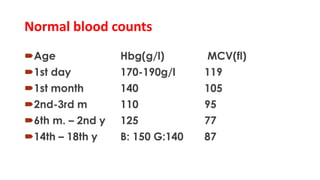
Normal blood counts
Age Hbg(g/l) MCV(fl)
1st day 170-190g/l 119
1st month 140 105
2nd-3rd m 110 95
6th m. – 2nd y 125 77
14th – 18th y B: 150 G:140 87
Newborn
• relative polycythaemia
• macrocytosis
• reticulocytes 3%, (later up to 1%)
• immature erythrocyte but functional, mature in 3 days
• erythrocyte: half-life 120 days
Platelets
Regardless of age:
• 140 - 400x109 / l
• Volume 7 - 11fl
• Life span 7-10 days
Anemia in the newborn
• The newborn is pale
• blood count: reduced Hbg more than 2 SD under physiologic value for
that age
definition – newborn over 34 GW aged 0-28 days:
• venous Hbg below 130 g/l
• capillary Hbg under 145 g/l
Physiological anemia of the newborn
• in full-term - physiological fall between 4th to 12th week
• Hbg to 95 - 110g / l
• the cause is a decrease in EPO production due to increased saturation
of O2 in the blood
Pathophysiology
• 3 main reasons:
• increased losses – hemorrhagic anemia
• increased destruction of ery – hemolytic anemia
• insufficient creation of ery – hypoplastic anemia
• the development of symptoms depends on the speed of anemia
progression
Hemorrhagic anemia 1
• antepartal (1/1000 births)
• placental abnormality
• abruption, praevia, traumatic AMC
• anomaly of the umbilicus
• knots, hematoma
Hemorrhagic anemia 2
Twin to twin transfusion
• only in monozygous multiple pregnancies, 13-33%
• the difference in Hbg is usually more than 50 g/l
• anemic twin - hydrops fetus
• plethoric twin - hyperviscosity syndrome
Hemorrhagic anemia 3
Intrapartum
• fetomaternal bleeding (preeclampsia, s.c.)
• S.C., especially acute
• umbilical traumatic rupture
• perinatal trauma - bleeding intracranial, visceral
Hemorrhagic anemia 4
postpartum
• birth trauma
• Bleeding intracranial, visceral, caput succedaneum, cephalhematoma,
subgaleal bleeding
• hemostasis disorders
• congenital deficiency of coagulation factors
• consumptive coagulopathy: DIC, sepsis
Hemorrhagic anemia 5
Hemostasis disorders
• Deficiency K vitamin-dependent factors II, VII, IX, X
• vit. K administration within 6 hours after birth
• Early form of hemorrhagic disease - bleeding in 3rd-4th. days
• Thrombocytopenia: Immune or congenital
• Iatrogenic anemia
• Blood samples - average 0.8 - 3ml/kg/day during ICU stay
Symptoms of hemorrhagic anemia
Acute
• pallor without cyanosis or jaundice
• tachypnoea, dyspnoea
• peripheral circulatory disorder (loss of 10%)
• hypovolemic shock (loss 20-25%)
• normocytar normochromatic anemia
• reticulocytosis rises in 2-3 days
Chronic hemorrhagic anemia
• paleness without jaundice or cyanosis, unresponsive to O2
• minimal dyspnoea
• normal CVP
• microcytary hypochrome anemia
• compensatory reticulocytosis
• hepatomegaly (extramedullary erythropoiesis)
• hydrops fetalis
Hemolytic anemia 1
• Immune hemolysis
• Isoimune
• ABO, Rh incompatibility
• Autoimmune - rare in newborns
• non-immune
• sepsis
• TORCH sy.
Hemolytic anemia 2
• Congenital erythrocyte disorders
• membrane defects
• enzymopathies
• hemoglobinopathies
• General diseases
• Galactosaemia
• Nutrition deficiency
• Vitamin E deficiency
Hereditary spherocytosis 1
• the most common congenital hemolytic. anemia in Central Europe
• 1/5000
• integrity of the ery membrane is impaired for the mutation of some
structural protein
• ankyrin, spectrin, protein 3 and 4
Hereditary spherocytosis 2
• the lipid bilayer is not anchored, forming vesicles by passing through
sinuses of the spleen.
• Ery loses parts of its membrane - the surface is reduced in proportion
to its volume
• spherocyt
• it decreases its resistance and deformability in splenic sinuses
• hemolysis
Hereditary spherocytosis 3
• anemia, jaundice, splenomegaly
3 forms:
• light - 30% of patients, hemolysis completely compensated by
reticulocytosis, no anemia
• moderate - 60%, light anemia, occasionally need of RCT
• severe - up to 10%, severe anemia, dependence on RCT
Hereditary spherocytosis 4
• In the newborn, severe hyperbilirubinaemia with need of
• intensive phototherapy
• exchange transfusion
• generally normal Hbg in newborn - very quickly decreases
Hereditary spherocytosis 5
• frequent need for RCT within 6 months of life
• The infant can not sufficiently compensate for hemolysis by increasing
erythropoesis.
• cholelithiasis - 20 - 60% of patients, even before 10 years.
• transient aplastic crisis
• Parvovirus B19 infection
• Duration 10-14 days
Hereditary spherocytosis 6
• positive family history, unconjugated hyperbilirubinemia,
splenomegaly, anemia with reticulocytosis, spherocytes in peripheral
blood
• tests: osmotic resistance, autohemolysis
• diagnosis is problematic in newborns:
• spherocytes are usually lacking
• family history may be negative in 25%
Hereditary spherocytosis 7
• splenectomy after 5 year of life (partial)
• previously completed vaccinations, pneumococcus and meningococcus
• gallbladder sonography follow - consider contemporary cholecystectomy
• after splenectomy - 2 years of PNC ATB prophylaxis.
• at each fever, ATB must be immediately applied for high risk of sepsis
Erythrocyte metabolism
• it determines its shape, structure and functionality
glucose utilization:
• 90% anaerobic glycolysis - ATP + 2,3 diphosphoglycerate
• regulates the affinity of Hbg for oxygen
• 10% aerobic glycolysis - pentose cycle - reduced glutathione
• protects Hbg and membranes of erythrocyte from O2 radicals
Enzymopathy 1
Pyruvate kinase deficiency (anaerobic glycolysis)
• lack of ATP - increased potassium loss - dehydration, stiffness - spleen
sequestration
• variable severity - up to lifetime dependence on RCT
• clinical picture:
- anemia,
- splenomegaly,
- severe neonatal hyperbilirubinemia,
- cholelithiasis,
- iron overload.
Enzymopathy 2
Glucose 6 phosphate dehydrogenase deficiency (aerobic glycolysis)
• X linked inheritance - more severe in men, Sardinia
• mostly asymptomatic, resistance to severe malaria
• serious neonatal jaundice
Glucose 6 phosphate dehydrogenase deficiency
acute hemolytic crisis
• infection, sulphonamides, antimalarials, raw beans
• within 24-72 hours: hemolysis, icterus, dark urine
• blood smear - "trickled ery" - after removing Heinz bodies in the
spleen (denatured hemoglobin)
• In our country as chronic extravascular hemolysis with reticulocytosis,
cholelithiasis and splenomegaly
Hemoglobinopathy
defects of hemoglobin synthesis
• a malformation of some of the globin chains - thalassemia
• synthesis of abnormal globin chains - sickle cell anemia
• fetal hemoglobin has 2 alpha and 2 gamma chains - alpha thalassemia
also in fetus and newborn
• adult hemoglobin predominates after 2 months - 2 alpha and 2 beta
chains
Alpha thalassemia
• deletion of 1 to 4 alpha-globin alleles
• Del. 1 allele - no clinical symptoms
• Del. 2 alleles - talasemia minor - mild anemia
• Del. 3 alleles - heavy hemolytic anemia, unstable Hbg – denatures –
Heinz's body
• Del. 4 alleles - severe intrauterine anemia, fetal hydrops - death
(Bart Hbg - 4 gamma strands)
Symptoms of hemolytic anemia
first symptom
• jaundice - unconjugated hyperbilirubinemia
• compensatory reticulocytosis
• pallor after 48 hours of life
• tachypnoea, hepatosplenomegaly
Hypoplastic anemia
congenital
• Diamond-Blackfan sy.
• Congenital leukemia
acquired
• infections: rubella, syphilis
• aplastic crisis, aplastic anemia
Diamond-Blackfan Syndrome 1
• congenital hypoplastic anemia
• already in the newborn age
• proteosynthesis disorder on ribosomes leading to failure of highly
proliferating erythropoiesis cells
• 60% of patients have one or more congenital anomalies:
Diamond-Blackfan Syndrome 2
• craniofacial dysmorphia + small figure,
• neck anomaly,
• three-inch thumb, malformation of uropoetic tract
• macrocytary anemia
• reduced number of red blood cells in the bone marrow
• reticulopenia
• elevated EPO
• Th: Corticoids
Diamond-Blackfan Syndrome 3
• 1/3 of patients - spontaneous resolution within 10 years, macrocytosis
persists
• 1/3 of patients - dependent on corticosteroids, without the need for RCT
• 1/3 of patients does not respond to corticosteroids, life dependence on
RCT
• secondary hemosiderosis
• Th: bone marow transplantation
Diamond-Blackfan Syndrome 4
• as with all congenital dysfunction of the bone marrow, there is an
increased risk of malignancy
- leukemia
- osteosarcoma
Symptoms of hypoplastic anemia
• dull – not significant
• start after 48 hours
• missing jaundice
• reticulocytopenia
Anemia of immaturity 1
• normochromatic, normocytar anemia of preterm babies under 32nd
gestational week
• already in 3rd - 10th week of life, Hb 65 - 90g/l
• it may be completely without symptoms
• failure to thrive, of deceleration of growth rate
• a more frequent occurrence of apnoe
• reduction of activity
Anemia of immaturity 2
• tachypnea
• tachycardia
• heart murmur
• severe anemia
• hypoxia
• metabolic acidosis
Anemia of immaturity 3
etiology: lack of erythropoetin
• in case of premature babies, it is produced in the liver
• is less sensitive to hypoxia than kidney
• premature birth does not accelerate EPO creation
• the relationship between the degree of immaturity and the severity
of anemia
Anemia of immaturity 4
• less red blood cells at birth, shortened ERY-Hbf survival
• rapid growth - high demands
• alimentary Causes (Fe)
• frequent blood withdrawals
• 1ml for 1kg baby = 70ml for 70kg adult
Diagnostics 1
• blood count
• Hbg
• Blood type, Rh factor
• Coombs testing - positive for auto / isoimmune hemolysis
• direct
• indirect
Diagnostics 2
MCV - mean red blood cell volume
• Microcytes
• sideropenia, thalassemia
• Normocytes
• acute hemorrhage, feto-maternal transfusion, isoimmunization
• Macrocytes
• Diamond - Blackfan sy.
• Vitamin B12 or folic acid deficiency
Diagnostics 3
Reticulocytes
• normal
• acute nlood Loss
• reduced
• hypoplastic anemia
• increased
• hemolytic anemia
Diagnostics 4
Blood smear
Spherocyte: congenital spherocytosis, ABO incompatibility
Pyknocyte: Glucose 6 phosphate dehydrogenase deficiency
Eliptocyte: heredit. eliptocytosis
Schistocyte: consumption coagulopathy
Diagnostics 5
• Apt test, Kleihauer-Betke test , flow cytometry
• detection of Hbf in the mother during fetal-maternal transfusion
• serum ferritin
• soluble intracellular Fe supply
• acute phase reactant - falsely elevated in inflammation, always be
investigated with CRP
Diagnostics 5
• soluble transferin receptor
• Fe, transferin
• inflammatory parameters
• Blood count, CRP, Pct
• serology of TORCH
Diagnostics 6
• bilirubin
• hemocoagulation, occult bleeding
• ultrasound - abdomen, brain
• genetics
• bone marrow sample
Diagnostics 7
• sufficient placental transfusion
• delayed umbilical cord clamping of 60-240s
• restriction of iatrogenic blood loss
• timely and sufficient supplementation of Fe
• Ferritin below 300ug / l
• recombinant EPO
Therapy
• red cell transfusion masses - 20 ml / kg
• acute indication - extensive blood loss with the need for immediate
replacement
• transfusion of 0 Rh negative blood crossed with umbilical cord
blood
• anemia of immaturity - gradual anemization
• RCT indication based on Htk, Hbg, presence of compensatory
reticulocytosis, postnatal age and cardiorespiratory status
Red cell transfusion
• blood resuspension, erythrocyte solution, where the plasma is
replaced by an electrolytes
• Htk 55 - 65%, ideally up to 5 days old
• deleukotyzated - reduced risk of transmission of infection
• irradiated - for the risk of graft versus host reaction
• especially in relational transfusions
• until 1st year of life - CMV negative transfusion
• Kell negative - all children (especially girls) and women of fertile age
RCT risk
• infections: CMV - 30 - 70% seropositive donors
• haemolysis: passively transferred by IGG from mother
• hyperkalaemia: at TREM 20ml/kg for 2-3 hours = low risk
• hypocalcemia: citrate
• hypothermia, hypervolemia
• creation of O2 radicals
EPO 1
• growth factor responsible for fetal and neonatal erythropoiesis
Synthesis:
• fetus and premature newborn
• liver
• full-term newborn
• kidney
EPO 2
Controversial views:
• according to the study, it does not reduce the risk of early RCT until
the 3rd week
• reduces the risk of late RCTs after the 3rd week
CONS:
• significantly increases risk of retinopathy
EPO 3
PROS:
• protective effect in brain ischemia
• reduces the risk of BPD
• unclear protective effect on NEC
Fe
• fast growing and dividing cells - hormone secretion, synt. DNA and
collagen
• O2 Carrier, oxygenation and hydroxylation catalysator
• coenzyme of the respiratory chain
• immunity - neutrophyles function
• growth and development of CNS and mental abilities
Deficiency of Fe
Reduced Ferritin
• full term newborn - in 4-6.m.
• 1 mg / kg / day
• immature - in the 2nd month.
• 2-4-6mg / kg / day
• supplementation ends with normalization of ferritin and Hbg
Fe supplementation
Maltofer - Fe3 + as ferric hydroxide
• it is actively absorbed after binding to ferritin and then transported
with transferrin
• advantage - less undesirable GIT symptoms than Fe 2+ (Aktiferin)
• administered together with vit. C - improves absorption
Nutritional Supplements
Folic acid
• reducing to tetrahydrofolate - coenzymes for the synthesis of purine
and pyrimidine nucleotides
• deficiency affects mainly rapidly dividing cells
• supplementation ends at 40 gestatuional wek
Vitamin B12 - only for a proven deficiency

Anemia_in_newborn.pdf

  • 1.
    Anemia in thenewborn Neonatal Department of Intensive Medicine Faculty of Medicine, Comenius University in Bratislava
  • 2.
    Normal blood counts AgeHbg(g/l) MCV(fl) 1st day 170-190g/l 119 1st month 140 105 2nd-3rd m 110 95 6th m. – 2nd y 125 77 14th – 18th y B: 150 G:140 87
  • 3.
    Newborn • relative polycythaemia •macrocytosis • reticulocytes 3%, (later up to 1%) • immature erythrocyte but functional, mature in 3 days • erythrocyte: half-life 120 days
  • 4.
    Platelets Regardless of age: •140 - 400x109 / l • Volume 7 - 11fl • Life span 7-10 days
  • 5.
    Anemia in thenewborn • The newborn is pale • blood count: reduced Hbg more than 2 SD under physiologic value for that age definition – newborn over 34 GW aged 0-28 days: • venous Hbg below 130 g/l • capillary Hbg under 145 g/l
  • 6.
    Physiological anemia ofthe newborn • in full-term - physiological fall between 4th to 12th week • Hbg to 95 - 110g / l • the cause is a decrease in EPO production due to increased saturation of O2 in the blood
  • 7.
    Pathophysiology • 3 mainreasons: • increased losses – hemorrhagic anemia • increased destruction of ery – hemolytic anemia • insufficient creation of ery – hypoplastic anemia • the development of symptoms depends on the speed of anemia progression
  • 8.
    Hemorrhagic anemia 1 •antepartal (1/1000 births) • placental abnormality • abruption, praevia, traumatic AMC • anomaly of the umbilicus • knots, hematoma
  • 9.
    Hemorrhagic anemia 2 Twinto twin transfusion • only in monozygous multiple pregnancies, 13-33% • the difference in Hbg is usually more than 50 g/l • anemic twin - hydrops fetus • plethoric twin - hyperviscosity syndrome
  • 10.
    Hemorrhagic anemia 3 Intrapartum •fetomaternal bleeding (preeclampsia, s.c.) • S.C., especially acute • umbilical traumatic rupture • perinatal trauma - bleeding intracranial, visceral
  • 11.
    Hemorrhagic anemia 4 postpartum •birth trauma • Bleeding intracranial, visceral, caput succedaneum, cephalhematoma, subgaleal bleeding • hemostasis disorders • congenital deficiency of coagulation factors • consumptive coagulopathy: DIC, sepsis
  • 12.
    Hemorrhagic anemia 5 Hemostasisdisorders • Deficiency K vitamin-dependent factors II, VII, IX, X • vit. K administration within 6 hours after birth • Early form of hemorrhagic disease - bleeding in 3rd-4th. days • Thrombocytopenia: Immune or congenital • Iatrogenic anemia • Blood samples - average 0.8 - 3ml/kg/day during ICU stay
  • 13.
    Symptoms of hemorrhagicanemia Acute • pallor without cyanosis or jaundice • tachypnoea, dyspnoea • peripheral circulatory disorder (loss of 10%) • hypovolemic shock (loss 20-25%) • normocytar normochromatic anemia • reticulocytosis rises in 2-3 days
  • 14.
    Chronic hemorrhagic anemia •paleness without jaundice or cyanosis, unresponsive to O2 • minimal dyspnoea • normal CVP • microcytary hypochrome anemia • compensatory reticulocytosis • hepatomegaly (extramedullary erythropoiesis) • hydrops fetalis
  • 15.
    Hemolytic anemia 1 •Immune hemolysis • Isoimune • ABO, Rh incompatibility • Autoimmune - rare in newborns • non-immune • sepsis • TORCH sy.
  • 16.
    Hemolytic anemia 2 •Congenital erythrocyte disorders • membrane defects • enzymopathies • hemoglobinopathies • General diseases • Galactosaemia • Nutrition deficiency • Vitamin E deficiency
  • 17.
    Hereditary spherocytosis 1 •the most common congenital hemolytic. anemia in Central Europe • 1/5000 • integrity of the ery membrane is impaired for the mutation of some structural protein • ankyrin, spectrin, protein 3 and 4
  • 18.
    Hereditary spherocytosis 2 •the lipid bilayer is not anchored, forming vesicles by passing through sinuses of the spleen. • Ery loses parts of its membrane - the surface is reduced in proportion to its volume • spherocyt • it decreases its resistance and deformability in splenic sinuses • hemolysis
  • 19.
    Hereditary spherocytosis 3 •anemia, jaundice, splenomegaly 3 forms: • light - 30% of patients, hemolysis completely compensated by reticulocytosis, no anemia • moderate - 60%, light anemia, occasionally need of RCT • severe - up to 10%, severe anemia, dependence on RCT
  • 20.
    Hereditary spherocytosis 4 •In the newborn, severe hyperbilirubinaemia with need of • intensive phototherapy • exchange transfusion • generally normal Hbg in newborn - very quickly decreases
  • 21.
    Hereditary spherocytosis 5 •frequent need for RCT within 6 months of life • The infant can not sufficiently compensate for hemolysis by increasing erythropoesis. • cholelithiasis - 20 - 60% of patients, even before 10 years. • transient aplastic crisis • Parvovirus B19 infection • Duration 10-14 days
  • 22.
    Hereditary spherocytosis 6 •positive family history, unconjugated hyperbilirubinemia, splenomegaly, anemia with reticulocytosis, spherocytes in peripheral blood • tests: osmotic resistance, autohemolysis • diagnosis is problematic in newborns: • spherocytes are usually lacking • family history may be negative in 25%
  • 23.
    Hereditary spherocytosis 7 •splenectomy after 5 year of life (partial) • previously completed vaccinations, pneumococcus and meningococcus • gallbladder sonography follow - consider contemporary cholecystectomy • after splenectomy - 2 years of PNC ATB prophylaxis. • at each fever, ATB must be immediately applied for high risk of sepsis
  • 24.
    Erythrocyte metabolism • itdetermines its shape, structure and functionality glucose utilization: • 90% anaerobic glycolysis - ATP + 2,3 diphosphoglycerate • regulates the affinity of Hbg for oxygen • 10% aerobic glycolysis - pentose cycle - reduced glutathione • protects Hbg and membranes of erythrocyte from O2 radicals
  • 25.
    Enzymopathy 1 Pyruvate kinasedeficiency (anaerobic glycolysis) • lack of ATP - increased potassium loss - dehydration, stiffness - spleen sequestration • variable severity - up to lifetime dependence on RCT • clinical picture: - anemia, - splenomegaly, - severe neonatal hyperbilirubinemia, - cholelithiasis, - iron overload.
  • 26.
    Enzymopathy 2 Glucose 6phosphate dehydrogenase deficiency (aerobic glycolysis) • X linked inheritance - more severe in men, Sardinia • mostly asymptomatic, resistance to severe malaria • serious neonatal jaundice
  • 27.
    Glucose 6 phosphatedehydrogenase deficiency acute hemolytic crisis • infection, sulphonamides, antimalarials, raw beans • within 24-72 hours: hemolysis, icterus, dark urine • blood smear - "trickled ery" - after removing Heinz bodies in the spleen (denatured hemoglobin) • In our country as chronic extravascular hemolysis with reticulocytosis, cholelithiasis and splenomegaly
  • 28.
    Hemoglobinopathy defects of hemoglobinsynthesis • a malformation of some of the globin chains - thalassemia • synthesis of abnormal globin chains - sickle cell anemia • fetal hemoglobin has 2 alpha and 2 gamma chains - alpha thalassemia also in fetus and newborn • adult hemoglobin predominates after 2 months - 2 alpha and 2 beta chains
  • 29.
    Alpha thalassemia • deletionof 1 to 4 alpha-globin alleles • Del. 1 allele - no clinical symptoms • Del. 2 alleles - talasemia minor - mild anemia • Del. 3 alleles - heavy hemolytic anemia, unstable Hbg – denatures – Heinz's body • Del. 4 alleles - severe intrauterine anemia, fetal hydrops - death (Bart Hbg - 4 gamma strands)
  • 30.
    Symptoms of hemolyticanemia first symptom • jaundice - unconjugated hyperbilirubinemia • compensatory reticulocytosis • pallor after 48 hours of life • tachypnoea, hepatosplenomegaly
  • 31.
    Hypoplastic anemia congenital • Diamond-Blackfansy. • Congenital leukemia acquired • infections: rubella, syphilis • aplastic crisis, aplastic anemia
  • 32.
    Diamond-Blackfan Syndrome 1 •congenital hypoplastic anemia • already in the newborn age • proteosynthesis disorder on ribosomes leading to failure of highly proliferating erythropoiesis cells • 60% of patients have one or more congenital anomalies:
  • 33.
    Diamond-Blackfan Syndrome 2 •craniofacial dysmorphia + small figure, • neck anomaly, • three-inch thumb, malformation of uropoetic tract • macrocytary anemia • reduced number of red blood cells in the bone marrow • reticulopenia • elevated EPO • Th: Corticoids
  • 34.
    Diamond-Blackfan Syndrome 3 •1/3 of patients - spontaneous resolution within 10 years, macrocytosis persists • 1/3 of patients - dependent on corticosteroids, without the need for RCT • 1/3 of patients does not respond to corticosteroids, life dependence on RCT • secondary hemosiderosis • Th: bone marow transplantation
  • 35.
    Diamond-Blackfan Syndrome 4 •as with all congenital dysfunction of the bone marrow, there is an increased risk of malignancy - leukemia - osteosarcoma
  • 36.
    Symptoms of hypoplasticanemia • dull – not significant • start after 48 hours • missing jaundice • reticulocytopenia
  • 37.
    Anemia of immaturity1 • normochromatic, normocytar anemia of preterm babies under 32nd gestational week • already in 3rd - 10th week of life, Hb 65 - 90g/l • it may be completely without symptoms • failure to thrive, of deceleration of growth rate • a more frequent occurrence of apnoe • reduction of activity
  • 38.
    Anemia of immaturity2 • tachypnea • tachycardia • heart murmur • severe anemia • hypoxia • metabolic acidosis
  • 39.
    Anemia of immaturity3 etiology: lack of erythropoetin • in case of premature babies, it is produced in the liver • is less sensitive to hypoxia than kidney • premature birth does not accelerate EPO creation • the relationship between the degree of immaturity and the severity of anemia
  • 40.
    Anemia of immaturity4 • less red blood cells at birth, shortened ERY-Hbf survival • rapid growth - high demands • alimentary Causes (Fe) • frequent blood withdrawals • 1ml for 1kg baby = 70ml for 70kg adult
  • 41.
    Diagnostics 1 • bloodcount • Hbg • Blood type, Rh factor • Coombs testing - positive for auto / isoimmune hemolysis • direct • indirect
  • 42.
    Diagnostics 2 MCV -mean red blood cell volume • Microcytes • sideropenia, thalassemia • Normocytes • acute hemorrhage, feto-maternal transfusion, isoimmunization • Macrocytes • Diamond - Blackfan sy. • Vitamin B12 or folic acid deficiency
  • 43.
    Diagnostics 3 Reticulocytes • normal •acute nlood Loss • reduced • hypoplastic anemia • increased • hemolytic anemia
  • 44.
    Diagnostics 4 Blood smear Spherocyte:congenital spherocytosis, ABO incompatibility Pyknocyte: Glucose 6 phosphate dehydrogenase deficiency Eliptocyte: heredit. eliptocytosis Schistocyte: consumption coagulopathy
  • 45.
    Diagnostics 5 • Apttest, Kleihauer-Betke test , flow cytometry • detection of Hbf in the mother during fetal-maternal transfusion • serum ferritin • soluble intracellular Fe supply • acute phase reactant - falsely elevated in inflammation, always be investigated with CRP
  • 46.
    Diagnostics 5 • solubletransferin receptor • Fe, transferin • inflammatory parameters • Blood count, CRP, Pct • serology of TORCH
  • 47.
    Diagnostics 6 • bilirubin •hemocoagulation, occult bleeding • ultrasound - abdomen, brain • genetics • bone marrow sample
  • 48.
    Diagnostics 7 • sufficientplacental transfusion • delayed umbilical cord clamping of 60-240s • restriction of iatrogenic blood loss • timely and sufficient supplementation of Fe • Ferritin below 300ug / l • recombinant EPO
  • 49.
    Therapy • red celltransfusion masses - 20 ml / kg • acute indication - extensive blood loss with the need for immediate replacement • transfusion of 0 Rh negative blood crossed with umbilical cord blood • anemia of immaturity - gradual anemization • RCT indication based on Htk, Hbg, presence of compensatory reticulocytosis, postnatal age and cardiorespiratory status
  • 50.
    Red cell transfusion •blood resuspension, erythrocyte solution, where the plasma is replaced by an electrolytes • Htk 55 - 65%, ideally up to 5 days old • deleukotyzated - reduced risk of transmission of infection • irradiated - for the risk of graft versus host reaction • especially in relational transfusions • until 1st year of life - CMV negative transfusion • Kell negative - all children (especially girls) and women of fertile age
  • 51.
    RCT risk • infections:CMV - 30 - 70% seropositive donors • haemolysis: passively transferred by IGG from mother • hyperkalaemia: at TREM 20ml/kg for 2-3 hours = low risk • hypocalcemia: citrate • hypothermia, hypervolemia • creation of O2 radicals
  • 52.
    EPO 1 • growthfactor responsible for fetal and neonatal erythropoiesis Synthesis: • fetus and premature newborn • liver • full-term newborn • kidney
  • 53.
    EPO 2 Controversial views: •according to the study, it does not reduce the risk of early RCT until the 3rd week • reduces the risk of late RCTs after the 3rd week CONS: • significantly increases risk of retinopathy
  • 54.
    EPO 3 PROS: • protectiveeffect in brain ischemia • reduces the risk of BPD • unclear protective effect on NEC
  • 55.
    Fe • fast growingand dividing cells - hormone secretion, synt. DNA and collagen • O2 Carrier, oxygenation and hydroxylation catalysator • coenzyme of the respiratory chain • immunity - neutrophyles function • growth and development of CNS and mental abilities
  • 56.
    Deficiency of Fe ReducedFerritin • full term newborn - in 4-6.m. • 1 mg / kg / day • immature - in the 2nd month. • 2-4-6mg / kg / day • supplementation ends with normalization of ferritin and Hbg
  • 57.
    Fe supplementation Maltofer -Fe3 + as ferric hydroxide • it is actively absorbed after binding to ferritin and then transported with transferrin • advantage - less undesirable GIT symptoms than Fe 2+ (Aktiferin) • administered together with vit. C - improves absorption
  • 58.
    Nutritional Supplements Folic acid •reducing to tetrahydrofolate - coenzymes for the synthesis of purine and pyrimidine nucleotides • deficiency affects mainly rapidly dividing cells • supplementation ends at 40 gestatuional wek Vitamin B12 - only for a proven deficiency