Free ebook:
Top 19 android developer interview
questions with answers
1. How do you find any view element into your
program?
Findviewbyid : Finds a view that was identified by
the id attribute from the XML processed
inActivity.OnCreate(Bundle).
Syntax
[Android.Runtime.Register("findViewById
", "(I)Landroid/view/View;", "GetFindVi
ewById_IHandler")]
public virtual View FindViewById (Int32
id)
2. Why cannot you run standard Java
bytecode on Android?
Android uses Dalvik Virtual Machine (DVM)
which requires a special bytecode. First of all,
we have to convert Java class files into
Dalvik Executable files using an Android tool
called “dx”. In normal circumstances,
developers will not be using this tool directly
and build tools will care for the generation of
DVM compatible files.
3. Can Android application only be
programmed in Java?
No, it is not necessary. You can program
Android apps can be created using NDK in
C/C++. The NDK is a toolset that allows you
to implement parts of your app using native-
code languages such as C and C++.
Typically, good use cases for the NDK are
CPU-intensive applications such as game
engines, signal processing, and physics
simulation.
4. Where will you declare your activity so
the system can access it?
Activity is to be declared in the manifest file.
For example:
1. <manifest></manifest>
2. <application></application>
3. <activity android:name=”.MyIntellipaa
t”>
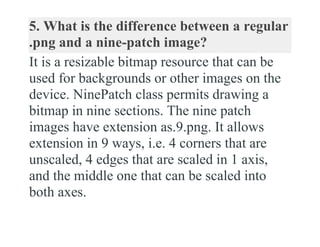
5. What is the difference between a regular
.png and a nine-patch image?
It is a resizable bitmap resource that can be
used for backgrounds or other images on the
device. NinePatch class permits drawing a
bitmap in nine sections. The nine patch
images have extension as.9.png. It allows
extension in 9 ways, i.e. 4 corners that are
unscaled, 4 edges that are scaled in 1 axis,
and the middle one that can be scaled into
both axes.
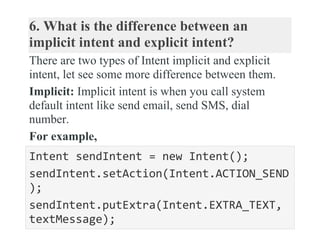
6. What is the difference between an
implicit intent and explicit intent?
There are two types of Intent implicit and explicit
intent, let see some more difference between them.
Implicit: Implicit intent is when you call system
default intent like send email, send SMS, dial
number.
For example,
Intent sendIntent = new Intent();
sendIntent.setAction(Intent.ACTION_SEND
);
sendIntent.putExtra(Intent.EXTRA_TEXT,
textMessage);
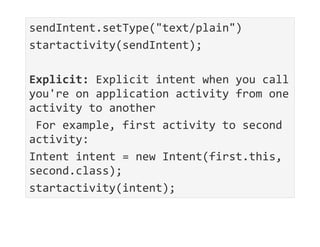
sendIntent.setType("text/plain")
startactivity(sendIntent);
Explicit: Explicit intent when you call
you're on application activity from one
activity to another
For example, first activity to second
activity:
Intent intent = new Intent(first.this,
second.class);
startactivity(intent);
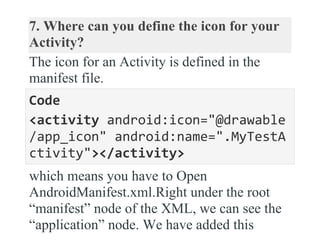
7. Where can you define the icon for your
Activity?
The icon for an Activity is defined in the
manifest file.
Code
<activity android:icon="@drawable
/app_icon" android:name=".MyTestA
ctivity"></activity>
which means you have to Open
AndroidManifest.xml.Right under the root
“manifest” node of the XML, we can see the
“application” node. We have added this
attribute to “application”. (The “icon” in
“@drawable/icon” refers to the file name of
the icon.)
android:icon=”@drawable/icon”
8. What is ADB?
ADB stands for Android Debug Bridge. It is a
command line tool that is used to
communicate with the emulator instance.
ADB can control your device over USB from
a computer, copy files back and forth, install
and uninstall apps, run shell commands, and
more. It is a client-server program that
includes three components:
• A client, which runs on your development
machine. You can invoke a client from a shell
by issuing an ADB command. Other Android
tools such as DDMS also create ADB clients.
• A server, which runs as a background
process on your development machine. The
server manages communication between the
client and the ADB daemon running on an
emulator or device.
• A daemon, which runs as a background
process on each emulator or device instance.
9. What are the different storage methods
in Android?
Android offers several different options for
data persistence. Shared Preferences – Store
private primitive data in key-value pairs. This
sometimes gets limited as it offers only key-
value pairs. You cannot save your own java
types. Internal Storage – Store private data on
the device memory.
10. What is action in Android?
In Android, the action is a description of
something that an intent sender desires.
SYNTAX:
CONTAINED IN:
DESCRIPTION:
Adds an action to an intent filter. An element
must contain one or more elements. If it
doesn’t contain any, no Intent objects will get
through the filter.
11. What is an ANR notification in
Android?
ANR is short for Application Not
Responding. Android systems show this
dialog if the application is performing too
much of task on the main thread and has been
unresponsive from a long time.
12. Enumerate three key loops when
monitoring an activity?
• Entire lifetime – activity happens between
onCreate and onDestroy
• Visible lifetime – activity happens between
onStart and onStop
• Foreground lifetime – activity happens
between onResume and onPause
13. Which dialog boxes can you use in your
Android application?
 AlertDialog : An alert dialogue box supports 0 to
3 buttons and a list of selectable elements.
 ProgressDialog : An extension to AlertDialog
and you may add buttons to it. It shows a progress
wheel or a progress bar.
 DatePickerDialog : It is used for selecting a date
by the user.
 TimePickerDialog : It is used for selecting time
by the user.
14. Name the resource that is a compiled
visual resource and can be used as a
background, title, or in other part of the
screen.
Drawable is the virtual resource that can be
used as a background, title, or in other parts
of the screen. It is compiled into an
android.graphics.drawable subclass. A
Drawable resource is a general concept for a
graphic which can be drawn. The simplest
case is a graphical file (bitmap), which would
be represented in Android via a
BitmapDrawable class.
The Drawable is stored as individual files in
one of the res/drawable folders. The ADT
project creation wizard creates these folders
by default. You would store bitmaps for
different resolutions in the -mdpi, -hdpi, -
xhdpi, -xxhdpi subfolders of res/drawable If
these bitmaps are provided in a different
folder, the Android system selects the correct
one automatically based on the device
configuration.
15. How can two Android applications
share same Linux user ID and share same
VM?
The applications must sign with the same
certificate in order to share same Linux user
ID and share same VM.
16. Can you deploy executable JARs on
Android? Which packaging is supported
by Android?
No, Android platform does not support JAR
deployments. Applications are packed into
Android Package (.apk) using Android Asset
Packaging Tool (AAPT) and then deployed
onto Android platform. Google provides
Android Development Tools for Eclipse that
can be used to generate Android Package.
17. Is it okay to change the name of an
application after its deployment?
It is not recommended to change the
application name after its deployment
because this action may break some
functionality. For example, shortcuts will not
work if you change application name.
18. How can ANR be prevented?
One technique that prevents the Android
system from concluding a code that has been
responsive for a long period of time is to
create a child thread. Within the child thread,
most of the actual tasks of the codes can be
placed, so that the main thread runs with
minimal periods of unresponsive time.
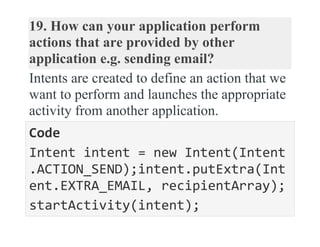
19. How can your application perform
actions that are provided by other
application e.g. sending email?
Intents are created to define an action that we
want to perform and launches the appropriate
activity from another application.
Code
Intent intent = new Intent(Intent
.ACTION_SEND);intent.putExtra(Int
ent.EXTRA_EMAIL, recipientArray);
startActivity(intent);

Android developer interview questions with answers pdf

  • 1.
    Free ebook: Top 19android developer interview questions with answers
  • 2.
    1. How doyou find any view element into your program? Findviewbyid : Finds a view that was identified by the id attribute from the XML processed inActivity.OnCreate(Bundle). Syntax [Android.Runtime.Register("findViewById ", "(I)Landroid/view/View;", "GetFindVi ewById_IHandler")] public virtual View FindViewById (Int32 id)
  • 3.
    2. Why cannotyou run standard Java bytecode on Android? Android uses Dalvik Virtual Machine (DVM) which requires a special bytecode. First of all, we have to convert Java class files into Dalvik Executable files using an Android tool called “dx”. In normal circumstances, developers will not be using this tool directly and build tools will care for the generation of DVM compatible files.
  • 4.
    3. Can Androidapplication only be programmed in Java? No, it is not necessary. You can program Android apps can be created using NDK in C/C++. The NDK is a toolset that allows you to implement parts of your app using native- code languages such as C and C++. Typically, good use cases for the NDK are CPU-intensive applications such as game engines, signal processing, and physics simulation.
  • 5.
    4. Where willyou declare your activity so the system can access it? Activity is to be declared in the manifest file. For example: 1. <manifest></manifest> 2. <application></application> 3. <activity android:name=”.MyIntellipaa t”>
  • 6.
    5. What isthe difference between a regular .png and a nine-patch image? It is a resizable bitmap resource that can be used for backgrounds or other images on the device. NinePatch class permits drawing a bitmap in nine sections. The nine patch images have extension as.9.png. It allows extension in 9 ways, i.e. 4 corners that are unscaled, 4 edges that are scaled in 1 axis, and the middle one that can be scaled into both axes.
  • 7.
    6. What isthe difference between an implicit intent and explicit intent? There are two types of Intent implicit and explicit intent, let see some more difference between them. Implicit: Implicit intent is when you call system default intent like send email, send SMS, dial number. For example, Intent sendIntent = new Intent(); sendIntent.setAction(Intent.ACTION_SEND ); sendIntent.putExtra(Intent.EXTRA_TEXT, textMessage);
  • 8.
    sendIntent.setType("text/plain") startactivity(sendIntent); Explicit: Explicit intentwhen you call you're on application activity from one activity to another For example, first activity to second activity: Intent intent = new Intent(first.this, second.class); startactivity(intent);
  • 9.
    7. Where canyou define the icon for your Activity? The icon for an Activity is defined in the manifest file. Code <activity android:icon="@drawable /app_icon" android:name=".MyTestA ctivity"></activity> which means you have to Open AndroidManifest.xml.Right under the root “manifest” node of the XML, we can see the “application” node. We have added this
  • 10.
    attribute to “application”.(The “icon” in “@drawable/icon” refers to the file name of the icon.) android:icon=”@drawable/icon”
  • 11.
    8. What isADB? ADB stands for Android Debug Bridge. It is a command line tool that is used to communicate with the emulator instance. ADB can control your device over USB from a computer, copy files back and forth, install and uninstall apps, run shell commands, and more. It is a client-server program that includes three components: • A client, which runs on your development machine. You can invoke a client from a shell by issuing an ADB command. Other Android tools such as DDMS also create ADB clients.
  • 12.
    • A server,which runs as a background process on your development machine. The server manages communication between the client and the ADB daemon running on an emulator or device. • A daemon, which runs as a background process on each emulator or device instance.
  • 13.
    9. What arethe different storage methods in Android? Android offers several different options for data persistence. Shared Preferences – Store private primitive data in key-value pairs. This sometimes gets limited as it offers only key- value pairs. You cannot save your own java types. Internal Storage – Store private data on the device memory.
  • 14.
    10. What isaction in Android? In Android, the action is a description of something that an intent sender desires. SYNTAX: CONTAINED IN: DESCRIPTION: Adds an action to an intent filter. An element must contain one or more elements. If it doesn’t contain any, no Intent objects will get through the filter.
  • 15.
    11. What isan ANR notification in Android? ANR is short for Application Not Responding. Android systems show this dialog if the application is performing too much of task on the main thread and has been unresponsive from a long time.
  • 16.
    12. Enumerate threekey loops when monitoring an activity? • Entire lifetime – activity happens between onCreate and onDestroy • Visible lifetime – activity happens between onStart and onStop • Foreground lifetime – activity happens between onResume and onPause
  • 17.
    13. Which dialogboxes can you use in your Android application?  AlertDialog : An alert dialogue box supports 0 to 3 buttons and a list of selectable elements.  ProgressDialog : An extension to AlertDialog and you may add buttons to it. It shows a progress wheel or a progress bar.  DatePickerDialog : It is used for selecting a date by the user.  TimePickerDialog : It is used for selecting time by the user.
  • 18.
    14. Name theresource that is a compiled visual resource and can be used as a background, title, or in other part of the screen. Drawable is the virtual resource that can be used as a background, title, or in other parts of the screen. It is compiled into an android.graphics.drawable subclass. A Drawable resource is a general concept for a graphic which can be drawn. The simplest case is a graphical file (bitmap), which would be represented in Android via a BitmapDrawable class.
  • 19.
    The Drawable isstored as individual files in one of the res/drawable folders. The ADT project creation wizard creates these folders by default. You would store bitmaps for different resolutions in the -mdpi, -hdpi, - xhdpi, -xxhdpi subfolders of res/drawable If these bitmaps are provided in a different folder, the Android system selects the correct one automatically based on the device configuration.
  • 20.
    15. How cantwo Android applications share same Linux user ID and share same VM? The applications must sign with the same certificate in order to share same Linux user ID and share same VM.
  • 21.
    16. Can youdeploy executable JARs on Android? Which packaging is supported by Android? No, Android platform does not support JAR deployments. Applications are packed into Android Package (.apk) using Android Asset Packaging Tool (AAPT) and then deployed onto Android platform. Google provides Android Development Tools for Eclipse that can be used to generate Android Package.
  • 22.
    17. Is itokay to change the name of an application after its deployment? It is not recommended to change the application name after its deployment because this action may break some functionality. For example, shortcuts will not work if you change application name.
  • 23.
    18. How canANR be prevented? One technique that prevents the Android system from concluding a code that has been responsive for a long period of time is to create a child thread. Within the child thread, most of the actual tasks of the codes can be placed, so that the main thread runs with minimal periods of unresponsive time.
  • 24.
    19. How canyour application perform actions that are provided by other application e.g. sending email? Intents are created to define an action that we want to perform and launches the appropriate activity from another application. Code Intent intent = new Intent(Intent .ACTION_SEND);intent.putExtra(Int ent.EXTRA_EMAIL, recipientArray); startActivity(intent);