Better control of avocado sunblotch
disease through improved diagnostic
technologies
By Andrew Geering and Vish Steele
Horticulture and Forestry Science, Industry Services
Queensland Primary Industries and Fisheries


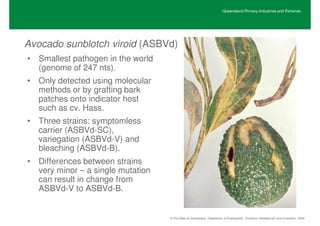
Avocado sunblotch viroid (ASBVd)
• Smallest pathogen in the world
  (genome of 247 nts).
• Only detected using molecular
  methods or by grafting bark
  patches onto indicator host
  such as cv. Hass.
• Three strains: symptomless
  carrier (ASBVd-SC),
  variegation (ASBVd-V) and
  bleaching (ASBVd-B).
• Differences between strains
  very minor – a single mutation
  can result in change from
  ASBVd-V to ASBVd-B.


                                   © The State of Queensland, Department of Employment, Economic Development and Innovation, 2009
Queensland Primary Industries and Fisheries


Economic impact of ASBVd
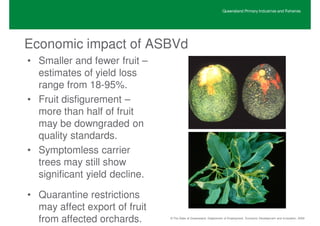
• Smaller and fewer fruit –
  estimates of yield loss
  range from 18-95%.
• Fruit disfigurement –
  more than half of fruit
  may be downgraded on
  quality standards.
• Symptomless carrier
  trees may still show
  significant yield decline.

• Quarantine restrictions
  may affect export of fruit
  from affected orchards.      © The State of Queensland, Department of Employment, Economic Development and Innovation, 2009
Queensland Primary Industries and Fisheries


Transmission of ASBVd
• Cannot be transmitted by insects.
• Cannot survive for any length of time outside of
  the plant (i.e. in the soil).
• Transmitted at a very high rate in seed.
• Transmitted in scions used for grafting.
• Probably transmitted at a low rate on the blades
  of pruning tools.
• Transmitted by root grafting.
                            © The State of Queensland, Department of Employment, Economic Development and Innovation, 2009
Queensland Primary Industries and Fisheries


Control of ASBVd
• Infected plants cannot be cured.
• Infected plants should be removed to prevent
  further spread – all living tissue must be
  destroyed.
• New blocks should be established with plants
  certified to be free of ASBVd:
   – i.e. from a nursery participating in the
     Avocado Nursery Voluntary Accreditation
     Scheme (ANVAS).

                          © The State of Queensland, Department of Employment, Economic Development and Innovation, 2009
Queensland Primary Industries and Fisheries


Objectives of research project
• To develop quality-assured diagnostic tools.

• To survey for ASBVd in south-east
  Queensland/northern NSW.


                           © The State of Queensland, Department of Employment, Economic Development and Innovation, 2009
Queensland Primary Industries and Fisheries


Quality-assured diagnostic tools
• Two types of error in diagnosis:
   – Healthy plant mistakenly diagnosed as
     infected.
   – Infected plant mistakenly diagnosed as
     healthy.
• The latter mistake is most serious.
   Causes of error:
     •   Human error.
     •   Sample degradation.
     •   Sampling error.
     •   Assay inhibition.
                               © The State of Queensland, Department of Employment, Economic Development and Innovation, 2009
Queensland Primary Industries and Fisheries


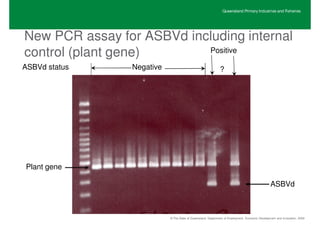
New PCR assay for ASBVd including internal
control (plant gene)       Positive

ASBVd status    Negative                                     ?


Plant gene

                                                                                                 ASBVd


                           © The State of Queensland, Department of Employment, Economic Development and Innovation, 2009
Queensland Primary Industries and Fisheries


How significant a problem is ASBVd in
Australia?
• ANVAS established in 1978.
• 34% of Australian avocado trees 6 years or
  younger.
• Less than 10 records of ASBVd from Australia
  and mostly from germplasm collections.
• Last published report of ASBVd was in 1989.

Question: Is ASBVd still present in Australia?

                           © The State of Queensland, Department of Employment, Economic Development and Innovation, 2009
Queensland Primary Industries and Fisheries


Verified records of ASBVd in Australia
   – cv. Mexicola, Alstonville Research Station, NSW
     (1962, 1989) – budwood obtained from ‘interstate’.
   – cv. Zutano AV35, 2 field trees, Coomealla, NSW
     (1981)
   – cv. unknown, CSIRO Division of Horticultural
     Research, Merbein, Victoria (1981).
   – cv. Carlsbad, post-entry quarantine, Canberra (1981).
   – cv. Fuerte, field tree, Alstonville, NSW (1981).
   – cv. Hass, 1 field tree, Red Cliffs, Vic (1981)
   – cv. Hass, 2 field trees, Qld (1981)
   – cv. Hass, 1 field tree, NT (1981).
   – cv. Bacon, 1 field tree, Paringi, NSW (1989).
                               © The State of Queensland, Department of Employment, Economic Development and Innovation, 2009
Queensland Primary Industries and Fisheries


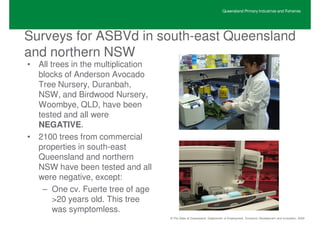
Surveys for ASBVd in south-east Queensland
and northern NSW
• All trees in the multiplication
  blocks of Anderson Avocado
  Tree Nursery, Duranbah,
  NSW, and Birdwood Nursery,
  Woombye, QLD, have been
  tested and all were
  NEGATIVE.
• 2100 trees from commercial
  properties in south-east
  Queensland and northern
  NSW have been tested and all
  were negative, except:
   – One cv. Fuerte tree of age
       >20 years old. This tree
       was symptomless.
                                    © The State of Queensland, Department of Employment, Economic Development and Innovation, 2009
Queensland Primary Industries and Fisheries


Conclusions
• ASBVd is very rare but not yet completely
  eradicated from Australia.

• ANVAS is successful and ASBVd progressively
  being eradicated.

• To ensure ASBVd-freedom, buy planting stock
  from accredited nurseries.

• If you suspect you have ASBVd, please talk to
  me at conference and we will test samples for
  free.
                          © The State of Queensland, Department of Employment, Economic Development and Innovation, 2009
Queensland Primary Industries and Fisheries


Acknowledgements
• Funding from Horticulture Australia Limited and
  Avocados Australia is gratefully acknowledged.

• THANK YOU FOR YOUR ATTENTION


                           © The State of Queensland, Department of Employment, Economic Development and Innovation, 2009

Andrew Geering

  • 1.
    Better control ofavocado sunblotch disease through improved diagnostic technologies By Andrew Geering and Vish Steele Horticulture and Forestry Science, Industry Services
  • 2.
    Queensland Primary Industriesand Fisheries Avocado sunblotch viroid (ASBVd) • Smallest pathogen in the world (genome of 247 nts). • Only detected using molecular methods or by grafting bark patches onto indicator host such as cv. Hass. • Three strains: symptomless carrier (ASBVd-SC), variegation (ASBVd-V) and bleaching (ASBVd-B). • Differences between strains very minor – a single mutation can result in change from ASBVd-V to ASBVd-B. © The State of Queensland, Department of Employment, Economic Development and Innovation, 2009
  • 3.
    Queensland Primary Industriesand Fisheries Economic impact of ASBVd • Smaller and fewer fruit – estimates of yield loss range from 18-95%. • Fruit disfigurement – more than half of fruit may be downgraded on quality standards. • Symptomless carrier trees may still show significant yield decline. • Quarantine restrictions may affect export of fruit from affected orchards. © The State of Queensland, Department of Employment, Economic Development and Innovation, 2009
  • 4.
    Queensland Primary Industriesand Fisheries Transmission of ASBVd • Cannot be transmitted by insects. • Cannot survive for any length of time outside of the plant (i.e. in the soil). • Transmitted at a very high rate in seed. • Transmitted in scions used for grafting. • Probably transmitted at a low rate on the blades of pruning tools. • Transmitted by root grafting. © The State of Queensland, Department of Employment, Economic Development and Innovation, 2009
  • 5.
    Queensland Primary Industriesand Fisheries Control of ASBVd • Infected plants cannot be cured. • Infected plants should be removed to prevent further spread – all living tissue must be destroyed. • New blocks should be established with plants certified to be free of ASBVd: – i.e. from a nursery participating in the Avocado Nursery Voluntary Accreditation Scheme (ANVAS). © The State of Queensland, Department of Employment, Economic Development and Innovation, 2009
  • 6.
    Queensland Primary Industriesand Fisheries Objectives of research project • To develop quality-assured diagnostic tools. • To survey for ASBVd in south-east Queensland/northern NSW. © The State of Queensland, Department of Employment, Economic Development and Innovation, 2009
  • 7.
    Queensland Primary Industriesand Fisheries Quality-assured diagnostic tools • Two types of error in diagnosis: – Healthy plant mistakenly diagnosed as infected. – Infected plant mistakenly diagnosed as healthy. • The latter mistake is most serious. Causes of error: • Human error. • Sample degradation. • Sampling error. • Assay inhibition. © The State of Queensland, Department of Employment, Economic Development and Innovation, 2009
  • 8.
    Queensland Primary Industriesand Fisheries New PCR assay for ASBVd including internal control (plant gene) Positive ASBVd status Negative ? Plant gene ASBVd © The State of Queensland, Department of Employment, Economic Development and Innovation, 2009
  • 9.
    Queensland Primary Industriesand Fisheries How significant a problem is ASBVd in Australia? • ANVAS established in 1978. • 34% of Australian avocado trees 6 years or younger. • Less than 10 records of ASBVd from Australia and mostly from germplasm collections. • Last published report of ASBVd was in 1989. Question: Is ASBVd still present in Australia? © The State of Queensland, Department of Employment, Economic Development and Innovation, 2009
  • 10.
    Queensland Primary Industriesand Fisheries Verified records of ASBVd in Australia – cv. Mexicola, Alstonville Research Station, NSW (1962, 1989) – budwood obtained from ‘interstate’. – cv. Zutano AV35, 2 field trees, Coomealla, NSW (1981) – cv. unknown, CSIRO Division of Horticultural Research, Merbein, Victoria (1981). – cv. Carlsbad, post-entry quarantine, Canberra (1981). – cv. Fuerte, field tree, Alstonville, NSW (1981). – cv. Hass, 1 field tree, Red Cliffs, Vic (1981) – cv. Hass, 2 field trees, Qld (1981) – cv. Hass, 1 field tree, NT (1981). – cv. Bacon, 1 field tree, Paringi, NSW (1989). © The State of Queensland, Department of Employment, Economic Development and Innovation, 2009
  • 11.
    Queensland Primary Industriesand Fisheries Surveys for ASBVd in south-east Queensland and northern NSW • All trees in the multiplication blocks of Anderson Avocado Tree Nursery, Duranbah, NSW, and Birdwood Nursery, Woombye, QLD, have been tested and all were NEGATIVE. • 2100 trees from commercial properties in south-east Queensland and northern NSW have been tested and all were negative, except: – One cv. Fuerte tree of age >20 years old. This tree was symptomless. © The State of Queensland, Department of Employment, Economic Development and Innovation, 2009
  • 12.
    Queensland Primary Industriesand Fisheries Conclusions • ASBVd is very rare but not yet completely eradicated from Australia. • ANVAS is successful and ASBVd progressively being eradicated. • To ensure ASBVd-freedom, buy planting stock from accredited nurseries. • If you suspect you have ASBVd, please talk to me at conference and we will test samples for free. © The State of Queensland, Department of Employment, Economic Development and Innovation, 2009
  • 13.
    Queensland Primary Industriesand Fisheries Acknowledgements • Funding from Horticulture Australia Limited and Avocados Australia is gratefully acknowledged. • THANK YOU FOR YOUR ATTENTION © The State of Queensland, Department of Employment, Economic Development and Innovation, 2009