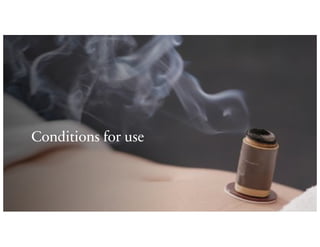
Conditions for use
Conditions for use
• Current or old injury or arthritis,
• Especially in "cold" patterns where the pain
naturally feels better with the application
of heat.
Pain
• Irregular elimination
• Ulcers
• Constipation
• Diarrhea
• Cramps
Digestive issues and
• Breech pregnancy
• Heavy menstrual bleeding
• Menstrual cramps
• Hot flashes
OB/GYN
Conditions for use
• Use at the start and throughout the season
Protection against cold and flu strains
• Osteo
• Ruematoid
Arthritis
• Cervical
• Thoracic
• Lumbar
• Sacrum
Back pain
• Migraines
• Stress/tension
• Chronic or acute
Headaches
Muscle stiffness
Tendonitis
How to safely use a
moxa stick
Simply light one end with a cigarette lighter or hold over a
candle.
With smokeless moxa it may take several minutes to light
but when the stick is correctly lit, you will be able to hold
the lit end two to three centimeters from the back of your
hand and feel a pleasant radiating warmth.
Hold the lit end of the stick over the area to be treated,
maintaining a distance of at least two to three centimeters
so that there is never any direct contact with the skin.
The moxa stick is then moved slowly over the area being
treated; this will begin to feel pleasantly warm.
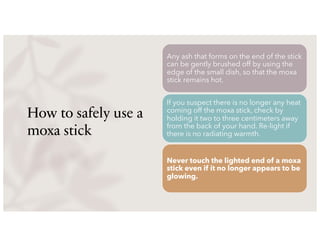
How to safely use a
moxa stick
Any ash that forms on the end of the stick
can be gently brushed off by using the
edge of the small dish, so that the moxa
stick remains hot.
If you suspect there is no longer any heat
coming off the moxa stick, check by
holding it two to three centimeters away
from the back of your hand. Re-light if
there is no radiating warmth.
Never touch the lighted end of a moxa
stick even if it no longer appears to be
glowing.
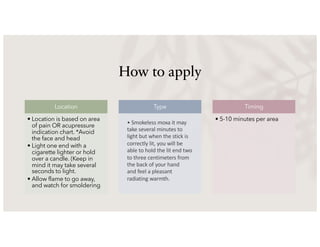
How to apply
Location
• Location is based on area
of pain OR acupressure
indication chart. *Avoid
the face and head
• Light one end with a
cigarette lighter or hold
over a candle. (Keep in
mind it may take several
seconds to light.
• Allow flame to go away,
and watch for smoldering
Type Timing
• 5-10 minutes per area
• Smokeless moxa it may
take several minutes to
light but when the stick is
correctly lit, you will be
able to hold the lit end two
to three centimeters from
the back of your hand
and feel a pleasant
radiating warmth.
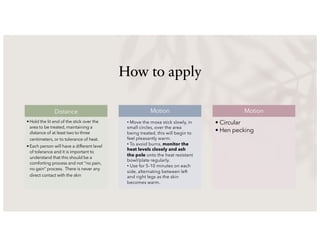
How to apply
Distance
• Hold the lit end of the stick over the
area to be treated, maintaining a
distance of at least two to three
centimeters, or to tolerance of heat.
• Each person will have a different level
of tolerance and it is important to
understand that this should be a
comforting process and not “no pain,
no gain” process. There is never any
direct contact with the skin
Motion Motion
• Circular
• Hen pecking
• Move the moxa stick slowly, in
small circles, over the area
being treated, this will begin to
feel pleasantly warm.
• To avoid burns, monitor the
heat levels closely and ash
the pole onto the heat resistant
bowl/plate regularly.
• Use for 5-10 minutes on each
side, alternating between left
and right legs as the skin
becomes warm.
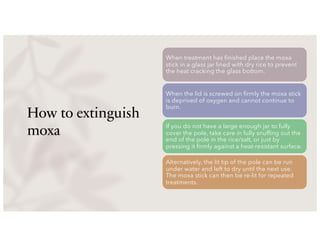
How to extinguish
moxa
When treatment has finished place the moxa
stick in a glass jar lined with dry rice to prevent
the heat cracking the glass bottom.
When the lid is screwed on firmly the moxa stick
is deprived of oxygen and cannot continue to
burn.
If you do not have a large enough jar to fully
cover the pole, take care in fully snuffing out the
end of the pole in the rice/salt, or just by
pressing it firmly against a heat-resistant surface.
Alternatively, the lit tip of the pole can be run
under water and left to dry until the next use.
The moxa stick can then be re-lit for repeated
treatments.
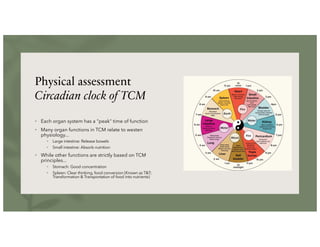
Physical assessment
Circadian clock of TCM
• Each organ system has a "peak" time of function
• Many organ functions in TCM relate to westen
physiology...
• Large intestine: Release bowels
• Small intestine: Absorb nutrition
• While other functions are strictly based on TCM
principles...
• Stomach: Good concentration
• Spleen: Clear thinking, food conversion (Known as T&T;
Transformation & Transportation of food into nutrients)
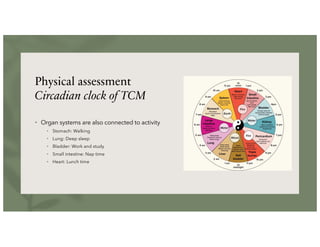
Physical assessment
Circadian clock of TCM
• Organ systems are also connected to activity
• Stomach: Walking
• Lung: Deep sleep
• Bladder: Work and study
• Small intestine: Nap time
• Heart: Lunch time
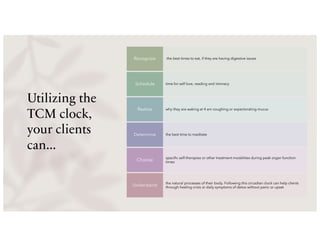
Utilizing the
TCM clock,
your clients
can...
the best times to eat, if they are having digestive issues
Recognize
time for self love, reading and intimacy
Schedule
why they are waking at 4 am coughing or expectorating mucus
Realize
the best time to meditate
Determine
specific self-therapies or other treatment modalities during peak organ function
times
Choose
the natural processes of their body. Following this circadian clock can help clients
through healing crisis or daily symptoms of detox without panic or upset
Understand
Utilizing the TCM clock and understanding
emotions....
Will aid you in choosing support tools for you or your client
• Auricular seeds applied to the appropriate organ(s) and stimulated at
optimal times
• Acupressure points along the appropriate meridian(s)
• Moxibustion used at peak times. For example...
• Moxa applied to Ren 3 (between 3-5 pm) for weak bladder
• Moxa applied to Ren 12 (between 7-11 am) for spleen and stomach issues
• Moxa applied to Ren 6 (between 5-7 pm) for kidney issues such as poor filtration
Putting it all together:
How to apply in practice
&
Case Studies
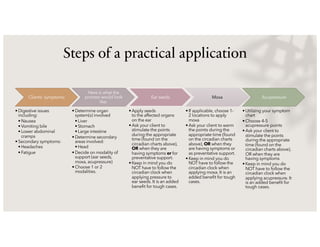
Steps of a practical application
Clients' symptoms:
• Digestive issues
including:
• Nausea
• Vomiting bile
• Lower abdominal
cramps
• Secondary symptoms:
• Headaches
• Fatigue
Here is what the
process would look
like:
• Determine organ
system(s) involved
• Liver
• Stomach
• Large intestine
• Determine secondary
areas involved:
• Head
• Decide on modality of
support (ear seeds,
moxa, acupressure)
• Choose 1 or 2
modalities.
Ear seeds
• Apply seeds
to the affected organs
on the ear
• Ask your client to
stimulate the points
during the appropriate
time (found on the
circadian charts above),
OR when they are
having symptoms or for
preventative support.
• Keep in mind you do
NOT have to follow the
circadian clock when
applying pressure to
ear seeds. It is an added
benefit for tough cases.
Moxa
• If applicable, choose 1-
2 locations to apply
moxa
• Ask your client to warm
the points during the
appropriate time (found
on the circadian charts
above), OR when they
are having symptoms or
as preventative support.
• Keep in mind you do
NOT have to follow the
circadian clock when
applying moxa. It is an
added benefit for tough
cases.
Acupressure
• Utilizing your symptom
chart
• Choose 4-5
acupressure points
• Ask your client to
stimulate the points
during the appropriate
time (found on the
circadian charts above),
OR when they are
having symptoms
• Keep in mind you do
NOT have to follow the
circadian clock when
applying acupressure. It
is an added benefit for
tough cases.
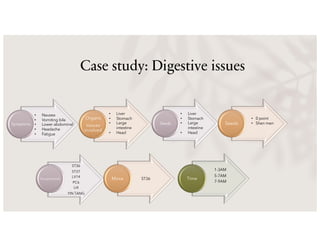
Case study: Digestive issues
Symptoms
Organs
tissues
involved
• Nausea
• Vomiting bile
• Lower abdominal
• Headache
• Fatigue
• Liver
• Stomach
• Large
intestine
• Head
Seeds Seeds
ST36
ST37
LV14
PC6
LI4
YIN TANG
Acupressure ST36
Moxa
1-3AM
5-7AM
7-9AM
Time
• Liver
• Stomach
• Large
intestine
• Head
• 0 point
• Shen men
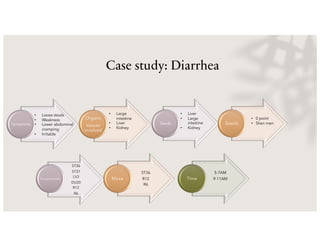
Case study: Diarrhea
Symptoms
Organs
tissues
involved
• Loose stools
• Weakness
• Lower abdominal
cramping
• Irritable
• Large
intestine
• Liver
• Kidney
Seeds Seeds
ST36
ST37
LV3
DU20
R12
R6
Acupressure
ST36
R12
R6
Moxa
5-7AM
9-11AM
Time
• Liver
• Large
intestine
• Kidney
• 0 point
• Shen men
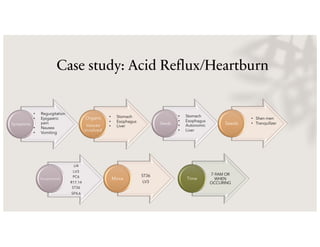
Case study: Acid Reflux/Heartburn
Symptoms
Organs
tissues
involved
• Regurgitation
• Epigastric
pain
• Nausea
• Vomiting
• Stomach
• Esophagus
• Liver
Seeds Seeds
LI4
LV3
PC6
R17,14
ST36
SP4,6
Acupressure
ST36
LV3
Moxa
7-9AM OR
WHEN
OCCURING
Time
• Stomach
• Esophagus
• Autonomic
• Liver
• Shen men
• Tranquilizer
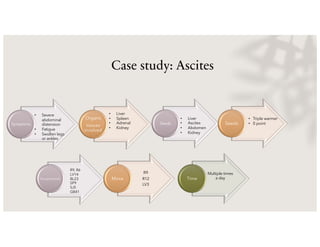
Case study: Ascites
Symptoms
Organs
tissues
involved
• Severe
abdominal
distension
• Fatigue
• Swollen legs
or ankles
• Liver
• Spleen
• Adrenal
• Kidney
Seeds Seeds
Acupressure
R9
R12
LV3
Moxa
Multiple times
a day
Time
• Liver
• Ascites
• Abdomen
• Kidney
• Triple warmer
• 0 point
R9, R6
LV14
BL23
SP9
SJ5
GB41
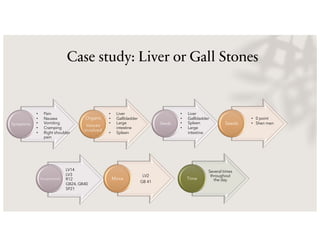
Case study: Liver or Gall Stones
Symptoms
Organs
tissues
involved
• Pain
• Nausea
• Vomiting
• Cramping
• Right shoulder
pain
• Liver
• Gallbladder
• Large
intestine
• Spleen
Seeds Seeds
Acupressure
LV2
GB 41
Moxa
Several times
throughout
the day
Time
• Liver
• Gallbladder
• Spleen
• Large
intestine
• 0 point
• Shen men
LV14
LV3
R12
GB24, GB40
SP21
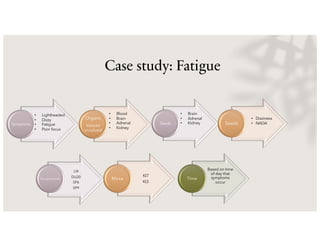
Case study: Fatigue
Symptoms
Organs
tissues
involved
• Lightheaded
• Dizzy
• Fatigue
• Poor focus
• Blood
• Brain
• Adrenal
• Kidney
Seeds Seeds
LI4
DU20
SP6
SP9
Acupressure
KI7
KI3
Moxa
Based on time
of day that
symptoms
occur
Time
• Brain
• Adrenal
• Kidney
• Dizziness
• NADA
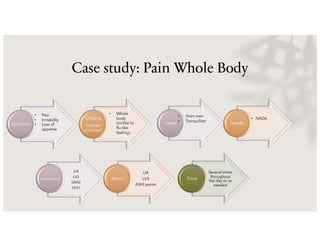
Case study: Pain Whole Body
Symptoms
Organs
tissues
involved
• Pain
• Irritability
• Loss of
appetite
• Whole
body
(similar to
flu-like
feeling)
Seeds Seeds
LI4
LV3
GB42
SP21
Acupressure
LI4
LV3
ASHI points
Moxa
Several times
throughout
the day or as
needed
Time
• Shen men
• Tranquilizer
• NADA
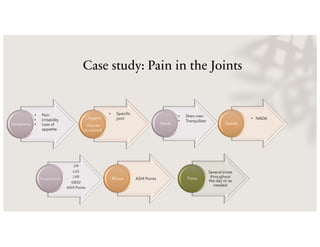
Case study: Pain in the Joints
Symptoms
Organs
tissues
involved
• Pain
• Irritability
• Loss of
appetite
• Specific
joint
Seeds Seeds
LI4
LV3
LV8
GB32
ASHI Points
Acupressure ASHI Points
Moxa
Several times
throughout
the day or as
needed
Time
• Shen men
• Tranquilizer
• NADA
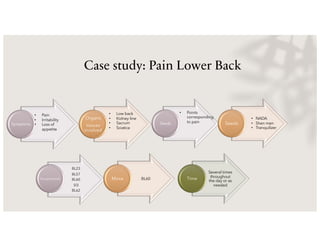
Case study: Pain Lower Back
Symptoms
Organs
tissues
involved
• Pain
• Irritability
• Loss of
appetite
• Low back
• Kidney line
• Sacrum
• Sciatica
Seeds Seeds
BL23
BL57
BL60
SI3
BL62
Acupressure BL60
Moxa
Several times
throughout
the day or as
needed
Time
• Points
corresponding
to pain
• NADA
• Shen men
• Tranquilizer
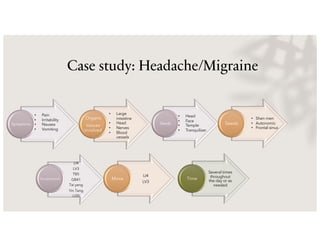
Case study: Headache/Migraine
Symptoms
Organs
tissues
involved
• Pain
• Irritability
• Nausea
• Vomiting
• Large
intestine
• Head
• Nerves
• Blood
vessels
Seeds Seeds
LI4
LV3
TB5
GB41
Tai yang
Yin Tang
LI20
Acupressure
LI4
LV3
Moxa
Several times
throughout
the day or as
needed
Time
• Head
• Face
• Temple
• Tranquilizer
• Shen men
• Autonomic
• Frontal sinus
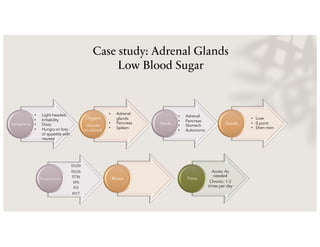
Case study: Adrenal Glands
Low Blood Sugar
Symptoms
Organs
tissues
involved
• Light-headed
• Irritability
• Dizzy
• Hungry or loss
of appetite with
nausea
• Adrenal
glands
• Pancreas
• Spleen
Seeds Seeds
DU20
DU26
ST36
SP6
KI3
KI17
Acupressure Moxa
Acute: As
needed
Chronic: 1-2
times per day
Time
• Adrenal
• Pancreas
• Stomach
• Autonomic
• Liver
• 0 point
• Shen men
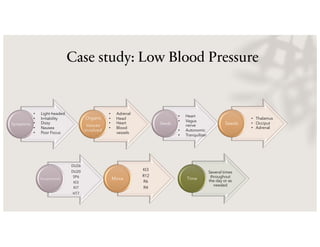
Case study: Low Blood Pressure
Symptoms
Organs
tissues
involved
• Light-headed
• Irritability
• Dizzy
• Nausea
• Poor Focus
• Adrenal
• Head
• Heart
• Blood
vessels
Seeds Seeds
DU26
DU20
SP6
KI3
KI7
HT7
Acupressure
KI3
R12
R6
R4
Moxa
Several times
throughout
the day or as
needed
Time
• Heart
• Vagus
nerve
• Autonomic
• Tranquilizer
• Thalamus
• Occiput
• Adrenal
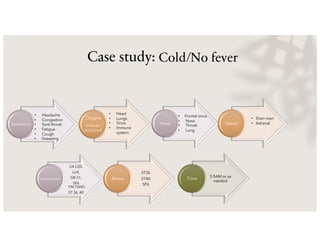
Case study: Cold/No fever
Symptoms
Organs
tissues
involved
• Headache
• Congestion
• Sore throat
• Fatigue
• Cough
• Sneezing
• Head
• Lungs
• Sinus
• Immune
system
Seeds Seeds
LI4 LI20,
LU9,
GB 21,
SP6
YIN TANG
ST 36, 40
Acupressure
ST36
ST40
SP6
Moxa
3-5AM or as
needed
Time
• Frontal sinus
• Nose
• Throat
• Lung
• Shen men
• Adrenal
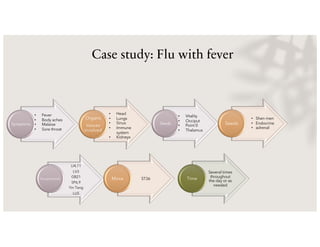
Case study: Flu with fever
Symptoms
Organs
tissues
involved
• Fever
• Body aches
• Malaise
• Sore throat
• Head
• Lungs
• Sinus
• Immune
system
• Kidneys
Seeds Seeds
LI4,11
LV3
GB21
SP6,9
Yin Tang
LU5
Acupressure ST36
Moxa
Several times
throughout
the day or as
needed
Time
• Vitality
• Occiput
• Point 0
• Thalamus
• Shen men
• Endocrine
• adrenal
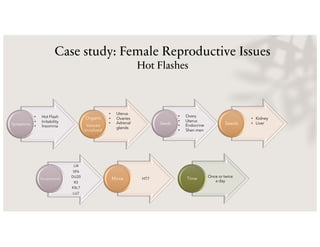
Case study: Female Reproductive Issues
Hot Flashes
Symptoms
Organs
tissues
involved
• Hot Flash
• Irritability
• Insomnia
• Uterus
• Ovaries
• Adrenal
glands
Seeds Seeds
LI4
SP6
DU20
R3
KI6,7
LU7
Acupressure HT7
Moxa
Once or twice
a day
Time
• Ovary
• Uterus
• Endocrine
• Shen men
• Kidney
• Liver
Case study: Female Reproductive Issues
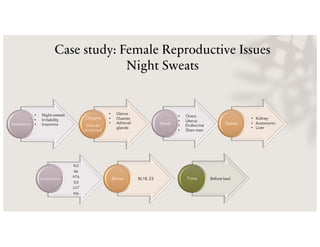
Night Sweats
Symptoms
Organs
tissues
involved
• Night sweats
• Irritability
• Insomnia
• Uterus
• Ovaries
• Adrenal
glands
Seeds Seeds
KI3
R6
HT6
SI3
LU7
KI6
Acupressure BL18, 23
Moxa Before bed
Time
• Ovary
• Uterus
• Endocrine
• Shen men
• Kidney
• Autonomic
• Liver
Case study: Female Reproductive Issues
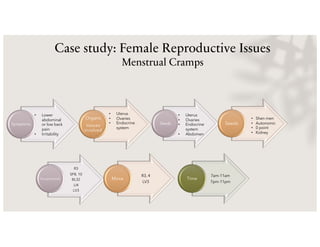
Menstrual Cramps
Symptoms
Organs
tissues
involved
• Lower
abdominal
or low back
pain
• Irritability
• Uterus
• Ovaries
• Endocrine
system
Seeds Seeds
R3
SP8, 10
BL32
LI4
LV3
Acupressure
R3, 4
LV3
Moxa
7am-11am
7pm-11pm
Time
• Uterus
• Ovaries
• Endocrine
system
• Abdomen
• Shen men
• Autonomic
• 0 point
• Kidney
Case study: Female Reproductive Issues
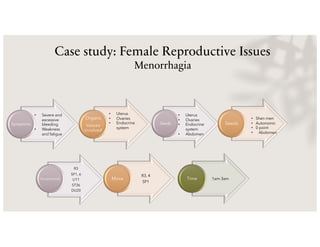
Menorrhagia
Symptoms
Organs
tissues
involved
• Severe and
excessive
bleeding
• Weakness
and fatigue
• Uterus
• Ovaries
• Endocrine
system
Seeds Seeds
R3
SP1, 6
LI11
ST36
DU20
Acupressure
R3, 4
SP1
Moxa 1am-3am
Time
• Uterus
• Ovaries
• Endocrine
system
• Abdomen
• Shen men
• Autonomic
• 0 point
• Abdomen
Case study: Female Reproductive Issues
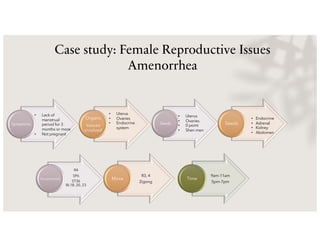
Amenorrhea
Symptoms
Organs
tissues
involved
• Lack of
menstrual
period for 3
months or more
• Not pregnant
• Uterus
• Ovaries
• Endocrine
system
Seeds Seeds
R4
SP6
ST36
BL18, 20, 23
Acupressure
R3, 4
Zigong
Moxa
9am-11am
5pm-7pm
Time
• Uterus
• Ovaries
• 0 point
• Shen men
• Endocrine
• Adrenal
• Kidney
• Abdomen
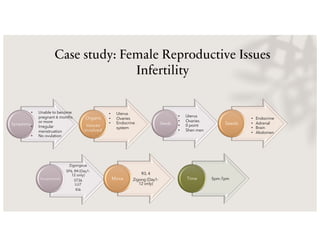
Case study: Female Reproductive Issues
Infertility
Symptoms
Organs
tissues
involved
• Unable to become
pregnant 6 months
or more
• Irregular
menstruation
• No ovulation
• Uterus
• Ovaries
• Endocrine
system
Seeds Seeds
Zigongxue
SP6, R4 (Day1-
12 only)
ST36
LU7
KI6
Acupressure
R3, 4
Zigong (Day1-
12 only)
Moxa 5pm-7pm
Time
• Uterus
• Ovaries
• 0 point
• Shen men
• Endocrine
• Adrenal
• Brain
• Abdomen
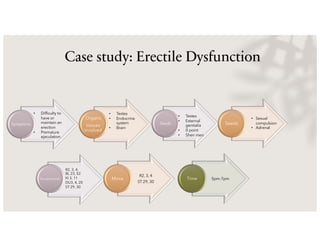
Case study: Erectile Dysfunction
Symptoms
Organs
tissues
involved
• Difficulty to
have or
maintain an
erection
• Premature
ejaculation
• Testes
• Endocrine
system
• Brain
Seeds Seeds
R2, 3, 4,
BL 23, 52
KI 3, 11
DU3, 4, 20
ST 29, 30
Acupressure
R2, 3, 4
ST 29, 30
Moxa 5pm-7pm
Time
• Testes
• External
genitalia
• 0 point
• Shen men
• Sexual
compulsion
• Adrenal
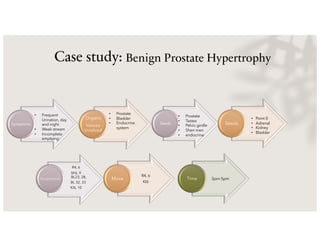
Case study: Benign Prostate Hypertrophy
Symptoms
Organs
tissues
involved
• Frequent
Urination, day
and night
• Weak stream
• Incomplete
emptying
• Prostate
• Bladder
• Endocrine
system
Seeds Seeds
R4, 6
SP6, 9
BL23, 28,
BL 32, 33
KI6, 10
Acupressure
R4, 6
KI6
Moxa 3pm-5pm
Time
• Prostate
• Testes
• Pelvic girdle
• Shen men
• endocrine
• Point 0
• Adrenal
• Kidney
• Bladder
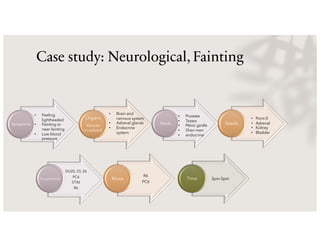
Case study: Neurological, Fainting
Symptoms
Organs
tissues
involved
• Feeling
lightheaded
• Fainting or
near-fainting
• Low blood
pressure
• Brain and
nervous system
• Adrenal glands
• Endocrine
system
Seeds Seeds
DU20, 23, 26
PC6
ST36
R6
Acupressure
R6
PC6
Moxa 3pm-5pm
Time
• Prostate
• Testes
• Pelvic girdle
• Shen men
• endocrine
• Point 0
• Adrenal
• Kidney
• Bladder
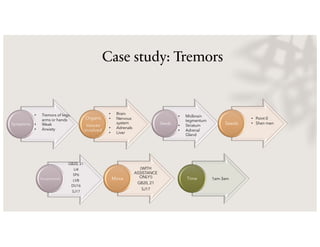
Case study: Tremors
Symptoms
Organs
tissues
involved
• Tremors of legs,
arms or hands
• Weak
• Anxiety
• Brain
• Nervous
system
• Adrenals
• Liver
Seeds Seeds
GB20, 21
LI4
SP6
LV8
DU16
SJ17
Acupressure
(WITH
ASSISTANCE
ONLY!)
GB20, 21
SJ17
Moxa 1am-3am
Time
• Midbrain
tegmentum
• Striatum
• Adrenal
Gland
• Point 0
• Shen men
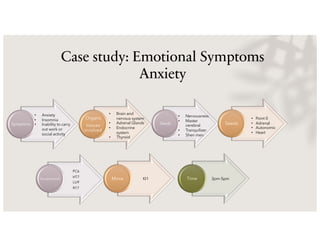
Case study: Emotional Symptoms
Anxiety
Symptoms
Organs
tissues
involved
• Anxiety
• Insomnia
• Inability to carry
out work or
social activity
• Brain and
nervous system
• Adrenal Glands
• Endocrine
system
• Thyroid
Seeds Seeds
PC6
HT7
LU9
R17
Acupressure KI1
Moxa 3pm-5pm
Time
• Nervousness
• Master
cerebral
• Tranquilizer
• Shen men
• Point 0
• Adrenal
• Autonomic
• Heart
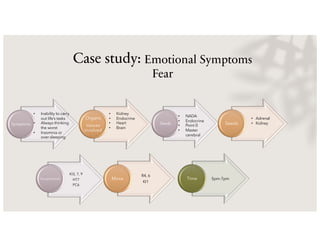
Case study: Emotional Symptoms
Fear
Symptoms
Organs
tissues
involved
• Inability to carry
out life’s tasks
• Always thinking
the worst
• Insomnia or
over-sleeping
• Kidney
• Endocrine
• Heart
• Brain
Seeds Seeds
KI3, 7, 9
HT7
PC6
Acupressure
R4, 6
KI1
Moxa 5pm-7pm
Time
• NADA
• Endocrine
• Point 0
• Master
cerebral
• Adrenal
• Kidney
Case study: Emotional Symptoms
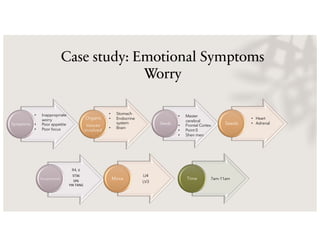
Worry
Symptoms
Organs
tissues
involved
• Inappropriate
worry
• Poor appetite
• Poor focus
• Stomach
• Endocrine
system
• Brain
Seeds Seeds
R4, 6
ST36
SP6
YIN TANG
Acupressure
LI4
LV3
Moxa 7am-11am
Time
• Master
cerebral
• Frontal Cortex
• Point 0
• Shen men
• Heart
• Adrenal
Case study: Emotional Symptoms
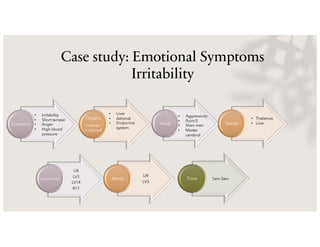
Irritability
Symptoms
Organs
tissues
involved
• Irritability
• Short temper
• Anger
• High blood
pressure
• Liver
• Adrenal
• Endocrine
system
Seeds Seeds
LI4
LV3
LV14
R17
Acupressure
LI4
LV3
Moxa 1am-3am
Time
• Aggressivity
• Point 0
• Shen men
• Master
cerebral
• Thalamus
• Liver
Case study: Emotional Symptoms
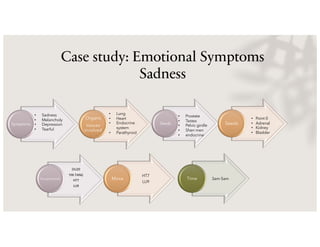
Sadness
Symptoms
Organs
tissues
involved
• Sadness
• Melancholy
• Depression
• Tearful
• Lung
• Heart
• Endocrine
system
• Parathyroid
Seeds Seeds
DU20
YIN TANG
HT7
LU9
Acupressure
HT7
LU9
Moxa 3am-5am
Time
• Prostate
• Testes
• Pelvic girdle
• Shen men
• endocrine
• Point 0
• Adrenal
• Kidney
• Bladder
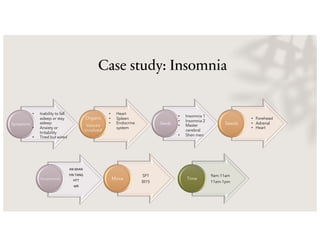
Case study: Insomnia
Symptoms
Organs
tissues
involved
• Inability to fall
asleep or stay
asleep
• Anxiety or
Irritability
• Tired but wired
• Heart
• Spleen
• Endocrine
system
Seeds Seeds
AN MIAN
YIN TANG
HT7
sp6
Acupressure
SP1
Bl15
Moxa
9am-11am
11am-1pm
Time
• Insomnia 1
• Insomnia 2
• Master
cerebral
• Shen men
• Forehead
• Adrenal
• Heart
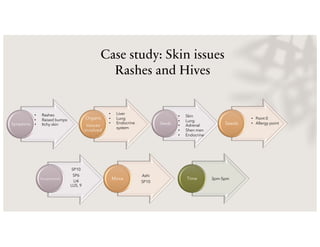
Case study: Skin issues
Rashes and Hives
Symptoms
Organs
tissues
involved
• Rashes
• Raised bumps
• Itchy skin
• Liver
• Lung
• Endocrine
system
Seeds Seeds
SP10
SP6
LI4
LU5, 9
Acupressure
Ashi
SP10
Moxa 3pm-5pm
Time
• Skin
• Lung
• Adrenal
• Shen men
• Endocrine
• Point 0
• Allergy point
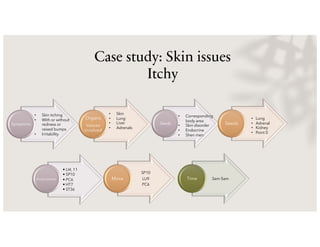
Case study: Skin issues
Itchy
Symptoms
Organs
tissues
involved
• Skin itching
• With or without
redness or
raised bumps
• Irritability
• Skin
• Lung
• Liver
• Adrenals
Seeds Seeds
• LI4, 11
• SP10
• PC6
• HT7
• ST36
Acupressure
SP10
LU9
PC6
Moxa 3am-5am
Time
• Corresponding
body area
• Skin disorder
• Endocrine
• Shen men
• Lung
• Adrenal
• Kidney
• Point 0
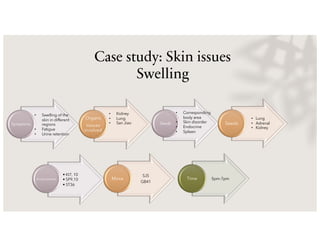
Case study: Skin issues
Swelling
Symptoms
Organs
tissues
involved
• Swelling of the
skin in different
regions
• Fatigue
• Urine retention
• Kidney
• Lung
• San Jiao Seeds Seeds
• KI7, 10
• SP9,10
• ST36
Acupressure
SJ5
GB41
Moxa 5pm-7pm
Time
• Corresponding
body area
• Skin disorder
• Endocrine
• Spleen
• Lung
• Adrenal
• Kidney
Case study: Skin issues
Acne
Symptoms
Organs
tissues
involved
• Acne in various
areas of the
body
• May or may not
be cystic
• Skin
• Kidney
• Lung
• Large
intestine
Seeds Seeds
• ST 8, 36
• DU23
• KI3, 7
Acupressure • BL23
• R4,6,8
Moxa
3am-5am
5am-7am
Time
• Corresponding
body area
• Skin disorder
• Lung
• 0 point
• Shen men
• Kidney
Resources
Resources
Resources:
• Moxa
• Moxa stick
• Auricular tools
Ear seeds
Point detector
Auricular Books
• Auriculotherapy Made Simple: The Complete Guide To The Chinese
And Western Ear Acupuncture (Auriculotherapy): Everything You Need
To Know: Shannon, Dr. Joel: 9798732665727: Amazon.com: Books
• Amazon.com: AURICULOTHERAPY eBook: CORAL ROSERO,
HERNANDO: Books
• Auricular Acupuncture Diagnosis: 9780443068669: Medicine & Health
Science Books @ Amazon.com
• Auriculotherapy Manual: Chinese and Western Systems of Ear
Acupuncture: Oleson, Terry: 9780962941559: Amazon.com: Books
Acupressure books
• Needleless Acupuncture: Self-treatment guide for 40 common
conditions: Trosclair, Justin: 9798629577652: Amazon.com: Books
• Acupuncture Points Handbook: A Patient's Guide to the Locations
and Functions of over 400 Acupuncture Points (Natural Medicine):
Bleecker, Deborah: 9781940146201: Amazon.com: Books
Acupressure tools
• https://www.amazon.com/Stainless-Acupressure-Pen-Trigger-Tool-
Reflexology-
Pressure/dp/B08BL9ZTTW/ref=sr_1_6?dchild=1&keywords=acupr
essure+tool&qid=1624385114&sr=8-6

Ancient Tools Supporting Modern Detoxification

  • 1.
  • 2.
    Conditions for use •Current or old injury or arthritis, • Especially in "cold" patterns where the pain naturally feels better with the application of heat. Pain • Irregular elimination • Ulcers • Constipation • Diarrhea • Cramps Digestive issues and • Breech pregnancy • Heavy menstrual bleeding • Menstrual cramps • Hot flashes OB/GYN
  • 3.
    Conditions for use •Use at the start and throughout the season Protection against cold and flu strains • Osteo • Ruematoid Arthritis • Cervical • Thoracic • Lumbar • Sacrum Back pain • Migraines • Stress/tension • Chronic or acute Headaches Muscle stiffness Tendonitis
  • 4.
    How to safelyuse a moxa stick Simply light one end with a cigarette lighter or hold over a candle. With smokeless moxa it may take several minutes to light but when the stick is correctly lit, you will be able to hold the lit end two to three centimeters from the back of your hand and feel a pleasant radiating warmth. Hold the lit end of the stick over the area to be treated, maintaining a distance of at least two to three centimeters so that there is never any direct contact with the skin. The moxa stick is then moved slowly over the area being treated; this will begin to feel pleasantly warm.
  • 5.
    How to safelyuse a moxa stick Any ash that forms on the end of the stick can be gently brushed off by using the edge of the small dish, so that the moxa stick remains hot. If you suspect there is no longer any heat coming off the moxa stick, check by holding it two to three centimeters away from the back of your hand. Re-light if there is no radiating warmth. Never touch the lighted end of a moxa stick even if it no longer appears to be glowing.
  • 6.
    How to apply Location •Location is based on area of pain OR acupressure indication chart. *Avoid the face and head • Light one end with a cigarette lighter or hold over a candle. (Keep in mind it may take several seconds to light. • Allow flame to go away, and watch for smoldering Type Timing • 5-10 minutes per area • Smokeless moxa it may take several minutes to light but when the stick is correctly lit, you will be able to hold the lit end two to three centimeters from the back of your hand and feel a pleasant radiating warmth.
  • 7.
    How to apply Distance •Hold the lit end of the stick over the area to be treated, maintaining a distance of at least two to three centimeters, or to tolerance of heat. • Each person will have a different level of tolerance and it is important to understand that this should be a comforting process and not “no pain, no gain” process. There is never any direct contact with the skin Motion Motion • Circular • Hen pecking • Move the moxa stick slowly, in small circles, over the area being treated, this will begin to feel pleasantly warm. • To avoid burns, monitor the heat levels closely and ash the pole onto the heat resistant bowl/plate regularly. • Use for 5-10 minutes on each side, alternating between left and right legs as the skin becomes warm.
  • 8.
    How to extinguish moxa Whentreatment has finished place the moxa stick in a glass jar lined with dry rice to prevent the heat cracking the glass bottom. When the lid is screwed on firmly the moxa stick is deprived of oxygen and cannot continue to burn. If you do not have a large enough jar to fully cover the pole, take care in fully snuffing out the end of the pole in the rice/salt, or just by pressing it firmly against a heat-resistant surface. Alternatively, the lit tip of the pole can be run under water and left to dry until the next use. The moxa stick can then be re-lit for repeated treatments.
  • 9.
    Physical assessment Circadian clockof TCM • Each organ system has a "peak" time of function • Many organ functions in TCM relate to westen physiology... • Large intestine: Release bowels • Small intestine: Absorb nutrition • While other functions are strictly based on TCM principles... • Stomach: Good concentration • Spleen: Clear thinking, food conversion (Known as T&T; Transformation & Transportation of food into nutrients)
  • 10.
    Physical assessment Circadian clockof TCM • Organ systems are also connected to activity • Stomach: Walking • Lung: Deep sleep • Bladder: Work and study • Small intestine: Nap time • Heart: Lunch time
  • 11.
    Utilizing the TCM clock, yourclients can... the best times to eat, if they are having digestive issues Recognize time for self love, reading and intimacy Schedule why they are waking at 4 am coughing or expectorating mucus Realize the best time to meditate Determine specific self-therapies or other treatment modalities during peak organ function times Choose the natural processes of their body. Following this circadian clock can help clients through healing crisis or daily symptoms of detox without panic or upset Understand
  • 12.
    Utilizing the TCMclock and understanding emotions.... Will aid you in choosing support tools for you or your client • Auricular seeds applied to the appropriate organ(s) and stimulated at optimal times • Acupressure points along the appropriate meridian(s) • Moxibustion used at peak times. For example... • Moxa applied to Ren 3 (between 3-5 pm) for weak bladder • Moxa applied to Ren 12 (between 7-11 am) for spleen and stomach issues • Moxa applied to Ren 6 (between 5-7 pm) for kidney issues such as poor filtration
  • 13.
    Putting it alltogether: How to apply in practice & Case Studies
  • 14.
    Steps of apractical application Clients' symptoms: • Digestive issues including: • Nausea • Vomiting bile • Lower abdominal cramps • Secondary symptoms: • Headaches • Fatigue Here is what the process would look like: • Determine organ system(s) involved • Liver • Stomach • Large intestine • Determine secondary areas involved: • Head • Decide on modality of support (ear seeds, moxa, acupressure) • Choose 1 or 2 modalities. Ear seeds • Apply seeds to the affected organs on the ear • Ask your client to stimulate the points during the appropriate time (found on the circadian charts above), OR when they are having symptoms or for preventative support. • Keep in mind you do NOT have to follow the circadian clock when applying pressure to ear seeds. It is an added benefit for tough cases. Moxa • If applicable, choose 1- 2 locations to apply moxa • Ask your client to warm the points during the appropriate time (found on the circadian charts above), OR when they are having symptoms or as preventative support. • Keep in mind you do NOT have to follow the circadian clock when applying moxa. It is an added benefit for tough cases. Acupressure • Utilizing your symptom chart • Choose 4-5 acupressure points • Ask your client to stimulate the points during the appropriate time (found on the circadian charts above), OR when they are having symptoms • Keep in mind you do NOT have to follow the circadian clock when applying acupressure. It is an added benefit for tough cases.
  • 15.
    Case study: Digestiveissues Symptoms Organs tissues involved • Nausea • Vomiting bile • Lower abdominal • Headache • Fatigue • Liver • Stomach • Large intestine • Head Seeds Seeds ST36 ST37 LV14 PC6 LI4 YIN TANG Acupressure ST36 Moxa 1-3AM 5-7AM 7-9AM Time • Liver • Stomach • Large intestine • Head • 0 point • Shen men
  • 16.
    Case study: Diarrhea Symptoms Organs tissues involved •Loose stools • Weakness • Lower abdominal cramping • Irritable • Large intestine • Liver • Kidney Seeds Seeds ST36 ST37 LV3 DU20 R12 R6 Acupressure ST36 R12 R6 Moxa 5-7AM 9-11AM Time • Liver • Large intestine • Kidney • 0 point • Shen men
  • 17.
    Case study: AcidReflux/Heartburn Symptoms Organs tissues involved • Regurgitation • Epigastric pain • Nausea • Vomiting • Stomach • Esophagus • Liver Seeds Seeds LI4 LV3 PC6 R17,14 ST36 SP4,6 Acupressure ST36 LV3 Moxa 7-9AM OR WHEN OCCURING Time • Stomach • Esophagus • Autonomic • Liver • Shen men • Tranquilizer
  • 18.
    Case study: Ascites Symptoms Organs tissues involved •Severe abdominal distension • Fatigue • Swollen legs or ankles • Liver • Spleen • Adrenal • Kidney Seeds Seeds Acupressure R9 R12 LV3 Moxa Multiple times a day Time • Liver • Ascites • Abdomen • Kidney • Triple warmer • 0 point R9, R6 LV14 BL23 SP9 SJ5 GB41
  • 19.
    Case study: Liveror Gall Stones Symptoms Organs tissues involved • Pain • Nausea • Vomiting • Cramping • Right shoulder pain • Liver • Gallbladder • Large intestine • Spleen Seeds Seeds Acupressure LV2 GB 41 Moxa Several times throughout the day Time • Liver • Gallbladder • Spleen • Large intestine • 0 point • Shen men LV14 LV3 R12 GB24, GB40 SP21
  • 20.
    Case study: Fatigue Symptoms Organs tissues involved •Lightheaded • Dizzy • Fatigue • Poor focus • Blood • Brain • Adrenal • Kidney Seeds Seeds LI4 DU20 SP6 SP9 Acupressure KI7 KI3 Moxa Based on time of day that symptoms occur Time • Brain • Adrenal • Kidney • Dizziness • NADA
  • 21.
    Case study: PainWhole Body Symptoms Organs tissues involved • Pain • Irritability • Loss of appetite • Whole body (similar to flu-like feeling) Seeds Seeds LI4 LV3 GB42 SP21 Acupressure LI4 LV3 ASHI points Moxa Several times throughout the day or as needed Time • Shen men • Tranquilizer • NADA
  • 22.
    Case study: Painin the Joints Symptoms Organs tissues involved • Pain • Irritability • Loss of appetite • Specific joint Seeds Seeds LI4 LV3 LV8 GB32 ASHI Points Acupressure ASHI Points Moxa Several times throughout the day or as needed Time • Shen men • Tranquilizer • NADA
  • 23.
    Case study: PainLower Back Symptoms Organs tissues involved • Pain • Irritability • Loss of appetite • Low back • Kidney line • Sacrum • Sciatica Seeds Seeds BL23 BL57 BL60 SI3 BL62 Acupressure BL60 Moxa Several times throughout the day or as needed Time • Points corresponding to pain • NADA • Shen men • Tranquilizer
  • 24.
    Case study: Headache/Migraine Symptoms Organs tissues involved •Pain • Irritability • Nausea • Vomiting • Large intestine • Head • Nerves • Blood vessels Seeds Seeds LI4 LV3 TB5 GB41 Tai yang Yin Tang LI20 Acupressure LI4 LV3 Moxa Several times throughout the day or as needed Time • Head • Face • Temple • Tranquilizer • Shen men • Autonomic • Frontal sinus
  • 25.
    Case study: AdrenalGlands Low Blood Sugar Symptoms Organs tissues involved • Light-headed • Irritability • Dizzy • Hungry or loss of appetite with nausea • Adrenal glands • Pancreas • Spleen Seeds Seeds DU20 DU26 ST36 SP6 KI3 KI17 Acupressure Moxa Acute: As needed Chronic: 1-2 times per day Time • Adrenal • Pancreas • Stomach • Autonomic • Liver • 0 point • Shen men
  • 26.
    Case study: LowBlood Pressure Symptoms Organs tissues involved • Light-headed • Irritability • Dizzy • Nausea • Poor Focus • Adrenal • Head • Heart • Blood vessels Seeds Seeds DU26 DU20 SP6 KI3 KI7 HT7 Acupressure KI3 R12 R6 R4 Moxa Several times throughout the day or as needed Time • Heart • Vagus nerve • Autonomic • Tranquilizer • Thalamus • Occiput • Adrenal
  • 27.
    Case study: Cold/Nofever Symptoms Organs tissues involved • Headache • Congestion • Sore throat • Fatigue • Cough • Sneezing • Head • Lungs • Sinus • Immune system Seeds Seeds LI4 LI20, LU9, GB 21, SP6 YIN TANG ST 36, 40 Acupressure ST36 ST40 SP6 Moxa 3-5AM or as needed Time • Frontal sinus • Nose • Throat • Lung • Shen men • Adrenal
  • 28.
    Case study: Fluwith fever Symptoms Organs tissues involved • Fever • Body aches • Malaise • Sore throat • Head • Lungs • Sinus • Immune system • Kidneys Seeds Seeds LI4,11 LV3 GB21 SP6,9 Yin Tang LU5 Acupressure ST36 Moxa Several times throughout the day or as needed Time • Vitality • Occiput • Point 0 • Thalamus • Shen men • Endocrine • adrenal
  • 29.
    Case study: FemaleReproductive Issues Hot Flashes Symptoms Organs tissues involved • Hot Flash • Irritability • Insomnia • Uterus • Ovaries • Adrenal glands Seeds Seeds LI4 SP6 DU20 R3 KI6,7 LU7 Acupressure HT7 Moxa Once or twice a day Time • Ovary • Uterus • Endocrine • Shen men • Kidney • Liver
  • 30.
    Case study: FemaleReproductive Issues Night Sweats Symptoms Organs tissues involved • Night sweats • Irritability • Insomnia • Uterus • Ovaries • Adrenal glands Seeds Seeds KI3 R6 HT6 SI3 LU7 KI6 Acupressure BL18, 23 Moxa Before bed Time • Ovary • Uterus • Endocrine • Shen men • Kidney • Autonomic • Liver
  • 31.
    Case study: FemaleReproductive Issues Menstrual Cramps Symptoms Organs tissues involved • Lower abdominal or low back pain • Irritability • Uterus • Ovaries • Endocrine system Seeds Seeds R3 SP8, 10 BL32 LI4 LV3 Acupressure R3, 4 LV3 Moxa 7am-11am 7pm-11pm Time • Uterus • Ovaries • Endocrine system • Abdomen • Shen men • Autonomic • 0 point • Kidney
  • 32.
    Case study: FemaleReproductive Issues Menorrhagia Symptoms Organs tissues involved • Severe and excessive bleeding • Weakness and fatigue • Uterus • Ovaries • Endocrine system Seeds Seeds R3 SP1, 6 LI11 ST36 DU20 Acupressure R3, 4 SP1 Moxa 1am-3am Time • Uterus • Ovaries • Endocrine system • Abdomen • Shen men • Autonomic • 0 point • Abdomen
  • 33.
    Case study: FemaleReproductive Issues Amenorrhea Symptoms Organs tissues involved • Lack of menstrual period for 3 months or more • Not pregnant • Uterus • Ovaries • Endocrine system Seeds Seeds R4 SP6 ST36 BL18, 20, 23 Acupressure R3, 4 Zigong Moxa 9am-11am 5pm-7pm Time • Uterus • Ovaries • 0 point • Shen men • Endocrine • Adrenal • Kidney • Abdomen
  • 34.
    Case study: FemaleReproductive Issues Infertility Symptoms Organs tissues involved • Unable to become pregnant 6 months or more • Irregular menstruation • No ovulation • Uterus • Ovaries • Endocrine system Seeds Seeds Zigongxue SP6, R4 (Day1- 12 only) ST36 LU7 KI6 Acupressure R3, 4 Zigong (Day1- 12 only) Moxa 5pm-7pm Time • Uterus • Ovaries • 0 point • Shen men • Endocrine • Adrenal • Brain • Abdomen
  • 35.
    Case study: ErectileDysfunction Symptoms Organs tissues involved • Difficulty to have or maintain an erection • Premature ejaculation • Testes • Endocrine system • Brain Seeds Seeds R2, 3, 4, BL 23, 52 KI 3, 11 DU3, 4, 20 ST 29, 30 Acupressure R2, 3, 4 ST 29, 30 Moxa 5pm-7pm Time • Testes • External genitalia • 0 point • Shen men • Sexual compulsion • Adrenal
  • 36.
    Case study: BenignProstate Hypertrophy Symptoms Organs tissues involved • Frequent Urination, day and night • Weak stream • Incomplete emptying • Prostate • Bladder • Endocrine system Seeds Seeds R4, 6 SP6, 9 BL23, 28, BL 32, 33 KI6, 10 Acupressure R4, 6 KI6 Moxa 3pm-5pm Time • Prostate • Testes • Pelvic girdle • Shen men • endocrine • Point 0 • Adrenal • Kidney • Bladder
  • 37.
    Case study: Neurological,Fainting Symptoms Organs tissues involved • Feeling lightheaded • Fainting or near-fainting • Low blood pressure • Brain and nervous system • Adrenal glands • Endocrine system Seeds Seeds DU20, 23, 26 PC6 ST36 R6 Acupressure R6 PC6 Moxa 3pm-5pm Time • Prostate • Testes • Pelvic girdle • Shen men • endocrine • Point 0 • Adrenal • Kidney • Bladder
  • 38.
    Case study: Tremors Symptoms Organs tissues involved •Tremors of legs, arms or hands • Weak • Anxiety • Brain • Nervous system • Adrenals • Liver Seeds Seeds GB20, 21 LI4 SP6 LV8 DU16 SJ17 Acupressure (WITH ASSISTANCE ONLY!) GB20, 21 SJ17 Moxa 1am-3am Time • Midbrain tegmentum • Striatum • Adrenal Gland • Point 0 • Shen men
  • 39.
    Case study: EmotionalSymptoms Anxiety Symptoms Organs tissues involved • Anxiety • Insomnia • Inability to carry out work or social activity • Brain and nervous system • Adrenal Glands • Endocrine system • Thyroid Seeds Seeds PC6 HT7 LU9 R17 Acupressure KI1 Moxa 3pm-5pm Time • Nervousness • Master cerebral • Tranquilizer • Shen men • Point 0 • Adrenal • Autonomic • Heart
  • 40.
    Case study: EmotionalSymptoms Fear Symptoms Organs tissues involved • Inability to carry out life’s tasks • Always thinking the worst • Insomnia or over-sleeping • Kidney • Endocrine • Heart • Brain Seeds Seeds KI3, 7, 9 HT7 PC6 Acupressure R4, 6 KI1 Moxa 5pm-7pm Time • NADA • Endocrine • Point 0 • Master cerebral • Adrenal • Kidney
  • 41.
    Case study: EmotionalSymptoms Worry Symptoms Organs tissues involved • Inappropriate worry • Poor appetite • Poor focus • Stomach • Endocrine system • Brain Seeds Seeds R4, 6 ST36 SP6 YIN TANG Acupressure LI4 LV3 Moxa 7am-11am Time • Master cerebral • Frontal Cortex • Point 0 • Shen men • Heart • Adrenal
  • 42.
    Case study: EmotionalSymptoms Irritability Symptoms Organs tissues involved • Irritability • Short temper • Anger • High blood pressure • Liver • Adrenal • Endocrine system Seeds Seeds LI4 LV3 LV14 R17 Acupressure LI4 LV3 Moxa 1am-3am Time • Aggressivity • Point 0 • Shen men • Master cerebral • Thalamus • Liver
  • 43.
    Case study: EmotionalSymptoms Sadness Symptoms Organs tissues involved • Sadness • Melancholy • Depression • Tearful • Lung • Heart • Endocrine system • Parathyroid Seeds Seeds DU20 YIN TANG HT7 LU9 Acupressure HT7 LU9 Moxa 3am-5am Time • Prostate • Testes • Pelvic girdle • Shen men • endocrine • Point 0 • Adrenal • Kidney • Bladder
  • 44.
    Case study: Insomnia Symptoms Organs tissues involved •Inability to fall asleep or stay asleep • Anxiety or Irritability • Tired but wired • Heart • Spleen • Endocrine system Seeds Seeds AN MIAN YIN TANG HT7 sp6 Acupressure SP1 Bl15 Moxa 9am-11am 11am-1pm Time • Insomnia 1 • Insomnia 2 • Master cerebral • Shen men • Forehead • Adrenal • Heart
  • 45.
    Case study: Skinissues Rashes and Hives Symptoms Organs tissues involved • Rashes • Raised bumps • Itchy skin • Liver • Lung • Endocrine system Seeds Seeds SP10 SP6 LI4 LU5, 9 Acupressure Ashi SP10 Moxa 3pm-5pm Time • Skin • Lung • Adrenal • Shen men • Endocrine • Point 0 • Allergy point
  • 46.
    Case study: Skinissues Itchy Symptoms Organs tissues involved • Skin itching • With or without redness or raised bumps • Irritability • Skin • Lung • Liver • Adrenals Seeds Seeds • LI4, 11 • SP10 • PC6 • HT7 • ST36 Acupressure SP10 LU9 PC6 Moxa 3am-5am Time • Corresponding body area • Skin disorder • Endocrine • Shen men • Lung • Adrenal • Kidney • Point 0
  • 47.
    Case study: Skinissues Swelling Symptoms Organs tissues involved • Swelling of the skin in different regions • Fatigue • Urine retention • Kidney • Lung • San Jiao Seeds Seeds • KI7, 10 • SP9,10 • ST36 Acupressure SJ5 GB41 Moxa 5pm-7pm Time • Corresponding body area • Skin disorder • Endocrine • Spleen • Lung • Adrenal • Kidney
  • 48.
    Case study: Skinissues Acne Symptoms Organs tissues involved • Acne in various areas of the body • May or may not be cystic • Skin • Kidney • Lung • Large intestine Seeds Seeds • ST 8, 36 • DU23 • KI3, 7 Acupressure • BL23 • R4,6,8 Moxa 3am-5am 5am-7am Time • Corresponding body area • Skin disorder • Lung • 0 point • Shen men • Kidney
  • 49.
  • 50.
  • 51.
    Resources: • Moxa • Moxastick • Auricular tools Ear seeds Point detector
  • 52.
    Auricular Books • AuriculotherapyMade Simple: The Complete Guide To The Chinese And Western Ear Acupuncture (Auriculotherapy): Everything You Need To Know: Shannon, Dr. Joel: 9798732665727: Amazon.com: Books • Amazon.com: AURICULOTHERAPY eBook: CORAL ROSERO, HERNANDO: Books • Auricular Acupuncture Diagnosis: 9780443068669: Medicine & Health Science Books @ Amazon.com • Auriculotherapy Manual: Chinese and Western Systems of Ear Acupuncture: Oleson, Terry: 9780962941559: Amazon.com: Books
  • 53.
    Acupressure books • NeedlelessAcupuncture: Self-treatment guide for 40 common conditions: Trosclair, Justin: 9798629577652: Amazon.com: Books • Acupuncture Points Handbook: A Patient's Guide to the Locations and Functions of over 400 Acupuncture Points (Natural Medicine): Bleecker, Deborah: 9781940146201: Amazon.com: Books
  • 54.