Ancient Roman Architecture By: Sofia & Mellissa
Aqueducts A channel that brought water into the towns and cities, sometimes raised high up on arches to cross rivers or ravines. Their easiest way of getting water straight into Rome. Pipes from Aqueducts go to public fountains, bathrooms and baths.
Bridges Bridges had the arch as its basic structure. The greatest difficulty were the pillars because they need to provide  support while fighting the water current. Built with wood then brick and stone.
Colosseum •  It was the greatest roman amphitheater. •  Games were held here. Sea battles raged and animals appeared out of trap doors in the floor. •  It could seat 50,000 people. •  No one knows the architect that designed the Colosseum
Colosseum Building Process •  If it wasn’t made with cement and vaulted arches the Colosseum could not have been built because it would have been to heavy and fallen. •  It had 80 entrances. 2 for the emperor, dignitaries. 2 for the gladiators, 1 for dead, 1 for alive and 76 for the people. •  They started by building an oval trench that was 18 feet deep and filled it with cement.
Building techniques and tools •  The Pantheon was the largest dome in history until the twentieth century •  The idea of a dome came from extending an arch. •  They built with simple hammers, chisels, saws, pulleys and cranes.
Roman Forum •  It was snug in a valley between Capitoline Hill and Palintine Hill. •  Beginning as a market place it evolved into an economic, political and religious hub and the town square in the center of Rome. •  Made with stone paving, arches and white marble columns.
Roman Homes •  Most apartments were 5-6 stories high. •  Apartments were crowded and unsanitary while stores were on the 1st floor •  The richest of Romans could afford town houses just for them selves. •  Town houses allowed kitchens unlike apartments and were only 1-2 stories and windows only on the 2nd floor for security purposes.
Ancient Roman Upper Class Life By Rosa, Jeffery, & Noa
Daily Life Slaves helped through whole day During day, men went to baths, women read In evening, HUGE feasts Prayed first thing in morning because believed gods gave wealth
Fashion for the rich Women had very elaborate hairstyles  They had emeralds, opals, and pearls Men had very elaborate styled beards Both men and women wore perfume
Homes and Decor Small windows to prevent heat from coming in Villas had 8 rooms Had courtyards and shrines  They had specially designed gutters and heating systems
Parties and festivity Rich people hosted feasts for friends and important people from the city Slaves washed guest’s feet Men got together for hunting parties Men wore bright togas for parties
Currency Moneylenders had very high interest A large some of money is called a  dowry Made new coins for every conquest Pecunia  means money in Latin
Slaves and servants Slaves were prisoners of war, captives or Romans in debt Rich roman can obtain slaves by buying, inheritance, or as slave’s child Most household slaves were treated well
Powers and Social Standings Rich people called  patricians Only oldest families in Rome were rich Held political, legal, and religious power Consul=  Supreme authority below emperor
Rich kids Boys and girls learned reading, writing, and math in primary school Older boys learned Greek, grammar, geometry, public speaking, and astronomy in secondary school Boys became men at 15 Learn to swim with bamboo floats
Ancient Roman Foods By:Eleanor & Aileen
Food For The Poor The poor people that lived near the Mediterranean Sea had to eat foods that grew in dry places They eat pasta,salad,water,bread,and porridge or eat left over food from breakfast
Rich People’s Foods Special occasions they ate giraffes,larks,and dormice,not for the flavor but because they’re expensive They ate chicken and pork with lots of spices They had the most access to fruits and figs and grapes
Roman Farmers They grow figs,and strawberries In hot climates they grow grapes and olives In cold climates they grow turnips and apples  Farmers grew grapes in order to make and sell wine
Kinds Of Roman Meats Sheep,Cattle  Pork and Ham Fish and peacock tongues Complicated meal is that they would make stuffing chicken inside of duck, duck inside of goose,goose inside of pig,pig inside of cow,then they cook it altogether
A Roman Dinner Party Good manners are to vomit to make more room for more meals The people stay for games and songs before getting ready to leave  They remove out door shoes and put indoor shoes (sandals) and the slaves would wash the wealthy peoples hands a place a crown of flowers upon their head
What meals did the ancient children eat at school?  Salad (lunch) Rice or pasta (snack) Water (daily) Juice (lunch) Cheese and vegetable(both)
What did the Romans drink?  Romans drank wine on special occasions,breakfast,lunch,and dinner  Romans drank water for breakfast,lunch,and dinner  Calda which is warm water and wine laced with spices  Ponca is vinegar mixed with enough water to make it drinkable
Clothing and Accesories By Morgan, Nora & Sofia C. Ancient Roman
Hair Styles, men and women   Curls were popular for both, men + women Men had short hair In early Rome, women wore simple hair styles (Bun)
Foot Wear, men and women Different ranks= Different types of shoes Women wore boots like men but made out of softer material Slaves wore wooden clogs, or animal skins wrapped around feet
Different Occasions Clothing Party stolas had embroidery around the hem Togas for party’s were brightly colored Togas for mourning were darkly colored
Seasonal wear/ traveling clothes To protect from rain + cold, wore hooded cloak called lacernae Traveling cloaks were made from animal skins, they were warm and waterproof Paenula is a piece of cloth with a hole cut into it
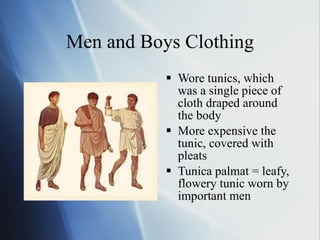
Men and Boys Clothing Wore tunics, which was a single piece of cloth draped around the body More expensive the tunic, covered with pleats Tunica palmat = leafy, flowery tunic worn by important men
Women and Girls Clothing Wore tunic, longer than men Important women wore stola over tunic Going out = wore pala over stola, pala is rectangular toga with hood
Jewelry  Women liked jewelry, for value rather than look Rings were most common jewelry, worn by both men + women The most precious stones were pearls, opals, + emeralds
Cosmetics Made from vegetables + mineral dyes Chalk was used as face powder Put on make-up with a spatula
ANCIENT ROMAN  ROADS & TRANSPORTATION   by BEN AND MATT
How Roads Helped Ancient Rome Helped Armies move quickly around Rome Made communicating easier Helped Rome run their empire by making easy travel
How Roads were built and what they were made out of Built by digging trenches Many layers, top=curbstones, bottom=mortar/sand Roads were built to last
Ships and Other Water Transportation Ships were sail boats with 2 sails Ships were made of wood Docks were always busy
Military Transportation Used horses to travel and fight Mules carried supplies for the army Built bridges for easy travel
Land Transportation Used horses to carry letters Chariots were used for entertainment Went in covered cart if going on long journeys
Different types of roads and where they went Paved roads=fast transportation, mud roads=slow transportation 50,000 miles of roads Roads covered Roman empire
Merchants and Farm carts Driven by oxen Farmers used plows that went slowly Farm carts had solid wooden wheels
Different Transportation Routes and how Long they Took Alexandria to Ostia takes 16-21 days Rome to Caesaria takes 20 days Took two to three weeks by ship to go from Egypt to Rome
Ancient Roman Army and weapons By Austin & Alex
How soldiers benefited the society  Soldiers built opera houses and other public buildings. The soldiers paroled the city for possible danger. They Brought treasure home from war. Most importantly, the soldiers kept the citizens and kingdom safe.
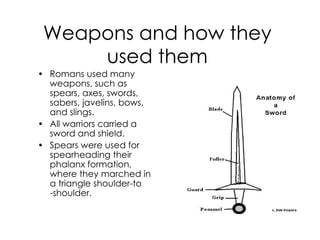
Weapons and how they used them Romans used many weapons, such as spears, axes, swords, sabers, javelins, bows, and slings. All warriors carried a sword and shield. Spears were used for spearheading their phalanx formation, where they marched in a triangle shoulder-to -shoulder.
Marching When Romans marched to war they each carried grain, a pick, 2 stakes, a saw, their armor and weapons. When marching they slept in a wool tent. Roman soldiers marched 8 or more miles a day. Some Roman camps could be as big as a city.
Siege Boats carried most supplies for troops. Commander directed troops from afar and from the advice of other leaders. Troops would mostly steal food from enemies to eat and hurt them. They built bridges over rivers by anchoring boats and putting large planks across the boats.
Training  When selected they were fitted for armor and outfits. They rode horses without stirrups to build endurance. Recruits marched two times a day with full armor and spears. Some trainees were taught to fire catapults. Selected for training when boys.
Armor Wore shield, plate armor, belt and mail shin guards. Shield is called Scuttum, and were made out of wood and steel. The Belt is called chinglum, and was leather with dangling mail. Chest plate is  cal led lorice, and is iron on leather. ^ Battle Helmet
Enemies of Rome The roman enemies were the Germans, Deccins, Iberians, Hispanics, Parthians, Celtics, Gallics, and Persians. The Germans were considered barbarians. The Romans lost to the Germans only once.
Benefits of War During war, slaves and land were captured to be sold and built on. Lots of gold and riches were brought back from war. After years of military service soldiers were given full citizenship. A parade to display valor full warriors and captured slaves was fun for everyone.
Ancient Roman Gladiators By: Sam & Raphael
Types of Gladiators  There were Retiariuses, who used tridents and nets. The Acians, who had brown shields and curved swords. The Mirmihlo, who had heavy shields, short swords and helmets. The Velitis, who used javelins and who fought 5 vs 5. Gladiators usually fought against other Gladiators.
How Gladiators are treated   Gladiators are usually slaves or prisoners! Gladiators were usually trained in gladiator schools and were not allowed out! Gladiators were usually treated like wild animals! Talented gladiators were worth a lot of money and were fed special barley.
Rise and Fall of the Gladiator Fights The tradition of gladiator fights came from the Etruscans. The Etruscans believed that the spilling of blood from the gladiator fights honored the dead! The tradition of gladiator fights ended in 404 A.D. because a Christian Priest got mad because one gladiator was about to kill the other one. The spectators got mad and killed the priest. Then the emperor ended the gladiator games.
Rules of the gladiator fights Gladiators had to swear an oath agreeing to suffer whips, burning, and death! In gladiator fights, when a gladiator is wounded, the crowd gets to choose if he lives or not: thumps up; keep alive, thumbs down; kill! Gladiator fights were only on special occasions. Very rarely can a woman be a gladiator.
Gladiator Schools Instructors were usually former gladiators. There were 4 gladiator schools in all of Rome. Gladiators-in-training used wooden swords to practice! Schools were usually close to the arena so they would have a smaller chance of escaping when they are going to the arena.
Types of Gladiator Fights Gladiators could fight animals such as lions and bears! The gladiator animals were kept hungry so they would try to eat the gladiator(s)! The Colosseum could be flooded so there could be sea battles! Gladiators most often fought each other.
The Colosseum The Colosseum was made in 80 A.D. The Colosseum was the biggest gladiator stadium ever! The Colosseum held up to 47,000 people! The Colosseum was built in Rome.
By: Natasha & Donnaya Pompeii
The Great Vesuvius Vesuvius was a volcano that was asleep and slowly building up pressure The magma was so hot and steam turned it to pumice and ash explodedthrough a hole in the top The volcano was 4,203 feet high Pompeii eruption was on August 24, AD 79
Volcano timeline
Old Pompeii In the town of Pompeii:  had altars in the center of the town  Nile water was sacred in temples  Found in 1600’s Porta Marina was a gate through which you entered Pompeii  People first invented the water fountain
Pompeii timeline
Buildings in Pompeii Amphitheater: double theater Forum: center of political, economical, and religons, outdoor market  Baths: public baths Frigidarium: cold bath Tepidarium: warm bath Caldarium: hot bath  Basilica: tall, thin structure Arch of Caligula: showcase of trophies
Pompeii Gods and Altars Jupiter: king of all gods Priapus: god of fertility Apollo: god of light Venus: goddess of love, known as protector of Pompeii, had a son called Cupid
Items and Bodies found In Pompeii, people found: Bread in oven Bowling alleys and running water Lot’s of paintings of fruits Graffiti from gladiator fights “ Beware of the dog” signs Marble basin and bronze tub with cradle Gold neck lace of 48 ivy leaves cut of gold
New Pompeii People added a terrace to enjoy the view Most popular during summer and autumn About 7,000 people visit per day Pompeii has been restored

Ancient Rome by 6M

  • 1.
    Ancient Roman ArchitectureBy: Sofia & Mellissa
  • 2.
    Aqueducts A channelthat brought water into the towns and cities, sometimes raised high up on arches to cross rivers or ravines. Their easiest way of getting water straight into Rome. Pipes from Aqueducts go to public fountains, bathrooms and baths.
  • 3.
    Bridges Bridges hadthe arch as its basic structure. The greatest difficulty were the pillars because they need to provide support while fighting the water current. Built with wood then brick and stone.
  • 4.
    Colosseum • It was the greatest roman amphitheater. • Games were held here. Sea battles raged and animals appeared out of trap doors in the floor. • It could seat 50,000 people. • No one knows the architect that designed the Colosseum
  • 5.
    Colosseum Building Process• If it wasn’t made with cement and vaulted arches the Colosseum could not have been built because it would have been to heavy and fallen. • It had 80 entrances. 2 for the emperor, dignitaries. 2 for the gladiators, 1 for dead, 1 for alive and 76 for the people. • They started by building an oval trench that was 18 feet deep and filled it with cement.
  • 6.
    Building techniques andtools • The Pantheon was the largest dome in history until the twentieth century • The idea of a dome came from extending an arch. • They built with simple hammers, chisels, saws, pulleys and cranes.
  • 7.
    Roman Forum • It was snug in a valley between Capitoline Hill and Palintine Hill. • Beginning as a market place it evolved into an economic, political and religious hub and the town square in the center of Rome. • Made with stone paving, arches and white marble columns.
  • 8.
    Roman Homes • Most apartments were 5-6 stories high. • Apartments were crowded and unsanitary while stores were on the 1st floor • The richest of Romans could afford town houses just for them selves. • Town houses allowed kitchens unlike apartments and were only 1-2 stories and windows only on the 2nd floor for security purposes.
  • 9.
    Ancient Roman UpperClass Life By Rosa, Jeffery, & Noa
  • 10.
    Daily Life Slaveshelped through whole day During day, men went to baths, women read In evening, HUGE feasts Prayed first thing in morning because believed gods gave wealth
  • 11.
    Fashion for therich Women had very elaborate hairstyles They had emeralds, opals, and pearls Men had very elaborate styled beards Both men and women wore perfume
  • 12.
    Homes and DecorSmall windows to prevent heat from coming in Villas had 8 rooms Had courtyards and shrines They had specially designed gutters and heating systems
  • 13.
    Parties and festivityRich people hosted feasts for friends and important people from the city Slaves washed guest’s feet Men got together for hunting parties Men wore bright togas for parties
  • 14.
    Currency Moneylenders hadvery high interest A large some of money is called a dowry Made new coins for every conquest Pecunia means money in Latin
  • 15.
    Slaves and servantsSlaves were prisoners of war, captives or Romans in debt Rich roman can obtain slaves by buying, inheritance, or as slave’s child Most household slaves were treated well
  • 16.
    Powers and SocialStandings Rich people called patricians Only oldest families in Rome were rich Held political, legal, and religious power Consul= Supreme authority below emperor
  • 17.
    Rich kids Boysand girls learned reading, writing, and math in primary school Older boys learned Greek, grammar, geometry, public speaking, and astronomy in secondary school Boys became men at 15 Learn to swim with bamboo floats
  • 18.
    Ancient Roman FoodsBy:Eleanor & Aileen
  • 19.
    Food For ThePoor The poor people that lived near the Mediterranean Sea had to eat foods that grew in dry places They eat pasta,salad,water,bread,and porridge or eat left over food from breakfast
  • 20.
    Rich People’s FoodsSpecial occasions they ate giraffes,larks,and dormice,not for the flavor but because they’re expensive They ate chicken and pork with lots of spices They had the most access to fruits and figs and grapes
  • 21.
    Roman Farmers Theygrow figs,and strawberries In hot climates they grow grapes and olives In cold climates they grow turnips and apples Farmers grew grapes in order to make and sell wine
  • 22.
    Kinds Of RomanMeats Sheep,Cattle Pork and Ham Fish and peacock tongues Complicated meal is that they would make stuffing chicken inside of duck, duck inside of goose,goose inside of pig,pig inside of cow,then they cook it altogether
  • 23.
    A Roman DinnerParty Good manners are to vomit to make more room for more meals The people stay for games and songs before getting ready to leave They remove out door shoes and put indoor shoes (sandals) and the slaves would wash the wealthy peoples hands a place a crown of flowers upon their head
  • 24.
    What meals didthe ancient children eat at school? Salad (lunch) Rice or pasta (snack) Water (daily) Juice (lunch) Cheese and vegetable(both)
  • 25.
    What did theRomans drink? Romans drank wine on special occasions,breakfast,lunch,and dinner Romans drank water for breakfast,lunch,and dinner Calda which is warm water and wine laced with spices Ponca is vinegar mixed with enough water to make it drinkable
  • 26.
    Clothing and AccesoriesBy Morgan, Nora & Sofia C. Ancient Roman
  • 27.
    Hair Styles, menand women Curls were popular for both, men + women Men had short hair In early Rome, women wore simple hair styles (Bun)
  • 28.
    Foot Wear, menand women Different ranks= Different types of shoes Women wore boots like men but made out of softer material Slaves wore wooden clogs, or animal skins wrapped around feet
  • 29.
    Different Occasions ClothingParty stolas had embroidery around the hem Togas for party’s were brightly colored Togas for mourning were darkly colored
  • 30.
    Seasonal wear/ travelingclothes To protect from rain + cold, wore hooded cloak called lacernae Traveling cloaks were made from animal skins, they were warm and waterproof Paenula is a piece of cloth with a hole cut into it
  • 31.
    Men and BoysClothing Wore tunics, which was a single piece of cloth draped around the body More expensive the tunic, covered with pleats Tunica palmat = leafy, flowery tunic worn by important men
  • 32.
    Women and GirlsClothing Wore tunic, longer than men Important women wore stola over tunic Going out = wore pala over stola, pala is rectangular toga with hood
  • 33.
    Jewelry Womenliked jewelry, for value rather than look Rings were most common jewelry, worn by both men + women The most precious stones were pearls, opals, + emeralds
  • 34.
    Cosmetics Made fromvegetables + mineral dyes Chalk was used as face powder Put on make-up with a spatula
  • 35.
    ANCIENT ROMAN ROADS & TRANSPORTATION by BEN AND MATT
  • 36.
    How Roads HelpedAncient Rome Helped Armies move quickly around Rome Made communicating easier Helped Rome run their empire by making easy travel
  • 37.
    How Roads werebuilt and what they were made out of Built by digging trenches Many layers, top=curbstones, bottom=mortar/sand Roads were built to last
  • 38.
    Ships and OtherWater Transportation Ships were sail boats with 2 sails Ships were made of wood Docks were always busy
  • 39.
    Military Transportation Usedhorses to travel and fight Mules carried supplies for the army Built bridges for easy travel
  • 40.
    Land Transportation Usedhorses to carry letters Chariots were used for entertainment Went in covered cart if going on long journeys
  • 41.
    Different types ofroads and where they went Paved roads=fast transportation, mud roads=slow transportation 50,000 miles of roads Roads covered Roman empire
  • 42.
    Merchants and Farmcarts Driven by oxen Farmers used plows that went slowly Farm carts had solid wooden wheels
  • 43.
    Different Transportation Routesand how Long they Took Alexandria to Ostia takes 16-21 days Rome to Caesaria takes 20 days Took two to three weeks by ship to go from Egypt to Rome
  • 44.
    Ancient Roman Armyand weapons By Austin & Alex
  • 45.
    How soldiers benefitedthe society Soldiers built opera houses and other public buildings. The soldiers paroled the city for possible danger. They Brought treasure home from war. Most importantly, the soldiers kept the citizens and kingdom safe.
  • 46.
    Weapons and howthey used them Romans used many weapons, such as spears, axes, swords, sabers, javelins, bows, and slings. All warriors carried a sword and shield. Spears were used for spearheading their phalanx formation, where they marched in a triangle shoulder-to -shoulder.
  • 47.
    Marching When Romansmarched to war they each carried grain, a pick, 2 stakes, a saw, their armor and weapons. When marching they slept in a wool tent. Roman soldiers marched 8 or more miles a day. Some Roman camps could be as big as a city.
  • 48.
    Siege Boats carriedmost supplies for troops. Commander directed troops from afar and from the advice of other leaders. Troops would mostly steal food from enemies to eat and hurt them. They built bridges over rivers by anchoring boats and putting large planks across the boats.
  • 49.
    Training Whenselected they were fitted for armor and outfits. They rode horses without stirrups to build endurance. Recruits marched two times a day with full armor and spears. Some trainees were taught to fire catapults. Selected for training when boys.
  • 50.
    Armor Wore shield,plate armor, belt and mail shin guards. Shield is called Scuttum, and were made out of wood and steel. The Belt is called chinglum, and was leather with dangling mail. Chest plate is cal led lorice, and is iron on leather. ^ Battle Helmet
  • 51.
    Enemies of RomeThe roman enemies were the Germans, Deccins, Iberians, Hispanics, Parthians, Celtics, Gallics, and Persians. The Germans were considered barbarians. The Romans lost to the Germans only once.
  • 52.
    Benefits of WarDuring war, slaves and land were captured to be sold and built on. Lots of gold and riches were brought back from war. After years of military service soldiers were given full citizenship. A parade to display valor full warriors and captured slaves was fun for everyone.
  • 53.
    Ancient Roman GladiatorsBy: Sam & Raphael
  • 54.
    Types of Gladiators There were Retiariuses, who used tridents and nets. The Acians, who had brown shields and curved swords. The Mirmihlo, who had heavy shields, short swords and helmets. The Velitis, who used javelins and who fought 5 vs 5. Gladiators usually fought against other Gladiators.
  • 55.
    How Gladiators aretreated Gladiators are usually slaves or prisoners! Gladiators were usually trained in gladiator schools and were not allowed out! Gladiators were usually treated like wild animals! Talented gladiators were worth a lot of money and were fed special barley.
  • 56.
    Rise and Fallof the Gladiator Fights The tradition of gladiator fights came from the Etruscans. The Etruscans believed that the spilling of blood from the gladiator fights honored the dead! The tradition of gladiator fights ended in 404 A.D. because a Christian Priest got mad because one gladiator was about to kill the other one. The spectators got mad and killed the priest. Then the emperor ended the gladiator games.
  • 57.
    Rules of thegladiator fights Gladiators had to swear an oath agreeing to suffer whips, burning, and death! In gladiator fights, when a gladiator is wounded, the crowd gets to choose if he lives or not: thumps up; keep alive, thumbs down; kill! Gladiator fights were only on special occasions. Very rarely can a woman be a gladiator.
  • 58.
    Gladiator Schools Instructorswere usually former gladiators. There were 4 gladiator schools in all of Rome. Gladiators-in-training used wooden swords to practice! Schools were usually close to the arena so they would have a smaller chance of escaping when they are going to the arena.
  • 59.
    Types of GladiatorFights Gladiators could fight animals such as lions and bears! The gladiator animals were kept hungry so they would try to eat the gladiator(s)! The Colosseum could be flooded so there could be sea battles! Gladiators most often fought each other.
  • 60.
    The Colosseum TheColosseum was made in 80 A.D. The Colosseum was the biggest gladiator stadium ever! The Colosseum held up to 47,000 people! The Colosseum was built in Rome.
  • 61.
    By: Natasha &Donnaya Pompeii
  • 62.
    The Great VesuviusVesuvius was a volcano that was asleep and slowly building up pressure The magma was so hot and steam turned it to pumice and ash explodedthrough a hole in the top The volcano was 4,203 feet high Pompeii eruption was on August 24, AD 79
  • 63.
  • 64.
    Old Pompeii Inthe town of Pompeii: had altars in the center of the town Nile water was sacred in temples Found in 1600’s Porta Marina was a gate through which you entered Pompeii People first invented the water fountain
  • 65.
  • 66.
    Buildings in PompeiiAmphitheater: double theater Forum: center of political, economical, and religons, outdoor market Baths: public baths Frigidarium: cold bath Tepidarium: warm bath Caldarium: hot bath Basilica: tall, thin structure Arch of Caligula: showcase of trophies
  • 67.
    Pompeii Gods andAltars Jupiter: king of all gods Priapus: god of fertility Apollo: god of light Venus: goddess of love, known as protector of Pompeii, had a son called Cupid
  • 68.
    Items and Bodiesfound In Pompeii, people found: Bread in oven Bowling alleys and running water Lot’s of paintings of fruits Graffiti from gladiator fights “ Beware of the dog” signs Marble basin and bronze tub with cradle Gold neck lace of 48 ivy leaves cut of gold
  • 69.
    New Pompeii Peopleadded a terrace to enjoy the view Most popular during summer and autumn About 7,000 people visit per day Pompeii has been restored