ANCIENT INSTRUMENTS
CAITLYN ROBERSON
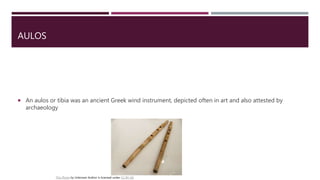
AULOS
 An aulos or tibia was an ancient Greek wind instrument, depicted often in art and also attested by
archaeology
This Photo by Unknown Author is licensed under CC BY-SA
LYRE
 a string instrument known for its use in Greek classical antiquity and later.
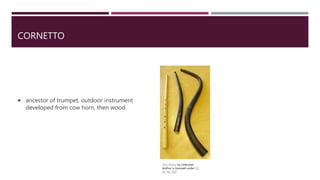
CORNETTO
 ancestor of trumpet, outdoor instrument
developed from cow horn, then wood.
This Photo by Unknown
Author is licensed under CC
BY-NC-ND
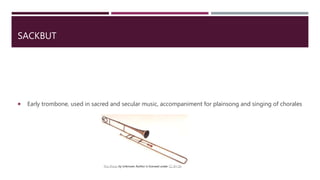
SACKBUT
 Early trombone, used in sacred and secular music, accompaniment for plainsong and singing of chorales
This Photo by Unknown Author is licensed under CC BY-SA
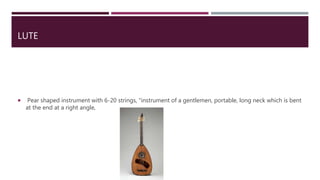
LUTE
 Pear shaped instrument with 6-20 strings, "instrument of a gentlemen, portable, long neck which is bent
at the end at a right angle,
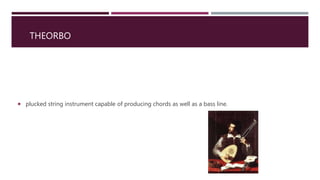
THEORBO
 plucked string instrument capable of producing chords as well as a bass line.
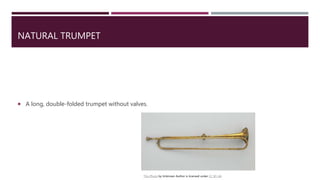
NATURAL TRUMPET
 A long, double-folded trumpet without valves.
This Photo by Unknown Author is licensed under CC BY-SA
HARPSICHORD
 A Baroque instrument in which the strings are plucked instead of being struck with hammers, like
a piano.
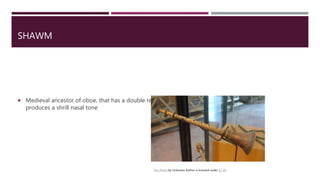
SHAWM
 Medieval ancestor of oboe, that has a double reed
produces a shrill nasal tone
This Photo by Unknown Author is licensed under CC BY
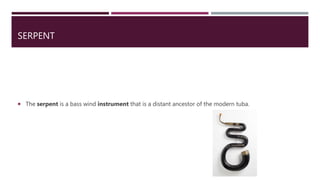
SERPENT
 The serpent is a bass wind instrument that is a distant ancestor of the modern tuba.
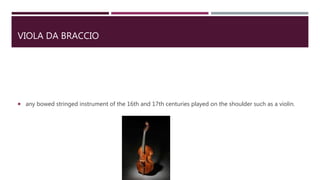
VIOLA DA BRACCIO
 any bowed stringed instrument of the 16th and 17th centuries played on the shoulder such as a violin.
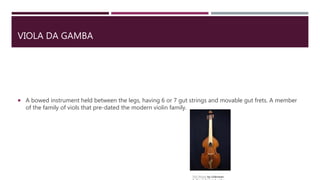
VIOLA DA GAMBA
 A bowed instrument held between the legs, having 6 or 7 gut strings and movable gut frets. A member
of the family of viols that pre-dated the modern violin family.
This Photo by Unknown
NATURAL HORN
 The simplest form of the horn consisting of a tapering brass tube with mouthpiece and bell curved upon
itself and without keys or valves and producing only those tones appearing in the harmonic series.

Ancient instruments

  • 1.
  • 2.
    AULOS  An aulosor tibia was an ancient Greek wind instrument, depicted often in art and also attested by archaeology This Photo by Unknown Author is licensed under CC BY-SA
  • 3.
    LYRE  a stringinstrument known for its use in Greek classical antiquity and later.
  • 4.
    CORNETTO  ancestor oftrumpet, outdoor instrument developed from cow horn, then wood. This Photo by Unknown Author is licensed under CC BY-NC-ND
  • 5.
    SACKBUT  Early trombone,used in sacred and secular music, accompaniment for plainsong and singing of chorales This Photo by Unknown Author is licensed under CC BY-SA
  • 6.
    LUTE  Pear shapedinstrument with 6-20 strings, "instrument of a gentlemen, portable, long neck which is bent at the end at a right angle,
  • 7.
    THEORBO  plucked stringinstrument capable of producing chords as well as a bass line.
  • 8.
    NATURAL TRUMPET  Along, double-folded trumpet without valves. This Photo by Unknown Author is licensed under CC BY-SA
  • 9.
    HARPSICHORD  A Baroqueinstrument in which the strings are plucked instead of being struck with hammers, like a piano.
  • 10.
    SHAWM  Medieval ancestorof oboe, that has a double reed produces a shrill nasal tone This Photo by Unknown Author is licensed under CC BY
  • 11.
    SERPENT  The serpentis a bass wind instrument that is a distant ancestor of the modern tuba.
  • 12.
    VIOLA DA BRACCIO any bowed stringed instrument of the 16th and 17th centuries played on the shoulder such as a violin.
  • 13.
    VIOLA DA GAMBA A bowed instrument held between the legs, having 6 or 7 gut strings and movable gut frets. A member of the family of viols that pre-dated the modern violin family. This Photo by Unknown
  • 14.
    NATURAL HORN  Thesimplest form of the horn consisting of a tapering brass tube with mouthpiece and bell curved upon itself and without keys or valves and producing only those tones appearing in the harmonic series.