Instruments of the
Middle Ages
High School Music History, 2nd Period
Mr. Basom
Overview
□ A large amount of instrumental development
occurred in the medieval and renaissance
periods. During these times, music was used in
various fashions, whether they be casual
meetings with friends or performing before the
royal court.
□ Instruments were used both indoors and
outdoors , but certain instruments were
preferred in specific environments due to their
characteristics.
□ Instruments were separated by consorts
(families). A certain instrument would be
available in many different sizes and often music
would be performed using an entire consort of
Wind
Instruments
There were several types of wind instruments
in the Middle ages. Some used mouthpieces
similar to today’s brass instruments, and some
used reeds, such as today’s woodwinds.
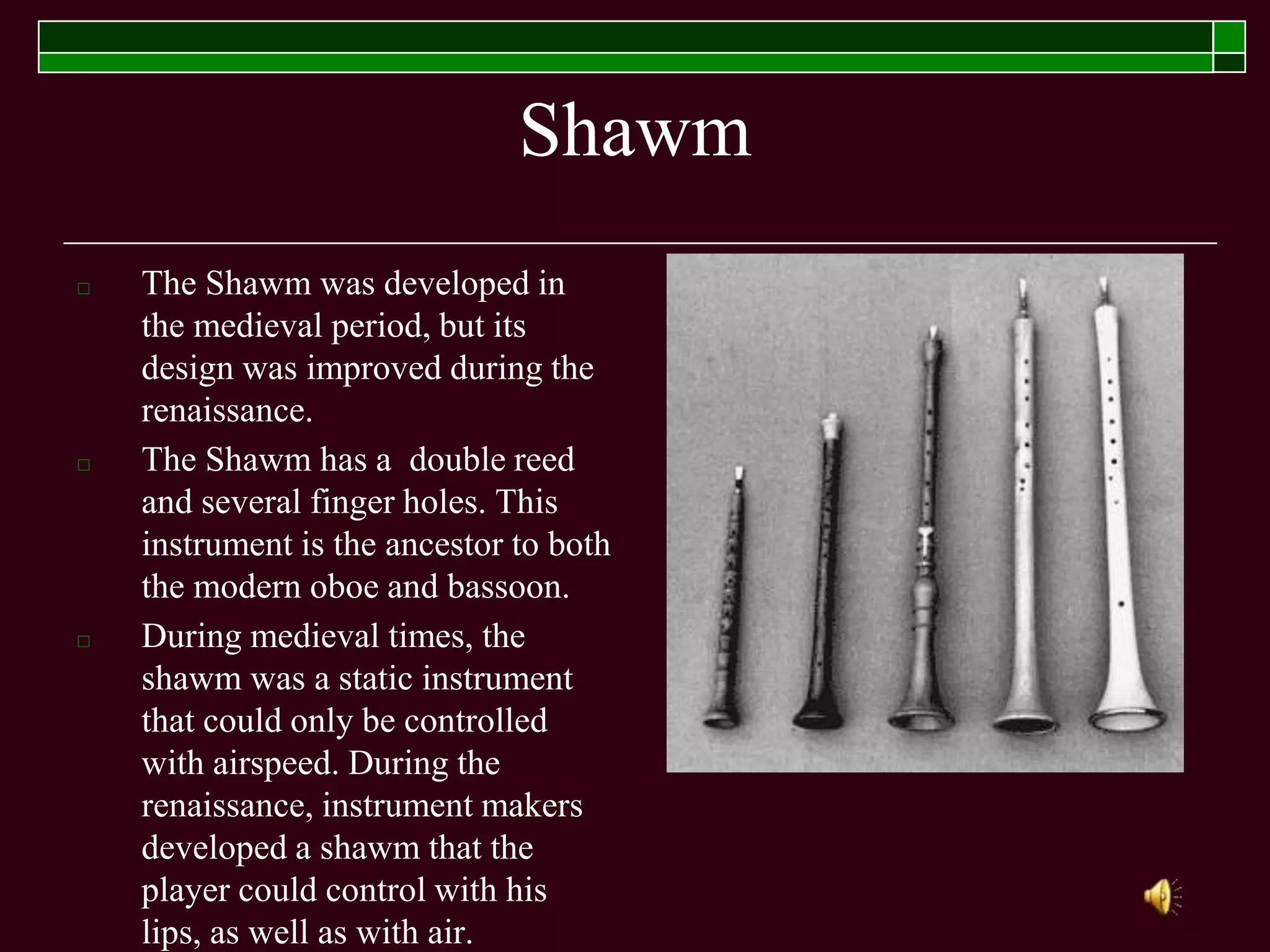
Shawm
□ The Shawm was developed in
the medieval period, but its
design was improved during the
renaissance.
□ The Shawm has a double reed
and several finger holes. This
instrument is the ancestor to both
the modern oboe and bassoon.
□ During medieval times, the
shawm was a static instrument
that could only be controlled
with airspeed. During the
renaissance, instrument makers
developed a shawm that the
player could control with his
lips, as well as with air.
Recorder
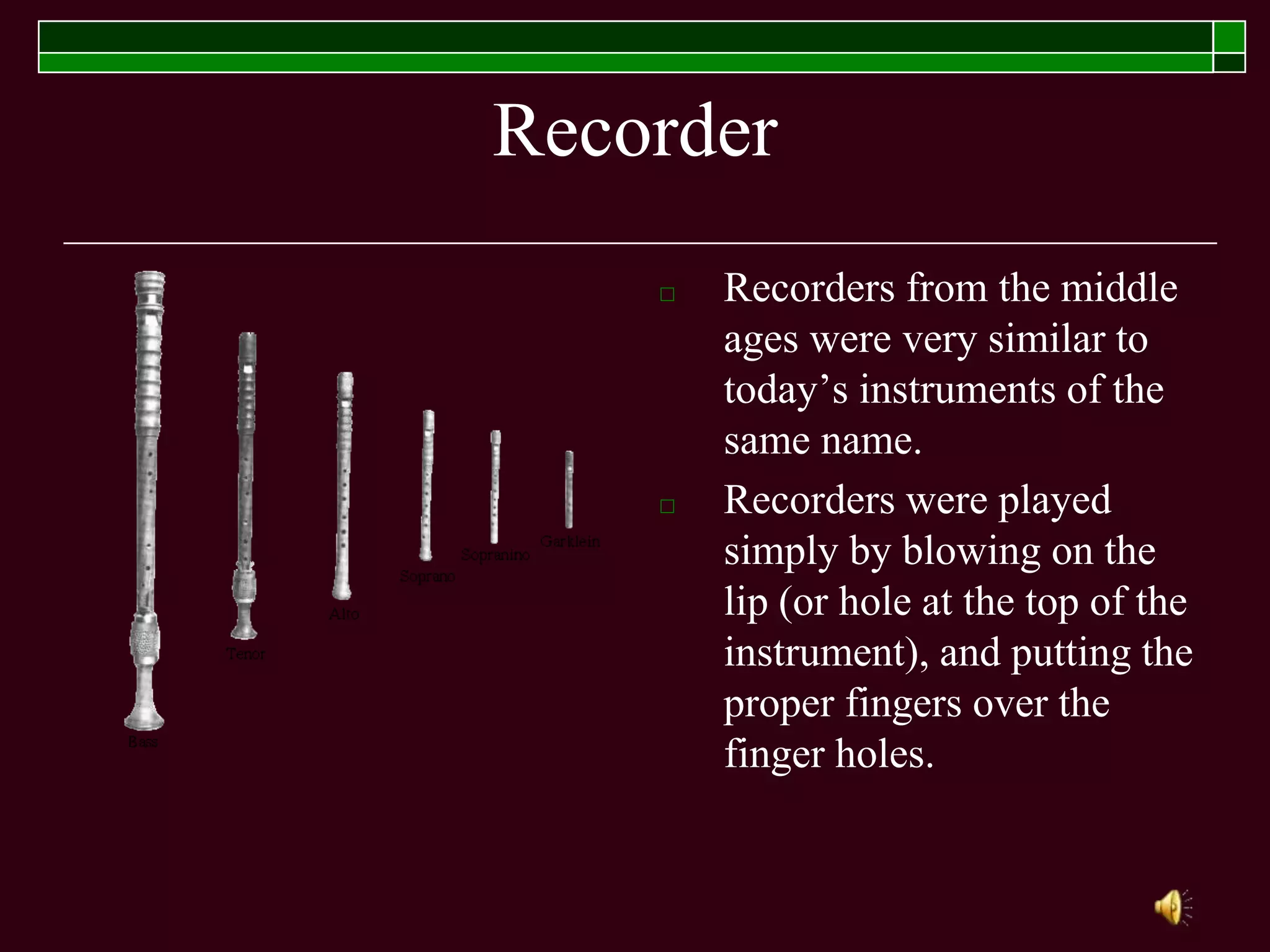
□ Recorders from the middle
ages were very similar to
today’s instruments of the
same name.
□ Recorders were played
simply by blowing on the
lip (or hole at the top of the
instrument), and putting the
proper fingers over the
finger holes.
Crumhorn
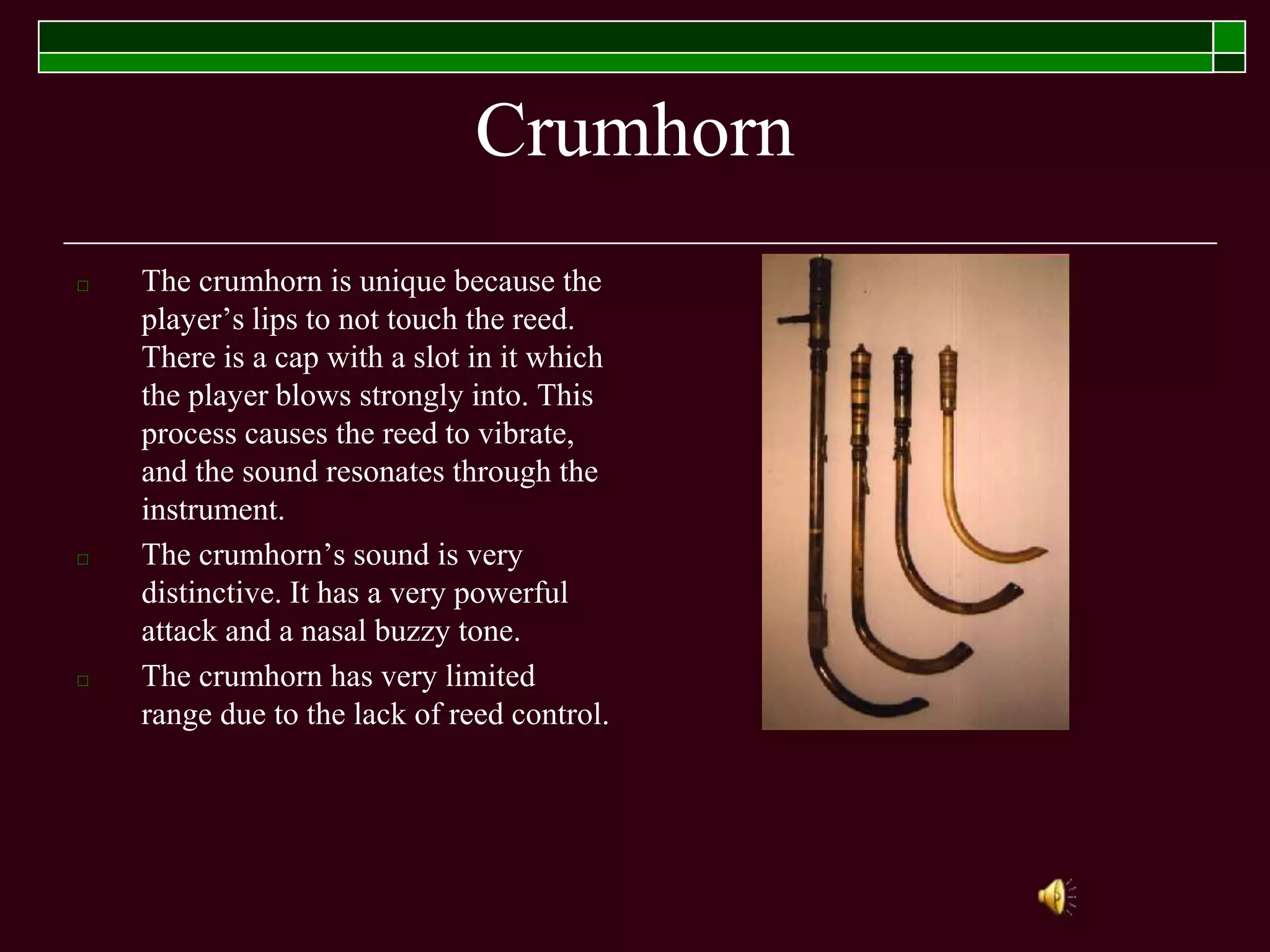
□ The crumhorn is unique because the
player’s lips to not touch the reed.
There is a cap with a slot in it which
the player blows strongly into. This
process causes the reed to vibrate,
and the sound resonates through the
instrument.
□ The crumhorn’s sound is very
distinctive. It has a very powerful
attack and a nasal buzzy tone.
□ The crumhorn has very limited
range due to the lack of reed control.
Sackbut
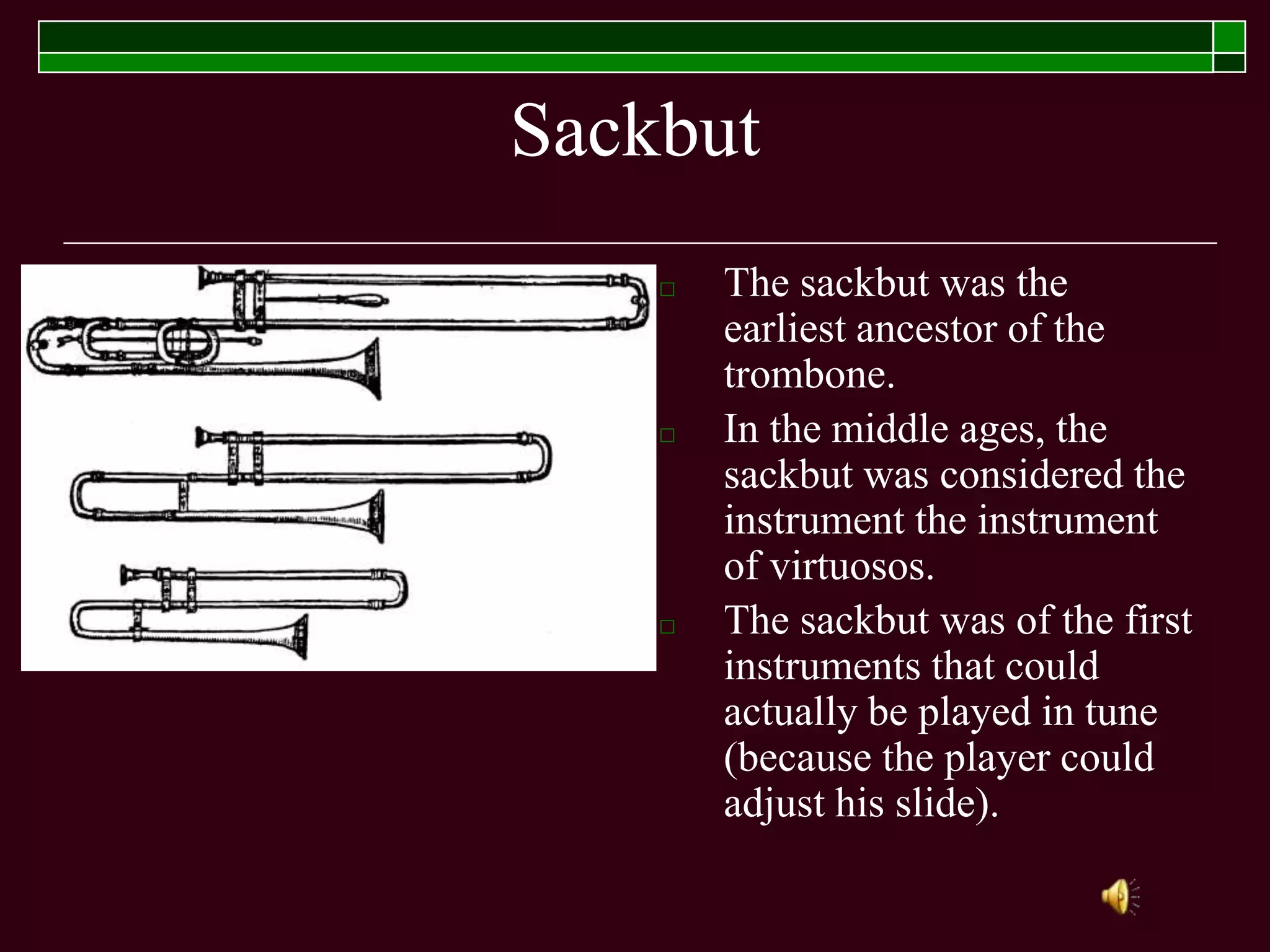
□ The sackbut was the
earliest ancestor of the
trombone.
□ In the middle ages, the
sackbut was considered the
instrument the instrument
of virtuosos.
□ The sackbut was of the first
instruments that could
actually be played in tune
(because the player could
adjust his slide).
Cornett
□ The cornett was possibly the
most versatile instrument from
the middle ages.
□ The cornett had a mouthpiece
like a trumpet’s, but was
fingered like a recorder.
□ The cornett could either be used
indoors or outdoors. The player
could control the volume of the
instrument with his air.
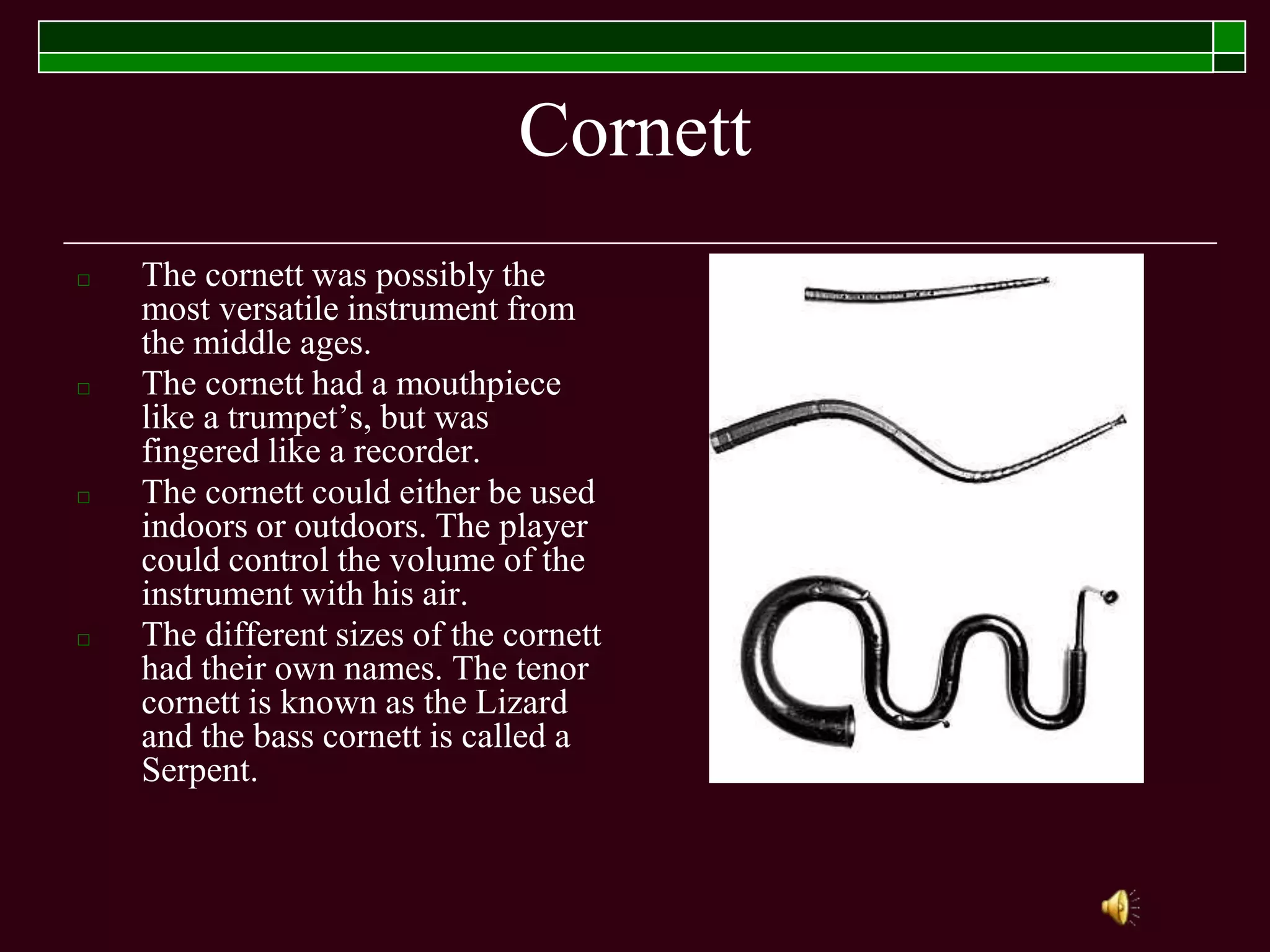
□ The different sizes of the cornett
had their own names. The tenor
cornett is known as the Lizard
and the bass cornett is called a
Serpent.
Percussion
Percussion came in many forms, whether it be
a drum, auxiliary percussion, or a keyboard
instrument.
Drums
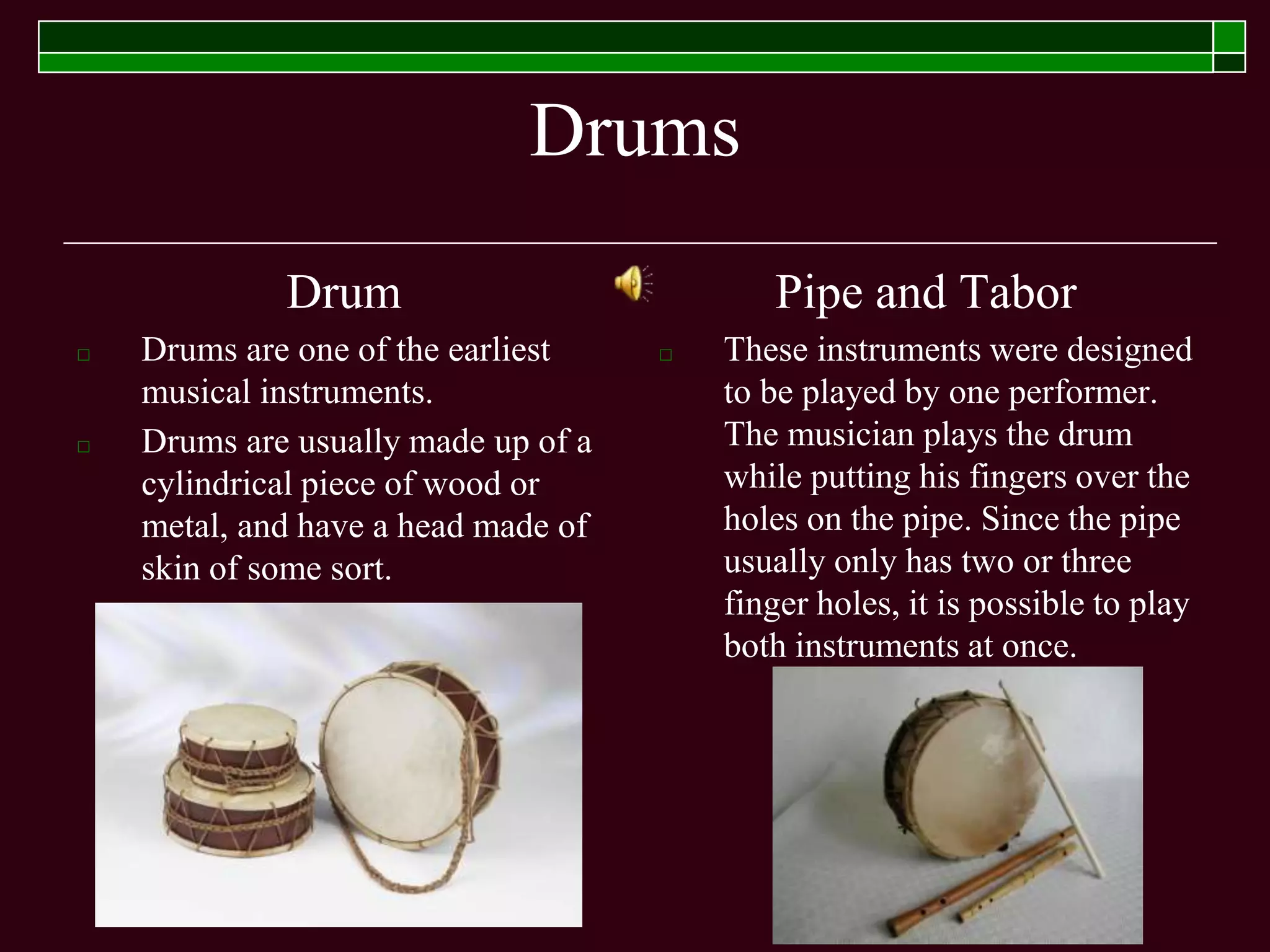
Drum
□ Drums are one of the earliest
musical instruments.
□ Drums are usually made up of a
cylindrical piece of wood or
metal, and have a head made of
skin of some sort.
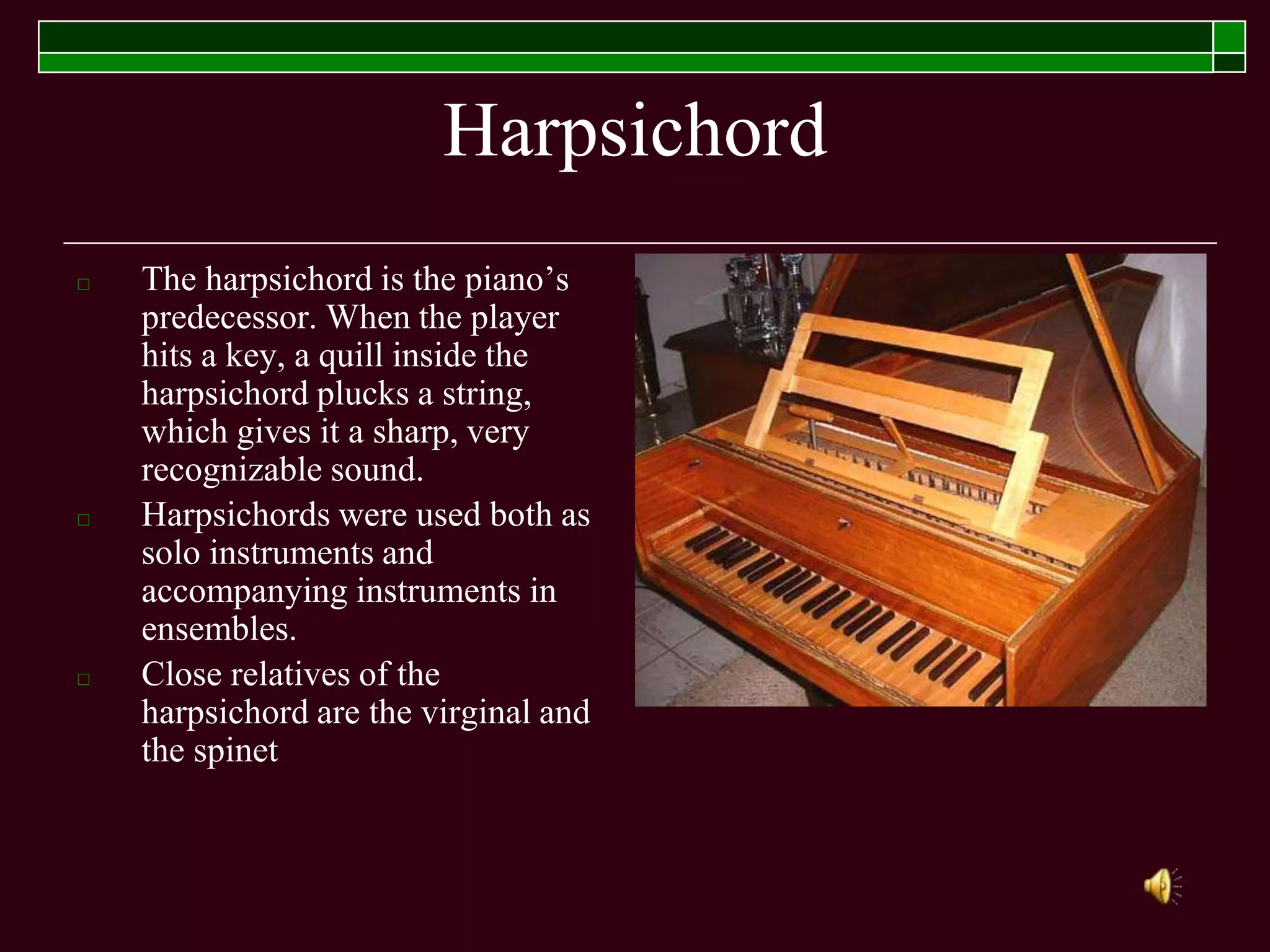
Pipe and Tabor
□ These instruments were designed
to be played by one performer.
The musician plays the drum
while putting his fingers over the
holes on the pipe. Since the pipe
usually only has two or three
finger holes, it is possible to play
both instruments at once.
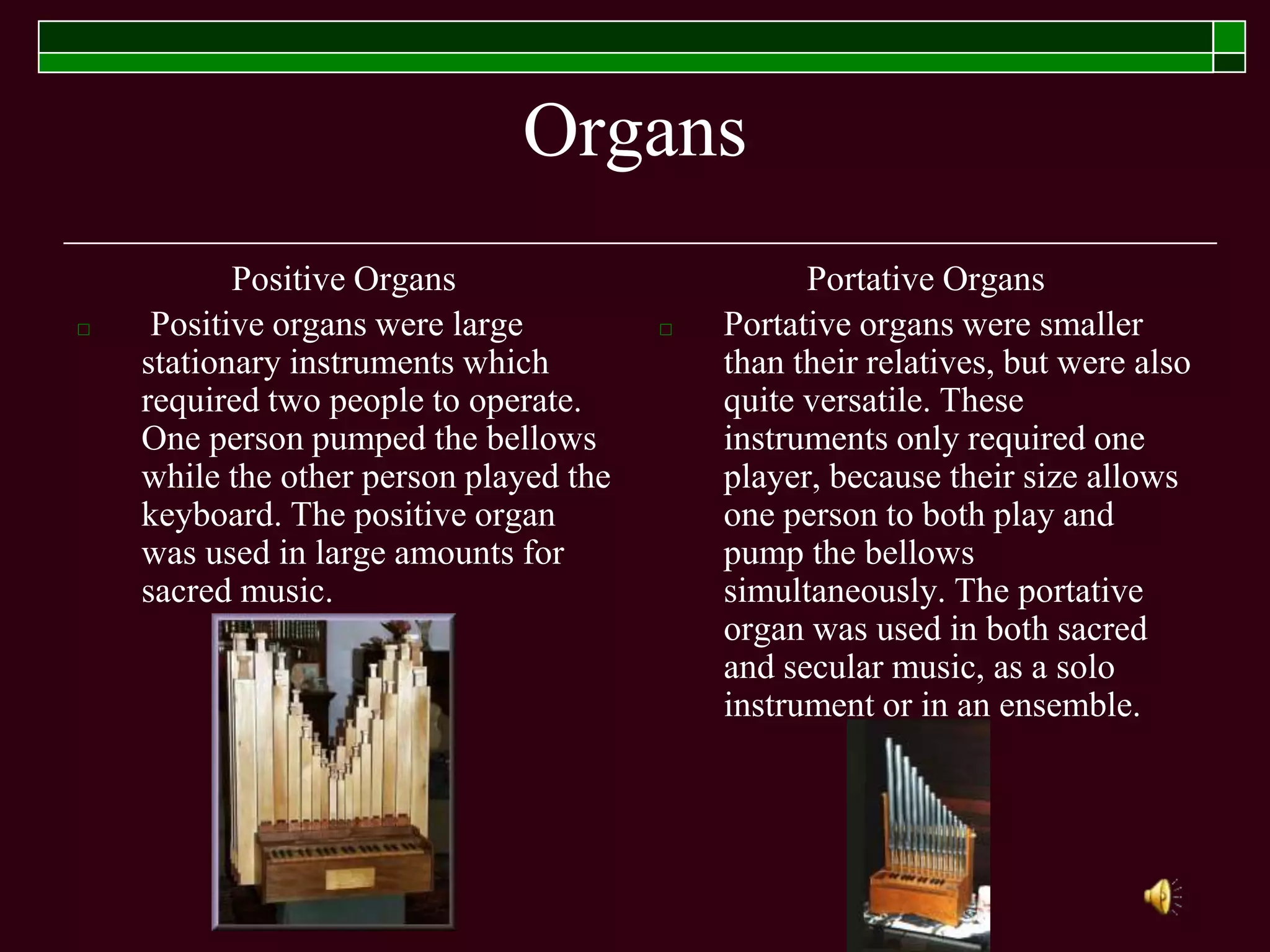
Harpsichord
□ The harpsichord is the piano’s
predecessor. When the player
hits a key, a quill inside the
harpsichord plucks a string,
which gives it a sharp, very
recognizable sound.
□ Harpsichords were used both as
solo instruments and
accompanying instruments in
ensembles.
□ Close relatives of the
harpsichord are the virginal and
the spinet
Organs
Positive Organs
□ Positive organs were large
stationary instruments which
required two people to operate.
One person pumped the bellows
while the other person played the
keyboard. The positive organ
was used in large amounts for
sacred music.
Portative Organs
□ Portative organs were smaller
than their relatives, but were also
quite versatile. These
instruments only required one
player, because their size allows
one person to both play and
pump the bellows
simultaneously. The portative
organ was used in both sacred
and secular music, as a solo
instrument or in an ensemble.
Stringed and Fretted
Instruments
Some of the most popular instruments of the
Middle ages were stringed instruments, and
most developed to become instruments that we
are familiar with today.
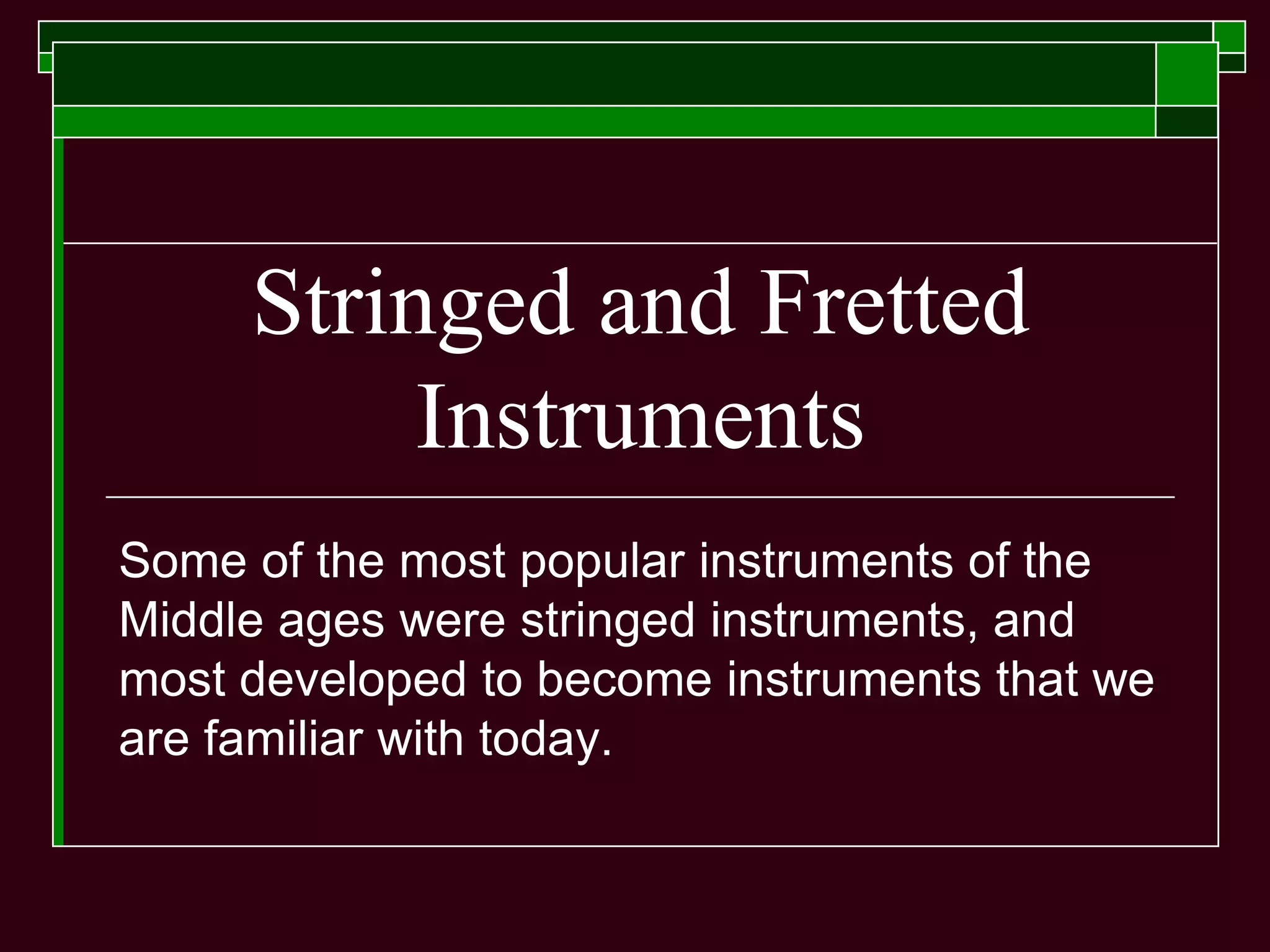
Viol
□ The viol was an important
instrument in this period because
it could be used in a variety of
ways.
□ The viol itself is a bowed
instrument with frets. It has a
very recognizable, nasal tone,
and was often used by upper
class musicians who had formal
training.
□ The strings of a viol could also
be plucked or hammered using a
plectrum, which at the time was
a piece of quill, ivory or wood.
□ The violin was another
instrument in the viol family.
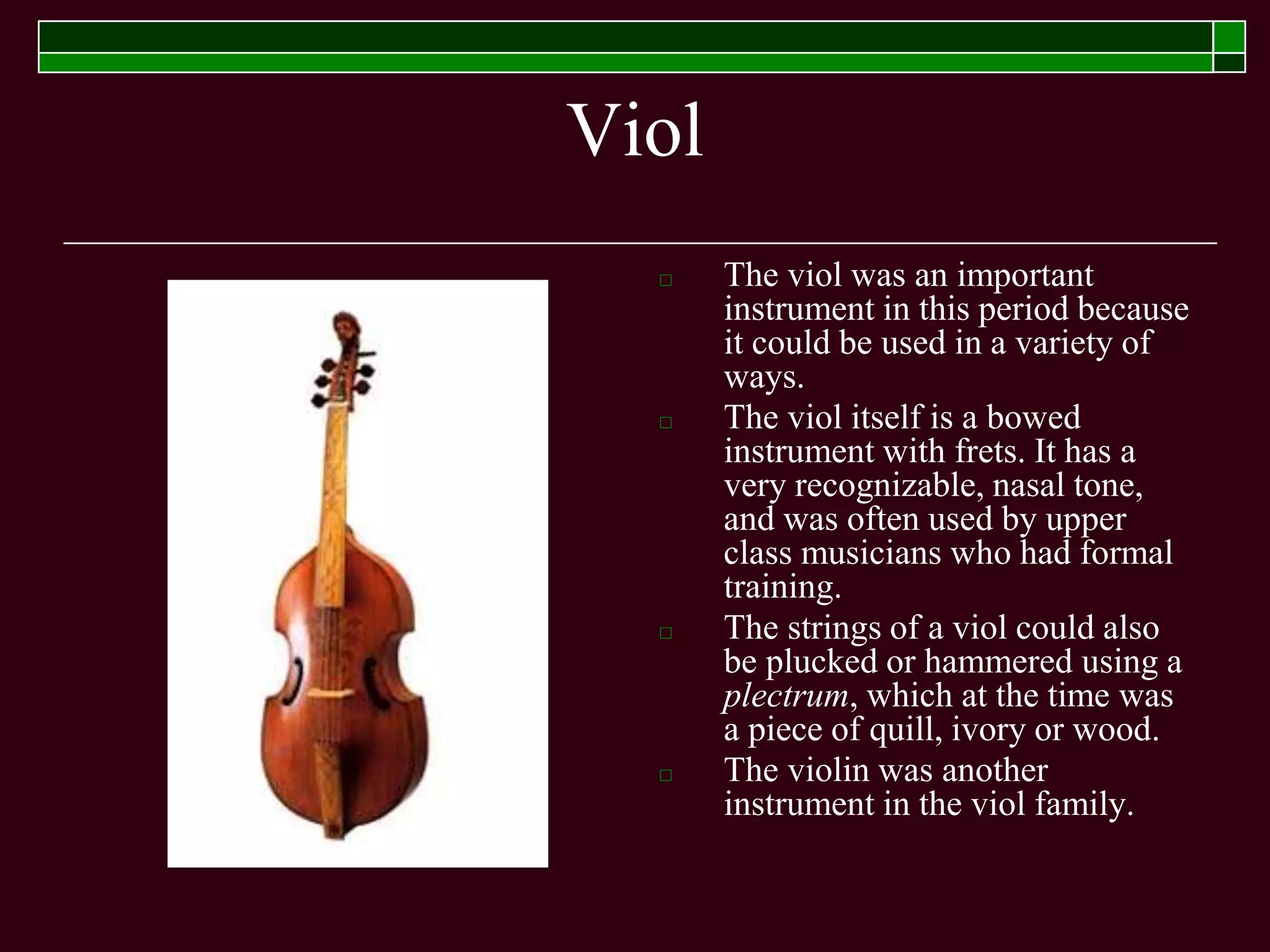
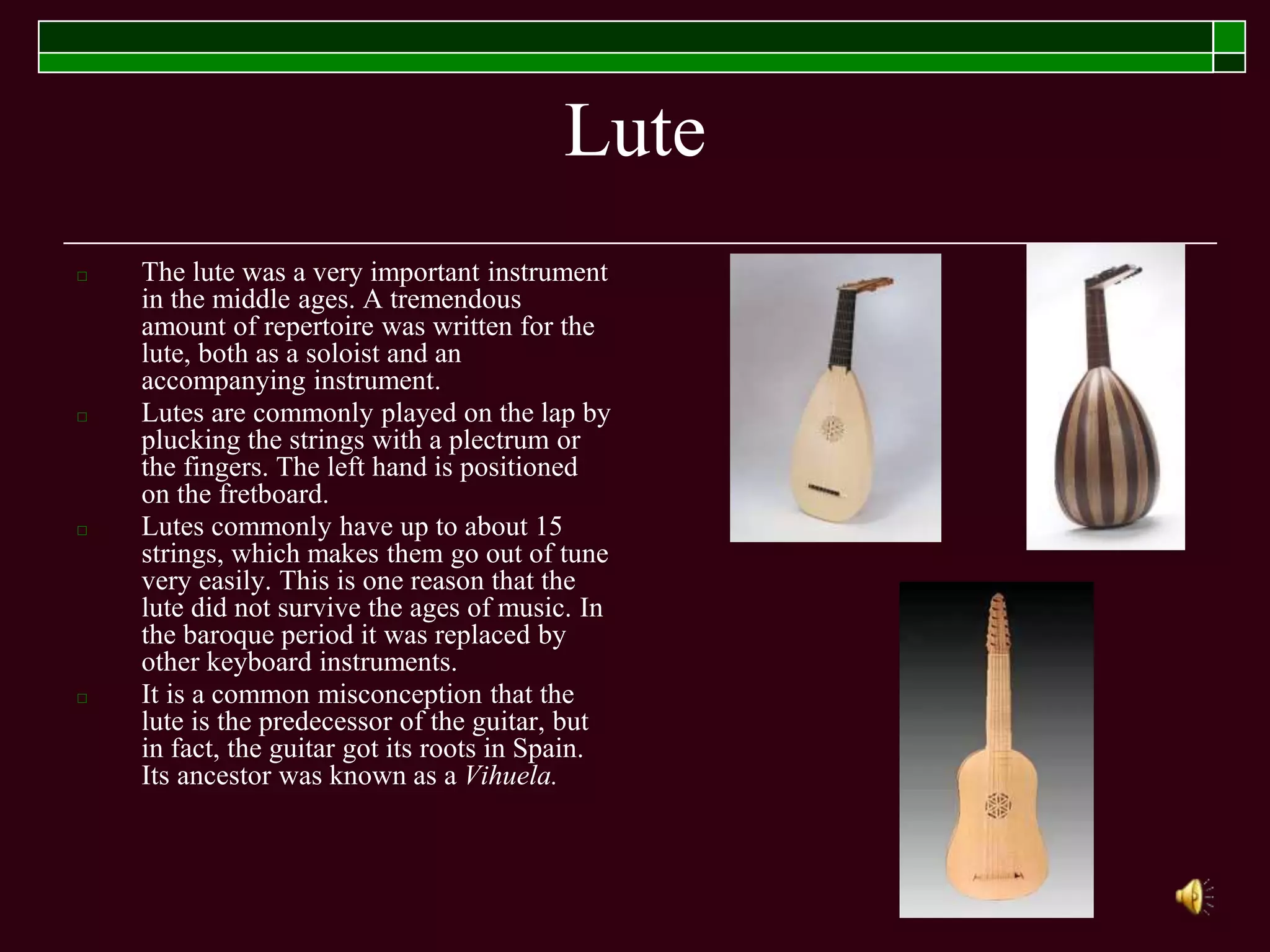
Lute
□ The lute was a very important instrument
in the middle ages. A tremendous
amount of repertoire was written for the
lute, both as a soloist and an
accompanying instrument.
□ Lutes are commonly played on the lap by
plucking the strings with a plectrum or
the fingers. The left hand is positioned
on the fretboard.
□ Lutes commonly have up to about 15
strings, which makes them go out of tune
very easily. This is one reason that the
lute did not survive the ages of music. In
the baroque period it was replaced by
other keyboard instruments.
□ It is a common misconception that the
lute is the predecessor of the guitar, but
in fact, the guitar got its roots in Spain.
Its ancestor was known as a Vihuela.
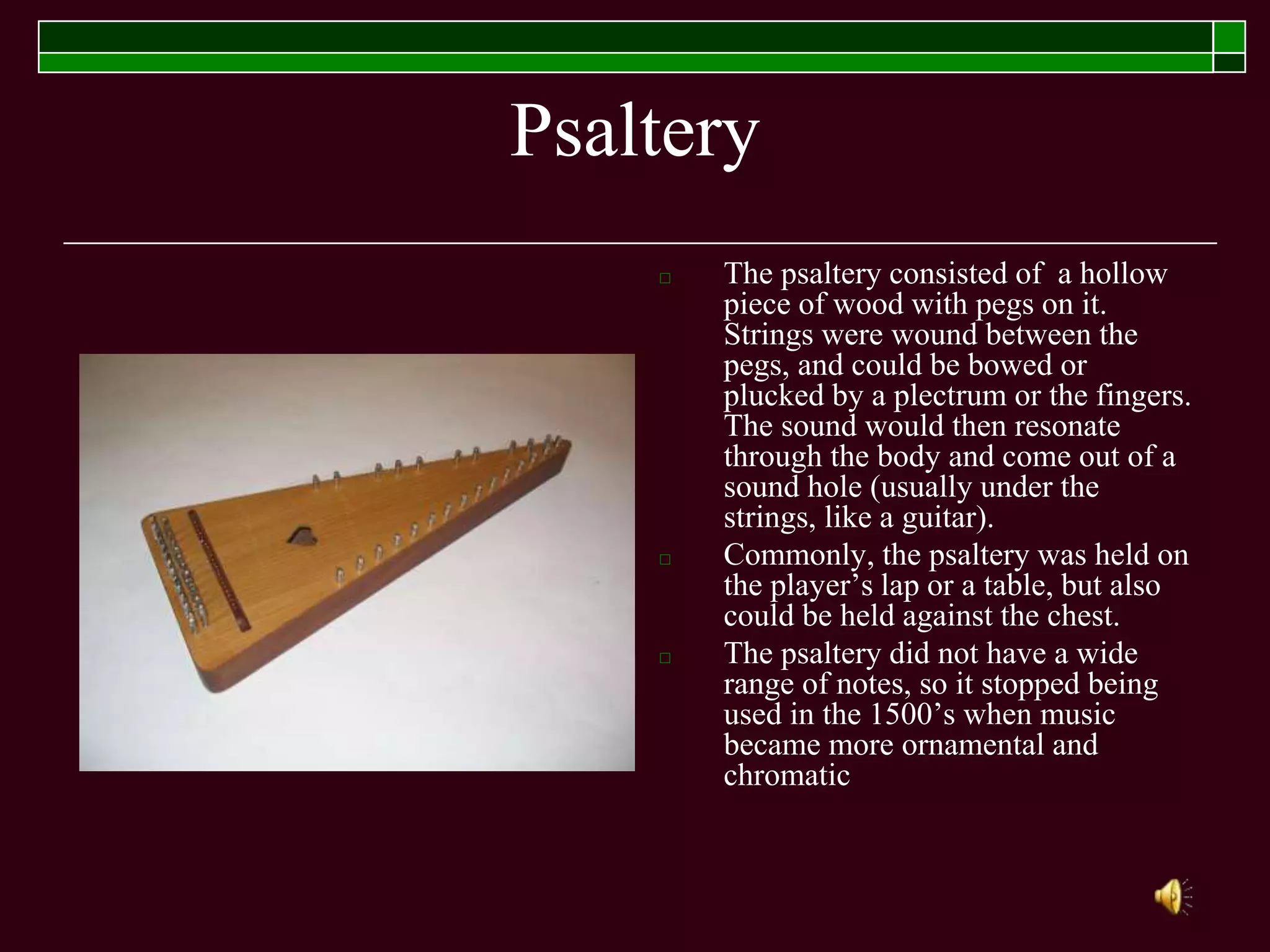
Psaltery
□ The psaltery consisted of a hollow
piece of wood with pegs on it.
Strings were wound between the
pegs, and could be bowed or
plucked by a plectrum or the fingers.
The sound would then resonate
through the body and come out of a
sound hole (usually under the
strings, like a guitar).
□ Commonly, the psaltery was held on
the player’s lap or a table, but also
could be held against the chest.
□ The psaltery did not have a wide
range of notes, so it stopped being
used in the 1500’s when music
became more ornamental and
chromatic
Sources
Most information obtained in this presentation
was retrieved at:
www.music.iastate.edu/antiqua/instrumt.html
Have a good weekend and remember
to study for the test on chapters 4 and 5
NEXT WEDNESDAY!!!!

Instruments of the middle ages.ppt

  • 1.
    Instruments of the MiddleAges High School Music History, 2nd Period Mr. Basom
  • 2.
    Overview □ A largeamount of instrumental development occurred in the medieval and renaissance periods. During these times, music was used in various fashions, whether they be casual meetings with friends or performing before the royal court. □ Instruments were used both indoors and outdoors , but certain instruments were preferred in specific environments due to their characteristics. □ Instruments were separated by consorts (families). A certain instrument would be available in many different sizes and often music would be performed using an entire consort of
  • 3.
    Wind Instruments There were severaltypes of wind instruments in the Middle ages. Some used mouthpieces similar to today’s brass instruments, and some used reeds, such as today’s woodwinds.
  • 4.
    Shawm □ The Shawmwas developed in the medieval period, but its design was improved during the renaissance. □ The Shawm has a double reed and several finger holes. This instrument is the ancestor to both the modern oboe and bassoon. □ During medieval times, the shawm was a static instrument that could only be controlled with airspeed. During the renaissance, instrument makers developed a shawm that the player could control with his lips, as well as with air.
  • 5.
    Recorder □ Recorders fromthe middle ages were very similar to today’s instruments of the same name. □ Recorders were played simply by blowing on the lip (or hole at the top of the instrument), and putting the proper fingers over the finger holes.
  • 6.
    Crumhorn □ The crumhornis unique because the player’s lips to not touch the reed. There is a cap with a slot in it which the player blows strongly into. This process causes the reed to vibrate, and the sound resonates through the instrument. □ The crumhorn’s sound is very distinctive. It has a very powerful attack and a nasal buzzy tone. □ The crumhorn has very limited range due to the lack of reed control.
  • 7.
    Sackbut □ The sackbutwas the earliest ancestor of the trombone. □ In the middle ages, the sackbut was considered the instrument the instrument of virtuosos. □ The sackbut was of the first instruments that could actually be played in tune (because the player could adjust his slide).
  • 8.
    Cornett □ The cornettwas possibly the most versatile instrument from the middle ages. □ The cornett had a mouthpiece like a trumpet’s, but was fingered like a recorder. □ The cornett could either be used indoors or outdoors. The player could control the volume of the instrument with his air. □ The different sizes of the cornett had their own names. The tenor cornett is known as the Lizard and the bass cornett is called a Serpent.
  • 9.
    Percussion Percussion came inmany forms, whether it be a drum, auxiliary percussion, or a keyboard instrument.
  • 10.
    Drums Drum □ Drums areone of the earliest musical instruments. □ Drums are usually made up of a cylindrical piece of wood or metal, and have a head made of skin of some sort. Pipe and Tabor □ These instruments were designed to be played by one performer. The musician plays the drum while putting his fingers over the holes on the pipe. Since the pipe usually only has two or three finger holes, it is possible to play both instruments at once.
  • 11.
    Harpsichord □ The harpsichordis the piano’s predecessor. When the player hits a key, a quill inside the harpsichord plucks a string, which gives it a sharp, very recognizable sound. □ Harpsichords were used both as solo instruments and accompanying instruments in ensembles. □ Close relatives of the harpsichord are the virginal and the spinet
  • 12.
    Organs Positive Organs □ Positiveorgans were large stationary instruments which required two people to operate. One person pumped the bellows while the other person played the keyboard. The positive organ was used in large amounts for sacred music. Portative Organs □ Portative organs were smaller than their relatives, but were also quite versatile. These instruments only required one player, because their size allows one person to both play and pump the bellows simultaneously. The portative organ was used in both sacred and secular music, as a solo instrument or in an ensemble.
  • 13.
    Stringed and Fretted Instruments Someof the most popular instruments of the Middle ages were stringed instruments, and most developed to become instruments that we are familiar with today.
  • 14.
    Viol □ The violwas an important instrument in this period because it could be used in a variety of ways. □ The viol itself is a bowed instrument with frets. It has a very recognizable, nasal tone, and was often used by upper class musicians who had formal training. □ The strings of a viol could also be plucked or hammered using a plectrum, which at the time was a piece of quill, ivory or wood. □ The violin was another instrument in the viol family.
  • 15.
    Lute □ The lutewas a very important instrument in the middle ages. A tremendous amount of repertoire was written for the lute, both as a soloist and an accompanying instrument. □ Lutes are commonly played on the lap by plucking the strings with a plectrum or the fingers. The left hand is positioned on the fretboard. □ Lutes commonly have up to about 15 strings, which makes them go out of tune very easily. This is one reason that the lute did not survive the ages of music. In the baroque period it was replaced by other keyboard instruments. □ It is a common misconception that the lute is the predecessor of the guitar, but in fact, the guitar got its roots in Spain. Its ancestor was known as a Vihuela.
  • 16.
    Psaltery □ The psalteryconsisted of a hollow piece of wood with pegs on it. Strings were wound between the pegs, and could be bowed or plucked by a plectrum or the fingers. The sound would then resonate through the body and come out of a sound hole (usually under the strings, like a guitar). □ Commonly, the psaltery was held on the player’s lap or a table, but also could be held against the chest. □ The psaltery did not have a wide range of notes, so it stopped being used in the 1500’s when music became more ornamental and chromatic
  • 17.
    Sources Most information obtainedin this presentation was retrieved at: www.music.iastate.edu/antiqua/instrumt.html
  • 18.
    Have a goodweekend and remember to study for the test on chapters 4 and 5 NEXT WEDNESDAY!!!!