Ancient Greeks
Ethics in Socrates, Plato, Aristotle and some Aesop´s Fables.
Democracy, justice and law, Plato´s perfect Ideas, Aristotle´s idea of
virtue, true friendship in Aesop´s Fables.
Ethics in Ancient Greece
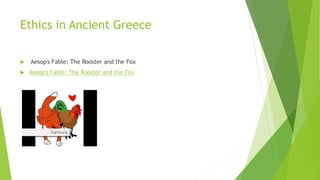
 Aesop's Fable: The Rooster and the Fox
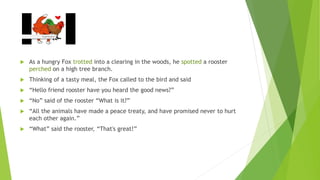
 As a hungry Fox trotted into a clearing in the woods, he spotted a rooster
perched on a high tree branch.
 Thinking of a tasty meal, the Fox called to the bird and said
 “Hello friend rooster have you heard the good news?”
 “No” said of the rooster “What is it?”
 “All the animals have made a peace treaty, and have promised never to hurt
each other again.”
 “What” said the rooster, “That's great!”
a
 “Why don't you come down and celebrate with me?” asked the Fox.
 Just then the Fox noticed that the rooster seemed to be looking intently off
into the distance and asked: “What are you looking at?”
 “Nothing much,” answered the sly rooster, “only a pack of hounds running this
way very fast.”
 “Oh no!” said the fox suddenly, “I just remembered something important and
I have to go!”
 “Why in such a rush friend fox” said the rooster mockingly, “we'll tell them
about the new peace treaty, and you'll be safe, you'll see. “ But the fox ran as
fast as he could and never looked back.
 This story is obviously about lying, and what lying leads to.
the ancient Greeks gave birth to the
idea of democracy
 You have already learned that the ancient Greeks gave birth to the idea of
democracy.
 They believed that vote of the people was the best way to make and to
enforce the laws.
 While we saw that earlier civilizations had kings like Hammurabi to hand
down laws, and used judges to decide cases, the Greeks introduced juries
who voted by majority rule.
 This was an important change, and an improvement for most people.
 The Greeks believed that right and wrong were basically what the majority of
people thought were right and wrong.
 This idea is called a group ethic, and it is still a big part of ethical thinking
today. We’re going to look carefully at both the up and the down side of this.
Socrates was a teacher who lived in Athens
during the height of Greek civilization
 One of the most famous Greeks was Socrates. Socrates was a teacher who
lived in Athens during the height of Greek civilization.
 He had ideas and opinions with which the majority of Athenians disagreed,
and he was accused of trying to overthrow the government by promoting his
views with the young students of the city.
 Socrates was convicted by a jury and ordered to drink a cup of poison and die.
 One of Socrates students was Plato.
 Plato wrote a famous account of the death of Socrates.
 The Sentencing of Socrates (video)
Scene: A prison cell While Socrates waits
for the hour of his execution
 His account was written as a kind of skit in which he tells what people said to
each other. In order to make this conversation easier to understand it has
been shortened and simplified.
 There are two characters in the play: Socrates and his friend Crito.
 First we’ll read, or act out, the play and then we’ll discuss some of the
important ideas in it.
 Scene: A prison cell While Socrates waits for the hour of his execution, his
good friend Crito visits him.
 Socrates: Why have you come so early Crito? What time is it anyway?

Ancient greeks

  • 1.
    Ancient Greeks Ethics inSocrates, Plato, Aristotle and some Aesop´s Fables. Democracy, justice and law, Plato´s perfect Ideas, Aristotle´s idea of virtue, true friendship in Aesop´s Fables.
  • 2.
    Ethics in AncientGreece  Aesop's Fable: The Rooster and the Fox  Aesop's Fable: The Rooster and the Fox
  • 3.
     As ahungry Fox trotted into a clearing in the woods, he spotted a rooster perched on a high tree branch.  Thinking of a tasty meal, the Fox called to the bird and said  “Hello friend rooster have you heard the good news?”  “No” said of the rooster “What is it?”  “All the animals have made a peace treaty, and have promised never to hurt each other again.”  “What” said the rooster, “That's great!”
  • 4.
    a  “Why don'tyou come down and celebrate with me?” asked the Fox.  Just then the Fox noticed that the rooster seemed to be looking intently off into the distance and asked: “What are you looking at?”  “Nothing much,” answered the sly rooster, “only a pack of hounds running this way very fast.”  “Oh no!” said the fox suddenly, “I just remembered something important and I have to go!”  “Why in such a rush friend fox” said the rooster mockingly, “we'll tell them about the new peace treaty, and you'll be safe, you'll see. “ But the fox ran as fast as he could and never looked back.  This story is obviously about lying, and what lying leads to.
  • 5.
    the ancient Greeksgave birth to the idea of democracy  You have already learned that the ancient Greeks gave birth to the idea of democracy.  They believed that vote of the people was the best way to make and to enforce the laws.  While we saw that earlier civilizations had kings like Hammurabi to hand down laws, and used judges to decide cases, the Greeks introduced juries who voted by majority rule.  This was an important change, and an improvement for most people.  The Greeks believed that right and wrong were basically what the majority of people thought were right and wrong.  This idea is called a group ethic, and it is still a big part of ethical thinking today. We’re going to look carefully at both the up and the down side of this.
  • 6.
    Socrates was ateacher who lived in Athens during the height of Greek civilization  One of the most famous Greeks was Socrates. Socrates was a teacher who lived in Athens during the height of Greek civilization.  He had ideas and opinions with which the majority of Athenians disagreed, and he was accused of trying to overthrow the government by promoting his views with the young students of the city.  Socrates was convicted by a jury and ordered to drink a cup of poison and die.  One of Socrates students was Plato.  Plato wrote a famous account of the death of Socrates.  The Sentencing of Socrates (video)
  • 7.
    Scene: A prisoncell While Socrates waits for the hour of his execution  His account was written as a kind of skit in which he tells what people said to each other. In order to make this conversation easier to understand it has been shortened and simplified.  There are two characters in the play: Socrates and his friend Crito.  First we’ll read, or act out, the play and then we’ll discuss some of the important ideas in it.  Scene: A prison cell While Socrates waits for the hour of his execution, his good friend Crito visits him.  Socrates: Why have you come so early Crito? What time is it anyway?