Lean Six Sigma Improving FTX/STX2 Tank Draw Quality SFC Henry, Don H. II Project Initiation Date: 31/03/08 Analyze Tollgate Date: 03/07/08
Agenda Project Charter and Measure Phase Review Critical X’s Potential Root Causes Affecting Critical X’s Reducing the List of Potential Root Causes Root Cause Analysis (Qualitative) Impact of Root Causes on Key Outputs (Y) Prioritized Root Causes Analyze Summary Lessons Learned Barriers/Issues Next Steps Storyboard
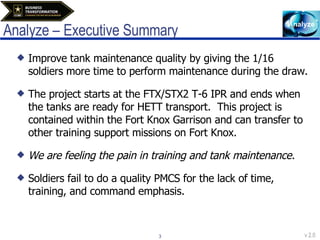
Analyze – Executive Summary Improve tank maintenance quality by giving the 1/16 soldiers more time to perform maintenance during the draw. The project starts at the FTX/STX2 T-6 IPR and ends when the tanks are ready for HETT transport.  This project is contained within the Fort Knox Garrison and can transfer to other training support missions on Fort Knox.  We are feeling the pain in training and tank maintenance. Soldiers fail to do a quality PMCS for the lack of time, training, and command emphasis.
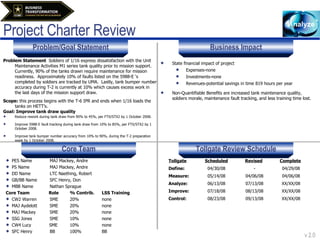
Project Charter Review Scope:  this process begins with the T-6 IPR and ends when 1/16 loads the tanks on HETT’s. Goal: Improve tank draw quality Problem/Goal Statement Tollgate Review Schedule Business Impact Core Team State financial impact of project Expenses-none Investments-none Revenues-potential savings in time 819 hours per year Non-Quantifiable Benefits are increased tank maintenance quality, soldiers morale, maintenance fault tracking, and less training time lost. PES Name MAJ Mackey, Andre PS Name MAJ Mackey, Andre DD Name LTC Naething, Robert GB/BB Name SFC Henry, Don MBB Name Nathan Sprague Core Team  Role % Contrib.  LSS Training CW2 Warren SME 20% none MAJ Aydelott  SME 20% none MAJ Mackey SME 20% none SSG Jones SME 10% none CW4 Lucy  SME 10% none SFC Henry BB 100% BB Tollgate Scheduled Revised   Complete Define: 04/30/08 -  04/29/08 Measure: 05/14/08 04/06/08   04/06/08 Analyze: 06/13/08 07/13/08  XX/XX/08 Improve:   07/18/08 08/13/08  XX/XX/08 Control: 08/23/08 09/13/08  XX/XX/08 Reduce rework during tank draw from 90% to 45%, per FTX/STX2 by 1 October 2008. Improve 5988-E fault tracking during tank draw from 10% to 85%, per FTX/STX2 by 1 October 2008. Improve tank bumper number accuracy from 10% to 90%, during the T-2 preparation week by 1 October 2008. Problem Statement  Soldiers of 1/16 express dissatisfaction with the Unit Maintenance Activities M1 series tank quality prior to mission support. Currently, 90% of the tanks drawn require maintenance for mission readiness.  Approximately 10% of faults listed on the 5988-E ‘s completed by soldiers are tracked by UMA.  Lastly, tank bumper number accuracy during T-2 is currently at 10% which causes excess work in the last days of the mission support draw.
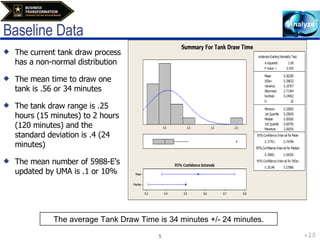
Baseline Data The current tank draw process has a non-normal distribution  The mean time to draw one tank is .56 or 34 minutes The tank draw range is .25 hours (15 minutes) to 2 hours (120 minutes) and the standard deviation is .4 (24 minutes) The mean number of 5988-E’s updated by UMA is .1 or 10%  The average Tank Draw Time is 34 minutes +/- 24 minutes.
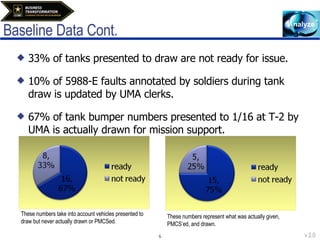
Baseline Data Cont. 33% of tanks presented to draw are not ready for issue. 10% of 5988-E faults annotated by soldiers during tank draw is updated by UMA clerks. 67% of tank bumper numbers presented to 1/16 at T-2 by UMA is actually drawn for mission support. These numbers take into account vehicles presented to draw but never actually drawn or PMCSed. These numbers represent what was actually given, PMCS’ed, and drawn.
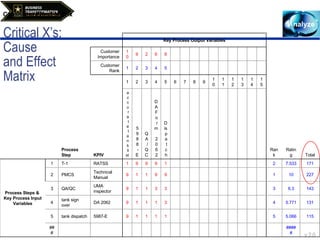
Critical X’s:  Cause  and Effect  Matrix Cause and Effect Matrix Key Process Output Variables Customer Importance 10 9 2 6 8                     Customer Rank 1 2 3 4 5                     1 2 3 4 5 6 7 8 9 10 11 12 13 14 15 Process Step KPIV accurate tank list 5988-E QA/QC DA Form 2062 Dispatch                     Rank Rating Total Process Steps &  Key Process Input Variables 1 T-1 RATSS 1 9 9 9 1                     2 7.533 171 2 PMCS Technical Manual 9 1 1 9 9                     1 10 227 3 QA/QC UMA inspector 9 1 1 3 3                     3 6.3 143 4 tank sign over DA 2062 9 1 1 1 3                     4 5.771 131 5 tank dispatch 5987-E 9 1 1 1 1                     5 5.066 115 ###                                     #####  
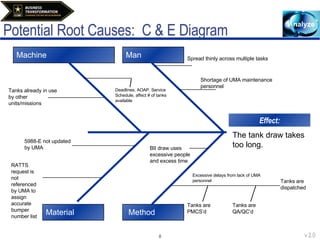
Potential Root Causes:  C & E Diagram Effect: The tank draw takes too long. Man Machine Material Method Spread thinly across multiple tasks Shortage of UMA maintenance personnel Deadlines, AOAP, Service Schedule, affect # of tanks available Tanks already in use by other units/missions BII draw uses excessive people and excess time RATTS request is not referenced by UMA to assign accurate bumper number list Tanks are PMCS’d Tanks are QA/QC’d Tanks are dispatched Excessive delays from lack of UMA personnel 5988-E not updated by UMA
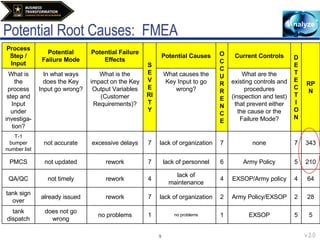
Potential Root Causes:  FMEA Process Step / Input Potential Failure Mode Potential Failure Effects SEVERITY Potential Causes OCCURRENCE Current Controls DETECTION RPN   What is the process step and Input under investiga-tion? In what ways does the Key Input go wrong? What is the impact on the Key Output Variables (Customer Requirements)? What causes the Key Input to go wrong? What are the existing controls and procedures (inspection and test) that prevent either the cause or the Failure Mode? T-1 bumper number list not accurate excessive delays 7 lack of organization 7 none 7 343 PMCS not updated rework 7 lack of personnel 6 Army Policy 5 210 QA/QC not timely rework 4 lack of maintenance 4 EXSOP/Army policy 4 64 tank sign over already issued rework 7 lack of organization 2 Army Policy/EXSOP 2 28 tank dispatch does not go wrong no problems 1 no problems 1 EXSOP 5 5
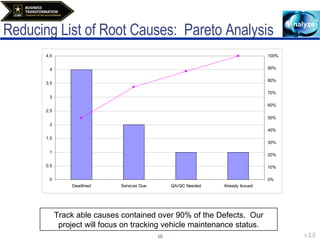
Reducing List of Root Causes:  Pareto Analysis Track able causes contained over 90% of the Defects.  Our project will focus on tracking vehicle maintenance status.
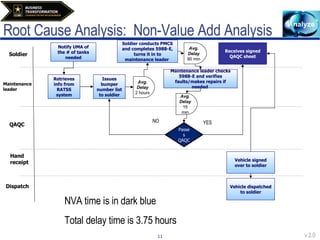
Root Cause Analysis:  Non-Value Add Analysis QAQC Maintenance leader Dispatch Soldier Issues bumper number list to soldier Maintenance leader checks 5988-E and verifies faults/makes repairs if needed  Hand receipt Vehicle signed over to soldier Avg. Delay 2 hours Avg.Delay 15 min Avg. Delay 90 min Soldier conducts PMCS and completes 5988-E, turns it in to maintenance leader  Passes QAQC Receives signed QAQC sheet Vehicle dispatched to soldier YES NO NVA time is in dark blue Total delay time is 3.75 hours Retrieves info from RATSS system Notify UMA of the # of tanks needed
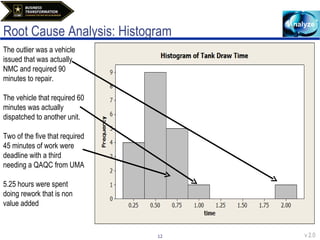
Root Cause Analysis: Histogram The outlier was a vehicle issued that was actually NMC and required 90 minutes to repair. The vehicle that required 60 minutes was actually dispatched to another unit. Two of the five that required 45 minutes of work were deadline with a third needing a QAQC from UMA 5.25 hours were spent doing rework that is non value added
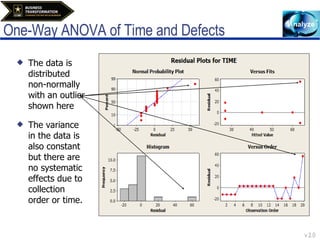
One-Way ANOVA of Time and Defects The data is distributed non-normally with an outlier shown here The variance in the data is also constant but there are no systematic effects due to collection order or time.
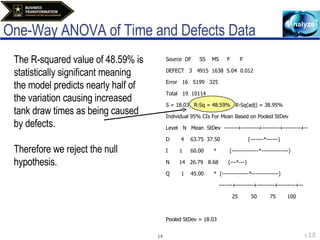
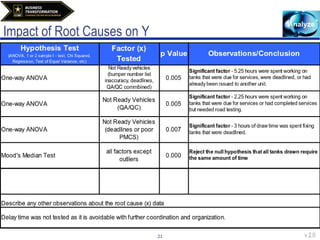
One-Way ANOVA of Time and Defects Data Source  DF  SS  MS  F  P DEFECT  3  4915  1638  5.04  0.012 Error  16  5199  325 Total  19  10114 S = 18.03  R-Sq = 48.59%  R-Sq(adj) = 38.95% Individual 95% CIs For Mean Based on Pooled StDev Level  N  Mean  StDev  -------+---------+---------+---------+-- D  4  63.75  37.50  (-------*------) I  1  60.00  *  (--------------*--------------) N  14  26.79  8.68  (---*---) Q  1  45.00  *  (--------------*--------------) -------+---------+---------+---------+-- 25  50  75  100 Pooled StDev = 18.03 The R-squared value of 48.59% is statistically significant meaning the model predicts nearly half of the variation causing increased tank draw times as being caused by defects. Therefore we reject the null hypothesis.
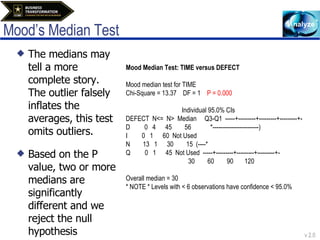
Mood’s Median Test The medians may tell a more complete story. The outlier falsely inflates the averages, this test omits outliers. Based on the P value, two or more medians are significantly different and we reject the null hypothesis Mood Median Test: TIME versus DEFECT  Mood median test for TIME Chi-Square = 13.37  DF = 1  P = 0.000 Individual 95.0% CIs DEFECT  N<=  N>  Median  Q3-Q1  -----+---------+---------+---------+- D  0  4  45  56  *------------------------) I  0  1  60  Not Used N  13  1  30  15  (----* Q  0  1  45  Not Used  -----+---------+---------+---------+- 30  60  90  120 Overall median = 30 * NOTE * Levels with < 6 observations have confidence < 95.0%
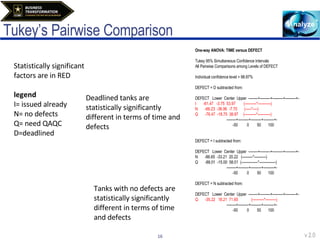
Tukey’s Pairwise Comparison One-way ANOVA: TIME versus DEFECT  Tukey 95% Simultaneous Confidence Intervals All Pairwise Comparisons among Levels of DEFECT Individual confidence level = 98.87% DEFECT = D subtracted from: DEFECT  Lower  Center  Upper  --------+---------+---------+---------+- I  -61.47  -3.75  53.97  (----------*-----------) N  -66.23  -36.96  -7.70  (-----*----) Q  -76.47  -18.75  38.97  (----------*-----------) --------+---------+---------+---------+- -50  0  50  100 DEFECT = I subtracted from: DEFECT  Lower  Center  Upper  --------+---------+---------+---------+- N  -86.65  -33.21  20.22  (---------*----------) Q  -88.01  -15.00  58.01  (--------------*--------------) --------+---------+---------+---------+- -50  0  50  100 DEFECT = N subtracted from: DEFECT  Lower  Center  Upper  --------+---------+---------+---------+- Q  -35.22  18.21  71.65  (----------*---------) --------+---------+---------+---------+- -50  0  50  100 Statistically significant factors are in RED legend I= issued already N= no defects Q= need QAQC D=deadlined Deadlined tanks are statistically significantly different in terms of time and defects Tanks with no defects are statistically significantly different in terms of time and defects
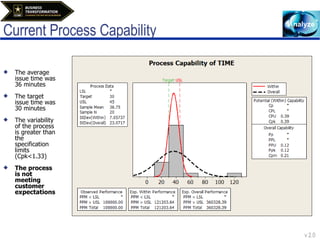
Current Process Capability The average issue time was 36 minutes The target issue time was 30 minutes The variability of the process is greater than the specification limits (Cpk<1.33) The process is not meeting customer expectations
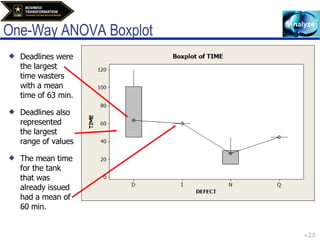
One-Way ANOVA Boxplot Deadlines were the largest time wasters with a mean time of 63 min. Deadlines also represented the largest range of values The mean time for the tank that was already issued had a mean of 60 min.
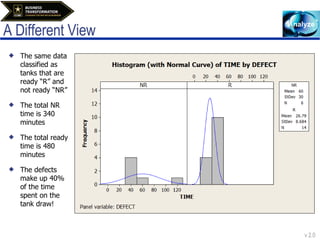
A Different View The same data classified as tanks that are ready “R” and not ready “NR” The total NR time is 340 minutes The total ready time is 480 minutes The defects make up 40% of the time spent on the tank draw!
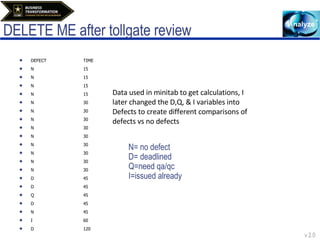
DELETE ME after tollgate review N= no defect  D= deadlined Q=need qa/qc I=issued already DEFECT TIME N 15 N 15 N 15 N 15 N 30 N 30 N 30 N 30 N 30 N 30 N 30 N 30 N 30 D 45 D 45 Q 45 D 45 N 45 I 60 D 120 Data used in minitab to get calculations, I later changed the D,Q, & I variables into Defects to create different comparisons of defects vs no defects
Impact of Root Causes on Y
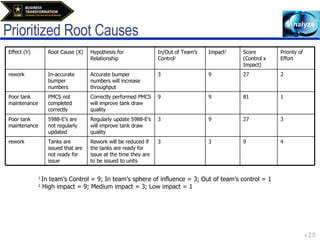
Prioritized Root Causes 1  In team’s Control = 9; In team’s sphere of influence = 3; Out of team’s control = 1 2  High impact = 9; Medium impact = 3; Low impact = 1 Effect (Y) Root Cause (X) Hypothesis for Relationship In/Out of Team’s Control 1 Impact 2 Score (Control x Impact) Priority of Effort rework In-accurate bumper numbers Accurate bumper numbers will increase throughput 3 9 27 2 Poor tank maintenance PMCS not completed correctly Correctly performed PMCS will improve tank draw quality 9 9 81 1 Poor tank maintenance  5988-E’s are not regularly updated Regularly update 5988-E’s will improve tank draw quality 3 9 27 3 rework Tanks are issued that are not ready for issue Rework will be reduced if the tanks are ready for issue at the time they are to be issued to units 3 3 9 4
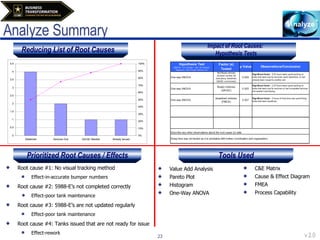
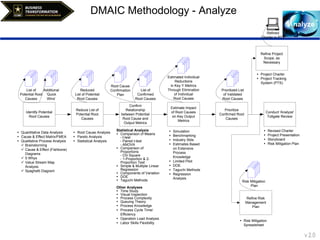
Analyze Summary Impact of Root Causes:  Hypothesis Tests Tools Used Reducing List of Root Causes Prioritized Root Causes / Effects Root cause #1: No visual tracking method Effect-in-accurate bumper numbers Root cause #2: 5988-E’s not completed correctly Effect-poor tank maintenance Root cause #3: 5988-E’s are not updated regularly Effect-poor tank maintenance Root cause #4: Tanks issued that are not ready for issue Effect-rework Value Add Analysis Pareto Plot Histogram One-Way ANOVA C&E Matrix Cause & Effect Diagram FMEA Process Capability
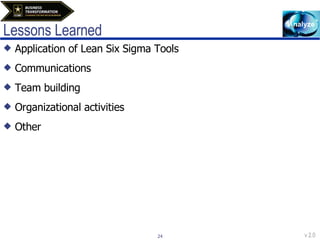
Lessons Learned Application of Lean Six Sigma Tools  Communications Team building Organizational activities Other
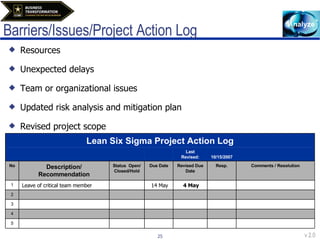
Barriers/Issues/Project Action Log Resources Unexpected delays Team or organizational issues Updated risk analysis and mitigation plan Revised project scope Lean Six Sigma Project Action Log         Last Revised: 10/15/2007   No Description/ Recommendation Status  Open/Closed/Hold Due Date Revised Due Date Resp. Comments / Resolution 1 Leave of critical team member     14 May   4 May     2           3           4           5          
Next Steps Outline activities for Improve Phase Planned Lean Six Sigma Tool use Barrier/risk mitigation activities
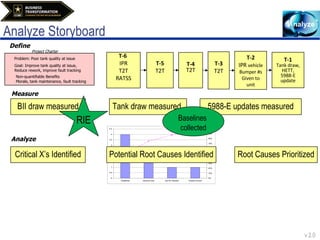
Analyze Storyboard Define Project Charter T-6  IPR T2T RATSS T-5 T2T T-4 T2T T-3 T2T T-2 IPR  vehicle Bumper #s Given to unit T-1 Tank draw, HETT, 5988-E update Measure BII draw measured Tank draw measured 5988-E updates measured RIE Baselines  collected Critical X’s Identified Potential Root Causes Identified Root Causes Prioritized Analyze Problem: Poor tank quality at issue Goal: Improve tank quality at issue,  Reduce rework, improve fault tracking Non-quantifiable Benefits Morale, tank maintenance, fault tracking
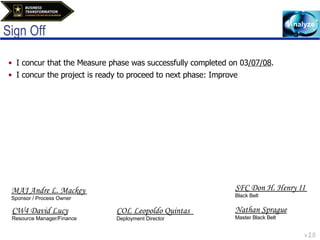
Sign Off I concur that the Measure phase was successfully completed on 03 /07/08 . I concur the project is ready to proceed to next phase: Improve CW4 David Lucy Resource Manager/Finance COL Leopoldo Quintas  Deployment Director  SFC Don H. Henry II  Black Belt Nathan Sprague Master Black Belt MAJ Andre L. Mackey  Sponsor / Process Owner
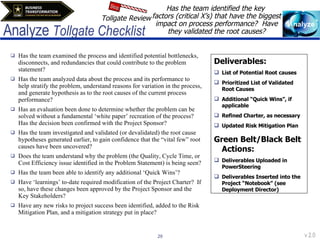
Analyze  Tollgate Checklist Has the team examined the process and identified potential bottlenecks, disconnects, and redundancies that could contribute to the problem statement? Has the team analyzed data about the process and its performance to help stratify the problem, understand reasons for variation in the process, and generate hypothesis as to the root causes of the current process performance? Has an evaluation been done to determine whether the problem can be solved without a fundamental ‘white paper’ recreation of the process?  Has the decision been confirmed with the Project Sponsor? Has the team investigated and validated (or devalidated) the root cause hypotheses generated earlier, to gain confidence that the “vital few” root causes have been uncovered? Does the team understand why the problem (the Quality, Cycle Time, or Cost Efficiency issue identified in the Problem Statement) is being seen? Has the team been able to identify any additional ‘Quick Wins’? Have ‘learnings’ to-date required modification of the Project Charter?  If so, have these changes been approved by the Project Sponsor and the Key Stakeholders? Have any new risks to project success been identified, added to the Risk Mitigation Plan, and a mitigation strategy put in place? Has the team identified the key  factors (critical X’s) that have the biggest impact on process performance?  Have they validated the root causes? Deliverables: List of Potential Root causes Prioritized List of Validated Root Causes Additional “Quick Wins”, if applicable Refined Charter, as necessary Updated Risk Mitigation Plan Green Belt/Black Belt Actions: Deliverables Uploaded in PowerSteering  Deliverables Inserted into the Project “Notebook” (see Deployment Director) Tollgate Review Stop
 

Analyze Tollgate

  • 1.
    Lean Six SigmaImproving FTX/STX2 Tank Draw Quality SFC Henry, Don H. II Project Initiation Date: 31/03/08 Analyze Tollgate Date: 03/07/08
  • 2.
    Agenda Project Charterand Measure Phase Review Critical X’s Potential Root Causes Affecting Critical X’s Reducing the List of Potential Root Causes Root Cause Analysis (Qualitative) Impact of Root Causes on Key Outputs (Y) Prioritized Root Causes Analyze Summary Lessons Learned Barriers/Issues Next Steps Storyboard
  • 3.
    Analyze – ExecutiveSummary Improve tank maintenance quality by giving the 1/16 soldiers more time to perform maintenance during the draw. The project starts at the FTX/STX2 T-6 IPR and ends when the tanks are ready for HETT transport. This project is contained within the Fort Knox Garrison and can transfer to other training support missions on Fort Knox. We are feeling the pain in training and tank maintenance. Soldiers fail to do a quality PMCS for the lack of time, training, and command emphasis.
  • 4.
    Project Charter ReviewScope: this process begins with the T-6 IPR and ends when 1/16 loads the tanks on HETT’s. Goal: Improve tank draw quality Problem/Goal Statement Tollgate Review Schedule Business Impact Core Team State financial impact of project Expenses-none Investments-none Revenues-potential savings in time 819 hours per year Non-Quantifiable Benefits are increased tank maintenance quality, soldiers morale, maintenance fault tracking, and less training time lost. PES Name MAJ Mackey, Andre PS Name MAJ Mackey, Andre DD Name LTC Naething, Robert GB/BB Name SFC Henry, Don MBB Name Nathan Sprague Core Team Role % Contrib. LSS Training CW2 Warren SME 20% none MAJ Aydelott SME 20% none MAJ Mackey SME 20% none SSG Jones SME 10% none CW4 Lucy SME 10% none SFC Henry BB 100% BB Tollgate Scheduled Revised Complete Define: 04/30/08 - 04/29/08 Measure: 05/14/08 04/06/08 04/06/08 Analyze: 06/13/08 07/13/08 XX/XX/08 Improve: 07/18/08 08/13/08 XX/XX/08 Control: 08/23/08 09/13/08 XX/XX/08 Reduce rework during tank draw from 90% to 45%, per FTX/STX2 by 1 October 2008. Improve 5988-E fault tracking during tank draw from 10% to 85%, per FTX/STX2 by 1 October 2008. Improve tank bumper number accuracy from 10% to 90%, during the T-2 preparation week by 1 October 2008. Problem Statement Soldiers of 1/16 express dissatisfaction with the Unit Maintenance Activities M1 series tank quality prior to mission support. Currently, 90% of the tanks drawn require maintenance for mission readiness. Approximately 10% of faults listed on the 5988-E ‘s completed by soldiers are tracked by UMA. Lastly, tank bumper number accuracy during T-2 is currently at 10% which causes excess work in the last days of the mission support draw.
  • 5.
    Baseline Data Thecurrent tank draw process has a non-normal distribution The mean time to draw one tank is .56 or 34 minutes The tank draw range is .25 hours (15 minutes) to 2 hours (120 minutes) and the standard deviation is .4 (24 minutes) The mean number of 5988-E’s updated by UMA is .1 or 10% The average Tank Draw Time is 34 minutes +/- 24 minutes.
  • 6.
    Baseline Data Cont.33% of tanks presented to draw are not ready for issue. 10% of 5988-E faults annotated by soldiers during tank draw is updated by UMA clerks. 67% of tank bumper numbers presented to 1/16 at T-2 by UMA is actually drawn for mission support. These numbers take into account vehicles presented to draw but never actually drawn or PMCSed. These numbers represent what was actually given, PMCS’ed, and drawn.
  • 7.
    Critical X’s: Cause and Effect Matrix Cause and Effect Matrix Key Process Output Variables Customer Importance 10 9 2 6 8                     Customer Rank 1 2 3 4 5                     1 2 3 4 5 6 7 8 9 10 11 12 13 14 15 Process Step KPIV accurate tank list 5988-E QA/QC DA Form 2062 Dispatch                     Rank Rating Total Process Steps & Key Process Input Variables 1 T-1 RATSS 1 9 9 9 1                     2 7.533 171 2 PMCS Technical Manual 9 1 1 9 9                     1 10 227 3 QA/QC UMA inspector 9 1 1 3 3                     3 6.3 143 4 tank sign over DA 2062 9 1 1 1 3                     4 5.771 131 5 tank dispatch 5987-E 9 1 1 1 1                     5 5.066 115 ###                                     #####  
  • 8.
    Potential Root Causes: C & E Diagram Effect: The tank draw takes too long. Man Machine Material Method Spread thinly across multiple tasks Shortage of UMA maintenance personnel Deadlines, AOAP, Service Schedule, affect # of tanks available Tanks already in use by other units/missions BII draw uses excessive people and excess time RATTS request is not referenced by UMA to assign accurate bumper number list Tanks are PMCS’d Tanks are QA/QC’d Tanks are dispatched Excessive delays from lack of UMA personnel 5988-E not updated by UMA
  • 9.
    Potential Root Causes: FMEA Process Step / Input Potential Failure Mode Potential Failure Effects SEVERITY Potential Causes OCCURRENCE Current Controls DETECTION RPN   What is the process step and Input under investiga-tion? In what ways does the Key Input go wrong? What is the impact on the Key Output Variables (Customer Requirements)? What causes the Key Input to go wrong? What are the existing controls and procedures (inspection and test) that prevent either the cause or the Failure Mode? T-1 bumper number list not accurate excessive delays 7 lack of organization 7 none 7 343 PMCS not updated rework 7 lack of personnel 6 Army Policy 5 210 QA/QC not timely rework 4 lack of maintenance 4 EXSOP/Army policy 4 64 tank sign over already issued rework 7 lack of organization 2 Army Policy/EXSOP 2 28 tank dispatch does not go wrong no problems 1 no problems 1 EXSOP 5 5
  • 10.
    Reducing List ofRoot Causes: Pareto Analysis Track able causes contained over 90% of the Defects. Our project will focus on tracking vehicle maintenance status.
  • 11.
    Root Cause Analysis: Non-Value Add Analysis QAQC Maintenance leader Dispatch Soldier Issues bumper number list to soldier Maintenance leader checks 5988-E and verifies faults/makes repairs if needed Hand receipt Vehicle signed over to soldier Avg. Delay 2 hours Avg.Delay 15 min Avg. Delay 90 min Soldier conducts PMCS and completes 5988-E, turns it in to maintenance leader Passes QAQC Receives signed QAQC sheet Vehicle dispatched to soldier YES NO NVA time is in dark blue Total delay time is 3.75 hours Retrieves info from RATSS system Notify UMA of the # of tanks needed
  • 12.
    Root Cause Analysis:Histogram The outlier was a vehicle issued that was actually NMC and required 90 minutes to repair. The vehicle that required 60 minutes was actually dispatched to another unit. Two of the five that required 45 minutes of work were deadline with a third needing a QAQC from UMA 5.25 hours were spent doing rework that is non value added
  • 13.
    One-Way ANOVA ofTime and Defects The data is distributed non-normally with an outlier shown here The variance in the data is also constant but there are no systematic effects due to collection order or time.
  • 14.
    One-Way ANOVA ofTime and Defects Data Source DF SS MS F P DEFECT 3 4915 1638 5.04 0.012 Error 16 5199 325 Total 19 10114 S = 18.03 R-Sq = 48.59% R-Sq(adj) = 38.95% Individual 95% CIs For Mean Based on Pooled StDev Level N Mean StDev -------+---------+---------+---------+-- D 4 63.75 37.50 (-------*------) I 1 60.00 * (--------------*--------------) N 14 26.79 8.68 (---*---) Q 1 45.00 * (--------------*--------------) -------+---------+---------+---------+-- 25 50 75 100 Pooled StDev = 18.03 The R-squared value of 48.59% is statistically significant meaning the model predicts nearly half of the variation causing increased tank draw times as being caused by defects. Therefore we reject the null hypothesis.
  • 15.
    Mood’s Median TestThe medians may tell a more complete story. The outlier falsely inflates the averages, this test omits outliers. Based on the P value, two or more medians are significantly different and we reject the null hypothesis Mood Median Test: TIME versus DEFECT Mood median test for TIME Chi-Square = 13.37 DF = 1 P = 0.000 Individual 95.0% CIs DEFECT N<= N> Median Q3-Q1 -----+---------+---------+---------+- D 0 4 45 56 *------------------------) I 0 1 60 Not Used N 13 1 30 15 (----* Q 0 1 45 Not Used -----+---------+---------+---------+- 30 60 90 120 Overall median = 30 * NOTE * Levels with < 6 observations have confidence < 95.0%
  • 16.
    Tukey’s Pairwise ComparisonOne-way ANOVA: TIME versus DEFECT Tukey 95% Simultaneous Confidence Intervals All Pairwise Comparisons among Levels of DEFECT Individual confidence level = 98.87% DEFECT = D subtracted from: DEFECT Lower Center Upper --------+---------+---------+---------+- I -61.47 -3.75 53.97 (----------*-----------) N -66.23 -36.96 -7.70 (-----*----) Q -76.47 -18.75 38.97 (----------*-----------) --------+---------+---------+---------+- -50 0 50 100 DEFECT = I subtracted from: DEFECT Lower Center Upper --------+---------+---------+---------+- N -86.65 -33.21 20.22 (---------*----------) Q -88.01 -15.00 58.01 (--------------*--------------) --------+---------+---------+---------+- -50 0 50 100 DEFECT = N subtracted from: DEFECT Lower Center Upper --------+---------+---------+---------+- Q -35.22 18.21 71.65 (----------*---------) --------+---------+---------+---------+- -50 0 50 100 Statistically significant factors are in RED legend I= issued already N= no defects Q= need QAQC D=deadlined Deadlined tanks are statistically significantly different in terms of time and defects Tanks with no defects are statistically significantly different in terms of time and defects
  • 17.
    Current Process CapabilityThe average issue time was 36 minutes The target issue time was 30 minutes The variability of the process is greater than the specification limits (Cpk<1.33) The process is not meeting customer expectations
  • 18.
    One-Way ANOVA BoxplotDeadlines were the largest time wasters with a mean time of 63 min. Deadlines also represented the largest range of values The mean time for the tank that was already issued had a mean of 60 min.
  • 19.
    A Different ViewThe same data classified as tanks that are ready “R” and not ready “NR” The total NR time is 340 minutes The total ready time is 480 minutes The defects make up 40% of the time spent on the tank draw!
  • 20.
    DELETE ME aftertollgate review N= no defect D= deadlined Q=need qa/qc I=issued already DEFECT TIME N 15 N 15 N 15 N 15 N 30 N 30 N 30 N 30 N 30 N 30 N 30 N 30 N 30 D 45 D 45 Q 45 D 45 N 45 I 60 D 120 Data used in minitab to get calculations, I later changed the D,Q, & I variables into Defects to create different comparisons of defects vs no defects
  • 21.
    Impact of RootCauses on Y
  • 22.
    Prioritized Root Causes1 In team’s Control = 9; In team’s sphere of influence = 3; Out of team’s control = 1 2 High impact = 9; Medium impact = 3; Low impact = 1 Effect (Y) Root Cause (X) Hypothesis for Relationship In/Out of Team’s Control 1 Impact 2 Score (Control x Impact) Priority of Effort rework In-accurate bumper numbers Accurate bumper numbers will increase throughput 3 9 27 2 Poor tank maintenance PMCS not completed correctly Correctly performed PMCS will improve tank draw quality 9 9 81 1 Poor tank maintenance 5988-E’s are not regularly updated Regularly update 5988-E’s will improve tank draw quality 3 9 27 3 rework Tanks are issued that are not ready for issue Rework will be reduced if the tanks are ready for issue at the time they are to be issued to units 3 3 9 4
  • 23.
    Analyze Summary Impactof Root Causes: Hypothesis Tests Tools Used Reducing List of Root Causes Prioritized Root Causes / Effects Root cause #1: No visual tracking method Effect-in-accurate bumper numbers Root cause #2: 5988-E’s not completed correctly Effect-poor tank maintenance Root cause #3: 5988-E’s are not updated regularly Effect-poor tank maintenance Root cause #4: Tanks issued that are not ready for issue Effect-rework Value Add Analysis Pareto Plot Histogram One-Way ANOVA C&E Matrix Cause & Effect Diagram FMEA Process Capability
  • 24.
    Lessons Learned Applicationof Lean Six Sigma Tools Communications Team building Organizational activities Other
  • 25.
    Barriers/Issues/Project Action LogResources Unexpected delays Team or organizational issues Updated risk analysis and mitigation plan Revised project scope Lean Six Sigma Project Action Log         Last Revised: 10/15/2007   No Description/ Recommendation Status Open/Closed/Hold Due Date Revised Due Date Resp. Comments / Resolution 1 Leave of critical team member     14 May   4 May     2           3           4           5          
  • 26.
    Next Steps Outlineactivities for Improve Phase Planned Lean Six Sigma Tool use Barrier/risk mitigation activities
  • 27.
    Analyze Storyboard DefineProject Charter T-6 IPR T2T RATSS T-5 T2T T-4 T2T T-3 T2T T-2 IPR vehicle Bumper #s Given to unit T-1 Tank draw, HETT, 5988-E update Measure BII draw measured Tank draw measured 5988-E updates measured RIE Baselines collected Critical X’s Identified Potential Root Causes Identified Root Causes Prioritized Analyze Problem: Poor tank quality at issue Goal: Improve tank quality at issue, Reduce rework, improve fault tracking Non-quantifiable Benefits Morale, tank maintenance, fault tracking
  • 28.
    Sign Off Iconcur that the Measure phase was successfully completed on 03 /07/08 . I concur the project is ready to proceed to next phase: Improve CW4 David Lucy Resource Manager/Finance COL Leopoldo Quintas Deployment Director SFC Don H. Henry II Black Belt Nathan Sprague Master Black Belt MAJ Andre L. Mackey Sponsor / Process Owner
  • 29.
    Analyze TollgateChecklist Has the team examined the process and identified potential bottlenecks, disconnects, and redundancies that could contribute to the problem statement? Has the team analyzed data about the process and its performance to help stratify the problem, understand reasons for variation in the process, and generate hypothesis as to the root causes of the current process performance? Has an evaluation been done to determine whether the problem can be solved without a fundamental ‘white paper’ recreation of the process? Has the decision been confirmed with the Project Sponsor? Has the team investigated and validated (or devalidated) the root cause hypotheses generated earlier, to gain confidence that the “vital few” root causes have been uncovered? Does the team understand why the problem (the Quality, Cycle Time, or Cost Efficiency issue identified in the Problem Statement) is being seen? Has the team been able to identify any additional ‘Quick Wins’? Have ‘learnings’ to-date required modification of the Project Charter? If so, have these changes been approved by the Project Sponsor and the Key Stakeholders? Have any new risks to project success been identified, added to the Risk Mitigation Plan, and a mitigation strategy put in place? Has the team identified the key factors (critical X’s) that have the biggest impact on process performance? Have they validated the root causes? Deliverables: List of Potential Root causes Prioritized List of Validated Root Causes Additional “Quick Wins”, if applicable Refined Charter, as necessary Updated Risk Mitigation Plan Green Belt/Black Belt Actions: Deliverables Uploaded in PowerSteering Deliverables Inserted into the Project “Notebook” (see Deployment Director) Tollgate Review Stop
  • 30.

Editor's Notes

  • #2 Expectations from the Measure Phase A detailed process map has been developed by the team and reflects key customer requirements and process variables. Key input, process and output metrics have been identified for data collection (potential Critical X’s) The relationship between process inputs and customer requirements has been investigated to provide a direction for the Analysis Phase. Special cause variation is reduced/removed providing an accurate picture of the process. A measurement system is in place and it’s error is understood. Baseline capability has been established and a path forward has been identified. A detailed project plan for the next phase exists, is realistic and reflects a more accurate financial impact statement. Who Should Attend Green Belt or Black Belt Required Project Leader Required Project Sponsor Required Process Owner Required (if not = Project Sponsor) Project Team Nice to have; Required for M, A, I, and C Stakeholders Required/Strongly Recommended Deployment Director Recommended Senior Management As possible or at DD request Master Black Belt Strongly Recommended (if available to attend)