Qualitative and Quantitative Research Approaches
Mohammad Samir Habib
R1811D6696523
Induction Module UU-DOC-803-ZM-30011
9 Oct 2021
Introduction
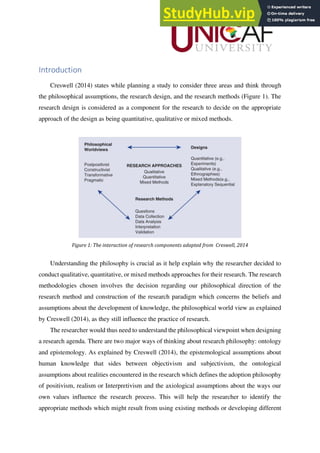
Creswell (2014) states while planning a study to consider three areas and think through
the philosophical assumptions, the research design, and the research methods (Figure 1). The
research design is considered as a component for the research to decide on the appropriate
approach of the design as being quantitative, qualitative or mixed methods.
Figure 1: The interaction of research components adapted from Creswell, 2014
Understanding the philosophy is crucial as it help explain why the researcher decided to
conduct qualitative, quantitative, or mixed methods approaches for their research. The research
methodologies chosen involves the decision regarding our philosophical direction of the
research method and construction of the research paradigm which concerns the beliefs and
assumptions about the development of knowledge, the philosophical world view as explained
by Creswell (2014), as they still influence the practice of research.
The researcher would thus need to understand the philosophical viewpoint when designing
a research agenda. There are two major ways of thinking about research philosophy: ontology
and epistemology. As explained by Creswell (2014), the epistemological assumptions about
human knowledge that sides between objectivism and subjectivism, the ontological
assumptions about realities encountered in the research which defines the adoption philosophy
of positivism, realism or Interpretivism and the axiological assumptions about the ways our
own values influence the research process. This will help the researcher to identify the
appropriate methods which might result from using existing methods or developing different
ones in order to address the research questions. The importance of the philosophical selection
lies in the ability to reflect and defend our philosophical stance compared to the other possible
alternatives, as explained by Saunders et al (2009).
The research design will be the general plan of how we intend to answer our research
question(s) which should contain the research objectives, to specify the source of data we
intend to collect and highlight any constraints we might encounter and discuss any ethical
issues (Saunders et al, 2009). It is important to differentiate between research design and
research tactics. Research design is involved with the overall plan of the research whereas
tactics involve understanding the differences of using the quantitative and qualitative
techniques in data collection and data analysis procedures which will impact our decision in
the selection of the technique as each has its own strengths and weaknesses (Smith et al, 2008).
There are two different approach to organisation studies as research methods, the
quantitative and the qualitative approach, where it is important to understand how to select an
approach given that the selection depends on the situation being studied that carries the
assumptions on how to study it and how to answer what we are studying (Lee, 1992). The
quantitative approach as defined by Creswell (2014, p. 32), is “an approach for testing objective
theories by examining the relationship among variables” while qualitative approach is “an
approach for exploring and understanding the meaning individuals or groups ascribe to a social
or human problem”.
As described by Lee (1992, p. 87), “The quantitative research methods derived from the
natural sciences has an emphasis on objectivity, measurement, reliability and validity”. There
are several types of quantitative research and those can be classified under four main categories
and each type has its specific characteristics; the survey research, the correlational research,
the experimental research and causal-comparative research (Sukamolson, 2007). Qualitative
research is an approach that aims to explore or investigate the human interaction in regards to
a social or human problem or issue that is being observed. Therefore, qualitative methods tend
to be flexible and focus on retaining rich meaning when interpreting data. Common approaches
include grounded theory, ethnography, action research, phenomenological research, and
narrative research.
Quantitative Research designs
There are three broad classifications when it comes to conducting quantitative research:
descriptive, experimental and casual comparative as cited by Williams (2007) in (Leedy &
Ormrod, 2001). In addition, falls under those classifications several types or methods to
conduct quantitative research and each type holds its own characteristics. In a descriptive
approach the research seek to identify the correlation between two or more phenomena, the
experimental research involves the manipulation of an independent variable and the
measurement of a dependent variable and measure the outcome of the research, whereas casual
comparative design is a research design that seeks to find the cause and effect relationships
between independent and dependent variables after an action or event has already occurred
(Williams, 2007).
In a quantitative research the process to make a selection of a research strategy will depend
on the research question(s) and objectives, the extent of available knowledge, the allocated
resources such as time and financials ones, in addition to the chosen amount of time and
philosophical viewpoint. Such strategies are: true experiment research an example is
hypothesis testing experiments that is a controlled experiment and involves randomisation and
treatments of subjects of the research that is kept under observations; a less rigorous
experiments named quasi-experiment research as an example used is the correlation and single
subject studies with a non-randomisation of the of subjects of the research under treatments
which uses statistical analysis to prove or disapprove a hypothesis and non-experiment
research such as using survey which does not involve any treatment. “Finally, it must be
remembered that these strategies should not be thought of as being mutually exclusive. For
example, it is quite possible to use the survey strategy as part of a case study” (Creswell, 2009).
Qualitative Research designs
Qualitative research is based on words, feelings, emotions, sounds and other non-
numerical and unquantifiable elements (Allan & Randy, 2005). Analysing qualitative data
entails reading an outsized quantity of transcripts searching for similarities or variations, and
afterwards finding themes and developing categories. Common approaches include grounded
theory, ethnography, action research, phenomenological research, and narrative research. In
grounded theory the researchers collect rich data on a topic of interest and develop theories
inductively, in ethnography the researchers immerse themselves in groups or organizations to
understand their cultures, as for action research the researchers and participants collaboratively
link theory to practice to drive social change, while phenomenological research the researchers
investigate a phenomenon or event by describing and interpreting participants’ lived
experiences, as for narrative research the researchers examine how stories are told to
understand how participants perceive and make sense of their experiences.
The qualitative data analysis requires openness during interpretation. The researcher in a
qualitative research closely examines the data to identify common themes – topics, ideas and
patterns of meaning that come up repeatedly. The qualitative research may interpret the data
differently while understanding the context and developing themes which may explain why
qualitative research might be complex and time consuming. The quality of the data analysis
requires the research to gain the experience and build with time the reliability in interpreting
and analysing the data (Neuman, 2000). There are methods of analysing qualitative data and it
t is usually applied to a set of texts (Attride-Stirling, 2001). As described by those are 1) content
analysis; seek to describe and categorize common words, phrases, and ideas, 2) textual
analysis; used to identify and interpret patterns and themes, 3) discourse analysis; to study
communication and how language is used to achieve effects in specific contexts, and 4)
thematic analysis; seek to identify and interpret patterns and themes in qualitative data (Wilson,
2014).
Qualitative Versus Quantitative
The comparison between the two approaches can be foreseen from the following
prospective; epistemological, theoretical, and methodological differences (Yilmaz, 2013). The
research methodologies chosen involves the decision regarding the philosophical direction of
the research method and construction of the research paradigm which concerns the beliefs and
assumptions about the development of knowledge, the philosophical world view as explained
by Creswell, 2009. The qualitative and quantitative approaches holds different epistemological
assumptions that holds the nature of knowledge (interpretivism vs positivism, respectively)
and ontological assumptions about the nature of the phenomena under investigation
(subjectivity vs objectivity, respectively) (Lee, 1992). Quantitative research ‘is a means for
testing objective theories by examining the relationships among variables (objectivity) and this
is usually measured using numbers and tested using statistical analysis to verify the theory and
seek explanation if the theory would predicts the phenomena of interest (Creswell, 2009).
Qualitative research as defined by Yilmaz (2013) is an approach used to study the natural
settings of people, cases, phenomena, social situations and processes as independent variables
(subjectivity) and seek to explain and identify the meaning of the experience of people in
descriptive terms.
Quantitative methods require the research to collect data from participants by identifying
a representative sample and seek generalisation. However, as the approach is based on getting
standard responses based on a theory with a neutral role from participants failing to consider
their views and experiences, developing the cause-effective relationship with deductive
reasoning. Whereas the qualitative method using purposeful sampling seek to understand and
explain the phenomenon by capturing participants experiences and communicating with them
using inductive reasoning. Data collection methods is another differentiator, the qualitative
research captures observations, conducts in-depth interviews, document analysis, and focus
groups. Quantitative research uses questionnaires, surveys and systematic measurements
involving numbers (Yilmaz, 2013).
Theory is another composite of research and would be identified differently according to
our research approach. Theory is the explanation of a set of conceptual relationships in which
concepts, constructs and principles are defined; the application domain is explicit; how and
why relationships exist is explained; and what could, should and would happen in a range of
circumstances is predicted. Creswell (2014) elaborates that a theory in quantitative research is
an interrelated set of constructs (or variables) formed in assumptions or hypotheses that
determine the relationship between variables (usually in terms of magnitude or direction). A
theory may appear in a research study as an argument, discussion, character, or rationale, and
help explain (or predict) phenomena that occur in the world. In addition, in a qualitative
inquirers the use of theory much like in quantitative research is used as a broad explanation for
behaviour and attitudes and further may be derived with variables, constructs, and hypotheses
The quality of research is another fundamental variance that is defining the concepts of
reliability and validity. Reliability refers to the extent to which your data collection techniques
or analysis procedures will yield consistent findings (Smith et al, 2008). “Validity is concerned
with whether the findings are really about what they appear to be about. Is the relationship
between two variables a causal relationship” (Saunders et al, 2009). The quantitative approach
test the reliability by examining the extent that there is highly positively correlated results
whenever conducting the same test on two different occasions. Validity for a quantitative
research tests if the results of the study measurement process are accurate and this involves
testing internal validity to test the casual relationship and the external validity to test the
generalisation (Yilmaz, 2013). The qualitative approach has a different approach when it
comes to test the reliability and Validity. As cited by Yilmaz (2013, p. 319) in (Gibbs, 2007;
Lincoln & Guba, 1985; Wolcott, 1994),
…an alternative set of criteria based on qualitative concepts need to be used to judge the
trustworthiness of a qualitative research which needs its own criteria for evaluation. The concept
of reliability in qualitative study is referred to the dependability and auditability meaning that
“the process of the study is consistent over time and across different researchers and different
methods or projects”……the concept of validity in quantitative study corresponds to the concept
of credibility, trustworthiness, and authenticity in qualitative study which means that the study
findings are accurate or true not only from the standpoint of the researcher but also from that of
the participants and the readers of the study.
Conclusion
There are a variety of advantages and limitations of the research approach, whether that is
qualitative or quantitative. The selection of an appropriate method for a research approach to
address a specific question will help in managing our time and resources efficiently. Thus the
method used to evaluate our research is important as this would reflect on our results and its
interpretation. Qualitative approach is a research strategy that emphasise on a relatively open-
ended approach and this would impact our results and finding during research process as a
result of generating new insights. The quantitative approach is not an application of neutral
tools that results in no new insights as the data analysis techniques can results in new
understandings. Furthermore, a mixed method would be another research approach that
scholars seek to use as a multi-strategy, this would have a considerable value by combining
quantitative and qualitative research in examining both the rationales that are given for and the
ways in which they are combined in practice. However, it is significantly difficult to merge the
analysis of quantitative and qualitative data and derive a one integrated analysis while it is
important to take into consideration the risk of losing sight of the rationale of conducting mixed
methods research in the first place (Bryman, 2006).
Reference List
Allan, AJ. & Randy, LJ (2005) Writing the winning thesis or dissertation: A step-by-step guide.
CA: Corwin Press Inc.
Attride-Stirling, J. (2001). Thematic networks: an analytic tool for qualitative research.
Qualitative Research, 1(3), 385–405.
Blaikie, N., & Priest, J. (2019). Designing social research: The logic of anticipation. John
Wiley & Sons.
Bryman, A. (2006). Integrating quantitative and qualitative research: how is it done?.
Qualitative research, 6(1), 97-113.
Bryman, A. (2007). Barriers to integrating quantitative and qualitative research. Journal of
mixed methods research, 1(1), 8-22.
Creswell J.W., (2014). Research Design: qualitative, quantitative, and mixed methods
approaches. Thousand Oaks, CA: Sage Publications.
Crowe, M., & Sheppard, L. (2010). Qualitative and quantitative research designs are more
similar than different. Internet Journal of Allied Health Sciences and Practice, 8(4), 5.
Lee, S. J. (1992). Quantitative versus qualitative research methods—Two approaches to
organisation studies. Asia Pacific Journal of Management, 9(1), 87-94.
Lochmiller, C. R. (2021). Conducting Thematic Analysis with Qualitative Data. Qualitative
Report, 26(6).
Lynham, S. A. (2002). Quantitative research and theory building: Dubin’s method. Advances
in developing human resources, 4(3), 242-276.
Mohajan, H. K. (2018). Qualitative research methodology in social sciences and related
subjects. Journal of Economic Development, Environment and People, 7(1), 23-48.
Neuman, W.L. (2000) Social Research Methods: Qualitative and Quantitative Approaches
(4th ed.), Allyn & Bacon, Boston, MA.
Saunders, M., Lewis, P., & Thornhill, A. (2009). Research methods for business students (5th
edn).
Smith, M. E., Thorpe, R., & Jackson, P. R. (2008). Management research. LA: SAGE.
Sukamolson, S. (2007). Fundamentals of quantitative research. Language Institute
Chulalongkorn University, 1, 2-3.
Williams, C. (2007). Research methods. Journal of Business & Economics Research (JBER),
5(3).
Wilson, J. (2014). Essentials of business research: A guide to doing your research project.
Sage.
Yilmaz, K. (2013). Comparison of quantitative and qualitative research traditions:
Epistemological, theoretical, and methodological differences. European journal of
education, 48(2), 311-325.

Analyze Quantitative And Qualitative Research

  • 1.
    Qualitative and QuantitativeResearch Approaches Mohammad Samir Habib R1811D6696523 Induction Module UU-DOC-803-ZM-30011 9 Oct 2021
  • 2.
    Introduction Creswell (2014) stateswhile planning a study to consider three areas and think through the philosophical assumptions, the research design, and the research methods (Figure 1). The research design is considered as a component for the research to decide on the appropriate approach of the design as being quantitative, qualitative or mixed methods. Figure 1: The interaction of research components adapted from Creswell, 2014 Understanding the philosophy is crucial as it help explain why the researcher decided to conduct qualitative, quantitative, or mixed methods approaches for their research. The research methodologies chosen involves the decision regarding our philosophical direction of the research method and construction of the research paradigm which concerns the beliefs and assumptions about the development of knowledge, the philosophical world view as explained by Creswell (2014), as they still influence the practice of research. The researcher would thus need to understand the philosophical viewpoint when designing a research agenda. There are two major ways of thinking about research philosophy: ontology and epistemology. As explained by Creswell (2014), the epistemological assumptions about human knowledge that sides between objectivism and subjectivism, the ontological assumptions about realities encountered in the research which defines the adoption philosophy of positivism, realism or Interpretivism and the axiological assumptions about the ways our own values influence the research process. This will help the researcher to identify the appropriate methods which might result from using existing methods or developing different
  • 3.
    ones in orderto address the research questions. The importance of the philosophical selection lies in the ability to reflect and defend our philosophical stance compared to the other possible alternatives, as explained by Saunders et al (2009). The research design will be the general plan of how we intend to answer our research question(s) which should contain the research objectives, to specify the source of data we intend to collect and highlight any constraints we might encounter and discuss any ethical issues (Saunders et al, 2009). It is important to differentiate between research design and research tactics. Research design is involved with the overall plan of the research whereas tactics involve understanding the differences of using the quantitative and qualitative techniques in data collection and data analysis procedures which will impact our decision in the selection of the technique as each has its own strengths and weaknesses (Smith et al, 2008). There are two different approach to organisation studies as research methods, the quantitative and the qualitative approach, where it is important to understand how to select an approach given that the selection depends on the situation being studied that carries the assumptions on how to study it and how to answer what we are studying (Lee, 1992). The quantitative approach as defined by Creswell (2014, p. 32), is “an approach for testing objective theories by examining the relationship among variables” while qualitative approach is “an approach for exploring and understanding the meaning individuals or groups ascribe to a social or human problem”. As described by Lee (1992, p. 87), “The quantitative research methods derived from the natural sciences has an emphasis on objectivity, measurement, reliability and validity”. There are several types of quantitative research and those can be classified under four main categories and each type has its specific characteristics; the survey research, the correlational research, the experimental research and causal-comparative research (Sukamolson, 2007). Qualitative research is an approach that aims to explore or investigate the human interaction in regards to a social or human problem or issue that is being observed. Therefore, qualitative methods tend to be flexible and focus on retaining rich meaning when interpreting data. Common approaches include grounded theory, ethnography, action research, phenomenological research, and narrative research.
  • 4.
    Quantitative Research designs Thereare three broad classifications when it comes to conducting quantitative research: descriptive, experimental and casual comparative as cited by Williams (2007) in (Leedy & Ormrod, 2001). In addition, falls under those classifications several types or methods to conduct quantitative research and each type holds its own characteristics. In a descriptive approach the research seek to identify the correlation between two or more phenomena, the experimental research involves the manipulation of an independent variable and the measurement of a dependent variable and measure the outcome of the research, whereas casual comparative design is a research design that seeks to find the cause and effect relationships between independent and dependent variables after an action or event has already occurred (Williams, 2007). In a quantitative research the process to make a selection of a research strategy will depend on the research question(s) and objectives, the extent of available knowledge, the allocated resources such as time and financials ones, in addition to the chosen amount of time and philosophical viewpoint. Such strategies are: true experiment research an example is hypothesis testing experiments that is a controlled experiment and involves randomisation and treatments of subjects of the research that is kept under observations; a less rigorous experiments named quasi-experiment research as an example used is the correlation and single subject studies with a non-randomisation of the of subjects of the research under treatments which uses statistical analysis to prove or disapprove a hypothesis and non-experiment research such as using survey which does not involve any treatment. “Finally, it must be remembered that these strategies should not be thought of as being mutually exclusive. For example, it is quite possible to use the survey strategy as part of a case study” (Creswell, 2009). Qualitative Research designs Qualitative research is based on words, feelings, emotions, sounds and other non- numerical and unquantifiable elements (Allan & Randy, 2005). Analysing qualitative data entails reading an outsized quantity of transcripts searching for similarities or variations, and afterwards finding themes and developing categories. Common approaches include grounded theory, ethnography, action research, phenomenological research, and narrative research. In grounded theory the researchers collect rich data on a topic of interest and develop theories
  • 5.
    inductively, in ethnographythe researchers immerse themselves in groups or organizations to understand their cultures, as for action research the researchers and participants collaboratively link theory to practice to drive social change, while phenomenological research the researchers investigate a phenomenon or event by describing and interpreting participants’ lived experiences, as for narrative research the researchers examine how stories are told to understand how participants perceive and make sense of their experiences. The qualitative data analysis requires openness during interpretation. The researcher in a qualitative research closely examines the data to identify common themes – topics, ideas and patterns of meaning that come up repeatedly. The qualitative research may interpret the data differently while understanding the context and developing themes which may explain why qualitative research might be complex and time consuming. The quality of the data analysis requires the research to gain the experience and build with time the reliability in interpreting and analysing the data (Neuman, 2000). There are methods of analysing qualitative data and it t is usually applied to a set of texts (Attride-Stirling, 2001). As described by those are 1) content analysis; seek to describe and categorize common words, phrases, and ideas, 2) textual analysis; used to identify and interpret patterns and themes, 3) discourse analysis; to study communication and how language is used to achieve effects in specific contexts, and 4) thematic analysis; seek to identify and interpret patterns and themes in qualitative data (Wilson, 2014). Qualitative Versus Quantitative The comparison between the two approaches can be foreseen from the following prospective; epistemological, theoretical, and methodological differences (Yilmaz, 2013). The research methodologies chosen involves the decision regarding the philosophical direction of the research method and construction of the research paradigm which concerns the beliefs and assumptions about the development of knowledge, the philosophical world view as explained by Creswell, 2009. The qualitative and quantitative approaches holds different epistemological assumptions that holds the nature of knowledge (interpretivism vs positivism, respectively) and ontological assumptions about the nature of the phenomena under investigation (subjectivity vs objectivity, respectively) (Lee, 1992). Quantitative research ‘is a means for testing objective theories by examining the relationships among variables (objectivity) and this
  • 6.
    is usually measuredusing numbers and tested using statistical analysis to verify the theory and seek explanation if the theory would predicts the phenomena of interest (Creswell, 2009). Qualitative research as defined by Yilmaz (2013) is an approach used to study the natural settings of people, cases, phenomena, social situations and processes as independent variables (subjectivity) and seek to explain and identify the meaning of the experience of people in descriptive terms. Quantitative methods require the research to collect data from participants by identifying a representative sample and seek generalisation. However, as the approach is based on getting standard responses based on a theory with a neutral role from participants failing to consider their views and experiences, developing the cause-effective relationship with deductive reasoning. Whereas the qualitative method using purposeful sampling seek to understand and explain the phenomenon by capturing participants experiences and communicating with them using inductive reasoning. Data collection methods is another differentiator, the qualitative research captures observations, conducts in-depth interviews, document analysis, and focus groups. Quantitative research uses questionnaires, surveys and systematic measurements involving numbers (Yilmaz, 2013). Theory is another composite of research and would be identified differently according to our research approach. Theory is the explanation of a set of conceptual relationships in which concepts, constructs and principles are defined; the application domain is explicit; how and why relationships exist is explained; and what could, should and would happen in a range of circumstances is predicted. Creswell (2014) elaborates that a theory in quantitative research is an interrelated set of constructs (or variables) formed in assumptions or hypotheses that determine the relationship between variables (usually in terms of magnitude or direction). A theory may appear in a research study as an argument, discussion, character, or rationale, and help explain (or predict) phenomena that occur in the world. In addition, in a qualitative inquirers the use of theory much like in quantitative research is used as a broad explanation for behaviour and attitudes and further may be derived with variables, constructs, and hypotheses The quality of research is another fundamental variance that is defining the concepts of reliability and validity. Reliability refers to the extent to which your data collection techniques or analysis procedures will yield consistent findings (Smith et al, 2008). “Validity is concerned with whether the findings are really about what they appear to be about. Is the relationship
  • 7.
    between two variablesa causal relationship” (Saunders et al, 2009). The quantitative approach test the reliability by examining the extent that there is highly positively correlated results whenever conducting the same test on two different occasions. Validity for a quantitative research tests if the results of the study measurement process are accurate and this involves testing internal validity to test the casual relationship and the external validity to test the generalisation (Yilmaz, 2013). The qualitative approach has a different approach when it comes to test the reliability and Validity. As cited by Yilmaz (2013, p. 319) in (Gibbs, 2007; Lincoln & Guba, 1985; Wolcott, 1994), …an alternative set of criteria based on qualitative concepts need to be used to judge the trustworthiness of a qualitative research which needs its own criteria for evaluation. The concept of reliability in qualitative study is referred to the dependability and auditability meaning that “the process of the study is consistent over time and across different researchers and different methods or projects”……the concept of validity in quantitative study corresponds to the concept of credibility, trustworthiness, and authenticity in qualitative study which means that the study findings are accurate or true not only from the standpoint of the researcher but also from that of the participants and the readers of the study. Conclusion There are a variety of advantages and limitations of the research approach, whether that is qualitative or quantitative. The selection of an appropriate method for a research approach to address a specific question will help in managing our time and resources efficiently. Thus the method used to evaluate our research is important as this would reflect on our results and its interpretation. Qualitative approach is a research strategy that emphasise on a relatively open- ended approach and this would impact our results and finding during research process as a result of generating new insights. The quantitative approach is not an application of neutral tools that results in no new insights as the data analysis techniques can results in new understandings. Furthermore, a mixed method would be another research approach that scholars seek to use as a multi-strategy, this would have a considerable value by combining quantitative and qualitative research in examining both the rationales that are given for and the ways in which they are combined in practice. However, it is significantly difficult to merge the analysis of quantitative and qualitative data and derive a one integrated analysis while it is
  • 8.
    important to takeinto consideration the risk of losing sight of the rationale of conducting mixed methods research in the first place (Bryman, 2006).
  • 9.
    Reference List Allan, AJ.& Randy, LJ (2005) Writing the winning thesis or dissertation: A step-by-step guide. CA: Corwin Press Inc. Attride-Stirling, J. (2001). Thematic networks: an analytic tool for qualitative research. Qualitative Research, 1(3), 385–405. Blaikie, N., & Priest, J. (2019). Designing social research: The logic of anticipation. John Wiley & Sons. Bryman, A. (2006). Integrating quantitative and qualitative research: how is it done?. Qualitative research, 6(1), 97-113. Bryman, A. (2007). Barriers to integrating quantitative and qualitative research. Journal of mixed methods research, 1(1), 8-22. Creswell J.W., (2014). Research Design: qualitative, quantitative, and mixed methods approaches. Thousand Oaks, CA: Sage Publications. Crowe, M., & Sheppard, L. (2010). Qualitative and quantitative research designs are more similar than different. Internet Journal of Allied Health Sciences and Practice, 8(4), 5. Lee, S. J. (1992). Quantitative versus qualitative research methods—Two approaches to organisation studies. Asia Pacific Journal of Management, 9(1), 87-94. Lochmiller, C. R. (2021). Conducting Thematic Analysis with Qualitative Data. Qualitative Report, 26(6). Lynham, S. A. (2002). Quantitative research and theory building: Dubin’s method. Advances in developing human resources, 4(3), 242-276.
  • 10.
    Mohajan, H. K.(2018). Qualitative research methodology in social sciences and related subjects. Journal of Economic Development, Environment and People, 7(1), 23-48. Neuman, W.L. (2000) Social Research Methods: Qualitative and Quantitative Approaches (4th ed.), Allyn & Bacon, Boston, MA. Saunders, M., Lewis, P., & Thornhill, A. (2009). Research methods for business students (5th edn). Smith, M. E., Thorpe, R., & Jackson, P. R. (2008). Management research. LA: SAGE. Sukamolson, S. (2007). Fundamentals of quantitative research. Language Institute Chulalongkorn University, 1, 2-3. Williams, C. (2007). Research methods. Journal of Business & Economics Research (JBER), 5(3). Wilson, J. (2014). Essentials of business research: A guide to doing your research project. Sage. Yilmaz, K. (2013). Comparison of quantitative and qualitative research traditions: Epistemological, theoretical, and methodological differences. European journal of education, 48(2), 311-325.