

www.edureka.co/base-sas
5 Best Practices in DevOps CultureAnalytics with SAS
www.edureka.co/base-sas
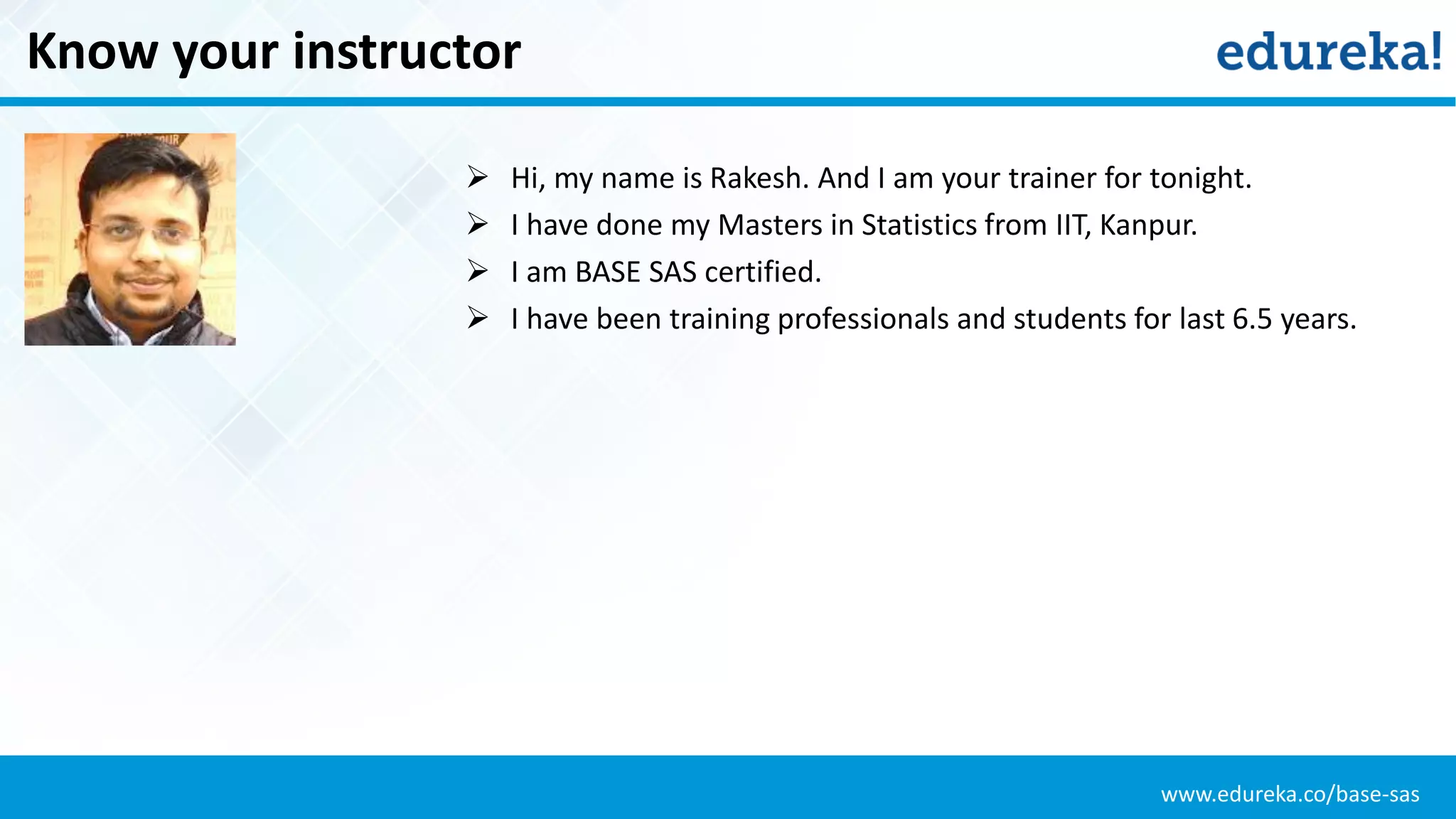
Know your instructor
 Hi, my name is Rakesh. And I am your trainer for tonight.
 I have done my Masters in Statistics from IIT, Kanpur.
 I am BASE SAS certified.
 I have been training professionals and students for last 6.5 years.
www.edureka.co/base-sas
What will you learn today?
 Introduction to Analytics
 Why there is so much hype around SAS?
 Top 5 Features of SAS
 Types of SAS Datasets
 How SAS Language works!
 Reading Data into SAS
 Plotting graphs to understand the data
www.edureka.co/base-sas
Introduction to Analytics
www.edureka.co/base-sas
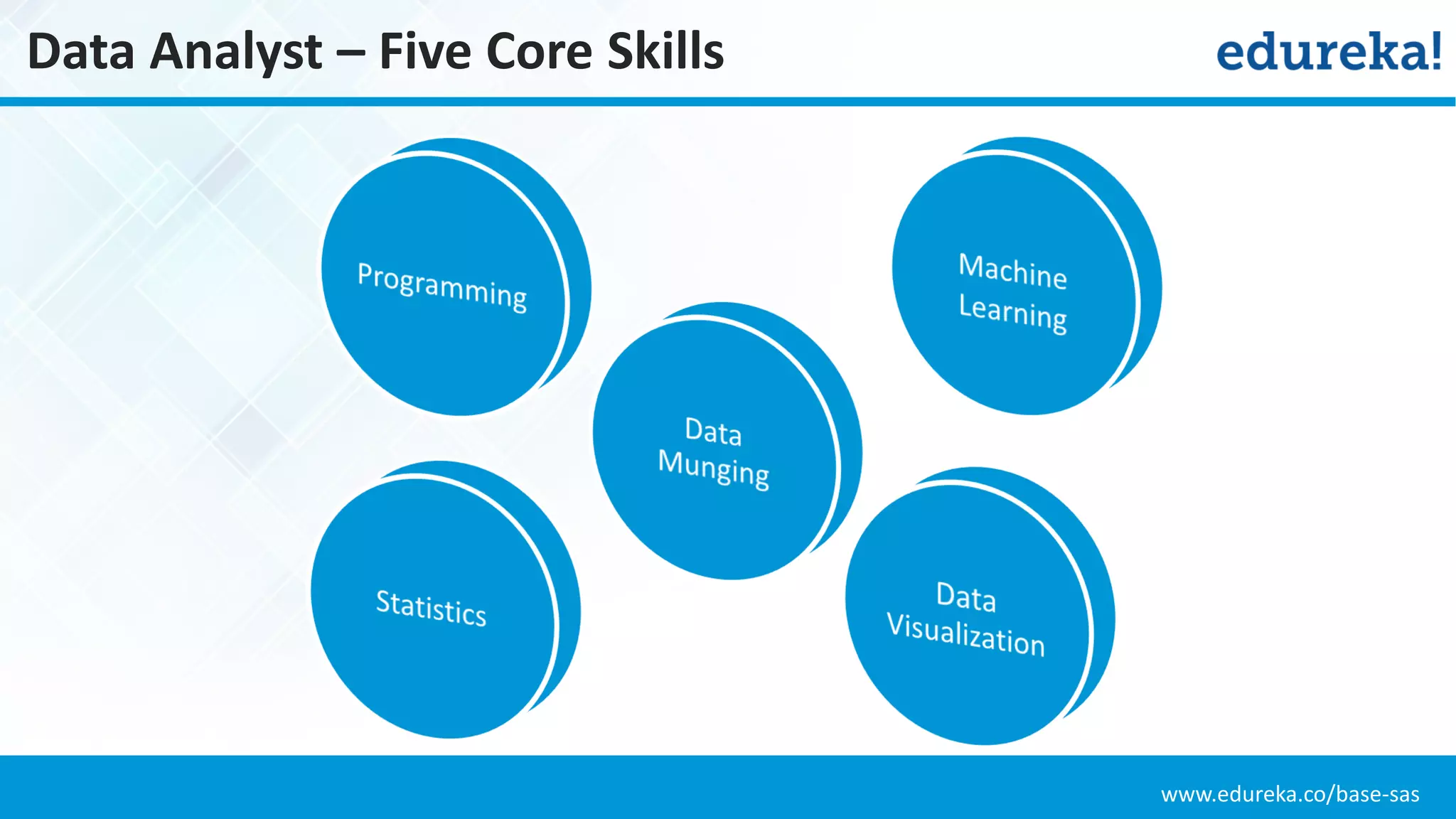
Data Analyst – Five Core Skills
www.edureka.co/base-sas
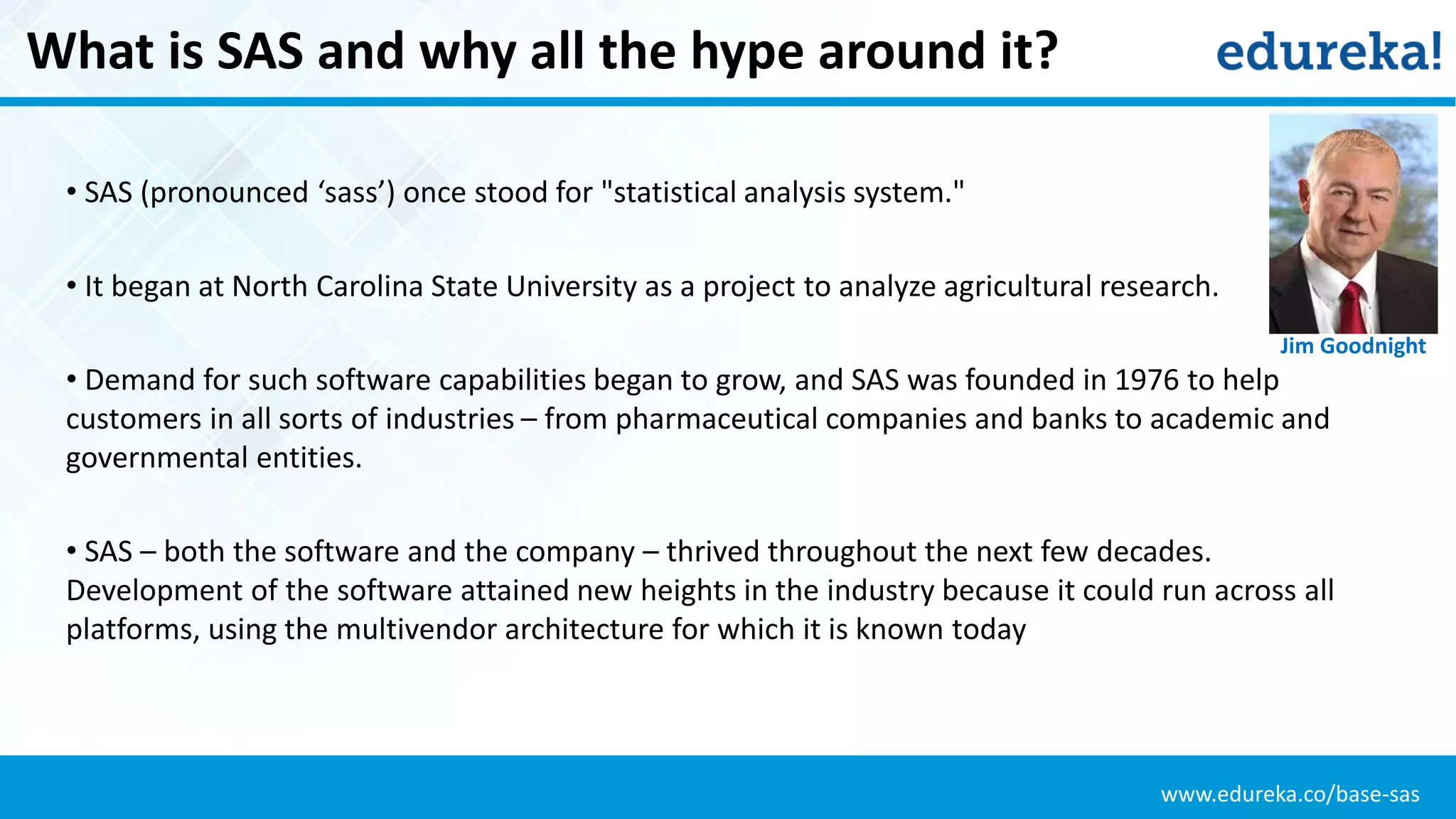
What is SAS and why all the hype around it?
• SAS (pronounced ‘sass’) once stood for "statistical analysis system."
• It began at North Carolina State University as a project to analyze agricultural research.
• Demand for such software capabilities began to grow, and SAS was founded in 1976 to help
customers in all sorts of industries – from pharmaceutical companies and banks to academic and
governmental entities.
• SAS – both the software and the company – thrived throughout the next few decades.
Development of the software attained new heights in the industry because it could run across all
platforms, using the multivendor architecture for which it is known today
Jim Goodnight
www.edureka.co/base-sas
Why SAS?
Is a mature development platform and has rich product documentation
Has great certification programs which carry a lot of weight in market
Has awesome product support
Been there since long and has been deployed in production of many mission critical jobs (like
churning out Pharma regulatory report and Clinical Trial analysis)
Is the first choice for Fraud Detection, Data Analytics involving huge amounts of data for any big
Enterprise
Is an undisputed Market leader in Data Analytics and Modeling (latest Gartner, Forrester Research)
www.edureka.co/base-sas
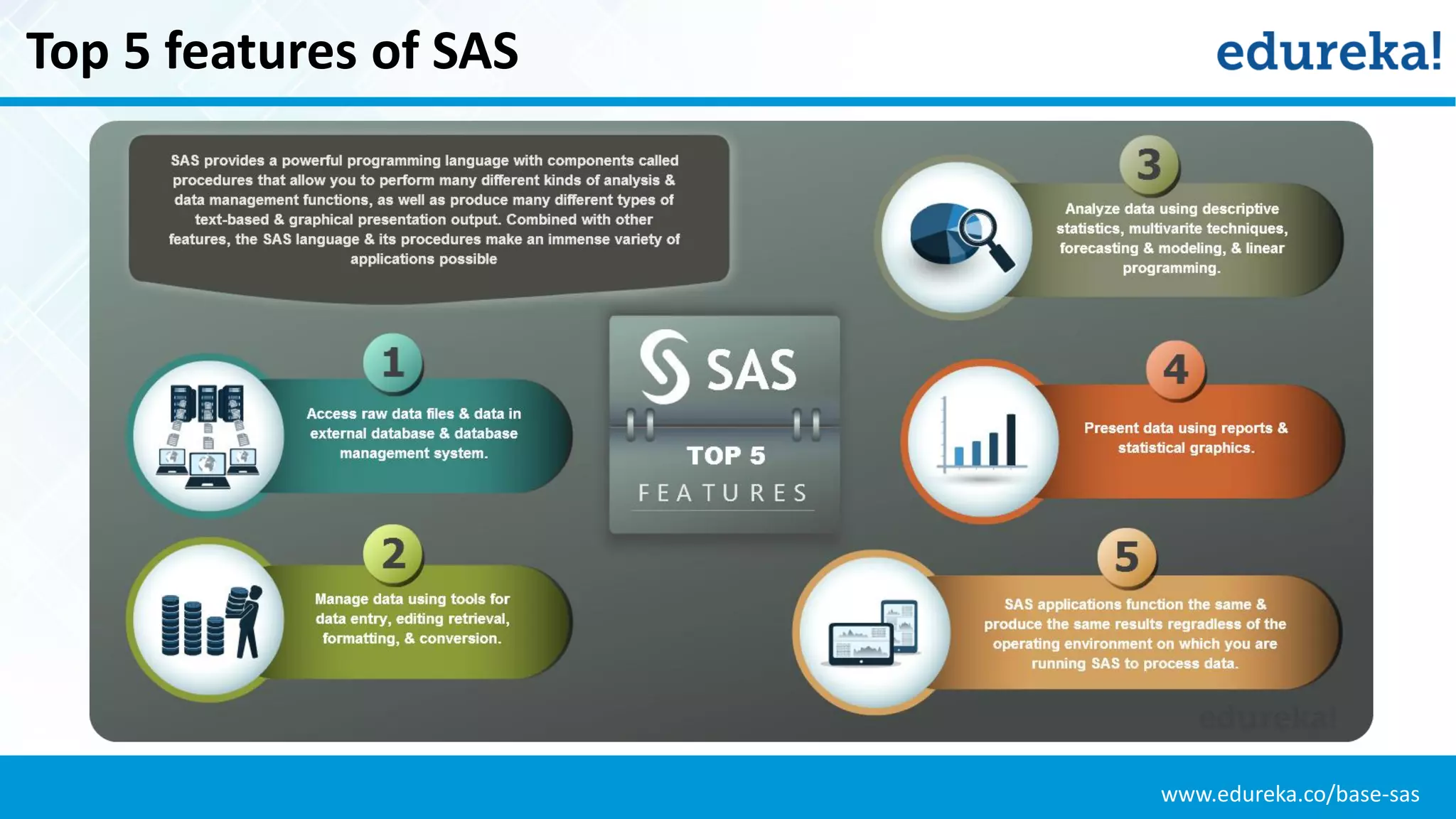
Top 5 features of SAS
www.edureka.co/base-sas
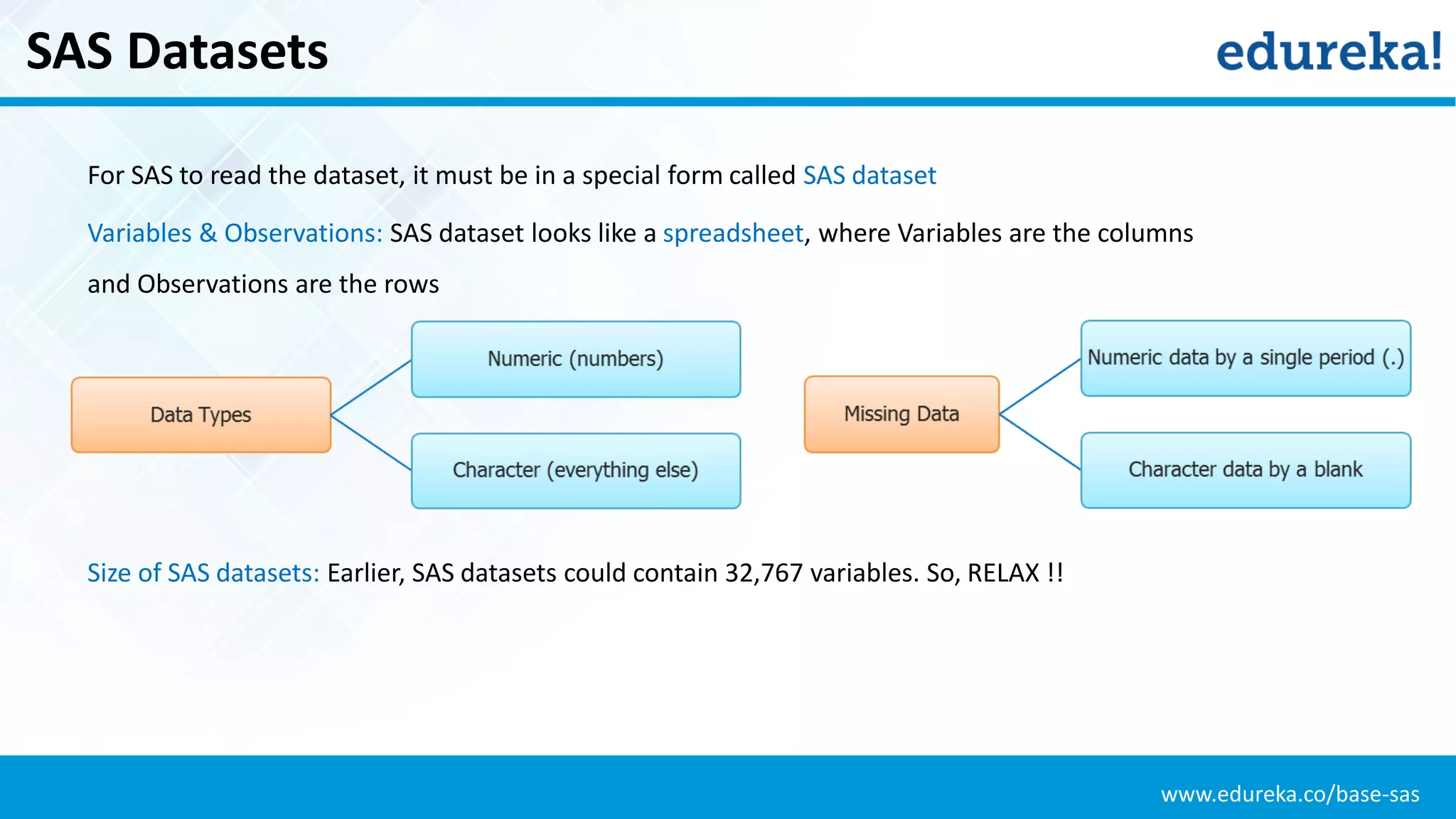
SAS Datasets
For SAS to read the dataset, it must be in a special form called SAS dataset
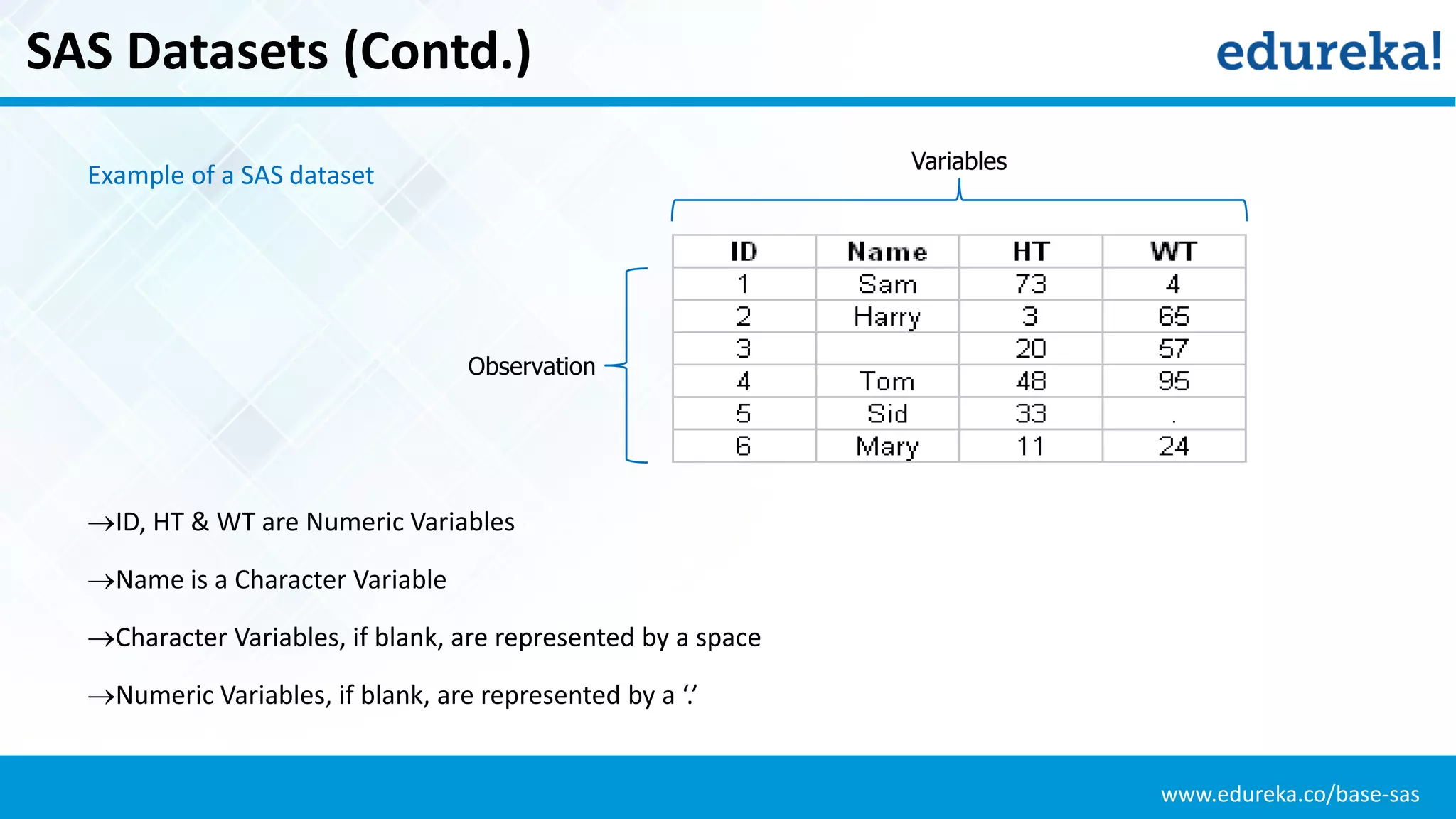
Variables & Observations: SAS dataset looks like a spreadsheet, where Variables are the columns
and Observations are the rows
Size of SAS datasets: Earlier, SAS datasets could contain 32,767 variables. So, RELAX !!
www.edureka.co/base-sas
SAS Datasets (Contd.)
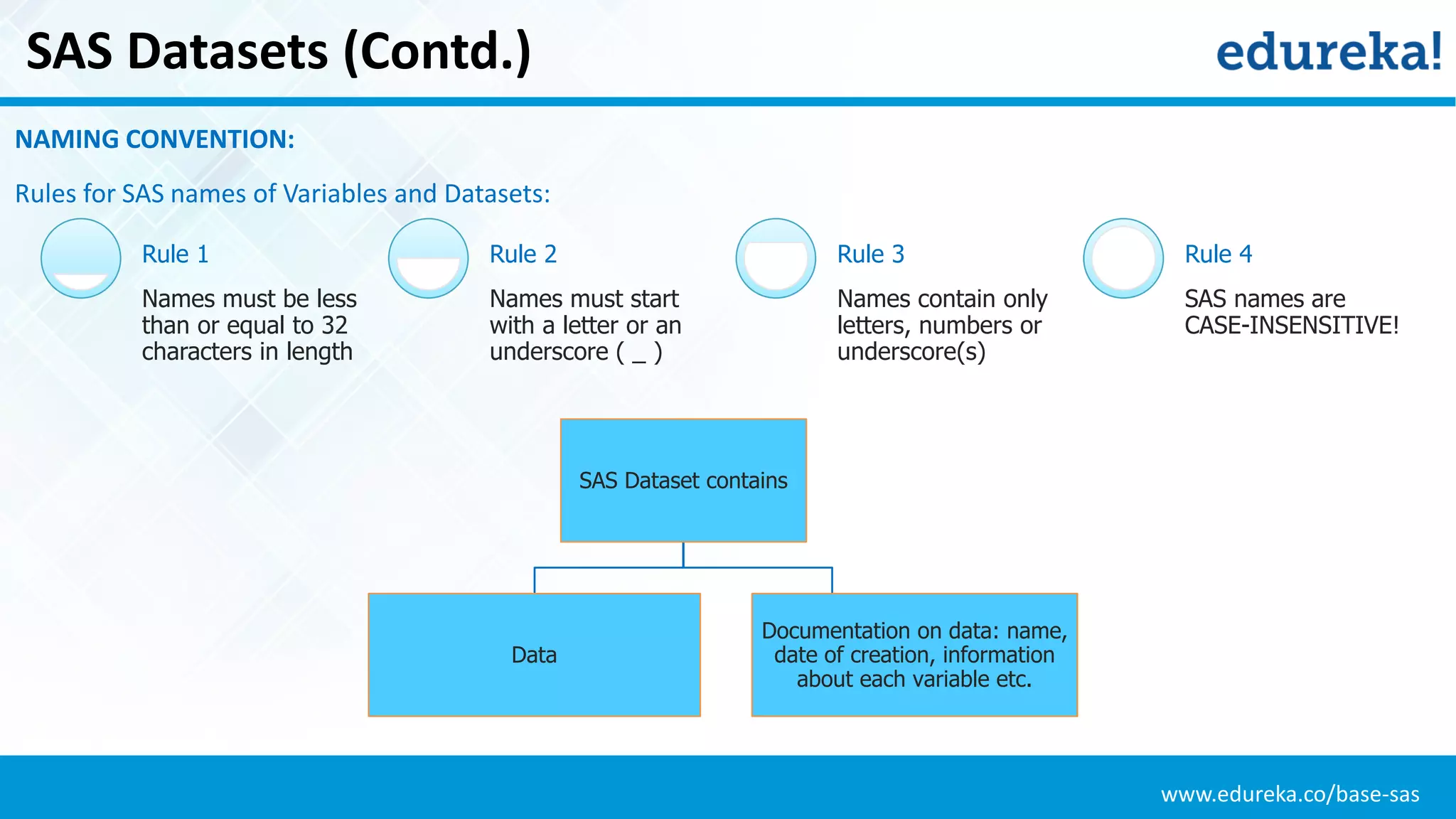
Names must be less
than or equal to 32
characters in length
Rule 1
Names must start
with a letter or an
underscore ( _ )
Rule 2
Names contain only
letters, numbers or
underscore(s)
Rule 3
SAS names are
CASE-INSENSITIVE!
Rule 4
NAMING CONVENTION:
Rules for SAS names of Variables and Datasets:
SAS Dataset contains
Data
Documentation on data: name,
date of creation, information
about each variable etc.
www.edureka.co/base-sas
SAS Datasets (Contd.)
Observation
Variables
Example of a SAS dataset
ID, HT & WT are Numeric Variables
Name is a Character Variable
Character Variables, if blank, are represented by a space
Numeric Variables, if blank, are represented by a ‘.’
www.edureka.co/base-sas
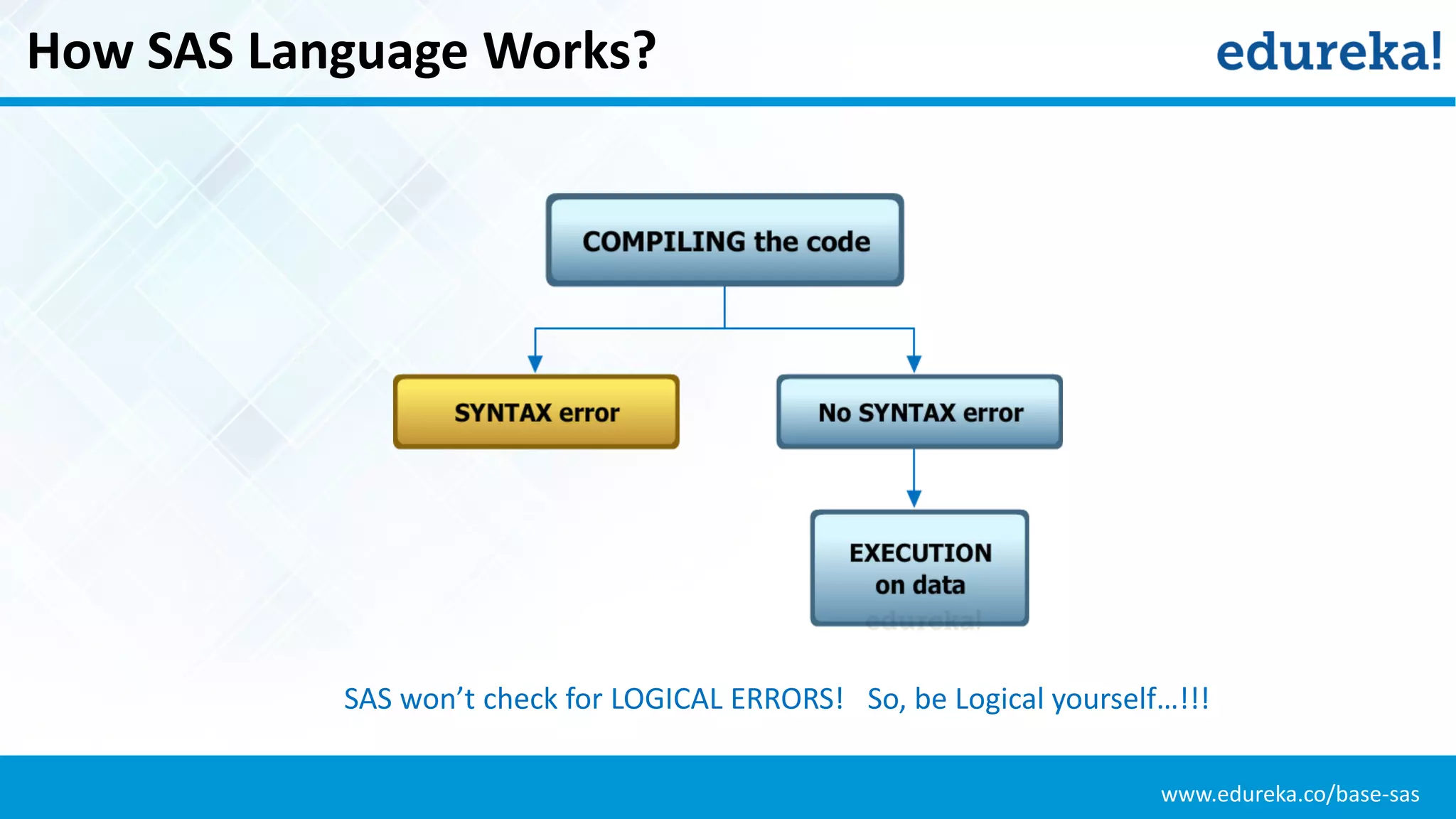
How SAS Language Works?
SAS won’t check for LOGICAL ERRORS! So, be Logical yourself…!!!
www.edureka.co/base-sas
Hands-On:
• How SAS looks!
• Importing Data into SAS
• Plotting graphs for understanding data
www.edureka.co/base-sas
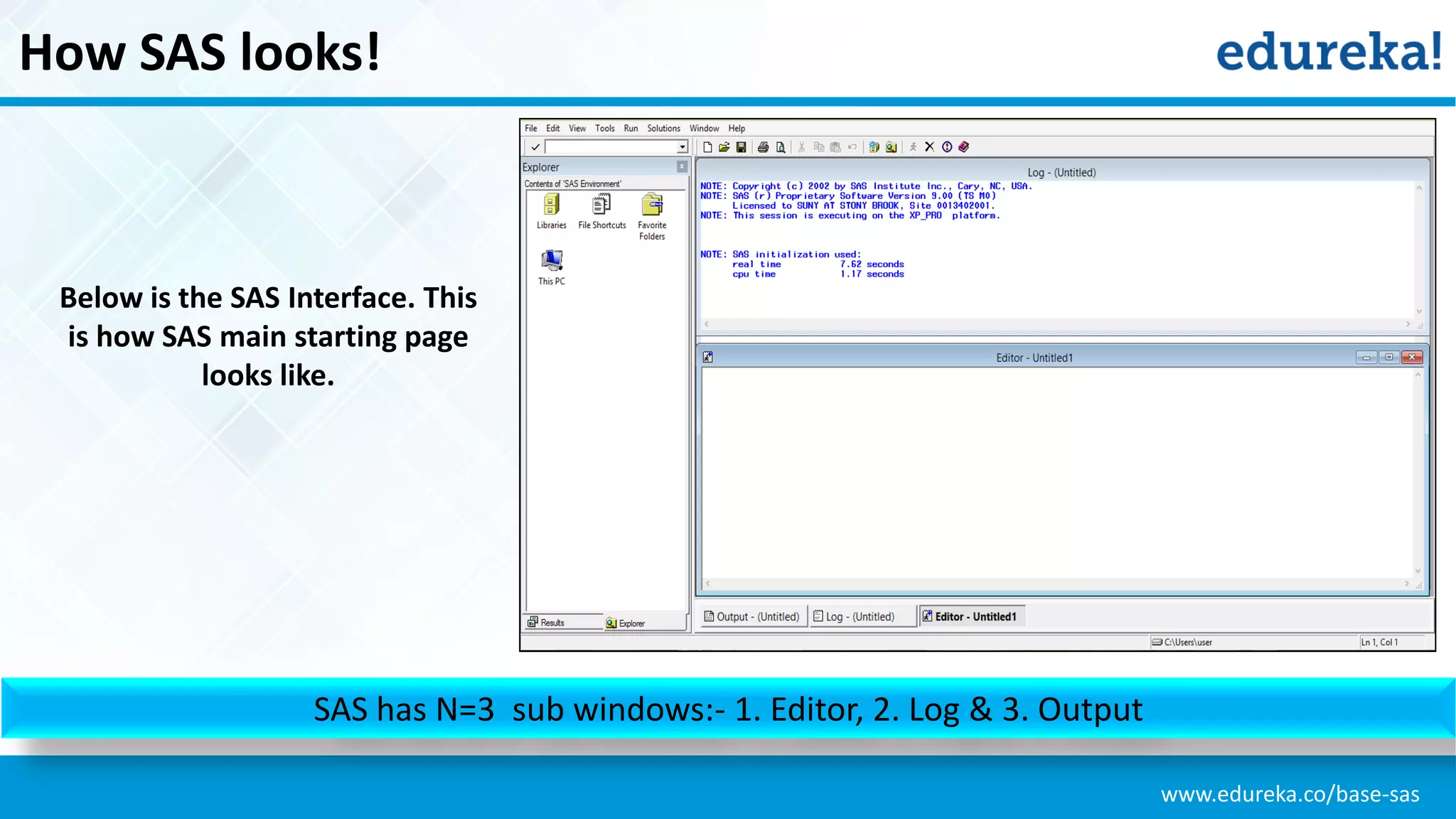
How SAS looks!
SAS has N=3 sub windows:- 1. Editor, 2. Log & 3. Output
Below is the SAS Interface. This
is how SAS main starting page
looks like.
www.edureka.co/base-sas
How SAS looks! - LIBRARIES
Primarily, SAS has N=2 libraries – 1. Temporary Library & 2. Permanent Library .Library:- Place to store Data Set.
WHAT IS TEMPORARY & PERMANENT LIBRARY?
Temporary Library:- It is the by-default library of SAS, where data is stored temporarily. The Data stored in Temp.
Lib. will be erased off as and when we close the SAS session. “Work” is the TEMPORARY LIBRARY.
Permanent Library:- These are user defined libraries in SAS. This is created by us and data is not erased off when
we end the session. Later we will learn “How to create Permanent Lib.”
WHY DO WE NEED A LIBRARY?
We need a library to store our Data Sets. Here there is a very simple analogy between our day-to-day life and SAS
– Normally we have Files stored in Folders or Directories . Similarly, we have Data Sets and Libraries in SAS.
Temporary Library stores all current activities on RAM for fast processing.
And , Permanent Library is used to store Data Set for future use also.
www.edureka.co/base-sas
Now you will learn to
Create a Library in SAS.
www.edureka.co/base-sas
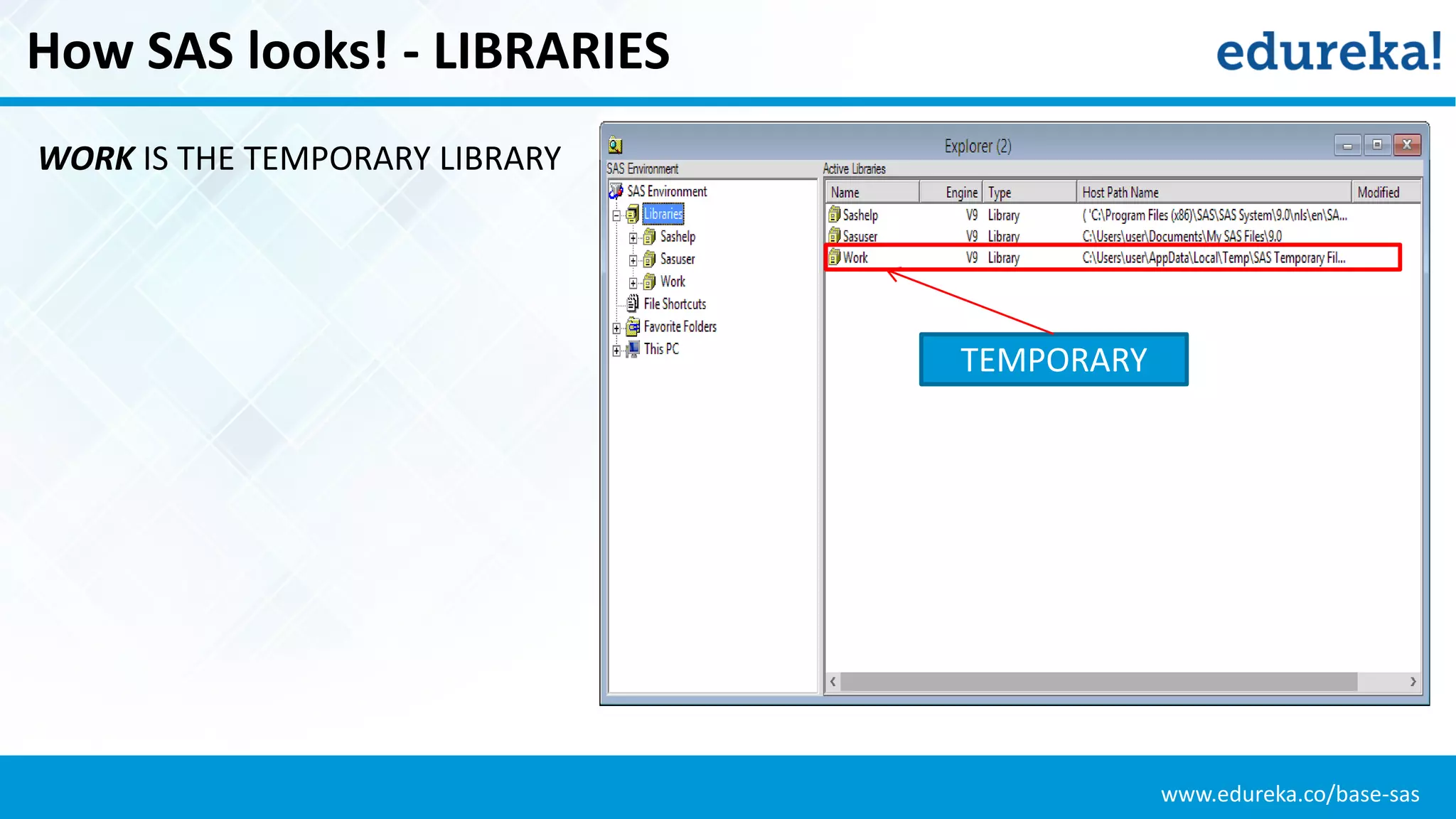
How SAS looks! - LIBRARIES
SAS
TEMPORARY
LIBRARY
WORK IS THE TEMPORARY LIBRARY
www.edureka.co/base-sas
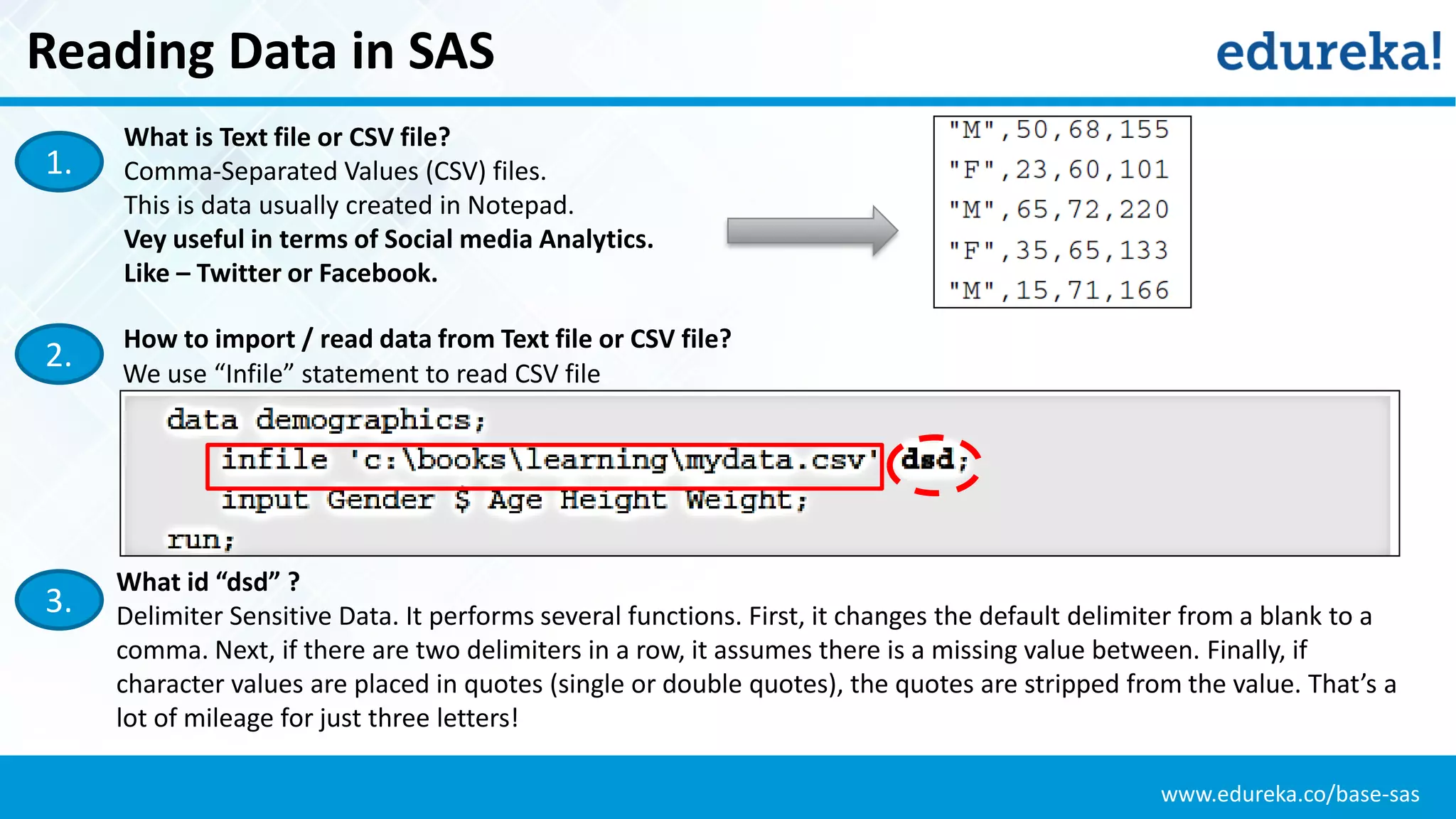
Reading Data in SAS
How to import / read data from Text file or CSV file?
We use “Infile” statement to read CSV file
What is Text file or CSV file?
Comma-Separated Values (CSV) files.
This is data usually created in Notepad.
Vey useful in terms of Social media Analytics.
Like – Twitter or Facebook.
1.
2.
3.
What id “dsd” ?
Delimiter Sensitive Data. It performs several functions. First, it changes the default delimiter from a blank to a
comma. Next, if there are two delimiters in a row, it assumes there is a missing value between. Finally, if
character values are placed in quotes (single or double quotes), the quotes are stripped from the value. That’s a
lot of mileage for just three letters!
www.edureka.co/base-sas
Now we will learn how to
input data using ‘Datalines’.
www.edureka.co/base-sas
Reading Data in SAS
Why do we use “Datalines” in SAS?
Suppose you want to write a short test program in SAS. Instead of having to place your data in an
external file, you can place your lines of data directly in your SAS program by using a DATALINES
statement.
www.edureka.co/base-sas
Reading Data in SAS
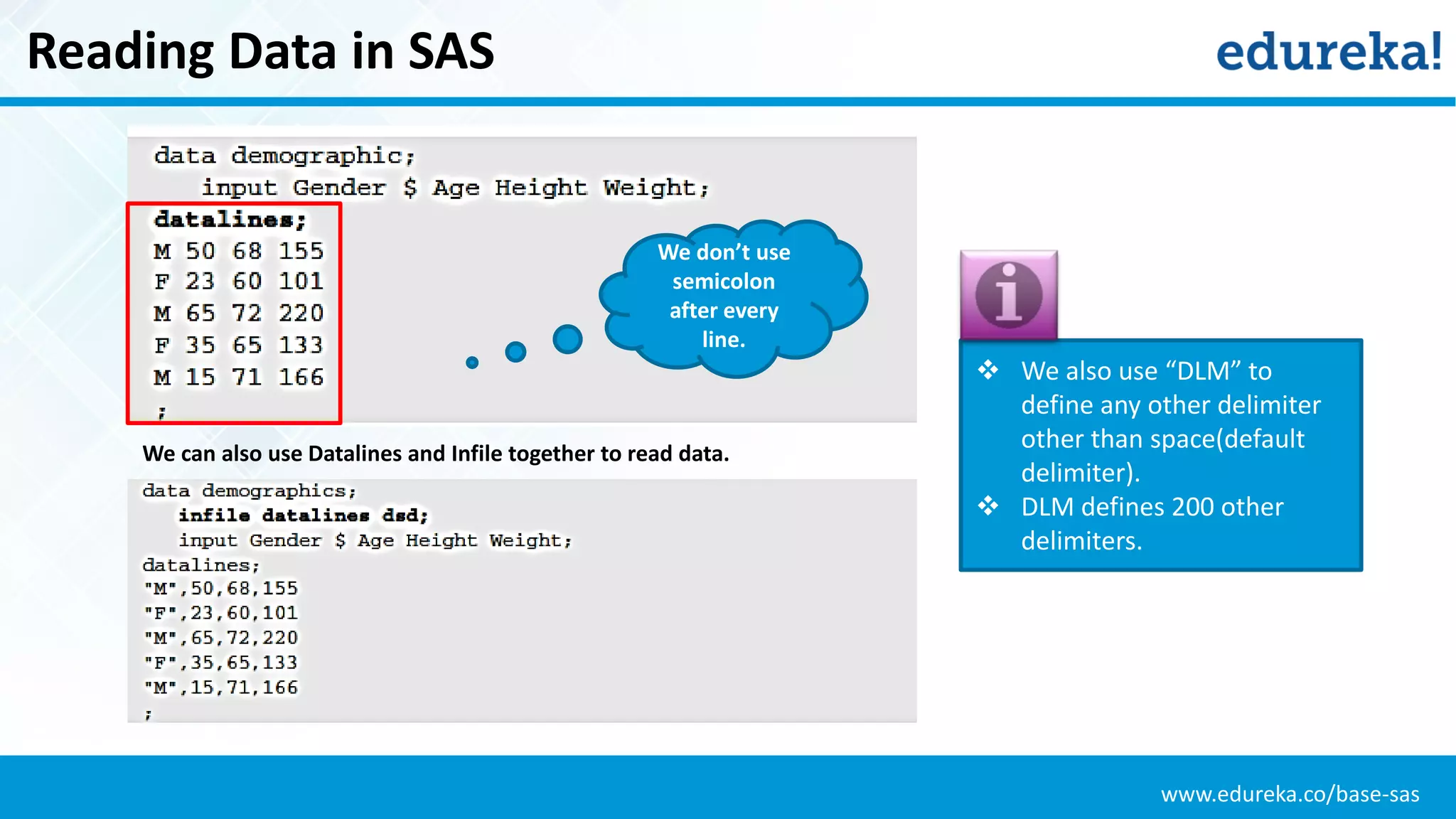
We don’t use
semicolon
after every
line.
We can also use Datalines and Infile together to read data.
 We also use “DLM” to
define any other delimiter
other than space(default
delimiter).
 DLM defines 200 other
delimiters.
www.edureka.co/base-sas
DATALINES statement used to be
called the CARDS statement.
www.edureka.co/base-sas
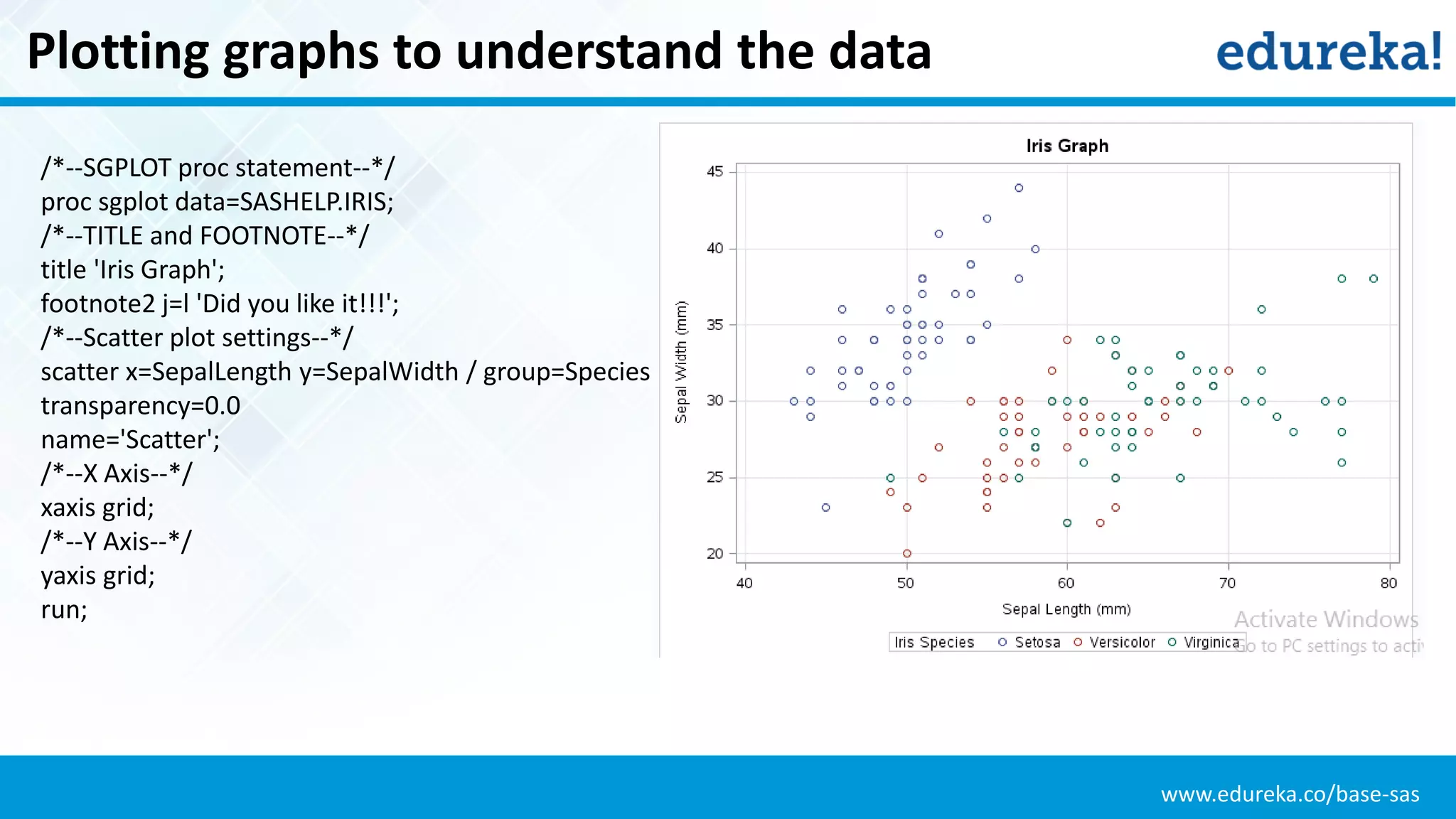
Plotting graphs to understand the data
/*--SGPLOT proc statement--*/
proc sgplot data=SASHELP.IRIS;
/*--TITLE and FOOTNOTE--*/
title 'Iris Graph';
footnote2 j=l 'Did you like it!!!';
/*--Scatter plot settings--*/
scatter x=SepalLength y=SepalWidth / group=Species
transparency=0.0
name='Scatter';
/*--X Axis--*/
xaxis grid;
/*--Y Axis--*/
yaxis grid;
run;
www.edureka.co/base-sas
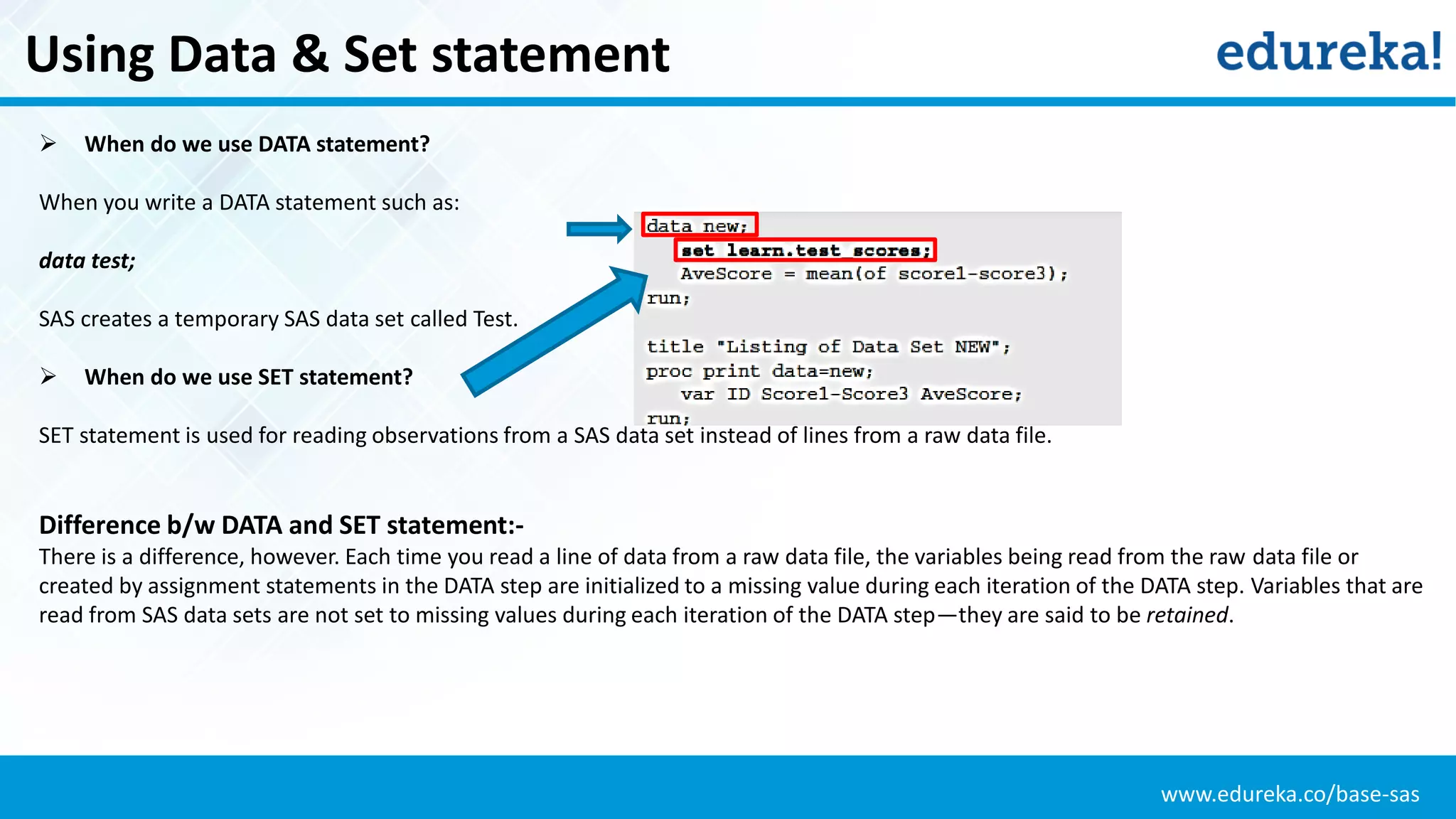
Using Data & Set statement
 When do we use DATA statement?
When you write a DATA statement such as:
data test;
SAS creates a temporary SAS data set called Test.
 When do we use SET statement?
SET statement is used for reading observations from a SAS data set instead of lines from a raw data file.
Difference b/w DATA and SET statement:-
There is a difference, however. Each time you read a line of data from a raw data file, the variables being read from the raw data file or
created by assignment statements in the DATA step are initialized to a missing value during each iteration of the DATA step. Variables that are
read from SAS data sets are not set to missing values during each iteration of the DATA step—they are said to be retained.
www.edureka.co/base-sas
Is SAS a proficient tool?
www.edureka.co/base-sas
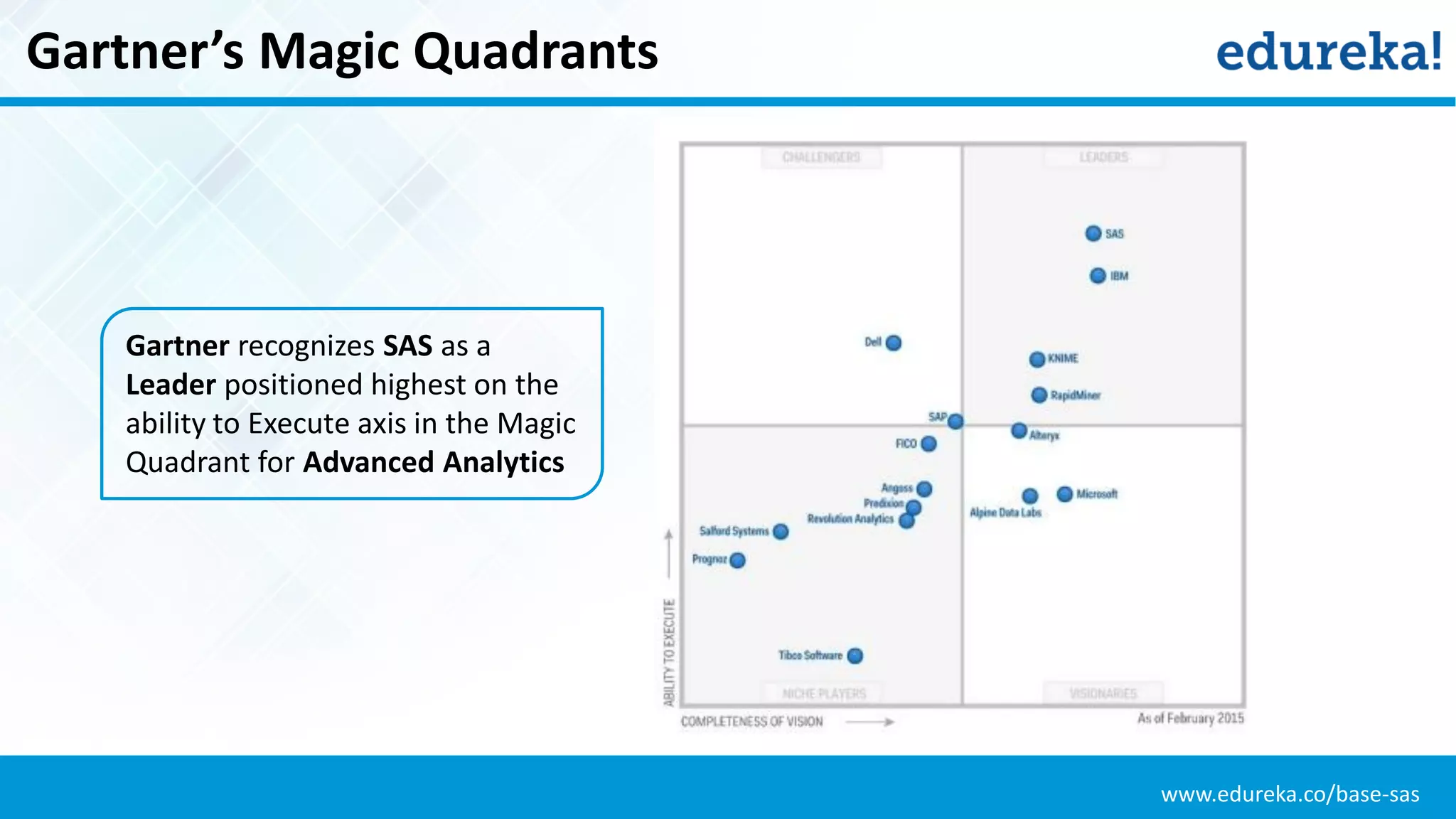
Gartner’s Magic Quadrants
Gartner recognizes SAS as a
Leader positioned highest on the
ability to Execute axis in the Magic
Quadrant for Advanced Analytics
www.edureka.co/base-sas
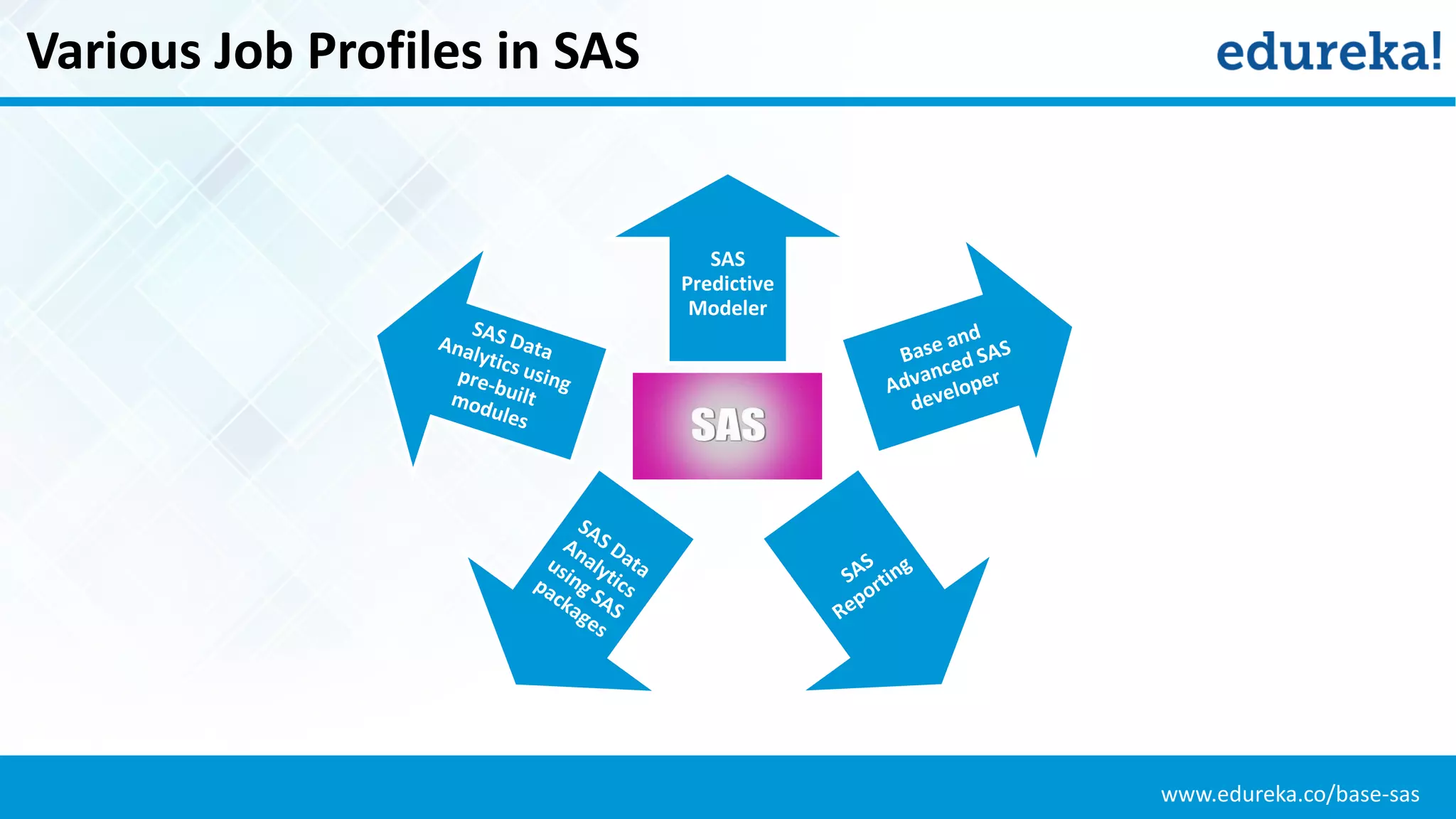
Various Job Profiles in SAS
SAS
Predictive
Modeler
www.edureka.co/base-sas
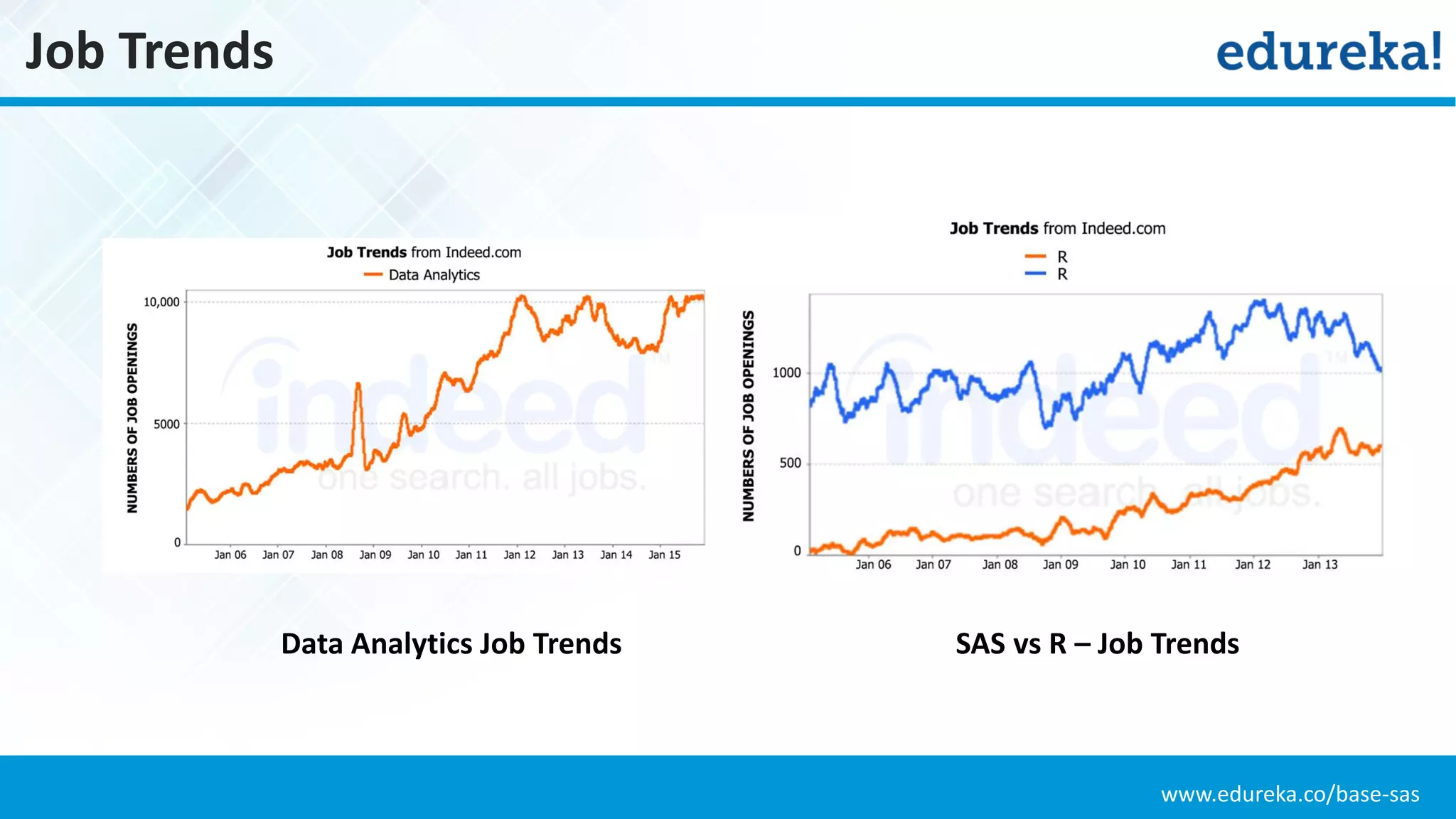
Job Trends
Data Analytics Job Trends SAS vs R – Job Trends
www.edureka.co/base-sas
Batch Details
Valid till 17th June, 11:30 PM PDT / 18th June, 12:00 PM IST
Course Features
 Online Live Classes : 24 Hours
 Assignments : 20 Hours
 Project : 20 Hours
http://bit.ly/1VhU7fp
Career Booster Offer - FLAT 15% OFF!
18
June
Sat & Sun (4 Weekends)
IST: 7:00 PM - 10:00 PM
PDT: 6:30 AM - 9:30 AM
INR 18,695
$ 357
INR 21,995
$ 420
www.edureka.co/base-sas
Thank You
Questions/Queries/Feedback
Recording and presentation will be made available to you within 24 hours

Analytics with SAS

  • 1.
    www.edureka.co/base-sas 5 Best Practicesin DevOps CultureAnalytics with SAS
  • 2.
    www.edureka.co/base-sas Know your instructor Hi, my name is Rakesh. And I am your trainer for tonight.  I have done my Masters in Statistics from IIT, Kanpur.  I am BASE SAS certified.  I have been training professionals and students for last 6.5 years.
  • 3.
    www.edureka.co/base-sas What will youlearn today?  Introduction to Analytics  Why there is so much hype around SAS?  Top 5 Features of SAS  Types of SAS Datasets  How SAS Language works!  Reading Data into SAS  Plotting graphs to understand the data
  • 4.
  • 5.
  • 6.
    www.edureka.co/base-sas What is SASand why all the hype around it? • SAS (pronounced ‘sass’) once stood for "statistical analysis system." • It began at North Carolina State University as a project to analyze agricultural research. • Demand for such software capabilities began to grow, and SAS was founded in 1976 to help customers in all sorts of industries – from pharmaceutical companies and banks to academic and governmental entities. • SAS – both the software and the company – thrived throughout the next few decades. Development of the software attained new heights in the industry because it could run across all platforms, using the multivendor architecture for which it is known today Jim Goodnight
  • 7.
    www.edureka.co/base-sas Why SAS? Is amature development platform and has rich product documentation Has great certification programs which carry a lot of weight in market Has awesome product support Been there since long and has been deployed in production of many mission critical jobs (like churning out Pharma regulatory report and Clinical Trial analysis) Is the first choice for Fraud Detection, Data Analytics involving huge amounts of data for any big Enterprise Is an undisputed Market leader in Data Analytics and Modeling (latest Gartner, Forrester Research)
  • 8.
  • 9.
    www.edureka.co/base-sas SAS Datasets For SASto read the dataset, it must be in a special form called SAS dataset Variables & Observations: SAS dataset looks like a spreadsheet, where Variables are the columns and Observations are the rows Size of SAS datasets: Earlier, SAS datasets could contain 32,767 variables. So, RELAX !!
  • 10.
    www.edureka.co/base-sas SAS Datasets (Contd.) Namesmust be less than or equal to 32 characters in length Rule 1 Names must start with a letter or an underscore ( _ ) Rule 2 Names contain only letters, numbers or underscore(s) Rule 3 SAS names are CASE-INSENSITIVE! Rule 4 NAMING CONVENTION: Rules for SAS names of Variables and Datasets: SAS Dataset contains Data Documentation on data: name, date of creation, information about each variable etc.
  • 11.
    www.edureka.co/base-sas SAS Datasets (Contd.) Observation Variables Exampleof a SAS dataset ID, HT & WT are Numeric Variables Name is a Character Variable Character Variables, if blank, are represented by a space Numeric Variables, if blank, are represented by a ‘.’
  • 12.
    www.edureka.co/base-sas How SAS LanguageWorks? SAS won’t check for LOGICAL ERRORS! So, be Logical yourself…!!!
  • 13.
    www.edureka.co/base-sas Hands-On: • How SASlooks! • Importing Data into SAS • Plotting graphs for understanding data
  • 14.
    www.edureka.co/base-sas How SAS looks! SAShas N=3 sub windows:- 1. Editor, 2. Log & 3. Output Below is the SAS Interface. This is how SAS main starting page looks like.
  • 15.
    www.edureka.co/base-sas How SAS looks!- LIBRARIES Primarily, SAS has N=2 libraries – 1. Temporary Library & 2. Permanent Library .Library:- Place to store Data Set. WHAT IS TEMPORARY & PERMANENT LIBRARY? Temporary Library:- It is the by-default library of SAS, where data is stored temporarily. The Data stored in Temp. Lib. will be erased off as and when we close the SAS session. “Work” is the TEMPORARY LIBRARY. Permanent Library:- These are user defined libraries in SAS. This is created by us and data is not erased off when we end the session. Later we will learn “How to create Permanent Lib.” WHY DO WE NEED A LIBRARY? We need a library to store our Data Sets. Here there is a very simple analogy between our day-to-day life and SAS – Normally we have Files stored in Folders or Directories . Similarly, we have Data Sets and Libraries in SAS. Temporary Library stores all current activities on RAM for fast processing. And , Permanent Library is used to store Data Set for future use also.
  • 16.
    www.edureka.co/base-sas Now you willlearn to Create a Library in SAS.
  • 17.
    www.edureka.co/base-sas How SAS looks!- LIBRARIES SAS TEMPORARY LIBRARY WORK IS THE TEMPORARY LIBRARY
  • 18.
    www.edureka.co/base-sas Reading Data inSAS How to import / read data from Text file or CSV file? We use “Infile” statement to read CSV file What is Text file or CSV file? Comma-Separated Values (CSV) files. This is data usually created in Notepad. Vey useful in terms of Social media Analytics. Like – Twitter or Facebook. 1. 2. 3. What id “dsd” ? Delimiter Sensitive Data. It performs several functions. First, it changes the default delimiter from a blank to a comma. Next, if there are two delimiters in a row, it assumes there is a missing value between. Finally, if character values are placed in quotes (single or double quotes), the quotes are stripped from the value. That’s a lot of mileage for just three letters!
  • 19.
    www.edureka.co/base-sas Now we willlearn how to input data using ‘Datalines’.
  • 20.
    www.edureka.co/base-sas Reading Data inSAS Why do we use “Datalines” in SAS? Suppose you want to write a short test program in SAS. Instead of having to place your data in an external file, you can place your lines of data directly in your SAS program by using a DATALINES statement.
  • 21.
    www.edureka.co/base-sas Reading Data inSAS We don’t use semicolon after every line. We can also use Datalines and Infile together to read data.  We also use “DLM” to define any other delimiter other than space(default delimiter).  DLM defines 200 other delimiters.
  • 22.
    www.edureka.co/base-sas DATALINES statement usedto be called the CARDS statement.
  • 23.
    www.edureka.co/base-sas Plotting graphs tounderstand the data /*--SGPLOT proc statement--*/ proc sgplot data=SASHELP.IRIS; /*--TITLE and FOOTNOTE--*/ title 'Iris Graph'; footnote2 j=l 'Did you like it!!!'; /*--Scatter plot settings--*/ scatter x=SepalLength y=SepalWidth / group=Species transparency=0.0 name='Scatter'; /*--X Axis--*/ xaxis grid; /*--Y Axis--*/ yaxis grid; run;
  • 24.
    www.edureka.co/base-sas Using Data &Set statement  When do we use DATA statement? When you write a DATA statement such as: data test; SAS creates a temporary SAS data set called Test.  When do we use SET statement? SET statement is used for reading observations from a SAS data set instead of lines from a raw data file. Difference b/w DATA and SET statement:- There is a difference, however. Each time you read a line of data from a raw data file, the variables being read from the raw data file or created by assignment statements in the DATA step are initialized to a missing value during each iteration of the DATA step. Variables that are read from SAS data sets are not set to missing values during each iteration of the DATA step—they are said to be retained.
  • 25.
  • 26.
    www.edureka.co/base-sas Gartner’s Magic Quadrants Gartnerrecognizes SAS as a Leader positioned highest on the ability to Execute axis in the Magic Quadrant for Advanced Analytics
  • 27.
    www.edureka.co/base-sas Various Job Profilesin SAS SAS Predictive Modeler
  • 28.
    www.edureka.co/base-sas Job Trends Data AnalyticsJob Trends SAS vs R – Job Trends
  • 29.
    www.edureka.co/base-sas Batch Details Valid till17th June, 11:30 PM PDT / 18th June, 12:00 PM IST Course Features  Online Live Classes : 24 Hours  Assignments : 20 Hours  Project : 20 Hours http://bit.ly/1VhU7fp Career Booster Offer - FLAT 15% OFF! 18 June Sat & Sun (4 Weekends) IST: 7:00 PM - 10:00 PM PDT: 6:30 AM - 9:30 AM INR 18,695 $ 357 INR 21,995 $ 420
  • 30.
    www.edureka.co/base-sas Thank You Questions/Queries/Feedback Recording andpresentation will be made available to you within 24 hours