1
Analytical Methods:
Key Considerations
to Efficiently Bring ADCs
to the Market
Arnaud Delobel, R&D Director
Word ADC Berlin – March 27th, 2018
2
Quality Assistance sa
Private, independent,
limited company
100% analytical services
100% (bio)pharmaceutical industry
+ 35 years experience
166 highly-qualified employees
> 60% university graduates
96 worldwide R&D companies
& 210 projects in 2017
Product dedicated support
Customised project management
Compliance with EMA / FDA regulations
From discovery to market place
All laboratories on one site
5700 m²
1.2 m € in machinery
& equipment (2017)
3
Analytical services for ADCs
4
Analytical services for ADCs
5
Analytical method lifecycle
Preclinical:
• Selection
• Development
• Optimisation
• Pre-formulation
Phase I:
• Safety tests validated
• Qualified methods
• Set tentative release/stab
acceptance criteria
Phase II:
• Optimisation/qualification
• Refine lot release criteria
• Set tentative validation
acceptance criteria
• Delineate/initiate assay
validation parameters
• Excipient control strategy
Phase III and BLA:
• Full assay validation
(strongly recommended for
phase III)
Post-licensure:
• Trend analysis
• Performance review
• Method replacement
(supplement)
Implement
Validate
Qualify
Develop
Review
Optimise
Method
6
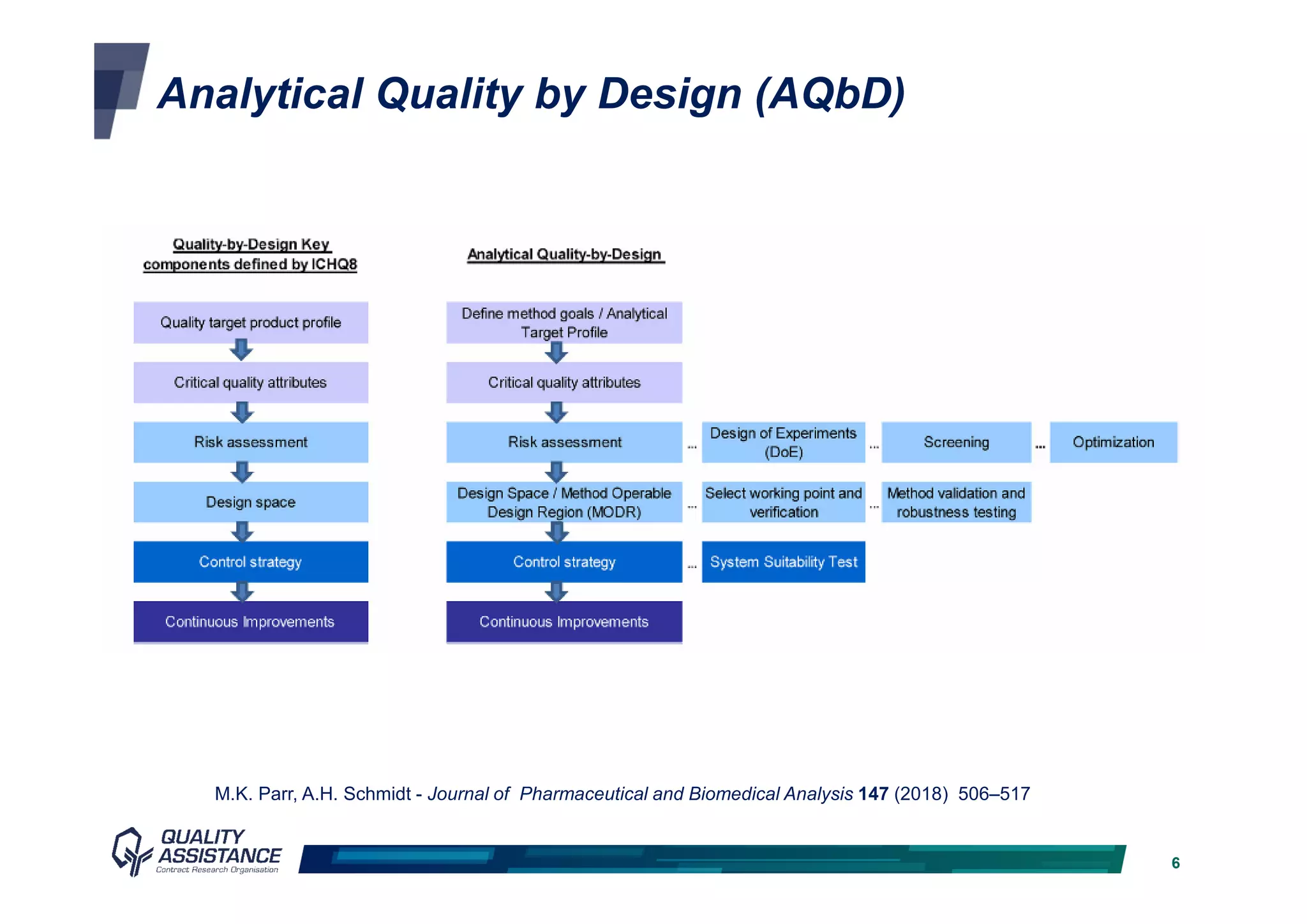
Analytical Quality by Design (AQbD)
M.K. Parr, A.H. Schmidt - Journal of Pharmaceutical and Biomedical Analysis 147 (2018) 506–517
7
Why are ADCs so special in terms of analytics?
8
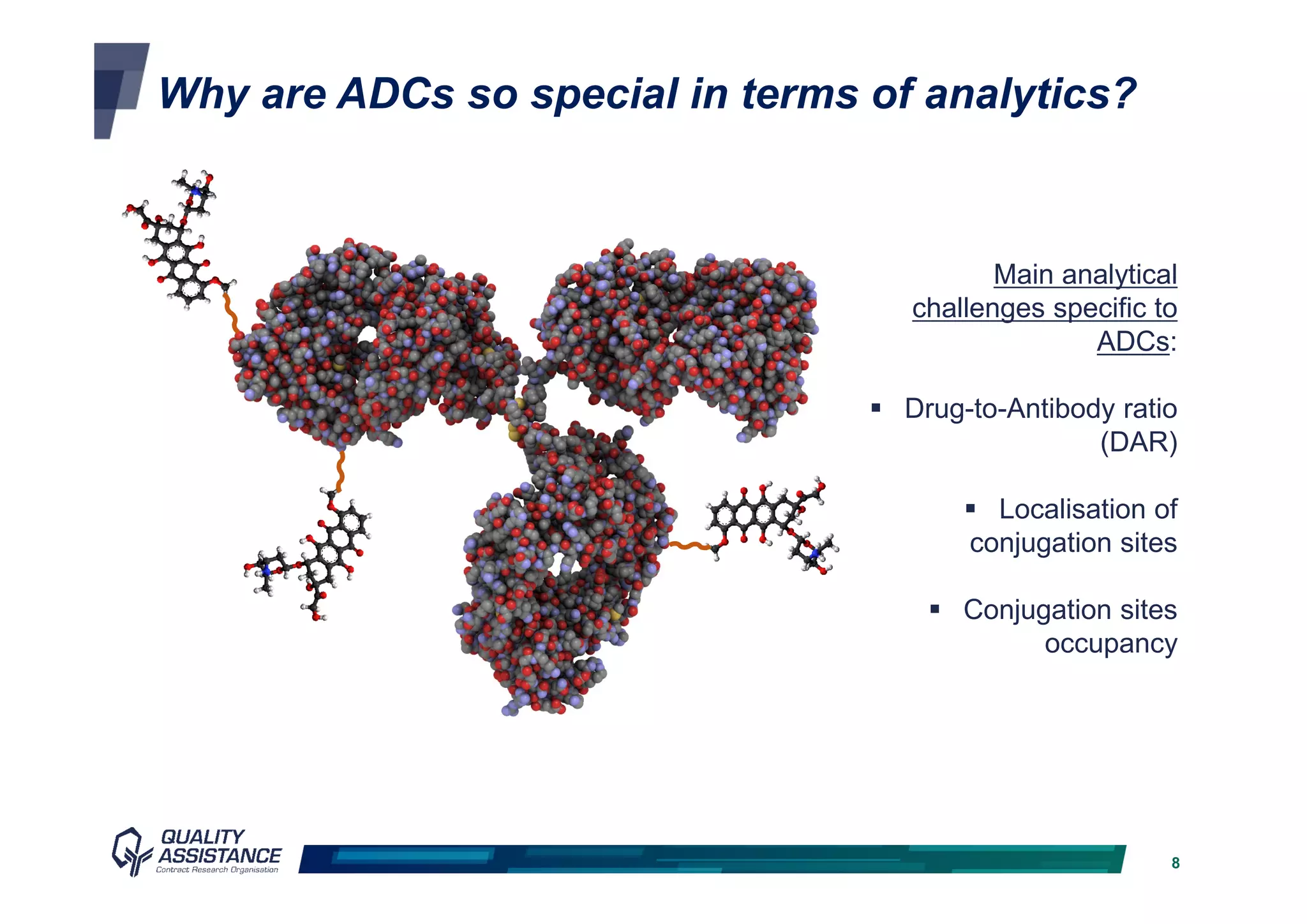
Why are ADCs so special in terms of analytics?
Main analytical
challenges specific to
ADCs:
 Drug-to-Antibody ratio
(DAR)
 Localisation of
conjugation sites
 Conjugation sites
occupancy
9
Why are ADCs so special in terms of analytics?
Main analytical
challenges specific to
ADCs:
 Drug-to-Antibody ratio
(DAR)
 Localisation of
conjugation sites
 Conjugation sites
occupancy
 Free drug (and related
species)
10
• How should the naked antibody and the drug (or drug-
linker) be considered from a regulatory point of view?
 Naked mAb and small molecule are not DS but intermediates.
 The drug substance is the conjugated mAb.
• But …
 The mAb has a role in the mechanism of action of the ADC.
 The characterisation of the mAb should be similar as the
characterisation of a mAb used alone.
 The impact of the conjugation on mAb properties should be
evaluated (binding, effector functions, primary structure and PTMs,
size and charge variants)
 The same is true for the drug/linker!
Intermediates, DS, DP … ?
11
mAb intermediate ADC-specific
Primary
structure
Amino acid sequence,
N- and C-terminal
sequencing, peptide mapping
Conjugation sites
(+ site occupancy)
Conformational
structure
Size and charge variants,
molecular mass
Drug-to-antibody ratio (DAR),
drug load distribution
PTMs
N-glycans profiling,
monosaccharide content,
sialic acids analysis
Impurities
Product-related impurities
(e.g. dimers, aggregates,
degradation products)
Free drug (+ related species),
residual solvents, heavy
metals, unconjugated mAb
Biological
activity
Target binding,
effector functions
Cytotoxicity
Characterisation of mAb intermediate and ADC
Based on the talk by Wen Jin Wu (CDER/FDA), World ADC Berlin 2017
12
Binding to C1q by ELISA
Impact of conjugation on mAb properties
Binding to Fcg receptors
and target by Biacore
13
Impact of conjugation on mAb properties
Aggregation by SEC (or A4F)
(with optional MALLS detection)
Primary sequence and PTMs
14
MS as a valuable tool for ADC characterisation
15
MS as a valuable tool for ADC characterisation
Primary sequence
Conjugation sites
Sites occupancy
Site-specific modifications
(oxidation, deamidation, …)
Glycosylation
Multiple-Attribute Monitoring (MAM)Multiple-Attribute Monitoring (MAM)
Peptide
Mapping
16
• DAR determination usually performed by:
 UV spectrophotometry (lysine conjugation)
 HIC/UV (cysteine conjugation)
• MS as a universal method
 Can be applied to any conjugate
 Need for « native » MS for cysteine-linked ADCs
Drug-to-Antibody ratio as a CQA
17
• Critical Quality Attribute to ensure safety
• Need to quantify free drug(/linker) and related species
• Limit to be set in DS/DP specifications
• Need for sensitive analytical techniques
 (2D)LC-UV
 (2D)LC-MS/MS
• Wide range of MS systems available (from high-res MS for
investigations and identification to routine mass detectors)
Free drug and related species: critical for
product safety
18
• 2 possible assays:
 Binding assay
 Cell-based assay (cytotoxicity)
• Binding assay is not sufficient
(but required for unconjugated mAb)
• Both assays should be included in DS/DP specifications
 Binding assay can be removed if justified
 Need to demonstrate that conjugation does not affect antigen binding
• If other mechanisms of action are involved in ADC activity,
additional potency assays must be included.
Biological activity
19
Category Test Analytical technique
General tests
Opalescence Visual test or turbidimetry
Color
Visual test or
spectrophotometry
Visible particles Visual test
pH Potentiometry
Content Total protein UV spectrophotometry
Identification
Specific binding ELISA
Isoform profile icIEF
Purity
Fragments
cGE (reduced and non-
reduced)
Aggregates and fragments SEC/UV
Naked antibody HIC/UV
Free drug and related species HPLC/MS
DAR and drug load
distribution
DAR determination UV spectrophotometry
Drug load distribution High resolution MS
Process-related
impurities
Process-related impurities HPLC/UV and/or HPLC/MS
Residual solvents GC/FID
Biological activity Cytotoxicity Cell-based assay
Microbiology
Microbial contamination Membrane filtration
Endotoxins Kinetic chromogenic LAL assay
Control strategy for the ADC Drug Substance
20
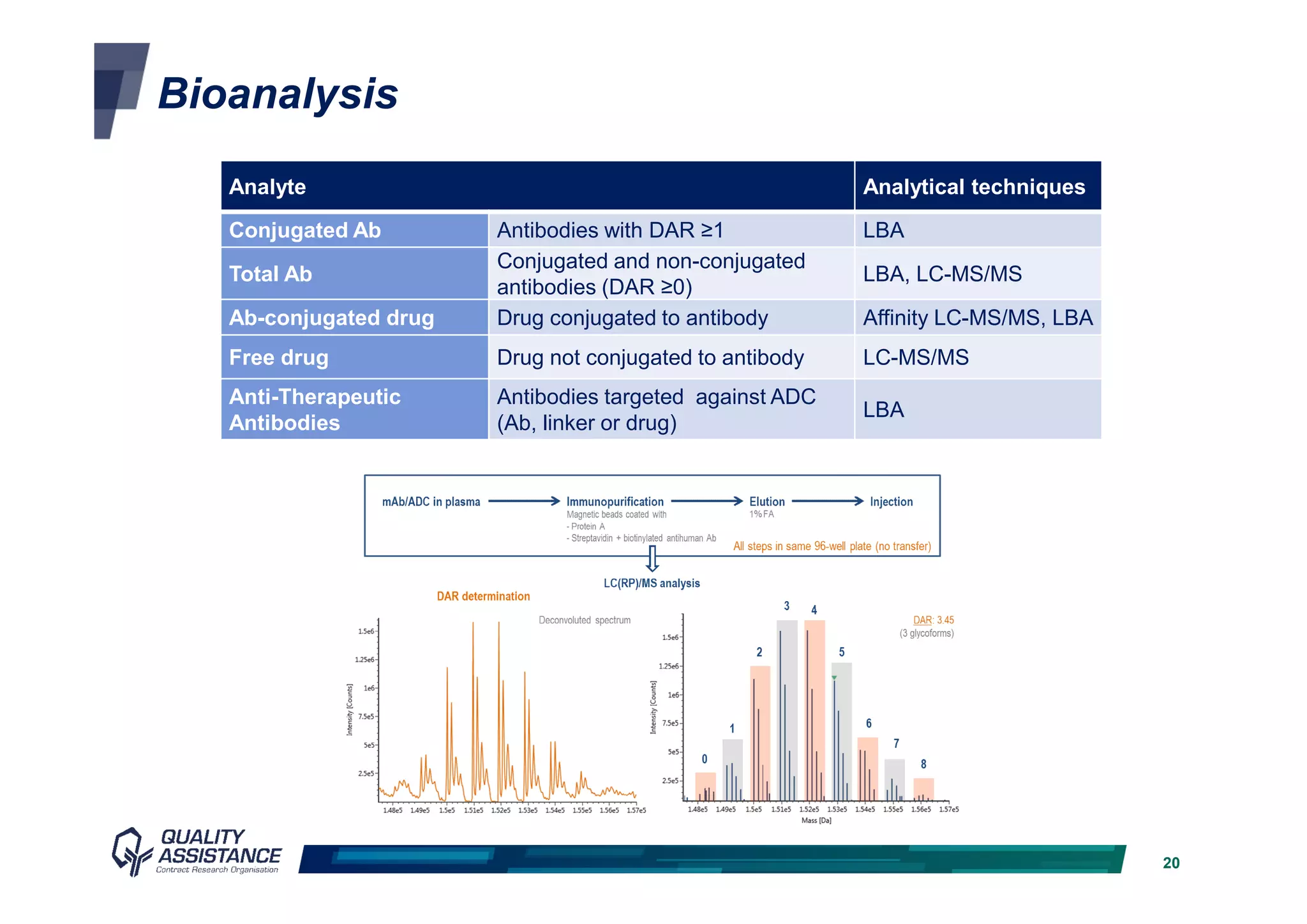
Bioanalysis
Analyte Analytical techniques
Conjugated Ab Antibodies with DAR ≥1 LBA
Total Ab
Conjugated and non-conjugated
antibodies (DAR ≥0)
LBA, LC-MS/MS
Ab-conjugated drug Drug conjugated to antibody Affinity LC-MS/MS, LBA
Free drug Drug not conjugated to antibody LC-MS/MS
Anti-Therapeutic
Antibodies
Antibodies targeted against ADC
(Ab, linker or drug)
LBA
21
August2016
April2017
March2015
April2016
June2016
September2016
August2016
Data integrity
March2018
22
Data integrity
A
O
C
L
A
+
Accurate
Original
Contemporaneous
Legible
Attributable
Complete, consistent,
enduring, available
23
In-house developed LIMS
24
Take-home messages
Regulatory, scientific and
technical expertise for
ADC analysis
Compliance
One-stop shop
on one site
State-of-the-art
analytical
techniques
Customised
project
management
25
ADC ressources @ www.quality-assistance.com
Product brochure
Webinars
Application notes
Posters
26
arnaud.delobel@quality-assistance.be
+32 71 53 47 81
www.quality-assistance.com
Technoparc de Thudinie, 2
B-6536 Donstiennes (Belgium)
Thank you for your attention
Any question?
To meet us:
Booth #11
Poster #1

Analytical methods: key considerations to efficiently bring ADCs to the market

  • 1.
    1 Analytical Methods: Key Considerations toEfficiently Bring ADCs to the Market Arnaud Delobel, R&D Director Word ADC Berlin – March 27th, 2018
  • 2.
    2 Quality Assistance sa Private,independent, limited company 100% analytical services 100% (bio)pharmaceutical industry + 35 years experience 166 highly-qualified employees > 60% university graduates 96 worldwide R&D companies & 210 projects in 2017 Product dedicated support Customised project management Compliance with EMA / FDA regulations From discovery to market place All laboratories on one site 5700 m² 1.2 m € in machinery & equipment (2017)
  • 3.
  • 4.
  • 5.
    5 Analytical method lifecycle Preclinical: •Selection • Development • Optimisation • Pre-formulation Phase I: • Safety tests validated • Qualified methods • Set tentative release/stab acceptance criteria Phase II: • Optimisation/qualification • Refine lot release criteria • Set tentative validation acceptance criteria • Delineate/initiate assay validation parameters • Excipient control strategy Phase III and BLA: • Full assay validation (strongly recommended for phase III) Post-licensure: • Trend analysis • Performance review • Method replacement (supplement) Implement Validate Qualify Develop Review Optimise Method
  • 6.
    6 Analytical Quality byDesign (AQbD) M.K. Parr, A.H. Schmidt - Journal of Pharmaceutical and Biomedical Analysis 147 (2018) 506–517
  • 7.
    7 Why are ADCsso special in terms of analytics?
  • 8.
    8 Why are ADCsso special in terms of analytics? Main analytical challenges specific to ADCs:  Drug-to-Antibody ratio (DAR)  Localisation of conjugation sites  Conjugation sites occupancy
  • 9.
    9 Why are ADCsso special in terms of analytics? Main analytical challenges specific to ADCs:  Drug-to-Antibody ratio (DAR)  Localisation of conjugation sites  Conjugation sites occupancy  Free drug (and related species)
  • 10.
    10 • How shouldthe naked antibody and the drug (or drug- linker) be considered from a regulatory point of view?  Naked mAb and small molecule are not DS but intermediates.  The drug substance is the conjugated mAb. • But …  The mAb has a role in the mechanism of action of the ADC.  The characterisation of the mAb should be similar as the characterisation of a mAb used alone.  The impact of the conjugation on mAb properties should be evaluated (binding, effector functions, primary structure and PTMs, size and charge variants)  The same is true for the drug/linker! Intermediates, DS, DP … ?
  • 11.
    11 mAb intermediate ADC-specific Primary structure Aminoacid sequence, N- and C-terminal sequencing, peptide mapping Conjugation sites (+ site occupancy) Conformational structure Size and charge variants, molecular mass Drug-to-antibody ratio (DAR), drug load distribution PTMs N-glycans profiling, monosaccharide content, sialic acids analysis Impurities Product-related impurities (e.g. dimers, aggregates, degradation products) Free drug (+ related species), residual solvents, heavy metals, unconjugated mAb Biological activity Target binding, effector functions Cytotoxicity Characterisation of mAb intermediate and ADC Based on the talk by Wen Jin Wu (CDER/FDA), World ADC Berlin 2017
  • 12.
    12 Binding to C1qby ELISA Impact of conjugation on mAb properties Binding to Fcg receptors and target by Biacore
  • 13.
    13 Impact of conjugationon mAb properties Aggregation by SEC (or A4F) (with optional MALLS detection) Primary sequence and PTMs
  • 14.
    14 MS as avaluable tool for ADC characterisation
  • 15.
    15 MS as avaluable tool for ADC characterisation Primary sequence Conjugation sites Sites occupancy Site-specific modifications (oxidation, deamidation, …) Glycosylation Multiple-Attribute Monitoring (MAM)Multiple-Attribute Monitoring (MAM) Peptide Mapping
  • 16.
    16 • DAR determinationusually performed by:  UV spectrophotometry (lysine conjugation)  HIC/UV (cysteine conjugation) • MS as a universal method  Can be applied to any conjugate  Need for « native » MS for cysteine-linked ADCs Drug-to-Antibody ratio as a CQA
  • 17.
    17 • Critical QualityAttribute to ensure safety • Need to quantify free drug(/linker) and related species • Limit to be set in DS/DP specifications • Need for sensitive analytical techniques  (2D)LC-UV  (2D)LC-MS/MS • Wide range of MS systems available (from high-res MS for investigations and identification to routine mass detectors) Free drug and related species: critical for product safety
  • 18.
    18 • 2 possibleassays:  Binding assay  Cell-based assay (cytotoxicity) • Binding assay is not sufficient (but required for unconjugated mAb) • Both assays should be included in DS/DP specifications  Binding assay can be removed if justified  Need to demonstrate that conjugation does not affect antigen binding • If other mechanisms of action are involved in ADC activity, additional potency assays must be included. Biological activity
  • 19.
    19 Category Test Analyticaltechnique General tests Opalescence Visual test or turbidimetry Color Visual test or spectrophotometry Visible particles Visual test pH Potentiometry Content Total protein UV spectrophotometry Identification Specific binding ELISA Isoform profile icIEF Purity Fragments cGE (reduced and non- reduced) Aggregates and fragments SEC/UV Naked antibody HIC/UV Free drug and related species HPLC/MS DAR and drug load distribution DAR determination UV spectrophotometry Drug load distribution High resolution MS Process-related impurities Process-related impurities HPLC/UV and/or HPLC/MS Residual solvents GC/FID Biological activity Cytotoxicity Cell-based assay Microbiology Microbial contamination Membrane filtration Endotoxins Kinetic chromogenic LAL assay Control strategy for the ADC Drug Substance
  • 20.
    20 Bioanalysis Analyte Analytical techniques ConjugatedAb Antibodies with DAR ≥1 LBA Total Ab Conjugated and non-conjugated antibodies (DAR ≥0) LBA, LC-MS/MS Ab-conjugated drug Drug conjugated to antibody Affinity LC-MS/MS, LBA Free drug Drug not conjugated to antibody LC-MS/MS Anti-Therapeutic Antibodies Antibodies targeted against ADC (Ab, linker or drug) LBA
  • 21.
  • 22.
  • 23.
  • 24.
    24 Take-home messages Regulatory, scientificand technical expertise for ADC analysis Compliance One-stop shop on one site State-of-the-art analytical techniques Customised project management
  • 25.
    25 ADC ressources @www.quality-assistance.com Product brochure Webinars Application notes Posters
  • 26.
    26 arnaud.delobel@quality-assistance.be +32 71 5347 81 www.quality-assistance.com Technoparc de Thudinie, 2 B-6536 Donstiennes (Belgium) Thank you for your attention Any question? To meet us: Booth #11 Poster #1