Analysis of University websites
FINAL RESEARCH
Maria Aguilera, Ignasi Berruezo,
Júlia Conillera, Alba Domingo,
Helena Parellada and Carla Ros
Presentation of the research conclusions VAN DIJCK’S ANALYTICAL MODEL
Regarding Van Dijck’s method, the four
universities do not present great differences
among them.
Socio-economic structures
Ownership
The owners of the websites are the universities
themselves, even though the institutions are
owned and governed by different superior
institutions, as the Generalitat de Catalunya,
the Gobierno de España and the European
Commission.
Governance
All four websites are free to access in exception
of specific parts as the virtual campuses. They
all warn that their content is a property of each
university and that it can be used as long as it
is not for a commercial use. At the governance
section, the universities also recalls that they will
act under any security breach.
Business model
They have three main ways for earning money:
funds that the Gobierno de España and
Generalitat de Catalunya gives to them from
the general budget, and the money that the
universities earn by the tuition payments and
the extracurricular activities.
RESEARCH INTRODUCTION
The aim of this project is to analyse, using qualitative and quantitative methods, the webs
of four different Catalan universities.
The decision of analysing universities’ websites was taken because of the importance of
having a virtual place where all the important information can be found. On this technological
era where all companies have an online presence, we think that institutions could not be less
and that they should be prepared for the online world and for the youngest generations,
accustomed to using the internet for almost everything. That is way we have decided to
analyse their structure and content, to see if they are ready for the next generations.
To analyze these websites, we used Van Dijck’s analytical model and the Task Analysis in
conjunction with the Thinking Aloud method. Thus, in general terms, we can say that the 4
universities analyzed, UPC, UB, UAB and UOC, all under the supervision of the Generalitat de
Catalunya, show a similar structure on their website, both inside, as we have seen from the
analysis with Van Dijck’s method, and outside, as in its operation and user usage, treated in
Task Analysis and Thinking Aloud.
Techno-cultural structures
Technology
They all offer different software to their students
according to the needs of the degree. Some of
the offered software is Adobe Creative Cloud,
ATALAB, Labview and Sophos. UAB is the only
university that doesn’t sepecify its offer.
Users and usage
Four main types common on them all: current
students who are studying a degree, master or
PhD, future students who are interested in the
different universities programs, international
students who will study on one of these
universities, and professors.
Content
All the universities’ websites have the same
sections and structure, and the only thing that
changes is the information the users can read.
These common sections (even if the content
is adapted to each university) are: location
and campuses, their values, their norms and
functioning, their research projects, the degrees,
masters and PhD they offer, etc.
As for the task analysis, the most used way to
achieve them was firstly accessing to the different
web pages from the main university website, so
they used hyperlinked access and secondly they
used the search engine in order to accomplish
all the tasks.
As for the gender equality we observed that
the majority of users were looking for a purple
(feminist movement color) section.
In reference to the climate change task, a lot of
users found it difficult to discover, finding the
worst cases in UB, as three out of four users gave
up the search, claiming that this section didn’t
exist.
Regarding the universities’ values and the
subjects, any user found it difficult, in fact was
one of the tasks that all the users from all the
universities quicker achieved.
As for the international agreements and
internship program users had more difficulties
basically for one main reason: users thought that
they would find both of these informations in
the specific section of computing engineering,
while it was actually for all degrees.
Regarding university life almost all users had
problems. All of them agreed that university
life is as important as the other sections and
therefore it should all be more accessible and
easier to find.
In this graph we can see the average of clicks needed to complete every asked
task. It also shows the total amount of clicks for every university.
UAB and UPC websites needed the most clicks. UB appears as “the easiest” website
to go through, but we have to take in consideration that some users were not
able to find sections such as Climate Change, Student Union for the UB and the
accomodation section in UOC.
FINAL CONCLUSIONS
Users were calmed until they had difficulties
trying to find the information of each task. That
means that users were nervous when they didn’t
find the information right away and they had to
spend more time searching all the information
that was required.
We also can affirm that no matter whether the
users were students of the selected universities
or not, they spent more or less the same time
and needed similar clicks in order to accomplish
all the tasks. Nevertheless, we can see that older
people need more time and clicks that young
people in order to achieve all the tasks.
To finish these usability analysis’ conclusion,
we can say that all these university websites
need improvements because all the users had
difficulties in some tasks in order to achieve
them; none of the users found every information
quickly and without any problem.
To conclude the whole project, just mention that
after this deep analysis we cannot determine
which website is better, as for the information
you can find in each one is basically the same
with some small variations, and as through the
task analysis and thinking aloud we have verified
that each one has some very strong points bus
then they also have some improveable parts.
We can say that an ideal university website
would be the one with complete information
about every topic related to the institution and
the one which would make all the information
accessible with 3 to 6 clicks.
TASK ANALYSIS AND THINKING ALOUD
Task analysis - Clicks needed
“ “I’m feeling
stupid, why
can’t I find it?”
“This is sh*t,
I can’t find it”
“My common
sense tells me
that it should
be here”
“Oh, I saw
them before
while I was
looking for
another thing”
“Oh thanks
for this lousy
service”
“Umm.. I don’t
know…”
“I give up, I
can’t find it”
“I’m
desperate!”
“I didn’t even
know this
really existed” “
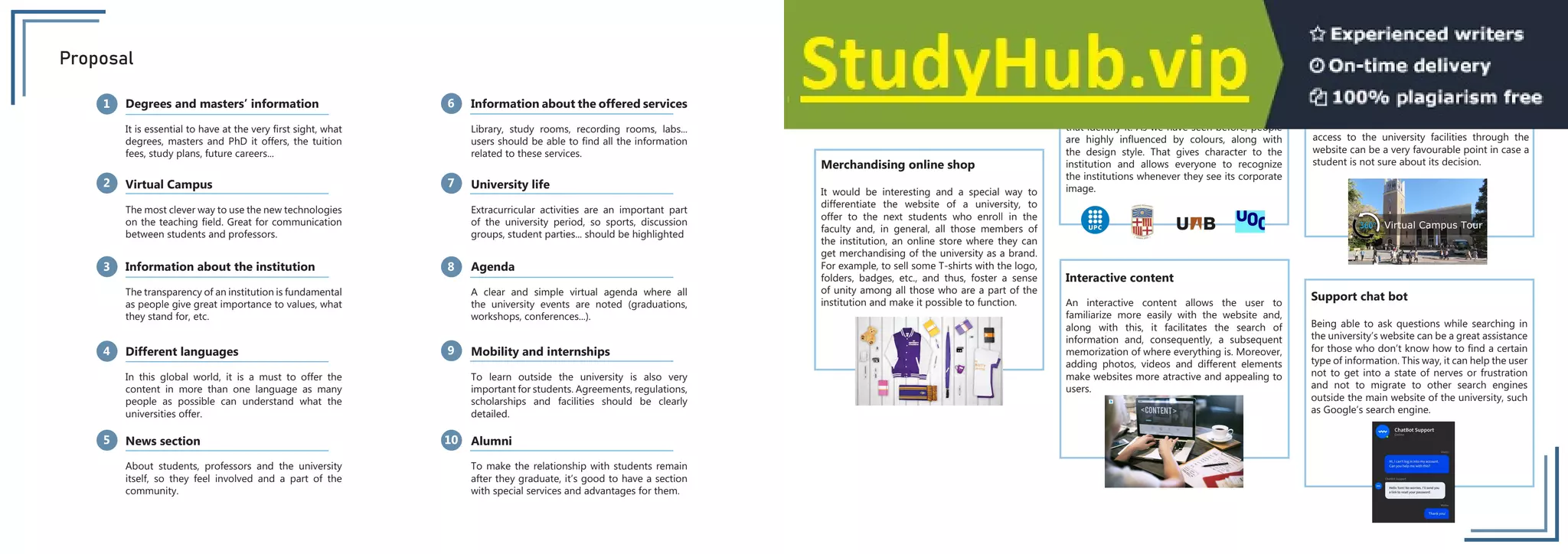
Proposal Proposition
Virtual tours
A virtual tour of the university, its campuses and
faculties could be very helpful for all those future
students who cannot attend the open days in-
person. The virtual tours can also be carried out
around the student residences. To facilitate the
access to the university facilities through the
website can be a very favourable point in case a
student is not sure about its decision.
Interactive content
An interactive content allows the user to
familiarize more easily with the website and,
along with this, it facilitates the search of
information and, consequently, a subsequent
memorization of where everything is. Moreover,
adding photos, videos and different elements
make websites more atractive and appealing to
users.
Support chat bot
Being able to ask questions while searching in
the university’s website can be a great assistance
for those who don’t know how to find a certain
type of information. This way, it can help the user
not to get into a state of nerves or frustration
and not to migrate to other search engines
outside the main website of the university, such
as Google’s search engine.
Merchandising online shop
It would be interesting and a special way to
differentiate the website of a university, to
offer to the next students who enroll in the
faculty and, in general, all those members of
the institution, an online store where they can
get merchandising of the university as a brand.
For example, to sell some T-shirts with the logo,
folders, badges, etc., and thus, foster a sense
of unity among all those who are a part of the
institution and make it possible to function.
Logo, style, corporate colours
Any website, in order to distinguish itself from
others should have its own corporate colours
that identify it. As we have seen before, people
are highly influenced by colours, along with
the design style. That gives character to the
institution and allows everyone to recognize
the institutions whenever they see its corporate
image.
Virtual Campus
The most clever way to use the new technologies
on the teaching field. Great for communication
between students and professors.
Information about the institution
The transparency of an institution is fundamental
as people give great importance to values, what
they stand for, etc.
Degrees and masters’ information
It is essential to have at the very first sight, what
degrees, masters and PhD it offers, the tuition
fees, study plans, future careers...
Different languages
In this global world, it is a must to offer the
content in more than one language as many
people as possible can understand what the
universities offer.
News section
About students, professors and the university
itself, so they feel involved and a part of the
community.
University life
Extracurricular activities are an important part
of the university period, so sports, discussion
groups, student parties... should be highlighted
Agenda
A clear and simple virtual agenda where all
the university events are noted (graduations,
workshops, conferences...).
Information about the offered services
Library, study rooms, recording rooms, labs...
users should be able to find all the information
related to these services.
Mobility and internships
To learn outside the university is also very
important for students. Agreements, regulations,
scholarships and facilities should be clearly
detailed.
Alumni
To make the relationship with students remain
after they graduate, it’s good to have a section
with special services and advantages for them.
1
2
3
4
5
6
7
8
9
10
Maria Aguilera, Ignasi Berruezo,
Júlia Conillera, Alba Domingo,
Helena Parellada and Carla Ros

Analysis Of University Websites

  • 1.
    Analysis of Universitywebsites FINAL RESEARCH Maria Aguilera, Ignasi Berruezo, Júlia Conillera, Alba Domingo, Helena Parellada and Carla Ros
  • 2.
    Presentation of theresearch conclusions VAN DIJCK’S ANALYTICAL MODEL Regarding Van Dijck’s method, the four universities do not present great differences among them. Socio-economic structures Ownership The owners of the websites are the universities themselves, even though the institutions are owned and governed by different superior institutions, as the Generalitat de Catalunya, the Gobierno de España and the European Commission. Governance All four websites are free to access in exception of specific parts as the virtual campuses. They all warn that their content is a property of each university and that it can be used as long as it is not for a commercial use. At the governance section, the universities also recalls that they will act under any security breach. Business model They have three main ways for earning money: funds that the Gobierno de España and Generalitat de Catalunya gives to them from the general budget, and the money that the universities earn by the tuition payments and the extracurricular activities. RESEARCH INTRODUCTION The aim of this project is to analyse, using qualitative and quantitative methods, the webs of four different Catalan universities. The decision of analysing universities’ websites was taken because of the importance of having a virtual place where all the important information can be found. On this technological era where all companies have an online presence, we think that institutions could not be less and that they should be prepared for the online world and for the youngest generations, accustomed to using the internet for almost everything. That is way we have decided to analyse their structure and content, to see if they are ready for the next generations. To analyze these websites, we used Van Dijck’s analytical model and the Task Analysis in conjunction with the Thinking Aloud method. Thus, in general terms, we can say that the 4 universities analyzed, UPC, UB, UAB and UOC, all under the supervision of the Generalitat de Catalunya, show a similar structure on their website, both inside, as we have seen from the analysis with Van Dijck’s method, and outside, as in its operation and user usage, treated in Task Analysis and Thinking Aloud. Techno-cultural structures Technology They all offer different software to their students according to the needs of the degree. Some of the offered software is Adobe Creative Cloud, ATALAB, Labview and Sophos. UAB is the only university that doesn’t sepecify its offer. Users and usage Four main types common on them all: current students who are studying a degree, master or PhD, future students who are interested in the different universities programs, international students who will study on one of these universities, and professors. Content All the universities’ websites have the same sections and structure, and the only thing that changes is the information the users can read. These common sections (even if the content is adapted to each university) are: location and campuses, their values, their norms and functioning, their research projects, the degrees, masters and PhD they offer, etc.
  • 3.
    As for thetask analysis, the most used way to achieve them was firstly accessing to the different web pages from the main university website, so they used hyperlinked access and secondly they used the search engine in order to accomplish all the tasks. As for the gender equality we observed that the majority of users were looking for a purple (feminist movement color) section. In reference to the climate change task, a lot of users found it difficult to discover, finding the worst cases in UB, as three out of four users gave up the search, claiming that this section didn’t exist. Regarding the universities’ values and the subjects, any user found it difficult, in fact was one of the tasks that all the users from all the universities quicker achieved. As for the international agreements and internship program users had more difficulties basically for one main reason: users thought that they would find both of these informations in the specific section of computing engineering, while it was actually for all degrees. Regarding university life almost all users had problems. All of them agreed that university life is as important as the other sections and therefore it should all be more accessible and easier to find. In this graph we can see the average of clicks needed to complete every asked task. It also shows the total amount of clicks for every university. UAB and UPC websites needed the most clicks. UB appears as “the easiest” website to go through, but we have to take in consideration that some users were not able to find sections such as Climate Change, Student Union for the UB and the accomodation section in UOC. FINAL CONCLUSIONS Users were calmed until they had difficulties trying to find the information of each task. That means that users were nervous when they didn’t find the information right away and they had to spend more time searching all the information that was required. We also can affirm that no matter whether the users were students of the selected universities or not, they spent more or less the same time and needed similar clicks in order to accomplish all the tasks. Nevertheless, we can see that older people need more time and clicks that young people in order to achieve all the tasks. To finish these usability analysis’ conclusion, we can say that all these university websites need improvements because all the users had difficulties in some tasks in order to achieve them; none of the users found every information quickly and without any problem. To conclude the whole project, just mention that after this deep analysis we cannot determine which website is better, as for the information you can find in each one is basically the same with some small variations, and as through the task analysis and thinking aloud we have verified that each one has some very strong points bus then they also have some improveable parts. We can say that an ideal university website would be the one with complete information about every topic related to the institution and the one which would make all the information accessible with 3 to 6 clicks. TASK ANALYSIS AND THINKING ALOUD Task analysis - Clicks needed “ “I’m feeling stupid, why can’t I find it?” “This is sh*t, I can’t find it” “My common sense tells me that it should be here” “Oh, I saw them before while I was looking for another thing” “Oh thanks for this lousy service” “Umm.. I don’t know…” “I give up, I can’t find it” “I’m desperate!” “I didn’t even know this really existed” “
  • 4.
    Proposal Proposition Virtual tours Avirtual tour of the university, its campuses and faculties could be very helpful for all those future students who cannot attend the open days in- person. The virtual tours can also be carried out around the student residences. To facilitate the access to the university facilities through the website can be a very favourable point in case a student is not sure about its decision. Interactive content An interactive content allows the user to familiarize more easily with the website and, along with this, it facilitates the search of information and, consequently, a subsequent memorization of where everything is. Moreover, adding photos, videos and different elements make websites more atractive and appealing to users. Support chat bot Being able to ask questions while searching in the university’s website can be a great assistance for those who don’t know how to find a certain type of information. This way, it can help the user not to get into a state of nerves or frustration and not to migrate to other search engines outside the main website of the university, such as Google’s search engine. Merchandising online shop It would be interesting and a special way to differentiate the website of a university, to offer to the next students who enroll in the faculty and, in general, all those members of the institution, an online store where they can get merchandising of the university as a brand. For example, to sell some T-shirts with the logo, folders, badges, etc., and thus, foster a sense of unity among all those who are a part of the institution and make it possible to function. Logo, style, corporate colours Any website, in order to distinguish itself from others should have its own corporate colours that identify it. As we have seen before, people are highly influenced by colours, along with the design style. That gives character to the institution and allows everyone to recognize the institutions whenever they see its corporate image. Virtual Campus The most clever way to use the new technologies on the teaching field. Great for communication between students and professors. Information about the institution The transparency of an institution is fundamental as people give great importance to values, what they stand for, etc. Degrees and masters’ information It is essential to have at the very first sight, what degrees, masters and PhD it offers, the tuition fees, study plans, future careers... Different languages In this global world, it is a must to offer the content in more than one language as many people as possible can understand what the universities offer. News section About students, professors and the university itself, so they feel involved and a part of the community. University life Extracurricular activities are an important part of the university period, so sports, discussion groups, student parties... should be highlighted Agenda A clear and simple virtual agenda where all the university events are noted (graduations, workshops, conferences...). Information about the offered services Library, study rooms, recording rooms, labs... users should be able to find all the information related to these services. Mobility and internships To learn outside the university is also very important for students. Agreements, regulations, scholarships and facilities should be clearly detailed. Alumni To make the relationship with students remain after they graduate, it’s good to have a section with special services and advantages for them. 1 2 3 4 5 6 7 8 9 10
  • 5.
    Maria Aguilera, IgnasiBerruezo, Júlia Conillera, Alba Domingo, Helena Parellada and Carla Ros