Journal of Physics: Conference Series
PAPER • OPEN ACCESS
Analysis of Students’ Ability In Solving Relation and Functions Problems
Based on Learning Indicators
To cite this article: Masjudin et al 2020 J. Phys.: Conf. Ser. 1464 012027
View the article online for updates and enhancements.
This content was downloaded from IP address 75.127.7.34 on 15/04/2020 at 01:13
Content from this work may be used under the terms of the Creative Commons Attribution 3.0 licence. Any further distribution
of this work must maintain attribution to the author(s) and the title of the work, journal citation and DOI.
Published under licence by IOP Publishing Ltd
The 1st International Conference on Education and Technology (ICETECH) 2019
IOP Conf. Series: Journal of Physics: Conf. Series 1464(2020) 012027
IOP Publishing
doi:10.1088/1742-6596/1464/1/012027
1
Analysis of Students 'Ability In Solving Relation And Functions
Problems Based On Learning Indicators
Masjudin*
, Ahmad Muzaki, Ade Kurniawan, Yuntawati, and Suhaini
IKIP Mataram, Indonesia
*masjudinindo@gmail.com
Abstract. The purpose of this study is to describe the ability of students to solve
relation and function problems in based on the learning indicator perspective. This
type of research is a qualitative descriptive study. This research was conducted at two
Madrasah Tsanawiyah (MTs) schools in West Lombok with 79 students. This research
instrument includes a diagnostic test sheet and interview guidelines. The procedure of
this study includes the provision of diagnostic test sheets to obtain the level of student
ability. Furthermore, with a purposive sampling technique interview samples were set.
Based on the results of the study obtained information that the ability of students to
solve the problem of relations and functions are in the low category. Based on the
learning indicators obtained the following findings: (1) the ability of students to
explain the definition of relations and functions are in the low category; (2) the ability
of students to determine examples and not examples of functions is in the medium
category; (3) students' ability to determine the domain, codomain, and range of a
function is in the medium category; (4) students' ability to draw Arrow and Cartesian
Diagrams are in the medium category; (5) students' ability to determine the value of a
function if the value of the variable is known to be in the low category; (6) students'
ability to determine the value of a variable if the value of the function is known to be
in the very low category; and (7) the ability of students to make function formulas is in
the very low category
1. Introduction
Mathematics is an important part of education. Mathematics education itself has an important role,
because mathematics is a basic science that is widely used in various fields of life [1]. By learning
mathematics, it will train students' ability to think critically, logically, analytically, and systematically.
Mathematics is very instrumental in the development of other fields of science and technology. In the
development of information technology in particular, mathematics provides its own contribution.
Various applications and programs on a computer can’t be separated from the application of
mathematical applications, including Boolean algebra operations, graph theory, discrete mathematics,
symbolic logic, opportunities and statistics. This growing technology shows that human development
in applying mathematical applications is growing. The better mastery of one's mathematics, the more
chance there is to master information technology, and vice versa. So, it is very appropriate if
mathematics is called a bridge of science and technology.
The 1st International Conference on Education and Technology (ICETECH) 2019
IOP Conf. Series: Journal of Physics: Conf. Series 1464(2020) 012027
IOP Publishing
doi:10.1088/1742-6596/1464/1/012027
2
Current facts, student achievements in learning mathematics have not yet reached encouraging results.
Based on data presented by Trends in International Mathematics and Science Study (TIMSS) in 2011
information was obtained that Indonesian students' mathematical achievements ranked 38th out of 42
[2]. In addition, data presented by the Organization for Economic Co-operation and Development
(OECD) in 2014 using the Program for International Student Assessment (PISA) test stated that
Indonesia's mathematical achievements ranked 69 out of 76 countries that participated in PISA. In
fact, the mathematical literacy ability of students in Indonesia is in the low category [3]. Therefore, all
parties related to mathematics education should continue to reflect on themselves, find weaknesses,
and try to make improvements in a comprehensive and consistent manner.
Especially in learning mathematics, the principle must be implanted that mathematics is a structured
science. With these structured characteristics, in the learning process students are required to
understand mathematics in a structured and systematic manner. Like a building, the building
foundation must be strong and sturdy, so that the building above it is also strong and sturdy and not
easily collapsed. Likewise in learning mathematics, students are required to understand basic
mathematical material well in order to more easily learn and understand higher mathematical material.
Conversely, if students are not understanding basic mathematics material, then it is certain that
students will find various obstacles and difficulties in learning higher mathematical material.
Therefore, learning mathematics must be done in stages, sequentially, and systematically and based on
past learning experiences [4].
The reality that exists today is that most mathematics educators are more concerned with achieving
curriculum targets rather than students' structured and systematic understanding of mathematics. The
teacher rarely tries to do a detailed analysis of the students' ability to understand the material. In fact,
one of the tasks of a teacher is to ensure that their students understand the material being taught. This
can only be known by analyzing the conditions of the students they teach. A teacher is very important
to know the extent of students' understanding of a material. This is necessary because understanding a
material or concept is a prerequisite for mastering the next material or concept.
Therefore, through this study, researchers conducted an analysis of students' abilities in solving
relationship and function questions in terms of learning objectives. Researchers choose the material
relations and functions because it is a basic material in mathematics. This material was studied at the
junior high school level in class VIII odd semester. This material becomes the basic concept of some
subsequent mathematical material. For this reason this material must be mastered and understood as
well as possible so as not to have difficulty in understanding the next material. Data from the analysis
of students' abilities in arranging questions will be very useful for the teacher as a reflection material,
so that it can improve the quality of learning, especially on material that is felt difficult by students..
2. Research Method
This research is a qualitative research with a descriptive approach. The subjects of this study were
students of IX grade of MTs Islahul Huda Lingsar, and students of IX grade of MTs Qur'aniyah
Narmada, West Lombok Regency with a total number of 79 students.
Instruments in this study include:
1. Diagnostic Test Sheet
Diagnostic test sheets are used to measure students' ability to solve relationship and function
questions. This test sheet is in the form of question details. The questions on this test sheet are also
based on the learning objectives of relations and functions in accordance with curriculum
requirements
2. Interview Guidelines,
Interview guidelines are used as a basis for conducting interviews. Interviews were conducted only
to clarify, explore the problem or clarify the findings of researchers on the test results. The
interview used is an unstructured interview, which is to find information that is not standardized to
explore a problem that emphasizes irregularities, unusual interpretations, rethinking, or new
approaches [5].
The 1st International Conference on Education and Technology (ICETECH) 2019
IOP Conf. Series: Journal of Physics: Conf. Series 1464(2020) 012027
IOP Publishing
doi:10.1088/1742-6596/1464/1/012027
3
3. Documentary
Documentary is a tool used to do documentation. Documentation as a method of data collection is
every written statement prepared by a person or institution for the purpose of testing an event or
presenting accounting [6]. Documentaries used include tape recorders and cameras.
Furthermore, the research procedures carried out in this study are:
1. Conduct diagnostic tests on students' ability to solve problems in relation and function.
The granting of this test is given to all students of class IX MTs Islahul Huda Lingsar, and students
of class IX MTs Qur'aniyah Narmada who have obtained material relations and functions. Class IX
students have received material about relationships and functions in class VIII Odd Semester
2018/2019. Relationship material and function were studied about 10 months before the test was
given. Before giving this test, researchers and teachers do not provide information to students. So
that, the variable time and readiness of students is not limited.
2. Conduct data analysis of students' abilities
The process of data analysis in this study uses the Miles & Huberman model [7] which is carried
out with the following steps: (1) Data Reduction; (2) Data Presentation; (3) Draw conclusions
The stages carried out as follows:
a. Correcting diagnostic test results in the ability of students to solve problems.
b. Calculating the score of the results of tests of students' ability to solve problems. the calculated
score is (1) the total score of the student's ability to solve the problem; and (2) the scores of each
student's ability to solve problems. The formula used to calculate it is as follows:
c. Categorizing the test results into the level of statistical thinking ability as follows:
Table 1. Student Ability Categories.
Score of Student’s ability Ability Category
80 ≤ S < 100 Very High
60 ≤ S < 80 High
40 ≤ S < 60 Middle
20 ≤ S < 40 Low
0 ≤ S < 20 Very Low
(Source: modification of Annajmi [8])
3. Choose a subject and conduct an interview
The interview subjects were 6 people. Taking interview subject based on the results of students'
ability to solve the questions. 2 people who have high ability, 2 people who have medium ability,
and 2 people who have low ability
4. Making the interview transcript
5. Draw conclusions and report the results of research.
In drawing conclusions note the validity of the data. The validity of the data is important in
research. To check the validity of the data, a data triangulation technique is used, which is a
technique for checking the validity of the data by utilizing something outside the data for the
purposes of checking or as a comparison of the data [9]. The triangulation conducted in this study
is the triangulation with the source, which is comparing the data observed by researchers, the data
of student work, and interview transcript data
3. Research Result
This research was conducted to obtain data on students' ability to solve relationship and function
questions in terms of curriculum learning indicators. The results of this study can be seen in the
following table.
3.1 Data on Diagnosis Test Results for Students' Ability to Solve Problems
The results of the diagnostic tests for students' ability to solve relation problems are presented in the
following table.
The 1st International Conference on Education and Technology (ICETECH) 2019
IOP Conf. Series: Journal of Physics: Conf. Series 1464(2020) 012027
IOP Publishing
doi:10.1088/1742-6596/1464/1/012027
4
Table 2. Results of diagnostic tests of students' ability to solve relation problems
Indicator of Learning Average Score
Achievement
Category
1. Explain the definition of relation and
function
26.08 Low
2. Determine examples and not examples of
functions
47.91 Low
3. Determine the Domain, Codomain, and
Range of a function
54.99 Middle
4. Drawing of Arrows Diagrams and
Cartesian Diagrams
41.40 Middle
5. Determine the value of the function if the
variable value is known
23.36 Low
6. Determine the value of the variable if the
value of the function is known
8.86 Very low
7. Creating a function formula 3.92 Very low
Average 29.50 Low
Based on table 1 above, information can be obtained that the students' ability to solve relation and
function questions is in the low category. This means that students' understanding of relations and
functions is at a low level.
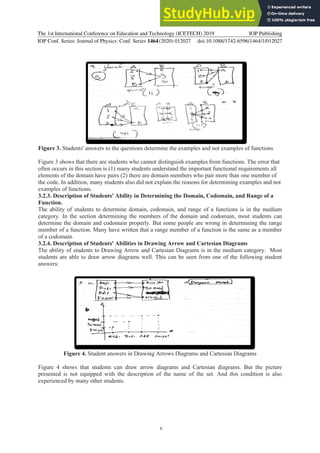
As for the distribution of students' level of ability to solving the problems can be seen the following
diagram.
Diagram 1. Distribution of students' level of ability in Solving the Problems
Based on diagram 1 above, information is obtained that the distribution of students' abilities in
answering questions varies. There are no students who have very high abilities. 1% have high ability.
13% students have medium abilities, 76% students have low abilities, and 10% students have very low
abilities
3.2. Description of Students' Ability in Solving Relationship Problems and Functions based on
Curriculum Learning Indicators
The following is a description of the Students 'Ability in Solving Relationship and Functions Problems
based on Learning Indicators in Curriculum:
3.2.1. Description of Students' Ability to explain the definition of relations and functions
After checking student test results, only one student can define the function correctly. The following
are the results of the students' work.
The 1st International Conference on Education and Technology (ICETECH) 2019
IOP Conf. Series: Journal of Physics: Conf. Series 1464(2020) 012027
IOP Publishing
doi:10.1088/1742-6596/1464/1/012027
5
Figure 1. Student answers defining functions
Based on the picture 1, it appears that students write 2 terms of the relation can be called functions,
namely: (1) each domain member has a pair and (2) matches exactly one member of the codomain.
Other than a student, no one can provide a precise definition of function. In addition, most students
also do not give answers. Students' abilities in defining functions are in the low category. This is
because the function material has been studied too long, so students forget the definition of function.
In addition, in understanding the definition many students memorize without understanding deeply. As
a result students forget quickly. This is in line with Masjudin's opinion that in learning mathematics,
what is most needed is understanding, not memorization [10].
3.2.2. Description of Students' Capabilities in Determining examples and not examples of
functions
The ability of students to determine examples and not examples of functions is in the medium
category. Based on the results of students' answers, most students are able to distinguish which
includes functions and not functions. Following are examples of student answers.
Figure 2. Student answers determine examples and not examples of functions
Based on Figure 2, students can answer the questions. students are able to analyze an image and then
be able to determine which belongs to functions and not functions. However, many students still
cannot determine the function and not the function. The following is a written test answer to students
who are still unable to determine function and not function
The 1st International Conference on Education and Technology (ICETECH) 2019
IOP Conf. Series: Journal of Physics: Conf. Series 1464(2020) 012027
IOP Publishing
doi:10.1088/1742-6596/1464/1/012027
6
Figure 3. Students' answers to the questions determine the examples and not examples of functions
Figure 3 shows that there are students who cannot distinguish examples from functions. The error that
often occurs in this section is (1) many students understand the important functional requirements all
elements of the domain have pairs (2) there are domain members who pair more than one member of
the code. In addition, many students also did not explain the reasons for determining examples and not
examples of functions.
3.2.3. Description of Students' Ability in Determining the Domain, Codomain, and Range of a
Function.
The ability of students to determine domain, codomain, and range of a functions is in the medium
category. In the section determining the members of the domain and codomain, most students can
determine the domain and codomain properly. But some people are wrong in determining the range
member of a function. Many have written that a range member of a function is the same as a member
of a codomain.
3.2.4. Description of Students' Abilities in Drawing Arrow and Cartesian Diagrams
The ability of students to Drawing Arrow and Cartesian Diagrams is in the medium category. Most
students are able to draw arrow diagrams well. This can be seen from one of the following student
answers:
Figure 4. Student answers in Drawing Arrows Diagrams and Cartesian Diagrams
Figure 4 shows that students can draw arrow diagrams and Cartesian diagrams. But the picture
presented is not equipped with the description of the name of the set. And this condition is also
experienced by many other students.
The 1st International Conference on Education and Technology (ICETECH) 2019
IOP Conf. Series: Journal of Physics: Conf. Series 1464(2020) 012027
IOP Publishing
doi:10.1088/1742-6596/1464/1/012027
7
3.2.5. Description of Student's ability to determine the value of a function if the value of the
variable is known
The ability of students to determine the value of a function if the value of the variable is known to be
in the low category. Many students are confused about how to find the value of a function. However,
there are also those who are able to answer correctly.
3.2. 6. Description of Student's Ability to Determine the value of a variable if the value of the
function is known
Students' Ability in Determining the value of a variable if the function value is known to be in the very
low category. Based on the results of the correction of researchers. No student can answer precisely
about determining the value of a variable if the value of the function is known. The following is one of
the students' answers
Figure 5 Student answers in determine the value of a function if the value of the variable is
known
Based on the figure 5, student wrong in substituting the function value. Based on the problem, it is
known that f (x) = 9 and what is asked is to determine f (x) = (2x + 5) / (3x-5). Students are wrong in
concepts and procedures. In the case of determining the value of a variable if the value of the function
is known, almost all students are wrong. Students have difficulty in answering questions like that.
3.2.7. Description of Students' Ability to Make Function Formulas
The ability of students to formulate functions is very low. The following are examples of student work
results.
Figure 6. Students' Ability to Make Function Formulas
Based on Figure 6, it shows that students are trying to solve problems but are still wrong in the
completion process. Students have not imagined predictions of the way to be used in answering the
problem.
Based on the results of the study and a description of the ability of students to solve the relation and
function problems above, obtained findings that are very important to note. Most students do not
understand the material relations and functions. The causal factor that researchers found was that
students learn only by memorization, not by understanding the material. Especially in understanding
the definition of relations and functions. So students quickly forget the definition they memorized. Yet
in learning mathematics, what is most needed is understanding, not rote learning. This is in accordance
with Hudojo who stated: "the core of mathematics learning is understanding not acquisition". Even
according to Katona [12] states that "students who learn through understanding will be more
successful than learning by rote". In addition, based on the results of interviews with students, so far in
learning relations and functions, usually the teacher explains the material, gives examples of questions,
The 1st International Conference on Education and Technology (ICETECH) 2019
IOP Conf. Series: Journal of Physics: Conf. Series 1464(2020) 012027
IOP Publishing
doi:10.1088/1742-6596/1464/1/012027
8
and gives exercises. This causes students to learn by memorizing and not well understanding the
material taught in its entirety.
In addition, students have difficulty in performing algebraic operations, as a result many students
incorrectly determine the value of a function or the value of a variable. This is in line with the results
of research Paladang, et al. [4] that the factor that causes the most frequent errors seen in solving
problems related to determining the value of a function or value of a variable is the lack of students'
mastery of algebraic arithmetic operations. When working on arithmetic operations that have
variables, sometimes someone ignores the variables or even omits them. When asked about algebraic
material that has been studied previously, students claim to have forgotten even stated that the material
has nothing to do with the material function being studied.
Students also have difficulty in translating everyday problems into mathematical formulas. As a result
students cannot solve the given problem. The reason is that students cannot pour the concept of
questions into mathematical symbols and formulas. This is in line with the opinion of Hamsiah [13]
that among the difficulties experienced by students in solving story problems is that students cannot
write what is meant in the problem into mathematical formulas. Students also do not understand the
formula. There are even students who completely forget the formula.
4. Conclusion
Based on the results of data analysis and discussion, it can be concluded that the ability of students to
solve in relations and functions problems is in the low category. In detail, the students 'ability to solve
problems for each indicator learning of relations and function is described as follows: (1) students'
ability to explain the definition of relations and functions is in the low category; (2) the ability of
students to determine examples and not examples of functions is in the medium category; (3) students'
ability to determine the Domain, Codomain, and Range of a function is in the medium category; (4)
students' ability to draw Arrow and Cartesian Diagrams are in the medium category; (5) students'
ability to determine the value of a function if the value of the variable is known to be in the low
category; (6) students' ability to determine the value of a variable if the value of the function is known
to be in the very low category; and (7) the ability of students to make function formulas is in the very
low category.
Based on the findings of the researchers found, the following suggestions were written:
1. For math teachers
Most students do not understand the material relations and functions. The causal factor that
researchers found was that students learn only by memorization, not by understanding the material.
Especially in understanding the definition of relations and functions. So, students quickly forget the
definition they memorized. In addition, students have difficulty in performing algebraic operations, as
a result many students incorrectly determine the value of a function or the value of a variable. Students
also have difficulty in translating everyday problems into algebraic forms, as a result students cannot
solve the given problem. Therefore, it is recommended for teachers to be able to teach relationship
material and functions by not only memorizing but by understanding. try to make students learn more
meaningfully, strengthen students' prerequisite materials, such as set material and algebraic forms, and
relate them to everyday problems.
2. For other researchers.
In this study, data retrieval was carried out about 10 months after students got the material relations
and functions. In addition, researchers also did not provide information in advance to students before
administering the test. Both of these researchers assume also contribute to the low ability of students
in answering questions about relationships and functions. Therefore, other researchers are advised to
take data right after students have just finished studying the material of relations and functions, as well
as providing information in advance to students before administering the test.
References
The 1st International Conference on Education and Technology (ICETECH) 2019
IOP Conf. Series: Journal of Physics: Conf. Series 1464(2020) 012027
IOP Publishing
doi:10.1088/1742-6596/1464/1/012027
9
[1] Fitriani, H. N., & Sujadi, A. A. (2018, February). ANALISIS KESALAHAN MENGERJAKAN
SOAL MATEMATIKA SISWA KELAS VII SMP PIRI 1 BACIRO KOTA YOGYAKARTA.
In Prosiding Seminar Nasional Pendidikan Matematika Etnomatnesia.
[2] Mahardhikawati, E., Mardiyana, M., & Setiawan, R. (2017). ANALISIS KEMAMPUAN
PEMECAHAN MASALAH BERDASARKAN LANGKAH-LANGKAH POLYA PADA
MATERI TURUNAN FUNGSI DITINJAU DARI KECERDASAN LOGIS-MATEMATIS
SISWA KELAS XI IPA SMA NEGERI 7 SURAKARTA TAHUN AJARAN
2013/2014. Jurnal Pendidikan Matematika dan Matematika SOLUSI, 1(4), 119-128.
[3] OECD, PISA 2012 Results: What Students Know and Can Do – Student Performance in
Mathematics, Reading and Science (Volume I, Revised edition, February 2014), Paris: OECD
Publishing, 2014
[4] Paladang, K. K., Indriani, S., & Dirgantoro, K. P. (2018). ANALISIS KESALAHAN SISWA
KELAS VIII SLH MEDAN DALAM MENGERJAKAN SOAL MATEMATIKA MATERI
FUNGSI DITINJAU DARI PROSEDUR NEWMAN [ANALYZING STUDENTS’ERRORS
IN SOLVING MATHEMATICS PROBLEMS IN FUNCTION TOPICS BASED ON
NEWMAN’S PROCEDURES IN GRADE 8 AT SLH MEDAN]. JOHME: Journal of Holistic
Mathematics Education, 1(2), 93-103.
.[5] Masjudin & Muzaki A. (2014). Analisis Proses Berfikir Geometri Tukang Bata Tradisional
Dalam Menghitung Jumlah Produksi Bata. Prosiding Seminar Nasional FPMIPA IKIP Mataram
Tema “ Sains dan Inovasi Pembelajaran Berorientasi Kearifan Lokal “ Mataram, 22 November
2014 ISBN : 978-602-71752-0-4
[6] Ahmad Tanzeh. (2011). Pengantar Metode penelitian. Yogyakarta: Teras.
[7] Miles, B. Mathew dan Michael Huberman. 1992. Analisis Data Kualitatif Buku Sumber Tentang
Metode-metode Baru. Jakarta: UIP.
[8]Annajmi, A. (2018). Kontribusi Disposisi Matematis terhadap Prestasi Belajar Matematika Siswa
Kelas VIII SMPN 3 Tambusai. Edumatica: Jurnal Pendidikan Matematika, 8(01), 1-8.
[9] Moleong, Lexy J. (2013). Metode Penelitian Kualitatif. Edisi Revisi. Bandung: PT. Remaja
Rosdakarya
[10] Masjudin, M. (2017). Pembelajaran Kooperatif Investigatif Untuk Meningkatkan Pemahaman
Siswa Materi Barisan Dan Deret. Jurnal Edukasi Matematika dan Sains, 4(2), 76-84.
[11] Hudojo.(1998). Pembelajaran matematika menurut pandangan konstruktivis. Makalah disajikan
pada seminar nasional “upaya meningkatkan peran pendidikan matematika dalam era
Globalisasi” PPS IKIP Malang: 4 April 1998
[12] Orthon, A. 1992. Learning Mathematic: Issues, Theory, and Practice. Great Britain: Redwook
Books.
[13] Hamsiah, H., & Masjudin, M. (2018). ANALISIS KEMAMPUAN PENALARAN MATEMATIS
SISWA SMPN 13 MATARAM PADA MATERI BANGUN RUANG. Media Pendidikan
Matematika, 5(2), 183-189.

Analysis Of Students Ability In Solving Relation And Functions Problems Based On Learning Indicators

  • 1.
    Journal of Physics:Conference Series PAPER • OPEN ACCESS Analysis of Students’ Ability In Solving Relation and Functions Problems Based on Learning Indicators To cite this article: Masjudin et al 2020 J. Phys.: Conf. Ser. 1464 012027 View the article online for updates and enhancements. This content was downloaded from IP address 75.127.7.34 on 15/04/2020 at 01:13
  • 2.
    Content from thiswork may be used under the terms of the Creative Commons Attribution 3.0 licence. Any further distribution of this work must maintain attribution to the author(s) and the title of the work, journal citation and DOI. Published under licence by IOP Publishing Ltd The 1st International Conference on Education and Technology (ICETECH) 2019 IOP Conf. Series: Journal of Physics: Conf. Series 1464(2020) 012027 IOP Publishing doi:10.1088/1742-6596/1464/1/012027 1 Analysis of Students 'Ability In Solving Relation And Functions Problems Based On Learning Indicators Masjudin* , Ahmad Muzaki, Ade Kurniawan, Yuntawati, and Suhaini IKIP Mataram, Indonesia *masjudinindo@gmail.com Abstract. The purpose of this study is to describe the ability of students to solve relation and function problems in based on the learning indicator perspective. This type of research is a qualitative descriptive study. This research was conducted at two Madrasah Tsanawiyah (MTs) schools in West Lombok with 79 students. This research instrument includes a diagnostic test sheet and interview guidelines. The procedure of this study includes the provision of diagnostic test sheets to obtain the level of student ability. Furthermore, with a purposive sampling technique interview samples were set. Based on the results of the study obtained information that the ability of students to solve the problem of relations and functions are in the low category. Based on the learning indicators obtained the following findings: (1) the ability of students to explain the definition of relations and functions are in the low category; (2) the ability of students to determine examples and not examples of functions is in the medium category; (3) students' ability to determine the domain, codomain, and range of a function is in the medium category; (4) students' ability to draw Arrow and Cartesian Diagrams are in the medium category; (5) students' ability to determine the value of a function if the value of the variable is known to be in the low category; (6) students' ability to determine the value of a variable if the value of the function is known to be in the very low category; and (7) the ability of students to make function formulas is in the very low category 1. Introduction Mathematics is an important part of education. Mathematics education itself has an important role, because mathematics is a basic science that is widely used in various fields of life [1]. By learning mathematics, it will train students' ability to think critically, logically, analytically, and systematically. Mathematics is very instrumental in the development of other fields of science and technology. In the development of information technology in particular, mathematics provides its own contribution. Various applications and programs on a computer can’t be separated from the application of mathematical applications, including Boolean algebra operations, graph theory, discrete mathematics, symbolic logic, opportunities and statistics. This growing technology shows that human development in applying mathematical applications is growing. The better mastery of one's mathematics, the more chance there is to master information technology, and vice versa. So, it is very appropriate if mathematics is called a bridge of science and technology.
  • 3.
    The 1st InternationalConference on Education and Technology (ICETECH) 2019 IOP Conf. Series: Journal of Physics: Conf. Series 1464(2020) 012027 IOP Publishing doi:10.1088/1742-6596/1464/1/012027 2 Current facts, student achievements in learning mathematics have not yet reached encouraging results. Based on data presented by Trends in International Mathematics and Science Study (TIMSS) in 2011 information was obtained that Indonesian students' mathematical achievements ranked 38th out of 42 [2]. In addition, data presented by the Organization for Economic Co-operation and Development (OECD) in 2014 using the Program for International Student Assessment (PISA) test stated that Indonesia's mathematical achievements ranked 69 out of 76 countries that participated in PISA. In fact, the mathematical literacy ability of students in Indonesia is in the low category [3]. Therefore, all parties related to mathematics education should continue to reflect on themselves, find weaknesses, and try to make improvements in a comprehensive and consistent manner. Especially in learning mathematics, the principle must be implanted that mathematics is a structured science. With these structured characteristics, in the learning process students are required to understand mathematics in a structured and systematic manner. Like a building, the building foundation must be strong and sturdy, so that the building above it is also strong and sturdy and not easily collapsed. Likewise in learning mathematics, students are required to understand basic mathematical material well in order to more easily learn and understand higher mathematical material. Conversely, if students are not understanding basic mathematics material, then it is certain that students will find various obstacles and difficulties in learning higher mathematical material. Therefore, learning mathematics must be done in stages, sequentially, and systematically and based on past learning experiences [4]. The reality that exists today is that most mathematics educators are more concerned with achieving curriculum targets rather than students' structured and systematic understanding of mathematics. The teacher rarely tries to do a detailed analysis of the students' ability to understand the material. In fact, one of the tasks of a teacher is to ensure that their students understand the material being taught. This can only be known by analyzing the conditions of the students they teach. A teacher is very important to know the extent of students' understanding of a material. This is necessary because understanding a material or concept is a prerequisite for mastering the next material or concept. Therefore, through this study, researchers conducted an analysis of students' abilities in solving relationship and function questions in terms of learning objectives. Researchers choose the material relations and functions because it is a basic material in mathematics. This material was studied at the junior high school level in class VIII odd semester. This material becomes the basic concept of some subsequent mathematical material. For this reason this material must be mastered and understood as well as possible so as not to have difficulty in understanding the next material. Data from the analysis of students' abilities in arranging questions will be very useful for the teacher as a reflection material, so that it can improve the quality of learning, especially on material that is felt difficult by students.. 2. Research Method This research is a qualitative research with a descriptive approach. The subjects of this study were students of IX grade of MTs Islahul Huda Lingsar, and students of IX grade of MTs Qur'aniyah Narmada, West Lombok Regency with a total number of 79 students. Instruments in this study include: 1. Diagnostic Test Sheet Diagnostic test sheets are used to measure students' ability to solve relationship and function questions. This test sheet is in the form of question details. The questions on this test sheet are also based on the learning objectives of relations and functions in accordance with curriculum requirements 2. Interview Guidelines, Interview guidelines are used as a basis for conducting interviews. Interviews were conducted only to clarify, explore the problem or clarify the findings of researchers on the test results. The interview used is an unstructured interview, which is to find information that is not standardized to explore a problem that emphasizes irregularities, unusual interpretations, rethinking, or new approaches [5].
  • 4.
    The 1st InternationalConference on Education and Technology (ICETECH) 2019 IOP Conf. Series: Journal of Physics: Conf. Series 1464(2020) 012027 IOP Publishing doi:10.1088/1742-6596/1464/1/012027 3 3. Documentary Documentary is a tool used to do documentation. Documentation as a method of data collection is every written statement prepared by a person or institution for the purpose of testing an event or presenting accounting [6]. Documentaries used include tape recorders and cameras. Furthermore, the research procedures carried out in this study are: 1. Conduct diagnostic tests on students' ability to solve problems in relation and function. The granting of this test is given to all students of class IX MTs Islahul Huda Lingsar, and students of class IX MTs Qur'aniyah Narmada who have obtained material relations and functions. Class IX students have received material about relationships and functions in class VIII Odd Semester 2018/2019. Relationship material and function were studied about 10 months before the test was given. Before giving this test, researchers and teachers do not provide information to students. So that, the variable time and readiness of students is not limited. 2. Conduct data analysis of students' abilities The process of data analysis in this study uses the Miles & Huberman model [7] which is carried out with the following steps: (1) Data Reduction; (2) Data Presentation; (3) Draw conclusions The stages carried out as follows: a. Correcting diagnostic test results in the ability of students to solve problems. b. Calculating the score of the results of tests of students' ability to solve problems. the calculated score is (1) the total score of the student's ability to solve the problem; and (2) the scores of each student's ability to solve problems. The formula used to calculate it is as follows: c. Categorizing the test results into the level of statistical thinking ability as follows: Table 1. Student Ability Categories. Score of Student’s ability Ability Category 80 ≤ S < 100 Very High 60 ≤ S < 80 High 40 ≤ S < 60 Middle 20 ≤ S < 40 Low 0 ≤ S < 20 Very Low (Source: modification of Annajmi [8]) 3. Choose a subject and conduct an interview The interview subjects were 6 people. Taking interview subject based on the results of students' ability to solve the questions. 2 people who have high ability, 2 people who have medium ability, and 2 people who have low ability 4. Making the interview transcript 5. Draw conclusions and report the results of research. In drawing conclusions note the validity of the data. The validity of the data is important in research. To check the validity of the data, a data triangulation technique is used, which is a technique for checking the validity of the data by utilizing something outside the data for the purposes of checking or as a comparison of the data [9]. The triangulation conducted in this study is the triangulation with the source, which is comparing the data observed by researchers, the data of student work, and interview transcript data 3. Research Result This research was conducted to obtain data on students' ability to solve relationship and function questions in terms of curriculum learning indicators. The results of this study can be seen in the following table. 3.1 Data on Diagnosis Test Results for Students' Ability to Solve Problems The results of the diagnostic tests for students' ability to solve relation problems are presented in the following table.
  • 5.
    The 1st InternationalConference on Education and Technology (ICETECH) 2019 IOP Conf. Series: Journal of Physics: Conf. Series 1464(2020) 012027 IOP Publishing doi:10.1088/1742-6596/1464/1/012027 4 Table 2. Results of diagnostic tests of students' ability to solve relation problems Indicator of Learning Average Score Achievement Category 1. Explain the definition of relation and function 26.08 Low 2. Determine examples and not examples of functions 47.91 Low 3. Determine the Domain, Codomain, and Range of a function 54.99 Middle 4. Drawing of Arrows Diagrams and Cartesian Diagrams 41.40 Middle 5. Determine the value of the function if the variable value is known 23.36 Low 6. Determine the value of the variable if the value of the function is known 8.86 Very low 7. Creating a function formula 3.92 Very low Average 29.50 Low Based on table 1 above, information can be obtained that the students' ability to solve relation and function questions is in the low category. This means that students' understanding of relations and functions is at a low level. As for the distribution of students' level of ability to solving the problems can be seen the following diagram. Diagram 1. Distribution of students' level of ability in Solving the Problems Based on diagram 1 above, information is obtained that the distribution of students' abilities in answering questions varies. There are no students who have very high abilities. 1% have high ability. 13% students have medium abilities, 76% students have low abilities, and 10% students have very low abilities 3.2. Description of Students' Ability in Solving Relationship Problems and Functions based on Curriculum Learning Indicators The following is a description of the Students 'Ability in Solving Relationship and Functions Problems based on Learning Indicators in Curriculum: 3.2.1. Description of Students' Ability to explain the definition of relations and functions After checking student test results, only one student can define the function correctly. The following are the results of the students' work.
  • 6.
    The 1st InternationalConference on Education and Technology (ICETECH) 2019 IOP Conf. Series: Journal of Physics: Conf. Series 1464(2020) 012027 IOP Publishing doi:10.1088/1742-6596/1464/1/012027 5 Figure 1. Student answers defining functions Based on the picture 1, it appears that students write 2 terms of the relation can be called functions, namely: (1) each domain member has a pair and (2) matches exactly one member of the codomain. Other than a student, no one can provide a precise definition of function. In addition, most students also do not give answers. Students' abilities in defining functions are in the low category. This is because the function material has been studied too long, so students forget the definition of function. In addition, in understanding the definition many students memorize without understanding deeply. As a result students forget quickly. This is in line with Masjudin's opinion that in learning mathematics, what is most needed is understanding, not memorization [10]. 3.2.2. Description of Students' Capabilities in Determining examples and not examples of functions The ability of students to determine examples and not examples of functions is in the medium category. Based on the results of students' answers, most students are able to distinguish which includes functions and not functions. Following are examples of student answers. Figure 2. Student answers determine examples and not examples of functions Based on Figure 2, students can answer the questions. students are able to analyze an image and then be able to determine which belongs to functions and not functions. However, many students still cannot determine the function and not the function. The following is a written test answer to students who are still unable to determine function and not function
  • 7.
    The 1st InternationalConference on Education and Technology (ICETECH) 2019 IOP Conf. Series: Journal of Physics: Conf. Series 1464(2020) 012027 IOP Publishing doi:10.1088/1742-6596/1464/1/012027 6 Figure 3. Students' answers to the questions determine the examples and not examples of functions Figure 3 shows that there are students who cannot distinguish examples from functions. The error that often occurs in this section is (1) many students understand the important functional requirements all elements of the domain have pairs (2) there are domain members who pair more than one member of the code. In addition, many students also did not explain the reasons for determining examples and not examples of functions. 3.2.3. Description of Students' Ability in Determining the Domain, Codomain, and Range of a Function. The ability of students to determine domain, codomain, and range of a functions is in the medium category. In the section determining the members of the domain and codomain, most students can determine the domain and codomain properly. But some people are wrong in determining the range member of a function. Many have written that a range member of a function is the same as a member of a codomain. 3.2.4. Description of Students' Abilities in Drawing Arrow and Cartesian Diagrams The ability of students to Drawing Arrow and Cartesian Diagrams is in the medium category. Most students are able to draw arrow diagrams well. This can be seen from one of the following student answers: Figure 4. Student answers in Drawing Arrows Diagrams and Cartesian Diagrams Figure 4 shows that students can draw arrow diagrams and Cartesian diagrams. But the picture presented is not equipped with the description of the name of the set. And this condition is also experienced by many other students.
  • 8.
    The 1st InternationalConference on Education and Technology (ICETECH) 2019 IOP Conf. Series: Journal of Physics: Conf. Series 1464(2020) 012027 IOP Publishing doi:10.1088/1742-6596/1464/1/012027 7 3.2.5. Description of Student's ability to determine the value of a function if the value of the variable is known The ability of students to determine the value of a function if the value of the variable is known to be in the low category. Many students are confused about how to find the value of a function. However, there are also those who are able to answer correctly. 3.2. 6. Description of Student's Ability to Determine the value of a variable if the value of the function is known Students' Ability in Determining the value of a variable if the function value is known to be in the very low category. Based on the results of the correction of researchers. No student can answer precisely about determining the value of a variable if the value of the function is known. The following is one of the students' answers Figure 5 Student answers in determine the value of a function if the value of the variable is known Based on the figure 5, student wrong in substituting the function value. Based on the problem, it is known that f (x) = 9 and what is asked is to determine f (x) = (2x + 5) / (3x-5). Students are wrong in concepts and procedures. In the case of determining the value of a variable if the value of the function is known, almost all students are wrong. Students have difficulty in answering questions like that. 3.2.7. Description of Students' Ability to Make Function Formulas The ability of students to formulate functions is very low. The following are examples of student work results. Figure 6. Students' Ability to Make Function Formulas Based on Figure 6, it shows that students are trying to solve problems but are still wrong in the completion process. Students have not imagined predictions of the way to be used in answering the problem. Based on the results of the study and a description of the ability of students to solve the relation and function problems above, obtained findings that are very important to note. Most students do not understand the material relations and functions. The causal factor that researchers found was that students learn only by memorization, not by understanding the material. Especially in understanding the definition of relations and functions. So students quickly forget the definition they memorized. Yet in learning mathematics, what is most needed is understanding, not rote learning. This is in accordance with Hudojo who stated: "the core of mathematics learning is understanding not acquisition". Even according to Katona [12] states that "students who learn through understanding will be more successful than learning by rote". In addition, based on the results of interviews with students, so far in learning relations and functions, usually the teacher explains the material, gives examples of questions,
  • 9.
    The 1st InternationalConference on Education and Technology (ICETECH) 2019 IOP Conf. Series: Journal of Physics: Conf. Series 1464(2020) 012027 IOP Publishing doi:10.1088/1742-6596/1464/1/012027 8 and gives exercises. This causes students to learn by memorizing and not well understanding the material taught in its entirety. In addition, students have difficulty in performing algebraic operations, as a result many students incorrectly determine the value of a function or the value of a variable. This is in line with the results of research Paladang, et al. [4] that the factor that causes the most frequent errors seen in solving problems related to determining the value of a function or value of a variable is the lack of students' mastery of algebraic arithmetic operations. When working on arithmetic operations that have variables, sometimes someone ignores the variables or even omits them. When asked about algebraic material that has been studied previously, students claim to have forgotten even stated that the material has nothing to do with the material function being studied. Students also have difficulty in translating everyday problems into mathematical formulas. As a result students cannot solve the given problem. The reason is that students cannot pour the concept of questions into mathematical symbols and formulas. This is in line with the opinion of Hamsiah [13] that among the difficulties experienced by students in solving story problems is that students cannot write what is meant in the problem into mathematical formulas. Students also do not understand the formula. There are even students who completely forget the formula. 4. Conclusion Based on the results of data analysis and discussion, it can be concluded that the ability of students to solve in relations and functions problems is in the low category. In detail, the students 'ability to solve problems for each indicator learning of relations and function is described as follows: (1) students' ability to explain the definition of relations and functions is in the low category; (2) the ability of students to determine examples and not examples of functions is in the medium category; (3) students' ability to determine the Domain, Codomain, and Range of a function is in the medium category; (4) students' ability to draw Arrow and Cartesian Diagrams are in the medium category; (5) students' ability to determine the value of a function if the value of the variable is known to be in the low category; (6) students' ability to determine the value of a variable if the value of the function is known to be in the very low category; and (7) the ability of students to make function formulas is in the very low category. Based on the findings of the researchers found, the following suggestions were written: 1. For math teachers Most students do not understand the material relations and functions. The causal factor that researchers found was that students learn only by memorization, not by understanding the material. Especially in understanding the definition of relations and functions. So, students quickly forget the definition they memorized. In addition, students have difficulty in performing algebraic operations, as a result many students incorrectly determine the value of a function or the value of a variable. Students also have difficulty in translating everyday problems into algebraic forms, as a result students cannot solve the given problem. Therefore, it is recommended for teachers to be able to teach relationship material and functions by not only memorizing but by understanding. try to make students learn more meaningfully, strengthen students' prerequisite materials, such as set material and algebraic forms, and relate them to everyday problems. 2. For other researchers. In this study, data retrieval was carried out about 10 months after students got the material relations and functions. In addition, researchers also did not provide information in advance to students before administering the test. Both of these researchers assume also contribute to the low ability of students in answering questions about relationships and functions. Therefore, other researchers are advised to take data right after students have just finished studying the material of relations and functions, as well as providing information in advance to students before administering the test. References
  • 10.
    The 1st InternationalConference on Education and Technology (ICETECH) 2019 IOP Conf. Series: Journal of Physics: Conf. Series 1464(2020) 012027 IOP Publishing doi:10.1088/1742-6596/1464/1/012027 9 [1] Fitriani, H. N., & Sujadi, A. A. (2018, February). ANALISIS KESALAHAN MENGERJAKAN SOAL MATEMATIKA SISWA KELAS VII SMP PIRI 1 BACIRO KOTA YOGYAKARTA. In Prosiding Seminar Nasional Pendidikan Matematika Etnomatnesia. [2] Mahardhikawati, E., Mardiyana, M., & Setiawan, R. (2017). ANALISIS KEMAMPUAN PEMECAHAN MASALAH BERDASARKAN LANGKAH-LANGKAH POLYA PADA MATERI TURUNAN FUNGSI DITINJAU DARI KECERDASAN LOGIS-MATEMATIS SISWA KELAS XI IPA SMA NEGERI 7 SURAKARTA TAHUN AJARAN 2013/2014. Jurnal Pendidikan Matematika dan Matematika SOLUSI, 1(4), 119-128. [3] OECD, PISA 2012 Results: What Students Know and Can Do – Student Performance in Mathematics, Reading and Science (Volume I, Revised edition, February 2014), Paris: OECD Publishing, 2014 [4] Paladang, K. K., Indriani, S., & Dirgantoro, K. P. (2018). ANALISIS KESALAHAN SISWA KELAS VIII SLH MEDAN DALAM MENGERJAKAN SOAL MATEMATIKA MATERI FUNGSI DITINJAU DARI PROSEDUR NEWMAN [ANALYZING STUDENTS’ERRORS IN SOLVING MATHEMATICS PROBLEMS IN FUNCTION TOPICS BASED ON NEWMAN’S PROCEDURES IN GRADE 8 AT SLH MEDAN]. JOHME: Journal of Holistic Mathematics Education, 1(2), 93-103. .[5] Masjudin & Muzaki A. (2014). Analisis Proses Berfikir Geometri Tukang Bata Tradisional Dalam Menghitung Jumlah Produksi Bata. Prosiding Seminar Nasional FPMIPA IKIP Mataram Tema “ Sains dan Inovasi Pembelajaran Berorientasi Kearifan Lokal “ Mataram, 22 November 2014 ISBN : 978-602-71752-0-4 [6] Ahmad Tanzeh. (2011). Pengantar Metode penelitian. Yogyakarta: Teras. [7] Miles, B. Mathew dan Michael Huberman. 1992. Analisis Data Kualitatif Buku Sumber Tentang Metode-metode Baru. Jakarta: UIP. [8]Annajmi, A. (2018). Kontribusi Disposisi Matematis terhadap Prestasi Belajar Matematika Siswa Kelas VIII SMPN 3 Tambusai. Edumatica: Jurnal Pendidikan Matematika, 8(01), 1-8. [9] Moleong, Lexy J. (2013). Metode Penelitian Kualitatif. Edisi Revisi. Bandung: PT. Remaja Rosdakarya [10] Masjudin, M. (2017). Pembelajaran Kooperatif Investigatif Untuk Meningkatkan Pemahaman Siswa Materi Barisan Dan Deret. Jurnal Edukasi Matematika dan Sains, 4(2), 76-84. [11] Hudojo.(1998). Pembelajaran matematika menurut pandangan konstruktivis. Makalah disajikan pada seminar nasional “upaya meningkatkan peran pendidikan matematika dalam era Globalisasi” PPS IKIP Malang: 4 April 1998 [12] Orthon, A. 1992. Learning Mathematic: Issues, Theory, and Practice. Great Britain: Redwook Books. [13] Hamsiah, H., & Masjudin, M. (2018). ANALISIS KEMAMPUAN PENALARAN MATEMATIS SISWA SMPN 13 MATARAM PADA MATERI BANGUN RUANG. Media Pendidikan Matematika, 5(2), 183-189.