Since 2009 to 2014
An Analysis of Research
in
Computing Disciplines
Article Review
An Analysis of Research in Computing Disciplines
by
Glass, R. , Ramesh, V. & Vessey, I. (2004)
Manuela Aparicio & Carlos J. Costa 2
Summary
1) Computing subdivisions
2)Topics studied by Computing
3)Research Approaches
4)Used Methods
5)Used Disciplines
6)Context Level
7)Conclusions
Manuela Aparicio & Carlos J. Costa 3
Computing Field Subdivisions
• Computer Science (CS),
• Software Engineering (SE),
• Information Systems (IS).
Manuela Aparicio & Carlos J. Costa 4
Computing Field Subdivisions
• “Just what are the differences among these fields?”
• “CS people are the ones who write the software that
MIS people implement and use.”
• “Most CS people laugh at MIS people,”
• “MIS people make more money and manage the CS
folks.”
Manuela Aparicio & Carlos J. Costa 5
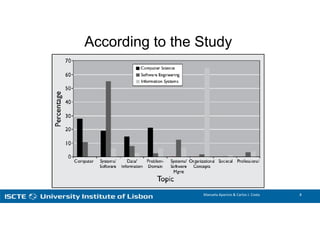
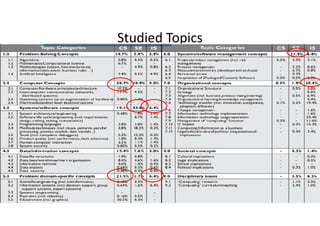
Study
Topic- addresses the subject matter of the research.
– Covered topics are:
– with problem solving,
– computers,
– systems/software,
– data/information,
– problem domain-specific,
– systems/software management, organizations,
– society, as well as disciplinary issues.
Manuela Aparicio & Carlos J. Costa 6
According to Euraxess
Manuela Aparicio & Carlos J. Costa 7
Source: Euraxess http://ec.europa.eu/euraxess/index.cfm
According to the Study
Manuela Aparicio & Carlos J. Costa 8
Studied Topics
Manuela Aparicio & Carlos J. Costa 9
• Research Approaches
Descriptive, Evaluative, Formulative
Manuela Aparicio & Carlos J. Costa 10
Manuela Aparicio & Carlos J. Costa 11
Used Methods
Research method addresses the specific methods used:
– Conceptual analysis,
– Case study,
– Data analysis,
– Field experiment,
– Laboratory experiment,
– Simulation
Manuela Aparicio & Carlos J. Costa 12
Used Method
Manuela Aparicio & Carlos J. Costa 13
Manuela Aparicio & Carlos J. Costa 14
Used Disciplines as Reference
Manuela Aparicio & Carlos J. Costa 15
Analysis Level/Context
Manuela Aparicio & Carlos J. Costa 16
Conclusions
CS/ Computer Science:
•Topics related to computer concepts at technical levels of
analysis
• Formulating processes/methods/algorithms largely using
mathematically based conceptual analysis;
•Does not rely on reference disciplines.
Manuela Aparicio & Carlos J. Costa 17
Conclusions
SE/ Systems Engineering:
• Topics related to systems/software concepts at technical levels
of analysis
• Formulating processes/methods/algorithms
• Using non-mathematically-based conceptual analysis;
• Does not rely on reference disciplines.
Manuela Aparicio & Carlos J. Costa 18
Conclusions
IS/ Information Systems:
• Topics related to:
• organizational concepts,
• usage/operation and technology transfer
• systems/software topics, all primarily at a behavioural level of analysis
• It uses evaluative research approaches:
– field studies, laboratory experiments, case studies,
• Relies on a variety of reference disciplines, some of which are located in
schools of business.
Manuela Aparicio & Carlos J. Costa 19
Conclusions
• Researchers in CS, and SE, primarily expect to produce new things:
processes, methods, algorithms, products.
• IS researchers expect to explore things theories, concepts, techniques,
projects.
• Terminology differs, sometimes in important ways, ie: “implementation”
tends to mean “write code based on the design” in CS and SE, but in IS it
also includes data conversion and changeover to usage of the new
software.
• Further, in IS today, it may also refer to the deployment of packaged
software.
Manuela Aparicio & Carlos J. Costa 20
Manuela Aparicio & Carlos J. Costa 21

Analysis computerscience disciplines

  • 1.
    Since 2009 to2014 An Analysis of Research in Computing Disciplines
  • 2.
    Article Review An Analysisof Research in Computing Disciplines by Glass, R. , Ramesh, V. & Vessey, I. (2004) Manuela Aparicio & Carlos J. Costa 2
  • 3.
    Summary 1) Computing subdivisions 2)Topicsstudied by Computing 3)Research Approaches 4)Used Methods 5)Used Disciplines 6)Context Level 7)Conclusions Manuela Aparicio & Carlos J. Costa 3
  • 4.
    Computing Field Subdivisions •Computer Science (CS), • Software Engineering (SE), • Information Systems (IS). Manuela Aparicio & Carlos J. Costa 4
  • 5.
    Computing Field Subdivisions •“Just what are the differences among these fields?” • “CS people are the ones who write the software that MIS people implement and use.” • “Most CS people laugh at MIS people,” • “MIS people make more money and manage the CS folks.” Manuela Aparicio & Carlos J. Costa 5
  • 6.
    Study Topic- addresses thesubject matter of the research. – Covered topics are: – with problem solving, – computers, – systems/software, – data/information, – problem domain-specific, – systems/software management, organizations, – society, as well as disciplinary issues. Manuela Aparicio & Carlos J. Costa 6
  • 7.
    According to Euraxess ManuelaAparicio & Carlos J. Costa 7 Source: Euraxess http://ec.europa.eu/euraxess/index.cfm
  • 8.
    According to theStudy Manuela Aparicio & Carlos J. Costa 8
  • 9.
  • 10.
    • Research Approaches Descriptive,Evaluative, Formulative Manuela Aparicio & Carlos J. Costa 10
  • 11.
    Manuela Aparicio &Carlos J. Costa 11
  • 12.
    Used Methods Research methodaddresses the specific methods used: – Conceptual analysis, – Case study, – Data analysis, – Field experiment, – Laboratory experiment, – Simulation Manuela Aparicio & Carlos J. Costa 12
  • 13.
    Used Method Manuela Aparicio& Carlos J. Costa 13
  • 14.
    Manuela Aparicio &Carlos J. Costa 14
  • 15.
    Used Disciplines asReference Manuela Aparicio & Carlos J. Costa 15
  • 16.
  • 17.
    Conclusions CS/ Computer Science: •Topicsrelated to computer concepts at technical levels of analysis • Formulating processes/methods/algorithms largely using mathematically based conceptual analysis; •Does not rely on reference disciplines. Manuela Aparicio & Carlos J. Costa 17
  • 18.
    Conclusions SE/ Systems Engineering: •Topics related to systems/software concepts at technical levels of analysis • Formulating processes/methods/algorithms • Using non-mathematically-based conceptual analysis; • Does not rely on reference disciplines. Manuela Aparicio & Carlos J. Costa 18
  • 19.
    Conclusions IS/ Information Systems: •Topics related to: • organizational concepts, • usage/operation and technology transfer • systems/software topics, all primarily at a behavioural level of analysis • It uses evaluative research approaches: – field studies, laboratory experiments, case studies, • Relies on a variety of reference disciplines, some of which are located in schools of business. Manuela Aparicio & Carlos J. Costa 19
  • 20.
    Conclusions • Researchers inCS, and SE, primarily expect to produce new things: processes, methods, algorithms, products. • IS researchers expect to explore things theories, concepts, techniques, projects. • Terminology differs, sometimes in important ways, ie: “implementation” tends to mean “write code based on the design” in CS and SE, but in IS it also includes data conversion and changeover to usage of the new software. • Further, in IS today, it may also refer to the deployment of packaged software. Manuela Aparicio & Carlos J. Costa 20
  • 21.
    Manuela Aparicio &Carlos J. Costa 21