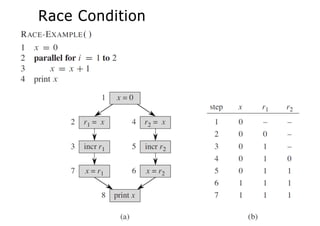
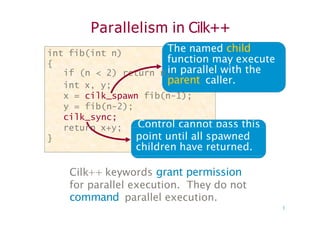
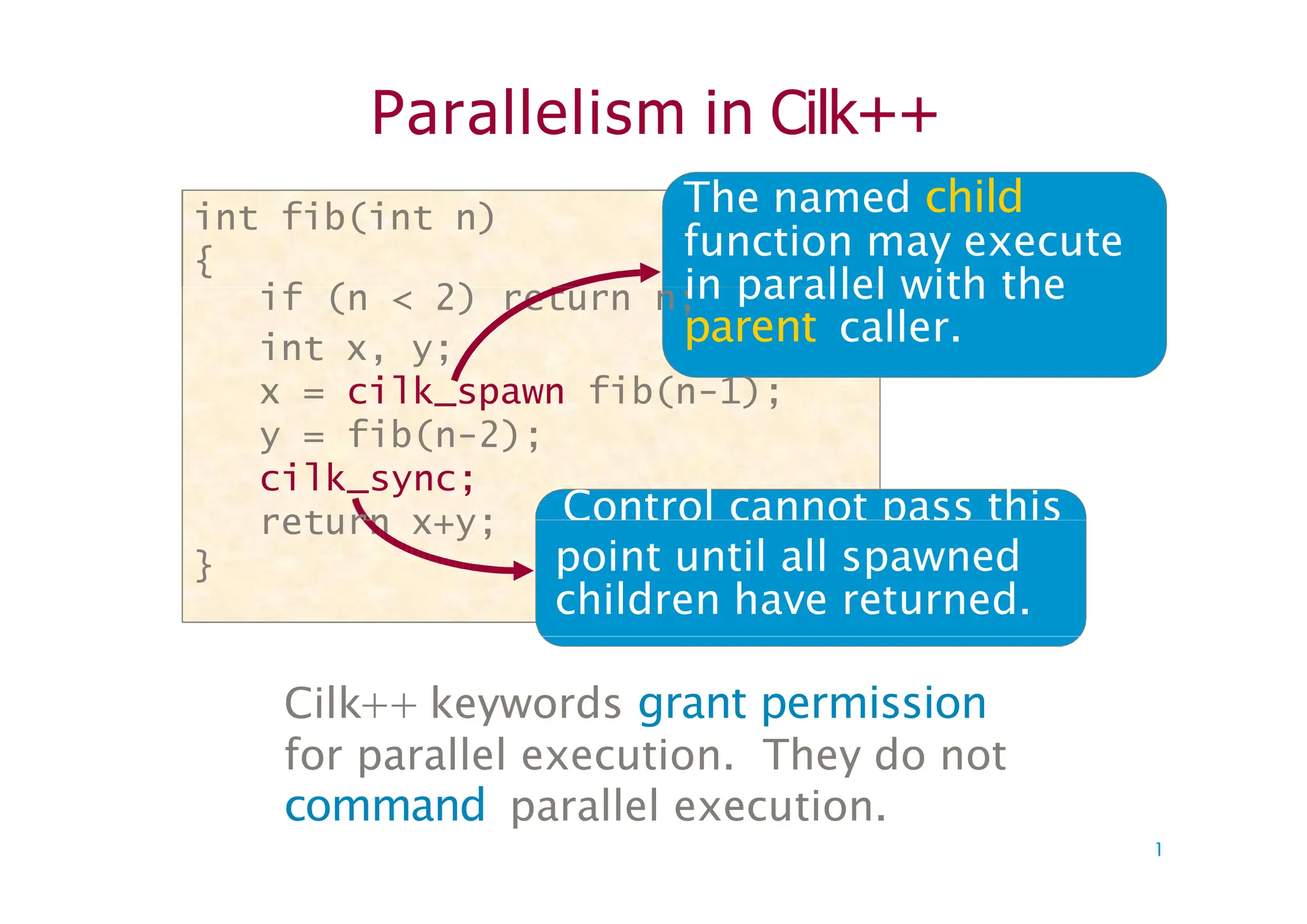
Parallelism in Cilk++
intfib(int n)
{
int fib(int n)
{
The named child
function may execute
if (n < 2) return n;
int x, y;
x = cilk spawn fib(n-1);
int x, y;
if (n < 2) return n;
in parallel with the
parent caller.
x = cilk_spawn fib(n-1);
y = fib(n-2);
Control cannot pass this
cilk_sync;
return x+y;
} point until all spawned
children have returned.
Cilk++ keywords grant permission
for parallel execution. They do not
command parallel execution.
1
2.
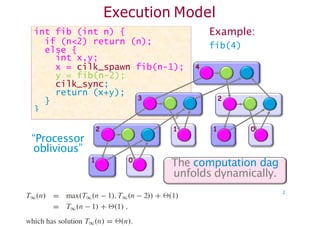
Execution Model
Example:
fib(4)
4
int fib(int n) {
if (n<2) return (n);
else {
int x,y;
x = cilk_spawn fib(n-1);
y = fib(n-2);
cilk_sync;
return (x+y);
}
}
3 2
2 1 1 0
The computation dag
“Processor
oblivious”
1 0
unfolds dynamically.
2
3.
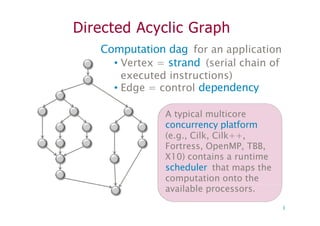
Directed Acyclic Graph
Computationdag for an application
• Vertex = strand (serial chain of
executed instructions)
• Edge = control dependency
A typical multicore
concurrency platform
(e.g., Cilk, Cilk++,
Fortress, OpenMP, TBB,
X10) contains a runtime
scheduler that maps the
computation onto the
available processors.
3
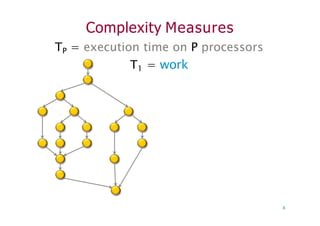
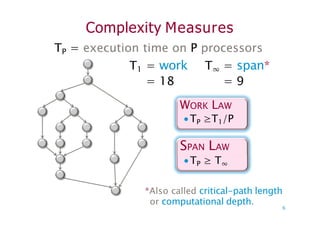
Complexity Measures
TP =execution time on P processors
T1 = work T∞ = span*
*Also called critical-path length
or computational depth.
5
6.
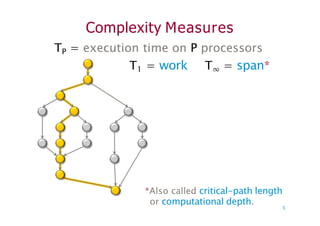
Complexity Measures
TP =execution time on P processors
T1 = work T∞ = span*
= 18 = 9
WORK LAW
∙TP ≥T1/P
SPAN LAW
∙TP ≥ T∞
*Also called critical-path length
or computational depth.
6
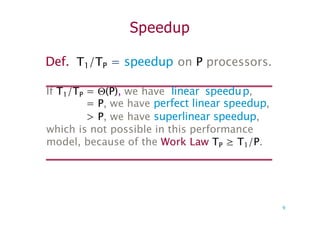
Speedup
Def. T1/TP =speedup on P processors.
If T1/TP = (P), we have linear speedup,
= P, we have perfect linear speedup,
> P, we have superlinear speedup,
which is not possible in this performance
model, because of the Work Law TP ≥ T1/P.
9
10.
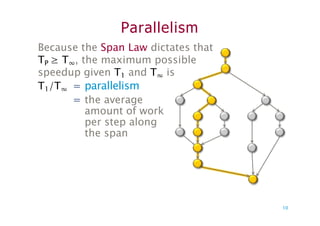
Parallelism
Because the SpanLaw dictates that
TP ≥ T∞, the maximum possible
speedup given T1 and T∞ is
T1/T∞ = parallelism
= the average
amount of work
per step along
the span
10
11.
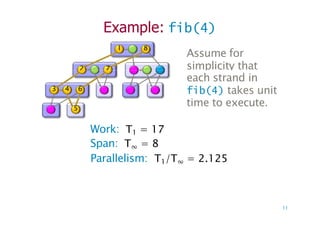
Example: fib(4)
Assume for
simplicitythat
2 7
1 8
3 4 6
each strand in
fib(4) takes unit
time to execute.
5
Work: T1 = 17
Span: T∞ = 8
Parallelism: T1/T∞ = 2.125
11
12.
Loop Parallelism inCilk++
Example:
In-place
a11 a12 ⋯ a1n a11 a21 ⋯ an1
a a ⋯ a a a ⋯ a
matrix
transpose
⋮ ⋮ ⋱ ⋮
an1 an2 ⋯ ann
A
⋮ ⋮ ⋱ ⋮
a1n a2n ⋯ ann
AT
The iterations
of a cilk_for
loop execute
in parallel.
// indices run from 0, not 1
cilk_for (int i=1; i<n; ++i) {
for (int j=0; j<i; ++j) {
double temp = A[i][j];
A[i][j] = A[j][i];
A[j][i] = temp;
}
}
12
13.
Implemention of ParallelLoops
Divide-and-conquer
implementation
cilk_for (int i=1; i<n; ++i) {
for (int j=0; j<i; ++j) {
double temp = A[i][j];
A[i][j] = A[j][i];
A[j][i] = temp;
}
}
void recur(int lo, int hi) {
if (hi > lo) {
int mid = lo + (hi - lo) / 2;
cilk_spawn recur(lo, mid);
recur(mid, hi);
cilk sync;
In practice,
the recursion
is coarsened
to minimize
overheads.
void recur(int lo, int hi) {
if (hi > lo) {
int mid = lo + (hi - lo) / 2;
cilk_spawn recur(lo, mid);
recur(mid, hi);
cilk_sync;
} else
for (int j=0; j<i; ++j) {
double temp = A[i][j];
A[j][i] = temp;
}
}
}
recur(1, n–1);
13
14.
Analysis of ParallelLoops
cilk_for (int i=1; i<n; ++i) {
for (int j=0; j<i; ++j) {
double temp = A[i][j];
A[i][j] = A[j][i];
A[j][i] = temp;
}
}
Span of loop control
= Θ(lg n) .
Max span of body
= Θ(n) .
1 2 3 4 5 6 7 8
Work: T1(n) = Θ(n2)
Span: T∞(n) = Θ(n + lg n) = Θ(n)
Parallelism: T1(n)/T∞(n) = Θ(n)
14
15.
Analysis of NestedLoops
cilk_for (int j=0; j<i; ++j) {
}
} Span of body = Θ(1) .
cilk_for (int i=1; i<n; ++i) { Span of outer loop
double temp = A[i][j];
A[i][j] = A[j][i];
A[j][i] = temp;
control = Θ(lg n) .
Max span of inner loop
control = Θ(lg n) .
Work: T1(n) = Θ(n2)
Span: T∞(n) = Θ(lg n)
Parallelism: T1(n)/T∞(n) = Θ(n2/lg n)
15
16.
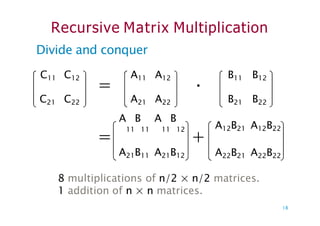
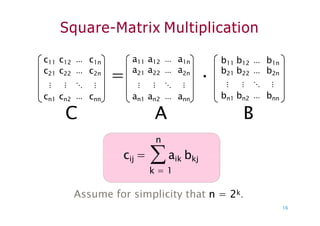
Square-Matrix Multiplication
a11 a12⋯ a1n
21 22 ⋯
a a a
⋮ ⋮ ⋱ ⋮
=
c11 c12 ⋯ c1n
c21 c22 ⋯ c2n
⋮ ⋮ ⋱ ⋮
cn1 cn2 ⋯ cnn an1 an2 ⋯ ann
b11 b12 ⋯ b1n
2n
· b21 b22 ⋯ b2n
⋮ ⋮ ⋱ ⋮
bn1 bn2 ⋯ bnn
C B
n
A
cij = aik bkj
k = 1
16
Assume for simplicity that n = 2k.
![Loop Parallelism in Cilk++
Example:
In-place
a11 a12 ⋯ a1n a11 a21 ⋯ an1
a a ⋯ a a a ⋯ a
matrix
transpose
⋮ ⋮ ⋱ ⋮
an1 an2 ⋯ ann
A
⋮ ⋮ ⋱ ⋮
a1n a2n ⋯ ann
AT
The iterations
of a cilk_for
loop execute
in parallel.
// indices run from 0, not 1
cilk_for (int i=1; i<n; ++i) {
for (int j=0; j<i; ++j) {
double temp = A[i][j];
A[i][j] = A[j][i];
A[j][i] = temp;
}
}
12](https://image.slidesharecdn.com/analysisandmatrixmultiplication-250715060129-4100dfc0/85/Analysis-and-Matrix-Multiplication-using-Parallel-12-320.jpg)
![Implemention of Parallel Loops
Divide-and-conquer
implementation
cilk_for (int i=1; i<n; ++i) {
for (int j=0; j<i; ++j) {
double temp = A[i][j];
A[i][j] = A[j][i];
A[j][i] = temp;
}
}
void recur(int lo, int hi) {
if (hi > lo) {
int mid = lo + (hi - lo) / 2;
cilk_spawn recur(lo, mid);
recur(mid, hi);
cilk sync;
In practice,
the recursion
is coarsened
to minimize
overheads.
void recur(int lo, int hi) {
if (hi > lo) {
int mid = lo + (hi - lo) / 2;
cilk_spawn recur(lo, mid);
recur(mid, hi);
cilk_sync;
} else
for (int j=0; j<i; ++j) {
double temp = A[i][j];
A[j][i] = temp;
}
}
}
recur(1, n–1);
13](https://image.slidesharecdn.com/analysisandmatrixmultiplication-250715060129-4100dfc0/85/Analysis-and-Matrix-Multiplication-using-Parallel-13-320.jpg)
![Analysis of Parallel Loops
cilk_for (int i=1; i<n; ++i) {
for (int j=0; j<i; ++j) {
double temp = A[i][j];
A[i][j] = A[j][i];
A[j][i] = temp;
}
}
Span of loop control
= Θ(lg n) .
Max span of body
= Θ(n) .
1 2 3 4 5 6 7 8
Work: T1(n) = Θ(n2)
Span: T∞(n) = Θ(n + lg n) = Θ(n)
Parallelism: T1(n)/T∞(n) = Θ(n)
14](https://image.slidesharecdn.com/analysisandmatrixmultiplication-250715060129-4100dfc0/85/Analysis-and-Matrix-Multiplication-using-Parallel-14-320.jpg)
![Analysis of Nested Loops
cilk_for (int j=0; j<i; ++j) {
}
} Span of body = Θ(1) .
cilk_for (int i=1; i<n; ++i) { Span of outer loop
double temp = A[i][j];
A[i][j] = A[j][i];
A[j][i] = temp;
control = Θ(lg n) .
Max span of inner loop
control = Θ(lg n) .
Work: T1(n) = Θ(n2)
Span: T∞(n) = Θ(lg n)
Parallelism: T1(n)/T∞(n) = Θ(n2/lg n)
15](https://image.slidesharecdn.com/analysisandmatrixmultiplication-250715060129-4100dfc0/85/Analysis-and-Matrix-Multiplication-using-Parallel-15-320.jpg)
![Parallelizing Matrix Multiply
// index from 0, not 1
cilk_for (int i=0; i<n; ++i) {
cilk_for (int j=0; j<n; ++j) {
for (int k=0; k<n; ++k {
C[i][j] += A[i][k] * B[k][j];
}
}
Work: T1 = Θ(n3)
Span: T∞ = Θ(n)
Parallelism: T1/T∞ = Θ(n2)
For 1000 × 1000 matrices, parallelism ≈
(103)2 = 106.
17](https://image.slidesharecdn.com/analysisandmatrixmultiplication-250715060129-4100dfc0/85/Analysis-and-Matrix-Multiplication-using-Parallel-17-320.jpg)