Signal and System
Nouman Ali:
BSEE-01143151
Saif-Ur-Rehman:
BSEE-01143137
Submission
Date:21-02-16
Assighment # 01
Analogue Computers
History of Analogue Computers
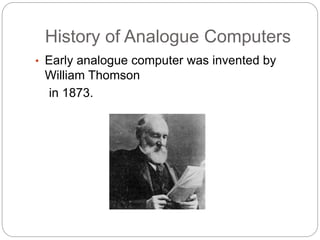
• Early analogue computer was invented by
William Thomson
in 1873.
History of Analogue Computers
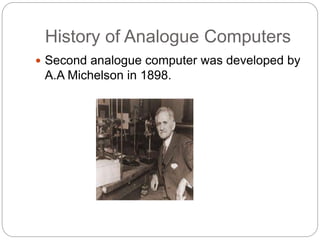
 Second analogue computer was developed by
A.A Michelson in 1898.
History of Analogue Computers
• They were used for gun fire control in World
war II and the Korean war.
• Before digital computers had developed
sufficiently , analogue computers were used in
science and industry.
Analogue
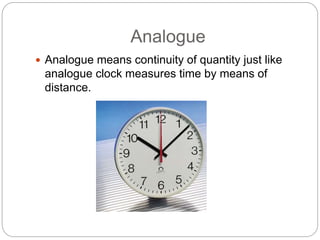
 Analogue means continuity of quantity just like
analogue clock measures time by means of
distance.
Analogue Computers
 Analogue computers are form of computers that
uses the continuously changeable aspects of
physical phenomenon such as Electrical ,
Mechanical quantities for problem is solving.
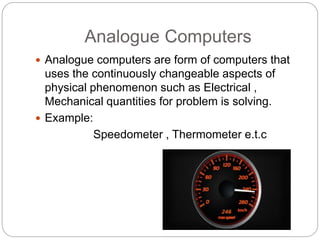
 Example:
Speedometer , Thermometer e.t.c
Working
 Most present-day electronic analog computers
operate by manipulating potential
difference(voltages).
 Their basic component is an operational amplifier,
a device whose output current is proportional to
its input potential difference.
Uses
 They are frequently used to control process
such as those found in oil refinery where flow
and temperature measurements are
important.
 They are used for example in paper making
and in chemical industry.
 Analog computers are the first computers
being developed and provided the basis for
the development of the modern digital
computers.
Disadvantages
• Digital computers can solve equations faster
than analogue computers.
• Readings for real time is difficult to record .
• Range of analogue computers is limited and
are difficult to deal with accurately.

Analogue computers

  • 1.
    Signal and System NoumanAli: BSEE-01143151 Saif-Ur-Rehman: BSEE-01143137 Submission Date:21-02-16
  • 2.
  • 3.
    History of AnalogueComputers • Early analogue computer was invented by William Thomson in 1873.
  • 4.
    History of AnalogueComputers  Second analogue computer was developed by A.A Michelson in 1898.
  • 5.
    History of AnalogueComputers • They were used for gun fire control in World war II and the Korean war. • Before digital computers had developed sufficiently , analogue computers were used in science and industry.
  • 6.
    Analogue  Analogue meanscontinuity of quantity just like analogue clock measures time by means of distance.
  • 7.
    Analogue Computers  Analoguecomputers are form of computers that uses the continuously changeable aspects of physical phenomenon such as Electrical , Mechanical quantities for problem is solving.  Example: Speedometer , Thermometer e.t.c
  • 8.
    Working  Most present-dayelectronic analog computers operate by manipulating potential difference(voltages).  Their basic component is an operational amplifier, a device whose output current is proportional to its input potential difference.
  • 9.
    Uses  They arefrequently used to control process such as those found in oil refinery where flow and temperature measurements are important.  They are used for example in paper making and in chemical industry.  Analog computers are the first computers being developed and provided the basis for the development of the modern digital computers.
  • 11.
    Disadvantages • Digital computerscan solve equations faster than analogue computers. • Readings for real time is difficult to record . • Range of analogue computers is limited and are difficult to deal with accurately.