An Overview to
Content
O Introduction
O Geographic of the port
O Features of the port
O Export & Import
O Safety measures
Introduction
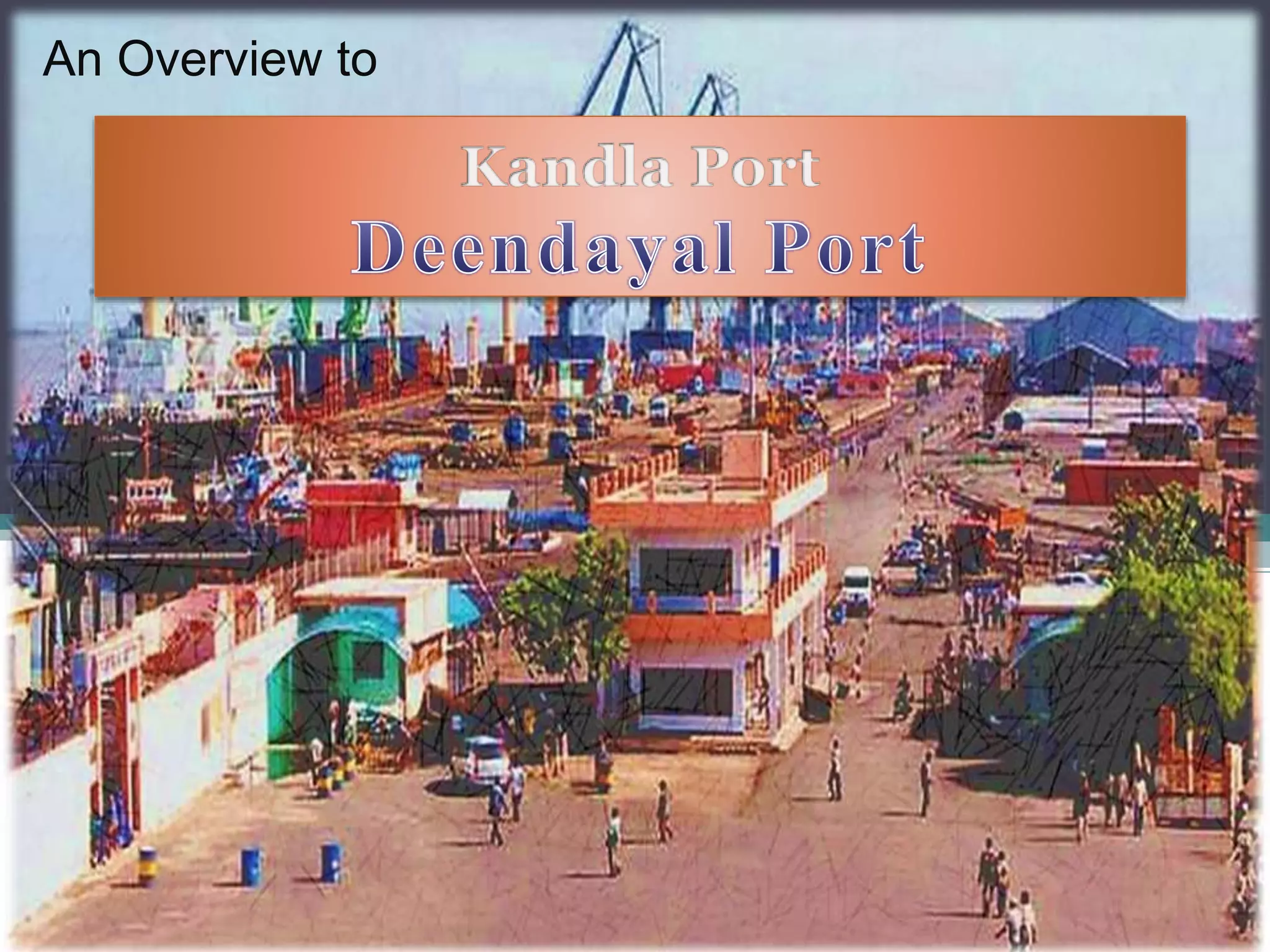
• Kandla Port (Gujarat), is a seaport in Kutch district of Gujarat
state in Western India.
• When the Port of Karachi was lost to India, maritime trade in
the area shifted to the Port of Mumbai which soon strained
beyond capacity. In early 1948, the Indian government created
the West Coast Major Port Development Committee which
recommended locating a port at Kandla.
• In 1952, Prime Minister Pandit Jawaharlal Nehru laid the
foundation stone for the new port. The Port of Kandla was
declared a major port in 1955. The Kandla Port Trust was
created by law in 1963 to manage the new port.
Geographic of the port
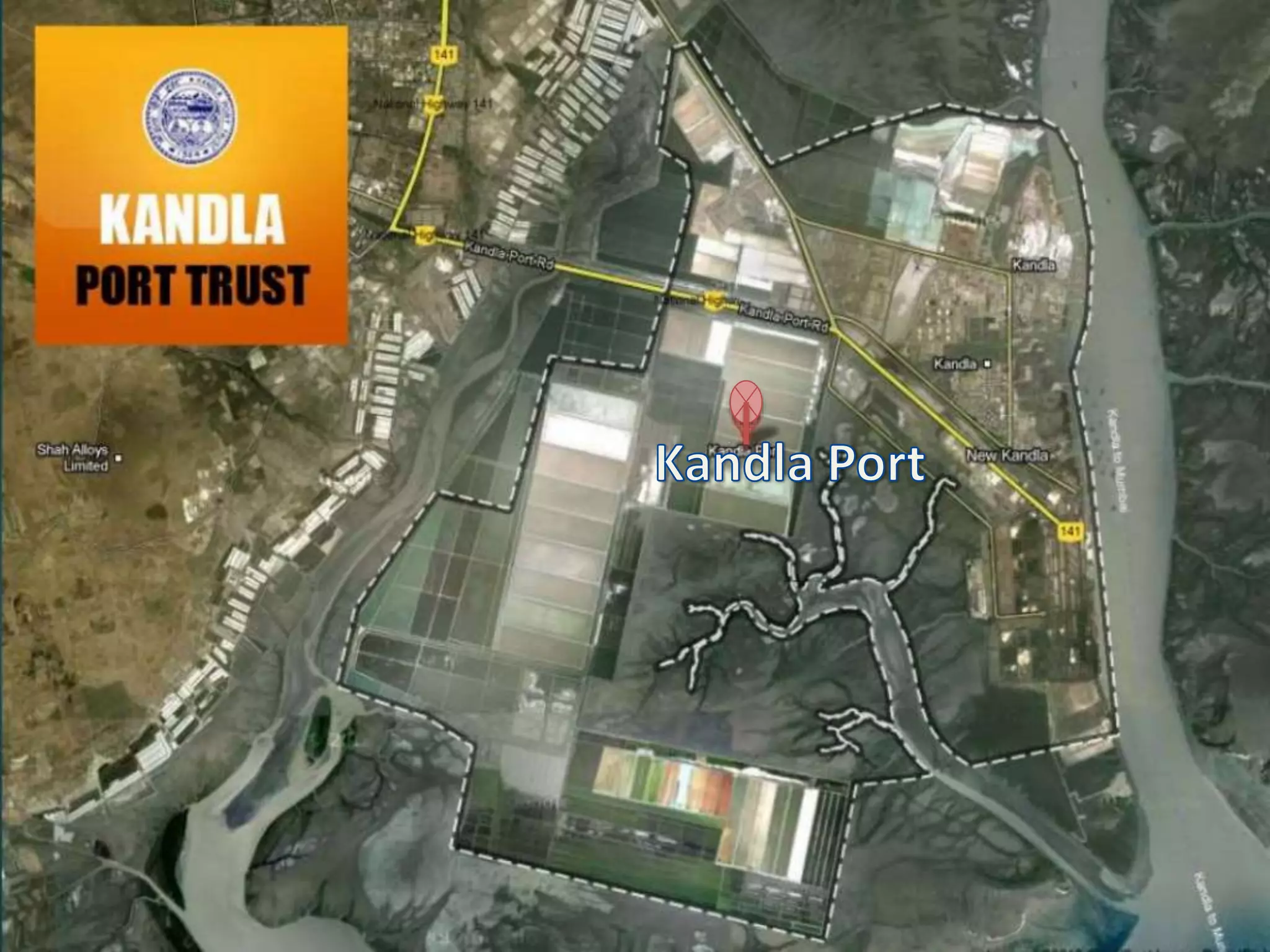
• The Port of Kandla is located on the Gulf of Kutch on the
north-western coast of India, some 256 nautical miles
southeast of the Port of Karachi in Pakistan and over 430
nautical miles north-northwest of the Port of
Mumbai(Bombay).
• Coordinates: Latitude : 23.03°N
Longitude : 70.22°E
The Port of Kandla Special Economic Zone (KASEZ) was the
first special economic zone to be established in India and in
Asia.
Features of Port
• One of the major ports on west coast linking India to major
parts of the world.
• The Port of Kandla Special Economic Zone (KASEZ) was the
first special economic zone to be established in India and in
Asia in 1965 covering 310 hectares.
• Today, the Port of Kandla is India's hub for exporting grains
and importing oil. This self-sufficient port is one of the
highest-earning ports in the country.
• Major imports entering the Port of Kandla are petroleum,
chemicals, and iron and steel machinery, but it also handles
salt, textiles, and grain.
Ultimate Goal : to make the Port of Kandla Asia's dominating
global logistics hub by making it the most economical modern
port in the region offering high-quality and cost-effective
services to its customers.
Objective : creating facilities that exceed international standards
and offer fast turn-around times for vessels, maintaining a well-
trained up-to-date workforce, protecting the environment, and
contributing to the society at large.
• Duration : 365 days open
• Protected from wind and weather by its head at Gulf of
Kachchh.
• Capacity : 24 thousand metric tons of dry cargo per day.
• Size of Ships handled : 240 meters in length.
• 22 lighted navigation buoys and a light house for navigation.
• Cargo berths : 12 dry, quay length of 2532 metres.
• Chemical and Liquid Handling Complex : 21.9 lakh
storage capacity.
• Liquefied petroleum gas : 30 thousand cubic metres.
Water Depth
Channel: 11 - 15 feet 3.4 -
4.6 meters
Cargo Pier: 26 - 30 feet 7.1 -
9.1 meters
Mean Tide: 5 feet
Anchorage: 31 - 35 feet 9.4 -
10 meters
Oil Terminal: 31 - 35 feet 9.4 -
10 meters
Harbour Characteristics
Harbour Size: Small
Shelter: Good
Maximum
Vessel Size:
Over 500 feet in
length
Harbour Type: River Natural
Types of berths Length
(in meters )
Cargo Jetty 178.3
Oil Jetty 91.40
Oil Jetty
(Sensitive liquid)
84.50
Oil Jetty (General
Liquid)
91.40
• Length of quay : 545 meters
• Cranes : 4 rail-mounted quay cranes
2 harbour mobile cranes.
The container facilities include an almost 11-hectare container
yard, a 6.5 thousand square meter container freight station.
The Port of Kandla is connected to its hinterland by the four-lane
national highway, and it is served by a fully-developed network
of roads within and around the port to facilitate cargo-handling.
It is also linked to the nation's rail network, and the Port of
Kandla is about 17 kilometres from the Kandla Airport.
Export & Import
Kandla mainly imports and exports the products from the states
such as :
 Jammu and Kashmir
 Punjab
 Himachal Pradesh
 Rajasthan
 Haryana
 Gujarat
• 25% of Indian economy depends on export import from other
nations. Of this, 19% of the total export import done through
Kandla port.
• 70% of cargos and 75% of crude oil welcomed by this port.
• 55 types different chemical are stored and processed at the
port.
• India’s 12 states are depend on the Kandla port and they
export and import by this port only and Kandla port is
permitted by 12 states International Permit craft of India.
• The port handled 2.22 lakh tonnes of fertilisers (15 vessels)
and 4.73 lakh tonnes of food (10 vessels).
• The timbers are supplied only by Kandla port in India.
Safety Measures
• Kandla Port is having international security for protection.
• They have 500 “SAINIK” unit.
• Air defense regiment, life defense regiment and court guard.
• They also do satellite monitoring.
• There are now planning a new system known as “PECULAR
MANAGEMENT TRAFFIC SYSTEM” from next year.
Kandla ports has been awarded “Management
Efficiency “ISO-9001-2001 Award by the
INTERNATIONAL STANDARD ORGANISATION.
Thanking You.
Prepared by
MEET SHAH (IU1541040041)

An overview to Kandla port

  • 1.
  • 2.
    Content O Introduction O Geographicof the port O Features of the port O Export & Import O Safety measures
  • 3.
    Introduction • Kandla Port(Gujarat), is a seaport in Kutch district of Gujarat state in Western India. • When the Port of Karachi was lost to India, maritime trade in the area shifted to the Port of Mumbai which soon strained beyond capacity. In early 1948, the Indian government created the West Coast Major Port Development Committee which recommended locating a port at Kandla. • In 1952, Prime Minister Pandit Jawaharlal Nehru laid the foundation stone for the new port. The Port of Kandla was declared a major port in 1955. The Kandla Port Trust was created by law in 1963 to manage the new port.
  • 4.
    Geographic of theport • The Port of Kandla is located on the Gulf of Kutch on the north-western coast of India, some 256 nautical miles southeast of the Port of Karachi in Pakistan and over 430 nautical miles north-northwest of the Port of Mumbai(Bombay). • Coordinates: Latitude : 23.03°N Longitude : 70.22°E The Port of Kandla Special Economic Zone (KASEZ) was the first special economic zone to be established in India and in Asia.
  • 6.
    Features of Port •One of the major ports on west coast linking India to major parts of the world. • The Port of Kandla Special Economic Zone (KASEZ) was the first special economic zone to be established in India and in Asia in 1965 covering 310 hectares. • Today, the Port of Kandla is India's hub for exporting grains and importing oil. This self-sufficient port is one of the highest-earning ports in the country. • Major imports entering the Port of Kandla are petroleum, chemicals, and iron and steel machinery, but it also handles salt, textiles, and grain.
  • 7.
    Ultimate Goal :to make the Port of Kandla Asia's dominating global logistics hub by making it the most economical modern port in the region offering high-quality and cost-effective services to its customers. Objective : creating facilities that exceed international standards and offer fast turn-around times for vessels, maintaining a well- trained up-to-date workforce, protecting the environment, and contributing to the society at large.
  • 8.
    • Duration :365 days open • Protected from wind and weather by its head at Gulf of Kachchh. • Capacity : 24 thousand metric tons of dry cargo per day. • Size of Ships handled : 240 meters in length. • 22 lighted navigation buoys and a light house for navigation. • Cargo berths : 12 dry, quay length of 2532 metres. • Chemical and Liquid Handling Complex : 21.9 lakh storage capacity. • Liquefied petroleum gas : 30 thousand cubic metres.
  • 10.
    Water Depth Channel: 11- 15 feet 3.4 - 4.6 meters Cargo Pier: 26 - 30 feet 7.1 - 9.1 meters Mean Tide: 5 feet Anchorage: 31 - 35 feet 9.4 - 10 meters Oil Terminal: 31 - 35 feet 9.4 - 10 meters Harbour Characteristics Harbour Size: Small Shelter: Good Maximum Vessel Size: Over 500 feet in length Harbour Type: River Natural Types of berths Length (in meters ) Cargo Jetty 178.3 Oil Jetty 91.40 Oil Jetty (Sensitive liquid) 84.50 Oil Jetty (General Liquid) 91.40
  • 11.
    • Length ofquay : 545 meters • Cranes : 4 rail-mounted quay cranes 2 harbour mobile cranes. The container facilities include an almost 11-hectare container yard, a 6.5 thousand square meter container freight station. The Port of Kandla is connected to its hinterland by the four-lane national highway, and it is served by a fully-developed network of roads within and around the port to facilitate cargo-handling. It is also linked to the nation's rail network, and the Port of Kandla is about 17 kilometres from the Kandla Airport.
  • 12.
    Export & Import Kandlamainly imports and exports the products from the states such as :  Jammu and Kashmir  Punjab  Himachal Pradesh  Rajasthan  Haryana  Gujarat
  • 13.
    • 25% ofIndian economy depends on export import from other nations. Of this, 19% of the total export import done through Kandla port. • 70% of cargos and 75% of crude oil welcomed by this port. • 55 types different chemical are stored and processed at the port. • India’s 12 states are depend on the Kandla port and they export and import by this port only and Kandla port is permitted by 12 states International Permit craft of India. • The port handled 2.22 lakh tonnes of fertilisers (15 vessels) and 4.73 lakh tonnes of food (10 vessels). • The timbers are supplied only by Kandla port in India.
  • 14.
    Safety Measures • KandlaPort is having international security for protection. • They have 500 “SAINIK” unit. • Air defense regiment, life defense regiment and court guard. • They also do satellite monitoring. • There are now planning a new system known as “PECULAR MANAGEMENT TRAFFIC SYSTEM” from next year. Kandla ports has been awarded “Management Efficiency “ISO-9001-2001 Award by the INTERNATIONAL STANDARD ORGANISATION.
  • 15.
    Thanking You. Prepared by MEETSHAH (IU1541040041)