An Introduction to
Critical Thinking
Presented by:
Mike Henderson
Business Performance Consultant
mrhenderson1105@gmail.com
1
“From the dawn of time until the dawn of the modern era
people had had to think. They had had to use their
intellect in order to discover and then practice the better
ways – because being wrong came with the potential for
dire consequences (disease, hunger, poverty, death).
For millions and millions born in America after the second
world war, with these consequences all but eliminated,
thinking became a relic, their mind nearly as unneeded
and unused as their appendix.”
- Evan Sayet
2
Learning Objectives:
1. Develop a basic understanding of Critical
Thinking and its use.
2. Develop a basic appreciation for a Total Life
System.
3. Raise awareness to Contradictions in our lives
and the world around us.
3
Critical Thinking Defined:
Critical thinking is a discipline for the
objective analysis of information as a
guide to judgment and action.
4
When to Use Critical Thinking:
• Life events with positive or negative consequences
• Performance issues (Work, Family, Non-work life,
Athletics, etc.)
• Solving difficult problems
• Civics, politics, societal issues
• Relationship issues
• Creating positive culture
• Creating and re-creating other aspects of our lives
5
Critical Thinkers are actively engaged in life:
• Observing consequences of behaviors and actions
• Recognizing underlying worldviews,
preconceptions, and errors in reasoning
• Seeing issues in larger and different contexts
• Bringing clarity to their underlying personal
assumptions and core values
• Evaluating apparent contradictions
• Learning and taking action
6
Worldview:
7
• All worldviews answer the three fundamental questions: “Where did
we come from and who are we? What has gone wrong with the
world? How can we fix it?
• By the nature of the three questions, all worldviews are
philosophical.
• A person’s worldview is intensely practical. It’s the sum total of their
beliefs about the world and reality. It directs daily decisions and
actions. It guides experience and learning.
• Worldviews are held individually and corporately.
• In terms of life, liberty, health, prosperity, success, (etc.), worldviews
are not equal. How could they be? Ideas have consequences.
• When worldviews collide with reality in painful ways, they need to be
critiqued.
Contradictions:
8
• A situation in which inherent factors, actions,
or propositions are inconsistent or contrary to
one another.
• Both parts of a contradiction cannot possibly
be true. Contradictions don’t exist in reality.
• Some can be resolved or explained by
examining larger contexts, underlying
intentions, or underlying assumptions.
“The significant problems we face cannot
be solved at the same level of thinking we
were at when we created them.”
- Albert Einstein
9
10
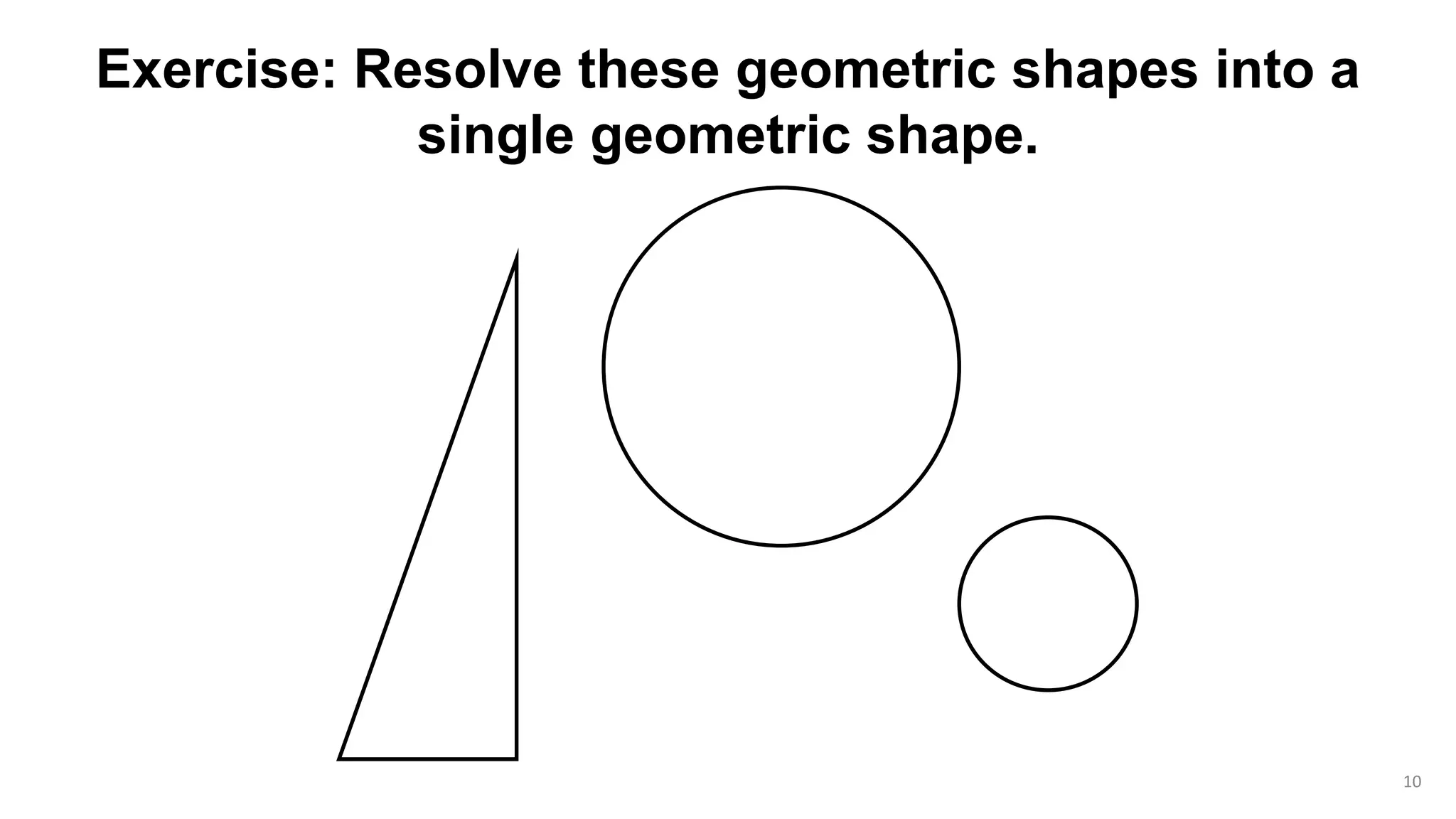
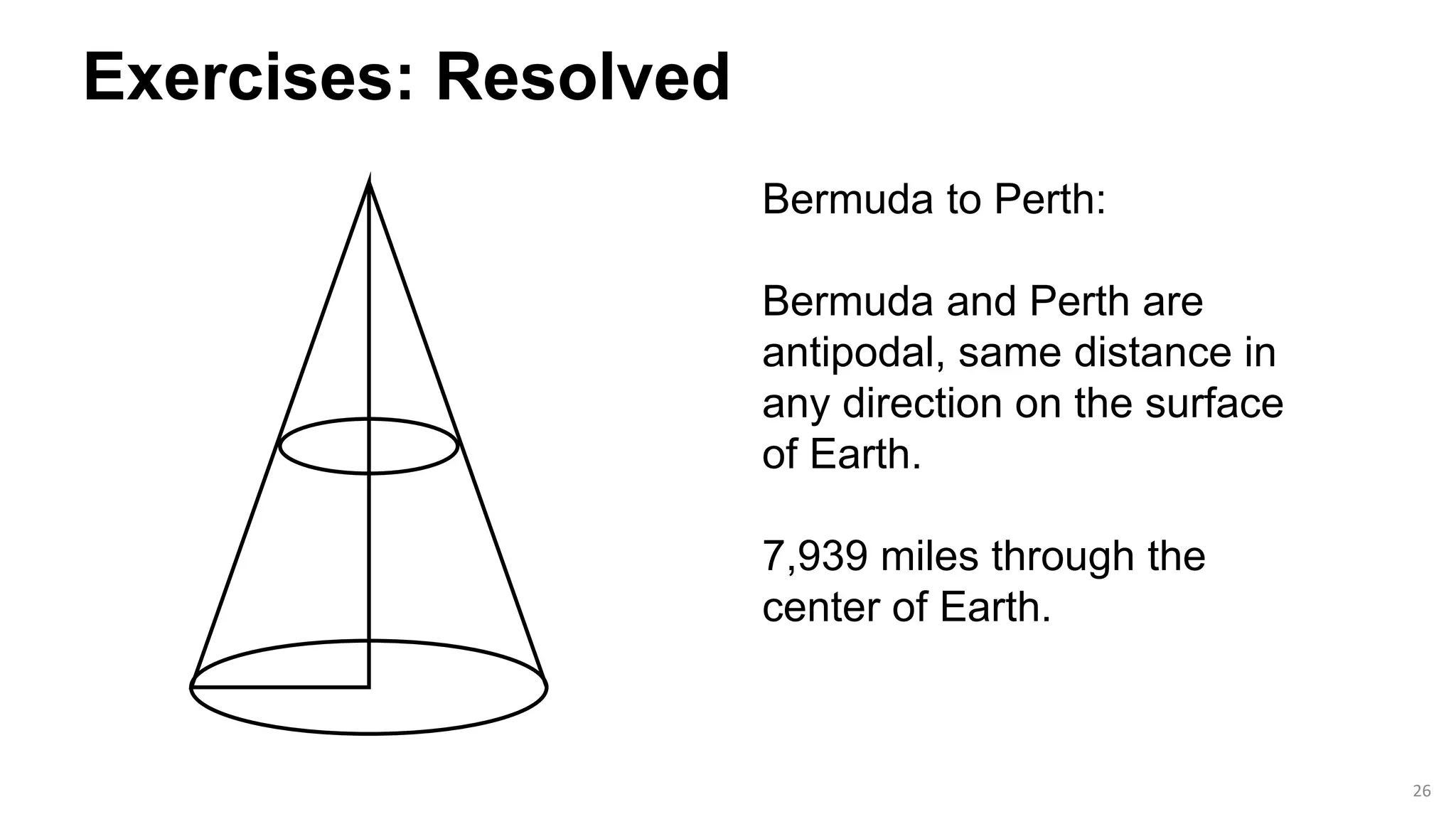
Exercise: Resolve these geometric shapes into a
single geometric shape.
11
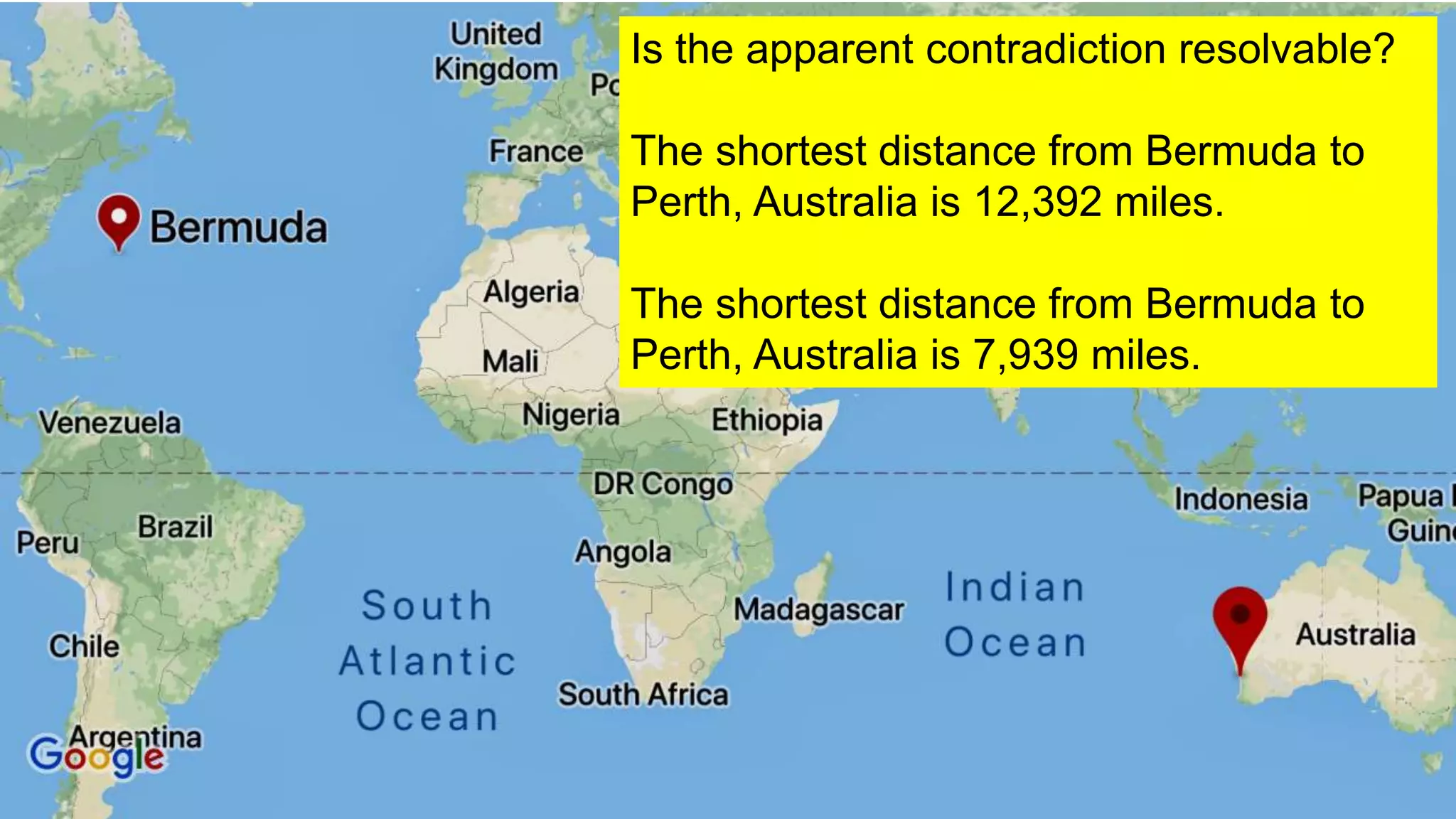
Is the apparent contradiction resolvable?
The shortest distance from Bermuda to
Perth, Australia is 12,392 miles.
The shortest distance from Bermuda to
Perth, Australia is 7,939 miles.
Initial Information is often Superficial:
These two exercises are good examples of how
we first see information. Initial information is most
often presented or interpreted superficially. In the
cases of these two exercises, two dimensionally.
In fact, the resolution of the apparent
contradictions requires a three dimensional
context.
We have to think deeper.
12
“People are people and thus a mass of
contradictions. They are in possession of
limited information, personality quirks,
and other flesh and blood realities that
make an individual an individual.”
- Evan Sayet
13
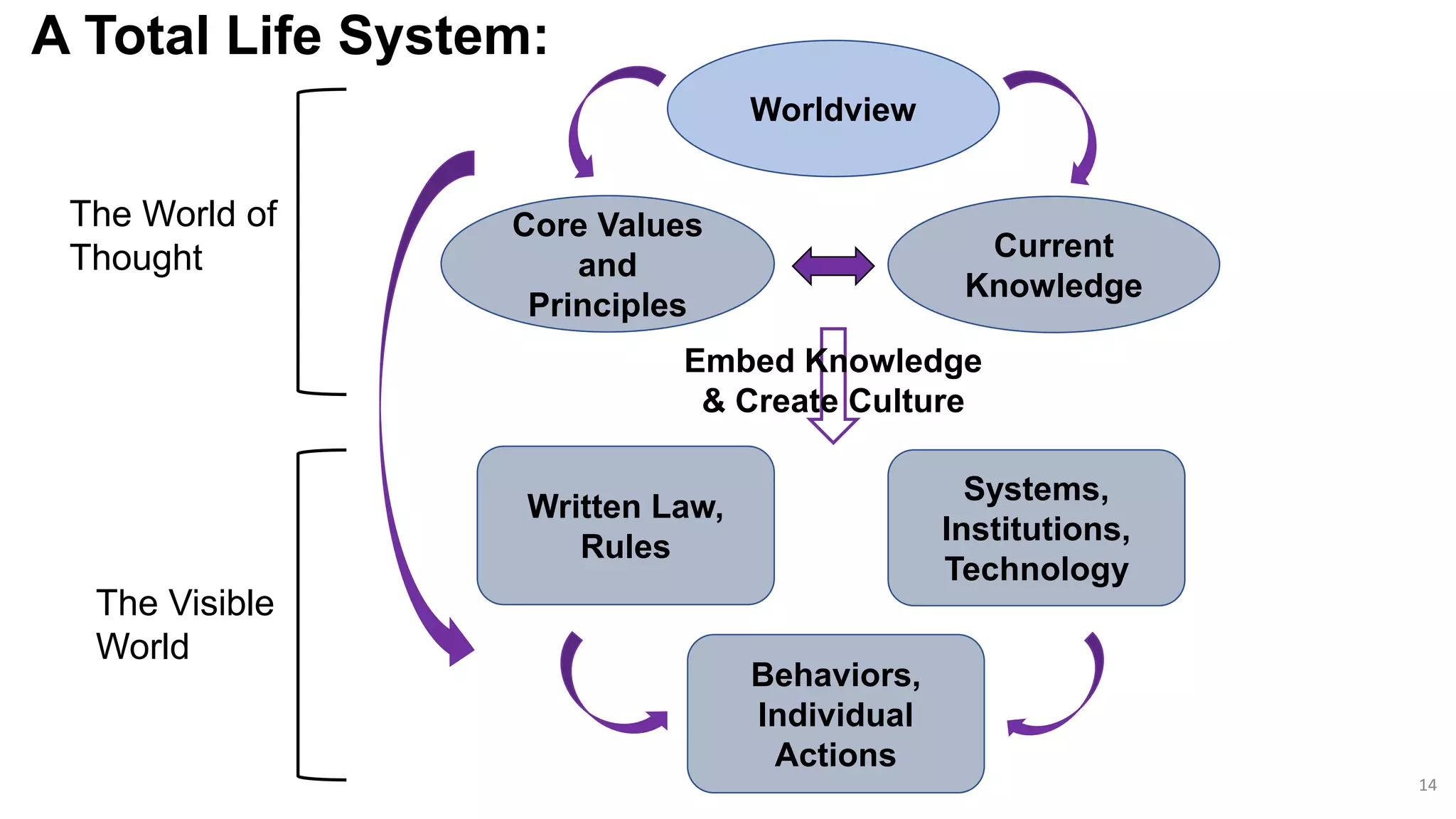
A Total Life System:
14
Written Law,
Rules
Systems,
Institutions,
Technology
The Visible
World
Embed Knowledge
& Create Culture
Worldview
Current
Knowledge
Core Values
and
Principles
The World of
Thought
Behaviors,
Individual
Actions
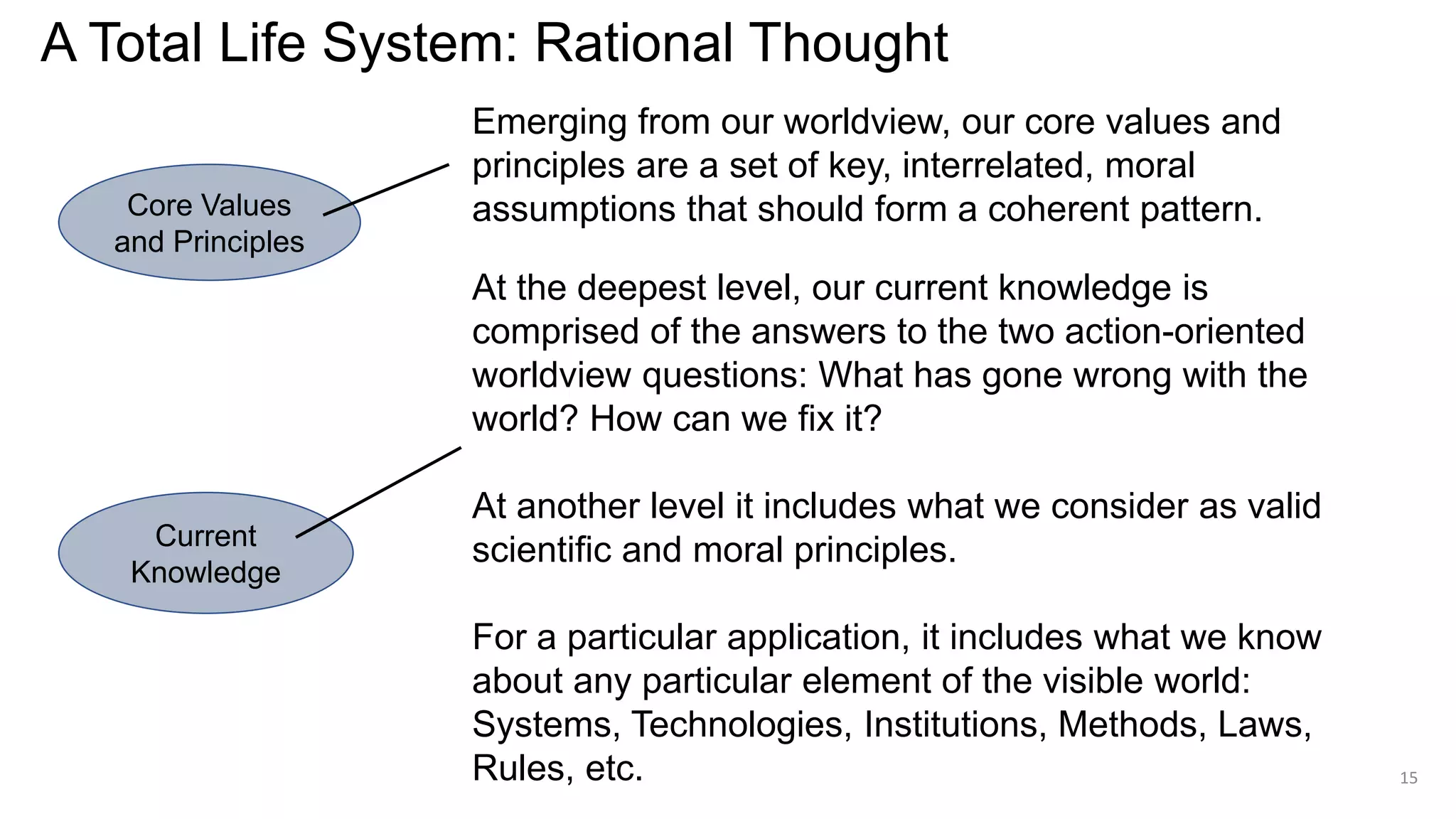
A Total Life System: Rational Thought
15
Current
Knowledge
Core Values
and Principles
At the deepest level, our current knowledge is
comprised of the answers to the two action-oriented
worldview questions: What has gone wrong with the
world? How can we fix it?
At another level it includes what we consider as valid
scientific and moral principles.
For a particular application, it includes what we know
about any particular element of the visible world:
Systems, Technologies, Institutions, Methods, Laws,
Rules, etc.
Emerging from our worldview, our core values and
principles are a set of key, interrelated, moral
assumptions that should form a coherent pattern.
Is it possible to embed error into the culture?
Yes. The lesser can be valued over the better.
The lesser can be embedded into culture.
In terms of life, liberty, health, prosperity, success,
(etc.), worldviews are not equal. How could they
be? Ideas have consequences.
16
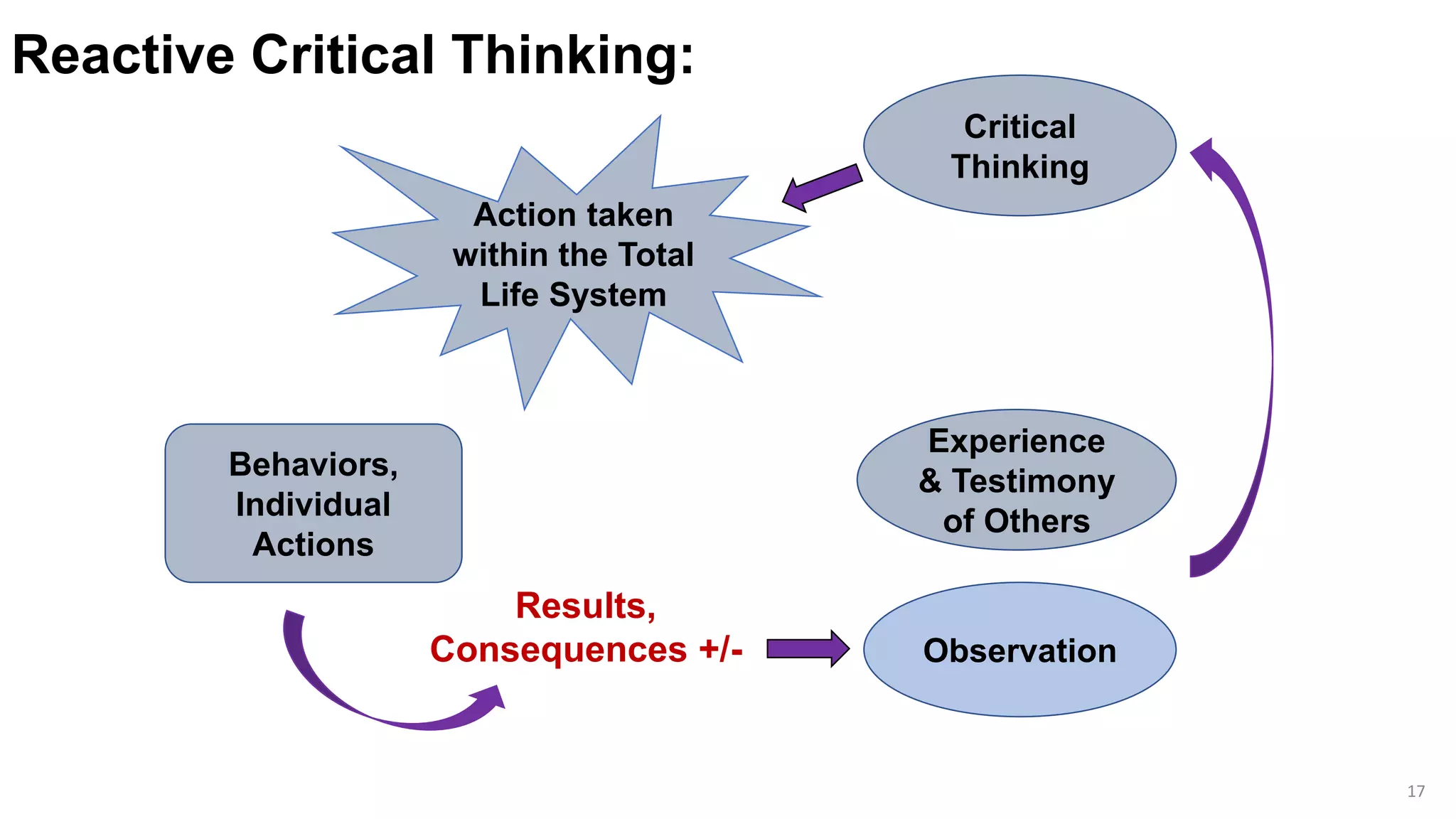
Reactive Critical Thinking:
17
Behaviors,
Individual
Actions
Observation
Experience
& Testimony
of Others
Results,
Consequences +/-
Critical
Thinking
Action taken
within the Total
Life System
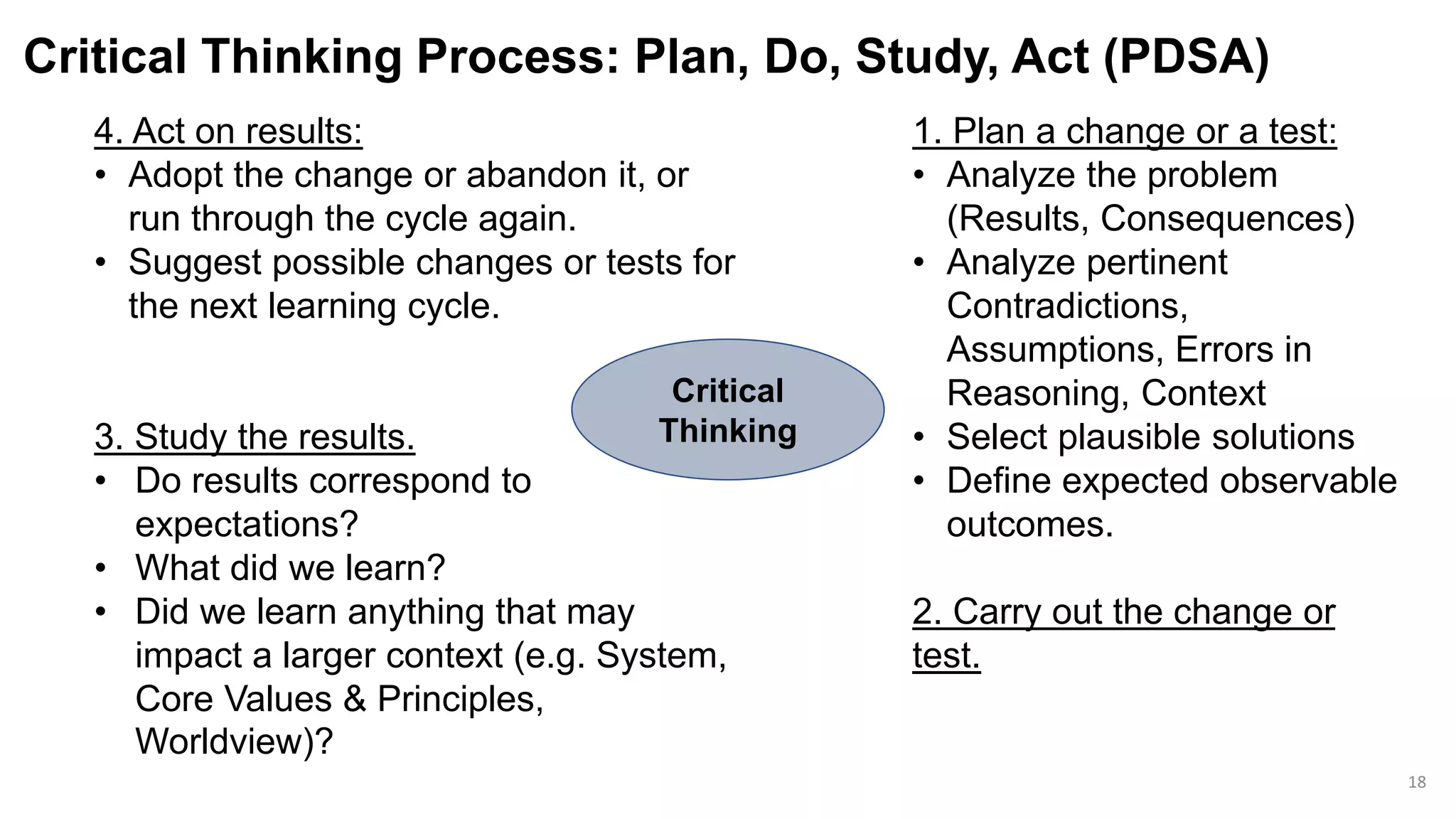
Critical Thinking Process: Plan, Do, Study, Act (PDSA)
18
Critical
Thinking
1. Plan a change or a test:
• Analyze the problem
(Results, Consequences)
• Analyze pertinent
Contradictions,
Assumptions, Errors in
Reasoning, Context
• Select plausible solutions
• Define expected observable
outcomes.
2. Carry out the change or
test.
4. Act on results:
• Adopt the change or abandon it, or
run through the cycle again.
• Suggest possible changes or tests for
the next learning cycle.
3. Study the results.
• Do results correspond to
expectations?
• What did we learn?
• Did we learn anything that may
impact a larger context (e.g. System,
Core Values & Principles,
Worldview)?
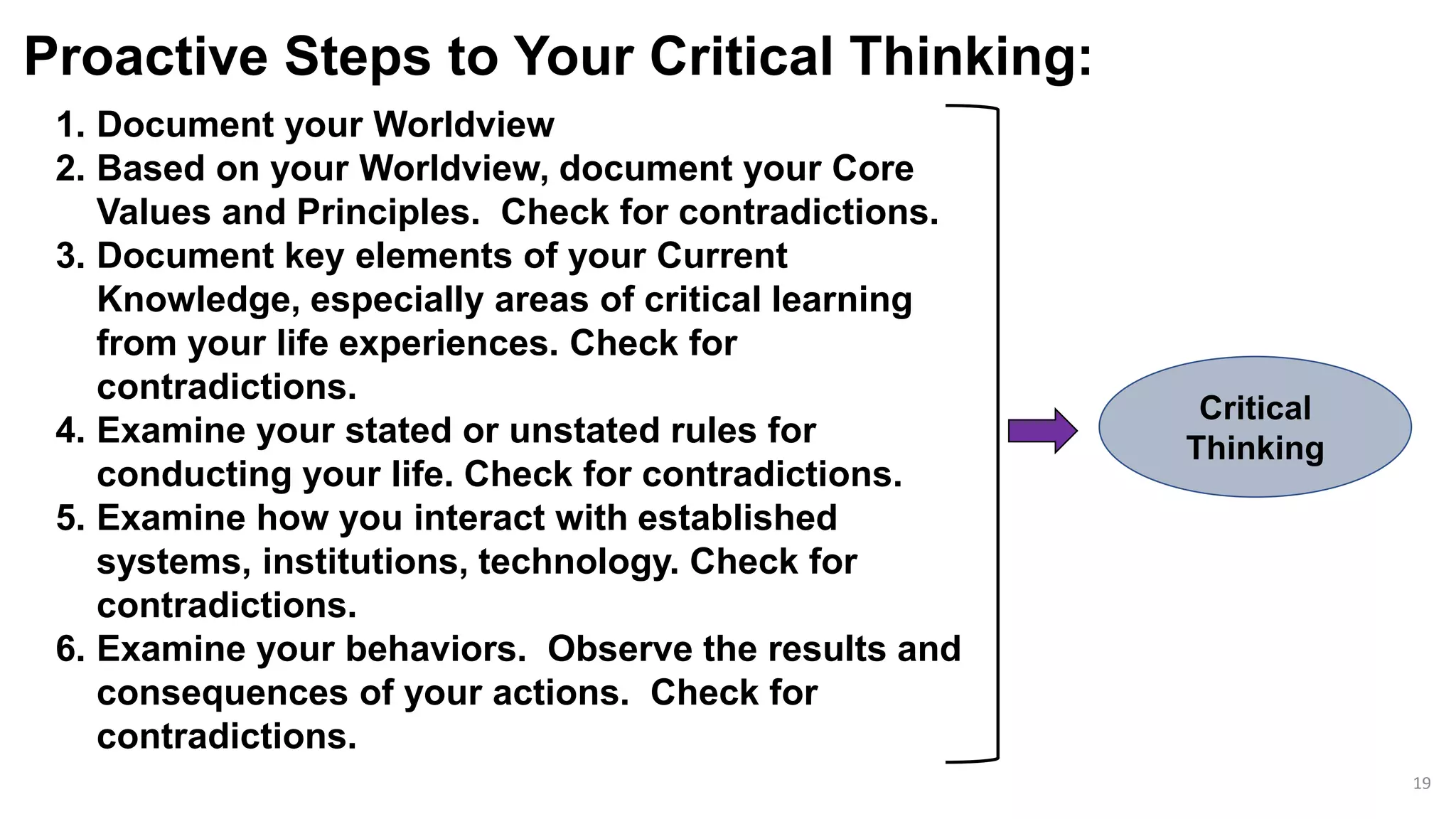
Proactive Steps to Your Critical Thinking:
19
Critical
Thinking
1. Document your Worldview
2. Based on your Worldview, document your Core
Values and Principles. Check for contradictions.
3. Document key elements of your Current
Knowledge, especially areas of critical learning
from your life experiences. Check for
contradictions.
4. Examine your stated or unstated rules for
conducting your life. Check for contradictions.
5. Examine how you interact with established
systems, institutions, technology. Check for
contradictions.
6. Examine your behaviors. Observe the results and
consequences of your actions. Check for
contradictions.
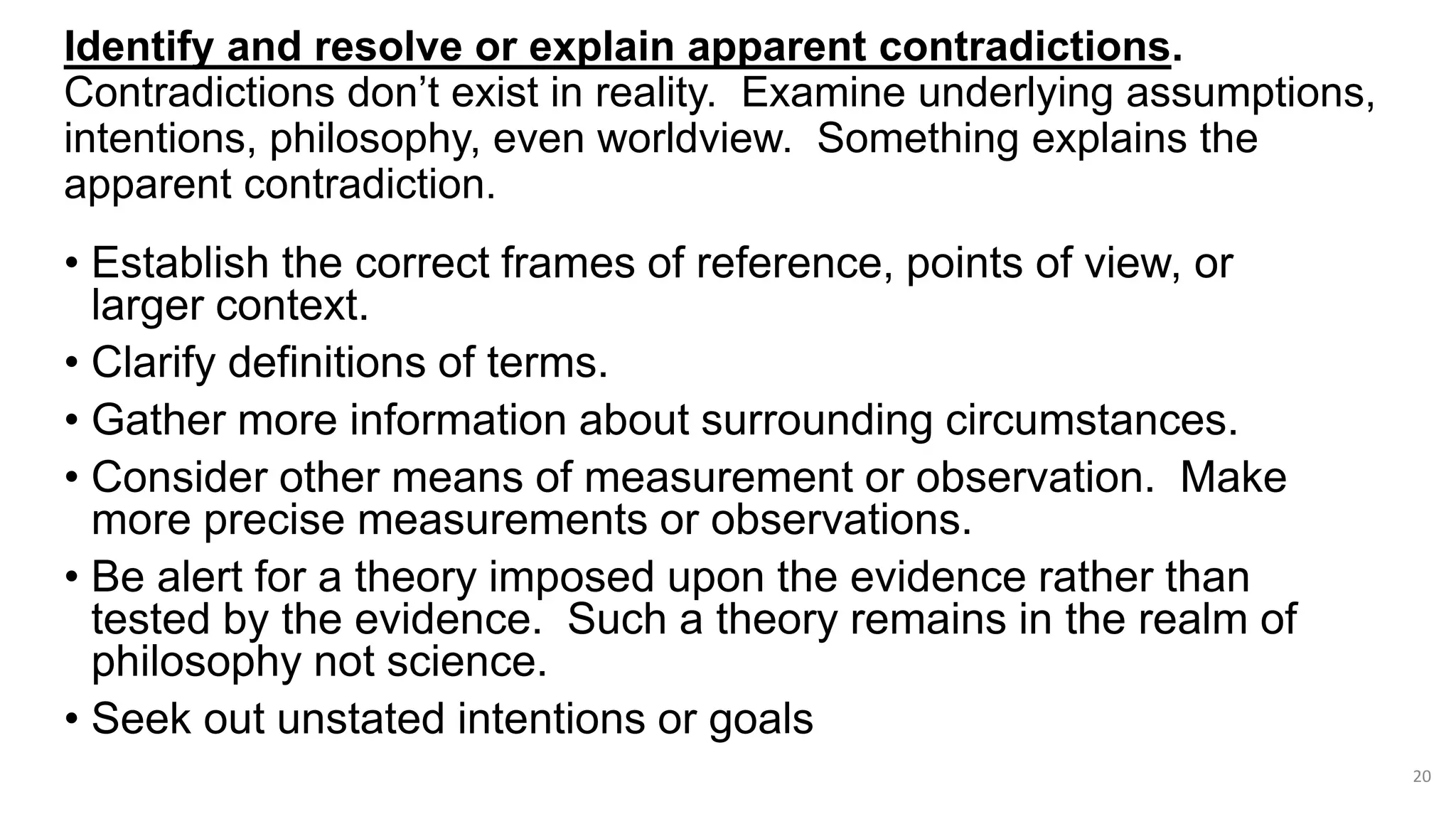
Identify and resolve or explain apparent contradictions.
Contradictions don’t exist in reality. Examine underlying assumptions,
intentions, philosophy, even worldview. Something explains the
apparent contradiction.
• Establish the correct frames of reference, points of view, or
larger context.
• Clarify definitions of terms.
• Gather more information about surrounding circumstances.
• Consider other means of measurement or observation. Make
more precise measurements or observations.
• Be alert for a theory imposed upon the evidence rather than
tested by the evidence. Such a theory remains in the realm of
philosophy not science.
• Seek out unstated intentions or goals
20
The most common contradiction is to
say one thing and do another.
21
Examples of Contemporary Contradictions in
need of Critical Thinking:
•ANTIFA
•“Scientific Consensus”
•“There is no absolute truth.”
•Others?
22
A shared belief in the existence of the
better and the moral and practical
imperative that follows to use one’s
intellect to seek it out and then to toil to
achieve it.
23
The journey:
24
Questions?
Thank You!
Appendix:
25
26
Exercises: Resolved
Bermuda to Perth:
Bermuda and Perth are
antipodal, same distance in
any direction on the surface
of Earth.
7,939 miles through the
center of Earth.
27
ANTIFA (Anti Fascist) using similar tactics to Mussolini’s blackshirts and Hitler’s
brownshirts fascist paramilitary: silencing free speech, disrupting meetings of opponents,
intimidation, use of force and violence, providing “protection”, paramilitary style. ANTIFA
leader Interview revealed the underlying intent: he’s a “communist anarchist revolutionary”
and his real goal is to “tear the system down root and branch.”
“There is no absolute truth”: internal contradiction, self-referentially incoherent. This is an
absolute statement in itself and we are led to believe that it is true.
Attributes of the Scientific Method (no “consensus”)
1.Objective: tests multiple reasonable hypotheses
2.Useful Findings (effect size is important for decision making)
3.Full disclosure of methods, data and other relevant information
4.Comprehensive review of prior knowledge
5.Valid and reliable data
6.Valid and simple methods
7.Experimental evidence provided
8.Conclusions consistent with the evidence

An introduction to critical thinking

  • 1.
    An Introduction to CriticalThinking Presented by: Mike Henderson Business Performance Consultant mrhenderson1105@gmail.com 1
  • 2.
    “From the dawnof time until the dawn of the modern era people had had to think. They had had to use their intellect in order to discover and then practice the better ways – because being wrong came with the potential for dire consequences (disease, hunger, poverty, death). For millions and millions born in America after the second world war, with these consequences all but eliminated, thinking became a relic, their mind nearly as unneeded and unused as their appendix.” - Evan Sayet 2
  • 3.
    Learning Objectives: 1. Developa basic understanding of Critical Thinking and its use. 2. Develop a basic appreciation for a Total Life System. 3. Raise awareness to Contradictions in our lives and the world around us. 3
  • 4.
    Critical Thinking Defined: Criticalthinking is a discipline for the objective analysis of information as a guide to judgment and action. 4
  • 5.
    When to UseCritical Thinking: • Life events with positive or negative consequences • Performance issues (Work, Family, Non-work life, Athletics, etc.) • Solving difficult problems • Civics, politics, societal issues • Relationship issues • Creating positive culture • Creating and re-creating other aspects of our lives 5
  • 6.
    Critical Thinkers areactively engaged in life: • Observing consequences of behaviors and actions • Recognizing underlying worldviews, preconceptions, and errors in reasoning • Seeing issues in larger and different contexts • Bringing clarity to their underlying personal assumptions and core values • Evaluating apparent contradictions • Learning and taking action 6
  • 7.
    Worldview: 7 • All worldviewsanswer the three fundamental questions: “Where did we come from and who are we? What has gone wrong with the world? How can we fix it? • By the nature of the three questions, all worldviews are philosophical. • A person’s worldview is intensely practical. It’s the sum total of their beliefs about the world and reality. It directs daily decisions and actions. It guides experience and learning. • Worldviews are held individually and corporately. • In terms of life, liberty, health, prosperity, success, (etc.), worldviews are not equal. How could they be? Ideas have consequences. • When worldviews collide with reality in painful ways, they need to be critiqued.
  • 8.
    Contradictions: 8 • A situationin which inherent factors, actions, or propositions are inconsistent or contrary to one another. • Both parts of a contradiction cannot possibly be true. Contradictions don’t exist in reality. • Some can be resolved or explained by examining larger contexts, underlying intentions, or underlying assumptions.
  • 9.
    “The significant problemswe face cannot be solved at the same level of thinking we were at when we created them.” - Albert Einstein 9
  • 10.
    10 Exercise: Resolve thesegeometric shapes into a single geometric shape.
  • 11.
    11 Is the apparentcontradiction resolvable? The shortest distance from Bermuda to Perth, Australia is 12,392 miles. The shortest distance from Bermuda to Perth, Australia is 7,939 miles.
  • 12.
    Initial Information isoften Superficial: These two exercises are good examples of how we first see information. Initial information is most often presented or interpreted superficially. In the cases of these two exercises, two dimensionally. In fact, the resolution of the apparent contradictions requires a three dimensional context. We have to think deeper. 12
  • 13.
    “People are peopleand thus a mass of contradictions. They are in possession of limited information, personality quirks, and other flesh and blood realities that make an individual an individual.” - Evan Sayet 13
  • 14.
    A Total LifeSystem: 14 Written Law, Rules Systems, Institutions, Technology The Visible World Embed Knowledge & Create Culture Worldview Current Knowledge Core Values and Principles The World of Thought Behaviors, Individual Actions
  • 15.
    A Total LifeSystem: Rational Thought 15 Current Knowledge Core Values and Principles At the deepest level, our current knowledge is comprised of the answers to the two action-oriented worldview questions: What has gone wrong with the world? How can we fix it? At another level it includes what we consider as valid scientific and moral principles. For a particular application, it includes what we know about any particular element of the visible world: Systems, Technologies, Institutions, Methods, Laws, Rules, etc. Emerging from our worldview, our core values and principles are a set of key, interrelated, moral assumptions that should form a coherent pattern.
  • 16.
    Is it possibleto embed error into the culture? Yes. The lesser can be valued over the better. The lesser can be embedded into culture. In terms of life, liberty, health, prosperity, success, (etc.), worldviews are not equal. How could they be? Ideas have consequences. 16
  • 17.
    Reactive Critical Thinking: 17 Behaviors, Individual Actions Observation Experience &Testimony of Others Results, Consequences +/- Critical Thinking Action taken within the Total Life System
  • 18.
    Critical Thinking Process:Plan, Do, Study, Act (PDSA) 18 Critical Thinking 1. Plan a change or a test: • Analyze the problem (Results, Consequences) • Analyze pertinent Contradictions, Assumptions, Errors in Reasoning, Context • Select plausible solutions • Define expected observable outcomes. 2. Carry out the change or test. 4. Act on results: • Adopt the change or abandon it, or run through the cycle again. • Suggest possible changes or tests for the next learning cycle. 3. Study the results. • Do results correspond to expectations? • What did we learn? • Did we learn anything that may impact a larger context (e.g. System, Core Values & Principles, Worldview)?
  • 19.
    Proactive Steps toYour Critical Thinking: 19 Critical Thinking 1. Document your Worldview 2. Based on your Worldview, document your Core Values and Principles. Check for contradictions. 3. Document key elements of your Current Knowledge, especially areas of critical learning from your life experiences. Check for contradictions. 4. Examine your stated or unstated rules for conducting your life. Check for contradictions. 5. Examine how you interact with established systems, institutions, technology. Check for contradictions. 6. Examine your behaviors. Observe the results and consequences of your actions. Check for contradictions.
  • 20.
    Identify and resolveor explain apparent contradictions. Contradictions don’t exist in reality. Examine underlying assumptions, intentions, philosophy, even worldview. Something explains the apparent contradiction. • Establish the correct frames of reference, points of view, or larger context. • Clarify definitions of terms. • Gather more information about surrounding circumstances. • Consider other means of measurement or observation. Make more precise measurements or observations. • Be alert for a theory imposed upon the evidence rather than tested by the evidence. Such a theory remains in the realm of philosophy not science. • Seek out unstated intentions or goals 20
  • 21.
    The most commoncontradiction is to say one thing and do another. 21
  • 22.
    Examples of ContemporaryContradictions in need of Critical Thinking: •ANTIFA •“Scientific Consensus” •“There is no absolute truth.” •Others? 22
  • 23.
    A shared beliefin the existence of the better and the moral and practical imperative that follows to use one’s intellect to seek it out and then to toil to achieve it. 23 The journey:
  • 24.
  • 25.
  • 26.
    26 Exercises: Resolved Bermuda toPerth: Bermuda and Perth are antipodal, same distance in any direction on the surface of Earth. 7,939 miles through the center of Earth.
  • 27.
    27 ANTIFA (Anti Fascist)using similar tactics to Mussolini’s blackshirts and Hitler’s brownshirts fascist paramilitary: silencing free speech, disrupting meetings of opponents, intimidation, use of force and violence, providing “protection”, paramilitary style. ANTIFA leader Interview revealed the underlying intent: he’s a “communist anarchist revolutionary” and his real goal is to “tear the system down root and branch.” “There is no absolute truth”: internal contradiction, self-referentially incoherent. This is an absolute statement in itself and we are led to believe that it is true. Attributes of the Scientific Method (no “consensus”) 1.Objective: tests multiple reasonable hypotheses 2.Useful Findings (effect size is important for decision making) 3.Full disclosure of methods, data and other relevant information 4.Comprehensive review of prior knowledge 5.Valid and reliable data 6.Valid and simple methods 7.Experimental evidence provided 8.Conclusions consistent with the evidence

Editor's Notes

  • #5 Not only academic
  • #7 Critical thinking drives us deeper into our beliefs.
  • #8 Worldview “Non-scientific:” example: Richard Dawkins (evolutionary biologist), Where did we come from? “Space Aliens.” Negative of the listed consequences: Death, tyranny, disease, poverty, hopelessness
  • #11 A Cone
  • #12 Bermuda and Perth are antipodal, opposite sides of the earth, equal distant in any direction of travel. Clue: only one of the paths can be traveled. 7939 through the center of the earth.
  • #15 Key point, nearly all authors on Critical Thinking are not honest and open about their Worldview even though their bias is obvious. This is deceptive and non-critical. Key Point: A critical thinker would be on a life-long journey to eliminate contradictions within their total life system. Where is the Church, Family, Business, School? Where is the Constitution? Is it possible to embed error into the culture? Yes. The lesser can be valued over the better. The lesser can be embedded into culture.
  • #19 Walk thru the Bermuda to Perth Exercise
  • #23 ANTIFA (Anti Fascist) using similar tactics to Mussolini’s blackshirts and Hitler’s brownshirts: silencing free speech, disrupting meetings of opponents, intimidation, use of force and violence, providing “protection”, paramilitary. Leader Interview revealed underlying intent: he’s a “communist anarchist revolutionary” and his real goal is to “tear the system down root and branch.” “There is no absolute truth”: internal contradiction, self-referentially incoherent. This is an absolute statement in itself and we are suppose to believe that it is true. Attributes of the Scientific Method (no “consensus”) Objective: tests multiple reasonable hypotheses Useful Findings (effect size is important for decision making) Full disclosure of methods, data and other relevant information Comprehensive review of prior knowledge Valid and reliable data Valid and simple methods Experimental evidence provided Conclusions consistent with the evidence
  • #27 Resolved by thinking in three dimensions, not two.