Presented by:
Mike Henderson
Business Performance Consultant
mrhenderson1105@gmail.com
Data Out of Context:
Enumerative vs. Analytic Studies
Adapted from Dr. D. Wheeler
2
To keep data in context, to avoid
inappropriate and costly action,
one must appreciate the
distinction between enumerative
and analytic studies.
Data Out of Context:
Enumerative vs. Analytic Studies
Enumerative studies are often
misapplied to analytic problems.
3
The most significant problems in
business involve improving performance
in the future, thus obtaining information
from the system or process under study
in order to take appropriate action.
This kind of study is known as an
“analytic study”
Analytic Studies
4
• An enumerative study is focused on
obtaining information about, and taking
action on, specific items contained in a frame,
which is a well-defined group of physical
items. (e.g. sampling from a batch of product to
answer the question, “Should the batch be
rejected or accepted?”)
• The statistical inference made from the data
is applied to the remaining units in the frame.
• The goal is not to characterize the process
that produced the frame, but to describe and
act on the frame.
Enumerative Studies
5
• A 100% sample of the units in a frame (i.e. a
complete census) will eliminate all uncertainty
and provide a complete answer to the
question posed in an enumerative study. (e.g.
Does the batch contain less than 1% defective?)
• In an enumerative study, the method of choice
to reduce uncertainty is to increase sample
size (reduce standard error).
• Therefore, within enumerative studies there is
a rational basis to utilize confidence intervals,
significance levels, analysis of variance, etc.
Enumerative Studies
6
• A coal train is heading from the a mine in Wyoming to
a generating station in Wisconsin.
• According to the Coal Contract, the plant can reject the
shipment of coal if the Coal Specifications are not met
(no more than 6% ash, no more than 1.1lb Sulfur per
ton, no less than 8700 Btu per lb).
• A sample (which was taken from the train at the mine)
is processed and the information is given to the plant –
6.2% ash, .91 lb sulfur per ton, 8750 Btu per lb.
• Question posed: “Should the plant reject this coal
shipment?”
Note: the statistical inference is from the sample back to the
remaining coal already on the train (to the frame).
Enumerative Study Example
7
• However, an analytic study is focused on obtaining
information from the system or process under study
and taking action on the cause system to improve
performance in the future. (e.g. sampling from a batch
of product to answer the question, “Has the process or
system changed as a result of our actions?” or “Is the
process consistently producing acceptable product?”)
• The statistical inference made from the data is
applied to the process.
• The goal is to characterize the process that produced
the frame, not to describe and act on the frame.
Analytic Studies
8
• A 100% sample of the units in a frame will be inconclusive
concerning the future performance of the process.
• In an analytic study, the major source of uncertainty is the
dynamics of the process or system under study (i.e. the physics
of the process, effects of entropy, human will, and other assignable
causes). The method of choice to reduce uncertainty is to
study the process over time (control charts), increasing
knowledge of the cause system and reducing variability and
improving predictability.
• Therefore, within analytic studies there is no rational basis to
utilize confidence intervals, significance levels, analysis of
variance, etc. Increasing sample size is of little help and can
be costly.
• The most significant problems in business are analytic
problems.
Analytic Studies
9
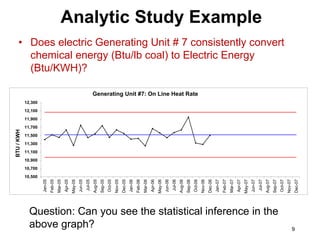
• Does electric Generating Unit # 7 consistently convert
chemical energy (Btu/lb coal) to Electric Energy
(Btu/KWH)?
Question: Can you see the statistical inference in the
above graph?
10,500
10,700
10,900
11,100
11,300
11,500
11,700
11,900
12,100
12,300
Jan-05
Feb-05
Mar-05
Apr-05
May-05
Jun-05
Jul-05
Aug-05
Sep-05
Oct-05
Nov-05
Dec-05
Jan-06
Feb-06
Mar-06
Apr-06
May-06
Jun-06
Jul-06
Aug-06
Sep-06
Oct-06
Nov-06
Dec-06
Jan-07
Feb-07
Mar-07
Apr-07
May-07
Jun-07
Jul-07
Aug-07
Sep-07
Oct-07
Nov-07
Dec-07
BTU/KWH
Generating Unit #7: On Line Heat Rate
Analytic Study Example
10
The primary goal of analysis of data is the objective
creation of information, evidence, and new knowledge
that forms the rational basis for action.
The distinctions between enumerative and analytic
studies are important because the applicable theories
of probability, sampling, estimation, and prediction are
not the same for both studies.
Misapplication of mathematical or statistical theory can
result in a false sense of confidence in predictions and
conclusions that are reached from analysis of the data,
leading to incorrect decisions and costly actions.
Data Out of Context:
Enumerative vs. Analytic Studies

Analytic vs Enumerative Studies

  • 1.
    Presented by: Mike Henderson BusinessPerformance Consultant mrhenderson1105@gmail.com Data Out of Context: Enumerative vs. Analytic Studies Adapted from Dr. D. Wheeler
  • 2.
    2 To keep datain context, to avoid inappropriate and costly action, one must appreciate the distinction between enumerative and analytic studies. Data Out of Context: Enumerative vs. Analytic Studies Enumerative studies are often misapplied to analytic problems.
  • 3.
    3 The most significantproblems in business involve improving performance in the future, thus obtaining information from the system or process under study in order to take appropriate action. This kind of study is known as an “analytic study” Analytic Studies
  • 4.
    4 • An enumerativestudy is focused on obtaining information about, and taking action on, specific items contained in a frame, which is a well-defined group of physical items. (e.g. sampling from a batch of product to answer the question, “Should the batch be rejected or accepted?”) • The statistical inference made from the data is applied to the remaining units in the frame. • The goal is not to characterize the process that produced the frame, but to describe and act on the frame. Enumerative Studies
  • 5.
    5 • A 100%sample of the units in a frame (i.e. a complete census) will eliminate all uncertainty and provide a complete answer to the question posed in an enumerative study. (e.g. Does the batch contain less than 1% defective?) • In an enumerative study, the method of choice to reduce uncertainty is to increase sample size (reduce standard error). • Therefore, within enumerative studies there is a rational basis to utilize confidence intervals, significance levels, analysis of variance, etc. Enumerative Studies
  • 6.
    6 • A coaltrain is heading from the a mine in Wyoming to a generating station in Wisconsin. • According to the Coal Contract, the plant can reject the shipment of coal if the Coal Specifications are not met (no more than 6% ash, no more than 1.1lb Sulfur per ton, no less than 8700 Btu per lb). • A sample (which was taken from the train at the mine) is processed and the information is given to the plant – 6.2% ash, .91 lb sulfur per ton, 8750 Btu per lb. • Question posed: “Should the plant reject this coal shipment?” Note: the statistical inference is from the sample back to the remaining coal already on the train (to the frame). Enumerative Study Example
  • 7.
    7 • However, ananalytic study is focused on obtaining information from the system or process under study and taking action on the cause system to improve performance in the future. (e.g. sampling from a batch of product to answer the question, “Has the process or system changed as a result of our actions?” or “Is the process consistently producing acceptable product?”) • The statistical inference made from the data is applied to the process. • The goal is to characterize the process that produced the frame, not to describe and act on the frame. Analytic Studies
  • 8.
    8 • A 100%sample of the units in a frame will be inconclusive concerning the future performance of the process. • In an analytic study, the major source of uncertainty is the dynamics of the process or system under study (i.e. the physics of the process, effects of entropy, human will, and other assignable causes). The method of choice to reduce uncertainty is to study the process over time (control charts), increasing knowledge of the cause system and reducing variability and improving predictability. • Therefore, within analytic studies there is no rational basis to utilize confidence intervals, significance levels, analysis of variance, etc. Increasing sample size is of little help and can be costly. • The most significant problems in business are analytic problems. Analytic Studies
  • 9.
    9 • Does electricGenerating Unit # 7 consistently convert chemical energy (Btu/lb coal) to Electric Energy (Btu/KWH)? Question: Can you see the statistical inference in the above graph? 10,500 10,700 10,900 11,100 11,300 11,500 11,700 11,900 12,100 12,300 Jan-05 Feb-05 Mar-05 Apr-05 May-05 Jun-05 Jul-05 Aug-05 Sep-05 Oct-05 Nov-05 Dec-05 Jan-06 Feb-06 Mar-06 Apr-06 May-06 Jun-06 Jul-06 Aug-06 Sep-06 Oct-06 Nov-06 Dec-06 Jan-07 Feb-07 Mar-07 Apr-07 May-07 Jun-07 Jul-07 Aug-07 Sep-07 Oct-07 Nov-07 Dec-07 BTU/KWH Generating Unit #7: On Line Heat Rate Analytic Study Example
  • 10.
    10 The primary goalof analysis of data is the objective creation of information, evidence, and new knowledge that forms the rational basis for action. The distinctions between enumerative and analytic studies are important because the applicable theories of probability, sampling, estimation, and prediction are not the same for both studies. Misapplication of mathematical or statistical theory can result in a false sense of confidence in predictions and conclusions that are reached from analysis of the data, leading to incorrect decisions and costly actions. Data Out of Context: Enumerative vs. Analytic Studies