Academic excellence for business and the professions
Nancy Doyle
CPsychol. AFBPsS
Dr Almuth McDowall
CPsychol. AFBPsS
Does Coaching Improve Working
Memory? A Narrative Systematic
Review.
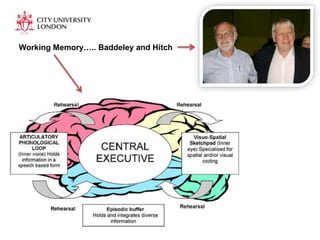
Working Memory….. Baddeley and Hitch
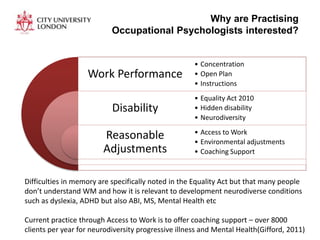
Why are Practising
Occupational Psychologists interested?
Work Performance
Disability
Reasonable
Adjustments
• Concentration
• Open Plan
• Instructions
• Equality Act 2010
• Hidden disability
• Neurodiversity
• Access to Work
• Environmental adjustments
• Coaching Support
Difficulties in memory are specifically noted in the Equality Act but that many people
don’t understand WM and how it is relevant to development neurodiverse conditions
such as dyslexia, ADHD but also ABI, MS, Mental Health etc
Current practice through Access to Work is to offer coaching support – over 8000
clients per year for neurodiversity progressive illness and Mental Health(Gifford, 2011)
Working Memory Research
Currently predominantly focused on cognitive training via computer
Which does not help us in the field since 1) this is not yet creating “far transfer” (i.e. gains
in educational or workplace performance) and 2) it’s not what we deliver in practice
Practice has moved on without an evidence base, research is not focused on practice.
Sound familiar?
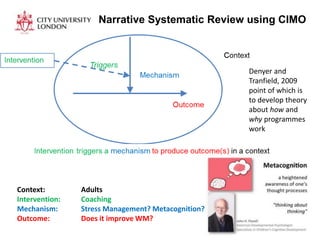
Narrative Systematic Review using CIMO
Context: Adults
Intervention: Coaching
Mechanism: Stress Management? Metacognition?
Outcome: Does it improve WM?
Denyer and
Tranfield, 2009
point of which is
to develop theory
about how and
why programmes
work
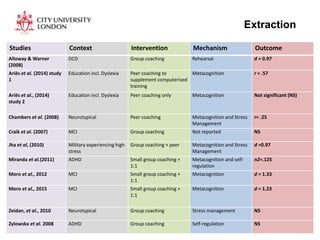
Extraction
Studies Context Intervention Mechanism Outcome
Alloway & Warner
(2008)
DCD Group coaching Rehearsal d = 0.97
Ariës et al. (2014) study
1
Education incl. Dyslexia Peer coaching to
supplement computerised
training
Metacognition r = .57
Ariës et al., (2014)
study 2
Education incl. Dyslexia Peer coaching only Metacognition Not significant (NS)
Chambers et al. (2008) Neurotypical Peer coaching Metacognition and Stress
Management
r= .25
Craik et al. (2007) MCI Group coaching Not reported NS
Jha et al, (2010) Military experiencing high
stress
Group coaching + peer Metacognition and Stress
Management
d =0.97
Miranda et al.(2011) ADHD Small group coaching +
1:1
Metacognition and self-
regulation
n2=.125
Moro et al., 2012 MCI Small group coaching +
1:1
Metacognition d = 1.33
Moro et al., 2015 MCI Small group coaching +
1:1
Metacognition d = 1.23
Zeidan, et al., 2010 Neurotypical Group coaching Stress management NS
Zylowska et al. 2008 ADHD Group coaching Self-regulation NS
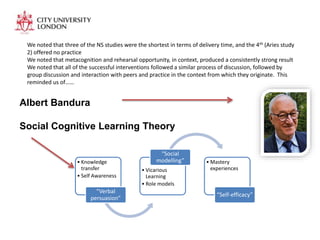
Albert Bandura
Social Cognitive Learning Theory
• Knowledge
transfer
• Self Awareness
“Verbal
persuasion”
• Vicarious
Learning
• Role models
“Social
modelling” • Mastery
experiences
“Self-efficacy”
We noted that three of the NS studies were the shortest in terms of delivery time, and the 4th (Aries study
2) offered no practice
We noted that metacognition and rehearsal opportunity, in context, produced a consistently strong result
We noted that all of the successful interventions followed a similar process of discussion, followed by
group discussion and interaction with peers and practice in the context from which they originate. This
reminded us of……
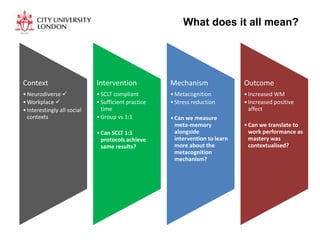
What does it all mean?
Context
•Neurodiverse 
•Workplace 
•Interestingly all social
contexts
Intervention
•SCLT compliant
•Sufficient practice
time
•Group vs 1:1
•Can SCLT 1:1
protocols achieve
same results?
Mechanism
•Metacognition
•Stress reduction
•Can we measure
meta-memory
alongside
intervention to learn
more about the
metacognition
mechanism?
Outcome
•Increased WM
•Increased positive
affect
•Can we translate to
work performance as
mastery was
contextualised?
And who are Psychologists anyway?
There’s a lot of white haired social psychs from the 70s and 80s still ruling the roost
despite our current obsession with neuroscience….
But in all seriousness, we must hang on to our identity of psychology as the
interaction between the brain and it’s environment, rather than single focus on the
brain as the solution to all our problems…..
It’s going to be hard to increase WM with
repetitive games. Dyslexic Children
develop an identity when they enter the
classroom that is embedded – they are the
kid who can’t listen, the kid who gets it
wrong, the kid who forgets. The same is
true in the workplace and with careers.
Before I get started on some more white
haired psychs from the 70s (“coughs Tajfel
and Turner…. Coughs Social Identity
Theory) Let us leave it there!

Coaching and working memory Doyle & McDowall slide share version

  • 1.
    Academic excellence forbusiness and the professions Nancy Doyle CPsychol. AFBPsS Dr Almuth McDowall CPsychol. AFBPsS Does Coaching Improve Working Memory? A Narrative Systematic Review.
  • 2.
  • 3.
    Why are Practising OccupationalPsychologists interested? Work Performance Disability Reasonable Adjustments • Concentration • Open Plan • Instructions • Equality Act 2010 • Hidden disability • Neurodiversity • Access to Work • Environmental adjustments • Coaching Support Difficulties in memory are specifically noted in the Equality Act but that many people don’t understand WM and how it is relevant to development neurodiverse conditions such as dyslexia, ADHD but also ABI, MS, Mental Health etc Current practice through Access to Work is to offer coaching support – over 8000 clients per year for neurodiversity progressive illness and Mental Health(Gifford, 2011)
  • 4.
    Working Memory Research Currentlypredominantly focused on cognitive training via computer Which does not help us in the field since 1) this is not yet creating “far transfer” (i.e. gains in educational or workplace performance) and 2) it’s not what we deliver in practice Practice has moved on without an evidence base, research is not focused on practice. Sound familiar?
  • 5.
    Narrative Systematic Reviewusing CIMO Context: Adults Intervention: Coaching Mechanism: Stress Management? Metacognition? Outcome: Does it improve WM? Denyer and Tranfield, 2009 point of which is to develop theory about how and why programmes work
  • 6.
    Extraction Studies Context InterventionMechanism Outcome Alloway & Warner (2008) DCD Group coaching Rehearsal d = 0.97 Ariës et al. (2014) study 1 Education incl. Dyslexia Peer coaching to supplement computerised training Metacognition r = .57 Ariës et al., (2014) study 2 Education incl. Dyslexia Peer coaching only Metacognition Not significant (NS) Chambers et al. (2008) Neurotypical Peer coaching Metacognition and Stress Management r= .25 Craik et al. (2007) MCI Group coaching Not reported NS Jha et al, (2010) Military experiencing high stress Group coaching + peer Metacognition and Stress Management d =0.97 Miranda et al.(2011) ADHD Small group coaching + 1:1 Metacognition and self- regulation n2=.125 Moro et al., 2012 MCI Small group coaching + 1:1 Metacognition d = 1.33 Moro et al., 2015 MCI Small group coaching + 1:1 Metacognition d = 1.23 Zeidan, et al., 2010 Neurotypical Group coaching Stress management NS Zylowska et al. 2008 ADHD Group coaching Self-regulation NS
  • 7.
    Albert Bandura Social CognitiveLearning Theory • Knowledge transfer • Self Awareness “Verbal persuasion” • Vicarious Learning • Role models “Social modelling” • Mastery experiences “Self-efficacy” We noted that three of the NS studies were the shortest in terms of delivery time, and the 4th (Aries study 2) offered no practice We noted that metacognition and rehearsal opportunity, in context, produced a consistently strong result We noted that all of the successful interventions followed a similar process of discussion, followed by group discussion and interaction with peers and practice in the context from which they originate. This reminded us of……
  • 8.
    What does itall mean? Context •Neurodiverse  •Workplace  •Interestingly all social contexts Intervention •SCLT compliant •Sufficient practice time •Group vs 1:1 •Can SCLT 1:1 protocols achieve same results? Mechanism •Metacognition •Stress reduction •Can we measure meta-memory alongside intervention to learn more about the metacognition mechanism? Outcome •Increased WM •Increased positive affect •Can we translate to work performance as mastery was contextualised?
  • 9.
    And who arePsychologists anyway? There’s a lot of white haired social psychs from the 70s and 80s still ruling the roost despite our current obsession with neuroscience…. But in all seriousness, we must hang on to our identity of psychology as the interaction between the brain and it’s environment, rather than single focus on the brain as the solution to all our problems….. It’s going to be hard to increase WM with repetitive games. Dyslexic Children develop an identity when they enter the classroom that is embedded – they are the kid who can’t listen, the kid who gets it wrong, the kid who forgets. The same is true in the workplace and with careers. Before I get started on some more white haired psychs from the 70s (“coughs Tajfel and Turner…. Coughs Social Identity Theory) Let us leave it there!

Editor's Notes

  • #3  Brief Explanation of Working Memory – do a quick digit span as a reminder to audience Small comment about how satisfying it must have been to do all your theoretical development in the 80s before fMRI and then for fMRI to prove you correct!
  • #4  All the ways in which WM deficits affect the workplace (Alloway, Gathercole & Kirkwood 2008) Discuss how difficulties in memory are specifically noted in the Equality Act but that many people don’t understand WM and how it is relevant to development neurodiverse conditions such as dyslexia, ADHD but also ABI, MS, Mental Health etc Current practice through Access to Work is to offer coaching support – over 8000 clients per year for neurodiversity progressive illness and Mental Health(Gifford, 2011)
  • #5  Predominantly focused on cognitive training via computer Which does not help us in the field since 1) this is not yet creating “far transfer” (explain what this is) and 2) it’s not what we deliver Practice has moved on without an evidence base, research is not focused on practice. Sound familiar?
  • #6  Narrative Synthesis Review – Denyer and Tranfield, 2009 point of which is to develop theory about how and why programmes work Our Extraction focused on adults wherever possible although included 5 studies of in education, simply a pragmatic measure as well matched in terms of participants and interventions All studies included a recognised, standardised measure of WM as a dependent variable and then we interpreted the mechanisms by which this had occurred through reading the intervention description and the record of their other DVs, for example PANAS
  • #7  We noted that three of the NS studies were the shortest in terms of delivery time, and the 4th (Aries study 2) offered no practice We noted that metacognition and rehearsal opportunity, in context, produced a consistently strong result We noted that all of the successful interventions followed a similar process of discussion, followed by group discussion and interaction with peers and practice in the context from which they originate. This reminded us of……
  • #8  Talk through each section, how all the good studies contained an element of group discussion that was lead by an expert being lead through exercises to learn metacognition through mindfulness, meta-memory and/or self-regulation Developing those skills with 1:1 or peer coaching or through own practice Applying those skills back in original context away from training space, before coming back to reflect and troubleshoot as a group
  • #9 Round up of Questions for future research to answer 1 – group vs 1:1 protocol. If SE is the goal, can we build this into 1:1 coaching (yes) 2 – develop our awareness of metacognition – Bor’s synaethesia study 3 – work place performance measures of ‘far transfer’
  • #10  But what does it all mean and who are we anyway? Make joke about a