An Assessor's
Viewpoint              on


TSB Funding Applications


                           Barney Craggs
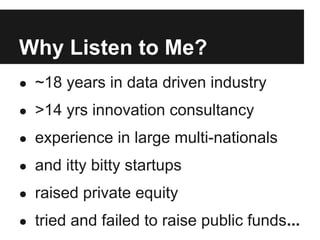
Why Listen to Me?
● ~18 years in data driven industry

● >14 yrs innovation consultancy

● experience in large multi-nationals

● and itty bitty startups

● raised private equity

● tried and failed to raise public funds...
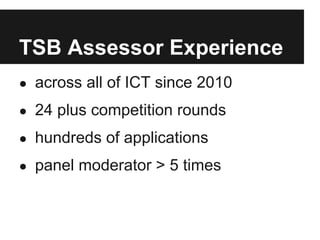
TSB Assessor Experience
● across all of ICT since 2010

● 24 plus competition rounds

● hundreds of applications

● panel moderator > 5 times
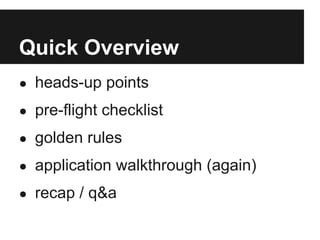
Quick Overview
● heads-up points

● pre-flight checklist

● golden rules

● application walkthrough (again)

● recap / q&a
Heads-Up
● NO secret recipes for getting it right

● assessors are human, we're

  subjectively objective
● it is a competition, where you are

  pitted against each other
● the application is a business plan
Pre-Flight Checklist
● re-read the competition brief

● read ALL of the guidance notes

● make sure your project fits FIRST

● check your business plan thinking

                   then and only then...
Ten Golden Rules (1-5)
● answer all questions to the guidance
● don't assume common knowledge
● grammar, spelling & punctuation
  matter
● you are space limited, so check it
● appendices; supporting & to size
Ten Golden Rules (6-10)
● avoid the cliches

● if evidence is king,

● the queen is awareness

● get it proof read
● right documents BY the deadline
Application Walkthrough
Abstract
● brief summary of application

● set the scene

● what, why, how

● keep language at high level

● please don't just cut & paste from Q1
Gateway
● state exactly how your project fits
  competition scope
● if it meets more than one aspect then state it
● don't get carried away, simplicity counts
● again please don't just cut & paste from Q1
Gateway Example
"We are looking at the feasibility of building a
cloud based analysis platform for white-
labelling to the agricultural sector based upon
real-time weather data collected & distributed
by/to farmers using a mobile application.
This directly addresses the challenge scope of
the competition in being an enabling platform
for hyper-local crowd sourced data analysis.
Additionally it meets the scope in being a
mobile location aware input / output device."
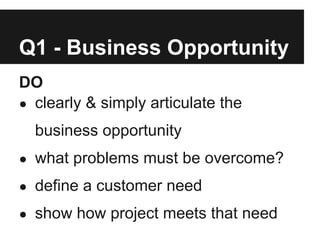
Q1 - Business Opportunity
DO
● clearly & simply articulate the

  business opportunity
● what problems must be overcome?

● define a customer need

● show how project meets that need
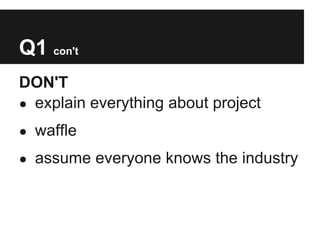
Q1 con't
DON'T
● explain everything about project

● waffle

● assume everyone knows the industry
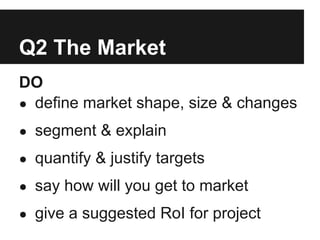
Q2 The Market
DO
● define market shape, size & changes

● segment & explain

● quantify & justify targets

● say how will you get to market

● give a suggested RoI for project
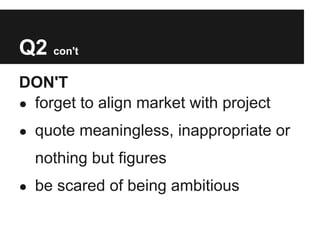
Q2 con't
DON'T
● forget to align market with project

● quote meaningless, inappropriate or

  nothing but figures
● be scared of being ambitious
Q3 - Exploitables
DO
● clearly state exploitable outputs

● describe how you will exploit them

● highlight research & dissemination

● discuss potential impact on YOUR

  business
Q3 con't
DON'T
● confuse impact with internal benefit

● forget to project upto 5yrs out

● assume that there is nothing to

  disseminate
Q4 - Benefits
DO
● cover all 3 required areas,

● from both internal & external angle

● describe how you will address benefit

● highlight & explain negative impacts

  not forgetting to include in Q7 Risks
Q4 con't
DON'T
● assume an implicit benefit (esp

  Environmental) - explain them
● hide/forget negative impacts

● give vague claims
Appendix A
● 5 pages to SUPPORT section 1

● don't over run or repeat yourself

● support customer needs & market

● benefit justification / evidence useful
Q5 - Technical Approach
● no hard & fast rules here
● avoid screeds of technical data
● summarise project plan, milestones,
  work-packages & allocations
● briefly justify choice of PM approach
● UTILISE appendix B
Q6 - Innovation
● describe evidence you have used to

  assure yourself of novelty (web,
  patents, academic)
● state your expectation of freedom to

  operate (or any restrictions)
● remember you have to prove novelty
Q6 con't
FOR EACH CLAIM OF INNOVATION
● briefly & clearly describe innovation

● clearly align to scope

● succinctly define innovation type

  (technical or commercial) & level
  (incremental or step)
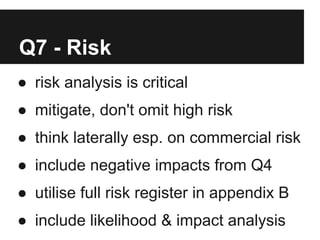
Q7 - Risk
● risk analysis is critical
● mitigate, don't omit high risk
● think laterally esp. on commercial risk
● include negative impacts from Q4
● utilise full risk register in appendix B
● include likelihood & impact analysis
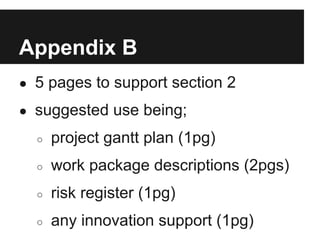
Appendix B
● 5 pages to support section 2

● suggested use being;

  ○   project gantt plan (1pg)
  ○   work package descriptions (2pgs)
  ○   risk register (1pg)
  ○   any innovation support (1pg)
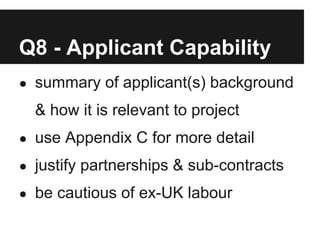
Q8 - Applicant Capability
● summary of applicant(s) background

  & how it is relevant to project
● use Appendix C for more detail

● justify partnerships & sub-contracts

● be cautious of ex-UK labour
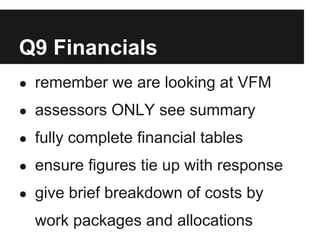
Q9 Financials
● remember we are looking at VFM

● assessors ONLY see summary

● fully complete financial tables

● ensure figures tie up with response

● give brief breakdown of costs by

  work packages and allocations
Q9 con't
● justify extreme costs (esp capitals or

  sub-contracts)
● common queries include;

  ○   capital cost apportionment
  ○   marketing / sales activities &
  ○   patent / legal costs
Q10 Additionality
● easiest points in application
● guidance is very explicit, so follow it
● do not waffle


                                            ...
Q10 con't
FIRSTLY your response
  MUST clearly state how support will
     increase your R&D spend in UK

You need to demonstrate this project is NOT something
you would normally be doing in course of your business
Q10 con't
SECONDLY answer either, or both;
● "Why you are not wholly self
  funding."
● "How TSB support allows the project
  to progress differently."

Answer both for belts & braces but
don't waffle.
Recap
● Read brief, scope and guidance
● Follow it!
● Keep it readible
● Proof read
● Submit on time
Any questions?

An Assessors Look at TSB Competition Applications

  • 1.
    An Assessor's Viewpoint on TSB Funding Applications Barney Craggs
  • 2.
    Why Listen toMe? ● ~18 years in data driven industry ● >14 yrs innovation consultancy ● experience in large multi-nationals ● and itty bitty startups ● raised private equity ● tried and failed to raise public funds...
  • 3.
    TSB Assessor Experience ●across all of ICT since 2010 ● 24 plus competition rounds ● hundreds of applications ● panel moderator > 5 times
  • 4.
    Quick Overview ● heads-uppoints ● pre-flight checklist ● golden rules ● application walkthrough (again) ● recap / q&a
  • 5.
    Heads-Up ● NO secretrecipes for getting it right ● assessors are human, we're subjectively objective ● it is a competition, where you are pitted against each other ● the application is a business plan
  • 6.
    Pre-Flight Checklist ● re-readthe competition brief ● read ALL of the guidance notes ● make sure your project fits FIRST ● check your business plan thinking then and only then...
  • 7.
    Ten Golden Rules(1-5) ● answer all questions to the guidance ● don't assume common knowledge ● grammar, spelling & punctuation matter ● you are space limited, so check it ● appendices; supporting & to size
  • 8.
    Ten Golden Rules(6-10) ● avoid the cliches ● if evidence is king, ● the queen is awareness ● get it proof read ● right documents BY the deadline
  • 9.
  • 10.
    Abstract ● brief summaryof application ● set the scene ● what, why, how ● keep language at high level ● please don't just cut & paste from Q1
  • 11.
    Gateway ● state exactlyhow your project fits competition scope ● if it meets more than one aspect then state it ● don't get carried away, simplicity counts ● again please don't just cut & paste from Q1
  • 12.
    Gateway Example "We arelooking at the feasibility of building a cloud based analysis platform for white- labelling to the agricultural sector based upon real-time weather data collected & distributed by/to farmers using a mobile application. This directly addresses the challenge scope of the competition in being an enabling platform for hyper-local crowd sourced data analysis. Additionally it meets the scope in being a mobile location aware input / output device."
  • 13.
    Q1 - BusinessOpportunity DO ● clearly & simply articulate the business opportunity ● what problems must be overcome? ● define a customer need ● show how project meets that need
  • 14.
    Q1 con't DON'T ● explaineverything about project ● waffle ● assume everyone knows the industry
  • 15.
    Q2 The Market DO ●define market shape, size & changes ● segment & explain ● quantify & justify targets ● say how will you get to market ● give a suggested RoI for project
  • 16.
    Q2 con't DON'T ● forgetto align market with project ● quote meaningless, inappropriate or nothing but figures ● be scared of being ambitious
  • 17.
    Q3 - Exploitables DO ●clearly state exploitable outputs ● describe how you will exploit them ● highlight research & dissemination ● discuss potential impact on YOUR business
  • 18.
    Q3 con't DON'T ● confuseimpact with internal benefit ● forget to project upto 5yrs out ● assume that there is nothing to disseminate
  • 19.
    Q4 - Benefits DO ●cover all 3 required areas, ● from both internal & external angle ● describe how you will address benefit ● highlight & explain negative impacts not forgetting to include in Q7 Risks
  • 20.
    Q4 con't DON'T ● assumean implicit benefit (esp Environmental) - explain them ● hide/forget negative impacts ● give vague claims
  • 21.
    Appendix A ● 5pages to SUPPORT section 1 ● don't over run or repeat yourself ● support customer needs & market ● benefit justification / evidence useful
  • 22.
    Q5 - TechnicalApproach ● no hard & fast rules here ● avoid screeds of technical data ● summarise project plan, milestones, work-packages & allocations ● briefly justify choice of PM approach ● UTILISE appendix B
  • 23.
    Q6 - Innovation ●describe evidence you have used to assure yourself of novelty (web, patents, academic) ● state your expectation of freedom to operate (or any restrictions) ● remember you have to prove novelty
  • 24.
    Q6 con't FOR EACHCLAIM OF INNOVATION ● briefly & clearly describe innovation ● clearly align to scope ● succinctly define innovation type (technical or commercial) & level (incremental or step)
  • 25.
    Q7 - Risk ●risk analysis is critical ● mitigate, don't omit high risk ● think laterally esp. on commercial risk ● include negative impacts from Q4 ● utilise full risk register in appendix B ● include likelihood & impact analysis
  • 26.
    Appendix B ● 5pages to support section 2 ● suggested use being; ○ project gantt plan (1pg) ○ work package descriptions (2pgs) ○ risk register (1pg) ○ any innovation support (1pg)
  • 27.
    Q8 - ApplicantCapability ● summary of applicant(s) background & how it is relevant to project ● use Appendix C for more detail ● justify partnerships & sub-contracts ● be cautious of ex-UK labour
  • 28.
    Q9 Financials ● rememberwe are looking at VFM ● assessors ONLY see summary ● fully complete financial tables ● ensure figures tie up with response ● give brief breakdown of costs by work packages and allocations
  • 29.
    Q9 con't ● justifyextreme costs (esp capitals or sub-contracts) ● common queries include; ○ capital cost apportionment ○ marketing / sales activities & ○ patent / legal costs
  • 30.
    Q10 Additionality ● easiestpoints in application ● guidance is very explicit, so follow it ● do not waffle ...
  • 31.
    Q10 con't FIRSTLY yourresponse MUST clearly state how support will increase your R&D spend in UK You need to demonstrate this project is NOT something you would normally be doing in course of your business
  • 32.
    Q10 con't SECONDLY answereither, or both; ● "Why you are not wholly self funding." ● "How TSB support allows the project to progress differently." Answer both for belts & braces but don't waffle.
  • 33.
    Recap ● Read brief,scope and guidance ● Follow it! ● Keep it readible ● Proof read ● Submit on time
  • 34.