Ammonia Production
( Plant Design, Modeling
And Simulation)
USAMA ARAIN
2016-CH-95
Presentation By:
Department of Chemical Engineering.
University of Engineering And Technology,
lahore.
Introduction:
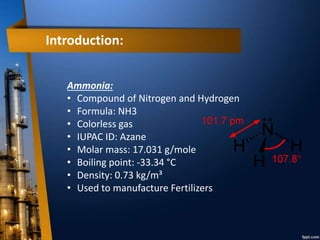
Ammonia:
• Compound of Nitrogen and Hydrogen
• Formula: NH3
• Colorless gas
• IUPAC ID: Azane
• Molar mass: 17.031 g/mole
• Boiling point: -33.34 °C
• Density: 0.73 kg/m³
• Used to manufacture Fertilizers
Ammonia Production:
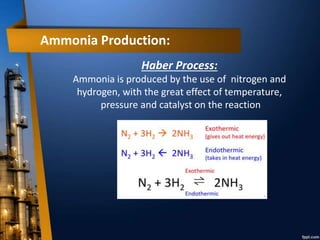
Haber Process:
Ammonia is produced by the use of nitrogen and
hydrogen, with the great effect of temperature,
pressure and catalyst on the reaction
Ammonia Production
Following Steps are involved in the
Production of Ammonia
1. Preparing PFD and BFD
2. Plant Designing
3. Modeling And Simulation
PFDs And BFDs
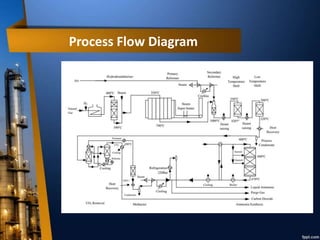
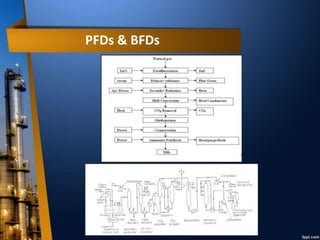
Process Flow Diagram
A process flow diagram (PFD) is a diagram commonly used
in chemical and process engineering to indicate the
general flow of plant processes and equipment.
Process Flow diagram consist of;
• All of the piping involved
• All the major equipment (Pumps, Reactors, Heat Exchangers etc.)
• The conditions (temperature, pressure, composition, flow rate
etc.) •The mechanism and entering and leaving streams from the
plant
• All the major process (separation, condensation, purification etc.)
Process Flow Diagram
PFDs & BFDs
PFDs & BFDs
Software used for Process Flow Diagram
and Block Flow Diagram
• Microsoft Visio
• SmartDraw
• Creately
• Pidoco
• OmniGraffle etc.
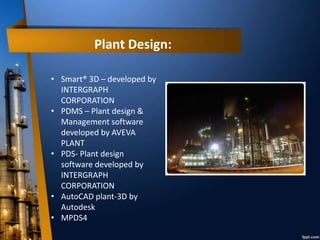
Plant Design:
• Smart® 3D – developed by
INTERGRAPH
CORPORATION
• PDMS – Plant design &
Management software
developed by AVEVA
PLANT
• PDS- Plant design
software developed by
INTERGRAPH
CORPORATION
• AutoCAD plant-3D by
Autodesk
• MPDS4
Modeling And Simulation
What is Modeling?
Modeling is the process of producing a model; a model
is a representation of the construction and working of
some system of interest Modeling is defining the properties,
conditions or parameters into a software and preparing a
mathematical model of a process followed into a plant.
What is Simulation?
A simulation of a system is the operation of a model of
the system Simulation is the application of working of the
mathematical model prepared on the computer into the plant.
1. Aspen
2. HSC Chemistry
3. MATLAB
4. Simio
5. AnyLogic
6. SIMUL8 Professional
7. SolidWorks Simulation Premium
8. Analytic Solver
9. COMSOL Multiphysics
10. iGrafx etc.
Modeling And Simulation(Ammonia Plants)
The process of producing ammonia is simulated in Simulation
software Aspen Hysys7.1. Aspen HYSYS process simulator is a
core element of AspenTech’sAspenONE® engineering
applications. It provides quite accurate results which makes it
an efficient simulator. It provides comprehensive
thermodynamics basis for accurate determination of physical
properties, transport properties, and phase behavior. Aspen
HYSYS can be used to determine outlet process conditions if
the inlet conditions like temperature, pressure, and
composition are specified. In this simulation we used Peng-
Robinson model fits best to equilibrium process.
Conclusion
Thank You!
Any Question?

Ammonia production

  • 1.
    Ammonia Production ( PlantDesign, Modeling And Simulation)
  • 2.
    USAMA ARAIN 2016-CH-95 Presentation By: Departmentof Chemical Engineering. University of Engineering And Technology, lahore.
  • 3.
    Introduction: Ammonia: • Compound ofNitrogen and Hydrogen • Formula: NH3 • Colorless gas • IUPAC ID: Azane • Molar mass: 17.031 g/mole • Boiling point: -33.34 °C • Density: 0.73 kg/m³ • Used to manufacture Fertilizers
  • 4.
    Ammonia Production: Haber Process: Ammoniais produced by the use of nitrogen and hydrogen, with the great effect of temperature, pressure and catalyst on the reaction
  • 5.
    Ammonia Production Following Stepsare involved in the Production of Ammonia 1. Preparing PFD and BFD 2. Plant Designing 3. Modeling And Simulation
  • 6.
    PFDs And BFDs ProcessFlow Diagram A process flow diagram (PFD) is a diagram commonly used in chemical and process engineering to indicate the general flow of plant processes and equipment. Process Flow diagram consist of; • All of the piping involved • All the major equipment (Pumps, Reactors, Heat Exchangers etc.) • The conditions (temperature, pressure, composition, flow rate etc.) •The mechanism and entering and leaving streams from the plant • All the major process (separation, condensation, purification etc.)
  • 7.
  • 8.
  • 9.
    PFDs & BFDs Softwareused for Process Flow Diagram and Block Flow Diagram • Microsoft Visio • SmartDraw • Creately • Pidoco • OmniGraffle etc.
  • 10.
    Plant Design: • Smart®3D – developed by INTERGRAPH CORPORATION • PDMS – Plant design & Management software developed by AVEVA PLANT • PDS- Plant design software developed by INTERGRAPH CORPORATION • AutoCAD plant-3D by Autodesk • MPDS4
  • 11.
    Modeling And Simulation Whatis Modeling? Modeling is the process of producing a model; a model is a representation of the construction and working of some system of interest Modeling is defining the properties, conditions or parameters into a software and preparing a mathematical model of a process followed into a plant. What is Simulation? A simulation of a system is the operation of a model of the system Simulation is the application of working of the mathematical model prepared on the computer into the plant.
  • 12.
    1. Aspen 2. HSCChemistry 3. MATLAB 4. Simio 5. AnyLogic 6. SIMUL8 Professional 7. SolidWorks Simulation Premium 8. Analytic Solver 9. COMSOL Multiphysics 10. iGrafx etc.
  • 13.
    Modeling And Simulation(AmmoniaPlants) The process of producing ammonia is simulated in Simulation software Aspen Hysys7.1. Aspen HYSYS process simulator is a core element of AspenTech’sAspenONE® engineering applications. It provides quite accurate results which makes it an efficient simulator. It provides comprehensive thermodynamics basis for accurate determination of physical properties, transport properties, and phase behavior. Aspen HYSYS can be used to determine outlet process conditions if the inlet conditions like temperature, pressure, and composition are specified. In this simulation we used Peng- Robinson model fits best to equilibrium process.
  • 14.