Ammonia Hot Water Heat
Pump Case Study
Mayekawa Australia Pty Ltd
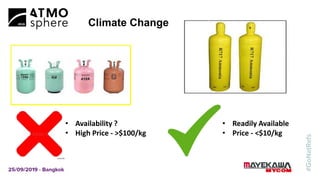
Climate Change
• Availability ?
• High Price - >$100/kg
• Readily Available
• Price - <$10/kg
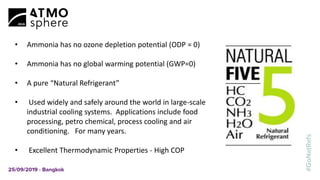
• Ammonia has no ozone depletion potential (ODP = 0)
• Ammonia has no global warming potential (GWP=0)
• A pure “Natural Refrigerant”
• Used widely and safely around the world in large-scale
industrial cooling systems. Applications include food
processing, petro chemical, process cooling and air
conditioning. For many years.
• Excellent Thermodynamic Properties - High COP
Ammonia NH3
Refrigerant
ODP: Ozone Depletion Potential
GWP: Global Warming Potential ODP
GWP
[100yrs]
Safety
classification
Natural
Refrigerants
CO2 (R744) 0 1 A1
Ammonia (R717) 0 0 B2
Propane (R290) 0 3 A3
Iso-Butane
(R600a) 0 3 A3
Utilising Waste Heat :
THR = kWr + kW abs
1009.3kWr + 246.5kW abs
1.26 MW
MODEL : N220JL-V
REFRIGERANT : AMMONIA
RECOMMENDED PORT : M
BOOSTER : N
Vi : [-] 3.23
COMPRESSION RATIO : [-] 4.65
CAPACITY : [kW] 1009.3
ABSORBED POWER : [kW] 246.5
Typical IP Compressor @ Te/Tc -10°C / +35°C
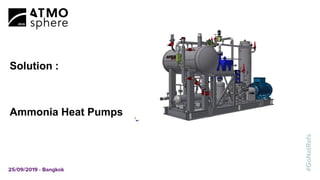
Solution :
Ammonia Heat Pumps
Project Outline: Small Goods Production Facility
1. The facility consumes a significant quantity of hot water daily, primarily
generated by LPG fired steam boilers.
2. 65°C hot water used primarily for wash down & boiler make up.
3. The refrigeration plant utilises a desuperheater, however higher grade
heat is required from this loop for factory services.
4. Hot water generation uses a high % of the total site energy.
5. Significant heat of rejection from the refrigeration system, so
utilisation of this “waste heat source” seen as a key factor for reducing
overall plant energy consumption.
Refrigeration Total Heat Rejection
SINGLE STAGE SCREW COMPRESSOR : 2019_ver.1
MODEL : N250VS*-M
REFRIGERANT : AMMONIA
RECOMMENDED PORT : L
Vi : [-] 2.98
COMPRESSION RATIO : [-] 4.65
CAPACITY : [kW] 1393.3
ABSORBED POWER : [kW] 330.6
SINGLE STAGE SCREW COMPRESSOR : 2019_ver.1
MODEL : N200VM*-M
REFRIGERANT : AMMONIA
RECOMMENDED PORT : L
Vi : [-] 3.23
COMPRESSION RATIO : [-] 4.65
CAPACITY : [kW] 824.9
ABSORBED POWER : [kW] 207.2
N200VMD
N250VSD
N160VLD LT = 334kW
Total: = 3,089kW
MT = 2,755kW
Heat Pump Design Data
REFRIGERANT AMMONIA
MODEL N6HK
BOOSTER N
CAPACITY [kW] 462.0
ABSORBED POWER [kW] 75.8
SPEED [min-1] 1450
LOAD [%] 100
CONDENSING TEMP. [degC] 70.0
EVAPORATIVE TEMP. [degC] 30.0
SUCTION SUPERHEAT [degC] 1.00
LIQUID SUBCOOLING [degC] 40.0
SUCTION PRES. [MPaA] 1.17
DISCHARGE PRES. [MPaA] 3.31
SWEPT VOLUME [m3/h] 193
DISCHARGE TEMP. [degC] 118
COP [-] 6.09
HEATING CAPACITY [kW] 532.0
COPh [-] 7.02
COPt [-] 13.1
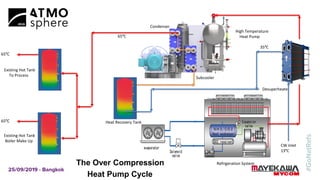
The Over Compression
Heat Pump Cycle
Heat Recovery Tank
Desuperheater
Refrigeration System
High Temperature
Heat Pump
Subcooler
Condenser
CW Inlet
13°C
Existing Hot Tank
To Process
35°C
65°C
65°C
65°C
Existing Hot Tank
Boiler Make Up
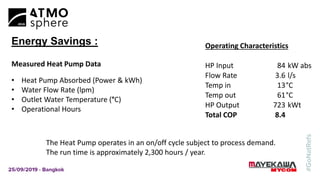
Energy Savings :
Measured Heat Pump Data
• Heat Pump Absorbed (Power & kWh)
• Water Flow Rate (lpm)
• Outlet Water Temperature (°C)
• Operational Hours
Operating Characteristics
HP Input 84 kW abs
Flow Rate 3.6 l/s
Temp in 13°C
Temp out 61°C
HP Output 723 kWt
Total COP 8.4
The Heat Pump operates in an on/off cycle subject to process demand.
The run time is approximately 2,300 hours / year.
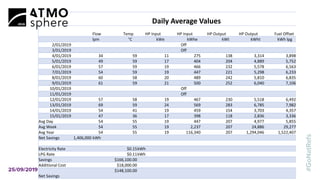
Daily Average Values
Flow Temp HP Input HP Input HP Output HP Output Fuel Offset
lpm °C kWe kWhe kWt kWht kWh lpg
2/01/2019 Off
3/01/2019 Off
4/01/2019 34 59 11 275 138 3,314 3,898
5/01/2019 49 59 17 404 204 4,889 5,752
6/01/2019 57 59 19 466 232 5,578 6,563
7/01/2019 54 59 19 447 221 5,298 6,233
8/01/2019 60 58 20 489 242 5,810 6,835
9/01/2019 61 59 21 500 252 6,040 7,106
10/01/2019 Off
11/01/2019 Off
12/01/2019 57 58 19 467 230 5,518 6,492
13/01/2019 69 59 24 569 283 6,785 7,982
14/01/2019 54 41 19 459 154 3,703 4,357
15/01/2019 47 36 17 398 118 2,836 3,336
Avg Day 54 55 19 447 207 4,977 5,855
Avg Week 54 55 19 2,237 207 24,886 29,277
Avg Year 54 55 19 116,340 207 1,294,046 1,522,407
Net Savings 1,406,000 kWh
Electricity Rate $0.15kWh
LPG Rate $0.11kWh
Savings $166,100.00
Additional Cost $18,000.00
Net Savings
$148,100.00
0
0.1
0.2
0.3
0.4
0.5
0.6
0.7
0.8
0.9
1
EfficiencykWh/kg
Date
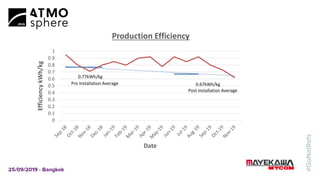
Production Efficiency
0.77kWh/kg
0.67kWh/kg
Post Installation Average
Pre Installation Average
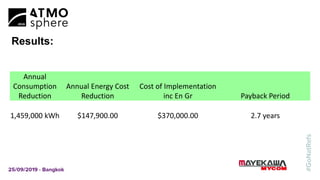
Results:
Annual
Consumption
Reduction
Annual Energy Cost
Reduction
Cost of Implementation
inc En Gr Payback Period
1,459,000 kWh $147,900.00 $370,000.00 2.7 years
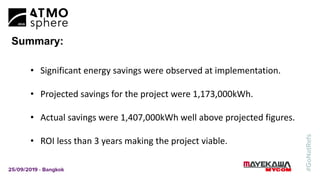
Summary:
• Significant energy savings were observed at implementation.
• Projected savings for the project were 1,173,000kWh.
• Actual savings were 1,407,000kWh well above projected figures.
• ROI less than 3 years making the project viable.
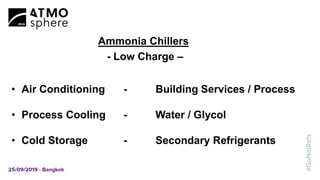
Ammonia Chillers
- Low Charge –
• Air Conditioning - Building Services / Process
• Process Cooling - Water / Glycol
• Cold Storage - Secondary Refrigerants
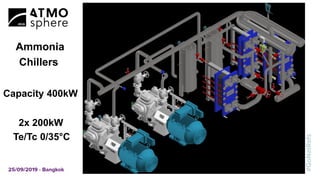
Ammonia
Chillers
2x 200kW
Te/Tc 0/35°C
Capacity 400kW
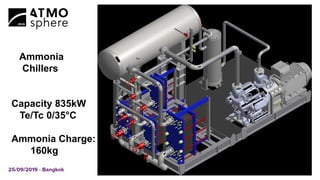
Ammonia
Chillers
Capacity 835kW
Te/Tc 0/35°C
Ammonia Charge:
160kg
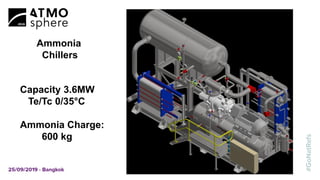
Capacity 3.6MW
Te/Tc 0/35°C
Ammonia Charge:
600 kg
Ammonia
Chillers
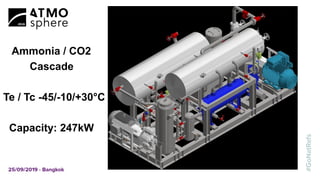
Ammonia / CO2
Cascade
Te / Tc -45/-10/+30°C
Capacity: 247kW
Natural Refrigerants
The only way forward !
Ammonia Hot Water Heat Pump Case Study

Ammonia Hot Water Heat Pump Case Study

  • 2.
    Ammonia Hot WaterHeat Pump Case Study Mayekawa Australia Pty Ltd
  • 3.
    Climate Change • Availability? • High Price - >$100/kg • Readily Available • Price - <$10/kg
  • 4.
    • Ammonia hasno ozone depletion potential (ODP = 0) • Ammonia has no global warming potential (GWP=0) • A pure “Natural Refrigerant” • Used widely and safely around the world in large-scale industrial cooling systems. Applications include food processing, petro chemical, process cooling and air conditioning. For many years. • Excellent Thermodynamic Properties - High COP
  • 5.
    Ammonia NH3 Refrigerant ODP: OzoneDepletion Potential GWP: Global Warming Potential ODP GWP [100yrs] Safety classification Natural Refrigerants CO2 (R744) 0 1 A1 Ammonia (R717) 0 0 B2 Propane (R290) 0 3 A3 Iso-Butane (R600a) 0 3 A3
  • 6.
    Utilising Waste Heat: THR = kWr + kW abs 1009.3kWr + 246.5kW abs 1.26 MW MODEL : N220JL-V REFRIGERANT : AMMONIA RECOMMENDED PORT : M BOOSTER : N Vi : [-] 3.23 COMPRESSION RATIO : [-] 4.65 CAPACITY : [kW] 1009.3 ABSORBED POWER : [kW] 246.5 Typical IP Compressor @ Te/Tc -10°C / +35°C
  • 7.
  • 8.
    Project Outline: SmallGoods Production Facility 1. The facility consumes a significant quantity of hot water daily, primarily generated by LPG fired steam boilers. 2. 65°C hot water used primarily for wash down & boiler make up. 3. The refrigeration plant utilises a desuperheater, however higher grade heat is required from this loop for factory services. 4. Hot water generation uses a high % of the total site energy. 5. Significant heat of rejection from the refrigeration system, so utilisation of this “waste heat source” seen as a key factor for reducing overall plant energy consumption.
  • 9.
    Refrigeration Total HeatRejection SINGLE STAGE SCREW COMPRESSOR : 2019_ver.1 MODEL : N250VS*-M REFRIGERANT : AMMONIA RECOMMENDED PORT : L Vi : [-] 2.98 COMPRESSION RATIO : [-] 4.65 CAPACITY : [kW] 1393.3 ABSORBED POWER : [kW] 330.6 SINGLE STAGE SCREW COMPRESSOR : 2019_ver.1 MODEL : N200VM*-M REFRIGERANT : AMMONIA RECOMMENDED PORT : L Vi : [-] 3.23 COMPRESSION RATIO : [-] 4.65 CAPACITY : [kW] 824.9 ABSORBED POWER : [kW] 207.2 N200VMD N250VSD N160VLD LT = 334kW Total: = 3,089kW MT = 2,755kW
  • 10.
    Heat Pump DesignData REFRIGERANT AMMONIA MODEL N6HK BOOSTER N CAPACITY [kW] 462.0 ABSORBED POWER [kW] 75.8 SPEED [min-1] 1450 LOAD [%] 100 CONDENSING TEMP. [degC] 70.0 EVAPORATIVE TEMP. [degC] 30.0 SUCTION SUPERHEAT [degC] 1.00 LIQUID SUBCOOLING [degC] 40.0 SUCTION PRES. [MPaA] 1.17 DISCHARGE PRES. [MPaA] 3.31 SWEPT VOLUME [m3/h] 193 DISCHARGE TEMP. [degC] 118 COP [-] 6.09 HEATING CAPACITY [kW] 532.0 COPh [-] 7.02 COPt [-] 13.1
  • 11.
    The Over Compression HeatPump Cycle Heat Recovery Tank Desuperheater Refrigeration System High Temperature Heat Pump Subcooler Condenser CW Inlet 13°C Existing Hot Tank To Process 35°C 65°C 65°C 65°C Existing Hot Tank Boiler Make Up
  • 12.
    Energy Savings : MeasuredHeat Pump Data • Heat Pump Absorbed (Power & kWh) • Water Flow Rate (lpm) • Outlet Water Temperature (°C) • Operational Hours Operating Characteristics HP Input 84 kW abs Flow Rate 3.6 l/s Temp in 13°C Temp out 61°C HP Output 723 kWt Total COP 8.4 The Heat Pump operates in an on/off cycle subject to process demand. The run time is approximately 2,300 hours / year.
  • 13.
    Daily Average Values FlowTemp HP Input HP Input HP Output HP Output Fuel Offset lpm °C kWe kWhe kWt kWht kWh lpg 2/01/2019 Off 3/01/2019 Off 4/01/2019 34 59 11 275 138 3,314 3,898 5/01/2019 49 59 17 404 204 4,889 5,752 6/01/2019 57 59 19 466 232 5,578 6,563 7/01/2019 54 59 19 447 221 5,298 6,233 8/01/2019 60 58 20 489 242 5,810 6,835 9/01/2019 61 59 21 500 252 6,040 7,106 10/01/2019 Off 11/01/2019 Off 12/01/2019 57 58 19 467 230 5,518 6,492 13/01/2019 69 59 24 569 283 6,785 7,982 14/01/2019 54 41 19 459 154 3,703 4,357 15/01/2019 47 36 17 398 118 2,836 3,336 Avg Day 54 55 19 447 207 4,977 5,855 Avg Week 54 55 19 2,237 207 24,886 29,277 Avg Year 54 55 19 116,340 207 1,294,046 1,522,407 Net Savings 1,406,000 kWh Electricity Rate $0.15kWh LPG Rate $0.11kWh Savings $166,100.00 Additional Cost $18,000.00 Net Savings $148,100.00
  • 14.
  • 15.
    Results: Annual Consumption Reduction Annual Energy Cost Reduction Costof Implementation inc En Gr Payback Period 1,459,000 kWh $147,900.00 $370,000.00 2.7 years
  • 16.
    Summary: • Significant energysavings were observed at implementation. • Projected savings for the project were 1,173,000kWh. • Actual savings were 1,407,000kWh well above projected figures. • ROI less than 3 years making the project viable.
  • 17.
    Ammonia Chillers - LowCharge – • Air Conditioning - Building Services / Process • Process Cooling - Water / Glycol • Cold Storage - Secondary Refrigerants
  • 18.
  • 19.
  • 20.
    Capacity 3.6MW Te/Tc 0/35°C AmmoniaCharge: 600 kg Ammonia Chillers
  • 21.
    Ammonia / CO2 Cascade Te/ Tc -45/-10/+30°C Capacity: 247kW
  • 22.