AMMETER AND VOLTMETER AMMETER AND VOLTMETER AMMETER AND VOLTMETER
1.
AMMETER:-
Ammeter is anelectrical measuring device
which is used to measure electric current
through the circuit.
Ammeter is a low resistance galvanometer.
Ammeter is used to measure the current in a
circuit. Current is measured in ampere.
Symbol of Ammeter:
2.
.
An ammeter isalways connected in series to
a circuit, so that current flow through circuit
will be same.
3.
Working Principle OfAmmeter:
The working principle of ammeter is that the
resistance and inductive reactance must be very
low.
Ammeter has a very low impedance as the
voltage drop across the ammeter should be low.
The working principle is depend on the ohm’s law;
4.
An Ideal Ammeter
Foran ideal ammeter, the impedance must be zero
so that the voltage drop across the instrument is zero,
so chance of short circuit is negligible.
5.
Uses In Physiotherapy:
•The use of this electric current to speed tissue
healing where tissues damage occurs.
• This allow a small, low-intensity electric charge to
be passed across the area.
• Uses in physiotherapy modalities:
- TENS
- IFT
- MS
6.
VOLTMETER:-
Voltmeter is anelectrical measuring device,
which is used to measure potential difference
b/w two points in a circuit.
Voltmeter is a high resistance galvanometer.
Voltmeter measures potential difference in
volt.
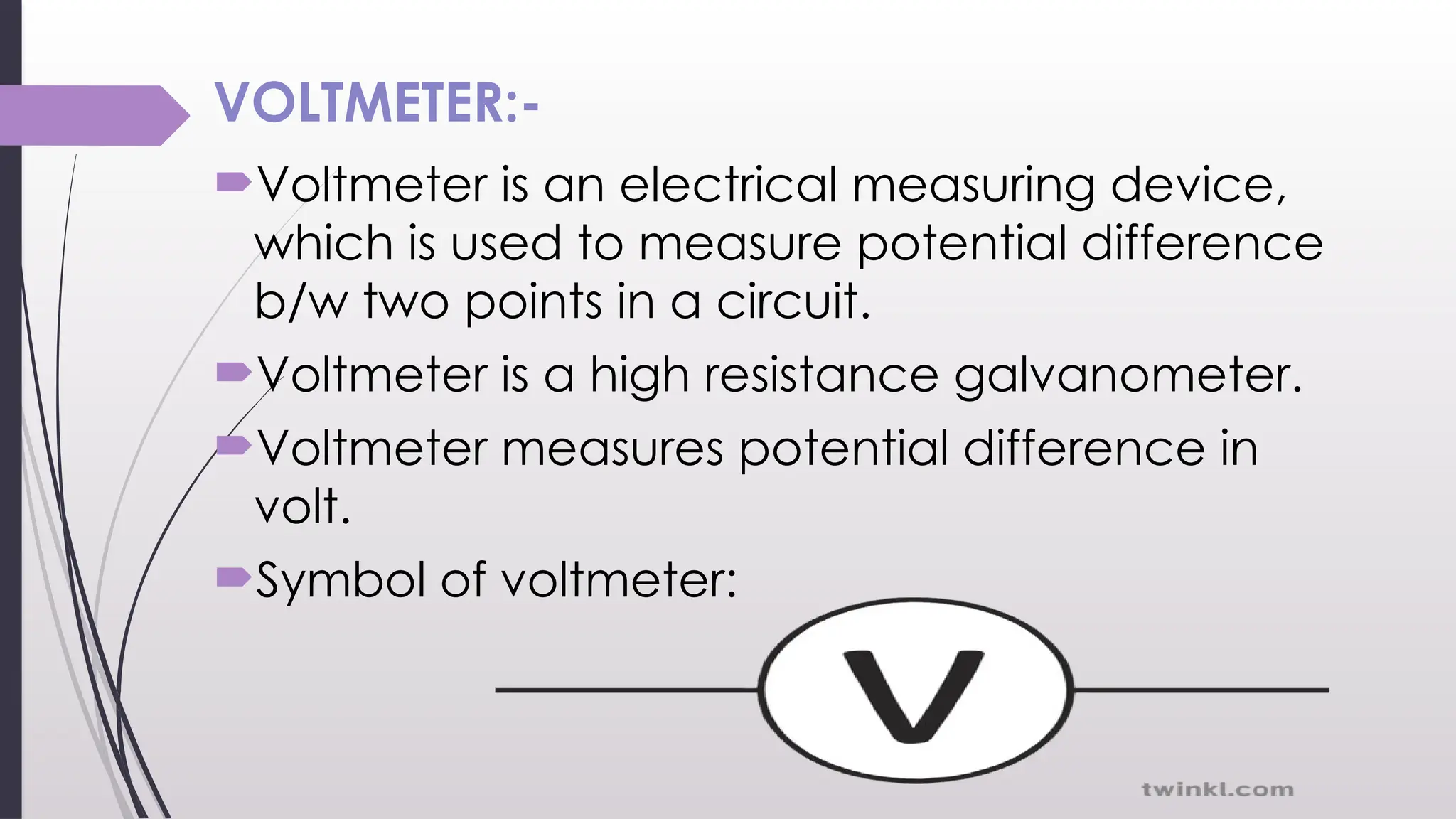
Symbol of voltmeter:
7.
.
Voltmeter is alwaysconnected in parallel to a
circuit, so the voltage across the circuit remains
same.
Its usually has a high resistance, so that it takes
negligible current from the circuit.
8.
Working Principle OfVoltmeter:
The main principle of voltmeter is that it must be
connected in parallel in which we want to measure
the voltage.
If it is connected in parallel, than the load impedance
comes parallel with the high resistance of the
voltmeter and hence the combination will give almost
the some the impedance that the load had.
The working principle works on ohm’s law.
9.
An Ideal Voltmeter
For,an ideal voltmeter, we have the resistance is to
be infinite and hence the current drawn to be zero,
so there will be no power loss in the instrument.
Practically this is not possible as there is no such
instrument with infinite resistance.
10.
Uses In Physiotherapy:
Electrotherapy
- US(Deep tissue healing and repairing)
- SWD
- Magnetotherapy(resulting in
hyperpolarization of the cell
membrane, and thereby the increment of the
metabolism)
- Phototherapy (IR-lamps, UV-Lamps)