Dr. Warren J. Blumenfeld
warrenblumenfeld@gmail.com
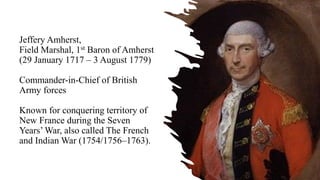
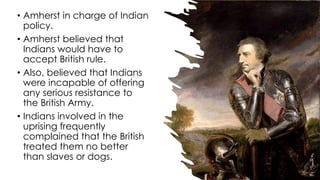
Jeffery Amherst,
Field Marshal, 1st Baron of Amherst
(29 January 1717 – 3 August 1779)
Commander-in-Chief of British
Army forces
Known for conquering territory of
New France during the Seven
Years’ War, also called The French
and Indian War (1754/1756–1763).
• Amherst in charge of Indian
policy.
• Amherst believed that
Indians would have to
accept British rule.
• Also, believed that Indians
were incapable of offering
any serious resistance to
the British Army.
• Indians involved in the
uprising frequently
complained that the British
treated them no better
than slaves or dogs.
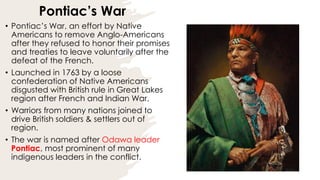
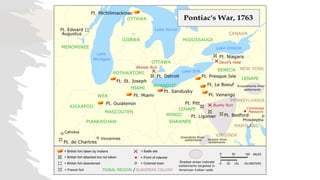
Pontiac’s War
• Pontiac’s War, an effort by Native
Americans to remove Anglo-Americans
after they refused to honor their promises
and treaties to leave voluntarily after the
defeat of the French.
• Launched in 1763 by a loose
confederation of Native Americans
disgusted with British rule in Great Lakes
region after French and Indian War.
• Warriors from many nations joined to
drive British soldiers & settlers out of
region.
• The war is named after Odawa leader
Pontiac, most prominent of many
indigenous leaders in the conflict.
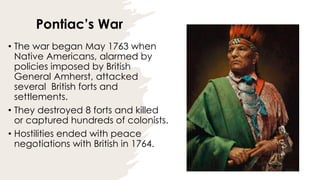
Pontiac’s War
• The war began May 1763 when
Native Americans, alarmed by
policies imposed by British
General Amherst, attacked
several British forts and
settlements.
• They destroyed 8 forts and killed
or captured hundreds of colonists.
• Hostilities ended with peace
negotiations with British in 1764.
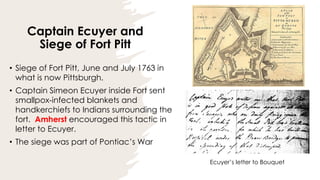
Captain Ecuyer and
Siege of Fort Pitt
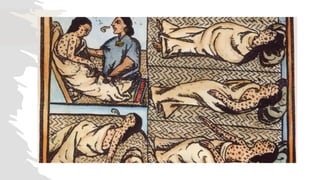
• Siege of Fort Pitt, June and July 1763 in
what is now Pittsburgh.
• Captain Simeon Ecuyer inside Fort sent
smallpox-infected blankets and
handkerchiefs to Indians surrounding the
fort. Amherst encouraged this tactic in
letter to Ecuyer.
• The siege was part of Pontiac’s War
Ecuyer’s letter to Bouquet
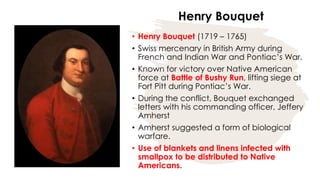
Henry Bouquet
• Henry Bouquet (1719 – 1765)
• Swiss mercenary in British Army during
French and Indian War and Pontiac’s War.
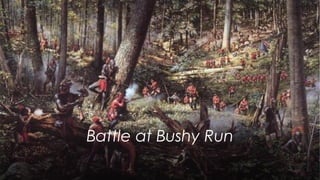
• Known for victory over Native American
force at Battle of Bushy Run, lifting siege at
Fort Pitt during Pontiac’s War.
• During the conflict, Bouquet exchanged
letters with his commanding officer, Jeffery
Amherst
• Amherst suggested a form of biological
warfare.
• Use of blankets and linens infected with
smallpox to be distributed to Native
Americans.
Battle at Bushy Run
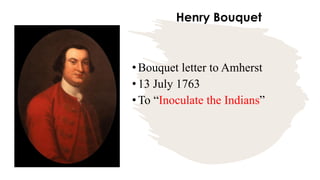
Henry Bouquet
•Bouquet letter to Amherst
•13 July 1763
•To “Inoculate the Indians”
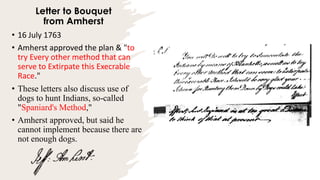
Letter to Bouquet
from Amherst
• 16 July 1763
• Amherst approved the plan & "to
try Every other method that can
serve to Extirpate this Execrable
Race."
• These letters also discuss use of
dogs to hunt Indians, so-called
"Spaniard's Method,"
• Amherst approved, but said he
cannot implement because there are
not enough dogs.
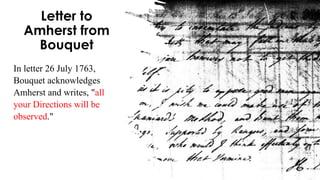
Letter to
Amherst from
Bouquet
In letter 26 July 1763,
Bouquet acknowledges
Amherst and writes, "all
your Directions will be
observed."
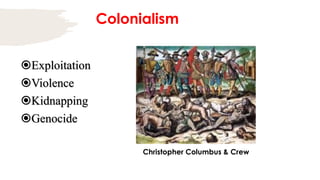
Colonialism
Exploitation
Violence
Kidnapping
Genocide
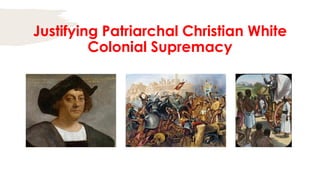
Christopher Columbus & Crew
Justifying Patriarchal Christian White
Colonial Supremacy
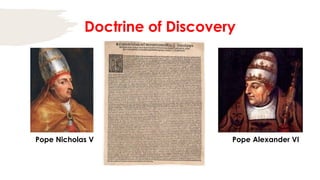
Doctrine of Discovery
Pope Nicholas V Pope Alexander VI
Doctrine of Discovery
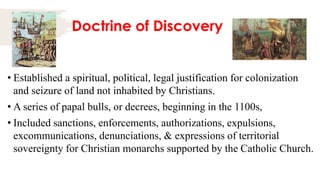
• Established a spiritual, political, legal justification for colonization
and seizure of land not inhabited by Christians.
• A series of papal bulls, or decrees, beginning in the 1100s,
• Included sanctions, enforcements, authorizations, expulsions,
excommunications, denunciations, & expressions of territorial
sovereignty for Christian monarchs supported by the Catholic Church.
Doctrine of Discovery
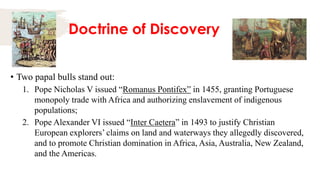
• Two papal bulls stand out:
1. Pope Nicholas V issued “Romanus Pontifex” in 1455, granting Portuguese
monopoly trade with Africa and authorizing enslavement of indigenous
populations;
2. Pope Alexander VI issued “Inter Caetera” in 1493 to justify Christian
European explorers’ claims on land and waterways they allegedly discovered,
and to promote Christian domination in Africa, Asia, Australia, New Zealand,
and the Americas.
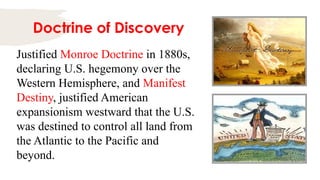
Doctrine of Discovery
Justified Monroe Doctrine in 1880s,
declaring U.S. hegemony over the
Western Hemisphere, and Manifest
Destiny, justified American
expansionism westward that the U.S.
was destined to control all land from
the Atlantic to the Pacific and
beyond.
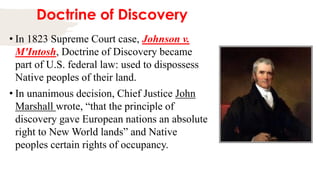
Doctrine of Discovery
• In 1823 Supreme Court case, Johnson v.
M'Intosh, Doctrine of Discovery became
part of U.S. federal law: used to dispossess
Native peoples of their land.
• In unanimous decision, Chief Justice John
Marshall wrote, “that the principle of
discovery gave European nations an absolute
right to New World lands” and Native
peoples certain rights of occupancy.
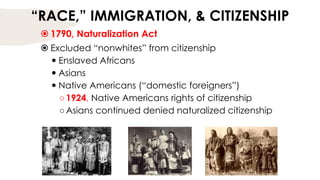
“RACE,” IMMIGRATION, & CITIZENSHIP
 1790, Naturalization Act
 Excluded “nonwhites” from citizenship
 Enslaved Africans
 Asians
 Native Americans (“domestic foreigners”)
○1924, Native Americans rights of citizenship
○Asians continued denied naturalized citizenship
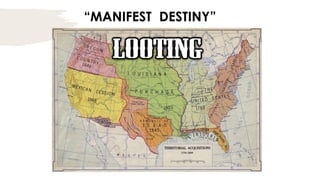
“MANIFEST DESTINY”
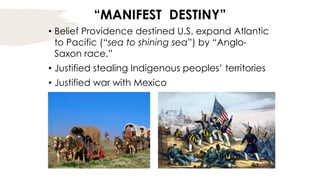
“MANIFEST DESTINY”
• Belief Providence destined U.S. expand Atlantic
to Pacific (“sea to shining sea”) by “Anglo-
Saxon race.”
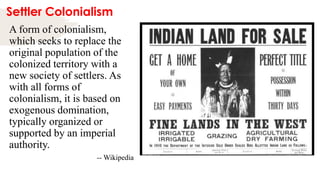
• Justified stealing Indigenous peoples’ territories
• Justified war with Mexico
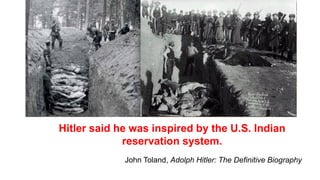
Hitler said he was inspired by the U.S. Indian
reservation system.
John Toland, Adolph Hitler: The Definitive Biography
Native American Indian Off-Site
Christian Boarding Schools
Between 1879 and 1905, white Christian teachers operated 25 Indian
boarding schools for U.S. government. Pratt related to Baptist audience
regarding his theory of education: “[We must immerse] Indians in our
civilization, and when we get them under, [hold] them there until they are
thoroughly soaked.” And, “We must kill the Indian in him to save the man.”
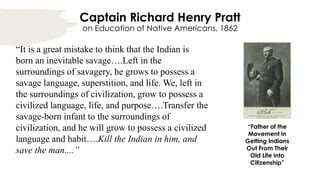
Lieutenant Richard Henry Pratt,
Founder and Superintendent of
Carlisle Indian School, in Military
Uniform and With Sword 1879.
Captain Richard Henry Pratt
on Education of Native Americans, 1862
“It is a great mistake to think that the Indian is
born an inevitable savage….Left in the
surroundings of savagery, he grows to possess a
savage language, superstition, and life. We, left in
the surroundings of civilization, grow to possess a
civilized language, life, and purpose….Transfer the
savage-born infant to the surroundings of
civilization, and he will grow to possess a civilized
language and habit….Kill the Indian in him, and
save the man....”
“Father of the
Movement in
Getting Indians
Out From Their
Old Life into
Citizenship”
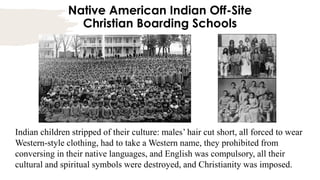
Native American Indian Off-Site
Christian Boarding Schools
Indian children stripped of their culture: males’ hair cut short, all forced to wear
Western-style clothing, had to take a Western name, they prohibited from
conversing in their native languages, and English was compulsory, all their
cultural and spiritual symbols were destroyed, and Christianity was imposed.
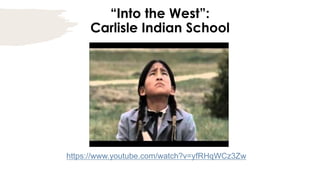
“Into the West”:
Carlisle Indian School
https://www.youtube.com/watch?v=yfRHqWCz3Zw
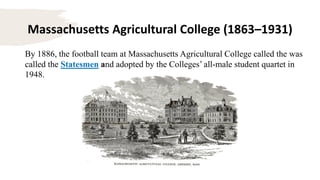
Massachusetts Agricultural College (1863–1931)
By 1886, the football team at Massachusetts Agricultural College called the was
called the Statesmen and adopted by the Colleges’ all-male student quartet in
1948.
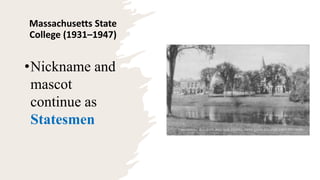
Massachusetts State
College (1931–1947)
•Nickname and
mascot
continue as
Statesmen
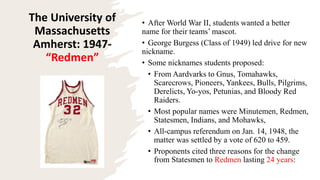
The University of
Massachusetts
Amherst: 1947-
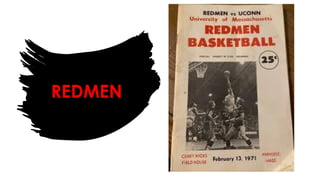
“Redmen”
• After World War II, students wanted a better
name for their teams’ mascot.
• George Burgess (Class of 1949) led drive for new
nickname.
• Some nicknames students proposed:
• From Aardvarks to Gnus, Tomahawks,
Scarecrows, Pioneers, Yankees, Bulls, Pilgrims,
Derelicts, Yo-yos, Petunias, and Bloody Red
Raiders.
• Most popular names were Minutemen, Redmen,
Statesmen, Indians, and Mohawks,
• All-campus referendum on Jan. 14, 1948, the
matter was settled by a vote of 620 to 459.
• Proponents cited three reasons for the change
from Statesmen to Redmen lasting 24 years:
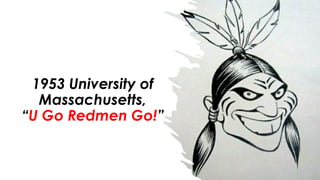
1953 University of
Massachusetts,
“U Go Redmen Go!”
REDMEN
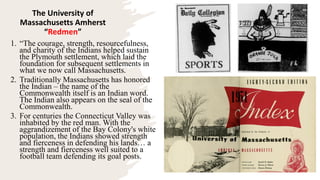
The University of
Massachusetts Amherst
“Redmen”
1. “The courage, strength, resourcefulness,
and charity of the Indians helped sustain
the Plymouth settlement, which laid the
foundation for subsequent settlements in
what we now call Massachusetts.
2. Traditionally Massachusetts has honored
the Indian – the name of the
Commonwealth itself is an Indian word.
The Indian also appears on the seal of the
Commonwealth.
3. For centuries the Connecticut Valley was
inhabited by the red man. With the
aggrandizement of the Bay Colony's white
population, the Indians showed strength
and fierceness in defending his lands… a
strength and fierceness well suited to a
football team defending its goal posts.
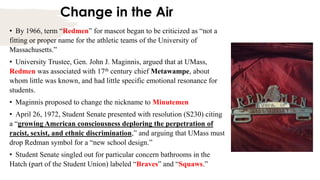
Change in the Air
• By 1966, term “Redmen” for mascot began to be criticized as “not a
fitting or proper name for the athletic teams of the University of
Massachusetts.”
• University Trustee, Gen. John J. Maginnis, argued that at UMass,
Redmen was associated with 17th century chief Metawampe, about
whom little was known, and had little specific emotional resonance for
students.
• Maginnis proposed to change the nickname to Minutemen
• April 26, 1972, Student Senate presented with resolution (S230) citing
a “growing American consciousness deploring the perpetration of
racist, sexist, and ethnic discrimination,” and arguing that UMass must
drop Redman symbol for a “new school design.”
• Student Senate singled out for particular concern bathrooms in the
Hatch (part of the Student Union) labeled “Braves” and “Squaws.”
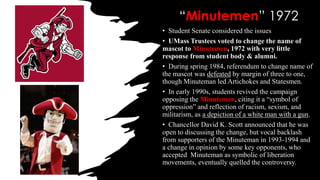
“Minutemen” 1972
• Student Senate considered the issues
• UMass Trustees voted to change the name of
mascot to Minutemen, 1972 with very little
response from student body & alumni.
• During spring 1984, referendum to change name of
the mascot was defeated by margin of three to one,
though Minuteman led Artichokes and Statesmen.
• In early 1990s, students revived the campaign
opposing the Minutemen, citing it a “symbol of
oppression” and reflection of racism, sexism, and
militarism, as a depiction of a white man with a gun.
• Chancellor David K. Scott announced that he was
open to discussing the change, but vocal backlash
from supporters of the Minuteman in 1993-1994 and
a change in opinion by some key opponents, who
accepted Minuteman as symbolic of liberation
movements, eventually quelled the controversy.
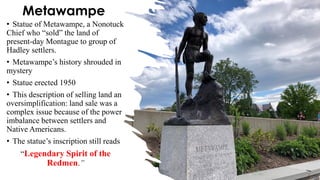
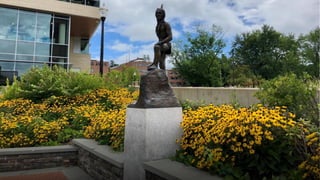
Metawampe
• Statue of Metawampe, a Nonotuck
Chief who “sold” the land of
present-day Montague to group of
Hadley settlers.
• Metawampe’s history shrouded in
mystery
• Statue erected 1950
• This description of selling land an
oversimplification: land sale was a
complex issue because of the power
imbalance between settlers and
Native Americans.
• The statue’s inscription still reads
“Legendary Spirit of the
Redmen.”
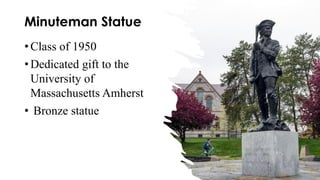
Minuteman Statue
•Class of 1950
•Dedicated gift to the
University of
Massachusetts Amherst
• Bronze statue
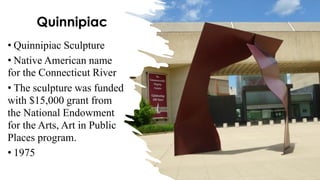
Quinnipiac
• Quinnipiac Sculpture
• Native American name
for the Connecticut River
• The sculpture was funded
with $15,000 grant from
the National Endowment
for the Arts, Art in Public
Places program.
• 1975
University of Massachusetts
Land Acknowledgment Statement
• The University of Massachusetts Amherst acknowledges that it was founded and built on the unceded
homelands of the Pocumtuc Nation on the land of the Norrwutuck community.
• We begin with gratitude for nearby waters and lands, including the Kwinitekw -- the southern portion
of what’s now called the Connecticut River. We recognize these lands and waters as important
Relations with which we are all interconnected and depend on to sustain life and wellbeing.
• The Norrwutuck community was one of many Pocumtuc Indian towns, including the Tribal seat at
Pocumtuc (in present day Deerfield), Agawam (Springfield), and Woronoco (Westfield) to name just a
few. The Pocumtuc, who had connections with these lands for millennia, are part of a vast expanse of
Algonqiuan relations. Over 400 years of colonization, Pocumtuc Peoples were displaced. Many joined
their Algonquian relatives to the east, south, west and north— extant communities of Wampanoag,
including Aquinnah, Herring Pond, and Mashpee, Massachusetts; the Nipmuc with a reservation at
Grafton/Hassanamisco, Massachusetts; the Narragansett in Kingstown, Rhode Island; Schagticoke,
Mohegan and Pequot Peoples in Connecticut; the Abenaki and other Nations of the Wabanaki
Confederacy extending northward into Canada; and the Stockbridge Munsee Mohican of New York
and Massachusetts, who were removed to Wisconsin in the 19th century. Over hundreds of years of
removal, members of Southern New England Tribes would make the journey home to tend important
places and renew their connections to their ancestral lands. Such care and connection to land and
waters continues to the present day.
• Continued at… https://www.umass.edu/diversity/umass-land-acknowledgement
References
• Colonial Germ Warfare, by Harold B. Gill Jr.
https://research.colonialwilliamsburg.org/Foundation/journal/Spring04/warfare.cfm
• Images of Jeffery Amherst’s Letters to Ecuyer at Fort Pitt.
https://www.google.com/search?source=univ&tbm=isch&q=amherst+letter+to+ecuyer+at+fort+pitt&c
• “Into the West”: TV Miniseries, TNT, Steven Spielberg, Executive Producer.
• Jeffery Amherst and Henry Bouquet on using Smallpox as a Weapon, July, 1763.
http://explorepahistory.com/odocument.php?docId=1-4-25
• Jeffery Amherst and Smallpox Blankets. https://people.umass.edu/derrico/amherst/lord_jeff.html
• Metawampe: A history of Metawampe’s image on the UMass campus.
https://dailycollegian.com/2021/11/a-history-of-metawampes-image-on-the-umass-campus/
• Pontiac’s War. https://en.wikipedia.org/wiki/Pontiac%27s_War
• Siege of Fort Pitt. https://en.wikipedia.org/wiki/Siege_of_Fort_Pitt
• Spring, J. (2016). Deculturalization and the Struggle for Equality, 8th Edition. Boston: McGraw Hill.
• Toland, J., (1976). Adolph Hitler: The Definitive Biography. NYC: Knopf Doubleday.
• University of Massachusetts, Wikipedia. https://en.wikipedia.org/wiki/University_of_Massachusetts_Amherst

Amherst, Massachusetts.pdf

  • 1.
    Dr. Warren J.Blumenfeld warrenblumenfeld@gmail.com
  • 2.
    Jeffery Amherst, Field Marshal,1st Baron of Amherst (29 January 1717 – 3 August 1779) Commander-in-Chief of British Army forces Known for conquering territory of New France during the Seven Years’ War, also called The French and Indian War (1754/1756–1763).
  • 3.
    • Amherst incharge of Indian policy. • Amherst believed that Indians would have to accept British rule. • Also, believed that Indians were incapable of offering any serious resistance to the British Army. • Indians involved in the uprising frequently complained that the British treated them no better than slaves or dogs.
  • 4.
    Pontiac’s War • Pontiac’sWar, an effort by Native Americans to remove Anglo-Americans after they refused to honor their promises and treaties to leave voluntarily after the defeat of the French. • Launched in 1763 by a loose confederation of Native Americans disgusted with British rule in Great Lakes region after French and Indian War. • Warriors from many nations joined to drive British soldiers & settlers out of region. • The war is named after Odawa leader Pontiac, most prominent of many indigenous leaders in the conflict.
  • 5.
    Pontiac’s War • Thewar began May 1763 when Native Americans, alarmed by policies imposed by British General Amherst, attacked several British forts and settlements. • They destroyed 8 forts and killed or captured hundreds of colonists. • Hostilities ended with peace negotiations with British in 1764.
  • 7.
    Captain Ecuyer and Siegeof Fort Pitt • Siege of Fort Pitt, June and July 1763 in what is now Pittsburgh. • Captain Simeon Ecuyer inside Fort sent smallpox-infected blankets and handkerchiefs to Indians surrounding the fort. Amherst encouraged this tactic in letter to Ecuyer. • The siege was part of Pontiac’s War Ecuyer’s letter to Bouquet
  • 8.
    Henry Bouquet • HenryBouquet (1719 – 1765) • Swiss mercenary in British Army during French and Indian War and Pontiac’s War. • Known for victory over Native American force at Battle of Bushy Run, lifting siege at Fort Pitt during Pontiac’s War. • During the conflict, Bouquet exchanged letters with his commanding officer, Jeffery Amherst • Amherst suggested a form of biological warfare. • Use of blankets and linens infected with smallpox to be distributed to Native Americans.
  • 9.
  • 10.
    Henry Bouquet •Bouquet letterto Amherst •13 July 1763 •To “Inoculate the Indians”
  • 11.
    Letter to Bouquet fromAmherst • 16 July 1763 • Amherst approved the plan & "to try Every other method that can serve to Extirpate this Execrable Race." • These letters also discuss use of dogs to hunt Indians, so-called "Spaniard's Method," • Amherst approved, but said he cannot implement because there are not enough dogs.
  • 12.
    Letter to Amherst from Bouquet Inletter 26 July 1763, Bouquet acknowledges Amherst and writes, "all your Directions will be observed."
  • 14.
  • 16.
    Justifying Patriarchal ChristianWhite Colonial Supremacy
  • 17.
    Doctrine of Discovery PopeNicholas V Pope Alexander VI
  • 18.
    Doctrine of Discovery •Established a spiritual, political, legal justification for colonization and seizure of land not inhabited by Christians. • A series of papal bulls, or decrees, beginning in the 1100s, • Included sanctions, enforcements, authorizations, expulsions, excommunications, denunciations, & expressions of territorial sovereignty for Christian monarchs supported by the Catholic Church.
  • 19.
    Doctrine of Discovery •Two papal bulls stand out: 1. Pope Nicholas V issued “Romanus Pontifex” in 1455, granting Portuguese monopoly trade with Africa and authorizing enslavement of indigenous populations; 2. Pope Alexander VI issued “Inter Caetera” in 1493 to justify Christian European explorers’ claims on land and waterways they allegedly discovered, and to promote Christian domination in Africa, Asia, Australia, New Zealand, and the Americas.
  • 20.
    Doctrine of Discovery JustifiedMonroe Doctrine in 1880s, declaring U.S. hegemony over the Western Hemisphere, and Manifest Destiny, justified American expansionism westward that the U.S. was destined to control all land from the Atlantic to the Pacific and beyond.
  • 21.
    Doctrine of Discovery •In 1823 Supreme Court case, Johnson v. M'Intosh, Doctrine of Discovery became part of U.S. federal law: used to dispossess Native peoples of their land. • In unanimous decision, Chief Justice John Marshall wrote, “that the principle of discovery gave European nations an absolute right to New World lands” and Native peoples certain rights of occupancy.
  • 22.
    “RACE,” IMMIGRATION, &CITIZENSHIP  1790, Naturalization Act  Excluded “nonwhites” from citizenship  Enslaved Africans  Asians  Native Americans (“domestic foreigners”) ○1924, Native Americans rights of citizenship ○Asians continued denied naturalized citizenship
  • 23.
  • 24.
    “MANIFEST DESTINY” • BeliefProvidence destined U.S. expand Atlantic to Pacific (“sea to shining sea”) by “Anglo- Saxon race.” • Justified stealing Indigenous peoples’ territories • Justified war with Mexico
  • 25.
    Hitler said hewas inspired by the U.S. Indian reservation system. John Toland, Adolph Hitler: The Definitive Biography
  • 26.
    Native American IndianOff-Site Christian Boarding Schools Between 1879 and 1905, white Christian teachers operated 25 Indian boarding schools for U.S. government. Pratt related to Baptist audience regarding his theory of education: “[We must immerse] Indians in our civilization, and when we get them under, [hold] them there until they are thoroughly soaked.” And, “We must kill the Indian in him to save the man.” Lieutenant Richard Henry Pratt, Founder and Superintendent of Carlisle Indian School, in Military Uniform and With Sword 1879.
  • 27.
    Captain Richard HenryPratt on Education of Native Americans, 1862 “It is a great mistake to think that the Indian is born an inevitable savage….Left in the surroundings of savagery, he grows to possess a savage language, superstition, and life. We, left in the surroundings of civilization, grow to possess a civilized language, life, and purpose….Transfer the savage-born infant to the surroundings of civilization, and he will grow to possess a civilized language and habit….Kill the Indian in him, and save the man....” “Father of the Movement in Getting Indians Out From Their Old Life into Citizenship”
  • 28.
    Native American IndianOff-Site Christian Boarding Schools Indian children stripped of their culture: males’ hair cut short, all forced to wear Western-style clothing, had to take a Western name, they prohibited from conversing in their native languages, and English was compulsory, all their cultural and spiritual symbols were destroyed, and Christianity was imposed.
  • 29.
    “Into the West”: CarlisleIndian School https://www.youtube.com/watch?v=yfRHqWCz3Zw
  • 31.
    Massachusetts Agricultural College(1863–1931) By 1886, the football team at Massachusetts Agricultural College called the was called the Statesmen and adopted by the Colleges’ all-male student quartet in 1948.
  • 32.
  • 33.
    The University of Massachusetts Amherst:1947- “Redmen” • After World War II, students wanted a better name for their teams’ mascot. • George Burgess (Class of 1949) led drive for new nickname. • Some nicknames students proposed: • From Aardvarks to Gnus, Tomahawks, Scarecrows, Pioneers, Yankees, Bulls, Pilgrims, Derelicts, Yo-yos, Petunias, and Bloody Red Raiders. • Most popular names were Minutemen, Redmen, Statesmen, Indians, and Mohawks, • All-campus referendum on Jan. 14, 1948, the matter was settled by a vote of 620 to 459. • Proponents cited three reasons for the change from Statesmen to Redmen lasting 24 years:
  • 34.
  • 35.
  • 36.
    The University of MassachusettsAmherst “Redmen” 1. “The courage, strength, resourcefulness, and charity of the Indians helped sustain the Plymouth settlement, which laid the foundation for subsequent settlements in what we now call Massachusetts. 2. Traditionally Massachusetts has honored the Indian – the name of the Commonwealth itself is an Indian word. The Indian also appears on the seal of the Commonwealth. 3. For centuries the Connecticut Valley was inhabited by the red man. With the aggrandizement of the Bay Colony's white population, the Indians showed strength and fierceness in defending his lands… a strength and fierceness well suited to a football team defending its goal posts.
  • 37.
    Change in theAir • By 1966, term “Redmen” for mascot began to be criticized as “not a fitting or proper name for the athletic teams of the University of Massachusetts.” • University Trustee, Gen. John J. Maginnis, argued that at UMass, Redmen was associated with 17th century chief Metawampe, about whom little was known, and had little specific emotional resonance for students. • Maginnis proposed to change the nickname to Minutemen • April 26, 1972, Student Senate presented with resolution (S230) citing a “growing American consciousness deploring the perpetration of racist, sexist, and ethnic discrimination,” and arguing that UMass must drop Redman symbol for a “new school design.” • Student Senate singled out for particular concern bathrooms in the Hatch (part of the Student Union) labeled “Braves” and “Squaws.”
  • 38.
    “Minutemen” 1972 • StudentSenate considered the issues • UMass Trustees voted to change the name of mascot to Minutemen, 1972 with very little response from student body & alumni. • During spring 1984, referendum to change name of the mascot was defeated by margin of three to one, though Minuteman led Artichokes and Statesmen. • In early 1990s, students revived the campaign opposing the Minutemen, citing it a “symbol of oppression” and reflection of racism, sexism, and militarism, as a depiction of a white man with a gun. • Chancellor David K. Scott announced that he was open to discussing the change, but vocal backlash from supporters of the Minuteman in 1993-1994 and a change in opinion by some key opponents, who accepted Minuteman as symbolic of liberation movements, eventually quelled the controversy.
  • 39.
    Metawampe • Statue ofMetawampe, a Nonotuck Chief who “sold” the land of present-day Montague to group of Hadley settlers. • Metawampe’s history shrouded in mystery • Statue erected 1950 • This description of selling land an oversimplification: land sale was a complex issue because of the power imbalance between settlers and Native Americans. • The statue’s inscription still reads “Legendary Spirit of the Redmen.”
  • 41.
    Minuteman Statue •Class of1950 •Dedicated gift to the University of Massachusetts Amherst • Bronze statue
  • 42.
    Quinnipiac • Quinnipiac Sculpture •Native American name for the Connecticut River • The sculpture was funded with $15,000 grant from the National Endowment for the Arts, Art in Public Places program. • 1975
  • 43.
    University of Massachusetts LandAcknowledgment Statement • The University of Massachusetts Amherst acknowledges that it was founded and built on the unceded homelands of the Pocumtuc Nation on the land of the Norrwutuck community. • We begin with gratitude for nearby waters and lands, including the Kwinitekw -- the southern portion of what’s now called the Connecticut River. We recognize these lands and waters as important Relations with which we are all interconnected and depend on to sustain life and wellbeing. • The Norrwutuck community was one of many Pocumtuc Indian towns, including the Tribal seat at Pocumtuc (in present day Deerfield), Agawam (Springfield), and Woronoco (Westfield) to name just a few. The Pocumtuc, who had connections with these lands for millennia, are part of a vast expanse of Algonqiuan relations. Over 400 years of colonization, Pocumtuc Peoples were displaced. Many joined their Algonquian relatives to the east, south, west and north— extant communities of Wampanoag, including Aquinnah, Herring Pond, and Mashpee, Massachusetts; the Nipmuc with a reservation at Grafton/Hassanamisco, Massachusetts; the Narragansett in Kingstown, Rhode Island; Schagticoke, Mohegan and Pequot Peoples in Connecticut; the Abenaki and other Nations of the Wabanaki Confederacy extending northward into Canada; and the Stockbridge Munsee Mohican of New York and Massachusetts, who were removed to Wisconsin in the 19th century. Over hundreds of years of removal, members of Southern New England Tribes would make the journey home to tend important places and renew their connections to their ancestral lands. Such care and connection to land and waters continues to the present day. • Continued at… https://www.umass.edu/diversity/umass-land-acknowledgement
  • 44.
    References • Colonial GermWarfare, by Harold B. Gill Jr. https://research.colonialwilliamsburg.org/Foundation/journal/Spring04/warfare.cfm • Images of Jeffery Amherst’s Letters to Ecuyer at Fort Pitt. https://www.google.com/search?source=univ&tbm=isch&q=amherst+letter+to+ecuyer+at+fort+pitt&c • “Into the West”: TV Miniseries, TNT, Steven Spielberg, Executive Producer. • Jeffery Amherst and Henry Bouquet on using Smallpox as a Weapon, July, 1763. http://explorepahistory.com/odocument.php?docId=1-4-25 • Jeffery Amherst and Smallpox Blankets. https://people.umass.edu/derrico/amherst/lord_jeff.html • Metawampe: A history of Metawampe’s image on the UMass campus. https://dailycollegian.com/2021/11/a-history-of-metawampes-image-on-the-umass-campus/ • Pontiac’s War. https://en.wikipedia.org/wiki/Pontiac%27s_War • Siege of Fort Pitt. https://en.wikipedia.org/wiki/Siege_of_Fort_Pitt • Spring, J. (2016). Deculturalization and the Struggle for Equality, 8th Edition. Boston: McGraw Hill. • Toland, J., (1976). Adolph Hitler: The Definitive Biography. NYC: Knopf Doubleday. • University of Massachusetts, Wikipedia. https://en.wikipedia.org/wiki/University_of_Massachusetts_Amherst