Art Style Study
American Scene
Painting
1931-1940
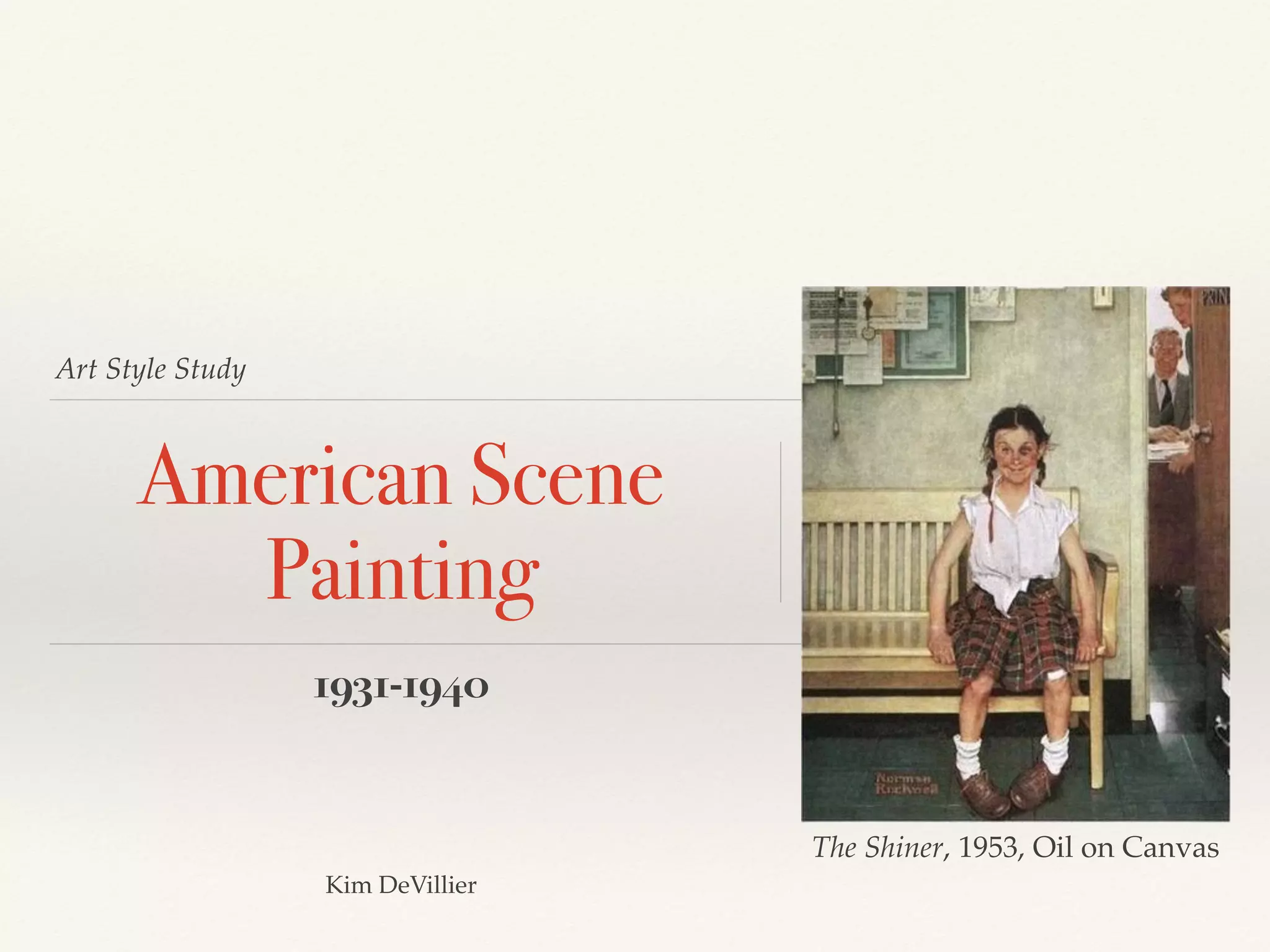
The Shiner, 1953, Oil on Canvas
Kim DeVillier
American Scene Painting
❖ A general term encompassing the realist and
anti-modernist style of painting
❖ Popular in America during the Great Depression
❖ A reaction against European Modernism
❖ An attempt to define a uniquely American style of
art
Two main schools:
Regionalism: rurally oriented
Social Realism: urban and politically
oriented
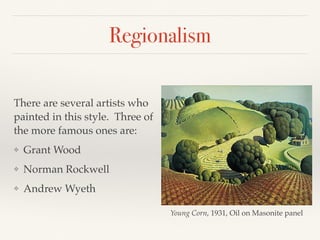
Regionalism
There are several artists who
painted in this style. Three of
the more famous ones are:
❖ Grant Wood
❖ Norman Rockwell
❖ Andrew Wyeth
Young Corn, 1931, Oil on Masonite panel
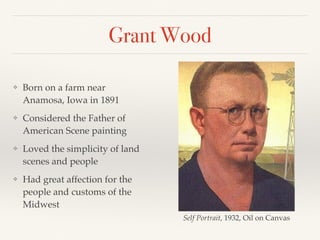
Grant Wood
❖ Born on a farm near
Anamosa, Iowa in 1891
❖ Considered the Father of
American Scene painting
❖ Loved the simplicity of land
scenes and people
❖ Had great affection for the
people and customs of the
Midwest
Self Portrait, 1932, Oil on Canvas
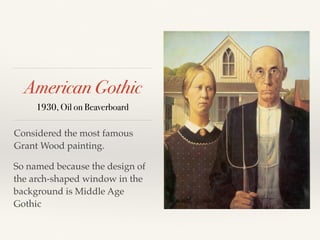
American Gothic
1930, Oil on Beaverboard
Considered the most famous
Grant Wood painting.
So named because the design of
the arch-shaped window in the
background is Middle Age
Gothic
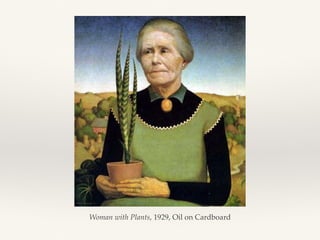
Woman with Plants, 1929, Oil on Cardboard
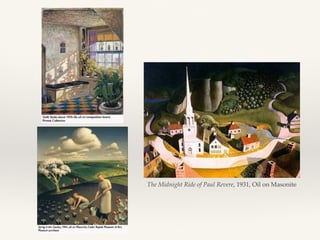
The Midnight Ride of Paul Revere, 1931, Oil on Masonite
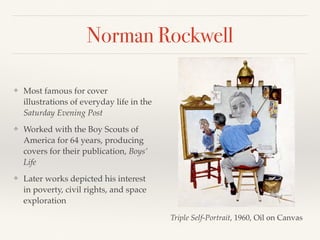
Norman Rockwell
❖ Most famous for cover
illustrations of everyday life in the
Saturday Evening Post
❖ Worked with the Boy Scouts of
America for 64 years, producing
covers for their publication, Boys’
Life
❖ Later works depicted his interest
in poverty, civil rights, and space
exploration
Triple Self-Portrait, 1960, Oil on Canvas
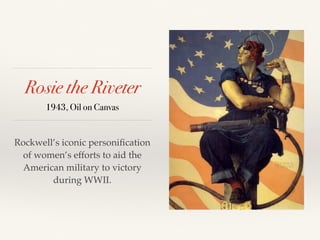
Rosie the Riveter
1943, Oil on Canvas
Rockwell’s iconic personification
of women’s efforts to aid the
American military to victory
during WWII.
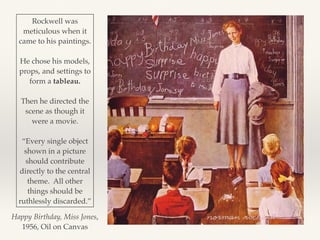
Happy Birthday, Miss Jones,
1956, Oil on Canvas
Rockwell was
meticulous when it
came to his paintings.
He chose his models,
props, and settings to
form a tableau.
Then he directed the
scene as though it
were a movie.
“Every single object
shown in a picture
should contribute
directly to the central
theme. All other
things should be
ruthlessly discarded.”
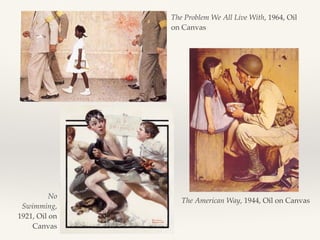
No
Swimming,
1921, Oil on
Canvas
The American Way, 1944, Oil on Canvas
The Problem We All Live With, 1964, Oil
on Canvas
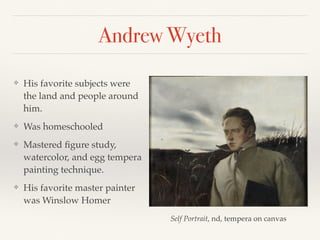
Andrew Wyeth
❖ His favorite subjects were
the land and people around
him.
❖ Was homeschooled
❖ Mastered figure study,
watercolor, and egg tempera
painting technique.
❖ His favorite master painter
was Winslow Homer
Self Portrait, nd, tempera on canvas
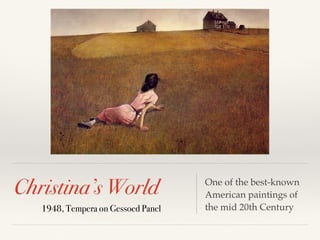
Christina’s World
1948, Tempera on Gessoed Panel
One of the best-known
American paintings of
the mid 20th Century
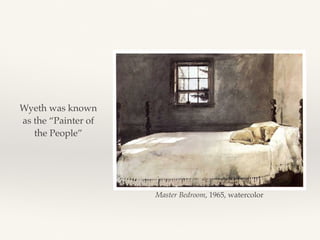
Wyeth was known
as the “Painter of
the People”
Master Bedroom, 1965, watercolor
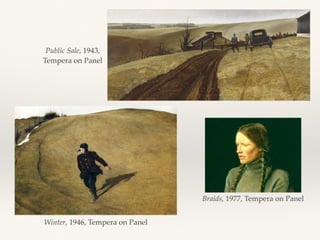
Winter, 1946, Tempera on Panel
Braids, 1977, Tempera on Panel
Public Sale, 1943,
Tempera on Panel
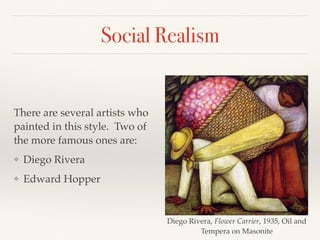
Social Realism
There are several artists who
painted in this style. Two of
the more famous ones are:
❖ Diego Rivera
❖ Edward Hopper
Diego Rivera, Flower Carrier, 1935, Oil and
Tempera on Masonite
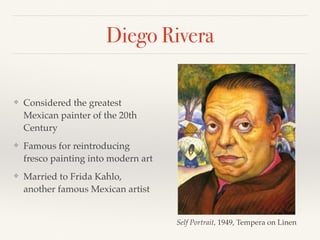
Diego Rivera
❖ Considered the greatest
Mexican painter of the 20th
Century
❖ Famous for reintroducing
fresco painting into modern art
❖ Married to Frida Kahlo,
another famous Mexican artist
Self Portrait, 1949, Tempera on Linen
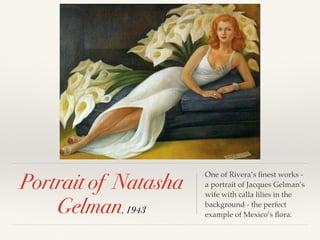
Portrait of Natasha
Gelman, 1943
One of Rivera’s finest works -
a portrait of Jacques Gelman’s
wife with calla lilies in the
background - the perfect
example of Mexico’s flora.
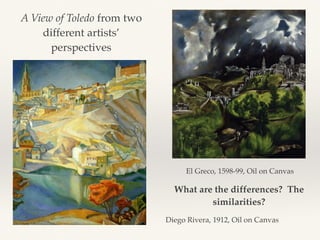
A View of Toledo from two
different artists’
perspectives
El Greco, 1598-99, Oil on Canvas
Diego Rivera, 1912, Oil on Canvas
What are the differences? The
similarities?
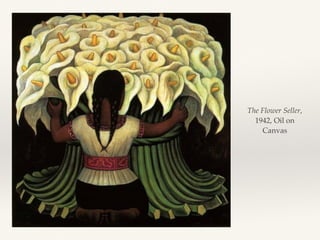
The Flower Seller,
1942, Oil on
Canvas
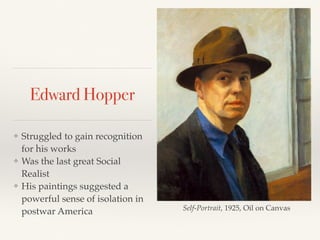
Edward Hopper
❖ Struggled to gain recognition
for his works
❖ Was the last great Social
Realist
❖ His paintings suggested a
powerful sense of isolation in
postwar America Self-Portrait, 1925, Oil on Canvas
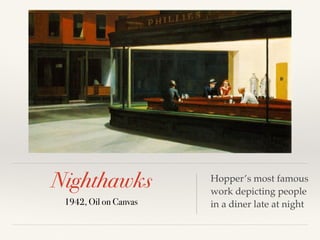
Nighthawks
1942, Oil on Canvas
Hopper’s most famous
work depicting people
in a diner late at night
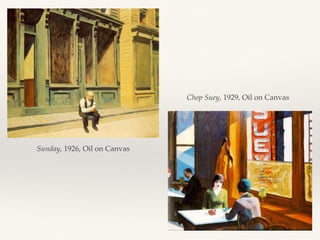
Chop Suey, 1929, Oil on Canvas
Sunday, 1926, Oil on Canvas
–Norman Rockwell
“Some people have been kind enough to
call me a fine artist. I've always called
myself an illustrator. I'm not sure what
the difference is. All I know is that
whatever type of work I do, I try to give it
my very best. Art has been my life.”
The End

American Scene Painting

  • 1.
    Art Style Study AmericanScene Painting 1931-1940 The Shiner, 1953, Oil on Canvas Kim DeVillier
  • 2.
    American Scene Painting ❖A general term encompassing the realist and anti-modernist style of painting ❖ Popular in America during the Great Depression ❖ A reaction against European Modernism ❖ An attempt to define a uniquely American style of art
  • 3.
    Two main schools: Regionalism:rurally oriented Social Realism: urban and politically oriented
  • 4.
    Regionalism There are severalartists who painted in this style. Three of the more famous ones are: ❖ Grant Wood ❖ Norman Rockwell ❖ Andrew Wyeth Young Corn, 1931, Oil on Masonite panel
  • 5.
    Grant Wood ❖ Bornon a farm near Anamosa, Iowa in 1891 ❖ Considered the Father of American Scene painting ❖ Loved the simplicity of land scenes and people ❖ Had great affection for the people and customs of the Midwest Self Portrait, 1932, Oil on Canvas
  • 6.
    American Gothic 1930, Oilon Beaverboard Considered the most famous Grant Wood painting. So named because the design of the arch-shaped window in the background is Middle Age Gothic
  • 7.
    Woman with Plants,1929, Oil on Cardboard
  • 8.
    The Midnight Rideof Paul Revere, 1931, Oil on Masonite
  • 9.
    Norman Rockwell ❖ Mostfamous for cover illustrations of everyday life in the Saturday Evening Post ❖ Worked with the Boy Scouts of America for 64 years, producing covers for their publication, Boys’ Life ❖ Later works depicted his interest in poverty, civil rights, and space exploration Triple Self-Portrait, 1960, Oil on Canvas
  • 10.
    Rosie the Riveter 1943,Oil on Canvas Rockwell’s iconic personification of women’s efforts to aid the American military to victory during WWII.
  • 11.
    Happy Birthday, MissJones, 1956, Oil on Canvas Rockwell was meticulous when it came to his paintings. He chose his models, props, and settings to form a tableau. Then he directed the scene as though it were a movie. “Every single object shown in a picture should contribute directly to the central theme. All other things should be ruthlessly discarded.”
  • 12.
    No Swimming, 1921, Oil on Canvas TheAmerican Way, 1944, Oil on Canvas The Problem We All Live With, 1964, Oil on Canvas
  • 13.
    Andrew Wyeth ❖ Hisfavorite subjects were the land and people around him. ❖ Was homeschooled ❖ Mastered figure study, watercolor, and egg tempera painting technique. ❖ His favorite master painter was Winslow Homer Self Portrait, nd, tempera on canvas
  • 14.
    Christina’s World 1948, Temperaon Gessoed Panel One of the best-known American paintings of the mid 20th Century
  • 15.
    Wyeth was known asthe “Painter of the People” Master Bedroom, 1965, watercolor
  • 16.
    Winter, 1946, Temperaon Panel Braids, 1977, Tempera on Panel Public Sale, 1943, Tempera on Panel
  • 17.
    Social Realism There areseveral artists who painted in this style. Two of the more famous ones are: ❖ Diego Rivera ❖ Edward Hopper Diego Rivera, Flower Carrier, 1935, Oil and Tempera on Masonite
  • 18.
    Diego Rivera ❖ Consideredthe greatest Mexican painter of the 20th Century ❖ Famous for reintroducing fresco painting into modern art ❖ Married to Frida Kahlo, another famous Mexican artist Self Portrait, 1949, Tempera on Linen
  • 19.
    Portrait of Natasha Gelman,1943 One of Rivera’s finest works - a portrait of Jacques Gelman’s wife with calla lilies in the background - the perfect example of Mexico’s flora.
  • 20.
    A View ofToledo from two different artists’ perspectives El Greco, 1598-99, Oil on Canvas Diego Rivera, 1912, Oil on Canvas What are the differences? The similarities?
  • 21.
  • 22.
    Edward Hopper ❖ Struggledto gain recognition for his works ❖ Was the last great Social Realist ❖ His paintings suggested a powerful sense of isolation in postwar America Self-Portrait, 1925, Oil on Canvas
  • 23.
    Nighthawks 1942, Oil onCanvas Hopper’s most famous work depicting people in a diner late at night
  • 24.
    Chop Suey, 1929,Oil on Canvas Sunday, 1926, Oil on Canvas
  • 25.
    –Norman Rockwell “Some peoplehave been kind enough to call me a fine artist. I've always called myself an illustrator. I'm not sure what the difference is. All I know is that whatever type of work I do, I try to give it my very best. Art has been my life.” The End