PARALLELIZATION OF IMAGE PROCESSING ALGORITHMS FOR EFFECTIVE IMAGE ANALYSIS


         PARALLELIZATION OF IMAGE PROCESSING
           ALGORITHMS FOR EFFECTIVE IMAGE
                       ANALYSIS

                                       S.M. Jaisakthi


                                   September 9, 2009
PARALLELIZATION OF IMAGE PROCESSING ALGORITHMS FOR EFFECTIVE IMAGE ANALYSIS
  Research Motivation


Research Motivation


             Image processing is the technique used to manipulate the
             image in order to enhance, restore or interpret the image.
             Sequential.
             Computationally intensive.
             Hence image analysis algorithms need more response time and
             lack scalability.
PARALLELIZATION OF IMAGE PROCESSING ALGORITHMS FOR EFFECTIVE IMAGE ANALYSIS
  Research Motivation


Research Motivation


      These issues can be solved by parallelizing the existing sequential
      algorithms by exploiting the massive computational power of the
      parallel computers.
PARALLELIZATION OF IMAGE PROCESSING ALGORITHMS FOR EFFECTIVE IMAGE ANALYSIS
  Research Motivation
    Research Objective


Research Objective


      To design parallel algorithms for image processing operations such
      as filtration, histograms, edge detection, image segmentation etc.,
      cost effectively in terms of reduced parallel overheads and applying
      these algorithms for effective parallelization of image analysis
      applications.
PARALLELIZATION OF IMAGE PROCESSING ALGORITHMS FOR EFFECTIVE IMAGE ANALYSIS
  Parallel Algorithm Design


Parallel Algorithm Design


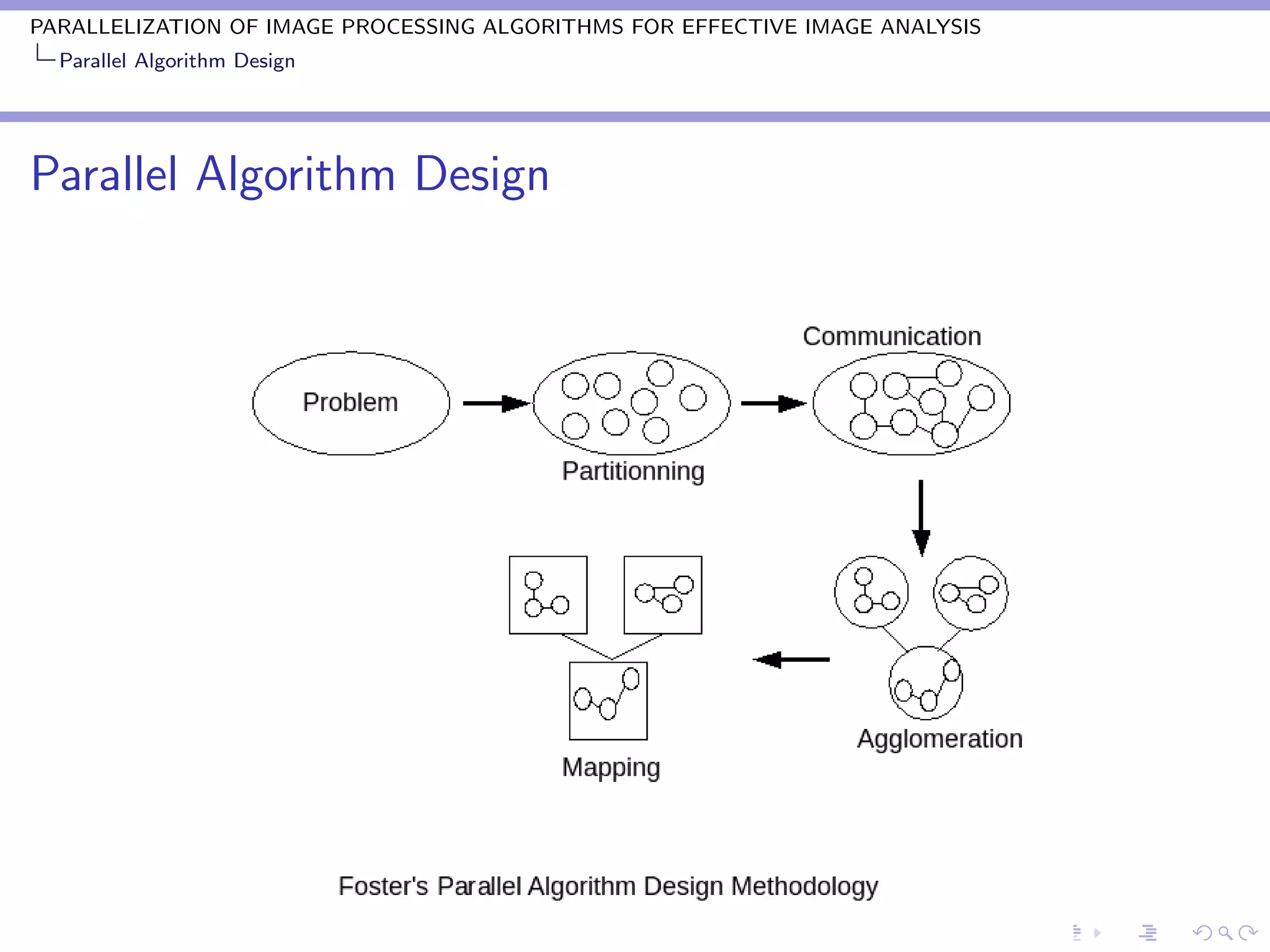
      According to Foster the design of parallel algorithm consist of 4
      stages[13] :
              Partitioning
              Communication
              Agglomeration
              Mapping
PARALLELIZATION OF IMAGE PROCESSING ALGORITHMS FOR EFFECTIVE IMAGE ANALYSIS
  Parallel Algorithm Design


Parallel Algorithm Design
PARALLELIZATION OF IMAGE PROCESSING ALGORITHMS FOR EFFECTIVE IMAGE ANALYSIS
  Parallel Algorithm Design
    Partitioning


Partitioning

              Decompose given problem into primitive task.
              Domain Decompositon
                      Divide data into pieces
                      Determine how to associate computations with the data
              Functional Decomposition
                      Divide computation into pieces
                      Determine how to associate data with the computations
              Design Strategy
                      Redundant computation and redundant data structure storage
                      are minimized.
                      Tasks are roughly same size.
                      Number of tasks is an increasing function of problem size.
PARALLELIZATION OF IMAGE PROCESSING ALGORITHMS FOR EFFECTIVE IMAGE ANALYSIS
  Parallel Algorithm Design
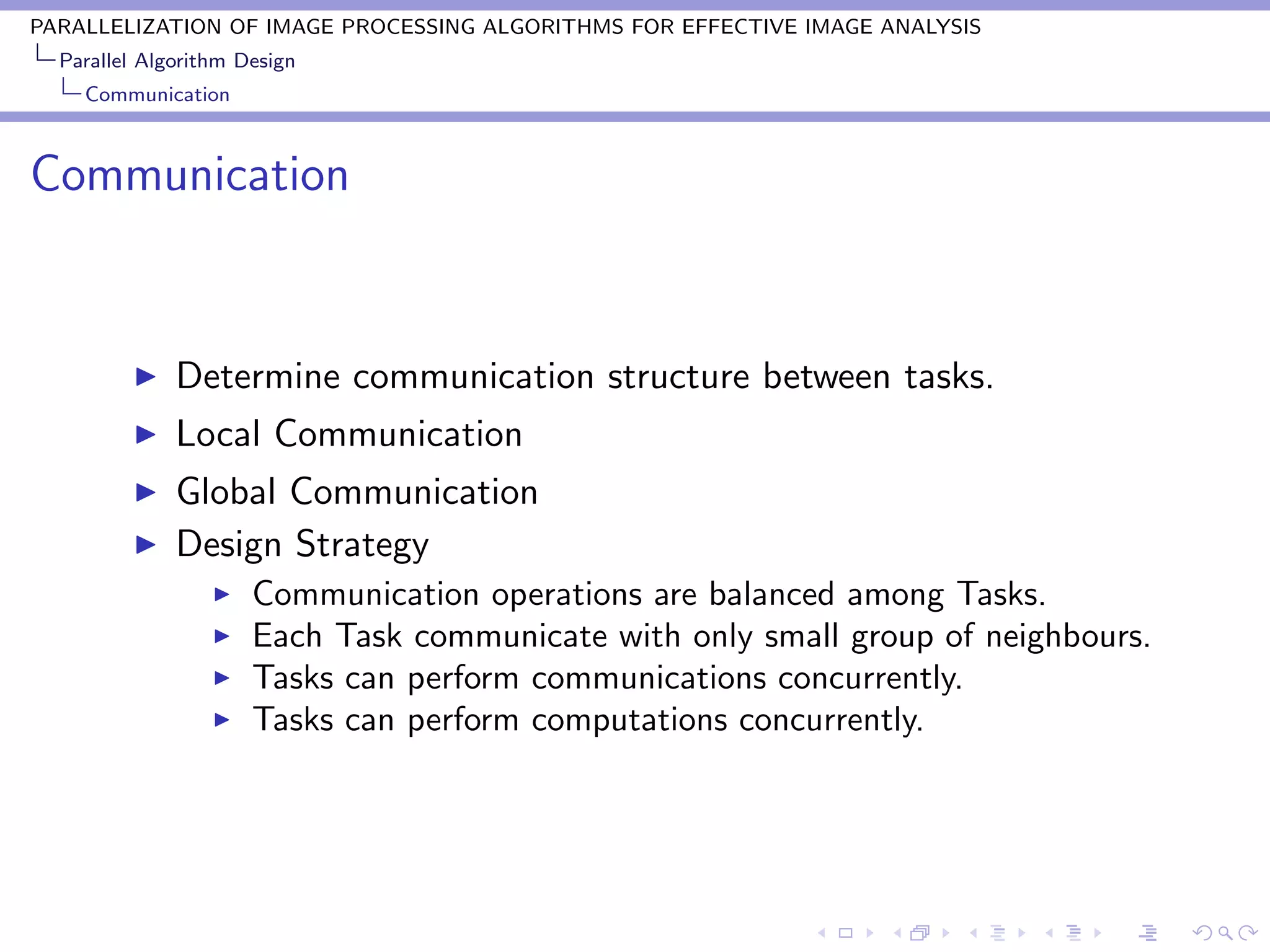
    Communication


Communication


              Determine communication structure between tasks.
              Local Communication
              Global Communication
              Design Strategy
                      Communication operations are balanced among Tasks.
                      Each Task communicate with only small group of neighbours.
                      Tasks can perform communications concurrently.
                      Tasks can perform computations concurrently.
PARALLELIZATION OF IMAGE PROCESSING ALGORITHMS FOR EFFECTIVE IMAGE ANALYSIS
  Parallel Algorithm Design
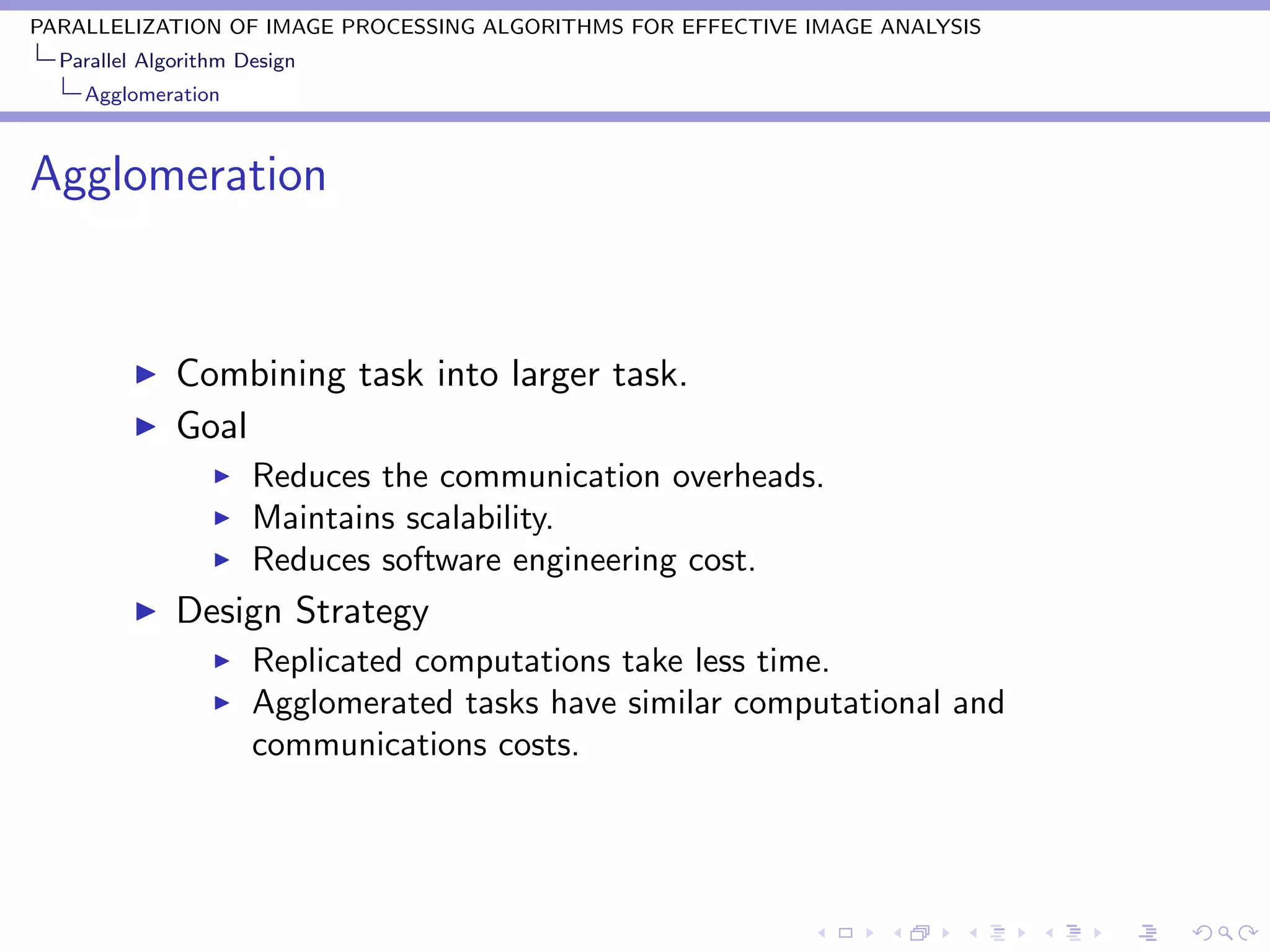
    Agglomeration


Agglomeration


              Combining task into larger task.
              Goal
                      Reduces the communication overheads.
                      Maintains scalability.
                      Reduces software engineering cost.
              Design Strategy
                      Replicated computations take less time.
                      Agglomerated tasks have similar computational and
                      communications costs.
PARALLELIZATION OF IMAGE PROCESSING ALGORITHMS FOR EFFECTIVE IMAGE ANALYSIS
  Parallel Algorithm Design
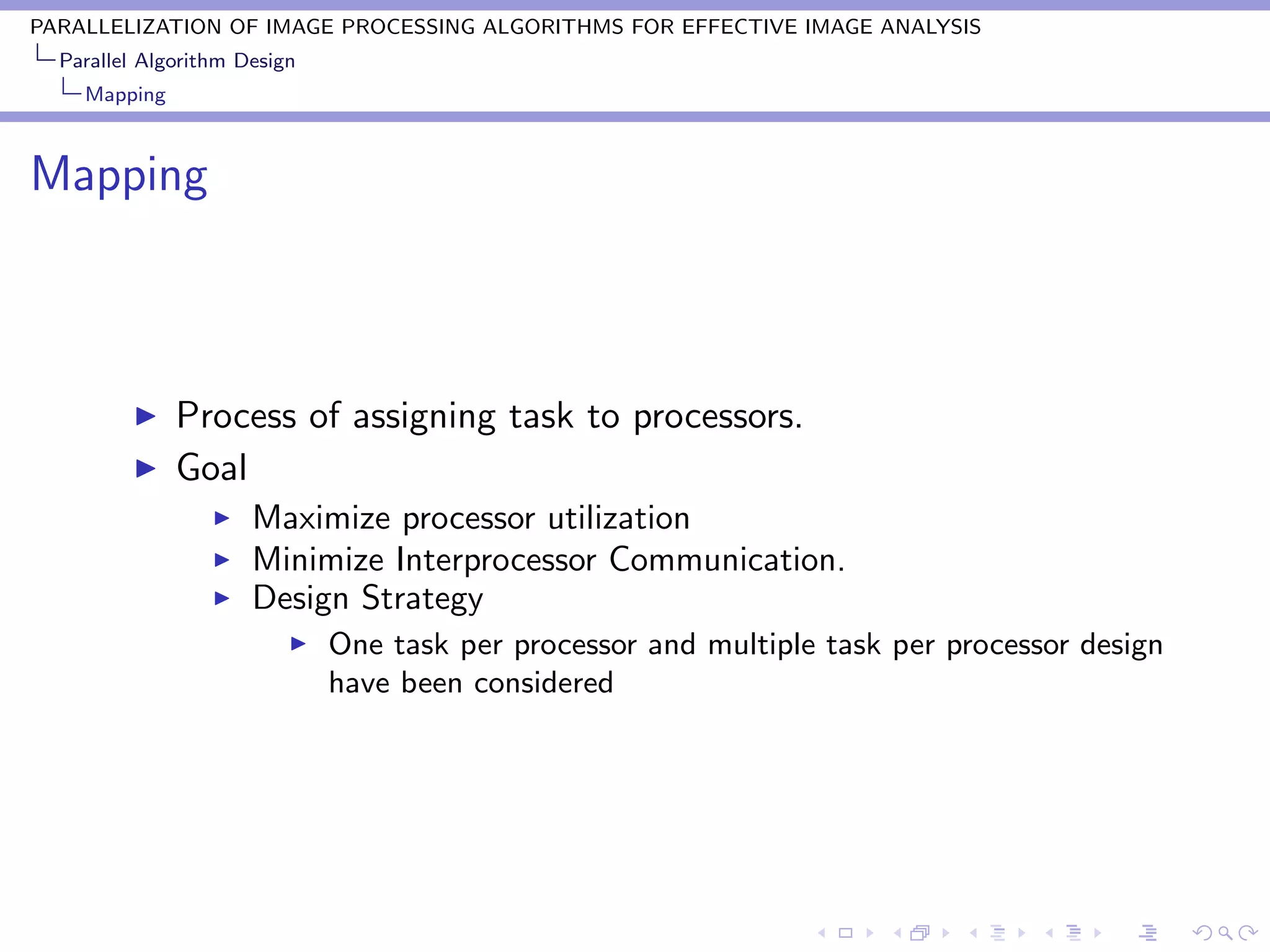
    Mapping


Mapping


              Process of assigning task to processors.
              Goal
                      Maximize processor utilization
                      Minimize Interprocessor Communication.
                      Design Strategy
                              One task per processor and multiple task per processor design
                              have been considered
PARALLELIZATION OF IMAGE PROCESSING ALGORITHMS FOR EFFECTIVE IMAGE ANALYSIS
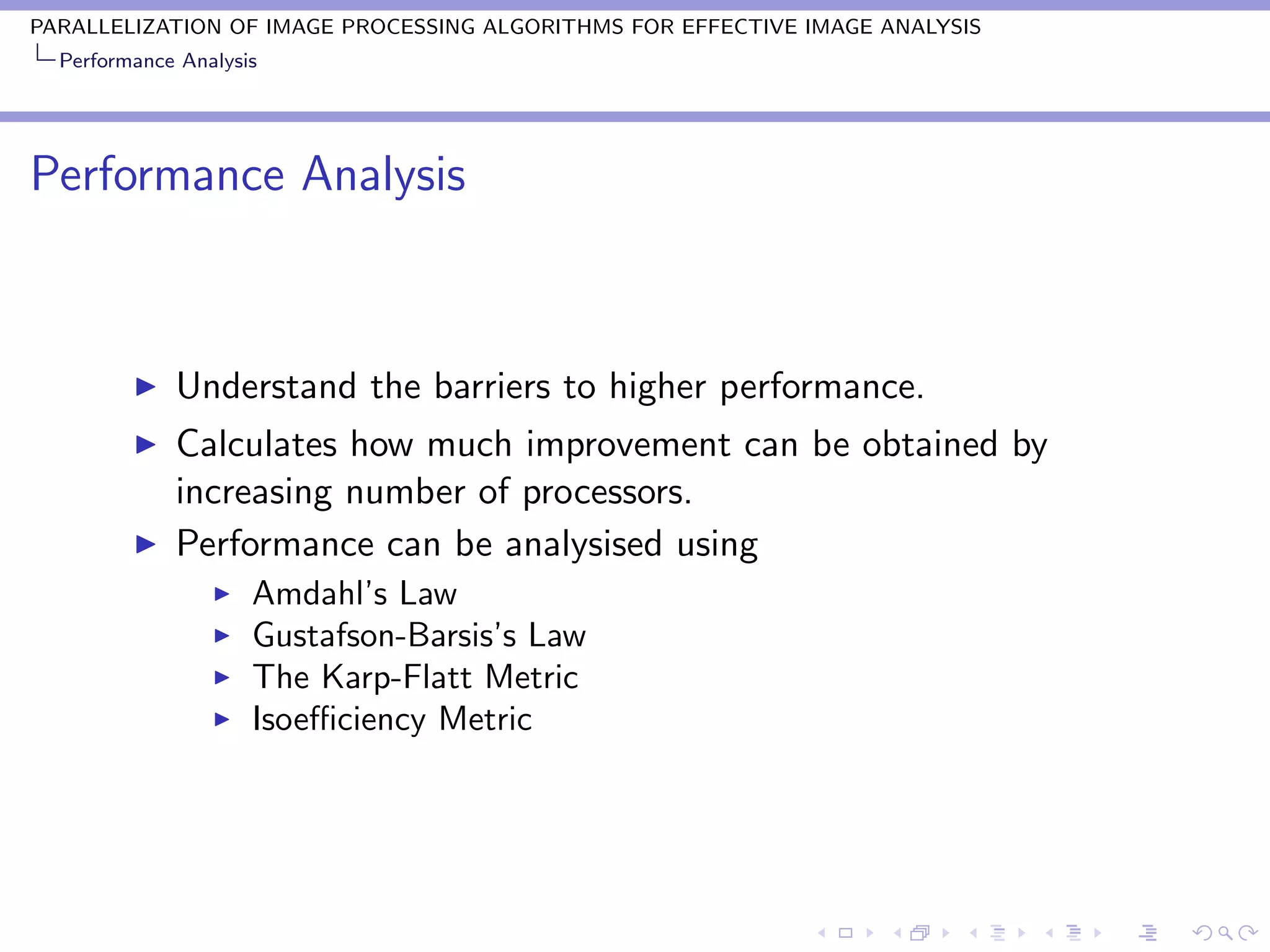
  Performance Analysis


Performance Analysis


             Understand the barriers to higher performance.
             Calculates how much improvement can be obtained by
             increasing number of processors.
             Performance can be analysised using
                     Amdahl’s Law
                     Gustafson-Barsis’s Law
                     The Karp-Flatt Metric
                     Isoefficiency Metric
PARALLELIZATION OF IMAGE PROCESSING ALGORITHMS FOR EFFECTIVE IMAGE ANALYSIS
  Performance Analysis


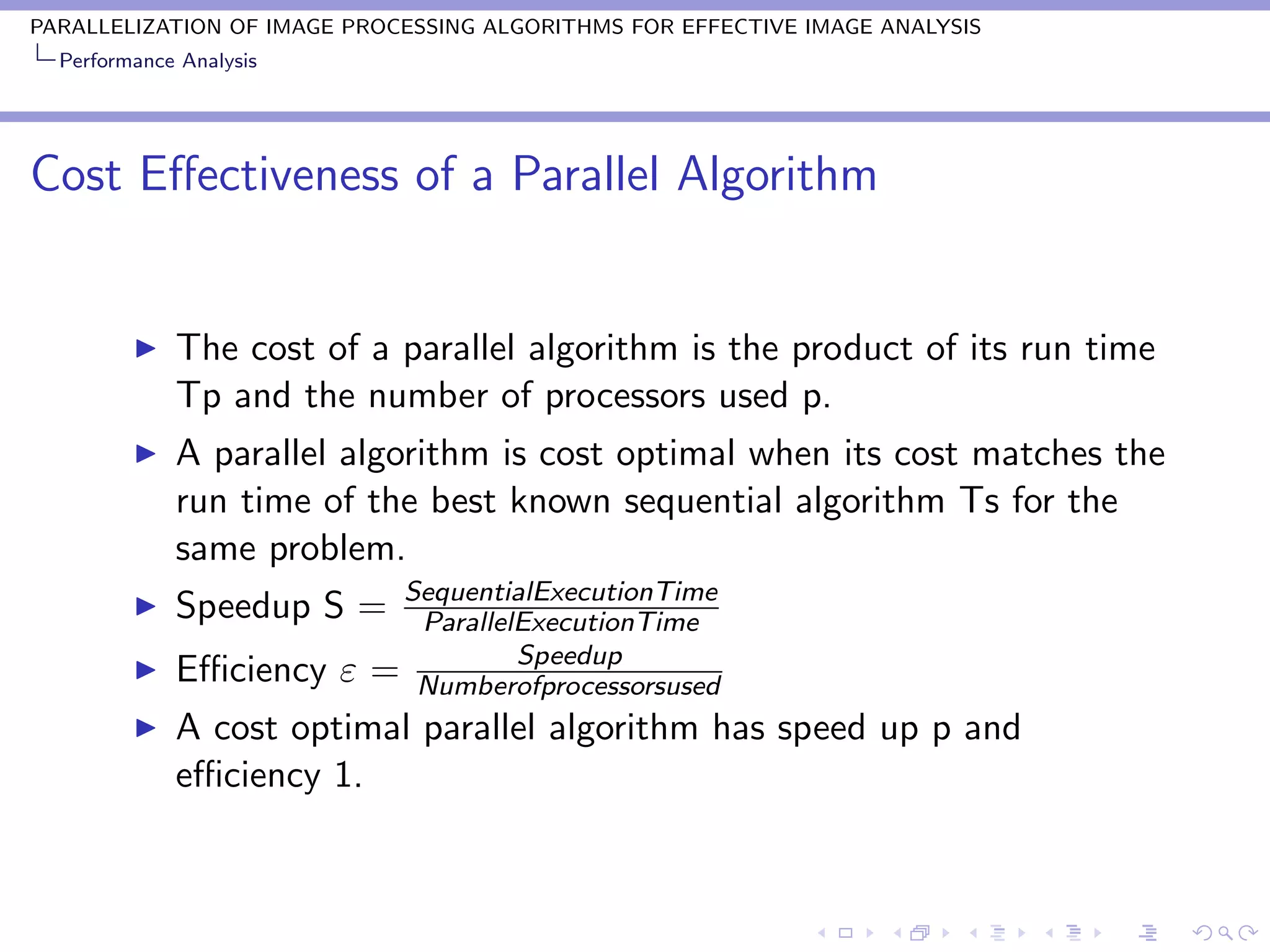
Cost Effectiveness of a Parallel Algorithm


             The cost of a parallel algorithm is the product of its run time
             Tp and the number of processors used p.
             A parallel algorithm is cost optimal when its cost matches the
             run time of the best known sequential algorithm Ts for the
             same problem.
                           SequentialExecutionTime
             Speedup S =    ParallelExecutionTime
                                    Speedup
             Efficiency ε   = Numberofprocessorsused
             A cost optimal parallel algorithm has speed up p and
             efficiency 1.
PARALLELIZATION OF IMAGE PROCESSING ALGORITHMS FOR EFFECTIVE IMAGE ANALYSIS
  Performance Analysis
    Amdahl’s Law


Amdahl’s Law
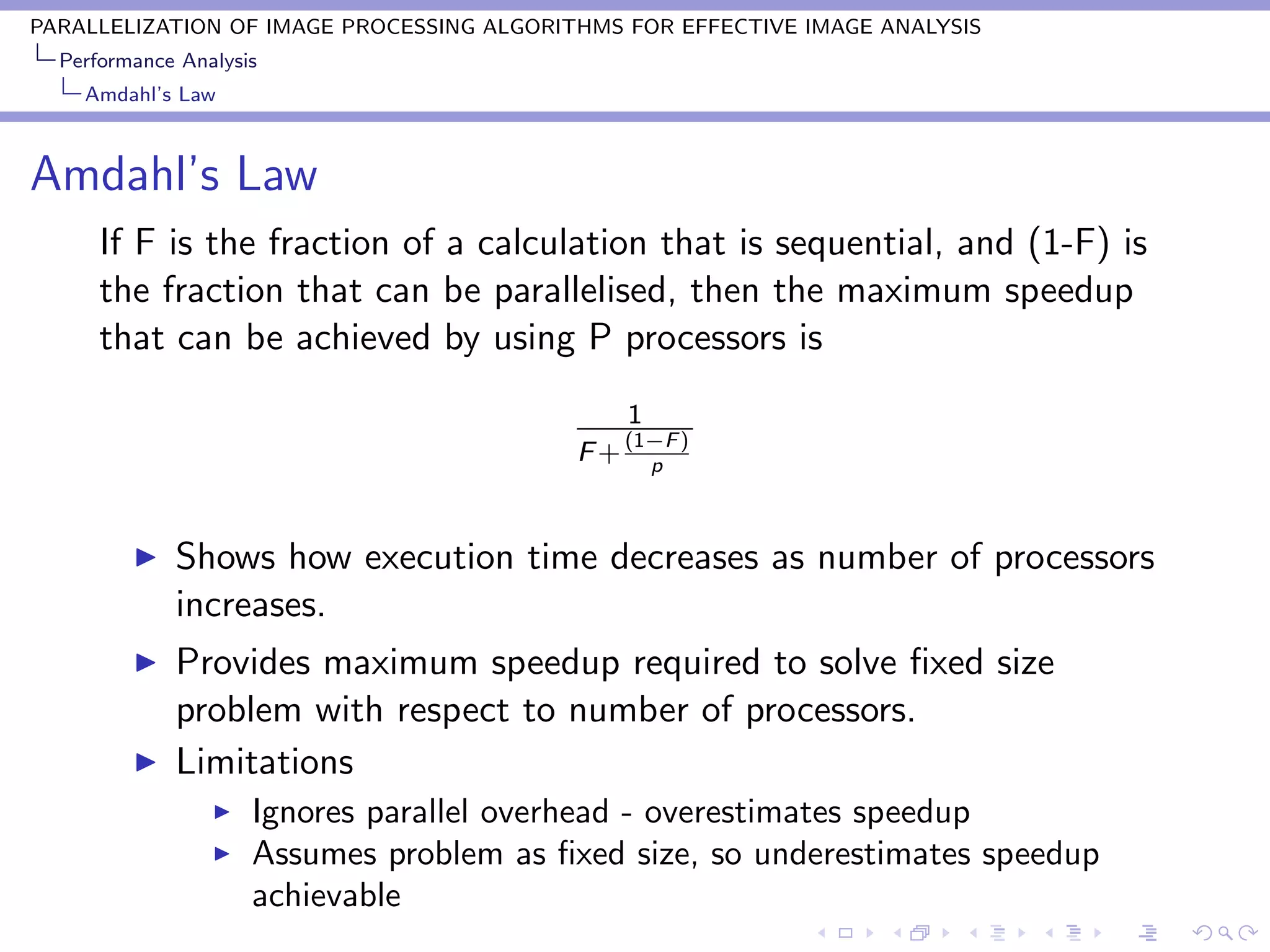
      If F is the fraction of a calculation that is sequential, and (1-F) is
      the fraction that can be parallelised, then the maximum speedup
      that can be achieved by using P processors is
                                                1
                                                (1−F )
                                           F+     p


             Shows how execution time decreases as number of processors
             increases.
             Provides maximum speedup required to solve fixed size
             problem with respect to number of processors.
             Limitations
                     Ignores parallel overhead - overestimates speedup
                     Assumes problem as fixed size, so underestimates speedup
                     achievable
PARALLELIZATION OF IMAGE PROCESSING ALGORITHMS FOR EFFECTIVE IMAGE ANALYSIS
  Performance Analysis
    Amdahl’s Effect


Amdahl’s Effect


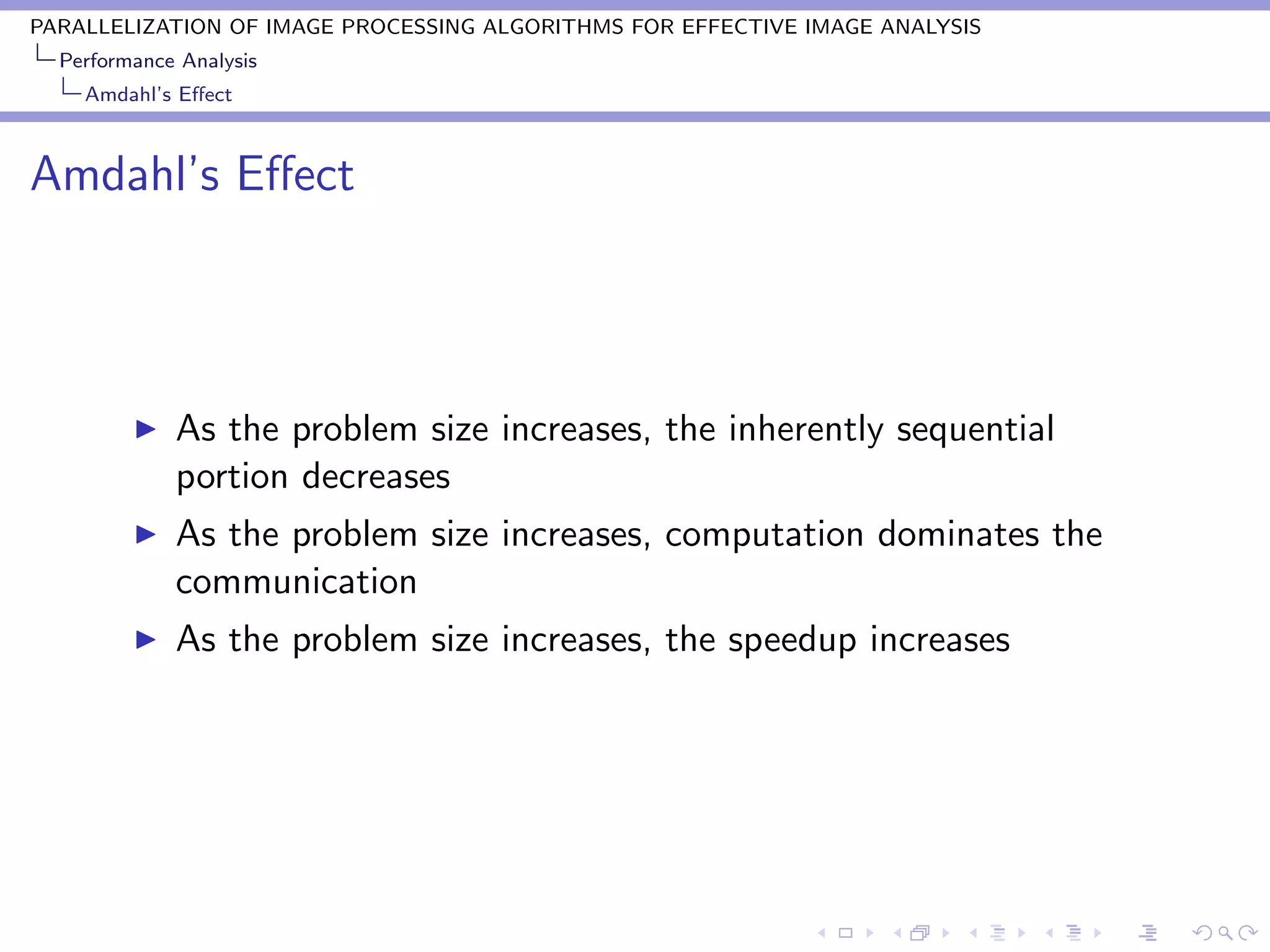
             As the problem size increases, the inherently sequential
             portion decreases
             As the problem size increases, computation dominates the
             communication
             As the problem size increases, the speedup increases
PARALLELIZATION OF IMAGE PROCESSING ALGORITHMS FOR EFFECTIVE IMAGE ANALYSIS
  Performance Analysis
    Gustafson-Barsis’s Law


Gustafson-Barsis’s Law


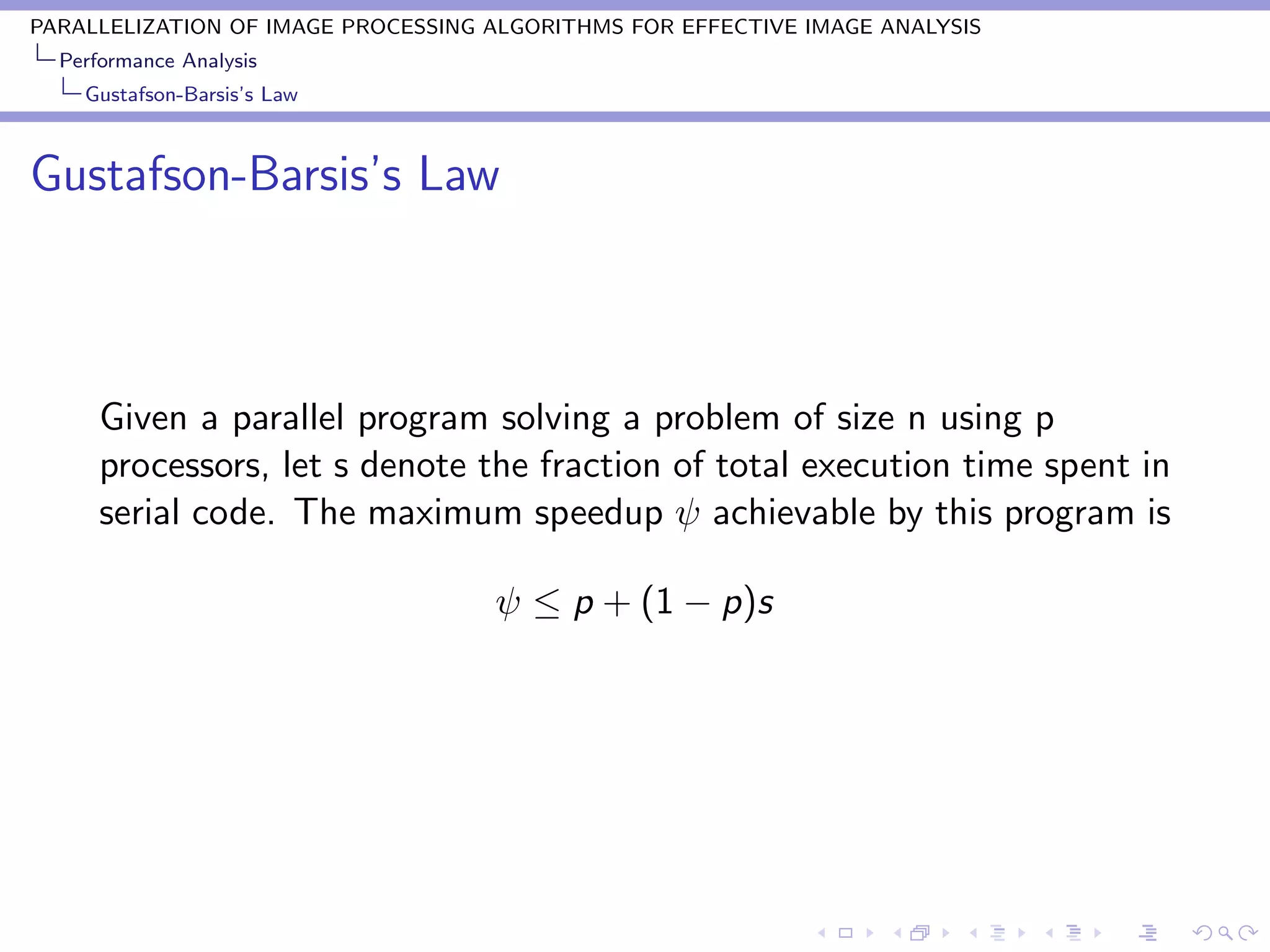
      Given a parallel program solving a problem of size n using p
      processors, let s denote the fraction of total execution time spent in
      serial code. The maximum speedup ψ achievable by this program is

                                    ψ ≤ p + (1 − p)s
PARALLELIZATION OF IMAGE PROCESSING ALGORITHMS FOR EFFECTIVE IMAGE ANALYSIS
  Performance Analysis
    Gustafson-Barsis’s Law


Gustafson-Barsis’s Law


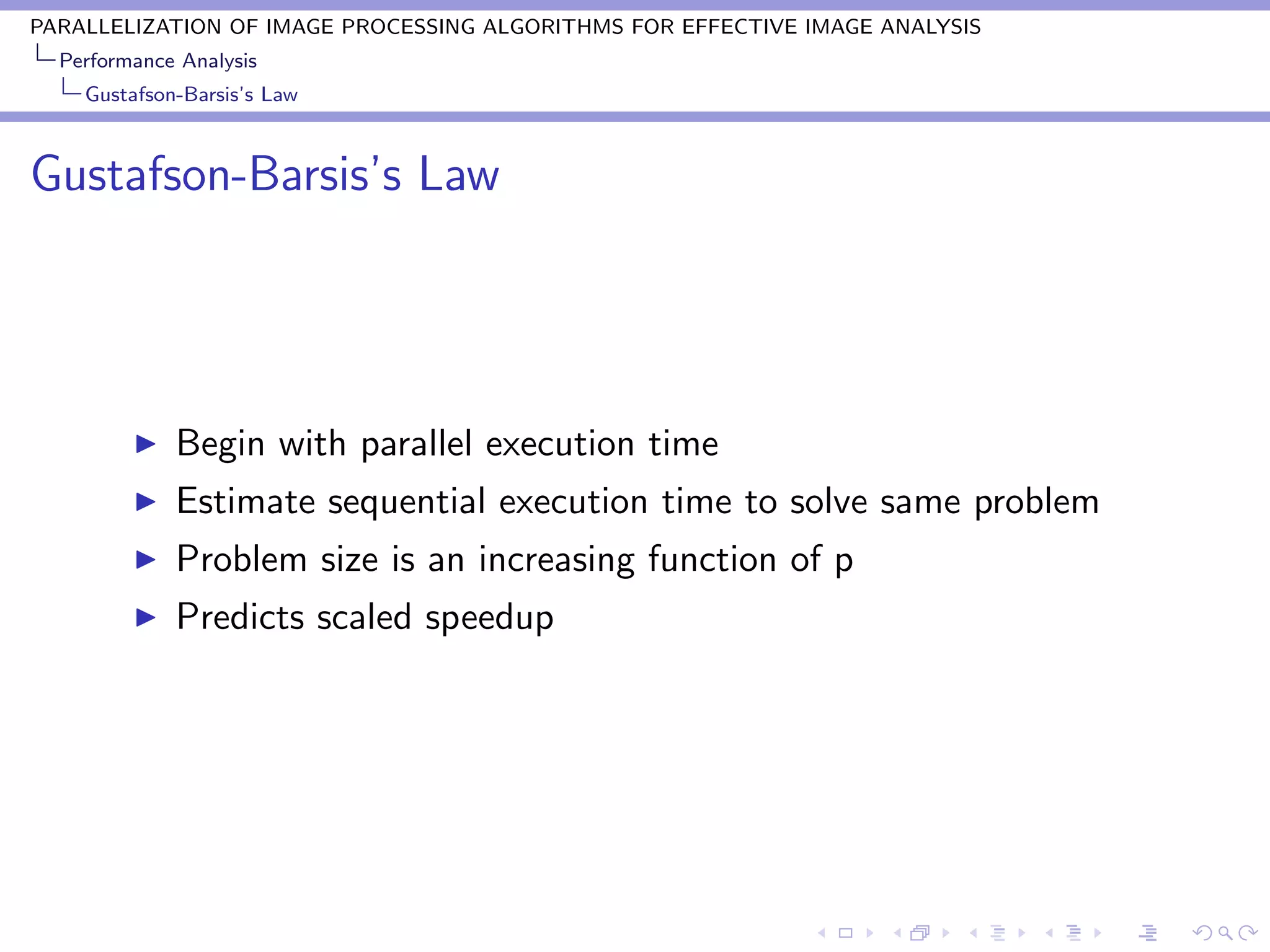
             Begin with parallel execution time
             Estimate sequential execution time to solve same problem
             Problem size is an increasing function of p
             Predicts scaled speedup
PARALLELIZATION OF IMAGE PROCESSING ALGORITHMS FOR EFFECTIVE IMAGE ANALYSIS
  Performance Analysis
    Karp-Flatt Metric


The Karp-Flatt Metric


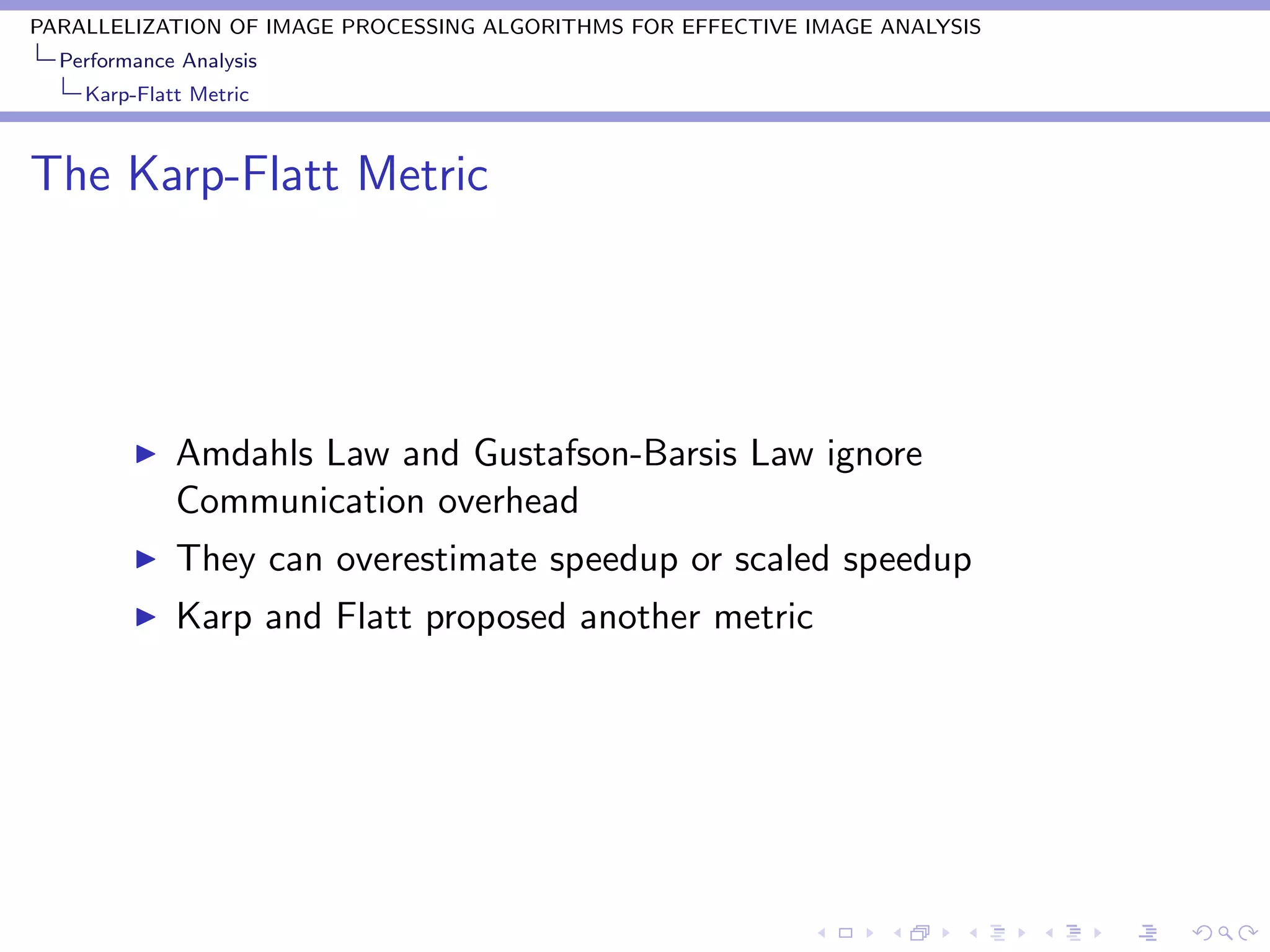
             Amdahls Law and Gustafson-Barsis Law ignore
             Communication overhead
             They can overestimate speedup or scaled speedup
             Karp and Flatt proposed another metric
PARALLELIZATION OF IMAGE PROCESSING ALGORITHMS FOR EFFECTIVE IMAGE ANALYSIS
  Performance Analysis
    Experimentally Determined Serial Fraction


Experimentally Determined Serial Fraction
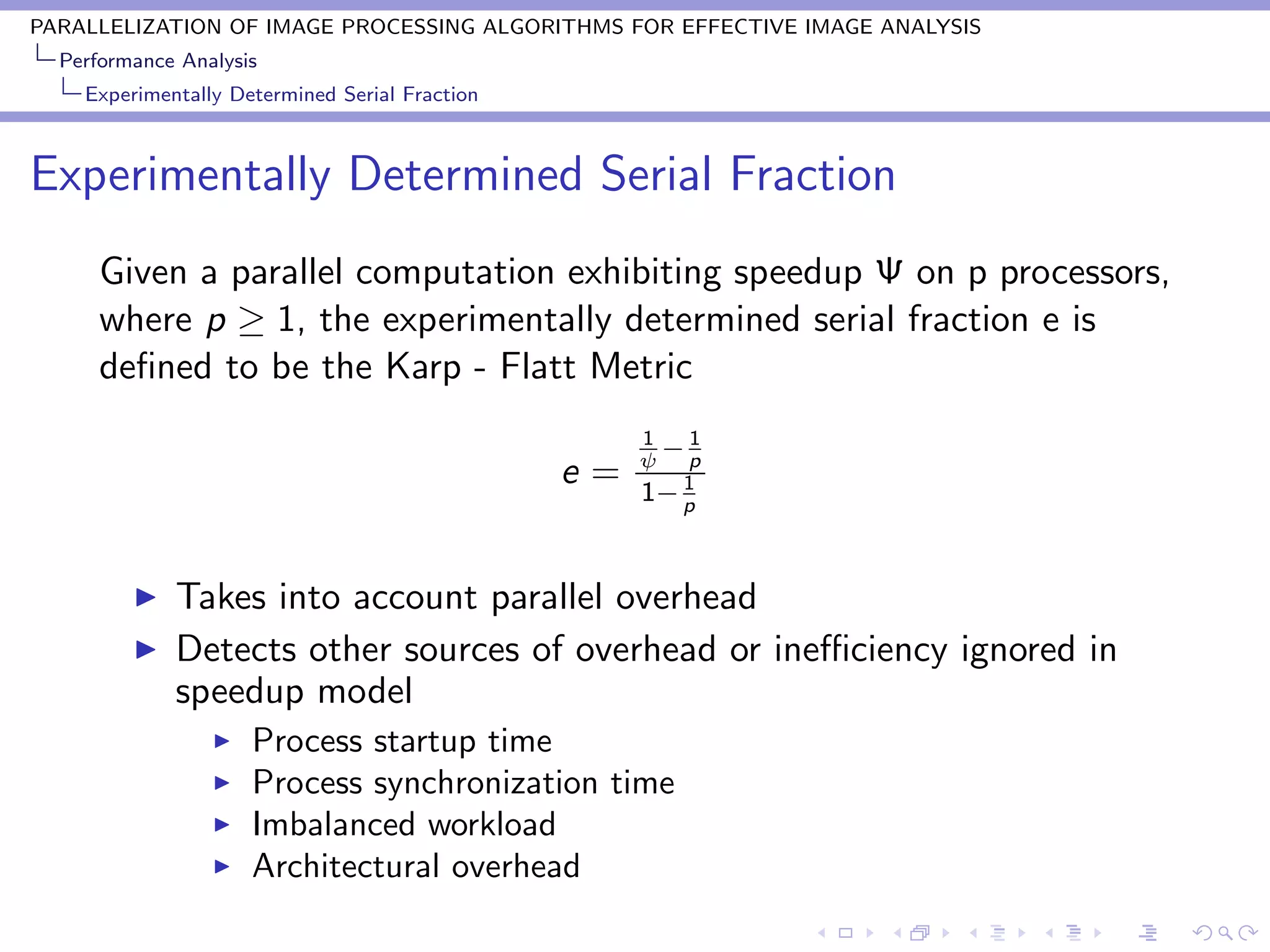
      Given a parallel computation exhibiting speedup Ψ on p processors,
      where p ≥ 1, the experimentally determined serial fraction e is
      defined to be the Karp - Flatt Metric
                                                     1   1
                                                     ψ
                                                       −p
                                                e=      1
                                                     1− p


             Takes into account parallel overhead
             Detects other sources of overhead or inefficiency ignored in
             speedup model
                     Process startup time
                     Process synchronization time
                     Imbalanced workload
                     Architectural overhead
PARALLELIZATION OF IMAGE PROCESSING ALGORITHMS FOR EFFECTIVE IMAGE ANALYSIS
  Performance Analysis
    Isoefficiency Metric


Isoefficiency Metric


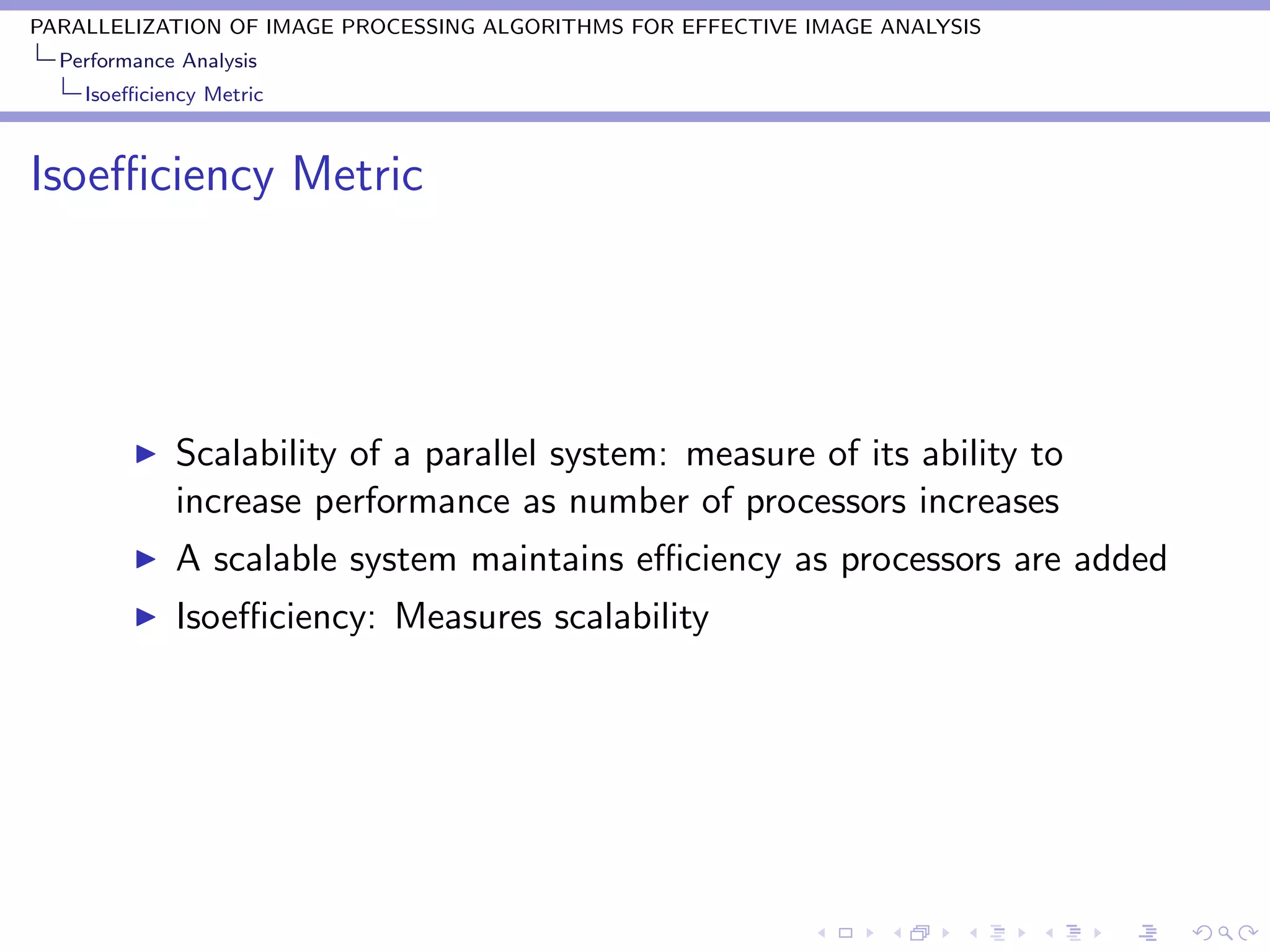
             Scalability of a parallel system: measure of its ability to
             increase performance as number of processors increases
             A scalable system maintains efficiency as processors are added
             Isoefficiency: Measures scalability
PARALLELIZATION OF IMAGE PROCESSING ALGORITHMS FOR EFFECTIVE IMAGE ANALYSIS
  Performance Analysis
    Isoefficiency Metric


Isoefficiency Metric


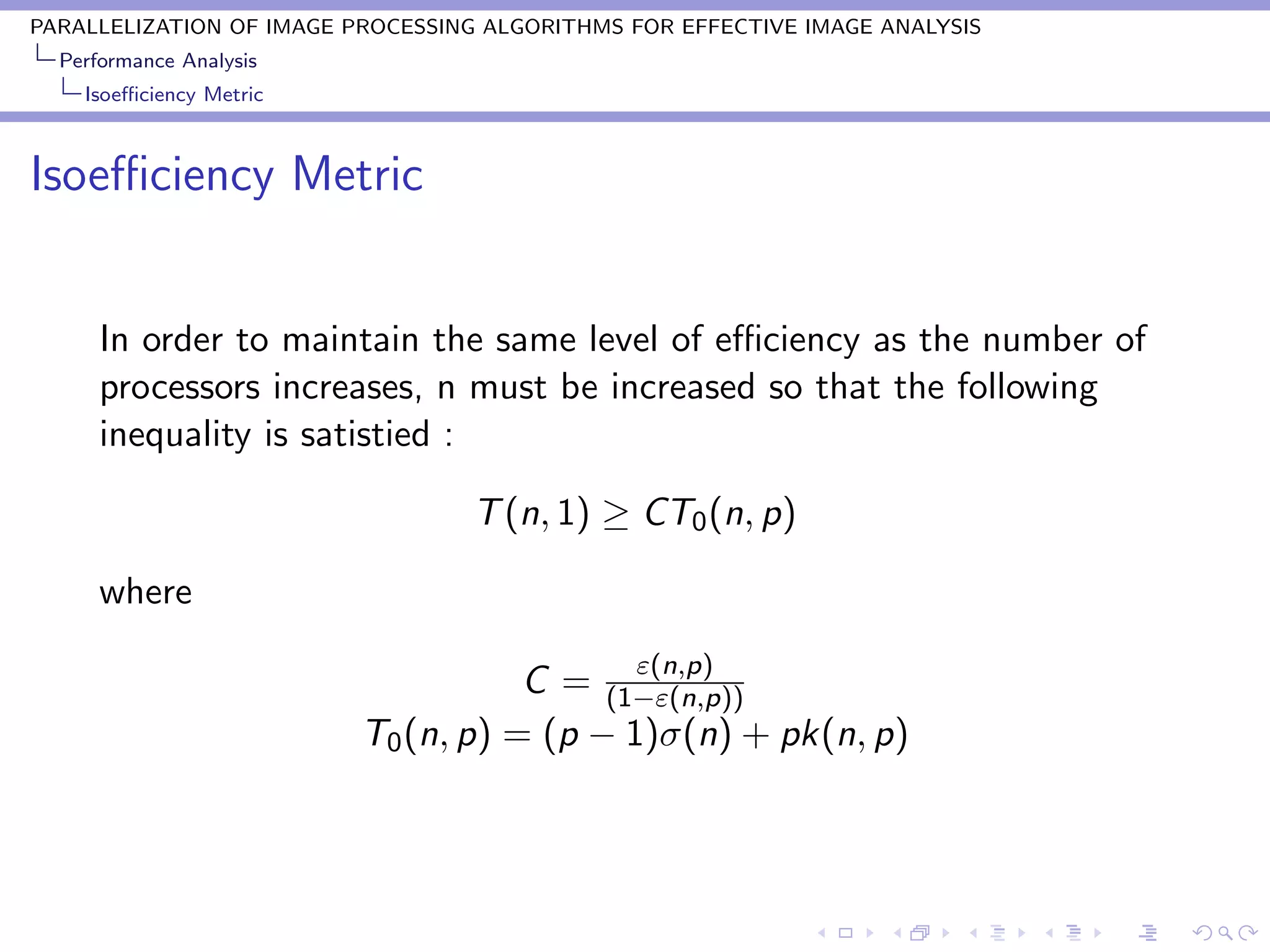
      In order to maintain the same level of efficiency as the number of
      processors increases, n must be increased so that the following
      inequality is satistied :

                                  T (n, 1) ≥ CT0 (n, p)

      where
                                            ε(n,p)
                                     C = (1−ε(n,p))
                          T0 (n, p) = (p − 1)σ(n) + pk(n, p)
PARALLELIZATION OF IMAGE PROCESSING ALGORITHMS FOR EFFECTIVE IMAGE ANALYSIS
  Performance Analysis
    Isoefficiency Metric


References
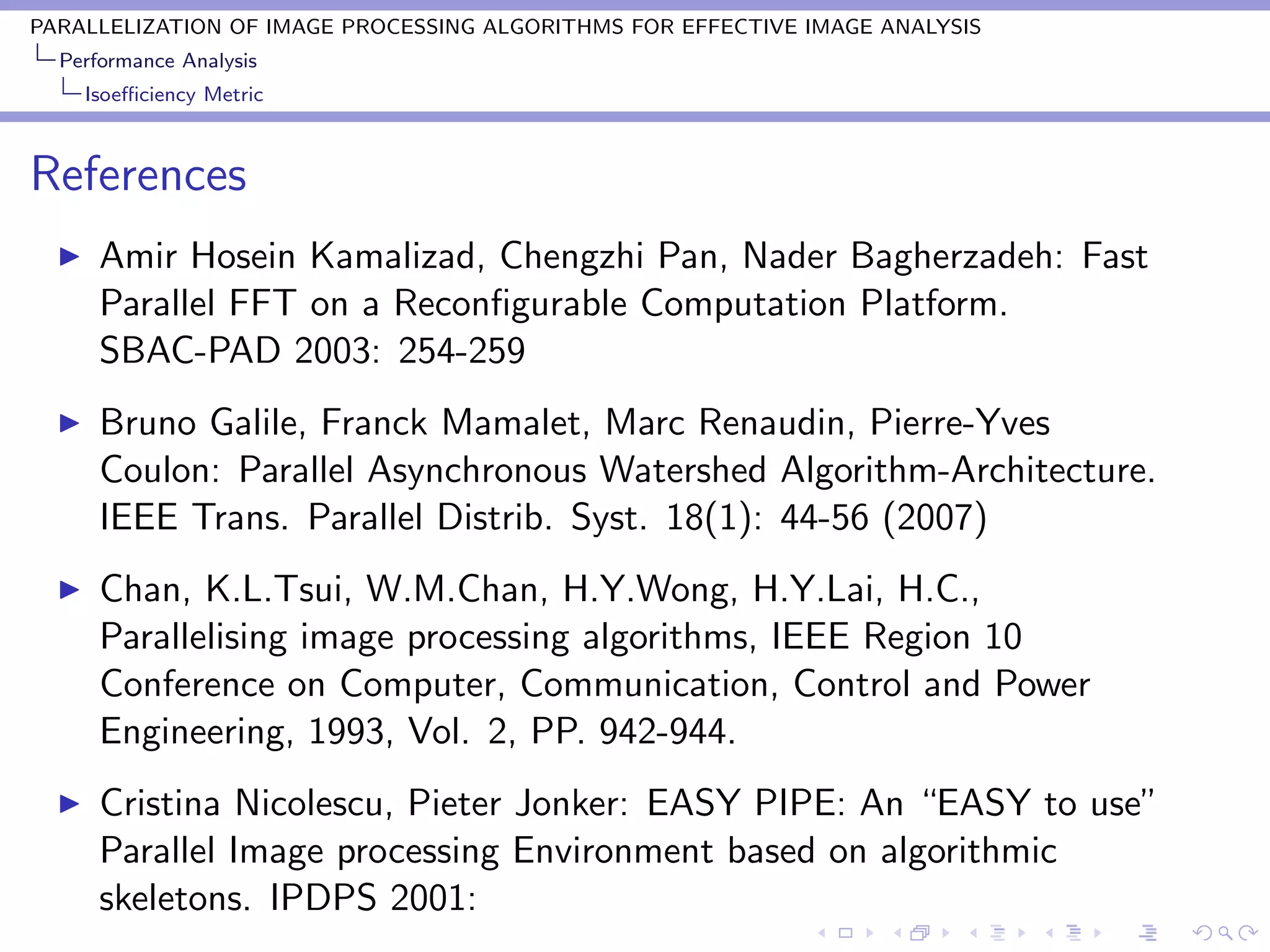
      Amir Hosein Kamalizad, Chengzhi Pan, Nader Bagherzadeh: Fast
      Parallel FFT on a Reconfigurable Computation Platform.
      SBAC-PAD 2003: 254-259
      Bruno Galile, Franck Mamalet, Marc Renaudin, Pierre-Yves
      Coulon: Parallel Asynchronous Watershed Algorithm-Architecture.
      IEEE Trans. Parallel Distrib. Syst. 18(1): 44-56 (2007)
      Chan, K.L.Tsui, W.M.Chan, H.Y.Wong, H.Y.Lai, H.C.,
      Parallelising image processing algorithms, IEEE Region 10
      Conference on Computer, Communication, Control and Power
      Engineering, 1993, Vol. 2, PP. 942-944.
      Cristina Nicolescu, Pieter Jonker: EASY PIPE: An “EASY to use”
      Parallel Image processing Environment based on algorithmic
      skeletons. IPDPS 2001:
PARALLELIZATION OF IMAGE PROCESSING ALGORITHMS FOR EFFECTIVE IMAGE ANALYSIS
  Performance Analysis
    Isoefficiency Metric


                                      THANK YOU

/.Amd mnt/lotus/host/home/jaishakthi/presentation/rmeet1/rmeet 1

  • 1.
    PARALLELIZATION OF IMAGEPROCESSING ALGORITHMS FOR EFFECTIVE IMAGE ANALYSIS PARALLELIZATION OF IMAGE PROCESSING ALGORITHMS FOR EFFECTIVE IMAGE ANALYSIS S.M. Jaisakthi September 9, 2009
  • 2.
    PARALLELIZATION OF IMAGEPROCESSING ALGORITHMS FOR EFFECTIVE IMAGE ANALYSIS Research Motivation Research Motivation Image processing is the technique used to manipulate the image in order to enhance, restore or interpret the image. Sequential. Computationally intensive. Hence image analysis algorithms need more response time and lack scalability.
  • 3.
    PARALLELIZATION OF IMAGEPROCESSING ALGORITHMS FOR EFFECTIVE IMAGE ANALYSIS Research Motivation Research Motivation These issues can be solved by parallelizing the existing sequential algorithms by exploiting the massive computational power of the parallel computers.
  • 4.
    PARALLELIZATION OF IMAGEPROCESSING ALGORITHMS FOR EFFECTIVE IMAGE ANALYSIS Research Motivation Research Objective Research Objective To design parallel algorithms for image processing operations such as filtration, histograms, edge detection, image segmentation etc., cost effectively in terms of reduced parallel overheads and applying these algorithms for effective parallelization of image analysis applications.
  • 5.
    PARALLELIZATION OF IMAGEPROCESSING ALGORITHMS FOR EFFECTIVE IMAGE ANALYSIS Parallel Algorithm Design Parallel Algorithm Design According to Foster the design of parallel algorithm consist of 4 stages[13] : Partitioning Communication Agglomeration Mapping
  • 6.
    PARALLELIZATION OF IMAGEPROCESSING ALGORITHMS FOR EFFECTIVE IMAGE ANALYSIS Parallel Algorithm Design Parallel Algorithm Design
  • 7.
    PARALLELIZATION OF IMAGEPROCESSING ALGORITHMS FOR EFFECTIVE IMAGE ANALYSIS Parallel Algorithm Design Partitioning Partitioning Decompose given problem into primitive task. Domain Decompositon Divide data into pieces Determine how to associate computations with the data Functional Decomposition Divide computation into pieces Determine how to associate data with the computations Design Strategy Redundant computation and redundant data structure storage are minimized. Tasks are roughly same size. Number of tasks is an increasing function of problem size.
  • 8.
    PARALLELIZATION OF IMAGEPROCESSING ALGORITHMS FOR EFFECTIVE IMAGE ANALYSIS Parallel Algorithm Design Communication Communication Determine communication structure between tasks. Local Communication Global Communication Design Strategy Communication operations are balanced among Tasks. Each Task communicate with only small group of neighbours. Tasks can perform communications concurrently. Tasks can perform computations concurrently.
  • 9.
    PARALLELIZATION OF IMAGEPROCESSING ALGORITHMS FOR EFFECTIVE IMAGE ANALYSIS Parallel Algorithm Design Agglomeration Agglomeration Combining task into larger task. Goal Reduces the communication overheads. Maintains scalability. Reduces software engineering cost. Design Strategy Replicated computations take less time. Agglomerated tasks have similar computational and communications costs.
  • 10.
    PARALLELIZATION OF IMAGEPROCESSING ALGORITHMS FOR EFFECTIVE IMAGE ANALYSIS Parallel Algorithm Design Mapping Mapping Process of assigning task to processors. Goal Maximize processor utilization Minimize Interprocessor Communication. Design Strategy One task per processor and multiple task per processor design have been considered
  • 11.
    PARALLELIZATION OF IMAGEPROCESSING ALGORITHMS FOR EFFECTIVE IMAGE ANALYSIS Performance Analysis Performance Analysis Understand the barriers to higher performance. Calculates how much improvement can be obtained by increasing number of processors. Performance can be analysised using Amdahl’s Law Gustafson-Barsis’s Law The Karp-Flatt Metric Isoefficiency Metric
  • 12.
    PARALLELIZATION OF IMAGEPROCESSING ALGORITHMS FOR EFFECTIVE IMAGE ANALYSIS Performance Analysis Cost Effectiveness of a Parallel Algorithm The cost of a parallel algorithm is the product of its run time Tp and the number of processors used p. A parallel algorithm is cost optimal when its cost matches the run time of the best known sequential algorithm Ts for the same problem. SequentialExecutionTime Speedup S = ParallelExecutionTime Speedup Efficiency ε = Numberofprocessorsused A cost optimal parallel algorithm has speed up p and efficiency 1.
  • 13.
    PARALLELIZATION OF IMAGEPROCESSING ALGORITHMS FOR EFFECTIVE IMAGE ANALYSIS Performance Analysis Amdahl’s Law Amdahl’s Law If F is the fraction of a calculation that is sequential, and (1-F) is the fraction that can be parallelised, then the maximum speedup that can be achieved by using P processors is 1 (1−F ) F+ p Shows how execution time decreases as number of processors increases. Provides maximum speedup required to solve fixed size problem with respect to number of processors. Limitations Ignores parallel overhead - overestimates speedup Assumes problem as fixed size, so underestimates speedup achievable
  • 14.
    PARALLELIZATION OF IMAGEPROCESSING ALGORITHMS FOR EFFECTIVE IMAGE ANALYSIS Performance Analysis Amdahl’s Effect Amdahl’s Effect As the problem size increases, the inherently sequential portion decreases As the problem size increases, computation dominates the communication As the problem size increases, the speedup increases
  • 15.
    PARALLELIZATION OF IMAGEPROCESSING ALGORITHMS FOR EFFECTIVE IMAGE ANALYSIS Performance Analysis Gustafson-Barsis’s Law Gustafson-Barsis’s Law Given a parallel program solving a problem of size n using p processors, let s denote the fraction of total execution time spent in serial code. The maximum speedup ψ achievable by this program is ψ ≤ p + (1 − p)s
  • 16.
    PARALLELIZATION OF IMAGEPROCESSING ALGORITHMS FOR EFFECTIVE IMAGE ANALYSIS Performance Analysis Gustafson-Barsis’s Law Gustafson-Barsis’s Law Begin with parallel execution time Estimate sequential execution time to solve same problem Problem size is an increasing function of p Predicts scaled speedup
  • 17.
    PARALLELIZATION OF IMAGEPROCESSING ALGORITHMS FOR EFFECTIVE IMAGE ANALYSIS Performance Analysis Karp-Flatt Metric The Karp-Flatt Metric Amdahls Law and Gustafson-Barsis Law ignore Communication overhead They can overestimate speedup or scaled speedup Karp and Flatt proposed another metric
  • 18.
    PARALLELIZATION OF IMAGEPROCESSING ALGORITHMS FOR EFFECTIVE IMAGE ANALYSIS Performance Analysis Experimentally Determined Serial Fraction Experimentally Determined Serial Fraction Given a parallel computation exhibiting speedup Ψ on p processors, where p ≥ 1, the experimentally determined serial fraction e is defined to be the Karp - Flatt Metric 1 1 ψ −p e= 1 1− p Takes into account parallel overhead Detects other sources of overhead or inefficiency ignored in speedup model Process startup time Process synchronization time Imbalanced workload Architectural overhead
  • 19.
    PARALLELIZATION OF IMAGEPROCESSING ALGORITHMS FOR EFFECTIVE IMAGE ANALYSIS Performance Analysis Isoefficiency Metric Isoefficiency Metric Scalability of a parallel system: measure of its ability to increase performance as number of processors increases A scalable system maintains efficiency as processors are added Isoefficiency: Measures scalability
  • 20.
    PARALLELIZATION OF IMAGEPROCESSING ALGORITHMS FOR EFFECTIVE IMAGE ANALYSIS Performance Analysis Isoefficiency Metric Isoefficiency Metric In order to maintain the same level of efficiency as the number of processors increases, n must be increased so that the following inequality is satistied : T (n, 1) ≥ CT0 (n, p) where ε(n,p) C = (1−ε(n,p)) T0 (n, p) = (p − 1)σ(n) + pk(n, p)
  • 21.
    PARALLELIZATION OF IMAGEPROCESSING ALGORITHMS FOR EFFECTIVE IMAGE ANALYSIS Performance Analysis Isoefficiency Metric References Amir Hosein Kamalizad, Chengzhi Pan, Nader Bagherzadeh: Fast Parallel FFT on a Reconfigurable Computation Platform. SBAC-PAD 2003: 254-259 Bruno Galile, Franck Mamalet, Marc Renaudin, Pierre-Yves Coulon: Parallel Asynchronous Watershed Algorithm-Architecture. IEEE Trans. Parallel Distrib. Syst. 18(1): 44-56 (2007) Chan, K.L.Tsui, W.M.Chan, H.Y.Wong, H.Y.Lai, H.C., Parallelising image processing algorithms, IEEE Region 10 Conference on Computer, Communication, Control and Power Engineering, 1993, Vol. 2, PP. 942-944. Cristina Nicolescu, Pieter Jonker: EASY PIPE: An “EASY to use” Parallel Image processing Environment based on algorithmic skeletons. IPDPS 2001:
  • 22.
    PARALLELIZATION OF IMAGEPROCESSING ALGORITHMS FOR EFFECTIVE IMAGE ANALYSIS Performance Analysis Isoefficiency Metric THANK YOU