Calming, Enriching and
Empowering our lives
What is AmI?
Ambient intelligence(AmI) is an emerging
discipline that brings intelligence to our every-
day environments and makes those
environments sensitive to us.
Ambient Intelligence is a network of hidden
intelligent interfaces that recognize our presence
and mould our environment to our immediate
needs.
What is AmI?
AmI refers to an exciting new paradigm in
information technology, in which people are
empowered through a digital environment
that is aware of their presence and context
and is sensitive, adaptive and responsive
to their needs, habits, gestures and
emotions.
It reduces the stress leading to an overall
higher quality of life.
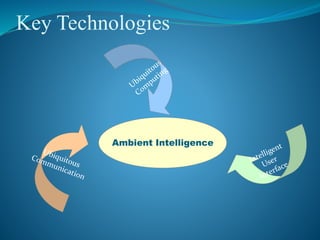
Key Technologies
Ambient Intelligence
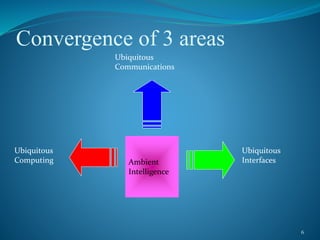
Convergence of 3 areas
6
Ambient
Intelligence
Ubiquitous
Interfaces
Ubiquitous
Computing
Ubiquitous
Communications
Interaction in-between AmI and
other disciplines
AmI
Many invisible dedicated devices throughout the
environment.
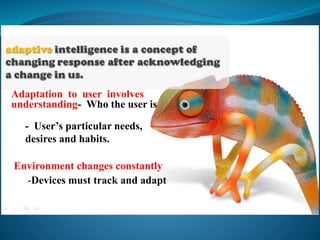
Adaptation to user involves
understanding- Who the user is
- User’s particular needs,
desires and habits.
Environment changes constantly
-Devices must track and adapt
Personalization: learning
your explicit and implicit
needs
15
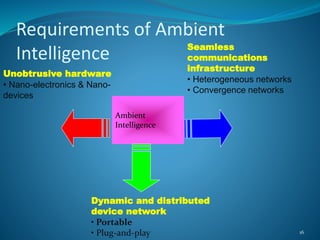
Requirements of Ambient
Intelligence
16
Ambient
Intelligence
Unobtrusive hardware
• Nano-electronics & Nano-
devices
Seamless
communications
infrastructure
• Heterogeneous networks
• Convergence networks
Dynamic and distributed
device network
• Portable
• Plug-and-play
Achievement…..
Ambient Intelligence aims to enhance the way
people interact with their environment to
promote safety and to enrich their lives.
The achievement of Ambient Intelligence
largely depends on the technology deployed
(sensors and devices interconnected through
networks) as well as on the intelligence of the
software used for decision-making.
AmI System
Sensing Reasoning Acting
● Perception is accomplished using variety of sensors.
● Software algorithm perceives the environment and
specifies the action that can be taken to change the state
of the environment.
● Sensors have been designed for position measurement,
for detection of chemicals and humidity sensing, and
to determine readings for light, radiation,
temperature, sound, strain, pressure, position,
velocity, and direction, and physiological sensing to
support health monitoring.
Sensing
Human Computer Interaction
● Explicit input must now be replaced with more
human-life communication capabilities and with
implicit actions.
● Technologies : motion tracking, gesture
recognition, facial expression recognition and
emotion recognition, speech processing, and even
whistle processing facilitate natural interactions
with intelligent environments.
The metaphor change of Ambient Intelligence from function orientation
to goal orientation effects that a user becomes a smart player within a proactive
intelligent environment
Technologies Used in AmI
 Radio Frequency Identification
 Microchip implant (human)
 Sensor
 Affective Computing
 Nanotechnology
 Biometrics
Radio Frequency Identification
 Radio-frequency identification (RFID) is the use of a
wireless non-contact system that uses radio-
frequency electronic fields to transfer data from a tag
attached to an object.
Microchip implant (human)
A human microchip implant is an integrated circuit
device or RFID transponder encased in silicate glass
and implanted in the body of a human being. It typically
contains a unique ID number that can be linked.
Sensor
 A sensor is also called detector which is a
convector that measures a physical quantity and
converts it into a signal which can be read by an
observer .
Affective Computing
•Affective computing is the study and development
of systems and devices that can recognize human
affects.
• In Affecting computing ,the machine should
interpret the emotional state of humans and adapt
its behavior to them, giving an appropriate response
for those emotions.
Nanotechnology- able to
create many new materials
and devices with a vast range
of medicine , electronics.
27
Biometrics
Robust fingerprint
sensing
Ear
recognition
Real time Face
Recognition
Iris
Speaker
Recognition
Biometrics refers to the identification of
humans by their characteristics.
28
Applications
Ambient Intelligence
Ubiquitous
Computing
Ubiquitous
Communications
Ubiquitous
Interfaces
Lifestyle
Convergence
Technologies
Solutions
Daily
Drawbacks
•Need high finance to install and to maintain the
environment.
•Technology is to be incorporated into the daily
routines of different class of people.
•Makes people lazy.
Security Risks
● AmI technologies can raise other security issues. At
the sensor level, sensor reliability, handling errors,
and installation errors can create security risks.
Absolutely critical for market acceptance.
Applications
 Health-related applications
 Public transportation sector
 Education services
 Emergency services
 Production-oriented services
Biggest adopters of AmI:
 Healthcare
 Home automation
AmI APPLICATIONS
● Health-related applications: Hospitals can
increase the efficiency of their services by
monitoring patients’ health and progress by
performing automatic analysis of activities in
their rooms. (Sensing and monitoring)
AmI APPLICATIONS
● Emergency services: Safety-related services
like fire brigades can improve the reaction to a
hazard by locating the place more efficiently
and also by preparing the way to reach the
place in connection with street services.
AmI APPLICATIONS
● Production-oriented places: Companies can use
RFID sensors to tag different products and track
them along the production and
commercialization processes.
● It helps improving the process by providing
valuable information for the company on how to
react to favourable demand and unusual events
like products that become unsuitable for sale.
Imagine in the future…. Intelligence
Are Embedded
36
AmI in Your Smart Phone…….
Ambient computing spk

Ambient computing spk

  • 1.
  • 3.
    What is AmI? Ambientintelligence(AmI) is an emerging discipline that brings intelligence to our every- day environments and makes those environments sensitive to us. Ambient Intelligence is a network of hidden intelligent interfaces that recognize our presence and mould our environment to our immediate needs.
  • 4.
    What is AmI? AmIrefers to an exciting new paradigm in information technology, in which people are empowered through a digital environment that is aware of their presence and context and is sensitive, adaptive and responsive to their needs, habits, gestures and emotions. It reduces the stress leading to an overall higher quality of life.
  • 5.
  • 6.
    Convergence of 3areas 6 Ambient Intelligence Ubiquitous Interfaces Ubiquitous Computing Ubiquitous Communications
  • 8.
    Interaction in-between AmIand other disciplines
  • 9.
  • 10.
    Many invisible dedicateddevices throughout the environment.
  • 11.
    Adaptation to userinvolves understanding- Who the user is - User’s particular needs, desires and habits. Environment changes constantly -Devices must track and adapt
  • 12.
  • 15.
  • 16.
    Requirements of Ambient Intelligence 16 Ambient Intelligence Unobtrusivehardware • Nano-electronics & Nano- devices Seamless communications infrastructure • Heterogeneous networks • Convergence networks Dynamic and distributed device network • Portable • Plug-and-play
  • 17.
    Achievement….. Ambient Intelligence aimsto enhance the way people interact with their environment to promote safety and to enrich their lives. The achievement of Ambient Intelligence largely depends on the technology deployed (sensors and devices interconnected through networks) as well as on the intelligence of the software used for decision-making.
  • 18.
  • 19.
    ● Perception isaccomplished using variety of sensors. ● Software algorithm perceives the environment and specifies the action that can be taken to change the state of the environment. ● Sensors have been designed for position measurement, for detection of chemicals and humidity sensing, and to determine readings for light, radiation, temperature, sound, strain, pressure, position, velocity, and direction, and physiological sensing to support health monitoring. Sensing
  • 20.
    Human Computer Interaction ●Explicit input must now be replaced with more human-life communication capabilities and with implicit actions. ● Technologies : motion tracking, gesture recognition, facial expression recognition and emotion recognition, speech processing, and even whistle processing facilitate natural interactions with intelligent environments.
  • 21.
    The metaphor changeof Ambient Intelligence from function orientation to goal orientation effects that a user becomes a smart player within a proactive intelligent environment
  • 22.
    Technologies Used inAmI  Radio Frequency Identification  Microchip implant (human)  Sensor  Affective Computing  Nanotechnology  Biometrics
  • 23.
    Radio Frequency Identification Radio-frequency identification (RFID) is the use of a wireless non-contact system that uses radio- frequency electronic fields to transfer data from a tag attached to an object.
  • 24.
    Microchip implant (human) Ahuman microchip implant is an integrated circuit device or RFID transponder encased in silicate glass and implanted in the body of a human being. It typically contains a unique ID number that can be linked.
  • 25.
    Sensor  A sensoris also called detector which is a convector that measures a physical quantity and converts it into a signal which can be read by an observer .
  • 26.
    Affective Computing •Affective computingis the study and development of systems and devices that can recognize human affects. • In Affecting computing ,the machine should interpret the emotional state of humans and adapt its behavior to them, giving an appropriate response for those emotions. Nanotechnology- able to create many new materials and devices with a vast range of medicine , electronics.
  • 27.
    27 Biometrics Robust fingerprint sensing Ear recognition Real timeFace Recognition Iris Speaker Recognition Biometrics refers to the identification of humans by their characteristics.
  • 28.
  • 29.
    Drawbacks •Need high financeto install and to maintain the environment. •Technology is to be incorporated into the daily routines of different class of people. •Makes people lazy.
  • 30.
    Security Risks ● AmItechnologies can raise other security issues. At the sensor level, sensor reliability, handling errors, and installation errors can create security risks. Absolutely critical for market acceptance.
  • 31.
    Applications  Health-related applications Public transportation sector  Education services  Emergency services  Production-oriented services Biggest adopters of AmI:  Healthcare  Home automation
  • 33.
    AmI APPLICATIONS ● Health-relatedapplications: Hospitals can increase the efficiency of their services by monitoring patients’ health and progress by performing automatic analysis of activities in their rooms. (Sensing and monitoring)
  • 34.
    AmI APPLICATIONS ● Emergencyservices: Safety-related services like fire brigades can improve the reaction to a hazard by locating the place more efficiently and also by preparing the way to reach the place in connection with street services.
  • 35.
    AmI APPLICATIONS ● Production-orientedplaces: Companies can use RFID sensors to tag different products and track them along the production and commercialization processes. ● It helps improving the process by providing valuable information for the company on how to react to favourable demand and unusual events like products that become unsuitable for sale.
  • 36.
    Imagine in thefuture…. Intelligence Are Embedded 36
  • 38.
    AmI in YourSmart Phone…….