Amazon Go Case Analysis:
1. Problem Statement:
The key problem Amazon is struggling with is whether their
decision to enter the offline retail segment will work. Amazon
has been known as a purely online retailer that offer home
products, electronics, and are a trusted source of product
information. The online retailer decided to enter the grocery
market launching amazon fresh and acquiring Whole Foods to
offer delivery of food to its customers. This decision still had
them in their online retail format and was in line with the
company’s strengths. . In 2016 the Amazon decided to also
create an offline retail format for its members called Amazon
Go a brick and mortar convenience store. The issues with this
move for Amazon is that it has resulted in monetary losses due
to the increased investment in R&D for new offers and these
losses are expected to increase with Amazon’s decision to move
forward into a brick and mortar retail environment. Other issues
stemming from this decision include how to leverage their
competitive advantages, they need to rethink key marketing
strategies and evolve the brand identity, and will this work as
the market shifts away from the traditional retail formats to
online retail formats. How far Amazon takes this decision can
have major impacts for the retailer and the size of those impacts
depends on if Amazon decides to “Go” or not to “Go”.
2. Alternative Evaluation:
·
3. Recommendations:
Flag this Question
Question 1
5 pts
(TCO 1) HIPAA security regulations primarily apply to
transportation organizations.
financial organizations.
education organizations.
healthcare organizations.
Flag this Question
Question 2
5 pts
(TCO 2) Objectives, purpose, policy, exceptions, and
disciplinary actions are the
summary of a policy.
goal of a policy.
outline of a policy.
rules of a policy.
Flag this Question
Question 3
5 pts
(TCO 3) Which is defined as the structure for determining the
clearance level of an individual, which must match the
classification of data, in order to be granted access?
For Your Eyes Only
Top Secret
Secret
Mandatory Access Control
Flag this Question
Question 4
5 pts
(TCO 4) Which of the following is NOT a type of background
check?
Criminal history
License verification
Family history
Civil records
Flag this Question
Question 5
5 pts
(TCO 5) Which of the following is NOT a component of a good
security incident reporting program?
Training users to recognize suspicious incidents
Updating antivirus software signature files
Establishing your incident response team
Establishing a system for reporting incidents
Flag this Question
Question 6
5 pts
(TCO 4) Which of the following is NOT a type of employment
agreement?
Monitoring and auditing agreement
Employee information security agreement
Affirmation agreement
Acceptable use agreement
Flag this Question
Question 7
5 pts
(TCO 6) When it comes to disposal of difficult drives that
contain company information
it’s okay to just dump them in the trash.
all you need to do is reformat the drive.
zeroization is the recommended practice.
all that is needed to do is format the master boot record.
Flag this Question
Question 8
5 pts
(TCO 7) This access control method is characterized by the
information owner being responsible for assigning privileges to
appropriate users.
MAC
RBAC
DAC
PAC
Flag this Question
Question 9
5 pts
(TCO 8) If employees using a company-provided application
system find what they think is a loophole that allows access to
confidential data, they should
alert their manager and the ISO immediately.
verify and test the alleged loophole before alerting anyone.
not say anything, unless they are a member of the Incident
Response team.
alert their manager whenever they happen to have a chance to
do so.
Flag this Question
Question 10
5 pts
(TCO 9) A threat assessment is a(n)
identification of types of threats an organization might be
exposed to.
systematic rating of threats based upon level of risk and
probability.
potential level of impact.
likelihood of a threat materializing.
Flag this Question
Question 11
5 pts
(TCO 10) Which organization, according to the provisions of
HIPAA, is mandated to develop and publish rules to implement
the HIPAA administrative simplification requirements?
The FDIC
The Department of Health and Human Services
The Office of the Attorney General
The OCS
Flag this Question
Question 12
5 pts
(TCO 10) Which is the first requirement set forth by the
security management process part of HIPAA’s administrative
safeguards?
A penetration test
A vulnerability assessment
A risk assessment
A disaster recovery assessment
Flag this Question
Question 13
5 pts
(TCO 11) Which of the following concerns federal agencies?
FISMA
FERPA
SOX
GLBA
Flag this Question
Question 14
5 pts
(TCO 11) Students have a right to file complaints against a
school for disclosing educational records in violation of which
federal law?
HIPAA
FERPA
FISMA
SOX
Flag this Question
Question 15
5 pts
(TCO 12) Which of the following is true about small
businesses?
Small businesses can fall under a federal mandate that governs
how they handle protected information.
Small businesses are too small to fall under any federal
mandates.
All small businesses are regulated by the Small Business
Security Act when it comes to safeguarding protected
information.
All of the above
Flag this Question
Question 16
5 pts
(TCO 12) Incident reporting is the responsibility of
any employee who discovers an incident.
the CEO.
the ISO.
departmental managers.
Flag this Question
Question 17
5 pts
(TCO 1) Keeping the policy documents separate from the
procedures, standards, and guidelines is
combining policies and procedures.
the preferred approach to organizing information security
policies, procedures, standards and guidelines.
not the preferred approach to organizing information security
policies, procedures, standards, and guidelines.
combining standards and guidelines.
Flag this Question
Question 18
5 pts
(TCO 2) A guideline can best be defined as a
requirement.
suggestion.
series of directions.
law.
Flag this Question
Question 19
5 pts
(TCO 3) This classification level is used by business
organizations for data that are used internally by an
organization for the purpose of conducting company business.
Sensitive
Top Secret
Secret
Restricted
Flag this Question
Question 20
5 pts
(TCO 4) There is a growing trend of replacing traditional
acceptable use agreements with
employee information security affirmation agreements.
employee internet security affirmation agreements.
security policies.
employee manuals.
Flag this Question
Question 21
40 pts
(TCO 1) Explain the steps to achieving acceptance of an
information security policy within an organization
HTML Editor
Keyboard Shortcuts
12pt
Paragraph
0 words
Flag this Question
Question 22
40 pts
(TCO 7) Define and provide examples for each of the following
terms: (1) deny all security posture, (2) need to know security
posture, and (3) least privilege security posture.
HTML Editor
Keyboard Shortcuts
12pt
Paragraph
0 words
Flag this Question
Question 23
40 pts
(TCO 9) Evaluate the relationship between GLBA and ISO
17799.
HTML Editor
Keyboard Shortcuts
12pt
Paragraph
0 words
Flag this Question
Question 24
40 pts
(TCO 11) How do COSO and CobiT® vary from ISO 17799?
HTML Editor
Keyboard Shortcuts
12pt
Paragraph
p
0 words
W17398
AMAZON GO: VENTURING INTO TRADITIONAL RETAIL1
Wiboon Kittilaksanawong and Aurélia Karp wrote this case
solely to provide material for class discussion. The authors do
not intend
to illustrate either effective or ineffective handling of a
managerial situation. The authors may have disguised certain
names and other
identifying information to protect confidentiality.
This publication may not be transmitted, photocopied, digitized,
or otherwise reproduced in any form or by any means without
the
permission of the copyright holder. Reproduction of this
material is not covered under authorization by any reproduction
rights
organization. To order copies or request permission to
reproduce materials, contact Ivey Publishing, Ivey Business
School, Western
University, London, Ontario, Canada, N6G 0N1; (t)
519.661.3208; (e) [email protected]; www.iveycases.com.
Copyright © 2017, Richard Ivey School of Business Foundation
Version: 2017-06-28
Amazon.com, Inc. (Amazon), one of the largest global online
retailers, decided to enter the offline retail
industry in December 2016 by launching its first Amazon Go
store in Seattle, offering a technologically
innovative way of shopping that allowed customers to make
purchases without a cashier.2 The launch was
the first time that Amazon really entered the traditional retail
industry. Earlier, in May 2016, the company
had entered food, diaper, and housekeeping product
manufacturing with its Amazon Elements brand.3
Nevertheless, these products were only available online for
American Prime Members. Founded in 1994 as
an online bookstore, the company had become an e-commerce
giant, leading digital sales of books and
electronic products. It revolutionized the way consumers
purchased products, while also becoming a trusted
source of product information for potential buyers. However,
the company was not profitable until 2001,
while it was still experiencing some financial difficulties.4 As
of the third quarter of 2016, it was the fourth
most valuable public company in the United States.5 In 2015, it
surpassed Wal-Mart Stores, Inc. (Walmart)
as the most valuable online retail company in the United States.
Could Amazon reproduce its online success in the traditional
offline retail segment? Could its current
competitive advantages be replicated in offline retailing? Did
this diversification make sense, considering
Amazon’s existing key resources and capabilities, the presence
of established traditional retailers like
Walmart, and the market trend that was increasingly moving
toward online stores?
HISTORY
The Beginnings: 1994–1997
On July 5, 1994, Jeff Bezos, a 30-year-old engineer graduating
from Princeton University, left his job as
vice-president at D.E. Shaw & Co., a global investment firm
based in New York, to create an online
bookstore based in Seattle. He saw the future of selling products
online and thus first sold books, videos,
computer hardware and software, and compact discs. He chose
to sell books because of the high worldwide
demand, low price per piece, and high number of titles. His aim
was to provide more varieties of books
online than were available in a physical store. Amazon’s main
competitors were Barnes & Noble
Booksellers Inc., the largest retail bookseller, and other local
booksellers in the United States. The company
For the exclusive use of A. ZHANG, 2018.
This document is authorized for use only by AILUN ZHANG in
Marketing Strategy Fall 2018 taught by TC DALE, Portland
State University from Sep 2018 to Mar 2019.
Page 2 9B17M092
was named Amazon.com in the year after it was created.
Through a partnership with Ingram Book Group
LLC, Amazon could access books at wholesale prices and sell
them online at cheaper prices than physical
bookstores. Within its first two months, Amazon’s online sales
covered more than 45 countries with sales
revenue of US$20,0006 per week. In June 1997, it went public
and entered the Nasdaq stock exchange at
an initial price of $18 per share, raising $54 million.
Global Expansion and Laborious Financial Results: 1998–2004
In 1998, Amazon began to expand internationally, first by
entering the United Kingdom and Germany, and
then moving to Europe and Asia, including France, Japan, and
China. The company included different
languages on its websites to serve these international markets.
Bezos was not expecting to make any profits
during the first four or five years of the business. Shareholders
were not satisfied with the company because
it was not profitable and not growing fast enough. However,
this business model, with slow but efficient
growth, saved Amazon from suffering too much from the 2001
dot-com bubble, and the company realized
its first profits in 2001. Nevertheless, its profit was only $5
million from revenues of over $1 billion. Since
2001, the company had significantly diversified its products,
from books to computers, electronics, clothes,
and beauty products.
Diversification, Early Steps in the Service Industry, and Own-
Brand Products: 2005–2010
Amazon continued to extend its services through AmazonFresh,
a grocery service, and Amazon Music, an
online music store. The company increased its product offerings
through the Fulfilment by Amazon
program, where products were stored in Amazon’s fulfilment
centres and then quickly picked, packed, and
shipped to customers. It also created Amazon Prime to provide a
two-day shipping service in the United
States for only $79 a year. It launched Amazon Web Services
Inc., which offered inexpensive, reliable, and
scalable cloud computing services, including Amazon
Mechanical Turk, a crowdsourcing Internet
marketplace that enabled individuals and businesses to
coordinate the use of human intelligence. This
period also marked the beginning of Amazon’s own-brand
products, including the 2007 launch of the
Amazon Kindle, one of the very first e-books readers, three
years before the launch of Apple Inc’s iBooks.
Innovating and Diversifying at a Faster Pace: 2011–2017
The company kept innovating to improve its products and
services. It launched Amazon Locker, a parcel
delivery service that allowed buyers to pick up purchases at
secure, self-service kiosks, and Amazon Prime
Air, a cargo airline and drone-based delivery system. In
February 2017, the company announced that it
would invest $1.5 billion to build an air cargo hub to support
the increasing size of its fleet.7 Amazon also
entered new segments with its Kindle Fire and Fire HD, which
competed with Apple’s iPad.
Amazon acquired several companies, including GoodReads, an
online social networking site for sharing
books and reviews, and LoveFilm, a DVD-by-mail and
streaming video-on-demand provider that competed
with Netflix in Europe. It acquired Kiva Systems to develop
robots that efficiently moved products in
warehouses, thereby shortening delivery times.
The company launched Amazon Video Direct to compete with
YouTube,8 and it also developed and operated
Amazon Video, an Internet video-on-demand service where
customers could buy, rent, and instantly watch
digital movies and TV shows. Amazon opened its first physical
bookstore, Amazon Books, in Seattle, selling
For the exclusive use of A. ZHANG, 2018.
This document is authorized for use only by AILUN ZHANG in
Marketing Strategy Fall 2018 taught by TC DALE, Portland
State University from Sep 2018 to Mar 2019.
Page 3 9B17M092
products at the same prices as those available in the online
stores. These strategic moves allowed Amazon to
become a global online retail giant. By 2015, its market
capitalization surpassed that of Walmart.
AMAZON’S DEVELOPMENT
Headquartered in Seattle, Amazon was one of the big four
global digital companies: Google, Apple Inc.,
Facebook Inc., and Amazon. It had worldwide operations, with
websites serving markets in 14 countries in
North America, Europe, and Asia, and shipping services in 75
countries.9 Its business was expanding
rapidly. The number of full-time and part-time Amazon
employees increased 47 per cent in one year to
reach 268,900 in 2016.10 This was 23 times more employees
than its online competitor EBay and twice as
many as Apple, but it was less than 12 per cent of the
employees of its offline competitor Walmart. Amazon
announced a plan to hire 100,000 full-time employees in the
United States from January 2017 to mid-2018,
potentially becoming one of the largest technology employers in
the country.11
Amazon offered a wide range of products on its website,
including books, apparel, and even food. As of
February 2017, Amazon.com had 48 categories of products—
both new and used—that were created and
sold both by Amazon itself and by other companies. Most
products were in the digital and multimedia
sectors. The company had diversified a lot over the years but
mainly within online businesses.
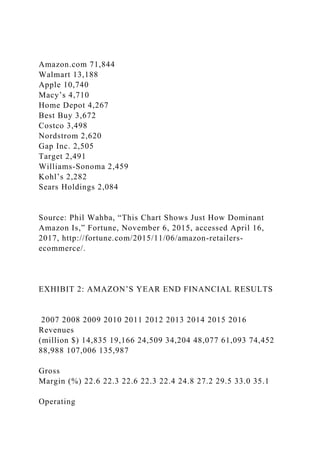
The company’s revenues from online retail sales largely
surpassed those of its competitors: in 2015, its
online retail sales were 5.5 times greater than those of Walmart,
making it the leader in the online retail
market12 (see Exhibit 1). Amazon made $71.84 billion in online
retail sales between November 2014 and
November 2015. This was more than the combined online sales
of Apple, Walmart, Sears, Roebuck &
company, The Gap Inc., Costco Wholesale Coporation, Target
Corporation, The Kohl’s Corporation, Best
Buy Co., and The Home Depot Inc.13 In the second quarter of
2016, Amazon hit a record profit for the third
straight quarter—$857 million ($1.78 per share) on revenue of
$30.4 billion.14 This record far surpassed
analysts’ estimates of profits per share of $1.11 and revenues of
$29.5 billion. In 2016, its online retail sales
accounted for half of all online retail sales in the United
States.15 According to Amazon’s chief financial
officer, Brian Olsavsky, these positive financial figures were a
result of “working very hard on efficiency”
and “benefits of operating at scale.”16
For years, as Amazon’s online retail sales and profits increased
continually, the company kept on investing
in research and development (R&D) to improve its offers and to
develop new market sectors. In 2016,
Amazon decided to enter food and consumable goods
manufacturing through Amazon Elements, available
only online for American Prime Members, and offline retailing
through Amazon Go in Seattle, the first
brick-and-mortar convenience food store that employed mobile
e-commerce, machine learning, and
computer vision to allow customers to make purchases without a
cashier.17
However, Amazon’s performance in the third quarter of 2016,
especially in terms of profits, was lower than
expected, and this caused its stock price to decrease by 7 per
cent. While its revenues were as expected, at
$32.7 billion, its profits were $252 million, which was much
lower than in the second quarter.18 Earnings
per share were only $0.52—below the estimated $0.78. Still, as
of the third quarter of 2016, Amazon was
the fourth most valuable public company in the United States.
This poorer performance resulted largely from increased
investments in improving existing offers and
developing new offers. Such investments were expected to
increase as Amazon entered offline retail
segments, which required at least buying physical stores. As
Olsavsky said, “We are in a period of
advancing up our investments in the second half of 2016, even
more so than in prior years.”19 In May 2016,
For the exclusive use of A. ZHANG, 2018.
This document is authorized for use only by AILUN ZHANG in
Marketing Strategy Fall 2018 taught by TC DALE, Portland
State University from Sep 2018 to Mar 2019.
Page 4 9B17M092
to raise more capital, Bezos sold over one million of his
shares—the largest amount he had ever made—for
$671 million. In August 2016, he sold another record one
million shares for $756.7 million, reducing his
shares in Amazon to 16.9 per cent (see Exhibit 2).
AMAZON’S COMPETITIVE ADVANTAGES
Amazon’s success was not only due to its first-mover advantage
but also came from a combination of
competitive advantages related to marketing, supply chain,
innovation, and customer-centricity.
Brand Awareness and Innovative Marketing
Amazon’s marketing strategy relied on its strong brand
awareness. As Bezos said, “Brand names are more
important online than they are in the physical world.”20 In
another interview, he noted the importance of
communicating the story of Amazon’s brand: “You can have the
best technology, you can have the best
business model, but if the storytelling isn’t amazing, it won’t
matter . . . Nobody will watch.”21
The company implemented innovative marketing to receive free
press coverage and to increase good customer
perception of its products and services. Its community banana
stands gave away about 4,500 free bananas
daily to Seattle inhabitants to create more links with customers
and improve its brand image. Since bananas
were also the most popular item sold by Amazon’s rival,
Walmart, some analysts thought this campaign could
be seen as a way of attacking Walmart by showing that Amazon
also sold good-quality fresh items.22
Amazon chose to advertise its first unexpected offline retail
venture, Amazon Go, through video teasing,
which successfully created a buzz among the general public.
Amazon did not really need to spend a lot of
money to advertise this brand-new offline offer, as media
outlets were already talking about this innovative
retail marketing approach. Amazon’s competitors also started to
react to the resulting widespread public
awareness by creating their own videos, which generated even
more visibility for Amazon Go.
In 2015, Amazon spent $2.8 billion on digital marketing, an
increase of 40 per cent from the year before.23
The company also established partnerships with digital
celebrities to promote its products.24 However, these
marketing activities were not the only reason for Amazon’s
success, and Amazon focused less on offline
advertising than digital brands like Apple and Samsung. As
Bezos said, “In the old world, you devoted 30
per cent of your time to building a great service and 70 per cent
of your time to shouting about it. In the
new world, that inverts.”25
Efficient Supply Chain Management to Create a Convenient
Shopping Experience
As an online retailer, Amazon revolutionized the way customers
shopped for products through its efficient
supply chain management, which made a wider range of
products available and delivered those products faster
than its competitors. The company’s global presence and
available worldwide shipments allowed customers
to easily buy almost anything from any country from Amazon.
Unlike Walmart, Amazon did not need a
physical shop; it just needed a warehouse to store products. It
also had products delivered directly from the
producer to the customer. Its fast delivery came from the
strategic location of its warehouses, the high levels
of available product inventory, its fast order management, and
its partnerships with delivery companies. For
example, in Japan, Amazon partnered with Yamato Holdings
Co., Ltd., allowing buyers to receive products
within a day of their orders.26 This very efficient delivery also
came from its investments in robotics.
For the exclusive use of A. ZHANG, 2018.
This document is authorized for use only by AILUN ZHANG in
Marketing Strategy Fall 2018 taught by TC DALE, Portland
State University from Sep 2018 to Mar 2019.
Page 5 9B17M092
From the beginning of its business, Amazon sold many products
at highly competitive prices, usually
cheaper than those of offline competitors. Bezos even said,
“There are two kinds of companies, those that
work to try to charge more and those that work to charge less.
We will be the second.”27 This ability to
reduce prices came from the high economies of scale Amazon
could generate on some products because of
their high turnover. Unlike offline retailers, Amazon did not pay
expensive rent for physical shops but
efficiently managed warehouses at strategic locations to
maximize its inventory turnover. Its strategy to sell
more at a low price meant the company’s margins were usually
lower than those of competitors, and this
was one reason why it was not profitable for many years.
Customer-Centricity and Innovation
Bezos’s strategy had always been to focus on customer needs.
He said, “We’ve had three big ideas at
Amazon that we’ve stuck with for 18 years, and they’re the
reason we’re successful: Put the customer first.
Invent. And be patient.”28 Since the beginning of online
business, Amazon kept innovating to create the
best possible user experience. The company emphasized the
ease of use of its websites. It also reduced
product delivery time, proposing even same-day deliveries in
some cities. This customer-centric approach
allowed the company to be more innovative. As Bezos said, “If
you’re competitor-focused, you have to
wait until there is a competitor doing something. Being
customer-focused allows you to be more
pioneering.”29 The company increased the number of products
it offered over the years to satisfy customer
needs, particularly through partnerships with prominent players
such as retailer Toys “R” Us Inc.
AMAZON’S PRIVATE LABELS AND OFFLINE RETAIL
OFFERS
Amazon had already launched a bookstore in a university in
Seattle, which offered over 6,000 book titles,
and it planned to open a second one in San Diego. Although
Amazon did not have much experience in the
traditional manufacturing and retail business, it decided in 2016
to enter grocery product manufacturing
and brick-and-mortar food retailing. This decision went against
the general trend of business models
followed by many competitors, which were increasingly moving
from offline physical stores to online
stores. However, Bezos did not see this decision as a risk.
Instead, he saw it as a normal evolution of
business, and said, “What’s dangerous is not to evolve.”30
New Brands
After developing many electronic devices under its own brand,
Amazon decided to enter the higher-margin
grocery and household goods sectors. In May 2016, the
company announced the launch of three brands
available for purchase online on its websites: Happy Belly
(which offered grocery products including milk,
coffee, cereals, and pasta), Wickedly Prime (which offered
ready-to-eat prepared foods), and Mama Bear
(which offered baby products including baby food, cleaning
wipes, and diapers).31 Amazon thus not only
sold grocery and household products online but also produced
them through private labels, allowing the
company to have potentially higher margins.32 On its websites,
the company explained that this move was
driven by its customer-centric capabilities. 33 According to
Amazon, the product offerings would be
improved based on the clients’ feedback. It wanted to create and
promote brands that would be seen by
customers as more trustworthy than others.
While Amazon Elements products had been available only in the
United States and only to Amazon Prime
members, a small segment of Amazon’s entire customer base,
Amazon contracted with multiple
manufacturers to produce this new range of products. These
manufacturers included TreeHouse Foods Inc.,
For the exclusive use of A. ZHANG, 2018.
This document is authorized for use only by AILUN ZHANG in
Marketing Strategy Fall 2018 taught by TC DALE, Portland
State University from Sep 2018 to Mar 2019.
Page 6 9B17M092
which was also manufacturing similar goods for other retailers.
This development could be seen as an
attempt by Amazon to catch up and compete even more with
other retailers such as Walmart and Target,
which had had their own product brands for years.
Because Amazon’s brand awareness was so high, it could
develop these new offers easily without having
to spend millions of dollars on advertising and other marketing
activities. Amazon could adapt its product
offers to meet consumer demands by utilizing its enormous
customer databases. However, as Amazon had
not been a traditional retailer before, this strategic move might
be seen as risky. Indeed, this was not the
first time that Amazon had tried to produce baby products. In
2014, the company had launched its own
diapers on its websites, but removed them from Amazon.com
only few weeks after the launch due to
manufacturing defects and negative customer feedback.34
Nevertheless, Bezos was not the kind to give up
easily after one failure. He said, “If you’re not stubborn, you’ll
give up on experiments too soon. And if
you’re not flexible, you’ll pound your head against the wall and
you won’t see a different solution to a
problem you’re trying to solve.”35
These new Amazon-branded products could also create tensions
with suppliers who were currently
presenting their products on Amazon.com, potentially putting
Amazon in an even tougher position to
negotiate with them.36 Should Amazon’s own brands be
showcased on its websites while the company
aimed to be a leader in the sale of its own-brand products?
Should these own-brand products be marketed
the same way as products available from other suppliers? Was
the launch of its own-brand products
considered unfair competition?
Amazon Go
Amazon’s business model was designed under the assumption
that retail businesses were all growing and
moving toward the online environment. However, with Amazon
Go, the company clearly revised its
business model to combine online and offline retailing. The
company opened its first brick-and-mortar food
store on December 5, 2016, near its headquarters in Seattle. It
announced this new initiative only by posting
a video about the Amazon Go concept that day.37 Immediately
after the post, media outlets around the world
wrote about it. The store was accessible only to the company’s
employees for beta testing, while a public
opening was planned for early 2017.
It seemed that Amazon might be planning to extend Amazon Go
to the United Kingdom. According to the
Guardian, the company had registered a British trademark for
the store concept in December 2016, on the
same day it opened the Seattle store.38 The company refused to
comment to the newspaper about this
potential U.K. expansion. However, such an expansion would
not be surprising given that the company had
often before used the United Kingdom as its first non-U.S.
market to test new offers. These strategic moves
implied that Amazon might be thinking of developing the
Amazon Go concept globally.
The Amazon Go store, which sold staple foods, was 1,800
square feet (over 160 square metres) in area. Its
uniqueness was its fast and convenient electronic payment
system. Customers just entered the store, picked
up the products they wanted, and left the store without having
to queue to process payments.39 When
customers took products from the store, sensors would
concurrently transmit information about the
purchases to its online processing system, which would debit
the price of those products directly from the
customers’ Amazon Prime accounts before the customers left
the store.40 Amazon Go and Amazon.com
had the same aim: to revolutionize the way people consumed in
their everyday life and to offer the best
possible customer experience. According to the company, this
shopping technology was really not a new
concept, as Amazon’s teams had already been working on it for
four years.41
For the exclusive use of A. ZHANG, 2018.
This document is authorized for use only by AILUN ZHANG in
Marketing Strategy Fall 2018 taught by TC DALE, Portland
State University from Sep 2018 to Mar 2019.
Page 7 9B17M092
The automated grocery store raised significant concerns among
Amazon’s employees due to the potential
job cuts in Amazon stores. It was estimated that, through this
technology, Amazon’s grocery stores might
eliminate thousands of jobs in the long term.42
COMPETITION IN THE OFFLINE RETAIL MARKET
Amazon Go and Amazon’s private labels, including Amazon
Elements, targeted markets that were quite
similar to those of its major grocery retail competitors, Walmart
and Target. Over the years, Amazon had
surpassed these large retailers in terms of online sales, but
would the company be able to reproduce this
online success in the offline markets? Though it might generate
greater profit margins, the offline retail
market was extremely competitive, requiring much larger
investments.
Importantly, Amazon had no solid experience in managing
physical chain stores. Many competitors,
particularly established grocery retailers, viewed such
announcements with humour. Amazon was clearly a
latecomer without sufficient knowledge of brick-and-mortar
retail markets, while efficient delivery systems
allowed more customers to shop for products online. Monoprix
S.A., a major French retail chain located in
key areas in city centres, made a parody of Amazon Go’s video,
saying that Amazon should have better
served its customers’ needs.43 This reaction was similar to the
response to Amazon’s entrance into the
online food market, in which it became a big player. By 2016,
the Amazon Prime service had over 63
million users; these users could be potential users of Amazon
Go and Amazon Elements as well.44
Amazon’s biggest competitor in the online retail market was
Walmart, an American retailer operating in
both offline and online markets through its own brick-and-
mortar stores and websites. It was the largest
offline retailer in the United States and the second online
retailer after Amazon. Amazon and Walmart had
been competing in the online market for years. Walmart had
even sued Amazon in 1998 for hiring former
Walmart executives and thus stealing its trade secrets.45 Doug
McMillon, the president and chief executive
officer of Walmart, commented that Walmart’s high number of
stores gave it a competitive edge over purely
online stores such as Amazon and that, by being in both offline
and online markets, the company could do
“quick last minute delivery that is free, cheaper, pushes cutoff
shopping during holidays, and . . . brings
people into stores.”46 The opening of Amazon Go stores and
the development of Amazon’s own-brand
grocery products could thus become a serious threat to Walmart.
CONCLUSION
The launch of Amazon Go and Amazon Elements, as well as
other private labels, clearly demonstrated
Amazon’s intention to move from being online only to
becoming a mixed offline and online retail and
manufacturing company. Amazon Go and Amazon Elements had
several similarities: they were offline,
were reserved only for Amazon Prime members, were in the
grocery segment, and had the same competitors.
These initiatives, which were seen as good opportunities for
Amazon to generate higher profits, meanwhile
put the company into a riskier position due to its lack of
experience in traditional retailing. In online retail
sales, Amazon’s performance had surpassed its mixed online
and offline retail competitors over the years,
demonstrating its strengths in marketing, supply chain, and
customer-centricity in online segments.
Could Amazon replicate the competitive advantage that
contributed to its online success in the offline retail
markets? Could the company leverage its existing online assets
and capabilities in the offline segments?
Given this diversification, how could Amazon manage the
efficiency of its operations and the quality of its
products in the long term? Did the company have capabilities to
do so? Would Amazon Go change the way
people bought and consumed as Amazon.com had done so
successfully before? Would the company be
For the exclusive use of A. ZHANG, 2018.
This document is authorized for use only by AILUN ZHANG in
Marketing Strategy Fall 2018 taught by TC DALE, Portland
State University from Sep 2018 to Mar 2019.
Page 8 9B17M092
able to go against the trend of grocery shopping, which was
increasingly moving toward online markets?
Could the company develop these offline retail offers globally?
Could competitors easily imitate this
innovative shopping technology? Finally, given potential job
cuts, would Amazon face resistance from
store employees and unions?
For the exclusive use of A. ZHANG, 2018.
This document is authorized for use only by AILUN ZHANG in
Marketing Strategy Fall 2018 taught by TC DALE, Portland
State University from Sep 2018 to Mar 2019.
Page 9 9B17M092
EXHIBIT 1: DIGITAL SALES WORLDWIDE, BY RETAILER
(IN $MILLIONS)
Amazon.com 71,844
Walmart 13,188
Apple 10,740
Macy’s 4,710
Home Depot 4,267
Best Buy 3,672
Costco 3,498
Nordstrom 2,620
Gap Inc. 2,505
Target 2,491
Williams-Sonoma 2,459
Kohl’s 2,282
Sears Holdings 2,084
Source: Phil Wahba, “This Chart Shows Just How Dominant
Amazon Is,” Fortune, November 6, 2015, accessed April 16,
2017, http://fortune.com/2015/11/06/amazon-retailers-
ecommerce/.
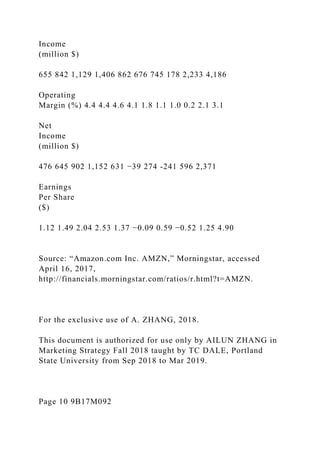
EXHIBIT 2: AMAZON’S YEAR END FINANCIAL RESULTS
2007 2008 2009 2010 2011 2012 2013 2014 2015 2016
Revenues
(million $) 14,835 19,166 24,509 34,204 48,077 61,093 74,452
88,988 107,006 135,987
Gross
Margin (%) 22.6 22.3 22.6 22.3 22.4 24.8 27.2 29.5 33.0 35.1
Operating
Income
(million $)
655 842 1,129 1,406 862 676 745 178 2,233 4,186
Operating
Margin (%) 4.4 4.4 4.6 4.1 1.8 1.1 1.0 0.2 2.1 3.1
Net
Income
(million $)
476 645 902 1,152 631 −39 274 -241 596 2,371
Earnings
Per Share
($)
1.12 1.49 2.04 2.53 1.37 −0.09 0.59 −0.52 1.25 4.90
Source: “Amazon.com Inc. AMZN,” Morningstar, accessed
April 16, 2017,
http://financials.morningstar.com/ratios/r.html?t=AMZN.
For the exclusive use of A. ZHANG, 2018.
This document is authorized for use only by AILUN ZHANG in
Marketing Strategy Fall 2018 taught by TC DALE, Portland
State University from Sep 2018 to Mar 2019.
Page 10 9B17M092
ENDNOTES
1 This case has been written on the basis of published sources
only. Consequently, the interpretation and perspectives
presented in this case are not necessarily those of Amazon.com,
Inc. or any of its employees.
2 Andrew Melville, “Amazon Go Is about Payments, Not
Grocery,” Forbes, January 20, 2017, accessed April 16, 2017,
https://www.forbes.com/sites/groupthink/2017/01/20/amazon-
go-is-about-payments-not-grocery/#41fd22df67e4.
3 Greg Bensinger, “Amazon to Expand Private-Label
Offerings—From Food to Diapers,” Wall Street Journal, May
15, 2016, accessed
April 16, 2017, https://www.wsj.com/articles/amazon-to-
expand-private-label-offeringsfrom-food-to-diapers-
1463346316.
4 “Amazon Posts a Profit,” CNN Money, January 22, 2002,
accessed April 16, 2017,
http://money.cnn.com/2002/01/22/technology/amazon/.
5 Tomi Kilgore, “Amazon Passes Exxon to Become 4th Most
Valuable Company in the U.S.,” MarketWatch, August 2, 2016,
accessed April 16, 2017, www.marketwatch.com/story/amazon-
passes-exxon-to-become-4th-most-valuable-company-in-the-
us-2016-08-01.
6 All currency amounts are in US$ unless otherwise specified.
7 Darrell Etherington, “Amazon Will Build Its Own 1.5 Billion
Air Cargo Hub,” Techcrunch, Feb 1, 2017, accessed April 16,
2017, https://techcrunch.com/2017/02/01/amazon-will-build-its-
own-1-5-billion-air-cargo-hub/.
8 Ron Amadeo, “‘Amazon Video Direct’ Takes Aim at the
Professional Side of YouTube,” Ars Technica, November 5,
2016,
accessed April 16, 2017,
https://arstechnica.com/business/2016/05/amazon-video-direct-
takes-aim-at-the-professional-side-
of-youtube/.
9 “Amazon.com,” accessed April 16, 2017,
https://www.amazon.com.
10 Nat Levy, “Amazon Reaches New High of 268,000
Employees—Skyrocketing 47% in Just One Year,” GeekWire,
July 28,
2016, accessed April 16, 2017,
www.geekwire.com/2016/amazon-employment-2nd-quarter/.
11 Don Reisinger, “Amazon Is Planning to Hire 100,000 Full-
Time Employees,” Fortune, January 12, 2017, accessed April
16,
2017, http://fortune.com/2017/01/12/amazon-full-time-
employees/.
12 Phil Wahba, “This Chart Shows Just How Dominant Amazon
Is,” Fortune, November 6, 2015, accessed April 16, 2017,
http://fortune.com/2015/11/06/amazon-retailers-ecommerce/.
13 “How Much Does Amazon Spend On Digital Marketing,”
Spinutech, August 9, 2016, accessed April 16, 2017,
https://www.spinutech.com/blog/digital-marketing/how-much-
does-amazon-spend-on-digital-marketing/.
14 Jason Del Rey, “Amazon Just Posted a Record Profit for the
Third Straight Quarter,” Recode, July 28, 2016, accessed
April 16, 2017,
https://www.recode.net/2016/7/28/12315690/amazon-earnings-
q2-2016.
15 Jason Del Rey, “Amazon’s Complete Retail Domination in
One Tiny Chart,” Recode, December 23, 2015, accessed April
16,
2017, https://www.recode.net/2015/12/23/11621690/amazons-
complete-retail-domination-in-one-tiny-chart.
16 Eugene Kim, “Amazon CFO Had to Explain It’s Not a Bad
Thing Amazon Had Its Highest Quarterly Profit Ever,” Business
Insider, July 28, 2016, accessed April 16, 2017,
www.businessinsider.com/amazon-cfo-defends-profit-on-
conference-call-
2016-7.
17 David Jones, “Amazon’s Register-Free Grocery Shopping
Could Disrupt Retail,” TechNewsWorld, December 6, 2016,
accessed May 15, 2017,
www.technewsworld.com/story/84141.html.
18 Eugene Kim, “Amazon Misses, Stock Falls,” Business
Insider, October 27, 2016, accessed April 16, 2017,
www.businessinsider.com/amazon-earnings-q3-2016-2016-10.
19 Ibid.
20 Bill Murphy, “‘Follow the Money’ and Other Lessons from
Jeff Bezos,” Inc., August 6, 2013, accessed April 16, 2017,
www.inc.com/bill-murphy-jr/follow-the-money-lessons-from-
jeff-bezos.html.
21 Aly Weisman, “Here’s How Jeff Bezos Chooses Which
Amazon Shows to Green-Light,” Business Insider, July 15,
2015,
accessed April 16, 2017, www.businessinsider.com/what-jeff-
bezos-wants-in-an-amazon-show-2015-7.
22 Jacob Demmitt, “Amazon Opens ‘Community Banana Stand’
at Seattle HQ to Give Away Free Fruits,” GeekWire,
December 3, 2015, accessed January 6, 2017,
www.geekwire.com/2015/amazon-opens-community-banana-
stand-to-give-
away-hundreds-of-free-snacks-at-seattle-hq/.
23 “Amazon Upped Its Digital Marketing Spend 40% Last Year
to $2.8 Billion,” PR Newswire, January 27, 2015, accessed
April 16, 2017, www.prnewswire.com/news-releases/amazon-
upped-its-digital-marketing-spend-40-last-year-to-28-billion-
300026351.html.
24 Celine Mingot, “Mister V et Cyprien Choisis pour
Promouvoir le Programme Amazon Premium Jeunes [Mister V
and Cyprien
Selected to Promote the Amazon Premium Youth Program],”
Influenth, December 5, 2016, accessed April 16, 2017,
www.influenth.com/mister-v-cyprien-choisis-promouvoir-
programme-amazon-premium-jeune/.
25 Jessica Stillman, “7 Jeff Bezos Quotes That Outline the
Secret to Success,” Inc., May 7, 2014, accessed April 16, 2017,
www.inc.com/jessica-stillman/7-jeff-bezos-quotes-that-will-
make-you-rethink-success.html.
26 Chris Cooper and Kiyotaka Matsuda, “Amazon Surge in
Japan Lifts Yamato’s Express Deliveries Freight,” Bloomberg,
August 15, 2014, accessed April 16, 2017,
https://www.bloomberg.com/news/articles/2014-08-14/amazon-
surge-in-japan-
lifts-yamato-s-express-deliveries-freight.
27 George Anders, “Jeff Bezos’s Top 10 Leadership Lessons,”
Forbes, April 4, 2012, accessed April 16, 2017,
https://www.forbes.com/sites/georgeanders/2012/04/04/bezos-
tips/#3dee7902fce4.
28 Paul Farhi, “Jeffrey Bezos, Washington Post’s Next Owner,
Aims for a New ‘Golden Era’ at the Newspaper,” Washington
Post, September 3, 2013, accessed April 16, 2017,
https://www.washingtonpost.com/lifestyle/style/jeffrey-bezos-
washington-
posts-next-owner-aims-for-a-new-golden-era-at-the-
newspaper/2013/09/02/30c00b60-13f6-11e3-b182-
1b3bb2eb474c_story.html.
For the exclusive use of A. ZHANG, 2018.
This document is authorized for use only by AILUN ZHANG in
Marketing Strategy Fall 2018 taught by TC DALE, Portland
State University from Sep 2018 to Mar 2019.
Page 11 9B17M092
29 David LaGesse, “America’s Best Leaders: Jeff Bezos,
Amazon.com CEO,” U.S. News, November 19, 2008, accessed
April 16,
2017, https://www.usnews.com/news/best-
leaders/articles/2008/11/19/americas-best-leaders-jeff-bezos-
amazoncom-ceo.
30 Michael Shick, “Jeff Bezos—What’s Dangerous Is Not to
Evolve,” Fast Company, March 3, 2010, accessed April 16,
2017,
https://www.fastcompany.com/1569357/jeff-bezos-whats-
dangerous-not-evolve.
31 Greg Bensinger, op. cit.; Flore Fauconnier, “Amazon va
Lancer sa Propre Marque Alimentaire [Amazon Launches Its
Own
Food Brand],” Journal du Net, May 29, 2015, accessed April 16,
2017, www.journaldunet.com/ebusiness/commerce/amazon-
mdd-alimentaire-0515.shtml; “Amazon Vendra Sa Propre
Nourriture [Amazon Will Sell Its Own Food],” Infopresse, May
16,
2016, www.infopresse.com/article/2016/5/16/amazon-vendra-sa-
propre-nourriture.
32 “Amazon va Bientôt Vendre de la Nourriture et D’Autres
Produits sous Sa Propre Marque [Amazon Will Soon Sell Food
under Its Own Brand],” Kulture Geek, May 16, 2016, accessed
April 16, 2017, http://kulturegeek.fr/news-84373/amazon-
vendre-nourriture-dautres-produits-propre-marque.
33 “Amazon Elements,” Amazon.com Inc., accessed April 16,
2017, https://www.amazon.com/Amazon-Elements-Premium-
products-Transparent- origins-Exclusive-to-
Prime/b?ie=UTF8&node=10166275011.
34 Omar Belkaab, “Amazon Lance Ses Propres Marques
D’Alimentation, de Détergents et de Couches Culottes [Amazon
Launches Own Brand of Food, Detergents, and Coats],”
Numerama, May 16, 2016, accessed April 16, 2017,
www.numerama.com/business/170495-amazon-lance-propres-
marques-dalimentation-de-detergent-de-couches-
culottes.html.
35 John Greathouse, “5 Time-Tested Success Tips from Amazon
Founder Jeff Bezos,” Forbes, April 30, 2013, accessed
April 16, 2017,
https://www.forbes.com/sites/johngreathouse/2013/04/30/5-
time-tested-success-tips-from-amazon-founder-
jeff-bezos/#384564c2370c.
36 Jason Del Rey, “Amazon Is Going to Sell Its Own Lines of
Food, Detergent and Diapers, and It's Going to Be a Really Big
Deal,” Recode, May 15, 2016, accessed April 16, 2017,
https://www.recode.net/2016/5/15/11680080/amazon-happy-
belly-
mama-bear-private-label.
37 “Introducing Amazon Go and the World’s Most Advanced
Shopping Technology,” YouTube video, 1:49, posted by
Amazon,
December 5, 2016, accessed April 16, 2017,
https://www.youtube.com/watch?v=NrmMk1Myrxc.
38 Sean Farrell, “Amazon Go Checkout-Free Stores Look Set to
Come to UK,” Guardian, December 9, 2016, accessed
April 16, 2017,
https://www.theguardian.com/business/2016/dec/09/amazon-go-
stores-uk-trademark-us.
39 Andrew Melville, op. cit.
40 Sean Farrell, op. cit.
41 “Frequently Asked Questions,” Amazon.com, Inc., accessed
April 16, 2017,
https://www.amazon.com/b?node=16008589011.
42 Erik Sherman, “Amazon's Grocery Would Eliminate
Thousands of Jobs,” Forbes, December 7, 2016, accessed April
16,
2017,
https://www.forbes.com/sites/eriksherman/2016/12/07/amazons-
grocery-would-eliminate-thousands-of-jobs/.
43 Nicolas Scheffer, “Monoprix Ironise à Propos D'Amazon Go
[Monoprix Ridicules Amazon Go],” Les Echos, January 3, 2017,
accessed April 16, 2017, https://business.lesechos.fr/directions-
marketing/communication/communication-
digitale/0211641428346-monoprix-ironise-a-propos-d-amazon-
go-304014.php; Angela Natividad, “This Grocery Chain Just
Mocked Amazon Go as a Latecomer With Snarky Remake of its
Ad,” AdWeek, January 3, 2017, accessed April 16, 2017,
www.adweek.com/creativity/grocery-chain-just-mocked-
amazon-go-latecomer-snarky-remake-its-ad-175322/.
44 Audrey Shi, “Amazon Prime Members Now Outnumber Non-
Prime Customers,” Fortune, July 11, 2016, accessed April 16,
2017, http://fortune.com/2016/07/11/amazon-prime-customers/.
45 “Wal-Mart Sues Amazon,” CNN Money, October 16, 1998,
accessed April 16, 2017,
http://money.cnn.com/1998/10/16/companies/walmart/.
46 Phil Wahba, op. cit.
For the exclusive use of A. ZHANG, 2018.
This document is authorized for use only by AILUN ZHANG in
Marketing Strategy Fall 2018 taught by TC DALE, Portland
State University from Sep 2018 to Mar 2019.

Amazon Go Case Analysis1. Problem StatementThe key prob.docx

  • 1.
    Amazon Go CaseAnalysis: 1. Problem Statement: The key problem Amazon is struggling with is whether their decision to enter the offline retail segment will work. Amazon has been known as a purely online retailer that offer home products, electronics, and are a trusted source of product information. The online retailer decided to enter the grocery market launching amazon fresh and acquiring Whole Foods to offer delivery of food to its customers. This decision still had them in their online retail format and was in line with the company’s strengths. . In 2016 the Amazon decided to also create an offline retail format for its members called Amazon Go a brick and mortar convenience store. The issues with this move for Amazon is that it has resulted in monetary losses due to the increased investment in R&D for new offers and these losses are expected to increase with Amazon’s decision to move forward into a brick and mortar retail environment. Other issues stemming from this decision include how to leverage their competitive advantages, they need to rethink key marketing strategies and evolve the brand identity, and will this work as the market shifts away from the traditional retail formats to online retail formats. How far Amazon takes this decision can have major impacts for the retailer and the size of those impacts depends on if Amazon decides to “Go” or not to “Go”. 2. Alternative Evaluation: ·
  • 2.
    3. Recommendations: Flag thisQuestion Question 1 5 pts (TCO 1) HIPAA security regulations primarily apply to transportation organizations. financial organizations.
  • 3.
    education organizations. healthcare organizations. Flagthis Question Question 2 5 pts (TCO 2) Objectives, purpose, policy, exceptions, and disciplinary actions are the summary of a policy. goal of a policy. outline of a policy. rules of a policy. Flag this Question Question 3 5 pts (TCO 3) Which is defined as the structure for determining the clearance level of an individual, which must match the classification of data, in order to be granted access? For Your Eyes Only Top Secret Secret Mandatory Access Control
  • 4.
    Flag this Question Question4 5 pts (TCO 4) Which of the following is NOT a type of background check? Criminal history License verification Family history Civil records Flag this Question Question 5 5 pts (TCO 5) Which of the following is NOT a component of a good security incident reporting program? Training users to recognize suspicious incidents Updating antivirus software signature files Establishing your incident response team Establishing a system for reporting incidents Flag this Question
  • 5.
    Question 6 5 pts (TCO4) Which of the following is NOT a type of employment agreement? Monitoring and auditing agreement Employee information security agreement Affirmation agreement Acceptable use agreement Flag this Question Question 7 5 pts (TCO 6) When it comes to disposal of difficult drives that contain company information it’s okay to just dump them in the trash. all you need to do is reformat the drive. zeroization is the recommended practice. all that is needed to do is format the master boot record. Flag this Question Question 8 5 pts (TCO 7) This access control method is characterized by the information owner being responsible for assigning privileges to
  • 6.
    appropriate users. MAC RBAC DAC PAC Flag thisQuestion Question 9 5 pts (TCO 8) If employees using a company-provided application system find what they think is a loophole that allows access to confidential data, they should alert their manager and the ISO immediately. verify and test the alleged loophole before alerting anyone. not say anything, unless they are a member of the Incident Response team. alert their manager whenever they happen to have a chance to do so. Flag this Question Question 10 5 pts (TCO 9) A threat assessment is a(n)
  • 7.
    identification of typesof threats an organization might be exposed to. systematic rating of threats based upon level of risk and probability. potential level of impact. likelihood of a threat materializing. Flag this Question Question 11 5 pts (TCO 10) Which organization, according to the provisions of HIPAA, is mandated to develop and publish rules to implement the HIPAA administrative simplification requirements? The FDIC The Department of Health and Human Services The Office of the Attorney General The OCS Flag this Question Question 12 5 pts (TCO 10) Which is the first requirement set forth by the security management process part of HIPAA’s administrative safeguards?
  • 8.
    A penetration test Avulnerability assessment A risk assessment A disaster recovery assessment Flag this Question Question 13 5 pts (TCO 11) Which of the following concerns federal agencies? FISMA FERPA SOX GLBA Flag this Question Question 14 5 pts (TCO 11) Students have a right to file complaints against a school for disclosing educational records in violation of which federal law? HIPAA FERPA
  • 9.
    FISMA SOX Flag this Question Question15 5 pts (TCO 12) Which of the following is true about small businesses? Small businesses can fall under a federal mandate that governs how they handle protected information. Small businesses are too small to fall under any federal mandates. All small businesses are regulated by the Small Business Security Act when it comes to safeguarding protected information. All of the above Flag this Question Question 16 5 pts (TCO 12) Incident reporting is the responsibility of any employee who discovers an incident. the CEO. the ISO.
  • 10.
    departmental managers. Flag thisQuestion Question 17 5 pts (TCO 1) Keeping the policy documents separate from the procedures, standards, and guidelines is combining policies and procedures. the preferred approach to organizing information security policies, procedures, standards and guidelines. not the preferred approach to organizing information security policies, procedures, standards, and guidelines. combining standards and guidelines. Flag this Question Question 18 5 pts (TCO 2) A guideline can best be defined as a requirement. suggestion. series of directions. law.
  • 11.
    Flag this Question Question19 5 pts (TCO 3) This classification level is used by business organizations for data that are used internally by an organization for the purpose of conducting company business. Sensitive Top Secret Secret Restricted Flag this Question Question 20 5 pts (TCO 4) There is a growing trend of replacing traditional acceptable use agreements with employee information security affirmation agreements. employee internet security affirmation agreements. security policies. employee manuals. Flag this Question
  • 12.
    Question 21 40 pts (TCO1) Explain the steps to achieving acceptance of an information security policy within an organization HTML Editor Keyboard Shortcuts 12pt Paragraph 0 words Flag this Question Question 22 40 pts (TCO 7) Define and provide examples for each of the following terms: (1) deny all security posture, (2) need to know security posture, and (3) least privilege security posture. HTML Editor Keyboard Shortcuts 12pt
  • 13.
    Paragraph 0 words Flag thisQuestion Question 23 40 pts (TCO 9) Evaluate the relationship between GLBA and ISO 17799. HTML Editor Keyboard Shortcuts 12pt Paragraph 0 words Flag this Question Question 24 40 pts
  • 14.
    (TCO 11) Howdo COSO and CobiT® vary from ISO 17799? HTML Editor Keyboard Shortcuts 12pt Paragraph p 0 words W17398 AMAZON GO: VENTURING INTO TRADITIONAL RETAIL1 Wiboon Kittilaksanawong and Aurélia Karp wrote this case solely to provide material for class discussion. The authors do not intend to illustrate either effective or ineffective handling of a managerial situation. The authors may have disguised certain names and other identifying information to protect confidentiality. This publication may not be transmitted, photocopied, digitized,
  • 15.
    or otherwise reproducedin any form or by any means without the permission of the copyright holder. Reproduction of this material is not covered under authorization by any reproduction rights organization. To order copies or request permission to reproduce materials, contact Ivey Publishing, Ivey Business School, Western University, London, Ontario, Canada, N6G 0N1; (t) 519.661.3208; (e) [email protected]; www.iveycases.com. Copyright © 2017, Richard Ivey School of Business Foundation Version: 2017-06-28 Amazon.com, Inc. (Amazon), one of the largest global online retailers, decided to enter the offline retail industry in December 2016 by launching its first Amazon Go store in Seattle, offering a technologically innovative way of shopping that allowed customers to make purchases without a cashier.2 The launch was the first time that Amazon really entered the traditional retail industry. Earlier, in May 2016, the company had entered food, diaper, and housekeeping product manufacturing with its Amazon Elements brand.3 Nevertheless, these products were only available online for American Prime Members. Founded in 1994 as an online bookstore, the company had become an e-commerce giant, leading digital sales of books and electronic products. It revolutionized the way consumers purchased products, while also becoming a trusted source of product information for potential buyers. However, the company was not profitable until 2001, while it was still experiencing some financial difficulties.4 As of the third quarter of 2016, it was the fourth
  • 16.
    most valuable publiccompany in the United States.5 In 2015, it surpassed Wal-Mart Stores, Inc. (Walmart) as the most valuable online retail company in the United States. Could Amazon reproduce its online success in the traditional offline retail segment? Could its current competitive advantages be replicated in offline retailing? Did this diversification make sense, considering Amazon’s existing key resources and capabilities, the presence of established traditional retailers like Walmart, and the market trend that was increasingly moving toward online stores? HISTORY The Beginnings: 1994–1997 On July 5, 1994, Jeff Bezos, a 30-year-old engineer graduating from Princeton University, left his job as vice-president at D.E. Shaw & Co., a global investment firm based in New York, to create an online bookstore based in Seattle. He saw the future of selling products online and thus first sold books, videos, computer hardware and software, and compact discs. He chose to sell books because of the high worldwide demand, low price per piece, and high number of titles. His aim was to provide more varieties of books online than were available in a physical store. Amazon’s main competitors were Barnes & Noble Booksellers Inc., the largest retail bookseller, and other local booksellers in the United States. The company For the exclusive use of A. ZHANG, 2018. This document is authorized for use only by AILUN ZHANG in
  • 17.
    Marketing Strategy Fall2018 taught by TC DALE, Portland State University from Sep 2018 to Mar 2019. Page 2 9B17M092 was named Amazon.com in the year after it was created. Through a partnership with Ingram Book Group LLC, Amazon could access books at wholesale prices and sell them online at cheaper prices than physical bookstores. Within its first two months, Amazon’s online sales covered more than 45 countries with sales revenue of US$20,0006 per week. In June 1997, it went public and entered the Nasdaq stock exchange at an initial price of $18 per share, raising $54 million. Global Expansion and Laborious Financial Results: 1998–2004 In 1998, Amazon began to expand internationally, first by entering the United Kingdom and Germany, and then moving to Europe and Asia, including France, Japan, and China. The company included different languages on its websites to serve these international markets. Bezos was not expecting to make any profits during the first four or five years of the business. Shareholders were not satisfied with the company because it was not profitable and not growing fast enough. However, this business model, with slow but efficient growth, saved Amazon from suffering too much from the 2001 dot-com bubble, and the company realized its first profits in 2001. Nevertheless, its profit was only $5 million from revenues of over $1 billion. Since 2001, the company had significantly diversified its products,
  • 18.
    from books tocomputers, electronics, clothes, and beauty products. Diversification, Early Steps in the Service Industry, and Own- Brand Products: 2005–2010 Amazon continued to extend its services through AmazonFresh, a grocery service, and Amazon Music, an online music store. The company increased its product offerings through the Fulfilment by Amazon program, where products were stored in Amazon’s fulfilment centres and then quickly picked, packed, and shipped to customers. It also created Amazon Prime to provide a two-day shipping service in the United States for only $79 a year. It launched Amazon Web Services Inc., which offered inexpensive, reliable, and scalable cloud computing services, including Amazon Mechanical Turk, a crowdsourcing Internet marketplace that enabled individuals and businesses to coordinate the use of human intelligence. This period also marked the beginning of Amazon’s own-brand products, including the 2007 launch of the Amazon Kindle, one of the very first e-books readers, three years before the launch of Apple Inc’s iBooks. Innovating and Diversifying at a Faster Pace: 2011–2017 The company kept innovating to improve its products and services. It launched Amazon Locker, a parcel delivery service that allowed buyers to pick up purchases at secure, self-service kiosks, and Amazon Prime Air, a cargo airline and drone-based delivery system. In February 2017, the company announced that it would invest $1.5 billion to build an air cargo hub to support
  • 19.
    the increasing sizeof its fleet.7 Amazon also entered new segments with its Kindle Fire and Fire HD, which competed with Apple’s iPad. Amazon acquired several companies, including GoodReads, an online social networking site for sharing books and reviews, and LoveFilm, a DVD-by-mail and streaming video-on-demand provider that competed with Netflix in Europe. It acquired Kiva Systems to develop robots that efficiently moved products in warehouses, thereby shortening delivery times. The company launched Amazon Video Direct to compete with YouTube,8 and it also developed and operated Amazon Video, an Internet video-on-demand service where customers could buy, rent, and instantly watch digital movies and TV shows. Amazon opened its first physical bookstore, Amazon Books, in Seattle, selling For the exclusive use of A. ZHANG, 2018. This document is authorized for use only by AILUN ZHANG in Marketing Strategy Fall 2018 taught by TC DALE, Portland State University from Sep 2018 to Mar 2019. Page 3 9B17M092 products at the same prices as those available in the online stores. These strategic moves allowed Amazon to become a global online retail giant. By 2015, its market capitalization surpassed that of Walmart.
  • 20.
    AMAZON’S DEVELOPMENT Headquartered inSeattle, Amazon was one of the big four global digital companies: Google, Apple Inc., Facebook Inc., and Amazon. It had worldwide operations, with websites serving markets in 14 countries in North America, Europe, and Asia, and shipping services in 75 countries.9 Its business was expanding rapidly. The number of full-time and part-time Amazon employees increased 47 per cent in one year to reach 268,900 in 2016.10 This was 23 times more employees than its online competitor EBay and twice as many as Apple, but it was less than 12 per cent of the employees of its offline competitor Walmart. Amazon announced a plan to hire 100,000 full-time employees in the United States from January 2017 to mid-2018, potentially becoming one of the largest technology employers in the country.11 Amazon offered a wide range of products on its website, including books, apparel, and even food. As of February 2017, Amazon.com had 48 categories of products— both new and used—that were created and sold both by Amazon itself and by other companies. Most products were in the digital and multimedia sectors. The company had diversified a lot over the years but mainly within online businesses. The company’s revenues from online retail sales largely surpassed those of its competitors: in 2015, its online retail sales were 5.5 times greater than those of Walmart, making it the leader in the online retail market12 (see Exhibit 1). Amazon made $71.84 billion in online retail sales between November 2014 and November 2015. This was more than the combined online sales of Apple, Walmart, Sears, Roebuck &
  • 21.
    company, The GapInc., Costco Wholesale Coporation, Target Corporation, The Kohl’s Corporation, Best Buy Co., and The Home Depot Inc.13 In the second quarter of 2016, Amazon hit a record profit for the third straight quarter—$857 million ($1.78 per share) on revenue of $30.4 billion.14 This record far surpassed analysts’ estimates of profits per share of $1.11 and revenues of $29.5 billion. In 2016, its online retail sales accounted for half of all online retail sales in the United States.15 According to Amazon’s chief financial officer, Brian Olsavsky, these positive financial figures were a result of “working very hard on efficiency” and “benefits of operating at scale.”16 For years, as Amazon’s online retail sales and profits increased continually, the company kept on investing in research and development (R&D) to improve its offers and to develop new market sectors. In 2016, Amazon decided to enter food and consumable goods manufacturing through Amazon Elements, available only online for American Prime Members, and offline retailing through Amazon Go in Seattle, the first brick-and-mortar convenience food store that employed mobile e-commerce, machine learning, and computer vision to allow customers to make purchases without a cashier.17 However, Amazon’s performance in the third quarter of 2016, especially in terms of profits, was lower than expected, and this caused its stock price to decrease by 7 per cent. While its revenues were as expected, at $32.7 billion, its profits were $252 million, which was much lower than in the second quarter.18 Earnings per share were only $0.52—below the estimated $0.78. Still, as of the third quarter of 2016, Amazon was the fourth most valuable public company in the United States.
  • 22.
    This poorer performanceresulted largely from increased investments in improving existing offers and developing new offers. Such investments were expected to increase as Amazon entered offline retail segments, which required at least buying physical stores. As Olsavsky said, “We are in a period of advancing up our investments in the second half of 2016, even more so than in prior years.”19 In May 2016, For the exclusive use of A. ZHANG, 2018. This document is authorized for use only by AILUN ZHANG in Marketing Strategy Fall 2018 taught by TC DALE, Portland State University from Sep 2018 to Mar 2019. Page 4 9B17M092 to raise more capital, Bezos sold over one million of his shares—the largest amount he had ever made—for $671 million. In August 2016, he sold another record one million shares for $756.7 million, reducing his shares in Amazon to 16.9 per cent (see Exhibit 2). AMAZON’S COMPETITIVE ADVANTAGES Amazon’s success was not only due to its first-mover advantage but also came from a combination of competitive advantages related to marketing, supply chain, innovation, and customer-centricity.
  • 23.
    Brand Awareness andInnovative Marketing Amazon’s marketing strategy relied on its strong brand awareness. As Bezos said, “Brand names are more important online than they are in the physical world.”20 In another interview, he noted the importance of communicating the story of Amazon’s brand: “You can have the best technology, you can have the best business model, but if the storytelling isn’t amazing, it won’t matter . . . Nobody will watch.”21 The company implemented innovative marketing to receive free press coverage and to increase good customer perception of its products and services. Its community banana stands gave away about 4,500 free bananas daily to Seattle inhabitants to create more links with customers and improve its brand image. Since bananas were also the most popular item sold by Amazon’s rival, Walmart, some analysts thought this campaign could be seen as a way of attacking Walmart by showing that Amazon also sold good-quality fresh items.22 Amazon chose to advertise its first unexpected offline retail venture, Amazon Go, through video teasing, which successfully created a buzz among the general public. Amazon did not really need to spend a lot of money to advertise this brand-new offline offer, as media outlets were already talking about this innovative retail marketing approach. Amazon’s competitors also started to react to the resulting widespread public awareness by creating their own videos, which generated even more visibility for Amazon Go. In 2015, Amazon spent $2.8 billion on digital marketing, an increase of 40 per cent from the year before.23 The company also established partnerships with digital
  • 24.
    celebrities to promoteits products.24 However, these marketing activities were not the only reason for Amazon’s success, and Amazon focused less on offline advertising than digital brands like Apple and Samsung. As Bezos said, “In the old world, you devoted 30 per cent of your time to building a great service and 70 per cent of your time to shouting about it. In the new world, that inverts.”25 Efficient Supply Chain Management to Create a Convenient Shopping Experience As an online retailer, Amazon revolutionized the way customers shopped for products through its efficient supply chain management, which made a wider range of products available and delivered those products faster than its competitors. The company’s global presence and available worldwide shipments allowed customers to easily buy almost anything from any country from Amazon. Unlike Walmart, Amazon did not need a physical shop; it just needed a warehouse to store products. It also had products delivered directly from the producer to the customer. Its fast delivery came from the strategic location of its warehouses, the high levels of available product inventory, its fast order management, and its partnerships with delivery companies. For example, in Japan, Amazon partnered with Yamato Holdings Co., Ltd., allowing buyers to receive products within a day of their orders.26 This very efficient delivery also came from its investments in robotics. For the exclusive use of A. ZHANG, 2018. This document is authorized for use only by AILUN ZHANG in
  • 25.
    Marketing Strategy Fall2018 taught by TC DALE, Portland State University from Sep 2018 to Mar 2019. Page 5 9B17M092 From the beginning of its business, Amazon sold many products at highly competitive prices, usually cheaper than those of offline competitors. Bezos even said, “There are two kinds of companies, those that work to try to charge more and those that work to charge less. We will be the second.”27 This ability to reduce prices came from the high economies of scale Amazon could generate on some products because of their high turnover. Unlike offline retailers, Amazon did not pay expensive rent for physical shops but efficiently managed warehouses at strategic locations to maximize its inventory turnover. Its strategy to sell more at a low price meant the company’s margins were usually lower than those of competitors, and this was one reason why it was not profitable for many years. Customer-Centricity and Innovation Bezos’s strategy had always been to focus on customer needs. He said, “We’ve had three big ideas at Amazon that we’ve stuck with for 18 years, and they’re the reason we’re successful: Put the customer first. Invent. And be patient.”28 Since the beginning of online business, Amazon kept innovating to create the best possible user experience. The company emphasized the ease of use of its websites. It also reduced product delivery time, proposing even same-day deliveries in
  • 26.
    some cities. Thiscustomer-centric approach allowed the company to be more innovative. As Bezos said, “If you’re competitor-focused, you have to wait until there is a competitor doing something. Being customer-focused allows you to be more pioneering.”29 The company increased the number of products it offered over the years to satisfy customer needs, particularly through partnerships with prominent players such as retailer Toys “R” Us Inc. AMAZON’S PRIVATE LABELS AND OFFLINE RETAIL OFFERS Amazon had already launched a bookstore in a university in Seattle, which offered over 6,000 book titles, and it planned to open a second one in San Diego. Although Amazon did not have much experience in the traditional manufacturing and retail business, it decided in 2016 to enter grocery product manufacturing and brick-and-mortar food retailing. This decision went against the general trend of business models followed by many competitors, which were increasingly moving from offline physical stores to online stores. However, Bezos did not see this decision as a risk. Instead, he saw it as a normal evolution of business, and said, “What’s dangerous is not to evolve.”30 New Brands After developing many electronic devices under its own brand, Amazon decided to enter the higher-margin grocery and household goods sectors. In May 2016, the company announced the launch of three brands available for purchase online on its websites: Happy Belly
  • 27.
    (which offered groceryproducts including milk, coffee, cereals, and pasta), Wickedly Prime (which offered ready-to-eat prepared foods), and Mama Bear (which offered baby products including baby food, cleaning wipes, and diapers).31 Amazon thus not only sold grocery and household products online but also produced them through private labels, allowing the company to have potentially higher margins.32 On its websites, the company explained that this move was driven by its customer-centric capabilities. 33 According to Amazon, the product offerings would be improved based on the clients’ feedback. It wanted to create and promote brands that would be seen by customers as more trustworthy than others. While Amazon Elements products had been available only in the United States and only to Amazon Prime members, a small segment of Amazon’s entire customer base, Amazon contracted with multiple manufacturers to produce this new range of products. These manufacturers included TreeHouse Foods Inc., For the exclusive use of A. ZHANG, 2018. This document is authorized for use only by AILUN ZHANG in Marketing Strategy Fall 2018 taught by TC DALE, Portland State University from Sep 2018 to Mar 2019. Page 6 9B17M092 which was also manufacturing similar goods for other retailers. This development could be seen as an attempt by Amazon to catch up and compete even more with
  • 28.
    other retailers suchas Walmart and Target, which had had their own product brands for years. Because Amazon’s brand awareness was so high, it could develop these new offers easily without having to spend millions of dollars on advertising and other marketing activities. Amazon could adapt its product offers to meet consumer demands by utilizing its enormous customer databases. However, as Amazon had not been a traditional retailer before, this strategic move might be seen as risky. Indeed, this was not the first time that Amazon had tried to produce baby products. In 2014, the company had launched its own diapers on its websites, but removed them from Amazon.com only few weeks after the launch due to manufacturing defects and negative customer feedback.34 Nevertheless, Bezos was not the kind to give up easily after one failure. He said, “If you’re not stubborn, you’ll give up on experiments too soon. And if you’re not flexible, you’ll pound your head against the wall and you won’t see a different solution to a problem you’re trying to solve.”35 These new Amazon-branded products could also create tensions with suppliers who were currently presenting their products on Amazon.com, potentially putting Amazon in an even tougher position to negotiate with them.36 Should Amazon’s own brands be showcased on its websites while the company aimed to be a leader in the sale of its own-brand products? Should these own-brand products be marketed the same way as products available from other suppliers? Was the launch of its own-brand products considered unfair competition?
  • 29.
    Amazon Go Amazon’s businessmodel was designed under the assumption that retail businesses were all growing and moving toward the online environment. However, with Amazon Go, the company clearly revised its business model to combine online and offline retailing. The company opened its first brick-and-mortar food store on December 5, 2016, near its headquarters in Seattle. It announced this new initiative only by posting a video about the Amazon Go concept that day.37 Immediately after the post, media outlets around the world wrote about it. The store was accessible only to the company’s employees for beta testing, while a public opening was planned for early 2017. It seemed that Amazon might be planning to extend Amazon Go to the United Kingdom. According to the Guardian, the company had registered a British trademark for the store concept in December 2016, on the same day it opened the Seattle store.38 The company refused to comment to the newspaper about this potential U.K. expansion. However, such an expansion would not be surprising given that the company had often before used the United Kingdom as its first non-U.S. market to test new offers. These strategic moves implied that Amazon might be thinking of developing the Amazon Go concept globally. The Amazon Go store, which sold staple foods, was 1,800 square feet (over 160 square metres) in area. Its uniqueness was its fast and convenient electronic payment system. Customers just entered the store, picked up the products they wanted, and left the store without having to queue to process payments.39 When customers took products from the store, sensors would
  • 30.
    concurrently transmit informationabout the purchases to its online processing system, which would debit the price of those products directly from the customers’ Amazon Prime accounts before the customers left the store.40 Amazon Go and Amazon.com had the same aim: to revolutionize the way people consumed in their everyday life and to offer the best possible customer experience. According to the company, this shopping technology was really not a new concept, as Amazon’s teams had already been working on it for four years.41 For the exclusive use of A. ZHANG, 2018. This document is authorized for use only by AILUN ZHANG in Marketing Strategy Fall 2018 taught by TC DALE, Portland State University from Sep 2018 to Mar 2019. Page 7 9B17M092 The automated grocery store raised significant concerns among Amazon’s employees due to the potential job cuts in Amazon stores. It was estimated that, through this technology, Amazon’s grocery stores might eliminate thousands of jobs in the long term.42 COMPETITION IN THE OFFLINE RETAIL MARKET Amazon Go and Amazon’s private labels, including Amazon Elements, targeted markets that were quite similar to those of its major grocery retail competitors, Walmart and Target. Over the years, Amazon had
  • 31.
    surpassed these largeretailers in terms of online sales, but would the company be able to reproduce this online success in the offline markets? Though it might generate greater profit margins, the offline retail market was extremely competitive, requiring much larger investments. Importantly, Amazon had no solid experience in managing physical chain stores. Many competitors, particularly established grocery retailers, viewed such announcements with humour. Amazon was clearly a latecomer without sufficient knowledge of brick-and-mortar retail markets, while efficient delivery systems allowed more customers to shop for products online. Monoprix S.A., a major French retail chain located in key areas in city centres, made a parody of Amazon Go’s video, saying that Amazon should have better served its customers’ needs.43 This reaction was similar to the response to Amazon’s entrance into the online food market, in which it became a big player. By 2016, the Amazon Prime service had over 63 million users; these users could be potential users of Amazon Go and Amazon Elements as well.44 Amazon’s biggest competitor in the online retail market was Walmart, an American retailer operating in both offline and online markets through its own brick-and- mortar stores and websites. It was the largest offline retailer in the United States and the second online retailer after Amazon. Amazon and Walmart had been competing in the online market for years. Walmart had even sued Amazon in 1998 for hiring former Walmart executives and thus stealing its trade secrets.45 Doug McMillon, the president and chief executive officer of Walmart, commented that Walmart’s high number of stores gave it a competitive edge over purely
  • 32.
    online stores suchas Amazon and that, by being in both offline and online markets, the company could do “quick last minute delivery that is free, cheaper, pushes cutoff shopping during holidays, and . . . brings people into stores.”46 The opening of Amazon Go stores and the development of Amazon’s own-brand grocery products could thus become a serious threat to Walmart. CONCLUSION The launch of Amazon Go and Amazon Elements, as well as other private labels, clearly demonstrated Amazon’s intention to move from being online only to becoming a mixed offline and online retail and manufacturing company. Amazon Go and Amazon Elements had several similarities: they were offline, were reserved only for Amazon Prime members, were in the grocery segment, and had the same competitors. These initiatives, which were seen as good opportunities for Amazon to generate higher profits, meanwhile put the company into a riskier position due to its lack of experience in traditional retailing. In online retail sales, Amazon’s performance had surpassed its mixed online and offline retail competitors over the years, demonstrating its strengths in marketing, supply chain, and customer-centricity in online segments. Could Amazon replicate the competitive advantage that contributed to its online success in the offline retail markets? Could the company leverage its existing online assets and capabilities in the offline segments? Given this diversification, how could Amazon manage the efficiency of its operations and the quality of its products in the long term? Did the company have capabilities to do so? Would Amazon Go change the way
  • 33.
    people bought andconsumed as Amazon.com had done so successfully before? Would the company be For the exclusive use of A. ZHANG, 2018. This document is authorized for use only by AILUN ZHANG in Marketing Strategy Fall 2018 taught by TC DALE, Portland State University from Sep 2018 to Mar 2019. Page 8 9B17M092 able to go against the trend of grocery shopping, which was increasingly moving toward online markets? Could the company develop these offline retail offers globally? Could competitors easily imitate this innovative shopping technology? Finally, given potential job cuts, would Amazon face resistance from store employees and unions? For the exclusive use of A. ZHANG, 2018. This document is authorized for use only by AILUN ZHANG in Marketing Strategy Fall 2018 taught by TC DALE, Portland State University from Sep 2018 to Mar 2019. Page 9 9B17M092 EXHIBIT 1: DIGITAL SALES WORLDWIDE, BY RETAILER (IN $MILLIONS)
  • 34.
    Amazon.com 71,844 Walmart 13,188 Apple10,740 Macy’s 4,710 Home Depot 4,267 Best Buy 3,672 Costco 3,498 Nordstrom 2,620 Gap Inc. 2,505 Target 2,491 Williams-Sonoma 2,459 Kohl’s 2,282 Sears Holdings 2,084 Source: Phil Wahba, “This Chart Shows Just How Dominant Amazon Is,” Fortune, November 6, 2015, accessed April 16, 2017, http://fortune.com/2015/11/06/amazon-retailers- ecommerce/. EXHIBIT 2: AMAZON’S YEAR END FINANCIAL RESULTS 2007 2008 2009 2010 2011 2012 2013 2014 2015 2016 Revenues (million $) 14,835 19,166 24,509 34,204 48,077 61,093 74,452 88,988 107,006 135,987 Gross Margin (%) 22.6 22.3 22.6 22.3 22.4 24.8 27.2 29.5 33.0 35.1 Operating
  • 35.
    Income (million $) 655 8421,129 1,406 862 676 745 178 2,233 4,186 Operating Margin (%) 4.4 4.4 4.6 4.1 1.8 1.1 1.0 0.2 2.1 3.1 Net Income (million $) 476 645 902 1,152 631 −39 274 -241 596 2,371 Earnings Per Share ($) 1.12 1.49 2.04 2.53 1.37 −0.09 0.59 −0.52 1.25 4.90 Source: “Amazon.com Inc. AMZN,” Morningstar, accessed April 16, 2017, http://financials.morningstar.com/ratios/r.html?t=AMZN. For the exclusive use of A. ZHANG, 2018. This document is authorized for use only by AILUN ZHANG in Marketing Strategy Fall 2018 taught by TC DALE, Portland State University from Sep 2018 to Mar 2019. Page 10 9B17M092
  • 36.
    ENDNOTES 1 This casehas been written on the basis of published sources only. Consequently, the interpretation and perspectives presented in this case are not necessarily those of Amazon.com, Inc. or any of its employees. 2 Andrew Melville, “Amazon Go Is about Payments, Not Grocery,” Forbes, January 20, 2017, accessed April 16, 2017, https://www.forbes.com/sites/groupthink/2017/01/20/amazon- go-is-about-payments-not-grocery/#41fd22df67e4. 3 Greg Bensinger, “Amazon to Expand Private-Label Offerings—From Food to Diapers,” Wall Street Journal, May 15, 2016, accessed April 16, 2017, https://www.wsj.com/articles/amazon-to- expand-private-label-offeringsfrom-food-to-diapers- 1463346316. 4 “Amazon Posts a Profit,” CNN Money, January 22, 2002, accessed April 16, 2017, http://money.cnn.com/2002/01/22/technology/amazon/. 5 Tomi Kilgore, “Amazon Passes Exxon to Become 4th Most Valuable Company in the U.S.,” MarketWatch, August 2, 2016, accessed April 16, 2017, www.marketwatch.com/story/amazon- passes-exxon-to-become-4th-most-valuable-company-in-the- us-2016-08-01. 6 All currency amounts are in US$ unless otherwise specified. 7 Darrell Etherington, “Amazon Will Build Its Own 1.5 Billion Air Cargo Hub,” Techcrunch, Feb 1, 2017, accessed April 16, 2017, https://techcrunch.com/2017/02/01/amazon-will-build-its- own-1-5-billion-air-cargo-hub/. 8 Ron Amadeo, “‘Amazon Video Direct’ Takes Aim at the Professional Side of YouTube,” Ars Technica, November 5, 2016, accessed April 16, 2017, https://arstechnica.com/business/2016/05/amazon-video-direct-
  • 37.
    takes-aim-at-the-professional-side- of-youtube/. 9 “Amazon.com,” accessedApril 16, 2017, https://www.amazon.com. 10 Nat Levy, “Amazon Reaches New High of 268,000 Employees—Skyrocketing 47% in Just One Year,” GeekWire, July 28, 2016, accessed April 16, 2017, www.geekwire.com/2016/amazon-employment-2nd-quarter/. 11 Don Reisinger, “Amazon Is Planning to Hire 100,000 Full- Time Employees,” Fortune, January 12, 2017, accessed April 16, 2017, http://fortune.com/2017/01/12/amazon-full-time- employees/. 12 Phil Wahba, “This Chart Shows Just How Dominant Amazon Is,” Fortune, November 6, 2015, accessed April 16, 2017, http://fortune.com/2015/11/06/amazon-retailers-ecommerce/. 13 “How Much Does Amazon Spend On Digital Marketing,” Spinutech, August 9, 2016, accessed April 16, 2017, https://www.spinutech.com/blog/digital-marketing/how-much- does-amazon-spend-on-digital-marketing/. 14 Jason Del Rey, “Amazon Just Posted a Record Profit for the Third Straight Quarter,” Recode, July 28, 2016, accessed April 16, 2017, https://www.recode.net/2016/7/28/12315690/amazon-earnings- q2-2016. 15 Jason Del Rey, “Amazon’s Complete Retail Domination in One Tiny Chart,” Recode, December 23, 2015, accessed April 16, 2017, https://www.recode.net/2015/12/23/11621690/amazons- complete-retail-domination-in-one-tiny-chart. 16 Eugene Kim, “Amazon CFO Had to Explain It’s Not a Bad Thing Amazon Had Its Highest Quarterly Profit Ever,” Business Insider, July 28, 2016, accessed April 16, 2017, www.businessinsider.com/amazon-cfo-defends-profit-on- conference-call-
  • 38.
    2016-7. 17 David Jones,“Amazon’s Register-Free Grocery Shopping Could Disrupt Retail,” TechNewsWorld, December 6, 2016, accessed May 15, 2017, www.technewsworld.com/story/84141.html. 18 Eugene Kim, “Amazon Misses, Stock Falls,” Business Insider, October 27, 2016, accessed April 16, 2017, www.businessinsider.com/amazon-earnings-q3-2016-2016-10. 19 Ibid. 20 Bill Murphy, “‘Follow the Money’ and Other Lessons from Jeff Bezos,” Inc., August 6, 2013, accessed April 16, 2017, www.inc.com/bill-murphy-jr/follow-the-money-lessons-from- jeff-bezos.html. 21 Aly Weisman, “Here’s How Jeff Bezos Chooses Which Amazon Shows to Green-Light,” Business Insider, July 15, 2015, accessed April 16, 2017, www.businessinsider.com/what-jeff- bezos-wants-in-an-amazon-show-2015-7. 22 Jacob Demmitt, “Amazon Opens ‘Community Banana Stand’ at Seattle HQ to Give Away Free Fruits,” GeekWire, December 3, 2015, accessed January 6, 2017, www.geekwire.com/2015/amazon-opens-community-banana- stand-to-give- away-hundreds-of-free-snacks-at-seattle-hq/. 23 “Amazon Upped Its Digital Marketing Spend 40% Last Year to $2.8 Billion,” PR Newswire, January 27, 2015, accessed April 16, 2017, www.prnewswire.com/news-releases/amazon- upped-its-digital-marketing-spend-40-last-year-to-28-billion- 300026351.html. 24 Celine Mingot, “Mister V et Cyprien Choisis pour Promouvoir le Programme Amazon Premium Jeunes [Mister V and Cyprien Selected to Promote the Amazon Premium Youth Program],” Influenth, December 5, 2016, accessed April 16, 2017, www.influenth.com/mister-v-cyprien-choisis-promouvoir- programme-amazon-premium-jeune/.
  • 39.
    25 Jessica Stillman,“7 Jeff Bezos Quotes That Outline the Secret to Success,” Inc., May 7, 2014, accessed April 16, 2017, www.inc.com/jessica-stillman/7-jeff-bezos-quotes-that-will- make-you-rethink-success.html. 26 Chris Cooper and Kiyotaka Matsuda, “Amazon Surge in Japan Lifts Yamato’s Express Deliveries Freight,” Bloomberg, August 15, 2014, accessed April 16, 2017, https://www.bloomberg.com/news/articles/2014-08-14/amazon- surge-in-japan- lifts-yamato-s-express-deliveries-freight. 27 George Anders, “Jeff Bezos’s Top 10 Leadership Lessons,” Forbes, April 4, 2012, accessed April 16, 2017, https://www.forbes.com/sites/georgeanders/2012/04/04/bezos- tips/#3dee7902fce4. 28 Paul Farhi, “Jeffrey Bezos, Washington Post’s Next Owner, Aims for a New ‘Golden Era’ at the Newspaper,” Washington Post, September 3, 2013, accessed April 16, 2017, https://www.washingtonpost.com/lifestyle/style/jeffrey-bezos- washington- posts-next-owner-aims-for-a-new-golden-era-at-the- newspaper/2013/09/02/30c00b60-13f6-11e3-b182- 1b3bb2eb474c_story.html. For the exclusive use of A. ZHANG, 2018. This document is authorized for use only by AILUN ZHANG in Marketing Strategy Fall 2018 taught by TC DALE, Portland State University from Sep 2018 to Mar 2019. Page 11 9B17M092
  • 40.
    29 David LaGesse,“America’s Best Leaders: Jeff Bezos, Amazon.com CEO,” U.S. News, November 19, 2008, accessed April 16, 2017, https://www.usnews.com/news/best- leaders/articles/2008/11/19/americas-best-leaders-jeff-bezos- amazoncom-ceo. 30 Michael Shick, “Jeff Bezos—What’s Dangerous Is Not to Evolve,” Fast Company, March 3, 2010, accessed April 16, 2017, https://www.fastcompany.com/1569357/jeff-bezos-whats- dangerous-not-evolve. 31 Greg Bensinger, op. cit.; Flore Fauconnier, “Amazon va Lancer sa Propre Marque Alimentaire [Amazon Launches Its Own Food Brand],” Journal du Net, May 29, 2015, accessed April 16, 2017, www.journaldunet.com/ebusiness/commerce/amazon- mdd-alimentaire-0515.shtml; “Amazon Vendra Sa Propre Nourriture [Amazon Will Sell Its Own Food],” Infopresse, May 16, 2016, www.infopresse.com/article/2016/5/16/amazon-vendra-sa- propre-nourriture. 32 “Amazon va Bientôt Vendre de la Nourriture et D’Autres Produits sous Sa Propre Marque [Amazon Will Soon Sell Food under Its Own Brand],” Kulture Geek, May 16, 2016, accessed April 16, 2017, http://kulturegeek.fr/news-84373/amazon- vendre-nourriture-dautres-produits-propre-marque. 33 “Amazon Elements,” Amazon.com Inc., accessed April 16, 2017, https://www.amazon.com/Amazon-Elements-Premium- products-Transparent- origins-Exclusive-to- Prime/b?ie=UTF8&node=10166275011. 34 Omar Belkaab, “Amazon Lance Ses Propres Marques D’Alimentation, de Détergents et de Couches Culottes [Amazon Launches Own Brand of Food, Detergents, and Coats],” Numerama, May 16, 2016, accessed April 16, 2017, www.numerama.com/business/170495-amazon-lance-propres- marques-dalimentation-de-detergent-de-couches-
  • 41.
    culottes.html. 35 John Greathouse,“5 Time-Tested Success Tips from Amazon Founder Jeff Bezos,” Forbes, April 30, 2013, accessed April 16, 2017, https://www.forbes.com/sites/johngreathouse/2013/04/30/5- time-tested-success-tips-from-amazon-founder- jeff-bezos/#384564c2370c. 36 Jason Del Rey, “Amazon Is Going to Sell Its Own Lines of Food, Detergent and Diapers, and It's Going to Be a Really Big Deal,” Recode, May 15, 2016, accessed April 16, 2017, https://www.recode.net/2016/5/15/11680080/amazon-happy- belly- mama-bear-private-label. 37 “Introducing Amazon Go and the World’s Most Advanced Shopping Technology,” YouTube video, 1:49, posted by Amazon, December 5, 2016, accessed April 16, 2017, https://www.youtube.com/watch?v=NrmMk1Myrxc. 38 Sean Farrell, “Amazon Go Checkout-Free Stores Look Set to Come to UK,” Guardian, December 9, 2016, accessed April 16, 2017, https://www.theguardian.com/business/2016/dec/09/amazon-go- stores-uk-trademark-us. 39 Andrew Melville, op. cit. 40 Sean Farrell, op. cit. 41 “Frequently Asked Questions,” Amazon.com, Inc., accessed April 16, 2017, https://www.amazon.com/b?node=16008589011. 42 Erik Sherman, “Amazon's Grocery Would Eliminate Thousands of Jobs,” Forbes, December 7, 2016, accessed April 16, 2017, https://www.forbes.com/sites/eriksherman/2016/12/07/amazons- grocery-would-eliminate-thousands-of-jobs/. 43 Nicolas Scheffer, “Monoprix Ironise à Propos D'Amazon Go [Monoprix Ridicules Amazon Go],” Les Echos, January 3, 2017,
  • 42.
    accessed April 16,2017, https://business.lesechos.fr/directions- marketing/communication/communication- digitale/0211641428346-monoprix-ironise-a-propos-d-amazon- go-304014.php; Angela Natividad, “This Grocery Chain Just Mocked Amazon Go as a Latecomer With Snarky Remake of its Ad,” AdWeek, January 3, 2017, accessed April 16, 2017, www.adweek.com/creativity/grocery-chain-just-mocked- amazon-go-latecomer-snarky-remake-its-ad-175322/. 44 Audrey Shi, “Amazon Prime Members Now Outnumber Non- Prime Customers,” Fortune, July 11, 2016, accessed April 16, 2017, http://fortune.com/2016/07/11/amazon-prime-customers/. 45 “Wal-Mart Sues Amazon,” CNN Money, October 16, 1998, accessed April 16, 2017, http://money.cnn.com/1998/10/16/companies/walmart/. 46 Phil Wahba, op. cit. For the exclusive use of A. ZHANG, 2018. This document is authorized for use only by AILUN ZHANG in Marketing Strategy Fall 2018 taught by TC DALE, Portland State University from Sep 2018 to Mar 2019.